1. Introduction
Governments worldwide face the dual challenge of advancing digital transformation while meeting climate commitments—a balancing act between economic growth and emission reduction. This tension between fostering a new digital economy and constraining a carbon-intensive one is not unique to any single country; it is a defining dilemma of our time. China, as the world’s largest emerging economy and carbon emitter, represents a critical test case for how these two imperatives can be integrated. It has embedded these dual imperatives into its national development strategies, translating them into binding targets for regional transformation. The former imposes constraints on carbon emissions; the latter expands the role of data as a factor of production. This is evident in its latest national strategies, such as China’s 15th Five-Year Plan period [
1], which for the first time, mandates the integration of these two policy trajectories by linking emission controls with digital infrastructure and financial allocation. As a result, green finance and the digital economy in China have moved beyond being merely encouraged toward a mode of mandatory integration.
Both sectors in China have reached impressive scale. By late 2024, the outstanding balance of green loans exceeded 30 trillion CNY, ranking first globally; the scale of the digital economy surpassed 56 trillion CNY, accounting for over 44% of GDP, while cumulative investment in new infrastructure such as 5G base stations and data centers also ranks first worldwide. However, “scale” has not automatically translated into “synergy”. The “capital allocation” of green finance and the “data allocation” of the digital economy still operate along “parallel tracks”. Green credit allocation remains primarily based on traditional project assessments, lacking real-time carbon footprint data; although digital platforms amass vast amounts of emission data, they lack standardized, asset-ready financial interfaces. This results in a broken “data-capital” positive feedback loop, preventing the full release of policy dividends [
2].
However, the policy loop has yet to be matched by a corresponding research loop. Existing literature predominantly proceeds along a “single-curve” trajectory: green finance research focuses on linear causality between financing constraints and emission reduction performance, while digital economy research emphasizes elasticity estimates of ICT penetration and total factor productivity. The two strands remain “non-intersecting” at the model level, leaving significant gaps. These include mechanism gaps—how, for instance, do capital allocation and data allocation interact to produce synergistic emission reduction effects where “1 + 1 > 2”?—and evaluation gaps, such as the absence of an official integration index, where traditional scale-based indicators fail to capture the depth of “synergistic transformation”.
To elucidate how green finance and the digital economy can achieve synergistic development, a comprehensive “Technology–Capital–Environment” (TCE) analytical framework is established in this study. By situationally reconstructing the “Organizational” dimension of the classical TOE framework, this framework transforms it into a “Capital Support” dimension at the regional level, elucidating the driving mechanisms and realization pathways of their integrated development from three dimensions: technological innovation, capital support, and external environment [
3]. Methodologically, a hybrid strategy integrating the coupling coordination degree model and dynamic QCA is employed: first, the synergistic development level of green finance and the digital economy across nine Pearl River Delta cities (2014–2023) is quantified via the coupling coordination degree model, subsequently revealing its spatiotemporal evolution characteristics; second, with “high coupling coordination degree” set as the outcome variable, the dynamic QCA method is utilized to identify multiple configurational pathways driving high-level synergy. Through inter-configuration consistency analysis, this approach delineates the temporal evolution of each pathway and their differential resilience to external perturbations, including the COVID-19 pandemic, thereby overcoming the “temporal blind spot” inherent in conventional static analyses.
The theoretical contributions and innovations of this work, relative to the extant literature, are manifested in three primary domains: First, innovation in the theoretical framework. Existing studies often approach the topic from a single dimension or linear perspective, lacking systematic analysis of multi-factor interaction and symbiosis. To overcome the limitations of prior research that overemphasizes single factors or linear relationships, this study reframes the TOE framework into a regional-level TCE framework. This reconceptualization elucidates the independent mechanisms and interactive effects of technological innovation, capital support, and the external environment within the context of green finance–digital economy synergy. Second, a breakthrough in research methodology. Current literature predominantly remains at the level of measuring coupling coordination degrees, failing to answer core questions such as “how regional disparities form” or “what driving combinations constitute high-level synergy.” In the context of green finance–digital economy synergy, this study pioneers the application of the dynamic QCA method. Through indicators such as consistency between configurations and consistency within configurations, it effectively identifies multiple concurrent causal relationships and spatiotemporal evolutionary patterns, while revealing the resilience differences in various driving pathways when facing external shocks. Third, deepened research findings. The Pearl River Delta urban agglomeration, rather than provinces or nations as examined in most existing studies, is selected as the research sample, from which three types of equifinal driving pathways are identified: technology-dominated institutional synergy, human capital–policy dual-core guidance, and technology–infrastructure synergistic driven. It also reveals that Guangzhou and Shenzhen have reached an “ecosystem-level” stage of synergistic development, a finding that offers fresh insights into the intricate synergy mechanisms operating within megacities.
The findings are intended to inform policy implementation during China’s 15th Five-Year Plan period: first, by providing regulators with a measurable, comparable integration index to address gaps in current statistical systems; second, by designing differentiated, context-sensitive pathways for local governments to avoid one-size-fits-all policies that could create new regional divides. More broadly, the analytical framework developed here offers a reference for other economies facing similar challenges of aligning green finance and digital transformation. Ultimately, this research aims to support institutional refinement by providing empirical evidence on how declining emissions, stable growth, and vibrant finance can be pursued simultaneously—a challenge relevant not only to China but to economies worldwide navigating the dual transition.
Why should the global academic and policy community pay attention to the experience of China’s Pearl River Delta? This research offers insights that extend far beyond its geographical focus for three compelling reasons. First, China’s scale and policy ambition make it a global bellwether. The sheer size of its green loans and digital economy means that success or failure here has tangible implications for global climate goals and technological standards. Second, the Pearl River Delta functions as a microcosm of global diversity. Its internal structure—featuring core megacities like Guangzhou and Shenzhen alongside rapidly industrializing and catch-up areas—mirrors the uneven development patterns found within and between nations worldwide. Understanding how different parts of this single region achieve synergy provides a powerful analog for cross-national learning. Finally, our configurational approach and findings are designed to be portable. Instead of offering a single blueprint, we identify multiple, context-specific pathways to success (e.g., technology-driven vs. policy-driven). This “toolkit” approach allows policymakers from Southeast Asia to Latin America to diagnose their own resource endowments and select the most relevant pathway, rather than attempting to replicate a one-size-fits-all model.
2. Literature Review
Green finance and the digital economy are increasingly recognized as two core drivers of sustainable economic development. As both fields continue to expand and evolve, understanding how they interact and potentially reinforce each other has emerged as an important area of scholarly inquiry. Against the backdrop of global efforts to address climate change and promote low-carbon transitions, the synergy between these two domains is seen not only as a critical pathway for managing environmental constraints and optimizing resource allocation, but also as a potential source of new growth dynamics. Existing research has developed along multiple dimensions, focusing primarily on three major aspects: interactive impact mechanisms, measurement of coordination levels, and extension into practical applications.
2.1. Research on the Interactive Correlation Between Green Finance and the Digital Economy
Academic exploration of the interaction between the two has extended from one-way influences to the realms of mutual empowerment and synergistic effects, yielding a relatively rich body of theoretical and empirical findings. Furthermore, with innovations in research methodologies and the increasing granularity of data, the robustness and explanatory power of related conclusions have been continuously enhanced.
In terms of the enabling mechanisms through which the digital economy supports green finance, research generally agrees that the deep penetration of digital technologies is reshaping the service models and operational efficiency of green finance. Digital technologies including big data, artificial intelligence and blockchain boost the effectiveness of green finance via diverse channels: Firstly, they address the problem of information asymmetry. By leveraging massive data mining and dynamic tracking, they enable precise assessment of green projects’ environmental benefits and investment risks, which in turn helps cut down the due diligence costs for financial institutions. Secondly, they optimize resource allocation efficiency. Digital platforms break geographical barriers, expanding the reach of green credit and green bonds [
4]. Digital technologies such as AI and blockchain serve as key drivers in enhancing the transparency, efficiency, and scalability of green financial instruments such as carbon finance and green bonds, thus effectively lifting these core operational dimensions in green finance. This alleviates corporate financing constraints and ultimately contributes to environmental improvement by enhancing energy efficiency [
5]. Thirdly, they foster innovative financial product formats. Digital finance encourages financial institutions to explore standards and product innovations for financially supporting industrial green development, giving rise to green digital finance tools. The synergistic effect of green finance and technological innovation boosts energy efficiency, exemplified by blockchain-based carbon allowance trading platforms and AI-driven green investment advisors, enriching the service scenarios of green finance. Further research confirms that corporate digital transformation curbs greenwashing by easing financing constraints, improving information transparency, and strengthening internal controls [
6]. Empirical studies indicate that the impact of the digital economy on green innovation exhibits regional heterogeneity and financial regional heterogeneity. In regions with higher levels of digital finance and more optimized industrial structures, capital allocation efficiency is greater, and the driving effect exerts a more pronounced impact on green innovation. Some studies also indicate that a firm’s digitalization level exerts an “inverted U-shaped” effect on carbon emissions. Beyond the inflection point, corporate carbon emissions decrease as the level of digitalization increases [
7].
With respect to how green finance underpins the digital economy, existing research focuses on two core functions: capital supply and sustainability orientation. Green finance delivers sustained, long-term funding to facilitate the green transition of digital infrastructure (e.g., energy-saving technology upgrades, decarbonization of computing power networks), using instruments including green credit, green investment, and green insurance. Simultaneously, it guides the digital industry towards eco-friendly upgrades via environmental incentive and penalty policies. By advancing the disclosure of data assets, fostering cooperation between industry and academia, and mitigating innovation-related risks, it enhances high-quality collaborative innovation [
8]. Tang et al. point out that the in-depth integration of green finance and digital technology not only exerts a marked direct impact on enhancing carbon emission performance, but its synergistic effect is especially notable in the central and western regions, areas with loose environmental regulation, and regions with underdeveloped commercial credit systems [
9]. Such outcomes are mainly realized through three channels: accelerating industrial upgrading, easing financial misallocation, and mitigating information asymmetry.
At the level of synergistic effect research, scholars are gradually moving beyond the analytical framework of one-way influence to focus on the “1 + 1 > 2” effect generated by the integration of the two. Some studies have begun to examine their synergistic effects, indicating that digital finance is able to drive green economic development via three dimensions: coverage breadth, usage depth, and degree of digitalization. Furthermore, green finance exerts a notable mediating function between the digital economy and economic resilience [
10,
11]. Concurrently, incorporation of digital technologies can expedite the green transformation process of polluting enterprises [
12]. Additionally, synergistic effects exhibit characteristics of spatial spillover. Research by Fang et al. shows that digital finance exerts a positive spatial spillover effect on industrial green transformation [
13]. The advancement of green digital finance in core regions can drive factor mobility and technology diffusion to surrounding areas, facilitating the formation of coordinated regional development and narrowing regional development imbalances.
2.2. Research on the Measurement and Evaluation of Coordination Levels of Green Finance and Digital Economy
As research deepens, scholars have widely adopted quantitative methods such as the Coupling Coordination Model—a tool for measuring systemic synergy—and the Dagum Gini Coefficient, applying them to systematically evaluate the synergistic development level of the two from spatial and temporal dimensions. This has yielded comparative analytical results across multiple regions and over long time series. Furthermore, the research scale has progressively descended from the provincial and urban agglomeration levels to the prefecture-level city level, continuously enhancing analytical precision [
14,
15].
Regarding the overall trend of coordinated development, most empirical studies confirm that, although China’s current coupling coordination development level is in a primary coordination stage, the coupling coordination degree between green finance and the digital economy shows a consistent upward trajectory. Empirical research focusing on the Yangtze River Economic Belt shows that during the period from 2013 to 2022, the level of coupling coordination among green finance, the digital economy, and carbon emission intensity across the region presented a steady rising trend. The overall Gini coefficient decreased by 31%, the average development level of the digital economy rose nearly 1.6 times, the average level of green finance development improved by about 67%, and carbon emission intensity continuously declined, providing strong momentum for low-carbon coordinated regional development. Inter-provincial data at the national level also show that with the advancement of initiatives such as the “Broadband China” policy and the construction of the green financial system, the synergistic compatibility between the two has continuously strengthened [
16,
17].
Regarding spatial distribution patterns, regional disparity constitutes a core finding in the measurement of coordination levels. The eastern region, leveraging advantages such as well-developed digital infrastructure, active financial markets, and strong policy support, exhibits a significantly higher coupling coordination degree compared to central and western regions. This nationwide gradient pattern has been corroborated in multiple studies evaluating coupling coordination levels [
18]. In key regions including the Yangtze River Economic Belt, the coordination level presents a distinct spatial pattern that diminishes from downstream to upstream areas, underscoring unbalanced development inside the region [
19]. Research by Liu et al. on the coupling nexus between the digital economy and low-carbon transition reveals that the spatial distribution of this coordination degree presents distinct watershed gradient characteristics, as its gravity center shifts toward the middle reaches of the Yangtze River [
20]. Such spatial heterogeneity patterns are common findings in coupling coordination research, with similar methods also applied in assessing the relationships between systems like green finance and clean energy [
21] or ecosystem service demand [
22].
Concerning the dynamic evolution of these disparities, a positive convergence trend is emerging. For instance, research by Tao et al. using the Dagum Gini coefficient showed that the overall disparity in the coupling coordination degree among the three systems of carbon emission reduction, pollution reduction, and economic growth decreased during the sample period, indicating a gradual narrowing of inter-regional gaps [
23]. Empirical research by Zhang et al. based on regional panel data also found that while the synergistic development level of digitalization and greening is higher in the east, the regional gap is steadily narrowing [
24]. This phenomenon of “gap convergence” is not isolated; similar trends of enhanced spatial coordination have also been identified in research focusing on the synergistic nexus between green finance and agricultural green development [
25].
In analyzing the factors affecting the coordinated development of the two, existing research has gradually shifted from exploring correlations to conducting in-depth analysis of their underlying mechanisms. Studies have consistently identified a series of key driving factors: financial development level and regulatory efficacy, information technology–infrastructure, industrial structure upgrading, and environmental regulation intensity have been confirmed to have significant positive impacts on the synergy between digital finance and green innovation [
26,
27,
28,
29]. Among these, a well-developed financial system and high-quality human capital can effectively reduce transaction costs, accelerating the integration and application of digital technologies in green finance scenarios. Regarding the mechanism pathways, digital finance primarily drives green technology innovation through three channels: alleviating financing constraints, enhancing the transparency of environmental information, and incentivizing R&D investment. Furthermore, the attraction of high-quality Foreign Direct Investment (FDI) and the enhancement of regional technological innovation capabilities have also been revealed as important transmission pathways through which digital finance improves energy and environmental efficiency.
It is noteworthy that government intervention exerts a complex function throughout this process. Research demonstrates that the facilitation effect of digital inclusive finance on urban green technology innovation does not follow a simple linear relationship; instead, it presents a significant double-threshold effect [
9]. The intensity and outcome of its influence undergo structural changes depending on the degree of government intervention [
30,
31]. In the context of heterogeneity analysis, studies have revealed the non-uniform characteristics of the aforementioned influences across diverse dimensions. Cheng points out that while internet development facilitates green technology innovation across all regional types, the enabling role of digital finance is more distinct in the developed eastern regions of China [
32]. Lee further deepens this understanding, confirming that the influence of digital finance on green technology innovation displays clear regional and industrial heterogeneity: the impact is particularly significant among manufacturing enterprises and demonstrates stronger force in specific regions like Zhejiang Province and certain central-western areas [
33]. These findings provide diversified explanatory perspectives for understanding the disparities in green technology innovation capabilities across Chinese regions and imply the necessity for differentiated policy design.
2.3. Literature Review and Research Gaps
Existing research has provided a solid foundation for understanding the nexus between green finance and the digital economy. Nevertheless, marked limitations still exist in terms of theoretical depth, research methodologies, and analytical perspectives, which calls for further breakthroughs:
First, theoretical perspectives are fragmented, with insufficient depth in analyzing synergistic mechanisms. Studies predominantly focus on single variables or simple additive effects, lacking a systemic framework that captures the interactive symbiosis of multiple elements such as data, capital, technology, and policy. This renders it challenging to uncover the “multiple concurrent” causal relationships and dynamic feedback mechanisms involved [
28,
34]. Although some studies have identified mediating pathways like green industries and green total factor productivity, there is insufficient attention paid to the interactions among multiple pathways and their contingent conditions, failing to establish a systematic theoretical analytical framework.
Second, research methodologies are overly descriptive, lacking depth in exploring driving pathways. Much of the work remains at the level of measuring coordination degrees, failing to address core questions such as “how regional disparities are formed” and “what configurations drive high-level synergy.” Traditional econometric models struggle to capture the complex pathways formed by combinations of multiple factors and the structural changes across different developmental stages. While methods like the generalized random forest model introduced by Hu et al. address issues of endogeneity and sample selection bias, existing research still lacks in-depth investigation into the dynamic evolutionary pathways of synergistic development, hindering the revelation of structural changes in driving factors across stages [
35].
Third, analytical frameworks are static and detached from practice. Reliance on cross-sectional data fails to reflect long-term evolutionary patterns; policy research is fragmented, lacking differentiated assessments; and studies on spatial spillover effects and cross-regional coordination mechanisms are inadequate, making it difficult to provide support for precisely targeted policymaking.
In light of these gaps, to overcome these limitations, this study: (1) constructs an integrated “technology–capital–environment” analytical framework that reveals the internal mechanisms of green finance–digital economy synergy from a system coupling perspective, addressing the shortcomings of existing research that overly focuses on single elements or linear relationships; (2) applies dynamic QCA to integration pathway research, effectively identifying multiple concurrent causal relationships and spatiotemporal evolution patterns, thereby breaking through the “temporal blind spot” of traditional static analysis; (3) proposes the theoretical proposition of an “ecosystem-level synergy development stage” by identifying the low coverage phenomenon of megacities such as Guangzhou and Shenzhen in the configurational model, offering a new analytical lens for future research.
3. Analytical Framework
An open, dynamic, and complex ecosystem is constituted by the integrated development of green finance and the digital economy—two critical subsystems within a modern economic system. Guided by green and low-carbon objectives and empowered by digital technologies, this system achieves the organic unification of economic, environmental, and social benefits through the interaction, symbiosis, and synergy of its internal elements. Existing studies often approach this topic from a single dimension or linear perspective, which proves insufficient for comprehensively revealing the intrinsic mechanisms of their synergistic development.
Within organizational and management scholarship, the Technology-Organization-Environment (TOE) framework ranks among the most influential classical models [
3]. According to this framework, technological, organizational, and environmental factors collectively shape an organization’s engagement with technological innovations. Recent scholarship has frequently employed the TOE framework to investigate corporate green innovation adoption [
36], green financing strategies [
37], and the drivers of digital technology empowering sustainable finance [
38].
However, the “organizational” dimension within the TOE framework primarily focuses on firm-level internal characteristics, such as enterprise scale, governance structure, and managerial support. At the regional scale, the absence of clearly corresponding organizational entities limits the direct applicability of the organizational dimension within research on green finance–digital economy synergy. Based on this, this study situationally reconstructs the TOE framework, transforming it into an integrated “Technology–Capital–Environment” (TCE) analytical framework. The theoretical foundation for this transformation lies in the following: First, the capital support dimension serves as an extension and substitution for the “organizational” dimension within the TOE framework—at the regional level, financial capital, as the core carrier of resource allocation, assumes functions analogous to resource allocation within enterprise organizations, acting as the pivotal hub connecting technological innovation and the external environment [
39]. Second, systems coupling theory and ecological economics emphasize that the integrated development of economic subsystems requires the synergistic interaction of three forces: technological driving force, resource supporting capacity, and environmental constraining force [
40]. The TCE framework emerging from these theoretical foundations delineates the driving mechanisms and realization pathways that govern the integrated development of green finance and the digital economy. Three core dimensions within this framework, along with their interrelationships, are delineated below regarding their connotations.
- (1)
Technological Innovation Dimension
Technological innovation constitutes the primary engine behind the convergence of green finance and the digital economy. This dimension corresponds to the “Technology” dimension in the TOE framework, focusing on technology empowerment capabilities and the foundation for knowledge creation. According to endogenous growth theory [
41], human capital constitutes the endogenous source of technological innovation, with R&D activities and knowledge accumulation directly dependent on the stock and quality of human capital [
42]. Human capital’s external effects, it further emphasizes, constitute the core drivers underpinning technological progress and economic growth. Therefore, this dimension selects technological innovation capability and human capital level as key variables: technological innovation capability reflects a region’s R&D investment and innovation output strength, while human capital level embodies the regional knowledge accumulation foundation and future innovation potential—together constituting the intellectual foundation for systemic integration [
43]. On one hand, digital technologies—including big data, artificial intelligence, and blockchain—enhance the information transparency, risk management capacity, and service efficiency of green finance. For example, blockchain technology can enhance the traceability of carbon trading [
44], and artificial intelligence can optimize green credit approval processes. On the other hand, green technological innovation provides low-carbon pathways for the digital economy, fostering the greening of digital infrastructure, including energy-efficient data centers and sustainable cloud computing.
- (2)
Capital Support Dimension
The capital support dimension constitutes the key reconstruction of the TOE framework within the TCE framework. In the TOE framework, the “organizational” dimension focuses on firms’ internal resource allocation capabilities [
3]. At the regional level, financial capital, as the core carrier of resource allocation, assumes analogous resource allocation functions and serves as the critical link connecting green projects with digital applications [
28]. Green finance guarantees funding for the digital economy’s green transformation via diversified instruments—credit, bonds, and funds; concurrently, the digital economy expands green finance’s coverage breadth and service depth, thereby improving capital allocation efficiency and broadening green investment channels. It should be emphasized that the capital support dimension and the environmental dimension are theoretically independent and irreducible to one another: the capital dimension focuses on the “instrumental rationality” of resource allocation—reflecting the financial system’s ability to channel resources toward green-digital integration; whereas the environmental dimension concerns the “normative constraints” of institutions and markets—the incentive structures shaped by regulatory pressures and market demands. Together, they constitute the driving forces and boundary conditions for systemic integration, yet their mechanisms of action are fundamentally distinct. This dimension selects financial infrastructure and policy support intensity as core variables, capturing both the maturity of regional financial systems and the government’s guiding role in green-digital integration. Together, these variables establish the capital and institutional foundation for systemic integration [
45].
- (3)
External Environment Dimension
The external environment dimension corresponds to the “Environment” dimension in the TOE framework, focusing on institutional and market factors external to organizations. Environmental regulation, market demand, and institutional culture collectively constitute the external ecosystem for systemic integration [
3,
46]. Stringent environmental regulations create stable demand for green transformation, stimulating enterprises’ willingness to invest in green technologies and digital solutions; active market demand drives synergistic innovation from the application side; and a favorable institutional environment provides stable policy expectations and legal safeguards for integrated development. This dimension selects environmental regulation intensity and market demand level as key variables, respectively reflecting regional environmental constraints and openness to the external world. Together, these variables shape the external incentives and market space for systemic integration [
47].
In summary, the theoretical contributions of the “Technology–Capital–Environment” (TCE) framework are threefold: First, by reconstructing the “Organizational” dimension of the TOE framework into a “Capital” dimension, it achieves a theoretical migration from firm-level analysis to regional-level analysis, expanding the applicability boundaries of the classical framework. Second, it clearly distinguishes the independent mechanisms of action between capital support (resource allocation tools) and environmental constraints (institutional and regulatory pressures), avoiding conceptual confusion. Third, grounded in configurational theory, it emphasizes the “multiple conjunctural causation” and “equifinal substitution” effects among the three dimensions [
48].
Configurational theory posits that outcomes of social phenomena are often not determined by any single factor independently, but rather result from the interdependence and joint action of multiple factors—namely, “causal complexity” [
49]. Equifinality refers to the phenomenon wherein multiple configurations of conditions can lead to an identical outcome. This theoretical perspective has been widely applied in organizational management and regional development research.
Based on this, high-level synergistic development between green finance and the digital economy, as proposed by Lin et al. [
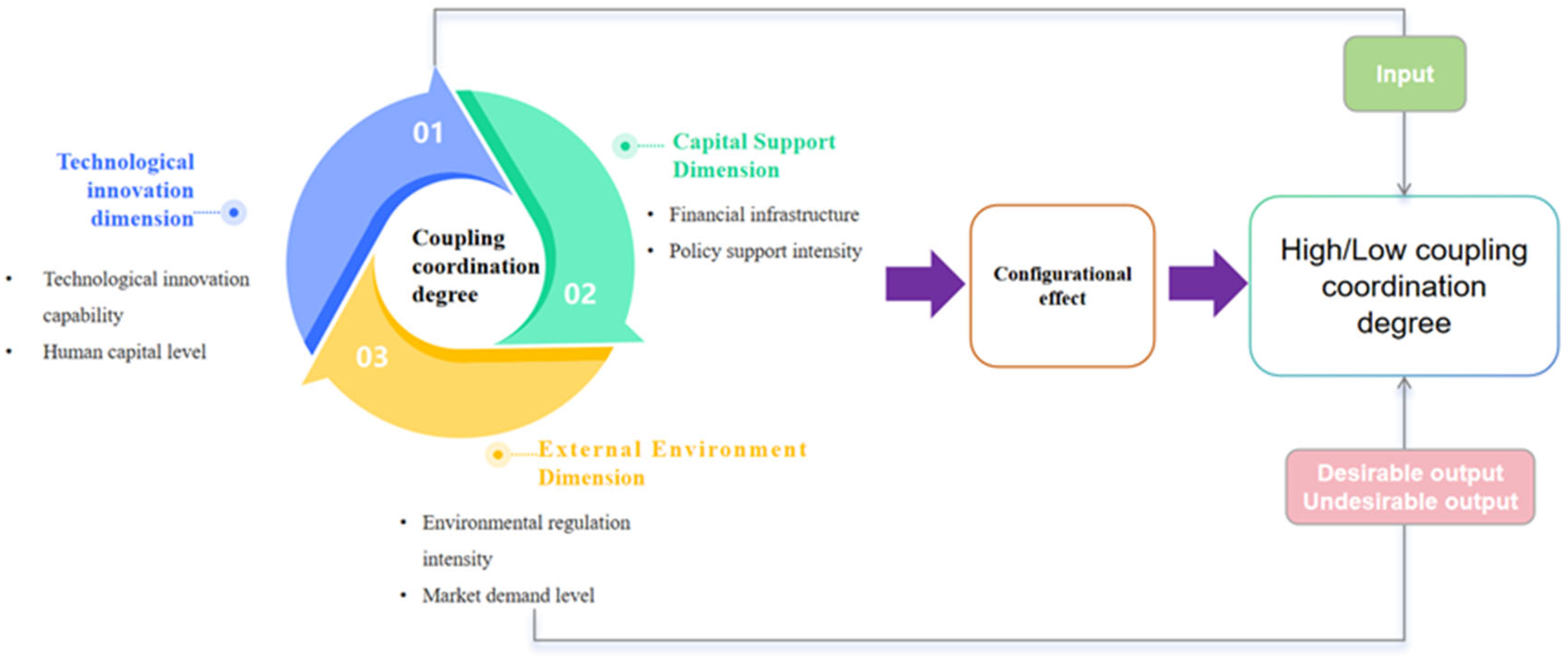
50], arises not from any single condition’s “net effect” but from complex causal relationships jointly induced by multiple elements across the three dimensions: technological innovation, capital support, and external environment. Different regions, according to their resource endowments and institutional environments, can achieve the “equifinal” goal of integrated development through differentiated pathways. This proposition aligns closely with the methodological foundation of the dynamic QCA approach employed herein, thereby establishing the theoretical groundwork for the subsequent empirical analysis.
Technological innovation, human capital, financial infrastructure, policy support, environmental regulation, and market demand—these six antecedent conditions collectively determine, in conclusion, the extent of coupling coordination in green finance and the digital economy. Their theoretical foundation lies in the multi-factor synergistic effects emphasized by systems coupling theory and the TOE framework. A “1 + 1 > 2” synergistic effect arising from the convergence of the digital economy and green finance has been confirmed by existing research [
51], implying that such synergistic development relies on the joint action of multiple factors.
The notions of causal complexity and equifinality from configurational theory provide the theoretical grounding for adopting a configurational perspective to examine how these six conditions jointly influence CCD. The synergistic effects characterizing green finance–digital economy synergy manifest typical configurational characteristics, and regional heterogeneity implies that different cities may achieve high-level synergy through varied pathways [
52]. Therefore, from a configurational perspective, this study identifies the multiple pathways driving high-level synergy and their evolutionary patterns (See
Figure 1).
4. Research Design
A combined research strategy integrating the coupling coordination degree model with dynamic QCA is employed herein. First, the coupling coordination degree model is utilized to calculate the synergy characterizing the two systems—green finance and the digital economy—across cities in the Pearl River Delta. Second, with “high coupling coordination degree” set as the outcome variable, the dynamic QCA method is utilized to identify its driving configurations [
53]. Qualitative Comparative Analysis (QCA) is a method that, drawing upon set theory and Boolean algebra, analyzes the logical relationships between conditions and outcomes in terms of set membership relations [
54,
55]. Traditional QCA methods (csQCA, fsQCA, mvQCA) exhibit notable limitations—they struggle to effectively incorporate the temporal dimension and case heterogeneity. The temporal dimension acknowledges the possibility of condition variables’ effects evolving across various periods; case heterogeneity refers to the possibility that the mechanisms of action for the same condition may differ across individuals. As traditional QCA is predominantly based on cross-sectional data for static analysis, researchers often treat configurational pathways identified at a single time point as temporally stable universal conclusions, overlooking the dynamic evolutionary characteristics of causal relationships.
To overcome this limitation, various methodological extensions incorporating the temporal dimension into QCA have been developed. However, some struggle to systematically observe cross-period effects, while others exhibit deficiencies in information utilization efficiency. In 2016, Garcia-Castro and Ariño proposed Panel Data QCA (PD-QCA), extending the traditional consistency concept into three types: aggregate consistency (overall average effect), between-entity consistency (time effect), and within-entity consistency (individual effect) [
56]. By calculating these three types of consistency and their adjustment distances, the dynamic evolutionary patterns of causal conditions across temporal and spatial dimensions can be systematically assessed.
The PD-QCA method is employed herein with consideration of the following aspects: First, the sample comprises panel data of nine Pearl River Delta cities from 2014 to 2023 (90 “city-year” observations). PD-QCA can fully utilize its temporal and cross-sectional information to effectively capture the dynamic evolution of configurations across time and space, thereby addressing the “temporal blind spot” problem inherent in static analyses [
57]. Second, the study aims to reveal the dynamic evolutionary patterns of driving pathways and their differential resilience under external shocks, and the between-entity consistency analysis of PD-QCA aligns closely with this objective. Third, this method has received widespread application and empirical support across disciplines including organizational management and regional development.
4.1. Coupling Coordination Degree (CCD) Model
Data for calculating the coupling coordination degree are drawn from multiple sources spanning 2014–2023: municipal statistical yearbooks, the China City Statistical Yearbook, the Peking University Digital Financial Inclusion Index (a joint compilation by the Institute of Digital Finance at Peking University and Ant Group), and government bulletins at various levels. Both postal and telecommunications business revenue data for Zhongshan City in 2023 were missing and were estimated using the linear interpolation method. This method estimates reasonable values for the missing years based on the average annual growth trend of the city’s data from 2014 to 2022, thereby minimizing estimation bias while maintaining temporal continuity. The linear interpolation method is widely used in panel data processing [
58], offering advantages such as simplicity, transparency, and no strict requirements regarding data distribution.
4.1.1. Green Finance Indicator System
Green finance development levels are comprehensively measured in this study, covering diversified instruments including green credit, insurance, securities, funds, socially responsible investment, environmental securitization, and carbon finance. A comprehensive evaluation indicator system for green finance development is constructed in this study, drawing upon prior research approaches [
59,
60], and guided by data availability and indicator representativeness. This system encompasses seven dimensions—green credit, investment, insurance, bonds, support, funds, and equity—thereby holistically reflecting the diverse practices and comprehensive levels of regional green finance development.
The rationale for each dimension of green finance is explained below, beginning with green credit—the most central financing instrument in this domain, which reflects the intensity of financial institutions’ credit support for environmental protection initiatives. A key indicator for measuring green investment scale is provided by the ratio of environmental pollution control investment to GDP, which reflects the investment intensity of both local governments and social capital in pollution abatement. Environmental pollution liability insurance represents an important risk management tool in green finance, reflecting the extent of market coverage for environmental risks. Green bonds serve as a source of long-term stable funding for environmental initiatives, with their market scale reflecting the depth and maturity of green finance. Fiscal environmental protection expenditure embodies the government’s direct support for green development and serves as an important supplement to the green finance system. Green funds guide social capital toward green industries, reflecting the degree of capital market participation in green investment. The environmental rights trading market represents an innovative area of green finance, with its activity level indicating the development degree of market-based environmental governance mechanisms (see
Table 1).
4.1.2. Digital Economy Indicator System
This research undertakes a thorough evaluation of digital economy development levels. Drawing on the indicator construction logic and methods from existing research, it incorporates the approach of using mobile phone-related indicators to measure urban internet development levels, thereby integrating digital infrastructure into the indicator system. It also adopts the methodology of using telecommunications and software business-related indicators to reflect information technology output, establishing the digital industry foundation dimension. Simultaneously, it incorporates the framework idea of constructing a digital economy evaluation system from multiple dimensions—“carrier-industrialization-environment”. Combining the core connotation and practical characteristics of digital economy development, the study ultimately identifies five core dimensions: the Digital Inclusive Finance Index, Digital Infrastructure, Digital Industry Foundation, Human Resource Support, and Economic Development Foundation, to construct a comprehensive evaluation index system for digital economy development. In this system, higher indicator values for each dimension represent a more solid foundation and higher level of regional digital economy development (see
Table 2) [
35,
61].
The Peking University Digital Financial Inclusion Index serves as an authoritative metric for digital inclusive finance development [
62], capturing the coverage breadth, usage depth, and digitization level of digital financial services. Mobile phone penetration rate is a fundamental indicator measuring regional digital infrastructure coverage, reflecting residents’ capacity to access digital networks [
63]. Postal services (particularly courier services) constitute important support for e-commerce and digital trade, reflecting the physical distribution capacity of the digital economy. A core indicator for digital industrialization is represented by telecommunications revenue, which captures both the scale and activity level of regional information and communication industries. Per capita GDP serves as both an indicator of overall regional economic development and a foundational condition supporting digital economy growth. The tertiary industry (especially producer services) serves as the main application scenario for digital technologies, with industrial structure upgrading closely related to digitalization levels.
Being an objective weighting technique, the entropy method assigns weights entirely according to the dispersion degree of indicator data, which may not fully reflect the theoretical a priori importance of indicators. Nevertheless, the entropy method is chosen for the reasons outlined below: First, the entropy method operates by assigning weights on the basis of indicator data dispersion, remaining free from the biases that subjective weighting techniques (e.g., Delphi method and analytic hierarchy process) may introduce. Second, in contrast to the equal weighting method—which implies an “all indicators are equally important” assumption—the entropy method distinguishes indicator importance based on the data’s inherent information content, making it more suitable for multi-dimensional comprehensive evaluation in the context of green finance and the digital economy. Third, unlike principal component analysis—which imposes no requirement for linear relationships among indicators—the entropy method yields weights with clear information-theoretic meaning: the greater the indicator variation, the more information it contains, and the higher its weight. This characteristic aligns closely with this study’s focus on regional disparities and dynamic evolution. To address the inherent limitations of the entropy method, content validity of the indicator system is ensured during the selection phase via comprehensive literature review; additionally, the equal weighting method is employed in robustness tests to recalculate the composite index, thereby examining the sensitivity of conclusions to weight settings. Robustness tests indicate that after recalculating the composite index using the equal weighting method, the core conclusions do not undergo substantive changes (see
Section 5.7).
The entropy method determines the weights for the composite index, which are subsequently applied to the standardized indicator values to derive the comprehensive development indices for green finance and the digital economy. The specific steps include:
- ①
Data standardization: Due to differences in the dimensions, magnitudes, and positive/negative orientations of various indicators, the original data must undergo standardization. The treatment of positive versus negative indicators employs distinct standardization methods, detailed as follows.
- ②
Calculate the proportion of the value of the
j-th indicator in the
i-th year:
- ③
Calculation of indicator information entropy:
Let , then 0 ≤ ≤ 1, and when 0, set × = 0.
- ④
Calculation of information entropy redundancy:
- ⑤
Determination of indicator weights:
Explanation of the Rationale for Key Proxy Variables: For digital infrastructure measurement, the “number of mobile phone subscribers at year-end” serves as a proxy variable, based primarily on the following considerations: First, mobile phone penetration rate is a fundamental indicator measuring regional digital infrastructure coverage, effectively reflecting residents’ capacity to access digital networks and the breadth of digital technology application [
63]. Second, at the Pearl River Delta urban agglomeration level, mobile phone subscriber data exhibits good availability and cross-year comparability, whereas more granular infrastructure indicators (for instance, 5G base station density and fiber-to-the-home penetration rate) suffer from extensive missing data during the early sample period. Third, existing studies commonly adopt this indicator to measure urban-level digital infrastructure, and its validity has been widely verified. Similarly, “postal business revenue” and “telecommunications business revenue” serve as proxy variables for the digital industry foundation, effectively reflecting the scale and activity level of e-commerce, digital trade, and information and communication industries. These are commonly used indicators for measuring the level of digital industrialization [
64].
4.1.3. Coupling Coordination Degree
To analyze the mutual relationship linking green finance and the digital economy, we utilize the Coupling Coordination Degree (CCD) model. This model can analyze the mutual influences and coordination among elements within a system. The coupling coordination degree model is formulated as follows:
In the model, the coupling degree between green finance and the digital economy is denoted by C, where
and
are the comprehensive scores of green finance and the digital economy, respectively. A higher value of C indicates better coupling. In the model, let T denote the comprehensive coordination index for green finance and the digital economy, while α and β are undetermined coefficients. Against the backdrop of China’s “dual carbon” goals coupled with its digital economy strategy, green finance and the digital economy are explicitly positioned as “dual-wheel drivers” for high-quality development. Policy documents consistently emphasize their synergistic development and bidirectional empowerment. For instance, the 14th Five-Year Plan for Digital Economy Development and the Guidance on Building a Green Finance System accord both sectors the same strategic priority. A bidirectional reinforcing dynamic exists between green finance and the digital economy: on one hand, the digital economy supplies technological tools—such as blockchain for green bond tracing and big data for environmental risk assessment—to green finance; on the other, green finance provides capital support enabling the digital economy’s green transition [
65]. This bidirectional interaction precludes arbitrarily assigning higher weight to either subsystem. The assumption of equal importance between green finance and the digital economy is adopted herein, with
=
= 0.5. The coupling coordination degree, denoted by D, reflects the synergy between green finance and the digital economy, with higher values indicating stronger synergistic effects.
Table 3 details the 10-level classification of coupling coordination degree used in this study [
66,
67].
4.2. Dynamic QCA Variable Design
The outcome variable is the coupling coordination degree between the green finance and digital economy systems. Based on the theoretical framework, six antecedent conditions are selected as follows (see
Table 4):
- ①
As cited in the Report on the Development Achievements of China’s Industrial Internet by the China Academy of Information and Communications Technology [
68], the average annual growth rate method is utilized for index forecasting. This approach constructs an indicator system from three dimensions—R&D investment, innovation outputs, and innovation carriers—to comprehensively measure the annual changes in regional innovation activity-related indices (such as the Industrial Internet Development Achievement Index). Based on the average growth rate of time series data, it extrapolates the evolutionary trend of future innovation capacity. Specifically, this method begins with a base period index value (e.g., setting 2020 as 100), then computes the average annual compound growth rate across years, and subsequently applies this rate to forecast future index levels, thereby quantifying technological innovation’s evolutionary trend and driving potential.
- ②
Human Capital: This indicator is measured by the number of students enrolled in regular institutions of higher education in each city. Human capital, which is commonly measured by the number of university students at the urban level [
69], serves as a fundamental carrier of regional innovation capacity and technological absorption capability. This indicator effectively reflects the regional talent supply potential: in the field of green finance, high-quality human capital enhances professional capacity for green project risk assessment and environmental benefit identification; in the digital economy domain, human capital accumulation directly influences the efficiency of digital technology R&D, application, and diffusion [
70]. Moreover, employing the number of university students to measure human capital offers high data availability and demonstrates strong theoretical alignment with research themes such as green innovation and digital transformation. The groundbreaking study by Atiqur Rahman et al. points out that the higher the level of human capital, the faster the speed of technological catch-up and innovation [
71].
- ③
Financial Infrastructure: Measured by “the ratio of year-end deposits and loans balance of financial institutions to regional GDP in each city.” The deposits and loans balance of financial institutions captures the financial sector’s service to the real economy, thereby serving as a measure of regional financial development level through its ratio to GDP, which reflects fund aggregation capacity and allocation efficiency [
72]. Within the green finance sector, well-developed financial infrastructure helps reduce financing costs for green projects and expand green bond issuance channels; in the digital economy domain, a developed financial system can provide sustained and stable financial support for digital infrastructure construction and digital industry cultivation [
73].
- ④
Policy Support: Regarding the measurement of policy support, in the absence of quantifiable policy metrics for the digital economy, this study collects and examines local government work reports to determine the occurrence frequency of terminology pertaining to the digital economy. Python 3.13.0 is used to perform textual analysis on government work reports, with the frequency of digital economy-related terminology statistically analyzed to gauge policy support intensity [
74,
75]. The keyword dictionary includes: digital economy, intelligent economy, information economy, knowledge economy, smart economy, digital information, modern information networks, information and communication technology, ICT, communication infrastructure, internet, cloud computing, blockchain, Internet of Things, digitalization, digital village, digital industry, e-commerce, 5G, digital infrastructure, artificial intelligence, AI, big data, datafication, industrial digitalization, digital industrialization, data assetization, smart city, cloud services, cloud technology, cloud computing, e-government, mobile payment, online, information industry, software, information infrastructure, information technology, digital life, etc. Finally, standardization is achieved by computing the ratio of digital economy policy term frequency to the annual report’s total word count, multiplied by 100, thereby controlling for text length variation.
- ⑤
Environmental Regulation: Reflecting China’s top-down governance framework and the government’s key role, this study utilizes the frequency share of environmental protection-related terms in government work reports to gauge regional environmental regulation intensity [
76,
77]. Specifically, the proportion of environmental term frequency refers to the proportion of sentences containing environment-related terms to the entire content of government work reports. Government work reports, formulated during the “Two Sessions” at the beginning of each year, aggregate the demands and consensus of multiple social sectors, serving as a definitive guide for that year’s governmental work. Environmental emphasis in government work reports mirrors that year’s governance efforts and overarching policy landscape, thereby meeting exogeneity conditions. The keyword dictionary includes: environmental protection, environment, green, low-carbon, ecology, air pollution, sulfur dioxide, chemical oxygen demand, haze, particulate matter, carbon dioxide, energy consumption, bulk coal, coal combustion, pollutant discharge, emission reduction, exhaust, energy conservation, emission reduction, desulfurization, denitrification. Finally, standardization is also performed to obtain the final data.
- ⑥
Market Demand (F) is operationalized as the share of actually utilized foreign capital in regional GDP. While this indicator primarily captures external market openness rather than domestic demand, it serves as a theoretically appropriate proxy for market demand in the Pearl River Delta context for two reasons. First, FDI inflows embody demand for host-country investment opportunities, technology transfer, and market access—particularly relevant for green-digital integration where foreign-invested enterprises often lead technology adoption [
78]. Second, extensive empirical research on China’s regional development uses FDI intensity to capture external market demand and technology spillover effects [
79]. For the globally integrated Pearl River Delta, FDI reliably reflects the market pull for sophisticated green financial services and digital transformation solution.
4.3. Data Sources, Processing, and Calibration
This study utilizes panel data covering nine Pearl River Delta cities over 2014–2023. Data are drawn from multiple sources, including city-level statistical yearbooks and the China City Statistical Yearbook. To guarantee data comparability and measurement rigor, standardization is applied to address unit inconsistencies across the collected secondary data. On this basis, indicator weights are determined via the entropy method. The calculation process of the entropy method involves the transformation of proportions of the standardized data and natural logarithm operations.
On this basis, the entropy method is first applied to determine the weights of secondary indicators within each subsystem; secondly, the comprehensive development indices for the digital economy and green finance systems are derived via weighted summation. Following standard practices in QCA calibration [
80], we used Excel to determine the membership anchors for each standardized variable. The 95th percentile, median (50th percentile), and 5th percentile of the sample distribution were set as the thresholds for full membership [
81], the crossover point, and full non-membership, respectively. The underlying assumption of this calibration strategy is that the sample distribution provides a valid representation of the empirical reality. Consequently, the upper tail, median, and lower tail of this distribution serve as appropriate proxies for the qualitative states of full membership, the crossover point, and full non-membership, thereby converting the raw data to fuzzy-set scores within [0, 1] [
82].
Table 5 presents the specific calibration values.
The core formula system of the PD-QCA method is as follows:
Within the set-theoretic analytical framework, consistency serves as the core indicator measuring the extent to which condition X constitutes a subset of outcome Y. Ragin [
83] formally defines it as:
where X
i and Y
i represent the membership scores of case i in condition set X and outcome set Y, respectively. This indicator captures the degree of sufficiency of X as a subset of Y, with values closer to 1 indicating stronger explanatory power of X for Y.
When the research context expands from cross-sectional data to panel data, the connotation of consistency undergoes structural divergence. Assuming panel data comprises N observed individuals (i = 1, …, N) and T observed periods (t = 1, …, T), three types of consistency indicators can be defined as follows:
- (1)
Pooled Consistency: Treating all N × T “individual-period” observations as a whole, the calculated consistency is termed pooled consistency:
This indicator reflects the overall average effect disregarding temporal and individual differences, equivalent to the result of merging all cross-sectional consistencies [
84].
For each time period t: t = 1, …, T.
Between consistency measures the stability of causal relationships across different time points, i.e., the time effect. Significant fluctuations in annual between consistency values indicate structural changes in the relationship between conditions and outcomes as periods evolve. In existing literature, between consistency is commonly referred to simply as “consistency” and represents the most frequently used indicator in traditional QCA studies [
85].
For each individual i: i = 1, …, N.
Within consistency refers to the stability characterizing a given case’s condition-outcome relationship over time—i.e., the individual effect. Substantial variation in within consistency values across different individuals indicates significant case heterogeneity in the causal mechanisms.
5. Empirical Results and Analysis
5.1. Spatiotemporal Evolution Analysis of the Coupling Coordination Degree
5.1.1. Overall Level Analysis
The entropy method and coupling coordination degree model are employed to compute the coupling coordination degree between green finance and the digital economy, with results presented in
Table 6. The 2014–2023 period witnessed a rise in the mean coupling coordination degree of the Pearl River Delta from 0.453 to 0.599, with the coordination level advancing from the verge of imbalance to barely coordinated. This trend aligns with studies on the national level and the Yangtze River Economic Belt, confirming the continuously strengthening interactive relationship between the two systems [
86,
87].
Although the broader eastern region has achieved primary coordination, the Pearl River Delta, its core area, lags at the barely coordinated stage (0.5–0.6) and has yet to make the overall leap. This phenomenon of “leading region, lagging coordination” warrants attention [
88]. The reason lies in the fact that the two systems are still in a transitional period from “quantitative accumulation” to “qualitative synergy”—green credit relies on traditional project assessments, the emission data accumulated by digital platforms have not yet formed standardized financial interfaces, and the “data-capital” positive feedback loop remains unestablished. This echoes the assessment that “the effects of digital-green integration need to be gradually released through intermediate channels such as industrial upgrading and mitigation of financial misallocation” [
11].
5.1.2. Analysis of Coupling Coordination Degree in the Pearl River Delta
Table 7 reveals significant spatial heterogeneity within the Pearl River Delta, presenting a gradient declining pattern of “core leading—key development—potential catch-up,” consistent with Ma et al. [
89].
The first tier (core leading type): Guangzhou (0.799) and Shenzhen (0.794) are in an intermediate coordination state. In 2022, Shenzhen ascended to high-quality coordination, validating the assertion of Song et al. regarding “the more prominent empowerment effect of digital finance in the eastern region [
90]”.
The second tier (key development type): Dongguan (0.568), Foshan (0.519), and Zhuhai (0.500) are in a barely coordinated state, exhibiting what has been referred to as “industry heterogeneity in digital finance empowerment”—the digital transformation of manufacturing is rapid, while supporting green finance measures lag behind [
91].
The third tier (potential catch-up type): Zhongshan (0.460) and Huizhou (0.445) are on the verge of imbalance, while Jiangmen (0.397) and Zhaoqing (0.355) are in a mild imbalance state. However, their average annual growth rates significantly exceed those of the first two tiers, exhibiting characteristics of “latecomer catching up,” which echoes the conclusion of Zhou regarding “narrowing regional disparities [
92]”.
In terms of the average annual growth rate of the coupling coordination degree, the potential catch-up cities exhibit a “late-comer catching-up” characteristic: Zhaoqing has the highest growth rate, followed by Huizhou and Jiangmen, while the growth rates of core leading and key development cities are relatively lower. This phenomenon indicates that the spatial disparities among the three tiers of cities in the PRD exhibit typical gradient differentiation. The underlying reasons lie in the fact that potential catch-up cities still have incomplete digital infrastructure deployment and insufficient depth in the integration of next-generation information technologies with the real economy. The innovative supply and scenario application of green financial products and services are also relatively lagging, preventing the synergistic enabling effect of the two major fields from being effectively realized. In contrast, core leading cities, capitalizing on first-mover advantages, have established a virtuous cycle in digital infrastructure, industrial synergy, and institutional innovation, further consolidating their leading position in coordinated development.
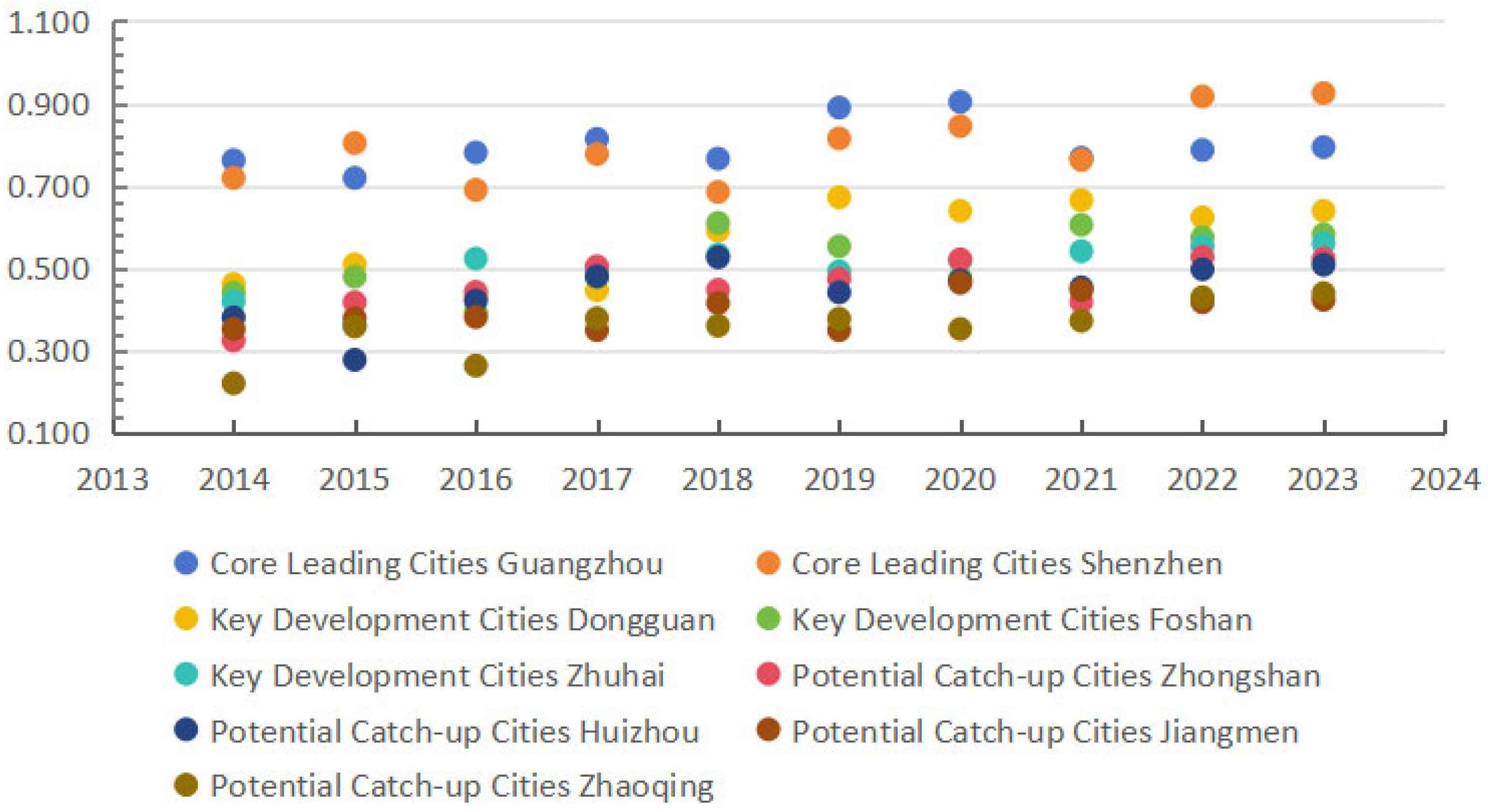
Figure 2 displays the evolution of green finance and digital economy coordination across the Pearl River Delta between 2014 and 2023. Regarding trends, green finance–digital economy coordination among all three tiers follows a generally rising path, reflecting enhanced synergistic and co-progressive capacities across the region. Looking at average annual growth figures, core leading cities post 1.64%, key development cities 3.37%, and potential catch-up cities 4.69%. This indicates that potential catch-up cities grow most rapidly, core leading cities rank next, and key development cities sustain steadier expansion. Different tiers exhibit differentiated characteristics in the speed of synergistic development, all exceeding the overall regional development expectations.
In terms of the tier averages, the coordination level of the core leading cities (Guangzhou, Shenzhen) has consistently remained within the 0.7–0.8 range, rising from 0.7089 in 2014 to 0.8336 in 2023, classifying as a High-quality Coordination type. Additionally, it surpassed the 0.8 threshold in 2022–2023, advancing into a High Coordination phase and establishing these cities as regional exemplars for green finance–digital economy synergy. The average coordination of key development cities (Dongguan, Foshan, Zhuhai, Zhongshan) increased from 0.4480 in 2014 to 0.5453 in 2023, remaining within the 0.4–0.6 range, progressing from Primary Coordination to Intermediate Coordination, with the foundation for synergistic development continuously strengthening. The average coordination of potential catch-up cities (Huizhou, Jiangmen, Zhaoqing) grew from 0.3381 in 2014 to 0.4615 in 2023, staying within the 0.3–0.5 range, advancing from Mild Dysregulation towards Primary Coordination. Although there is still room for improvement, synergistic momentum has been significantly released under strengthened factor supply.
Overall, the three tiers exhibit a differentiated development pattern characterized by “core leading type leading the way, key development type catching up, and potential catch-up type gathering momentum,” with the coordination levels of each tier showing an upward trend year by year. This indicates that the overall momentum for the synergistic development of green finance and the digital economy in the Pearl River Delta is positive, with cities across different tiers continuously advancing the integration and coordination of the two systems at their respective development levels.
5.1.3. City-Level Analysis
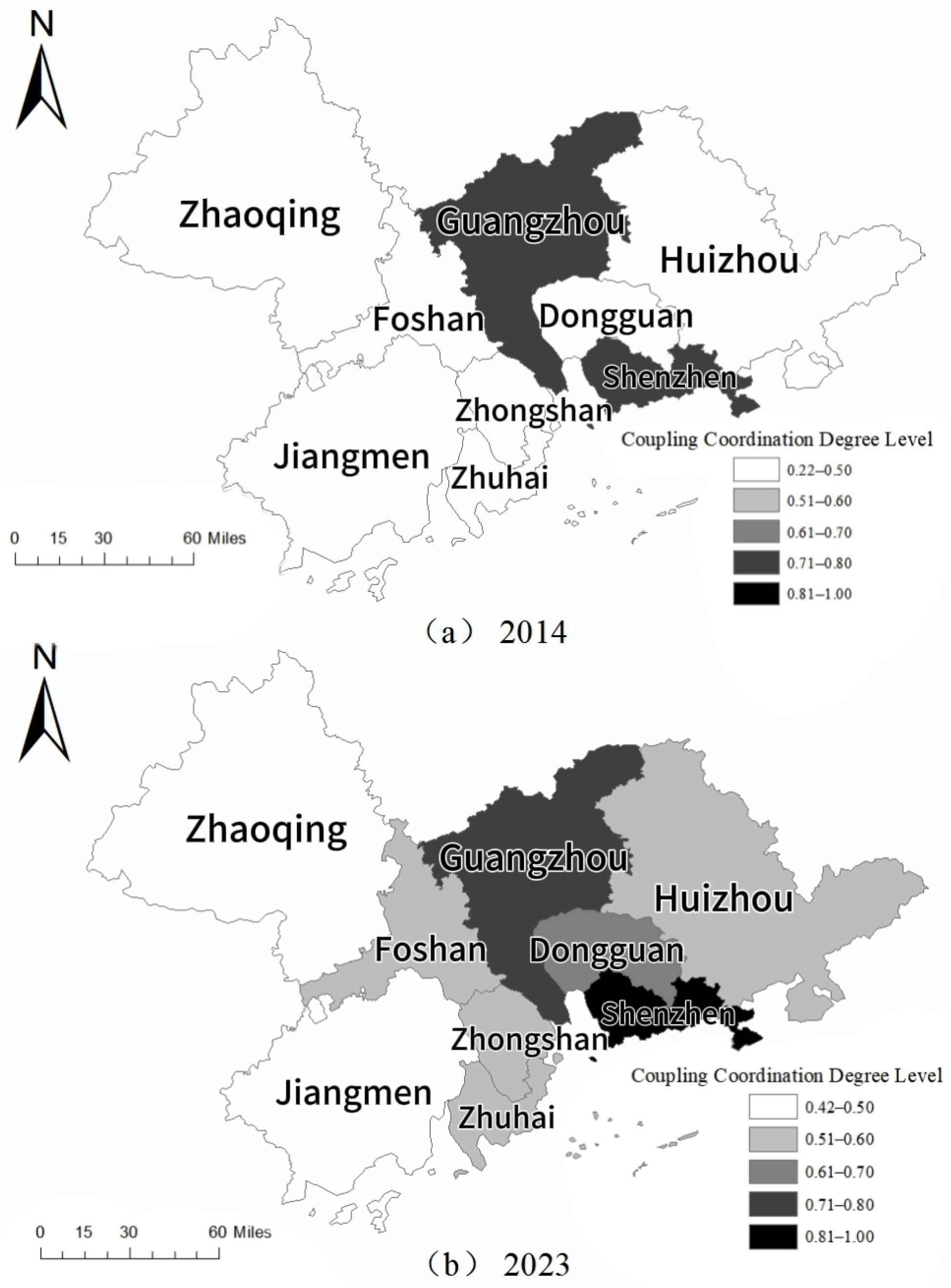
Figure 3 illustrates a typical “core-periphery” structure in the coordination degree across the Pearl River Delta. In 2014, only Guangzhou and Shenzhen achieved intermediate coordination; by 2023, Shenzhen had ascended to high-quality coordination, Guangzhou maintained intermediate coordination, and most cities in the core area entered barely coordinated status, forming a contiguous coordination zone. This corroborates the finding of Kharb et al. regarding “the spatial spillover effects of green digital finance [
93].” However, western peripheral cities remain below 0.50: Jiangmen (0.423) and Zhaoqing (0.439) are both on the verge of imbalance, facing three types of constraints identified in the literature—low industrial hierarchy, insufficient innovation resources, and weak accessibility to green finance. Peripheral cities need to explore characteristic pathways based on their endowments—Zhaoqing can achieve catch-up through “human capital–policy dual-core guidance” (Configuration 2), while Jiangmen can rely on “technology–infrastructure synergistic driven” (Configurations 3/4) [
94].
5.2. Necessary Condition Analysis of Single Conditions
Similar to the procedure for testing necessary conditions in traditional QCA, two indicators—consistency and coverage—are employed to verify whether individual condition variables constitute sufficient or necessary conditions. Generally, consistency levels of 0.8–0.9 indicate that X is sufficient for Y, while values above 0.9 denote necessity. When the adjustment distance falls below 0.2 in panel data QCA, pooled consistency demonstrates greater precision and provides stronger support for judgment outcomes [
56]. For adjustment distances above 0.2, conditional necessity must be further examined.
Table 8 reveals that for high green finance and digital economy coordination, the pooled consistency of all condition variables fails to reach 0.9, indicating that no individual condition is necessary for high-level regional innovation capacity. For low green finance and digital economy coordination, the pooled consistency of “low technological innovation (~A)” and “low human capital (~B)” exceeds 0.9, and their pooled coverage significantly exceeds 0.5, indicating they constitute necessary conditions for low-level regional innovation capacity. Other condition variables fall below the judgment threshold and do not constitute necessary conditions.
For reader comprehension, a brief explanation of two core QCA concepts is provided: A necessary condition is defined as one that is required for the outcome to occur, yet its existence does not ensure that the outcome will inevitably materialize. A sufficient condition is defined as one that by itself guarantees the outcome, although the outcome may also be achieved through alternative pathways. In QCA, conditions with consistency above 0.9 can be regarded as necessary conditions, while sufficiency analysis focuses on how multiple conditions combine to form sufficient pathways for the outcome.
Causal combinations with between-entity consistency adjustment distances exceeding 0.2 undergo further analysis, as presented in
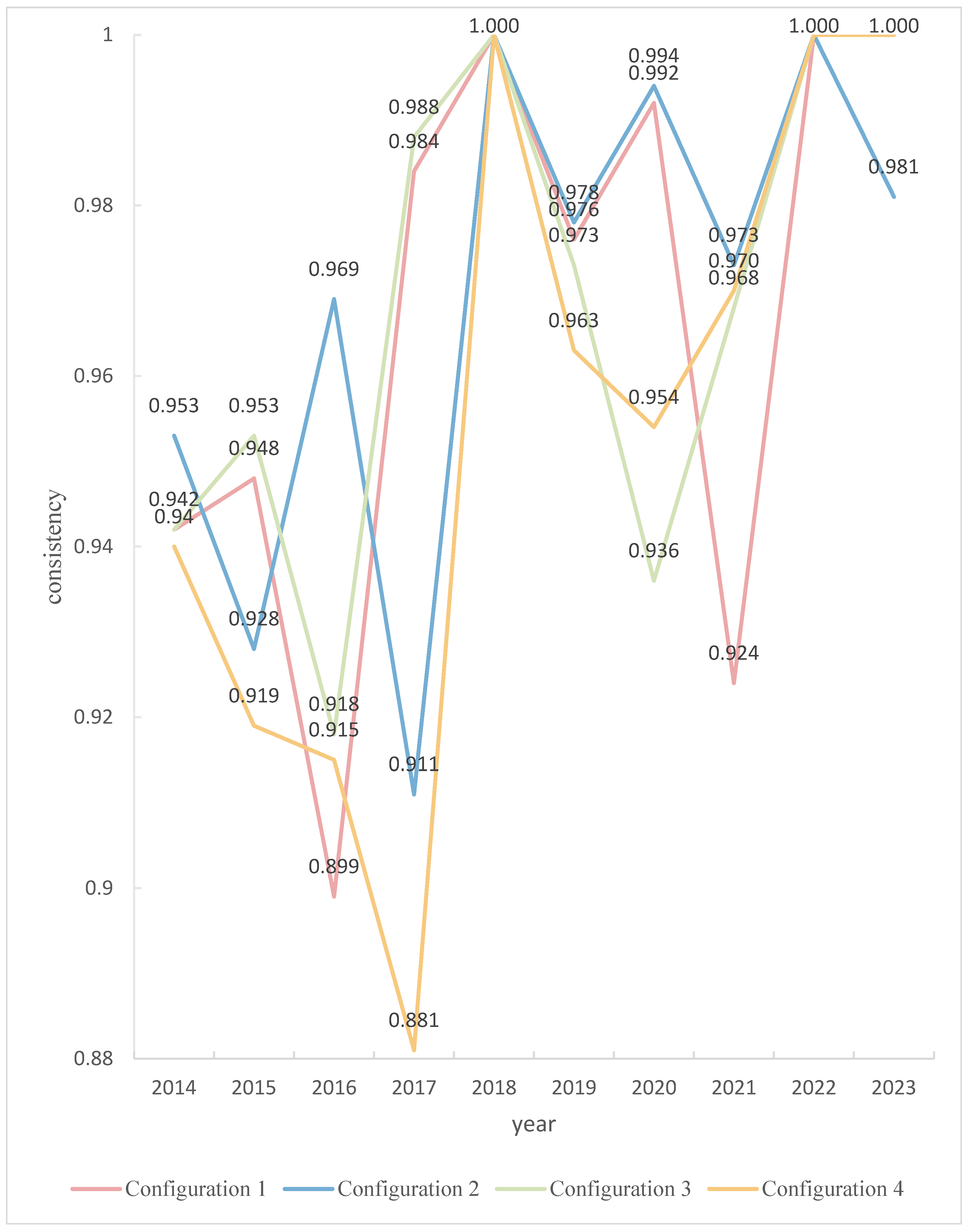
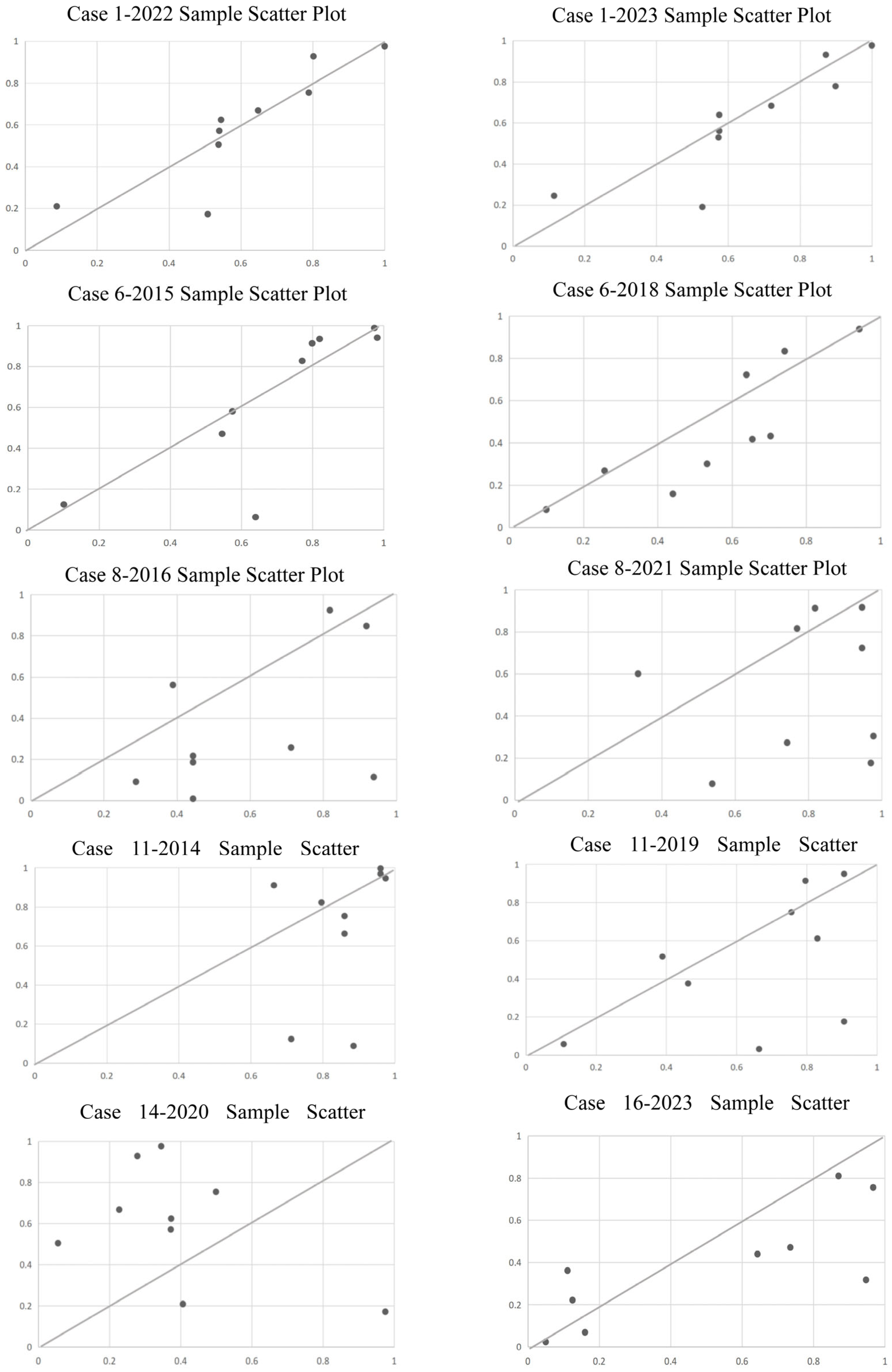
Table 9. As shown by the findings, for Cases 2–5, 7, 9, 12, 13, and 15, between-entity consistency remains below 0.9 across all years; thus, no necessity is established. Secondly, although Case 1 exhibits consistency levels above 0.9 in 2022 with coverage greater than 0.5, the X-Y scatter plot test indicates that this condition variable does not constitute a necessary condition; however, it satisfies the necessary condition in 2023 [
80]. Similarly, as shown in
Figure 4, through plotting scatter diagrams for Case 6 for 2015 and 2018, the condition variable also fails the necessity test. Case 8 fails the test in 2016 and 2021; Case 11 fails in 2014 and 2019. Additionally, Case 14 in 2020 and Case 16 in 2023 both fail the necessity test.
Finally, through the between-entity consistency of Case 1 (A→Y), Case 2 (A→~Y), and Case 6 (~C→~Y) shown in
Table 9, the dynamic evolutionary trends of three key causal relationships are demonstrated. These changes carry profound institutional implications. For Case 1 (A→Y), consistency steadily increased from 0.567 in 2014 to 0.954 in 2023. This enhanced driving effect of technological innovation signals the Pearl River Delta’s increasingly mature regional innovation system: whereas its contribution to synergy was relatively dispersed initially, improvements in digital infrastructure and green financial instruments have rendered this empowering effect systematic and stable, reflecting structural institutional maturity. For Case 2 (A→~Y), consistency rose from 0.108 to 0.734, indicating that the absence of technological innovation is increasingly becoming a key obstacle to synergistic development, reflecting the enhanced dependence of regional development on innovation factors. For Case 6 (~C→~Y), consistency increased from 0.421 to 0.834, revealing that the constraining effect of absent financial infrastructure intensifies over time, confirming the increasingly prominent foundational supporting role of the financial system in green-digital integration. Overall, these dynamic evolutions reflect both the institutional maturity of the regional innovation system and the structural shifts in factor dependency.
A noteworthy finding from the necessity analysis (
Table 8) is that for high coordination between green finance and the digital economy (Y), the pooled consistency of condition absence states (~C, ~E, ~F) exceeds that of their presence states (C, E, F). This calls for interpretation along two dimensions: the logical underpinnings of QCA necessity analysis and the heterogeneous structure of the Pearl River Delta sample.
First, necessity analysis reveals “background characteristics” rather than “causal effects.” In QCA, necessity addresses the question: “When outcome Y occurs, is condition X always present?” The high consistency of ~C (0.875) indicates that among the cases achieving high coordination in the Pearl River Delta, the vast majority occurred in cities with weak financial infrastructure. This does not equate to “weak financial infrastructure promotes synergy,” but rather reflects the distribution characteristic that “cities with weak infrastructure constitute the majority” in the sample. As shown in
Table 7, among the nine Pearl River Delta cities, core leading cities with well-established financial infrastructure (Guangzhou, Shenzhen) account for only two, while key development cities with relatively weak financial infrastructure (Dongguan, Foshan, Zhuhai) and potential catch-up cities (Zhongshan, Huizhou, Jiangmen, Zhaoqing) account for seven in total. It is precisely these cities, which constitute the majority of the sample, that have achieved improved coordination through compensation mechanisms involving other conditions, thereby elevating the consistency level of ~C in the necessity analysis. Similarly, the high consistency of ~E and ~F also results from potential catch-up cities with lax environmental regulations and inactive market demand constituting the majority in the sample.
Second, the high consistency of ~C, ~E, and ~F constitutes a statistical mapping of the “core-periphery” gradient pattern in the Pearl River Delta. A combined analysis of
Figure 2 and
Figure 3 reveals significant spatial differentiation characterized by “high in the center, low in the periphery.” Core leading cities (Guangzhou, Shenzhen), by virtue of well-established factor endowments, have long maintained coordination levels that fluctuate within the 0.7–0.9 range, spanning both intermediate and good coordination. Key development cities (Dongguan, Foshan, Zhuhai) are in the 0.5–0.6 barely coordinated stage, with their development foundations continuously being consolidated. Potential catch-up cities (Zhongshan, Huizhou, Jiangmen, Zhaoqing), despite generally facing practical constraints such as weak financial infrastructure (~C), inactive market demand (~F), and lax environmental regulations (~E), exhibit a strong “latecomer catching up” momentum—their average annual coordination growth rate reaches 3.37%, far exceeding core leading cities (1.77%) and key development cities (2.14%). Therefore, the high consistency of ~C, ~E, and ~F essentially provides a statistical depiction of the prevalent phenomenon wherein potential catch-up cities achieve rapid advancement under multiple constraints.
Third, this finding provides a crucial foundation for the subsequent configurational analysis. Precisely because key development and potential catch-up cities, constituting the majority of the sample, exhibit shortcomings in ~C, ~E, and ~F, they require strong combinations of other conditions to achieve a “compensation effect.” This constitutes the core finding revealed by the configurational analysis in
Table 10:
5.3. Inter-Configuration Analysis
Configuration 2 (B~CD), with Foshan and Zhaoqing as typical cases, demonstrates how human capital and policy support can “compensate for hardware with software,” addressing deficiencies in financial infrastructure. Configuration 1 (A*~F), with Huizhou as a typical case, illustrates how technological innovation can drive synergy ahead of market demand activation. Configurations 3 and 4 (AC~F), with Jiangmen as a typical case, demonstrate how synergy between technological innovation and financial infrastructure can achieve breakthroughs under the dual constraints of human capital and market shortcomings.
In other words, the high consistency of ~C, ~E, and ~F precisely confirms the “equifinal substitution” and “compensation mechanisms” emphasized by the TCE framework—under realistic conditions of uneven resource endowments, cities across different tiers can achieve “equifinal” synergistic development through differentiated combinations of factors. Particularly, potential catch-up cities, with their fastest growth rates, verify the existence of “compensatory catch-up pathways under constraint shortcomings”.
In summary, the high consistency of ~C, ~E, and ~F does not contradict theoretical expectations; rather, it represents a deepened understanding of the connotations of QCA necessity analysis and an empirical validation of the unbalanced regional development and diversified catch-up pathways in the Pearl River Delta.
5.4. Configurational Sufficiency Analysis
5.4.1. Sufficiency Analysis for High CCD
At its core, QCA identifies how various combinations of conditions jointly influence the outcome, with the sufficiency consistency level of conditional configurations serving as the key criterion. The parameter thresholds are set following the prevailing standards of the QCA method [
80]: the consistency threshold is set at 0.80, above the classic lower limit of 0.75, to ensure that the identified configurations possess sufficient causal explanatory power; the frequency threshold is set at 1, balancing the characteristics of a small-to-medium sample with the richness of theoretical findings; the PRI threshold is set at 0.75 to avoid contradictory configurations caused by simultaneous subset relationships. Robustness tests indicate that after raising the consistency threshold to 0.90 and the PRI threshold to 0.80, the core configurational logic remains stable, demonstrating the reliability of the parameter selection [
95]. The study employs R 4.5.1 software for data processing, obtaining both intermediate and parsimonious solutions. Using the intermediate solution as the primary basis and the parsimonious solution as a supplementary reference, and considering causal asymmetry, configurational pathways for high-level coordination are screened.
Table 10 presents the specific results. Four configurational pathways emerge from the analysis for achieving high-level coordination in green finance and the digital economy. Encompassing three types, they illustrate how different regions can attain coordinated development given varying resource endowments and institutional environments.
- (1)
Configuration 1: Technology-Dominated Institutional Synergy Type
This pathway corresponds to Configuration 1, exhibiting a consistency level of 0.973 and coverage of 0.316, which explains 31.6% of the sample cases, indicating high explanatory power and a certain degree of typicality. This model features the presence of technological innovation (A) and the absence of market demand (F) as core conditions, supplemented by the presence of policy support (D) and environmental regulation (E), while the absence of human capital (B) serves as a peripheral background condition. This pathway reveals a developmental reality: even when market demand is not yet fully activated and human capital is relatively scarce, strengthening indigenous technological innovation capabilities and supplementing them with institutional synergy from policy support and environmental regulation makes it possible to achieve effective green finance–digital economy coordination under constrained conditions. This model underscores both the foundational role of technological innovation—serving as a core driving force—and the compensatory synergistic effect of institutional factors (policy + regulation) in offsetting market and human capital deficiencies.
- (2)
Configuration 2: Human Capital–Policy Dual-Core Guidance Type
This pathway corresponds to Configuration 2, with a consistency level of 0.972 and coverage of 0.233, explaining 23.3% of the sample cases, indicating high explanatory power. This model features the presence of human capital (B), the absence of financial infrastructure (C), and the presence of policy support (D) as core conditions, supplemented by the presence of environmental regulation (E) and market demand (F). This pathway reveals a developmental reality: under conditions of weak financial infrastructure, through the dual-core guidance of human capital empowerment and policy support, combined with the pull of market demand and synergy with environmental regulation, a “software compensating for hardware” pathway to coordinated development is formed. This model highlights that when hardware facilities are insufficient, human capital and institutional factors (policy, regulation, market) can form effective complementarities, jointly driving such synergy.
- (3)
Configuration 3: Technology–Infrastructure–Policy Synergy Type
This pathway corresponds to Configuration 3, with a consistency level of 0.968 and coverage of 0.274, explaining 27.4% of the sample cases, indicating high explanatory power and a certain degree of typicality. This model features the presence of technological innovation (A) and the absence of market demand (F) as core conditions, supplemented by the presence of financial infrastructure (C) and policy support (D), while the absence of human capital (B) serves as a peripheral background condition. This pathway reveals a developmental reality: under conditions of relatively scarce human resources and insufficiently activated market demand, through the synergistic drive of technological innovation and financial infrastructure, supplemented by institutional guarantees from policy support, the shortcomings in talent and market can be compensated to a certain extent, achieving effective coordination in this domain. This model highlights the complementary reinforcement effects of the synergy among technological factors, hardware facilities, and policy support in driving systemic integration.
- (4)
Configuration 4: Technology–Infrastructure Foundation Type
This pathway corresponds to Configuration 4, with a consistency level of 0.949 and coverage of 0.286, explaining 28.6% of the sample cases, indicating high explanatory power and a certain degree of typicality. This model features the presence of technological innovation (A) and the absence of market demand (F) as core conditions, with the presence of financial infrastructure (C) as a supplementary condition, while the absence of human capital (B) and environmental regulation (E) serve as peripheral background conditions, and policy support (D) does not participate. This pathway reveals a special route to coordinated development under multiple constraints: against the backdrop of insufficient market demand, scarce human capital, lax environmental regulation, and absent policy support, merely relying on the “technology–infrastructure” foundational structure—composed of technological innovation and financial infrastructure—can still leverage effective green finance–digital economy coordination. This model highlights the strong adaptability of technological innovation as a core driving force and the foundational supporting role played by financial infrastructure in the absence of institutional support—together, they constitute the minimum structural foundation for systemic synergistic development.
Through the analysis of the above four models, it is evident that technological innovation (A) appears as a core condition in Configurations 1, 3, and 4, demonstrating its foundational position in systemic coordination. The absence of market demand (F) serves as a stable core condition in Configurations 1, 3, and 4, reflecting that the pull effect of domestic demand has not yet been fully unleashed at the current stage, and the realization of coordinated development still primarily relies on supply-side promotion and institutional design. The varied configurations of core and peripheral elements across pathways embody the principles of “multiple conjunctural causation” and “equifinality” within green finance–digital economy synergy, offering diverse strategic options across regions with distinct resource profiles.
Synthesizing the configurational findings, the driving logic for high-level green finance–digital economy synergy can be encapsulated as: technological innovation is a universal engine, but its fuel needs to be deployed according to local conditions. Specifically, Configurations 1, 3, and 4 all center on technological innovation, but the former requires institutional synergy (policy + regulation) to compensate for human capital shortcomings, while the latter relies on financial infrastructure for foundational support—this is akin to the same engine, which can focus on technological breakthroughs in human-capital-rich regions but requires institutional protection in human-capital-scarce regions; in regions with well-established infrastructure, the dual wheels of technology and facilities alone can drive progress. Configuration 2 demonstrates another logic: when financial infrastructure is weak, human capital and policy support can constitute a “software compensating for hardware” alternative, much like compensating for poor road conditions with high-quality drivers and traffic rules. These four pathways collectively reveal that such synergy has no standard formula but rather represents the optimal combination of multiple elements under different resource endowments.
5.4.2. Sufficiency Analysis for Non-High CCD
Based on considerations of causal asymmetry, this study further conducted sufficiency analysis for non-high CCD.
Table 10 also presents the configurations leading to non-high CCD. Comparison of intermediate and parsimonious solutions reveals the core conditions leading to non-high CCD. Parsimonious solution analysis shows that five combinations—C·F, ~A·~B·F, C·~D·E, D·~E·F, and ~A·~B·C·~E—constitute the most parsimonious pathways leading to non-high CCD. Among these, C and F appear as core conditions in multiple pathways, indicating they play key roles in the formation of non-high CCD. Peripheral conditions such as D, E, and A play roles in specific contexts, enriching our understanding of the formation mechanisms of non-high CCD. These pathways reveal the multiple concurrent causal mechanisms leading to non-high CCD, standing in stark contrast to the pathways for high CCD and confirming the causal asymmetry of QCA—the condition combinations that lead to the occurrence of an outcome are not simple mirror images of those that lead to its non-occurrence.
5.5. Inter-Configurational Results Analysis
To overcome the temporal blind spot inherent in traditional QCA methods, this study employs between-configuration consistency analysis to investigate the temporal dynamic effects of each conditional configuration. As shown in
Figure 5, the between-configuration consistency of the four configurations remained above 0.85 throughout 2014–2023, far exceeding the 0.75 criterion. Meanwhile, the adjustment distance of between-configuration consistency for each year remained below 0.2, indicating that these configurations maintained stability over time without significant temporal effects.
This study takes 2019 as the pre-pandemic baseline, 2020 as the core impact period, and 2021 as the recovery period, measuring the dynamic consistency characteristics of the four configurations (see
Figure 5).
The 2020 pandemic served as a “screening test” for configurational resilience, behind which lies the differentiated transmission of shocks through specific channels. From the demand side, economic contraction impacted expectations of green project cash flows. Configuration 1, relying on institutional synergy to compensate for human capital shortcomings, exhibited the highest vulnerability (relative decline of 4.39%) as policy resources tilted toward emergency response and environmental regulations were temporarily weakened during the early pandemic, becoming the only pathway that failed to achieve full recovery. From the supply side, impeded factor flows affected synergistic efficiency. However, Configurations 3 and 4, embedded in digital infrastructure, maintained stable service capacity through their “zero-contact” characteristics, coupled with accelerated new infrastructure deployment across regions, achieving “exceeding expectations recovery” (relative increase of 1.04%). From the policy response perspective, digital epidemic response policies and green recovery plans produced differentiated impacts: relief policies resonated with the policy elements of Configuration 2, causing it to rise rather than fall during the impact period (relative increase of 1.64%) and maintain sustained high-level stability.
This differentiation reveals the “factor dependence” characteristic of systemic resilience—pathways embedded with digital human capital and new infrastructure (Configurations 2, 3, and 4) demonstrated stronger shock resistance, constituting risk-resistant configurations. In contrast, Configuration 1, relying on institutional synergy, belongs to the shock-sensitive type. This heterogeneous response provides crucial evidence for exploring the risk-resistance mechanisms of different configurations.
5.6. Intra-Configuration Coverage Analysis
Within the four configurations for high-level green finance–digital economy coordination, the intra-configuration coverage of city cases exhibits significant spatial differentiation characteristics, reflecting the differential adaptability of various driving models at the regional level. Statistical analysis of city coverage across configurational paths reveals a distinct gradient structure and geographic agglomeration pattern in case distribution.
Specifically, different cities demonstrate clear pattern attribution and distinct typicality in high-level coordination pathways: spatially, typical cities achieving high-level coordination are primarily concentrated in the Pearl River Delta core area (e.g., Foshan, Dongguan, Zhuhai) and its closely connected peripheral nodes (e.g., Huizhou, Jiangmen, Zhaoqing), presenting a “core-periphery” multi-path regional coordinated development dynamic. Notably, Guangzhou and Shenzhen—the regional innovation hubs—show low typicality under existing configurational frameworks, revealing structural imbalances and path complexity in intra-regional synergy mechanisms.
Taking Huizhou (0.506), the city with the highest coverage in Configuration 1 (Technology-Dominated Institutional Synergy Type), as an example, leveraging its solid foundation in the electronic information industry and its locational advantage adjacent to Shenzhen, the city has established an industry-university-research synergy mechanism centered around leading enterprises and supported by innovation platforms. By constructing high-level innovation platforms such as the Tonghu Eco-Smart Zone and the China-Korea (Huizhou) Industrial Park, it compensates for talent shortcomings with policy resources. Relying on stringent environmental standards and green industry guidance policies, it promotes the green agglomeration of emerging industries, including new energy batteries and intelligent connected vehicles. This pathway, characterized by “technological innovation as the core, institutional synergy as the wings,” has enabled Huizhou to achieve deep integration between green financial instruments and emerging industries under the dual constraints of human capital and market demand, forming a virtuous cycle of “technology R&D—achievement transformation—financial empowerment.” In the future, Huizhou should continue to deepen industrial collaboration with the Guangzhou–Shenzhen Science and Technology Innovation Corridor, improve talent enclave mechanisms to offset local human capital deficiencies, explore cross-regional green finance cooperation to expand market space, and propel the “technology-dominated institutional synergy” model toward a higher level.
Zhaoqing (0.723), a typical case of Configuration 2 (Human Capital–Policy Dual-Core Guidance Type), as a potential catch-up city in the Pearl River Delta, faced dual constraints of weak financial infrastructure and insufficient market demand. Through establishing green industry development guidance funds and promoting differentiated credit instruments—including “carbon efficiency loans” and “photovoltaic loans”—it fully leveraged governmental guidance in industrial policy and green finance innovation, thereby driving the green agglomeration of emerging industries such as new energy vehicles and electronic information. Simultaneously, relying on local vocational colleges and an industrial worker training system, Zhaoqing strengthened the supporting role of human capital in green technology absorption and re-innovation, forming a triple-driven synergy pathway of “policy—human capital—industry.” In the future, Zhaoqing should further strengthen the synergy between human capital and the institutional environment, deepen the gradient division of labor with the Guangzhou–Shenzhen Science and Technology Innovation Corridor, and construct a more resilient and inclusive regional green development model.
Jiangmen (0.611, 0.652), which exhibits relatively high coverage in both Configuration 3 (Technology–Infrastructure–Policy Synergy Type) and Configuration 4 (Technology–Infrastructure Foundation Type), demonstrates dual advantages in infrastructure support and institutional adaptation. Building on its solid manufacturing foundation and its strategic location as a key Pearl River Delta node, Jiangmen actively deploys new infrastructure, including industrial internet and big data centers. Simultaneously, by establishing green industry development guidance funds and exploring models like “carbon accounts + green credit,” it provides solid institutional guarantees for technology-driven coordination pathways. In the future, Jiangmen should continue to deepen industrial collaboration with the Guangzhou–Shenzhen Science and Technology Innovation Corridor, foster a cross-regional innovation community characterized by “R&D and incubation in Guangzhou–Shenzhen, transformation and landing in Jiangmen,” and further improve the institutional environment for green finance–digital economy synergy.
The pathways driving regional green finance–digital economy coordination are found to exhibit multiple concurrency, primarily manifesting as three typical models: the “Technology-Dominated Institutional Synergy Type,” the “Human Capital–Policy Dual-Core Guidance Type,” and the “Technology–Infrastructure Synergistic Driven Type.” Among these, the “Technology–Infrastructure Synergistic Driven Type” encompasses Configuration 3 (Technology–Infrastructure–Policy Synergy Type) and Configuration 4 (Technology–Infrastructure Foundation Type), both sharing the core conditions of the presence of technological innovation and the absence of market demand. This jointly reveals a developmental reality: under conditions of relatively scarce human capital, effective coordination can still be achieved by relying on the synergy of technology and infrastructure, supplemented by flexible policy adaptation.
However, it is noteworthy that Guangzhou and Shenzhen, as regional development poles, generally exhibit low coverage across the three existing configurational models. This phenomenon reflects that the synergistic development in Guangzhou and Shenzhen may have transcended the factor-driven stage dependent on specific condition combinations, entering an advanced “ecosystem” stage characterized by comprehensive high-quality development of all elements and complex nonlinear interactions within the system. On one hand, this confirms the universal explanatory power of this study’s configurational models for cities at ordinary development levels; on the other hand, it reveals the necessity for separate, in-depth case studies on the development mechanisms of top-tier megacities. Future research should strengthen the deep deconstruction of the complex synergy mechanisms in megacities like Guangzhou and Shenzhen, explore the construction of integrated theoretical models combining complex systems theory and network analysis, and provide more targeted decision-making references for regional overall synergistic development.
5.7. Robustness Tests
Following existing research practices [
95], alternative calibration anchors were first selected by adjusting the crossover point to 45% and 55% [
96]. The 45% anchor yielded 7 configurations, but the core driving logic remained unchanged. All configurations could be categorized into the three baseline-identified models: “Technology-Dominated Institutional Synergy Type,” “Human Capital–Policy Dual-Core Guidance Type,” and “Technology–Infrastructure Synergistic Driven Type,” with technological innovation (A) and the absence of market demand (~F) remaining core conditions and the synergistic role of human capital (B) persistently evident. The 55% anchor streamlined the configurations to 3, with the most parsimonious expression being A*~F + B*~C*D, fully consistent with the baseline result of A*~F + B*~C*D. The logical core of the three primary models remained stable. Second, raising the consistency threshold from 0.8 to 0.9 resulted in no substantive changes to the configurational pathways and core conditions. In summary, the configurational analysis results demonstrate strong robustness.
To test the model’s sensitivity to weight settings, the weights assigned to green finance and the digital economy were varied from the original α = β = 0.5 to α = 0.4, β = 0.6 and α = 0.6, β = 0.4, respectively, with configurational analysis then re-conducted. The results show that all core configurations (such as B*~C*D*E*F, A*~B*D*E*~F, A*B*~C*~E*~F, etc.) were retained under the three weight settings. The solution coverage (covS) ranged between 0.597 and 0.635, and solution consistency (inclS) ranged between 0.962 and 0.977, with fluctuation ranges all below 0.04. The case distribution remained generally consistent. This indicates that the model is insensitive to weight settings, and the research conclusions possess strong robustness.
6. Conclusions and Implications
6.1. Research Conclusions
Drawing on the “Technology–Capital–Environment” (TCE) analytical framework, this investigation utilizes the coupling coordination degree model and dynamic QCA method on 2014–2023 panel data from the Pearl River Delta urban agglomeration to systematically examine the coordinated development level and driving pathways of green finance–digital economy coupling coordination. Key findings include:
- (1)
Green finance–digital economy coupling coordination in the Pearl River Delta exhibits a steady upward trend, marked by significant spatial differentiation. Over the sample period, the region’s mean coupling coordination degree rose from 0.453 in 2014 to 0.599 in 2023, progressing from the verge of imbalance to barely coordinated. Core leading cities (Guangzhou, Shenzhen) have entered the intermediate coordination stage (average 0.799, 0.794); key development cities (Dongguan, Foshan, Zhuhai) are in the barely coordinated stage (average 0.500–0.568); potential catch-up cities (Zhongshan, Huizhou, Jiangmen, Zhaoqing) remain on the verge of imbalance or in mild imbalance (average 0.355–0.460). The average annual growth rate of potential catch-up cities reaches 3.37%, significantly higher than that of core leading cities (1.77%) and key development cities (2.14%), exhibiting a strong latecomer catching-up momentum.
- (2)
There are four equifinal driving pathways for green finance–digital economy synergy. Configurational analysis identifies: (1) Technology-Dominated Institutional Synergy Type (Configuration 1): Centered on technological innovation, relying on policy support and environmental regulation to compensate for human capital shortcomings under conditions of absent market demand; (2) Human Capital–Policy Dual-Core Guidance Type (Configuration 2): Under conditions of weak financial infrastructure, driven by the dual core of human capital and policy support, forming a “software compensating for hardware” pathway; (3) Technology–Infrastructure–Policy Synergy Type (Configuration 3): Driven by the dual wheels of technological innovation and financial infrastructure, supplemented by policy support, achieving synergy under human capital scarcity; (4) Technology–Infrastructure Foundation Type (Configuration 4): Against the backdrop of multiple institutional deficiencies, leveraging solely the foundational combination of technological innovation and financial infrastructure to catalyze synergistic development. These four pathways can be summarized into three typical models: “Technology-Dominated Institutional Synergy,” “Human Capital–Policy Dual-Core Guidance,” and “Technology–Infrastructure Synergistic Driven.”
- (3)
Different driving pathways exhibit differentiated resilience characteristics under external shocks. Dynamic QCA reveals that during the COVID-19 pandemic, Configuration 2 demonstrated strong immediate resilience, with consistency rising rather than falling during the impact period (+1.64%); Configurations 3 and 4 exhibited efficient recovery capacity, achieving “exceeding expectations recovery” post-impact (+1.04%); while Configuration 1 was deeply affected, with a longer recovery cycle, becoming the only pathway that failed to fully recover (5.62% lower than the baseline). This indicates that pathways incorporating human capital and financial infrastructure possess greater risk resistance capacity.
- (4)
Guangzhou and Shenzhen exhibit “ecosystem-level” synergistic characteristics, with limited explanatory power of existing configurational models. Guangzhou’s coverage across configurations ranges between 0.041–0.156; Shenzhen’s coverage is also unremarkable except for relatively higher values in Configuration 1 (0.388) and Configuration 3 (0.335). This reflects that synergy in Guangzhou and Shenzhen has likely advanced beyond the factor-driven stage into an “ecosystem” level, marked by high integration across all elements and complex nonlinear systemic interactions.
- (5)
Deep mechanisms of regional development path heterogeneity: differentiated logic between core cities and catch-up cities. The study finds that core cities like Guangzhou and Shenzhen follow different development pathways compared to catch-up cities like Zhaoqing. This heterogeneity is rooted in systemic differences in “factor endowments—institutional space—development stages.” Regarding factor endowments, Guangzhou and Shenzhen have formed a “source” ecology with highly concentrated innovation factors; catch-up cities face “structural shortages” such as weak financial infrastructure and scarce human capital, necessitating breakthroughs in constraints through “compensatory combinations”—this is the inherent logic underlying the validity of Configurations 1, 2, and 3/4 in Huizhou, Zhaoqing, and Jiangmen, respectively. Regarding institutional space, Guangzhou and Shenzhen enjoy the privilege of “pilot experimentation,” allowing them to break through conventional frameworks in areas like green finance; catch-up cities face narrower institutional space, with policy innovation primarily taking the form of “implementation adaptation,” hence policy support often features as a core condition in their pathways. Regarding development stages, Guangzhou and Shenzhen have entered a “post-industrial” phase, where synergistic development occurs at the intersection of high-end services and knowledge-intensive industries; catch-up cities remain in the “mid-to-late industrialization” phase, where synergy primarily manifests in the green transformation of manufacturing. Technological innovation serves as a core condition in both city types but with distinctly different connotations. Regarding convergence trends, the average annual growth rate of catch-up cities (3.37%) exceeds that of core cities (1.77%). This “latecomer catching up” stems not only from technological latecomer advantages and institutional learning effects but also from regional coordination strategies and Greater Bay Area construction, collectively shaping the “convergence amidst differentiation” pattern in the Pearl River Delta.
6.2. Theoretical Contributions
This study makes three primary theoretical contributions:
First, the construction and validation of the TCE framework extends the applicability boundaries of TOE theory. This study reconstructs the classical TOE framework [
3] into a “Technology–Capital–Environment” framework suitable for regional development research, transforming the original “Organizational” dimension into a “Capital Support” dimension at the regional level. This transformation responds to academic calls for contextual framework extension and confirms that financial capital, at the regional level, assumes resource allocation functions analogous to those of enterprise organizations, serving as a critical hub connecting technological innovation and the external environment.
Second, the identification of multiple equifinal pathways enriches theoretical understanding of “multiple conjunctural causation.” Existing studies have largely examined the one-way effects between green finance and the digital economy, thus overlooking the complex causal mechanisms underlying their synergistic development [
97]. Through configurational analysis, this study identifies four equifinal pathways, summarized into three typical models, confirming the configurational effect of “equifinality” and extending the concept of “equifinal substitution” to this interdisciplinary domain.
Third, this study reveals the “factor dependence” characteristics of systemic resilience under external shocks, deepening understanding of dynamic evolution. Traditional QCA studies mostly employ cross-sectional data, struggling to capture the temporal evolution of pathways. This study finds that during the COVID-19 pandemic, pathways embedded with digital human capital and new infrastructure demonstrated stronger shock resistance, while pathways relying on institutional synergy exhibited higher vulnerability. This finding reveals that digital infrastructure and human capital constitute the “resilience base” of the system, providing a new perspective for exploring systemic evolution under external shocks.
6.3. Practical Implications
Drawing from these findings, several policy implications emerge:
- (1)
Bolster foundational support from universal core elements while reinforcing the sustained driving effect of technological innovation. Dynamic analysis shows that the driving effect of technological innovation (A) on high coordination steadily increased from 0.567 in 2014 to 0.954 in 2023 (Case 1), while its absence increasingly became a key obstacle to coordinated development (Case 2 consistency rose from 0.108 to 0.734). This indicates that technological innovation has become an “essential” element for synergistic development. All regions should elevate technological innovation to a central position in regional development strategies, continuously increase R&D investment, and foster deeply integrated industry-academia-research innovation communities to ensure the stable output of this core driving force. For catch-up cities, particular attention should be paid to the digestion, absorption, and adaptive transformation of mature technologies, leveraging technology diffusion dividends to compensate for stage-specific shortcomings in original innovation.
- (2)
Differentiate the allocation of “compensatory element combinations” to precisely address structural shortcomings. Dynamic analysis reveals the characteristic of intensifying constraint effects of different elements over time: the impact of absent financial infrastructure (~C) on low coordination rose from 0.421 in 2014 to 0.834 in 2023 (Case 6), indicating the increasingly severe constraining effects of structural shortcomings. Policymakers should adopt targeted element compensation strategies according to the endowment shortcomings across city types: cities with weak financial infrastructure, like Zhaoqing, need to strengthen the “software compensating for hardware” synergy of human capital and policy support (Configuration 2); cities with insufficient market demand, like Huizhou, should deepen the “technology-dominated” pathway of technological innovation and institutional synergy (Configuration 1); cities with scarce human capital, like Jiangmen, can explore the “technology–infrastructure” dual-wheel driven model (Configurations 3/4), transforming innovation spillovers from core cities into development dividends through industrial chain division of labor characterized by “R&D and incubation in Guangzhou–Shenzhen, transformation and landing in surrounding areas.”
- (3)
Construct a resilience-oriented systemic architecture to enhance the shock resistance capacity of synergistic development. The “screening test” effect of the pandemic shock reveals: pathways embedded with digital human capital and new infrastructure (Configurations 2, 3, 4) possess stronger shock resistance, while pathways relying on institutional synergy (Configuration 1) exhibit significant vulnerability. Accordingly, regions should focus on constructing a “resilience base”—accelerating deployment of new infrastructure, including 5G networks and data centers, to leverage their “zero-contact” service advantages, while simultaneously advancing digital transformation of human capital to cultivate versatile talents with remote collaboration capabilities. Simultaneously, establish risk monitoring and policy buffer mechanisms, setting differentiated contingency plans targeting the vulnerabilities of different pathways: for Configuration 1-type pathways, strengthen the emergency response capacity of institutional synergy to avoid excessive deviation of policy resources during impact periods.
- (4)
Build a “categorized implementation, dynamically adaptive” regional collaborative governance system. Based on the mechanism of pathway heterogeneity, policy formulation should establish a categorized implementation framework. Core leading cities (Guangzhou, Shenzhen) should pivot from “factor supply” to “ecosystem cultivation,” facilitating unfettered movement of data, capital, and talent; pioneering institutional innovations in green finance standards mutual recognition and cross-border digital assets; building a globally influential green-digital integration innovation ecosystem; while strengthening spillover effects on surrounding cities via “innovation enclaves.” Key development cities (Dongguan, Foshan, Zhuhai) should focus on “addressing element shortcomings and strengthening industrial chain linkages”: Dongguan can deepen “technology–infrastructure–policy” synergy relying on its electronic information industry chain; Foshan should leverage its manufacturing advantages to strengthen the “human capital–policy” dual-core drive; Zhuhai can explore cross-border green finance and digital governance innovation utilizing the Hengqin platform. Potential catch-up cities (Zhongshan, Huizhou, Jiangmen, Zhaoqing) should focus on the precise allocation of “compensatory element combinations”: Zhaoqing should strengthen the synergy between human capital and policy guidance (Configuration 2); Huizhou should deepen the “technology-dominated institutional synergy” pathway (Configuration 1); Jiangmen should explore the “technology–infrastructure” dual-wheel driven model (Configurations 3/4), transforming innovation spillovers from core cities into development dividends through industrial chain division of labor characterized by “R&D and incubation in Guangzhou–Shenzhen, transformation and landing in surrounding areas.” This framework embodies the precise governance logic under the “convergence amidst differentiation” pattern.
6.4. Research Limitations and Future Prospects
Several limitations of this study should be acknowledged, offering avenues for future investigation in the following directions:
First, the research scope needs expansion, with future possibilities for cross-regional comparison and multi-scale analysis. The Pearl River Delta urban agglomeration serves as the sample for this study. As a typical representative of China’s developed urban agglomerations, insights from this study offer valuable references for understanding such synergy in developed regions. However, caution is warranted in generalizing the findings to regions with different development levels. Future research could deepen in three directions: first, conduct cross-regional comparative studies to explore pathway similarities and differences across urban agglomerations with different development gradients, including the Yangtze River Delta, Beijing–Tianjin–Hebei, and Chengdu–Chongqing; second, descend to the county level or ascend to the provincial level to analyze how scale effects influence the stability of configurational pathways; third, select typical cities for longitudinal case studies to deeply reveal the micro-mechanisms of pathway evolution.
Second, variable measurement requires refinement, with future possibilities for introducing multi-source data and dynamic calibration methods. Due to constraints in macro-statistical data availability, composite indices are calculated via the entropy method, with certain condition variables measured by proxy indicators (e.g., human capital proxied by university student enrollment). Furthermore, the setting of fuzzy-set calibration thresholds may introduce some sensitivity to the results. Future research could improve in three aspects: first, integrate multi-source data such as enterprise survey data, patent quality data, and in-depth policy text mining to construct a measurement system with greater granularity; second, explore methods like machine learning for dynamic weighting of condition variables to capture the temporal variation in factor importance; third, to enhance conclusion reliability, employ multiple calibration threshold settings for robustness testing.
Third, the synergistic mechanisms of megacities require deeper exploration, with future possibilities for introducing complex systems and network analysis methods. Results indicate that Guangzhou and Shenzhen’s synergy may have entered an advanced “ecosystem-level” stage, with existing configurational models exhibiting limited explanatory power. Future research could combine complex network analysis to deconstruct the node-connection structure of the Guangzhou–Shenzhen innovation ecosystem; employ system dynamics modeling to simulate the emergent characteristics arising from element interactions; and conduct process-tracing case studies to reveal the critical conditions and transition mechanisms for the leap from factor-driven to ecosystem-driven stages. These explorations will contribute to constructing integrated theoretical models applicable to top-tier megacities.
Generalizing the conclusions of this study to other regions requires consideration of contextual differences. Regarding the institutional environment, the Pearl River Delta, as a frontier of reform and opening-up, enjoys policy innovation space. Its pathways hold direct reference value for regions with similar institutional exploration space, including the Yangtze River Delta and Beijing–Tianjin–Hebei. For regions with significantly different institutional environments, the core role of policy support may be more pronounced. Regarding the industrial foundation, the synergistic development in catch-up cities primarily occurs in the context of manufacturing green transformation. This finding offers referential significance for regions in mid-to-late industrialization facing industrial upgrading pressures, such as Central and Eastern Europe and Latin America. Regarding resilience patterns, the discovery that digital human capital and new infrastructure constitute a “resilience base” possesses universality—regardless of the institutional environment, enhancing infrastructure resilience and the digital level of human capital represents an effective strategy for coping with external uncertainties.