Article

Spatial–Temporal Patterns and Driving Mechanisms of Ecosystem Service Trade-Offs and Synergies in Fujian Province


College of Environment & Safety Engineering, Fuzhou University, Fuzhou 350108, China
*
Author to whom correspondence should be addressed.
Sustainability 2026, 18(6), 3084; https://doi.org/10.3390/su18063084
Submission received: 21 January 2026 / Revised: 11 March 2026 / Accepted: 16 March 2026 / Published: 20 March 2026
(This article belongs to the Section Environmental Sustainability and Applications)

Abstract

This study systematically analyzes the spatio-temporal evolution, trade-offs, synergies and driving mechanisms of five ecosystem services (ESs) in Fujian Province (carbon storage, CS; habitat quality, HQ; sediment delivery ratio, SDR; water yield, WY; food provision, FP) based on multi-source data from 2003, 2013 and 2023 by adopting the InVEST model, Spearman correlation analysis, geographically weighted regression (GWR), self-organizing maps (SOM) and geographic detectors. Results show that: (1) ESs present a spatial pattern of “high in northwest and low in southeast” in Fujian; CS, HQ and FP show an overall decline, while SDR and WY increase significantly. (2) ES trade-offs and synergies have obvious scale effects and spatial heterogeneity, with stronger relationship intensity at the county level than the grid level, and FP generally shows a trade-off relationship with other services. (3) Land use is the key driving factor for CS, FP and HQ; precipitation dominates the changes in WY and SDR; and dual-factor interactions generally enhance the explanatory power of ES changes. The findings enrich the theoretical system of multi-scale ES trade-off and synergy research under rapid urbanization and provide a scientific basis for sustainable territorial spatial planning and differentiated ecological governance in Fujian. Meanwhile, the research framework can serve as a reference for ES management in other coastal mountainous regions worldwide, contributing to the realization of regional sustainable development goals (SDGs).

1. Introduction

Human prosperity and long-term social progress are inextricably linked to global ecosystem integrity, with ecosystem services (ESs)—essential benefits like food provision, carbon sequestration, and water purification for human survival—at the core. Their supply directly determines regional ecological resilience and well-being [1,2], and is also a key link in achieving global Sustainable Development Goals (SDGs), especially the goals of climate action, life on land, and sustainable cities and communities. As highlighted by MEA (2005) [3], urbanization and industrialization intensify ES exploitation, degrading critical regulating/supporting services, elevating disaster risks, and threatening ecological security [4,5,6]. Thus, clarifying ES dynamics and managing trade-offs has become a key research priority [7,8].
Against these challenges, the diversity, fragmented spatial distribution of ESs, and targeted human exploitation drive intricate ES dynamics, manifesting as trade-offs, synergies, and co-occurring distinct ecosystem service bundles (ESB) [7,9]. Trade-offs involve reduced provision of some ESs with increased provision of others [10,11], while synergies represent concurrent ES enhancement [12]. ESB—spatiotemporally coexisting ES groups shaped by interrelated processes [13,14]—provide a scientific basis for clarifying ES interactions. Common ESB detection methods include k-means clustering [10,11,12,13,14,15,16,17]. Combined techniques (e.g., PCA, SOM) [18] are also used, with SOM noted as innovative for ESB analysis due to its high error tolerance, performance, and spatial resolution adaptability [19,20].
Notable advances have been made in ES trade-off and synergy analysis, yet two critical limitations remain. First, most studies focus on a single spatial scale rather than multi-scale integration/comparison, failing to clarify the scale dependence of ES interactions [6,21]. Second, existing research emphasizes individual drivers’ independent effects while neglecting their hierarchical and nonlinear interactions [22,23]. These gaps hinder an in-depth understanding of ES mechanisms, limiting the translation of findings into refined ecological management [24,25,26,27].
Fujian Province, a key ecological zone with rapid urbanization in southeastern coastal China facing ecological conservation–economic development tensions, is ideal for studying ES changes driven by climate change and intensive human activities. Focusing on 2003–2023, this study addresses three core questions regarding spatio-temporal dynamics, scale-dependent/geographical heterogeneous trade-offs/synergies, and driving mechanisms of critical ESs. Integrating InVEST, multiscale correlation analysis [25], geographically weighted regression (GWR), self-organizing maps (SOM) [18], and geographic detectors [28,29], this study aims to not only enrich the multi-scale research framework of ES trade-offs and synergies in coastal mountainous regions but also provide a scientific basis for sustainable ecological zoning, territorial spatial planning, and differentiated ecological management in Fujian Province. Furthermore, the research results are expected to provide a replicable reference for the coordination of ecological protection and high-quality economic development in other coastal mountainous regions in China and even worldwide, contributing to the sustainable management of regional ecosystems and the realization of SDGs.

2. Materials and Methods

2.1. Study Area

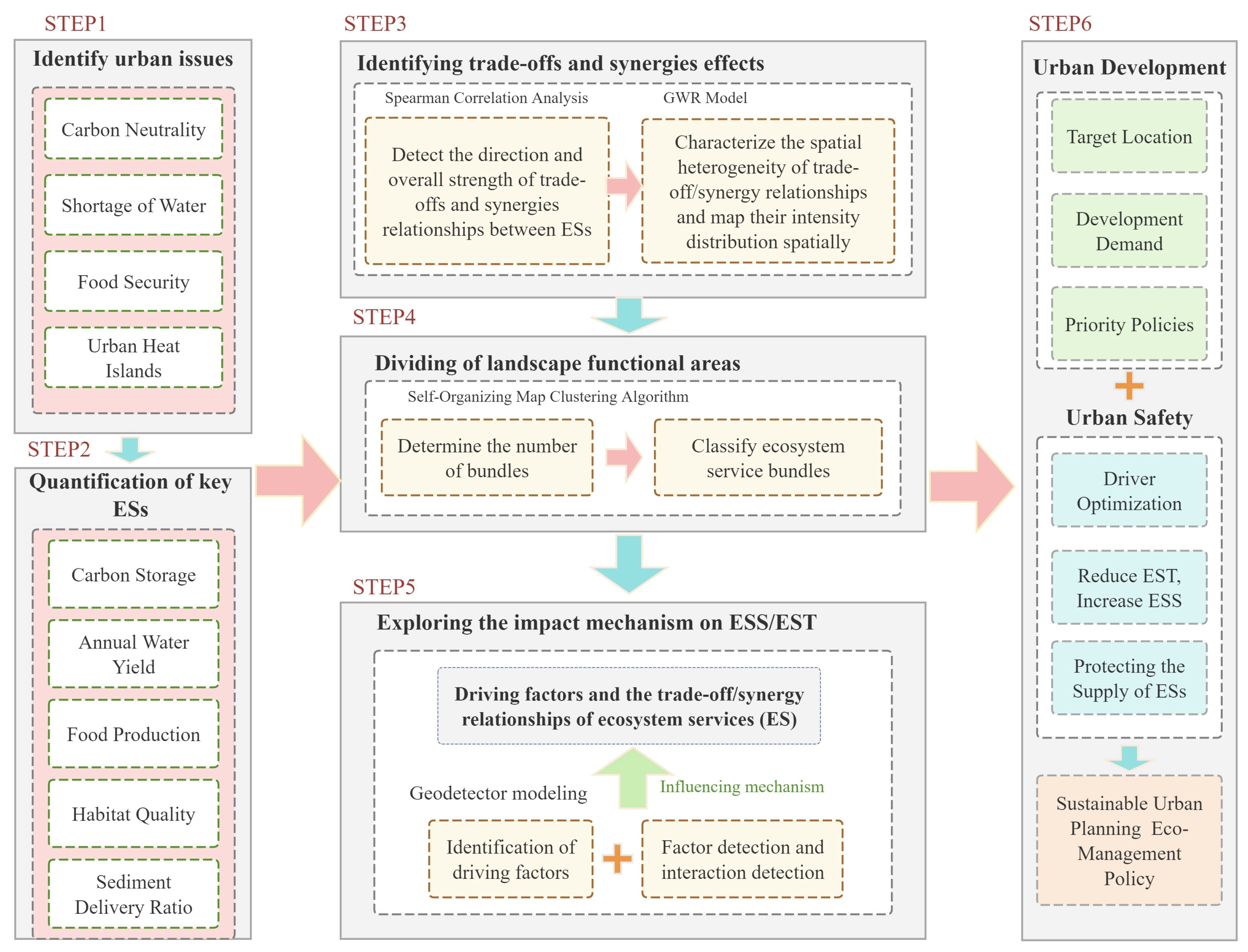
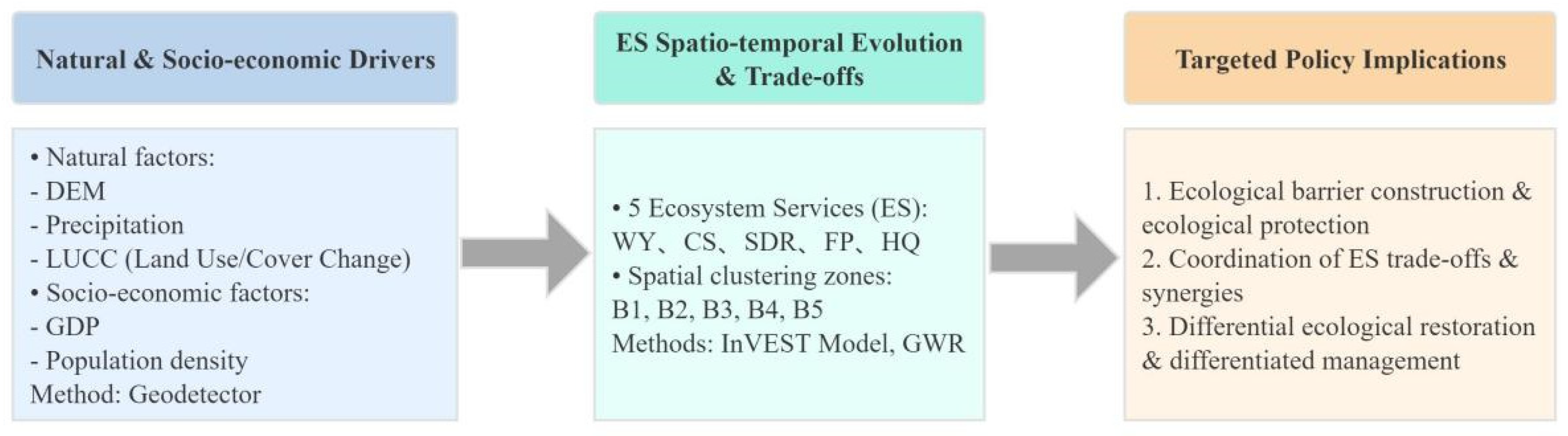
Fujian Province is located on China’s southeastern coast (115°50′ E–120°40′ E, 23°30′ N–28°20′ N), opposite Taiwan Island, bordering Jiangxi and Zhejiang Provinces to the north and west, and Guangdong Province to the south, with the East China Sea and South China Sea adjacent to its eastern and southern coasts. With a land area of 124,000 km2, it includes 9 prefecture-level cities, the Pingtan Comprehensive Experimental Zone, and 84 county-level divisions. The study area and technical framework are shown in Figure 1 and Figure 2.

2.2. Data Source

The precipitation, evapotranspiration, DEM, soil, NDVI, and land use data used in this study are listed in Table 1. All spatial data were unified to the Albers_Conic_Equal_Area projection coordinate system with a spatial resolution of 1 km (land use data was resampled from 30 m to 1 km for data consistency) and processed using ArcGIS 10.6. The quantitative calculation of ESs and statistical analysis were completed using InVEST 3.16 and R Studio 4.2.3, respectively.

2.3. Research Methods

2.3.1. Quantification of Ecosystem Services

Fujian Province has complex terrain, diverse climates, and rich ecosystems. Clarifying the spatial distribution and variation in these five ESs is essential for regional ecological change analysis and management strategy optimization. This study investigates these ESs in Fujian (2003–2023) using LULC and DEM datasets. The InVEST 3.16 Model’s Annual Water Yield module calculates annual water availability via the water balance principle, with annual precipitation and actual evapotranspiration data [30]. Equation (1) is as follows:
Y ( X ) = 1 A E T ( X ) p X p X
where Y(x) = annual water yield (mm) of grid x, AET(x) = actual evapotranspiration of grid x, and P(x) = annual precipitation of grid x. This method has been widely applied in relevant ES assessments [31]. Additionally, the InVEST model is used to quantify carbon storage and sequestration across four carbon pools (aboveground biomass, belowground biomass, soil carbon, and dead organic matter), with the total carbon storage calculated via Equation (2), as follows:
C i = C a b o v e i + C b e l o w i + C d e a d i + C s o i l i
where CS = total carbon storage, Cabove = aboveground biomass carbon storage, Cbelow = belowground biomass carbon storage, Csoil = soil carbon storage, and Cdead = dead organic matter carbon storage. Carbon density data (Table 2) for the four pools are mainly sourced from the China Terrestrial Ecosystem Carbon Density Dataset [32] and previous research results [33].
As a critical provisioning ES supporting local livelihoods, food production is evaluated at the grid scale using NDVI, cropland distribution, and spatially explicit grain yield data [34]. It is calculated using Equation (3), as follows:
F P x = N D V I x N D V I s u m G s u m
where FPx = food production of grid x, G = total grain yield of the study area, NDVIx = NDVI value of grid x, and NDVIsum = total NDVI of cropland. For regulating services, habitat quality is assessed using the InVEST model, which integrates habitat data with threat factors and evaluates their adverse impacts on habitats by incorporating distance and intensity. Habitat quality is calculated based on degradation and suitability [35], with the specific equation presented in Equation (4).
Q x j = H j 1 D x j z D x j z + k z
In this case, Qxj represents grid x’s habitat quality in land use type j; Hj is land use type j’s habitat-appropriateness (Table 3); Z is a constant (by default 2.5), k is a half-saturation constant (by default 0.5), and Dxj is the stress level of grid x for land use type j.
The updated soil erosion equation determines the current and potential soil erosion for every grid cell in order to evaluate the sediment delivery ratio. The difference between these two numbers is known as SDR [36]. Equation (5) is as follows:
S D R = R K L S U S L = R × K × L S × ( 1 C × P )
SDR = RKLSUSLE, where SDR is sediment delivery ratio (t/ha), RKLS stands for prospective erosion (t/ha), USLE for actual soil erosion (t/ha), R for rainfall erosivity (MJ·mm/ha·h), K for soil erodibility (t·ha·h/ha·MJ·mm), LS for slope length-gradient (dimensionless), C for cover-management (dimensionless), and P for support practice [36].

2.3.2. Quantifying Trade-Offs/Synergies Among ESs

To clarify ES trade-offs and synergies, we adopted Spearman’s non-parametric correlation analysis [37], a widely used method of identifying the direction and strength of such interactions—positive for a synergy and negative for a trade-off. Using the “corrplot” package in R 4.0, we conducted the analysis at 500 m grid and county scales for 2003, 2013 and 2023. The 500 m grid was chosen as the unified micro-scale for multi-source data fusion and ES quantification, a scientific compromise to match 30 m DEM/LULC and 1 km precipitation/evapotranspiration/NDVI data. This resolution avoids over-smoothing high-resolution geospatial data and minimizes FP estimation errors: nearest neighbor (LULC) and bilinear (DEM) resampling preserves core 30 m data characteristics, while linear resampling of 1 km meteorological/NDVI data to 500 m prevents climate data over-fitting in complex terrain and resolution mismatch, with a sensitivity test confirming FP estimation relative error < 4% (within regional ES assessment limits). It also balances micro spatial heterogeneity detection (superior to 1 km) and computational feasibility (avoiding excessive 30 m data volume), enabling accurate grid-scale ES variation capture and efficient operation of InVEST, GWR and Geodetector models. Beyond the overall trade-offs/synergies identified by correlation analysis, spatially explicit patterns were further explored via GWR [38], which modifies the traditional regression framework to test spatial non-stationarity [39,40,41]. GWR assumes that the relationship strength between dependent variable predictors and contextual factors varies spatially [42], which aligns with the formation of ES trade-offs/synergies—where similar drivers affect multiple ESs [41]—and spatial heterogeneity among these drivers leads to non-stationarity in ES interactions. Since only ES variables were used as independent and dependent variables, issues such as multicollinearity or nominal/categorical data were irrelevant. The GWR calculation follows Equation (6):
y i = β 0 μ i , v i + k = 1 p β k ( μ i , v i ) x j k + ε i
where i denotes the spatial position of point i, p is the number of independent variables, Y represents the dependent variable, X denotes independent variables, ε is the random error, β0 is the intercept at point i, and bi are regression coefficients. Consistent with Spearman correlation analysis, a positive regression correlation coefficient indicates spatial synergy, while a negative one denotes spatial trade-off. GWR analyses were conducted at both the grid and sub-basin scales using the GWmodel package in R 4.0 [43].

2.3.3. Identification of Ecosystem Service Clusters

Additionally, the self-organizing map (SOM) method was applied via the “Kohonen” package in R for a clustering analysis of various ecosystem services, enabling a reduction in dimensionality and clustering of high-dimensional data [43,44]. This clustering of similar ESs among groups reveals their similarities and differences, illustrates the spatial distribution patterns of different ESs, and identifies the characteristics and importance of ESs across distinct regions.

2.3.4. Geodetector Model

The Geodetector includes four modules (factor, risk, interaction, and ecological detection) and explores spatial heterogeneity by discretizing geographic elements and dependent variables to reveal their underlying driving forces [45]. Since ecosystem services are influenced by multiple natural and socio-economic factors with hierarchical and nonlinear interaction effects [46], the driving forces of ES spatio-temporal dynamics in Fujian Province were identified by selecting nine core indicators from two dimensions based on the regional natural background, human activity characteristics, and the applicability of the Geodetector model [47,48]. Natural factors (DEM, slope, annual average precipitation (pre), annual average evapotranspiration (etp), NDVI) form the basic background of ES formation and distribution; socio-economic factors (LUCC, population density (pop), nighttime light data (npp), GDP) are dominant drivers of ESs’ temporal evolution under rapid urbanization [49]. All indicators were verified to have significant explanatory power for ES changes via single-factor and two-factor interaction detection. The q value magnitude represents the strength of each factor’s driving effect, as shown in Equation (7):
q = 1 1 N σ 2 h = 1 L N h σ h 2 = 1 S S W S S T
In this equation [45], q is the extent of the contribution of each of the different driving factors on the distinct ecosystem services, and its value ranges between 0 and 1; N and σ2 are the variance and the sample size of a larger region, respectively; and N h σ h 2 are the number of indicators and the number of levels, respectively.

3. Results

3.1. Spatio-Temporal Evolution Characteristics of Ecosystem Services

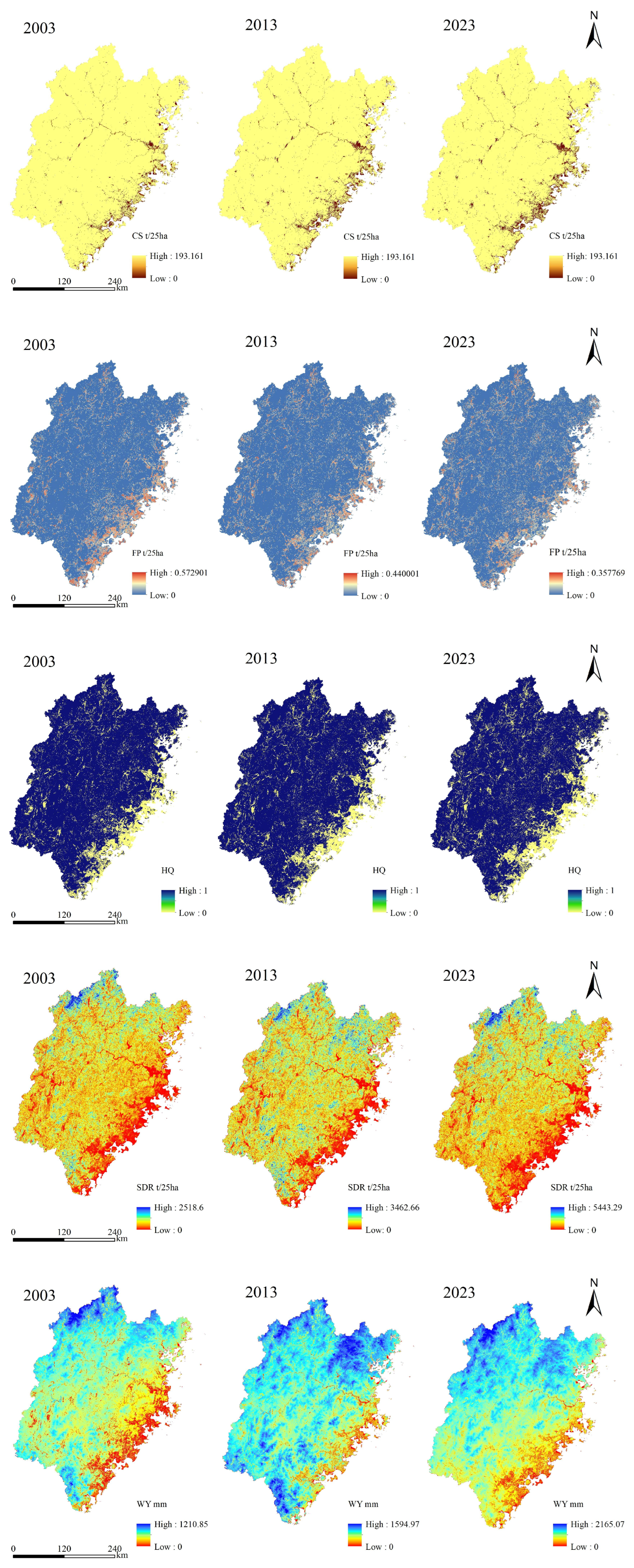
Five ecosystem services in Fujian Province were evaluated using the InVEST model for 2003–2023 (Figure 3), with distinct spatio-temporal differentiation: regulating services (carbon sequestration, sediment delivery ratio, water yield) concentrated in the forest core areas of the Wuyi and Daiyun Mountains in northwest Fujian, food provision distributed in the coastal plains/river valleys of southeast Fujian, and habitat quality declining gradually with urbanization intensity in southeast Fujian.
Temporally, HQ, CS, and FP showed degradation trends (Table 4). The mean HQ value decreased from 0.8889 to 0.8639, driven by construction land expansion and habitat destruction in the Xiamen–Zhangzhou–Quanzhou urban agglomeration. CS lost 1.16 × 10⁶ t in total over 20 years due to forest occupation by urban construction in southeast Fujian, while its high-value areas remained stable in the contiguous forest zones of western and northern Fujian without significant attenuation. FP declined by 26.33%, with its high-value areas shrinking from the southeast coastal plains to inland river valley agricultural zones in Sanming and Ningde, reflecting spatial restructuring of agricultural functions under coastal cropland non-agriculturalization. In contrast, SDR and WY increased significantly: SDR rose from 1.78 × 10⁸ t to 3.84 × 10⁸ t, and WY depth from 485.87 mm to 1050.57 mm, driven by ecological restoration projects and enhanced forest water conservation capacity in northwest Fujian.
Spatially, the low-value areas of WY, CS, SDR, and HQ were clustered in southeast Fujian, a region dominated by construction land with intense human activities and rapid urbanization. High-value CS areas lay stably in the mountainous forests of western and northern Fujian during the study period. FP high-value areas shrank continuously due to urbanization-induced cropland occupation and agricultural restructuring, with their intensity decreasing from 0.573776 (2003) to 0.361784 (2023). SDR high-value areas expanded notably in northwest Fujian, benefiting from long-term erosion control and afforestation, with their value rising to 6582.84 in 2023. WY high-value areas also expanded year by year, with their maximum value reaching 2185.79 mm in 2023, as ecological protection optimized water resource regulation in western Fujian’s mountainous areas.

3.2. Trade-Offs and Synergies of Ecosystem Services

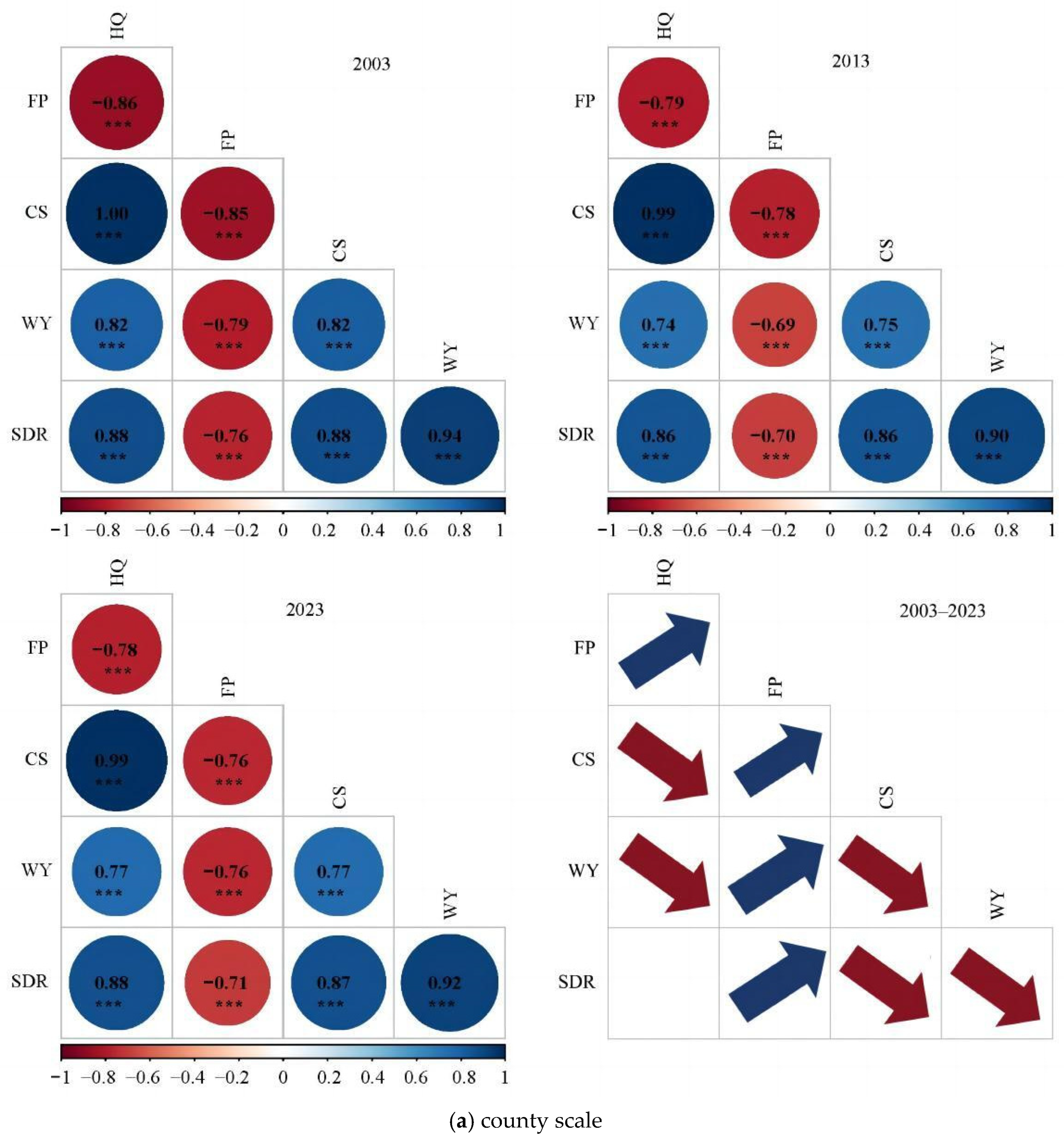
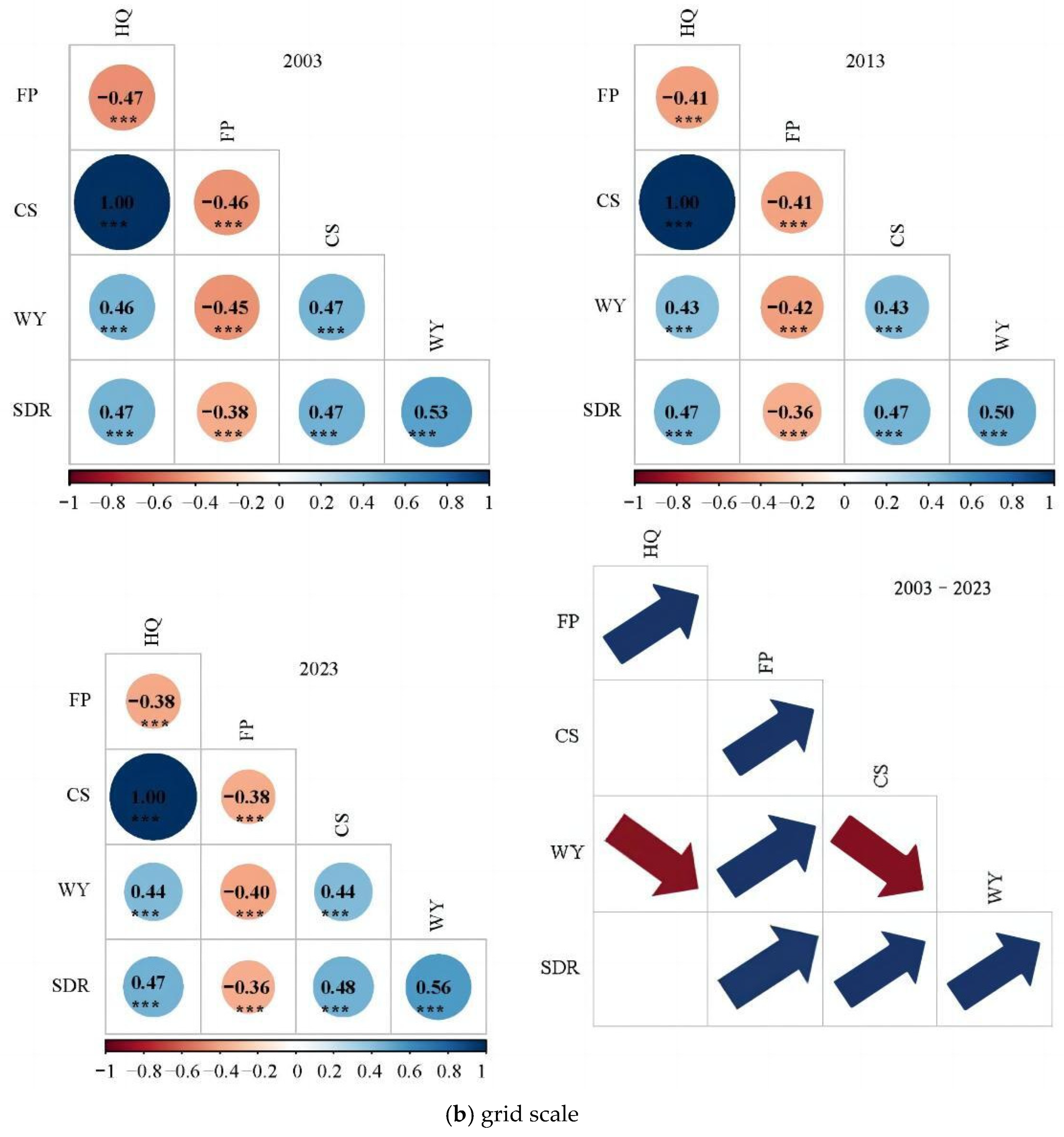
The trade-offs and synergies of ESs reflect their intricate interaction mechanisms, with analyses conducted at the 500 m grid and county scales based on a balanced resolution for spatial detail and computational efficiency. The county scale (Figure 4a) captures overall regional ecological functional connections, while the grid scale (Figure 4b) reveals local microcosmic process variations, providing a scientific basis for regional ecological management.
Spearman correlation analysis (p < 0.001) showed obvious scale and regional differentiation in ES interactions. At the county scale, correlation values were more stable and intense, shaped by regional ecological planning and industrial layout; the grid scale captured micro heterogeneity driven by local topography and small-scale land use changes, with lower correlation values. FP-HQ, CS-FP, WY-FP, and SDR-FP exhibited significant trade-offs, with far higher intensity in southeast Fujian’s coastal counties (county scale R = −0.72~−0.81; grid scale R = −0.42~−0.55) than in northwest Fujian’s ecological counties (county scale R = −0.35~−0.50; grid scale R = −0.20~−0.30), driven by high-intensity land use in the southeast and low human activity in the northwest.
The remaining six ES pairs showed significant synergies, stronger at the county scale and concentrated in northwest Fujian’s forest zones. WY and SDR maintained an extremely strong synergy (R = 0.94 in 2003, 0.92 in 2023) in western and northern Fujian’s mountainous counties, and CS-HQ achieved complete synergy (R = 1) in contiguous forest areas due to the shared forest carrier. Synergy intensity in southeast Fujian was significantly lower than in the northwest, even showing a weakening trend in coastal urban counties with severe urban expansion.

3.3. Spatial Distribution of Trade-Offs and Synergies Among Ecosystem Services

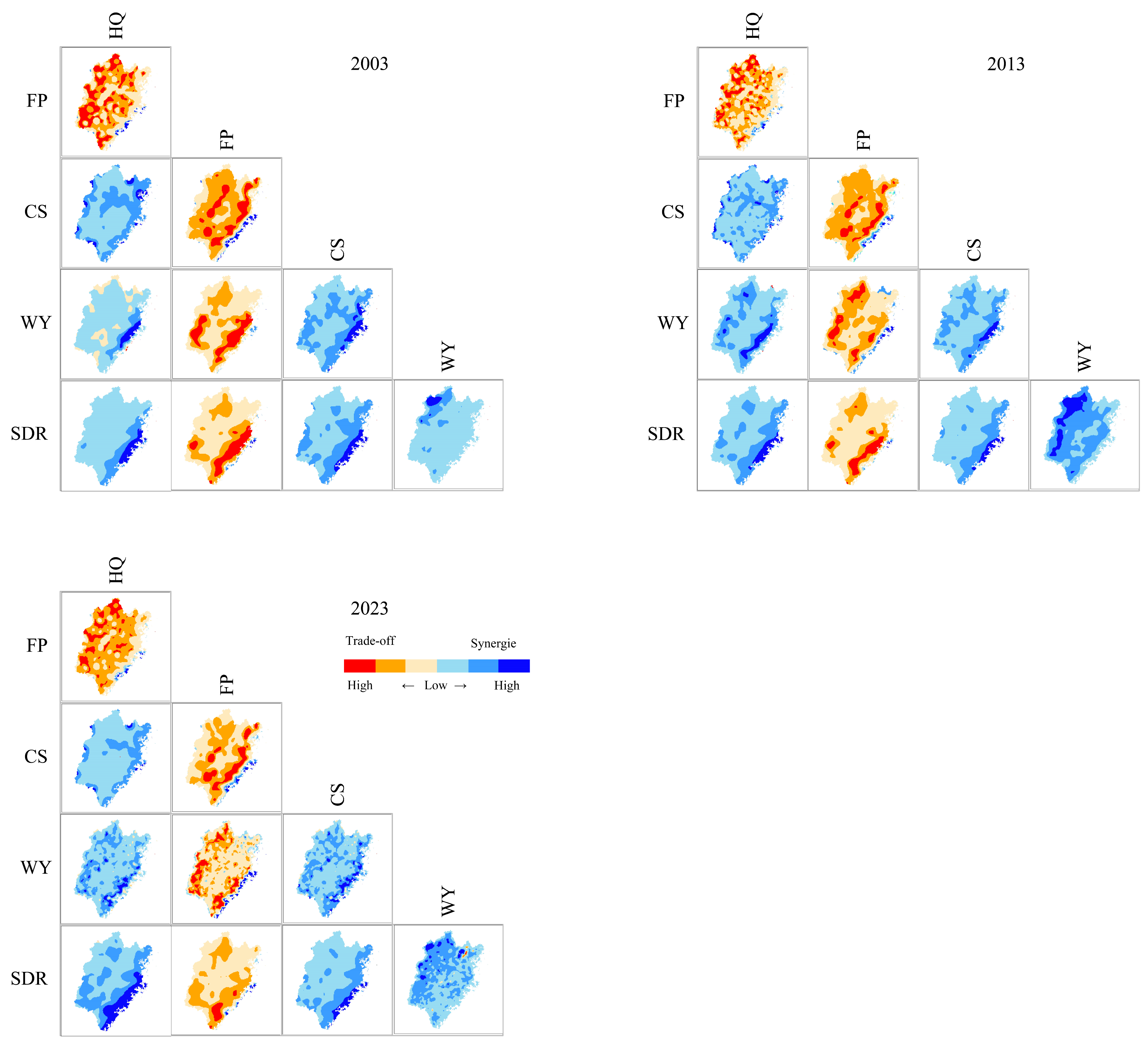
GWR results revealed significant spatial heterogeneity and temporal evolution in ES trade-offs and synergies in Fujian Province (Figure 5). Synergies dominated most ES pairs except for FP-related ones, clustering in the mountainous forests of western and northern Fujian; trade-offs concentrated in southeast Fujian’s urban agglomerations and intensive agricultural zones, consistent with Spearman correlation findings.
Temporally, FP-CS/WY/SDR high-value trade-off areas initially lay in southeast Fujian’s coastal agricultural zones (Zhangzhou, Quanzhou, Putian) in 2003, driven by intensive agriculture compressing ecological space. By 2013, these areas shrank with slightly reduced intensity, due to the “Grain for Green” policy and ecological agriculture transformation in partial counties. In 2023, trade-offs further weakened in traditional coastal agricultural zones with the promotion of ecological farming, while isolated high-value trade-off points emerged in northern Fujian’s newly reclaimed farmland due to blind sloping land reclamation.
FP-HQ high-value trade-offs initially occurred in southeast Fujian’s coastal aquaculture and urban fringe agricultural zones in 2003, caused by agricultural non-point source pollution and habitat destruction. From 2013 to 2023, these areas shifted to central Fujian’s inland agricultural counties with a 25% overall intensity reduction, reflecting coastal pollution control progress and increasing ecological pressure in inland grain production zones.
Synergy proportions of ES pairs increased continuously during 2003–2023, expanding from northwest Fujian’s core forest zones to surrounding transition zones, with WY-HQ and SDR-HQ showing the most obvious expansion (rising to 92% and 93% in western Fujian in 2023). SDR-WY synergy remained dominant (above 90%) in core areas, with a slight decline in southeast Fujian’s river basin fringes due to urban hardening surface expansion. WY-CS, SDR-CS, and CS-HQ synergy weakened in southeast Fujian’s forest edge zones affected by urban expansion, due to forest land conversion to construction land and farmland.
WY and SDR formed strong synergy cores in the Wuyi and Daiyun Mountains, driven by vegetation interception and soil infiltration in continuous forest areas. Synergy intensity remained stable in core forests but declined in northwest Fujian’s forest–agriculture transition zones due to vegetation fragmentation. In southeast Fujian’s Minjiang and Jiulongjiang river basins, WY-SDR synergy was weak in 2003 due to hydrological process changes from engineering measures, but improved significantly after 2013 with ecological water conservancy projects such as ecological embankment reconstruction and river wetland restoration.

3.4. Ecological Function Zoning Based on the Spatio-Temporal Dynamics of Ecosystem Service Clusters

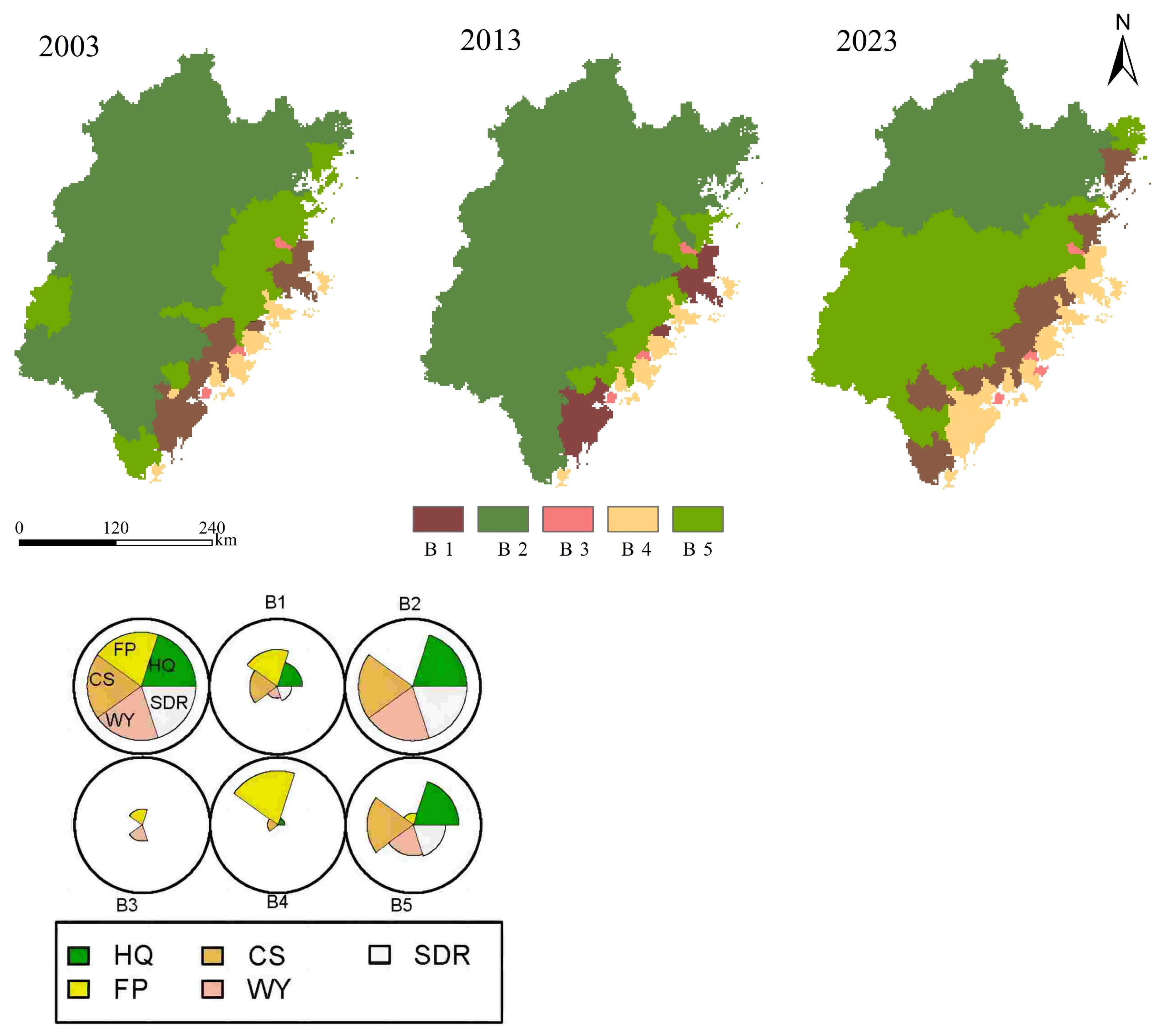
To determine the compositional structure and spatial correlation feature of these ecosystem services provided in those different areas within the Fujian Province, a self-organizing map algorithm was applied to generalize the spatio-temporal distribution of clusters of five ecosystem services. Based on the structural characteristics of each ecosystem service cluster, they were classified into five types (Figure 6): B1 Urban Development Service Cluster, B2 Core Ecological Service Cluster, B3 Degraded Ecological Service Cluster, B4 Food Supply Service Cluster, and B5 Transitional Ecological Conservation Cluster. Subsequently, the changes in the structure and spatial dispersion of the service clusters were examined to understand trade-offs and synergies amongst the ecosystem services. For example, in regions associated with the B1 service cluster, urban development can create trade-offs between ecological regulation services such as HQ and FP. Urban expansion may occupy farmland, affecting food supply, while disrupting natural ecosystems and reducing the capacity of ecosystems to regulate. Conversely, in regions associated with B2 or B5, which are ecological conservation areas, there may be synergies among multiple ecosystem services, such as mutual enhancement between water conservation and biodiversity protection.

3.5. Drivers of Spatio-Temporal Dynamics in Trade-Offs and Synergies of Ecosystem Services

The geographic detector method was used to explore the individual and interactive impacts of natural and human factors on Fujian’s ecosystem services (ESs) in 2023 and identify their behavioral patterns. Fujian’s ES spatio-temporal evolution and trade-off/synergy relationships result from the coupling of multiple natural and socio-economic factors. Results showed that in the natural dimension (Table 5): precipitation (pre, q = 0.767) dominated water yield; sediment delivery ratio (SDR) was mainly affected by precipitation (q = 0.302), slope (q = 0.233), and elevation (dem, q = 0.253); land use (lucc, q = 0.397) governed carbon storage (CS) (forest carbon density > construction land/cropland, and forest conversion causes carbon loss); food production (FP) was primarily driven by land use (q = 0.455) (relying on cropland/orchards, with quantity/quality determining supply); habitat quality (HQ) was core-driven by land use (q = 0.375) (natural vegetation supports high-quality habitats, while construction/cropland expansion disrupts integrity).
Overall, land use was the most critical ES driver, leading in q-values for CS, FP, and HQ, reflecting its profound impact amid rapid urbanization and agricultural development. Precipitation played a decisive role in water yield and SDR (subtropical monsoon climate influence), while potential evapotranspiration (etp) had a limited impact due to humid conditions. NDVI, nighttime lights (npp), and population (pop) significantly affected CS and HQ, indicating human activity pressure is indispensable for ecological conservation.
2003–2023 land-use data show stable–slightly increased forest area, reduced farmland, and growing construction land. Forest land supports CS, SDR, and water regulation, matching their high-value area expansion; reduced farmland shrinks FP high-value areas due to more construction land pressure ESs (e.g., reduced HQ from pollution).
Fujian’s mountainous terrain (high elevation/steep slopes) has good vegetation coverage, leading to high CS, SDR, WY, and HQ (excluding FP) via vegetation growth and soil-water conservation. Coastal plains/river valleys (low elevation/gentle slopes) support high FP, but other ESs are weak due to intense human activity and reduced vegetation, with urbanization worsening this contrast and shrinking high-value FP areas.
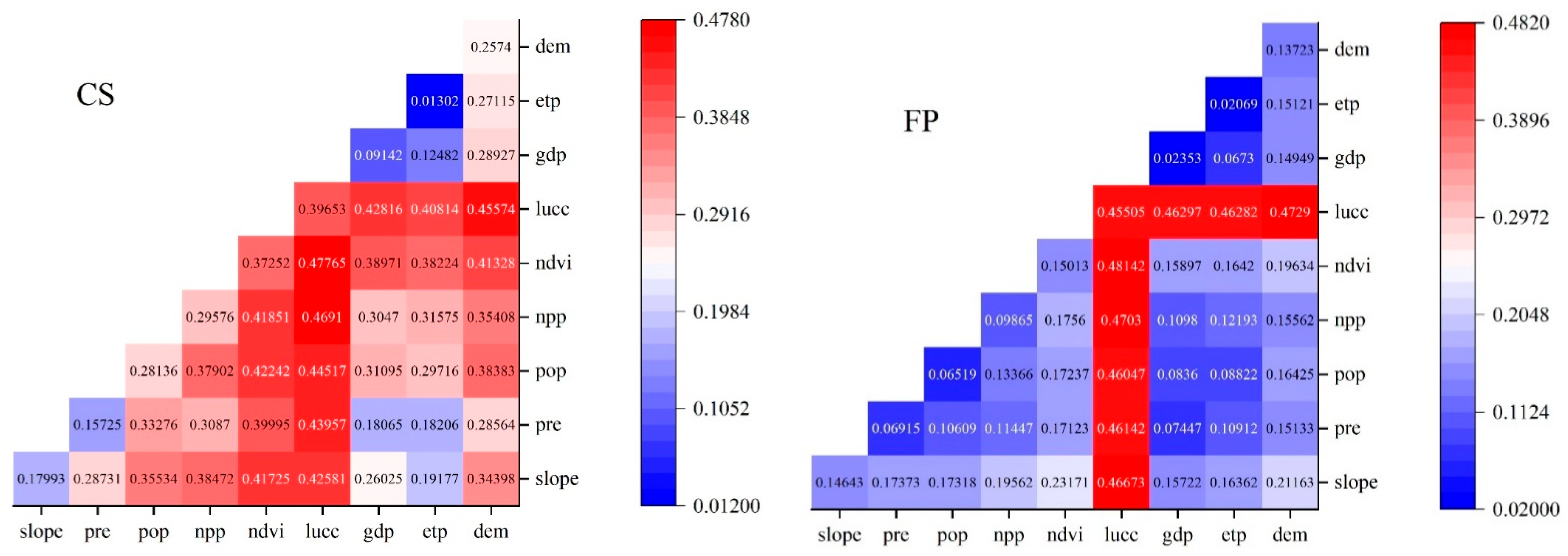
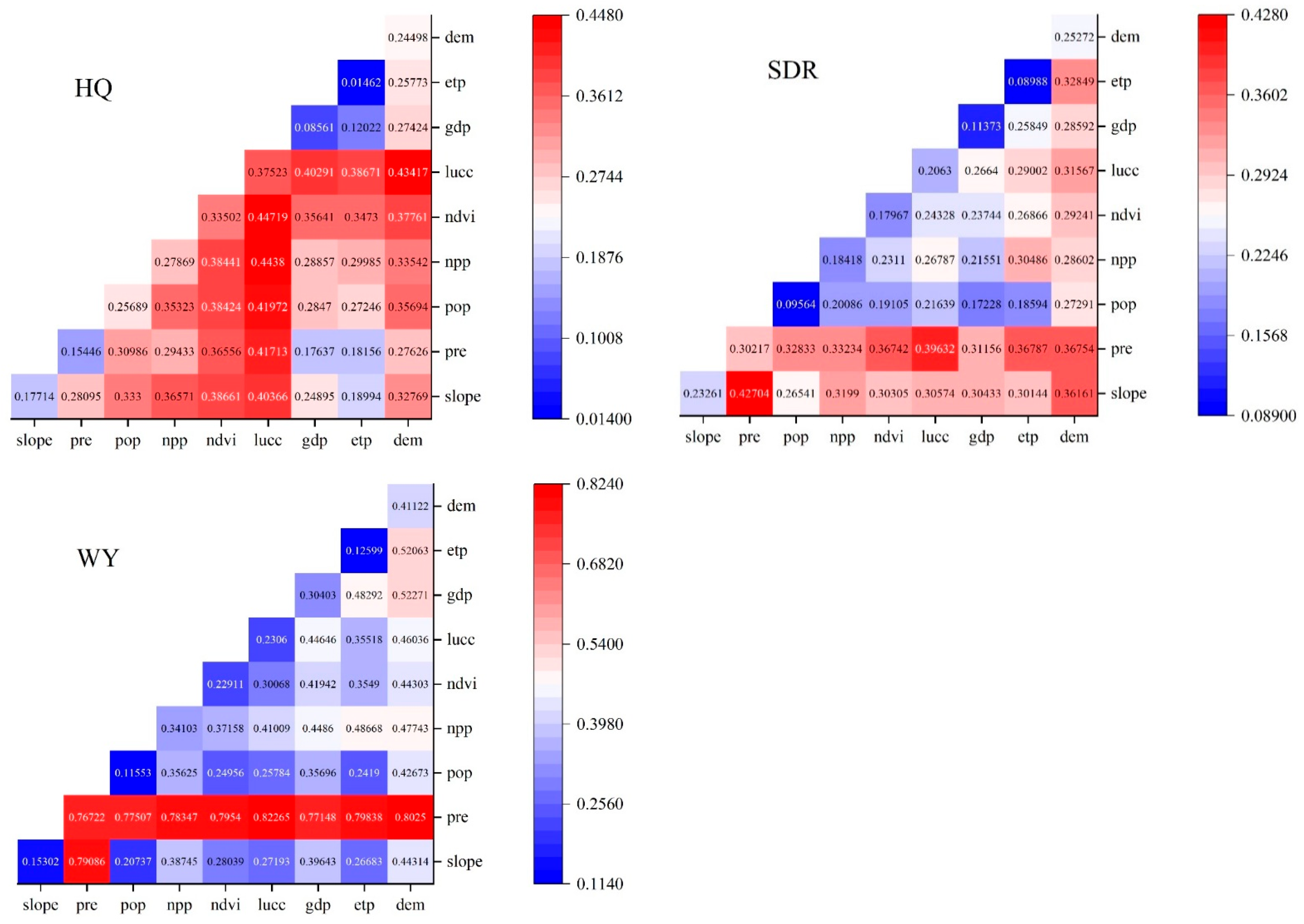
Two-factor interaction detection results showed that all interaction q-values exceeded individual factor q-values (Figure 7), confirming the synergistic driving effect of multiple factors on ecosystem services. Dominant interactions for each ES type are as follows. Carbon storage: dominant interactions—lucc × ndvi (q = 0.478), ndvi × npp (q = 0.469), lucc × npp (q = 0.456). These collectively indicate that the carbon sink–source balance is co-governed by land cover patterns and human activity intensity. Food production: dominant interactions—lucc × slope (q = 0.467), lucc × pre (q = 0.460), lucc × npp (q = 0.473). Food production is constrained by land resource endowment, climate, and human management. Habitat quality: dominant interactions—lucc × ndvi (q = 0.444), npp × ndvi (q = 0.442), lucc × npp (q = 0.434). Habitat quality is comprehensively regulated by lucc-determined habitat structure, ndvi-characterized vegetation cover, and npp-indicated anthropogenic disturbance. Soil conservation: dominant interactions—pre × slope (q = 0.427), pre × lucc (q = 0.396), slope × lucc (q = 0.362). Soil erosion mitigation is integrally controlled by topography, precipitation, and land use management. Water yield: dominant interactions—pre × slope (q = 0.823), pre × npp (q = 0.803), pre × pop (q = 0.775). Water yield is precipitation-dominated, jointly modulated by terrain and human-induced land surface modifications.

4. Discussion

4.1. Spatial and Temporal Distribution Patterns of Ecosystem Services

To facilitate the interpretation of the complex interactions, a conceptual framework is provided (Figure 8) to illustrate the linkage between the identified ES clusters (B1–B5), their dominant driving factors, and the corresponding policy recommendations derived from this study. The spatio-temporal evolution of ecosystem services (ESs) is primarily regulated by urbanization and ecological protection policies—a global pattern, yet regional differences in natural backgrounds and human activities lead to distinct characteristics. Maes et al. [50] found European urbanization (2000–2020) reduced provisioning services (e.g., food supply, carbon storage) but enhanced regulating services (e.g., sediment delivery ratio, water conservation) via ecological restoration, consistent with Fujian’s trends (2003–2023). Specifically, Fujian’s carbon storage decreased by 1.16 × 10⁶ t and mean habitat quality by 0.025 (reflecting human pressure, aligning with MEA (2005) [3]), while sediment delivery ratio (1.78 × 10⁸ t → 3.84 × 10⁸ t) and water yield (485.87 mm → 1050.58 mm) rose significantly, demonstrating restoration effectiveness (consistent with Wu et al. [2]). Fujian’s annual ES degradation rate is much lower than Southeast Asia’s [51], attributed to long-term high forest cover, highlighting the regional feature of “high vegetation coverage buffering urbanization pressure” and providing a differentiated case for ES protection in humid regions.
Fujian’s ES spatial distribution is strongly shaped by natural background and human activity intensity, showing a “northwest high, southeast low” pattern: mountainous, forested west/north (>60% forest cover) have higher carbon storage and sediment delivery ratio, while rapidly urbanizing coastal areas have reduced habitat quality and carbon storage (supporting Hasan et al. [7]). Notably, high-value food supply areas shifted inland due to a 15% arable land reduction and coastal land encroachment (2003–2023), consistent with Schirpke et al. [25] and exacerbated by terrain-driven fragmentation.

4.2. Scale Effects of Trade-Offs and Synergies in Ecosystem Services

A core theoretical concept in ecosystem services research is the scale dependence of trade-offs and synergies, shaped by climate and landscape. Bennett et al.’s [42] scale effect theoretical model holds that larger scales capture more complex socio-ecological processes, enhancing relationship strength, while smaller scales reflect local buffering effects. This study’s multi-scale analysis confirms that ES trade-offs and synergies are more pronounced at the county scale than the 500 m grid scale, supporting the centrality of scale effects—driven by macro-patterns/planning versus local conditions.
Notably, FP maintains similar-magnitude trade-offs with other services across both scales, reflecting the inherent food production–ecological protection conflict [17], with sharper trade-offs in coastal intensive cultivation zones and weaker ones in western reforested areas. Strong synergies (e.g., WY-SDR R > 0.9, CS-HQ R = 1 at county scale) highlight vegetation processes, intensified by subtropical productivity, deepening understanding of climatic modulation of synergies.
GWR analyses reveal spatial heterogeneity in ES relationships beyond global correlations. The inland contraction of FP-CS trade-off hotspots demonstrates ecological agriculture’s effectiveness in mitigating production–ecology conflicts [52], confirming that local social–ecological conditions regulate service relationships and validating targeted micro-scale interventions.

4.3. Spatial–Temporal Patterns of Ecosystem Service Clusters

The five ecosystem service clusters (B1–B5) identified by SOM reflect the spatial differentiation and functional types of Fujian’s ecosystem service portfolio. B2, mainly distributed in the mountainous areas of western and northern Fujian, features high CS, HQ, SDR, and WY values, serving as a core ecological conservation area. B4 is concentrated in coastal plains, with prominent FP but weaker in other services under ecological–agricultural trade-off pressures. B1 dominates urban areas (e.g., Fuzhou, Xiamen) with overall low ecosystem services. The spatio-temporal dynamics of these clusters clarify regional dominant ecological functions and conflict types, providing a spatial basis for differentiated ecological management.

4.4. Mechanisms of Driving Factors and Regional Specificity

Land use change is the primary driver of ecosystem service variations, with regionally divergent mechanisms. According to Liu et al. [53], Northeast China’s land use impacts stem from “large-scale agricultural development + deforestation,” reducing carbon storage and accelerating erosion. In contrast, Fujian featured “urbanization-dominated construction land expansion,” directly decreasing FP by 26.3% and indirectly weakening HQ via increased impervious surfaces (5.2%→12.8%), aligning with European cities [54]. Constrained by “mountain–sea” topography, construction land is confined to <50 km wide, causing “striped” service degradation—providing guidance for coastal mountainous land use planning [55].
Fujian’s forested areas show prominent “multifunctional synergies,” contributing 78% to CS, 65% to SDR, and 58% to WY (far higher than Beijing–Tianjin–Hebei’s ~45% [56]), attributed to subtropical evergreen broad-leaved forests’ high biomass and 300–500 mm/year precipitation interception capacity. Compared with the Three Gorges Reservoir Area [17], Fujian’s forests have stronger service synergies (67% vs. 52%), validating that “humid-region forests have more comprehensive ecological functions” and providing quantitative evidence for native evergreen species selection in ecological restoration [20,57].

4.5. Research Limitations and Prospects

This study has certain limitations: ES quantification relies mainly on remote sensing and statistical data, with partial parameter accuracy to be improved by more field surveys; the driving mechanism analysis is static for 2023, with dynamic processes to be further explored. Future research will integrate UAV remote sensing and field monitoring to improve ES quantification accuracy, construct a natural-human factor coupling model for ES dynamic simulation and prediction, and carry out scenario simulation under different policies to provide a more detailed scientific basis for regional ecological management.

5. Conclusions

This study quantified five key ESs in Fujian (2003–2023) and analyzed their multi-scale spatio-temporal patterns, trade-off/synergy characteristics, and driving mechanisms, drawing three main conclusions:
ESs show significant spatio-temporal differentiation: northwest regulating services improve, southeast FP declines, and HQ degrades with urbanization. ES trade-offs/synergies have obvious scale/regional differentiation: county-scale relationship intensity > grid scale; FP-regulating service trade-offs are stronger in the southeast; regulating services show strong synergies in northwest forests. ES changes are driven by multi-factor coupling: LUCC is core driver of CS/FP/HQ; precipitation dominates WY/SDR; dual-factor interactions amplify driving effects, causing ES “mountain-sea differentiation”. Based on research conclusions and ES clusters, three targeted policy recommendations are proposed.
Implement the “Ecological Protection Red Line Quality and Efficiency Improvement Project”: strictly protect forest land (stabilize coverage > 80%); promote native evergreen broad-leaved afforestation; establish CS-WY linked horizontal ecological compensation mechanism.
Launch the “Coastal Ecological Agriculture and Urban Ecological Restoration Integration Project”: demarcate “Permanent Basic Farmland Ecological Corridors”; promote urban ecological restoration and urban agricultural complexes; strictly control B4 cropland non-agriculturalization.
Carry out the “Classified Ecological Restoration and Functional Improvement Project”: reclaim industrial/mining wastelands in B3; construct “forest-farmland-wetland” ecological network in B5; establish 500 m grid-scale ES dynamic monitoring system in B3/B5.

Author Contributions

Conceptualization, P.Z. and J.C.; methodology, P.Z. and J.C.; software, P.Z. and J.C.; validation, P.Z. and J.C.; formal analysis, P.Z. and J.C.; investigation, P.Z. and J.C.; resources, P.Z., J.C. and W.P.; data curation, P.Z. and J.C.; writing—original draft preparation, P.Z. and J.C.; writing—review and editing, P.Z., J.C. and W.P.; visualization, P.Z. and J.C.; supervision, P.Z. and W.P.; funding acquisition, P.Z. and W.P. All authors have read and agreed to the published version of the manuscript.

Funding

This research was funded by the National Key Research and Development Program of China (Grant No. 2022YFF1301302-02) and Fujian Provincial Natural Science Foundation (Grant No. 2023J01064).

Institutional Review Board Statement

Not applicable.

Informed Consent Statement

Not applicable.

Data Availability Statement

The original contributions presented in this study are included in the article. Further inquiries can be directed to the corresponding author.

Acknowledgments

We would like to thank the editors and anonymous reviewers for their constructive comments and suggestions, which helped to improve the quality of the paper.

Conflicts of Interest

The authors declare that they have no known competing financial interests or personal relationships that could have appeared to influence the work reported in this paper.

References

  1. Costanza, R.; D’Arge, R.; de Groot, R.; Farber, S.; Grasso, M.; Hannon, B.; Limburg, K.; Naeem, S.; O’Neill, R.V.; Paruelo, J.; et al. The value of the world’s ecosystem services and natural capital. Nature 1997, 387, 253–260. [Google Scholar] [CrossRef]
  2. Wu, Y.; Zhang, X.; Li, C.; Xu, Y.; Hao, F.; Yin, G. Ecosystem service trade-offs and synergies under influence of climate and land cover change in an afforested semiarid basin, China. Ecol. Eng. 2021, 159, 106083. [Google Scholar] [CrossRef]
  3. Reid, W.; Mooney, H.; Cropper, A.; Capistrano, D.; Carpenter, S.; Chopra, K. Millennium Ecosystem Assessment. In Ecosystems and Human Well-Being: Synthesis; Island Press: Washington, DC, USA, 2005. [Google Scholar]
  4. Chen, J.; Sun, Y.; Luo, Z.; Ma, J.; Yang, Y.; Chen, F. Trade-Offs and Synergies of Ecosystem Services in the Urban Agglomeration on the Northern Slope of the Tianshan Mountains: A Perspective of Socio-Ecological Drivers. Land Degrad. Dev. 2025, 36, 4226–4247. [Google Scholar] [CrossRef]
  5. Xu, T.; Tian, G.; Lin, T.; Li, W.; Liu, C. Multiscale analysis of ecosystem service interactions and driving factors in the Loess Plateau: Implications for ecological management. J. Clean. Prod. 2025, 495, 145074. [Google Scholar] [CrossRef]
  6. Li, S.; Li, R.; Wang, L.; Fu, M.; Tian, Y.; Zhang, J. Study on the multi-scale characteristics of ecosystem service trade-offs, synergies and ecosystem service bundles in Beijing. Environ. Earth Sci. 2025, 84, 359. [Google Scholar] [CrossRef]
  7. Hasan, S.S.; Zhen, L.; Miah, M.G.; Ahamed, T.; Samie, A. Impact of land use change on ecosystem services: A review. Environ. Dev. 2020, 34, 100527. [Google Scholar] [CrossRef]
  8. Liu, S.; Ward, S.E.; Wilby, A.; Manning, P.; Gong, M.; Davies, J.; Killick, R.; Quinton, J.N.; Bardgett, R.D. Multiple targeted grassland restoration interventions enhance ecosystem service multifunctionality. Nat. Commun. 2025, 16, 3971. [Google Scholar] [CrossRef]
  9. Aryal, K.; Maraseni, T.; Apan, A. How much do we know about trade-offs in ecosystem services? A systematic review of empirical research observations. Sci. Total Environ. 2022, 806, 151229. [Google Scholar] [CrossRef]
  10. Raudsepp-Hearne, C.; Peterson, G.D.; Bennett, E.M. Ecosystem service bundles for analyzing tradeoffs in diverse landscapes. Proc. Natl. Acad. Sci. USA 2010, 107, 5242–5247. [Google Scholar] [CrossRef] [PubMed]
  11. Schirpke, U.; Candiago, S.; Egarter Vigl, L.; Jäger, H.; Labadini, A.; Marsoner, T.; Meisch, C.; Tasser, E.; Tappeiner, U. Integrating supply, flow and demand to enhance the understanding of interactions among multiple ecosystem services. Sci. Total Environ. 2019, 651, 928–941. [Google Scholar] [CrossRef] [PubMed]
  12. Xiong, S.; Yang, F.; Fan, H.; Zhang, J. Multiscale coordination dynamics in large freshwater lake basin ecosystems: Machine learning reveals spatiotemporal variations and driving mechanisms of risk-quality-service process interactions. Ecol. Indic. 2025, 180, 114381. [Google Scholar] [CrossRef]
  13. Sylla, M.; Hagemann, N.; Szewrański, S. Mapping trade-offs and synergies among peri-urban ecosystem services to address spatial policy. Environ. Sci. Policy 2020, 112, 79–90. [Google Scholar] [CrossRef]
  14. Meacham, M.; Norström, A.V.; Peterson, G.D.; Andersson, E.; Bennett, E.M.; Biggs, R.O.; Crouzat, E.; Cord, A.F.; Enfors, E.; Felipe-Lucia, M.R.; et al. Advancing research on ecosystem service bundles for comparative assessments and synthesis. Ecosyst. People 2022, 18, 99–111. [Google Scholar] [CrossRef]
  15. Quintas-Soriano, C.; García-Llorente, M.; Norström, A.; Meacham, M.; Peterson, G.; Castro, A.J. Integrating supply and demand in ecosystem service bundles characterization across Mediterranean transformed landscapes. Landsc. Ecol. 2019, 34, 1619–1633. [Google Scholar] [CrossRef]
  16. Renard, D.; Rhemtulla, J.M.; Bennett, E.M. Historical dynamics in ecosystem service bundles. Proc. Natl. Acad. Sci. USA 2015, 112, 13411–13416. [Google Scholar] [CrossRef]
  17. Gou, M.; Li, L.; Ouyang, S.; Wang, N.; La, L.; Liu, C.; Xiao, W. Identifying and analyzing ecosystem service bundles and their socioecological drivers in the Three Gorges Reservoir Area. J. Clean. Prod. 2021, 307, 127208. [Google Scholar] [CrossRef]
  18. Dittrich, A.; Seppelt, R.; Václavík, T.; Cord, A.F. Integrating ecosystem service bundles and socio-environmental conditions—A national scale analysis from Germany. Ecosyst. Serv. 2017, 28, 273–282. [Google Scholar] [CrossRef]
  19. Dou, H.; Li, X.; Li, S.; Dang, D.; Li, X.; Lyu, X.; Li, M.; Liu, S. Mapping ecosystem services bundles for analyzing spatial trade-offs in inner Mongolia, China. J. Clean. Prod. 2020, 256, 120444. [Google Scholar] [CrossRef]
  20. Shen, J.; Li, S.; Liu, L.; Liang, Z.; Wang, Y.; Wang, H.; Wu, S. Uncovering the relationships between ecosystem services and social-ecological drivers at different spatial scales in the Beijing-Tianjin-Hebei region. J. Clean. Prod. 2021, 290, 125193. [Google Scholar] [CrossRef]
  21. Liu, L.; Wang, J.; Li, J.; He, S.; Lan, Y.; Liu, F. Evaluation of Ecosystem Service Capacity Using the Integrated Ecosystem Services Index at Optimal Scale in Central Yunnan, China. Ecol. Evol. 2025, 15, e71222. [Google Scholar] [CrossRef]
  22. Yu, D.; Li, Y.; Yin, B.; Wu, N.; Ye, R.; Liu, G. Spatiotemporal variation of net primary productivity and its response to drought in Inner Mongolian desert steppe. Glob. Ecol. Conserv. 2022, 33, e1991. [Google Scholar] [CrossRef]
  23. Zhang, Y.; Lu, X.; Liu, B.; Wu, D.; Fu, G.; Zhao, Y.; Sun, P. Spatial relationships between ecosystem services and socioecological drivers across a large-scale region: A case study in the Yellow River Basin. Sci. Total Environ. 2021, 766, 142480. [Google Scholar] [CrossRef]
  24. Jia, Y.; Tang, X.; Liu, W. Spatial-Temporal Evolution and Correlation Analysis of Ecosystem Service Value and Landscape Ecological Risk in Wuhu City. Sustainability 2020, 12, 2803. [Google Scholar] [CrossRef]
  25. Schirpke, U.; Ghermandi, A.; Sinclair, M.; Van Berkel, D.; Fox, N.; Vargas, L.; Willemen, L. Emerging technologies for assessing ecosystem services: A synthesis of opportunities and challenges. Ecosyst. Serv. 2023, 63, 101558. [Google Scholar] [CrossRef]
  26. Zhang, J.; Wang, Y.; Sun, J.; Zhang, Y.; Wang, D.; Chen, J.; Liang, E. Trade-offs and synergies of ecosystem services and their threshold effects in the largest tableland of the Loess Plateau. Glob. Ecol. Conserv. 2023, 48, e2706. [Google Scholar] [CrossRef]
  27. Li, B.; Wang, W. Trade-offs and synergies in ecosystem services for the Yinchuan Basin in China. Ecol. Indic. 2018, 84, 837–846. [Google Scholar] [CrossRef]
  28. Song, Y.; Wang, J.; Ge, Y.; Xu, C. An optimal parameters-based geographical detector model enhances geographic characteristics of explanatory variables for spatial heterogeneity analysis: Cases with different types of spatial data. Gisci. Remote Sens. 2020, 57, 593–610. [Google Scholar] [CrossRef]
  29. Li, H.; Chen, J.; Ling, M.; Chen, Z.; Lan, Y.; Huang, Q.; Li, X.; You, H.; Wang, F.; Han, X.; et al. A framework for dynamic assessment of soil erosion and detection of driving factors in alpine grassland ecosystems using the RUSLE-InVEST (SDR) model and Geodetector: A case study of the source region of the Yellow River. Ecol. Inform. 2025, 85, 102928. [Google Scholar] [CrossRef]
  30. Sharp, R.; Chaplin-Kramer, R.; Wood, S.; Guerry, A.; Douglass, J. InVEST User’s Guide; Stanford University: Stanford, CA, USA, 2018. [Google Scholar]
  31. Fallahi, M.; Nelson, S.A.C.; Beyene, S.; Caldwell, P.V.; Roise, J.P. A Comparative Assessment of Water Supply Stress Index (WaSSI) and Integrated Valuation of Ecosystem Services and Tradeoffs (InVEST) Models for Annual Water Yield Estimation: A Case Study in the Croatan National Forest. Environments 2025, 12, 89. [Google Scholar] [CrossRef]
  32. Chen, Z.; Chen, L.; Lu, R.; Lou, Z.; Zhou, F.; Jin, Y.; Xue, J.; Guo, H.; Wang, Z.; Wang, Y.; et al. A national soil organic carbon density dataset (2010–2024) in China. Sci. Data 2025, 12, 1480. [Google Scholar] [CrossRef] [PubMed]
  33. Li, J.; Li, S.; Zhao, R.; Xing, S.; Chen, H.; Huang, Y.; Zhang, L.; Li, J. Soil organic carbon dynamics (2008–2020) across different cultivated land use types in a subtropical region. Geoderma Reg. 2025, 40, e926. [Google Scholar] [CrossRef]
  34. Potter, C.S.; Randerson, J.T.; Field, C.B.; Matson, P.A.; Vitousek, P.M.; Mooney, H.A.; Klooster, S.A. Terrestrial ecosystem production: A process model based on global satellite and surface data. Glob. Biogeochem. Cycles 1993, 7, 811–841. [Google Scholar] [CrossRef]
  35. Wen, S.Q.; Hu, B.Q.; Xie, W.W.; Gao, C.L. Land Use Scenario Simulation and Habitat Quality Change in Pinglu River Economic Belt Based on PLUS-InVEST Model. Huan Jing Ke Xue = Huanjing Kexue 2025, 46, 5122–5133. [Google Scholar]
  36. Zhao, Y.; Zhu, D.; Wu, Z.; Cao, Z. Extreme rainfall erosivity: Research advances and future perspectives. Sci. Total Environ. 2024, 917, 170425. [Google Scholar] [CrossRef]
  37. Lyu, R.; Clarke, K.C.; Zhang, J.; Feng, J.; Jia, X.; Li, J. Spatial correlations among ecosystem services and their socio-ecological driving factors: A case study in the city belt along the Yellow River in Ningxia, China. Appl. Geogr. 2019, 108, 64–73. [Google Scholar] [CrossRef]
  38. Zhang, X.; Xie, B.; Li, J.; Yuan, C.; Zhou, K.; Xie, J.; Pang, X. Spatiotemporal patterns and drivers of ecosystem service interactions in karst regions: Insights for environmental protection and sustainability. iScience 2026, 29, 114399. [Google Scholar] [CrossRef]
  39. Gao, J.; Zuo, L. Revealing ecosystem services relationships and their driving factors for five basins of Beijing. J. Geogr. Sci. 2021, 31, 111–129. [Google Scholar] [CrossRef]
  40. Kupfer, J.A.; Farris, C.A. Incorporating spatial non-stationarity of regression coefficients into predictive vegetation models. Landsc. Ecol. 2007, 22, 837–852. [Google Scholar] [CrossRef]
  41. Gollini, I.; Lu, B.; Charlton, M.; Brunsdon, C.; Harris, P. GWmodel: An R Package for Exploring Spatial Heterogeneity Using Geographically Weighted Models. J. Stat. Softw. 2015, 63, 1–50. [Google Scholar] [CrossRef]
  42. Bennett, E.M.; Peterson, G.D.; Gordon, L.J. Understanding relationships among multiple ecosystem services. Ecol. Lett. 2009, 12, 1394–1404. [Google Scholar] [CrossRef]
  43. Kohonen, T. The self-organizing map. Neurocomputing 1998, 21, 1–6. [Google Scholar] [CrossRef]
  44. Qi, J.; Liu, H.; Liu, X.; Zhang, Y. Spatiotemporal evolution analysis of time-series land use change using self-organizing map to examine the zoning and scale effects. Comput. Environ. Urban Syst. 2019, 76, 11–23. [Google Scholar] [CrossRef]
  45. Wang, J.; Xu, C. Geodetector: Principle and prospective. Acta Geogr. Sin. 2017, 72, 116–134. [Google Scholar]
  46. Zhou, J.; Yang, J.; Tang, Z.; Xue, L.; Zhang, W.; Zhang, J. Driving mechanisms of ecosystem services and their trade-offs and synergies in the transition zone between the Qinghai-Tibet Plateau and the Loess Plateau. Ecol. Indic. 2025, 171, 113148. [Google Scholar] [CrossRef]
  47. Zhong, L.; Wang, J.; Zhang, X.; Ying, L. Effects of agricultural land consolidation on ecosystem services: Trade-offs and synergies. J. Clean. Prod. 2020, 264, 121412. [Google Scholar] [CrossRef]
  48. Zhang, Z.; Tong, Z.; Zhang, L.; Liu, Y. What are the dominant factors and optimal driving threshold for the synergy and tradeoff between ecosystem services, from a nonlinear coupling perspective? J. Clean. Prod. 2023, 422, 138609. [Google Scholar] [CrossRef]
  49. Zhi, L.; Li, X.; Bai, J.; Shao, D. Prioritizing multifunctional conservation zones with dominant function based on comprehensive hotspots and bundles of ecosystem service. Ecol. Indic. 2025, 171, 113122. [Google Scholar] [CrossRef]
  50. Maes, J.; Egoh, B.; Willemen, L.; Liquete, C.; Vihervaara, P.; Schägner, J.P.; Grizzetti, B.; Drakou, E.G.; La Notte, A.; Zulian, G.; et al. Mapping ecosystem services for policy support and decision making in the European Union. Ecosyst. Serv. 2012, 1, 31–39. [Google Scholar] [CrossRef]
  51. Díaz, S.; Settele, J.; Brondízio, E.S.; Ngo, H.T.; Agard, J.; Arneth, A.; Balvanera, P.; Brauman, K.A.; Butchart, S.H.M.; Chan, K.M.A.; et al. Pervasive human-driven decline of life on Earth points to the need for transformative change. Science 2019, 366, eaax3100. [Google Scholar] [CrossRef] [PubMed]
  52. Xue, C.; Chen, X.; Xue, L.; Zhang, H.; Chen, J.; Li, D. Modeling the spatially heterogeneous relationships between tradeoffs and synergies among ecosystem services and potential drivers considering geographic scale in Bairin Left Banner, China. Sci. Total Environ. 2023, 855, 158834. [Google Scholar] [CrossRef]
  53. Liu, J.; Deng, X.; Liu, M.; Zhang, S. Study on the spatial patterns of land-use change and analyses of driving forces in Northeastern China during 1990–2000. Chin. Geogr. Sci. 2002, 12, 299–308. [Google Scholar] [CrossRef]
  54. Haase, D.; Frantzeskaki, N.; Elmqvist, T. Ecosystem Services in Urban Landscapes: Practical Applications and Governance Implications. Ambio 2014, 43, 407–412. [Google Scholar] [CrossRef] [PubMed]
  55. Yin, Y.; Gu, K.; Dai, Y.; Qu, C.; Sheng, Q. Trade-Offs, Synergies, and Drivers of Cultural Ecosystem Service Supply—Demand Bundles: A Case Study of the Nanjing Metropolitan Area. Land 2026, 15, 210. [Google Scholar] [CrossRef]
  56. Shen, J.; Li, S.; Liang, Z.; Liu, L.; Li, D.; Wu, S. Exploring the heterogeneity and nonlinearity of trade-offs and synergies among ecosystem services bundles in the Beijing-Tianjin-Hebei urban agglomeration. Ecosyst. Serv. 2020, 43, 101103. [Google Scholar] [CrossRef]
  57. Jiang, J.; Hou, J.; Zeng, C.; Feng, H.; Xiong, Z. Synergistic management enhances ecosystem services through optimized specialty agro-pastoralism in the context of food security. Agric. Syst. 2026, 233, 104600. [Google Scholar] [CrossRef]
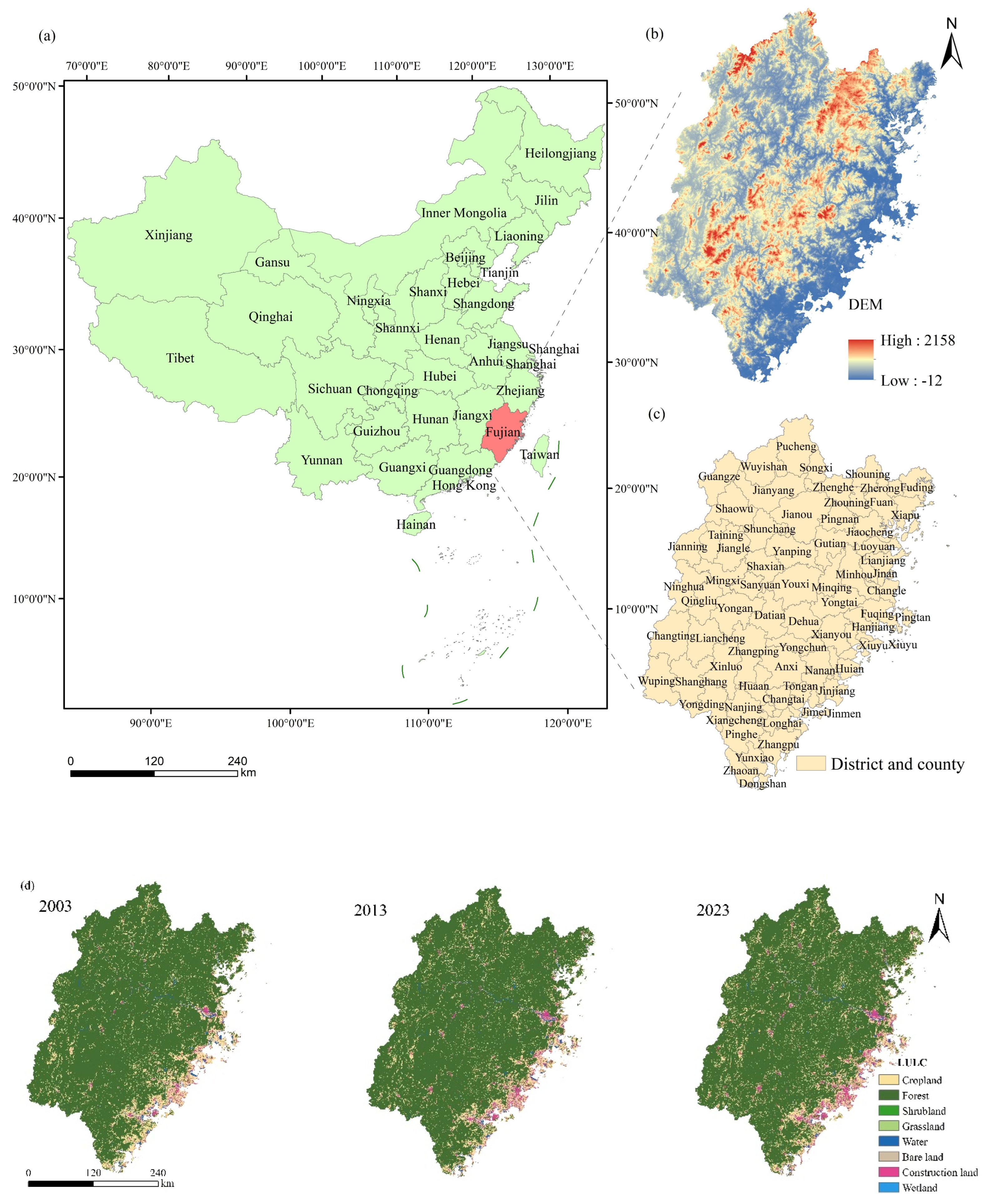
Figure 1. Location map of the study area and land use maps of the three periods: (a) Geographic location (115°50′ E–120°40′ E, 23°30′ N–28°20′ N), (b) DEM, (c) county-level administrative division of Fujian Province, (d) land use-type maps from 2003, 2013, and 2023.
Sustainability 18 03084 g001
Figure 2. The technical framework diagram of the research.
Sustainability 18 03084 g002
Figure 3. The spatial–temporal patterns and variability of ecosystem services. (WY: water yield; SDR: sediment delivery ratio; CS: carbon storage; HQ: habitat quality; FP: food production. From 2003 to 2013, ecological service differences in the study area were mainly driven by early urbanization expansion (construction land encroaching on arable/forested land) and small-scale ecological restoration projects. CS and HQ in southeastern coastal Fujian declined, while WY and SDR in northwestern regions improved slightly. From 2013 to 2023, Fujian’s ecological protection red line policy and large-scale afforestation became core drivers, leading to significant increases in SDR and WY in the northwest. However, coastal urban agglomerations saw continued FP declines due to non-agricultural use of arable land, with CS and HQ further degrading under urban expansion.
Sustainability 18 03084 g003
Figure 4. Correlations among ecosystem services in Fujian Province from 2003 to 2023 (*** indicate significant correlations at p < 0.001 levels. WY: water yield; SDR: sediment delivery ratio; CS: carbon storage; HQ: habitat quality; FP: food production. Blue arrows indicate that relationships are optimized in a synergistic direction, while red arrows indicate that relationships are deteriorated in a trade-off direction).
Sustainability 18 03084 g004aSustainability 18 03084 g004b
Figure 5. Spatial distribution of trade-offs and synergies among ecosystem services in fujian province from 2003 to 2023 (WY: water yield; SDR: sediment delivery ratio; CS: carbon storage; HQ: habitat quality; FP: food production).
Sustainability 18 03084 g005
Figure 6. Spatial distribution of ecosystem service clusters in Fujian Province from 2003 to 2023. B1: Urban development service cluster, B2: core ecosystem service cluster, B3: degraded ecosystem service cluster, B4: food supply service cluster, B5: Transitional Ecological Conservation Cluster WY: water yield; SDR: sediment delivery ratio; CS: carbon storage; HQ: habitat quality; FP: food production.
Sustainability 18 03084 g006
Figure 7. Results of two-factor interaction detection for ecosystem services in Fujian Province in 2023. The numerical values in the figure represent the q-values of the two-factor interaction in the GeoDetector model (p < 0.001). A larger q-value indicates stronger explanatory power of the driving factors on ecosystem services. WY: water yield; SDR: sediment delivery ratio; CS: carbon storage; HQ: habitat quality; FP: food production.
Sustainability 18 03084 g007aSustainability 18 03084 g007b
Figure 8. Conceptual framework of ecosystem service (ES) clusters and their multi-scale driving mechanisms in Fujian Province. WY: water yield; SDR: sediment delivery ratio; CS: carbon storage; HQ: habitat quality; FP: food production.
Sustainability 18 03084 g008
Table 1. Research data and sources.
Data TypeSpatial ResolutionData Source
Land Use30 mhttps://www.resdc.cn/
Precipitation1 kmhttps://www.geodata.cn/
Evapotranspiration1 kmhttps://www.geodata.cn/
HWSD1:1,000,000https://data.tpdc.ac.cn/
DEM30 mhttps://www.gscloud.cn/
NDVI1 kmhttps://www.resdc.cn/
Population Density1 kmhttps://landscan.ornl.gov/
Nighttime Light Data1 kmhttps://www.geodata.cn/
GDP Fujian Statistical Yearbook
Table 2. Carbon density data.
LULCCaboveCbelowCsoilCdead
Cropland21.3479711.6920596.474492.4
Forest40.985056.82065141.95583.4
Shrubland40.985056.82065141.95583.4
Grassland19.6551219.46756126.60722.9
Water0091.508790
Bareland27.442234.5723284.17312.4
Construction land0082.80
Wetland73250
Table 3. Habitat quality sensitivity.
LULCHabitatGengdiJiansheyongdiLuodi
Cropland0.300.50
Forest10.560.840.3
Shrubland0.780.50.810.23
Grassland0.70.460.80.15
Water0.750.580.850.28
Bareland0000
Construction land0000
Wetland0000
Table 4. Quantitative results of various ecosystem services.
CS/tHQSDR/tWY/mmFP/t
200388,560,060.3132550.8889177,552,630.325429234,110,702.98701224,975.894336
201388,213,069.5629580.8832307,141,198.393448424,101,297.166419,264.400789
202387,395,952.6067890.8639384,127,428.273394506,041,299.08996718,400.952476
Table 5. Results of single-factor detection by geographic detector.
ESsWYSDRCSFPHQ
slope0.1530250.2326090.1799320.1464270.177143
pre0.7672170.3021720.1572520.0691550.154465
pop0.1155280.0956420.2813570.0651920.256887
npp0.3410320.184180.295760.0986540.27869
ndvi0.2291080.1796740.3725210.1501310.335025
lucc0.2305990.2062980.3965330.4550530.375231
gdp0.3040270.1137320.0914160.0235340.085609
etp0.1259930.0898830.0130160.0206890.014623
dem0.4112170.2527210.2574030.1372320.244977
Disclaimer/Publisher’s Note: The statements, opinions and data contained in all publications are solely those of the individual author(s) and contributor(s) and not of MDPI and/or the editor(s). MDPI and/or the editor(s) disclaim responsibility for any injury to people or property resulting from any ideas, methods, instructions or products referred to in the content.