Article

Climate Change Effects on Flood Risk at Wastewater Treatment Plants: A Facility-Scale Assessment


by
Guillem Flor Tey
1,*,
Eduardo Martínez-Gomariz
1,
Beniamino Russo
1 and
Joaquín Bosque Royo
2
1
Flumen Research Institute, Universitat Politècnica de Catalunya, BarcelonaTech (UPC)—Centre Internacional de Mètodes Numèrics a l’Enginyeria (CIMNE), Campus Nord, 08034 Barcelona, Spain
2
Aigües de Barcelona, Empresa Metropolitana de la Gestió del Cicle Integral de l’Aigua, C/General Batet 1-7, 08028 Barcelona, Spain
*
Author to whom correspondence should be addressed.
Sustainability 2026, 18(6), 3074; https://doi.org/10.3390/su18063074
Submission received: 21 January 2026 / Revised: 12 March 2026 / Accepted: 18 March 2026 / Published: 20 March 2026

Abstract

Climate change is expected to modify precipitation patterns and increase flood hazard in urban areas, potentially affecting critical infrastructures such as wastewater treatment plants (WWTPs), often located in flood-prone zones. This study assesses the impacts of climate-driven changes in extreme rainfall on flood hazard, pedestrian safety, and tangible physical damage at WWTPs in the Metropolitan Area of Barcelona, Spain. Twenty-four future flood scenarios are defined using CMIP6-based downscaled climate projections (SSP126 and SSP585), two time horizons (2041–2070 and 2071–2100), and different climate model percentiles. Climate Change Coefficients derived from updated Intensity–Duration–Frequency curves are applied to hydrodynamic simulations to evaluate flooded and high-hazard areas for plant workers, as well as direct economic damage at the Montcada i Reixac WWTP, used as a case study. Results indicate limited changes under SSP126, while SSP585 leads to systematic increases in hazard extent and damage, particularly for long-term projections (2071–2100) and extreme percentiles (90th). A large dispersion among climate models is also observed, especially for extraordinary flood events. Finally, a site-specific nature-based adaptation measure targeting frequent floods is proposed, demonstrating the potential of integrated assessments to support sustainable adaptation planning and to reduce the Expected Annual Damage in future climate conditions by 93%.

1. Introduction

Wastewater treatment plants (WWTPs) are strategic infrastructures for the protection of public health, environmental conservation, and the proper functioning of urban systems. In highly populated areas, such as metropolitan agglomerations, their continuous operation is essential to ensure wastewater treatment, preventing public health issues and protecting the receiving water bodies [1,2]. These facilities are commonly located in low-lying, flood-prone areas near rivers, ephemeral streams, or coastal zones [3], facilitating gravity-driven conveyance, reducing energy costs, enabling efficient discharge of treated effluent into the natural environment, and reflecting historical urban planning decisions [4]. Although this location offers operational advantages, it increases exposure to fluvial, pluvial, and coastal flooding [5], extreme climate hazards that can disrupt treatment processes [6], cause direct damage to plant components [7], and lead to significant economic and environmental impacts [8].
Flooding is one of the most damaging natural hazards affecting critical infrastructure worldwide [9]. Focusing exclusively on direct physical damage, there are documented flood events that have inundated entire wastewater treatment plants in past decades in the United States, with associated losses amounting to several million euros [10]. In Spain, the Consorcio de Compensación de Seguros, the public insurer for extraordinary events, compensated more than EUR 15 million for damages to sanitation facilities between 2000 and 2023, according to official records [7]. More recently, the DANA episode that affected Valencia (Spain) in October 2024 reportedly damaged more than 123 wastewater treatment plants, and the regional government allocated over EUR 100 million to a recovery plan for the facilities and the sanitation system [11]. Beyond direct physical damage, indirect impacts often persist over longer periods when treatment services are disrupted, potentially leading to the discharge of untreated wastewater, degradation of receiving ecosystems, and penalties for non-compliance with environmental regulations [6].
Current evidence suggests that climate change is likely to increase the frequency and severity of extreme weather events, thereby intensifying stress on the sanitation system and facilities [12]. Changes in precipitation patterns, increased frequency and intensity of extreme rainfall events, and altered hydrological regimes are projected to modify flood hazard characteristics across many regions [13], also in the Barcelona Metropolitan Area, in Spain [14].
In recent years, a new generation of Global Climate Models (GCMs) has been developed within the framework of the sixth Coupled Model Intercomparison Project (CMIP6) [13,15]. In this context, the climate projections are framed using Shared Socioeconomic Pathways (SSPs), which combine socioeconomic development trajectories projected up to 2100 with greenhouse gas concentration scenarios. Under medium- to high-emission scenarios, projections consistently indicate an intensification of extreme hydrological events in many Mediterranean and temperate regions. Within the scope of the ICARIA Project [16], which aims to improve the resilience of critical infrastructure and strategic assets against extreme climate events through advanced multi-risk modelling, statistical downscaling of CMIP6 model projections has been developed for the Metropolitan Area of Barcelona (AMB), in Spain [17,18]. These data constitute the starting point of the research presented in this paper. Although this downscaling does not show a direct correlation between greenhouse gas concentrations and increases in total precipitation (as observed for variables such as temperature [19]), it does indicate a concentration of precipitation into more extreme events, which is expected to affect the intensity and magnitude of runoff and flooding [17].
Previous studies have highlighted the key role of ephemeral streams in urban flooding for events with return periods shorter than 100 years [20], and specifically in wastewater treatment plants [7], as a result of their exposure due to location and the high hazard driven by peak flows under flash flood conditions. Consequently, there is a need for studies that explicitly address how climate-driven changes in flood hazard translate into changes in hazard and economic damage at wastewater treatment facilities. In this context, the main objective of this research is to assess how total tangible physical damage (direct impacts on infrastructure resulting from flooding) and high-hazard areas within wastewater treatment plants may increase because of future variations in precipitation patterns, and to understand the relative influence of SSPs, time horizons, and climate model percentiles on these impacts. Changes in the Intensity–Duration–Frequency (IDF) precipitation curves developed within the ICARIA Project [17,18,21] have been used as the basis for defining climate change factors for different SSP scenarios and time horizons for the watercourses within the study domain, as detailed in Section 2. Moreover, uncertainty is explicitly considered through the analysis of the Mean Values and the 90th percentile of projected discharges from the climate models.
Against this background, this study initially focuses on how projected hydrological changes affect high-hazard areas within the WWTPs. To address this issue, the existing literature commonly applies hazard criteria for pedestrians, understood here as plant workers and staff, typically defined as combinations of floodwater depth and flow velocity [22]. Among the available approaches, two high-hazard area criteria are selected, applied, and compared in this research: the assessment used in the Spanish Regulation of the Public Hydraulic Domain (RDPH), proposed by Témez [23], and the loss-of-stability sliding criterion proposed by Martínez-Gomariz [22]. Changes in high-hazard areas within the facilities across different climate scenarios are relevant for the definition of both current and future evacuation protocols during flood events.
On the other hand, the economic assessment of tangible flood damage at WWTPs remains a relatively underexplored field, with most existing studies providing predominantly qualitative results [6]. In some cases, hydrodynamic modelling combined with damage curve approaches has been applied, such as in studies conducted by the Centro de Estudios y Experimentación de Obras Públicas (CEDEX) to assess flood impacts at two plants in Madrid, Spain [24,25], and more recently in two case studies on the island of Rhodes [26] or New York [27]. In both cases, generic vulnerability curves for wastewater facilities provided by the HAZUS Flood Model [28] were used. In this research, the damage assessment methodology specifically developed using data from wastewater treatment facilities in the Metropolitan Area of Barcelona [7] is applied, where plant-specific damage curves were derived for different asset typologies, and floodwater depth (m) is used as the main hazard driver.
In order to illustrate the broader implications of climate change on flood damage at wastewater treatment facilities, the assessment of climate change impacts is developed using the Montcada i Reixac WWTP (Barcelona, Spain) as a case study. This facility has a treatment capacity exceeding 420,000 population equivalents (pe) [29] and has been identified in previous studies [7,30] as the plant with the highest potential exposure and flood-related damage within the Metropolitan Area of Barcelona under current climatic conditions. The plant is exposed to flooding from nearby fluvial and ephemeral watercourses and is representative of many WWTPs operating in Mediterranean urban contexts. While results are presented for this specific facility, the emphasis of the study is on deriving general insights into how climate change may modify flood hazard and damage patterns at wastewater treatment plants more broadly. Accordingly, the analysis examines the evolution of mean flood depths, inundated area, areas classified as a high hazard, and integrated damage estimates across different climate scenario combinations. The concept of Expected Annual Damage (EAD) is used to facilitate comparison between the evaluated scenarios.
Finally, a site-specific adaptation measure is proposed for this WWTP [31]. Building on the climate impact assessment, this study further explores adaptation strategies aimed at reducing future flood damage originating from a nearby ephemeral watercourse. A nature-based solution combining a vegetated embankment and a flood retention basin is proposed and evaluated in terms of its potential to reduce EAD under selected future scenarios. By comparing damage estimates with and without the adaptation measure, the study provides a quantitative assessment of risk reduction potential, explicitly accounting for climate change effects. This approach allows the assessment of adaptation effectiveness under future climate conditions.
Overall, this work contributes to the growing literature on climate change impacts on critical infrastructure by providing a detailed, facility-scale assessment of flood hazard evolution, damage trajectories, and adaptation effectiveness at wastewater treatment plants. By integrating climate projections, hydraulic modelling, damage assessment, and adaptation analysis within a consistent framework, the study aims to support more informed decision-making for flood risk management. Consequently, the detailed assessment of this WWTP is framed within an ambitious climate change adaptation plan for the infrastructures of the urban water cycle of Aigües de Barcelona, the water utility in charge of the management of the sanitation system in the Barcelona Metropolitan Area.

2. Materials and Methods

2.1. The Case Study: Montcada i Reixac Wastewater Treatment Plant

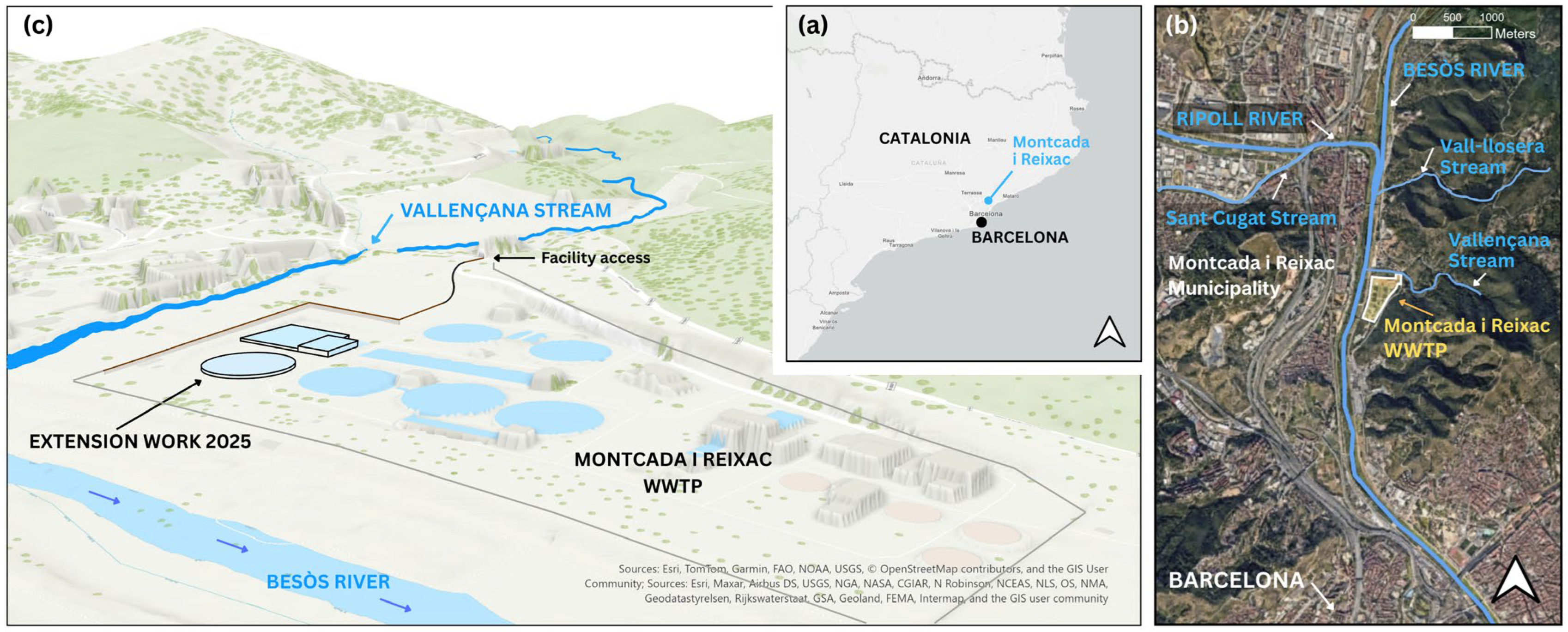
The research focuses on the Montcada i Reixac wastewater treatment plant, a facility with a treatment capacity of 72,600 m3/day located in the north-eastern sector of the Metropolitan Area of Barcelona (AMB). The plant treats wastewater from six municipalities in the area and also receives a significant industrial load [32], accounting for approximately 7% of the total wastewater generated by the more than 3 million inhabitants of the AMB. It is located on the right bank of the Besòs River, one of the two main rivers crossing the entire metropolitan area. In addition, the facility is situated downstream of the Vallençana stream, a torrential watercourse draining the surrounding upland catchments. Figure 1 shows the location of the municipality of Montcada i Reixac (a), the rivers and ephemeral streams in the vicinity of the plant (b), and a three-dimensional schematic of the facility and the contributing watercourses (c).
The facility has an estimated asset value of approximately EUR 57 million, based on official documentation from the Catalan Water Agency [29]. The plant provides secondary treatment and was upgraded in 2024 to include nitrogen removal [32]. Previous studies indicate that the facility is located within a flood-prone area, being affected by overflows from the Vallençana ephemeral stream for events with 10-, 100-, and 500-year return periods, and by the Besòs River for events with a 500-year return period [7]. The recent expansion is located in the northern sector of the plant, an area highly exposed to overflow from the stream under extreme events. These factors justify the selection of this facility as the case study.

2.2. Climate Scenarios and Time Horizons

As introduced in the previous section, this research has used climate projections developed within the framework of the sixth Coupled Model Intercomparison Project (CMIP6) [15], in which the future behaviour of different climatic variables (up to 2100) is defined as a function of a combination of socioeconomic development trajectories, mainly driven by greenhouse gas emissions. These trajectories are represented by the Shared Socioeconomic Pathways (SSPs) [33], which describe a potential line of evolution for humankind in terms of different pathways, such as radiative forcing driven by adopted mitigation policies, the adaptation strategies followed, and the prevailing social concepts of human development [34]. These models have been downscaled to the territory of the Metropolitan Area of Barcelona [17].
Following Intergovernmental Panel on Climate Change (IPCC) recommendations [13], the ICARIA project used climate models from CMIP6 (10 in total). Specifically for precipitation, daily data were obtained for the period 2015–2100 for each Global Climate Model (GCM) and socioeconomic scenario (SSP). By combining these downscaled variables across the different models, future variations in Intensity–Duration–Frequency (IDF) curves can be derived.
Within the framework of the European ICARIA project, damage assessment methodologies for climate hazards have been developed and applied to different high-value assets for society [35]. To evaluate impacts under future conditions, the SSP126 and SSP585 climate scenarios were selected for the mid-term (2041–2070) and long-term (2071–2100) horizons to capture the lower and upper bounds of plausible future climate conditions. In addition, to account for uncertainty in the predictive models, both the ‘Mean value’ (average values of the ten climatic models) and an ‘Extreme value’ (90th percentile) were also considered in the analysis.
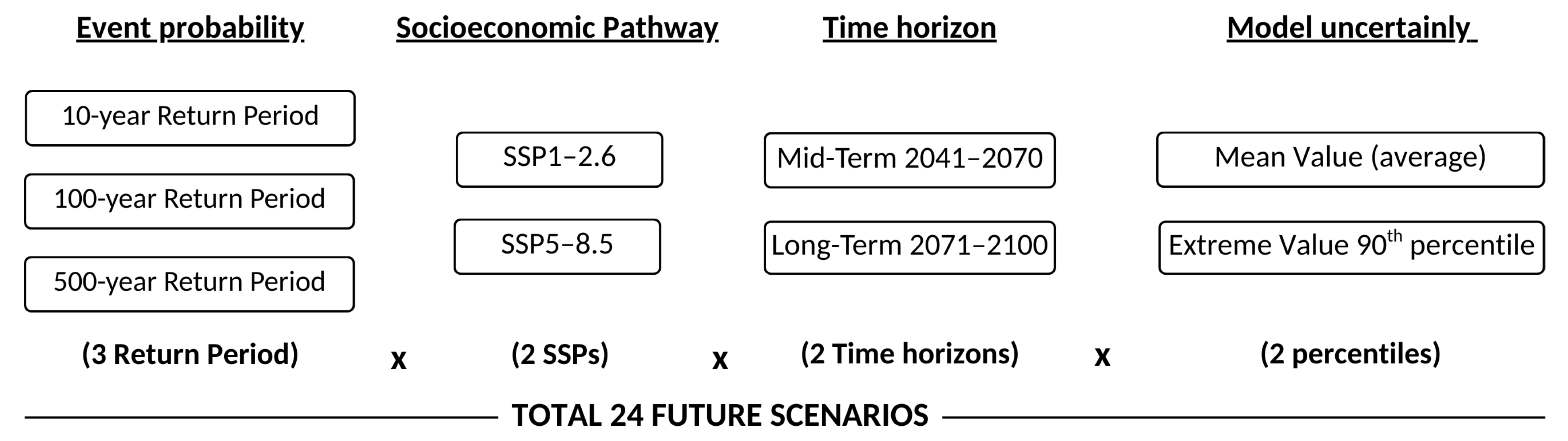
Floods are climate hazards driven by extreme meteorological conditions. Accordingly, these scenario combinations are applied independently to each watercourse contribution for events with 10-, 100-, and 500-year return periods. The combination of variables results in 24 future scenarios and 3 actual scenarios, yielding a total of 27 situations to be simulated, as summarised in Figure 2.

2.3. Climate Change Coefficients in Watercourse Contributions

The study domain of the Montcada i Reixac WWTP includes five watercourse contributions, which are introduced as inflow discharges at the boundaries of the computational mesh. This procedure, developed using Iber software 3.4 [36], is consistent with that adopted in the first study of this research by Flor et al. [7]. Details of the hydrodynamic modelling process have been presented previously [30], and the same model and parameters are used here. In the present work, for each of the 24 future scenarios, discharge variations are implemented by multiplying the current values by a Climate Change Coefficient (CCC).
The downscaling of the CGMs carried out within the ICARIA Project produced future precipitation time series. Based on these data [17], the evolution of Intensity–Duration–Frequency (IDF) curves was estimated for different combinations of rainfall duration and return period. By comparing future and current IDF curves, CCCs were derived for each future scenario. These coefficients quantify the projected variation in precipitation intensity. All data is published in an open-access format on Zenodo [37].
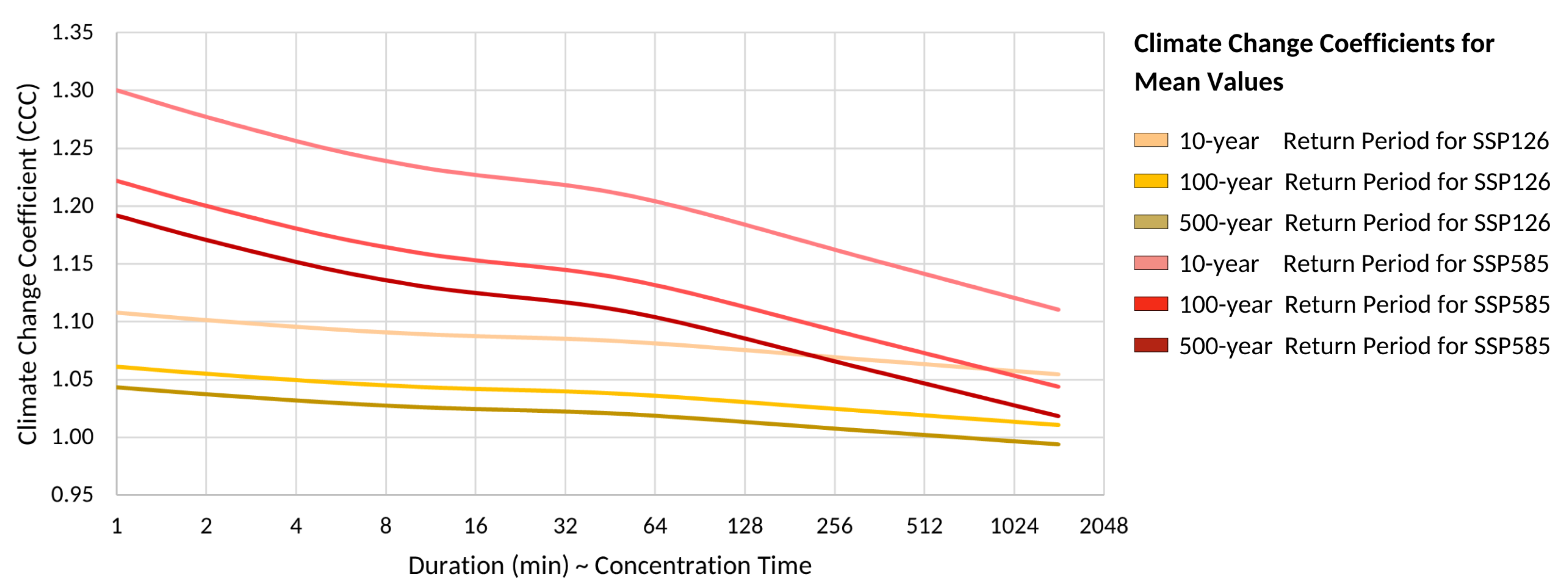
The methodology [7] estimates domain flow rates using a simplified triangular hydrograph, in which the time to peak (Tp) is assumed to be equal to the concentration time of each catchment (Tc), thus assuming an event duration equal to Tc, as recommended in a technical report of the Catalan Water Agency [38]. The rainfall–runoff transformation is calculated using the Rational Method (RM) [39], except for the Besòs river, which is modelled using the Soil Conservation Service (SCS) method. Under the RM framework, peak discharges are directly proportional to rainfall intensity, allowing Climate Change Coefficients (CCCs) derived from IDF curves to be applied directly to the flows. While the RM is less suitable for large catchments like the Besòs, as it oversimplifies spatial and temporal rainfall uniformity, the direct application of CCCs to SCS-derived flows represents a minor methodological limitation, which is considered a conservative approach. Due to the linear sensitivity of the RM compared to the non-linear nature of the SCS, this methodology ensures that the estimated discharge remains on the safe side of design. Consequently, this provides more conservative peak flow results for the Besòs river than a strictly non-linear recalculation. Figure 3 presents the CCCs corresponding to the multi-model mean for the long-term situation (2071–2100) for the selected SSP scenarios and return periods considered in this study.
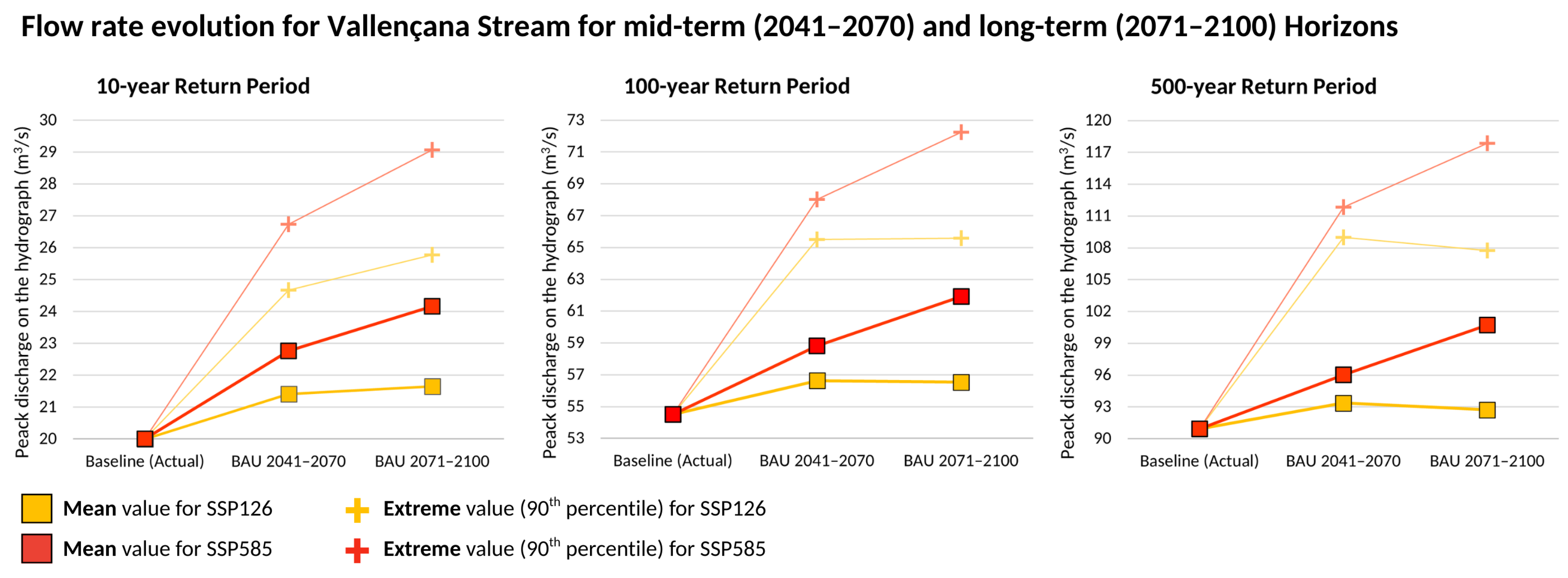
Current-condition discharges were obtained from the data repository of the Catalan Water Agency [40] and are reported in Table 1, together with the concentration time (Tc) of each catchment within the study domain shown in Figure 1b. Tc is introduced into the corresponding CCC curves to estimate future discharges for each scenario. As an example, Figure 4 illustrates the evolution of discharges for the Vallençana stream. The results show that discharges under SSP126 tend to stabilise for both time horizons, whereas SSP585 indicates substantially larger increases in the long term (2071–2100). This behaviour is consistent across all contributions and is more pronounced for catchments with smaller hydrological areas.

2.4. Hazard and Impact Assessment: Expected Annual Damage (EAD)

Hazard and exposure are quantified using two hazard-related indicators: the percentage of flooded area (%FA) and the average water depth within the flooded area of the facility (AWD). Post-processing of the simulations was carried out using ArcGIS 3.6 Pro tools, through an internal notebook and -based workflows (version 3.13), to derive these indicators from successive calculations for each future scenario.
Similarly, the high-hazard area within the plant was obtained for each of the hazard criteria considered. Velocity (v) and water depth (y) raster from the map of the maximum of the simulations were combined to derive the (v·y) parameter required for the application of the criteria. Two hazard assessment approaches were applied. First, general hazard (including material damage and risk to people) was evaluated following the definition of the Spanish Regulation of the Public Hydraulic Domain (RDPH), developed by Témez [23], which focuses on the risk of overturning or dragging of elements. Second, pedestrian stability under sliding conditions was assessed using the criterion proposed by Martínez-Gomariz [22]. The same methodology described for the current-climate scenario for this case study was applied [30]. In both cases, the evolution of the area classified as a high hazard was analysed across the different climate scenarios.
Regarding the impact assessment, the methodology developed by Flor et al. [7] for wastewater treatment facilities in the metropolitan area was applied. The assessment is based on the use of damage curves specifically developed for different WWTP asset typologies in the study area, which relate floodwater depth to a percentage of damage relative to the total value of the area under analysis. For this case study, the Montcada i Reixac WWTP is assigned an approximate total value of EUR 57 million [29], distributed across ten zones. As a novelty of this research, plant data were updated to include a tenth section corresponding to the expansion works carried out in 2025, with an approximate value of EUR 10 million, representing more than 17% of the total.
The outputs of the methodology allow the estimation, for each future scenario, of the percentage of damage in each plant division and the total integrated damage value. Using these data, the Expected Annual Damage (EAD) [9] for each scenario was calculated. It should be noted that, for the calculation of future damages (for the 2041–2070 and 2071–2100 horizons), the plant value has not been updated based on the Gross Domestic Product (GDP) long-term forecast [41] as usual, in order to assess only the increases associated with climate change.

2.5. Adaptation Measures: Natural Embankment

A nature-based adaptation measure is proposed to completely eliminate flood damage at the plant associated with future flood events from the Vallençana stream, while maintaining exposure only to overflow from the Besòs River, which occurs for events with a 500-year return period (RP). Understanding that the scope for intervention is limited and confined to the immediate surroundings of the WWTP, the proposed solution consists of a vegetated embankment (levee) that enables the development of a small flood retention basin in the northern part of the plant, allowing controlled discharge to the main Besòs River channel through the existing culvert. The measure is simulated for the most adverse mean-flow scenario, corresponding to the long-term SSP585 projection, and the resulting Expected Annual Damage (EAD) is compared with the Business-as-Usual (BAU) scenario.

3. Results

3.1. General Hazard-Related Indicators: Water Depth and Flooded Area

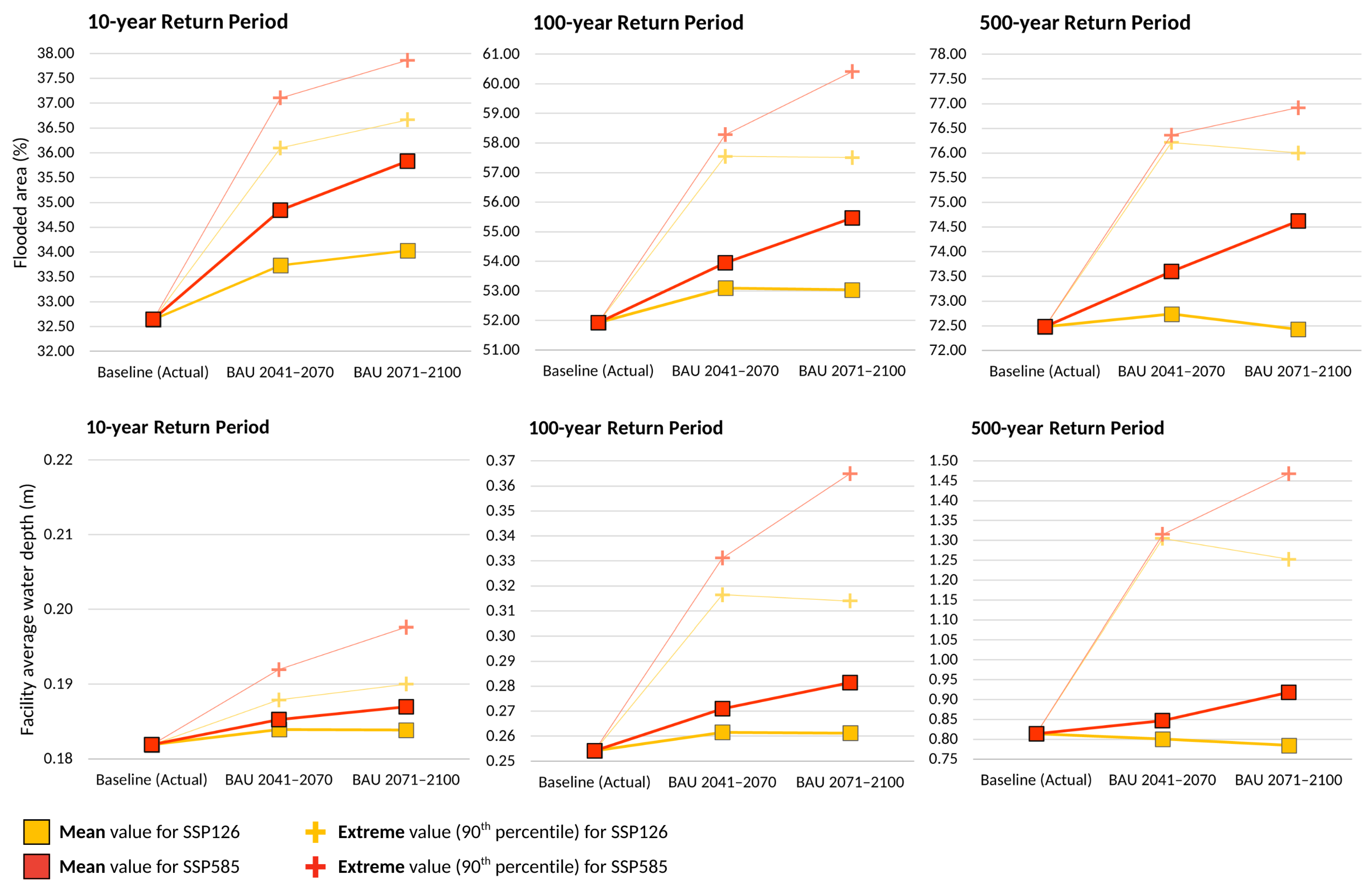
First, the hazard drivers and plant exposure were analysed for each future scenario. The results for average water depth (AWD) and percentage of flooded area (%FA) are shown in Figure 5. Differences in flood depths for the 10-year return period (RP) event are negligible for the purposes of extreme-event assessment and can be considered within modelling uncertainty. By contrast, significant increases in %FA and AWD are observed only for the Extreme Values (90th percentile of the models), whereas the Mean Values show increases consistently below 10% relative to current conditions. It is also noteworthy that the SSP126 socioeconomic scenario does not yield higher values in the long-term compared with the mid-term horizon, in line with the behaviour previously observed in the applied CCCs.
Consistent with the current scenario and as demonstrated in the preceding study [7], the plant is affected by overflow from the Vallençana stream for flood events with 10- and 100-year return periods (RP). In the 500-year simulation, the Besòs River also overtops its banks, resulting in widespread flooding of the facility. Climate change simulations exhibit the same general flooding pattern; however, under the BAU 2071–2100 + SSP585 + Extreme Value (90th percentile) combination, the 100-year RP event already leads to flooding associated with overflow of the Besòs River.

3.2. Hazard Assessment Based on RDPH (1) and Pedestrian Stability Criteria (2)

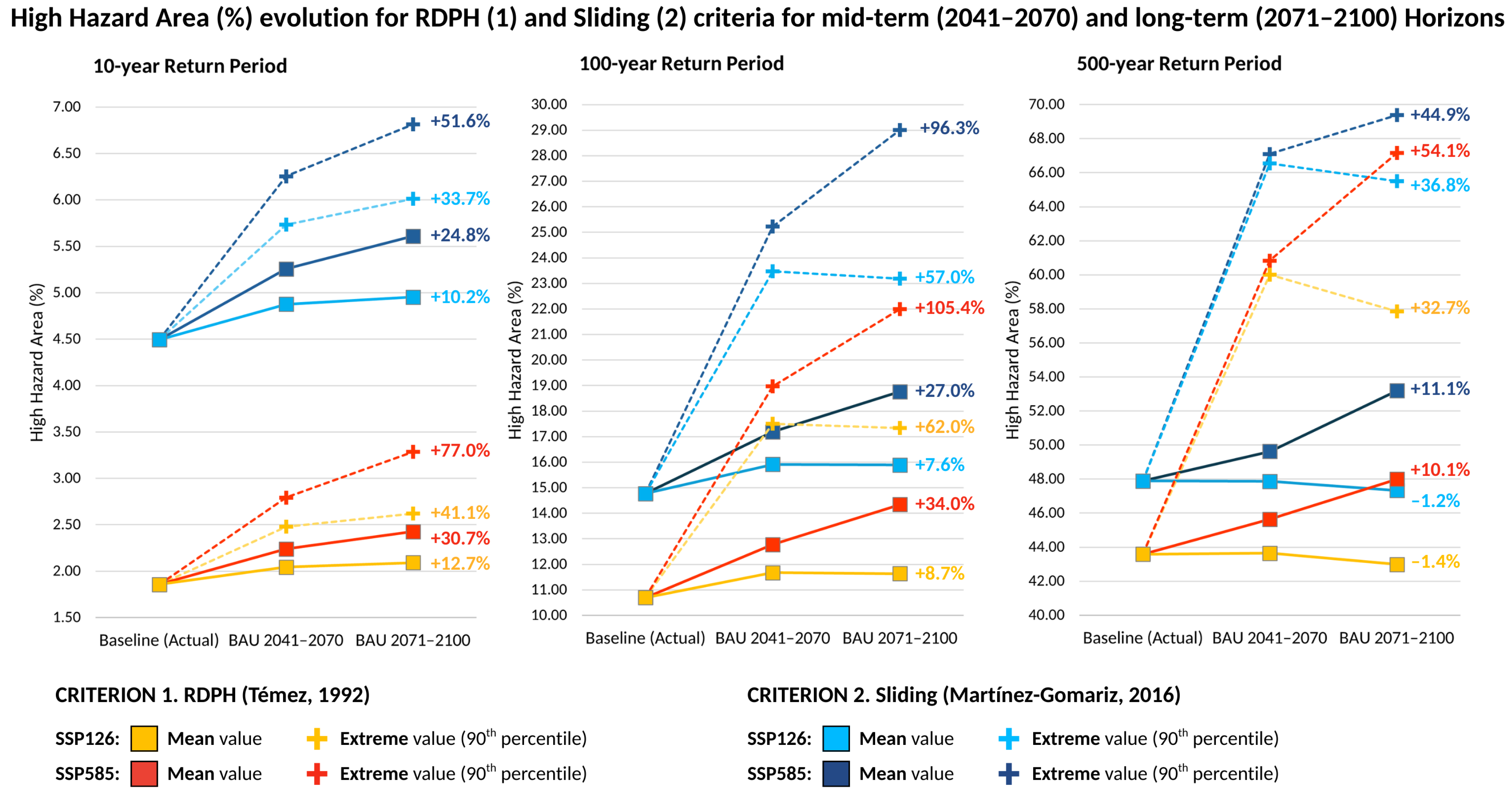
Hazard assessment results (Figure 6) are consistent with the general hazard-related flood indicators. The SSP126 climate scenario does not show consistent differences between the mid- and long-term horizons, whereas SSP585 leads to an increase in high-hazard (HH) areas in the long term. Uncertainty is substantial, as reflected by the differences between Mean Values and Extreme Values (90th percentile), with variations of up to 50% in HH area within the same climate scenario and time horizon. Differences between the hazard criteria are not significant, although the sliding stability criterion (2) systematically yields slightly higher values, especially for more frequent events (10-year RP).
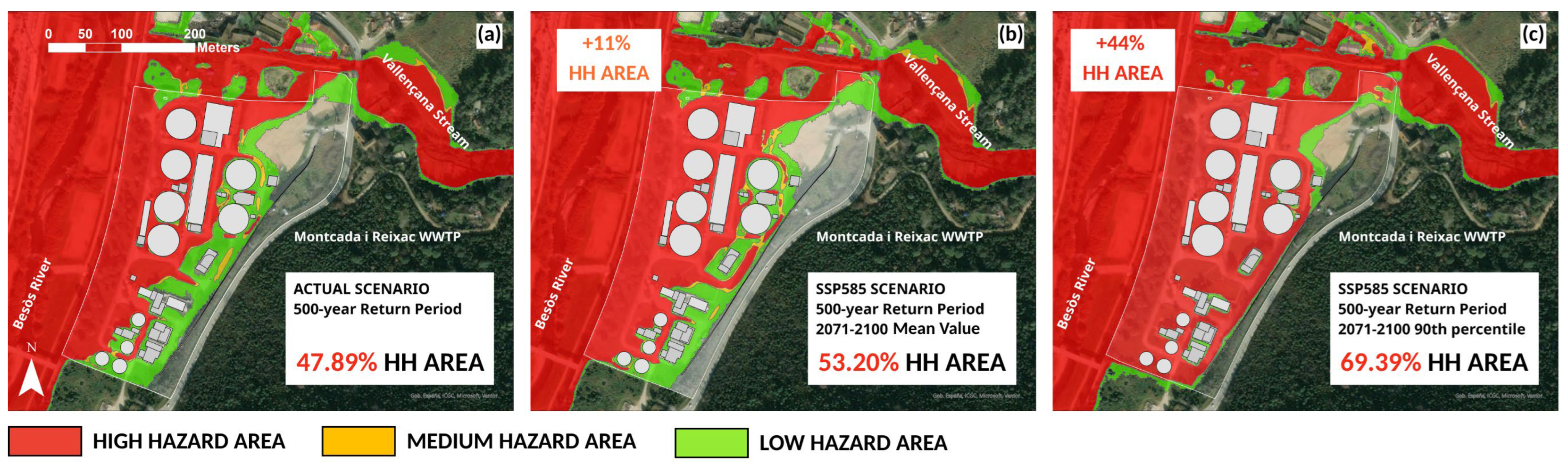
Figure 7 presents the pedestrian sliding hazard map (criterion 2), as it yields slightly higher values than criterion 1, comparing the current scenario for a 500-year RP simulation with the most adverse future scenario (SSP585, long-term). Relative increases are significant for the model Mean Values across all climate scenarios; however, the spatial extent of the hazard does not change substantially in absolute terms. Notably, the eastern sector of the plant, together with the access routes, remains free of hazard in all cases, allowing its use for safe staff evacuation during flood events. In contrast, both Figure 6 and Figure 7 highlight the marked difference between Mean Values and Extreme Values (90th percentile), as the latter result in hazardous conditions across all internal pedestrian areas of the WWTP. This contrast underscores the high level of uncertainty in the model outputs, particularly under the SSP585 scenario.
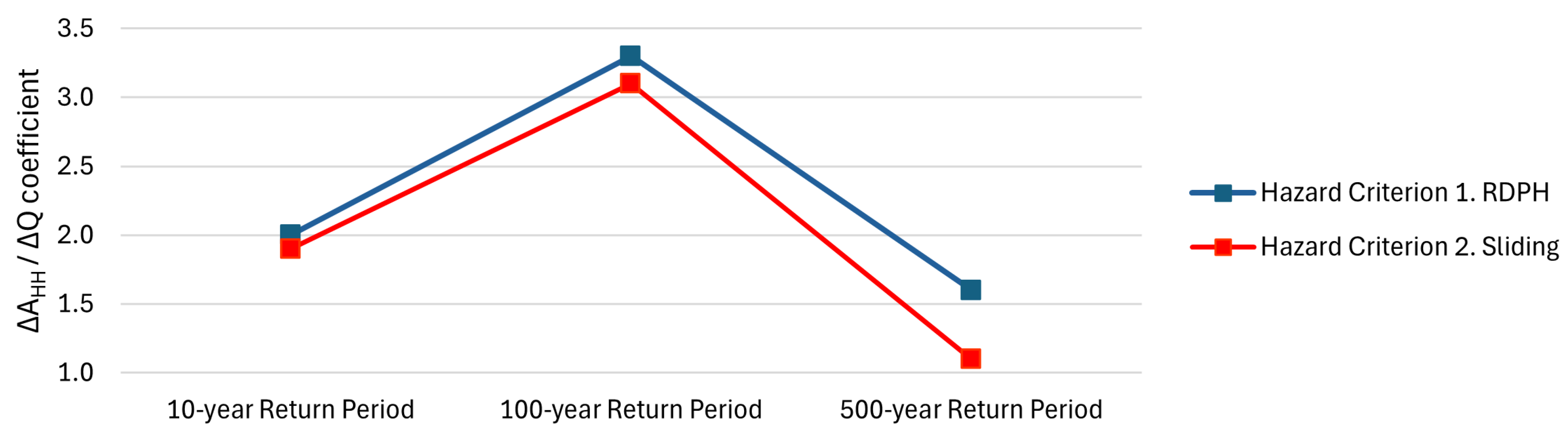
The increase in flow rate (ΔQ) from the Vallençana stream, the main water contribution responsible for WWTP flooding, has been related to the corresponding increase in HH area for both hazard criteria (ΔAHH), relative to current conditions. All future scenarios exhibit a similar pattern, and both variables can be related, for each return period (RP) and criterion, through linear functions with R2 > 0.9. Accordingly, the increase in HH area scales with Vallençana flow increase as ΔAHH = [1.1–3.3] ΔQ. Comparable results are obtained when analysing discharge increases in the Besòs River. In more detail, Figure 8 presents the results disaggregated by hazard criterion and flood event. This indicates an amplification of flood hazard relative to the increase in discharge. Consequently, assessing future impacts based solely on flow changes could lead to an underestimation of the actual expansion of hazardous conditions.

3.3. Damage Assessment Results

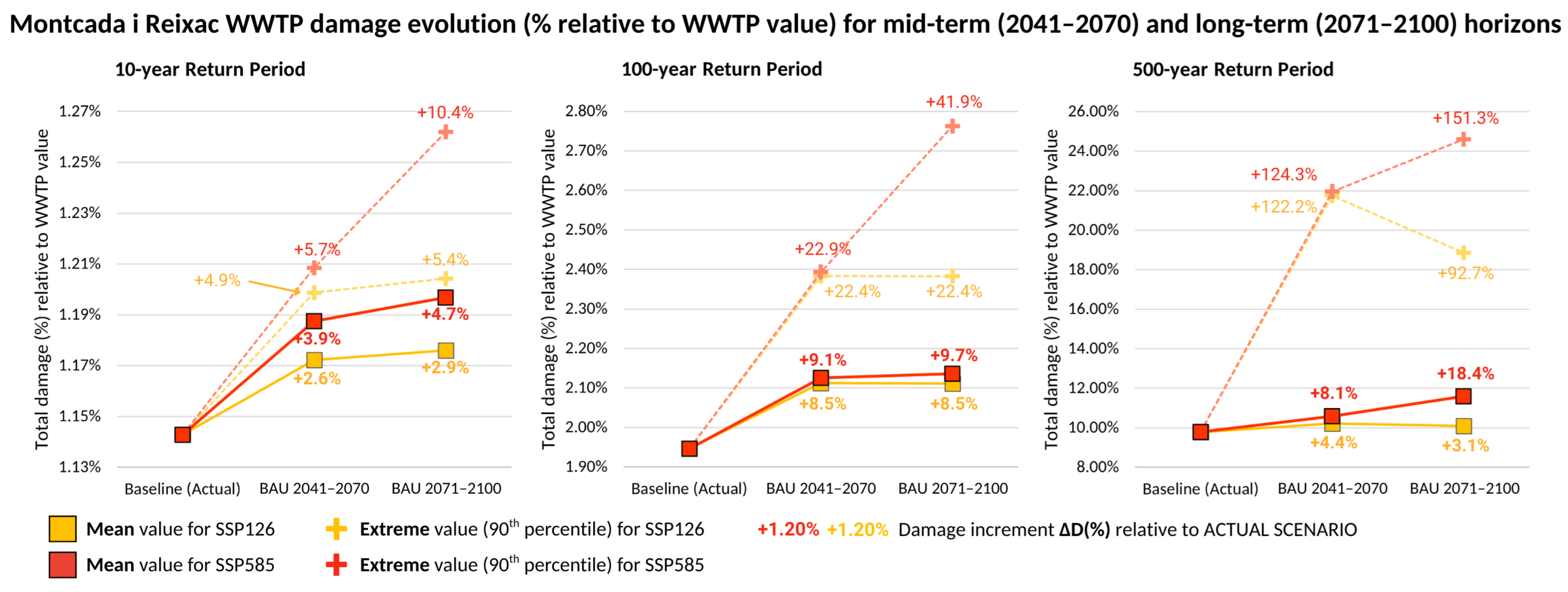
Damage across the different sectors of the Montcada i Reixac WWTP has been aggregated to estimate the total damage to the facility for each future scenario. All the results presented below are derived from the application of damage curves to the facility and do not correspond to observations from real events. Figure 9 shows the percentage (%) of damage per event relative to the total value of the WWTP for current conditions and its evolution under future Business-as-Usual (BAU) scenarios. In addition, the percentage increase in damage relative to the baseline (actual) scenario is overlaid on the figure.
Total damages in this section (in EUR) are expressed at 2025 cost levels, with no future cost updating, in order to isolate the increase attributable exclusively to climate change. Results show that damages remain slightly above 1% of the WWTP value for all future scenarios, with negligible differences between current conditions and the most adverse scenario for the 10-year RP events, where damages range between EUR 600,000 and EUR 700,000. For the 100-year RP simulations, damages do not vary substantially between SSP scenarios, showing increases below 10% for all Mean Damages and slightly above 20% for the Extreme Damages (90th percentile). In all cases, damages are slightly above 2% of the plant value (approximately EUR 1 million), except for the most adverse scenario (SSP585, long-term, 90th percentile), which is the only case in which flooding from the Besòs River affects the facility. In this situation, damage increases exceed 40%, with absolute losses greater than EUR 1.5 million.
Finally, results for the 500-year RP events exhibit high uncertainty, with highlighted differences between Mean and Extreme Damages. Under SSP126, Mean Values remain close to current conditions, with damages around 10% of the plant value (approximately EUR 5.5 million). Under SSP585, increases of 8% for the mid-term and 18% for the long-term horizon are observed, corresponding to an additional damage of approximately EUR 1 million in the latter case. Extreme Damages yield substantially higher impacts, reaching up to 22% of damage (around EUR 12 million) for the mid-term horizon in both scenarios, and up to 25% of damage for SSP585 in the long-term, representing a ×2.5 increase relative to current conditions and absolute damages of approximately EUR 14 million.
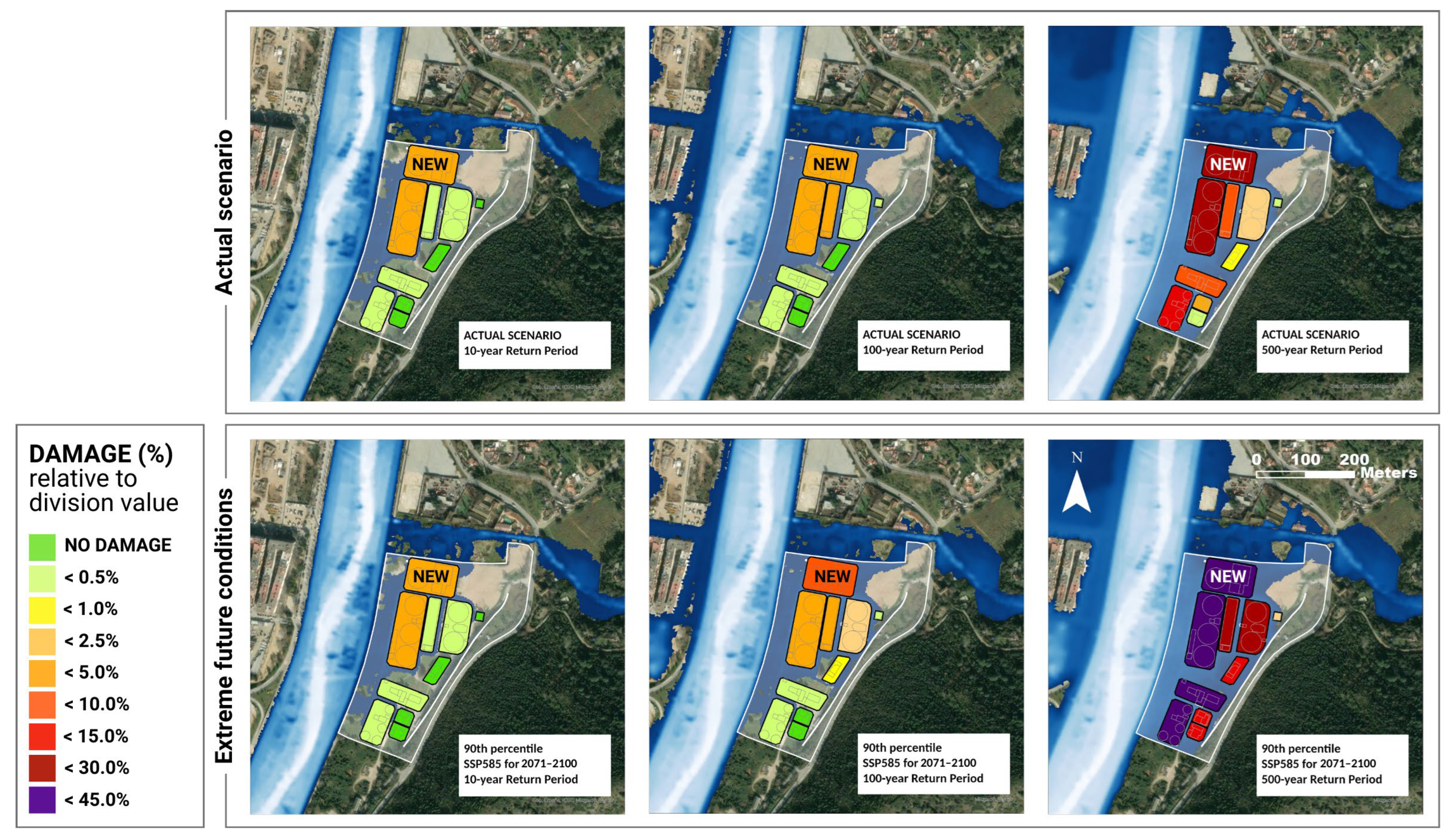
Thanks to the damage assessment methodology based on the segmentation of the facility, it is possible to spatially localise and analyse damage in greater detail. In general, the northern and north-eastern sectors of the plant experience the most significant damage for flood events with 10- and 100-year RP, while damage becomes widespread for the 500-year event due to overflow from the Besòs River. It is also noteworthy that the plant extension completed in 2025 (NEW in Figure 10) is located in the most flood-prone area of the northern sector.
Figure 10 compares the current scenario with the most extreme future conditions (SSP585, long-term, and 90th percentile). While damage patterns for the 10-year RP are similar, a significant increase in damage is observed in the northern sections due to overflow from the Vallençana stream for the 100-year RP simulation. Under future conditions, the 500-year RP event exposes more than half of the plant to damage levels ranging between 30% and 45% of the total value of the affected sections.
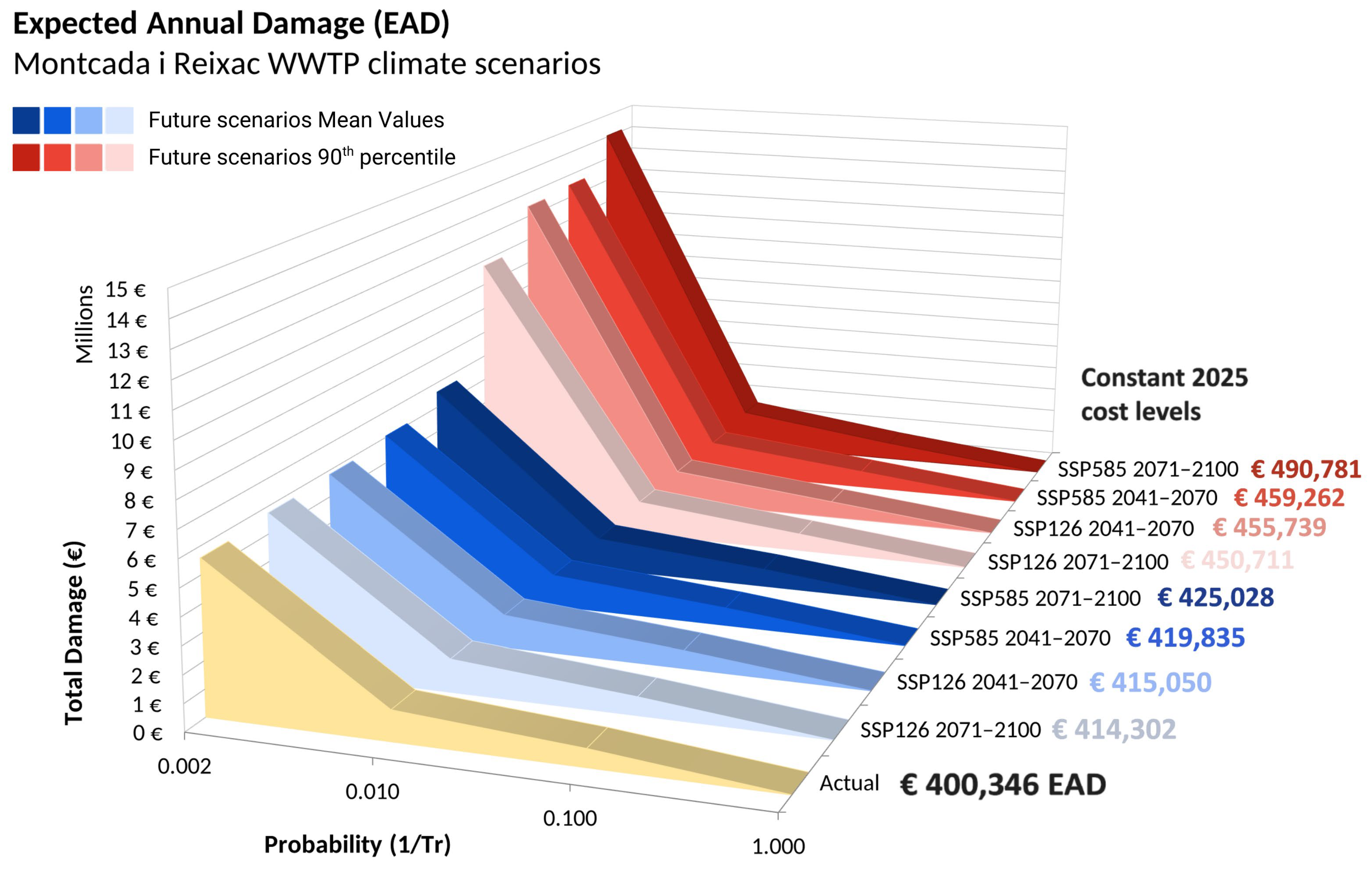
The Expected Annual Damage (EAD) results yield values exceeding EUR 400,000 for all scenarios, with increases ranging from 3.5% to 22.5% relative to current conditions across all future climate scenarios. To complete the EAD representation, zero damage is assumed at a probability of 1 (1-year RP). Figure 11 presents these results, with the horizontal axis representing the probability of occurrence on a logarithmic scale. The model selection (mean or 90th) emerges as the key differentiating factor between the EAD estimates for the climate scenarios, once again highlighting the uncertainty among climate models arising from the coefficients applied to the flow rates, particularly for the 500-year return period events.

3.4. Adaptation Measure Results

Finally, an adaptation measure is proposed to reduce exposure and, consequently, the Expected Annual Damage (EAD) for the worst mean climate scenario (SSP585, long-term horizon, and Mean Values). Due to uncertainty between models across different climate scenarios, an adaptive measure has been proposed that is capable of addressing the full range of future scenarios for the Vallençana stream, including 500-year return period events. Nevertheless, the primary objective remains focused on events with 100-year RP or less, which are the only events for which the Vallençana stream is the sole watercourse affecting the facility.
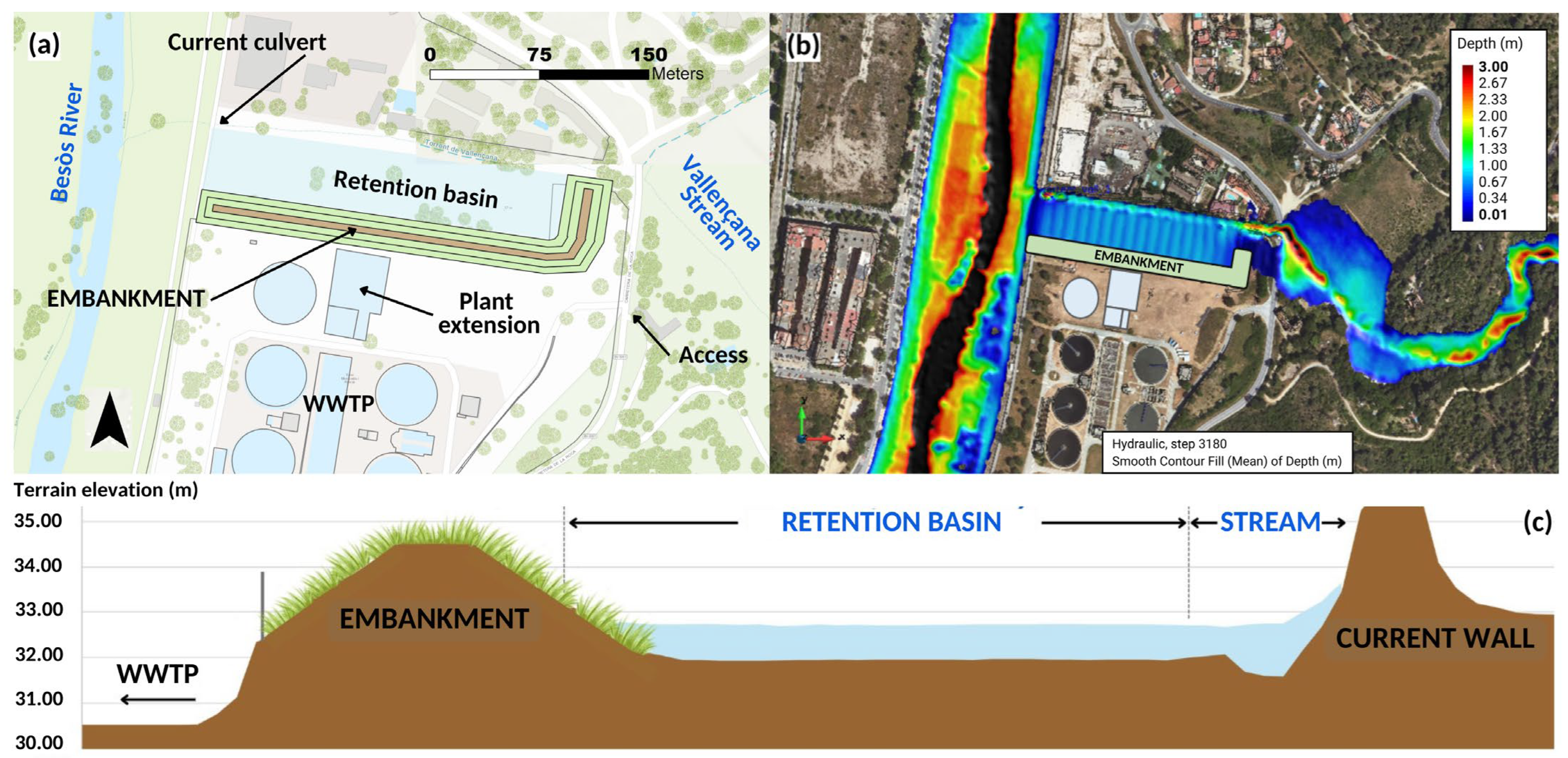
An embankment has been implemented parallel to the northern boundary of the WWTP, as shown in Figure 12. This embankment creates a retention basin that captures flows from the Vallençana stream, even for the 500-year RP event under the analysed future climate scenario, developing a local flood retention area in the northern sector where the existing culvert discharges the stream water into the Besòs River.
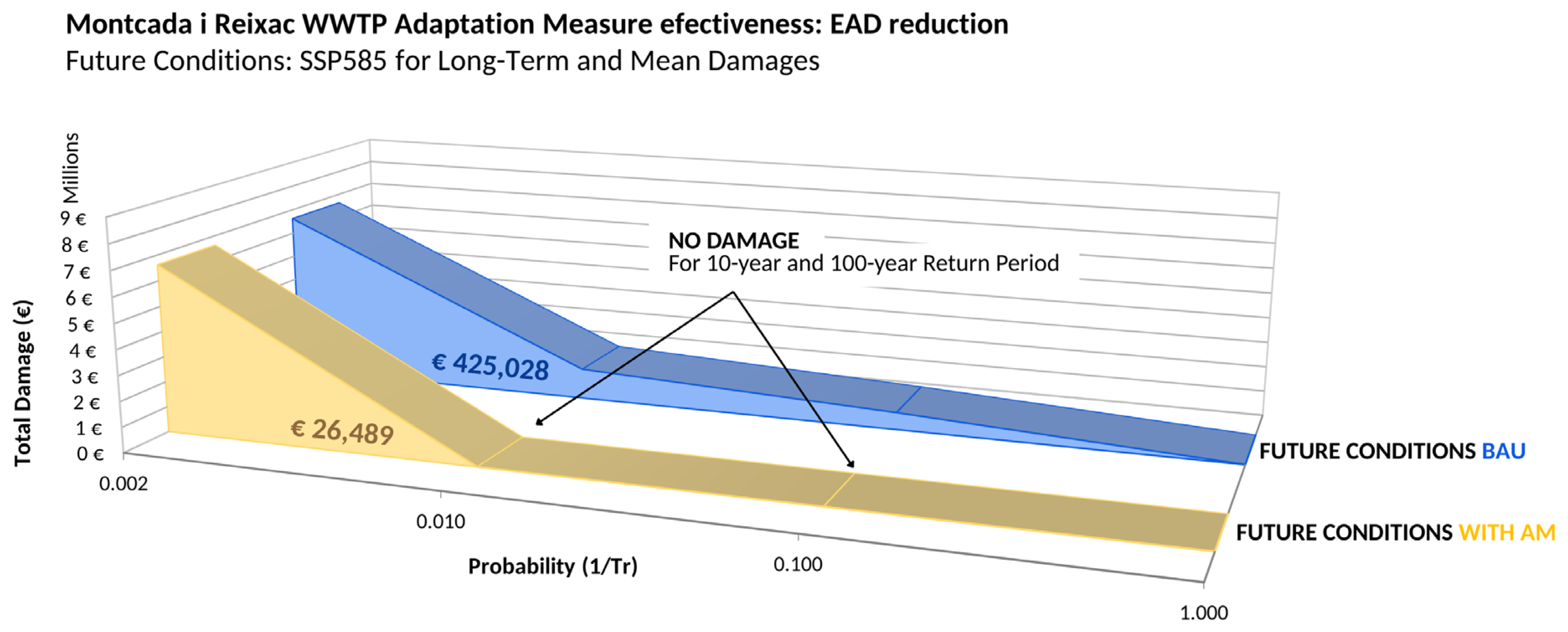
With this measure in place, the plant remains exposed only to flooding from the Besòs River, which has an annual associated probability of 0.002 (500-year RP). As a result, the EAD for the selected scenario is reduced from EUR 425,028 to EUR 26,489, corresponding to a 93% reduction, achieved by eliminating exposure to the more frequent 10- and 100-year return period events, as shown in Figure 13.

4. Discussion

The impacts of climate change are altering the behaviour of climatic variables at the regional scale, modifying precipitation patterns and, consequently, the frequency and intensity of extreme events in rivers and streams. These changes are expected to generate significant damage to assets and infrastructures exposed to flood hazard. Sanitation systems are not exempt from this phenomenon, as wastewater treatment plants (WWTPs) are commonly located in low-lying and flood-prone areas, making them particularly vulnerable. In the Metropolitan Area of Barcelona (AMB), the statistical downscaling of CMIP6 climate models does not project a significant increase in mean annual precipitation across the analysed scenarios. However, it does indicate a temporal redistribution of rainfall, with a higher concentration in short-duration, high-intensity events, which increases flood risk, especially in Mediterranean catchments characterised by rapid hydrological response.
Future climate scenarios were defined through the combination of key variables: Shared Socioeconomic Pathways (SSPs), temporal horizons (mid-term and long-term), and climate model percentiles, allowing both average conditions (Mean Values) and more adverse (Extreme Values) situations to be assessed. These variables enable the evaluation of changes not only in design discharges but also in their direct impact on hazard and damage metrics at the facility scale. The Montcada i Reixac WWTP was selected as a representative case study of a typical Mediterranean plant, as it is simultaneously exposed to a fast-response stream (Vallençana) and a large river (Besòs). These characteristics make it a suitable example for analysing the future behaviour of similar infrastructures located in complex fluvial and highly urbanised environments.
The results show that the variable generating the largest differences among the analysed outputs, both in terms of high-hazard area for pedestrians and damage to the facilities, is the climate model percentile. In all scenarios and time horizons, the outcomes associated with the 90th percentile are significantly higher than those obtained for the Mean Values. This highlights the substantial dispersion among climate model projections and, consequently, the relevance of uncertainty in future impact assessments. In this regard, the differences between mean and Extreme Values demonstrate how uncertainty in the physical models (particularly in precipitation) is propagated into the risk assessment models. In any case, to a greater or lesser extent, all scenarios point to an increase in extreme events, supporting the need to incorporate adaptation measures.
The comparison between SSPs reveals clearly differentiated trends. Under the SSP126 scenario and considering mean flood events, the projected increase in affecting discharges between present, mid-term, and long-term horizons is minimal. This behaviour is consistently reflected across all analysed metrics (average water depths within the facility, percentage of flooded area, high-hazard pedestrian zones, and physical damage), whose average values tend to remain stable over time for the Montcada i Reixac WWTP. In contrast, the SSP585 scenario exhibits a generalised increase across all variables, which becomes more pronounced in the long-term period (2071–2100). These results underline the importance of socioeconomic and emission assumptions in future risk assessments, particularly for infrastructures with long operational lifespans.
One limitation of the proposed approach is the direct application of Climate Change Coefficients (CCCs) to the inflow discharges of the hydrodynamic model. This application assumes that the discharges were derived using the Rational Method, and therefore that flow rates are directly proportional to rainfall intensity. While this assumption is appropriate for the Vallençana stream and the other ephemeral watercourses within the study domain, it is less suitable for the Besòs River, whose catchment size precludes the original use of the Rational Method. As a result, the direct application of CCCs may lead to an overestimation of future discharges in the Besòs River.
The evolution of pedestrian hazard shows a particularly sensitive response to increases in discharge. The results indicate that relatively moderate discharge increments lead to larger expansions of areas classified as a high hazard for pedestrians. This behaviour arises from the combined effect of increasing water depths and flow velocities, which significantly enlarges zones exceeding pedestrian stability thresholds. In the operational context of a WWTP, this aspect is critical from a safety and emergency management perspective, as it increases potentially inaccessible areas and constrains evacuation routes during flood events. Specifically, for the Montcada i Reixac WWTP, the results for future scenario combinations associated with 10- and 100-year return period (RP) floods identify the north-eastern sector of the facility as a safe area, highlighting this zone as a potential evacuation route. However, this route ceases to be safe under extraordinary 500-year RP events, for which progressively expanding high-hazard areas are identified, eventually leading to widespread hazardous conditions across the facility in the most extreme scenario combinations.
Flood events associated with more frequent precipitation, such as those with a 10-year RP, show higher future variability, with Climate Change Coefficients exceeding those observed for more extreme events. Nevertheless, the absolute damage caused by these floods does not vary significantly in future scenarios, remaining between 1% and 1.5% of the total plant value across all simulations. A similar pattern is observed for 100-year RP floods, with damage ranging between 2% and 2.4%, except for the SSP585 long-term 90th percentile simulation, where overtopping of the Besòs River increases damage to approximately 2.8%. Overall, absolute damage variations for these events remain relatively limited, indicating that frequent floods are not the main drivers of severe losses.
The largest differences are observed for extraordinary floods with a 500-year RP. In these events, the Besòs River overtops in all analysed scenarios and periods, inundating most of the facility. The associated Climate Change Coefficients (CCC) are relatively small, due both to the large size of the Besòs catchment (with long concentration times) and to the exceptional nature of these events. Nevertheless, absolute damage increases substantially under the SSP585 scenario. Mean Damages exceed 12% and 14% in the mid-term and long-term periods, respectively, while 90th percentile damages reach 22% and 24% of the total plant value. These results demonstrate that, for extreme events, even modest discharge increases can translate into very significant rises in absolute damage.
Overall, the results reveal a high degree of uncertainty in future impact projections, particularly for long-term horizons and 500-year RP events. The research highlights that increases in stream flows generate larger increases in hazard. In particular, projected increases in discharge lead to large expansions of high-hazard areas (between 1.1 and 3.3 times greater) and to a generalised increase in damage, especially for extraordinary floods (500-year RP). Although the analysis focuses on a single facility, the observed patterns allow for broader conclusions that are applicable to other WWTPs located in similar hydrological and climatic settings.
The analysed future scenarios show limited differences in Expected Annual Damage (EAD), as the most significant increases in damage are concentrated in low-probability flood events (500-year RP), which have a minor effect on the aggregated EAD. Flood adaptation measures are inherently site-specific and must be designed for each individual infrastructure. At the Montcada i Reixac WWTP, the available intervention area is limited, and the proposed strategy focuses on achieving zero exposure to the Vallençana stream, which is the main contributor to damage for lower return period events.
Although the facility remains exposed to extreme floods (500-year RP) driven by the Besòs River, the proposed measures reduce the EAD by 93% by directly addressing the most frequent events. For the 500-year return period flood of the Besòs River, the plant is inundated similarly to past events, but the retention basin reduces the overall flood extent. Some water flows through the culvert in the reverse direction, slightly entering the basin, but it never reaches full capacity and does not overtop. As a result, water drains naturally through the same culvert once the river flows recede. This measure has been proposed as a nature-based solution, promoting sustainability and allowing for potential synergies and alternative uses during non-flood periods, such as natural waste stabilisation ponds in wastewater treatment or as a natural area and biodiversity space.
This type of analysis is essential for the development of climate change adaptation plans in urban water utilities. The integration of climate projections, detailed hydraulic modelling, and damage assessment enables the prioritisation of interventions, optimisation of resources, and enhancement of the resilience of critical infrastructures. In a context of increasing climatic uncertainty, tools that allow both hazard and damage to be quantified under multiple scenarios are relevant to informed decision-making and to ensuring long-term service continuity.

5. Conclusions

Climate change is expected to modify precipitation patterns in the Mediterranean region, with a higher concentration of short-duration, high-intensity rainfall events. In the Metropolitan Area of Barcelona, this shift directly affects flood-generating processes in rivers and ephemeral streams, increasing pressure on wastewater treatment plants, which are typically located in low-lying and hydrologically sensitive areas. These infrastructures are therefore particularly exposed to climate-driven changes in flood hazard, with implications for operational safety, service continuity, and economic losses.
The results for the Montcada i Reixac wastewater treatment plant show that future impacts strongly depend on the selected climate scenario and, in particular, on the percentile of the climate models. Under SSP126, changes in flooded area, high-hazard areas, and tangible damage at the plant do not increase significantly, especially when considering the model Mean models values. In contrast, SSP585 leads to systematic increases in hazard and damage, particularly for long-term (2071–2100) projections and extraordinary events (500-year RP). In all cases, uncertainty associated with climate projections emerges as a dominant factor in the results; therefore, the proposed sustainable adaptation measure aims to address the full range of possible outcomes.
These findings demonstrate the value of combining climate projections, hydraulic modelling, and damage assessment to support adaptation planning in urban water utilities. The application of Climate Change Coefficients to the initial variables in flood risk assessments can be fully transferred to other territorial risk assessments that use the same types of input data, such as flows or precipitation, as boundary conditions. Quantifying future hazard and damage enables the prioritisation of interventions and the evaluation of adaptation effectiveness under climate uncertainty. Framed within the broader climate change adaptation strategy of Aigües de Barcelona for the integrated water cycle, the proposed nature-based solution shows that targeted, site-specific measures can substantially reduce risk, providing actionable evidence to inform climate adaptation strategies for wastewater infrastructure. Future work should extend this approach by exploring additional adaptation measures addressing other climate-related hazards affecting water utility infrastructure, thereby supporting a more comprehensive resilience strategy across the urban water cycle.

Author Contributions

Conceptualization, G.F.T., E.M.-G. and B.R.; methodology, G.F.T. and E.M.-G.; software, G.F.T.; validation, J.B.R., E.M.-G. and B.R.; formal analysis, G.F.T.; investigation, G.F.T.; resources, J.B.R., E.M.-G. and B.R.; data curation, G.F.T.; writing—original draft preparation, G.F.T.; writing—review and editing, G.F.T.; visualisation, G.F.T.; supervision, J.B.R., E.M.-G. and B.R.; project administration, B.R.; funding acquisition, B.R. All authors have read and agreed to the published version of the manuscript.

Funding

The ICARIA project (Improving Climate Resilience of Critical Assets) is funded by the European Commission through the Horizon Europe Programme, Grant Number 101093806. https://cordis.europa.eu/project/id/101093806 (accessed on 17 March 2026). G.F. acknowledges the financial support provided by the Agència de Gestió d’Ajuts Universitaris i de Recerca (https://agaur.gencat.cat/en/inici (accessed on 17 March 2026)) through the Industrial Doctorate Plan of the Secretariat for Universities and Research Department of Business and Knowledge of the Government of Catalonia, under the Grant DI 085-2024.

Institutional Review Board Statement

Not applicable.

Informed Consent Statement

Not applicable.

Data Availability Statement

The data presented in this study are available on request from the corresponding author due to company privacy.

Acknowledgments

The authors acknowledge the Fundación para la Investigación del Clima (FIC) and the ICARIA project for providing the climate data used in this study. This publication has received support from the Industrial Doctorates Programme of the Department of Research and Universities of the Government of Catalonia.

Conflicts of Interest

Joaquin Bosque was employed by the company Aigües de Barcelona, l’Empresa Metropolitana de la Gestió del Cicle Integral de l’Aigua. The remaining authors declare that the research was conducted in the absence of any commercial or financial relationships that could be construed as a potential conflict of interest.

Abbreviations

The following abbreviations are used in this manuscript:
AMBMetropolitan Area of Barcelona
GCMsGlobal Climate Models
CMIP6Sixth Coupled Model Intercomparison Project
SSPsShared Socioeconomic Pathways
CCCsClimate Change Coefficients
WWTPsWastewater Treatment Plants
RPReturn Period
EADExpected Annual Damage

References

  1. Hummel, M.A.; Berry, M.S.; Stacey, M.T. Sea Level Rise Impacts on Wastewater Treatment Systems Along the U.S. Coasts. Earths Future 2018, 6, 622–633. [Google Scholar] [CrossRef]
  2. Friedrich, E.; Kretzinger, D. Vulnerability of Wastewater Infrastructure of Coastal Cities to Sea Level Rise: A South African Case Study. Water SA 2012, 38, 755–764. [Google Scholar] [CrossRef]
  3. Burian, S.J.; Walsh, T.; Kalyanapu, A.J.; Larsen, S.G. Climate Vulnerabilities and Adaptation of Urban Water Infrastructure Systems. In Climate Vulnerability: Understanding and Addressing Threats to Essential Resources; Elsevier Inc.: Amsterdam, The Netherlands, 2013; Volume 5, pp. 87–107. [Google Scholar]
  4. Allison, A.E.F.; Lawrence, J.H.; Stephens, S.A.; Kwakkel, J.H.; Singh, S.K.; Blackett, P.; Stroombergen, A. Planning for Wastewater Infrastructure Adaptation under Deep Uncertainty. Front. Clim. 2024, 6, 1355446. [Google Scholar] [CrossRef]
  5. Tavakol-Davani, H.; Burian, S.; Apul, D.; Devkota, J. Developing Urban Water Infrastructure Modeling Approach to Control the Flood Damages and Reduce Life Cycle Impacts. In Proceedings of the World Environmental and Water Resources Congress, Cincinnati, Ohio, 19–23 May 2013. [Google Scholar]
  6. Hughes, J.; Cowper-Heays, K.; Olesson, E.; Bell, R.; Stroombergen, A. Impacts and Implications of Climate Change on Wastewater Systems: A New Zealand Perspective. Clim. Risk Manag. 2021, 31, 100262. [Google Scholar] [CrossRef]
  7. Flor Tey, G.; Martínez-Gomariz, E.; Russo, B.; Bosque Royo, J. Metodología para la Cuantificación Económica de Daños Tangibles Directos Provocados por Inundaciones en Estaciones Depuradoras de Agua Residual. Apl. Área Metrop. Barcelona. Ing. Agua 2025, 29, 263–279. [Google Scholar] [CrossRef]
  8. Olds, H.T.; Corsi, S.R.; Dila, D.K.; Halmo, K.M.; Bootsma, M.J.; McLellan, S.L. High Levels of Sewage Contamination Released from Urban Areas after Storm Events: A Quantitative Survey with Sewage Specific Bacterial Indicators. PLoS Med. 2018, 15, e1002614. [Google Scholar] [CrossRef]
  9. Dawson, R.J.; Speight, L.; Hall, J.W.; Djordjevic, S.; Savic, D.; Leandro, J. Attribution of Flood Risk in Urban Areas. J. Hydroinform. 2008, 10, 275–288. [Google Scholar] [CrossRef]
  10. Sanders, D.A. Damage to Wastewater Treatment Facilities from Great Flood of 1993. J. Environ. Eng. 1997, 123, 54–60. [Google Scholar] [CrossRef]
  11. Generalitat Valenciana la Generalitat Restablix el Tractament Complet de les Depuradores de Pinedo i Quart-Benàger i Mitiga el Problema d’olors en el Llit del Túria. Pla Recuperem València [Press Release]. Available online: https://comunica.gva.es/va/detalle?id=389132905&site=373428693 (accessed on 22 December 2025).
  12. Li, J.; Li, X.; Liu, H.; Gao, L.; Wang, W.; Wang, Z.; Zhou, T.; Wang, Q. Climate Change Impacts on Wastewater Infrastructure: A Systematic Review and Typological Adaptation Strategy. Water Res. 2023, 242, 120282. [Google Scholar] [CrossRef]
  13. IPCC. Climate Change 2021: The Physical Science Basis. Contribution of Working Group I to the Sixth Assessment Report of the Intergovernmental Panel on Climate Change; Masson-Delmotte, V., Zhai, P., Pirani, A., Connors, S.L., Péan, C., Berger, S., Caud, N., Chen, Y., Goldfarb, L., Gomis, M.I., et al., Eds.; The Intergovernmental Panel on Climate Change: New York, NY, USA, 2021. [Google Scholar]
  14. Monjo, R.; Locatelli, L.; Milligan, J.; Torres, L.; Velasco, M.; Gaitán, E.; Pórtoles, J.; Redolat, D.; Russo, B.; Ribalaygua, J. Estimation of Future Extreme Rainfall in Barcelona (Spain) under Monofractal Hypothesis. Int. J. Climatol. 2023, 43, 4047–4068. [Google Scholar] [CrossRef]
  15. Eyring, V.; Bony, S.; Meehl, G.A.; Senior, C.A.; Stevens, B.; Stouffer, R.J.; Taylor, K.E. Overview of the Coupled Model Intercomparison Project Phase 6 (CMIP6) Experimental Design and Organization. Geosci. Model. Dev. 2016, 9, 1937–1958. [Google Scholar] [CrossRef]
  16. Russo, B.; de la Cruz Coronas, À.; Leone, M.; Evans, B.; Brito, R.S.; Havlik, D.; Bügelmayer-Blaschek, M.; Pacheco, D.; Sfetsos, A. Improving Climate Resilience of Critical Assets: The ICARIA Project. Sustainability 2023, 15, 14090. [Google Scholar] [CrossRef]
  17. Paradinas, C.; Galiano, L.; Redolat, D.; Prado, C. Climate Projections and Hazard Scenarios—AMB Area (D1.2 Executive Summary); ICARIA Improving Climate Resilience of Critical Assets: Madrid, Spain, 2024. [Google Scholar]
  18. Gacon, B.; Santuy, D.; Redolat, D. Temporal Distribution of Extreme Precipitation in Barcelona (Spain) under Multi-Fractal n-Index with Breaking Point. Atmosphere 2024, 15, 804. [Google Scholar] [CrossRef]
  19. IPCC. Global Warming of 1.5 °C; Cambridge University Press: Cambridge, UK, 2022. [Google Scholar]
  20. Tanaka, T.; Kiyohara, K.; Tachikawa, Y. Comparison of Fluvial and Pluvial Flood Risk Curves in Urban Cities Derived from a Large Ensemble Climate Simulation Dataset: A Case Study in Nagoya, Japan. J. Hydrol. 2020, 584, 124706. [Google Scholar] [CrossRef]
  21. Paradinas, C.; Bügelmayer-Blaschek, M. Climate Projections and Hazard Scenarios—Deliverable 1.2 ICARIA Improving Climate Resilience of Critical Assets; European Commission: Brussels, Belgium, 2024. [Google Scholar]
  22. Martínez-Gomariz, E.; Gómez, M.; Russo, B. Experimental Study of the Stability of Pedestrians Exposed to Urban Pluvial Flooding. Nat. Hazards 2016, 82, 1259–1278. [Google Scholar] [CrossRef]
  23. Témez, J.R. Control del Desarrollo Urbano en Zonas Inundables. In Monografías del Colegio de Ingenieros de Caminos, Canales y Puertos, 10th ed.; Colegio de Ingenieros de Caminos Canales y Puertos: Madrid, Spain, 1992. [Google Scholar]
  24. PGRI. Informe Diagnóstico de la Situación del Riesgo de Innundación de las EDAR de la China (Termino Municipal de Madrid). Planes de Gestión del Riesgo de Inundación; Ministerio para la Transición Ecológica y el Reto Demográfico (MITECO): Madrid, Spain, 2016. [Google Scholar]
  25. PGRI. Informe Diagnóstico de la Situación del Riesgo de Inundaciónde las EDAR de Butarque (Termino Municipal de Madrid). Planes de Gestión de Inundación; Ministerio para la Transición Ecológica y el Reto Demográfico (MITECO): Madrid, Spain, 2015. [Google Scholar]
  26. Donahue, T.; Krekorian, P.; Swift, L.; Spaulding, M.L.; Baxter, C.; Swanson, C. Application and Validation of Flood Damage Curves for Wastewater Treatment Facilities (WWTF), Case Examples in Rhode Island. J. Mar. Sci. Eng. 2022, 10, 1671. [Google Scholar] [CrossRef]
  27. Sun, Q.; Nazari, R.; Karimi, M.; Fahad, M.G.R.; Peters, R.W. Comprehensive Flood Risk Assessment for Wastewater Treatment Plants under Extreme Storm Events: A Case Study for New York City, United States. Appl. Sci. 2021, 11, 6694. [Google Scholar] [CrossRef]
  28. US Federal Emergency Management Agency. FEMA HAZUS 6.1 Flood Model Technical Manual; US Federal Emergency Management Agency: Washington, DC, USA, 2024. [Google Scholar]
  29. ACA. Plec de Prescripcions Tècniques Que Regeix el Contracte de Serveis d’Assegurances Pera la Cobertura de les Pèrdues o Danys Materials de l’Obra Civil de l’Agència Catalana de l’Aigua; Departament d’Acció Climàtica, Alimentació i Agenda Rural: Barcelona, Spain, 2023. [Google Scholar]
  30. Flor Tey, G.; Martínez-Gomariz, E.; Russo, B.; Bosque Royo, J.; Veza, E. Flood Hazard Assessment on Wastewater Treatment Plants: A Case Study of the Metropolitan Area of Barcelona (Spain). Nat. Hazards 2026, 122, 257. [Google Scholar] [CrossRef]
  31. Griffiths, J.; Borne, K.E.; Semadeni-Davies, A.; Tanner, C.C. Selection, Planning, and Modelling of Nature-Based Solutions for Flood Mitigation. Water 2024, 16, 2802. [Google Scholar] [CrossRef]
  32. Aigües de Barcelona Memòria d’Explotació Aigües de Barcelona 2024; Ecofactories: Barcelona, Spain, 2024.
  33. Riahi, K.; van Vuuren, D.P.; Kriegler, E.; Edmonds, J.; O’Neill, B.C.; Fujimori, S.; Bauer, N.; Calvin, K.; Dellink, R.; Fricko, O.; et al. The Shared Socioeconomic Pathways and Their Energy, Land Use, and Greenhouse Gas Emissions Implications: An Overview. Glob. Environ. Chang. 2017, 42, 153–168. [Google Scholar] [CrossRef]
  34. O’Neill, B.C.; Kriegler, E.; Ebi, K.L.; Kemp-Benedict, E.; Riahi, K.; Rothman, D.S.; van Ruijven, B.J.; van Vuuren, D.P.; Birkmann, J.; Kok, K.; et al. The Roads Ahead: Narratives for Shared Socioeconomic Pathways Describing World Futures in the 21st Century. Glob. Environ. Chang. 2017, 42, 169–180. [Google Scholar] [CrossRef]
  35. Leone, M.F.; Zuccaro, G.; De Gregorio, D.; Turchi, A.; Tedeschi, A.; Büegelmayer-Blaschek, M.; Sfetsos, A.; Zarikos, I.; de la Cruz Coronas, A.; Russo, B. A Holistic Asset-Level Modelling Framework for a Comprehensive Multi-Hazard Risk/Impact Assessment: Insights from the ICARIA Project. Int. J. Disaster Risk Reduct. 2025, 119, 105319. [Google Scholar] [CrossRef]
  36. Sanz-Ramos, M.; Sañudo, E.; López-Gómez, D.; García-Feal, O.; Bladé, E.; Cea, L. Evolution of the Two-Dimensional Numerical Modelling of Free Surface Flows through Iber Software. Ing. Agua 2025, 29, 114–131. [Google Scholar] [CrossRef]
  37. Paradinas, C.; Prado, C.; Galiano, L.; Redolat, D.; Monjo, R.; Gaitan, E. ICARIA: Spatially Distributed Climate Projections from Statistical Downscaling [Data Set]. Zenodo 2024. [Google Scholar] [CrossRef]
  38. ACA. Recomanacions Tècniques per Als Estudis d’inundabilitat d’àmbit Local GUIA TÈCNICA; ACA: Barcelona, Spain, 2023. [Google Scholar]
  39. Shyamsunder, B.; Vishnuvardhanreddy, K.; Sandeepmenon. Runoff Estimation by Using Rational Method: A Review. Int. J. Appl. Nat. Sci. 2021, 10, 1–4. [Google Scholar]
  40. ACA. Cabals Normalitzats, Innundabilitat, Espais Fluvials, Capes d’Informació Geogràfica. Available online: https://sig.gencat.cat/visors/VISOR_ACA.html (accessed on 15 December 2025).
  41. OECD. Real GDP Long-Term Forecast. Available online: https://www.oecd.org/en/data/indicators/real-gdp-long-term-forecast.html (accessed on 2 January 2026).
Figure 1. (a) Location of Montcada i Reixac within Catalonia (Spain); (b) location of the Montcada i Reixac WWTP and the surrounding contributing watercourses; and (c) three-dimensional schematic of the WWTP, including the recent expansion, as well as the relative position of the Besòs River and the Vallençana stream.
Sustainability 18 03074 g001
Figure 2. Total number of future scenarios analysed.
Sustainability 18 03074 g002
Figure 3. Mean Values of the climate model Climate Change Coefficients (CCCs) derived from the downscaling for the Metropolitan Area of Barcelona. Representation of the 10-, 100-, and 500-year return periods for SSP126 and SSP585, as well as 2071–2100. Authors’ own elaboration based on the ICARIA project dataset [37].
Sustainability 18 03074 g003
Figure 4. Flow rate evolution for Vallençana Stream (stream located in the northern area of the plant) for mid-term and long-term time horizons and for SSP126 and SSP585 climate scenarios.
Sustainability 18 03074 g004
Figure 5. Results for the hazard-related indicators flood area (%FA) and average water depth (AWD) for mid-term and long-term time horizons and for SSP126 and SSP585 climate scenarios.
Sustainability 18 03074 g005
Figure 6. Evolution of the % of high-hazard area for plant staff within the Montcada i Reixac WWTP according to the hazard criteria of Témez (1992) [23] and Martínez-Gomariz (2016) [22], for mid-term and long-term time horizons under the SSP126 and SSP585 climate scenarios. For the 2071–2100 horizon, the increase is shown relative to current conditions. The solid lines represent the evolution of the Mean Values, and the dashed lines the trajectories of the Extreme Values.
Sustainability 18 03074 g006
Figure 7. Hazard map based on the sliding criterion (Martínez-Gomariz, 2016 [22]) for flood events with a 500-year RP. Comparison between current conditions (a) and the most adverse long-term SSP585 scenario for Mean Values (b) and Extreme Values (c).
Sustainability 18 03074 g007
Figure 8. ΔAHH/ΔQ ratio for the two applied hazard criteria. Relationship derived from the Vallençana stream flow data and the Montcada i Reixac WWTP affectation.
Sustainability 18 03074 g008
Figure 9. Total damage evolution (constant 2025 cost levels) in Montcada i Reixac WWTP in % relative to WWTP total value for mid-term and long-term time horizons and for SSP126 and SSP585 climate scenarios. The solid lines represent the evolution of the Mean Values, and the dashed lines the trajectories of the Extreme Values.
Sustainability 18 03074 g009
Figure 10. Damage map expressed as % of the total value of each division for the Montcada i Reixac WWTP, using the damage curve methodology developed by Flor et al. (2025) [7]. Comparison between the current scenario and the most adverse future conditions (SSP585, long-term horizon, 90th percentile).
Sustainability 18 03074 g010
Figure 11. Expected Annual Damage (EAD) representation of the current scenario and eight future climate conditions for the Montcada i Reixac WWTP.
Sustainability 18 03074 g011
Figure 12. Proposed scenario-specific adaptation measure. Plan view of the vegetated embankment and the location of the retention basin (a); results for the 500-year RP event of the Vallençana stream under the SSP585 long-term scenario (models mean), with the retention basin in operation (b); and cross-sectional profile under peak discharge conditions of the Vallençana stream (c).
Sustainability 18 03074 g012
Figure 13. Comparison of Expected Annual Damage under future conditions, corresponding to the SSP585 long-term scenario, with Mean Damages (models mean) between the Business-as-Usual scenario and the proposed adaptation measure (AM). The horizontal axis is shown on a logarithmic scale.
Sustainability 18 03074 g013
Table 1. Actual flow rate and concentration time of each watercourse contribution in the Montcada i Reixac simulation domain.
Watercourse ContributionConcentration Time Tc (Min)Actual Flow Rate (m3/s)
10-Year 1100-Year 1500-Year 1
Ripoll River423 min221.1561.3911.2
Besòs River485 min926.72363.33754.8
Vall-llosera Stream34 min5.713.320.7
Vallençana Stream54 min20.054.590.9
Sant Cugat Stream196 min159.5366.1538.9
1 Event return period.
Disclaimer/Publisher’s Note: The statements, opinions and data contained in all publications are solely those of the individual author(s) and contributor(s) and not of MDPI and/or the editor(s). MDPI and/or the editor(s) disclaim responsibility for any injury to people or property resulting from any ideas, methods, instructions or products referred to in the content.