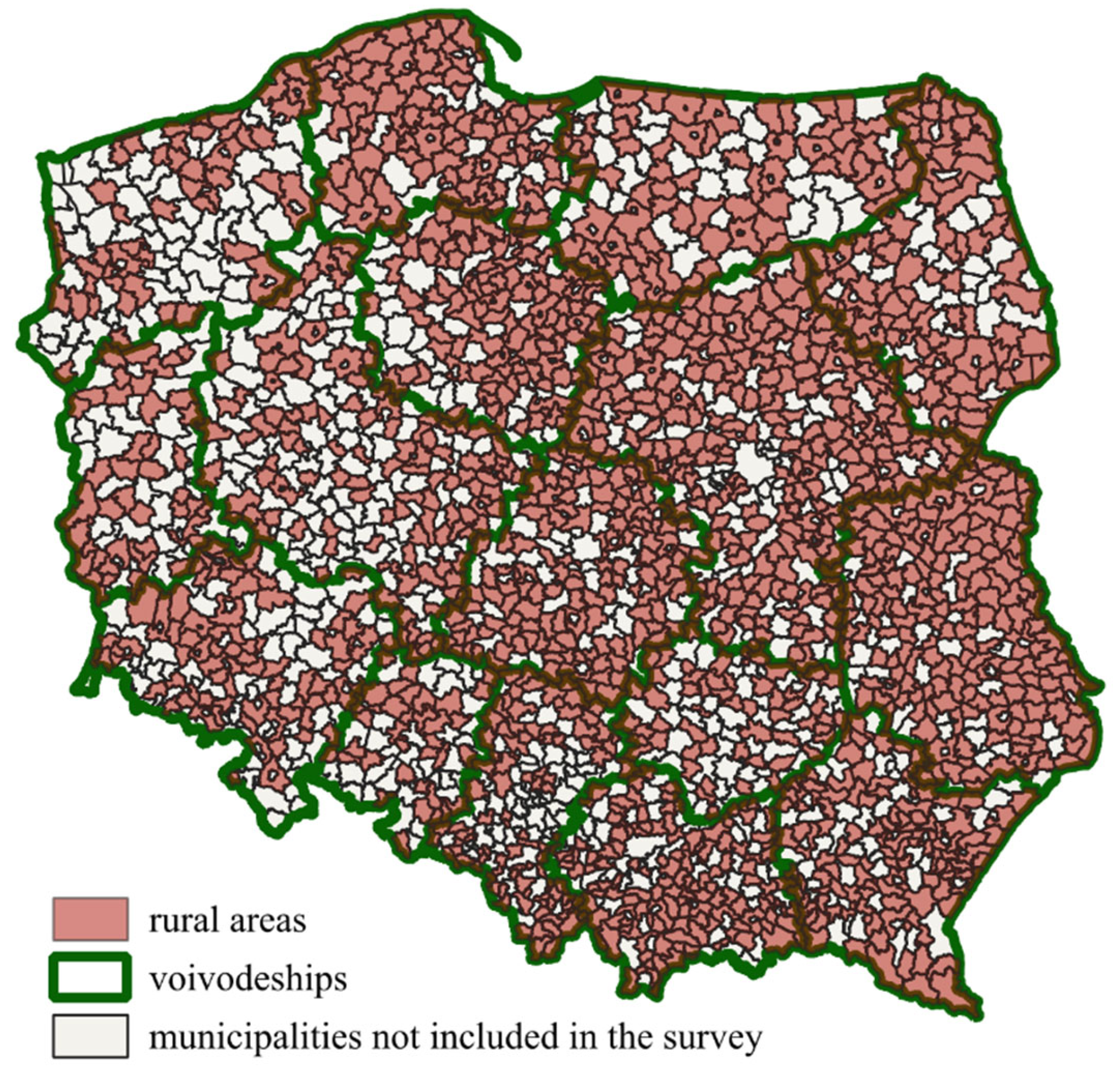
1. Introduction
The World Tourism Organization reports that tourism accounts for one in eleven jobs worldwide [
1] and generates approximately 10% of global GDP. Before the COVID-19 pandemic, the tourism sector directly contributed, on average, 4.4% of GDP and 6.9% of employment in OECD countries. The shock caused by the COVID-19 pandemic led to a decline in tourism’s contribution to GDP to 2.5%; however, this share increased to 3.9% in 2022 [
2]. The tourism industry employed approximately 5% of the European Union’s workforce. Similarly to the global perspective, tourism’s contribution to the EU’s GDP is around 10%. In Poland, according to 2022 data, the total value of the tourism economy was estimated at just under 5% of GDP [
2].
Tourism is not perceived solely as a form of social activity but also as an economic generator for a given area. The sector can enrich the economic structure and create opportunities for regions that have experienced stagnation in traditional industries. Tourism is widely recognised as a potential instrument for reducing poverty and unemployment, creating jobs, driving economic growth, attracting capital and investment, and expanding the range of goods and services [
3,
4,
5,
6,
7,
8]. At the same time, economic growth positively influences tourism development by facilitating tourism-related activities through the expansion of technical and social infrastructure, including transportation networks, roads, theatres, hotels, gastronomy, and entertainment services [
6].
In rural areas, in addition to the aforementioned benefits, rural tourism may reduce the gap between urban and rural regions [
9], contribute to the diversification of agricultural income [
10], support multi-activity development [
11], promote natural and cultural heritage [
12], broaden the range of products based on rural resources [
13], and help reduce rural-to-urban migration [
14]. The multitude of benefits associated with rural tourism clearly illustrates a multiplier effect that extends beyond the purely economic dimension of rural areas.
Rural areas are characterised by a diverse socio-economic structure, reflected in the varying importance of tourism to these regions’ economies. Consequently, the relationship between the economic situation and tourism development in rural areas is not consistent. This justifies the need for further research in this field.
The study aimed to identify the relationships between selected economic indicators in rural areas and the level of their tourism function.
To achieve this objective, the following research tasks were formulated:
- -
classifying tourism function types by constructing a comprehensive index,
- -
analysing the correlation between tourism and the economy in different types of regions based on this,
- -
identifying the core economic factors affecting tourism functions.
Following the introduction in
Section 1, the subsequent sections of the article present a review of the literature on rural tourism and the economic aspects of rural areas (
Section 2).
Section 3 and
Section 4 discuss the research materials and methodology.
Section 5 presents the research results, including the synthetic indicator of the tourism function in rural areas, the identified relationships between the indicator and selected economic variables, and an assessment of the degree to which economic indicators influence the level of the tourism function.
Section 6 and
Section 7 contain the discussion and conclusions.
2. Rural Tourism and Economic Development of Rural Areas
Tourism plays an important role in diversifying the economic structure of rural areas. From an economic perspective, tourism is defined as “a sector of the economy and a factor of socio-economic development of areas” [
15]. Tourism encompasses various branches of the national economy [
16], whose common characteristic is that the entities operating within them provide goods and services that satisfy a wide range of needs associated with tourist activity. As noted by Markey et al. [
17] and Liu et al. [
18], the adoption of rural tourism as an alternative development approach has become a preferred strategy to balance economic, social, cultural, and environmental regeneration.
According to Wijijayanti et al. [
19], in Western countries, the increased focus on rural tourism represents a response to the need to restructure the agricultural sector in the face of declining economic activity, population decline in rural areas, and the migration of educated populations to urban centres. These areas increasingly perceive tourism as an alternative development pathway. A similar view is expressed by Kataya [
20], who identifies rural tourism as an opportunity to maintain the vitality and stability of rural regions. The development of rural tourism as a partial panacea for rural challenges is further supported by its recognition as an alternative to mass tourism. As many countries have experienced improvements in economic performance, income levels, and standards of living, opportunities for leisure activities have expanded significantly. The development of transport networks, the modernisation of means of transportation, and the establishment of specialised infrastructure have attracted tourists to rural areas [
21].
Among other factors, tourism has contributed to diversifying the rural economy, and demand for rural tourism continues to grow. As indicated by Wojciechowska [
22], a significant proportion of the urban population contributes to the increasing popularity of rural tourism. Urban residents travel to rural areas for recreation and leisure, where they can experience aspects of the environment and lifestyle that urban settings cannot offer.
The assets of rural tourism mean that this type of destination is not limited to passive forms of leisure. Forms of rural tourism such as agritourism, regenerative agritourism, ecotourism, and cultural heritage tourism contribute to the rejuvenation and revitalisation of rural areas, as noted by Yanan et al. [
23] and Jęczmyk et al. [
24].
It is also important to emphasise that increasing societal wealth, demographic changes (including depopulation and population ageing), and evolving perceptions of rural tourism influence—and will continue to influence—the structure, specialisation, and development of rural tourism offerings.
As reported by Ren et al. [
25] and Sokhanvar et al. [
3], the academic literature identifies four main approaches to examining the relationship between tourism and economic growth:
the tourism-led growth hypothesis, which assumes that tourism stimulates economic growth (e.g., Balaguer and Cantavella-Jordá [
26], Payne and Mervar [
27], Dritsakis [
28], Tang and Tan [
29]);
the reverse hypothesis, which posits that economic growth drives tourism development (e.g., Narayan [
30], Khalil et al. [
31]);
the feedback hypothesis, which assumes bidirectional causality between tourism and economic growth (e.g., Kim and Chen [
32], Du et al. [
33], Mustafa [
34]);
the neutrality hypothesis, which suggests the absence of a significant causal relationship (e.g., Öztürk and Acaravci [
35], Katircioglu [
36]).
According to Sokhanvar et al. [
3], the direction of the causal relationship between tourism and economic growth varies across countries. The approaches identified by Sokhanvar et al. [
3] and Ren et al. [
25], together with the cited empirical studies, predominantly address international comparisons or analyses of national economies. However, studies that explicitly differentiate between spatial contexts—particularly those concentrating on rural areas—remain relatively scarce. Rural areas, characterised by limited resources and persistent socio-economic challenges, tend to receive less scholarly attention than urban regions.
The present study tests the reverse hypothesis by examining whether selected economic indicators influence rural tourism in Poland.
In the scientific literature, several studies have analysed this relationship. Martins et al. [
37] used panel data from 218 countries to examine the relationships between macroeconomic variables (exchange rates, relative prices, and GDP per capita) and tourism demand. Their findings indicate that income is a significant determinant in high-income countries, whereas prices play a more important role in middle- and low-income countries. This suggests that both national wealth and the overall size of the economy may influence tourism demand. Pérez-Rodríguez et al. [
38] analysed the relationship between GDP and tourism growth rates in the United Kingdom, Croatia, and Spain. Their results demonstrate that economic growth is positively correlated with tourism development in the analysed countries. Nguyen [
39] estimated the income and price elasticities of tourism demand in Vietnam’s regional and international markets. The results indicate that both income and prices have a significant impact on international tourism flows. A 1% increase in income leads to approximately a 1.03% increase in the number of foreign tourists visiting Vietnam (and nearly 3% for tourists from Asia). Similarly, Liu et al. [
40] conducted a panel analysis for 35 Asian countries to examine the relationship between economic growth and tourism. The findings reveal a strong and positive relationship, indicating that economic growth stimulates tourism regardless of its initial level.
Economic growth and development, therefore, play an important role in shaping tourism activity. Rising income levels and increasing societal wealth expand the possibilities for consuming diverse goods and services. Growth in disposable income enables individuals to travel for leisure and recreation. Moreover, economic development fosters investment in tourism-related infrastructure, which in turn supports the expansion of the tourism sector.
The studies referenced primarily examine the connection between tourism and economic growth at the national level, relying mostly on macroeconomic indicators. However, when examining examples at the regional and local levels, it is important to consider not only socio-economic factors but also environmental determinants that affect tourism development.
Qualitative research conducted by Niedziółka [
41] suggests that factors such as infrastructure development and promotional activities play a significant role in influencing tourism in rural areas. Similarly, Roman et al. [
42] emphasise the importance of natural amenities in fostering competitive tourism in Poland. Additionally, Piras and Pedes [
43] analysed various social, economic, technological, environmental, and legal factors affecting rural tourism across different regions of Italy. Their findings highlight the significance of these determinants—including regional GDP—in shaping rural tourism development. Research by Snieška et al. [
44] on rural tourism in Lithuania highlights several key factors influencing this sector, including income levels, government expenditure, foreign investment, wages, and GDP. The authors also identify a reverse relationship between tourism and economic development. Additionally, Du et al. [
45] examined socio-economic variables as determinants of rural tourism development in Henan Province, China. While economic development was recognised as a significant factor affecting rural tourism, the authors emphasised the importance of the number of potential tourist attractions in the most attractive areas. Therefore, indicators of economic development may serve as financial support for expanding rural tourism.
Based on the studies mentioned above, it is evident that socio-economic and environmental structures are viewed as a set of interacting variables that collectively have a positive impact on rural tourism development. However, when analyses are conducted at lower levels of spatial aggregation, data availability often poses limitations. Consequently, different sets of indicators are typically used compared to those found in studies that examine multiple national economies.
In this study, the authors aim to address a research gap by shifting to a more localised perspective and focusing on a specific aspect of development. Recognising the multifunctional nature of rural areas, the analysis examines rural territories in Poland to identify and evaluate the relationship between selected economic indicators and rural tourism. While much of the existing research in this field tends to focus on a single dimension of tourism—such as the number of tourist arrivals or tourism revenues—this study constructs a composite measure of the tourism function by integrating several tourism-related indicators. In examining the relationship between the economic situation and rural tourism, the analysis reveals indicators that do not show a significant association with rural tourism. The methodology used in this study can also be applied to other geographic areas and to the analysis of different socio-economic phenomena. Furthermore, the findings of this research may have practical implications for planning revitalisation activities focused on rural tourism development. These results could be particularly beneficial for rural areas where tourism plays a crucial role in their functional structure.
4. Methodology
The success of tourist destinations depends on the extent to which the tourism function is implemented and on the area’s competitiveness in this regard [
48]. A tourist site is no longer perceived solely as a distinct and unique natural, cultural, artistic, or environmental resource, but rather as an attractive product offering comprehensive and integrated services [
49].
In the first stage, the focus was on constructing a synthetic measure based on indicators representing the tourism function in rural areas. The analysis of the tourism function was conducted using the ranking and classification method for multi-attribute objects—the Zero Unitarisation Method [
50]. This method enables aggregating multiple variables into a single synthetic indicator. The normalisation stage enables the unification of the characteristics of simple variables and the transformation of their values into mutually comparable measures. Additionally, the technique enables the classification of objects into groups or rankings (in this instance, rural municipalities).
i—rural municipalities;
j—diagnostic variables.
The selection of diagnostic variables was based on substantive and statistical considerations.
Table 1 shows the indicators proposed for measuring the level of the tourism function.
Subsequently, the diagnostic variables were subjected to statistical verification. At this stage, descriptive statistics—specifically the coefficient of variation and the correlation coefficient—were used to select simple variables. The coefficient of variation was calculated to eliminate indicators for which the value of the coefficient of variation was below 20% (CV < 20). Next, for the remaining group of diagnostic variables, an inverted matrix of the Pearson linear correlation matrix was constructed. Variables whose values significantly exceeded 10 were to be eliminated. As a result of the statistical verification, none of the proposed simple characteristics was removed.
Step 2. In the next step, the simple variables were normalised to ensure their mutual comparability. Considering the impact of each diagnostic variable on the phenomenon under study, two types of variables were distinguished: stimulants and destimulants. A variable for which higher values indicated a higher level of development was classified as a stimulant (S), whereas a variable for which lower values were favourable to the phenomenon under study was classified as a destimulant (D). Accordingly, the normalisation of stimulant variables was performed using the following formula:
For destimulants, the indicator values were normalised using the following formula:
where:
At this stage, it was assumed that all simple characteristics were treated as stimulants.
Step 3. The normalised simple characteristics were aggregated using the following formula:
The synthetic measure ranges from 0 to 1. The higher the measure’s value, the higher the level of the tourism function identified in rural areas.
Step 4. In this step, the synthetic measure values were used to rank rural areas linearly. Using the mean value of the measure
and the standard deviation (s
q), four typological groups were distinguished [
55]:
Group I: rural areas with a high level of the tourism function: ;
Group II: rural areas with an above-average level of the tourism function: ;
Group III: rural areas with a below-average level of the tourism function:
Group IV: rural areas with a low level of the tourism function:
In the second stage, the first step was to select indicators that represented the economic situation in rural municipalities. The economic dimension of rural areas or towns is widely discussed in the empirical literature. The following indicators were selected to reflect the economic situation:
E1—Entrepreneurship Indicator, reflecting the potential of residents to undertake economic initiatives [
14,
53].
E2—Registered Unemployment Indicator, representing the share of unemployed individuals within the working-age population [
56,
57].
E3—Financial Self-Sufficiency Indicator, reflecting the amount of own revenues per capita in the municipality [
53].
E4—Development Potential per Capita, representing the public funds actually remaining in the local government budget after financing current expenditures, which can be allocated to development-oriented activities per capita [
47].
where:
Pbzwr—budget revenues excluding loans, credits, and issuance of securities;
Do—total revenues;
Wb—current expenditures;
L—population of the rural municipality.
E5—Operating Surplus, indicating the amount of funds remaining in the local government budget after covering all current expenditures, expressed per capita [
47,
58].
where:
E6—European Union Funds per Capita, representing the amount of EU funds allocated for financing programs and projects per capita [
47].
To provide a preliminary assessment of the relationships between the tourism function development index () and the selected economic indicators (E1–E6), a Pearson correlation analysis was conducted using the full dataset. Statistical significance was evaluated at the 5% level using the Pearson correlation coefficient test implemented in R statistical environment via the cor.test() function.
In addition, separate correlation matrices were computed for each group and each year to provide a more detailed insight into the structure and stability of the relationships under investigation.
It should be noted that the correlation coefficients were initially calculated using the raw data. The Zero Unitarisation Method constitutes a linear transformation and therefore preserves the absolute values of the Pearson correlation coefficients. However, variable E2 is defined as a destimulant; consequently, its normalisation involves a monotonic decreasing transformation, which results in a reversal of the sign of its correlation coefficients.
For interpretability and computational consistency, the correlation matrices reported in the study are based on normalised variables.
Prior to the econometric analysis, the dependent variable was previously constructed as a composite measure, but for this analysis, we model its variation using the explanatory variables E1,…, E6. All explanatory variables were normalised to the interval [0, 1] using the zero-unitarisation method. Although linear mixed models do not strictly require normalisation, this transformation provides several advantages: it allows the regression coefficients to be interpreted as comparable marginal effects, improves numerical stability of REML estimation, and maintains methodological consistency with the construction of the composite dependent variable.
Due to the hierarchical structure of the data, with repeated observations over time nested within spatial units (municipalities), linear mixed-effects models are used. These models allow the simultaneous inclusion of fixed effects, describing the average impact of explanatory variables, and random effects, which capture unobserved heterogeneity across units. The use of a linear mixed model is particularly appropriate here because it accounts for both time-invariant differences across municipalities (random intercepts) and repeated measures over time, allowing us to model intra-unit dependence correctly.
The general linear mixed-effects model (see Pinheiro and Bates [
59]) for balanced panel data with N cross-sectional units observed over T time periods can be written as:
where:
—vector of observations,
—the fixed-effects design matrix,
—the vector of fixed-effects coefficients,
—the random-effects design matrix,
—the vector of random effects,
—the vector of idiosyncratic errors.
The random effects and error terms are assumed to satisfy:
where
and
denote identity matrices of dimensions N × N and NT × NT, respectively.
The parameter vector
is estimated using restricted maximum likelihood (REML, see Pinheiro and Bates [
59]), which provides less biased estimates of variance components than ordinary maximum likelihood, particularly in finite samples.
Let
denote the covariance matrix of
and is defined as:
REML provides unbiased estimates of variance components by accounting for the estimation of fixed effects.
Model fit is assessed using the coefficients of determination proposed by Nakagawa and Schielzeth [
60]. The marginal coefficient of determination quantifies the proportion of variance explained by fixed effects only:
The conditional coefficient of determination represents the proportion of variance explained by the entire model, including both fixed and random effects:
To evaluate the degree of dependence among observations within panel units, the intraclass correlation coefficient (ICC) is computed as described by Nakagawa et al. [
61]. The ICC quantifies the proportion of total variance attributable to differences between panel units and therefore provides a direct measure of within-unit dependence.
The unadjusted ICC is estimated from an intercept-only (null) model and is defined as:
which measures the proportion of total variance attributable to between-unit differences.
The adjusted ICC is estimated from the full mixed-effects model and accounts for the variance explained by fixed effects:
A high adjusted ICC indicates that, after controlling for observed covariates, a substantial share of the remaining variance in the dependent variable is attributable to persistent differences between panel units. This supports the use of a mixed-effects modelling framework with unit-specific random intercepts.
In empirical applications, all variance components and fixed-effect coefficients appearing in the definitions of , , and ICC are replaced by their restricted maximum likelihood (REML) estimates. All analyses are conducted using the lme4, MuMIn, and performance packages within the R statistical environment (vesion R 4.5.1.).
For the empirical application, let
i = 1,…,
N (N = 1498) index the spatial units,
t = 1,…,
T denote time periods, and let G = 4 denote the number of group categories. The linear mixed-effects model is specified as:
where:
denotes the dependent variable for unit observed at time ,
are time-varying explanatory variables,
is a vector of group dummy variables (with one category omitted as the reference group),
is the corresponding vector of group fixed-effect coefficients,
is a vector of year dummy variables (with one period serving as the baseline),
is the vector of time fixed effects,
represents the unit-specific random intercept, capturing unobserved, time-invariant heterogeneity across panel units,
is the idiosyncratic error term, assumed to be independent across units and time and independent of .
The full vector of fixed-effect coefficients can therefore be written as:
5. Results
5.1. The Level of Tourism Function in Rural Areas in Poland
During the periods under review, a pronounced variation in the level of tourism activity in rural areas was observed, with a coefficient of variation ranging from 62% to 63%. The significant heterogeneity in this domain is also evidenced by the range, defined as the difference between the maximum and minimum values of the synthetic tourism function indicator (e.g., in 2022–2023, R = 0.5493) (
Table 2). In the rural areas examined, a positive right-skewed asymmetry was observed, indicating that rural communes with synthetic indicator values below the median predominated (e.g., in 2022–2023, As = 0.1874). Overall, during the analysed periods, the value of the tourism function indicator did not change significantly, which is understandable. This segment of the socio-economic structure of rural areas does not exhibit substantial year-to-year fluctuations.
The analysis for the period 2020–2021 indicates that, compared to the previous period (2018–2019), the synthetic tourism function indicator declined in 62% of the rural communes examined (
n = 929), while it remained unchanged in 1% of them. In the subsequent period, following the lifting of lockdown restrictions and the gradual reopening of the economy, improvements were not observed in many communes. Notably, in nearly 40% of rural areas, the value of the synthetic indicator decreased in 2022–2023 relative to 2020–2021 (
Table 3).
During the periods under review, the structure of rural communes across the typological groups of tourism function remained largely unchanged. In group I, representing a high level of tourism function, 17% of the examined rural areas were classified throughout the analysed periods. In 2020–2021 and 2022–2023, changes in the structure of this group were primarily due to shifts between groups I and II (
Table 3). Across the periods studied, 88% of communes remained in their original typological group. Rural areas characterised by a high level of tourism function exhibited the highest mean values for the indicators describing this aspect. For example, the proportion of entities in group I relative to the total was nearly twice the average for all rural communes examined. Overall, the infrastructural endowment in this regard (indicators X1 and X2) was substantially higher in these rural areas than in the remaining units analysed (
Table 4).
In Group II, one in every four rural communes examined was classified during the periods under review (
Table 3). In 2020–2021, most rural areas remained within this group, despite a decline in the synthetic indicator in over half of them. In 2022–2023, the situation reversed: although the proportion of rural communes with a medium–high level of tourism function did not change significantly, the synthetic indicator increased in more than 60% of these communes. In rural areas characterised by a medium–high level of tourism function, forests accounted for approximately one-third of the total area on average (
Table 4). The saturation of the tourism infrastructure in this group of rural areas was similar to the average for all rural areas examined.
In Group III, nearly half of the rural communes examined (44%) were classified. Shifts of communes in 2020–2021 relative to the previous period generally occurred between Groups II and IV. In the second period, 5% of rural areas with a medium–low level of tourism function consisted of units that had moved from group II (
Table 3). A medium–low level of tourism function development was observed throughout the entire period in over 90% of rural areas classified in this group from the first period of analysis. Classification of rural areas within the medium–low tourism function group was associated with minimal accommodation infrastructure: on average, only 0.3 lodging places per km
2 were available in these areas (
Table 4). Moreover, forests accounted for less than half of the total land area compared to the average for rural areas in group I.
A low level of tourism function was observed in 14% of the rural areas examined (group IV) (
Table 3). In 2020–2021, any shifts between groups IV and III were due to minor changes in the values of the synthetic indicator among rural areas located on the boundary between the two groups. A similar situation occurred in 2022–2023. During the periods studied, 77% of rural areas did not change their group classification. This group included rural areas in which the tourism function was virtually absent. The share of economic entities engaged in accommodation and catering services (X5) was less than 2% (
Table 4). The saturation of tourism infrastructure in these areas was negligible, approximately half of that observed in rural areas of group III.
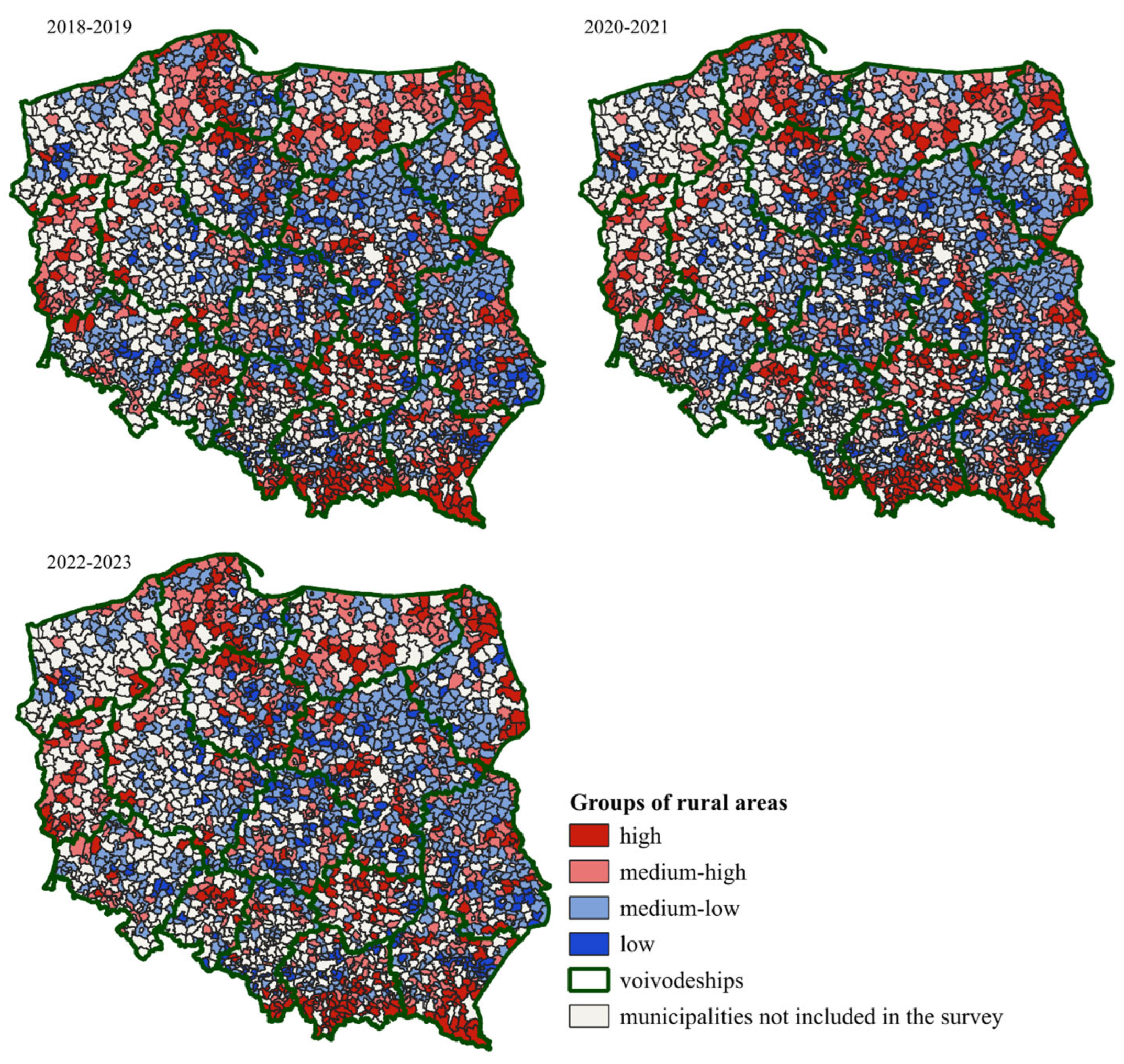
The identification of groups allowed for distinguishing rural areas where tourism function is present from those where it is not clearly manifested. Groups I and II include popular tourist destinations in the northern and southern regions of the country (
Figure 2). Due to their attractiveness—such as coastal and mountainous locations and natural features—these areas are a primary motivation for tourists. These areas have gained a competitive advantage in the domestic tourism market due to their natural amenities. As a result, they have become economically dependent on the tourism sector. As noted by Kataya [
20], in areas with such characteristics, tourism and the presence of tourists provide opportunities to secure funding for the development of new infrastructure (e.g., museums, cinemas). Rural areas often serve as repositories of cultural heritage. Rural tourism can foster interest in local culture [
62].
Groups III and IV, located in various parts of the country, encompass rural areas where the tourism function is not clearly identified. Natural amenities or locational advantages do not provide a sufficiently strong stimulus for the development of the tourism sector in these areas.
5.2. Economic Conditions and the Tourism Function in Rural Areas
The coefficient of variation (CV) was calculated from the raw (non-normalised) data to assess the relative dispersion of the explanatory variables. The results reveal considerable heterogeneity in indicator variability. Variable E1 shows the lowest relative dispersion (CV = 33.84%), while E4 (CV = 126.46%) and E6 (CV = 102.79%) exhibit very high variability, indicating substantial heterogeneity. The remaining variables (E2–E5) display moderate to high dispersion, with CVs ranging from 53.75% to 77.27%. These differences suggest that the variables capture distinct levels of economic variability, which may influence their relative importance in the econometric model.
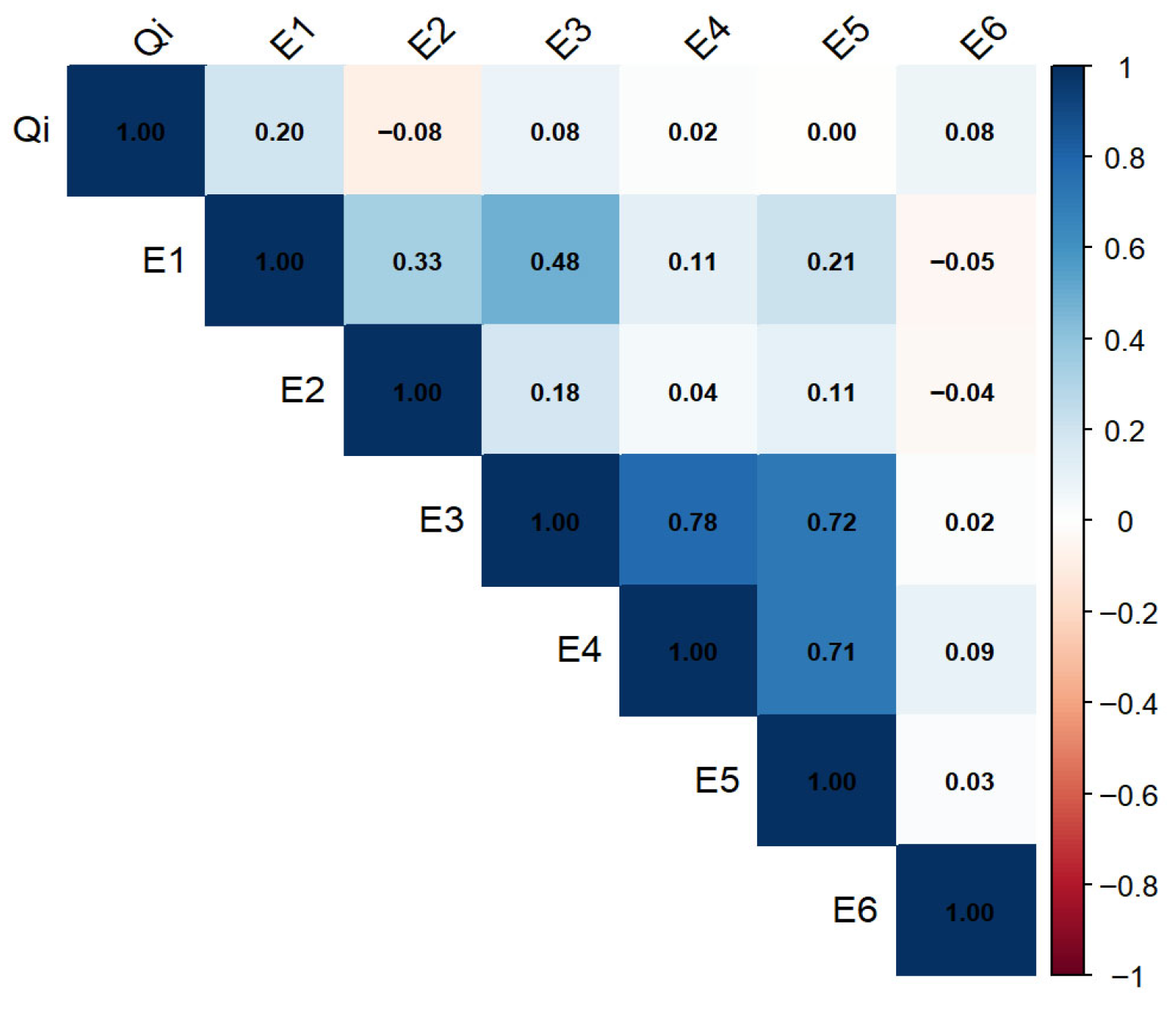
The correlation matrix among the measured variables is presented in
Figure 3.
The variable showed significant correlations with several of the E-variables, as determined by individual Pearson correlation tests (cor.test function from R environment). Specifically, was positively correlated with E1 (r = 0.20), negatively correlated with E2 (r = −0.08), positively correlated with E3 (r = 0.08), and positively correlated with E6 (r = 0.08).
The remaining correlations between and E4 (r = 0.02) and E5 (r = −0.001) were not statistically significant. Among the E-variables themselves, moderate to strong correlations were observed, for example, between E3 and E4 (r = 0.78) and between E3 and E5 (r = 0.72), indicating potential co-dependencies within this subset of variables. Overall, these results suggest that is meaningfully associated with a subset of the measured E-variables, which could be relevant for further analysis or modelling.
The analysis of relationships identified differences in the tourism function indicator across various typological groups and certain economic indicators. In rural areas with high tourist attractiveness (group I), stronger correlations were found between the synthetic indicator and economic indicators compared to rural municipalities with low tourist attractiveness (groups II, III, and IV) (see
Table 5).
In rural municipalities classified within the group characterised by a high tourism function index, a moderate positive correlation was observed in 2018–2019 with the entrepreneurship indicator (E1 = 0.40) and the financial self-sufficiency indicator (E3 = 0.42). No linear relationship was identified with the indicator reflecting EU funds obtained per capita (E6 = 0.02). The tourism attractiveness of rural areas exhibited a relationship with the unemployment rate; however, this correlation was not significant (E2 = −0.16) (
Table 5).
The pandemic period (2020–2021) resulted in some changes in the correlations. Minor variability was observed between the unemployment rate (E2 = −0.23), EU funds per capita (E6 = 0.20), and the tourism attractiveness of rural areas. In 2022–2023, in rural municipalities of group I, weak correlations were noted for indicators E1, E2, E3, and E4, while no association was found for indicators E5 and E6 with respect to the tourism function index (
Table 5).
For rural municipalities classified in groups II, III, and IV, no significant associations were identified between the tourism function index and the selected economic indicators. In group II, during 2022–2023, where rural areas with relatively high tourism function values were located, a moderate correlation was observed between the tourism function index and both the entrepreneurship indicator and the financial self-sufficiency indicator (correlations of 0.47 and 0.46, respectively) (
Table 5). This may indicate an economic recovery in these rural areas following the lockdown. The reopening of the tourism sector for visitors contributed moderately to increased municipal budget revenues.
It should be noted, however, that this summary pertains to only one of the functions of rural areas. The absence of correlation or lower tourism attractiveness does not necessarily indicate lower development in a given rural municipality. Considering other functional contexts (e.g., cultural or social functions), such relationships could potentially be more pronounced.
5.3. Results of the Linear Mixed-Effects Model
According to the methodology described above, using the lmer function in R on the rescaled data, the results of the linear mixed-effects model were obtained and are presented in the tables below.
The dependent variable in the model is the
index, while the fixed effects include variables E1–E6 and the control variables group and year. This specification allows for the simultaneous assessment of the impact of substantive factors as well as group-specific and time-specific differences on the level of
. The model includes a random intercept (uᵢ) at the unit level (KOD_JEL), meaning that each unit may be characterised by its own specific baseline level of the
variable (
Table 6).
The variance of the unit-level random effect (uᵢ) is 0.00214, which corresponds to a standard deviation of 0.0463. This indicates substantial heterogeneity in the level of
across units (KOD_JEL) (
Table 7).
The intraclass correlation coefficient (ICC), as well as the marginal and conditional coefficients of determination, were computed following the approach presented in
Section 4.
The marginal coefficient of determination equals , indicating that approximately 32.5% of the variance in is explained solely by the fixed effects. The conditional coefficient of determination amounts to , which implies that nearly 97.2% of the total variance is explained by the full model, including both fixed and random effects. The substantial difference between and highlights the importance of unit-level heterogeneity captured by the random intercept.
The adjusted intraclass correlation coefficient equals , indicating that after accounting for fixed effects, the vast majority of the total variance in , is attributable to persistent differences between units. For comparison, the unadjusted ICC equals , suggesting that the inclusion of explanatory variables substantially alters the variance decomposition.
The results of the mixed-effects model indicate that variables E1 (entrepreneurship index) and E2 (registered unemployment rate) have a statistically significant impact on the value of the tourism function development index
. The entrepreneurship index (E1) was the most strongly significant predictor among all economic indicators included in the study (
Table 8). An increase in the entrepreneurship index is associated with an increase in the tourism function development index (a positive effect). Variable E2 was also statistically significant: a decrease in the registered unemployment rate was associated with an increase in the value of the tourism function development index (negative effect). The remaining variables (E3–E6) are not statistically significant, which may indicate either a genuine lack of effect or multicollinearity with other variables (
Table 8).
A strong, statistically significant effect of the “group” variable was observed, suggesting systematic differences across groups of units. The estimated coefficient equals −0.0327 (p < 0.0001), indicating that belonging to the study group is associated with an average decrease in of approximately 0.033 units compared to the reference group.
The time effects indicate a statistically significant decline in
in the periods 2020–2021 and 2022–2023 relative to the reference period (2018–2019), with a stronger effect observed in 2020–2021. This confirms the impact of the COVID-19 pandemic on
, the tourism function development index (
Table 8). The high variance of the random intercept further confirms substantial heterogeneity across spatial units.
6. Discussion
The conducted research revealed considerable differentiation among rural areas in their understanding of the tourism function, as well as a certain degree of heterogeneity in the influence of economic factors on its development. Among the six analysed indicators, two were identified as related to the tourism function measure. It can therefore be concluded that these factors are positively correlated with rural tourism in Poland. Brodziński and Turkowski [
63] found significant spatial heterogeneity in the level of tourism development among rural municipalities in the Warmian-Masurian region, even in areas with high tourism potential. The greatest impact on tourism growth in rural municipalities in 2020 was exerted by tourism expenditure within total municipal expenditure, as well as by the size of the accommodation base per unit of area. However, environmental factors, particularly the amount of industrial and municipal wastewater per unit of municipal area, negatively affected tourism development, underscoring the importance of environmental quality in shaping the tourist attractiveness of rural areas.
The entrepreneurship indicator, defined as the number of economic entities per capita, was positively associated with the tourism function index. Therefore, an increase in the number of economic entities per person contributed to the growth of the tourism function index in rural municipalities. Residents of rural areas (and not only they) establish and operate businesses related to tourism—such as restaurants, equipment rental services, souvenir shops, the sale of local products, and enterprises offering various tourist attractions—thereby expanding the tourism offer and increasing the competitiveness of rural tourism. The development of entrepreneurship is widely recognised as a driving force for the economy of tourist destinations [
64]. However, a feedback relationship can also be identified in this context. Göde et al. [
65] emphasise the importance of entrepreneurs’ skills and competencies in management, marketing, and knowledge of the tourism market for the success of rural tourism. Similarly, Yang et al. [
66] point out that the development of tourism entrepreneurship not only stimulates rural tourism but may also lead to tourism being classified as the main sector of the local economy, thereby contributing to the transformation of rural areas.
An increase in entrepreneurship also multiplies across other indicators, such as unemployment. The creation of new businesses and economic activities generates new jobs and, consequently, reduces unemployment. In this study, the unemployment rate was identified as a factor influencing the level of the tourism function. A significant inverse relationship was observed, indicating that lower unemployment rates are associated with a higher level of the tourism function. The development of the tourism sector requires investment in the tourism labour market, including the creation of spaces, facilities, and attractions for visitors. This process is linked to increased employment opportunities, as noted by Južnik Rotar et al. [
67].
Similar conclusions were reached by Piras and Pedes [
43], who demonstrated that the selected economic factors were positively correlated with rural tourism in Italy. However, economic factors alone do not drive rural tourism development. Technological and environmental factors also support this process.
Tourism plays a significant role in rural areas, with agritourism often considered particularly important. Compared with other on-farm and non-farm activities, agritourism has been more successful in increasing farm incomes, generating employment, and preserving natural and cultural heritage, thereby generally improving the socio-economic conditions of rural areas [
68]. As noted by Barbieri [
68], agritourism enterprises operating in rural areas tend to adopt a more sustainability-oriented approach to development. This is justified, as the surrounding environment—including natural assets and social infrastructure—enhances the area’s attractiveness and helps generate demand for rural tourism. The importance of infrastructure for the development of rural tourism is also emphasised by Bogan [
21] and Shkodra and Shkodra [
69]. However, according to Pomianek et al. [
70], three areas can be distinguished as the regions with the highest potential for development in Poland in 2005–2018: the Warsaw Capital Region, the Małopolska Region, and the Pomeranian Region.
As highlighted by Cánoves et al. [
13], rural tourism is often promoted as a panacea for rural areas’ economic problems; however, in practice, it does not resolve the economic challenges these regions face. Importantly, most rural areas lack the natural, cultural, and other attributes typically associated with attractive rural tourist destinations. Consequently, these areas pursue development strategies based on a multifunctional development approach, in which tourism plays only a marginal role. The determinants of tourism development and its relationship with the socio-economic development of rural areas are also discussed by Petelca and Garbuz [
71]. Their findings (based on rural areas in Moldova) indicate that tourism contributes to improvements in residents’ quality of life, including higher household incomes and increased employment. Nevertheless, this impact is moderate and highly dependent on local conditions that enable the sector’s development.
It is also worth emphasising that, despite the frequently cited positive multiplier effects of rural tourism, its scale and macroeconomic significance are insufficient to replace the productive sector or to compensate for its substantial decline [
72,
73]. Rural tourism should therefore be regarded more as a complementary alternative rather than a primary driver of economic development. The conducted research indicates that in rural areas characterised by high tourism attractiveness, a relationship exists between the tourism function index and both the entrepreneurship and unemployment indicators. This suggests that the tourism sector plays an important role in the local economy of these areas. In contrast, in rural municipalities where the tourism function index exhibited lower values, no significant relationship with the analysed economic indicators was identified. Therefore, in less tourist-attractive rural areas, tourism may be an additional component of these municipalities’ development strategies rather than a core driver of the local economy.
Moreover, as noted by McAreavey and McDonagh [
74], debates often attempt to substitute agriculture with alternative activities, particularly tourism. For example, Bartkowiak-Bakun et al. [
75] analysed the agricultural and tourism potential as well as the level of socio-economic development of rural municipalities in the Wielkopolska Voivodeship. Their results indicated that an area’s tourism potential decreases as its agricultural development potential increases. Furthermore, the author emphasises that integrating tourism with other rural functions is crucial to local development strategies. Meanwhile, it should be emphasised that the impact of tourism on local development varies across rural municipalities. Some areas benefit directly from tourism, while neighbouring municipalities may experience indirect effects stemming from their proximity to tourist centres. Research on spatial relationships in tourism development indicates that public goods and local government spending can influence tourism infrastructure and generate spatial spillover effects between neighbouring rural areas [
76].
Neumeier and Pollermann [
73] argue that rural tourism and its diversification cannot rescue poorly developed rural areas. Consequently, not all rural regions are suitable for tourism development. A key prerequisite is identifying the tourism potential of rural areas. To establish economically viable tourism, elements of tourism attractiveness must be adequately recognised and incorporated. According to research by Widawski et al. [
77], rural tourism in Poland contributes to structural changes in local economies by stimulating service development, supporting small businesses, and strengthening the multifunctional character of rural areas.
The present study also demonstrated that even in attractive rural tourist destinations in Poland, the tourism sector does not exert a decisive influence on economic development. Various factors may weaken the tourism function in rural areas. As emphasised by Neumeier and Pollermann [
73], rural tourist destinations are characterised by strong competition, which, to some extent, forces these areas to maintain adequate levels of technical and social infrastructure to meet tourists’ expectations. In their research, Szmytkie et al. [
78] indicate that the socio-economic transformation of the Kłodzko region highlights that the development of tourist infrastructure and accommodation facilities has contributed to the revitalisation of previously declining rural settlements and helped to reduce negative socio-economic processes such as depopulation and economic stagnation.
As observed by Du et al. [
33], in the absence of additional drivers of economic growth, tourism alone cannot sustain economic growth, even in countries that rely heavily on this sector. Tourism is effective only when it is integrated into a broader development strategy. Nowicka [
79] points out that strategic planning and local development policy play important roles in shaping tourism development. An analysis of strategic documents of Polish local governments indicates that local authorities increasingly see tourism as an important instrument for supporting socio-economic development and strengthening regional competitiveness. According to Pomianek et al. [
70], between 2007 and 2018, 5082 tourism projects co-financed by the European Regional Development Fund and the Cohesion Fund were implemented in Poland, accounting for 4.9% of all projects financed from these sources. This indicates a relatively small share of tourism in the structure of EU fund interventions. The largest number of projects was recorded in the provinces of Silesia, Lower Silesia, Mazovia, Lesser Poland, and Warmia-Masuria, where the highest co-financing values were also concentrated. At the same time, the allocation of funds was clearly concentrated in urban areas, while projects implemented in rural areas dominated only in the Świętokrzyskie Province.
7. Conclusions
The study aimed to identify the relationships between selected economic indicators of rural areas and the level of their tourism function. To achieve this objective, a synthetic measure of the tourism function was first constructed to identify the level of tourism attractiveness in the analysed municipalities. The results obtained in this area enabled the identification of groups of rural municipalities characterised by varying degrees of presence of the tourism function. At this stage, the need for an individualised approach to the development of tourism in rural areas, as well as for planning rural municipal development based on available resources, becomes evident. In the next step, the values of the synthetic tourism function measure for a given typological group of rural areas were compared with the normalised values of selected economic indicators using correlation analysis. This analysis showed that only in the case of rural municipalities characterised by a high level of tourism function attractiveness (group 1) was a weak or moderate relationship observed. No such relationships were identified for the remaining rural areas. Already at this stage, the importance of the identified tourism function and the selected economic indicators was recognised. In the third step, it was observed that, among the six economic indicators analysed, the entrepreneurship indicator and the unemployment rate had a statistically significant effect on the tourism function measure. Group membership and the time factor exerted a strong and unambiguous influence on the dependent variable. The results in this regard indicate that tourist-attractive rural areas are supported by an economically active community that contributes to developing the tourism offer and co-creates the local tourism sector.
Given that the research focused on the economic dimension of rural development and tourism, further studies are required, with particular emphasis on the social and environmental dimensions of rural tourism. As argued by Neumeier and Pollermann [
73], social relations are crucial for economic interactions in regional development. Therefore, analyses of the role of rural tourism in rural development should be based on a broader conceptualisation of rural tourism. In the course of further analyses, qualitative research directed at the local community and local authorities of these areas would undoubtedly provide additional insights into what the local economy currently does—and could potentially do—to support rural tourism.
7.1. Limitations
This study is not without limitations. Constraints emerged during the definition of the research’s spatial scope and the selection of variables for analysis. Establishing these limitations enabled the research objective to be achieved within the available resources. Due to the analysed research area—rural municipalities—the availability of data in the Polish public statistics system is limited (data availability is generally greater for administrative units such as counties and regions). Consequently, a limited number of indicators were used to construct the tourism function index and later to analyse the economic situation of rural municipalities. Greater access to economic indicators at the municipal level would likely enable the identification of more relationships and, as a result, yield more comprehensive findings. Another limitation concerns the study’s territorial scope. Data availability constrained the authors to focus exclusively on rural municipalities, excluding rural areas that constitute parts of urban–rural municipalities.
7.2. Policy Implications
While most studies on the relationship between tourism and economic growth focus on the national level, the present research contributes to the analysis of this issue at the local scale. By focusing on rural areas, the findings can serve as a source of information for municipal authorities, highlighting factors that shape the development of territorial units. The identified relationship between rural tourism and the indicators of entrepreneurship and unemployment in tourist-attractive rural municipalities may serve as a signal for local and regional policy-making. The study highlights the importance of investing in areas with high tourism potential. Such investments should not only include the development of technical and social infrastructure but also initiatives to enhance community competencies in entrepreneurship, such as funding for new or alternative forms of rural tourism and tourism-related services. To reduce regional disparities, support should also be directed toward areas that may not currently be among the most popular rural tourism destinations but possess untapped potential that requires targeted development (for example, rural areas in the eastern part of the country).