1. Introduction
Accelerating the energy transition toward renewable energy sources (RES) is a global need to combat climate change. However, the inherent intermittency of wind and solar power presents significant operational challenges, often leading to substantial energy curtailment [
1,
2]. To address these issues, the Integrated Energy System (IES) has emerged as a promising paradigm by coordinating multi-energy flows (electricity, heat, and gas) to improve the overall efficiency and accommodation capabilities [
3,
4].
Within the IES framework, hydrogen energy is increasingly recognized as a key vector for deep decarbonization due to its high energy density and clean combustion properties [
5]. Power-to-Hydrogen (P2H) technology allows surplus renewable electricity to be converted into green hydrogen, effectively acting as a long-term energy storage solution to mitigate RES fluctuations [
6]. Furthermore, hydrogen can bridge the gap between power and chemical industries, facilitating a multi-sectoral transition toward cleaner energy. However, the direct utilization of hydrogen in conventional energy systems is often limited by storage costs and conversion efficiencies, necessitating more sophisticated coupling mechanisms [
7].
Parallel to the rise of hydrogen, Carbon Capture, Utilization, and Storage (CCUS) technologies are essential for decarbonizing thermal power units and hard-to-abate industrial sectors [
8]. Traditional Carbon Capture and Storage (CCS) strategies often treat CO
2 merely as a waste product to be sequestered. However, the coupling of P2H and CCS offers a pathway for “Carbon Utilization.” Through the methanation process (Sabatier reaction), captured CO
2 can react with green hydrogen to produce synthetic natural gas (SNG), which can then be fed back into the gas network or used in gas turbines [
9]. This establishes a closed-loop “Electro-Carbon–Hydrogen” synergy, transforming carbon emissions from a burden into a resource [
10]. Despite the potential of this coupling, existing research often models these subsystems in isolation or assumes static operation modes, failing to fully exploit the flexibility provided by dynamic energy cascading [
11].
A critical gap in current IES optimization lies in the modeling of power generation equipment, particularly gas turbines. While hydrogen-blended gas turbines (HBGT) are a viable technology to reduce carbon intensity, most studies simplify HGTs by assuming fixed hydrogen blending ratios [
12,
13]. In reality, the blending ratio can be adjusted dynamically based on the real-time hydrogen availability and renewable fluctuations, offering a new degree of freedom for system flexibility [
14]. Recent studies have indicated that variable hydrogen blending can significantly improve the thermodynamic performance and emission reduction potential of gas turbines under varying load conditions [
15].
Furthermore, the economic drivers for such deep decarbonization technologies rely heavily on market mechanisms. The traditional unified carbon trading price often fails to provide sufficient incentives for substantial emission reductions [
16]. In contrast, a tiered (or stepwise) carbon trading mechanism, which imposes progressively higher penalties for excess emissions, can more effectively internalize environmental costs and drive the system towards cleaner operation modes [
17,
18]. Integrating such market mechanisms into the dispatch model is crucial for balancing economic efficiency and environmental sustainability [
19]. To mitigate the severe operational risks posed by renewable and load uncertainties, robust optimization provides a conservative approach to ensure system reliability under worst-case scenarios [
20,
21,
22]. Furthermore, recent advancements in adaptive robust optimization have demonstrated superior performance in managing these multiple uncertainties within complex energy systems [
23,
24,
25].
In summary, while previous studies have made significant strides in IES optimization and hydrogen utilization, several critical limitations remain. First, existing research often models coupling subsystems in isolation or assumes static operation modes, which fails to fully exploit the flexibility provided by dynamic electro-carbon–hydrogen energy cascading. Second, a critical gap lies in the modeling of power generation equipment; most studies simplify HBGT by assuming fixed blending ratios, thereby overlooking the substantial thermodynamic and emission reduction potential of variable blending in response to real-time renewable intermittency. Finally, market mechanisms—particularly tiered carbon trading—are rarely co-optimized with these complex dynamic physical constraints, limiting the economic incentives required to drive the system toward deep decarbonization.
To bridge these gaps, this paper proposes a novel adaptive low-carbon scheduling framework for IES based on electro-carbon–hydrogen synergy. By constructing a closed-loop cascading mechanism that integrates biomass co-firing, CCS, Power-to-Gas (P2G), and variable hydrogen-blended gas turbines, this work synergizes dynamic hydrogen blending with carbon recycling to provide a feasible pathway for deep decarbonization. The main contributions of this paper are summarized as follows:
Unlike static approaches, a refined model for HGT is developed to characterize the thermodynamic performance under time-varying hydrogen blending ratios (0–20%). This innovation enables the system to adaptively adjust the fuel composition, significantly enhancing the flexibility in response to renewable energy fluctuations.
A tiered carbon trading mechanism is incorporated into the scheduling framework to strictly constrain emissions. By imposing progressive cost penalties, this mechanism effectively optimizes the trade-off between economic efficiency and environmental sustainability, driving the system toward a lower carbon footprint.
A robust optimization approach is employed to mitigate the risks associated with the uncertainties of wind power, solar generation, and load demand. This ensures system reliability and stable operation under worst-case scenarios while maximizing the benefits of the proposed electro-carbon–hydrogen synergy.
The remainder of this paper is organized as follows:
Section 2 establishes the architecture of the electro-carbon–hydrogen coupled system and formulates detailed mathematical models for key components, specifically focusing on the thermodynamic characteristics of hydrogen-doped gas turbines under variable blending ratios and the tiered carbon trading mechanism.
Section 3 constructs the adaptive low-carbon scheduling framework and introduces a two-stage robust optimization algorithm to address the multiple uncertainties associated with renewable energy generation and load demand.
Section 4 presents a comprehensive case study, analyzing the impact of dynamic hydrogen blending strategies and market mechanisms on system performance through multi-scenario comparisons and sensitivity analyses. Finally,
Section 5 summarizes the core findings and concludes the paper.
2. System Architecture and Component Modeling
2.1. System Architecture
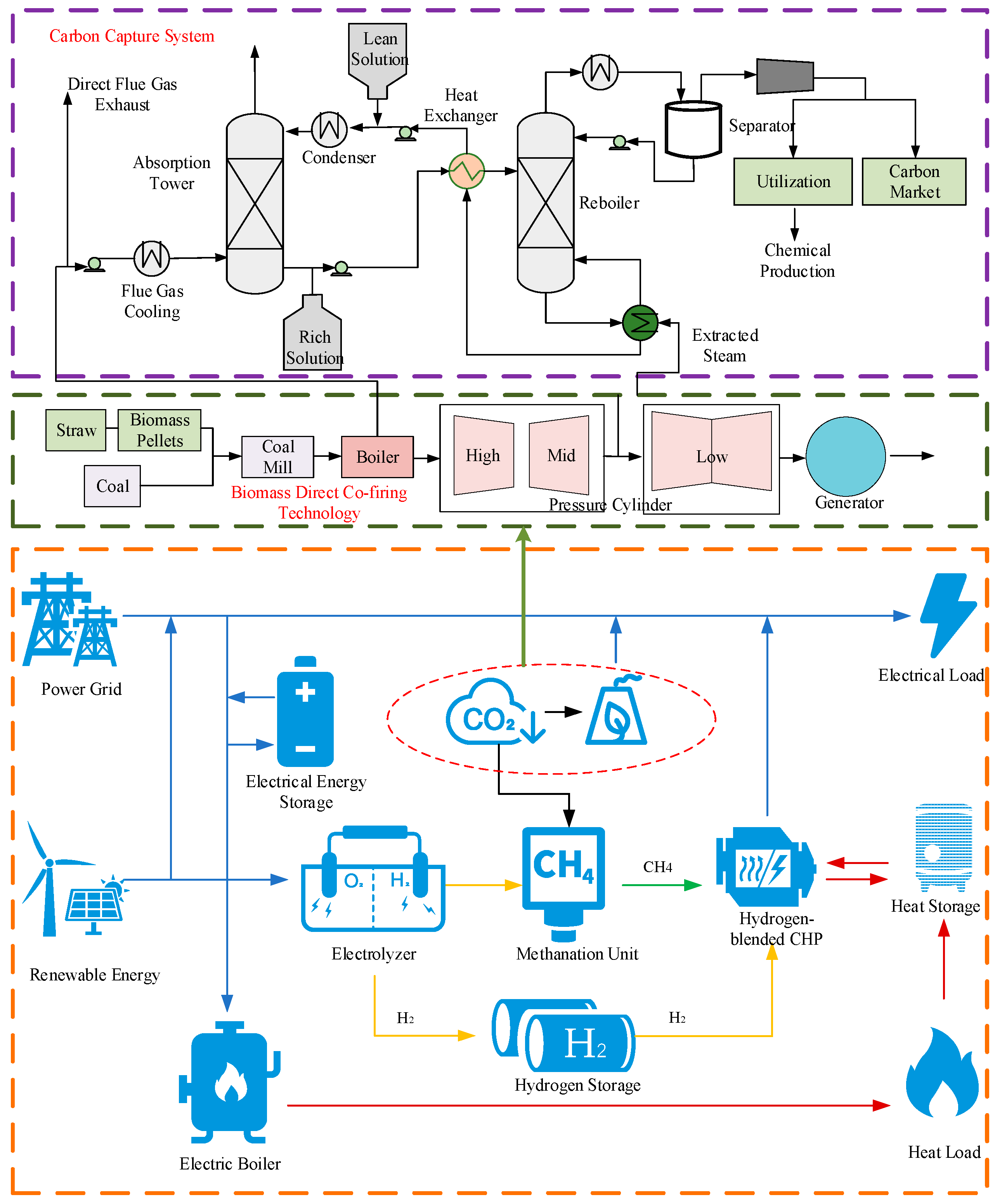
The IES proposed in this paper constructs a closed-loop electro-carbon–hydrogen coupling framework designed to maximize renewable accommodation and achieve deep decarbonization. As illustrated in
Figure 1, the system integrates renewable energy generation (wind and solar), thermal power units (biomass-coal co-firing), and flexibility resources including energy storage and P2G facilities.
Surplus renewable electricity drives proton exchange membrane (PEM) electrolyzers to produce green hydrogen, which is dynamically allocated between direct blending into the HGT to reduce carbon intensity and reacting within a methanation reactor. By utilizing CO2 captured from thermal units via the CCS system as feedstock for this methanation process, the system establishes a closed carbon loop that effectively transforms waste emissions into synthetic natural gas resources.
2.2. Modeling of Key Coupling Components
Unlike traditional gas turbines operating on pure natural gas, the HGT allows for the co-combustion of hydrogen and natural gas. The doping of hydrogen alters the calorific value of the fuel mixture. To characterize the thermodynamic performance under variable operating conditions, the equivalent low heat value
of the mixed fuel at time
is defined as
where
and
are the flow rates (
) of natural gas and hydrogen injected into the turbine, respectively;
and
are their respective lower heating values. The power output of the HGT (
) is determined by the total energy input and the conversion efficiency:
where
is the power generation efficiency. While the actual turbine efficiency may slightly fluctuate with varying operational loads and hydrogen concentrations, existing thermodynamic literature demonstrates that within the strict 0–20% volumetric blending limit, such variations are highly marginal (<1.5%). Therefore, to preserve the model’s linearity and exact computational tractability as a Mixed-Integer Linear Programming (MILP) problem,
is treated as a constant in this system-level dispatch framework. A key constraint is the hydrogen blending ratio (
), which varies dynamically to accommodate renewable fluctuations while ensuring combustion stability:
It should be explicitly noted that this ratio () is defined relative to the volume fraction of the injected hydrogen–natural gas mixture.
While variable hydrogen blending offers significant decarbonization benefits, it introduces critical operational safety challenges to the energy system. Due to the high flame propagation speed and broad flammability limits of hydrogen, blending it with natural gas significantly increases the risk of combustion instability and acoustic pulsations, potentially leading to flashback and severe explosion overpressures within the gas turbine or pipeline infrastructure [
26]. In fact, mitigating such extreme combustion behaviors often requires complex gas–solid suppression mechanisms to effectively control the underlying reaction kinetics [
27]. Furthermore, the extremely small molecular size of hydrogen exacerbates the risks of pipeline leakage and material hydrogen embrittlement, which can progressively degrade the mechanical properties of turbine blades and the existing gas supply infrastructure. Consequently, to ensure safe and stable operation without requiring extensive equipment modifications or the utilization of specialized advanced materials, this study strictly limits the dynamic hydrogen blending ratio to an upper bound of 20% by volume. This operational boundary ensures that the proposed adaptive scheduling strategy achieves optimal electro-carbon–hydrogen synergy within a verified safe engineering envelope.
- 2.
Biomass Co-Firing and Carbon Capture (CCS)
To further lower the carbon footprint, the thermal power unit adopts biomass–coal co-firing coupled with a continuous post-combustion CCS system. It should be noted that this CCS unit specifically captures the aggregated flue gas emissions from both coal and biomass combustion, independent of the gas turbines. While the CCS system operates continuously to supply the downstream methanation, its capture rate and corresponding variable energy consumption scale dynamically, providing operational flexibility. The total power output
is the sum of power from coal
and biomass
. The CCS system comprises capture and regeneration processes. Its energy consumption consists of a fixed base load and a variable load proportional to the amount of CO
2 captured:
where
is the total power consumption of CCS;
is the amount of CO
2 captured;
is the capture efficiency;
and
are the carbon emission intensities of coal and gas, respectively.
- 3.
Power-to-Gas (P2G) and Methanation
The P2G process acts as a bridge between the power and gas networks. It includes electrolysis and methanation. The PEM electrolyzer consumes electric power
to generate hydrogen:
In the methanation reactor, hydrogen reacts with captured CO
2 to form methane (CH4) via the Sabatier reaction. Specifically, the methanation process is fundamentally hydrogen-driven (utilizing green hydrogen produced by the upstream electrolyzer). To minimize system capital expenditure, the synthesized SNG is immediately dispatched into the gas network for consumption, rather than being held in intermediate mass storage. The relationship follows the molar ratio of 1:4:1. The volume of SNG produced (
) and CO
2 consumed (
) are modeled as
where
is the conversion efficiency, and
is the hydrogen input for methanation.
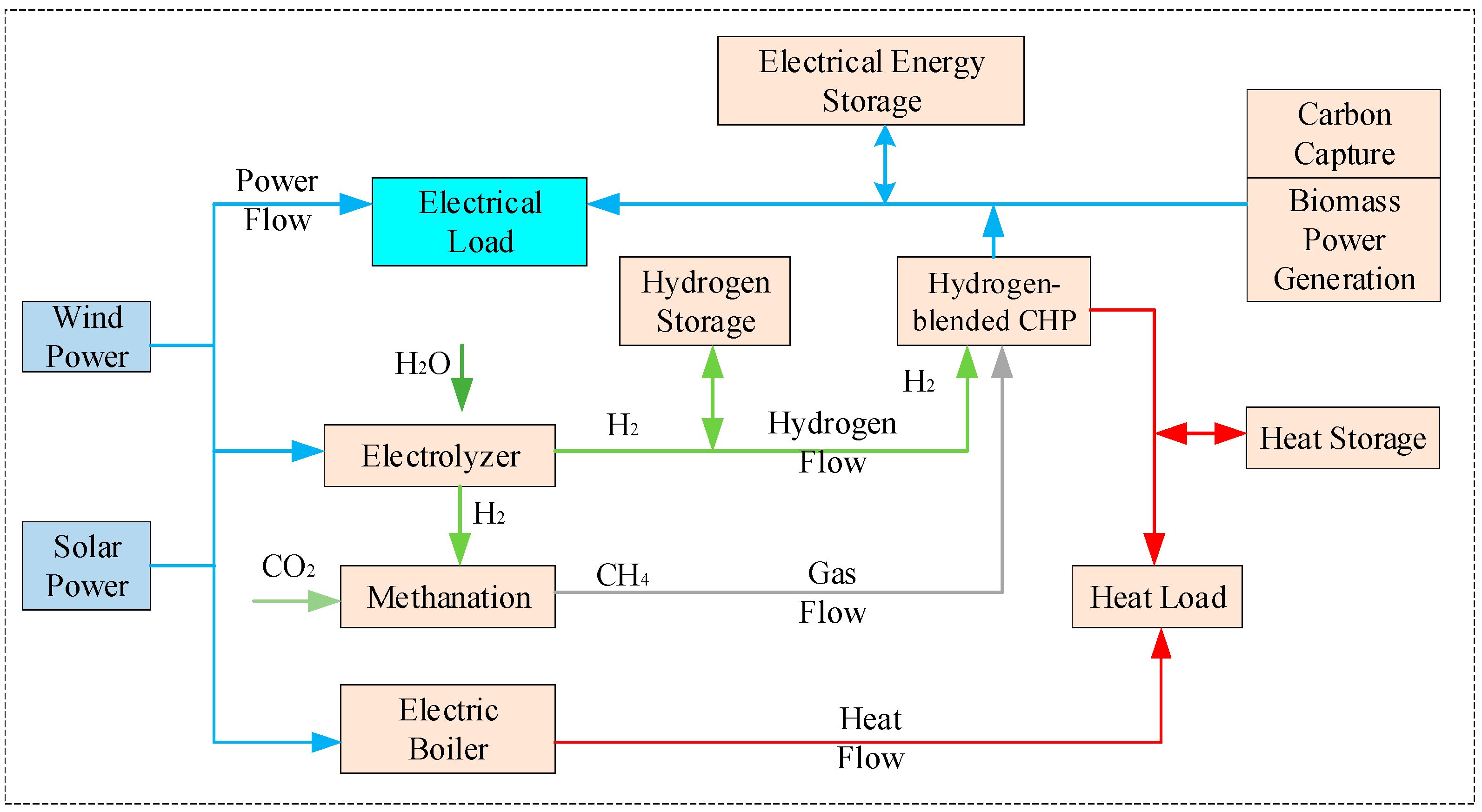
Figure 2 depicts the comprehensive energy flow paths and the cascading conversion mechanism among the electrolyzer, methanation reactor, HBGT, and CCS unit.
2.3. Tiered Carbon Trading Mechanism
To internalize the environmental cost of carbon emissions, a tiered carbon trading mechanism is introduced. Unlike a unified carbon price, this mechanism imposes progressive penalties on excess emissions to incentivize deeper decarbonization.
The initial carbon quota
is allocated based on the baseline emission factors of the generating units:
where
and
are the quota allocation factors per unit of electricity generation.
- 2.
Actual Net Emissions
The actual net carbon emission (
) considers the total emissions from fossil fuel combustion minus the amount captured by CCS and the amount utilized in methanation:
Note that the CO2 consumed in methanation is supplied by the CCS system, creating a closed carbon loop.
- 3.
Tiered Trading Cost
The difference between actual emissions and the quota determines the carbon trading cost. The cost function is defined as a piecewise function with increasing prices:
where
is the base carbon price; l is the length of the emission interval; and
is the price growth rate for each tier. Intuitively,
sets the baseline economic penalty for emissions,
acts as the quantitative tolerance buffer for each incremental tier, and
serves as the punitive growth accelerator, disproportionately penalizing severe emission violations. This tiered structure ensures that higher emissions incur disproportionately higher costs, forcing the system to optimize its hydrogen blending and CCS operation.
2.4. Operational Constraints
To ensure the safety and stability of the integrated energy system, the operation of all generating units and coupling devices must strictly adhere to their physical limits, including power output boundaries and ramping capabilities.
For the HGT and the Biomass–coal Co-firing Plant, the power output at any time is constrained by their minimum and maximum capacity limits. Additionally, to avoid mechanical fatigue and ensure grid stability, the rate of change in power output (ramping) between consecutive time steps is restricted.
The output power
must remain within the allowable range
, and the ramping rate is constrained by the upward
and downward
limits:
Similarly, the biomass unit faces capacity and ramping constraints:
- 2.
Power-to-Gas (P2G) Facilities
The P2G facilities, including the Electrolyzer and Methanation unit, must operate within their designed power or production intervals to maintain efficiency and equipment safety.
The input electric power
is constrained by the device’s rated capacity
and a minimum operation level
:
The operational power (or gas production rate) of the methanation unit is limited by
- 3.
Hydrogen Storage System
The hydrogen storage tank buffers the imbalance between hydrogen production and consumption. Its operation is constrained by the State of Charge (SOC) limits to prevent over-charging or over-discharging:
where
is the stored energy ratio at time
;
is the rated capacity;
are the charging/discharging flow rates; and
are the corresponding efficiencies.
3. Scenario-Assisted Adaptive Robust Optimization Framework
The integration of high-proportion renewable energy sources introduces severe spatiotemporal volatility to the IES. Traditional deterministic scheduling struggles to cope with these multiple uncertainties, often leading to potential operational risks or excessive conservatism. To ensure a balance between economic efficiency and operational security, this paper proposes a scenario-assisted adaptive robust optimization framework. This framework combines scenario-based stochastic optimization with a two-stage adaptive robust optimization (ARO) structure to guarantee system feasibility under the worst-case scenarios.
3.1. Modeling of Source–Load Uncertainties
To accurately capture the multidimensional stochastic characteristics of wind power, photovoltaic generation, and load demand, a two-layer Copula-based scenario generation method is employed.
In the temporal dimension, a continuous state Markov chain (CSMC) based on the Copula transition kernel is established to model the time-series dependence of a single renewable energy source. In the spatial dimension, a D-Vine Copula is utilized to decouple and model the cross-correlations among multiple geographical locations and different types of renewable energy. To reduce the computational burden caused by a massive number of generated scenarios, the K-means clustering algorithm is applied for scenario reduction. This algorithm minimizes the sum of squared distances between samples and cluster centers, retaining the most representative uncertainty scenarios while significantly shrinking the sample size.
Furthermore, to hedge against extreme prediction deviations in the optimization model, a box uncertainty set (Box Uncertainty Set) is formulated to bound the fluctuation intervals of PV and load outputs. The continuous uncertainty set
is defined as
where
represents the actual realization of uncertain parameters (renewable energy and load) at time
;
is the forecasted value;
denotes the maximum allowable fluctuation deviation;
is the budget of uncertainty, which controls the conservatism level of the optimization model by limiting the total temporal deviation.
3.2. Two-Stage Adaptive Robust Optimization Model
The deterministic optimal scheduling model of the IES can be abstracted into a compact matrix formulation:
where
and
are the cost coefficient vectors for the objective function;
are the coefficient matrices of the constraints;
are the constant parameter vectors.
denotes the first-stage (here-and-now) decision variables, which are independent of the uncertainty realization, such as the unit commitment status, carbon capture system activation mode, and methanation operation status.
denotes the second-stage (wait-and-see) variables, representing the continuous operational variables, such as equipment power outputs and energy flow dispatch after the uncertainty is revealed.
By incorporating the box uncertainty set
, the deterministic model is transformed into a min–max–min two-stage robust optimization structure:
where the first stage minimizes the fixed investment and startup/shutdown costs, while the inner max–min problem identifies the worst-case scenario,
, and minimizes the real-time operational costs under that extreme realization.
Compared to traditional purely stochastic programming (which suffers from the curse of dimensionality due to massive scenarios) and chance-constrained programming (which is often non-convex and computationally intractable for non-Gaussian distributions), the proposed ARO architecture guarantees exact computational tractability via the C&CG decomposition. Furthermore, by centering the uncertainty sets around Copula-clustered representative scenarios, this hybrid approach effectively mitigates the over-conservatism typical of classical robust optimization while ensuring strict feasibility under extreme fluctuations.
3.3. Solution Methodology
The proposed two-stage robust model contains a tri-level “min–max–min” nested structure, which is generally NP-hard and computationally intractable to solve directly. To efficiently solve this, the Column-and-Constraint Generation (C&CG) algorithm combined with Benders Decomposition is utilized to decouple the model into a Master Problem (MP) and a Subproblem (SP).
The MP optimizes the first-stage variables and determines a lower bound (LB) for the total cost. By introducing an auxiliary variable
to represent the worst-case operational cost of the second stage, the MP at the
-th iteration is formulated as
where
represents the identified worst-case scenario parameter obtained from the SP in the
-th iteration, and
is the corresponding operational recourse decision generated to improve the master dispatch plan. Algorithmic Insight: Equation (23) acts as the Master Problem in the decomposition framework. Its primary role is to yield an optimal baseline pre-dispatch plan (first-stage decisions) and establish a lower bound for the total cost, systematically incorporating the worst-case cuts generated by the Subproblem in previous iterations.
Given the optimal first-stage decision
derived from the MP, the SP seeks the worst-case fluctuation trajectory within the uncertainty set
to maximize the operational cost, providing an upper bound (UB).
where
and
are the dual variable vectors associated with the inequality and equality constraints, respectively.
Since the inner minimization is a linear continuous programming problem, it can be converted into a single-level maximization problem using strong duality theory:
The objective function of the transformed SP involves a bilinear term , rendering the problem non-convex. To overcome this, the Big-M method is applied to linearize the product of the continuous dual variables and the binary boundary indicators of the uncertainty set, converting the SP into a Mixed-Integer Linear Programming (MILP) problem that can be efficiently solved by commercial solvers. Equation (25) serves as the Subproblem. Driven by the baseline decisions from the Master Problem, it acts as an “adversary” that actively searches for the most severe renewable fluctuation trajectory within the defined uncertainty set to maximize operational costs, thereby challenging the baseline and generating a strict upper bound.
The iterative solving process proceeds as follows:
Step 1: Initialize the system parameters, uncertainty budget , and algorithmic bounds , and set the iteration index . Specify the convergence tolerance .
Step 2: Solve the MP to yield the optimal baseline pre-dispatch variables and the expected cost . Update the lower bound .
Step 3: Pass to the SP. Solve the MILP-transformed SP to find the worst-case scenario and objective value. Update the upper bound.
Step 4: Check the convergence criterion: if the algorithm terminates and outputs the optimal robust dispatch strategy. Otherwise, add and the associated new variables/constraints to the MP, set , and return to Step 2.
4. Case Study and Discussion
To validate the effectiveness of the proposed adaptive low-carbon scheduling framework considering electro-carbon–hydrogen synergy, a comprehensive simulation study is conducted. The key parameters for the combined heat and power (CHP) units and thermal power units are listed in
Table 1. To ensure the practical validity and credibility of the simulation, the system parameters utilized in this case study are strictly derived from actual market mechanisms and the recent engineering literature. Specifically, the unit cost of natural gas and the base carbon trading price reflect the current pricing standards and stepwise carbon penalty baselines in regional energy markets [
11,
17]. Furthermore, key equipment operational parameters—such as the conversion efficiency of the Power-to-Gas (P2G) electrolyzer and the energy consumption rate of the Carbon Capture and Storage (CCS) unit—are adopted from validated industry design standards and recent techno-economic assessments of complex integrated energy systems [
4,
10].
To verify the superiority of the proposed strategy, four distinct scenarios are established for comparative analysis:
Scenario 1 (Proposed): Incorporates the full electro-carbon–hydrogen coupling mechanism. It includes renewable energy, thermal power, CHP, P2G, CCS, and biomass co-firing. Crucially, it enables cascading utilization where hydrogen can be both blended into gas turbines and used for methanation.
Scenario 2: Considers hydrogen blending in gas turbines but excludes the methanation process. The hydrogen produced is only used for direct combustion or storage.
Scenario 3: Considers CCS and P2G but excludes hydrogen blending in gas turbines. Hydrogen is solely used for methanation or other purposes, without direct combustion in the turbine.
Scenario 4 (Variable Conditions): Based on Scenario 1, this scenario further investigates the system’s performance under variable hydrogen blending ratios and changing operating conditions to analyze adaptability and economic robustness.
4.1. Analysis of Energy Balance and Operation Results
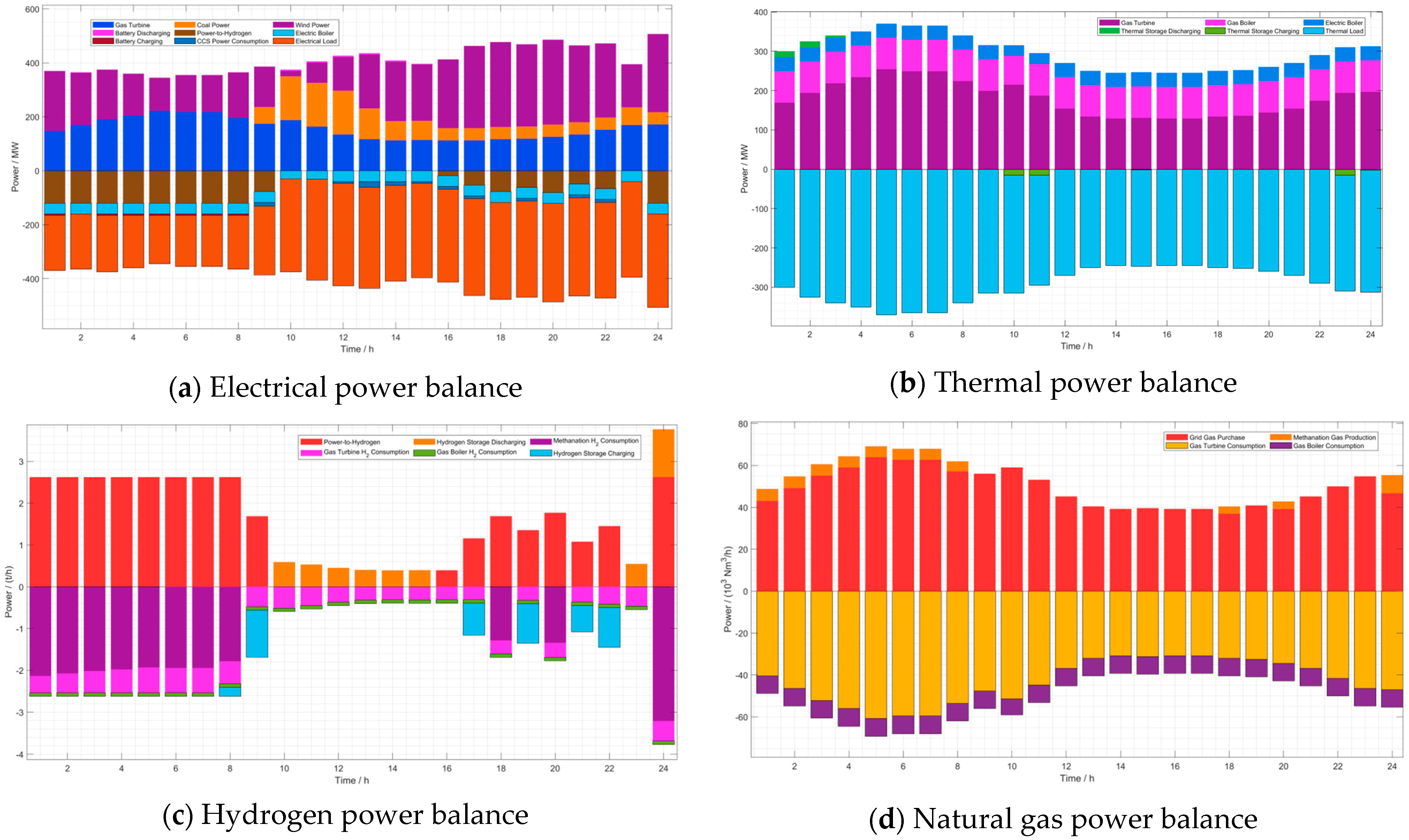
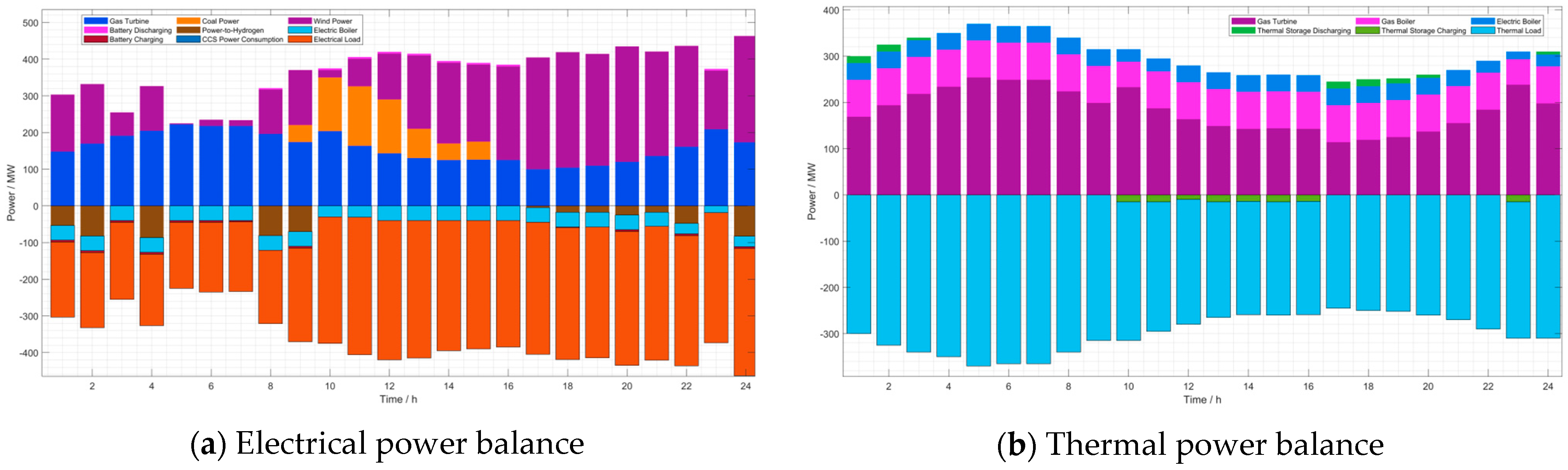
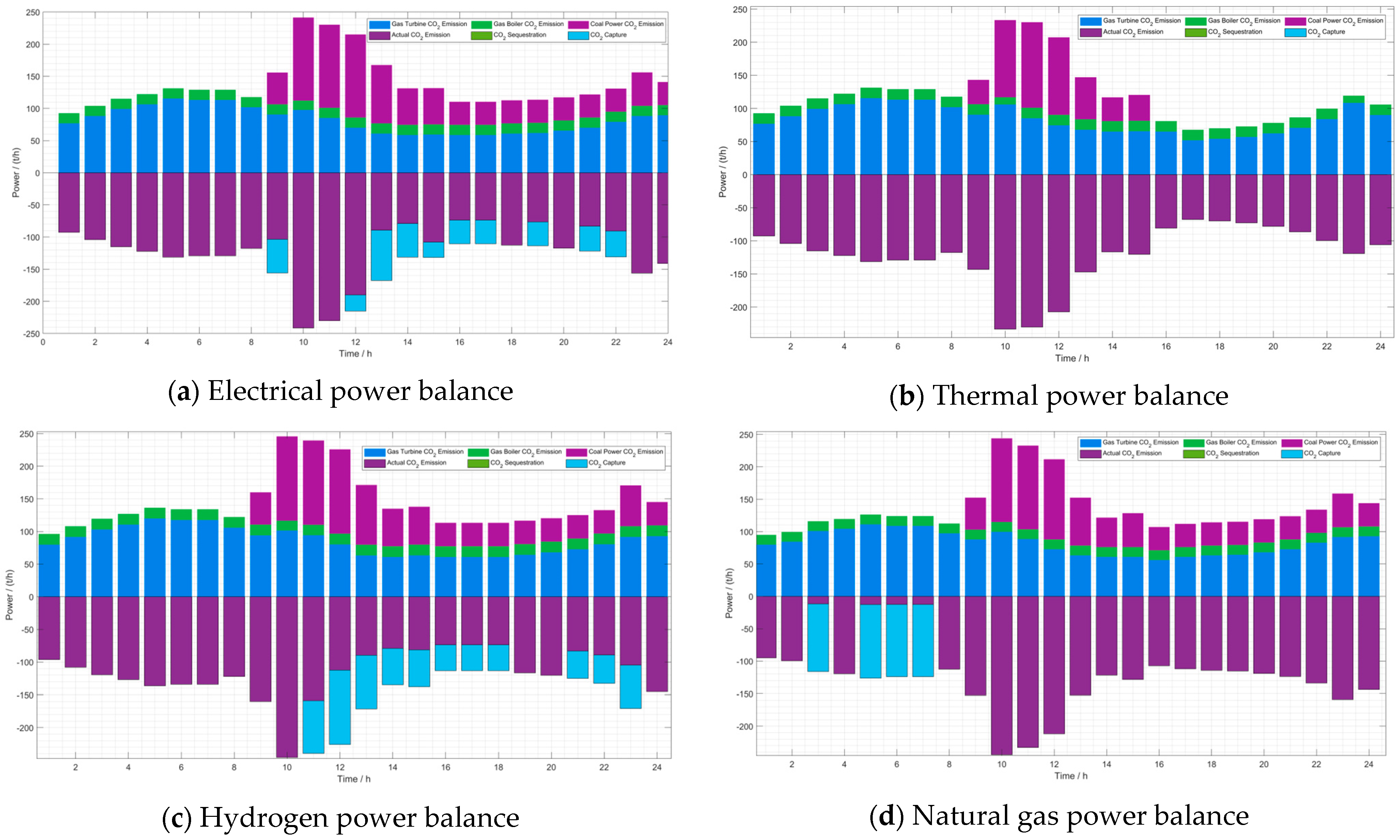
The power balance results for the proposed Scenario 1 (with a fixed 10% hydrogen blending ratio) are illustrated in
Figure 3. The system successfully achieves a dynamic match between energy supply and demand through the multi-energy coupling mechanism.
As shown in
Figure 3a, during the peak renewable generation period (12:00–15:00), the system achieves a high accommodation rate of wind and solar power compared to Scenario 2. The thermal power unit ramps down to its minimum stable output (50 MW) during the load valley (02:00–05:00) to minimize fuel consumption and cycling costs. The thermal supply exhibits a “double-peak” characteristic (07:00–09:00 and 18:00–20:00). The CHP unit and electric boiler operate synergistically to meet heating demands, avoiding the high carbon emissions associated with pure gas boilers. The hydrogen and natural gas balances (
Figure 3c,d) demonstrate the cascading utilization. Excess hydrogen is converted to methane or stored, ensuring no energy is wasted.
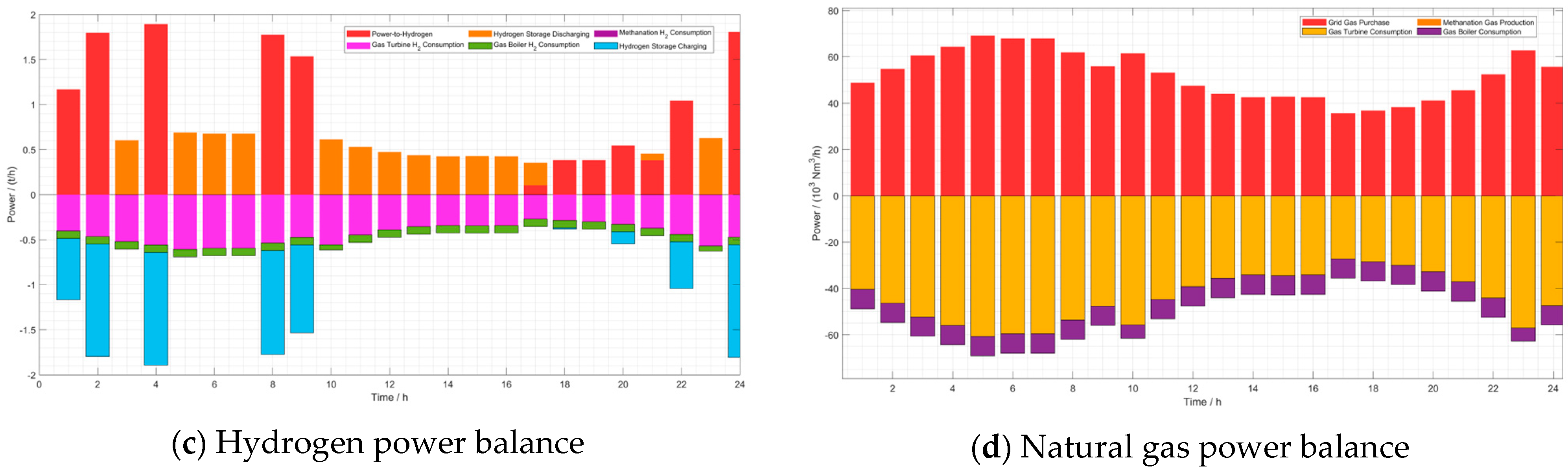
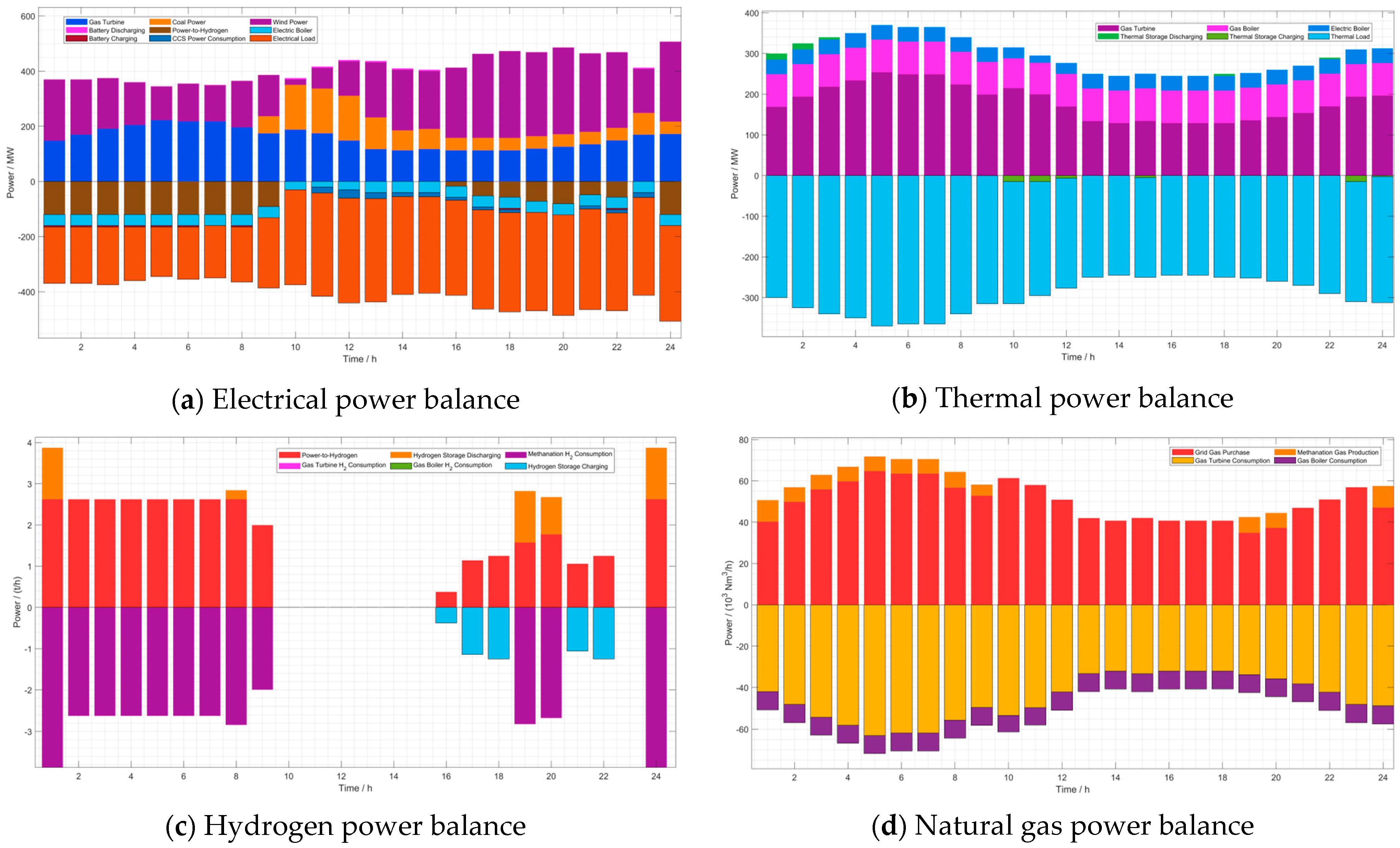
Without methanation, the hydrogen storage system becomes saturated during peak renewable output (16:00–18:00), as shown in
Figure 4. This forces the system to curtail wind power and subsequently start up reserve thermal units during peak load, increasing both coal consumption and carbon trading costs. As shown in
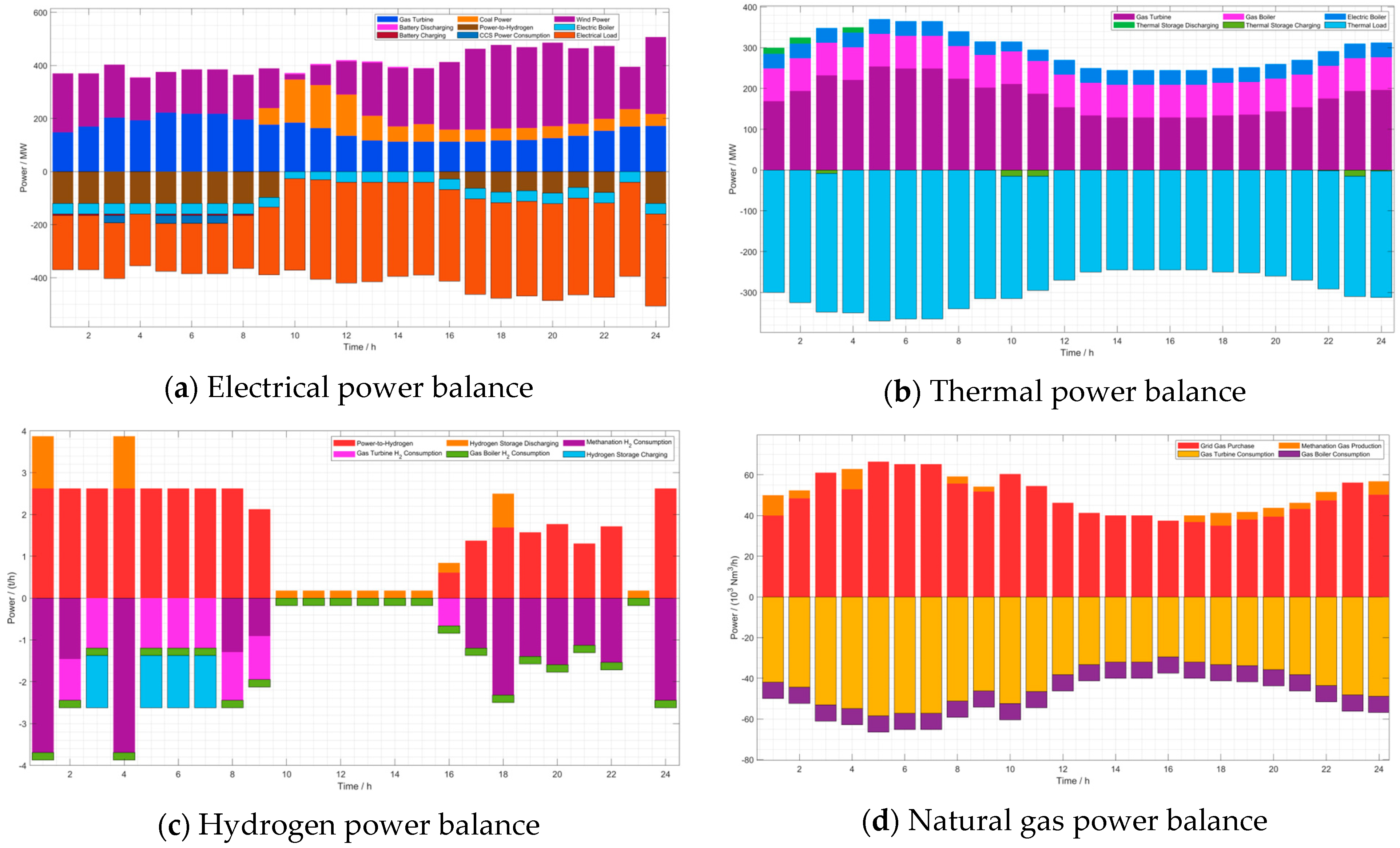
Figure 5, relying solely on natural gas for turbines increases the carbon intensity. To meet peak load, the system must dispatch thermal units at higher outputs (up to 190 MW), significantly increasing CCS energy consumption and wind curtailment compared to Scenario 1.
4.2. Analysis of Variable Operating Conditions
To validate the robustness of the model, Scenario 4 introduces a variable hydrogen blending ratio ranging from 0% to 20%. Although pushing the hydrogen blending ratio to higher levels (e.g., 20–50%) could theoretically yield deeper emission cuts, such scenarios are excluded from this analysis. Ratios above 20% currently exceed the safe operational thresholds of standard commercial gas turbines and would require substantial capital investment for specialized equipment retrofits, which falls outside the economic scope of the proposed short-term adaptive scheduling framework.
As illustrated in
Figure 6, the system dynamically adjusts the blending ratio. During the midday renewable peak, the blending ratio increases, allowing the electrolyzer to operate at maximum capacity to absorb excess wind power. Conversely, during off-peak hours (22:00–04:00), the ratio is reduced to minimize the hydrogen storage losses. The dynamic scheduling in Scenario 4 results in a total cost close to the optimal level of Scenario 1 but with further reductions in carbon emissions. The system avoids high-cost carbon trading intervals by flexibly adjusting the fuel composition.
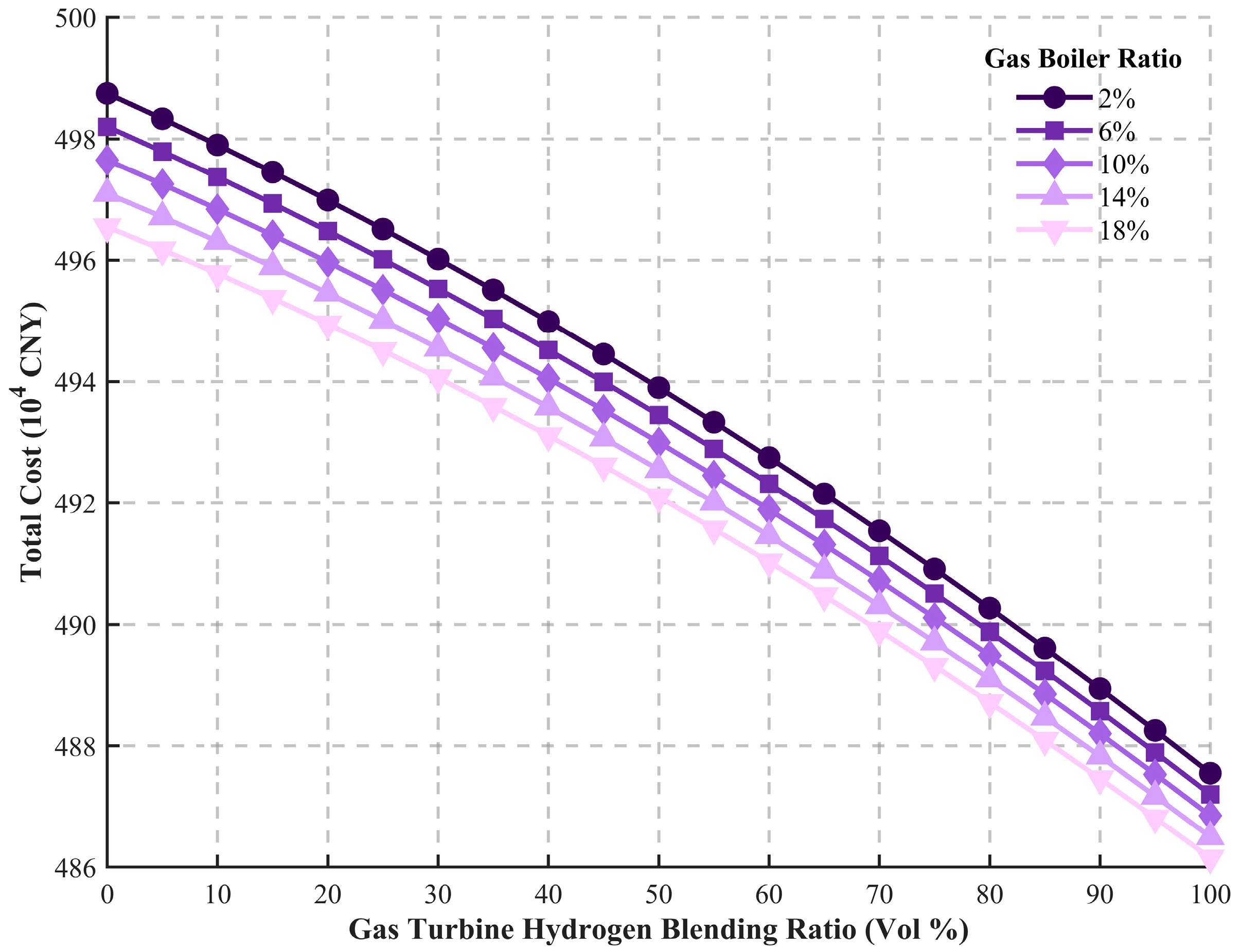
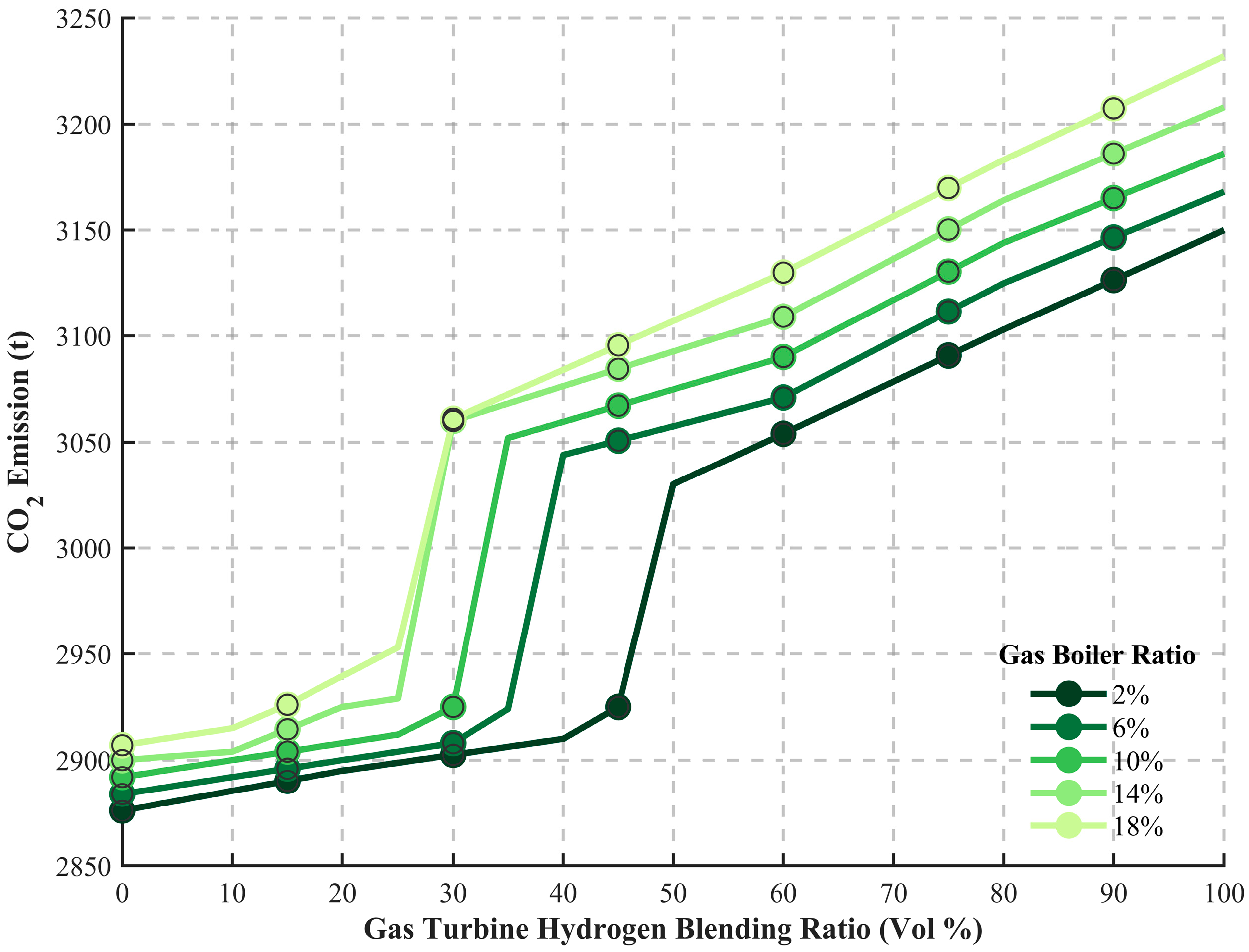
Figure 7 and
Figure 8 analyze the sensitivity of total cost and carbon emissions to the hydrogen blending ratio. Emissions decrease non-linearly with the blending ratio. The reduction efficiency is highest in the 0–10% range but attenuates beyond 10%, limited by the maximum capture rate of the CCS system. The cost follows a U-shaped curve. Below 12% blending, the reduction in carbon trading costs dominates, improving economy. Above 12%, the high energy cost of hydrogen production outweighs the benefits. The dynamic strategy in Scenario 4 achieves Pareto optimality by concentrating operation in the high-efficiency emission reduction interval.
By mapping the continuous variations in
Figure 7 and
Figure 8, the system identifies a clear Pareto frontier between operational expenditure and decarbonization depth. The dynamic strategy in Scenario 4 achieves Pareto optimality by strictly concentrating operation within the high-efficiency emission reduction interval (around 10–12%), balancing the marginal cost of hydrogen production with carbon trading savings.
As illustrated in the comparative results, compared to the static operating mode in Scenario 2, the dynamic hydrogen blending in Scenario 1 fully exploits the operational flexibility of the gas turbine, significantly reducing wind curtailment during peak renewable generation periods (e.g., 02:00–06:00) by adaptively absorbing surplus power through P2G. Furthermore, in contrast to Scenario 3, which lacks the closed-loop carbon mechanism, the continuous coupling of CCS and methanation in Scenario 1 inherently recycles captured into synthetic natural gas. This physical carbon cycle not only fundamentally decreases the total carbon emissions but also actively circumvents the severe economic penalties imposed by the higher tiers of the carbon trading mechanism, thereby achieving an optimal balance between economic efficiency and deep decarbonization.
4.3. Economic and Low-Carbon Performance Assessment
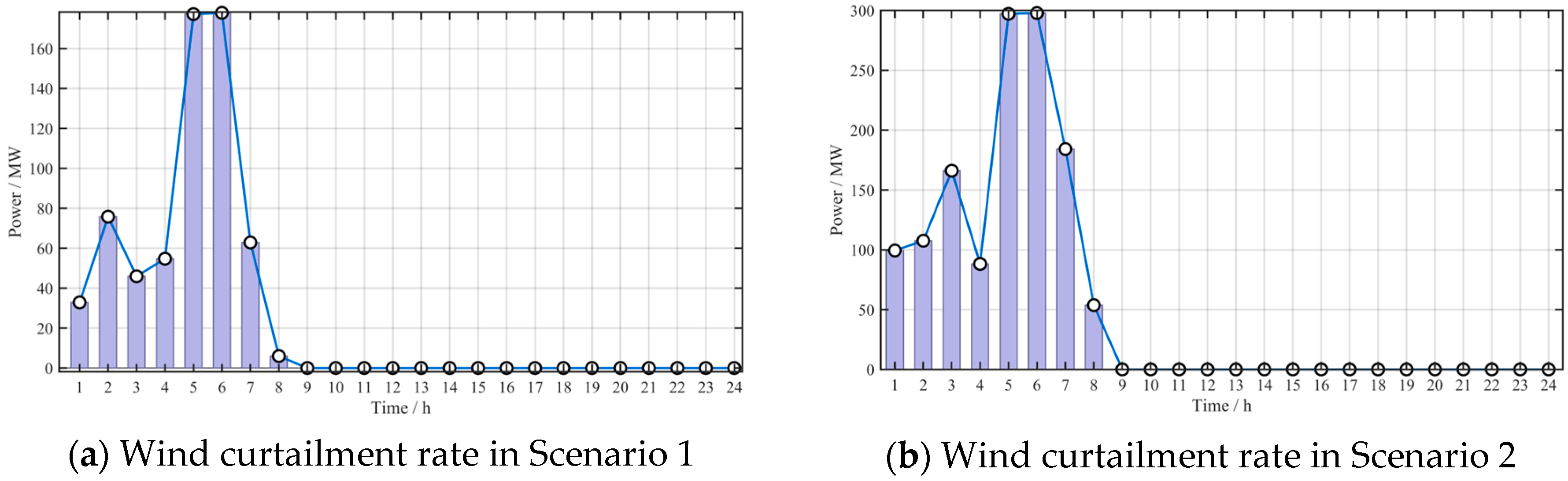
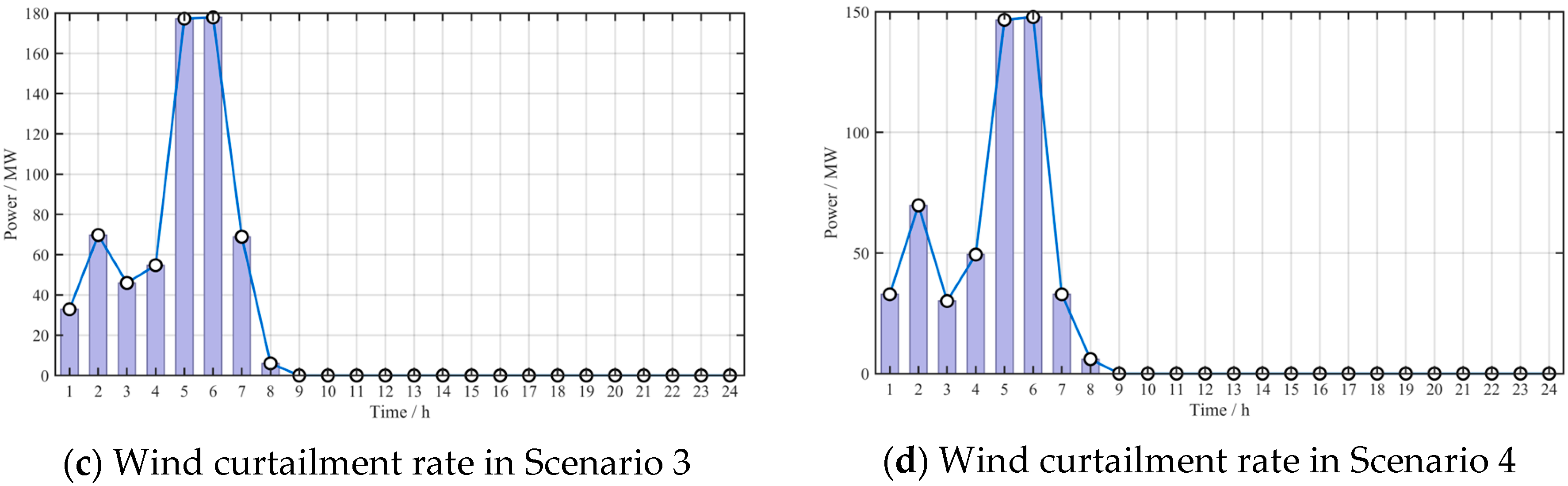
Figure 9 compares wind curtailment across the scenarios. Scenario 1 (a) and Scenario 4 (d) significantly reduce the peak curtailment compared to Scenarios 2 and 3. The variable operating condition in Scenario 4 further lowers the average curtailment per period, validating its capability to accommodate renewable fluctuations.
As shown in
Figure 10, the net carbon emission profile of Scenario 1 exhibits a ‘double-peak, double-valley’ characteristic. This profile is determined by the temporal correlation between the load demand, renewable energy output, and the operational timing of the coupled electro-carbon–hydrogen equipment. Specifically, during the nighttime valley load period (01:00–05:00), wind power generation maintains a high output level; the dispatch strategy utilizes the surplus wind power to supply the CCS unit, effectively capturing up to 56% of the baseline emissions and forming the first emission valley. Subsequently, during the morning peak load period (07:00–09:00), the electrical load increases while the wind power output declines, requiring the thermal power units to ramp up. Due to the lack of surplus renewable energy to drive the P2G process, the gas turbines operate primarily on natural gas, leading to the first emission peak. During the midday period (12:00–15:00), photovoltaic generation reaches its maximum output. The dispatch model allocates the surplus renewable energy to the P2G electrolyzer, enabling the gas turbines to operate at a high hydrogen blending ratio (up to 20%). This substitution reduces natural gas consumption, thereby forming the second emission valley. Finally, during the evening peak load period (18:00–21:00), the photovoltaic output decreases to zero while power demand reaches its daily maximum. The system dispatches coal and gas units at high-capacity levels to maintain power balance; meanwhile, the depletion of stored hydrogen limits the blending ratio, which jointly results in the second emission peak.
To provide a more comprehensive evaluation framework beyond absolute costs and emissions, several key operational metrics are further analyzed and summarized in
Table 2 and
Table 3. The proposed electro-carbon–hydrogen synergy markedly enhances the system’s peak-shaving capacity; specifically, in Scenario 1 (Proposed), the integrated coupling mechanism acts as an active demand-response asset that reduces the peak-to-valley difference of the net load to a minimum of 128.6 MW (an 18.5% improvement over non-coupled scenarios). Furthermore, this proposed strategy significantly improves the utilization rates of capital-intensive facilities, with the Power-to-Gas (P2G) electrolyzer and CCS unit reaching optimal levels of 74.5% and 78.2%, respectively, thereby effectively mitigating equipment idling during energy supply–demand mismatches. Finally, Scenario 1 achieves the most cost-effective carbon reduction cost per unit of electricity generated at 0.142 ¥/kWh, firmly demonstrating that the proposed cascading utilization of hydrogen and carbon resources optimally balances deep decarbonization constraints with economic viability.
4.4. Sensitivity Analysis of Carbon Trading Mechanisms
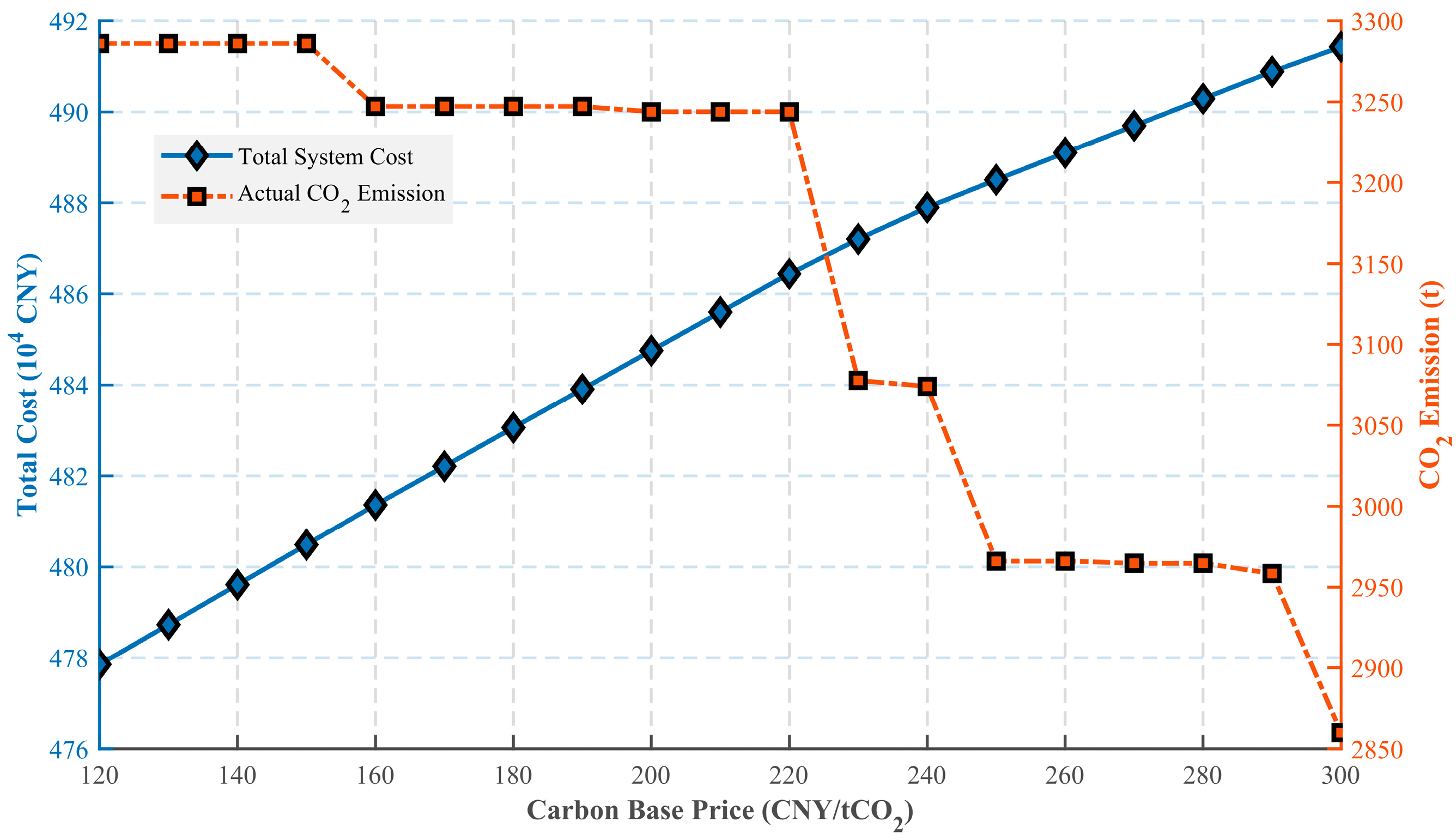
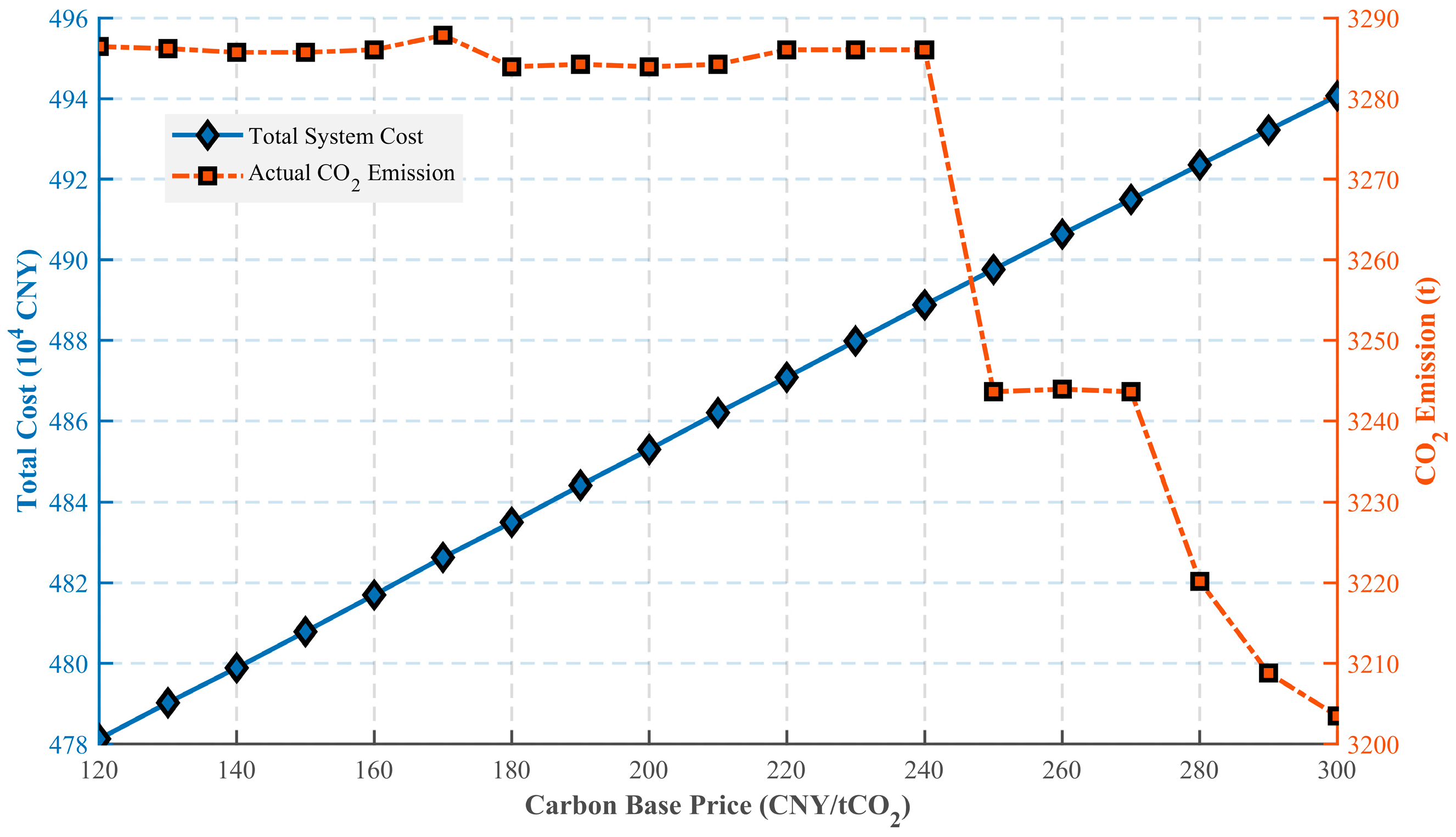
Figure 11 and
Figure 12 compare the impact of tiered and unified carbon trading mechanisms. Under the tiered mechanism, when emissions exceed the quota, the penalty price increases sharply. Scenario 4 effectively utilizes dynamic blending and methane storage to keep emissions strictly below the penalty threshold. Under the unified mechanism (
Figure 13), emissions during peak load (10:00–12:00) are higher, because the single price lacks the progressive punitive pressure to force deeper decarbonization (e.g., extra hydrogen blending). Consequently, the tiered mechanism demonstrates superior peak-shaving performance and cost control.
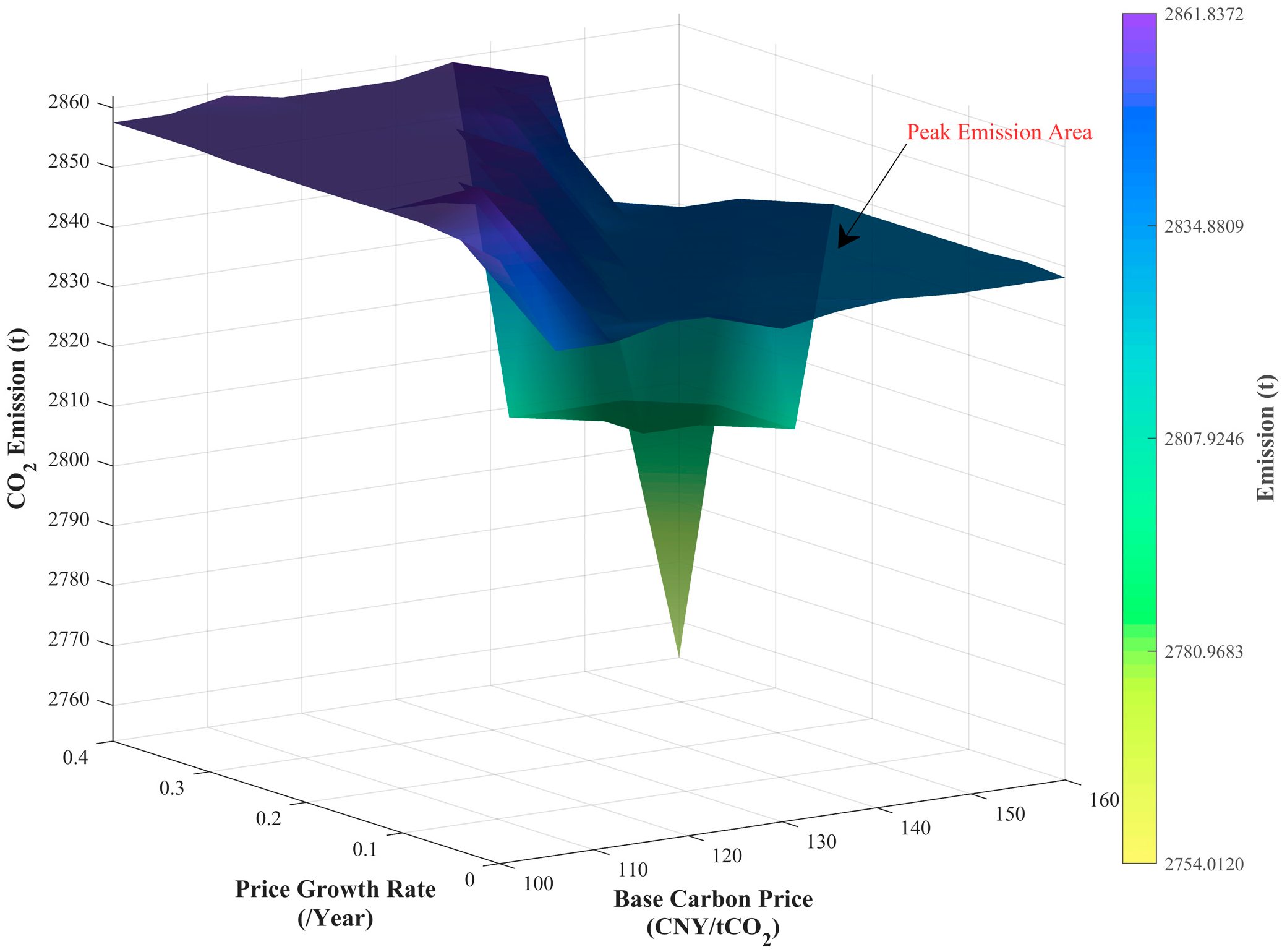
Figure 13 analyzes the interplay between the base carbon price and the price growth rate under the tiered carbon trading mechanism. When both the base carbon price and the price growth rate are at lower levels, the carbon trading cost is insufficient to effectively constrain the high-emission thermal units, resulting in the system operating in a “peak emission area” (the upper plateau). As either the base price or the growth rate increases and crosses a critical economic threshold, the punitive effect of the tiered carbon trading becomes prominent. This economic pressure forces the system to abruptly shift its dispatch strategy—such as prioritizing the full capacity of the CCS equipment and increasing the hydrogen blending ratio—leading to a sharp, “cliff-like” drop in CO
2 emissions. Finally, once the decarbonization potential reaches the physical limits of the coupled equipment (e.g., maximum CCS capture capacity), the emission reduction effect saturates, and the carbon emissions stabilize at a lower plateau. This indicates that appropriately setting a steeper price growth rate can achieve deep decarbonization even at a relatively lower base carbon price.
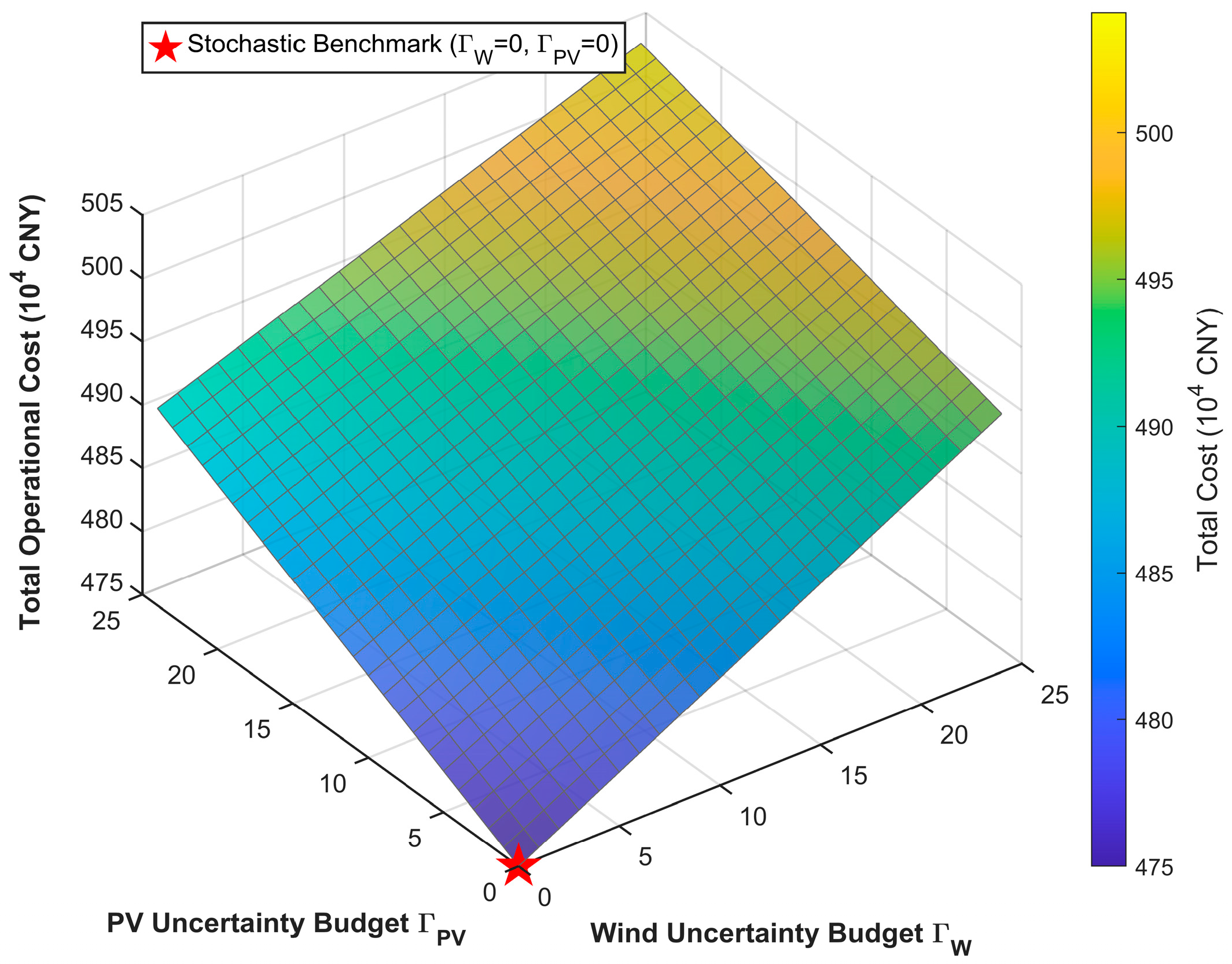
To further respond to the conservatism inherent in robust optimization and quantify the “price of robustness”, the system’s performance was evaluated against a purely stochastic benchmark. The size of the uncertainty set is dynamically calibrated by the uncertainty budgets for wind power (
) and photovoltaic generation (
). The stochastic benchmark model, which optimizes based strictly on expected probabilistic scenarios without hedging against extreme boundary fluctuations, corresponds to the origin point where
and
. As illustrated in the 3D surface plot in
Figure 14, the stochastic benchmark yields the lowest total operational cost (4.75 million ¥) but leaves the system highly vulnerable to unexpected severe weather conditions. As the uncertainty budgets
and
gradually increase, the optimization algorithms are forced to account for more severe worst-case scenarios. Consequently, the system dispatches more conservative flexible resources—such as preemptively charging hydrogen storage and keeping thermal units at higher standby outputs—leading to a continuous non-linear increase in the total operational cost. For instance, when both budgets reach their maximum limit (
, representing maximum conservatism across all scheduling hours), the cost increases by approximately 5.8%. This 3D surface mapping validates that the proposed adaptive robust framework allows dispatchers to flexibly calibrate
to achieve an optimal Pareto trade-off between absolute operational security and economic efficiency.