


Abstract
Wind turbines play an important role for renewable energy generation related to sustainable development. Selection of a suitable blade shape is a key factor in wind turbine design, especially in low wind speed conditions such as urban areas. In addition, two airfoil models of the S-series, S4110 and S1012, are often selected based on their suitable aerodynamic properties with low Reynolds numbers, high applicability, and stable performance. However, there is no research design for wind turbine blades based on S4110 and S1012 under low wind conditions in countries around the world. The angle of attack was adjusted to observe variations in the key aerodynamic parameters while applying appropriate boundary conditions for different regions. The study results show that the overall performance of the optimized S4110 is better than that of the optimized S1012, particularly at larger angles of attack. The performance of the airfoil S4110 shows a strong improvement after optimization, with the aerodynamic performance from 17.35 at 3 m/s to 50.78 at 5 m/s. This paper proposed the airfoil combination usage of S4110 at the blade tip and S1012 at the blade root to form an optimal hybrid airfoil configuration for wind turbine blade, which can both take advantage of high aerodynamic efficiency in low wind conditions and ensure the necessary mechanical strength and stability for the entire wind turbine blade. The performance of the proposed small wind turbine blade model based on the optimal S4110 and S1012 airfoils was analyzed using the Qblade program. Its purpose is to create a new blade model for small wind turbines that moves beyond conventional applications to explore novel and integrated solutions for a sustainable energy future.
1. Introduction
Wind energy has garnered significant global attention owing to its vast potential for sustainable power generation. Wind power offers numerous advantages, including the conservation of non-renewable natural resources [1], reduction in CO2 emissions and greenhouse effects [2], and promotion of new energy technologies [3]. These advancements reflect technological progress and increased financial investment [4], driving the rapid expansion of wind energy infrastructure worldwide [5].
Small wind turbines (SWTs) are a practical solution, particularly in developing nations, because they can satisfy localized energy demands [6]. However, airflow characteristics at low Reynolds numbers pose challenges for small wind turbines in areas with low wind speeds [7]. Passive flow control techniques such as (winglets, flaps, and external devices) have been used in several applications to control stall phenomena and Yaw Misalignment that occur at low Reynolds numbers [8]. The selection of airfoil profiles is crucial in determining the blade geometry and overall performance [9].
Recent research has focused on enhancing airfoil aerodynamics, leading to numerous studies on refining SWT blade profiles to boost efficiency and reduce electricity costs. Advances in airfoil geometry have significantly improved the performance of small wind turbines [10]. For instance, SG6043 and BW-3 airfoils, analyzed for low-wind regions, demonstrated complementary benefits: SG6043 exhibited a high lift-to-drag ratio, whereas BW-3 ensured low inertia for stability [11].
A multifidelity deep neural network model integrating low- and high-fidelity CFD data optimizes airfoil shapes while minimizing computational costs. Compared with high-fidelity simulations, this approach enhances the lift-to-drag ratios, increases the lift coefficients, and reduces the drag across various angles of attack [12]. Additionally, a Reynolds-averaged Navier–Stokes (RANS)-based multifidelity optimization system improved turbine airfoil aerodynamics over single-fidelity methods, showing strong lift coefficient correlations at low angles but discrepancies at higher angles owing to 3D flow effects and turbulence model limitations [13].
Another important aspect of airfoil design is environmental factors, such as airflow velocity, air density, and angle of attack. The angle of attack is the angle between the chord line of the airfoil and the direction of the incoming airflow. At a certain angle of attack, the airfoil achieves an optimal lift; however, if the angle is too large, stalling occurs, causing a loss of lift and increased drag. Therefore, understanding and optimizing these parameters play a key role in the design. During the development process, modern technologies such as numerical simulation (CFD) have improved the ability to design and verify the performance of airfoils.
There are two methods for airfoil design optimization: forward design and reverse design. Reverse design refers to the design of the airfoil according to the desired parameters and the blade shape according to those parameters. Forward design is widely used today owing to the many design tools and optimization algorithms that support it, such as CFD, artificial intelligence. Optimum designs are mostly chosen to optimize aerodynamic performance and reduce the load during wind turbine operation. The parameters used for the optimization calculations were lift, thrust, lift/thrust ratio, and torque. These parameters change owing to the effect of the variable angle of attack, which means that the pressure on the upper and lower surfaces of the airfoil changes.
CFD simulations of NACA, FX, and S airfoils across angles of attack from −6° to 12° and Reynolds numbers of 2 × 10⁵, 1 ×10⁶, and 2 × 10⁶ revealed that FX 60-157 and S4110 achieved maximum lift coefficients of approximately 1.5 at a Reynolds number of 1 × 10⁶ and an angle of 12° [14]. The NACA 6409 airfoil, simulated using the panel method in XFLR5 at low Reynolds numbers, exhibited stable lift characteristics and a high lift-to-drag ratio over a range of attack angles [15]. Comparative studies of four numerical methods—CFD, Lifting Line Theory, Vortex Lattice Method, and the 3D Panel Method on the LSU 05-NG aircraft’s wing lift distribution demonstrated that the 3D Panel Method achieved accuracy close to CFD with significantly reduced computation time [16] (Angga et al., 2020). Similarly, CFD validation of the NACA 2412 airfoil analyzed the aerodynamic performance at low Reynolds numbers using the Spalart–Allmaras turbulence model [17]. Simulations of the NACA 0010-35 airfoil indicated that increasing the angle of attack significantly altered the pressure distribution, causing flow separation and reducing lift performance [18]. Additionally, rotor blade airfoil optimization through a response surface method enhanced helicopter rotor aerodynamic performance, and CFD has proven to be a cost-effective alternative to wind tunnel experiments [19]. The authors [20] numerically studied three turbulence simulation models using CFD for the S809 wind turbine airfoil.
Countries near the sea, such as Vietnam, have great potential for wind energy development [21] because of its long coastline and favorable wind conditions. However, effectively harnessing wind energy sources still faces several challenges because many regions have low average wind speeds [22]. Most commercial wind turbines use standard blade designs that are not specifically optimized for climate and terrain, leading to lower energy conversion efficiency. Airflow around wind turbine blades under low-wind conditions operates at a low Reynolds number, increasing the risk of flow separation and reducing aerodynamic efficiency. Therefore, research on suitable airfoil profiles is essential to enhance the lift and minimize the drag in this environment.
Dinh et al. [23] analyzed the S1210 airfoil by using two-dimensional CFD simulation at a Reynolds number of 204,100, focusing on aerodynamic parameters such as lift and drag coefficients across angles of attack from −4° to 18°. Phan et al. [24] explored small wind turbine blade designs optimized for low wind speeds using the SD7062 airfoil, employing Burton and Manwell’s methods to enhance efficiency in low-wind areas. Nguyen et al. [25] optimized the NACA 4415 airfoil under low-speed conditions using CFD in COMSOL Multiphysics, developing an improved C4415 profile that significantly enhanced aerodynamic efficiency. To further improve the performance of small wind turbines under low wind speed conditions, XFLR5 and CFD simulations were utilized to develop a new airfoil based on the S1010 model [26]. The result achieved optimal performance at an attack angle of 3°, with a 6.25% improvement in the lift-to-drag ratio at 6 m/s.
The development of optimized airfoils for urban regions with low wind speeds is a critical research priority. These conditions present challenges for maintaining effective wind turbine operation, necessitating airfoil designs tailored to specific environmental factors. Therefore, it is essential to understand the aerodynamic behavior and performance characteristics under low wind velocity conditions. The selection of aerodynamic blade models suitable for low-Reynolds-pressure conditions is a key factor in ensuring the performance of wind turbines. In low-wind-speed regions, the Reynolds number associated with small wind turbines ranges from 105 to 5 × 10⁵. This is the range of Reynolds numbers in which many conventional blade designs do not achieve optimal performance, resulting in large energy losses.
S4110 and S1012 are two airfoil models of the S-series designed to operate efficiently at low wind speeds owing to their special aerodynamic shapes. The lift-to-drag ratios (CL/CD) of S4110 and S1012 are optimized for applications that require the conversion of energy from flow into mechanical power. Both airfoil designs are capable of maintaining flow close to the surface and reducing flow separation, which is the main cause of efficiency loss in wind turbines. Despite their potential, no existing studies have explored the design of wind turbine blades based on the S4110 and S1012 profiles, specifically for low wind environments.
This research is a critical problem because many countries have a large untapped potential for wind energy, especially in low-wind-speed regions. Most current commercial wind turbines are optimized for high-wind conditions, making them inefficient in low-wind regions. Therefore, conducting a comprehensive aerodynamic analysis of aerodynamic blade models such as S4110 and S1012 under low Reynolds number conditions is necessary to develop blade designs that are suitable for local wind characteristics. In addition, this research also contributes to supporting the design and deployment of small-scale wind power systems, which are particularly suitable for urban areas, rural electrification, and off-grid areas.
In this study, the aerodynamic performance of S4110 and S1012 airfoils under low wind speed conditions was investigated with the support of advanced CFD simulations. These findings provide valuable insights for optimizing these airfoils to enhance wind energy utilization in low-wind-speed regions. In addition, the study utilized a numerical simulation using ANSYS Fluent software (2023R2 Student Version) with the Spalart–Allmaras model, thereby clarifying the applications of simulation in accurately predicting the aerodynamic parameters of wind turbines. Finally, the performance of the proposed small wind turbine blade model based on the optimal S4110 and S1012 airfoils was analyzed using the Qblade program.
Some novel technical contributions in the study include redesigning the airfoils when changing the maximum thickness and maximum camber in the low-wind-speed region, combining two symmetrical and asymmetrical airfoils to create a complete wind turbine blade, and changing the maximum thickness and maximum camber positions to change the shape of the airfoils to perform better in low wind speed conditions.
2. Materials and Methods
2.1. Spalart–Allmaras Model
The Spalart–Allmaras (SA) turbulence model represents a groundbreaking approach to turbulence modeling, providing an effective and computationally efficient method for simulating aerodynamic flows [27]. Designed with a single transport equation to predict the modified eddy viscosity , this model is particularly well suited for scenarios in which accurate modeling of the boundary layers is essential. By avoiding the complexity of multi-equation turbulence models, the SA model minimizes computational requirements, making it the preferred choice in both academic research and industrial applications.
Widely used in the fields of aerodynamics and fluid mechanics, the SA model is particularly valuable for analyzing low Re number flows and wall-bounded systems. Its stability in capturing turbulence near walls has made it dispensable for airfoil studies, wind turbine blade optimization, and external flow simulations of aircraft and automotive components. At the heart of the Spalart–Allmaras model lies a single transport equation for the modified eddy viscosity :
where Production term (cb1) represents the generation of turbulence based on strain rate; Diffusion term (1⁄σ [∇.((v + )∇ )] accounts for the spread of turbulence across the flow; Damping term (cb2(∇)2) controls turbulence in regions with rapid spatial variations; Destruction term (cw1fw[]2) reduces turbulence near walls through wall-damping effects. In Equation (1), and denote the modified turbulent and laminar kinematic viscosities, respectively []; t is the time [s]; is the modified vorticity magnitude [; d is the distance to the nearest wall, critical for wall-bounded flows [m]. The model constants and the wall damping function are dimensionless. The term enhances the model’s accuracy by including wall-related effects and is defined as:
where : Magnitude of the vorticity, measuring rotational flow; Ƙ: Von Kármán constant (dimensionless), a key parameter in turbulence modeling; d: Distance to the nearest wall, critical for wall-bounded flows; fv2: A correction function designed to modulate turbulence effects near the wall; The wall-damping function, fw is crucial for reducing turbulence intensity in regions close to solid surfaces (dimensionless):
where g is expressed as follows:
where g, r, and the model constant are dimensionless quantities, ensuring that the auxiliary function g used in the wall-destruction term remains nondimensional.
The turbulence eddy viscosity vt is derived as follows:
where fv1 is an empirical function, ensuring smooth transition of viscosity values near the wall:
The key model constants used in the Spalart–Allmaras model were empirically derived to ensure accuracy and stability across various flow regimes.
2.2. S4110 and S1012 Airfoil Model
The S4110 and S1012 airfoil models are the baseline airfoils and they are selected from the website (airfoiltools.com (accessed on 15 August 2024)) (Airfoil plotter) to determine the aerodynamic capability at low Reynolds numbers. The geometrical characteristics and profile of a standard airfoil are shown in Figure 1, and several technical specifications of the S4110 and S1012 airfoil models are presented in Table 1. In this study, the aerodynamic parameters for high efficiency under moderate wind conditions were selected with an average wind velocity of 3 m/s and within the AoA from −2° to 14°, which is suitable for many regions in Vietnam.
Figure 1.
Profile of S4110 and S1012 airfoil models. Note: The dotted lines connect the starting point to the ending point.
Table 1.
Technical specifications of the S4110 and S1012 airfoil models.
2.3. Flow Region and Grid Generation
Computational meshing is a key step in ensuring the accuracy and efficiency of the numerical simulations. The mesh is designed with a high density in the regions near the blade surface and in the boundary layer, where the flow exhibits large changes in velocity and pressure. Advanced meshing techniques, such as concentrated meshing in areas with large gradients or adaptive meshing methods, are often preferred. These techniques not only help to improve the accuracy of the simulation results but also optimize the computational cost.
In particular, in the regions near the blade surface, the mesh must meet strict y + scale standards to ensure accurate capture of the flow characteristics in the boundary layer. An optimized mesh will include small and uniform elements in the boundary layer region to accurately resolve large gradients in the flow, while maintaining larger element sizes in regions far from the surface to reduce the overall number of elements and save computational resources.
By combining precise geometric design and advanced meshing techniques, the simulation model can accurately reflect the interaction between the flow and blade surface, ensuring the quality and reliability of the aerodynamic analysis results.
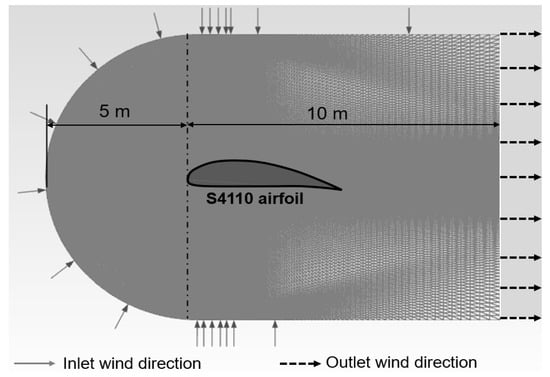
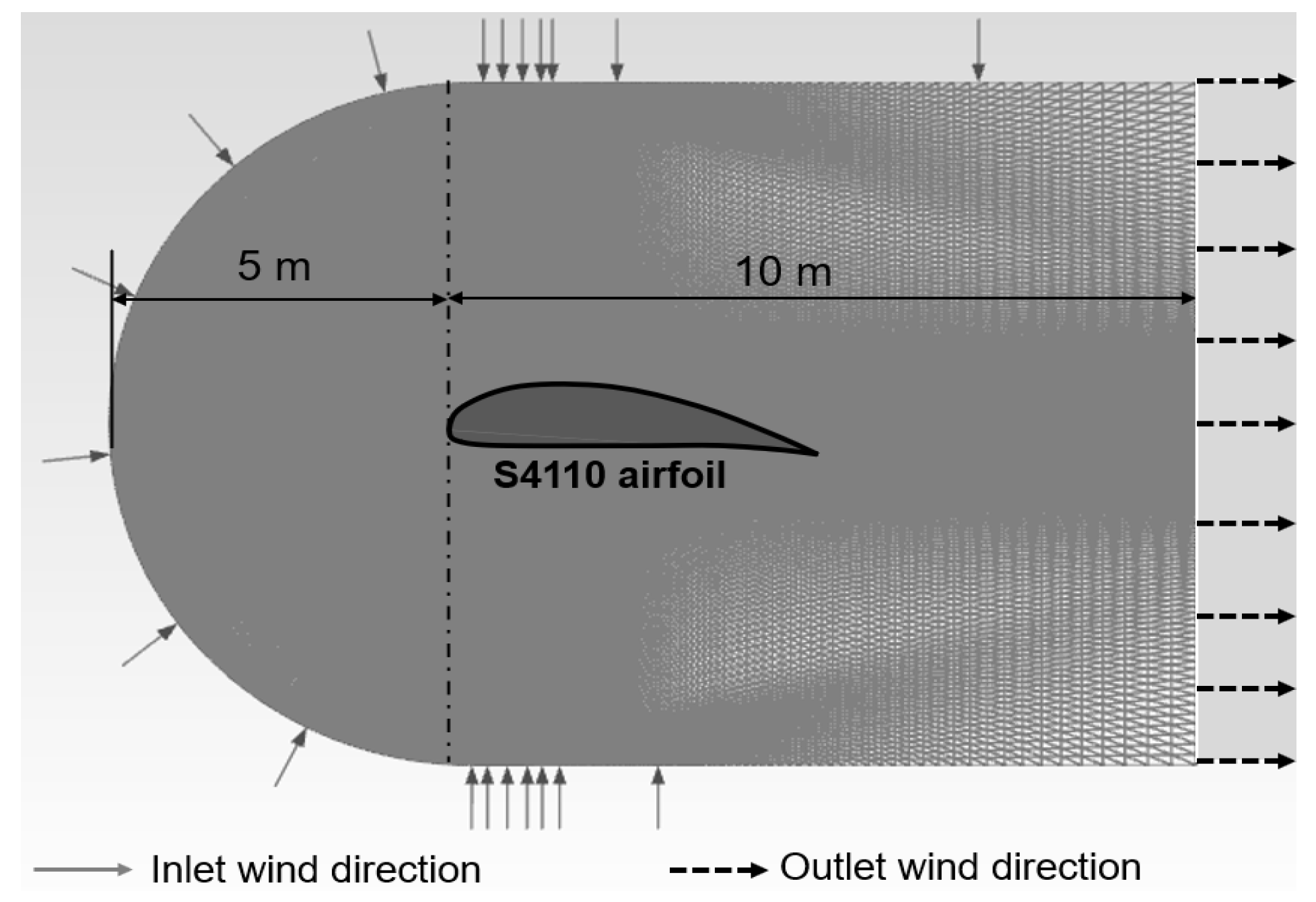
A 2D geometric model was established in the Ansys Fluent environment to delineate the flow region, including the profile of the airfoil and the region of wind power effects on this airfoil, as shown in Figure 2. The radius of the semicircle and distance from the leading edge to the outlet boundary of the airfoils were 5.0 and 10.0 m, respectively. To generate a structured grid, the flow region was separated into six domains using different optional tools for meshing. The quadrilateral mesh division method was selected for meshing the 2D faces, and edge sizing was applied to the profile of the airfoil to achieve a very intense mesh, which was the region of interest.
Figure 2.
Simulation flow region.
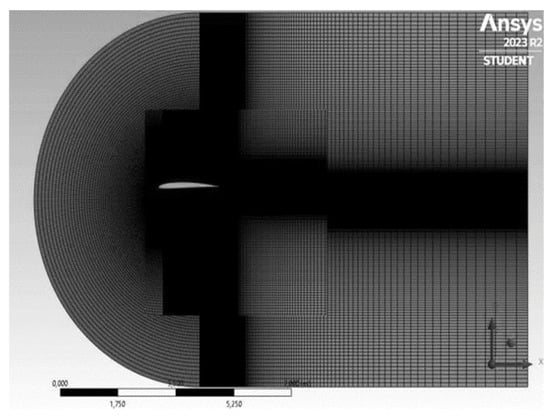
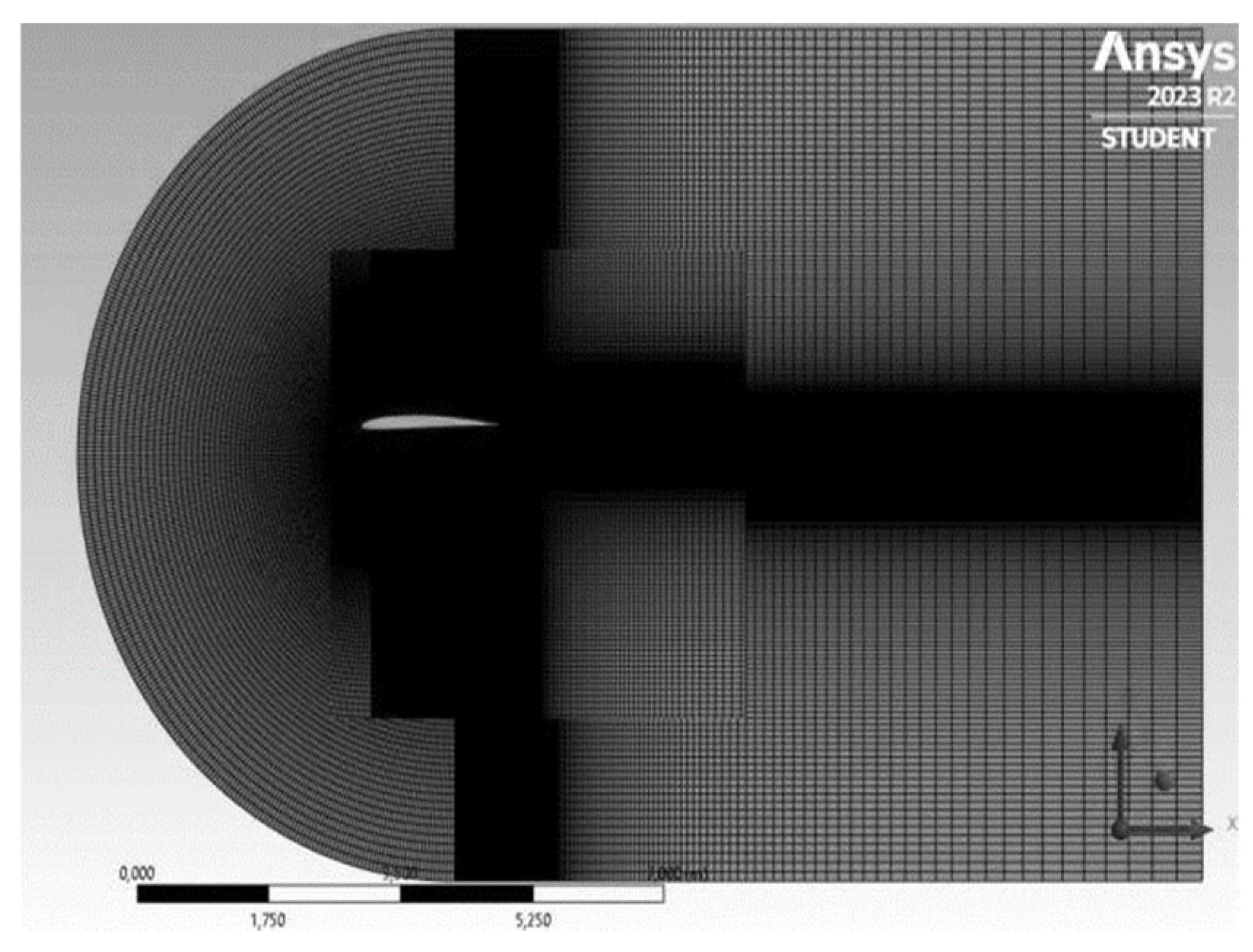
A mesh independence test was performed using three grid sizes of approximately 110000, 225000, and 410000 elements. The lift and drag coefficients obtained under identical conditions showed a difference of less than 2% between the medium and fine meshes. Therefore, a mesh with approximately 225000 elements was selected for subsequent simulations as an optimal balance between accuracy and computational cost, as shown in Figure 3. To ensure good results and minimize the computation time, the analysis process was conducted with 500 iterations to achieve the necessary convergence. The analysis results consisted of the distribution of the pressure, velocity, lift coefficient, drag coefficient, and other relevant coefficients related to the aerodynamic aspects of the airfoil model.
Figure 3.
Meshing in Ansys Fluent.
The CFD method is a computational technique for simulating and analyzing fluid or air flow in a three-dimensional or two-dimensional (3D/2D) space by solving complex mathematical equations of fluid and air physics, including governing equations for the conservation of mass, momentum, and energy [28]. The Navier–Stokes equation is an indispensable and critical part of simulating fluid flow in the CFD method. The fundamental NSE equations describe the flow of fluid or air in a three-dimensional space, encompassing both dynamic (kinetic) and physical (such as pressure, density, and temperature variations). In addition, the Spalart–Allmaras turbulence model was selected because it consists of a single governing kinematic equation to depict viscous eddy flow. This model is useful for aerodynamic applications involving wall-bound systems.
The Spalart–Allmaras turbulence model comprises several parameters and coefficients that must be defined during the simulation process. However, the computation time is faster than that of the other methods because only one dynamic differential equation needs to be resolved. This one-equation model is particularly suitable for resolving eddy viscosity problems near the boundary of CFD simulations. The three important coefficients of CL, CD, CP present the aerodynamic characteristics of this airfoil model, and they need to be monitored during the simulation and given by these equations (Equations (9)–(11)):
where CL, CD and CP are the lift coefficient, drag coefficient, and pressure coefficient on the surface, respectively; L and D are the lift and drag forces; , are the static pressure (the value of ρ is independent with the flow) and pressure of the free flow; A represents the area of the airfoil.
The Reynolds number, depending on the flow velocity at any given point on the airfoil surface, can be calculated using Equation (12):
The aerodynamic characteristics of the airfoil models are analyzed with different AoA in the range of [−2° ÷ 14°] under the conditions of low wind velocity ϑ from 3 to 5 m/s, which is equivalent to a Reynolds number of 205422. The density of the airflow ρ is 1.225 kg/m3, and dynamic viscosity μ is 1.789 × 10⁻⁵ kg/(m.s). The static pressure distributed throughout the space is 101,325 Pa. The straight line (Chord) that connects the first and last points of the airfoil is 1 m.
2.4. Analysis Methods on Qblade Program
Qblade is integrated with Xfoil’s aerodynamic analysis engine, which provides accurate simulations of lift force, drag force and aerodynamic performance of the airfoil configurations [29]. Qblade uses a combination of airfoil element theory (BEM) and momentum equations to evaluate the performance of the airfoil pattern under different wind conditions. It also provides tools for wind turbine simulation, including nonlinear dynamics analyses and flow dynamics simulations.
In the rotor simulation subsystem, users can perform rotor blade simulations within a range of tip speed ratios (TSR). Rotor simulation can only be defined when at least one rotor blade exists in the runtime database. When setting up a rotor simulation, users need to select the desired adjustments for the BEM algorithm and simulation parameters. Once the simulation is set up, users can select the TSR range and increment for the simulation.
where ω is the rotational speed of the rotor (m/s); R is the rotor radius (m); V is the wind velocity (m/s).
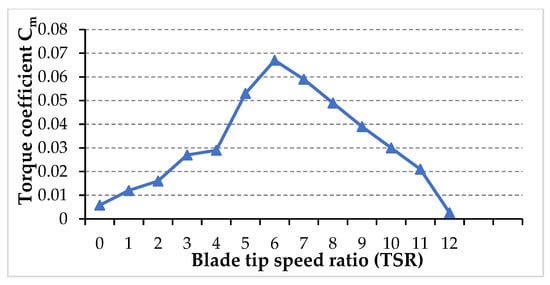
The torque coefficient (Cm) is an important index in the design and performance of wind turbines, especially in the BEM method. It represents the degree to which the rotor generates torque around the axis, which directly affects the turbine output power. The torque coefficient is defined by the formula:
where M is the rotor torque (N.m); ρ is the air density (kg/m3); A = πR2 is the rotor swept area (m2); V is the wind velocity (m/s); R is the rotor radius (m).
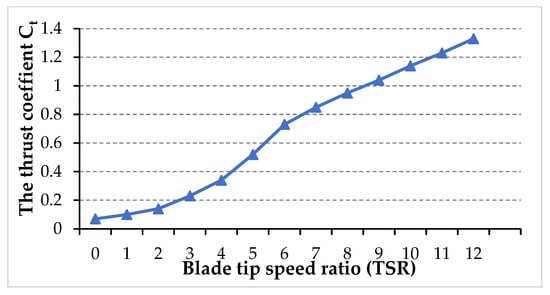
The thrust coefficient (Ct) is an important parameter in wind turbine performance analysis, helping to evaluate the impact of airflow on the rotor and the influence of the stall effect, tip loss, and dynamic load. The thrust coefficient is calculated by the formula:
where FT is the thrust force acting on the rotor (N); ρ is the air density (kg/m3); A = πR2 is the swept area of the rotor (m2); R is the rotor radius (m); V is the inlet wind velocity (m/s).
3. Results
3.1. S4110 Airfoil
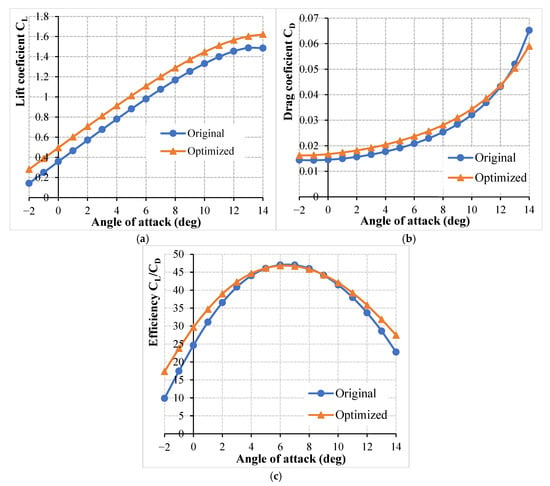
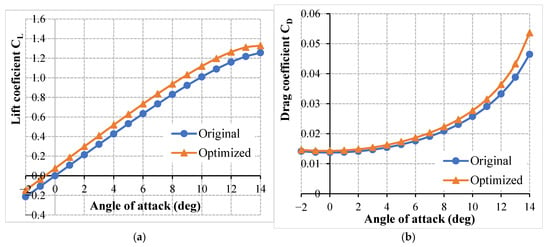
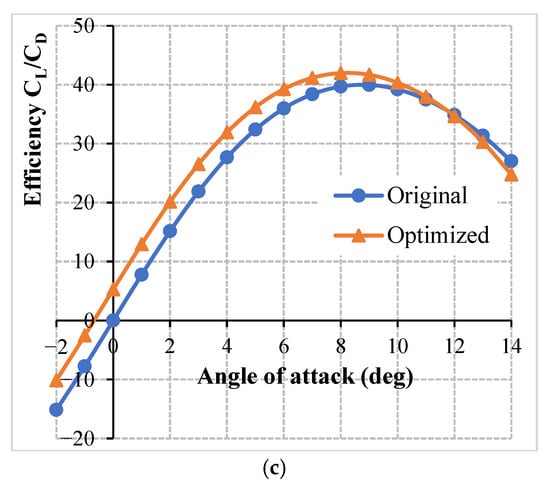
Figure 4a shows that the lift coefficient of the optimized S4110 airfoil was always higher than that of the original airfoil over the entire range of attack angles. Specifically, at low attack angles (0–6°), the difference between the two models was negligible, but the optimized airfoil still achieved a higher CL value. This proves that the optimized design improves the lift performance, even at small angles of attack. Meanwhile, at medium to high angles of attack (6–12°), the difference becomes obvious. The optimized airfoil achieved a higher maximum CL value than the original airfoil, indicating that the lift capacity of the design was significantly improved. Overall, the optimization of the airfoil shape increased the lift capacity over the entire AoA range.
Figure 4.
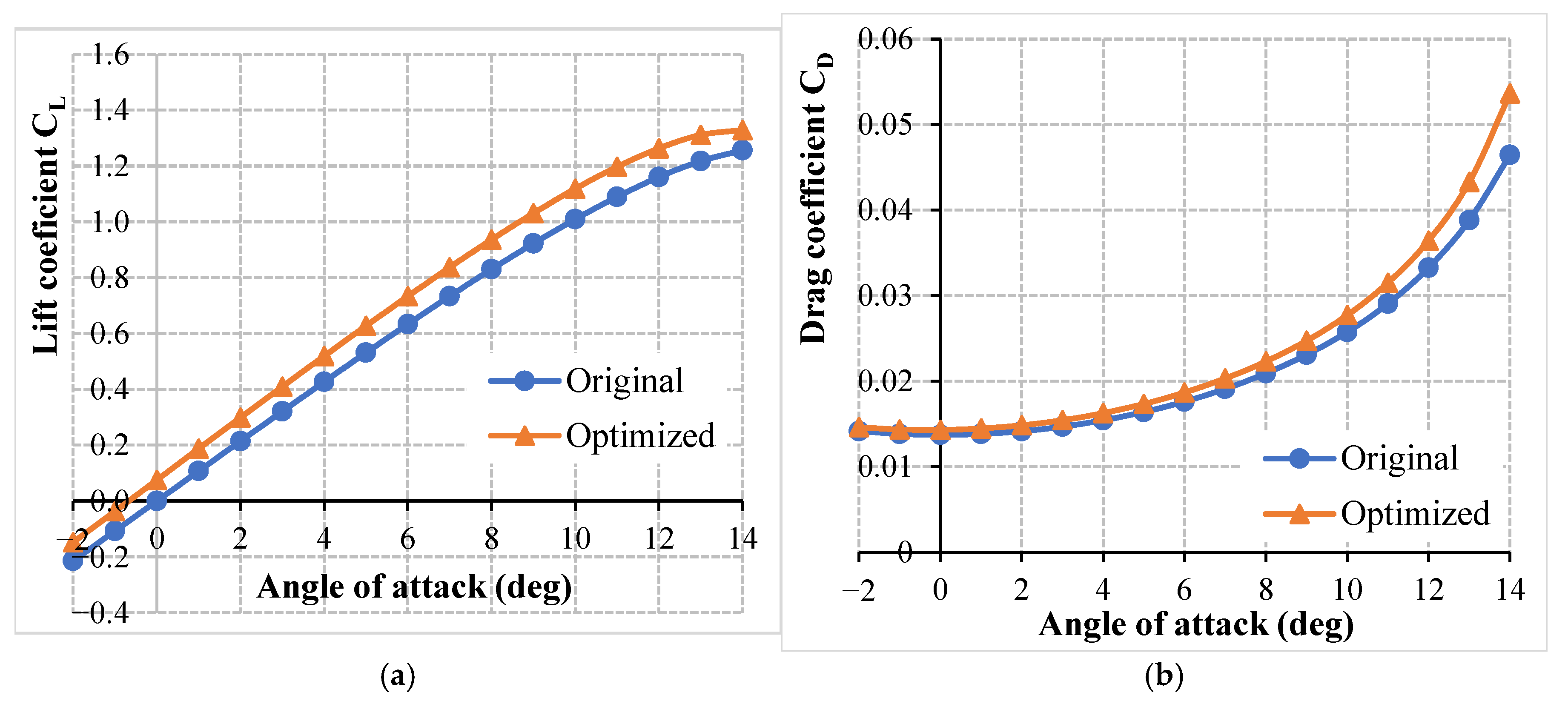
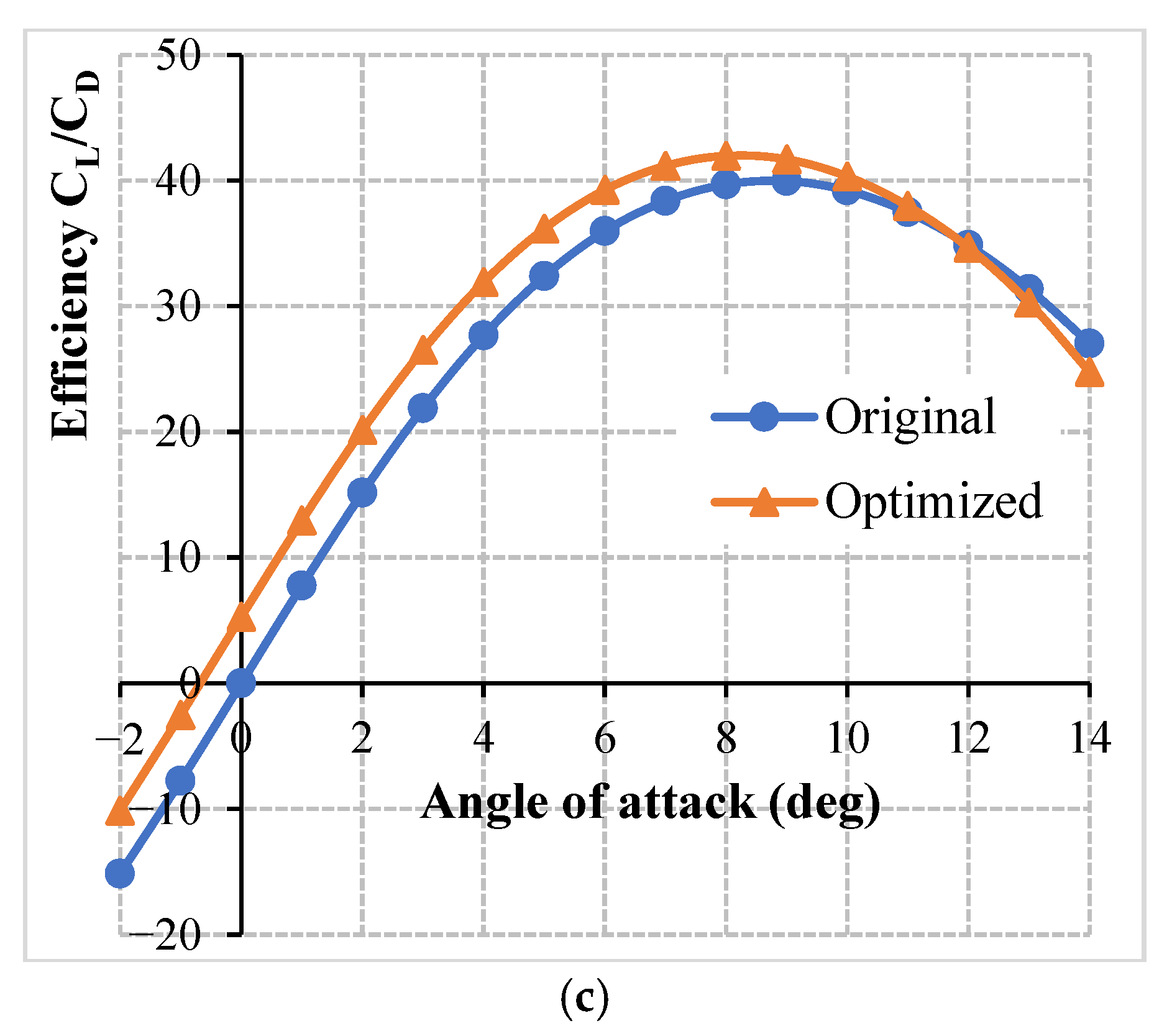
Lift coefficient (a), drag coefficient (b) and efficiency (c) values of the original S4110 compared to the optimum S4110 at 3 m/s.
In terms of the drag coefficient, as shown in Figure 4b, the drag coefficient (CD) of both models increased with increasing AoA, particularly at high angles of attack (AoA > 10°). However, the optimized airfoil model exhibited a slight increase in drag at low to medium AoA angles. In the 0–6° angle of attack range, the CD value of the optimized airfoil was higher than that of the original airfoil, indicating that the drag increased with increasing angle of attack.
At high angles of attack (>10°), the CD values of both models were similar, indicating that the improvement was no longer significant in this region. However, the drag coefficient decreased in this range, indicating that the optimized design focused on improving the aerodynamic performance in the normal angle-of-attack region rather than at a very high angle of attack. This finding is consistent with the current research direction.
The aerodynamic efficiency (CL/CD) of both models increased rapidly from −2° angle of attack and reached a peak value at approximately 6–8°, then gradually decreased as the AoA continued to increase. However, the optimized airfoil always has a superior CL/CD value compared to the original airfoil at all AoAs; in particular, at the optimal angle of attack (approximately 6°), the aerodynamic efficiency of the optimized airfoil is approximately 10–15% higher than that of the original airfoil. The benefit of the optimized design is significant because the AoA region is commonly used in practice. At higher angles of attack (AoA > 10°), although the CL/CD of both models decreased, the optimized airfoil maintained an advantage over the original airfoil.
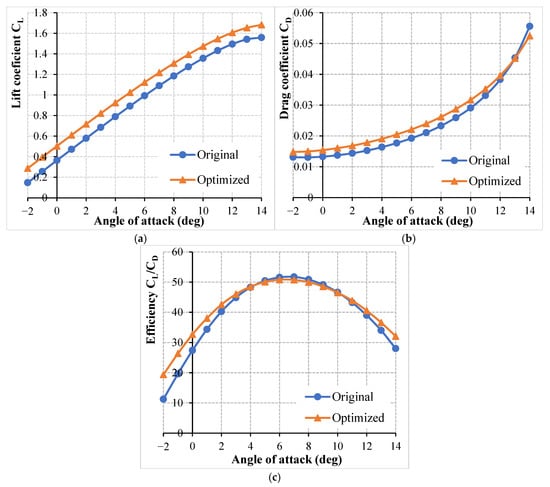
The aerodynamic performance increased over the AoA range at a wind speed of 5 m/s as shown in Figure 5. The lift coefficient in Figure 5a of the original airfoil starts at 0.147 at an AoA of −2° and increases steadily to 1.558 at an AoA of 14°. The lift capacity of the airfoil increased with the angle of attack. In the optimized airfoil, the optimal lift coefficient starts at 0.287 at an AoA of −2° and increases steadily to 1.683 at an AoA of 14°. Therefore, the airfoil can improve the lift when optimized.
Figure 5.
Lift coefficient (a), drag coefficient (b) and efficiency (c) values of the original S4110 compared to the optimum S4110 at 5 m/s.
In Figure 5b, the original drag coefficient starts at 0.0131 at an AoA of −2° and increases to 0.0556 at an AoA of 14°. The drag increased with the angle of attack, but the increase was quite slow until the AoA reached 12°. The optimized airfoil partially reduced the increase in drag owing to the optimal drag coefficient starting from 0.0148 and increasing to 0.0525 at an AoA of 14°.
In Figure 5c, the original CL/CD ratio starts at 11.26 with an AoA of −2° and increases to 28.04 at an AoA of 14°. The performance of the original airfoil improves with increasing angle of attack, indicating that the airfoil lift increases faster than the drag. In contrast, at the optimized airfoil, the optimal CL/CD ratio starts from 19.39, and increases to 32.07 at an AoA of 14°. The optimized performance showed a clear improvement over the non-optimized performance, with a strong increase in performance at high angles of attack. Therefore, the optimized CL was significantly larger than the original CL, and the shape optimization of the airfoil significantly improved the lift capacity.
The optimized CD has a slower increase than the original CD, which indicates that the optimization not only improves the lift but also helps minimize the increase in drag. In addition, the optimized performance shows a large improvement in the CL/CD ratio compared to the original performance, especially at high angles of attack. The optimization can improve the overall efficiency of the airfoil, particularly under high angle of attack conditions.
In general, when analyzing the data of the original and optimized S4110 airfoils at wind speeds of 3 and 5 m/s, it can be observed that the lift coefficient increases steadily with the angle of attack (AoA), and the CL value of the optimized airfoil is always higher than that of the original airfoil. For wind speeds ranging from 3 m/s to 5 m/s, the optimal CL tends to increase gradually from 0.28 to 1.68, showing that the lift capacity of the airfoil is significantly improved, especially at a large AoA. The drag coefficient (CD) also increases slightly with the angle of attack, but the optimized airfoil always maintains a lower CD than the original airfoil, thereby improving the aerodynamic efficiency. The CL/CD ratio shows a strong improvement after optimization, with the original airfoil efficiency ranging from 9.89 (at 3 m/s) to 50.44 (at 5 m/s) and the optimized airfoil efficiency from 17.35 (at 3 m/s) to 50.78 (at 5 m/s). The optimized airfoil not only improves lift but also reduces drag, especially at high angles of attack and higher speeds. In summary, the optimization of the S4110 airfoil is highly effective in improving aerodynamic efficiency, especially under high-speed operating conditions.
3.2. S1012 Airfoil
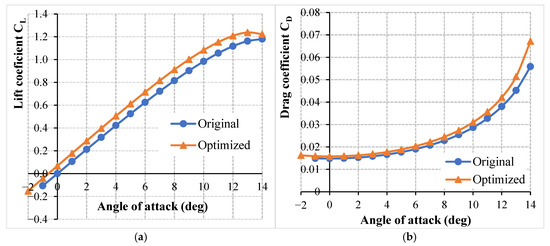
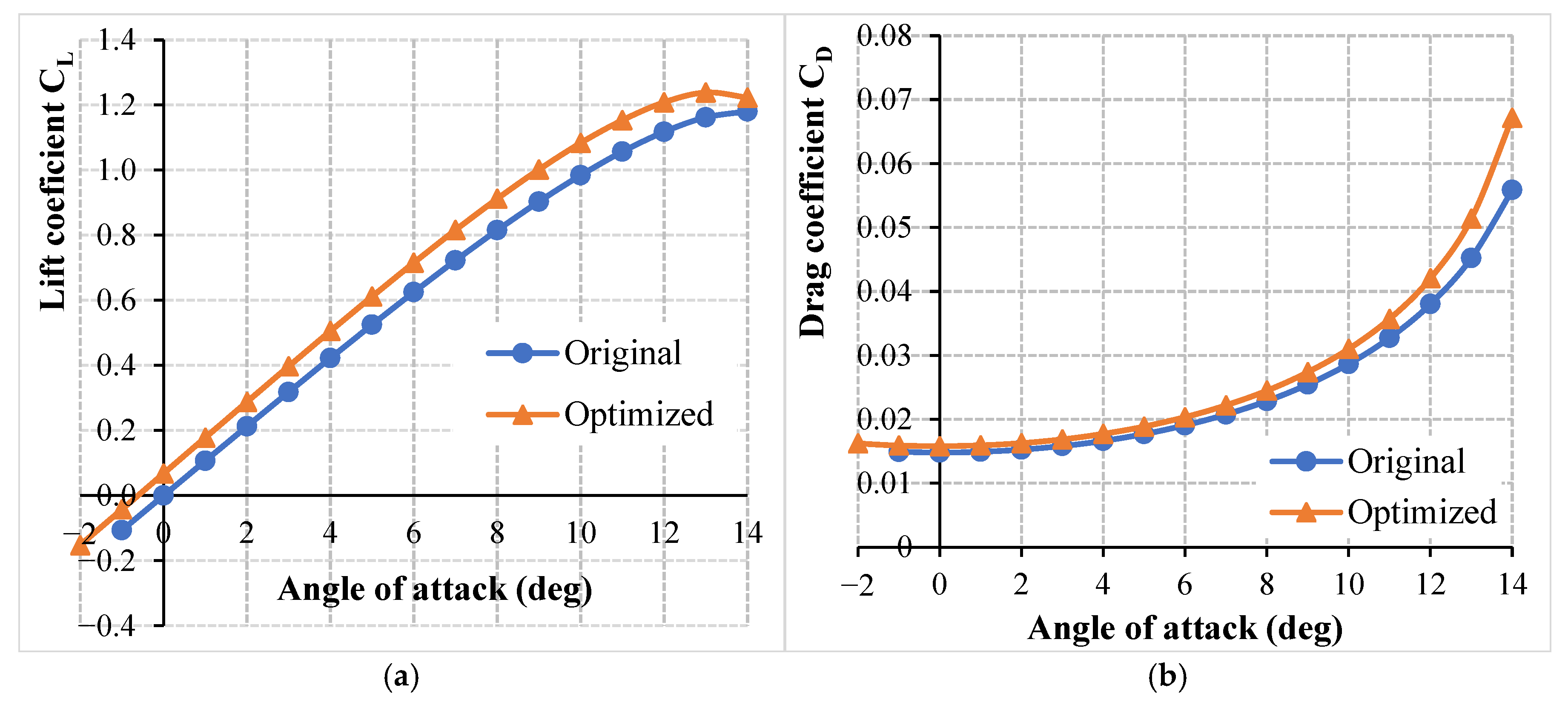
In Figure 6a, the lift coefficient (CL) of the original and optimized S1012 airfoil models has a clear improvement after optimization at a wind speed of 3 m/s. At negative angles of attack (AoA) such as −2° and −1°, the original CL value is negative, but CL has moved closer to a positive value after optimization, for example, from −0.21253 to −0.15257 at AoA of −2°. Thus, the optimization significantly reduced the negative lift force under this condition. As the AoA increases, both the original and optimal CL gradually increase, but the optimal value is always higher than the original value, particularly at an AoA from 2° to 8°, where the optimal CL significantly improves the lift.
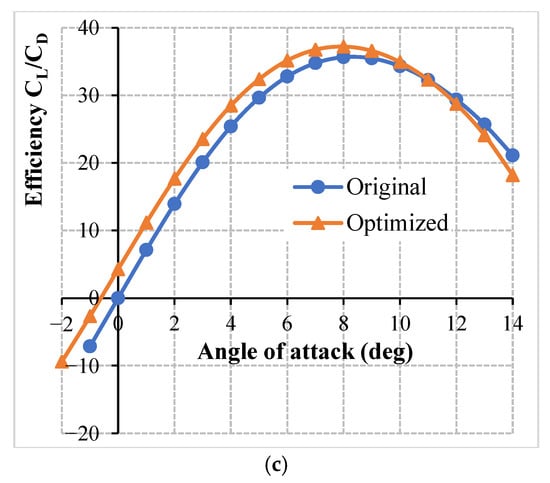
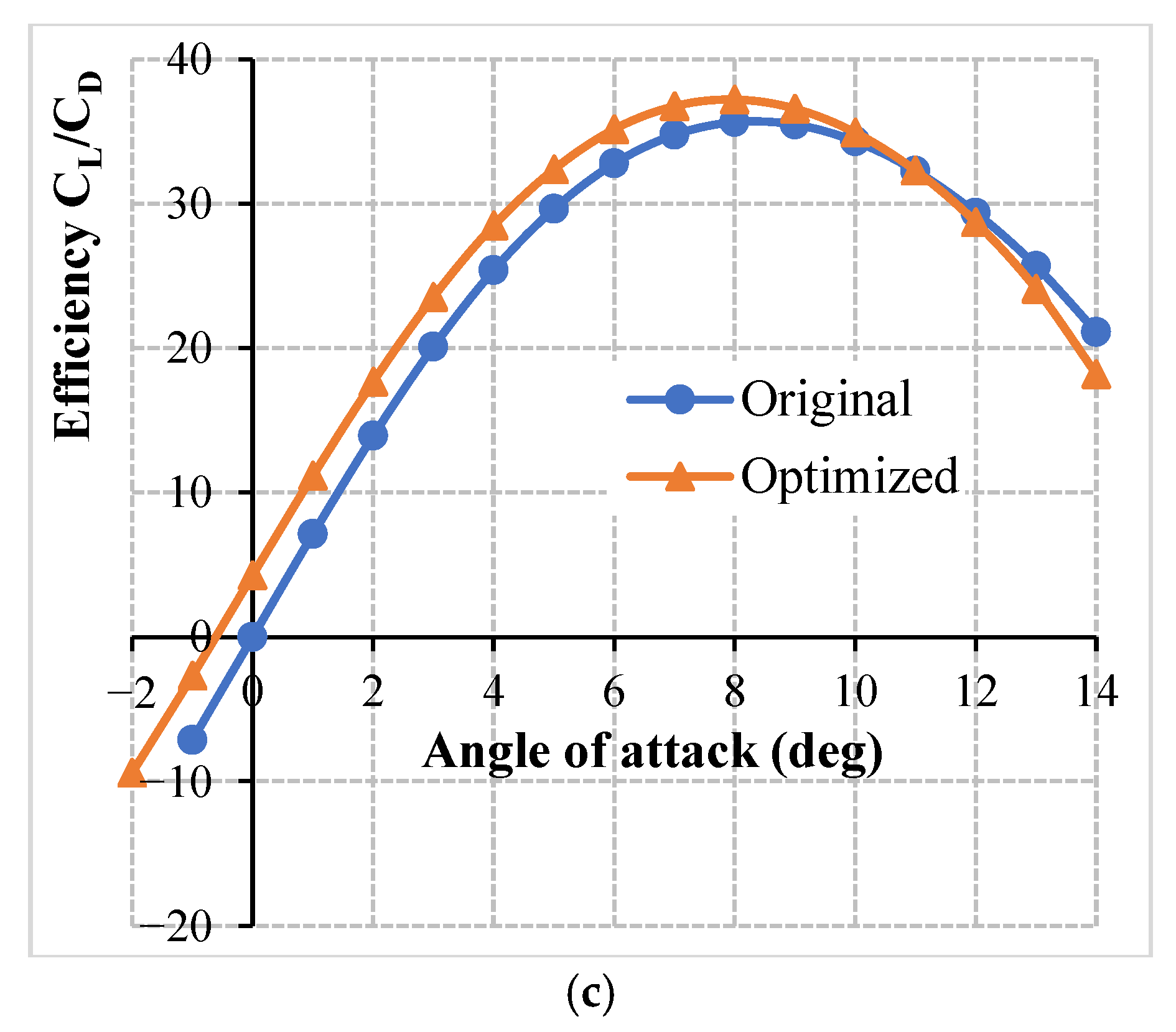
Figure 6.
Lift coefficient (a), drag coefficient (b) and efficiency (c) values of the original S1012 compared to the optimum S1012 at 3 m/s.
In Figure 6b, the drag coefficient (CD) shows an increasing trend with high values of AoA, which is a common feature in aerodynamics. However, the optimal CD value is not lower than the original value at most angles of attack, but even higher in some cases, such as at AoA of 6° (value of optimal CD is 0.020343 compared to the original value of 0.019063). Increasing the lift is often accompanied by a higher drag to optimize the lift coefficient (CD). Nevertheless, the CL/CD ratio was still significantly improved to demonstrate the aerodynamic efficiency of the optimized airfoil.
In contrast, the CL/CD ratio in Figure 6c shows the superiority of the optimized airfoil over the original airfoil. At small and negative AoA, the optimized efficiency reduces the negative impact compared to the original efficiency, for example, the optimized efficiency increases to −9.40 from −13.93 at AoA of −2°. In the AoA range from 2° to 8°, the optimized efficiency reaches its highest value of 37.22 at AoA of 8° compared to 35.66 for the original efficiency. However, when the AoA increased beyond 10°, the efficiency decreased in both cases, indicating that the increase in drag was no longer proportional to the lift.
When calculating the simulation at a wind speed of 5 m/s in Figure 7a, the lift coefficient (CL) of the optimized airfoil model is always larger than that of the original airfoil at all angles of attack (AoA). This difference was clearly observed at medium and high angles of attack. For example, the optimal CL reaches 0.733678 at AoA of 6°, and this value is significantly higher than the original value of 0.633633. Thus, the airfoil achieves a greater lift generation capacity and supports better aerodynamic performance.
Figure 7.
Lift coefficient (a), drag coefficient (b), and efficiency (c) values of the original S1012 compared to the optimum S1012 at 5 m/s.
In Figure 7b, the drag coefficient (CD) tends to increase gradually with AoA, which is a common feature in aerodynamics. However, the optimized airfoil only slightly reduced the CD at some low angles. At higher angles, the CD of the optimized airfoil is usually larger. The CL is improved but at high angles is slightly increased. However, these values are within the acceptable range because the ultimate goal is to achieve performance improvement.
The aerodynamic efficiency (CL/CD) of the optimized airfoil is higher than that of the original airfoil at most AoAs, as can be seen in Figure 7c. In particular, the efficiency of the optimized airfoil model is 39.26203 at an AoA of 6°, which is significantly higher than the 35.98445 of the original airfoil model. This trend continued at several other angles of attack. However, it is found that the efficiency of the optimized airfoil model decreases more sharply than that of the original airfoil at very large angles of attack (AoA ≥ 13°) owing to the rapid increase in drag, while the benefit from lift gradually decreases at these angles. The S1012 airfoil is suitable for low wind speeds and operation at low and medium angles of attack. Therefore, simulation calculations at high angles of attack will often show performance degradation. In summary, the optimized S1012 airfoil at 5 m/s has good aerodynamic performance, especially at low and medium angles of attack. However, the optimization of the airfoil at high angles of attack does not provide much benefit and may be less efficient than the original design.
Overall, the optimized S1012 airfoil model showed a significant improvement in the coefficient of lift (CL) at most angles of attack (AoA), particularly at medium and high angles, which increased the airfoil’s lifting capacity. However, the coefficient of drag (CD) of the optimized airfoil model increases slightly compared to that of the original airfoil, especially at high angles of attack; therefore, it should be considered when operating under these conditions. The aerodynamic performance (CL/CD) of the optimized airfoil model is generally larger than that of the original airfoil, especially at low and medium angles of attack, reflecting the ability to improve the overall performance and optimize the use of the S1012 airfoil at low or medium wind speeds and angles of attack. However, the improvement is not clear at high angles of attack, while the performance of the optimized airfoil is lower than that of the original airfoil. These results show that the optimization process has been successful in improving aerodynamic performance under typical wind conditions, but caution is needed when operating the airfoil at high angles of attack, where the rapidly increasing drag can reduce the overall benefit.
The study results at wind speeds of 3 m/s and 5 m/s show a significant improvement in both the lift coefficient and the CL/CD ratio after optimizing the airfoil design. The optimized airfoil designs of S4110 and S1012 present the ability to maintain laminar flow and minimize separation, which enhances aerodynamic performance, especially at high angles of attack. Although the drag coefficient (CD) tends to increase slightly at some angles of attack, the CL/CD ratio improved significantly, indicating that design optimization helps achieve a higher overall performance, even at low wind speeds.
Table 2 illustrates the comparison results of the optimization airfoils S4110 and S1012. The optimized S4110 always had a higher CL and lower CD than the optimized S1012 at all wind speeds and angles of attack, resulting in the overall performance (CL/CD) of the optimized S4110 being better than that of the optimized S1012, especially at larger angles of attack (6° and 12°). The optimized S1012 has good performance at small angles of attack (0° and 2°), whereas the optimized S4110 has an overall higher aerodynamic performance and is more efficient under strong wind conditions (5 m/s). The analytical results indicated that the optimization of the airfoil patterns significantly improved the lift, especially at low and medium angles of attack, thereby improving the overall aerodynamic performance of the airfoil. However, the drag coefficient also tended to increase slightly, reflecting the trade-off between lift and drag during the optimization process. Nevertheless, the aerodynamic performance (CL/CD) of the optimized airfoil models still outperformed that of the baseline model at most angles of attack. These results emphasize the importance of tailoring the airfoil shape to specific wind conditions and optimizing the aerodynamic parameters to achieve the highest performance in different wind environments.
Table 2.
Comparison results of optimized airfoils S4110 and S1012 at typical AoAs.
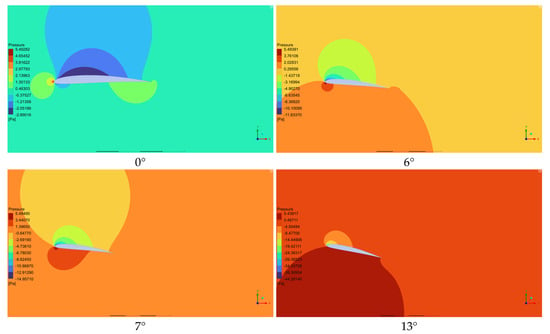
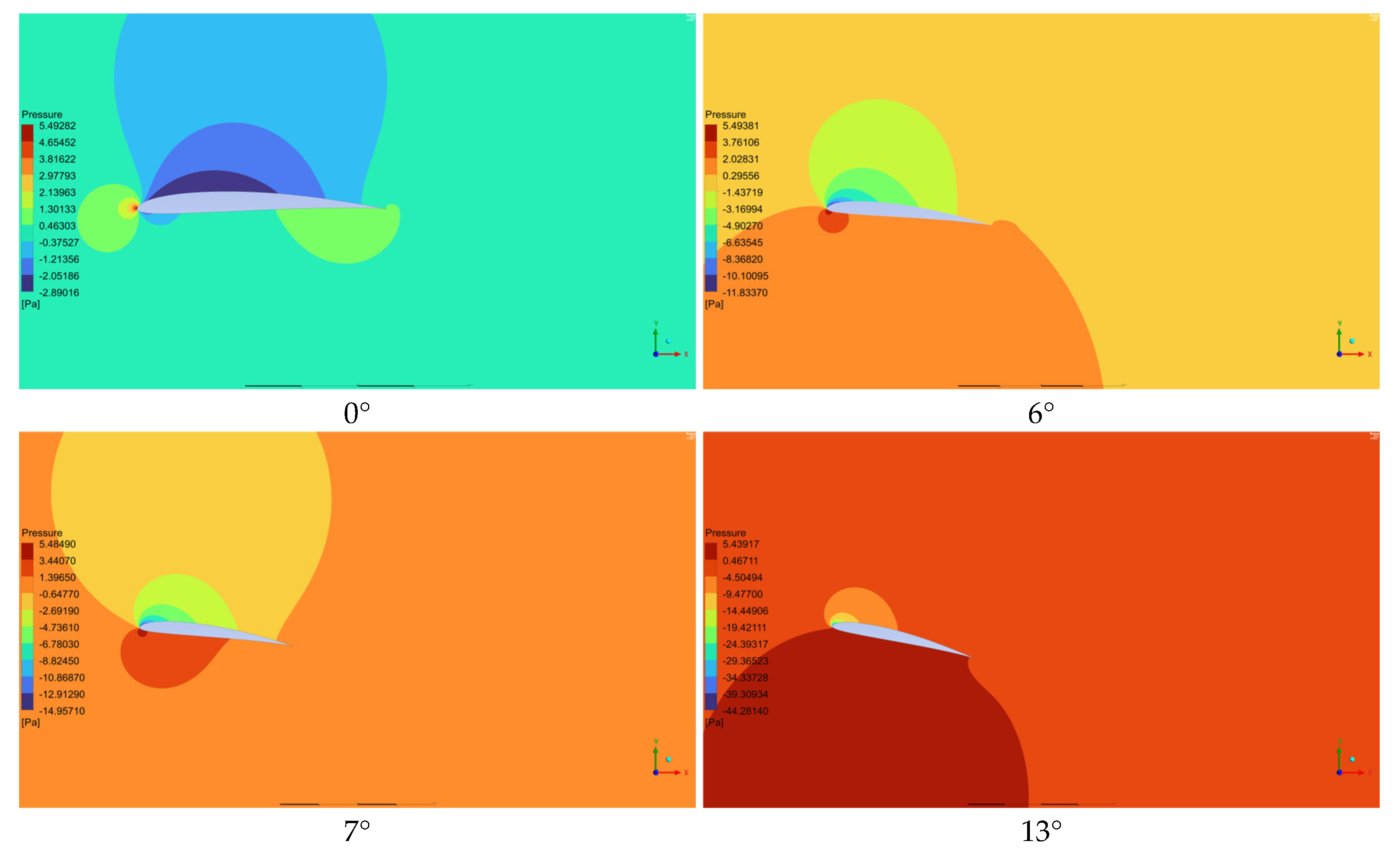
Figure 8 illustrates the pressure distribution across the S4110 airfoil at different angles of attack (AoAs), revealing a distinct contrast between the upper and lower surfaces. At an AoA of 0°, the lower surface is marked by a light green pressure region, while the upper surface is dominated by blue zones, indicating lower pressure. This pressure difference results in minimal lift, as expected at small angles of attack. As the AoA increased to the optimal range from 6° to 7°, both surfaces showed a significant increase in pressure. The upper surface transitions to light green (indicating lower pressure), and the lower surface becomes darker yellow, reflecting higher pressure values. At an AoA of 13°, the lower surface is nearly entirely covered by red regions, indicating maximum pressure, while the upper surface still shows low-pressure areas. This sharp pressure contrast generates a significant lift but also contributes to a higher drag, as confirmed by the previous drag coefficient analysis.
Figure 8.
Pressure distribution across the S4110 airfoil surface.
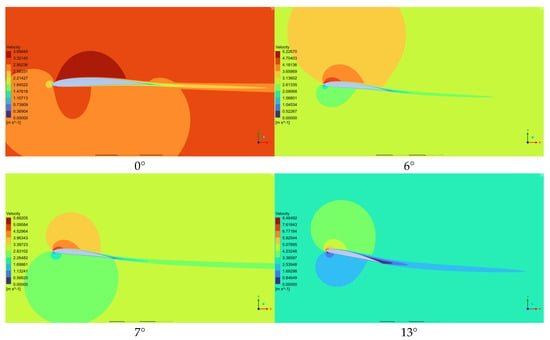
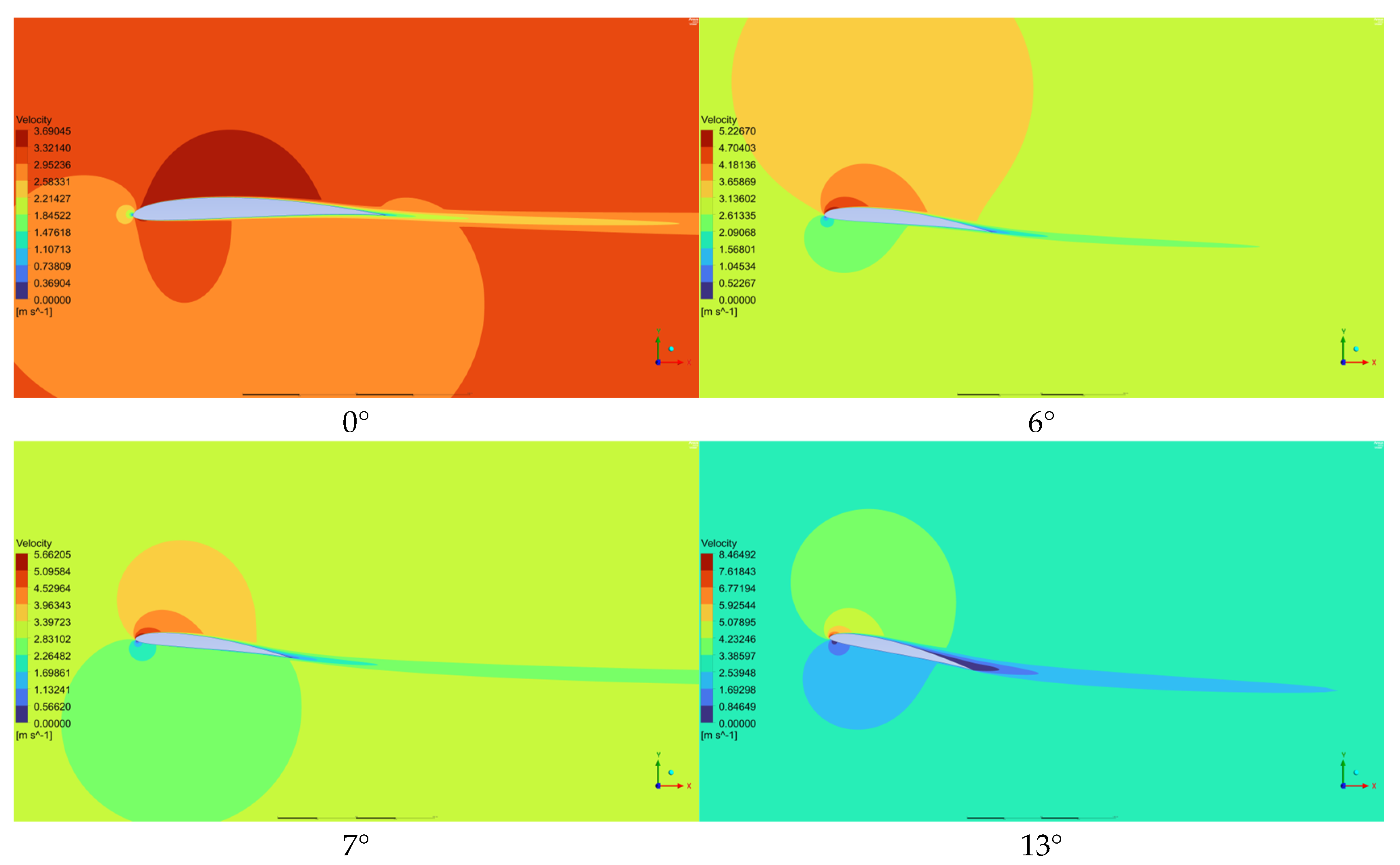
In Figure 9, the velocity contours complement the observations from the pressure distributions. At an AoA of 0°, the airflow remained relatively uniform, with the highest velocities (red regions) on the upper surface and lower velocities on the lower surface. The leading edge shows a slight acceleration, but the trailing edge maintains minimal velocity variations, which is indicative of stable but low-performance conditions. In the optimal range of 6–7° AoA, the upper surface experiences considerably higher velocities, represented by red and orange contours covering over three-quarters of its area. Conversely, the lower surface specifies a mix of moderate and low velocities, marked by green and blue contours, indicating a stable pressure zone that supports lift without contributing significantly to drag.
Figure 9.
Velocity distribution on the S4110 airfoil surface.
At AoA of 13°, velocity contours on the upper surface reach their peak near the leading edge, with intense red zones signifying high-speed airflow. However, a bold blue region appears at the trailing edge, revealing the onset of flow separation. This separation is a critical phenomenon in which the airflow detaches from the surface, leading to vortex formation and increased drag. The lower surface retains a mix of green and blue contours, maintaining temperate velocity levels; however, the overall asymmetry between the upper and lower surfaces underscores the dominance of drag forces at this high AoA.
Figure 8 and Figure 9 collectively illustrate how the interplay between pressure and velocity influences the S4110 airfoil’s aerodynamic performance. At optimal angles of attack, such as from 6° to 7°, the airfoil demonstrates efficient airflow attachment, resulting in a high lift-to-drag ratio. Nevertheless, at higher angles, the onset of flow separation notably reduces the aerodynamic efficiency.
In the low-Reynolds-number region (corresponding to low wind speeds), the airflow tends to separate more easily from the upper surface of the airfoil, resulting in reduced lift and increased drag. Adjusting the maximum thickness, location of the maximum thickness, maximum camber, and camber position helps redistribute the pressure more uniformly along the upper surface, thereby improving lift generation.
For small angles of attack between 0° and 7°, as shown in Figure 9, the optimal angle of attack lies in the range of 6–7°. The S4110 airfoil exhibits increased lift at these low angles of attack and reduced drag due to delayed stall characteristics. This implies that the wind turbine can effectively generate power under low wind speed conditions.
For large angles of attack, also shown in Figure 9, the flow separation and vortex formation become noticeable at approximately 13°, progressively reducing the aerodynamic efficiency of the airfoil. However, when the camber and thickness are increased to their optimized values, the lift does not experience a sudden drop, and the flow separation on the upper surface occurs more gradually.
4. Discussion
In summary, the research results show that S4110 increases the CL/CD ratio, which is an important index reflecting the aerodynamic energy efficiency of the blade. In addition, the shape design of S4110 helps maintain the flow close to the blade surface over a wide angle of attack, limiting the flow separation phenomenon and thereby improving the efficiency of converting wind energy into mechanical energy. While S4110 is effective at the tip, S1012 is an ideal choice for the inner section, where higher mechanical strength and load-bearing capacity are required. The S1012 airfoil has a thicker design, which enhances stiffness and bending resistance in the area near the axis of rotation. Although the CL/CD ratio of S1012 is lower than that of S4110, this airfoil model shows stable aerodynamic performance in the low to medium Reynolds number range. In particular, S1012 is less sensitive to angle of attack (AoA) fluctuations, helping to limit sudden stalls, which is one of the common causes of operational instability in wind turbines, especially in continuously changing wind environments.
The combination of S4110 at the blade tip and S1012 at the blade root, as can be seen in Table 3, creates an optimal hybrid airfoil blade configuration, which takes advantage of high aerodynamic performance in low wind conditions and ensures the mechanical strength and stability required for the entire wind turbine blade. This design promises to improve wind energy harvesting efficiency in small-scale projects, while opening up a new direction for wind turbine development suitable for the climate characteristics and practical needs in urban areas.
Table 3.
Proposal of combination of airfoil S4110 and S1012 for wind turbine blade design.
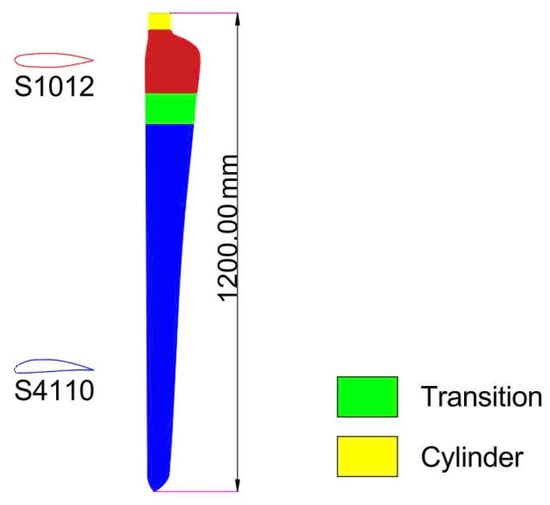
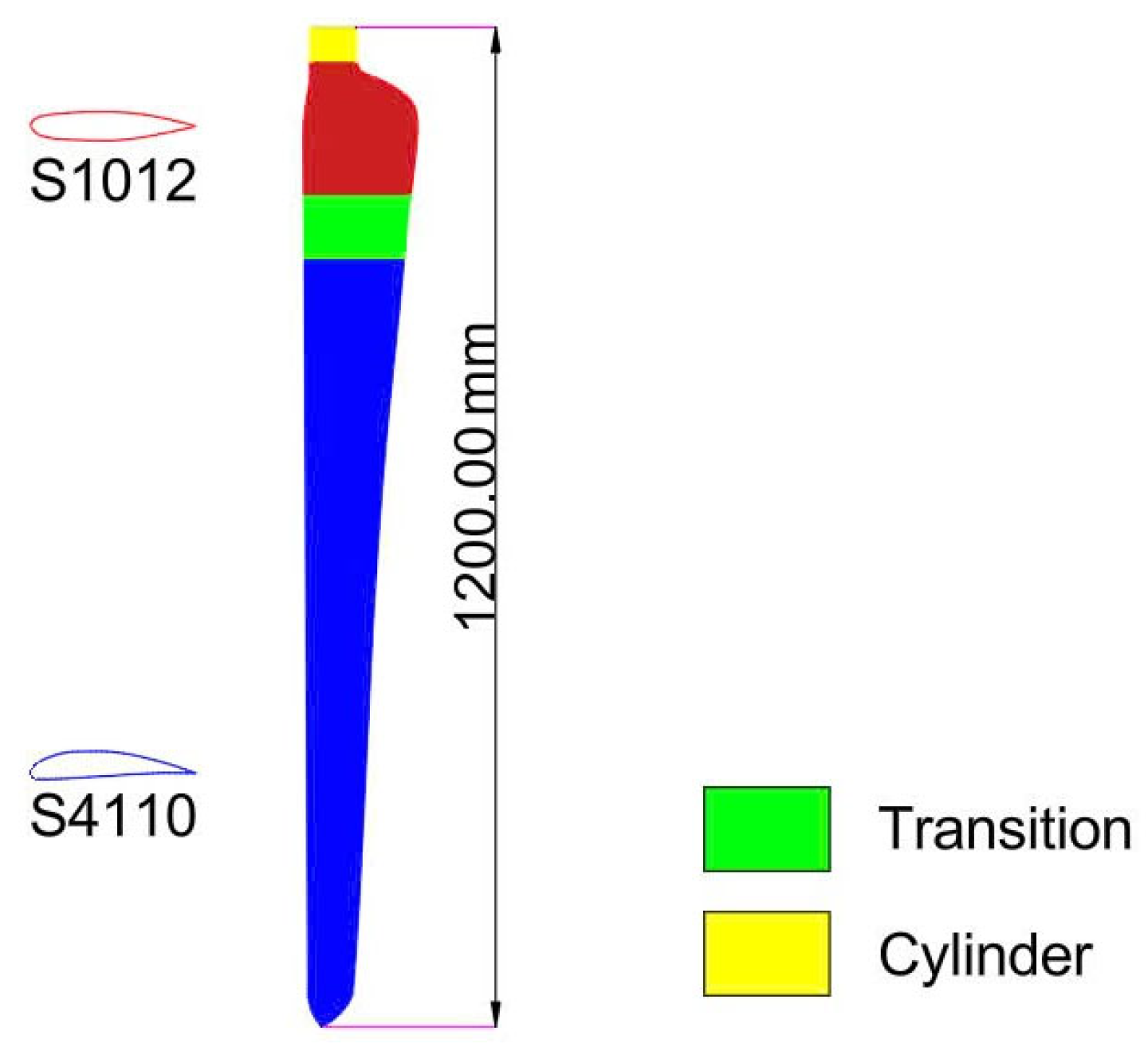
The preliminary proposed optimal hybrid airfoil wind turbine blade model is shown in Figure 10 with the airfoil ratio of S4110 at 80% and S1012 at 20%. The large length (80%) of the S4110 allows the optimization of turbine power in prevailing wind conditions. However, it reduces the turbulence and vortices at the blade tips, where energy loss is likely to occur. The shorter length of the S1012 (20%) helps to optimize the overall weight of the blade while maintaining aerodynamic efficiency. This proportional design achieves a balance between aerodynamic efficiency and mechanical strength and helps to reduce energy losses due to drag and turbulence, while maintaining high lift in the most important region.
Figure 10.
Proposed optimal hybrid airfoil wind turbine blade model.
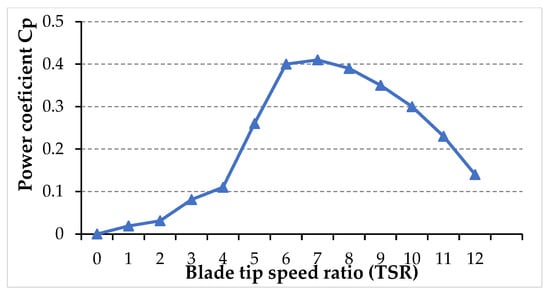
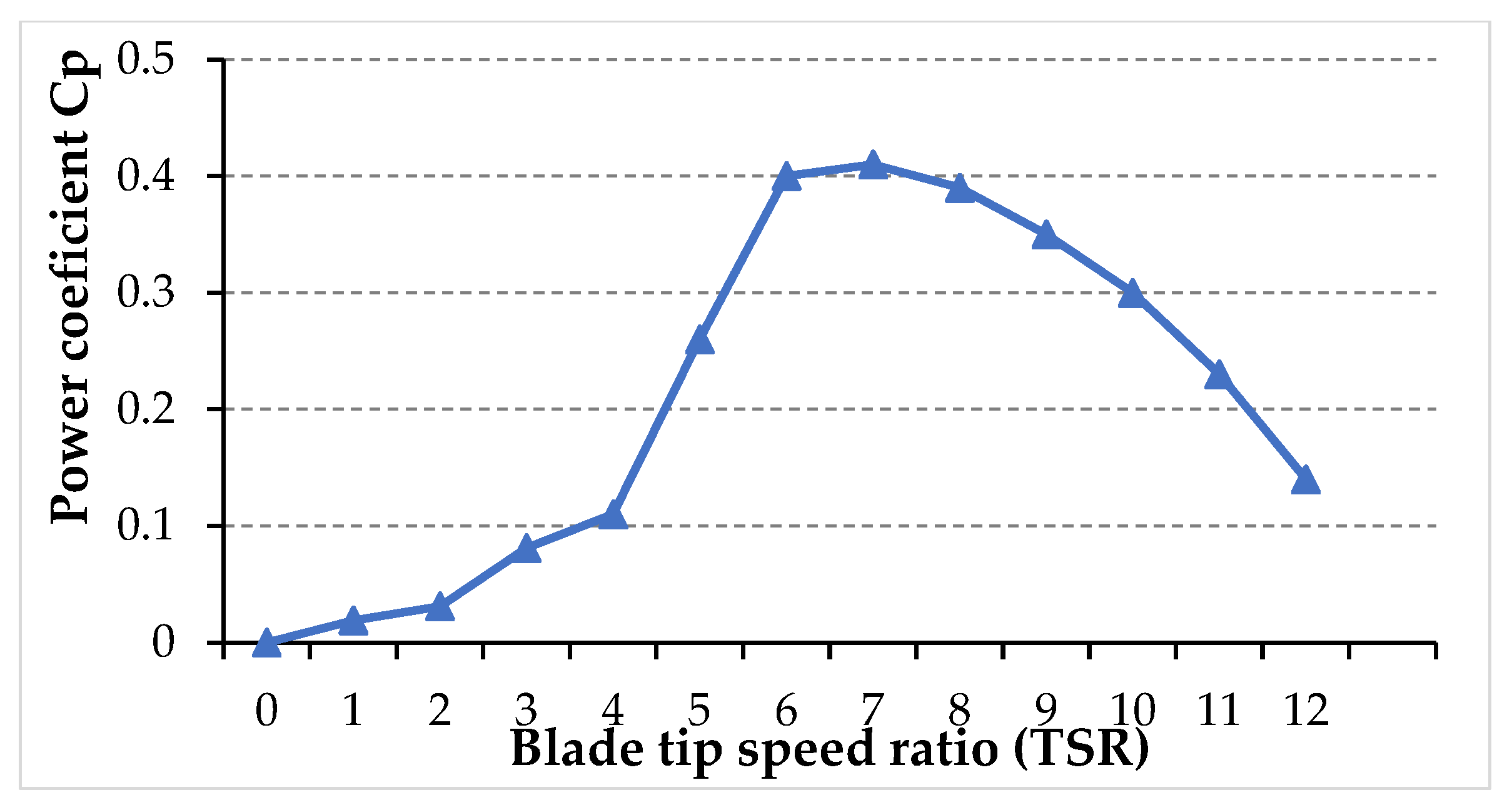
The performance of the proposed small wind turbine blade model at a minimum speed of 3 m/s was analyzed using the Qblade program. Figure 11 shows the variation in the thrust coefficient Ct with the blade tip speed ratio (TSR) at a wind speed of 3 m/s. The results show that the power coefficient Cp starts near 0 at low TSR, increases rapidly to a peak of about 0.42 at TSR = 7, then maintains a high value around 6–7 and only decreases slightly as TSR increases further, keeping Cp positive up to TSR ≈ 12. This result is consistent with most modern wind turbines with actual power coefficients in the range of 0.4–0.5 [30] (Lubosny, Z., 2003) under optimal operating conditions.
Figure 11.
The variation of the thrust coefficient C_t with the blade tip speed ratio (TSR).
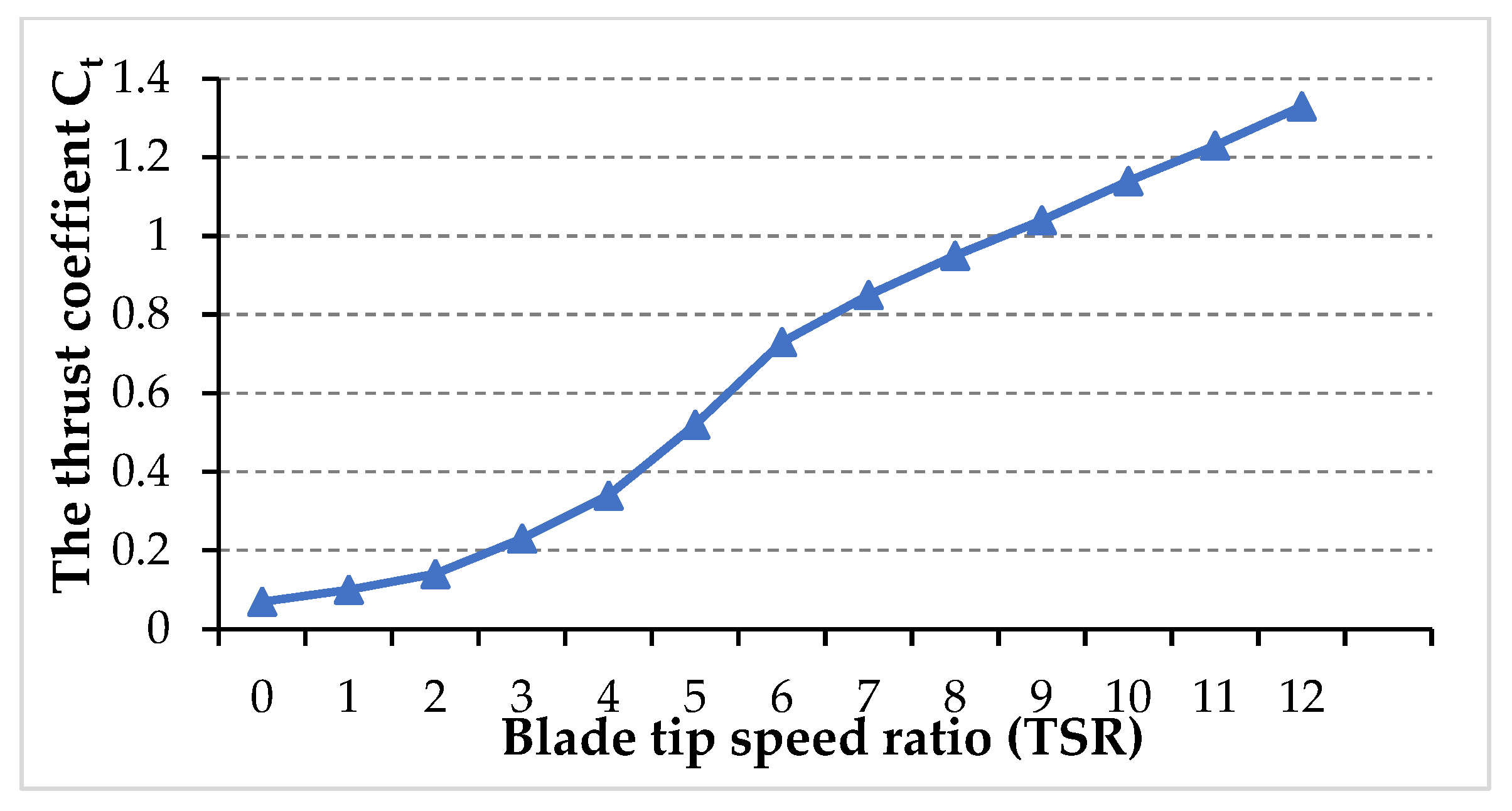
The relationship between the thrust coefficient Ct and tip speed ratio (TSR) at a wind speed of 3 m/s in Figure 12 shows that Ct increases gradually as the TSR increases. The Ct value is maintained at a moderate level, which helps balance the torque and minimize losses, supporting a higher and more stable power factor Cp.
Figure 12.
The relationship between the thrust coefficient Ct and TSR.
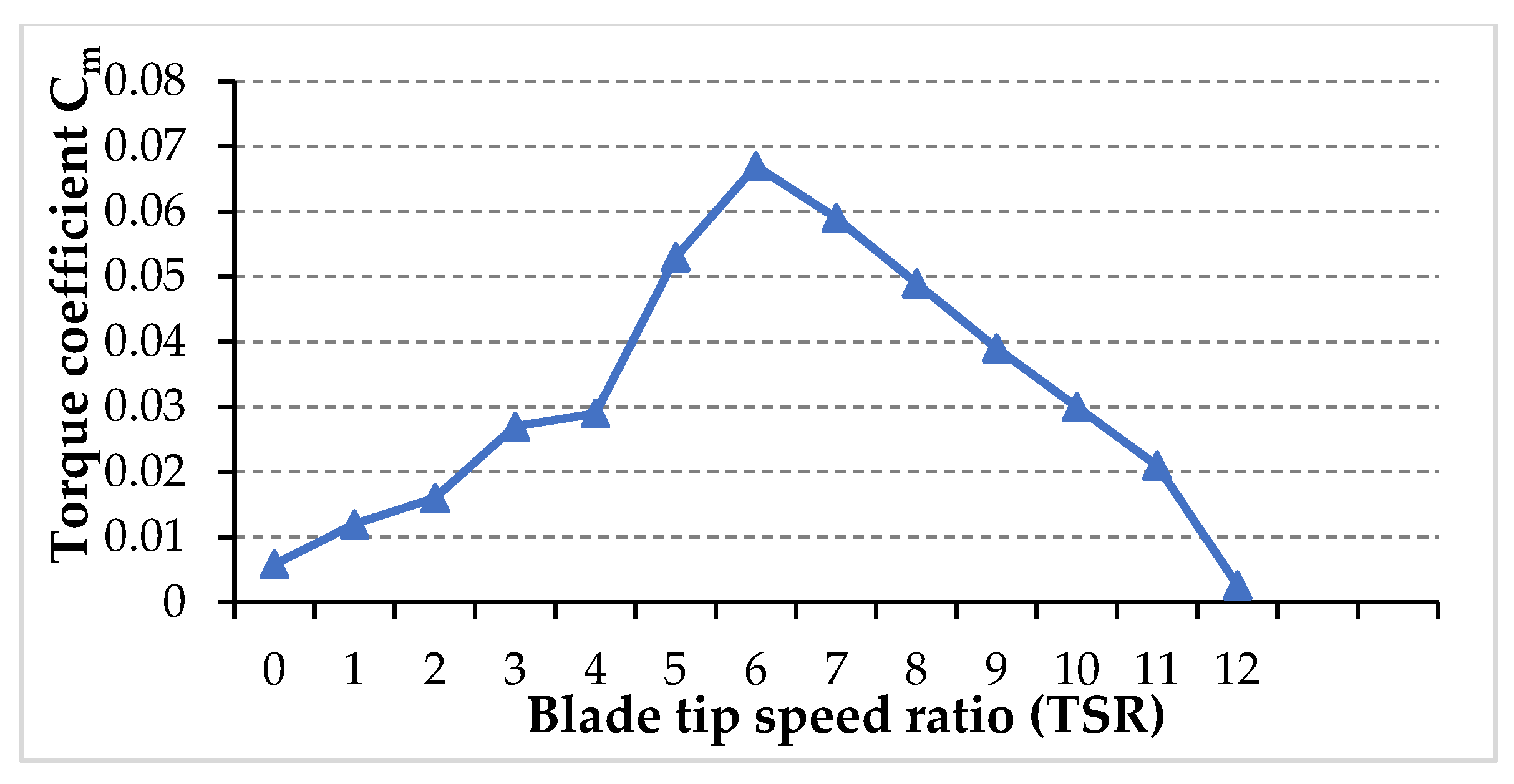
Figure 13 shows the relationship between the torque coefficient Cm and the blade tip speed ratio (TSR) at a wind speed of 3 m/s. The results show that Cm increases steadily from TSR = 0 to the peak region and then gradually decreases as the TSR continues to increase. Cm maintains a positive torque until TSR ≈ 12 before returning to zero, indicating that the rotor is able to maintain the torque effectively over a wider speed range. This result explains why the blade design not only achieves a higher power factor Cp but also has better stability when operating at various TSRs.
Figure 13.
Relationship between the C_m and TSR.
Table 4 presents the results of comparing Cp of the proposed blade model with those of several other similar blades in the low wind speed range. The research results show that the Cp value in this study is equivalent to the results of other simulations using the BEM method and is higher than the experimental Cp values.
Table 4.
Comparison of peak power coefficient.
The power coefficient obtained from the BEM-based optimization is consistent with other BEM-based numerical studies due to similar assumptions of ideal flow conditions and aerodynamic databases. However, the predicted Cp is higher than the experimentally measured values because the BEM method does not fully account for three-dimensional flow effects, surface roughness, atmospheric turbulence, manufacturing errors, and mechanical losses, which are inherently present in real-world wind turbine operation.
5. Conclusions
This paper presents a comprehensive aerodynamic analysis of two S-series airfoils, S4110 and S1012, targeted for low-wind-speed applications in small wind turbines through CFD and QBlade simulations. The study results were compared with available experimental data, revealing a strong correlation between the numerically simulated lift coefficient and the experimentally obtained values.
The optimized S4110 always had a higher CL and lower CD than the optimized S1012 at all wind speeds and angles of attack. The optimized S1012 has good performance at small angles of attack, while the optimized S4110 has an overall higher aerodynamic performance. The CL/CD ratio of the airfoil S4110 shows a strong improvement after optimization, with the aerodynamic performance from 17.35 at 3 m/s to 50.78 at 5 m/s.
The combination of S4110 at the blade tip and S1012 at the blade root creates an optimal hybrid airfoil wind turbine blade configuration, which both takes advantage of high aerodynamic efficiency in low wind conditions and ensures the necessary mechanical strength and stability for the entire turbine blade. This design promises to improve the efficiency of wind energy collection in small-scale projects, while opening up a new direction for wind turbine development suitable for the climate characteristics and practical needs in Vietnam.
The study also provided a detailed evaluation of the pressure and velocity distributions along the airfoil surface. At higher AoAs, flow separation was detected at the trailing edge, which contributed to increased drag and reduced aerodynamic efficiency. The use of the CFD method has proven effective in predicting key aerodynamic parameters, enhancing the understanding of airfoil behavior in low wind velocity conditions.
The simulation results in QBlade clearly demonstrate the effectiveness of the blade design optimization process. The power coefficient increases significantly at medium wind speeds, indicating a significant improvement in energy harvesting efficiency. At the same time, the thrust coefficient and moment are well controlled, reducing the risk of aerodynamic overload and ensuring the stability of the turbine in long-term operation. In particular, the analysis of moment and force distribution on each blade element has helped the designer better understand the interaction mechanism between the airflow and the blade structure, thereby improving the design quality.
The study results can be applied to the design of more efficient wind turbines, helping to reduce energy production costs and improve the efficiency of renewable energy use on a large scale. In the next research, an optimal blade prototype will be tested to measure lift, drag, torque, power coefficient and to evaluate the influence of surface roughness and noise generation.
Author Contributions
V.H.B.: Conceptualization, Methodology, Supervision, Validation, Formal Analysis, Writing of the Original Draft. M.P.V.: Conceptualization, Supervision, Writing of the Original Draft; Writing of the Final Manuscript, Review and Editing, Visualization. Q.S.L.: Methodology, Validation, Review and Editing. M.Q.H.T.: Software, Formal Analysis, Data Curation. Q.D.P.: Software, Investigation. Q.G.D.: Software, Resources. All authors have read and agreed to the published version of the manuscript.
Funding
This research was funded by University of Transport and Communications (UTC) under grant number T2024-CK-008TĐ.
Data Availability Statement
The original contributions presented in this study are included in the article. Further inquiries can be directed to the corresponding authors.
Acknowledgments
This research is supported by University of Transport and Communications (UTC).
Conflicts of Interest
The authors declare no competing interests with respect to the research, authorship, and/or publication of this article.
Nomenclature and Abbreviation List
| AoA | Angle of Attack |
| CFD | Computational Fluid Dynamics |
| SA | Spalart–Allmaras |
| SWT | Small wind turbines |
| CL | Coefficient lift |
| CD | Coefficient drag |
| Cm | Torque coefficient |
| NSE | Navier–Stokes |
| RE | Reynolds |
| RANS | Reynolds-averaged Navier–Stokes |
| TSR | Tip speed ratios |
References
- Paraschiv, L.S.; Paraschiv, S. Contribution of renewable energy (hydro, wind, solar and biomass) to decarbonization and transformation of the electricity generation sector for sustainable development. Energy Rep. 2023, 9, 535–544. [Google Scholar] [CrossRef] [Scilit]
- Li, Y.; Tang, X.; Liu, M.; Chen, G. The benefits and burdens of wind power systems in reaching China’s renewable energy goals: Implications from resource and environment assessment. J. Clean. Prod. 2024, 481, 144134. [Google Scholar] [CrossRef] [Scilit]
- Bošnjaković, M.; Katinić, M.; Santa, R.; Marić, D. Wind Turbine Technology Trends. Appl. Sci. 2022, 12, 8653. [Google Scholar] [CrossRef] [Scilit]
- Sun, L.; Yin, J.; Bilal, A.R. Green financing and wind power energy generation: Empirical insights from China. Renew. Energy 2023, 206, 820–827. [Google Scholar] [CrossRef] [Scilit]
- GWEC. Global Wind Report 2024. 2024. Available online: https://www.gwec.net/reports?t=87193577191 (accessed on 2 August 2024).
- Wang, H.; Xiong, B.; Zhang, Z.; Zhang, H.; Azam, A. Small wind turbines and their potential for internet of things applications. iScience 2023, 26, 107674. [Google Scholar] [CrossRef] [Scilit]
- Davari, H.S.; Davari, M.S.; Kouravand, S.; Kurdkandi, M.K. Optimizing the Aerodynamic Efficiency of Different Airfoils by Altering Their Geometry at Low Reynolds Numbers. Arab. J. Sci. Eng. 2024, 49, 15253–15288. [Google Scholar] [CrossRef] [Scilit]
- Abdelghany, E.S.; Farghaly, M.B. Study the effect of wind speed on the dynamic stall behavior of horizontal axis wind turbine performance characteristics during yaw misalignment using analytical approach. Int. J. Renew. Energy Res. 2023, 13, 944–955. [Google Scholar] [CrossRef] [Scilit]
- Akbari, V.; Naghashzadegan, M.; Kouhikamali, R.; Yaïci, W. Comparative Study of the Blade Number and Airfoil Profile Impacts on the Twist/Chord Distribution of a Small Wind Turbine Blade. Int. J. Energy Res. 2023, 2023, 8164273. [Google Scholar] [CrossRef] [Scilit]
- Anitha, D.; Shamili, G.K.; Kumar, P.R.; Vihar, R.S. Air foil Shape Optimization Using Cfd and Parametrization Methods. Mater. Today Proc. 2018, 5, 5364–5373. [Google Scholar] [CrossRef] [Scilit]
- Akbari, V.; Naghashzadegan, M.; Kouhikamali, R.; Afsharpanah, F.; Yaïci, W. Multi-Objective Optimization and Optimal Airfoil Blade Selection for a Small Horizontal-Axis Wind Turbine (HAWT) for Application in Regions with Various Wind Potential. Machines 2022, 10, 687. [Google Scholar] [CrossRef] [Scilit]
- Zhang, X.; Xie, F.; Ji, T.; Zhu, Z.; Zheng, Y. Multi-fidelity deep neural network surrogate model for aerodynamic shape optimization. Comput. Methods Appl. Mech. Eng. 2021, 373, 113485. [Google Scholar] [CrossRef] [Scilit]
- Matyushenko, A.A.; Kotov, E.V.; Garbaruk, A.V. Calculations of flow around airfoils using two-dimensional RANS: An analysis of the reduction in accuracy. St. Petersburg Polytech. Univ. J. Phys. Math. 2017, 3, 15–21. [Google Scholar] [CrossRef] [Scilit]
- Kaya, M.N.; Kok, A.R.; Kurt, H. Comparison of aerodynamic performances of various airfoils from different airfoil families using CFD. Wind Struct. 2021, 32, 239–248. [Google Scholar] [CrossRef]
- Thin, D.V.; Duc, N.H.; Sang, L.Q. Aerodynamic analysis of naca 6409 airfoil in wind turbine by using panel method. TNU J. Sci. Technol. 2022, 227, 227–235. Available online: https://vjol.info.vn/index.php/tnu/article/view/69737 (accessed on 10 August 2024).
- Septiyana, A.; Hidayat, K.; Rizaldi, A.; Wijaya, Y.G. Comparative Study Of Wing Lift Distribution Analysis Using Numerical Method. Indones. J. Aerosp. 2020, 18, 129–139. [Google Scholar] [CrossRef] [Scilit]
- Flores, G.A.M.; Hallak, P.H.; Araújo, A.M.S.; Fronczak, J.; Cury, A.A. Aerodynamic and aeroelastic analysis of the NACA0012 airfoil using CFD. In Proceedings of the XLIII Ibero-Latin-American Congress on Computational Methods in Engineering, ABMEC, Foz do Iguacu, Brazil, 21–25 November 2022; Available online: https://publicacoes.softaliza.com.br/cilamce2022/article/view/5284/4351 (accessed on 10 August 2024).
- Xiao, S.; Chen, Z. Investigation of Flow over the Airfoil NACA 0010-35 with Various Angle of Attack. MATEC Web Conf. 2018, 179, 03020. [Google Scholar] [CrossRef] [Scilit]
- Veer, R.; Shinde, K.; Gaikwad, V.; Sonawane, P.; Sonawane, Y. Study and Analyse Airfoil Section using CFD. Int. J. Eng. Res. Technol. 2017, 6, 47–51. [Google Scholar] [CrossRef] [Scilit]
- Sanei, M.; Razaghi, R. Numerical investigation of three turbulence simulation models for S809 wind turbine airfoil. Proc. Inst. Mech. Eng. A J. Power Energy 2018, 232, 1037–1048. [Google Scholar] [CrossRef] [Scilit]
- Luong, N.D. A critical review on potential and current status of wind energy in Vietnam. Renew. Sustain. Energy Rev. 2015, 43, 440–448. [Google Scholar] [CrossRef] [Scilit]
- Giap, L.N.; Khanh, N.B.; Trung, B.T.; An, T.N.T.; Vinh, T.T.; Tu, L.T. A Study of the Development Strategy of the Wind Power Sector in Vietnam. Eng. Technol. Appl. Sci. Res. 2024, 14, 15351–15355. [Google Scholar] [CrossRef] [Scilit]
- Thin, D.V.; Duc, N.H.; Sang, L.Q. Analysis of Aerodynamic Parameters of the S1210 Wind Turbine Airfoil under the Condition of Low Reynolds Number. Univ. Danang-J. Sci. Technol. 2022, 20, 77–81. Available online: https://jst-ud.vn/jst-ud/article/view/7754 (accessed on 15 August 2024).
- Long, P.T.; Dao, N.V. Research on Designing Small Wind Turbine Blades Operating in Low Wind Speed Conditions. Univ. Danang-J. Sci. Technol. 2018, 9, 41–45. Available online: https://jst-ud.vn/jst-ud/article/view/1304 (accessed on 15 August 2024).
- Nguyen, N.V.; Hoang, V.M.; Nguyen, N.L. Research on improving aerodynamic performance of an UAV airfoil using numerical simulation method. J. Sci. Technol. 2016, 35, 35–38. Available online: https://www.haui.edu.vn/media/28/ufpdf28494.pdf (accessed on 15 August 2024).
- Sang, L.Q.; Phengpom, T.; Thin, D.V.; Duc, N.H.; Hang, L.T.T.; Huyen, C.T.T.; Huong, N.T.T.; Tran, Q.T. A Method to Design an Efficient Airfoil for Small Wind Turbines in Low Wind Speed Conditions Using XFLR5 and CFD Simulations. Energies 2024, 17, 4113. [Google Scholar] [CrossRef] [Scilit]
- Spalart, P.R.; Allmaras, S.R. One-equation turbulence model for aerodynamic flows. In Proceedings of the 30th Aerospace Sciences Meeting and Exhibit, Reno, NV, USA, 6–9 January 1992. [Google Scholar] [CrossRef] [Scilit]
- Liu, X.; Gao, W.; Zuo, Y.; Sun, D.; Zhang, W.; Zhang, Z.; Liu, S.; Dong, J.; Wang, S.; Xu, H.; et al. Simulation of Control Process of Fluid Boundary Layer on Deposition of Travertine Particles in Huanglong Landscape Water Based on Computational Fluid Dynamics Software (CFD). Water 2025, 17, 638. [Google Scholar] [CrossRef] [Scilit]
- Surve, M.; Deshmukh, P.D.; Purohit, H. Design and Analysis of New Airfoil and Blade for Micro-Capacity Horizontal Axis Wind Turbine Using QBlade Tool. In Proceedings of the 5th International Conference on Advances in Science and Technology (ICAST), Mumbai, India, 2–3 December 2022; pp. 531–536. [Google Scholar] [CrossRef] [Scilit]
- Lubosny, Z. Wind Turbine Operation in Electric Power Systems; Springer: Berlin/Heidelberg, Germany, 2003. [Google Scholar] [CrossRef] [Scilit]
- Umar, D.A.; Yaw, C.T.; Koh, S.P.; Tiong, S.K.; Alkahtani, A.A.; Yusaf, T. Design and Optimization of a Small-Scale Horizontal Axis Wind Turbine Blade for Energy Harvesting at Low Wind Profile Areas. Energies 2022, 15, 3033. [Google Scholar] [CrossRef] [Scilit]
- Ronit, K.S.; Ahmed, M.R. Blade design and performance testing of a small wind turbine rotor for low wind speed applications. Renew. Energy 2013, 50, 812–819. [Google Scholar] [CrossRef] [Scilit]
- Ahmed Mohamed, E.A.E.; Abdellatif, O.E.; Osman, A.M. Experimental and numerical investigation into effect of different blade configurations on performance of small-scale wind turbines. Energy Rep. 2021, 7, 138–143. [Google Scholar] [CrossRef] [Scilit]



Disclaimer/Publisher’s Note: The statements, opinions and data contained in all publications are solely those of the individual author(s) and contributor(s) and not of MDPI and/or the editor(s). MDPI and/or the editor(s) disclaim responsibility for any injury to people or property resulting from any ideas, methods, instructions or products referred to in the content. |
© 2025 by the authors. Licensee MDPI, Basel, Switzerland. This article is an open access article distributed under the terms and conditions of the Creative Commons Attribution (CC BY) license (https://creativecommons.org/licenses/by/4.0/).