Article

Sustainable Water Sources for Swimming Pools: Analysis of Regulations and Opportunities in EU Countries


by
Anna Lempart-Rapacewicz
1,2,*,
Edyta Kudlek-Tymoszuk
2 and
Rafał Rapacewicz
2,3
1
Faculty of Materials, Civil and Environmental Engineering, University of Bielsko-Biała, Willowa Street 2, 43-309 Bielsko-Biała, Poland
2
Faculty of Energy and Environmental Engineering, Silesian University of Technology, Akademicka Street 2A, 44-100 Gliwice, Poland
3
Construction Company PB LEMTER, Mickiewicza Street 66, 41-902 Bytom, Poland
*
Author to whom correspondence should be addressed.
Sustainability 2026, 18(6), 2937; https://doi.org/10.3390/su18062937
Submission received: 18 January 2026 / Revised: 11 March 2026 / Accepted: 14 March 2026 / Published: 17 March 2026
(This article belongs to the Section Sustainable Water Management)

Abstract

Growing water scarcity across the European Union (EU) increases the need for improved water-use efficiency in water-intensive sectors such as recreational facilities. This study evaluates the feasibility of integrating alternative water sources—including rainwater, graywater, and filter backwash water—into swimming pool operations through a comparative analysis of EU legislation and selected national regulatory frameworks. The study is based on a structured desk review of scientific literature, legal documents, and technical standards published between 2010 and 2025, complemented by a qualitative SWOT (Strengths, Weaknesses, Opportunities, and Threats) analysis. Previous studies indicate that public swimming pool facilities may consume approximately 20–50 m3 of water per day, highlighting the potential benefits of alternative water supply strategies. However, regulatory fragmentation and the absence of harmonized EU-level quality standards for recreational water reuse remain the main barriers to wider implementation. While Regulation (EU) 2020/741 establishes minimum requirements for reclaimed water reuse in agricultural irrigation, no dedicated framework exists for swimming pool facilities. Among the analyzed options, rainwater harvesting and graywater reuse appear to be the most feasible solutions. Clearer regulatory guidance and risk-management procedures could support the safe adoption of alternative water sources and contribute to improving water-use efficiency in the recreational sector.

1. Introduction

Water scarcity represents a growing challenge across the European Union [1], with over 60% of the territory experiencing regular episodes of drought. Forecasts indicate that by2050, water availability may decrease by an additional 15–20%, exacerbating existing pressures on both natural ecosystems and human activities. Currently, approximately 41% of the European population is affected by water deficits, while 34% of the continent’s land area suffers from limited water resources. The state of surface waters also raises concern, as only 29% of European surface water bodies currently achieve a “good” chemical status under EU water quality standards. Beyond environmental and public health impacts, water scarcity is also expected to generate significant economic consequences. Projections suggest that inadequate water supply could reduce Gross Domestic Product (GDP) by up to 6% by 2050 [2,3]. These figures indicate the urgent need for sustainable water management strategies, particularly in sectors with high water demands, such as recreational and swimming pool facilities, which must increasingly rely on alternative and resilient water sources.
In response to increasing water shortages in Europe and stricter environmental regulations, the recreational sector must identify alternative water sources. Both public and private swimming pool facilities operate under strict water quality standards, which leads to high potable water consumption and the generation of wastewater streams. The use of alternative water sources has therefore emerged as an important strategy for reducing potable water consumption and operational costs [4].
Water is essential for the operation of recreational facilities; however, swimming pools are among the most water-intensive facilities on a per-user basis [5,6,7]. On average, a typical public pool consumes between 20 and 50 m3 of water per day. Higher values are reported for high-traffic facilities or those equipped with extensive infrastructure, such as slides, saunas, or wellness areas [7]. Consequently, optimizing water use in such facilities is not merely an economic consideration but, more importantly, an environmental imperative, as it directly affects local water balances and the overall water footprint of the recreational sector.
Rising water supply and wastewater disposal costs, together with increasing regulatory pressure for sustainable resource management, are key drivers of change in recreational facility management. Initiatives such as the European Green Deal and the European Union’s circular economy policy are setting clear expectations for all sectors, including recreation and sports. As major water consumers, swimming pools are expected to implement measures to reduce their water footprint. The recovery and reuse of water can reduce pressure on local ecosystems and municipal water supply systems. The use of alternative water sources—such as rainwater, graywater, or recovered backwash water—represents an important step toward achieving the objectives of the UN Sustainable Development Goals and the European Green Deal. The recreational sector therefore represents a relevant case for examining how technological innovation can support more sustainable water management practices. Each source has distinct benefits, limitations, and potential health and environmental risks. Table 1 summarizes the health and environmental risks associated with different alternative water sources, underscoring the importance of appropriate treatment, monitoring, and risk management strategies.
Several alternative water sources have been discussed in the literature as potential options for reducing potable water consumption in swimming pool facilities. The following overview summarizes the main technological approaches currently considered in this context. One of the most promising alternatives is the use of harvested rainwater [8,9], which can be collected from building roofs and surrounding impervious surfaces. Although rainwater typically requires pre-treatment to meet sanitary standards, it represents a relatively clean and decentralized water source with the potential to reduce dependence on municipal supplies [10,11]. In swimming pools, rainwater can be used for purposes such as compensating for water losses due to evaporation or supplying technical systems, provided appropriate treatment technologies are used. Integrating rainwater into facility water systems can significantly reduce freshwater demand, particularly in regions experiencing frequent droughts or seasonal water shortages.
Another option is the reuse of graywater [12,13], primarily from showers, which typically account for one of the largest water flows in swimming pool facilities. Graywater reuse systems [14] enable the collection, filtration, and disinfection of this relatively low-contamination wastewater, which can then be reused for applications such as toilet flushing, landscape irrigation, and, after advanced treatment, even partial replenishment of swimming pool water. Advances in treatment technologies and increasing environmental awareness are encouraging wider implementation of graywater recycling.
In coastal regions, the use of seawater provides another sustainable alternative [15]. Seawater swimming pools, fed directly by untreated seawater or via desalination systems, can reduce freshwater demand. Although operating seawater installations poses specific challenges—such as the need for corrosion-resistant materials, appropriate filtration strategies [16], and compliance with bathing water standards—their environmental benefits, particularly in regions experiencing chronic water shortages, make them an attractive solution. In some cases, hybrid systems combining seawater and freshwater treatment technologies could further optimize resource utilization.
Surface water, including rivers, lakes, and reservoirs, represents another potential alternative source for swimming pool water, especially in areas with abundant freshwater bodies. Surface water can be utilized directly after appropriate filtration, sedimentation, and disinfection processes or indirectly via integration with existing municipal treatment systems. While offering the advantage of substantial availability, the use of surface water requires careful assessment of seasonal variations, pollution risks, and potential eutrophication, as well as compliance with both national and EU water quality regulations. When properly managed, the integration of surface water into swimming pool operations can reduce reliance on potable water and contribute to a more sustainable water management strategy.
Another potential source of alternative water for swimming pool facilities is groundwater [17,18], which can be accessed through wells and boreholes in regions where aquifers are abundant. Groundwater typically offers a relatively stable supply and, in many cases, good initial water quality. However, its use requires careful monitoring to ensure compliance with sanitary standards, particularly with respect to microbial contamination, mineral content, and potential presence of heavy metals. Proper treatment and disinfection are essential before groundwater can be safely used to replenish pool water or supply ancillary systems. Additionally, sustainable abstraction rates must be maintained to prevent overexploitation of local aquifers and negative impacts on surrounding ecosystems.
A further source of sustainable water is the reuse of water recovered from filter backwash cycles [19]. Backwashing, necessary to maintain filtration efficiency, typically results in measurable volumes of wastewater being discharged to the sewer system [20,21]. With appropriate sedimentation, filtration, and disinfection, backwash water can be recovered and reused in swimming pool systems [22,23]. This approach not only reduces the amount of potable water required for pool operation but also reduces the overall wastewater load, contributing to improved resource efficiency. With the advancement of treatment technologies, backwash water recovery is increasingly being recognized as a cost-effective and environmentally friendly practice.
Combined, these alternative water sources offer opportunities for increasing the sustainability of swimming pools. Their successful integration depends not only on technological readiness but also on the regulatory framework, economic viability, and public acceptance. Understanding the interplay of these factors is essential to identifying practical ways to reduce drinking water consumption and promote more flexible water management strategies in swimming pool facilities across the European Union.
This study is positioned within the framework of Sustainable Development Goal 6 (SDG 6): Clean Water and Sanitation, particularly Target 6.3 (improving water quality and increasing safe water reuse) and Target 6.4 (substantially increasing water-use efficiency across sectors). By examining sector-specific regulatory and technological conditions for water reuse in recreational facilities, the study supports broader European objectives related to water resilience, circular economy transition, and sustainable resource management.
The growing pressure on freshwater resources has increased interest in water reuse and alternative water sources as important elements of sustainable water management. These approaches are closely linked to the objectives of the United Nations Sustainable Development Goals, particularly SDG 6 (Clean Water and Sanitation), which emphasizes the need to improve water-use efficiency and promote integrated water resources management. In particular, Target 6.3 highlights the importance of improving water quality and increasing safe water reuse, while Target 6.4 aims to substantially increase water-use efficiency across all sectors.
Previous studies have highlighted that sustainable water management and water quality protection are key elements for achieving SDG 6, emphasizing the role of efficient water use, monitoring systems, and water reuse strategies in strengthening the resilience of water resources under increasing environmental pressures [24]. In this context, the integration of alternative water sources—such as rainwater, graywater, and treated backwash water—has gained attention as a potential approach to reducing potable water demand and supporting more circular water management practices.
The present study examines the regulatory and technological conditions for the implementation of alternative water sources in swimming pool facilities within the European Union. Recreational facilities represent a relatively water-intensive sector, yet their potential role in sustainable water management has received limited attention in the context of regulatory and policy analysis. In particular, limited attention has been given to how regulatory frameworks and technological readiness jointly influence the adoption of alternative water sources in this sector.
To address this gap, the study applies structured desk research combined with a SWOT (Strengths, Weaknesses, Opportunities, and Threats) analytical framework to evaluate the feasibility and regulatory context of implementing alternative water sources in swimming pool facilities. The research is guided by the following hypotheses:
H1. 
Existing technological solutions create the potential for the safe recovery and reuse of alternative water sources in swimming pool facilities, contributing to improved water-use efficiency;
H2. 
Regulatory fragmentation and the absence of harmonized sector-specific standards at the EU level represent significant barriers to the wider adoption of such systems.
By linking regulatory analysis with sustainability objectives, this study contributes to a better understanding of how sector-specific water reuse strategies may support the implementation of SDG 6 targets within the European water governance framework.
The remainder of this paper is structured as follows. Section 2 describes the research methodology and data sources. Section 3 presents the regulatory analysis and the results of the SWOT assessment. Section 4 discusses the implications of the findings in the context of sustainable water management. Finally, Section 5 summarizes the main conclusions and recommendations.
Projected climate change [25,26] will directly affect the availability of water for recreational purposes. Increased temperatures, prolonged dry periods, and more variable precipitation patterns may reduce freshwater availability while increasing demand in swimming pools due to evaporation. Seasonal shortages could make reliance on municipal water supplies insufficient, emphasizing the need to integrate alternative and resilient water sources. Incorporating rainwater harvesting, graywater reuse, and other local water recovery strategies can buffer against climate-induced water scarcity, ensuring the continuity of recreational services and reducing the sector’s water footprint.
In this context, this study examines the technical, regulatory, and economic feasibility of integrating sustainable water sources, particularly harvested rainwater, into swimming pool operations across European Union Member States (EU Member States). The study adopts a qualitative comparative regulatory approach, integrating desk research and thematic synthesis to identify structural patterns across EU Member States. The research aims to assess the potential for reducing freshwater consumption, identify key barriers and enabling factors, and provide practical recommendations for operators, facility designers, and policymakers. Particular attention is paid to the interplay between technological readiness, regulatory frameworks, economic viability, and social acceptance in shaping the adoption of innovative water reuse systems. The study synthesizes findings from existing regulations, technological solutions, and documented practices. In addition, a qualitative SWOT (Strengths, Weaknesses, Opportunities, and Threats) analysis is applied to evaluate the conditions under which alternative water sources can be safely and effectively implemented.

2. Materials and Methods

This study is based on the desk research method [27,28], enabling the analysis of existing scientific, regulatory, and technical sources concerning the feasibility of using sustainable water resources—particularly harvested rainwater—in swimming pool facilities across European Union member states. The desk research method was chosen because it allows for the comprehensive analysis of diverse secondary sources that are essential for this study, including legal documents, technical reports, economic assessments, and case studies from EU Member States. Given that the research focuses on existing regulations, technological solutions, and practical implementations rather than the generation of new empirical data, desk research provides an efficient and methodologically appropriate approach. Its flexibility makes it particularly suitable for synthesizing information from multiple disciplines and jurisdictions, enabling a thorough examination of the feasibility and conditions of using sustainable water sources—especially harvested rainwater—in swimming pool facilities across the European Union.

2.1. Scope and Criteria for Source Selection

The selection of sources was guided by several criteria to ensure the relevance and reliability of the analysis. Priority was given to publications issued between 2010 and 2025, as this time frame reflects current regulatory, technological, and environmental conditions in the European Union. Only sources directly relevant to the topic of swimming pools and water management systems were included, with particular emphasis on documents addressing sustainable water use, rainwater harvesting, and water quality standards. The credibility of the materials was also essential; therefore, the review focused on scientific publications, reports issued by governmental and professional institutions, and official EU documents. An additional requirement was the availability of full-text versions, which allowed for comprehensive and detailed content analysis. Materials that did not meet these standards were excluded from the analysis. This included documents unrelated to EU Member States, as well as sources of a purely marketing nature that lacked objectivity. Publications that failed to address water quality or safety considerations—both critical aspects in the context of swimming pool operations—were also omitted. Materials covering three main thematic areas were analyzed. They are summarized in Table 2.
A structured literature search was conducted between September and November 2025 using the following databases: Scopus, Web of Science, Google Scholar, EUR-Lex (EU legislation database), and National legal databases of selected EU Member States.
The search covered publications and legal documents issued between 2010 and 2025 to ensure relevance to current regulatory and technological conditions. In addition to scientific publications, official EU directives, regulations, national acts, technical norms, and professional guidelines were analyzed.
To ensure consistency and minimize selection bias, explicit inclusion and exclusion criteria were applied. The inclusion criteria comprised documents related to EU Member States, with full-text availability, and directly relevant to water reuse, water quality, or regulatory frameworks. Priority was given to sources explicitly addressing recreational facilities or whose findings could be reasonably transferred to swimming pool applications. Eligible materials included scientific publications, official legal acts, technical standards, and governmental or institutional reports. Documents were excluded if they were unrelated to EU jurisdictions, constituted marketing or promotional materials lacking a scientific or regulatory foundation, or did not address water quality or safety considerations. Opinion-based publications without analytical or regulatory relevance were also omitted. The application of these predefined criteria aimed to ensure consistency in source selection and to minimize selection bias in the analytical process.
In total, 24 scientific publications, 20 legal acts, and 8 technical standards or policy documents covering 11 EU Member States—namely Germany, Spain, France, Denmark, the Netherlands, Italy, Estonia, Portugal, Sweden, Hungary, and Romania—were included in the final analysis. This distribution of sources ensured sufficient regulatory depth and technological breadth to support a comprehensive comparative analysis.
Data extraction was performed through structured thematic analysis. Each source was examined with regard to its relevance for three core dimensions of the study: regulatory frameworks (both EU and national), technological solutions and treatment requirements, and economic as well as operational implications. Relevant information was systematically identified, categorized, and organized to enable cross-country comparison.
In the case of national regulations, particular attention was paid to the types of alternative water sources permitted, their allowed applications in swimming pool facilities, applicable quality standards, and monitoring or risk management requirements. Where relevant, explicit restrictions and legal limitations were also documented. This approach allowed the development of comparative matrices summarizing similarities and differences across Member States.
To increase analytical reliability and reduce the risk of selective interpretation, key findings were cross-verified using multiple independent source types, such as legal documents, scientific publications, technical guidelines, and documented case studies. The synthesis phase involved integrating these findings into a coherent comparative analysis, identifying recurring structural barriers and enabling factors, and subsequently incorporating them into the SWOT framework used in this study.

2.2. Analytical Procedure

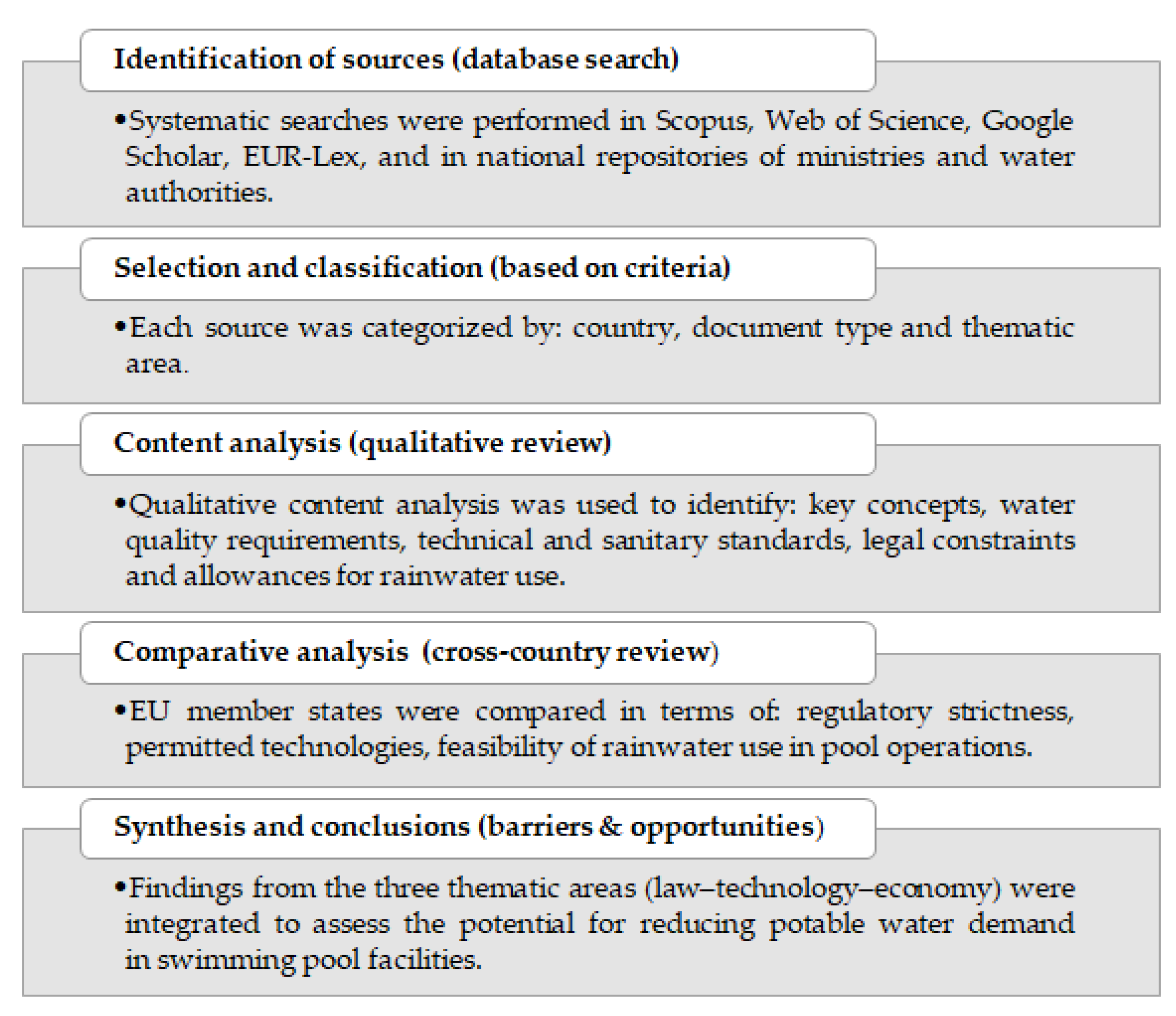
The research process followed five sequential stages, based on systematic and qualitative analysis. The general workflow of the research procedure and the description of the procedure stages are presented in Figure 1.

2.3. SWOT Analysis Procedure

Following the structured data extraction and comparative analysis described above, a SWOT (Strengths, Weaknesses, Opportunities, Threats) analysis was conducted as a secondary interpretative stage to evaluate the feasibility of implementing alternative water systems in swimming pool facilities. The analysis focused on rainwater, graywater, and backwash water applications within the regulatory and operational context of EU Member States. The SWOT analysis was applied as an exploratory and heuristic analytical framework to synthesize qualitative regulatory and technological findings rather than as a quantitative decision-support tool.
The identification of SWOT factors was based on recurring themes and structural patterns identified in the synthesized regulatory, technological, and economic evidence. Explicit classification criteria were applied to ensure consistency. Strengths and weaknesses were defined as internal characteristics related to technological performance, operational feasibility, and economic implications. Opportunities and threats were defined as external conditions arising from regulatory developments, environmental pressures, governance structures, and social acceptance.
Only factors supported by documented evidence in the reviewed sources and assessed as relevant across more than one national or thematic context were included in the matrix. The classification and interpretation of factors were discussed among the authors to ensure coherence and to reduce interpretative bias.
The SWOT analysis was qualitative in nature and did not apply quantitative weighting or scoring. This approach reflects the exploratory and regulatory focus of the study, which aims to identify systemic barriers and enabling conditions rather than to provide numerical prioritization of individual factors. The resulting matrix served as a structured framework for synthesizing implications for sustainable water management in EU swimming pool facilities.

2.4. Methodological Limitations

The methodological approach adopted in this study is subject to several limitations that should be considered when interpreting the findings. Regulatory diversity across EU Member States, including differences in legal detail, scope, enforcement practices, and technical standards, creates challenges for direct comparison and may result in uneven representation of individual countries. The limited availability of documented case studies addressing the application of alternative water sources in swimming pool facilities further constrains the empirical basis for evaluating practical implementation and identifying context-specific strengths and weaknesses.
The research relies exclusively on secondary data and does not include empirical performance testing or field validation of the technologies discussed. Consequently, the efficiency, safety, and operational effectiveness of alternative water systems in specific local conditions cannot be directly verified. In addition, regulatory frameworks in the field of water management are evolving rapidly, and some analyzed sources may not fully reflect the most current legal or technological conditions.
Additional limitations relate to the qualitative nature of the SWOT analysis. The identification and classification of SWOT factors involve interpretative judgment, which may introduce a degree of subjectivity inherent in qualitative regulatory analysis. Although conducted in a structured manner and supported by cross-verification of sources, no weighting or scoring system was applied, and the relative importance of identified factors was not quantitatively prioritized. This methodological choice is consistent with the exploratory and regulatory focus of the study, which aims to identify structural conditions and systemic barriers rather than to provide numerical performance rankings. Nevertheless, the absence of quantitative assessment may limit the precision of conclusions regarding the comparative feasibility and impact of alternative water systems.
These limitations underscore the need for cautious interpretation of the results. Future research could complement and validate the findings through empirical case analyses, stakeholder interviews, Delphi surveys, or multi-criteria decision analysis (MCDA), thereby enabling quantitative prioritization and broader external validation.

3. Results

3.1. Implementation Barriers

One of the key challenges in implementing sustainable water sources in swimming pool facilities (Table 3) is the absence of uniform and clearly defined quality standards for water originating from alternative sources. While most EU Member States have established regulations governing the quality of drinking water and pool water, separate standards for reclaimed water—such as water recovered from filter backwashing or graywater systems—are generally lacking. As a result, operators and designers must interpret existing legislation independently, often relying on broad sanitary and technical guidelines or local recommendations rather than on dedicated regulatory frameworks.
Another major barrier stems from differences in legal interpretation across EU countries. The absence of a harmonized European framework results in the lack of a common set of quality requirements for alternative water sources. This regulatory gap affects the comparability of solutions, certification processes, and the exchange of operational experience between Member States.
Beyond legal issues, economic and social barriers also play an important role. The cost of implementing advanced water recovery systems remains high, particularly for small facilities with limited financial resources. In addition, psychological factors influence acceptance: concerns about sanitary safety persist among both users and operators, who may question the quality of water derived from alternative sources.

3.2. EU Regulatory Framework

The EU legal framework relevant to water reuse has been shaped by several key instruments: the Water Framework Directive (2000/60/EC) [29] the Urban Wastewater Treatment Directive (Directive 91/271/EEC) [30], recently replaced by Directive (EU) 2024/3019 [31], and Regulation (EU) 2020/741 [32]. Together, these acts establish general principles for sustainable water management, wastewater treatment requirements, and introduce minimum quality standards for reclaimed water.
The Water Framework Directive (2000/60/EC) [29] provides a comprehensive strategic framework for integrated river basin management and recognizes water reuse as part of sustainable water resource planning.
The EU regulatory framework relevant to water reuse and wastewater management has recently been updated with the adoption of Directive (EU) 2024/3019 [31], which replaces the former Urban Wastewater Treatment Directive (91/271/EEC) [30].
Directive 91/271/EEC [30] historically established the fundamental requirements for the collection, treatment, and discharge of urban wastewater within the European Union, including biochemical oxygen demand (BOD5 ≤ 25 mg/L), chemical oxygen demand (COD ≤ 125 mg/L), and total suspended solids (TSS ≤ 35 mg/L), along with minimum percentage reduction requirements.
The newly adopted Directive (EU) 2024/3019 [31] strengthens this regulatory framework by introducing progressively stricter monitoring obligations, enhanced treatment requirements, improved transparency in reporting, and additional provisions addressing emerging environmental challenges. Although the directive primarily targets wastewater treatment and environmental protection, it indirectly shapes the regulatory context for water reuse and alternative water sources by establishing baseline treatment performance and risk control mechanisms.
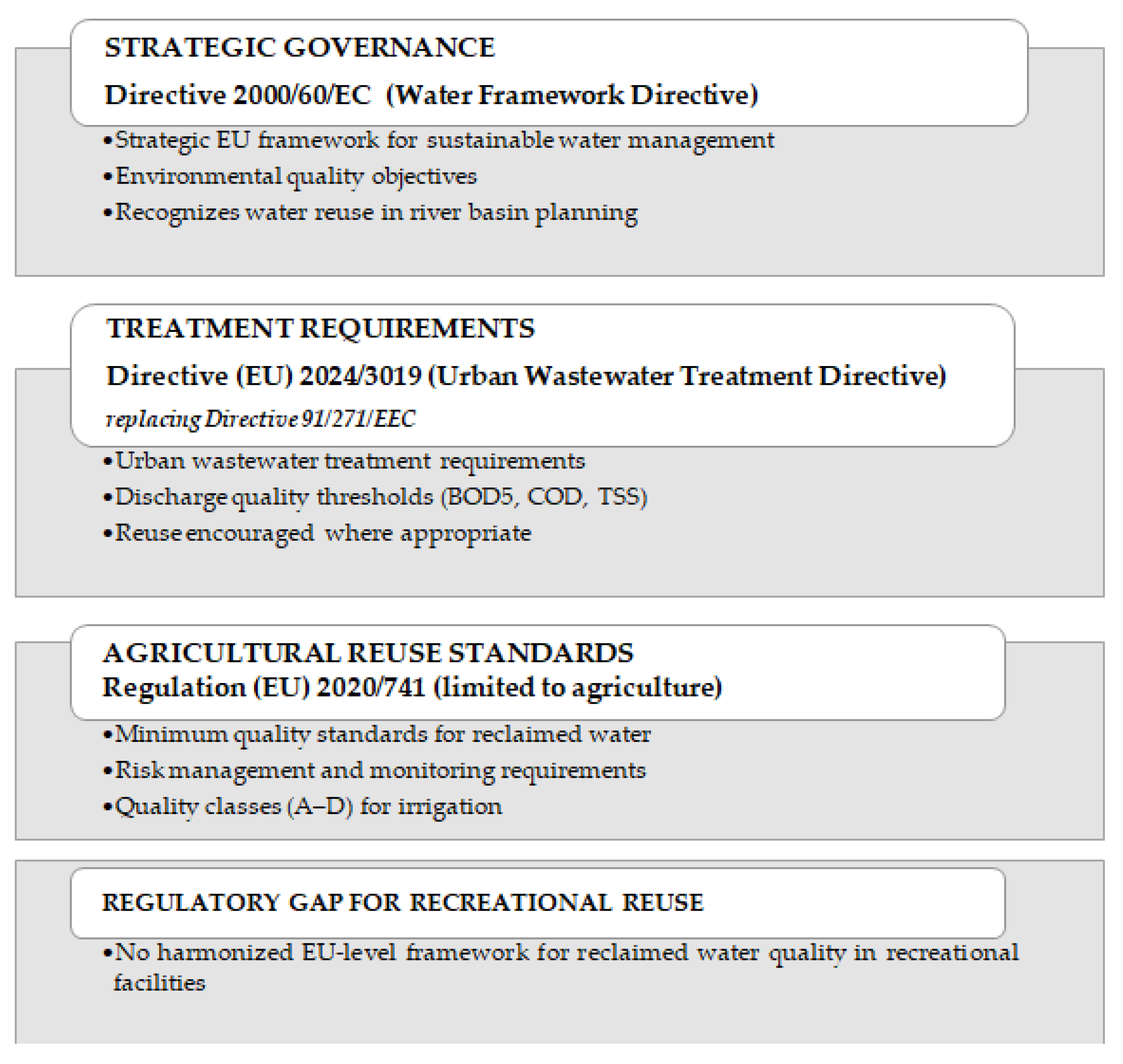
In designated sensitive areas, stricter limits apply to total phosphorus and total nitrogen. Regulation (EU) 2020/741 [32] establishes harmonized minimum requirements for water reuse in agricultural irrigation within the European Union. It defines four quality classes (A–D) based on microbiological and physico-chemical parameters, including E. coli, BOD5, TSS, turbidity, Legionella spp., and intestinal nematodes. The Regulation also requires systematic monitoring and the implementation of risk management plans. Although Regulation (EU) 2020/741 is currently limited to agricultural irrigation, it represents the most comprehensive EU-level framework for reclaimed water quality and risk control. Figure 2 summarizes the structure of the EU regulatory framework relevant to water reuse.

3.3. Examples of National Regulations

Despite the absence of comprehensive and harmonized EU-wide criteria for reclaimed water, several countries have developed their own legislative frameworks, regulations, technical standards, or guidance documents addressing the recovery and reuse of water, including rainwater, graywater, and treated wastewater to govern its use. Approaches differ across countries in terms of permitted applications, quality standards, authorization procedures, and the scope of technical regulation [33,34]. Table 4 presents a comparative overview of national frameworks relevant to swimming pool facilities.
In Germany, a structured system of technical standards regulates alternative water use. National standards such as DIN 1989 [35] and DIN EN 16941 [36] regulate the collection and storage of rainwater, while DWA-M 277 [37] provides guidance on the reuse of graywater. DIN 19645:2016-07 [38] specifically addresses the treatment of spent filter backwash water in swimming pool and bathing water systems, creating a relatively clear regulatory environment for technical water reuse in aquatic facilities. In several federal states, including Bavaria [39] and Baden-Württemberg [40], the use of alternative water sources is permitted for technical purposes, such as filter backwashing and sanitary installations in recreational facilities.
Spain regulates reclaimed water reuse primarily through The Royal Decree 1620/2007 [41], which establishes quality categories and microbiological criteria for different reuse applications. Reclaimed water may be used for irrigation and certain non-potable purposes. Regional pilot programs in areas such as Catalonia [42] and Andalusia [43] allow limited use of treated water in outdoor recreational facilities under defined microbiological conditions. The National Water Reuse Plan (Plan Nacional de Reutilización de Aguas) [44] provides a strategic framework for expanding reuse practices at the national level.
France has adopted a precautionary approach to water reuse. The legal framework, based on the Environmental Code [45] and the Arrêté of 21 August 2008 [46], permits the use of rainwater and graywater solely for technical purposes, such as toilet flushing, irrigation of green areas, and surface cleaning, while direct contact with bathers is prohibited. Subsequent regulations, including the 2010 decree on the use of urban wastewater for irrigation [47], classify reclaimed water into quality categories based on physicochemical and microbiological properties and define allowable uses for agriculture, landscaping, and green spaces. Direct use involving contact with bathers is not permitted. Subsequent regulatory updates introduced quality classifications and risk assessment requirements for reclaimed water applications [48,49,50].
In Denmark, water reuse decisions are largely based on risk assessment and municipal authorization. National guidance allows the use of rainwater for technical purposes in recreational facilities, provided that public health requirements are met [51].
The Netherlands, despite lacking specific legislation dedicated to swimming pool facilities, allows broad use of rainwater and reclaimed water [52] within the public sector under its general water law framework [53]. National programs such as the Delta Programme [54], together with local initiatives like “Rainproof Amsterdam” [55], actively promote water retention, reuse, and recirculation systems, supported by public funding and urban resilience policies [52].
In Estonia, the Water Act [56] defines reclaimed water as treated wastewater or process water intended for transfer to third parties but does not specify detailed quality requirements for swimming pool applications.
Hungary regulates [57] treated wastewater reuse primarily in agriculture, permitting its use for non-food crops while explicitly excluding applications related to human consumption or animal feed, in line with the objectives of Regulation (EU) 2020/741 [32].
Romania, due to its location within the Danube River Basin and the Black Sea catchment, classifies its entire territory as a sensitive area [58]; consequently, water reuse is allowed only with prior authorization and under strict conditions determined by competent authorities.
Portugal encourages water reuse through national water legislation [59] that prioritizes recovery over discharge, particularly for irrigation and recreational areas.
Italy has established technical standards governing the reuse of domestic, urban, and industrial wastewater [60]. Permitted applications include irrigation of crops and green areas, as well as various urban and industrial uses such as street cleaning, cooling and heating systems, toilet flushing, and firefighting, while prohibiting uses involving direct contact with food, pharmaceuticals, or cosmetics.
Sweden complements Regulation (EU) 2020/741 [32] with national provisions [61] assigning compliance responsibility to end users and environmental authorities.
These examples illustrate the diversity of national regulatory approaches to alternative water sources within the EU, including differences in permitted applications, technical requirements, and authorization procedures relevant to swimming pool facilities.

3.4. SWOT Analysis Results

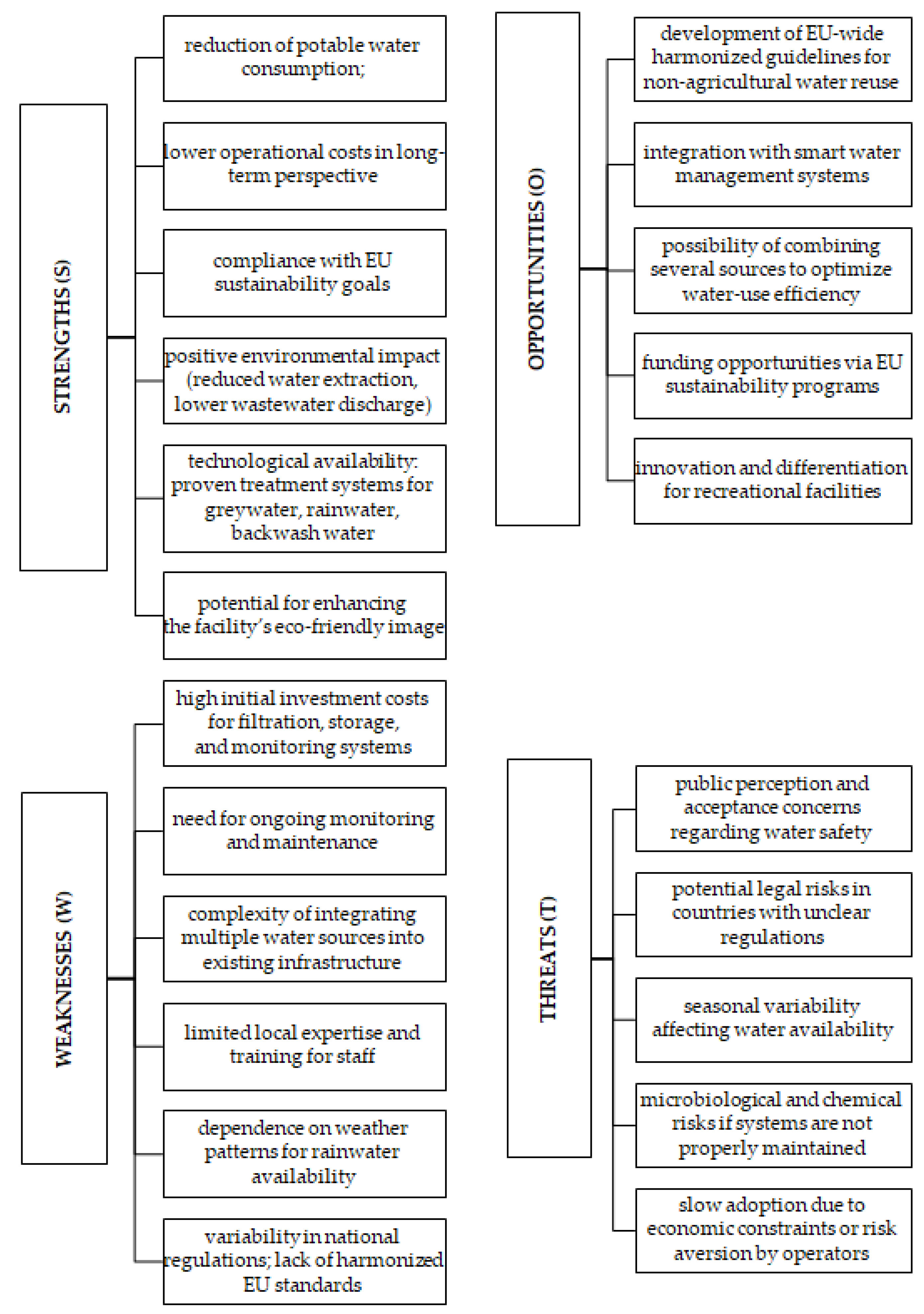
The SWOT analysis suggests several structural factors that may influence the implementation of alternative water supply systems in swimming pool facilities across the European Union. The main strengths, weaknesses, opportunities, and threats identified in the analysis are synthesized in the SWOT matrix presented in Figure 3. Among the main strengths is the availability of established treatment technologies that enable the safe recovery and reuse of water from sources such as rainwater, graywater, and filter backwash water. The implementation of such systems may significantly reduce the consumption of potable water and support broader sustainability objectives, including improved water-use efficiency and alignment with circular economy principles.
At the same time, the analysis also indicates several weaknesses that currently limit wider adoption of alternative water systems. The most significant barrier is the absence of harmonized EU-level quality standards specifically addressing recreational water reuse. In practice, this leads to regulatory complexity and uncertainty for operators and designers of swimming pool facilities, who must interpret general sanitary or environmental regulations that were not originally developed for this type of application. In addition, relatively high initial investment costs and the limited number of documented implementation examples may discourage facility managers from adopting innovative water reuse solutions.
From a broader policy perspective, the analysis also points to several opportunities. Increasing attention to water scarcity and climate change at both the EU and national levels creates favorable conditions for the development of clearer regulatory frameworks and support mechanisms for water reuse technologies. Existing EU legislation addressing reclaimed water quality and risk management, particularly Regulation (EU) 2020/741, may also provide a conceptual basis for extending risk-based regulatory approaches to other sectors, including recreational facilities.
Nevertheless, the analysis also points to potential threats that may hinder the wider implementation of alternative water supply systems. These include the continued fragmentation of regulatory frameworks across Member States, legal uncertainty related to compliance requirements, and concerns regarding public health and social acceptance of non-conventional water sources. Addressing these challenges will require not only technological solutions but also clearer regulatory guidance and improved communication regarding the safety and benefits of water reuse systems.

4. Discussion

4.1. Drivers of Regulatory Divergence

The comparative overview presented in Table 4 reveals substantial differences in the scope, specificity, and restrictiveness of national regulations concerning alternative water use in swimming pool facilities. These differences are not incidental but reflect structural, environmental, and governance-related factors operating within individual Member States.
One of the determinants is the level of water stress and climatic conditions. Countries experiencing recurrent droughts or structural water scarcity, such as Spain, have developed more explicit regulatory frameworks for water reuse, driven by long-term resource pressure and national water security strategies. In contrast, countries with relatively stable freshwater availability tend to approach rainwater and greywater use more cautiously, often embedding such practices within broader sanitation or construction regulations rather than establishing dedicated reuse frameworks. Thus, climatic vulnerability and hydrological pressure appear to act as catalysts for regulatory innovation.
Governance structure also plays an important role. Federal or highly decentralized systems, such as Germany, may exhibit regulatory fragmentation due to regionally differentiated competencies, leading to variations in interpretation and implementation across states. Conversely, more centralized administrative systems tend to provide uniform national regulations, although sometimes at the expense of flexibility. These institutional configurations directly influence the clarity, coherence, and enforceability of reuse provisions.
Another explanatory factor is the maturity of national water management systems and technological capacity. Countries with established experience in wastewater treatment, stormwater management, and urban resilience strategies are more likely to integrate alternative water use within broader sustainability or circular economy policies. In contrast, in jurisdictions where reuse remains peripheral to mainstream water governance, regulatory references are often indirect, scattered across environmental, construction, or public health legislation.
Finally, perceptions of public health risks and societal acceptance also influence regulatory approaches. Swimming pools are classified as high-sensitivity public facilities, and concerns regarding microbiological safety and liability may lead to precautionary regulatory frameworks. In several Member States, the absence of explicit authorization for alternative water use reflects not necessarily prohibition but regulatory caution in contexts where public confidence in reuse systems remains limited

4.2. Implications for Technology Diffusion and Market Integration

Regulatory divergence has practical implications for the dissemination of alternative water technologies and for the functioning of the internal EU market.
First, the absence of harmonized quality standards for recreational reuse increases compliance complexity for technology providers operating across multiple jurisdictions. Manufacturers and designers may face differing technical requirements, approval procedures, and documentation standards, which can increase transaction costs and limit economies of scale.
Second, fragmented regulation constrains the transferability of operational experience. When quality criteria, risk management obligations, and permitted applications vary substantially, best practices developed in one Member State may not be directly replicable in another. This reduces the potential for cross-border learning and slows the diffusion of innovative solutions.
Third, legal uncertainty may discourage investment in alternative water systems. Operators of swimming pool facilities must navigate heterogeneous regulatory environments, often interpreting general provisions not specifically designed for recreational reuse. This uncertainty may reinforce conservative decision-making and favor conventional potable water supply over alternative sources.
From a market integration perspective, the current regulatory landscape creates asymmetries in technological development and adoption rates, potentially limiting the emergence of standardized solutions at the EU level.

4.3. Regulatory Gaps in Recreational Water Reuse

The analysis of EU-level legislation and national frameworks reveals a distinct regulatory gap concerning recreational water reuse. While Directive 2000/60/EC [29] and Directive (EU) 2024/3019 [30] establish general principles for sustainable water management and wastewater treatment performance, they do not define sector-specific criteria for recreational facilities. Regulation (EU) 2020/741 [32] introduces harmonized minimum quality requirements and risk management obligations for reclaimed water; however, its scope is currently limited to agricultural irrigation. As a result, no dedicated EU-level framework defines quality classes, monitoring frequency, or risk management standards specifically for alternative water sources used in swimming pool facilities. Graywater, rainwater, and backwash water are therefore regulated indirectly through drinking water laws, public health provisions, environmental legislation, or technical standards of varying scope. This regulatory gap contributes to legal uncertainty and uneven application across Member States. In practice, operators must interpret general environmental and sanitary provisions in contexts not explicitly addressed by EU law. The absence of sector-specific guidance also limits regulatory predictability for designers and technology providers.
The findings suggest that recreational water reuse occupies an intermediate regulatory space between environmental discharge control and potable water protection, without a clearly defined and harmonized framework at the EU level.

4.4. Policy Implications and Future Research Directions

The results indicate that improved regulatory coherence could enhance the safe and efficient adoption of alternative water systems in swimming pool facilities. One potential direction is the adaptation of risk-based governance principles similar to those embedded in Regulation (EU) 2020/741 [32]. The introduction of minimum quality parameters, monitoring obligations, and structured risk management plans tailored to recreational applications could increase legal clarity while preserving flexibility for Member States.
Greater coordination between national technical standardization bodies and EU institutions may also facilitate mutual recognition of compliance procedures and technical specifications. Such alignment could reduce administrative burdens for operators and promote cross-border dissemination of validated technological solutions.
In addition, transparent communication and public engagement strategies are essential for addressing sanitary risk perception and strengthening social acceptance. Even where technologies are technically capable of achieving high water quality, public trust remains a decisive factor in implementation.
From a broader sustainability perspective, the findings of this study have important implications for the implementation of Sustainable Development Goal 6 (Clean Water and Sanitation). The integration of alternative water sources in swimming pool facilities can contribute to improving water-use efficiency, particularly in relation to Target 6.4, which aims to increase water-use efficiency across sectors. Furthermore, the reuse of rainwater, graywater, and treated backwash water reflects the principles of circular water management, where water streams traditionally treated as waste are reintegrated into operational systems, supporting the transition toward circular economy models in urban water management. Recent studies have also highlighted the importance of reliable hydrochemical monitoring frameworks as a basis for sustainable water management and the implementation of SDG 6 objectives [24].
Under current regulatory conditions, rainwater harvesting and graywater reuse appear to be the most feasible options for implementation in both new and retrofitted swimming pool facilities. These findings indicate that technological feasibility already exists, while improved regulatory coherence remains the key condition for enabling wider implementation of alternative water systems in the recreational sector.
Future research should complement the present desk-based regulatory analysis with empirical investigations, including case studies of operational facilities, stakeholder interviews, and quantitative prioritization methods such as Delphi surveys or multi-criteria decision analysis (MCDA). Such approaches would enable a more detailed assessment of relative barrier importance and support evidence-based policy design.

5. Conclusions

This study assessed the feasibility of integrating alternative water sources in swimming pool facilities within the European Union through a comparative desk-based analysis of EU legislation, national regulatory frameworks, and technological conditions. The results indicate that the primary barrier to wider implementation is not technological readiness but regulatory fragmentation and the absence of harmonized quality standards for recreational water reuse.
While EU legislation—particularly Regulation (EU) 2020/741—establishes a structured risk-based framework for agricultural water reuse, no comparable sector-specific guidance exists for recreational facilities. This regulatory gap creates legal uncertainty, increases compliance complexity, and limits the transferability of technological solutions across Member States.
Among the analyzed options, rainwater harvesting and graywater reuse appear to be the most feasible solutions under current regulatory and technological conditions, while other sources such as seawater or groundwater involve greater operational and regulatory constraints. Overall, improving regulatory coherence, risk-based governance mechanisms, and coordination between EU and national frameworks could facilitate the safe implementation of alternative water systems in swimming pool facilities and support broader water-use efficiency and sustainability objectives within the European Union.

Author Contributions

Conceptualization, A.L.-R.; methodology, A.L.-R. and E.K.-T.; formal analysis, A.L.-R.; investigation, A.L.-R. and R.R. resources, E.K.-T.; data curation, A.L.-R. and R.R.; writing—original draft preparation, A.L.-R.; writing—review and editing, R.R. and E.K.-T.; visualization, A.L.-R.; supervision, E.K.-T.; project administration, E.K.-T.; funding acquisition, E.K.-T. and R.R. All authors have read and agreed to the published version of the manuscript.

Funding

This research was financed by National Centre for Research and Development (No. LIDER13/0126/2022) and supported by the Ministry of Education and Science as part of the “Implementation Doctorate 2023” program (No. DWD/7/0339/2023).

Institutional Review Board Statement

Not applicable.

Informed Consent Statement

Not applicable.

Data Availability Statement

The raw data supporting the conclusions of this article will be made available by the authors on request.

Conflicts of Interest

Author Rafał Rapacewicz was employed by the company PB LEMTER, the remaining authors declare that the research was conducted in the absence of any commercial or financial relationships that could be construed as a potential conflict of interest.

References

  1. Whytock, G. Water Resources Across Europe: Confronting Water Stress—An Updated Assessment; European Environment Agency: Copenhagen, Denmark, 2021. [Google Scholar]
  2. European Parliament. The State of Water in Europe: Key Challenges and Actions EU; European Parliament: Brussels, Belgium, 2025. [Google Scholar]
  3. Global Commission on the Economics of Water. The What, Why and How of the World Water Crisis: Global Commission on the Economics of Water Phase 1 Review and Findings. 2023. Available online: www.watercommission.org (accessed on 12 December 2025).
  4. Lempart-Rapacewicz, A.; Kudlek, E.; Rapacewicz, R. Examples of technological solutions used in Poland in the field of reducing the operating costs of swimming pool facilities. In Proceedings of the 10th International Conference on Swimming Pool & Spa: Sustainability of Swimming Pools and Spa in a One Health Perspective, Bologna, Italy, 15–17 February 2023. [Google Scholar]
  5. Maglionico, M.; Stojkov, I. Water consumption in a public swimming pool. Water Supply 2015, 15, 1304–1311. [Google Scholar] [CrossRef]
  6. Cardoso, B.J.; Gaspar, A.R.; Góis, J.C.; Rodrigues, E. Energy and water consumption characterization of Portuguese indoor swimming pools. In Proceedings of the CYTEF 2018 VII Congreso Ibérico Ciencias y Técnicas del Frío, Valencia, Spain, 19–21 June 2018. [Google Scholar]
  7. Mika-Shalyha, A.; Wyczarska-Kokot, J.; Lempart-Rapacewicz, A. Water consumption rates in indoor swimming pools: Analysis of design assumptions in the context of Green Deal implementation. Desalin. Water Treat. 2024, 320, 100874. [Google Scholar] [CrossRef]
  8. Lempart-Rapacewicz, A.; Zakharova, J.; Kudlek, E. Rainwater quality analysis for its potential recovery: A case study on its usage for swimming pools in Poland. Sustainability 2023, 15, 15037. [Google Scholar] [CrossRef]
  9. Rapacewicz, R.; Kudlek, E.; Brukało, K. Rainwater and stormwater quality in terms of its potential use in swimming pool installations. Desalin. Water Treat. 2025, 321, 100918. [Google Scholar] [CrossRef]
  10. Raimondi, A.; Quinn, R.; Abhijith, G.R.; Becciu, G.; Ostfeld, A. Rainwater harvesting and treatment: State of the art and perspectives. Water 2023, 15, 1518. [Google Scholar] [CrossRef]
  11. Mazurkiewicz, K.; Jeż-Walkowiak, J.; Michałkiewicz, M. Physicochemical and microbiological quality of rainwater harvested in underground retention tanks. Sci. Total Environ. 2022, 814, 152701. [Google Scholar] [CrossRef]
  12. Rodrigues, K.C.; de Morais, L.S.R.; de Paula, H.M. Green/sustainable treatment of washing machine graywater for reuse in the built environment. Clean. Eng. Technol. 2022, 6, 100410. [Google Scholar] [CrossRef]
  13. Van de Walle, A.; Kim, M.; Alam, M.K.; Wang, X.; Wu, D.; Dash, S.R.; Rabaey, K.; Kim, J. Graywater reuse as a key enabler for improving urban wastewater management. Environ. Sci. Ecotechnol. 2023, 16, 100277. [Google Scholar] [CrossRef] [PubMed]
  14. Juan, Y.-K.; Chen, Y.; Lin, J.-M. Graywater reuse system design and economic analysis for residential buildings in Taiwan. Water 2016, 8, 546. [Google Scholar] [CrossRef]
  15. Pobat, T.; Mandilara, G.D.; Nigro Di Gregorio, F.; Valeriani, F.; Veschetti, E.; Ferretti, E.; Mavridou, A.; Romano Spica, V. Pool safety regulations in Europe: Challenges towards a framework for sustainable seawater utilization in public swimming pools. Water 2025, 17, 2544. [Google Scholar] [CrossRef]
  16. Manasfi, T.; De Méo, M.; Coulomb, B.; Di Giorgio, C.; Boudenne, J.-L. Identification of disinfection by-products in freshwater and seawater swimming pools and evaluation of genotoxicity. Environ. Int. 2016, 88, 94–102. [Google Scholar] [CrossRef]
  17. Winid, B.; Chruszcz-Lipska, K.; Maruta, M.; Solecki, M.L. Water resources and climate change—Groundwater as an alternative source of water supply. AGH Drill. Oil Gas. 2020, 37, 5–14. [Google Scholar]
  18. Carrard, N.; Foster, T.; Willetts, J. Groundwater as a source of drinking water in Southeast Asia and the Pacific: A multi-country review of current reliance and resource concerns. Water 2019, 11, 1605. [Google Scholar] [CrossRef]
  19. Wyczarska-Kokot, J.; Lempart, A. The reuse of washings from pool filtration plants after the use of simple purification processes. Archit. Civ. Eng. Environ. 2018, 11, 163–170. [Google Scholar] [CrossRef]
  20. Łaskawiec, E. Quality assessment of sludge from filter backwash water in swimming pool facilities. Sustainability 2023, 15, 1811. [Google Scholar] [CrossRef]
  21. Wolska, M.; Urbańska-Kozłowska, H. Assessing the possibilities of backwash water reuse filters in the water treatment system—Case analysis. Water 2023, 15, 2452. [Google Scholar] [CrossRef]
  22. Doménech-Sánchez, A.; Laso, E.; Berrocal, C.I. Water loss in swimming pool filter backwashing processes in the Balearic Islands (Spain). Water Policy 2021, 23, 1314–1328. [Google Scholar] [CrossRef]
  23. Brügger, A.; Voßenkaul, K.; Melin, T.; Rautenbach, R.; Golloing, B.; Jacobs, U.; Ohlenforst, P. Reuse of filter backwash water by implementing ultrafiltration technology. Water Supply 2001, 1, 207–214. [Google Scholar] [CrossRef]
  24. Biedunkova, O.; Kuznietsov, P.; Tsos, O.; Boiaryn, M.; Karaim, O. Sustainable Hydrochemical Reference Conditions in the Headwaters of Western Ukraine. Sustainability 2026, 18, 821. [Google Scholar] [CrossRef]
  25. Bibi, T.S.; Kara, K.G. Evaluation of climate change, urbanization, and low-impact development practices on urban flooding. Heliyon 2023, 9, e12955. [Google Scholar] [CrossRef]
  26. Intergovernmental Panel on Climate Change. Climate Change 2022: Impacts, Adaptation and Vulnerability; Cambridge University Press: Cambridge, UK, 2022. [Google Scholar]
  27. Gupta, R.K. Methodological and Theoretical Rigor in Desk Research. 2024. ResearchGate. Available online: https://www.researchgate.net/publication/386642850 (accessed on 12 December 2025).
  28. Moore, N. Desk research. In How to Do Research; Facet: London, UK, 2018; pp. 106–111. [Google Scholar]
  29. European Parliament and Council. Directive 2000/60/EC establishing a framework for Community action in the field of water policy. Off. J. Eur. Union 2000. Available online: https://eur-lex.europa.eu/eli/dir/2000/60/oj/eng (accessed on 12 December 2025).
  30. European Parliament and Council. Directive 91/271/EEC concerning urban wastewater treatment. Off. J. Eur. Union 1991. Available online: https://eur-lex.europa.eu/legal-content/en/ALL/?uri=CELEX:31991L0271 (accessed on 12 December 2025).
  31. European Parliament and Council. Directive (EU) 2024/3019 concerning urban wastewater treatment. Off. J. Eur. Union 2024. Available online: https://eur-lex.europa.eu/eli/dir/2024/3019/oj/eng (accessed on 12 December 2025).
  32. European Parliament and Council. Regulation (EU) 2020/741 on minimum requirements for water reuse. Off. J. Eur. Union 2020. Available online: https://eur-lex.europa.eu/eli/reg/2020/741/oj/eng (accessed on 12 December 2025).
  33. Ramm, K.; Smol, M. Water reuse—Analysis of the possibility of using reclaimed water depending on the quality class in the European countries. Sustainability 2023, 15, 12781. [Google Scholar] [CrossRef]
  34. Ramm, K.; Dadok, M.; Lavonen, S.; Biveson, P.; Klavins, M.; Purmalis, O.; Smol, M.; Skalny, M.; Marcinek, P.; Andrunik, M. ReNutriWater Handbook on Water Reuse, Version 1.2; Interreg Baltic Sea Region Programme: Rostock, Germany, 2025. [Google Scholar]
  35. DIN 1989-100:2022; Rainwater Utilization Systems. German Institute for Standardization: Berlin, Germany, 2022.
  36. DIN EN 16941-1:2024; On-Site Non-Potable Water Systems—Rainwater Use Systems. German Institute for Standardization: Berlin, Germany, 2024.
  37. DWA. Guideline DWA-M 277: Design of Systems for the Treatment and Reuse of Graywater; German Association for Water, Wastewater and Waste: Hennef, Germany, 2017. [Google Scholar]
  38. Bavarian State Government. Bayerisches Wassergesetz (BayWG); Bavarian State Government: Bavaria, Germany, 2010. [Google Scholar]
  39. Baden-Württemberg Parliament. Gesetz zur Neuordnung des Wasserrechts in Baden-Württemberg; Baden-Württemberg Parliament: Stuttgart, Germany.
  40. DIN 19645:2016; Treatment of Backwash Water from Swimming Pool Systems. German Institute for Standardization: Berlin, Germany, 2016.
  41. Government of Spain. Royal Decree 1620/2007 on the Legal Framework for Water Reuse; Government of Spain: Madrid, Spain, 2007. [Google Scholar]
  42. Molist, J. Indirect Potable Reuse in Catalonia. Available online: https://www.aquapublica.eu//sites/default/files/event/file/2024-06/Jordi%20Molist%20PPT.pdf (accessed on 12 December 2025).
  43. SUWANU Europe. Regional Action Plans for the Implementation of Water Reuse; SUWANU Europe: Málaga, Spain, 2023. [Google Scholar]
  44. Government of Spain. National Water Reuse Plan; Government of Spain: Madrid, Spain, 2019. [Google Scholar]
  45. French Republic. Environmental Code; French Republic: Paris, France, 2010. [Google Scholar]
  46. French Republic. Arrêté du 21 Août 2008 Relatif à la Récupération des Eaux de Pluie; French Republic: Paris, France, 2008. [Google Scholar]
  47. French Republic. Arrêté du 2 Août 2010 Relatif à L’utilisation de L’eau de Pluie; French Republic: Paris, France, 2010. [Google Scholar]
  48. French Republic. Arrêté du 25 Juin 2014 Modifiant L’arrêté du 2 Août 2010; French Republic: Paris, France, 2014. [Google Scholar]
  49. French Republic. Arrêté du 26 Avril 2016 Modifiant L’arrêté du 2 Août 2010; French Republic: Paris, France, 2016. [Google Scholar]
  50. French Republic. Décret n°2022-336 Relatif à la Réutilisation des Eaux Usées Traitées; French Republic: Paris, France, 2022. [Google Scholar]
  51. Jensen, D.M.R.; Thomsen, A.T.H.; Larsen, T.; Egemose, S.; Mikkelsen, P.S. From EU directives to local stormwater discharge permits: A study of regulatory uncertainty and practice gaps in Denmark. Sustainability 2020, 12, 6317. [Google Scholar] [CrossRef]
  52. Ministry of Infrastructure and Water Management. Waterwet; Government of the Netherlands: Hague, The Netherlands, 2009. [Google Scholar]
  53. Delta Programme. National Strategy for Flood Risk Management and Water Scarcity; Delta Programme: Amsterdam, The Netherlands, 2021. [Google Scholar]
  54. Rainproof Amsterdam. Urban Water Retention and Reuse Programme; Rainproof Amsterdam: Amsterdam, The Netherlands, 2021. [Google Scholar]
  55. Ministry of Economic Affairs and Climate Policy. Dutch Climate Agreement; Ministry of Economic Affairs and Climate Policy: Hague, The Netherlands, 2019. [Google Scholar]
  56. Republic of Estonia. Water Act; Republic of Estonia: Tallinn, Estonia, 2019. [Google Scholar]
  57. Government of Hungary. Regulation on Water Supply and Wastewater Treatment (50/2001); Government of Hungary: Budapest, Hungary, 2001. [Google Scholar]
  58. Government of Romania. Decision No. 188 on Wastewater Discharge Conditions; Government of Romania: Bucharest, Romania, 2002. [Google Scholar]
  59. Portuguese Republic. Lei da Água (Water Law No. 58/2005). Portuguese Republic: Lisbon, Portugal, 2005.
  60. Italian Ministry for the Environment. Decreto Ministeriale No. 185 on Wastewater Reuse; Italian Ministry for the Environment: Rome, Italy, 2003. [Google Scholar]
  61. Swedish Government. Regulation (2024:161) on Water Reuse for AgriculturalIrrigation; Swedish Government: Stockholm, Sweden, 2024. [Google Scholar]
Figure 1. Schematic diagram of the research procedure.
Sustainability 18 02937 g001
Figure 2. Main EU legislative instruments relevant to water reuse and wastewater management (including Directive (EU) 2024/3019, which replaced Directive 91/271/EEC).
Sustainability 18 02937 g002
Figure 3. SWOT analysis of alternative water sources in swimming pool facilities.
Sustainability 18 02937 g003
Table 1. Health and environmental risks of alternative water sources for swimming pools.
Water
Source
Potential UsesHealth RisksEnvironmental
Risks
Comments
RainwaterPool top-up,
irrigation,
auxiliary systems
Low if properly treatedMinimal; depends on collection surface contaminationRelatively clean,
decentralized
GraywaterToilet flushing, irrigation, partial pool replenishmentMicrobial contamination if untreatedLow if reused appropriatelyRequires filtration
and disinfection
Backwash WaterPool system replenishmentPathogens, suspended solidsMinimal if properly treatedCost-effective,
but treatment required
Surface WaterPool replenishment,
irrigation
Microbial and chemical pollutantsPotential eutrophication,
seasonal variability
Requires filtration
and monitoring
GroundwaterPool top-up,
ancillary systems
Mineral content,
heavy metals
Overexploitation
of aquifers
Stable supply,
site-specific
SeawaterFull or partial pool useCorrosion-related
chemical issues, microbial risk
Brine disposal,
local ecosystem impact
High operational costs, specialized infrastructure
Table 2. Thematic scope of the sources included in the research.
Thematic AreaTypes of SourcesExamples of Analyzed Issues
Legal
regulations
EU directives, national acts, sanitary and construction regulationspermitted uses of rainwater, water quality requirements, safety standards, certification procedures
Technologiesscientific articles, industry
reports, technical guidelines
rainwater harvesting
and treatment systems, pool water recirculation technologies, integration with pool infrastructure, operational safety
Economics and practicecost analyses,
investment reports,
case studies
investment and operational costs, environmental effects, examples of facilities using rainwater
Table 3. Identified barriers to implementing sustainable water sources in swimming pool facilities.
CategoryIdentified Barriers
RegulatoryLack of uniform quality standards; No EU-level standards; Divergent national regulations; Absence of specific pool-related reuse guidelines; Monitoring requirements; Legal uncertainty
EconomicHigh investment costs; Limited financial resources of small facilities
TechnicalStorage requirements; Integration with existing infrastructure; Need for advanced treatment technologies; Limited number of documented good practices
Social/InstitutionalSanitary risk perception; Concerns of institutions, users, and operators; Lack of professional knowledge and design guidelines
Table 4. Comparison of selected national regulatory approaches to alternative water sources relevant to swimming pool facilities within the broader EU regulatory framework.
CountryAllowed
Sources
Applications
in Swimming Pools
Relevant Regulations/StandardsComments
GermanyRainwater, graywater, backwash waterFiltration, toilets, technical systems; partially for pool replenishmentDIN 1989;
DIN EN 16941;
DWA-M 277;
DIN 19645:2016
Varies by federal state;
high technical standards
for backwash water
SpainRainwater, graywater, treated wastewaterToilets, irrigation; in some regions’ outdoor recreational poolsRoyal Decree 1620/2007
on water reuse
Prohibited for direct contact with bathers; restrictions for high-risk applications
FranceRainwater, graywaterToilets, irrigation of green areas, surface cleaningArrêté of 21 August 2008No direct contact with bathers; risk assessment required for new uses
DenmarkRainwaterTechnical processes
in pools
Local public health
authority guidelines
Decisions made at municipal level, adapted to local conditions
NetherlandsRainwater, reclaimed waterBroad use
in the public sector
Dutch Water ActNo specific regulations for pools; dependent on local initiatives
ItalyRainwater, graywater, reclaimed waterIrrigation, toilets, cooling/heating,
technical systems
National standards for urban and industrial water reuseProhibited for contact with food, pharmaceuticals, cosmetics
EstoniaReclaimed water/treated wastewaterTransfer to third partiesWater Act
—no specific requirements
No defined quality standards for swimming pools; indirect use only
PortugalRainwater, reclaimed waterIrrigation of public areas and recreational poolsNational water law
—prioritizes water reuse
Permits required; reuse prioritized over disposal
SwedenReclaimed waterPrimarily agricultural reuse; no specific provisions for swimming poolsComplementing
Regulation (EU) 2020/741
End users responsible for compliance; additional measures by environmental authorities
Disclaimer/Publisher’s Note: The statements, opinions and data contained in all publications are solely those of the individual author(s) and contributor(s) and not of MDPI and/or the editor(s). MDPI and/or the editor(s) disclaim responsibility for any injury to people or property resulting from any ideas, methods, instructions or products referred to in the content.