Article

When Are Decentralised Non-Potable Water Systems Environmentally and Financially Viable? Evidence from a Water–Energy–GHG Evaluation of a Healthcare Facility in an Arid City


by
Geraldine Seguela
1,*,
John Richard Littlewood
1 and
George Karani
2
1
The Sustainable & Resilient Built Environment Group, Cardiff School of Art & Design, Cardiff Metropolitan University, Cardiff CF5 2YB, UK
2
The Environmental Public Health Group, Cardiff School of Health Sciences, Cardiff Metropolitan University, Cardiff CF5 2YB, UK
*
Author to whom correspondence should be addressed.
Sustainability 2026, 18(6), 2932; https://doi.org/10.3390/su18062932
Submission received: 31 January 2026 / Revised: 8 March 2026 / Accepted: 9 March 2026 / Published: 17 March 2026

Abstract

Rapid urbanisation in arid regions has increased reliance on energy-intensive desalinated water, intensifying environmental and financial pressures on the built environment. Although non-potable water (NPW) reuse is promoted within regional water strategies, empirical validation of decentralised systems at asset scale remains limited. This study applies a greenhouse gas (GHG) intensity metric (kgCO2e/m3) to multi-year operational data from a large healthcare facility in Abu Dhabi. The analysis integrates calibrated water balance records, onsite pumping energy (Scope 2), embedded desalination emissions (Scope 3), and a 20-year discounted cash flow framework. Three configurations are evaluated: a fully desalinated baseline, the observed mixed-supply system, and an optimised NPW configuration. The baseline exhibits an emission intensity of 19.53 kgCO2e/m3. The observed configuration reduces desalinated supply but achieves only marginal decarbonisation (0.40 kgCO2e/m3) due to continued dependence on desalinated make-up water. The optimised configuration reduces outdoor water demand by 36.7% and achieves 10.94 kgCO2e/m3 net decarbonisation while improving life-cycle cost (LCC) performance. The results show that GHG intensity is primarily driven by water source substitution and system configuration rather than volumetric reuse alone, providing asset-level evidence for evaluating decentralised NPW systems in arid-climate buildings.

1. Introduction

This paper presents the empirical validation and operational evaluation of a greenhouse gas (GHG) metric methodology previously developed to assess decentralised non-potable water (NPW) systems serving outdoor building uses [1]. Building on that methodological foundation, the study moves from theoretical modelling to realised performance, using multi-year operational data from a large healthcare facility in Abu Dhabi (AD), the United Arab Emirates (UAE). The analysis addresses water, energy, GHG, and financial outcomes and translates results into regulatory and professional practice implications aligned with regional climate and water policy objectives.

1.1. Background of the Study

AD, the UAE, is in a hot desert climate (BWh) characterised by high temperatures, limited rainfall, and high evaporation rates [2,3,4,5,6]. Under these conditions, water scarcity is structural and municipal supply relies predominantly on energy-intensive seawater desalination, embedding water provision within a GHG-intensive infrastructure system [2,3,4,5,6,7,8,9,10,11,12,13].
Within this context, the built environment, particularly healthcare infrastructure, represents a critical leverage point for addressing water scarcity and climate impacts. Healthcare systems are resource-intensive and materially contribute to national GHG footprints through energy, water, and supply chains [14,15], while simultaneously being vulnerable to climate-related risks [14,15,16,17]. Sustainable healthcare infrastructure has therefore emerged as a priority area for mitigation and adaptation, supported by growing research on green hospitals and performance-based assessment frameworks [18,19,20].

1.2. The Case Study Context

The Medical Facility Case Study (MFCS) is a 364-bed hospital opened in 2015, with 50% of its footprint landscaped (33,354 m2) and a design aspiration to achieve 100% non-clinical NPW use for LI and WFs using treated-air handling unit (AHU) air-conditioning (A/C) condensate water (CW). Condensate formation peaks during April–November and is lowest during December–April [21], creating a five-month seasonal NPW deficit that is typically met using desalinated make-up water, with associated financial and GHG implications.
Healthcare estates are water-intensive yet underrepresented in outdoor water reuse research. In the United States, hospital water consumption ranged from 260 to 1128 m3/year per bed for hospitals sized 133–510 beds (i.e., 0.71–2.21 m3/day per bed) [15,22]. MFCS records indicate 2.97 m3/day per bed in 2016 (395,916 m3 ÷ 364 beds ÷ 366 days) with LI alone accounting for 36% of total water demand [23,24]. This demonstrates that outdoor water use in healthcare facilities represents a substantial and addressable component of total water demand, offering a significant opportunity to reduce potable water use, associated energy and GHG impacts through NPW reuse strategies aligned with broader healthcare sustainability objectives.

1.3. Updated Literature

1.3.1. Desalination Energy Intensity

Desalination energy intensity remains a defining constraint on water supply sustainability in the UAE. Earlier policy documents reported energy intensities of approximately 4–7 kWh/m3 for reverse osmosis (RO) 7.5 kWh/m3 for multi-effect distillation (MED) and up to 15.40 kWh/m3 for multi-stage flash (MSF) desalination [25] with corresponding production cost ranges reported in [13,25,26]. The more recent literature indicates technological improvements in RO, with large-scale plants operating within approximately 2.5–7 kWh/m3, while MED and MSF remain substantially more energy-intensive [10,27,28,29].
Table 1 synthesises the updated literature on desalination performance, including production cost, total energy use, saline feedwater requirements, and GHG emissions [13,25,29]. Across studies, RO demonstrates the lowest energy and GHG intensity (1.7–3.6 kgCO2e/m3), while MSF exhibits the highest energy demand (15.40–30 kWh/m3) and GHG intensity (15.6–25.0 kgCO2e/m3) [13,25,29].
Despite technological advances, desalination remains energy-intensive at the system scale [4,5,10,27,29,30,31]. At the MFCS location, no verified evidence indicates a step change in energy or GHG intensity relative to previously identified MSF-dominated systems [1]. Accordingly, MSF intensity values are retained for modelling consistency [25].

1.3.2. Water Tariff

Abu Dhabi’s water system is structured around centralised wastewater collection, treatment, and redistribution at the city scale, with treated effluent supplied through non-drinking water networks under the Regulatory Supervision Bureau (RSB) framework, now part of the Department of Energy (DoE) [8,32,33]. Decentralised recycling at the customer level remains limited within this planning model.
Water tariff schedules published by Abu Dhabi Distribution Company (ADDC), formerly under TAQA [34,35] indicate that end-user desalinated-water tariffs have remained broadly stable. In 2017, subsidised effective billed prices for residential and commercial/government users were reported as low as AED 4.11/m3 [1,24] (USD 1.12/m3, based on the fixed exchange rate of 1 USD = 3.6725 AED [36]), while the published commercial/government tariff was AED 10.41/m3 [35]. In 2025, the published tariff for commercial and government users remains AED 10.41/m3, with residential tariffs unchanged at AED 2.09–2.60/m3 for UAE Nationals, and AED 7.84–10.41/m3 for expatriate customers [34].
A recycled-water tariff of AED 1.70/m3 was formally introduced in the 2025 schedule, having not been explicitly defined in 2017 [34]. All reported values represent billed end-user prices and exclude information on production technology, energy intensity, or environmental externalities.

1.3.3. Standards and Regulatory Context

Strategically, Abu Dhabi has adopted water security initiatives including aquifer storage and recovery investments [37,38], and Integrated Water Resources Management (IWRM) principles articulated by the Environment Agency–Abu Dhabi (EAD) [8,39]. Nexus-oriented analyses highlight structural inefficiencies in water–energy systems and seasonal demand divergence [40], while dynamic water budget modelling projects persistent long-term supply–demand imbalances [6].
Despite strong policy intent, implementation remains spatially uneven; treated sewage effluent (TSE) infrastructure was unavailable near the MFCS during the study period [1]. Earlier regulatory guidance under the RSB [41] framed recycled water primarily within centralised wastewater paradigms. Subsequent regulatory updates by the DoE [42] and soil quality regulations by EAD [43,44,45] strengthened monitoring and classification requirements but did not establish integrated asset-level methodologies linking soil–water management, NPW prioritisation, and GHG performance.
International standards including ISO 14046 [46], ISO 50001 [47], Water Usage Effectiveness (WUE) [48], Embedded Resource Accounting (ERA) [49], Water–Energy–GHG (WEG) guidance [50], The Climate Registry [51], and the GHG Protocol Scope 3 Standard [52] address water, energy, and GHG emissions largely in isolation. While water–energy nexus scholarship highlights interdependencies [30,50,53], asset-scale benchmarking methodologies capable of evaluating decentralised NPW systems for outdoor uses under consistent water–energy–GHG boundaries remain limited [1,54,55].
Without an integrated metric capturing water demand, water source, onsite electricity use, and embedded upstream emissions, decentralised systems risk being assessed solely on volumetric water savings, obscuring non-linear energy and GHG effects. This gap motivates the application of a boundary-consistent water–energy–GHG metric (kgCO2e/m3) and Sustainable Water Conservation and Reuse (SWC) protocol [1,55] to evaluate when decentralised NPW systems are environmentally and financially viable.

1.3.4. Updated Literature Implications

The recent literature confirms that water scarcity, energy intensity, and GHG emissions are structurally interlinked in arid urban systems [30,50,53].
Regional-scale dynamic water budget modelling projects persistent long-term supply–demand imbalances under baseline growth conditions, even where desalination and reuse are expanded [6]. However, current standards [46,47,48,52] and policies [7,8,11] remain predominantly strategic rather than operational and do not provide asset-level methodologies capable of benchmarking decentralised NPW systems against desalinated alternatives.
This gap has direct implications for infrastructure decision-making and regulatory oversight. Without an integrated metric linking water demand, water source, onsite energy use, and embedded upstream emissions, decentralised NPW systems risk being evaluated solely on volumetric water savings. This limitation motivates the application of a boundary-consistent water–energy–GHG metric (kgCO2e/m3) and the SWC protocol [1,55].

1.4. Novelty of This Research

While prior work [1] introduced a GHG intensity metric for evaluating onsite NPW systems under theoretical modelling conditions, the present study advances this methodology through empirical validation and integrated financial assessment under real operating conditions.
First, the research operationalises a boundary-consistent water–energy–GHG modelling framework integrating measured water demand, seasonal NPW variability, onsite electricity consumption (Scope 2 [56]) embedded desalination emissions (Scope 3 [57]), and discounted-life-cycle cost (LCC) modelling within a single system boundary. In contrast to macro-scale or ratio-based indicators such as WUE, ERA, and WEG guidance [6,48,49,50,53] this framework enables direct counterfactual comparison between observed, baseline, and optimised configurations under consistent boundary definitions.
Second, the study provides empirical validation of decentralised NPW performance using calibrated Energy Management and Control System (EMCS) operational data from an arid-climate healthcare facility. Seasonal deficits, operational inefficiencies, and additional onsite streams (RORW and FSPTW) are explicitly incorporated, extending prior theoretical modelling [1,54,55] to determine when decentralised NPW systems deliver measurable environmental and financial benefits.
Third, the study addresses a persistent gap in standards and professional practice. Despite post-2020 water, energy, and climate frameworks promoting efficiency, reuse, and decarbonisation, verifiable asset-level benchmarking methodologies for decentralised NPW systems serving outdoor uses remain absent, as identified in Seguela et al. [1]. By linking GHG intensity (kgCO2e/m3) to life-cycle financial performance, the study provides an asset-level benchmarking approach for evaluating decentralised NPW systems relative to desalinated supply. Through application of the SWC protocol [1,55], the research translates empirical findings into performance-oriented guidance under consistent environmental and financial boundaries.
The methodological structure supporting these contributions is detailed in Section 2.

2. Materials and Methods

This section describes the methodological structure underpinning the analysis.

2.1. Research Design and Methodological Foundation

Calculations follow the system boundaries, emission factors, and Equations defined in [1]. The methodological approach combines empirical action research and mixed-methods design [58,59,60,61,62,63,64], integrating longitudinal operational data, targeted field testing, and engineering calculations within a unified system boundary.
The empirical basis of the MFCS derives from prior investigations. The water resource assessment reported in [54,65,66,67] quantified NPW supply–demand dynamics using calibrated EMCS records and hydraulic review. The subsequent water quality evaluation in [55,67,68,69] assessed the suitability of AHU CW and supplementary NPW streams for reuse.
The integrated analytical framework incorporates:
  • A calibrated water balance derived from the building EMCS operational records maintained by the facility operator
  • Laboratory testing of AHU A/C CW and additional NPW streams.
  • Engineering calculations for irrigation demand, pumping energy, and system performance modelling based on the literature [70,71,72,73,74,75,76,77].
  • GHG accounting aligned with established international protocols and guidance [50,52,56,57,78] and applying UAE GHG emission factors (EF) corresponding to the period of empirical data collection (2016–2018) namely a Scope 2 EF 0.64337 kgCO2e/kWh [30] and a Scope 3 EF 15.1 kgCO2e/m3 [79].
Energy, GHG, and financial performance are calculated using the system boundary definitions, emission factors, and accounting logic specified in [1], ensuring methodological continuity and comparability across scenarios. These include electricity-based Scope 2 emissions, desalinated-water-related Scope 3 emissions, a GHG intensity metric expressed in kgCO2e/m3, and discounted cash flow analysis over a 20-year (2016–2026)) project lifespan, including net present value (NPV), benefit–cost ratio (BC), and simple payback period (SPP).
The mathematical modelling draws on irrigation, hydraulic, and the system performance modelling literature [70,71,72,73,74,75,76,77], consistent with mixed-methods research frameworks [58,59,60,61,62,63,64]. Full mathematical formulations are provided in [1] and referenced where applicable.
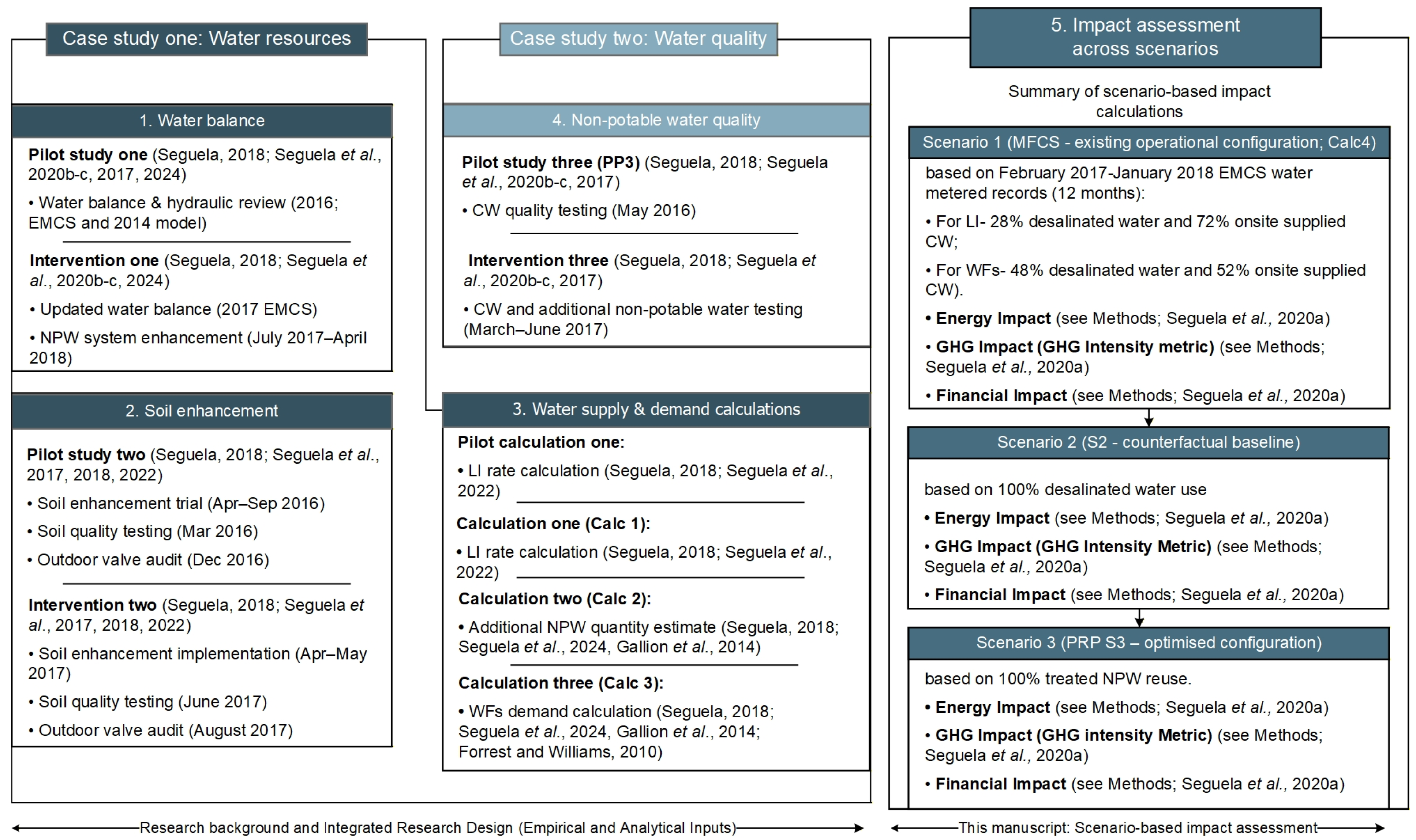
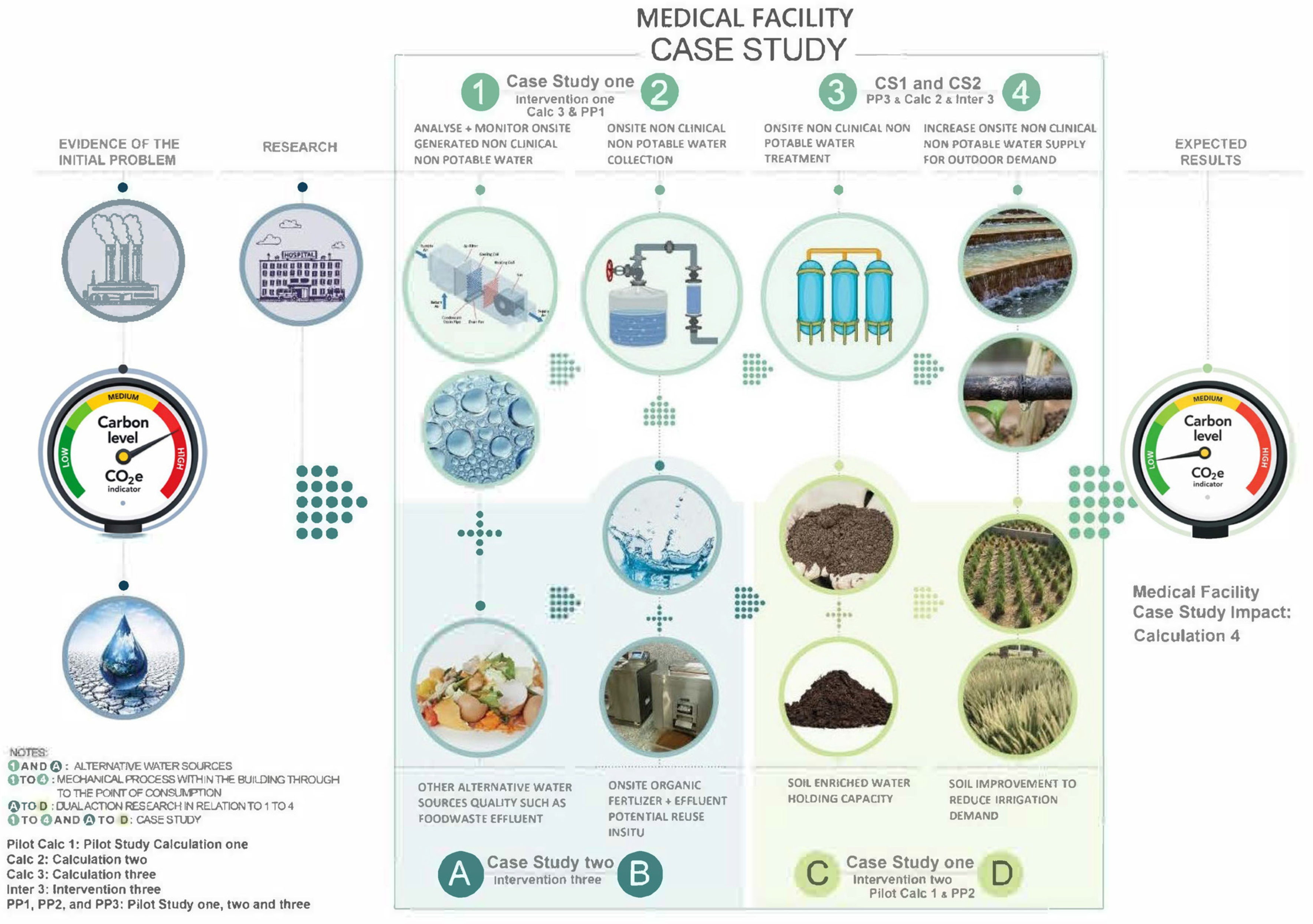
The cumulative research programme underpinning the present analysis is summarised in Figure 1, situating CS1 and CS2 within the broader empirical framework developed in [1,23]. The integrated research design and scenario structure applied in this study are illustrated in Figure 2.

2.2. Scenario Framework and Volumetric Inputs

The scenario-based evaluation applies the established framework to three configurations:
  • Scenario 1 (MFCS—existing operational configuration): Actual operational performance based on EMCS records covering February 2017–January 2018, reflecting a mixed outdoor water system using 38% desalinated make-up water and 62% treated NPW serving LI and WFs.
  • Scenario 2 (S2—counterfactual baseline): All outdoor water demand supplied by desalinated water, based on Abu Dhabi Municipality (ADM) irrigation standards [80] and calibrated EMCS records.
  • Scenario 3 (PRP S3—optimised configuration): A demand-controlled, fully NPW reuse configuration incorporating soil enhancement, hydraulic optimisation, enhanced storage, automation, and integration of additional NPW sources (RORW and FSPTW). Under PRP S3, demand reduction is achieved through soil improvement and runtime optimisation, alongside expanded NPW substitution, resulting in lower total outdoor water volume relative to both observed and baseline scenarios.
The calibrated annual water balance, derived from [1,23,55], defines the volumetric system boundary conditions for all subsequent energy, GHG, and financial modelling. These inputs are summarised in Table 2.
Pumping and treatment energy demand constitute Scope 2 emissions within the defined system boundary. The decentralised NPW system comprises 31 pumps supporting storage, conveyance, treatment, and distribution across the LI (8 pumps) and WF (23 pumps) subsystems (Appendix A, Table A1 and Table A2). Under the optimised PRP S3 configuration, the LI system operates 8 pumps, while the WF system operates 23 pumps including ozone/chlorine treatment. Configuration adjustments under PRP S3 reflect hydraulic recommissioning, revised operating hours, and demand optimisation rather than expansion of installed mechanical capacity.
Embedded desalination energy for Scope 3 emissions is calculated using an intensity of 15.40 kWh/m3 [25] applied to scenario-specific desalinated-water volumes. Under PRP S3, Scope 3 desalination energy equals zero due to full substitution with onsite NPW sources (CW, RORW, and FSPTW).
The analytical cascade linking calibrated volumetric inputs (Table 2) to energy modelling, Scope 2 and Scope 3 accounting, and financial evaluation is illustrated in Figure 2.

2.3. Energy, GHG and Financial Modelling

Using the volumetric inputs defined in Table 2, energy consumption, Scope 2 electricity emissions, Scope 3 embedded desalination emissions, and net decarbonisation outcomes are calculated under a consistent operational boundary. The methodological structure follows the framework originally developed in [1], but the core equations are restated here for clarity and standalone reproducibility.

2.3.1. Scope 2 Electricity Emissions

Annual Scope 2 emissions associated with onsite pumping and treatment systems are calculated as per Equation (1):
Scope   2   Emissions   ( tCO 2 e ) = E e l e c × E F e l e c
where
  • E e l e c = annual electricity consumption (kWh/year), derived from measured EMCS records and pump/treatment power calculations;
  • E F e l e c = grid emission factor (tCO2e/kWh).

2.3.2. Scope 3 Embedded Water Desalination Emissions

Embedded upstream emissions from desalinated-water production are calculated as per Equation (2):
Scope   3   Emissions   ( tCO 2 e ) = V d e s a l × E F w a t e r
where
  • V d e s a l = annual desalinated-water consumption (m3/year);
  • E F w a t e r = emission factor for desalinated-water production (tCO2e/m3).
Onsite-generated NPW streams (CW, RORW, FSPTW) are assigned zero embedded production emissions under Scope 3, consistent with the boundary logic defined in [ibid.], as these streams are generated independently of reuse decisions. Associated pumping and treatment energy is fully captured under Scope 2.

2.3.3. Net GHG Outcome

Net annual GHG performance is calculated as the algebraic sum from Equation (3):
Net   GHG   ( tCO 2 e ) = Scope   2 + Scope   3  
Positive values indicate net decarbonisation (avoided desalination emissions exceed electricity demand), while negative values indicate net emissions.

2.3.4. GHG Intensity Metric

The asset-level GHG intensity metric is expressed as Equation (4):
GHG   Intensity   ( tCO 2 e ) =   Net   GHG   ( tCO 2 e )   × 1000 V t o t a l
where V t o t a l is total annual outdoor water consumption (m3/year). This boundary-consistent metric enables direct comparison across the MFCS, S2, and PRP S3 scenarios and aligns with the methodological formulation in [1].

2.3.5. Financial Evaluation

Financial impacts are evaluated using discounted-cash-flow analysis over a 20-year project lifespan, including NPV, BC, and SPP. Tariff structures and economic assumptions are applied consistently across scenarios [81,82].
Net life-cycle cost (Net LCC) is calculated as per Equation (5):
Net   LCC n = C 0 + t = 1 n O t S t 1 r ) t
where
  • C 0 = initial capital investment;
  • O t = annual operating expenditure;
  • S t = annual avoided costs;
  • r = discount rate (16%);
  • n = project lifespan (20 years).
Under the flat-annual-operating-expenditure assumption applied in this study, O t   and S t are treated as constant across years.

2.3.6. Discount Rate Justification

A 16% discount rate was applied, reflecting a Minimum Attractive Rate of Return (MARR) consistent with private-sector engineering economic evaluation practice during 2016–2018, when the empirical data was collected. In life-cycle costing, the MARR represents a risk-adjusted hurdle rate reflecting the opportunity cost of capital and project-specific uncertainty rather than a public-sector social discount rate [81,82,83,84].
Given the operational uncertainty, technology integration risk, and tariff and demand variability associated with decentralised NPW systems, this rate was adopted as a conservative commercial benchmark. Sensitivity analysis indicates that scenario ranking remains unchanged under lower discount rates (8–12%), although absolute NPVs increase accordingly.

3. Results

3.1. MFCS Water System Energy Impact

The MFCS energy results are derived from the EMCS operational records as described in the above section. Percentages refer to end-use specific proportions unless otherwise stated. Energy intensity values are annualised based on the EMCS records.
Earlier estimates in [66] assumed an average LI demand of 4200 m3/month (2016 data) and a 1 h/day irrigation runtime. Updated EMCS data indicate higher and more representative water use, including 8783 m3/month of CW and 4599 m3/month of desalinated make-up water across LI and WFs, alongside revised controller schedules increasing LI runtime to 13 h/day from September 2017.
Revised energy calculations incorporate operational changes implemented after 2016, including the inclusion of ultraviolet (UV) disinfection energy for LI and ozone treatment energy for WFs, which were excluded from earlier analyses [54,68]. Energy associated with offsite desalinated-water production is calculated using an intensity of 15.40 kWh/m3 [25], while onsite CW is assigned 0 kWh/m3, as it is gravity-fed and generated irrespective of reuse.
Table 3 presents the MFCS energy intensity and power consumption results by end use and scope. For LI, the average Scope 2 electrical consumption is 326.44 kWh/day, corresponding to an energy intensity of 1.03 kWh/m3, increasing to 5.28 kWh/m3 when combined Scope 2 and Scope 3 impacts are included. For WFs, the Scope 2 electrical consumption is substantially higher at 2863.29 kWh/day, yielding an energy intensity of 22.82 kWh/m3, increasing to 30.20 kWh/m3 when desalinated-make-up-water impacts are included. The Scope 3 energy associated with desalinated-water production contributes 15.40 kWh/m3 for both LI and WFs, while onsite NPW generation contributes no Scope 3 energy demand. Unless otherwise stated, reported energy intensity values reflect combined Scope 2 (onsite electricity) and Scope 3 (embedded desalination energy) impacts.
The results in Table 3 are underpinned by pump-level power demand calculations for LI and WFs, based on the EMCS water consumption records (115,967 m3/year) and detailed in Appendix A Table A1 and Table A2. WFS energy calculations apply the Forrest and Williams swimming pool methodology [71], adapted to account for seasonal operation, pump power, and water consumption, with pump usage frequency incorporated following the findings in [66]. Pump sizing and flow rates were determined at the design stage [83]. Pump P3 (45.5 m3/h) is substantially oversized relative to P1(A) and P1(C) (17 m3/h); a hydraulic review (June 2016) confirmed suboptimal Variable Frequency Drive (VFD) operation and premature component failure, indicating measurable efficiency improvement potential.
At the system-level, Table 4 consolidates MFCS total energy demand across Scope 2 and Scope 3. Combined LI and WF operation results in an average Scope 2 energy demand of 3189.73 kWh/day and an overall energy intensity of 12.33 kWh/m3 when Scope 2 and Scope 3 impacts are aggregated. This system-level indicator provides the basis for subsequent GHG and financial assessments.
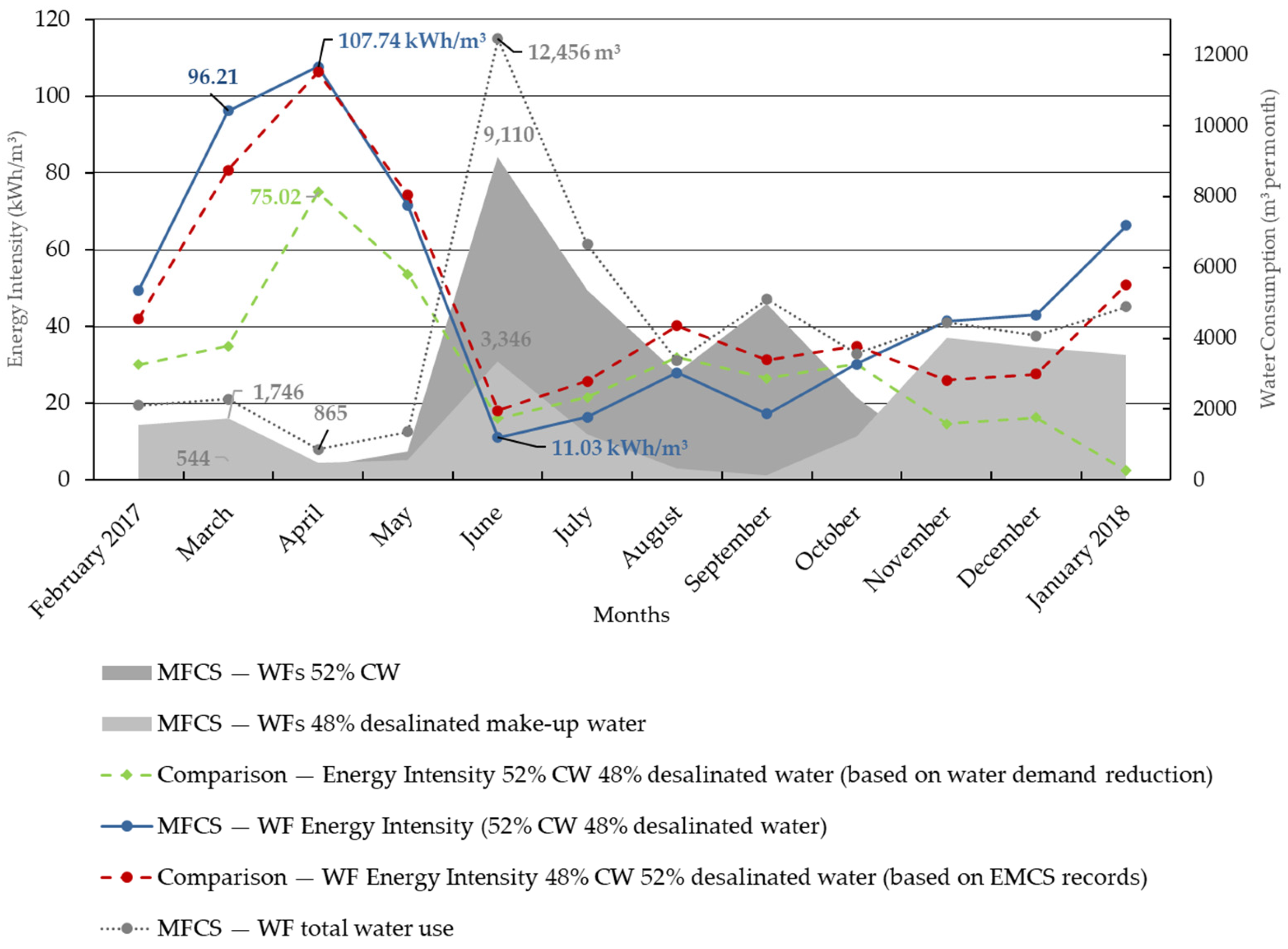
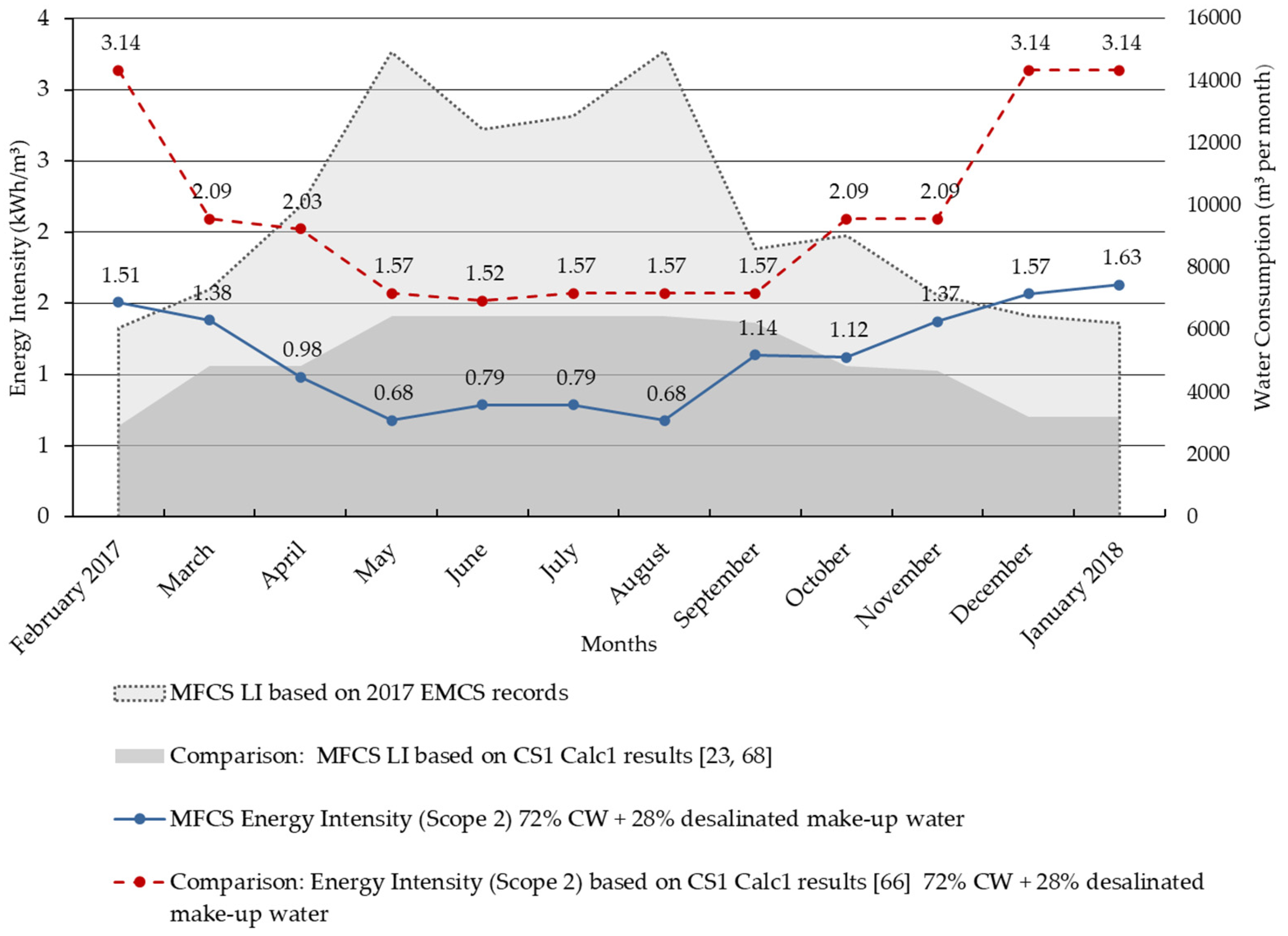
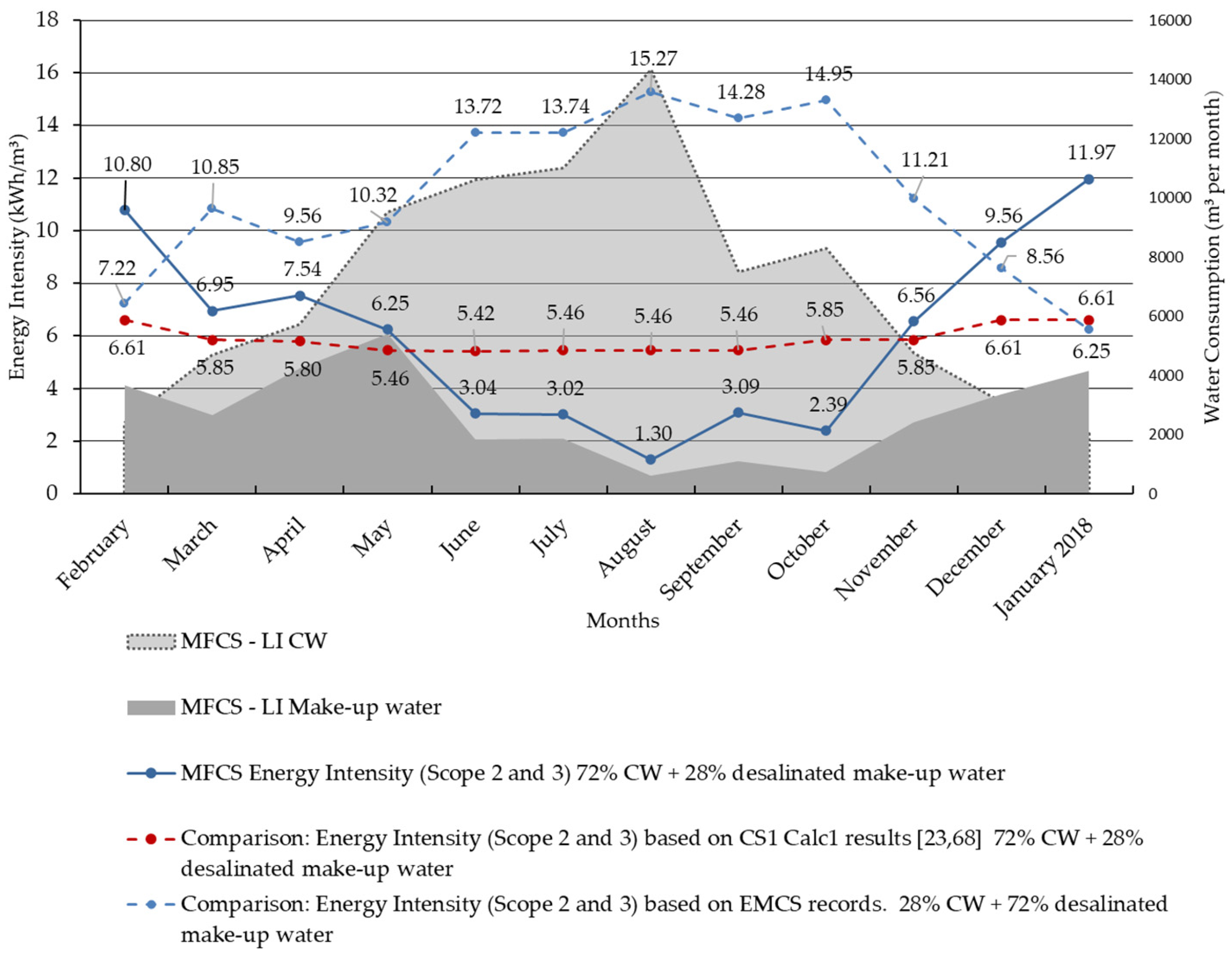
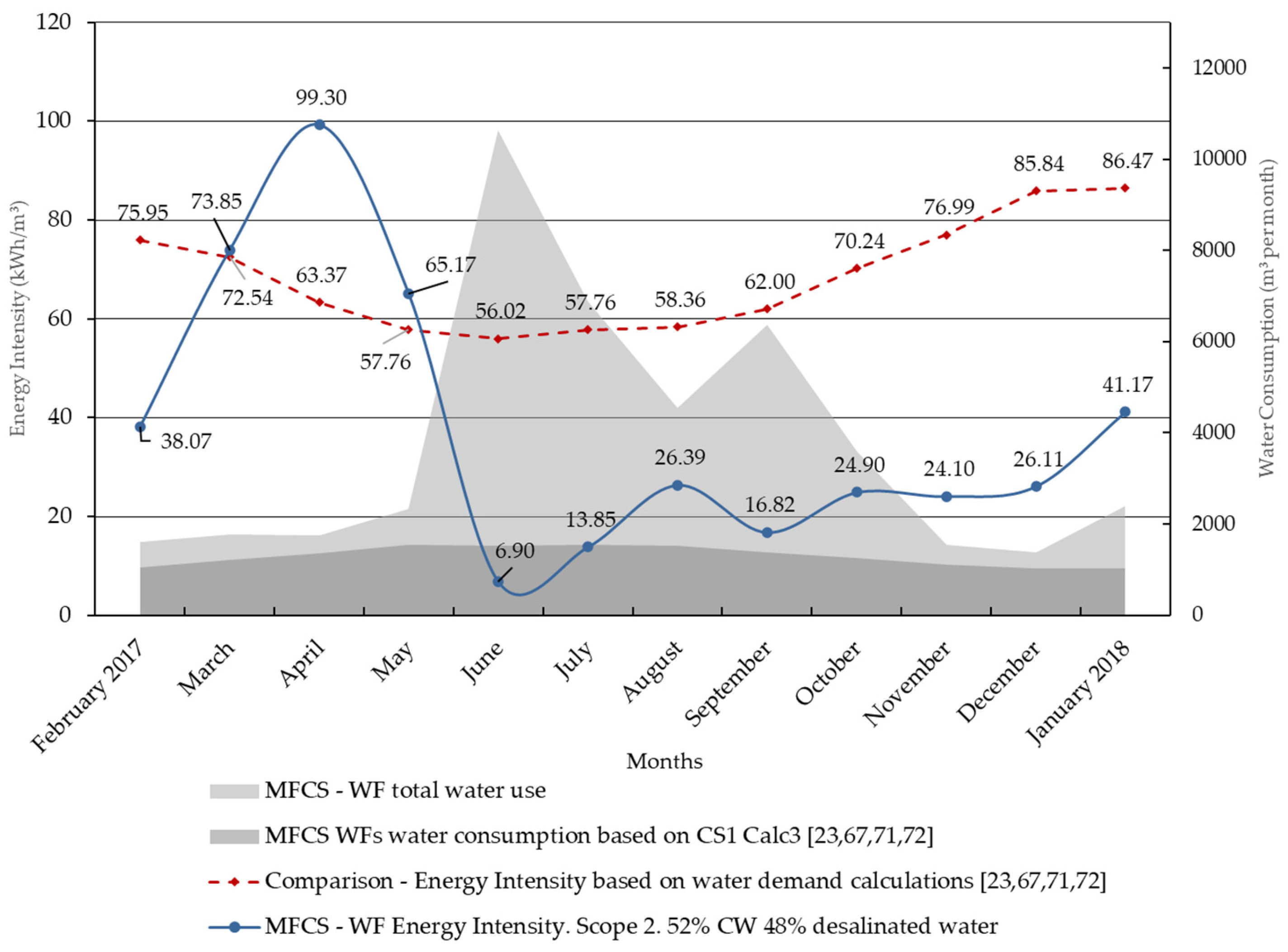
Figure 3 illustrates the monthly variation in WF energy intensity (Scope 2 and 3). Figure A4 (Appendix A) shows pronounced peaks during periods of low total water throughput and increased reliance on desalinated make-up water [66]. As total water use increases, particularly during summer months with higher CW availability, energy intensity declines despite higher absolute power consumption. This confirms that energy intensity is structurally inversely related to total water volume and materially influenced by water source composition. A comparable pattern is observed for the LI system (Appendix A, Figure A1 and Figure A2).
For LI, lower total consumption yields higher kWh/m3 values even when absolute power demand decreases. For example, in February 2017, consumption of 6057 m3 corresponds to 1.51 kWh/m3, whereas in May 2017, consumption of 14,909 m3 reduces intensity to 0.68 kWh/m3 (Appendix A, Figure A2). When the LI demand is aligned to CS1 Calculation One (60,580 m3/year), the average intensity increases from 5.28 to 5.87 kWh/m3. Increasing the desalinated proportion to 72% further raises intensity to 11.33 kWh/m3, isolating the compositional effect.
WF behaviour demonstrates even greater sensitivity. Average WF energy intensity increases from 22.82 kWh/m3 (Scope 2) under observed MFCS conditions to 68.59 kWh/m3 at 15,590 m3/year (CS1 Calculation Three [54]; Appendix A, Figure A3). Monthly variation reinforces this dependence: in March 2017, low throughput combined with a higher desalinated share resulted in 96.21 kWh/m3, whereas increased water availability in June 2017 reduced intensity to 11.03 kWh/m3.
If WF demand was aligned to 15,590 m3/year while maintaining the observed 52% CW/48% desalinated ratio, intensity would increase to 46.57 kWh/m3, exceeding the MFCS 2017 average of 30.20 kWh/m3. Increasing the desalinated share to 52% further elevates intensity to 76.60 kWh/m3. Peak values (Appendix A, Figure A4) occur during months of very low consumption (e.g., 885 m3 in April 2017), demonstrating that both throughput constraints and desalinated-water reliance amplify system-level GHG emission intensity.
Overall, the MFCS results demonstrate that while absolute energy demand is dominated by WF pumping and treatment, energy intensity is primarily driven by total water throughput and the proportion of desalinated make-up water. These findings confirm earlier observations in [69] and provide a quantitative basis for comparison with Scenarios 2 and 3 presented in Section 3.4.

3.2. MFCS Calc4 Environmental Impact

Based on the EMCS operational records, the LI and WF systems operate under a mixed supply of desalinated make-up water and CW-derived NPW. Consistent with the Scope 2 and Scope 3 accounting structure defined in Section 2, Table 5 reports gross emissions (Scope 2 and Scope 3), Scope 3 decarbonisation from NPW substitution, and net GHG outcome by end use, based on EAD [85] and IEA [30] emission factors.
Under the MFCS configuration, WFs remain net emitters because Scope 2 pumping demand and residual desalinated make-up emissions exceed Scope 3 decarbonisation from CW substitution. By contrast, LI remains net decarbonising because avoided desalination emissions from CW substitution exceed Scope 2 electricity demand. Aggregated across LI and WFs, the facility-level net outcome is modestly positive, reflecting opposing subsystem behaviours and incorporating pump energy demand and treatment-related electricity consumption.
The Calc4 results, therefore, capture the full operational boundary of the NPW system, including pump energy demand and treatment-related electricity consumption. While CW substitution generates substantial Scope 3 decarbonisation benefits, these gains are partially offset by Scope 2 electricity use and residual desalinated make-up water demand. The net outcome is system-dependent: LI delivers overall decarbonisation, whereas WFs remain emission-intensive due to higher pumping energy requirements.

3.3. MFCS Financial Impact

Table 6 provides the NPV, BC, and SPP for the observed MFCS configuration, based on the cost variables associated with building and operating a treated-NPW system. The analysis assumes an average outdoor water supply mix of 38% desalinated water and 62% CW (LI: 28% desalinated water and 72% CW; WFs: 48% desalinated water and 52% CW), derived from EMCS operational records.
Using a 20-year project horizon and a 16% discount rate [81,82], the MFCS configuration yields: NPV: USD 513,626; BC: 0.58; and SPP: 3.85 years.
Although a positive NPV is achieved within the project lifetime, the BC remains below unity, indicating that discounted life-cycle benefits do not exceed total costs under the observed configuration, consistent with standard economic evaluation criteria [84].

3.4. Results Summary

The existing MFCS configuration operates at an overall energy intensity of 12.33 kWh/m3 and achieves a net decarbonisation intensity of 0.40 kgCO2e/m3 (Table 7). Although measurable emissions reductions arise through partial reliance on NPW sources, performance remains constrained by electricity demand for pumping and treatment and by continued reliance on desalinated make-up water.
The MFCS results are evaluated relative to two comparator scenarios: Baseline Scenario 2 (S2), representing a conventional 100% desalinated-water supply configuration (Table 8), and the Proposed Research Project Scenario 3 (PRP S3), incorporating enhanced NPW use and system optimisation (Table 9).
Comparative results demonstrate a clear performance gradient across scenarios. PRP S3 delivers the greatest decarbonisation benefit, achieving 10.94 kgCO2e/m3 net decarbonisation intensity (Table 9), compared with 0.40 kgCO2e/m3 under MFCS (Table 7) and 19.53 kgCO2e/m3 net emission intensity under S2 (Table 8). Importantly, the optimised strategy displaces desalinated-water supply associated with an embedded energy intensity of approximately 15.40 kWh/m3 [25]. Section 4 builds on these results by comparing MFCS, baseline, and optimised scenarios within an integrated environmental and financial framework.

4. Discussion

4.1. NPW System Energy Impact

The comparative patterns presented in Table 10 and Table 11 demonstrate that energy intensity in decentralised NPW systems is governed primarily by water source hierarchy and hydraulic configuration rather than by total volumetric demand alone. Table 10 separates onsite pumping (Scope 2) from embedded desalination energy (Scope 3), clarifying that the dominant driver of total system intensity under the fully desalinated baseline (S2) is embedded upstream production energy rather than onsite electricity demand. This interpretation remains consistent with the system boundary and equipment scope defined in [1], including a water–energy system comprising 31 pumps supporting storage, conveyance, treatment, and distribution across LI and WFs.
Under S2, desalinated supply introduces a structural energy burden that compounds pumping and treatment demand. In contrast, the PRP S3 configuration eliminates embedded desalination exposure and simultaneously reduces pumping energy through runtime optimisation and hydraulic adjustment. The reductions summarised in Table 11, therefore, reflect a reallocation of energy exposure within the system boundary rather than a simple reduction in water volume.
The differentiation between LI and WFs further illustrates structural constraints. Irrigation demand can be modulated through soil enhancement, runtime scheduling, and demand control, enabling elastic energy response. WFs, however, remain intrinsically energy-intensive due to continuous circulation, evaporation losses, and treatment requirements. Even under PRP S3, WFs exhibit structurally higher intensity relative to LI, confirming that decorative hydraulic systems represent persistent energy liabilities unless fundamentally redesigned.
Seasonal variability also emerges as a critical determinant. Partial substitution under the MFCS configuration leaves the system exposed to desalinated make-up water during CW deficits, amplifying embedded energy volatility. By contrast, the PRP S3 configuration dampens this volatility through coordinated demand control, storage alignment, and full NPW prioritisation, consistent with the intervention logic defined in [67]. Thus, Table 10 and Table 11 confirm that system configuration, specifically source substitution combined with runtime optimisation, governs energy intensity at asset scale.
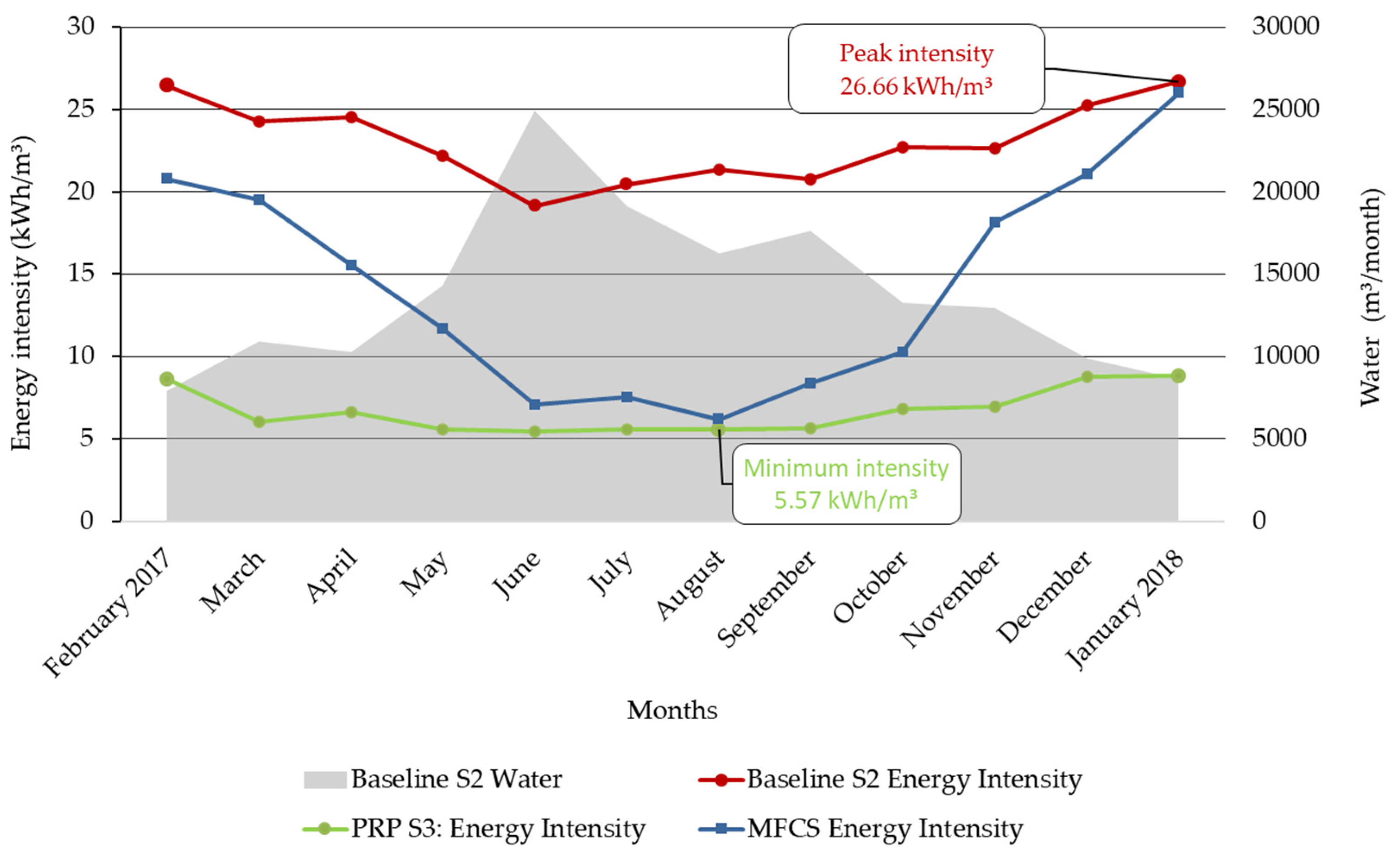
Figure 4 confirms that scenario divergence is structurally embedded in source hierarchy and runtime configuration, rather than mechanically correlated with total water volume. The fully desalinated baseline (S2) maintains the highest intensity throughout the year, peaking at 26.66 kWh/m3 in January 2018, reflecting persistent embedded desalination energy exposure. In contrast, PRP S3 achieves a minimum intensity of 5.57 kWh/m3 in August 2017, indicating the combined effect of full NPW substitution and reduced operating hours. The MFCS configuration remains intermediate, but exhibits pronounced seasonal sensitivity.

4.2. GHG Emissions and Decarbonisation

Table 12 translates these energy dynamics into net GHG outcomes, confirming that volumetric water savings do not automatically equate to decarbonisation. Under the observed MFCS configuration, irrigation achieves net decarbonisation while WFs remain net emitters, yielding only a marginal overall annual balance. This divergence reflects the asymmetric interaction between avoided embedded desalination emissions and continuous pumping demand. Table 12 reports end-use outcomes for MFCS and S2; for PRP S3, results are presented at the total-system level due to integrated NPW source substitution and demand control interventions.
The fully desalinated baseline (S2) represents a structurally emission-intensive configuration, as embedded upstream production and onsite electricity use combine cumulatively. By contrast, PRP S3 achieves a structural shift from net emission to net decarbonisation. This shift is not attributable solely to water source substitution; it is reinforced by runtime optimisation and soil-mediated demand reduction. The latter is consistent with the soil-conditioning and demand control interventions previously defined in [67], which demonstrate how irrigation demand intensity and associated Scope 2 energy can be reduced structurally.
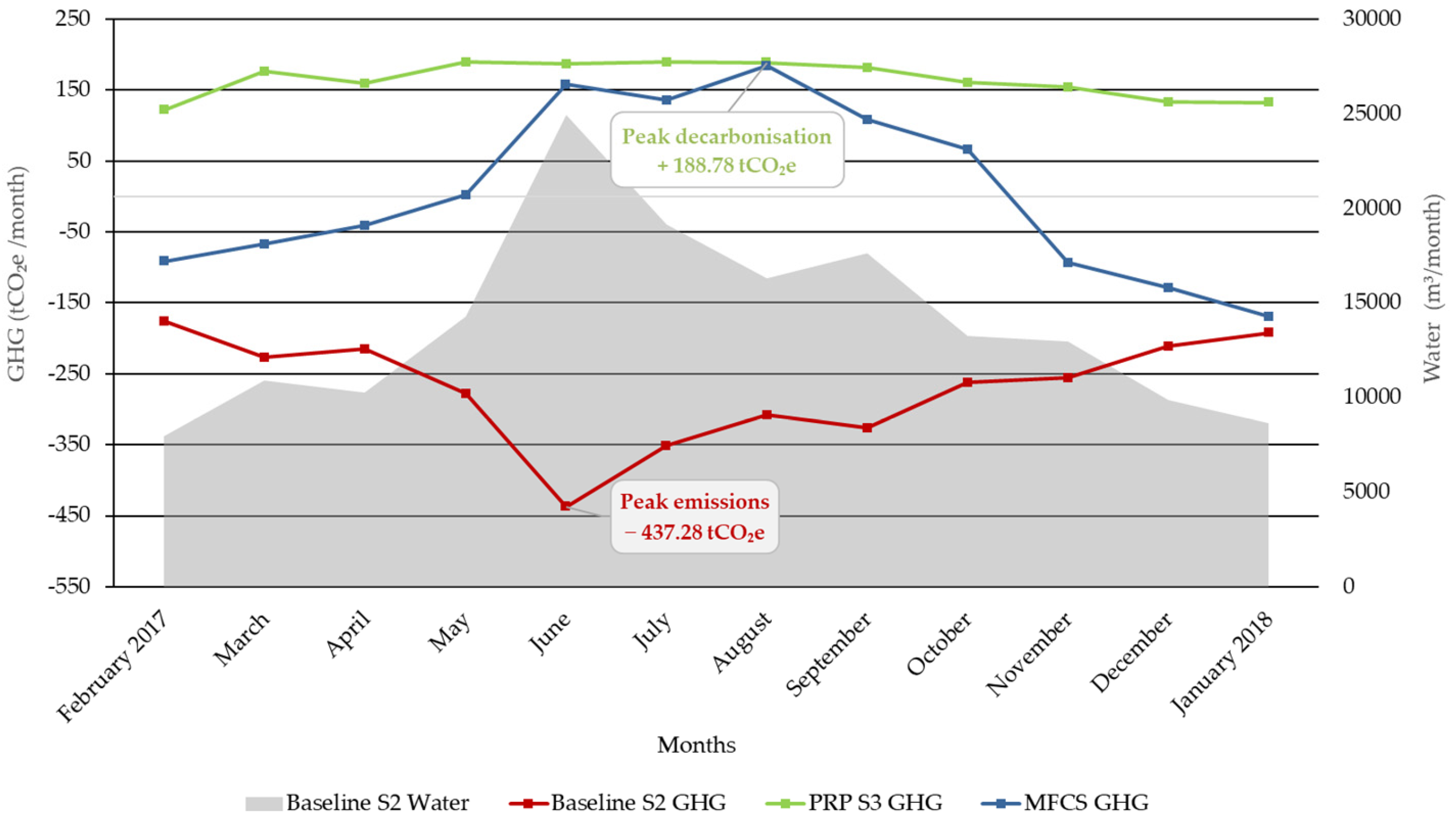
Figure 5 provides a monthly resolution of these annual outcomes. Monthly values are expressed in tCO2e/month and represent total Scope 2 and Scope 3 performance per scenario. Under S2, peak emissions occur in June 2017 (−437.28 tCO2e), reflecting full reliance on desalinated-water supply during peak demand conditions. In contrast, PRP S3 achieves peak decarbonisation of +188.78 tCO2e in August 2017. The divergence between these extrema (626 tCO2e) illustrates the magnitude of cross-scenario variation at the seasonal scale.
Figure 4 and Figure 5 together indicate that GHG decarbonisation outcomes are determined by the interaction between normalised energy intensity (kWh/m3), total water throughput (m3/month), and embedded desalination exposure, rather than by energy efficiency alone. Consequently, months with high volumetric demand may exhibit moderate intensity but high total emissions, while low-demand months may show elevated intensity without proportionally large GHG impact. This distinction clarifies that decarbonisation performance depends on both intensity behaviour and total system throughput.
The observed divergence reflects the interaction between CW availability, embedded desalination intensity, and runtime control. Under PRP S3, coordinated source substitution and demand optimisation stabilise monthly performance and reduce structural GHG exposure. These findings align with the broader water–energy nexus literature emphasising the dominance of upstream production intensity in arid desalination-dependent systems [30,50,53].
Collectively, the results reveal a structural distinction between irrigation systems and WFs. Irrigation performance improves when soil conditioning, demand control, and NPW prioritisation operate concurrently. WFs remain constrained by circulation requirements and higher duty cycles. Consequently, GHG performance is determined by integrated system design rather than reuse percentage alone.

4.3. Financial Impact Comparison

The LCC results (Table 13) demonstrate that environmental optimisation and financial performance are structurally coupled. Although MFCS and PRP S3 require higher initial capital investment than the baseline (S2) long-term operating exposure diverges substantially due to differing dependence on desalinated-water supply.
Under S2, sustained operating expenditure reflects continued reliance on embedded energy-intensive desalinated water. MFCS achieves partial cost reduction but remains financially marginal under discounted evaluation. Only PRP S3 crosses the financial viability threshold (BC > 1), indicating that marginal reuse does not internalise embedded energy exposure sufficiently to shift life-cycle economics. Full displacement of desalinated supply, combined with runtime optimisation, is required to convert environmental gains into durable financial value.
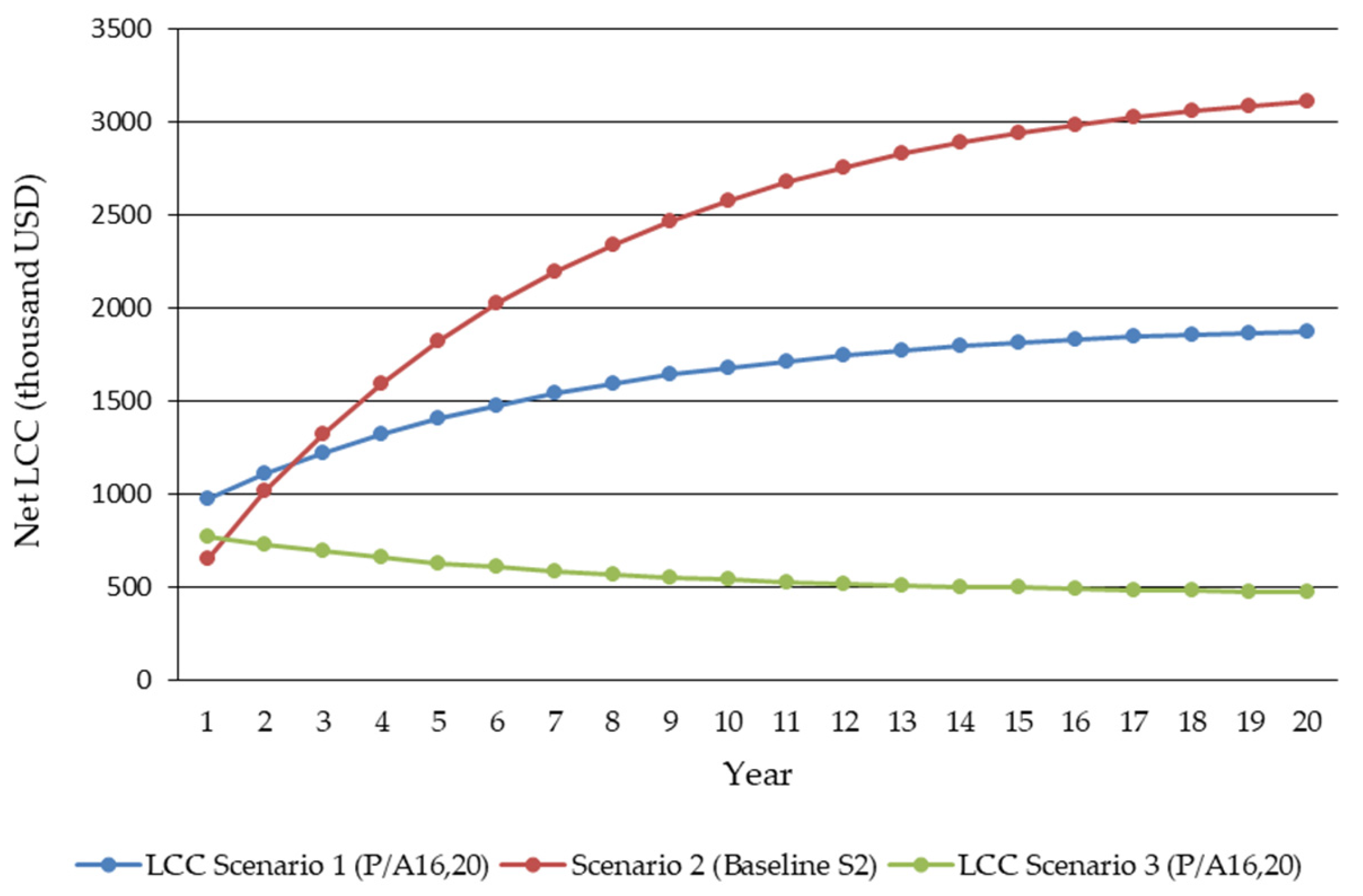
Figure 6 shows that the cumulative discounted net LCC diverges progressively over time. The structural driver of this divergence is not capital cost alone but avoided embedded energy exposure. Reductions in desalinated dependency translate directly into lower long-term operating liability, linking asset-level GHG performance to discounted LCC outcomes. In practice, periodic replacements (such as annual UV lamps; ozone generator overhauls every 5–7 years; pump/VFD refurbishment at 10–12 years) would introduce step changes in Net LCC curves. At a 16% discount rate, these effects are secondary to the operating exposure driven by desalinated-water dependency, so scenario ordering is expected to remain unchanged.
These findings reinforce the environmental conclusions: partial substitution produces limited benefit, whereas integrated optimisation combining full NPW supply with demand control shifts both GHG and financial performance.

4.4. GHG Metric Methodology for Onsite NPW Systems

Electricity consumption associated with water and wastewater systems remains a major contributor to GHG emissions [5,50,53,86,87,88]. Although water–energy nexus research identifies systemic interdependencies [30,50,53] asset-scale methodologies capable of integrating water demand, embedded supply emissions, and onsite distribution energy remain limited [1,54,55].
The GHG metric (kgCO2e/m3) applied in this study addresses this gap by operationalising a boundary-consistent asset-level benchmarking framework. As summarised in Table 14, the metric distinguishes between net emission and net decarbonisation configurations across water source hierarchies. Importantly, it demonstrates that partial reuse may still result in net emissions when embedded desalination exposure and pumping energy are not concurrently optimised.
By integrating volumetric demand, source composition, Scope 2 electricity use, and Scope 3 embedded emissions, the metric moves beyond isolated efficiency indicators and enables transparent comparison of decentralised NPW systems against desalinated supply under consistent system boundaries. This analytical structure operationalises the SWC framework [1,56], and provides a replicable asset-level benchmarking methodology.

4.5. Transferability and Policy Implementation Beyond Healthcare

The MFCS case illustrates how decentralised NPW systems underperform when implemented as supplementary design features rather than performance-managed infrastructure. Table 15 confirms that integrated optimisation, not water substitution alone, drives both environmental and financial outcomes.
Although healthcare estates exhibit characteristics (such as RORW generation, operational continuity), the structural principles are transferable to large institutional and commercial buildings in arid climates. CW and periodic NPW streams are common across typologies; however, facilities without healthcare-level redundancy may rely more heavily on storage optimisation and demand modulation to manage seasonal deficits.
Table 16 translates empirical findings into governance-oriented operational considerations. Existing standards and guidance [47,48,49,50,51,52,53,54,79] address water, energy, and emissions separately. Asset-level integration remains limited [1,54,55,68]. The SWC operational components summarised in Table 16 link sub-metering, soil–water alignment, prioritised NPW control logic, seasonal storage sizing, hydraulic efficiency, and integrated kgCO2e/m3 reporting into a coherent implementation pathway.
The findings demonstrate that decentralised NPW systems function as viable decarbonisation mechanisms only when water source hierarchy, hydraulic efficiency, demand control, and financial exposure are managed as a single integrated infrastructure system.

5. Conclusions

This research addressed the question, when are decentralised NPW systems environmentally and financially viable in arid-climate buildings? Using the MFCS in Abu Dhabi, the study applied a mixed-methods approach integrating longitudinal EMCS data, certified water quality testing, system audits, and scenario-based modelling. Two empirical investigations underpinned the analysis: CS1 evaluated water resources, supply–demand dynamics, and MEP performance, while CS2 assessed NPW quality and reuse suitability. These datasets informed the construction and evaluation of three comparative system configurations.
These three scenarios were systematically evaluated through an integrated GHG metric (kgCO2e/m3) linking water quantity, water source, onsite energy use (Scope 2), and embedded upstream emissions (Scope 3): (i) the observed MFCS configuration, (ii) a fully desalinated baseline (S2), and (iii) an optimised NPW configuration (PRP S3). The existing MFCS system, operating with an average of 62% AHU A/C CW and 38% desalinated make-up water for LI and WFs, delivers only marginal environmental benefit, achieving +64.07 tCO2e net decarbonisation. Continued reliance on desalinated water and suboptimal MEP system operation constrain performance.
By contrast, the fully desalinated baseline (S2) results in −3242.03 tCO2e net emissions, confirming desalination as the dominant emissions driver. The optimised scenario (PRP S3), which eliminates desalinated water for outdoor use and supplements CW with RORW and FSPTW during seasonal deficits, achieves +1120.68 tCO2e net decarbonisation. Under this configuration, energy intensity is reduced by approximately 86% for LI and 79% for WFs relative to the fully desalinated baseline, with net decarbonisation reaching 10.94 kgCO2e/m3 and LI energy intensity reduced to 1.24 kWh/m3 under CS1-aligned demand control. The optimised configuration reduces outdoor water demand by 36.7% relative to the observed configuration while simultaneously improving GHG and LCC performance.
Financial analysis demonstrates a consistent structural pattern. Under a 20-year discounted-net-LCC framework (discount rate = 16%), S2 exhibits the highest cumulative cost, MFCS performs intermediately, and PRP S3 achieves the lowest net LCC. By Year 20, cumulative discounted net LCC reaches approximately 11,600 thousand USD (S2), 7400 thousand USD (MFCS), and 2200 thousand USD (PRP S3), indicating progressively lower long-term cost exposure as desalinated-water dependency is reduced. These cumulative LCC results are consistent with the NPV and BC indicators reported in Section 3.3 and demonstrate that full NPW optimisation (PRP S3) not only improves environmental performance but also structurally reduces long-term operating exposure relative to both the observed MFCS configuration and the fully desalinated baseline.
Performance differentials reflect the structural relationship between water source, embedded energy intensity, and system configuration. At the MFCS location, MSF desalination operates at approximately 15.40 kWh/m3. Although contemporary RO plants may operate at lower intensities (2.5–7 kWh/m3), the comparative performance gradient remains structurally governed by water source substitution and operational optimisation rather than absolute desalination efficiency.
The results demonstrate that water scarcity alone is not the primary constraint on decentralised NPW reuse in arid climates. Underperformance arises from misaligned irrigation rates, inadequate NPW storage, oversized pumping systems, insufficient automation, and the absence of asset-level performance guidance for non-clinical NPW systems. Existing standards promote water efficiency and reuse strategically but do not provide mechanisms to evaluate integrated water–energy–GHG performance at the system scale.
To address these gaps, this research proposes the SWC Protocol, operationalised through the kgCO2e/m3 metric. At the practice level, it requires integrated design and operation, including soil–water alignment, NPW-first automation, seasonal storage sizing, pump recommissioning and runtime optimisation, and continuous sub-metering. At the regulatory level, it provides a performance-oriented benchmarking framework for evaluating decentralised NPW systems against desalinated alternatives.
Future research should focus on piloting the SWC Protocol across additional building typologies and climatic contexts to test transferability, refining default performance thresholds through multi-site datasets, and integrating the kgCO2e/m3 metric into building codes, planning approvals, and sustainability rating systems. Further work is also needed to connect asset-level water GHG metrics with emerging climate disclosure frameworks, enabling consistent reporting, verification, and performance tracking over time.
Overall, this research demonstrates that decentralised NPW systems in arid climates are environmentally and financially viable only when implemented as primary, performance-managed infrastructure for high-volume uses, particularly landscape irrigation and when evaluated through integrated water–energy–GHG metrics rather than water savings alone. Partial substitution without operational optimisation yields marginal benefit; structural decarbonisation requires system-level integration and asset-scale performance benchmarking.

Author Contributions

Conceptualisation, G.S.; methodology, G.S.; software, G.S.; validation, G.S.; formal analysis, G.S.; investigation, G.S.; resources, G.S.; data curation, G.S.; writing—original draft preparation, G.S.; writing—review and editing, G.S. and J.R.L.; visualisation, G.S.; supervision, J.R.L. and G.K.; project administration, G.S. All authors have read and agreed to the published version of the manuscript.

Funding

This research received no external funding.

Institutional Review Board Statement

Not applicable.

Informed Consent Statement

Not applicable.

Data Availability Statement

The datasets analysed in this study are derived from previously published sources and institutional operational records cited in the manuscript. No new datasets were generated.

Acknowledgments

The authors gratefully acknowledge the support of the Medical Facility (MF) team during the 2015–2018 study period, including the former Chief Academic Officer and Chief of Cardiovascular Medicine at the Heart and Vascular Institute, the former Senior Director of Hospital Operations, and members of the building owner’s team at that time. The authors also acknowledge the MF staff and contractors involved during the study period, including the building services specialist, the Mechanical, Electrical and Plumbing (MEP) management team, and the landscape contractor’s management team, for their technical assistance and operational support. The lead author further acknowledges the long-standing academic guidance and support of John Richard Littlewood and George Karani throughout the development and completion of this research.

Conflicts of Interest

The authors declare no conflicts of interest.

Abbreviations

The following abbreviations are used in this manuscript:
A/CAir Conditioning
CWCondensate water
ADAbu Dhabi
ADDCAbu Dhabi Distribution Company
ADMAbu Dhabi Municipality
AHUAir handling unit
BCBenefit–Cost Ratio
Calc4Calculation four
CO2Carbon dioxide
CS1Case study one
CS2Case study two
DoEDepartment of Energy—Abu Dhabi
EADEnvironment Agency—Abu Dhabi
ERAEmbedded Resource Accounting
GHGGreenhouse gas
EMCSEnergy Management and Control System
FSPTWFire sprinkler pump test water
ISOInternational Organization for Standardization
IWRMIntegrated water resources management (EAD)
kgCO2eKilogram of carbon dioxide equivalent
kWKilowatt
kWhKilowatt hour
LCCLife-Cycle Cost
LILandscape irrigation
m3Cubic metre
MEDMulti-effect distillation
MFCSMedical facility case study
MSFMulti-stage flash
NPVNet Present Value
NPWNon-potable water
PRP S3Proposed research project scenario 3
ROReverse osmosis
RORWReverse osmosis reject water
RSBRegulatory Supervision Bureau
SPPSimple Payback Period
S2Baseline case scenario 2
SWCSustainable Water Conservation and Reuse Protocol
TAQAAbu Dhabi National Energy Company
TSETreated sewage effluent
UAEUnited Arab Emirates
USDUnited States dollar
UVUltraviolet
VFDVariable Frequency Drive
WEGWater–energy–greenhouse gas
WFsWater features
WUEWater usage effectiveness

Appendix A. Detailed Energy Calculations Supporting Scope 2 Results

Appendix A provides detailed pump-level and treatment system energy calculations that underpin the aggregated Scope 2 values presented in Section 3. These calculations apply Equations (1)–(4), defined in [1], and are based on calibrated EMCS records (February 2017–January 2018).
Table A1. Detailed irrigation pump and treatment energy calculations (MFCS) based on Equations (2) and (4) in [1]. Table A1 presents pump-level energy demand calculations for the LI subsystem.
Pump SetPeak
Discharge (m3/s)
Head (m)Peak Power Demand (kW)Avg. Hours/DayDaily
Energy Demand
(kWh/Day)
Annual
Energy Demand (MWh/Year)
P2 LI pump Set 1 (100% usage/day)0.0181017.4413226.7282.75
P2 LI pump Set 2
(100% usage/day)
0.003256.811388.5632.32
P1 pump Set A (30% usage/day)0.005104.630.050.240.09
P1 pump Set B
(30% usage/day)
0.0181017.440.010.240.09
P1 pump Set C (10% usage/day)0.00534.630.020.070.03
P1 pump Set D (10% usage/day)0.01835.230.010.070.03
P5 LI pump Set 3 (30% usage/day)0.0188.715.010.010.200.07
P5 UV + Filtration (0.17 kWh/m3)----10.803.94
Total system----326.44119.33
Table A2. WF pumping and ozone treatment energy breakdown (MFCS). Table A2 presents detailed pumping and ozone treatment energy inputs for the WFs subsystem.
(a) Operating Time Assumptions
SeasonDays of OperationOperating hours (h/day)
Open season35110.67
Closed season140
(b) Pump sets—Landscape and WFs
Pump Set
description
Pump Set #Power (kW)m3/hNumber of pumpsUsage (%)Total kW
P1A4171301.2
P1B11641101.1
P1C4171301.2
P1D11641101.1
P3WF Pump 7.545.511007.5
(c) Ozone Tertiary Treatment System—Plant Rooms
Plant RoomPump TypePower (kW)Number of pumpsTotal kW
P4 Plant room 1Filter5.515.5
Display30130
P4 Plant room 2Filter30130
Display5.515.5
Display30130
P4 Plant room 3Filter5.515.5
Display37.5137.5
P4 Plant room 4Filter2.212.2
Display11.2111.2
P4 Plant room 5–7Filter22322
Display3.733.7
P4 Plant room 8Filter5.515.5
Display30130
Display5.515.5
Ozone Treatment System (based on 0.32 kWh/m3, [77]40.15
Total 23268.35
(d) System Energy Summary
ParametersValue
Total WF energy (kWh/day)2863.29
Total WF energy (kWh/year) 365 days1045,100.85
Total WF energy (MWh/year) 351 days1005.014.79
Figure A1. MFCS Monthly LI water consumption and corresponding Scope 2 energy intensity based on EMCS operational records (February 2017–January 2018), compared with CS1 Calculation One results [23].
Sustainability 18 02932 g0a1
Figure A2. MFCS Monthly LI water consumption and corresponding combined Scope 2 and Scope 3 energy intensity based on EMCS operational records (February 2017–January 2018). Scope 3 reflects embedded desalination energy calculated at 15.40 kWh/m3, while onsite CW carries zero embedded energy.
Sustainability 18 02932 g0a2
Figure A3. MFCS monthly WF consumption and corresponding Scope 2 energy intensity based on. EMCS operational records (February 2017–January 2018), compared with CS1 Calculation three (Calc 3) and demand calculations [23,66,70,71].
Sustainability 18 02932 g0a3
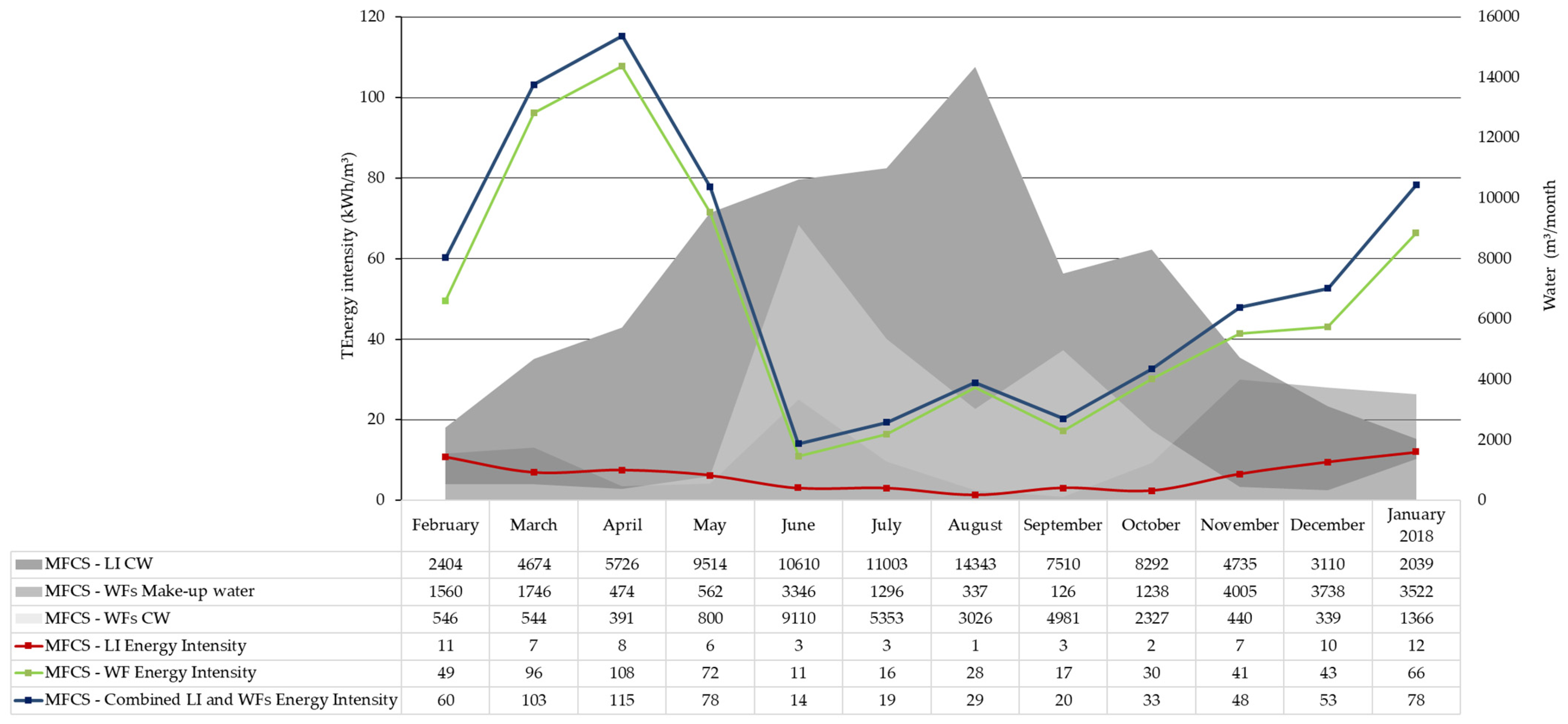
Figure A4. Monthly combined outdoor water consumption (LI + WFs) and corresponding total energy intensity (Scope 2 + Scope 3, kWh/m3) under Calc4 modelling conditions (February 2017–January 2018). Stacked areas represent CW and desalinated-make-up-water volumes (m3/month). Lines represent LI, WF, and combined energy intensity [23].
Sustainability 18 02932 g0a4

References

  1. Seguela, G.; Littlewood, J.R.; Karani, G. A GHG Metric Methodology to Assess Onsite Buildings Non-Potable Water System for Outdoor Landscape Use. Appl. Sci. 2020, 10, 1339. [Google Scholar] [CrossRef]
  2. Rubel, F.; Kottek, M. Observed and Projected Climate Shifts 1901-2100 Depicted by World Maps of the Köppen-Geiger Climate Classification. Meteorol. Z. 2010, 19, 135–141. [Google Scholar] [CrossRef]
  3. National Centre of Meteorology (NCM). Climate Yearly Report 2003–2025. Available online: https://www.ncm.gov.ae/services/climate-reports-yearly?lang=en (accessed on 24 February 2025).
  4. World Bank. Beyond Scarcity: Water Security in the Middle East and North Africa; World Bank: Washington, DC, USA, 2018. [Google Scholar]
  5. World Bank. Water in the Middle East and North Africa: Scarcity, Climate Change, and Conflict; World Bank: Washington, DC, USA, 2022. [Google Scholar]
  6. Kizhisseri, M.I.; Mohamed, M.M.; El-Shorbagy, W.; Chowdhury, R.; McDonald, A. Development of a Dynamic Water Budget Model for Abu Dhabi Emirate, UAE. PLoS ONE 2021, 16, e0245140. [Google Scholar] [CrossRef] [PubMed]
  7. DoE Abu Dhabi. Energy and Water Sector Policy Framework. Available online: https://www.doe.gov.ae (accessed on 10 January 2026).
  8. EAD Abu Dhabi. Integrated Water Resources Management Strategy 2021–2030. Available online: https://www.ead.gov.ae (accessed on 23 January 2026).
  9. DoE. The Future of Enhanced Water Sustainability Through the Graphene Revolution. Available online: https://www.doe.gov.ae/-/media/Project/DOE/Department-Of-Energy/Media-Center-Publications/English-Files/DOE-Future-Foresight-Reports---graphneENG.pdf (accessed on 10 January 2026).
  10. IEA. Desalination and the Energy Transition in the Middle East. Available online: https://www.iea.org/reports/desalination-and-the-energy-transition-in-the-middle-east (accessed on 9 January 2026).
  11. UAE Ministry of Energy and Infrastructure. The UAE Water Security Strategy 2036. Available online: https://u.ae/en/about-the-uae/strategies-initiatives-and-awards/federal-governments-strategies-and-plans/the-uae-water-security-strategy-2036 (accessed on 10 January 2026).
  12. UAE, Ministry of Energy and Infrastructure. Decarbonisation Pathway in UAE Water Security Strategy 2036. Available online: https://wstagcc.org/wp-content/uploads/2017/11/1.-WSTA-15-GWC-Hind-Al-Ali.pdf (accessed on 10 January 2026).
  13. Eyl-Mazzega, M.A.; Cassignol, E. The Geopolitics of Seawater Desalination. Available online: https://www.ifri.org/en/studies/geopolitics-seawater-desalination#:~:text=Water%20desalination%20is%20gradually%20emerging,and%20+12%25%20per%20year (accessed on 5 January 2026).
  14. Eckelman, M.J.; Sherman, J. Environmental Impacts of the U.S. Health Care System and Effects on Public Health. PLoS ONE 2016, 11, e0157014. [Google Scholar] [CrossRef]
  15. Lenzen, M.; Malik, A.; Li, M.; Fry, J.; Weisz, H.; Pichler, P.-P.; Chaves, L.; Capon, A.; Pencheon, D. The Environmental Footprint of Health Care: A Global Assessment. Lancet Planet. Health 2020, 4, e271–e279. [Google Scholar] [CrossRef]
  16. Dhillon, V.S. Green Hospital and Climate Change: Their Interrelationship and the Way Forward. J. Clin. Diagn. Res. 2015, 9, LE01–LE05. [Google Scholar] [CrossRef]
  17. Health Care Without Harm Health Care’s Climate Footprint: How the Health Sector Contributes to the Global Climate Crisis and Opportunities for Action. Available online: https://sustainability.emory.edu/wp-content/uploads/2020/06/HealthCaresClimateFootprint_090619.pdf (accessed on 23 January 2026).
  18. Castro, M.D.F.; Mateus, R.; Bragança, L. Development of a Healthcare Building Sustainability Assessment Method—Proposed Structure and System of Weights for the Portuguese Context. J. Clean. Prod. 2017, 148, 555–570. [Google Scholar] [CrossRef]
  19. McGain, F.; Naylor, C. Environmental Sustainability in Hospitals—A Systematic Review and Research Agenda. J. Health Serv. Res. Policy 2014, 19, 245–252. [Google Scholar] [CrossRef]
  20. Roschnik, S.; Sanchez Martinez, G.; Yglesias-Gonzalez, M.; Pencheon, D.; Tennison, I. Transitioning to Environmentally Sustainable Health Systems: The Example of the NHS in England. Public Health Panor. 2017, 3, 229–236. [Google Scholar]
  21. Cardno Greywater/Condensate Water Risk Assessment Report; Medical Facility: Abu Dhabi, United Arab Emirates; Cardno: Abu Dhabi, United Arab Emirates, 2014.
  22. U.S. EPA. WaterSense at Work: Best Management Practices for Commercial and Institutional Facilities Healthcare Facilities; U.S. Environmental Protection Agency: Washington, DC, USA, 2012. [Google Scholar]
  23. Seguela, G. Implementation and Evaluation of an Outdoor Water Conservation Strategy for Hospital Decarbonisation in an Arid Climate. Unpublished Professional Doctorate in Engineering Thesis, Cardiff Metropolitan University, Cardiff, UK, 2018. [Google Scholar]
  24. ADDC 2016-2017; Medical Facility Monthly Water Bills. Abu Dhabi Distribution Company: Abu Dhabi, United Arab Emirates, 2017.
  25. MoEW United Arab Emirates Water Conservation Strategy. Available online: https://faolex.fao.org/docs/pdf/uae147095.pdf (accessed on 10 January 2026).
  26. Ahuja, S. Water Recycling and Reuse. In Water Reclamation and Sustainability; Elsevier: Amsterdam, The Netherlands, 2014; pp. 431–454. [Google Scholar]
  27. Ghaffour, N.; Missimer, T.M.; Amy, G.L. Technical Review and Evaluation of the Economics of Water Desalination: Current and Future Challenges for Better Water Supply Sustainability. Desalination 2013, 309, 197–207. [Google Scholar] [CrossRef]
  28. Jones, E.; Qadir, M.; Van Vliet, M.T.H.; Smakhtin, V.; Kang, S. The State of Desalination and Brine Production: A Global Outlook. Sci. Total Environ. 2019, 657, 1343–1356. [Google Scholar] [CrossRef]
  29. Shahzad, M.W.; Burhan, M.; Ang, L.; Ng, K.C. Energy-Water-Environment Nexus Underpinning Future Desalination Sustainability. Desalination 2017, 413, 52–64. [Google Scholar] [CrossRef]
  30. IEA. Water-Energy Nexus. Available online: https://www.iea.org/reports/water-energy-nexus (accessed on 10 January 2026).
  31. Verner, D. (Ed.) Adaptation to a Changing Climate in the Arab Countries: A Case for Adaptation Governance and Leadership in Building Climate Resilience; MENA Development Report; World Bank: Washington, DC, USA, 2012. [Google Scholar]
  32. EAD. The Water Resources Management Strategy for the Emirates of Abu Dhabi 2014–2018. Available online: https://www.scribd.com/document/265738494/Executive-Summary-of-the-Water-Resources-Management-Strategy-for-the-Emirate-of-Abu-Dhabi-2014-2018-Eng1 (accessed on 23 January 2026).
  33. UPC Plan Abu Dhabi 2030-Urban Structure Framework Plan. Available online: https://u.ae/en/about-the-uae/strategies-initiatives-and-awards/strategies-plans-and-visions/transport-and-infrastructure/plan-abu-dhabi-2030 (accessed on 10 January 2026).
  34. TAQA. Distribution Utility Tariff 2025. Available online: https://www.addc.ae/en-US/residential/Documents/2025%20Tariff%20(English).pdf (accessed on 10 May 2025).
  35. ADDC. Water and Energy Tariffs 2017. Available online: https://www.aadc.ae/pdfs/Tariff/Tariff2017Englishwebsite.pdf (accessed on 2 February 2026).
  36. Central Bank of the UAE. Monetary Policy Framework and Exchange Rate Regime. Available online: https://www.centralbank.ae/ar/ (accessed on 14 January 2026).
  37. Ali, E.S.; Alsaman, A.S.; Harby, K.; Askalany, A.A.; Diab, M.R.; Ebrahim Yakoot, S.M. Recycling Brine Water of Reverse Osmosis Desalination Employing Adsorption Desalination: A Theoretical Simulation. Desalination 2017, 408, 13–24. [Google Scholar] [CrossRef]
  38. Shahid, S.A. Developments in Soil Classification, Land Use Planning and Policy Implications; Springer: New York, NY, USA, 2013. [Google Scholar]
  39. EAD. Integrated Water Resources Management Plan in Abu Dhabi; EAD: Tokyo, Japan, 2021. [Google Scholar]
  40. Paul, P.; Al Tenaiji, A.; Braimah, N. A Review of the Water and Energy Sectors and the Use of a Nexus Approach in Abu Dhabi. Int. J. Environ. Res. Public. Health 2016, 13, 364. [Google Scholar] [CrossRef] [PubMed]
  41. RSB Regulatory Supervision Bureau (RSB). Guide to Recycled Water and Biosolids Regulations 2010; RSB Regulatory Supervision Bureau (RSB): Abu Dhabi, United Arab Emirates, 2010. [Google Scholar]
  42. Department of Energy (DoE) Recycled Water and Biosolids Regulations. 2021. Available online: https://www.doe.gov.ae/-/media/Project/DOE/Department-Of-Energy/Media-Center-Publications/Regulations/English/Recycled-Water--Biosolids-Regulations-2021-Edition-3.pdf (accessed on 15 December 2025).
  43. EAD Decree No. (7) of 2024 on Soil Contamination Risk Assessment and Management. Available online: https://www.lexismiddleeast.com/law/AbuDhabi/Decision_7_2024/en (accessed on 8 March 2026).
  44. Environment Agency—Abu Dhabi (EAD) Regulation No. (5) of 2024 on Soil Quality. 2024. Available online: https://www.mediaoffice.abudhabi/en/environment/environment-agency-abu-dhabi-issues-a-regulation-on-soil-quality-in-the-emirate-to-promote-safety-and-sustainable-management/ (accessed on 8 March 2026).
  45. EAD Abu Dhabi. Soil Contamination Assessment and Remediation User Guide; Environment Agency—Abu Dhabi (EAD): Abu Dhabi, United Arab Emirates, 2024. [Google Scholar]
  46. ISO 14046:2016; Environmental Management—Water Footprint—Principles, Requirements and Guidelines. International Organization for Standardization (ISO): Geneva, Switzerland, 2016.
  47. ISO 50001:2018; Energy Management Systems—Requirements with Guidance for Use. International Organization for Standardization (ISO): Geneva, Switzerland, 2018.
  48. Walsh, B.P.; Murray, S.N.; O’Sullivan, D.T.J. The Water Energy Nexus, an ISO50001 Water Case Study and the Need for a Water Value System. Water Resour. Ind. 2015, 10, 15–28. [Google Scholar] [CrossRef]
  49. Ruddell, B.L.; Adams, E.A.; Rushforth, R.; Tidwell, V.C. Embedded Resource Accounting for Coupled Natural-Human Systems: An Application to Water Resource Impacts of the Western U.S. Electrical Energy Trade. Water Resour. Res. 2014, 50, 7957–7972. [Google Scholar] [CrossRef]
  50. TCR. Water–Energy–Greenhouse Gas (WEG) Guidance; The Climate Registry: Los Angeles, CA, USA, 2015. [Google Scholar]
  51. TCR. General Reporting Protocol, Version 2.1; The Climate Registry: Los Angeles, CA, USA, 2015.
  52. WRI; WBCSD. The Greenhouse Gas Protocol: Corporate Accounting and Reporting Standard. Available online: https://ghgprotocol.org/corporate-standard (accessed on 10 January 2026).
  53. Nair, S.; George, B.; Malano, H.M.; Arora, M.; Nawarathna, B. Water–Energy–Greenhouse Gas Nexus of Urban Water Systems: Review of Concepts, State-of-Art and Methods. Resour. Conserv. Recycl. 2014, 89, 1–10. [Google Scholar] [CrossRef]
  54. Seguela, G.; Littlewood, J.R.; Karani, G. Water Resource Management in the Context of a Non-Potable Water Reuse Case Study in Arid Climate. Energy Ecol. Environ. 2020, 5, 369–388. [Google Scholar] [CrossRef]
  55. Seguela, G.; Littlewood, J.R.; Karani, G. Non-Potable Water Quality Assessment Methodology for Water Conservation in Arid Climates. Water Conserv. Sci. Eng. 2020, 5, 215–234. [Google Scholar] [CrossRef]
  56. WRI World Resource Institute. GHG Protocol Scope 2 Guidance; WRI World Resource Institute: Washington, DC, USA, 2015. [Google Scholar]
  57. WRI. Carbon Trust Technical Guidance for Calculating Scope 3 Emissions (Version 1.0). Available online: https://ghgprotocol.org/sites/default/files/standards/Scope3_Calculation_Guidance_0.pdf (accessed on 10 January 2026).
  58. Van den Brink, A.; Bruns, D.; Tobi, H.; Bell, S. Research in Landscape Architecture: Methods and Methodology, 1st ed.; Routledge: Oxford, UK, 2017. [Google Scholar]
  59. O’Leary, Z. The Essential Guide to Doing Your Research Project, 3rd ed.; SAGE: London, UK, 2017. [Google Scholar]
  60. Coghlan, D.; Brannick, T. Doing Action Research in Your Own Organization, 4th ed.; SAGE: London, UK, 2014. [Google Scholar]
  61. Swaffield, S. Chapter 7: Case Studies. In Research in Landscape Architecture: Methods and Methodology; Routledge: Oxford, UK, 2017; pp. 105–119. [Google Scholar]
  62. Creswell, J.W.; Plano Clark, V.L. Designing and Conducting Mixed Methods Research, 3rd ed.; Sage Publications: Thousand Oaks, CA, USA, 2018. [Google Scholar]
  63. Gill, J.; Johnson, P.; Clark, M. Research Methods for Managers, 4th ed.; Sage: Los Angeles, CA, USA, 2010. [Google Scholar]
  64. Yin, R.K. Case Study Research: Design and Methods, 5th ed.; Sage: Thousand Oaks, CA, USA, 2014. [Google Scholar]
  65. Seguela, G.; Littlewood, J.R.; Karani, G. Eco-Engineering Strategies for Soil Restoration and Water Conservation: Investigating the Application of Soil Improvements in a Semi-Arid Climate in a Medical Facility Case Study, Abu Dhabi. Ecol. Eng. 2018, 121, 53–64. [Google Scholar] [CrossRef]
  66. Seguela, G.; Littlewood, J.R.; Karani, G. A Study to Assess Alternative Water Sources for Reducing Energy Consumption in a Medical Facility Case Study, Abu Dhabi. Energy Procedia 2017, 134, 797–806. [Google Scholar] [CrossRef]
  67. Seguela, G.; Littlewood, J.R.; Karani, G. Evaluation of a Landscape Irrigation Management Strategy to Support Abu Dhabi Update Its Water-Related Standards. In Water Quality—New Perspectives; Dincer, S., Aysun Mercimek Takci, H., Sumengen Ozdenefe, M., Eds.; IntechOpen: London, UK, 2024. [Google Scholar]
  68. Seguela, G.; Littlewood, J.R.; Karani, G. Non-Potable Water Quality Assessment Results for Water Conservation in the Context of a Medical Facility Case Study. Sustainability 2022, 14, 6578. [Google Scholar] [CrossRef]
  69. Seguela, G.; Littlewood, J.R.; Karani, G. Onsite Food Waste Processing as an Opportunity to Conserve Water in a Medical Facility Case Study, Abu Dhabi. Energy Procedia 2017, 111, 548–557. [Google Scholar] [CrossRef]
  70. Gallion, T.; Harrison, T.; Hulverson, R.; Hristovski, K.; Ahuja, S. Estimating Water, Energy, and Carbon Footprints of Residential Swimming Pools. In Water Reclamation and Sustainability; Elsevier: Amsterdam, The Netherlands, 2014; pp. 343–359. [Google Scholar]
  71. Forrest, N.; Williams, E. Life Cycle Environmental Implications of Residential Swimming Pools. Environ. Sci. Technol. 2010, 44, 5601–5607. [Google Scholar] [CrossRef]
  72. Rothausen, S.G.S.A.; Conway, D. Greenhouse-Gas Emissions from Energy Use in the Water Sector. Nat. Clim. Change 2011, 1, 210–219. [Google Scholar] [CrossRef]
  73. Kay, M.; Hatcho, N. Small-Scale Pumped Irrigation: Energy and Cost; FAO Irrigation and Drainage Paper; Food and Agriculture Organization of the United Nations (FAO): Rome, Italy, 1992; pp. 5–40. [Google Scholar]
  74. Ayers, R.S.; Westcot, D.W. Water Quality for Agriculture; FAO irrigation and Drainage Paper; Food and Agriculture Organization of the United Nations: Rome, Italy, 1985. [Google Scholar]
  75. Food and Agriculture Organization of the United Nations (FAO). Irrigation Water Management: Training Manual No. 1 Introduction to Irrigation; FAO: Rome, Italy, 2019. [Google Scholar]
  76. Food and Agriculture Organization of the United Nations (FAO). Guidelines for Salinity and Sodicity Management in Irrigated Agriculture; FAO: Rome, Italy, 2019. [Google Scholar]
  77. Elliott, T.; Zeir, B.; Xagoraraki, I. Energy Use at Wisconsin’s Drinking Water Facilities; Energy Centre: Madison, WI, USA, 2003. [Google Scholar]
  78. ISO 14064-1:2018; Greenhouse Gases—Part 1: Specification with Guidance at the Organization Level for Quantification and Reporting of Greenhouse Gas Emissions and Removals. International Organization for Standardization (ISO): Geneva, Switzerland, 2018.
  79. EAD. Greenhouse Gas Inventory for Abu Dhabi Emirate; Environment Agency—Abu Dhabi (EAD): Abu Dhabi, United Arab Emirates, 2012. [Google Scholar]
  80. ADM Abu Dhabi Municipality. Irrigation Systems Operation and Maintenance; ADM Parks and Recreation Facilities Division—Section 2C 02800; ADM Abu Dhabi Municipality: Abu Dhabi, United Arab Emirates, 2013. [Google Scholar]
  81. Pawlik, K.-D.E. Economic Analysis and Life Cycle Costing; River Publishers: London, UK, 2021. [Google Scholar]
  82. Capehart, B.L.; Turner, W.C.; Kennedy, W.J. Guide to Energy Management, 7th ed.; Fairmont Press: Liburn, GA, USA, 2012. [Google Scholar]
  83. Dufresne, L.; Ferrell, L. (Eds.) Energy Management for Water Utilities; American Water Works Association: Denver, CO, USA, 2016. [Google Scholar]
  84. Economic Analysis. In Energy Management Handbook; Roosa, S.A., Doty, S., Turner, W.C., Eds.; Fairmont Press, Inc: Louisville, KY, USA, 2018. [Google Scholar]
  85. EAD. Greenhouse Gas Inventory and Projections for Abu Dhabi Emirates. Available online: https://www.ead.gov.ae/-/media/Project/EAD/EAD/Documents/Resources/EAD-GHG-Executive-Summary-Report-EN-final.pdf (accessed on 17 February 2026).
  86. Griffiths-Sattenspiel, B. Wendy Wilson The Carbon Footprint of Water; River Network: Boulder, CO, USA, 2009. [Google Scholar]
  87. CPUC. Embedded Energy in Water Studies: Study 1—Statewide and Regional Water–Energy Relationship. Available online: https://files.cpuc.ca.gov/gopher-data/energy%20efficiency/Water%20Studies%201/Study%201%20-%20FINAL.pdf (accessed on 6 January 2026).
  88. CPUC. Water–Energy Nexus Study: Water Agency and Function Component Study. Available online: https://files.cpuc.ca.gov/gopher-data/energy%20efficiency/Water%20Studies%202/Study%202%20-%20FINAL.pdf (accessed on 6 January 2026).
Figure 1. MFCS Summary [23]. Overview of the mixed-methods research design, showing the integration of CS1 and CS2, and associated calculations used to assess water, energy, GHG, and financial impacts, including Calc 1–Calc 3 demand recalculations affecting both LI and WFs subsystems. Adapted from Seguela (2018), Gallion et al. (2014) and Seguela et al. (2017, 2018, 2020a–c, 2022, 2024) [1,54,55,66,67,70].
Sustainability 18 02932 g001
Figure 2. Conceptual and methodological framework of the Medical Facility Case Study. The diagram presents the integrated research design linking case study one (water resources) and case study two (water quality), including onsite data collection, interventions, and scenario-based calculations. Adapted from [1,23].
Sustainability 18 02932 g002
Figure 3. MFCS Calc4 WF system energy intensity (Scope 2 and 3) [23]), showing higher unit intensity during low-volume months and lower intensity during peak throughput.
Sustainability 18 02932 g003
Figure 4. Monthly energy intensity (kWh/m3) across scenarios (February 2017–January 2018). Values reflect combined Scope 2 and Scope 3 impacts for outdoor water uses (LI + WFs). Baseline S2 water consumption is shown on the secondary axis (m3/month). The figure illustrates structural differences in intensity across system configurations.
Sustainability 18 02932 g004
Figure 5. Monthly net GHG outcomes across the three scenarios (February 2017–January 2018). Net GHG values (Scope 2 + Scope 3) are shown for combined outdoor water uses (LI + WFs) and are expressed in tCO2e/month. Positive values indicate net decarbonisation; negative values indicate net emissions. Baseline S2 water consumption (m3/month) is shown on the secondary axis. Adapted from [23].
Sustainability 18 02932 g005
Figure 6. Net LCC across scenarios (i = 16%, n = 20 years). Net LCC is calculated as capital expenditure plus the present value of net annual operating cost, discounted at 16% over a 20-year horizon in accordance with Equation (5). Assumptions: Capex applied at Year 1; annual net cost = (Opex − Savings) applied end-of-year; constant values; no replacements; no salvage value.
Sustainability 18 02932 g006
Table 1. Comparison of desalination technologies: cost, energy, and environmental performance (updated from [1]).
DescriptionMSFMEDROSources
Water cost production (USD/m3) 0.56–1.750.52–1.550.26–1.25[13,25,29]
Energy use (kWh/m3) 15.40–307.50–222.5–7[13,25,29]
Volume of saline feed water per m3 of fresh water 4–103–82–4[25,29]
GHG emissions of seawater desalination (kgCO2e/m3) 15.6–25.07.0–17.61.7–3.6[13,29]
Table 2. Annual MFCS water balance (February 2017–January 2018) used as input for scenario modelling (m3).
Water TypeScenario 1 (MFCS)Scenario 2 (S2)Scenario 3 (PRP S3) *
Desalinated Water 53,957166,035-
AHU A/C CW107,805-76,170
RORW--25,141
FSPTW--1136
Total Water Volume 161,762166,035102,447
* PRP S3 volumes reflect CS1-aligned demand recalculation (Calc 1–Calc 3) and Interventions 1 and 2 (Figure 1), with CS2 confirming NPW suitability.
Table 3. MFCS Calc4 energy intensity and power consumption results summary [23].
Scope DescriptionEnergy Intensity
(kWh/m3)
Power Consumption
(kWh/Day)
Scope 2 electrical consumption (WFs)22.822863.29
Scope 2 electrical consumption (LI)1.03326.44
Scope 3 offsite-produced
desalinated-water production (WFs)
15.40Equivalent to
28,169 kWh/month
Scope 3 offsite-produced desalinated-water production (LI)15.40Equivalent to
41,075 kWh per month
Scope 3 onsite-generated raw NPW0-
Combined Scope 2 and 3
Energy Intensity (WFs)
30.200
Combined Scope 2 and 3
Energy Intensity (LI)
5.28-
Table 4. MFCS Calc4 results: Energy demand based on CS1 Intervention One results 1 [23].
End UseWater SourceVolume (m3)GHG
Scope
Energy Use (kWh/Day Avg)Energy
Intensity (kWh/m3)
LIDesalinated water (28%)32,00731350 (equiv.)4.90 (equiv.)
LICW (72%)83,9603-0
LIPumping Energy 2-2326.441.03
LI total-115,9672 + 3326.445.28
WFsDesalinated water (48%)21,9503926 (equiv.)10.20 (equiv.)
WFsCW (52%)23,8453 0
WFsPumping Energy 3-22863.2922.82
WFs total-45,7952 + 32863.2930.20
MFCS Total (LI + WFs)-161,7622 + 33189.7312.33
1 Scope 3 desalination energy is expressed as kWh equivalent based on 15.40 kWh/m3 [25]. Onsite CW is assigned zero embedded energy as it is generated independently of additional treatment energy demand. 2 Eight pumps including a UV disinfection treatment system (0.017 Kwh/m3 × 2 units) serving the LI system (Scope 2). 3 Twenty-three pumps for WFs; 31 pumps for the total system.
Table 5. MFCS Calc4 GHG emissions and decarbonisation summary (2017 EMCS data), adapted from [23] and based on EAD [85] and IEA [30] emission factors.
ParametersWFs (tCO2e)LI (tCO2e)Combined Total (tCO2e)
Scope 2 electricity emissions−672.39−76.66−749.05
Scope 3 desalinated-water emissions−331.45−483.31−814.75
Total gross emissions (Scope 2 + 3)−1003.83−559.96−1563.79
Scope 3 NPW
decarbonisation
+360.06+1267.80+1627.86
Net GHG impact−643.77+707.83+64.07
Note: Net GHG emissions (−): Emissions exceed avoided emissions (Scope 2 + Scope 3 surplus). Net decarbonisation (+): Avoided emissions exceed Scope 2 and Scope 3 emissions.
Table 6. MFCS financial impact results [23].
Cost Estimate VariablesMFCS Results (USD)
Initial investment (tanks, piping, flow metres, pumps, EMCS connection, water treatment) 952,900
Annual water system maintenance for LI (fertigation, laboratory testing) 95,290
Annual landscape maintenance (soil conditioner) 61,258
Annual water system maintenance for WFs (chemicals, laboratory analysis, tank disinfection) 95,290
Total annual maintenance cost251,338
Annual desalinated-water cost and consumption based on water tariff [35] and based on 55,186 m3123,684
Annual electrical cost based on 865,798 kWh and electricity tariff in [35]49,515
Total annual water and electricity cost 173,145
Total annual expected water savings (110,393 m3)247,355
Total annual expected energy savings 0
NPV513,626
BC0.58
SPP3.85
Table 7. MFCS combined LI and WFs: Annual energy use, water consumption, and GHG emissions (2017–2018) 1 adapted from [23].
IndicatorResultsUnitReference
Total energy consumption (Scope 2)1,164,251kWh/yearEquation (5) in [1]
Total water consumption (m3)161,762m3/yearEMCS records
Total CW consumption (m3)107,805m3/yearEMCS records
Total desalinated-make-up-water consumption53,957m3/yearEMCS records
Scope 2 GHG emissions749.04tCO2e/yearEquation (13) in [1]
Scope 3 GHG emissions814.74tCO2e/yearEquation (14) in [1]
Total GHG emissions
(Scope 2 + 3, pre-decarbonisation)
1563.79tCO2e/yearEquation (16) in [1]
Scope 3 GHG decarbonisation1627.86tCO2e/yearEquation (15) in [1]
Net GHG emissions (Scope 2 + 3)64.07tCO2e/yearEquation (16) in [1]
Average net GHG intensity0.40kgCO2e/m3Equation (11) in [1]
1 Results reflect mixed water use comprising 72% CW and 28% desalinated make-up water.
Table 8. Baseline Scenario Two (S2): Combined LI and WFs—annual energy use, water consumption, and GHG emissions 2. Adapted from [23].
IndicatorResultsUnitReference
Total energy consumption (Scope 2)1,142,263.85kWh/yearEquation (5) in [1]
Total water consumption166,035m3/yearEMCS records; ADM standard [80]
Total CW consumption0m3/yearScenario assumption (S2)
Total desalinated-water consumption166,035m3/yearEMCS records; ADM standard [80]
Scope 2 GHG emissions735.00tCO2e/yearEquation (13) in [1]
Scope 3 GHG emissions2507.13tCO2e/yearEquation (14) in [1]
Total GHG emissions (Scope 2 + 3)−3242.03tCO2e/yearEquation (17) in [1]
Net GHG emissions (Scope 2 + 3)−3242.03tCO2e/yearEquation (17) in [1]
Average GHG intensity19.53kgCO2e/m3Equation (11) in [1]
2 Assumption (100% desalinated-water use) based on ADM standards [80], with no soil improvement.
Table 9. PRP S3 (100% NPW): Combined LI and WFs—annual energy use, water consumption, and GHG emissions 3 Adapted from [23].
IndicatorResultsUnitReference
Total energy consumption (Scope 2)662,555kWh/yearEquation (5) in [1]
Total water consumption102,447m3/yearEMCS records
Total CW consumption76,170m3/yearEMCS records; see [66]
Total RORW + FSPTW26,277m3/yearCalculated; see [66]
Total NPW consumption (CW + RORW + FSPTW)102,447m3/yearCalculated; see [66]
Total desalinated-water consumption0m3/yearPRP S3 assumption
Scope 2 GHG emissions426.27tCO2e/yearEquation (13) in [1]
Scope 3 GHG decarbonisation1546.95tCO2e/yearEquation (15) in [1]
Net GHG emissions (Scope 2 + 3)1120.68tCO2e/yearEquation (18) in [1]
Average net GHG intensity10.94kgCO2e/m3Equation (11) in [1]
3 100% NPW use: CW, RORW, and FSPTW, based on ADM standards [80] after soil improvement.
Table 10. MFCS Calc4 results for Scenarios 2 and 3 1 [23].
End Use/ScenarioComponent/
GHG Scope
Energy Use
(kWh/day; Scope 3
Shown as kWh Equivalent) 3
Energy Intensity (kWh/m3)
LI/S2Pumping/Scope 2315.280.96
Water source/Scope 35073 315.40 [25]
LI/PRP S3Pumping/Scope 2205.121.24
Water source/Scope 3nil 2nil
Subtotal LI (S2)Scope 2 + 3315.2816.36
Subtotal LI PRP S3205.121.24
WFs/S2Pumping/Scope 22814.2137.36
Water source/Scope 31932 315.40 [25]
WFs/PRP S3Pumping/Scope 21610.1014.04
Water source/Scope 3nil (CW only)nil
Subtotal WFs (S2)Scope 2 + 32814.2137.83
Subtotal WFs (PRP S3)1610.1014.04
Total outdoor system (S2)Scope 2 + 33129.4922.28
Total outdoor system (PRP S3)1815.226.47
1 Scope 2 values represent pumping and treatment energy demand. LI pumping under S2 reflects 2 pumps: under PRP S3, 8 pumps, including UV disinfection. WFs pumping under S2 reflect 20 pumps, including ozone/chlorine treatment; under PRP S3, 23 pumps, including ozone/chlorine treatment. 2 Under PRP S3, Scope 3 energy equals zero due to 100% NPW substitution (CW, RORW, and FSPTW). 3 Scope 3 energy reflects embedded desalination intensity calculated at 15.40 kWh/m3 [25], applied to 120,240 m3 (LI, S2) and 45,795 m3 (WFs, S2). Scope 3 values are expressed as kWh equivalent and are not directly additive to daily Scope 2 pumping energy.
Table 11. MFCS Calc4 energy demand and intensity summary results across scenarios.
(a) LI
ScenarioWater
(m3/year)
Energy (kWh/day)Intensity
(kWh/m3)
Operating Hours (h/day)
MFCS115,967326.445.2813
S2120,240315.2816.3613
PRP S360,580205.121.248
(b) WFs
ScenarioWater
(m3/year)
Energy (kWh/day)Intensity
(kWh/m3)
Operating Hours (h/day)
MFCS45,7952863.2930.2013
S245,7952814.2137.8313
PRP S341,8671610.1014.046
(c) Total Outdoor Water System (LI + WFs)
ScenarioWater
(m3/year)
Energy (kWh/day)Intensity
(kWh/m3)
MFCS161,7623189.7312.33
S2166,0353129.4922.28
PRP S3102,4471815.226.47
Note: Under PRP S3, LI volume (60,580 m3/year) reflects CS1-aligned demand-controlled irrigation (Calc 1–Calc 3) and hydraulic optimisation, validated by CS2 water quality assessment (Figure 1). WF volume (41,867 m3/year) reflects Calc 3 demand recalibration informed by hydraulic review and pump audits. Both subsystems are supplied through integrated allocation of CW, RORW and FSPTW within the defined boundary, yielding a total PRP S3 volume of 102,447 m3/year.
Table 12. Net GHG emissions and decarbonisation outcomes across the three scenarios (Calc4). Scope 2 (onsite electricity) and Scope 3 (embedded water source) emissions are shown by end use for MFCS, S2, and PRP S3. Adapted from [23].
ScenariosEnd UseWater
Consumption (m3/Year)
Scope 2
(tCO2e)
Scope 3
(tCO2e)
Net GHG
Outcome (tCO2e)
Scenario 1WFs45,795−672.39+28.60−643.79
LI115,967−76.66+784.49+707.83
Total (WFs + LI)161,762--+64.07
Scenario 2WFs45,795−660.86−691.50−1352.36
LI120,240−74.04−1816.00−1890.04
Total (WFs + LI)166,035 −3242.03
Scenario 3Total (WFs + LI)102,447--+1120.68
Legend: Net GHG emissions (−): Emissions exceed avoided emissions (Scope 2 + Scope 3 surplus); Net decarbonisation (+): Avoided emissions exceed Scope 2 and Scope 3 emissions. Scenario 3 (PRP S3) is reported at the total-system level only because the optimised configuration integrates CW, RORW, and FSPTW under CS1-aligned demand control, making end-use attribution between LI and WFs scenario-dependent. Total Scope 2 and Scope 3 accounting remains boundary consistent.
Table 13. Key financial inputs for MFCS, S2, and PRP S3 [23].
Cost Variable (USD)MFCSBaseline (S2)PRP S3
Initial investment 1952,900272,257952,900
Annual water system maintenance—LI 295,290095,290
Annual water system maintenance—WFs 395,29081,67795,290
Annual landscape maintenance
(soil conditioner)
61,258061,258
Total annual maintenance251,33881,677251,338
Annual desalinated-water cost [35] 123,684369,3890
Annual electricity cost [35]49,51546,59249,135
Total annual water + electricity cost173,145406,40449,135
Financial performance indicators (LCC outputs) [23]
Annual water savings (m3)110,3930160,579
Annual water savings (USD)247,3550359,806
Annual energy savings (USD)029830
NPV (USD)513,626−254,5681180,328
BC0.580.011.20
SPP (years)3.8591.262.65
1 Water tanks, piping, flow metres, pumps, EMCS connection, water treatment systems. 2 Soil fertigation, soil and water laboratory analysis. 3 Chemicals for water treatment, water laboratory analysis, water tank disinfection.
Table 14. MFCS Calc4 GHG metric summary across system configurations [23].
ConfigurationWater Volume (m3/Year)Net GHG (tCO2e/Year)GHG Metric (kgCO2e/m3)
MFCS—Desalinated only (LI + WFs)53,967−814.75−15.40
MFCS—CW107,805+427.86+0.40
MFCS—Mixed NPW
(CW + RO reject + FSPTW)
161,762−749.04−4.63
Scenario 2 (S2)—Desalinated only166,035−2507.13−15.53
Scenario 3 (PRP S3)—Optimised
NPW mix
102,447+1120.68+10.94
Table 15. Cross-scenario performance summary (for transferability).
ScenarioWater
Reduction
Energy
Reduction
Net GHG
Shift
Financial
Performance
S2 vs. MFCS+2.6%−1.9%−3306 tCO2eNegative NPV
PRP S3 vs. MFCS−36.7%−43.1%+1056 tCO2eHighest NPV
Table 16. Operationalisation of integrated water–energy–GHG governance gaps (adapted from [1,54,55]) 1.
SWC ComponentEmpirical Insight and
Governance Gap
Operational Implication
Water balance and sub-metering• Elevated kWh/m3 and kgCO2e/m3 under partial desalinated-water substitution.
• No mandatory requirement for asset-level NPW sub-metering.
Implement EMCS-integrated
sub-metering (CW, desalinated make-up water, irrigation, WFs).
Soil–water alignment• Irrigation optimisation reduced energy intensity.
• No explicit soil–water balance requirement in irrigation standards.
Align irrigation rates with validated soil–water plans and landscape budgets.
NPW classification & EC/SAR thresholds• Lack of formal classification and salinity limits for non-clinical NPW.Define end-use thresholds and apply fit-for-purpose treatment.
Desalinated-water-first control• Desalinated-water substitution increased system-level intensity.
• No automation requirement.
Automate NPW prioritisation with logged override triggers.
Seasonal storage• Seasonal mismatch increased kgCO2e/m3.
• No sizing criteria.
Size storage to manage seasonal variability and reduce dumping.
Pump efficiency & runtime• Oversizing and VFD inefficiency increased kWh/m3.Incorporate recommissioning and VFD optimisation.
Integrated Water–Energy- GHG metric• Volumetric savings insufficient.
• No asset-level integrated metric.
Adopt kgCO2e/m3 reporting framework.
High-energy WFs• WFs exhibit persistently high intensity.Require energy–GHG justification for large WFs.
1 This table operationalises the SWC framework by linking MFCS empirical findings to performance-oriented governance considerations. It summarises system-level implementation gaps and associated operational implications derived from the case study and prior regulatory gap analyses [1,54,55].
Disclaimer/Publisher’s Note: The statements, opinions and data contained in all publications are solely those of the individual author(s) and contributor(s) and not of MDPI and/or the editor(s). MDPI and/or the editor(s) disclaim responsibility for any injury to people or property resulting from any ideas, methods, instructions or products referred to in the content.