Article

Empowering Sustainable Education: A Study on Resource Integration Capability and Cross-Border EdTech Entrepreneurship of Globally Mobile Talent

School of Economics and Management, University of Chinese Academy of Sciences, Beijing 100190, China
*
Author to whom correspondence should be addressed.
These authors contributed equally to this work.
Sustainability 2026, 18(6), 2877; https://doi.org/10.3390/su18062877
Submission received: 5 February 2026 / Revised: 8 March 2026 / Accepted: 13 March 2026 / Published: 15 March 2026

Abstract

As a sustainability-oriented mode of education, cross-border digital education has distinct advantages, including a low carbon footprint associated with decreased student and staff commute times and expanded accessibility for disadvantaged learners. However, the intrinsic mechanisms by which globally mobile talent, including international students and transnational professionals, utilize their global skills and networks to create sustainable EdTech entrepreneurial initiatives need further investigation. Based on dynamic capability theory and resource orchestration logic, this study examines how human and social capital shape entrepreneurial engagement through resource integration capability (RIC) via PLS-SEM analysis of data collected from 318 transnationally mobile actors. The study finds that neither form of capital has a direct association on entrepreneurial entry; instead, both are associated with entrepreneurial entry indirectly through RIC, allowing mobile talent to combine and allocate knowledge, networks, and digital technologies across institutional and cultural boundaries. The study examines how cross-border EdTech entrepreneurship works towards creating inclusive and equitable quality education, as well as global partnerships, through scalable, adaptable, and low-carbon educational services, while meeting objectives 4 and 17 of the UN Sustainable Development Goals. This study reveals the transformation process centered around RIC, highlighting the need to create innovative ecosystems that transition from talent attraction to talent empowerment. The findings underline the importance of RIC in translating global mobility into sustainable digital education solutions.

1. Introduction

The application of digital education technology (EdTech) in the whole education service process continues to deepen, which promotes structural changes in global education patterns. EdTech not only renews the educational delivery form but also deepens innovation in cross-border knowledge flow, thus freeing educational exchange from geographical restrictions and the carbon emission costs of physical movement. Combined with the rapid development of digital services in the global trade market [1], EdTech has become the core support for the development of sustainable education, which may potentially reduce mobility-related emissions, ease the pressure on educational infrastructure, and enable marginalized learners to obtain more educational opportunities, which is also in line with the development goals of SDG 4. However, the transformation of digital education itself cannot naturally achieve sustainability and fairness, and the differences in digital readiness and resource acquisition ability and the lack of institutional operation ability are all practical problems influencing its development. This also shows that achieving sustainable education requires not only technical support but also relevant subjects to promote EdTech inclusiveness and tolerance. Therefore, to study the educational and sustainable development value of EdTech, we must attach importance to the core role of human–computer interaction.
Globally mobile talent is an important driving factor of digital education ecosystems, but the research in this field is still relatively lacking. These professionals can accurately find the shortcomings of cross-border learning, match educational needs with existing solutions, and create a unique perspective suitable for local educational content. Cross-border learning is formed by diverse systems, technologies, and teaching environment experiences [2], making it an important promoter of sustainable EdTech innovation.
However, international mobility does not automatically translate into educational sustainability or digital inclusion. The possession of human and social resources alone is not sufficient to fuel EdTech ventures that expand access and help realize sustainable development goals. The ability to generate such an impact depends on the ability to integrate resources, establish cross-border partnerships, and develop inclusive digital learning solutions. Thus, the core challenge is not acquiring resources, but the capability to convert them into feasible, extensive, and inclusive digital learning solutions. This capability gap results in a critical bottleneck in unleashing the sustainability potential of global talent mobility within the international education service trade and the wider digital innovation ecosystem; however, there are currently very limited studies conducted on this subject.
Research on entrepreneurship indicates that successful opportunity recognition and action rely not only on access to information but also on the possession of relevant human capital, such as specialized knowledge and skills, digital literacy, and social capital such as networks, legitimacy, and trust [3]. However, these resources depict what individuals have rather than how to utilize them [4] (Shane and Venkataraman, 2000), and this distinction is particularly important in the context of sustainable development. Against the backdrop of increasing emphasis on educational equity and digital technology inclusiveness, developing scalable cross-border digital education solutions is an important way to achieve sustainable education. EdTech entrepreneurship has therefore emerged as a promising solution to address the problem of unequal access by providing low-cost digital learning opportunities in various regions. However, the development of sustainable cross-border EdTech services relies on globally mobile talent to transform their knowledge and networks into viable solutions that increase digital access.
This gap is mirrored in the existing literature. Studies recognize the importance of human and social capital for entrepreneurship, but they offer few explanations of how resources are transformed into action, especially in sustainability-driven EdTech domains. The existing literature also lacks empirical evidence on how individuals use their resources in cross-border digital education ventures. Dynamic capability theory suggests that resource integration capability may be the answer, as entrepreneurial action depends on the ability to integrate, mobilize, and reconfigure resources rather than relying solely on resource possession [5]. However, empirical validation of this mechanism in the domains of international mobility and sustainable EdTech entrepreneurship is still needed.
In response, this study developed and tested a model that explains how globally mobile talent integrates human and social capital in cross-border EdTech entrepreneurship. This study employed PLS-SEM and survey data, revealing the formation mechanism of cross-border EdTech entrepreneurship from a globally mobile talent perspective.

2. Literature Review

2.1. Cross-Border Digital Education as a Sustainable Service Context

Digital education may contribute to sustainability by potentially reducing dependence on physical mobility and related carbon emissions while expanding access to education [6,7]. SDG 4 (Quality Education) calls for ensuring equal access to affordable and high-quality technical, vocational, and higher education for all, eliminating gender and geographic disparities in education, and helping people acquire the knowledge and skills necessary for sustainable development. Cross-border digital education breaks geographical boundaries by providing learners from different regions and backgrounds around the world with equal access to high-quality educational resources, enriching the content of education, and enhancing its accessibility and inclusiveness.
Within digital innovation research, educational technology is conceptualized as a form of service innovation that decouples educational value creation from physical resource consumption via remote and platform-based delivery models, thereby highlighting the sustainability potential of digital education in terms of efficiency and inclusivity [8,9,10,11].
In this study, digital education is not considered an outcome but a part of the broader context in which educational services are produced. Previous studies caution against assuming that sustainability gains follow automatically after adopting digital technologies, pointing instead to how digital tools are mobilized and embedded within specific institutional and organizational settings [7,8]. Seen in this light, the sustainability relevance of cross-border digital education depends less on the technologies involved than on how actors use them to develop workable forms of educational provision.

2.2. Globally Mobile Talent as a Source of Resource Exposure

The academic research on international mobility and transnational entrepreneurship shows that individuals who participate in global mobility can interact with multiple institutional environments, regulatory systems, and technological ecologies, thus enhancing their ability to identify opportunities [2,12]. This dual embeddedness enables globally mobile talent to discover the mismatch between local educational needs and globally available solutions.
The empirical study of returnees and transnational entrepreneurship also finds that international experience can promote knowledge transfer and make global technology better adapt to local scenes [13,14,15]. This is particularly critical in the field of digital education. Sustainable education services need both global scalability and local institutional requirements.
However, the existing literature points out that international mobility alone cannot promote entrepreneurial behavior [16,17]. This suggests that although international mobility can increase resource contact and enhance opportunity perception, other mechanisms are needed to support the transformation of international experience into sustainable digital education and entrepreneurship.

2.3. Human and Social Capital: Necessary but Insufficient Resources

Human and social capital are recognized as pre-factors of entrepreneurial behavior, which has formed an academic consensus. Human capital includes educational background, professional skills, and digital ability, which can improve individuals’ abilities to evaluate the feasibility of opportunities and cope with uncertainties [18,19]. Empirical data show that the higher the human capital level, the stronger the entrepreneurial judgment, and this feature is more prominent in knowledge-intensive and technology-driven fields [20,21].
Social capital is a resource embedded in social networks and interpersonal relationships, which can help individuals obtain information, establish legitimacy, and gain institutional support [22,23]. In the cross-border scenario, transnational networks can connect different institutional environments and coordinate cross-border participants [3,24].
Recent research has suggested that these two kinds of capital alone cannot explain the occurrence of entrepreneurial behavior. Both constructs are mostly defined as static endowments in existing studies, making it difficult to explain how resources are mobilized in practice. Empirical results also show that even with abundant human and social capital, individuals may not start a business, especially in the field of sustainable development with complex systems and diverse stakeholders [19,25]. This requires a study from the perspective of individual ability to explain how resources can be transformed into practical entrepreneurial actions.

2.4. Resource Integration Capability as the Central Mechanism

Dynamic capability theory provides an analytical framework for explaining resource mobilization in changing and uncertain environments. This theory does not emphasize resource ownership, but it considers the ability to integrate, reconstruct, and allocate heterogeneous resources as the basis of value creation [5,26]. Under this framework, the key to entrepreneurial achievement lies in whether the subject can coordinate resources across scenes [27,28]. Although mobile talent with cross-border experience has accumulated rich human and social capital, these resources are essentially dispersed and difficult to directly transform into feasible business actions. As a micro-level dynamic ability, resource integration capability enables these talented individuals to break through the limitations of static resources and reconfigure them into digital education solutions that meet local needs.
Based on the theory of resource arrangement, the existing research defines resource integration ability as the core micro-mechanism that allows individuals to combine, integrate, and utilize scattered resources [29,30]. The innovation of digital and cross-border entrepreneurship needs to coordinate technical, human, and institutional resources; therefore, resource integration is particularly critical. The competitive advantage of entrepreneurial enterprises lies in the scarcity of resources they possess, as well as the effective combination and allocation of these resources. Cross-border mobile talent possesses these potentially valuable resources in the form of human and social capital. The ability to integrate resources enables cross-border talent to systematically identify, screen, and reconstruct knowledge, technological, and relational resources in different institutional and cultural backgrounds, thereby forming a new resource combination that is difficult for competitors to replicate. Ultimately, entrepreneurs can create service models that meet local educational needs and have global expansion potential, achieving sustainable digital education.
In sustainable EdTech entrepreneurship, resource integration ability plays a decisive role. Promoting digital education entrepreneurship projects requires efficient coordination of platforms, educational content, cooperative relations, and governance arrangements. Without this integration, resources will be dispersed, which will not only reduce the feasibility of starting a business but also weaken the influence of sustainable development [9,31]. As mentioned earlier, dynamic capability is the key to the success of cross-border EdTech entrepreneurship, and resource integration capability constitutes the micro foundation of dynamic capability. Resource integration capability (RIC) means the ability to effectively identify, acquire, integrate, and utilize resources, while the essence of dynamic capability lies in perceiving opportunities and threats, seizing opportunities, and reconstructing resources. Specifically, resource identification and acquisition are the micro foundations of ‘perception’, indicating that globally mobile talents can scan the external environment, identify technological gaps, and obtain key resources from diverse institutional backgrounds. The integration and utilization of resources reflect the micro foundation of ‘grasping’ and ‘reconstructing’, indicating that globally mobile talents can combine resources, design digital service solutions that meet local educational needs, and complete the key leap from opportunity identification to business model construction. Resource integration ability is considered the core mechanism to transform human and social capital into sustainable digital education entrepreneurship.

2.5. Focused Research Gap

The existing literature has verified several core viewpoints: digital education has sustainable development potential, international mobility can increase opportunities for resource contact, and human and social capital are the basic resources for entrepreneurship. However, the existing research has not fully explained how these elements are systematically transformed into entrepreneurial actions for sustainable development in the cross-border digital education scene.
Among them, the role of resource integration ability in connecting global talent flow, capital endowment, and sustainable EdTech entrepreneurial choice has not been deeply studied. To fill this research gap, based on the perspective of dynamic capability, this study positions resource integration capability as the core mechanism and proposes that globally mobile talent relies on this capability to transform their human and social capital into inclusive and low-carbon digital education services.

3. Research Model and Hypothesis Development

Human capital is the sum of the knowledge, skills, and abilities that individuals obtain from education, training, and experiential learning [19]. In transnational entrepreneurship, human capital provides a cognitive basis for individuals to evaluate the feasibility of digital opportunities and reduce perceived risks. Globally mobile talent has been exposed to diverse teaching systems and digital infrastructure and can more keenly identify the structural mismatch between global EdTech solutions and local market demand [2]. If individuals have professional technical expertise in the education field, they can better design feasible solutions to address the complexity of cross-border service trade [18]. From a resource arrangement perspective, human capital is not only an asset but also an essential means for individuals to integrate heterogeneous resources into a unified service model [30]. Therefore, the higher the level of individual human capital, the stronger the ability to integrate decentralized technology and teaching resources.
H1: 
Human capital positively influences resource integration capability.
Social capital is an actual and potential resource embedded in social networks and interpersonal relationships, which can promote information acquisition, build trust, and establish legitimacy [22]. Research shows that social networks can provide “intermediary advantages”, reduce transaction costs, and obtain non-redundant information, thus promoting entrepreneurial behavior [32]. With the help of “dual embeddedness”, globally mobile talent can connect different ecosystems, international platform providers, content creators, and local user groups [3]. This kind of cross-border network is an important channel for obtaining “raw materials” for entrepreneurship, such as technical support and market legitimacy of localization. The richer the social capital, the wider the scope of coordinating resources, and the efficiency and scale of resource integration will also increase.
H2: 
Social capital positively influences resource integration capability.
Dynamic capability theory emphasizes that integrating, constructing, and reconfiguring internal and external resources is a prerequisite for entrepreneurial enterprises to adapt to the environment. This precisely aligns with the mechanism of resource integration capability. Resource integration capability (RIC) is the dynamic ability of individuals to identify, acquire, integrate, and configure multiple resources to create value [27,30]. Unlike simply owning resources, RIC is a mechanism driven by subject initiative, which can transform potential assets into practical entrepreneurial actions [5]. Entrepreneurial projects in the EdTech field are difficult to operate independently and require seamless cooperation of teaching content, cloud infrastructure, and institutional cooperation. Therefore, the ability to coordinate and integrate these heterogeneous resources is more important than resource ownership itself. Individuals with strong RIC are more likely to perform entrepreneurial activities because they can overcome collaborative obstacles and perceive the feasibility of developing complex digital services [33]. As the micro-foundation of dynamic ability, RIC facilitates whether individuals can advance from opportunity identification to practical, sustainable EdTech entrepreneurial projects.
H3: 
Resource integration capability positively influences EdTech entrepreneurial choice.
In the framework of dynamic capability theory, good resources are the foundation of capabilities, and the integration and utilization of resources ultimately form adaptive capabilities. Therefore, human and social capital are resources controlled by cross-border mobile talent, and the ability to integrate resources transforms them into dynamic capabilities that adapt to cross-border EdTech entrepreneurship. Human and social capital provide basic resources for entrepreneurship, and RIC is a cognitive and behavioral mechanism that turns these resources into practical actions. Dynamic capability theory suggests that transforming idle resources into competitive entrepreneurial behavior is realized through the integration process of such resources [5]. Therefore, RIC is a key intermediary variable connecting capital endowment and actual entrepreneurial behavior.
H4: 
Resource integration capability plays an intermediary role between human capital, social capital, and EdTech entrepreneurial choice.
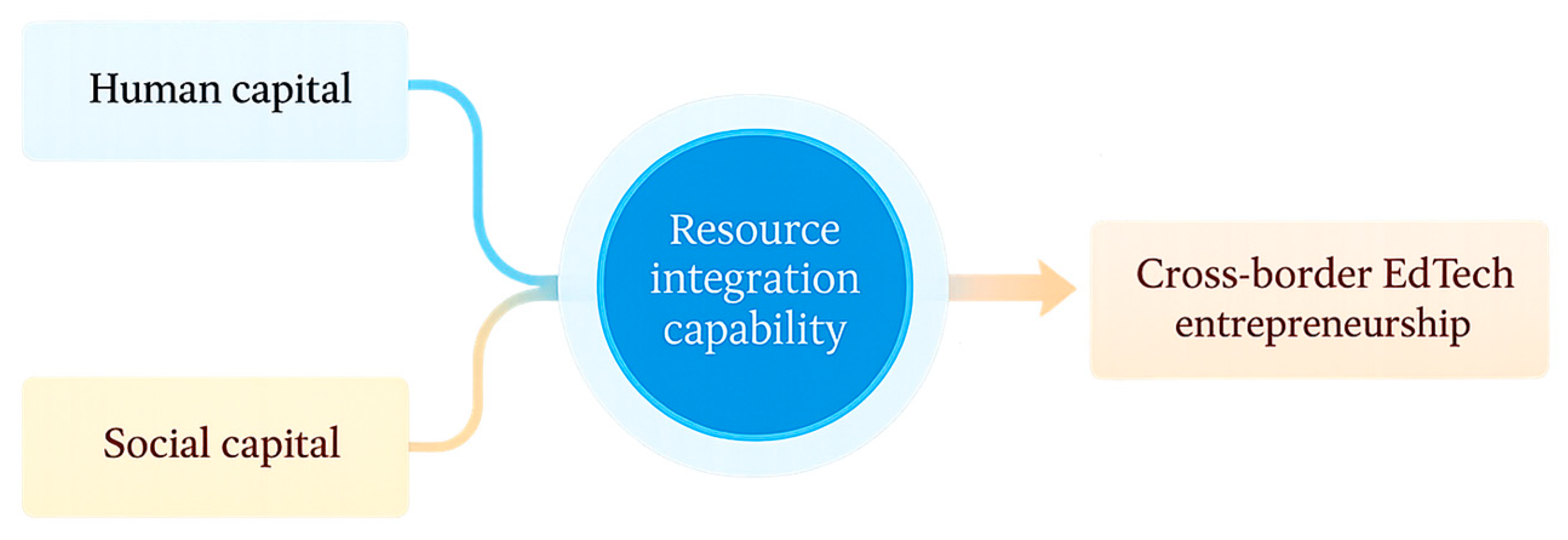
Based on the above reasoning, we propose the following hypotheses: H1, H2, H3, and H4. The conceptual framework is presented in Figure 1.

4. Empirical Analysis

4.1. Measurement Model

The Partial Least Squares Structural Equation Model (PLS-SEM) was used in this study instead of the Covariance-Based Structural Equation Model (CB-SEM), mainly for the following reasons. Firstly, this study aims to predict and explain how the resource integration ability of cross-border mobile talent drives cross-border EdTech entrepreneurship, which requires exploratory analysis rather than strict theoretical verification. PLS-SEM performs better in predictive-oriented research. Secondly, the research model includes the second-order formability concept (RIC), and PLS-SEM more clearly and accurately processes formability measurement models.
Reflective indicators are linked to their latent constructs via the standard outer model,
x i j = λ i j ξ j + ϵ i j
where x i j is indicator i for construct j , λ i j is the loading, ξ j is the latent score, and ϵ i j is the measurement error. Convergent validity was assessed by composite reliability (CR) and average variance extracted (AVE):
C R = ( λ i ) 2 ( λ i ) 2 + ( 1 λ i 2 ) , A V E = λ i 2 k
Discriminant validity was assessed using Fornell–Larcker and HTMT:
H T M T a b = 1 m n i = 1 m j = 1 n | r ( x a i , x b j ) | 1 m ( m 1 ) i i r x a i , x a i · 1 n ( n 1 ) j j | r ( x b j , x b j ) |
According to the existing PLS-SEM evaluation criteria, we tested the reflective measurement model, judged the measurement reliability and validity of latent variables, and focused on the analysis of indicator reliability, internal consistency reliability, aggregation validity, and discrimination validity [34]. All latent variables were set as reflective and were measured with a multi-item Likert scale adapted from the mature scale. Among them, the human capital measurement was adapted from the analytical framework of Unger et al. (2011) [19], social capital was measured from the dimensions of social network resources and interpersonal relationships [22], and resource integration ability (RIC) was measured based on the theoretical logic of resource arrangement [30]. Cross-border EdTech entrepreneurship (EC) is a key dependent variable that reflects the willingness of globally mobile talent to engage in cross-border EdTech entrepreneurship and reflects sustainable education. The measurement items are “If given the opportunity, I would prefer a role involving cross-border digital education or innovation” and “I intend to take concrete steps towards such initiatives within the next 12 months”.
All questions were scored on a seven-level scale, reflecting the respondents’ recognition of the relevant expressions. To verify the validity of aggregation, we analyzed the mean variance extraction value (AVE) and combination reliability (CR). At the same time, according to the standard of Henseler et al. (2015) [35], discrimination validity was tested using the heterogeneity–homogeneity ratio (HTMT).
The “globally mobile talent” in this study included non-Chinese nationals who were pursuing a master’s degree or working at universities in China. Therefore, the survey respondents of this study were international students and graduated multinational professionals in China, covering 29 countries in Asia, Africa, and other regions, with a total of 318 respondents. From a nationality composition perspective, the respondents were mainly from countries such as Pakistan (39.0%), Nigeria (11.0%), Kenya (5.7%), and Ethiopia (4.7%), reflecting the geographical diversity of “globally mobile talent”. These interviewees had cross-border learning or working experience and were studying for master’s or doctoral degrees at universities of the Chinese Academy of Sciences and other cooperative institutions. Their professional backgrounds covered natural science, engineering technology, environmental science, geographic information science, biology, and other fields.
Indicator reliability was first examined. All standardized outer loadings exceeded the minimum recommended threshold of 0.70, indicating that each indicator shared sufficient variance with its corresponding construct. More specifically, human capital loadings ranged from 0.86 to 0.89, social capital from 0.84 to 0.91, resource identification and acquisition from 0.80 to 0.89, and resource integration and utilization from 0.82 to 0.90. Entrepreneurial choice exhibited the highest loadings (0.90 and 0.93), indicating exceptional indicator–construct correspondence.
Internal consistency reliability was tested using Cronbach’s alpha and composite reliability (CR). All constructs demonstrated values above the 0.70 criterion, confirming satisfactory internal reliability. Human capital (α = 0.88; CR = 0.92) and social capital (α = 0.90; CR = 0.93) showed particularly strong reliability. Resource identification and acquisition, as well as resource integration and utilization, also exceeded reliability thresholds, indicating that measurement error is not a likely source of bias in the structural model.
The average variance extracted (AVE) was used to assess convergent validity, and the AVE values of all constructs were above the recommended standard of 0.50, indicating that most of the variance in the indicators can be explained by the construct. The AVE values for human capital and social capital were 0.75 and 0.77, respectively, while the AVE value for entrepreneurial choice reached 0.84, which further suggests a relatively strong convergent validity. The results of indicator loadings, reliability, and convergent validity are reported in Table 1.
Discriminant validity was examined in two ways, namely, the Fornell–Larcker criterion and the heterotrait–monotrait ratio (HTMT). Table 2 presents the Fornell–Larcker results. The square root of each construct’s AVE (diagonal values) is greater than its correlation coefficients with other constructs. This confirms that each construct is more closely related to its own indicators than to those of other constructs. This finding illustrates that the latent variables exhibit good discriminative power both conceptually and empirically.
The HTMT results shown in Table 3 further support discriminant validity. All HTMT ratios are below the conservative threshold of 0.85, indicating no severe multicollinearity or construct redundancy, and the distinctiveness of each conceptual domain in the model is clear.
In summary, the systematic evaluation of indicator reliability, internal consistency reliability, convergent validity, and discriminant validity shows that the reflective measurement model demonstrates sound psychometric properties and is suitable for subsequent analysis of the structural model.
Higher-order construct specification (second-order formative RIC)
Resource integration capability (RIC) is the core dynamic ability to identify, acquire, combine, and reconfigure heterogeneous resources in a dynamic environment to create value. Its connotation includes two logically progressive but functionally complementary dimensions: Resource Identification and Acquisition (RIA) and Resource Integration and Utilization (RIU). RIA focuses on the perception and introduction of external resources, addressing the questions of “what is available” and “how to obtain it”. Meanwhile, RIU focuses on the internal reconstruction and value transformation of acquired resources, solving the problems of “how to use them well” and “how to dynamically adapt”. Therefore, as a second-order forming concept, RIC enables cross-border mobile talents to transform knowledge, networks, and technological resources dispersed in different institutional and cultural backgrounds into feasible entrepreneurial actions through the synergistic effect of the two dimensions of RIA and RIU. To reflect the above variables well, in this study, we measured three items for RIA, including “I can identify the key resources needed to move a project forward”, and three items for RIU, including “I can reorganize plans when policies, markets, or technologies change”. Resource integration capability (RIC) was modeled as a formative second-order construct and was assessed with a two-stage approach. The reason why RIC is set as a formative second-order construct is that its two dimensions (RIA and RIU) complement each other functionally, progress logically, and together form the micro foundation of dynamic capabilities. There is no necessary high correlation between RIA and RIU, and an individual may only be skilled in identifying resources or utilizing resources. Therefore, RIC is not a single ability, and only through a formative model can it fully reflect the core connotations of its corresponding dynamic abilities of ‘perception’, ‘grasp’, and ‘reconstruction’. In the first stage, RIA and RIU were estimated as reflective first-order constructs whose latent variable scores became formative indicators in the second stage to build the second-order RIC construct:
R I C = β 1 R I A + β 2 R I U + ξ
In this study, we defined resource integration capability (RIC) as a dynamic capability consisting of two dimensions: resource identification and acquisition (RIA) and resource integration and utilization (RIU). Because these two dimensions theoretically jointly shape different aspects of RIC and there is no necessary high correlation, RIC was set as a formative second-order construct rather than a reflective one. In the specific estimation, a two-stage method was adopted. In the first stage, RIA and RIU were used as first-order reflective constructs to measure the model estimation and obtain their respective latent variable scores. In the second stage, these scores were used as formative indicators to construct a second-order RIC using partial least squares structural equation modeling. As shown in Table 4, The weights of formative indicators reached a significant level (RIA weight = 0.48, t = 6.82, p < 0.001; RIU weight = 0.55, t = 8.14, p < 0.001), and the variance inflation factors (VIFs) were 2.15 and 2.08, respectively, far below the critical value of 5.0, indicating that there is no severe multicollinearity between the two dimensions.

4.2. Structural Model

The inner model was specified as
R I C = γ 1 H C + γ 2 S C + ξ 1 , E C = λ 3 R I C + ξ 2
The analysis involved evaluating collinearity (inner VIF < 5.0), estimating standardized path coefficients with 5000 bootstrap resamples, and reporting R 2 , adjusted R 2 , effect sizes ( f 2 ),
f 2 = R i n c l u d e d 2 R e x c l u d e d 2 1 R i n c l u d e d 2
and predictive relevance ( Q 2 ) via blindfolding (omission distance 7).
As shown in Table 5, human and social capital have a significant positive effect on resource integration capability, thereby supporting H1 and H2. Resource integration capability also has a significant positive effect on entrepreneurial choice, supporting H3.
To further evaluate the predictive relevance of the model, we calculated effect sizes (f2) for each relationship. As shown in Table 6, resource integration capability has a large effect on entrepreneurial choice (f2 = 0.41), while human capital and social capital exhibit small to medium effects on RIC (f2 = 0.19 and 0.16, respectively).

4.3. Mediation Analysis

We tested indirect effects using percentile bootstrap confidence intervals:
I n d i r e c t H C E C = γ 1 γ 3 , I n d i r e c t S C E C = γ 2 γ 3
Variance Accounted For (VAF) was used to quantify mediation strength:
V A F = I n d i r e c t I n d i r e c t + D i r e c t
To test the mediating role of resource integration capability, we conducted a bootstrap analysis with 5000 resamples. As presented in Table 7, the indirect effects of both human capital (β = 0.22, p < 0.001) and social capital (β = 0.21, p < 0.001) on entrepreneurial choice through RIC are significant. The variance accounted for (VAF) values indicate partial mediation in both paths, thereby supporting H4.

4.4. Predictive Assessment (PLSpredict)

Out-of-sample predictive power was examined using PLSpredict procedure in SmartPLS 4.0 with 10-fold cross-validation. For each EC indicator, the PLS model’s RMSE/MAE was compared against a linear benchmark (LM). Positive predictive relevance is indicated when most PLS metrics are lower than LM. According to the PLSpredict analysis results, the research model demonstrates good extrapolation prediction ability. The prediction error of the PLS model for all indicators is lower than the benchmark value of linear regression model. This indicates that the research model has strong predictive correlation, and the resource integration capability (RIC), as the core mechanism, has good robustness and extrapolation prediction ability in explaining the entrepreneurial choices of cross-border mobile talent.
As presented in Table 8, the PLS model has lower RMSE values than the LM for both indicators, demonstrating strong predictive relevance. This indicates that the research model has good robustness ability in explaining entrepreneurial choices.

4.5. Robustness and Sensitivity

Alternative dependent variable coding. We re-estimated the model under two alternative EdTech definitions: (A) strict (education-only = 1) and (B) refined (education + education-related technology = 1). The paths retained direction and significance, and the influence of RIC on EC remained robust.
Alternative estimators. The results were corroborated using covariance-based SEM (MLR) and logistic regression on factor scores, with no changes observed in the direction or significance of the estimated effects.
Control variables. There were no substantive changes in the core conclusions when variables like gender, age, prior entrepreneurship, and training experience were added.

4.6. Multigroup Analysis (MGA)

To identify heterogeneity among respondents and test whether the structural relationships would differ from individual characteristics, multigroup analysis (MGA) was performed using the permutation-based procedure with 5000 permutations. Following the existing PLS-SEM multigroup analysis method, we used the MICOM program to evaluate measurement invariance. The program consists of three progressive steps: (1) configuration invariance, (2) composition invariance, and (3) equality test of mean and variance. Firstly, configuration invariance was established by ensuring that all groups used the same measurement items, data processing methods, and algorithm settings. Secondly, we compared the original composite variable correlation values between groups with the empirical distribution obtained through 5000 permutation samples to test the compositional invariance. The results showed that the original correlation values of all constructs were higher than the critical value of the 5% percentile of the permutation distribution, indicating that the compositional invariance of each construct holds. Thirdly, we evaluated the equality of the mean and variance between groups. The results showed that the confidence intervals of the constructs all contained zero, which is sufficient to support meaningful comparisons of cross-group path coefficients. Therefore, the conditions for conducting reliable multigroup analysis were met, and subsequent subgroup comparisons had sufficient rationality.
We investigated two different groups of participants. The first group compared those who had received entrepreneurial or innovation-related training with those who had not. The second group consisted of those with prior entrepreneurial experience and those without prior venture exposure. The MGA results reveal that human capital has a greater impact on resource integration capability for participants who had received entrepreneurial training. This suggests that systematic training enhances individuals’ abilities to more effectively identify and mobilize resources for cross-border EdTech initiatives. In comparison, social capital has a significantly larger effect on resource integration capability for individuals with prior entrepreneurial experience, demonstrating how previous venture experience improves the ability to form institutional ties, and gain support from their social network.
These differences are summarized in Table 9, which records subgroup-specific regression coefficients and permutation-based significance values. Notably, the effect of resource integration capability on entrepreneurial choice did not differ significantly across groups, implying that previous entrepreneurial experience does not affect an individual’s likelihood of engaging in business ventures once their resource integration capability has been built.

4.7. Common-Method Bias and Endogeneity Test

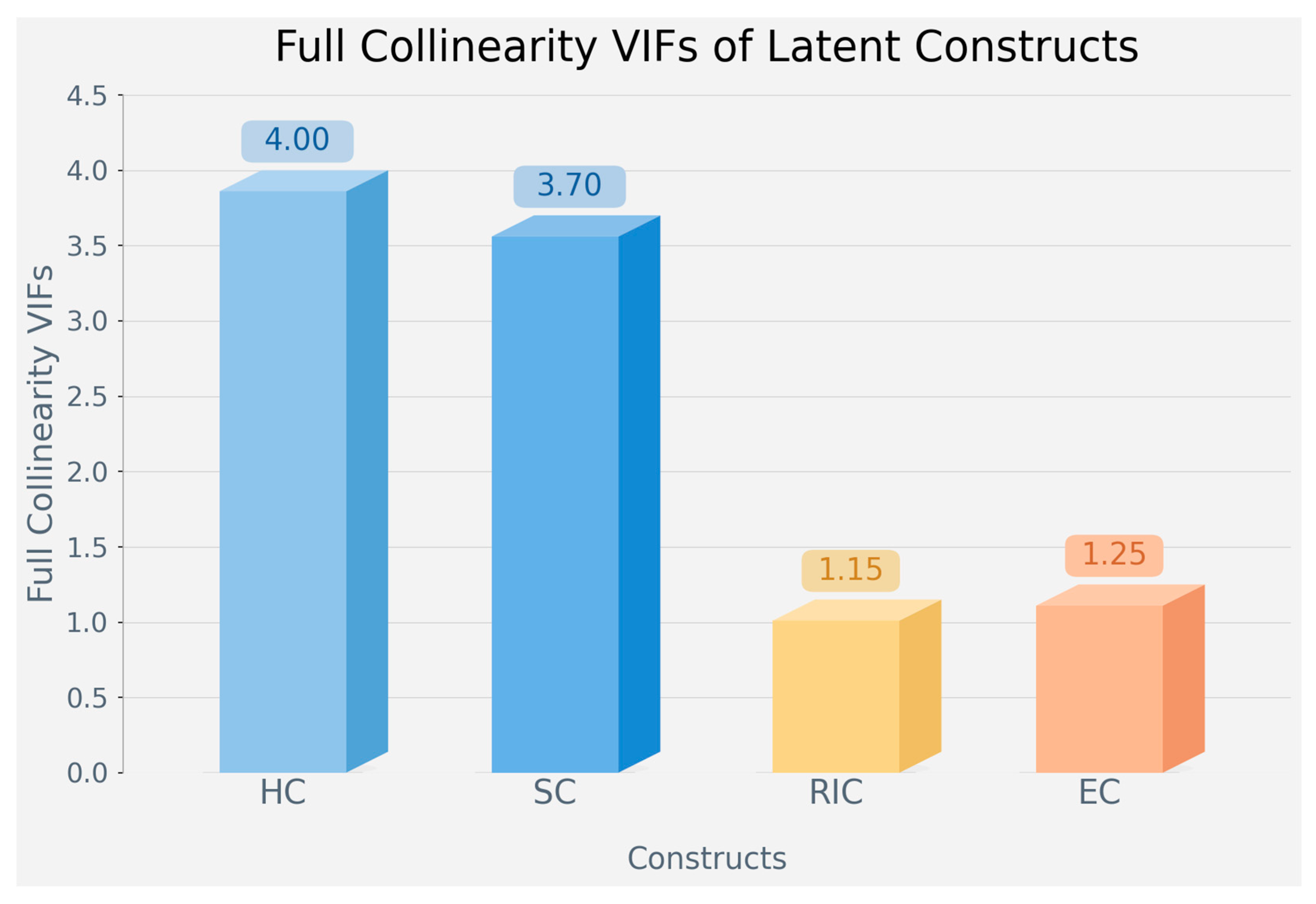
Given the self-reported nature of the data, several procedures were employed to reduce the potential influence of common-method bias (CMB). Anonymity and randomization were integrated into the survey design to reduce evaluation apprehension and consistency motifs. Statistically, three independent diagnostic strategies were applied. First, Harman’s single-factor test indicated that no single factor accounted for more than 50 percent of the variance. Second, the measured marker variable technique showed negligible partial correlations between the marker construct and the substantive constructs. Thirdly, research suggested that the VIF values should be less than 5.0 to avoid multicollinearity issues [36], while in this study, the VIF values for all structures with complete collinearity were below the threshold of 5.0. Together, these results indicate that neither CMB nor pathological collinearity is present in the model.
To further address potential endogeneity—which could arise from reverse causality or omitted variable bias—we employed the Gaussian copula approach and the two-stage residual inclusion (2SRI) model. A key challenge in endogeneity testing is selecting valid instrumental variables (IVs). In the 2SRI model, language proficiency and training participation were used as exogenous instrumental variables. The rationale for these choices is grounded in both theoretical relevance and exclusion restriction logic.
Regarding relevance, language proficiency is a fundamental tool for cross-border communication and knowledge acquisition. Higher proficiency enables individuals to more effectively access, comprehend, and assimilate diverse information and technical resources from global networks, thereby directly enhancing their capacities to integrate those resources. Similarly, participation in entrepreneurship or innovation-related training programs provides individuals with structured frameworks and practical heuristics for opportunity evaluation and resource mobilization, which are core components of RIC. Thus, both variables are theoretically expected to be strong predictors of an individual’s RIC.
Regarding the exclusion restriction, language proficiency and training participation are argued to not directly influence the decision to engage in EdTech entrepreneurship, except through their impact on RIC. While language skills might seem broadly beneficial, in the specific context of cross-border EdTech, their primary function is to enable the complex synthesis of technical, pedagogical, and institutional knowledge from different cultural spheres—a process central to RIC. Once RIC is accounted for, the residual direct effect of language on the choice to start a venture is likely negligible. For training participation, the theoretical argument is more nuanced but equally defensible. Training programs do not typically provide the tangible resources (e.g., seed funding, co-founder teams, specific market contracts) directly required for venture launch. Instead, they equip participants with the cognitive frameworks and skills to better identify, combine, and utilize such resources. Therefore, while training builds RIC, its influence on the ultimate entrepreneurial choice is indirect and fully mediated by this enhanced capability. This logic satisfies the theoretical requirement for exogeneity.
To empirically validate the relevance condition, we examined the first-stage regression results (with RIC as the dependent variable and the instruments, along with all exogenous controls, as independent variables). Both instruments exhibited strong and statistically significant coefficients, and the Sanderson–Windmeijer F-statistic for the excluded instruments was substantially above the conventional threshold of 10, mitigating concerns about weak instruments. In the second stage, the residual inclusion term from the 2SRI model was nonsignificant, and the copula terms in the Gaussian copula approach were also statistically insignificant. These results suggest that endogeneity bias does not pose a significant threat to the consistency of our structural path estimates, thereby reinforcing the reliability of the findings.
The CMB and collinearity results are presented in Figure 2 to further complement the above diagnostics, illustrating the full collinearity VIF values for all the constructs in the model. All values fall well below the 5.0 threshold [36], further confirming that neither common-method bias nor multicollinearity is present in the structural model.

4.8. Synthesis of Findings

The findings suggest that resource integration capability plays a key role in enabling the application of human capital and social capital in the entrepreneurial process. Human capital can enable individuals to master professional knowledge, technical ability, and analytical methods and identify digital education market needs more accurately, which provides support for H1. Social capital can help individuals build multiple social networks, connect with various institutional resources, and find partners, information sources, and support systems on a global scale, which provides support for H2. However, the existence of human and social capital alone cannot support complete entrepreneurial behavior, and resource integration capability is the key to transforming these resources into practical EdTech entrepreneurship actions. This ability, embodied in the EdTech field, is the ability of individuals to accurately identify the required resources, obtain resources from multiple scenarios, and reorganize them into feasible educational services.
Resource integration capability shows a significant association with entrepreneurial choice, which provides support for H3, and this conclusion has been verified in different dependent variable codes, estimation methods, and out-of-sample prediction tests. Multigroup analysis also suggested that there are individual differences in the development of resource integration capability: entrepreneurial training was positively associated with resource integration capability, and past entrepreneurial experience can positively empower social capital. This also shows that the effective transformation of resources requires not only having resources but also accumulating experience in resource search, application, and allocation in an uncertain environment, thus clarifying the essential difference between resource ownership and resource mobilization.
From a theoretical value extension perspective, the research also clarifies the core role of resource integration capability in sustainable digital education. Cross-border EdTech entrepreneurship provides educational services digitally without physical mobility, which not only reduces environmental pressure but also serves more users, which provides support for H4. However, digital technology itself does not have natural environmental benefits, and its sustainable value can only be realized when individuals can integrate technical, human capital, and institutional resources into accessible and extensible long-term digital education programs. Globally mobile talent with strong resource integration capability can not only better connect with transnational networks and acquire cutting-edge knowledge, but also actively promote knowledge dissemination and digital inclusion. Its abilities can help create sustainable digital education services and reduce carbon emissions while potentially improving global education accessibility.
These research conclusions can provide a clear direction for policy formulation and system construction. Universities and policy makers should put capacity-building first, rather than simply attracting talent or investing in digital infrastructure. Through structured tutor guidance, platform cooperation opportunities, and experiential entrepreneurship education, individuals can learn to efficiently tap and use resources across scenes, and international talents can turn potential resources into practical and sustainable digital education achievements. Resource integration capability is not only the core element of entrepreneurial behavior but also the key to promoting the sustainable development of education in cross-border digital learning scenarios.


5. Discussion

This study positions RIC as a micro level dynamic capability rather than a general skill or ability, and the core of RIC lies in its dynamism and adaptability. Our findings indicate that the two dimensions of RIC (RIA and RIU) are associated with how global mobile talent addresses the issue of resource fragmentation in cross-border EdTech entrepreneurship. This ability to actively identify, acquire, integrate, and utilize re-source combinations based on external environmental changes distinguishes resource integration capabilities from general static capabilities. This study found that resource integration capability (RIC) is a significant predictor of cross-border EdTech entrepreneurship choices, explaining 29% of the variance in cross-border EdTech entrepreneurship (R2 = 0.29). This result suggests a mediating mechanism whereby RIC accounts for the relationship between human and social capital and entrepreneurial action, and individuals with higher RIC are more likely to design digital education models that are scalable, culturally adaptable, and inclusive. This conclusion is consistent with the core view of resource arrangement theory (ROT), that is, value creation comes from structural integration and utilization of resources, rather than static resource ownership [30]. This finding is consistent with Liu et al.’s [37] finding that entrepreneurial leadership style and idle resources are beneficial for the development of exploratory dynamic capabilities in enterprises, thereby bringing long-term significant competitive advantages. At the same time, this study expands dynamic capability theory and explains how the micro-capability of perceiving and grasping opportunities can help migrant talent build a bridge between resource endowment and entrepreneurial behavior [5].
This mechanism also provides insight into the “transformation gap” of transnational entrepreneurship: why many individuals from globally mobile talent have rich knowledge and extensive networks but fail to start their own businesses [2]. This discovery is different from existing research and has extended and innovative significance. For example, Martin and Bachrach [38] argued that management cognition, social capital, and human capital are the core pillars of dynamic capabilities. However, this study extends existing research by highlighting the role of resource mobilization. Without the initiative to integrate resources, capital will be idle [19,22]. RIC is significantly associated with entrepreneurial choice (β = 0.54, p < 0.001), which further supports the view that entrepreneurial behavior in the digital age is closely associated with professional ability rather than simply resource possession.
In addition, this study identifies RIC as a key factor associated with empowering sustainable education with EdTech, which is consistent with existing research perspectives on the micro-foundations of dynamic capability formation. Bendig et al. [39] explored the micro basis for the formation of dynamic capabilities, arguing that dynamic capabilities come from the CEO’s human, social, and organizational capital. Their viewpoint implies that human and social capital do not work in isolation and require collaborative resource allocation and integration at the organizational level. EdTech is deeply embedded in the complex teaching and institutional environment, and its sustainability is related to entrepreneurs’ abilities to cope with local governance rules and cultural norms. Individuals with high RIC are better positioned to integrate educational content and platform functions into customized solutions, which will contribute to sustainable digital education entrepreneurship actions. By providing digital services, such projects can not only ensure the continuity of global education but also reduce the carbon footprint associated with physical mobility [8].
The conclusion of this study is consistent with the framework of UNESCO (2023) [7], which emphasizes fairness and accessibility in technology empowerment learning. As a sustainable service trade model, cross-border EdTech is associated with more equitable global education by narrowing the gap in educational accessibility. This study also suggests that RIC is a learnable skill that can be improved through business incubators, cross-cultural training, and other ecosystems [33]. Therefore, it is more important to build an ecosystem with capacity-building as its core rather than simply attracting talent [31]. This study also shifts the research focus of EdTech innovation from technology platforms to globally mobile talent with cross-border integration ability, providing a new perspective for studying sustainable service systems.

6. Conclusions and Recommendations

This study enriches the existing research literature in three ways. First, the core logic of transforming resources into entrepreneurial behavior is clarified at the basic level. The existing research mostly emphasizes the importance of human and social capital in identifying and grasping opportunities, but it ignores how these resources can be transformed into practical entrepreneurial actions. This study provides evidence that only having resources is not sufficient for entrepreneurship, and resource integration capability plays a crucial role for globally mobile talent to participate in entrepreneurship.
Second, we extend the resource integration theory to the cross-border EdTech entrepreneurship scenario. There are essential differences between EdTech and ordinary digital entrepreneurship because education and culture are deeply bound, and, at the same time, teaching expectations, teacher–student interaction, and cooperation between educational institutions and platforms will affect the final service effect. We found that resource integration capability is not only related to whether individuals can carry out entrepreneurial activities but also associated with their ability to allocate educational resources efficiently, which is the key to ensuring the smooth operation of educational services in different scenarios. Therefore, in the EdTech field, resource integration capability is a professional core competence that is closely linked to the landing and operational effect of digital learning services.
Thirdly, from a sustainable education supply perspective, our results suggest that resource integration capability plays a significant role in realizing the expansibility, accessibility, and cultural adaptation of digital learning services. When entrepreneurs can adapt technical tools to local teaching needs and governance structure and meet the individual needs of users, cross-border EdTech entrepreneurship can help promote global education equity. Our research also makes it clear that sustainable digital education is not the natural result of technology popularization but the product of an individual’s resource integration capability to integrate knowledge, institutional resources, and platform resources into an inclusive and long-term learning program. Therefore, resource integration capability is the basic element of building a sustainable digital service system.
The practical implications of this study far exceed general entrepreneurial suggestions and also highlight the unique development requirements of sustainable cross-border EdTech entrepreneurship. Because educational services are deeply embedded in cultural, teaching, and institutional environments, relevant policy-making should not only focus on the technology itself but also on the construction of an educational governance system.
Higher education institutions need to focus on strengthening individual-level training, especially the ability to design and adapt digital learning services to different cultures and local scenes. Colleges and universities can create courses with a more global vision, teach students to use digital tools efficiently, and carry out simulation training of cross-border cooperation projects to help students adjust educational content and teaching methods and adapt to different learner groups and regulatory environments.
Government and regulatory agencies should establish a cross-border education quality assurance framework and a mutual recognition system for higher education degrees and qualifications, create a flexible regulatory path, and reduce institutional barriers to cross-border EdTech entrepreneurship development. At the same time, relevant policies supporting digital certificate standards, curriculum interoperability, and data governance should be introduced to enhance the replicability and expandability of digital education services in various countries.
In addition, to achieve long-term sustainable development, EdTech platforms and enterprises should not only focus on technical infrastructure but also provide professional training for teachers, monitor learning achievements, and establish a service improvement mechanism based on user feedback. A platform that combines technical tools with continuous user support can provide diversified and high-quality education services more efficiently.
Simply put, a sustainable cross-border EdTech ecosystem necessitates the collaborative efforts of universities, governments, and digital platforms. The sustainable development of digital education is the result of the synergistic effects of technology application, talent ability, institutional frameworks, and teaching support. Only when these elements support each other can EdTech entrepreneurship truly achieve the development goals of digital inclusion and educational equity.

Author Contributions

Conceptualization, Y.T. and Y.X.; methodology, Y.T. and Y.X.; software, Y.T.; validation, Y.T. and Y.X.; formal analysis, Y.T.; investigation, Y.T.; resources, Y.T.; data curation, Y.T.; writing—original draft preparation, Y.T.; writing—review and editing, Y.X.; visualization, Y.T. and Y.X.; supervision, Y.X. All authors have read and agreed to the published version of the manuscript.

Funding

This research received no external funding.

Institutional Review Board Statement

The study was conducted in accordance with the Declaration of Helsinki, and approved by the University of Chinese Academy of Sciences Science and Technology Ethics Committee (protocol code UCASSTEC26-022).

Informed Consent Statement

Informed consent was obtained from all subjects involved in the study.

Data Availability Statement

Data supporting this study’s findings are partially included in this article. Due to privacy protection of the survey participants (international students), the full raw dataset is not publicly available. Qualified researchers may request the de-identified dataset by contacting the corresponding author.

Conflicts of Interest

The authors declare no conflicts of interest.

References

  1. World Trade Organization. World Trade Report 2023: Re-Globalization for a Secure, Inclusive and Sustainable Future; World Trade Organization: Geneva, Switzerland, 2023. [Google Scholar]
  2. Au, K.; Kwan, H.K. Start-Up Capital and Chinese Entrepreneurs: The Role of Family. Entrep. Theory Pract. 2009, 33, 889–908. [Google Scholar] [CrossRef]
  3. Davidsson, P.; Honig, B. The role of social and human capital among nascent entrepreneurs. J. Bus. Ventur. 2003, 18, 301–331. [Google Scholar] [CrossRef]
  4. Shane, S.; Venkataraman, S. The Promise of Entrepreneurship as a Field of Research. Acad. Manag. Rev. 2000, 25, 217–226. [Google Scholar] [CrossRef]
  5. Teece, D. Explicating dynamic capabilities: The nature and microfoundations of (sustainable) enterprise performance. Strateg. Manag. J. 2007, 28, 1319–1350. [Google Scholar] [CrossRef]
  6. United Nations. Transforming Our World: The 2030 Agenda for Sustainable Development; United Nations: New York, NY, USA, 2015. [Google Scholar]
  7. UNESCO. Technology in Education: A Tool on Whose Terms? Global Education Monitoring Report 2023; UNESCO Publishing: Paris, France, 2023. [Google Scholar]
  8. Vial, G. Understanding digital transformation: A review and a research agenda. J. Strateg. Inf. Syst. 2019, 28, 118–144. [Google Scholar] [CrossRef]
  9. Yoo, Y.; Henfridsson, O.; Lyytinen, K. The New Organizing Logic of Digital Innovation: An Agenda for Information Systems Research. Inf. Syst. Res. 2010, 21, 724–735. [Google Scholar] [CrossRef]
  10. Schaltegger, S.; Wagner, M. Sustainable Entrepreneurship and Sustainability Innovation: Categories and Interactions. Bus. Strategy Environ. 2011, 20, 222–237. [Google Scholar] [CrossRef]
  11. Bansal, T.; Song, H.-C. Similar but Not the Same: Differentiating Corporate Sustainability from Corporate Responsibility. Acad. Manag. Ann. 2017, 11, 105–149. [Google Scholar] [CrossRef]
  12. Chen, W.; Tan, J. Understanding Transnational Entrepreneurship Through a Network Lens: Theoretical and Methodological Considerations. Entrep. Theory Pract. 2009, 33, 1079–1091. [Google Scholar] [CrossRef]
  13. Filatotchev, I.; Liu, X.; Buck, T. The Export Orientation and Export Performance of High-Technology SMEs in Emerging Markets: The Effects of Knowledge Transfer by Returnee Entrepreneurs. J. Int. Bus. Stud. 2009, 40, 1005–1021. [Google Scholar] [CrossRef]
  14. Kenney, M.; Breznitz, D.; Murphree, M. Coming back home after the sun rises: Returnee entrepreneurs and growth of high tech industries. Res. Policy 2013, 42, 391–407. [Google Scholar] [CrossRef]
  15. Dai, O.; Liu, X. Returnee entrepreneurs and firm performance in Chinese high-technology industries. Int. Bus. Rev. 2009, 18, 373–386. [Google Scholar] [CrossRef]
  16. Drori, I.; Honig, B.; Wright, M. Transnational entrepreneurship: An emergent field of study. Entrep. Theory Pract. 2009, 33, 1001–1022. [Google Scholar] [CrossRef]
  17. Liu, X.; Filatotchev, I.; Buck, T.; Wright, M. Returnee entrepreneurs, knowledge spillovers and innovation in emerging economies. J. Int. Bus. Stud. 2010, 41, 1183–1197. [Google Scholar] [CrossRef]
  18. Becker, G. Human Capital: A Theoretical and Empirical Analysis, with Special Reference to Education; University of Chicago Press: Chicago, IL, USA, 1993. [Google Scholar]
  19. Unger, J.; Rauch, A.; Frese, M.; Rosenbusch, N. Human Capital and Entrepreneurial Success: A Meta-Analytical Review. J. Bus. Ventur. 2011, 26, 341–358. [Google Scholar] [CrossRef]
  20. Marvel, M.; Davis, J.; Sproul, C. Human Capital and Entrepreneurship Research: A Critical Review and Future Directions. Entrep. Theory Pract. 2016, 40, 599–626. [Google Scholar] [CrossRef]
  21. Dimov, D. Nascent Entrepreneurs and Venture Emergence: Opportunity Confidence, Human Capital, and Early Planning. J. Manag. Stud. 2010, 47, 1123–1153. [Google Scholar] [CrossRef]
  22. Nahapiet, J.; Ghoshal, S. Social Capital, Intellectual Capital, and the Organizational Advantage. Acad. Manag. Rev. 1998, 23, 242–266. [Google Scholar] [CrossRef]
  23. Adler, P.; Kwon, S.W. Social Capital: Prospects for A New Concept. Acad. Manag. Rev. 2002, 27, 17–40. [Google Scholar] [CrossRef]
  24. Stam, W.; Arzlanian, S.; Elfring, T. Social Capital of Entrepreneurs and Small Firm Performance: A Meta-Analysis of Contextual and Methodological Moderators. J. Bus. Ventur. 2014, 29, 152–173. [Google Scholar] [CrossRef]
  25. Daskalopoulou, I.; Karakitsiou, A.; Thomakis, Z. Social entrepreneurship and social capital: A review of impact research. Sustainability 2023, 15, 4787. [Google Scholar] [CrossRef]
  26. Teece, D.J.; Shuen, P.A. Dynamic capabilities and strategic management. Strateg. Manag. J. 1997, 18, 509–533. [Google Scholar] [CrossRef]
  27. Eisenhardt, K.; Martin, J. Dynamic Capabilities: What Are They? Strateg. Manag. J. 2000, 21, 1105–1121. [Google Scholar] [CrossRef]
  28. Helfat, C.; Peteraf, M. The Dynamic Resource-Based View: Capability Lifecycles. Strateg. Manag. J. 2003, 24, 997–1010. [Google Scholar] [CrossRef]
  29. Sirmon, D.G.; Hitt, M.A.; Ireland, R.D. Managing Firm Resources in Dynamic Environments to Create Value: Looking Inside the Black Box. Acad. Manag. Rev. 2007, 32, 273–292. [Google Scholar] [CrossRef]
  30. Sirmon, D.G.; Hitt, M.A.; Ireland, R.D.; Gilbert, B.A. Resource orchestration to create competitive advantage: Breadth, depth, and life cycle effects. J. Manag. 2011, 37, 1390–1412. [Google Scholar] [CrossRef]
  31. Nambisan, S. Digital Entrepreneurship: Toward a Digital Technology Perspective of Entrepreneurship. Entrep. Theory Pract. 2017, 41, 1029–1055. [Google Scholar] [CrossRef]
  32. Burt, R. Structural Holes and Good Ideas. Am. J. Sociol. 2004, 110, 349–399. [Google Scholar] [CrossRef]
  33. Adomako, S.; Amankwah-Amoah, J.; Dankwah, G.O.; Danso, A.; Donbesuur, F. Institutional voids, international learning effort and internationalization of emerging market new ventures. J. Int. Manag. 2019, 25, 100666. [Google Scholar] [CrossRef]
  34. Hair, J.; Risher, J.; Sarstedt, M.; Ringle, C. When to use and how to report the results of PLS-SEM. Eur. Bus. Rev. 2018, 31, 2–24. [Google Scholar] [CrossRef]
  35. Henseler, J.; Ringle, C.M.; Sarstedt, M. A new criterion for assessing discriminant validity in variance-based structural equation modeling. J. Acad. Mark. Sci. 2015, 43, 115–135. [Google Scholar] [CrossRef]
  36. Hair, J.; Ringle, C.; Sarstedt, M. PLS-SEM: Indeed a Silver Bullet. J. Mark. Theory Pract. 2014, 19, 139–152. [Google Scholar] [CrossRef]
  37. Liu, L.; Yu, B.; Wu, W. The Formation and Effects of Exploitative Dynamic Capabilities and Explorative Dynamic Capabilities: An Empirical Study. Sustainability 2019, 11, 2581. [Google Scholar] [CrossRef]
  38. Martin, J.A.; Bachrach, D.G. A relational perspective of the microfoundations of dynamic managerial capabilities and transactive memory systems. Ind. Mark. Manag. 2018, 74, 27–38. [Google Scholar] [CrossRef]
  39. Bendig, D.; Strese, S.; Flatten, T.C.; da Costa, M.E.S.; Brettel, M. On micro-foundations of dynamic capabilities: A multi-level perspective based on CEO personality and knowledge-based capital. Long Range Plann. 2018, 51, 797–814. [Google Scholar] [CrossRef]
Figure 1. Conceptual model.
Sustainability 18 02877 g001
Figure 2. Full collinearity VIFs of latent constructs.
Sustainability 18 02877 g002
Table 1. Reflective measurement model.
ConstructItemLoadingCronbach’s αCRAVE
Human Capital (HC)HC10.86
HC20.870.880.920.75
HC30.89
Social Capital (SC)SC10.84
SC20.880.900.930.77
SC30.91
Resource Identification and Acquisition (RIA)RIA10.80
RIA20.870.880.920.74
RIA30.89
Resource Integration and Utilization (RIU)RIU10.82
RIU20.880.890.930.78
RIU30.90
Cross-Border EdTech Entrepreneurship (EC)EC10.90
EC20.930.910.950.84
Table 2. Fornell–Larcker results.
HCSCRIARIUEC
HC0.866
SC0.5010.877
RIA0.5800.6100.860
RIU0.6000.6300.7100.883
EC0.4900.5400.5900.6600.916
Table 3. HTMT ratios.
HCSCRIARIUEC
HCN/A0.570.670.700.55
SC N/A0.700.720.58
RIA N/A0.790.63
RIU N/A0.74
EC N/A
Table 4. Second-order construct: resource integration capability (formative).
IndicatorWeightt-Valuep-ValueVIF
RIA0.486.82<0.0012.15
RIU0.558.14<0.0012.08
Table 5. Structural paths and model quality.
Relationshipβt-Valuep-Value/Supported
HC → RIC0.426.81<0.001/Yes
SC → RIC0.395.92<0.001/Yes
RIC → EC0.549.34<0.001/Yes
Model Quality Indicators
Endogenous ConstructR2Adj. R2Q2
RIC0.560.550.33
EC0.290.280.17
Table 6. Effect sizes (f2) on endogenous constructs.
PredictorCriterionf2Interpretation
HCRIC0.19medium
SCRIC0.16small to medium
RICEC0.41large
Table 7. Mediation results (bootstrap: 5000; two-tailed).
Mediation PathIndirect Effect95% CIt-Valuep-ValueVAFMediation Type
HC → RIC → EC0.22[0.14, 0.31]5.11<0.0010.63Partial
SC → RIC → EC0.21[0.12, 0.30]4.87<0.0010.58Partial
Table 8. PLSpredict: RMSE comparison (PLS vs. LM).
IndicatorPLS RMSELM RMSEPredictive Power
EC10.8470.892PLS demonstrates stronger predictive power
EC20.8120.856PLS demonstrates stronger predictive power
Table 9. Multigroup analysis (permutation test).
PathGroup AGroup Bp-ValueInterpretation
HC → RICTrainedNot trained<0.05Significant difference
SC → RICPrior experienceNo prior experience<0.05Significant difference
RIC → ECGroup 1Group 2>0.05Not significant
Disclaimer/Publisher’s Note: The statements, opinions and data contained in all publications are solely those of the individual author(s) and contributor(s) and not of MDPI and/or the editor(s). MDPI and/or the editor(s) disclaim responsibility for any injury to people or property resulting from any ideas, methods, instructions or products referred to in the content.