Article

Exogenous Moments of Change at Work: How Short- and Long-Term Disruptions Reshape Environmental Habits and Behaviour

by
Néstor Lázaro Gutiérrez
1,*,
Ellen van der Werff
2,
Ibon Zamanillo Elguezabal
1 and
Jose Maria Ravelo Garcia
1
1
Department of Management and Industrial Engineering, University of the Basque Country, 48013 Bilbao, Spain
2
Department of Psychology, Faculty of Behavioural and Social Sciences, University of Groningen, 9712 TS Groningen, The Netherlands
*
Author to whom correspondence should be addressed.
Sustainability 2026, 18(6), 2856; https://doi.org/10.3390/su18062856
Submission received: 23 January 2026 / Revised: 5 March 2026 / Accepted: 11 March 2026 / Published: 13 March 2026
(This article belongs to the Section Psychology of Sustainability and Sustainable Development)

Abstract

Sudden disruptions can destabilize everyday routines and open the door to pro-environmental behavioral change. This paper examines whether exogenous Moments of Change (MoC) with different temporal profiles—an acute nationwide power outage in Spain and the prolonged COVID-19 disruption—reshape employees’ workplace pro-environmental behavior (PEB) by weakening the relationship between habits and PEB. Study 1 surveyed 226 Spanish office workers 38 days after a brief blackout, while Study 2 followed 135 employees in Spain and the Netherlands longitudinally across the COVID-19 period. We found that, while reported PEB increased after both disruptions, the short-term blackout was insufficient to weaken the relationship between habits and behavior significantly, or to strengthen individual and organizational drivers of behavior. In contrast, the more prolonged COVID-19 disruption significantly weakened the influence of habits on PEB and strengthened the relationship between perceived corporate environmental responsibility and behavior. These findings suggest that the duration of a disruption is a critical factor. Specifically, brief shocks may elicit specific new behaviors; only prolonged disruptions appear sufficient to break established habits and enhance the influence of organizational factors on employees’ pro-environmental actions.

1. Introduction

Organisations play a significant role in environmental challenges. Since the early 2000s, industrial emissions have increased more rapidly than those from any other sector, primarily driven by the intensified extraction and production of raw materials. By 2019, the industry was responsible for about 20 GtCO2-eq—around one-third of total global pro-environmental house gas emissions [1]. To mitigate their environmental footprint, organisations depend heavily on their employees’ daily actions. These actions can range from choosing pro-environmental commuting options to modifying workplace routines and standards that help reduce emissions, to encouraging colleagues to adopt pro-environmental behaviour. As Paille et al. noted, employees’ behaviours can significantly influence an organisation’s overall environmental performance [2]. Understanding what drives employees’ pro-environmental behaviour (PEB) at work is therefore a critical research priority.
Two key drivers of PEB at work are environmental self-identity (ESI—the degree to which a person sees themselves as environmentally friendly) and perceived corporate environmental responsibility (CER—employees’ perceptions of their organisation’s environmental commitment). However, even strong ESI and visible CER may fail to produce behavioural change when employees act out of entrenched habits. More than half of workplace tasks are estimated to be habitual (Wood, 2019 [3]), making habits a dominant barrier to pro-environmental action.
The Habit Discontinuity Hypothesis suggests one pathway beyond this barrier: when a significant contextual disruption interrupts habitual cues, individuals shift to deliberate processing, creating a temporary window in which ESI and CER can exert greater influence. Such disruptions have been conceptualised as Moments of Change (MoC). However, critical gaps remain: existing research focuses almost exclusively on biographical transitions (e.g., relocation), largely ignoring exogenous disruptions such as infrastructure failures or pandemics; it is unclear what disruption duration is needed to break habits; and no prior study has tested whether exogenous MoCs can simultaneously strengthen both individual and organisational drivers of PEB in a workplace context.
This paper addresses these gaps by comparing two natural experiments: the brief nationwide blackout in Spain (April 2025, ~10–12 h) and the prolonged COVID-19 disruption (2020–2023). We make three theoretical contributions: (1) the first empirical test of habit discontinuity using exogenous disruptions in an organisational context; (2) disruption duration as a boundary condition for habit weakening; and (3) perceived contingency as a mechanism explaining differential activation of ESI versus CER across disruption types. The remainder of the paper is structured as follows: Section 2 reviews the relevant literature and develops the hypotheses; Section 3 describes the methods for both studies; Section 4 and Section 5 present the results and discussion; and Section 6 concludes with implications and future research directions.

2. Literature Review

2.1. Individual and Organizational Drivers of PEB at Work

Environmental self-identity (ESI) refers to the extent to which individuals view themselves as environmentally friendly. When people have a strong environmental self-identity, they are more likely to behave in ways consistent with this identity, such as saving energy or recycling more, both at home and at work [1,2,4]. Specifically, in workplace settings, ESI is associated with a wide range of pro-environmental actions, including sustainable energy behaviours, the sustainable use of electric vehicles, and general PEBs, as well as greater acceptability of environmental policies [4].
Perceived corporate environmental responsibility (CER) refers to employees’ perceptions of their organisation’s commitment to environmental sustainability [5]. Research shows that when employees view their organisation as genuinely engaged in pro-environmental behaviour, they are more likely to adopt pro-environmental behaviours at work. Such behaviours include everyday voluntary actions—such as recycling, switching off lights, reducing waste, or minimising printing—alongside more job-related decisions, such as choosing environmentally preferable product options or integrating sustainability into procurement and design processes [6,7,8,9]. However, a strong ESI and a strong and visible CER may not always translate into action when established habits dominate PEB at work.

2.2. The Role of Habits in Pro-Environmental Behaviour at Work

Habits are learned tendencies to respond to specific cues in a stable environment with minimal conscious deliberation [10]. For example, employees may routinely switch off their computers at the end of the day, take the same commuting route, or sort waste automatically without actively thinking about it. Once formed, habits become efficient behavioural shortcuts that reduce cognitive load but also make behavioural change particularly resistant to informational or motivational interventions [11].
In organisational settings, habits influence a wide range of daily pro-environmental behaviours, from how employees commute and dispose of waste to how they manage energy consumption and printing routines [12,13,14]. Empirical studies show that many daily workplace actions—such as energy use, waste management, or commuting—are influenced by habits and routines that are difficult to break [13]. Because such behaviours are often performed repeatedly under consistent environmental cues, they become entrenched and persist even when individual or organisational factors change [15]. As a result, even employees with a strong environmental self-identity or who perceive their company as committed to the environment may continue engaging in environmentally unfriendly behaviours if existing routines remain intact. For example, someone may habitually drive to work every day without considering other options. Even if their organisation aims to promote sustainable commuting, their decision to drive to work is not influenced by organisational factors; instead, it is driven by their habit. Empirical evidence from organizations indicates that habit strength can be a significant barrier to pro-environmental behaviour, even among employees with strong pro-environmental intentions [16]. Indeed, more than half of workplace tasks are considered habitual, highlighting the strong automatic component of employee behaviour (Wood, 2019 [3]). Because of the automaticity, habits can operate as a dominant factor underlying employees’ environmental behaviours. Similarly, previous research has shown that habit strength is a key antecedent of employees’ pro-environmental behaviour (Wiernik et al., 2018 [17]).

2.3. Moments of Change: Habit Discontinuity and Self-Activation

While habits represent a powerful barrier to behavioural change, research in environmental and social psychology has identified conditions under which they can be disrupted. The Habit Discontinuity Hypothesis posits that behaviour change is most likely to occur when a shift in context interrupts the cues that usually trigger habitual actions, making individuals more attentive to alternative behavioural options and more susceptible to deliberate reasoning [18]. In stable contexts, strong habits bypass organizational messaging [19]. When habits are broken, people no longer engage in behavior automatically but consciously consider the consequences of their actions and deliberate about behavioral choices, making them more attentive to both identity-based cues (ESI) and organizational cues (CER). While the Habit Discontinuity Hypothesis originally focused on individual motivational factors, we argue that it extends to organizational factors.
A growing body of literature has built on this idea through the concept of “moments of change” (MoC), which refers to life transitions or environmental disruptions that alter contextual cues and, in doing so, weaken the automaticity of habitual behaviour [19]. These moments of change, such as moving homes, changing jobs, or experiencing major societal events, create windows of opportunity during which individuals become more responsive to individual drivers, such as ESI. Thus, after a moment of change, individual factors are expected to exert greater influence over behaviour, at least temporarily. Indeed, in their study, Verplanken and colleagues [18] demonstrated that following a context change (e.g., moving residence), individuals with strong environmental concern became significantly more likely to choose sustainable travel modes than those who did not experience the disruption. We extend this literature by testing whether both individual and organisational factors become more influential after a moment of change.
MoCs can be divided into two categories. The first comprises biographical events or life transitions, such as relocation, becoming a parent, starting university, and retiring. The second captures exogenous events, such as extreme weather, infrastructure disruptions, economic shocks, or political crises. These two types of MoCs differ in theoretically important ways that may affect how they disrupt habits and activate behavioral drivers. Exogenous disruptions are collectively experienced and involuntary (individuals cannot opt out of a blackout or pandemic, unlike planned relocations). They involve external attribution, potentially reducing psychological reactance to change. Many carry inherent environmental salience (e.g., power outages highlight energy dependence) that biographical transitions typically lack. They often need coordinated organizational responses, making organizational factors particularly salient. For example, following COVID-19, organisations were forced to facilitate remote working. Finally, their timing and scope are beyond individual control, creating conditions where contextual cues change suddenly and uniformly. These characteristics suggest that exogenous MoCs may particularly strengthen the impact of organizational factors on employees’ behavior, whereas biographical transitions may particularly strengthen the impact of individual factors on behavior.
Relocation has long been considered a prototypical trigger for moments of change, as confirmed by a recent systematic review [20]. By disrupting stable commuting contexts and environmental cues, moves (whether residential or organisational) have been shown to weaken habitual travel behaviours and create space for intentional decisions [21,22]. For example, Thomas [23] found that individuals with strong environmental attitudes were more likely to reduce car use shortly after moving houses; however, this effect declined as habits stabilised, highlighting the temporary nature of habit disruption.
While most habit discontinuity studies focus on biographical events or life transitions such as relocation, fewer have examined how exogenous events can reshape behaviour [20]. Among these studies, the majority have analysed the impact of financial crises on habits. Research on exogenous MoCs has focused mostly on how such moments of change may alter behaviour by changing the costs and benefits of the behaviour, for example, by reducing income or restricting infrastructure. Less attention has been given to natural disasters, infrastructure, and pandemic disruptions as potential MoCs. As natural disasters are likely to increase in frequency and severity due to climate change, it is important to understand whether they may also create opportunities to break habits and change pro-environmental behaviour. Therefore, we aim to test if exogenous MoCs influence employees’ PEB and its drivers. Specifically, drawing on the Habit Discontinuity Hypothesis, we expect that exogenous MoC weaken habits and temporarily strengthen the relationship between individual (ESI) and organisational factors (CER) and PEB at work.
A few studies have tested the impact of exogenous MoCs on behaviour. Exogenous MoCs include natural disasters, which are often dramatic events with severe and long-term consequences, leading to scarcity, price increases, or unavailability. For example, the destruction of a central hydroelectric transmission line in Alaska resulted in a 500% increase in electricity prices [24], which may serve as a strong external motivator to reduce energy and water consumption.
In contrast, the recent Spanish blackout led to only a mild increase in electricity prices (approx. 5%), due to its short-term nature and high renewable production during spring. However, despite being short-lived, the blackout temporarily disrupted multiple everyday routines and infrastructures relied upon by employees, such as commuting routes (e.g., malfunctioning traffic lights, closed petrol stations), access to buildings and offices (e.g., non-functioning elevators or electronic entry systems), and the use of digital tools and equipment required for work. These disruptions likely weakened the situational cues that usually trigger habitual pro-environmental actions at work, while simultaneously prompting employees to reflect on broader energy issues and their organisation’s environmental commitment.
Only a handful of studies have explored behavioural outcomes following power outages. For example, Spence et al. [25] found that people who had experienced power outages were more likely to engage in social energy-saving behaviours but not in personal energy-saving habits. Yet, whether exogenous MoCs influence the strength of the relationships between individual and organisational variables and behaviour remains largely untested. Overall, research on power cuts as MoCs has mainly examined planned shutoffs or prolonged infrastructure failures, focusing on health or social outcomes rather than pro-environmental behaviour or its underlying mechanisms [26].
To our knowledge, no prior research has examined whether an exogenous MoC can weaken the relationship between habits and PEB at work while strengthening the influence of individual and organisational factors.
The recent COVID-19 pandemic is another key recent example of an exogenous MoC, far more widespread and prolonged than the short, local blackout discussed above. There is a growing body of research examining how the pandemic affected habits and daily behaviour. Most of this literature focuses on health-related or consumer behaviours (e.g., hand-washing or mask-wearing) [27,28] rather than on pro-environmental behaviour. Nevertheless, a few studies have found increases in PEB after the start of the pandemic. Specifically, studies have documented shifts toward locally sourced and organic food consumption [29], reductions in energy use and household waste during lockdowns [30,31], and increased interest in pro-environmental products driven by health and safety concerns [32,33]. However, COVID-19 also strongly affected the way we work, forcing people to work from home and to use more individual modes of transport to commute. For instance, during the Dutch ‘intelligent lockdown’, almost half of employees shifted to working from home and public transport use dropped by more than 90%, while walking and cycling trips increased markedly [34]. Therefore, a key question is whether such an exogenous MoC can reduce the impact of habits on PEB at work and strengthen the impact of individual and organisational factors on PEB at work.

2.4. Research Gaps and Present Study

Despite growing interest in habit discontinuity and moments of change, several critical gaps remain. First, the literature mostly focused on biographical transitions (relocation, job changes, life events), with limited attention to exogenous, externally imposed disruptions such as natural disasters, infrastructure failures, or pandemic events [20]. Second, temporal dynamics remain poorly understood. While research demonstrates that disruptions can trigger behavioral change, we lack evidence on the minimum duration of disruption required to weaken habits or on how long these effects persist after contexts stabilize. The authors of a relocation field experiment noted that the 6-month “recent” cutoff was arbitrary and called for more theory and research on window size [35]. Existing studies rarely include longitudinal follow-ups beyond 3–6 months, limiting our understanding of long-term durability. Third, it has mostly been studied whether disruptions strengthen the impact of individual factors on behavior, while changes in the impact of organizational factors on behavior are hardly studied. Fourth, research on exogenous moments of change in organizational contexts is particularly scarce, despite workplaces being critical settings for pro-environmental behavior and frequent sites of disruption. A recent paper [36] highlighted the need for research on interlevel dynamics and collective and temporal dynamics in this area. Finally, workplace pro-environmental behavior is shaped by both individual (e.g., environmental self-identity) and organizational (e.g., perceived corporate environmental responsibility) factors [37]. Yet, few studies examine how disruptions affect these factors simultaneously.
This research addresses these gaps by examining how exogenous Moments of Change (MoC) influence employees’ pro-environmental behaviour (PEB) and its drivers. We do so by testing how habit disruption impacts the influence of both individual and organizational factors on pro-environmental behavior at work. While existing studies show that prolonged disruptions can shift pro-environmental behaviour, no prior work has tested whether behaviour becomes less strongly guided by habits following an MoC and whether individual and organisational factors become more influential. Drawing on the Habit Discontinuity Hypothesis, we argue that externally imposed disruptions can weaken habits and temporarily enhance the influence of individual (ESI) and organisational (CER) factors. Prior research supports this reasoning, showing that when regular supervision and daily structures are disrupted, employees rely more on organisational cues and values [38]. Because most people care about climate change and thus may also have moderately strong environmental self-identities [39], a disruption that amplifies the influence of ESI and CER is therefore likely to produce an overall increase in PEB.
To investigate this, we analyse two natural experiments that differ markedly in temporal scope. Study 1 focuses on the national blackout that occurred in Spain on 28 April 2025, a sudden, collective, and short-lived disruption (≈10–12 h) that affected millions without warning. Although brief, this event offered a unique opportunity to assess whether an acute infrastructural shock can weaken workplace habits.
Study 2 extends the analysis to the COVID-19 pandemic, a prolonged and globally shared disruption that restructured work patterns for months. Using three measurement points—before the pandemic (retrospectively), shortly after lockdowns, and two years later—we examine whether habit strength and the influence of individual and organisational factors changed during the disruption and whether these effects persisted or returned to baseline once routines restabilised. Previous studies suggest that habit formation typically requires several weeks to months of repeated stability [40], whereas disrupted habits may quickly recover once old cues return [18,41]. In research on relocation, for example, behavioural adaptation tends to peak after about three months and then decline as routines stabilise again [23]. However, the use of retrospective baselines carries a specific risk beyond general recall difficulty. Research on reconstructive memory demonstrates that individuals use the present as an anchor and reconstruct memories of past states in ways consistent with their current theory of how change has unfolded—a process known as expectancy-guided retrieval [42,43]. Participants who believe the blackout or the pandemic changed their habits may therefore systematically recall their pre-disruption habits as stronger and their prior PEB as lower than it actually was, potentially inflating the apparent magnitude of pre-to-post differences. We acknowledge this limitation explicitly in the discussion.
It is important to note that not all disruptions may activate ESI and CER equally. The extent to which individual versus organizational factors become influential may depend (besides the minimum disruption timing and size) on the perceived contingency between the disruption and potential behavioral responses; that is, whether employees perceive clear linkages between the event, their identity, or organizational values, and actionable pro-environmental behaviors. For instance, disruptions requiring significant organizational restructuring may amplify CER’s influence, while disruptions with explicit environmental framing may strengthen the impact of ESI on behavior. We explore these dynamics in our comparative analysis of a brief infrastructure disruption (blackout) and a prolonged organizational restructuring event (COVID-19).
Based on the above, we propose the following hypotheses:
H1. 
Following an exogenous disruption to employees’ work context, the influence of habit strength on pro-environmental behaviour (PEB) is expected to be weaker than during the pre-disruption period.
H2. 
Following an exogenous disruption, the influence of environmental self-identity (ESI) and perceived corporate environmental responsibility (CER) on PEB is expected to be stronger than during the pre-disruption period.
H3. 
Employees are expected to report higher pro-environmental intentions and actions after the disruption than before.
H4. 
During prolonged disruptions, the predictive power of habits on PEB is expected to increase again over time, returning toward pre-disruption levels as new routines stabilise and the temporary influence of ESI and CER diminishes. (H4 tested only in Study 2—COVID-19.)

3. Materials and Methods

3.1. Study 1: The Blackout (Short-Term Disruption)

3.1.1. Participants

We conducted an online questionnaire study using the Prolific research panel, targeting office workers in Spain. A total of 226 respondents completed the survey on 5 June 2025, 38 days after the nationwide power outage in Spain (28 April 2025).
All participants were informed about the purpose of the study, assured of the confidentiality of their responses, and provided informed consent before completing the questionnaire. Participation was voluntary. The survey was administered online and took approximately 5–10 min to complete.
Participants ranged in age from 19 to 63 years (M = 37.08, SD = 11.14); 60% were male, 39% female, and 1% identified as non-binary. The questionnaire included the following sections: Introduction and Consent, Demographics, Environmental Self-Identity, Employees’ pro-environmental Behaviours, and Habit Strength. All items are described in Section 3.1.2. Full demographic details are provided in Table S1 (Supplementary Materials).
To avoid priming or influencing participants’ responses, the questionnaire did not mention the blackout at the beginning. Current behaviours, habits, ESI, and CER were assessed first. Only after this section were participants asked whether they had personally experienced the outage. Ten who responded “no” were excluded from the analysis. Participants were then asked how much the blackout had disrupted their work routines or habits, to test potential moderator effects. Finally, retrospective questions regarding pre-blackout behaviours and habits were presented.

3.1.2. Measures

Environmental Self-Identity: Environmental Self-Identity (ESI) was measured using three items from Van der Werff et al. [44]: “Acting environmentally friendly is an important part of who I am,” “I am the type of person who acts environmentally friendly,” “I see myself as an environmentally friendly person.” Participants rated their agreement on a 7-point Likert scale (1 = strongly disagree; 7 = strongly agree). The scale demonstrated excellent internal consistency (M = 5.47, SD = 0.93, α = 0.83).
Perceived CER: Perceived Corporate Environmental Responsibility (CER) was assessed with three items adapted from Ruepert et al. [6]: “The company has the goal to minimize its impact on the environment;” “The company has committed in its mission to implement sustainable (pro-environmental) policies;” “The company has implemented policies and procedures to minimize its impact on the environment.” Responses were recorded on the same 7-point Likert scale. The scale showed strong internal consistency (M = 4.51, SD = 1.58, α = 0.94).
Employees’ Pro-environmental Habits: Pro-environmental workplace habits were measured using an adapted version of the Self-Report Habit Index [45]. After completing the behavioural intention items, participants were instructed to reflect on the same set of workplace energy-related behaviours and indicate their agreement with four general statements describing habitual performance: “I do these behaviours automatically.” “I do these behaviours without having to remember consciously.” “I do these behaviours without thinking.” “I start doing these behaviours before I realise I am doing them.” Responses were given on a 7-point Likert scale (1 = strongly disagree; 7 = strongly agree).
Habit strength was assessed at two time points: (a) current habits at the time of the survey (Moment 2) and (b) retrospective habits referring to the period before the blackout (Moment 1), for participants who reported having experienced the outage. Mean habit scores were computed for both moments, with higher values indicating stronger automaticity. Internal consistency was excellent across both time points (Moment 1: α = 0.96, M = 4.92, SD = 1.58; Moment 2: α = 0.94, M = 4.97, SD = 1.42).
Employees’ Pro-environmental behaviour intentions: The questionnaire measured five pro-environmental workplace behaviours. Participants first read the following question: “How likely are you to perform this behaviour at work currently?” They then rated the following behaviours on a continuous slider scale from 0 (extremely unlikely) to 100 (extremely likely): Work remotely; Bring a power bank to work as a backup; Talk to management about installing a battery/solar system in the company; Commute by public transport; and Use the company stairs instead of the elevator. These items were measured at two points in time, current intentions (after the blackout) and retrospective intentions (before the outage), using the same response scale.
An overall measure of Pro-environmental behaviour (PEB) intentions was computed by averaging all items. Internal consistency for the PEB scale was poor; removing any item did not improve it, so results should be interpreted with care. Moment 1: α = 0.54 (M = 48.72, SD = 20.84); Moment 2: α = 0.53 (M = 53.79, SD = 20.68)
Pro-environmental behaviours at home: In addition to pro-environmental behaviour at work, we also included four pro-environmental behaviours at home: Use the stairs instead of the elevator; Install/plan a battery at home; Buy/plan to buy an EV; Switch to a renewable/resilient provider. Behavioural intentions were measured by asking participants to indicate the likelihood of engaging in various pro-environmental behaviours at each time point. Items were introduced as follows: “Please indicate the likelihood of engaging in the following behaviours.” Responses were recorded on a continuous scale from 0 (not at all likely) to 100 (totally likely).
A global measure of intentions to perform Pro-environmental behaviour at home (PEBH) was computed by averaging all items. Moment 1: α = 0.68 (M = 38.33, SD = 21.57); Moment 2: α = 0.73 (M = 43.34, SD = 22.84)

3.1.3. Statistical Analysis

Statistical analyses were performed using IBM SPSS Statistics version 27 and AMOS version 23. Descriptive statistics included means and standard deviations for all study variables. Internal consistency of the scales was assessed using Cronbach’s alpha coefficients.
To test H1 (Habit weakening) and H2 (individual and organisational activation), we estimated a two-time-point path model in AMOS and examined changes in the standardised regression coefficients of Habits, ESI, and CER predicting PEB before vs. after the blackout (95% percentile bootstrap CIs; 5000 samples). To test H3 (Behavioural increase), paired-sample t-tests compared pro-environmental behaviour at work and at home before vs. after the blackout. H4 (long-term re-stabilisation of habits) is not applicable in Study 1.

3.2. Study 2: The COVID-19 Disruption (Long-Term Disruption)

3.2.1. Participants

We conducted an online questionnaire study using the Prolific research panel, targeting office-based employees from Spain and the Netherlands. Participants were pre-screened to ensure that their roles were transferable to a work-from-home setting.
A total of 218 respondents completed the first wave of the survey in early 2021, during a period when most employees had returned to the office following COVID-19 lockdowns. In the second wave, conducted in early 2023, 135 participants from the original sample also completed the second questionnaire, enabling the analysis of long-term behavioural changes. This longitudinal panel sample of 135 respondents serves as the basis for the analyses presented in this study.
Participants ranged in age from 18 to 73 years (M = 31.74, SD = 10.06), with 48% identifying as male, 49% as female, and 2% as non-binary. All participants provided informed consent before participating in the study. The average time to complete the survey was approximately 10 min per wave. Full demographic details are provided in Table S1 (Supplementary Materials).
In terms of professional background, participants represented a wide range of industries. The most common were Education/Research (24%), IT/Software/Telecommunications (14%), Retail/Wholesale (10%), Public Sector/Government (10%), Hospitality/Tourism/Food Services (9%), and Others (33%). Regarding job function, participants primarily worked in IT/Data roles (17%), Marketing/Communications (15%), Operations (13%), and Customer Service (10%).
The sample included a balanced distribution across organisational role levels: mid-level specialists (26%), managers/team leaders (22%), executives/senior managers (17%), junior staff, and other roles. Influence over environmental decision-making varied: 26% reported moderate influence, 17% high impact, and 28% little or no influence.
Tenure at their current organisation ranged from recent hires to long-term employees. Notably, 24% of participants had worked at their current company for 6–10 years, 20% for more than 10 years, and another 20% for 1–2 years.

3.2.2. Measures

Environmental Self-Identity (ESI) was measured using the same three items as in Study 1. Participants rated their agreement on a 7-point Likert scale (1 = strongly disagree to 7 = strongly agree). The scale demonstrated excellent internal consistency (M = 4.42, SD = 1.47, α = 0.90).
Perceived Corporate Environmental Responsibility (CER) was measured with the same three items as in Study 1. Responses were recorded on the same 7-point Likert scale. The scale showed strong internal consistency (M = 5.36, SD = 1.14, α = 0.94).
Employees’ Pro-environmental Habits were measured using an adapted version of the Self-Report Habit Index [45], which focused on nine key behaviours, namely eating organic food, reducing meat consumption; commuting by bike or public transport, teleworking; using stairs instead of elevators; using reusable mugs, separating and recycling materials, switching off the light at the office when leaving, lowering the heater and wearing an extra layer. Two related behaviours—reducing meat consumption and eating organic food at work—were combined into one (“Eating at work”) to reflect dietary choices in the workplace context. Each habit was assessed using four items: “The behaviour is something I do frequently;” “The behaviour is something I do automatically;” “The behaviour is something I would find hard not to do;” “The behaviour is something that’s typically ‘me.’”
Responses were collected on a 7-point scale (1 = strongly disagree; 7 = strongly agree), and higher scores reflected stronger habitual tendencies. Habits were assessed across three time points to capture behavioural dynamics across a contextual disruption:
  • Moment 1: Before the disruption (retrospectively reported in 2021, referring to pre-2020 behaviour);
  • Moment 2: During the disruption (reported in early 2021, post-change);
  • Moment 3: After re-stabilisation (reported in 2023).
Internal consistency was high across all time points: Moment 1: α = 0.737 (M = 5.03, SD = 0.93); Moment 2: α = 0.810 (M = 5.37, SD = 1.02); Moment 3: α = 0.704 (M = 5.28, SD = 0.86)
Employees’ Pro-environmental Behaviour Intentions. Behavioural intentions were measured by asking participants to indicate the likelihood of engaging in various pro-environmental workplace behaviours at each time point. Items were introduced with the prompt: “Please indicate the likelihood of engaging in the following behaviours.” Responses were recorded on a continuous scale from 1 (not at all likely) to 100 (totally likely), allowing for nuanced analysis and interpretation.
The behavioural items were adapted from Van de Ven et al. (2018) [46] and focused on actions with high carbon reduction potential in office settings. They covered four categories: Nutrition (e.g., eating organic food, reducing meat consumption); Transportation (e.g., commuting by bike or public transport, teleworking); Energy use (e.g., using stairs instead of elevators); and Recycling (e.g., using reusable mugs, separating and recycling materials).
A global measure of Pro-environmental Behaviour (PEB) intentions was computed by averaging all items. Internal consistency for the PEB scale was acceptable to strong: Moment 1: α = 0.759; Moment 2: α = 0.810; Moment 3: α = 0.704.

3.2.3. Statistical Analysis

To test the study’s hypotheses, we conducted a path analysis using AMOS. The model included three time points, Moment 1 (pre-COVID-19, 2020 reported at Moment 2), Moment 2 (during the COVID-19 lockdown, 2021), and Moment 3 (long-term follow-up, 2023), and assessed the predictive relationships between habits, perceived CER, environmental self-identity (ESI), and pro-environmental behaviour (PEB).
We examined differences in standardised regression coefficients across time points to determine whether the predictive strength of habits, CER, and ESI changed over the short term (Moment 1 to Moment 2) and long term (Moment 1 to Moment 3; Moment 2 to Moment 3).
Table 1 shows the correlations between the main variables in the study.

4. Results

4.1. Study 1: The Blackout (Short-Term Disruption)

4.1.1. Path Model (H1 & H2)

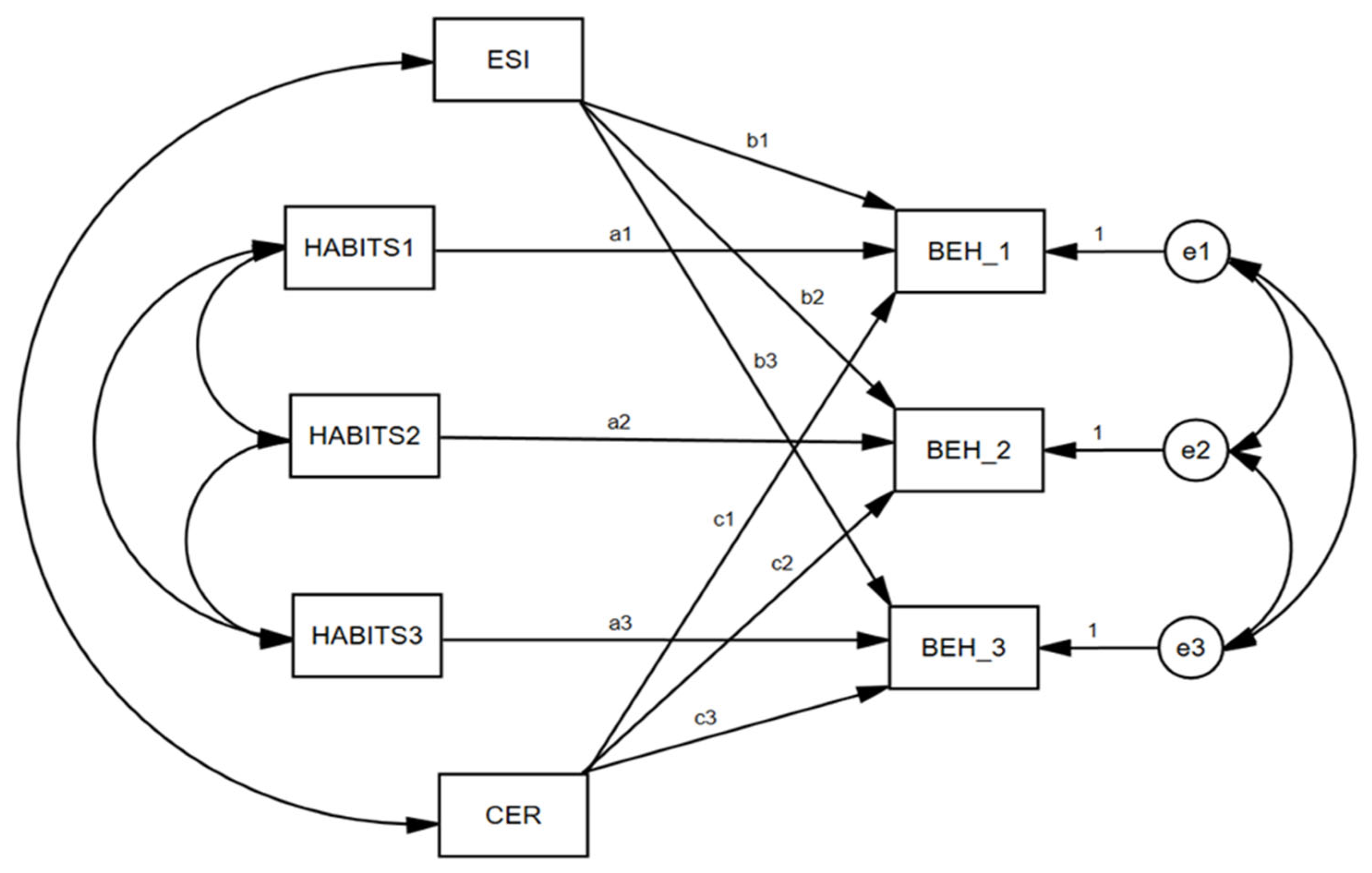
To examine whether the influence of habits, environmental self-identity (ESI), and perceived corporate environmental responsibility (CER) on pro-environmental behaviour (PEB) at work changed after the blackout, a path model was estimated using AMOS (version 23) for SPSS. The model included two time points: before the blackout and after the outage. Habits, ESI, and CER were entered as predictor variables, with PEB before (PEB_BEFORE) and after the event (PEB_AFTER) as the respective dependent variables (Figure 1).
The model demonstrated acceptable fit according to standard indices:
  • Chi-squared (χ2) value: χ2(6, N = 216) = 13.361, p = 0.038;
  • CFI (Comparative Fit Index): 0.989;
  • RMSEA (Root Mean Square Error of Approximation): 0.076, CI 90%(0.017, 0.131), p-close = 0.185;
  • NFI (Normed Fit Index): 0.980;
  • TLI (Tucker–Lewis Index): 0.972.
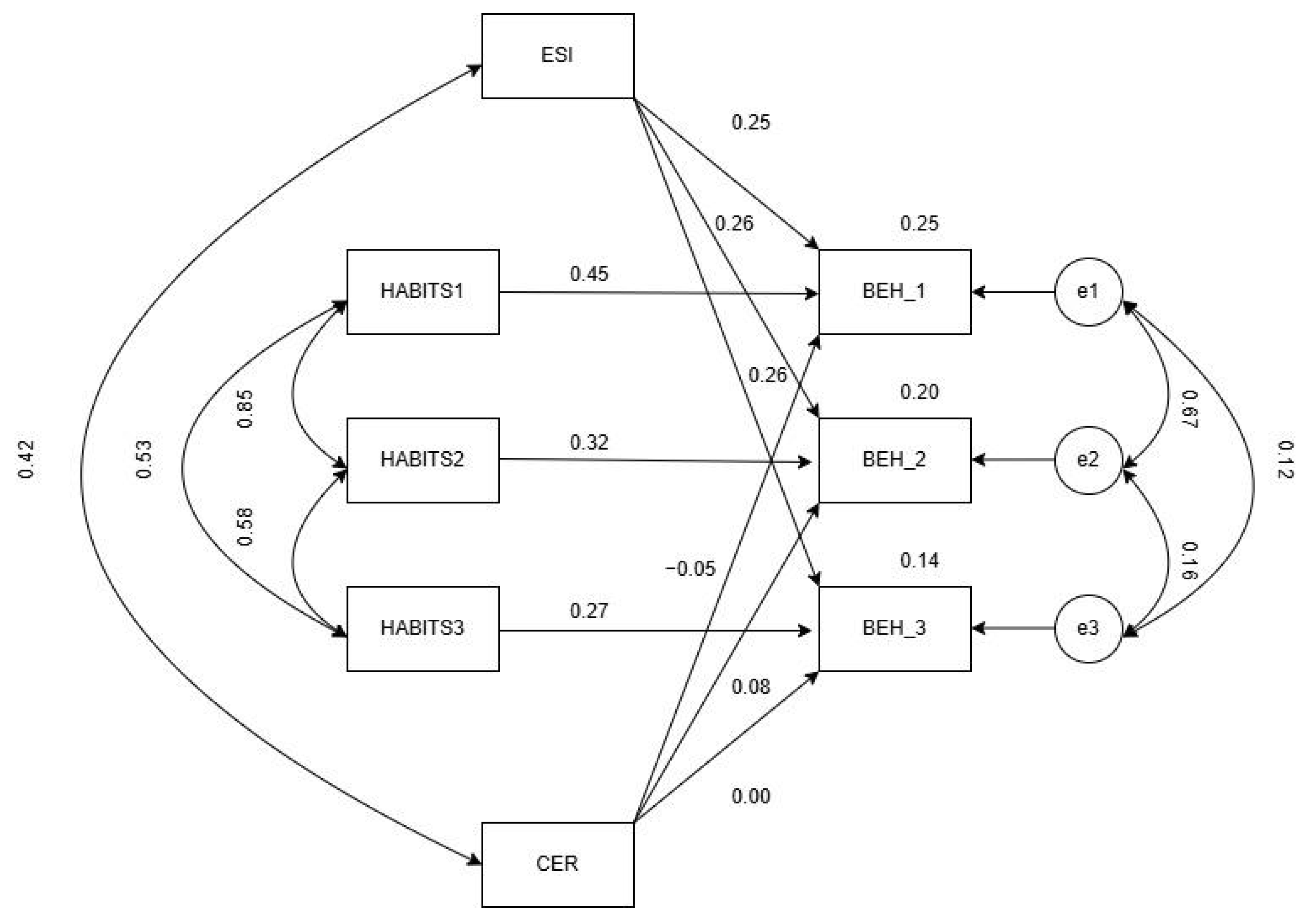
Regression coefficients are presented in Table 2. Habits showed statistically significant associations with PEB at both time points. Although the relationship between habits and pro-environmental behaviour at work is stronger before the blackout than after, this difference is not significant. ESI and CER were not statistically significantly related to pro-environmental behaviour at work, neither before nor after the blackout.
Table 3 presents the differences in standardised regression coefficients between the two time points for each predictor. Habits were more strongly related to PEB before the blackout than after it; however, this difference was not statistically significant (p = 0.066). In contrast, the changes in the coefficients for ESI (b2–b1) and CER (c2–c1) were not statistically significant, suggesting their influence on behaviour remained stable across the two moments.
Figure 2 illustrates the structural path model with standardised parameter estimates, showing the relationships between habits, ESI, CER, and pro-environmental behaviour before and after the blackout.

4.1.2. Overall PEB at Work Change (H3)

Paired-sample t-tests were conducted to assess differences in pro-environmental behaviour intentions before and after the blackout. Significant increases were observed in two behaviours: bringing a power bank to work and talking to management about installing battery or solar systems. No significant changes were observed in other behaviours (Table 4).

4.1.3. Overall PEB at Home Change

Paired-sample t-tests indicated statistically significant increases in two pro-environmental behaviour intentions at home: using the stairs instead of the elevator and installing or planning to install a battery at home. No significant changes were observed in other behaviours (Table 5).

4.2. Study 2: COVID-19 (Long-Term Disruption)

4.2.1. Path Model (H1, H2 & H4)

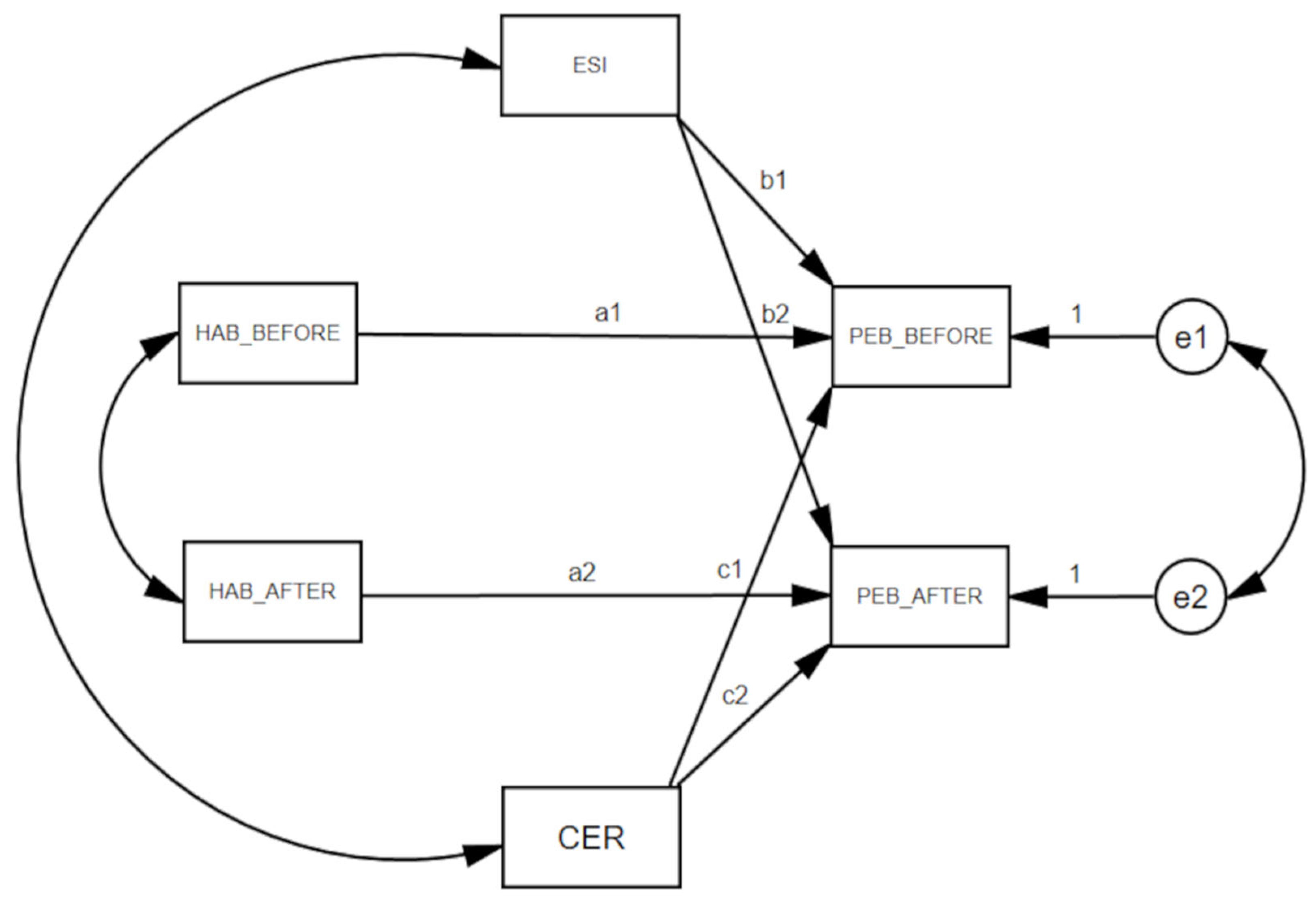
Model (Figure 3) fit was evaluated using multiple indices: Chi-squared (χ2), Comparative Fit Index (CFI), Root Mean Square Error of Approximation (RMSEA) with 90% confidence intervals, Normed Fit Index (NFI), and Tucker–Lewis Index (TLI). The tested model demonstrated acceptable fit: χ2(12, N = 135) = 27.137, p = 0.007; CFI = 0.966; RMSEA = 0.097, 90% CI [0.048, 0.146], p-close = 0.056; NFI = 0.942; TLI = 0.92.
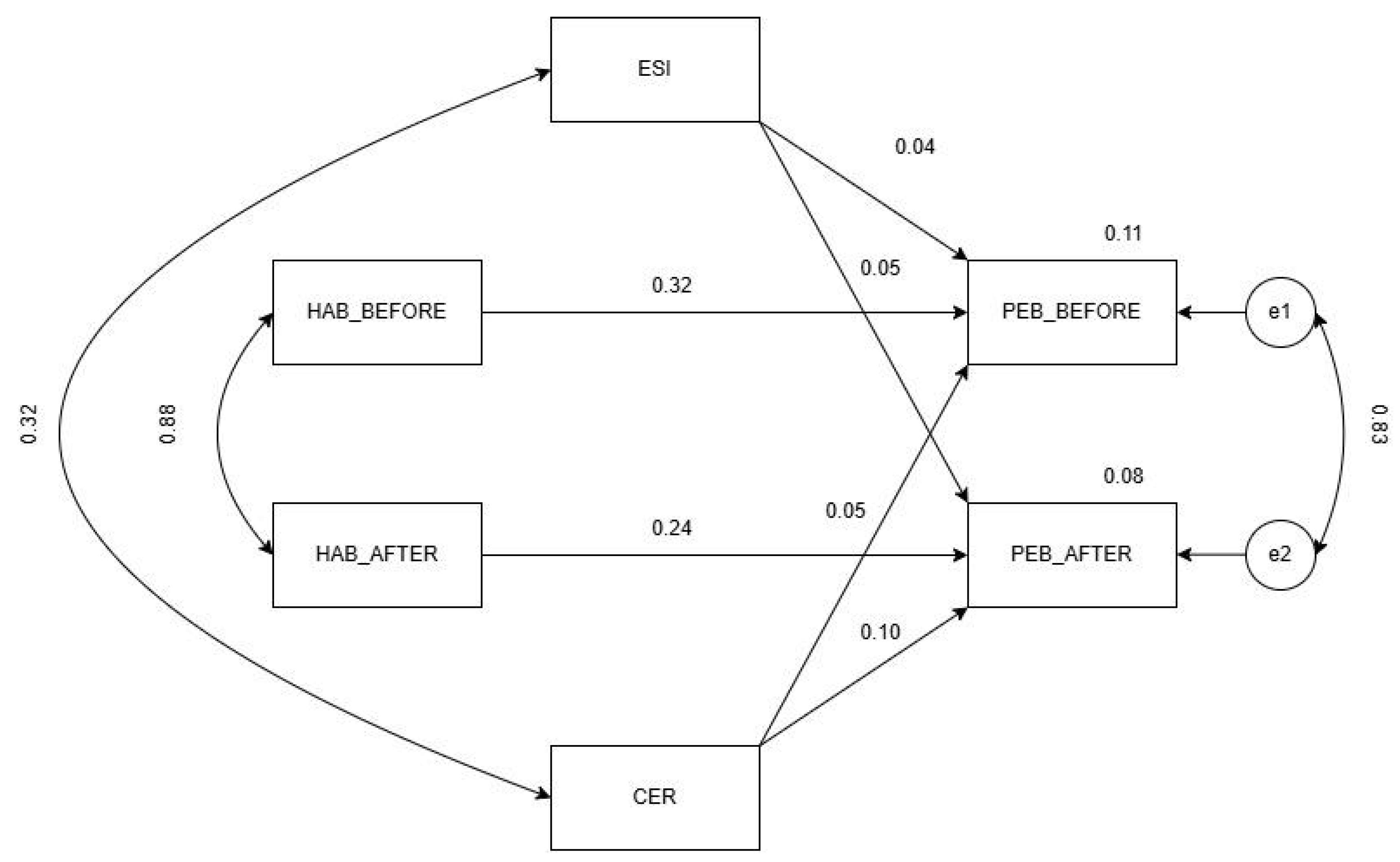
Before the disruption (Moment 1), habits strongly predicted PEB (Table 6). During the lockdown (Moment 2), the strength of this relationship decreased significantly (Table 7). ESI was significantly related to PEB at both time points, with no significant change over time. The relationship between CER and PEB at work increased significantly from Moment 1 to Moment 2. However, the relationship between CER and PEB at work was not significant at either Moment 1 or Moment 2 (Figure 4).
A central contribution of this study is the test of Hypothesis 4, which predicted that the influence of habits on PEB would return toward pre-disruption levels as routines restabilized following the COVID-19 disruption. We found no support for this hypothesis. Habits remained statistically significant predictors of PEB at all three time points (Table 6). Still, the strength of this relationship did not increase significantly from Moment 2 (2021, during lockdown) to Moment 3 (2023, two years post-lockdown) (Table 7). In fact, habits at Moment 3 were still significantly weaker predictors of PEB than at Moment 1 (pre-COVID), though this difference did not reach statistical significance (p = 0.132).

4.2.2. Overall PEB at Work Change (H3)

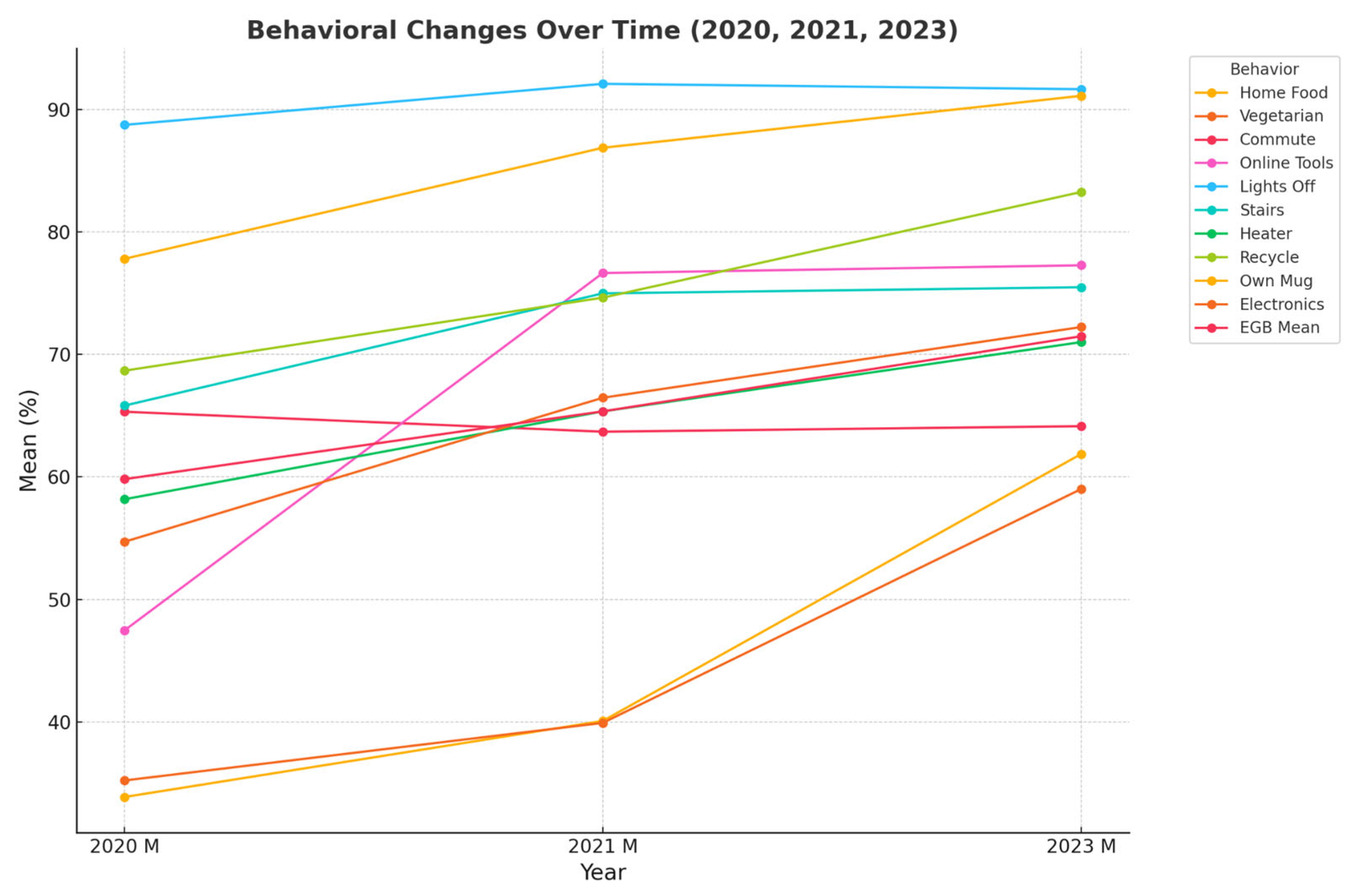
Overall, PEB increased significantly from 2020 (pre-COVID, M = 59.82) to 2021 (post-lockdown, M = 65.35) and 2023 (M = 71.48; see Figure 5). The most significant and persistent gains were observed in the use of online meeting tools, recycling, personal mug use, and electronic behaviours (e.g., turning off electronic devices) (Table 8).

5. Discussion

This paper examined whether exogenous disruptions can operate as Moments of Change that weaken the relationship between habits and employees’ pro-environmental behaviour (PEB) at work, and whether they simultaneously strengthen the influence of individual (ESI) and organisational (CER) factors. We tested these questions across two natural experiments differing markedly in temporal scope: the brief nationwide blackout in Spain and the prolonged COVID-19 disruption.
In Study 1, we found that the short-term blackout was not sufficient to weaken the influence of habits on behaviour significantly, nor to strengthen the relationship between individual and organisational factors and PEB at work. No statistically significant changes were found in the relationships between habits, ESI, or CER with PEB across the blackout. The differences in regression coefficients between the two time points were not statistically significant, providing no support for H1 or H2 in the context of the short-term disruption. Interestingly, some specific pro-environmental actions did increase following the blackout, particularly those directly linked to the event, such as talking to management about installing solar panels or batteries. This suggests that a very brief disruption may be enough to trigger targeted behavioural responses, but insufficient to break the broader grip of habits or amplify the role of motivational factors.
In Study 2, extending the analysis to the prolonged COVID-19 disruption, we found clearer evidence of habit weakening. Habits were significantly less strongly related to PEB during the disruption than before it, and some pro-environmental behaviours, particularly those that are easy to change and do not depend on external infrastructure, increased after the disruption. The relationship between CER and PEB strengthened significantly from Moment 1 to Moment 2 (c2–c1, p = 0.012), though CER was not a statistically significant predictor at either individual time point. ESI’s relationship with PEB remained stable across both disruptions. Contrary to expectations, the weakening of habits did not reverse at the two-year follow-up, challenging the assumption that habit disruption is necessarily temporary.
Taken together, these findings point to disruption duration as a critical boundary condition for habit discontinuity processes in the workplace. Below, we organise the discussion thematically, integrating findings from both studies under each heading and connecting them to the research gaps identified in Section 2.4.

5.1. Habit Disruption

We expected that exogenous MoC would weaken the relationship between habits and pro-environmental behaviour. In the study examining the blackout, we found that this relationship was weaker after the disruption; however, the difference was not significant. In the COVID-19 study, we observed a significant weakening of the link between habits and PEB, suggesting that the disruption of work routines over a more extended period—mainly through the shift to remote work—was effective in breaking habits. Taken together, these results support H1 in Study 2 but not in Study 1 and indicate that when external events disrupt employees’ usual work context, habitual patterns lose part of their influence on behaviour, at least temporarily. However, our findings also suggest that a very short, exogenous MoC may not be sufficient to produce substantial weakening of habits, as the opportunity window for change might be too brief and routines can quickly restabilise once the context returns to normal.
Theoretically, these findings are consistent with the habit-discontinuity hypothesis literature, which shows that contextual change can loosen the grip of established habits, creating temporary openings for deliberate action. For instance, studies on residential relocation show that it disrupts automatic travel routines and encourages more sustainable choices [18], and significant life transitions similarly weaken habits and increase the role of values and deliberate reasoning [23,35].
Nonetheless, this process has rarely been examined in the context of exogenous disruptions, which differ from the biographical or planned transitions usually studied in this literature [20]. Our results extend previous research by showing that externally imposed events that employees cannot control, such as a sudden blackout or a pandemic, weaken the impact of habits. We discuss future research directions in Section 6.

5.2. Increased Role of Individual and Organisational Factors (ESI, CER)

Our findings reveal an intriguing pattern regarding the activation of individual and organizational factors during disruptions. In Study 2 (COVID-19), the difference in the regression coefficient for CER between Moment 1 and Moment 2 (c2–c1) was statistically significant, indicating a statistically significant difference in the regression coefficients across time points. However, it is important to note that CER’s relationship with PEB did not reach statistical significance at either individual time point, when considered in isolation, which limits the interpretability of this change and calls for caution in the strength of the conclusions drawn. We propose two complementary explanations for this pattern.
First, disruption duration matters: the blackout lasted only 10–12 h, while COVID-19 restructured work patterns for months. This extended timeframe may be necessary for employees to re-evaluate organizational factors and for CER to exert a stronger influence on behavior. The brief blackout, despite being energy-related, may have been insufficient to shift employees’ reliance on organizational cues.
Second, perceived contingency (i.e., the degree to which employees perceive clear connections between a disruption and relevant behavioral responses) may differ across events. COVID-19 required organizations to actively manage the disruption through visible restructuring (remote work policies, health protocols, resource allocation), making organizational commitment and goals highly salient in employees’ daily experience. In contrast, the blackout was a nationwide technical failure with minimal organizational involvement; employees experienced and coped with it individually, limiting organizational salience. Even though the blackout was energy-related, it was framed primarily as an infrastructure issue rather than an environmental or organizational challenge, reducing the perceived link to corporate environmental responsibility.
The lack of ESI activation in either study may similarly reflect limited perceived contingency. Neither disruption was explicitly framed in environmental terms: the blackout was discussed as an infrastructure issue, while COVID-19 was framed as a public health crisis. Without clear environmental framing, employees may not have strongly focused on their environmental self-identities, which therefore did not exert a stronger influence, even as habits weakened.
Also, the fact that CER’s influence increased but remained non-significant in Study 2 raises an important distinction. Organizational support through commitments (e.g., sustainability statements, expressed values, or general policy intentions) may be insufficient to drive behavior during disruptions if not paired with “hard” structural changes. Hard changes might include providing sustainable commuting alternatives, investing in visible green infrastructure, reducing office energy footprints, or embedding sustainability requirements into remote work policies. During prolonged disruptions, employees may become more attentive to organizational messages, but without tangible structural support for pro-environmental behavior, this awareness will not translate into stronger perceived CER.
Collectively, these findings suggest that disruption characteristics beyond duration (including the organization’s role in managing the event, the framing of the disruption, and the perceived relevance to environmental behavior) shape which factors become more influential during moments of change. Future research could directly measure perceived contingency and test whether organizational communication strategies can strengthen event–behavior linkages during disruptions. Additionally, studies may examine specific types of organizational interventions following disruptions to identify which are most effective at translating exogenous disruptions into actual behavioral change.

5.3. Increases in Pro-Environmental Behaviour (Workplace and Beyond)

Regarding behavioural change, we found that some PEB at work increased after the MoC. Thus, we found partial support for Hypothesis 3. Specifically, we found that after the blackout, people reported engaging more in actions closely tied to energy preparedness (i.e., bringing a power bank to work as a backup, talking to management about installing batteries or solar at work, installing batteries at home, and using the stairs more). In contrast, there were no changes for commuting by public transport or working remotely. Beyond the workplace, people indicated that they planned to increase pro-environmental behaviour in domains directly linked to the blackout, even if habits did not change: installing a home battery and switching to a renewable/resilient provider both increased, whereas purchasing an EV did not.
In the COVID-19 study, employees reported increases in most behaviours (only commute and switching off the lights did not change). Thus, the type and scope of the disruption shape the breadth of behavioural change, with brief events prompting shifts in a narrow set of behaviours that are particularly relevant for the disruption. For example, encouraging management to install batteries or solar power at work can help maintain an energy supply during future blackouts. Disruptions may affect a broader range of PEBs, including pro-environmental behaviours that are not directly related to the disruption. Future research is needed to test whether perceived contingency (the degree to which people link the disruption to specific behaviours) is indeed a key mechanism that explains which behaviours may be changed by the disruption.
Furthermore, future research is needed to test whether more prolonged disruptions indeed change a broader range of pro-environmental behaviors and to explain why this is the case. We found that the impact of habits on behavior indeed weakens after a long-term disruption. However, we did not find that the relationship between ESI and pro-environmental behavior strengthened, and we found little support for the idea that the relationship between CER and behavior strengthened. Future research is needed to test if other individual and organisational factors may explain the increase in pro-environmental behavior over time.
Theoretically, our findings extend the habit-discontinuity framework by highlighting that not all contextual changes automatically translate into behavioural change. The effect depends on whether individuals perceive a clear, meaningful connection between the disruption and a possible response. In this sense, exogenous MoCs do not act as general “reset buttons” but as situational triggers that activate behavioural reflection when contingency is high.
From a practical perspective, organisations and policymakers may be more effective at promoting actions aligned with the disruption. For example, following an energy shortage, workplace interventions that emphasise electricity savings or energy resilience may resonate more strongly than general sustainability campaigns. Future research could examine how organisations might strengthen this sense of contingency through targeted framing—emphasising how a disruptive event relates to specific sustainability goals or practices.

5.4. Long-Term Effects Under Prolonged Disruption (COVID-Only)

Finally, we expected that under a prolonged disruption, the predictive power of habits might gradually return toward baseline as new habits formed and the temporary influence of individual and organisational factors diminished. While most research on MoCs shows that, over time, the relationship between individual factors and behaviour weakens as new habits are established [23], our results point in the opposite direction. Specifically, while the impact of habits on behaviour weakened right after the disruption, the relationship between CER and behaviour strengthened (though CER did not reach significance at individual time points), and ESI’s influence remained stable throughout.
Why did habits remain weakened? We propose several complementary mechanisms that may account for this finding.
First, a new habit may have formed. The COVID-19 disruption did not simply break old habits—it created conditions for the formation of new pro-environmental habits. The prolonged nature of the disruption (months of altered routines) provided sufficient repetition and stability for new behavioral patterns to consolidate. For instance, employees who began using online meeting tools, recycling more consistently, or using reusable mugs during lockdown may have repeated these behaviors frequently enough to establish them as new habits. By Moment 3, these new habits may have stabilized, but their automaticity may be distributed across a broader behavioral repertoire than pre-COVID habits.
Second, structural and infrastructural changes may have endured. COVID-19 prompted lasting changes in workplace organization (e.g., the normalization of remote work, reduced office occupancy, digitalization of meetings, improved recycling infrastructure, and reorganized office layouts). These structural changes altered the environmental cues that trigger habitual behavior. Unlike brief disruptions, in which employees return to identical contexts, the post-COVID workplace remained fundamentally different. If the cue environment at Moment 3 differed from Moment 1, then, even if new habits formed, they would be responding to a different cue structure, perhaps reducing the overall predictive strength of habits compared to pre-disruption contexts.
Third, increased reflective control may persist. The prolonged disruption may have fostered lasting increases in deliberate, reflective decision-making regarding pro-environmental behavior. Repeated disruption of automatic routines over months may have trained employees to consciously evaluate their actions rather than relying on automaticity. This shift toward System 2 (deliberate) rather than System 1 (automatic) processing [47] may endure if employees internalized the value of conscious environmental decision-making during the disruption. Supporting this interpretation, we observed that ESI and CER remained stable (ESI) or elevated (CER, though non-significant) at Moment 3, suggesting that motivational factors continued to exert influence alongside habits rather than fading as habits returned.
Fourth, hybrid work patterns may sustain behavioral flexibility. Many organizations adopted hybrid work models post-COVID, meaning employees alternate between working from home and the office. This ongoing variability in context may prevent full habit re-consolidation. If employees work from home 2–3 days per week and in the office 2–3 days per week, the contextual instability may keep habits “loose” by preventing the repeated, stable cue–response pairings necessary for strong habit formation. Habits thrive on consistency; hybrid work introduces ongoing micro-disruptions that may maintain behavioral flexibility. Future studies can test this effect more explicitly.
Most habit-discontinuity research emphasizes the temporary nature of habit disruption. Studies on relocation, for example, show that habits typically re-strengthen within 3–6 months as routines stabilize [15,23]. Our findings challenge this temporal assumption by demonstrating that under certain conditions—specifically, prolonged disruptions that enable new habit formation, structural change, and lasting context alteration—the weakening of old habits can persist for years.
This has important implications for understanding when disruptions create lasting versus temporary change. Brief disruptions (like the blackout) may temporarily open windows for deliberate action, but these windows close quickly as old cues and contexts return. Prolonged disruptions that fundamentally reshape the organizational context may create enduring behavioral change not simply by breaking old habits, but by establishing new ones, altering cue structures, and shifting the balance between automatic and reflective processes. These findings must be interpreted in light of several theoretical and methodological limitations, which are addressed, along with future research directions, in Section 6.

6. Conclusions

This paper shows that externally imposed disruptions can weaken habits and open the door to pro-environmental action at work. Still, disruption characteristics fundamentally shape both the magnitude and durability of these effects. Our comparative analysis of two natural experiments reveals that duration, organizational involvement, and perceived contingency determine whether disruptions create temporary or lasting behavioral change.
We found different effects per disruption type. During the brief, unexpected blackout (10–12 h), we observed modest, situation-specific shifts, mainly in behaviors directly related to energy infrastructure (e.g., bringing power banks, advocating for battery/solar systems). The blackout did not produce a statistically significant weakening of habit influence (p = 0.066) and did not strengthen the impact of ESI or CER on behavior. No significant changes were detected in the relationships between any of the predictors and PEB, and the observed behavioral increases were concentrated in actions linked to the disruption, suggesting that brief disruptions operate selectively, primarily affecting actions with high perceived contingency to the event.
By contrast, during the prolonged COVID-19 disruption, we observed broader increases in pro-environmental behavior and a significant weakening of habit influence. CER’s relationship with PEB strengthened significantly (though CER was not significant at individual time points), and this pattern persisted at the two-year follow-up. Habits remained significantly weaker predictors of PEB at Moment 3 than at baseline, challenging the assumption that habits quickly return to pre-disruption levels once contexts stabilize. We propose that prolonged disruptions may create lasting change through multiple mechanisms: the formation of new distributed habits, enduring structural changes to workplace contexts, increased reflective control over behavior, and ongoing contextual variability (e.g., hybrid work patterns) that prevent full habit reconsolidation.
Confounding contextual factors may have influenced the results of each study independently of disruption duration, and these must be carefully considered before interpreting the contrast between Study 1 and Study 2 as evidence that duration is the key moderating variable.
First, the two studies involve different countries. Study 1 was conducted exclusively in Spain, whereas Study 2 included employees from both Spain and the Netherlands. These countries differ in several potentially relevant ways: the Netherlands ranks consistently higher than Spain on pro-environmental attitudes, organizational sustainability culture, and the prevalence of active commuting (e.g., cycling). Dutch organizations also tend to implement formal environmental policies more extensively. These baseline differences may have amplified the effects of COVID-19 observed in Study 2, independently of habit disruption per se. That said, we note that the country confound is likely limited in scope: Spain was included in both studies, and the clearest country-level mechanism (greater infrastructure for active transport in the Netherlands) applies primarily to commuting behaviors rather than to the full range of PEBs examined. Country differences are therefore unlikely to account for the pattern of findings in its entirety but cannot be entirely ruled out.
Second, the two disruptions occurred at different historical moments. Study 2 (COVID-19) unfolded between 2020 and 2023, a period marked by a surge in global environmental awareness, the visibility of ‘green recovery’ agendas, and intense public debate on sustainability. Study 1 occurred in April 2025, in a different political and media climate. Increases in PEB observed in Study 2 may partly reflect broader societal shifts toward sustainability rather than disruption-induced habit weakening. Relatedly, the two disruptions differed substantially in media coverage and public salience: COVID-19 dominated global and national media for months, generating sustained discourse on sustainability and collective responsibility, which may have independently heightened the salience of ESI and CER. The blackout, by contrast, received brief coverage focused on technical causes and immediate inconvenience, with limited environmental framing. Furthermore, given that Study 1 was conducted in 2025 (after participants had already lived through the COVID-19 pandemic), many behaviors targeted in the blackout study may already have been substantially reorganized during the pandemic. This could create a ceiling or saturation effect: participants’ behavioral baselines at the time of the blackout may have been less rigid than typical pre-disruption habits, narrowing the observable window for further habit-breaking effects.
Third, and perhaps most critically, the two events differed fundamentally in the degree of perceived uncertainty and in their unprecedentedness. COVID-19 was a genuinely unprecedented global event: its duration, health consequences, and impact on work structures were unknown to participants. This extreme uncertainty may have prompted deeper reflection and identity questioning (i.e., processes that are known to facilitate behavioral change) beyond what a technical infrastructure failure, however disruptive, could produce. Greater uncertainty may also have lowered the threshold for abandoning habitual patterns, since habits are inherently cue-dependent and COVID removed virtually all familiar contextual triggers simultaneously. By contrast, the blackout, though unexpected, was short-lived and its resolution was swift, limiting the extent to which it could disrupt the cue–habit associations that sustain routine behavior.
In discussing these confounds, we have focused on factors for which a plausible explanatory mechanism can be specified. Future research using matched designs (e.g., same country, same historical period, and disruptions varying only in duration) would be needed to isolate the effect of duration from these structural confounds.
Theoretical contributions. Our findings refine the habit-discontinuity framework in three ways. First, they introduce a contingency principle: disruptions do not uniformly strengthen the impact of all factors on behavior; instead, the type and framing of the disruption shape which factors (ESI versus CER) become influential. Environmentally framed disruptions may particularly activate environmental self-identity, while disruptions requiring organizational restructuring may amplify corporate environmental responsibility. Second, our findings suggest duration as a critical boundary condition: only sufficiently prolonged disruptions appear capable of breaking established habits and strengthening organizational and individual factors. Third, our results challenge temporal assumptions in the habit-discontinuity literature by showing that under certain conditions, habit weakening can persist for years rather than months. However, these theoretical contributions must be interpreted with caution, given the methodological limitations discussed later.
Practical implications. For organizations and policymakers, moments of change offer strategic opportunities to promote pro-environmental behavior, but success depends on recognizing the characteristics of disruption and responding accordingly.
For brief, acute disruptions (e.g., power outages, equipment failures), organizations should deploy immediate, targeted interventions that explicitly link the event to specific pro-environmental actions. These may include communication strategies that frame the disruption in environmental terms and connect it to actionable responses, provision of practical resources (e.g., information about backup power systems, renewable energy options, organizational resilience measures), and time-limited incentives that create urgency (e.g., expedited procurement processes, subsidized access to pro-environmental technologies). Such interventions should be implemented within narrow temporal windows to capitalize on the brief period before habits re-consolidate.
For prolonged disruptions (e.g., relocations, restructuring, pandemic-like events), organizations have extended windows to implement structural changes that enable lasting behavior change. This may include investing in infrastructure (bike storage, recycling systems, energy monitoring technologies), embedding pro-environmental requirements into new work arrangements (e.g., sustainable commuting policies, green procurement standards), and using sustained communication to strengthen perceived corporate environmental responsibility. The extended temporal scope of such disruptions (months rather than weeks) allows for more comprehensive organizational responses that can support durable behavioral shifts.
Finally, public agencies can amplify organizational efforts by offering rapid-response toolkits deployable immediately following disruptions, implementing time-limited incentive programs (e.g., rebates for efficiency retrofits, expedited approvals for renewable installations), and facilitating partnerships that integrate technical guidance with financial support. The timing and targeting of such interventions should align with the temporal dynamics and perceived contingency of the specific disruption type.
Methodological Limitations. A significant limitation of this research is the reliance on self-reported measures for all key constructs (habits, PEB, ESI, CER), collected through the same survey instrument at each time point. This introduces several threats to validity. First, common method variance (CMV) may inflate observed relationships between variables, as shared method variance can create artificial correlations independent of the true relationships between constructs. While our longitudinal design in Study 2, which includes temporal separation between measurements, partially mitigates CMV by reducing the likelihood that participants use consistent response patterns over time, it does not eliminate this concern.
Second, social desirability bias may lead participants to overreport pro-environmental intentions and underreport habit strength, particularly given the explicit focus on environmental behavior. We attempted to reduce priming effects in Study 1 by measuring current habits and behaviors before mentioning the blackout event; nevertheless, participants’ awareness of the study’s environmental focus may have influenced their responses.
Third, the use of retrospective self-assessments to establish pre-disruption baselines introduces a specific and theoretically important memory bias that goes beyond general recall difficulty. As discussed in the introduction, Hirt [42] and Hirt et al. [43] have shown that expectancy-guided retrieval leads individuals who hold a clear theory of how the past unfolded to reconstruct prior states in ways consistent with that theory. In the context of this research, participants are likely aware (from their own experience and from media discourse) that the blackout or pandemic ‘changed things.’ This awareness may cause them to retrospectively report stronger pre-disruption habits and lower pre-disruption PEB than they actually held, not because they are being dishonest, but because memory reconstruction is inherently theory-driven. As a result, our retrospective pre-disruption baselines may be systematically biased toward exaggerating the disruption’s effects. This concern is especially acute for Study 2, where Moment 1 was retrospectively assessed in 2021, after participants had already experienced significant pandemic-related change (precisely the conditions under which Hirt’s model predicts the strongest expectancy-guided distortion). Study 1, which surveyed only 38 days post-blackout, may be somewhat less susceptible on this dimension, as the episodic memory trace of pre-blackout behavior was more recently encoded; however, the short retention interval also means the event’s salience was still high at the time of recall. Future research should use prospective longitudinal designs with pre-disruption baselines collected before any disruption occurs to avoid this confound entirely.
Notwithstanding the above, we acknowledge that exogenous disruptions are by definition unpredictable, making it practically difficult to collect pre-disruption baselines in advance. This represents a fundamental challenge for the field, and innovative designs (such as ongoing panel studies that can be repurposed when disruptions occur) may offer a partial solution.
Furthermore, our behavioral outcomes are based on self-reported intentions rather than observed actions. While intentions are significant predictors of behavior, they do not always translate into action, particularly for behaviors constrained by infrastructure, cost, or organizational policy [48]. Future research may incorporate objective behavioral measures to validate self-reported intentions, such as organizational trace data (e.g., badge swipe counts for stair vs. elevator use, printer logs, energy consumption dashboards, recycling weight records, workstation standby patterns) or observational methods.
Lastly, our samples were limited to office workers in Spain and the Netherlands whose roles could be performed remotely. This limits generalizability to other sectors (e.g., manufacturing, healthcare, retail) where disruptions may affect work differently. Additionally, both studies used convenience samples recruited through Prolific, which may not represent the full diversity of workplace contexts and employee demographics.
Future research directions. The temporal dynamics of moments of change remain poorly understood in the broader literature. A recent systematic review highlighted that while contextual disruptions can trigger rapid behavioral changes, the durability of these changes and the time windows during which habits remain flexible are rarely systematically analyzed [20]. Our two studies provide contrasting disruption durations that can serve as initial reference points, though systematic manipulation of disruption length is needed to identify precise temporal thresholds. Future studies can systematically vary disruption duration to identify temporal thresholds for habit weakening and for the activation of motivational factors.
Second, we introduced perceived contingency as a possible explanation for our unexpected results; we did not directly measure this variable. Future research may directly measure perceived contingency and test whether organizational framing strategies can strengthen event–behavior linkages during disruptions.
Third, while most research focuses on large disruptions, an interesting area to be explored is the smaller-scale, routine micro-disruptions (company-specific outages, building refurbishments, major software transitions) that could yield more frequent and tractable opportunities for intervention and behavioural change.
In sum, disruptions create opportunities for behavioral change, but realizing this potential requires understanding when, why, and how different types of disruptions operate. Timely, context-sensitive actions aligned with employees’ experiences and the nature of the disruption can transform momentary openness into lasting pro-environmental transformation.


Supplementary Materials

The following supporting information can be downloaded at https://www.mdpi.com/article/10.3390/su18062856/s1, Table S1. Demographic characteristics.

Author Contributions

Conceptualization, N.L.G.; methodology, N.L.G. and E.v.d.W.; formal analysis, N.L.G. and J.M.R.G.; investigation, N.L.G.; data curation, J.M.R.G.; writing—original draft preparation, N.L.G.; writing—review and editing, E.v.d.W., I.Z.E. and J.M.R.G.; supervision, I.Z.E. All authors have read and agreed to the published version of the manuscript.

Funding

This research received no external funding.

Institutional Review Board Statement

The study was conducted in accordance with the Declaration of Helsinki and approved by the Ethics Committee of the Department of Psychology of the University of Groningen (on 1 June 2021, approval code PSY-2021-S-0462).

Informed Consent Statement

Informed consent was obtained from all subjects involved in the study. Participants were provided with a detailed information sheet explaining the study’s purpose, the voluntary nature of participation, and privacy protections before consenting to take part.

Data Availability Statement

The data presented in this study are available upon request from the corresponding author. The data are not publicly available to ensure the continued privacy and anonymity of the participants, as stated in the informed consent protocol.

Acknowledgments

During the preparation of this manuscript, the authors used Grammarly Pro and Gemini 3.1 for language polishing and proofreading. The authors have reviewed and edited the output and take full responsibility for the content of this publication.

Conflicts of Interest

The authors declare no conflicts of interest.

Abbreviations

The following abbreviations are used in this manuscript:
PEBPro-environmental behaviour
MoCMoments of change
ESIEnvironmental self-identity
CERPerceived corporate environmental responsibility
PEBHPro-environmental behaviour at home
SRHISelf-Report Habit Index
EVElectric vehicle
GtCO2-eqGigatonnes of carbon dioxide equivalent
CFIComparative Fit Index
RMSEARoot Mean Square Error of Approximation
NFINormed Fit Index
TLITucker–Lewis Index

References

  1. Van der Werff, E.; Steg, L.; Keizer, K. The Value of Environmental Self-Identity: The Relationship between Biospheric Values, Environmental Self-Identity and Environmental Preferences, Intentions and Behaviour. J. Environ. Psychol. 2013, 34, 55–63. [Google Scholar] [CrossRef]
  2. Whitmarsh, L.; O’Neill, S. Green Identity, Green Living? The Role of pro-Environmental Self-Identity in Determining Consistency across Diverse pro-Environmental Behaviours. J. Environ. Psychol. 2010, 30, 305–314. [Google Scholar] [CrossRef]
  3. Wood, W. Good Habits, Bad Habits; Pan Macmillan: London, UK, 2019; ISBN 9781509864751. [Google Scholar]
  4. van der Werff, E.; Steg, L.; Ruepert, A. My Company Is Green, so Am I: The Relationship between Perceived Environmental Responsibility of Organisations and Government, Environmental Self-Identity, and pro-Environmental Behaviours. Energy Effic. 2021, 14, 50. [Google Scholar] [CrossRef]
  5. Azim, M.T. Corporate Social Responsibility and Employee Behavior: Mediating Role of Organizational Commitment. Rev. Bras. Gest. Neg. 2016, 18, 207–225. [Google Scholar] [CrossRef]
  6. Ruepert, A.M.; Keizer, K.; Steg, L. The Relationship between Corporate Environmental Responsibility, Employees’ Biospheric Values and pro-Environmental Behaviour at Work. J. Environ. Psychol. 2017, 54, 65–78. [Google Scholar] [CrossRef]
  7. Norton, T.A.; Parker, S.L.; Zacher, H.; Ashkanasy, N.M. Employee Green Behavior: A Theoretical Framework, Multilevel Review, and Future Research Agenda. Organ. Environ. 2015, 28, 103–125. [Google Scholar] [CrossRef]
  8. Sharpe, E.; Ruepert, A.; van der Werff, E.; Steg, L. Corporate Environmental Responsibility Leads to More pro-Environmental Behavior at Work by Strengthening Intrinsic pro-Environmental Motivation. One Earth 2022, 5, 825–835. [Google Scholar] [CrossRef]
  9. Tian, Q.; Robertson, J.L. How and When Does Perceived CSR Affect Employees’ Engagement in Voluntary pro-Environmental Behavior? J. Bus. Ethics 2019, 155, 399–412. [Google Scholar] [CrossRef]
  10. Verplanken, B.; Aarts, H. Habit, Attitude, and Planned Behaviour: Is Habit an Empty Construct or an Interesting Case of Goal-Directed Automaticity? Eur. Rev. Soc. Psychol. 1999, 10, 101–134. [Google Scholar] [CrossRef]
  11. Wood, W.; Rünger, D. Psychology of Habit. Annu. Rev. Psychol. 2016, 67, 289–314. [Google Scholar] [CrossRef]
  12. Boiral, O. Greening the Corporation Through Organizational Citizenship Behaviors. J. Bus. Ethics 2009, 87, 221–236. [Google Scholar] [CrossRef]
  13. Michalek, G.; Thronicker, I.; Yildiz, Ö.; Schwarze, R. Habitually Green: Integrating the Concept of Habit into the Design of pro-Environmental Interventions at the Workplace. Nachhalt.|Sustain. Manag. Forum 2019, 27, 113–124. [Google Scholar] [CrossRef]
  14. Holland, R.W.; Aarts, H.; Langendam, D. Breaking and Creating Habits on the Working Floor: A Field-Experiment on the Power of Implementation Intentions. J. Exp. Soc. Psychol. 2006, 42, 776–783. [Google Scholar] [CrossRef]
  15. Walker, I.; Thomas, G.O.; Verplanken, B. Old Habits Die Hard: Travel Habit Formation and Decay During an Office Relocation. Environ. Behav. 2015, 47, 1089–1106. [Google Scholar] [CrossRef]
  16. Banwo, A.O.; Du, J. Workplace pro-environmental behaviors in small and medium-sized enterprises: An employee level analysis. J. Glob. Entrep. Res. 2019, 9, 34. [Google Scholar] [CrossRef]
  17. Wiernik, B.M.; Ones, D.S.; Dilchert, S. Individual Antecedents of Pro-Environmental Behaviours: Implications for Employee Green Behaviours. In Research Handbook on Employee Pro-Environmental Behaviour; Ones, D.S., Dilchert, S., Eds.; Edward Elgar: Cheltenham, UK, 2018. [Google Scholar]
  18. Verplanken, B.; Walker, I.; Davis, A.; Jurasek, M. Context Change and Travel Mode Choice: Combining the Habit Discontinuity and Self-Activation Hypotheses. J. Environ. Psychol. 2008, 28, 121–127. [Google Scholar] [CrossRef]
  19. Verplanken, B.; Whitmarsh, L. Habit and Climate Change. Curr. Opin. Behav. Sci. 2021, 42, 42–46. [Google Scholar] [CrossRef]
  20. Whitmarsh, L.; Mitev, K.; Nash, N.; Hoolohan, C.; Poortinga, W.; Whittle, C.; Haggar, P.; Tipping, C.; Dudley, H.; Turner, L.; et al. “Moments of Change” and Low-Carbon Behaviors: A Multidisciplinary, Systematic Review. Wiley Interdiscip. Rev. Clim. Change 2025, 16, e70014. [Google Scholar] [CrossRef]
  21. Thomas, G.O.; Walker, I. The Development and Validation of an Implicit Measure Based on Biospheric Values. Environ. Behav. 2016, 48, 659–685. [Google Scholar] [CrossRef]
  22. Sprumont, F.; Benam, A.S.; Viti, F. Short- and Long-Term Impacts of Workplace Relocation: A Survey and Experience from the University of Luxembourg Relocation. Sustainability 2020, 12, 7506. [Google Scholar] [CrossRef]
  23. Thomas, G.O.; Poortinga, W.; Sautkina, E. Habit Discontinuity, Self-Activation, and the Diminishing Influence of Context Change: Evidence from the UK Understanding Society Survey. PLoS ONE 2016, 11, e0153490. [Google Scholar] [CrossRef]
  24. Leighty, W.; Meier, A. Accelerated Electricity Conservation in Juneau, Alaska: A Study of Household Activities That Reduced Demand 25%. Energy Policy 2011, 39, 2299–2309. [Google Scholar] [CrossRef]
  25. Spence, A.; Leygue, C.; Ortega Andeane, P. Sustainability Following Adversity: Power Outage Experiences Are Related to Greater Energy Saving Intentions in the United Kingdom and Mexico. Energy Res. Soc. Sci. 2021, 79, 102143. [Google Scholar] [CrossRef]
  26. Andresen, A.; Kurtz, L.C.; Hondula, D.; Meerow, S.; Gall, M. Understanding the Social Impacts of Power Outages in North America: A Systematic Review. Environ. Res. Lett. 2023, 18, 053004. [Google Scholar] [CrossRef]
  27. Maltagliati, S.; Rebar, A.; Fessler, L.; Forestier, C.; Sarrazin, P.; Chalabaev, A.; Sander, D.; Sivaramakrishnan, H.; Orsholits, D.; Boisgontier, M.P.; et al. Evolution of Physical Activity Habits after a Context Change: The Case of COVID-19 Lockdown. Br. J. Health Psychol. 2021, 26, 1135–1154. [Google Scholar] [CrossRef]
  28. Zhang, C.; Adriaanse, M.A.; Potgieter, R.; Tummers, L.; de Wit, J.; Broersen, J.; de Bruin, M.; Aarts, H. Habit Formation of Preventive Behaviours during the COVID-19 Pandemic: A Longitudinal Study of Physical Distancing and Hand Washing. BMC Public Health 2022, 22, 1588. [Google Scholar] [CrossRef]
  29. Cavallo, C.; Sacchi, G.; Carfora, V. Resilience Effects in Food Consumption Behaviour at the Time of COVID-19: Perspectives from Italy. Heliyon 2020, 6, e05676. [Google Scholar] [CrossRef] [PubMed]
  30. Bahmanyar, A.; Estebsari, A.; Ernst, D. The Impact of Different COVID-19 Containment Measures on Electricity Consumption in Europe. Energy Res. Soc. Sci. 2020, 68, 101683. [Google Scholar] [CrossRef]
  31. Van Fan, Y.; Jiang, P.; Hemzal, M.; Klemeš, J.J. An Update of COVID-19 Influence on Waste Management. Sci. Total Environ. 2021, 754, 142014. [Google Scholar] [CrossRef] [PubMed]
  32. Han, J.; Prabhakar, G.; Luo, X.; Tseng, H.-T. Exploring Generation Z Consumers’ Purchase Intention towards Green Products during the COVID-19 Pandemic in China. e-Prime-Adv. Electr. Eng. Electron. Energy 2024, 8, 100552. [Google Scholar] [CrossRef]
  33. Dangelico, R.M.; Schiaroli, V.; Fraccascia, L. Is COVID-19 Changing Sustainable Consumer Behavior? A Survey of Italian Consumers. Sustain. Dev. 2022, 30, 1477–1496. [Google Scholar] [CrossRef]
  34. Eg De Haas, M.; Faber, R.; Hamersma, M. How COVID-19 Dutch “intelligent Lockdown”change Activities, Work Travel Behaviour: Evidence from Longitudinal Data Netherlands. Transp. Res. Interdiscip. Perspect. 2020, 6, 100150. [Google Scholar] [CrossRef] [PubMed]
  35. Verplanken, B.; Roy, D. Empowering Interventions to Promote Sustainable Lifestyles: Testing the Habit Discontinuity Hypothesis in a Field Experiment. J. Environ. Psychol. 2016, 45, 127–134. [Google Scholar] [CrossRef]
  36. Composto, J.W. Virtuous Cycles of Organizational Climate Action: A Multilevel View of pro-Environmental Behavior in the Workplace. Curr. Opin. Behav. Sci. 2025, 61, 101468. [Google Scholar] [CrossRef]
  37. Katz, I.M.; Rauvola, R.S.; Rudolph, C.W.; Zacher, H. Employee Green Behavior: A Meta-analysis. Corp. Soc. Responsib. Environ. Manag. 2022, 29, 1146–1157. [Google Scholar] [CrossRef]
  38. Sumayya, U.; Amen, U.; Hameed, I. Adapting to Uncertainty: Navigating the Pandemic with Green and Traditional HR Practices. Future Bus. J. 2023, 9, 81. [Google Scholar] [CrossRef]
  39. Andre, P.; Boneva, T.; Chopra, F.; Falk, A. Globally Representative Evidence on the Actual and Perceived Support for Climate Action. Nat. Clim. Change 2024, 14, 253–259. [Google Scholar] [CrossRef]
  40. Verplanken, B. (Ed.) The Psychology of Habit: Theory, Mechanisms, Change, and Contexts; Springer: Cham, Switzerland, 2018. [Google Scholar]
  41. Lally, P.; van Jaarsveld, C.H.M.; Potts, H.W.W.; Wardle, J. How Are Habits Formed: Modelling Habit Formation in the Real World. Eur. J. Soc. Psychol. 2010, 40, 998–1009. [Google Scholar] [CrossRef]
  42. Hirt, E.R. Do I See Only What I Expect? Evidence for an Expectancy-Guided Retrieval Model. J. Pers. Soc. Psychol. 1990, 58, 937–951. [Google Scholar] [CrossRef]
  43. Hirt, E.R.; Erickson, G.A.; McDonald, H.E. Role of Expectancy Timing and Outcome Consistency in Expectancy-Guided Retrieval. J. Pers. Soc. Psychol. 1993, 65, 640–656. [Google Scholar] [CrossRef]
  44. Van der Werff, E.; Steg, L.; Keizer, K. I Am What I Am, by Looking Past the Present: The Influence of Biospheric Values and Past Behavior on Environmental Self-Identity. Environ. Behav. 2014, 46, 626–657. [Google Scholar] [CrossRef]
  45. Gardner, B.; Abraham, C.; Lally, P.; de Bruijn, G.-J. Towards Parsimony in Habit Measurement: Testing the Convergent and Predictive Validity of an Automaticity Subscale of the Self-Report Habit Index. Int. J. Behav. Nutr. Phys. Act. 2012, 9, 102. [Google Scholar] [CrossRef] [PubMed]
  46. van de Ven, D.-J.; González-Eguino, M.; Arto, I. The Potential of Behavioural Change for Climate Change Mitigation: A Case Study for the European Union. Mitig. Adapt. Strateg. Glob. Change 2018, 23, 853–886. [Google Scholar] [CrossRef]
  47. Kahneman, D. Thinking, Fast and Slow; Tian Xia Wen Hua: Taipei, China, 2023. [Google Scholar]
  48. Sheeran, P.; Webb, T.L. The Intention–behavior Gap. Soc. Personal. Psychol. Compass 2016, 10, 503–518. [Google Scholar] [CrossRef]
Figure 1. Path model showing the Effects of Habits, CER, and ESI on Employees’ pro-environmental behaviour across two Moments.
Sustainability 18 02856 g001
Figure 2. Path model showing the Effects of Habits, CER, and ESI on Employees’ Green behaviour across two Moments, standardised estimates.
Sustainability 18 02856 g002
Figure 3. Path model showing the Effects of Habits, CER, and ESI on Employees’ Pro-environmental behaviour across Three Moments.
Sustainability 18 02856 g003
Figure 4. Path model showing the Effects of Habits, CER, and ESI on Employees’ Green behaviour across three Moments with standardised estimates.
Sustainability 18 02856 g004
Figure 5. Changes in pro-environmental behaviour at work across three time points (2020, 2021, 2023).
Sustainability 18 02856 g005
Table 1. Correlation matrix of the variables under study.
Variable12345678
1. ESI1
2. CER0.324 **1
3. Habits Before0.1060.0041
4. Habits After0.147 *0.0320.882 **1
5. PEB Before0.0900.0650.409 **0.390 **1
6. PEB After0.1180.1230.331 **0.340 **0.853 **1
7. PEBH Before0.277 **0.136 *0.218 **0.254 **0.495 **0.420 **1
8. PEBH After0.279 **0.1230.190 **0.255 **0.427 **0.459 **0.879 **1
Note: * p < 0.05, ** p < 0.01.
Table 2. Standardised Regression Coefficients for CER, ESI, and HABITS predicting PEB.
ParameterEstimateSE95% CI (Lower, Upper)p
a10.3200.0750.165, 0.461<0.001
a20.2430.0780.091, 0.3970.003
b10.0420.063−0.079, 0.1640.507
b20.0520.068−0.079, 0.1860.430
c10.0520.073−0.095, 0.1940.467
c20.1020.075−0.048, 0.2460.178
Note: SE = Bootstrap estimates of standard error; CI = Confidence Interval percentile bootstrap; p = p-value bootstrap; 5000 samples.
Table 3. Differences between Standardised Regression Coefficients for Moment 1 and Moment 2.
ParameterEstimateSE95% CI (Lower, Upper)p
a2–a1−0.0770.043−0.163, 0.0040.066
b2–b10.0110.045−0.084, 0.1000.809
c2–c10.0500.034−0.020, 0.1160.161
Note. SE = Bootstrap estimates of standard error; CI = Confidence Interval percentile bootstrap; p = p-value bootstrap; 5000 samples.
Table 4. Student t-tests of related samples for different PEBs.
BehaviourBefore: M (SD)After: M (SD)t (215)pCohen’s d
Work remotely58.33 (40.52)60.36 (39.70)1.7810.380.12
Bring a power bank to work as a backup33.22 (34.87)45.81 (35.97)6.802<0.0010.46
Talk to management (battery/solar)22.29 (27.74)29.32 (30.66)6.401<0.0010.44
Commute by public transport61.28 (38.23)62.64 (37.24)1.19410.08
Use the stairs instead of the elevator68.50 (32.62)70.82 (30.55)1.8670.3150.13
Note: M = mean; SD = standard deviation; p = p-values; Bonferroni correction.
Table 5. Student t-tests of related samples for different PEBs at home.
BehaviourBefore: M (SD)After: M (SD)t (215)pCohen’s d
Use the stairs instead of the elevator71.32 (30.99)77.31 (27.67)5.632<0.0010.38
Install/plan to install a battery at home26.91 (30.62)36.33 (32.44)6.033<0.0010.41
Buy/plan to buy an EV26.41 (30.31)27.90 (32.14)1.5410.5000.11
Switch to a renewable/resilient provider28.69 (28.81)31.82 (30.76)2.4090.0680.16
Note: M = mean; SD = standard deviation; p = p-values; Bonferroni correction.
Table 6. Standardised Regression Coefficients for CER, ESI, and HABITS Predicting PEB.
ParameterEstimateSE95% CI (Lower, Upper)p
a10.4480.0680.308, 0.577<0.001
a20.3170.0740.168, 0.458<0.001
a30.2700.1010.071, 0.4620.009
b10.2490.0760.093, 0.3910.003
b20.2630.0790.100, 0.4110.003
b30.2560.0950.070, 0.4430.007
c1−0.0530.085−0.213, 0.1230.551
c20.0840.085−0.081, 0.2520.305
c30.0030.087−0.169, 0.1740.988
Note. M1, M2, and M3 refer to Moment 1 (pre-COVID-19, 2020), Moment 2 (during COVID-19 lockdown, 2021), and Moment 3 (long-term follow-up, 2023). “a” refers to habits, “b” to environmental self-identity (ESI), and “c” to perceived corporate environmental responsibility (CER). For example, a1 is the standardised regression coefficient for habits predicting pro-environmental behaviour (PEB) at Moment 1. SE = bootstrap estimates of standard error; CI = percentile bootstrap confidence interval; p = bootstrap p-value; 5000 samples.
Table 7. Differences between Standardised Regression Coefficients for M1, M2, and M3.
ParameterEstimateSE95% CI (Lower, Upper)p
a2–a1−0.1310.060−0.245, −0.0100.036
a3–a1−0.1770.115−0.404, 0.0510.132
a3–a2−0.0460.111−0.264, 0.1690.686
b2–b10.0140.054−0.092, 0.1220.818
b3–b10.0070.116−0.218, 0.2350.972
b3–b2−0.0070.118−0.237, 0.2220.977
c2–c10.1370.0510.032, 0.2340.012
c3–c10.0570.117−0.177, 0.2830.658
c3–c2−0.0800.121−0.324, 0.1580.464
Note. M1, M2, and M3 refer to Moment 1 (pre-COVID-19, 2020), Moment 2 (during COVID-19 lockdown, 2021), and Moment 3 (long-term follow-up, 2023). “a” refers to habits, “b” to environmental self-identity (ESI), and “c” to perceived corporate environmental responsibility (CER). For example, a2–a1 represents the change in the predictive strength of habits between Moments 1 and 2. SE = bootstrap estimates of standard error; CI = confidence interval percentile bootstrap; p = p-value bootstrap; 5000 samples.
Table 8. Changes in specific pro-environmental behaviour at work across three time points (2020, 2021, 2023).
Behaviour202020212023F (2, 242)p% Change (2023–2020)
Nutrition
Home Food33.8840.0961.8759.72<0.0182.62%
Vegetarian35.2339.9359.0138.15<0.0167.50%
Transportation
Commute65.3263.6964.140.130.88−1.81%
Online Meetings47.4876.6477.2749.33<0.0162.74%
Energy
Lights Off88.7392.0891.640.990.373.28%
Stairs65.8274.9875.488.30<0.0114.68%
Heater58.1865.3571.008.19<0.0122.04%
Recycling
Recycle68.6774.6383.2517.10<0.0121.23%
Own Mug77.8086.8691.1015.58<0.0117.10%
Electronics
Electronics54.7166.4672.2314.29<0.0132.02%
Overall Mean59.8265.3571.4831.84<0.0119.49%
Disclaimer/Publisher’s Note: The statements, opinions and data contained in all publications are solely those of the individual author(s) and contributor(s) and not of MDPI and/or the editor(s). MDPI and/or the editor(s) disclaim responsibility for any injury to people or property resulting from any ideas, methods, instructions or products referred to in the content.