


Abstract
Nowadays, synthetic textiles, widely used on the market and largely composed of polyester (polyethylene terephthalate, PET), release microplastic fiber fragments (MPFFs) into the environment, inducing repercussions on ecosystems and health. Reducing these emissions by understanding manufacturing’s influence on MPFF release represents an important challenge for sustainable textile manufacturing and eco-design. This study aims to identify key weaving process factors influencing MPFF release during the first wash, which ends up in wastewater. Employing a Taguchi design of experiments, 18 fabrics were produced on industrial machines from polyester filaments, with different warp and weft densities, weaving patterns, and production speeds. Following identical black dyeing and finishing treatments, the range of the average quantity of MPFF released per fabric varies from 221 mg/kg to 753 mg/kg with an overall mean value of 451 mg/kg across all trials. Among the investigated parameters, warp yarn density and weaving pattern emerged as the most influential factors, accounting for the largest variations in MPFF release. Increasing warp density from 40 to 60 yarns/cm resulted in a substantial increase in MPFF emission, while the 3/1 sateen weave exhibited significantly lower MPFF release compared to plain and ottoman weaves. In contrast, weft density and weft insertion speed showed limited influence relative to experimental variability. No clear correlation was observed between the number of filaments in the weft yarn and MPFF release. These results show that the higher the surface mass, the cover factor, and the drape coefficient, the higher the release of MPFFs. This study shows that it is possible to limit the amount of microfibers generated by textiles by controlling the design and production of fabrics. The results support the integration of microplastic mitigation criteria into sustainable textile engineering and industrial eco-design frameworks. Nevertheless, the complexity of the release mechanisms and potential interactions between factors highlights the importance of conducting further research to determine the specific fabric characteristics that influence MPFF release.
1. Introduction
The use of plastic materials in everyday life has continued to increase over the past 50 years. In 1975, 3.37 million tonnes of polyester were produced, compared with 77.7 million tonnes in 2024 [1], representing an increase of more than 2180%. In the textile industry, polyethylene terephthalate, a member of the polyester family, has become predominant, mainly due to its low cost, ease of processing, and favorable mechanical and chemical properties. This material is now the most widely used, accounting for 59% of global fiber and filament production in 2024 [1].
Once released into the environment, polyester is not biodegradable, as it is composed of polymer chains and additives considered to be persistent. Its lifespan as waste in the environment can last for hundreds of years. In the form of microfibers, it can disrupt ecosystems, being particularly toxic to marine fauna [2]. Depending on the morphology of MPFFs, living organisms may mistake them for food [3]. For example, zooplankton can ingest plastic by confusing certain MPFFs with its natural food. As zooplankton constitutes the food source for other animal species, it transfers the incorporated MPFFs to these organisms [4]. Although the impact of MPFFs on the human body is still poorly understood, several pathways for human exposure have been identified, including ingestion, inhalation of contaminated air, or dermal contact with cosmetic products containing them [5]. Once inside the body, MPFFs can circulate through tissues and fluids such as blood, potentially inducing inflammation in the brain, lungs, and reproductive organs [6].
Regarding the production of MPFFs, they are generated through friction and degradation, causing certain parts to detach from the textile structure. This breaking occurs throughout the entire life cycle of textile products—from production to end of life—including the use phase, during wearing, and machine washing, mainly due to mechanical friction or chemical degradation.
At each of these stages, fiber fragments can enter the environment through different pathways. This can occur via air, for instance, through abrasion during production, or via water, during dyeing processes, or in industrial and domestic washing machines. These washing effluents then enter wastewater treatment plants, which are capable of removing more than 98% of microplastics [7]. The retained material is sometimes incinerated, but is more commonly mixed with other impurities in sludge, which is subsequently used as fertilizer, thereby introducing microplastics into soils or marine environments [8]. In parallel, approximately 50% of the global population still washes clothes by hand directly in rivers, leading to direct microplastic release into aquatic systems [9]. Microplastics are therefore found throughout the environment, transported by wind, runoff, rivers, wastewater discharges, oceans, and ice [10].
Currently, textile products are estimated to be responsible for approximately 35% of total microplastic pollution in the ocean, ahead of tires (28%) and urban pollution (24%) [11]. The First Sentier MUFG Sustainable Investment Institute [8] estimates that across the entire life cycle of a textile product, 50% of MPFF release occurs during production and 50% during the use phase. During the latter, roughly half of the MPFF release occurs during wearing, while the other half occurs during washing. Each washing parameter influences the mechanical stresses experienced by fibers and filaments during washing, which determines the extent of fiber breakage within the textile material. For instance, the number of released MPFFs tends to increase when washing is performed at higher temperatures [7]. However, very few studies have investigated the influence of the intrinsic properties of textiles on MPFF release.
At each stage of production, textiles are subjected to numerous mechanical stresses (in particular, friction) and chemical stresses. It is clear that these processes are responsible for the release of MPFF during production, but also during the first wash, due to MPFFs remaining trapped in textile structures or the first fibrillations generated, which induce points of fragility. Regarding the number of washes, MPFF release is greater during the first wash. This is likely due to various manufacturing processes that create weak points in the fibers and filaments, or directly generate MPFFs trapped in the textile structure, which are then released during the first wash [12,13].
To counter this release during machine washing, microfiber filters can be added to existing washing machines or directly integrated into future generations of appliances [14]. However, solutions aiming to block microplastics before emission face several limitations, such as the minimum size of MPFFs that can be retained or the end-of-life management of saturated filters. Following an eco-design approach that considers the entire product life cycle, it is therefore also the responsibility of textile designers to intervene from the design stage to prevent and reduce such emissions upstream. It is also their responsibility to raise awareness and support textile producers in understanding this issue. In order to better understand the influence of production processes on MPFF release, this study focuses on the analysis of the weaving process, which affects the friction occurring during fabric production and the intrinsic properties of the fabric once used in its environment.
2. Materials and Methods
2.1. Methodology: Taguchi Design of Experiments
The Taguchi method was chosen for the experimental design of the study, as it allows several factors to be studied at different levels, with a limited number of trials to be carried out. This method is therefore highly advantageous, as it produces usable results with the minimum number of trials. On the other hand, the factors of each test must be scrupulously respected when the samples are taken. In application, depending on the number of factors and levels, the Taguchi method provides a specific orthogonal matrix, defining the number of trials of the design of experiments. This matrix is constructed in such a way that each factor level is tested the same number of times and in a balanced combination with the levels of the other factors. As a result, the influence of each factor on the measured response can be evaluated independently, while reducing the total number of experimental runs compared to a full factorial design. The structured nature of the matrix ensures systematic coverage of the experimental space and facilitates the statistical analysis of the effects of the studied parameters.
2.2. Textile Sampling Manufacturing
This study focuses on the weaving loom factors, which influence the friction received by the warp and weft yarns during weaving, as well as on the final properties of the fabrics. To accurately replicate commercial textile production, all samples were manufactured within a single facility on industrial-scale machinery, mastering weaving preparation, weaving, dyeing, and finishing processes.
As all the processes can have an influence on the MPFFs, all the samples follow the same process flow during production.
To be representative of conventional industrial production, common yarns from woven fabrics are chosen and used in the apparel sector. Within the textile industry, warp and weft yarns are interwoven perpendicularly to form a woven fabric. While knitted fabrics are mainly used in T-shirts or sweatshirts, woven fabrics are more commonly used to make trousers, such as jeans, shorts or jackets. In this study, 100% polyester, 75 denier (representative of the yarn thickness), 72 filaments, and drawn textured warp yarn is used, called PET 75/72 DTY. For weft yarns, each trial of the design of experiment is done with PET 75/72 DTY, the same yarn as warp direction, and then done with PET 75/144 DTY, with 144 filaments. This is in order to analyze the influence of filament thickness on MPFF leak: 144-filament yarns are approximately half the thickness of 72-filament yarns. All yarns used in this work are continuous multifilament yarns, with filaments exhibiting a circular cross-section.
All the samples received sizing before weaving on an air jet Picanol 190 weaving loom, and then desizing on a jigger machine. Then, they were dyed in a baby jet machine with black disperse dyestuff at 130 °C for 30 min, and then washed and dried. They were finally fixed in 6 stenter chambers at 185 °C at 35 m/min.
Regarding weaving factors, four variable factors were defined for the design of experiments: the weaving pattern, the warp and weft densities, and the weft insertion speed. The weaving pattern and the yarn densities were chosen because they are the main weaving variables that change the properties of the fabrics. The weft insertion speed is studied because of the mechanical stress generated on the material. The weft yarn is potentially subjected to a high mechanical stress when it is propelled at very high speed between the warp yarns, while the speed of the combing strokes also generates high stresses on the yarns. These stresses can therefore potentially lead to the release of MPFFs. All the other production factors that could influence the release of MPFFs are set identically for each of the trials.
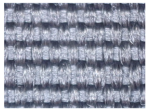
According to the factory feasibility, the Taguchi matrix has been defined, with the four various factors per matrix at different levels, as expressed in Table 1. The matrix is composed of nine trials (L9 34) with three different levels per factor. Regarding weaving patterns, shown in Table 2, plain and sateen were chosen because of their different numbers of floats and belong to different basic weaving pattern families. For the third level, ripstop was chosen first because it is a weaving pattern very frequently used in sports, and the irregularities of the structure can hypothetically induce points of friction different from those of other patterns, and therefore influence the MPFFs. However, as ripstop induces a different drawing-in than plain and sateen 3/1, it has been replaced by an ottoman pattern, which, instead of revealing a grid structure on the surface, reveals a surface striped with horizontal lines. For the warp density, levels 1 and 2 are identical to accommodate two different levels, 40 yarns/cm and 60 yarns/cm, avoiding making a third beam during sample production. For weft densities, there are three levels of densities: 25 yarns/cm, 30 yarns/cm and 35 yarns/cm. For the weft speed, the levels defined are 300 rpm, 450 rpm and 600 rpm.
Table 1.
Weaving variable factors with their levels of the Taguchi matrix.
Table 2.
Schemes and microscope view of plain, sateen and ottoman weaving patterns.
As each trial is made two times because of two different weft yarns, 18 fabrics have been made, respecting the L9 Taguchi matrix condition, as expressed in Table 3.
Table 3.
List of the fabric trials.
2.3. Quantification of MPFF Mass Leak
There are several methods for quantifying the release of MPFFs. The reference standard currently in common use is ISO 4484-1:2023 [15]. This method consists of simulating a machine wash using equipment such as a rotawash, which is generally used for washing color fastness tests. Concretely, specimens are washed at 40 °C for 45 min, with stainless steel balls and without detergent. Once the cycle is complete, the water from the rinsing bath is collected and filtered under vacuum, using a filter with a porosity of 1.6 micrometers. The loss of material is then weighed to obtain the ratio between the mass of the initial fabric specimen and the mass of material recovered. Before each weighing, the material is dried in an oven at 50 °C. The result is then expressed in milligrams of microplastic fibers released per kg of textile specimen washed. Based on the ISO 4484-1:2023, The Microfibre Consortium, The University of Leeds, and European Outdoor Group set up the TMC version 1.1 standard [16] using the same test conditions as the ISO, but tests eight specimens per fabric, instead of four in the ISO standard, providing better accuracy. This TMC version 1.1 standard was selected for the study. All washing tests were made on Rotawash SDL Atlas, and all fabric specimens were weighed on a precision scale accurate to 0.0001 g. Mass leak is defined as the following:
where
Mass leak = (Fm2 − Fm1) × 100/Sm
- Fm1 = mass (in grams) of the filter prior to testing;
- Fm2 = mass (in grams) of the filter after testing;
- Sm = mass (in grams) of the textile specimen prior to testing.
3. Results
3.1. Quantification of MPFF Mass Leak
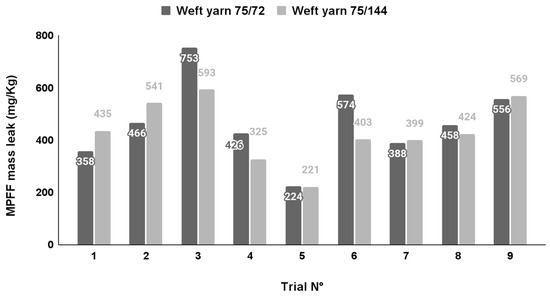
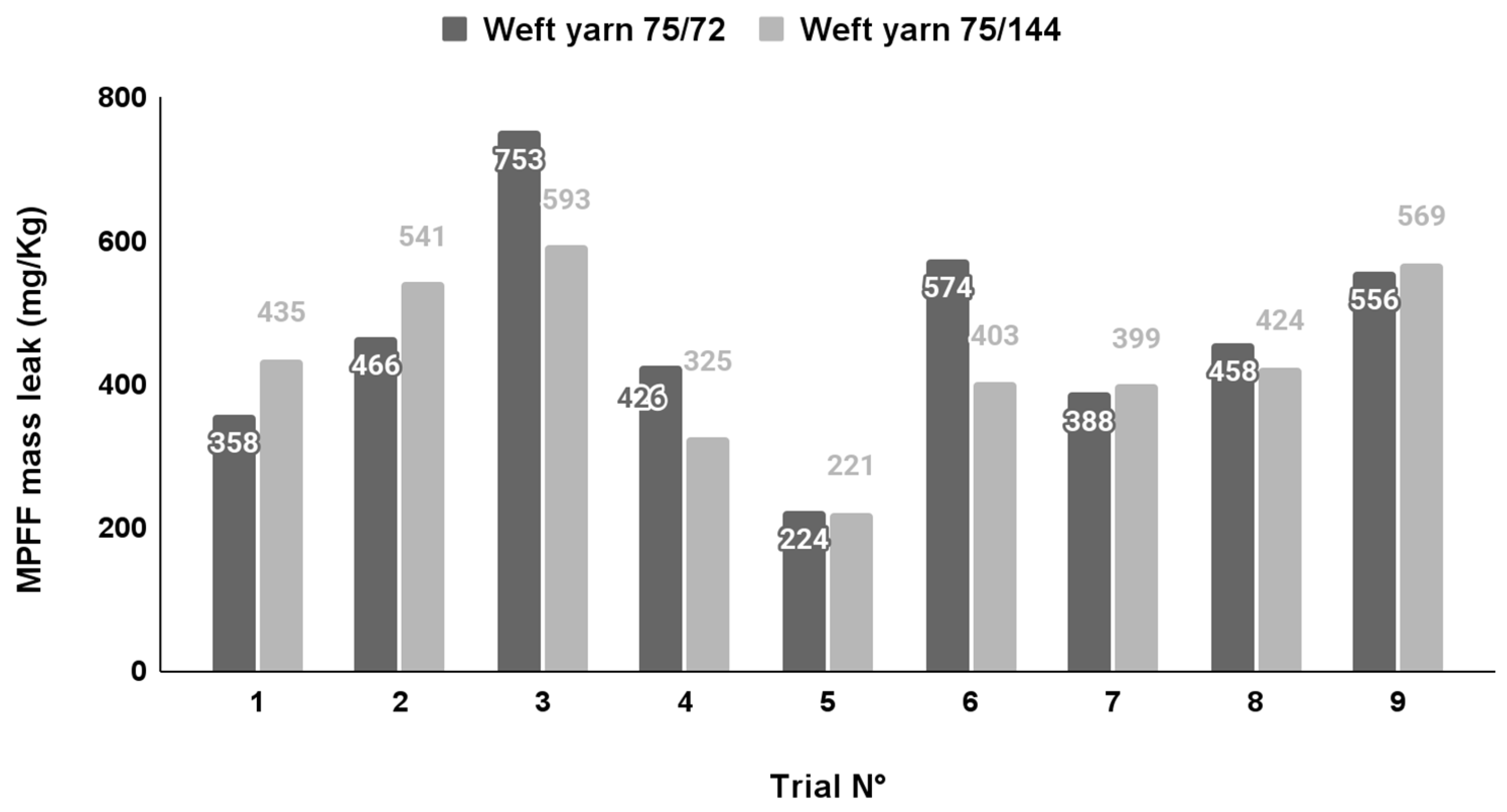
Table 4 shows the average results of the MPFF mass leak for the 18 fabric samples made, with the standard deviation and the coefficient of variation for each trial. Each of these results is the average of eight specimens tested per fabric with the TMC 1.1 method. All eighteen trials show an average MPFF release of 451 mg/kg, with an average standard deviation of 86 mg/kg and an average coefficient of variation of 20%, with a minimum average result of 221 mg/kg and a maximum average result of 753 mg/kg. The first parameter that could cause differences in release is the use of two different weft yarns. Figure 1 compares the duplicate tests to highlight a potential difference in release depending on the number of filaments in each weft yarn.
Table 4.
Results of fabrics’ average MPFF mass leak, with their standard deviation and their coefficient of variation.
Figure 1.
Average mass leak comparison between weft yarn 75/72 and 75/144.
Based on the results shown in Table 4 and Figure 1, some trials are very similar in terms of mass leakage, particularly fabrics 5, 7, and 9. Other trials, such as fabrics 3, 4, 6, and 8, show greater mass leakage, which is associated with the lower mass leakage observed with the 144-filament weft yarn. Conversely, for trials 1 and 2, mass release is minimized when using the 72-filament weft yarn.
Taking into account standard deviations, there is therefore no observed correlation between the number of filaments in the weft and the MPFF mass leakage. Consequently, for the remainder of the analysis, the decision was made to average the mass leakage of each Taguchi trial, as presented in Table 5. Standard deviation and CV% shown in Table 5 were calculated from the 16 specimens that compose each Taguchi trial, composed of eight specimens with 72 filaments and eight specimens with 144 filaments in weft.
Table 5.
Results of Taguchi trials average MPFF mass leak, with their standard deviation and their coefficient of variation.
All nine tests still indicate an average MPFF release of 451 mg/kg. The average standard deviation (97 mg/kg) and average coefficient of variation (22%) are slightly higher with this new table.
3.2. Factor Effects on MPFF Mass Leak
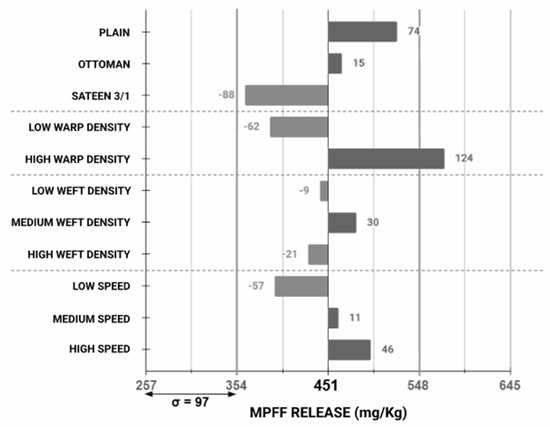
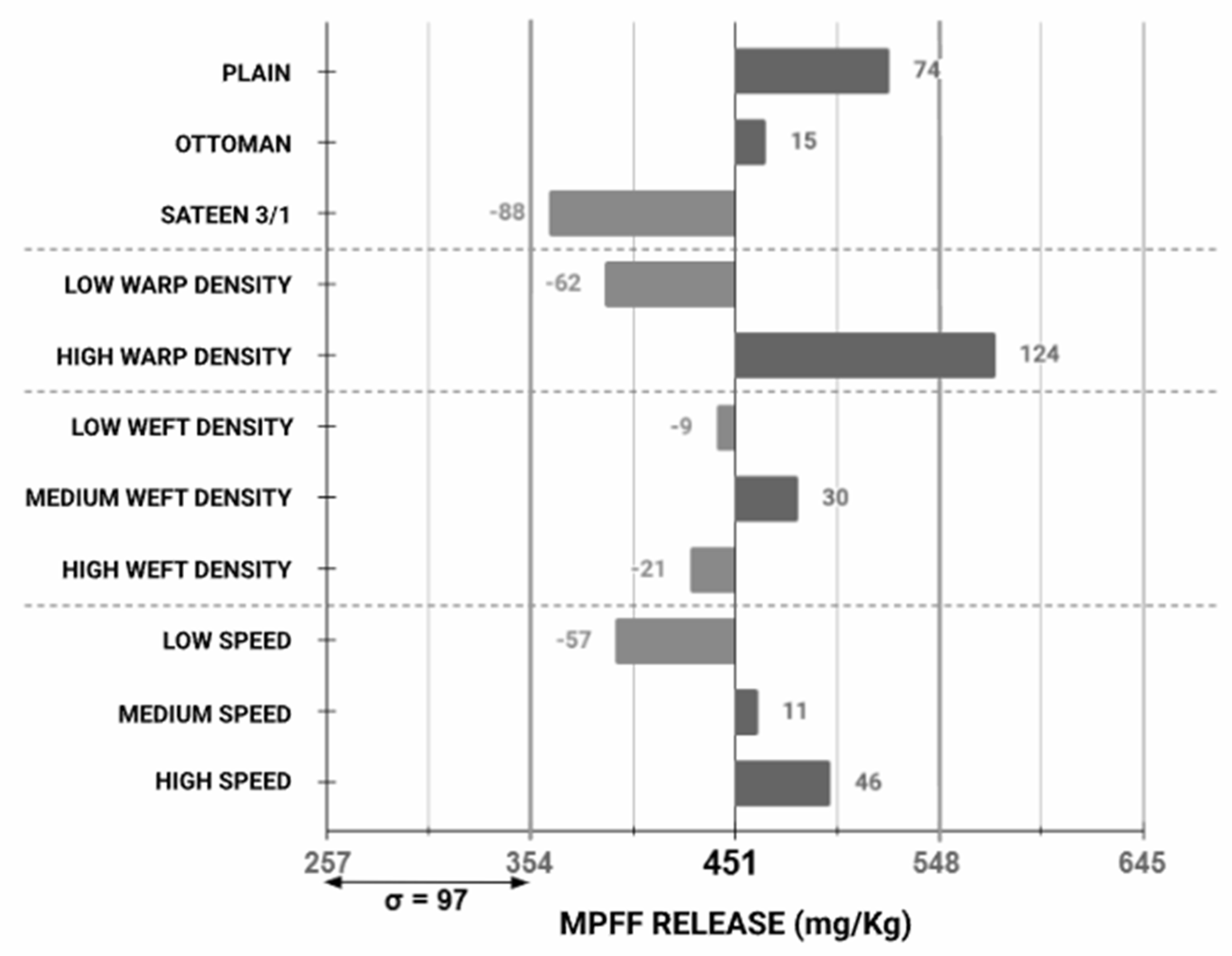
Without taking into account the difference in weft yarn, it is possible to return to the Taguchi analysis to determine the effect of each factor on the observed MPFF release. Figure 2 visually shows the influence of each factor on the average MPFF release by comparing the mean release of all trials conducted at a specific parameter level against the overall mean MPFF release of all nine trials. For instance, to calculate the average response for level 1 of Factor A (i.e., the plain weave), the release results from all trials executed with a plain weave are averaged (trials 1–2–3). Then, this result is compared with the overall average MPFF release of 451 mg/kg. A greater divergence of a level’s mean value from the overall average indicates a more substantial impact of that specific level on the quantity of MPFF released.
Figure 2.
Effect of each factor on the average MPFF release (mg/kg), following Taguchi method.
According to the results in Figure 2, the dispersion of factors around the mean of 451 mg/kg in the design of experiments can be explained mainly by the influence of weaving patterns and, above all, the densities of warp yarns. The lowest warp density (40/cm) results in a reduction of −62 mg/kg. Among all the investigated factors, warp yarn density exhibits the largest variation between its levels, indicating that it is the most influential parameter in the experimental design. The lowest warp density (40 yarns/cm) results in a decrease of 62 mg/kg relative to the overall mean, whereas increasing the warp density to 60 yarns/cm leads to an increase of 124 mg/kg. The difference between the two levels, therefore, reaches 186 mg/kg, corresponding to approximately 37% of the total variation observed in MPFF release across the experimental matrix.
Weaving pattern shows a secondary but still significant influence on MPFF release, accounting for approximately 32% of the observed variation. As illustrated in Figure 2, the 3/1 sateen weave stands out for its ability to reduce MPFF release, with an average value of 88 mg/kg below the overall mean. In contrast, the plain weave leads to a higher average release, exceeding the mean by 74 mg/kg, while the ottoman weave results in a more moderate increase of 15 mg/kg. These results highlight clear differences in MPFF release depending on the fabric structure associated with each weaving pattern.
The last two factors in the design of the experiment have less influence on MPFF release. A lower speed reduces MPPF release by 57 mg/kg, while doubling this speed increases release during the first wash by an average of 46 mg/kg. But this influence can be defined as negligible, as the delta between high and low speed (103 mg/kg) is almost half of two standard deviations (194 mg/kg). Meanwhile, weft density appears to follow a non-linear trend, although this remains negligible as the influence of this factor is not significant compared to the standard deviations.
Overall, Figure 2 indicates that variations in MPFF release are predominantly driven by warp yarn density and weaving pattern, whereas the effects of weft yarn density and weft insertion speed are comparatively minor under the experimental conditions investigated.
3.3. Fabric Properties Related to MPFF Mass Leak
In addition to the factors analyzed in the Taguchi matrix, other fabric properties were analyzed and correlated with MPFF release:
- -
- Fabric weight (g/m2), following ISO 3801 [17];
- -
- Drape coefficient, following ISO 9073-9 [18];
- -
- Cover factor.
3.3.1. Fabric Weight
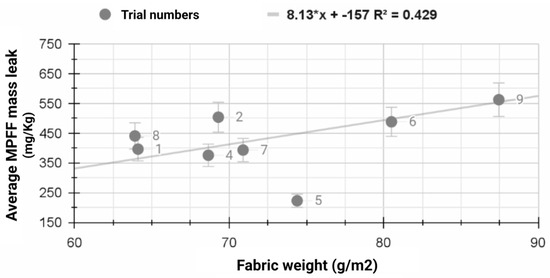
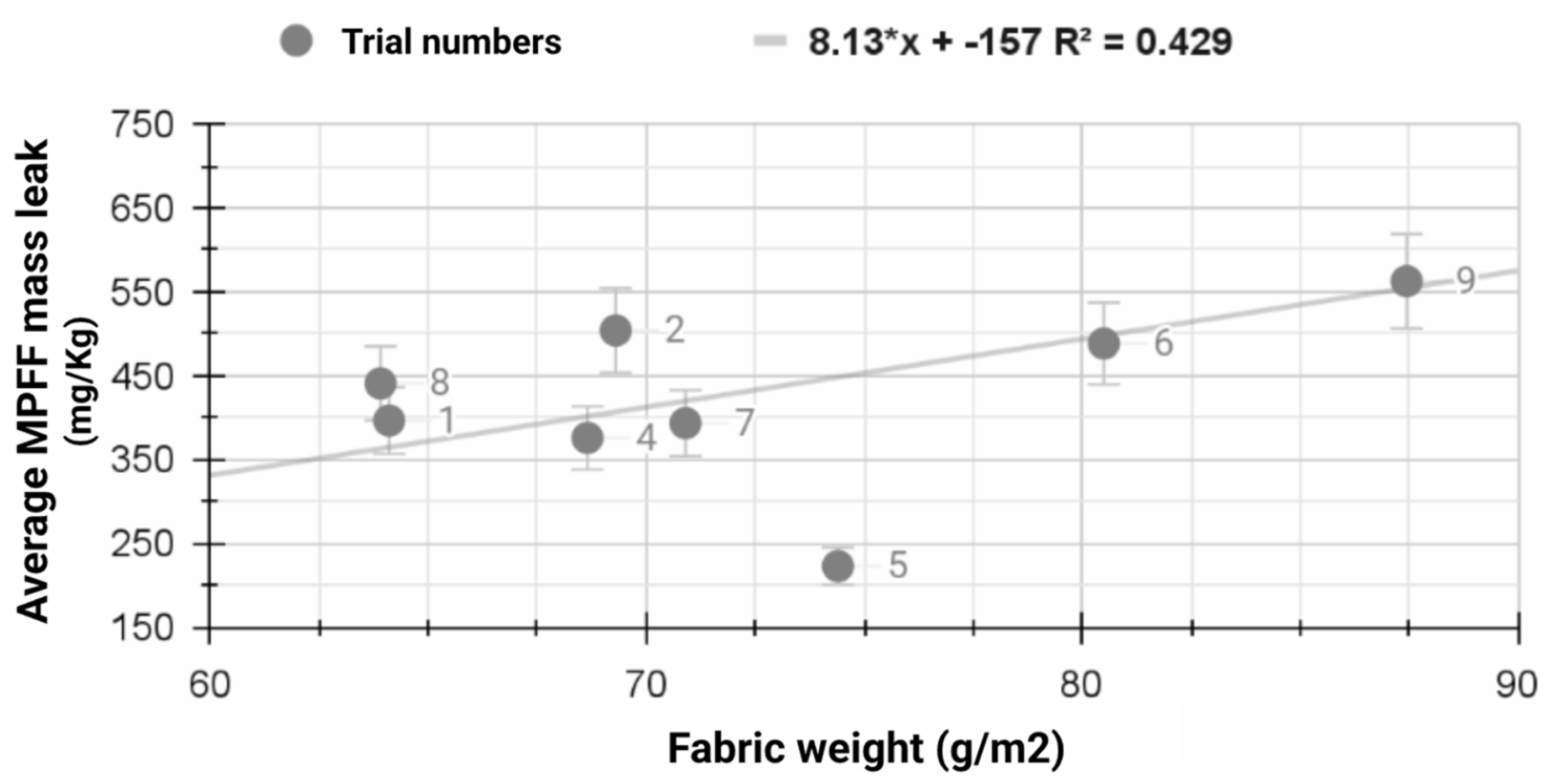
Figure 3 shows that fabric release has a positive correlation with basis surface mass, according to its Pearson coefficient of 0.66 (for p = 0.055). This means that the lighter the fabric, the less it releases. This trend is confirmed by a linear R2 of 0.43.
Figure 3.
Correlation between fabric weight (g/m2) and MPFF mass leak (mg/kg).
3.3.2. Cover Factor
In weaving, the coverage factor is a measure of the density of the threads in a fabric, indicating the proportion of the fabric surface covered by yarns. It is crucial in determining the appearance, feel, opacity, air permeability, and other properties of the fabric. It can be calculated based on the characteristics of the fabric. A higher coverage factor indicates a more opaque and denser fabric, which is stiffer and therefore less flexible and less permeable.
The cover factor has been calculated based on yarn counts, the warp and weft densities, and weaving pattern, following the equation below [19]:
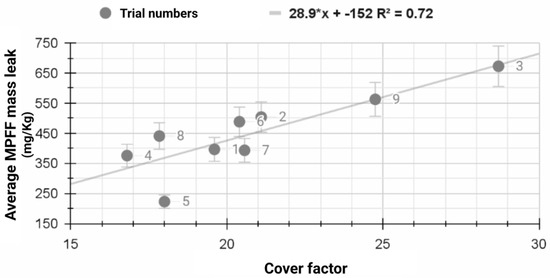
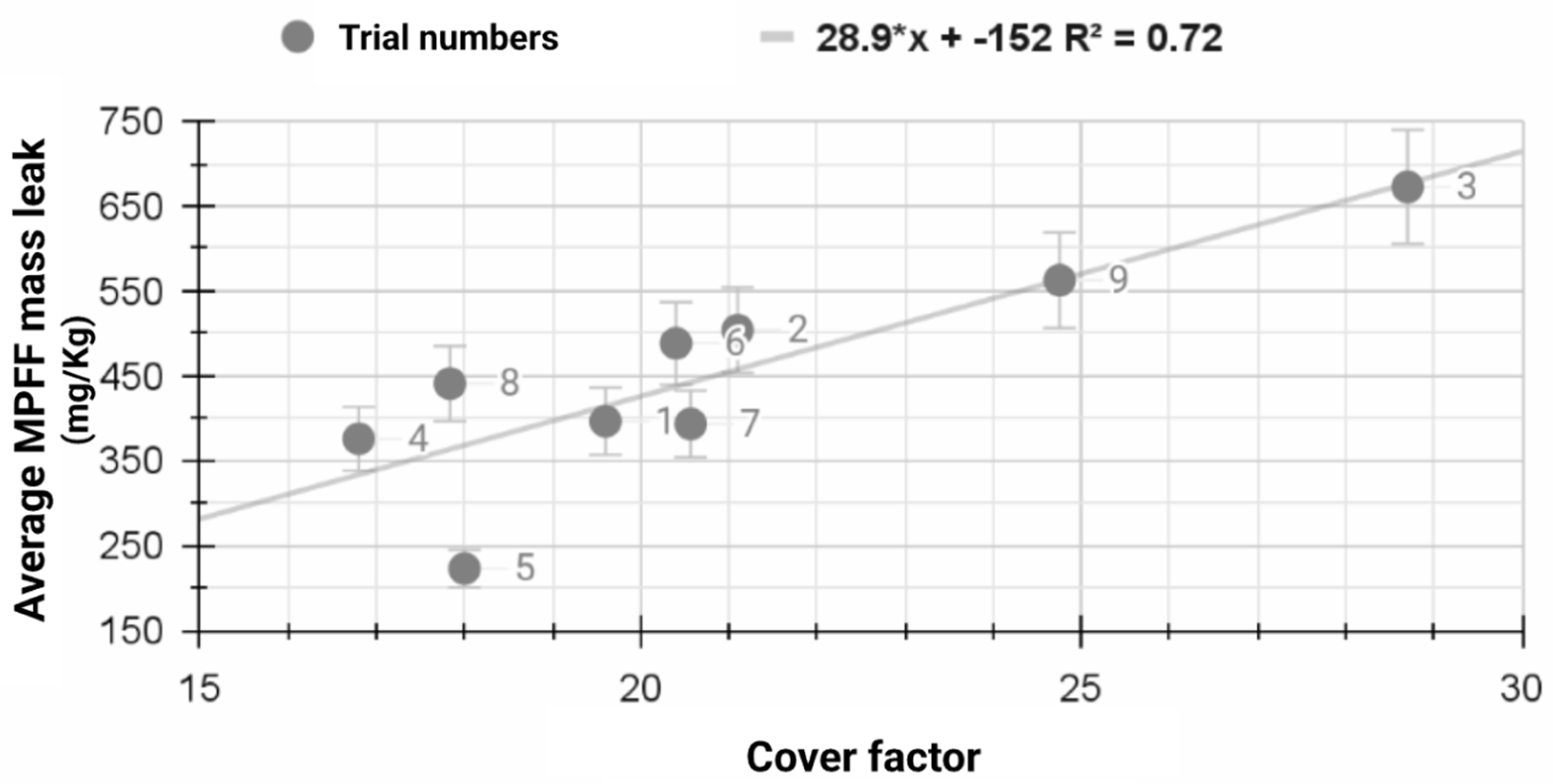
In Figure 4, the cover factor, calculated for each fabric, is linked to MPFF release by a Pearson coefficient of 0.85 (for p = 0.04). This indicates that the lower the coverage factor, and therefore the more flexible, the less MPFFs the fabric emits. This trend is confirmed in Figure 4 by an R2 of 0.72.
Figure 4.
Correlation between fabrics cover factor and MPFF mass leak (mg/kg).
It should be noted that in the two previous correlations between release and surface mass and cover factor shown respectively in Figure 3 and Figure 4, fabric number 5 deviates from the trend due to its very low release, correlated with an average basis surface mass and a cover factor that is not low enough. When it is removed from the equations, the positive correlations of the other fabrics increase. The linear trend between release and coverage factor reaches an R2 equal to 0.85. The other trend between MPFF release and fabric surface mass follows an R2 of 0.76.
3.3.3. Drape Coefficient
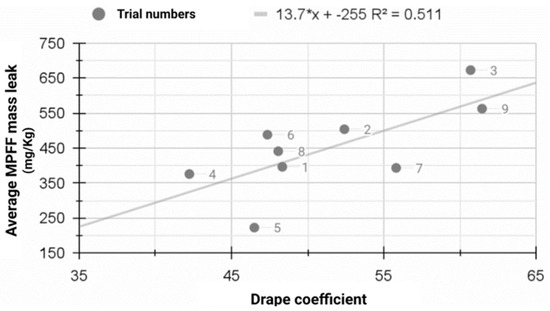
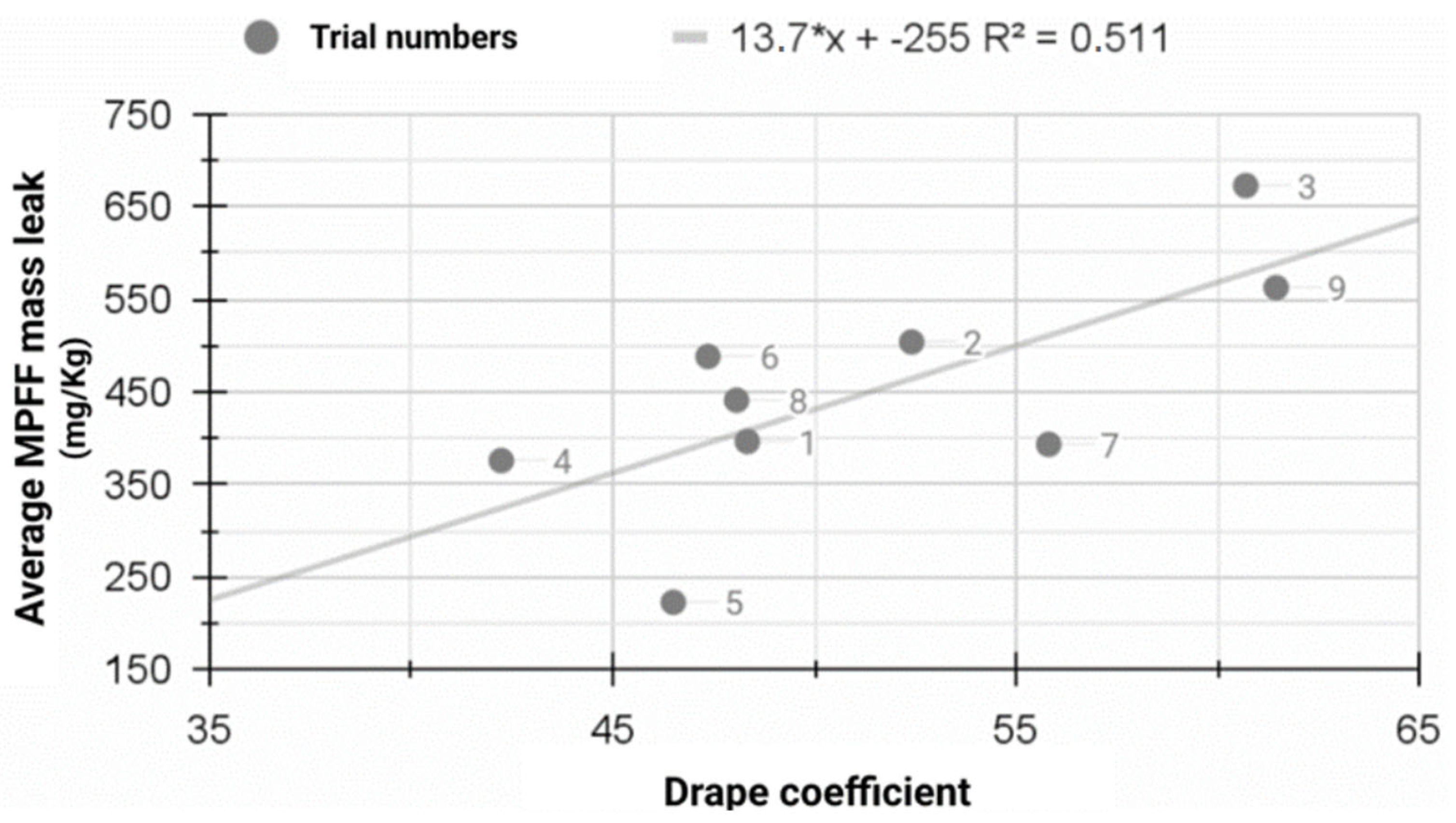
The drape of a fabric is defined as the way it folds and falls under its own surface mass, forming pleats. It is the way the fabric hangs, which is linked to the intrinsic properties of the material, such as its flexibility, stiffness, and surface mass. The higher the drape coefficient, the stiffer the fabric and the less it deforms under the effect of gravity. Conversely, a low drape coefficient indicates that the fabric is more flexible and deforms more, forming more numerous and larger folds. Measured in the eighteen initial fabrics following ISO 9073-9 standard, the drape coefficient is determined by projecting the shadow of the draped specimen onto a paper ring (equal in size and mass to the unsupported area). The shadow’s outline is traced, and the traced area is cut out. The coefficient is the mass of the shadow paper segment expressed as a percentage of the total mass of the paper ring.
It turns out that there is a difference between fabrics depending on the weft yarn used to make them. The draping results show higher values for fabrics with 72 filaments than for those with 144 filaments. Nevertheless, the same curve profile emerges for all nine tests, regardless of the weft yarn. The decision was therefore made to average the drape coefficient values for the two original populations.
Figure 5 shows a linear trend between MPFF release and drape coefficient (R2 = 0.51). The higher the drape coefficient, the greater the mass leaks.
Figure 5.
Correlation between drape coefficient and MPFF mass leak (mg/kg).
4. Discussion—Influencing Factors
The results obtained show that the warp yarn density is the most impactful factor on the release of MPFFs among those studied. They show that increasing from 40 yarns/cm to 60 yarns/cm significantly increases the release of MPFFs. As illustrated in Table 6, a higher warp density results in a tighter structural configuration, with a reduced spacing between adjacent warp yarns and a higher number of interlacement points per cm. If the release of MPFFs during washing is mainly due to the initiation of breakage occurring during weaving, the proximity of the warp yarns on the loom in the case of a density of 60 yarns/cm could induce much more yarn-on-yarn friction than in the case of a warp density of 40 yarns/cm, leading to a greater number of potential structural weak points.
Table 6.
Schemes of weaving patterns and their number of warp face changes.
Nevertheless, the influence of warp yarn density on MPFF release is not verified in the weft direction, as the difference between the influence of each level on release, compared to the average, is too small in relation to the standard deviations. Within the scope of the study, the change from 25 yarns/cm to 35 yarns/cm has no significant influence on the generation of MPFFs.
The experimental results regarding the influence of warp yarn density can be linked to the results from the influence of the weaving pattern factor. Plain induces a much greater release in these tests than the 3/1 sateen (respective average releases of 524 mg/kg and 362 mg/kg), while the ottoman, which is part of the plain weave family, shows an average release of 465 mg/kg. As shown in Table 6, these weaving patterns differ mainly in terms of interlacement frequency and float distribution. The higher the interlacement frequency, the more frequently the warp yarns change face during weaving after each weft insertion, and thus the more they are subjected to repeated bending and friction. Taking a ratio of 44, which is the first common multiple of the ratios of each weaving pattern in the warp direction (2; 4; 11), a number of interlacing changes of 44 for the plain, 22 for the 3/1 sateen, and 40 for the ottoman is observed, as summarized in Table 6.
On the other hand, the way the yarns are interlaced can influence the ability of a fabric to withstand friction during machine washing. Based on the results and the structural configurations shown in Table 6, fabrics with a higher number of floats, such as the 3/1 sateen, tend to release fewer MPFFs during washing and be able to withstand friction during washing. In contrast, the plain weave, characterized by the absence of floats and a high level of yarn crimp, may create more frequent bending points within the yarns, which could act as potential initiation sites for filament breakage.
This is directly linked to the warp yarn density that may influence the ability of a fabric to withstand friction during machine washing. In this case, the hypothesis can be made that a low yarn density allows the filaments to have space to move within the woven structure and thus avoid filament breakage.
The trends observed regarding the influence of weaving structure and fabric tightness on MPFF release appear to be opposite to those commonly reported in the textile literature regarding abrasion resistance and fabric durability. Mehreen Ijaz [20] reported that tightly woven structures, such as plain and twill weaves, particularly when produced from polyester fibers, demonstrate higher durability after repeated laundering, while structures with fewer interlacement points, such as satin and basket weaves, are more susceptible to pilling and abrasion. Similarly, the study by Kaynak et al. [21] showed that long yarn floats and a low number of interlacings significantly decrease the abrasion resistance of woven fabrics, leading to higher mass loss during abrasion testing. These observations are further supported by the review conducted by Begum and Milašius [22], which highlights that dense and stiff weave structures generally exhibit higher abrasion resistance. This apparent discrepancy can be explained by the fundamental differences between abrasion resistance testing and MPFF release mechanisms. Abrasion resistance studies primarily focus on macroscopic fabric durability and surface integrity under standardized, localized, and repetitive mechanical contact, such as that imposed in Martindale or Taber tests [23]. In these contexts, dense and tightly interlaced fabrics are more resistant to visible damage and mass loss. In contrast, MPFF release during washing causes micro-scale filament damage and fragmentation that may not result in visible surface degradation. Furthermore, breaks generated during the manufacturing process appear to have a significant impact on the release of MPFFs during the first wash, whereas this appears to have less of an impact during abrasion or pilling tests.
Based on this approach, the analysis of fabric weight, cover factor and drape coefficient, influenced by yarn densities and weaving pattern, completes the understanding of the impact of structure tightness on the release of MPFF.
For the cover factor, these findings suggest that a tighter fabric construction, as determined by its warp and weft yarn densities and its weaving pattern, tends to release more MPFFs. This observation contradicts the study by Berruezo in 2020 [24], which shows that the interlacement coefficient, calculated as the ratio of the number of interlacement points in the weave to the warp and weft densities, exerts an inverse influence compared to the results presented herein. This correlates with the results for surface mass and weight. The tighter a fabric is, the heavier it is, the higher its cover factor and drape coefficient, and the greater the release of MPFFs. A tight structure would therefore tend not to diffuse mechanical energy during the stresses undergone during washing, but rather would concentrate these stresses on specific points, and would therefore be responsible for more filament breakage and thus MPFF release. This may also be related to the fact that in a tight structure, the filaments undergo greater deformation, preventing them from moving within the structure and creating points of weakness.
Regarding the influence of the production speed on the emission of MPFFs during washing, even if the results are not significant, they follow a linear tendency. Presumably, the increase in speed induces greater stress on the comb during weaving, mainly on the weft yarn, leading to breakage or breakage of the filaments, increasing the emission of MPFFs. It is therefore likely that this factor has no influence after several washes. These results show that it is therefore possible that mills wishing to increase their productivity by speeding up their production speed in weaving may have a greater impact on the release of MPFFs.
5. Conclusions
With the aim of better understanding the phenomena involved in the release of microplastic fiber fragments during the first domestic washing, this study has highlighted that the factors of the weaving process play a significant role in this release. Regardless of the manufacturing conditions of the polyester fabrics studied, all generate MPFFs, ranging from 221 mg/kg to 753 mg/kg.
The first observation is that the number of filaments in the weft yarn is not a determining factor. Within the scope of the study, a minimal average solution for the release of MPFFs is identified with test 5, weaved with a 3/1 sateen pattern, warp and weft yarn densities of 40 threads/cm and 30 threads/cm, respectively, and at a speed of 600 RPM.
Trends have been identified, with warp yarn density and weaving patterns having the main impacts. A decrease in warp yarn density leads to a decrease in released MPFFs, while for weaving patterns, sateen 3/1 emits less MPFFs than ottoman, which itself emits less than plain. Considering that a part of the MPFF release is coming from initial breakage during production, this study shows that the decrease in friction during weaving induces a decrease in the release of MPFFs during the first wash using the TMC 1.1 standard.
Conversely, the freedom of movement of the filaments within the woven structure helps to reduce the emission of MPFFs. This is evaluated with the surface mass, the cover factor, and the draping coefficient, which is correlated to the MPFF leak in this study: the lower they are, the lower the MPFF emission. Possibly, this trend is true up to a certain limit, where the cohesion of filaments and yarns becomes too low, the resistance to friction becomes too low as well, and exposes the filaments to more breakage, and thus to a higher release of MPFFs.
These findings suggest that abrasion resistance, as defined by textile standards, and MPFF release during washing are governed by different mechanical regimes and evaluation criteria. While abrasion resistance is strongly influenced by fabric stiffness and resistance to surface wear, MPFF release after one washing appears to be more closely linked to friction occurring during fabric production and to the ability of yarns and filaments to redistribute mechanical stresses during washing.
However, the mechanisms inducing the release of MPFFs are very complex and vary greatly within the same fabric. The intricate mechanisms that induce the release of MPFFs and their variability within a fabric suggest a complex system of interactions. Notably, the interplay between the weaving pattern and warp and weft densities appears to be a key area for exploration. While fully identifying the predisposing phenomena requires further analysis, this study on nine combinations of weaving parameters provides initial insights. Further investigation across a broader range of samples would be necessary to substantiate this correlation. The creation of a more complex design of experiment would enable the analysis of interactions between several factors, particularly between yarn densities and weaving patterns, using the Taguchi method.
In addition, testing after several washes would show whether the influence of the factors studied remains consistent over time. It would also eliminate the influence of breakage occurring during the production phase after several washes, to reveal the influence of the fabric structure as the main factor.
Author Contributions
Conceptualization, P.M., A.C., A.P. and N.B.; Methodology, P.M. and A.C.; Validation, A.P. and N.B.; Formal Analysis, P.M., A.C. and A.P.; Investigation, P.M. and A.C.; Resources, P.M., A.C. and A.P.; Writing—Original Draft Preparation, P.M.; Writing—Review and Editing, P.M., A.C. and A.P.; Supervision, A.P. and N.B.; Project Administration, P.M., A.C., A.P. and N.B.; Funding Acquisition, A.C. All authors have read and agreed to the published version of the manuscript.
Funding
This research was funded by DECATHLON and GEMTEX laboratory themselves. DECATHLON benefits from partial fundings from ANRT Agence Nationale de la Recherche et de la Technologie and ADEME grant number 2022-1149. The APC was funded by GEMTEX Laboratory.
Institutional Review Board Statement
Not applicable.
Informed Consent Statement
Not applicable.
Data Availability Statement
The original contributions presented in this study are included in the article. Further inquiries can be directed to the corresponding author.
Acknowledgments
The authors would like to thank all those who contributed to this research and to the PhD project on which it is based. Particular thanks are extended to the DECATHLON textile team, whose support made this study possible. The authors especially acknowledge Marie Stephan for initiating microplastic pollution research within Decathlon and for her continued engagement in this field. The authors are grateful to Philippe Ober and Denis Laureau, also from Decathlon, for their valuable technical expertise in weaving processes and for their guidance on the application of the Taguchi design of experiments methodology, respectively. The contribution of the industrial partners involved in textile sample manufacturing is also acknowledged. The authors thank CONCORDIA TEXTILES, and in particular Fanny Vanderschelden, for the fabric manufacturing in industrial conditions, from yarn bobbins to finished woven fabrics. Thanks are also extended to INTERTEK FRANCE, notably Gilles Durot and Nazih Frej, for carrying out the TMC testing on the woven samples. This study benefited from partial funding provided by the French organizations ANRT and ADEME.
Conflicts of Interest
Authors Pierre Matteoni and Antoine Cosne were employed by the company DECATHLON SE. The remaining authors declare that the research was conducted in the absence of any commercial or financial relationships that could be construed as a potential conflict of interest. The authors declare that this study received funding from DECATHLON, GEMTEX laboratory, ADEME and ANRT organizations. The funder had the following involvement with the study: project supervision and monitoring, dissemination of results.
Abbreviations
The following abbreviations are used in this manuscript:
| MPFF | MicroPlastic Fiber fragments |
| DTY | Draw Textured Yarn |
References
- Textile Exchange. Material Market Report 2025; Textile Exchange: San Francisco, CA, USA, 2025; Available online: https://2d73cea0.delivery.rocketcdn.me/app/uploads/2025/09/Materials-Market-Report-2025.pdf (accessed on 14 October 2025).
- Liévin, T. Synthèse Bibliographique: La Micropollution; GEMTEX: Roubaix, France, 2022; Available online: http://www.ecytwin.eu/synthese-bibliographique-la-micropollution/ (accessed on 14 October 2025).
- Weis, J.S.; De Falco, F. Microfibers: Environmental problems and textile solutions. Microplastics 2022, 1, 626–639. [Google Scholar] [CrossRef] [Scilit]
- Zhang, Y.-Q.; Lykaki, M.; Markiewicz, M.; Alrajoula, M.T.; Kraas, C.; Stolte, S. Environmental contamination by microplastics originating from textiles: Emission, transport, fate and toxicity. J. Hazard. Mater. 2022, 430, 128453. [Google Scholar] [CrossRef] [Scilit] [PubMed]
- Periyasamy, A.P.; Tehrani-Bagha, A. A review on microplastic emission from textile materials and its reduction techniques. Polym. Degrad. Stab. 2022, 199, 109901. [Google Scholar] [CrossRef] [Scilit]
- Feng, Y.; Tu, C.; Li, R.; Wu, D.; Yang, J.; Xia, Y.; Peijnenburg, W.J.; Luo, Y. A systematic review of the impacts of exposure to micro- and nano-plastics on human tissue accumulation and health. Eco-Environ. Health 2023, 2, S2772985023000418. [Google Scholar] [CrossRef] [Scilit] [PubMed]
- Zambrano, M.C.; Pawlak, J.J.; Daystar, J.; Ankeny, M.; Cheng, J.J.; Venditti, R.A. Microfibers generated from the laundering of cotton, rayon and polyester based fabrics and their aquatic biodegradation. Mar. Pollut. Bull. 2019, 142, 394–407. [Google Scholar] [CrossRef] [Scilit] [PubMed]
- Belzagui, F.; Gutiérrez-Bouzán, C.; Álvarez-Sánchez, A.; Vilaseca, M. Textile microfibers reaching aquatic environments: A new estimation approach. Environ. Pollut. 2020, 265, 114889. [Google Scholar] [CrossRef] [Scilit] [PubMed]
- Stanton, T.; Stanes, E.; Gwinnett, C.; Lei, X.; Cauilan-Cureg, M.; Ramos, M.; Sallach, J.B.; Harrison, E.; Osborne, A.; Sanders, C.H.; et al. Shedding off-the-grid: The role of garment manufacturing and textile care in global microfibre pollution. J. Clean. Prod. 2023, 428, 139391. [Google Scholar] [CrossRef] [Scilit]
- European Environment Agency (EEA). Microplastics from Textiles: Towards a Circular Economy for Textiles in Europe; EEA: Copenhagen, Denmark, 2022; Available online: https://www.eea.europa.eu/en/analysis/publications/microplastics-from-textiles-towards-a-circular-economy-for-textiles-in-europe (accessed on 25 October 2025).
- First Sentier MUFG Sustainable Investment Institute. Microfibres: The Invisible Pollution from Textiles; First Sentier MUFG Sustainable Investment Institute: London, UK, 2022; Available online: https://www.firstsentier-mufg-sustainability.com/content/dam/sustainabilityinstitute/assets/research/FSI-Sustainability-Investment-Institute-Report-January2022-final.pdf (accessed on 25 October 2025).
- Hazlehurst, A.; Tifn, L.; Sumner, M.; Taylor, M. Quantification of microfibre release from textiles during domestic laundering. Environ. Sci. Pollut. Res. 2023, 30, 43932–43949. [Google Scholar] [CrossRef] [Scilit] [PubMed]
- Novotná, J.; Tunak, M.; Militký, J.; Kremenakova, D.; Wiener, J.; Novakova, J.; Sevcu, A. Release of microplastic fibers from polyester knit fleece during abrasion, washing, and drying. ACS Omega 2025, 31, 14241–14249. [Google Scholar] [CrossRef] [Scilit] [PubMed]
- Belzagui, F.; Gutiérrez-Bouzán, C. Review on alternatives for the reduction of textile microfibers emission to water. J. Environ. Manag. 2022, 317, 115347. [Google Scholar] [CrossRef] [Scilit] [PubMed]
- ISO 4484-1:2023; Textiles—Determination of Resistance to Surface Abrasion. ISO: Geneva, Switzerland, 2023. Available online: https://www.iso.org/standard/82238.html (accessed on 20 January 2026).
- The Microfibre Consortium. TMC Test Method 1.1. Available online: https://www.microfibreconsortium.com/the-tmc-test-method (accessed on 20 January 2026).
- ISO 3801:1977; Textiles—Woven Fabrics—Determination of Mass per Unit Length and Mass per Unit Area. International Organization for Standardization: Geneva, Switzerland, 1977.
- ISO 9073-9:2008; Textiles—Test Methods for Nonwovens. Part 9: Determination of Drapability Including Drape Coefficient. International Organization for Standardization: Geneva, Switzerland, 2008.
- Islam, S.; Akter, S.; Ahmed, S. Influence of cover factor on the physical properties of woven fabrics. J. Text. Polym. 2022, 10, 57–63. [Google Scholar] [CrossRef]
- Ijaz, M. Effect of weave structure on pilling resistance of woven fabrics at various washing intervals. J. Univ. Shanghai Sci. Technol. 2025, 27, 115–121. [Google Scholar]
- Kaynak, H.K.; Topalbekiroğlu, M. Influence of fabric pattern on the abrasion resistance property of woven fabrics. Fibres Text. East. Eur. 2008, 16, 54–56. [Google Scholar]
- Begum, M.S.; Milašius, R. Factors of weave estimation and the effect of weave structure on fabric properties: A review. Fibers 2022, 10, 74. [Google Scholar] [CrossRef] [Scilit]
- Özdil, N.; Marmaralı, A.; Kretzschmar, S.D. Abrasion resistance of textiles: Gaining insight into the damaging mechanisms of different test procedures. J. Eng. Fibers Fabr. 2019, 14, 1558925019829481. [Google Scholar] [CrossRef] [Scilit]
- Berruezo, M.; Bonet-Aracil, M.; Montava, I.; Bou-Belda, E.; Diaz-Garcia, P.; Gisbert-Paya, J. Preliminary study of weave pattern influence on microplastics from fabric laundering. Text. Res. J. 2020, 91, 1037–1045. [Google Scholar] [CrossRef] [Scilit]








Disclaimer/Publisher’s Note: The statements, opinions and data contained in all publications are solely those of the individual author(s) and contributor(s) and not of MDPI and/or the editor(s). MDPI and/or the editor(s) disclaim responsibility for any injury to people or property resulting from any ideas, methods, instructions or products referred to in the content. |
© 2026 by the authors. Licensee MDPI, Basel, Switzerland. This article is an open access article distributed under the terms and conditions of the Creative Commons Attribution (CC BY) license.