Article

Medical Financial Assistance and Sustainable Livelihood Resilience in China’s Rural Revitalization Process

1
College of Economics and Management, Hebei Agricultural University, Baoding 071001, China
2
Hebei Provincial Key Laboratory of Science and Technology Finance, Hebei Finance University, Baoding 071051, China
3
College of Humanities and Social Sciences, Hebei Agricultural University, Baoding 071001, China
*
Authors to whom correspondence should be addressed.
Sustainability 2026, 18(6), 2795; https://doi.org/10.3390/su18062795
Submission received: 2 February 2026 / Revised: 7 March 2026 / Accepted: 9 March 2026 / Published: 12 March 2026

Abstract

Rural revitalization has emerged as a core agenda in the global pursuit of sustainable development, with its success fundamentally hinging on enhancing the resilience of rural households to withstand shocks and restore their livelihoods. In contrast to mainstream research that primarily examines whether Medical Financial Assistance (MFA) reduces medical burden, this paper focuses on MFA as ex-post cash compensation and investigates whether and how it affects the sustainable livelihood recovery of low-income rural households following health shocks, thereby providing empirical evidence for understanding the foundational role of health security in rural revitalization. A quasi-natural experiment is constructed by leveraging the institutional feature that MFA eligibility is activated by exogenous health shocks. Using two-wave balanced panel data (2021–2022) from a nationally designated deep poverty-stricken county in Hebei Province, China, the Propensity Score Matching–Difference-in-Differences (PSM-DID) method and mediation models are employed for causal identification and mechanism testing. The findings indicate that (1) MFA significantly promotes household income recovery. It enables recipient households to recover per capita net income by an average of approximately 13.2% (p < 0.01), demonstrating a protective recovery effect, and simultaneously recovers per capita non-farm labor income by an average of approximately 13.8% (p < 0.05), revealing a developmental recovery effect. The latter is partially mediated by the non-farm labor participation rate (mediation ratio 51.7%, Sobel Z = 2.10). This finding validates the “time release effect,” demonstrating that MFA stimulates endogenous dynamics by restoring health capital and releasing labor previously constrained by family care responsibilities. It thereby extends the application of health capital theory from the individual to the household level. (2) Mechanism analysis shows that the protective recovery effect is fully mediated by the amount of MFA received (mediation ratio 326.7%, Sobel Z = 12.85), providing empirical evidence for precautionary saving theory in the context of targeted social assistance and revealing the potential productive attributes of the social safety net. (3) Heterogeneity analysis reveals clear group targeting and shock thresholds. The protective effect is concentrated among elderly households, while the developmental effect is primarily evident in middle-aged households. Both recovery effects manifest significantly only for households experiencing major disease shocks, confirming the theoretical expectation of “conditional effectiveness,” namely that policy effects are systematically moderated by household life-cycle characteristics and the severity of health shocks. This study demonstrates that MFA serves both as a safety net and an empowerment tool, but its effectiveness is highly contingent upon household characteristics and shock severity. By uncovering the foundational mechanisms through which health security contributes to rural household resilience, this study provides empirical evidence from China for building sustainable poverty prevention systems in the global process of rural revitalization.

1. Introduction

Rural revitalization has emerged as a central agenda in the global pursuit of sustainable development, with its fundamental goal being the restoration and enhancement of the livelihood resilience of rural households and communities, their capacity to withstand various shocks, recover from them, and achieve transformative development [1,2]. This resilience-building process encompasses multiple dimensions, among which health, as core human capital, constitutes a fundamental element sustaining household livelihood resilience. Existing research reveals that household health capital is a critical component of livelihood resilience, directly influencing households’ capacity to cope with risks and pursue development opportunities [3]. From a geographical perspective, it is further argued that the materiality of remote rural areas, including traditional livelihoods, living spaces, and social networks, fundamentally depends on the health and productive capacity of their inhabitants [4]. Therefore, constructing an effective health security system is not merely a matter of safeguarding individual health rights but a strategic investment in consolidating the foundation of rural revitalization and enhancing rural household resilience.
Health shocks constitute a core risk that drives vulnerable households into the vicious cycle of “poverty and illness.” Constructing an effective medical safety net to break this link directly pertains to two critical global agendas in poverty reduction and development: the elimination of poverty and the assurance of good health. Within China’s multi-tiered medical security system, Medical Financial Assistance (MFA) is positioned as the last line of defense for low-income groups, designed to prevent households from falling back into poverty due to catastrophic health expenditures through ex-post medical cost compensation. The promulgation of the Opinions on Improving the Medical Insurance and Assistance System for Catastrophic Illnesses by the General Office of the State Council in 2021 marked a strategic shift in MFA policy from “extraordinary poverty alleviation” to “routine poverty prevention” [5]. The 2025 Central Document No. 1 further emphasized the need to consolidate and expand the achievements in poverty alleviation and strengthen the safety net role of social security, including MFA [6]. The Fourth Plenary Session of the 20th Central Committee of the Communist Party of China established “improving the social security system” and “accelerating the construction of a Healthy China” as key livelihood objectives for the 15th Five-Year Plan period [7]. In the context of advancing sustainable development, strengthening the social safety net with MFA as a critical component is not only essential for safeguarding basic living standards but also a fundamental project for achieving long-term and sustainable poverty prevention.
However, significant challenges persist. Data from the National Health Commission indicate that since 2021, households at risk of poverty due to illness still account for 48.13 percent of the key monitoring targets for preventing a return to poverty. This figure underscores a critical question requiring urgent investigation: For low-income rural households experiencing health shocks, does the role of MFA remain confined to ex-post medical expense reimbursement? Can it go further by mitigating the suppressive impact of health shocks on household livelihoods, thereby facilitating substantive income recovery? In other words, within the grand narrative of rural revitalization, what role does health security actually play? Is it merely a “safety net” for basic protection, or can it serve as an “empowerment tool” that stimulates endogenous dynamics?
To address these questions, this study shifts the evaluation focus from whether MFA “reduces medical burden” to whether and how it promotes sustainable livelihood recovery, aiming to reveal at the micro level the mechanisms through which health security enhances rural household livelihood resilience. At the theoretical level, it integrates precautionary saving theory [8], health capital theory [9], and household production theory [10] to conceptualize the effects of MFA as operating through two distinct pathways: protective recovery and developmental recovery, conceptualizing household income recovery as a core manifestation of livelihood resilience [1,2]. At the empirical level, it leverages the institutional feature that MFA eligibility is activated by exogenous health shocks to construct a quasi-natural experiment, employs the Propensity Score Matching–Difference-in-Differences (PSM-DID) method for causal identification, and utilizes mediation models to test the transmission mechanisms underlying the two pathways.
Relative to the existing literature, the contributions of this study are fourfold. First, in terms of research perspective, this study situates the evaluation of MFA effects within the broader framework of rural revitalization, shifting the focus from “burden reduction” to “livelihood resilience building.” It reveals the foundational role of health security in enhancing rural households’ capacity to withstand risks, providing new evidence for understanding the micro-foundations of rural revitalization. Second, in terms of theoretical integration, this study synthesizes health capital theory [9], household production theory [10], and precautionary saving theory [8] within a unified analytical framework to distinguish between the dual pathways of MFA. By engaging in dialogue with rural resilience theory and rural materiality theory, it reveals that MFA possesses not only a safety-net function but also the potential to stimulate endogenous household dynamics through health restoration and time release, thereby providing empirical evidence grounded in the Chinese context for examining the classic proposition of whether social assistance can promote development. Third, in terms of causal identification, by leveraging the institutional feature that MFA is activated by exogenous health shocks, this study constructs a quasi-natural experiment comparing “severe shock recipients” with “mild shock non-recipients” within the population of households experiencing health shocks, effectively mitigating selection bias. Fourth, in terms of mechanism and heterogeneity analysis, this study quantifies the transmission intensity of the two pathways through mediation models and examines the heterogeneity of policy effects across family life cycle stages and disease types, thereby providing empirical evidence for understanding the conditional effectiveness of MFA. This responds to the academic call for “context-specific, differentiated approaches” in rural revitalization policy [11].
The remainder of this paper is organized as follows. Section 2 presents the literature review and research gap, systematically reviewing studies on MFA policy effects, health shocks and labor supply, and household resilience, thereby clarifying the research positioning of this paper. Section 3 constructs the theoretical analytical framework and proposes research hypotheses. Section 4 describes the data sources, variable definitions, and model specifications. Section 5 reports the empirical results, including prerequisite assumption tests, baseline regressions, robustness checks, heterogeneity analyses, and mechanism tests. Section 6 concludes, discussing policy implications, research limitations, and future directions.

2. Literature Review

2.1. Research on the Effects of Medical Financial Assistance Policy

As a safety-net and targeted institutional arrangement within the multi-tiered medical security system, the effects of Medical Financial Assistance (MFA) policy can be systematically examined from two dimensions: “financial burden reduction” and “empowerment.” Although existing research has yielded substantial findings in policy effect evaluation, there remains considerable scope for exploration regarding how MFA influences household livelihood outcomes through the micro-behavioral mechanism of intra-household labor resource allocation, a critical yet under-explored transmission pathway.

2.1.1. The “Financial Burden Reduction” Effect of Medical Financial Assistance

The most direct and observable effect of MFA involves the reduction of household direct medical expenditure burdens. This “financial burden reduction” effect represents an area of broad scholarly consensus. The theoretical foundation for this understanding lies in conceptualizing MFA as a critical financial risk protection tool [12]. Numerous empirical studies consistently confirm that MFA, through its reimbursement mechanism, significantly reduces out-of-pocket medical expenses for beneficiary households and effectively decreases the probability of catastrophic health expenditure [13,14,15]. Early quantitative evidence from China demonstrates that the combination of the New Rural Cooperative Medical Scheme and MFA effectively reduces the medical economic burden on impoverished rural residents [16]. International evidence from the U.S. Medicaid program further corroborates the substantial contribution of targeted medical assistance in reducing elderly poverty rates [17].
However, the conceptualization of “burden reduction” itself faces methodological challenges. Recent scholarship highlights the inherent difficulties in simply monetizing the in-kind benefits of health insurance to measure poverty reduction effects. This insight has prompted researchers to seek more direct welfare outcome indicators rather than relying solely on intermediate measures such as out-of-pocket expenditures [18]. This methodological consideration is particularly relevant for evaluating MFA, as the ultimate goal of such policies extends beyond cost reduction to encompass broader livelihood protection.
Beyond the consensus on direct effects, scholarly debate persists regarding the overall effectiveness of MFA in achieving broader poverty reduction and the heterogeneity of these effects across different contexts. Some studies indicate that due to institutional design and implementation issues, including limited funding levels, narrow coverage, and complex reimbursement procedures, the initial effectiveness of MFA in alleviating catastrophic medical expenditures was not significant [19]. Using actuarial projection models, recent research estimates that up to 83 percent of current MFA funds in China are allocated to premium subsidies, leaving limited resources available for direct inpatient expense compensation [5]. This funding structure results in modest per capita assistance amounts, revealing a potential constraint on MFA’s economic effects from a fiscal perspective.
The effectiveness question becomes more complex when considering policy interactions. Although not directly focusing on MFA, some studies find that merely expanding health insurance coverage without simultaneous reforms on the healthcare supply side may fail to effectively reduce financial risk for poor households [20]. This finding indirectly suggests the limitations of MFA as a standalone demand-side policy. A comprehensive review of a decade of China’s healthcare system reform notes that despite significant progress in coverage, the burden of medical expenditure remains severe [21]. However, more optimistic evidence also exists. Employing quasi-experimental designs in rural central and western China, several studies find that comprehensive poverty alleviation interventions, including MFA, significantly increase basic medical service utilization among the poor [22].
In-depth comparison across studies reveals significant regional and group heterogeneity in MFA’s economic effects. Based on county-level data, poverty reduction elasticity coefficients in some central and western regions are notably lower than those in eastern coastal areas [23,24]. This spatial variation suggests that the “financial burden reduction” effect of MFA may be constrained by multiple contextual factors, including regional medical service prices, reimbursement caps, and primary healthcare service capacity [25]. Recent research further indicates that MFA plays a critical role in mitigating livelihood vulnerability induced by health shocks within specific vulnerable family structures, such as empty-nest elderly households [26]. Other studies demonstrate significant disparities in hospital service utilization related to healthcare accessibility among MFA beneficiaries, suggesting that policy effects are influenced by geography and resource distribution [27]. These heterogeneous findings collectively point to a crucial insight: even the well-established “burden reduction” effect of MFA is not uniform but varies systematically across regions, institutional contexts, and household types. Studies confirm that despite continuous healthcare reform, the incidence and inequality of catastrophic health expenditures among rural households remain severe, exhibiting a persistent “pro-poor” nature, with poorer households continuing to face disproportionately higher risks [28,29,30,31,32,33,34,35].

2.1.2. The “Empowerment” Effect of Medical Assistance

When the research perspective shifts from immediate “burden reduction” to longer-term “empowerment,” academic consensus gives way to productive divergence. A fundamental distinction must first be clarified at the outset. Universal medical insurance operates on the principle of large numbers and risk pooling, aiming to improve overall healthcare service accessibility. In contrast, targeted medical assistance is based on means-testing, with its core function being ex-post compensatory coverage for incurred catastrophic expenditures. These two systems differ fundamentally in their institutional objectives, mechanisms of action, and intensity of intervention. Consequently, conclusions drawn from studies on universal basic medical insurance should not be directly extrapolated to medical assistance [36].
A strand of literature adopts a cautious stance, suggesting that structural factors may constrain MFA’s developmental effects. Some scholars point out that the high proportion of funds allocated to premium subsidies may crowd out direct reimbursement resources for catastrophic illnesses, thereby compromising the depth of coverage needed for genuine economic empowerment [5]. Others emphasize that significant regional disparities imply heterogeneity in policy effects, warranting caution in evaluating national average effects [6]. These constraints lead some researchers to argue that the core effect of medical assistance should be positioned as the “last safety net” against catastrophic medical expenditures, rather than as a tool for broader economic development.
Nevertheless, another strand of literature provides theoretical and indirect empirical support for the “empowerment” effect. The theoretical foundation for this perspective draws from health human capital theory, which conceptualizes health as a stock of capital that can be accumulated and maintained through investment in medical services [9]. By lowering the economic threshold for healthcare access, medical assistance can, in principle, improve healthcare service accessibility and actual utilization levels among low-income populations. Based on surveys conducted in poverty alleviation reform pilot zones, some studies confirm that farmers receiving medical assistance experienced significant improvements in self-rated health status and timely medical consultation rates [37]. Further research indicates that such health improvements exhibit significant synergistic effects with burden reduction [14]. Using nationally representative survey data, recent studies also confirm that medical assistance not only improves health but also alleviates multidimensional poverty precisely through the mediating channel of health improvement [38]. This health-promoting effect holds heterogeneous value across different groups. For the working-age population, targeted medical assistance can effectively restore labor capacity, producing a direct “health empowerment” effect [39].

2.1.3. Medical Assistance and Labor Supply

Though, theoretically, medical assistance may promote labor supply through the “health empowerment” channel, studies in the literature directly examining the labor supply effects of medical assistance as the object of study remain surprisingly limited. Most available evidence comes from research on universal basic medical insurance [40]. Despite institutional differences between universal and targeted programs, this body of research provides important theoretical references and points of contention for the present study.
The existing evidence presents an apparent contradiction that requires resolution. On one hand, medical insurance may promote labor supply through the “health empowerment” channel. The underlying logic is straightforward: by improving the health status of enrollees, insurance enhances their labor productivity, effective working hours, and employment stability. Domestically, studies on the New Cooperative Medical Scheme provide supporting evidence, finding that urban-rural health insurance integration policies achieve poverty reduction effects through two major mediating channels. These channels include reducing the proportion of out-of-pocket medical expenditures and improving labor supply levels [41].
On the other hand, medical insurance may also generate an “income effect” or “employment lock-in effect” that suppresses labor supply. According to the neoclassical labor-leisure model, any increase in non-labor income may produce a pure income effect, inducing individuals to reduce labor supply in order to “purchase” more leisure. Using longitudinal survey data, some studies find that the New Cooperative Medical Scheme actually reduced non-agricultural labor participation rates and working hours among enrollees [42]. This finding lends some support to the dominance of the income effect in certain contexts.
The question of how these seemingly contradictory findings can be reconciled is central to advancing this literature. The key lies in recognizing that the labor supply effect of health interventions is highly contingent on context. First, the life cycle stage of research subjects constitutes a core dimension leading to effect differentiation. The extent to which the informal care effect generated by health shocks suppresses household labor supply depends profoundly on intra-household labor composition and role division [43]. Second, and crucially for the present study, the nature of the policy intervention itself matters. Direct research on China’s rural medical assistance policy has not provided strong evidence for the negative effects observed in universal insurance studies. Based on household finance survey data, recent research finds that, unlike the potential “welfare dependency” associated with cash transfer programs, medical assistance does not exhibit significant suppressive effects on labor supply [44]. This finding suggests that for low-income households facing extremely tight budget constraints and urgent health needs, the marginal utility of the “empowerment” effect may be particularly salient. The alleviation of rigid expenditure shocks and the release of productive resources through medical assistance likely far outweigh any negative “income effect” that might stem from a one-time transfer payment. Specific details are presented in Table 1.

2.2. Research on Health Shocks, Labor Supply, and Household Income

Health shocks constitute a core risk that traps vulnerable households in the vicious cycle of poverty and disease. Understanding how health shocks affect household economies requires a systematic examination of their suppressive mechanisms on labor supply. These mechanisms can be analytically organized into three interconnected dimensions: financial suppression, health capital suppression, and time endowment suppression.

2.2.1. The “Triple Suppression” Effect of Health Shocks

The negative impact of health shocks on household livelihoods operates through three mutually reinforcing channels that together constitute a comprehensive suppression framework.
Financial Suppression. From the financial dimension, precautionary saving theory posits that high and uncertain medical expenditures compel households to strengthen precautionary savings, thereby crowding out liquidity resources that would otherwise be available for productive investment [8]. Based on Chinese data, recent studies find significant disease heterogeneity in medical expenditure following health shocks, which imposes differentiated requirements on healthcare security design [45]. Critically, cross-country research confirms that when responding to health shocks, targeted government transfers are more effective than universal policies in supporting household economic recovery [46]. This finding directly motivates the present study’s focus on MFA as a targeted intervention.
Health Capital Suppression. From the health capital dimension, health capital theory conceptualizes health as a core productive capital that depreciates over time but can be maintained through investment [9]. Health shocks directly erode this capital stock, thereby weakening workers’ productive efficiency [47]. This suppression not only reduces current labor income but also diminishes future earning capacity, potentially creating long-term poverty traps from which households struggle to escape.
Time Endowment Suppression. From the time endowment dimension, household production theory suggests that illness not only reduces patient productivity but also inevitably crowds out caregiving time from other household members [10]. This effectively reduces the total household time endowment available for market activities. In the Chinese context, empirical studies find that household caregiving responsibilities significantly suppress caregivers’ labor market participation, with particularly pronounced effects for women [48]. This time suppression effect is especially acute in low-income households where substitute care options are limited or financially prohibitive.

2.2.2. Heterogeneity of Health Shocks and Household Resilience

Crucially, the impact of health shocks on household economies is not homogeneous across populations. The severity of these impacts is closely related to intra-household labor composition and other contextual factors. Based on research on China’s New Cooperative Medical Scheme, studies confirm that the effects of healthcare security policies vary significantly across groups with different health statuses [49]. Theoretical work demonstrates that disease severity is a key factor leading to differences in healthcare demand, economic shocks, and household coping strategies [50]. Recent research further confirms that the extent to which the informal care effect generated by health shocks suppresses household labor supply depends profoundly on intra-household labor composition and role division [43].
This recognition of heterogeneity has prompted scholars to adopt the household resilience framework as a more comprehensive analytical lens for understanding how households respond to and recover from adverse events. From this perspective, the key question is not merely whether a household experiences a shock, but whether it possesses the capacity to withstand, adapt to, and ultimately recover from that shock. Methodological advances in this area propose conditional moment approaches for estimating development resilience, providing tools for assessing households’ capacity to recover from shocks [51]. Using panel data from Southeast Asian countries, recent studies systematically examine the dynamic relationship between household resilience to shocks and poverty outcomes [52].
Domestic scholars have also begun to apply this resilience framework to the Chinese context. Recent research analyzes the economic resilience of rural elderly households under health shocks, finding that social networks play an important moderating role in facilitating recovery [53]. From the perspectives of return-to-poverty risk prevention policies and targeted poverty alleviation, several studies verify the positive effects of comprehensive support policies on enhancing household resilience [54,55]. These studies collectively suggest that well-designed policy interventions can strengthen household resilience, thereby enabling recovery from shocks that might otherwise trap households in persistent poverty. Specific details are presented in Table 2.

2.3. Summary

Domestic and international scholars have conducted relatively extensive research on the effects of medical assistance policies, health shocks and labor supply, as well as household resilience, achieving a series of important findings. Numerous studies have confirmed the “burden reduction” effect of medical assistance in reducing out-of-pocket medical expenditures and catastrophic health expenditures. Some studies have also explored, based on health human capital theory, the “empowerment” potential of medical insurance to influence labor supply through health improvement. Regarding research methods, early studies predominantly employed OLS or Logit models, while in recent years, quasi-experimental methods such as DID and PSM-DID have been widely applied. These studies provide important theoretical foundations and methodological references for investigating the impact of medical assistance policies on the income recovery of low-income rural households. However, upon comprehensive examination, existing research still exhibits certain limitations and shortcomings.
(1) The evaluation focus is confined to the “burden reduction” effect, with insufficient attention to “livelihood recovery.” Existing research primarily focuses on the “burden reduction” function of medical assistance, reducing out-of-pocket medical expenditures and catastrophic health expenditures. Although this constitutes the core objective of the policy, it is not the ultimate goal of policy intervention. The ultimate aim of policy evaluation should be to examine improvements in household welfare and the recovery of family livelihoods. Although the “economic resilience” framework provides a new perspective for assessing the long-term effects of policies, its application to the evaluation of medical assistance policies remains limited. This paper shifts the evaluation focus from “whether it reduces medical burden” to “whether it can promote income recovery,” precisely in response to this limitation.
(2) The research approach is relatively singular, failing to distinguish between the “burden reduction” and “empowerment” pathways. In evaluating the economic impact of medical assistance, existing studies mostly attribute the observed aggregate effect as a whole, with few conducting separate tests within the same analytical framework to distinguish between protective income recovery and developmental income enhancement. Although the existence of these two pathways can be theoretically deduced, empirical research distinguishing and quantifying them is lacking. This study uses household per capita net income and per capita non-agricultural labor income as observational indicators for the two pathways, respectively, aiming to address this gap.
(3) Existing identification strategies have limitations, particularly in their handling of endogeneity issues. The non-random selection of medical assistance beneficiaries is the primary source of endogeneity. Recipient households typically suffer more severe health shocks, and their pre-shock risk exposure and health endowments may also differ from those of non-recipient households. This selection bias, arising from the intertwining of shock severity and household initial characteristics, renders simple before–after or cross-sectional comparisons unlikely to yield consistent estimates. Existing research has inadequately utilized the institutional feature that medical assistance is “activated by exogenous health shocks,” lacking causal identification designs based on this characteristic. This paper constructs a quasi-natural experiment comparing “severe shock recipients” with “mild shock non-recipients” within the population of households experiencing health shocks, aiming to overcome this endogeneity challenge.
(4) Heterogeneity analysis remains underdeveloped, with limited systematic examination of group differences in policy effects. Heterogeneity in policy effects constitutes the academic foundation for targeted policy implementation. However, existing research remains insufficient in revealing the heterogeneous impact of medical assistance on household income. The economic consequences of health shocks vary across different groups, and their suppressive effect on caregivers’ labor supply depends on intra-household labor composition and role division. This implies that households with different age structures and labor endowments experience systematic differences in how health shocks suppress labor productivity. These differences may in turn moderate the livelihood recovery effects that medical assistance can generate. This paper conducts heterogeneity analysis from two dimensions, family life cycle and disease type, precisely to examine group differences in policy effects and clarify their boundaries of effectiveness.
In response to the aforementioned research limitations, this study contributes to the existing literature in the following ways. At the theoretical level, it integrates precautionary saving theory, health capital theory, and household production theory to conceptualize the effects of Medical Financial Assistance (MFA) as operating through two distinct pathways: protective recovery and developmental recovery. This theoretical framework extends health capital theory from the individual to the household level, thereby revealing the indirect effects of health shocks on overall household labor supply through the channel of “time endowment inhibition.” Furthermore, by introducing the non-farm labor participation rate as a mediating variable, the framework provides an analytical pathway for examining the classical proposition of whether social assistance can stimulate endogenous development dynamics. At the empirical level, this study leverages the institutional feature that MFA eligibility is activated by exogenous health shocks to construct a quasi-natural experiment. It employs the PSM-DID method for causal identification and utilizes mediation models to test the transmission mechanisms underlying the two pathways. Building on this foundation, the study further examines the heterogeneity of policy effects across family life cycle stages and disease types, thereby providing empirical evidence for understanding the conditional effectiveness of MFA.

3. Theoretical Analysis and Hypotheses

3.1. Theoretical Analysis

3.1.1. Health Shock Heterogeneity and the Triple Inhibition Effect

Experiencing a health shock is a prerequisite for the activation of Medical Financial Assistance (MFA). This paper is grounded in a key reality: within the low-income rural household population, health shocks vary in severity. A severe health shock (one that meets the MFA deductible threshold) not only implies higher medical expenses but is also more likely to cause long-term or significant impairment of the patient’s labor capacity and imposes a strong time-binding constraint on family caregivers. In contrast, the negative impact of a mild health shock (one that does not meet the assistance threshold) on household finances and labor supply is relatively limited. An important observation is that low-income rural households differ in their potential livelihood capacity or initial resilience. Households that ultimately suffer a severe health shock may exhibit characteristics such as a higher proportion of family labor force and more active participation in non-farm employment before the shock [56], suggesting they possessed a relatively higher potential for income generation. However, the inhibitory effect of a more severe negative shock on such households is also more profound. This inhibition manifests in three dimensions.
Financial Inhibition. Catastrophic medical expenditures directly deplete household savings and liquid assets. By exacerbating uncertainty about future expenditures, they force households to strengthen precautionary savings, thereby severely crowding out liquid resources available for production and consumption, leading to a substantive tightening of the household budget constraint [8].
Health Capital Inhibition. According to Grossman’s health capital theory [9], severe illness leads to accelerated depreciation of human health capital, directly undermining the worker’s production efficiency and market labor supply capacity [47].
Time Endowment Inhibition. Drawing on Becker’s household production theory [10], while eroding the patient’s own productive capacity, a severe health shock also generates rigid needs for treatment and care, crowding out time that other family members could otherwise devote to market labor or household production. This locks up and consumes the household’s total effective time endowment. Research shows that family caregiving responsibilities significantly suppress caregivers’ labor market participation [48]. Under a severe health shock, this disease-induced, intensive, and often unpredictable demand for care exerts an especially potent crowding-out effect on household time resources, constituting a direct constraint on the household’s reproductive capacity.
The superposition of these three inhibitory effects suppresses the household’s livelihood level to a low point, forming the micro-foundation of the “poverty-disease” vicious cycle [45].

3.1.2. The Dual Recovery Pathways of Medical Financial Assistance

Based on the above logic, this paper compares households experiencing “severe shocks” with those experiencing “mild shocks” within a sample that has all suffered health shocks. The role of the Medical Financial Assistance (MFA) policy is precisely to help households targetedly alleviate these inhibitions and recover their livelihoods following a severe shock through the following two pathways.
Pathway 1: The Protective Recovery Pathway. This pathway aims to alleviate financial inhibition and stabilize the basic livelihood, corresponding directly to the policy’s safety net function. MFA provides ex-post cash compensation through its reimbursement mechanism, equivalent to an exogenous transfer payment. The amount of this compensation directly measures the actual support intensity of the policy for the household; households receiving assistance necessarily obtain a certain amount of compensation, with the magnitude reflecting the intensity of policy intervention. This compensation directly offsets the household’s catastrophic medical expenditure, increasing current disposable resources [57]. More importantly, as a rigid social safety net, it significantly reduces the household’s uncertainty about falling into future financial distress, thereby alleviating the household’s precautionary savings motive [8] and converting part of the “frozen” savings into liquidity that can be used for smoothing consumption or productive investment [46]. The core function of this pathway is financial “hemostasis” and “repair,” aiming to directly alleviate the financial inhibition induced by the severe shock, preventing the collapse of household disposable resources, and thus laying the foundation for income recovery. Consequently, the policy effect of this pathway is expected to be concentrated in the restorative increase in household per capita net income, with its essence being the stabilization of the household’s basic economic foundation. Research indicates that in coping with health shocks, targeted government transfer payments are more effective than universal basic medical insurance in supporting household economic recovery [53], providing corroborating evidence for MFA’s protective recovery function.
Pathway 2: The Developmental Recovery Pathway. This pathway aims to repair health capital and release time to activate endogenous momentum, revealing MFA’s potential productive investment attribute. By lowering the effective out-of-pocket price of medical care, MFA enhances access to and utilization efficiency of medical services [58], thereby promoting health investment and repairing damaged health human capital [59]. Health improvement affects household non-farm labor supply through three dimensions. First, increasing labor efficiency raises income per unit of time (productivity effect). Second, it encourages members who had withdrawn from the labor market due to health shocks or caregiving responsibilities to re-enter the employment sphere (extensive margin). Third, it extends the working hours of those already engaged in non-farm employment (intensive margin) [47,60]. Simultaneously, the patient’s effective treatment and recovery directly release the occupied family caregiving time. According to time allocation theory, this released time endowment will be re-optimized [10]. Given that non-farm employment typically offers higher marginal returns, the released labor will be preferentially allocated to non-farm employment [41,61].
It should be noted that the impact of health improvement on non-farm labor supply does not occur synchronously. In the early stages of recovery, the primary task for household labor adjustment is addressing the question of “whether participation is possible”, that is, members who temporarily withdrew from the labor market due to health shocks or caregiving responsibilities will first face the decision of whether to re-enter the employment market. In contrast, improvements in labor efficiency and extensions of working hours for those already employed typically require a longer recovery period. Therefore, the policy effect of this pathway is expected to initially manifest as an increase in household non-farm labor participation rates, subsequently translating into growth in household per capita non-farm labor income.

3.1.3. Analytical Framework Synthesis

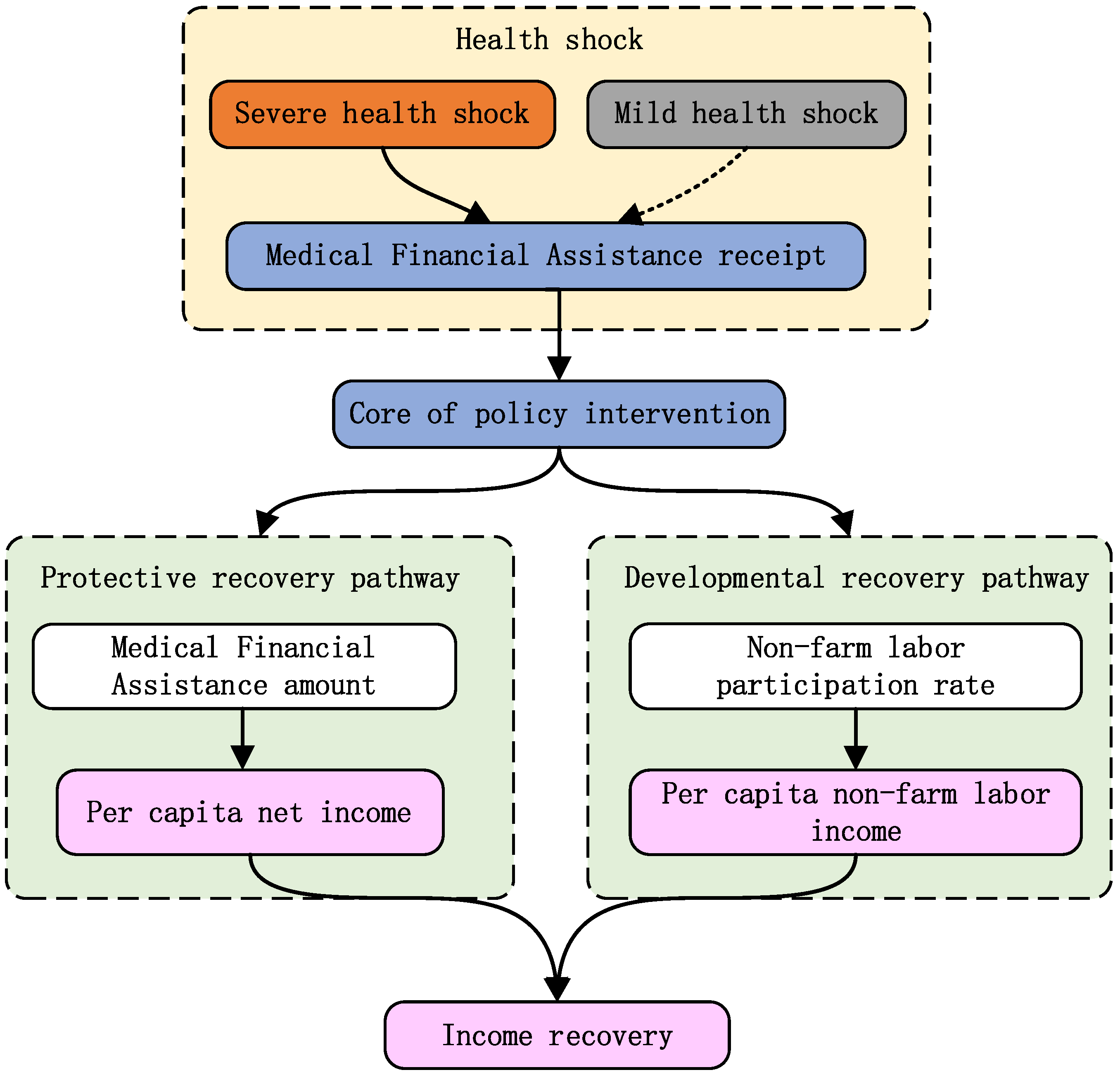
In summary, severe health shocks suppress the livelihood potential of low-income rural households through a triple inhibition mechanism operating through financial, health capital, and time endowment channels. This predicament constitutes the essential context for Medical Financial Assistance (MFA) intervention. MFA counteracts these inhibitions through two distinct pathways: protective recovery and developmental recovery. The protective pathway, using the MFA amount as a mediating variable, directly facilitates the restoration of household per capita net income, reflecting the policy’s safety-net function. The developmental pathway, with the non-farm labor participation rate serving as a mediating variable, promotes the growth of household per capita non-farm labor income, revealing MFA’s potential productive attributes and its capacity to stimulate endogenous household dynamics. This analytical logic forms the theoretical framework of the present study, as depicted in Figure 1.
This framework integrates health capital theory [9], household production theory [10], and precautionary saving theory [8]. Specifically, the framework draws on precautionary saving theory [8] to explain how health shocks generate financial inhibition through expenditure uncertainty. It employs Grossman’s health capital theory [9] to analyze the constraints that health capital depreciation imposes on household labor supply, extending this theory from the individual to the household level to reveal how health shocks indirectly affect overall household labor supply through “time endowment inhibition.” Becker’s household production theory [10] further elucidates how health restoration can release household time previously occupied by caregiving. Through this theoretical integration, the framework systematically distinguishes between the two mechanisms of MFA within a coherent analytical structure and advances a theoretical expectation of conditional effectiveness, namely that the magnitude of these two effects may vary with household characteristics and the severity of health shocks. By focusing on “income recovery” as the core economic manifestation, this framework aims to reveal the key micro-mechanisms through which MFA enhances household livelihood resilience.

3.2. Model Deduction and Research Hypotheses

Building upon Grossman’s health capital theory [9] and Becker’s household production theory [10], this section constructs a model to formally deduce the mechanisms through which the Medical Financial Assistance (MFA) policy influences household income via its dual pathways and proposes testable research hypotheses.

3.2.1. Model for the Protective Recovery Pathway

This model aims to characterize how MFA directly alleviates a household’s liquidity constraints and expenditure uncertainty through financial compensation. According to Leland’s precautionary savings theory [8], households hold precautionary savings to smooth consumption fluctuations caused by future random medical expenditures. Assume the MFA policy provides ex-post reimbursement: when the household incurs medical expenditure, its actual out-of-pocket amount is reduced, and it simultaneously receives cash compensation. This policy intervention generates a dual effect. First, a direct income effect: the compensation directly increases current disposable resources. Second, a risk-smoothing effect: the MFA policy reduces the medical expenditure risk faced by the household, thereby weakening its precautionary savings motive. Considering a two-period model where the household decides consumption C1 and savings S in period 1, its intertemporal budget constraint can be expressed as:
C 1   + S = Y 1   E ( X )
In Equation (1), Y1 is labor income in period 1, and E(X) is expected medical expenditure. On one hand, MFA directly reduces expected medical expenditure, decreasing E(X) to E(X|policy). On the other hand, by reducing medical expenditure risk, it alleviates the household’s precautionary savings motive, releasing a portion of previously “frozen” savings, denoted as ΔS > 0. The combined effect relaxes the household budget constraint. Defining the household’s comprehensive resources available for non-medical consumption and livelihood smoothing as R, we have:
R = Y 1   E ( X p o l i c y ) + Δ S
Equation (2) indicates that MFA, through medical cost compensation and risk smoothing, significantly alleviates the financial inhibition triggered by the health shock, increasing resources available for maintaining livelihoods and smoothing consumption. This resource increase constitutes the core channel through which the MFA policy affects household income. Based on the above theoretical deduction, this paper proposes the total effect hypothesis for protective recovery and its underlying mechanism hypothesis.
Hypothesis H1 (Total Effect of Protective Recovery).
The MFA policy exerts a significant restorative effect on the per capita net income of assisted households.
Hypothesis H1a (Mediating Mechanism of Protective Recovery).
The MFA policy promotes the restorative increase in per capita net income by providing medical assistance amounts to assisted households. Specifically, recipient households receive significantly higher assistance amounts, and the higher the assistance amount, the better the recovery effect on household per capita net income.

3.2.2. Model for the Developmental Recovery Pathway

This model aims to characterize how MFA promotes health investment, repairs human capital, and releases household time, thereby stimulating income-generating potential. Based on the Grossman model [9], the accumulation equation for health capital Ht is:
H t + 1   = ( 1 δ ) H t   + I ( M t   )
In Equation (3), δ is the health depreciation rate, and I(Mt) is the health investment function, which depends on the utilization of medical services Mt, satisfying ∂It/∂Mt > 0, 2It/∂Mt2 < 0. MFA increases Mt by lowering the effective price of medical services, thereby promoting health capital repair, ΔH > 0. The repair and enhancement of health capital affect market income through two channels.
First, the productivity effect. Health is an increasing function of labor efficiency e, e = e ( H t ) , e > 0 . Let ω be the market benchmark wage; then, the effective wage is ω e ( H t ) MFA increases labor income per unit time by improving health Ht, as shown in Equation (4):
[ ω e ( H t   ) ] M t > 0
Second, the labor release effect. According to Becker’s time allocation theory [10], within the household’s total time T, the care time Lc required by the patient is a decreasing function of his/her health level, Lc,t = Lc (Ht), Lc (Ht) < 0. Improvement in the patient’s health directly releases family care time, expressed in Equation (5):
Δ L m , t   = Δ L c , t > 0
Assuming the released time ΔLm,t can be allocated to market labor. From Equation (4), the effective wage rate ω e ( H t ) increases with health improvement. Since market labor supply is an increasing function of the effective wage rate, i.e., L m , t / ω e ( H t ) > 0 , the increase in effective wage rate induces the household to increase market labor supply, thus ΔLm,t > 0. Combining the productivity effect and the labor release effect, the total impact of the MFA policy on non-farm labor income Ynonfarm is positive, expressed as Equation (6):
Y n o n f a r m , t M t       = ( ω e ( H t   ) )   M t       L m , t + ω e ( H t   ) L m , t   M t   > 0
Equation (6) indicates that the impact of MFA on non-farm labor income comprises two dimensions: first, increasing income per unit time by enhancing labor efficiency (the productivity effect); second, releasing household labor by increasing non-farm labor supply (the labor release effect). The labor release effect can be further decomposed into two sub-dimensions: the extensive margin and the intensive margin. The extensive margin refers to facilitating the re-entry into non-farm employment of members who temporarily withdrew from the labor market due to health shocks or caregiving responsibilities, a qualitative shift from “no employment” to “employment”. The intensive margin refers to extending the working hours of existing non-farm workers.
The realization of these three dimensions exhibits significant temporal sequencing. In the initial stage of health recovery, households first face the decision of whether labor returns to the market. The repair of health capital removes the rigid constraint of “whether participation is possible,” enabling members who temporarily withdrew from the labor market to regain employment opportunities. In contrast, the realization of the productivity effect (enhanced labor efficiency) and intensive margin adjustments (extended working hours) depends on more long-term processes of human capital accumulation and labor market adaptation, typically requiring longer observation periods to fully manifest. These processes are also constrained by factors such as labor market institutions, skill updating cycles, and changes in family caregiving demands. Based on this temporal logic, within the one-year observation period following policy intervention, if the developmental recovery pathway holds, one should first observe that MFA significantly increases the household’s non-farm labor participation rate (the extensive margin), and that this effect can partially explain the growth in per capita non-farm labor income. Although the productivity effect and intensive margin adjustments exist in the theoretical model, they may not fully manifest within the observation period of this study. Accordingly, the hypothesis for the developmental recovery effect and its mediating mechanism is proposed.
Hypothesis H2 (Total Effect of Developmental Recovery).
The MFA policy exerts a significant restorative effect on the per capita non-farm labor income of assisted households.
Hypothesis H2a (Mediating Mechanism of Developmental Recovery).
The MFA policy promotes the growth of per capita non-farm labor income by significantly increasing the household’s non-farm labor participation rate. Specifically, receiving assistance significantly increases the probability that household members engage in non-farm labor, and this increased participation rate significantly raises household per capita non-farm labor income.

3.2.3. Heterogeneity Analysis and Conditional Hypotheses

The effectiveness of health interventions is deeply embedded within socio-economic and family structural contexts, exhibiting significant heterogeneity [62,63]. Focusing on the MFA policy, existing research indicates that the design of its benefit package directly affects household medical service utilization and the degree of benefit obtained [19], and its effects vary substantially across different sub-groups, such as migrant populations [64]. This suggests that the intensity and dominant pathway of the aforementioned dual recovery effects of MFA are not homogeneous but are likely systematically moderated by intrinsic household attributes and external shock characteristics.
The family life cycle is a primary dimension moderating the recovery pathways. For elderly-dominated households, with weak financial buffers and health capital in a phase of accelerated depreciation, the financial inhibition effect from a health shock is often more acute. Therefore, the marginal value of MFA in providing financial relief through direct cost reimbursement to achieve protective recovery is particularly pronounced. Consequently, the protective recovery effect is expected to strengthen with the degree of household aging. In contrast, the core feature of prime working-age-dominated households lies in abundant human capital and greater flexibility in time allocation. Once the health shock is mitigated by the policy, such families can more rapidly reallocate the restored labor capacity and released care time to non-farm employment with higher marginal returns, thus more fully realizing developmental recovery. Accordingly, the following hypotheses are proposed:
Hypothesis H3a.
The protective recovery effect of MFA on household per capita net income strengthens with the degree of household aging.
Hypothesis H3b.
The developmental recovery effect of MFA on household per capita non-farm labor income is more prominent in prime working-age-dominated households.
The severity of the health shock constitutes another key boundary condition. Major disease shocks have a deep inhibition characteristic, simultaneously creating severe financial, health, and time constraints, resulting in a deeper livelihood gap. Therefore, the MFA policy, designed to precisely counteract such deep inhibition, is expected to exhibit more pronounced dual recovery effects for this group compared to households suffering from mild disease shocks. Accordingly, the following hypotheses are proposed:
Hypothesis H4a.
The protective recovery effect of MFA on household per capita net income is more significant in households suffering from major disease shocks.
Hypothesis H4b.
The developmental recovery effect of MFA on household per capita non-farm labor income is more significant in households experiencing major disease shocks.

3.2.4. Mapping Theoretical Parameters to Observable Variables

To bridge the theoretical model with empirical analysis and clarify the testable implications derived from theoretical deductions, this paper establishes the following correspondence between theoretical parameters and observable variables. This mapping provides a clear theoretical foundation for subsequent variable selection, econometric model specification, and hypothesis testing, as detailed in Table 3.
Several correspondences in Table 3 carry specific methodological implications requiring further elaboration.
First, the measurement of increased disposable resources in the protective recovery pathway. In the theoretical model presented in Section 2.2.1, MFA increases household disposable resources, denoted as ΔR, through the combined effects of cost compensation and risk smoothing. Theoretically, this resource increase comprises two components: the directly received MFA amount and the precautionary savings released due to reduced risk. However, the release of precautionary savings cannot be directly observed and is difficult to disentangle from household savings behavior. Therefore, this paper uses the MFA amount as a proxy variable for the increase in disposable resources. This approach captures the core of policy intervention, a higher assistance amount indicates greater direct financial support received by the household and a more significant increase in disposable resources, thereby more effectively alleviating the financial inhibition caused by health shocks. Although this measure cannot fully capture the risk-smoothing effect, the assistance amount, as a direct measure of policy intensity, effectively reflects the core mechanism of the protective recovery pathway and provides an empirical basis for testing Hypothesis H1a.
Second, the selection of the non-farm labor participation rate in the developmental recovery pathway. In the theoretical analysis presented in Section 2.2.2, health improvement affects non-farm labor income through three dimensions: the productivity effect, extensive margin adjustments, and intensive margin adjustments. The realization of these three dimensions exhibits significant temporal sequencing. The repair of health capital first removes the rigid constraint of “whether participation is possible,” enabling family members who temporarily withdrew from the labor market due to health shocks or caregiving responsibilities to regain employment opportunities. In contrast, the productivity effect (enhanced labor efficiency) and intensive margin adjustments (extended working hours) depend on more long-term processes of human capital accumulation and labor market adaptation, typically requiring longer observation periods to fully manifest. Based on this temporal logic, within the one-year observation period following policy intervention, if the developmental recovery pathway holds, adjustments to the extensive margin should be the first to be observed. Therefore, this paper uses the non-farm labor participation rate as the core mediating variable for the developmental recovery pathway to test whether health improvement can facilitate the re-entry of household labor into non-farm employment, thereby providing empirical evidence for Hypothesis H2a. This selection aligns with both theoretical expectations and the observation period of this study.
Third, the theoretical positioning of grouping variables in heterogeneity analysis. Table 3 identifies household life cycle and shock severity as dimensions for heterogeneity analysis. Although these two variables are not expressed through mathematical equations in the core model, Section 3.1.2 has theoretically elucidated their moderating mechanisms: elderly households face more severe financial inhibition, thus exhibiting stronger protective recovery effects; middle-aged households possess more abundant labor endowments, thus exhibiting more prominent developmental recovery effects; major disease shocks simultaneously impose deep financial, health, and time constraints on households, thus both recovery effects should be more pronounced. This paper will rigorously test these theoretical expectations in the empirical section through subgroup regression and interaction term models.
Fourth, the correspondence between hypotheses and variables. The “Corresponding Hypothesis” column in Table 3 indicates the research hypotheses associated with each variable. Among these, H1 and H2 are total effect hypotheses, corresponding to the relationship between the core explanatory variable (household receipt of MFA) and the outcome variables (household per capita net income and household per capita non-farm labor income). H1a and H2a are mediating mechanism hypotheses, corresponding to the mediating roles of the MFA amount (log) and the household non-farm labor participation rate. H3 and H4 are heterogeneity hypotheses, corresponding to the moderating effects of the grouping variables (household life cycle and disease type). This correspondence clarifies the empirical variables upon which each hypothesis depends, providing a clear testing pathway for subsequent econometric analysis.

4. Materials and Methods

4.1. Study Setting and Data Source

The data for this study stem from two waves of a household panel survey conducted by the research team in 2021 and 2022, focusing on County L—a nationally designated deeply impoverished county situated in the Yanshan–Taihang Mountain region of Hebei Province. County L was selected as the study site because, as a representative deep poverty-alleviated region, it is a key area for consolidating and expanding poverty alleviation achievements and preventing large-scale relapse into poverty. Its policy practices hold significant reference value for similar regions. To ensure the sample’s representativeness of the overall low-income rural household population in the county, the survey employed a stratified equal-probability random sampling method, covering 280 administrative villages across the county’s 17 townships. Within sample villages, systematic interval sampling was performed based on complete lists of low-income households provided by village committees. The survey utilized structured questionnaires to systematically collect information on household demographics, health, income and expenditures, labor allocation, and the receipt of various policies including MFA. Key variables were cross-verified against administrative records from county-level medical insurance and rural revitalization departments to ensure data reliability. The initial sample comprised a total of 13,124 households across the two waves. To precisely align with the research theme and construct a high-quality analytical sample, households with no labor force and those receiving special hardship support were excluded. This exclusion focuses the analysis on the core population where the policy might generate “recovery” effects through labor market channels. The data were then processed into a balanced panel. The final dataset used for the baseline analysis is a balanced panel comprising 12,678 households, totaling 25,356 observations, exhibiting good representativeness.

4.2. Variables

4.2.1. Dependent Variables

The dependent variables in this study are household income indicators, designed to capture the “protective recovery” and “developmental recovery” effects of the MFA policy respectively. They specifically include household per capita net income and household per capita non-farm labor income.
Household per capita net income is used to measure the policy’s “protective recovery” effect, i.e., its net impact on stabilizing the household’s basic livelihood. This indicator is defined as the annual total household income (sum of all income sources) minus productive expenditures and taxes, averaged per capita. Its variation directly reflects the policy’s bottom-line effect in mitigating the shock of catastrophic medical expenditure and preventing the depletion of household disposable resources.
Household per capita non-farm labor income is used to test the policy’s “developmental recovery” effect, i.e., its effect in stimulating the household’s endogenous income-generating capacity. This indicator is specifically defined as the per capita average of the total annual wage income of all household members. An increase in this income directly reflects the optimized allocation of household labor resources and the recovery of income-generating capacity, serving as key evidence for identifying whether MFA can achieve a transition from “blood transfusion” to “blood making”.
In data processing, to avoid the failure of logarithmic transformation due to zero values for some households, all income indicators were transformed by taking the natural logarithm of the original value plus one.

4.2.2. Core Explanatory Variable

The core explanatory variable in this paper is “treatment group household”, which is a binary dummy variable. This variable is constructed based on two-wave medical security data from 2021 to 2022. Households that received Medical Financial Assistance (MFA) for the first time in 2022 (i.e., did not receive it in 2021 but received it in 2022) are assigned a value of 1 and defined as the treatment group. Households that did not receive MFA in either 2021 or 2022 are assigned a value of 0 and defined as the control group. This specification aligns with the quasi-natural experiment design based on “health shock severity” in this paper, aiming to compare the differences in income recovery between households that received assistance for the first time due to severe health shocks and those that experienced mild health shocks but did not receive assistance.

4.2.3. Covariates and Control Variables

To construct a comparable counterfactual analytical framework and control for potential confounding factors, this paper incorporates the following variables in the model specification, drawing on classical empirical practices in studies examining the effects of China’s rural medical security programs [49,65].
Covariates for the PSM stage. Covariates are used in the PSM stage to balance observable pre-intervention (2021) differences between the treatment and control groups. Matching variables cover four domains: household head characteristics (age, gender, years of education, and political affiliation); household structure (household size, health-adjusted labor force ratio, proportion of disabled members, proportion of ill members, and dependency ratio); economic and health baseline (cultivated land area and baseline out-of-pocket medical expenses in logarithms). Baseline out-of-pocket medical expenses serve as a key proxy for the household’s inherent health risk and long-term medical care needs; controlling for this predetermined variable helps isolate the influence of the household’s initial health endowment on the subsequent probability of experiencing severe shocks, thereby enhancing the purity of the identification strategy [66]; other policy support, namely whether the household had received employment assistance or industrial assistance in the baseline period, to control for potential overlapping effects from concurrent interventions [51].
Control variables are used in the DID. Based on the balanced sample obtained through PSM, time-varying confounding factors are further controlled in the difference-in-differences baseline regression. Following common practices in evaluating policy effects using panel data [67], the control variables are divided into two categories: The first category consists of explicitly time-varying characteristics, including household head age, household size, health-adjusted labor force ratio, dependency ratio, and cultivated land area. The second category comprises household head demographic characteristics that actually changed during the two observation waves, including gender, years of education, and political affiliation. Controlling for these observed changes aims to mitigate omitted variable bias that may arise from changes in household decision-makers’ characteristics.

4.2.4. Mediating Variables

To examine the underlying mechanisms through which the Medical Financial Assistance policy affects household income recovery, this paper selects two categories of mediating variables based on the theoretical analysis, corresponding respectively to the protective recovery pathway and the developmental recovery pathway.
Protective recovery pathway uses the logarithm of the medical assistance amount as the core mediating variable, defined as the total annual medical assistance received by household members, transformed by natural logarithm. The core function of the MFA policy lies in directly offsetting households’ catastrophic medical expenditures through cash compensation. The magnitude of this compensation amount directly measures the actual intensity of policy support received by the household. In the protective recovery pathway, receiving MFA is the prerequisite for policy intervention, while the amount of assistance reflects the intensity of the policy intervention. This variable captures the transmission mechanism through which MFA promotes per capita net income recovery by increasing household disposable resources.
The developmental recovery pathway uses the non-farm labor participation rate as the core mediating variable. This variable measures the intensity of household labor supply in the non-farm employment market and serves as an extensive margin indicator reflecting household labor resource allocation. In the process of recovery from health shocks, the primary response in household labor adjustment occurs at the extensive margin, the decision of whether to participate in non-farm labor. Members who temporarily withdrew from the labor market due to health shocks or caregiving responsibilities first face the decision of whether to re-enter the employment market upon health improvement. Therefore, this variable captures the transmission mechanism through which MFA promotes the growth of household per capita non-farm labor income by restoring health capital and releasing caregiving time.
The specific construction of the non-farm labor participation rate is based on a household labor force conversion system. According to members’ labor capacity types, individuals with no (lost) labor capacity are counted as 0, semi-(weak) labor capacity as 0.5, ordinary labor capacity as 1.0, and skilled labor capacity as 1.5. The total household labor force is the sum of the converted values of these four types of members. On this basis, the non-farm labor participation rate is defined as the proportion of household members participating in non-farm labor relative to the total household labor force. It should be noted that because the total household labor force employs equivalent conversion (with a conversion coefficient of 1.5 for skilled labor and 0.5 for semi-skilled labor), while the number of non-farm labor participants is the actual count, the participation rate may exceed 1. For example, when the proportion of skilled labor in a household is relatively high, the converted total labor force may be smaller than the actual number of members participating in non-farm labor, resulting in a participation rate exceeding 1. This phenomenon reflects the actual situation of high-intensity household labor allocation and does not indicate data errors. For households with no labor force, the participation rate is defined as 0. To improve variable distribution and address zero-value issues, its logarithmic form is used in regression analysis, specifically taking the natural logarithm after adding 0.01 to the participation rate. Adding 0.01 addresses the problem that zero values cannot be logarithmically transformed; negative values are a normal mathematical transformation result (when the original participation rate is less than 0.99, the logarithmic value is negative) and do not affect the economic interpretation of the regression coefficients. Specific definitions and descriptive statistics for each variable are presented in Table 4.

4.3. Empirical Strategy

To accurately identify the causal effect of the Medical Financial Assistance (MFA) policy, this paper constructs a quasi-natural experiment based on the inherent feature that MFA eligibility is activated by exogenous health shocks. The core identification strategy involves comparing two groups of households that both experienced health shocks in 2022 but differed in shock severity, leading to different policy responses. Specifically, households that, due to a severe health shock in 2022, incurred medical expenses reaching the MFA threshold and thus received MFA for the first time are defined as the treatment group. Households that did not receive MFA in either year but similarly experienced a mild health shock, incurring medical expenses that did not reach the assistance threshold, are defined as the control group. This grouping design based on “health shock severity” aligns with the research approach in health economics that leverages variations in illness severity to identify behavioral or policy effects [50]. This design ensures that the control group consists not of healthy households but of those similarly exposed to health risks as the treatment group, thereby effectively isolating the baseline impact of general health shocks. This allows the identification to focus more purely on the additional net recovery effect brought by MFA when a shock becomes severe enough to activate the policy [68]. To address potential selection bias stemming from the treatment group experiencing more severe negative shocks, this paper employs the Propensity Score Matching–Difference-in-Differences (PSM-DID) method for estimation. The propensity score matching method proposed by Rosenbaum and Rubin [69] provides an effective tool for addressing selection bias based on observable characteristics. The estimation is implemented through the following two steps.

4.3.1. Propensity Score Matching (PSM)

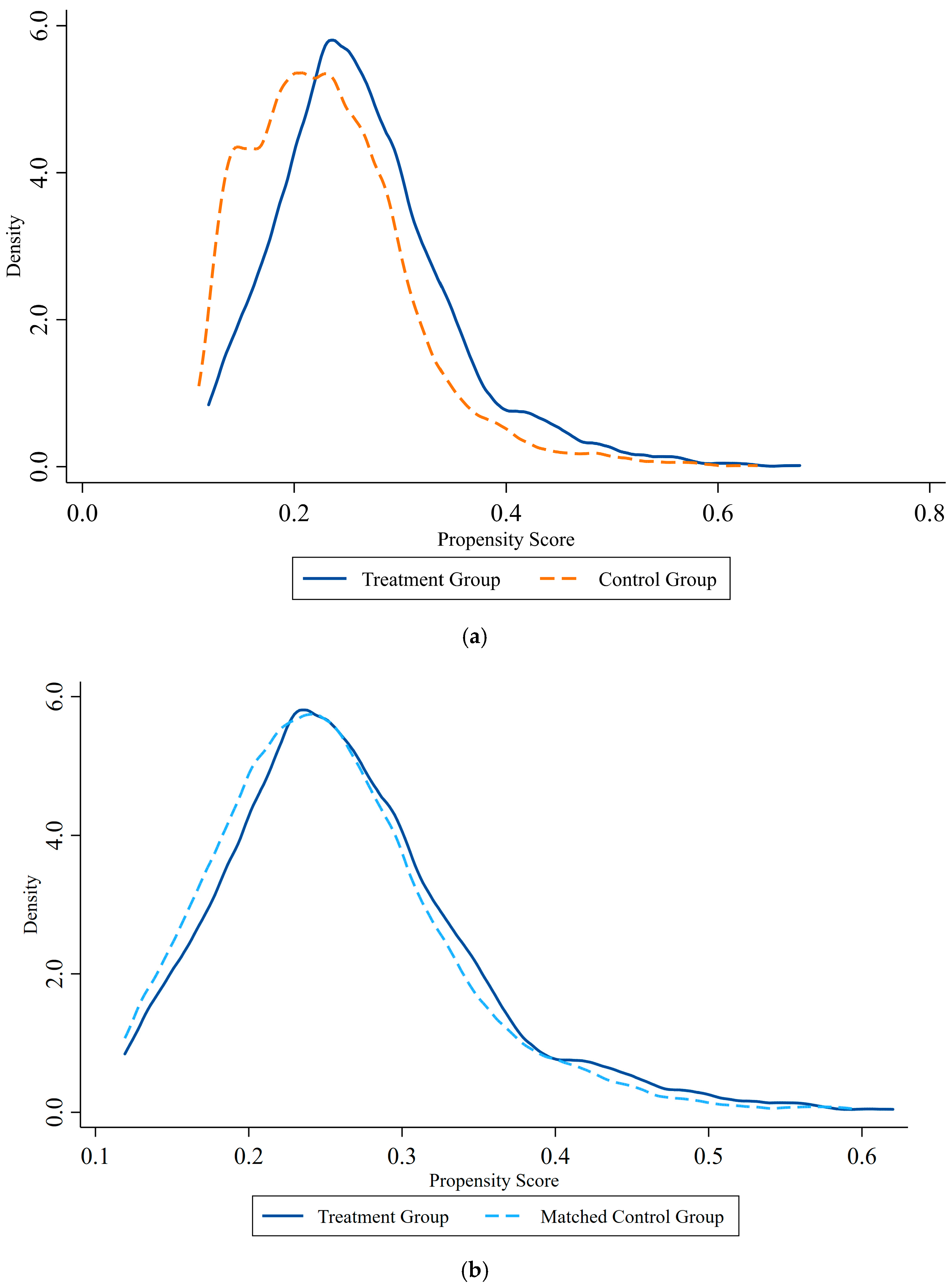
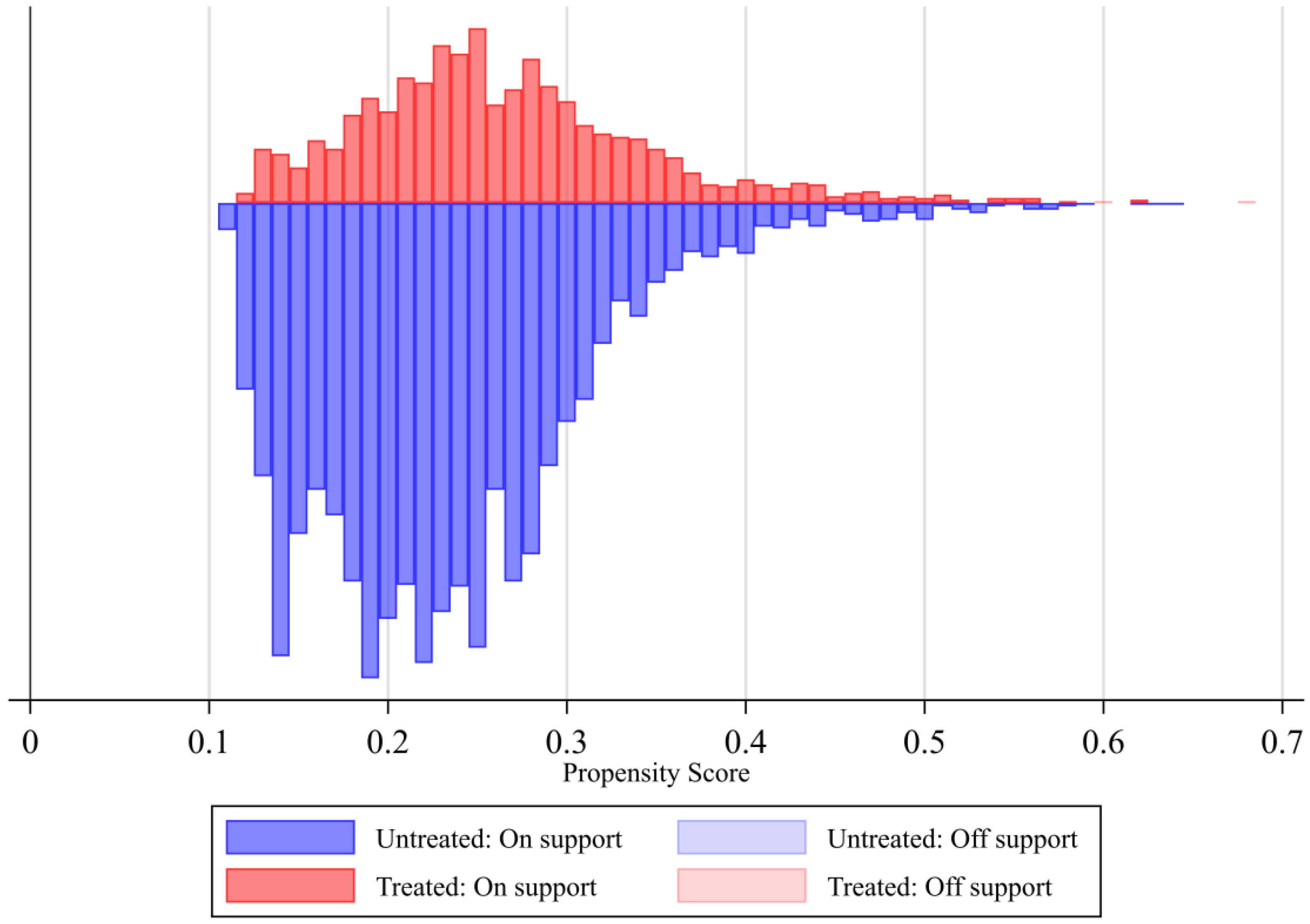
This paper utilizes covariates from the pre-intervention baseline year (2021) to estimate the propensity score for each household to be in the treatment group, using a Logit model. A 1:1 nearest neighbor matching without replacement is then employed to match each treated household with the most similar control household, constructing a comparable counterfactual sample based on observable characteristics. The model is specified as follows:
p s c o r e ( X i ) = P r ( t r e a t e d i = 1 | X i ) = e x p ( β X i   ) 1 + e x p ( β X i )
In Equation (7), treatedi is the treatment variable, indicating whether low-income rural household i received MFA (treatedi = 1 if yes, treatedi = 0 otherwise). Xi is the vector of observable baseline covariates, and β is the vector of parameters to be estimated. After estimating the propensity scores, 1:1 nearest neighbor matching without replacement is used to match each treated household with the most similar control household, aiming to minimize systematic differences in observable characteristics.

4.3.2. Construction of the Difference-in-Differences Model (DID)

On the matched balanced sample, the following two-way fixed effects model is constructed for estimation:
Y i t   = α + β 1   t r e a t e d i   + β 2   p o s t t   + δ D I D ( t r e a t e d i   × p o s t t   ) + γ X i t   + μ i   + λ t   + ϵ i t  
In Equation (8), Yit represents the dependent variable, specifically the logarithm of household per capita net income and the logarithm of household per capita non-farm labor income. postt is a time dummy variable representing the year (postt = 0 for 2021, postt = 1 for 2022). The coefficient of the interaction term treati × postt, β 3 , is the core parameter of interest, reflecting the net recovery effect of the medical assistance policy. Xit represents a vector of time-varying control variables, μi and λt denote household fixed effects and year fixed effects, respectively, and εit is the random error term.
The two-way fixed effects model employed in this paper serves an important role in addressing endogeneity. Household fixed effects μi absorb all time-invariant household heterogeneity characteristics, such as unobservable factors including inherent health endowment, risk preferences, and social capital, effectively mitigating endogeneity bias arising from time-invariant omitted variables. Year fixed effects λt control for common shocks at the annual level, such as macroeconomic fluctuations and regional policy changes. Combined with the control for selection bias in observable characteristics achieved through PSM, the identification strategy in this paper ensures the reliability of causal inference to the greatest extent possible given the available data.
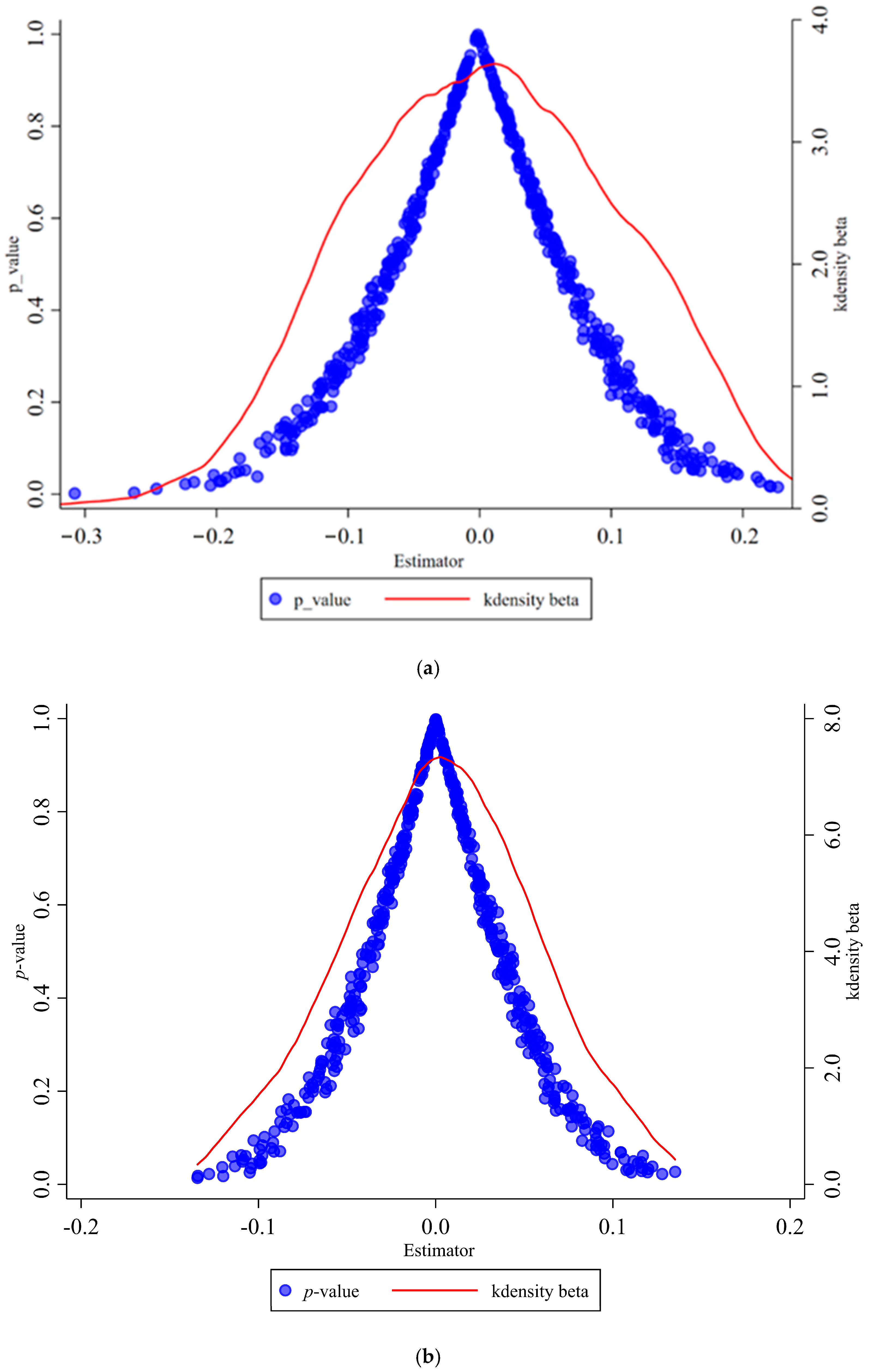
Identification Strategy for the Parallel Trends Assumption. The unbiasedness of difference-in-differences estimation relies on the parallel trends assumption, which requires that the treatment and control groups exhibit similar outcome trends prior to policy intervention. Constrained by the two-wave panel data, this paper cannot conduct dynamic event study analysis. To examine the validity of the parallel trends assumption, this paper adopts the following two approaches. First, balance in baseline outcome variables is achieved through PSM matching. According to the conditional parallel trends assumption proposed by Heckman et al. [69], after controlling for observable characteristics, if the treatment and control groups have similar outcome levels before the policy, their potential outcome trends also tend to be parallel. Second, placebo tests are employed. Following the research approach of Chetty et al. [70], this paper examines whether unobservable confounding factors exist by randomly permuting treatment status.

4.3.3. Mediation Effect Model

The baseline regression aims to identify the causal effect of the MFA policy on the income recovery of low-income rural households (the “whether effect”). To further explore the pathways through which the policy operates (the “how effect”), this paper constructs a mediation effect model to test the two pathways proposed in the theoretical analysis: protective recovery and developmental recovery. Following the mediation effect testing methods of Baron and Kenny [71] and Wen and Ye [72], this paper specifies the following recursive equation system to identify mediation effects:
  Y i t   = α 0   + γ 0   d i d i t   + δ 0   X i t   + μ i   + λ t   + ε i t  
M i t   = α 1   + γ 1   d i d i t   + δ 1   X i t   + μ i   + λ t   + ε i t  
Y i t   = α 2   + γ 2   d i d i t   + φ M i t   + δ 2   X i t   + μ i   + λ t   + ε i t  
In the equations, Mit represents the mediating variable. In Equation (9), the coefficient of the core explanatory variable didit on the dependent variable Yit represents the total effect c. In Equation (10), the coefficient of the core explanatory variable is denoted as path coefficient a, representing the effect of the core explanatory variable on the mediating variable. In Equation (11), the estimated coefficient of the mediating variable is denoted as path coefficient b, representing the effect of the mediating variable on the outcome variable. The estimated coefficient of the core explanatory variable in Equation (11) is denoted as the direct effect c′, representing the direct effect of the core explanatory variable on the outcome variable after controlling for the mediating variable. The indirect effect (i.e., the mediation effect) is measured by a × b, and the proportion of the mediation effect to the total effect is ( a × b ) / c . To test the statistical significance of the mediation effect, this paper further employs the Sobel [73] test, with the test statistic Z = ( a × b ) / a 2 S E b 2   + b 2 S E a 2 , and reports the corresponding Z-statistic. All regressions are based on the PSM-matched sample and use cluster-robust standard errors at the village level. All statistical analyses were performed using Stata 15.0 (StataCorp LLC).

5. Results

5.1. Precondition Tests

Prior to estimating the baseline effect, a series of precondition tests were conducted to ensure the validity of the PSM-DID research design. This section reports on the propensity score estimation, common support condition, and the balance diagnostics of the matched sample.

5.1.1. Propensity Score Estimation and Balancing Property

Table 5 reports the results of the Logit model estimating the propensity scores based on baseline (2021) covariates. The results show that the probability of a low-income rural household receiving MFA exhibits an inverted U-shaped relationship with the household head’s age and is significantly positively correlated with household size, the proportion of ill members, and baseline out-of-pocket medical expenses. In contrast, the proportion of healthy labor force in the household shows no significant effect. This pattern confirms that MFA follows an “expenditure-based poverty” targeting mechanism. That is, eligibility is primarily activated by the occurrence of actual catastrophic medical expenditures, rather than the household’s pre-existing potential labor capacity. The high significance of baseline out-of-pocket expenses, in particular, indicates that it serves as an effective proxy for the household’s inherent health risks. Controlling for this variable during matching effectively balances the pre-treatment differences in “susceptibility to health shocks” between the treatment and control groups. Therefore, the subsequent DID estimates based on the matched sample can more cleanly identify the net recovery effect of MFA, as opposed to the selection bias stemming from initial risk differences. This establishes a reliable foundation for causal inference.

5.1.2. Common Support Condition

The feasibility of the Propensity Score Matching (PSM) approach hinges on the common support assumption. This test was conducted on the initial sample of 6077 low-income rural households (treatment group: 1460; control group: 4617). The kernel density distributions of propensity scores before and after matching are presented in Figure 2a (Before Matching) shows a markedly right-skewed distribution for the treatment group compared to the control group, visually confirming significant pre-existing differences in observable characteristics. A direct comparison based on these unmatched samples would thus introduce severe selection bias Figure 2b (After Matching) demonstrates a highly overlapping distribution pattern following 1:1 nearest neighbor matching without replacement, providing preliminary evidence of successful covariate balancing.
Furthermore, the analysis of the common support region (Figure 3) confirms sufficient overlap between the treatment and control groups across the propensity score interval [0.12, 0.64]. The matching procedure excluded only one treatment household (0.02%) that fell outside this region. Consequently, a highly comparable analytical sample of 6076 households (treatment: 1459; control: 4617) was successfully constructed. This matched sample establishes a reliable counterfactual foundation for the subsequent application of the Difference-in-Differences (DID) estimator.

5.1.3. Post-Matching Balance Diagnostics

Balancing diagnostics after matching is a crucial step for assessing matching quality and laying the foundation for subsequent causal inference. Table 6 reports the balancing test results for covariates and baseline outcome variables before and after matching. Before matching, the treatment and control groups exhibited systematic differences in multiple observable covariates (Panel A). After matching, the absolute values of standardized biases for all covariates dropped below 5%, and the mean differences between groups were no longer statistically significant (all p-values > 0.1), indicating that good balance has been achieved in observable dimensions.
Most critically, after matching, the two groups also achieved statistical balance in baseline outcome variables (pre-policy intervention) (Panel B). Household per capita net income, which showed significant inter-group differences before matching, became statistically insignificant after matching (p = 0.899). For per capita non-agricultural labor income, inter-group differences were not significant at the 10% level either before or after matching (p = 0.114 before matching, p = 0.703 after matching), with the p-value further increasing after matching, indicating that the two groups had no statistically discernible differences at baseline.
This balance in outcome variables carries important methodological implications. According to the conditional parallel trends assumption proposed by Heckman et al. [69], after controlling for observable characteristics, if the treatment and control groups have similar outcome levels prior to policy intervention, their potential outcome trends also tend to be parallel. Therefore, the balance in baseline income provides critical empirical support for the parallel trends assumption required by the difference-in-differences model, partially compensating for the limitation that two-period panel data cannot accommodate dynamic event study analysis.
The overall effectiveness of the matching procedure is systematically confirmed by comprehensive indicators (Table 7). After matching, as shown in the comprehensive assessment of matching quality in Table 7, the pseudo-R2 of the propensity score model dropped sharply from 0.030 to 0.002, and the p-value of the joint significance test (LR test) increased to 0.766, indicating that the predictive power of covariates for treatment status has essentially disappeared. Rubin’s B, which measures the standardized difference in means between groups, decreased significantly from 43.5 before matching to 11.7 after matching, well below the empirical threshold of 25% [74]. Meanwhile, Rubin’s R, reflecting the ratio of variances between groups, remained stable at 1.09, falling within the ideal range of 0.5 to 2 [75]. These results consistently confirm that the matching procedure has effectively eliminated systematic differences in observable characteristics between the treatment and control groups. Consequently, the matched sample satisfies the balance prerequisites required for causal inference, establishing a reliable empirical foundation for accurately estimating the net recovery effect of the Medical Financial Assistance policy in subsequent analyses.

5.2. Baseline Regression Results

Table 8 presents the Propensity Score Matching–Difference-in-Differences (PSM-DID) estimation results based on the matched sample, aiming to identify the net causal effect of the Medical Financial Assistance (MFA) policy on income recovery for low-income rural households.

5.2.1. The Protective Recovery Effect

The coefficient for the MFA policy variable (did) is positive and statistically significant at the 1% level (Table 8, columns (1) and (2)). After controlling for relevant household and householder characteristics in the full model (column (2)), the estimated coefficient is 0.132 (p < 0.01). This result indicates that receiving MFA enabled households to recover their per capita net income by an average of approximately 13.2%. This finding directly confirms the policy’s safety-net function, whereby the ex-post cash compensation alleviates the financial inhibition caused by catastrophic health expenditures, thereby stabilizing the basic household livelihood. Hypothesis H1 is supported.

5.2.2. The Developmental Recovery Effect

For household per capita non-farm labor income, the coefficient for the MFA policy is also positive and significant at the 5% level (Table 8, columns (3) and (4)). In the model with the full set of control variables (column (4)), the coefficient is 0.138 (p < 0.05), suggesting an average recovery of about 13.8%. This result reveals that, beyond direct financial protection, MFA may also contribute to income recovery by mitigating the health and time-endowment inhibitions, thereby facilitating a return to or increase in market labor participation. Hypothesis H2 is supported.

5.3. Robustness Checks

To ensure the reliability of the baseline regression results, this paper conducts the following robustness checks.

5.3.1. Winsorization Test

To mitigate potential interference from outliers, this paper applies a 1% winsorization (top and bottom) to household per capita net income and per capita non-farm labor income, respectively. The PSM-DID model is then re-estimated using the winsorized data. The results are reported in Table 9. Column (2) shows that after controlling for relevant variables, the coefficient of the MFA policy on household per capita net income is 0.127, remaining highly significant at the 1% level. This estimate is highly consistent with the baseline result (0.132) in terms of sign, significance, and economic magnitude. Similarly, column (4) shows a coefficient of 0.139 for per capita non-farm labor income, significant at the 5% level and nearly identical to the baseline estimate (0.138). These results indicate that the identified “protective recovery” and “developmental recovery” effects are not driven by anomalous observations from households with extreme incomes. The significant restorative effects of MFA remain robust after excluding outliers.

5.3.2. Placebo Test

Figure 4 presents the placebo test results using household per capita net income and per capita non-agricultural labor income as dependent variables. Figure 4a shows the results for per capita net income, and Figure 4b shows the results for per capita non-agricultural labor income. Following the research approach of Chetty et al. [70], the placebo test examines the presence of unobservable confounding factors by randomly permuting the treatment status. Specifically, “pseudo” treatment groups are randomly generated in the sample, and “pseudo” policy years are randomly assigned to construct intervention variables unrelated to the actual policy. This procedure is repeated 500 times, with the baseline model re-estimated each time, thereby obtaining the distribution of coefficients for the spurious policy effects.
As shown in Figure 4, the means of the “pseudo” estimated coefficients in both panels are centered around zero, with density distributions exhibiting a symmetric pattern centered at zero. This aligns with the null hypothesis that the policy has no actual effect. If unobservable confounding factors or systematic differences violating the parallel trends assumption existed, significant policy effects might still emerge after random permutation [76]. However, the true estimates obtained from the baseline regression (0.132 for household per capita net income; 0.138 for household per capita non-agricultural labor income) both constitute statistical outliers, significantly deviating from the distribution range of the “pseudo” estimated coefficients.
This finding indicates that the significantly positive effects observed in the baseline regression are not driven by unobservable confounding factors or randomness, further validating the effectiveness of the identification strategy. Moreover, the placebo test results provide indirect support for the parallel trends assumption: if systematic inter-group differences violating parallel trends existed, the placebo test with randomly assigned treatment status would detect spurious effects. However, the tests in this paper show that the pseudo coefficients are consistently insignificant, indirectly supporting the plausibility of the parallel trends assumption.

5.4. Heterogeneity Analysis

The preceding baseline regression reveals the average effect of MFA. However, international experience suggests that the economic consequences of health shocks exhibit significant group heterogeneity [77]. To examine whether the income recovery effect of the MFA policy varies according to households’ intrinsic endowments and external shock characteristics, thereby addressing two key questions: “for whom is the policy more effective” and “under what types of shocks is it more effective”, this paper conducts analyses from two dimensions: family life cycle and disease shock type.

5.4.1. Heterogeneity Based on the Family Life Cycle

The life cycle stage in which a household finds itself profoundly influences its resource endowments, risk exposure, and recovery capacity. According to Grossman’s health capital theory, an individual’s health depreciation rate accelerates with age [9]. Extending this micro-level regularity to the household level, households at different life cycle stages exhibit differentiated economic characteristics and policy needs determined by the composition of their members’ health capital. Elderly-stage households are predominantly composed of members with rapid health depreciation and high medical needs, thus exhibiting pronounced financial vulnerability and the highest potential demand for safety-net policies. Middle-aged-stage households concentrate core laborers with high health capital stock and substantial labor income contribution; their capacity to withstand shocks and restore production critically depends on the preservation and repair of this human capital. Youth-stage households are still in the accumulation phase of human capital, with potentially unstable labor market participation. To translate these theoretical expectations into testable empirical designs, this paper categorizes households based on the age structure of household members in the baseline year (2021). Households with the highest proportion of elderly members (≥65 years) are defined as “elderly households”; those with the highest proportion of working-age adults (18–64 years) are defined as “middle-aged households”; and those with the highest proportion of minors (<18 years) are defined as “youth households.” Middle-aged households serve as the reference group in the interaction term model. To rigorously test the differential effects of the MFA policy across households at different life cycle stages, this paper introduces interaction terms between household type and the policy variable based on the baseline model (8), constructing the following model:
Y i t   = α + β 1   d i d i t   + β 2   ( d i d i t   × e l d e r l y i ) + β 3   ( d i d i t   × y o u t h i ) + γ X i t + μ i   + λ t   + ε i t  
In Equation (12), Yit represents household per capita net income and household per capita non-farm labor income, respectively; didit is the MFA policy variable; elderlyi is a dummy variable for elderly households; youthi is a dummy variable for youth households; Xit is the vector of control variables; μi and λt represent household fixed effects and year fixed effects, respectively. The interaction term coefficients β2 and β3 measure the differential effects for elderly households and youth households relative to middle-aged households, respectively.
Table 10 reports the estimation results based on the interaction term model. The interaction term coefficients reflect the differential effects of different household types relative to the reference group. The marginal effects intuitively present the actual recovery levels for each subgroup, and the F-test for inter-group differences provides formal statistical evidence for the significance of these differences.
Protective recovery effect. As shown in Column (1) of Table 10, MFA increases per capita net income for middle-aged households (the reference group) by 0.131, significant at the 1% level. Marginal effect calculations reveal that the combined effect is 0.168 for elderly households (p < 0.01), 0.131 for middle-aged households (p < 0.01), and 0.094 for youth households (p < 0.01). This pattern indicates that the protective recovery effect strengthens with the degree of household aging. The interaction term between youth households and MFA is significantly negative (−0.036, p < 0.05), confirming that the protective recovery effect for youth households is significantly lower than that for middle-aged households. The F-test for inter-group differences yields an F-statistic of 3.21 (p = 0.042), significant at the 5% level, confirming systematic variation in the protective recovery effect across the three household types. These results validate Hypothesis H3a.
Developmental recovery effect. Column (2) of Table 10 shows that MFA increases per capita non-farm labor income for middle-aged households by 0.116, significant at the 5% level, implying an average recovery of approximately 11.6%. The interaction term between elderly households and MFA is positive and marginally significant (0.238, p < 0.10). Marginal effect calculations indicate that the combined effect for elderly households reaches 0.354 (p < 0.05), substantially exceeding that for middle-aged households. Conversely, the interaction term between youth households and MFA is significantly negative (−0.123, p < 0.05), with a marginal effect of −0.007 (p > 0.10), indicating no significant developmental recovery effect for youth households. The F-test for inter-group differences yields an F-statistic of 2.98 (p = 0.053), marginally significant at the 10% level, suggesting systematic differences in the developmental recovery effect across household types. These findings demonstrate that the developmental recovery effect primarily manifests in middle-aged households dominated by prime working-age laborers, thereby validating Hypothesis H3b.

5.4.2. Heterogeneity Based on the Type of Health Shock

Disease severity is a critical factor leading to variations in healthcare needs, economic shocks, and household coping strategies [49]. Compared to ordinary illnesses, severe diseases (including 30 major illnesses and four types of chronic conditions such as hypertension and diabetes) not only entail higher medical expenses but are also more likely to cause long-term or significant impairment of the patient’s labor capacity and impose strong time-binding constraints on family caregivers. According to the theoretical analysis, both the protective recovery effect and the developmental recovery effect of MFA are expected to be more pronounced in households experiencing severe disease shocks.
To examine the heterogeneity of MFA policy effects across groups with different health risks, this paper classifies the sample into a “severe disease group” and an “ordinary disease group” (as the baseline group) based on baseline medical insurance reimbursement records from 2021, following the criteria of the National Health Commission’s Disease Categories for Special Treatment of Major Illnesses among the Poor Population and the National Essential Public Health Service Specifications. The following interaction term model is constructed:
Y i t = α + β 1 d i d i t + β 4 ( d i d i t × s e v e r e i ) + γ X i t   + μ i   + λ t   + ε i t  
In Equation (13), Yit represents household per capita net income and household per capita non-farm labor income, respectively; didit is the MFA policy variable; severei is a dummy variable for severe disease, with the ordinary disease group serving as the baseline; Xit is a vector of control variables; μi and λt represent household fixed effects and year fixed effects, respectively; the interaction term coefficient β3 measures the differential effect of the severe disease group relative to the ordinary disease group. Table 11 presents the estimation results based on the interaction term model, reporting the regression coefficients for core variables, the marginal effects for each subgroup, and the F-statistics for inter-group difference tests.

5.5. Mechanism Analysis

Through which pathways does the Medical Financial Assistance (MFA) policy affect household income recovery? To address this question, this paper employs a mediation effect model to empirically test the protective recovery pathway and developmental recovery pathway, using the MFA amount and the non-farm labor participation rate as mediating variables, respectively. The testing procedure follows the stepwise regression approach proposed by Baron and Kenny [71], supplemented by the Sobel test [73]. All estimations are based on the PSM-matched sample.

5.5.1. Protective Recovery Pathway: The Mediating Role of MFA Amount

To test the mechanism through which MFA receipt affects per capita net income recovery via the assistance amount, this paper conducts a mediation analysis within the PSM-DID framework, using the logarithm of the total MFA amount as the mediating variable. Table 12 reports the stepwise regression results.
Column (1) shows that the total effect of MFA on per capita net income is 0.132, significant at the 1% level, consistent with the baseline regression results. Column (2) indicates that the effect of MFA on the assistance amount is 6.015, significant at the 1% level, demonstrating that recipient households received significantly higher MFA amounts. This result directly validates the “financial infusion” function of the policy, namely that MFA provides direct financial support to households through cash compensation. After introducing the assistance amount in Column (3), the coefficient of this variable on per capita net income is 0.071, significant at the 1% level, indicating that higher assistance amounts contribute to income recovery. Meanwhile, the estimated coefficient of MFA decreases from 0.132 to −0.298 and remains significant at the 1% level. This pattern aligns with the typical characteristics of a mediation effect: the assistance amount, as a mediating variable, explains the positive impact of the policy on income. The negative direct effect reflects the suppressive effect of the health shock itself, which is identified by MFA receipt, on income, while the indirect effect (0.430) captures the income recovery generated by the assistance amount. The Sobel test shows that the indirect effect is significant at the 1% level, with a mediation proportion of 326.7% (Table 13), indicating that the assistance amount plays a fully mediating role in the process through which MFA affects household income. Hypothesis H1a is further validated.

5.5.2. Developmental Recovery Pathway: The Mediating Role of Non-Farm Labor Participation Rate

Table 14 tests the mechanism through which MFA affects per capita non-farm labor income recovery via the non-farm labor participation rate. Column (1) shows that the total effect of MFA on per capita non-farm labor income is 0.138, significant at the 5% level, consistent with the baseline regression results. Column (2) indicates that the effect of MFA on the logarithm of the non-farm labor participation rate is 0.115, significant at the 5% level, demonstrating that recipient households experienced a significantly higher non-farm labor participation rate. After introducing the non-farm labor participation rate in Column (3), the coefficient of this variable on per capita non-farm labor income is 0.618, significant at the 1% level, indicating a significant positive association between increased participation rates and growth in per capita non-farm labor income. Meanwhile, the estimated coefficient of MFA decreases from 0.138 to 0.067 and becomes insignificant, aligning with the typical characteristics of a mediation effect, where the direct effect of the core explanatory variable disappears after controlling for the mediating variable.
To precisely quantify the strength and significance of this mediation effect, this paper further conducts a Sobel test. Table 15 reports the test results. The Sobel Z-value is 2.10, significant at the 5% level. The indirect effect is 0.071, and the mediation proportion accounts for 51.7% of the total effect. These findings are fully consistent with the stepwise regression results, where the direct effect c′ decreased substantially, collectively validating the mediating role of the non-farm labor participation rate in the process through which MFA affects household per capita non-farm labor income. Hypothesis H2a is validated.

5.6. Discussion

5.6.1. Discussion on Baseline Effects

This study finds that low-income rural households receiving Medical Financial Assistance (MFA) experienced an average recovery of approximately 13.2% in per capita net income and 13.8% in per capita non-farm labor income. These results confirm that, as a targeted safety-net policy, MFA exerts a significant net positive effect on household income recovery. More importantly, the coexistence of these two income effects aligns with the “dual pathways” deduced from the theoretical framework of this paper. Specifically, the recovery in per capita net income directly corresponds to the policy’s financial safety-net function (protective recovery), while the simultaneous increase in per capita non-farm labor income suggests that the policy’s impact transcends mere expense reimbursement. This finding is consistent with the theoretical logic that health improvement promotes labor supply and releases household caregiving time, thereby stimulating endogenous dynamics (developmental recovery). The subsequent heterogeneity finding that the developmental recovery effect exists only in middle-aged households further reinforces the plausibility of this inference.
Rural revitalization fundamentally depends on enhancing the livelihood resilience of rural households—their capacity to withstand shocks, recover from them, and pursue sustainable development pathways [1,2]. The dual recovery effects identified in this study reveal a critical mechanism through which health security contributes to such resilience. By restoring both financial stability (protective recovery) and labor capacity (developmental recovery), MFA enables households not only to recover from health shocks but also to participate in broader revitalization processes. This finding resonates with recent research emphasizing that household health capital is a foundational component of livelihood resilience, directly influencing households’ capacity to cope with risks and pursue development opportunities [3].
Regarding whether health security policies can generate empowerment effects beyond direct financial compensation, evidence from universal health insurance programs suggests that health improvements can promote non-farm labor supply among rural laborers [40]. The present study extends this logic to the domain of targeted MFA, confirming that even a policy aimed at ex-post medical expense compensation can transmit its benefits to the labor market, thereby exerting broader effects on household income recovery. This finding provides empirical evidence grounded in the Chinese context for the classic proposition of whether social assistance can promote development, suggesting that well-designed social assistance programs may possess dual attributes of consumption smoothing and productive investment. This aligns with broader scholarly discussions on the role of social policies in fostering endogenous development dynamics in rural areas [11].
The aforementioned findings simultaneously provide empirical support for the extended application of Grossman’s health capital theory [9]. This theory is extended from the individual to the household level, revealing that health shocks not only affect the patient’s own labor capacity but also indirectly influence overall household labor supply through “time endowment inhibition.” By repairing patients’ health capital, MFA not only directly restores the patients’ own labor capacity but also releases household caregiving time previously occupied by care responsibilities. This “time release effect” extends the application boundary of health capital theory from the individual to the household level, and is empirically validated through the mediating role of the non-farm labor participation rate. This theoretical extension contributes to understanding the micro-foundations of rural resilience, as household-level resource reallocation mechanisms are central to how rural communities adapt to and recover from shocks [2].
Regarding the core financial protection effect of MFA, existing evaluations are inconsistent. Based on cross-sectional data, some studies argue that MFA in China has limited effectiveness in providing financial protection for target households and is not a strong complement to basic medical insurance [20]. The positive conclusions drawn from the quasi-natural experiment constructed in this study differ from this assessment. This discrepancy may partially stem from differing capacities of research methods to control for endogeneity bias. The PSM-DID design employed in this study, by comparing households differentiated by the severity of exogenous health shocks, aims to estimate the net effect of MFA more cleanly. Evaluating the economic value of social security policies often faces methodological challenges. Recent scholarship highlights that monetizing the in-kind benefits of medical insurance and incorporating them into total household income to measure poverty reduction effects entails inherent conceptual and measurement difficulties [18]. The research design of this study circumvents this dilemma by directly observing changes in households’ actual cash income following policy intervention, providing more direct and robust micro-level evidence for evaluating the income recovery effect of MFA as a safety-net policy.

5.6.2. Discussion on Heterogeneous Effects

The effects of Medical Financial Assistance (MFA) exhibit significant heterogeneity across different groups and conditions. These heterogeneous characteristics not only reveal the boundaries within which policy resources achieve maximum efficacy but also provide empirical support for the theoretical expectation of “conditional effectiveness” embedded in this study’s analytical framework. This conditionality resonates with the growing recognition in rural revitalization scholarship that effective policies must be tailored to local contexts and population characteristics, as one-size-fits-all approaches often fail to address the diverse challenges facing rural communities [78].
The family life cycle constitutes a key dimension moderating policy effects. The analysis indicates that the protective income recovery effect is concentrated among elderly households, while the developmental non-farm income recovery effect is observed only in middle-aged households. This differentiation stems from the distinctly different economic vulnerabilities and resource endowments of these two household types. The core vulnerability of elderly households lies in insufficient financial buffers resulting from health capital depreciation, a need effectively addressed by MFA’s direct cash compensation. This finding aligns with previous research on the role of government transfers in supporting rural elderly households to withstand shocks [53]. In contrast, the core asset of middle-aged households is their labor force, and their predicament lies in the suppression of labor supply and the crowding out of caregiving time caused by health shocks. Existing research demonstrates that assuming family caregiving responsibilities significantly reduces caregivers’ labor market participation [79]. The present study shows that MFA, by promoting patient recovery, can release labor constrained by family care responsibilities, enabling primary workers in middle-aged households to re-enter the labor market. This finding provides an important complement to Becker’s household production theory [10]. While this theory emphasizes time allocation between market and non-market activities, it does not fully account for how health shocks “lock in” household labor through caregiving demands. The “time release effect” proposed in this study reveals how health interventions can unlock this constrained labor, thereby extending the application of household production theory within health economics. This insight contributes to understanding the mechanisms through which rural households can maintain productive capacity in the face of health shocks, a critical dimension of rural livelihood resilience [3].
The severity of health shocks constitutes another critical threshold for policy effectiveness. The protective recovery effect is significantly more pronounced in households experiencing major disease shocks, with the effect magnitude substantially higher in the severe disease group than in the ordinary illness group. This pronounced disparity reveals that the core efficacy of MFA, as a safety-net policy, lies in precisely mitigating the catastrophic medical expenditure crises triggered by severe shocks. For ordinary illnesses that do not pose catastrophic threats, households’ own financial buffering capacity may already fall within the coverage of other social security programs [80]; thus, the marginal improvement effect of the policy is relatively modest. This cross-country finding, however, should be interpreted alongside recent longitudinal evidence from China, which demonstrates that well-designed universal medical insurance systems can significantly reduce catastrophic health expenditure among middle-aged and elderly households [81]. Such evidence suggests that the relationship between insurance coverage and financial protection is contingent on institutional design and population characteristics. For households experiencing severe disease shocks, however, the policy directly offsets substantial medical expenditures through its reimbursement mechanism, effectively preventing the depletion of household disposable resources and thereby achieving significant income recovery. Previous research notes that elderly and chronically ill households face the highest risk of catastrophic medical expenditures [80]. The heterogeneous results of this study are not only consistent with this observation but further demonstrate that MFA’s significant effects precisely target this highest-risk group. This precision in targeting aligns with the principle that effective rural revitalization policies require differentiated approaches based on the specific vulnerabilities and needs of different population segments [11].
The heterogeneous results of the developmental recovery effect reveal its “severity threshold” characteristic. Only when a health shock is severe enough to impose substantial, rigid constraints on the patient’s labor capacity and family caregiving time can the treatment and rehabilitation promoted by the policy through medical expense compensation effectively release constrained labor resources and translate them into observable growth in non-farm labor income. For ordinary illnesses, the suppression of labor supply is milder and more elastic; family members may not have fully withdrawn from market labor in the first place, making it difficult to stimulate significant income-enhancing potential through this policy intervention. This finding confirms the theoretical expectation that the developmental recovery effect of MFA is not universally present but rather depends critically on whether the severity of the health shock reaches a threshold sufficient to impose rigid constraints on household labor. This threshold effect underscores the importance of understanding the conditions under which social policies can generate transformative impacts on rural livelihoods. This is a key theme in contemporary rural resilience research [2,78].
These heterogeneous findings collectively support the core theoretical expectation of “conditional effectiveness” embedded in this study’s analytical framework. This expectation posits that the dual recovery effects of MFA are not homogeneous but are systematically moderated by household characteristics (life cycle stage) and shock characteristics (severity). This theoretical perspective advances policy evaluation from a focus on average effects toward a more nuanced understanding of “for whom the policy is effective and under what conditions,” thereby providing a theoretical foundation for building targeted and efficient poverty prevention systems. This nuanced understanding aligns with the broader scholarly discourse on rural revitalization, which emphasizes that sustainable development pathways must be context-specific and responsive to local conditions [1,78].
This pattern of “conditional effectiveness” offers an instructive contrast with evaluations of universal medical insurance. Cross-country research finds that increased health insurance coverage does not necessarily lead to reductions in household medical expenditures [80], suggesting that broad institutional coverage alone does not guarantee effective financial protection. The present study demonstrates, from a positive perspective, that for a targeted MFA policy to achieve significant effects, its resources must be precisely allocated to target groups experiencing severe health shocks and possessing releasable labor resources. Therefore, evaluating the effectiveness of MFA must fully account for the heterogeneity of health shocks and household characteristics, with its core efficacy lying in precisely mitigating the catastrophic economic risks caused by major diseases. This insight contributes to the ongoing global conversation about how to design social protection systems that effectively support rural revitalization across diverse contexts [78].

5.6.3. Discussion of Mediating Mechanisms

Mediation effect tests reveal the transmission mechanisms and quantitative contributions of the protective and developmental recovery pathways, providing empirical validation for the dual-pathway theoretical framework proposed in this study. These mechanisms illuminate the micro-level processes through which health security contributes to rural household resilience, addressing a critical gap in the literature on rural revitalization [1,3].
Protective Recovery Pathway. In the protective recovery pathway, the mediation effect of the MFA amount accounts for 326.7% and is significant at the 1% level. This result carries profound theoretical implications. The assistance amount not only fully explains the policy’s effect on increasing per capita net income but also effectively offsets the negative suppression of income caused by the health shock itself. The negative direct effect (−0.298) reflects the suppressive effect of the health shock identified by MFA receipt, while the indirect effect (0.430) captures the income recovery generated by the assistance amount. This pattern, termed a “suppression effect” in mediation analysis, precisely reveals the core mechanism through which MFA operates. By providing cash compensation, the policy directly counteracts the financial consequences of health shocks, thereby restoring households to the income level they would have achieved in the absence of severe illness.
This finding extends the application of precautionary saving theory [8] to the context of targeted social assistance. While this theory emphasizes how uncertainty about future expenditures leads households to accumulate precautionary savings, the present study demonstrates that MFA serves not only as ex-post compensation but also as an ex-ante risk-smoothing mechanism. The full mediation effect indicates that the primary channel through which MFA affects household income is the direct cash transfer itself, confirming its essential function as a financial safety net. This finding is consistent with research demonstrating the effectiveness of government transfers in supporting household economic recovery following adverse shocks [46]. Furthermore, this result contributes new evidence to the ongoing debate regarding the financial protection role of MFA. While some studies based on cross-sectional data have argued that MFA’s role in providing financial protection is limited [20], the present study, through its quasi-experimental design and formal mediation analysis, identifies the central role of the assistance amount in facilitating income recovery. Recent research on the financial protection provided by multi-tiered medical security systems lends further indirect support to this conclusion [57]. This financial stabilization function is fundamental to household livelihood resilience, as it provides the resource base necessary for households to engage in longer-term development activities [3].
Developmental Recovery Pathway. In the developmental recovery pathway, the mediation effect of the non-farm labor participation rate accounts for 51.7% (p < 0.05). This finding validates the theoretical expectation derived from the integration of health capital theory [9] and household production theory [10]. Specifically, it confirms that MFA, through health restoration and time release, enhances households’ non-farm labor participation and thereby drives growth in non-farm income. Notably, after including the mediator, the direct effect of MFA on non-farm income decreases from 0.138 to 0.067 and becomes statistically insignificant. This pattern indicates that the labor participation rate serves as the core transmission channel for the developmental pathway.
This result provides empirical support for extending health capital theory from the individual to the household level. The original formulation conceptualizes health as a durable capital stock that affects individual labor productivity [9]. The present study demonstrates that health interventions generate household-level spillover effects by releasing labor previously constrained by caregiving responsibilities. This “time release effect” represents a theoretical extension of health capital theory, revealing that health investments produce returns not only through improved individual productivity but also through the reallocation of household labor resources. This household-level perspective is crucial for understanding rural resilience, as it captures the collective capacity of rural families to adapt and reorganize in response to shocks [2].
The finding simultaneously contributes to household production theory [10]. This framework emphasizes time allocation between market and non-market activities but does not fully account for how health shocks can “lock in” household labor through caregiving demands. The mediation analysis reveals that MFA serves as a mechanism that “releases” this locked labor for productive market activities. This theoretical insight is further supported by research on the spillover effects of health shocks within households [43] and studies demonstrating that family caregiving responsibilities significantly suppress caregivers’ labor market participation [48]. These insights illuminate the micro-level dynamics through which rural households can maintain or restore productive capacity. This is a central concern in rural revitalization scholarship [1].
This result also aligns with previous findings regarding the role of medical security in promoting labor supply through health improvement, while offering a novel contribution by quantifying the transmission strength (51.7%) [41]. Simultaneously, this study contributes new evidence to the broader debate on the labor supply effects of medical security. Some studies using longitudinal survey data have found that universal medical insurance schemes may reduce labor participation among enrollees, supporting the “income effect” hypothesis [42]. However, the present study finds no significant labor suppression effect associated with MFA, a pattern consistent with recent research on targeted medical assistance programs [44]. This discrepancy likely stems from fundamental differences in policy design and target populations. Universal medical insurance may generate a non-trivial income effect for some groups, whereas for targeted MFA serving low-income households with extremely tight budget constraints, the empowerment effect of alleviating rigid expenditure shocks appears to far outweigh any potential negative income effect.
Comparative Insights. A comparison of the two mediation pathways reveals fundamental structural differences in how MFA achieves its effects, thereby validating the dual-pathway theoretical framework proposed in this study. The protective pathway exhibits characteristics of strong directness and full mediation, with the assistance amount serving as both necessary and sufficient for income recovery. This finding confirms that the financial compensation mechanism operates as predicted by precautionary saving theory. The developmental pathway, in contrast, displays characteristics of conditional compliance and partial transmission. The increase in non-farm labor participation rate plays a significant mediating role, but this effect is contingent on household characteristics and manifests primarily in specific subgroups, including middle-aged households and those experiencing severe disease shocks. This pattern aligns with the theoretical expectation of “conditional effectiveness” embedded in the analytical framework, namely that the developmental recovery effect depends critically on the availability of releasable labor resources and the severity of health shocks reaching a sufficient threshold. These contrasting pathways illustrate the multi-faceted nature of rural resilience-building. They highlight that both financial stability and labor reallocation mechanisms are essential components of sustainable rural development strategies.

6. Conclusions and Future Research Prospects

6.1. Conclusions

Rural revitalization has emerged as a global imperative for sustainable development, with its success fundamentally hinging on enhancing the resilience of rural households to withstand shocks and restore their livelihoods. This study contributes to this global discourse by providing empirical evidence from China on how targeted health interventions can strengthen rural household resilience and facilitate livelihood recovery following health shocks.
This study provides a nuanced evaluation of the economic efficacy of China’s Medical Financial Assistance (MFA) policy by shifting the analytical focus from immediate medical expense reduction to household livelihood recovery following health shocks. Drawing on the analytical framework of “health shock inhibition, MFA intervention, and income recovery,” the study constructed a quasi-natural experiment leveraging the institutional feature that MFA eligibility is activated by exogenous health shocks. Employing a PSM-DID design on two-wave panel data from a deep poverty-stricken county, this research yields several key conclusions with important theoretical and policy implications.
First, MFA generates a significant protective recovery effect, effectively fulfilling its safety-net function of preventing poverty due to illness. Receiving MFA significantly promotes the recovery of per capita net income among assisted low-income rural households, directly offsetting catastrophic expenditures, alleviating financial inhibition, and providing a foundation for livelihood stabilization. This finding provides empirical evidence for precautionary saving theory [8] in the context of targeted social assistance, demonstrating that MFA performs both ex-post compensation and ex-ante risk-smoothing functions.
Second, MFA simultaneously generates a substantial developmental recovery effect, demonstrating its potential to activate endogenous household dynamics beyond mere financial compensation. Receiving MFA significantly promotes the recovery of per capita non-farm labor income, suggesting that the policy helps household labor return to market activities by promoting health recovery and releasing caregiving time. This finding supports the extended application of health capital theory [9] from the individual to the household level, revealing how health shocks indirectly affect household labor supply through “time endowment inhibition” and how MFA repairs household productive capacity through the “time release effect.”
Third, the protective and developmental effects exhibit clear heterogeneous boundaries, varying systematically with household age structure and health shock type. The protective effect is more pronounced in elderly households, while the developmental effect concentrates in prime-age households with stronger labor endowments. Both effects manifest significantly only under major disease shocks. These patterns validate the theoretical expectation of “conditional effectiveness,” namely that MFA’s effects are systematically moderated by household characteristics and shock severity. This finding complements household production theory [10] by revealing how health shocks “lock in” household labor through caregiving demands and how MFA can “release” this labor for productive activities.
Fourth, mechanism analysis reveals the intrinsic transmission pathways underlying these dual effects. The protective effect is fully mediated by the MFA amount, indicating that assistance magnitude directly determines the extent to which the policy’s safety-net function is realized. The developmental effect is partially mediated by the non-farm labor participation rate, validating the empowerment mechanism through which MFA facilitates health recovery, releases caregiving time, and helps household labor return to the market. These findings jointly reveal the micro-behavioral foundation of MFA’s impact on income recovery and provide empirical evidence for the classic proposition of whether social assistance can promote development, suggesting that well-designed programs may possess dual attributes of consumption smoothing and productive investment.
It should be noted that the findings of this paper are derived from a specific sample and context. The sample was drawn from low-income rural households in County L, a nationally designated deep poverty county located in the Yanshan–Taihang Mountain region of Hebei Province, China. This area is characterized by typical mountainous geography, a high poverty incidence, and a specific medical assistance policy environment. This research orientation gives the findings direct empirical relevance, offering important reference for understanding the role of medical assistance in rural areas of China and other developing countries with similar geographical features, poverty levels, and policy contexts. Furthermore, this paper identifies two distinct pathways through which medical assistance promotes income recovery among low-income rural households: protective recovery achieved through direct expense compensation, and developmental recovery achieved through health restoration and time release. The study finds that the effectiveness of these two pathways is contingent upon household life cycle stages and the severity of health shocks, exhibiting a distinct pattern of conditional effectiveness. By uncovering the mechanisms through which health security contributes to rural household resilience, this study provides empirical evidence from China for the global process of rural revitalization. The findings offer actionable insights for policymakers seeking to design targeted social protection strategies that support sustainable rural development across diverse contexts.

6.2. Implications

6.2.1. Theoretical Implications

This study provides micro-level empirical evidence and theoretical insights from the Chinese context that deepen the understanding of the economic effects of Medical Financial Assistance (MFA) policy.
First, this study expands the theoretical connotations of MFA policy effects by revealing the productive attributes of the social safety net. Mainstream research has predominantly focused on the direct “burden reduction” effect of MFA in lowering medical expenditures. Within a unified analytical framework, this study distinguishes between two pathways through which MFA operates: protective recovery and developmental recovery. It demonstrates that the latter transmits its benefits to the labor market and translates into income growth through health capital restoration and household time reallocation. This finding extends the application of precautionary saving theory [8] by demonstrating that MFA serves not only as ex-post compensation but also as an ex-ante risk-smoothing mechanism through reducing expenditure uncertainty. Simultaneously, this finding extends health capital theory [9] from the individual to the household level, revealing how health shocks indirectly affect overall household labor supply through “time endowment inhibition” and how MFA repairs household productive capacity through the “time release effect.” These results provide mechanism-based evidence from the Chinese context for the classic proposition of whether social assistance can promote development, suggesting that well-designed social assistance programs may possess dual attributes of consumption smoothing and productive investment.
Second, this study deepens the understanding of heterogeneity in policy effects by advancing a “conditional effectiveness” theoretical perspective. The findings reveal that the dual recovery effects of MFA are not homogeneous but are systematically moderated by household life cycle (which determines resource endowments) and shock severity (which determines the depth of inhibition). The protective recovery effect strengthens with the degree of household aging, while the developmental recovery effect concentrates in prime-age households with optimal labor endowments. Moreover, both effects manifest significantly only when households experience major disease shocks. These findings provide an important complement to household production theory [10] by revealing how health shocks “lock in” household labor through caregiving demands and how MFA can “release” this labor for productive market activities. More importantly, these heterogeneous patterns collectively validate the theoretical expectation of “conditional effectiveness” embedded in this study’s analytical framework, namely that the realization of policy effects depends critically on specific household characteristics and shock conditions. This theoretical perspective advances the paradigm for evaluating MFA policy effectiveness from a focus on average treatment effects toward a more nuanced understanding of “for whom the policy is effective, under what conditions it is effective, and how it becomes effective,” thereby providing a theoretical foundation for building targeted and efficient poverty prevention systems.

6.2.2. Practical Implications

To maximize the resource efficiency and welfare effects of MFA, policy optimization should adhere to the principles of “precise identification, categorized intervention, and full-cycle coordination.” It is important to note that the following recommendations are based on empirical analysis from a deep poverty-stricken county in the Yanshan–Taihang Mountain area of Hebei Province. Given the significant variations across regions in MFA funding levels, reimbursement procedures, and implementation details, local governments should exercise caution and make contextual adjustments when drawing policy lessons.
First, it is essential to persist with categorized interventions to achieve the precise synergy between “safeguarding basic needs” and “promoting development.” For elderly and labor-deficient households, the policy priority should be strengthening the safety net. This can be achieved by increasing reimbursement rates, lowering deductibles, and exploring the establishment of special assistance mechanisms for long-term care to fortify their livelihood security net. For prime working-age labor-dominated households, the policy core should be balancing protection and empowerment. A linked mechanism of “MFA + employment services” should be established. While providing medical expense coverage, follow-up support from human resources and rural revitalization departments, including vocational skill training, job information matching, and employment/entrepreneurship counseling, should be provided to help these households translate recovered health human capital into a sustainable income stream.
Second, policy must focus on major disease risks to build a full-cycle intervention chain of “emergency treatment, adequate compensation, rehabilitation support, and livelihood recovery,” while strengthening its synergy with upstream disease prevention policies. In the emergency response phase, administrative procedures should be optimized to ensure full and immediate settlement of MFA funds for major diseases, thoroughly resolving patients’ payment crises, the foundation for all subsequent effects. In the post-recovery phase, health authorities should be encouraged to integrate MFA recipients into rehabilitation management service systems, providing professional guidance. Concurrently, individuals in the rehabilitation period should be automatically included in key employment assistance monitoring. In the prevention phase, it is imperative to strengthen the coordination between MFA, basic medical insurance, and public health services. By increasing investment in early disease screening and health management for key populations, the incidence of major diseases and the associated economic burden can be reduced at the source, thereby enhancing the efficiency and sustainability of the entire medical security system.
Third, strengthen institutional integration to build a multi-tiered and sustainable poverty prevention safety net. As a foundational institutional arrangement, the effectiveness of MFA requires synergy with basic medical insurance, catastrophic disease insurance, commercial health insurance, as well as employment support and industrial assistance policies. It is recommended to establish and improve cross-departmental information sharing and business coordination mechanisms, breaking down data barriers between medical security, health, human resources, and rural revitalization departments. This would enable dynamic monitoring and precise assistance for populations at risk of returning to poverty, promoting the deep integration of health protection and livelihood support, and providing institutional guarantees for consolidating and expanding poverty alleviation achievements in the context of rural revitalization.

6.3. Limitations and Prospects

This study has several limitations, and future research could expand on the following aspects:
(1) Research data can be further expanded. This study was based on two-wave household panel data (2021–2022) from County L in the Yanshan–Taihang Mountain area of Hebei Province. Constrained by the survey cycle and implementation costs, the study has limitations in observation duration and geographical scope. Future research could construct longer-term panel data through continuous tracking to reveal the dynamic trajectory of policy effects. Alternatively, cross-regional comparable surveys could be conducted to enhance the generalizability of the findings.
(2) Causal identification can be further strengthened. This study employs a combination of two-way fixed effects and PSM-DID designs, leveraging the institutional feature of “health shock-activated assistance” to mitigate selection bias. However, limited by the two-wave panel data, it is unable to conduct dynamic event study tests for parallel trends and can only provide indirect support through the balance of baseline outcome variables. Future research could leverage differential reforms in local government reimbursement rates and cap lines as natural experiments, or adopt multi-period panel data with event study designs to provide more robust evidence for the causal effects of MFA.
(3) The boundary of the research context requires further examination. This study focuses on a nationally designated deep poverty county in Hebei Province, China. The specific geographical features, poverty level, policy environment, and cultural traditions of this region collectively constitute the boundary conditions for the research findings. Although the sample has strong regional representativeness for similar poverty-alleviated areas in the Yanshan–Taihang Mountain region, medical security systems, rural household livelihood patterns, and sociocultural norms may vary across different countries and regions. These factors could moderate the effects of medical assistance policies. Therefore, the findings provide empirical evidence for understanding the role of medical assistance in China’s deep poverty-stricken rural areas, while their applicability in different contexts requires further investigation. Future research could conduct cross-country comparisons or similar studies in diverse regions to examine whether the dual recovery pathways of medical assistance and their conditional effectiveness characteristics identified in this study remain valid in different contexts.


Author Contributions

Conceptualization, S.G., W.Y. and S.Y.; methodology, S.G. and Y.W.; software, Y.W.; validation, Y.W. and S.G.; formal analysis, Y.W.; investigation, Y.W., S.G. and S.Y.; resources, W.Y. and S.Y.; data curation, Y.W.; writing—original draft preparation, Y.W.; writing—review and editing, S.G. and S.Y.; visualization, S.G.; supervision, W.Y. and S.Y.; project administration, S.G. and W.Y. All authors have read and agreed to the published version of the manuscript.

Funding

This research was funded by the National Social Science Fund of China (grant number 22FGLB061); the Social Science Development Research Project of Hebei Province (grant number 20200202065); the Soft Science Project of the Department of Science and Technology of Hebei Province (grant number 323556401D); the earmarked fund for the Chinese Medicinal Herbs Innovation Team within the Hebei Agriculture Research System (HARS) (grant number HBCT2024110301); and The Key Talents of Hebei Yanzhao Golden Platform Gathering Program (grant number [HJYB202527]). The APC was funded by the earmarked fund for the Chinese Medicinal Herbs Innovation Team within the Hebei Agriculture Research System (HARS) (grant number HBCT2024110301).

Institutional Review Board Statement

This study has been reviewed and approved by the Ethics Committee of the School of Economics and Management, Hebei Agricultural University (Approval Code: JGEC202010113; Approval Date: 15 October 2020).

Informed Consent Statement

Informed consent was obtained from all subjects involved in the study.

Data Availability Statement

The data presented in this study are available on request from the corresponding authors.

Acknowledgments

The authors sincerely thank the village and township cadres in County L for their invaluable assistance in organizing the household survey. The authors are also deeply grateful to all the participating farm households for their time and cooperation.

Conflicts of Interest

The authors declare no conflicts of interest.

Abbreviations

The following abbreviations are used in this manuscript:
MFAMedical Financial Assistance
PSMPropensity Score Matching
DIDDifference-in-Differences
PSM-DIDPropensity Score Matching–Difference-in-Differences
UUnmatched
MMatched
FEFixed Effects

References

  1. Li, Y.; Song, C.; Huang, H. Rural Resilience in China and Key Restriction Factor Detection. Sustainability 2021, 13, 1080. [Google Scholar] [CrossRef]
  2. Yu, C.; Zhou, Z.; Gao, J. Rural Network Resilience: A New Tool for Exploring the Mechanisms and Pathways of Rural Sustainable Development. Sustainability 2024, 16, 5850. [Google Scholar] [CrossRef]
  3. Tang, L.; Xu, Y.; Wang, W.; Wang, Y. Impact of livelihood capital and rural site conditions on livelihood resilience of farm households: Evidence from contiguous poverty-stricken areas in China. Environ. Sci. Pollut. Res. 2023, 30, 123808–123826. [Google Scholar] [CrossRef]
  4. Paniagua, A. Exploring Sustainable Rural Materiality in Remote Areas: A Geographical Perspective of Ten Years of Research. Sustainability 2026, 18, 2033. [Google Scholar] [CrossRef]
  5. Zhou, J.H.; Zhu, M.L. Expenditure forecasting and policy optimization of medical assistance under a stratified classification model. Soc. Secur. Rev. 2025, 9, 105–123. [Google Scholar]
  6. Zuo, T.; Alimu, G.; Du, L. From anti-poverty to poverty prevention: Institutional innovation and theoretical contributions of China’s poverty prevention system in the transition period. J. Huazhong Agric. Univ. (Soc. Sci. Ed.) 2025, 5, 1–11. [Google Scholar] [CrossRef]
  7. Zheng, G.C. Social security reform during the 15th Five-Year Plan period: Problem agenda and institutional optimization. Soc. Sci. 2025, 12, 16–23. [Google Scholar] [CrossRef]
  8. Leland, H.E. Saving and Uncertainty: The Precautionary Demand for Saving. Q. J. Econ. 1968, 82, 465–473. [Google Scholar] [CrossRef]
  9. Grossman, M. On the concept of health capital and the demand for health. J. Polit. Econ. 1972, 80, 223–255. [Google Scholar] [CrossRef]
  10. Becker, G.S. A theory of the allocation of time. Econ. J. 1965, 75, 493–517. [Google Scholar] [CrossRef]
  11. Zhou, J.; Kong, W.; Wang, X.; Zhang, Z. Unleashing new quality productivity for rural revitalization: A spatial panel data analysis of 282 cities in China. Sci. Rep. 2025, 16, 114. [Google Scholar] [CrossRef]
  12. Wagstaff, A.; Doorslaer, E.V. Catastrophe and impoverishment in paying for health care: With applications to Vietnam 1993–1998. Health Econ. 2003, 12, 921–933. [Google Scholar] [CrossRef]
  13. Finkelstein, A.; Taubman, S.; Wright, B.; Bernstein, M.; Gruber, J.; Newhouse, J.P.; Allen, H.; Baicker, K.; Oregon Health Study Group. The Oregon Health Insurance Experiment: Evidence from the First Year. Q. J. Econ. 2012, 127, 1057–1106. [Google Scholar] [CrossRef]
  14. Gao, P.; Yang, C.Y.; Liu, Y. Medical assistance, health improvement and medical economic burden. China Econ. Stud. 2023, 4, 85–101. [Google Scholar] [CrossRef]
  15. Gotanda, H.; Jha, A.K.; Kominski, G.F.; Tsugawa, Y. Out-of-pocket spending and financial burden among low income adults after Medicaid expansions in the United States: Quasi-experimental difference-in-difference study. BMJ 2020, 368, m40. [Google Scholar] [CrossRef]
  16. Fang, L.M. The impact of the new rural cooperative medical system and the rural medical assistance system on the economic burden of healthcare for rural poor residents. China Rural Surv. 2013, 2, 80–92. [Google Scholar] [CrossRef]
  17. Korenman, S.; Remler, D.K.; Hyson, R.T. Health Insurance and Poverty of the Older Population in the United States: The Importance of a Health Inclusive Poverty Measure. J. Econ. Ageing 2021, 18, 100297. [Google Scholar] [CrossRef]
  18. Remler, D.K.; Korenman, S. On the Importance and Intrinsic Difficulties of Incorporating Health Insurance Benefits in Absolute Poverty Trends. J. Health Polit. Policy Law 2023, 48, 761–798. [Google Scholar] [CrossRef]
  19. Hao, Y.; Wu, Q.; Zhang, Z.; Gao, L.; Ning, N.; Jiao, M.; Zakus, D. The impact of different benefit packages of Medical Financial Assistance Scheme on health service utilization of poor population in Rural China. BMC Health Serv. Res. 2010, 10, 170. [Google Scholar] [CrossRef]
  20. Liu, K.; Yang, J.; Lu, C. Is the medical financial assistance program an effective supplement to social health insurance for low-income households in China? A cross-sectional study. Int. J. Equity Health 2017, 16, 138. [Google Scholar] [CrossRef]
  21. Yip, W.; Fu, H.; Chen, A.; Zhai, T.; Jian, W.; Xu, R.; Pan, J.; Hu, M.; Zhou, Z.; Chen, Q.; et al. 10 years of health-care reform in China: Progress and gaps in Universal Health Coverage. Lancet 2019, 394, 1192–1204. [Google Scholar] [CrossRef]
  22. Zou, Q.; He, X.; Li, Z.; Xu, W.; Zhang, L. The effects of poverty reduction policy on health services utilization among the rural poor: A quasi-experimental study in central and western rural China. Int. J. Equity Health 2019, 18, 186. [Google Scholar] [CrossRef]
  23. Li, J.; Wang, Y.J.; Yin, Y.F. Vulnerability analysis of poverty alleviation outcomes among rural households in poverty-stricken areas: Based on survey data from four counties in four provinces on health poverty alleviation. Soc. Sci. Front. 2023, 1, 73–81. [Google Scholar]
  24. Yan, H.T.; Yang, S.P. The relative poverty governance effect of rural medical insurance system: An empirical analysis based on the perspective of poverty vulnerability. J. Hunan Agric. Univ. (Soc. Sci. Ed.) 2021, 22, 48–55. [Google Scholar] [CrossRef]
  25. Hu, Z.P.; Yu, S. Health governance capacity, involution and health poverty alleviation. J. Party Sch. Cent. Comm. C.P.C. (Chin. Acad. Gov.) 2020, 24, 97–104. [Google Scholar] [CrossRef]
  26. Du, X.; Guo, S.; Wu, Y.; Zhao, J.; Li, S.; Han, D.; Zhang, M.; Sang, L.Z.; Ao, Y.; Wang, J. The influence of the utilization of health insurance on the relationship between health shocks and poverty vulnerability among rural elderly in China: A study of different household structures. Public Health 2025, 246, 105797. [Google Scholar] [CrossRef]
  27. Ren, Y.; Zhou, Z.; Liu, G.; Shen, C.; Cao, D.; Xu, T.; Fry, J.M.; Nawaz, R.; Zhao, D.; Su, M.; et al. Does inpatient health services utilization vary by remoteness in the medical financial assistance population? Evidence from Shaanxi province, China. BMC Health Serv. Res. 2020, 20, 1051. [Google Scholar] [CrossRef]
  28. Fu, X. The comparison of catastrophic health expenditure and its inequality between urban and rural households in China. Health Econ. Rev. 2022, 12, 19. [Google Scholar] [CrossRef]
  29. Yuan, S.; Wu, Y.; Li, F.; Yang, M.; Chen, D.; Zou, K. Economic status and catastrophic health expenditures in China in the last decade of health reform: A systematic review and meta-analysis. BMC Health Serv. Res. 2021, 21, 600. [Google Scholar] [CrossRef]
  30. Liu, C.; Liu, Z.; Nicholas, S.; Wang, J. Trends and determinants of catastrophic health expenditure in China 2010–2018: A national panel data analysis. BMC Health Serv. Res. 2021, 21, 526. [Google Scholar] [CrossRef]
  31. Zhang, L.; Cui, N.N.; Chen, J.P. A study on the direct economic burden of major diseases among the rural poor in China. Popul. Dev. 2022, 28, 2–19. [Google Scholar]
  32. Chi, X.X.; Liu, X.H.; Li, C. Targeted poverty alleviation helps farmers overcome the “health poverty trap”: Theoretical analysis and empirical test. Popul. Dev. 2024, 30, 76–88. [Google Scholar]
  33. Zuo, T.; Xu, X.Y. The vicious cycle of “poverty-disease” in rural areas and the construction of a chain-type health security system in targeted poverty alleviation. J. Southwest Minzu Univ. (Humanit. Soc. Sci.) 2017, 38, 1–8. [Google Scholar]
  34. Atchessi, N.; Ridde, V.; Zunzunégui, M. Is the process for selecting indigents to receive free care in Burkina Faso equitable? BMC Public Health 2014, 14, 1158. [Google Scholar] [CrossRef]
  35. Zhu, M.L.; Hu, Q. Target identification and funding demand estimation of medical assistance in China. Soc. Secur. Rev. 2019, 3, 132–146. [Google Scholar]
  36. Dai, W.D.; Xu, G.X. An empirical study on the poverty alleviation effect of rural medical assistance and its constraining factors: Based on a survey in Lishui City, a national pilot zone for poverty alleviation reform. China Soft Sci. 2020, 4, 56–69. [Google Scholar]
  37. Tao, J.K.; Zhang, S.J. Can the rural medical assistance system alleviate multidimensional poverty? An analysis based on data from the China Household Finance Survey. China Econ. Stud. 2025, 2, 132–147. [Google Scholar] [CrossRef]
  38. Hamid, S.A.; Mosley, R.P. Can Micro Health Insurance Reduce Poverty? Evidence From Bangladesh. J. Risk Insur. 2011, 78, 57–82. [Google Scholar] [CrossRef]
  39. Shen, Z.; Parker, M.; Brown, D.; Fang, X. Effects of public health insurance on labor supply in rural China. China Agric. Econ. Rev. 2017, 9, 623–642. [Google Scholar] [CrossRef]
  40. Zheng, C.; Wang, X.J.; Sun, Q. Urban-rural medical insurance integration policy, health risk shocks and targeted poverty alleviation performance. J. Public Manag. 2022, 19, 146–158+176. [Google Scholar] [CrossRef]
  41. Liu, J.; Lu, Y.; Xu, Q.; Yang, Q. Public Health Insurance, Non-Farm Labor Supply, and Farmers’ Income: Evidence from New Rural Cooperative Medical Scheme. Int. J. Environ. Res. Public Health 2019, 16, 4865. [Google Scholar] [CrossRef] [PubMed]
  42. Giaquinto, A.M.; Jones, A.M.; Rice, N.; Zantomio, F. Labor supply and informal care responses to health shocks within couples: Evidence from the UK. Health Econ. 2022, 31, 2700–2720. [Google Scholar] [CrossRef] [PubMed]
  43. Song, Y.; Cheng, Z.R.; Dai, L.Y. Welfare dependency effects and mechanisms of the rural subsistence allowance system: An empirical analysis based on CHFS 2015–2019. Soc. Secur. Stud. 2025, 2, 72–90. [Google Scholar]
  44. Zang, W.B.; Chen, C.; Zhao, S.Y. Social medical insurance, disease heterogeneity and medical expenses. Econ. Res. J. 2020, 55, 64–79. [Google Scholar]
  45. Gertler, P.; Gruber, J. Insuring Consumption Against Illness. Am. Econ. Rev. 2002, 92, 51–70. [Google Scholar] [CrossRef]
  46. Schultz, T.W. Investment in Human Capital. Am. Econ. Rev. 1961, 51, 1–17. [Google Scholar]
  47. Fan, H.L.; Xin, B.Y. Family elderly care and non-farm employment of rural women: Empirical analysis based on micro-survey data from China. China Rural Econ. 2019, 2, 98–114. [Google Scholar] [CrossRef]
  48. Cheng, L.; Liu, H.; Zhang, Y.; Shen, K.; Zeng, Y. The impact of health insurance on health outcomes and spending of the elderly: Evidence from China’s New Cooperative Medical Scheme. Health Econ. 2015, 24, 672–691. [Google Scholar] [CrossRef]
  49. Olivella, P.; Vera-Hernandez, M. Prioritisation, risk selection, and illness severity in a mixed healthcare system. J. Health Econ. 2025, 104, 103072. [Google Scholar] [CrossRef]
  50. Cissé, J.D.; Barrett, C.B. Estimating development resilience: A conditional moments-based approach. J. Dev. Econ. 2018, 135, 272–284. [Google Scholar] [CrossRef]
  51. Do, M.H.; Nguyen, T.T.; Grote, U. Insights on household’s resilience to shocks and poverty: Evidence from panel data for two emerging economies in Southeast Asia. Clim. Dev. 2025, 17, 684–698. [Google Scholar] [CrossRef]
  52. Liu, T.X.; Yue, P.P. A study on the economic resilience of rural elderly households under health shocks: Analysis based on heterogeneous social networks. China Rural Econ. 2025, 8, 66–84. [Google Scholar] [CrossRef]
  53. Jia, N.; Wang, H. Policy research on preventing the risk of returning to poverty for households that have escaped poverty. Econ. Res. J. 2022, 57, 121–137. [Google Scholar]
  54. Li, H.; Lu, Q. Targeted poverty alleviation and the resilience of poor households: An analysis based on CHFS microdata. China Rural Surv. 2021, 2, 28–41. [Google Scholar] [CrossRef]
  55. Zhao, W.F. Health shocks, household expenditure structure and farmers’ income. J. Zhongnan Univ. Econ. Law 2017, 3, 115–124. [Google Scholar]
  56. Liu, G.P.; Zhou, Z.L.; Ren, Y.L.; Zhai, X.H.; Zhuang, Y.; Wang, Z.C.; Cui, R.F. Strengthening financial protection through multitiered health coverage: Evidence from 667055 low-income households in China. BMJ Glob. Health 2025, 10, e019440. [Google Scholar] [CrossRef] [PubMed]
  57. Hu, H.W.; Chen, Y.L. Medical security and anti-poverty: Theoretical logic, empirical evidence and policy optimization. J. Hebei Univ. (Philos. Soc. Sci. Ed.) 2024, 49, 27–39. [Google Scholar]
  58. Van Zon, A.; Muysken, J. Health and endogenous growth. J. Health Econ. 2001, 20, 169–185. [Google Scholar] [CrossRef]
  59. Zhang, D.; Liu, Y.; Li, Z. Do social assistance programs alleviate rural households’ energy poverty? Evidence from China’s basic medical insurance scheme. Energy 2024, 313, 133969. [Google Scholar] [CrossRef]
  60. Sun, D.Q.; Feng, Z.X. The impact of health on rural household non-farm employment in China: Efficiency effect and allocation effect. Issues Agric. Econ. 2015, 36, 28–34. [Google Scholar] [CrossRef]
  61. Uddin, J.; Mazur, R.E. Socioeconomic factors differentiating healthcare utilization of cyclone survivors in rural Bangladesh: A case study of cyclone Sidr. Health Policy Plan. 2015, 30, 782–790. [Google Scholar] [CrossRef]
  62. Pan, B.; Towne, S.D.; Chen, Y.; Yuan, Z. The inequity of inpatient services in rural areas and the New-Type Rural Cooperative Medical System (NRCMS) in China: Repeated cross sectional analysis. Health Policy Plan. 2017, 32, 634–646. [Google Scholar] [CrossRef][Green Version]
  63. Liu, L.; Sun, R.; Gu, Y.; Ho, K.C. The effect of China’s health insurance on labor supply of middle-aged and elderly farmers. Int. J. Environ. Res. Public Health 2020, 17, 6689. [Google Scholar] [CrossRef] [PubMed]
  64. Lei, X.; Lin, W. The New Cooperative Medical Scheme in rural China: Does more coverage mean more service and better health? Health Econ. 2009, 18, S25–S46. [Google Scholar] [CrossRef]
  65. Wagstaff, A.; Lindelow, M. Can insurance increase financial risk? The curious case of health insurance in China. J. Health Econ. 2008, 27, 990–1005. [Google Scholar] [CrossRef]
  66. Wagstaff, A.; Lindelow, M.; Gao, J.; Xu, L.; Qian, J. Extending health insurance to the rural population: An impact evaluation of China’s new cooperative medical scheme. J. Health Econ. 2009, 28, 1–19. [Google Scholar] [CrossRef]
  67. Card, D.; Krueger, A.B. Minimum Wages and Employment: A Case Study of the Fast-Food Industry in New Jersey and Pennsylvania. Am. Econ. Rev. 1994, 84, 772–793. [Google Scholar] [CrossRef]
  68. Rosenbaum, P.R.; Rubin, D.B. The Central Role of the Propensity Score in Observational Studies for Causal Effects. Biometrika 1983, 70, 41–55. [Google Scholar] [CrossRef]
  69. Heckman, J.J.; Ichimura, H.; Todd, P.E. Matching as an econometric evaluation estimator: Evidence from evaluating a job training programme. Rev. Econ. Stud. 1997, 64, 605–654. [Google Scholar] [CrossRef]
  70. Chetty, R.; Looney, A.; Kroft, K. Salience and taxation: Theory and evidence. Am. Econ. Rev. 2009, 99, 1713–1737. [Google Scholar] [CrossRef]
  71. Baron, R.M.; Kenny, D.A. The Moderator-Mediator Variable Distinction in Social Psychological Research: Conceptual, Strategic and Statistical Considerations. J. Pers. Soc. Psychol. 1986, 51, 1173–1182. [Google Scholar] [CrossRef]
  72. Wen, Z.L.; Ye, B.J. Mediation analysis: Methods and model development. Adv. Psychol. Sci. 2014, 22, 731–745. [Google Scholar] [CrossRef]
  73. Sobel, M.E. Asymptotic Confidence Intervals for Indirect Effects in Structural Equation Models. Sociol. Methodol. 1982, 13, 290–312. [Google Scholar] [CrossRef]
  74. Austin, P.C. An Introduction to Propensity Score Methods for Reducing the Effects of Confounding in Observational Studies. Multivar. Behav. Res. 2011, 46, 399–424. [Google Scholar] [CrossRef]
  75. Rubin, D.B. Using Propensity Scores to Help Design Observational Studies: Application to the Tobacco Litigation. Health Serv. Outcomes Res. Methodol. 2001, 2, 169–188. [Google Scholar] [CrossRef]
  76. Imbens, G.W.; Wooldridge, J.M. Recent developments in the econometrics of program evaluation. J. Econ. Lit. 2009, 47, 5–86. [Google Scholar] [CrossRef]
  77. Hallgren, E.; Moore, R.; Ayers, B.L.; Purvis, R.S.; Bryant-Smith, G.; DelNero, P.; McElfish, P.A. “It was kind of a nightmare, it really was:” Financial toxicity among rural women cancer survivors. J. Cancer Surviv. 2024, 18, 1006–1015. [Google Scholar] [CrossRef]
  78. Ahlmeyer, F.; Volgmann, K. What Can We Expect for the Development of Rural Areas in Europe?—Trends of the Last Decade and Their Opportunities for Rural Regeneration. Sustainability 2023, 15, 5485. [Google Scholar] [CrossRef]
  79. Akyol, P.; Nolan, M. Effects of informal caring on labour market outcomes of carers: Evidence from HILDA. J. Health Econ. 2025, 103, 103028. [Google Scholar] [CrossRef] [PubMed]
  80. Hooley, B.; Afriyie, D.O.; Fink, G.; Tediosi, F. Health insurance coverage in low-income and middle-income countries: Progress made to date and related changes in private and public health expenditure. BMJ Glob. Health 2022, 7, e008722. [Google Scholar] [CrossRef] [PubMed]
  81. Yue, Z.; Wushouer, H.; Vuillermin, D.; Guan, X.; Shi, L. Does the universal medical insurance system reduce catastrophic health expenditure among middle-aged and elderly households in China? A longitudinal analysis. Eur. J. Health Econ. 2021, 22, 463–471. [Google Scholar] [CrossRef]
Figure 1. Analytical Framework.
Sustainability 18 02795 g001
Figure 2. Kernel Density Distribution of Propensity Scores. (a) Before Matching; (b) After 1:1 Nearest Neighbor Matching Without Replacement.
Sustainability 18 02795 g002
Figure 3. Common support region for propensity score matching.
Sustainability 18 02795 g003
Figure 4. Placebo Test Results: Coefficient Distributions from 500 Random Permutations. (a) Per Capita Net Income; (b) Per Capita Non-farm Labor Income.
Sustainability 18 02795 g004
Table 1. Summary of Studies on Medical Assistance Policy Effects.
Effect TypeSpecific ContentRepresentative Studies
Burden Reduction EffectReduction of out-of-pocket medical expendituresFinkelstein et al. (2012) [13]; Gotanda et al. (2020) [15]; Fang (2013) [16]
Reduction of catastrophic health expendituresWagstaff & Doorslaer (2003) [12]; Yuan et al. (2021) [29]; Liu et al. (2021) [30]
Financial risk protectionGao et al. (2023) [14]; Zhang et al. (2022) [31]; Chi et al. (2024) [32]
Controversies over poverty reduction effectivenessHao et al. (2010) [19]; Liu et al. (2017) [20]; Yip et al. (2019) [21]; Zou et al. (2019) [22]
Regional and group heterogeneityLi et al. (2023) [23]; Yan & Yang (2021) [24]; Du et al. (2025) [26]; Ren et al. (2020) [27]; Fu (2022) [28]
Empowerment EffectHealth improvementGrossman (1972) [9]; Dai & Xu (2020) [36]; Gao et al. (2023) [14]
Alleviation of multidimensional povertyTao & Zhang (2025) [37]; Hamid et al. (2011) [38]
Labor Supply EffectHealth empowerment promoting labor supplyZheng et al. (2022) [40]
Income effect suppressing labor supplyLiu et al. (2019) [41]
No significant suppression effect from medical assistanceSong et al. (2025) [43]
Note: Compiled by the author. For multi-author works, only the first author is listed, followed by “et al.”, in accordance with journal style.
Table 2. Summary of Studies on Health Shocks and Household Resilience.
Constraint DimensionSpecific MechanismRepresentative Studies
Financial ConstraintIncreased precautionary savingsLeland (1968) [8]; Gertler & Gruber (2002) [45]
Medical expenditures crowding out productive investmentZang et al. (2020) [44]
Health Capital ConstraintAccelerated health depreciationGrossman (1972) [9]; Schultz (1961) [46]
Time Endowment ConstraintFamily caregiving crowding out market laborBecker (1965) [10]
Suppression of caregiver labor participationFan & Xin (2019) [47]
Household ResilienceEstimation of development resilienceCissé & Barrett (2018) [50]; Do et al. (2025) [51]
Economic resilience of elderly householdsLiu & Yue (2025) [52]
Prevention of return-to-poverty riskJia & Wang (2022) [53]; Li & Lu (2021) [54]
Note: Compiled by the author. For multi-author works, only the first author is listed, followed by “et al.”, in accordance with journal style.
Table 3. Mapping of Theoretical Parameters to Observable Variables.
Theoretical ParameterTheoretical MeaningObservable VariableCorresponding HypothesisVariable Type
Core Variables
MMFA policy interventionHousehold receipt of MFA (Yes = 1, No = 0)H1, H2Core explanatory variable
Protective Recovery Pathway
ΔRIncrease in disposable resourcesAnnual household MFA amount (log)H1aMediating variable
YHousehold net incomeHousehold per capita net income (log)H1, H1aOutcome variable
Developmental Recovery Pathway
PnonfarmNon-farm labor participation decisionHousehold non-farm labor participation rateH2aMediating variable
YnonfarmNon-farm labor incomeHousehold per capita non-farm labor income (log)H2, H2aOutcome variable
Heterogeneity Analysis
Life CycleHousehold life cycle stageHousehold type (1 = young, 2 = middle-aged, 3 = elderly)H3a, H3bGrouping variable
Shock SeveritySeverity of health shockDisease type (0 = mild, 1 = severe)H4a, H4bGrouping variable
Table 4. Variable Definitions and Descriptive Statistics for the Full Sample.
Variable TypeVariable NameDefinition or MeasurementObsMeanStdMinMax
Outcome VariablesPer Capita Net IncomeAnnual household per capita net income (RMB/person), log-transformed25,3569.2860.3324.52811.229
Per Capita Non-farm Labor IncomeAnnual household per capita wage income (RMB/person), log-transformed25,3568.3162.078010.897
Treatment VariableMFA Receipt StatusAssigned value 1 for households receiving MFA for the first time in 2022 (treatment group); 0 for households not receiving MFA in either year (control group)25,3560.1150.31901
Covariates and Control VariablesAgeHousehold head’s actual age (years)25,35658.88511.5782987
Age SquaredSquare of household head’s actual age25,3563601.5081362.5588417569
GenderMale = 1, Female = 025,3560.8610.34601
Education LevelHousehold head’s actual years of education (years)25,3566.8162.869012
Party MembershipWhether household head is a CCP member (Yes = 1, No = 0)25,3560.0550.22801
Household SizeNumber of household members co-residing in the current year25,3562.7021.375111
Health-adjusted Labor RatioRatio of effective household labor force to baseline labor force population aged 16–6025,3560.6970.27801
Proportion of Disabled MembersProportion of disabled members in total household population (%)25,3565.91518.5750100
Household Dependency RatioRatio of members aged under 16 and over 60 to the household labor force25,3560.3420.34701
Proportion of Ill MembersProportion of ill members in total household population (%)25,35635.84337.9020100
Cultivated Land AreaActual household cultivated land area (mu), log-transformed25,3561.4360.5280.3362.568
Baseline OOP Medical ExpensesTotal annual out-of-pocket medical expenses of household members in 2021 (RMB), log-transformed25,3563.1513.28009.892
Receipt of Employment AssistanceYes = 1, No = 025,3560.4700.49901
Receipt of Industrial AssistanceYes = 1, No = 025,3560.4650.49901
Mediating VariablesMFA AmountTotal annual medical assistance received by household members (RMB), log-transformed25,3563.1093.34409.411
Non-farm Labor Participation RateRatio of household members engaged in non-farm labor to total equivalent household labor force, natural logarithm taken after adding 0.0125,356−0.5111.439−4.6050.517
Note: MFA denotes Medical Financial Assistance. Monetary values and land area are measured in Chinese yuan (CNY) and mu (1 mu ≈ 0.0667 hectares), respectively. The variables per capita net income, per capita non-farm labor income, cultivated land area, and out-of-pocket medical expenses are logarithmically transformed using ln(value + 1) to handle zero values. The disability and illness ratios are measured in percentage terms.
Table 5. Propensity Score Estimation for Medical Financial Assistance Receipt in Low-Income Rural Households (Logit Model).
Variable TypeVariable NameCoefficientStandard Error
Household Head CharacteristicsAge (years)−0.03220.0207
Age Squared (years)0.000375 **0.000185
Gender (Male = 1)0.08910.0917
Education Level (years)0.0114(0.0118)
Party Member (Yes = 1)0.364 **0.146
Household CharacteristicsHousehold Size (persons)0.264 ***0.0284
Health-Adjusted Labor Force Ratio−0.02490.141
Disability Ratio−0.0004950.00158
Dependency Ratio0.1450.116
Ratio of Ill Members0.00355 ***0.00102
Economic CharacteristicsCultivated Land Area (mu)0.01820.0616
Out-of-Pocket Medical Expenses (yuan)0.0872 ***0.0232
Policy SupportReceived Employment Assistance (Yes = 1)0.122 *0.0681
Received Industrial Assistance (Yes = 1)−0.157 **0.0627
Statistical TestsConstant−1.562 ***0.568
Pseudo-R20.0299
LR Statistic200.06 ***
Observations6077
Note: *, **, and *** denote significance at the 10%, 5%, and 1% levels, respectively. The variables Cultivated Land Area and Out-of-Pocket Medical Expenses are measured in natural logarithmic form. mu is a Chinese unit of area (≈667 square meters). yuan is the Chinese currency unit (Renminbi).
Table 6. Balancing Tests for Baseline Covariates and Baseline Outcomes.
VariableSampleMeanStd. Bias
(%)
Bias Reduction
(%)
t-Valuep-Value
TreatedControl
Panel ABaseline Covariates
Household Head AgeU57.71656.6069.388.83.150.002 ***
M57.71457.5891.10.280.779
Household Head Age SquaredU3477.73339.110.185.43.450.001 ***
M3477.73457.41.50.390.694
Household Head Gender (Male = 1)U0.866440.845795.940.31.930.054 *
M0.866350.854013.50.960.337
Household Head Education Level (Years)U6.84456.75113.373.61.080.282
M6.8436.8677−0.9−0.230.815
Household Head Party Member (Yes = 1)U0.054110.0335710.080.03.560.000 ***
M0.054150.050032.00.500.617
Household Size (Number of Persons)U2.80342.38131.698.410.700.000 ***
M2.79852.8053−0.5−0.130.893
Health-Adjusted Labor RatioU0.688890.74362−20.098.3−6.660.000 ***
M0.688950.688040.30.090.928
Disability Ratio (%)U6.97118.7597−8.368.0−2.620.009 ***
M6.97596.40282.70.810.418
Dependency RatioU0.355880.30116.075.75.300.000 ***
M0.355850.36918−3.9−1.060.289
Ratio of Sick Members (%)U24.68521.917.965.12.630.009 ***
M24.70225.672−2.8−0.740.461
Cultivated Land Area (mu)U1.40331.36587.139.82.370.018 **
M1.40251.425−4.3−1.160.246
Out-of-Pocket Medical Expenditure (log)U0.359260.1800514.176.45.150.000 ***
M0.359510.317133.30.800.426
Received Employment Assistance (Yes = 1)U0.315750.2954.583.51.510.131
M0.315280.311860.70.200.842
Received Industrial Assistance (Yes = 1)U0.451370.47932−5.653.4−1.860.062 *
M0.450990.437972.60.710.479
Panel BBaseline Outcome Variables
Per Capita Net Income (log)U9.15589.184−9.095.2−2.970.003 ***
M9.15899.15750.40.130.899
Per Capita Non-farm Labor Income (log)U8.2538.3488−4.769.3−1.580.114
M8.25878.288−1.4−0.380.703
Notes: U = unmatched sample; M = matched sample. *, **, and *** denote significance at the 10%, 5%, and 1% levels, respectively. Sample sizes—Unmatched: Treated = 1460, Control = 4617; Matched: Treated = 1459, Control = 4617.
Table 7. Comprehensive Assessment of Matching Quality.
SamplePseudo R2LR chi2p > chi2Mean Bias (%)Median Bias (%)B ValueR ValueProportion of Significant Variables (%)
U0.03203.240118.843.50.9940
M0.0029.950.7662.12.311.71.090
Notes: U = unmatched sample; M = matched sample. Sample sizes: Treated (U: 1460; M: 1459), Control (U: 4617; M: 4617).
Table 8. PSM-DID Estimation Results of Medical Assistance Policy on Household Income Recovery (Matched Sample).
VariablePer Capita Net IncomePer Capita Non-Farm Labor Income
(1)(2)(3)(4)
MFA0.128 ***0.132 ***0.155 **0.138 **
(0.012)(0.012)(0.060)(0.054)
Age of Household Head −0.035 ** −0.105
(0.018) (0.079)
Age of Household Head Squared 0.000 0.001
(0.000) (0.001)
Gender of Household Head (Male = 1) −0.086 0.147
(0.067) (0.265)
Education of Household Head −0.006 −0.033
(0.021) (0.058)
Party Member of Household Head (Yes = 1) −0.073 *** 0.400
(0.021) (0.364)
Family Size −0.093 *** 0.357 ***
(0.020) (0.105)
Health-Adjusted Labor Share 0.083 ** 4.493 ***
(0.040) (0.545)
Dependency Ratio −0.180 0.178
(0.130) (1.013)
Cultivated Land Area 0.383 *** 2.023 ***
(0.062) (0.474)
Constant9.154 ***10.123 ***8.306 ***3.891
(0.004)(0.494)(0.022)(2.454)
Household FEYes Yes Yes Yes
Year FE0.127 ***0.128 ***0.0740.098 *
(0.009)(0.009)(0.064)(0.055)
Observations4700470047004700
R20.3750.3920.0150.247
Notes: *, **, and *** denote statistical significance at the 10%, 5%, and 1% levels, respectively. Robust standard errors clustered at the village level are reported in parentheses. FE denotes fixed effects. The DID term (MFA) is the interaction between the treatment group dummy and the post-treatment period dummy.
Table 9. Robustness Check: PSM-DID Estimates with Winsorized Outcomes.
VariablePer Capita Net IncomePer Capita Non-Farm Labor Income
(1)(2)(3)(4)
MFA0.123 ***0.127 ***0.156 **0.139 **
(0.010)(0.010)(0.060)(0.054)
Control VariablesYesYesYesYes
Constant9.157 ***10.314 ***8.303 ***3.896
(0.004)(0.489)(0.022)(2.463)
Household FEYesYesYesYes
Year FE0.125 ***0.126 ***0.0720.097 *
(0.008)(0.009)(0.064)(0.055)
Observations4700470047004700
R20.4430.4650.0150.247
Notes: *, **, and *** denote statistical significance at the 10%, 5%, and 1% levels, respectively. Robust standard errors clustered at the village level are reported in parentheses. FE denotes fixed effects. The DID term (MFA) is the interaction between the treatment group dummy and the post-treatment period dummy.
Table 10. Heterogeneity Analysis of Family Life Cycle Based on Interaction Term Model.
VariablesHousehold per Capita Net IncomeHousehold per Capita Non-Farm Labor Income
(1)(2)
Medical Assistance (did)0.131 ***0.116 **
(0.013)(0.055)
Medical Assistance × Elderly Household0.0370.238 *
(0.024)(0.139)
Medical Assistance × Youth Household−0.036 **−0.123 **
(0.017)(0.055)
Control VariablesYesYes
Household FEYesYes
Year FEYesYes
Observations47004700
R20.3940.249
Marginal Effects
Elderly Households0.168 ***0.354 **
(0.024)(0.138)
Middle-aged Households (Reference Group)0.131 ***0.116 **
(0.013)(0.055)
Youth Households0.094 ***−0.007
(0.015)(0.063)
Test for Inter-group Differences
F-statistic3.21 **2.98 *
[p = 0.042][p = 0.053]
Notes: *, **, and *** denote statistical significance at the 10%, 5%, and 1% levels, respectively. Robust standard errors clustered at the village level are reported in parentheses. p-values for the test of inter-group differences are reported in square brackets. Middle-aged households serve as the reference group.
Table 11. Heterogeneity Analysis of Disease Type Based on Interaction Term Model.
VariablesHousehold per Capita Net IncomeHousehold per Capita Non-Farm Labor Income
(1)(2)
MFA (did)0.037 ***0.054
(0.013)(0.076)
MFA × Severe Disease0.137 ***0.120
(0.017)(0.074)
Control VariablesYesYes
Household FEYesYes
Year FEYesYes
Observations47004700
R20.4120.248
Marginal Effects
Severe Disease Group0.174 ***0.175 ***
(0.015)(0.058)
Ordinary Disease Group (Baseline)0.037 ***0.054
(0.013)(0.076)
Test for Inter-group Difference
F-statistic64.01 ***2.61
[p < 0.001][p = 0.108]
Note: *** indicate statistical significance at the 1% levels, respectively. Robust standard errors clustered at the village level are reported in parentheses. p-values for inter-group difference tests are reported in square brackets. The ordinary disease group serves as the baseline category.
Table 12. Mediation Test: Protective Recovery Pathway (Medical Assistance Amount).
VariablePer Capita Net IncomeLog (MFA Amount)Per Capita Net Income
(1)(2)(3)
MFA (did)0.132 ***6.015 ***−0.298 ***
(0.012)(0.064)(0.029)
Log (MFA Amount) 0.071 ***
(0.006)
Control VariablesYesYesYes
Household FEYesYesYes
Year FEYesYesYes
Observations470047004700
R20.3920.9160.477
Note: *** denote significance at the 1% levels, respectively; clustered standard errors at the village level are in parentheses. All estimations are based on the PSM-matched sample.
Table 13. Sobel Test for Mediation Effect: Protective Recovery Pathway (Medical Assistance Amount).
Test IndicatorValue
Total Effect c0.132 ***
(0.012)
Path Coefficient a6.015 ***
(0.064)
Path Coefficient b0.071 ***
(0.006)
Direct Effect c−0.298 ***
(0.029)
Indirect Effect a × b0.430 ***
(0.034)
Mediation Proportion (a × b)/c326.7%
Sobel Z-value12.85 ***
Observations4700
Note: *** denote significance at the 1% levels, respectively; clustered standard errors at the village level are in parentheses. All estimations are based on the PSM-matched sample.
Table 14. Stepwise Regression Results: Developmental Recovery Pathway (Non-farm Labor Participation Rate).
VariablePer Capita Non-Farm Labor IncomeLog (Non-Farm Labor Participation Rate)Per Capita Non-Farm Labor Income
(1)(2)(3)
MFA (did)0.138 **0.115 **0.067
(0.054)(0.053)(0.042)
Log (Non-farm Labor Participation Rate) 0.618 ***
(0.061)
Control VariablesYesYesYes
Household FEYesYesYes
Year FEYesYesYes
Observations470047004700
R20.2470.0740.496
Note: ** and *** denote significance at the 5% and 1% levels, respectively; clustered standard errors at the village level are in parentheses. All estimations are based on the PSM-matched sample.
Table 15. Sobel Test for Mediation Effect: Developmental Recovery Pathway (Non-farm Labor Participation Rate).
Test IndicatorValue
Total Effect c0.138 **
(0.054)
Path Coefficient a0.115 **
(0.053)
Path Coefficient b0.618 ***
(0.061)
Direct Effect c0.067
(0.042)
Indirect Effect a × b0.071 **
(0.034)
Mediation Proportion (a × b)/c51.7%
Sobel Z-value2.10 **
Observations4700
Note: ** and *** denote significance at the 5% and 1% levels, respectively; clustered standard errors at the village level are in parentheses. All estimations are based on the PSM-matched sample.
Disclaimer/Publisher’s Note: The statements, opinions and data contained in all publications are solely those of the individual author(s) and contributor(s) and not of MDPI and/or the editor(s). MDPI and/or the editor(s) disclaim responsibility for any injury to people or property resulting from any ideas, methods, instructions or products referred to in the content.