Article

Ghedhabna Beach (Tunisia) as a Newly Confirmed Nesting Site for Loggerhead Sea Turtles in the Central Mediterranean: Implications for Conservation


by
Olfa Chaieb
1,*,
Ahmed Ghedira
2,
Menel Kraiem
1,
Ahmed Souki
2,
Amjed Khiareddine
2,
Malek Chaarana
2,
Lobna Ben Nakhla
3 and
Hechmi Missaoui
1
1
Laboratoire de Biodiversité Marine, Institut National des Sciences et Technologies de la Mer, Université de Carthage, Carthage 2025, Tunisia
2
Association Notre Grand Bleu, Résidence Kairouan Cap Marina, Monastir 5000, Tunisia
3
Specially Protected Areas Regional Activity Center of UNEP-MAP, Boulevard du Leader Yasser Arafat B.P. 337, Tunis Cedex 1080, Tunisia
*
Author to whom correspondence should be addressed.
Sustainability 2026, 18(6), 2765; https://doi.org/10.3390/su18062765
Submission received: 3 December 2025 / Revised: 12 January 2026 / Accepted: 29 January 2026 / Published: 12 March 2026

Abstract

Endangered sea turtles are highly vulnerable to environmental pressures and human activities, resulting in major shifts in their population and distribution. Identifying and managing new nesting sites are essential for their reproduction and survival. This study identifies the presence of an unrecorded loggerhead turtle (Caretta caretta) nesting population at Ghedhabna Beach in Tunisia. A mixed-methods study based on intensive field monitoring over three consecutive nesting seasons (2023–2025) and interviews with 120 local residents was conducted to assess reproductive parameters and community perceptions of sea turtles. An annual mean of 39.33 ± 12.56 nests (range 30–54) and a mean nesting density of 3.93 ± 1.29 nests km−1yr−1 were recorded, highlighting Ghedhabna as the second most important loggerhead nesting site in Tunisia. Incubation durations suggested a potential male-skewed hatchling production, a key factor for the Mediterranean population sustainability under climate warming. The interviews revealed a history of consistent nesting activity in the area and a limited public awareness. The main threats to nesting success include marine debris, uncontrolled beach activities, and predation by the ghost crab (Ocypode cursor). The mixed ecological and social approaches highlighted the urgent need to develop sustainable conservation measures in this zone, based on integrated management, to mitigate existing pressures and ensure population resilience.

1. Introduction

The loggerhead sea turtle (Caretta caretta) is one of the seven extant marine turtle species worldwide and the most common in the Mediterranean Sea [1]. It is classified as globally vulnerable by the International Union for Conservation of Nature (IUCN) [2]. Despite facing significant challenges in the Mediterranean, conservation efforts have led to positive changes, resulting in the reclassification of the Mediterranean subpopulation as “Least Concern” [3]. This classification should be considered as associated with long-term efforts that include the protection of nesting sites, mitigation of main anthropogenic and natural disturbances, and the development of strategies to address climate change impacts.
Major nesting sites with high clutch densities are concentrated in the Eastern Mediterranean, particularly in Greece, Turkey, Cyprus, and Libya [4]. In addition, minor nesting sites exist throughout the region, with individual clutches now recorded across most of the Mediterranean basin [4].
In the Central Mediterranean, Tunisian waters host three sea turtle species: the green turtle (Chelonia mydas), the leatherback (Dermochelys coriacea), and the loggerhead turtle (Caretta caretta), the latter being the most common. The Tunisian plateau, characterized by an extensive continental shelf with rich meadows of the Mediterranean-endemic seagrass Posidonia oceanica, serves as a critical feeding and wintering ground for these species [5]. Historically, loggerhead turtles nested along much of the Tunisian coastline [6]. However, due to increasing anthropogenic pressures and coastal development, nesting activity is now confined to the Kuriat Islands, located 18 km off the coast of Monastir. This marine and coastal protected area is the most stable and significant nesting site for loggerhead turtles in Tunisia and has been monitored since 1997.
Over the last decade, sporadic nesting events have been recorded along Tunisia’s northern, central, and southern coasts, including Zouaraa Beach [7], Kelibia, Chott Mariem, Hergla, Dimas, Edzira, Echraff, Baghdadi, Mahdia, Rejiche, and Djerba Island [8,9]. More broadly, an increasing number of nests have been observed in the Central and Western Mediterranean [10,11]. In particular, Italy has experienced an unprecedented rise in loggerhead nesting activity along its coasts [12,13,14,15]. This enhances the resilience of the Mediterranean population, whose demography is impacted by environmental and anthropogenic pressures [11]. This trend was attributed to climate warming, which has driven the westward migration of nesting females from the eastern to the cooler western Mediterranean basin [11]. Additionally, a recent study suggested that the increase in nesting females, originating from both Atlantic and Mediterranean stocks, is a result of successful conservation efforts and a feminization of source populations linked to earlier sexual maturation [16]. The increased monitoring effort is another factor that has contributed to the rise in the number of recorded nests [14]. Sea turtles are ectothermic reptiles and depend on environmental temperature to regulate their body heat. They use behavioral thermoregulation and physiological heat exchange to control metabolism, growth, and reproduction throughout their life cycle [17,18,19]. Female nesting activity has been linked to sea surface temperature [20], while incubation duration is directly influenced by atmospheric temperature [21]. Hatchlings exhibit temperature-dependent sex determination, with higher incubation temperatures leading to a higher proportion of female hatchlings [22].
Supporting sea turtle conservation and mitigating threats in the Mediterranean are key objectives of the Action Plan for the conservation of marine turtles in the Mediterranean [23] and the Integrated Monitoring and Assessment Program (IMAP) of the UNEP/MAP Barcelona Convention. A central component of these efforts involves analyzing distribution patterns, population abundance, and demographic characteristics, which serve as critical indicators of sea turtle status and trends in the region. Studying nesting sites is particularly important for understanding reproductive success and habitat suitability. Systematic monitoring helps identify essential habitats, assess human impacts, and inform targeted conservation strategies. In this context, identifying potential nesting areas in Tunisia is essential for improving regional knowledge of nesting activity. Evaluating disturbance factors is also necessary for developing sustainable management measures.
This study is the first to investigate Ghedhabna Beach, an underexplored site, to assess its role in supporting the regional reproductive loggerhead turtle population. Since 2018, scattered nesting events have been reported in the area, but no regular monitoring has been established. Opportunistic reports from NGOs, tourists, authorities or residents have often served as the first step in identifying potential nesting sites and initiating monitoring programs [24,25]. Given this, a focused effort was made over three nesting seasons to thoroughly investigate nesting activity at Ghedhabna Beach. In addition, to reconstruct historical nesting patterns in the area, an interview-based approach with the local community was employed. Interviews are a cost-effective approach that provides essential insights into social behavior and understanding of stakeholder knowledge [26]. The mixed-methods research used in this study is crucial for developing sustainable conservation measures, as effective management depends on the inclusive participation of key stakeholders, particularly local residents.

2. Materials and Methods

2.1. Study Area

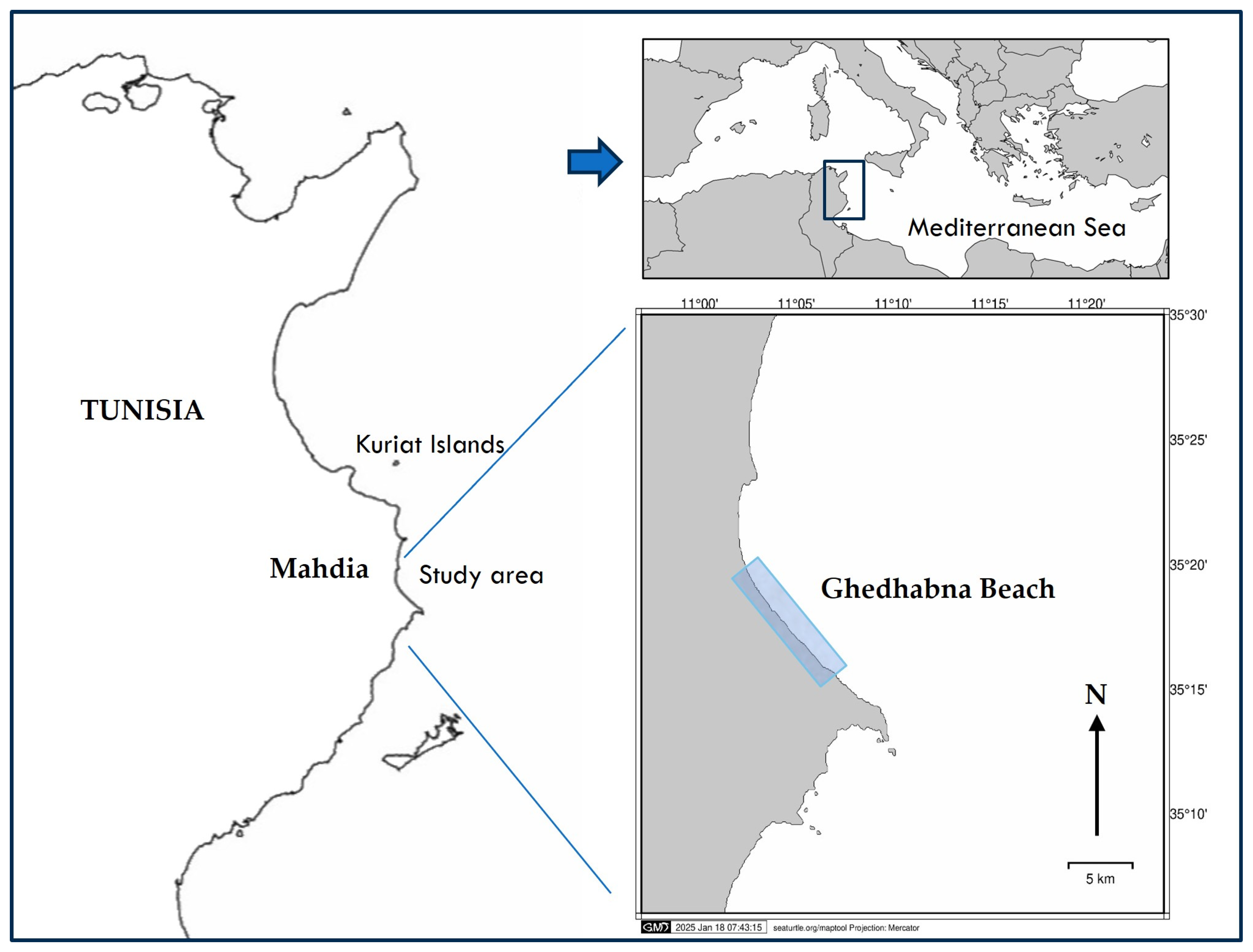
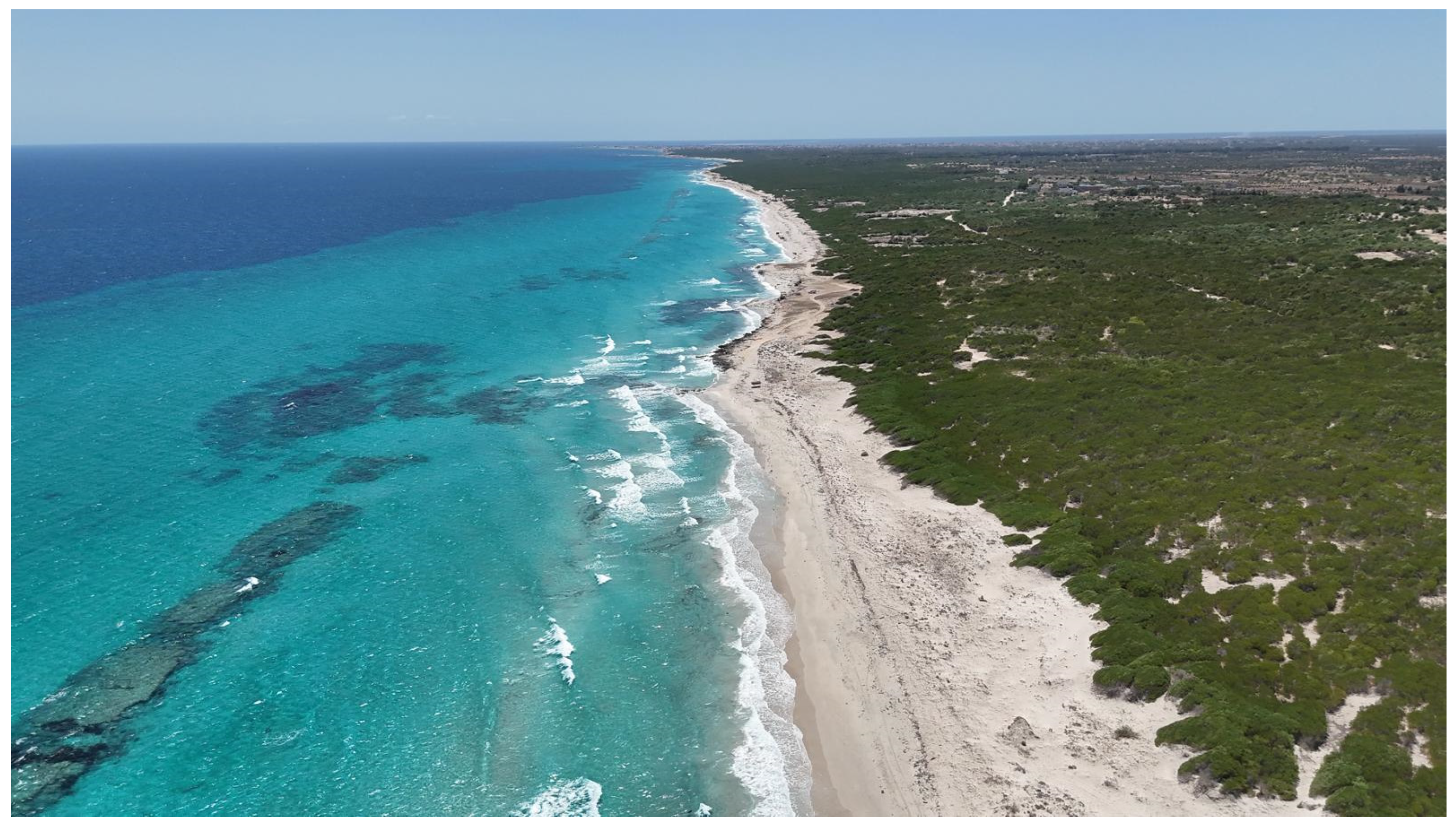
The study area is located in the Tunisian Eastern coast and is attached to the governorate of Mahdia (35.327817 N 11.040122 E, 35.26397 N 11.10554 E; Figure 1). It extends over 10 km of beach with few residential areas. It is a pristine zone characterized by remarkable natural scenery. On one side, it benefits from a young forest, commonly known as Ghedhabna forest. On the other side, there is a sandy beach with bordering dunes and a sapphire-colored sea. The coastal forest of 693 hectares was planted during the 1960s by the national army to reduce sand winds and is composed predominantly of pines, eucalyptus, and acacias [27]. The economy of the residential area is primarily based on terrestrial agricultural activities and artisanal fishery, which serve as the main sources of livelihood for the local population. In addition, the village experiences a seasonal economic boost during the summer months, when locals living abroad return for annual vacations.

2.2. Field Work

The team included trained volunteers and locals, supervised by experienced field assistants. Surveys were conducted daily from 1 May to mid-August, with extended monitoring for hatchling emergences until late September. Morning patrols lasted approximately 6 h (05:00–11:00 a.m.) and were conducted by 4–8 observers. The entire 10 km nesting beach was surveyed on foot and divided into four 2.5 km sections, each assigned to 1–2 observers. This resulted in ~20–40 observer-km per day (considering round-trip movement), and ~24–48 observer-hours per day. Afternoon patrols were conducted opportunistically. This survey protocol was fully implemented in 2025, applied to a lesser extent in 2024, and in 2023. We did not conduct nocturnal monitoring; therefore, no nesting female was observed, as they usually emerge at night. Tracks left by adult turtles crawling onto the beach were analyzed to identify the species and check for evidence of nesting. Species identification was based on track patterns, being asymmetrical in loggerhead turtles [28]. Experienced surveyors carefully used a small, narrow-diameter probe stick to detect the softened sand above the clutch while minimizing the risk of egg puncture. Egg chambers were carefully excavated by hand until the topmost eggs were exposed. Nesting was confirmed when eggs were present, otherwise, it was considered as a nesting attempt. Nest locations were recorded with GPS coordinates and photographed to help localize them and to avoid duplication of records. The nests were left unmarked to minimize the risk of tampering with sea turtle nests. The distance from the nest (N) to the high tidal line (T) was registered (NT). When NT was short (≤10 m), making the nest at risk of inundation, we relocated it to a safer location at the same beach. We used an established nest relocation protocol [29] within the first 24 h of oviposition. After a period of incubation, hatchlings emerged naturally from sand, crawled down the beach, and entered the sea without any assistance. After the last hatchlings emergence, excavation was undertaken manually, and the nest contents were sorted and counted. The last hatchlings, trapped at the bottom of the egg chamber, were brought out onto the beach and assisted in making their way to the sea.

2.3. Nesting Parameters Assessment

The observed nesting density (ND) was calculated as the number of nests (N) per km and per year (N km−1 yr−1). The percentage of nesting success (NS) was calculated as (N/(N + A) × 100), where A is the number of nesting attempts. An attempt refers to a false crawl when a female returns to the sea without laying eggs. The duration of the oviposition process (OD) was determined based on the dates of the first and last successful nests recorded during the season. The duration of the hatchling emergence season (HED) was determined by the period from the first day of emergence of hatchlings to the last one in a season. The overall duration of the nesting season (NSD) was determined as the elapsed days from the first female emergence to the last hatchling emergence. The incubation duration (ID) was defined as the time from oviposition to the date of the first hatchling emergence. We used the website https://www.timeanddate.com/date/duration.html (accessed on 30 August 2025) to perform the calculations.
The length of the incubation period can serve as an indicator of the incubation temperature which determines the hatchling sex ratio. The pivotal incubation duration, corresponding to a 50:50 sex ratio in loggerheads, has been the subject of numerous studies. The latest Mediterranean assessment [30] estimated a pivotal incubation duration of 52.8 days. Longer incubation periods reflect lower temperatures and result in a higher proportion of male hatchlings, while shorter periods indicate higher temperatures and lead to a higher proportion of female hatchlings [31]. We conducted a literature review of incubation durations from regular Mediterranean nesting sites, with updated values from recent years, to compare with our results. We ran the Mann–Whitney U test to compare IDs between natural nests (N = 85) and the relocated ones (N = 12) recorded in the present study
The clutch size (CS) refers to the number of eggs laid in a nest. It was determined during relocation or estimated after nest excavation by counting eggshells and other nest contents, including unhatched eggs, and pipped eggs (dead or live hatchlings that had only partially broken through the eggs) [32]. The hatching success (HS) was defined as the percentage of empty eggshells in a nest. The emergence success (ES) was determined as the percentage of empty eggshells minus dead hatchlings in the nest. The fertility rate (FR) corresponded to the percentage of total eggs minus the infertile eggs in a nest. We calculated the estimated annual number of the emerged hatchlings (EH) by multiplying the number of hatched nests by the mean clutch size and the mean emergence success.

2.4. Interview Description

We conducted in-person semi-structured interviews with local residents to document historical nesting activity and to understand community perceptions and practices related to sea turtles. The survey was conducted between June and October 2024. The 120 interviewees were informed in advance about the study’s purpose and assured that the collected data would be kept confidential. Participation was voluntary and anonymous. The respondents could withhold any information that they did not wish to share. The interviewee could choose what to answer depending on the situation. A single interview was planned for 30 min but often exceeded this duration because interviewees wished to share additional observations.
The team consisted of an experienced conservation scientist and a student, who had worked with local communities, and a passionate volunteer local citizen, well-connected with the community. This fostered trust and minimized the risk of miscommunication during the interviews. Moreover, we opted to meet the participants in their natural surroundings, such as local cafes, along the roads or along the beach, where they felt at ease. The interviews were conducted in the local vernacular Arabic.
The interviewed population represented a diverse cross-section of the community, encompassing a wide range of ages, genders, and occupations, to capture a comprehensive understanding of sea turtle nesting trends. Interviewees spanned from younger adults to elderly residents.
The interview guide consisted of predetermined questions (Supplementary Material), and the interview addressed three main topics: (a) historical trends in nesting activity, (b) local perceptions of sea turtle nesting and interest in conservation, and (c) main threats to sea turtles in the area. Questions on nesting activity covered observations of hatchlings, nesting females, tracks, eggs, anecdotal sightings, dates, locations, frequency, temporal changes, and potential drivers. Perception-related questions assessed awareness, attitudes, current engagement, and willingness to participate in future conservation actions. Additional questions targeted local threats, including predation, poaching, habitat degradation, and pollution. The questionnaire combined open- and closed-ended items to encourage detailed responses and support qualitative data collection. Interview data were analyzed using inductive thematic analysis. Interview transcripts were reviewed, coded, and iteratively organized into themes.

2.5. Threat Assessment

We assessed threats that could hinder nesting activity or cause damage to turtles or eggs by analyzing site-specific threatening factors. Threats were classified as natural or anthropogenic. For each factor, direct impacts were confirmed through field observations, and the number of affected nests was recorded.
To evaluate threat severity, the potential risk of each factor was determined based on its prevalence and spatial distribution along the beach. Interviews with local residents also provided complementary insights. Risk levels were categorized as low (+), medium (++), or high (+++) impact.

3. Results

3.1. Site Description

The expansive beach of Ghedhabna, over 50 m wide, is characterized by moderate slopes and a dune cordon stabilized by dense dune vegetation. The prevalent beach vegetation includes halophilous species well-suited to the coastal conditions, such as the sea eryngium (Eryngium maritimum), the prickly saltwort (Salsola kali), the sea daffodil (Pancratium maritimum), the sand dropseed (Sporobolus pungens), the maritime cottonweed (Achillea maritima), and the Hottentot fig (Carpobrotus edulis).

3.2. Nesting Parameters and Phenology

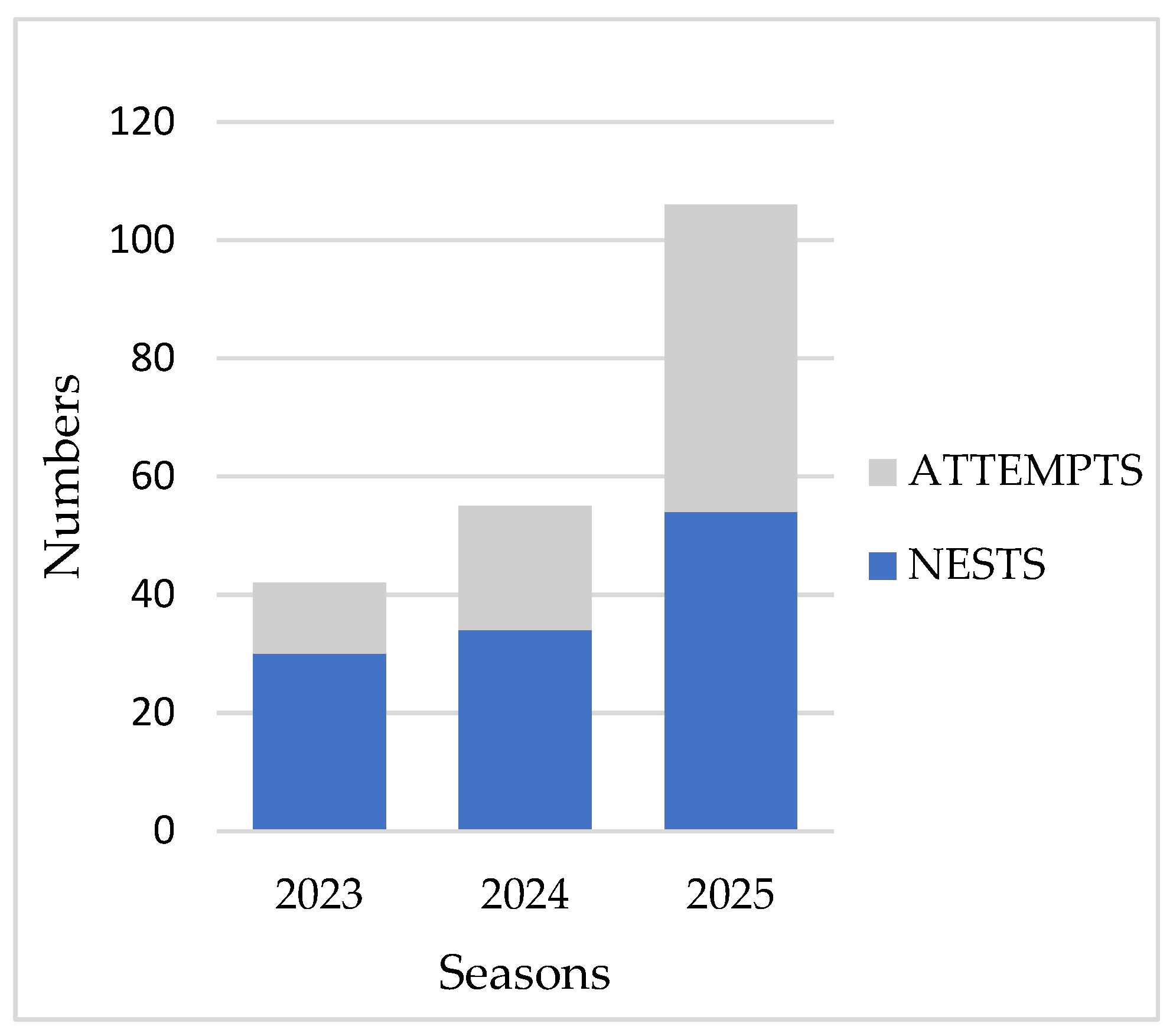
All the observed hatchlings and eggs belonged to the loggerhead sea turtle species. A total of 203 female loggerheads emergences were recorded, of which 118 resulted in successful nests along the 10 km surveyed beach (Figure 2, Table 1).
During the 2023 and 2024 nesting seasons, the first female emergence was detected in the last week of May. However, in 2025, the first nesting event was recorded earlier, on May 13. In all three seasons, emergence of nesting females ended at the end of July (Table 1). Peak nesting occurred in June (51.72%), followed by July (32.76%) then May (15.52%). Nesting frequency in May increased progressively over the study period, rising from 01 nest in 2023 to 06 in 2024, and 11 nests in May 2025. Nesting attempts began and ended within an interval of 4 to 10 days before and after the oviposition period. Nesting activity was monitored over a total of 418 fieldwork days during the study period, starting on May 1st and continuing until the last hatchling emergences. Interannual variation in nesting phenology was detected, showing an increase in some measured durations. Detailed nesting characteristics including nesting success, nesting density, distance from the nest to the high tidal line, durations of egg incubation, oviposition, hatchling emergence, and nesting seasons are reported in Table 1.
The incubation durations (IDs) ranged from 43 to 76 days. ID reached high values of 66 and 67 days in 2023 and 2025, respectively, and a maximum of 76 days in 2024, among the highest recorded in the Mediterranean rookeries (Table 2). Longer incubation durations were observed earlier in the nesting seasons, with durations decreasing over time due to the negative correlation between incubation period and atmospheric and nest temperatures [31]. The Mann–Whitney U test, used to compare IDs between natural and relocated nests, showed no significant difference (p > 0.05); thus, we considered the ID of all the nests. The annual mean ID was 59.63 ± 6.19 days. In this study, a literature review of IDs from regular Mediterranean nesting sites was conducted. In several of these studies, reported IDs were correlated with field measurements of nest temperature and/or sex ratio estimates. For example, authors in [33,34,35,36,37,38] reported IDs up to 50.1 days, and indicated predominantly female production sites. In contrast, reported IDs were above 57 days in [14,39], and indicated a male-biased sex ratio of hatchlings (Table 2).
To mitigate the risk of inundation, 12 nests (03 in 2023, 06 in 2024, and 03 in 2025), located less than 10 m from the shore or on unsuitable substrates were relocated following the protocol from [29]. In 2025, 05 nests, located between 11.2 m and 13.7 m from the shoreline, were totally inundated and eggs were putrefied. Also, two nests in the same season were partially predated by the ghost crab (Ocypode cursor), with eggshell remnants found around the nests. In contrast, all nests recorded in 2023 and 2024 hatched successfully, resulting in a 100% clutch hatching rate (CHR), whereas CHR declined to 88.89% in 2025. The means of clutch size (CS), hatching (HS), emergence success (ES), and fertility rate (FR) were therefore calculated excluding the inundated and predated nests in 2025 (N = 47). The estimated total number of hatchlings emerged over the three-year study period was 7617. Nesting parameters are reported in Table 3.

3.3. Interview Results

Participants were categorized into three age categories, each including 40 individuals: young adults [20–40 yr], middle-aged adults [41–60 yr], and seniors > 60 yr, with a higher representation of males than females (85, 35, respectively), as women were less frequently encountered in outdoor settings during the survey period.
Interviewees included long-term residents such as retired fishermen and farmers and local elders who possess extensive knowledge of historical nesting events, current fishermen who continue to interact with the coastal environment daily, ordinary employees in different sectors, students, and others (homemakers, unemployed, and retired). Demographic characteristics of the interviewees are reported on Table 4.
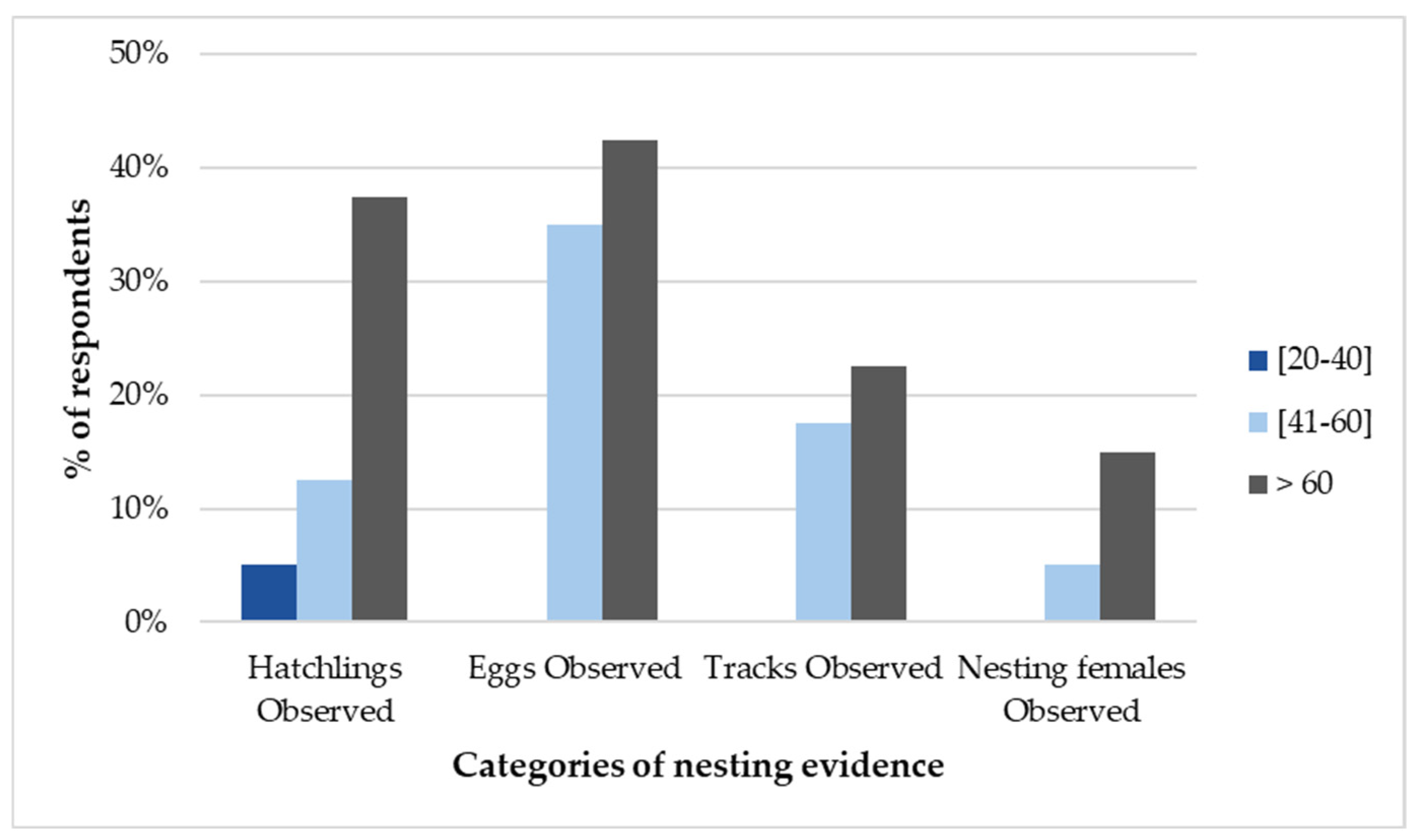
The interviews were interactive, and the results revealed that all participants had at least heard anecdotal accounts about the nesting phenomenon in the region prior to our study. All seniors and middle-aged participants (68%) reported direct evidence of this phenomenon, unlike younger participants, who merely observed it (5%). Regarding evidence-based indicators, egg sightings were the most frequent (77.5%), followed by hatchling encounters (55%), track detections of nesting females and/or of hatchlings (40%), and least frequently, nesting female sightings (20%). The distribution of these indicators varies by age group, with seniors reporting more observations than middle-aged respondents (Figure 3). The distribution also varied by gender, with all types of indicators recorded by men, while most women reported seeing only turtle eggs and, to a lesser extent, hatchlings. In all cases, the total observations per group exceed 100% because many interviewees reported multiple categories of observations. Participants stated that nesting has occurred consistently for decades in the region. Systematic observations were common in the past, while reports have been scarce over the last two decades.
Behavioral analysis was also investigated to understand locals’ attitudes towards the nesting phenomenon and to report any human interference. Awareness of the importance of marine turtles and their role in the ecosystem was revealed to be low, with only 35% of the middle-aged group recognizing their significance (representing 11.67% of the interviewed population). The rest of the respondents totally ignored their ecological importance or the existence of dedicated programs for conservation. Regarding willingness to support conservation initiatives, only a small proportion of younger participants (5%) and seniors (10%) expressed enthusiasm for participation, whereas 60% of middle-aged adults showed interest, accounting for a total of 30 respondents supporting these initiatives (25% of the interviewed population). The creation of a local environmental NGO emerged as the most frequently proposed measure (63.33%), followed by the promotion of awareness campaigns (53.33%). Other suggested initiatives included the establishment of a turtle sanctuary (4%), artificial nest incubation (2.67%), and the use of the “head-start” technique for hatchlings (1.33%). Concerning threats, 90% of seniors and 70% of middle-aged participants reported that turtles were historically exploited locally, mainly for their eggs as a food source. They confirmed that this practice no longer exists at present. In addition, all the interviewees reported severe pollution and substantial marine debris accumulation on the beach, emphasizing the limited involvement of public authorities and services in waste removal and beach management.

3.4. Threats

During the survey, sea turtles at the Ghedhabna site were found to face both anthropogenic and natural threats. Five major threatening factors were identified based on field observations, with direct impacts recorded on hatchlings and eggs. The risk level posed by each threat was assessed based on its prevalence, its spatial distribution along the beach, and its documented negative impacts on the ecosystem (Table 5).
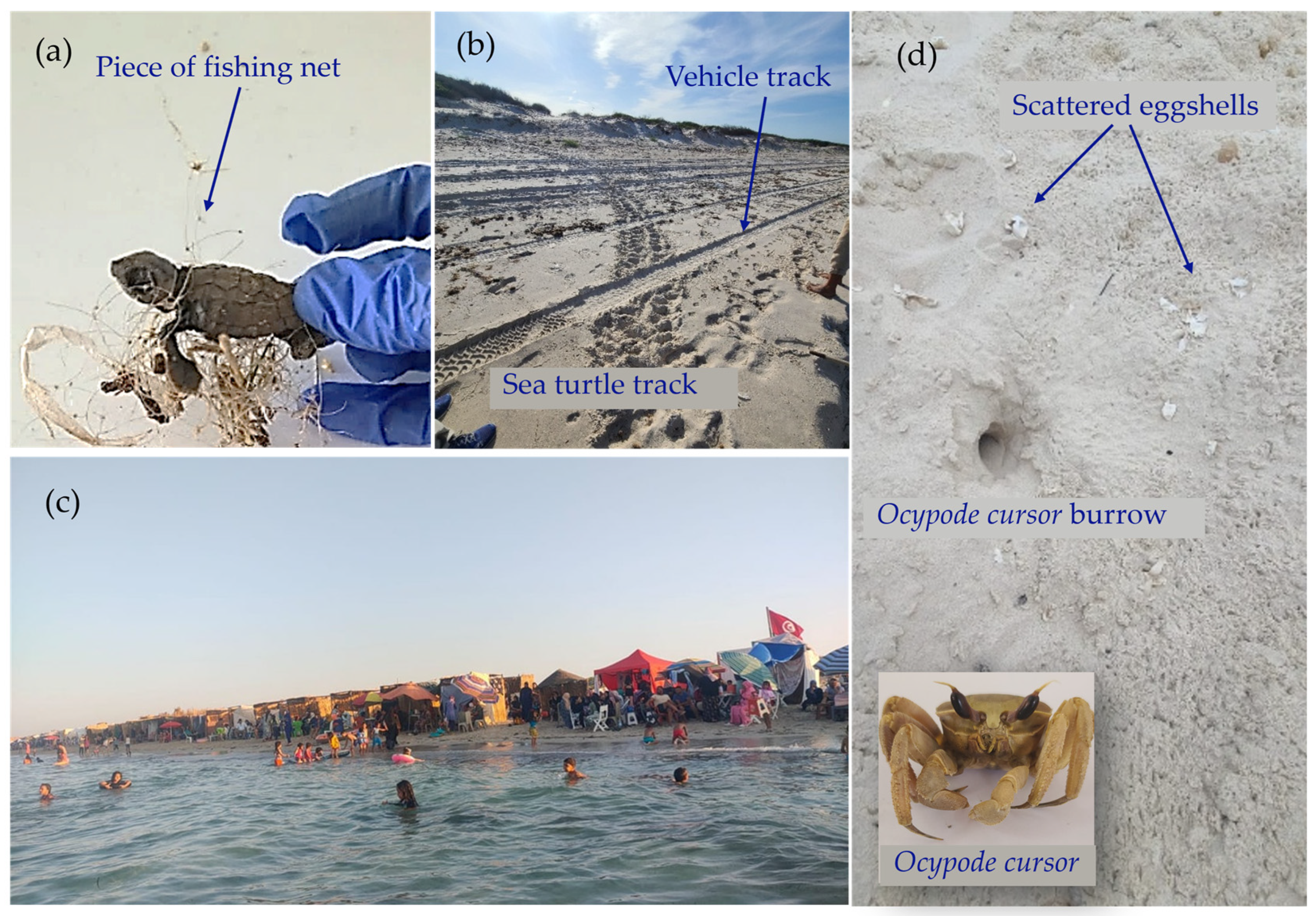
Marine debris, primarily plastic waste, emerged as one of the most significant threats to sea turtle survival. Washed-up debris, combined with litter deliberately discarded by campers, were observed in large quantities along the beach. Items ranged from discarded fishing nets and ropes to minute plastic particles, including industrial granules, detected inside several nests. In 2024, a hatchling was found dead, entangled in a piece of discarded fishing net (Figure 4a). Taking into account the abundance of marine debris and its harmful consequences, the risk level associated with this factor was considered high.
Driving off-road vehicles along the beach represents another major anthropogenic threat. In 2023, this practice caused the death of 42 hatchlings, found crushed on the nest surface prior to emergence. Frequent vehicle traffic was observed along the entire beach, which represents a major threat to nesting success (Figure 4b).
Anthropogenic disturbances also include unregulated camping and the dense clustering of beach furniture, such as tents and umbrellas, which persist throughout the summer season (Figure 4c). These camps are typically concentrated in limited sections of the beach, creating overcrowded areas. Light pollution, constant noise, and the permanent presence of beach furniture are key threats to nesting activity. Four nests identified during the study were located beneath tents and beach umbrellas. Hatchlings emerged among beachgoers, with some disoriented by artificial lighting, before being guided back to the sea. Access from the village to the beach is possible only through a few tracks crossing the forest, which restricts camping to some highly frequented sections. Fortunately, about 70% of the shoreline remains sparsely visited, reducing the overall level of disturbance to a moderate risk (Table 5).
Natural predation is also a concern. In 2024, burrows of the ghost crab (Ocypode cursor) were detected for the first time on this beach. This opportunistic omnivorous species feeds on sea turtle eggs and hatchlings. By 2025, many burrows were observed along the entire beach, with relatively high density. Two nests were partially predated, with scattered eggshells found around the nests (Figure 4d). In two other nests, hatchling tracks were interrupted, suggesting predation by crabs. Although the overall predation rate was low (3.39%), the species’ increased density and voracity represent a significant threat to nesting success (Table 5).
Finally, environmental factors such as nest inundations were recorded. Despite taking precautions and relocating nests situated less than 10 m from the sea, five nests in 2025, originally located between 11.2 m and 13.7 m from the tidal line, were completely flooded, leading to egg spoilage and embryo mortality at various developmental stages. Some nests, despite being situated at comparable distances from the shoreline, remained unaffected, suggesting that not all nests are equally vulnerable to inundation.

4. Discussion

4.1. Ghedhabna as a Moderate Dense Nesting Site

We present here the first survey on loggerhead sea turtle nesting activity on Ghedhabna Beach. The suitability of sea turtle nesting habitats depends on a favorable combination of physical and chemical factors, variables that have been widely studied to understand site selection [52]. These variables include the distance from the high tide line [53], beach slope and elevation [54,55], presence of vegetation [56], humidity levels [52], as well as sand particle size and temperature [57]. With a wide beach, fine sand, an extensive dune system, and abundant vegetation, Ghedhabna Beach represents a suitable nesting habitat for loggerhead sea turtles (Figure 5).
To provide a comprehensive assessment of nesting activity levels in the Mediterranean area, sea turtle nesting sites were categorized based on their annual clutch frequency and nest density [4]. The results showed relatively important nesting activity with an average annual nest number of 39.33 and a nesting density of 3.93± 1.29 nests km−1 yr−1. Based on an annual number of nests ranging from 20 to 99, and a nest density between 2.5 and 6.5 nests km−1 yr−1, Ghedhabna falls within the category of moderately dense nesting sites, as reported by [4]. It emerges as the second most important nesting area in the country, after Kuriat islands.
The number of nests increased over the study period. This pattern may be partially explained by increased monitoring effort, as well as by natural interannual fluctuations in nesting activity, which are commonly observed in Mediterranean loggerhead turtle populations [44,50]. Given that most females do not nest annually and exhibit irregular remigration intervals, this study underscores the need for long-term monitoring to clearly assess the reproductive dynamics of loggerhead turtles at this newly identified nesting site.

4.2. Nesting Parameters

Worldwide nesting patterns indicate that not all female emergences result in nest deposition. The nesting success rate indicates the measure of disturbance encountered by turtles during nesting activity [42,60]. In the present study, the annual mean nesting success (NS) was 61.39 ± 10.24%, representing the highest value reported in the Mediterranean Sea. NS values varied among Mediterranean nesting sites. For instance, in Greece, they reached 38% in Koroni over 25 seasons [34], 26.2% in Zakynthos over 38 years [42], and 34.6% in Kyparissia Bay over 9 years [58]. In Turkey, NS was 48.8% at Çıralı Beach over 9 years [35] and 38.96% at Patara Beach over 5 years [36]. In Italy, NS reached 45.8% in Calabria over 5 nesting seasons [12]. High NS indicates generally limited anthropogenic disturbance and favorable environmental conditions that facilitate nest digging and egg laying [61,62]. The high rate observed in this study is primarily due to the lack of coastal development and touristic and recreational activities at Ghedhabna Beach. The surrounding forest also acts as a natural barrier, reducing human interference and maintaining suitable nesting conditions. The annual mean NS exhibited a slight declining trend over the study period (71.4% in 2023 vs. 50.94% in 2025, Table 1). The increased monitoring effort likely provided a more accurate representation of the actual status of this parameter and better reflected the actual conditions of the local nesting environment. Adult female turtles are highly sensitive when they come ashore at night to lay eggs. The anthropogenic factors include light pollution, excessive noise, and frequent movement from campers. In this regard, nighttime monitoring of nesting activity in this area is essential to better analyze the emergence conditions of nesting females and implement appropriate conservation measures.
The clutch size from our study was within the range of what has been reported in previous studies from Mediterranean rookeries, and a little below the range of the loggerhead population nesting in the large Greek nesting site of Zakynthos [42]. The variation in clutch size was attributed to body size differences in nesting females. These two variables are strongly interrelated [63,64,65]. For instance, the large clutch size observed in Greece is associated with the larger size of local nesting turtles compared to those in other Mediterranean rookeries [66]. Here, body size data for loggerheads nesting in Ghedhabna are missing as patrolling was conducted exclusively during daylight hours.
The overall nesting season, estimated from the date of the emergence of the first nesting female to the date of the last hatchling emergence, was shorter than those reported at major Mediterranean nesting sites. This reduced duration is likely related to the relatively small nesting population in the study area. Across years, nesting activity started progressively earlier in the season, with the first emergences recorded in mid-May and an increasing number of nests occurring in May over successive seasons. The increased monitoring effort and earlier survey start may have contributed to this trend. However, rising summer temperatures could also play a role, as a similar earlier onset of nesting, beginning in May, has been observed in the recent years at the nearby Kuriat Islands nesting site. Studies have shown that sea turtles exhibit shifts in nesting phenology in response to rising temperatures, advancing the nesting season in a way that helps maintain climatic niche suitability [67,68,69,70]. Long-term monitoring is essential to evaluate the reproductive phenology of loggerhead turtles in Tunisia.
Overall, we presented here a complete database of the nesting parameters of this site, that were within the ranges reported for the regular Mediterranean nesting sites. Strengthening long-term nesting monitoring and fieldwork is essential to obtain a clearer understanding of the nesting dynamics and phenology of the loggerhead population at this site and to ensure reliable trend detection.

4.3. Potential for Male Production Hatchlings

The incubation duration (ID) is negatively correlated with nest temperature. It varies according to seasonal conditions, latitude, sand color, nest depth, and episodic events such as rainfall [71,72,73]. The pivotal incubation duration, corresponding to a 50:50 sex ratio, has been frequently studied in the Mediterranean. Reported values included, for example, 56.6 days in Greece [74], 52.6 days in the same region [34], and 56.3 days over a 10-year monitoring period in Cyprus [75]. More recently, [30] estimated a pivotal incubation duration of 52.8 days, corresponding to a pivotal temperature of 28.95 °C. In all cases, the incubation duration observed at Ghedhabna (59.63 ± 6.19) exceeded all the predicted pivotal values producing a balanced sex ratio, suggesting that this site likely produces a male-biased hatchling population. This finding contrasts with the predominantly female-biased primary sex ratios reported at most Mediterranean nesting sites, where major rookeries in the eastern basin like Greece, Turkey, Libya, and Cyprus have been shown to produce 60–99% females [4]. Given the ongoing shift toward female-biased ratios driven by rising global temperatures, male-producing sites are critical for maintaining population balance, as both sexes are essential for population sustainability [76,77].
The review of incubation duration estimates from most Mediterranean rookeries over the past decade revealed that recently studied nesting sites in France, Italy, Spain, and Tunisia (Table 2) tend to produce a male-biased hatchling ratio. Therefore, the central and western Mediterranean populations, which have recently shown increased nesting activity, represent key nesting populations for the entire Mediterranean basin. Given the continued impact of rising temperatures, future studies should include direct measurements of nest temperatures during incubation and multi-year datasets on sex ratios to better understand the potential resilience mechanisms of the Mediterranean loggerhead turtle population in response to global warming [75].

4.4. Threats

Despite the absence of coastal development, and recreational and touristic activities at this site, several threats to nesting success were identified. Although the proportion of nests directly affected by these threats was relatively low, the associated risk levels are estimated to be high (Table 5). The observed cases of nest disturbance may not fully represent the true scale of risk, as the three-year monitoring period is too short to evaluate long-term impacts on nesting activity or to fully interpret the combined effects of terrestrial and marine threats.
Among the identified threats, the accumulation of plastic debris along the shoreline emerged as one of the most significant. Large quantities of plastic waste can obstruct the movement of nesting females and hatchlings, leading to entrapment, dehydration, injury, or death [78]. Plastic pollution can also reduce nesting success by altering the thermal and chemical properties of nesting substrates [79]. As sea turtles have temperature-dependent sex determination, an increase in incubation temperature can skew sex ratios toward females. Plastics possess a higher specific heat capacity than sand, and their accumulation within the nesting substrate can raise local temperatures, thereby increasing feminization rates [78,80]. In addition, heated microplastics may release toxic compounds, further degrading beach quality and affecting embryo development [81].
In addition to plastic pollution, uncontrolled human activities such as vehicle traffic and unregulated camping exert considerable pressure on nesting habitats at Ghedhabna. The circulation of vehicles on the beach and the installation of seasonal camps can destroy nests, crush eggs, and disorient hatchlings. These repeated disturbances discourage females from emerging to nest and degrade the overall nesting environment. Although officially prohibited, such activities occur every summer season, posing a persistent threat. Beyond direct impacts on turtles, these practices also damage the coastal ecosystem by degrading beach vegetation, damaging dune stability, and affecting associated flora and fauna. Limited administrative oversight, coupled with low public awareness, contribute to the continuation of these pressures and hinder effective beach management.
Natural factors also play a significant role in shaping nesting success. Predation represents a major threat to eggs and hatchlings. The ghost crab (Ocypode cursor), first detected at Ghedhabna Beach in 2024, was confirmed as a predator during the 2025 season through the discovery of scattered eggshells around two nests. This study provides the first report of sea turtle predation by Ocypode cursor in Tunisia. Ghost crabs dig into nests to feed on eggs and attack hatchlings during their crawl to the sea [4,82]. Their high density and widespread presence along the beach make them a serious threat to nesting success. This species is recognized as a major cause of nest mortality, sometimes affecting nearly all nests, and preying heavily on eggs (up to ~50% in some cases) [83,84]. Additionally, large numbers of seagulls were observed during the survey. While no direct evidence of predation was recorded here, seagulls are recognized as predators of hatchlings and may often capture them as they emerge and move toward the sea [4,85]. In the Mediterranean, sea turtle predation has been widely reported with canids, particularly jackals, feral dogs, and foxes, constituting the main predators of loggerhead eggs and hatchlings at several nesting sites [4]. In contrast, predation by the ghost crab Ocypode cursor has been documented less frequently, with only few studies reporting its impact [86,87].
Another natural factor affecting nesting success is nest inundation by waves. Seawater intrusion into nests leads to embryo mortality by interrupting gas exchange and disrupting development, resulting in reduced hatching and emergence successes [88]. However, this threat does not affect all nests equally. The likelihood of inundation varies with beach elevation, slope, and local erosion dynamics [89]. The author in [90] described the coastline between Salakta and Ghedhabna as a mixed structure, characterized by sandy sectors alternating with scattered rocky outcrops, and a highly indented shoreline. Its alignment with the dominant wave directions, combined with favorable incidence angles, enhances the effect of longshore drift. The pronounced heterogeneity of coastal formations resulted in marked morphodynamic complexity, particularly evident along the sandy barrier and the dunes in the study area. In this context, several sandy sections remain potentially vulnerable to marine erosion. Therefore, nests located in erosion-prone sections are more vulnerable to flooding, particularly during high tides and storm events.

4.5. Interviews Reveal Long-Term Nesting Trends in Ghedhabna

Prior to this study, nesting in Ghedhabna was rarely recorded and nests were discovered serendipitously. The observed relatively high number of nests discovered during this study cannot reflect an abrupt population increase in species with long generation length such as sea turtles. In this context, our interview survey shed light on the ecological significance of Ghedhabna as a historical critical zone for sea turtles and for providing an important habitat for successful reproduction. Several environmental studies using an interview-based approach have demonstrated their effectiveness in examining issues related to sea turtle populations and in providing a more accurate assessment [91]. Such studies addressed community–sea turtle interactions, bycatch [92,93], community involvement in conservation actions [94,95], turtle consumption [96], and illegal harvesting [97]. In this research, community interviews provided qualitative evidence of historical nesting activity, with residents reporting a decline over the past decade. This suggests potential environmental or anthropogenic pressures affecting nesting rates. In the past, the absence of specific legislation that prohibited the exploitation of sea turtles potentially impacted nesting activity. In fact, before the establishment of international legal protections, the trade of sea turtles was widespread and unregulated in many coastal communities. Turtles held significant local importance as a food source, which brought public attention to their presence and abundance. After the ban on their capture, this consumption-driven interest declined significantly. This shift could partly explain reports of a decrease in nesting turtle numbers in our case, which is likely attributed to a reduction in observations and documentation in recent decades. It is noteworthy to mention that Tunisia is one of the pioneer countries in Africa and in the Mediterranean region to ratify key international conventions on the protection of sea turtles and other endangered species. Its early involvement in agreements like CITES, CMS and the Barcelona Convention reflects a strong commitment to conservation efforts in the Mediterranean.

4.6. Social Diversity and Attitudes Toward Sea Turtles

The results of the interviews also revealed an interesting link between the level of awareness and the socio-economic aspect within the local community, with older individuals showing greater knowledge and sensitivity to the subject. Over the years, Ghedhabna’s societal structure has shifted from being primarily composed of fishermen to a younger generation with more education and aspirations of working abroad. This transition has likely played a role in the observed generational gap in knowledge and engagement with sea turtle nesting conservation. In the past, seniors and middle-aged adults were deeply connected to the beach and marine environment due to their livelihoods as fishermen. Fishing required daily interaction with the sea and its ecosystems, giving them consistent opportunities to observe natural events like turtle nesting. As a result, older generations were more attuned to environmental changes, such as the decline in nesting activity, making them more aware of the historical nesting patterns. Today, the younger generation is more focused on professional opportunities abroad, leading to reduced physical interaction with the local marine environment. The shift from traditional, nature-based livelihoods like fishing to more modern pursuits has distanced younger adults from the natural rhythms of the beach, which partly explains their reluctance and reduced willingness to support the cause.

4.7. Intensive Monitoring Can Unveil Important Nesting Sites

Nesting parameters lie generally within the range reported for loggerhead turtles in the majority of regular rookeries in the Mediterranean Sea, demonstrating that sea turtles regularly return to Ghedhabna Beach to nest. At the same time, interviews with community members revealed historical accounts of sea turtle nesting spanning several decades. This provides evidence of consistent nesting patterns and the long-standing presence of sea turtles in the area. Together, the scientific data and community insights created a comprehensive picture, confirming that sea turtle nesting on Ghedhabna Beach is not only a regular occurrence but also a historically significant natural event that comprises a healthy and viable population. The lack of previously documented reports is primarily related to the lack of proper monitoring and regular survey of the site, as all national efforts were mainly focused during the last 30 years on Kuriat Islands, the most important nesting site in the country. As reported in some regions in the Mediterranean, an increase in monitoring can unveil important nesting sites, such the one in Sicily, Italy [14]. In regions where, in appearance, nesting is sparse, the lack of dedicated monitoring could lead to underestimations or even complete neglect of sea turtle nesting occurrences and protection.

4.8. Ecological and Cultural Significance of Ghedhabna Site

Ghedhabna is a region of significant ecological and cultural importance. The area represents a biodiversity hotspot encompassing multiple interconnected natural ecosystems, including forest, dune, and marine habitats. Each of these systems hosts a wide variety of species, and their coexistence maintains the ecological integrity and biological productivity of the region. This ecological richness is further complemented by the site’s exceptional cultural value. The area contains archeological remains both on land and beneath the coastal sand layer [98], providing evidence of successive human occupations by Punic, Roman, Byzantine, Libyan Neolithic, and Islamic civilizations [98]. The coexistence of high ecological diversity and rich cultural heritage makes Ghedhabna a unique site of national and regional significance. Although the village is situated in a strategically important coastal area within one of the country’s most developed tourist regions, its economic situation remains fragile. The lack of development initiatives capable of meeting the community’s basic needs, together with limited governmental attention, has resulted in growing social and environmental instability. This is manifested primarily through forest vandalism, characterized by the destruction of vegetation and the unauthorized appropriation of forest land for personal use. In addition, the degradation of archeological remains and the proliferation of unregulated constructions further threaten the integrity of both the natural and cultural heritage of the area, as some buildings were erected directly on archeological sites.

4.9. Implications for Sustainable Conservation

The sandy beaches along the eastern Tunisian coastline once provided suitable nesting habitats for sea turtles [6]. However, extensive coastal urbanization and tourism development have progressively led to the degradation and loss of most nesting sites [8]. Currently, only the Kuriat Islands, which are relatively unfrequented, sustain regular and stable nesting activity. The identification of the Ghedhabna site, located within densely populated and heavily exploited coastal zones, constitutes an exception. This site has been preserved primarily due to the presence of an extensive coastal forest that forms a natural buffer zone. The vegetation cover limited human disturbance and supported the ecological stability of the area. Consequently, the nesting population has been able to persist within this favorable habitat, contributing to the stability and long-term resilience of the local reproductive population of sea turtles. Nevertheless, this study revealed multiple anthropogenic and natural pressures that threaten nesting success at the site. The destruction of coastal vegetation and forest, limited community awareness, and insufficient administrative oversight further increase the ecosystem’s vulnerability. Addressing these pressures requires an integrated conservation strategy that combines targeted management, continuous monitoring, and adaptive measures to maintain the loggerhead population resilience and its habitat integrity. Sustainable management at Ghedhabna should be guided by the principles of Integrated Coastal Zone Management (ICZM), which promote coordinated actions across ecological, social, and economic sectors to ensure that conservation objectives are consistent with local development. The implementation of basic control measures, improved awareness, and the enforcement of beach-use regulations could substantially reduce threatening pressures. Effective conservation of sea turtle nesting habitats requires strict control of human activities and pollution. Measures should include regular beach cleanups to reduce plastic debris, enforcement of regulations prohibiting vehicle access to the beach, and the establishment of designated camping zones away from nesting areas. Regarding predation, cage protection and mesh barriers work well against canids but are less effective against ghost crabs, which enter nests from below and attack eggs at depth. An alternative approach is to relocate vulnerable nests to safer areas with lower crab density. Regular monitoring of nesting beaches also allows early detection of both egg and hatchling predation, enabling timely intervention. In addition, reducing practices that boost crab numbers near nesting sites, such as leaving organic waste on beaches, can help limit predation pressure. Combining these actions can significantly reduce predation rates and improve hatchling survival. Another important point to consider is the need to identify zones with high erosion risk so that nests insufficiently distant from the shoreline can be relocated to prevent inundation and egg loss. Finally, strengthening collaboration among stakeholders, including community representatives, authorities, NGOs, fishermen, and scientists, is essential for building an effective and coherent management framework.
Ghedhabna has been identified by the government as a priority area for tourism development by 2030 [99], based on its natural and cultural value. While this strategy offers economic opportunities, it also poses challenges for biodiversity conservation. Integrating conservation into development planning is therefore essential. Nature-based and sustainable approaches can align tourism growth with the protection of ecological and cultural heritage. Linking scientific research with participatory governance that actively involves local communities improves the effectiveness and social acceptance of conservation measures. Initiatives such as eco-tourism, sustainable fishing practices, and education can generate economic incentives while supporting the protection of key ecosystem services. Inclusive conservation that recognizes local knowledge and community leadership is critical for long-term success. This study provides a valuable resource for policymakers and coastal managers, encouraging the implementation of coastal development policies that balance tourism expansion with resilient and sustainable conservation actions.

5. Conclusions

Demographic data, combined with environmental variability and varying threat levels, are essential to understanding the true dynamics of sea turtle populations [4]. In this context, the present study provides the first comprehensive assessment of nesting parameters and threatening factors to reproductive population of loggerhead turtles at this newly identified nesting site. It establishes a database for long-term monitoring and serves as a reference for future comparative studies aimed at detecting potential phenological or behavioral variations in nesting and reproduction under the influence of anthropogenic pressures and climate change.
The nesting population of Caretta caretta in Tunisia is relatively fragile due to several contributing factors. First, the population size is limited, with approximately 20 to 30 nesting females recorded annually in recent years at the key nesting site of the Kuriat Islands, despite the implementation of significant conservation efforts and the increase in nest number over the years. Additionally, its genetic diversity was suggested to be among the lowest in the Mediterranean and it was classified within the broader Libyan population, which, in contrast, showed much higher genetic variability [100,101]. The discovery of the historically established population at Ghedhabna prompts us to review this pattern, as current estimates of genetic diversity may have been underestimated. Molecular analyses of this newly identified population may reveal higher genetic diversity within the overall Tunisian stock, suggesting a more stable and resilient population, whose long-term presence and genetic contribution to regional stocks were previously overlooked.

Supplementary Materials

The following supporting information can be downloaded at https://www.mdpi.com/article/10.3390/su18062765/s1. File S1: Interview guide on sea turtle nesting activity at Ghedhabna Beach.

Author Contributions

Conceptualization, O.C., A.G., A.S., L.B.N. and H.M.; methodology, O.C., M.K., A.G. and A.S.; validation, O.C., M.K., M.C. and A.K.; formal analysis, O.C., M.K., M.C. and A.K.; investigation, O.C., A.G., M.K., M.C. and A.K.; resources, A.S., L.B.N. and H.M.; data curation, O.C. and M.C.; writing—original draft preparation, O.C.; writing—review and editing, M.K., A.K. and L.B.N.; visualization, O.C. and A.K.; supervision, H.M. and A.S.; project administration, H.M.; funding acquisition, A.G., L.B.N. and H.M. All authors have read and agreed to the published version of the manuscript.

Funding

This research was partially funded by the French Voluntary Contribution, per Agreement letter signed between the UNEP Executive Director and the Ministry for Europe and Foreign Affairs of France (2023–2025, N°31/2025_SPA/RAC FVC and the APC was partially funded by The American Cooperative School of Tunis (ACST).

Institutional Review Board Statement

This study was conducted under a partnership agreement between the Institut National des Sciences et Technologies de la Mer, INSTM (Ministry of Agriculture, Water Resources and Fisheries of Tunisia), the Agence de protection et d’Aménagement du Littoral, APAL (Ministry of Environment), and the UNEP/MAP-Specially Protected Areas Regional Activity Centre for the national monitoring programme of sea turtle nesting activity in Tunisia. This research action is part of the national project “Vulnerable Marine Megafauna” conducted by the Marine Biodiversity Laboratory of INSTM (LR16INSTM02) and has been formally approved by the Institutional Scientific Board.

Informed Consent Statement

Informed consent was obtained from all participants interviewed in this study.

Data Availability Statement

The original contributions presented in this study are included in the article. Further inquiries can be directed to the corresponding author.

Acknowledgments

We extend our heartfelt gratitude to the local community of Ghedhabna, especially to Sahbi Ismail, for their involvement and invaluable assistance in field work. They generously volunteered their time to participate in interviews and share valuable insights for this study. We also acknowledge the National Coast Guard for their support during the field work. The authors are grateful to Norma and Roy Napier for an early revision of the manuscript. We express our gratitude for the insightful comments and constructive suggestions provided during the peer-review process.

Conflicts of Interest

The authors declare no conflicts of interest.

References

  1. Casale, P.; Margaritoulis, D. Sea Turtles in the Mediterranean: Distribution, Threats and Conservation Priorities; IUCN: Gland, Switzerland, 2010. [Google Scholar]
  2. Casale, P.; Tucker, A.D. Caretta caretta. The IUCN Red List of Threatened Species. Available online: https://www.iucnredlist.org/en (accessed on 12 March 2025).
  3. Casale, P. IUCN Red List of Threatened Species: Caretta caretta Mediterranean Subpopulation. In IUCN Red List of Threatened Species; IUCN: Gland, Switzerland, 2015. [Google Scholar]
  4. Casale, P.; Broderick, A.C.; Camiñas, J.A.; Cardona, L.; Carreras, C.; Demetropoulos, A.; Fuller, W.J.; Godley, B.J.; Hochscheid, S.; Kaska, Y.; et al. Mediterranean Sea Turtles: Current Knowledge and Priorities for Conservation and Research. Endanger. Species Res. 2018, 36, 229–267. [Google Scholar] [CrossRef]
  5. Chaieb, O.; Elouaer, A.; Maffucci, F.; Karaa, S.; Bradai, M.N.; ElHili, H.; Bentivegna, F.; Saïd, K.; Chatti, N. Population Structure and Dispersal Patterns of Loggerhead Sea Turtles Caretta caretta in Tunisian Coastal Waters, Central Mediterranean. Endanger. Species Res. 2012, 18, 35–45. [Google Scholar] [CrossRef]
  6. Laurent, L.; Nouira, S.; Jeudy de Grissac, A.; Bradai, M.N.; Laurent, L.; Nouira, S.; Jeudy de Grissac, A.; Bradai, M.N. Les Tortues Marines de Tunisie: Premieres Donnees. Bull. Soc. Herpetol. Fr. 1990, 53, 1–17. [Google Scholar]
  7. Bradai, M.N.; Karaa, S. Première Mention de La Nidification de La Tortue Caouanne Caretta caretta Sur La Plage Zouaraa (Nord de La Tunisie). INSTM Bull. Mar. Freshw. Sci. 2017, 44, 203–206. [Google Scholar] [CrossRef]
  8. Chaieb, O.; Maatouk, K.; Dhraief, M.; Bradai, M. First Evidence of Loggerhead Sea Turtle (Caretta caretta) Nesting Events on the Tunisian Beaches Echraff and Chott Mariem (South Central Mediterranean). Herpetol. Rev. 2022, 53, 6. [Google Scholar]
  9. Chaieb, O. Suivi de la Nidification des Tortues Marines en Tunisie; Rapport 2024; INSTM-UNEP/MAP/SPA/RAC-APAL-NGB: Tunis, Tunisia, 2024; 36p, unpublished. [Google Scholar]
  10. Mancino, C.; Canestrelli, D.; Maiorano, L. Going West: Range Expansion for Loggerhead Sea Turtles in the Mediterranean Sea under Climate Change. Glob. Ecol. Conserv. 2022, 38, e02264. [Google Scholar] [CrossRef]
  11. Carreras, C.; Pascual, M.; Tomás, J.; Marco, A.; Hochscheid, S.; Castillo, J.J.; Gozalbes, P.; Parga, M.; Piovano, S.; Cardona, L. Sporadic Nesting Reveals Long Distance Colonisation in the Philopatric Loggerhead Sea Turtle (Caretta caretta). Sci. Rep. 2018, 8, 1435. [Google Scholar] [CrossRef] [PubMed]
  12. Denaro, M.; Malito, T.; Mancuso, C.; Parise, G.; Urso, S. Nesting Activity of the Loggerhead Sea Turtle, Caretta caretta, in Calabria: 2016-2020 Reproductive Seasons. Mediterr. Mar. Sci. 2021, 23, 46–54. [Google Scholar] [CrossRef]
  13. Mancusi, C.; Caruso, C.; Terracciano, G.; Raimondi, G.; Venturi, L.; Tonelli, L.; Neri, A.; Ceciarini, I.; Franchi, E.; Ventrella, S.; et al. Nesting of Caretta caretta in Tuscany Area (North-Western Mediterranean Sea): Insights of a Recent Colonisation Phenomenon. Herpetol. J. 2024, 34, 68–74. [Google Scholar] [CrossRef]
  14. Prato, O.O.; Paduano, V.; Baldi, G.; Bonsignore, S.; Callea, G.; Camera, C.; Culmone, G.; D’angelo, S.; Fiorentino, D.; Galia, G.; et al. Minor Sea Turtle Nesting Areas May Remain Unnoticed without Specific Monitoring: The Case of the Largest Mediterranean Island (Sicily, Italy). Animals 2022, 12, 1221. [Google Scholar] [CrossRef]
  15. Hochscheid, S.; Maffucci, F.; Abella Pérez, E.; Bradai, M.; Camedda, A.; Carreras, C.; Claro, F.; de Lucia, G.; Imed, J.; Mancusi, C.; et al. Nesting Range Expansion of Loggerhead Turtles in the Mediterranean: Phenology, Spatial Distribution, and Conservation Implications. Glob. Ecol. Conserv. 2022, 38, e02194. [Google Scholar] [CrossRef]
  16. Luna-Ortiz, A.; Marín-Capuz, G.; Abella, E.; Crespo-Picazo, J.L.; Escribano, F.; Félix, G.; Giralt, S.; Tomás, J.; Pegueroles, C.; Pascual, M.; et al. New Colonisers Drive the Increase of the Emerging Loggerhead Turtle Nesting in Western Mediterranean. Sci. Rep. 2024, 14, 1506. [Google Scholar] [CrossRef]
  17. Mrosovsky, N.; Pieau, C. Transitional Range of Temperature, Pivotal Temperatures and Thermosensitive Stages for Sex Determination in Reptiles. Amphibia-Reptilia 1991, 12, 169–179. [Google Scholar] [CrossRef]
  18. Stubbs, J.L.; Mitchell, N.J. The Influence of Temperature on Embryonic Respiration, Growth, and Sex Determination in a Western Australian Population of Green Turtles (Chelonia mydas). Physiol. Biochem. Zool. 2018, 91, 1102–1114. [Google Scholar] [CrossRef] [PubMed]
  19. Gammon, M.; Bentley, B.; Fossette, S.; Mitchell, N. Metabolic Rates and Thermal Thresholds of Embryonic Flatback Turtles (Natator depressus) from the North West Shelf of Australia. Physiol. Biochem. Zool. 2021, 94, 429–442. [Google Scholar] [CrossRef] [PubMed]
  20. Mazaris, A.D.; Kornaraki, E.; Matsinos, Y.G.; Margaritoulis, D. Modeling the Effect of Sea Surface Temperature on Sea Turtle Nesting Activities by Investigating Seasonal Trends. Nat. Resour. Model. 2004, 17, 445–465. [Google Scholar] [CrossRef]
  21. Milton, S.L.; Schulman, A.A.; Lutz, P.L. The Effect of Beach Nourishment with Aragonite versus Silicate Sand on Beach Temperature and Loggerhead Sea Turtle Nesting Success. J. Coast. Res. 1997, 13, 904–915. [Google Scholar]
  22. Mrosovsky, N.; Yntema, C.L. Temperature Dependence of Sexual Differentiation in Sea Turtles: Implications for Conservation Practices. Biol. Conserv. 1980, 18, 271–280. [Google Scholar] [CrossRef]
  23. UNEP/MAP—SPA/RAC. Action Plan for the Conservation of Marine Turtles in the Mediterranean; SPA/RAC: Tunis, Tunisia, 2019; pp. 1–16. [Google Scholar]
  24. Margaritoulis, D.; Fytilis, D.; Manias, N.; Panagopoulou, A.; Theodorou, P.; Rees, A.F. Sporadic Nesting Events of Loggerhead Sea Turtles Caretta caretta along the Greek Coasts of the Ionian Sea. Herpetozoa 2025, 38, 225–230. [Google Scholar] [CrossRef]
  25. Hanna, M.E.; Chandler, E.M.; Semmens, B.X.; Eguchi, T.; Lemons, G.E.; Seminoff, J.A. Citizen-Sourced Sightings and Underwater Photography Reveal Novel Insights About Green Sea Turtle Distribution and Ecology in Southern California. Front. Mar. Sci. 2021, 8, 671061. [Google Scholar] [CrossRef]
  26. Young, J.C.; Rose, D.C.; Mumby, H.S.; Benitez-Capistros, F.; Derrick, C.J.; Finch, T.; Garcia, C.; Home, C.; Marwaha, E.; Morgans, C.; et al. A Methodological Guide to Using and Reporting on Interviews in Conservation Science Research. Methods Ecol. Evol. 2018, 9, 10–19. [Google Scholar] [CrossRef]
  27. Direction Générale de l’Aménagement du Territoire (DGAT). Rapport de Synthèse de l’étude du Schéma Directeur d’Aménagement de la Région Economique (SDARE) du Centre-Est; Ministère de l’Equipement, de l’Habitat et de l’Aménagement du Territoire: Tunis, Tunisia, 2011. Available online: https://www.scribd.com/document/406688110/RapportSDARCE-1-pdf (accessed on 1 August 2025).
  28. Schroeder, B.; Murphy, S. Population Surveys (Ground and Aerial) on Nesting Beaches. In Research and Management Techniques for the Conservation of Sea Turtles, No. 4; Eckert, K.L., Bjorndal, K.A., Abreu-Grobois, F.A., Donnelly, M., Eds.; IUCN/Species Survival Commission Marine Turtles Specialist Group Publication: Washington, DC, USA, 1999; pp. 45–55. [Google Scholar]
  29. Ilgaz, Ç.; Özdemir, A.; Kumlutaş, Y.; Durmuş, S. The Effect of Nest Relocation on Embryonic Mortality and Sex Ratio of Loggerhead Turtles, Caretta caretta (Reptilia: Cheloniidae), at Dalyan Beach, Turkey. Ital. J. Zool. 2011, 78, 354–363. [Google Scholar] [CrossRef][Green Version]
  30. Girondot, M. Temperature-Dependent Sex Determination in Mediterranean Marine Turtles: What We Know and What We Still Don’t Know. MedTurtle Bull. 2023, 4, 12–20. [Google Scholar]
  31. Mrosovsky, N.; Baptistotte, C.; Godfrey, M.H. Validation of Incubation Duration as an Index of the Sex Ratio of Hatchling Sea Turtles. Can. J. Zool. 1999, 77, 831–835. [Google Scholar] [CrossRef]
  32. Miller, J.D. Determining Clutch Size and Hatching Success. In Research and Management Techniques for the Conservation of Sea Turtles; IUCN/SSC Marine Turtle Specialist Group Publication No. 4; IUCN: Washington, DC, USA, 1999. [Google Scholar]
  33. Witt, M.; Beton, D.; Davey, S.; Fuller, W.; Godley, B.; Özkan, M.; Snape, R.; Stokes, K.; Broderick, A. Phenological Shift Mitigates Predicted Impacts of Climate Change on Sea Turtle Offspring. Endanger. Species Res. 2024, 56, 41–51. [Google Scholar] [CrossRef]
  34. Margaritoulis, D.; Lourenço, G.; Rees, A.F. Update of the Loggerhead Sea Turtle (Caretta caretta) Population Nesting in Koroni, Greece, Mediterranean. Zool. Stud. 2023, 62, e50. [Google Scholar] [CrossRef] [PubMed]
  35. Sönmez, B.; Elginöz, E.; Ilgaz, M.; Altınkaya, H. Nesting Activity of Loggerhead Turtles (2013–2020) and 20 Years Abundance Trend (2001–2020) on Çıralı Beach, Turkey. Reg. Stud. Mar. Sci. 2021, 44, 101758. [Google Scholar] [CrossRef]
  36. Şirin, A.; Başkale, E. Assessing the Phenology and Reproductive Output of Loggerhead Turtles in Relation to Climatic Variables at Patara Beach, Türkiye. J. Zool. 2024, 324, 339–352. [Google Scholar] [CrossRef]
  37. Kaska, Y.; Başkale, E.; Urhan, R.; Katılmış, Y.; Gidis, M.; Sari, F.; Sözbilen, D.; Canbolat, A.; Yılmaz, F.; Barlas, M.; et al. Natural and Anthropogenic Factors Affecting the Nest-Site Selection of Loggerhead Turtles, Caretta caretta, on Dalaman-Sarıgerme Beach in South-West Turkey. Zool. Middle East 2010, 50, 47–58. [Google Scholar] [CrossRef]
  38. Uçar, A.H.; Kaska, Y.; Ergene, S.; Aymak, C.; Kaçar, Y.; Kaska, A.; İli, P. Sex Ratio Estimation of the Most Eastern Main Loggerhead Sea Turtle Nesting Site: Anamur Beach, Mersin, Turkey. Isr. J. Ecol. Evol. 2012, 58, 87–100. [Google Scholar] [CrossRef]
  39. Jribi, I.; Bradai, M. Sex Ratio Estimations of Loggerhead Sea Turtle Hatchlings at Kuriat Islands, Tunisia: Can Minor Nesting Sites Contribute to Compensate Globally Female-Biased Sex Ratio? Sci. World J. 2014, 2014, 419410. [Google Scholar] [CrossRef]
  40. Türkozan, O.; Vela, H.; Shearer, I.; Meray, Y.; Keleş, Ö.; Karaman, S.; Riviera, G.; Fuller, W. Reproductive Ecology of Loggerhead (Caretta caretta) and Green Sea Turtles (Chelonia mydas) on the Karpaz Peninsula, in Northern Cyprus. Russ. J. Herpetol. 2025, 32, 189–198. [Google Scholar] [CrossRef]
  41. Girard, F.; Catteau, S.; Gambaiani, D.; Gérigny, O.; Sénégas, J.B.; Moisson, P.; Claro, F. Shift in Demographic Structure and Increased Reproductive Activity of Loggerhead Turtles in the French Mediterranean Sea Revealed by Long-Term Monitoring. Sci. Rep. 2021, 11, 23164. [Google Scholar] [CrossRef]
  42. Margaritoulis, D.; Lourenço, G.; Riggall, T.E.; Rees, A.F. Thirty-Eight Years of Loggerhead Turtle Nesting in Laganas Bay, Zakynthos, Greece: A Review. Chelonian Conserv. Biol. 2022, 21, 143–157. [Google Scholar] [CrossRef]
  43. Comis, C. Wildlife Sense Sea Turtle Monitoring Report 2013. Available online: https://wildlifesense.com/media/download/Wildlife_Sense_Sea_Turtle_Monitoring_Report_2013.pdf (accessed on 12 July 2025).
  44. Margaritoulis, D.; Argano, R.; Baran, I.; Bentivegna, F.; Bradai, M.N.; Camiñas, J.A.; Casale, P.; De Metrio, G.; Demetropoulos, A.; Gerosa, G.; et al. Loggerhead turtles in the Mediterranean Sea: Present knowledge and conservation perspectives. In Loggerhead Sea Turtles; Bolten, A.B., Witherington, B., Eds.; Smithsonian Institution Press: Washington, DC, USA, 2003; pp. 175–198. [Google Scholar]
  45. Maffucci, F.; Corrado, R.; Palatella, L.; Borra, M.; Marullo, S.; Hochscheid, S.; Lacorata, G.; Iudicone, D. Seasonal Heterogeneity of Ocean Warming: A Mortality Sink for Ectotherm Colonizers. Sci. Rep. 2016, 6, 23983. [Google Scholar] [CrossRef]
  46. Ceolotto, L.; Mazzariol, S.; Pietroluongo, G.; Centelleghe, C.; Mazzoldi, C.; Barausse, A. Modeling the Impacts of Natural and Human Factors on the Hatching Success of the Loggerhead Sea Turtle Caretta caretta along the Coasts of Italy. PLoS ONE 2025, 20, e0320733. [Google Scholar] [CrossRef] [PubMed]
  47. Mahdy, A.; Ahmed, A.F.A.; Idris, M.Y.M.; Mohamed, I.M.A.; Samie, M.A.A.; Mayof, A.A.M.; Emgower, S.A.B.; Said, R.E.M. The Effects of Nesting Ground Temperatures on Incubation and Hatchability of Loggerhead Turtle Caretta caretta Inhabiting the Mediterranean Sea Coast, Libya. Egypt. J. Aquat. Biol. Fish. 2020, 24, 111–124. [Google Scholar] [CrossRef]
  48. Yilmaz, C.; Oruc, A.; Türkozan, O. Marine Turtles (Chelonia mydas and Caretta caretta) Nesting along the Eastern Mediterranean Coast of Turkey: Results from Six Years of Surveying. Herpetol. J. 2015, 25, 197–204. [Google Scholar]
  49. Türkozan, O.; Yilmaz, C. Loggerhead Turtles, Caretta caretta, at Dalyan Beach, Turkey: Nesting Activity (2004–2005) and 19-Year Abundance Trend (1987–2005). Chelonian Conserv. Biol. 2008, 7, 178–187. [Google Scholar] [CrossRef]
  50. Türkozan, O. Reproductive Ecology of the Loggerhead Turtle, Caretta caretta, on Fethiye and Kizilot Beaches, Turkey. Chelonian Conserv. Biol. 2000, 3, 686–692. [Google Scholar]
  51. Durmuş, S.H.; Ilgaz, Ç.; Özdemir, A.; Yerli, S.V. Nesting Activity of Loggerhead Turtles (Caretta caretta) at Göksu Delta, Turkey during 2004 and 2008 Nesting Seasons. Ecol. Balk. 2011, 3, 95. [Google Scholar]
  52. Bustard, H.R.; Greenham, P. Physical and Chemical Factors Affecting Hatching in the Green Sea Turtle, Chelonia mydas (L.). Ecology 1968, 49, 269–276. [Google Scholar] [CrossRef]
  53. Zavaleta-Lizárraga, L.; Morales-Mávil, J.E. Nest Site Selection by the Green Turtle (Chelonia mydas) in a Beach of the North of Veracruz, Mexico. Rev. Mex. Biodivers. 2013, 84, 927–937. [Google Scholar] [CrossRef]
  54. Horrocks, J.A.; Scott, N.M. Nest Site Location and Nest Success in the Hawksbill Turtle Eretmochelys imbricata in Barbados, West Indies. Mar. Ecol. Prog. Ser. 1991, 69, 1–8. [Google Scholar] [CrossRef]
  55. Wood, D.W.; Bjorndal, K.A. Relation of Temperature, Moisture, Salinity, and Slope to Nest Site Selection in Loggerhead Sea Turtles. Copeia 2000, 2000, 119. [Google Scholar] [CrossRef]
  56. Turkozan, O.; Yamamoto, K.; Yılmaz, C. Nest Site Preference and Hatching Success of Green (Chelonia mydas) and Loggerhead (Caretta caretta) Sea Turtles at Akyatan Beach, Turkey. Chelonian Conserv. Biol. 2011, 10, 270–275. [Google Scholar] [CrossRef]
  57. Yalçın-Özdilek, Ş.; Özdilek, H.G.; Ozaner, F.S. Possible Influence of Beach Sand Characteristics on Green Turtle Nesting Activity on Samandağ Beach, Turkey. J. Coast. Res. 2007, 2007, 1379–1390. [Google Scholar] [CrossRef]
  58. Margaritoulis, D.; Rees, A.F. The Loggerhead Turtle, Caretta caretta, Population Nesting in Kyparissia Bay, Peloponnesus, Greece: Results of Beach Surveys over Seventeen Seasons and Determination of the Core Nesting Habitat. Zool. Middle East 2001, 24, 75–90. [Google Scholar] [CrossRef]
  59. Broderick, A.C.; Godley, B.J. Population and Nesting Ecology of the Green Turtle, Chelonia mydas, and the Loggerhead Turtle, Caretta caretta, in Northern Cyprus. Zool. Middle East 1996, 13, 27–46. [Google Scholar] [CrossRef]
  60. Schofield, G.; Katselidis, K.; Dimopoulos, D. Beach Denaturalisation—The Effects on Nest Site Location and Nesting Success. In Proceedings of the Twenty-First Annual Symposium on Sea Turtle Biology and Conservation, Philadelphia, PA, USA, 24–28 February 2001; Coyne, M.S.; Clark, R.D. (Compiler) NOAA Technical Memorandum NMFS-SEFSC-528; U.S. Department of Commerce, National Oceanic and Atmospheric Administration: Miami, FL, USA, 2005; p. 315. [Google Scholar]
  61. Miller, J.; Limpus, C. Ontogeny of Marine Turtle Gonads. Biol. Sea Turt. 2003, 2, 199–220. [Google Scholar] [CrossRef]
  62. Topping, N.E.; Valenzuela, N. Turtle Nest-Site Choice, Anthropogenic Challenges, and Evolutionary Potential for Adaptation. Front. Ecol. Evol. 2021, 9, 808621. [Google Scholar] [CrossRef]
  63. Broderick, A.C.; Glen, F.; Godley, B.J.; Hays, G.C. Variation in Reproductive Output of Marine Turtles. J. Exp. Mar. Biol. Ecol. 2003, 288, 95–109. [Google Scholar] [CrossRef]
  64. Tiwari, M.; Bjorndal, K.A. Variation in Morphology and Reproduction in Loggerheads, Caretta caretta, Nesting in the United States, Brazil, and Greece. Herpetologica 2000, 56, 343–356. [Google Scholar]
  65. Zbinden, J.A.; Bearhop, S.; Bradshaw, P.; Gill, B.; Margaritoulis, B.; Newton, J.; Godley, B.J. Migratory Dichotomy and Associated Phenotypic Variation in Marine Turtles Revealed by Satellite Tracking and Stable Isotope Analysis. Mar. Ecol. Progress Ser. 2011, 421, 291–302. [Google Scholar] [CrossRef]
  66. Margaritoulis, D. Nesting Activity and Reproductive Output of Loggerhead Sea Turtles, Caretta caretta, Over 19 Seasons (1984-2002) at Laganas Bay, Zakynthos, Greece: The Largest Rookery in the Mediterranean. Chelonian Conserv. Biol. 2005, 4, 916–929. [Google Scholar]
  67. Mazaris, A.D.; Kallimanis, A.S.; Pantis, J.D.; Hays, G.C. Phenological Response of Sea Turtles to Environmental Variation across a Species’ Northern Range. Proc. Biol. Sci. 2013, 280, 20122397. [Google Scholar] [CrossRef]
  68. Mazaris, A.; Kallimanis, A.; Sgardelis, S.; Pantis, J. Do Long-Term Changes in Sea Surface Temperature at the Breeding Areas Affect the Breeding Dates and Reproduction Performance of Mediterranean Loggerhead Turtles? Implications for Climate Change. J. Exp. Mar. Biol. Ecol. 2008, 367, 219–226. [Google Scholar] [CrossRef]
  69. Patel, S.H.; Morreale, S.J.; Saba, V.S.; Panagopoulou, A.; Margaritoulis, D.; Spotila, J.R. Climate Impacts on Sea Turtle Breeding Phenology in Greece and Associated Foraging Habitats in the Wider Mediterranean Region. PLoS ONE 2016, 11, e0157170. [Google Scholar] [CrossRef]
  70. Almpanidou, V.; Katragkou, E.; Mazaris, A. The Efficiency of Phenological Shifts as an Adaptive Response against Climate Change: A Case Study of Loggerhead Sea Turtles (Caretta caretta) in the Mediterranean. Mitig. Adapt. Strateg. Glob. Change 2018, 23, 1143–1158. [Google Scholar] [CrossRef]
  71. Dobbs, K.; Miller, J.; Limpus, C.J.; Landry, A.M. Hawksbill Turtle Hatchling Sex Ratios and Incubation and Pivotal Temperatures from Milman Island, Great Barrier Reef, Australia. Mar. Turt. Newsl. 2010, 128, 12–16. [Google Scholar]
  72. Broderick, A.C.; Godley, B.J.; Reece, S.; Downie, J.R. Incubation Periods and Sex Ratios of Green Turtles: Highly Female Biased Hatchling Production in the Eastern Mediterranean. Mar. Ecol. Prog. Ser. 2000, 202, 273–281. [Google Scholar] [CrossRef]
  73. Miguel, R.A.M.S.; Anastácio, R.; Pereira, M.J. Sea Turtle Nesting: What Is Known and What Are the Challenges under a Changing Climate Scenario. Open J. Ecol. 2022, 12, 1–35. [Google Scholar] [CrossRef]
  74. Mrosovsky, N.; Kamel, S.; Rees, A.F.; Margaritoulis, D. Pivotal Temperature for Loggerhead Turtles (Caretta caretta) from Kyparissia Bay, Greece. Can. J. Zool. 2002, 80, 2118–2124. [Google Scholar] [CrossRef]
  75. Fuller, W.J.; Godley, B.J.; Hodgson, D.J.; Reece, S.E.; Witt, M.J.; Broderick, A.C. Importance of Spatio-Temporal Data for Predicting the Effects of Climate Change on Marine Turtle Sex Ratios. Mar. Ecol. Prog. Ser. 2013, 488, 267–274. [Google Scholar] [CrossRef][Green Version]
  76. Hawkes, L.A.; Broderick, A.C.; Godfrey, M.H.; Godley, B.J. Investigating the Potential Impacts of Climate Change on a Marine Turtle Population. Glob. Change Biol. 2007, 13, 923–932. [Google Scholar] [CrossRef]
  77. Tomillo, P.; Pujol, F.; Félix, G.; Núñez-Reyes, V.; Saba, V.; Tomás, J.; Marco, A. Colonization of New Nesting Areas Could Provide Climate Refuge to Loggerhead Turtles under Climate Change. Biol. Conserv. 2023, 284, 110146. [Google Scholar] [CrossRef]
  78. Nelms, S.; Duncan, E.; Broderick, A.; Galloway, T.; Godfrey, M.; Hamann, M.; Lindeque, P.; Godley, B. Plastic and Marine Turtles: A Review and Call for Research. ICES J. Mar. Sci. 2015, 73, 165–181. [Google Scholar] [CrossRef]
  79. Fuentes, M.; Beckwidth, V.; Ware, M. The Effects of Microplastic on the Thermal Profile of Sand: Implications for Marine Turtle Nesting Grounds. Front. Mar. Sci. 2023, 10, 1146556. [Google Scholar] [CrossRef]
  80. Cooper, D.A.; Corcoran, P.L. Effects of Mechanical and Chemical Processes on the Degradation of Plastic Beach Debris on the Island of Kauai, Hawaii. Mar. Pollut. Bull. 2010, 60, 650–654. [Google Scholar] [CrossRef] [PubMed]
  81. Estrella Jordan, B.; Lango-Reynoso, F.; Castañeda-Chávez, M.; Montoya, J.; Reynier-Valdes, D. Microplastic Pollution in Sea Turtle Nests on the Beaches of Nautla and Vega de Alatorre, Veracruz. Microplastics 2023, 2, 182–191. [Google Scholar] [CrossRef]
  82. Stokes, H.J.; Esteban, N.; Hays, G.C. Predation of Sea Turtle Eggs by Rats and Crabs. Mar. Biol. 2023, 171, 17. [Google Scholar] [CrossRef]
  83. Marco, A.; Graça, J.; García-Cerdá, R.; Abella Pérez, E.; Freitas, R. Patterns and Intensity of Ghost Crab Predation on the Nests of an Important Endangered Loggerhead Turtle Population. J. Exp. Mar. Biol. Ecol. 2015, 468, 74–82. [Google Scholar] [CrossRef]
  84. Marco, A.; Abella Pérez, E.; Argüello, C.; Tavares Martins, S.; Araujo, S.; Jurado, L. The International Importance of the Archipelago of Cape Verde for Marine Turtles, in Particular the Loggerhead Turtle Caretta caretta. Zool. Caboverdiana 2013, 2, 1–11. [Google Scholar]
  85. Mullin, V.S.; Schofield, G.; Katselidis, K.; Dimalexis, T. Monitoring Program for the Impact Assessment of Yellow-Legged Gull Predation on Loggerhead Turtle Hatchlings at the Zakynthos National Park, Greece. In Proceedings of the 4th HELECOS Conference (Hellenic Ecological Society): “Modern Trends in Ecology”, Volos, Greece, 9–12 October 2008; pp. 165–172. [Google Scholar]
  86. Clarke, M.; Campbell, A.C.; Hameid, W.S.; Ghoneim, S. Preliminary Report on the Status of Marine Turtle Nesting Populations on the Mediterranean Coast of Egypt. Biol. Conserv. 2000, 94, 363–371. [Google Scholar] [CrossRef]
  87. Campbell, A.; Clarke, M.; Ghoneim, S.; Hameid, W.; Simms, C.; Edwards, C. On Status and Conservation of Marine Turtles along the Egyptian Mediterranean Sea Coast: Results of the Darwin Initiative Sea Turtle Conservation Project 1998–2000. Zool. Middle East 2001, 24, 19–29. [Google Scholar] [CrossRef]
  88. Pike, D.A.; Roznik, E.A.; Bell, I. Nest Inundation from Sea-Level Rise Threatens Sea Turtle Population Viability. R. Soc. Open Sci. 2015, 2, 150127. [Google Scholar] [CrossRef] [PubMed]
  89. Christiaanse, J.C.; Antolínez, J.A.A.; Marshall, C.D.; Figlus, J.; Dellapenna, T.M.; Reniers, A.J.H.M. Beach Groundwater Response to Ocean Processes and Rain on a Mild-Sloping Barrier Island: Implications for Sea Turtle Nest Flooding. Coast. Eng. 2025, 201, 104795. [Google Scholar] [CrossRef]
  90. Bada, D. Classification des indicateurs de vulnérabilité du littoral entre Kelibia et Chebba (Tunisie orientale) face au risque d’érosion par la technique multivariée d’interdépendance. Dyn. Environ. J. Int. Géosci. L’Environ. 2023, 52, 1–35. [Google Scholar] [CrossRef]
  91. Markle, G.L. Sea Turtle Conservation: Volunteers’ Experience of Symbolic Threat. J. Environ. Plan. Manag. 2022, 65, 2748–2762. [Google Scholar] [CrossRef]
  92. Braga, H.; Schiavetti, A. Attitudes and Local Ecological Knowledge of Experts Fishermen in Relation to Conservation and Bycatch of Sea Turtles (Reptilia: Testudines), Southern Bahia, Brazil. J. Ethnobiol. Ethnomed. 2013, 9, 15. [Google Scholar] [CrossRef]
  93. Awabdi, D.; Bondioli, A.; Zappes, C.; Beneditto, A. Influences of Conservation Action on Attitudes and Knowledge of Fishermen towards Sea Turtles along the Southeastern Brazil. Mar. Policy 2018, 95, 57–68. [Google Scholar] [CrossRef]
  94. Senko, J.; Schneller, A.J.; Solis, J.; Ollervides, F.; Nichols, W.J. People Helping Turtles, Turtles Helping People: Understanding Resident Attitudes towards Sea Turtle Conservation and Opportunities for Enhanced Community Participation in Bahia Magdalena, Mexico. Ocean Coast. Manag. 2011, 54, 148–157. [Google Scholar] [CrossRef]
  95. Ranasinghe, H.M.D.M.; Gunawardena, U.A.D.P. Attitudes Towards Turtle Conservation: An Island Wide Study in Sri Lanka. In Proceedings of the 27th International Forestry and Environment Symposium 2023; Department of Forestry and Environmental Science, University of Sri Jayewardenepura: Nugegoda, Sri Lanka, 2024; Volume 27, p. 7020. [Google Scholar] [CrossRef]
  96. Senko, J.; Nichols, W.J.; Ross, J.P.; Willcox, A.S. To Eat or Not to Eat an Endangered Species: Views of Local Residents and Physicians on the Safety of Sea Turtle Consumption in Northwestern Mexico. EcoHealth 2009, 6, 584–595. [Google Scholar] [CrossRef]
  97. Rojas-Cañizales, D.; Restrepo, J.; Mejías-Balsalobre, C.; Barrios-Garrido, H.; Valverde, R.A. Illegal Take of Nesting Sea Turtles in Tortuguero, Costa Rica: Conservation, Trade, or Tradition? J. Environ. Manag. 2022, 324, 116408. [Google Scholar] [CrossRef]
  98. Brahim, F. Évolution de la paléolagune-sebkha d’Ennjila et de ses environs (Sahel tunisien—Tunisie orientale). Méditerr. Rev. Géogr. Pays Méditerr. J. Mediterr. Geogr. 2015, 125, 51–62. [Google Scholar] [CrossRef]
  99. CGDR. Étude Stratégique pour le Développement du Gouvernorat de Mahdia à l’Horizon 2030. Rapport de Synthèse de la Phase III: Synthèse et Tableau de Bord de la Stratégie de Développement du Gouvernorat de Mahdia, Horizon 2030; Commissariat Général au Développement Régional, Ministère du Développement, de l’Investissement et de la Coopération Internationale: Tunis, Tunisia, 2018; p. 179. [Google Scholar]
  100. Kaska, A.; Koç, G.; Sözbilen, D.; Salih, D.; Glidan, A.; Elsowayeb, A.A.; Saied, A.; Margaritoulis, D.; Theodorou, P.; Rees, A.; et al. Increased Sample Size Provides Novel Insights into Population Structure of Mediterranean Loggerhead Sea Turtles. Conserv. Genet. Resour. 2023, 15, 67–75. [Google Scholar] [CrossRef]
  101. Chaieb, O.; Ouaer, A.E.; Maffucci, F.; Bradai, M.N.; Bentivegna, F.; Said, K.; Chatti, N. Genetic Survey of Loggerhead Turtle Caretta caretta Nesting Population in Tunisia. Mar. Biodivers. Rec. 2010, 3, e20. [Google Scholar] [CrossRef]
Figure 1. Location of the study area: Ghedhabna Beach.
Sustainability 18 02765 g001
Figure 2. Annual number of nests and attempts recorded in Ghedhabna (2023–2025).
Sustainability 18 02765 g002
Figure 3. Reported nesting evidence by age group.
Sustainability 18 02765 g003
Figure 4. Major threats evidenced to nesting activity at Ghedhabna Beach. Photos: O. Chaieb. (a) Entanglement of a loggerhead hatchling in a piece of discarded fishing net; (b) Runoff vehicle (35.282011, 11.083080); (c) Uncontrolled camping (35.299519, 11.064225); (d) Egg predation by the ghost crab Ocypode cursor.
Sustainability 18 02765 g004
Figure 5. Aerial view of Ghedhabna Beach (35.295759, 11.067551;2025). Photo: O. Chaieb.
Sustainability 18 02765 g005
Table 1. Characteristics of nesting parameters and phenology of loggerhead sea turtles in Ghedhabna Beach during 2023, 2024, and 2025 nesting seasons.
ParametersNANS
%
ND
(km−1 yr−1)
NT (m)ID (d)OD (d)HED (d)NSD (d)
Mean ± SD
(Range)
(Range)
2023301271.4318.24 ± 5.65
(8–26)
55.35 ± 5.93
(43–66)
(N = 24)
63
(27/05–28/07)
44
(01/08–13/09)
107
(27/05–13/09)
2024342161.823.416.82 ± 6.25
(5–25)
62.45 ± 6.80
(51–76)
(N = 30)
67
(23/05–28/07)
42
(04/08–14/09)
115
(23/05–14/09)
2025545250.945.417.37 ± 9.99
(9–40)
60.12 ± 4.01
(51–67)
(N = 43)
74
(13/05–25/07)
70
(15/07–22/09)
133
(13/05–22/09)
Annual mean ± SD39.33 ± 12.5628.33 ± 20.9861.39 ± 10.243.93 ± 1.2917.48 ± 0.6259.63 ± 6.1968 ± 7.7852 ± 15.62118.33 ± 13.31
N: number of nests; A: number of attempts; NS: nesting success; ND: nesting density; NT: nest–tide distance; ID: incubation duration; OD: oviposition duration; HED: hatchling emergence season duration; NSD: nesting season duration.
Table 2. A review of incubation durations registered in several Mediterranean rookeries.
CountryNesting Beach or LocationMean Incubation Duration ± SDRangeN NestsSurveyed SeasonsReferences
CYPRUSAlagadi a<5045–503001996–2021[33]
Karpaz Peninsula50.4 ± 8.540–5952022–2023[40]
FRANCESaint Aygulf, Fréjus63 ± 14.9346–7432016, 2020[41]
GREECELaganas Bay (Zakynthos)53.02 ± 5.246.6–72.2140622002–2021[42]
Koroni a50.146.8−54.05581995−2021[34]
Kefalonia53.1 ± 4.5-472013[43]
Bay of Chania53.3–54.3 *43–7473–76 Ɨ [44]
Kyparissia Bay48.1–53.9 *43–6735–302 Ɨ [44]
Lakonikos Bay52.1–59.3 *43–8435–150 Ɨ [44]
Rethymno51.7–55.2 *40–77105–156 Ɨ [44]
Rhodes49.0–55.0 *44–551–3 Ɨ [44]
ITALYCalabria49 ± 5.442–821222016–2020[12]
Sicily b57 ± 8.836–80 832017–2021[14]
Campania53 ± 6.0845–70352014–2020[15,45]
Tuscany5947–7472018–2021[13]
All Italy56.4 ± 8 31–912372019–2023[46]
LIBYAAl-Qurdaba67 -12019[47]
Umm-Alfraes59 ± 5.3556–6742019[47]
SPAINAll57 ± 5.7746–69142014–2020[11,15]
TUNISIAGhedhabna b59.63 ± 6.1943–76972023–2025Present study
Kuriat Islands b61.3 57–6672014[39]
TURKEYÇıralı Beach a47.4 ± 4.24 41–747062014–2020[35]
Patara a49.31 ± 0.11 42–6514962019–2023[36]
Akyatan50.8 ± 3.4 47–58102006–2011[48]
Dalyan52.3 ±0.2745–792732004–2005[49]
Dalaman a49.4--2002–2008[37]
Fethiye56.0--1995–1997[50]
Kızılot49.8--1995–1997[50]
Anamur a49.93 ± 4.7742–673562006–2007[38]
Göksu Deltası5346–62402004–2008[51]
* Range of incubation means; Ɨ: range of sample sizes; a: female producing sites; b: male producing sites.
Table 3. Reproductive parameters of loggerhead sea turtles in Ghedhabna Beach during 2023, 2024, and 2025 nesting seasons.
ParametersCHR
%
CS HS (%)ES (%)FR (%)EH
Mean ± SD
(Range)
2023 (N = 30)10086.23 ± 16.06
(64–127)
67.79 ± 17.54
(27–95.96)
65.64 ± 18.46
(27–95.96)
77.75 ± 17.33
(28–100)
1681
2024 (N = 34)10091.7 ± 24.13
(51–132)
79.65 ± 16.07
(41.67–98)
75.7 ± 22.02
(36.67–98)
86.33 ± 19.89
(61.36–100)
2360
2025 (N = 47)88.8984.92 ± 25.02
(24–135)
87.05 ± 78.49
(68.52–97.22)
85.89 ± 8.82
(68.52–97.22)
91.88 ± 15.51
(80–100)
3576
Annual mean ± SD96.3 ± 6.4187.62 ± 378.16 ± 9.7275.74 ± 14.3285.32 ± 9.99Total = 7617
CHR: clutch hatching rate; CS: clutch size; HS: hatching success; ES: emergence success; FR: fertility rate; EH: annual emerged hatchlings; N: number of nests.
Table 4. Demographic characteristics of the interviewed population.
Age Group (N = Number)[20,21,22,23,24,25,26,27,28,29,30,31,32,33,34,35,36,37,38,39,40]
N = 40
[41,42,43,44,45,46,47,48,49,50,51,52,53,54,55,56,57,58,59,60]
N = 40
>60
N = 40
Total%
GenderMFMFMF
OccupationFishermen302302505142.5
Farmers1624201512.5
Local business5471402117.5
Students16000075.83
Others8603452621.67
Total1822328355120100
M: male; F: female.
Table 5. Main threats to nesting activity at Ghedhabna Beach.
ThreatTypeOccurrence by
Season
Observed Nests AffectedRatio of Nests Affected (%)Estimated Threat Risk
Marine debris (Plastics)Anthropogenic2023/2024/20250/1/00.85+++
Uncontrolled camping
(Light pollution/Beach furniture/Noise)
Anthropogenic2023/2024/20251/2/13.39++
Vehicle runoffAnthropogenic2023/2024/20251/0/00.85+++
Predation by Ocypode cursorNatural2024/20250/43.39+++
InundationNatural202554.24++
++: moderate risk; +++: high risk.
Disclaimer/Publisher’s Note: The statements, opinions and data contained in all publications are solely those of the individual author(s) and contributor(s) and not of MDPI and/or the editor(s). MDPI and/or the editor(s) disclaim responsibility for any injury to people or property resulting from any ideas, methods, instructions or products referred to in the content.