Threshold Effects of Water Use Efficiency in Urbanization and Industrial Growth


 and
and
Abstract
1. Introduction
2. Study Area and Its Characteristics
3. Materials and Methods
3.1. Variable Selection and Data Sources
Data Sources
- (1)
- The theoretical basis for total industrial output value originated from agglomeration economies theory. Theoretically, the influence of industrial scale on IWRUE is expected to exhibit nonlinear characteristics. At early stages, when industrial scale is relatively small, industrial expansion may generate a “crowding effect” due to inadequate infrastructure, thereby inhibiting IWRUE. After surpassing a certain threshold, output growth may trigger scale effects, making research, development, and large-scale application of advanced water-saving technologies economically feasible, thereby improving IWRUE.
- (2)
- The theoretical basis for urbanization rate was derived from the Environmental Kuznets Curve (EKC) and structural transformation theory. Urbanization represents not only population agglomeration but also the modernization of management systems and technological innovation. Theoretically, only when urbanization reaches a certain critical level can the benefits of centralized wastewater treatment facilities, refined water resource management systems, and the regulatory “forcing effect” of environmental policies effectively offset the resource consumption pressures that arise in the early stages of urbanization.
3.2. Model Selection
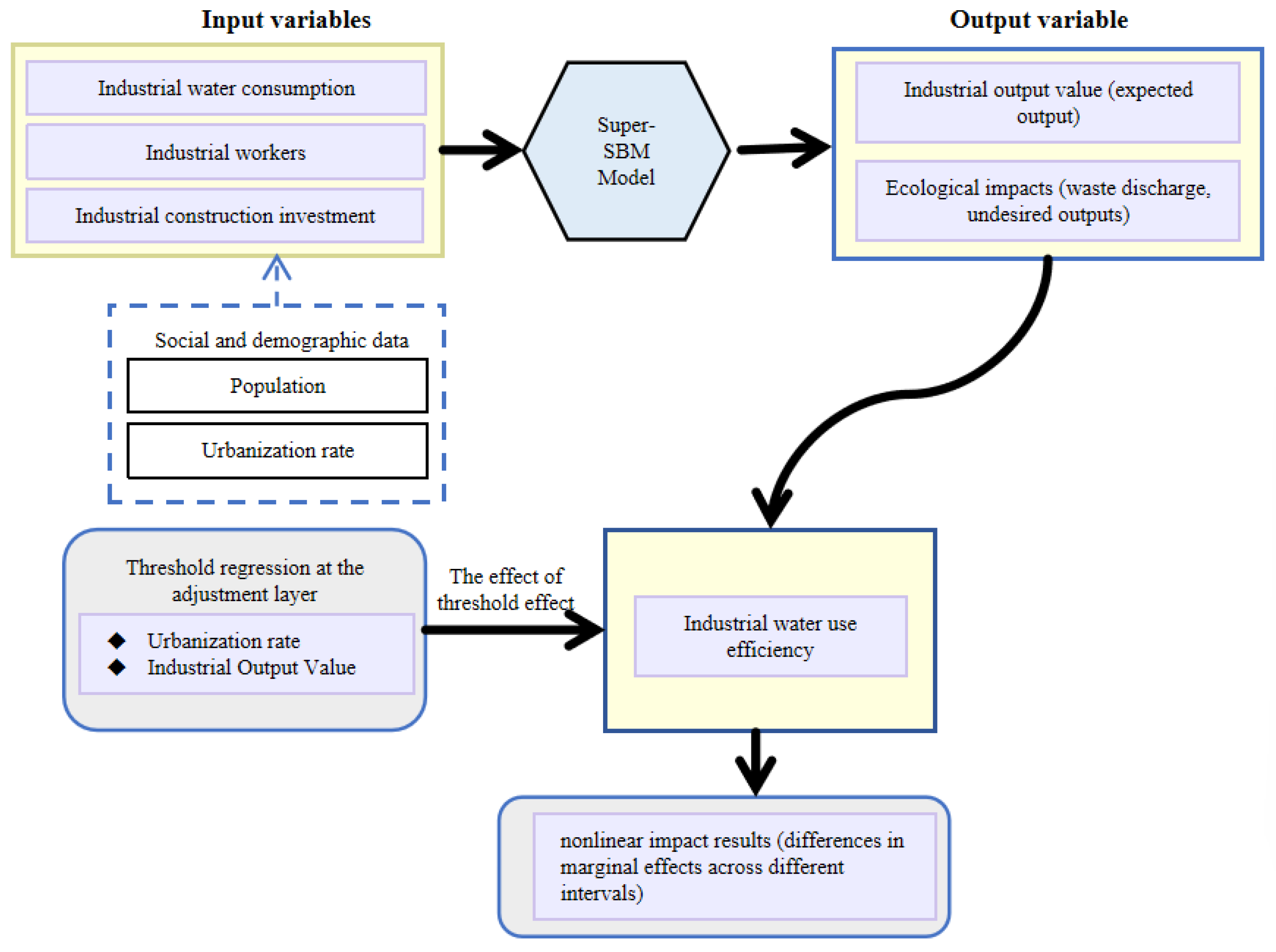
3.2.1. Super-SBM Efficiency Measure Model
3.2.2. Threshold Regression Analysis Model
4. Results and Analysis
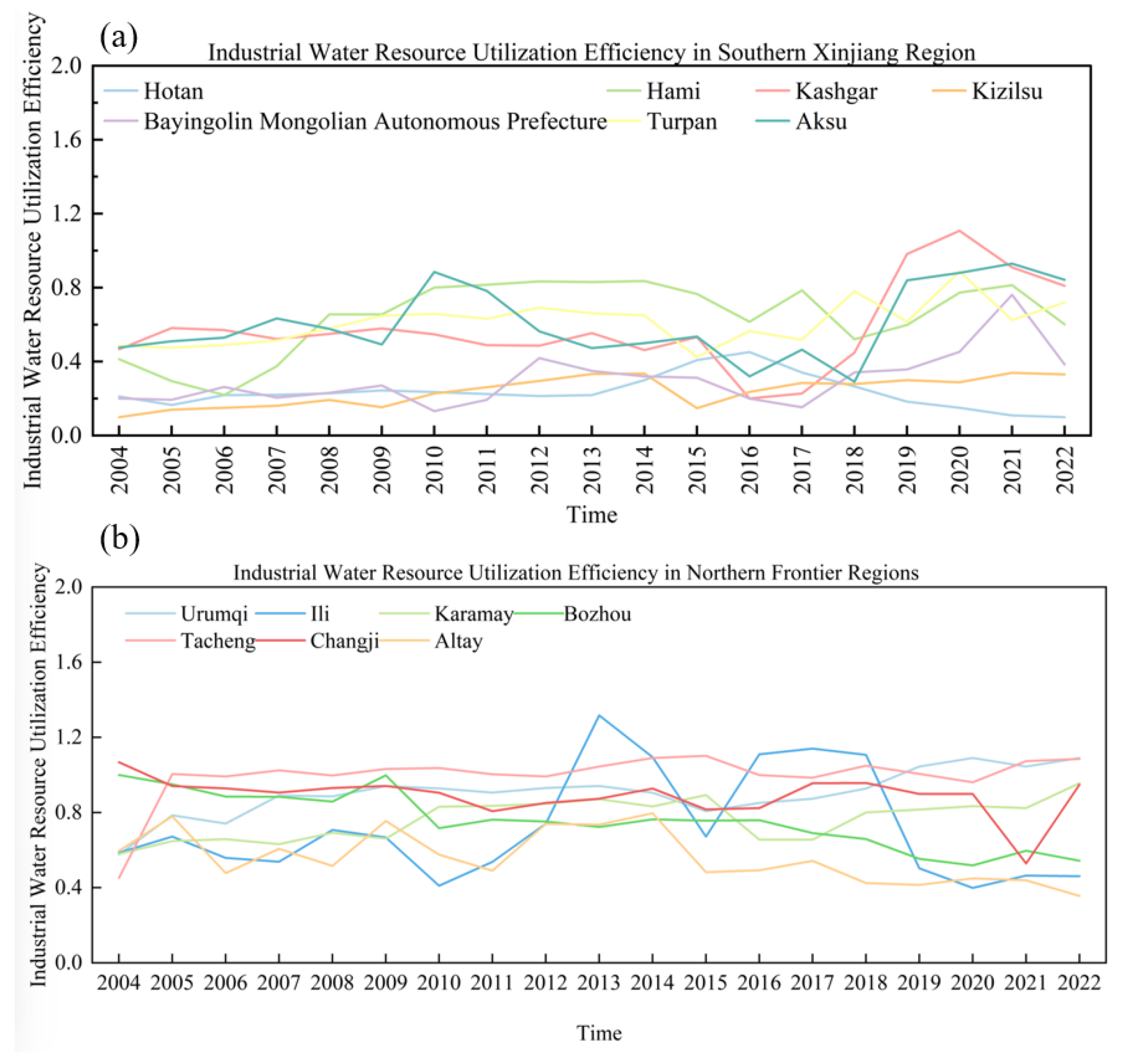
4.1. Trends in IWRUE Across Regions
4.2. Descriptive Statistics and Correlation Analysis
4.3. Threshold Regression Model Estimation
4.3.1. Preliminary Regression Analysis
4.3.2. Testing and Determination of the Threshold Effect
- (1)
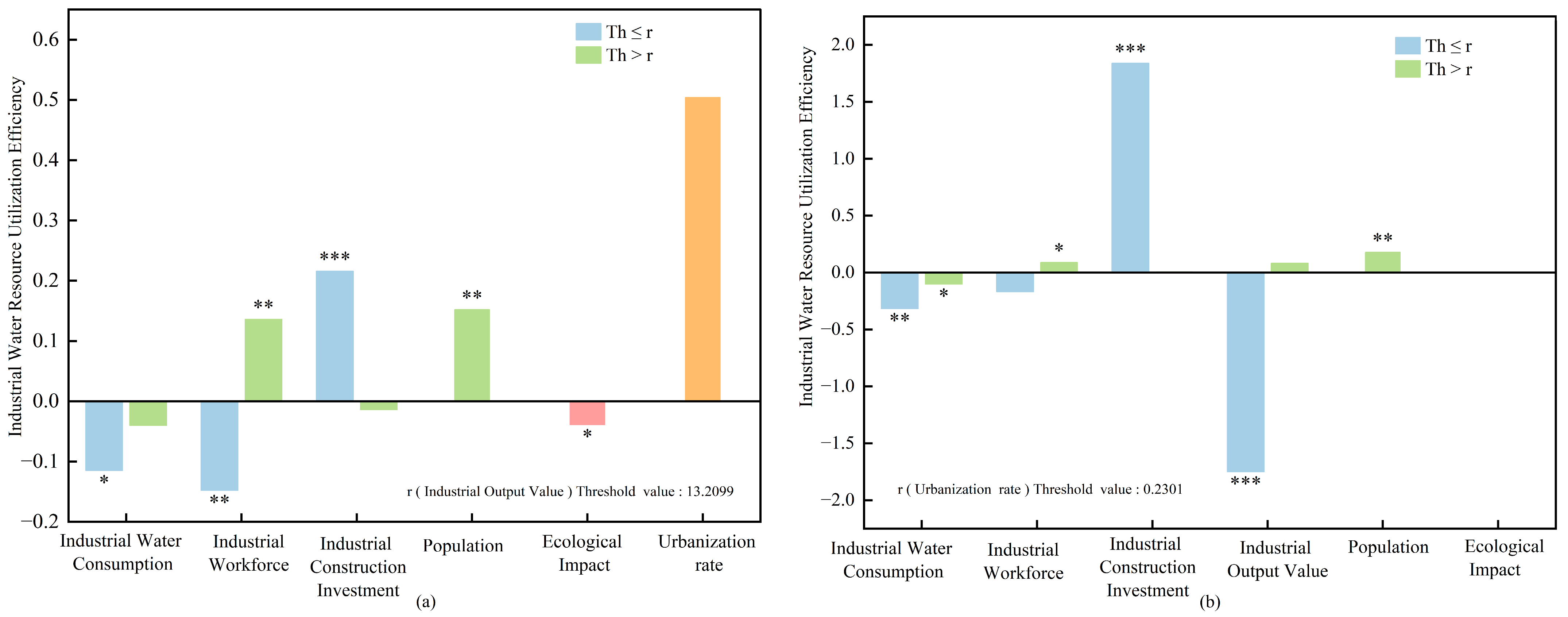
- Analysis of the industrial output threshold effect: When industrial output is below 13.234, the elasticities of industrial water consumption and industrial employment are negative (−0.110 and −0.134, respectively). This reflects that, in the early stage of industrialization, economic growth is characterized by extensive development [27], in which output expansion is primarily driven by large-scale accumulation of resource inputs [28]. During this period, the absence of economies of scale and advanced management means with increased output are often offset by rapid growth in resource consumption, thereby reducing IWRUE [29,30]. However, once this threshold is crossed, a qualitative shift occurs. The inhibitory effect of water consumption weakens significantly and loses statistical significance, while the effect of employment changes from negative to positive (r = 0.145). This indicates that, with industrial expansion, the “human capital dividend” and “technology spillover effect” begin to emerge. High-quality labor enhances IWRUE by optimizing production processes and applying water-saving technologies. As the industrial scale expands, the emergence of human capital dividends and technological spillovers becomes a key driver of IWRUE improvement [31,32]. High-quality labor facilitates process optimization and the rapid adoption of water-saving technologies, enabling enterprises to shift from extensive resource consumption toward intensive management [33,34].
- (2)
- Analysis of the urbanization rate threshold effect: As a typical representative of China’s arid northwest, Xinjiang has experienced leapfrog urbanization and industrialization over the past two decades. The urbanization threshold identified in this study (0.2301) is relatively low, mainly due to the unique starting point of oasis city development in arid regions and the imbalance between early industrialization and urbanization. This low threshold clearly captures the sensitivity of IWRUE to the early stages of urbanization in arid regions.
4.3.3. Model Robustness and Technical Notes
- Interpretation of elasticity coefficients and their magnitude: Within the double-logarithmic framework, a coefficient of −1.777 indicates that a 1% increase in industrial output corresponds to a 1.777% decline in IWRUE. From an economic perspective, such a high elasticity requires a nuanced interpretation. It likely captures the “low-base effect” characteristic of Xinjiang’s early industrial development, where even modest absolute shifts in output can trigger disproportionate percentage swings in efficiency scores. Moreover, in threshold modeling, coefficients of this magnitude often emerge near “structural breakpoints,” representing the volatile fluctuations inherent in the transition from resource-dependent extensive growth to more intensive modes. Consequently, this value should be viewed more as a barometer of structural imbalance during a specific phase than as a constant, long-term elasticity.
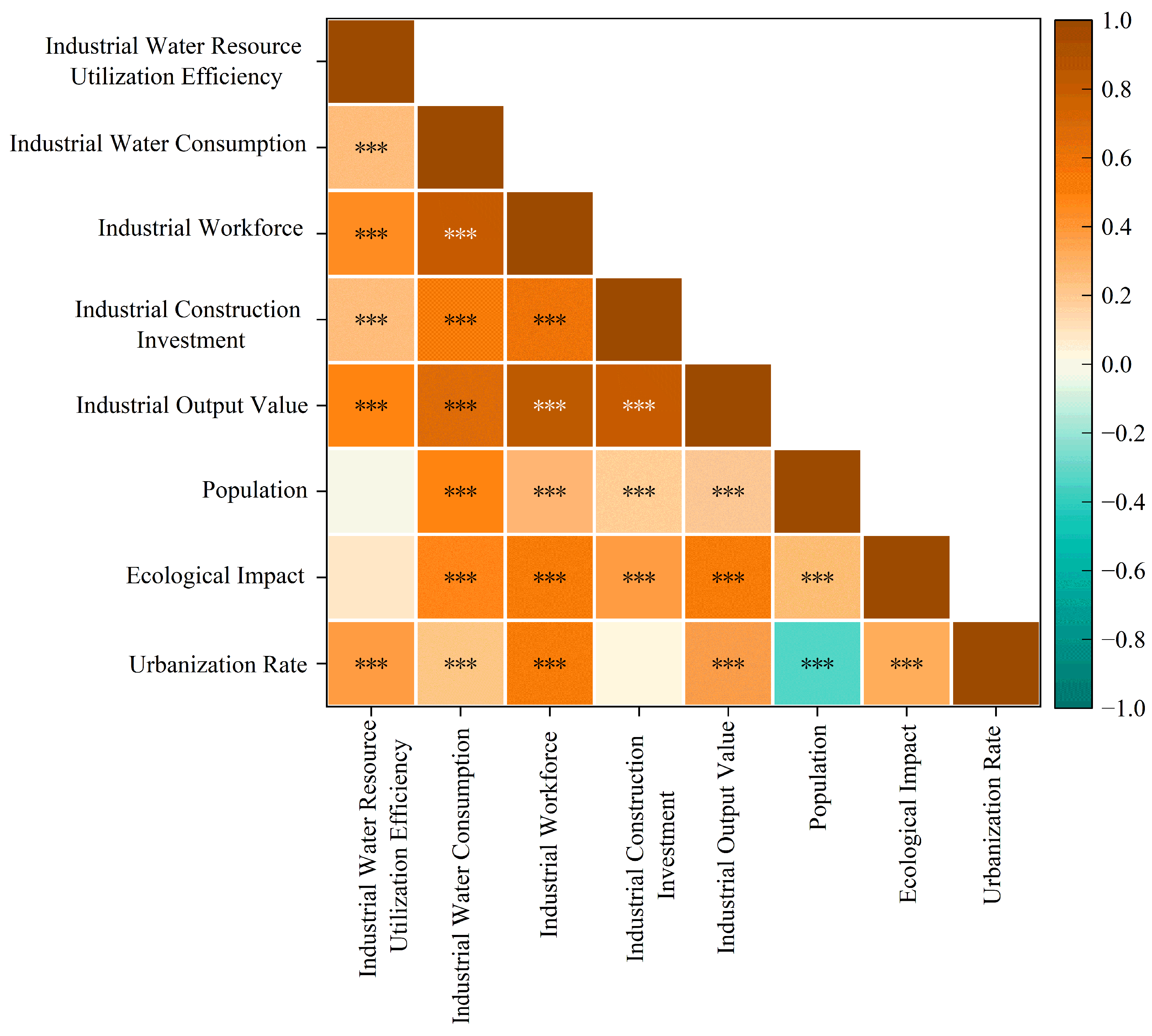
- Multicollinearity test: Variance inflation factor (VIF) testing (Table 4) shows that, except for industrial employment and industrial output value, the average VIF values of all variables are below 5, thereby excluding serious multicollinearity concerns.
- Stability: Robustness tests (see Figure 8) confirm that, after removing extreme values and adjusting control variables, the core thresholds and coefficient signs remain highly consistent, indicating strong statistical support for the model results.
4.3.4. Discussion of Endogeneity and Robustness
5. Discussion
5.1. Internal Mechanisms of the Threshold Effect on IWRUE
5.2. Regional Heterogeneity
5.3. Threshold-Based Pathways for Sustainable Development
6. Summary
Author Contributions
Funding
Institutional Review Board Statement
Informed Consent Statement
Data Availability Statement
Conflicts of Interest
Abbreviations
| IWRUE | Industrial Water Resource Utilization Efficiency |
| EIO-LCA | Economic Input Output Life Cycle Assessment |
| SDA | Spatial Discriminant Analysis |
| GDP | Gross Domestic Product |
| LULC | Land Use/Land Cover |
| DEA | Data Envelopment Analysis |
| SBM | Slacks-Based Measure |
| OLS | Ordinary Least Squares |
Appendix A

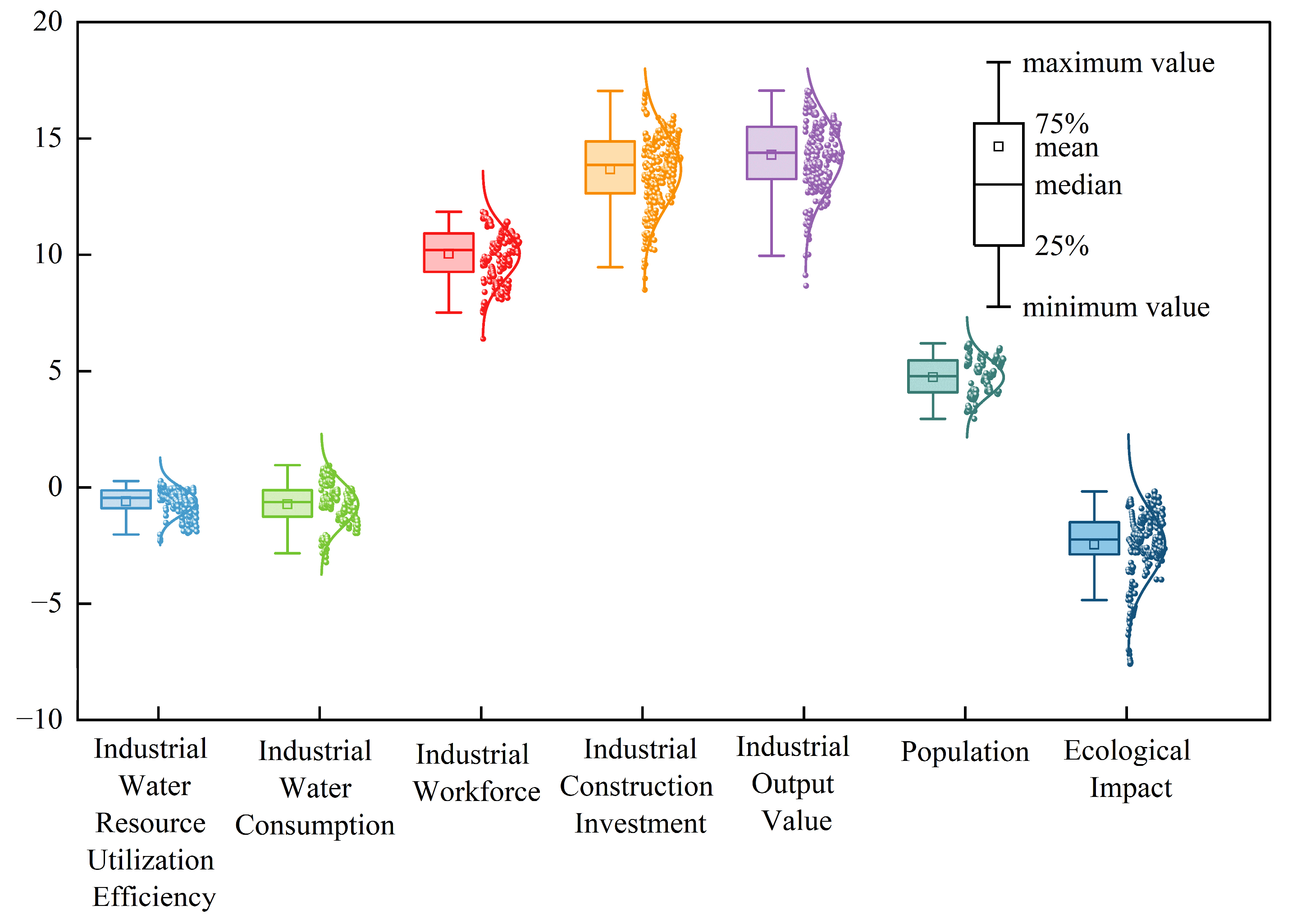
| Observation Value | Mean Value | Standard Deviation | Minimum Value | Maximum Value | |
|---|---|---|---|---|---|
| Industrial efficiency | 266 | 0.574 | 1.780 | 0.100 | 1.318 |
| Industrial water consumption | 266 | 0.488 | 2.570 | 0.050 | 2.718 |
| Industrial employees | 266 | 23,270 | 3.028 | 403.430 | 162,755 |
| Industrial investment | 266 | 904,300 | 5.018 | 2981 | 8,886,000 |
| Total industrial output value | 266 | 1,693,000 | 4.889 | 8103 | 24,150,000 |
| Population | 266 | 115 | 2.245 | 20.090 | 1097 |
| Ecological impact | 266 | 0.085 | 4.302 | 0.000336 | 1.000 |
| Urbanization rate | 266 | 1.701 | 1.229 | 1.234 | 2.718 |
References
- Ikrame, H.; Mohammed, A. Innovation management in economic development: The role of industrialization strategy. Econ. Sustain. Bus. Pract. 2024, 1, 47–53. [Google Scholar] [CrossRef]
- Rees, J. Industrialization and Urbanization in the United States, 1880–1929. In Oxford Research Encyclopedia of American History; Oxford University Press: Oxford, UK, 2016. [Google Scholar]
- Zheng, F.; Zhang, X. Water Resource Sustainable Management: An Important Aspect of Sustainable Urbanization in China. In Proceedings of the International Conference on Sustainable Construction & Risk Management, Chongqing, China, 12–14 June 2010. [Google Scholar]
- Kosolapova, N.A.; Matveeva, L.G.; Nikitaeva, A.Y.; Molapisi, L. Modeling Resource Basis For Social And Economic Development Strategies: Water Resource Case. J. Hydrol. 2017, 553, 438–446. [Google Scholar] [CrossRef]
- Shu, M.; Chen, Y. Xinjiang on the New Silk Road: Kyrgyzstan’s Energy and China’s Manufacturing Foreign Trade. J. Educ. Humanit. Soc. Sci. 2023, 24, 867–873. [Google Scholar] [CrossRef]
- Cheng, Z.; He, J.; Liu, Y.; Zhang, Q.; Deng, Y. Exploring the spatial structure and impact factors of water use efficiency in China. Environ. Impact Assess. Rev. 2023, 103, 107258. [Google Scholar] [CrossRef]
- Xie, Z.; Feng, M.; Zhao, R.; Xiao, L.; Yao, S.; Ji, J.; Gao, Y.; Rong, P.; Chuai, X.; Chen, B. Impact of urbanization on water-energy-carbon nexus system: The case of Zhengzhou, China. Cities 2024, 155, 105466. [Google Scholar] [CrossRef]
- Egilmez, G.; Park, Y.S. Transportation related carbon, energy and water footprint analysis of US manufacturing: An eco-efficiency assessment. Transp. Res. Part D Transp. Environ. 2014, 32, 143–159. [Google Scholar] [CrossRef]
- Samsudin, M.S.; Azid, A.; Khalit, S.I.; Sani, M.S.A.; Lananan, F. Comparison of prediction model using spatial discriminant analysis for marine water quality index in mangrove estuarine zones. Mar. Pollut. Bull. 2019, 141, 472–481. [Google Scholar] [CrossRef]
- Sun, Y.; Ma, M.; Miao, X. The Application of Cobb-Douglas Model in Forecasting Grain Output. In Proceedings of the China Agriculture System Engineering Society, Weihai, China, 29 July–3 August 2010; pp. 189–193. [Google Scholar]
- Mahaboob, B.; Ajmath, K.A.; Venkateswarlu, B.; Narayana, C.; Praveen, J.P. On Cobb-Douglas Production Function Model. In Proceedings of the International Conference on Applications of Fluid Dynamics (ICAFD), Vellore, India, 13–15 December 2018. [Google Scholar]
- Yang, Z.; Liu, H.; Yang, T.; Xu, X. A path-based structural decomposition analysis of Beijing’s water footprint evolution. Environ. Earth Sci. 2015, 74, 2729–2742. [Google Scholar] [CrossRef]
- Cheng, M.L.; Han, Y. A modified Cobb-Douglas production function model and its application. IMA J. Manag. Math. 2014, 25, 353–365. [Google Scholar] [CrossRef]
- Liu, B.; Li, Y.; Hou, R.; Wang, H. Does Urbanization Improve Industrial Water Consumption Efficiency? Sustainability 2019, 11, 1787. [Google Scholar] [CrossRef]
- Kan, D.; Huang, W. An Empirical Study of the Impact of Urbanization on Industry Water Footprint in China. Sustainability 2020, 12, 2263. [Google Scholar] [CrossRef]
- Chao, B.; Xiaojie, C. The driving effects of urbanization on economic growth and water use change in China: A provincial-level analysis in 1997–2011. J. Geogr. Sci. 2015, 25, 530–544. [Google Scholar] [CrossRef]
- Duo, H.; Wang, N.; Qiao, Y.; Li, Z.; Yang, G.; Liu, H.; Chen, G.; Li, F. Industrial water consumption efficiency and driving factors based on the super-efficient SBM and Tobit approach. Sci. Rep. 2025, 15, 12461. [Google Scholar] [CrossRef] [PubMed]
- Li, A.; Liu, Y.; Chen, G.; Hu, M. Scenario analysis of low-carbon development of energy industry with restriction of water resource in Xinjiang. J. Water Clim. Change 2019, 10, 263–275. [Google Scholar] [CrossRef]
- Zhou, X.; Xue, Z.; Seydehmet, J. An empirical study on industrial eco-efficiency in arid resource exploitation region of northwest China. Environ. Sci. Pollut. Res. 2021, 28, 53394–53411. [Google Scholar] [CrossRef]
- Xu, S.; Wu, T.; Zhang, Y. The spatial-temporal variation and convergence of green innovation efficiency in the Yangtze River Economic Belt in China. Environ. Sci. Pollut. Res. 2020, 27, 26868–26881. [Google Scholar] [CrossRef]
- Wu, W.-p.; Zhu, Y.-f.; Zeng, W.-k.; Wang, M.; Yang, D.-x.; Chen, W.-f. Green efficiency of water resources in Northwest China: Spatial-temporal heterogeneity and convergence trends. J. Clean. Prod. 2021, 320, 128651. [Google Scholar] [CrossRef]
- Wang, Y.; Zhang, Y.; Sun, W.; Zhu, L. The impact of new urbanization and industrial structural changes on regional water stress based on water footprints. Sustain. Cities Soc. 2022, 79, 103686. [Google Scholar] [CrossRef]
- Bassett, K.G., Jr. Regression Quantiles. Econometrica 1978, 46, 33–50. [Google Scholar] [CrossRef]
- Hansen, B.E. Threshold Effects in Non-Dynamic Panels: Estimation, Testing, and Inference. J. Econom. 1999, 93, 345–368. [Google Scholar] [CrossRef]
- Bai, J.; Perron, P. Estimating and Testing Linear Models with Multiple Structural Changes. Econometrica 1998, 66, 47–78. [Google Scholar] [CrossRef]
- Yu, Q.; Sun, Z.; Shen, J.; Xu, X.; Han, Q.; Zhu, M. The nonlinear effect of new urbanization on water pollutant emissions: Empirical analysis based on the panel threshold model. J. Environ. Manag. 2023, 345, 118564. [Google Scholar] [CrossRef] [PubMed]
- Krugman, P. The Myth of Asia’s Miracle. Foreign Aff. 1994, 73, 62–78. [Google Scholar] [CrossRef]
- Grossman, G.M.; Krueger, A.B. Environmental Impacts of a North American Free Trade Agreement. CEPR Discuss. Pap. 1992, 8, 223–250. [Google Scholar]
- Panayotou, T. Empirical Tests and Policy Analysis of Environmental Degradation at Different Stages of Economic Development; Working Paper WP238; ILO: Geneva, Switzerland, 1993; Volume 4. [Google Scholar]
- Auty, R.M. Pollution Patterns during the Industrial Transition. Geogr. J. 1997, 163, 206–215. [Google Scholar] [CrossRef]
- Li, H.; Zhao, X.; Ding, X.; Zhang, R. The Impact of Rapid Urbanization on the Efficiency of Industrial Green Water Use in Urban Agglomerations around Poyang Lake. Sustainability 2024, 16, 8698. [Google Scholar] [CrossRef]
- Peng, W.; Xu, J.; He, Z. The impact of human capital on green economic efficiency: Evidence from 280 prefectural cities in China. Environ. Sci. Pollut. Res. 2023, 30, 72415–72429. [Google Scholar] [CrossRef]
- Lan, J.; Munro, A. Environmental compliance and human capital: Evidence from Chinese industrial firms. Resour. Energy Econ. 2013, 35, 534–557. [Google Scholar] [CrossRef]
- Zou, D.; Cong, H. Evaluation and influencing factors of China’s Industrial water resource utilization efficiency from the perspective of spatial effect. Alex. Eng. J. 2021, 60, 173–182. [Google Scholar] [CrossRef]
- Bao, C.; Fang, C.L. Water resources constraint force on urbanization in water deficient regions: A case study of the Hexi Corridor, arid area of NW China. Ecol. Econ. 2007, 62, 508–517. [Google Scholar] [CrossRef]
- Wang, Y. Urban land and sustainable resource use: Unpacking the countervailing effects of urbanization on water use in China, 1990–2014. Land Use Policy 2020, 90, 104307. [Google Scholar] [CrossRef]
- Yu, H.; Song, Y.; Chang, X.; Gao, H.; Peng, J. A Scheme for a Sustainable Urban Water Environmental System During the Urbanization Process in China. Engineering 2018, 4, 190–193. [Google Scholar] [CrossRef]
- Li, K.; Hajar, S.; Ding, Z.; Dooling, T.; Wei, G.; Hu, C.; Zhang, Y.; Zhang, K. Dynamic optimization of input production factors for urban industrial water supply and demand management. J. Environ. Manag. 2020, 270, 110807. [Google Scholar] [CrossRef] [PubMed]
- Li, L. Innovative Exploration of High-Quality and Refined Management in New Park—A Case Study of the whole process of urban design of Liuxiandong Headquarter. Urbanie Urbanus—Urban Des. A Sustain. Future Innov. Model City 2023. [Google Scholar] [CrossRef]
- Fu, J.; Xiao, G.; Wu, C. Urban green transformation in Northeast China: A comparative study with Jiangsu, Zhejiang and Guangdong provinces. J. Clean. Prod. 2020, 273, 122551. [Google Scholar] [CrossRef]
- Zhang, R.; Zhang, L.; Wang, Z. Spatial network and influencing factors of green water use efficiency in the YREB: Considering carbon emissions and pollution indicators. Environ. Sci. Pollut. Res. 2024, 31, 17324–17338. [Google Scholar] [CrossRef]
- Jin, W.; Zhang, H.Q.; Liu, S.S.; Zhang, H.B. Technological innovation, environmental regulation, and green total factor efficiency of industrial water resources. J. Clean. Prod. 2019, 211, 61–69. [Google Scholar] [CrossRef]
- Morikawa, M. Population density and efficiency in energy consumption: An empirical analysis of service establishments. Energy Econ. 2012, 34, 1617–1622. [Google Scholar] [CrossRef]
- Han, X.; Boota, M.W.; Soomro, S.E.H.; Ali, S.; Soomro, S.G.H.; Soomro, N.E.H.; Soomro, M.H.A.A.; Soomro, A.R.; Batool, S.; Bai, Y.; et al. Water strategies and management: Current paths to sustainable water use. Appl. Water Sci. 2024, 14, 154. [Google Scholar] [CrossRef]
- Wang, S.Y.; Chen, W.M.; Wang, R.; Zhao, T. Study on the coordinated development of urbanization and water resources utilization efficiency in China. Water Supply 2022, 22, 749–765. [Google Scholar] [CrossRef]
- Ding, X.; Fu, Z.; Jia, H. Study on Urbanization Level, Urban Primacy and Industrial Water Utilization Efficiency in the Yangtze River Economic Belt. Sustainability 2019, 11, 6571. [Google Scholar] [CrossRef]
- Lin, X.; Zhou, X.; Wang, P. Spatial differentiation and influencing factors of industrial resource and environmental pressures in China. Environ. Dev. Sustain. 2022, 25, 9991–10015. [Google Scholar] [CrossRef]
- Wang, F.; Wu, M.; Du, X. Does industrial upgrading improve eco-efficiency? Evidence from China’s industrial sector. Energy Econ. 2023, 124, 106774. [Google Scholar] [CrossRef]


| Variable Type | Specific Indicator | Unit | Description |
|---|---|---|---|
| Input variables | Industrial water consumption | 100 million cubic meters | Refers to the total water used by industrial enterprises during production, measuring the intensity of natural water resource consumption |
| Industrial employees | Persons | The number of workers engaged in industrial production, reflecting the supporting role of labor in resource conversion efficiency | |
| Industrial construction investment | 10,000 yuan | Investment in industrial fixed assets, representing capital input that influences technological progress and improvements in water-use processes | |
| Output variables | Total industrial output value | 10,000 yuan | The total value of final industrial products and industrial service activities produced by enterprises during the reporting period |
| Ecological impact | 100 million tons | Environmental disutility (wastewater discharge) generated alongside industrial output, reflecting pressure on the ecological environment | |
| Social and population data | Population size | 10,000 persons | Total resident population of the region, representing the macro-social background influencing resource allocation efficiency and environmental carrying capacity |
| Urbanization rate | % | The proportion of urban population in the total population, reflecting industrial upgrading and agglomeration effects |
| Variable Type | Specific Indicator | Indicator Explanation | Unit |
|---|---|---|---|
| Industrial | IWRUE | Water consumption per unit of output during production | / |
| Industrial water consumption | Water consumption during industrial production | 108 m3 | |
| Industrial workers | Persons engaged in industrial production | persons | |
| Industrial Investment | Amount invested in the industrial sector | 104 Yuan | |
| Industrial output value | Industrial output value | 104 Yuan | |
| Social and Demographic Data | Population | Population of the entire region | 104 persons |
| Ecological impact | Wastewater discharged during production | 108 t | |
| Urbanization rate | Urban population as a proportion of the total population of the region | % |
| Threshold Variable | Driving Factor | Interval I (Below Threshold) | Interval II (Above Threshold) | Change in Marginal Effect (Δ) |
|---|---|---|---|---|
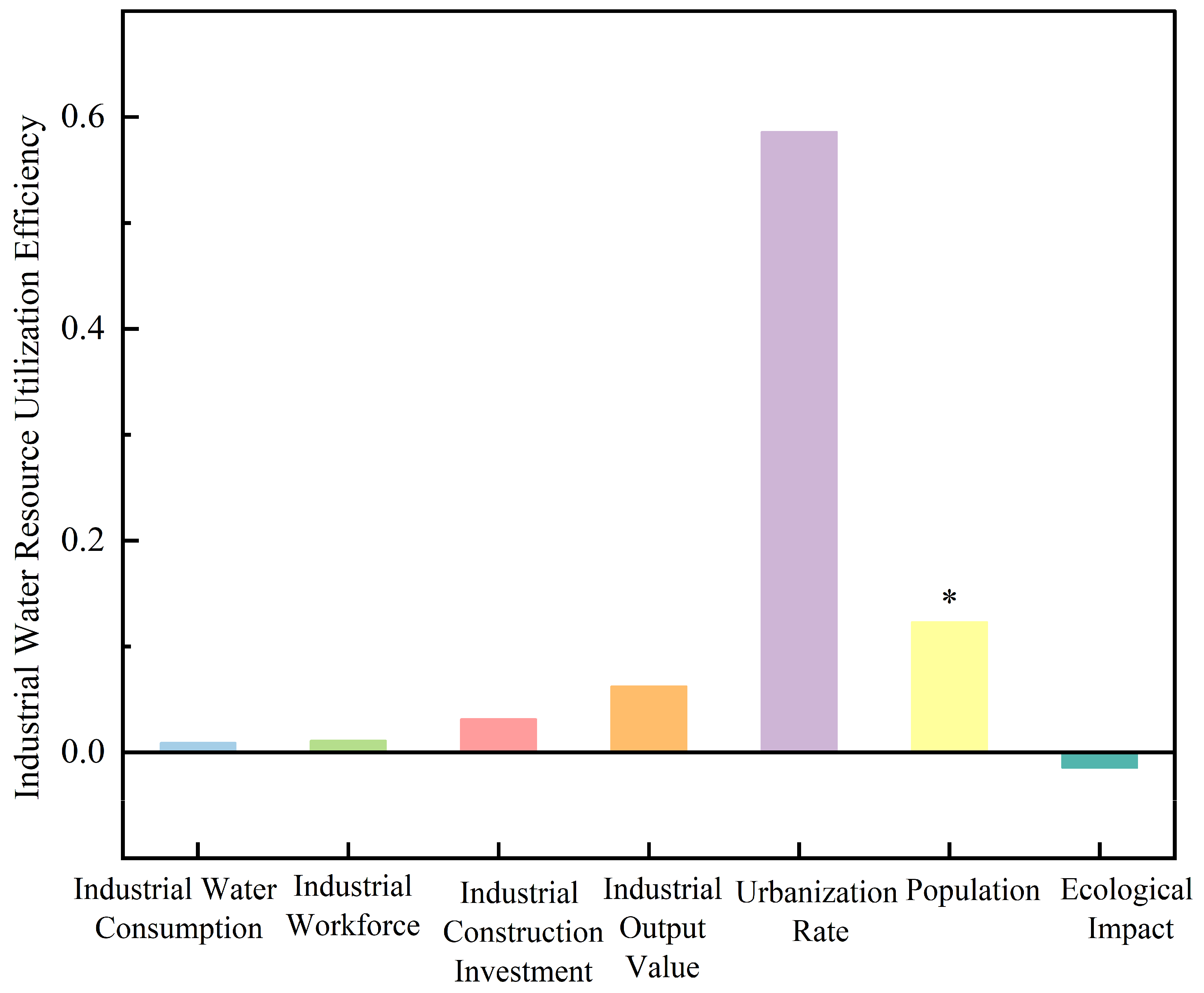
| Industrial Output Value | Industrial water consumption | −0.110 (0.0644) * | −0.0378 (0.0563) (not significant) | 0.0722 |
| Employment | −0.134 (0.0581) ** | 0.145 (0.0565) ** | 0.279 | |
| Industrial investment | 0.214 (0.0368) *** | −0.0129 (0.0292) (not significant) | −0.2269 | |
| Population | 0.121 (0.0630) * | — | ||
| Ecological impact | −0.00087975 (not significant) | — | ||
| Urbanization rate | 0.522 (0.324) (not significant) | — | ||
| Urbanization Rate | Industrial water consumption | −0.316 (0.135) ** | −0.0055284 (not significant) | 0.214 |
| Employment | −0.161 (0.222) (not significant) | 0.0876 (0.0519) * | 0.2486 | |
| Industrial investment | 1.871 (0.404) *** | 0.00872 (0.0262) (not significant) | −1.8623 | |
| Industrial output value | −1.777 (0.548) *** | 0.0897 (0.0546) (not significant) | 1.8667 | |
| Population | 0.140 (0.0608) ** | — | ||
| Ecological impact | 0.00226 (0.0233) (not significant) | — | ||
| Variable | VIF | 1/VIF |
|---|---|---|
| Industrial employment | 6.04 | 0.16546 |
| Industrial output value | 5.8 | 0.172378 |
| Industrial investment | 3.68 | 0.271593 |
| Industrial water consumption | 3.41 | 0.29335 |
| Urbanization rate | 2.94 | 0.339621 |
| Population | 2.16 | 0.462421 |
| Ecological impact | 1.57 | 0.6381 |
Disclaimer/Publisher’s Note: The statements, opinions and data contained in all publications are solely those of the individual author(s) and contributor(s) and not of MDPI and/or the editor(s). MDPI and/or the editor(s) disclaim responsibility for any injury to people or property resulting from any ideas, methods, instructions or products referred to in the content. |
© 2026 by the authors. Licensee MDPI, Basel, Switzerland. This article is an open access article distributed under the terms and conditions of the Creative Commons Attribution (CC BY) license.
Share and Cite
Duo, H.; Liu, S.; Zeng, L.; Wang, D.; Li, C.; Wang, Y.; Wang, F.; Chen, G.; Zhang, Q. Threshold Effects of Water Use Efficiency in Urbanization and Industrial Growth. Sustainability 2026, 18, 2741. https://doi.org/10.3390/su18062741
Duo H, Liu S, Zeng L, Wang D, Li C, Wang Y, Wang F, Chen G, Zhang Q. Threshold Effects of Water Use Efficiency in Urbanization and Industrial Growth. Sustainability. 2026; 18(6):2741. https://doi.org/10.3390/su18062741
Chicago/Turabian StyleDuo, Haixia, Shanbao Liu, Linghui Zeng, Dengchao Wang, Caole Li, Yizhe Wang, Fan Wang, Gang Chen, and Qiuying Zhang. 2026. "Threshold Effects of Water Use Efficiency in Urbanization and Industrial Growth" Sustainability 18, no. 6: 2741. https://doi.org/10.3390/su18062741
APA StyleDuo, H., Liu, S., Zeng, L., Wang, D., Li, C., Wang, Y., Wang, F., Chen, G., & Zhang, Q. (2026). Threshold Effects of Water Use Efficiency in Urbanization and Industrial Growth. Sustainability, 18(6), 2741. https://doi.org/10.3390/su18062741