1. Introduction
In recent years, the intersection of climate change and disaster risk has forced a global re-evaluation of how small-scale economic actors adapt to environmental volatility (e.g., [
1,
2,
3,
4,
5,
6,
7,
8,
9]). While large corporations often possess the slack resources necessary for sophisticated sustainability transitions, micro-entrepreneurs operate under significant constraints, where the decision to adopt environmentally friendly initiatives is often a matter of immediate survival rather than long-term strategy (e.g., [
10,
11]). This article explores this dynamic within the unique context of Chile, a nation currently navigating a profound transition in its multi-hazard profile.
Historically, Chile’s national risk landscape has been dominated by seismic events, leading to world-class earthquake resilience (e.g., [
12]). However, the period between 2020 and 2025 has signaled a dramatic shift toward climatological and hydrological extremes. Driven by a 15-year mega-drought and the intensification of the El Niño-Southern Oscillation (ENSO), the country has faced a series of catastrophic events: urban-forest interface fires, hydrological extremes, and mass movement events (e.g., [
13,
14,
15]).
Research into pro-environmental behavior indicates that addressing the psychological and structural drivers of action can foster change (e.g., [
16]). However, existing evidence suggests that business entities globally, including those in developed economies, exhibit low levels of readiness, frequently delegating the burden of mitigation to the state (e.g., [
11]). To understand why some micro-entrepreneurs adopt green initiatives while others remain reactive, this study employs three complementary theoretical lenses. First, construal level theory suggests that risk is often perceived through the lens of psychological distance (e.g., [
17,
18]). For many, regional vulnerability is a high-level, abstract construal. It is only when a disaster becomes a lived experience—a low-level, concrete construal—that the mental anchor required to prioritize a response is established (e.g., [
19]). Second, protection motivation theory clarifies the internal decision-making process (e.g., [
20,
21]). Even when a threat is acknowledged, an entrepreneur’s coping appraisal often dictates the outcome. Finally, these disasters can be viewed as focusing events. These sudden, high-impact occurrences disrupt the status quo and create a window for rapid learning (e.g., [
22,
23]). However, the pressure of these events often favors visible, direct adaptations over the systemic, long-term structural shifts necessary for true climate resilience.
Despite extensive work on small-to-medium enterprise (SME) resilience (e.g., [
24,
25,
26]), empirical evidence remains limited on whether direct disaster experience triggers pro-environmental action differently from merely operating in high-risk territories; this distinction matters because it separates abstract awareness from behaviorally consequential shocks. Evidence from the present study confirms that while exposure to natural disasters influences initiatives such as emission reductions, equipment efficiency, and recycling, the depth of this influence is notably uneven. Specifically, while recycling and immediate mitigation measures demonstrate significant increases following a disaster, energy savings and systemic emissions reduction continue to lag. Most notably, the percentage of micro-entrepreneurs engaging in comprehensive mitigation remains small, even among those in regions severely affected within the last five years. This suggests that residing in a high-risk zone does not inherently translate into environmental proactivity (e.g., [
27]). Instead, there is a stark cognitive and behavioral divergence between the abstract awareness generated by geographic proximity and the concrete, low-level construal triggered by direct, personal exposure (e.g., [
28]).
Altogether, these findings highlight that while disasters serve as powerful focusing events for learning, the resulting proactivity remains largely superficial and reactive. Such responses often fail to translate into the systemic, long-term structural shifts required for true climate resilience in emerging economies (e.g., [
29]). Furthermore, this evidence offers a critical template for understanding the systemic resilience gap that plagues both emerging and developed economies. It illustrates that the shift toward environmental proactivity is hindered less by a lack of awareness and more by a universal survivalist mindset common among resource-constrained actors (e.g., [
11,
30]). Indeed, across the global landscape, micro-entrepreneurs and SMEs often lack the necessary organizational slack—surplus financial or human capital—to move beyond low-cost, visible adaptations (e.g., [
31]). This leaves global supply chains inherently fragile, as the will to act generated by localized disaster experiences is consistently stifled by a structural inability to act effectively.
This article is organized as follows.
Section 2 presents a summary of the main climatological events that occurred during the period 2020–2025.
Section 3 presents a theoretical framework and research hypotheses.
Section 4 presents the data, analyzes some descriptive statistics, and describes methodological aspects.
Section 5 presents the statistical results, while
Section 6 analyzes them from the perspective of the theoretical framework.
Section 7 concludes by summarizing the main findings and proposing some policy implications and themes for future research.
3. Theoretical Frameworks
Construal level theory (CLT) posits that the way individuals perceive an event or a risk is dictated by its psychological distance from it across dimensions of time, space, and personal experience. When a risk is perceived as a distant possibility or a statistical likelihood associated with a geographic area, it is processed as a high-level construal—an abstract, theoretical concept that rarely triggers immediate behavioral change. However, once that risk becomes a lived experience, it shifts into a low-level construal, characterized by concrete, proximal, and urgent details (e.g., [
31,
35,
36,
37]). This cognitive transition is essential for bridging the gap between general awareness and localized action, as the shift from the abstract to the concrete provides the necessary mental anchor to prioritize a response.
Once a threat is perceived as concrete, protection motivation theory (PMT) explains the internal decision-making process that leads to action. This process involves two distinct appraisals: threat appraisal, where the individual evaluates the severity of the danger and their personal vulnerability to it; and coping appraisal, where an individual assesses his/her own ability to respond (self-efficacy) and the effectiveness of the proposed solution. Even when the perceived threat is high, a coping gap can occur if the individual feels they lack the resources or expertise to implement a complex solution. Consequently, people often gravitate toward actions that offer a high sense of self-efficacy—those that feel manageable and immediate—while avoiding more technically demanding or costly interventions (e.g., [
20,
21]).
These psychological processes are complemented by the concept of focusing events, which describes sudden, high-impact occurrences that serve as powerful catalysts for change (e.g., [
22,
23]). Unlike chronic or background risks that can be easily ignored or normalized over time, a focusing event commands total attention and forces a rapid re-prioritization of goals. These events disrupt the status quo and create a unique window for learning and adaptation. However, because the pressure of such events often demands a swift response, the resulting actions tend to favor visible and direct adaptations rather than complex, long-term structural shifts, as the immediate need to restore stability often outweighs the drive for systemic transformation (e.g., [
38]).
Based on this theoretical framework, the first hypothesis is:
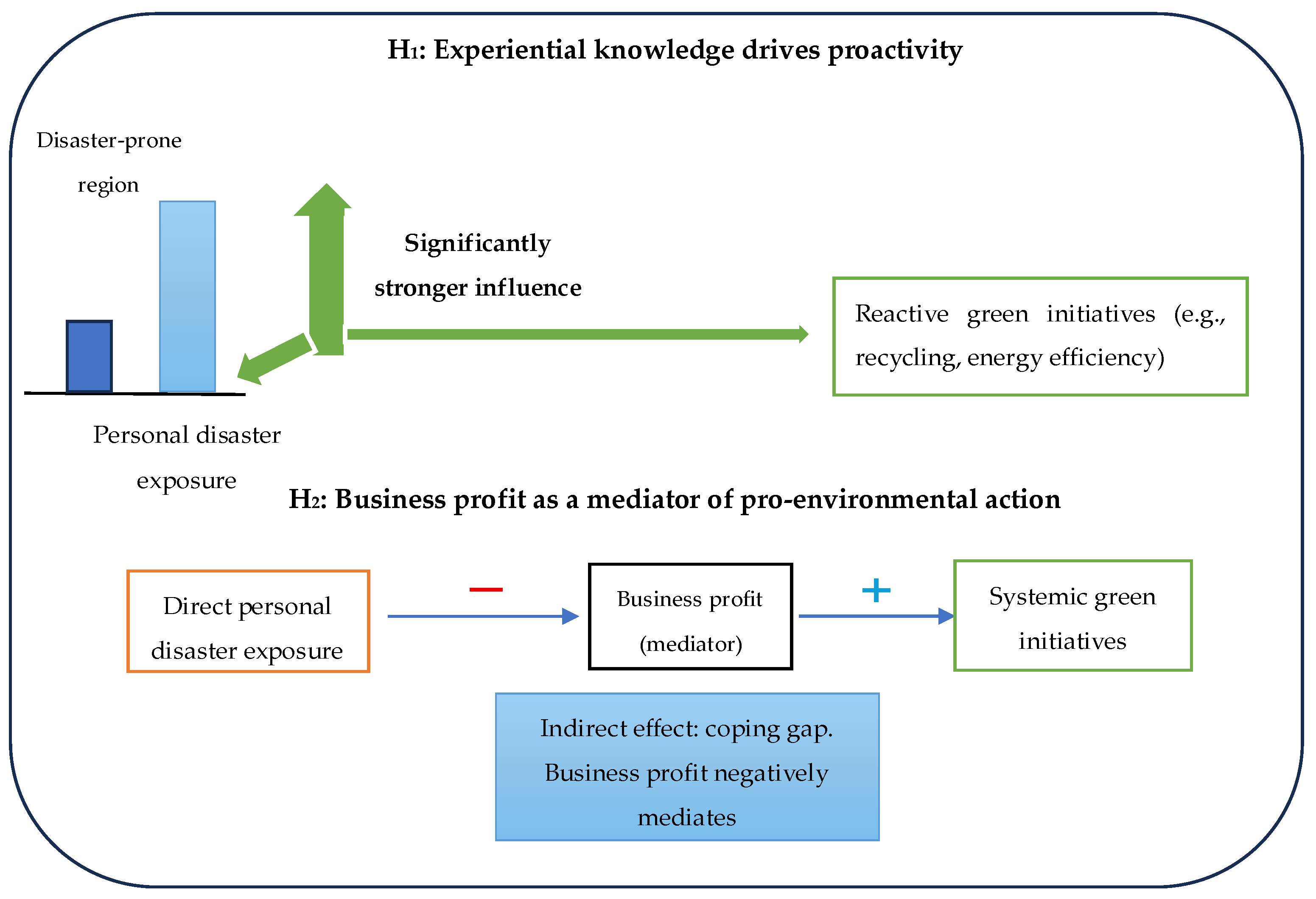
H1: Direct personal exposure to natural disasters exerts a significantly stronger positive influence on the adoption of environmentally friendly initiatives among micro-entrepreneurs than the mere residential location in a disaster-prone region.
Disasters typically lead to direct physical damage, inventory loss, and supply chain disruptions, which immediately slash business profits. Because micro-entrepreneurs operate with virtually no organizational slack (i.e., surplus cash or human capital), this profit loss restricts their coping appraisal (e.g., [
39]). Even if they are aware of the risk, they lack the capital to implement systemic environmentally friendly initiatives. Conversely, if an environmentally friendly initiative is perceived to restore or protect profits, the entrepreneur is more likely to adopt it. In this case, profit acts as a positive mediator that rationalizes green behavior.
From the perspective of CLT, business profit acts as a mental anchor. Pre-disaster high profit allows for high-level construal. The entrepreneur can think abstractly about climate change and long-term sustainability. In contrast, post-disaster low profit forces low-level construal. The entrepreneur’s focus narrows to immediate, concrete survival. Environmental initiatives are only considered if they solve a concrete, immediate problem. On the other hand, according to PMT, profit is the engine for coping appraisal. If the disaster destroys profit, the entrepreneur’s perceived self-efficacy plummets (e.g., [
11]).
Based on this discussion, the second hypothesis is:
H2: Direct personal exposure to natural disasters positively influences the adoption of reactive environmental initiatives, but this relationship is negatively mediated by business profit for systemic mitigation measures, such as emission reductions and structural efficiency.
The two hypotheses are illustrated in
Figure 1.
A methodological caveat regarding the testing of H
2 warrants consideration. Because this study primary dataset lacks direct psychometric scales for latent variables—specifically psychological distance from CLT or perceived self-efficacy from PMT—monthly profit is utilized as an observable proxy for the material constraints inherent in coping appraisal. While this is an indirect measure, it provides a testable mechanism for capturing the resource channel through which financial stability dictates a firm’s capacity for complex, systemic adaptation. This approach aligns with contemporary research suggesting that for resource-scarce micro-enterprises, financial performance often serves as a quantifiable indicator of the objective feasibility of protective actions, effectively operationalizing the gap between the will and the way to mitigate risk (e.g., [
39,
40]).
This figure outlines the two primary hypotheses (H1 and H2) governing the relationship between natural disaster exposure and the adoption of environmental initiatives among micro-entrepreneurs. H1: Experiential knowledge as a driver of proactivity. The upper portion of the diagram illustrates the psychological distance gap inherent in risk perception. While residing in a disaster-prone region exerts a baseline influence on behavior, the figure highlights that direct personal disaster exposure provides a significantly stronger catalyst for action. This concrete experience collapses the abstract nature of climate risk, leading primarily to reactive green initiatives such as recycling and basic energy efficiency measures. H2: Business profit as a mediator of systemic action. The lower portion of the figure details the mediation mechanism (coping gap) that dictates the depth of environmental response. Direct personal exposure is shown to have a negative relationship with business profit. The destruction of organizational slack and financial liquidity following a disaster creates a significant barrier to action. Business profit is positively correlated with the adoption of systemic green initiatives. The indirect effect highlighted in the blue box represents the coping gap. Even when the will to act is present due to threat appraisal, the mediation of profit loss suggests that micro-entrepreneurs are often financially unable to move beyond low-cost reactive behaviors toward long-term, structural mitigation.
5. Results
This section focuses on the adoption of environmentally friendly and climate mitigation initiatives. The primary independent variables are direct personal exposure to natural disasters and residence within a high-risk geographic region. To isolate these effects, the model incorporates a suite of control variables categorized by both entrepreneur demographics—including gender, education, age, and wealth—and firm-level attributes, such as formal registration, personnel size, establishment tenure, economic sector, and national market scope. The selection of these covariates is consistent with established literature in the field (e.g., [
43,
44]). The econometric specifications detailed in
Section 4.3 were estimated using Stata 19, incorporating EME sampling weights to ensure the representativeness of the findings.
5.1. Logistic Regressions of Sustainable Practices
Table 3, columns (1)–(5), presents logistic regressions for the variables analyzed in
Table 2: energy/emissions, efficiency, recycling, environmental, and mitigation. Parameter estimates are expressed as odds ratios, so that the value below (above) one indicates an inverse (direct) association between the dependent variable and the covariate in question. As shown, natural disasters had a positive impact on each of these dependent variables. For example, column (1) shows that the odds of achieving energy savings/emissions reductions were 50% higher for someone who had experienced a natural disaster in the past 5 years. For all environmental initiatives, column (4) shows that the odds were 73% higher. Not surprisingly, the odds were particularly high in the case of mitigation. This reflects the fact reported in
Table 2e: mitigation was very infrequent among micro-entrepreneurs who had not experienced natural disasters (4.7% versus 23.5% of those who had). In fact, the mitigation odds for those who experienced natural disasters, computed from
Table 2e, are (23.5/76.5)/(4.7/95.3) = 6.24, a figure close to that reported in column (5) of
Table 3, 6.98.
For completeness, the bottom of
Table 3 reports marginal effects of natural disasters on each dependent variable, evaluated at sample means. Given that the dependent variables are binary, the marginal effect is interpreted as an increment in the likelihood that a particular dependent variable equals 1. For example, the likelihood of recycling increased by 10.9 percentage points for someone who had experienced natural disasters. In turn, the increments in the likelihood of energy/emissions, efficiency, environmental and mitigation were, respectively, 5.2, 1.9, 13.6, and 13.7 percentage points. In other words, it appears that energy saving/emissions reduction and improved equipment efficiency were not particularly sensitive to experiencing extreme climatological events.
Regarding control variables, the adoption of green initiatives and climate mitigation strategies is fundamentally shaped by a combination of organizational scale, entrepreneurial motivation, and socio-economic factors. The statistical results indicate that businesses with a national reach, workforce, and municipal permits are the most consistent in implementing sustainable practices, as these structural advantages provide the necessary framework for environmental accountability. However, a significant gap exists between intent and action based on the entrepreneur’s mindset; specifically, while opportunity-driven individuals frequently embrace green initiatives to capture market value, they often neglect the long-term defensive measures required for climate risk mitigation. Furthermore, while personal wealth serves as a vital resource for funding both green innovations and resilience efforts—except for recycling—gender remains a defining variable. Men are generally less inclined toward broad green-friendly behaviors, instead focusing their environmental efforts almost exclusively on operational efficiency, where there is a clear technical or financial return.
5.2. Average Treatment Effects of Sustainable Practices
In panel (a), the ATEs of natural disasters on environmental, energy/emissions, efficiency, and recycling do not differ substantially from the marginal effects reported in
Table 3: 13.7, 6.2, 2.1, and 10.2 percentage points, respectively. However, the ATE on mitigation is much larger than the marginal effect from the logistic regression: 22.4 versus 13.7 percentage points. This discrepancy highlights the importance of covariate balancing; by using propensity scores to account for the structural and socio-economic differences between exposed and non-exposed micro-entrepreneurs, the model reveals that the true behavioral shift toward mitigation is much more profound than standard estimates suggest.
Following the criteria in
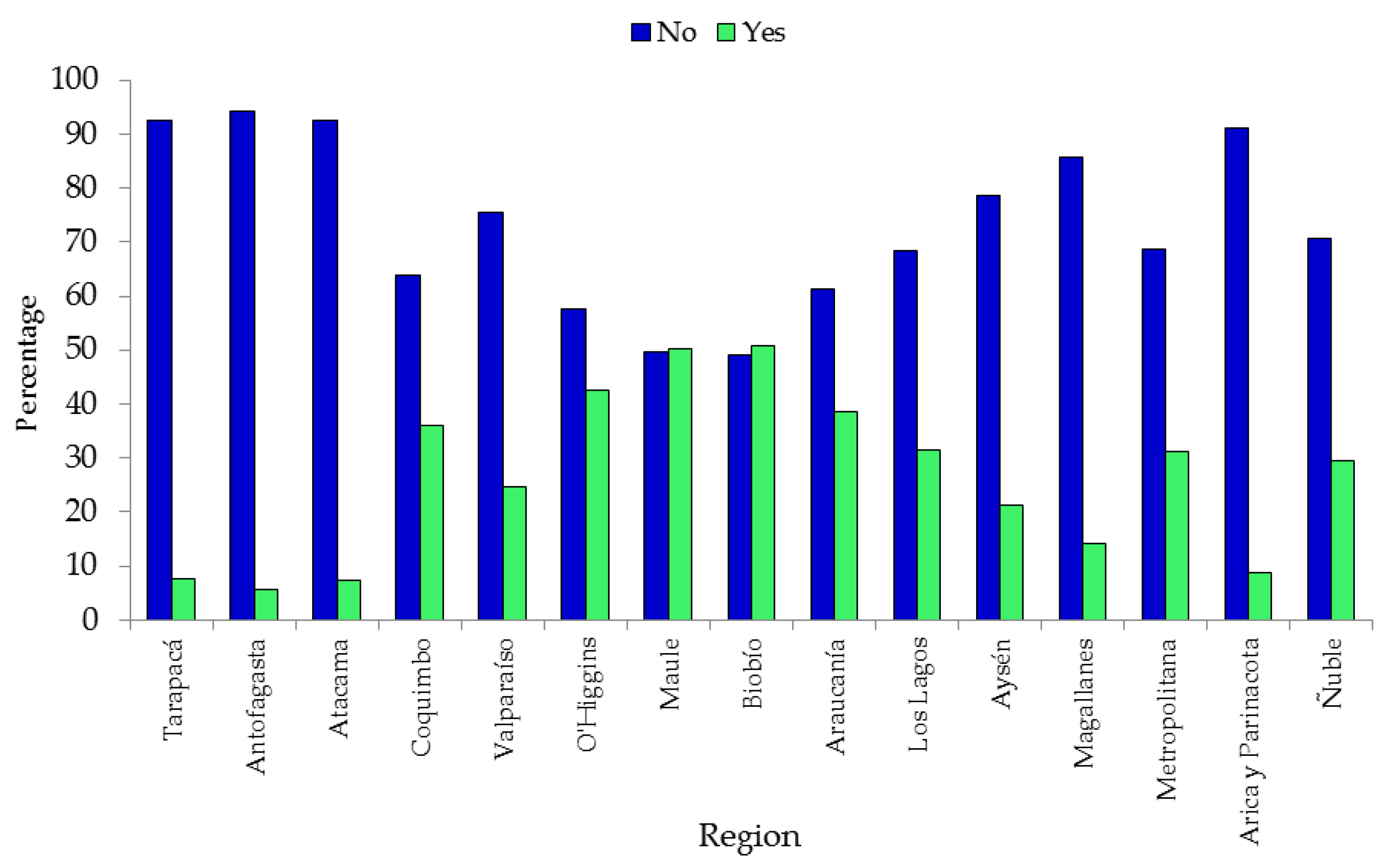
Section 2, regions identified as disaster-prone are those that experienced the highest frequency of natural disasters between 2020 and 2025. These include regions 5 through 9 (Valparaíso, O’Higgins, Maule, Biobío, and Araucanía), as well as regions 13 (Metropolitana) and 16 (Ñuble). Approximately 78% of all survey participants and 84% of those who personally experienced a natural disaster resided in these areas. Consequently, the focus is a group that includes most disaster-affected micro-entrepreneurs (539,712) and a significant number of others (1,013,933) who may have faced indirect impacts, such as supply chain disruptions or reduced demand for goods and services. As illustrated in panel (b), ATEs decrease significantly compared to panel (a), except for recycling. For instance, the ATE for environmental initiatives falls from 13.7 to 5.3 percentage points, while the ATEs for efficiency and mitigation approach zero.
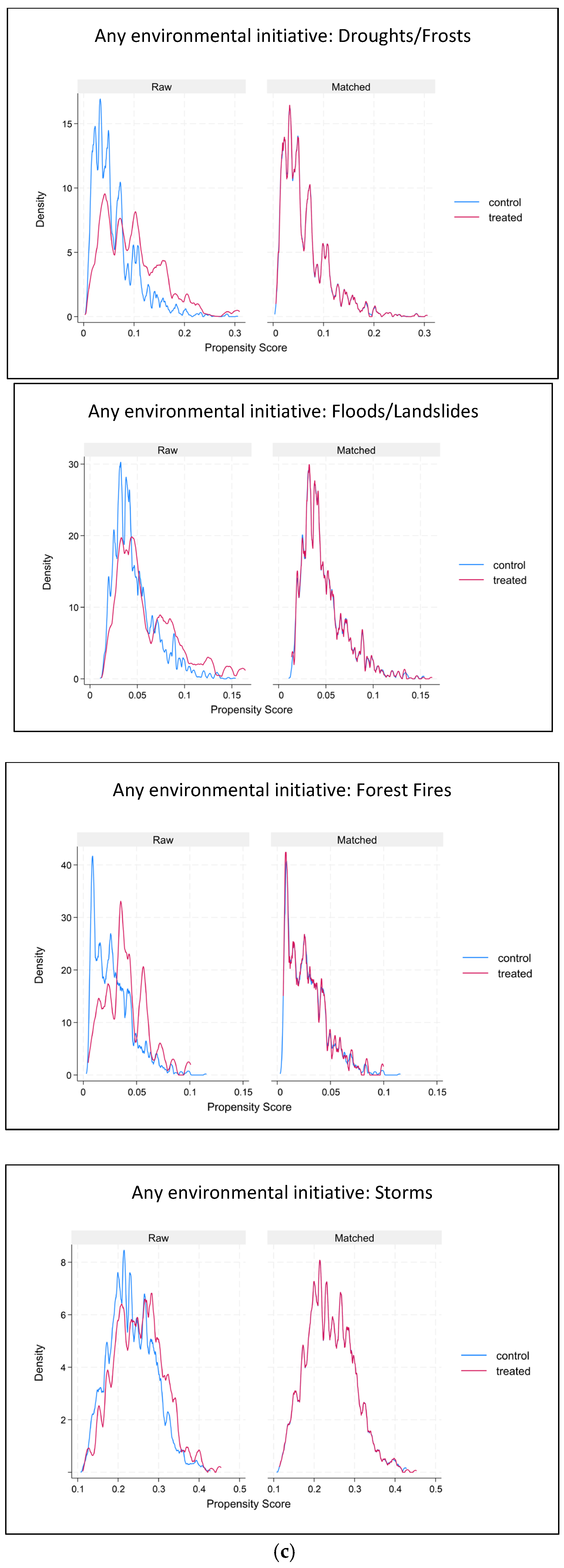
Panel (c) further details the ATEs for environmental initiatives categorized by disaster type: droughts/frosts, floods/landslides, forest fires, and storms. The most substantial effects are observed in response to droughts/frosts (10.7 percentage points) and storms (12.6 percentage points). According to
Table 1, these categories represent the disasters that affected the largest portion of the population.
As a robustness check,
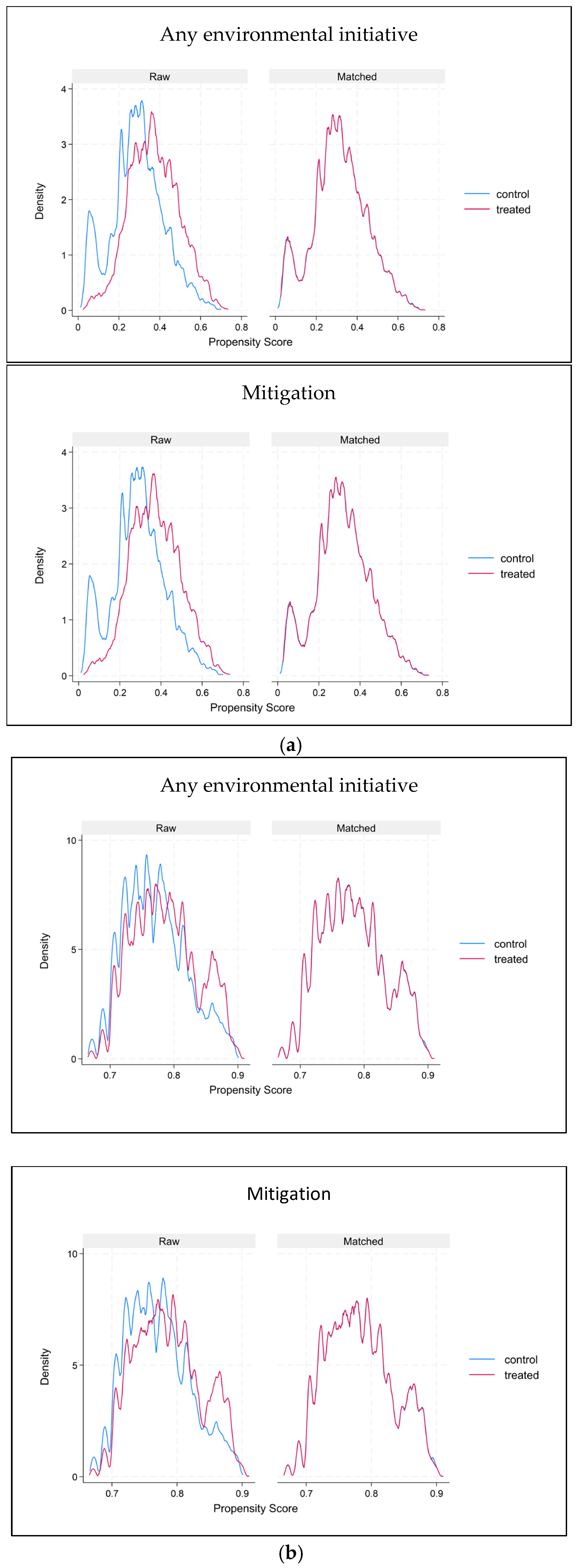
Figure 3 displays kernel density plots to evaluate the balance of the estimated propensity scores between the treatment and control groups. Panels (a) and (b) illustrate the balancing for Any environmental initiative and Mitigation, respectively; these are presented separately to account for the slight variations in sample size (1,780,799 versus 1,778,840). The density plots for Energy/Emissions, Efficiency, and Recycling are omitted for brevity, as they are analogous to that of Any environmental initiative due to their identical treatment and estimation samples. Panel (c) in turn presents similar plots for any environmental initiative under the different treatments of droughts/frosts, floods/landslides, forest fires, and storms. Across all specifications, the figures demonstrate that common support is achieved, with the treated and control distributions aligning closely after matching. It is worth noting that the propensity score range reflects the baseline probability of treatment. For instance, the estimated likelihood of experiencing a storm for the matched units in Panel (c) is concentrated between approximately 10% and 45%.
Figure 3.
Kernel density plots for propensity score balance. Plots are based on an Epanechnikov kernel function. (
a) Plots corresponding to
Table 4a; (
b) Plots corresponding to
Table 4b; (
c) Plots corresponding to
Table 4c.
Figure 3.
Kernel density plots for propensity score balance. Plots are based on an Epanechnikov kernel function. (
a) Plots corresponding to
Table 4a; (
b) Plots corresponding to
Table 4b; (
c) Plots corresponding to
Table 4c.
Table 4.
Average treatment effects: natural disasters and disaster-prone regions.
Table 4.
Average treatment effects: natural disasters and disaster-prone regions.
| (a) Having experienced a natural disaster |
| (i) Any environmental initiative | Nº obs. = 1,780,799 |
| Average treatment effect | Coefficient | Robust s.e | z | P > |z| | 95% conf. interval |
| Natural disaster (Yes vs. No) | 0.137 | 5.50 × 10⁻⁴ | 246.03 | 0.000 | 0.136 | 0.138 |
| (ii) Energy/Emissions | Nº obs. = 1,780,799 |
| Average treatment effect | Coefficient | Robust s.e | z | P > |z| | 95% conf. interval |
| Natural disaster (Yes vs. No) | 0.062 | 4.30 × 10⁻⁴ | 143.04 | 0.000 | 0.061 | 0.063 |
| (iii) Efficiency | Nº obs. = 1,780,799 |
| Average treatment effect | Coefficient | Robust s.e | z | P > |z| | 95% conf. interval |
| Natural disaster (Yes vs. No) | 0.021 | 3.30 × 10⁻⁴ | 65.07 | 0.000 | 0.021 | 0.022 |
| (iv) Recycling | Nº obs. = 1,780,799 |
| Average treatment effect | Coefficient | Robust s.e | z | P > |z| | 95% conf. interval |
| Natural disaster (Yes vs. No) | 0.102 | 5.40 × 10⁻⁴ | 189.88 | 0.000 | 0.101 | 0.103 |
| (v) Mitigation | Nº obs. = 1,778,840 |
| Average treatment effect | Coefficient | Robust s.e | z | P > |z| | 95% conf. interval |
| Natural disaster (Yes vs. No) | 0.224 | 3.90 × 10⁻⁴ | 580.32 | 0.000 | 0.223 | 0.224 |
| (b) Living in a disaster-prone region |
| (i) Any environmental initiative | Nº obs. = 1,780,799 |
| Average treatment effect | Coefficient | Robust s.e | z | P > |z| | 95% conf. interval |
| Potential exposure (Yes vs. No) | 0.053 | 7.30 × 10⁻⁴ | 72.82 | 0.000 | 0.052 | 0.055 |
| (ii) Energy/Emissions | Nº obs. = 1,780,799 |
| Average treatment effect | Coefficient | Robust s.e | z | P > |z| | 95% conf. interval |
| Potential exposure (Yes vs. No) | 0.019 | 5.20 × 10⁻⁴ | 37.09 | 0.000 | 0.018 | 0.020 |
| (iii) Efficiency | Nº obs. = 1,780,799 |
| Average treatment effect | Coefficient | Robust s.e | z | P > |z| | 95% conf. interval |
| Potential exposure (Yes vs. No) | −0.004 | 4.50 × 10⁻⁴ | −9.09 | 0.000 | −0.005 | −0.003 |
| (iv) Recycling | Nº obs. = 1,780,799 |
| Average treatment effect | Coefficient | Robust s.e | z | P > |z| | 95% conf. interval |
| Potential exposure (Yes vs. No) | 0.082 | 6.70 × 10⁻⁴ | 122.25 | 0.000 | 0.081 | 0.083 |
| (v) Mitigation | Nº obs. = 1,778,840 |
| Average treatment effect | Coefficient | Robust s.e | z | P > |z| | 95% conf. interval |
| Potential exposure (Yes vs. No) | 0.009 | 4.60 × 10⁻⁴ | 18.81 | 0.000 | 0.008 | 0.009 |
| (c) Any type of environmental initiative by type of natural disaster experienced |
| (i) Any environmental initiative | Nº obs. = 1,780,799 |
| Average treatment effect | Coefficient | Robust s.e | z | P > |z| | 95% conf. interval |
| Droughts/Frosts (Yes vs. No) | 0.107 | 8.60 × 10⁻⁴ | 123.76 | 0.000 | 0.105 | 0.108 |
| (ii) Any environmental initiative | Nº obs. = 1,780,799 |
| Average treatment effect | Coefficient | Robust s.e | z | P > |z| | 95% conf. interval |
| Floods/Landslides (Yes vs. No) | −0.001 | 7.45 × 10⁻⁴ | −1.05 | 0.296 | −0.002 | 0.001 |
| (iii) Any environmental initiative | Nº obs. = 1,780,799 |
| Average treatment effect | Coefficient | Robust s.e | z | P > |z| | 95% conf. interval |
| Forest fires (Yes vs. No) | 0.055 | 6.9 × 10⁻⁴ | 80.40 | 0.000 | 0.054 | 0.057 |
| (iv) Any environmental initiative | Nº obs. = 1,780,799 |
| Average treatment effect | Coefficient | Robust s.e | z | P > |z| | 95% conf. interval |
| Storms (Yes vs. No) | 0.126 | 6.80 × 10⁻⁴ | 184.90 | 0.000 | 0.125 | 0.128 |
For completeness,
Table A3 provides detailed covariate balance summaries for two representative cases. Following the matching procedure, all standardized mean differences (SMD) are reduced to values less than or equal to 0.1 in absolute magnitude. This threshold is widely accepted in empirical literature as an indicator of a well-specified model, suggesting that the matching process successfully eliminated observable systematic differences between the treatment and control groups. Consequently, the resulting estimates are not driven by imbalances in the underlying demographic or firm-level characteristics.
5.3. Business Profit as a Mediator
Mediation analysis involves estimating separate equations for the outcome and mediator variables. Three outcome variables are considered in this case: energy/emissions, efficiency and recycling. Each of these variables is modeled on the treatment (exposure to natural disasters), an interaction between the treatment and the mediator (monthly profit) and on the control variables previously considered (
Table 3). Given their binary nature, each outcome is estimated using a probit model. The mediator, monthly profit, in turn is modeled on the treatment, entrepreneur’s wealth, municipal patent, business registration, economic sector, personnel, national scope, and geographic region through a linear regression. Considering the large sample size, the analysis prioritizes marginal effects (reported as percentage-point changes) to facilitate a direct comparison across initiative types. Statistical significance is interpreted with caution; instead, the relevance of the results is assessed by evaluating the magnitude of the effect sizes relative to the baseline prevalence of each initiative.
Table 5 presents statistical results of mediation analysis for the above-mentioned outcome variables. As can be seen, there is evidence of a negative mediation effect for efficiency (b) and recycling (c) but not for energy/emissions (a), demonstrating mixed support for H
2. Nevertheless, the magnitude of the negative mediating effects is small: −0.1 percentage points in each case. Therefore, the ATEs obtained do not substantially differ from those reported in
Table 4a: 5.5 percentage points for energy/emissions (versus 6.2 percentage points), 2.3 percentage points for efficiency (versus 2.1 percentage points), and 10.6 percentage points (versus 10.2 percentage points). In interpreting these results, it is important to note that the profit measure used reflects the preceding year’s performance, which may not fully capture the acute, immediate financial impact of the disaster event.
6. Discussion
The results provide robust support for H1, demonstrating that direct personal exposure is a far more potent catalyst for change than mere proximity to risk:
The psychological distance gap: While 78% of participants lived in disaster-prone regions, the ATEs for these individuals dropped significantly compared to those with direct exposure. For example, the likelihood of adopting environmental initiatives dropped from 13.7 percentage points (direct exposure) to only 5.3 percentage points (geographic residence).
The concrete anchor: This confirms the core tenet of CLT. Regional vulnerability remains a high-level, abstract construal. It is only when the disaster disrupts the micro-entrepreneur’s own inventory, supply chain, or physical assets that the risk shifts to a low-level concrete construal. This lived experience provides the mental anchor required to shift from passive awareness to active mitigation.
The study offers more nuanced, mixed support for H2. While natural disasters increased the odds of all types of initiatives, there is a clear hierarchy in the sensitivity of these responses:
Mitigation odds: The odds of engaging in mitigation were 6.98 times higher for those who experienced a disaster. However, the marginal effects show that energy savings and equipment efficiency—measures that often require significant upfront capital—were the least sensitive to these events.
The profit mediation paradox: Mediation analysis showed a negative mediation effect for efficiency and recycling, but the magnitude was small (−0.1 percentage points). This suggests that while profit loss (the destruction of organizational slack) restricts an entrepreneur’s coping appraisal, the barrier may be more structural than purely financial.
Rationalizing green behavior: The fact that recycling and general environmental initiatives saw the highest likelihood of adoption (increments of 10.9 and 13.6 percentage points, respectively) suggests that micro-entrepreneurs gravitate toward low-hanging fruit. These actions offer a high sense of self-efficacy (as per PMT) because they are manageable and immediate, often perceived as a way to protect shrinking profits rather than as a costly long-term investment.
The results also highlight that not all disasters teach equally. Droughts, frosts, and storms showed the largest ATEs on environmental initiatives.
These events, which affected the largest number of people in the 2020–2025 period, served as effective focusing events.
They disrupted the status quo so profoundly that they forced a rapid re-prioritization of goals. However, as predicted by the theory of focusing events, the response remains largely reactive. The pressure for a swift response favors visible, direct adaptations over the systemic, long-term structural shifts required for true climate resilience.
This reactive behavior suggests that, in the absence of a structured anticipatory framework, experiential shocks serve as a traumatic substitute for anticipatory capacity (e.g., [
45]). Systematic syntheses of strategic foresight demonstrate that these practices can catalyze responsible environmental action by sharpening anticipatory thinking and aligning immediate decisions with long-term sustainability objectives (e.g., [
46]). For micro-enterprise ecosystems, this implies that policy should move away from treating disasters as involuntary instructors. Instead, interventions should institutionalize low-cost foresight routines—such as scenario-based peer workshops and forward-looking risk budgeting—specifically designed to collapse the psychological distance of climate threats before physical and financial losses occur.
A key takeaway is that the coping gap is not just a result of a lack of awareness; it is a result of a survivalist mindset (e.g., [
11,
27]). Micro-entrepreneurs are trapped in a cycle where disasters provide the will to act (threat appraisal) but simultaneously destroy the means to act effectively (coping appraisal). This structural fragility is particularly evident in the Chilean context. As detailed in
Table A1, most micro-entrepreneurs in Chile operate with zero financial buffer, as their annual business income is consumed entirely by critical operational expenses, including essential production inputs and employee salaries. When a disaster strikes, the capital required for effective coping, such as retrofitting infrastructure or purchasing insurance, is nonexistent because all available liquidity is locked into maintaining the immediate viability of the business.