Article

The Optimal Design of Agri-Environmental Contracts Aimed at Reducing Methane Emissions from Dairy Production in Poland


1
Institute of Economics and Finance, Warsaw University of Life Sciences, 02-787 Warszawa, Poland
2
Department of Agricultural and Food Sciences, University of Bologna, 40127 Bologna, Italy
*
Author to whom correspondence should be addressed.
Sustainability 2026, 18(6), 2702; https://doi.org/10.3390/su18062702
Submission received: 19 January 2026 / Revised: 6 March 2026 / Accepted: 8 March 2026 / Published: 10 March 2026

Abstract

Methane emissions from dairy production constitute a significant share of agricultural greenhouse gas emissions in Poland and represent a key challenge under EU climate policy and the Common Agricultural Policy (CAP). This study evaluates dairy farmers’ acceptance of alternative methane mitigation measures (MMMs) and examines the cost-efficient design of agri-environmental contracts from a public-budget perspective. A Discrete Choice Experiment (DCE) conducted among 302 dairy farmers was used to estimate participation probabilities for different mitigation measures and contract attributes, including result-based (RB) and input-based (IB) payment schemes. These preference-based probabilities were subsequently embedded into a cost-minimisation optimisation framework that identifies the least-cost portfolios of MMMs capable of achieving increasing methane-reduction targets while remaining behaviourally feasible. The DCE results show significantly higher acceptance of RB contracts compared with IB schemes, strong resistance to vaccination-based measures, and relatively favourable preferences for biofiltration. Payment levels and environmental attitudes significantly influence participation decisions. When behavioural constraints are incorporated into the optimisation model, RB contracts allow for higher achievable methane reductions under the adopted assumptions, primarily due to higher participation rates of farmers in result-based contracts. The model indicates that, beyond moderate mitigation targets, IB schemes face participation limits that constrain scalability. Biofiltration consistently forms the backbone of cost-efficient portfolios, while less accepted measures enter optimal solutions only when ambition levels exceed the feasible potential of high-acceptance options, revealing a potential ambition–acceptance gap. Methodologically, the study integrates stated-preference data into a policy optimisation model, demonstrating how farmers’ quantified perceptions can be treated as structural inputs to environmental policy design rather than assuming full adoption of technically efficient measures. Conceptually, the framework links farmer participation, environmental effectiveness, and budget efficiency within a unified decision-support structure. The proposed framework contributes to sustainability-oriented policy design by linking environmental effectiveness, behavioural feasibility, and public-budget efficiency in methane mitigation strategies for the dairy sector. Although the results are scenario-based and conditional on assumed mitigation and cost parameters, they underline the importance of aligning environmental ambition with empirically grounded participation patterns when designing methane mitigation policies for the dairy sector.

1. Introduction

The rising concentration of greenhouse gases (GHGs) in the atmosphere [1] has intensified the global debate on strategies to mitigate emissions in response to climate change. Designing agri-environmental policies that effectively reduce agricultural emissions while remaining economically feasible and socially acceptable is a key challenge for sustainable agricultural systems.
Reducing greenhouse gas (GHG) emissions from agriculture in the EU is critical for achieving the ambitious goal of climate neutrality by 2050, outlined in the European Green Deal [2]. Given agriculture’s substantial contribution to EU-wide emissions, targeted mitigation strategies are essential. Key EU policies, notably the Farm to Fork Strategy and the 2030 Climate Target Plan, emphasise sustainable farming practices and efficient resource use to significantly cut agricultural emissions, especially methane and nitrous oxide, within the coming decade [3,4].
Within agriculture, cattle are recognised as the primary source of methane emissions [5]. In Poland, where the study was based, nearly half of the GHG emissions from the Polish farming sector [6] were generated by dairy farms, a share comparable to the global contribution of cattle to methane emissions [7]. Consequently, methane-reduction measures in Polish dairy farming are vital for aligning national agriculture with EU climate targets and for ensuring meaningful progress towards climate neutrality. The current architecture of the Common Agricultural Policy (CAP) offers several instruments to support climate change mitigation. Among these, the Agri-Environment Climate Measure (AECM) is considered one of the most significant [8]. Each EU Member State is required to design AECM schemes in a way that maximises the positive environmental impacts of the CAP [9]. However, since participation remains voluntary for farmers, the overall effectiveness of AECMs depends on both the environmental efficiency of the proposed measures and farmers’ willingness to participate. Given the voluntary nature of AECM, it is essential to increase participation and achieve environmental targets [10]. Behavioural factors and opportunity costs are essential drivers of farmers’ participation in AECM, directly impacting their perception, evaluation, and selection of practices (e.g., [11]).
To date, most AECMs have been action-based (input-based), where farmers receive compensation for implementing specified activities [12]. This approach has shown considerable drawbacks, often proving ineffective in achieving environmental targets [13,14,15,16]. In response, the post-2020 CAP reforms advocate for a shift towards result-based measures, where payments depend on the actual volume of verified methane reductions [8,17].
Result-based AECMs offer several advantages. They encourage farmers to adopt the most cost-effective methods [18,19] and to select practices that are best suited to protecting the natural environment [20]. However, these schemes also impose greater risk on farmers due to uncertainty in achieving the desired environmental outcomes [18,21]. Nevertheless, result-based schemes may increase farmer acceptance as they typically involve fewer restrictions and administrative requirements [22,23].
Several factors influence methane emissions from cattle, including diet composition, feed processing, dietary supplementation, and modification of rumen microbiota [24]. The type of dietary carbohydrate plays a critical role: diets rich in easily fermentable carbohydrates, such as starch, typically reduce methane emissions compared to high-fibre diets [25,26]. Certain dietary supplements—such as lipids, nitrates, and ionophores (e.g., monensin)—can effectively lower emissions by altering ruminal fermentation pathways. Lipids suppress methanogenic activity by inhibiting protozoa and methanogens [27,28]. Nitrates act as alternative hydrogen sinks in the rumen, competing with methanogenesis for reducing equivalents and thereby decreasing methane formation by reducing nitrate to ammonia [29,30]. Ionophores limit methane production by selectively targeting hydrogen-producing bacteria [31]. Emerging strategies aimed at directly modifying ruminal microflora, including vaccination against rumen methanogenic archaea (anti-methanogen vaccines), probiotics, and direct-fed microbials (DFMs), also show promise for methane mitigation [32,33]. Evidence in cattle indicates that vaccination with methanogen antigens can induce methanogen-specific antibodies delivered to the rumen via saliva [34]. Another innovative approach is biofiltration, which uses methanotrophic bacteria to oxidise methane from livestock facilities into carbon dioxide and water. This method is especially effective for treating air with high methane concentrations, such as that from manure storage systems [35]. Compost-based biofilters inoculated with methane-oxidising bacteria have demonstrated removal efficiencies of up to 85–92% [35,36].
Strategically, integrating these approaches and tailoring them to specific farm systems could significantly advance methane mitigation efforts, supporting climate policy goals and promoting sustainable livestock production. In this study, we propose a modelling approach to evaluate a set of specific measures to reduce methane emissions from dairy farms. The selection of the three methane mitigation measures considered in this study—dietary supplementation, vaccination against methanogenic archaea, and biofiltration—was guided by both their contrasting technological characteristics and their relevance for policy design. Dietary supplementation represents a relatively low-investment, management-based measure that can be adopted with limited structural changes at the farm level. Vaccination against methanogenic archaea constitutes an emerging, animal-level biological intervention with potentially high mitigation efficiency but greater uncertainty regarding farmer acceptance. Biofiltration, in turn, is a capital-intensive, infrastructure-based solution targeting emissions at the facility level rather than directly at the animal. Together, these measures capture a broad spectrum of mitigation approaches in terms of cost structure, technological maturity, risk profile, and monitoring requirements, making them particularly suitable for analysing farmers’ preferences and the performance of result-based versus input-based agri-environmental contracts. The measures considered were designed for research purposes and are not part of the official AECM list. To avoid confusion with existing policy instruments, we refer to them throughout this paper as Methane Mitigation Measures (MMMs).
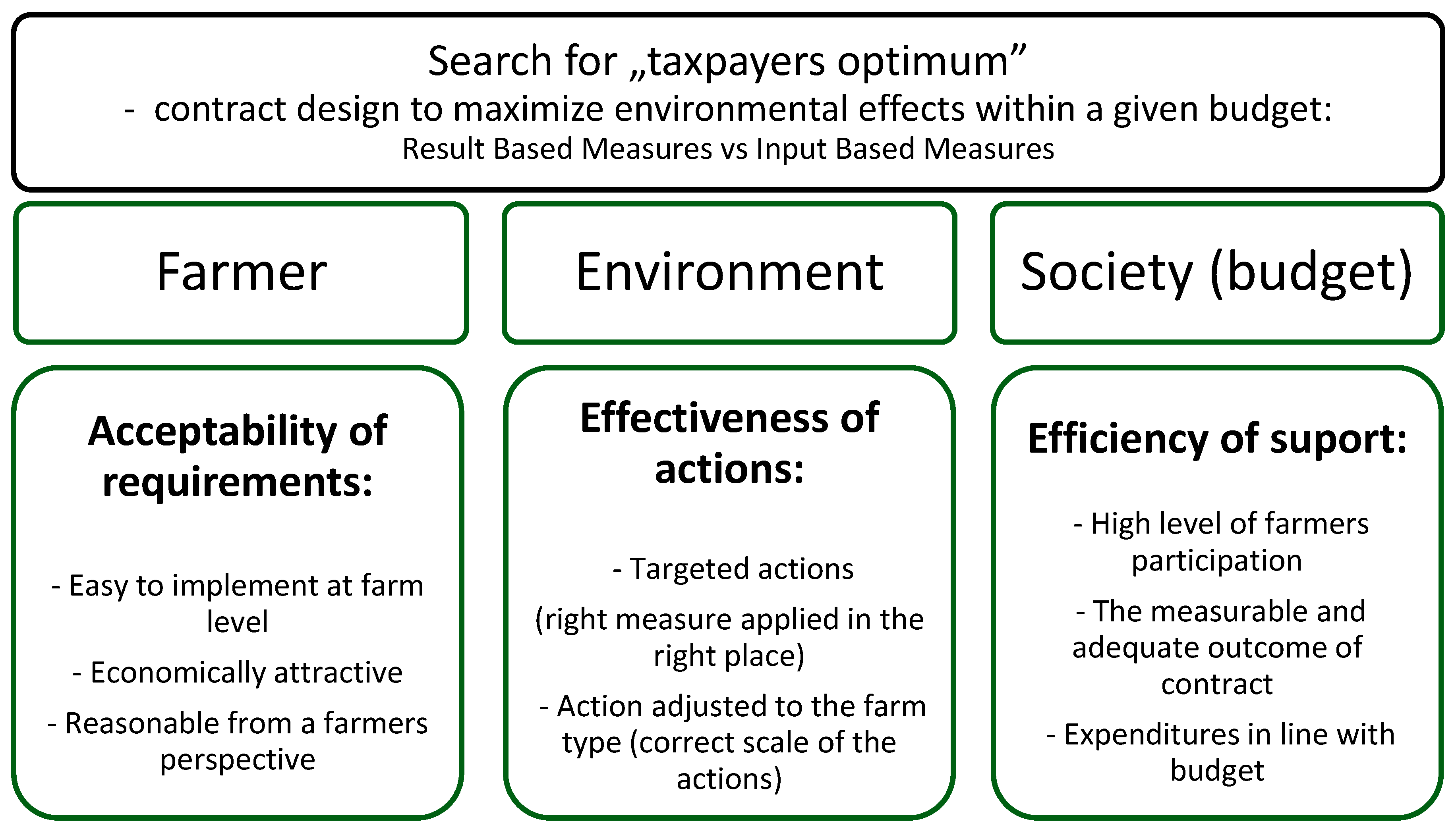
The study aimed to assess the potential of result-based contracts in reducing methane emissions from dairy farms and to identify the most cost-effective combination of MMMs at the country scale. From the perspective of public authorities, it is important to determine a policy-supported mix of MMMs that achieves specified methane-reduction targets at the lowest possible cost to taxpayers. Thus, the research combines an assessment of farmers’ acceptance of the proposed MMMs with an optimisation procedure designed to identify the most environmentally and economically efficient policy structure (Figure 1).
The performance of result-based contracts was compared with that of input-based contracts through model simulations.
This study aims to assess dairy farmers’ acceptance of alternative methane mitigation measures and contract designs, and to demonstrate how preference-based information derived from a discrete choice experiment can be incorporated into an optimisation framework to explore cost-efficient policy configurations for achieving methane reduction under agri-environmental climate measures.
This study contributes to the literature in three ways. First, it provides new empirical evidence on dairy farmers’ acceptance of alternative methane mitigation measures and contract designs, explicitly comparing result-based and input-based approaches. Second, it offers methodological contributions by integrating discrete-choice experiment results into an optimisation framework to identify cost-efficient policy configurations from a taxpayer’s perspective. Third, it makes a conceptual contribution by proposing an analytical framework that links farmer participation, environmental effectiveness, and budget efficiency, thereby supporting the evidence-based design of agri-environmental climate measures.

2. Methodology

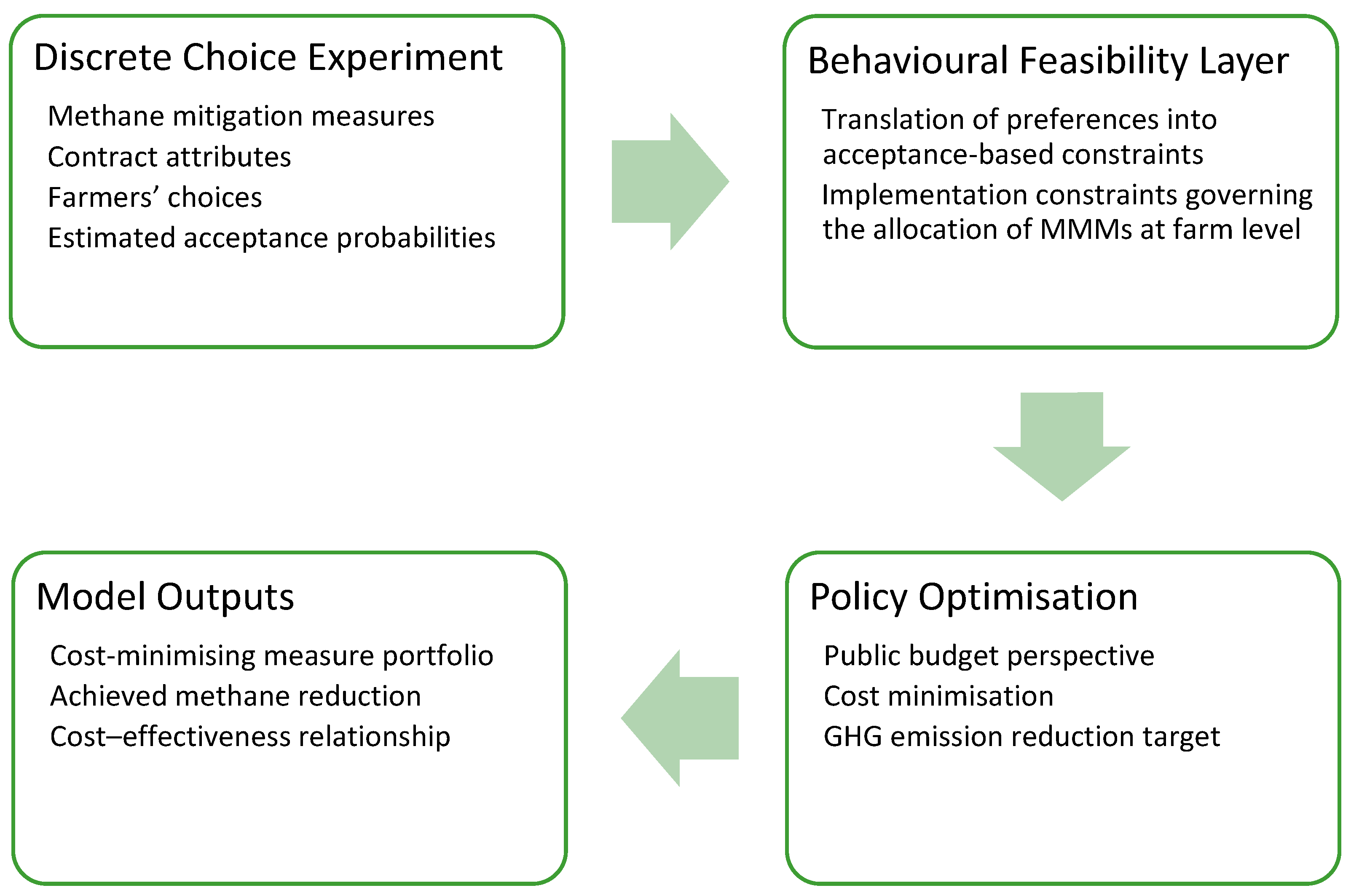
The approach applied in the study combines the assessment of farmers’ acceptance of methane mitigation instruments with an optimisation procedure to find the most environmentally efficient structure of MMM that achieves the assumed environmental effect. The modelling was carried out in four stages (Figure 2):
-
Identification of farmers’ preferences and estimation of participation probabilities for alternative methane mitigation measures and contract designs;
-
Translation of estimated participation probabilities into behaviourally feasible policy options;
-
Formulation of a cost-minimisation problem subject to a predefined methane reduction target for the most efficient selection of MMMs designs,
-
Determination of the cost-efficient portfolio of methane mitigation measures and the resulting emission reduction and cost-effectiveness outcomes.

2.1. Discrete Choice Experiment

To explore farmers’ preferences, we conducted a stated preference survey using a Discrete Choice Experiment (DCE) [10,37]. The DCE included the following key attributes: contract type (RB or IB), methane-reduction action (dietary supplementation with feed additives to reduce enteric methane formation, vaccination against methanogenic archaea, or biofiltration), contract duration (1, 5, or 10 years), and payment rate. These attributes, selected based on their relevance in the literature and their suitability for the Polish agricultural context, were defined as follows:
The MMMs are characterised by
  • Type of action: (1) dietary supplementation [38], (2) vaccination against Archaea [39], and (3) biofiltration [35];
  • Contract type: result-based (RB) or input-based (IB);
  • Contract duration: 1, 5, or 10 years;
  • Payment rate: €80–€200 per tonne of CO2e reduced.
The initial plan included a set of MMM comprising all possible combinations of attribute levels, differing in the type of action (3 options), the contract period (3), the method of determining the payment (2) and the rate of payment (3). The set of attributes and their level for DCE is presented in Table 1.
Payment rates of 80, 120, and 200 EUR per tonne of mitigated CO2 equivalent (CO2e) were converted to PLN (Polish złoty) and expressed per cow for each mitigation measure for use in the DCE. Farmers’ payments were subsequently calculated as a function of the expected methane emission reduction per cow and the assumed payment rate expressed in PLN per tonne of CO2e.
The assumed mitigation effects of each action were derived from the literature on methane-reducing practices corresponding to the measures considered: (1) dietary supplementation [38], (2) vaccination against methanogenic archaea [39], and (3) biofiltration [35]. For result-based MMMs, these effects were parameterised using literature-based estimates for dairy cows with milk yields ranging from 6000 to 10,000 kg per lactation, and a single representative value for the optimisation was obtained by averaging the minimum and maximum reported reduction levels. To ensure comparability across measures, all calculations were standardised to a reference milk yield of 6000 kg per cow per lactation.
For input-based MMMs, the achieved methane emission reduction was assumed to equal 95% of the corresponding literature-based benchmark. This simplifying assumption reflects the absence of direct performance incentives under input-based contracts, in contrast to result-based schemes where payments depend on verified emission reductions.
In total, 54 measures (a complete set of MMM) were designed by combining the attributes listed above.
The plan of the DCE was prepared with three alternatives within each choice set:
-
Two of the three proposed actions (Alternatives 1 or 2);
-
A “no choice” option if farmers were not accepting the given alternatives for any reason.
An example of the DCE choice set as presented to the surveyed farmers is shown in Table 2.
The number of choice sets was reduced by minimising the Bayesian D-error (DB-error) to limit redundancy and improve statistical efficiency [40,41]. The coordinate exchange algorithm (CEA) [42] was applied using the idefix (v. 1.0.3) package in R (v. 4.2.1) [43], which allowed the preparation of 36 choice sets. Each respondent answered 9 randomly selected choice sets out of the 36 generated.
The experiment was conducted in four Polish regions classified at the NUTS 2 level (Nomenclature of Territorial Units for Statistics) [44], which represents the basic regional level for the application of regional policies and statistical reporting in the European Union (Eurostat, 2023). The selected regions—Mazowieckie, Kujawsko-Pomorskie, Podlaskie, and Warmińsko-Mazurskie—account for nearly 60% of Poland’s total milk production. The field of observation was limited to dairy farms keeping more than 20 cows. The survey was conducted among over 302 dairy farmers from four regions of Poland. The sample was designed to be statistically representative of the population of approximately 25,000 farms meeting this criterion in these regions, which together account for about one million cows out of the 2.2 million kept nationally.
In addition to the discrete choice experiment, the survey collected information on key farm and farmer characteristics, including structural variables describing farm size and production scale (e.g., number of dairy cows, milk yield, land use, and labour input), socio-economic characteristics such as the self-assessed financial situation of the farm and the presence of a potential successor, and farmers’ perceptions of methane-related environmental impacts. The complete questionnaire is provided in the Supplementary Materials, while the gathered data are stored in an open repository: https://doi.org/10.5281/zenodo.7228611.
Results of the experiment have been transformed to binary form in the following way:
1. A binary variable Y (share) was created expressing the farmer’s willingness to participate in a given MMM;
2. For choices of alternatives 1 or 2, the variable Y was assigned the value 1, and 0 otherwise;
3. The variables describing the characteristics of MMM came from the chosen alternatives. If the “No choice” was chosen, the value of the variable Y corresponding to alternatives 1 and 2 was set to 0, resulting in two negative responses for alternatives 1 and 2.
To model farmers’ participation decisions derived from the modified discrete choice experiment data within the random utility framework, a logit specification was applied [45,46]. The linear predictor was specified as
η i j = x i β + z i j γ ; i = 1 , , N ; j = 1 , , S
where vector x i stands for respondent characteristics invariant across alternatives (i.e., number of cows at the farm) and vector z i j represents characteristics which vary across alternatives (MMM characteristics), N—number of farmers, S—number of MMM sets. The model was estimated in R (environment for statistical computing) using a generalised linear model with a binomial family; inference is based on standard maximum-likelihood estimation for logit models [47].
It was assumed that the value of the linear predictor carries the information that allows for determining the hierarchy of MMMs alternatives, reflecting their usefulness to the farmer.

2.2. Conceptual Structure of the Optimisation Framework

The optimisation framework integrates farmers’ behavioural preferences with the public authority’s cost-minimisation objective. Conceptually, the model operates in two interconnected layers.
First, farmers’ participation decisions are represented using probabilities estimated from the Discrete Choice Experiment (DCE). These probabilities reflect the maximum share of farmers, represented by each sampled farm, who would be willing to participate in a given methane mitigation measure (MMM) under specific contractual and payment conditions. In the optimisation model, these probabilities act as behavioural upper bounds, ensuring that participation levels remain consistent with empirically observed preferences.
Second, from the perspective of the public authority, the model selects the combination of MMMs that achieves a predefined methane emission reduction target at the lowest possible public cost. Total public cost consists of (i) subsidy payments to participating farmers and (ii) programme-related transaction and monitoring costs, including contract conclusion and control costs as specified in Table 3. The decision variables determine the share of farmers participating in each available MMM, being subject to behavioural feasibility constraints derived from the DCE and to the environmental constraint imposing the required greenhouse gas (GHG) reduction.
The structure of the model can therefore be interpreted as a constrained cost-minimisation problem in which behavioural realism is embedded directly into the feasible decision space. Rather than assuming full adoption of the most cost-effective measure, the optimisation accounts for heterogeneous willingness to participate and for the mutually exclusive nature of alternative programme designs.

2.3. Formal Specification of Optimisation Model

The estimated logit model, based on DCE, was used to calculate the probability of participation in each MMM (j) for every farmer (i) in the sample, according to the following formula:
p i j = e x p ( x i β + z i j γ ) 1 + e x p ( x i β + z i j γ )
The resulting probabilities p i j were interpreted as behavioural constraints limiting the maximum share of farmers represented by the i-th farm who could participate in the j-th MMM.
For the 302 surveyed farmers and 54 considered MMM profiles, this procedure produced a 302-by-54 matrix of participation probabilities, which was subsequently incorporated into the optimisation model (constraints 1–8).
The objective function was defined by three key parameters: the assumed methane-emission reduction per cow associated with each MMM, the payment rate offered to farmers, and the transaction costs related to contract implementation and monitoring.
The objective function is as follows:
C O S T   m i n = i = 1 N j = 1 S F i · Q i j · C P F i + C C i P P C j + C P C j
(Objective function)
Where
Fi—number of farms in the population represented by the surveyed farm i;
Qij—share of farmers represented by the i-th farm decided to participate in the j-th MMM;
CCi—number of cows per i-th farm;
PPCj—payment per cow for j-th MMM;
CPFi—cost per i-th farm (contracting and monitoring costs);
CPCj—cost per cow for j-th MMM (e.g., control costs).
The logistic regression results were used to calculate the participation probabilities for each surveyed farmer across all considered MMMs, yielding a 302-by-54 matrix. Parameters from the matrix were used in the model’s equations (constraints 1–8).
There were three main parameters of the objective function: the assumed reduction in methane emissions from enrolling cows in the MMM, the payments offered to the farmer, and the transaction costs of implementing the MMM.
The MMM’s total cost includes transaction costs related to contract implementation and programme management (i.e., monitoring). The probabilities pij that the i-th farmer chooses specific MMMs were used as a basic constraint in the optimisation model. It was assumed that the share of farmers represented by the i-th farm who would participate in the MMMs must equal the probability of participation estimated from the DCE. Thus,
Q i j p i j
(1st constraint)
The total share of all farmers represented by the i-th farmer participating in all available MMMs j = 1, …, K was assumed to be no greater than the highest probability for all considered MMMs (1, …, K for i-th farmer).
j = 1 K Q i j max p i 1 , , p i K
(2nd constraint)
This constraint keeps the total share of farmers’ participation in a group of farms represented by the i-th farm below the maximum achievable level. Both constraints are necessary to ensure that each farmer in the population chooses exactly one of the offered MMMs.
To make sure that the sets of MMMs with different payment rates (A, B, C) are represented adequately, to probabilities of farmers’ participation reflecting respective rates and types of action (biofilters, vaccination, feed additives), the following constraints have been applied:
The first type of action:
j = 1 K 1 Q i j max p i 1 , , p i K 1
(3rd constraint)
The second type of action:
j = K 1 + 1 K 2 Q i j max p i K 1 + 1 , , p i K 2
(4th constraint)
The third type of action:
j = K 2 + 1 K 3 Q i j max p i K 2 + 1 , , p i K 3
(5th constraint)
There were three additional sets of constraints introduced to ensure that the sum of Q i j shares for any combination of 2 types of actions are not greater than the maximal probability for all MMMs with those types of actions:
Biofilters and additives:
j = 1 K 1 Q i j + j = K 1 + 1 K 2 Q i j m a x p i 1 , , p i K 1 , p i K 1 + 1 , , p i K 2
(6th constraint)
Biofilters and vaccines:
j = 1 K 1 Q i j + j = K 2 + 1 K 3 Q i j + max p i 1 , , p i K 1 , p i K 2 + 1 , , p i K 3
(7th constraint)
Additives and vaccines:
j = K 1 + 1 K 2 Q i j + j = K 2 + 1 K 3 Q i j max p i K 1 + 1 , , p i K 2 , p i K 2 + 1 , , p i K 3
(8th constraint)
Finally, the constraint which enforces a required minimal GHG reduction was added:
G H G r e d i = 1 N j = 1 S F i · C C i · G H G j · Q i j
(9th constraint)
The model presented above aimed to select the most efficient set of MMM designs for farmers to implement to achieve the desired methane emission mitigation. From the perspective of farmers, preferred choices would be most likely those with the highest utility. However, the model takes the perspective of taxpayers, represented by public authorities, and offers farmers a set of MMMs that make the most effective use of public subsidies. Therefore, it was assumed that the basic criterion for choice is not the best utility for farmers but the most cost-efficient set of MMMs. The procedure assumes calculating the minimum costs of each possible combination of the considered MMMs at subsequent levels of methane emission reduction.
To identify farmers’ preferences expressed as maximal probabilities of participation, it was rational to consider the complete set of MMMs in the Discrete Choice Experiment. In the optimisation procedure, the complete set of MMMs was reduced to 18 measures covering three actions, three contract periods, and two contract types (IB, RB) at payment rates set at A, B, or C levels.
Considering that, in reality, each specific action (biofilters, vaccination, feed additives) can be supported at only one rate of payment at a time, this results in a set of 27 combinations of MMMs. The MMMs were introduced to the model, starting with those offered at the lowest rates (the most cost-efficient but with the lowest probability of acceptance by farmers). Thus, in the first step, farmers were offered MMMs with the payment rate A (A,A,A) for biofilters, vaccination, and feed additives, respectively, followed in the next steps by all available combinations of payments (e.g., A,A,B; A,B,A), up to all sets with the highest rates (C,C,C). Each set with specific payment rates, e.g., A,A,A, introduced to the model, contains K elements (different types of action, time of contract and type of contract). In the case of optimisation limited to one type of contract (IB or RB), K = 9.
It was assumed that each i-th farmer in the sample represents the specific number of dairy farmers from the population. Therefore, the probabilities Pij reflect the maximum share of farmers represented by the i-th farmer who might be interested in participating in the j-th MMM. Thus, the model allowed the i-th farmer to participate in several MMM designs (j = 1, …, K).
The optimisation model was solved for each set of the MMMs. The model for a specific MMM set consisted of 5436 (32 × 18) decision variables and 7551 constraints (302 × 18—1st constraint; 302 × 7—2nd to 8th constraints +1—9th constraint). After solving models for all MMM sets, the model results that achieved the required reduction in GHG emissions at the lowest cost to taxpayers were selected for implementation.
The requested methane emission reduction started at 20 kt of CO2e and was increased by an additional 20 kt of CO2e in each model iteration until reaching the maximum methane emission reduction. The total amount of the assumed reduction was achieved, including farmers participating at the highest possible level of payments at the rate C for all types of actions. It was required to run 24 iterations for IB types of contracts, totalling a reduction of about 480 kt CO2e, and 32 iterations for RB types of contracts (up to ~640 kt CO2e).
After ranking the results of all the considered variants in terms of environmental performance, expressed as the average MMM for a given combination, at the cost of unit methane emission reduction, a correlation curve between the amount of public funds spent and the environmental effect was obtained.

3. Results

The surveyed farms were heterogeneous in size and production intensity, with median herd size of 37 cows, median milk yield of approximately 7300 kg per cow, and median farm area of 40 ha (Table 4).
The logit regression model was estimated from the farmers’ responses collected in the DCE and presented in Table 5.
The estimated logit model shows that the input-based payment scheme has a statistically significant negative coefficient (p < 0.001), indicating lower utility relative to result-based contracts (reference category). Higher payment rates (levels B and C) significantly increase the probability of participation, while vaccination against Archaea is negatively valued. The contract duration variable is not statistically significant in the main specification, indicating no clear overall preference for shorter or longer contracts. However, the interaction term between contract duration and the presence of a successor is positive and statistically significant, suggesting that longer contracts are more acceptable in farms with expected intergenerational continuity. Farmers who perceive methane as environmentally harmful are more likely to participate, whereas better financial standing and a larger number of workers are associated with a lower probability of participation. The model exhibits acceptable explanatory power (McFadden pseudo-R2 = 0.23).
The objective function parameters were calculated based on the estimated logit model and the assumed mitigation and cost parameters for each MMM configuration. The complete set of resulting parameter values is provided in Table S2 in the Supplementary Materials.
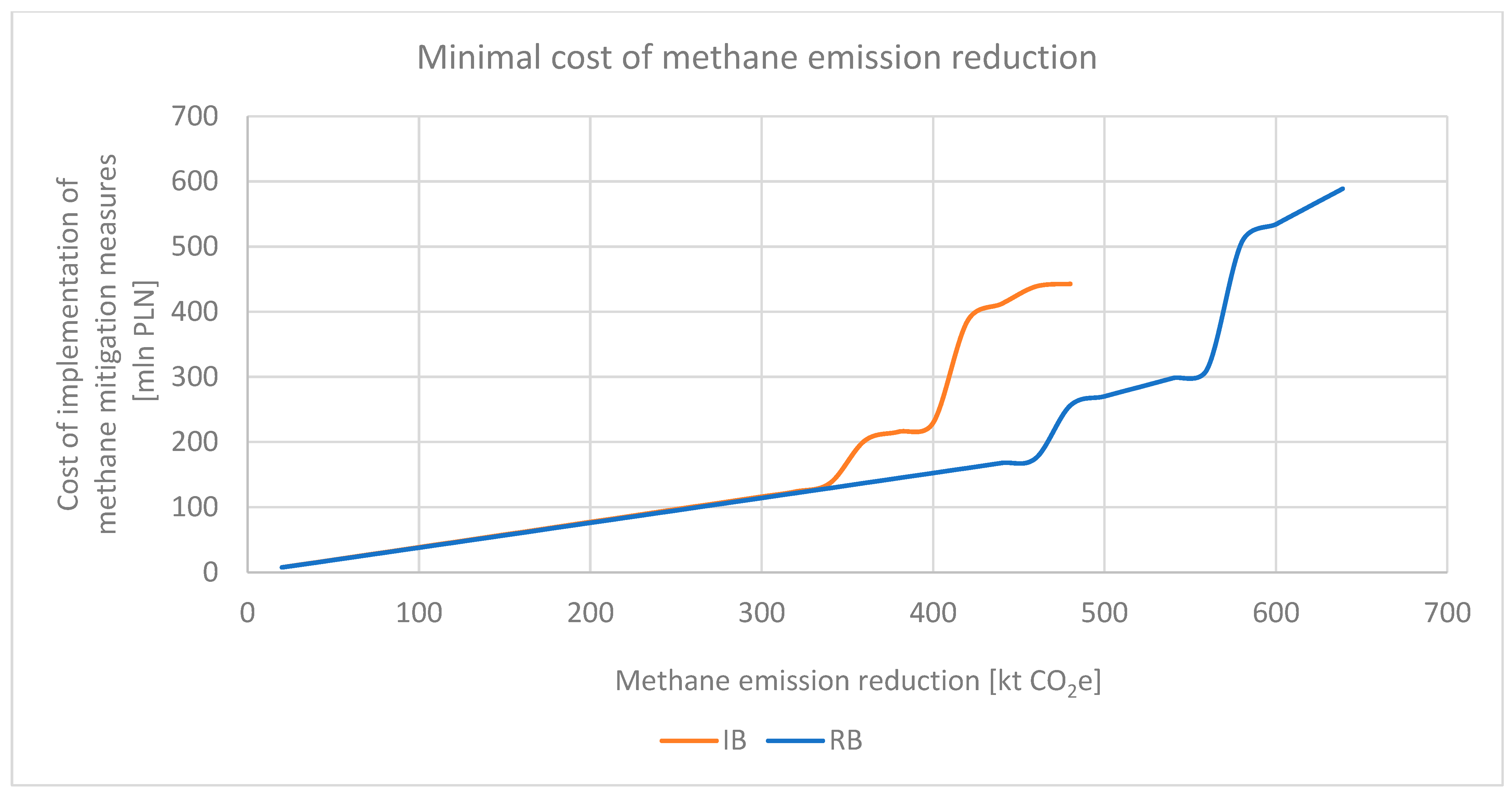
The optimisation was performed separately for RB (result-based) and IB (input-based) MMMs. Modelling results (Figure 3) show that the performance of both RB and IB contract types is similar at lower ambition-reduction targets, up to 340 kt of CO2e.
For more ambitious reduction targets, the RB type of contract performs better.
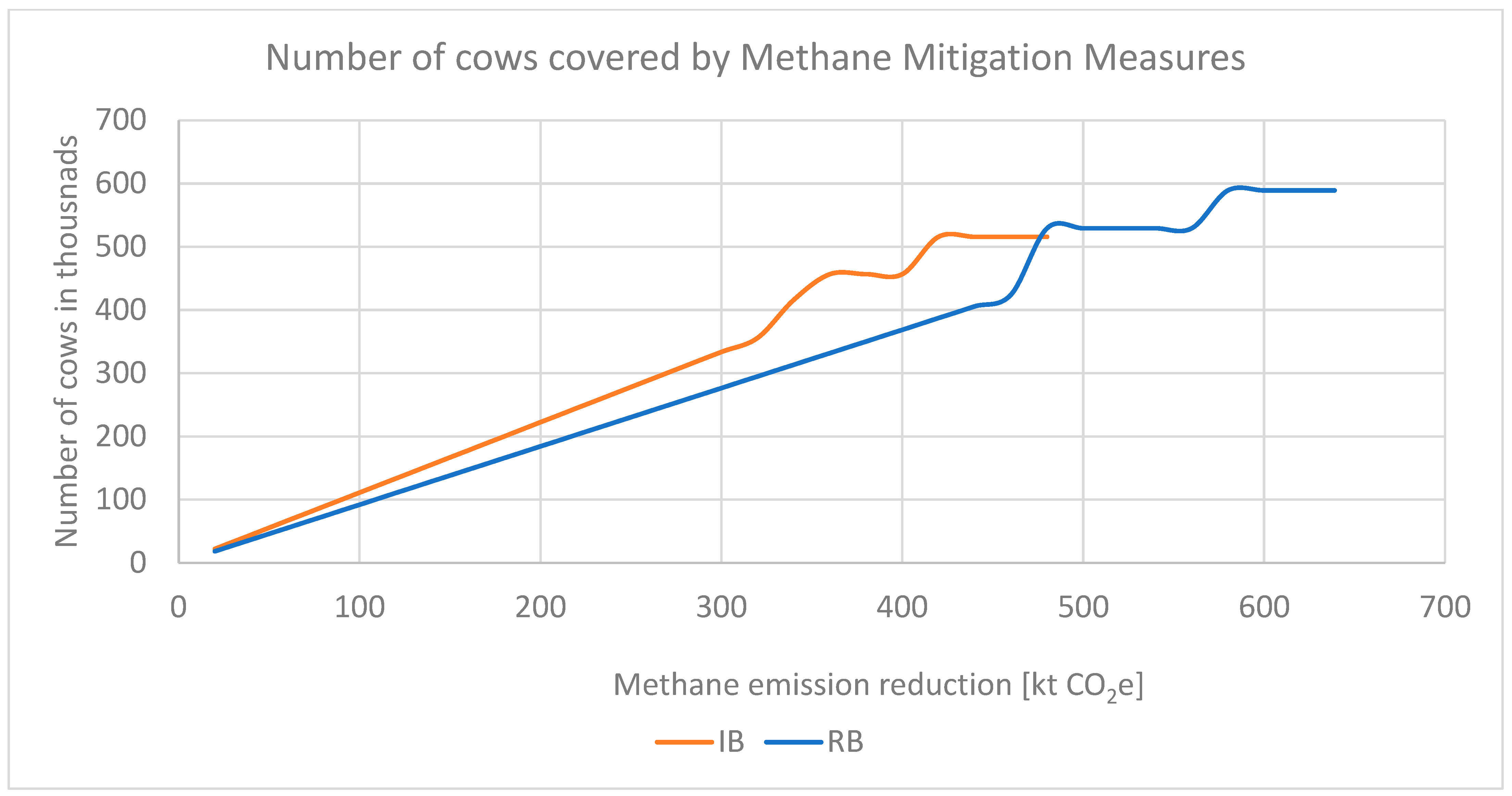
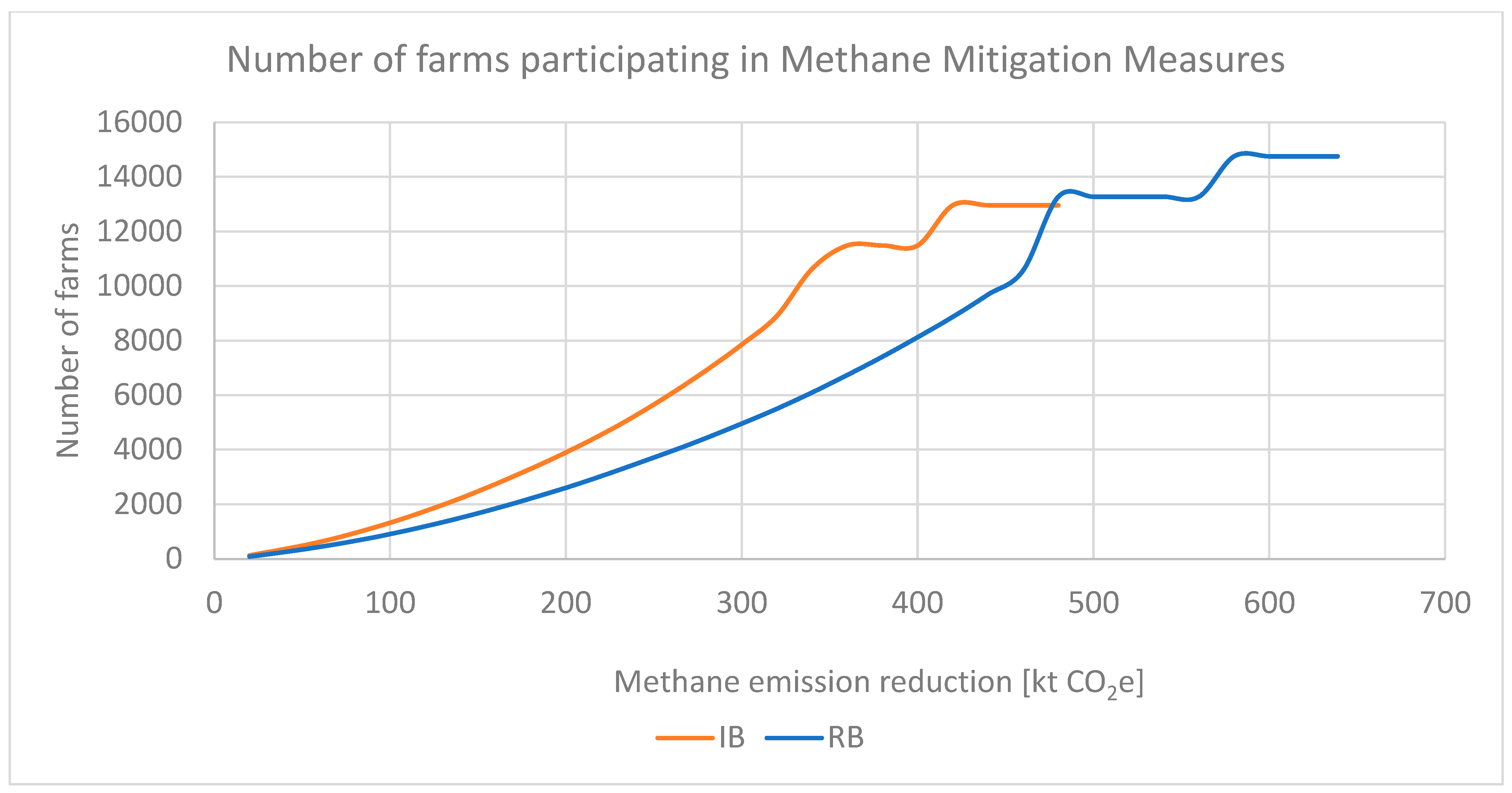
Since the DCE results indicate a statistically significant negative coefficient for the input-based (IB) payment scheme relative to result-based (RB) contracts (Table 5), farmers’ acceptance of RB-type contracts is higher when other contract attributes are held constant. Consequently, the higher expected participation under RB schemes increases the maximum achievable methane emission reduction. Under the adopted assumptions, the total reduction for IB-type contracts amounts to slightly above 480 kt of CO2e, while for RB-type contracts, it reaches nearly 640 kt of CO2e. Because such specific measures have not been tested under Polish conditions, these results should be interpreted as scenario-based, and it can only be hypothesised that RB payments provide more substantial incentives for farmers confident in their ability to achieve emission reductions. The results presented in Figure 1 correspond closely with the number of farms participating in the MMMs (Figure 4). In Figure 4, Figure 5, Figure 6 and Figure 7, the methane emission reduction target is treated as the independent variable (x-axis), while the model outputs include indicators of participation and scale effects, such as the number of participating farms, the number of enrolled cows, and herd-size-related participation patterns across MMMs.
Given the assumed lower efficiency of IB-type contracts, more farms participating in MMMs are needed to meet the requested methane mitigation target. As explained in the following paragraph, the farms participating in the IB scheme are slightly smaller on average. At the point of maximum emission reduction for the IB scheme, the number of farms participating in RB contracts is similar. However, the maximum number of farms participating in RB programmes is higher because of higher participation rates in the MMMs.
Comparing the number of cows enrolled on MMMs (Figure 5) in RB and IB, it is possible to point out that in the case of RB, the number of cows needed to reach the required methane emission reduction is lower. This is because of the assumption of the higher efficiency of methane emission reduction per cow in RB contracts. Thus, for the same environmental effects, more cows need to be enrolled in IB than in RB contracts.
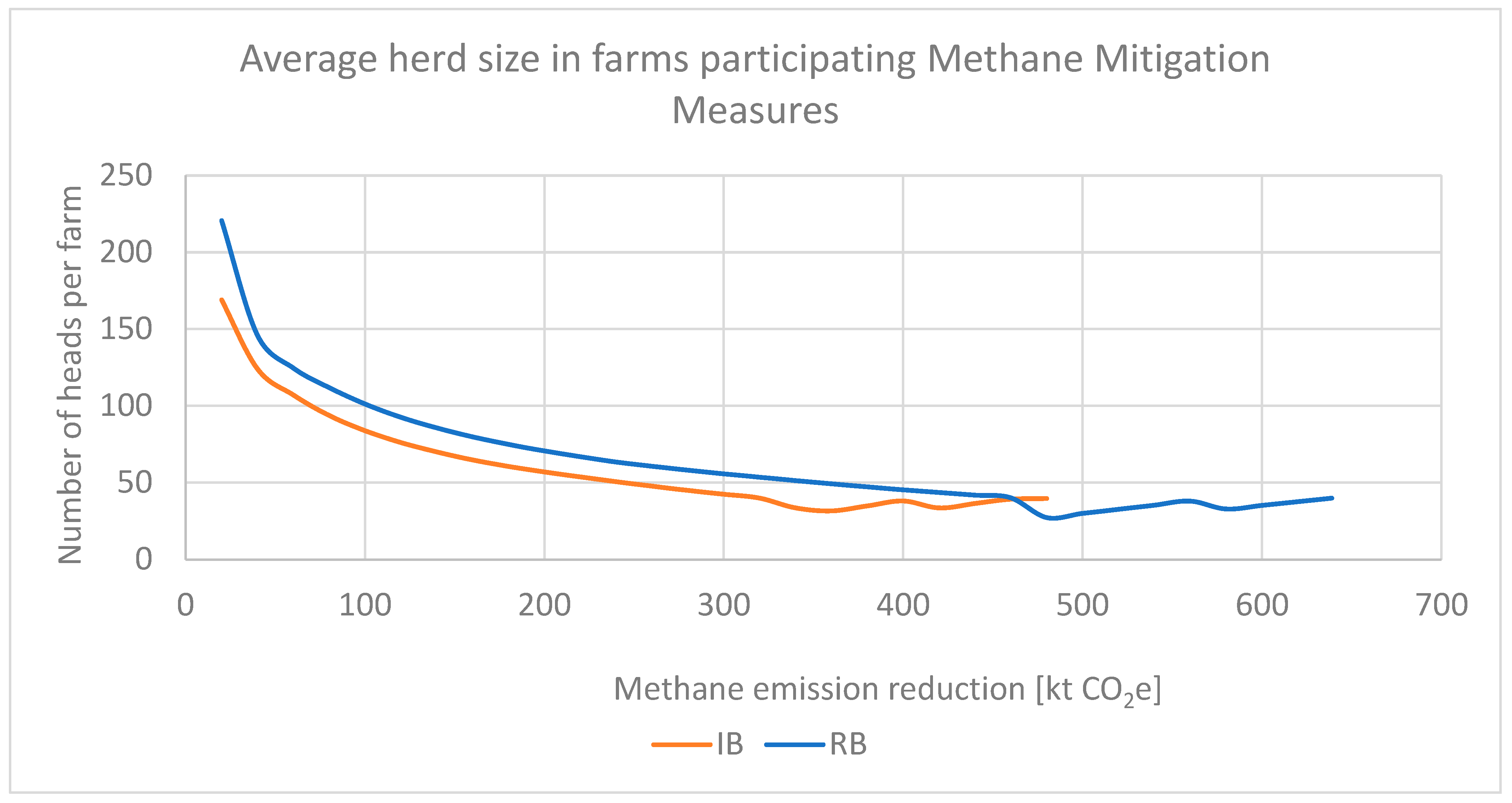
Comparing the average herd size in both types of contracts, it could be noticed that, generally, the farms participating in RB contracts have bigger herds. This could be partly explained by the assumption about transaction costs, which, calculated per farm, are higher for RB contracts and by higher probabilities of participation in MMMs from the logit regression. Due to the assumption of transaction costs calculated per farm, the model, to minimise total methane-reduction costs, starts to include the largest farms from the very low methane-emission reduction targets. Because the probability of participation is, on average, higher under RB contracts, more large farms participate, resulting in a higher average herd size (Figure 6).
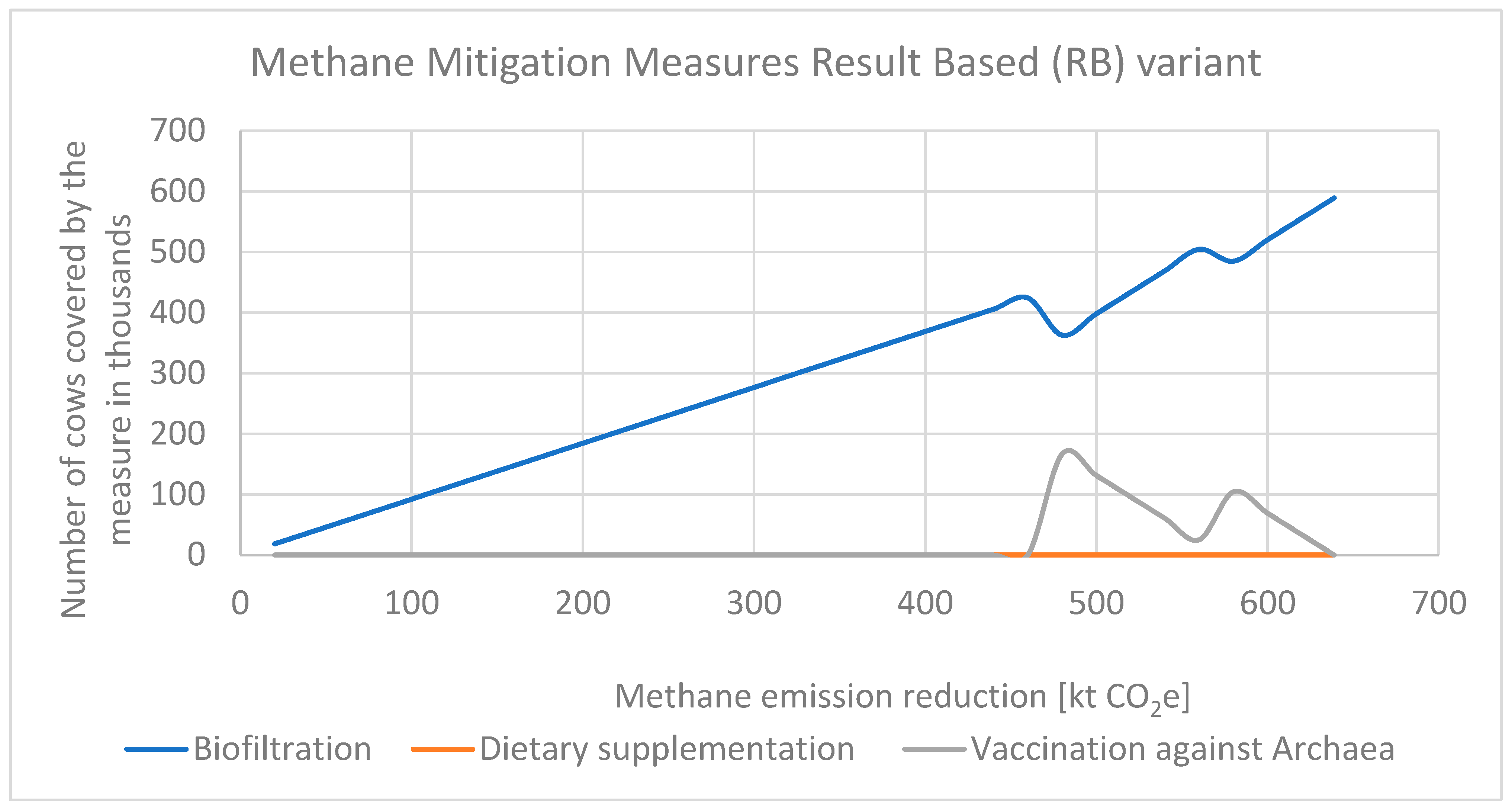
The optimal share of specific actions in model solutions differs between result-based and input-based contract types. In the case of RB contracts (Figure 7), biofiltration clearly dominates the optimal portfolios across all methane-reduction targets. This outcome is consistent with the relatively high mitigation effectiveness of biofiltration reported in the literature [48] and with the comparatively favourable acceptance of this measure among farmers observed in the DCE results. Vaccination against Archaea enters the optimal solution only at higher ambition levels when the mitigation potential of biofiltration becomes insufficient. In contrast, dietary supplementation does not appear in the optimal portfolios under RB contracts, reflecting its comparatively lower mitigation effectiveness per cow under the assumed parameters.
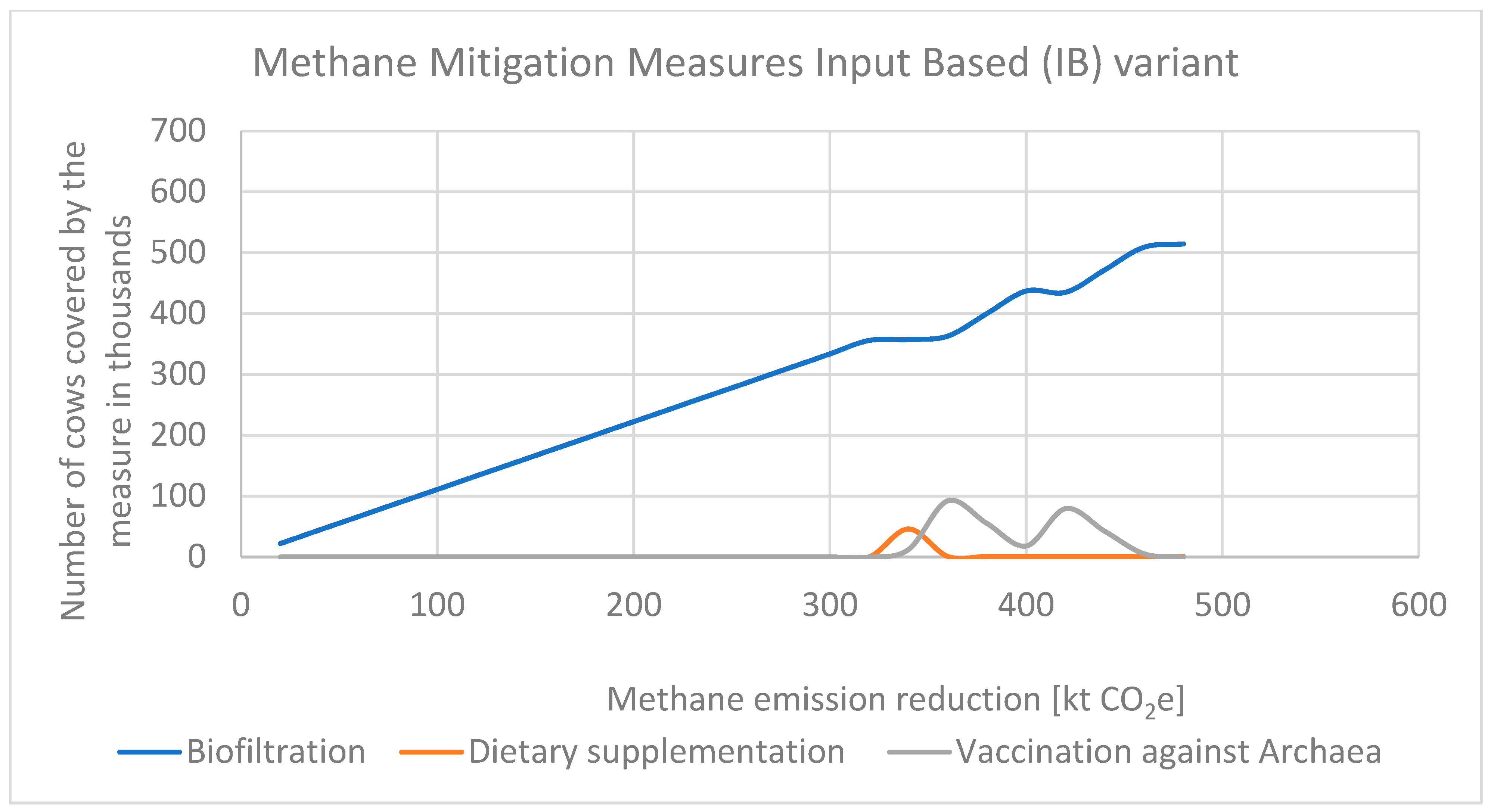
In the case of IB type contracts, the overall pattern of the optimal actions is similar to the pattern characterising RB contracts (Figure 8). Biofiltration is also the dominating action. However, it can be observed that when the maximum biofiltration potential is reached at the lowest payment rates, both other actions are included in the optimal solution. This occurs at the methane emission reduction level of 340 kt CO2e.

4. Discussion

4.1. Interpretation of Farmers’ Preferences

The results indicate that farmers’ preferences are shaped not only by economic incentives but also by behavioural and attitudinal factors, which is consistent with previous findings in agri-environmental policy research.
The strong adverse effect of vaccination against Archaea suggests substantial resistance to biological mitigation measures. Similar patterns have been observed in studies examining the adoption of novel or less familiar agricultural technologies, where perceived risk and uncertainty reduce uptake [11,49]. Farmers tend to be more cautious toward interventions perceived as potentially affecting herd health or productivity, especially when long-term effects are uncertain. Ethical considerations and trust in innovation systems may further influence acceptance of biotechnology-related measures.
In contrast, dietary supplementation did not significantly affect preferences, suggesting greater familiarity with feed-based management tools. Prior research suggests that familiarity and perceived compatibility with existing farm practices increase the likelihood of adoption [11]. This difference between vaccination and supplementation supports the interpretation that technological familiarity moderates mitigation choices.
The negative coefficient for input-based payment schemes aligns with previous evidence that farmers often prefer more flexible, outcome-oriented contracts. Studies on agri-environmental schemes indicate that excessive monitoring and administrative complexity reduce participation rates [21,50]. Result-based approaches are often perceived as granting greater autonomy and recognising farmers’ expertise, thereby strengthening intrinsic motivation and trust in policy instruments.
Environmental attitudes emerged as a decisive factor. Farmers who perceived no need for agri-environmental and climate measures were significantly less likely to accept contracts, while those acknowledging methane’s environmental impact showed greater acceptance. This finding is consistent with the literature emphasising the importance of environmental awareness and pro-environmental values in shaping participation decisions [11,49]. The results suggest that financial incentives alone may not compensate for weak problem recognition.
Structural characteristics further influenced preferences. The positive interaction between contract duration and the presence of a successor indicates that long-term commitment becomes more attractive when farmers have a longer planning horizon. This supports earlier findings that farm continuity and intergenerational considerations increase engagement in long-term environmental schemes [50].
Overall, the findings confirm that participation in methane mitigation contracts is not purely an economic decision. Perceived technological risk, environmental beliefs, trust in contract design, and farm-level planning horizons jointly shape farmers’ choices. These results reinforce calls in the literature to integrate behavioural insights into the design of agri-environmental and climate policies.

4.2. Optimisation Results and Policy Design Implications

The optimisation stage extends the DCE evidence by translating estimated participation probabilities into feasible policy portfolios under a fixed public budget and a required emission-reduction target. The key contribution of this stage is that it makes explicit how behavioural acceptance interacts with technical abatement potential and programme costs: the least-cost portfolio is not simply an engineering ranking of measures, but a behaviourally constrained abatement pathway. This perspective is essential for policy design because measures with high technical potential may remain non-scalable if predicted uptake is limited, while seemingly less “ideal” measures may enter the portfolio when preferred options are exhausted at given incentive levels.
Across both contract types, biofiltration emerges as the backbone measure in the optimal portfolios. This dominance reflects its high assumed mitigation effectiveness per cow and a comparatively favourable acceptance profile. As reduction targets become more ambitious, the model increasingly relies on scaling up the dominant measure by increasing payment rates. This pattern implies that deep methane mitigation is unlikely to be achieved solely through a broad menu of low-to-moderate incentives; instead, it requires either more substantial incentives for high-impact measures or institutional innovations that raise participation at existing payment levels (e.g., advisory support, simplification, credible measurement procedures).
The role of vaccination is particularly informative when interpreted alongside the DCE results. Given the strong disutility for vaccination, its appearance in optimal portfolios at higher ambition levels should not be read as a straightforward endorsement of this measure. Rather, vaccination functions as a marginal abatement option that becomes relevant when additional reductions cannot be achieved through biofiltration at the current payment rate due to participation constraints. This highlights a potential ambition–acceptance gap: if policy targets exceed what high-acceptance measures can deliver within acceptable budgets, the programme may become increasingly dependent on interventions that face behavioural resistance, jeopardising implementation, credibility, and political feasibility.
Dietary supplementation displays a different pattern in the optimisation results. In the RB scenario, feed additives do not enter the optimal portfolios across the considered methane-reduction targets. This outcome reflects their comparatively lower assumed abatement potential per cow relative to alternative measures such as biofiltration, whose effectiveness has been documented in the literature [48]. From a policy perspective, this does not necessarily imply that feed additives are irrelevant; rather, they may still play a complementary or transitional role—supporting early engagement, learning, and incremental reductions—while deeper mitigation requires measures with higher per-cow effectiveness or broader scalability. A critical issue raised by the optimisation outcomes concerns inclusiveness. Although result-based contracts may achieve higher maximum emission reductions in the model, they may also generate distributional concerns by relying more strongly on larger farms. This tendency is consistent with the interaction between fixed (per-farm) transaction and monitoring costs and the logic of least-cost allocation: where administrative costs include a fixed component, enrolling fewer large farms can minimise costs per tonne of reduction, while smaller and medium-sized farms face a relatively higher cost burden per unit of mitigation and may experience greater exposure to performance and compliance risk.
This outcome is particularly relevant for policy design under CAP principles, where fairness and broad accessibility are core objectives. The results therefore point to a practical message: result-based schemes may be environmentally attractive, but they require equity-oriented design to avoid structural marginalisation of smaller farms. Several design solutions follow directly from the mechanisms highlighted by the model: (i) differentiated scheme variants or tiered payment rates that compensate for fixed-cost disadvantages of smaller farms or offer simplified participation conditions; (ii) collective or cooperative contracts that allow farms to pool participation and share monitoring and contracting costs; (iii) simplified, risk-based monitoring and verification protocols (including the use of proxy indicators or digital reporting) to reduce fixed administrative burdens while maintaining credibility. In addition, targeted advisory support and risk-sharing arrangements can help smaller holdings participate without disproportionate uncertainty and compliance costs.
Taken together, the combined DCE–optimisation approach suggests that reaching ambitious methane-reduction targets requires not only appropriate incentive levels but also an implementation strategy that treats acceptability, monitoring capacity, and inclusiveness as design parameters rather than as fixed constraints.

4.3. Limitations and Robustness Considerations

The optimisation results should be interpreted in light of several assumptions that affect quantitative outcomes and, in some cases, the composition of the optimal portfolios.
First, methane-abatement coefficients per cow were taken as fixed parameters for each action and contract type. In practice, mitigation effectiveness can vary across farms due to differences in herd management, baseline performance, and implementation quality. In addition, the analysis represents incentive differences between result-based and input-based contracts by assuming lower average effectiveness under input-based schemes. While the direction of this assumption is consistent with standard incentive arguments, the exact magnitude is uncertain. Consequently, the optimisation should be interpreted primarily as a decision-support tool that explores relative performance under plausible parameterisation rather than as a precise forecast of realised abatement.
Second, transaction and monitoring costs were represented by stylised cost schedules with per-farm and per-cow components. Because per-farm costs create scale economies, this structure can mechanically favour enrolling larger farms earlier in least-cost allocations, especially under more monitoring-intensive arrangements. This feature also relates directly to the distributional concern highlighted above: the tendency to prioritise large farms partly reflects the assumed administrative setting rather than an unavoidable property of result-based contracting. Institutional alternatives—such as collective contracting, differentiated monitoring intensity, or simplified verification for smaller holdings—could reduce fixed costs and alter both cost-effectiveness and inclusiveness outcomes.
Third, participation probabilities derived from the DCE were used as upper bounds on enrolment shares, ensuring behavioural feasibility but assuming that stated preferences translate into actual uptake at similar rates. Real-world participation may differ due to information constraints, learning and experience effects, liquidity limitations, peer influences, and administrative burden. The optimisation also does not explicitly model capacity constraints (e.g., technology supply, advisory services, monitoring resources) that could become binding at scale and affect both costs and achievable reductions.
Finally, the optimisation was conducted on a reduced set of MMM designs, assuming that each action can be supported by only one payment rate at a time. This reflects realistic policy constraints but limits flexibility relative to targeted or differentiated instruments (e.g., tailoring rates by farm type, region, or baseline emissions). Allowing for such targeting could improve both cost-effectiveness and fairness, particularly if distributional objectives are explicitly incorporated into the policy design.
Overall, these limitations mainly influence the magnitude of achievable reductions and the precise switching points between measures and payment levels. The qualitative insights are more robust: ambitious mitigation is jointly constrained by technical potential and behavioural feasibility; transaction-cost structures can shape both efficiency and equity outcomes; and deep reductions are likely to require either higher incentives for high-impact measures or institutional innovations that lower administrative burdens and broaden participation.

5. Conclusions

This study combined a discrete-choice experiment with a behaviourally constrained optimisation framework to assess dairy farmers’ acceptance of methane mitigation measures and identify cost-efficient policy configurations from a taxpayer perspective. Beyond the empirical results, the paper advances a policy-design construct in which agri-environmental measures are formulated based on quantitatively elicited farmer perceptions and participation probabilities, rather than assuming uniform or purely technical adoption. By embedding these behavioural parameters directly into the optimisation model, the framework treats farmers’ preferences as structural inputs to the policy design process. The results indicate that both contract types can contribute to methane mitigation, but their effectiveness differs once farmers’ behavioural responses are taken into account. While result-based (RB) contracts allow for higher achievable methane reductions under the adopted assumptions, input-based (IB) schemes may reach participation limits that constrain scalability. The optimisation results also highlight the dominant role of biofiltration in cost-efficient mitigation portfolios, while other measures enter the optimal solutions only when mitigation targets become more ambitious. Future research should further test the robustness and transferability of this preference-informed policy framework under alternative technical and institutional settings, explore a broader spectrum of methane mitigation strategies, and assess their applicability and acceptability across dairy farms of different scales and organisational structures to support the development of more flexible, inclusive, and effective agri-environmental policies capable of maximising methane reduction in the sector.

Supplementary Materials

The following supporting information can be downloaded at: https://www.mdpi.com/article/10.3390/su18062702/s1, Survey Form (English Translation); Table S1: Attribute-Level Matrix for All 36 Choice Cards, Table S2: Parameters for the objective function in the optimisation model.

Author Contributions

Conceptualisation, A.W., E.M. and D.V.; methodology, A.W. and P.K.; software, P.K. and G.R.; validation, A.W. and E.M.; formal analysis, P.K. and A.W.; investigation, A.W., P.K. and E.M.; resources, E.M.; data curation, A.W., P.K. and G.R.; writing—original draft preparation, E.M., P.K. and A.W.; writing—review and editing, E.M., D.V., P.K. and A.W.; visualisation, P.K. and G.R.; supervision, E.M. and D.V.; project administration, E.M. and D.V.; funding acquisition, E.M. and D.V. All authors have read and agreed to the published version of the manuscript.

Funding

The research was performed within the CONSOLE project, CONtract SOLutions, for Effective and lasting delivery of agri-environmental-climate public goods by EU agriculture and forestry, funded by the European Union, Horizon 2020 Programme. Grant Agreement number. 817949; https://console-project.eu (accessed on 18 January 2026).

Institutional Review Board Statement

This study is waived for ethical review based on the documented characteristics of the study, including its anonymous and non-interventional nature by Institution Committee.

Informed Consent Statement

Informed consent for participation was obtained from all subjects involved in the study.

Data Availability Statement

The original data presented in the study are openly available in [Horizon Europe 676 CONSOLE project] at [https://zenodo.org/records/7228611] (accessed on 18 January 2026).

Acknowledgments

During the preparation of this manuscript, the authors used Grammarly version 1.2.239.1849 (Grammarly, Inc.) for language editing and improvement of clarity and style. The authors reviewed and edited the output and take full responsibility for the content of this publication.

Conflicts of Interest

The authors declare no conflicts of interest. The funders had no role in the design of the study, in the collection, analysis, or interpretation of data, in the writing of the manuscript, or in the decision to publish the results.

Abbreviations

The following abbreviations are used in this manuscript:
GHGGreenhouse Gases
DCEDiscrete Choice Experiment
MMMMethane Mitigation Measure
AECMAgri Environmental Climate Measure
RBResult-Based
IBInput-Based
CO2eequivalent of Carbon dioxide

References

  1. Stocker, T.F.; Qin, D.; Plattner, G.-K.; Tignor, M.M.B.; Allen, S.K.; Boschung, J.; Nauels, A.; Xia, Y.; Bex, V.; Midgley, P.M. Climate Change 2013: The Physical Science Basis. Contribution of Working Group I to the Fifth Assessment Report of the Intergovern Mental Panel on Climate Change; IPCC: Cambridge, UK; New York, NY, USA, 2013. [Google Scholar]
  2. European Commission. The European Green Deal; COM(2019) 640 Final; European Commission: Brussels, Belgium, 2019.
  3. European Commission. Farm to Fork Strategy; COM(2020) 381 Final; European Commission: Brussels, Belgium, 2020.
  4. European Commission. Stepping Up Europe’s 2030 Climate Ambition—Climate Target Plan 2030; COM(2020) 562 Final; European Commission: Brussels, Belgium, 2020.
  5. European Commission. Working Group III Contribution to the Sixth Assessment Report of the Intergovernmental Panel on Climate Change Mitigation of Climate Change; European Commission: Brussels, Belgium, 2022.
  6. United Nations. Ministry of Climate and Environment Poland’s National Inventory Report 2022 Greenhouse Gas Inventory for 1988–2020; United Nations: Warsaw, Poland, 2022. [Google Scholar]
  7. Shefali, S. Climate: A Lighter Hoofprint. Available online: https://eu.boell.org/en/2021/09/07/climate-lighter-hoofprint (accessed on 18 January 2026).
  8. Bartolini, F.; Vergamini, D.; Longhitano, D.; Povellato, A. Do Differential Payments for Agri-Environment Schemes Affect the Environmental Benefits? A Case Study in the North-Eastern Italy. Land Use Policy 2021, 107, 104862. [Google Scholar] [CrossRef]
  9. Bonvillain, T.; Foucherot, C.; Bellassen, V. Will the Obligation of Environmental Results Green the CAP? A Comparison of the Costs and Effectiveness of Six Instruments for the Transition to Sustainable Agriculture; Institute for Climate Economics: Paris, France, 2020. [Google Scholar]
  10. Espinosa-Goded, M.; Barreiro-Hurlé, J.; Ruto, E. What Do Farmers Want from Agri-Environmental Scheme Design? A Choice Experiment Approach. J. Agric. Econ. 2010, 61, 259–273. [Google Scholar] [CrossRef]
  11. Dessart, F.J.; Barreiro-Hurlé, J.; Van Bavel, R. Behavioural Factors Affecting the Adoption of Sustainable Farming Practices: A Policy-Oriented Review. Eur. Rev. Agric. Econ. 2019, 46, 417–471. [Google Scholar] [CrossRef]
  12. Simoncini, R.; Ring, I.; Sandström, C.; Albert, C.; Kasymov, U.; Arlettaz, R. Constraints and Opportunities for Mainstreaming Biodiversity and Ecosystem Services in the EU’s Common Agricultural Policy: Insights from the IPBES Assessment for Europe and Central Asia. Land Use Policy 2019, 88, 104099. [Google Scholar] [CrossRef]
  13. Coderoni, S.; Esposti, R. CAP Payments and Agricultural GHG Emissions in Italy. A Farm-Level Assessment. Sci. Total Environ. 2018, 627, 427–437. [Google Scholar] [CrossRef] [PubMed]
  14. United Nations. European Court of Auditors Special Report Biodiversity on Farmland: CAP Contribution Has Not Halted the Decline; United Nations: Luxembourg, 2020. [Google Scholar]
  15. Navarro, A.; López-Bao, J.V. Towards a Greener Common Agricultural Policy. Nat. Ecol. Evol. 2018, 2, 1830–1833. [Google Scholar] [CrossRef] [PubMed]
  16. Pe’er, G.; Bonn, A.; Bruelheide, H.; Dieker, P.; Eisenhauer, N.; Feindt, P.H.; Hagedorn, G.; Hansjürgens, B.; Herzon, I.; Lomba, Â.; et al. Action Needed for the EU Common Agricultural Policy to Address Sustainability Challenges. People Nat. 2020, 2, 305–316. [Google Scholar] [CrossRef]
  17. Herzon, I.; Birge, T.; Allen, B.; Povellato, A.; Vanni, F.; Hart, K.; Radley, G.; Tucker, G.; Keenleyside, C.; Oppermann, R.; et al. Time to Look for Evidence: Results-Based Approach to Biodiversity Conservation on Farmland in Europe. Land Use Policy 2018, 71, 347–354. [Google Scholar] [CrossRef]
  18. Matzdorf, B.; Lorenz, J. How Cost-Effective Are Result-Oriented Agri-Environmental Measures?—An Empirical Analysis in Germany. Land Use Policy 2010, 27, 535–544. [Google Scholar] [CrossRef]
  19. Wuepper, D.; Huber, R. Comparing Effectiveness and Return on Investment of Action- and Results-Based Agri-Environmental Payments in Switzerland. Am. J. Agric. Econ. 2022, 104, 1585–1604. [Google Scholar] [CrossRef]
  20. Matzdorf, B.; Kaiser, T.; Rohner, M.S. Developing Biodiversity Indicator to Design Efficient Agri-Environmental Schemes for Extensively Used Grassland. Ecol. Indic. 2008, 8, 256–269. [Google Scholar] [CrossRef]
  21. Burton, R.J.F.; Schwarz, G. Result-Oriented Agri-Environmental Schemes in Europe and Their Potential for Promoting Behavioural Change. Land Use Policy 2013, 30, 628–641. [Google Scholar] [CrossRef]
  22. Bertke, E.; Klimek, S.; Wittig, B. Developing Result-Orientated Payment Schemes for Environmental Services in Grasslands: Results from Two Case Studies in North-Western Germany. Biodiversity 2008, 9, 91–95. [Google Scholar] [CrossRef]
  23. Klimek, S.; Richter gen. Kemmermann, A.; Steinmann, H.H.; Freese, J.; Isselstein, J. Rewarding Farmers for Delivering Vascular Plant Diversity in Managed Grasslands: A Transdisciplinary Case-Study Approach. Biol. Conserv. 2009, 141, 2888–2897. [Google Scholar] [CrossRef]
  24. Johnson, K.A.; Johnson, D.E. Methane Emissions from Cattle. J. Anim. Sci. 1995, 73, 2483–2492. [Google Scholar] [CrossRef] [PubMed]
  25. Beauchemin, K.A.; Kreuzer, M.; O’Mara, F.; McAllister, T.A. Nutritional Management for Enteric Methane Abatement: A Review. Aust. J. Exp. Agric. 2008, 48, 21–27. [Google Scholar] [CrossRef]
  26. Hristov, A.N.; Oh, J.; Firkins, J.L.; Dijkstra, J.; Kebreab, E.; Waghorn, G.; Makkar, H.P.S.; Adesogan, A.T.; Yang, W.; Lee, C.; et al. Special Topics--Mitigation of Methane and Nitrous Oxide Emissions from Animal Operations: I. A Review of Enteric Methane Mitigation Options. J. Anim. Sci. 2013, 91, 5045–5069. [Google Scholar] [CrossRef]
  27. Grainger, C.; Beauchemin, K.A. Can Enteric Methane Emissions from Ruminants Be Lowered without Lowering Their Production? Anim. Feed Sci. Technol. 2011, 166–167, 308–320. [Google Scholar] [CrossRef]
  28. Patra, A.K. The Effect of Dietary Fats on Methane Emissions, and Its Other Effects on Digestibility, Rumen Fermentation and Lactation Performance in Cattle: A Meta-Analysis. Livest. Sci. 2013, 155, 244–254. [Google Scholar] [CrossRef]
  29. Choudhury, P.K.; Jena, R.; Tomar, S.K.; Puniya, A.K. Reducing Enteric Methanogenesis through Alternate Hydrogen Sinks in the Rumen. Methane 2022, 1, 320–341. [Google Scholar] [CrossRef]
  30. Yang, C.; Rooke, J.A.; Cabeza, I.; Wallace, R.J. Nitrate and Inhibition of Ruminal Methanogenesis: Microbial Ecology, Obstacles, and Opportunities for Lowering Methane Emissions from Ruminant Livestock. Front. Microbiol. 2016, 7, 172645. [Google Scholar] [CrossRef]
  31. Russell, J.B.; Houlihan, A.J. Ionophore Resistance of Ruminal Bacteria and Its Potential Impact on Human Health. FEMS Microbiol. Rev. 2003, 27, 65–74. [Google Scholar] [CrossRef]
  32. Wedlock, D.N.; Pedersen, G.; Denis, M.; Buddle, B.M.; Dey, D.; Janssen, P.H. Development of a Vaccine to Mitigate Greenhouse Gas Emissions in Agriculture: Vaccination of Sheep with Methanogen Fractions Induces Antibodies That Block Methane Production in Vitro. N. Z. Vet. J. 2010, 58, 29–36. [Google Scholar] [CrossRef]
  33. Newbold, C.J.; Ramos-Morales, E. Review: Ruminal Microbiome and Microbial Metabolome: Effects of Diet and Ruminant Host. Animal 2020, 14, 78–86. [Google Scholar] [CrossRef]
  34. Subharat, S.; Shu, D.; Zheng, T.; Buddle, B.M.; Janssen, P.H.; Luo, D.; Wedlock, D.N. Vaccination of Cattle with a Methanogen Protein Produces Specific Antibodies in the Saliva Which Are Stable in the Rumen. Vet. Immunol. Immunopathol. 2015, 164, 201–207. [Google Scholar] [CrossRef]
  35. Melse, R.W.; Van Der Werf, A.W. Biofiltration for Mitigation of Methane Emission from Animal Husbandry. Environ. Sci. Technol. 2005, 39, 5460–5468. [Google Scholar] [CrossRef] [PubMed]
  36. National Hog Farmer Bacteria Reduce Pig Farm Methane Emissions. Available online: https://www.dtu.dk/english/newsarchive/2024/12/bacteria-reduce-pig-farm-methane-emissions (accessed on 18 January 2026).
  37. Wamberg Broch, S.; Elizabeth Vedel, S.; Broch, S.W.; Vedel Forest, S.E.; Vedel, S.E. Using Choice Experiments to Investigate the Policy Relevance of Heterogeneity in Farmer Agri-Environmental Contract Preferences. Environ. Resour. Econ. 2012, 51, 561–581. [Google Scholar] [CrossRef]
  38. Van Zijderveld, S.M.; Gerrits, W.J.J.; Dijkstra, J.; Newbold, J.R.; Hulshof, R.B.A.; Perdok, H.B. Persistency of Methane Mitigation by Dietary Nitrate Supplementation in Dairy Cows. J. Dairy Sci. 2011, 94, 4028–4038. [Google Scholar] [CrossRef] [PubMed]
  39. Black, J.L.; Davison, T.M.; Box, I.; Black, J.L.; Davison, T.M.; Box, I. Methane Emissions from Ruminants in Australia: Mitigation Potential and Applicability of Mitigation Strategies. Animals 2021, 11, 951. [Google Scholar] [CrossRef]
  40. Rose, J.M.; Bliemer, M.C.J. Constructing Efficient Stated Choice Experimental Designs. Transp. Rev. 2009, 29, 587–617. [Google Scholar] [CrossRef]
  41. Ferrini, S.; Scarpa, R. Designs with a Priori Information for Nonmarket Valuation with Choice Experiments: A Monte Carlo Study. J. Environ. Econ. Manag. 2007, 53, 342–363. [Google Scholar] [CrossRef]
  42. Meyer, R.K.; Nachtsheim, C.J. The Coordinate-Exchange Algorithm for Constructing Exact Optimal Experimental Designs. Technometrics 1995, 37, 60–69. [Google Scholar] [CrossRef]
  43. Traets, F.; Sanchez, D.G.; Vandebroek, M. Generating Optimal Designs for Discrete Choice Experiments in R: The Idefix Package. J. Stat. Softw. 2020, 96, 1–41. [Google Scholar] [CrossRef]
  44. Overview—NUTS—Nomenclature of Territorial Units for Statistics—Eurostat. Available online: https://ec.europa.eu/eurostat/web/nuts (accessed on 21 February 2026).
  45. Train, K.E. Discrete Choice Methods with Simulation, 2nd ed.; Cambridge University Press: Cambridge, UK, 2009; pp. 1–388. ISBN 9780521766555. [Google Scholar] [CrossRef]
  46. McFadden, D. Conditional Logit Analysis of Qualitative Choice Behavior. In Economic Theory and Mathematical Economics; Zarembka, P., Ed.; Clanrye International: New York, NY, USA, 1974; pp. 105–142. [Google Scholar]
  47. R Foundation for Statistical Computing. R: A Language and Environment for Statistical Computing; R Foundation for Statistical Computing: Vienna, Austria, 2018. [Google Scholar]
  48. Fedrizzi, F.; Cabana, H.; Ndanga, É.M.; Cabral, A.R. Biofiltration of Methane from Cow Barns: Effects of Climatic Conditions and Packing Bed Media Acclimatization. Waste Manag. 2018, 78, 669–676. [Google Scholar] [CrossRef]
  49. Greiner, R.; Gregg, D. Farmers’ Intrinsic Motivations, Barriers to the Adoption of Conservation Practices and Effectiveness of Policy Instruments: Empirical Evidence from Northern Australia. Land Use Policy 2011, 28, 257–265. [Google Scholar] [CrossRef]
  50. Mettepenningen, E.; Verspecht, A.; van Huylenbroeck, G. Measuring Private Transaction Costs of European Agri-Environmental Schemes. J. Environ. Plan. Manag. 2009, 52, 649–667. [Google Scholar] [CrossRef]
Figure 1. Framework for Maximising Environmental Outcomes within a Fixed Budget. Source: own elaboration.
Sustainability 18 02702 g001
Figure 2. Conceptual Structure of the Preference-Based Policy Optimisation Framework. Source: own elaboration.
Sustainability 18 02702 g002
Figure 3. Costs and performance of methane emission reduction in Result-Based and Input-Based MMMs. Source: own calculations.
Sustainability 18 02702 g003
Figure 4. The number of farms participating in MMMs. Source: own calculations.
Sustainability 18 02702 g004
Figure 5. Number of cows in farms participating in MMMs. Source: own calculations.
Sustainability 18 02702 g005
Figure 6. Average herd size in farms participating in MMMs. Source: own calculations.
Sustainability 18 02702 g006
Figure 7. Number of cows in farms participating in Result-Based MMMs. Source: own calculations.
Sustainability 18 02702 g007
Figure 8. Number of cows in farms participating in Input-Based MMMs. Source: own calculations.
Sustainability 18 02702 g008
Table 1. Characteristics of DCE attributes and levels.
AttributeLevels
Type of actionDietary supplementation (feed additive)
Vaccination against Archaea (vaccination)
Biofilters (biofiltration)
Type of contractInput-Based—fixed payment (IB)
Result-Based—payment based on effect (RB)
Contract duration1 year
5 years
10 years
Amount of subsidiesA—80 EUR/t CO2e (level A)
B—120 EUR/t CO2e (level B)
C—200 EUR/t CO2e (level C)
Source: Own assumptions.
Table 2. Example of DCE choice set.
Alternative 1Alternative 2NO choice
Type of actionDietary supplementationBiofilters
Type of contractresult-based paymentconstant payment
Contract duration1 year10 years
Amount of subsidies70–200
PLN/cow/year *
860
PLN/cow/year
* rates in EUR converted to PLN (Polish zloty, the currency used in Poland) in the survey questionnaire. Source: Own calculations based on idefix: package.
Table 3. Allocation of assumed transaction costs to designed MMMs.
Contract TypeResult BasedInput Based
Contract period [years]15101510
Costs of concluding the contract [PLN/farmer/year]40080402004020
Farm control costs [PLN/cow/year]202020555
Farm control costs [PLN/farm/year]100100100100100100
Source: Own assumptions based on budget data from the Agency for Restructuring and Modernisation of Agriculture (ARMA), the Polish national paying agency responsible for CAP implementation. https://www.gov.pl/web/arimr/koszty-transakcyjne26 (accessed 18 February 2026).
Table 4. Basic characteristics of the surveyed farms (N = 302).
VariableMeanMedianIQR (Q1–Q3)
Number of dairy cows453730–50
Milk yield (kg per cow per year)720073006000–9000
Farm area (ha)484025–60
Permanent grassland (ha)17.3147–22
Total farm labour (persons)2.732–3
Perceived probability of having a successor (0–1)0.3410–0.8
Perceived financial situation of the farmDifficultRather GoodGoodExcellent
12.6%32.9%48.8%5.7%
Perceived harmfulness of methane for the environment and climate1—very low2345—very high
28.6%21.6%23.6%18.6%7.6%
Source: Own calculations.
Table 5. Estimates of logit regression based on DCE results.
EstimateStd. Errorz Valuep-Value
(Intercept)0.79510.26792.9680.003
Action dietary supplementation 0.00260.21880.0120.991
Action Vaccination against Archaea −1.01940.2313−4.4060.000
Input Based payment scheme−0.38450.0791−4.8590.000
Contract period0.00630.01810.3510.726
Payment rate B0.53510.09905.4050.000
Payment rate C0.84380.09638.7630.000
Farmers’ perception—no need for AECM−1.53270.0960−15.9700.000
Dairy cows’ herd size−0.00030.0023−0.1090.913
Number of workers−0.16740.0480−3.4850.000
Farm financial standing−0.41780.0573−7.2930.000
Farmers’ perception—methane impact on the environment0.39800.039310.1170.000
Action dietary supplementation: contract period−0.08760.0244−3.5910.000
Action Vaccination against Archaea: contract period0.00290.02700.1090.913
Action dietary supplementation: dairy cow herd size−0.00850.0039−2.1810.029
Action Vaccination against Archaea: dairy cow herd size0.00040.00340.1200.904
Contract period: the presence of the farmers’ successor0.04900.01633.0050.003
Source: Own calculations, McFadden pseudo-R-square 0.23.
Disclaimer/Publisher’s Note: The statements, opinions and data contained in all publications are solely those of the individual author(s) and contributor(s) and not of MDPI and/or the editor(s). MDPI and/or the editor(s) disclaim responsibility for any injury to people or property resulting from any ideas, methods, instructions or products referred to in the content.