1. Introduction
Sustainability development education (SDE) is key to achieving Sustainable Development Goals (SDGs). Unlike environmental education, which focuses narrowly on environmental protection, natural resource management, and nature conservation, SDE is broader, encompassing socioeconomic, political, and cultural dimensions [
1]. It integrates sustainability-related content into the curriculum while creating interactive, learner-centred teaching and learning environments [
2,
3]. As a problem-based education method combining inter- and transdisciplinary approaches [
4], it employs action-oriented pedagogy to support collaborative, self-directed, and participatory learning, delivered in formal, non-formal, and informal ways.
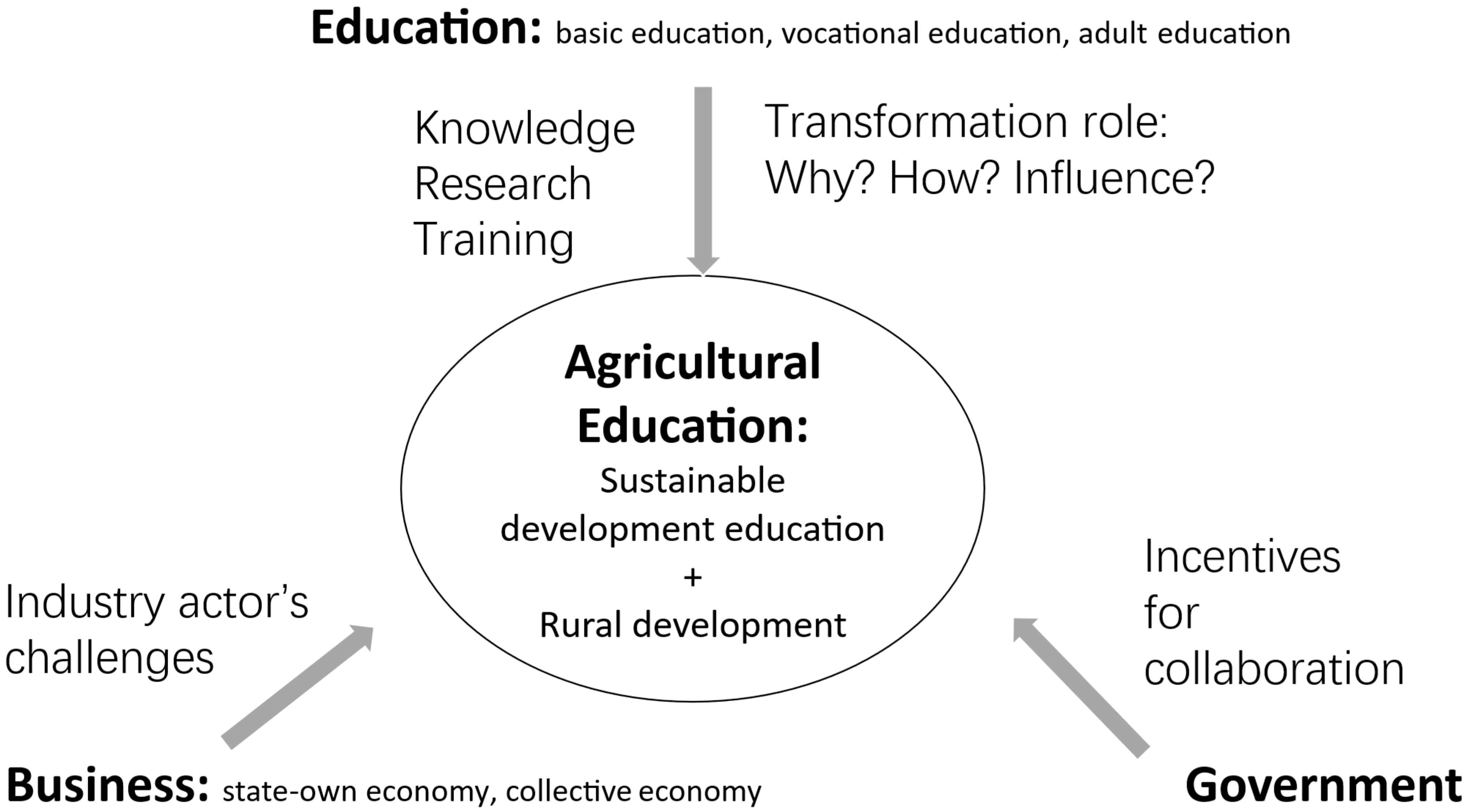
While facilitating and strengthening SDE is challenging, Etzkowitz and Leydesdorff’s triple helix model may be helpful for analysing the networking required to do so [
5]. The model examines the relationships among three stakeholder types—education, business, and government—that interact and collaborate within networks to transform knowledge and information into collective learning, thereby contributing to regional development [
6]. Industrial actors’ challenges are often the network’s focus and the rationale for its creation, while universities contribute new research, process knowledge, and mediation skills, and governments incentivise collaboration [
7,
8].
While most triple helix studies examine universities’ roles, few address the influence of basic education. For example, Australia’s Global Immersion Guarantee and the United States’ Youth Environmental Alliance in Higher Education (22–25) have developed collaborative networks that meet SDE goals while promoting intercultural learning among higher education institutions. In China, most universities are in urban areas, while rural areas have only basic education systems. However, in recent decades, China, recognising the problems caused by urban-centric development, has begun to focus on rural development and to promote sustainable development in school curricula, including agricultural education, creating a rich potential for collaboration among government, business, and basic education.
Rural China has traditionally respected intellectuals and involved them in rural management and development, viewing teachers as wise and knowledgeable [
9]. Thus, examining how rural basic education (along with local businesses and government) contributes to rural development could provide insights for China and other countries. The Chinese Communist Party (CCP), viewing rural education as vital to rural development, construction, and revitalisation [
10,
11], has, since 1985, pursued a “three-education coordinate model” in which rural basic, vocational, and adult education educators collaborate with local villages and governments for those purposes.
This echoes findings in the literature that education, schools, and teachers are major forces for social change, justice, and transformation [
12]. Teachers must invert hegemony and seek ways of “organising [educational] content and methods that build on the experience of the disadvantaged … [which] requires constructive intellectual work. This is not easy for disadvantaged groups … [as] most of the tools of the intellectual work are in other people’s hands” [
13]. Teachers could help produce and organise the knowledge of the socially subordinate [
14], while adding novel and unexpected ideas [
15].
Wright identified four interlinked components of social transformation: (1) social reproduction, (2) gaps and contradictions, (3) the trajectory of unintended social change, and (4) transformational strategies. While social reproduction aims to maintain the status quo, social transformation can occur when “cracks and openings” emerge in the system due to the “exposed limits and contradictions of reproduction”. Identifying and politicising gaps and contradictions can “open up spaces for transformative strategies” [
16].
Education’s transformative role is also addressed in SDE, which envisions a world in which everyone can benefit from quality education and learn the values, behaviours, and lifestyles required for a sustainable future and positive societal transformation [
17]. SDE views transformation roles and competencies as key to helping individuals participate in sociopolitical processes and transform society towards sustainable development [
18].
This study applied the triple helix model to understand how basic education, through its interactions with local government and businesses, contributed to rural and sustainable development within an agricultural education programme in Chongming District, Shanghai, China. The remaining sections are organised as follows.
Section 2 and
Section 3, respectively, review rural development in China and agricultural education and social transformation.
Section 4 describes the study’s methodology.
Section 5 and
Section 6 present and discuss the major findings.
Section 7 concludes the study.
4. Methods
4.1. Research Questions and Design
The study examined the role of out-of-school agricultural education in achieving SDGs and rural development through the following research questions:
- (1)
What motivates rural educators, local governments, and businesses to participate in out-of-school agricultural education programmes?
- (2)
What role do educators play in transforming the network?
- (3)
What are stakeholders’ opinions of how the agricultural education programme has influenced the rural region?
A case study examined the triple helix collaboration between the local education bureau, schoolteachers, an agricultural company (G Company), and the collective economy of a rural village (S Village) (In China, most villages collectively develop the village’s economy. All income created by the collective economy belonged to all villagers. It is a special enterprise.) in Shanghai’s Chongming District. A qualitative methodology was selected, involving observing agricultural education sites, collecting related documents, and interviewing stakeholders in the agricultural education programme. Case studies investigate the complex dynamics and unfolding interactions of events and human relationships in unique instances and penetrate situations that are not always susceptible to numerical analysis [
41].
4.2. Sampling Strategy and Programme Context
The case in this study was carefully selected to augment the generalisability of the findings for theory building, enhancing the study’s external validity. Case selection was based on variables identified in the extant literature to reflect the roles of business, government, education, and programme stakeholders.
The triple collaboration established out-of-school agricultural education sites, developed agricultural education curricula, and delivered agricultural education to students in Chongming, beginning in early 2022. Three people from the local education bureau (B01, B02, and B03) and seven teachers from local basic and adult education schools (T01, T02, etc.) joined G Company and S Village in constructing agricultural education sites and developing curricula.
G Company—a state-owned agricultural enterprise whose core products include milk, rice, pork, vegetables, candies, honey, and wine—ranks among the top 500 enterprises in China. Echoing the PRC’s emphasis on “craftsman spirit education,” it introduced K-12 students to stories of role-model agricultural craftsmen and provided some 50 km2 of farmland for Chongming District students’ out-of-school agricultural education sites in 2022.
S Village is 30 km from Shanghai’s municipal core and 15 km from J Ship Factory, which had already established a national-level agricultural education site at the time of this study. S Village has over 700 households with more than 1700 residents. Its main crop is oranges, with groves occupying 68.5% of village land (1563 mu (1 mu = 0.0667 hectare)). Recently classified as a “Chongming District-level rural revitalisation model,” S Village was selected by its town-level government to build an agricultural education site in 2022. Two village heads took charge of the site, making decisions on facilities, housing, and land provision, and liaising with the local education bureau, schools, enterprises, and villagers to design learning programmes and attract students. Education bureaus paid for students’ agricultural education in S Village. Villagers were recruited and paid based on their programme contributions, such as hours worked and the provision of their houses as teaching sites. As a collective economy, the village keeps the rest of the money earned.
At the time of this study, S Village’s agriculture education programme involved 50 families (about 150 villagers) as agricultural education specialists. Some 13,000 students enrolled in the programme, with the Shanghai government paying their out-of-school education fees, increasing each participating family’s annual income by about 70,000 yuan. Chongming’s education bureau also recommended S Village’s agriculture programmes to students in its and other districts.
4.3. Data Collection
To maximise effectiveness, the researchers designed an interview guideline based on the extant literature and sent drafts to S Village’s head, a local education bureau official, and two schoolteachers to seek their advice. The researchers used Mandarin (the medium of instruction in district schools) during the interviews; an assistant familiar with the local context and dialect accompanied the interviewers to improve communication and ensure interviews were conducted at the respondents’ language level.
Three people from the local education bureau (B01, B02, B03), seven local teachers (T01, T02, etc.), two people from G Company (G01, G02), and 14 people (12 agricultural education supervisors and two village leaders) from S Village (S01, S02, etc.) directly involved in agricultural education programmes were interviewed to explore why they joined the programme and how they understood its impact on rural development. The 12 villagers interviewed were the first volunteers to offer agricultural education services; except for one aged under 40, all were older than 60. The interviews (See
Table 1) were conducted after site visits between November and December 2022, averaging 30 min (see
Appendix A).
The researchers also observed the agricultural education sites provided by the interviewees or their village/company, recorded the learning environments with permission, and collected related learning materials. Teachers and Education Bureau officers were interviewed at agricultural education sites, and relevant documents were collected.
4.4. Ethics
This study was approved by the researchers’ university. Written informed consent was obtained from all participants, and all research was conducted in accordance with relevant guidelines. The strict use of pseudonyms protected the informants’ privacy. Access to the original data was limited to the researchers only.
4.5. Data Analysis
Immediately after each interview, a short memo was written, summarising the researcher’s impressions and the key points covered. The researchers translated the interview content from Chinese to English after each interview, consulting the recordings to ensure the notes were clear. All researchers were involved in the analysis, reading each interview transcript several times and identifying recurring patterns.
Data analysis is the process of bringing order, structure, and meaning to the mass of collected data [
42]. The interview data were read and subjected to two rounds of thematic analysis [
43].
In the first (deductive) round, the researchers created initial codes based on the analytic framework and interview questions—e.g., different stakeholders’ network motivations (e.g., industrial challenges) and contributions, programme development, influences, teachers’ transformation role, etc.—and used them in subsequent coding to ensure the findings were connected to the extant literature.
In the second (inductive) round, the researchers revisited the data and were open to new ideas; new codes emerged directly from the participants’ language, and iterative refinements were made. For example, a relevant new code was created when researchers noted that participants repeatedly mentioned the educator’s designated responsibility. Its definition differed from that of the transformation role, emphasising Chinese scholars’ tradition of taking responsibility for social improvement. For example, teachers reported, “This is the destination, I returned to my hometown 20 years ago. The responsibility is on my shoulders rather than the other people to develop our district.” The inductive approach added new knowledge and balanced the deductive findings.
All data were coded to identify core content, which was then grouped into different camps, with emerging themes grouped to generate explanations. The researchers examined the interview data for evidence, shared the patterns they had uncovered individually, discussed them at length, and then returned to the transcripts to follow up on each other’s findings. The data were analysed through a deliberate, iterative process of discussion, reflection, and reviewing transcripts until no new codes emerged and all new data fit neatly into the categories. Ten major themes emerged: rural development concerns; challenges caused by rural population loss; programme development; SDE content; network innovations; network motivation and contributions; network benefits for agricultural education; rural development; teachers’ increased network influence; and governments’ networking policies. Three final themes reflecting the intertwining of participants’ motivation, contributions, and the transformative roles of education in agricultural education will be reported in the following section. The data were collected between November 2022 and January 2023. Due to its limited sample size, this study makes no attempt to generalise its findings.
5. Major Findings
5.1. Stakeholders’ Different Decisions to Participate in Agricultural Education, Teachers Highlighting SDGs and Rural Development
Most interviewees viewed the out-of-school agricultural education programme as a good top-down strategy for Chongming’s sustainable rural development and social transformation. However, schoolteachers, local education bureau members, G Company, and S Village had different motivations for joining the programme, with schoolteachers highlighting its rural development function and alignment with SDGs.
Schoolteachers joined partly because their schools recommended them (based on their agricultural education knowledge and expertise) and partly because they were strongly motivated to facilitate rural development and social transformation. One stated, “I was born in a prosperous city, but more than ten years ago … my husband moved to Chongming. At that time, there was no bridge connecting Chongming to [other parts of] Shanghai. It took me hours to leave urban Shanghai, then a one-hour ferry. Then I arrived here. I cried when I saw the [desolate] island … years passed … I live here, work here. I wish the island could become more prosperous” (T01). Another stated that the “agricultural education programme is meaningful, we kept losing population, especially young people…look at our villages. they are all old people. Agricultural education programme here could attract young people to work in rural areas, to increase rural income. I felt we are doing things good and important” (T02).
The local education bureau joined to manage regional education development goals. One official stated, “Agricultural education is one of our district education bureau’s nine important tasks in 2022–2025 … to construct out-of-school agricultural education sites and develop their curriculum is our task” (B01). Another introduced Chongming’s tradition of agricultural education, saying, “we have to construct out-of-school agricultural sites with the society, like companies … they could put investment to improve the agricultural education quality” (B02).
G Company joined as part of a top-down initiative by the Shanghai municipal government. One company official reported, “This is our social responsibility … we have rich resources” (G01). Another explained that the “agricultural education program is also an important [potential income] opportunity for our company” (G02).
S Village joined the programme primarily due to its concerns about rural economic development. One S Village leader explained, “Due to the COVID-19 pandemic, my village’s income decreased … at the good times before, our village could give each resident (older than 60) 1,000 yuan at the end of the year … later, I learned about the out-of-school agricultural education site construction programme, I found it a good opportunity to develop our village” (S01). Villagers joined for economic reasons and to share their skills/culture with the youth. One suggested, “My daughter is in her 40s, and my grandson [who lives in the city] knows nothing about the skills I have mastered … I will be very glad to share these skills with the youth” (S04). Another said, while they did not expect high payment for teaching about agriculture, “Earning money at home, without travelling far away, is good” (S05).
5.2. Expansion of Stakeholders’ Roles in Agricultural Education Network, Teachers Involved Deeper for SDGs
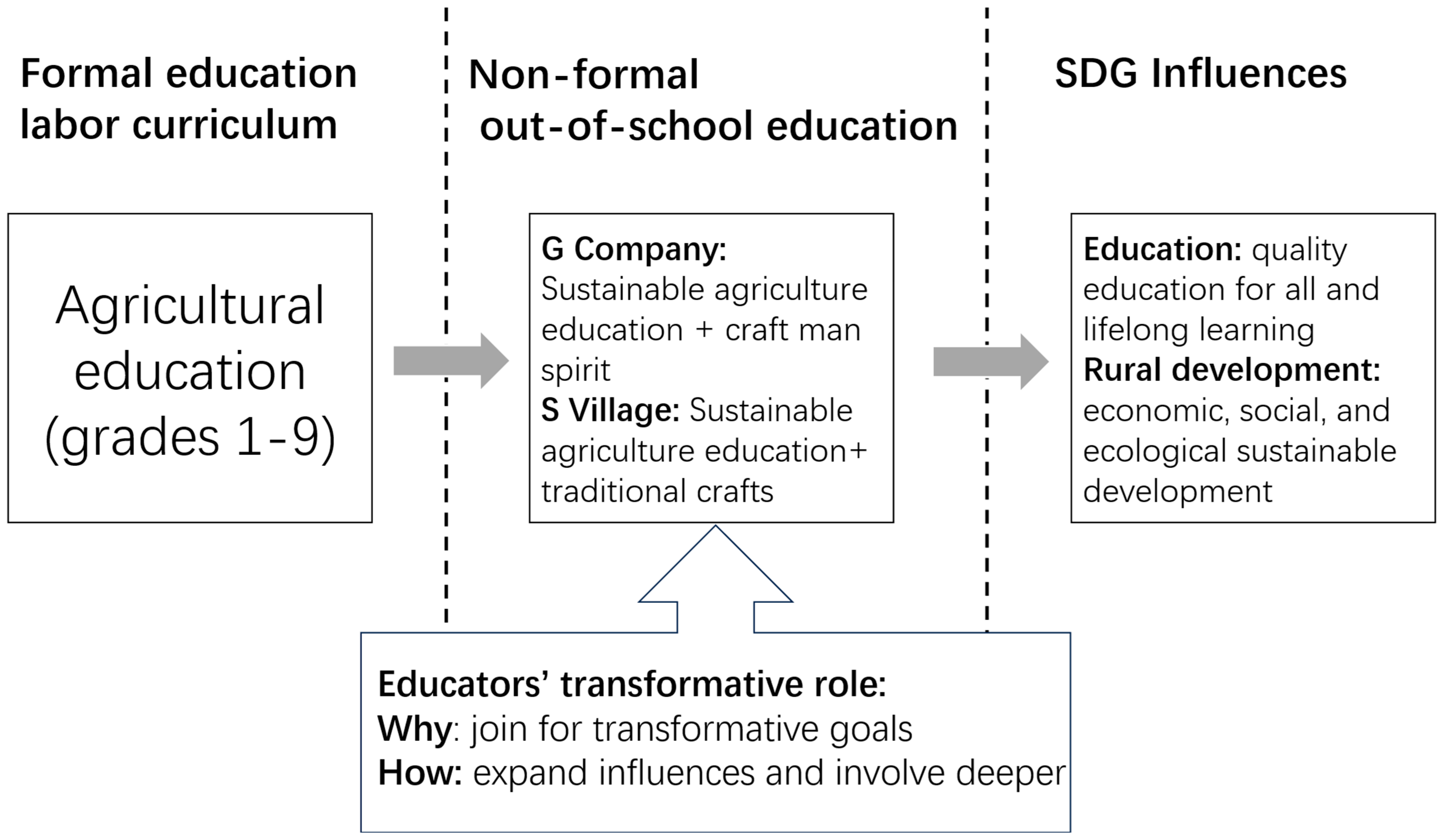
Chongming’s out-of-school agricultural education programme has undergone two rounds of change, creating a network among local government, teachers, and businesses, expanding stakeholder roles, and increasing human, material, and knowledge resources.
The first round began in early 2022, when G Company, at the behest of Shanghai’s municipal government, spoke with Chongming’s local education bureau about constructing out-of-school agricultural education sites. Later, seven teachers with expertise in agricultural education joined them, shaping the first round of triple collaboration.
The local education bureau regulated this round, communicating task requirements and overseeing G Company’s implementation of its assigned task. G Company was the funder, providing resources and people to construct the sites and develop the curriculum. One reported, “We have leading staff [who] gained master’s degrees in agricultural majors in the UK and the Netherlands [and] could work in agricultural education” (G01). However, G Company faced curriculum development difficulties and needed support; “Despite our staff’s knowledge in agricultural science, we know little about education. It’s very different” (G02). The local education bureau sought support from schools, after which seven teachers were invited to join the programme to support curriculum development. At the end of the first round, G Company provided 10 agricultural education courses in its agricultural labs, farms, and kitchens, and constructed a 1000-bed camp for participating students.
The second round began in September 2022, with the local education bureau, S Village, and the seven teachers from the first round forming the agricultural education site construction team.
The local education bureau’s previous regulatory role morphed into establishing a wider network (agricultural education cluster) of teachers, government, and villages to develop an agricultural education site and connect it to neighbouring sites. One bureau member stated the bureau planned “to systematically design [neighbouring sites’] functions and curriculum to provide better educational service.… P Village is next to J Ship Factory, which has already developed an industrial education curriculum, [so we] will include J Ship Factory in the cluster. They could provide education service on agricultural and industrial themes respectively” (B03).
The bureau persuaded the Chongming District government to fund the education cluster to test the effects of the agricultural education curriculum, eventually becoming a programme funder itself; “The government gave us 20,000,000 yuan … we plan to invite students and schools to visit the agricultural education sites, make payments to these sites, and test our agricultural education programme” (B02).
S Village, like G Company, facilitated the site’s construction by providing space, funding, and people. However, unlike G Company, it left curriculum development to the team’s teachers. As a collective economy, S Village’s leaders had to seek each villager’s support and make satisfactory income allocation plans. Thus, the village played two roles. Collectively, it funded the project, investing in parks, orange groves, fisheries, and storehouses to ensure they met agricultural education needs and provided materials for students’ future agricultural practice. Individually, villagers with specialised agricultural or craft knowledge provided their houses and gardens as teaching venues and themselves as agricultural education supervisors. S Village’s leader suggested that “Most villagers are still waiting … when they see benefits, they will join” (S02).
In the second round, the schoolteachers became main curriculum developers and active programme designers, reflecting their social transformation aspirations. One teacher explained, “[In the first round] G Company had a team of master’s degree staff working on curriculum development … but S Village didn’t … They are less educated, [so we] oversee curriculum development… We want to include not only their skills but also their good character in the curriculum. They are unsophisticated, hostile, and seldom trust strangers … This is what our students and we deserve to learn … students will see the beautiful side of rural people” (T04). Another reported, “We also advise the village on how to outfit public areas, such as public storehouses, as classrooms” (T01). S Villagers promptly addressed the teachers’ concerns about the programme development and made adjustments. Teachers talked with participating villagers about their preferred agricultural education topics and suggested adjustments that the villagers followed without disagreement. One teacher explained, “Some of us know rural life very well … villagers can understand our advice, and our adjustment could improve their programme, to decrease replication, to highlight their strength” (T04).
In the second round, the schoolteachers expanded their knowledge resources by inviting university teachers, experts, and other peer teachers. One stated, “I invited Professor L … to increase our programme’s international influence. Professor L is familiar with international organisations and SDGs” (T05). Another reported, “I invited several peer teachers in different subjects … to design cross-discipline agricultural projects” (T06), while a third said, “My school had experience in agricultural education, adult education … With deeper participation in the programme in S Village, I started to think of using my schools’ strength in adult education for S Village in the future … to provide training for the villagers … This is what we in adult education should do too” (T07).
5.3. Perception of the Impact of Agricultural Education on SDGs and Rural Development: The CCP’s Rural Revitalisation Tactic
China’s sustainable rural development strategy, while well-intentioned, has been problematic for Chongming District; specifically, it has not increased residents’ incomes and has even led to job losses and regional depopulation.
Many interviewees’ perceptions of using agricultural education to network across the four levels—local government, schoolteachers, and enterprises, including villages—echoed the Rural Revitalisation Tactic goal of creating prosperous industries and affluent citizens, and improving the rural living environment and rural residents’ civilisation, habits, and skills.
First, Chongming District sought to convince the Shanghai Municipal Government to increase its per-student payment for agricultural education. G Company reported that the government was satisfied with its agricultural education efforts and trusted it to “further explore agricultural education in the coming year” (G01). As such, it hired more staff with educational backgrounds to develop its agricultural education curriculum and used its government links to negotiate higher agricultural education subsidies.
The local education bureau explained, “G Company is a state-owned company. It can talk directly to the municipal government. But we can’t. If we want to talk to our supervisors, we have to go level by level so our voices can be heard. Shanghai currently provides each student with 100 yuan per day for their field trip. This price was set more than 20 years ago … It is too old and too low … if the municipal government raises the per-student payment to G Company, then more [villages, companies] will join agricultural education, improving our rural development as well as our agricultural education” (B01).
Second, the local government helped fund the construction of the agricultural education cluster, creating a new function/industry in rural areas and laying the groundwork to ask the Shanghai Municipal Government to adopt additional policies to support the cluster. One from the local education bureau suggested, “With a well-constructed agricultural education cluster, we will show Shanghai our competence in running out-of-school agricultural education. This is the basis for us to ask for support … There are 2,000,000 students in Shanghai, and if the municipal government requires some of them to visit here, as they did another out-of-school education site years ago, it will be a great success for our district’s rural income and development” (B03).
Third, S Village detailed how the agricultural education programme had influenced it, including improved living conditions, new job opportunities, additional income, and greater civilisation. The village improved its living conditions in 2022; “We intentionally built enough toilets near our public areas to ensure at least meet 4000 students’ visit in 2023 … We decorated our villages’ roads, rivers, the walls … We also plan to construct toilets in villagers’ gardens if they provide their gardens and houses as teaching venues for agricultural education” (S02).
Agricultural education increased income and job opportunities for S Villagers. According to its leaders, while S Village had previously “followed the sustainable development strategy, making our environment better … planting trees can’t bring us income” (S01), whereas the programme “will attract thousands of students … increase jobs in our village, provide education service, provide food, etc. We also expect more students from urban Shanghai … the payment will be made to villagers” (S02). Thus, S Village got government permission to use another village’s building for agricultural education.
Participating teachers added that agricultural education could “help to improve the local rural residents’ civilisation habits … They have to keep their houses clean since they have frequent visits. We will support their teaching of the agricultural education curriculum … These improvements are not direct but important for rural development” (T06).
Finally, the agricultural education programme helped rural teachers to develop their professional competencies. The seven teachers reported that programme participation led to municipal- and district-level research projects, encouraging them to explore out-of-school agricultural education further. One explained, “It’s not easy for teachers in Chongming [to get projects, to work hard], the rural area … we experienced years of student loss, especially good students … I felt I’m becoming more and more stupid these years … [Participation] motivated me to learn, to explore” (T05). Another added, “We are very efficient [among Chongming] teachers, not all teachers [are] like us” (T04).
Figure 2 summarizes the emerging themes and patterns reported above.
6. Possible Explanations and Discussion
6.1. Chinese Educators’ Participation in Network: Tradition and “Three-Education Coordinate Model”
Chinese educators’ traditional role in social transformation motivated them to join the network. As Wright suggested, “the biggest puzzle” for emancipatory transformation is how to create collective agency to drive change. Chinese educators have traditionally assumed significant responsibilities for social transformation. Confucian scholar Mengzi advised educators: “If you are poor, you take care of yourself alone, and if you are good, you have to help the world” [
44]. This was reflected in the 1930s, when Chinese educators like Liang Shuming, Yan Yangchu, and Tao Xingzhi launched the Rural Construction Movement, believing that education would eliminate stupidity, poverty, weakness, and selfishness in rural China, thereby saving the peasants and the nation. In this study, while other participants joined the programme for economic or government-related reasons, educators joined mainly to advance rural development and social transformation. In creating curriculum materials, they developed curricula that benefited less-advantaged groups, such as peasants, and highlighted rural people’s good character.
Moreover, Chongming District’s well-developed “three-education coordinate model” fostered educators’ commitment to SDGs and rural development, enabling smooth collaboration between the rural village and the local government.
The model is a “work with” approach rather than a “work for” approach, collaborating with peasants to resolve their issues rather than imposing top-down solutions. It involves a deep collaboration between three categories of rural education—basic (full-time education for students aged 6–18), vocational (full-time education for students aged 12–18 who are not enroled in basic education), and adult (part-time education for students 18 and older)—and rural development. Teachers were invited to join and advise on village construction and development; rural basic education students who failed to continue their academic studies pursued vocational or adult education, mastering skills to advance rural development. Villages allowed these students to practise in village fields and gardens [
45].
Chongming, as a rural district of Shanghai, developed mechanisms to implement the “three-education coordinate model” and ensure close collaboration between rural educators and rural society. Basic education providers developed a “three-garden” approach, delivering education in family gardens, campus gardens, and on farms to ensure schoolteachers were closely connected with rural students, families, and villages. Chongming District’s only vocational education school designed its curricula to ensure graduates met local agricultural work requirements and funded adult education to support lifelong learning.
The model’s influence was evident in this study, as both basic and adult education teachers participated in the programme. Some were familiar with rural life, and interviewees reported that peasants understood and accepted their advice. One interviewee planned to provide further agricultural education training, viewing it as an adult educator’s responsibility. Agricultural education invited villagers with talents and skills to serve as programme supervisors, and the village opened its fields and gardens to students.
6.2. Government and Business’ Network Roles and Motivations: China’s Publicly Owned Economy, Shanghai’s Out-of-School Education Tradition, and Education as a Promising Industry
China’s public-ownership-based economic model and Shanghai’s tradition of out-of-school education accounted for the government’s inviting companies to participate in agricultural education programmes in this study.
On the one hand, because China’s economy is publicly owned, state-owned enterprises must comply with government requirements for out-of-school education. Shanghai is a leader in out-of-school education, with 98 organisations offering out-of-school education programs as part of Shanghai’s “out-of-school social practice maps for minors” over the last decade. These organisations and sites covered nine educational categories: patriotism; Chinese culture; civics; health and life education; science; vocational skills; agricultural knowledge; art; and volunteer service [
46]. Some organisations were run by leading Chinese agricultural and industrial companies, including G Company and J Ship Factory.
As this study shows, the leading agricultural and industrial companies in the Chongming Islands could provide high-quality materials for agricultural education. The municipal government tasked G Company with participating in the programme, while the local government included J Ship Factory, as both have good agricultural education resources that could improve the local agricultural education programme.
At the same time, education is a growth industry in China, which partly explains the government’s adoption of agricultural education as a rural revitalisation strategy and its inviting businesses to participate.
In the last decade, private tutoring has expanded significantly in China, its value exceeding 800,000,000,000 yuan in 2016 and involving more than 137,000,000 students, including 47.2% of students in Grades 1–12. However, in 2021, the Chinese government published its
Advice on further alleviating students’ homework and out-of-school tutor burdens, which sought to “regulate both online and offline out-of-school tutors” and prohibited private academic tutors from tutoring on weekends or holidays. The policy gave Chinese students more time to explore new hobbies and enabled schools and families to offer a range of activities, including agricultural education, rather than relying solely on academic homework [
47].
Against this background, schools and governments saw agricultural education as a good way to occupy students previously enroled in private academic tutoring, since it focuses on practice rather than homework, is encouraged by the recent curriculum reform, and reduces students’ academic burden [
48].
As shown in this study, Shanghai has a large student population and the economic capacity to fund their agricultural education; thus, agricultural education was seen as a good rural revitalisation strategy. G Company tried to convince the Shanghai government to increase agricultural education subsidies, and the local government sought to create an agricultural education cluster to persuade the municipal government to send students to Chongming District. This increased employment and improved rural living conditions, as expected by the CCP’s Rural Revitalisation Tactic and Shanghai’s sustainable development strategy for the islands.
7. Conclusions
With specific reference to Shanghai’s Chongming District, this article reports on the transformative role of agricultural education in meeting SDGs and advancing rural development, finding that it was largely viewed as a helpful rural development strategy. Stakeholders had different reasons for participating, with teachers highlighting its social transformation function and embedding themselves deeply within its network. These can be attributed to Chinese educators’ traditional role in social transformation. The “three-education coordinate model,” which motivates educators to serve rural development, addresses urban–rural education gaps, supports China’s publicly owned economy, and upholds Shanghai’s tradition of out-of-school education, accounts for companies’ participation in agricultural education programmes and in education as a growing industry.
This study supplements the extant literature on education, sustainable development, and social transformation by identifying a “macro/micro level” of the social transformation model. Education for sustainable development is not narrowly restricted to environmental protection; it also broadly encourages people to participate actively in sustainable development, promote social, economic, and political change, and change their behaviour.
Educators in this study reflected on how SDE addressed these aspects. Though educators’ traditional roles as social transformers and implementers are subordinated in the literature, their role in rural social transformation was located at the intersection of macro- and micro-level social transformation.
The macro-level social transformation encompassed three interactions involving the central government, economic development, and municipal governments, laying the groundwork for education to transform rural areas. First, China’s central government realised the “gaps and contradictions” in the existing social reproduction of urban–rural gaps. Second, China’s rapid economic development led its central government to propose trajectories of change, implement rural development, and focus on improving rural incomes and alleviating rural poverty to address the social problems caused by the urban–rural divide. However, while the trajectory for change was identified, it was not developed. Third, the Shanghai municipal government followed the central government’s rural revitalisation strategy, making sustainable development a priority for the Chongming local government. However, despite being more detailed than the central government’s strategy, Shanghai’s approach caused problems, including regional depopulation.
Selecting sustainable development as Chongming District’s rural revitalisation strategy resulted in micro-level social transformations involving a triple helix of collaboration among local educators, local government, and a local company and village, with agricultural education as a specific strategy. Educators, with their strong sense of social responsibility and social transformation, joined the agricultural education programme and designed curricula for their societal subordinates (villagers). However, their ability to transform rural society was contingent on other entities’ efforts, including G Company’s links to and discussions with the municipal government over higher per-student agricultural education payments, and the local government’s construction of an agricultural education cluster to attract more urban students. Through these efforts, S Village was attracted to agricultural education, as it increased job opportunities and improved living conditions, facilitating the rural revitalisation envisioned by the central government.
This study has two important implications for understanding the complexity of education, sustainable development, and social transformation in rural areas. First, it highlights the importance of creating a network among education stakeholders to ensure closer interaction and enlarge education’s influence on social transformation and rural development. Educators showed interest in social transformation and designed a curriculum for their social subordinates, though they are not the only “agricultural education” members. With the participation of local government, companies, and villages, education stakeholders shared information, knowledge, and resources, expanding the transformative role of agricultural education to ensure rural revitalisation.
Second, regarding practical implications, this study has shown that investment in agricultural education can positively impact rural development in China. Thus, it calls for developing mechanisms to facilitate these programmes, including them in China’s macro-and micro-level social transformation policy agendas, and creating partnerships with various local entities. These partnerships must include local educators with a sense of responsibility for social transformation, experts in agricultural education, companies and villages with agricultural education resources, and local governments that can contribute by creating new policies to support agricultural education.