Article

Evaluation and Optimization of Activity Spaces in Urban Comprehensive Parks in Shenzhen Based on Older Adults’ Behaviour and Perception


1
School of Architecture and Urban Planning, Shenzhen University, Shenzhen 518061, China
2
Center for Human-Oriented Environment and Sustainable Design, Shenzhen University, Shenzhen 518061, China
3
Shenzhen Key Research Base for Humanities and Social Sciences, National Image Research Center of Shenzhen University, Shenzhen 518061, China
*
Author to whom correspondence should be addressed.
Sustainability 2026, 18(5), 2345; https://doi.org/10.3390/su18052345
Submission received: 26 January 2026 / Revised: 15 February 2026 / Accepted: 19 February 2026 / Published: 28 February 2026

Abstract

Given China’s increasingly severe population ageing, urban comprehensive parks are important places for older adults’ daily activities. Improving their quality directly affects the physical and mental health of older adults. Most previous studies have explored spatial optimisation strategies from a single dimension, focusing either on behaviour or on perception; studies on simultaneous improvements in behavioural and perceptual levels across functional space types remain limited. This study selects 40 activity spaces from four urban comprehensive parks in Shenzhen as samples. It systematically analyses differences in older adults’ behavioural patterns and perceptual experiences across six types of functional spaces. Based on the results, a comprehensive behaviour–perception evaluation model is developed to identify optimisation priorities for different space types. Furthermore, generalised linear regression models are employed to explore the relationships between environmental elements and older adults’ behaviours and perceptions, from which targeted optimisation strategies are derived. First, significant differences are observed among six functional space types in older adults’ concentrated leisure behaviour, dispersed exercise behaviour, concentrated exercise behaviour, and safety, while the remaining indicators are relatively balanced. Second, the evaluation model classifies the 40 samples into four space types, including high behavioural level–high perceptual level, high behavioural level–low perceptual level, low behavioural level–high perceptual level, and low behavioural level–low perceptual level. Third, 12 environmental elements, including area, degree of greenery, and leisure facilities, are associated with older adults’ behavioural and perceptual levels in urban comprehensive parks. Fourth, optimisation strategies are proposed for problem spaces with low behavioural or perceptual levels across the six functional space types, including behavioural strategies such as expanding activity spaces and avoiding excessive plant density, as well as perceptual strategies such as improving plant landscape layering and balancing spatial colour combinations. This study develops a quantitative evaluation and spatial optimisation framework guided by older adults’ behaviour and perception, providing theoretical support and practical insights for the sustainable improvement of urban comprehensive park quality.

1. Introduction

Global population ageing is rapidly accelerating. This trend has become one of the key issues shaping societal development in the 21st century. China is one of the countries most profoundly affected by population ageing, facing both a large older population and a rapid pace of ageing [1]. It is projected that China will enter a stage of severe population ageing by 2035, with the population aged 60 years and above expected to exceed 400 million. Within these demographic patterns, major metropolitan areas face more pronounced ageing challenges driven by population concentration. Addressing this “Chinese challenge” in the context of global population ageing is critical not only to the well-being of China’s society but also to providing broader global implications for responding to demographic ageing. With advancing age, immune function declines in older adults. Health challenges, such as the high prevalence of chronic diseases and reduced mobility, become key factors influencing their quality of life [2]. Beyond individual physiological characteristics, lifestyle, and medical conditions, the external built environment constitutes a key variable that is amenable to active intervention and dynamic optimisation [3]. It not only contributes to improving older adults’ health, alleviating functional decline, and enhancing well-being, but also serves as a central concern in urban planning and public policy. Therefore, optimising the built environment, developing age-friendly spatial systems, and providing sustainable external support for older adults’ health have become urgent priorities and key research directions in contemporary urban development.
Urban comprehensive parks serve as key venues for older adults’ daily activities and play an irreplaceable role in promoting their physical and mental health. In China, there are more than 160,000 ageing residential communities. Because many of these communities were built decades ago, they have limited outdoor space and outdated facilities, making them inadequate for older adults’ daily activities [4]. Constrained by age-related physiological decline and limited mobility, older adults exhibit a strong reliance on nearby urban comprehensive parks, which function as key spaces for leisure, social interaction, and health-promoting physical activity. Additionally, urban comprehensive parks are built environments with significant health benefits. They have a positive impact on older adults’ physical and mental health by alleviating psychological distress, enhancing social interaction, and reducing the risk of chronic diseases [5,6,7,8]. Therefore, improving the quality of urban comprehensive parks to better serve older adults is of important practical relevance.
However, urban comprehensive parks in many large Chinese cities face challenges such as uneven spatial distribution, homogeneous landscape structures, and inadequate provision of age-friendly facilities. These issues not only diminish older adults’ user experience and activity efficiency but also hinder the effective delivery of parks’ health-promoting functions. Therefore, scientifically identifying the critical deficiencies in comprehensive park spatial environments and systematically enhancing their age-friendly qualities have become essential for developing age-friendly cities and improving public health. As a leading example of China’s modernization, Shenzhen has implemented a range of innovative practices in age-friendly urban development, offering valuable insights into this field [9]. This study focuses on the quality evaluation and optimisation strategies of urban comprehensive parks in Shenzhen. The aim is to advance the sustainable age-friendly improvement of Shenzhen’s urban comprehensive parks and inform the development of comparable parks in other major metropolitan areas in China.
To this end, establishing a systematic evaluation framework for park activity spaces is essential. This framework enables the identification of spatial strengths and weaknesses and informs targeted spatial optimisation. Environmental determinism [10] and interactionism [11] suggest that environmental characteristics shape human behavioural patterns to a certain extent, thereby influencing spatial use. Ecological perception theory [12] and cognitive theory of emotion [13] further indicate that environmental characteristics influence spatial perception by modulating individuals’ cognitive and emotional experiences. Behaviour reflects the efficiency of spatial use, whereas perception shapes the psychological experience of space. Therefore, behaviour and perception jointly constitute key dimensions for evaluating activity space quality. Previous studies generally incorporate different types of park activity spaces into an integrated evaluation framework. Based on the observation and recording of older adults’ actual behaviours, behavioural evaluation was conducted using methods such as behaviour mapping and kernel density analysis. Behaviour is quantified using indicators such as usage frequency [14], behaviour density [15], activity intensity [16], and activity duration [17]. Based on questionnaires and interviews capturing older adults’ subjective experiences, perceptual evaluation was conducted using methods such as post-occupancy evaluation, the analytic hierarchy process, and importance–performance analysis. Perception is quantified using subjective indicators such as perception scores [18] and perceived experience [19]. Most previous studies, however, have focused on a single dimension. As a result, differences in older adults’ behavioural and perceptual experiences across types of functional space are often overlooked, and the actual use of park spaces is not fully reflected. It is therefore necessary to establish a dual-dimensional evaluation framework that integrates both behaviour and perception, enabling systematic evaluation of the actual quality of different types of functional space.
Understanding the relationships between environmental elements and older adults’ behaviour and perception is essential for informing targeted spatial optimisation. Environmental elements in the park are complex in composition. Previous studies have discussed these environmental elements at multiple scales, including site layout, landscape design, and facility configuration. At the micro-scale, researchers have focused on elements such as pavement [20], vegetation [21], and seating [22]; at the macro-scale, researchers have considered green space accessibility [23], green coverage [24], and facility density [25]. In recent years, studies have shifted from general behavioural analyses to specific types of activity, such as leisure [26], social interaction [27], and exercise [28]. Perception studies have focused on psychological aspects, including satisfaction [29] and well-being [30]. However, the differential associations between environmental elements and older adults’ behaviour patterns and perceptual experiences remain unclear. The relationship between these two aspects also requires further study. Particularly across different functional spaces, the concentration or dispersion of behaviour and the dimensions of perceptual experience may correspond to distinct spatial design requirements. Clarifying these complex relationships would not only improve the precision and effectiveness of spatial optimisation but also help advance the theoretical framework for evaluating park activity spaces.
This study focuses on 40 activity spaces in typical urban comprehensive parks in Shenzhen and adopts a dual perspective, considering both older adults’ behavioural patterns and perceived environmental quality. The study has three objectives: (1) analyse the characteristics of six types of functional spaces to develop a comprehensive evaluation model to identify the key behavioural and perceptual strengths and weaknesses of activity spaces, (2) use generalised linear regression models to identify key environmental elements associated with older adults’ behaviour and perception, and (3) based on the evaluation results and identified influencing mechanisms, propose optimisation strategies for different functional spaces to enhance age-friendly design and environmental quality, providing guidance for the sustainable promotion of older adults’ public health.

2. Materials and Methods

2.1. Site Selection

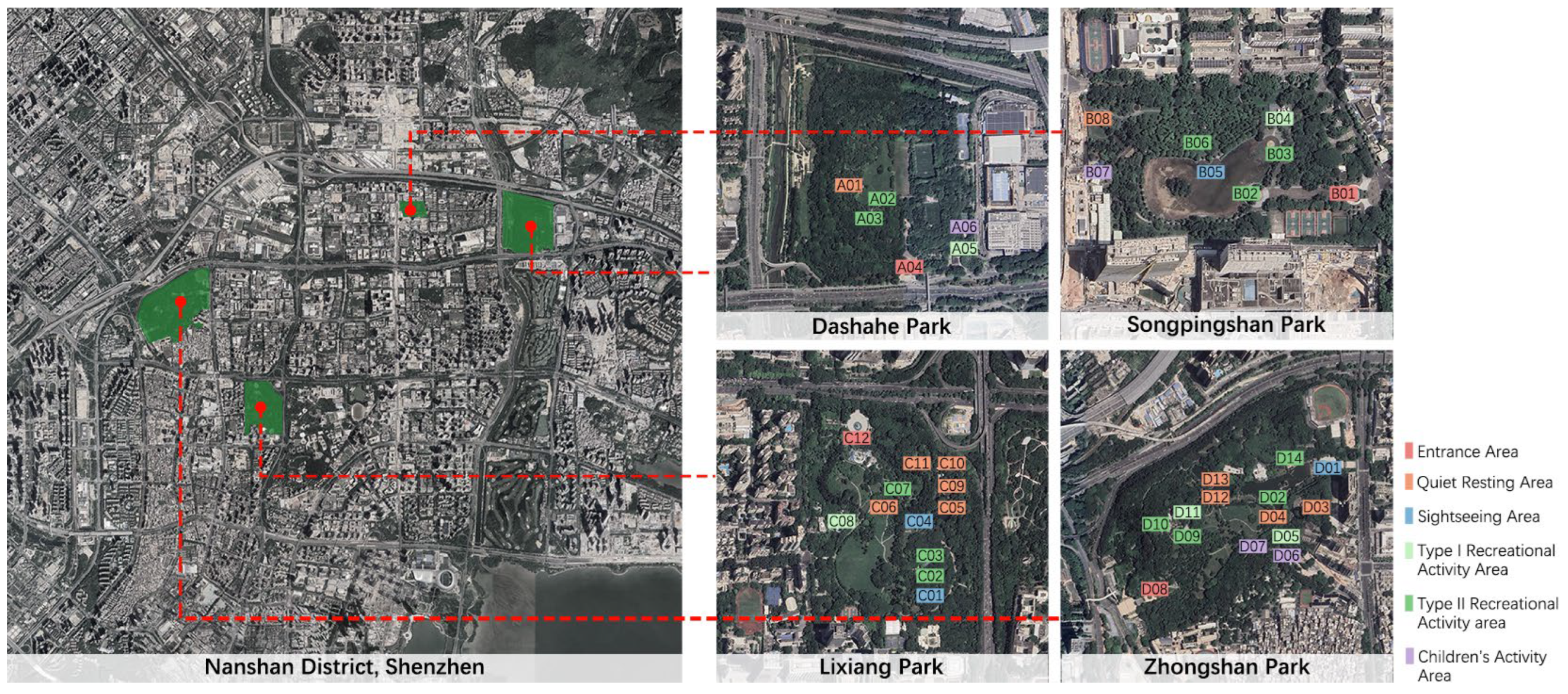
Shenzhen is one of the cities with the largest number of parks in China. By the end of 2024, it had 1320 urban parks, including 143 urban comprehensive parks. These parks are characterised by diverse types and high usage intensity. To ensure the representativeness of the samples, research sites were chosen based on the following principles: (1) they have been in use for a long time and their surrounding communities are well developed, ensuring stable and continual daily use by older adults; (2) they cover different sizes and functional types, reflecting the diversity of spatial structures; and (3) they include areas with relatively high concentrations of older adults, ensuring that the study subjects exhibit typical activity patterns. Based on these principles, four urban comprehensive parks in Shenzhen were selected: Dashahe Park, Songpingshan Park, Lixiang Park, and Zhongshan Park. Forty activity spaces within these parks were identified as research samples.
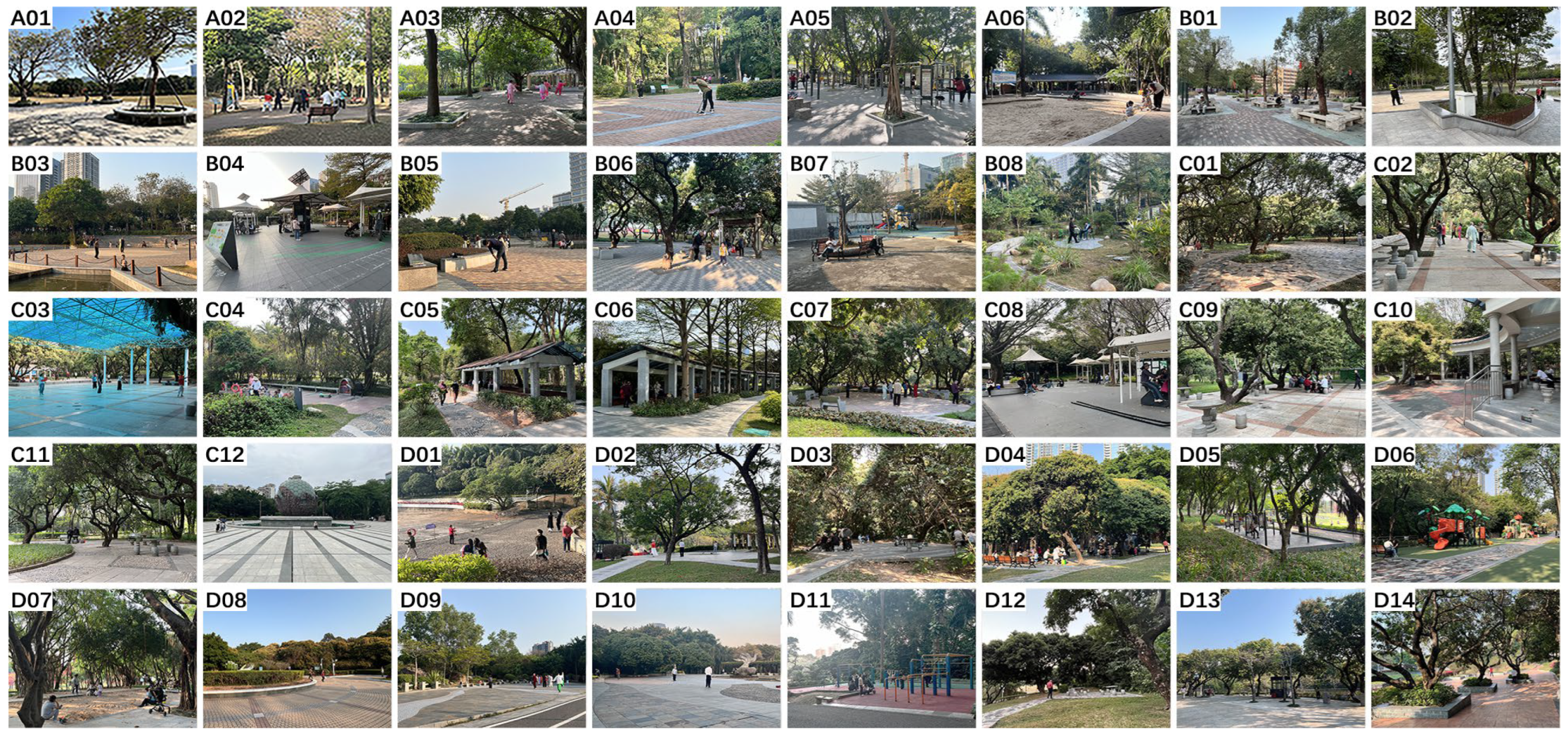
To systematically examine the distribution patterns of older adults’ behaviour and perception across different functional spaces, the study followed the Shenzhen Comprehensive Park Construction Standards and relevant functional zoning guidelines [31]. The 40 samples were classified into six types based on these standards: (1) four samples of the entrance area, which connects the external urban space with internal activity zones; four samples of the sightseeing area, which primarily features natural or cultural landscapes for visitors; 11 samples of the quiet resting area, which provides a calm environment suitable for resting and meditation; 17 samples of the recreational exercise area, which supports physical activities (Type I primarily features equipment-based fitness facilities and is represented by five samples, while Type II primarily features open plaza spaces and is represented by 12 samples); and four samples of the children’s activity area, which provides dedicated activity spaces for children’s activities and accommodates the accompaniment needs of older adults (Figure 1 and Figure 2).

2.2. Data Collection

2.2.1. Behavioural and Perceptual Data

(1)
Behavioural Data
To cover the core activity needs of older adults in park activity spaces, activity purpose was adopted as the primary classification criterion. Older adults’ behaviour is divided into leisure behaviour, social behaviour, and exercise behaviour. Additionally, following the study by Li Chenqi et al., behaviours are further categorised based on the concentration and dispersion of participants [32]. Given that social behaviour typically occurs in small groups, this study does not further classify social behaviour by concentration or dispersion. Ultimately, five behaviour types were included in the study: dispersed leisure behaviour, concentrated leisure behaviour, social behaviour, dispersed exercise behaviour, and concentrated exercise behaviour (Table 1).
Behavioural data were collected through on-site fixed-point observation and photo-assisted recording. From March to April 2023, observations were conducted at the 40 sample spaces during two peak periods of older adults’ activity: 08:00–09:00 and 16:00–17:00. Behaviours were identified according to predefined classifications, and the number of participants and duration of each behaviour type were recorded. Photographs were also taken for subsequent verification. Given the ambiguity in determining the initiation time of older adults’ behaviours and the feasibility of data collection, a 5 min rounding approach, following Lu Shan, was used to record behavioural duration (0–2.4 min = 0 min; 2.5–7.4 min = 5 min; 7.5–12.4 min = 10 min; and so forth). This method simplified operations and maintained stability.
(2)
Perceptual Data
Research in environmental psychology indicates that comfort, safety, and aesthetics are the three core perceptual dimensions of individuals’ environmental experience [33]. Comfort reflects the extent to which the environment supports the physiological and psychological comfort needs of the elderly. Safety reflects the elderly’s subjective judgement of potential risks and the controllability of the environment. Aesthetics reflects the visual appeal of the environment to the elderly. Scholars such as Li Zhixuan [34] and Sun Wenshu [35] have also regarded these three dimensions as key indicators associated with older adults’ use of urban parks. Well-being and sense of belonging are more susceptible to complex confounding factors, including social relationships and residential background [30]. In contrast, comfort, safety, and aesthetics are more directly and consistently associated with older adults’ immediate experiences in park spaces. Therefore, this study selects these three dimensions as the core indicators for perceptual evaluation.
Perceptual data were collected through questionnaires (Table A1 and Table A2). Respondents were adults aged 60 or above who were active in the park. The questionnaire covered three aspects: comfort, safety, and aesthetics. Participants rated each aspect on a scale from 1 to 5 (1 = very dissatisfied, 5 = most satisfied). Each of the 40 spatial samples was evaluated separately, with at least 30 respondents surveyed in each sample space. In total, 1872 valid questionnaires were collected across all sample spaces.

2.2.2. Environmental Element Data

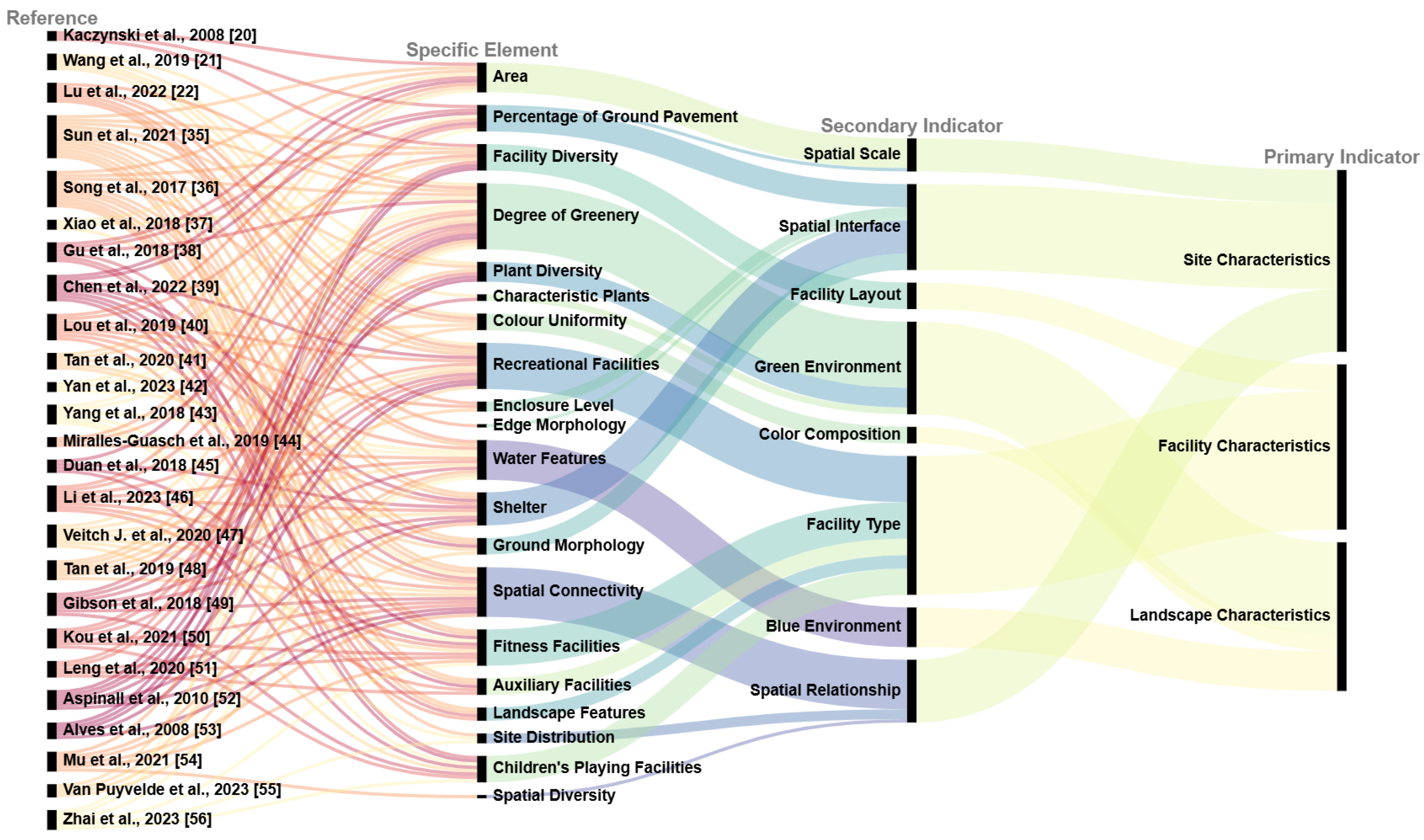
The databases selected for this study were the Web of Science and the China National Knowledge Infrastructure (CNKI). Advanced searches were conducted using “elderly + park” and “elderly + green space” as themes and keywords. After screening, 25 articles related to older adults and urban park environmental elements were summarised. Subsequently, the environmental elements in urban parks affecting older adults’ behaviour and perception were extracted (Figure 3).
Given the limited sample size, this study could not discuss all environmental element variables. Based on their categories, the environmental elements were organised into three primary indicators: site characteristics, landscape characteristics, and facility characteristics. Then, taking into account the frequency of occurrence of the elements and the availability of data, 12 specific elements under the three primary indicators were selected for analysis. Quantitative measurements of the sample spaces were conducted using on-site empirical measurements, photographs, satellite images, and image processing tools. As a result, quantitative data for the environmental elements of the 40 activity spaces in the selected parks were obtained (Table 2).

2.3. Data Processing

2.3.1. Quantification of Behaviour and Perception Data

(1) Behavioural Level
The frequency and duration of behaviours are important indicators for assessing the degree of environmental support [57]. A behaviour that occurs frequently and lasts for a long time in a sample space indicates strong environmental support and a higher evaluation. Conversely, a low frequency and short duration suggest a lower evaluation. In this study, the total duration of each type of behaviour within an activity space is defined as the behavioural level. This metric is used to assess the intensity of different behaviours within the sample spaces.
(2) Perceptual Level
Questionnaire scores directly reflect users’ perceptual evaluations of a space. The perceptual level is calculated as the average of the cumulative scores for comfort, safety, and aesthetics within the space. This metric is used to assess the level of various perceptions across the sample spaces.

2.3.2. Preprocessing of Environmental Elements

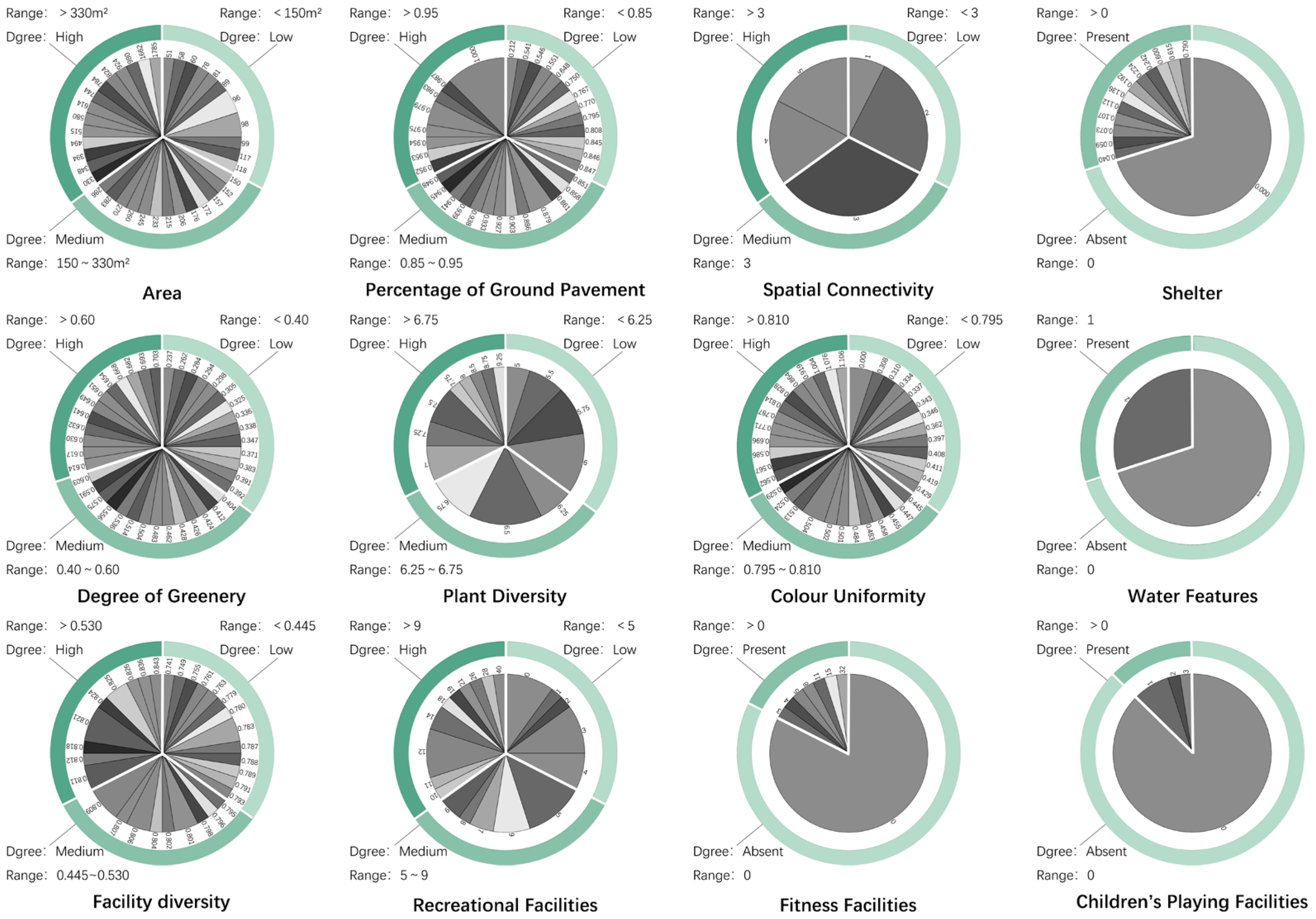
Some indicators of existing urban comprehensive park environmental elements have a wide distribution and contain extreme values, which may affect the stability of regression models. This study enhances the interpretability and application value of the results by following the binning processing method used by Sun Xuyang et al. [58]. In the specific operational process, two binning methods were applied based on the characteristics of the environmental elements. First, the data were divided into three equal-width intervals using two cut points, representing low, medium, and high categories. Second, the data were divided into two intervals using 0 as the cut point, representing the presence or absence (Figure 4).

2.3.3. Behaviour–Perception Analysis and Evaluation

Analysis of variance (ANOVA) was used to compare the distribution differences in behavioural and perceptual indicators across different functional spaces. This analysis reveals the distribution characteristics of older adults’ behaviours and perceptions in various types of functional spaces.
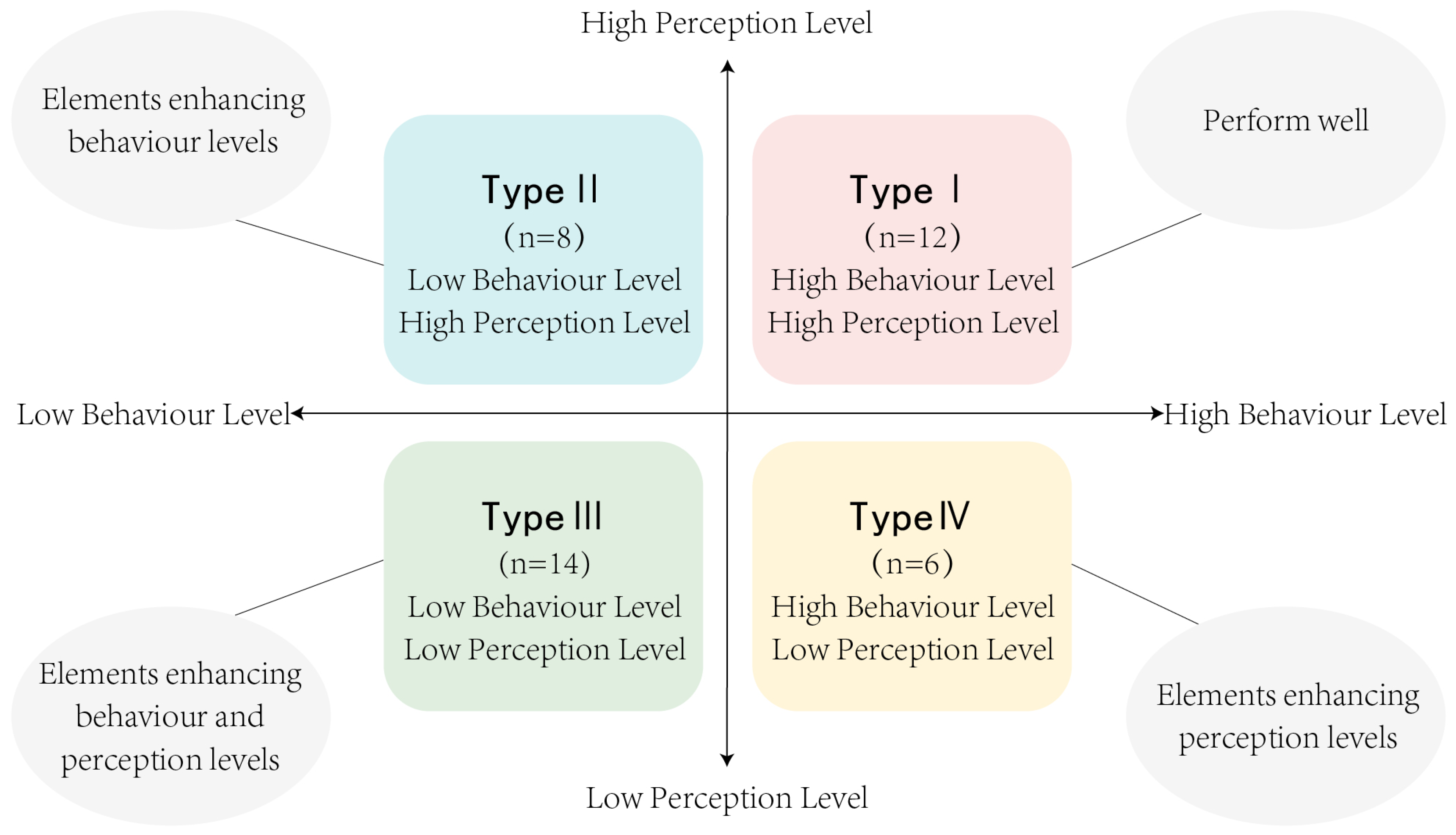
A four-quadrant analysis was employed to comprehensively evaluate older adults’ use of urban comprehensive parks (Figure 5). Behavioural level was set as the horizontal axis and perceptual level as the vertical axis. The 40 samples were classified into four typical categories: high behavioural level–high perceptual level, high behavioural level–low perceptual level, low behavioural level–high perceptual level, and low behavioural level–low perceptual level. Different functional spaces exhibit spatial heterogeneity in behavioural carrying capacity and perceptual experiences. A unified evaluation standard may obscure the genuine differences among space types. Separate horizontal and vertical threshold values were therefore established for each functional space type, and statistical calibration was conducted based on the results of variance analysis. The mean values of the five behavioural indicators and the three perceptual indicators were summed to construct the horizontal and vertical threshold values, respectively. For behavioural or perceptual indicators showing significant differences, the sample mean corresponding to each functional space type was used as the reference value. For indicators without significant differences, the overall sample mean was adopted as a unified benchmark. Samples with behavioural or perceptual levels greater than or equal to the corresponding reference threshold were classified as “high”; otherwise, they were classified as “low”.

2.3.4. Association Analysis

The data for the 12 environmental elements were subjected to multicollinearity diagnostics. The results showed that all tolerance values were greater than 0.1 and all variance inflation factors were below 10, indicating the absence of serious multicollinearity. In the models with five types of behaviour and three types of perception as dependent variables, the omnibus likelihood ratio chi-square tests were all significant (p < 0.05), and all R2 values exceeded 0.6, suggesting that the models had good overall fit and were statistically meaningful. Generalised linear regression models were therefore used to analyse the relationships between behaviour–perception and environmental elements (Table A3 and Table A4).

3. Results

3.1. Variance Analysis of Behaviour and Perception

The results of the variance analysis showed that the differences among functional spaces in dispersed leisure behaviour, social behaviour, comfort, and aesthetic perception were not significant (p > 0.05). This indicates that these indicators are relatively balanced across different space types. In contrast, significant differences were observed in concentrated leisure behaviour, dispersed exercise behaviour, concentrated exercise behaviour, and safety (p < 0.05). These results suggest that these indicators are distributed differently across space types (Table 3).
In terms of behavioural composition, different functional spaces show distinct patterns. Entrance areas are characterised by a relatively balanced distribution of dispersed leisure behaviour, social behaviour, dispersed exercise behaviour, and concentrated exercise behaviour, with no clearly dominant activity type. Quiet resting areas are primarily characterised by concentrated leisure behaviour, accompanied by dispersed leisure behaviour and social behaviour. Sightseeing areas, type I recreational activity areas, and children’s activity areas have similar behavioural compositions, including dispersed leisure behaviour, social behaviour, and dispersed exercise behaviour, but their proportions differ considerably. Type II recreational activity areas include all five behaviour types, with concentrated exercise behaviour being the most prominent.
In terms of perceptual composition, only the entrance areas and children’s activity areas show the sequence comfort > aesthetics > safety in terms of perceived levels. In all other spaces, the sequence is generally aesthetics > comfort > safety.

3.2. Evaluation Results

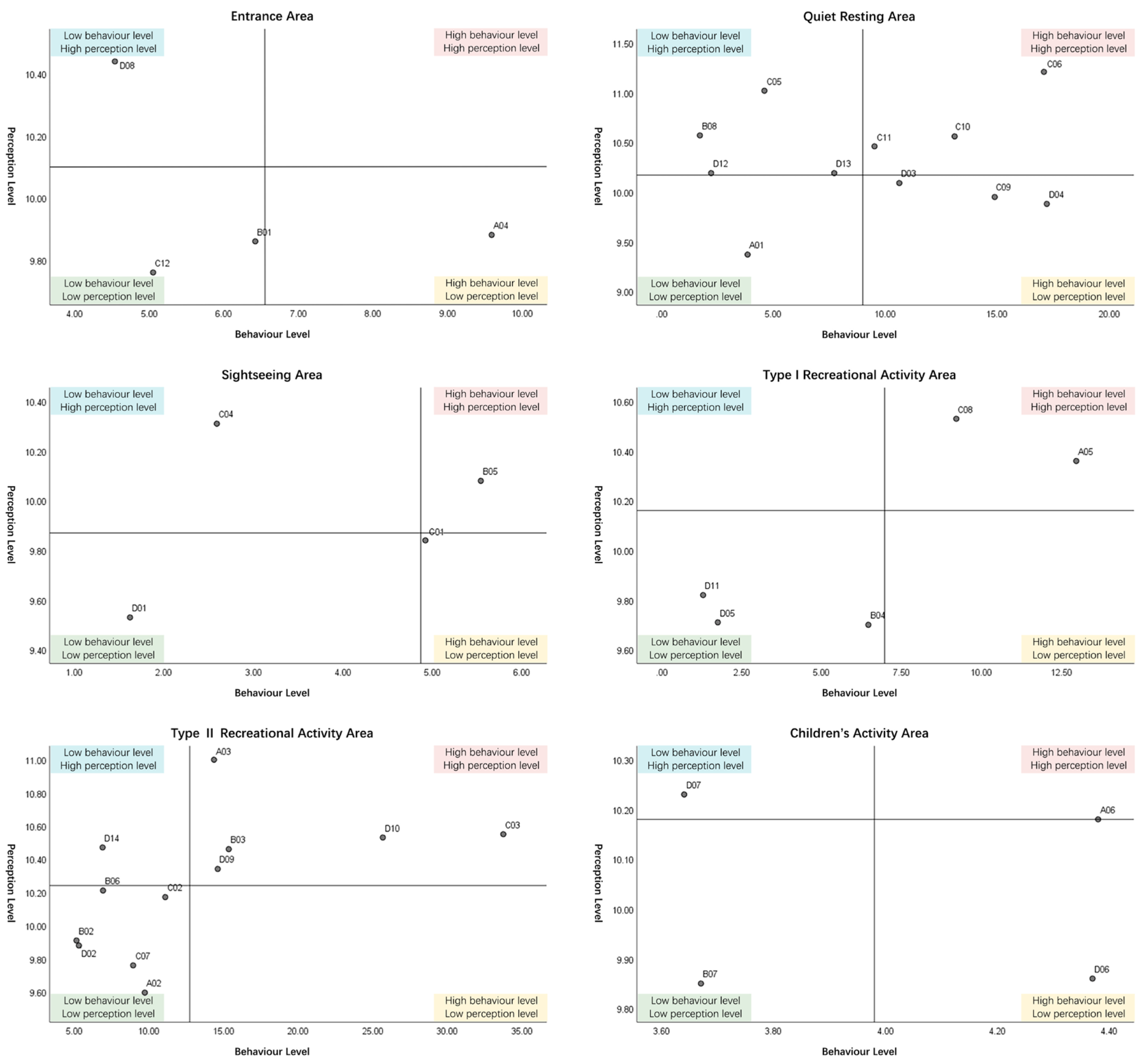
Separate evaluation coordinate systems were constructed for the six functional space types. The horizontal threshold values for the entrance area, quiet resting area, sightseeing area, Type I recreational activity area, Type II recreational activity area, and children’s activity area were 6.55, 8.99, 4.87, 6.97, 12.72, and 3.98, respectively. The corresponding vertical threshold values were 10.10, 10.17, 9.87, 10.16, 10.24, and 10.18. The 40 sample spaces were divided into four types. The high behaviour level–high perception level type has 12 spaces; the low behaviour level–high perception level type has eight spaces; the high behaviour level–low perception level type has six spaces; and the low behaviour level–low perception level type has 14 spaces.
In terms of functional space type distribution, entrance area samples all show insufficient behaviour or perception levels, and no high behaviour level–high perception level type is observed. Type I recreational activity areas show no low behaviour level–high perception level type or high behaviour level–low perception level type. Type II recreational activity areas show no high behaviour level–low perception level type. All other functional spaces show all four types (Figure 6).

3.3. Results of Association Analysis

3.3.1. Behavioural Association Analysis

The generalised linear regression results show that older adults’ behaviour is significantly associated with area, proportion of ground pavement, spatial connectivity, shelter, degree of greenery, and plant diversity, along with facility diversity, recreational facilities, fitness facilities, and children’s facilities (p < 0.05), as follows (Table 4):
(1) Shelter, plant diversity, and recreational facilities were significantly associated with dispersed leisure behaviour among older adults (p < 0.05). Spaces without shelter are 0.664 units lower in behaviour level than spaces with shelter. Spaces with medium plant diversity are 0.905 units lower in behaviour level than spaces with high plant diversity. Spaces with few and medium recreational facilities are 1.127 and 0.974 units lower in behaviour level than spaces with abundant recreational facilities.
(2) Spatial connectivity, shelter, facility diversity, and recreational facilities were significantly associated with concentrated leisure behaviour among older adults (p < 0.05). Spaces with medium spatial connectivity are 2.713 units lower in behaviour level than spaces with high spatial connectivity. Spaces without shelter are 1.853 units lower in behaviour level than spaces with shelter. Spaces with medium facility diversity are 2.966 units lower in behaviour level than spaces with high facility diversity. Spaces with medium recreational facilities are 2.478 units lower in behaviour level than spaces with abundant recreational facilities.
(3) Shelter, recreational facilities, and children’s playing facilities were significantly associated with social behaviour among older adults (p < 0.05). Spaces without shelter are 0.702 units lower in behaviour level than spaces with shelter. Spaces with few and medium recreational facilities are 1.171 and 0.920 units lower in behaviour level than spaces with abundant recreational facilities. Spaces without children’s facilities are 1.119 units lower in behaviour level than spaces with children’s facilities.
(4) Spatial connectivity and fitness facilities were significantly associated with dispersed exercise behaviour among older adults (p < 0.05). Spaces with low spatial connectivity are 1.674 units lower in behaviour level than spaces with high spatial connectivity. Spaces without fitness facilities are 2.825 units lower in behaviour level than spaces with fitness facilities.
(5) Area, proportion of ground pavement, spatial connectivity, degree of greenery, and recreational facilities were significantly associated with concentrated exercise behaviour among older adults (p < 0.05). Spaces with a medium-sized area are 2.282 units lower in behaviour level than spaces with a large area. Spaces with a medium proportion of ground pavement are 2.281 units lower in behaviour level than spaces with a high proportion of ground pavement. Spaces with a low and medium degree of greenery are 2.991 and 2.336 units lower in behaviour level than spaces with a high degree of greenery. Spaces with few recreational facilities are 2.654 units lower in behaviour level than spaces with abundant recreational facilities.

3.3.2. Perceptual Association Analysis

The results of the generalised linear regression analysis show that older adults’ perception is significantly associated with proportion of ground pavement, spatial connectivity, shelter, degree of greenery, plant diversity, colour uniformity, water features, and recreational facilities (p < 0.05), as follows (Table 5):
(1) Shelter, plant diversity, colour uniformity, and recreational facilities were significantly associated with comfort among older adults (p < 0.05). Spaces without shelter are 0.173 units lower in comfort level than spaces with shelter. Spaces with low plant diversity are 0.152 units lower in comfort level than spaces with high plant diversity. Spaces with moderate colour uniformity are 0.178 units higher in comfort level than spaces with high colour uniformity. Spaces with few recreational facilities are 0.156 units lower in comfort level than spaces with abundant recreational facilities.
(2) The proportion of ground pavement, spatial connectivity, shelter, and recreational facilities were significantly associated with sense of safety among older adults (p < 0.05). Spaces with a moderate proportion of ground pavement are 0.207 units lower in safety level than spaces with a high proportion of ground pavement. Spaces with low spatial connectivity are 0.165 units lower in safety level than spaces with high spatial connectivity. Spaces without shelter are 0.128 units lower in safety level than spaces with shelter. Spaces with few recreational facilities are 0.212 units lower in safety level than spaces with abundant recreational facilities.
(3) Plant diversity, colour uniformity, and water features were significantly associated with aesthetic quality among older adults (p < 0.05). Spaces with low and medium plant diversity are, respectively, 0.213 and 0.250 units lower in aesthetics level than spaces with high plant diversity. Spaces with medium colour uniformity are 0.178 units lower in aesthetics level than spaces with high colour uniformity. Spaces without water features are 0.221 units lower in aesthetics level than spaces with water features.

4. Discussion

4.1. Characteristics of Older Adults’ Behaviours and Perceptions and Optimisation Priorities

This study analysed the distribution of behavioural and perceptual characteristics across different types of functional space. Key optimisation indicators were identified. In terms of behaviour, the study found that the differences in the spatial distribution of older adults’ dispersed leisure behaviours and social behaviours were relatively small, and no significant preference for specific spatial types was observed. Previous studies have also shown that these two types of behaviours occur in a relatively random and widely distributed manner, and they frequently co-occur with other activities [59,60]. In contrast, concentrated leisure behaviour, dispersed exercise behaviour, and concentrated exercise behaviour exhibited significant spatial differences. These behaviours tended to cluster in specific locations. As a result, composite behaviour patterns that were dominated by these behaviours were formed [61,62]. This indicates that different behaviours vary in their dependence on space and that different functional spaces provide varying levels of support for these behaviours. Spatial optimisation should therefore focus on the primary behaviours associated with each functional space. Entrance areas should strengthen support for dispersed leisure behaviour, social behaviour, dispersed exercise behaviour, and concentrated exercise behaviour. Quiet resting areas should prioritise dispersed leisure behaviour, concentrated leisure behaviour, and social behaviour. Sightseeing areas, Type I recreational activity areas, and children’s activity areas should accommodate dispersed leisure behaviour, social behaviour, and dispersed exercise behaviour. By contrast, Type II recreational activity areas must comprehensively meet the demands of multiple behaviour types. In terms of perception, significant differences were found in safety across different functional space types. These differences were clearly distinct from the relatively balanced distribution of comfort and aesthetics, and the safety scores were generally low. These variations may be related to the functional positioning and spatial location of the areas, which leads to insufficient safety in specific types of spaces. Spatial optimisation should therefore also focus on improving safety.
This study also conducted a comprehensive evaluation at the sample level by constructing a behaviour–perception four-quadrant evaluation model. Previous studies have mostly conducted evaluations from a single dimension [14,29]. In contrast, this study considered both behaviour and perception. The thresholds of the four quadrants were determined by aggregating the spatial differences in each indicator. Corresponding four-quadrant criteria were then established for the six types of functional spaces. The results showed that samples in all types of spaces exhibited low levels in either behaviour or perception. Samples in entrance areas were all classified as below the high behaviour level–high perception level type. Samples in Type I recreational activity areas were mostly concentrated in the low behaviour level–high perception level type or the high behaviour level–low perception level type. Samples in Type II recreational activity areas generally exhibited low perception levels. As a result, three types of problematic samples were identified: high behaviour level–low perception level, low behaviour level–high perception level, and low behaviour level–low perception level. These findings provide a basis for the development of subsequent optimisation strategies, and they also indicate whether optimisation should focus on the behaviour dimension or the perception dimension.

4.2. Impacts of Environmental Elements on Older Adults’ Behaviours and Perceptions

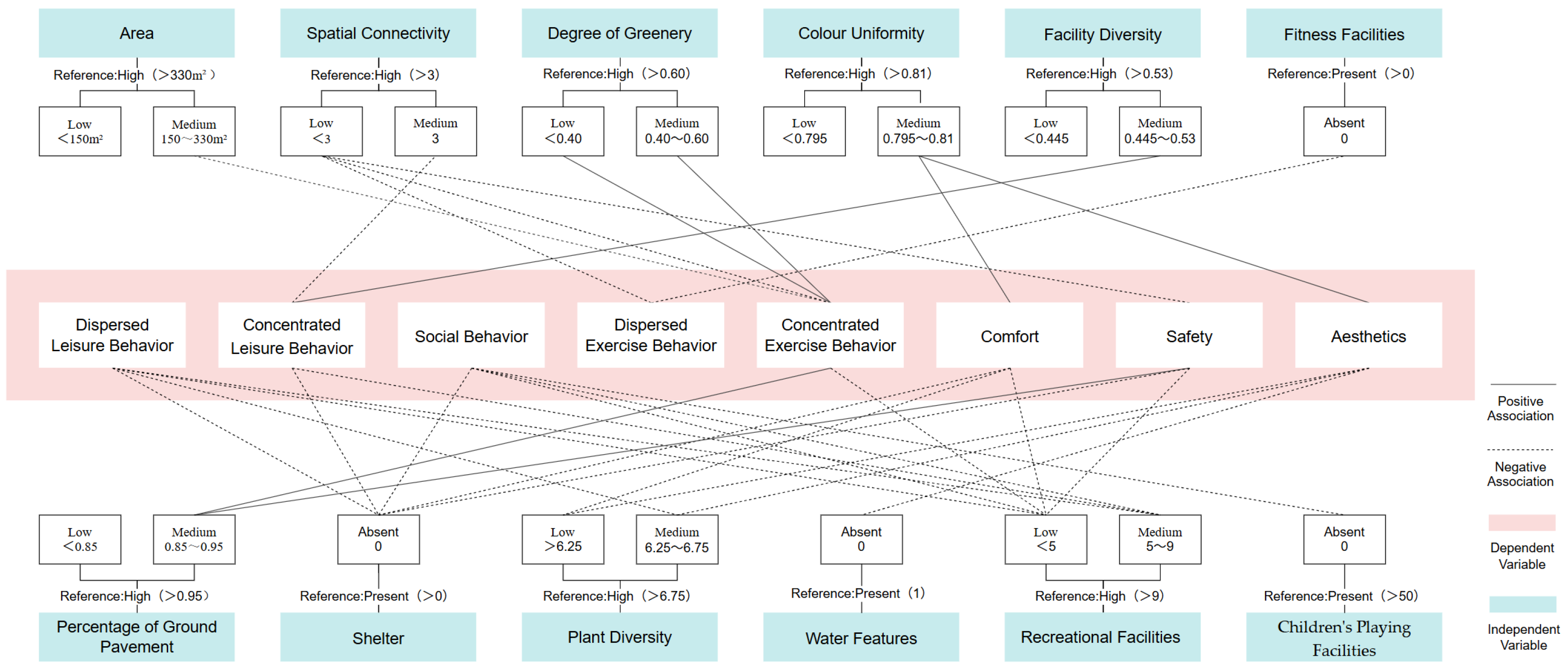
The results indicate that different environmental elements exhibit varying associations with older adults’ behaviour and perception in urban comprehensive parks. This provides a basis for subsequent adjustments of elements in different functional spaces. (Figure 7).
In terms of site characteristics, compared with spaces larger than 330 m2, spaces of 150–330 m2 showed a negative association with older adults’ concentrated exercise behaviours, contrasting previous studies suggesting an optimal area of approximately 115 m2 [16]. This discrepancy may mainly result from differences in spatial scale. As urban comprehensive parks serve broader areas and larger user populations, larger spaces may therefore be required. Compared with spaces with a proportion of ground pavement exceeding 0.95, spaces with a proportion of ground pavement of 0.85–0.95 showed a positive association with older adults’ safety and concentrated exercise behaviours. Compared with spaces with spatial connectivity greater than 3, spaces with spatial connectivity less than 3 showed a negative association with older adults’ dispersed exercise behaviours, concentrated exercise behaviours, and perceived safety, whereas spaces with spatial connectivity equal to 3 showed a negative association with concentrated leisure behaviours. Relative to prior studies [27,39] these two categories of environmental elements provide boundary values for associations. The positive role of shelter has been widely documented in previous studies [40,45], and this study provides a comprehensive analysis on this basis. Compared with spaces with shelter, spaces without shelter showed negative associations with older adults’ dispersed and concentrated leisure behaviours, social behaviours, comfort, and perceived safety.
In terms of landscape characteristics, compared with spaces with a degree of greenery greater than 0.06, spaces with a degree of greenery less than 0.06 showed a positive association with older adults’ concentrated exercise behaviours. This finding is similar to previous studies [63]. Compared with spaces with plant diversity exceeding 6.75, spaces with plant diversity of 6.25–6.75 showed a negative association with older adults’ dispersed leisure behaviours, spaces with plant diversity less than 6.25 showed a negative association with comfort, and spaces with plant diversity less than 6.75 showed a negative association with aesthetics. Colour uniformity and water features represent key environmental elements related to older adults’ perceptions [22,35]. Compared with spaces with colour uniformity greater than 0.810, spaces with colour uniformity of 0.795–0.810 showed positive associations with older adults’ comfort and aesthetics. Compared with spaces with water features, spaces without water features showed a negative association with older adults’ aesthetics.
In terms of landscape characteristics, compared with spaces with facility diversity greater than 0.530, spaces with facility diversity of 0.445–0.530 showed a positive association with older adults’ concentrated leisure behaviours. This finding has not been reported in previous studies [41]. Compared with spaces with more than nine groups of recreational facilities, spaces with fewer than nine groups of recreational facilities showed negative associations with older adults’ dispersed leisure behaviours and social behaviours, spaces with five to nine groups of recreational facilities showed a negative association with concentrated leisure behaviours, and spaces with fewer than five groups of recreational facilities showed negative associations with concentrated exercise behaviours, comfort, and perceived safety. Compared with spaces equipped with fitness facilities and children’s playing facilities, spaces lacking fitness facilities and children’s playing facilities showed negative associations with older adults’ dispersed exercise behaviours and social behaviours, respectively. The above two points are generally consistent with previous research findings.

4.3. Element Optimisation Strategies for Different Functional Spaces

Systematic enhancement of the behavioural and perceptual outcomes of older adults in urban comprehensive parks is the primary aim of this study. A four-quadrant evaluation method was developed to identify problem areas, and environmental interventions were proposed to optimise them. First, the four-quadrant evaluation of the six functional space types identified three sample types with low behaviour or perception levels, which were the focus of optimisation. Second, based on the association analysis between environmental elements and older adults’ behaviour and perception, environmental element optimisation strategies were proposed, and two main types of strategies were established. The type of behavioural strategies is used to enhance activity participation in spaces with low behaviour levels. The type of perceptual strategies is used to improve subjective perception in spaces with low perception levels. For spaces with both low behaviour and perception levels, strategies from both types can be applied. Within the six types of functional space, the type of behavioural strategies is divided into four categories based on behaviour distribution. This ensures that the primary behaviour types are effectively supported (Table 6). For example, in quiet resting areas, the primary behaviours targeted for optimisation include dispersed leisure behaviours, concentrated leisure behaviours, and social behaviours. Based on the elements that are significantly associated with these behaviours, a corresponding set of environmental element optimisation strategies is formed, including enhancing spatial connectivity, enhancing shelters, improving plant landscape layering, balancing activity facility layout, increasing recreational facilities, and providing essential children’s facilities. The type of perceptual strategies is applied uniformly across the six types of functional space. The strategies consist of moderating ground pavement ratio, enhancing spatial connectivity, improving shelter coverage, improving plant landscape layering, balancing spatial colour combinations, introducing water features, and increasing recreational facilities. The method can be applied to age-friendly environments. It can be used to develop differentiated optimisation measures for older adults’ behaviour and perception needs in different functional spaces of urban comprehensive parks. These measures promote coordinated improvements in behaviour and perception, sustainably improve environmental quality, and increase older adults’ participation and experience.

4.4. Strengths and Limitations

This study has two main innovations. First, for the study subjects, different functional spaces in urban comprehensive parks are classified, and older adults’ behaviour and perception are then subdivided. This approach reveals differences in behaviour and perception across space types and lays the foundation for precise evaluation and optimisation. Second, for the research method, this study extends the application of environmental behaviour studies. A behaviour–perception dual-dimensional evaluation model is constructed, which identifies insufficient behaviour and perception levels of older adults in different functional spaces. Based on the significantly associated environmental elements, differentiated optimisation paths are proposed for each functional space type. A systematic intervention framework is formed, ranging from problem identification to strategy development. This approach achieves coordinated improvement in behaviour and perception and provides practical and applicable references for enhancing the quality of activity spaces for older adults in urban comprehensive parks.
This study has four main limitations. First, this study included only 40 samples from urban comprehensive parks in Shenzhen; therefore, the established evaluation thresholds and the suitable ranges for optimisation elements are primarily applicable to the samples examined and may not be directly applicable to other contexts or regions. Future research could expand the sample size and extend it to different cities to further enhance the generalizability and stability of the conclusions. Additionally, the limited sample size prevented the environmental elements from encompassing all environmental characteristics. Second, as the sample data were collected only during spring (March to April) in Shenzhen and covered only two periods, they cannot fully reflect the behavioural and perceptual characteristics of the elderly across all seasons and times of the year. Future research may consider conditions across different seasons as well as nighttime effects, both of which warrant further investigation. Third, this study did not fully account for heterogeneity within the older adult population. Future research could incorporate subgroup analyses to enable a comprehensive examination of demographic factors such as gender and health status, thereby facilitating more targeted and differentiated investigations. Fourth, the behavioural indicators adopted in this study comprised five categories, while the perceptual indicators primarily involved three categories. Future research could further expand the types of behavioural and perceptual indicators on this basis to enrich the evaluation dimensions. Meanwhile, equal weighting between behaviour and perception was assumed in the construction of the comprehensive evaluation model. Based on this foundation, future research could further explore the issue of weight assignment in evaluation models with complex behaviour–perception relationships.

5. Conclusions

This study aims to enhance the behavioural and perceptual levels of older adults’ activities in urban comprehensive parks. Accordingly, a behaviour–perception two dimensional evaluation system was adopted as the analytical framework. Using this framework, six types of functional spaces in urban comprehensive parks were systematically analysed and evaluated. Differentiated spatial optimisation strategies are proposed, with the aim of improving the environmental quality of urban comprehensive parks and enhancing older adults’ user experience. The main conclusions are as follows. First, there is spatial heterogeneity in older adults’ behaviour and perception across the six types of functional spaces. The analysis shows that concentrated leisure behaviours, dispersed exercise behaviours, concentrated exercise behaviours, and safety differ significantly across spaces. In contrast, dispersed leisure behaviours, social behaviours, comfort, and aesthetics are relatively balanced. This indicates that different functional spaces have varying potential to promote specific behaviours and that differentiated measures should be adopted. Among perception indicators, overall improvement is needed, and safety should be a key focus due to its significant variation. Second, the comprehensive evaluation model effectively identified four typical behaviour–perception spatial types. A clustering evaluation was conducted on the 40 sample spaces. Four categories were then distinguished: high behaviour level–high perception level, low behaviour level–high perception level, high behaviour level–low perception level, and low behaviour level–low perception level. This allowed the weak aspects of behaviour or perception in each functional space to be precisely identified. Third, the associations between environmental elements and behaviour and perception varied. The results of the generalised linear regression analysis indicated that the twelve environmental elements exhibited distinct associations with older adults’ behaviour and perception. Significantly associated environmental elements were identified. Based on these findings, this study established a type of behaviour-oriented strategies and a type of perception-enhancement strategies for the six functional space types. The differentiated optimisation of spaces with low behaviour or low perception levels now has a scientific basis. Thus, this study proposes a comprehensive evaluation and spatial optimisation approach guided by older adults’ behaviour and perception. The age-friendly renewal and sustainable refined design of urban comprehensive parks are supported by both theoretical and empirical evidence. A practical and scientific strategy framework is provided for enhancing the age-friendly quality of urban comprehensive parks.

Author Contributions

Conceptualization, L.Z., D.J. and W.T.; methodology, L.Z. and D.J.; software, W.T.; validation, L.Z. and D.J.; formal analysis, W.T.; investigation, W.T.; resources, L.Z.; data curation, W.T.; writing—original draft preparation, W.T.; writing—review and editing, L.Z. and D.J.; visualisation, W.T.; supervision, L.Z.; project administration, L.Z.; funding acquisition, L.Z. and D.J. All authors have read and agreed to the published version of the manuscript.

Funding

This research was funded by the National Natural Science Foundation of China (Grant Number: 52008250), and the Collaborative Innovation of Internationalization and Localization of Design Aesthetics in the Greater Bay Area under the “Dual-Circulation” Pattern, Project Approval No.: 25ZDZT06.

Institutional Review Board Statement

This study involved only anonymous questionnaire surveys and non-intrusive observational methods, with no collection of personally identifiable information and no intervention involving human participants. As the institutional and regulatory basis indicating that formal ethics approval is not required for this type of study. The following official policy document for reference: Relevant national regulations of China, including Article 32 of the Measures for Ethical Review of Life Science and Medical Research Involving Human Beings (issued by the National Health Commission of the People’s Republic of China).

Informed Consent Statement

Verbal informed consent was obtained from the participants. Verbal consent was obtained rather than written because all participants provided verbal informed consent through their voluntary participation behavior, which is considered an acceptable and effective form of informed consent for anonymous, minimal-risk questionnaire studies.

Data Availability Statement

The raw data supporting the conclusions of this article will be made available by the authors on request.

Acknowledgments

The authors would like to thank the support from the Center for Human oriented Environment and Sustainable Design, Shenzhen University.

Conflicts of Interest

The authors declare no conflicts of interest.

Appendix A

Table A1. Questionnaire on older adults’ perceptions of urban comprehensive parks.
No.DimensionQuestion Scale
Q1DemographicsWhat is your age?60–74; 75–89; ≥90
Q2DemographicsWhat is your gender?Male; Female
Q3ComfortHow would you rate the comfort of the park?1 = very dissatisfied, 2 = dissatisfied, 3 = neutral, 4 = satisfied, 5 = very satisfied
Q4SafetyHow would you rate the safety of the park?1 = very dissatisfied, 2 = dissatisfied, 3 = neutral, 4 = satisfied, 5 = very satisfied
Q5AestheticsHow would you rate the aesthetics of the park?1 = very dissatisfied, 2 = dissatisfied, 3 = neutral, 4 = satisfied, 5 = very satisfied
Table A2. Reliability statistics.
Cronbach’s αStandardized αNumber of Items
0.7110.7123

Appendix B

Table A3. Multicollinearity diagnostics.
Variable Type TOLVIF
X 1 (>330 m2 as reference)<150 m20.1029.849
150~330 m20.2494.015
X 2 (>0.95 as reference)<0.850.3053.279
0.85~0.950.2963.380
X 3 (>3 as reference)<30.3133.193
30.2953.395
X 4 (>0 as reference)00.6701.492
X 5 (>0.60 as reference)<0.400.1377.306
0.40~0.600.3562.805
X 6 (>6.75 as reference)<6.250.3432.911
6.25~6.750.2454.082
X 7 (>0.810 as reference)<0.7950.4382.283
0.795~0.8100.2753.630
X 8 (1 as reference)00.2484.025
X 9 (>0.530 as reference)<0.4450.1985.057
0.445~0.5300.2134.695
X 10 (>9 as reference)<50.3153.178
5~90.3113.216
X 11 (>0 as reference)00.2723.676
X 12 (>0 as reference)00.2623.813

Appendix C

Table A4. Goodness of fit statistics for the generalised linear model.
Test StatisticModel 1Model 2Model 3Model 4Model 5Model 6Model 7Model 8
χ244.49540.19946.68840.70341.04237.22051.26738.694
Sig.0.0010.0050.0010.0040.0040.0110.0000.007
AIC181.658271.853173.393218.417257.70150.56034.66651.936
R20.6710.6340.6890.6380.6420.6060.7220.620
Models 1–5 correspond to five behavioural dependent variables, while models 6–8 correspond to three perceptual dependent variables.

References

  1. Xiang, X.; Wang, Y. Current Situation, Characteristics, Causes, and Countermeasures of Population Aging in China. Chin. J. Gerontol. 2021, 41, 4149–4152. [Google Scholar] [CrossRef]
  2. Kılıc, M.; Uzuncakmak, T. Daily Life Activity Levels of Turkish Older Adults and Associated Factors: A Multivariable Analysis. Ageing Int. 2024, 49, 136–152. [Google Scholar] [CrossRef]
  3. Yu, Y. Health Effect of the Built Environment on the Older Adults: Fundamental Understanding and Research Approach. Urban Plan. Int. 2020, 35, 1–7. [Google Scholar] [CrossRef]
  4. Liang, C.; Li, C. Main Approaches and Reflections on the Comprehensive Renovation of Old Residential Communities in Beijing. Constr. Sci. Technol. 2016, 9, 20–23. [Google Scholar] [CrossRef]
  5. Orsega-Smith, E.; Mowen, A.J.; Payne, L.L.; Godbey, G. The Interaction of Stress and Park Use on Psycho-Physiological Health in Older Adults. J. Leis. Res. 2004, 36, 232–256. [Google Scholar] [CrossRef]
  6. Elsadek, M.; Shao, Y.; Liu, B. Benefits of Indirect Contact With Nature on the Physiopsychological Well-Being of Elderly People. HERD Health Environ. Res. Des. J. 2021, 14, 227–241. [Google Scholar] [CrossRef]
  7. Aliyas, Z. Physical, Mental, and Physiological Health Benefits of Green and Blue Outdoor Spaces among Elderly People. Int. J. Environ. Health Res. 2021, 31, 703–714. [Google Scholar] [CrossRef]
  8. Ali, M.J.; Rahaman, M.; Hossain, S.I. Urban Green Spaces for Elderly Human Health: A Planning Model for Healthy City Living. Land Use Policy 2022, 114, 105970. [Google Scholar] [CrossRef]
  9. Chen, H.; Hu, Y.; Cui, J.; Chen, Y.; Cai, Y. Age-friendly Urban Transition: Shenzhen Experience and Planning Strategies. Planners 2023, 39, 35–41. [Google Scholar] [CrossRef]
  10. Lang, J. Creating Architectural Theory: The Role of the Behavioral Sciences in Environmental Design; Van Nostrand Reinhold: New York, NY, USA, 1987. [Google Scholar]
  11. Moore, G.T. Environment and Behavior Research in North America: History, Developments, and Unresolved Issues. In Handbook of Environmental Psychology; John Wiley & Sons: New York, NY, USA, 1987; Volume 2, pp. 1359–1410. [Google Scholar]
  12. Lobo, L.; Heras-Escribano, M.; Travieso, D. The History and Philosophy of Ecological Psychology. Front. Psychol. 2018, 9, 2228. [Google Scholar] [CrossRef]
  13. Lazarus, R.S. Emotion and Adaptation; Oxford University Press: New York, NY, USA, 1991. [Google Scholar]
  14. Wang, X.; Yang, D. How the Built Environment Affect the Frequency of Green Space Used by the Elderly Based on the Dual Perspective of Accessibility and Attractiveness. Chin. Landsc. Archit. 2020, 36, 62–66. [Google Scholar] [CrossRef]
  15. Yu, X.; Fan, J.; Chen, C.; Zhang, L. Study on the Distribution Characteristics of Leisure Activities of the Elderly in people’s Park of Nanchang City Based on Behavioral Annotation. J. Green Sci. Technol. 2020, 9, 60–64. [Google Scholar] [CrossRef]
  16. Xiao, W. Study on the Vitality of Small Green Spaces in Old Urban Areas Based on Multi-Source Data, Focusing on the Elderly. Master’s Thesis, Southeast University, Nanjing, China, 2022. [Google Scholar]
  17. Fu, T. Study on the Behavior and Microclimate Adaptation of the Elderly During Spring in Zhaolin Park, Harbin. Master’s Thesis, Northeast Forestry University, Harbin, China, 2021. [Google Scholar]
  18. Onose, D.A.; Ioja, I.C.; Nita, M.R.; Vanau, G.O.; Popa, A.M. Too Old for Recreation? How Friendly Are Urban Parks for Elderly People? Sustainability 2020, 12, 790. [Google Scholar] [CrossRef]
  19. Tao, Z.; Maruthaveeran, S.; Shahidan, M.F.; Xiang, Y. Older Adults’ Experiences, Needs, and Preferences for Community Park Design in China: A Reflexive Thematic Analysis. Urban For. Urban Green. 2025, 112, 128977. [Google Scholar] [CrossRef]
  20. Kaczynski, A.T.; Potwarka, L.R.; Saelens, B.E. Association of Park Size, Distance, and Features with Physical Activity in Neighborhood Parks. Am. J. Public Health 2008, 98, 1451–1456. [Google Scholar] [CrossRef] [PubMed]
  21. Wang, X.; Rodiek, S. Older Adults’ Preference for Landscape Features Along Urban Park Walkways in Nanjing, China. Int. J. Environ. Res. Public Health 2019, 16, 3808. [Google Scholar] [CrossRef] [PubMed]
  22. Lu, S.; Oh, W.; Ooka, R.; Wang, L. Effects of Environmental Features in Small Public Urban Green Spaces on Older Adults’ Mental Restoration: Evidence from Tokyo. Int. J. Environ. Res. Public Health 2022, 19, 5477. [Google Scholar] [CrossRef]
  23. Zandieh, R.; Martinez, J.; Flacke, J. Older Adults’ Outdoor Walking and Inequalities in Neighbourhood Green Spaces Characteristics. Int. J. Environ. Res. Public Health 2019, 16, 4379. [Google Scholar] [CrossRef]
  24. Shi, Y.; Zhu, X.; Sun, J. Study on the Influence of Green Open Space on Different Social Interaction of the Elderly: A Case Study of Nanjing City. J. Hum. Settl. West. China 2022, 37, 62–68. [Google Scholar] [CrossRef]
  25. Jiang, J.; Chen, M.; Zhang, J. Analyses of Elderly Visitors’ Behaviors to Community Parks in Shanghai and the Impact Factors. Landsc. Arch. Front. 2020, 8, 94–109. [Google Scholar] [CrossRef]
  26. Guo, H.; Liu, Y.; Dou, W.; Wang, Y. Study on Recreation Behavior of the Elderly in Urban ParK—Taking Lotus Pond Park in Yangzhou as Example. Jiangsu Constr. 2019, z1, 66–70. [Google Scholar] [CrossRef]
  27. Veitch, J.; Ball, K.; Rivera, E.; Loh, V.; Deforche, B.; Best, K.; Timperio, A. What Entices Older Adults to Parks? Identification of Park Features That Encourage Park Visitation, Physical Activity, and Social Interaction. Landsc. Urban Plan. 2022, 217, 104254. [Google Scholar] [CrossRef]
  28. Wagner, P.; Duan, Y.P.; Zhang, R.; Wulff, H.; Brehm, W. Association of Psychosocial and Perceived Environmental Factors with Park-Based Physical Activity among Elderly in Two Cities in China and Germany. BMC Public Health 2020, 20, 55. [Google Scholar] [CrossRef]
  29. Xiao, J.X.; Liao, J.; Zhao, B.; Long, Y.; Xu, X.; Liang, X.; Xia, T. The Influence of Community Park Characteristics on Satisfaction in Guangzhou: Moderating and Mediating Effects Analysis. Heliyon 2024, 10, e31043. [Google Scholar] [CrossRef]
  30. Han, B.; Leng, H. Influence of Community Green Space on Subjective Well-Being of the Elderly in Cold Regions: A Case Study of Changchun. Landsc. Archit. 2022, 29, 115–121. [Google Scholar] [CrossRef]
  31. Wang, J.; Xie, L.; Cao, H. Study on Comprehensive Park Construction Standards of Shenzhen City. Chin. Landsc. Archit. 2010, 26, 94–96. [Google Scholar] [CrossRef]
  32. Li, C.; Yu, M.; Li, C. Research on the Renovation of Elderly-oriented Landscape in Old Residential Area of Shenyang Based on Micro environment Simulations-Taking Xiushan District as an Example. Chin. Landsc. Archit. 2019, 35, 23–28. [Google Scholar] [CrossRef]
  33. Le, Q.H.; Kang, D.; Ahn, Y. Determinants of psycho-comfort in urban outdoor spaces: A Narrative review using latent dirichlet allocation (LDA) algorithm. Int. J. Sustain. Build. Tech. 2025, 16, 3–22. [Google Scholar] [CrossRef]
  34. Li, Z.; He, Z.; Zhang, Y.; Jin, S.; Wang, X.; Zhu, J.; Liu, S. Impact of greenspace exposure on residents’ mental health: A case study of Nanjing City. Progress Geogr. 2020, 39, 779–791. [Google Scholar] [CrossRef]
  35. Sun, W.; Yu, B. Study on the Influences of Community Park Environment on Health Behavior Activities of the Floating Elderly. Landsc. Archit. 2021, 28, 86–91. [Google Scholar] [CrossRef]
  36. Song, J.; Yi, S.; Hou, X. Analysis of Spacial Environment Characteristics of Community Park in Densely Populated District Based on Activity Classification of Elderly. Archit. J. 2017, 5, 116–120. [Google Scholar] [CrossRef]
  37. Xiao, Y.; Miao, S.; Zhang, Y.; Xie, B.; Wu, W. Exploring the Associations between Neighborhood Greenness and Level of Physical Activity of Older Adults in Shanghai. J. Transp. Health 2022, 24, 101312. [Google Scholar] [CrossRef]
  38. Gu, K.; Chen, Y.; Yang, Y. Research on the Elderly-Suit of Resting Area of Xiamen Zhongshan Park. Mod. Urban Res. 2018, 2, 53–58. [Google Scholar] [CrossRef]
  39. Chen, J.; Zhang, J. Research on the Relationship between Community Park Space and Characteristics of Outdoor Activities of the Elderly. Chin. Landsc. Archit. 2022, 38, 86–91. [Google Scholar] [CrossRef]
  40. Lou, Y.; Jin, H.; Zhang, L. Sampling Survey and Analysis of the Elderly Behaviors in City Parks of Hangzhou in Spring. Chin. Landsc. Archit. 2019, 35, 66–70. [Google Scholar] [CrossRef]
  41. Tan, S.; He, Q.; Chen, L.; Liu, L. Study on the Influence of Urban Park Environment on the Elderly People’s Daily Communicative Activities. Chin. Landsc. Archit. 2020, 36, 44–48. [Google Scholar] [CrossRef]
  42. Yan, T.; Leng, H.; Yuan, Q. The Effects of Winter Parks in Cold Regions on Cognition Recovery and Emotion Improvement of Older Adults: An Empirical Study of Changchun Parks. Int. J. Environ. Res. Public Health 2023, 20, 2135. [Google Scholar] [CrossRef]
  43. Yang, Z.; Li, K.; Liu, J. A Conceptual Guideline to Age-Friendly Outdoor Space Development in China: How Do Chinese Seniors Use the Urban Comprehensive Park? A Focus on Time, Place, and Activities. Sustainability 2018, 10, 3678. [Google Scholar] [CrossRef]
  44. Miralles-Guasch, C.; Dopico, J.; Delclos-Alio, X.; Knobel, P.; Marquet, O.; Maneja-Zaragoza, R.; Schipperijn, J.; Vich, G. Natural Landscape, Infrastructure, and Health: The Physical Activity Implications of Urban Green Space Composition among the Elderly. Int. J. Environ. Res. Public Health 2019, 16, 3986. [Google Scholar] [CrossRef]
  45. Duan, Y.; Wagner, P.; Zhang, R.; Wulff, H.; Brehrn, W. Physical Activity Areas in Urban Parks and Their Use by the Elderly from Two Cities in China and Germany. Landsc. Urban Plan. 2018, 178, 261–269. [Google Scholar] [CrossRef]
  46. Li, D.; Xu, H.; Kang, Y.; Steemers, K. Systematic Review: Landscape Characteristics Correlated with Physical Activity of the Elderly People. Land 2023, 12, 605. [Google Scholar] [CrossRef]
  47. Veitch, J.; Flowers, E.; Ball, K.; Deforche, B.; Timperio, A. Designing Parks for Older Adults: A Qualitative Study Using Walk-along Interviews. Urban For. Urban Green. 2020, 54, 126768. [Google Scholar] [CrossRef]
  48. Tan, Z.; Lau, K.K.-L.; Roberts, A.C.; Chao, S.T.-Y.; Ng, E. Designing Urban Green Spaces for Older Adults in Asian Cities. Int. J. Environ. Res. Public Health 2019, 16, 4423. [Google Scholar] [CrossRef]
  49. Gibson, S.C. “Let’s Go to the Park.” An Investigation of Older Adults in Australia and Their Motivations for Park Visitation. Landsc. Urban Plan. 2018, 180, 234–246. [Google Scholar] [CrossRef]
  50. Kou, R.; Hunter, R.F.; Cleland, C.; Ellis, G. Physical Environmental Factors Influencing Older Adults’ Park Use: A Qualitative Study. Urban For. Urban Green. 2021, 65, 127353. [Google Scholar] [CrossRef]
  51. Leng, H.; Li, S.; Zhao, H.; Song, Y.; Yuan, Q. Planning for Supportive Green Spaces in the Winter City of China: Linking Exercise of Elderly Residents and Exercise Prescription for Cardiovascular Health. Int. J. Environ. Res. Public Health 2020, 17, 5762. [Google Scholar] [CrossRef]
  52. Aspinall, P.A.; Thompson, C.W.; Alves, S.; Sugiyama, T.; Brice, R.; Vickers, A. Preference and Relative Importance for Environmental Attributes of Neighbourhood Open Space in Older People. Environ. Plan. B Plan. Des. 2010, 37, 1022–1039. [Google Scholar] [CrossRef]
  53. Alves, S.; Aspinall, P.A.; Thompson, C.W.; Sugiyama, T. Preferences of older people for environmental attributes of local parks: The use of choice-based conjoint analysis. Facilities 2008, 26, 433–453. [Google Scholar] [CrossRef]
  54. Mu, B.; Liu, C.; Mu, T.; Xu, X.; Tian, G.; Zhang, Y.; Kim, G. Spatiotemporal Fluctuations in Urban Park Spatial Vitality Determined by On-Site Observation and Behavior Mapping: A Case Study of Three Parks in Zhengzhou City, China. Urban For. Urban Green. 2021, 64, 127246. [Google Scholar] [CrossRef]
  55. Van Puyvelde, A.; Deforche, B.; Mertens, L.; Rivera, E.; Van Dyck, D.; Veitch, J.; Poppe, L. Park Features That Encourage Park Visitation among Older Adults: A Qualitative Study. Urban For. Urban Green. 2023, 86, 128026. [Google Scholar] [CrossRef]
  56. Zhai, Y.; Li, D.; Wu, C.; Wu, H. Spatial Distribution, Activity Zone Preference, and Activity Intensity of Senior Park Users in a Metropolitan Area. Urban For. Urban Green. 2023, 79, 127761. [Google Scholar] [CrossRef]
  57. Niu, T.; Qing, L.; Han, L.; Long, Y.; Hou, J.; Li, L.; Tang, W.; Teng, Q. Small Public Space Vitality Analysis and Evaluation Based on Human Trajectory Modeling Using Video Data. Build. Environ. 2022, 225, 109563. [Google Scholar] [CrossRef]
  58. Sun, X.; Wang, L.; Wang, F.; Soltani, S. Behaviors of Seniors and Impact of Spatial Form in Small-Scale Public Spaces in Chinese Old City Zones. Cities 2020, 107, 102894. [Google Scholar] [CrossRef]
  59. Qu, Y.; Zhang, R.; Liu, C.; Wang, D. Strategies of Spatial Optimization for Open Urban Parks in North China An Investigation of the Behaviors of the Elderly at All Seasons in Bainiao Park in Shenyang. Archit. J. 2018, 2, 106–111. [Google Scholar] [CrossRef]
  60. Zhao, X.; Guo, W.; Shi, J. The Configuration Mode of Outdoor Environmental Elements in Elderly-Adaptive Communities Based on the Daily Activity Types of the Elderly. Archit. J. 2017, 2, 48–52. [Google Scholar] [CrossRef]
  61. Li, Y.; Niu, S.; Mou, Y. Gender Difference in the Chinese Middle-Aged and Elderly of Pocket Park Use: A Case Study of Zongbei Park. Front. Environ. Sci. 2022, 10, 978935. [Google Scholar] [CrossRef]
  62. Sun, Y.; Tan, S.; He, Q.; Shen, J. Influence Mechanisms of Community Sports Parks to Enhance Social Interaction: A Bayesian Belief Network Analysis. Int. J. Environ. Res. Public Health 2022, 19, 1466. [Google Scholar] [CrossRef]
  63. Yue, W. Study on the Coupling Relationship between the Elderly’s Physical Activity and Site Characteristics Based on EAPRS Method:A Case Study of Six Residential Communities in Haidian District, Beijing. Mod. Urban Res. 2022, 5, 90–97. [Google Scholar] [CrossRef]
Figure 1. Location and layout of four parks in Shenzhen.
Sustainability 18 02345 g001
Figure 2. Photographs of sampled sites.
Sustainability 18 02345 g002
Figure 3. Review and summary of environmental elements.
Sustainability 18 02345 g003
Figure 4. Results of binning environmental elements.
Sustainability 18 02345 g004
Figure 5. Four-quadrant evaluation model.
Sustainability 18 02345 g005
Figure 6. Evaluation results of six functional space types.
Sustainability 18 02345 g006
Figure 7. Associations between environmental elements and older adults’ behaviours and perceptions.
Sustainability 18 02345 g007
Table 1. Classification of elderly behaviour types.
Behaviour Type Specific Behavioural Content
Leisure BehaviourDispersed typeSitting, looking at mobile phones, reading books or newspapers, standing, sunbathing, meditation, etc.
Concentrated typePlaying chess, playing cards, group instrumental performances, group singing, etc.
Social Behaviour Casual sitting and chatting, stopping to chat, making outdoor phone calls, online chatting, etc.
Exercise BehaviourDispersed typeFlying kites, walking dogs, equipment-based fitness exercises, walking, rope skipping, whip cracking, spinning tops, etc.
Concentrated typeTable tennis, volleyball, square dancing, ball dancing, sword dancing, dancing, yangko dance, etc.
Table 2. Quantitative measures of environmental elements.
Primary IndicatorSpecific ElementQuantification MethodReferences
Site
Characteristics
X 1 -AreaTotal area of the sampled space (m2)[20,35,36,37,38,39,40,41,42]
X 2 -Proportion of Ground PavementRatio of paved area to total area of the sampled space[20,38,39,43,44,45,46]
X 3 -Spatial ConnectivityThe number of other activity spaces that are directly connected to the sampled space[35,36,37,38,40,41,46,47,48,49,50,51,52,53,54]
X 4 -ShelterPresence or absence of covered objects in the sampled space (0 = absent, 1 = present)[35,36,39,40,45,46,47,49,52,53]
Landscape Characteristics X 5 -Degree of GreeneryUse the green-looking rate to calculate degree of greenery. The calculation uses the average proportion of green area in the four central photographs of the sampled space[21,22,35,36,37,38,42,43,44,46,47,48,49,50,51,52,53,54,55,56]
X 6 -Plant
Diversity
Use the Patrick index to calculate plant diversity. The centre of the space was selected. The calculation uses the average number of plant species in four eye-level photographs taken in the cardinal directions from the centre of the sampled space[21,35,48,50,52]
Landscape Characteristics X 7 -Colour
Uniformity
Use the Simpson index to calculate colour uniformity. The image in the sampled space was converted into a pixel map. The calculation is D i = 1 i = N I P i 2 , where q is the total pixels of elements of type i, and I is the total pixels of the visible range[21,22,35,41,48]
X 8 -Water
Features
Presence or absence of water features within the sampled space (0 = absent, 1 = present)[22,35,40,42,43,44,46,47,49,53,54,55,56]
Facility Characteristics X 9 -Facility
Diversity
Use the Patrick index to calculate facility diversity. Due to differences in the area of the sampled space, the formula was adjusted as F = R l g A , where A is the total area of the sampled space, and R represents the number of facility types in the sampled space[20,35,36,40,41,51,52]
X 10 -Recreational FacilitiesRecreational facilities include benches, stone seats, and other seating elements such as flower beds that allow people to sit and rest. The quantity in the sampled space is calculated in units of “groups”[21,22,35,36,39,40,46,47,48,49,50,52,53,55,56]
X 11 -Fitness
Facilities
Fitness facilities include exercise equipment such as pull-up bars, treadmills, and table tennis tables. The quantity in the sampled space is calculated in units of “groups”[35,36,39,43,45,46,47,50,51,54,56]
X 12 -Children’s Playing FacilitiesChildren’s playing facilities include equipment such as slides, sandpits, swings, and climbing structures. The quantity in the sampled space is calculated in units of “groups”[38,39,43,45,47,49,50,53]
Table 3. Results of analysis of variance.
Behaviour
Perception
Space Type (Mean ± SD)η2FSig.Post Hoc Comparisons
Type IType IIType IIIType IVType VType VI
Dispersed Leisure Behaviour1.81 ± 0.692.11 ± 1.061.45 ± 0.931.22 ± 1.191.96 ± 1.511.64 ± 0.420.0720.5290.753-
Concentrated Leisure Behaviour0.00 ± 0.005.20 ± 4.300.21 ± 0.410.00 ± 0.002.05 ± 2.470.00 ± 0.000.4124.7740.002 *II > I, III, IV, VI
Social Behaviour1.43 ± 0.501.61 ± 0.960.74 ± 0.311.53 ± 1.351.85 ± 1.371.84 ± 0.570.0940.7050.623-
Dispersed Exercise Behaviour1.50 ± 0.840.29 ± 0.471.10 ± 0.863.58 ± 2.552.10 ± 1.790.58 ± 0.440.4034.5910.003 *V > II
Concentrated Exercise Behaviour1.66 ± 1.940.11 ± 0.380.17 ± 0.330.00 ± 0.005.18 ± 2.810.00 ± 0.000.67514.1320.000 *V > II, III, IV, VI
Comfort3.41 ± 0.153.49 ± 0.183.32 ± 0.253.35 ± 0.163.40 ± 0.243.42 ± 0.210.0780.5730.720-
Safety3.22 ± 0.143.29 ± 0.232.99 ± 0.163.28 ± 0.173.36 ± 0.163.30 ± 0.090.2892.7660.034 *II, IV, V, VI > III
Aesthetics3.36 ± 0.253.54 ± 0.253.63 ± 0.193.40 ± 0.113.48 ± 0.183.31 ± 0.090.1961.6530.173-
Types I–VI correspond to the entrance area, quiet resting area, sightseeing area, Type I recreational activity area, Type II recreational activity area, and children’s activity area, respectively. * The parameter is significant at the level of 0.05
Table 4. Results of generalised linear regression for five behaviour types.
Dependent VariableIndependent VariableβSig.OR95%CI
LowerUpper
Dispersed Leisure
Behaviour
X 4 (>0 as reference)0−0.6640.014 *0.5150.3030.875
X 6 (>6.75 as reference)<6.25−0.3970.2740.6720.3301.370
6.25~6.75−0.9050.039 *0.4050.1710.955
X 10 (>9 as reference)<5−1.1270.004 *0.3240.1520.692
5~9−0.9740.012 *0.3780.1760.809
Concentrated Leisure Behaviour X 3 (>3 as reference)<30.2070.8631.2290.11812.836
3−2.7130.028 *0.0660.0060.745
Concentrated Leisure Behaviour X 4 (>0 as reference)0−1.8530.027 *0.1570.0300.807
X 9 (>0.530 as reference)<0.445−0.0390.9790.9620.05317.465
0.445~0.5302.9660.041 *19.4231.130333.884
X 10 (>9 as reference)<5−1.9610.1010.1410.0141.462
5~9−2.4780.039 *0.0840.0080.884
Social Behaviour X 4 (>0 as reference)0−0.7020.004 *0.4960.3070.800
X 10 (>9 as reference)<5−1.1710.001 *0.3100.1560.614
5~9−0.9200.009 *0.3990.2000.793
X 12 (>0 as reference)0−1.1190.039 *0.3270.1130.943
Dispersed Exercise
Behaviour
X 3 (>3 as reference)<3−1.6310.008 *0.1960.0590.651
3−0.8690.1700.4190.1211.449
X 11 (>0 as reference)0−2.7780.001 *0.0620.0130.305
Concentrated Exercise Behaviour X 1 (>330 m2 as reference)<150 m21.1470.5153.1470.10099.311
150~330 m2−2.2820.042 *0.1020.0110.925
X 2 (>0.95 as reference)<0.85−1.0640.2950.3450.0472.529
0.85~0.952.2810.024 *9.7851.34371.271
X 3 (>3 as reference)<3−2.0840.038 *0.1240.0170.888
3−0.9540.3560.3850.0512.921
X 5 (>0.60 as reference)<0.402.9910.045 *19.9101.075368.876
0.40~0.602.3360.013 *10.3391.63965.241
X 10 (>9 as reference)<5−2.6540.008 *0.0700.0100.500
5~9−1.3080.1940.2700.0381.942
* The parameter is significant at the level of 0.05.
Table 5. Results of generalised linear regression for three perception types.
Dependent VariableIndependent VariableβSig.OR95%CI
LowerUpper
Comfort X 4 (>0 as reference)0−0.1730.001 *0.8420.7590.933
X 6 (>6.75 as reference)<6.25−0.1520.032 *0.8590.7480.987
6.25~6.75−0.0820.3330.9210.7791.088
X 7 (>0.810 as reference)<0.7950.0540.3901.0550.9331.193
0.795~0.8100.1780.027 *1.1941.0201.398
X 10 (>9 as reference)<5−0.1560.038 *0.8560.7380.991
5~9−0.0590.4310.9420.8131.093
Safety X 2 (>0.95 as reference)<0.850.0850.1731.0890.9631.231
0.85~0.950.2070.001 *1.2291.0881.389
X 3 (>3 as reference)<3−0.1650.008 *0.8480.7510.957
3−0.0320.6100.9680.8551.097
X 4 (>0 as reference)0−0.1280.003 *0.8800.8080.957
X 10 (>9 as reference)<5−0.2120.001 *0.8090.7170.912
5~9−0.0400.5170.9610.8511.085
Aesthetics X 6 (>6.75 as reference)<6.25−0.2130.003 *0.8080.7020.930
6.25~6.75−0.2500.004 *0.7790.6570.923
X 7 (>0.810 as reference)<0.7950.0020.9791.0020.8841.135
0.795~0.8100.1780.029 *1.1951.0181.402
X 8 (1 as reference)0−0.2210.012 *0.8020.6750.952
* The parameter is significant at the level of 0.05.
Table 6. Strategy repository for six functional space types.
Optimisation StrategyType of Behavioural StrategiesType of Perceptual Strategies
Type
I
Type
II
Type
III, IV, VI
Type
V
Type
I~VI
Expanding activity
spaces
Moderating ground pavement ratio
Enhancing spatial connectivity
Enhancing shelter
coverage
Avoiding excessive
plant density
Improving plant landscape layering
Balancing spatial colour combinations
Introducing water features
Balancing activity
facility layout
Increasing recreational facilities
Providing essential fitness facilities
Providing essential children’s facilities
Types I–VI correspond to the entrance area, quiet resting area, sightseeing area, Type I recreational activity area, Type II recreational activity area, and children’s activity area, respectively. ◉ indicates applicability, and ━ indicates non-applicability.
Disclaimer/Publisher’s Note: The statements, opinions and data contained in all publications are solely those of the individual author(s) and contributor(s) and not of MDPI and/or the editor(s). MDPI and/or the editor(s) disclaim responsibility for any injury to people or property resulting from any ideas, methods, instructions or products referred to in the content.