1. Introduction: A Conservation Perspective on Maritime Emissions
International maritime shipping remains the circulatory system of global commerce. Over 80% of the volume of international trade in goods is carried by sea [
1], with global maritime trade reaching 12.3 billion tons in 2023 [
1]. Despite its scale, ocean shipping offers significant efficiency advantages: emissions per pound per mile are substantially lower for ocean-going vessels compared to road, rail, or air transport. This efficiency, however, does not diminish the sector’s aggregate environmental impact. The International Maritime Organization’s Fourth GHG Study [
2] documented that shipping accounts for approximately 3% of global CO
2 emissions.
From a conservation standpoint, the climate implications of maritime emissions extend far beyond carbon accounting. Ocean warming driven by greenhouse gas emissions fundamentally alters marine ecosystems: shifting species distributions, disrupting food webs, intensifying ocean acidification, and threatening the coral reef systems that support approximately 25% of all marine species [
3,
4]. Every ton of CO
2 reduced from shipping helps slow these cascading impacts. The maritime sector’s decarbonization thus represents not only an industrial efficiency challenge but also an ecological imperative.
The regulatory landscape has evolved considerably. The IMO’s 2023 Strategy on Reduction of GHG Emissions from Ships established binding targets: net-zero emissions by or around 2050, with interim checkpoints of 20–30% reduction by 2030 and 70–80% by 2040, relative to 2008 baselines [
5]. The Net-Zero Framework, approved at MEPC 83 in April 2025, introduced mandatory fuel-intensity standards and a global pricing mechanism for emissions, representing the first binding emissions-reduction framework across an entire industrial sector [
6]. These regulations apply to vessels with a gross tonnage over 5000, which account for 85% of maritime CO
2 emissions.
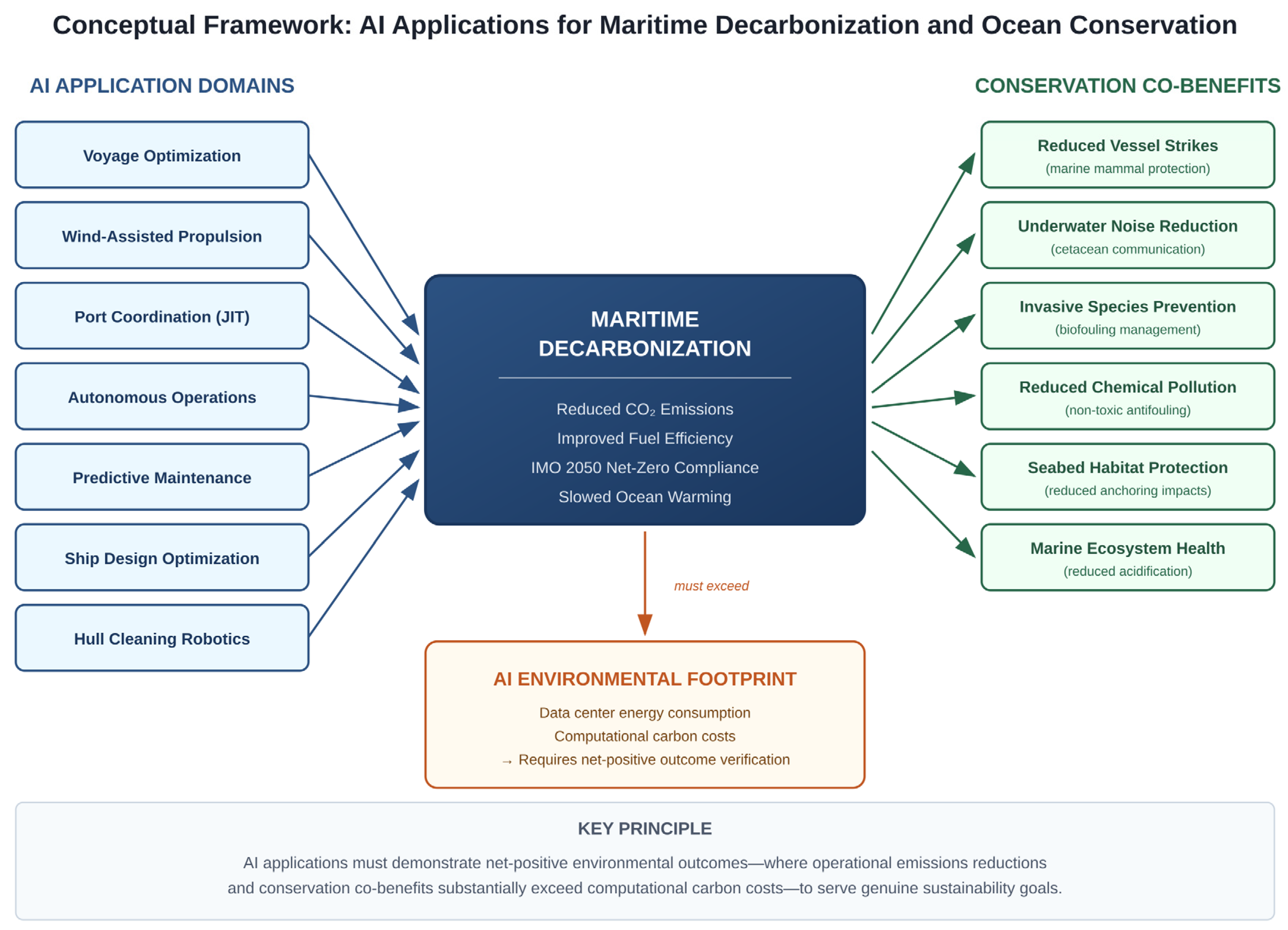
Artificial intelligence emerges as a potentially transformative enabling technology—not as a standalone solution, but as an integrative capability that can optimize existing systems, accelerate the development of new technologies, and coordinate complex maritime logistics to reduce emissions. However, responsible deployment of AI in conservation contexts requires acknowledging its own environmental costs. This article examines specific applications in which AI can contribute to emissions reductions, identifies current limitations, including AI’s energy demands, and proposes research directions that advance both climate objectives and marine ecosystem protection (
Figure 1).
2. The Environmental Footprint of AI: An Honest Accounting
Before examining AI’s potential contributions to maritime decarbonization, intellectual honesty demands acknowledging the technology’s own environmental costs. AI systems—particularly large language models and complex optimization algorithms—require substantial computational resources housed in energy-intensive data centers. The International Energy Agency projects that global electricity consumption by data centers will more than double by 2030, reaching approximately 945 terawatt-hours—roughly equivalent to Japan’s current electricity demand [
7].
A Goldman Sachs Research analysis forecasts that approximately 60% of the increase in data center electricity demand will be met by natural gas and other fossil fuels, potentially adding 215–220 million tons to global carbon emissions cumulatively through 2030—equivalent to 0.6% of global energy emissions [
8]. These projections represent scenarios based on current growth trajectories and stated assumptions about AI adoption rates, and carry significant uncertainty given the rapidly evolving nature of AI deployment and data center energy sources. While not all data center computing involves AI, generative AI and machine learning have become major drivers of rising energy demand. Research published in the journal Patterns estimates that AI systems alone could generate 32.6 to 79.7 million tons of CO
2 emissions in 2025 [
9]. To contextualize these figures: this represents approximately 0.1–0.2% of total global CO
2 emissions (~37 billion tons annually) and approximately 3–8% of shipping’s annual emissions (~1 billion tons).
This reality demands that any assessment of AI’s role in maritime decarbonization include a transparent accounting of the emissions associated with developing, training, and deploying AI systems. The maritime industry should prioritize AI solutions that demonstrate net-positive environmental outcomes—where operational emissions reductions substantially exceed the computational carbon costs. Research frameworks should incorporate lifecycle assessments that account for data center energy consumption, hardware manufacturing, and transmission losses.
Fortunately, pathways do exist to reduce AI’s environmental burden. Researchers at MIT and other institutions are developing more energy-efficient algorithms, optimizing data center locations near renewable energy sources, and implementing flexible computing that shifts workloads to times when grid electricity is cleanest [
10]. The maritime industry should advocate for and preferentially adopt AI solutions powered by verified renewable energy, contributing to broader demand for sustainable computing infrastructure.
3. AI-Enabled Operational Efficiency
3.1. Voyage Optimization and Route Planning
Voyage optimization represents one of the most mature applications of AI in maritime emissions reduction. AI systems analyze meteorological data, ocean currents, vessel performance characteristics, and scheduling constraints to identify routes that minimize fuel consumption while meeting commercial requirements [
11]. From a conservation perspective, optimized routes can also reduce vessel strikes on marine mammals by avoiding known migration corridors and feeding areas—a significant co-benefit for endangered species such as North Atlantic right whales.
The Greek technology company DeepSea Technologies exemplifies the commercialization of these capabilities. In a 2024 partnership with Eastern Pacific Shipping (EPS), DeepSea deployed its AI-driven Cassandra platform across EPS’s fleet of over 300 vessels, achieving weekly fuel consumption forecasts accurate to within 1% [
12]. MMSL, the ship-owning arm of Marubeni, reported savings of
$86,000 in fuel costs on a single vessel over one year by deploying AI-assisted watchkeeping tools [
13].
A critical technical challenge remains data quality. AI models for voyage optimization often work with noisy data—particularly speed-through-water measurements affected by ocean currents [
11]. Companies should invest substantially in improving data collection infrastructure before expecting significant returns from AI optimization.
3.2. Wind-Assisted Propulsion Management
Wind propulsion technologies are experiencing renewed interest as the maritime sector seeks to reduce reliance on fossil fuels. Modern wind-assist systems include Flettner rotors, rigid wing sails, soft sails, and towing kites, with demonstrated fuel savings ranging from 3–15% for rotor sails to projected averages of 30% for advanced rigid wing designs such as BAR Technologies’ WindWings [
14]. The MV Afros, a 64,000 DWT bulk carrier managed by Blue Planet Shipping, has operated commercially since January 2018, equipped with four movable Flettner rotors, and won Ship of the Year at the 2018 Lloyd’s List Greek Shipping Awards.
AI plays an essential role in maximizing the contribution of wind-assist systems through dynamic route optimization that accounts for wind patterns, sea states, and scheduling constraints. BAR Technologies’ WindWing sails pivot automatically using sensor data to optimize wind capture, with software determining whether to engage sail propulsion or rely on engine power based on real-time conditions [
14].
The Marshall Islands, a low-lying Pacific nation facing existential threats from climate-driven sea-level rise, has proposed a $100-per-ton levy on shipping’s CO2 emissions from bunker fuels, with revenues directed toward climate adaptation for vulnerable nations and the development of clean shipping technologies.
At the same time, the shipping company Maersk has advocated for $150 per ton—pricing regimes under which AI-optimized wind propulsion could deliver dramatic fuel savings.
3.3. Port Coordination and Just-in-Time Arrival
Port operations represent a significant source of avoidable emissions. Vessels frequently race to arrive at ports only to wait at anchor for berth availability, burning fuel while stationary. Beyond emissions, vessels at anchor in ecologically sensitive areas can damage seabed habitats and contribute to localized water quality degradation. AI-enabled port coordination systems address these inefficiencies through real-time data analytics, optimized berthing schedules, and vessel movement management [
15].
The Port of Rotterdam has deployed PortXchange’s Synchronizer platform, using AI and machine learning to predict logistical impacts and optimize fleet scheduling [
11]. Just-in-time arrival protocols allow ships to adjust speed en route to arrive precisely when berths become available, reducing both waiting time at anchor and fuel consumption through optimized transit speeds. A 2021 Navis survey found that 76% of terminal operators sought to reduce waiting times, specifically to decrease fuel consumption and emissions. There may be labor savings on this as well—no idle crews sitting on idle boats. However, these savings may be offset by the extended voyage times associated with slow steaming.
4. Automation, Autonomy, and Conservation Co-Benefits
Autonomous and automated vessel technologies offer potential emissions benefits through optimized operations, reduced hotel loads due to decreased crew sizes, and the elimination of weight associated with crew accommodations and provisioning. From a conservation perspective, autonomous systems may also enable more consistent adherence to speed restrictions in marine protected areas and whale habitats—compliance that human operators sometimes neglect under commercial pressure.
The IMO has begun developing a code for maritime autonomous surface ships (MASS), with initial non-mandatory guidelines potentially becoming mandatory by 2028 [
16]. Commercial pilot projects demonstrate varied approaches: Norway’s Yara Birkeland, an 80-m container vessel with a capacity of 120 TEU, autonomously transports fertilizer between a manufacturing plant in Porsgrunn and the export port in Brevik, with zero emissions. The vessel, which commenced commercial operations in spring 2022, is projected to eliminate 40,000 diesel truck journeys annually. China’s Zhi Fei, a 120-m electric container ship, operates under remote and sometimes autonomous control between ports in Shandong province.
The One Sea Association notes that digitalization, automation, and efficient data utilization can help drive the transition to greener shipping before the broad adoption of renewable fuels becomes feasible [
17]. However, concerns persist regarding the displacement of maritime workers. The IMO’s 2023 Strategy emphasizes the importance of a just and equitable transition, with revenues from emissions pricing mechanisms directed toward training, technology transfer, and capacity building in developing countries.
5. Predictive Maintenance for Efficiency Preservation
Equipment degradation progressively reduces vessel efficiency, increasing fuel consumption and emissions over time. AI-powered predictive maintenance systems monitor equipment health through digital twins, sensor networks, and machine learning algorithms to anticipate failures and optimize maintenance schedules [
18]. This proactive approach prevents efficiency losses and reduces the risk of unplanned downtime—including emergency operations that may disturb sensitive marine areas. However, these benefits accrue only to vessels operating within regulatory frameworks. The growing “shadow fleet” of sanctioned tankers—approximately 1700 aging vessels carrying oil from Russia, Iran, and Venezuela—operates largely outside maritime safety regulations and lacks adequate insurance or professional oversight [
19]. These vessels average 16.8 years old, with ships over 20 years old expected to comprise 11% of the global tanker fleet by 2025, up from just 3% before 2022. Operating without predictive maintenance or proper certification, this shadow fleet represents what experts call “a ticking time bomb” for marine environments, with at least nine documented oil spills since 2021.
The SmartShip project, funded by the EU’s Horizon 2020 program, has developed a data-driven framework optimizing energy efficiency through circular economy principles, with approximately 47% of maritime businesses now using IoT and advanced analytics to measure and forecast fuel consumption [
20]. Berlin-based startup Sealenic has developed a maritime AI decision-support platform that reduces the time spent finding compliance-related information from hours to minutes, helping ensure maintenance protocols are correctly followed [
11].
6. AI in Ship Design: Optimizing for Ocean-Friendly Operations
The application of AI to ship design represents an emerging frontier with significant potential for emissions reduction and broader environmental benefits. AI-powered design tools can optimize hull structures and propulsion systems, enhancing hydrodynamic performance and fuel efficiency [
18]. From a conservation perspective, AI-optimized hull designs could also reduce underwater radiated noise—a growing concern as anthropogenic noise increasingly disrupts marine mammal communication, navigation, and foraging.
BAR Technologies’ development of WindWings illustrates this potential. Using proprietary software originally developed for America’s Cup racing yachts, engineers optimized rigid-wing sail designs for cargo vessel applications [
14]. The company’s chief technology officer notes that AI could eventually determine optimal hull and sail shapes that maximize wind-power utilization when combined with zero-carbon fuels. In manufacturing, HD Hyundai has delivered vessels with AI-enabled machinery monitoring and safety systems [
11], suggesting that AI integration is increasingly occurring at the shipbuilding stage.
7. AI, Robotics, and Hull Maintenance: Conservation Implications
7.1. The Biofouling Challenge: Emissions and Invasive Species
Biofouling—the accumulation of marine organisms on submerged hull surfaces—represents a persistent challenge with both climate and ecological dimensions. Fouling increases hydrodynamic drag, with severe accumulation increasing fuel consumption by up to 40% [
21]. The IMO’s 2011 biofouling management guidelines, currently under revision, will likely evolve into a legally binding framework as approved at MEPC 83 [
6].
Beyond emissions, biofouling facilitates the transfer of invasive species, creating ecological disruption in destination ports and coastal ecosystems worldwide. The introduction of non-native species through hull fouling has contributed to the collapse of native shellfish populations, the displacement of endemic species, and the alteration of entire marine food webs. Effective hull maintenance thus delivers dual conservation benefits: reduced emissions and reduced transport of invasive species. Approximately 80% of fouling organisms concentrate in niche areas such as propellers, rudder hinges, and bilge keels, where complex shapes make cleaning difficult [
22].
7.2. AI-Enabled Hull Cleaning Robotics
Underwater cleaning robots (UCRs) are transforming hull maintenance from periodic, reactive interventions to continuous, proactive management. The global underwater cleaning robot market, valued at
$553 million in 2024, is projected to reach
$1.42 billion by 2031 at a 14.7% compound annual growth rate [
23]. Norwegian firm ECOsubsea has launched next-generation hull cleaning robots capable of cleaning vessels 10 times faster than traditional divers, cleaning a fully laden capesize vessel—among the largest bulk carriers, too big for the Suez or Panama canals—with an 18-m draft in just four hours [
24].
AI integration enhances UCR capabilities significantly. Self-navigating robots optimize cleaning paths using machine learning, minimizing energy consumption while ensuring complete hull coverage. Jotun’s HullSkater robot accompanies vessels and cleans hulls while ships are anchored, preventing fouling accumulation rather than removing established growth [
21]. Nautica Technologies has developed HYDRA, an AI-powered robotic swarm system designed for proactive cleaning. Specialized robots equipped with multi-degree-of-freedom manipulator arms can access complex hull geometries that are inaccessible to conventional magnetic crawling robots [
22].
7.3. Toward Non-Toxic Antifouling: A Conservation Priority
Traditional antifouling approaches rely on biocide-releasing coatings that prevent the attachment of organisms. However, these coatings present serious environmental and human health concerns that extend beyond their intended targets. Tributyltin (TBT) coatings, though highly effective in preventing biofouling, were banned globally in 2008 after causing catastrophic oyster population collapses, imposex in gastropods, and bioaccumulation throughout marine food chains—ultimately reaching human consumers of contaminated seafood. TBT is now recognized as an endocrine disruptor linked to immunotoxicity and developmental effects in humans. The lesson of TBT should inform current antifouling practices: Seemingly localized chemical interventions can have ecosystem-wide consequences that ultimately affect human health through the seafood supply.
Copper-based alternatives now face similar scrutiny, with the EU’s Water Framework Directive mandating a 50% reduction in copper emissions by 2030 [
25]. Copper accumulation in port sediments affects benthic communities, enters food webs, and can impair the reproduction of commercially and ecologically important species. From a conservation standpoint, the transition away from toxic antifouling coatings represents an opportunity to significantly reduce the maritime sector’s chemical footprint on marine ecosystems—and potentially reduces the demand for copper (and copper mining) as well.
UCRs offer an alternative pathway—physical removal without continuous biocide release. When combined with non-toxic or low-toxicity coatings, robotic cleaning systems could enable effective fouling management while dramatically reducing chemical inputs to the marine environment. This approach aligns with emerging concepts of marine ecosystem health that recognize the cumulative impacts of multiple stressors.
AI presents opportunities to develop improved antifouling formulations with reduced environmental impact. Machine learning can accelerate materials discovery by predicting the performance of novel coating compositions before physical synthesis and testing. The EU-funded BIO-CODES project aims to embed DNA sequencers into cleaning robots by 2026, enabling automated species identification during cleaning cycles to support biodiversity monitoring [
26]. PPG has developed coatings incorporating sacrificial layers that slough off during robotic brushing, halving energy consumption compared to traditional coatings.
A proposed “Dynamic Fouling Equilibrium Index” (DFEI) would balance hull cleaning efficiency with marine biodiversity considerations by establishing thresholds for acceptable fouling coverage—for example, preserving approximately 15% hull coverage as potential habitat for larval fish. The DFEI framework would require real-time species monitoring capabilities currently under development; the EU-funded BIO-CODES project aims to embed DNA sequencers into cleaning robots by 2026 to enable automated species identification during cleaning cycles [
26]. While such frameworks remain conceptual, they illustrate how AI-enabled monitoring could support more nuanced approaches to biofouling management that account for ecological impacts alongside efficiency objectives.
8. Research Directions: Advancing Climate and Conservation Goals
The application of AI to maritime decarbonization presents numerous research opportunities that advance both climate and conservation objectives:
AI energy transparency: Developing standardized frameworks for measuring and reporting the carbon footprint of maritime AI applications, enabling net-impact assessments that account for data center emissions against operational savings.
Conservation-optimized routing: Creating voyage optimization algorithms that incorporate marine protected areas, seasonal wildlife migration patterns, and noise-sensitive habitats alongside efficiency parameters.
Materials discovery for non-toxic antifouling: Applying machine learning to identify coating formulations that prevent biofouling without biocide release, potentially incorporating biomimetic approaches inspired by marine organisms with natural antifouling properties.
Invasive species monitoring: Integrating AI-powered species identification into hull cleaning systems to track and reduce the transport of non-native organisms across biogeographic regions.
Underwater noise reduction: Developing AI-optimized propeller and hull designs that minimize radiated noise, reducing impacts on marine mammals and other acoustically sensitive species.
Human-AI interaction in maritime contexts: Understanding factors affecting crew acceptance of AI systems, designing interfaces that support rather than supplant human decision-making.
Propeller monitoring and optimization: AI-enabled continuous monitoring of propeller condition through vibration signatures, acoustic emissions, and performance data to maintain peak efficiency and reduce cavitation noise.
9. Conclusions: Technology in the Service of Ocean Health
The maritime industry’s transition to net-zero emissions requires a comprehensive transformation across vessel design, operational practices, port infrastructure, and supply chain coordination. AI technologies offer capabilities that can accelerate this transition by optimizing existing systems, enhancing emerging technologies, and coordinating complex logistics networks.
Current applications demonstrate measurable benefits: voyage optimization systems saving significant fuel costs, wind-assist technologies delivering 3–30% fuel reductions with AI-managed operations, port coordination reducing idle time at anchor, and predictive maintenance preserving vessel efficiency. Emerging applications in hull-cleaning robotics and sustainable antifouling development promise further contributions—and offer conservation co-benefits by reducing the transport of invasive species and chemical contamination in marine environments.
However, AI is not a panacea. Effective deployment requires attention to data quality, crew acceptance, regulatory frameworks, and equitable distribution of benefits. Most critically, honest accounting of AI’s own environmental footprint—the substantial energy demands of data centers and computational infrastructure—must inform decisions about which AI applications deliver genuine net-positive environmental outcomes. The conservation community should advocate for transparent reporting of AI-related emissions and the preferential adoption of AI solutions powered by renewable energy, without slowing efforts to replace fossil fuels to meet existing residential and commercial electricity demand.
While the AI applications surveyed here demonstrate significant potential, a comprehensive quantitative comparison of emissions reduction effects across application domains remains challenging. Published figures vary substantially depending on vessel type, route characteristics, operational context, and measurement methodology—from 5–14% fuel savings for voyage optimization to up to 30% on ideal routes for wind-assisted propulsion with AI optimization. These figures derive from different studies using incompatible baselines, making direct comparison methodologically problematic. Priority-setting for AI investment requires context-specific assessment based on vessel type, age, voyage intensity, and integration capabilities, recognizing that multiple solutions can work cumulatively and that optimal combinations require professional assessment tailored to individual vessels.
The global applicability of AI-enabled maritime decarbonization faces significant barriers, particularly for developing countries. High upfront costs for AI systems and supporting digital infrastructure, limited access to technical expertise for implementation and maintenance, and infrastructure constraints at ports in developing regions all present challenges. Capacity-building and technology-transfer mechanisms are essential to ensure that AI’s benefits extend beyond wealthy nations and well-resourced shipping companies. The IMO’s emphasis on a just and equitable transition—including proposals to direct revenues from emissions pricing toward training and technology transfer for developing nations—represents an important step toward addressing these disparities. Without such mechanisms, AI-enabled decarbonization risks widening the gap between developed and developing maritime economies.
The IMO’s Net-Zero Framework establishes mandatory requirements that will drive investment in emissions reduction technologies. AI capabilities that demonstrate clear contributions to compliance—whether through operational optimization, enhanced efficiency of wind-assist systems, or reduced hull fouling through robotic maintenance—will see accelerated adoption. Research that advances these capabilities while addressing implementation challenges and broader ecological considerations will prove essential to achieving the maritime sector’s ambitious decarbonization targets.
Ultimately, technology must serve conservation goals, not merely efficiency metrics. The ocean’s role as a climate regulator, biodiversity reservoir, and foundation of coastal community livelihoods demands that maritime decarbonization efforts consider the full spectrum of environmental impacts. AI offers powerful tools for this transition—but only if deployed with a clear-eyed assessment of both benefits and costs, and with an unwavering commitment to ocean health as the ultimate measure of success.