Internationalizing Terroir Products Today: Focus on Tunisian Olive Oil and Swiss La Tête de Moine AOP Cheese

Abstract
1. Introduction
2. Literature Review
2.1. The Resource-Based View (RBV) Theory
2.2. Application of the RBV to the Internationalization of Agri-SMEs
2.3. Territorial Resources and the Internationalization of Agri-SMEs
2.4. Territorial Capital and Local Development
3. Materials and Methods
3.1. Data Collection Procedure
3.2. Interview Guide
3.3. Sample Size and Description
3.4. Data Analysis
4. Results and Discussion
4.1. Organizational R–C Pair
4.2. Production and Technological R–C Pair
4.3. Managerial R–C Pair
4.4. Experiential R–C Pair
4.5. Relational R–C Pair
4.6. Knowledge-Based R–C Pair
4.7. Marketing R–C Pair
4.8. Financing R–C Pair
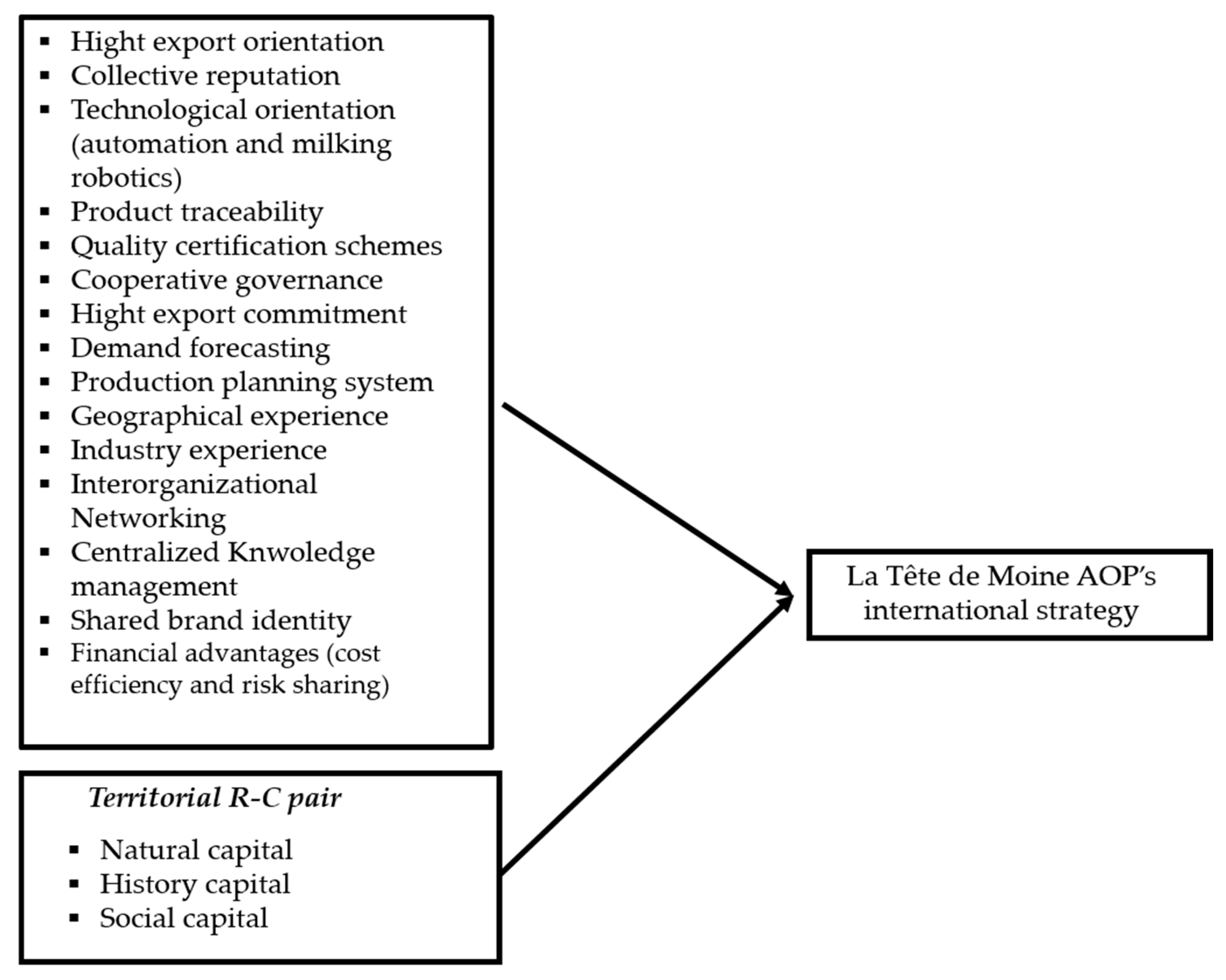
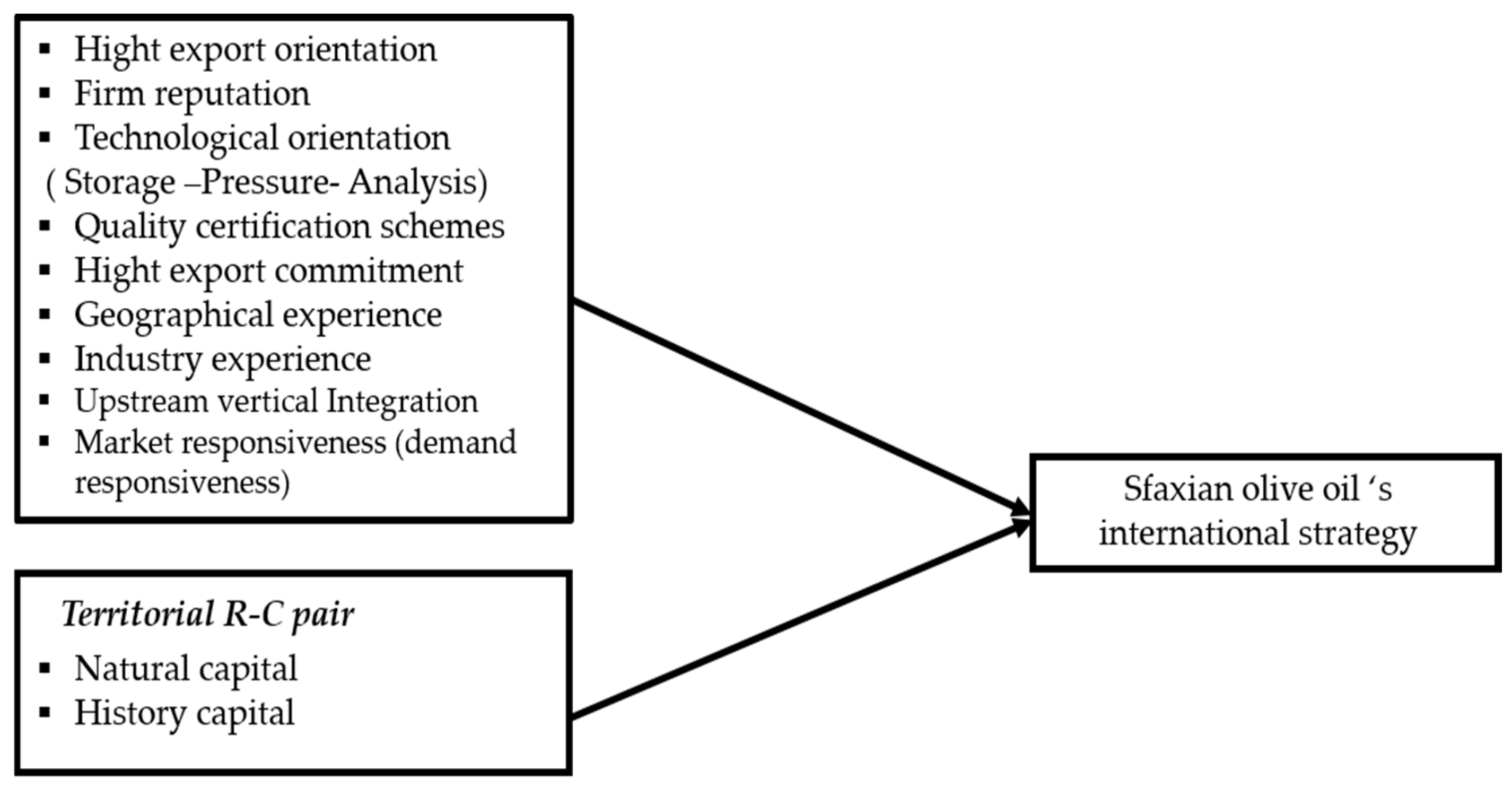
4.9. Territorial R–C Pair
5. Conclusions
Author Contributions
Funding
Institutional Review Board Statement
Informed Consent Statement
Data Availability Statement
Conflicts of Interest
Abbreviations
| SMEs | Small and medium-sized enterprises |
| RBV | Resource-based view |
| AOP | Appellation d’Origine Protégée |
| RTS | Radio Télévision Suisse |
| SCA | Sustainable competitive advantage |
| R–C | Resources–capabilities |
| PDO | Protected Designation of Origin |
| SCM | Switzerland Cheese Marketing |
| ERP | Enterprise Resource Planning |
| ONH | Oil National Office |
| FOAG | Federal Office for Agriculture |
| FOPROHOC | Fonds de Promotion de l’Huile d’Olive Conditionnée |
| DOC | Controlled denomination of origin |
| OIC | Intercantonal Certification Organization |
Appendix A

| Pre-Defined Codes | Pre-Defined Sub-Codes | Theme Questions in the Interview Guide |
|---|---|---|
| Human resource management | When hiring a new employee, what will you pay particular attention to? | |
| Technological mastery | Have you had to make any technological changes? | |
| Networking | Is your company a member of an industry association or local cooperative? | |
| Is geographical proximity to other firms essential for starting export processes? | ||
| Production Method | What production method do you use? | |
| Integration of Upstream and Downstream Activities | Packaging unit (capability to prepare product packaging, e.g., preparing bottles according to quality standards or cheese ripening) | Do you have a packaging unit? |
| Forecasting System | Do you make export forecasts? | |
| Storage | Storage capacity and quality? | |
| Quality Management System | Do you have an integrated laboratory within your company? | |
| Innovation | In your opinion, how important are innovation, research, and development in your business? | |
| International Experience | To which markets do you export the most? | |
| How was access to foreign markets possible? | ||
| What percentage of your turnover do these exports represent? | ||
| What entry strategy do you adopt? Indirect or direct exports? | ||
| Knowledge | Market sources, institutional sources, other sources | Have you implemented a business intelligence system? What knowledge did your company use to export part of its production? |
| Export Market Orientation | Responsiveness to export market information | Do you think you can convey the correct image of your product’s quality and value to foreign customers? |
| Generation of export market information | How do you identify cultural differences between your country and your export destination? | |
| Do you consider these differences when entering into business relationships with foreign market players? | ||
| Relationship quality | Relationship with competitors | Do you know your competitors operating in your export destination and their products? |
| Relationship with foreign Customers | Have your foreign customers made suggestions that have helped you improve some of your manufacturing processes? | |
| The firm’s competitive advantages | Do you believe you have advantages that differentiate you from competitors in the international market? | |
| Product adaptation | Product adaptation | Do you have product varieties manufactured exclusively for international markets? |
| Price adaptation | Do you make any adjustments to the product for export? | |
| Distribution adaptation | How do you market your products in the foreign markets | |
| Communication adaptation | Have you implemented a communication and promotion strategy for foreign markets? | |
| Export commitment | Financial investment for Export | |
| Participation in informational programs | Do you travel regularly for business? | |
| Financing | State Support | To what extent does the government, such as economic promotion offices, play a facilitating role in this area? |
| Emerging Codes | Emerging Sub-Codes | Example of Data from Interviews |
|---|---|---|
| Territorial capital | ||
| Social resource | Cheesemakers may compete, but when it comes to decision-making, we collaborate, discuss, and reach solutions that satisfy everyone | |
| Identity resource | We really emphasize the most important values: raw milk, milk quality, the artisanal production, the origin, the region, the PDO | |
| Historical resource | The La Tête de Moine AOP sector has the potential to sustain its 800-year tradition | |
| Cultural resource | It’s an inheritance from our great-grandparents. My father bought the surrounding plots to expand his estate. We wanted to honor these centenarian olive trees | |
| Natural resource | We use cultivation techniques specific to the Sfax region, relying on the Chemlali variety, which is remarkably well adapted to the arid climate | |
| Reputation | Sector reputation | You have to be careful, you have to maintain an image. |
| Firm reputation | The biggest unforeseen event was COVID-19. From one day to the next, everything was closed, everything was blocked. And I would say that we were able to overcome all of this thanks to our reputation |
References
- Acs, Z.; Leo-Paul, D.; Jones, M.V. Toward new horizons: The internationalisation of entrepreneurship. J. Int. Entrep. 2003, 1, 5. [Google Scholar] [CrossRef]
- Ramon-Jeronimo, J.M.; Florez-Lopez, R.; Araujo-Pinzon, P. Resource-based view and SMEs performance exporting through foreign intermediaries: The mediating effect of management controls. Sustainability 2019, 11, 3241. [Google Scholar] [CrossRef]
- Serrano, R.; Fernandez-Olmos, M.; Pinilla, V. Internationalization and performance in agri-food firms (No. ART-2018-107549). Span. J. Agric. Res. 2018, 16, e0107. [Google Scholar] [CrossRef]
- Caiazza, R.; Volpe, T. How Campanian Small and Medium Enterprises (SMEs) Can Compete in the Global Agro-Food Industry. J. Food Prod. Mark. 2013, 19, 406–412. [Google Scholar] [CrossRef]
- Belletti, G.; Burgassi, T.; Manco, E.; Marescotti, A.; Pacciani, A.; Scaramuzzi, S. The roles of geographical indications (PDO and PGI) on the internationalisation process of agro-food products. In Proceedings of the 105th EAAE Seminar ‘International Marketing and International Trade of Quality Food Products’, Bologna, Italy, 8–10 March 2007; Avenue Media: Bologna, Italy, 2007. [Google Scholar]
- Spielmann, N.; Gélinas-Chebat, C. Terroir? That’s not how I would describe it. Int. J. Wine Bus. Res. 2012, 24, 254–270. [Google Scholar] [CrossRef]
- Millet, M.; Keast, V.; Gonano, S.; Casabianca, F. Product qualification as a means of identifying sustainability pathways for place-based agri-food systems: The case of the GI Corsican grapefruit (France). Sustainability 2020, 12, 7148. [Google Scholar] [CrossRef]
- Belletti, G.; Marescotti, A.; Touzard, J.M. Geographical indications, public goods, and sustainable development: The roles of actors’ strategies and public policies. World Dev. 2017, 98, 45–57. [Google Scholar] [CrossRef]
- Rodríguez-Gutiérrez, P.; Guerrero-Baena, M.D.; Luque-Vílchez, M. Survival in the agri-food industry: Internationalisation and manager gender in Spanish SMEs. Int. J. Entrep. Small Bus. 2021, 44, 359–385. [Google Scholar] [CrossRef] [PubMed]
- Serrano, R.; Dejo-Oricain, N.; Ferrer, J.; Pinilla, V.; Abella-Garcés, S.; Maza, M.T. Domestic clustered networks and internationalization of agrifood SMEs. Agribusiness 2023, 39, 167–195. [Google Scholar] [CrossRef]
- Dominguez, N.; Mayrhofer, U. Internationalization stages of traditional SMEs: Increasing, decreasing and re-increasing commitment to foreign markets. Int. Bus. Rev. 2017, 26, 1051–1063. [Google Scholar] [CrossRef]
- Freeman, S.; Cavusgil, S.T. Toward a typology of commitment states among managers of born-global firms: A study of accelerated internationalization. J. Int. Mark. 2007, 15, 1–40. [Google Scholar] [CrossRef]
- Testa, S. Internationalization patterns among speciality food companies: Some Italian case study evidence. Br. Food J. 2011, 113, 1406–1426. [Google Scholar] [CrossRef]
- McDougall, P.P.; Shane, S.; Oviatt, B.M. Explaining the formation of international new ventures: The limits of theories from international business research. J. Bus. Ventur. 1994, 9, 469–487. [Google Scholar] [CrossRef]
- Young, S.; Dimitratos, P.; Dana, L.P. International entrepreneurship research: What scope for international business theories? J. Int. Entrep. 2003, 1, 31–42. [Google Scholar] [CrossRef]
- Katsikeas, C.S.; Leonidou, L.C.; Morgan, N.A. Firmlevel export performance assessment: Review, evaluation, and development. J. Acad. Mark. Sci. 2000, 28, 493–511. [Google Scholar] [CrossRef]
- Kraus, S.; Harms, R.; Fink, M. Family firm research: Sketching a research field. Int. J. Entrep. Innov. Manag. 2011, 13, 32–47. [Google Scholar] [CrossRef]
- D’Angelo, A.; Majocchi, A.; Zucchella, A.; Buck, T. Geographical pathways for SME internationalization: Insights from an Italian sample. Int. Mark. Rev. 2013, 30, 80–105. [Google Scholar] [CrossRef]
- Nolan, C.T.; Garavan, T.N. Problematizing HRD in SMEs: A “critical” exploration of context, informality, and empirical realities. Hum. Resour. Dev. Q. 2016, 27, 407–442. [Google Scholar] [CrossRef]
- Duarte Alonso, A.; Bressan, A. A resource-based view of the firm and micro and small Italian wine firms. Int. J. Wine Bus. Res. 2016, 28, 349–368. [Google Scholar] [CrossRef]
- Zen, A.C.; Fensterseifer, J.E.; Prévot, F. The influence of resources on the internationalisation process of clustered wine companies. Int. J. Bus. Glob. 2012, 8, 30–48. [Google Scholar] [CrossRef]
- Fensterseifer, J.E.; Rastoin, J.L. Cluster resources and competitive advantage: A typology of potentially strategic wine cluster resources. Int. J. Wine Bus. Res. 2013, 25, 267–284. [Google Scholar] [CrossRef]
- Morretta, V.; Syrett, S.; Ramirez, L.S. Territorial capital as a source of firm competitive advantage: Evidence from the North and South of Italy. Eur. Plan. Stud. 2020, 28, 2390–2408. [Google Scholar] [CrossRef]
- Lucini, L.; Rocchetti, G.; Trevisan, M. Extending the concept of terroir from grapes to other agricultural commodities: An overview. Curr. Opin. Food Sci. 2020, 31, 88–95. [Google Scholar] [CrossRef]
- Vlahovic, B.; Popovic-Vranjes, A.; Mugoša, I. International cheese market–Current state and perspective. Econ. Insights–Trends Chall. 2014, 66, 35–43. [Google Scholar]
- Ben Hamida, L.; Hasler, S.; Siala Abid, H.; Khemakhem, R. Internationalization of local products in today’s world: A Focus on the Swiss cheese sector “La Tête de Moine AOP”. Small Bus. Int. Rev. 2025, 9, e694. [Google Scholar] [CrossRef]
- Bornaz, B.S.; Kachouri, F. La comp. titivit. du secteur de l’huile d’olive en Tunisie: Prix, qualit. et avantage concurrentiel national. New Medit 2003, 2, 6–14. [Google Scholar]
- Pehlivanoğlu, F.; Erarslan, C.; Demir, S. Factors affecting competition in olive oil exports: Panel data analysis of selected countries. Case study. Agric. Econ.-Zemed. Ekon. 2021, 67, 511–518. [Google Scholar] [CrossRef]
- Mariem, A.; Mouna, B.; Sonia, B. Competitiveness of Tunisian olive oil exports in a changing world market: A shift share analysis. Eur. J. Econ. Manag. Sci. 2021, 4, 42–52. [Google Scholar] [CrossRef]
- Weber, M.; Salhab, J.; Tsatsimpe, K.; Sanchez-Quintela, S. Olive Oil in the North-West of Tunisia: Findings from a Value Chain and Jobs Survey; World Bank Group: Washington, DC, USA, 2020. [Google Scholar]
- Deshpande, R.; Webster, F.E., Jr. Organizational culture and marketing: Defining the research agenda. J. Mark. 1989, 53, 3–15. [Google Scholar] [CrossRef]
- Caramelli, M. Les facteurs de succès des plans internationaux d’actionnariat salarié: Une revue de la littérature. In Proceedings of the 14th Congress of the Francophone Association for Human Resource Management (AGRH), Grenoble, France, 19–22, November 2003. [Google Scholar]
- İpek, İ. The resource-based view within the export context: An integrative review of empirical studies. J. Glob. Mark. 2018, 31, 157–179. [Google Scholar] [CrossRef]
- Raymond, L.; St-Pierre, J.; Uwizeyemungu, S.; Le Dinh, T. Internationalization capabilities of SMEs: A comparative study of the manufacturing and industrial service sectors. J. Int. Entrep. 2014, 12, 230–253. [Google Scholar] [CrossRef]
- Wernerfelt, B. A resource-based view of the firm. Strateg. Manag. J. 1984, 5, 171–180. [Google Scholar] [CrossRef]
- Grant, R.M. Porter’s ‘competitive advantage of nations’: An assessment. Strateg. Manag. J. 1991, 12, 535–548. [Google Scholar] [CrossRef]
- Kaleka, A. Resources and capabilities driving competitive advantage in export markets: Guidelines for industrial exporters. Ind. Mark. Manag. 2002, 31, 273–283. [Google Scholar] [CrossRef]
- Barney, J. Firm resources and sustained competitive advantage. J. Manag. 1991, 17, 99–120. [Google Scholar] [CrossRef]
- Bharadwaj, S.G.; Varadarajan, P.R.; Fahy, J. Sustainable competitive advantage in service industries: A conceptual model and research propositions. J. Mark. 1993, 57, 83–99. [Google Scholar] [CrossRef]
- Dhanaraj, C.; Beamish, P.W. A resource-based approach to the study of export performance. J. Small Bus. Manag. 2003, 41, 242–261. [Google Scholar] [CrossRef]
- Fernández-Mesa, A.; Alegre, J. Entrepreneurial orientation and export intensity: Examining the interplay of organizational learning and innovation. Int. Bus. Rev. 2015, 24, 148–156. [Google Scholar] [CrossRef]
- Knight, G.A.; Kim, D. International business competence and the contemporary firm. J. Int. Bus. Stud. 2009, 40, 255–273. [Google Scholar] [CrossRef]
- Behyan, M.; Mohamad, O.; Omar, A. Influence of internationalization orientation on export performance: In the perspective of Malaysian manufacturing firms. J. Bus. Ind. Mark. 2015, 30, 83–95. [Google Scholar] [CrossRef]
- Maurel, C. Determinants of export performance in French wine SMEs. Int. J. Wine Bus. Res. 2009, 21, 118–142. [Google Scholar] [CrossRef]
- Gaur, A.S.; Kumar, V.; Singh, D. Institutions, resources, and internationalization of emerging economy firms. J. World Bus. 2014, 49, 12–20. [Google Scholar] [CrossRef]
- López-Navarro, M.Á.; Camisón-Zornoza, C. The effect of group composition and autonomy on the performance of joint ventures (JVs): An analysis based on Spanish export JVs. Int. Bus. Rev. 2003, 12, 17–39. [Google Scholar] [CrossRef]
- Aguilera-Caracuel, J.; Hurtado-Torres, N.E.; Aragón-Correa, J.A. Does international experience help firms to be green? A knowledge-based view of how international experience and organisational learning influence proactive environmental strategies. Int. Bus. Rev. 2012, 21, 847–861. [Google Scholar] [CrossRef]
- Majocchi, A.; Bacchiocchi, E.; Mayrhofer, U. Firm size, business experience and export intensity in SMEs: A longitudinal approach to complex relationships. Int. Bus. Rev. 2005, 14, 719–738. [Google Scholar] [CrossRef]
- Olmos, M.F. The determinants of internationalization: Evidence from the wine industry. Appl. Econ. Perspect. Policy 2011, 33, 384–401. [Google Scholar] [CrossRef]
- Gomes-Casseres, B. Ownership structures of foreign subsidiaries. Theory and evidence. J. Econ. Behav. Organ. 1989, 11, 1–25. [Google Scholar] [CrossRef]
- Johanson, J.; Mattsson, L.G. Internationalisation in industrial systems—A network approach. In Strategies in Global Competition (RLE International Business); Routledge: Abingdon, UK, 2013; pp. 287–314. [Google Scholar] [CrossRef]
- Sullivan Mort, G.; Weerawardena, J. Networking capability and international entrepreneurship: How networks function in Australian born global firms. Int. Mark. Rev. 2006, 23, 549–572. [Google Scholar] [CrossRef]
- Beleska-Spasova, E.; Glaister, K.W.; Stride, C. Resource determinants of strategy and performance: The case of British exporters. J. World Bus. 2012, 47, 635–647. [Google Scholar] [CrossRef]
- Ahmed, Z.U.; Julian, C.C.; Mohamad, O.; Tooksoon, P. The empirical link between resources, networks and export marketing performance and the implications for developing countries. J. Transnatl. Manag. 2012, 17, 63–88. [Google Scholar] [CrossRef]
- Goll, I.; Brown Johnson, N.; Rasheed, A.A. Knowledge capability, strategic change, and firm performance: The moderating role of the environment. Manag. Decis. 2007, 45, 161–179. [Google Scholar] [CrossRef]
- Huber, G.P. Organizational learning: The contributing processes and the literatures. Organ. Sci. 1991, 2, 88–115. [Google Scholar] [CrossRef]
- Wei, Y.; Zheng, N.; Liu, X.; Lu, J. Expanding to outward foreign direct investment or not? A multi-dimensional analysis of entry mode transformation of Chinese private exporting firms. Int. Bus. Rev. 2014, 23, 356–370. [Google Scholar] [CrossRef]
- Zhang, J.; Zhu, M. Market orientation, product innovation and export performance: Evidence from Chinese manufacturers. J. Strateg. Mark. 2016, 24, 377–397. [Google Scholar] [CrossRef]
- Westhead, P.; Wright, M.; Ucbasaran, D. The internationalization of new and small firms: A resource-based view. J. Bus. Ventur. 2001, 16, 333–358. [Google Scholar] [CrossRef]
- Ling-yee, L.; Ogunmokun, G.O. Effect of export financing resources and supply-chain skills on export competitive advantages: Implications for superior export performance. J. World Bus. 2001, 36, 260–279. [Google Scholar] [CrossRef]
- García-Álvarez de Perea, J.; Ramírez-García, C.; Del Cubo-Molina, A. Internationalization business models and patterns of SMEs and MNEs: A qualitative multi-case study in the agrifood sector. Sustainability 2019, 11, 2755. [Google Scholar] [CrossRef]
- Schiefer, J.; Hartmann, M. Determinants of competitive advantage for German food processors. Agribus. Int. J. 2008, 24, 306–319. [Google Scholar] [CrossRef]
- Valdés, R. A Comparative Analysis of Ethnic Networks and Internationalization of Latin American Agri-SMEs: The Case of Argentina, Brazil, and Chile. Agriculture 2024, 14, 1918. [Google Scholar] [CrossRef]
- Santini, C.; Cavicchi, A.; Zampi, V. Old World Wineries and Market Orientation: Empirical Evidence from the Italian Wine Industry. In Market Orientation; Routledge: Abingdon, UK, 2016; pp. 341–353. [Google Scholar] [CrossRef]
- Duarte Alonso, A. Wine as a unique and valuable resource: An exploratory study of wine consumers on La Palma Island. Br. Food J. 2015, 117, 2757–2776. [Google Scholar] [CrossRef]
- Galati, A.; Crescimanno, M.; Rossi, M.; Farruggia, D.; Tinervia, S. The determinants affecting the internationalisation of the Italian SMEs producing sparkling wines: An empirical study on the RBV of the firms. Int. J. Glob. Small Bus. 2014, 6, 100–118. [Google Scholar] [CrossRef]
- Prévost, P. Enjeux didactiques dans la formation des agronomes: Cas de la notion de terroir. Nat. Sci. Soc. 2011, 19, 50–55. [Google Scholar] [CrossRef]
- Begalli, D.; Capitello, R.; Agnoli, L. Territorial-based marketing strategies for typical agro-food products: Issues and perspectives. In Agricultural Management Strategies in a Changing Economy; Popescu, G., Jean-Vasile, A., Eds.; GI Global Scientific Publishing: Hershey, PA, USA, 2015; pp. 30–51. [Google Scholar] [CrossRef]
- Radić, I.; Monaco, C.; Cerdan, C.; Peri, I. Establishing communities of value for sustainable localized food products: The case of mediterranean olive oil. Sustainability 2023, 15, 2236. [Google Scholar] [CrossRef]
- Cosentino, A.; Paoloni, P.; Iannone, B.; Temperini, V. Tradition, innovation and relationships: Emergent profiles from agro-food Italian industry. Br. Food J. 2020, 123, 279–299. [Google Scholar] [CrossRef]
- Vrontis, D.; Bresciani, S.; Giacosa, E. Tradition and innovation in Italian wine family businesses. Br. Food J. 2016, 118, 1883–1897. [Google Scholar] [CrossRef]
- Collins, J.D.; Hitt, M.A. Leveraging tacit knowledge in alliances: The importance of using relational capabilities to build and leverage relational capital. J. Eng. Technol. Manag. 2006, 23, 147–167. [Google Scholar] [CrossRef]
- Festa, G.; Rossi, M.; Kolte, A.; Situm, M. Territory-based knowledge management in international marketing processes–the case of “Made in Italy” SMEs. Eur. Bus. Rev. 2020, 32, 425–442. [Google Scholar] [CrossRef]
- Fort, F.; Couderc, J.P. Le terroir: Un avantage concurrentiel à l’exportation? Le cas des entreprises agro-alimentaires du Languedoc-Roussillon. Écon. Rural. 2001, 264, 46–59. [Google Scholar] [CrossRef]
- Santini, C.; Rabino, S. Internationalisation drivers in the wine business: A RBV perspective. Int. J. Bus. Glob. 2012, 8, 7–19. [Google Scholar] [CrossRef]
- Cheriet, F.; Maurel, C. Être petit et réussir à l’export: étude de dix cas d’entreprises vitivinicoles françaises. Manag. Int. 2020, 24, 114–126. [Google Scholar] [CrossRef]
- Dabić, M.; Maley, J.; Dana, L.P.; Novak, I.; Pellegrini, M.M.; Caputo, A. Pathways of SME internationalization: A bibliometric and systematic review. Small Bus. Econ. 2020, 55, 705–725. [Google Scholar] [CrossRef]
- Vivek, R.; Nanthagopan, Y.; Piriyatharshan, S. Beyond methodology: Theoretical foundations of triangulation in qualitative and multi-method research: A literature review. Sci. Studios Soc. Political Psychol. 2023, 29, 53–62. [Google Scholar] [CrossRef]
- Giannelloni, J.L.; Vernette, E. Études de Marché, 2nd ed.; Vuibert: Paris, France, 2001; p. 240. [Google Scholar]
- Evrard, Y.; Pras, B.; Roux, E. Market–Etudes et Recherches en Marketing, 4th ed.; Dunod: Malakoff, France, 2009; p. 720. [Google Scholar]
- Boyatzis, R. Transforming Qualitative Information: Thematic Analysis and Code Development; Sage: Thousand Oaks, CA, USA, 1998; p. 184. [Google Scholar]
- Bardin, L. L’Analyse de Contenu; PUF: Paris, France, 1977; p. 233. [Google Scholar]
- Fereday, J.; Muir-Cochrane, E. Demonstrating rigor using thematic analysis: A hybrid approach of inductive and deductive coding and theme development. Int. J. Qual. Methods 2006, 5, 80–92. [Google Scholar] [CrossRef]
- Crabtree, B.F.; Miller, W.F. A template approach to text analysis: Developing and using codebooks. In Doing Qualitative Research; Crabtree, B.F., Miller, W.L., Eds.; Sage: Newbury Park, CA, USA, 1999; pp. 163–177. [Google Scholar]
- Tobin, G.A.; Begley, C.M. Methodological rigour within a qualitative framework. J. Adv. Nurs. 2004, 48, 388–396. [Google Scholar] [CrossRef]
- Schwandt, T.A.; Lincoln, Y.S.; Guba, E.G. Judging interpretations: But is it rigorous? Trustworthiness and authenticity in naturalistic evaluation. New Dir. Eval. 2007, 2007, 114. [Google Scholar] [CrossRef]
- Ali, R.; Lynch, R.; Melewar, T.C.; Jin, Z. The Moderating Influences on the Relationship of Corporate Reputation with Its Antecedents and Consequences: A Meta-Analytic Review. J. Bus. Res. 2015, 68, 1105–1117. [Google Scholar] [CrossRef]
- Antoldi, F.; Cerrato, D.; Depperu, D. SMEs export consortia and the development of intangible resources. J. Small Bus. Enterp. Dev. 2013, 20, 567–583. [Google Scholar] [CrossRef]
- Tirole, J. A theory of collective reputations (with applications to the persistence of corruption and to firm quality). Rev. Econ. Stud. 1996, 63, 1–22. [Google Scholar] [CrossRef]
- Bai, J.; Gazze, L.; Wang, Y. Collective reputation in trade: Evidence from the Chinese dairy industry. Rev. Econ. Stat. 2022, 104, 1121–1137. [Google Scholar] [CrossRef]
- Serra, F.; Pointon, J.; Abdou, H. Factors influencing the propensity to export: A study of UK and Portuguese textile firms. Int. Bus. Rev. 2012, 21, 210–224. [Google Scholar] [CrossRef]
- Osoro, J.; Noor, I.; Nyanga’u, S. Demand forecasting and performance of horticulture exporting firms in Kenya. Int. J. Soc. Sci. Manag. Entrep. (IJSSME) 2024, 8, 208–225. [Google Scholar]
- Debbabi, O.S.; Amar, F.B.; Rahmani, S.M.; Taranto, F.; Montemurro, C.; Miazzi, M.M. The status of genetic resources and olive breeding in Tunisia. Plants 2022, 11, 1759. [Google Scholar] [CrossRef] [PubMed]
- Naidu, G.M.; Prasad, V.K. Predictors of export strategy and performance of small-and medium-sized firms. J. Bus. Res. 1994, 31, 107–115. [Google Scholar] [CrossRef]
- Song, F.S.; Montabon, F.; Xu, Y. The impact of national culture on corporate adoption of environmental management practices and their effectiveness. Int. J. Prod. Econ. 2018, 205, 313–328. [Google Scholar] [CrossRef]
- Kreiser, P.M.; Marino, L.D.; Dickson, P.; Weaver, K.M. Cultural influences on entrepreneurial orientation: The impact of national culture on risk taking and proactiveness in SMEs. Entrep. Theory Pract. 2010, 34, 959–984. [Google Scholar] [CrossRef]
- Country Comparison Tool. Available online: https://www.theculturefactor.com/country-comparison-tool?countries=switzerland%2Ctunisia (accessed on 26 November 2024).
- Đuretić, G.; Krasulja, N. Dimensions of national cultures and organisational behaviour. Kultura 2020, 168, 323–345. [Google Scholar] [CrossRef]
- Santoro, G.; Mazzoleni, A.; Quaglia, R.; Solima, L. Does age matter? The impact of SMEs age on the relationship between knowledge sourcing strategy and internationalization. J. Bus. Res. 2021, 128, 779–787. [Google Scholar] [CrossRef]
- Laursen, K.; Salter, A. Open for innovation: The role of openness in explaining innovation performance among UK manufacturing firms. Strateg. Manag. J. 2006, 27, 131–150. [Google Scholar] [CrossRef]
- Tregear, A.; Gorton, M. The challenges of sharing: Brands as club goods. Eur. J. Mark. 2009, 43, 826–842. [Google Scholar] [CrossRef]
- Castro, V.A.; Giraldi, J.D.M.E. Shared brands and sustainable competitive advantage in the Brazilian wine sector. Int. J. Wine Bus. Res. 2018, 30, 243–259. [Google Scholar] [CrossRef]
- Cojanu, V.; Robu, R. The geography of territorial capital in the European union: A map and several policy issues. Transylv. Rev. Adm. Sci. 2019, 15, 23–40. [Google Scholar] [CrossRef]
- Camagni, R. Regional competitiveness: Towards a concept of territorial capital. In Seminal Studies in Regional and Urban Economics: Contributions from an Impressive Mind; Springer International Publishing: Cham, Switzerland, 2017; pp. 115–131. [Google Scholar]
- Malecki, E.J. Regional social capital: Why it matters. Reg. Stud. 2012, 46, 1023–1039. [Google Scholar] [CrossRef]
- Rodríguez-Pose, A. Do institutions matter for regional development? Reg. Stud. 2013, 47, 1034–1047. [Google Scholar] [CrossRef]
- Depetris-Chauvin, N.; Fernández-Olmos, M. Disentangling the relationships between denomination of origin regulatory councils activities and Spanish wineries’ export performance. Agribusiness 2024. early view. [Google Scholar] [CrossRef]


| Phase | Content |
|---|---|
| Introduction Phase | Presentation of the study and its objectives in order to approach the respondent |
| Centering Phase | Get the respondent to talk about the reality of the sector and their general knowledge of the sector’s activities |
| In-depth Phase | Theme 1: Organizational characteristics Theme 2: Management strategy and export marketing Theme 3: Export levers (knowledge and relational networks) |
| Conclusion Phase | The aim is to close the interview while prompting the respondent to add further information |
| Informant | Status of the Informant | Field of Activity | Number of Employees | Storage Capacity | Destination Markets |
|---|---|---|---|---|---|
| Informant 1 | Agriculture–Olive Grower–Producer–exporter | Bulk and packaged—Conventional | 20 permanent employees | 5000 tons | Argentina, Brazil, North America, Japan, Gulf Countries, Japan, Australia |
| Informant 2 | Olive Grower–Exporter–producer | Packaged—Organic | 10 permanent employees and around 10 seasonal workers | 200 tons | China, Japan, Russia, Nordic countries |
| Informant 3 | Agriculture–Olive Grower–Producer–exporter | Packaged—organic, conventional | 15 permanent employees in the oil mills and around 20 seasonal workers | 700 tons | England, Switzerland, Italy, Spain |
| Informant 4 | Producer–exporter | Bulk—conventional | 5 employees | 1500 tons | Italy, Spain |
| Informant 5 | Agriculture–Olive Grower–Producer–exporter | Packaged—organic, conventional | 23 direct employees | - | 10 countries in 4 continents, including Singapore and Libya |
| Informant 6 | Producer–Exporter | Packaged—organic, conventional | 25 permanent employees | - | Bulk: Canada, Spain, Italy Packaged: Africa, France, Middle East, Bahrain, South Korea, Cambodia |
| Informant 7 | Producer–Exporter | Bulk—Packaged, conventional | 20 qualified employees and 20 workers | 22,000 tons | Italy, USA, Canada, United Arab Emirates, Iraq, Bahrain, France Italy Portugal |
| Informant 8 | Exporter | Bulk—conventional | 6 employees | 10,000 tons | Canada, US, Italy, Spain |
| Informant 9 | Exporter | Packaged—bulk | 15 employees | 12,000 tons | USA, France |
| Informant | Structural Typology | Field of Activity | Interviewee’s Hierarchical Position | Typical Professional Profile of Employees |
|---|---|---|---|---|
| Informant 1 | Association | Brand protection, Marketing and Promotion | Manager | Master cheesemakers, agricultural engineers, commercial employees, and a few multi-skilled people |
| Informant 2 | Company | Marketing and Promotion | Project Manager | Marketing and communications professionals, economists, agronomists |
| Informant 3 | Company | Marketing and Promotion | Manager | Scientific collaborators |
| Informant 4 | Association | Services and defense of interests | Manager | Sales staff, marketing and communications professionals, economists, and agricultural engineers |
| Informant 5 | Association | Services and defense of interests | Chairman | Master cheesemakers, agricultural engineers, commercial employees, marketing technicians |
| Informant 6 | Association | Services and defense of interests | Chairman | Farmers |
| Informant 7 | Company | Cheesemaker–refiner and retailer | Export Manager | All professional profiles from production to sales of dairy and vegetable products |
| Informant 8 | Company | Cheesemaker–refiner and retailer | Sales Manager | Master cheesemakers, dairy technologists, apprentices, multi-skilled people used to working with food, agricultural engineers |
| Informant 9 | Company | Cheesemaker | Cheesemaker | Dairy technicians, salespeople, multi-skilled workers |
| Informant 10 | Company | Farmer (milk producer) | Milk Producer | Farmers |
| Informant 11 | Company | Farmer (milk producer) | Milk Producer | Farmers |
| Informant 12 | Company | School of agriculture, consulting, and project development center | Project Manager | Agricultural engineers and economists |
Disclaimer/Publisher’s Note: The statements, opinions and data contained in all publications are solely those of the individual author(s) and contributor(s) and not of MDPI and/or the editor(s). MDPI and/or the editor(s) disclaim responsibility for any injury to people or property resulting from any ideas, methods, instructions or products referred to in the content. |
© 2026 by the authors. Licensee MDPI, Basel, Switzerland. This article is an open access article distributed under the terms and conditions of the Creative Commons Attribution (CC BY) license.
Share and Cite
Ben Hamida, L.; Siala Abid, H.; Hasler, S.; Khemakhem, R. Internationalizing Terroir Products Today: Focus on Tunisian Olive Oil and Swiss La Tête de Moine AOP Cheese. Sustainability 2026, 18, 2237. https://doi.org/10.3390/su18052237
Ben Hamida L, Siala Abid H, Hasler S, Khemakhem R. Internationalizing Terroir Products Today: Focus on Tunisian Olive Oil and Swiss La Tête de Moine AOP Cheese. Sustainability. 2026; 18(5):2237. https://doi.org/10.3390/su18052237
Chicago/Turabian StyleBen Hamida, Lamia, Hana Siala Abid, Stefanie Hasler, and Romdhane Khemakhem. 2026. "Internationalizing Terroir Products Today: Focus on Tunisian Olive Oil and Swiss La Tête de Moine AOP Cheese" Sustainability 18, no. 5: 2237. https://doi.org/10.3390/su18052237
APA StyleBen Hamida, L., Siala Abid, H., Hasler, S., & Khemakhem, R. (2026). Internationalizing Terroir Products Today: Focus on Tunisian Olive Oil and Swiss La Tête de Moine AOP Cheese. Sustainability, 18(5), 2237. https://doi.org/10.3390/su18052237