Next Article in Journal
When Digital Trade Meets Regulatory Distance: Implications for Carbon Intensity in International Trade
Previous Article in Journal
Barriers to Green Economy in the Construction Industry in Ghana
 
 
Correction published on 17 March 2026, see Sustainability 2026, 18(6), 2916.
Article

Adsorption Performance and Modeling of Pb(II) on Magnetically Functionalized TiO2 Nanoflowers

by
Tolgahan Polat
1 and
Hayrunnisa Mazlumoglu
1,2,*
1
Department of Chemical Engineering, Atatürk University, Erzurum 25240, Türkiye
2
Department of Nanoscience and Nanoengineering, Atatürk University, Erzurum 25240, Türkiye
*
Author to whom correspondence should be addressed.
Sustainability 2026, 18(4), 2156; https://doi.org/10.3390/su18042156
Submission received: 7 January 2026 / Revised: 9 February 2026 / Accepted: 15 February 2026 / Published: 23 February 2026 / Corrected: 17 March 2026

Abstract

Heavy metal contamination, particularly lead, poses significant environmental and health risks. In this study, a multifunctional TiO2@PLDOPA@Fe3O4 (TPF) nanocomposite was synthesized and evaluated as a reusable adsorbent for lead ion (Pb(II)) removal from aqueous solutions. Batch adsorption experiments were conducted to examine the effects of contact time, temperature, solution pH, adsorbent dosage, and shaking speed on adsorption performance. A high Pb(II) removal efficiency of 84% and an equilibrium adsorption capacity of 72.38 mg g−1 were obtained under optimized conditions. Kinetic analysis revealed that Pb(II) adsorption followed a pseudo-second-order model, indicating surface-controlled interactions. Thermodynamic analysis suggested a spontaneous and endothermic adsorption process dominated by physical interactions and electrostatic attraction Equilibrium data were better fitted by the Freundlich model, suggesting heterogeneous multilayer adsorption on the functionalized composite surface. The maximum monolayer adsorption capacity of TPF reached 263.16 mg g−1, exceeding those of pristine TiO2 and Fe3O4. Regeneration studies showed that the TPF nanocomposite retained approximately 87% of its initial adsorption capacity after five adsorption-desorption cycles, demonstrating good stability and reusability. The integration of hierarchical TiO2, magnetic Fe3O4, and bio-inspired PLDOPA functionalization provides a promising and sustainable strategy for heavy metal removal and highlights the potential of multifunctional nanocomposites in circular and resource-efficient water treatment systems.

1. Introduction

Heavy metal accumulation in water resources is a critical form of pollution, posing significant risks to both ecosystems and human health. Lead is particularly hazardous because of its low degradability, high mobility, and strong bioaccumulation in biological tissues. These characteristics are associated with serious health risks, including neurological disorders and renal dysfunction, and may also induce ecological imbalance. The World Health Organization has set a maximum permissible limit of 10 µg L−1 for Pb(II) in drinking water, highlighting the urgent need for effective remediation strategies [1,2,3].
Conventional removal methods, including chemical precipitation, membrane filtration, and ion exchange, are widely applied. However, they suffer from limitations such as high operational costs, limited selectivity, energy-intensive processes, and secondary pollutant generation. Adsorption has emerged as a promising and sustainable alternative due to its high removal efficiency, low chemical consumption, minimal sludge production, and adaptability to a wide range of contaminants [4,5,6]. The performance of adsorption strongly depends on the properties of the adsorbent. Ideally, an adsorbent should possess a high surface area, abundant functional groups, rapid adsorption kinetics, easy separation capability, and reusability to support sustainable water treatment. Nevertheless, challenges related to adsorbent regeneration, reusability, and stability under repeated adsorption–desorption cycles remain critical for practical applications [7,8].
Magnetic nanoadsorbents have attracted increasing attention because of their rapid magnetic separation and excellent reusability. Fe3O4 nanoparticles exhibit strong magnetic responsiveness but often suffer from poor surface stability and limited functionalization. Stabilizing Fe3O4 through surface modification and integrating them with functional group-rich architectures has therefore become an important research direction [9,10].
Hierarchically structured TiO2 nanoflowers are particularly attractive as adsorption platforms due to their three-dimensional flower-like architecture. This structure provides a high specific surface area, abundant exposed active sites, and enhanced mass transfer pathways compared to conventional nanoparticles or nanorods [11,12,13]. However, their nanoscale dimensions make post-treatment recovery challenging and limit their practical applicability in water treatment processes [9,14].
Magnetic functionalization offers an effective solution by enabling rapid and energy-efficient separation using an external magnetic field, reducing the need for filtration or centrifugation [15,16]. Moreover, coupling TiO2 nanoflowers with magnetic nanoparticles integrates the structural advantages of hierarchical TiO2 with the operational benefits of magnetic separation. As a result, a multifunctional platform with potentially improved performance compared to single-component nanostructures can be achieved for scalable and more sustainable water purification applications [17,18].
Previous studies have explored TiO2- and Fe3O4-based nanostructures and levodopa (LDOPA, 3,4-dihydroxy-L-phenylalanine) coatings individually for Pb(II) adsorption [10,17,19,20,21]. However, reports on multicomponent hybrid systems integrating hierarchical TiO2 nanoflowers with LDOPA-mediated Fe3O4 immobilization are still limited, and the synergistic effects of these components on adsorption performance and practical sustainability have not been fully clarified.
In this study, a multifunctional TiO2@PLDOPA@Fe3O4 (TPF) nanocomposite was developed by integrating hierarchical TiO2 nanoflowers, PLDOPA surface functionalization, and magnetically recoverable Fe3O4 nanoparticles. The main contributions include: (i) stabilizing the TiO2 nanoflower architecture through polymerized LDOPA (PLDOPA) coating to enhance surface functionality and structural robustness; (ii) improving Pb(II) complexation via catechol and amine groups of PLDOPA, which also serve as anchoring sites for Fe3O4 immobilization; and (iii) enabling rapid magnetic separation through controlled distribution of Fe3O4 nanoparticles, supporting efficient material recovery.
The composite was synthesized and characterized in terms of structural and surface properties, and the effects of key experimental parameters on Pb(II) removal were investigated. Adsorption mechanisms were analyzed using isotherm and kinetic models, and regeneration and reusability were evaluated to assess its potential for sustainable water treatment applications.

2. Materials and Methods

2.1. Chemicals and Characterization

All chemicals were of analytical grade and purchased from Sigma-Aldrich (St. Louis, MO, USA). Titanium butoxide, acetic acid, ethanol, FeCl3·6H2O, urea, succinic acid, propylene glycol, Tris buffer, tetramethylammonium hydroxide (TMAOH), LDOPA, Pb(NO3)2, EDTA (disodium salt), HCl, and NaOH were used in synthesis and adsorption experiments. Deionized water was used in all experiments.
The synthesized nanomaterials were characterized before and after Pb(II) adsorption. Morphology and structure were analyzed using transmission electron microscopy (TEM, Hitachi HighTech HT7700, Tokyo, Japan), scanning electron microscopy with energy-dispersive X-ray spectroscopy (SEM-EDS, Zeiss Sigma 300, Oberkochen, Germany), and X-ray diffraction (XRD, PANalytical Empyrean, Almelo, The Netherlands). Pb(II) concentrations in solution were determined by inductively coupled plasma mass spectrometry (ICP-MS, Agilent 7800, Santa Clara, CA, USA). Particle size distributions were evaluated from SEM and TEM images using ImageJ software (National Institutes of Health, Bethesda, MD, USA), version 1.53, with at least 200 particles measured per sample to ensure statistical reliability.

2.2. Adsorbent Synthesis

2.2.1. TiO2 Nanoflowers

TiO2 nanoflowers were synthesized via hydrothermal treatment. Titanium butoxide (1 mL) was added to acetic acid (30 mL) and stirred for 10 min to obtain a homogeneous suspension. The mixture was transferred to a 50 mL Teflon-lined autoclave and heated at 140 °C for 14 h. The precipitate was collected by centrifugation at 9000 rpm for 1 h, washed with deionized water and ethanol, and dried at 60 °C for 12 h. Finally, the dried sample was calcined at 700 °C for 1 h under nitrogen to complete crystallization [11,12].

2.2.2. Fe3O4 Nanoparticles

Fe3O4 nanoparticles were synthesized via the solvothermal method. FeCl3·6H2O (3 mmol), urea (30 mmol), and succinic acid (1 mmol) were dissolved in propylene glycol (30 mL) and transferred to a Teflon-lined autoclave. The mixture was heated at 200 °C for 12 h. Particles were separated magnetically, washed once with deionized water and three times with ethanol, and stored in 0.1 M TMAOH at room temperature (RT) [20,22]. TMAOH was used as a stabilizing medium to prevent Fe3O4 oxidation and aggregation. The alkaline environment suppresses the oxidation of Fe2+ in magnetite to γ-Fe2O3 during storage. TMA+ ions adsorb on the nanoparticle surface, providing electrostatic and partial steric stabilization and improving colloidal dispersion. Prior to composite fabrication, the nanoparticles were separated from the TMAOH medium and washed with deionized water and ethanol to remove excess TMAOH [23,24].

2.2.3. TPF Nanocomposite

TiO2 (6 mg/15 mL) and Fe3O4 (2 mg/15 mL) suspensions were prepared in 10 mM Tris’s buffer (pH 8.5). The TiO2/Fe3O4 ratio was selected based on preliminary experiments and previous studies to balance adsorption capacity and magnetic separability [20,25]. The selected Fe3O4 content corresponds to ~25 wt%, which is commonly used in magnetic nanocomposites to ensure magnetic separability while maintaining high surface area [15,24]. The suspensions were combined, and 6 mg LDOPA was added. The mixture was shaken at 200 rpm for 3 h to allow LDOPA polymerization and surface functionalization to proceed. The resulting TPF nanocomposite was collected by centrifugation at 1000 rpm for 10 min [20,25].

2.3. Adsorption Experiments

Batch adsorption was performed using laboratory-prepared Pb(II) solutions. The effects of contact time (0–9 h), temperature (25–45 °C), shaking speed (50–200 rpm), solution pH (2–7), and adsorbent dosage (10:1–1000:1 adsorbent:adsorbate, mass ratio) were evaluated.
The effect of temperature was analyzed by determining the distribution coefficient ( K d ) and calculating Gibbs free energy ( Δ G ° ), enthalpy ( Δ H ° ), and entropy ( Δ S ° ) using the Van’t Hoff approach.
During the evaluation of each parameter, all other experimental conditions were kept constant. Except for the pH studies, all experiments were conducted at the natural pH of the Pb(II) solution. The fixed conditions were as follows: temperature of 25 °C, shaking speed of 150 rpm, adsorbent amount of 25 mg, solution volume of 50 mL, and contact time of 3 h. All experiments were performed in a temperature-controlled thermostatic shaker under dark conditions to avoid potential light-induced effects.
A Pb(II) stock solution (50 mg L−1) was prepared using Pb(NO3)2 as the Pb(II) source. The actual Pb(II) concentrations of the stock solution were verified by ICP-MS, and the measured values were used for all calculations. pH adjustments were made using 0.1 M HCl or NaOH. After adsorption, the magnetic adsorbent was separated using an external magnet, and residual Pb(II) concentrations were measured by ICP-MS. The Pb(II)-loaded adsorbent was denoted as TPFP throughout this study.

2.3.1. Adsorption Efficiency and Capacity

Pb(II) removal efficiency ( R , %) and adsorption capacity ( q t , mg g−1) at time t were calculated using Equations (1) and (2), respectively:
R ( % ) = ( C 0 C t ) ×   100 C 0
q t = ( C 0 C t ) V m
where C 0 and C t (mg L−1) represent initial and time- t Pb(II) concentrations, respectively, V (L) is solution volume, m (g) is adsorbent mass.

2.3.2. Adsorption Kinetics

Kinetic experiments were performed at 50 mg L−1 initial Pb(II) concentration. Samples were withdrawn at 0.5, 1, 2, 4, 6, 7, 8, and 9 h. Remaining Pb(II) concentrations were analyzed by ICP-MS. Data were fitted to pseudo-first-order (PFO), pseudo-second-order (PSO), film diffusion (FD), and intraparticle diffusion (IPD) models.

2.3.3. Adsorption Isotherms

Equilibrium adsorption was evaluated at initial Pb(II) concentrations of 10, 25, 50, and 75 mg L−1. Data were analyzed using Langmuir and Freundlich isotherm models.

2.4. Desorption and Reusability Experiments

Desorption and reusability experiments were conducted to evaluate the regeneration performance of the TPF nanocomposite. After each adsorption experiment, the Pb(II)-loaded adsorbent was magnetically separated and rinsed with deionized water to remove residual solution.
Desorption was carried out by contacting the recovered adsorbent with 10 mL of 0.01 M EDTA solution (disodium salt). The mixture was shaken continuously at 200 rpm and RT for 1 h. After desorption, the adsorbent was subsequently separated, and the desorbed Pb(II) concentration in the eluate was determined using ICP-MS.
The regenerated adsorbent was then washed three times with deionized water to remove residual EDTA, dried at 60 °C for 12 h, and reused in subsequent adsorption cycles. Adsorption–desorption experiments were repeated for five consecutive cycles under identical conditions. To ensure a constant adsorbent dosage, all cycles were performed using a fixed adsorbent mass of 25 mg, obtained from parallel experiments conducted under identical conditions.
The desorption efficiency ( D E ,   % ) was calculated using Equation (3):
D E   % = q d e s q a d s   ×   100
where q d e s (mg g−1) and q a d s (mg g−1) represent the desorbed and initially adsorbed Pb(II) amounts per unit mass of adsorbent, respectively.
The regeneration efficiency ( R E , %) was determined using Equation (4):
R E   % = q n q i   ×   100
where q n (mg g−1) is the adsorption capacity after each cycle and q i (mg g−1) is the initial adsorption capacity.

3. Results and Discussion

3.1. Characterization

3.1.1. XRD Analysis

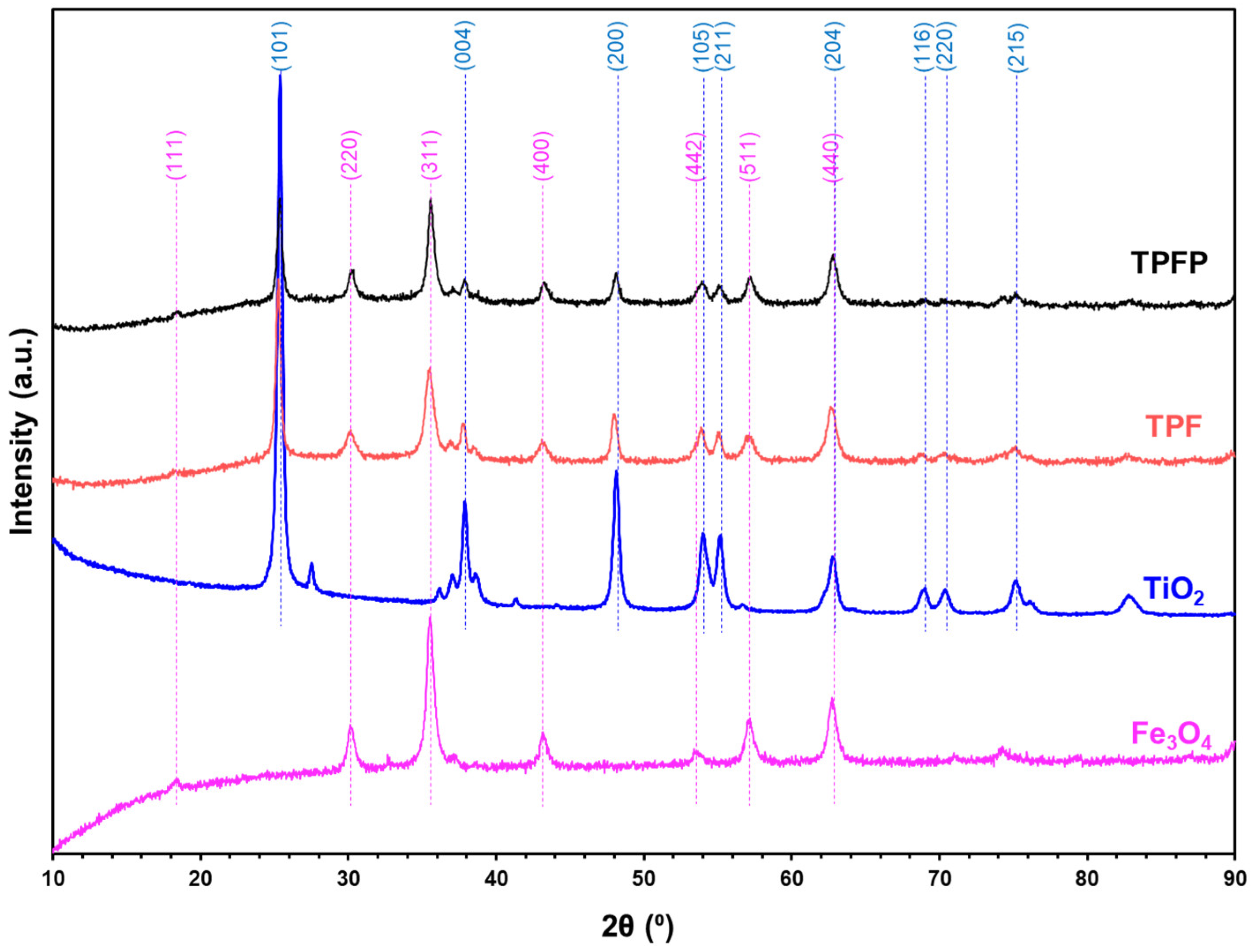
The crystalline structures of Fe3O4, TiO2, TPF, and TPFP nanomaterials were investigated by XRD, and the corresponding patterns are presented in Figure 1.
For Fe3O4 nanoparticles, characteristic diffraction peaks were observed at 2θ values of 18.29°, 30.10°, 35.42°, 43.04°, 53.50°, 56.98°, and 62.60°. These peaks correspond to the (111), (220), (311), (400), (442), (511), and (440) crystal planes, respectively. The diffraction pattern shows good agreement with the standard JCPDS card No. 19–0629 [26], suggesting that the synthesized particles possess a pure magnetite phase with a cubic spinel crystal structure. In particular, the high intensity of the (311) reflection indicates that the spinel structure is the dominant crystalline phase [21,27].
The XRD pattern of TiO2 nanoflowers exhibits diffraction peaks at 2θ values of 25.4°, 38.0°, 48.2°, 54.0°, 55.2°, 62.8°, 69.0°, 70.5°, and 75.2°, which can be indexed to the (101), (004), (200), (105), (211), (204), (116), (220), and (215) planes of the anatase phase (JCPDS card No. 21–1272) [28]. The peak positions and their full width at half maximum values indicate that the TiO2 nanoflowers crystallized in a tetragonal crystal system with nanoscale crystallite dimensions [29].
For the TPF nanocomposite, the XRD pattern retains the characteristic diffraction peaks of both Fe3O4 and TiO2 without any noticeable peak shift, broadening, or the appearance of additional phases. This observation confirms that both components were successfully immobilized within the PLDOPA matrix while preserving their original crystal structures. The absence of distinct diffraction peaks associated with PLDOPA is attributed to its amorphous nature. This behavior has been widely reported for polymer-based nanocomposites, where the amorphous polymer phase is masked by the strong diffraction signals of crystalline metal oxide components [21,30,31,32]. The relatively broad diffraction peaks further suggest that the constituent nanoparticles possess small crystallite sizes and maintain a nanocrystalline structure [33].
In the XRD pattern of the TPFP nanomaterial, no additional diffraction peaks corresponding to Pb-containing crystalline phases were detected. This can be attributed to the low Pb content, the predominance of surface-bound Pb(II) species in ionic or amorphous forms, and the masking of weak Pb-related signals by the intense diffraction peaks of TiO2 and Fe3O4 [34]. These results indicate that the crystalline framework of the nanocomposite remains intact after adsorption, indicating good structural stability.

3.1.2. SEM, TEM and EDS Analysis

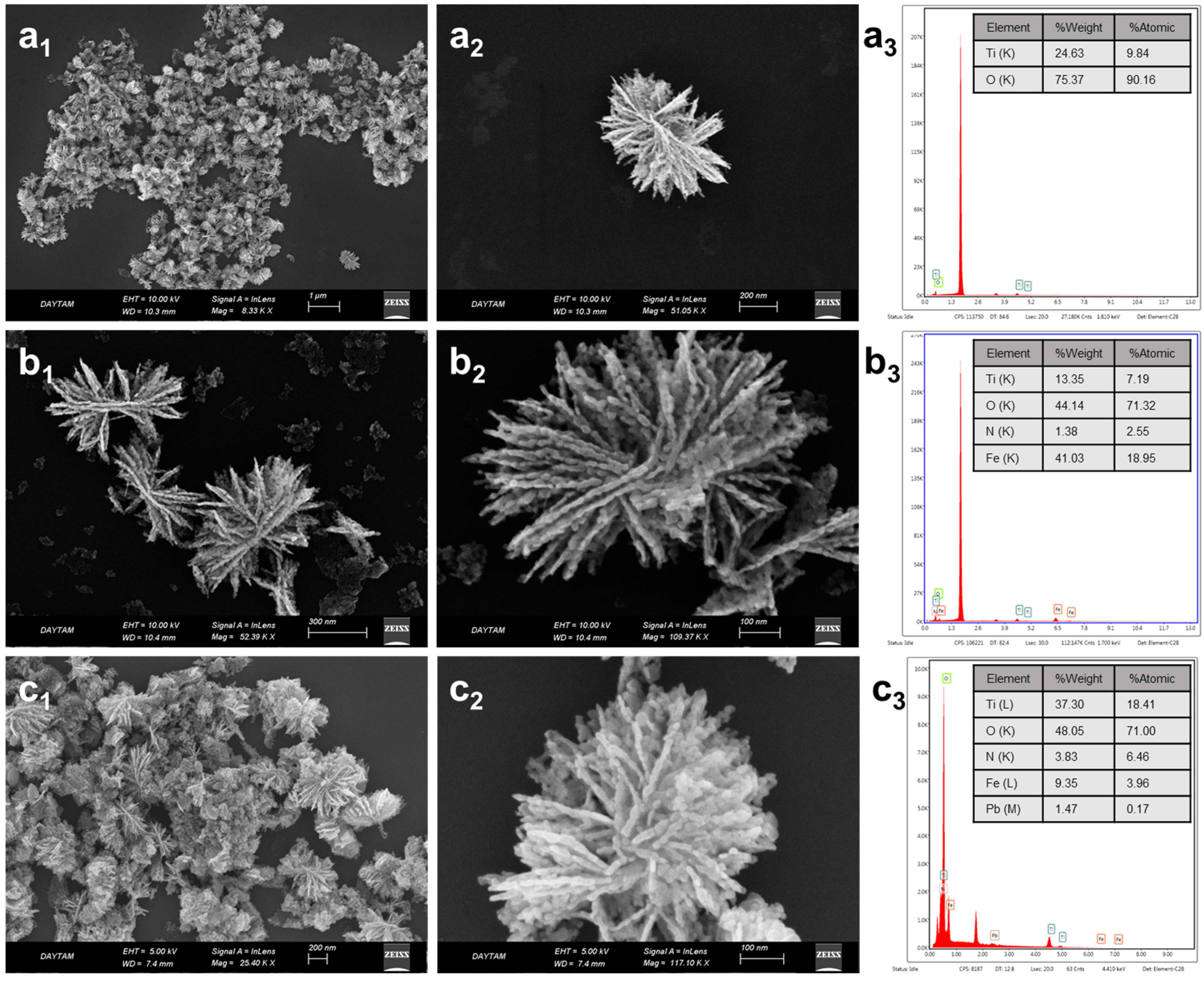
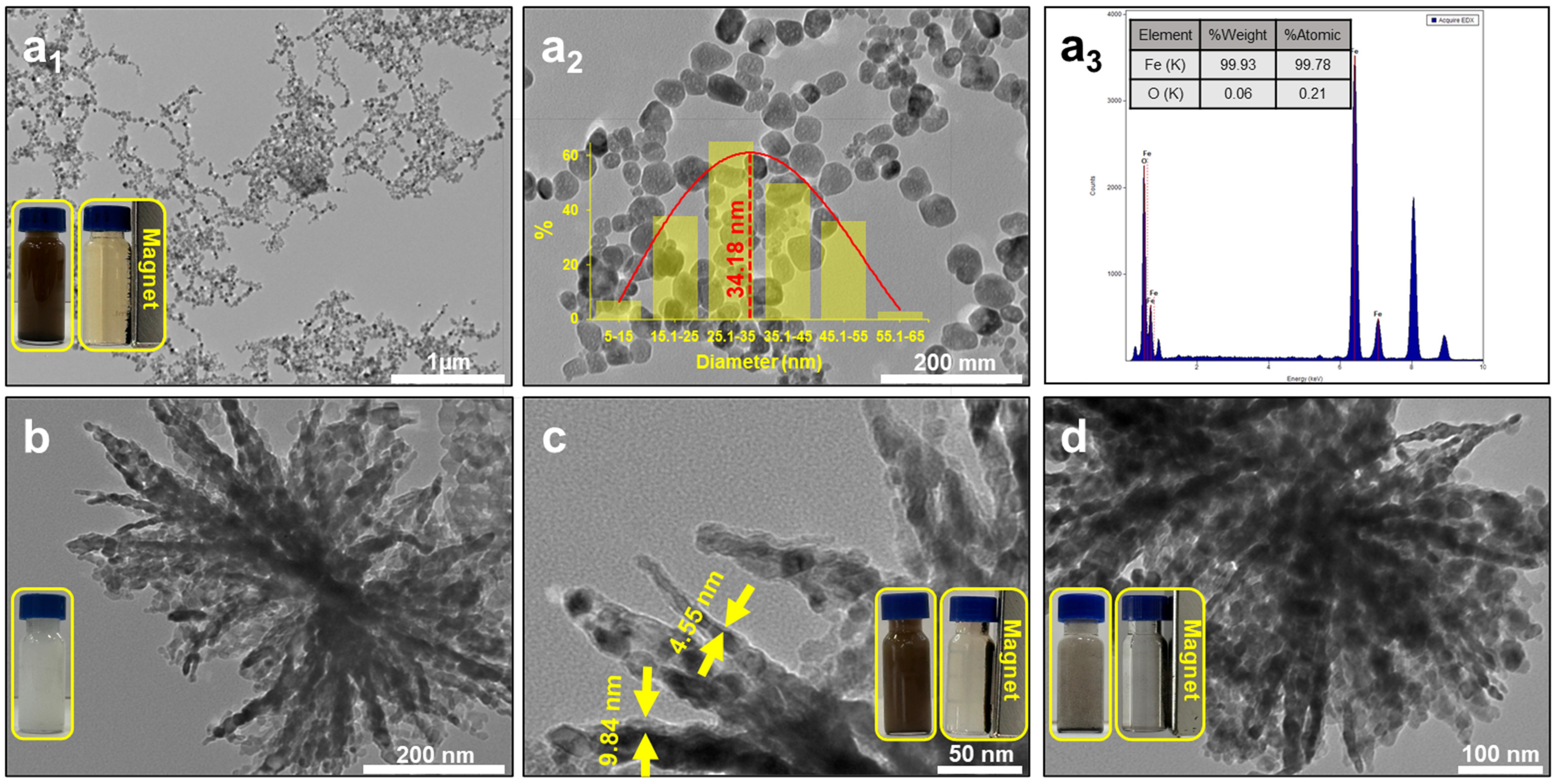
The morphologies of TiO2, Fe3O4, TPF, and TPFP nanomaterials were investigated using SEM and TEM, as shown in Figure 2 and Figure 3.
SEM images presented in Figure 2 reveal that the TiO2 nanoflowers consist of three-dimensional hierarchical flower-like architectures. These structures are composed of densely packed nanospike arrays that are uniformly distributed across the surface. Such hierarchical architectures are known to enhance mass transfer and provide abundant active sites, which is advantageous for adsorption-driven water remediation systems [12]. Since Fe3O4 nanoparticles could not be clearly distinguished at the SEM scale, their detailed morphological features were further examined by TEM.
EDS analyses (Figure 2a3–c3) confirm the presence and expected distribution of Ti, O, Fe, and C elements on the nanocomposite surface. In particular, the presence of hemispherical features on the nanospike structures in Figure 2b3 indicates the successful immobilization of magnetite nanoparticles. It should be noted that EDS provides local surface composition rather than bulk stoichiometry. The relatively higher Fe atomic percentage observed in the TPF sample can be attributed to the preferential surface localization of Fe3O4 nanoparticles and the higher X-ray emission efficiency of Fe compared to Ti [21,35]. After adsorption, the detection of Pb signals in the TPFP structure further confirms the effective binding of heavy metal ions onto the TPF nanocomposite surface (Figure 2c3). The apparent decrease in Fe atomic percentage after Pb(II) adsorption is attributed to surface coverage by Pb, which partially masks the Fe signal [13,15].
TEM analysis reveals that Fe3O4 nanoparticles exhibit a quasi-spherical morphology and show a slight tendency toward agglomeration due to magnetic dipole–dipole interactions (Figure 3a1,2) [15]. Particle size analysis performed using ImageJ software indicates that the Fe3O4 nanoparticles are distributed within a size range of 8–62 nm, with an average diameter of 34.18 nm. In addition, the accumulation of nanoparticles around an external magnet (Figure 3c,d) indicates strong magnetic responsiveness of Fe3O4.
TEM images of TiO2 nanoflowers (Figure 3b) further support the SEM observations, clearly displaying hierarchical nanospike assemblies. ImageJ-based measurements show that the overall sizes of the nanoflowers range from 400 to 690 nm, with an average size of approximately 500 nm. TEM images of the TPF nanocomposite (Figure 3c) demonstrate that the TiO2 surface is conformally coated with a PLDOPA layer without disrupting the original nanoflower topology. Moreover, the homogeneous distribution of magnetite nanoparticles along the surface confirms that the catechol and amine groups of PLDOPA play a crucial role in the controlled immobilization of Fe3O4 nanoparticles [20,31]. Following adsorption, TEM images of the TPFP structure (Figure 3d) reveal the accumulation of Pb species in a layer-like manner along the nanoflower architecture. Importantly, the adsorption process does not compromise the integrity of the nanospike framework, indicating good morphological stability after Pb(II) uptake.
Overall, the combined SEM, TEM, and EDS results confirm that Fe3O4 nanoparticles are homogeneously and stably immobilized onto PLDOPA-coated TiO2 nanoflowers. The resulting hierarchical structure, characterized by a high surface area and abundant functional groups, provides a suitable platform for Pb(II) adsorption. In addition, the magnetic nature of the nanocomposite enables efficient magnetic separation, which is advantageous for practical water treatment applications [25].

3.2. Proposed Formation Mechanism of TPF

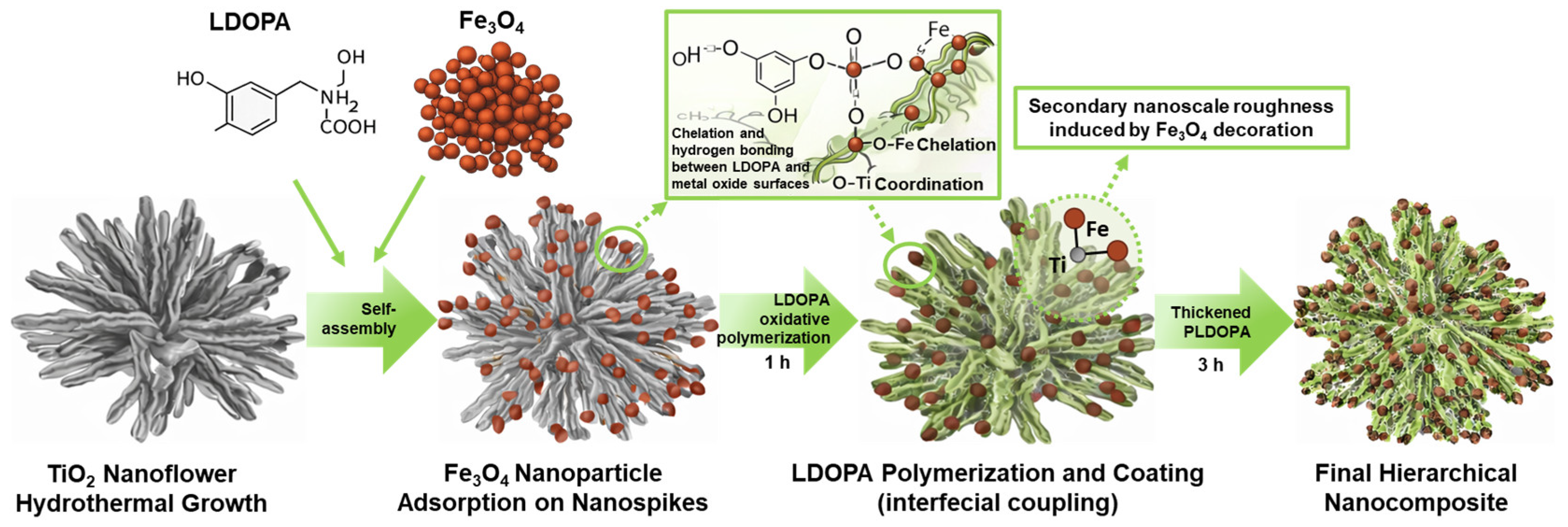
The proposed formation mechanism of the hierarchical TPF nanocomposite is schematically illustrated in Figure 4. Initially, TiO2 nanoflowers are synthesized via the hydrothermal method, likely involving anisotropic crystal growth, providing high-energy facets and abundant nucleation sites [11]. Subsequently, Fe3O4 nanoparticles synthesized by the solvothermal method are introduced. They are preferentially adsorbed onto the TiO2 nanoflower spikes, which may be associated with heterogeneous nucleation and interfacial interactions, and a self-assembly process driven by surface functionalization [36].
During LDOPA polymerization in Tris buffer, a conformal PLDOPA layer is formed, which acts as an adhesive interfacial matrix, immobilizing Fe3O4 nanoparticles on the TiO2 surface and suppressing their aggregation. LDOPA oxidative polymerization and subsequent chelation and coordination interactions are believed to facilitate Fe3O4 immobilization. The catechol and amine groups of LDOPA can chelate surface Ti and Fe atoms, inducing interfacial coupling and nanoscale surface modification [14,37]. The immobilized Fe3O4 nanoparticles introduce secondary nanoscale roughness on the TiO2 nanospikes, contributing to the hierarchical architecture [35,36].
The hierarchical structure is suggested to be thermodynamically favored due to surface free energy minimization, which is expected to enhance surface area and interfacial activity [14,36,37]. Such hierarchical structures are considered beneficial for enhancing surface area and interfacial activity, which is relevant for sustainable catalytic and environmental applications [5,8].

3.3. Investigation of Adsorption Parameters

3.3.1. Effect of Contact Time

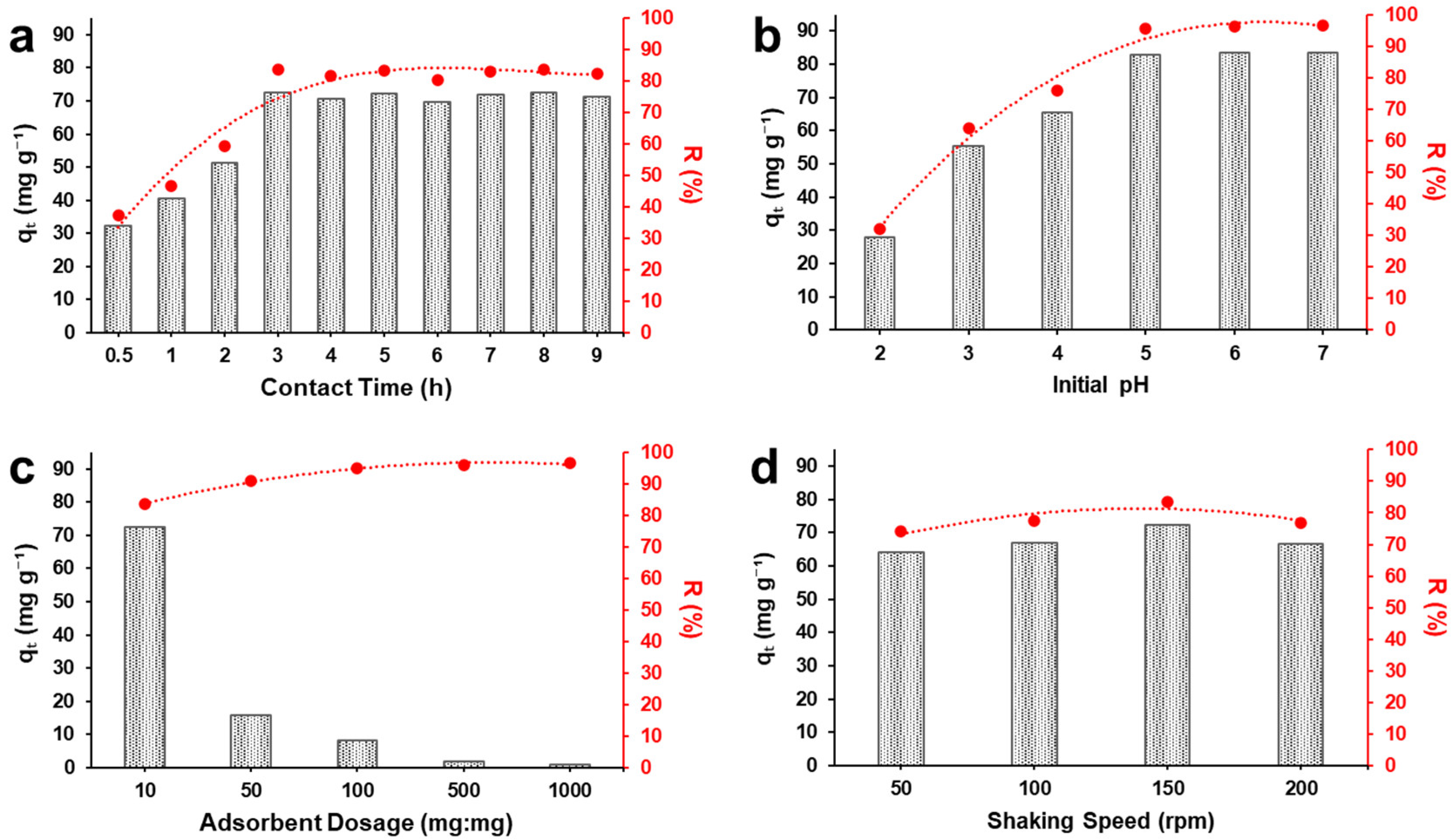
Pb(II) adsorption exhibited a typical two-stage adsorption behavior, consisting of an initial rapid uptake followed by a slower approach to equilibrium (Figure 5a). Within the first 2 h, removal efficiency increased rapidly to 59%, corresponding to an adsorption capacity of 51.38 mg g−1. Equilibrium was reached after approximately 3 h, with the removal efficiency stabilizing at around 84% and q e reaching 72.38 mg g−1.
This rapid uptake is advantageous for reducing contact time and energy consumption in practical water treatment processes. The rapid initial uptake can be attributed to the high availability of active surface sites and the dominance of external surface adsorption [32]. The hierarchical morphology of TiO2 nanoflowers and the high density of functional groups (–OH, –NH, and catechol) provided by the PLDOPA coating are further expected to facilitate rapid Pb(II) uptake during the early stage [37,38]. As adsorption proceeds, progressive site occupation suggests that intraparticle diffusion becomes rate-limiting, resulting in a plateau in adsorption capacity after equilibrium is achieved [25,39,40].

3.3.2. Effect of Initial pH

Solution pH plays a critical role in Pb(II) adsorption by influencing both metal speciation and the surface charge of the adsorbent. At pH values below the point of zero charge (pHpzc), surface functional groups are protonated, leading to electrostatic repulsion between the positively charged adsorbent surface and Pb(II) ions [21,40,41]. In addition, excess H+ ions compete with Pb(II) for available adsorption sites, resulting in reduced uptake [32,34]. With increasing pH, deprotonation of –OH and –NH groups occurs, generating a negatively charged surface that enhances electrostatic attraction toward Pb(II) ions [37,42].
In this study, the pH range was limited to 7 because Pb(II) precipitation as Pb(OH)2 occurs at higher pH values. Such precipitation can interfere with adsorption measurements and lead to misleading removal results [13,32]. As shown in Figure 5b, Pb(II) removal efficiency increased from 32% under acidic conditions to 96% at pH 7, with a maximum adsorption capacity of 83.55 mg g−1. No Pb(OH)2 precipitation was observed within the investigated pH range, suggesting that Pb(II) removal predominantly occurred via adsorption [10,36]. Notably, the natural pH of the Pb(II) solution (4.86) falls within the effective adsorption range, indicating that pH adjustment is not required under practical operating conditions [25]. This feature is beneficial for reducing chemical consumption and operational costs.

3.3.3. Effect of Adsorbent Dosage

The adsorbent dosage is a critical parameter from both economic and operational perspectives. At a low adsorbent dosage (10:1), a removal efficiency of 84% was achieved, with a high adsorption capacity of 72.38 mg g−1. Increasing the ratio to 50:1 enhanced the removal efficiency to 91%; however, the adsorption capacity decreased markedly to 15.76 mg g−1. Further increasing the ratio to 1000:1 resulted in only a marginal improvement in removal efficiency (95–96%), while the adsorption capacity declined sharply to 0.83 mg g−1 (Figure 5c).
This behavior can be attributed to the increase availability of surface area and active sites at higher adsorbent dosages, which promotes Pb(II) removal [32,34]. At excessive dosages, however, particle aggregation and partial saturation of active sites limit further improvement in removal efficiency, as commonly reported in the literature [17,33]. Based on these findings, an adsorbent-to-adsorbate ratio of 10:1 was considered a suitable condition, offering a favorable balance between high adsorption capacity and economic feasibility [25].

3.3.4. Effect of Shaking Speed

Shaking speed significantly influences adsorption performance by governing mass transfer and ion transport in the solution. Pb(II) adsorption improved as the shaking speed increased from 50 to 150 rpm. In this range, the removal efficiency increased from 74% ( q t = 64.08 mg g−1) to 84% ( q t = 72.38 mg g−1). However, a further increase to 200 rpm resulted in a decrease in removal efficiency to 77%, with a corresponding adsorption capacity of 66.60 mg g−1 (Figure 5d).
This two-stage adsorption behavior can be explained by hydrodynamic effects on mass transfer. Moderate shaking enhances Pb(II) transport toward the adsorbent surface and reduces boundary layer thickness, thereby facilitating adsorption. At higher shaking speeds, excessive turbulence shortens effective contact time and increases particle–particle collisions. This may hinder the efficient utilization of active adsorption sites [19,39,43]. Accordingly, a shaking speed of 150 rpm was selected as a suitable condition for subsequent experiments [25]. Moderate shaking is also favorable for reducing energy consumption in practical water treatment applications.

3.3.5. Effect of Temperature

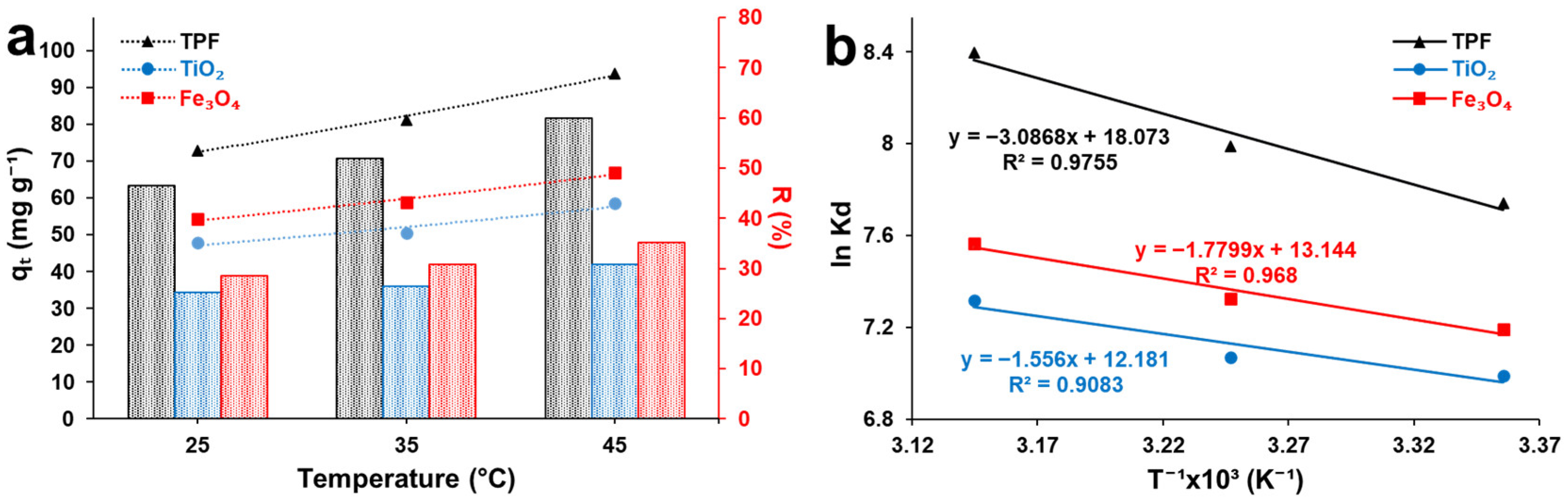
Temperature is an important parameter influencing adsorption thermodynamics. In this study, the temperature-dependent adsorption behavior of TPF, TiO2, and Fe3O4 was investigated (Figure 6). Increasing temperature enhances ion kinetic energy and collision frequency with active sites, facilitating diffusion into pores and improving removal efficiency. Elevated temperatures also reduce solution viscosity, enhancing mass transfer across the boundary layer [27,44].
Experimentally, the adsorption capacity increased with temperature for all adsorbents, with TPF showing the highest capacity (from 63.40 to 81.58 mg g−1), followed by Fe3O4 and TiO2 (Figure 6a). This behavior indicates that the adsorption process is endothermic in nature [19]. The superior performance of TPF suggests enhanced interactions between Pb(II) ions and surface functional groups, particularly catechol groups in the PLDOPA layer. Similar temperature-dependent adsorption behavior has been reported for metal oxide- and catechol-functionalized adsorbents [25,27,30,37].
Thermodynamic parameters were calculated using temperature-dependent equilibrium data (Table 1). The distribution coefficient ( K d ) was calculated according to Equation (5):
K d = q e C e × 1000
where q e   (mg g−1) is the equilibrium adsorption capacity and C e   (mg L−1) is the equilibrium concentration of Pb(II) ions in solution. The multiplication factor of 1000 was introduced to account for the density of water and to maintain unit consistency.
The standard Δ G ° was calculated using Equation (6):
Δ G ° = R T   l n   K d
where R is the universal gas constant (8.314 J mol−1 K−1) and T is the absolute temperature (K). Δ H ° and Δ S ° were determined using the Van’t Hoff equation (Equation (7)):
l n   K d =   Δ H ° R   1 T +   Δ S ° R  
The Van’t Hoff plots exhibited good linearity ( R 2 > 0.90) for all adsorbents (Figure 6b). Negative Δ G ° values indicate spontaneous adsorption, with TPF exhibiting more negative values, suggesting a stronger affinity for Pb(II) [32,45]. The relatively low Δ G ° values suggest that adsorption is mainly governed by physical interactions, accompanied by surface complexation and electrostatic attraction [46]. Positive Δ H ° values confirm the endothermic nature of adsorption, while positive Δ S ° values indicate increased randomness at the solid–solution interface [30,32,47].
Overall, TPF exhibited superior adsorption performance compared to TiO2 and Fe3O4. Its effective adsorption at ambient temperatures highlights its potential for sustainable and energy-efficient water treatment applications.
These results suggest that physical interactions are energetically favored in the adsorption process, and that the overall adsorption behavior should be interpreted in conjunction with kinetic modeling results.

3.4. Adsorption Kinetics

Adsorption kinetics describes the rate at which dissolved species are transported from the solution to the adsorbent surface and bound at the solid–liquid interface. Kinetic analysis provides insight into adsorption mechanisms and rate-controlling steps, which is essential for the design of wastewater treatment systems [27,39,41].
The goodness of fit between experimental data and kinetic models was evaluated using the regression correlation coefficient ( R 2 ), root mean square error (RMSE), and chi-square ( χ 2 ) statistical analyses. Higher R 2 values and lower R M S E and χ 2 values indicate better model agreement [48,49].
In this study, the adsorption behavior of Pb(II) onto the TPF, TiO2, and Fe3O4 was evaluated using the pseudo-first-order (PFO), pseudo-second-order (PSO), intraparticle diffusion (Weber–Morris, IPD), and film diffusion (FD) kinetic models.

3.4.1. Pseudo-First-Order Kinetic Model

The PFO kinetic model assumes that the adsorption rate is proportional to the number of unoccupied active sites and is described by the Lagergren equation (Equation (8)) [50]:
l n q e q t = l n   q e   k 1 t
where q e (mg g−1) is the equilibrium adsorption capacity, q t (mg g−1) is adsorption capacity at time t , and k 1 (min−1) is the PFO rate constant.
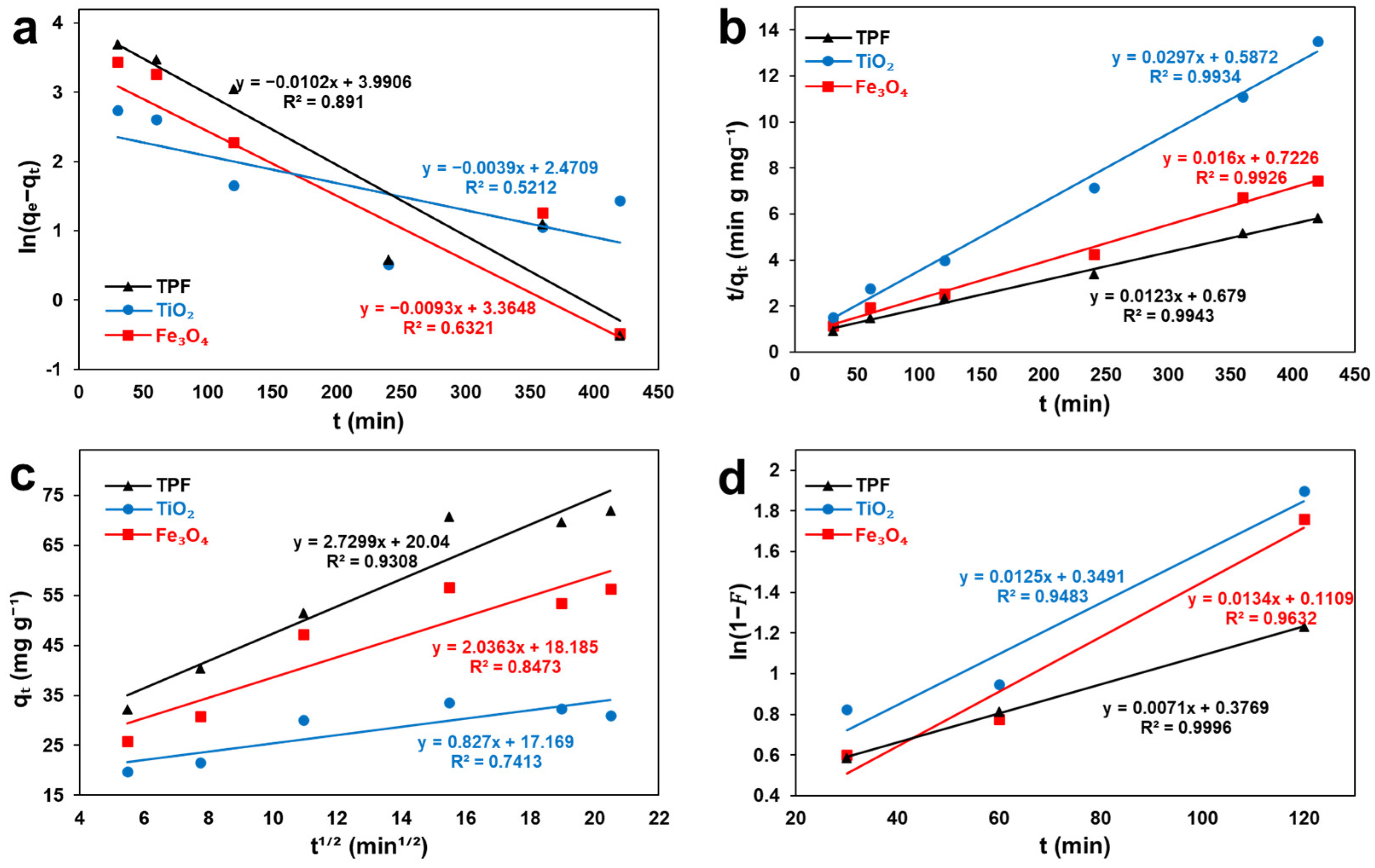
The PFO model describes the initial adsorption stage but often fails to represent the entire adsorption period, especially for heterogeneous surfaces [51]. In this study, the PFO model yielded q e , c a l = 54.09 mg g−1, k 1 = 10.20 × 10⁻³ min−1 and R 2 = 0.89 for TPF (Figure 7a). The calculated q e value showed poor agreement with the experimental equilibrium capacity ( q e , e x p = 72.58 mg g−1), indicating that the PFO model does not satisfactorily describe Pb(II) adsorption onto TPF. Similarly lower R 2 and higher R M S E and χ 2 values for TiO2 and Fe3O4 further confirm the limited applicability of the PFO model (Table 2).
These results suggest that the adsorption process cannot be adequately explained by a simple first-order mechanism, likely due to the heterogeneous surface and the involvement of multiple adsorption pathways. Comparable deviations from the PFO model have been reported for oxide–polymer hybrid adsorbents with heterogeneous surfaces [52,53,54].

3.4.2. Pseudo-Second-Order Kinetic Model

The PSO kinetic model assumes that the adsorption rate is proportional to the square of the number of available active sites and that chemisorption may be the rate-limiting step [37]. This model, proposed by Ho and McKay [55], is described by Equation (9):
t q t =   1 k 2 q e 2   +   t q e
where q e (mg g−1) is the equilibrium adsorption capacity, q t (mg g−1) is the adsorption capacity at time t , and k 2 (g mg−1 min−1) is the PSO rate constant.
The initial adsorption rate ( h ) can be calculated using Equation (10):
h =   k 2 q e 2
In this study, the PSO model provided q e , c a l = 81.97 mg g−1, k 2 = 0.22 × 10⁻³ g mg−1 min−1,   h = 1.49 mg g−1 min−1 and an excellent fit ( R 2 = 0.99) for TPF (Figure 7b). High R 2 and low R M S E and χ 2 values for TiO2 and Fe3O4 further confirm that PSO adequately describes Pb(II) adsorption kinetics for all adsorbents (Table 2).
The close agreement between calculated and experimental q e values supports the applicability of the PSO model. The enhanced kinetics of TPF are attributed to catechol groups in the PLDOPA layer, which provide additional active sites [14,35].
These results are consistent with previous studies reporting PSO-dominated kinetics for metal oxide–polymer hybrid adsorbents [27,30,31,56].

3.4.3. Intraparticle Diffusion Model

Adsorption commonly involves external mass transfer followed by intraparticle diffusion. The intraparticle diffusion model is expressed as Equation (11) [57,58]
q t = k d i f t 1 / 2 + C
where q t (mg g−1) is the adsorption capacity at time t , k d i f (mg g−1 min−12) is the intraparticle diffusion rate constant, and C (mg g−1) reflects the boundary layer thickness.
In this study, the intraparticle diffusion model yielded k d i f = 2.73 mg g−1 min−12, C = 20.04 mg g−1, and R 2 = 0.93 for TPF. The deviation of the fitted line from the origin and the relatively high C value indicate that boundary layer diffusion contributes significantly (Figure 7c). Similar trends were observed for TiO2 and Fe3O4, suggesting that Pb(II) transport involves both external mass transfer and intraparticle diffusion (Table 2). Comparable observations have been reported for TiO2—and Fe3O4—based composite adsorbents [32,34,46,52].

3.4.4. Film Diffusion Model

The film diffusion model describes mass transfer across the boundary layer surrounding the adsorbent particles (Equation (12)) [59]:
l n 1 F = k f d t
where F (= q t / q e ) represents the fractional adsorption at time t , q t (mg g−1) is the adsorption capacity at time t , q e (mg g−1) is the equilibrium adsorption capacity, and k f d (min−1) is the fractional diffusion rate constant.
For TPF, k f d = 0.007 min−1 and R 2 = 0.99 were obtained in the F < 0.5 region (Figure 7d). The strong linearity in the initial adsorption stage indicates that film diffusion plays a significant role at the early phase of Pb(II) uptake. However, film diffusion is not considered the sole rate-controlling step, as intraparticle diffusion and surface reaction processes are expected to contribute at later stages of adsorption. Similar behavior was observed for TiO2 and Fe3O4, suggesting that external mass transfer resistance dominates during the initial adsorption period, followed by intraparticle diffusion-controlled transport. This adsorption behavior is consistent with previous studies on hybrid and polymer-functionalized nanocomposite adsorbents [45,60,61].

3.4.5. Overall Kinetic Interpretation

Although Pb(II) adsorption kinetics were well described by the PSO model, this model reflects adsorption rate behavior and does not necessarily imply a purely chemisorption-controlled mechanism. Previous studies have shown that the PSO kinetics can describe systems governed by combined physical adsorption and weak surface-related interactions, such as surface complexation or ion exchange [4,62,63]. The relatively low Δ G ° (−19.18 to −22.20 kJ mol−1) suggest that physical interactions are energetically favored [43,54].
Accordingly, Pb(II) adsorption onto TPF can be interpreted as a mixed adsorption mechanism. The PSO behavior suggests the involvement of surface coordination and weak chemical interactions with catechol, amine, and metal oxide hydroxyl groups. Meanwhile, electrostatic interactions and physisorption dominate the adsorption energetics. Kinetic parameters from different models indicate a multi-step adsorption process, supported by the high PSO correlation coefficient ( R 2 = 0.99), low R M S E and χ 2 values, and good agreement between calculated and experimental q e values [10,13,18,58].
The relatively high initial adsorption rate ( h = 1.49 mg g−1 min−1) indicates rapid interaction between Pb(II) ions and surface functional groups [16,18,27,39]. The intraparticle diffusion parameters ( k d i f = 2.73 mg g−1 min−12 and C = 20.04 mg g−1) suggest that adsorption is not governed solely by pore diffusion, while the nonzero C value highlights the contribution of film diffusion. Thus, Pb(II) adsorption can be described as a three-stage process: (i) initial film diffusion, (ii) surface interaction-controlled adsorption, and (iii) gradual intraparticle diffusion [27,61,62].
This kinetic behavior is consistent with the multiphase structure and functional-group-rich surface chemistry of TPF. TiO2 and Fe3O4 provide metal oxide sites for electrostatic attraction and surface coordination, while PLDOPA contributes catechol and amine groups that enhance surface interactions. Compared with TiO2 and Fe3O4, TPF exhibited higher adsorption rates and better model fitting, highlighting the synergistic effect of polymer functionalization [34,35,40].
Overall, Pb(II) adsorption on TPF, TiO2, and Fe3O4 follows a multi-step mechanism. Surface-related interactions mainly influence the adsorption rate, while thermodynamic results indicate that physical interactions are energetically dominant.

3.5. Adsorption Isotherms

Adsorption equilibrium is commonly described using isotherm models to characterize adsorbate–adsorbent interactions under equilibrium conditions. These models provide quantitative information regarding the pollutant removal capacity of an adsorbent under specific system conditions [64,65]. Among the various equilibrium models, the Langmuir and Freundlich isotherms are the most widely employed to interpret adsorption behavior in water and wastewater treatment applications [63].
In this study, both Langmuir and Freundlich models were applied to evaluate the equilibrium adsorption behavior of Pb(II) ions onto the TPF, TiO2, and Fe3O4. Model performance was assessed using R 2 , R M S E , and χ 2 statistical analyses [49].

3.5.1. Langmuir Isotherm Model

The Langmuir isotherm assumes monolayer adsorption on an energetically homogeneous surface with a finite number of identical active sites and no lateral interactions between adsorbed species. The model is expressed as Equation (13) [66,67]:
q e =   q m a x K L C e 1 +   K L C e
where q e (mg g−1) is the equilibrium adsorption capacity, q m a x (mg g−1) is the maximum monolayer adsorption capacity, C e (mg L−1) is the equilibrium concentration of Pb(II) in solution, and K L (L mg−1) is the Langmuir constant related to adsorption energy and binding affinity. The q m a x values are theoretical parameters obtained from model fitting and should not be interpreted as experimentally attained capacities.
Higher values of q m a x and K L indicate enhanced adsorption performance. The Langmuir constant K L reflects the affinity between the adsorbent and the adsorbate and is directly related to the binding strength [30,41].
The dimensionless separation factor ( R L ), which indicates the favorability of adsorption, is calculated as Equation (14) [68]:
R L = 1 1 +   K L C 0
where C 0 (mg L−1) represents the initial concentration of Pb(II) ions in the aqueous solution. Values of 0 < R L < 1 indicate favorable adsorption behavior consistent with the Langmuir model [68].
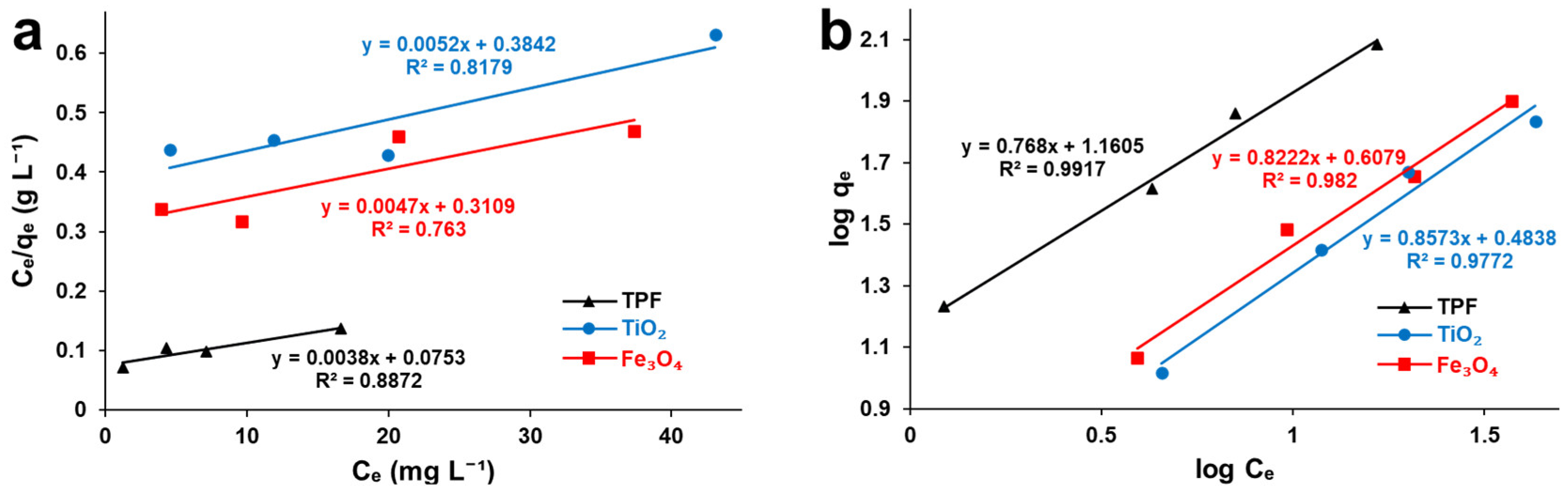
The Langmuir model yielded q m a x values of 263.16, 192.31, and 212.77 mg g−1 for TPF, TiO2, and Fe3O4, respectively. The corresponding K L values were 0.05 L mg−1 for TPF and 0.01 L mg−1 for both TiO2 and Fe3O4, suggesting a stronger binding affinity of Pb(II) ions toward the TPF surface (Figure 8a).
The calculated R L values (0.31–0.63) confirmed favorable adsorption for all materials. Although the Langmuir R 2 values were moderate, the low R M S E and χ 2 values indicate acceptable agreement with experimental data, suggesting that monolayer adsorption is a reasonable approximation. The lower R 2 values, particularly for TiO2 and Fe3O4, imply that surface heterogeneity contributes to the adsorption behavior (Table 3) [18,27].

3.5.2. Freundlich Isotherm Model

The Freundlich isotherm is an empirical model describing reversible multilayer adsorption on heterogeneous surfaces and is particularly suitable for functionalized adsorbents [64]. The model is expressed as follows Equation (15) [69]:
q e =   K F C e 1 / n
where K F [(mg g−1) (L mg−1)1/n] is the Freundlich adsorption capacity constant, and n is an empirical parameter related to adsorption intensity and surface heterogeneity. Values of n > 1 indicate favorable adsorption [30].
For the TPF nanocomposite, the Freundlich model provided an excellent fit with R 2 = 0.97, K F = 14.83 (mg g−1) (L mg−1)1/n, and n = 1.40 (Figure 8b). Similarly, high correlation coefficients were obtained for TiO2 ( R 2 = 0.97, K F = 3.05, n = 1.17) and Fe3O4 ( R 2 = 0.98, K F = 4.05, n = 1.22), indicating heterogeneous adsorption sites with non-uniform energies.
Although R M S E and χ 2 values were comparable to those of the Langmuir model, the higher R 2 values suggest that the Freundlich model better describes the equilibrium adsorption behavior, particularly for TiO2 and Fe3O4 (Table 3).
The n values greater than unity suggest that the adsorption process is favorable and predominantly governed by physical interactions. Moreover, the higher K F value of the TPF reflects its stronger surface affinity and enhanced adsorption capacity, highlighting the synergistic contribution of TiO2, Fe3O4, and PLDOPA functional groups [30,70].

3.5.3. Overall Isotherm Interpretation

The surface of the TPF nanocomposite consists of coexisting TiO2, PLDOPA, and Fe3O4 phases, resulting in a structurally and energetically heterogeneous surface enriched with –OH, –NH, and catechol functional groups. These functional moieties enable multiple Pb(II) binding mechanisms, including surface complexation, electrostatic interactions, and hydrogen bonding [13,71]. Such surface heterogeneity suggests that adsorption cannot be fully described by a single idealized isotherm model [65,66].
Isotherm parameters obtained from all models are presented in Table 3. The Freundlich model exhibited higher correlation coefficients ( R 2 = 0.99, 0.97, and 0.98 for TPF, TiO2, and Fe3O4, respectively), indicating a better description of adsorption on heterogeneous surfaces with non-uniform binding energies. In contrast, the Langmuir model showed lower R 2 values but comparable and relatively low R M S E and χ 2 values, suggesting that monolayer adsorption on energetically similar sites also contributes to Pb(II) uptake [46,69].
Overall, the combined isotherm analysis indicates a complex adsorption mechanism in which heterogeneous multilayer adsorption is likely dominant, accompanied by localized monolayer adsorption on specific active sites. These findings are consistent with previously reported Pb(II) adsorption behavior for Fe3O4—and TiO2—based adsorbents [13,16,18,27,40,41].

3.6. Comparative Adsorption Behavior

To facilitate comparison with similar TiO2—, and Fe3O4—based adsorbent systems reported in the literature, a comparative summary of Pb(II) adsorption performance is presented in Table 4. The q m a x values represent theoretical maximum adsorption capacities obtained from isotherm models and do not correspond to experimentally equilibrium capacities ( q e , e x p ). Additionally, the equilibrium time ( t e ) denotes the contact time required to reach adsorption equilibrium, and the listed experimental conditions correspond to those used for isotherm calculations. Model selection in Table 4 is based on R 2 to ensure consistency with previous adsorption studies. R M S E and χ 2 values were considered to provide further statistical validation in the kinetic and isotherm analyses.
A comparative evaluation of pristine TiO2, Fe3O4, and the TPF was conducted to elucidate the contribution of each component and to assess the effect of composite formation. As shown in Table 4, TiO2 and Fe3O4 exhibited moderate Pb(II) removal efficiencies of 36% and 59%, with q e , e x p values of 35.28 and 57 mg g−1, respectively. In contrast, the TPF nanocomposite achieved a higher removal efficiency (84%) and q e , e x p value (72.38 mg g−1), indicating enhanced adsorption performance of the hybrid material. Furthermore, kinetic, isotherm, and thermodynamic analyses consistently indicated superior adsorption behavior of the TPF composite, including higher adsorption capacities, more negative Δ G ° , and improved kinetic performance, suggesting a synergistic enhancement compared to pristine components.
Table 4 also compares the Pb(II) adsorption performance of TPF with previously reported TiO2—, Fe3O4—, and hybrid-based adsorbents. The q m a x value of TPF (263.16 mg g−1) is higher than those of pristine TiO2 and Fe3O4 in this study and comparable to or higher than many reported TiO2— and Fe3O4—based composites, particularly those without polymeric or chelating functional layers. Although some functionalized Fe3O4-based systems show higher capacities, they often involve more complex synthesis routes or longer equilibrium times.
Overall, the TPF composite demonstrates a balanced performance with enhanced adsorption capacity, favorable thermodynamic parameters, and relatively short equilibrium times, highlighting the effectiveness of PLDOPA functionalization and the integrated TiO2/Fe3O4 structure. These results position TPF as a competitive and structurally efficient adsorbent for Pb(II) removal.

3.7. Regeneration and Reusability

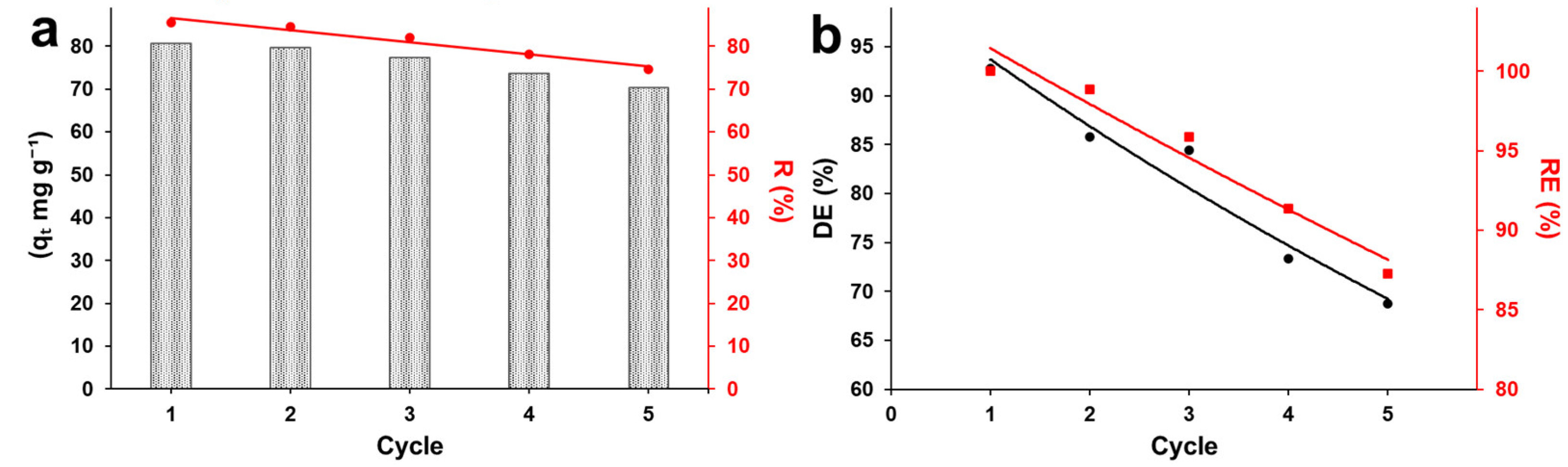
The regeneration and reusability performance of the adsorbent were evaluated through five consecutive adsorption–desorption cycles to assess its practical applicability for Pb(II) removal. Moreover, the magnetic nature of the TPF nanocomposite enabled rapid separation from the aqueous phase using an external magnetic field, indicating its potential suitability for repeated reuse in water treatment applications. The experimental results are presented in Figure 9.
In the first cycle, the adsorption capacity ( q a d s ) was 80.6 mg g−1, while the reusability efficiency ( R E ), desorption efficiency ( D E ), and removal efficiency ( R ) were 99%, 93%, and 86%, respectively. These results indicate that the eluent solution effectively removed Pb(II) ions from the adsorbent surface, enabling efficient recovery of active adsorption sites. As the number of regeneration cycles increased, a gradual decrease in adsorption capacity and efficiency parameters was observed. After the fifth cycle, q a d s decreased to 70.36 mg g−1, while R E , D E , and R values declined to 87%, 69%, and 75%, respectively. Nevertheless, the adsorbent retained approximately 87% of its initial adsorption capacity after five cycles, demonstrating good structural stability and good regeneration capability.
The gradual reduction in removal efficiency suggests partial blockage of active adsorption sites or minor losses of surface functional groups during repeated regeneration processes. This observation indicates that the PLDOPA coating and the TiO2@Fe3O4 core–shell structure remained relatively stable throughout the adsorption–desorption cycles. The observed decrease in adsorption and desorption performance over successive cycles can be attributed to incomplete desorption, mechanical loss of the adsorbent, or irreversible occupation of active sites due to strong complexation of Pb(II) ions, as widely reported for similar bio-based adsorbents [17,27,30,47]. EDTA was selected as the desorbing agent due to its strong chelating affinity toward Pb(II) [10,72,73]. The catechol and amine functional groups derived from PLDOPA in the adsorbent structure can form strong coordination bonds with Pb(II); therefore, EDTA facilitates Pb(II) desorption via competitive complexation, weakening these interactions. The progressive decrease in desorption efficiency with increasing cycle number may be associated with partial irreversible binding of Pb(II) ions to PLDOPA-based functional groups [74,75,76].
Overall, the acceptable adsorption and desorption performance over five regeneration cycles suggests that the developed adsorbent shows promising potential as a reusable and cost-effective material for Pb(II) removal, contributing to sustainable wastewater treatment strategies and circular material utilization.

4. Conclusions

This study demonstrates that the TiO2@PLDOPA@Fe3O4 (TPF) nanocomposite is an efficient and reusable adsorbent for Pb(II) removal, contributing to sustainable water treatment technologies. The integration of hierarchical TiO2 nanoflowers, PLDOPA surface functionalization, and magnetically recoverable Fe3O4 nanoparticles significantly enhanced adsorption performance compared to pristine components. It also demonstrated the importance of multifunctional hybrid materials in environmental remediation.
The adsorption process exhibited rapid kinetics and favorable thermodynamic behavior, with pseudo-second-order kinetics and Freundlich isotherm models providing the best fit to experimental data. These results indicate a heterogeneous adsorption mechanism involving electrostatic attraction, surface complexation, and multilayer adsorption. The high theoretical adsorption capacity and strong binding affinity highlight the effectiveness of PLDOPA-derived catechol and amine groups in improving Pb(II) uptake.
From a sustainability perspective, the magnetic separability and high regeneration efficiency of the TPF nanocomposite support its practical applicability and resource-efficient reuse. The adsorbent retained approximately 87% of its initial capacity after five cycles, demonstrating good structural stability and potential for repeated application with reduced material consumption and waste generation.
Overall, the TPF nanocomposite represents a promising and sustainable adsorbent platform for heavy metal remediation. Its scalable synthesis, high performance, and reusability make it a viable candidate for integration into advanced water treatment systems, contributing to circular material utilization and the protection of water resources and human health.

Author Contributions

Conceptualization, methodology, supervision, data interpretation, and writing—original draft, corresponding author, H.M.; investigation, data curation, and formal analysis, co-author, T.P. Writing—review and editing, T.P. and H.M. All authors have read and agreed to the published version of the manuscript.

Funding

This research was funded by the Ataturk University Scientific Research Project Coordination Unit (AU-BAP), Project No. FBA–2024–14469.

Institutional Review Board Statement

Not applicable.

Informed Consent Statement

Not applicable.

Data Availability Statement

The data presented in this study are available from the corresponding author upon reasonable request. Raw experimental data are stored in Excel format, while analytical data were generated using the facilities of the East Anatolia High Technology Application and Research Center (DAYTAM).

Conflicts of Interest

The authors declare no conflicts of interest. The funder had no role in the design of the study; in the collection, analyses, or interpretation of data; in the writing of the manuscript; or in the decision to publish the results.

References

  1. WHO. Guidelines for Drinking-Water Quality; World Health Organization: Geneva, Switzerland, 2022; 631p, Available online: https://www.who.int/publications/i/item/9789241549950 (accessed on 1 January 2026).
  2. Fuller, R.; Landrigan, P.J.; Balakrishnan, K.; Bathan, G.; Bose-O’Reilly, S.; Brauer, M.; Caravanos, J.; Chiles, T.; Cohen, A.; Corra, L.; et al. Pollution and health: A progress update. Lancet Planet. Health 2022, 6, e535–e547. Available online: https://linkinghub.elsevier.com/retrieve/pii/S2542519622000900 (accessed on 1 January 2026). [CrossRef] [PubMed]
  3. Bian, Y.; Feng, J.; He, X.; Xu, R.; Yang, Z.; Chen, R.; Sheng, K.; Zhang, Y. Assessing the dynamics of endotoxin release and removal in water supply systems: A study of four disinfection methods. Energy Environ. Sustain. 2025, 1, 100027. Available online: https://linkinghub.elsevier.com/retrieve/pii/S3050745625000264 (accessed on 7 February 2026). [CrossRef]
  4. Qasem, N.A.A.; Mohammed, R.H.; Lawal, D.U. Removal of heavy metal ions from wastewater: A comprehensive and critical review. npj Clean Water 2021, 4, 36. Available online: https://www.nature.com/articles/s41545-021-00127-0 (accessed on 1 January 2026). [CrossRef]
  5. Satyam, S.; Patra, S. Innovations and challenges in adsorption-based wastewater remediation: A comprehensive review. Heliyon 2024, 10, e29573. Available online: https://linkinghub.elsevier.com/retrieve/pii/S2405844024056044 (accessed on 7 February 2026). [CrossRef]
  6. Zhang, S.; Liu, Z.; Wang, S.; Yi, S.; Yu, L.; Wang, H. Optimizing rural aquatic remediation: A novel TBEC-IMO composite approach for targeted removal of blackening and odor agents. Bioresour. Technol. 2026, 440, 133534. Available online: https://linkinghub.elsevier.com/retrieve/pii/S0960852425015019 (accessed on 7 February 2026). [CrossRef]
  7. Zheng, X.; Alam, O.; Zhou, Y.; Du, D.; Li, G.; Zhu, W. Heavy metals detection and removal from contaminated water: A critical review of adsorption methods. J. Environ. Chem. Eng. 2024, 12, 114366. Available online: https://linkinghub.elsevier.com/retrieve/pii/S2213343724024977 (accessed on 1 January 2026). [CrossRef]
  8. Baby, R.; Hussein, M.Z.; Abdullah, A.H.; Zainal, Z. Nanomaterials for the Treatment of Heavy Metal Contaminated Water. Polymers 2022, 14, 583. [Google Scholar] [CrossRef]
  9. Almomani, F.; Bhosale, R.; Khraisheh, M.; Kumar, A.; Almomani, T. Heavy metal ions removal from industrial wastewater using magnetic nanoparticles (MNP). Appl. Surf. Sci. 2020, 506, 144924. Available online: https://linkinghub.elsevier.com/retrieve/pii/S0169433219337419 (accessed on 7 February 2026). [CrossRef]
  10. Cheraghipour, E.; Pakshir, M. Process optimization and modeling of Pb(II) ions adsorption on chitosan-conjugated magnetite nano-biocomposite using response surface methodology. Chemosphere 2020, 260, 127560. Available online: https://linkinghub.elsevier.com/retrieve/pii/S0045653520317550 (accessed on 7 February 2026). [CrossRef]
  11. Lui, G.; Liao, J.Y.; Duan, A.; Zhang, Z.; Fowler, M.; Yu, A. Graphene-wrapped hierarchical TiO2 nanoflower composites with enhanced photocatalytic performance. J. Mater. Chem. A 2013, 1, 12255–12262. Available online: https://pubs.rsc.org/en/content/articlehtml/2013/ta/c3ta12329d (accessed on 7 February 2026). [CrossRef]
  12. Serginay, N.; Mazlumoglu, H.; Yilmaz, A.; Yilmaz, M. Silver nanostructure-decorated hierarchical titanium dioxide nanoflowers for SERS and photocatalytic applications. Catal. Commun. 2023, 178, 106672. Available online: https://linkinghub.elsevier.com/retrieve/pii/S1566736723000742 (accessed on 7 February 2026). [CrossRef]
  13. Rehman, M.; Rehman, W.; Waseem, M.; Hussain, S.; Haq, S.; Rehman, M.A. Adsorption mechanism of Pb2+ ions by Fe3O4, SnO2, and TiO2 nanoparticles. Environ. Sci. Pollut. Res. 2019, 26, 19968–19981. Available online: http://link.springer.com/10.1007/s11356-019-05276-x (accessed on 7 February 2026). [CrossRef]
  14. Chen, R.; Lin, B.; Luo, R. Recent progress in polydopamine-based composites for the adsorption and degradation of industrial wastewater treatment. Heliyon 2022, 8, e12105. Available online: https://linkinghub.elsevier.com/retrieve/pii/S240584402203393X (accessed on 7 February 2026). [CrossRef] [PubMed]
  15. Rajput, S.; Pittman, C.U.; Mohan, D. Magnetic magnetite (Fe3O4) nanoparticle synthesis and applications for lead (Pb2+) and chromium (Cr6+) removal from water. J. Colloid Interface Sci. 2016, 468, 334–346. Available online: https://linkinghub.elsevier.com/retrieve/pii/S0021979715303921 (accessed on 7 February 2026). [CrossRef] [PubMed]
  16. Guo, S.; Jiao, P.; Dan, Z.; Duan, N.; Zhang, J.; Chen, G.; Gao, W. Synthesis of magnetic bioadsorbent for adsorption of Zn(II), Cd(II) and Pb(II) ions from aqueous solution. Chem. Eng. Res. Des. 2017, 126, 217–231. Available online: https://linkinghub.elsevier.com/retrieve/pii/S0263876217304495 (accessed on 7 February 2026). [CrossRef]
  17. Kanakaraju, D.; Abdullah, M.A.B.; Chin, L.Y. TiO2/PKSAC functionalized with Fe3O4 for efficient concurrent removal of heavy metal ions from water. Colloid Interface Sci. Commun. 2021, 40, 100353. Available online: https://linkinghub.elsevier.com/retrieve/pii/S2215038220301333 (accessed on 7 February 2026). [CrossRef]
  18. Esfandiari, N.; Kashefi, M.; Mirjalili, M.; Afsharnezhad, S. Role of silica mid-layer in thermal and chemical stability of hierarchical Fe3O4-SiO2-TiO2 nanoparticles for improvement of lead adsorption: Kinetics, thermodynamic and deep XPS investigation. Mater. Sci. Eng. B 2020, 262, 114690. Available online: https://linkinghub.elsevier.com/retrieve/pii/S0921510720301975 (accessed on 7 February 2026). [CrossRef]
  19. Liang, X.X.; Ouyang, X.-K.; Wang, S.; Yang, L.-Y.; Huang, F.; Ji, C.; Chen, X. Efficient adsorption of Pb(II) from aqueous solutions using aminopropyltriethoxysilane-modified magnetic attapulgite@chitosan (APTS-Fe3O4/APT@CS) composite hydrogel beads. Int. J. Biol. Macromol. 2019, 137, 741–750. Available online: https://linkinghub.elsevier.com/retrieve/pii/S0141813019319828 (accessed on 1 January 2026). [CrossRef]
  20. Mazlumoğlu, H. TiO2@PLDOPA@Fe3O4 Nanokompozitinin Kurşun Adsorpsiyonunda Kullanımı ve PLDOPA Film Kalınlığının Adsorpsiyon Üzerine Etkisi. Karadeniz Fen. Bilim. Derg. 2025, 15, 1027–1045. Available online: https://dergipark.org.tr/tr/doi/10.31466/kfbd.1594864 (accessed on 7 February 2026). [CrossRef]
  21. Chu, Y.; Zhang, X.; Chen, W.; Wu, F.; Wang, P.; Yang, Y.; Tao, S.; Wang, X. Plasma assisted-synthesis of magnetic TiO2/SiO2/Fe3O4-polyacrylic acid microsphere and its application for lead removal from water. Sci. Total Environ. 2019, 681, 124–132. Available online: https://linkinghub.elsevier.com/retrieve/pii/S0048969719320765 (accessed on 7 February 2026). [CrossRef]
  22. Cheng, C.; Xu, F.; Gu, H. Facile synthesis and morphology evolution of magnetic iron oxide nanoparticles in different polyol processes. New J. Chem. 2011, 35, 1072. Available online: https://xlink.rsc.org/?DOI=c0nj00986e (accessed on 1 January 2026). [CrossRef]
  23. Massart, R. Preparation of aqueous magnetic liquids in alkaline and acidic media. IEEE Trans. Magn. 1981, 17, 1247–1248. Available online: http://ieeexplore.ieee.org/document/1061188/ (accessed on 7 February 2026). [CrossRef]
  24. Laurent, S.; Forge, D.; Port, M.; Roch, A.; Robic, C.; Vander Elst, L.; Muller, R.N. Magnetic Iron Oxide Nanoparticles: Synthesis, Stabilization, Vectorization, Physicochemical Characterizations, and Biological Applications. Chem. Rev. 2008, 108, 2064–2110. Available online: https://pubs.acs.org/doi/10.1021/cr068445e (accessed on 7 February 2026). [CrossRef] [PubMed]
  25. Polat, T. TiO2@PLDOPA@Fe3O4 Nanocomposite System for Heavy Metal Removal; Atatürk Universtiy: Erzurum, Türkiye, 2025. [Google Scholar]
  26. JCPDS Card No. 19-0629; Iron Oxide (Magnetite, Fe3O4). International Centre for Diffraction Data (ICDD): Newtown Square, PA, United States. Available online: https://www.icdd.com/ (accessed on 1 January 2026).
  27. Tian, S.; Shi, X.; Wang, S.; He, Y.; Zheng, B.; Deng, X.; Zhou, Z.; Wu, W.; Xin, K.; Tang, L. Recyclable Fe3O4@UiO-66-PDA core–shell nanomaterials for extensive metal ion adsorption: Batch experiments and theoretical analysis. J. Colloid Interface Sci. 2024, 665, 465–476. Available online: https://linkinghub.elsevier.com/retrieve/pii/S0021979724006532 (accessed on 7 February 2026). [CrossRef]
  28. JCPDS Card No. 21-1272; Titanium Dioxide (Anatase). International Centre for Diffraction Data (ICDD): Newtown Square, PA, United States. Available online: https://www.icdd.com/ (accessed on 1 January 2026).
  29. Bi, J.; Huang, X.; Wang, J.; Wang, T.; Wu, H.; Yang, J.; Lu, H.; Hao, H. Oil-phase cyclic magnetic adsorption to synthesize Fe3O4@C@TiO2-nanotube composites for simultaneous removal of Pb(II) and Rhodamine B. Chem. Eng. J. 2019, 366, 50–61. Available online: https://linkinghub.elsevier.com/retrieve/pii/S1385894719302347 (accessed on 1 January 2026). [CrossRef]
  30. Ge, J.; Tang, N.; Guo, J.; Yu, M.; Zhang, Y.; Li, X.; Liang, J. Mussel-inspired magnetic adsorbent MnO2/PDA@Fe3O4 for removing heavy metal ions contaminants in single and mixed systems. Environ. Sci. Pollut. Res. 2023, 30, 40846–40859. Available online: https://link.springer.com/10.1007/s11356-022-25094-y (accessed on 7 February 2026). [CrossRef]
  31. Wang, X.; Wu, C.; Lin, K.; Ma, X.; Wang, Y.; Tian, F. Polydopamine (PDA) functionalized ultrathin carbon layer encapsulated magnetite nanoparticle and graphene oxide (Fe3O4@C-GO@PDA) as recyclable and stable nanoadsorbent for enhanced removal of metal ions. Results Chem. 2025, 17, 102579. Available online: https://linkinghub.elsevier.com/retrieve/pii/S2211715625005624 (accessed on 7 February 2026). [CrossRef]
  32. Yousefzadeh, H.; Salarian, A.A.; Sid Kalal, H. Study of Pb (II) adsorption from aqueous solutions by TiO2 functionalized with hydroxide ethyl aniline (PHEA/n-TiO2). J. Mol. Liq. 2018, 263, 294–302. Available online: https://linkinghub.elsevier.com/retrieve/pii/S0167732217347700 (accessed on 7 February 2026). [CrossRef]
  33. Plohl, O.; Simonič, M.; Kolar, K.; Gyergyek, S.; Fras Zemljič, L. Magnetic nanostructures functionalized with a derived lysine coating applied to simultaneously remove heavy metal pollutants from environmental systems. Sci. Technol. Adv. Mater. 2021, 22, 55–71. Available online: https://www.tandfonline.com/doi/full/10.1080/14686996.2020.1865114 (accessed on 7 February 2026). [CrossRef]
  34. Vasquez-Caballero, M.A.; Canchanya-Huaman, Y.; Mayta-Armas, A.F.; Pomalaya-Velasco, J.; Checca-Huaman, N.-R.; Bendezú-Roca, Y.; Ramos-Guivar, J.A. Pb(II) Uptake from Polluted Irrigation Water Using Anatase TiO2 Nanoadsorbent. Molecules 2023, 28, 4596. [Google Scholar] [CrossRef]
  35. Siciliano, G.; Monteduro, A.G.; Turco, A.; Primiceri, E.; Rizzato, S.; Depalo, N.; Curri, M.L.; Maruccio, G. Polydopamine-Coated Magnetic Iron Oxide Nanoparticles: From Design to Applications. Nanomaterials 2022, 12, 1145. [Google Scholar] [CrossRef] [PubMed]
  36. Liu, F.; Jin, Y.; Liao, H.; Cai, L.; Tong, M.; Hou, Y. Facile self-assembly synthesis of titanate/Fe3O4 nanocomposites for the efficient removal of Pb2+ from aqueous systems. J. Mater. Chem. A 2013, 1, 805–813. Available online: https://xlink.rsc.org/?DOI=C2TA00099G (accessed on 7 February 2026). [CrossRef]
  37. Hemmatpour, H.; De Luca, O.; Crestani, D.; Stuart, M.C.A.; Lasorsa, A.; van der Wel, P.C.A.; Loos, K.; Giousis, T.; Haddadi-Asl, V.; Rudolf, P. New insights in polydopamine formation via surface adsorption. Nat. Commun. 2023, 14, 664. Available online: https://www.nature.com/articles/s41467-023-36303-8 (accessed on 7 February 2026). [CrossRef] [PubMed]
  38. Fornal, M.; Krawczyńska, A.; Belcarz, A. Comparison of the Impact of NaIO4-Accelerated, Cu2+/H2O2-Accelerated, and Novel Ion-Accelerated Methods of Poly(l-DOPA) Coating on Collagen-Sealed Vascular Prostheses: Strengths and Weaknesses. ACS Appl. Mater. Interfaces 2024, 16, 40515–40530. Available online: https://pubs.acs.org/doi/10.1021/acsami.4c05979 (accessed on 1 January 2026). [CrossRef]
  39. Hasanzadeh, R.; Moghadam, P.N.; Bahri-Laleh, N.; Sillanpää, M. Effective removal of toxic metal ions from aqueous solutions: 2-Bifunctional magnetic nanocomposite base on novel reactive PGMA-MAn copolymer@Fe3O4 nanoparticles. J. Colloid Interface Sci. 2017, 490, 727–746. Available online: https://linkinghub.elsevier.com/retrieve/pii/S0021979716309833 (accessed on 1 January 2026). [CrossRef]
  40. Li, J.; Hu, Z.; Chen, Y.; Deng, R. Removal of Pb(II) by Adsorption of HCO–(Fe3O4)x Composite Adsorbent: Efficacy and Mechanism. Water 2023, 15, 1857. [Google Scholar] [CrossRef]
  41. Chen, J.; Zhang, L.; Zhu, J.; Wang, N.; Feng, J.; Yan, W. Adsorption of polythiophene/TiO2 composite for Zn (II), Pb (II) and Cu (II): Selectivity and synergistic effect investigation. Appl. Surf. Sci. 2018, 459, 318–326. Available online: https://linkinghub.elsevier.com/retrieve/pii/S0169433218321299 (accessed on 1 January 2026). [CrossRef]
  42. Sorriaux, M.; Sorieul, M.; Chen, Y. Bio-Based and Robust Polydopamine Coated Nanocellulose/Amyloid Composite Aerogel for Fast and Wide-Spectrum Water Purification. Polymers 2021, 13, 3442. [Google Scholar] [CrossRef]
  43. Moradi, A.; Najafi Moghadam, P.; Hasanzadeh, R.; Sillanpää, M. Chelating magnetic nanocomposite for the rapid removal of Pb(ii) ions from aqueous solutions: Characterization, kinetic, isotherm and thermodynamic studies. RSC Adv. 2017, 7, 433–448. Available online: https://xlink.rsc.org/?DOI=C6RA26356A (accessed on 1 January 2026). [CrossRef]
  44. Ahmaruzzaman, M.; Gupta, V.K. Rice Husk and Its Ash as Low-Cost Adsorbents in Water and Wastewater Treatment. Ind. Eng. Chem. Res. 2011, 50, 13589–13613. Available online: https://pubs.acs.org/doi/10.1021/ie201477c (accessed on 1 January 2026). [CrossRef]
  45. Lach, J.; Okoniewska, E. Equilibrium, Kinetic, and Diffusion Mechanism of lead(II) and cadmium(II) Adsorption onto Commercial Activated Carbons. Molecules 2024, 29, 2418. [Google Scholar] [CrossRef] [PubMed]
  46. Yin, X.; Meng, X.; Zhang, Y.; Zhang, W.; Sun, H.; Lessl, J.T.; Wang, N. Removal of V (V) and Pb (II) by nanosized TiO2 and ZnO from aqueous solution. Ecotoxicol. Environ. Saf. 2018, 164, 510–519. Available online: https://linkinghub.elsevier.com/retrieve/pii/S0147651318308042 (accessed on 1 January 2026). [CrossRef] [PubMed]
  47. Zhao, D.; Zhang, Y.; Wu, C. Adsorption of Pb(II) ions by functionalized multi-walled carbon nanotubes MWCNTs-NH2. J. Hazard. Mater. Adv. 2025, 19, 100764. Available online: https://www.sciencedirect.com/science/article/pii/S2772416625001755 (accessed on 7 February 2026). [CrossRef]
  48. Mozaffari Majd, M.; Kordzadeh-Kermani, V.; Ghalandari, V.; Askari, A.; Sillanpää, M. Adsorption isotherm models: A comprehensive and systematic review (2010–2020). Sci. Total Environ. 2022, 812, 151334. Available online: https://linkinghub.elsevier.com/retrieve/pii/S0048969721064123 (accessed on 7 February 2026). [CrossRef]
  49. Vijayaraghavan, K.; Padmesh, T.; Palanivelu, K.; Velan, M. Biosorption of nickel(II) ions onto Sargassum wightii: Application of two-parameter and three-parameter isotherm models. J. Hazard. Mater. 2006, 133, 304–308. Available online: https://linkinghub.elsevier.com/retrieve/pii/S0304389405006357 (accessed on 7 February 2026). [CrossRef]
  50. Lagergren, S. Zur Theorie der Sogenannten Adsorption Geloster Stoffe; PA Norstedt & söner: Stockholm, Sweden, 1898. [Google Scholar]
  51. Bakalis, E.; Zerbetto, F. Adsorption Kinetics: Classical, Fractal, or Fractional? Langmuir 2025, 41, 19834–19844. Available online: https://pubs.acs.org/doi/10.1021/acs.langmuir.5c01726 (accessed on 1 January 2026). [CrossRef]
  52. Sangoremi, A.A. Adsorption Kinetic Models and Their Applications: A Critical Review. Int. J. Res. Sci. Innov. 2025, XII, 245–258. Available online: https://rsisinternational.org/journals/ijrsi/articles/adsorption-kinetic-models-and-their-applications-a-critical-review/ (accessed on 1 January 2026). [CrossRef]
  53. Raji, Z.; Karim, A.; Karam, A.; Khalloufi, S. Adsorption of Heavy Metals: Mechanisms, Kinetics, and Applications of Various Adsorbents in Wastewater Remediation—A Review. Waste 2023, 1, 775–805. [Google Scholar] [CrossRef]
  54. Mashentseva, A.A.; Seitzhapar, N.; Barsbay, M.; Aimanova, N.A.; Alimkhanova, A.N.; Zheltov, D.A.; Zhumabayev, A.M.; Temirgaziev, B.S.; Almanov, A.A.; Sadyrbekov, D.T. Adsorption isotherms and kinetics for Pb(ll) ion removal from aqueous solutions with biogenic metal oxide nanoparticles. RSC Adv. 2023, 13, 26839–26850. Available online: https://xlink.rsc.org/?DOI=D3RA05347D (accessed on 1 January 2026). [CrossRef]
  55. Ho, Y.; McKay, G. Pseudo-second order model for sorption processes. Process Biochem. 1999, 34, 451–465. Available online: https://linkinghub.elsevier.com/retrieve/pii/S0032959298001125 (accessed on 1 January 2026). [CrossRef]
  56. Ho, Y. Review of second-order models for adsorption systems. J. Hazard. Mater. 2006, 136, 681–689. Available online: https://linkinghub.elsevier.com/retrieve/pii/S0304389406000021 (accessed on 1 January 2026). [CrossRef]
  57. Weber, W.J.; Morris, J.C. Kinetics of Adsorption on Carbon from Solution. J. Sanit. Eng. Div. 1963, 89, 31–59. Available online: https://ascelibrary.org/doi/10.1061/JSEDAI.0000430 (accessed on 1 January 2026). [CrossRef]
  58. Wang, J.; Guo, X. Rethinking of the intraparticle diffusion adsorption kinetics model: Interpretation, solving methods and applications. Chemosphere 2022, 309, 136732. Available online: https://linkinghub.elsevier.com/retrieve/pii/S0045653522032258 (accessed on 1 January 2026). [CrossRef] [PubMed]
  59. Boyd, G.E.; Adamson, A.W.; Myers, L.S. The Exchange Adsorption of Ions from Aqueous Solutions by Organic Zeolites. II. Kinetics 1. J. Am. Chem. Soc. 1947, 69, 2836–2848. Available online: https://pubs.acs.org/doi/abs/10.1021/ja01203a066 (accessed on 1 January 2026). [CrossRef] [PubMed]
  60. Mohamed Nasser, S.; Abbas, M.; Trari, M. Understanding the rate-limiting step adsorption kinetics onto biomaterials for mechanism adsorption control. Prog. React. Kinet. Mech. 2024, 49. Available online: https://journals.sagepub.com/doi/10.1177/14686783241226858 (accessed on 1 January 2026). [CrossRef]
  61. Yao, C.; Chen, T. A film-diffusion-based adsorption kinetic equation and its application. Chem. Eng. Res. Des. 2017, 119, 87–92. Available online: https://linkinghub.elsevier.com/retrieve/pii/S0263876217300060 (accessed on 1 January 2026). [CrossRef]
  62. Wang, J.; Guo, X. Adsorption kinetic models: Physical meanings, applications, and solving methods. J. Hazard. Mater. 2020, 390, 122156. Available online: https://linkinghub.elsevier.com/retrieve/pii/S0304389420301448 (accessed on 1 January 2026). [CrossRef]
  63. Wang, J.; Guo, X. Adsorption kinetics and isotherm models of heavy metals by various adsorbents: An overview. Crit. Rev. Environ. Sci. Technol. 2023, 53, 1837–1865. Available online: https://www.tandfonline.com/doi/full/10.1080/10643389.2023.2221157 (accessed on 1 January 2026). [CrossRef]
  64. Murphy, O.P.; Vashishtha, M.; Palanisamy, P.; Kumar, K.V. A Review on the Adsorption Isotherms and Design Calculations for the Optimization of Adsorbent Mass and Contact Time. ACS Omega 2023, 8, 17407–17430. Available online: https://pubs.acs.org/doi/10.1021/acsomega.2c08155 (accessed on 1 January 2026). [CrossRef]
  65. Foo, K.Y.; Hameed, B.H. Insights into the modeling of adsorption isotherm systems. Chem. Eng. J. 2010, 156, 2–10. Available online: https://linkinghub.elsevier.com/retrieve/pii/S1385894709006147 (accessed on 1 January 2026). [CrossRef]
  66. Langmuir, I. The Adsorption of Gases on Plane Surfaces of Glass, Mica and Platinum. J. Am. Chem. Soc. 1918, 40, 1361–1403. Available online: https://pubs.acs.org/doi/abs/10.1021/ja02242a004 (accessed on 1 January 2026). [CrossRef]
  67. Langmuir, I. The Constitution and Fundamental Properties of Solids and Liquids. Part I. Solids. J. Am. Chem. Soc. 1916, 38, 2221–2295. Available online: https://pubs.acs.org/doi/abs/10.1021/ja02268a002 (accessed on 1 January 2026). [CrossRef]
  68. Weber, T.W.; Chakravorti, R.K. Pore and solid diffusion models for fixed-bed adsorbers. AIChE J. 1974, 20, 228–238. Available online: https://aiche.onlinelibrary.wiley.com/doi/10.1002/aic.690200204 (accessed on 1 January 2026). [CrossRef]
  69. Freundlich, H. Über die Adsorption in Lösungen. Z. Phys. Chem. 1907, 57U, 385–470. Available online: https://www.degruyter.com/document/doi/10.1515/zpch-1907-5723/html (accessed on 1 January 2026). [CrossRef]
  70. Davodi, B.; Jahangiri, M.; Ghorbani, M. The lead removal from aqueous solution by magnetic Fe3O4@polydopamine nanocomposite using Box–Behnken design. Part. Sci. Technol. 2020, 38, 325–336. Available online: https://www.tandfonline.com/doi/full/10.1080/02726351.2018.1539796 (accessed on 1 January 2026). [CrossRef]
  71. Contreras Rodríguez, A.R.; Saiz-Poseu, J.; García-Pardo, J.; García, B.; Lorenzo, J.; Ojea-Jiménez, I.; Komilis, D.; Sedó, J.; Busqué, F.; Sánchez, A.; et al. Biocompatible polydopamine-like particles for the removal of heavy metals at extremely low concentrations. RSC Adv. 2016, 6, 40058–40066. Available online: https://xlink.rsc.org/?DOI=C6RA03664C (accessed on 1 January 2026). [CrossRef]
  72. Wang, J.; Chen, C. Biosorbents for heavy metals removal and their future. Biotechnol. Adv. 2009, 27, 195–226. Available online: https://linkinghub.elsevier.com/retrieve/pii/S0734975008001109 (accessed on 7 February 2026). [CrossRef]
  73. Smith, R.M.; Martell, A.E. Critical stability constants, enthalpies and entropies for the formation of metal complexes of aminopolycarboxylic acids and carboxylic acids. Sci. Total Environ. 1987, 64, 125–147. Available online: https://linkinghub.elsevier.com/retrieve/pii/0048969787901276 (accessed on 7 February 2026). [CrossRef]
  74. Yuan, M.; Liu, D.; Liu, W.; Song, Z.; Shang, S.; Wang, Z.; Ren, J.; Cui, S. Graphene oxide/polydopamine modified montmorillonite/carboxymethyl chitosan composite aerogel for efficient removal of Pb2+, Cu2+, and Cd2+: Adsorption behavior, mechanism and DFT study. Sep. Purif. Technol. 2024, 339, 126585. Available online: https://linkinghub.elsevier.com/retrieve/pii/S1383586624003241 (accessed on 7 February 2026). [CrossRef]
  75. Gholizadeh, M.R.; Asl, V.H.; Roghani-Mamaqani, H. Polydopamine-based nanoadsorbents for water purification. Chem. Eng. J. 2025, 505, 159314. Available online: https://linkinghub.elsevier.com/retrieve/pii/S1385894725001135 (accessed on 7 February 2026). [CrossRef]
  76. Lee, H.; Dellatore, S.M.; Miller, W.M.; Messersmith, P.B. Mussel-Inspired Surface Chemistry for Multifunctional Coatings. Science 2007, 318, 426–430. Available online: https://www.science.org/doi/10.1126/science.1147241 (accessed on 7 February 2026). [CrossRef]
Figure 1. XRD patterns of Fe3O4, TiO2, TPF, and TPFP nanomaterials.
Sustainability 18 02156 g001
Figure 2. SEM images of (a) TiO2, (b) TPF, and (c) TPFP at two different magnifications (12), along with the corresponding EDS spectra (3).
Sustainability 18 02156 g002
Figure 3. TEM images of (a1,2) Fe3O4, (b) TiO2, (c) TPF, and (d) TPFP at different magnifications, along with the corresponding EDS spectrum of Fe3O4 (a3).
Sustainability 18 02156 g003
Figure 4. Schematic illustration of the formation mechanism of the TPF nanocomposite.
Sustainability 18 02156 g004
Figure 5. Effects of (a) contact time, (b) initial pH, (c) adsorbent dosage, and (d) shaking speed for Pb(II) adsorption onto the TPF.
Sustainability 18 02156 g005
Figure 6. (a) Effect of temperature, and (b) Van’t Hoff plot of l n   K d versus 1 / T for Pb(II) adsorption onto the TPF, TiO2, and Fe3O4.
Sustainability 18 02156 g006
Figure 7. Kinetic model fitting plots of (a) PFO, (b) PSO, (c) IPD and (d) FD for Pb(II) adsorption onto TPF, TiO2, and Fe3O4.
Sustainability 18 02156 g007
Figure 8. Isotherm model fitting plots of (a) Langmuir, and (b) Freundlich for Pb(II) adsorption onto TPF, TiO2, and Fe3O4.
Sustainability 18 02156 g008
Figure 9. Regeneration and reusability performance of TPF: (a) adsorption capacity (qₜ) and removal efficiency (R); (b) desorption efficiency (DE) and regeneration efficiency (RE).
Sustainability 18 02156 g009
Table 1. Thermodynamic parameters for Pb(II) adsorption onto the TPF, TiO2, and Fe3O4 at different temperatures.
ParametersTemperatureValue
TPFTiO2Fe3O4
Δ G ° (kJ mol−1)25 °C (298 K)−19.18−17.31−17.81
35 °C (308 K)−20.46−18.10−18.76
45 °C (318 K)−22.20−19.35−20.01
K d 25 °C (298 K)230510841326
35 °C (308 K)295411751519
45 °C (318 K)443115091934
Δ H ° (kJ mol−1) 25.6612.9414.80
Δ S ° (J mol−1 K−1) 150.26101.27109.28
Table 2. Kinetic parameters calculated from different models for Pb(II) adsorption onto TPF, TiO2, and Fe3O4.
Kinetic ModelParametersValue
TPFTiO2Fe3O4
Pseudo-First-Order
(PFO)
q e 54.0911.8328.93
k 1 × 10310.203.909.30
R 2 0.890.520.63
R M S E 6.3712.437.05
χ 2 6.8637.269.15
Pseudo-Second-Order (PSO) q e 81.3033.6762.50
k 2 × 1030.221.500.35
h 1.471.701.38
R 2 0.990.990.99
R M S E 3.111.952.82
χ 2 1.180.921.21
Intraparticle Diffusion (Weber–Morris, IPD) C 20.0417.1718.18
k d i f 2.730.832.04
R 2 0.930.740.85
R M S E 4.152.724.82
χ 2 1.611.533.04
Film Diffusion
(FD)
k f d × 1037.112.513.4
R 2 0.990.950.96
R M S E 10.483.942.92
χ 2 17.934.531.93
Table 3. Isotherm parameters calculated from different models for Pb(II) adsorption onto TPF, TiO2, and Fe3O4.
Isotherm ModelParametersValue
TPFTiO2Fe3O4
Langmuir q m a x 263.16192.31212.77
K L 0.050.010.01
R L 0.310.630.60
R 2 0.890.680.76
R M S E 3.373.193.58
χ 2 1.020.961.16
Freundlich K F 14.483.054.05
n 1.301.171.22
R 2 0.990.970.98
R M S E 4.465.532.95
χ 2 1.112.181.02
Table 4. Comparison of Pb(II) adsorption performances of different adsorbents in the literature.
AdsorbentR (%) q e , e x p
(mg g−1)
t e
(min)
q m a x
(mg g−1)
Experimental ConditionsIsotherm ModelKinetic ModelΔG° (T)
(kJ mol−1)
ΔH°
(kJ mol−1)
ΔS°
(J mol−1
K−1)
Ref.
TiO2 90197 30256.41pH 6.5, 25 °C, 6 h, 170 rpmFreundlich PSO−23.8 (289 K)--[46]
TiO29947.47-65.99pH 6.5, 25 °C, 1 h, 300 rpmLangmuirPSO---[34]
TiO2@hydroxide ethyl
aniline
-26.05 12024.25pH 5.5, 25 °C, 3 h, 150 rpmLangmuirIPD−3.145 (298 K)
−3.581 (313 K)
−4.515 (298 K)
10.38045[32]
polythiophene/TiO2 -113.3820163.51pH 5, 25 °C, 3 h, 200 rpmFreundlichPSO---[41]
Fe3O496.7753.53-53.37pH 5, 40 °C,
3 h, 200 rpm
Freundlich-−25.14 (293 K)
−26.44 (303 K)
−26.72 (313 K)
11.0466.14[13]
HCO-(Fe3O4)x 96.05-24035.93pH 4, 30 °C,
5 h, 150 rpm
FreundlichPSO---[40]
Fe3O4@polydopamine -294.4324297.2pH 5.8, 5.4 hLangmuir----[70]
MnO2/PDA@Fe3O4 98.33236.60300295.01pH 6.0, 25 °C, 24 h, 180 rpmLangmuirPSO−4.59 (198 K)
−5.57 (308 K)
−6.55 (318 K)
24.6197.99[30]
CGMA-MAn-IDAc/Fe3O4-NH2 99.953.3320101.010pH 5, 25 °C, 20 min, 100 rpmTemkinPSO---[39]
Fe3O4@UiO-66-PDA -121.42360529.10pH 5, RT, 20 hFreundlich PSO−5.66 (298 K)
−7.27 (308 K)
−8.88 (318 K)
42.32161.00[27]
Fe3O4-CS-L-97.345 128.63pH 6, 25 °C,
45 min
FreundlichPSO−0.45 (298 K)
−0.69 (303 K)
−0.93 (308 K)
−1.17 (313 K)
13.9648.35[16]
APTS-Fe3O4/APT@CS99625.34 90636.94pH 6, 20 °C, 2 h, 200 rpmLangmuirPSO−11.16 (293 K)
−11.71 (298 K)
−11.94 (303 K)
42.86108.12[19]
Fe3O4@C@TiO29215.6180-pH 7, 25 °C,
3 h
-PFO---[29]
Titanate/Fe3O4 90-60382.3 pH 5, 25 °C,
4 h, 200 rpm
LangmuirPSO---[36]
Fe3O4-TiO2 9012.941511.2337 °C, 160 rpmFreundlichPSO−2.39 (305 K)
−3.05 (310 K)
−3.72 (315 K)
38.27133.31[18]
TiO2/SiO2/Fe3O4-
polyacrylic acid
95-12042.34pH 6, 36 h LangmuirPSO---[21]
TiO23635.28-192.3125 °C, 3 h,
150 rpm
Freundlich PSO−17.31 (298 K)
−18.10 (308 K)
−19.35 (318 K)
12.94101.27This study
Fe3O45957-212.7725 °C, 3 h,
150 rpm
Freundlich PSO−17.81 (298 K)
−18.76 (308 K)
−20.01 (318 K)
14.80109.28This study
TiO2@PLDOPA@ Fe3O48472.38180263.16pH 4.3, 25 °C, 3 h, 150 rpmFreundlich PSO−19.18 (298 K)
−20.46 (308 K)
−22.20 (318 K)
25.66150.26This study
Disclaimer/Publisher’s Note: The statements, opinions and data contained in all publications are solely those of the individual author(s) and contributor(s) and not of MDPI and/or the editor(s). MDPI and/or the editor(s) disclaim responsibility for any injury to people or property resulting from any ideas, methods, instructions or products referred to in the content.