Bio-Epoxy Composites Formulation Using Bio-Oils from Walnut and Almond Shell Pyrolysis: Influence of Temperature on Chemical Composition and Curing Behavior


Abstract
1. Introduction
2. Materials and Methods
2.1. Experimental Setup and Procedure
2.1.1. Pyrolysis of Biomass
2.1.2. Preparation of Bio-Based Epoxy Blends
2.2. Analytical Techniques
2.2.1. Elemental and Proximate Analysis
2.2.2. GC–MS Analysis
2.2.3. Thermogravimetric Analysis (TGA)
2.2.4. Raman Spectroscopy
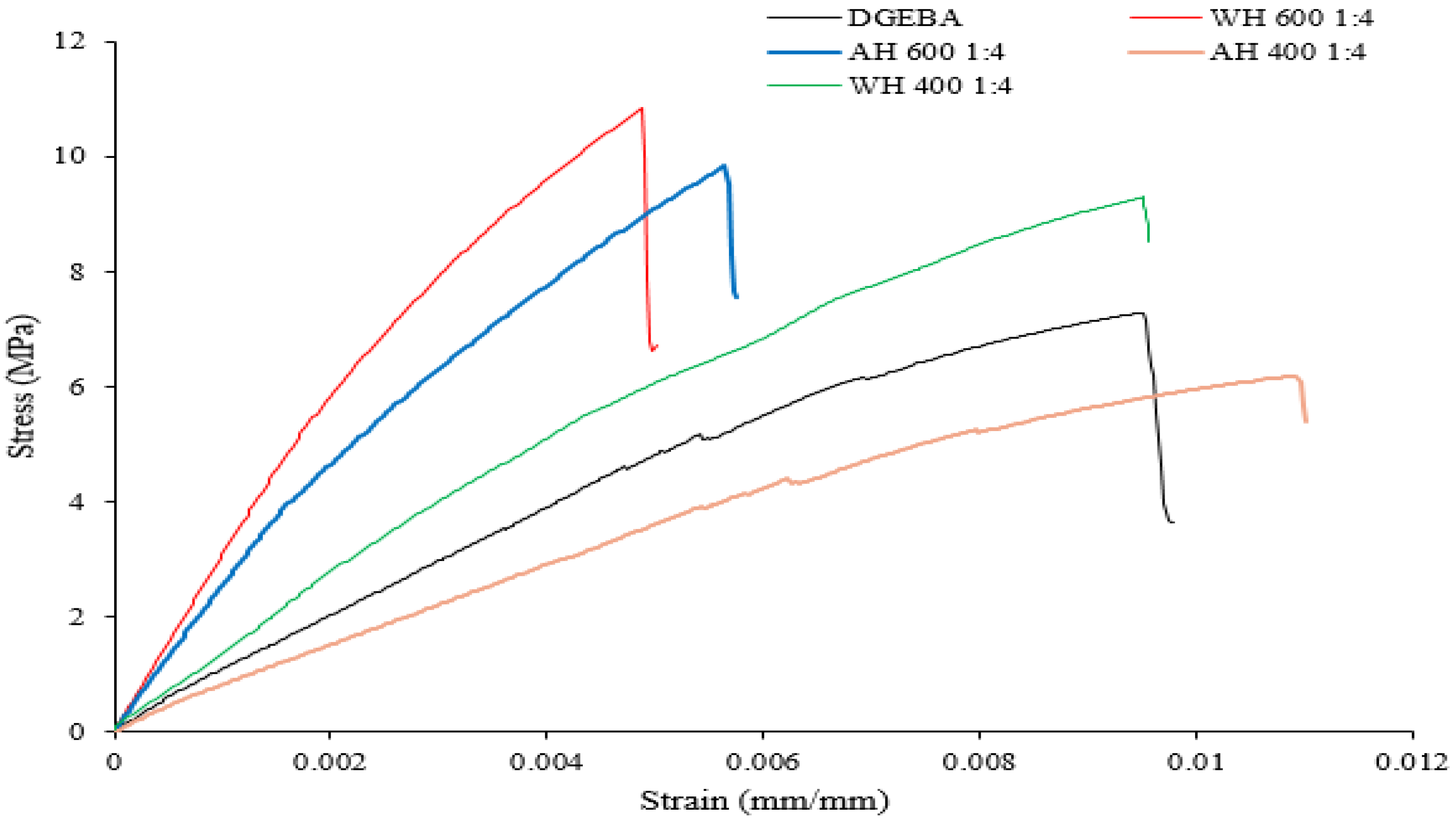
2.2.5. Mechanical Testing
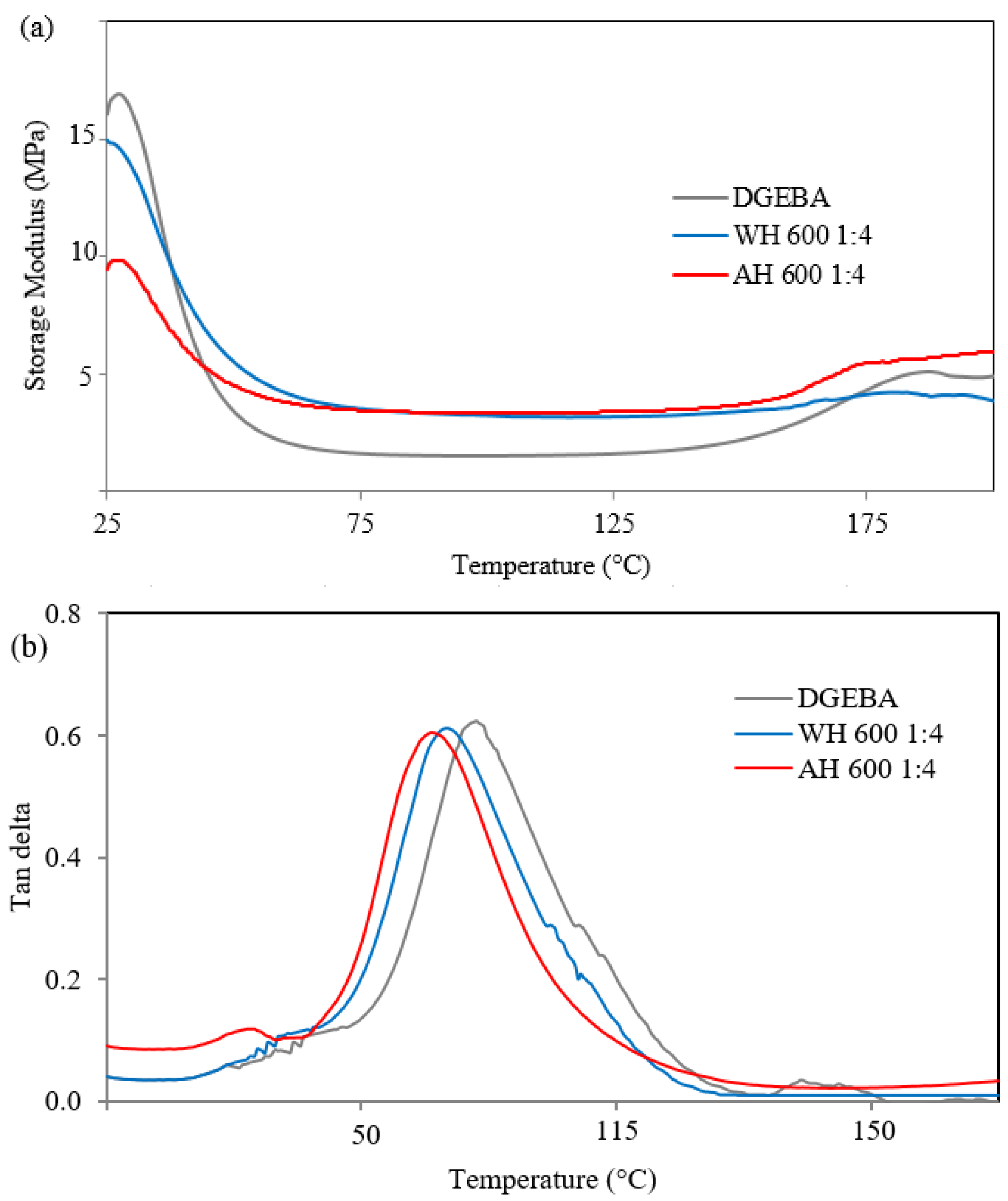
2.2.6. Dynamic Mechanical Analysis (DMA)
3. Results and Discussion
3.1. Characterization of the Biomass of Almond Hulls (AH) and Walnut Hulls (WH)
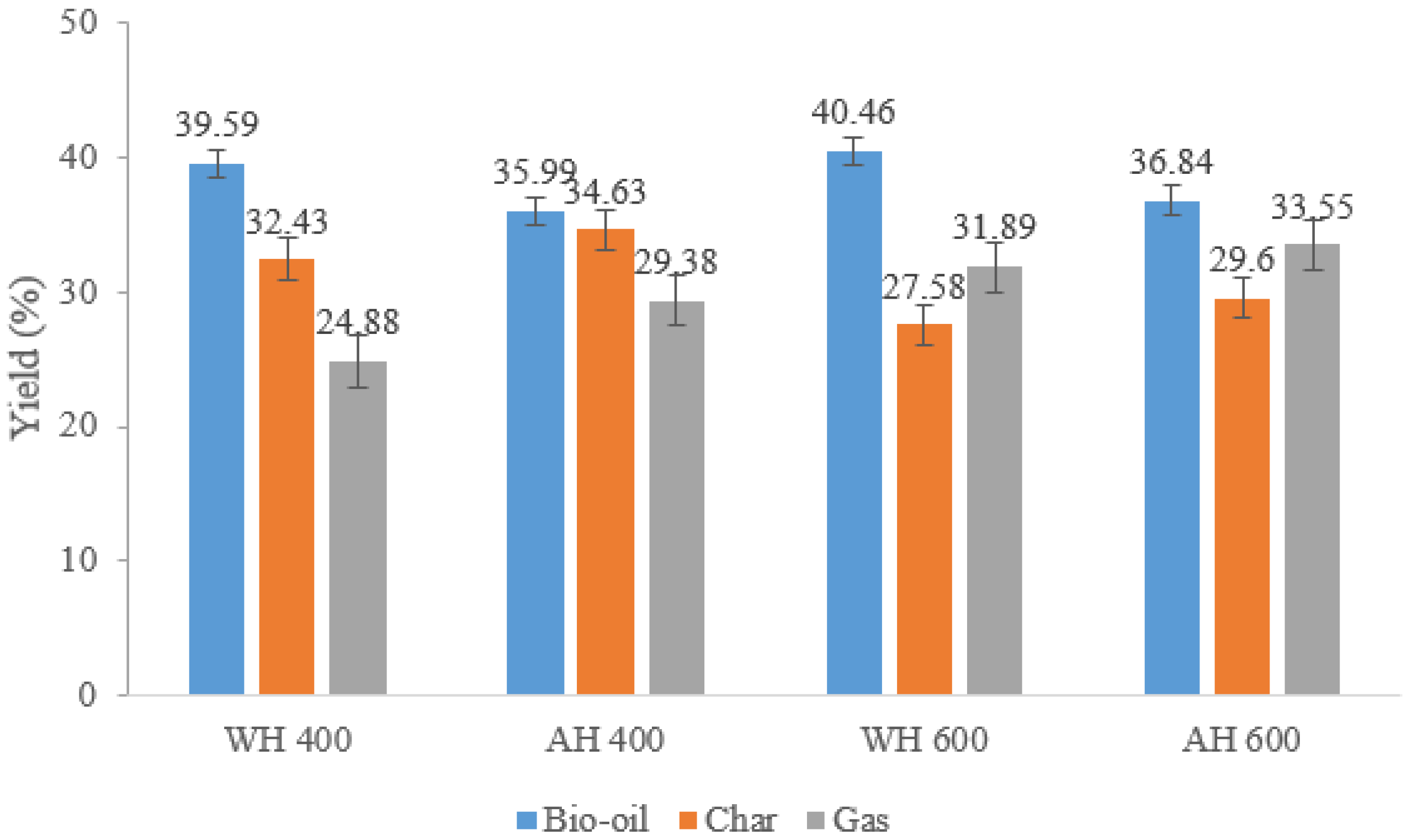
3.2. Effect of Pyrolysis Temperature on Product Yields
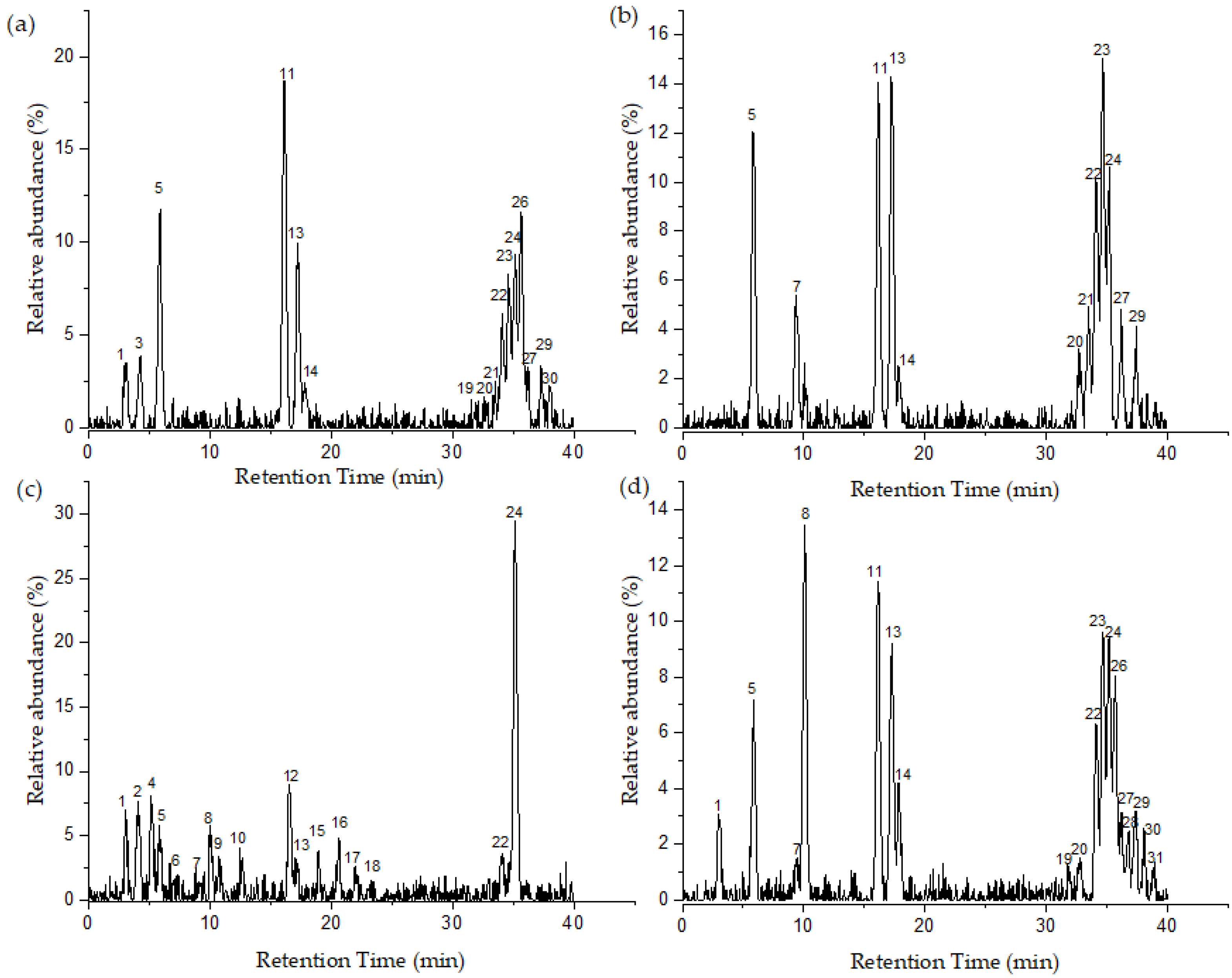
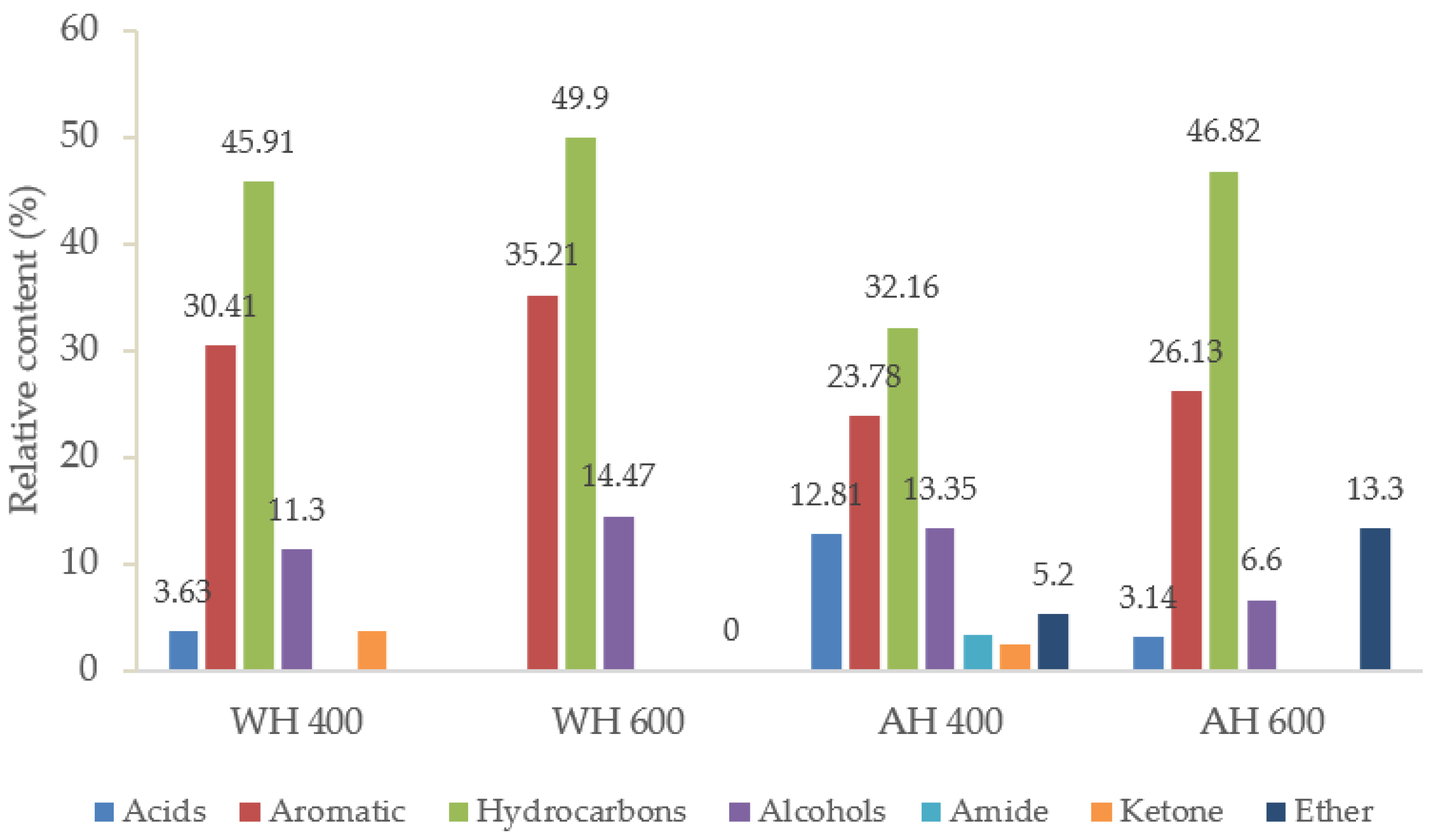
3.3. Characterization of the Bio-Oil
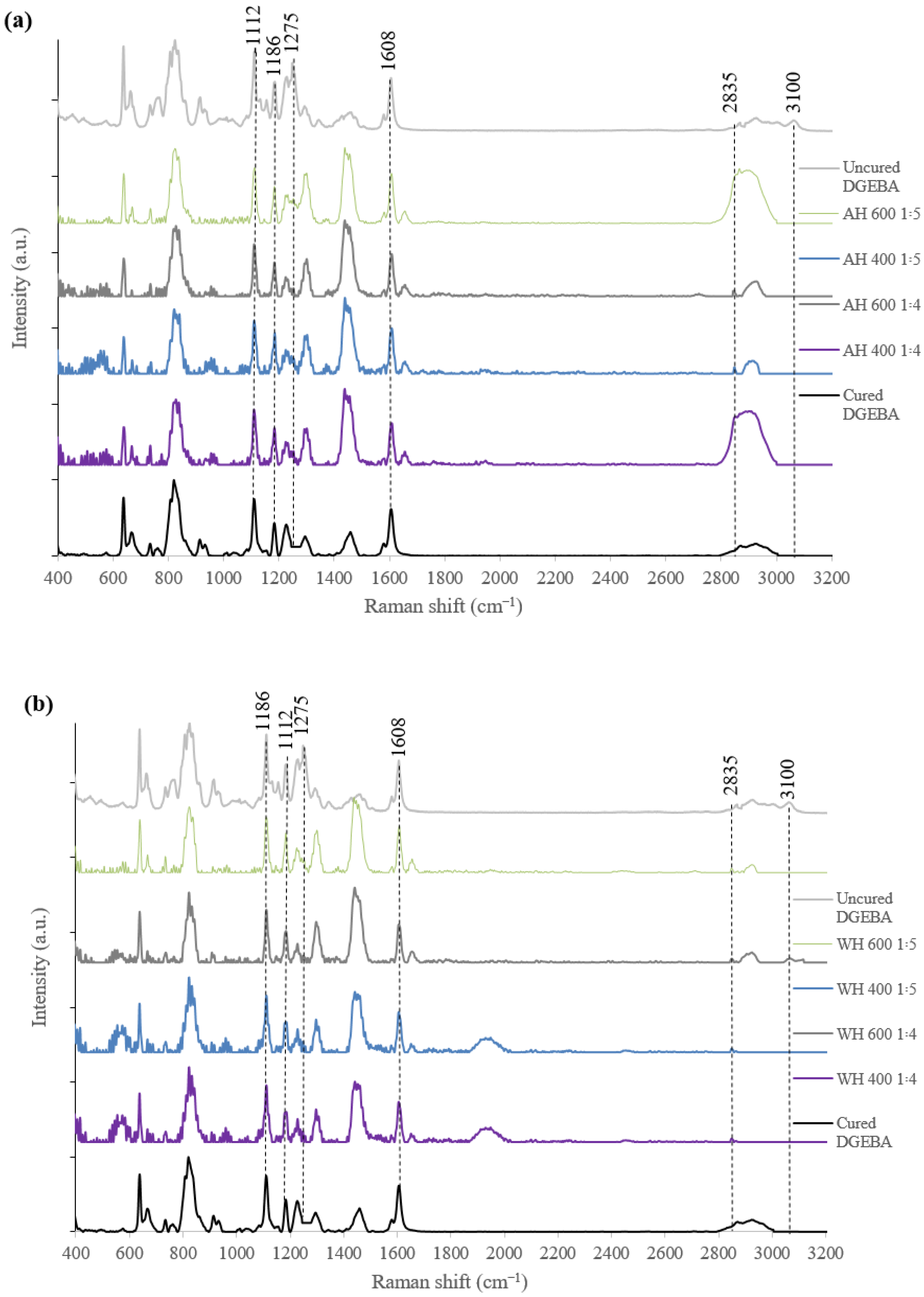
3.4. Cross-Linking Degree
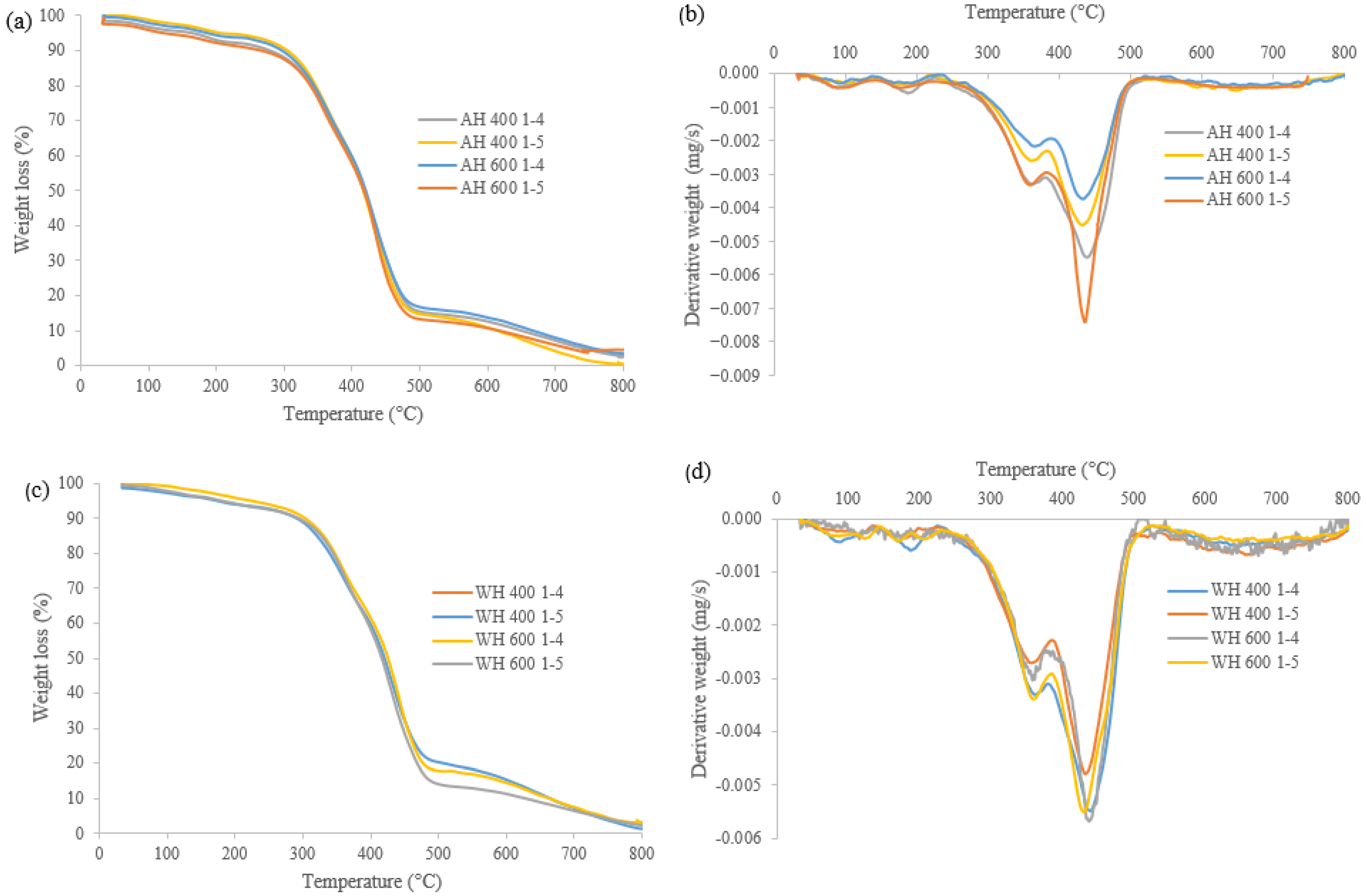
3.5. Thermal Degradation Properties
3.6. Mechanical Properties
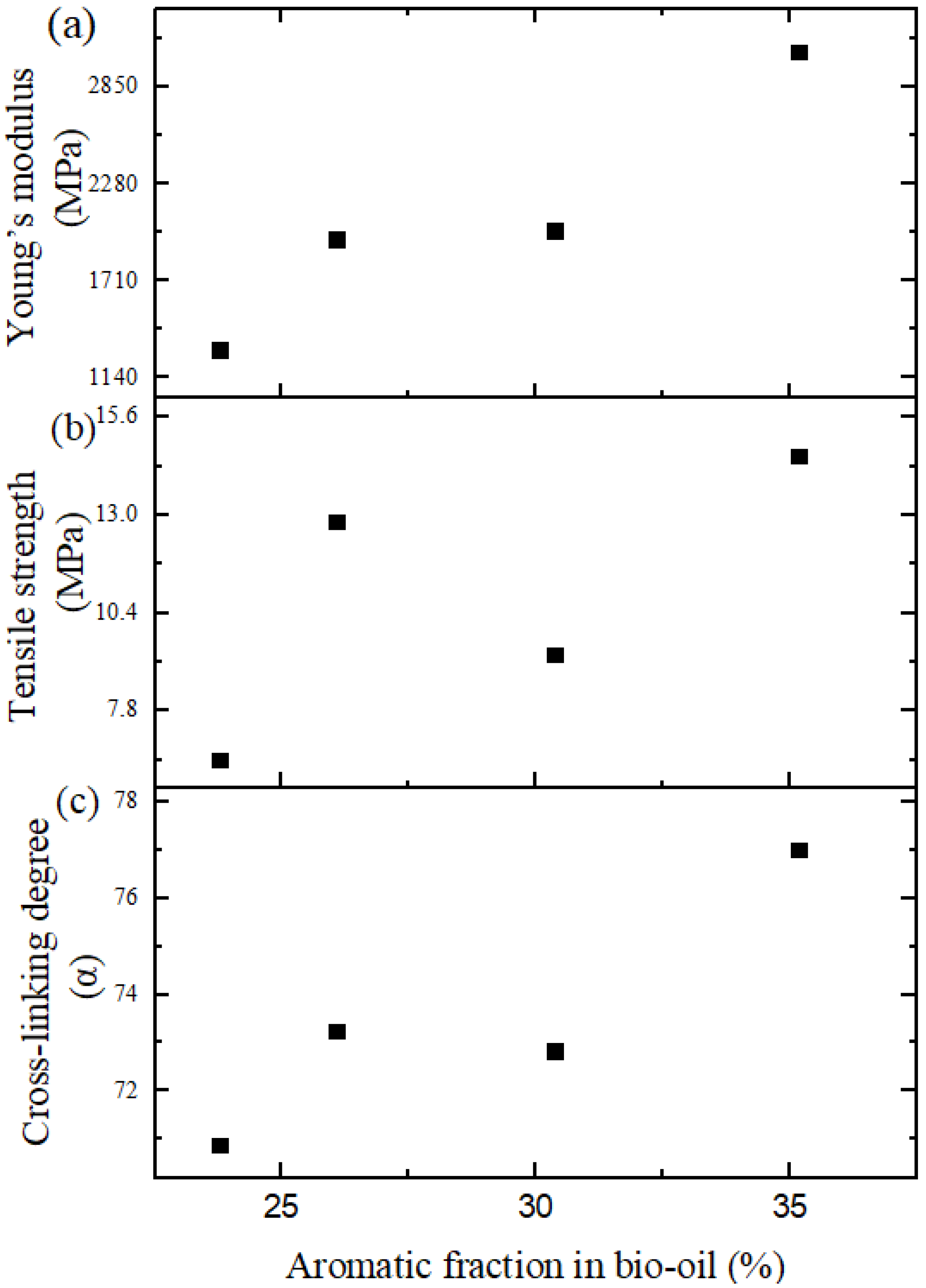
3.7. Semi-Quantitative Analysis of Aromatic Fraction of the Bio-Oil on Cure Development and Mechanical Performance
4. Conclusions
Author Contributions
Funding
Institutional Review Board Statement
Informed Consent Statement
Data Availability Statement
Conflicts of Interest
References
- Song, X.; Zheng, S.; Huang, J.; Zhu, P.; Guo, Q. Miscibility, morphology and fracture toughness of tetrafunctional epoxy resin/poly(styrene-co-acrylonitrile) blends. J. Mater. Sci. 2000, 35, 5613–5619. [Google Scholar] [CrossRef]
- Pan, Y.; Pan, Y.; Cheng, Q.; Liu, Y.; Essien, C.; Via, B.; Wang, X.; Sun, R.; Taylor, S. Characterization of epoxy composites reinforced with wax encapsulated microcrystalline cellulose. Polymers 2016, 8, 415. [Google Scholar] [CrossRef]
- Kan, T.; Strezov, V.; Evans, T.J. Lignocellulosic biomass pyrolysis: A review of product properties and effects of pyrolysis parameters. Renew. Sustain. Energy Rev. 2016, 57, 1126–1140. [Google Scholar] [CrossRef]
- Balat, M.; Balat, M.; Kırtay, E.; Balat, H. Main routes for the thermo-conversion of biomass into fuels and chemicals. Part 1: Pyrolysis systems. Energy Convers. Manag. 2009, 50, 3147–3157. [Google Scholar] [CrossRef]
- Demirbas, M.F.; Balat, M. Biomass pyrolysis for liquid fuels and chemicals: A review. J. Sci. Ind. Res. 2007, 66, 797–804. [Google Scholar]
- Akhtar, J.; Amin, N.S. A review on operating parameters for optimum liquid oil yield in biomass pyrolysis. Renew. Sustain. Energy Rev. 2012, 16, 5101–5109. [Google Scholar] [CrossRef]
- Zhang, S.; Yan, Y.; Li, T.; Ren, Z. Upgrading of liquid fuel from the pyrolysis of biomass. Bioresour. Technol. 2005, 96, 545–550. [Google Scholar] [CrossRef] [PubMed]
- Dai, L.; Zeng, Z.; Tian, X.; Jiang, L.; Yu, Z.; Wu, Q.; Wang, Y.; Liu, Y.; Ruan, R. Microwave-assisted catalytic pyrolysis of torrefied corn cob for phenol-rich bio-oil production over Fe modified bio-char catalyst. J. Anal. Appl. Pyrolysis 2019, 143, 104691. [Google Scholar] [CrossRef]
- Machado, H.; Cristino, A.F.; Orišková, S.; Galhano dos Santos, R. Bio-oil: The next-generation source of chemicals. Reactions 2022, 3, 118–137. [Google Scholar]
- Oumer, A.; Hasan, M.; Baheta, A.T.; Mamat, R.; Abdullah, A. Bio-based liquid fuels as a source of renewable energy: A review. Renew. Sustain. Energy Rev. 2018, 88, 82–98. [Google Scholar] [CrossRef]
- Isa, Y.M.; Ganda, E.T. Bio-oil as a potential source of petroleum range fuels. Renew. Sustain. Energy Rev. 2018, 81, 69–75. [Google Scholar] [CrossRef]
- Salehi, E.; Abedi, J.; Harding, T. Bio-oil from sawdust: Effect of operating parameters on the yield and quality of pyrolysis products. Energy Fuels 2011, 25, 4145–4154. [Google Scholar] [CrossRef]
- Qureshi, K.M.; Lup, A.N.K.; Khan, S.; Abnisa, F.; Daud, W.M.A.W. Effect of temperature and feed rate on pyrolysis oil produced via helical screw fluidized bed reactor. Korean J. Chem. Eng. 2021, 38, 1797–1809. [Google Scholar] [CrossRef]
- Mourant, D.; Lievens, C.; Gunawan, R.; Wang, Y.; Hu, X.; Wu, L.; Syed-Hassan, S.S.A.; Li, C.-Z. Effects of temperature on the yields and properties of bio-oil from the fast pyrolysis of mallee bark. Fuel 2013, 108, 400–408. [Google Scholar] [CrossRef]
- Jamilatun, S.; Elisthatiana, Y.; Aini, S.N.; Mufandi, I.; Budiman, A. Effect of temperature on yield product and characteristics of bio-oil from pyrolysis of Spirulina platensis residue. Elkawnie 2020, 6, 96–108. [Google Scholar] [CrossRef]
- Fordos, S.; Abid, N.; Gulzar, M.; Pasha, I.; Oz, F.; Shahid, A.; Khan, M.K.I.; Mousavi Khaneghah, A.; Aadil, R.M. Recent development in the application of walnut processing by-products (walnut shell and walnut husk). Biomass Convers. Biorefinery 2023, 13, 14389–14411. [Google Scholar] [CrossRef]
- Kali, A.; Amar, A.; Loulidi, I.; Jabri, M.; Hadey, C.; Lgaz, H.; Alrashdi, A.A.; Boukhlifi, F. Characterization and adsorption capacity of four low-cost adsorbents based on coconut, almond, walnut, and peanut shells for copper removal. Biomass Convers. Biorefinery 2024, 14, 3655–3666. [Google Scholar]
- Liu, Y.; Via, B.K.; Pan, Y.; Cheng, Q.; Guo, H.; Auad, M.L.; Taylor, S. Preparation and characterization of epoxy resin cross-linked with high wood pyrolysis bio-oil substitution by acetone pretreatment. Polymers 2017, 9, 106. [Google Scholar] [CrossRef]
- Alejandro-Martín, S.; Montecinos Acaricia, A.; Cerda-Barrera, C.; Diaz Perez, H. Influence of chemical surface characteristics of ammonium-modified Chilean zeolite on oak catalytic pyrolysis. Catalysts 2019, 9, 465. [Google Scholar] [CrossRef]
- Mohan, D.; Pittman, C.U., Jr.; Steele, P.H. Pyrolysis of wood/biomass for bio-oil: A critical review. Energy Fuels 2006, 20, 848–889. [Google Scholar] [CrossRef]
- Kanaujia, P.K.; Sharma, Y.; Garg, M.; Tripathi, D.; Singh, R. Review of analytical strategies in the production and upgrading of bio-oils derived from lignocellulosic biomass. J. Anal. Appl. Pyrolysis 2014, 105, 55–74. [Google Scholar] [CrossRef]
- Merad, L.; Cochez, M.; Margueron, S.; Jauchem, F.; Ferriol, M.; Benyoucef, B.; Bourson, P. In-situ monitoring of the curing of epoxy resins by Raman spectroscopy. In Proceedings of the New Achievements in Materials and Environmental Sciences Names, Metz, France, 7–9 November 2007; pp. 155–158. [Google Scholar]
- Oyebanji, J.; Okekunle, P.; Lasode, O.; Oyedepo, S. Chemical composition of bio-oils produced by fast pyrolysis of two energy biomass. Biofuels 2018, 9, 479–487. [Google Scholar]
- Li, X.; Zhang, H.; Zhao, B.; Zhang, Y. Preparation of hydrogen storage carbon materials using bio-oil heavy components as carbon-containing precursor. Fuel Process. Technol. 2020, 203, 106386. [Google Scholar] [CrossRef]
- Sharma, M.; Singh, J.; Baskar, C.; Kumar, A. A comprehensive review of renewable energy production from biomass-derived bio-oil. BioTechnologia 2019, 100, 179–194. [Google Scholar] [CrossRef]
- Mullen, C.A.; Boateng, A.A. Chemical composition of bio-oils produced by fast pyrolysis of two energy crops. Energy Fuels 2008, 22, 2104–2109. [Google Scholar] [CrossRef]
- Shafiq, M.; Capareda, S.C. Effect of different temperatures on the properties of pyrolysis products of Parthenium hysterophorus. J. Saudi Chem. Soc. 2021, 25, 101197. [Google Scholar] [CrossRef]
- Maulinda, L.; Husin, H.; Arahman, N.; Rosnelly, C.M.; Syukri, M.; Nurhazanah; Nasution, F.; Ahmadi. The Influence of Pyrolysis Time and Temperature on the Composition and Properties of Bio-Oil Prepared from Tanjong Leaves (Mimusops elengi). Sustainability 2023, 15, 13851. [Google Scholar] [CrossRef]
- Irfan, M.; Chen, Q.; Yue, Y.; Pang, R.; Lin, Q.; Zhao, X.; Chen, H. Co-production of biochar, bio-oil, and syngas from halophyte grass (Achnatherum splendens L.) under three different pyrolysis temperatures. Bioresour. Technol. 2016, 211, 457–463. [Google Scholar] [CrossRef]
- Shah, M.A.; Khan, N.; Kumar, V.; Qurashi, A. Pyrolysis of walnut shell residues in a fixed bed reactor: Effects of process parameters, chemical and functional properties of bio-oil. J. Environ. Chem. Eng. 2021, 9, 105564. [Google Scholar] [CrossRef]
- He, X.; Liu, Z.; Niu, W.; Yang, L.; Zhou, T.; Qin, D.; Niu, Z.; Yuan, Q. Effects of pyrolysis temperature on the physicochemical properties of gas and biochar obtained from pyrolysis of crop residues. Energy 2018, 143, 746–756. [Google Scholar] [CrossRef]
- Zhao, X.; Wang, M.; Liu, H.; Zhao, C.; Ma, C.; Song, Z. Effect of temperature and additives on the yields of products and microwave pyrolysis behaviors of wheat straw. J. Anal. Appl. Pyrolysis 2013, 100, 49–55. [Google Scholar] [CrossRef]
- Demirbas, A. Effects of temperature and particle size on bio-char yield from pyrolysis of agricultural residues. J. Anal. Appl. Pyrolysis 2004, 72, 243–248. [Google Scholar] [CrossRef]
- Önal, E.; Uzun, B.B.; Pütün, A.E. Bio-oil production via co-pyrolysis of almond shell as biomass and high-density polyethylene. Energy Convers. Manag. 2014, 78, 704–710. [Google Scholar] [CrossRef]
- Barde, M.; Edmunds, C.W.; Labbe, N.; Auad, M.L. Fast pyrolysis bio-oil from lignocellulosic biomass for the development of bio-based cyanate esters and cross-linked networks. High Perform. Polym. 2019, 31, 1140–1152. [Google Scholar] [CrossRef]
- Kleinert, M.; Barth, T. Phenols from lignin. Chem. Eng. Technol. 2008, 31, 736–745. [Google Scholar] [CrossRef]
- El Mashad, H.M.; Edalati, A.; Zhang, R.; Jenkins, B.M. Production and characterization of biochar from almond shells. Clean Technol. 2022, 4, 854–864. [Google Scholar] [CrossRef]
- Fardhyanti, D.S.; Chafidz, A.; Triwibowo, B.; Prasetiawan, H.; Cahyani, N.N.; Andriyani, S. Improving the quality of bio-oil produced from rice husk pyrolysis by extraction of its phenolic compounds. J. Bahan Alam Terbarukan 2020, 8, 90–100. [Google Scholar] [CrossRef]
- Sibaja, B.; Adhikari, S.; Celikbag, Y.; Via, B.; Auad, M.L. Fast pyrolysis bio-oil as precursor of thermosetting epoxy resins. Polym. Eng. Sci. 2018, 58, 1296–1307. [Google Scholar] [CrossRef]
- Pappa, C.; Feghali, E.; Vanbroekhoven, K.; Triantafyllidis, K.S. Recent advances in epoxy resins and composites derived from lignin and related bio-oils. Curr. Opin. Green Sustain. Chem. 2022, 38, 100687. [Google Scholar] [CrossRef]
- Bi, D.; He, Z.; Huang, F.; Zhang, G.; Wang, H.; Liu, S. Interaction mechanisms among cellulose, hemicellulose, and lignin in nitrogen-rich pyrolysis under K and Ca presence: Intermediate evolution and product formation. Chem. Eng. J. 2024, 496, 153798. [Google Scholar] [CrossRef]
- Ahmed, N.; Zeeshan, M.; Iqbal, N.; Farooq, M.Z.; Shah, S.A. Investigation on bio-oil yield and quality with scrap tire addition in sugarcane bagasse pyrolysis. J. Clean. Prod. 2018, 196, 927–934. [Google Scholar] [CrossRef]
- Naik, D.V.; Kumar, V.; Prasad, B.; Poddar, M.K.; Behera, B.; Bal, R.; Khatri, O.P.; Adhikari, D.K.; Garg, M.O. Catalytic cracking of jatropha-derived fast pyrolysis oils with VGO and their NMR characterization. RSC Adv. 2015, 5, 398–409. [Google Scholar] [CrossRef]
- Kanaujia, P.K.; Naik, D.V.; Tripathi, D.; Singh, R.; Poddar, M.K.; Konathala, L.S.K.; Sharma, Y.K. Pyrolysis of Jatropha Curcas seed cake followed by optimization of liquid–liquid extraction procedure for the obtained bio-oil. J. Anal. Appl. Pyrolysis 2016, 118, 202–224. [Google Scholar] [CrossRef]
- Hidayat, S.; Bakar, M.S.A.; Yang, Y.; Phusunti, N.; Bridgwater, A. Characterisation and Py-GC/MS analysis of Imperata Cylindrica as potential biomass for bio-oil production in Brunei Darussalam. J. Anal. Appl. Pyrolysis 2018, 134, 510–519. [Google Scholar] [CrossRef]
- Adar, F. Introduction to interpretation of Raman spectra using database searching and functional group detection and identification. Spectroscopy 2016, 31, 16–23. [Google Scholar]
- Marina, A.; Man, Y.C.; Amin, I. Virgin coconut oil: Emerging functional food oil. Trends Food Sci. Technol. 2009, 20, 481–487. [Google Scholar] [CrossRef]
- Pershin, S. Raman spectroscopy of the OH group vibrations in structural complexes of liquid water. Opt. Spectrosc. 2005, 98, 543–555. [Google Scholar] [CrossRef]
- Bock, P.; Gierlinger, N. Infrared and Raman spectra of lignin substructures: Coniferyl alcohol, abietin, and coniferyl aldehyde. J. Raman Spectrosc. 2019, 50, 778–792. [Google Scholar] [CrossRef]
- Lukić, I.; Kesić, Ž.; Zdujić, M.; Skala, D. Vegetable oil as a feedstock for biodiesel synthesis. In Vegetable Oils—Properties, Uses and Benefits; Nova PBL: Cascais, Portugal, 2016; pp. 83–128. [Google Scholar]
- Chen, H.; Lang, Q.; Zhang, H.; Wu, G.; Zheng, X.; Pu, J. Study of chemical modification by impregnation of fresh poplar log and by hot-press drying process. BioResources 2013, 8, 3924–3933. [Google Scholar] [CrossRef]
- Lyon, R.; Chike, K.; Angel, S. In situ cure monitoring of epoxy resins using fiber-optic Raman spectroscopy. J. Appl. Polym. Sci. 1994, 53, 1805–1812. [Google Scholar] [CrossRef]
- Vašková, H.; Křesálek, V. Raman spectroscopy of epoxy resin crosslinking. In Proceedings of the 13th WSEAS International Conference on Automation Control, Modeling & Simulation (ACMOS’11), Canary Islands, Spain, 27–29 May 2011. [Google Scholar]
- Farquharson, S.; Smith, W.; Rose, J.; Shaw, M. Correlations between molecular (Raman) and macroscopic (rheology) data for process monitoring of thermoset composite. J. Process Anal. Chem. 2002, 7, 45–53. [Google Scholar]
- Hardis, R.; Jessop, J.L.; Peters, F.E.; Kessler, M.R. Cure kinetics characterization and monitoring of an epoxy resin using DSC, Raman spectroscopy, and DEA. Compos. Part A Appl. Sci. Manuf. 2013, 49, 100–108. [Google Scholar] [CrossRef]
- Rowell, R.M. Handbook of Wood Chemistry and Wood Composites; CRC Press: Boca Raton, FL, USA, 2005. [Google Scholar]
- Ma, S.; Liu, W.; Su, Q.; Liu, Y. Studies on the thermal properties of epoxy resins modified with two kinds of silanes. J. Macromol. Sci. Part B Phys. 2010, 49, 43–56. [Google Scholar] [CrossRef]
- Gerbase, A.E.; Petzhold, C.L.; Costa, A.P.O. Dynamic mechanical and thermal behavior of epoxy resins based on soybean oil. J. Am. Oil Chem. Soc. 2002, 79, 797–802. [Google Scholar] [CrossRef]
- Zhao, W.; Liu, J.; Peng, H.; Liao, J.; Wang, X. Synthesis of a novel PEPA-substituted polyphosphoramide with high char residues and its performance as an intumescent flame retardant for epoxy resins. Polym. Degrad. Stab. 2015, 118, 120–129. [Google Scholar] [CrossRef]
- Hidalgo, P.; Salgado, L.; Ibacache, N.; Hunter, R. Influence of biochar and bio-oil loading on the properties of epoxy resin composites. Polymers 2023, 15, 1895. [Google Scholar] [CrossRef]
- Auad, M.L.; Nutt, S.R.; Stefani, P.M.; Aranguren, M.I. Rheological study of the curing kinetics of epoxy–phenol novolac resin. J. Appl. Polym. Sci. 2006, 102, 4430–4439. [Google Scholar] [CrossRef]
- Kotb, Y.; Cagnard, A.; Houston, K.R.; Khan, S.A.; Hsiao, L.C.; Velev, O.D. What makes epoxy-phenolic coatings on metals ubiquitous: Surface energetics and molecular adhesion characteristics. J. Colloid Interface Sci. 2022, 608, 634–643. [Google Scholar] [CrossRef]
- Agbo, P.; Mali, A.; Deng, D.; Zhang, L. Bio-Oil-Based Epoxy Resins from Thermochemical Processing of Sustainable Resources: A Short Review. J. Compos. Sci. 2023, 7, 374. [Google Scholar] [CrossRef]




| BEBs | Bio-Oil/ DGEBA (w/w) | Formulation Description |
|---|---|---|
| Bio-based epoxy blends with almond hulls bio-oil | ||
| AH 400 1:4 | 1:4 | Bio-oil from Almond hulls pyrolyzed at 400 °C, mixed with DGEBA |
| AH 400 1:5 | 1:5 | Bio-oil from Almond hulls pyrolyzed at 400 °C, mixed with DGEBA |
| AH 600 1:4 | 1:4 | Bio-oil from Almond hulls pyrolyzed at 600 °C, mixed with DGEBA |
| AH 600 1:5 | 1:5 | Bio-oil from Almond hulls pyrolyzed to 600 °C, mixed with DGEBA |
| Bio-based epoxy blends with walnut hulls bio-oil | ||
| WH 400 1:4 | 1:4 | Bio-oil from walnut hulls pyrolyzed at 400 °C, mixed with DGEBA |
| WH 400 1:5 | 1:5 | Bio-oil from walnut hulls pyrolyzed at 400 °C, mixed with DGEBA |
| WH 600 1:4 | 1:4 | Bio-oil from walnut hulls pyrolyzed at 600 °C, mixed with DGEBA |
| WH 600 1:5 | 1:5 | Bio-oil from Walnut hulls pyrolyzed to 600 °C, mixed with DGEBA |
| Fixed Carbon (%) | Volatile Matter (%) | Ash (%) | Moisture (%) | N (%) | C (%) | H (%) | O (%) * | S (%) | |
|---|---|---|---|---|---|---|---|---|---|
| Almond hulls (AH) | 30.23 | 49.33 | 14.91 | 5.53 | 0.32 | 40.69 | 5.59 | 53.40 | - |
| Walnut hulls (WH) | 31.22 | 56.12 | 8.71 | 3.95 | 0.00 | 44.81 | 5.39 | 49.80 | - |
| N° | Compounds | Formula | tR (min) | Relative Content (%) | |||
|---|---|---|---|---|---|---|---|
| WH 400 | WH 600 | AH 400 | AH 600 | ||||
| 1 | Acetic acid | C2H4O2 | 3.053 | 3.63 | – | 5.65 | 3.14 |
| 2 | Propanoic acid | C3H6O2 | 4.102 | – | – | 7.16 | – |
| 3 | 1-Hydroxy-2-butanone | C4H8O2 | 4.219 | 3.75 | – | – | – |
| 4 | Furfural | C5H4O2 | 5.203 | – | – | 8.27 | – |
| 5 | 2-Furanmethanol | C5H6O2 | 5.86 | 11.3 | 12.6 | 4.4 | 6.6 |
| 6 | 2-Hexene | C6H12 | 7.436 | – | – | 1.1 | – |
| 7 | Phenol | C6H6O | 9.385 | – | 5.19 | 1.41 | 1.42 |
| 8 | Furan, 2,5-diethoxytetrahydro | C8H14O3 | 10.073 | – | – | 5.2 | 13.3 |
| 9 | 1,2-Cyclopentanedione, 3-methyl- | C6H8O2 | 10.779 | – | – | 2.37 | – |
| 10 | Phenol, 2-methoxy- | C7H8O2 | 12.622 | – | – | 3.17 | – |
| 11 | Catechol | C6H6O2 | 16.131 | 18.41 | 13.86 | - | 11.93 |
| 12 | Levoglucosan | C6H8O4 | 16.554 | – | – | 8.95 | – |
| 13 | 5-Hydroxymethylfurfural | C9H20 | 17.252 | 9.69 | 15.9 | 2.4 | 9.22 |
| 14 | 1,2-Benzenediol, 3-methoxy- | C7H8O3 | 17.865 | 2.31 | 2.13 | - | 3.56 |
| 15 | 3,5-Dihydroxytoluene | C7H8O2 | 18.938 | – | – | 2.68 | – |
| 16 | Phenol, 2,6-dimethoxy- | C8H10O3 | 20.599 | – | – | 3.43 | – |
| 17 | Vanillin | C8H8O3 | 22.007 | – | – | 1.29 | – |
| 18 | 1,2,4-Trimethoxybenzene | C9H12O3 | 23.096 | – | – | 1.13 | – |
| 19 | Nonadecane | C19H40 | 31.874 | 1.06 | – | – | 1.01 |
| 20 | Eicosane | C20H42 | 32.749 | 1.19 | 2.5 | – | 1.52 |
| 21 | Heneicosane | C21H44 | 33.475 | 2.14 | 4.3 | – | – |
| 22 | Docosane | C22H46 | 34.105 | 5.44 | 10.3 | 3.66 | 6.27 |
| 23 | Tricosane | C23H48 | 34.654 | 8.22 | 15.1 | – | 9.3 |
| 24 | Tetracosane | C24H50 | 35.157 | 9.02 | 10.1 | 27.4 | 8.9 |
| 25 | Octadecanamide | C18H37NO | 35.256 | – | – | 3.31 | – |
| 26 | Pentacosane | C25H52 | 35.668 | 11.67 | – | – | 7.99 |
| 27 | Hexacosane | C26H54 | 36.176 | 2.85 | 4.3 | – | 3.03 |
| 28 | Heptacosane | C27H56 | 36.732 | – | – | – | 2.53 |
| 29 | Octacosane | C28H58 | 37.352 | 2.55 | 3.3 | – | 2.93 |
| 30 | Nonacosane | C29H60 | 38.058 | 1.77 | – | – | 1.92 |
| 31 | Triacontane | C30H62 | 38.883 | – | – | – | 1.42 |
| Sample | Cross-Linking Degree (α) |
|---|---|
| DGEBA | 72.16 |
| Almond Hull (AH) | |
| AH 400 1:4 | 70.85 |
| AH 400 1:5 | 64.30 |
| AH 600 1:4 | 73.21 |
| AH 600 1:5 | 70.90 |
| Walnut hulls (WH) | |
| WH 400 1:4 | 72.80 |
| WH 400 1:5 | 67.40 |
| WH 600 1:4 | 76.99 |
| WH 600 1:5 | 73.05 |
| Sample | Tonset (°C) a | Tendset (°C) b | T5% (°C) c | T10% (°C) d | T50% (°C) e | Tmax (°C) f | Rm800 (%) g |
|---|---|---|---|---|---|---|---|
| DGEBA | 320.41 | 507.51 | 328.53 | 350.53 | 415.75 | 450.62 | 4.36 |
| Almond Hull (AH) | |||||||
| AH 400 1:4 | 297.54 | 502.84 | 164.77 | 278.84 | 417.33 | 448.25 | 2.58 |
| AH 400 1:5 | 295.83 | 498.7 | 206.33 | 304.78 | 416.80 | 434.23 | 0.43 |
| AH 600 1:4 | 297.54 | 501.23 | 187.2 | 296.7 | 419.96 | 436.74 | 3.41 |
| AH 600 1:5 | 295.83 | 497.3 | 122.57 | 265.71 | 417.48 | 437.22 | 4.51 |
| Walnut hulls (WH) | |||||||
| WH 400 1:4 | 294.3 | 491.05 | 211.28 | 303.69 | 421.41 | 437.29 | 3.12 |
| WH 400 1:5 | 293.4 | 491.05 | 173.1 | 290.47 | 419.94 | 425.97 | 1.31 |
| WH 600 1:4 | 296.41 | 494.34 | 223.04 | 302.92 | 425.22 | 437.29 | 3.15 |
| WH 600 1:5 | 294.3 | 500.4 | 178.99 | 293.47 | 416.01 | 425.97 | 2.31 |
| Sample | Tg (°C) a | E′ at 30 °C (MPa) b |
|---|---|---|
| DGEBA | 83.02 | 17.50 |
| WH 600 1:4 | 76.01 | 14.70 |
| AH 600 1:4 | 73.21 | 10.01 |
| Sample | Tensile Strength (MPa) | Strain at Break (mm/mm) | Young’s Modulus (MPa) |
|---|---|---|---|
| DGEBA | 7.52 ± 1.09 | 0.01 | 1093.69 ± 128.83 |
| AH 400 1:4 | 6.45 ± 1.12 | 0.011 | 1300 ± 101.21 |
| AH 600 1:4 | 12.78 ± 4.97 | 0.006 | 1950.90 ± 73.35 |
| WH 400 1:4 | 9.25 ± 1.02 | 0.01 | 2000 ± 101.21 |
| WH 600 1:4 | 14.54 ± 4.30 | 0.005 | 3050.02 ± 90.49 |
Disclaimer/Publisher’s Note: The statements, opinions and data contained in all publications are solely those of the individual author(s) and contributor(s) and not of MDPI and/or the editor(s). MDPI and/or the editor(s) disclaim responsibility for any injury to people or property resulting from any ideas, methods, instructions or products referred to in the content. |
© 2026 by the authors. Licensee MDPI, Basel, Switzerland. This article is an open access article distributed under the terms and conditions of the Creative Commons Attribution (CC BY) license.
Share and Cite
Hidalgo, P.; Nahuelpan, Z.; Rebolledo, A.; Treumun, Y.; Yáñez, M.; Hunter, R. Bio-Epoxy Composites Formulation Using Bio-Oils from Walnut and Almond Shell Pyrolysis: Influence of Temperature on Chemical Composition and Curing Behavior. Sustainability 2026, 18, 2083. https://doi.org/10.3390/su18042083
Hidalgo P, Nahuelpan Z, Rebolledo A, Treumun Y, Yáñez M, Hunter R. Bio-Epoxy Composites Formulation Using Bio-Oils from Walnut and Almond Shell Pyrolysis: Influence of Temperature on Chemical Composition and Curing Behavior. Sustainability. 2026; 18(4):2083. https://doi.org/10.3390/su18042083
Chicago/Turabian StyleHidalgo, Pamela, Zarella Nahuelpan, Alison Rebolledo, Yenifer Treumun, Mauricio Yáñez, and Renato Hunter. 2026. "Bio-Epoxy Composites Formulation Using Bio-Oils from Walnut and Almond Shell Pyrolysis: Influence of Temperature on Chemical Composition and Curing Behavior" Sustainability 18, no. 4: 2083. https://doi.org/10.3390/su18042083
APA StyleHidalgo, P., Nahuelpan, Z., Rebolledo, A., Treumun, Y., Yáñez, M., & Hunter, R. (2026). Bio-Epoxy Composites Formulation Using Bio-Oils from Walnut and Almond Shell Pyrolysis: Influence of Temperature on Chemical Composition and Curing Behavior. Sustainability, 18(4), 2083. https://doi.org/10.3390/su18042083