Article

Sustainable Sampling of Marine Bioconstructions: A Minimally Invasive ROV Coring Approach for Geobiological Studies


1
Department of Biology, Ecology and Earth Sciences, University of Calabria, Street P. Bucci, Cube 15b, 87036 Rende, Italy
2
Department of Mechanical, Energy and Management Engineering, University of Calabria, Street P. Bucci, Cube 45, 87036 Rende, Italy
3
Consorzio Nazionale Interuniversitario per le Scienze del Mare—CoNISMa, Piazzale Flaminio, 9, 00196 Rome, Italy
4
Department of Earth and Environmental Sciences, University of Milano-Bicocca, Piazza dell’ Ateneo Nuovo, 1, 20126 Milan, Italy
5
Department of Biological, Geological and Environmental Sciences, University of Catania, Corso Italia, 57, 95129 Catania, Italy
*
Authors to whom correspondence should be addressed.
Sustainability 2026, 18(4), 2067; https://doi.org/10.3390/su18042067
Submission received: 19 January 2026 / Revised: 12 February 2026 / Accepted: 16 February 2026 / Published: 18 February 2026

Abstract

Coralligenous bioconstructions are biogenic calcareous structures characterized by low accretion rate and high sensitivity to natural and anthropogenic impacts. Assessing their ecological quality and health status requires non-destructive approaches. In the project “FISR 2019_CRESCIBLUREEF”, a ROV-based coring device has been developed to collect samples while ensuring minimal impact on the ecological and structural integrity of bioconstructions and overcoming scuba diving depth and safety constraints. This study evaluates whether fragments retrieved by the device are representative of whole coralligenous build-ups (“tal-quale”) for geobiological characterization at the microscale. Representativeness is assessed through (i) preservation of microfacies textures and framework integrity in thin sections and (ii) relative abundances of skeletal and non-skeletal carbonate components quantified by point-counting. The results suggested that a coring device represents a powerful tool for obtaining representative bioconstruction samples at least in terms of the relationships and distribution between different carbonate components. This innovative approach opens new frontiers in the study of bioconstructed habitats, allowing the collection of samples suitable for qualitative and quantitative analyses while preserving ecosystem integrity. It therefore represents a step toward in sustainable marine research, with great potential for monitoring, conservation, and management of benthic habitats.

1. Introduction

Marine bioconstructions are biodiversity-rich structures that regulate ecosystem functioning. They are made of living benthic organisms that overgrow the remnants of earlier assemblages and can be ephemeral or persistent for centuries to millennia [1].
The organisms that actively build the framework of the bioconstructions have been indicated as constructors [1,2] or bioconstructors [1]. Among them, encrusting calcareous red algae are habitat engineers responsible for the formation of primary algal-dominated frameworks known as Coralligenous [3,4]. This term, translated from the French Coralligène [5,6], refers to a hard-biogenic substrate mainly produced by the superposition of several generations of calcareous red algae living under sciaphilic conditions [3]. Coralligenous is identified as the climax biocenosis of the circalittoral zone [6,7,8,9], although these bioconstructions have also been observed in relatively shallow-water dim-light settings [10,11,12,13].
Coralligenous assemblages occur on hard and soft bottoms and sub-vertical and sub-horizontal substrates [10]. Based on the geometry of the substrate, two general categories are reported: (i) banks, flat structures mainly built on sub-horizontal substrata, and (ii) rims, occurring on submarine vertical cliffs or within caves [3,6,14]. Bracchi et al. [10] proposed a new classification for coralligenous morphotypes on sub-horizontal substrates, distinguishing between tabular banks (flat, laterally continuous, seafloor-covering structures), discrete reliefs (smaller, clustered, with exposed sediment in between), and hybrid banks (intermediate between tabular and discrete forms).
Overall, coralligenous bioconstructions represent the result of interspecific and dynamic relationships between bioconstructors and bioeroders, e.g., [1,15]. The main framework builders are Crustose Coralline Algae (CCA), while bryozoans and serpulid polychaetes play a subordinate role as engineering taxa [3,4]. Sponges can regulate the growth direction of encrusting organisms and modify the internal structure of the build-ups through bioerosion processes [12,16,17,18,19,20,21,22,23]. The cavities within the bioconstructions framework are often filled with autochthonous (produced in situ) and/or allochthonous (detrital) micrite, while rare cements may be either primary or diagenetic [12].
The coralligenous heterogeneous framework supports a high level of biodiversity [3,24,25,26,27], hosting more than 10% of the known Mediterranean marine benthic species, many of which are endemic, protected, and vulnerable [28,29]. However, Coralligenous is characterized by a low accretion rate (0.06–0.27 mm/yr) and a high sensitivity to natural and anthropic change ([12] and reference therein). Particularly, human impact, as well as mass mortality events, threaten the stability of this ecosystem, compromising its conservation and alpha diversity [2,3,4,30,31,32,33,34,35]. Consistent with this, coralligenous is recognized as a priority habitat for conservation in the Mediterranean and is protected under the EU Habitats Directive (92/43/CE) through its inclusion in the Natura 2000 network. Moreover, it is the focus of targeted conservation measures under the Barcelona Convention [36,37] and is monitored as part of the Marine Strategy Framework Directive [38]. Consequently, non-destructive approaches, most of which are based on visual census methods (e.g., photo and video transects) have been developed to assess the ecological quality and health status of coralligenous assemblages without invasive techniques, which would damage this delicate ecosystem [4,39,40,41,42]. Although non-invasive sampling has greatly advanced the knowledge of coralligenous habitats, it remains insufficient for species-level identification of key bioconstructors (namely CCA) due to morphological convergence among species [4]. Additionally, such methods are inadequate for accurately assessing species diversity and richness in certain taxa, as recently demonstrated for mollusks and other taxonomic groups [43,44]. Moreover, the visual census is not suitable for geobiological investigations on the mode and pattern of build-up inception and accretion, nor for exploring its history [45]. Nevertheless, because coralligenous bioconstructions are protected habitats, it is crucial to develop minimally invasive techniques and tools that strike a balance between scientific exploration and minimizing ecological impact.
A turning point in this regard was dictated by the project “FISR 2019_04543-CRESCIBLUREEF—Grown in the blue: new technologies for knowledge and conservation of Mediterranean reefs” which involved several research groups from the Universities of Calabria, Milano-Bicocca, and Catania. In the frame of this project, aimed at understanding time and mode of the Coralligenous inception and development (also in relation to fluctuations of environmental parameters recorded by geobiological–geochemical proxies) a ROV (Remotely Operated Vehicle)-based technology has been developed for minimally invasive sampling of marine bioconstructions, consistent with the principles of the European Blue Growth Strategy, and characterized by compactness, functional integration, and efficient deployment. This innovative system, currently being implemented within the frame of the project “Tech4You PP2.3.1: Development of tools and applications for integrated marine communities and substrates monitoring—Action 1: Development of hardware and software systems for three-dimensional detection, sampling and mapping of underwater environments”, was tested offshore Marzamemi (Sicily, Italy), proving capable of collecting coralligenous samples, though extremely fragmented.
The aim of this study is to assess the representativeness of core samples collected with the ROV-based coring device for geobiological characterization of coralligenous bioconstructions. To this end, coralligenous core samples were compared with data obtained from “tal-quale” bioconstructions, collected (in their entirety from the seafloor) by scuba divers in the same area and analyzed by Bracchi et al. [4], Cipriani et al. [12], and Bazzicalupo et al. [45].

2. Geological Setting

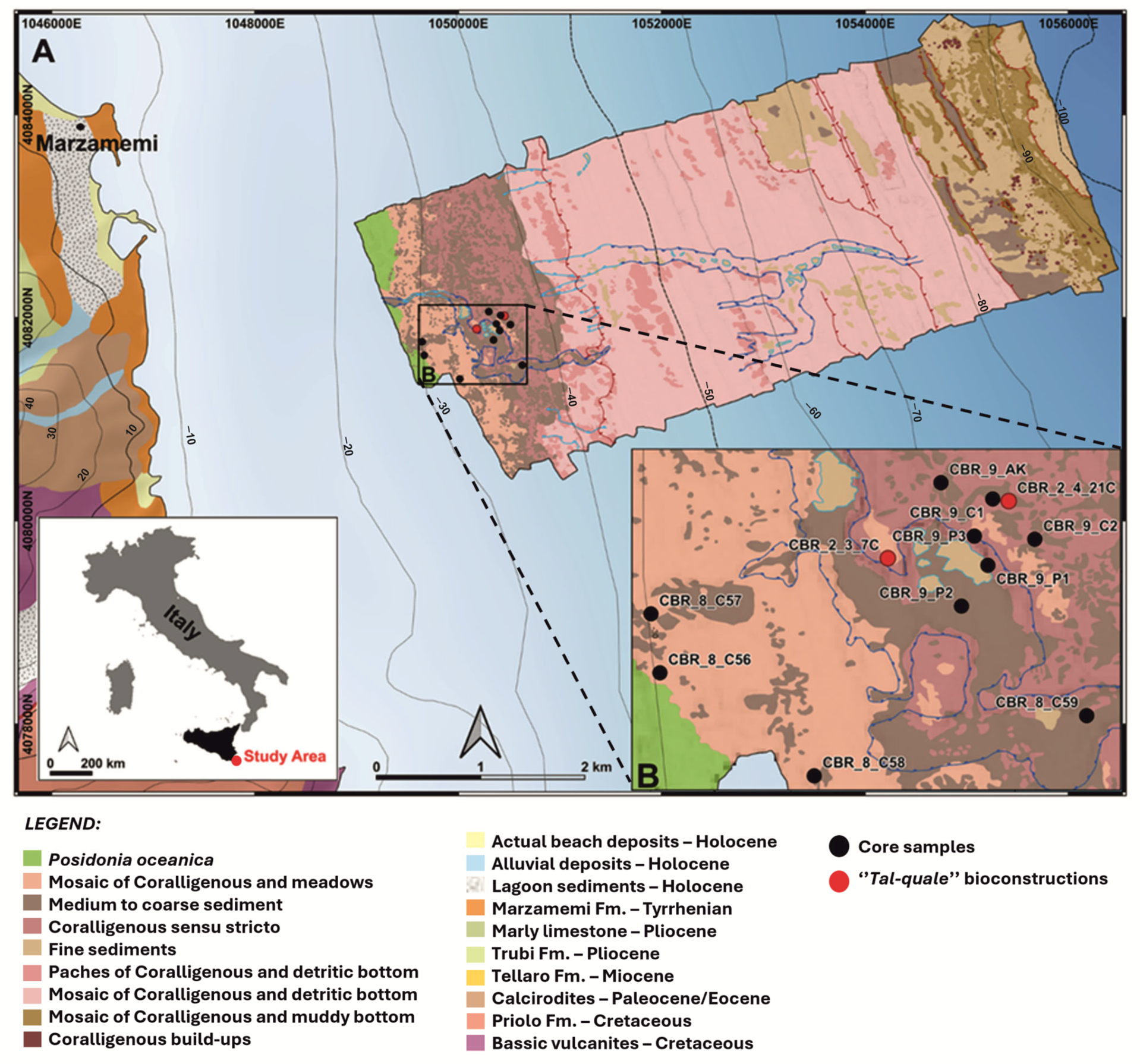
The study area (Figure 1), located in Southeastern Sicily (Italy), is affected by a regional tectonic uplift that began in Middle Pleistocene (~0.6 Ma) and continued throughout the Holocene, e.g., [46,47,48,49,50]. Coupled with eustatic sea level fluctuations, the uplift produced the marine terracing documented by Varzi et al. [51].
The Marzamemi area is part of the Hyblean Plateau, that represents the emerged portion of the African foreland bulge, e.g., [51,52,53,54,55]. The plateau is bounded, to the NE, by a system of normal faults, to the West by the Gela Basin, and toward the East by the Hyblean–Maltese Escarpment ([50,56] and references therein). The stratigraphic succession of the Hyblean Plateau consists of carbonate facies that hint at two main paleogeographic domains: (i) the carbonate shelf of the “Ragusa Sector” westward, and (ii) the subsiding basin of the “Siracusa Sector” eastward [50]. The stratigraphic succession in the onshore portion of the study area belongs to the Siracusa domain; it starts with the shallow-water reefal limestones of the Priolo Formation (Upper Cretaceous), overlied by Paleocene–Eocene sedimentary deposits (white-pinkish Nummulitic calcirudites) and the marls of the Tellaro Formation (Middle to Late Miocene). Pliocene units are represented by the marly limestones of the Trubi Formation (Early Pliocene) and Late Pliocene marls and are topped by calcarenites of the Marzamemi Formation (Upper Pleistocene), lagoonal–alluvial Holocene sediments and present-day beach deposits, e.g., [55,57].
Both subaerial and submerged geomorphological features in the Marzamemi area provide evidence of erosional forms incised into carbonate units. Indeed, the submerged morphologies of the sublittoral and inner shelf zones draws a complex closed depression with characteristics similar to those of karst depressions [50]. Subaerial erosional surfaces indicate the different relative sea levels reached during Late Quaternary, following the interplay of sea level changes and regional tectonic uplift. Specifically, Late Pleistocene marine terraces have been identified at approximately 15 m above sea level [58,59].
According to Varzi et al. [51], the seafloor in the shallower region of the study area (Figure 1) shows significant topographic complexity, with positive landforms forming distinct banks between −10 and −40 m water depth (w.d.). Moving offshore, seafloor complexity decreases, except for deeper areas where narrow ridges and positive morphologies occur between −75 and −100 m w.d.
Marked breaks in slope define a series of terraces, ranging from −35 to −98 m w.d. The shallower terraces, developed presumably between MIS 5 and MIS 2 as wave-cut shore platform, were likely generated during lowstand periods or transgressive events, while the scarp delimiting the deepest terrace (−98 to −102 m w.d.) may correspond to paleo-cliff formed during Marine Isotope Stage (MIS) 6 lowstand period [51]. In the area, coralligenous formations occur on a soft substrate and exhibit various morphotypes, ranging from hybrid banks to discrete reliefs.

3. Materials and Methods

3.1. ROV-Based Coring System for Minimally Invasive Sampling of Bioconstructions

Between July and September 2022, two campaigns (CBR_8 and CBR_9) were carried out to collect coralligenous bioconstructions offshore Marzamemi village (Sicily, Italy).
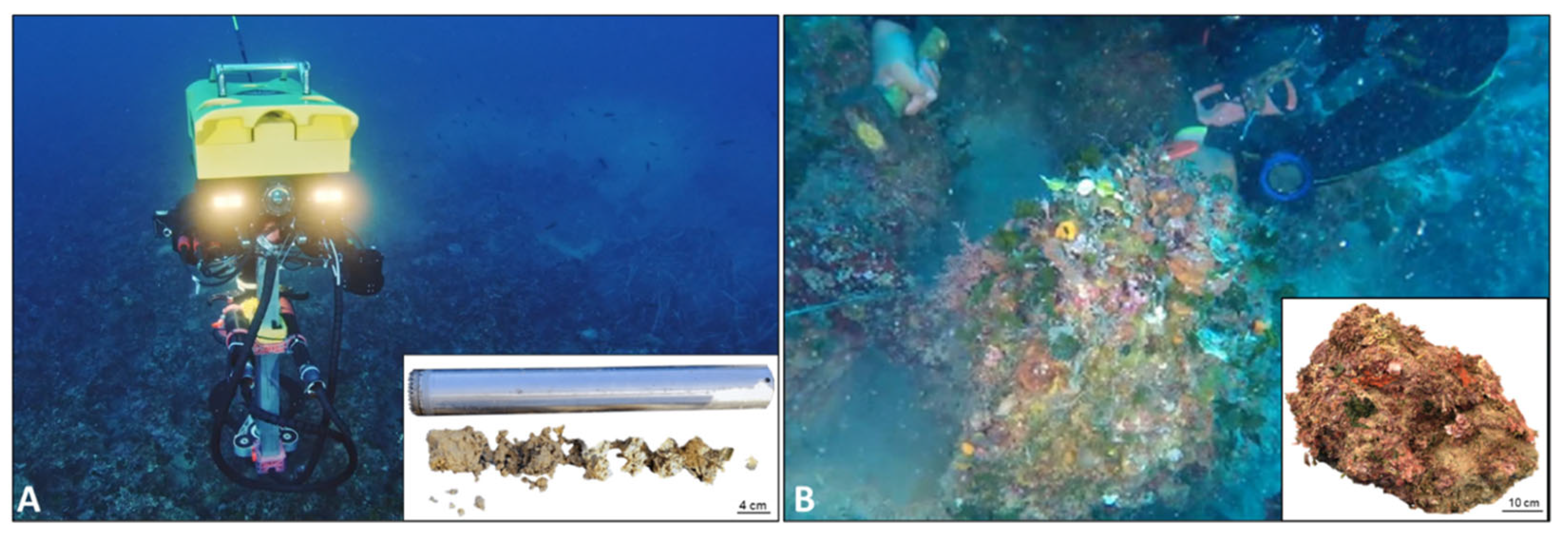
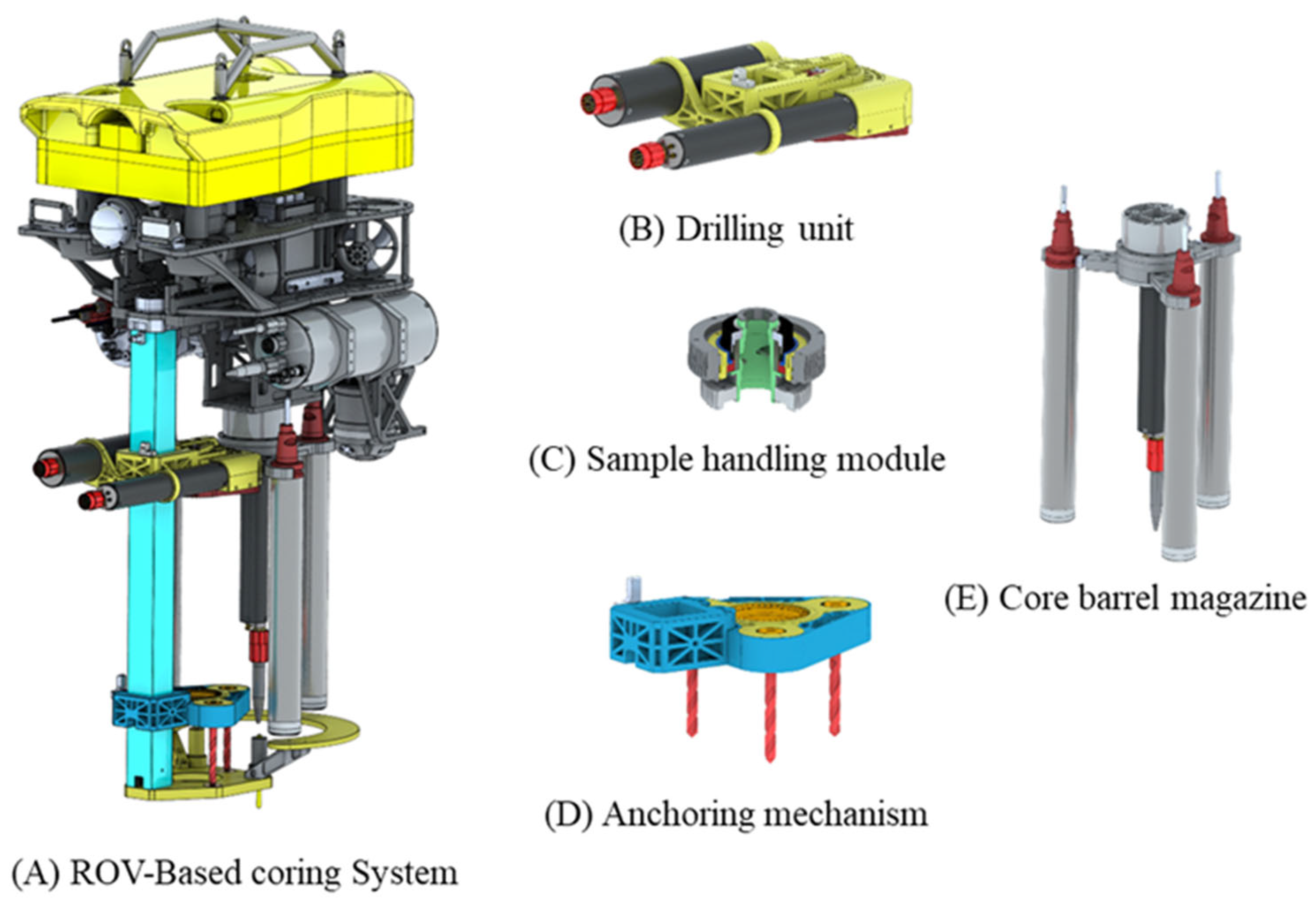
Sampling operations employed the ROV-based coring device (Figure 2A) developed as part of the projects “FISR 2019_04543-CRESCIBLUREEF” and “Tech4You PP2.3.1-Action 1”. The robotic system, specifically designed for observer-class ROVs to perform precise coring operations in challenging underwater environments, was designed to extract up to three cores per ROV deployment (i.e., magazine capacity) while preserving the structural integrity and stratigraphic information of the sample. Furthermore, the compact design facilitates the deployment from small support vessels, hence reducing the logistical and environmental impact of field operations.
Unlike diver-operated manual coring systems, which require surface-connected hydraulic or pneumatic equipment and expose operators to time and safety constraints, the robotic system enables safer, untethered sampling at greater depths and in more demanding environments.
The coring device (Figure 3) is based on a modular architecture, incorporating all functional components within a compact structural layout that integrates four main subsystems: the drilling unit, the anchoring mechanism, a core barrel magazine, and a sample handling module. Each subsystem performs a distinct function within the coring sequence, comprising stabilization, drilling, core extraction, and storage. This configuration allows to perform each sampling cycle without operator intervention.
Unlike conventional systems that rely on seabed anchoring or the inherent mass of work-class ROVs to stabilize against drilling loads, the proposed system achieves stabilization by anchoring directly onto the bioconstruction. The anchoring subsystem consists of three helical tips that are pushed into the substrate. These contact points are specifically designed to counteract the torque generated by the drilling process, ensuring the necessary stability of the underwater vehicle. These anchoring elements are not intended to oppose the axial advancement of the coring tool.
Given the fragile and irregular nature of the coralligenous substrate, the axial thrust required for core penetration could not be transmitted through rigid mechanical anchoring systems. Instead, vertical thrust was provided by the ROV’s own propulsion system: the vertical thrusters were dynamically controlled to apply a balanced feed force during drilling. Drilling torque and feed motion are monitored by an integrated control system, which continuously monitors the coring process to ensure the stability of the drilling process. The combination of this control method with the dynamic thrust correction and optimal anchoring subsystem design allowed for accurate sampling with observer-class ROVs, even in extremely challenging underwater scenarios.
Multiple sampling operations can be carried out in a single deployment, thanks to the inclusion of a storage module designed to hold up to three core barrels. This magazine adopts a vertically arranged drum layout, which helps reduce the overall system footprint while ensuring precise alignment and smooth transitions during barrel replacement procedures. In this study, one core was collected from each targeted coralligenous build-up sampled by the ROV (n = 10 cores; Table 1).
Sampling performance, particularly in the presence of fragile or porous structures, is further improved using a dual-pipe core barrel. In this configuration, the outer tube is responsible for the cutting action, rotating during drilling, while the inner tube remains stationary to shield the sample from torsional forces. At the end of the drilling phase, a mechanical core catcher is triggered to secure the sample inside the barrel, reducing the risk of fragmentation and preserving both the internal stratigraphy and overall integrity of the collected material.
During the CBR_8 campaign, four different build-ups (C56, C57, C58, C59) were sampled with the developed system at depths ranging from −26 to −35 m w.d. (Figure 1). In the same way, during the CBR_9 campaign, six different coralligenous bioconstructions (C1, C2, P1, P2, P3, AK) were cored at depths between −35 m and −37 m w.d. (Figure 1, Table 1). The bioconstructions sampled using this minimally invasive methodology are located near the build-ups CBR2_3_7C and CBR2_4_21C (Figure 1, Table 1). These two bioconstructions were collected entirely by scuba divers (Figure 2B), in the framework of the second field campaign of the project “FISR2019_04543-CRESCIBLUREEF” and characterized by Bracchi et al. [4,44], Cipriani et al. [12], Bazzicalupo et al. [45], Donato et al. [43], and Sanfilippo et al. [60]. Overall, 12 build-ups (sampling sites) were examined: 10 were sampled using the ROV-based coring device (4 during CBR_8 and 6 during CBR_9; one core per build-up), and 2 were collected entirely by scuba divers as “tal-quale” bioconstructions (CBR_2_3 and CBR_2_4; Table 1).
The sampling strategy was defined as a compromise between minimizing physical disturbance to this vulnerable habitat and the operational constraints of ROV deployments. Rather than performing a priori sample-size calculation, representativeness was evaluated a posteriori by comparing ROV-derived fragments with “tal-quale” samples through microfacies observations, point-counting data, and bivariate/multivariate analyses. In this framework, it is important to note the assessment focused on microscale compositional and textural consistency rather than on macroscopic reconstruction.
Nevertheless, although the ROV-based coring device was designed to minimize sample disturbance (also using a mechanical core catcher aimed at preserving the integrity of collected material), continuous and undisturbed cores could not be retrieved. Indeed, although minimally invasive, the sampling operations yielded only small and fragmented portions of bioconstructions, primarily due to the fragile and porous structure of coralligenous build-ups and the mechanical stress generated during coring phases.

3.2. Geobiological Characterization

After drying, the most representative coralligenous fragments obtained from coring operations (Figure 2A) were cut with a diamond saw. The obtained thin sections were investigated in the Laboratory of Geobiology of the Department of Biology, Ecology, and Earth Science (University of Calabria) using an optical microscope (Zeiss Axioplan 2 Imaging, Carl Zeiss Werk Göttingen, Germany) at different magnifications (2.5×, 5×, 10×, 20×, 40×). Fluorescence intensity has been evaluated in incident light, utilizing a Hg high-pressure vapor bulb and high-performance wide bandpass filters (436/10 nm) and long pass (470 nm), no. 488006, for the green light and bandpass filters (450–490 nm) and long pass (515 nm), no. 488009, for the yellow light. UV epifluorescence was used to discriminate the presence and distribution of organic compounds and to recognize microfacies textures as well as biotic and abiotic components, especially in those cases showing a similar general aspect under reflected light [61,62,63].
The point-counting analyses were performed using a Counter AC-15 (Karl Hecht KG, Sondheim, Germany) apparatus with a count step of 0.5 mm, in order to record several points ranging from 800 to 900 for each thin section. Several skeletal (i.e., CCA, serpulids, bryozoans, sponge spicules and other bioclasts) and non-skeletal (i.e., autochthonous micrite, organic and inorganic detrital micrite, cavities and cements) components of coralligenous core samples have been counted and compared with abundances reported by Cipriani et al. [12] for CBR_2_4_21C and CBR_2_3_7C “tal-quale” bioconstructions in order to check for any differences. Samples belonging to these latter bioconstructions were preliminarily reanalysed through point-counting to determine the presence and the abundance of cements, to make the data consistent with those obtained from core fragments (this study).
The class “bioclasts” include all skeletal remains of organisms that did not directly participate in the formation of the skeletal framework (i.e., many mollusks and foraminifers, echinoids) but were trapped inside cavities either first living in association with the build-up or transported by neighboring habitats. Sponge spicules, abundantly distributed in microcavities and along the edges of algal skeletons and engulfed in both autochthonous and detrital micrite, were considered as indicators of the pervasive colonization operated by sponges.
Thin sections suitable for point-counting were available for all build-ups included in the quantitative analyses. Anyway, due to the fragmentary nature of the core samples retrieved by the ROV-based coring device, only a limited number of thin sections (n = 1–3 per build-up) were available for point-counting, whereas a larger number of sections (n = 15–20 per build-up) could be analyzed for the “tal-quale” bioconstructions. For each build-up, point-counting data are reported as mean component percentages calculated across the available thin sections.

3.3. Statistical and Multivariate Analyses

Quantitative data used for statistical analyses consisted of the mean percentage abundances of carbonate components derived from point-counting for each examined build-up.
For bivariate analyses and correlation plots, additional composite variables were calculated as follows: total skeletal components (sum of algae/CCA, serpulids, bryozoans, bioclasts, and sponge spicules), total non-skeletal components (sum of autochthonous micrite, organic detrital micrite, inorganic detrital micrite, cavities, and cements), total detrital micrite (organic + inorganic detrital micrite), and secondary bioconstructors (serpulids + bryozoans). Pearson correlation coefficients (r) and coefficients of determination (R2) were computed for the variable pairs.
Multivariate patterns were explored using Principal Component Analysis (PCA) and Non-metric Multidimensional Scaling (NMDS). PCA was performed on the matrix of component percentages), after centering and scaling variables to unit variance, in order to summarize the main gradients of compositional variability among samples. NMDS ordination was based on Bray–Curtis similarity calculated from the same component percentage matrix. In these unconstrained ordinations, carbonate component percentages were treated as active (response) variables, whereas sample categories (ROV cores vs. “tal-quale” bioconstructions) and field campaigns were used as supplementary grouping factors for graphical representation only (i.e., not used to compute ordination axes).
All calculations were performed by integrating Python-based software (Phyton 3.14.0) with graphical output rendered in Excel.

4. Results

4.1. Microfacies Characterization

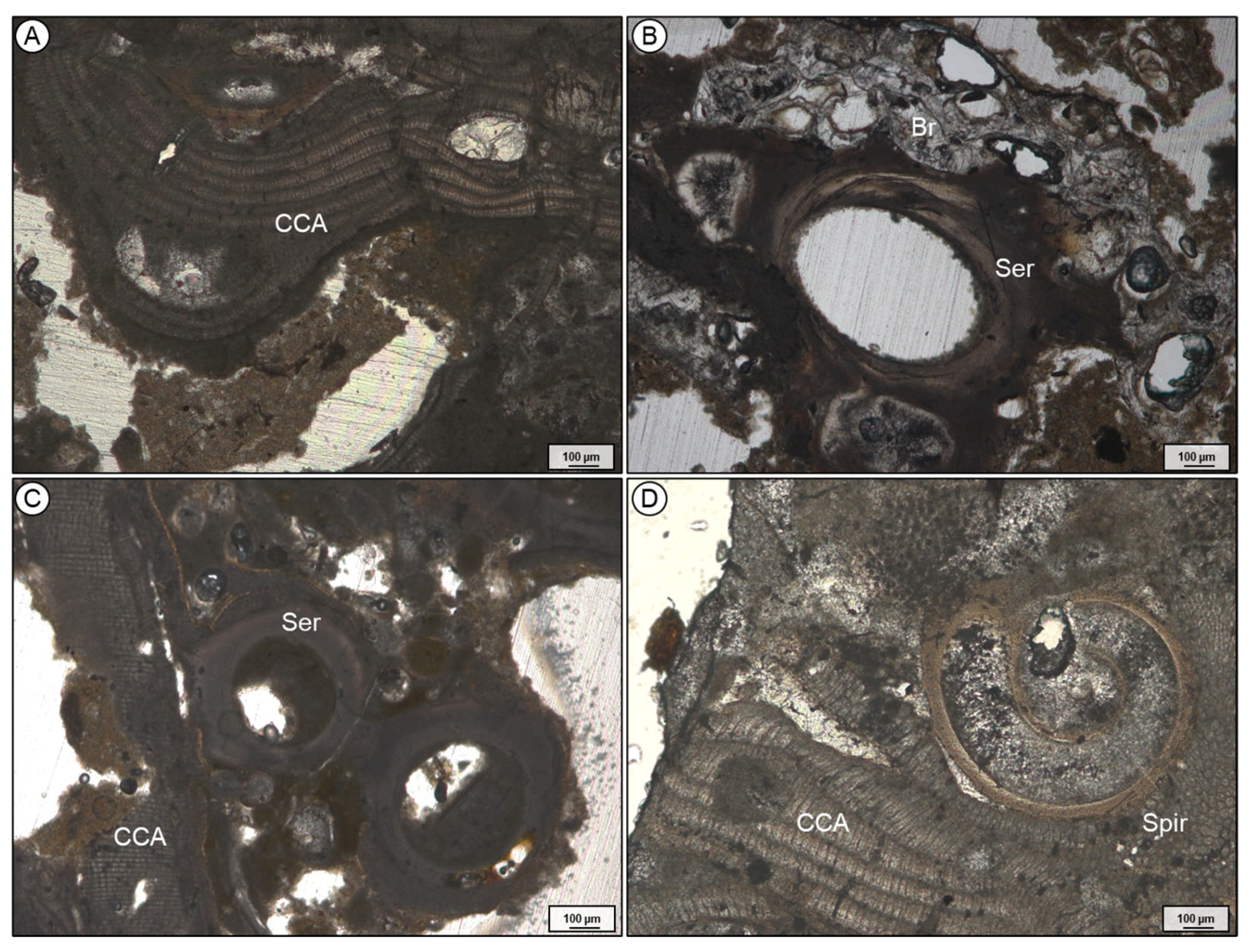
Microfacies analysis revealed that all coralligenous samples, regardless of the sampling method used, showed a porous primary framework mainly composed of non-geniculate coralline algae (Figure 4A). Their skeletons, continuous at the mesoscale, often showed traces of bioerosion at the microscale, mainly seemingly produced by endolytic sponges.
Bryozoans and serpulid polychaetes (Figure 4B–D) played a subordinate role as skeletal frame builders, with serpulid tubes and bryozoan colonies encrusting each other or mostly coralline algae. Microcavities were empty or filled with sediment, sponge spicules and remains of organic matter. Other bioclasts (i.e., some foraminifer, echinoid spines and plates, some gastropods and bivalves), belonging to organisms that do not directly participate to bioconstructions building, were also recognized in almost all thin sections. Sometimes, skeletons exhibited micritization processes, which, together with bioerosion, contribute to the alteration of the original microstructures.
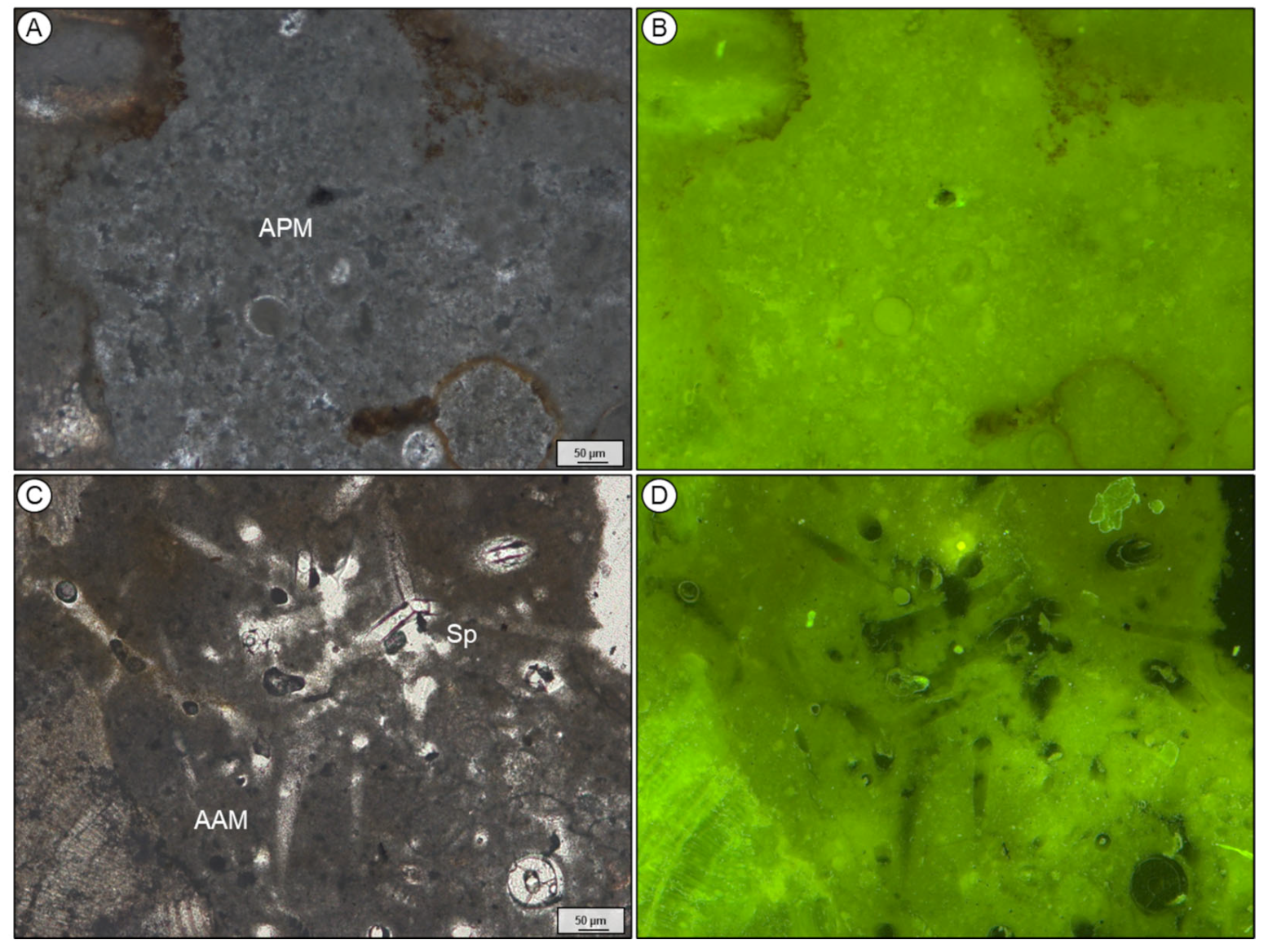
The cavities of the skeletal framework (distinguished into interspaces, generated during the superimposition of skeletonized organisms and microborings, mainly produced by boring sponges) were both filled with different types of micrite. Texture and organic matter content allowed to distinguish between autochthonous and allochthonous (detrital) micrites. The autochthonous micrite showed peloidal (Figure 5A,B) or aphanitic (Figure 5C,D) microfabrics and exhibited a bright epifluorescence under UV light, that indicates a high content of organic matter relics.
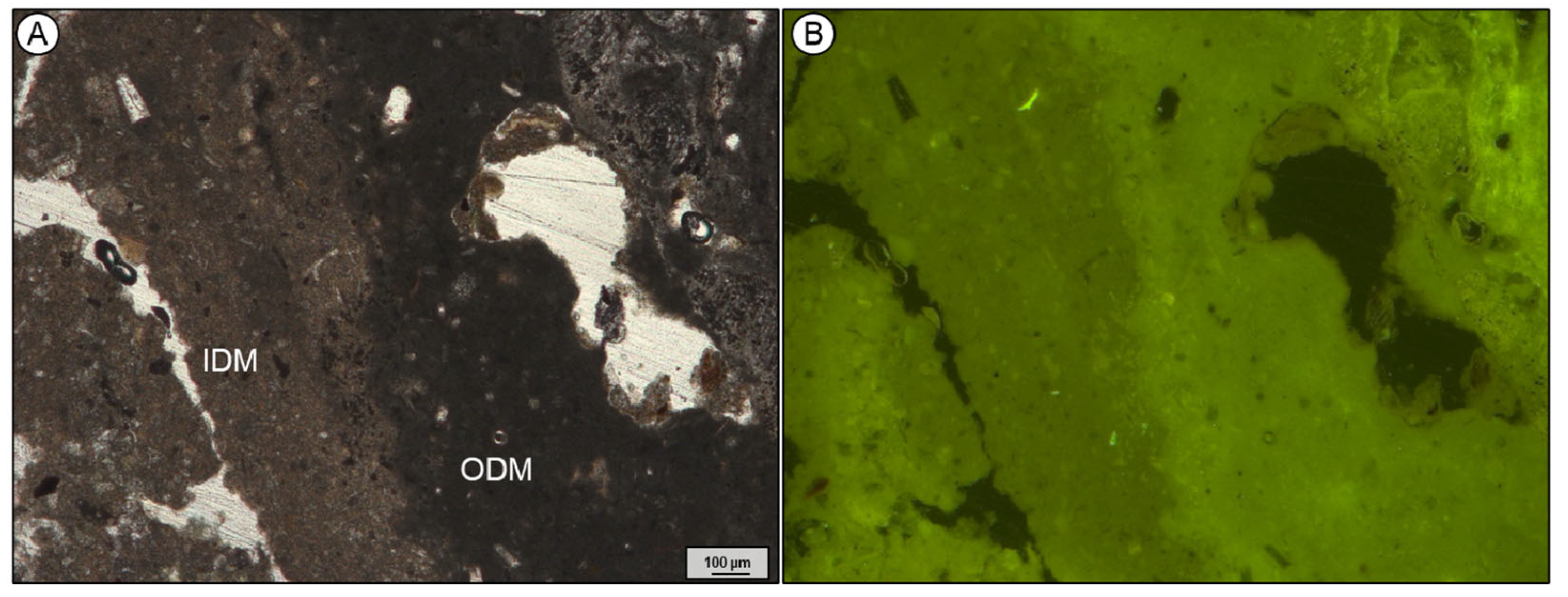
Detrital micrite (Figure 6A) has been differentiated into organic and inorganic. Organic detrital micrite (ODM) is rich in bioclasts and exhibits a very faint to scarce epifluorescence while inorganic detrital micrite (IDM) includes a minor number of bioclasts and lacks epifluorescence (Figure 6B, right and left, respectively).
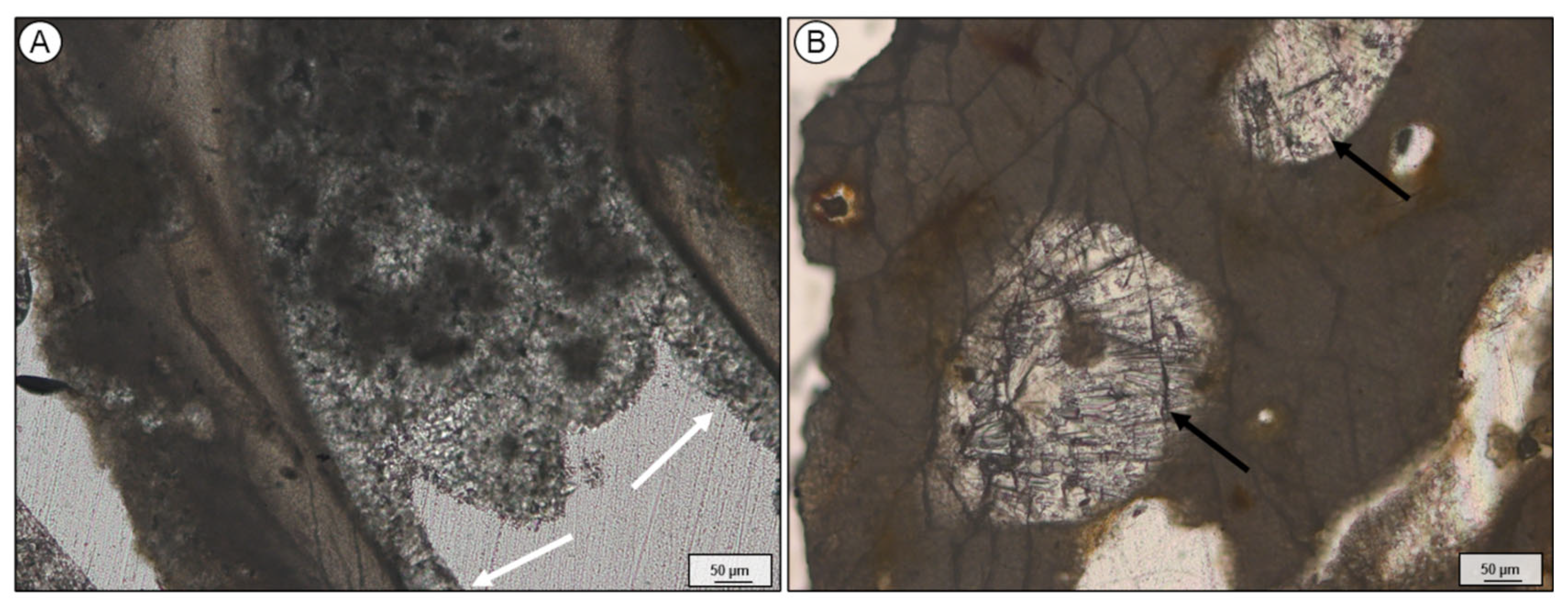
Cements (Figure 7) represent a subordinate component of the build-ups. Particularly, primary (syndepositional) and secondary (diagenetic) cements have been identified. Syndepositional cements showed isopachous, peloidal microcrystalline (Figure 7A), and botryoidal (Figure 7B) fabrics, whereas rare secondary cements filled residual microcavities with drusy micro-textures.

4.2. Point-Counting Analysis

Quantitative analyses (Table 2) showed that CCA largely dominated (34.5–44.3%) among skeletal remains, whereas serpulids (0.3–3.6%) and bryozoans (1.5–9.5%) were subordinate although locally relevant. Bryozoans reached their highest abundance in CBR_8_C59 (9.5%; Table 2). Bioclasts, excluding sponge spicules (0.0–1.9%), accounted for 0.8–7.8%.
Among non-skeletal components (Table 3), detrital micrite was more abundant (7.3–26.3% and 9.9–19.4% for organic and inorganic fraction, respectively) than the autochthonous one (0.0–9.2%) in almost all coralligenous samples.
The average percentages of cavities (comprising the empty cavities and those partially filled with sediment) vary from 8.0% to 23.8%, whereas cements abundance ranges from 0.0% to 4.1%.

4.3. Data Comparison Between Coralligenous Core Samples and “Tal-Quale” Bioconstructions

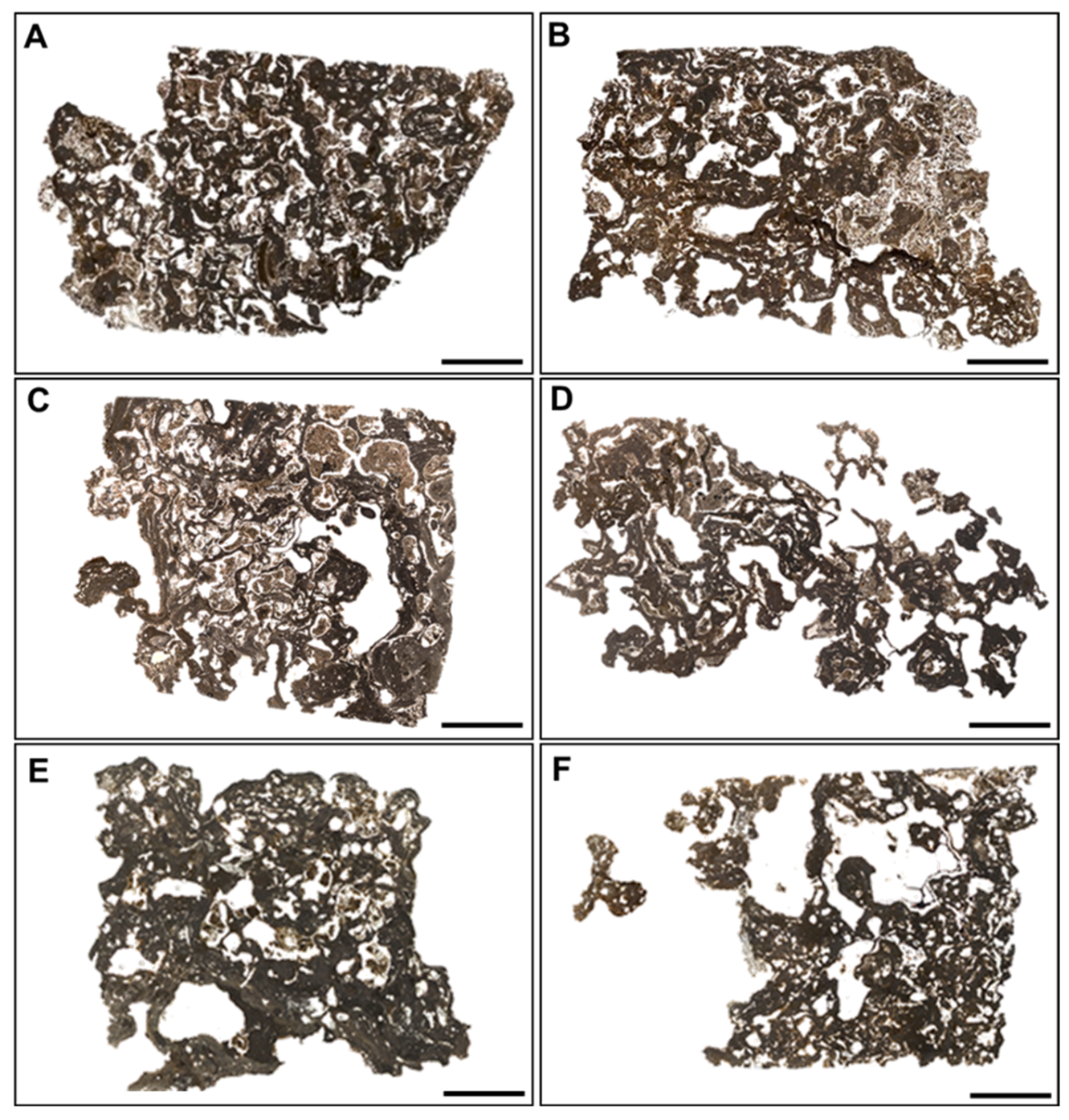
Microfacies characterization of coralligenous core samples collected during CBR_9 (C1, C2, P1, P2, P3, AK) and CBR_8 (C56, C57, C58, C59) campaigns revealed the same skeletal and non-skeletal carbonate components detected on “tal-quale” bioconstructions (CBR_2_4_21C and CBR_2_3_7C), despite the much smaller size of the cores (Figure 8).
Core fragments exhibited a remarkable continuity of the algal framework, with well-preserved skeletons and minimal alteration of the primary framework at the microscale. Other skeletal components (i.e., bryozoans, serpulids, sponge spicules, and other bioclasts) were also preserved and their distribution was comparable to that observed in “tal-quale” bioconstructions. Cavities were consistently represented in the core fragments, and often totally or partially filled, indicating effective preservation of the original porosity and microporosity, as assessed in the “tal quale” samples. Autochthonous and detrital (organic and inorganic) micrite displayed textural and fluorescence characteristics consistent with those observed in “tal-quale” bioconstructions. Finally, primary cements were also detected in the core fragments.
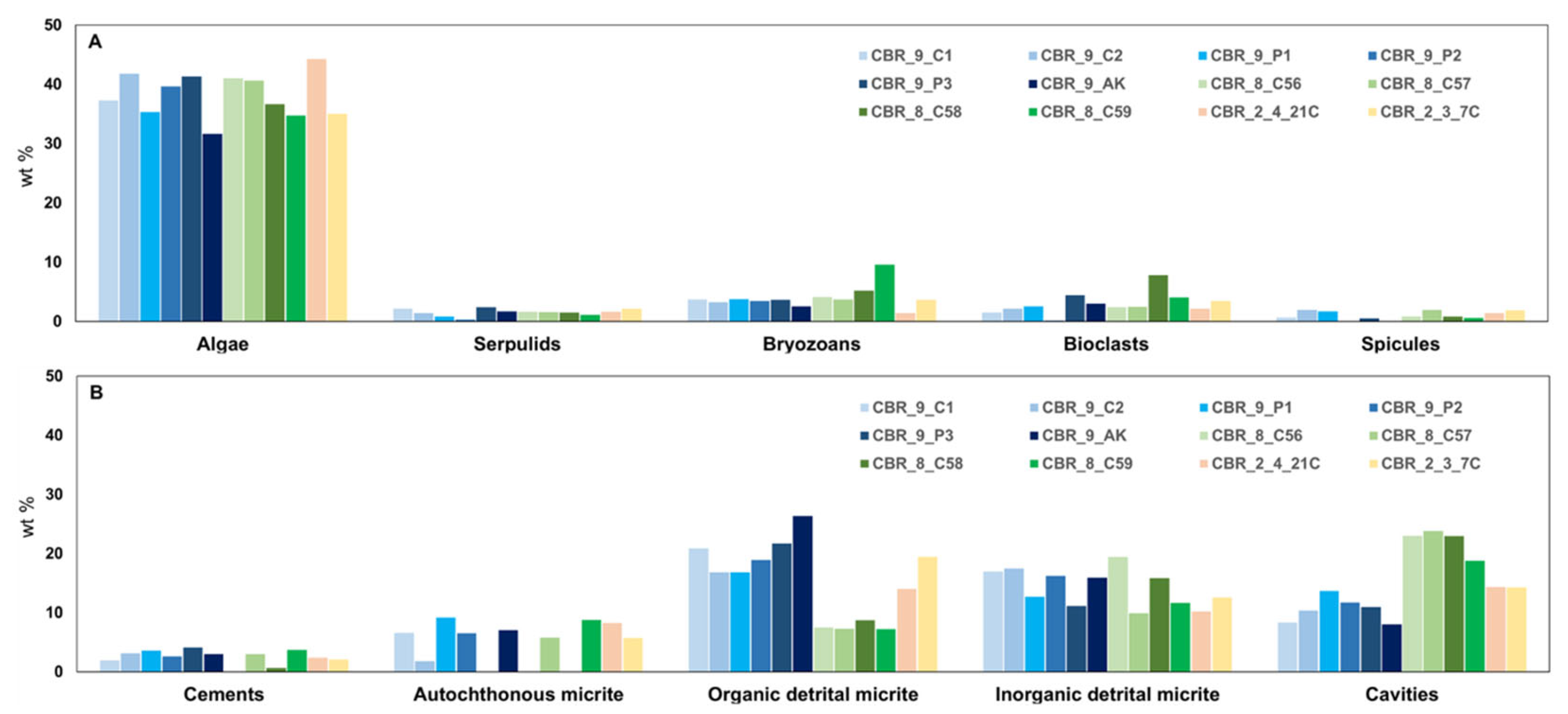
Quantitative analysis showed very similar percentages of skeletal grains in all samples, regardless of the used sampling method (Figure 9). CCA exhibited percentages ranging from ~32% to ~42% in the core samples, in line with those observed in CBR_2_4_21C and CBR_2_3_7C bioconstructions (~44% and ~35%, respectively). Bryozoans and serpulids were present in lower percentages, with similar abundances in core fragments and “tal-quale” bioconstructions. Bioclasts and sponge spicules were evenly distributed across the core samples, with abundances comparable to those reported in CBR_2_4_21C and CBR_2_3_7C build-ups.
Autochthonous micrite also exhibited comparable percentages across all samples, with values minor than 10% in “tal-quale” bioconstructions and core fragments. Detrital micrite showed more variable percentages in core samples (17–42%), but overall, these values were still comparable to the variability observed in the “tal-quale” bioconstructions (24–32%). Organic detrital micrite generally exceeds inorganic detrital micrite in the CBR_9 cores and in the ‘tal-quale’ bioconstructions, whereas inorganic detrital micrite is relatively higher in the CBR_8 cores (Figure 9B; Table 3).
Cements were present in lower percentages (<5%) in all samples, with no significant differences. Similarly, cavities in CBR_2_4_21C and CBR_2_3_7C bioconstructions showed abundances largely matching those of the core samples, indicating good preservation of their three-dimensional structure at the meso- to microscale.
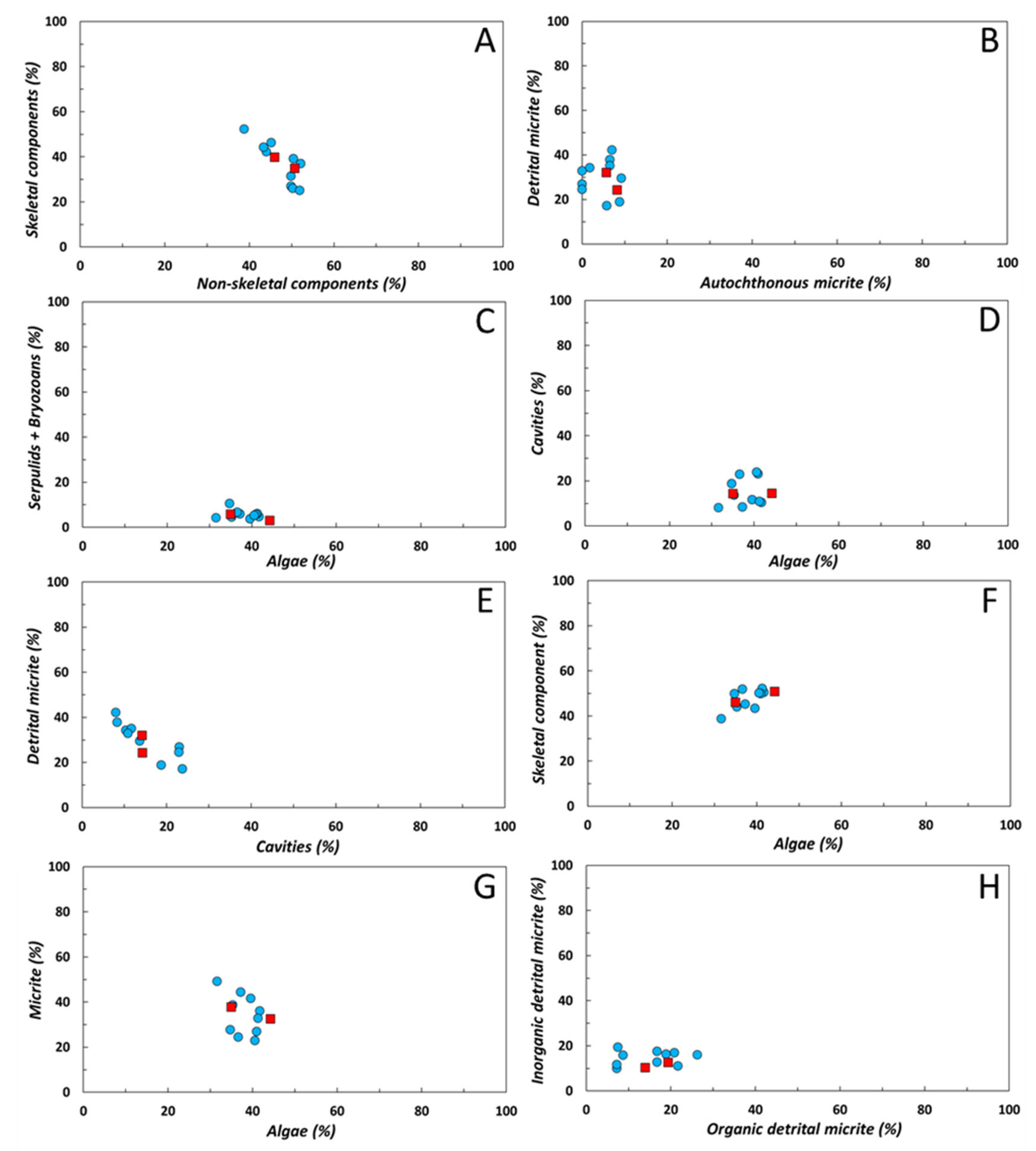
The comparison between carbonate component abundances in coralligenous core samples and those of the “tal-quale” bioconstructions (Figure 10) revealed no significant differences in the proportional relationships and compositional trends between skeletal and non-skeletal components. The analysis of the scatter plots shown in Figure 10 highlighted that the “tal-quale” bioconstructions (CBR_2_4_21C and CBR_2_3_7C) systematically fall within the distribution cloud of the core samples, following the same trends and not appearing as outliers.
This apparent overlap is expected because all samples derive from the same study area and share comparable environmental conditions and dominant framework builders. Accordingly, the scatter plots do not show discrete clusters, but rather a continuous compositional gradient controlled by the trade-off between skeletal framework accretion and non-skeletal components (micrite, cavities, and cements). The position of the ‘tal-quale’ bioconstructions within the same point cloud indicates that they span the same range of variability as the ROV-derived cores, supporting the representativeness of the minimally invasive sampling. The dispersion of points within the cloud reflects natural small-scale heterogeneity among build-ups (e.g., relative micrite and cavity proportions), rather than a systematic bias related to the sampling method.
The selected variable pairs were chosen to emphasize the main geobiological relationships and dynamic equilibria governing the evolution of coralligenous bioconstructions. Specifically, the comparison between skeletal (i.e., CCA, serpulids, bryozoans, spicules, and other bioclasts) and non-skeletal (i.e., autochthonous and detrital micrite, cavities, and cements) components (Figure 10A) depicts the balance between framework accretion, bioerosion, and cavity formation, and the accumulation of detrital micrite together with the in situ precipitation of autochthonous micrite and early cements. This balance illustrates how constructive, porosity-generating, and diagenetic processes coexist and interact in shaping the internal architecture of coralligenous build-ups.
The comparison between detrital (organic and inorganic) and autochthonous micrite (Figure 10B) reflects the relative contribution of external sediment input versus in situ carbonate precipitation. The relationship between serpulids and bryozoans versus CCA (Figure 10C) represents the interaction between primary framework builders and secondary bioconstructors, while the CCA–cavities relationship (Figure 10D) indicates how porosity influences framework density. The detrital micrite–cavities relationship (Figure 10E) reflects the degree of void infilling through the accumulation of fine-grained detrital material, whereas the algae–skeletal relationship (Figure 10F) expresses the relative contribution of coralline algae within the total biogenic framework. The CCA–detrital micrite relationship (Figure 10G) provides a comparative view between coralline algae and fine allochthonous carbonate content, whereas the organic vs inorganic detrital micrite comparison (Figure 10H) describes the covariation between biogenic and clastic fine-grained carbonate fractions, outlining the balance between organic and abiotic micrite within the analyzed samples.
The correlation analysis performed on the variables represented in Figure 10 (Table 4) revealed different degrees of association among the carbonate components of the coralligenous framework. A significant inverse relationship was observed between skeletal and non-skeletal components (r = −0.832; R2 = 0.692; Figure 10A), indicating that the proportion of one fraction decreases as the other increases. A similarly strong negative correlation was identified between cavities and detrital micrite (r = −0.848; R2 = 0.719; Figure 10E), exhibiting that samples with higher micritic content display proportionally lower porosity. A moderate positive correlation was observed between skeletal components and CCA (r = 0.692; R2 = 0.425; Figure 10F), consistent with the main contribution of the CCA to the biogenic framework. In contrast, the relationships between coralline algae and secondary bioconstructors (r = −0.363; R2 = 0.132; Figure 10C) and between CCA and total micrite (r = −0.419; R2 = 0.175; Figure 10G) were weak. Negligible correlations were found for autochthonous vs. detrital micrite (r = −0.043; R2 = 0.002; Figure 10B), CCA vs. cavities (r = 0.160; R2 = 0.026; Figure 10D), and organic vs. inorganic detrital micrite (r = 0.118; R2 = 0.014; Figure 10H). Overall, the correlation results indicate that the main compositional gradients within the analyzed samples are primarily controlled by the relative proportions of skeletal components, non-skeletal components, and cavities, with reference to the contribution of CCA and detrital micrite, whereas the other variables display weak or no linear associations.
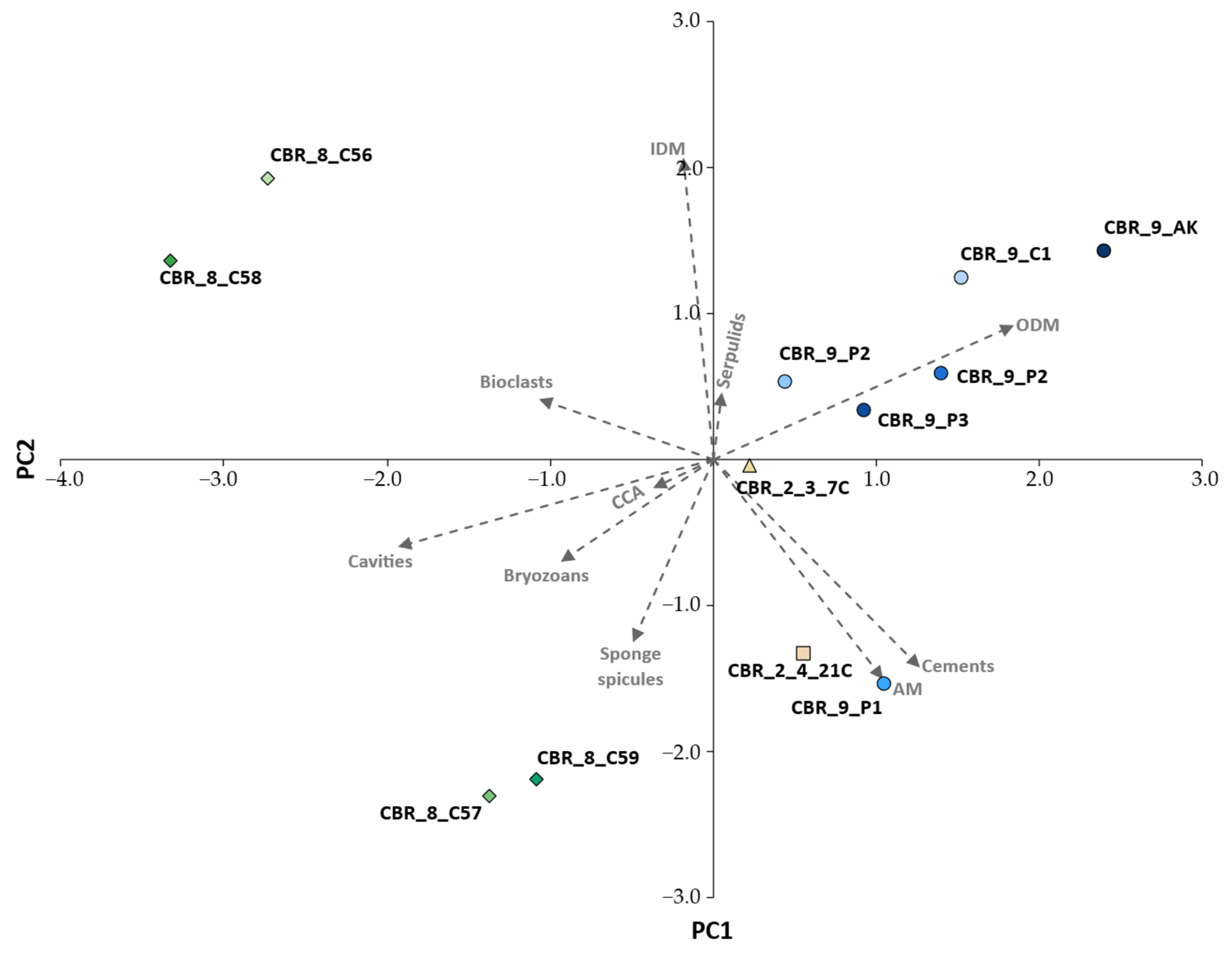
The Principal Component Analysis (PCA; Figure 11) confirms the results of the bivariate and correlation analyses, providing an integrated view of the compositional variability among the analyzed samples. The first two principal components (PC1 and PC2) together explain nearly half of the total variance, summarizing the main gradients of variation within the dataset. Along PC1, samples characterized by higher abundances of skeletal components (mainly coralline algae, serpulids, bryozoans, and bioclasts) and cements are opposed to those enriched in detrital micrite and cavities, whereas PC2 primarily reflects the variability associated with bryozoans, spicules, and cavities. The “tal-quale” bioconstructions (CBR_2_4_21C and CBR_2_3_7C) plot within the compositional field defined by the core samples, following the same distribution trends and showing no distinct clustering or divergence.
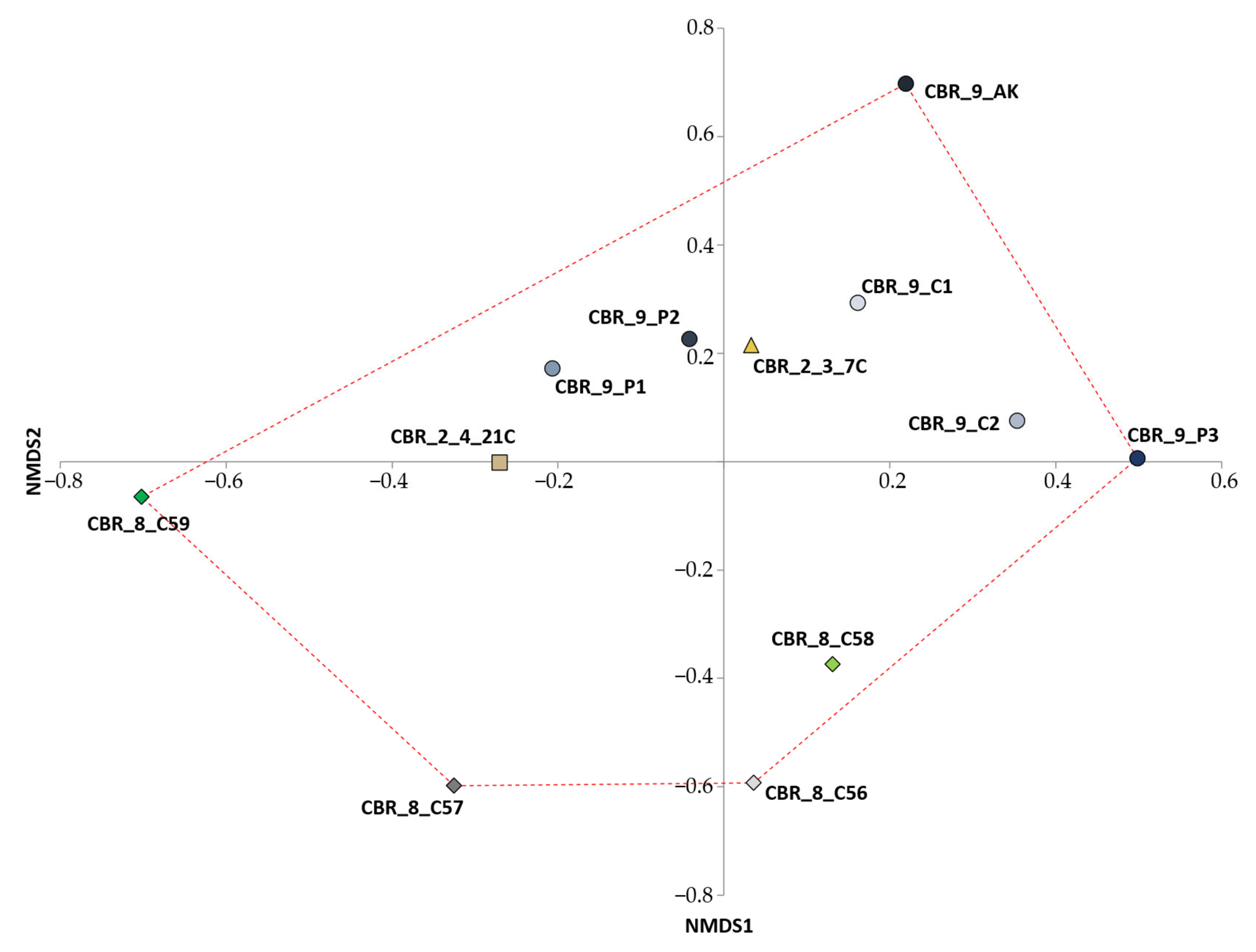
The Non-metric Multidimensional Scaling (NMDS; Figure 12) analysis, based on Bray–Curtis similarity, provides a synthetic representation of the compositional relationships among all analyzed samples. In the NMDS plot (Figure 12), core samples and the “tal-quale” bioconstructions are closely associated within the ordination space, showing no evidence of distinct clustering or compositional segregation. The proximity of the “tal-quale” build-ups to the cloud of ROV-based core samples confirms their compositional similarity and the absence of systematic differences related to the sampling method. The slight dispersion observed among the core samples reflects natural heterogeneity in the relative abundance of detrital micrite and cavity content, rather than methodological bias.

5. Discussion

Coralligenous bioconstructions represent one of the most heterogeneous, complex, and ecologically significant habitats in the Mediterranean Sea. Their formation results from the interplay of constructive and destructive processes involving a wide range of benthic organisms, typically occurring under dim-light conditions [3].
In this framework, the present study aims to evaluate the efficiency of an innovative ROV-based coring device for the minimally invasive collection of coralligenous samples reflecting the characteristics of bioconstructions samples in terms of relationships and distribution between skeletal and non-skeletal carbonate components.
Microfacies analyses performed on core samples revealed textural and compositional features consistent with those observed in the “tal-quale” bioconstructions, despite the smaller size and the high fragmentation of the cores. Both coralligenous core samples and “tal-quale” build-ups from the Marzamemi (Southeastern Sicily, Italy) area exhibit a skeletal framework mainly formed by CCA, with subordinate contributions from bryozoans and serpulids, which can locally enhance the morphological complexity of the build-ups, while other skeletonized invertebrates provide only a negligible contribution. These findings are in line with evidence reported in the literature, e.g., [3,29,60].
The role of boring sponges in modifying the internal framework of the coralligenous build-ups is also consistent with earlier observation ([12] and reference therein); indeed, their endolithic activity generates microcavities that, together with the interspaces produced by the superimposition of skeletonized encrusting organisms, contribute to the high porosity of the framework.
The analysis of coralligenous samples at the microscale revealed that cavities, both primary and secondary in origin, were often infilled with micrite. According to Cipriani et al. [12], two types of micrite were distinguished: autochthonous (in situ) and allochthonous (detrital). Autochthonous micrite represents in situ precipitation of micrite, whose syndepositional cementation contributes to stabilizing the structures of the build-ups [64,65]. The autochthonous micrite shows two microfabrics: (i) aphanitic, frequently associated with sponge spicules, suggesting a precipitation in association with decaying organic tissues of sponges [61,62,63,66,67,68,69]; (ii) peloidal to clotted peloidal, often confined in suboxic/anoxic microenvironments (i.e., microcavities such as spaces between skeletons or the interior of serpulid tubes), where anaerobic heterotrophic bacterial communities can flourish and promote micrite precipitation [12]. Detrital micrite (distinguished as organic or inorganic based on the presence or absence of organic matter and bioclast content) primarily derives from the degradation and transport of skeletal remains from adjacent areas or the erosion of pre-existing bioclastic rocks, e.g., [70].
Finally, primary and diagenetic cements are only sporadically observed and represent a subordinate component of the framework [12].
Quantitative and multivariate analyses confirm that the compositional relationships identified in the core samples are consistent with those observed in the “tal-quale” bioconstructions. The abundances of skeletal components (i.e., CCA, bryozoans, serpulids, sponge spicules, and bioclasts) display comparable ranges in both datasets, with minor variabilities reflecting the intrinsic heterogeneity of coralligenous framework. This convergence suggests the validity of the ROV-based coring device for the characterization of the skeletal frame builder.
An additional comparison was made regarding the distribution of non-skeletal carbonate components within the bioconstructions. Particularly, autochthonous micrite was preserved in core samples with percentages comparable to those observed in “tal-quale” bioconstructions. Detrital micrite, both organic and inorganic, was also present with comparable abundances in all samples, indicating that even finer and infill components were not significantly altered or lost during sampling operations. Naturally, some washing-out of non-lithified sediments from cavities may have occurred during drilling operations, but it should be noted that this effect can also occur during traditional diver-based sampling, especially in highly porous and unconsolidated substrates; therefore, it is not a bias specific to the ROV-based coring procedure. In this regard, future improvements could include the use of fast-setting resin or consolidating agents injected prior to coring, aimed at inducing an in situ stabilization or partial cementation of unconsolidated materials. Such an approach could potentially enable the recovery of continuous and mechanically coherent cores, even from fragile and highly porous bioconstructions. However, in several cases, cavities in core fragments retained their original content, preserving their compositional and textural features and confirming the effectiveness of the ROV-based system in ensuring representative samples. Moreover, microcavities were well preserved, confirming the effectiveness of the system in maintaining the original framework’s porosity.
Finally, cements were similarly distributed across all samples (core samples and “tal-quale” bioconstructions), reinforcing the capability of the system in capturing also early diagenetic features.
The statistical analyses provide additional evidence supporting the representativeness of the ROV-collected cores with respect to the “tal-quale” bioconstructions. Correlation results show internally consistent relationships among skeletal and non-skeletal components, confirming the structural coherence of the coralligenous framework and the absence of sampling-related bias. PCA results demonstrate that the first two principal components effectively summarize the main compositional gradients, and that the “tal-quale” build-ups plot within the compositional field defined by the core samples, with no evidence of clustering or divergence. Likewise, NMDS ordination confirms the compositional overlap between the two datasets, with the slight dispersion among core samples attributable to the intrinsic heterogeneity of bioconstructions rather than to methodological bias.
The minimally invasive ROV-based coring device represents a significant advancement for the study of submerged bioconstructed settings. The system enabled precise and reliable sampling even in the particularly heterogeneous and delicate setting of coralligenous bioconstructions, thanks to its compact design, stable anchoring capability, interchangeable tool system, and ROV-assisted vertical thrust. Moreover, the remote-control enables sampling at depths and in environments challenging for divers, maintaining a low invasiveness during operations. Furthermore, the ability to extract multiple cores during a single dive with limited observable impact on the habitat’s structural integrity demonstrates the efficiency of the robotic system in reducing environmental disturbance and streamlining operations through its modular configuration and integrated storage components.
However, Coralligenous is extremely heterogeneous, and the high fragmentation of core samples does not allow for the reconstruction of the general framework of bioconstructions at the macroscale, nor for assessments of growth patterns and spatial-temporal relationships between builder and bioeroding organisms. The recovered cores frequently consisted of small, discontinuous fragments rather than continuous sequences, reflecting both the fragility of build-ups and the mechanical stress generated during coring operations. Consequently, given to the current state of instrumental advancement, reconstruction of the morphological development of the framework at the mesoscale, as well as the assessment of spatial relationships between bioconstructors and bioeroding organisms, remain unfeasible. Consistent with this, the validity of the method for reliable analyses of bio- and paleo-biodiversity and accretion patterns need to be further tested. However, the good preservation of the framework at the microscale, together with the convergence of quantitative and qualitative data emerging from the statistical comparison between core samples and “tal-quale” bioconstructions, enables to identify the main skeletal builders and the relationships between these organisms and non-skeletal components at microscale. These results, obtained from a limited number of thin sections analyzed for the core samples compared to the “tal-quale” bioconstructions, confirm that the ROV-based coring device reliably reproduces the compositional variability of coralligenous frameworks, attesting to its methodological robustness.
Moreover, the use of the minimally invasive coring system allowed to verify that, within the investigated bathymetric, ranging from −25.8 m to −37.5 m w.d., coralligenous bioconstructions exhibit analogous features in terms of abundance of skeletal and non-skeletal components, as well as in their microfacies composition. This compositional and structural consistency suggests that the main physico-chemical parameters controlling Coralligenous development do not undergo significant variations along this depth interval. Such evidence is consistent with the restricted range of ecological conditions, including low levels of irradiance, moderate and relatively constant temperatures, regular but not excessive hydrodynamics, low sedimentation rates, and availability of dissolved nutrients, which are all considered crucial for Coralligenous development [3]. These results may be compared with the recent findings of Bazzicalupo et al. [45], which, along a wider bathymetric range (−36 to −85 m w.d.), highlighted an increase in framework density, cementation degree, and lithification. Such variations were interpreted as the result of early diagenetic processes leading to a progressive reduction in primary porosity, rather than to marked environmental gradients.
For all these reasons, the new minimally invasive ROV-based coring system represents an effective and sustainable solution for the study of coralligenous bioconstructions, as it allows for the acquisition of representative geobiological information while minimizing the impact on habitats and offering an important opportunity for the investigation, monitoring, and conservation of relevant but fragile and threatened ecosystems. In contrast to conventional marine coring techniques, which rely on heavy equipment and rigid seabed anchoring systems, and to previous studies on Coralligenous, where entire build-ups were removed from the seafloor causing severe damage to this ecosystem, the device proposed in this study allowed for targeted sampling with reduced logistical effort and limited ecological disturbance.
To the best of our knowledge, no studies have previously reported the use of minimally invasive ROV-based coring systems specifically designed for geobiological characterization of benthic bioconstructed structures. Therefore, the present work represents the first documented case of such an application. Moreover, although specifically developed for coralligenous bioconstructions, this approach could also be tested to the study other bioconstructed habitats, opening new perspectives for the sustainable advancement of marine geobiological research.

6. Conclusions

This work tested the performance of an innovative ROV-based coring system designed for the minimally invasive collection of coralligenous bioconstructions. The approach proved effective in recovering representative geobiological samples in ecologically sensitive or logistically challenging environments, minimizing habitat disturbance while still providing valuable insights into the structural and compositional characteristics of the build-ups.
Quantitative and multivariate statistical analyses (i.e., correlation matrix, PCA, and NMDS) confirmed the compositional correspondence between core samples and “tal-quale” coralligenous bioconstructions, supporting the representativeness and reliability of the obtained data. The consistency in microfacies textures and carbonate component abundances between the two datasets further validates the ability of this approach to preserve the original structural and compositional features of the coralligenous framework at microscale. However, the current configuration of the coring system does not permit the collection of continuous and undisturbed core samples, thereby limiting the ability to reconstruct the overall framework of bioconstructions or to interpret spatial and temporal relationships between bioconstructors and bioeroders. To address these limitations, future developments, currently being carried out within the project “Tech4You PP2.3.1—Action 1”, will focus on designing a coring device capable of retrieving continuous and undisturbed samples, thus improving the resolution of ecological and palaeoecological reconstructions.
Overall, the ROV-based coring system represents a significant methodological advancement in the geobiological investigation of benthic bioconstructed habitats. Its operational versatility, combined with the ability to perform precise and minimally invasive sampling, enhances its potential for application across a wide range of marine settings. In the context of growing global attention to the conservation of marine biodiversity, this minimally invasive technique represents an effective and low-impact solution for monitoring, vulnerability assessment, and planning of conservation actions for threatened and ecologically valuable habitats.

Author Contributions

Conceptualization, G.M., M.C., D.B., A.R. and A.G. (Adriano Guido); methodology, G.M., M.C., A.L., A.G. (Alessandro Gallo), F.B., E.S., M.M., V.A.B., R.S. and A.G. (Adriano Guido); software, G.M., M.C., A.L., A.G. (Alessandro Gallo), F.B., E.S., G.D. and A.G. (Adriano Guido); validation, G.M., M.C., A.G. (Alessandro Gallo), F.B., V.A.B., D.B., A.R., R.S., G.D. and A.G. (Adriano Guido); formal analysis, G.M., M.C. and A.G. (Adriano Guido); investigation, G.M., M.C. and A.G. (Adriano Guido); data curation, G.M., M.C., A.L., A.G. (Alessandro Gallo), F.B., E.S., G.D. and A.G. (Adriano Guido); writing—original draft preparation, G.M. and M.C.; writing—review and editing, G.M., M.C., A.G. (Alessandro Gallo), V.A.B., D.B., A.R., R.S., G.D. and A.G. (Adriano Guido); visualization, G.M., M.C., A.L., A.G. (Adriano Guido), F.B., E.S., M.M., V.A.B., D.B., A.R., R.S., G.D. and A.G. (Adriano Guido); supervision, F.B., V.A.B., D.B., A.R., R.S. and A.G. (Adriano Guido); project administration, D.B., A.R. and A.G. (Adriano Guido); funding acquisition, F.B., M.M., D.B., A.R. and A.G. (Adriano Guido). All authors have read and agreed to the published version of the manuscript.

Funding

This research has been supported by the project “Next Generation EU—Tech4You PP 2.3.1: Development of tools and applications for integrated marine communities and substrates monitoring—Action 1: Development of hardware and software systems for three-dimensional detection, sampling and mapping of underwater environments” (CUP H23C22000370006). Additional funding was received by the Ministero dell’Istruzione, dell’Università e della Ricerca (MIUR)—Fondo Integrativo Speciale per la Ricerca (FIRS), project: FISR2019_04543 “CRESCIBLUREEF—Grown: in the blue: new technologies for knowledge and conservation of Mediterranean reefs”.

Institutional Review Board Statement

Not Applicable.

Informed Consent Statement

Not Applicable.

Data Availability Statement

Data will be made available on request.

Acknowledgments

We thank the Assistant Editor and two anonymous reviewers for their valuable comments and suggestions. This research was carried out within the framework of the project “Next Generation EU—Tech4You PP 2.3.1: Development of tools and applications for integrated marine communities and substrates monitoring—Action 1: Development of hardware and software systems for three-dimensional detection, sampling and mapping of underwater environments” (CUP H23C22000370006). The work was built on findings, methodological approaches, sampling, and technical development carried out within the project “FISR 2019_04543 CRESCIBLUREEF—Grown in the blue: new technologies for knowledge and conservation of Mediterranean reefs”. Support and technical assistance were provided by the Geobiology and Marine Laboratories of the DiBEST (Department of Biology, Ecology and Earth Science), University of Calabria. AR and RS received funding from the University of Catania, through PiaCeRi—PIAno inCEntivi per la Ricerca di Ateneo—2024—26—Linea di intervento 1—Ricerca Collaborativa—Progetto COMBIO. The authors also acknowledge the collaboration of Suttakkua Diving during the fieldwork activities. This is the Catania Paleontological Group contribution n. 535.

Conflicts of Interest

The authors declare no conflicts of interest.

Abbreviations

The following abbreviations are used in this manuscript:
AAMAutochthonous Aphanitic Micrite
APMAutochthonous Peloidal Micrite
BrBryozoans
CCACrustose Coralline Algae
IDMInorganic Detrital Micrite
MISMarine Isotope Stages
NMDSNon-Metric Multidimensional Scaling
ODMOrganic Detrital Micrite
PCPrincipal Component
PCAPrincipal Component Analysis
rPearson Correlation Coefficient
R2Coefficient of Determination
ROVRemotely Operated Vehicle
SerSerpulids
SpSponge spicules
SpirSpirorbid
w.d.Water depth

References

  1. Ingrosso, G.; Abbiati, M.; Badalamenti, F.; Bavestrello, G.; Belmonte, G.; Cannas, R.; Benedetti-Cecchi, L.; Bertolino, M.; Bevilacqua, S.; Bianchi, C.N.; et al. Mediterranean bioconstructions along the Italian coast. Adv. Mar. Biol. 2018, 79, 61–136. [Google Scholar] [CrossRef]
  2. Fagerström, J.A. Reef-building guilds and a checklist for determining guild membership. A new approach for study of communities. Coral Reefs 1991, 10, 47–52. [Google Scholar] [CrossRef]
  3. Ballesteros, E. Mediterranean Coralligenous Assemblages: A synthesis of present knowledge. Oceanog. Mar. Biol. Annu. Rev. 2006, 44, 123–195. [Google Scholar]
  4. Bracchi, V.A.; Bazzicalupo, P.; Fallati, L.; Varzi, A.G.; Savini, A.; Negri, M.P.; Rosso, A.; Sanfilippo, R.; Guido, A.; Bertolino, M.; et al. The Main Builders of Mediterranean Coralligenous: 2D and 3D Quantitative Approaches for its Identification. Front. Earth Sci. 2022, 10, 910522. [Google Scholar] [CrossRef]
  5. Marion, A.F. Esquisse d’une topographie zoologique du Golfe de Marseille. Ann. Mus. Hist. Nat. Marseille 1883, 1, 1–108. [Google Scholar]
  6. Pérès, J.M.; Picard, J. Nouveau manuel de bionomie benthique de la Méditerranée. Rec. Trav. Stn. Mar. Endoume 1964, 31, 1–137. [Google Scholar]
  7. Pérès, J.M. Structure and dynamics of assemblages in the benthal. Mar. Ecol. 1982, 5, 119–185. [Google Scholar]
  8. Coll, M.; Piroddi, C.; Steenbeek, J.; Kaschner, K.; Ben Rais Lasram, F.; Aguzzi, J.; Ballesteros, E.; Bianchi, C.N.; Corbera, J.; Dailianis, T.; et al. The biodiversity of the Mediterranean Sea: Estimates, patterns, and threats. PLoS ONE 2010, 5, e11842. [Google Scholar] [CrossRef]
  9. La Rivière, M.; Michez, N.; Delavenne, J.; Andres, S.; Fréjefond, C.; Janson, A.L.; Abadie, A.; Amouroux, J.M.; Bellan, G.; Bellan-Santini, D.; et al. Fiches Descriptives des Biocénoses Benthiques de Méditerranée; UMS PatriNat (OFB-CNRS-MNHN): Paris, France, 2021; p. 660. [Google Scholar] [CrossRef]
  10. Bracchi, V.A.; Basso, D.; Marchese, F.; Corselli, C.; Savini, A. Coralligenous morphotypes on subhorizontal substrate: A new categorization. Cont. Shelf Res. 2017, 144, 10–20. [Google Scholar] [CrossRef]
  11. Laborel, J.; Morhange, C.; Lafont, R.; Le Campion, J.; Laborel-Deguen, F.; Sartoretto, S. Biological evidence of sea-level rise during the last 4500 years on the rocky coasts of continental southwestern France and Corsica. Mar. Geol. 1994, 120, 203–223. [Google Scholar] [CrossRef]
  12. Cipriani, M.; Apollaro, C.; Basso, D.; Bazzicalupo, P.; Bertolino, M.; Bracchi, V.A.; Bruno, F.; Costa, G.; Dominici, R.; Gallo, A.; et al. Origin and role of non-skeletal carbonate in coralligenous build-ups: New geobiological perspectives in biomineralization processes. Biogeosciences 2024, 21, 49–72. [Google Scholar] [CrossRef]
  13. Maruca, G.; Cipriani, M.; Dominici, R.; Imbrogno, G.; Vespasiano, G.; Apollaro, C.; Perri, F.; Bruno, F.; Lagudi, A.; Severino, U.; et al. Mapping benthic marine habitat featuring coralligenous bioconstructions: A new approach to support geobiological research. Ocean Sci. 2025, 21, 1967–2025. [Google Scholar] [CrossRef]
  14. Laborel, J. Marine biogenic constructions in the Mediterranean. A review. Sci. Rep. PCNP 1987, 13, 97–126. [Google Scholar]
  15. Fava, F.; Ponti, M.; Abbiati, M. Role of recruitment processes in structuring coralligenous benthic assemblages in the northern Adriatic continental shelf. PLoS ONE 2016, 11, e0163494. [Google Scholar] [CrossRef]
  16. Cerrano, C.; Bavestrello, G.; Bianchi, C.N.; Calcinai, B.; Cattaneo-Vietti, R.; Morri, C.; Sarà, M. The Role of Sponge Bioerosion in Mediterranean Coralligenous Accretion. In Mediterranean Ecosystems: Structures and Processes; Faranda, F.M., Guglielmo, L., Spezie, G., Eds.; Springer: Milan, Italy, 2001; pp. 235–240. [Google Scholar]
  17. Turicchia, E.; Abbiati, M.; Bettuzzi, M.; Calcinai, B.; Morigi, M.P.; Summers, A.P.; Ponti, M. Bioconstruction and Bioerosion in the Northern Adriatic Coralligenous Reefs Quantified by X-Ray Computed Tomography. Front. Mar. Sci. 2022, 8, 790869. [Google Scholar] [CrossRef]
  18. Jones, C.G.; Lawton, J.H.; Shachak, M. Organisms as ecosystems engineers. Oikos 1994, 69, 373–386. [Google Scholar] [CrossRef]
  19. Sartoretto, S.; Verlaque, M.; Laborel, J. Age of Settlement and Accumulation Rate of Submarine coralligène (-10 to -60 m) of the Northwestern Mediterranean Sea; Relation to Holocene Rise in Sea Level. Mar. Geol. 1996, 130, 317–331. [Google Scholar] [CrossRef]
  20. Bertolino, M.; Cerrano, C.; Bavestrello, G.; Carella, M.; Pansini, M.; Calcinai, B. Diversity of Porifera in the Mediterranean coralligenous accretions, with description of a new species. ZooKeys 2013, 336, 1–37. [Google Scholar] [CrossRef] [PubMed]
  21. Bertolino, M.; Costa, G.; Carella, M.; Cattaneo-Vietti, R.; Cerrano, C.; Pansini, M.; Quarta, G.; Calcagnile, L.; Bavestrello, G. The Dynamics of a Mediterranean Coralligenous Sponge Assemblage at Decennial and Millennial Temporal Scales. PLoS ONE 2017, 12, e0177945. [Google Scholar] [CrossRef]
  22. Bertolino, M.; Costa, G.; Cattaneo-Vietti, R.; Pansini, M.; Quarta, G.; Calcagnile, L.; Bavestrello, G. Ancient and Recent Sponge Assemblages from the Tyrrhenian Coralligenous over Millennia (Mediterranean Sea). Facies 2019, 65, 30. [Google Scholar] [CrossRef]
  23. Costa, G.; Bavestrello, G.; Micaroni, V.; Pansini, M.; Strano, F.; Bertolino, M. Sponge Community Variation along the Apulian Coasts (Otranto Strait) over a Pluri-Decennial Time Span. Does Water Warming Drive a Sponge Diversity Increasing in the Mediterranean Sea? J. Mar. Biol. Assoc. UK 2019, 99, 1519–1534. [Google Scholar] [CrossRef]
  24. Garrabou, J.; Ballesteros, E. Growth of Mesophyllum alternans and Lithophyllum frondosum (Corallinales, Rhodophyta) in the northwestern Mediterranean. Eur. J. Phycol. 2000, 35, 1–10. [Google Scholar] [CrossRef]
  25. Boudouresque, C.F. Marine biodiversity in the Mediterranean: Status of species, populations and communities. Sci. Rep. Port-Cros Natl. Park 2004, 20, 97–146. [Google Scholar]
  26. Cerrano, C.; Danovaro, R.; Gambi, C.; Pusceddu, A.; Riva, A.; Schiaparelli, S. Gold coral (Savalia savaglia) and gorgonian forests enhance benthic biodiversity and ecosystem functioning in the mesophotic zone. Biodivers. Conserv. 2010, 19, 153–167. [Google Scholar] [CrossRef]
  27. Chimienti, G.; Stithou, M.; Dalle Mura, I.; Mastrototaro, F.; D’Onghia, G.; Tursi, A.; Izzi, C.; Fraschetti, S. An explorative assessment of the importance of Mediterranean Coralligenous habitat to local economy: The case of recreational diving. J. Environ. Account. Manag. 2017, 5, 315–325. [Google Scholar] [CrossRef]
  28. Ferrigno, F.; Appolloni, L.; Rendina, F.; Donnarumma, L.; Russo, G.F.; Sandulli, R. Red coral (Corallium rubrum) populations and coralligenous characterization within “Regno di Nettuno MPA” (Tyrrhenian Sea, Italy). Eur. Zool. J. 2020, 87, 203–213. [Google Scholar] [CrossRef]
  29. Ferrigno, F.; Rendina, F.; Sandulli, R.; Russo, F.G. Coralligenous assemblages: Research status and trends of a key Mediterranean biodiversity hotspot through bibliometric analysis. Ecol. Quest. 2024, 35, 19–36. [Google Scholar] [CrossRef]
  30. Bavestrello, G.; Cerrano, C.; Zanzi, D.; Cattaneo-Vietti, R. Damage by fishing activities to the Gorgonian coral Paramuricea clavata in the Ligurian Sea. Aquat. Conserv. Mar. Freshw. Ecosyst. 1997, 7, 253–262. [Google Scholar] [CrossRef]
  31. Bavestrello, G.; Bava, S.; Canese, S.; Cattaneo-Vietti, R.; Cerasi, S.; Profeta, A.; Bo, M. Coralligenous assemblages and professional fisheries: A challenge for the marine spatial planning. Biol. Mar. Medit. 2015, 22, 12–15. [Google Scholar]
  32. Cerrano, C.; Bavestrello, G.; Bianchi, C.N.; Cattaneo-Vietti, R.; Bava, S.; Morganti, C.; Morri, C.; Picco, P.; Sara, G.; Schiaparelli, S.; et al. A catastrophic massmortality episode of gorgonians and other organisms in the Ligurian Sea (Northwestern Mediterranean), summer 1999. Ecol. Lett. 2000, 3, 284–293. [Google Scholar] [CrossRef]
  33. Bo, M.; Bava, S.; Canese, S.; Angiolillo, M.; Cattaneo-Vietti, R.; Bavestrello, G. Fishing impact on deep Mediterranean rocky habitats as revealed by ROV investigation. Biol. Conserv. 2014, 171, 167–176. [Google Scholar] [CrossRef]
  34. Enrichetti, F.; Bava, S.; Bavestrello, G.; Betti, F.; Lanteri, L.; Bo, M. Artisanal Fishing Impact on Deep Coralligenous Animal Forests: A Mediterranean Case Study of Marine Vulnerability. Ocean Coast. Manag. 2019, 177, 112–126. [Google Scholar] [CrossRef]
  35. Gennaro, P.; Piazzi, L.; Cecchi, E.; Montefalcone, M.; Morri, C.; Bianchi, C.N. Monitoraggio e valutazione dello stato ecologico dell’habitat a coralligeno. Il coralligeno di parete; ISPRA—Manuali e Linee Guida 191bis/2020; ISPRA: Rome, Italy, 2020. [Google Scholar]
  36. UNEP-MAP-RAC/SPA. Piano D’azione per la Conservazione del Coralligeno e di altre Bioconcrezioni Calcaree nel Mar Mediterraneo; Rac/Spa: Tunisi, Tunisia, 2008; pp. 1–21. [Google Scholar]
  37. UNEP-MAP-RAC/SPA. Piano D’azione per la Conservazione del Coralligeno e di altre Bioconcrezioni Calcaree nel Mar Mediterraneo; Rac/Spa: Atene, Greece, 2017; pp. 1–20. [Google Scholar]
  38. European Parliament and Council. Directive 2008/56/EC of 17 June 2008 Establishing a Framework for Community Action in the Field of Marine Environmental Policy (Marine Strategy Framework Directive). EUR-Lex. Available online: https://eur-lex.europa.eu/legal-content/EN/TXT/?uri=CELEX:32008L0056 (accessed on 10 February 2026).
  39. Montefalcone, M.; Morri, C.; Bianchi, C.N.; Bavestrello, G.; Piazzi, L. The Two Facets of Species Sensitivity: Stress and Disturbance on Coralligenous Assemblages in Space and Time. Mar. Pollut. Bull. 2017, 117, 229–238. [Google Scholar] [CrossRef] [PubMed]
  40. Sartoretto, S.; Schohn, T.; Bianchi, C.N.; Morri, C.; Garrabou, J.; Ballesteros, E.; Ruitton, S.; Verlaque, M.; Daniel, B.; Charbonnel, E.; et al. An Integrated Method to Evaluate and Monitor the Conservation State of Coralligenous Habitats: The INDEX-COR Approach. Mar. Pollut. Bull. 2017, 120, 222–231. [Google Scholar] [CrossRef] [PubMed]
  41. Ferrigno, F.; Russo, G.F.; Semprucci, F.; Sandulli, R. Unveiling the State of Some Underexplored Deep Coralligenous Banks in the Gulf of Naples (Mediterranean Sea, Italy). Reg. Stud. Mar. Sci. 2018, 22, 82–92. [Google Scholar] [CrossRef]
  42. Astruch, P.; Boudouresque, C.F.; Cabral, M.; Schohn, T.; Ballesteros, E.; Bellan-Santini, D.; Belloni, B.; Bianchi, C.N.; Cassetti, O.; Chevaldonné, P.; et al. An ecosystem-based index for Mediterranean coralligenous reefs: A protocol to assess the quality of a complex key habitat. Mar. Pollut. Bull. 2025, 220, 118375. [Google Scholar] [CrossRef] [PubMed]
  43. Donato, G.; Sanfilippo, R.; Basso, D.; Bazzicalupo, P.; Bertolino, P.; Bracchi, V.A.; Cipriani, M.; D’Alpa, F.; Guido, A.; Negri, M.P.; et al. Biodiversity associated with a coralligenous build-up off Sicily (Ionian Sea). Reg. Stud. Mar. Sci. 2024, 80, 103868. [Google Scholar] [CrossRef]
  44. Bracchi, V.A.; Negri, M.P.; Bazzicalupo, P.; Bertolino, M.; Cipriani, M.; Donato, G.; Guido, A.; Rosso, A.; Sanfilippo, R.; Sciuto, F.; et al. Mollusk diversity of coralligenous build-ups in the southwestern Ionian Sea. Mediterr. Mar. Sci. 2025, 26, 472–483. [Google Scholar] [CrossRef]
  45. Bazzicalupo, P.; Bracchi, V.A.; Cipriani, M.; Guido, A.; Rosso, A.; Sanfilippo, R.; Maspero, F.; Galli, A.; De Ponti, E.; Basso, D. A thousand-year journey of lithification: CT-analysis and radiocarbon dating of algal reef from Central Mediterranean. Mar. Geol. 2025, 489, 107637. [Google Scholar] [CrossRef]
  46. De Guidi, G.; Catalano, S.; Monaco, C.; Tortorici, L. Morphological evidence of Holocene coseismic deformation in the Taormina region (NE Sicily). J. Geodyn. 2003, 36, 193–211. [Google Scholar] [CrossRef]
  47. Ferranti, L.; Monaco, C.; Antonioli, F.; Maschio, L.; Kershaw, S.; Verrubbi, V. The contribution of regional uplift and coseismic slip to the vertical crustal motion in the Messina Straits, southern Italy: Evidence from raised Late Holocene shorelines. JGR 2007, 112, B06401. [Google Scholar] [CrossRef]
  48. Catalano, S.; De Guidi, G.; Monaco, C.; Tortorici, G.; Tortorici, L. Active faulting and seismicity along the Siculo-Calabrian Rift Zone (Southern Italy). Tectonophysics 2008, 453, 177–192. [Google Scholar] [CrossRef]
  49. Lentini, F.; Carbone, S. Geologia della Sicilia-Geology of Sicily. Mem. Descr. Carta Geol. Ital. 2014, 95, 31–98. [Google Scholar]
  50. Distefano, S.; Gamberi, F.; Borzì, L.; Di Stefano, A. Quaternary coastal landscape evolution and sea-level rise: An example from south-east Sicily. Geosciences 2021, 11, 506. [Google Scholar] [CrossRef]
  51. Varzi, G.A.; Fallati, L.; Savini, A.; Bracchi, V.A.; Bazzicalupo, P.; Rosso, A.; Sanfilippo, R.; Bertolino, M.; Muzzupappa, M.; Basso, D. Geomorphology of coralligenous reefs offshore southeastern Sicily (Ionian Sea). J. Maps 2023, 19, 2161963. [Google Scholar] [CrossRef]
  52. Colacicchi, R. Geologia del territorio di Pachino. Geol. Rom. 1963, 2, 343–404. [Google Scholar]
  53. Burollet, P.F.; Mugniot, G.M.; Sweeney, P. The geology of the Pelagian Block: The margins and basins of Southern Tunisia and Tripolitania. In The Ocean Basins and Margins; Nairn, A., Kanes, W., Stelhi, F.G., Eds.; Plenum Press: New York, NY, USA, 1978; pp. 331–339. [Google Scholar]
  54. Ghisetti, F.; Vezzani, L. The structural features of the Hyblean Plateau and the Mount Judica area (South-Eastern Sicily): A microtectonic contribution to the deformational history of the Calabrian Arc. Boll. Soc. Geol. Ital. 1980, 99, 55–102. [Google Scholar]
  55. Lentini, F.; Carbone, S.; Catalano, S. Main structural domains of the central Mediterranean region and their Neogene tectonic evolution. Boll. Geofis. Teor. Appl. 1994, 36, 103–125. [Google Scholar]
  56. Distefano, S.; Gamberi, F.; Di Stefano, A. Stratigraphic and structural reconstruction of an offshore sector of the Hyblean Foreland ramp (southern Italy). Ital. J. Geosci. 2019, 138, 390–403. [Google Scholar] [CrossRef]
  57. Catalano, S.; Romagnoli, G.; Tortorici, G. Kinematics and dynamics of the Late Quaternary rift-flank deformation in the Hyblean Plateau (SE Sicily). Tectonophysics 2010, 486, 1–14. [Google Scholar] [CrossRef]
  58. Gracia, F.J.; Gutiérrez, M. Origin and evolution of the gallocanta polje (Iberian range, NE Spain). Zeistchrift Geomorphol. 2002, 46, 245–262. [Google Scholar] [CrossRef]
  59. Gracia, F.J.; Geremia, F.; Privitera, S.; Amore, C. The probable karst origin and evolution of the Vendicari coastal lake system (SE Sicily, Italy). Acta Carsol. 2014, 43, 215. [Google Scholar] [CrossRef]
  60. Sanfilippo, R.; Donato, G.; Sciuto, F.; Guido, A.; Cipriani, M.; Bracchi, V.A.; Viola, A.; Basso, D.; Rosso, A. Serpulid diversity of coralligenous build-ups in the southwestern Ionian Sea. Afr. Zool. 2025, 60, 154–162. [Google Scholar] [CrossRef]
  61. Neuweiler, F.; Rutsch, M.; Geipel, G.; Reimer, A.; Heise, K.H. Soluble humic substances from in situ precipitated microcrystalline calcium carbonate, internal sediment, and spar cement in a Cretaceous carbonate mud-mound. Geology 2000, 28, 851–854. [Google Scholar] [CrossRef]
  62. Neuweiler, F.; D’orazio, V.; Immenhauser, A.; Geipel, G.; Heise, K.H.; Cocozza, C.; Miano, T.M. Fulvic-acid-like organic compounds control nucleation of marine calcite under suboxic conditions. Geology 2003, 31, 681–684. [Google Scholar] [CrossRef]
  63. Neuweiler, F.; Kershaw, S.; Boulvain, F.; Matysik, M.; Sendino, C.; Mcmenamin, M.; Munnecke, A. Keratose sponges in ancient carbonates. A problem of interpretation. Sedimentology 2023, 70, 927–969. [Google Scholar] [CrossRef]
  64. Riding, R. Microbial carbonates: The geological record of calcified bacterial-algal mats and biofilms. Sedimentology 2000, 47, 179–214. [Google Scholar] [CrossRef]
  65. Riding, R.; Liang, L. Geobiology of microbial carbonates: Metazoan and seawater saturation state influences on secular trends during the Phanerozoic. Palaeogeogr. Palaeoclimatol. Palaeoecol. 2005, 219, 101–115. [Google Scholar] [CrossRef]
  66. Neuweiler, F.; Gautret, P.; Thiel, V.; Lange, R.; Michaelis, W.; Reitner, J. Petrology of Lower Cretaceous carbonate mud mounds (Albian, N. Spain): Insights into organomineralic deposits of the geological record. Sedimentology 1999, 146, 837–859. [Google Scholar] [CrossRef]
  67. Pratt, B.R. Microbial contribution to reefal mud-mounds in ancient deep-water settings: Evidence from the Cambrian. In Microbial Sediments; Riding, R.E., Awramik, M., Eds.; Springer: Berlin, Germany, 2000; pp. 282–288. [Google Scholar]
  68. Reolid, M. Taphonomy of the Oxfordian-Lowermost Kimmeridgian Siliceous Sponges of the Prebetic Zone (Southern Iberia). J. Taphon. 2007, 5, 71–90. [Google Scholar]
  69. Reolid, M. Interactions between microbes and siliceous sponges from Upper Jurassic buildups of External Prebetic (SE Spain). Lect. Notes Earth Sci. 2010, 131, 319–330. [Google Scholar]
  70. Tucker, M.E.; Wright, V.P. Carbonate Sedimentology; Blackwell Scientific Publications: London, UK, 1990; 488p. [Google Scholar]
Figure 1. (A) Geological map of the Marzamemi area (modified from Distefano et al. [50]) and habitat mapping of the offshore sector (modified from Varzi et al. [51]) with location of bioconstructions sampled with ROV-based coring device (black circles) and coralligenous build-ups collected by scuba divers (red circles). (B) Magnification showing the location of coralligenous build-ups examined in this study.
Sustainability 18 02067 g001
Figure 2. (A) Operating ROV-based coring device and a representative core sample (CBR_9_C2) in the inset. (B) Scuba divers collecting samples in the same area and example of “tal-quale” coralligenous bioconstruction (CBR_2_4_21C) in the inset.
Sustainability 18 02067 g002
Figure 3. CAD assembly of the ROV-based coring device (A) with the main subsystems: drilling unit (B), sample-handling module (C), anchoring mechanism (D), and core barrel magazine (E).
Sustainability 18 02067 g003
Figure 4. (A) Crustose Coralline Algae (CCA), CBR_9_P1 sample. (B) Intergrowing serpulid (Ser) and bryozoan (Br), CBR_9_AK sample. (C) CCA encrusted by serpulid (Ser), CBR_8_C57 sample. (D) Cross-section of a spirorbid (Spir) encrusted by CCA, CBR_8_C1 sample.
Sustainability 18 02067 g004
Figure 5. (A,B) Autochthonous peloidal micrite (APM) in transmitted light (A) and UV epifluorescence (B), CBR_9_C2 sample. (C,D) Autochthonous aphanitic micrite (AAM) engulfing sponge spicules (Sp) in transmitted light (C) and UV epifluorescence (D), CBR_9_P3 sample.
Sustainability 18 02067 g005
Figure 6. Inorganic (IDM) and organic detrital micrite (ODM) observed in transmitted light (A) and UV epifluorescence (B), CBR_8_C59 sample.
Sustainability 18 02067 g006
Figure 7. (A) Primary cements with isopachous rim (white arrows) observed in CBR_9_P2 sample. (B) Botryoidal cement (black arrows) recognized in CBR_8_C56 sample.
Sustainability 18 02067 g007
Figure 8. Photocomposition of representative thin sections showing coralligenous frameworks. (AD) Samples (CBR_9_C2, CBR_9_P1, CBR_8_C58 and CBR_8_C57) obtained through ROV-based coring device. (E,F) “Tal-quale” bioconstructions (CBR_2_4_21C and CBR_2_3_7C, respectively) collected by scuba divers. Scale bars: 3 mm.
Sustainability 18 02067 g008
Figure 9. Histograms showing the abundances of skeletal (A) and non-skeletal (B) components in “tal-quale” bioconstructions (orange and yellow) and core samples (blue and green nuances).
Sustainability 18 02067 g009
Figure 10. Scatter plots showing relationships between skeletal and non-skeletal carbonate components in “tal-quale” bioconstructions (CBR_2_4_21C, CBR_2_3_7C) and core samples CBR_9 (C1, C2, P1, P2, P3, AK) and CBR_8 (C56, C57, C58, C59). Panels show the following relationships: (A) skeletal vs non-skeletal components; (B) detrital micrite vs autochthonous micrite; (C) serpulids and bryozoans vs algae; (D) cavities vs algae; (E) detrital micrite vs cavities; (F) skeletal components vs algae; (G) micrite vs algae; (H) inorganic detrital micrite vs organic detrital micrite. In order to improve clarity and visual distinction among samples categories, core fragments are represented by blue circles, whereas “tal-quale” bioconstructions are indicated by red squares.
Sustainability 18 02067 g010
Figure 11. Principal Component Analysis (PCA) biplot of carbonate component composition from coralligenous core samples and “tal-quale” bioconstructions. Dotted arrows represent variable vectors in the PCA, expressing the contribution of skeletal and non-skeletal carbonate components to the ordination space. Circles = CBR_9 core samples; rhomboids = CBR_8 core samples; squares = the “tal-quale” bioconstruction CBR_2_4_21C; triangles = “tal-quale” bioconstruction CBR_2_3_7C.
Sustainability 18 02067 g011
Figure 12. Non-metric Multidimensional Scaling (NMDS) ordination of coralligenous core samples and “tal-quale” bioconstructions based on Bray–Curtis similarity of carbonate component abundances. Dotted lines outline the convex hull enclosing the distribution of samples in the NMDS ordination space, illustrating the overall spread of the dataset. Circles = CBR_9 core samples; rhomboids = CBR_8 core samples; squares = “tal-quale” bioconstruction CBR_2_4_21C; triangles = “tal-quale” bioconstruction CBR_2_3_7C.
Sustainability 18 02067 g012
Table 1. List of coralligenous build-ups and related sampling information. The “tal-quale” bioconstructions are marked with *.
Field CampaignCoralligenous Build-UpsCoordinatesDepth (m w.d.)
CBR_9C136°43′25.5″ N; 15°09′28.4″ E−37.3
C236°43′21.9″ N; 15°09′27.4″ E−37.5
P136°43′22.3″ N; 15°09′27.5″ E−36.5
P236°43′22.9″ N; 15°09′27.2″ E−36.1
P336°43′23.2″ N; 15°09′27.5″ E−36.6
AK36°43′28.1″ N; 15°09′29.6″ E−35.7
CBR_8C5636°04′07.8″ N; 15°08′55.2″ E−25.8
C5736°43′02.7″ N; 15°07′58.7″ E−25.8
C5836°43′03.3″ N; 15°08′02.1″ E−28.0
C5936°43′09.7″ N; 15°08′05.9″ E−35.8
CBR_2_421C *36°43′23.6″ N; 15°09′28.1″ E−36.7
CBR_2_37C *36°43′02.2″ N; 15°09′39.4″ E−37.2
Table 2. Quantitative percentage of the skeletal components recognized in core samples and “tal-quale” coralligenous bioconstructions (*).
CampaignBuild-UpsDepth
(m w.d.)
Algae
(%)
Serpulids (%)Bryozoans (%)Bioclasts
(%)
Sponge Spicules (%)Total
(%)
CBR_9C1−37.337.22.23.71.60.545.2
C2−37.541.81.43.32.11.850.4
P1−36.535.30.83.82.61.644.1
P2−36.139.60.33.40.80.044.1
P3−36.641.32.43.64.40.552.2
AK−35.731.61.72.54.00.039.8
CBR_8C56−25.841.01.64.12.60.850.1
C57−25.840.51.63.62.52.050.2
C58−28.036.61.55.27.80.851.9
C59−35.834.71.19.54.00.649.9
CBR_2_421C*−36.744.31.51.52.11.450.8
CBR_2_37C*−37.234.53.63.63.41.947.0
Table 3. Quantitative percentage of the non-skeletal components recognized in core samples and “tal-quale” coralligenous bioconstructions (*).
CampaignBuild-UpsDepth
(m w.d.)
Autochthonous
Micrite (%)
Organic Detrital Micrite (%)Inorganic Detrital Micrite (%)Cavities
(%)
Cements (%)Total
(%)
CBR_9C1−37.36.620.817.08.42.054.8
C2−37.51.816.817.510.43.149.6
P1−36.59.216.712.713.73.655.9
P2−36.16.518.916.211.72.655.9
P3−36.60.021.711.110.94.147.8
AK−35.77.026.315.98.03.060.2
CBR_8C56−25.80.07.519.4230.049.9
C57−25.85.87.39.923.83.049.8
C58−28.00.08.715.823.00.648.1
C59−35.88.97.311.718.63.650.1
CBR_2_421C*−36.78.314.010.214.32.449.2
CBR_2_37C*−37.25.718.812.514.21.853.0
Table 4. Pearson correlation coefficients (r) and coefficient of determination (R2) for variable pairs shown in Figure 10.
Scatter PlotVariable Pair (x, y)rR2
Figure 10ANon-skeletal component; Skeletal component−0.8320.692
Figure 10BAutochthonous micrite; Detrital micrite−0.0430.002
Figure 10CCCA; Serpulids and bryozoans−0.3630.132
Figure 10DCCA; cavities+0.1600.026
Figure 10EDetrital micrite; Cavities−0.8480.719
Figure 10FCCA; Skeletal components+0.6520.425
Figure 10GCCA–Micrite (Autochthonous and detrital)−0.4190.175
Figure 10HOrganic detrital micrite; Inorganic detrital micrite+0.1180.014
Disclaimer/Publisher’s Note: The statements, opinions and data contained in all publications are solely those of the individual author(s) and contributor(s) and not of MDPI and/or the editor(s). MDPI and/or the editor(s) disclaim responsibility for any injury to people or property resulting from any ideas, methods, instructions or products referred to in the content.