How Does Government Attention to Climate Risks Drive Corporate Green Investment? A Stakeholder Theory-Based Empirical Analysis


Abstract
1. Introduction
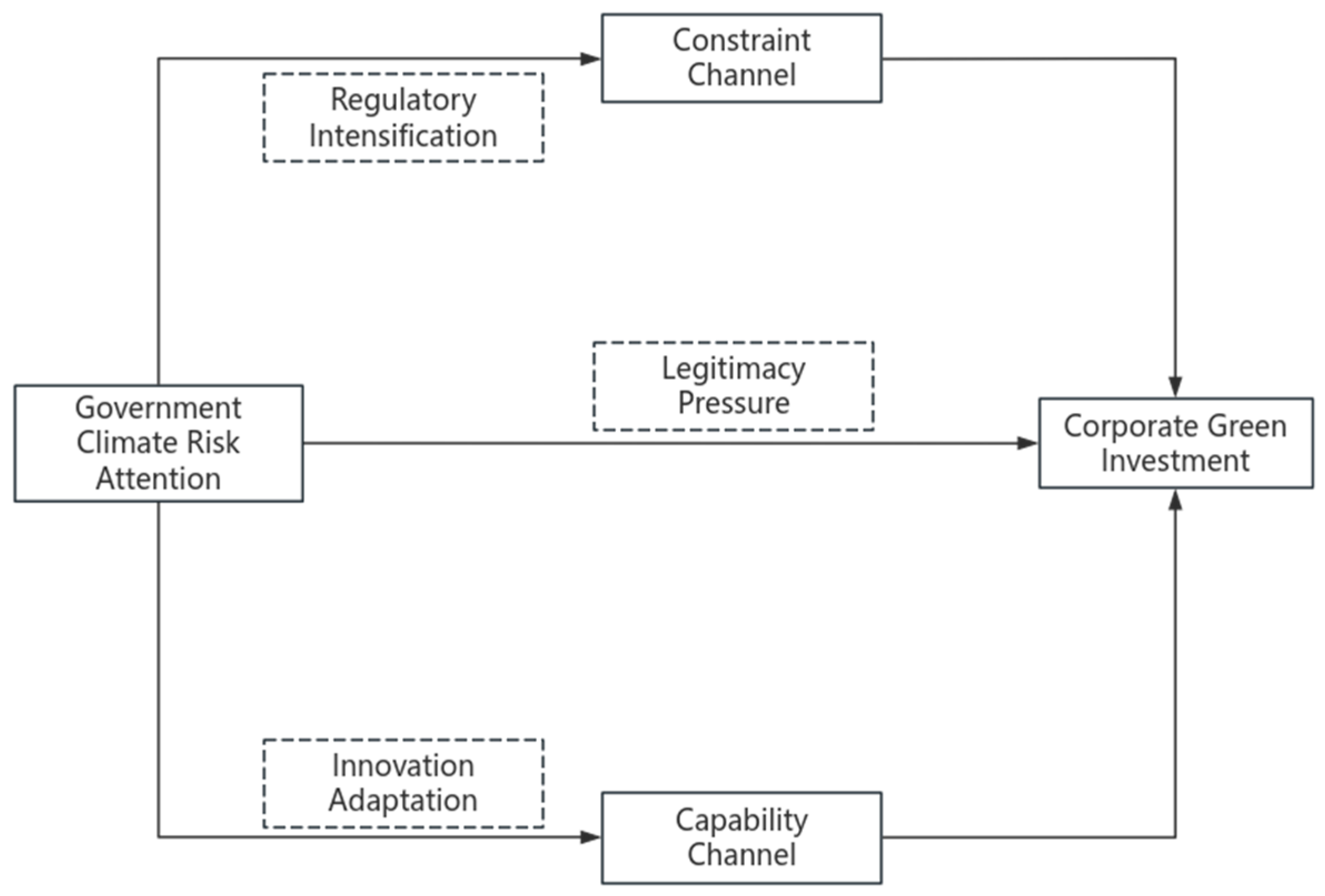
2. Theoretical Analysis and Research Hypotheses
2.1. Legitimacy Acquisition
2.2. Transmission Hardening
2.3. Strategic Adaptation
3. Research Design
3.1. Identification Strategy
- (1)
- Benchmark Regression Model
- (2)
- Mechanism Identification
- (3)
- Economic Consequence Identification
3.2. Variable Definition
- (1)
- Dependent Variable: Corporate green investment (Gi). Following the measurement logic of existing studies [25,26], this paper identifies and aggregates the capitalized and expensed expenditures directly related to green investment by combing through the detailed items in the notes to the financial statements of listed companies, so as to measure the actual scale of corporate green investment. Specifically, capitalized expenditures are derived from environment-related items under the detail of “Construction in Progress”, including capitalized investments in wastewater and waste gas treatment facilities, energy-saving/water-saving/electricity-saving equipment, desulfurization/denitrification/nitrogen removal/dust removal devices, waste disposal systems, waste heat recovery and utilization facilities, exhaust gas treatment equipment, etc. Expensed expenditures are obtained from independent environmental protection items in the detail of “Administrative Expenses”, specifically covering sewage charges, environmental protection fees, vegetation restoration fees, etc. Given that this paper focuses on the absolute scale characteristics of corporate green investment, the core proxy variable (denoted as Gi) is measured by the natural logarithm of the total corporate green investment plus 1 (the “plus 1” operation is intended to avoid the interference of zero values in logarithmic transformation). To enhance the robustness of the research conclusions, this paper further constructs two relative scale indicators as alternative proxy variables for green investment to conduct supplementary tests: (1) the ratio of total corporate green investment to end-of-period total assets; and (2) the ratio of total corporate green investment to current operating revenue.
- (2)
- Core Explanatory Variable: Government attention to climate risks (Cr). Referring to the text analysis method of relevant studies [27] for quantification, keywords are selected from two themes: physical climate risks (including high temperature, heavy rain, floods, droughts, extreme weather, etc.) and transition climate risks (including low carbon, clean energy, carbon peaking, carbon neutrality, carbon trading, etc.). The frequency of these words in the government work report of a city in a certain year is counted and summed up. Finally, the ratio of the summed keyword frequency to the total number of words in the report is used to measure the government’s attention to climate risks.
- (3)
- Control Variables: Referring to the relevant literature [28], this paper selects the following control variables: (1) City-level control variables: economic development level (Ed), expressed by the natural logarithm of per capita regional GDP; and advanced industrial structure (Ig), expressed by the ratio of the added value of the tertiary industry to the added value of the secondary industry. (2) Firm-level control variables: ownership nature (Soe), 1 for state-owned holding enterprises and 0 for others; firm size (Size), expressed by the natural logarithm of annual total assets; asset–liability ratio (Lev), expressed by the ratio of total liabilities at the end of the year to total assets at the end of the year; return on assets (Roa), expressed by the ratio of net profit to total assets; board size (Board), expressed by the natural logarithm of the number of directors; financing constraint degree (Sa), expressed by the Sa index, where a smaller index indicates more severe financing constraints; and firm age (Firmage), expressed by the natural logarithm of the difference between the year of establishment and the current year.
- (4)
- Mechanism Variables: Government environmental regulation (Ge). Referring to relevant studies [29], the intensity of environmental regulation is measured by the proportion of the number of words in sentences containing “environmental protection” in each city’s government work report to the total number of words in the entire government work report. Corporate green innovation (Gt). Referring to relevant studies [30], the number of green utility models independently applied by enterprises in the current year plus one and taking the natural logarithm is used to represent corporate green innovation.
3.3. Data Source
4. Empirical Results
4.1. Benchmark Regression
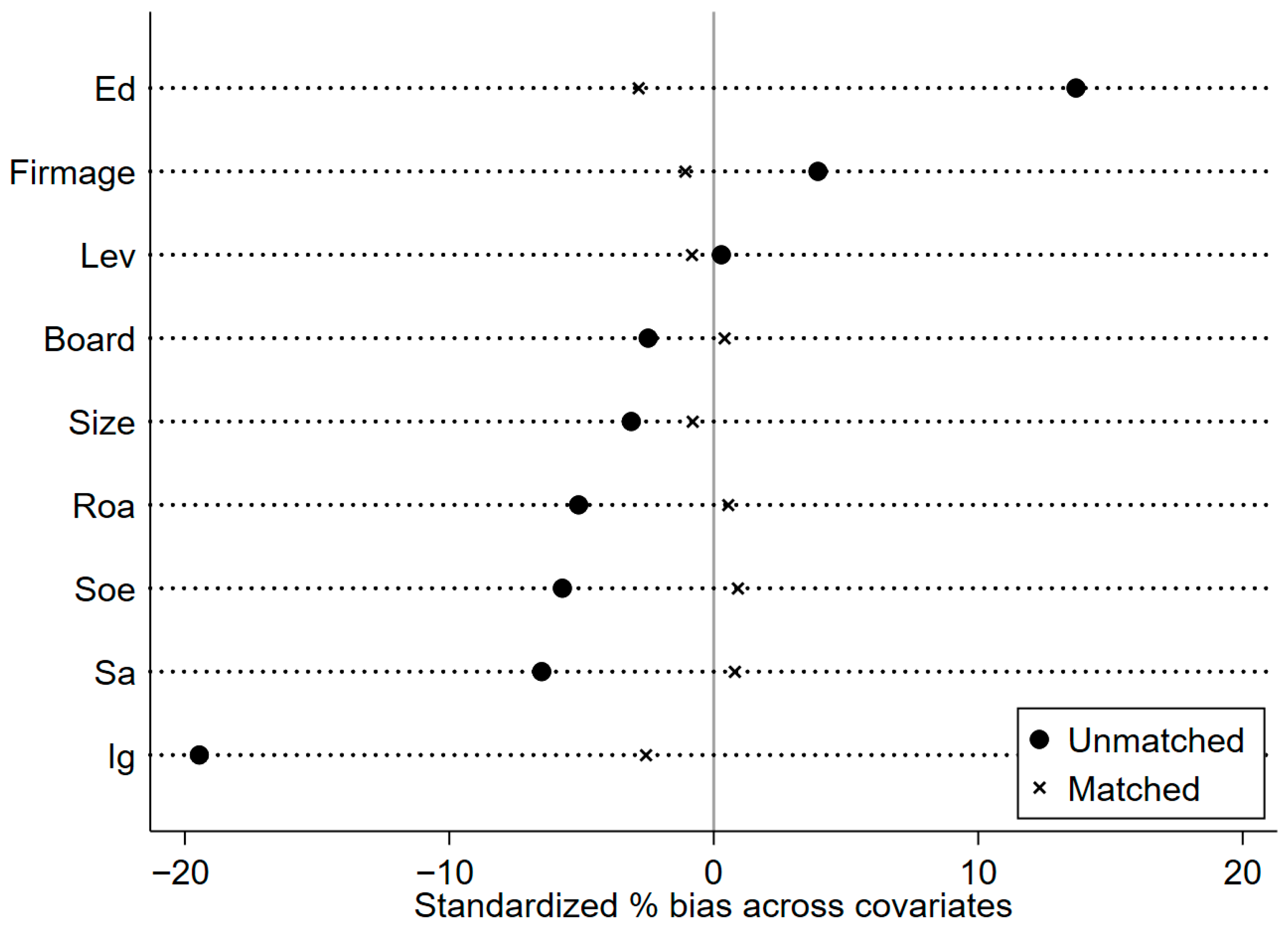
4.2. Robustness Tests
4.3. Mechanism Tests
4.4. Heterogeneity Analysis
- (1)
- Regional Heterogeneity (columns 1–3): The impact presents a gradient differentiation pattern of “weak in the east—strong in the central—secondary in the west”. The regression coefficient of government attention to climate risks in the eastern region is not significant, which is closely related to the development characteristic of the region’s relatively mature marketization process. The driving forces for corporate green transformation in the eastern region have shown a diversified evolutionary trend, and non-policy-driven factors such as market competition pressure and consumers’ green preferences form a synergistic driving pattern, which significantly weakens the marginal incentive effect of government attention to climate risks on corporate green investment. The regression coefficient in the central region is 3.901, significant at the 5% significance level, with the most prominent driving effect; as the core bearing region for industrial structure upgrading, central enterprises are more sensitive to policy signals. The policy expectations released by government attention to climate risks have a significant leverage effect on capital flow, which can effectively guide the agglomeration of social capital in the field of green investment. The regression coefficient in the western region is positive but numerically weaker than that in the central region. Restricted by practical constraints such as a weak economic and technological foundation and an imperfect industrial supporting system, the transmission efficiency of policy signals to corporate green investment decisions is significantly restricted, and the room for releasing policy effects is relatively limited.
- (2)
- Heterogeneity of Pollution Attributes (columns 4–5): The driving effect presents distinct “targeted” characteristics. The regression coefficient of heavily polluting industries is 4.414, significant at the 5% significance level, which is highly consistent with the policy regulatory positioning of such industries. As the core regulatory objects of climate risk management and environmental protection policies, heavily polluting enterprises face a higher level of climate risk exposure and environmental compliance pressure. The climate risk attention signals released by the government are more likely to be transformed into strong policy regulatory expectations and market incentive orientations, thereby forcing enterprises to increase green investment intensity. The regression coefficient of non-heavily polluting industries is not significant. The reason is that such industries have inherently low inherent correlation with climate risks, and enterprises have weaker perceptual sensitivity to policy signals related to government attention to climate risks, making it difficult for policies to form an effective green investment driving mechanism.
- (3)
- Heterogeneity of Industry Types (columns 6–7): The promoting effect of government attention to climate risks is mainly concentrated in the real economy sector. The regression coefficient of the manufacturing industry is 2.384, significant at the 5% significance level; as the core bearing subject of resource consumption and environmental impact, the production and operation links of the manufacturing industry are strongly bound to the demand for green transformation. The government can effectively embed climate risk considerations into the enterprise’s production decision-making process through targeted policy tools such as green supply chain management and industrial energy efficiency standard setting, thereby promoting the substantive implementation of green investment. The regression coefficient of the non-manufacturing industry fails the statistical significance test. On the one hand, it is due to its relatively low overall carbon emission intensity and resource dependence, resulting in less direct impact from climate risk shocks; on the other hand, due to the dispersive characteristics of industry activities, it is difficult for the policy signals transmitted by government attention to climate risks to be transformed into large-scale and centralized green investment momentum.
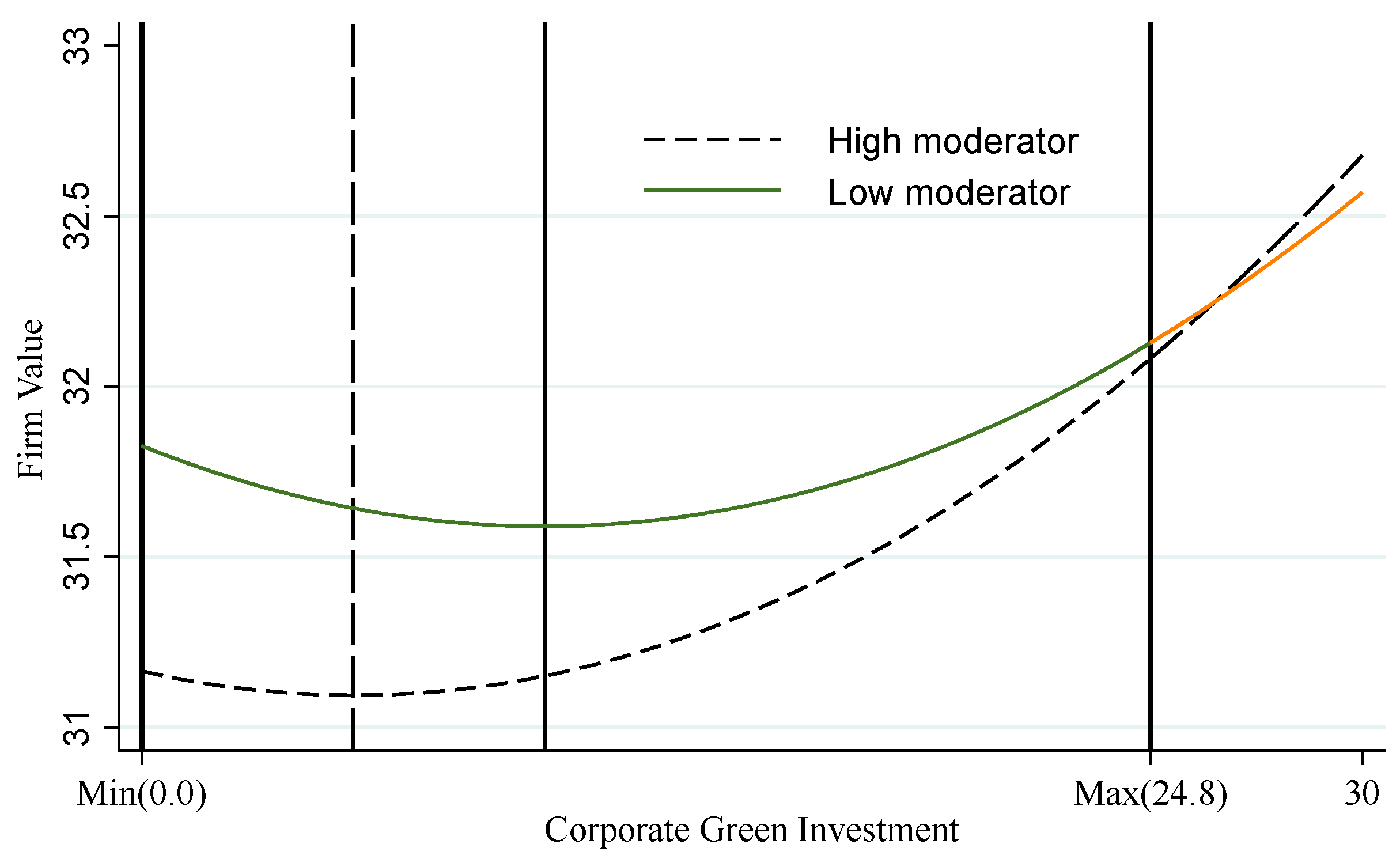
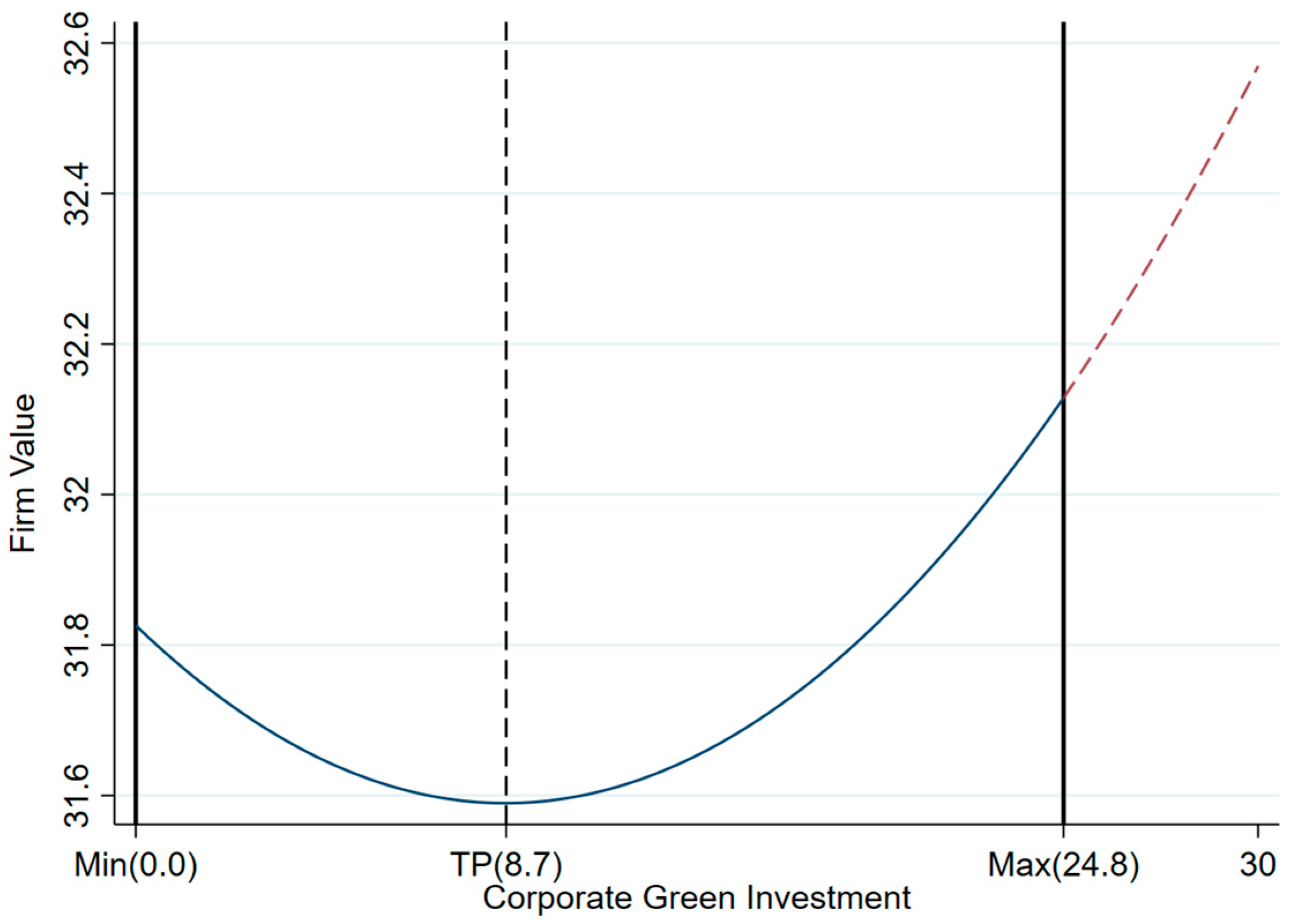
4.5. Further Analysis: Economic Consequences
5. Conclusions and Policy Recommendations
5.1. Research Conclusions
5.2. Policy Recommendations
- (1)
- Strengthen the transformation efficiency of “soft signals”. Unify the core keywords of climate risk-related expressions in local policy documents to improve signal clarity and comparability; and incorporate attention to climate risks into the annual assessment of local governments to avoid policy fluctuations and stabilize long-term corporate expectations.
- (2)
- Build a “constraint + incentive” environmental regulation system. Implement a progressive pollution penalty tax on the constraint side to force the withdrawal of high-carbon investment; increase subsidies for green technology R&D on the incentive side; and expand the scope of green credit interest subsidies and green bond support. Guide financial institutions to incorporate government climate attention into corporate credit rating, and promote core enterprises to establish green supply chain access mechanisms to activate multi-subject collaboration.
- (3)
- Strengthen the direction guidance and resource support for green innovation. Issue a catalog of climate risk response technologies to clarify key support areas; establish a “government–industry–university–research” collaborative innovation fund, and provide tax reductions or rewards for corporate green patents; and launch special green innovation bonds to broaden corporate financing channels.
- (4)
- Implement differentiated climate governance strategies. At the regional level, the central region should strengthen subsidies for industrial green technological transformation, the western region should improve green infrastructure, and the eastern region should guide market forces to take the lead; and at the industry level, implement “one enterprise, one policy” and mandatory environmental information disclosure for heavily polluting enterprises, promote industrial chain green certification for manufacturing, and formulate low-carbon standards for high-energy-consuming sub-sectors in non-manufacturing.
- (5)
- Help enterprises cross the “U-shaped” inflection point of green investment. Provide phased special subsidies or tax rebates for enterprises before the inflection point to cover short-term costs; and accelerate the release of returns for enterprises after the inflection point through green brand certification and government procurement inclination. Guide institutional investors to hold shares of green enterprises for a long time to help enterprises achieve a smooth transformation.
Author Contributions
Funding
Institutional Review Board Statement
Informed Consent Statement
Data Availability Statement
Acknowledgments
Conflicts of Interest
References
- Li, Y.; Mao, K.; Gan, H.; Zhou, Y. Climate risk and household stock market participation. China Econ. Rev. 2025, 94, 102596. [Google Scholar] [CrossRef] [Scilit]
- Hao, J.; Chen, L.; Zhang, N. A statistical review of considerations on the implementation path of China’s “double carbon” goal. Sustainability 2022, 14, 11274. [Google Scholar] [CrossRef] [Scilit]
- Wang, S. Exclusive Video: Xi Jinping Delivers Video Address at the UN Climate Change Summit and Announces China’s New Round of Nationally Determined Contributions. Available online: https://news.cnr.cn/native/gd/sz/20250925/t20250925_527375083.shtml (accessed on 22 November 2025).
- Wang, Y.; Zhao, Z.; Shi, M.; Liu, J.; Tan, Z. Public environmental concern, government environmental regulation and urban carbon emission reduction—Analyzing the regulating role of green finance and industrial agglomeration. Sci. Total Environ. 2024, 924, 171549. [Google Scholar] [CrossRef] [Scilit]
- World Economic Forum. Bridging the Gap: How to Finance the Net-Zero Transition. Available online: https://www.weforum.org/publications/bridging-the-gap-how-to-finance-the-net-zero-transition/?f_link_type=f_linkinlinenote&flow_extra=eyJpbmxpbmVfZGlzcGxheV9wb3NpdGlvbiI6MCwiZG9jX3Bvc2l0aW9uIjowLCJkb2NfaWQiOiJlOGVjNTc5NzgwN2Q2MWRmLWU0N2RkNTEwODRjNGE4MmMifQ%3D%3D (accessed on 28 September 2025).
- Tong, L.; Jabbour, C.J.C.; ben belgacem, S.; Najam, H.; Abbas, J. Role of environmental regulations, green finance, and investment in green technologies in green total factor productivity: Empirical evidence from Asian region. J. Clean. Prod. 2022, 380, 134930. [Google Scholar] [CrossRef] [Scilit]
- Chen, J.; Geng, Y.; Liu, R. Carbon emissions trading and corporate green investment: The perspective of external pressure and internal incentive. Bus. Strategy Environ. 2023, 32, 3014–3026. [Google Scholar] [CrossRef] [Scilit]
- Schaltenbrand, B.; Foerstl, K.; Azadegan, A.; Lindeman, K. See what we want to see? The effects of managerial experience on corporate green investments. J. Bus. Ethics 2018, 150, 1129–1150. [Google Scholar] [CrossRef] [Scilit]
- Tang, R.; Yu, D.; Tan, Y. Navigating the Carbon Challenge: Strategic Integration of Hybrid Policies in Green Supply Chains. Sustainability 2025, 17, 2390. [Google Scholar] [CrossRef] [Scilit]
- Mitchell, R.K.; Agle, B.R.; Wood, D.J. Toward a theory of stakeholder identification and salience: Defining the principle of who and what really counts. Acad. Manag. Rev. 1997, 22, 853–886. [Google Scholar] [CrossRef] [Scilit]
- Suchman, M.C. Managing legitimacy: Strategic and institutional approaches. Acad. Manag. Rev. 1995, 20, 571–610. [Google Scholar] [CrossRef] [Scilit]
- Bansal, P.; Roth, K. Why companies go green: A model of ecological responsiveness. Acad. Manag. J. 2000, 43, 717–736. [Google Scholar] [CrossRef] [Scilit]
- Filatotchev, I.; Nakajima, C. Corporate governance, responsible managerial behavior, and corporate social responsibility: Organizational efficiency versus organizational legitimacy? Acad. Manag. Perspect. 2014, 28, 289–306. [Google Scholar] [CrossRef] [Scilit]
- Laplume, A.O.; Sonpar, K.; Litz, R.A. Stakeholder theory: Reviewing a theory that moves us. J. Manag. 2008, 34, 1152–1189. [Google Scholar] [CrossRef] [Scilit]
- Tan, J.; Xu, G.; Quan, X. Strategic Guidance of Environmental Regulation and Enterprises’ Cross-Regional Investment. Foreign Econ. Manag. 2025, 47, 135–152. [Google Scholar]
- Wang, S.; Zhang, Y.; Wang, Y. Environmental Regulation and Corporate M&A Decisions—Empirical Evidence from Heavily Polluting Industries. Foreign Econ. Manag. 2024, 46, 88–100. [Google Scholar]
- Hu, Y.; Bai, W.; Farrukh, M.; Koo, C.K. How does environmental policy uncertainty influence corporate green investments? Technol. Forecast. Soc. Change 2023, 189, 122330. [Google Scholar] [CrossRef] [Scilit]
- Wang, K.; Sun, X.; Wang, F. Green Finance Development, Debt Maturity Structure and Green Corporate Investment. Financ. Forum 2019, 24, 9–19. [Google Scholar]
- Tseng, M.L.; Islam, M.S.; Karia, N.; Fauzi, F.A.; Afrin, S. A literature review on green supply chain management: Trends and future challenges. Resour. Conserv. Recycl. 2019, 141, 145–162. [Google Scholar] [CrossRef] [Scilit]
- Porter, M.E.; Linde, C. Toward a new conception of the environment-competitiveness relationship. J. Econ. Perspect. 1995, 9, 97–118. [Google Scholar] [CrossRef] [Scilit]
- Su, W.; Peng, M.W.; Tan, W.; Cheung, Y.-L. The signaling effect of corporate social responsibility in emerging economies. J. Bus. Ethics 2016, 134, 479–491. [Google Scholar] [CrossRef] [Scilit]
- Lin, J. Structured Reflection on the Sustainable Development Principles of Global Environmental Governance. Study Explor. 2024, 12, 82–91. [Google Scholar]
- Wang, J.; Liu, J. The Impact of Green Innovation on the ESG Performance of Manufacturing Enterprises. Commer. Res. 2025, 67, 121–130+152. [Google Scholar]
- Fischer, D.; Reinermann, J.L.; Mandujano, G.G.; DesRoches, C.T.; Diddi, S.; Vergragt, P.J. Sustainable consumption communication: A review of an emerging field of research. J. Clean. Prod. 2021, 300, 126880. [Google Scholar] [CrossRef] [Scilit]
- Li, Q.; Xiao, Z. Heterogeneous Environmental Regulation Tools and Incentives for Corporate Green Innovation—Evidence from Green Patents of Listed Enterprises. Econ. Res. J. 2020, 55, 192–208. [Google Scholar]
- Tang, G.; Li, L. Ownership Structure, Property Right Nature and Corporate Environmental Investment—Empirical Evidence from Chinese A-Share Listed Enterprises. Res. Financ. Econ. Issues 2013, 93–100. [Google Scholar] [CrossRef]
- Chen, Z.; Kahn, M.; Liu, Y.; Wang, Z. The Consequences of Spatially Differentiated Water Pollution Regulation in China. J. Environ. Econ. Manag. 2018, 88, 468–485. [Google Scholar] [CrossRef] [Scilit]
- Javeed, S.A.; Latief, R.; Cai, X.; Ong, T.S. Digital finance and corporate green investment: A perspective from institutional investors and environmental regulations. J. Clean. Prod. 2024, 446, 141367. [Google Scholar] [CrossRef] [Scilit]
- Shao, S.; Ge, L.; Zhu, J. How to Achieve Harmonious Coexistence between Humans and Nature: Environmental Regulation and Environmental Welfare Performance from the Perspective of Geographical Factors. Manag. World 2024, 40, 119–146. [Google Scholar]
- Zhou, D.; Zhou, H. Have Green Bonds Gained Investor Preference?—From the Perspective of Credit Spreads. Foreign Econ. Manag. 2023, 45, 19–34+61. [Google Scholar]
- Jiang, T. Mediating Effect and Moderating Effect in Empirical Research on Causal Inference. China Ind. Econ. 2022, 5, 100–120. [Google Scholar]
- Han, C.; Hang, S. Can new consumption promote urban industrial resilience? Empirical evidence from pilot cities of information consumption. PLoS ONE 2025, 20, E0323101. [Google Scholar] [CrossRef] [Scilit] [PubMed]
- He, H.; Shi, L.; Zhang, X. Corporate Zero-Leverage Strategy and Investment Peer Effect. J. Lanzhou Univ. (Soc. Sci. Ed.) 2024, 52, 152–165. [Google Scholar]
- Haans, R.F.J.; Pieters, C.; He, Z.-L. Thinking about U: Theorizing and testing U-and inverted U-shaped relationships in strategy research. Strateg. Manag. J. 2016, 37, 1177–1195. [Google Scholar] [CrossRef] [Scilit]




| Variable Name | Variable | Sample | Mean | Std. Dev. | Min | Max |
|---|---|---|---|---|---|---|
| Dependent Variable | Gi | 37,412 | 4.672 | 7.388 | 0.000 | 24.762 |
| Core Explanatory Variable | Cr | 37,412 | 0.184 | 0.086 | 0.047 | 0.436 |
| Control Variables | Ed | 37,412 | 11.817 | 0.760 | 9.948 | 13.156 |
| Ig | 37,412 | 1.747 | 1.145 | 0.463 | 5.691 | |
| Soe | 36,631 | 0.360 | 0.480 | 0.000 | 1.000 | |
| Size | 37,412 | 22.209 | 1.318 | 19.875 | 26.352 | |
| Lev | 37,412 | 0.411 | 0.207 | 0.049 | 0.883 | |
| Roa | 37,412 | 0.038 | 0.060 | −0.225 | 0.193 | |
| Board | 37,409 | 2.116 | 0.199 | 1.609 | 2.639 | |
| Sa | 37,412 | −3.837 | 0.270 | −4.528 | −3.126 | |
| Firmage | 37,412 | 2.938 | 0.336 | 1.946 | 3.611 | |
| Mechanism Variables | Ge | 37,412 | 0.939 | 0.221 | 0.502 | 1.656 |
| Gt | 37,412 | 0.201 | 0.531 | 0.000 | 2.708 |
| Variable | (1) | (2) |
|---|---|---|
| Only City-Level Controls | All Controls | |
| Cr | 1.769 ** | 1.794 ** |
| (0.85) | (0.77) | |
| Ed | −0.840 *** | −0.778 *** |
| (0.19) | (0.13) | |
| Ig | 0.030 | −0.089 |
| (0.14) | (0.12) | |
| Soe | 0.918 *** | |
| (0.21) | ||
| Size | 1.055 *** | |
| (0.09) | ||
| Lev | 0.943 ** | |
| (0.47) | ||
| Roa | −0.951 | |
| (0.96) | ||
| Board | 0.188 | |
| (0.50) | ||
| Sa | −2.165 *** | |
| (0.62) | ||
| Firmage | −1.487 *** | |
| (0.49) | ||
| Industry Fixed | Yes | Yes |
| Year Fixed | Yes | Yes |
| N | 37,410 | 36,626 |
| R2 | 0.174 | 0.212 |
| Variable | (1) | (2) | (3) | (4) | (5) | (6) | |
|---|---|---|---|---|---|---|---|
| Change Clustering | Replace Measure 1 | Replace Measure 2 | Year–Industry Fixed | IV Method | PSM | ||
| First Stage | Second Stage | ||||||
| Cr | 1.794 ** | 0.312 ** | 1.435 ** | 1.592 ** | 0.001 *** | 0.353 *** | 0.261 ** |
| (0.72) | (0.16) | (0.71) | (0.78) | (0.00) | (0.04) | (0.10) | |
| Controls | Yes | Yes | Yes | Yes | Yes | Yes | Yes |
| Industry Fixed | Yes | Yes | Yes | Yes | Yes | Yes | Yes |
| Year Fixed | Yes | Yes | Yes | Yes | Yes | Yes | Yes |
| Year × Industry Fixed | No | No | No | Yes | No | No | No |
| LM Statistic | - | - | - | - | 634.935 *** | - | |
| Wald F Statistic | - | - | - | - | 828.413 | - | |
| N | 36,626 | 36,628 | 36,624 | 36,558 | 36,560 | 32,103 | |
| R2 | 0.212 | 0.071 | 0.057 | 0.208 | 0.212 | 0.367 | 0.216 |
| Variable | Matched or Not | Mean Value | T-Test | |
|---|---|---|---|---|
| Treatment Group | Control Group | |||
| Ed | Unmatched | 11.872 | 11.768 | 13.07 *** |
| Matched | 11.872 | 11.893 | −2.51 ** | |
| Ig | Unmatched | 1.619 | 1.838 | −18.29 *** |
| Matched | 1.618 | 1.647 | −2.53 ** | |
| Soe | Unmatched | 0.345 | 0.372 | −5.43 *** |
| Matched | 0.345 | 0.340 | 0.82 | |
| Size | Unmatched | 22.181 | 22.222 | −2.96 *** |
| Matched | 22.18 | 22.191 | −0.74 | |
| Lev | Unmatched | 0.411 | 0.411 | 0.27 |
| Matched | 0.411 | 0.413 | −0.75 | |
| Roa | Unmatched | 0.0365 | 0.039 | −4.85 *** |
| Matched | 0.0365 | 0.036 | 0.47 | |
| Board | Unmatched | 2.113 | 2.118 | −2.36 ** |
| Matched | 2.113 | 2.112 | 0.36 | |
| Sa | Unmatched | −3.846 | −3.829 | −6.20 *** |
| Matched | −3.847 | −3.849 | 0.70 | |
| Firmage | Unmatched | 2.944 | 2.931 | 3.76 *** |
| Matched | 2.944 | 2.948 | −0.96 | |
| Variable | (1) | (2) |
|---|---|---|
| Government Environmental Regulation | Corporate Green Innovation | |
| Cr | 0.616 *** | 0.145 ** |
| (0.22) | (0.06) | |
| Controls | Yes | Yes |
| Industry Fixed Effects | Yes | Yes |
| Year Fixed Effects | Yes | Yes |
| N | 36,628 | 36,628 |
| R2 | 0.132 | 0.160 |
| Variable | (1) | (2) | (3) | (4) | (5) | (6) | (7) |
|---|---|---|---|---|---|---|---|
| East | Central | West | Heavily Polluting | Non-Heavily Polluting | Manufacturing | Non-Manufacturing | |
| Cr | 0.539 | 3.901 ** | 2.752 * | 4.414 ** | 0.847 | 2.384 ** | 0.559 |
| (0.74) | (1.84) | (1.37) | (2.01) | (0.74) | (0.97) | (1.00) | |
| Controls | Yes | Yes | Yes | Yes | Yes | Yes | Yes |
| Industry Fixed | Yes | Yes | Yes | Yes | Yes | Yes | Yes |
| Year Fixed | Yes | Yes | Yes | Yes | Yes | Yes | Yes |
| N | 26,322 | 5837 | 4455 | 7638 | 28,978 | 23,585 | 13,031 |
| R2 | 0.176 | 0.303 | 0.296 | 0.183 | 0.120 | 0.176 | 0.280 |
| Variable | (1) | (2) |
|---|---|---|
| Gi | −0.052 *** | −0.027 *** |
| (0.01) | (0.00) | |
| Gi2 | 0.003 *** | 0.003 *** |
| (0.00) | (0.00) | |
| Cr | −0.190 | |
| (0.34) | ||
| Gi × Cr | −0.032 | |
| (0.04) | ||
| Gi2 × Cr | 0.001 ** | |
| (0.00) | ||
| Controls | Yes | Yes |
| Industry Fixed | Yes | Yes |
| Year Fixed | Yes | Yes |
| N | 36,149 | 36,149 |
| R2 | 0.052 | 0.065 |
Disclaimer/Publisher’s Note: The statements, opinions and data contained in all publications are solely those of the individual author(s) and contributor(s) and not of MDPI and/or the editor(s). MDPI and/or the editor(s) disclaim responsibility for any injury to people or property resulting from any ideas, methods, instructions or products referred to in the content. |
© 2026 by the authors. Licensee MDPI, Basel, Switzerland. This article is an open access article distributed under the terms and conditions of the Creative Commons Attribution (CC BY) license.
Share and Cite
Wang, L.; Wu, M. How Does Government Attention to Climate Risks Drive Corporate Green Investment? A Stakeholder Theory-Based Empirical Analysis. Sustainability 2026, 18, 1852. https://doi.org/10.3390/su18041852
Wang L, Wu M. How Does Government Attention to Climate Risks Drive Corporate Green Investment? A Stakeholder Theory-Based Empirical Analysis. Sustainability. 2026; 18(4):1852. https://doi.org/10.3390/su18041852
Chicago/Turabian StyleWang, Ling, and Mingyao Wu. 2026. "How Does Government Attention to Climate Risks Drive Corporate Green Investment? A Stakeholder Theory-Based Empirical Analysis" Sustainability 18, no. 4: 1852. https://doi.org/10.3390/su18041852
APA StyleWang, L., & Wu, M. (2026). How Does Government Attention to Climate Risks Drive Corporate Green Investment? A Stakeholder Theory-Based Empirical Analysis. Sustainability, 18(4), 1852. https://doi.org/10.3390/su18041852