Article

Diversification and Competitiveness Patterns in International Shrimp and Prawn Trade: Evidence from Ecuador, India, Vietnam, and Indonesia

by
Jose Carlos Montes Ninaquispe
1,*,
Luisa Angelica Orejuela Guerrero
2,
Francisco Elias Rodriguez Novoa
2,
Pedro Ramiro Mendoza Ocaña
3,
Anggie Melissa Sánchez Yarleque
4,
Carlos Enrique Mendoza Ocaña
5,
Fanny Lileth Pairazaman Lam
3,
Luis Ignacio Gutiérrez Albán
6,
Marcos Marcelo Flores Castillo
7 and
Yerson Paul Semillan Rosales
7
1
Programa de Administración y Administración de Negocios Internacionales Filial Norte, Universidad de San Martín de Porres, Chiclayo 14001, Peru
2
Escuela de Ingeniería Industrial, Universidad Nacional de Trujillo, Trujillo 13700, Peru
3
Escuela de Ingeniería Industrial, Facultad de Ingeniería, Campus Piura, Universidad César Vallejo, Chepén 13871, Peru
4
Facultad de Humanidades, Campus Piura, Universidad Tecnológica del Peru, Piura 20002, Peru
5
Escuela de Ingeniería Industrial, Campus Trujillo, Universidad Privada del Norte, Trujillo 13001, Peru
6
Escuela de Humanidades, Facultad de Humanidades, Campus Piura, Universidad César Vallejo, Piura 20301, Peru
7
Facultad de Ciencias Empresariales y Turismo, Universidad Nacional de Frontera, Sullana 20103, Peru
*
Author to whom correspondence should be addressed.
Sustainability 2026, 18(4), 1793; https://doi.org/10.3390/su18041793
Submission received: 12 January 2026 / Revised: 2 February 2026 / Accepted: 4 February 2026 / Published: 10 February 2026

Abstract

This study aimed to jointly characterize destination diversification and revealed competitiveness in the international shrimp and prawn trade of Ecuador, India, Vietnam, and Indonesia during 2020–2024. A quantitative, descriptive–comparative approach was applied using annual free-on-board values at the exporter–destination level obtained from Trade Map (International Trade Centre). Destination diversification was proxied by the Herfindahl–Hirschman Index, while market-level competitiveness was measured through the Normalized Revealed Comparative Advantage index. Results show that Ecuador expanded exports while maintaining persistently high destination concentration. India exhibited broad revealed comparative advantage across multiple markets, yet remained highly concentrated, with episodes of deconcentration that were not sustained. Vietnam recorded relative stagnation, moderate concentration, and heterogeneous competitiveness across destinations. Indonesia experienced contraction with extremely high concentration, characterized by a pronounced advantage in the United States alongside disadvantages in alternative markets. Overall, a positive NRCA did not necessarily coincide with a low HHI, and configurations in which revealed advantage is concentrated in a small set of anchor markets are associated with higher exposure and may entail more limited reorientation options under shocks.

1. Introduction

Export competitiveness research increasingly combines specialization metrics with indicators of diversification and exposure to shocks. Revealed comparative advantage remains a standard empirical approach to infer specialization from observed trade flows, beginning with Balassa’s formulation [1], while subsequent critiques of asymmetry and scale sensitivity motivated alternative indices with improved comparability [2]. In this line, the Normalized Revealed Comparative Advantage (NRCA) offers an additive measure designed for cross-country and intertemporal comparisons and reduces distortions linked to total export size [3]. Complementarily, export performance is also evaluated through the distribution of exports across destinations, because concentration is commonly linked to higher exposure to demand shifts, price changes, and regulatory barriers [4]. The Herfindahl–Hirschman Index (HHI) is widely used for this purpose, with higher values indicating stronger dependence on a limited set of markets; macro evidence suggests diversification can buffer external volatility, although effects differ by structure and shock synchronicity [5].
In the shrimp and prawn trade, competitiveness and market access are shaped by sector-specific constraints that make a joint reading of “advantage” and “concentration” particularly informative. Penaeid aquaculture has expanded through technological change and species reconfiguration, including the broad consolidation of whiteleg shrimp [6]. Evidence from Ecuador highlights strong output performance alongside efficiency heterogeneity that can influence cost structures and export persistence [7]. Beyond productivity, competitiveness in high-value destinations depends on governance in global value chains, sanitary compliance, certification regimes, and traceability capabilities that can facilitate or restrict access [8]. Certification may operate as a commercial filter without necessarily transforming local practices [9], while trade-defense measures and dumping disputes can increase uncertainty and alter incentives to rely on one or two dominant markets [10].
The relevance of studying diversification and competitiveness jointly is amplified by the strategic role of shrimp exports and the sector’s recent volatility. For leading exporters, specialization combined with destination concentration can transmit external disturbances to coastal incomes and processing chains. For instance, shrimp has become a major non-oil export in Ecuador [11]; the sector is central to seafood exports and employment linkages in India [12]. Vietnam’s recent export recovery raises questions about whether improved performance coincides with destination reconfiguration [13], and Indonesia’s dependence on the U.S. market increases exposure to policy and trade-measure changes [14]. Recent turbulence linked to cost pressures and demand deceleration illustrates how market conditions can tighten when exporters compete in a narrow set of destinations [6], particularly when official figures show strong dependence on a few markets in key exporters [11,15,16]. Moreover, the role of standards and non-tariff measures in fisheries trade underscores that market access is influenced by regulatory dynamics in addition to cost-based competitiveness [17].
This study is guided by a descriptive research question: What patterns of destination concentration and market-specific revealed competitiveness characterized shrimp and prawn exports in Ecuador, India, Vietnam, and Indonesia during 2020–2024 at the destination level? The question frames the analysis as a characterization of observed trade configurations (how export values are distributed across destinations and how revealed competitiveness varies by market) without estimating causal effects or prescribing an optimal level of concentration.

2. Literature Review

The literature on export diversification suggests that patterns of concentration and diversification can evolve nonlinearly across development stages, implying that concentration indicators should be interpreted under structural heterogeneity rather than as a monotonic improvement metric [18]. In parallel, macro-level evidence frequently links broader diversification to growth performance, although reported relationships vary with country structure, time horizons, and model specifications [19]. A complementary strand associates changes in diversification patterns with trade policy and integration processes, suggesting that liberalization and openness can coincide with diversification outcomes in developing economies under certain institutional and productive conditions [20].
In this context, diversification is commonly defined and operationalized as the extent to which export value is distributed across destinations, and it is often treated as an exposure and volatility diagnostic. Empirical work reports that more diversified export structures are associated with lower growth volatility, particularly under higher trade openness, while concentrated structures exhibit higher sensitivity to adverse external conditions [21]. Related vulnerability-focused analyses similarly interpret diversification as being associated with lower structural exposure to shocks, stressing that concentration can amplify reliance on a limited set of markets or products [4]. Methodologically, several studies caution that diversification diagnostics depend on aggregation choices; concentration indices computed at different territorial or sectoral scales can yield distinct readings of resilience and exposure, because concentration may be hidden when the level of analysis is too aggregated [22].
Competitiveness, in turn, is frequently defined in trade analytics through revealed comparative advantage, and the literature debates how it should be operationalized for cross-country and intertemporal comparisons. The Balassa index remains widely used but has known distributional limitations that can distort comparability and interpretation across countries and products [23]. This has motivated alternative formulations designed to improve the symmetry, stability, and interpretability of revealed advantage measures [24,25]. In this line, the Normalized Revealed Comparative Advantage is frequently highlighted as an additive measure suitable for comparative applications, supporting both cross-sectional and time series readings of specialization [3]. Empirical applications across sectors indicate that competitiveness inferences can vary by indicator choice and that normalized or symmetric measures are often preferred when the research objective requires consistent comparisons across countries, products, and periods [26,27,28,29,30,31].
These concepts are especially salient for shrimp and prawn trade, where diversification and competitiveness are shaped by constraints related to perishability, distance, and logistics infrastructure, particularly cold chain capacity, which condition spatial trade patterns and the feasibility of expanding into new destinations [32]. Additional evidence shows that country-level diversification can coexist with firm-level concentration, where a small number of firms account for a substantial share of export value, affecting how exposure is distributed within the sector [33]. Other studies note that competitiveness readings may change when value-added decomposition and imported input dependence are incorporated, complicating interpretations based solely on gross export values [34]. Within shrimp and prawn markets, comparative analyses document heterogeneous trajectories and shifts in leadership across destinations and periods, reinforcing the importance of destination-disaggregated assessment [35,36], while related work points to associations between broader macroeconomic or policy conditions and observed changes in competitiveness over time [37].
Taken together, prior research supports an integrative descriptive approach in which concentration-based diversification metrics are used to characterize destination dependence and potential exposure, while Normalized Revealed Comparative Advantage metrics are used to characterize market-specific revealed competitiveness. Jointly reading both dimensions helps identify configurations where revealed advantage is concentrated in a small set of anchor destinations versus patterns where competitiveness appears more distributed across markets, improving the interpretation of export performance and exposure in shrimp and prawn trade.

Theoretical Framework

In international trade, diversification is understood as the expansion and balancing of a territory’s export portfolio across a broader set of destinations, thereby reducing dependence on a limited number of markets [38]. This concept aligns with a resilience perspective in which a less concentrated export basket supports more stable export levels under disturbances by spreading commercial risk and enabling faster reallocation across market segments. Barbieri et al. [22] synthesize this reasoning by treating export diversification as both a shock-mitigation mechanism and a proxy for the productive and geoeconomic capabilities underlying export performance under crisis conditions.
Theoretically, diversification is linked to structural change and capability accumulation. When an economy expands its export portfolio, it not only changes quantities but also reveals—and may accelerate—the development of technological, organizational, and institutional capabilities needed to produce and place new goods in international markets [39]. Recent evidence also supports diversification as a buffer against macroeconomic vulnerability in economies highly dependent on natural resources [40]. Studies report that export concentration is associated with greater economic vulnerability, reinforcing the idea that diversification is not merely “more variety” but a reduction in systemic risks derived from narrow specialization [41]. Complementary analyses discuss diversification and structural transformation in regions with low export sophistication by comparing productive transformation dynamics and diversification patterns [42]. Satnarine-Singh et al. [43] further examine these interactions by analyzing how export structure and productive transformation condition the margins of diversification and external performance.
Operationalizing diversification via the HHI is consistent with the conceptual definition that “lower concentration equals higher diversification,” because the index summarizes, in a single value, how export shares are distributed across destinations and the extent to which a few categories dominate total exports [13,44]. Recent applications use HHI-based indices to measure sectoral and geographic diversification in industrial exports as representations of portfolio breadth and, by extension, underlying capabilities supporting export performance. Barbieri et al. make this explicit by proposing HHI-based indices to approximate diversification across sectoral and territorial dimensions [22,45,46,47,48].
External competitiveness in international economics is typically defined as the relative ability of a country or sector to sustain and expand its presence in international markets, often proxied through revealed comparative advantage indicators derived from observed export patterns [49,50]. The classical reference is Balassa’s revealed comparative advantage, which interprets relative export performance as an empirical signal of specialization. Balassa (1965) formalizes this approach by arguing that observed export structures can “reveal” comparative advantages even when technological determinants or factor endowments are not directly observed, making it a widely used basis for measuring product–country competitiveness [1].
Yu et al. (2009) introduce NRCA to improve precision and intertemporal and intersectoral comparability, allowing competitiveness to be interpreted as a relative position whose sign and magnitude indicate advantage or disadvantage and its intensity [3]. This feature is particularly useful when competitiveness must be compared across multiple markets or tracked over time without distortions driven by scale or bounds typical of non-normalized measures.
Diversification and competitiveness can be coherently integrated within a capabilities-and-structural-transformation framework, in which the observable export structure reflects accumulated capabilities and simultaneously conditions the formation of new comparative advantages [51]. In this perspective, a positive and larger NRCA suggests that capabilities, costs, and institutional conditions have converged toward effective specialization in a product [52]. Applied evidence shows that these indicators are often used jointly to characterize external performance and export structure; for example, Mabeta and Smutka (2023) treat NRCA as a core competitiveness metric that links revealed advantage dynamics to structural and orientation shifts in trade [53].
Under this framework, lower destination concentration (lower HHI) is expected to be associated with stronger conditions for sustaining aggregate or sectoral competitiveness over time through two complementary mechanisms. First, from a resilience perspective, a less concentrated structure reduces vulnerability to product- or destination-specific disturbances [54]. Second, from an upgrading and learning perspective, diversification can facilitate cumulative capability-building processes that, in the long run, raise export quality or complexity and improve competitive positioning [55].

3. Materials and Methods

This study used annual bilateral export values for shrimp and prawns, measured in FOB value in current United States dollars, disaggregated by importing destination. The data were obtained from Trade Map, which compiles and standardizes international trade statistics by product and partner market [56]. The observation window covers the years 2020 to 2024. The raw data are publicly accessible through the Trade Map platform [56], and the processed dataset and replication script used to compute all indicators are provided in the repository reported in the Data Availability Statement.
The unit of analysis is the “exporter, destination, year export” flow, denoted as export value from exporter c to destination d in year t . For each exporter and year, the complete list of destinations reported in Trade Map was downloaded and organized into a consistent “exporter, destination, year” structure to ensure transparent and replicable computation of destination concentration and revealed competitiveness.
The analysis focuses on Ecuador, India, Vietnam, and Indonesia because they are consistently prominent exporters in global shrimp and prawn trade during the study window and represent major supply centers across regions, which supports cross-country comparison under the same product definition and period [56]. In addition, these exporters display contrasting destination architectures in the descriptive tables, which makes them suitable for a comparative reading of destination concentration and market-specific competitiveness using the same metrics. The selection is therefore motivated by relevance in trade volume, cross-regional representativeness, and suitability for comparing distinct destination patterns using a consistent data source and timeframe.
For descriptive tables, the largest destination markets are reported explicitly, and the residual set of smaller destinations is grouped as “Others” to improve readability. However, to avoid mechanical distortions in measurement, all indicators were computed using the complete destination list for each exporter and year, without collapsing destinations into “Others”. This ensures that concentration and competitiveness reflect the full distribution of export value across importing markets.
Destination diversification can be quantified using several approaches, including concentration indices based on destination shares, entropy-based measures (for example, Shannon- or Theil-type indices), counts of active destinations, and extensive margin indicators. In this study, the Herfindahl Hirschman Index was selected because it is widely used, transparent, and directly interpretable as a concentration measure that places greater weight on dominant destinations through the squared share structure. This property is aligned with the study objective, which is a descriptive characterization of market anchoring and exposure signals rather than causal inference. The index is also straightforward to replicate from destination-level shares and is commonly reported on a 0 to 10,000 scale in applied concentration analysis [57].
Let X c , d , t denote exports of shrimp and prawns from exporter c to destination d in year t (FOB value). Let total exports of exporter c in year t be:
X c , t = d X c , d , t .
The destination share is defined as:
s c , d , t = X c , d , t X c , t .
Destination concentration is then computed as the sum of squared destination shares, reported on the 0 to 10,000 scale:
H H I c , t = 10,000 d s c , d , t 2 .
Higher values indicate stronger destination concentration and therefore lower destination diversification. For interpretability, concentration regimes are discussed using conventional screening thresholds that classify values below 1000 as unconcentrated, values between 1000 and 1800 as moderately concentrated, and values above 1800 as highly concentrated, following standard applied practice for the index scale used here [57,58]. These thresholds are used only as descriptive labels and do not imply an optimal degree of concentration.
Competitiveness is described using the Normalized Revealed Comparative Advantage, which is designed for cross-country and intertemporal comparisons and is additive across dimensions, making it suitable for destination-level mapping in a descriptive comparative setting [3]. The indicator compares observed exports in a specific destination with the value expected under a neutral benchmark given the exporter total scale and the destination total absorption.
To simplify notation and improve transparency, define the following totals for each year t :
X c , t = d X c , d , t is exporter c total exports across destinations.
X d , t = c X c , d , t is world exports to destination d .
X t = c d X c , d , t is total world exports of the product.
The expected neutral export value from exporter c to destination d is:
E c , d , t = X c , t X d , t X t .
Normalized Revealed Comparative Advantage is computed as:
N R C A c , d , t = X c , d , t E c , d , t X t .
By construction, N R C A c , d , t > 0 indicates revealed comparative advantage in destination d relative to the neutral benchmark, N R C A c , d , t < 0 indicates revealed comparative disadvantage, and values near zero indicate near neutral positioning [3]. The sign and relative magnitude are interpreted descriptively to map where competitiveness is concentrated versus broadly distributed across destinations.
The empirical workflow proceeds in a strictly descriptive sequence. First, annual export values by destination are summarized for each exporter to document trajectories and the degree of market anchoring. Second, the Herfindahl Hirschman Index is computed for each exporter and year to describe the destination structure and identify periods of tightening or loosening concentration. Third, the Normalized Revealed Comparative Advantage is computed for each exporter, destination, and year to map market-specific competitiveness and assess whether advantage is concentrated in a small set of destinations or more evenly distributed.
All indicators used are descriptive indices and do not identify causal mechanisms. The study therefore discusses observed patterns as descriptive associations in the trade data and does not estimate welfare effects, optimal concentration levels, or causal impacts of policies, shocks, or supply chain factors not explicitly modeled.

4. Results

The findings are reported as descriptive patterns by country, year, and destination, without hypothesis-testing procedures.

4.1. Ecuador

In Table 1, Ecuador’s shrimp and prawn exports exhibit a sharp expansion followed by a visible normalization, with a clear dominance of one destination that nevertheless does not move in lockstep with the total. The trajectory shows a pronounced surge in the middle of the period and a subsequent retrenchment that still leaves exports above the initial level. At the same time, the “Others” aggregate gains relative weight toward the end of the period, indicating that the export increase is not concentrated solely in the largest buyer and that secondary markets contribute meaningfully to the export base. The co-movement between the total and the leading destination suggests sensitivity of aggregate exports to changes in the principal market. While the partial rebalancing toward additional markets is consistent with some diversification at the margin, the export profile remains strongly anchored in a single importer. From a descriptive standpoint, the evidence is consistent with strong market penetration alongside a concentration-related exposure that merits monitoring.
In Table 2, the HHI levels place Ecuador’s shrimp and prawn exports firmly in the high-concentration range throughout the period, indicating persistent dependence on a narrow set of destination markets. The sequence suggests that concentration is not stable but rather episodic: it tightens notably around the middle of the period and then relaxes toward the end, without crossing into even moderate concentration. This implies that diversification gains, when they occur, are incremental and reversible, reflecting a structure where shifts in one or two large markets can quickly re-shape the overall distribution of export value. The implication is that Ecuador’s export resilience is constrained by structural concentration, even when headline performance is strong. The late-period reduction in concentration is meaningful because it signals a potential pathway to risk mitigation through wider market absorption, yet the continued high HHI indicates that the export system remains highly exposed to importer-specific disruptions.
In Table 3, the NRCA results indicate a robust and persistent comparative advantage in several destination markets, alongside a borderline-to-neutral position in at least one large market over time. The strongest feature is stability: key markets remain consistently in the comparative-advantage range, with only modest drift, which signals durable competitiveness rather than a temporary placement effect. By contrast, the United States moves from mild comparative disadvantage toward the intra-product trade corridor and eventually into a near-neutral/incipient advantage position, implying a gradual strengthening rather than abrupt repositioning. This configuration suggests that Ecuador’s shrimp exports rest on a solid competitive core in specific markets, which can underpin export continuity even when total values fluctuate. However, the coexistence of strong advantage in some destinations and near-neutral positioning in a major market is consistent with segmented competitiveness, where market access, preferences, or competitive intensity may differ across importers. Strategically, the evidence supports the interpretation that Ecuador has room to consolidate and deepen advantage where it is already strong while building a more resilient portfolio by converting near-neutral markets into sustained advantage positions, thereby reducing over-reliance on a narrow set of high-impact buyers.

4.2. India

In Table 4, India’s shrimp and prawn exports exhibit a high level of market anchoring alongside pronounced cyclical sensitivity in aggregate performance. The trajectory features a sharp expansion followed by a correction and subsequent stabilization, indicating that growth impulses were not fully consolidated into a higher long-run plateau. Across destinations, the United States remains the dominant absorber, while a secondary tier of Asian markets provides additional scale without overturning the hierarchy; the “Others” aggregate also retains material weight, suggesting some breadth but not enough to offset the system’s reliance on a few core outlets. This configuration implies an export profile that is commercially strong yet exposed to demand or price fluctuations in its principal markets. The persistence of a leading destination supports revenue continuity and bargaining familiarity, but it also concentrates negotiation and compliance risks, making performance more vulnerable to shifts in procurement cycles or buyer-side standards in those hubs. The meaningful contribution of secondary markets and the residual “Others” category offers a platform for risk distribution, yet the observed inability to sustain the post-expansion peak suggests that resilience would depend less on marginal market additions and more on deepening and broadening demand across multiple destinations simultaneously.
In Table 5, the HHI levels consistently place India’s shrimp and prawn exports in a highly concentrated structure (well above the 1800 threshold) throughout the period, despite a partial easing after the initial rise. The pattern indicates that concentration intensified early and then retreated, but without transitioning into a moderately concentrated range. The post-peak decline suggests some incremental diversification, yet the rebound afterward signals that dispersion gains were not self-reinforcing, pointing to a structure that remains highly sensitive to the relative pull of the largest markets rather than steadily broadening over time. Sustained high concentration implies that India’s export performance is structurally conditioned by a limited set of destination markets, which amplifies exposure to market-specific shocks and buyer power dynamics. The temporary improvement in diversification does not appear to have matured into a durable rebalancing, indicating that competitive positioning may still be organized around scale relationships with dominant importers rather than a wide portfolio logic. Strategically, the evidence is consistent with a need to transform episodic diversification into persistent market development, because only sustained dispersion would materially reduce vulnerability while preserving overall export capacity.
In Table 6, NRCA values are predominantly in the comparative advantage range for the main destinations, indicating a robust and persistent competitiveness profile rather than a marginal or ambiguous specialization. The advantage is especially strong and stable in Japan and Vietnam, while China also exhibits a notably elevated advantage that strengthens relative to earlier years and remains high thereafter. The United States shows a steady but less extreme advantage, suggesting a mature position that is resilient but not necessarily accelerating, whereas Belgium displays a shift from a weak advantage toward clearer advantage by the end of the period, consistent with improving relative positioning in that market. The breadth of comparative advantage across multiple importers suggests that India’s concentration is not driven by competitiveness confined to a single market, but by the gravitational pull of large buyers and established trading relationships. This distinction matters: it implies that diversification is feasible from a capability standpoint, since competitive strength appears portable across destinations rather than narrowly market-specific. However, because comparative advantage remains strongest in a subset of markets, the export system may continue to self-select into those channels unless market development efforts intentionally convert capability into a wider demand base, thereby reducing concentration risk without undermining the underlying specialization.

4.3. Vietnam

In Table 7, Vietnam’s shrimp and prawn exports display a clear pattern of level-shifting rather than smooth growth: aggregate receipts rise into the early part of the window, then contract sharply before a partial recovery. The composition of destinations indicates a portfolio anchored in a small set of large markets, while the residual “Others” block remains structurally decisive for the total and becomes the main source of short-run volatility. Across the principal importers, leadership rotates rather than consolidates, which signals that year-to-year performance is driven more by demand reallocation across partners than by a uniform expansion of Vietnam’s sales frontier. This configuration implies a trade profile that is simultaneously broad and exposed. Breadth is suggested by the large “Others” segment, which can cushion bilateral shocks and provide adaptive room when specific markets soften. Exposure arises because the same segment also concentrates uncertainty: when “Others” compresses, the overall export level deteriorates even if some key partners hold steady.
In Table 8, the HHI values place Vietnam’s destination structure firmly in the zone of moderate concentration throughout the period, with only a brief move into diversified territory. The diversification signal is therefore not a trend of steady broadening, but a cyclical oscillation around the moderate-concentration threshold, indicating sensitivity of market shares to relatively small reallocations among destinations. The quick reversion after the diversification episode suggests that the underlying distribution of demand remains sticky: Vietnam can widen its market footprint temporarily, but the export mix tends to snap back toward a more concentrated configuration. This persistence of moderate concentration implies that risk is managed but not eliminated. A moderately concentrated structure typically offers some efficiency advantages—scale and relational depth in core markets—yet it leaves the export profile vulnerable to synchronized downturns or tighter access conditions in those anchors.
In Table 9, the NRCA map is heterogeneous rather than uniformly favorable: sustained comparative advantage is concentrated in a subset of importers, while others remain in comparative disadvantage or hover near the intra-product trade corridor. Japan and Australia consistently sit in the comparative-advantage range, indicating persistent alignment between Vietnam’s export strength and those markets’ import structure, while the Republic of Korea stays positive but closer to the boundary, suggesting a more contestable position. China transitions from mild disadvantage toward the intra-product/near-neutral zone, pointing to improving relative competitiveness without yet consolidating a strong advantage; by contrast, the United States remains on the disadvantage side and even crosses into deeper disadvantage at one point, signaling a structurally tougher competitive benchmark. These asymmetries imply that Vietnam’s competitiveness is market-specific, with “safe” destinations where advantage appears entrenched and “pressure” destinations where performance is more dependent on competing margins. Advantage markets provide a platform for stability and upgrading because they are consistent with durable specialization, whereas disadvantage markets imply that growth—if pursued—may require sharper differentiation, cost discipline, or stronger market access positioning to avoid volume-driven fragility. The near-neutral positioning in China is especially meaningful: it suggests strategic optionality, where incremental improvements could shift the relationship into clear advantage, thereby improving the overall robustness of the export portfolio without necessarily increasing concentration if additional gains are spread across secondary markets.

4.4. Indonesia

In Table 10, Indonesia’s shrimp and prawn exports display a marked shift from expansion to contraction, with the aggregate trajectory peaking early and then falling sharply before settling into a lower plateau. The profile is structurally skewed toward one dominant destination, such that changes in that single market largely determine the overall slope of total exports. The mid-period decline is therefore not merely a generalized weakening across partners, but a re-scaling of the export envelope driven by the largest buyer, while secondary markets remain comparatively small and unable to offset that adjustment. This configuration implies that Indonesia’s export performance is best understood as exposure to buyer-specific demand and price-cycle sensitivity rather than as a broadly distributed portfolio outcome. The limited compensatory capacity of alternative destinations constrains resilience: when the leading market retrenches, total export revenues mechanically compress even if other buyers remain stable or improve marginally. From an international business perspective, the pattern is consistent with a commercial strategy anchored in a primary market where Indonesia is deeply embedded, but it also signals that upgrading resilience would require either scaling second-tier destinations or cultivating new markets capable of absorbing volume at meaningful value levels.
In Table 11, the HHI levels are consistently far above the threshold for high concentration, indicating a persistently concentrated market structure rather than episodic dependence. While the index declines from the earlier years toward the middle of the period, the improvement is partial and does not cross into a lower concentration regime; instead, it resembles a modest easing of dominance within an otherwise concentrated portfolio. The slight rebound at the end of the period suggests that diversification gains are fragile and can be reversed when the distribution of sales across destinations re-tightens. The implication is that Indonesia’s export system remains strategically exposed to destination-specific shocks, bargaining power asymmetries, and compliance or logistics disruptions tied to a narrow set of markets. Even when concentration softens, the structure still reflects limited optionality: the country’s ability to re-route exports across multiple sizable destinations appears constrained, which can amplify revenue volatility when the lead market adjusts. Consequently, a diversification narrative here would be one of incremental rather than transformational change, where risk reduction depends on building scale in alternative markets rather than relying on marginal dispersion across small buyers.
In Table 12, the NRCA signals a clear segmentation of competitiveness across destinations. The United States exhibits a strong and stable comparative advantage throughout, indicating persistent market-specific strength rather than a temporary spike. Japan also remains in comparative advantage, though at a less extreme level, and its trajectory suggests consolidation of competitiveness over time. By contrast, China and Malaysia consistently register comparative disadvantage, implying structural limitations in those markets. Chinese Taipei moves from comparative disadvantage toward the intra-product trade band in later years, indicating a partial normalization of competitiveness that remains short of a sustained advantage. These patterns imply that Indonesia’s concentration is not only a demand-side outcome but also aligns with where its revealed competitiveness is strongest, reinforcing path dependence toward the leading markets. Strong and stable advantage in the primary destinations supports revenue generation, but it can also lock the export model into a narrow set of market requirements and buyer relationships, raising adjustment costs if conditions shift. Meanwhile, persistent disadvantages in certain Asian markets suggest that diversification cannot be assumed to materialize simply through outreach; it may require changes consistent with market access conditions, product positioning, or value-chain configuration to convert those destinations from structurally weak to competitively viable.

4.5. Comparative Overview

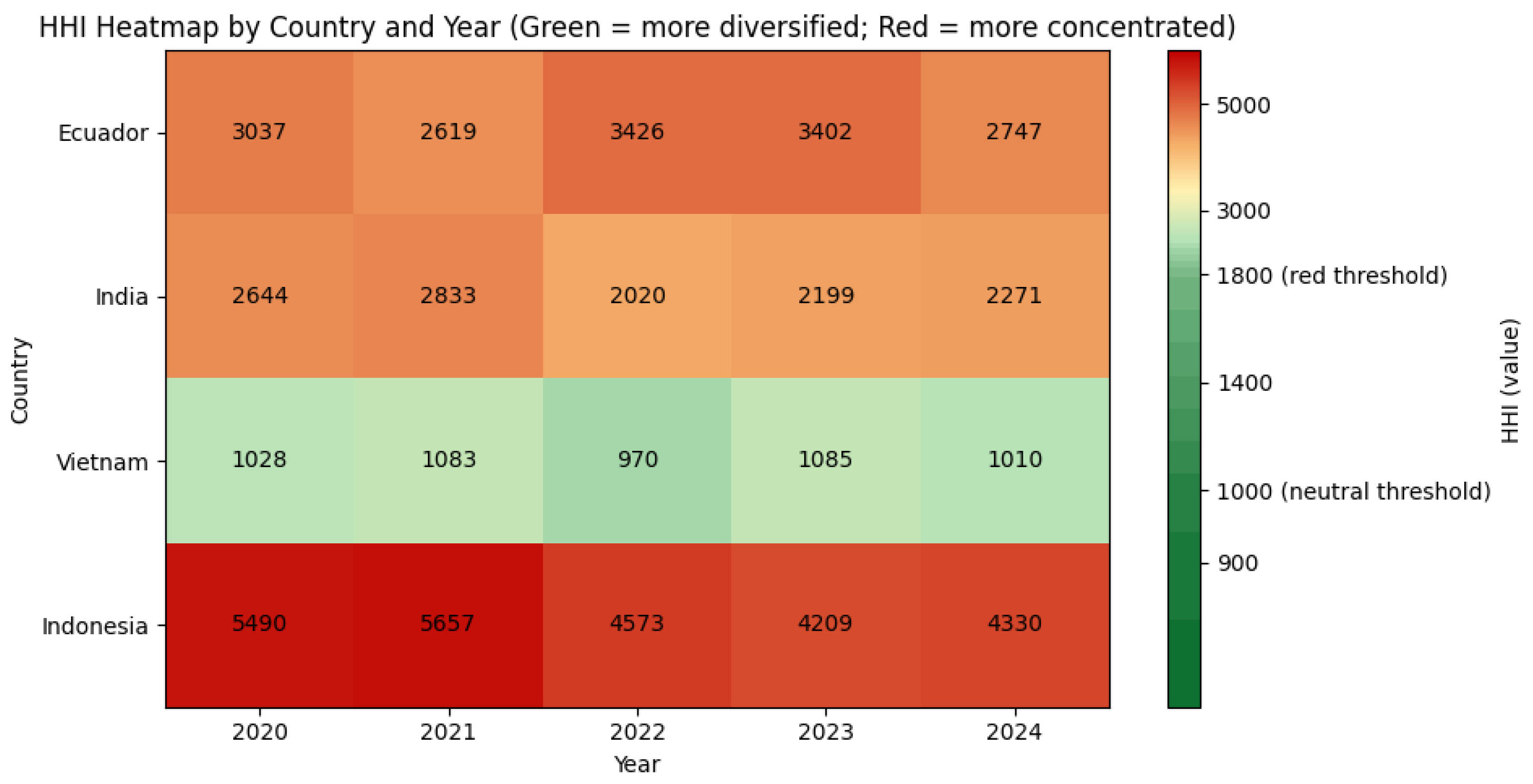
In Figure 1, the HHI heatmap shows clear differences in export concentration (red) and diversification (green) across countries from 2020 to 2024. Indonesia consistently records the highest HHI values (5490 in 2020 and 5657 in 2021), followed by a relative decline in 2022–2023 (4573 and 4209) and a slight rebound in 2024 (4330), indicating a persistently concentrated export structure. Vietnam exhibits the lowest and most stable HHI levels (970–1085), suggesting sustained diversification. Ecuador remains in a mid-to-high range (2619–3426), reflecting moderate concentration with fluctuations, while India shows a shift toward lower concentration from 2022 onward (2020–2271) compared with 2020–2021 (2644–2833), consistent with gradual diversification.
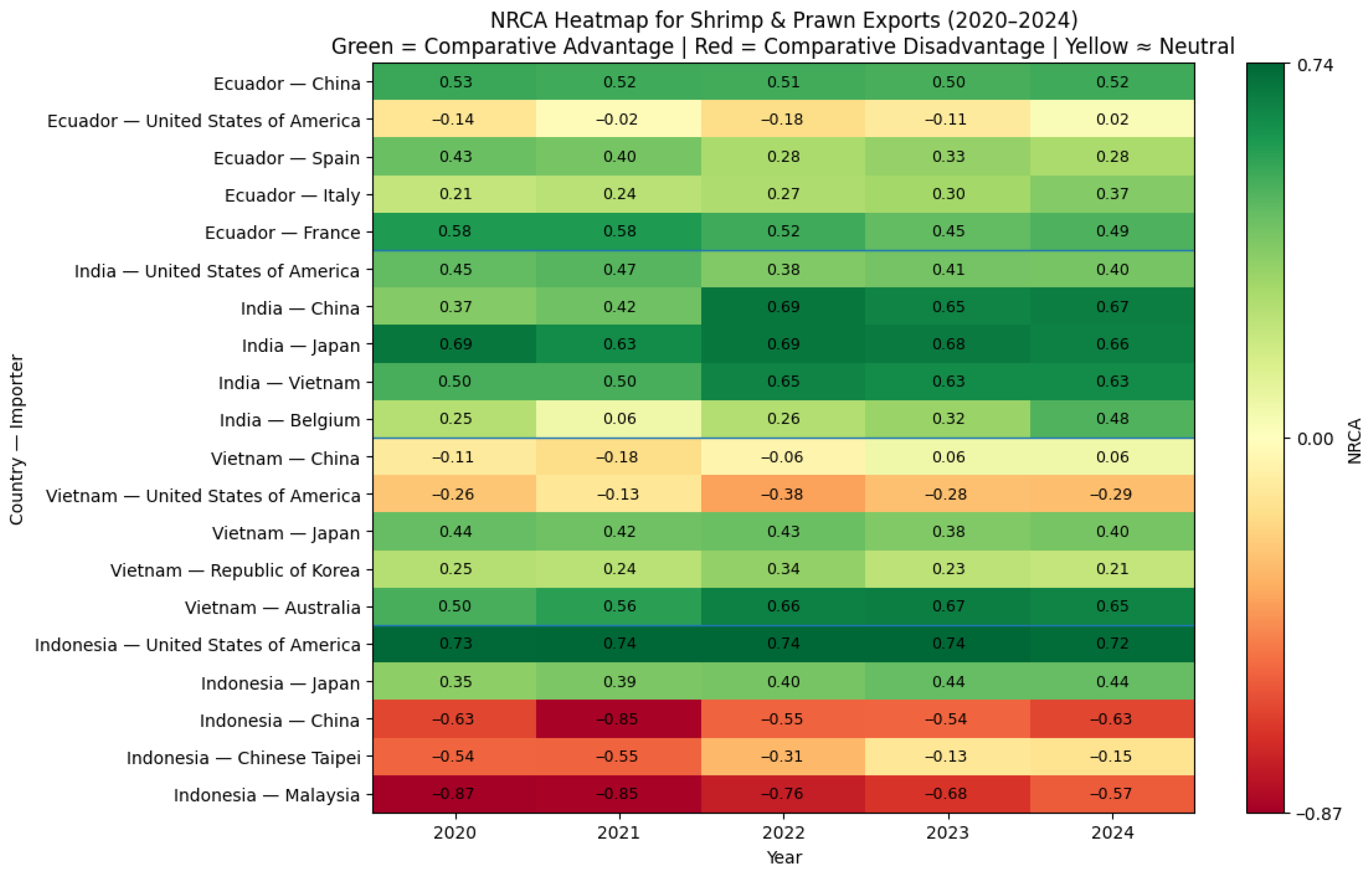
Figure 2 indicates that comparative advantage in shrimp and prawn exports is highly importer-specific across 2020–2024. Ecuador shows consistently positive NRCA (comparative advantage) toward China and France, and maintains positive values toward Spain and Italy, while its position with the United States of America remains mostly near-neutral to slightly negative (moving closer to neutral by 2024). India presents broadly positive and strengthening NRCA—especially with Japan and China—suggesting robust competitiveness, with a notable improvement toward Belgium by 2024. Vietnam is mixed: it remains negative with the United States of America, but positive with Japan, Republic of Korea, and Australia (the latter showing relatively strong advantage). Indonesia shows a very strong and stable advantage with the United States of America, but persistent disadvantage with China and Malaysia, although the disadvantage moderates over time; a similar partial recovery is observed with Chinese Taipei.

5. Discussion

The results indicate that shrimp and prawn export performance from 2020 to 2024 cannot be interpreted solely from total export value. A destination-based reading is required because export expansion and exposure can coexist depending on the degree of anchoring in major markets. Based on International Trade Center data [56], Ecuador shows expansion with a peak in 2022 followed by correction; India displays a surge and subsequent adjustment with stabilization; Vietnam exhibits relative stagnation with oscillations; and Indonesia records net contraction. This heterogeneity matters because the same change in totals can reflect either broad-based participation across destinations or movements concentrated in the dominant market, which has different implications for exposure when concentration is high [6]. At the same time, the descriptive design does not allow these trajectories to be attributed to specific shocks or policies, and the discussion should therefore be read as a critical positioning of observed patterns within the existing literature rather than as a causal account.
Destination concentration patterns reinforce the view that diversification is neither automatic nor monotonic. The Herfindahl Hirschman Index suggests persistent concentration for Ecuador, India, and Indonesia, and a largely moderate concentration profile for Vietnam, with limited episodes of dispersion. This configuration aligns with evidence that diversification can follow non-linear trajectories that include respecialization phases [18] and with the argument that openness and integration do not mechanically translate into deconcentration when productive and institutional constraints remain binding [20]. In this sense, the results support the literature that treats concentration as a practical exposure signal, because persistent concentration is typically associated with higher vulnerability to adverse external conditions [4]. However, the findings also invite a critical nuance: while concentration is commonly interpreted as exposure, the present evidence cannot evaluate whether the observed concentration is an inefficient outcome or a rational specialization equilibrium for each exporter. For Indonesia, the contraction observed during the period is compatible with constraints documented in perishable seafood trade, where distance and logistics capacity affect trade feasibility and the speed of rerouting to alternative corridors [32], but this compatibility should be interpreted as a plausible consistency with sector constraints rather than a tested mechanism.
Competitiveness patterns further indicate that the revealed advantage is market-specific and not necessarily transferable across destinations. The Normalized Revealed Comparative Advantage is suited to this setting because it improves comparability and reduces scale-related distortions [3], which is particularly relevant when comparing large exporters. Consistent with the literature on the limitations of traditional revealed comparative advantage measures [23], Ecuador and Vietnam display destination-differentiated competitiveness profiles, and the sign of competitiveness varies across markets within each exporter. Yet the coexistence of positive competitiveness in anchor markets with continued concentration suggests that competitiveness alone is not sufficient to generate a diversified destination structure. This observation is consistent with the role of market governance, standards, sanitary compliance, and traceability in conditioning access and sustaining commercial presence in high-value destinations [8]. India exhibits a comparatively broader advantage profile, suggesting that concentration may reflect the gravitational pull of large buyers and persistent commercial relationships rather than a purely competitiveness-constrained structure, which aligns with broader arguments on learning, export performance, and how market development and regulatory compatibility influence diversification prospects [17,19]. Vietnam shows a persistent disadvantage in a large-scale market, which is compatible with structural positioning barriers discussed in related research [37]. Indonesia displays an asymmetric pattern in which a strong advantage in the dominant destination coexists with disadvantages in alternatives, reinforcing that destination-specific competitiveness can deepen dependence when alternative markets remain weak and that interpretations based on gross exports should be cautious in light of value chain linkages and the limits of gross trade measures [34].
The joint reading of concentration and competitiveness clarifies a central result: positive revealed advantage does not imply low concentration. In several cases, competitiveness is strongest in the same destinations that account for the largest export shares, which is consistent with the analytical expectation that competitiveness may be concentrated in anchor markets while alternative destinations remain near neutral or disadvantaged. This configuration is relevant because resilience-oriented interpretations typically view diversification as a proxy for flexibility under external disturbances [22] and associate lower concentration with export resilience [54]. Nonetheless, the present results do not establish that reducing concentration would raise welfare or that any threshold represents an optimal target. Moreover, HHI should be interpreted with care because national-level dispersion can coexist with firm-level concentration, implying that exposure may remain concentrated among a small set of exporting firms even when destination shares appear more distributed [33]. Overall, the evidence suggests that performance sustainability is better characterized by whether competitiveness extends beyond anchor markets in value-meaningful terms, which is consistent with perspectives that link sustained performance to upgrading and learning processes [55].
Limitations of this study are substantial and should be stated explicitly. First, the analysis uses annual FOB values and therefore cannot disentangle changes in quantities from changes in unit prices, which is particularly relevant in a period marked by volatility. Second, the descriptive comparative design does not identify determinants or causal mechanisms. Third, the destination-level focus does not incorporate firm-level heterogeneity, and aggregation can conceal concentration within exporting firms [33]. Fourth, the analysis does not model non-tariff measures, certifications, sanitary events, or regulatory changes that may shape access and competitiveness, even though the literature suggests these factors are important in seafood trade [8,17].
These limitations point to clear directions for future research that the present descriptive evidence helps motivate. Explanatory work could test determinants of destination concentration and market-specific competitiveness using gravity models, panel designs, or event-based strategies around tariff or sanitary shocks, and could evaluate whether changes in concentration are associated with measurable changes in resilience or welfare.

6. Conclusions

Using a quantitative descriptive–comparative design, this study shows that combining destination diversification and revealed competitiveness provides a more informative characterization of shrimp and prawn export performance in Ecuador, India, Vietnam, and Indonesia during 2020–2024. Destination-level disaggregation reveals heterogeneous trajectories of expansion and adjustment, indicating that export performance is not fully captured by aggregate totals: changes in destination architecture and the degree of anchoring in major markets are also central to understanding observed trade patterns.
Two substantive conclusions follow from the joint reading of HHI and NRCA. First, concentration regimes (as captured by HHI) appear persistent in several cases, and short-term shifts in destination shares do not necessarily amount to sustained diversification. In descriptive terms, higher concentration is repeatedly observed alongside higher exposure to changes in dominant destinations, which is relevant for interpreting commercial sensitivity under external shocks. Second, NRCA patterns show that competitiveness is frequently market-specific: revealed advantage can be strong in one or a small set of destinations while remaining weak or near-neutral elsewhere. Consequently, competitiveness and destination structure represent distinct dimensions of export performance that may evolve in a decoupled manner.
Importantly, the study does not estimate an “optimal” level of concentration (HHI), nor does it identify causal mechanisms or welfare effects of diversification. Therefore, the findings should be interpreted as evidence of observed configurations (e.g., coexistence of high concentration and strong competitiveness; or market-specific revealed advantage under concentrated portfolios), rather than as proof that deconcentration improves welfare or that specific concentration targets should be pursued.
Within this scope, the results support practical, evidence-aligned suggestions focused on diagnosis and risk awareness rather than prescriptive policy targets. For firms and sector stakeholders, the integrated HHI–NRCA reading can be operationalized as a monitoring framework to (i) track dependence on dominant destinations over time, (ii) detect whether changes in total exports stem primarily from anchor markets or from broader destination participation, and (iii) identify where competitiveness is robust versus where it remains weak or near-neutral. Such monitoring can inform contingency planning, market intelligence priorities, and the sequencing of commercial actions (e.g., reinforcing positions in destinations where revealed advantage is already strong, while treating low/near-neutral NRCA markets as higher-uncertainty prospects requiring careful evaluation and phased engagement). For public agencies, the principal implication is analytical: routinely reporting concentration and market-specific competitiveness jointly may improve the visibility of exposure and help prioritize data-driven surveillance of destination-specific regulatory or demand disruptions.
Finally, given the limitations of the descriptive–comparative design, the use of annual FOB values, and the 2020–2024 window, future research should extend the analysis with quantities, unit prices, cost structures, logistics conditions, and destination-specific regulatory indicators. Explanatory approaches (e.g., gravity models, event-based designs around tariff or sanitary shocks, and firm-level or producing-region analyses) are needed to identify determinants and mechanisms behind changes in concentration and NRCA, and to evaluate whether diversification strategies generate measurable welfare or resilience gains.


Author Contributions

Conceptualization, L.A.O.G., A.M.S.Y. and F.L.P.L.; methodology, F.E.R.N. and F.L.P.L.; software, J.C.M.N., L.I.G.A. and C.E.M.O.; validation, P.R.M.O., C.E.M.O. and L.I.G.A.; formal analysis, J.C.M.N., P.R.M.O. and Y.P.S.R.; investigation, L.A.O.G. and L.I.G.A.; resources, C.E.M.O. and M.M.F.C.; data curation, J.C.M.N. and M.M.F.C.; writing—original draft preparation, F.E.R.N. and M.M.F.C.; writing—review and editing, F.E.R.N. and F.L.P.L.; visualization, L.A.O.G. and A.M.S.Y.; supervision, P.R.M.O. and Y.P.S.R.; project administration, A.M.S.Y. and Y.P.S.R. All authors have read and agreed to the published version of the manuscript.

Funding

This research received no external funding.

Institutional Review Board Statement

Not applicable.

Informed Consent Statement

Not applicable.

Data Availability Statement

The original contributions presented in this study are included in the article. Further inquiries can be directed to the corresponding author.

Conflicts of Interest

The authors declare no conflicts of interest.

References

  1. Balassa, B. Trade Liberalisation and “Revealed” Comparative Advantage. Manch. Sch. 1965, 33, 99–123. [Google Scholar] [CrossRef]
  2. Laursen, K. Revealed Comparative Advantage and the Alternatives as Measures of International Specialization. Eurasian Bus. Rev. 2015, 5, 99–115. [Google Scholar] [CrossRef]
  3. Yu, R.; Cai, J.; Leung, P. The Normalized Revealed Comparative Advantage Index. Ann. Reg. Sci. 2009, 43, 267–282. [Google Scholar] [CrossRef]
  4. Mano, H.; Combary, O. Effects of Export Diversification on Economic Vulnerability: The Case of WAEMU Countries. J. Int. Trade Econ. Dev. 2025, 34, 1872–1892. [Google Scholar] [CrossRef]
  5. Trinh, P.; Thuy, H. Export Diversification and Economic Growth: A Threshold Regression Approach for Emerging Markets and Developing Countries. Econ. J. Emerg. Mark. 2021, 13, 188–199. [Google Scholar] [CrossRef]
  6. Villarreal, H. Shrimp Farming Advances, Challenges, and Opportunities. J. World Aquac. Soc. 2023, 54, 1092–1095. [Google Scholar] [CrossRef]
  7. Boyd, C.; Davis, R.; Wilson, A.; Marcillo, F.; Brian, S.; McNevin, A. Resource Use in Whiteleg Shrimp Litopenaeus Vannamei Farming in Ecuador. J. World Aquac. Soc. 2021, 52, 772–788. [Google Scholar] [CrossRef]
  8. Kruk, S.; Toonen, H.; Bush, S. Digital Sustainability Assurance Governing Global Value Chains: The Case of Aquaculture. Regul. Gov. 2024, 18, 1153–1170. [Google Scholar] [CrossRef]
  9. Watanabe, H.; Ubukata, F. Does International Environmental Certification Change Local Production and Trade Practices? A Case Study of Shrimp Farming in Southern Vietnam. Hum. Ecol. 2023, 51, 781–794. [Google Scholar] [CrossRef]
  10. Chang, C.; McAleer, M.; Nguyen, D. US Antidumping Petitions and Revealed Comparative Advantage of Shrimp-exporting Countries. Rev. Aquac. 2019, 11, 782–792. [Google Scholar] [CrossRef]
  11. Ministerio de Producción, Comercio Exterior, Inversiones y Pesca. ANÁLISIS TRIMESTRAL COMERCIO EXTERIOR; Ministerio de Producción, Comercio Exterior, Inversiones y Pesca: Quito, Ecuador, 2024.
  12. Chandrasekar, V.; Geethalakshmi, V.; Suresh, A.; Gopal, N. Indian Marine Products Exports: Growth, Instability and Geographical Diversification. Indian J. Fish. 2024, 71, 149–156. [Google Scholar] [CrossRef]
  13. Islam, S. Product and Geographical Concentrations of Exports: Some Evidence for Selected Asian Countries. S. Asian Res. J. Bus. Manag. 2025, 7, 218–220. [Google Scholar] [CrossRef]
  14. Aranda, T.; Yuddy, C. Hit by US Tariffs, Indonesia Plans to Sell Shrimp to China Instead. Available online: https://www.reuters.com/world/china/hit-by-us-tariffs-indonesia-plans-sell-shrimp-china-instead-2025-08-06/ (accessed on 1 January 2026).
  15. Santhosha, K.; Naik, A.D.; Patil, G.I.; Yadava, C.G.; Srinivasulu, G.B. Raghavendra Export Performance and Trade Competitiveness of India’s Frozen Shrimps: A Temporal Analysis. Arch. Curr. Res. Int. 2024, 24, 427–436. [Google Scholar] [CrossRef]
  16. Vietnam Association of Seafood Exporters and Producers After 11 Months, Shrimp Exports Reach Nearly 3.6 Billion USD. Available online: https://seafood.vasep.com.vn/key-seafood-sectors/shrimp/news/after-11-months-shrimp-exports-reach-nearly-3-6-billion-usd-32420.html (accessed on 9 January 2026).
  17. Baylis, K.; Nogueira, L.; Fan, L.; Pace, K. Something Fishy in Seafood Trade? The Relation between Tariff and Non-tariff Barriers. Am. J. Agric. Econ. 2022, 104, 1656–1678. [Google Scholar] [CrossRef]
  18. Imbs, J.; Wacziarg, R. Stages of Diversification. Am. Econ. Rev. 2003, 93, 63–86. [Google Scholar] [CrossRef]
  19. Markakkaran, S.; Sridharan, P. Impact of Export Diversification on Economic Growth: A System GMM Approach. Int. J. Dev. Issues 2022, 21, 309–320. [Google Scholar] [CrossRef]
  20. Osakwe, P.; Santos-Paulino, A.; Dogan, B. Trade Dependence, Liberalization, and Exports Diversification in Developing Countries☆. J. Afr. Trade 2018, 5, 19. [Google Scholar] [CrossRef]
  21. Haddad, M.; Lim, J.J.; Pancaro, C.; Saborowski, C. Trade Openness Reduces Growth Volatility When Countries Are Well Diversified. Can. J. Econ./Rev. Can. D’économique 2013, 46, 765–790. [Google Scholar] [CrossRef]
  22. Barbieri, E.; Capoani, L.; Cattaruzzo, S.; Corò, G. Export Diversification Dimensions and Performance: Analysis and Industrial Policy Insights from Italian Territories over COVID-19 Shocks. Socio-Econ. Plann. Sci. 2024, 94, 101923. [Google Scholar] [CrossRef]
  23. Hinloopen, J.; Marrewijk, C. On the Empirical Distribution of the Balassa Index. Weltwirtsch. Arch. 2001, 137, 1–35. [Google Scholar] [CrossRef]
  24. Foster, J. Putting Social Preferences to Work: Can Revealed Preferences Predict Real Effort Provision? J. Econ. Psychol. 2014, 45, 128–140. [Google Scholar] [CrossRef]
  25. Stellian, R.; Danna-Buitrago, J.P. Revealed Comparative Advantage and Contribution-to-the-Trade-Balance Indexes. Int. Econ. 2022, 170, 129–155. [Google Scholar] [CrossRef]
  26. García Juárez, H.D.; Montes Ninaquispe, J.C.; Marquez Yauri, H.Y.; Rodríguez Abraham, A.R.; Corrales Otazú, C.D.; Apaza Miranda, S.J.; Suysuy Chambergo, E.J.; León Luyo, S.L.; Flores Castillo, M.M. Market Diversification and International Competitiveness of South American Coffee: A Comparative Analysis for Export Sustainability. Sustainability 2025, 17, 5091. [Google Scholar] [CrossRef]
  27. Montes, J.; Vasquez, K.; Ludeña, D.; Pantaleón, A.; Farías, J.; Suárez, F.; Escalona, E.; Arbulú-Ballesteros, M. Market Diversification and Competitiveness of Fresh Grape Exports in Peru. Sustainability 2024, 16, 2528. [Google Scholar] [CrossRef]
  28. Montes Ninaquispe, J.C.; Ludeña Jugo, D.A.; Blas Sanchez, J.E.; Cruz Salinas, L.E.; Flores Lezama, M.T.; Martel Acosta, R.; Pacheco Gonzales, I.B.; Guzmán Valle, M.d.l.Á. An Analysis of Market Diversification Strategy and Commercial Competitiveness in the Cocoa Bean Exporting Companies. Corp. Bus. Strategy Rev. 2025, 6, 178–186. [Google Scholar] [CrossRef]
  29. Montes Ninaquispe, J.C.; Castillo-Coronado, Y.D.M.; Chavesta Paico, S.J.; Carbonel Mendoza, J.L.; Vasquez Huatay, K.C.; Portilla Sampen, J.E.; Zegarra Escudero, H.T. Diversification and Revealed Comparative Advantage of Global Strawberry Exports, 2019–2023. In Proceedings of the 23rd LACCEI International Multi-Conference for Engineering, Education and Technology (LACCEI): “Engineering, Artificial Intelligence, and Sustainable Technologies in Service of Society”; Latin American and Caribbean Consortium of Engineering Institutions: Boca Raton, FL, USA, 2025. [Google Scholar]
  30. Corrales Otazú, C.D.; Apaza Miranda, S.J.; Montes Ninaquispe, J.C.; Arbulú Ballesteros, M.A.; Palma Vallejo, J.G.; Rodriguez Novoa, F.E.; Sandoval Reyes, C.J.; Sanchez García, I.E.; Reyes Aroca, M.A.; Medina Rodriguez, J.E. Diversification and Competitiveness of Banana Exports in the Andean Community Countries. Sustainability 2025, 17, 10685. [Google Scholar] [CrossRef]
  31. García, H.; Montes, J.; León, S.; Marquez, H.; Mendoza, C.; De La Cruz Ruiz, N.V.; Apaza Miranda, S.J.; Corrales Otazú, C.D.; Rodríguez Abraham, A.R.; Villanueva Butrón, G.V. Competitiveness and Diversification in Grape Exports: Keys to Their Sustainability in Global Markets. Agriculture 2025, 15, 1894. [Google Scholar] [CrossRef]
  32. Asche, F.; Straume, H.; Vårdal, E. Perish or Prosper: Trade Patterns for Highly Perishable Seafood Products. Agribusiness 2021, 37, 876–890. [Google Scholar] [CrossRef]
  33. Straume, H.-M.; Asche, F.; Oglend, A.; Gaasland, I.; Pettersen, I.K.; Sogn-Grundvåg, G. The Structure of Norwegian Seafood Trade. Mar. Policy 2024, 159, 105921. [Google Scholar] [CrossRef]
  34. Seung, C. Decomposing Global Value Chain (GVC) Income for World Fisheries. Mar. Policy 2022, 137, 104950. [Google Scholar] [CrossRef]
  35. Ling, B.H.; Leung, P.S.; Shang, Y.C. Export Performance of Major Cultured Shrimp Producers in the Japanese and US Markets. Aquac. Res. 1996, 27, 775–786. [Google Scholar] [CrossRef]
  36. Yu, R.; Cai, J.; Leung, P. AN EXPLORATORY PERFORMANCE ASSESSMENT OF SHRIMP EXPORTERS FOR THE U.S. MARKET. Aquac. Econ. Manag. 2008, 12, 225–251. [Google Scholar] [CrossRef]
  37. Khan, A.; Hossain, E.; Islam, S.; Rahman, T.; Dey, M.M. Shrimp Export Competitiveness and Its Determinants: A Novel Dynamic ARDL Simulations Approach. Aquac. Econ. Manag. 2023, 27, 221–248. [Google Scholar] [CrossRef]
  38. Montes, J.; Arbulú-Ballesteros, M.; Morales, A.; Salinas, L.; Farfán-Chilicaus, G.; Juárez, H.; Valle, M.; Sanchez, J. Diversification of Export Markets: A Literature Review. J. Educ. Soc. Res. 2024, 14, 260–275. [Google Scholar] [CrossRef]
  39. Saviotti, P.-P.; Pyka, A.; Jun, B. Diversification, Structural Change, and Economic Development. J. Evol. Econ. 2020, 30, 1301–1335. [Google Scholar] [CrossRef]
  40. Houngbedji, H.S. Diversification des Exportations et Vulnérabilité des Économies des Pays de l’Afrique Subsaharienne: Rôle de la Dépendance en Ressources Naturelles. Rev. Int. Écon. Lang. Fr. 2022, 7, 111–134. [Google Scholar] [CrossRef]
  41. Gnangnon, S.K. Export Product Concentration and Poverty Volatility in Developing Countries. Int. Trade J. 2024, 38, 221–244. [Google Scholar] [CrossRef]
  42. Ortiz, C.; Jiménez, D.; Jaramillo, M. Diversificación Productiva y Cambio Estructural en Economías Cerradas y Abiertas. Lect. Econ. 2019, 11–39. [Google Scholar] [CrossRef]
  43. Satnarine-Singh, N.; Hosein, R.; Saridakis, G. Structural Change and Export Diversification: A Comparison of CARICOM’s Position. J. Int. Trade Econ. Dev. 2024, 33, 1163–1189. [Google Scholar] [CrossRef]
  44. Prada Villamizar, E.; García Cediel, G. Concentración o Diversificación Exportadora Por Destinos: Un Análisis a Través del Índice Herfindahl Hirschmann en Santander, Colombia. Saber Cienc. Lib. 2016, 11, 111. [Google Scholar] [CrossRef]
  45. Cadot, O.; Carrère, C.; Strauss-Kahn, V. Export Diversification: What’s behind the Hump? Rev. Econ. Stat. 2021, 93, 590–605. [Google Scholar] [CrossRef]
  46. Canh, N.; Thanh, S. The Dynamics of Export Diversification, Economic Complexity and Economic Growth Cycles: Global Evidence. Foreign Trade Rev. 2022, 57, 234–260. [Google Scholar] [CrossRef]
  47. Mora, J.; Olabisi, M. Economic Development and Export Diversification: The Role of Trade Costs. Int. Econ. 2023, 173, 102–118. [Google Scholar] [CrossRef]
  48. Montes, J. Diversification and Corporate Strategy of Agricultural Products Exports from a Developing Country. Corp. Bus. Strategy Rev. 2025, 6, 138–148. [Google Scholar] [CrossRef]
  49. Irsahd, M.S.; Xin, Q. Determinants of Exports Competitiveness: An Empirical Analysis through Revealed Comparative Advantage of External Sector of Pakistan. Asian Econ. Financ. Rev. 2017, 7, 623–633. [Google Scholar] [CrossRef]
  50. Maqbool, M.S.; Rehman, H.u.; Bashir, F. Comparative Advantage in International Trade: A Study Based on Meat Exports in Pakistan. Rev. Appl. Manag. Soc. Sci. 2022, 5, 43–51. [Google Scholar] [CrossRef]
  51. Patelli, A.; Napolitano, L.; Cimini, G.; Pugliese, E.; Gabrielli, A. Capability Accumulation Patterns across Economic, Innovation, and Knowledge-Production Activities. Sci. Rep. 2023, 13, 12988. [Google Scholar] [CrossRef]
  52. Martínez Hernández, A.; Caamal Cauich, I. Revealed Comparative Advantage and Competitiveness of Mexican Mango Exports. Agro. Product. 2024, 17, 59–66. [Google Scholar] [CrossRef]
  53. Mabeta, J.; Smutka, L. Trade and Competitiveness of African Sugar Exports. Front. Sustain. Food Syst. 2023, 7, 1304383. [Google Scholar] [CrossRef]
  54. Burlutski, S.; Burlutska, S.; Berezianko, T. THE EXPORT DETERMINANT OF SOCIO-ECONOMIC RESILIENCE IN FOREIGN ECONOMIC ACTIVITY. J. Life Econ. 2019, 6, 413–420. [Google Scholar] [CrossRef]
  55. Gehl Sampath, P.; Vallejo, B. Trade, Global Value Chains and Upgrading: What, When and How? Eur. J. Dev. Res. 2018, 30, 481–504. [Google Scholar] [CrossRef]
  56. Trademap Exportaciones Mundiales. 2022. Available online: https://www.trademap.org/ (accessed on 1 January 2026).
  57. Montes Ninaquispe, J.C.; Arbulú Ballesteros, M.A.; Ludeña Jugo, D.A.; Escalona Aguilar, E.; Guzmán Valle Md l, A.; Cruz Salinas, L.E.; Farfán Chilicaus, G.C.; García Juárez, H.D. Agricultural products export strategy: Expanding reach through diversification. Corp. Bus. Strategy Rev. 2024, 5, 53–62. [Google Scholar] [CrossRef]
  58. Available online: https://laccei.org/LEIRD2023-VirtualEdition/meta/fp255.html (accessed on 1 July 2025).
Figure 1. Comparison of HHI.
Sustainability 18 01793 g001
Figure 2. Comparison of NRCA.
Sustainability 18 01793 g002
Table 1. Exports of shrimp and prawns from Ecuador (in millions of USD).
Importers20202021202220232024
China18532263424738653234
United States of America6541182151013641463
Spain242332399383361
Italy140174231266326
France184280269200247
Others554859111510131244
Total36275090776970936875
Note. Data taken from International Trade Center (2025) [56].
Table 2. Market diversification in Ecuador’s shrimp and prawn exports.
Years20202021202220232024
HHI in Value30372619342634022747
Note. Own elaboration.
Table 3. NRCA for Ecuador’s shrimp and prawn exports.
Importers20202021202220232024
China0.530.520.510.500.52
United States of America−0.14−0.02−0.18−0.110.02
Spain0.430.400.280.330.28
Italy0.210.240.270.300.37
France0.580.580.520.450.49
Note. Own elaboration.
Table 4. Exports of shrimp and prawns from India (in millions of USD).
Importers20202021202220232024
United States of America18112580188818121883
China572744872763752
Japan308351331269281
Vietnam184258291249245
Belgium106132174157187
Others8131082124010721033
Total37935149479743214381
Note. Data taken from International Trade Center (2025) [56].
Table 5. Market diversification in India’s shrimp and prawn exports.
Years20202021202220232024
HHI in Value26442833202021992271
Note. Own elaboration.
Table 6. NRCA for India’s shrimp and prawn exports.
Importers20202021202220232024
United States of America0.450.470.380.410.40
China0.370.420.690.650.67
Japan0.690.630.690.680.66
Vietnam0.500.500.650.630.63
Belgium0.250.060.260.320.48
Note. Own elaboration.
Table 7. Exports of shrimp and prawns from Vietnam (in millions of USD).
Importers20202021202220232024
China268264310365331
United States of America314500302290314
Japan340329368276275
Republic of Korea221239299201188
Australia76107163144146
Others723823814601675
Total19422261225618781929
Note. Data taken from International Trade Center (2025) [56].
Table 8. Market diversification in Vietnam’s shrimp and prawn exports.
Years20202021202220232024
HHI in Value1028108397010851010
Note. Own elaboration.
Table 9. NRCA for Vietnam’s shrimp and prawn exports.
Importers20202021202220232024
China−0.11−0.18−0.060.060.06
United States of America−0.26−0.13−0.38−0.28−0.29
Japan0.440.420.430.380.40
Republic of Korea0.250.240.340.230.21
Australia0.500.560.660.670.65
Note. Own elaboration.
Table 10. Exports of shrimp and prawns from Indonesia (in millions of USD).
Importers20202021202220232024
United States of America10181118933677677
Japan247270285232219
China6229978358
Chinese Taipei1113232220
Malaysia56111014
Others74931038798
Total14161531145211111086
Note. Data taken from International Trade Center (2025) [56].
Table 11. Market diversification in Indonesia’s shrimp and prawn exports.
Years20202021202220232024
HHI in Value54905657457342094330
Note. Own elaboration.
Table 12. NRCA for Indonesia’s shrimp and prawn exports.
Importers20202021202220232024
United States of America0.730.740.740.740.72
Japan0.350.390.400.440.44
China−0.63−0.85−0.55−0.54−0.63
Chinese Taipei−0.54−0.55−0.31−0.13−0.15
Malaysia−0.87−0.85−0.76−0.68−0.57
Note. Own elaboration.
Disclaimer/Publisher’s Note: The statements, opinions and data contained in all publications are solely those of the individual author(s) and contributor(s) and not of MDPI and/or the editor(s). MDPI and/or the editor(s) disclaim responsibility for any injury to people or property resulting from any ideas, methods, instructions or products referred to in the content.