Auditing Crisis Management at Work: A Toolkit Including Individual and Contextual Predictors


Abstract
1. Introduction
Crisis Management at Work
2. Individual and Collective Mindful Action
2.1. Dispositional Mindfulness Facets as Individual-Level Predictors of Crisis Management
2.2. Mindful Organizing Factors as Organizational-Level Predictors of Crisis Management
3. Study 1
3.1. Method
3.1.1. Sample and Procedure
3.1.2. Transparency and Openness
3.1.3. Measures
3.1.4. Analytical Strategy
3.2. Results
4. Study 2
4.1. Method
4.1.1. Sample and Procedure
4.1.2. Measures
4.1.3. Analytical Strategy
4.2. Results
4.2.1. Measurement Model
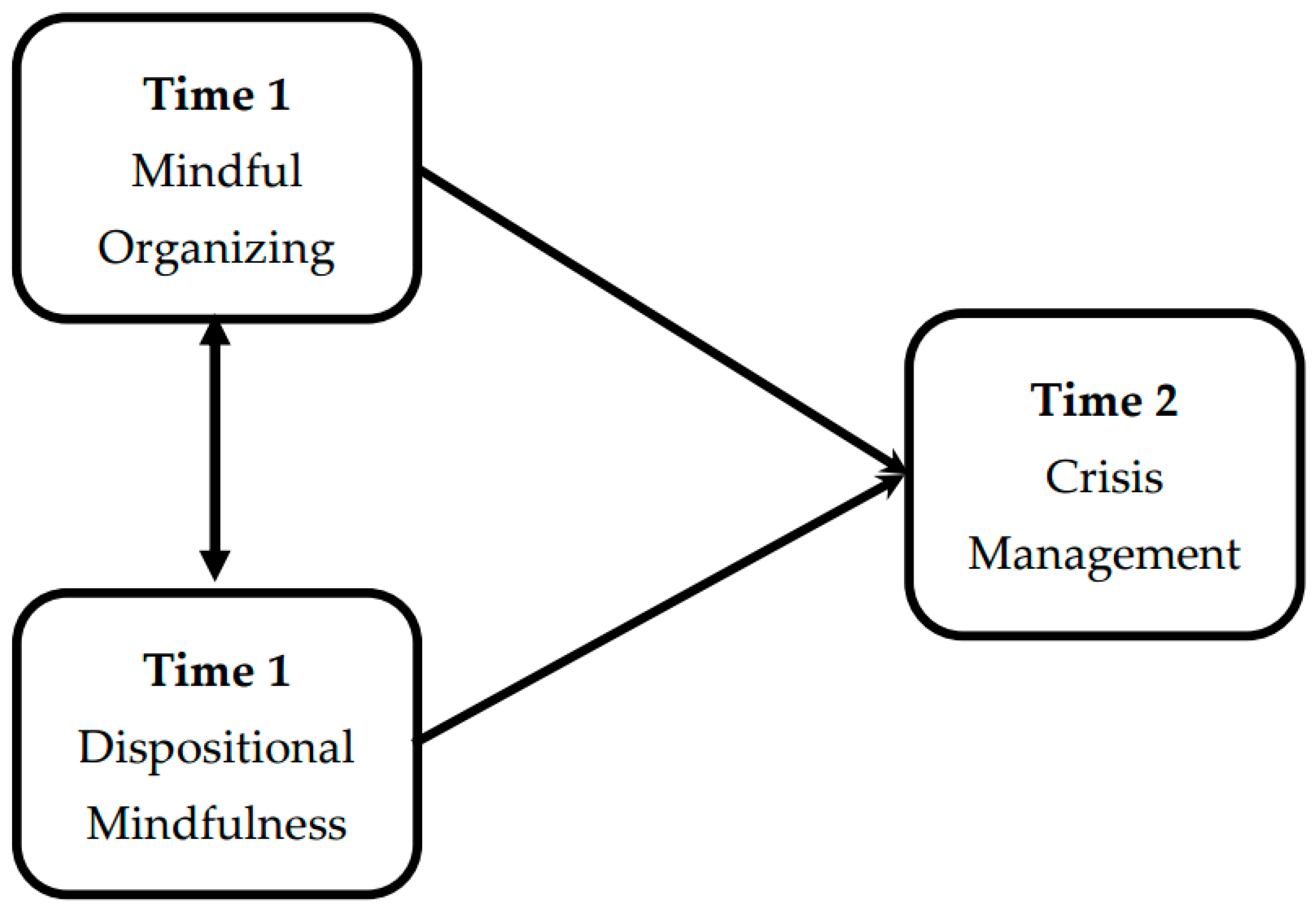
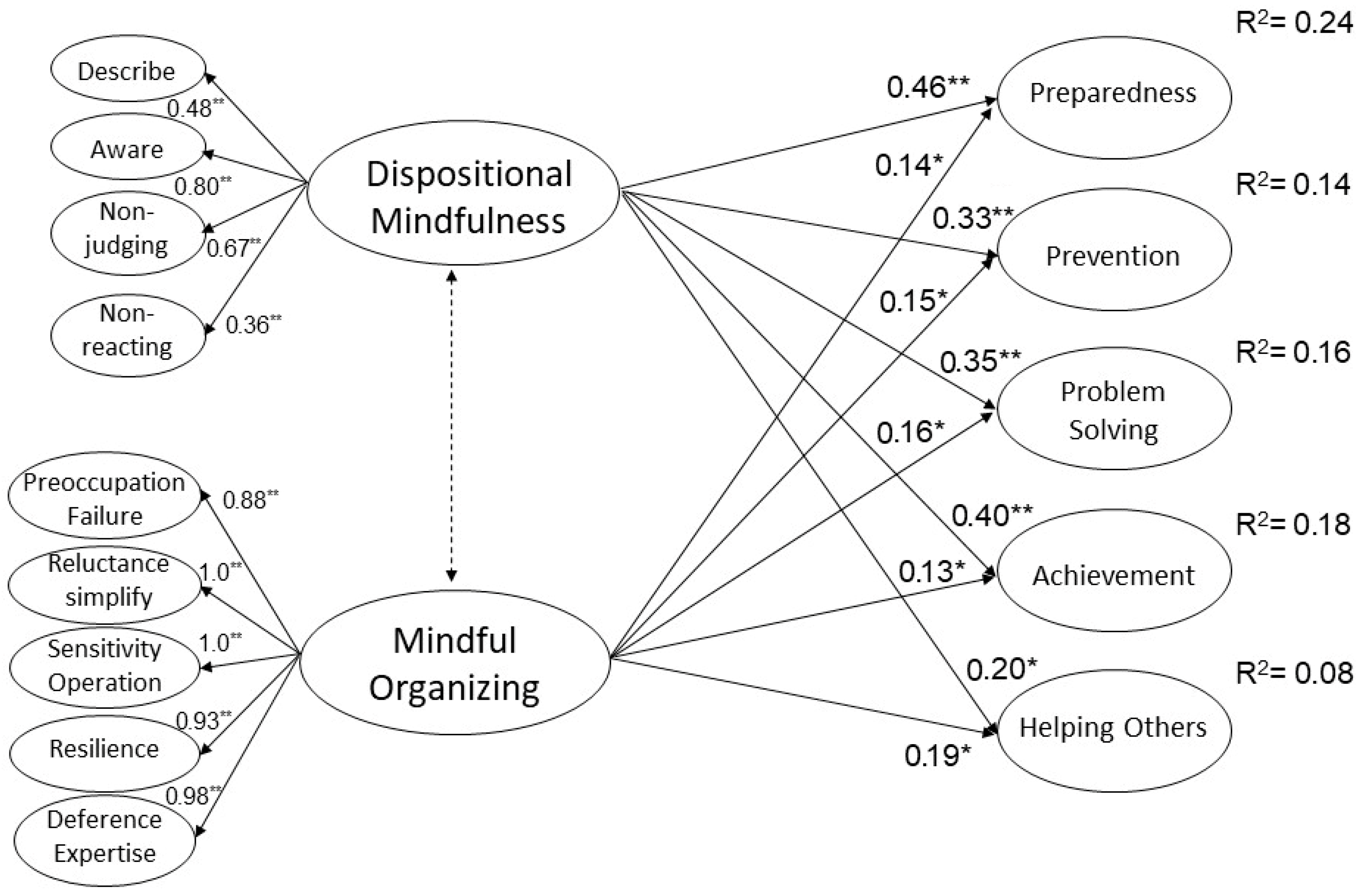
4.2.2. Structural Model for Hypotheses Testing
5. Discussion
5.1. Theoretical Implications
5.2. Implications for Practice
5.3. Strengths, Limitations and Future Directions
6. Conclusions
Author Contributions
Funding
Institutional Review Board Statement
Informed Consent Statement
Data Availability Statement
Conflicts of Interest
Appendix A
| Italian Version | English Version |
| Crisis Management at Work Scale | |
|
|
|
|
|
|
|
|
|
|
|
|
|
|
|
|
|
|
|
|
|
|
|
|
|
|
|
|
|
|
|
|
|
|
|
|
|
|
|
|
|
|
|
|
|
|
|
|
|
|
|
|
References
- Coombs, W.T. Protecting organization reputations during a crisis: The development and application of situational crisis communication theory. Corp. Reput. Rev. 2007, 10, 163–176. [Google Scholar] [CrossRef]
- Glaesser, D. Crisis Management in the Tourism Industry; Butterworth Heinemann: Oxford, UK, 2003. [Google Scholar]
- Boin, A. (Ed.) Crisis Management; Sage: London, UK, 2008; Volume III, pp. 1–340. [Google Scholar]
- Boin, A.; Hart, P. Public Leadership in Times of Crisis: Mission Impossible? Public Adm. Rev. 2003, 63, 544–553. [Google Scholar] [CrossRef]
- Weick, K.E.; Sutcliffe, K.M. Mindfulness and the quality of organizational attention. Organ. Sci. 2006, 16, 409–421. [Google Scholar] [CrossRef]
- Weick, K.E.; Sutfcliffe, K.M.; Obstfeld, D. Organizing for high reliability: Processes of collective mindfulness. In Research in Organizational Behavior; Staw, B.M., Cummings, L.L., Eds.; JAI Press: Greenwich, CT, USA, 1999; pp. 81–123. [Google Scholar]
- Baer, R. Assessment of mindfulness by self-report. Curr. Opin. Psychol. 2019, 28, 42–48. [Google Scholar] [CrossRef]
- Baer, R.A.; Smith, G.T.; Hopkins, J.; Krietemeyer, J.; Toney, L. Using self- report assessment methods to explore facets of mindfulness. Assessment 2006, 13, 27–45. [Google Scholar] [CrossRef]
- Piotrowski, C.; Watt, J.; Armstrong, T. The interdisciplinary nature of the field of crisis management: A call for research collaboration. Organ. Dev. J. 2010, 28, 87–93. [Google Scholar]
- Weick, K.E.; Sutcliffe, K.M.; Obstfeld, D. Organizing for high reliability: Processes of collective mindfulness. In Crisis Management; Boin, A., Ed.; Sage: London, UK, 2008; Volume III, pp. 31–66. [Google Scholar]
- Weick, K.E. Enacted sensemaking in crisis situations. J. Manag. Stud. 1988, 25, 305–317. [Google Scholar] [CrossRef]
- Bland, M. Communicating out of a Crisis; Macmillan Business: New York, NY, USA, 1998. [Google Scholar]
- Campbell, R. Crisis Control: Preventing & Managing Corporate Crises; Prentice Hall: Hoboken, NJ, USA, 1999. [Google Scholar]
- Coombs, T. Ongoing Crisis Communication: Planning, Managing, and Responding; SAGE: London, UK, 1999. [Google Scholar]
- Coombs, W.T.; Holladay, S.J. Helping crisis managers protect reputational assets: Initial tests of the situational crisis communication theory. Manag. Commun. Q. 2002, 16, 165–186. [Google Scholar] [CrossRef]
- Faulkner, B. Towards a framework for disaster management. Tour. Manag. 2001, 22, 135–147. [Google Scholar] [CrossRef]
- Moreira, P. Aftermath of crises and disasters: Notes for an impact assessment approach. In Crisis Management in Tourism; Laws, E., Prideaux, B., Chon, K., Eds.; CAB International: Oxford, UK, 2007; pp. 51–65. [Google Scholar]
- Pforr, C. Tourism policy in the making: An Australian network study. Ann. Tour. Res. 2006, 33, 87–108. [Google Scholar] [CrossRef]
- Ritchie, B.W. Chaos, crises and disasters: A strategic approach to crisis management in the tourism industry. Tour. Manag. 2004, 25, 669–683. [Google Scholar] [CrossRef]
- Ruff, P.; Aziz, K. Managing Communications in a Crisis; Gower Publishing: Hampshire, UK, 2003. [Google Scholar]
- Cambridge Dictionary. Crisis. 2004. Available online: https://dictionary.cambridge.org/dictionary/english/crisis (accessed on 10 December 2025).
- Merriam-Webster Online Dictionary. Crisis. 2005. Available online: https://www.merriam-webster.com/dictionary/crisis (accessed on 10 December 2025).
- Sönmez, S.F.; Backman, S.J.; Allen, L. Managing Tourism Crises: A Guidebook; Department of Parks, Recreation and Tourism Management, Clemson University: Clemson, SC, USA, 1994. [Google Scholar]
- Lerbinger, O. The Crisis Manager; Lawrence Erlbaum Associates: Mahwah, NJ, USA, 1997. [Google Scholar]
- Singh, R.; Nazki, A.A. The measurement of crisis management strategies in tourism. Development and validation of a scale. Turyzm Tour. 2023, 33, 133–144. [Google Scholar] [CrossRef]
- Ziakas, V.; Antchak, V.; Getz, D. Theoretical Perspectives of Crisis Management and Recovery for Events; Goodfellow Publishers: Oxford, UK, 2021. [Google Scholar] [CrossRef]
- Rosenthal, U.; Boin, A.; Comfort, L. The Changing World of Crises and Crisis Management. Managing Crises: Threats, Dilemmas, Opportunities; Charles C. Thomas Publishers: Springfield, IL, USA, 2001. [Google Scholar]
- Rosenthal, U.; Pijnenburg, B. Crisis Management and Decision Making: Simulation Oriented Scenarios; Kluwer Academic Publishers: Dordrecht, The Netherlands, 1991. [Google Scholar]
- Veil, S.; Reynolds, B.; Sellnow, T.L.; Seeger, M.W. CERC as a theoretical framework for research and practice. Health Promot. Pract. 2008, 9, 26S–34S. [Google Scholar] [CrossRef]
- Benoit, W.L. Image restoration discourse and crisis communication. Public Relat. Rev. 1997, 23, 177–186. [Google Scholar] [CrossRef]
- Park, S.; Avery, E. Development and validation of a crisis self-efficacy index. J. Contingencies Crisis Manag. 2019, 27, 247–256. [Google Scholar] [CrossRef]
- Plant, J.L.; van Schaik, S.M.; Sliwka, D.C.; Boscardin, C.K.; O’Sullivan, P.S. Self-Efficacy in Crisis Resource Management Instrument; APA PsycTests: Washington, DC, USA, 2011. [Google Scholar] [CrossRef]
- Reynolds, B.; Seeger, M.W. Crisis and emergency risk communication as an integrative model. J. Health Commun. 2005, 10, 43–55, Erratum in J. Health Commun. 2007, 12, 313. [Google Scholar] [CrossRef]
- Hannan, M.T.; Freeman, J. Structural inertia and organizational change. Am. Sociol. Rev. 1984, 49, 149–164. [Google Scholar] [CrossRef]
- Hollnagel, E. Human Reliability Analysis: Context and Control; Academic Press: London, UK, 1993. [Google Scholar]
- Bundy, J.; Pfarrer, M.D. A burden of responsibility: The role of social approval at the onset of a crisis. Acad. Manag. Rev. 2015, 40, 345–369. [Google Scholar] [CrossRef]
- James, E.H.; Wooten, L.P.; Dushek, K. Crisis management: Informing a new leadership research agenda. Acad. Manag. Ann. 2011, 5, 455–493. [Google Scholar] [CrossRef]
- Kahn, W.A.; Barton, M.A.; Fellows, S. Organizational crises and the disturbance of relational systems. Acad. Manag. Rev. 2013, 38, 377–396. [Google Scholar] [CrossRef]
- Keeler, J.T.S. Opening the Window for Reform: Mandates, Crises, and Extraordinary Policy-Making. In Crisis Management; Boin, A., Ed.; Sage: London, UK, 2008; Volume III, pp. 228–268. [Google Scholar]
- Aptekar, L.; Boore, J. The Emotional Effects of Disaster on Children: A Review of the Literature. In Crisis Management; Boin, A., Ed.; Sage: London, UK, 2008; Volume III, pp. 340–351. [Google Scholar]
- Gillespie, N.; Dietz, G. Trust repair after an organization-level failure. Acad. Manag. Rev. 2009, 34, 127–145. [Google Scholar] [CrossRef]
- James, E.H.; Wooten, L.P. Diversity crises: How firms manage discrimination lawsuits. Acad. Manag. J. 2006, 49, 1103–1118. [Google Scholar] [CrossRef]
- Pfarrer, M.D.; DeCelles, K.A.; Smith, K.G.; Taylor, M.S. After the fall: Reintegrating the corrupt organization. Acad. Manag. Rev. 2008, 33, 730–749. [Google Scholar] [CrossRef]
- Rhee, M.; Kim, T. After the collapse: A behavioral theory of reputation repair. In The Oxford Handbook of Corporate Reputation; Barnett, M.L., Pollock, T.G., Eds.; Oxford University Press: Oxford, UK, 2012; pp. 446–465. [Google Scholar]
- Diestre, L.; Rajagopalan, N. Toward an input-based perspective on categorization: Investor reactions to chemical accidents. Acad. Manag. J. 2014, 57, 1130–1153. [Google Scholar] [CrossRef]
- Dowell, G.W.; Shackell, M.B.; Stuart, N.V. Boards, CEOs, and surviving a financial crisis: Evidence from the internet shakeout. Strateg. Manag. J. 2011, 32, 1025–1045. [Google Scholar] [CrossRef]
- Lamin, A.; Zaheer, S. Wall Street vs. Main Street: Firm strategies for defending legitimacy and their impact on different stakeholders. Organ. Sci. 2012, 23, 47–66. [Google Scholar] [CrossRef]
- Lee, F.; Peterson, C.; Tiedens, L.Z. Mea culpa: Predicting stock prices from organizational attributions. Personal. Soc. Psychol. Bull. 2004, 30, 1636–1649. [Google Scholar] [CrossRef] [PubMed]
- Madsen, P.M. Perils and profits: A reexamination of the link between profitability and safety in U.S. aviation. J. Manag. 2013, 39, 763–791. [Google Scholar] [CrossRef]
- Paruchuri, S.; Misangyi, V.F. Investor perceptions of financial misconduct: The heterogeneous contamination of bystander firms. Acad. Manag. J. 2015, 58, 169–194. [Google Scholar] [CrossRef]
- Pfarrer, M.D.; Pollock, T.G.; Rindova, V.P. A tale of two assets: The effects of firm reputation and celebrity on earnings surprises and investors’ reactions. Acad. Manag. J. 2010, 53, 1131–1152. [Google Scholar] [CrossRef]
- Zyglidopoulos, S.C. The impact of accidents on firms’ reputation for social performance. Bus. Soc. 2001, 40, 416–441. [Google Scholar] [CrossRef]
- Bundy, J.; Pfarrer, M.D.; Short, C.E.; Coombs, W.T. Crises and crisis management: Integration, interpretation, and research development. J. Manag. 2017, 43, 1661–1692. [Google Scholar] [CrossRef]
- Drabeck, T.E.; Quarantelli, E.L. Scapegoats, Villains, and Disasters. In Crisis Management; Boin, A., Ed.; Sage: London, UK, 2008; Volume III, pp. 146–153. [Google Scholar]
- Gephart, R.P. Crisis Sensemaking and the Public Inquiry. In International Handbook of Organizational Crisis Management; Pearson, C.M., Roux-Dufort, C., Clair, J.A., Eds.; Sage Publications: London, UK, 2007; pp. 123–160. [Google Scholar] [CrossRef]
- Lampel, J.; Bhalla, A.; Jha, P.P. Model Growth: Do Employee-Owned Businesses Deliver Sustainable Performance? Cass Business School, City University London: London, UK, 2010. [Google Scholar]
- Stern, E. Crisis and Learning: A Conceptual Balance Sheet. In Crisis Management; Boin, A., Ed.; Sage: London, UK, 2008; Volume III, pp. 286–310. [Google Scholar]
- Brown, K.W.; Ryan, R.M. Perils and promise in defining and measuring mindfulness: Observations from experience. Clin. Psychol. Sci. Pract. 2004, 11, 242–248. [Google Scholar] [CrossRef]
- Gunaratana, H. Mindfulness in Plain English; Wisdom Publications: Boston, MA, USA, 1990. [Google Scholar]
- Kabat-Zinn, J. Full Catastrophe Living: How to Cope with Stress, Pain and Illness Using Mindfulness Meditation; Bantam Dell: New York, NY, USA, 1990. [Google Scholar]
- Walach, H.; Buchheld, N.; Buttenmüller, V.; Kleinknecht, N.; Schmidt, S. Measuring mindfulness: The Freiburg Mindfulness Inventory (FMI). Personal. Individ. Differ. 2006, 40, 1543–1555. [Google Scholar] [CrossRef]
- Kabat-Zinn, J. The Suspension of Distraction. Mindfulness 2020, 11, 2237–2238. [Google Scholar] [CrossRef]
- Langer, E.J. Minding matters: The consequences of mindlessness-mindfulness. In Advances in Experimental Social Psychology; Berkowitz, L., Ed.; Academic Press: San Diego, CA, USA, 1989; Volume 22, pp. 137–173. [Google Scholar]
- Dimidjian, S.; Linehan, M.M. Mindfulness practice. In Empirically Supported Techniques of Cognitive Behavior Therapy: A Step-by-Step Guide for Clinicians; O’Donohue, W., Fisher, J.E., Hayes, S.C., Eds.; John Wiley: New York, NY, USA, 2003. [Google Scholar]
- Rochlin, G.I. Informal organizational networking as a crisis avoidance strategy: U.S. naval flight operations as a case study. Ind. Crisis Q. 1989, 3, 159–176. [Google Scholar] [CrossRef]
- Morgeson, F.P.; Hofmann, D.A. The structure and function of collective constructs: Implications for multilevel research and theory development. Acad. Manag. Rev. 1999, 24, 249–265. [Google Scholar] [CrossRef]
- Vaughan, D. Uncoupling: Turning Points in Intimate Relationship; Oxford University Press: New York, NY, USA, 1986. [Google Scholar]
- March, J.G. A Primer on Decision Making: How Decisions Happen; Free Press: New York, NY, USA, 1994. [Google Scholar]
- LaPorte, T.R.; Consolini, P. Working in practice but not in theory: Theoretical challenges of high reliability organizations. J. Public Adm. Res. Theory 1991, 1, 19–47. [Google Scholar] [CrossRef]
- Sutcliffe, K.M. Mindful organizing. In Organizing for Reliability: A Guide for Research and Practice; Ramanujam, R., Roberts, K.H., Eds.; Stanford University Press: Stanford, CA, USA, 2018; pp. 61–88. [Google Scholar]
- Turner, B. Man-Made Disasters; Wykeham Publications: London, UK, 1978. [Google Scholar]
- Miller, T.E.; Woods, D.D. Key issues for naturalistic decision making researchers in system design. In Naturalistic Decision Making; Zsambok, C., Klein, G., Eds.; Erlbaum: Mahwah, NJ, USA, 1997; pp. 141–150. [Google Scholar]
- Vogus, T.J. Mindful organizing: Establishing and extending the foundations of highly reliable performance. In Handbook of Positive Organizational Scholarship; Cameron, K., Spreitzer, G.M., Eds.; Oxford University Press: Oxford, UK, 2011; pp. 664–676. [Google Scholar]
- Van Dyck, C.; Frese, M.; Baer, M.; Sonnentag, S. Organizational error management culture and its impact on performance: A two-study replication. J. Appl. Psychol. 2005, 90, 1228–1240. [Google Scholar] [CrossRef]
- Sutcliffe, K.M.; Vogus, T.J. Organizing for resilience. In Positive Organizational Scholarship: Foundations of a New Discipline; Cameron, K.S., Dutton, J.E., Quinn, R.E., Eds.; Berrett-Koehler: San Francisco, CA, USA, 2003; pp. 94–110. [Google Scholar]
- Roberts, K.H.; Stout, S.K.; Halpern, J.J. Decision dynamics in two high reliability military organizations. Manag. Sci. 1994, 40, 614–624. [Google Scholar] [CrossRef]
- Muthén, L.K.; Muthén, B.O. Mplus User’s Guide: Statistical Analysis with Latent Variables, 7th ed.; Muthén & Muthén: Los Angeles, CA, USA, 2017. [Google Scholar]
- Coutinho, C.P. Metodologias de Investigação em Ciências Sociais e Humanas: Teoria e Prática; Almedina: Coimbra, Portugal, 2021. [Google Scholar]
- Browne, M.W.; Cudeck, R. Alternative ways of assessing model fit. In Testing Structural Equation Models; Bollen, K.A., Long, J.S., Eds.; Sage: Newbury Park, CA, USA, 1993; pp. 136–162. [Google Scholar]
- Hu, L.; Bentler, P.M. Fit indices in covariance structure modeling: Sensitivity to underparameterized model misspecification. Psychol. Methods 1998, 3, 424–453. [Google Scholar] [CrossRef]
- Tabachnick, B.G.; Fidell, L.S. Using Multivariate Statistics, 3rd ed.; Harper Collins: New York, NY, USA, 1996. [Google Scholar]
- Podsakoff, P.M.; MacKenzie, S.B.; Lee, J.-Y.; Podsakoff, N.P. Common method biases in behavioral research: A critical review of the literature and recommended remedies. J. Appl. Psychol. 2003, 88, 879–903. [Google Scholar] [CrossRef]
- Brislin, R. Translation and content analysis of oral and written material. In Handbook of Cross-Cultural Psychology; Triandis, H.C., Berry, J.W., Eds.; Allyn & Bacon: Boston, MA, USA, 1980; pp. 389–444. [Google Scholar]
- Giovannini, C.; Giromini, L.; Bonalume, L.; Tagini, A.; Lang, M.; Amadei, G. The Italian Five Facet Mindfulness Questionnaire: A contribution to its validity and reliability. J. Psychopathol. Behav. Assess. 2014, 36, 415–423. [Google Scholar] [CrossRef]
- Weick, K.E.; Sutcliffe, K.M. Managing the Unexpected: Resilient Performance in an Age of Uncertainty, 2nd ed.; Jossey-Bass: New York, NY, USA, 2007. [Google Scholar]
- Vogus, T.J.; Sutcliffe, K.M. The safety organizing scale: Development and validation of a behavioral measure of safety culture in hospital nursing units. Med. Care 2007, 45, 46–54. [Google Scholar] [CrossRef] [PubMed]
- Little, T.D. Longitudinal Structural Equation Modeling; Guilford Press: New York, NY, USA, 2013. [Google Scholar]
- Bentler, P.M.; Chou, C. Practical Issues in Structural Modeling. Sociol. Methods Res. 1987, 16, 78–117. [Google Scholar] [CrossRef]
- Little, T.D.; Rhemtulla, M.; Gibson, K.; Schoemann, A.M. Why the items versus parcels controversy needn’t be one. Psychol. Methods 2013, 18, 285–300. [Google Scholar] [CrossRef]
- Little, T.D.; Rioux, C.; Odejimi, O.A.; Stickley, Z.L. Parceling in Structural Equation Modeling: A Comprehensive Introduction for Developmental Scientists; Cambridge University Press: Cambridge, UK, 2022. [Google Scholar]
- Nabi, R.L. Exploring the framing effects of emotion: Do discrete emotions differentially influence information accessibility, information seeking, and policy preference? Commun. Res. 2003, 30, 224–247. [Google Scholar] [CrossRef]
- Jin, Y.; Pang, A.; Cameron, G.T. Toward a publics-driven, emotion-based conceptualization in crisis communication: Unearthing dominant emotions in multi-staged testing of the Integrated Crisis Mapping (ICM) Model. J. Public Relat. Res. 2012, 24, 266–298. [Google Scholar] [CrossRef]
- Kim, H.J.; Cameron, G.T. Emotions matter in crisis: The role of anger and sadness in the publics’ response to crisis news framing and corporate crisis response. Commun. Res. 2011, 38, 826–855. [Google Scholar] [CrossRef]
- Hofstede, H.; Hofstede, G.J.; Minkov, M. Cultures and Organizations: Software of the Mind, 3rd ed.; McGraw-Hill USA: New York, NY, USA, 2010. [Google Scholar]
- Pearson, C.M.; Clair, J.A. Reframing Crisis Management. Acad. Manag. Rev. 1998, 23, 59–76. [Google Scholar] [CrossRef]
- Kim, S.; Wertz, E. Predictors of Organization’s Crisis Communication Approaches: Full Versus Limited Disclosure. Public Relat. Rev. 2013, 39, 238–240. [Google Scholar] [CrossRef]
- Petitta, L.; Sinato, E.; Giannelli, M.T.; Palange, M. Implementing Mindfulness in General Life and Organizations. Validation of the Time Flow Mindfulness Questionnaire for Effective Health Management. Front. Psychol. 2022, 13, 832784. [Google Scholar] [CrossRef]
- Westrum, R. Social factors in safety-critical systems. In Human Factors in Safety Critical Systems; Redmill, F., Rajan, J., Eds.; Butterworth-Heinemann: London, UK, 1997; pp. 233–256. [Google Scholar]
- Roberts, K.H.; Libuser, C. From bhopal to banking: Organizational design can mitigate risk. Organ. Dyn. 1993, 21, 15–26. [Google Scholar] [CrossRef]
- Landau, M.; Chisholm, D. The arrogance of optimism: Notes on failure avoidance management. J. Contingencies Crisis Manag. 1995, 3, 67–80. [Google Scholar] [CrossRef]
- Petitta, L.; Ghezzi, V. Remote, Disconnected, or Detached? Examining the Effects of Psychological Disconnectedness and Cynicism on Employee Performance, Wellbeing, and Work–Family Interface. Int. J. Environ. Res. Public Health 2023, 20, 6318. [Google Scholar] [CrossRef] [PubMed]
- Tamuz, M. Developing organizational safety information systems for monitoring potential dangers. In Proceedings of PSAM; Apostolakis, G.E., Win, T.S., Eds.; University of California: Los Angeles, CA, USA, 1994; Volume 2, pp. 7–12. [Google Scholar]
- Edmondson, A.C. Learning from mistakes is easier said than done: Group and organizational influences on the detection and correction of human error. J. Appl. Behav. Sci. 1996, 32, 5–28. [Google Scholar] [CrossRef]
- Schulman, P.R. The negotiated order of organizational reliability. Adm. Soc. 1993, 25, 353–372. [Google Scholar] [CrossRef]
- Petitta, L.; Martínez-Córcoles, M. A conceptual model of mindful organizing for effective safety and crisis management. The role of organizational culture. Curr. Psychol. 2023, 42, 25773–25792. [Google Scholar] [CrossRef]
- Petitta, L.; Borgogni, L. Differential correlates of group and organizational collective efficacy. Eur. Psychol. 2011, 16, 187–197. [Google Scholar] [CrossRef]
- Segal, Z.V.; Williams, J.M.G.; Teasdale, J.D. Mindfulness Based Cognitive Therapy for Depression: A New Approach to Preventing Relapse; Guilford: New York, NY, USA, 2002. [Google Scholar]
- Bishop, S.R.; Lau, M.; Shapiro, S.; Carlson, L.; Anderson, N.C.; Carmody, J.; Segal, Z.V.; Abbey, S.; Speca, M.; Velting, D.; et al. Mindfulness: A proposed operational definition. Clin. Psychololgy Sci. Pract. 2004, 11, 230–241. [Google Scholar] [CrossRef]
- Linehan, M.M. Skills Training Manual for Treating Borderline Personality Disorder; Guilford: New York, NY, USA, 1993. [Google Scholar]
- Birtwell, K.; Williams, K.; Van Marwijk, H.; Armitage, C.J.; Sheffield, D. An Exploration of Formal and Informal Mindfulness Practice and Associations with Wellbeing. Mindfulness 2019, 10, 89–99. [Google Scholar] [CrossRef] [PubMed]
- Feldman, G.; Hayes, A.; Kumar, S.; Greeson, J.; Laurenceau, J.P. Mindfulness and emotion regulation: The development and initial validation of the Cognitive and Affective Mindfulness Scale-Revised (CAMS-R). J. Psychopathol. Behav. Assess. 2007, 29, 177–190. [Google Scholar] [CrossRef]
- Kabat-Zinn, J. Mindfulness-based interventions in context: Past, present, and future. Clin. Psychol. Sci. Pract. 2003, 10, 144–156. [Google Scholar] [CrossRef]
- Walsh, R.; Shapiro, S.L. The meeting of meditative disciplines and western psychology: A mutually enriching dialogue. Am. Psychol. 2006, 61, 227–239. [Google Scholar] [CrossRef]
- Hubbard, D. The Failure of Risk Management: Why It’s Broken and How to Fix It; John Wiley & Sons: Hoboken, NJ, USA, 2009. [Google Scholar]
- Vasvári, T. Risk, Risk Perception, Risk Management—A Review of the Literature. Public Financ. Q. Corvinus Univ. Bp. 2015, 60, 29–48. [Google Scholar]
- Gabriel, K.P.; Aguinis, H. How to prevent and combat employee burnout and create healthier workplaces during crises and beyond. Bus. Horiz. 2022, 65, 183–192. [Google Scholar] [CrossRef]
- Deffner, D.; Rohrer, J.M.; McElreath, R. A Causal Framework for Cross-Cultural Generalizability. Adv. Methods Pract. Psychol. Sci. 2022, 5. [Google Scholar] [CrossRef]



| N | df | χ2 | χ2/df | CFI | TLI | RMSEA | SRMR | |
|---|---|---|---|---|---|---|---|---|
| Exploratory Factor Analyses (EFA) | ||||||||
| 1-factor EFA CMWS | 771 | 299 | 1543.279 | 5.16 | 0.84 | 0.83 | 0.073 | 0.055 |
| 2-factor EFA CMWS | 771 | 274 | 1043.201 | 3.80 | 0.90 | 0.89 | 0.060 | 0.039 |
| 3-factor EFA CMWS | 771 | 250 | 861.008 | 3.44 | 0.92 | 0.90 | 0.056 | 0.031 |
| 4-factor EFA CMWS | 771 | 227 | 606.356 | 2.67 | 0.95 | 0.93 | 0.047 | 0.024 |
| 5-factor EFA CMWS | 771 | 205 | 473.424 | 2.30 | 0.97 | 0.95 | 0.041 | 0.020 |
| M | SD | α | 1 | 2 | 3 | 4 | |
|---|---|---|---|---|---|---|---|
| 1. Prevention | 4.90 | 0.81 | 0.83 | ||||
| 2. Preparedness | 4.75 | 0.90 | 0.91 | 0.69 ** | |||
| 3. Problem Solving | 4.94 | 0.86 | 0.88 | 0.70 ** | 0.73 ** | ||
| 4. Achievement | 4.90 | 0.83 | 0.88 | 0.73 ** | 0.79 ** | 0.76 ** | |
| 5. Helping Others | 4.94 | 0.85 | 0.85 | 0.64 ** | 0.61 ** | 0.67 ** | 0.66 ** |
| Variable | M | SD | 1 | 2 | 3 | 4 | 5 | 6 | 7 | 8 | 9 | 10 | 11 | 12 | 13 | |
|---|---|---|---|---|---|---|---|---|---|---|---|---|---|---|---|---|
| 1. Prevention T2 | 4.89 | 0.77 | 0.83 | |||||||||||||
| 2. Preparedness T2 | 4.74 | 0.87 | 0.65 ** | 0.91 | ||||||||||||
| 3. Problem Solving T2 | 4.93 | 0.81 | 0.70 ** | 0.77 ** | 0.87 | |||||||||||
| 4. Achievement T2 | 4.88 | 0.77 | 0.71 ** | 0.82 ** | 0.80 ** | 0.88 | ||||||||||
| 5. Helping Others T2 | 4.90 | 0.81 | 0.58 ** | 0.58 ** | 0.60 ** | 0.61 ** | 0.84 | |||||||||
| 6. Describing T1 | 3.41 | 0.69 | 0.16 ** | 0.24 ** | 0.18 ** | 0.19 ** | 0.21 ** | 0.86 | ||||||||
| 7. Aware T1 | 3.67 | 0.78 | 0.25 ** | 0.33 ** | 0.26 ** | 0.28 ** | 0.18 ** | 0.33 ** | 0.90 | |||||||
| 8. Non-judging T1 | 3.45 | 0.73 | 0.10 ** | 0.24 ** | 0.15 ** | 0.17 ** | 0.01 | 0.22 ** | 0.50 ** | 0.86 | ||||||
| 9. Non-reacting T1 | 3.03 | 0.54 | 0.18 ** | 0.20 ** | 0.21 ** | 0.24 ** | 0.14 ** | 0.36 ** | 0.14 ** | 0.10 * | 0.70 | |||||
| 10. Preoccupation Failure T1 | 3.37 | 0.64 | 0.15 ** | 0.12 * | 0.14 ** | 0.12 * | 0.15 ** | 0.05 | 0.01 | −0.09 | 0.14 ** | 0.70 | ||||
| 11. Reluctance Simplify T1 | 3.17 | 0.65 | 0.12 * | 0.13 ** | 0.13 ** | 0.15 ** | 0.17 ** | 0.07 | 0.07 | 0.01 | 0.16 ** | 0.66 ** | 0.63 | |||
| 12. Sensitivity Operations T1 | 3.13 | 0.71 | 0.13 ** | 0.12 * | 0.14 ** | 0.12 * | 0.16 ** | 0.00 | 0.01 | −0.03 | 0.10 * | 0.63 ** | 0.64 ** | 0.83 | ||
| 13. Resilience T1 | 3.22 | 0.69 | 0.10 | 0.13 * | 0.16 ** | 0.12 * | 0.14 ** | 0.04 | −0.01 | −0.10 | 0.10 * | 0.59 ** | 0.58 ** | 0.73 ** | 0.79 | |
| 14. Deference Expertise T1 | 3.52 | 0.70 | 0.12 * | 0.12 * | 0.10 * | 0.08 | 0.14 ** | 0.07 | 0.08 | −0.00 | 0.15 ** | 0.60 ** | 0.55 ** | 0.71 ** | 0.66 ** | 0.81 |
Disclaimer/Publisher’s Note: The statements, opinions and data contained in all publications are solely those of the individual author(s) and contributor(s) and not of MDPI and/or the editor(s). MDPI and/or the editor(s) disclaim responsibility for any injury to people or property resulting from any ideas, methods, instructions or products referred to in the content. |
© 2026 by the authors. Licensee MDPI, Basel, Switzerland. This article is an open access article distributed under the terms and conditions of the Creative Commons Attribution (CC BY) license.
Share and Cite
Petitta, L.; Ghezzi, V. Auditing Crisis Management at Work: A Toolkit Including Individual and Contextual Predictors. Sustainability 2026, 18, 1755. https://doi.org/10.3390/su18041755
Petitta L, Ghezzi V. Auditing Crisis Management at Work: A Toolkit Including Individual and Contextual Predictors. Sustainability. 2026; 18(4):1755. https://doi.org/10.3390/su18041755
Chicago/Turabian StylePetitta, Laura, and Valerio Ghezzi. 2026. "Auditing Crisis Management at Work: A Toolkit Including Individual and Contextual Predictors" Sustainability 18, no. 4: 1755. https://doi.org/10.3390/su18041755
APA StylePetitta, L., & Ghezzi, V. (2026). Auditing Crisis Management at Work: A Toolkit Including Individual and Contextual Predictors. Sustainability, 18(4), 1755. https://doi.org/10.3390/su18041755