Article

Multi-Objective Optimization Design of High-Power Permanent Magnet Synchronous Motor Based on Surrogate Model

1
Guangxi University, Nanning 530004, China
2
School of Mechanical Engineering, Guangxi University, Nanning 530004, China
3
Guangxi Liugong Yuanxiang Technology Co., Ltd., Liuzhou 545000, China
*
Author to whom correspondence should be addressed.
Sustainability 2026, 18(3), 1705; https://doi.org/10.3390/su18031705
Submission received: 25 December 2025 / Revised: 25 January 2026 / Accepted: 4 February 2026 / Published: 6 February 2026
(This article belongs to the Section Energy Sustainability)

Abstract

Energy scarcity has evolved into one of the most pressing challenges confronting the global community today. Fuel-driven loaders suffer from drawbacks such as high fuel consumption, low energy conversion efficiency, and heavy pollution, which not only aggravate atmospheric environmental pollution but also exacerbate the global energy crisis, directly undermining sustainable development goals. In contrast, permanent magnet synchronous motors (PMSMs) have become the preferred choice for the electrification of loaders owing to their exceptional torque density, strong overload capacity, and high reliability. However, during the optimal design of high-power interior permanent magnet synchronous motors (IPMSMs), traditional methods encounter issues with inadequate optimization efficiency and excessive computational expenses, thus hindering the large-scale deployment of power systems for eco-friendly loaders. Therefore, this paper takes a 125 kW, 3000 rpm IPMSM as the research object and proposes a multi-objective optimization strategy integrating a high-precision surrogate model with modern intelligent algorithms. This approach not only enhances motor performance but also cuts down computational overhead, which holds considerable significance for reducing industrial carbon emissions and driving the sustainable development of the manufacturing industry. Taking the key performance of IPMSM as the optimization objective and the related structural parameters as the optimization variables, the multi-performance characteristic index, interaction effect and comprehensive sensitivity of the variables are calculated and analyzed by fuzzy Taguchi experiment, and the hierarchical dimension reduction in the variables is completed. The Multicriteria Optimal-Latin Hypercube Sampling (MO-LHS) method is adopted to construct the sample data space, and a back-propagation neural network (BPNN) surrogate model is used to predict and fit the motor performance. The second-generation non-dominated sorting genetic algorithm (NSGA-II) is employed for iterative optimization, and the optimized motor dimension parameters are obtained through the Pareto optimal solution. Finally, through finite element analysis (FEA) and experiments, the rated torques obtained are 417.6 N·m and 425.1 N·m, respectively, with an error not exceeding 1.8%. This verifies the correctness and effectiveness of the proposed multi-objective optimization method based on the surrogate model.

1. Introduction

Fuel-driven loaders are characterized by drawbacks such as high fuel consumption, low energy conversion efficiency, and severe pollution, which not only aggravate atmospheric environmental pollution but also intensify the global energy crisis, directly undermining sustainable development goals. Therefore, pure electric loaders, as an effective solution to address the energy crisis and excessive carbon emissions, have emerged as a cutting-edge direction in the evolution of the intelligent equipment manufacturing industry [1]. Currently, centralized drive configuration is commonly adopted in electric loaders, featuring stable structure and low manufacturing cost [2]. In terms of drive motor selection, asynchronous motors are limited by their volume and power density, rendering them unable to satisfy the requirements of loaders with compact space and high power demands; switched reluctance motors have restricted applicability due to large torque ripple and noise. In contrast, PMSMs possess advantages including high efficiency, strong overload capacity, low torque ripple, and high reliability, and have consequently emerged as the preferred drive solution for current electric loaders.
The optimal design of motors usually needs to consider multiple performance indicators to achieve the best overall performance through global optimization. Therefore, multi-objective optimization methods based on modern intelligent optimization algorithms have emerged as a research hotspot in the motor research domain [3]. Commonly used modern intelligent optimization algorithms include differential evolution algorithm [4], particle swarm optimization algorithm [5], ant colony algorithm [6], Taguchi method [7], and multi-objective genetic algorithm [8], etc. These optimization algorithms can all achieve good results, but when utilized for the high-dimensional nonlinear scenario of motor multi-objective optimization design, accurate analysis and overall optimization usually require substantial finite element computing resources and are time-consuming, which limits the motor development process [9]. To address this issue, scholars have proposed a range of data-driven surrogate models [10] and combined them with intelligent optimization algorithms to complete the process of improving motor performance in a shorter computing time. Commonly used data-driven surrogate models include Kriging model [11], Response Surface Methodology (RSM) model [12], Artificial Neural Network (ANN) model [13], Random Forest (RF) model [14], and BPNN model [15], etc.
F. Mahmouditabar et al. first conducted a multi-objective sensitivity analysis on all optimization variables based on experimental design to select key optimization variables. They then constructed a multilayer perceptron ANN model to model the correlation between design variables and objectives, and finally completed the motor optimization process using the NSGA-II [16]. Y. Shimizu proposed a method to generate a vast quantity of data based on a handful of FEA results using machine learning, and on this basis, constructed a motor multi-objective optimization system based on deep generative model and convolutional neural network (CNN) [17]. J.C. Son proposed an optimization method combining the Kriging surrogate model and genetic algorithm (GA). This method effectively adjusted the number of samples and significantly reduced finite element calculations, thereby achieving the effect of suppressing motor torque ripple [18]. Wang, J. et al. introduced an optimal design strategy for the PMSM based on sensitivity analysis, RSM, and the multi-objective whale optimization algorithm (MOWOA), which achieves global optimization of the key performance indicators of the PMSM [19]. Wang, S.-C. et al. optimized the rotor structural parameters of the PMSM via the particle swarm optimization (PSO) algorithm, aiming to maximize the output torque of the PMSM across three distinct load conditions and thus optimizing the rotor design of the PMSM [20]. Xing, E. et al. achieved the multi-physics and multi-objective optimization of the fuel cell air compressor by integrating multi-physics with the multi-objective grey wolf optimizer (MOGWO) [21]. Liu, F. et al. proposed a multi-objective optimization system for IPMSM combining an ANN surrogate model with the NSGA-II algorithm, optimizing the motor’s torque ripple, cogging torque, loss, and flux density [22]. Zhao, X.F. et al. presented a multi-objective hierarchical (MOH) optimization approach featuring decoupling functionality. This method is divided into two optimization layers, assigning mutually coupled objectives to different layers for separate optimization, and ultimately achieving decoupling through a GA [23]. Si, J.K. et al. calculated the parameter sensitivity of optimization variables using the Taguchi experimental method, explored the variation trends and contribution ratios of the effects of optimization variables on motor performance, derived rules for selecting multi-objective optimization variables, and ultimately arrived at the global optimal solution via the RSM [24]. Sun, M.X. et al. proposed a novel optimization strategy that integrates BPNN, GA, and PSO algorithm to optimize the efficiency and volume characteristics of PMSM. The validity of the proposed optimization method is substantiated through comparative analysis [25]. Sun, K. et al. first conducted a theoretical investigation of cogging torque and torque ripple, then optimized the rotor notch structure defined by seven key design parameters, adopted the RSM to analyze the relationship between torque performance and design parameters, and finally introduced the seagull optimization algorithm (SOA) to obtain the optimal solution [26]. Park, J.C. et al. used the Kriging surrogate model to optimize the asymmetric rotor structure of IPMSM, aiming to reduce torque ripple and cogging torque while maintaining the motor’s average torque and output power [27]. Wang, Y.N. et al. introduced a multi-objective optimization method for IPMSM integrating the RSM and simulated annealing algorithm (SAA), and established a comprehensive performance index function to realize the normalization of the optimization process, ultimately improving the motor’s operating efficiency [28].
To systematically clarify the characteristics of existing optimization methods for PMSM, Table 1 presents a comparative analysis of the aforementioned approaches, providing a clear basis for the selection and improvement of the optimization framework in this paper.
In the design process of high-power IPMSMs, we should not be limited to a single objective but adopt a global and multi-objective perspective. However, when the motor’s finite element model is repeatedly invoked through multi-objective optimization algorithms, problems such as low optimization efficiency and insignificant optimization effects arise. To address these issues, this paper proposes an optimization method combining a high-precision surrogate model with a multi-objective genetic algorithm. This method can effectively reduce the complexity of FEA, thereby shortening the computation time and improving optimization efficiency. The rest of this paper is structured as follows: Section 2 defines the multi-objective optimization design process for IPMSM; Section 3 identifies the optimization objectives and variables of IPMSMs, establishes a high-precision data-driven surrogate model, and performs multi-objective optimization of IPMSMs with the NSGA-II algorithm; Section 4 performs FEA and experimental analysis on the motor before and after optimization; Section 5 presents the conclusions and prospects of this paper.

2. Design Process of Multi-Objective Optimization

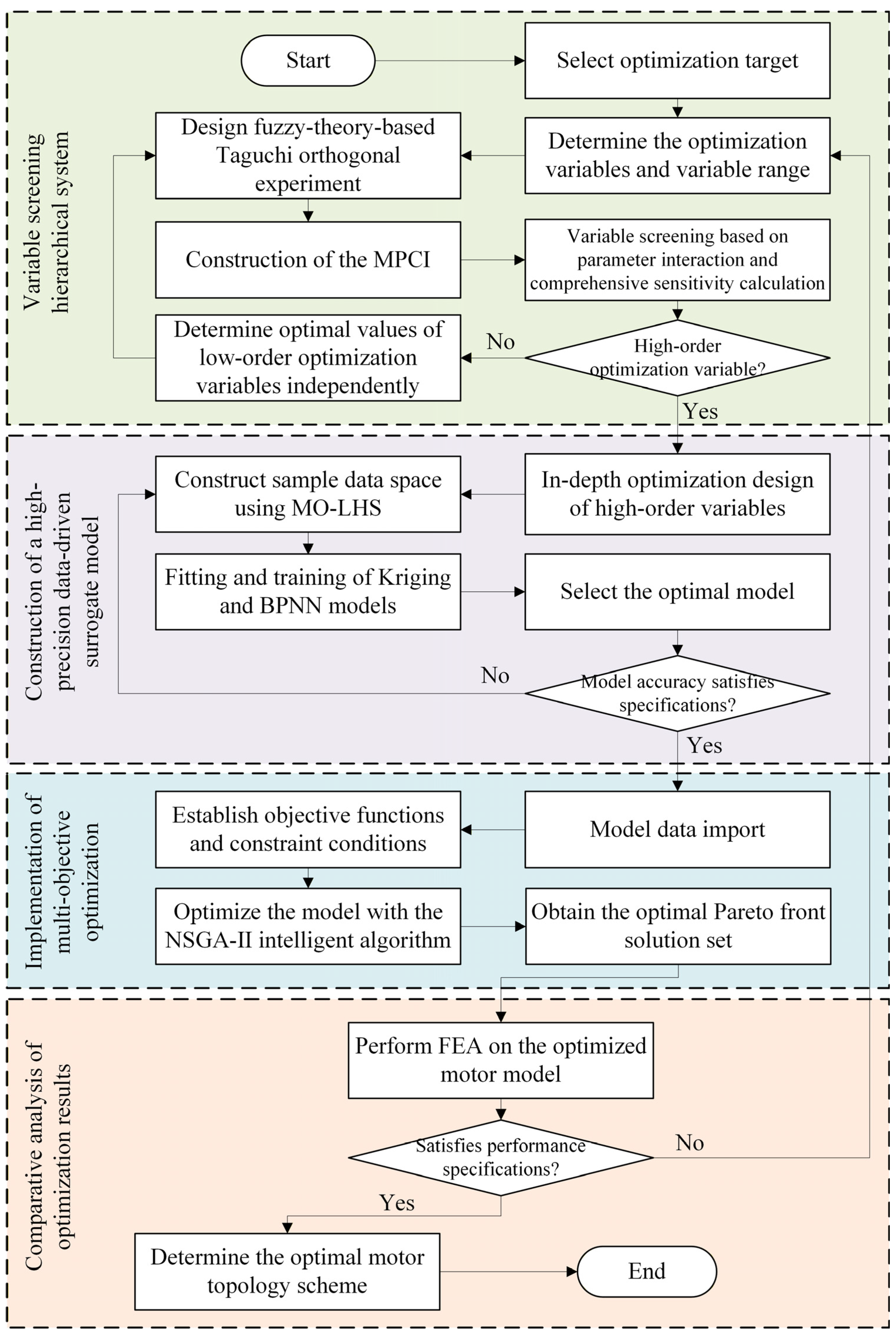
The multi-objective optimization process of motors involves numerous performance indicators and variables, and thus the selection of optimization objectives and variables is crucial [29]. First, a screening and hierarchical system for key optimization variables is constructed to reduce optimization costs while boosting optimization efficiency. On this basis, a multi-objective optimization method integrating a high-precision surrogate model with the NSGA-II algorithm is presented, which achieves a marked improvement in IPMSM torque performance and meets the high-torque operating requirements of electric loaders. Finally, a comparative analysis of the motor performance before and after optimization is conducted to verify the effectiveness of the proposed optimization method.
The specific process of multi-objective optimization is as follows:
Step 1: The optimization objectives and key topological variables are screened, and the parameter ranges applicable to the optimization variables are determined. Construct a Taguchi orthogonal experiment integrated with fuzzy theory to compute the multi-performance characteristic index of each optimization variable. Complete the stratification of optimization variables through the calculation of parameter interactivity and comprehensive sensitivity, so as to avoid low-priority variables wasting resources in subsequent in-depth optimization.
Step 2: Adopt the multi-criteria optimal Latin hypercube sampling method to construct the sample data space required for the high-precision surrogate model. On this basis, use the Kriging model and BPNN model, employed to fit the predicted values, and the surrogate model meeting the high-precision requirements is selected.
Step 3: Multi-objective optimization design is implemented for the surrogate model via the NSGA-II algorithm. The Pareto frontier is then utilized to derive the optimal parameter values corresponding to the optimization variables, with a comparative assessment carried out on the motor’s performance pre- and post-optimization.
The entire workflow, including variable screening, surrogate model construction, and multi-objective optimization, is visually summarized in Figure 1.

3. Optimization of IPMSM

3.1. Establishment of the Variable Screening Hierarchical System

3.1.1. Selection of Optimization Objectives

To improve the torque performance and efficiency of the motor while reducing its cogging torque and torque ripple, five objectives are selected for the optimization design in this study, namely output torque T a v g , torque ripple T r i p , cogging torque T c o g , core loss P c o r e , and maximum no-load back electromotive force (back EMF) U B E M F .
In addition, the selection of weight coefficients is particularly important when establishing a rational multi-objective optimization model [30]. In this research, minimizing torque ripple serves as the core optimization objective for the IPMSM. The stable operation of the motor also requires relatively low loss and high output torque. Furthermore, cogging torque should also be included in the priority level when optimizing the IPMSM. Therefore, the weight coefficients of the optimization objectives T a v g , T r i p , T c o g , P c o r e and U B E M F are set to 0.2, 0.3, 0.2, 0.2 and 0.1, respectively.

3.1.2. Selection of Finite Element Model Parameters and Optimization Variables for IPMSM

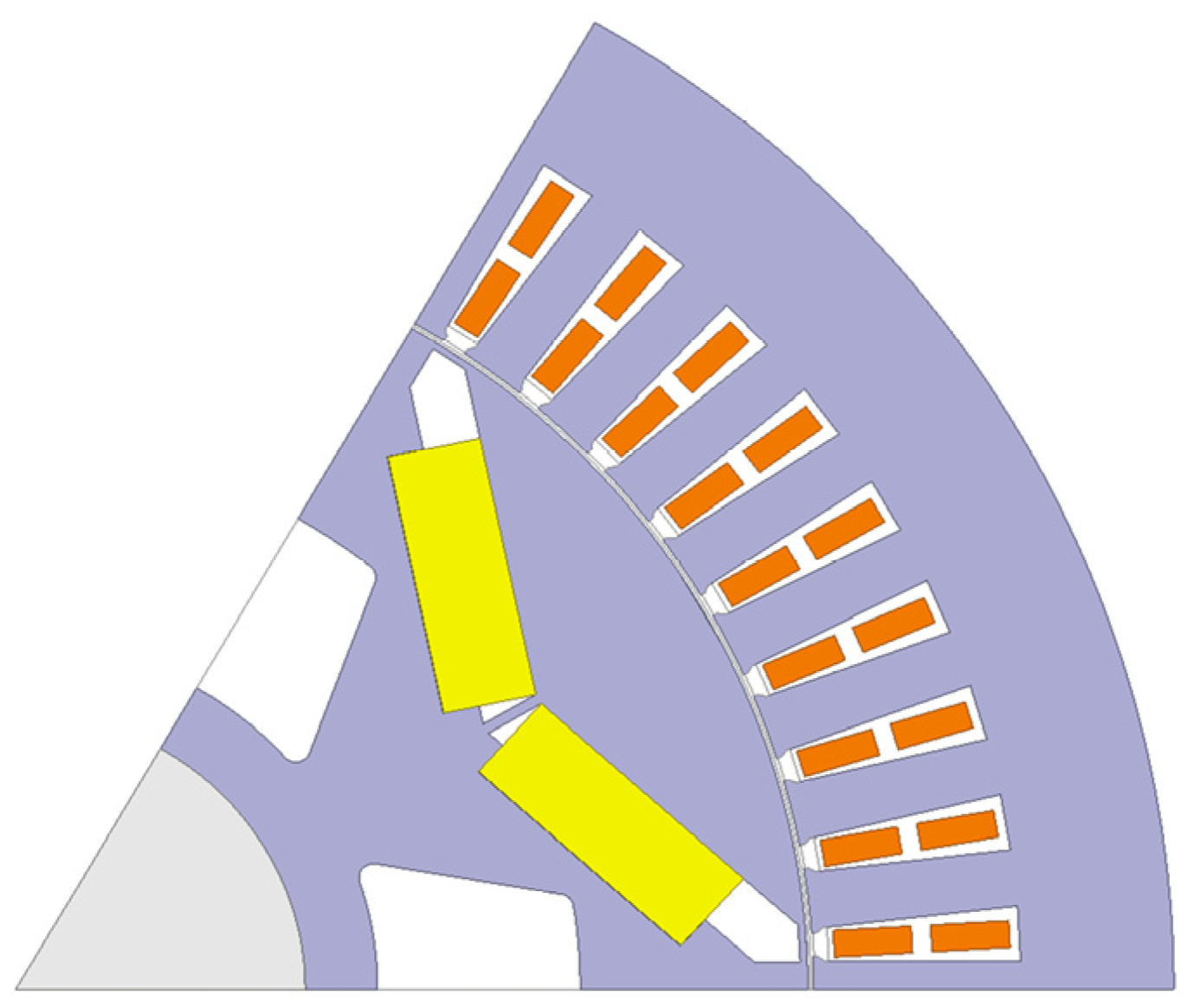
In this paper, a finite element model of a three-phase, 6-pole, 54-slot IPMSM as illustrated in Figure 2 serves as the research object, specified with 125 kW of output power and a 3000 rpm rated speed. The stator adopts a short-pitch distributed double-layer round copper wire winding, while the rotor uses V-shaped permanent magnets of grade N42UH and silicon steel sheets of grade B20AV1200. The key parameters of the IPMSM are listed in Table 2. Given the numerous parameters of the motor, an optimal design cannot be achieved through empirical design; thus, a multi-objective optimization design is carried out on this basis.
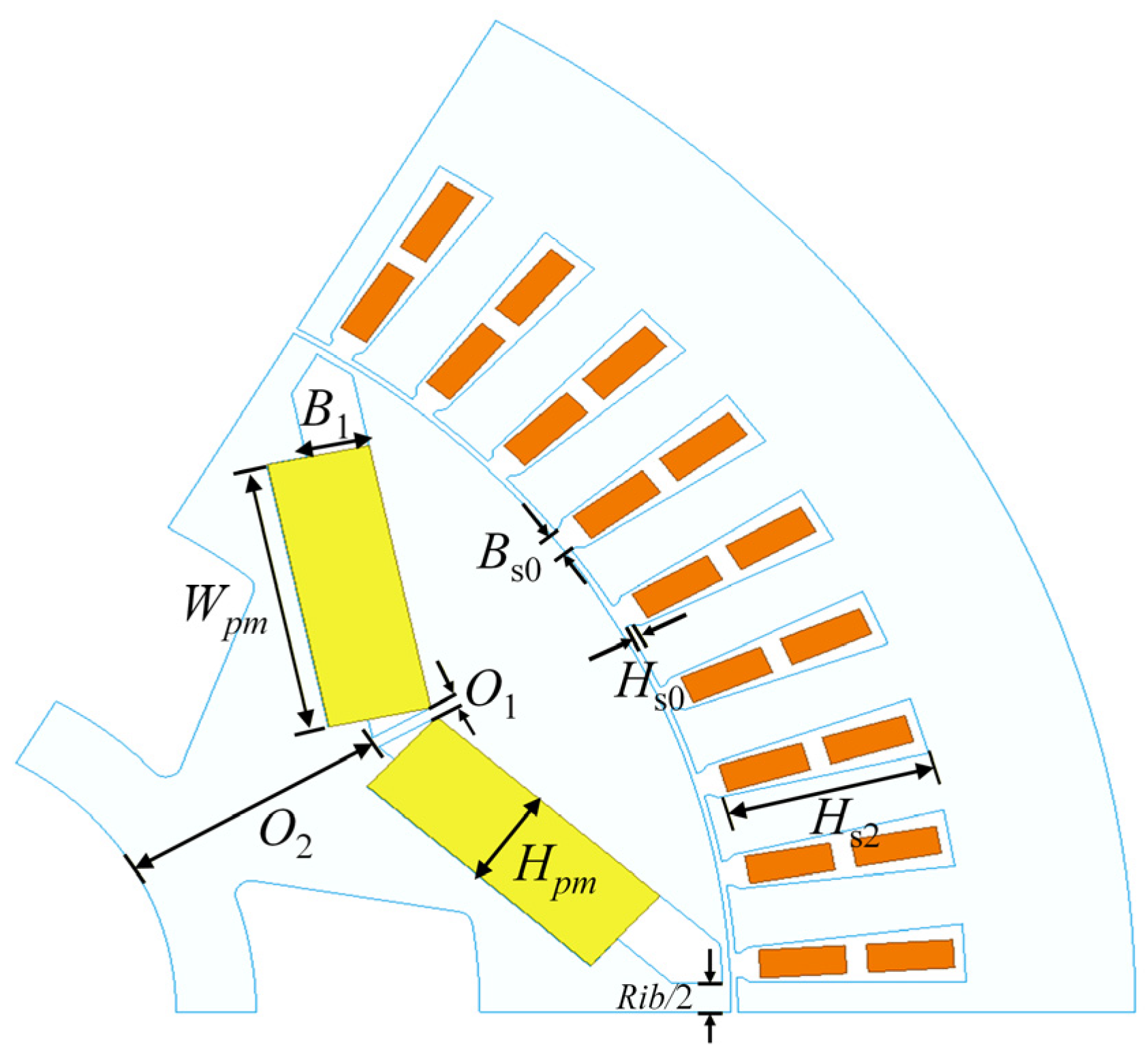
The dimensions of permanent magnets directly determine the air gap flux density and output torque, and exert a pronounced influence on motor power density. The stator slot opening parameters notably affect the cogging torque and core loss. Therefore, the permanent magnet thickness H p m , permanent magnet width W p m , stator slot opening depth H s 0 , and stator slot opening width B s 0 are selected as optimization variables. The width of the inner magnetic isolation bridge B 1 and the spacing of the outer magnetic barriers r i b control the local magnetic barriers of the rotor and the magnetic leakage between magnetic poles, respectively. Moreover, B 1 and r i b determine the included angle of permanent magnets within the V-shaped rotor, thereby exerting an influence on motor torque performance. Therefore, they are selected as the optimization variables. To reduce the cogging torque and core loss, the distance between the inner magnetic barrier and the inner edge of the rotor O 2 , magnetic barrier bridge width O 1 , and stator slot depth H s 2 are selected as optimization variables. The selection of nine topological parameters not only ensures the comprehensiveness of the optimization process but also avoids the substantial increase in sampling size and computational time caused by high-dimensional optimization, which would otherwise contradict the demand for efficient, engineering-oriented optimization.
Based on the above analysis, nine motor topological parameters are selected as the variables for the optimization design in this paper, namely permanent magnet thickness H p m , permanent magnet width W p m , stator slot opening depth H s 0 , stator slot opening width B s 0 , inner magnetic barrier bridge width B 1 , outer magnetic barrier spacing r i b , distance between the inner magnetic barrier and the inner edge of the rotor O 2 , magnetic barrier bridge width O 1 , and stator slot depth H s 2 . The parametric finite element model of the IPMSM is shown in Figure 3. Since the ranges of the optimization variables are restricted by the geometric structure, the optimization variables and their corresponding ranges are listed in Table 3.

3.1.3. Taguchi Orthogonal Experiment Incorporating Fuzzy Theory

To reduce redundancy in FEA (Ansys 2021, version 3.1.3) and improve the efficiency of the optimization algorithm, it is necessary to perform preprocessing of hierarchical dimension reduction on the optimization parameters. Four level grades are assigned to the optimization variables O 2 , B 1 , r i b , O 1 , H s 0 ,   H s 2 , B s 0 and H p m , as shown in Table 4. The permanent magnet width W p m directly affects the output torque performance of the motor, and its value range is relatively wide. Further refinement of the grading criteria is necessary to comprehensively analyze the effects of this optimization variable with respect to the optimization objectives. Therefore, eight level grades are set for W p m , with the values sorted from smallest to largest as 76, 78, 80, 82, 84, 86, 88 and 90.
Based on the optimal design of the traditional Taguchi method, this paper flexibly converts the multi-objective optimization problem into a multi-layer single-objective optimization problem through fuzzy theory. Sampling analysis is performed by constructing an Orthogonal Array (OA). A mixed orthogonal array L 32 ( 4 8 ,   8 1 ) is selected to establish the experimental matrix. Only 32 simulations are needed to cover all key parameter combinations, avoiding meaningless data combinations and saving resources. The detailed OA combinations of optimization variables and the corresponding FEA results are presented in Table 5.
To quickly distinguish significant parameters from non-significant ones, avoid wasting resources on secondary variables, and consider the comprehensive performance results of motor performance indicators after the hierarchical coupling of optimization variables, this paper proposes a Multi-Performance Characteristic Index (MPCI) that combines the signal-to-noise ratio (SNR) and Data Standardization Index (DSI). MPCI can balance model rationality and data applicability, quickly lock in the optimal parameter combination through the OA matrix, and is a scientific tool for solving multi-objective optimization and comprehensive evaluation problems.
In this study, the higher the values of T a v g and U B E M F , the better. Taking the calculation of the SNR of T a v g as an example, the calculation formula for its larger-the-better characteristic is as follows:
S N R ( T a v g ) = 10 lg 1 m j = 1 m ( T a v g j ) 2
where m and j are the total number of samples and the number of samples, respectively.
On the contrary, in the optimization research of this paper, T r i p , T c o g and P c o r e are expected to be as low as possible. Taking the calculation of the SNR of T r i p as an example, the calculation formula for its smaller-the-better characteristic is as follows:
S N R ( T r i p ) = 10 lg 1 m j = 1 m ( T r i p j ) 2
Based on the signal-to-noise ratio analysis, the DSI is employed for a more intuitive comparative analysis. Taking the normalization of the signal-to-noise ratio of T a v g as an example, its corresponding DSI is expressed as follows:
D S I T a v g j =   S N R T a v g j min S N R T a v g max S N R T a v g min S N R T a v g  
Among them, m a x S N R   ( T a v g ) and m i n S N R   ( T a v g ) represent the maximum and minimum signal-to-noise ratios of T a v g among all samples, respectively. DSI can normalize the SNR values to the range of [0, 1], making all objectives comparable.
In this step, the results of DSI are further integrated into MPCI based on fuzzy theory. After comprehensively considering the weight factors of each optimization objective, the MPCI of the j-th sample can be expressed as follows:
M P C I j = β 1 D S I T a v g j + β 2 D S I T r i p j + β 3 D S I T c o g j + β 4 D S I P c o r e j   + β 5 D S I U B E M F j
where β 1 , β 2 , β 3 , β 4 and β 5 are the weight factors of the optimization objectives T a v g , T r i p , T c o g , P c o r e and U B E M F respectively, and they are set to 0.2, 0.3, 0.2, 0.2 and 0.1 in this paper.
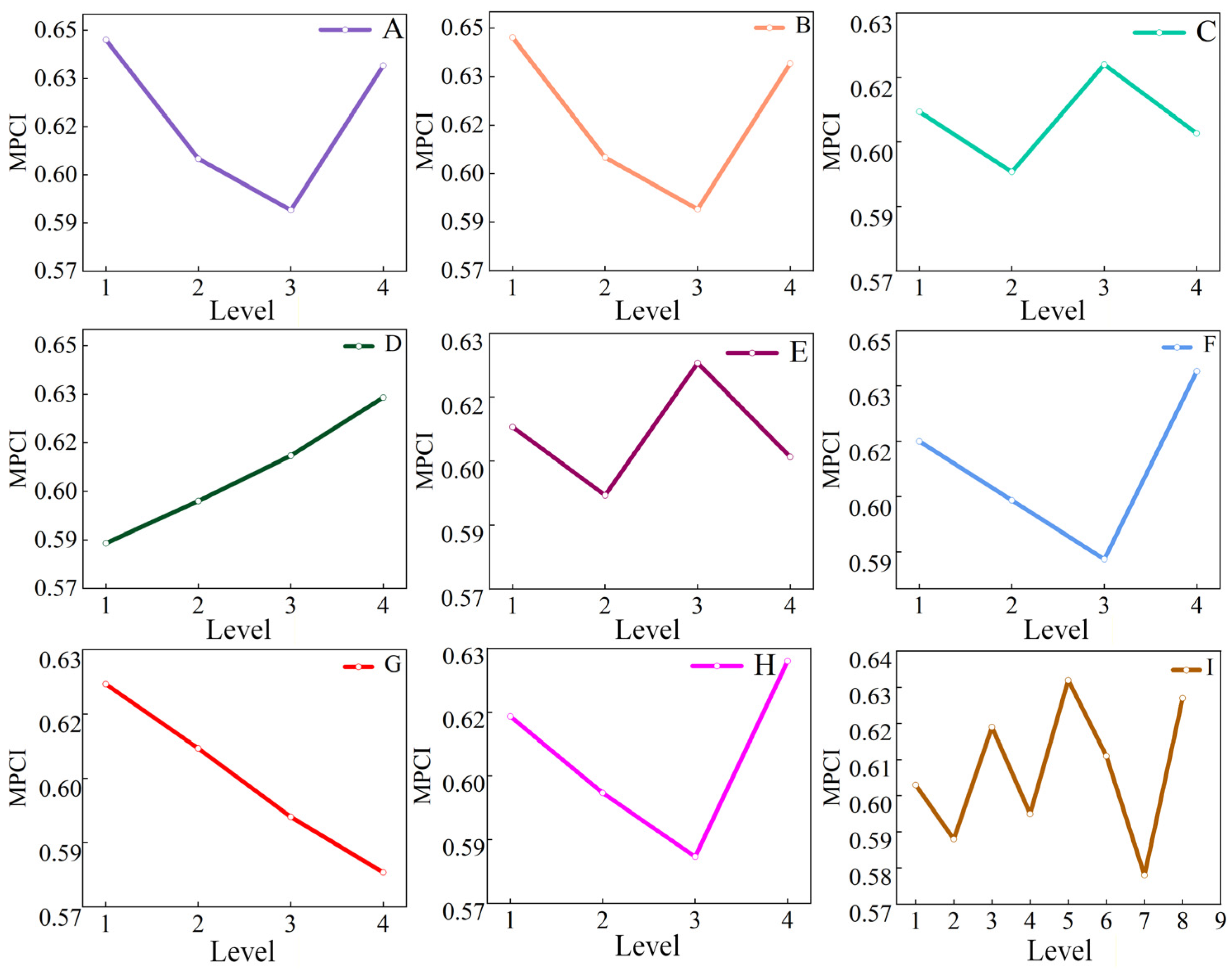
In the orthogonal array L 32 , each grade of the 4-level variables appears eight times, and each grade of the 8-level variables appears four times. Taking the calculation of the 1st-level value of the 4-level design variable B and the 2nd-level value of the 8-level design variable I as an example, the corresponding MPCI is expressed as follows:
M P C I ( B 1 ) = 1 8 M P C I 1 + M P C I 5 + M P C I 9 + M P C I 13 + M P C I 17 + M P C I 21 + M P C I 25 + M P C I 29
M P C I ( I 2 ) = 1 4 M P C I 2 + M P C I 10 + M P C I 23 + M P C I 31
Figure 4 illustrates the MPCI values corresponding to each variable at different levels across all optimization objectives.
The optimal level grade of each variable corresponds to the maximum value of its MPCI, so as to ensure the best comprehensive performance of the IPMSM. It can be concluded from the calculation results that the optimal combination of design variables is A1, B4, C3, D4, E3, F4, G1, H4, I5, and the specific values of each parameter are presented in Table 6.

3.1.4. Variable Stratification Based on Parameter Interaction and Comprehensive Sensitivity

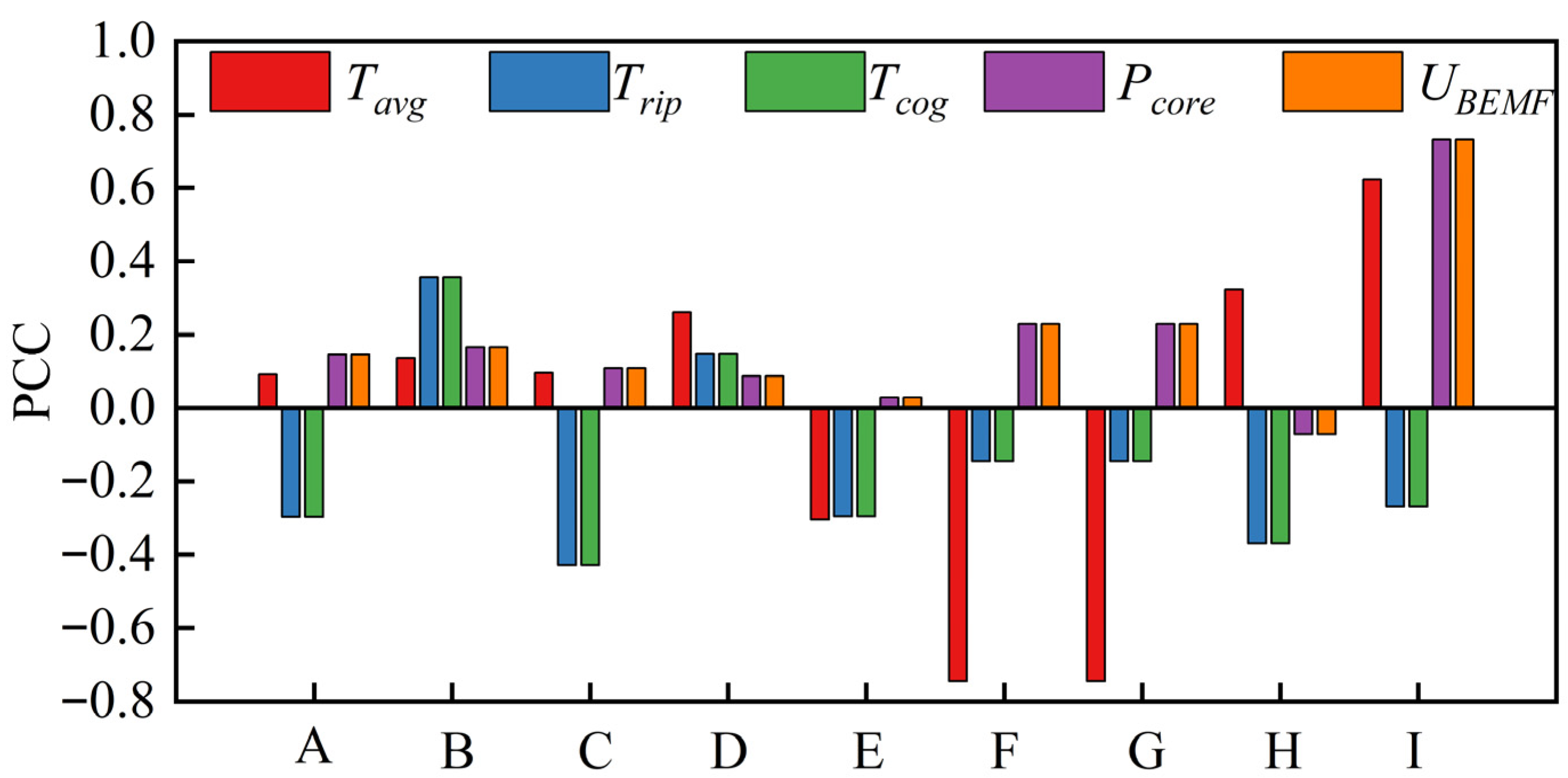
Reasonable sensitivity analysis is essential to the multi-objective optimization design [31]. In this study, the Pearson Correlation Coefficient (PCC) is adopted to conduct the analysis of multi-variable interaction, and its calculation formula is provided below:
P C C x y = C o v ( x , y ) x y
C o v ( x , y ) = m x i y i x i y i
x y = m x i 2 ( x i ) 2 1 / 2 m y i 2 ( y i ) 2 1 / 2
P C C x y = m x i y i x i y i m x i 2 ( x i ) 2 1 / 2 m y i 2 ( y i ) 2 1 / 2
where x i and y i are the design variable and optimization objective corresponding to the i-th sample, respectively. m is the total number of samples. C o v x , y is the covariance between x and y . x y are the standard deviations.
As shown in the PCC calculation results in Figure 5, variables H and I have high correlation with multiple optimization objectives, variables F and G have relatively high impacts on some objectives, while variables D and E have minor impacts. In subsequent optimization studies, H and I should be given priority, followed by F and G, and the optimization priority of D and E can be appropriately lowered.
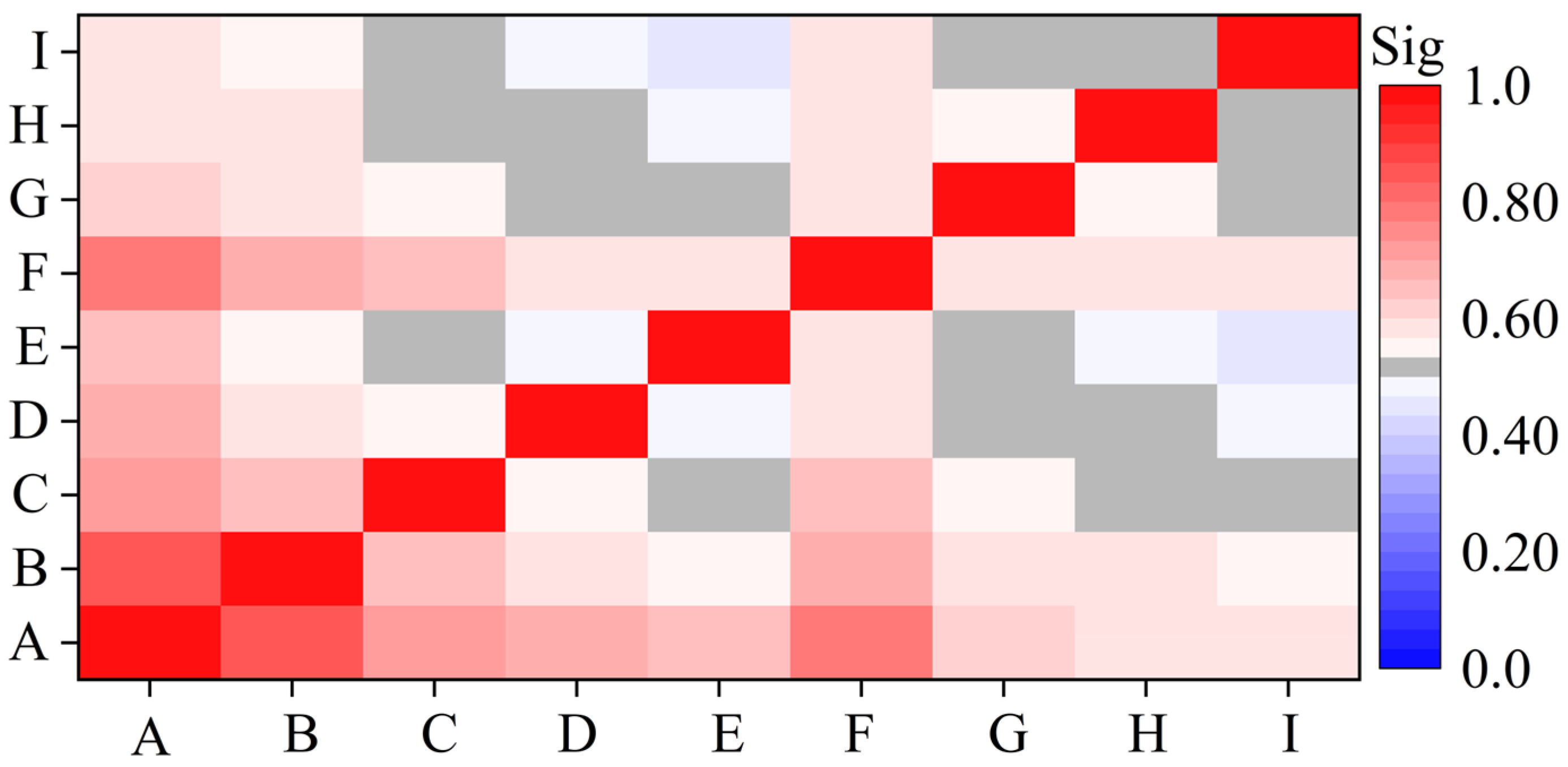
Traditional optimization models mainly focus on the longitudinal impacts of variables on objectives, but rarely consider the horizontal interaction effects between variables. To conduct a more comprehensive study on the significance of coupling interactions among multiple variables, this paper proposes a significance effect analysis of variable interactions based on multivariate analysis of variance (MANOVA), which is derived from the PCC calculation results of each variable on the optimization objectives. The analysis results are presented in Figure 6 (“Sig” denotes “Significance”). As observed from the heatmap, there exist extremely significant interaction effects between Variable A and Variable B, Variable C and Variable F, Variable A and Variable I, as well as Variable H and Variable I.
This paper studies a multi-objective optimization problem involving nine design variables and five optimization objectives. In such a high-dimensional optimization space, although parameter correlation analysis can reveal the linear covariation relationship between variables, its limitation lies in the inability to quantify the dynamic impact intensity of each variable on the multi-objective system and the nonlinear coupling effect. Therefore, this paper introduces Comprehensive Sensitivity Analysis (CSA) to construct a complete variable stratification and screening system: the collaborative application of parameter correlation analysis and sensitivity analysis. The commonly used calculation formula for Local Sensitivity Analysis (LSA) at present is as follows:
L S A m i = f m ( x ) x i | x = x 0 = f m ( x 0 + Δ x i ) f m ( x 0 Δ x i ) 2 Δ x i
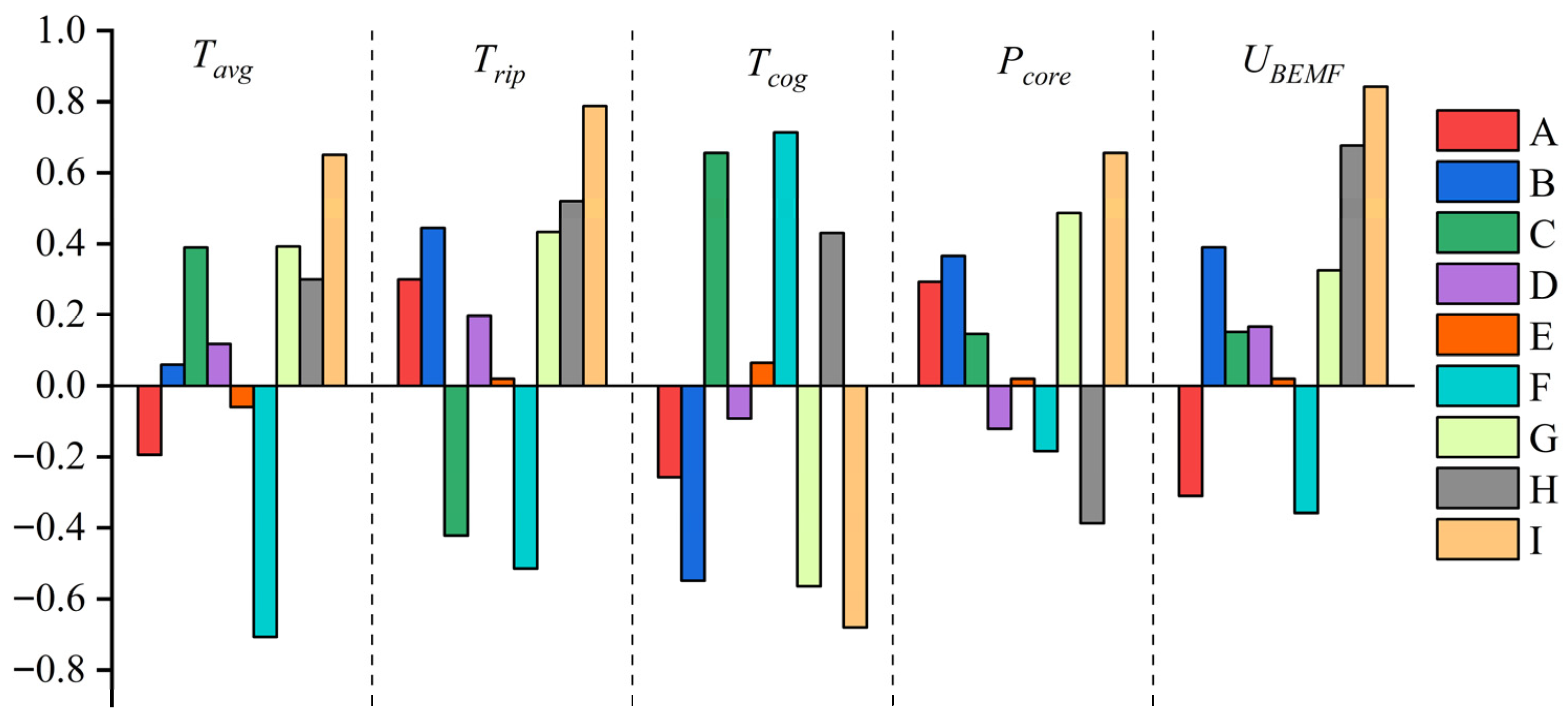
where L S A m i denotes the local sensitivity of the i -th design variable x i with respect to the m -th objective function f m x . x 0 denotes the initial value of the design variable, and Δ x i denotes the small perturbation applied to the variable x i in both positive and negative directions. The sensitivity of each parameter to different optimization objectives can be obtained by Equation (11), with the results presented in Figure 7.
Typically, an increase in the absolute value of L S A m i corresponds to heightened responsiveness of the objective function f m to fluctuations in the design variable x i . Since the multi-objective optimization of IPMSM is a nonlinear, high-dimensional, and multi-parameter interaction system, it is necessary to analyze the comprehensive sensitivity of each structural parameter and select the structural parameters with high comprehensive sensitivity for optimization. The CSA index, which represents the comprehensive sensitivity of the i-th structural parameter x i to the five optimization objectives, is expressed as
C S A m i = β 1 | L S A T a v g ( x ) | + β 2 | L S A T r i p ( x ) | + β 3 | L S A T c o g ( x ) | + β 2 | L S A p c o r e ( x ) | + β 5 | L S A U B E M F ( x ) |
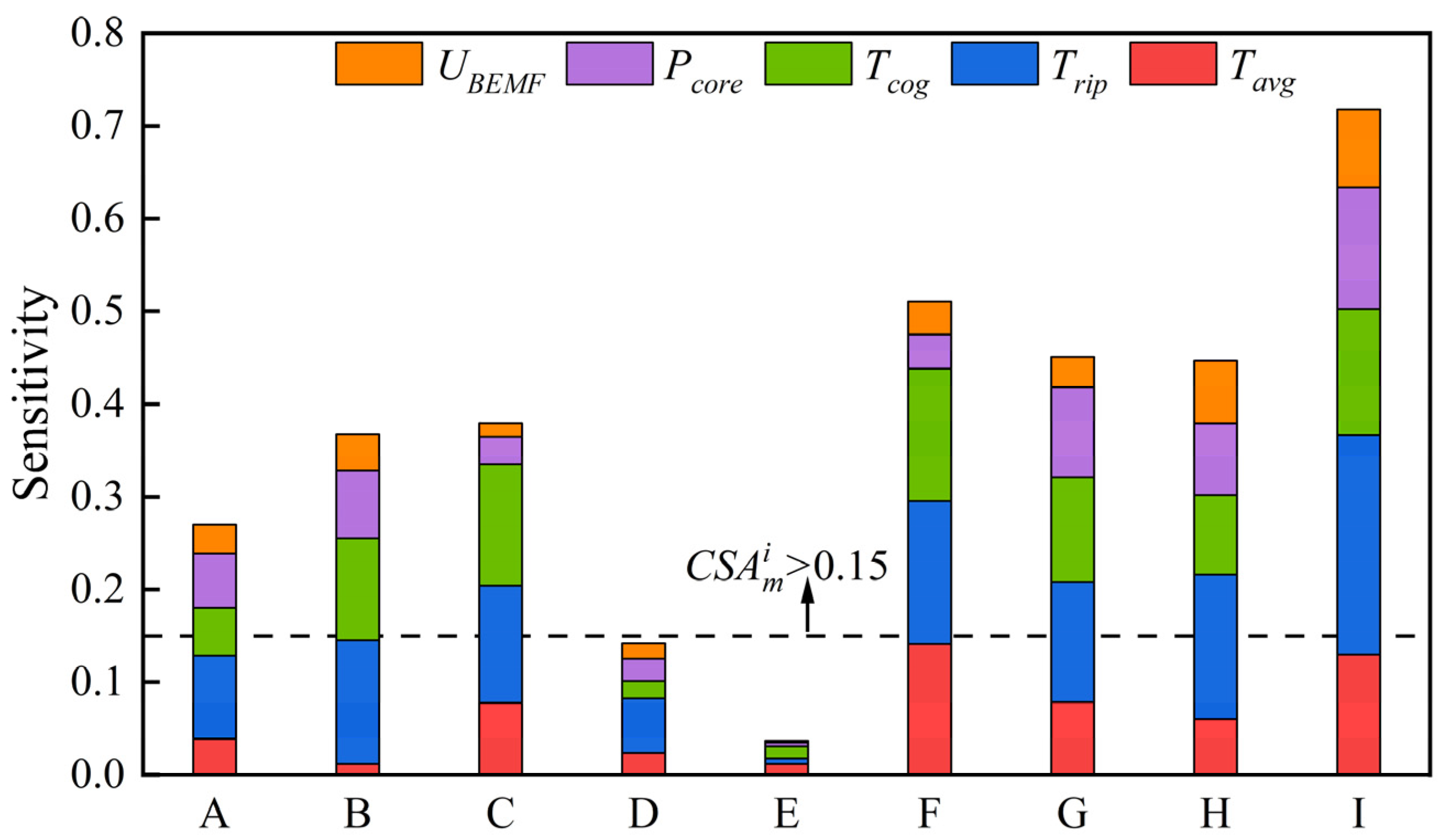
The comprehensive sensitivity indices of different structural parameters are calculated via Equation (12), with the results presented in Figure 8. In comparison with other variables, the CSA indices of Variable D and Variable E are significantly lower. To balance computational efficiency and optimization benefits while reducing the sample size and computational time, the structural parameters with a comprehensive sensitivity index C S A m i > 0.15 are defined as highly sensitive parameters for further optimization. As observed from Figure 8, only the comprehensive sensitivity indices of Variable D and Variable E are less than 0.15. After comprehensive analysis, Variables A, B, C, F, G, H, and I are finally selected as high-order optimization variables.
To reduce the complexity of subsequent in-depth optimization, the low-order optimization variables D and E should be fixed at a reasonable level. Referring to the foregoing analysis and calculations, the optimal values of D and E are selected from Table 6 as the optimization results, namely, the optimization variable D is set to 1.75 and E to 0.72. After hierarchical variable screening, the number of optimization variables is reduced from 9 to 7, which significantly enhances the optimization efficiency.

3.2. Construction of High-Precision Data-Driven Surrogate Model

Currently, commonly used data-driven surrogate models include the RSM, Kriging model, BPNN model, and Radial Basis Function (RBF) model, etc. The response surface constructed by RSM exhibits a certain degree of smoothness and linearity, which limits the identification of multi-objective parameters. The RBF model relies too much on data at the function center and has weak generalization ability, making it unable to perfectly capture complex nonlinear relationships in the data. Considering that the in-depth optimization of the IPMSM designed in this paper involves seven high-order optimization variables and five optimization objectives, to better handle complex nonlinear problems in high-dimensional space, this paper selects the Kriging model and BPNN model as the data-driven surrogate models. The optimal spatial mapping relationship between optimization variables and optimization objectives is determined by comparing the accuracy of the two surrogate models.

3.2.1. Establishment of Sample Data Space Based on MO-LHS

To further enhance the quality of sample data points, this study adopts the MO-LHS method to construct the data space. As an improved version of LHS (Latin Hypercube Sampling), MO-LHS is designed to further enhance the spatial uniformity and orthogonality of samples, so as to more effectively capture the data characteristics of optimization variables over a wide range of variations.
The data selection of LHS only ensures the uniform marginal distribution of each variable but does not constrain the relative positions of sample points in the multi-dimensional space, leading to easy local aggregation of samples and difficulty in fully capturing the nonlinear correlations between variables. In contrast, the data selection principle of MO-LHS is based on the spatial filling property and representativeness of samples in the multi-dimensional design space. It optimizes the distribution of sample points while retaining the stratified sampling feature of LHS, which helps accelerate the convergence speed of model fitting and avoid falling into local optima.
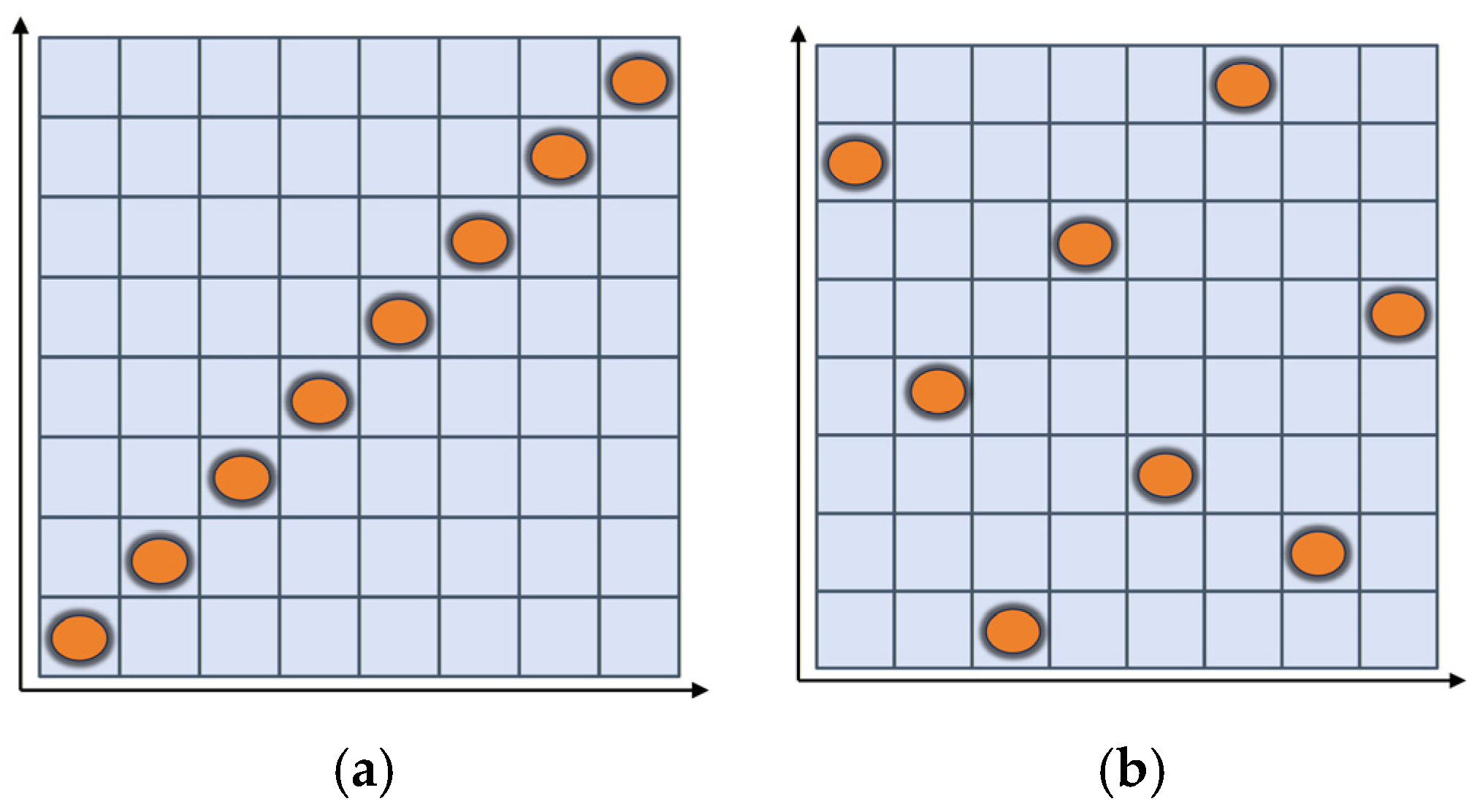
A total of eight sample points are collected in the two-dimensional space using LHS and MO-LHS, respectively, with the results shown in Figure 9. It can be observed that the sample points collected by LHS are basically distributed along the diagonal, showing poor filling performance and failing to capture some data characteristics. In contrast, the sample points collected by MO-LHS are more scattered than those by LHS, which can fill the data space better, achieve superior sample uniformity, and capture data characteristics more comprehensively.
For the seven high-order optimization variables and five optimization objectives in this paper, MO-LHS is adopted as the Design of Experiments (DOE) method to generate 200 sets of sample data as the original training set for the surrogate model. Table 7 presents the sample data constructed by the DOE and the corresponding simulation results of each sample.

3.2.2. Fitting of Predicted Values of the Kriging Model and BPNN Model

The Kriging model, also known as Gaussian process regression or spatial correlation modeling, is a data modeling technique used to predict variable values based on spatial or temporal correlations within a dataset. This model assumes that the predicted variables are stochastic functions of spatial or temporal coordinates, and estimates the unknown values at unobserved positions by incorporating the weighted average of nearby observed values. The weights are determined according to the spatial correlation among observation points, where points with a shorter distance exert a greater influence on the estimation target than those with a longer distance. The general mathematical expression of the Kriging model is given as follows:
y ^ ( x ) = μ + i = 1 m β i ( y ( x i ) μ ) + ε ( x i )
where y ^ ( x ) denotes the predicted value of sample x, μ is the overall mean, x i represents the observation position, y x i is the observed value of the sample data, ε is the correlation error term, β i is the assigned weight, and m is the number of input variables.
The Kriging model minimizes the estimation variance under the unbiasedness constraint and sums over all observation positions. The mathematical expression of the covariance C o v x , y in the sample data space is given as follows:
c o v y ^ ( x i ) , y ^ ( x j ) = σ 2 S ( θ , x i , x j )
where σ 2 is the variance of the spatially distributed error, S ( θ , x i , x j ) denotes the spatial distribution function of the data, and the selection principle for the spatial distribution coefficient θ is to take the optimal solution when the variance of the smaller-the-better characteristic predicted by the Kriging model is minimized, which is expressed by Equation (15) as follows:
ψ min ( θ ) θ > 0 = | S ( θ , z ) | 1 m σ 2
where z is the straight-line distance between two observation points in the sample data space, and ψ min ( θ ) θ > 0 denotes that the spatial distribution coefficient follows a normal distribution. Considering that S ( θ , x i , x j ) and ψ min ( θ ) θ > 0 lie in the nonlinear high-dimensional space constructed by the optimization parameters and output responses of the IPMSM, this paper incorporates the Gaussian function into the data spatial distribution function S ( θ , x i , x j ) of the Kriging model to further fit the surrogate model to the sample data space. The updated expression of S ( θ , x i , x j ) is given as follows:
S ( θ , z ) = e x p k = 1 m θ k ( x i k x j k ) 2
where x i k and x j k denote the k-th component of sample points i and j, and e x p is the natural exponential function.
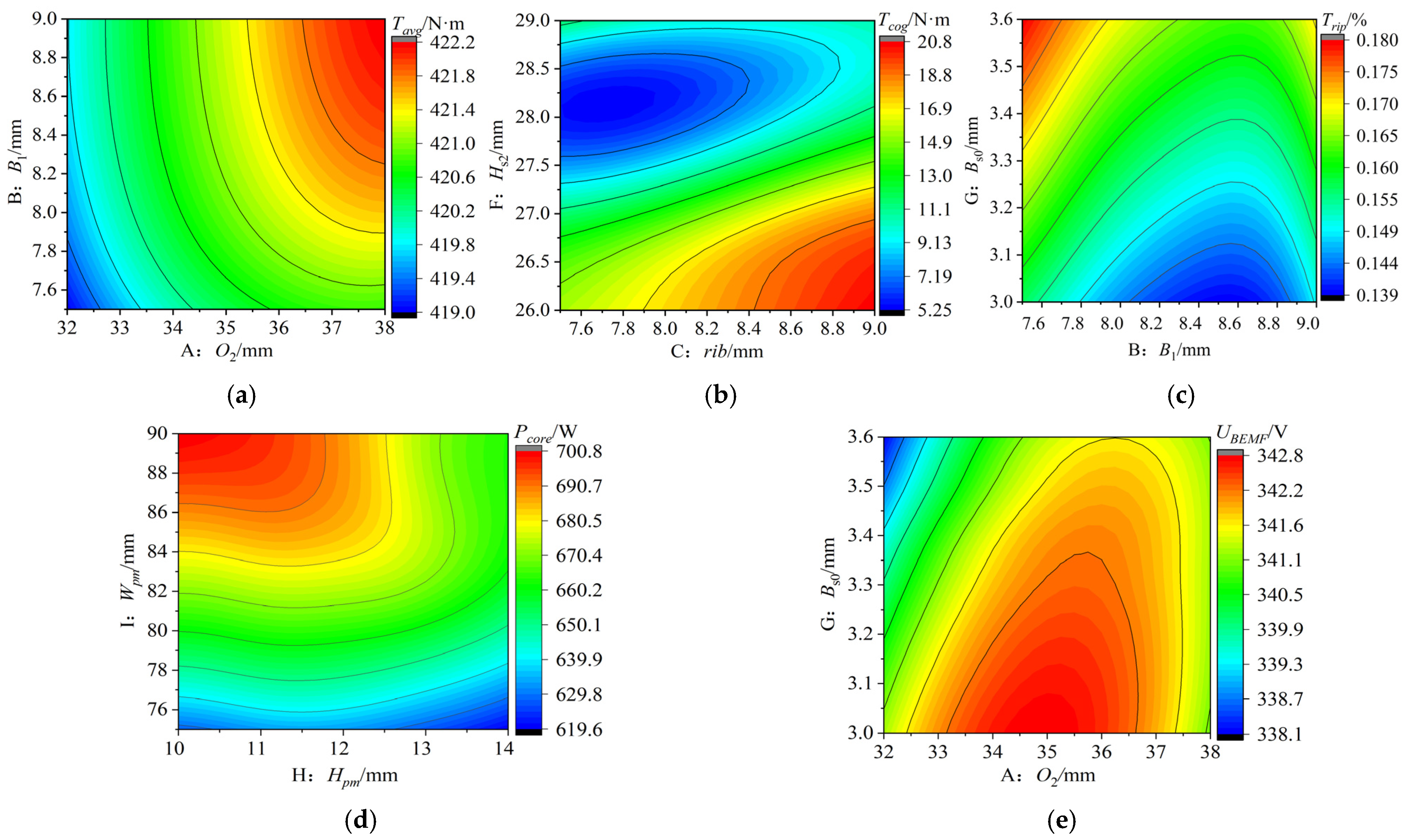
The Kriging surrogate model used to predict motor performance is constructed through the above analysis. Figure 10 shows the fitting surfaces of the predicted values for different optimization objectives obtained by the Kriging model.
As can be seen from Figure 10a, the output torque T a v g increases with the increase of O 2 and B 1 . From Figure 10b, it is observed that the increase in r i b will increase the cogging torque T c o g , and T c o g tends to be minimized when H s 2 is in the range of 27 to 29 mm. As shown in Figure 10c, the torque ripple T r i p increases with the increase of B s 0 , while T r i p tends to be minimized when B 1 is between 8 and 9 mm. From Figure 10d, the core loss P c o r e increases as W p m rises. From Figure 10e, it is indicated that the no-load back EMF amplitude U B E M F decreases with the increase of B s 0 , and U B E M F tends to be maximized when O 2 is in the range of 33 to 37 mm.
Different surrogate models exhibit distinct discrepancies in predicting motor performance, making it necessary to conduct a comparative analysis of model selection schemes. To determine the highly nonlinear transfer relationship between optimization variables and optimization objectives, the BPNN approach is employed to construct the corresponding surrogate model. The BPNN model can utilize the data space established by SF-LHS to fit the response model, and it has strong fault tolerance and computing capability. The BPNN adopts a three-layer architecture, consisting of an input layer, a single hidden layer and an output layer. The range of the number of hidden layer nodes h is set as follows:
h = n + q + λ
where n represents the number of variable samples in the input layer, q is the number of target nodes in the output layer, and λ is a constant which can take an integer value between 1 and 10.
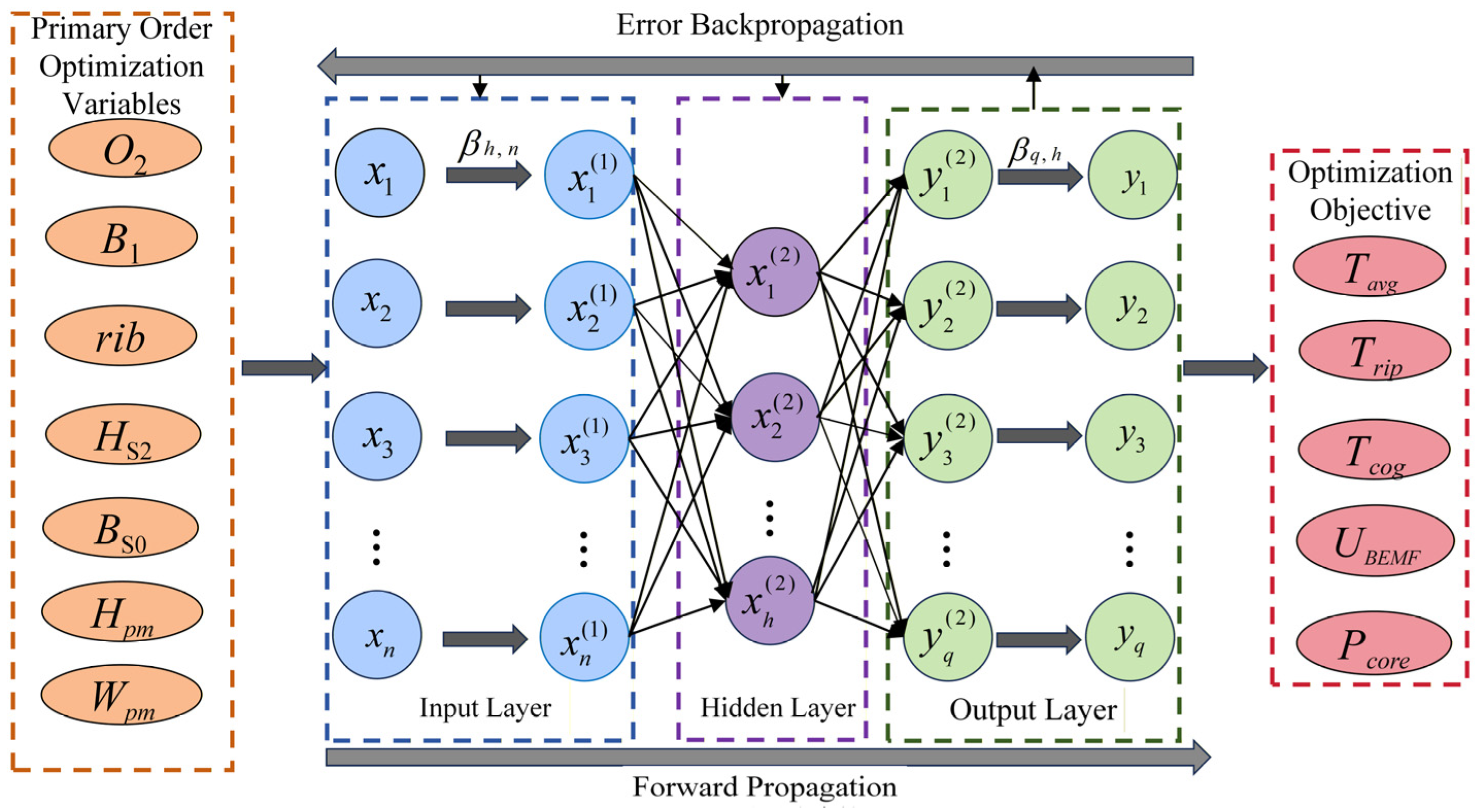
The BPNN is capable of handling complex computational problems, and its topological structure is shown in Figure 11. The central tenet of the BP algorithm lies in adjusting weights layer by layer in a backward sequence. The calculation formulas are as follows:
x h ( 2 ) = g ( x 1 ( 1 ) × β h , 1 ( 1 ) + x 2 ( 1 ) × β h , 2 ( 1 ) + + x n ( 1 ) × β h , n ( 1 ) )
where g x represents the approximate model constructed by the BP neural network, and β h , n represents the weight between the input layer and the hidden layer. The final output y is further calculated through the intermediate hidden layer data x p ( 2 ) and the weight matrix β q , h from the hidden layer to the output layer, with the calculation formula as follows:
y q = g ( x 1 ( 2 ) × β q , 1 ( 2 ) + x 2 ( 2 ) × β q , 2 ( 2 ) + + x p ( 2 ) × β q , h ( 2 ) )
For the function construction of the BPNN model in this study, the number of intermediate hidden layer nodes is set to 10, the number of iterations is set to 1200, the learning target reaches the order of magnitude of 10−5, the learning rate is set to 1%, and the maximum allowable error is set to 0.3%. The logsig, purelin and tansig functions are adopted as the activation functions for the model in this paper. Among them, the logsig function is employed as the activation function for the hidden layer, the purelin function as the output layer transfer function to transmit the activation values from the hidden layer to the output layer, while the tansig function as the transfer function between the input layer and the activation layer. The mathematical expressions of these three transfer functions are as follows:
log sig ( x ) = 1 1 + e x
tan sig ( x ) = 2 1 + e 2 x 1
purelin ( x ) = x
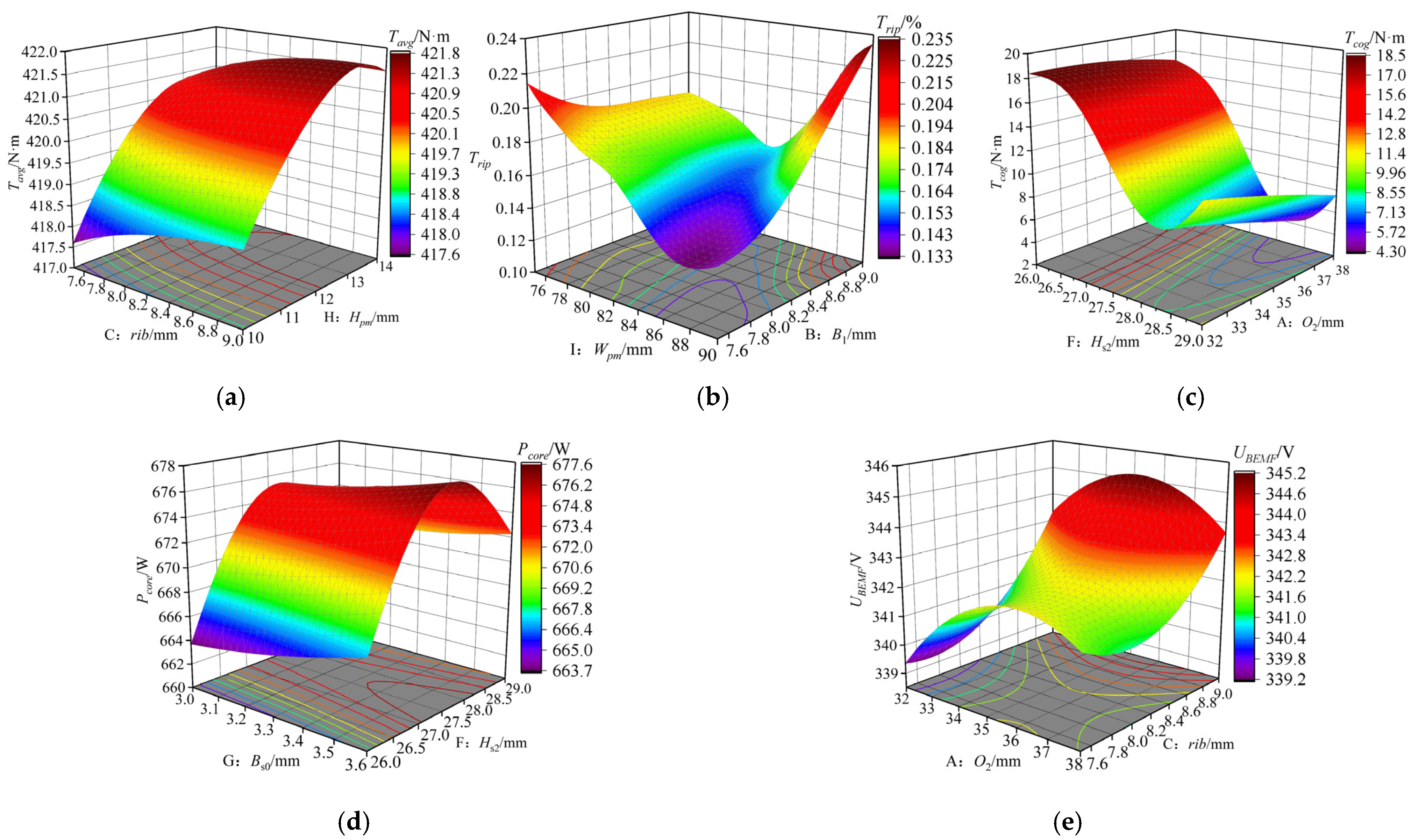
Based on the above analysis, a BPNN surrogate model for predicting motor performance can be constructed. Figure 12 presents the fitting surfaces of the predicted values of different optimization objectives by the BPNN surrogate model. Figure 12 illustrates that the average torque T a v g increases with the increase of H p m ; when W p m takes the maximum value and B 1 takes the minimum value, there is a concentrated region where the torque ripple T r i p is minimized; as H s 2 increases, the cogging torque T c o g decreases gradually, while the core loss P c o r e increases accordingly; the amplitude of the no-load back EMF U B E M F increases with the increase of r i b .
The calculation and evaluation of surrogate model accuracy are critical steps to verifying the model’s credibility and practical applicability. Such evaluations are typically based on discrepancies between predicted values and actual values, with commonly used metrics including the Root Mean Square Error (RMSE) and coefficient of determination (R2). RMSE is characterized by its sensitivity to outliers; it has the same dimension as the target variable and amplifies the impact of relevant error terms, with a smaller value indicating better predictive performance of the surrogate model. The coefficient of determination R2 reflects the proportion of all sample points that can be explained by the fitting function with respect to the independent variables, and a value closer to 1 denotes a better fitting degree of the surrogate model. The calculation formulas are as follows:
R 2 = 1 i = 1 n ( y i y ^ i ) 2 i = 1 n ( y i y ¯ i ) 2
RMSE = i = 1 n ( y i y ^ i ) 2 n
where n denotes the number of samples in the test set; y i represents the actual FEA results of the test set samples; y ^ i is the predicted value of the test set samples generated by the surrogate model; and y ¯ i is the mean value of the actual values y i . A number of sample points are randomly selected as the test set, and the R2 and RMSE values of the two surrogate models are calculated and summarized in Table 8. It can be seen from the calculation results that the BPNN model is superior to the Kriging model in both R2 and RMSE, which indicates that the BPNN model provides more accurate prediction results with smaller prediction errors for the optimization objectives. Therefore, the BPNN model is ultimately selected as the high-precision data-driven surrogate model for the subsequent intelligent algorithm optimization.
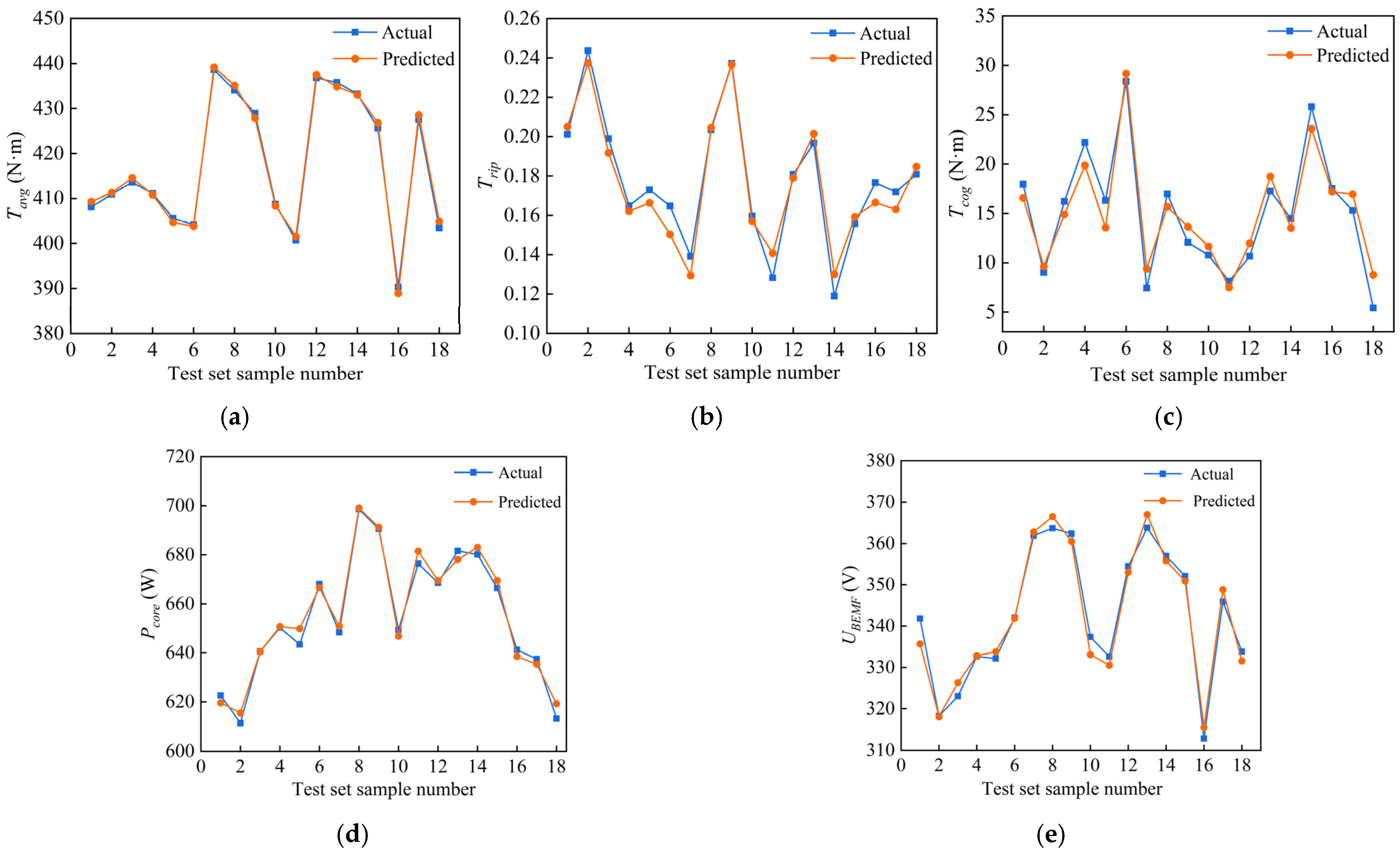
Meanwhile, to more intuitively demonstrate the predictive capability of the BPNN surrogate model for multiple optimization objectives under different optimization variables, 18 groups of data are randomly selected from the test set samples and substituted into the model for fitting. Figure 13a–e show the comparison curves between the BPNN model-predicted values and FEA-calculated actual values for each optimization objective across the 18 groups, respectively. These comparison curves show that the BPNN model has an excellent fitting effect. Although there are certain errors at individual sample points, the error values are all maintained within a reasonable range, and the variation trend of the predicted values is basically consistent with the fluctuation of the actual values. This indicates that the BPNN model can well reflect the nonlinear fitting relationship between the seven high-order optimization variables and the five optimization objectives. Therefore, the BPNN model can be used as a high-precision surrogate model for the NSGA-II multi-objective optimization algorithm in subsequent steps.

3.3. Multi-Objective Optimization of IPMSM Based on the NSGA-II Algorithm

The NSGA-II algorithm is the most widely used intelligent optimization algorithm in the field of electrical machines [32]. It can perfectly resolve the conflict between high-dimensional complexity and multi-objective optimization, focus on efficiently approximating the Pareto frontier while maintaining population diversity, and achieve a good trade-off among all optimization objectives based on the Pareto frontier, so as to obtain optimized electrical machine dimensions.

3.3.1. Setting of Objective Functions and Constraint Conditions

To ensure excellent torque performance of the motor, limit the increase in core loss under high-speed operation, and reduce the motor’s cogging torque as much as possible without compromising the amplitude of the back electromotive force, the mathematical expressions for the objective functions and constraint conditions in this optimization design are given as follows:
O 2 [ 32.0 , 38.0 ] , B 1 [ 7.5 , 9.0 ] r i b [ 7.5 , 9.0 ] , H s 2 [ 26.0 , 29.0 ] B s 0 [ 3.0 , 3.6 ] H p m [ 10.0 , 14.0 ] , W p m [ 75.0 , 90.0 ]
F u n c t i o n s : { max [ T a v g ( x ) , U B E M F ( x ) ] , min [ T r i p ( x ) , T c o g ( x ) , P c o r e ( x ) ] } x = [ x 1 , x 2 , x 3 , x 4 , x 5 , x 6 , x 7 ] = [ O 2 , B 1 , r i b , H s 2 , B s 0 , H p m , W p m ]
s . t . f 1 ( x ) = T a v g ( x ) 400   N m f 2 ( x ) = T r i p ( x ) 10 % f 3 ( x ) = U B E M F ( x ) 320   V f 4 ( x ) = P c o r e ( x ) 700   W
Considering that the NSGA-II algorithm demands optimal design of high-precision surrogate models, weighted normalization is performed on the five optimization objectives to intuitively visualize the algorithm’s performance across all targets, with an evaluation function G introduced for quantification:
G ( T a v g , T r i p , T c o g , P c o r e , U B E M F ) = 0.2 T a v g T a v g 0.3 T r i p T r i p 0.2 T c o g T c o g 0.2 P c o r e P c o r e + 0.1 U B E M F U B E M F
In the formula, according to the previously set constraint conditions, the weight coefficients of the optimization objectives T a v g , T r i p , T c o g , P c o r e , and U B E M F are set to 0.2, 0.3, 0.2, 0.2, and 0.1, respectively. T a v g denotes the average torque before optimization; T r i p denotes the torque ripple before optimization; T c o g denotes the magnitude of the cogging torque before optimization; P c o r e denotes the average core loss before optimization; and U B E M F denotes the amplitude of the back electromotive force before optimization.

3.3.2. Optimization Results of the NSGA-II Algorithm

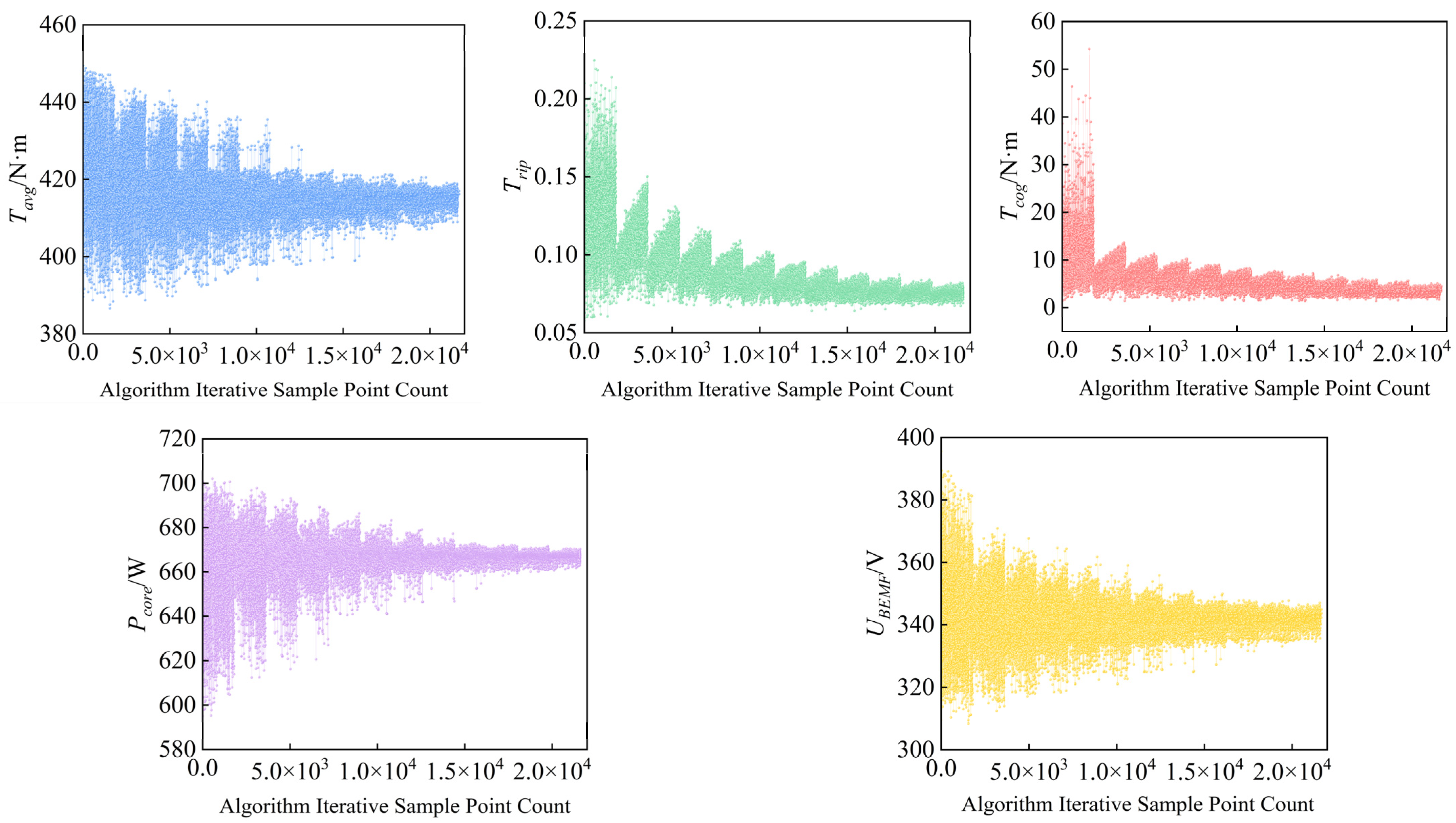
In accordance with the above settings of objective functions and constraint conditions, the improved NSGA-II algorithm initially generates 9000 system samples for multi-objective optimization. The optimization algorithm performs iterative convergence according to the constraint conditions of optimization variables and objectives, and the specific iterative convergence process is presented in Figure 14. The algorithm takes the system samples as the parent solution set, generates 1800 offspring solution sets in each iteration, and finds the optimal solution after a maximum of 20 iterations. As shown in Figure 14, all iterative sample points converge to the constraint target values after 21,600 evaluations. The convergence range of the average output torque T a v g is 410 to 420 N·m; the convergence range of the torque ripple T r i p is 0.08 to 0.10; the convergence range of the cogging torque T c o g is 0 to 10 N·m; the convergence range of the core loss P c o r e is 660 to 680 W; and the convergence range of the no-load back EMF amplitude U B E M F is 330 to 350 V.
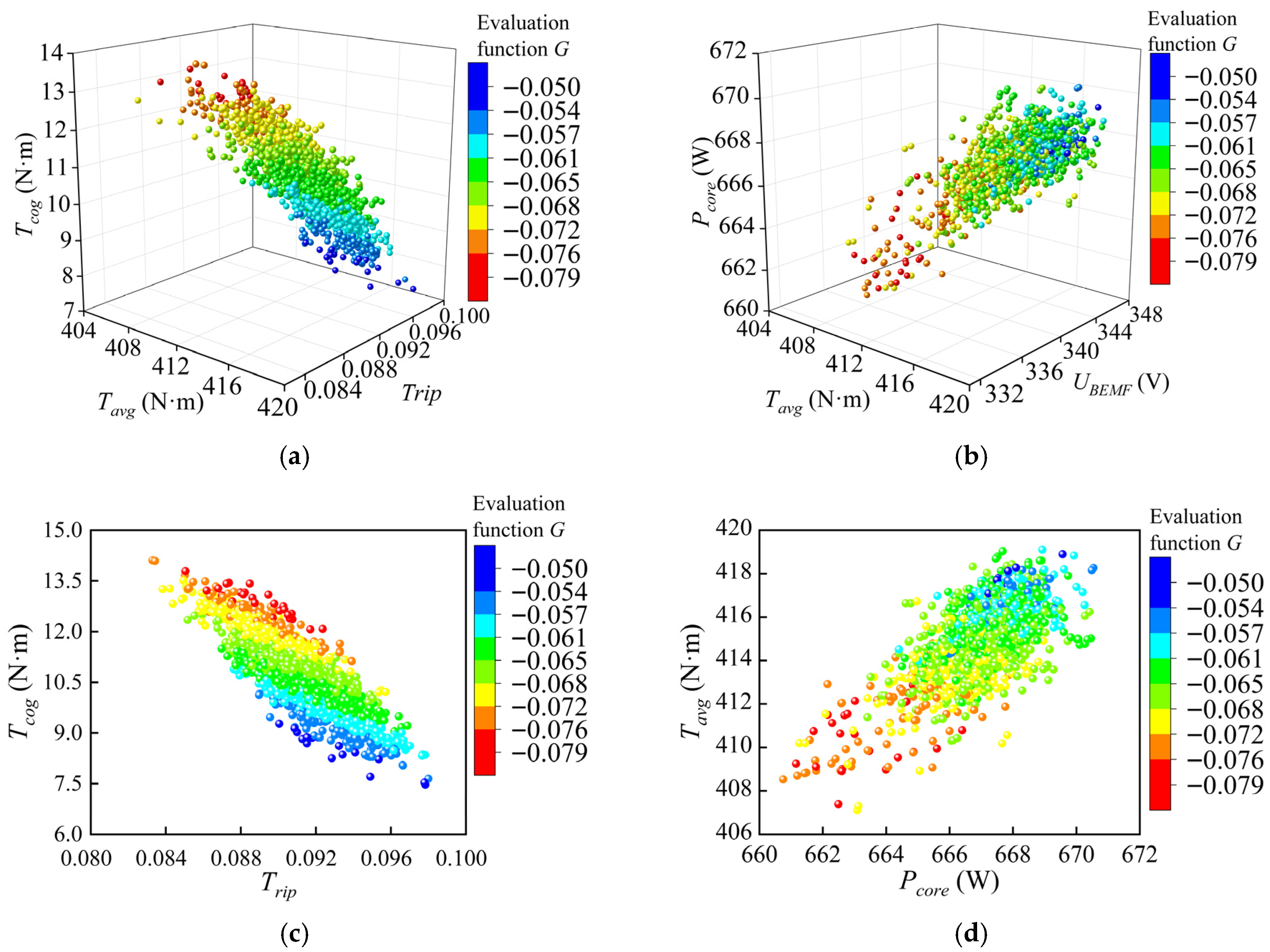
After evaluating 21,600 iterative sample points, the NSGA-II algorithm yields an 8-layer Pareto frontier. To screen out the optimal Pareto frontier, the evaluation function G is introduced to stratify the distribution of feasible solutions obtained by the optimization algorithm, and then the Pareto optimal solutions are extracted accordingly. Figure 15 shows the multi-layer Pareto frontier with the introduction of the evaluation function G, where the feasible solutions with calculation values of the evaluation function G closer to 0 are more in line with the overall performance of this multi-objective optimization design.
As can be seen from Figure 15, there is a strong correlation between the torque ripple T r i p and the cogging torque T c o g , while a complex coupling relationship exists between the core loss P c o r e and the cogging torque T c o g . During the iterative process, the sample point solution set is continuously coupled toward the direction of low torque ripple, low cogging torque and low core loss, but it is also constrained by the average output torque T a v g and the no-load back EMF amplitude U B E M F .
Therefore, the Pareto optimal solutions for each optimization objective cannot be selected merely from a single dimension, but rather require global trade-offs from different perspectives. On the basis of the calculation results of the evaluation function G, optimal solution extraction is performed on the stratified Pareto frontiers mentioned above, yielding 10 sets of high-order optimization variable candidate points that form the optimal Pareto frontier, as detailed in Table 9. Combined with the calculation results of the evaluation function, the 7th set of candidate points is selected as the optimal variables.
To validate the accuracy of the NSGA-II algorithm in multi-objective optimization, the selected 7th set of candidate points is substituted into the FEA model to calculate the five optimization objectives, and the comparison results are summarized in Table 10. The computational results indicate that the relative errors between the optimization outcomes and FEA results are all less than 3%, which verifies that the data-driven surrogate model and improved NSGA-II optimization algorithm exhibit favorable guidance and reliability in determining the optimal parameter values of optimization variables.

4. Comparative Analysis of IPMSM Performance Before and After Optimization

The comparison of design variables before and after optimization is presented in Table 11. To verify the effect of the multi-objective optimization design, the above nine design variables are adjusted to their optimal optimization variables, while the remaining design variables are kept consistent with those of the initial IPMSM finite element model.

4.1. Analysis of IPMSM No-Load Performance Before and After Optimization

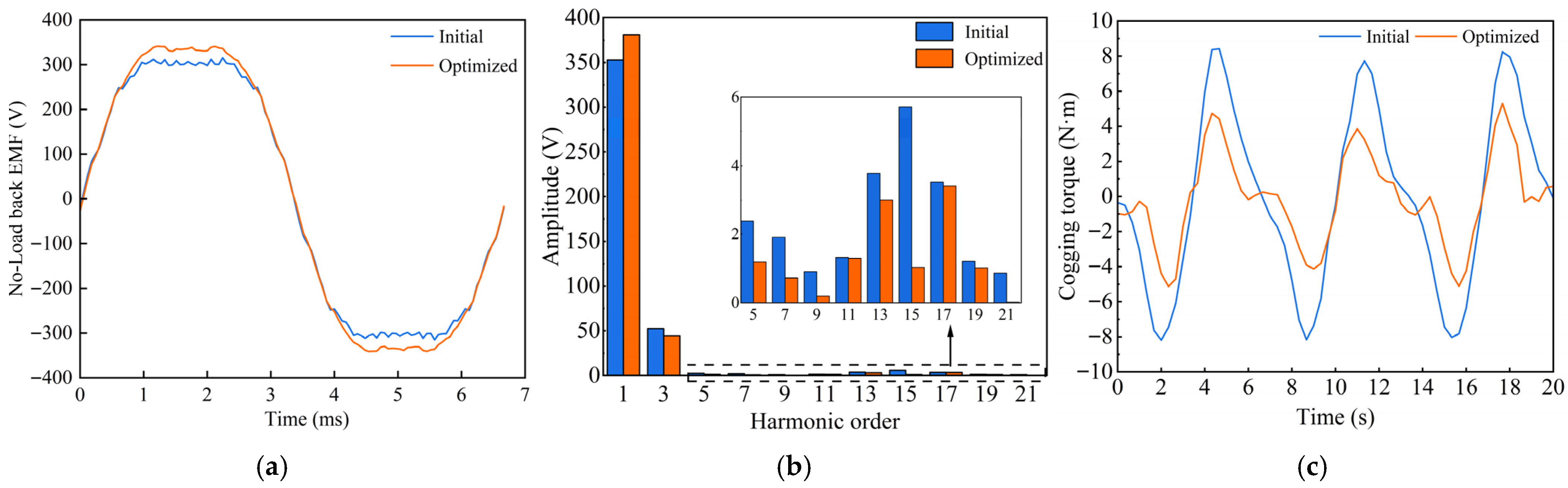
Figure 16a,b shows the comparison of the no-load back EMF and the corresponding Fast Fourier Transform (FFT) spectra of the IPMSM before and after optimization, respectively. The optimized phase-A back EMF exhibits a more sinusoidal waveform, with both its amplitude and effective value enhanced relative to the pre-optimization counterpart. The amplitude of the fundamental wave after optimization is increased to 380.8 V, while the harmonic content is reduced. Figure 16c presents the comparison of the cogging torque of the IPMSM before and after optimization. It is evident that the cogging torque is significantly reduced, with the peak-to-peak value of its waveform decreasing from 16.6 N·m before optimization to 9.8 N·m, a reduction of 40.96%.

4.2. Analysis of IPMSM Load Performance Before and After Optimization

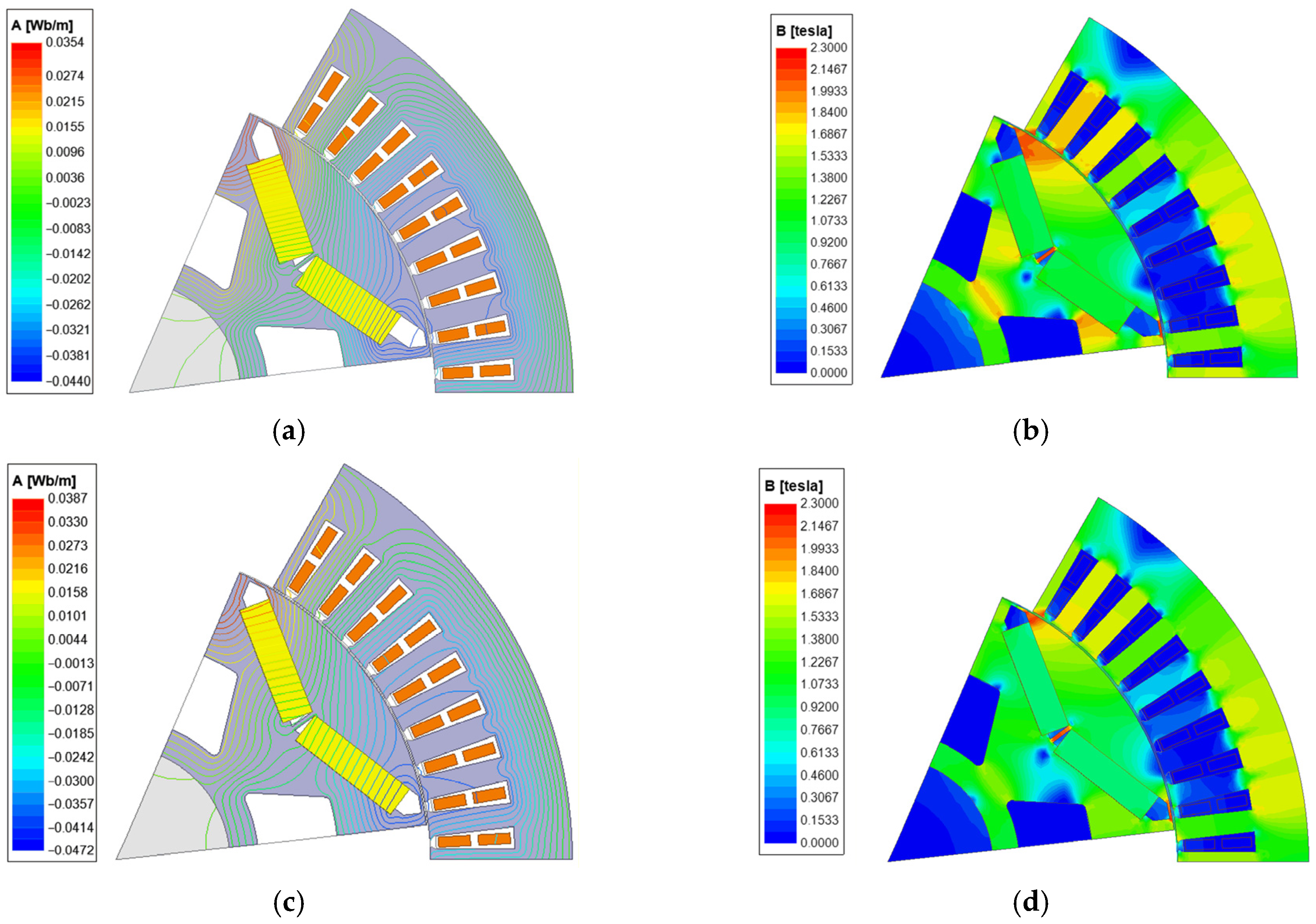
The magnetic field distributions of the IPMSM under rated operating conditions before and after optimization are presented in Figure 17. Internal magnetic field distribution in the optimized motor is substantially more uniform; meanwhile, stator and rotor magnetic flux density saturation has been drastically lowered relative to the pre-optimization configuration. The maximum magnetic flux density at the stator tooth tips is approximately 2.2 T, which is within the allowable range of the material. The results of magnetic flux line distribution and magnetic flux density cloud diagram indicate that the electromagnetic model of the optimized IPMSM is reasonable.
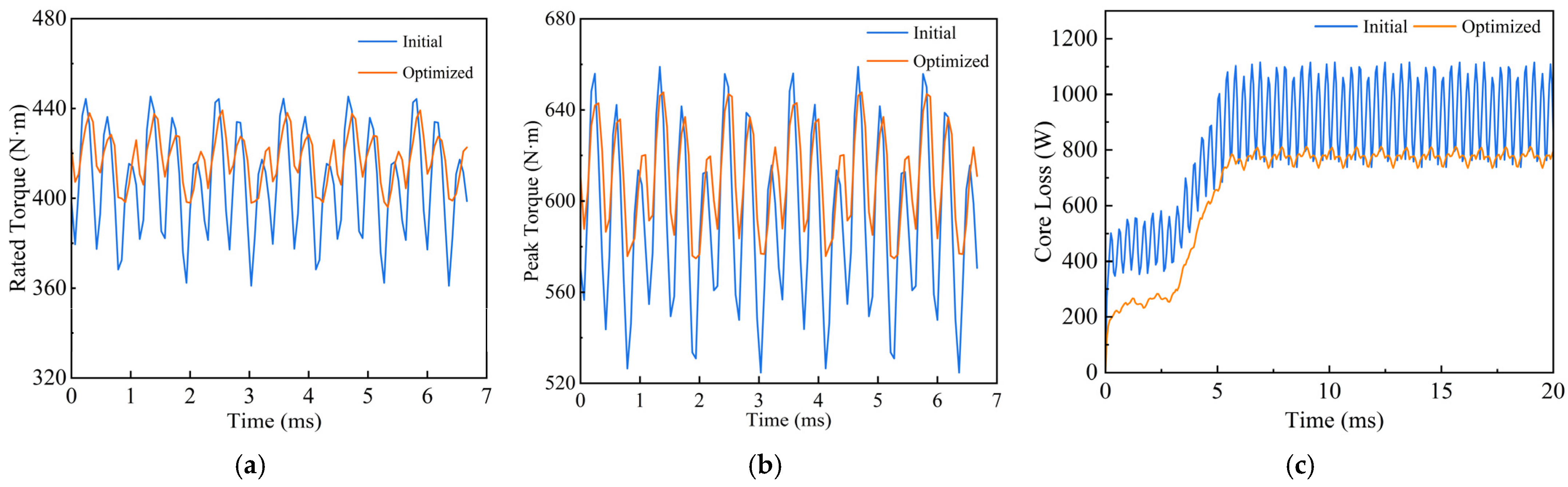
Figure 18a,b shows the comparisons of the rated torque and peak torque of the IPMSM before and after optimization, respectively. As can be seen, the rated average torque is increased from 407.5 N·m to 417.6 N·m, with a growth rate of 2.48%. The peak average torque is enhanced from 596.3 N·m to 610.7 N·m, a rise of 2.41%. Both the pulsations of the rated torque and peak torque are significantly reduced, and the decrease in cogging torque is a key factor contributing to the reduced motor torque ripple. Figure 18c shows the comparison of the IPMSM core loss. From the figure, the core loss is significantly reduced: the average loss decreases from 834.1 W to 665.1 W, a reduction of 20.26%, which significantly lowers energy consumption. The reduction in harmonics is one of the main factors contributing to the decrease in motor loss.
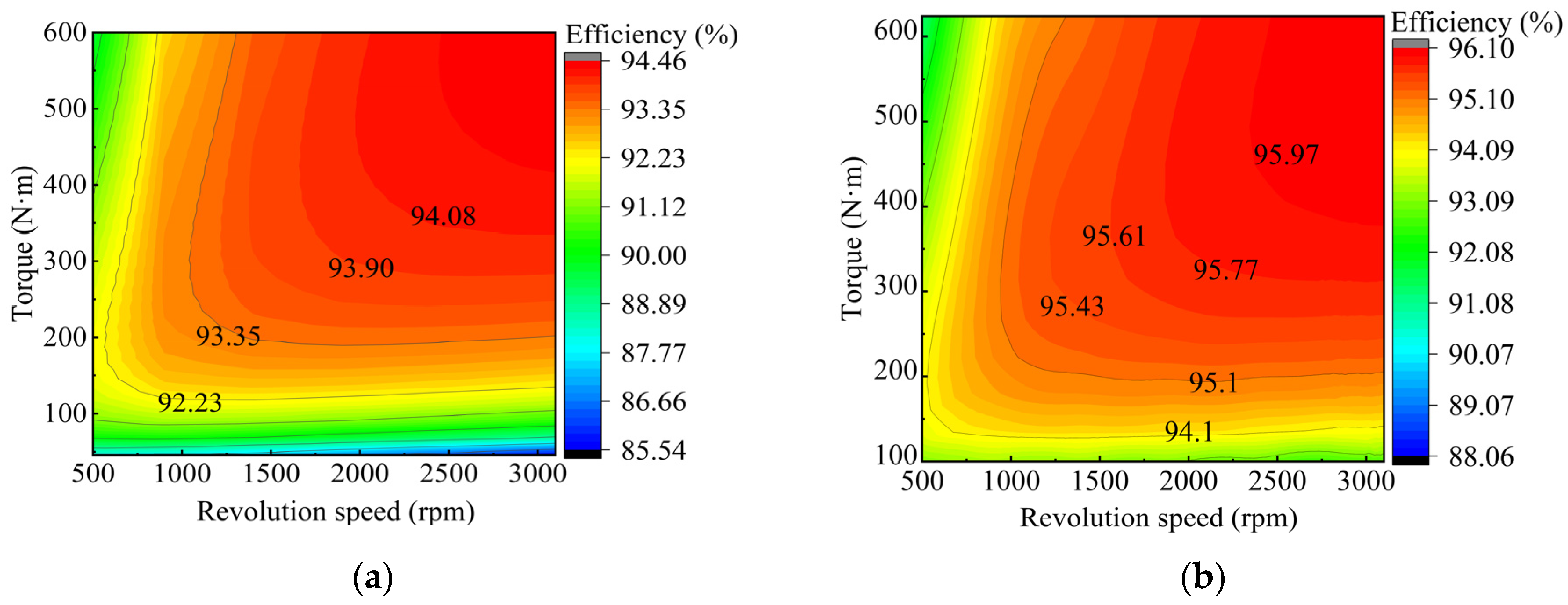
Figure 19 depicts the efficiency distribution maps of the motor before and after optimization. As observed from the figure, the peak efficiency of the IPMSM has increased from 94.46% to 96.10%. In addition, the optimized IPMSM has a larger high-efficiency coverage area, and its speed regulation capability and torque output characteristics are also better. This indicates that the optimized IPMSM can better meet the performance requirements of electric loaders across varying operating conditions.
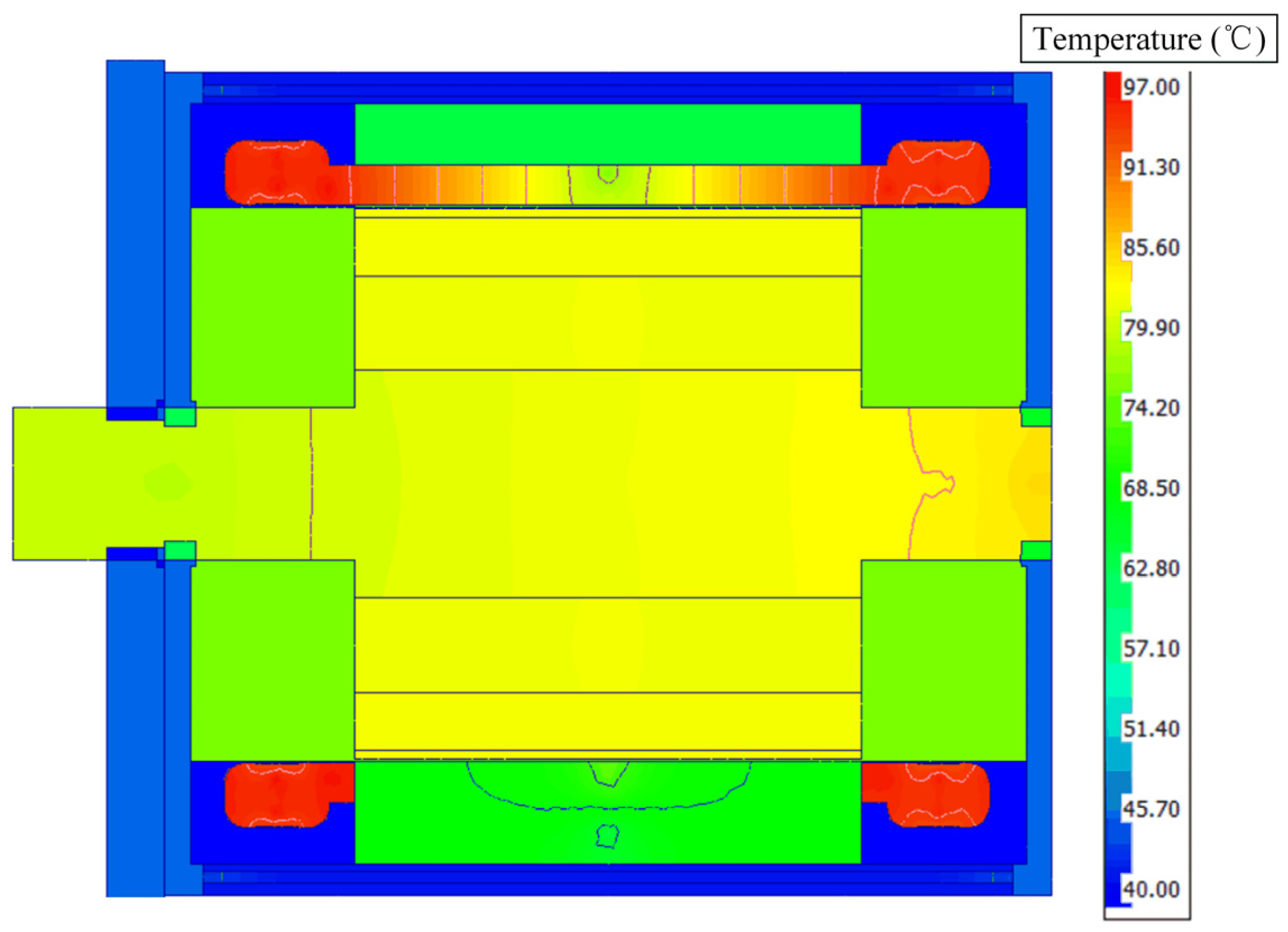
Temperature is an indicator for evaluating the operational reliability of the IPMSM. Figure 20 illustrates the temperature distribution of the water-cooled IPMSM under rated operating conditions. Among them, the winding temperature of the IPMSM is the highest, reaching 97 °C. As the windings are designed with Class H insulation, which allows a maximum operating temperature of 180 °C, the motor fully meets the temperature rise requirements for the safe operation of the IPMSM.
For a more intuitive comparison of the electromagnetic performance of the IPMSM before and after optimization, the performance indicators are tabulated in Table 12. From the overall optimization results, the multi-objective optimization design of the IPMSM in this study has improved the rated torque, peak torque, and no-load back EMF, while reducing the cogging torque, torque ripple, and core loss.

4.3. Experiments

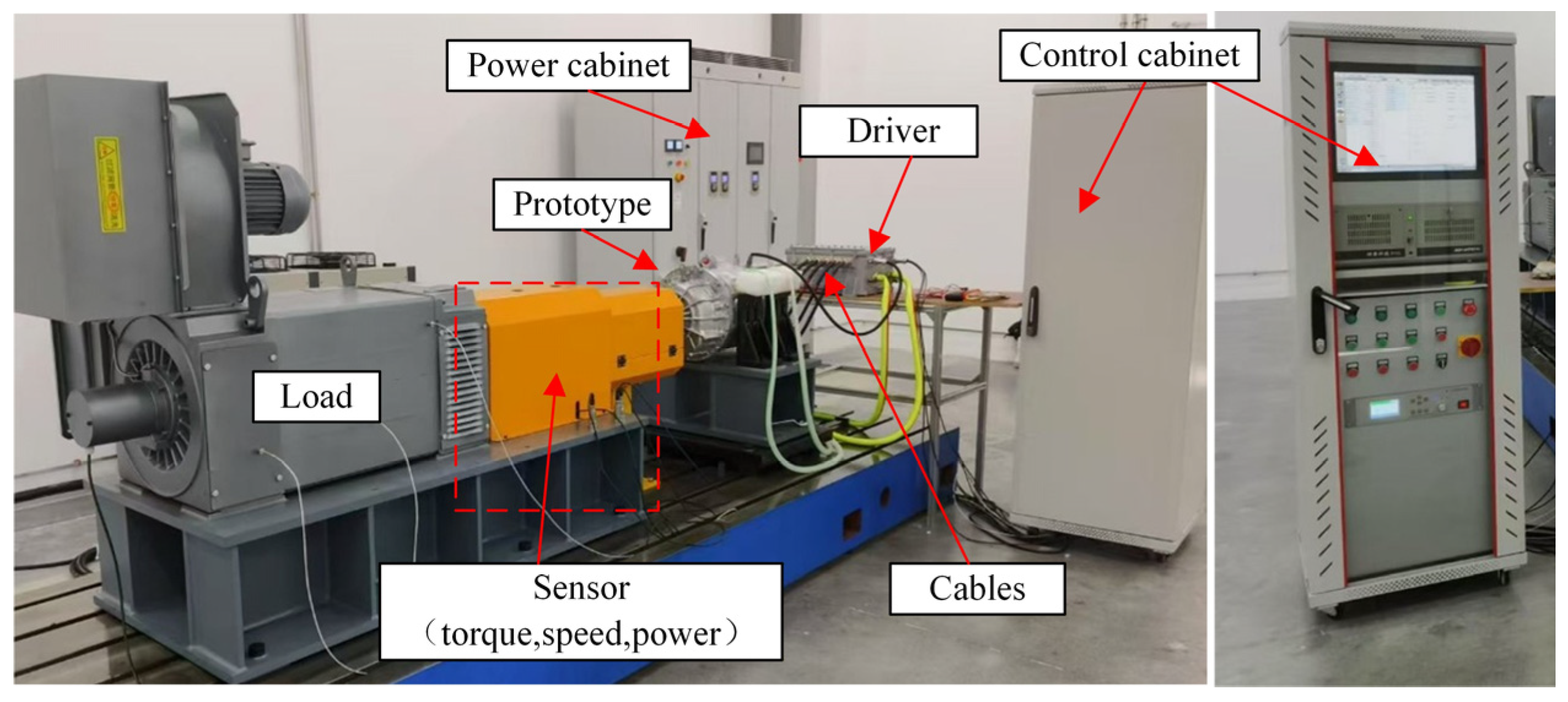
Based on the optimized motor parameters, a prototype is fabricated, and a corresponding experimental platform is established to test the IPMSM performance. As illustrated in Figure 21, the platform is composed of a power cabinet (from Unitech Embedded, Shanghai, China), a sensor (from Haibohua Technology Co., Ltd., Beijing, China), a control cabinet (from Unitech Embedded), and a driver (from Unitech Embedded), among other equipment. The experimental process is as follows: first, connect the power cabinet, control cabinet, driver, and other equipment via cables, and install the sensor between the prototype and the load to collect operating data; second, the power cabinet supplies power, and the control cabinet sends signals to the driver to start the prototype; finally, on the load platform, the driving prototype drives the load to rotate, and the torque and speed, as well as the power parameters are measured.
To verify the accuracy of the optimization model and its compliance with practical engineering application requirements, this study obtained the motor torque under various operating conditions through FEA and experimental tests, as presented in Table 13. Among them, the output torque under rated conditions is 425.1 N·m, the torque ripple rate is 9.97%, and the output torque under peak conditions is 623.5 N·m. The experimental results are highly consistent with the simulation data, indicating that the optimization model meets the design specifications and holds considerable engineering reference value.

5. Conclusions

This research takes the high-power IPMSM as the research object and conducts multi-objective global optimization for its key performance indicators. A multi-objective optimization system incorporating the high-precision data-driven surrogate model and the NSGA-II algorithm is established, which reduces the computational cost of optimization and significantly improves the motor performance. The specific research contents and conclusions of this paper are as follows:
  • A screening and hierarchical system for optimization variables is established to quickly distinguish significant parameters from non-significant ones. Based on the orthogonal matrix of fuzzy theory, the parameter interactivity and global sensitivity of each variable are calculated, and two low-order optimization variables are screened out. The number of variables is reduced from nine to seven, which greatly reduces the optimization cost.
  • For the seven high-order optimization variables, the MO-LHS method is adopted to construct a data sample space with excellent uniformity and orthogonality. Subsequently, the BPNN surrogate model is employed to predict and fit the motor performance, which reduces the computational cost. The correctness of the high-precision BPNN model and the optimization algorithm is verified, and the relative error of all optimization objectives is less than 3%.
  • The NSGA-II algorithm is adopted to optimize the high-power permanent magnet synchronous motor. By defining the objective functions and constraint conditions, the optimal Pareto frontier with the evaluation function introduced is obtained. The optimization results of the algorithm are compared with the FEA simulation results, and the optimized high-power permanent magnet synchronous motor model is derived. After optimization, the cogging torque is reduced by 40.96%, the torque ripple is reduced by 52.48%, the core loss is reduced by 20.26%, and the efficiency is improved by 1.74%. The IPMSM performance is thus significantly enhanced, and the optimization results verify the effectiveness and accuracy of the multi-objective optimization system for high-power permanent magnet synchronous motors established in this paper.
As future research directions, this study can be extended in the following ways:
  • The multi-objective optimization framework proposed herein centers exclusively on torque performance, cogging torque and iron loss, with neither vibration and noise metrics nor rotor dynamic characteristic analysis taken into account. Future research can integrate the electromagnetic–thermal–structural multi-physics field coupling analysis into the optimization framework, develop a temperature-dependent surrogate model considering the demagnetization characteristics of permanent magnets, and further improve the optimization framework to meet the comprehensive operation requirements of electric loaders.
  • The surrogate model and sampling strategy adopted for the optimization in this paper still have room for improvement. In future research, we can integrate BPNN with deep learning algorithms such as CNN and generative adversarial networks (GAN) to improve the model structure. Meanwhile, adaptive sampling strategies can be incorporated to supplement key sample points, thereby enhancing the prediction accuracy under extreme operating conditions and reducing the deviation from the actual finite element model.

Author Contributions

Conceptualization, Z.Z. and H.W.; methodology, Z.Z. and X.L.; software, Y.L. and N.Z.; validation, B.L. and S.W.; formal analysis, H.W.; investigation, Y.L. and J.C.; resources, X.L. and T.W.; data curation, Z.Z. and H.W.; writing—original draft preparation, Z.Z., H.W., Y.L., N.Z. and X.L.; writing—review and editing, X.L.; visualization, J.C. and Y.L.; supervision, J.C.; project administration, Z.Z. and H.W.; funding acquisition, X.L. All authors have read and agreed to the published version of the manuscript.

Funding

This work was supported in part by Guangxi Science and Technology Major Program under Grant AA23023012, in part by Guangxi Science and Technology Plan Project under Grant AD23026124, in part by the National Natural Science Foundation of China under Grant 52407044, in part by Guangxi Young Elite Scientist Sponsorship Program under Grant GXYESS2025017, in part by Guangxi Science and Technology Major Program under Grant AA23073019, and in part by Guangxi Key Research and Development Plan under Grant AB23049006.

Institutional Review Board Statement

Not applicable.

Informed Consent Statement

Not applicable.

Data Availability Statement

The original contributions presented in this study are included in the article. Further inquiries can be directed to the corresponding author.

Conflicts of Interest

Authors Bo Lin and Suyan Wang were employed by Guangxi Liugong Yuanxiang Technology Co., Ltd. The remaining authors declare that the research was conducted in the absence of any commercial or financial relationships that could be construed as a potential conflict of interest.

References

  1. Sun, W.; Si, H.; Qiu, J.; Li, J. Research on Efficiency of Permanent-Magnet Synchronous Motor Based on Adaptive Algorithm of Fuzzy Control. Sustainability 2024, 16, 1253. [Google Scholar] [CrossRef]
  2. Huang, X.; Yan, W.; Cao, H.; Chen, S.; Tao, G.; Zhang, J. Prospects for purely electric construction machinery: Mechanical components, control strategies and typical machines. Autom. Constr. 2024, 16, 105477. [Google Scholar] [CrossRef]
  3. Bramerdorfer, G.; Tapia, J.A.; Pyrhönen, J.J.; Cavagnino, A. Modern electrical machine design optimization: Techniques, trends, and best practices. IEEE Trans. Ind. Electron. 2018, 65, 7672–7684. [Google Scholar] [CrossRef]
  4. Chen, M.; Feng, C.; Cheng, R. MetaDE: Evolving differential evolution by differential evolution. IEEE Trans. Evol. Comput. 2025, 6, 54–64. [Google Scholar] [CrossRef]
  5. Piotrowski, A.P.; Napiorkowski, J.J.; Piotrowska, A.E. Particle swarm optimization or differential evolution—A comparison. Eng. Appl. Artif. Intell. 2023, 121, 106008. [Google Scholar] [CrossRef]
  6. Yu, X.; Chen, W.; Gu, T.; Yuan, H.; Zhang, H.; Zhang, J. ACO-A: Ant colony optimization plus a for 3-D traveling in environments with dense obstacles. IEEE Trans. Evol. Comput. 2019, 23, 617–631. [Google Scholar] [CrossRef]
  7. Nekoubin, A.; Soltani, J.; Dowlatshah, M. Multi-objective design optimization of five-phase fractional-slot concentrated-winding surface-mounted permanent-magnet machine. Arch. Electr. Eng. 2020, 69, 873–889. [Google Scholar] [CrossRef]
  8. Sun, C.; Li, Q.; Fan, T.; Wen, X.; Li, Y.; Li, H. Multi-Objective Optimal Design of 200 kW Permanent Magnet Synchronous Motor Based on NSGA-II. World Electr. Veh. J. 2025, 16, 299. [Google Scholar] [CrossRef]
  9. Li, Y.; Ding, S.; Hang, J.; Li, W. A New Perspective on High-Torque-Density Mechanism of Permanent Magnet Vernier Machines. IEEE Trans. Energy Convers. 2024, 39, 2337–2348. [Google Scholar] [CrossRef]
  10. Yu, Y.; Liang, C.; Zeng, D.; Hu, Y.; Yang, J. Multi-objective optimization of IPMSM for electric vehicles based on the combinatorial surrogate model and the hierarchical design method. Int. J. Electr. Power Energy Syst. 2024, 164, 110245. [Google Scholar] [CrossRef]
  11. Wang, Y.; Zhang, H.; Zhang, J.; Yin, H.; Wang, P.; Zhang, C.; Hua, W. Kriging-assisted multiobjective optimization of embedded magnetic encoder in PM synchronous machines. IEEE Trans. Instrum. Meas. 2023, 72, 2509512. [Google Scholar] [CrossRef]
  12. Jing, L.; Liu, W.; Tang, W.; Qu, R. Design and optimization of coaxial magnetic gear with double-layer PMs and spoke structure for tidal power generation. IEEE/ASME Trans. Mechatron. 2023, 28, 3263–3271. [Google Scholar] [CrossRef]
  13. He, L.; Wu, X.; Nie, Y.; Shi, W. Loss Prediction of vehicle permanent magnet synchronous motor based on deep learning. J. Electr. Eng. Technol. 2023, 18, 1053–1063. [Google Scholar] [CrossRef]
  14. Pan, Z.; Fang, S. Combined random forest and NSGA-II for optimal design of permanent magnet arc motor. IEEE J. Emerg. Sel. Top. Power Electron. 2022, 10, 1800–1812. [Google Scholar] [CrossRef]
  15. Qiu, W.; Wen, G.; Liu, H. A back-propagation neural network model based on genetic algorithm for prediction of build-up rate in drilling process. Arab. J. Sci. Eng. 2022, 47, 11089–11099. [Google Scholar] [CrossRef]
  16. Mahmouditabar, F.; Vahedi, A.; Mosavi, M.R.; Bafghi, M.H.B. Sensitivity analysis and multiobjective design optimization of flux switching permanent magnet motor using MLP-ANN modeling and NSGA-II algorithm. Int. Trans. Electr. Energy Syst. 2020, 30, 1–11. [Google Scholar] [CrossRef]
  17. Shimizu, Y.; Morimoto, S.; Sanada, M.; Inoue, Y. Automatic design system with generative adversarial network and convolutional neural network for optimization design of interior permanent magnet synchronous motor. IEEE Trans. Energy Convers. 2023, 38, 724–734. [Google Scholar] [CrossRef]
  18. Son, J.C.; Ahn, J.M.; Lim, J.; Lim, D.K. Optimal design of PMa-synRM for electric vehicles exploiting adaptive-sampling Kriging algorithm. IEEE Access 2021, 9, 41174–41183. [Google Scholar] [CrossRef]
  19. Wang, J.; Hua, Y.; Xu, B.; Zhu, Y. Multi-Objective Optimization Design of Bearingless Interior Permanent Magnet Synchronous Motor Based on MOWOA. Electronics 2025, 14, 3080. [Google Scholar] [CrossRef]
  20. Wang, S.-C.; Nien, Y.-C.; Huang, S.-M. Multi-Objective Optimization Design and Analysis of V-Shape Permanent Magnet Synchronous Motor. Energies 2022, 15, 3496. [Google Scholar] [CrossRef]
  21. Xing, E.; Gao, Q.; Dong, Y.; Bai, W. Design and Optimization of Support and Drive System for Magnetic Levitation Air Compressor for Fuel Cells. Actuators 2025, 14, 26. [Google Scholar] [CrossRef]
  22. Liu, F.; Wang, X.; Xing, Z.; Ren, J.; Li, X. Analysis and research on no-load air gap magnetic field and system multiobjective optimization of interior PM motor. IEEE Trans. Ind. Electron. 2022, 69, 10915–10925. [Google Scholar] [CrossRef]
  23. Zhao, X.; Lin, H.; Zhong, Y.; Yang, H.; Zeng, X. Multiobjective hierarchical optimization method with decoupling capability for hybrid-magnetic circuit variable flux memory machine. IEEE Trans. Transp. Electrif. 2024, 10, 8917–8927. [Google Scholar] [CrossRef]
  24. Si, J.; Zhao, S.; Feng, H.; Cao, R.; Hu, Y. Multi-objective optimization of surface-mounted and interior permanent magnet synchronous motor based on Taguchi method and response surface method. Chin. J. Electr. Eng. 2018, 4, 67–73. [Google Scholar]
  25. Sun, M.; Xu, Y.; Han, K. Structure and optimization design of cup winding permanent magnet synchronous machine in flywheel energy storage system. IEEE Trans. Magn. 2023, 59, 8100805. [Google Scholar] [CrossRef]
  26. Sun, K.; Tian, S. Multiobjective optimization of IPMSM with FSCW applying rotor notch design for torque performance improvement. IEEE Trans. Magn. 2022, 58, 8104909. [Google Scholar] [CrossRef]
  27. Park, J.C.; Kim, J.H.; Park, S.H.; Kim, K.O.; Sung, M.H.; Lim, M.S. Design optimization using asymmetric rotor in IPMSM for torque ripple reduction considering forward and reverse directions. IEEE Trans. Magn. 2023, 59, 8205805. [Google Scholar] [CrossRef]
  28. Wang, Y.; Zhao, M.; Jia, X.; Lu, M. Analysis and multi-objective optimization of an interior permanent magnet synchronous motor for a comprehensive performance enhancement. Struct. Multidiscip. Optim. 2025, 68, 55–61. [Google Scholar] [CrossRef]
  29. Li, Y.; Shang, L.; Wang, R.; Hang, J.; Ding, S. Design and Analysis of a Novel Consequent-Pole Interleaved Hybrid Magnet Memory Machine. IEEE Trans. Transp. Electrif. 2025, 12, 1607–1617. [Google Scholar] [CrossRef]
  30. Chen, M.; Huang, L.; Yang, H.; Yang, J.; Zhou, Z.; Li, Y.; Shen, F. Design and Analysis of a Hybrid Excitation Transverse Flux Linear Machine Used for Linear Railway Traction. IEEE Trans. Transp. Electrif. 2025. [Google Scholar] [CrossRef]
  31. Bramerdorfer, G.; Zăvoianu, A.C. Surrogate-based multi-objective optimization of electrical machine designs facilitating tolerance analysis. IEEE Trans. Magn. 2017, 53, 8107611. [Google Scholar] [CrossRef]
  32. Zhou, X.; Zhu, X.; Xiang, Z.; Fan, D.; Xu, L.; Zhu, T. Harmonic-oriented design and vibration characteristic suppression for interior permanent magnet motors. IEEE Trans. Ind. Electron. 2024, 71, 1246–1256. [Google Scholar] [CrossRef]
Figure 1. Optimization flowchart of the IPMSM.
Sustainability 18 01705 g001
Figure 2. 1/6 finite element model of IPMSM.
Sustainability 18 01705 g002
Figure 3. 1/6 parametric finite element model of IPMSM.
Sustainability 18 01705 g003
Figure 4. MPCI chart of optimization variables based on each level grade.
Sustainability 18 01705 g004
Figure 5. PCCs of variables vs. objectives.
Sustainability 18 01705 g005
Figure 6. Analysis of significant interaction effects among multiple variables.
Sustainability 18 01705 g006
Figure 7. Local sensitivity between variables and objectives.
Sustainability 18 01705 g007
Figure 8. Comprehensive sensitivity between variables and objectives.
Sustainability 18 01705 g008
Figure 9. Sample distributions of LHS and MO-LHS in two-dimensional space. (a) LHS; (b) MO-LHS.
Sustainability 18 01705 g009
Figure 10. Fitting surfaces of predicted values from the Kriging model (a) Fitting surface of O 2 and B 1 for the average torque T a v g ; (b) fitting surface of r i b and H s 2 for the cogging torque T c o g ; (c) fitting surface of B 1 and B s 0 for the torque ripple T r i p ; (d) fitting surface of H p m and W p m for the core loss P c o r e ; (e) fitting surface of O 2 and B s 0 for the amplitude of no-load back EMF U B E M F .
Sustainability 18 01705 g010
Figure 11. Topological structure of BPNN.
Sustainability 18 01705 g011
Figure 12. Fitting surfaces of predicted values of the BPNN model. (a) fitting surface of r i b and H p m for the average torque T a v g ; (b) fitting surface of W p m and B 1 for the torque ripple T r i p ; (c) fitting surface of H s 2 and O 2 for the cogging torque T c o g ; (d) fitting surface of B s 0 and H s 2 for the core loss P c o r e ; (e) fitting surface of O 2 and r i b for the amplitude of no-load back EMF U B E M F .
Sustainability 18 01705 g012
Figure 13. Comparison curves between predicted values and actual values of the five optimization objectives. (a) Test on the average torque T a v g ; (b) test on the torque ripple T r i p ; (c) test on the cogging torque T c o g ; (d) test on the core loss P c o r e ; (e) test on the amplitude of no-load back EMF U B E M F .
Sustainability 18 01705 g013
Figure 14. Iterative optimization convergence process of NSGA-II.
Sustainability 18 01705 g014
Figure 15. Pareto front stratification based on the evaluation function G. (a) 3D Pareto frontier for T a v g , T r i p and T c o g ; (b) 3D Pareto frontier for T a v g , U B E M F and P c o r e ; (c) 2D Pareto frontier for T r i p and T c o g ; (d) 2D Pareto frontier for T a v g and P c o r e .
Sustainability 18 01705 g015
Figure 16. Comparison of no-load back EMF and cogging torque of the IPMSM before and after optimization. (a) No-load back EMF before and after optimization; (b) FFT spectrum of no-load back EMF before and after optimization; (c) cogging torque before and after optimization.
Sustainability 18 01705 g016
Figure 17. Comparison of IPMSM magnetic field distributions under rated operating conditions before and after optimization. (a) Magnetic flux line distribution of the motor before optimization; (b) magnetic flux density nephogram of the motor before optimization; (c) magnetic flux line distribution of the optimized motor; (d) magnetic flux density nephogram of the optimized motor.
Sustainability 18 01705 g017
Figure 18. Comparison of torque performance and core loss of the motor before and after optimization. (a) Rated torque before and after optimization; (b) peak torque before and after optimization; (c) core loss before and after optimization.
Sustainability 18 01705 g018
Figure 19. Comparison of IPMSM efficiency distributions before and after optimization. (a) Efficiency MAP before optimization; (b) efficiency map of the optimized motor.
Sustainability 18 01705 g019
Figure 20. The temperature distribution of IPMSM.
Sustainability 18 01705 g020
Figure 21. IPMSM experimental platform.
Sustainability 18 01705 g021
Table 1. Comparison of different optimization methods in the literature.
MethodExampleAccuracyCostReferences
Surrogate model + Optimization algorithmANN + NSGA-II/PSO/GAHighMedium[16,22]
RSM + MOWOA/SOA/SAA/GAMediumMedium[19,26,28]
BPNN + GA/PSOHighHigh[25]
Kriging + GAHighLow[18]
Surrogate modelKriging, RSM, ANNHigh (Kriging/ANN)
Medium (RSM)
Medium (RSM/ANN)
Low (Kriging)
[17,24,27]
Optimization algorithmMOGWO, PSOMediumLow[20,21]
Table 2. Main parameters of the IPMSM.
ParameterValueParameterValue
Output Power/kW125Stator Inner Diameter/mm220.5
Rated Speed/rpm3000Stator Outer Diameter/mm320
Rated Current/A150Permanent Magnet Thickness/mm13
Rated Torque/N·m400Permanent Magnet Width/mm75
Axial Length of Core/mm210Rotor Outer Diameter/mm218.9
Motor Length/mm400Number of Stator Slots54
Shaft Diameter/mm80Number of Rotor Poles6
Table 3. Structural parameters and value ranges of optimization variables.
Motor Topological ParameterItem CodeInitial ValueValue Range
Distance Between Inner Magnetic Barrier and Rotor Inner Edge O 2 /mmA35[32, 38]
Inner Magnetic Barrier Bridge Width B 1 /mmB8[7.5, 9.0]
Outer Magnetic Barrier Spacing r i b /mmC8[7.5, 9.0]
Magnetic Barrier Bridge Width O 1 /mmD1.5[1.3, 1.75]
Stator Slot Opening Depth H s 0 /mmE0.7[0.64, 0.76]
Stator Slot Depth H s 2 /mmF27[26, 29]
Stator Slot Opening Width B s 0 /mmG3.4[3, 3.6]
Permanent Magnet Thickness H p m /mmH13[10, 14]
Permanent Magnet Width W p m /mmI75[75, 90]
Table 4. Optimization variables corresponding to each level grade.
Optimization VariableABCDEFGH
Level Grade 1327.57.51.30.6426310
Level Grade 234881.450.68273.211.3
Level Grade 3368.58.51.60.72283.412.6
Level Grade 438991.750.76293.614
Table 5. OA combinations and FEA results.
CodeOrthogonal MatrixTavg
/N·m
TripTcog
/N·m
Pcore
/W
UBEMF
/V
A B C D E F G H I
1327.57.51.30.642631076410.960.249.02611.43318.22
23288.51.450.68273.211.378413.610.2016.21640.59323.02
3328.591.60.72283.412.680411.090.1622.18650.27332.66
43297.51.750.76293.61482405.610.1716.30643.42332.17
5347.581.30.76293.612.684404.120.1628.37668.03342.04
63488.51.450.642631486438.610.147.43648.40361.90
7348.591.60.68273.21088434.030.2016.97698.59363.66
83497.51.750.72283.411.390428.890.2412.06690.49362.38
9367.58.51.30.72283.41480408.730.165.77649.42337.34
1036891.450.76293.61082400.700.138.10676.41332.60
11368.57.51.60.6426311.384436.810.1810.65668.51354.47
1236981.750.68273.212.686435.800.2017.27681.61363.77
13387.591.30.68273.212.688433.210.1214.48680.12356.99
143887.51.450.72283.41490425.650.1625.80666.38352.07
15388.581.60.76293.61076390.340.1817.51641.25312.87
163898.51.750.6426311.378427.530.1715.31637.48345.98
17327.581.450.76283.41480403.470.185.42613.26333.82
183288.51.60.64293.61082400.720.179.27674.44331.41
19328.591.750.6826311.384436.380.1720.09669.43360.35
203297.51.30.72273.212.686433.980.1816.47672.79360.94
21347.58.51.60.72273.212.688430.410.1318.46672.37354.85
2234891.750.76283.41490424.830.1516.93664.72359.03
23348.57.51.30.64293.61076391.890.2016.84640.67311.58
2434981.450.6826311.378426.600.1919.57634.16345.28
25367.591.750.682631480425.410.179.57635.88336.24
263687.51.30.72273.21082419.770.184.21664.34343.94
27368.581.450.76283.411.384418.420.159.20681.71344.38
283698.51.60.64293.612.686416.330.2014.76675.56354.71
29387.57.51.450.64293.612.688411.330.1647.47676.36335.01
3038881.60.682631490443.300.188.18653.20367.69
31388.58.51.750.72273.21076409.340.1919.02631.80323.54
3238991.30.76283.411.378431.30.1917.83669.32349.62
Table 6. Optimization variable combination corresponding to the maximum MPCI value.
Optimization VariableOptimal Level GradeOptimal Level Value
A132
B49
C38.5
D41.75
E30.72
F429
G13
H414
I584
Table 7. 200 sets of finite element experiments created based on MO-LHS.
CodeHigh-Order Optimization VariablesFEA Results
ABCFGHITavg/N·mTripTcog
/N·m
Pcore
/W
UBEMF
/V
133.737.518.9428.643.3510.1580.86400.580.1596.88672.60332.24
235.298.878.0728.153.5712.4185.56423.050.17613.58680.73355.13
332.068.307.6428.363.4611.8486.07417.050.1559.22678.39345.59
434.597.587.5927.933.1913.9384.13414.890.15923.92655.25352.45
532.227.888.2826.033.3713.2878.72421.690.20218.65613.30332.86
7135.538.518.0328.843.2312.0579.84403.030.1468.43662.00335.13
7232.958.948.4127.233.5611.7878.92419.130.19023.28653.82339.71
7332.028.238.6826.563.4512.5485.25433.950.16819.06667.58355.67
7432.518.977.8227.213.2210.4788.52433.300.21515.23693.22362.44
7536.107.817.9328.473.5913.8781.58407.810.1518.22660.72341.44
14036.677.848.1026.803.3611.6488.82436.190.15810.65691.14355.17
14134.028.407.5027.113.5512.9781.47423.220.18414.47660.60341.92
14234.428.038.4227.843.1511.5380.25411.630.1618.46666.59333.81
14333.087.988.4427.863.1912.5975.25399.300.18113.75625.01310.64
14436.918.787.8528.293.3212.9275.96401.890.17718.72641.74321.54
14537.658.498.2926.623.5512.3586.37439.150.18516.79686.94366.57
Table 8. R2 and RMSE of the surrogate models.
Surrogate ModelR2RMSE
TavgTripTcogPcoreUBEMFTavgTripTcogPcoreUBEMF
Kriging0.9770.9790.9180.8790.9761.1890.0132.7797.3486.142
BPNN0.9960.9840.9520.9470.9860.8730.0091.7521.7821.386
Table 9. Extraction of optimal solutions from the Pareto frontier.
Candidate Point No.High-Order Optimization Variables
A: O2/mmB: B1/mmC: rib/mmF: Hs2/mmG: Bs0/mmH: Hpm/mmI: Wpm/mm
137.878.428.1928.273.0213.9483.49
237.998.458.2328.253.0113.7782.25
337.898.498.2128.413.0313.9783.74
435.798.498.4227.413.3512.9785.74
536.958.378.6728.633.4613.9186.94
637.258.558.1528.223.5514.0087.28
737.648.528.6428.523.2411.3584.77
837.868.428.0428.383.2612.9787.41
934.597.967.8726.913.5613.6788.13
1035.628.848.6328.863.4813.3486.32
Table 10. Error calculation of surrogate model predictions.
Comparison ResultsOptimization Objectives
Tavg/N·mTripTcog/N·mPcore/WUBEMF/V
Optimization Results419.89.51%9.63669.4343.7
FEA Results417.69.79%9.8665.1341.1
Relative Error0.53%−2.86%−1.73%0.65%0.76%
Table 11. Comparison of topological variable parameter values before and after optimization.
Topological ParametersItemBeforeAfter
Distance between inner magnetic barrier and rotor inner edge O 2 /mmA3537.64
Inner magnetic isolation bridge width B 1 /mmB88.52
Outer magnetic barrier spacing r i b /mmC88.64
Magnetic bridge width O 1 /mmD1.51.75
Slot opening depth H s 0 /mmE0.70.72
Slot depth H s 2 /mmF2728.52
Slot opening width B s 0 /mmG3.43.24
Permanent magnet thickness H p m /mmH1311.35
Permanent magnet width W p m /mmI7584.77
Table 12. Comparison of motor performance before and after optimization.
Performance ParameterBeforeAfterOptimization Rate
Rated Condition Output Torque/N·m407.5417.6+2.48%
Peak Condition Output Torque/N·m596.3610.7+2.41%
Cogging Torque/N·m16.69.8−40.96%
Torque Ripple20.6%9.79%−52.48%
No-load Back EMF Amplitude/V300.5341.1+13.51%
Core Loss/W834.1665.1−20.26%
Efficiency/%94.4696.10+1.74%
Table 13. Comparative simulation vs. experimental results.
Operating ConditionsFEA Results
/N·m
Experimental Results
/N·m
Variation
Light-load308.5313.21.50%
Rated417.6425.11.76%
Overload526.6536.41.83%
Peak610.7623.52.05%
Disclaimer/Publisher’s Note: The statements, opinions and data contained in all publications are solely those of the individual author(s) and contributor(s) and not of MDPI and/or the editor(s). MDPI and/or the editor(s) disclaim responsibility for any injury to people or property resulting from any ideas, methods, instructions or products referred to in the content.