1. Introduction
Wetlands and forest ecosystems constitute the living backbone of the tropical landscape, covering millions of hectares. These ecosystems extend into the environment through their soils, waterways, and vegetation, sustaining both wildlife and human livelihood. Globally, forests cover approximately 41 million km
2, while wetlands span another 12.1 million km
2 [
1,
2], harboring a distinct share of the world’s plant and animal species and storing vast reservoirs of carbon. These natural ecosystems function through quiet ecosystem elements, including rooted vegetation that stabilizes soils, water that filters through wetland beds, nutrient cycles that nourish living organisms, and habitat corridors that support wildlife movement [
3,
4]. When these elements interact harmoniously, they create landscapes that are capable of absorbing disturbances and regenerating after stress [
5]. However, over the last century, wetland ecosystems have experienced severe global degradation, with about 87% of wetlands and 2000 million hectares of forests lost since the 1700s [
6]. This decline is more pronounced in the United States, Europe, and China [
7], driven by both natural factors, such as climate variability, and human activities, including deforestation, agriculture, urbanization, and resource overexploitation [
8,
9]
Over generations, many households across the tropics have relied on the steady flow of ecosystem services provided by wetlands and forests. It is evident that a family’s water for farming and drinking often comes from wetland springs; daily cooking depends on fuelwood collected and gathered from forest edges; and food, fodder, medicinal plants, and non-timber products support local livelihoods [
10,
11]. At a broader scale, wetlands protect communities from floods, forests usually cool the environment, and together these ecosystems store carbon, acting as natural shields against the unfolding climate crisis [
12,
13]. However, increasing pressure from land use, resource extraction, and infrastructure development is causing declines in these services, weakening the resilience of the communities that rely on them [
13,
14].
The problem is particularly severe in tropical mountainous regions, including the Elgon and Rwenzori ranges, where steep slopes, intense rainfall, and human activity accelerate soil erosion, landslides, and river siltation [
15,
16]. Globally, tropical forests experienced an average annual forest loss of approximately 3.94 million hectares between 2010 and 2020, while African wetlands shrank at 2–4% per year [
17]. Loss of ecological balance in these landscapes exposes communities to floods, unpredictable water flows, declining soil fertility, and reduced access to natural resources that once supported their livelihoods [
18,
19].
Recognizing these growing risks, national and subnational governments have resorted to ecological restoration to reverse degradation and rebuild resilience [
20,
21]. The government of Uganda is committed to restoring approximately 2.5 million hectares by 2030 under the AFR100 initiative, through firm policy and regulatory bodies, including the National Environment Management Authority, the National Environment Act, and the National Wetlands Policy [
21]. Local governments and districts are also implementing restoration programs, such as demarcating wetland and forest boundaries, regenerating forests, stabilizing riverbanks, and partnering with local communities to reduce pressure on these fragile natural ecosystems [
22,
23]. These interventions reflect the understanding that wetland and forest restoration benefits both the environment and local communities [
24,
25].
Within Uganda’s restoration efforts, Sironko and Ibanda Districts reflect both the challenges and opportunities of tropical ecosystem restoration. The ever-increasing population of Sironko is a threat to wetlands and forests, driven by the search for farmland, space for settlement, and sand for construction. This expansion has altered the River Sironko corridor, reducing water retention and increasing erosion [
26]. In Ibanda, wetland and forest degradation is driven by agriculture, sand mining, brick laying, and craft production [
27]. Through government support and community mobilization, degraded wetland sections are being demarcated and replanted, forest patches are regenerating, and alternative livelihood initiatives are reducing human pressure on these fragile landscapes [
28].
Whereas several studies have profiled the causes of environmental degradation and the loss of ecosystem services, and their implications for human well-being [
29,
30], there remains a critical knowledge gap regarding how communities perceive the drivers of forest and wetland degradation in the tropics and the contributions of restoration interventions. Little emphasis has been placed on the qualification of restoration measures in wetland and forest ecosystems in the tropics, particularly understanding the extent of degradation, recovery, and resupply of ecosystem services. Furthermore, a comparative analysis of ecosystem supply recoveries between these two ecosystems is also inadequate. Secondly, although wetland and forest degradation have been widely documented, this threat to community forests and permanent wetlands has received little attention; this study brings it to the attention of conservation planners. Thirdly, despite the introduction of restoration interventions in wetlands and forests in the global south, this study argues that the promotion of alternative livelihoods should be prioritized, particularly for affected households, to sustain the measures implemented to facilitate the recovery of these ecosystems from the scars of degradation.
This study addressed these knowledge gaps by applying an integrative approach to investigate community perceptions of the causes of degradation in forest and wetland ecosystems and the recovery of ecosystem services following restoration interventions in the Sironko and Ibanda districts, located in Eastern and Western Uganda, respectively. The districts are characterized by diverse forest and wetland ecosystems that are threatened by population pressures associated with settlement and agricultural land expansion. The communities, however, have been mobilized to undertake interventions to restore degraded patches of these ecosystems. As such, the paper’s research questions were as follows:
What are the extent and drivers of wetland/forest degradation before and after restoration?
What are the effects of wetland/forest restoration on the supply of ecosystem services?
Are there any statistical differences in the supply of ecosystem services between the restored and unrestored wetland/forest sites?
Are there any statistical differences in the recovery of ecosystem services between the restored wetland and forest ecosystems?
This study aims to provide evidence on the importance of restoring degraded wetland and forest ecosystems, raise awareness about the need to conserve fragile ecosystems, support increased budgetary allocations for natural resource management, and strengthen the integration of ecosystem service supply into climate adaptation planning in rural communities.
2. Materials and Methods
2.1. Description of the Study Area
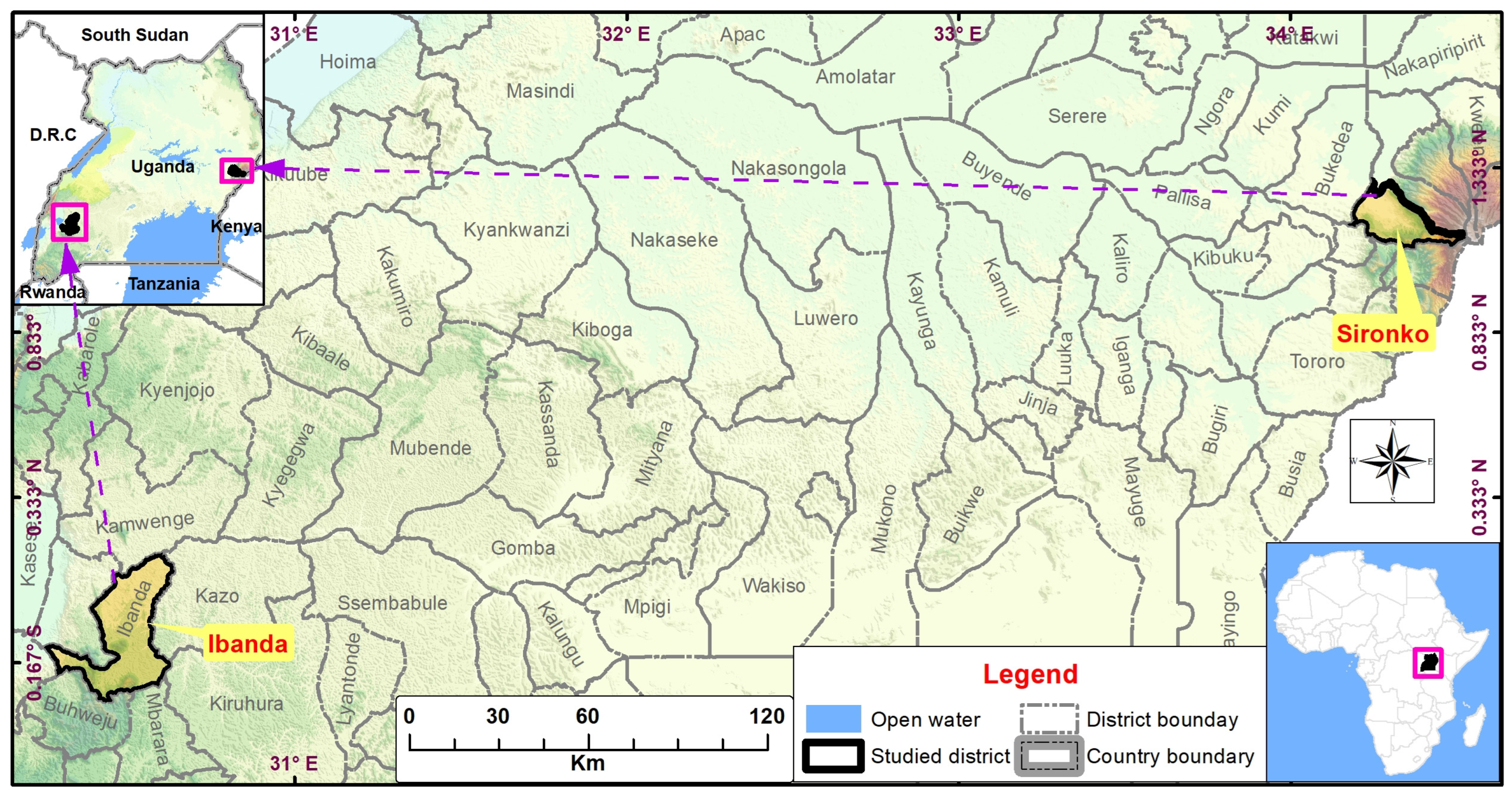
This study was conducted in two districts: Sironko (Eastern) and Ibanda (Western) (
Figure 1). These districts were selected based on their ecological sensitivity (adjacent mountainous ecosystems—Mt Elgon and Rwenzori—and the presence of Rivers—Sironko and Mpanga in Ibanda); widespread wetland and forest ecosystem degradation; and proneness to the devastating impacts of flash floods and prolonged droughts. In Sironko district, rainfall ranges from 2000 to 3000 mm annually in the wetter upper areas near Mt. Elgon to about 1000 mm in the downstream areas [
31]. These range from 27 °C to 32 °C mean maximum temperatures and from 15 °C to 17 °C mean minimum temperatures in the lowlands. In highland areas, mean maximum temperatures range from 25 °C to 28 °C, and mean minimum temperatures range from 15 °C to 16 °C [
32]. The soil composition varies considerably across the landscape, comprising laterites, sandy loams, and volcanic soils [
32]. The soils consist mainly of volcanic ash decomposition products, forming clay soils in shades of red, black, or gray, mixed with sand- and gravel-sized particles.
On the other hand, Ibanda District lies at elevations ranging from 1800 to 13,000 m above sea level. The district experiences a tropical climate, hot and wet, with an average annual rainfall of 1000–1200 mm. There are two rainy seasons, from mid-August to December and from mid-March to mid-May, with a short dry spell between them, lasting from mid-June to mid-July, and a long dry spell from late November to early March. These modifications have contributed to unexpected heavy rains and, at times, long dry spells. District temperatures range from 12.5 °C to 30 °C, with extremes recorded in February. The soils are predominantly derived from weathered pre-Cambrian basement rocks, including gneiss and granitoids, resulting in a variety of soil types influenced by topography and climate. The upland areas are mainly covered by Ferralsols and Nitisols, which are deep red, well-drained, clay-rich, but generally acidic and nutrient-poor due to intense weathering [
33].
2.2. Analysis of Wetland Degradation
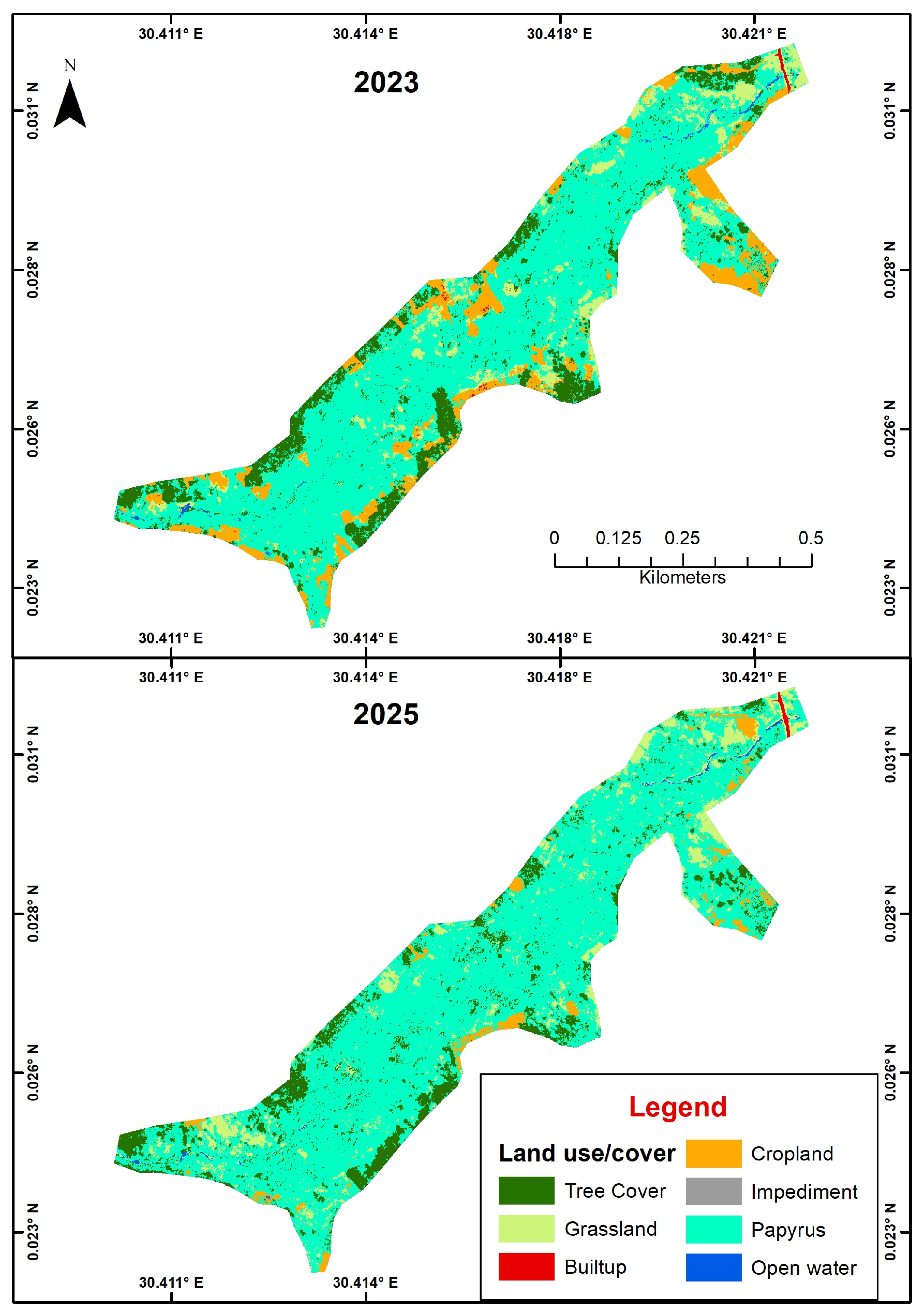
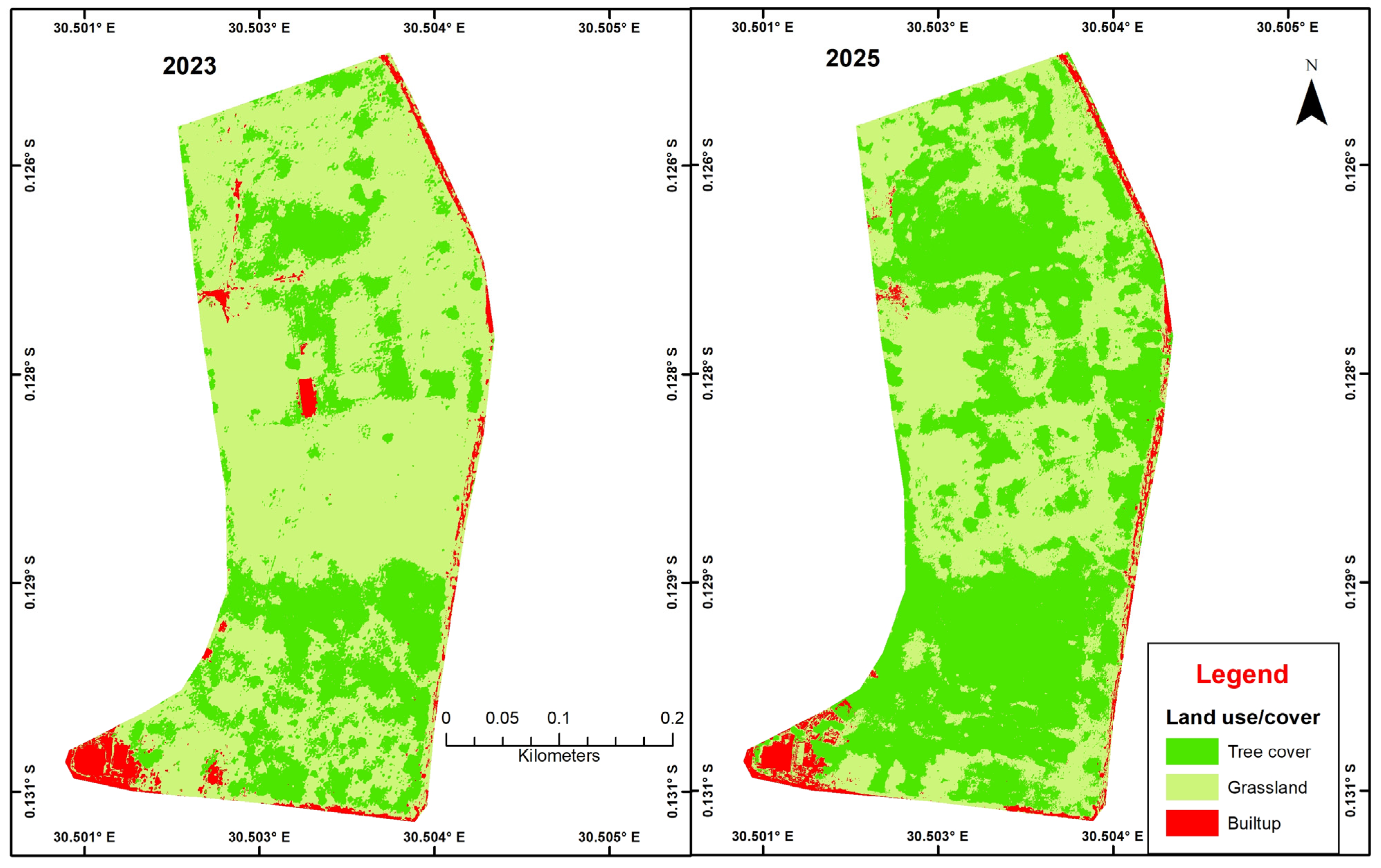
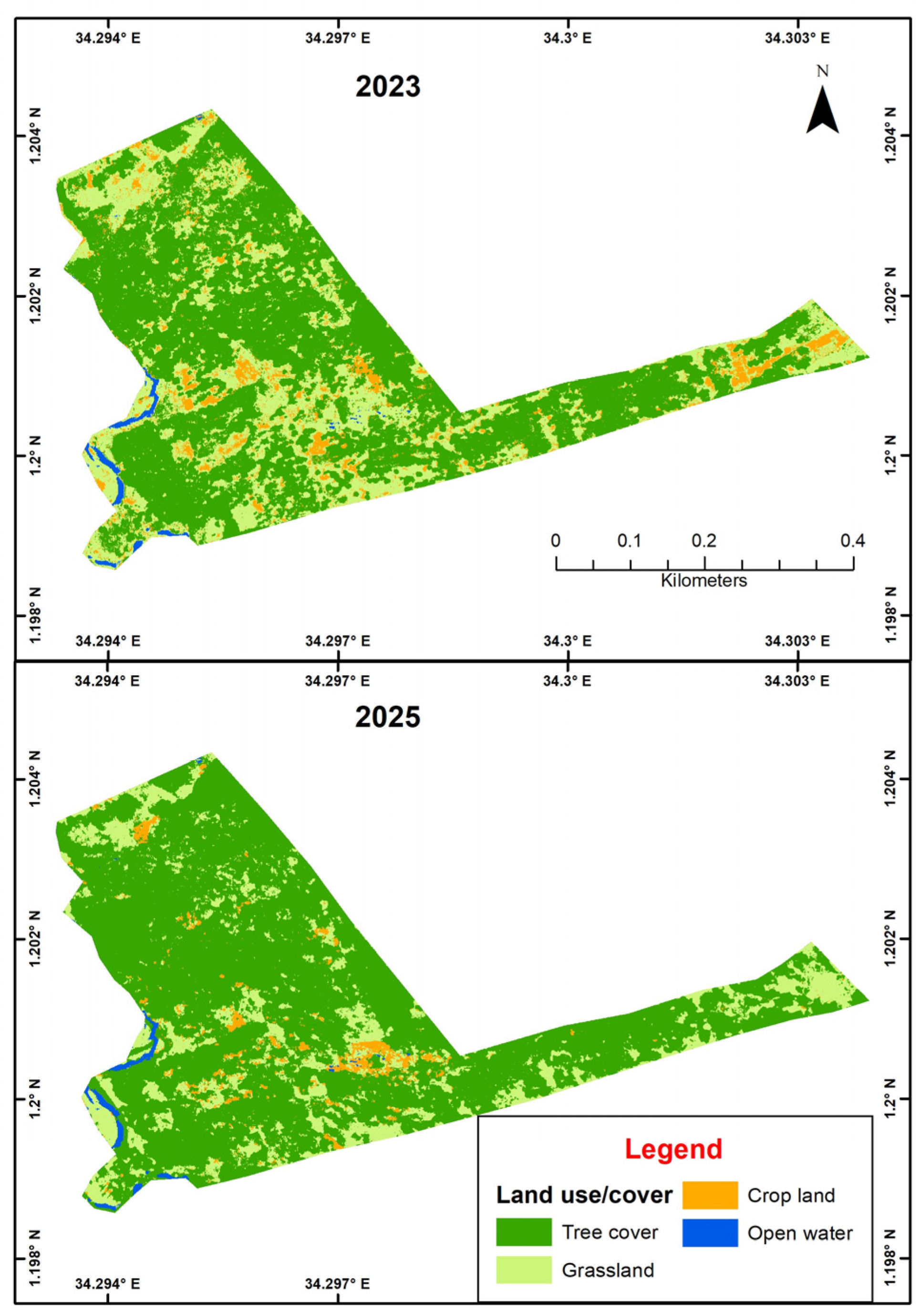
Wetland use/cover (structural) changes were used as an indicator of wetland degradation. High-resolution optical satellite imagery from the Airbus constellation was acquired for all sites. To ensure consistency in analysis, images with minimal cloud cover (<20%) and comparable conditions across seasons were selected. The images were all pre-processed in Google Earth Pro (version 7.3.6.10441), using ground truth points (34) to georeference and rectify the imagery. Tilting corrections were applied before downloading to minimize geometric distortion. Ecosystem boundaries were overlaid using a wetland shapefile (2022) provided by the Ministry of Water and Environment (MWE). The boundaries were refined by comparing field survey data with historical satellite imagery and by visual inspection (
Table 1).
Supervised classification was conducted using the Maximum Likelihood Classification (MLC) algorithm, a probabilistic approach widely recognized for its accuracy in remote sensing. Representative training samples for each wetland use/cover class were identified using Google Earth Pro and field validation points. The classification was implemented in QGIS (version 3.38) and ArcGIS (version 10.8.2) platforms. An error matrix methodology was used to estimate overall image classification accuracies: Rwambu (92%), Kafunjo (92%), Mutufu wetland (91%), and Mutufu forest (93%). Refer to the
Supplementary Materials for tables on image classification accuracy assessment. Reclassification was performed to organize the spectral classes into seven classes based on the physical attributes of features observed in satellite images and field validation data (
Table 2).
2.3. Household Population and Sampling
The population in the current cross-sectional survey comprised households adjacent to forest and wetland ecosystems in the Sironko and Ibanda districts. The districts are located in the Afromontane agroecological zone. The sampling design was developed to enable the collection of perceptions and experiences from communities in both restored and unrestored areas within the same ecosystem. The choice of restored and unrestored regions studied was purposively selected in consultation with district environmental officers and local leaders and informed by a review of restoration program records. The target households were interviewed upon informed consent to participate in the survey.
A stratified random sampling technique was used to select households from both restored and unrestored areas across the forest and wetland ecosystems. The entire area was divided into sub-counties and parishes, representing separate strata. Within each parish, villages surrounding the selected forest and wetland ecosystems were identified and listed. The survey included all villages within a 5 km radius of the forest and wetland ecosystems, since forests and wetlands may exert direct and indirect ecological and socio-economic effects within this range.
A total of 12 villages were selected for the wetland ecosystem (6 restored and 6 unrestored) and 15 for the forest ecosystem (8 restored and 7 unrestored), for a total of 27 villages, ensuring adequate representation of both restored and unrestored sites. The sample included villages with varying degrees of restoration intervention and ecological condition to capture a wide range of community experiences. The number of sampled households in each town was determined proportionally to the village’s population relative to the total population of all selected villages: villages with larger populations contributed more households, thereby ensuring representativeness across communities surrounding the ecosystems.
The application of stratified sampling ensured a logical distribution across the selected sites, enabling the collection of proportionate and representative data that reflected the study area’s diversity. In total, 275 households were surveyed from wetland ecosystem villages (177 in restored sites and 98 in unrestored sites), with 29 and 16 households selected from each village near restored and unrestored wetland ecosystems, respectively. On the other hand, 817 households were surveyed from forest ecosystem villages (719 in restored sites and 98 in unrestored sites), with 89 and 14 households selected from each village near restored and unrestored forest ecosystems, respectively. Households that reported interacting with both ecosystems were included in both categories to examine linkages among ecosystem service degradation, restoration interventions, and changes in household income.
The sample size determination procedure was used to determine the required sample size from the study population surrounding forest and wetland ecosystems. The Krejcie and Morgan method helps estimate sample size when the population size is known [
34]. It is ideal for determining statistically appropriate sample sizes in research surveys, just like the present study. The application of stratified sampling ensured a logical distribution across the selected sites, enabling the collection of proportionate and representative data that reflected the study area’s diversity. The communities perceived improvements in ecosystem services relative to the resources harnessed over the last 10 years, when ecosystems were not widely encroached upon.
The selected wetland and forest ecosystems were studied due to their long-term ecological degradation and because restoration interventions (2022–2024) had commenced by the Ministry of Water and Environment (
Figure 2). The period studied was sufficient to track the recovery of ecosystem services, given the similarity of climatic conditions of the assessed ecosystems. The households assessed improvements in ecosystem services by comparing levels between 2002 and 2024. Ecosystem service improvement indicators used to track changes included ecosystem quality and quantity, flood regulation, and ecosystem coverage. The points of departure were used to assess perceived recovery after restoration, using a Likert scale (1–5).
2.4. Data Collection
A semi-structured questionnaire was designed and administered to collect data on socio-demographic characteristics, perceptions of degradation and restoration activities, community participation, and changes in ecosystem services. The questionnaire was developed based on a review of validated frameworks and the existing literature in ecosystem restoration and rural livelihoods. The draft instrument was reviewed by environmental scientists, restoration practitioners, and researchers to ensure validity. A pilot study was conducted with a small sample of households in the forest and wetland ecosystems prior to fieldwork. Feedback from the pilot clarified and structured the research questions, making them more relevant. The questionnaire was then administered by the data collection team, comprising four trained research assistants in each ecosystem, all with experience in rural surveys and fluent in local languages. Data collection took place over 2 months. Although the initial target was 373 households, 33 individuals declined to participate, resulting in 340 completed interviews. Of these, 25 questionnaires were excluded due to excessive missing data; hence, 315 valid questionnaires were included in the analysis.
2.5. Data Analysis
The collected data were coded and entered into SPSS (Version 25) for analysis. Descriptive statistics, including frequencies and percentages, were first computed to summarize the distribution of ecosystem service indicators across restored and unrestored communities. A binary logistic regression analysis was employed to examine the effect of wetland/forest restoration on ecosystem services and their supply, and to compare recovery between restored and unrestored communities. The regression model was selected because the outcome variable for each ecosystem service indicator was binary (1 = service reported as present, 0 = service not reported), allowing estimation of the likelihood of service provision while controlling for potential confounding variables. The restored variable was coded as 1 for restored sites and 0 for unrestored communities. The ecosystem type was coded as 1 for wetlands and 0 for forests. Odds ratios and 95% confidence intervals were computed for each ecosystem service to assess whether the likelihood of service supply differed significantly between restored and unrestored communities and between wetlands and forests.
The estimated coefficients from the regression model are presented as Odds Ratios (OR), which measure how the odds of reporting a given ecosystem service change with a one-unit increase in a predictor (for binary predictors, the shift from 0 to 1).
Any Odds Ratio > 1 indicates a higher likelihood of service supply in the reference group (restored communities or wetlands); OR = 1 suggests no effect of restoration. In comparison, values OR < 1 indicate a higher likelihood in the comparison group (unrestored communities or forest ecosystem). For each OR, the study reported the 95% confidence interval (95% CI), which shows the range within which the actual OR would fall 95% of the time if data were repeatedly sampled from the same population. An OR was considered statistically significant at approximately the 0.05 level if its 95% CI did not include 1.
Statistical significance was assessed using p-values, which were reported for each OR. The results were considered statistically significant when p < 0.05. A small p-value indicates that the observed association is unlikely to be due to chance, suggesting a real effect.
The binary logistic regression model formula is expressed as
where
P (Y = 1) is the probability that the ecosystem service is enhanced.
Logit is the log-odds transformation. The logit link function maps linear predictors to probabilities bounded between 0 and 1. Placing the model on the log-odds scale allows a linear combination of predictors (βs) while ensuring that predicted probabilities remain in the valid range (0–1).
Restoration is a binary variable (1 = restored, 0 = unrestored).
X2, …, Xn are additional covariates.
β1 is the coefficient indicating the effect of restoration on the likelihood of service enhancement. Additional covariates included household socio-demographic factors (household size, livelihood, level of education), distance to the ecosystem edge, participation in restoration, and site-level factors such as time since restoration started. To ensure model reliability, standard diagnostic checks were performed: multicollinearity was assessed using variance inflation factors (VIFs), model fit was evaluated using the Hosmer–Lemeshow goodness-of-fit test, and classification accuracy (sensitivity/specificity) and the Area Under the Curve (AUC) were computed. Sensitivity analyses (e.g., excluding observations with borderline missing values and alternative covariate sets) were performed to assess the robustness of the OR estimates.
5. Conclusions
The study results demonstrate that wetland and forest ecosystem degradation is attributed to human-induced disturbances (poverty, excessive water abstraction, population increase, burning of vegetation, soil erosion from nearby farms, overharvesting of wetland resources, and overgrazing along wetlands and riverbanks). Evidence indicates that livelihood pressures and unsustainable resource-use practices are key drivers of ecosystem degradation, necessitating targeted interventions that address both poverty alleviation and sustainable land and water management.
The most significant wetland ecosystem-based adaptation interventions implemented to restore wetlands were community mobilization and sensitization on wetland restoration, wetland demarcation, revegetation, the establishment of flood control measures, and the provision of alternative livelihoods. The wetland and forest ecosystems were largely restored through natural regeneration, owing to their adaptive capacity to local climatic and soil conditions, thereby helping to reclaim degraded land. These measures were applied across both permanent and seasonal wetland ecosystems in the study areas, whereas in forests, they were used only in natural forests. The study shows that wetland restoration enhances both material and livelihood-related ecosystem services. These results indicate that both ecosystem types contribute meaningfully to community livelihoods and environmental resilience. Still, restoration strategies need to be enhanced to align with the specific service categories unique to each ecosystem.