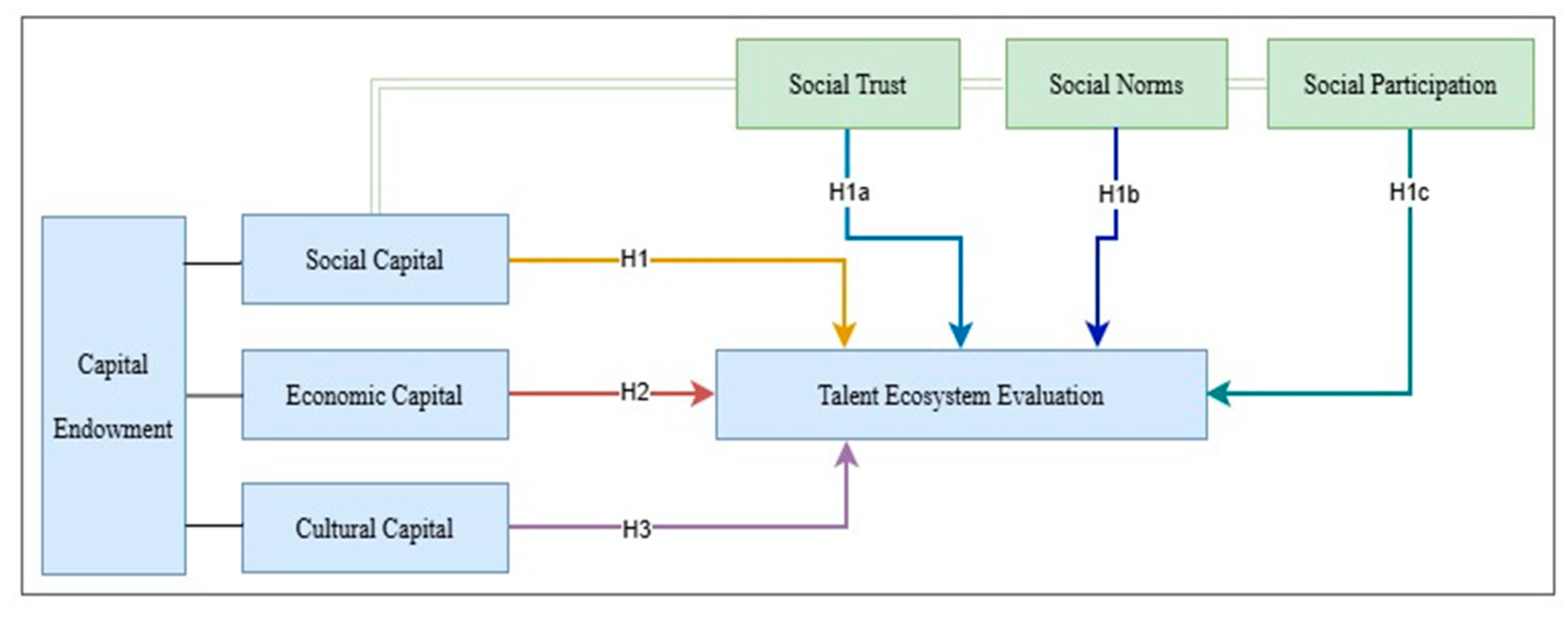
Research on the Evaluation of Talent Ecosystem in Industrial Parks from the Perspective of Capital Endowment: Evidence from China’s Hainan Free Trade Port

Abstract
1. Introduction
2. Literature Review and Hypothesis
2.1. Talent and Talent Ecosystem
2.2. RBV and Institutional Theory
2.3. Capital Endowment and the Evaluation of Talent Ecosystem
2.4. Present Study
3. Materials and Methods
3.1. Participants and Procedures
3.2. Measures
3.2.1. Evaluation of Talent Ecosystem
3.2.2. Capital Endowment
3.3. Statistical Analysis
4. Results
4.1. Evaluation of Talent Ecosystem in Industrial Parks of Hainan Free Trade Port
4.2. Regression Analysis
4.3. Robustness Test
5. Discussion
5.1. Effects of Demographic and Behavioral Factors on the Evaluation of Talent Ecosystem
5.2. Effects of Social Capital on the Evaluation of Talent Ecosystem
5.3. Effects of Economic Capital on the Evaluation of Talent Ecosystem
5.4. Effects of Cultural Capital on the Evaluation of Talent Ecosystem
6. Conclusions
6.1. Key Findings and Implications
6.2. Recommendations
6.3. Limitations and Prospects
Author Contributions
Funding
Institutional Review Board Statement
Informed Consent Statement
Data Availability Statement
Acknowledgments
Conflicts of Interest
References
- Hainan Provincial Bureau of Statistics. The Steady Development of Industrial Park Economy: An Analysis of the Operational Status of Key Industrial Parks in Hainan Free Trade Port in 2024. Available online: https://stats.hainan.gov.cn/tjj/index.html (accessed on 26 January 2025).
- Chen, X. Hainan: Utilizing Government Investment Funds to Drive High-Quality Industrial Park Development. China State Financ. 2022, 7, 72–73. (In Chinese) [Google Scholar]
- Becker, G.S. Human Capita; National Bureau of Economic Research: New York, NY, USA, 1964. [Google Scholar]
- Schultz, T.W. Investment in human capital. Am. Econ. Rev. 1961, 51, 1–17. [Google Scholar]
- Lee, E.S. A theory of migration. Demography 1966, 3, 47–57. [Google Scholar] [CrossRef]
- AnnaLee, S. From brain drain to brain circulation: Transnational communities and regional upgrading in India and China. Stud. Comp. Int. Dev. 2005, 40, 35–61. [Google Scholar] [CrossRef]
- Richard, F. The economic geography of talent. Ann. Assoc. Am. Geogr. 2002, 92, 743–755. [Google Scholar] [CrossRef]
- Mathias, C.; Parsons, C.R. The gravity of high-skilled migration policies. Demography 2017, 54, 603–630. [Google Scholar] [CrossRef] [PubMed]
- Edward, G. Cities, productivity, and quality of life. Science 2011, 333, 592–594. [Google Scholar] [CrossRef] [PubMed]
- Nicholas, B.; Ruobing, H.; James, L. How Hybrid Working from Home Works Out; National Bureau of Economic Research: New York, NY, USA, 2022. [Google Scholar]
- Collings, D.; Mellahi, K.; Cascio, W. Global Talent Management and Performance in Multinational Enterprises: A Multilevel Perspective. J. Manag. 2018, 45, 540–566. [Google Scholar] [CrossRef]
- Deolalikar, A.B.; Quibria, M.G. Human Resource Development and the Asian Economic Crisis: Facts, Issues, and Policy; University of Washington: Washington, DC, USA, 1999. [Google Scholar]
- Bangyi, S. Fundamental Concepts in the Field of Talent Ecology. Talent. Exploit. 2003, 12, 22–23. (In Chinese) [Google Scholar]
- Fangtao, Z. Discussion of the Establishment and Elements Interactions of the Regional Ecosystem for Hi-tech Entrepreneurial Talents. Forum Sci. Technol. China 2012, 12, 86–90. (In Chinese) [Google Scholar]
- Jieqiong, W.; Zehou, S. TheThree-dimensional Capital of NewAgricultural Entrepreneurial Talents, Entrepreneurship Environment and Entrepreneurial Performance. Chin. Rural. Econ. 2018, 2, 81–94. (In Chinese) [Google Scholar]
- Dessler, G. A Framework for Human Resource Management; Pearson Education International: London, UK, 2012. [Google Scholar]
- Atsushi, O. A study of the self-directed human resource development platform in corporations. J. Jpn. Inf.-Cult. Soc. 2008, 15, 54–60. [Google Scholar]
- Mellander, C.; Florida, R. Creativity, talent, and regional wages in Sweden. Ann. Reg. Sci. 2011, 46, 637–660. [Google Scholar] [CrossRef]
- Earle, H.A. Building a workplace of choice: Using the work environment to attract and retain top talent. J. Facil. Manag. 2003, 2, 244–257. [Google Scholar] [CrossRef]
- Acemoglu, D. Technical Change, Inequality, and the Labor Market. J. Econ. Lit. 2002, 40, 7–72. [Google Scholar] [CrossRef]
- Harris, L.C.; Ogbonna, E. Strategic human resource management, market orientation, and organizational performance. J. Bus. Res. 2001, 51, 157–166. [Google Scholar] [CrossRef]
- Garavan, T.; Wang, J.; Nolan, C.; Lai, Y.; O’Brien, F.; Darcy, C.; Matthews-Smith, G.; McLean, G. Putting the individual and context back into national human resource development research: A systematic review and research agenda. Int. J. Manag. Rev. 2023, 25, 152–175. [Google Scholar] [CrossRef]
- Liang, X.; Zhang, J. Construction and analysis of ecological circulation model for regional talents. J. Shenyang Univ. Technol. (Soc. Sci. Ed.) 2016, 9, 246–250. (In Chinese) [Google Scholar]
- Dai, D.Y. The Nature and Nurture of Talent: A New Foundation for Human Excellence; Cambridge University Press: Cambridge, UK, 2024. [Google Scholar]
- Yan, L.; Fan, S.; Mengyu, L. Innovative talent agglomeration, spatial spillover effects and regional innovation performance—Analyzing the threshold effect of government support. PLoS ONE 2024, 19, e0311672. [Google Scholar] [CrossRef]
- Granstrand, O.; Holgersson, M. Innovation ecosystems: A conceptual review and a new definition. Technovation 2020, 90, 102098. [Google Scholar] [CrossRef]
- Benhabib, J.; Spiegel, M.M. The role of human capital in economic development evidence from aggregate cross-country data. J. Monet. Econ. 1994, 34, 143–173. [Google Scholar] [CrossRef]
- Huang, W.; Liu, Q.; Xing, J.; Zheng, S. Breaking the Iron Rice Bowl: Tenure-Track Systems and the Rise of Academic Innovation in China. Econ. J. 2025, ueaf093. [Google Scholar] [CrossRef]
- Wang, W.; Zhao, Z.; Hu, K. Efficient Utilization of the Talents: SystemGravity, Allocation of Talentsand the Growth of Productivity. China Econ. Q. 2024, 24, 605–623. (In Chinese) [Google Scholar]
- Liu, S.; Yan, J.; Liu, Y. Dual Game of Interest and Norm: A Basic Discussion. Sociol. Rev. China 2022, 10, 5–28. (In Chinese) [Google Scholar]
- Wang, S.; Cao, S.; Du, M.; Liu, Y.; Qian, Y. Investigating Sustainable Development Trajectories in China (2006–2021): A Coupling Coordination Analysis of the Social, Economic, and Ecological Nexus. Sustainability 2026, 18, 899. [Google Scholar] [CrossRef]
- Ziegler, A.; Naujoks-Schober, N.; Vialle, W.; Stoeger, H. Analyzing National Talent Support Systems: The Case for a Resource-Oriented Approach. Sustainability 2025, 17, 5896. [Google Scholar] [CrossRef]
- Barney, J. Firm resources and sustained competitive advantage. J. Manag. 1991, 17, 99–120. [Google Scholar] [CrossRef]
- Wright, P.M.; McMahan, G.C.; McWilliams, A. Human resources and sustained competitive advantage: A resource-based perspective. Int. J. Hum. Resour. Manag. 1994, 5, 301–326. [Google Scholar] [CrossRef]
- Gueler, M.S.; Schneider, S. The resource-based view in business ecosystems: A perspective on the determinants of a valuable resource and capability. J. Bus. Res. 2021, 133, 158–169. [Google Scholar] [CrossRef]
- Scott, W.R. Institutions and Organizations: Ideas, Interests, and Identities; Sage Publications: Thousand Oaks, CA, USA, 2013. [Google Scholar]
- North, D.C. Institutions, Institutional Change and Economic Performance; Cambridge University Press: Cambridge, UK, 1990. [Google Scholar]
- Marquis, C.; Qian, C. Corporate social responsibility reporting in China: Symbol or substance? Organ. Sci. 2014, 25, 127–148. [Google Scholar] [CrossRef]
- Oliver, C. Sustainable competitive advantage: Combining institutional and resource-based views. Strateg. Manag. J. 1997, 18, 697–713. [Google Scholar] [CrossRef]
- Solow, R.M. A contribution to the theory of economic growth. Q. J. Econ. 1956, 70, 65–94. [Google Scholar] [CrossRef]
- Bourdieu, P. The forms of capital. In Handbook of Theory and Research for the Sociology of Education; Richardson, J.G., Ed.; Greenwood Press: New York, NY, USA, 1986; pp. 241–258. [Google Scholar]
- Fligstein, N. Social skill and the theory of fields. Sociol. Theory 2001, 19, 105–125. [Google Scholar] [CrossRef]
- Coleman, J.S. Social capital in the creation of human capital. Am. J. Sociol. 1988, 94, S95–S120. [Google Scholar] [CrossRef]
- Putnam, R.D. The prosperous community. Am. Prospect. 1993, 4, 35–42. [Google Scholar]
- Burt, R.S. Structural Holes: The Social Structure of Competition; Harvard University Press: Cambridge, MA, USA, 1992. [Google Scholar]
- Granovetter, M.S. The strength of weak ties. Am. J. Sociol. 1973, 78, 1360–1380. [Google Scholar] [CrossRef]
- Nahapiet, J.; Ghoshal, S. Social capital, intellectual capital, and the organizational advantage. Acad. Manag. Rev. 1998, 23, 242–266. [Google Scholar] [CrossRef]
- Putnam, R.D. Making Democracy Work: Civic Traditions in Modern Italy; Princeton University Press: Princeton, NJ, USA, 1993. [Google Scholar]
- Robbins, D.; Zhongze, L. The Genesis, Early Development, and Current Status of Bourdieu’s Concept of Cultural Capital. Soc. Sci. Int. 2006, 3, 36–42. [Google Scholar]
- Xiangjun, K.; Jingjun, Z. A Study on Social Capital and Political Efficacy Among Medical Students. China High. Med. Educ. 2017, 9, 19–20. (In Chinese) [Google Scholar]
- Meijuan, X. Social Capital and Political Trust: A Case Study of Macau. Wuhan Univ. J. (Philos. Soc. Sci.) 2011, 64, 77–87. (In Chinese) [Google Scholar]
- Alejandro, P. La mondialisation par le bas. Actes Rech. Sci. Soc. 1999, 129, 15–25. [Google Scholar]
- Putnam, R.D. Bowling Alone: The Collapse and Revival of American Community; Simon and Schuster: New York, NY, USA, 2000. [Google Scholar]
- Fukuyama, F. Trust: The Social Virtues and the Creation of Prosperity; Simon and Schuster: New York, NY, USA, 1996. [Google Scholar]
- Coleman, J.S. Foundations of Social Theory; Harvard University Press: Cambridge, MA, USA, 1990. [Google Scholar]
- Shah, Z.; Wei, L.; Ghani, U. The Use of Social Networking Sites and Pro-Environmental Behaviors: A Mediation and Moderation Model. Int. J. Environ. Res. Public Health 2021, 18, 1805. [Google Scholar] [CrossRef]
- Weber, M. Economy and Society: An Outline of Interpretive Sociology; University of California Press: Oakland, CA, USA, 1978. [Google Scholar]
- Savage, M.; Devine, F.; Cunningham, N.; Friedman, S.; Laurison, D.; Miles, A.; Snee, H.; Taylor, M. On Social Class, Anno 2014. Sociology 2015, 49, 1011–1030. [Google Scholar] [CrossRef]
- Thomas, P. The Economics of Inequality; Harvard University Press: Cambridge, MA, USA, 2015. [Google Scholar]
- Wilkinson, R.G.; Pickett, K.E. Income inequality and social dysfunction. Annu. Rev. Sociol. 2009, 35, 493–511. [Google Scholar] [CrossRef]
- Martin, G. Affluence and Influence: Economic Inequality and Political Power in America; Princeton University Press: Princeton, NJ, USA, 2012. [Google Scholar]
- Stiglitz, J.E. The Price of Inequality: How Today’s Divided Society Endangers Our Future; WW Norton & Company: New York, NY, USA, 2012. [Google Scholar]
- Suchman, M.C. Managing legitimacy: Strategic and institutional approaches. Acad. Manag. Rev. 1995, 20, 571–610. [Google Scholar] [CrossRef]
- DiMaggio, P. Cultural capital and school success: The impact of status culture participation on the grades of US high school students. Am. Sociol. Rev. 1982, 47, 189–201. [Google Scholar] [CrossRef]
- Lamont, M. Money, Morals, and Manners: The Culture of the French and the American Upper-Middle Class; University of Chicago Press: Chicago, IL, USA, 1992. [Google Scholar]
- Verba, S. Voice and Equality: Civic Voluntarism in American Politics; Harvard University Press: Cambridge, MA, USA, 1995. [Google Scholar]
- Lareau, A.; Weininger, E.B. Cultural capital in educational research: A critical assessment. Theory Soc. 2003, 32, 567–606. [Google Scholar] [CrossRef]
- Norris, P. Democratic Deficit: Critical Citizens Revisited; Cambridge University Press: Cambridge, UK, 2011. [Google Scholar]
- DiMaggio, P.J.; Powell, W.W. The iron cage revisited: Institutional isomorphism and collective rationality in organizational fields. Am. Sociol. Rev. 1983, 48, 147–160. [Google Scholar] [CrossRef]
- Greenwood, R.; Suddaby, R.; Hinings, C.R. Theorizing change: The role of professional associations in the transformation of institutionalized fields. Acad. Manag. J. 2002, 45, 58–80. [Google Scholar] [CrossRef]
- DiStefano, C.; Zhu, M.; Mindrila, D. Understanding and using factor scores: Considerations for the applied researcher. Pract. Assess. Res. Eval. 2009, 14, 1–11. [Google Scholar]
- Mulaik, S.A. Foundations of Factor Analysis; CRC Press: Boca Raton, FL, USA, 2009. [Google Scholar]
- Putnam, R.D. (Ed.) Democracies in Flux: The Evolution of Social Capital in Contemporary Society; Oxford University Press: Oxford, UK, 2002. [Google Scholar]
- Huggins, R.; Thompson, P. Entrepreneurship, innovation and regional growth: A network theory. Small Bus. Econ. 2015, 45, 103–128. [Google Scholar] [CrossRef]
- Lu, Y.; Ruan, D.; Lai, G. Social capital and economic integration of migrants in urban China. Soc. Netw. 2013, 35, 357–369. [Google Scholar] [CrossRef] [PubMed]
- Florida, R.; Adler, P.; Mellander, C. The city as innovation machine. In Transitions in Regional Economic Development; Routledge: Abingdon-on-Thames, UK, 2018; pp. 151–170. [Google Scholar]
- Lina, S.; Yunpeng, X. An empirical study on the influence mechanism of internet use on public risk perception: Based on the perspective of political participation and trust in the government. J. Cent. South Univ. (Soc. Sci.) 2022, 28, 153–164. (In Chinese) [Google Scholar]
- Zhenhua, S.; Waibin, H. The Internet’s Impact on the Political Trust and Values: An Empirical Study Based on CGSS2010 Data. Comp. Econ. Soc. Syst. 2015, 5, 113–126. (In Chinese) [Google Scholar]
- Didi, W.; Wen, Z. A Comprehensive Review of Talent Ecosystem Research. Co-Oper. Econ. Sci. 2021, 9, 92–94. (In Chinese) [Google Scholar]
- Halpern, D. Social Capital; Polity Press: Cambridge, UK, 2005. [Google Scholar]
- Rong, H.; Shan, S. Social Trust, Political Participation and Public Sense of Political Efficacy. Southeast Acad. Res. 2015, 3, 23–33+246. (In Chinese) [Google Scholar]
- Shen, C.; Yaling, L. Social Capital, Sense of Political Efficacy andthe Public’ s Willingness to Participate in the Governance of Social Conflicts: Empirical Research Based on Structural Equation Model. Public Adm. Policy Rev. 2021, 10, 16–30. (In Chinese) [Google Scholar]
- Zhijun, P. The Effects of Social Capital and Political Efficacy on Villagers’Participation of Self-governance When the Institutions Are Given. Issues Agric. Econ. 2013, 34, 33–43+111. (In Chinese) [Google Scholar]
- Jackman, R.W.; Miller, R.A. Social capital and politics. Annu. Rev. Political Sci. 1998, 1, 47–73. [Google Scholar] [CrossRef]
- Pretty, J.; Ward, H. Social capital and the environment. World Dev. 2001, 29, 209–227. [Google Scholar] [CrossRef]
- Yusong, S.; Feng, T. How Does the Use of the Internet Affect Public Satisfaction with Environmental Governance? A Study based on the Mediating Effect of the Government’ s Environmental Image and the Moderating Effect of Environmental Accountability. Soc. Policy Res. 2021, 3, 44–63. (In Chinese) [Google Scholar]
- Liuzhao, H. Do Social Capital and Government Role Cognition Affect the Subjective Evaluation of Public Service Performance?—Empirical Evidence from the Chinese General Social Survey in 2015. Forum Leadersh. Sci. 2020, 15, 16–29. (In Chinese) [Google Scholar]
- Baum, F. Social capital, economic capital and power: Further issues for a public health agenda. J. Epidemiol. Community Health 2000, 54, 409–410. [Google Scholar] [CrossRef] [PubMed][Green Version]
- Lynch, K.; Moran, M. Markets, schools and the convertibility of economic capital: The complex dynamics of class choice. Br. J. Sociol. Educ. 2006, 27, 221–235. [Google Scholar] [CrossRef]
- DiMaggio, P.; Mohr, J. Cultural capital, educational attainment, and marital selection. Am. J. Sociol. 1985, 90, 1231–1261. [Google Scholar] [CrossRef]
- Sullivan, A. Cultural capital, cultural knowledge and ability. Sociol. Res. Online 2008, 12, 91–104. [Google Scholar] [CrossRef]
- Brown, P.; Power, S.; Tholen, G.; Allouch, A. Credentials, talent and cultural capital: A comparative study of educational elites in England and France. Br. J. Sociol. Educ. 2016, 37, 191–211. [Google Scholar] [CrossRef]
- Tianguang, M.; Quanjun, M. A Research of Relationship between Social Capital and the Sense of Civic Participation—An Empirical Analysis Based on National Representative Samples. Chin. Public Adm. 2011, 3, 107–111. (In Chinese) [Google Scholar]
- Xiufeng, Q. Leveraging New Media for Effective Government Image Dissemination. People’s Trib. 2019, 3, 48–49. (In Chinese) [Google Scholar]
- Folke, C.; Carpenter, S.R.; Walker, B.; Scheffer, M.; Chapin, T.; Rockström, J. Resilience thinking: Integrating resilience, adaptability and transformability. Ecol. Soc. 2010, 15, 20. [Google Scholar] [CrossRef]
- Ansell, C.; Gash, A. Collaborative governance in theory and practice. J. Public Adm. Res. Theory J. 2008, 18, 543–571. [Google Scholar] [CrossRef]
- Capano, G.; Howlett, M. The knowns and unknowns of policy instrument analysis: Policy tools and the current research agenda on policy mixes. Sage Open 2020, 10, 2158244019900568. [Google Scholar] [CrossRef]
- Folke, C.; Hahn, T.; Olsson, P.; Norberg, J. Adaptive governance of social-ecological systems. Annu. Rev. Environ. Resour. 2005, 30, 441–473. [Google Scholar] [CrossRef]


| Characteristics | Number of Participants (n) | Percentage (%) |
|---|---|---|
| Gender | ||
| Male | 351 | 46.6 |
| Female | 402 | 53.4 |
| Age | ||
| 18–30 | 271 | 36.0 |
| 31–50 | 353 | 46.9 |
| ≥51 | 129 | 17.1 |
| Marital status | ||
| Married | 425 | 56.4 |
| Unmarried | 328 | 43.6 |
| Political Affiliation | ||
| Party Member | 135 | 17.9 |
| Non-Party Member | 618 | 82.1 |
| Religious status | ||
| Religious | 103 | 13.7 |
| No religion | 650 | 86.3 |
| Education level | ||
| Below associate degree | 12 | 1.6 |
| Associate degree | 141 | 18.7 |
| Bachelor’s degree | 451 | 59.9 |
| Postgraduate and above | 149 | 19.8 |
| Annual Personal income | ||
| <¥100,000 | 321 | 42.6 |
| ¥100,001–¥200,000 | 207 | 27.5 |
| ¥200,001–¥300,000 | 186 | 24.7 |
| <¥300,001 | 39 | 5.2 |
| Primary Indicator | Secondary Indicator | Question |
|---|---|---|
| Natural Ecology | Natural Environment | Natural Environment of the Park |
| Transportation Environment | Regional Transportation Conditions | |
| Economic Ecology | Income Treatment | Income and Benefits for Talents |
| Tax Incentives | Tax Incentives for Talents | |
| Legal Ecology | Legal Policies | Provision of Legal Guidance |
| Talent Policies | Talent Approval Process Policies | |
| Educational Ecology | Education and Training | Specialized Educational and Training Programs |
| Support Facilities for Education | Educational Resources and Facility Support Services in the Park | |
| Technological Innovation Ecology | Technological Environment | Required Technological Environment |
| Information Consulting | Entrepreneurial Incentives and Information Consultation Assistance | |
| Public Service Ecology | Lifestyle Services | Required Living Services |
| Welfare Policies | Required Welfare Services | |
| Cultural Ecology | Cultural Services | Cultural Services Provided |
| Cultural Integration | Initiatives to Facilitate Understanding and Integration into the Local Culture | |
| Social Ecology | Social Governance | Corporate/Park Social Governance Status |
| Social Security | Corporate/Park Social Safety Environment |
| Primary Indicator | Secondary Indicator | M ± SD | t | p | 95%CI |
|---|---|---|---|---|---|
| Natural Ecology | Natural Environment | 3.89 ± 0.919 | 30.319 | 0.000 *** | 0.86~0.98 |
| Transportation Environment | 3.81 ± 0.960 | 24.281 | 0.000 *** | 0.75~0.89 | |
| Economic Ecology | Income Treatment | 3.82 ± 1.037 | 23.612 | 0.000 *** | 0.78~0.92 |
| Tax Incentives | 3.88 ± 0.910 | 29.572 | 0.000 *** | 0.87~1.00 | |
| Legal Ecology | Legal Policies | 4.13 ± 0.814 | 41.428 | 0.000 *** | 1.07~1.18 |
| Talent Policies | 3.72 ± 1.072 | 21.050 | 0.000 *** | 0.69~0.83 | |
| Educational Ecology | Education and Training | 3.83 ± 0.992 | 24.567 | 0.000 *** | 0.78~0.91 |
| Support Facilities for Education | 3.65 ± 1.089 | 15.071 | 0.000 *** | 0.51~0.66 | |
| Technological Innovation Ecology | Technological Environment | 3.63 ± 1.073 | 14.001 | 0.000 *** | 0.47~0.62 |
| Information Consulting | 3.68 ± 1.064 | 17.750 | 0.000 *** | 0.60~0.75 | |
| Public Service Ecology | Lifestyle Services | 3.62 ± 1.097 | 16.232 | 0.000 *** | 0.56~0.71 |
| Welfare Policies | 3.79 ± 0.985 | 23.852 | 0.000 *** | 0.74~0.87 | |
| Cultural Ecology | Cultural Services | 3.91 ± 0.904 | 31.312 | 0.000 *** | 0.89~1.00 |
| Cultural Integration | 3.88 ± 0.935 | 26.644 | 0.000 *** | 0.81~0.94 | |
| Social Ecology | Social Governance | 3.94 ± 0.878 | 29.756 | 0.000 *** | 0.87~0.99 |
| Social Security | 3.84 ± 0.998 | 24.867 | 0.000 *** | 0.82~0.98 |
| Model 1 | Model 2 | Model 3 | Model 4 | |
|---|---|---|---|---|
| Gender | −0.076 *** (0.023) | −0.068 *** (0.021) | −0.067 *** (0.021) | −0.063 *** (0.021) |
| Age | −0.013 ** (0.005) | −0.013 *** (0.005) | −0.013 *** (0.005) | −0.019 *** (0.005) |
| Age Squared Divided by 100 | 0.018 *** (0.006) | 0.014 *** (0.005) | 0.014 ** (0.005) | 0.018 *** (0.005) |
| Political Affiliation | 0.244 *** (0.037) | 0.111 *** (0.033) | 0.112 *** (0.033) | 0.162 *** (0.035) |
| Religious Belief | 0.023 (0.033) | 0.022 (0.029) | 0.022 (0.030) | 0.008 (0.030) |
| Internet Utilization | −0.201 *** (0.030) | −0.141 *** (0.027) | −0.141 *** (0.027) | −0.105 *** (0.028) |
| Social Trust | - | 0.086 *** (0.006) | 0.087 *** (0.006) | 0.087 *** (0.006) |
| Social Norms | - | 0.106 *** (0.004) | 0.106 *** (0.004) | 0.105 *** (0.004) |
| Social Participation | - | 0.050 *** (0.017) | 0.050 *** (0.017) | 0.052 *** (0.017) |
| Economic Capital | - | - | 0.000 (0.003) | 0.002 (0.003) |
| Cultural Capital | - | - | - | −0.056 *** (0.011) |
| Sample Size | 753 | 753 | 753 | 753 |
| Adjusted R2 | 0.020 | 0.237 | 0.237 | 0.239 |
| Original Model | Model 5 | Model 6 | |
|---|---|---|---|
| Social Trust | 0.087 *** (0.006) | 0.094 *** (0.008) | 0.081 *** (0.008) |
| Social Norms | 0.105 *** (0.004) | 0.107 *** (0.005) | 0.102 *** (0.005) |
| Social Participation | 0.052 *** (0.017) | 0.047 ** (0.023) | 0.056 ** (0.026) |
| Economic Capital | 0.002 (0.003) | 0.005 (0.005) | 0.001 (0.003) |
| Cultural Capital | −0.056 *** (0.011) | −0.030 * (0.017) | −0.072 *** (0.015) |
| Control Variables | Controlled | Controlled | Controlled |
| Sample Size | 753 | 351 | 402 |
| Adjusted R2 | 0.239 | 0.243 | 0.238 |
Disclaimer/Publisher’s Note: The statements, opinions and data contained in all publications are solely those of the individual author(s) and contributor(s) and not of MDPI and/or the editor(s). MDPI and/or the editor(s) disclaim responsibility for any injury to people or property resulting from any ideas, methods, instructions or products referred to in the content. |
© 2026 by the authors. Licensee MDPI, Basel, Switzerland. This article is an open access article distributed under the terms and conditions of the Creative Commons Attribution (CC BY) license.
Share and Cite
Zhao, X.; Xunuo, Z. Research on the Evaluation of Talent Ecosystem in Industrial Parks from the Perspective of Capital Endowment: Evidence from China’s Hainan Free Trade Port. Sustainability 2026, 18, 1649. https://doi.org/10.3390/su18031649
Zhao X, Xunuo Z. Research on the Evaluation of Talent Ecosystem in Industrial Parks from the Perspective of Capital Endowment: Evidence from China’s Hainan Free Trade Port. Sustainability. 2026; 18(3):1649. https://doi.org/10.3390/su18031649
Chicago/Turabian StyleZhao, Xiaoge, and Zhongyi Xunuo. 2026. "Research on the Evaluation of Talent Ecosystem in Industrial Parks from the Perspective of Capital Endowment: Evidence from China’s Hainan Free Trade Port" Sustainability 18, no. 3: 1649. https://doi.org/10.3390/su18031649
APA StyleZhao, X., & Xunuo, Z. (2026). Research on the Evaluation of Talent Ecosystem in Industrial Parks from the Perspective of Capital Endowment: Evidence from China’s Hainan Free Trade Port. Sustainability, 18(3), 1649. https://doi.org/10.3390/su18031649