Study on the Synergy/Trade-Off Relationships Between the Concentrated-Contiguous Conservation and Utilization of Traditional Villages and the Social-Ecological System Based on Network Science

Abstract
1. Introduction
2. Materials and Methods
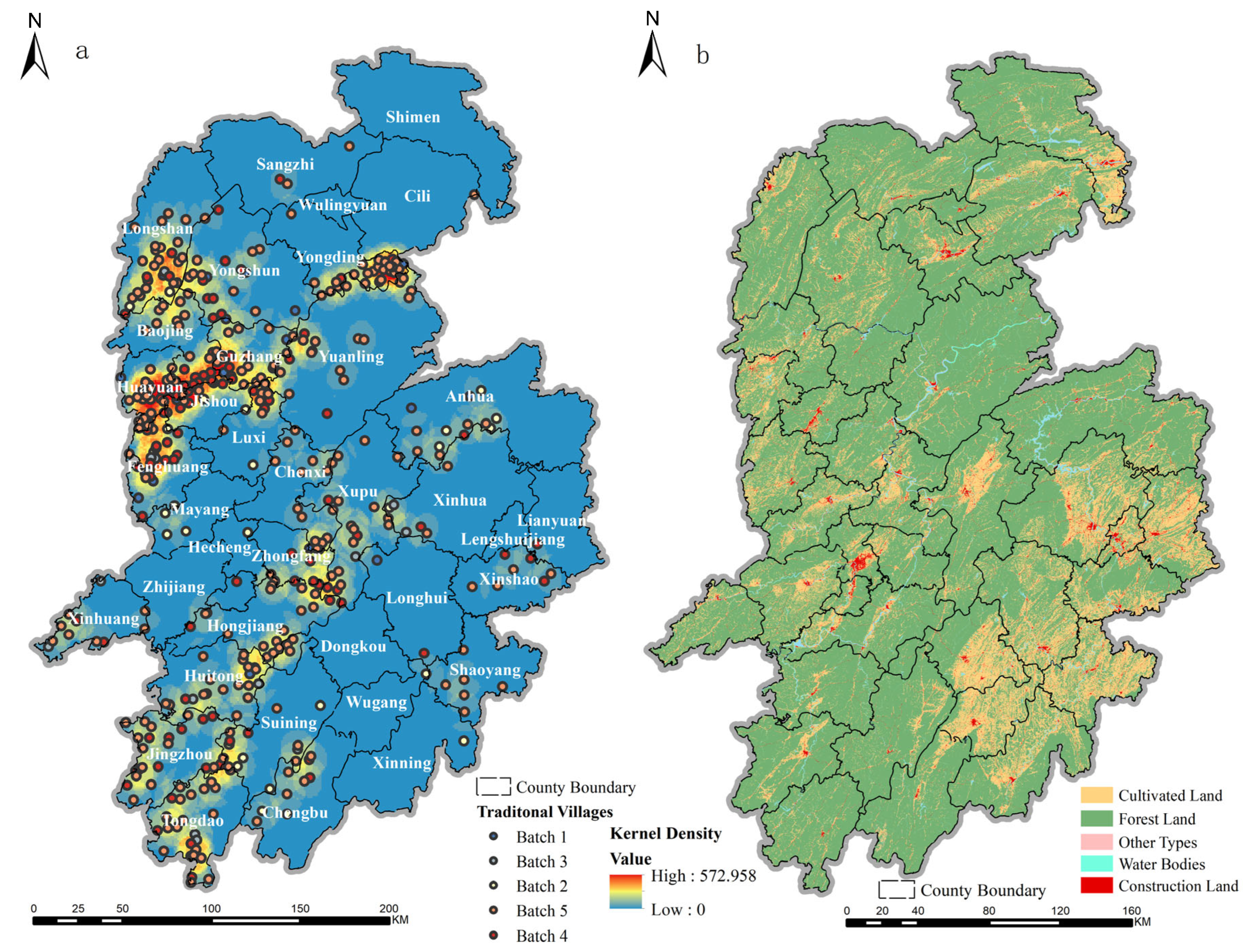
2.1. Study Area
2.2. Data Sources and Us
2.3. Methods
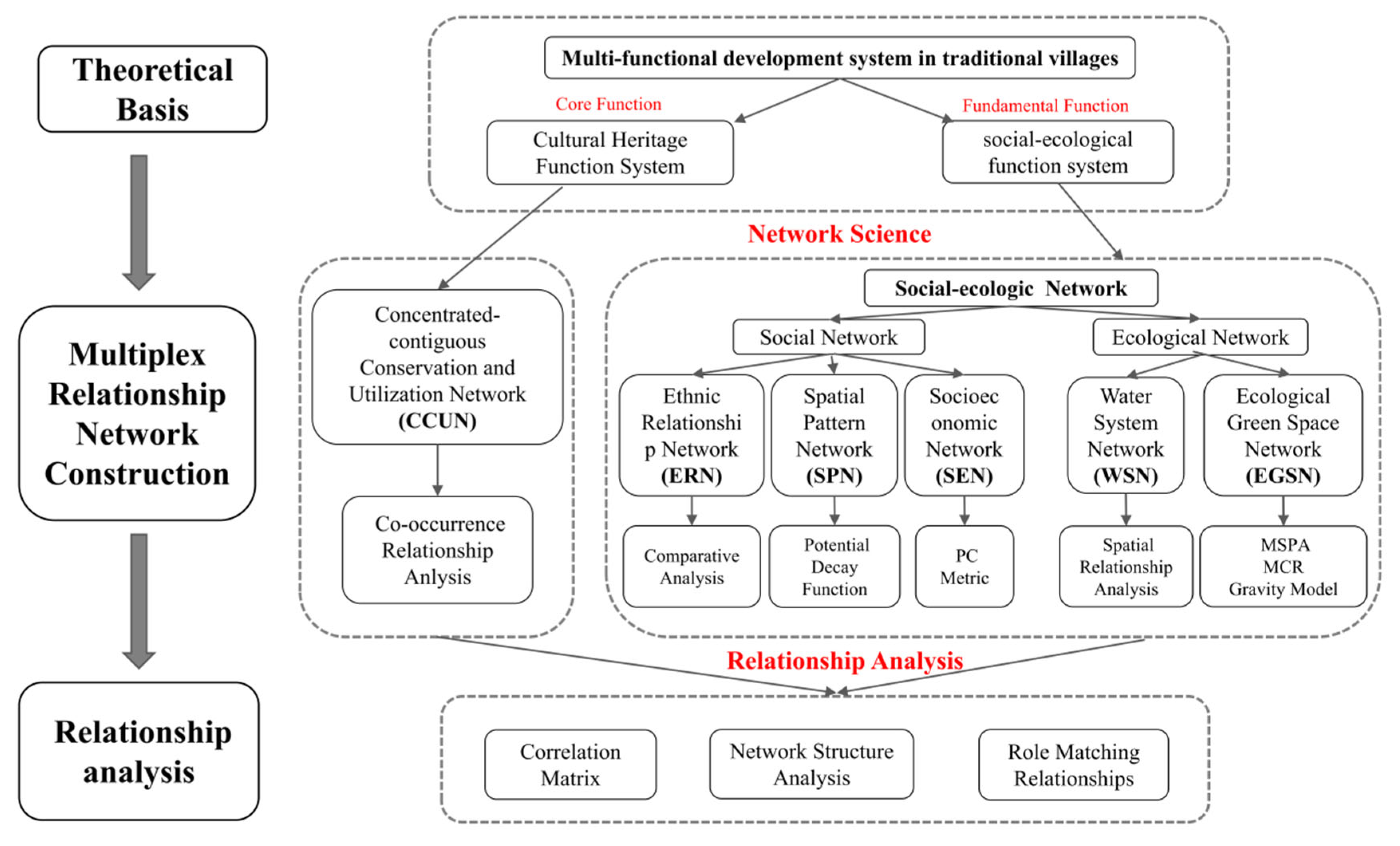
2.3.1. Method Framework
2.3.2. Differentiated Construction of Multiplex Relationship Networks for Traditional Villages
2.3.3. Analysis of Synergy/Trade-Off Relationships Between CCUN and Social-Ecological Networks
Correlation Matrix
Network Structure Analysis
Role Matching Relationships
- (1)
- Core-Periphery Structure
- (2)
- Bivariate Spatial Autocorrelation
3. Results
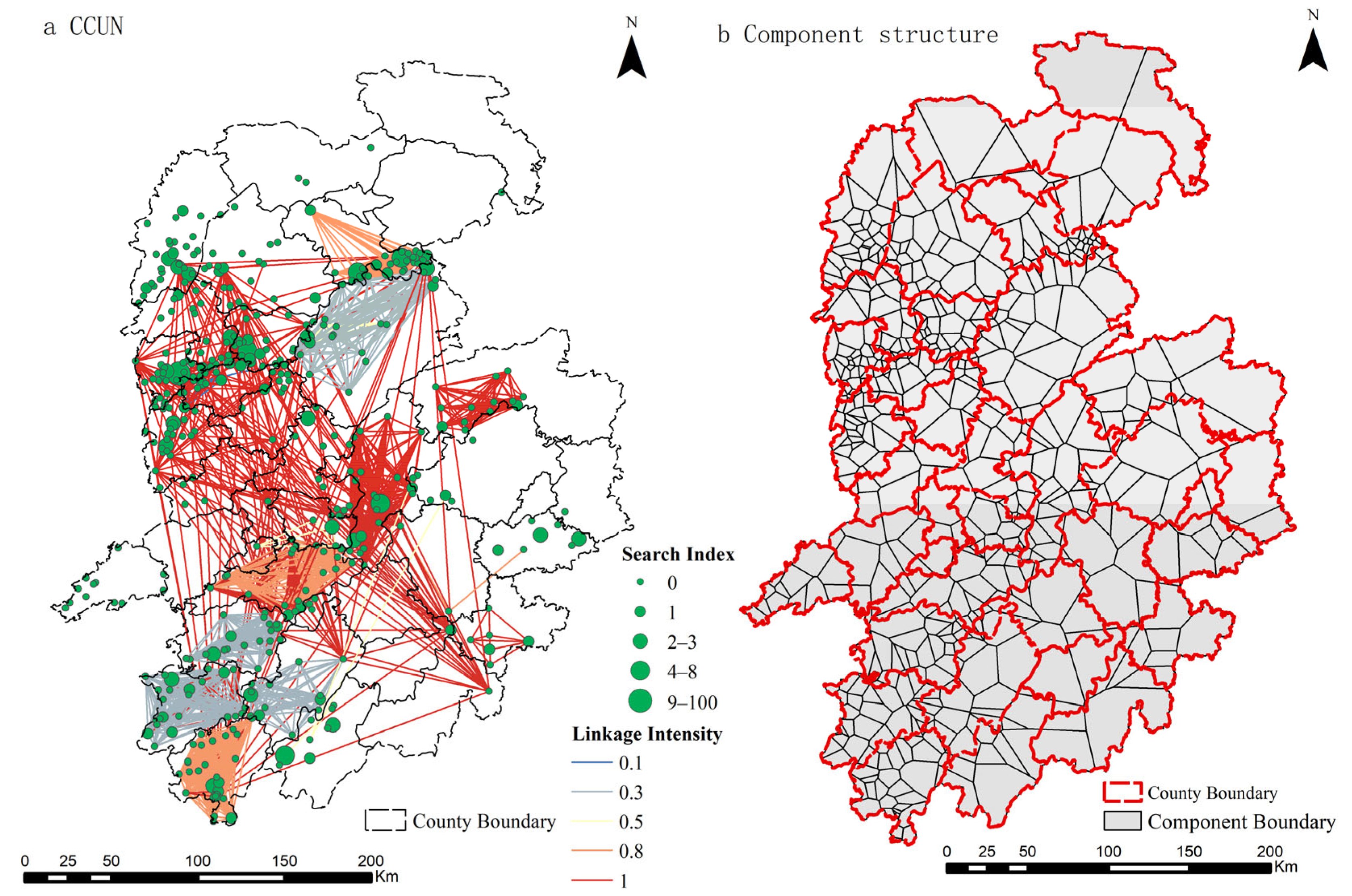
3.1. Result of CCUN Construction
3.2. Results of Social-Ecological Network Construction
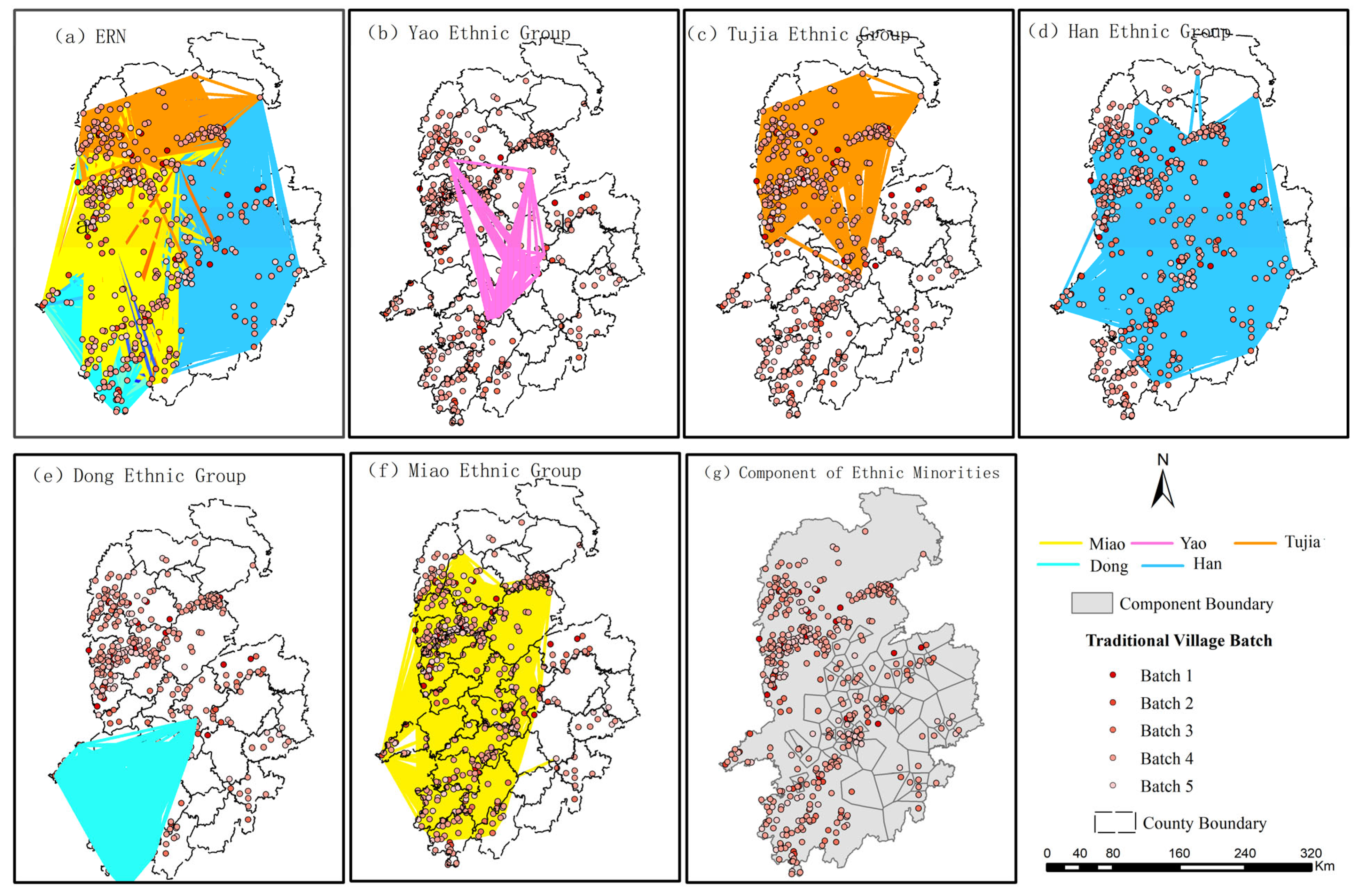
3.2.1. Result of ERN Construction
3.2.2. Result of SPN Construction
3.2.3. Result of SEN Construction
3.2.4. Result of WSN Construction
3.2.5. Result of EGSN Construction
3.3. Result of Relationship Analysis
3.3.1. Correlation Matrix
3.3.2. Network Structure Analysis
3.3.3. Role Matching Relationship Analysis
4. Discussion and Conclusions
4.1. Discussion
- (1)
- How are synergies and trade-offs manifested within the different functional systems of traditional villages?
- (2)
- Is it reasonable to use administrative divisions as the sole units for delineating CCU in traditional villages?
- (3)
- Policy implication
4.2. Conclusions
Author Contributions
Funding
Institutional Review Board Statement
Informed Consent Statement
Data Availability Statement
Conflicts of Interest
References
- Li, X.; Wu, S.; Chen, X. Characteristics, types and differentiated guidance strategies of multi-functional development of traditional villages: A case study of 44 villages in Yixian county, China. J. Nat. Resour. 2024, 39, 1887–1905. [Google Scholar] [CrossRef]
- Dai, Y.; Zhang, Y.; Ke, X.; Chen, Y. Structural Characteristics of Spatial Correlation Network of Rural Territorial Multi-functions and Its Impact on Urban-Rural Integrated Development: A Case Study of Henan Province. J. Nat. Resour. 2023, 38, 2059–2075. [Google Scholar] [CrossRef]
- Li, B.; Yang, F.; Dou, Y. The organic renewal of the human settlement environment in traditional villages: Theoretical cognition and practical path. Geogr. Res. 2022, 41, 1407–1421. [Google Scholar]
- Li, B.; Zhou, L.; Dou, Y.; Liu, L. Evolutionary Characteristics and Influencing Mechanisms of Landscape Features in Ethnic Traditional Settlements Based on Rural Multifunctionality Theory: A Case Study of Huangdu Village, Huaihua, Hunan Province. Prog. Geogr. 2022, 42, 1433–1445. [Google Scholar]
- Liu, Y.; Gao, Y.; Pan, Y.; Tang, L.; Tu, M. Measurement of Rural Functional Spatial Characteristics and Their Trade-off/Synergy Relationships Based on Multi-source Data. Geogr. Res. 2021, 40, 2036–2050. [Google Scholar]
- Bao, X.; Chen, X. Research on Functional–Spatial Integrated Development and Measurement Methods of Traditional Villages. J. Urban Plan. Dev. 2026, 152, 05025048. [Google Scholar] [CrossRef]
- He, T.; Qiao, W.; Jia, K.; Chai, Y.; Hu, Y.; Sun, P.; Wang, Y.; Feng, T.; Li, Q. Selecting Rural Development Paths Based on Village Multifunction: A Case of Jingjiang City, China. Complexity 2020, 2020, 7590942. [Google Scholar] [CrossRef]
- Gu, X.; Xie, B.; Zhang, Z.; Guo, H. Rural multifunction in Shanghai suburbs: Evaluation and spatial characteristics based on villages. Habitat Int. 2019, 92, 102041. [Google Scholar] [CrossRef]
- Li, X.; Liu, J.; Jia, J.; Yang, H. Relationship between multifunctionality and rural sustainable development: Insights from 129 counties of the Sichuan Province, China. Chin. J. Popul. Resour. Environ. 2022, 20, 285–294. [Google Scholar] [CrossRef]
- Liu, M.; Wang, P.; He, X.; Shi, J. Research on the Reconstruction and Spatial Production of Traditional Villages Driven by Red Tourism: A Case Study of Malan Village, Mentougou District, Beijing. Geogr. Res. 2023, 42, 1663–1679. [Google Scholar]
- Bi, S.; Du, J.; Tian, Z.; Zhang, Y. Investigating the spatial distribution mechanisms of traditional villages from the human geography region: A case study of Jiangnan, China. Ecol. Inform. 2024, 81, 102649. [Google Scholar] [CrossRef]
- Jiang, P.; Wang, Z. Exploration on the Construction of Regional Traditional Village Hierarchical Collaborative Network Based on MST Clustering: A Case Study of Clustered Contiguous Conservation and Utilization of Traditional Villages in Yongzhou City. In Proceedings of the 2022 China Urban Planning Informatization Annual Conference & Annual Meeting of the Urban Planning New Technology Application Academic Committee of the Urban Planning Society of China, Hefei, China, 8–9 September 2022; Hangzhou Planning and Design Institute, Planning Research Center: Hangzhou, China, 2022; p. 9. [Google Scholar]
- Zhou, Z.; Omar, J.; Doh, S. A Review on Traditional Villages Protection and Development in China. Construction 2024, 4, 140–149. [Google Scholar]
- Wang, D.; Yang, Y. The Path to Overcoming Traditional Village Hollowing from the Perspective of Urban-Rural Integration and Residential-Business Synergy. Tour. Trib. 2025, 40, 3–5. [Google Scholar]
- Jiang, X.; Man, S.; Zhu, X.; Zhao, H.; Yan, T. Sustainable Protection Strategies for Traditional Villages Based on a Socio-Ecological Systems Spatial Pattern Evaluation: A Case Study from Jinjiang River Basin in China. Sustainability 2024, 16, 7700. [Google Scholar] [CrossRef]
- Lv, X.; Lin, H.; Chen, Z. Prevention and Control Strategies for Rainwater and Flood Disasters in Traditional Villages: A Concentrated Contiguous Zone Approach. Buildings 2025, 15, 1335. [Google Scholar] [CrossRef]
- Liu, X.; Yuan, L.; Tan, G. Identification and Hierarchy of Traditional Village Characteristics Based on Concentrated Contiguous Development—Taking 206 Traditional Villages in Hubei Province as an Example. Land 2023, 12, 471. [Google Scholar] [CrossRef]
- Yuan, L.; Xu, L.; Zhang, Z.; Xu, Y. Traditional village clustered protection and utilization methods based on network science. NPJ Herit. Sci. 2025, 13, 140. [Google Scholar] [CrossRef]
- Pan, Y.; Zhao, Y.; Shi, Y. Exploration of Whole-process Guidance and Control System for Clustered Contiguous Conservation and Utilization of Traditional Villages in Guangdong Province. South Archit. 2024, 11, 22–30. [Google Scholar]
- Huang, J.; Wang, N. Methodology for Constructing a Protection System in Clustered Contiguous Traditional Village Areas: A Case Study of the Conservation and Utilization Demonstration Zone in Huangnan Tibetan Autonomous Prefecture, Qinghai Province. Planners 2023, 39, 123–130. [Google Scholar]
- Zhang, J.; Lin, B.; Chen, Q.; Qi, T. Research on the Clustered Contiguous Protection System for Traditional Village Landscape Clusters in Southeast Chongqing. South. Archit. 2023, 2, 98–107. [Google Scholar]
- Li, G.; Hu, W. A network-based approach for landscape integration of traditional settlements: A case study in the Wuling Mountain area, southwestern China. Land Use Policy 2019, 83, 105–112. [Google Scholar] [CrossRef]
- Danya, M. Strategies for Clustered Contiguous Conservation and Development of Traditional Villages; North China University of Technology: Beijing, China, 2022. [Google Scholar]
- Xue, Q.; Huang, Y. Methods for Constructing a Concentrated and Contiguous Protection and Utilization Pattern of Traditional Villages: A Case Study of Liangdang County, Gansu Province. Planners 2024, 40, 66–74. [Google Scholar]
- Fuyu, C. Analysis of Clustered Contiguous Planning Methods for Traditional Villages in Jiexiu City, Shanxi Province from a Cluster Perspective. Shanxi Archit. 2024, 50, 17–21. [Google Scholar]
- Zhang, W.; Chen, D.; Zhang, D. Conservation and Development Methods for County-level Traditional Village Clusters from the Perspective of Social Organism Theory. Small Town Constr. 2022, 40, 111–119. [Google Scholar]
- Zhang, W.; Zhang, D.; Chen, D. Research on Conservation and Utilization Pathways of Traditional Villages from a Regional Coordination Perspective: A Case Study of Weinan City, Shaanxi Province. Huazhong Archit. 2022, 40, 113–117. [Google Scholar]
- Chen, X.; Wu, S. Network-based Conservation and Development Framework, Mechanisms, and Guiding Strategies for Regional Traditional Villages: A Case Study of Jixi County, Anhui Province. J. Anhui Agric. Univ. 2023, 50, 473–483. [Google Scholar]
- Zhang, Y. Exploration of Spatial Governance for Clustered Contiguous Conservation and Development of Traditional Villages: A Case Study of Dabu County. In Proceedings of the 2024 China Urban Planning Annual Conference, Hefei, China, 6–9 September 2024; Hefei Binhu International Conference and Exhibition Center: Hefei, China, 2024; p. 8. [Google Scholar] [CrossRef]
- Liu, Y.; Liu, Y.; Guo, L. The Connotation of Rural Regional Multi-functionality and Its Policy Implications. Hum. Geogr. 2011, 26, 103–106. [Google Scholar]
- Fang, Y.; Long, H.; Tang, Y. A Discussion on the Diversification of Rural Development in China Based on Multi-functionality Theory: Beyond the “Modernization” Development Paradigm. Acta Geogr. Sin. 2015, 70, 487–497. [Google Scholar]
- Yue, H.; Wong, C.; Min, J.; Wu, S.; Wu, C. Multifunctional Evaluation and Revitalization Pathways for Rural Areas in Xiushan County, Chongqing. Chin. J. Agric. Resour. Reg. Plan. 2024, 45, 216–228. [Google Scholar]
- Ye, S.; Chen, C.; Yang, H. Exploring the spatial patterns of rural multifunctionality in China’s metropolitan hinterland and its driving forces: The case of Shanghai-Suzhou-Jiaxing-Huzhou region. Habitat Int. 2025, 165, 103562. [Google Scholar]
- Chen, J.; Zhao, C.; Zhao, Q.; Xu, C.; Lin, S. Construction of Fujian Ecological Network Based on MSPA Analysis. Acta Ecol. Sin. 2023, 43, 603–614. [Google Scholar]
- He, Y.; Lian, H.; Ni, B.; Liu, C. Evolution of resilience in the ecological network across arid inland river basins and its improvement strategies: A case study of Shiyang River Basin. J. Nat. Resour. 2024, 39, 2087–2101. [Google Scholar] [CrossRef]
- Baranyi, G.S.S.; Podani, J.; Jordán, F. Contribution of habitat patches to network connectivity: Redundancy and uniqueness of topological indices. Ecol. Indic. 2011, 11, 1301–1310. [Google Scholar] [CrossRef]
- Saura, S.; Lucía, P. A new habitat availability index to integrate connectivity in landscape conservation planning: Comparison with existing indices and application to a case study. Landsc. Urban Plan. 2007, 83, 91–103. [Google Scholar] [CrossRef]
- Daraganova, G.; Pattison, P.; Koskinen, J.; Mitchell, B.; Bill, A.; Watts, M.; Baum, S. Networks and geography: Modelling community network structures as the outcome of both spatial and network processes. Soc. Netw. 2012, 34, 6–17. [Google Scholar] [CrossRef]
- Deng, Y.; Jiang, Y.-H.; Yang, Y.; He, Z.; Luo, F.; Zhou, J.J.B. Molecular ecological network analyses. BMC Bioinform. 2012, 13, 113. [Google Scholar] [CrossRef]
- Yang, X.; Xiao, H.; Huang, C.; Wang, Y. Construction and Collaborative Governance of “Social-Ecological” Networks in Land Ecosystems of the Urban Agglomeration in the Middle Reaches of the Yangtze River. J. Nat. Resour. 2024, 39, 2155–2170. [Google Scholar]
- Mao, Y.; Liu, Y.; Wei, X.; Kong, X. Network and Geography: Dependence and Disparity Between Human Settlement Pattern and Socioeconomic Network in Chengui, China. J. Urban Plan. Dev. 2018, 144, 05017015. [Google Scholar] [CrossRef]
- Wu, Y.; Xu, J.G.; Wang, Z.B. A GIS-based Approach for the Quantitative Evaluation of Accessibility in Yangzhong—A Case Study of the Building of Taizhou Chang Jiang River in Yangzhong. Areal Res. Dev. 2008, 27, 124–128. [Google Scholar]
- Millward, H.; Spinney, J.; Scott, D. Active-transport walking behavior: Destinations, durations, distances. J. Transp. Geogr. 2013, 28, 101–110. [Google Scholar] [CrossRef]
- Tan, J.; Wang, K. Trade-offs/synergistic relationship between the spatial correlatiosn network of tourism ecosystem developmetn and landuse trasformantion: A case study of Wuling mountain area. Acta Ecol. Sin. 2025, 45, 1563–1574. [Google Scholar]
- Tan, X.; Liu, Y.; An, Y.; Hu, Z.; Hu, T. Spatial pattern and multifunctional characteristics of rural settlements: Take Dongting Lake area of Hunan Province as an example. Geogr. Res. 2025, 44, 2300–2314. [Google Scholar]
- Oliveira, M. An overview of social network analysis. Data Min. Knowl. Discov. 2012, 2, 99–115. [Google Scholar] [CrossRef]
- Pereira, M.; Segurado, P.; Neves, N. Using spatial network structure in landscape management and planning: A case study with pond turtles. Landsc. Urban Plan. 2011, 100, 67–76. [Google Scholar] [CrossRef]



| Network Name | Definitions | Data Sources | Network Construction Method | Roles of Core Villages | |
|---|---|---|---|---|---|
| Concentrated-Contiguous Conservation and Utilization Network (CCUN) | An undirected network with traditional villages as nodes, where an edge connects two traditional villages if their names co-occur in at least one Baidu search result. | (1) CCU-based relationship data: Department of Housing and Urban-Rural Development of Hunan Province (https://zjt.hunan.gov.cn) (accessed on 24 October 2024); (2) Other co-occurrence relationship data: Identified through co-occurrence analysis of village names in Baidu search results (http://baidu.com) (accessed on 3 December 2024). | The CCUN is constructed based on co-occurrence relationships among traditional villages through a four-step process. First, all possible pairwise combinations are generated from the 432 traditional village names through a combination tool (https://gongju.chuanxiong.net/cizu/) (accessed on 24 October 2024). A total of 432 × 432 combinations are ultimately obtained. Second, each pair is queried on Baidu; co-occurrence is recorded as 1, and non-co-occurrence as 0. The search revealed that co-occurrence was sparse and mainly indicated CCU relationships. Subsequently, graded scores are assigned to these CCU relationships based on the implementation progress of their respective CCU demonstration zone. The data comes from the official websites of the county governments. Finally, the network is built in two scenarios: using binary co-occurrence edges , and using edges weighted by implementation progress scores. If villages i and j co-occur in relevant documents and have been approved as part of a CCU demonstration zone with tendering for implementation, then = 1. If they have only been approved but no tendering has taken place, then = 0.8. If there is only project filing, then = 0.5. If a demonstration zone application is planned, then = 0.3. For other passive connections, such as shared conservation list inclusion, joint village surveys, or adjacency, = 0.1. If the two villages do not co-occur in any relevant context, then = 0. | Demonstrate active engagement and a collaborative foundation with other traditional villages. | |
| Social Network (SN) | Ethnic Relationship Network (ERN) | An undirected binary network where traditional villages serve as nodes, and an edge connects two villages if they are inhabited by the same ethnic minority group. | Ethnic composition data: Digital Museum of Chinese Traditional Villages (https://www.dmctv.cn) (accessed on 15 November 2024). | Lij represents the probability of connection in the ERN If villages i and j belong to the same ethnic minority group, then Lij = 1, indicating that they are likely to share language and customs, which conversely suggests a high degree of homogeneity between them. If they belong to different ethnic groups, then Lij = 0. | Are characterized by multi-ethnic integration and serve as bridges for cultural exchange. |
| Spatial Pattern Network (SPN) | An undirected weighted network where traditional villages serve as nodes, and an edge indicates the accessibility and proximity between two villages | Land use and road data: Resource and Environment Science and Data Centre of the Chinese Academy of Sciences (https://www.resdc.cn) (accessed on 14 October 2025). | To effectively reflect the spatial diffusion decay effect, probability connection models are commonly adopted in spatial or ecological network research [36]. In the probability connection model, the direct diffusion probability pij between traditional villages represents the likelihood or probability of direct diffusion between two villages across landscapes with different land use types [36,37], generally calculated using a potential decay function [38]. Pij represents the edge value in SPN, characterizing the spatial proximity relationship between villages. refers to the distance between traditional villages i and j, while is a constant determined by a set of parameters and . | Exhibit high accessibility to other villages through spatial agglomeration and proximity. | |
| Socioeconomic Network (SEN) | An undirected weighted network in which traditional villages serve as nodes, and edges represent the potential for socioeconomic connectivity based on the attributes and accessibility between pairs of villages. | Income and population data: Digital Museum of Chinese Traditional Villages (https://www.dmctv.cn) (accessed on 15 November 2024); List of Five Batches data: Ministry of Housing and Urban-Rural Development of the People’s Republic of China (http://www.mohurd.gov.cn) (accessed on 8 June 2024); Baidu search volume data: Baidu Search Resource Platform (https://ziyuan.baidu.com/keywords/index) (accessed on 11 October 2025). | Considering both the attributes and accessibility of traditional villages, the Probability of Connectivity (PC) index from ecology is introduced to assess their potential for socioeconomic connectivity [34]. The attributes of a traditional village include: its designation batch (assigned a weight of 0.5), annual Baidu search volume (0.2), population (0.15), and per capita income (0.15). The attribute data were standardized using min-max normalization, and the attribute weights were determined using the Entropy Weight Method. The comprehensive attribute value for each village was then obtained through weighted synthesis. For accessibility, we employed the direct diffusion probability (Pij) from the SPN framework. Furthermore, the index was modified from an overall network metric to a link-specific indicator () for constructing the socioeconomic network between villages: represents the strength of socioeconomic connections between traditional villages i and j; where ai and aj denote comprehensive attribute values of the villages i and j. amax is the maximum attribute value, and Pij indicates the accessibility between villages. | Are defined by their locational advantages and high development potential. | |
| Ecological Network (EN) | Water System Network (WSN) | An undirected binary network in which traditional villages serve as nodes. An edge exists between two villages if they are connected by a shared river. | River system spatial distribution data: Resource and Environment Science and Data Centre of the Chinese Academy of Sciences (https://www.resdc.cn) (accessed on 14 October 2025). | A water system network was established for traditional villages according to their spatial association with rivers. In this binary network, a connection (value = 1) is created between two villages if they are both proximate to and linked by a common river stretch; if not, no connection is made (value = 0). As villages do not physically occupy river channels, a 1500 m buffer search was implemented to define proximity to a river. | Are often situated near water bodies, acting as connectors for communication via the water network. |
| Ecological Green Space Network (EGSN) | An ecological network, consisting of ecological sources, corridors, and nodes, alleviates spatial ecological fragmentation by effectively linking habitat patches through its corridors [39,40]. | Digital Elevation Model (DEM) data: Geospatial Data Cloud of the Chinese Academy of Sciences (https://www.gscloud.cn) (accessed on 14 October 2025); Land use and road data: Resource and Environment Science and Data Centre of the Chinese Academy of Sciences (https://www.resdc.cn) (accessed on 14 October 2025). | Following the ecological network analysis framework of “source identification–resistance surface construction–corridor extraction–gravity model-two-mode matrix”, the ecological green space network of traditional villages is constructed [40]. This will be explained in detail below. | Are located within significant ecological source areas and corridors. | |
| Resistance Factors | Resistance Value | Weight | ||||
|---|---|---|---|---|---|---|
| 1 | 2 | 3 | 4 | 5 | ||
| Land Use Type | Cultivated land, Forest land | Grassland | Shrubland | Wetland Water, body | Construction land, Bare land | 0.26 |
| Slope (°) | <8 | 8–15 | 15–25 | 25–35 | >35 | 0.21 |
| Elevation (m) | <300 | 300–500 | 500–1000 | 1000–1500 | >1500 | 0.13 |
| Distance to Road (m) | <800 | 800–2000 | 2000–3000 | 3000–5000 | >5000 | 0.20 |
| MSPA Landscape Type | Core Area | Bridge, Loop | Branch Islet | Edge | Perforation Background | 0.20 |
| Network Name | CCUN (Weighted) | CCUN (Binary) | ERN | SPN (ED-1 h) | SPN (CD) | SEN (ED-1 h) | SEN (CD) | WSN | EGSN (Search Radius: 5000 m) | Mean | CV | |
|---|---|---|---|---|---|---|---|---|---|---|---|---|
| CCUN (Weighted) | QAP | 1.00 | 0.94 | 0.13 | 0.31 | 0.01 | 0.12 | 0.07 | 0.07 | 0.12 | 0.14 | 0.65 |
| p-value | -- | 0.00 | 0.00 | 0.00 | 0.09 | 0.00 | 0.00 | 0.00 | 0.00 | |||
| CCUN (Binary) | QAP | 0.94 | 1.00 | 0.13 | 0.33 | 0.02 | 0.15 | 0.05 | 0.07 | 0.12 | 0.14 | 0.65 |
| p-value | 0.00 | -- | 0.00 | 0.00 | 0.09 | 0.00 | 0.00 | 0.00 | 0.00 | |||
| ERN | QAP | 0.13 | 0.13 | 1.00 | 0.16 | −0.01 | 0.04 | 0.02 | 0.04 | 0.07 | 0.09 | 0.64 |
| p-value | 0.00 | 0.00 | -- | 0.00 | 0.38 | 0.00 | 0.17 | 0.00 | 0.00 | |||
| SPN (ED-1 h) | QAP | 0.31 | 0.33 | 0.16 | 1.00 | 0.03 | 0.34 | 0.01 | 0.06 | 0.15 | 0.15 | 0.86 |
| p-value | 0.00 | 0.00 | 0.00 | -- | 0.00 | 0.00 | 0.01 | 0.00 | 0.00 | |||
| SPN (CD) | QAP | 0.01 | 0.02 | 0.01 | 0.03 | 1.00 | 0.02 | 0.34 | 0.00 | 0.01 | 0.13 | 1.39 |
| p-value | 0.09 | 0.00 | 0.38 | 0.00 | -- | 0.00 | 0.00 | 0.48 | 0.10 | |||
| SEN (ED-1 h) | QAP | 0.12 | 0.15 | 0.04 | 0.34 | 0.02 | 1.00 | 0.10 | 0.00 | 0.03 | 0.11 | 1.12 |
| p-value | 0.00 | 0.00 | 0.00 | 0.00 | 0.00 | -- | 0.00 | 0.17 | 0.00 | |||
| SEN (CD) | QAP | 0.07 | 0.05 | 0.02 | 0.01 | 0.34 | 0.10 | 1.00 | 0.01 | 0.00 | 0.11 | 1.28 |
| p-value | 0.00 | 0.00 | 0.17 | 0.01 | 0.00 | 0.00 | -- | 0.05 | 0.27 | |||
| WSN | QAP | 0.07 | 0.07 | 0.04 | 0.06 | 0.00 | 0.00 | 0.01 | 1.00 | 0.01 | 0.04 | 0.76 |
| p-value | 0.00 | 0.00 | 0.00 | 0.00 | 0.48 | 0.17 | 0.05 | -- | 0.01 | |||
| EGSN (Search radius: 5000 m) | QAP | 0.12 | 0.12 | 0.07 | 0.15 | 0.01 | 0.03 | 0.00 | 0.01 | 1.00 | 0.08 | 0.78 |
| p-value | 0.00 | 0.00 | 0.00 | 0.00 | 0.10 | 0.00 | 0.27 | 0.01 | 0.00 |
| Network Type | Density | Average Clustering Coefficient | Average Path Length | Number of Components | Degree Centralization | Betweenness Centralization |
|---|---|---|---|---|---|---|
| CCUN | 0.02 | 0.96 | 2.92 | 174 | 0.08 | 0.04 |
| ERN | 0.37 | 0.92 | 1.64 | 1 | 0.48 | 0.05 |
| SPN (ED-15 min) | 0.00 | 0.58 | 2.30 | 244 | 0.00 | 0.35 |
| SPN (ED-1 h) | 0.01 | 0.70 | 5.54 | 17 | 0.01 | 0.06 |
| SPN (ED-2 h) | 0.02 | 0.74 | 5.02 | 3 | 0.03 | 0.18 |
| SPN (CD) | 0.21 | 0.91 | 1.30 | 18 | 0.25 | 0.01 |
| SEN (ED-15 min) | 0.00 | 0.60 | 1.10 | 414 | 0.00 | 0.00 |
| SEN (ED-1 h) | 0.00 | 0.68 | 2.12 | 338 | 0.01 | 0.00 |
| SEN (ED-2 h) | 0.00 | 0.73 | 3.63 | 276 | 0.01 | 0.02 |
| SEN (CD) | 0.01 | 0.88 | 1.74 | 237 | 0.10 | 0.02 |
| WSN | 0.00 | 0.00 | 2.90 | 344 | 0.01 | 0.00 |
| EGSN (Search radius: 1500 m) | 0.00 | 0.69 | 4.65 | 361 | 0.02 | 0.01 |
| EGSN (Search radius: 5000 m) | 0.00 | 0.64 | 5.69 | 303 | 0.03 | 0.04 |
| County | No. of Villages | Avg. Monthly Baidu Search Index | Population | Total Coreness by Network Type | |||||||
|---|---|---|---|---|---|---|---|---|---|---|---|
| CCUN | ERN | SPN (ED-1 h) | SPN (CD) | SEN (ED-1 h) | SEN (CD) | WSN | ERGN (5000 m) | ||||
| Tongdao | 28 | 1173 | 23,817 | 4.06 | 0.62 | 0.25 | 1.30 | 0.47 | 1.14 | 0.49 | 0.38 |
| Yongding | 25 | 3042 | 14,706 | 1.90 | 0.89 | 1.22 | 1.16 | 0.29 | 0.98 | 0.44 | 0.84 |
| Xupu | 20 | 2147 | 25,136 | 1.18 | 0.67 | 0.07 | 0.64 | 0.23 | 0.78 | 0.42 | 1.15 |
| Hongjiang | 22 | 583 | 9347 | 1.04 | 0.62 | 0.11 | 0.61 | 0.26 | 0.88 | 0.71 | 0.36 |
| Fenghuang | 22 | 891 | 14,711 | 0.32 | 1.40 | 0.68 | 0.85 | 1.65 | 0.97 | 0.08 | 0.00 |
| Guzhang | 24 | 2802 | 20,643 | 0.27 | 1.33 | 0.78 | 0.63 | 0.41 | 0.94 | 0.19 | 0.32 |
| Jishou | 14 | 792 | 5996 | 0.21 | 0.85 | 1.46 | 0.56 | 1.03 | 0.58 | 0.21 | 0.00 |
| Huayuan | 31 | 25,833 | 20,400 | 0.20 | 1.97 | 3.71 | 1.35 | 0.93 | 1.26 | 0.41 | 0.00 |
| Huitong | 20 | 857 | 14,113 | 0.14 | 0.88 | 0.09 | 1.13 | 0.26 | 0.78 | 0.83 | 0.13 |
| Suining County | 13 | 1282 | 20,932 | 0.14 | 0.82 | 0.04 | 0.77 | 0.25 | 0.54 | 0.35 | 0.57 |
| Jingzhou | 23 | 1488 | 18,354 | 0.13 | 1.26 | 0.07 | 0.78 | 0.26 | 0.90 | 0.10 | 0.20 |
| Anhua | 13 | 451 | 12,796 | 0.12 | 0.42 | 0.01 | 0.39 | 0.20 | 0.51 | 0.41 | 0.55 |
| Longshan | 29 | 1738 | 14,907 | 0.10 | 0.85 | 0.48 | 1.05 | 1.58 | 1.97 | 2.03 | 0.00 |
| Yongshun | 19 | 806 | 13,077 | 0.09 | 0.63 | 0.11 | 0.63 | 0.26 | 0.76 | 0.21 | 0.13 |
| Longhui | 2 | 92 | 2118 | 0.09 | 0.03 | 0.00 | 0.10 | 0.03 | 0.08 | 0.00 | 0.02 |
| Chenxi | 15 | 696 | 3675 | 0.09 | 0.27 | 0.05 | 0.71 | 0.17 | 0.59 | 0.20 | 1.34 |
| Luxi | 10 | 210 | 7529 | 0.09 | 0.65 | 0.13 | 0.23 | 0.11 | 0.39 | 0.04 | 0.05 |
| Xinning | 1 | 6 | 1324 | 0.09 | 0.03 | 0.00 | 0.04 | 0.01 | 0.04 | 0.00 | 0.01 |
| Hecheng | 1 | 2 | 958 | 0.09 | 0.03 | 0.00 | 0.07 | 0.01 | 0.04 | 0.00 | 0.00 |
| Wugang | 1 | 87 | 2400 | 0.09 | 0.03 | 0.00 | 0.05 | 0.01 | 0.04 | 0.00 | 0.00 |
| Baojing | 23 | 1246 | 19,684 | 0.08 | 1.12 | 1.22 | 0.54 | 0.76 | 0.96 | 0.97 | 0.00 |
| Yuanling | 19 | 1024 | 11,163 | 0.03 | 0.86 | 0.18 | 0.66 | 0.21 | 0.74 | 0.20 | 1.02 |
| Shaoyang | 6 | 434 | 4356 | 0.01 | 0.19 | 0.00 | 0.26 | 0.07 | 0.23 | 0.04 | 0.00 |
| Chengbu | 9 | 2984 | 11,839 | 0.00 | 0.59 | 0.02 | 0.59 | 0.11 | 0.35 | 0.13 | 0.28 |
| Xinhua | 6 | 289 | 2042 | 0.00 | 0.18 | 0.01 | 0.26 | 0.09 | 0.26 | 0.05 | 0.26 |
| Dongkou | 3 | 16 | 2034 | 0.00 | 0.04 | 0.02 | 0.09 | 0.03 | 0.12 | 0.07 | 0.14 |
| Zhongfang | 4 | 404 | 8984 | 0.00 | 0.13 | 0.02 | 0.26 | 0.06 | 0.16 | 0.07 | 0.00 |
| Sangzhi | 3 | 14 | 2365 | 0.00 | 0.05 | 0.00 | 0.12 | 0.03 | 0.12 | 0.04 | 0.00 |
| Mayang | 4 | 66 | 1137 | 0.00 | 0.24 | 0.00 | 0.14 | 0.10 | 0.16 | 0.05 | 0.00 |
| Xinhuang | 12 | 125 | 7377 | 0.00 | 0.36 | 0.01 | 0.34 | 0.14 | 0.48 | 0.02 | 0.00 |
| Xinshao | 7 | 1298 | 9451 | 0.00 | 0.22 | 0.00 | 0.31 | 0.08 | 0.27 | 0.01 | 0.00 |
| Lianyuan | 1 | 6 | 1652 | 0.00 | 0.03 | 0.00 | 0.02 | 0.01 | 0.04 | 0.00 | 0.00 |
| Cili | 1 | 9 | 816 | 0.00 | 0.04 | 0.00 | 0.00 | 0.01 | 0.04 | 0.00 | 0.00 |
Disclaimer/Publisher’s Note: The statements, opinions and data contained in all publications are solely those of the individual author(s) and contributor(s) and not of MDPI and/or the editor(s). MDPI and/or the editor(s) disclaim responsibility for any injury to people or property resulting from any ideas, methods, instructions or products referred to in the content. |
© 2026 by the authors. Licensee MDPI, Basel, Switzerland. This article is an open access article distributed under the terms and conditions of the Creative Commons Attribution (CC BY) license.
Share and Cite
Mao, Y.; Li, T.; Liu, Y.; Zhang, P.; Yu, H. Study on the Synergy/Trade-Off Relationships Between the Concentrated-Contiguous Conservation and Utilization of Traditional Villages and the Social-Ecological System Based on Network Science. Sustainability 2026, 18, 1625. https://doi.org/10.3390/su18031625
Mao Y, Li T, Liu Y, Zhang P, Yu H. Study on the Synergy/Trade-Off Relationships Between the Concentrated-Contiguous Conservation and Utilization of Traditional Villages and the Social-Ecological System Based on Network Science. Sustainability. 2026; 18(3):1625. https://doi.org/10.3390/su18031625
Chicago/Turabian StyleMao, Yan, Ting Li, Yanfang Liu, Ping Zhang, and Hanwu Yu. 2026. "Study on the Synergy/Trade-Off Relationships Between the Concentrated-Contiguous Conservation and Utilization of Traditional Villages and the Social-Ecological System Based on Network Science" Sustainability 18, no. 3: 1625. https://doi.org/10.3390/su18031625
APA StyleMao, Y., Li, T., Liu, Y., Zhang, P., & Yu, H. (2026). Study on the Synergy/Trade-Off Relationships Between the Concentrated-Contiguous Conservation and Utilization of Traditional Villages and the Social-Ecological System Based on Network Science. Sustainability, 18(3), 1625. https://doi.org/10.3390/su18031625