1. Introduction
In the past decade, circularity has transitioned from a niche sustainability goal to a central component of industrial strategy and policy. Positioned as an alternative to the linear “take–make–dispose” production model, circularity aims to close, slow and narrow material loops to reduce virgin resource extraction and minimise waste and emissions [
1,
2]. This evolution has intensified interest in circular business models that restructure value creation, delivery, and capture around extended use, reuse, and recovery. Currently, policy discussions have shifted from isolated instruments to the broader conditions necessary for scaling such models, recently conceptualised as circular ecosystems: interdependent networks of firms and public actors connected through infrastructures, standards, and contracts. However, key concepts remain heterogeneous, with contested boundaries that influence what stakeholders consider feasible, legitimate, and worthy of investment [
3,
4].
The practical significance of circular ecosystem governance is increasingly visible in fast-moving product categories where the highest sustainability potential lies not in marginal improvements in recyclability, but in the ability to scale repair, refurbishment, remanufacturing, and higher-quality end-of-life recovery without undermining commercial viability. In these contexts, the central challenge is not the existence of circular techniques as such but the governance conditions under which high-value loops become reliable, convenient, and investable at scale. When these conditions are absent, circularity can persist as compliance activity, remain confined to pilot initiatives, or settle into stable but low-value routines in which recycling dominates because it is comparatively easier to organise, audit, and contract. A sharper understanding of circular ecosystem governance is therefore needed to explain why circular business models frequently remain peripheral despite increasing strategic attention.
Despite the rapid adoption of circular practices, there is limited understanding regarding circular business models and the motivations that support them. The initial discussion was primarily driven by regulation, policy initiatives and consumer pressure, prompting firms to address waste and resource efficiency even in the absence of clear commercial benefits. More recently, circularity has been positioned as a strategic option with potential for profitability, including reduced exposure to volatile material prices and supply disruptions, retention of the value of embedded components through higher-value reuse, and generation of revenue from services, secondary markets, and long-term management [
5,
6]. This shift is significant because it alters firm priorities and reframes circular commitments as sources of competitive legitimacy rather than mere compliance [
7,
8,
9]. A more precise understanding of these motivations is therefore essential to explain when circular business models become mainstream strategies and when they remain selectively pursued at the margins of core activity.
An important implication is that circular business models should not be regarded as isolated firm strategies. The construction of a circular value chain is inherently dependent on the value propositions and capabilities of other organisations. Collection systems, repair and refurbishment networks, logistics partners, recyclers, and data intermediaries collectively determine whether products remain in use and materials are recovered at scale. Consequently, the circular offering represents a shared value proposition, requiring complementarities and interfaces to align across actors and life-cycle stages. Since costs, risks, and benefits are distributed unevenly, these complementarities do not automatically result in coordinated investment, and bottlenecks in any partner can compromise commercial viability. Innovation in circular business models therefore necessitates ecosystem orchestration, including alignment of incentives, sequencing of capability development, and stabilisation of standards and routines for information sharing, before circularity can progress beyond pilot projects.
A more urgent gap concerns the analysis of circular ecosystems and the governance mechanisms that shape their trajectories over time. The existing literature often polarises between top-down policy-driven approaches that view ecosystems as objects of collective design and management [
10] and bottom-up business-led perspectives that emphasise strategic interdependence and alignment around value propositions [
11]. In circular contexts, these perspectives are seldom integrated, resulting in ambiguity for both policymakers and strategists, particularly regarding how multi-stakeholder incentives interact and how governance arrangements evolve as experimentation transitions to scaling. While missions and rules can facilitate coordination, the success of circularity ultimately depends on decentralised investments and adaptation among multiple actors. The objective of this paper is therefore to develop a conceptual framework that integrates these approaches by emphasising incentives and system dynamics. The analysis draws on the theory of complex adaptive systems to capture emergence, feedback, and path dependence [
12] and on the theory of common agency to conceptualise overlapping principals and instruments that influence ecosystem trajectories [
13,
14].
To guide the theory-building contribution, the paper addresses three interrelated questions. It asks how circular ecosystems should be conceptualised in a way that integrates policy-driven governance objectives with ecosystem strategy concerns about complementarities, bottlenecks, and alignment structures. It then examines through what dynamic mechanisms—feedback, emergence, and path dependence—circular ecosystems accelerate, stabilise, or stagnate over time. Finally, it investigates how multi-principal incentives and contracting instruments shape collaboration, information sharing, and capability investment across shared pools of agents, and what meta-governance role a super-principal can play in aligning these incentives.
On this basis, the contribution of this paper is fourfold. It develops an integrative framework that connects circular business models to circular ecosystem governance by combining ecosystem strategy, complex adaptive systems, and common agency theory. It provides a mechanism-based account of emergence, stabilisation, and lock-in by linking complementarities and contracting to reinforcing and balancing feedback loops and ecosystem trajectories. It advances the concept of the super-principal as a meta-governance role that can align incentive regimes across principals through performance-based instruments. Finally, it derives implications for strategy and policy regarding how incentive architectures, shared infrastructures, and performance metrics influence whether circular ecosystems evolve toward higher-value loops or remain confined to low-value routines. This contribution is aligned with the aims of sustainability research that seeks to connect governance arrangements with the conditions under which sustainability-orientated strategies scale in practice. In particular, the argument speaks of the implementation challenges embedded in Agenda 2030, especially where circularity is mobilised as a route to responsible production and consumption (SDG 12) and where technological change and infrastructure development condition feasible transition pathways (with relevance also to SDGs 9, 11, and 13).
The argument is structured as follows.
Section 2 outlines the methodological approach used for conceptual construction.
Section 3 examines the emergence of circular business models and explains how they restructure value creation and capture throughout the product lifecycle. It also discusses the challenges of scaling circularity when incentives and capabilities are distributed across organisations, defining circularity as a coordination challenge rather than a single-firm optimisation problem.
Section 4 presents two established ecosystem perspectives—policy governance and business ecosystem strategy—and highlights the divergence in their underlying assumptions. Building on this comparison,
Section 5 applies a complex adaptive systems perspective to the emergence of circular ecosystems, while
Section 6 incorporates a common agency perspective to elucidate how multi-principal incentives, contracts, and performance instruments influence collaboration and stability, including the super-principal as a meta-governance role.
Section 7 concludes with a discussion of the implications, limitations, and directions for future research.
2. Methodology
This article is a conceptual theory-building study that develops an analytical framework for the governance of the circular ecosystem. The aim is not to provide empirical testing or statistical generalisation but to increase theoretical precision about how circular business models scale (or stagnate) under distributed complementarities and multi-stakeholder incentives. To do so, the article follows a structured narrative review combined with theoretical synthesis, using the literature cited throughout the manuscript as the empirical “material” from which constructs, mechanisms, and boundary conditions are derived. In this sense, the method is orientated toward explanation-building: clarifying the causal logic through which governance arrangements and incentive architectures shape ecosystem trajectories, rather than evaluating a specific intervention or dataset.
2.1. Review Design and Analytical Scope
The review is structured around the core phenomenon introduced in the article: the transition of circular business models from policy-driven sustainability initiatives to commercially viable strategies in fast-moving product categories, with particular attention to repair, refurbishment, remanufacturing, reverse logistics, and end-of-life recovery. The focus is therefore deliberately positioned at the interface of firm strategy and collective governance, where circular value creation depends on complementary capabilities distributed across organisations (e.g., repair networks, logistics partners, recyclers, data intermediaries, and regulators). The paper treats “circular ecosystems” as interdependent networks whose performance is shaped by interfaces, standards, and incentive instruments, rather than by optimisation at the firm level alone [
11,
15].
The narrative is structured in the sense that literature is not reviewed as an open-ended overview but is organised around a defined set of theoretical building blocks and their explanatory roles. The study therefore does not aim to exhaustively map all circular economy research but to consolidate the subset that is most relevant for explaining (i) ecosystem coordination under complementarities, (ii) dynamic emergence and lock-in through feedback, and (iii) incentive alignment under multi-principal contracting. The sectoral illustrations in the article frequently draw on electrical and electronic equipment and related governance settings, consistent with the emphasis in the cited circular business model and the reverse logistics literature [
16]. These examples are used as stylised illustrations to clarify mechanisms, not as empirical case evidence or as a claim of sectoral completeness.
2.2. Literature Identification and Selection Logic
The literature was identified and selected through an iterative process that combined (a) keyword-based search and (b) citation-based consolidation around “anchor” works that define the conceptual terrain already represented in the reference list of the manuscript. The search logic was organised around four literatures, each of which serves a distinct explanatory function in the framework:
Circular economy and circular business models, including business model archetypes and circular strategies to slow down and close loops [
1,
2,
5,
17].
Ecosystem strategy and governance, including alignment structures, complementarities, and bottleneck risk in multi-actor value propositions [
10,
11,
15,
18].
Complex adaptive systems and system dynamics, used to conceptualise emergence, reinforcement, and balance feedback loops, and path-dependent trajectories in the development of circular ecosystems [
12,
19,
20].
Agency and common agency theory, used to articulate incentive conflicts, incomplete contracts, information asymmetries, and multi-principal externalities in circular governance arrangements [
13,
14].
The identification process used search terms consistent with the constructs developed in the manuscript (e.g., “circular business model”, “product-service system”, “repair”, “refurbishment”, “re-manufacturing”, “reverse logistics”, “extended producer responsibility”, “right to repair”, “ecosystem strategy”, “ecosystem governance”, “complementarities”, “bottlenecks”, “complex adaptive systems”, “feedback loops”, “path dependence”, “principal–agent”, “common agency”, “incomplete contracts”, and “multi-principal incentives”). Selection prioritised peer-reviewed journal contributions and established theoretical works that (i) explicitly address the scaling problem beyond the focal firm, (ii) articulate mechanisms relevant to coordination, incentives and governance, and (iii) are conceptually compatible with the framework’s purpose of explaining the emergence and stabilisation of eco-systems. Works were excluded when they were primarily technical (e.g., focused on material processing without governance or incentive mechanisms) or when they did not address the distributed coordination problem central to the manuscript.
Because the objective is the synthesis of theories rather than comprehensive enumeration, the selection logic emphasises conceptual relevance and explanatory leverage. This approach also reflects the integrative intent of the manuscript: rather than treating each language as self-contained, the review privileges contributions that can be connected into a coherent mechanism story linking business model design, ecosystem alignment, and governance instruments.
2.3. Integration and Theory-Building Procedure
The theoretical synthesis proceeded in three steps that mirror the argumentative progression of the manuscript and culminate in the proposed governance framework. First, the literature on circular business models is used to define the core transformation at stake: moving from linear value capture to lifecycle-based value creation through repair, refurbishment, and recovery, including the role of capabilities and enabling infrastructures [
5,
6]. This step establishes why circularity is increasingly framed as commercially relevant, while also clarifying why scaling often exceeds the control of a single firm.
Second, the ecosystem literature is used to articulate the coordination problem as a problem of interdependence and non-generic complementarities. The business ecosystem lens provides an account of alignment structures and bottlenecks [
11,
18], while the policy-oriented lens clarifies how institutions and network governance arrangements mobilise collective objectives and instruments [
10]. The structured comparison in the manuscript is therefore not a juxtaposition of unrelated views but a deliberate step to locate where each perspective illuminates a part of the coordination challenge while leaving gaps for a dynamic incentive-based account.
Third, complex adaptive systems and common agency are integrated as complementary mechanism lenses. The perspective of complex adaptive systems explains how circular ecosystems emerge and stabilise through reinforcement and balance of feedback loops, local adaptation, and path-dependent trajectories [
12,
19,
20]. The common agency perspective then specifies how these trajectories are shaped by incentive regimes in multi-principal environments characterised by externalities and incomplete contracts [
13,
14,
21]. Integration logic is intentionally modular: ecosystem strategy clarifies the structure of interdependence; complexity theory clarifies the dynamics of emergence and stagnation; and common agency clarifies how governance instruments select, stabilise, or distort collaboration under information asymmetry. On this basis, the “super-principal” is developed as a meta-governance role that can align incentive regimes between principals by conditioning support on ecosystem-level performance, while preserving decentralised experimentation and adaptation.
Throughout the synthesis, the internal coherence of the conceptual claims was iteratively checked by moving between the narrative argument and the diagrammatic representation (
Figure 1,
Figure 2 and
Figure 3). Figures are treated as analytical devices: they codify the assumptions of the mechanism of the article and make explicit how constructs relate between levels (institutions, principals, agents and ecosystem outcomes). The result is a framework intended to support the development of mechanism-based explanations and propositions, not to claim empirical validation.
2.4. Methodological Limitations and Intended Use
As a structured narrative review, the approach is selective rather than exhaustive. Its limitation is that it does not seek complete coverage of all circular economy subfields and does not provide empirical testing of specific causal estimates. Its strength is that it enables theoretical integration across bodies of work that are often treated separately in circular economy governance debates. The framework should therefore be read as a conceptual scaffold for analysis: a way to diagnose why circular ecosystems may accelerate through reinforcing loops, stagnate in stable but low-value equilibria, or lock in around narrow contracting routines—and to identify which incentive and governance levers are theoretically implicated in shifting those trajectories.
3. The Rise of Circular Business Models
Building on the introductory overview of the transition of circularity from policy-driven sustainability ambitions to strategic relevance, this section develops the firm-level logic of circular business models and clarifies how they restructure value creation and capture throughout the product lifecycles. The transition from a make–dispose paradigm toward a make–last logic is reshaping how firms conceptualise value creation. Circular business models represent a departure from linear “take–make–dispose” frameworks by embedding value creation throughout the product lifecycle rather than focussing solely on end-of-pipe recycling. Strategies such as durable design, repair, refurbishment, remanufacturing and product-as-a-service narrow, slow, and close resource loops while addressing uncertainty related to future resource prices, technological change, and material availability [
5]. These approaches reduce reliance on virgin materials, stabilise input costs, and preserve customer value over time. As a result, circularity increasingly becomes a core design and strategic principle rather than a downstream corrective, with implications for firm boundaries and competitive positioning.
The early momentum behind circular business models was largely normative, driven by concerns about resource depletion, waste accumulation, and climate change, and reinforced by policy debates surrounding sustainable development and the circular economy [
3]. Governments translated these concerns into regulatory instruments such as extended producer responsibility schemes, eco-design requirements, and waste-reduction targets, complemented more recently by right-to-repair frameworks that mandate long-term access to spare parts and repair information. The European Union’s Ecodesign Directive, for example, formalises expectations regarding product reparability. In parallel, segments of consumers increasingly valued durability, reuse, and reduced environmental impact, particularly when these attributes did not compromise performance or convenience. Together, these pressures created a context in which continued reliance on purely linear models exposed firms to regulatory, reputational, and market risks, even before circular alternatives were fully established as commercially viable.
However, in recent decades, circular business models have progressively been reframed as strategic instruments rather than as solely compliance-orientated responses. Empirical studies show that circular configurations can generate new revenue streams through services, secondary materials, and product life extension, while reducing exposure to volatile input prices and regulatory disruptions. Product-as-a-service and sharing models enable firms to retain asset ownership, capture residual value through refurbishment and resale, and build longer-term customer relationships that extend beyond single transactions [
22]. Research on innovation in circular business models further highlights the role of dynamic capabilities, digital tracking technologies, and lifecycle management tools in scaling these strategies and integrating circularity into mainstream corporate portfolios rather than isolating it within niche initiatives [
6].
In this literature, dynamic capabilities refer to the ability of incumbent firms to reposition circularity from peripheral experimentation to a portfolio-level logic by reconfiguring routines, partnerships, and life-cycle management practices in ways that sustain value capture across multiple product lives. A key enabling mechanism in this reconfiguration concerns the role of digital tracking technologies and traceability infrastructures in reducing transaction costs throughout the value chain. Traceability systems can reduce search and verification costs in secondary markets by improving the visibility of product histories, component identities, and ownership or service records, thus mitigating uncertainty regarding condition, provenance, and compliance. They can also reduce monitoring and coordination costs by standardising how repair, refurbishment, and end-of-life recovery activities are documented and audited across specialised partners. Digital product passports, in this sense, function as shared information architectures that support authentication, condition assessment, warranty provision, and the allocation of responsibilities across life-cycle stages, which in turn facilitates contracting and performance measurement. These mechanisms connect innovation in firm-level circular business models with the institutions and incentive instruments discussed later in the paper, where information asymmetries and measurement constraints become central to ecosystem-level coordination.
The commercial case for circularity is reinforced by broader evidence linking sustainability-orientated strategies to long-term financial performance and risk management. Studies of large global corporations indicate that firms with systematic environmental and social practices tend to outperform peers in both the stock-market and accounting terms, partly because they manage regulatory, resource and reputational risks more effectively [
8,
9]. From a financial perspective, such practices contribute to value creation through both alpha generation and beta risk reduction. Systematic reviews further suggest that sustainability becomes a source of differentiation and competitive advantage when embedded in core business models rather than being treated as peripheral corporate responsibility activities. In this sense, circular business models allow firms to align internal values, employee preferences, and investor expectations with long-term strategic resilience.
As circular business models mature, their dependence on coordination beyond the focal firm becomes increasingly visible. Many models rely on external partners for reverse logistics, refurbishment, access to usage data, or secondary markets for components, implying that value creation is distributed across interdependent networks rather than contained within single organisations. Circular business models taxonomies describe a continuum from firm-centric approaches to ecosystem-based configurations, in which multiple actors jointly enable the loops required for large-scale circularity [
23,
24]. Shared infrastructures, such as digital product passports or formalised take-back contracts, illustrate how coordination mechanisms shape feasibility and scalability. These developments indicate that the commercial success of circular business models is increasingly contingent on the emergence of circular ecosystems, where complementarities, governance arrangements, and shared investments define both opportunities and constraints—a transition that motivates the ecosystem-level analysis developed in the subsequent sections.
Taken together, the literature reviewed in this section establishes why circular business models have shifted from normative aspirations and compliance-orientated responses to commercially motivated strategies that can generate new revenue streams and manage long-term risk exposure. At the same time, it remains comparatively under-specified when and how such models move from pilot initiatives to scalable configurations, particularly when critical capabilities, data access, and investments are distributed across specialised partners and when value capture depends on shared infrastructures and contested interfaces. This limitation is not merely operational: it points to a conceptual gap regarding the coordination conditions under which circularity becomes viable as a system of interdependent activities rather than as a set of isolated firm choices. The next section therefore examines the barriers that persist even as the strategic appeal of circular business models increases, and it reframes scaling as a coordination challenge that motivates an explicit ecosystem-level analysis.
Challenges to Circular Business Models
While this section so far showed that circular business models are becoming increasingly attractive from a commercial perspective, companies that attempt to move beyond pilot projects continue to encounter substantial barriers. Regulatory, activist, and employee pressures now coexist with established linear revenue models, accelerated product cycles, and fragmented end-of-life responsibilities. These forces generate conflicting incentives that make it difficult for individual firms to justify deep circular commitments. As a result, circular strategies are often pursued cautiously, selectively, or at the margins of core business activity, despite the availability of technologies for repair, refurbishment, and high-quality reuse.
These barriers should not be treated as static obstacles that can be addressed once and then removed. In fast-moving product categories, technological change, regulatory adjustment, and competitive responses co-evolve, repeatedly shifting what is technically feasible, commercially attractive, and institutionally legitimate. Digital tracking and diagnostics can relax information constraints and lower the costs of coordinating reverse flows, yet they can also create new bottlenecks when data access, interface control, and standards governance become contested. In parallel, policy instruments such as extended producer responsibility can facilitate collective infrastructures and clearer allocation of responsibilities, but the effectiveness of these instruments depends on how consistently they are implemented and enforced across governance settings. Evidence on barriers in both EU and US contexts suggests that the feasibility of repair, refurbishment, and high-quality recovery therefore varies not only by product characteristics, but also by institutional configuration and implementation capacity [
16,
25,
26].
For incumbent manufacturers, the main challenge lies in the tension between circularity and volume-driven growth. Extending product lifetimes through repair, take-back schemes, or modular design can reduce replacement sales and depress short-term revenues. Marketing and sales functions therefore continue to prioritise successive generations of products rather than the prolonged use of existing devices [
27]. Accounting practices and investor expectations reinforce this bias by focussing on quarterly sales and margins over long-term resource productivity [
28]. Although circular initiatives can be aligned with cost leadership or differentiation strategies, they are often perceived as risky departures from proven growth models rather than as integral elements of long-term business renewal.
Although the present paper does not provide original estimates of the magnitude of these frictions, the literature reviewed here consistently indicates that the risk of cannibalisation is not simply a “one-off” commercial concern, but a time-varying constraint. As firms experiment with service revenues, lifetime management, and secondary markets, the trade-off between circularity and profitability can soften; however, this depends on whether complementary infrastructures and acceptance mechanisms develop sufficiently to make post-sale value capture predictable. Where these ecosystem conditions remain underdeveloped, it is rational for firms to treat circular offerings as peripheral experiments, because the downside risk of affecting volume-based models is immediate, while the upside of loops of higher-value is uncertain and distributed between multiple actors [
6,
27,
28].
The characteristics of the product and the market further reinforce these incentives. In electronics and large household appliances, profits are concentrated at the technological frontier, where new features command premium prices and attract intensive marketing [
26]. Designing products for multiple life cycles, maintaining spare-parts inventories, and investing in repair-friendly architectures raise upfront costs that are difficult to justify in markets defined by rapid turnover and competitive innovation [
29]. Consumer behaviour, often shaped by status considerations and the desire for novelty, accelerates replacement cycles. Although extended producer responsibility schemes shift some end-of-life costs to manufacturers, collective compliance arrangements can dilute incentives for durable design and transform take-back systems into shared overheads rather than sources of competitive advantage [
7,
16].
The uncertainty on the demand-side compounds these constraints on the supply-side. Evidence shows that remanufactured electronics appeal primarily to price-sensitive consumers and typically require substantial discounts and strong warranties, resulting in limited displacement of new sales [
30]. Product-service systems and leasing models remain contested, particularly in fast-moving consumer electronics, where users value ownership, privacy, and control [
31]. At the same time, rebound effects suggest that circular offerings may increase total device usage rather than directly substitute for primary production [
32]. In this context, high-volume linear models often appear less risky than uncertain circular alternatives, unless commercial risks are redistributed through coordinated action and supportive policy frameworks [
33].
Fast-moving markets intensify these dynamics. In sectors such as smartphones, laptops, and small household electronics, competitive advantage is closely tied to rapid product launches, brand signalling, and feature differentiation, leaving limited strategic space for longevity-orientated models. Empirical studies show that while recyclability has improved, design for durability, modularity, and repairability remains underdeveloped, reflecting a persistent emphasis on cost reduction and miniaturisation rather than extended use [
29,
34]. Circular initiatives are therefore often confined to secondary product lines or corporate responsibility programmes. However, emerging evidence—such as the expansion of service revenues and repair infrastructures by leading firms—suggests that circularity and profitability need not be mutually exclusive, challenging assumptions about the inherent superiority of linear models.
Beyond firm-level incentives, scaling circular business models introduces significant managerial complexity due to the creation of multiple forms of value across organisational boundaries. Repair, refurbishment and redistribution frequently rely on social enterprises, municipal agencies, and non-profit organisations that combine technical expertise with social objectives and local legitimacy. These actors generate environmental value through waste reduction, social value through inclusion and skill development, and economic value through lower replacement costs [
5,
28]. However, the capabilities required for the extension—durable design, spare-parts logistics, diagnostics, repair, and quality assurance, are distributed between specialised organisations, creating strong interdependencies and non-generic complementarities [
15,
35].
These interdependencies raise distributional challenges. Social enterprises and public actors often bear the costs of labour and coordination, while producers, retailers, and users capture a disproportionate share of the financial benefits. Such asymmetries encourage business models that prioritise break-even operations to sustain environmental and social outcomes rather than profit maximisation. From an ecosystem perspective, these arrangements resemble joint value propositions in which actors pursue interconnected but distinct objectives, shifting analytical attention away from firm-level optimisation toward alignment, coordination, and value distribution across networks. These dynamics indicate that persistent barriers to circular business models are not merely technological or behavioural, but structural—anticipating the need for an explicit ecosystem perspective developed in the following section. Seen in this way, the scale-up problem is not only to remove “barriers”, but also to understand how shifting constraints interact through feedback and interdependence, thus shaping which circular configurations stabilise and which revert to low-commitment, low-value routines.
4. Traditional Approaches to Ecosystem Analysis
The literature on circular ecosystems often treats “the ecosystem” as an object that can be shaped, but it differs considerably in terms of what exactly is being shaped and how coordination occurs. This section introduces two influential lenses that structure that debate. One frames ecosystems primarily through policy and governance: collective arrangements designed to deliver public objectives, supported by formal coordination, metrics, and administrative oversight. The other starts from firm strategy and interdependence: ecosystems as alignment structures in which multiple partners must coordinate complementary investments for a value proposition to work. By placing these lenses side by side, the text establishes a comparison of their core assumptions about agency, incentives, and coordination, and prepares the ground for a later discussion of how their strengths can be combined.
To make the comparison systematic,
Table 1 summarises the two perspectives as ideal-typical lenses that emphasise different analytical starting points and levels. In practice, circular ecosystems often combine elements of both: policy programmes convene and resource networks, while firms simultaneously seek alignment around shared value propositions and compatible interfaces. The distinction is therefore not that one approach “forms” ecosystems while the other does not; rather, they differ in (i) the primary objective pursued (public mission versus value proposition performance), (ii) the configuration of actors and connexions, and (iii) the role of the integrator/orchestrator and the instruments through which coordination is expected to occur.
4.1. The Traditional Policy Approach
Within the traditional policy-orientated framework, ecosystems are regarded as collective mechanisms to achieve public objectives, rather than as emergent networks of entrepreneurial activity. Drawing on regional development, cluster, and innovation policy, governments identify societal challenges—such as waste reduction or insufficient innovation—and then create goal-driven networks to address them. The ecosystem is framed as a policy object that can be built and managed, with strategy documents, performance metrics, and governance structures. Public agencies convene firms, research institutions, and civil society, allocate resources, and define eligibility for initiatives. Coordination is carried out through formal partnerships, memoranda of understanding, and steering committees, complemented by regulatory tools and public procurement. The central concern shifts from the creation of value at the firm-level to how the ecosystem can be directed to deliver predetermined policy outcomes.
From a network-governance perspective, this approach commonly results in shared steering groups, lead organisations, or dedicated network administrative bodies that coordinate on behalf of the ecosystem. Public agencies act as brokers, set participation criteria, and determine which stakeholders gain access to resources and decision-making arenas. While such arrangements can generate economies of scale in planning, monitoring, and reporting, they also institutionalise a top-down logic in which participants are treated primarily as implementers of collectively sanctioned projects. Well-documented tensions—between efficiency and inclusiveness, internal and external legitimacy, and flexibility and stability—tend to be resolved in favour of administrative oversight. As a consequence, the ecosystem can become a rigid entity that struggles to support experimentation and the development of innovative circular business models.
4.2. The Business Ecosystem Approach
A business ecosystem lens starts from the strategic alignment problem faced by firms, especially when a circular value proposition depends on complementary capabilities beyond the focal firm. In Adner’s formulation, an ecosystem is the “alignment structure” of the multilateral set of partners whose coordinated contributions are required for a focal value proposition to materialise [
11]. Competitive advantage is therefore often conditional: firms may develop strong circular offerings, but their ability to deliver and capture value depends on whether complementary partners—logistics providers, repair networks, refurbishers, recyclers, data intermediaries, certification bodies, and regulators—invest in compatible capabilities and interfaces. The focus accordingly shifts from designing a collective programme to managing interdependence around a value proposition. Incentives remain individual, but results depend on aligned commitments between firms and stakeholders.
In this sense, circular ecosystems exhibit a form of supermodularity: the returns to the circular business model of an actor increase when others adopt complementary circular models and make non-generic investments that fit the same architecture. Design-for-disassembly, for instance, becomes more valuable when downstream partners can sort, diagnose, and refurbish efficiently; conversely, refurbishment capacity increases when upstream design choices enable modular replacement and standardised parts. However, these complementarities also create coordination risk, because performance depends on bottlenecks and delays in complementary partners and technologies. Ecosystem orchestration thus involves aligning incentives, sequencing investments, and stabilising interfaces so that distributed circular activities cohere at [
36]. Later sections on complex systems and common agencies build on this tension by showing how policy instruments and firm-level alignment can be combined to overcome the limitations of each approach.
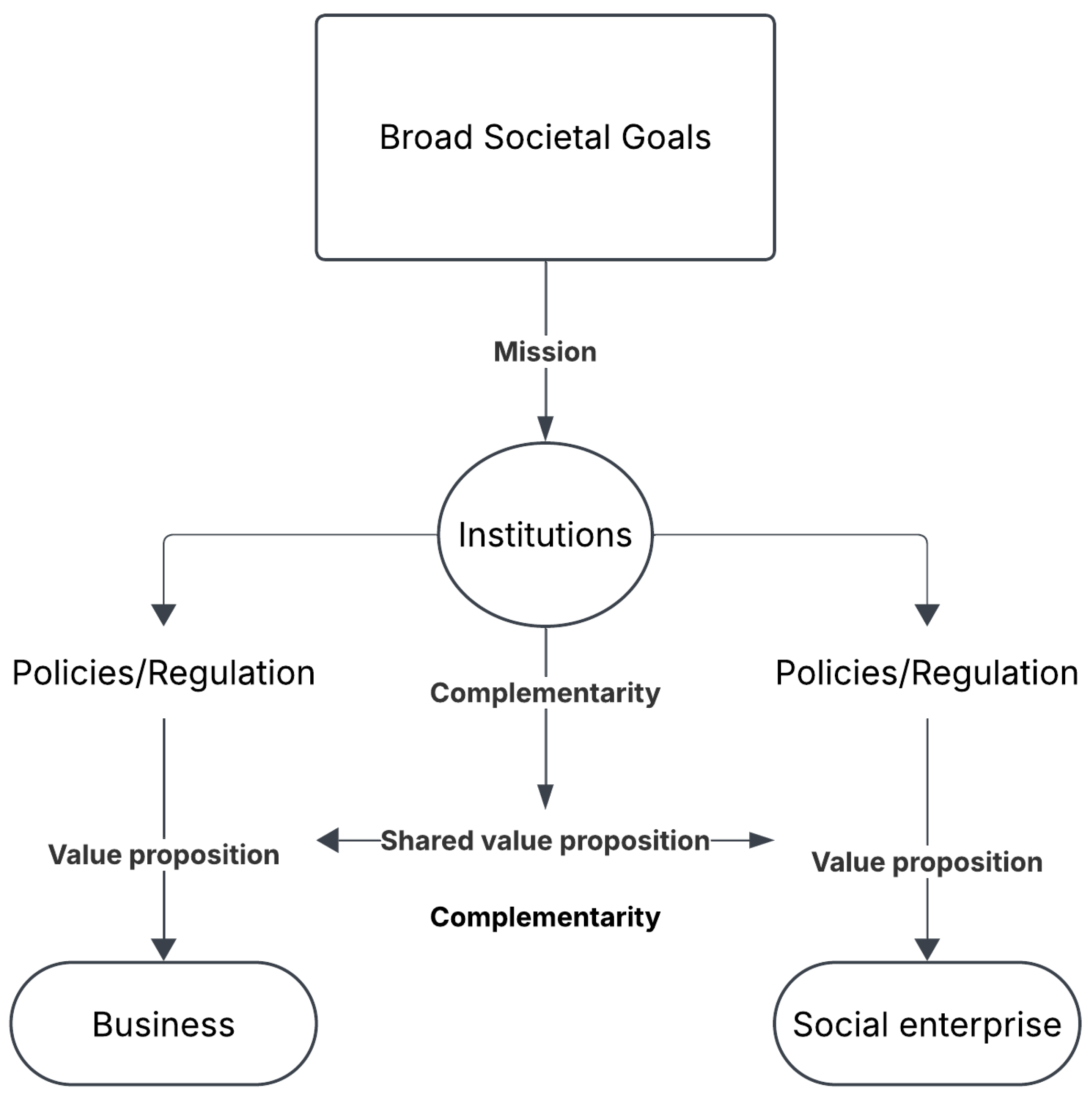
Figure 1 positions the two traditional approaches as connected parts of a single governance chain. At the top, broad social goals represent welfare-orientated goals such as waste reduction, resource security, and inclusion. These objectives are translated into a mission that legitimises the creation or mobilisation of institutions. Institutions sit at the centre as the organising layer: they convert high-level ambitions into concrete policy instruments, regulations, standards, and funding programmes. Through these instruments, institutions shape the room for manoeuvre of both businesses and social enterprises, influencing which circular activities become viable and which remain marginal. In this top down reading, value propositions at the organisational level are partially ‘made’ by the institutional environment, because incentives, compliance requirements, and access to infrastructure define what can be offered, to whom and at what cost.
At the same time, the figure makes clear that circular ecosystems are not only the result of institutional steering. Businesses and social enterprises also seek to build a shared value proposition through complementarity: repair networks, refurbishers, recyclers, logistics providers, and data intermediaries each contribute capabilities that cannot be replicated by a single actor at reasonable cost. When these contributions are combined, the returns become supermodular, in the sense that the value of the investment of one actor increases when others invest in compatible assets and interfaces. The central arrow from institutions to complementarity captures this duality: institutions can stabilise interfaces and reduce coordination risk, but the shared value proposition ultimately depends on decentralised alignment between partners.
Figure 1 therefore highlights a core tension of circular governance: missions and rules may enable coordination, yet circularity emerges only when interdependent value propositions cohere in practice.
These two traditional perspectives clarify the challenges of steering circular eco-systems. The policy approach typically assumes a coherent collective direction, whereas the business ecosystem approach assumes that alignment can be achieved around a central value proposition. While both perspectives highlight important aspects, neither fully explains how coordination emerges as actors adapt, learn, and respond to changing incentives over time. This limitation is particularly significant in the context of circularity, where high-value loops are based on cumulative capabilities, trust, and infrastructure. Consequently, the following section adopts a complex adaptive systems perspective, viewing circular ecosystems as evolving patterns shaped by feedback, path dependence, and decentralised experimentation.
5. Ecosystem Emergence, the Complex Adaptive Systems Lens
Conceptualising circular ecosystems as complex adaptive systems emphasises emergence as the primary mechanism for collective circularity, rather than deliberate design. In the regional science and policy literature, this complexity turn reduces the mechanical flavour of traditional top-down ecosystem programmes by foregrounding dynamics, adaptation, and learning over time. These ecosystems comprise heterogeneous actors such as manufacturers, repairers, recyclers, digital platforms, regulators, and communities, whose repeated interactions generate patterns that are not directly controlled by any single participant. Instead of centralised planning, coordination is achieved through local rules, routines, and expectations that actors continuously update in response to evolving technologies, prices, and policies. This approach complements perspectives that stress modular complementarities and alignment around a shared value proposition [
15].
To reduce conceptual ambiguity, this paper uses circular ecosystem to refer to an interdependent set of business, social enterprise, and public actors whose coordinated contributions—mediated by shared infrastructures, standards, and contractual interfaces—enable a circular value proposition to function beyond the control of any single firm. The term ecosystem trajectory denotes the evolving pattern of ecosystem states over time, as capabilities, routines, and institutional supports co-develop under conditions of bounded rationality and local adaptation [
12]. In this context, attractor states describe relatively stable configurations of practices and expectations around which circular activities cluster, such that ecosystems can stabilise in “high-value” life-extension configurations (repair, refurbishment, and reuse) or settle into lower-value routines (e.g., narrow compliance and recycling-centric patterns) depending on which feedback structures and coordination routines become self-reinforcing [
12].
Within this perspective, feedback loops are the primary drivers of ecosystem emergence. Positive loops arise when effective lifetime-extension practices reinforce themselves. For example, local repair businesses that provide reliable services attract more customers, which justifies further investment in skills, tools, and spare-parts inventories. Enhanced service quality then normalises repair and refurbishment, increasing demand for modular and repairable product designs. Strategic interventions—such as tax incentives for repair providers, public awareness campaigns that promote longevity, and subsidies for repair-skills training—can strengthen these reinforcing dynamics. System-dynamic studies of electrical and electronic equipment show that loops involving collection, reuse, and remanufacturing can reduce material throughput, but bottlenecks in capacity or quality can quickly undermine these gains [
19,
20]. Balancing loops operate simultaneously through increased repair costs, limited component availability, or rapid technological change that shifts users back toward new purchases. In this sense, feedback is not merely a descriptive metaphor: it refers to how observed outcomes—such as service reliability, turnaround times, collection quality, and the availability of parts and diagnostics—update expectations among users, firms, and public stakeholders, thereby reshaping subsequent investment and participation decisions. When these signals are consistently positive, they increase the perceived feasibility and legitimacy of life extension and make complementary investments more likely; when they are negative, they heighten perceived coordination risk and push actors toward safer, more easily routinised alternatives.
Decentralised decision-making represents a second defining characteristic of complex adaptive circular ecosystems. In local electronics and white-goods markets, repair cafés, independent workshops, and social enterprises autonomously determine which devices to accept, which repair techniques to employ, and how to source parts, based on tacit knowledge of users and patterns of recurring failure. Viability and social impact shape these choices: repair cafés and workshops must balance costs with consumer demand, while social enterprises may also prioritise community values and employment objectives, alongside sustainability goals. Regulatory requirements can further influence practices by encouraging compliance with environmental standards. Community repair events and open online repositories of repair manuals, teardowns, and design modifications broaden the range of solutions and reduce entry barriers for new participants [
37]. Collectively, these initiatives constitute a distributed experiment in life extension, where actors replicate successful practices and discontinue ineffective ones.
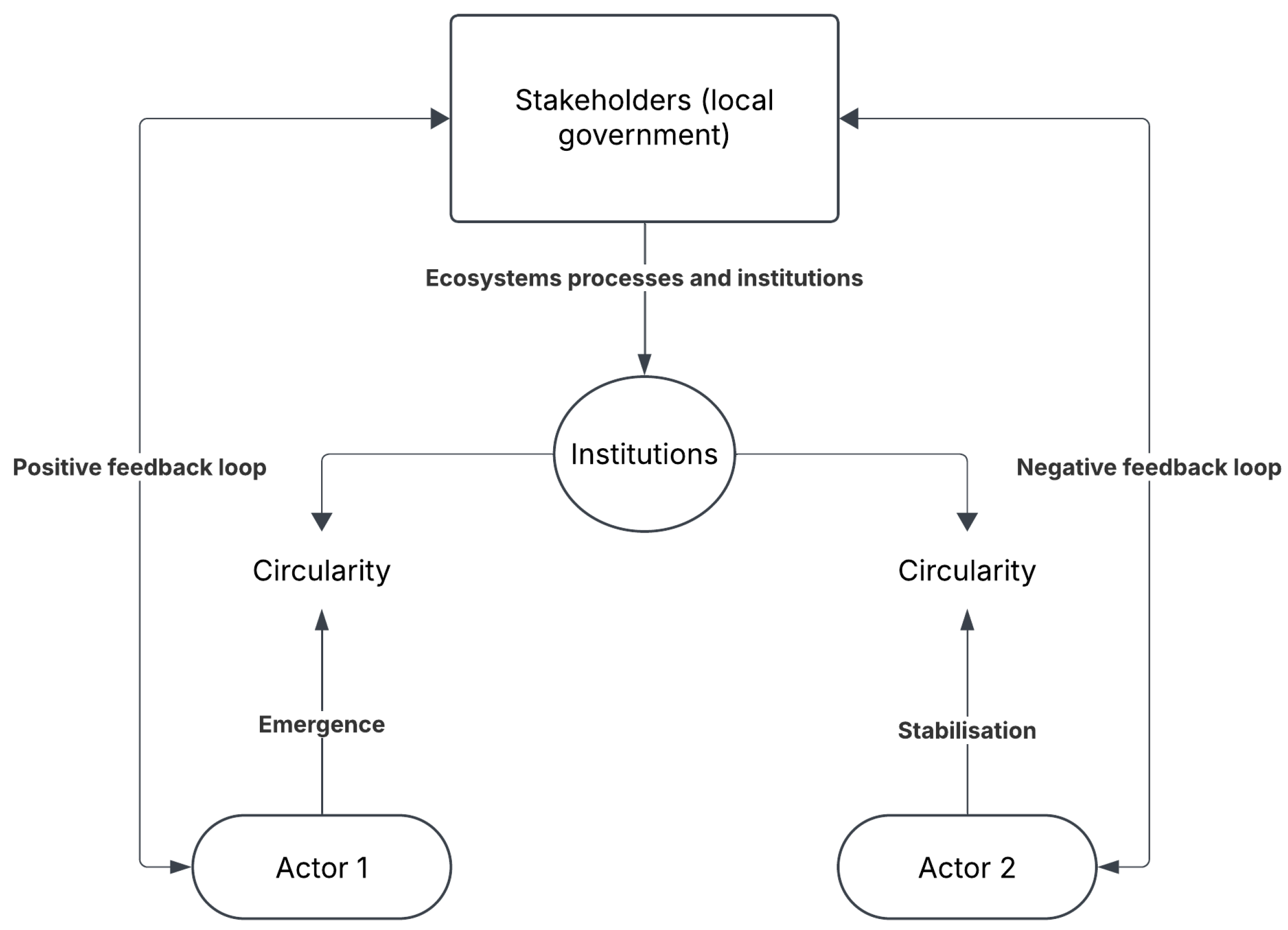
Figure 2 reframes ecosystem development as a complex system in which outcomes emerge from repeated interaction rather than a single design choice. Moving one level down from the mission–institution logic in
Figure 1, the starting point is a group of stakeholders—often local and regional authorities—who seek to establish the conditions for circular activity. They mobilise resources, convene partners, and create institutional arrangements that provide rules, infrastructures, and legitimacy for firms and social enterprises to experiment with repair, refurbishment, and recycling. What matters here is not only the formal design of institutions but also how stakeholder interactions evolve over time as priorities shift, coalitions form, and learning accumulates. The figure, therefore, shifts attention away from linear cause–and–effect links towards an adaptive process in which policy, firms, and societal actors co-produce trajectories of circularity.
A key addition relative to
Figure 1 is the explicit role of positive feedback loops in the emergence of circular ecosystems. Reinforcing dynamics explain how small initiatives can scale into self-sustaining systems once a critical mass is reached. Early investments in repair skills, spare-part access, collection points, or sorting and diagnostics facilities can reduce transaction costs and uncertainty for circular business models. As more organisations adopt these models, the demand for circular services increases, the utilisation of shared infrastructure improves, and the unit costs fall. The resulting improvements in reliability and convenience further normalise circular practices, attracting additional partners and cap-ital. In
Figure 2 this logic is captured by the positive loop that links actor behaviour back to stakeholder expectations and institutional reinforcement, turning initial experimentation into accelerated growth.
Negative feedback loops, on the contrary, help explain why progress often stabilises or stalls after an initial phase of success. Balancing mechanisms emerge when scaling raises coordination costs, increases regulatory complexity, or triggers resistance from incumbent linear models that lose rents from shorter product lifetimes. Circular offerings may also encounter diminishing returns as expansion requires serving more price-sensitive consumers, tightening margins, and reducing willingness to invest in higher-quality reverse logistics. Capacity constraints—such as shortages of skilled technicians or scarce components can further raise costs and lengthen lead times, pushing users back towards new purchases. These dynamics do not imply failure; rather, they explain why ecosystems may settle into stable but suboptimal equilibria.
Figure 2 therefore highlights that sustaining circularity requires managing both reinforcing and balancing loops, not just launching new initiatives. Over time, such stabilisation also becomes path dependent, because accumulated routines, sunk investments in infrastructure, and established institutional templates raise switching costs and make alternative circular configurations harder to coordinate, even when superior options exist. Trajectories therefore reflect a selection process: ecosystems do not merely “progress” or “fail,” but can converge on attractors in which circularity persists at limited depth and value, unless governance interventions deliberately reshape the feedback conditions that keep higher-value loops from becoming self-sustaining.
Interpreting circular ecosystems as complex adaptive systems clarifies why similar policy programmes can produce divergent outcomes and why early interventions may lock systems into low-value trajectories. However, the concept of emergence does not fully address governance challenges, such as the allocation of costs and benefits or the incentives that sustain collaboration as experimentation transitions to scaling. Feedback-sensitive rules must still be operationalised through contracts, funding criteria, and performance expectations that influence investment decisions among diverse actors. Accordingly, the next section introduces a common agency perspective, conceptualising circular ecosystems as multi-principal environments where policymakers, funders, and firms collectively influence shared pools of agents and, consequently, the trajectory of ecosystem evolution.
6. A Common Agency Perspective
6.1. Common Agency
A common agency perspective reveals that circular ecosystems function both as networks of complementary capabilities and as arenas where incentives and contracts structure collaboration. It extends the Adner type alignment problem by adding the policy and funding instruments that determine whether complementary partners actually invest, share information, and accept interdependence. In this way, common agency completes a full system incentive setting: complementarities may be present in principle, yet coordination will still fail if actors face conflicting targets, uneven risks, or weak rewards for non-generic circular investments. Integrating systems-thinking notions such as feedback loops and attractor states, common agency also clarifies how incentive regimes can stabilise particular patterns of collaboration, or lock ecosystems into narrow routines that are difficult to change once established. In particular, whether reinforcing dynamics are amplified or dampened depends on how principals specify metrics, allocate resources, and manage information asymmetries—features that are only partly visible in a complexity account, but become central when ecosystems are analysed as incentive systems.
To make the “multi-agent—shared agent” structure explicit, this document treats principals and agents as governance roles rather than fixed organisational categories. Principals are those actors who mobilise resources, set eligibility and reporting rules, and define the performance criteria through which circular activity is funded and legitimised—e.g., public authorities, producer-responsibility organisations, lead firms or philanthropic funders. Agents are the organisations that carry out the operational work of circularity—repairers, refurbishers, recyclers, logistics partners, and intermediaries—whose relevant effort includes both service provision and non-generic capability investment (diagnostics capacity, data routines, skills development, and interface com-patibility) that enables complementarities to materialise. A common agency setting arises when multiple principals seek to steer overlapping pools of such agents, while agents simultaneously need to satisfy different contractual demands. The resulting governance problem therefore is not only to coordinate complementarities, but also to align incentive schemes under incomplete information in a way that sustains the development of feedback-sensitive capability over time [
13,
14].
In this setting, multiple principals—including local authorities, regional development agencies, large manufacturers, and philanthropic foundations—depend on over-lapping groups of agents such as social enterprises, NGOs, and private firms providing repair, refurbishment, and recycling services. Each principal designs incentive schemes, grants, or procurement contracts to steer agents toward circular objectives, yet the effort of any one agent often generates benefits for several principals simultaneously. This is a multi-principal environment in which aligning behaviour with divergent goals is more complex than in bilateral relationships. Agents must also reconcile competing reporting formats, timelines, and performance metrics, which can fragment effort even when intentions are aligned.
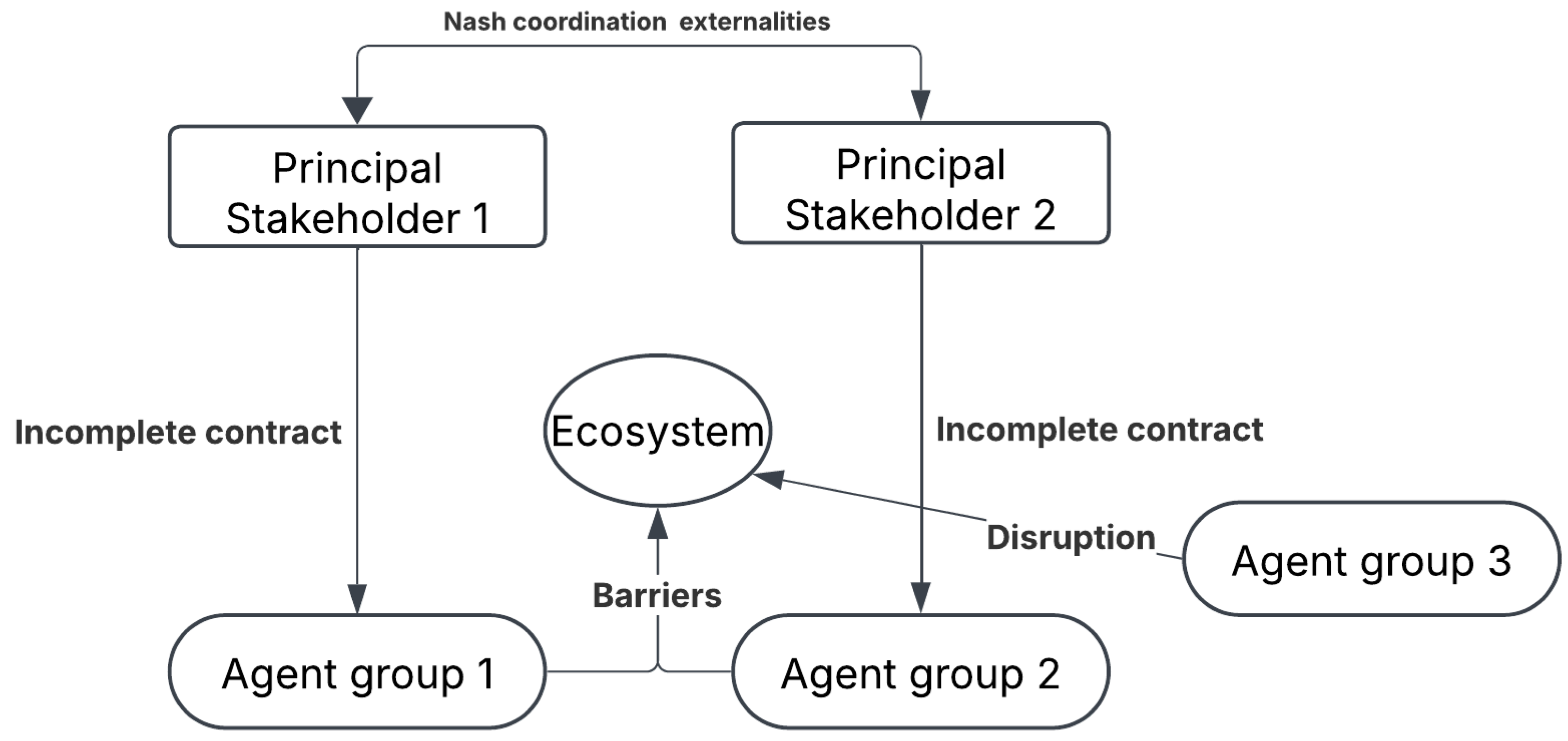
Figure 3 depicts this structure by showing distinct principals connected to shared pools of agents, with over-lapping benefits and competing accountability demands.
Analytically, each principal chooses a bundle of instruments—subsidy intensity, selection criteria, monitoring requirements, and time horizons—seeking to secure observable performance and organisational legitimacy while limiting budget exposure. Agents respond by allocating attention and effort across programmes, deciding where to invest in capabilities that are valuable for multiple principals, and deciding what information to share or conceal across contracts. Because principals cannot fully observe effort, constraints or quality, and because outcomes are often co-produced across agent groups, principal’ instruments interact through externalities: one principal’s investment in shared infrastructures can increase returns to the contracts of other principals’, while divergent metrics can force agents to fragment effort and prioritise compliance. In this sense, the “game” is multi-layered: principal’ strategies interact through external coordination links, and agents’ strategies interact through complementarities and barriers that condition diffusion and learning.
Within this shared-agency structure, principals face a common-pool problem when designing incentives for circular services. Because the benefits of additional agent effort—such as expanding local repair networks or improving diagnostics for reusable components—spill are transferred to other principals, each has incentives to free-ride on others’ contributions. Yet, the same setting can also trigger influence-seeking, where principals over-invest in preferred partners through generous subsidies or long-term contracts. In a city’s e-waste tender, for example, substantial subsidies to large companies intended to improve efficiency displaced smaller local recyclers that could not compete. Then a sorting effect emerges: a small set of well-connected or incumbent agents, the “usual suspects,” meets eligibility criteria and captures the most support, while newer or more experimental organisations remain excluded.
At the periphery, an underfunded group of agents often persists—community repair initiatives, small refurbishers, and grassroots recyclers that do not qualify for major programmes but continue to operate on limited budgets. Exclusion from mainstream contracting channels restricts their influence on ecosystem-wide standards, but it can also compel experimentation with alternative business models, unconventional partnerships, and low-cost technologies. These marginal agents can function as systemic explorers, akin to “skunk-works” units whose relative isolation can enable exploratory behaviour [
38]. From a perspective of complex adaptive systems, such variation strengthens resilience and adaptability by sustaining evolutionary search and keeps alternative circular pathways alive, even when dominant programmes converge on a narrow set of routines [
39].
The common agency also clarifies how the’ incentive schemes of the principals define the selection environment in which specific models succeed or fail. Grant criteria, tender rules, and reporting requirements shape which business models scale, which routines stabilise, and which actors gain legitimacy, thereby influencing the attractor states around which circular activities cluster. Ecosystem evolution can therefore be read as an interplay between contractual sorting and emergent innovation at the margins: formal incentives stabilise a subset of practices and partners, while excluded agents experiment with alternatives that may later diffuse into the wider ecosystem. Circular ecosystems thus evolve through a continuous interaction between what contracts select and what decentralised experimentation discovers, rather than through a single, planned pathway over time.
Information asymmetries further complicate this landscape. Principals rarely ob-serve agent effort or local conditions accurately, creating scope for moral hazard and adverse selection. Agents may exaggerate circular performance or prioritise activities that are easy to monitor, while more transformative but less visible practices remain underprovided. A measurement trap follows: easily audited actions receive funding, whereas high-impact but opaque practices are overlooked [
40]. Building on Tirole, common agency can be understood as overlapping externalities, where each principal both benefits from others’ incentives and distorts agent choices through its own objectives.
Figure 3 provides a schematic overview of the common agency setting that shapes many circular ecosystems. Two principals—such as public authorities, producer-response organisations, large firms, or funders—attempt to steer overlapping pools of agents. Each principal uses instruments that resemble contracts: grants, tenders, procurement rules, and reporting requirements. Yet these contracts are necessarily incomplete, because principals cannot fully observe effort, constraints, or the quality of out-comes. Moral hazard arises when agents can comply in form while shifting effort away from hard to measure activities; adverse selection arises when principals cannot distinguish high-capability organisations from those that are mainly skilled at meeting formal criteria. Ecosystem performance is therefore shaped by incentive design under imperfect information rather than by coordination alone.
The figure also highlights that principals are interdependent: they create externalities for each other, both positive and negative. If one principal subsidises diagnostic capacity or data infrastructure, other principals may benefit because agents can deliver better circular outcomes across multiple programmes. This creates scope for under-provision if each principal expects others to pay. At the same time, incentive schemes can generate negative spillovers when principals pursue different metrics or timelines, forcing agents to fragment effort and optimise for compliance rather than for ecosystem learning. The interaction with incomplete contracts is central. When incentives are too weak, positive externalities are not internalised, and complementarities remain latent. When incentives become too strong and narrowly targeted, they can crowd out collab-oration and counteract spillovers not recognised in the contract design.
Finally,
Figure 3 introduces two mechanisms that are easily missed in standard ecosystem accounts. First, barriers between agent groups limit the diffusion of practices and the formation of shared routines, reducing the rate at which local experiments scale into ecosystem capabilities. These barriers may reflect incompatible standards, competition for scarce inputs, or administrative boundaries that prevent knowledge transfer. Second, the figure shows a third group of agents outside the mainstream contracting sphere. Because they are less constrained by established criteria, these outsiders can experiment with alternative technologies, business models, or partnerships, and may disrupt the eco-system from the periphery. This disruption can trigger change by revealing new value propositions or exposing inefficiencies in the incumbent configuration. The common agency lens, therefore, frames ecosystem evolution as a mix of contracting, constrained collaboration, and innovation from outside the dominant system.
These mechanisms can be condensed into a coherent set of expectations that follow from the interaction between externalities, incomplete contracts, and feedback dynamics. When principals pursue divergent performance metrics and reporting cycles, agents face incompatible accountability demands and are incentivised to allocate effort toward compliance optimisation, which fragments collective learning and weakens reinforcing feedback loops around shared routines and circular capability investment. Likewise, when incentive schemes rely predominantly on easily audited outputs, measurement becomes a selection device that steers activity toward visible but lower-impact practices, increasing the likelihood that ecosystems stabilise in low-value attractor states. Selective funding and eligibility criteria that privilege administrative capacity can further concentrate support among “usual suspect” agents, improving short-term controllability while strengthening path dependence and reducing experimentation and diffusion from peripheral actors [
38]. In contrast, shared investments in enabling infrastructures—such as diagnostics, data, and traceability routines—help internalise positive externalities between principals and accelerate the diffusion of effective circular practices between agent groups, thus strengthening ecosystem-level emergence.
6.2. Multilevel Governance and the Super-Principal
Multilevel governance adds another layer by introducing a “super-principal” above the multiple principals described in
Section 6.3. While
Section 6.1,
Section 6.2 and
Section 6.3 focus on principal–agent interactions within a single territorial or sectoral context, many circular ecosystems operate within nested governance structures where local or regional principals are overseen by national governments, European institutions or federal states. In this setting, the super-principal designs incentive regimes for ministries, regional development agencies, or producer-responsibility organisations, which in turn contract with agents. This role resembles the administrative bodies of the network that coordinate and resource entire networks while maintaining member autonomy [
10,
41]. The super-principal layer thus creates an additional lever to address misaligned incentives that individual principals cannot resolve alone.
Importantly, the super-principal is conceptually distinct from a generic network administrative body. Whereas network administration typically coordinates participants at the agent level—organising ties, brokering collaboration, and monitoring project delivery—the super-principal operates primarily through up-stream contracting with principals. Its “agents” are themselves orchestrators with dele-gated authority, and therefore the main object of intervention is the incentive architecture: shared performance metrics, pooled funding rules and infrastructure investments that alter the benefits of multiple principals simultaneously. The super-principal role thus targets coordination externalities that arise in multi-principal settings without collapsing local autonomy or assuming that circular ecosystems can be centrally designed.
From a common agency perspective, the super-principal reshapes incentives by contracting “upstream” with the principals rather than “downstream” with the agents. Because multi-principal settings can yield both free-riding (too little aggregate support) and over-bidding for influence (excessively strong, selective incentives), the super-principal can condition funding on ecosystem-wide outcomes rather than on the performance of individual flagship projects. One mechanism is performance-based grants indexed to indicators such as waste reduction, recovery rates, or collaborative density measures [
42]. A complementary component can allocate funds for emerging or underfunded agents to counteract concentration among incumbents, balancing administrative efficiency with inclusiveness. The challenge is to choose indicators that are simple enough to coordinate across principals, yet rich enough to avoid rewarding compliance theatre over genuine circular capability building.
Developing this logic requires recognising that ecosystem-wide performance indicators are not neutral measurement devices but governance instruments that privilege certain circular pathways. Stylised indicators can be grouped into (i) outcome indicators (e.g., waste reduction and recovery rates), (ii) high-value loop indicators (e.g., shares of products returned to use through repair, refurbishment, or remanufacturing), and (iii) capability and coordination indicators (e.g., diagnostic capacity, data availability, and collaborative density). Each class carries design risks. Narrow outcome metrics can reward the compliance theatre and encourage agents to redirect effort toward what is measurable rather than what builds long-term circular capability. Capability indicators can unintentionally favour incumbents with administrative capacity, reinforcing concentration and exclusion, while coordination indicators can devolve into procedural reporting if they are decoupled from learning and interface compatibility. In nested governance structures, the super-principal therefore faces a balancing task: it must standardise a small set of shared indicators to reduce fragmentation across principals, yet keep measurement sufficiently open-ended to avoid prematurely locking the ecosystem into a single, low-value attractor.
Such multilevel designs also leverage diversity and weak links to increase innovation throughput by connecting disparate actors and practices. Looking forward, the super-principal should be understood less as a hierarchical planner and more as a meta-governance layer that shapes the rules of the game for distributed ecosystem orchestration. In practice, this may involve specifying common metrics, funding digital infrastructures for traceability and product passports, and mandating minimum transparency around take-back, repair, and remanufacturing outcomes. Such traceability infrastructures expand the feasible set of outcome-based contracting by reducing information asymmetries between principals and agents and by making cross programme spillovers more visible, thereby supporting both accountability and learning. At the same time, interventions must protect against regulatory capture and rigid templates that suppress local experimentation.
6.3. EU Illustration: The Super-Principal in a Nested Common-Agency Setting
In the European policy ecosystem, circular initiatives are typically governed in a nested common-agency structure. Regional governments and managing authorities act as principals that fund and steer a shared pool of agents (repair networks, refurbishers, social enterprises, recyclers, logistics providers, and data intermediaries). The European Union can be interpreted as a super-principal because it usually does not manage these agents directly; instead, it contracts “upstream” with the principals by shaping their feasible instrument bundles. Through programme rules, co-funding rates, eligibility requirements, and indicator frameworks, the EU layer changes the payoff structure faced by regional principals when they choose subsidy intensity, selection criteria, monitoring stringency, and time horizons. This is consequential precisely because the core common-agency pathologies discussed in this paper are upstream: free-riding between principals when capability building creates cross-territorial spillovers; influence-seeking and “usual suspect” selection when principals compete to place resources with preferred agents; and metric fragmentation that pushes agents toward compliance optimisation rather than ecosystem learning. A super-principal logic therefore becomes visible when EU-level instruments make coordination, learning, and interface-building more attractive to regional principals than narrowly auditable, low-risk routines.
From the common-agency perspective, the super-principal affects regional principal behaviour through three channels that map directly onto the model. First, co-funding conditionality and competitive allocation change the marginal return to principal effort: regions that invest in convening capacity, partner search, and non-generic circular capabilities can leverage EU resources, while regions that do not pay the fixed costs of ecosystem building forgo those resources. This reduces free-riding among principals because some benefits that would otherwise spill over without compensation are partially internalised through access to funding. Second, standardised monitoring architectures (shared output/result indicators and reporting templates) reduce metric divergence across principals and thereby reduce the incentive for agents to fragment effort across incompatible accountability regimes. Third, investments in enabling infrastructures (e.g., traceability routines, testing facilities, shared digital interfaces) lower information asymmetries and transaction costs for multiple principals at once, turning what would be underprovided positive externalities into ecosystem-level capabilities that are usable across programmes. In combination, these three channels alter the selection environment in which particular circular routines become investable and stabilise.
Horizon-type instruments align closely with the paper’s mechanisms of experimentation and incomplete contracting. In domains such as circular design, reverse logistics, diagnostics, and data/traceability, the relevant effort is difficult to specify ex ante and outcomes are co-produced, so contracts are necessarily incomplete. Horizon addresses this by funding pre-competitive experimentation and capability building rather than attempting to contract directly on full ecosystem outcomes. Two technical implications follow. First, transnational consortium requirements bundle heterogeneous agents into temporary “micro-ecosystems” that must align complements within a shared project architecture. This reduces interdependence risk by forcing bottlenecks to surface early (interfaces, standards, data access, verification routines) instead of remaining latent until deployment. Second, dissemination and replication requirements (together with common project logics and deliverable formats) intentionally create spillovers beyond the funded consortium, which is precisely the type of positive externality that individual regional principals have incentives to underprovide in a common-agency setting.
Horizon can also be read through the lens of peripheral exploration. Because participation can take the form of pilots, demonstrations, and living-lab style experimentation, it can provide a protected entry channel for outsiders that often remain below the threshold of mainstream procurement and compliance regimes (community repair initiatives, niche refurbishers, start-ups, or social enterprises). In the framework’s terms, this preserves variation and sustains ecosystem search, increasing the probability that high-value loop innovations are discovered and tested before the system locks into easily audited but low-value routines. At the same time, because application and reporting requirements are demanding, Horizon can inadvertently reinforce the “usual suspect” mechanism by selecting agents that are administratively capable rather than those with the most grounded repair/refurbishment expertise—a point that connects directly to the paper’s selection and measurement-trap logic.
Interreg instruments illustrate the super-principal role most directly at the level of regional governments. Many circular value propositions have strong cross-border spillovers: secondary markets, reverse-logistics corridors, shared repair/refurbishment capacity, harmonised sorting and diagnostics practices, and interoperable data routines often only become viable once a sufficient scale is reached across neighbouring territories. Without a super-principal, each regional principal has incentives to underinvest and wait for others to pay for shared infrastructures and coordination, producing a classic free-riding problem. Interreg mitigates this by making support conditional on joint programming and joint implementation, which effectively creates a coordination contract among principals: regions must agree on shared objectives, align parts of their monitoring regimes, and stabilise interfaces across administrative boundaries. In the language of
Figure 3, Interreg targets the “barriers between agent groups” mechanism by lowering boundary costs and enabling diffusion of practices and routines across territories, increasing the likelihood that local experiments scale into ecosystem capabilities.
Taken together, Horizon and Interreg illustrate how a super-principal can align principal incentives without centrally designing the ecosystem: by subsidising experimentation where contracts are incomplete, by building enabling infrastructures that internalise spillovers, and by imposing a limited degree of metric compatibility so agents face fewer incompatible demands. The same EU ecosystem also illustrates the paper’s cautions. If monitoring frameworks privilege what is easiest to audit, performance measurement can become a selection device that steers effort toward visible outputs while underfunding the harder, longer-horizon work of building repair/refurbishment capability and trust in secondary markets. Likewise, if administrative templates and compliance requirements are too rigid, they can suppress local experimentation and reduce the permeability needed for outsiders to transition from peripheral exploration to mainstream diffusion.
7. Conclusions
This paper investigated the emergence of circular business models and examined why their strategic potential often exceeds their widespread adoption in fast-moving product categories. It argued that circularity becomes commercially meaningful when it is organised around repair, refurbishment, remanufacturing, and higher-quality end-of-life recovery, yet it rarely scales as a single-firm optimisation problem. Instead, circularity is more accurately understood as a system property: it emerges when product design, reverse logistics, and secondary-market practices are transformed in a coordinated manner across interdependent actors. The central implication is therefore that circular economy progress depends as much on governance arrangements and incentive architectures as on the availability of circular technologies or the intentions of individual firms.
Conclusions can be articulated in three layers: conceptual innovation, mechanistic propositions, and policy implications. First, conceptual innovation is the integration of three bodies of theory into a single analytical framework for circular ecosystem governance. The paper combined ecosystem strategy, complex adaptive systems thinking, and common agency theory to address a persistent gap in circular economy scholarship: the limited ability to explain how circular initiatives transition from local experimentation to stable ecosystem-level scale. This integration clarifies why the two dominant perspectives in the literature—policy governance and business ecosystem strategy—capture important but partial aspects of the coordination challenge. Policy perspectives mobilise public missions and instruments but can overestimate steerability; business ecosystem perspectives highlight complementarities and bottlenecks but often under-specify normative objectives and the incentive regimes that shape investment and information sharing. The framework therefore advances circular ecosystem analysis by treating governance, incentives, and system dynamics as mutually constitutive rather than sequential or separate.
Second, the mechanistic propositions concern how circular ecosystems emerge, lock in, and stagnate. The synthesis of the paper emphasised that distributed complementarities create a coordination risk: even when a circular value proposition is attractive in principle, bottlenecks in reverse logistics, diagnostics, skills, or secondary-market trust can undermine performance. In terms of complex adaptive systems, reinforcing feedback loops can accelerate circularity when early successes increase legitimacy, skills, capacity utilisation, and investment, while balancing loops can stabilise ecosystems in suboptimal equilibria when costs rise, parts become scarce, or incumbent linear models resist longer lifetimes. The common agency perspective adds that these dynamics are conditioned by the incentive regimes through which principals attempt to steer shared pools of agents. Divergent metrics, reporting cycles, and incomplete contracts can fragment effort, encourage compliance optimisation, and generate measurement traps in which easily audited actions are funded while high-impact but harder-to-measure practices remain underprovided. At the same time, the framework clarifies why experimentation at the margins can matter: excluded or underfunded agents may function as systemic explorers that maintain variation and create pathways for later diffusion, even when mainstream contracting converges on narrow routines. In combination, these mechanisms explain why circularity may scale into high-value loop retention in some settings, while in others it stabilises in low-value routines that are easier to coordinate and monitor but do not realise the full potential of life extension.
Third, the policy implications follow from conceptualising circular ecosystems as multi-principal incentive systems rather than as single programmes or focal-firm orchestration problems. From this perspective, effective governance requires instruments that internalise positive externalities across principals, reduce information asymmetries, and support capability development over time. The super-principal concept is proposed as a meta-governance role that can shape incentives “upstream” by coordinating principals through shared performance metrics, pooled rules, and infrastructure investments. Performance-based instruments can be used to align objectives around ecosystem-level outcomes rather than isolated flagship projects, while complementary provisions can counteract concentration by ensuring that underfunded agents and peripheral experimentation remain connected to the ecosystem’s learning and diffusion processes. At the same time, the framework highlights design risks: overly narrow indicators can reward compliance theatre; overly rigid templates can suppress local adaptation; and governance arrangements that privilege administrative capacity can reinforce exclusion and path dependence. The practical implication is not that circular ecosystems should be centrally designed but that incentive architectures should be deliberately structured to sustain reinforcing dynamics while mitigating the balancing mechanisms that stabilise low-value equilibria.
The framework is deliberately conceptual and should be interpreted accordingly. It does not claim empirical validation or offer a ready-made practitioner toolkit. Its boundary conditions reflect the focus of the literature discussed throughout the paper, which often illustrates circular governance in electrical and electronic equipment and European regulatory contexts. Transferability to other sectors and regions—particularly where informal repair markets, enforcement capacity, and infrastructure availability differ—should therefore be treated as an open and valuable research direction rather than an assumed property of the argument. The analysis also highlights the centrality of measurement and information infrastructures, yet it recognises that performance metrics are themselves political and contested and that what becomes “measurable” can shape what becomes scalable.
A further limitation—and an opportunity for research—is that circular ecosystem governance involves potential trade-offs between sustainability pillars. Incentive configurations that maximise environmental outcomes through efficiency and throughput reduction may conflict with social objectives such as inclusion and local employment, while economic viability pressures may prioritise routinised solutions that underdeliver on higher-value loop retention. The framework suggests that these trade-offs are not peripheral but are embedded in indicator design, contracting routines, and the distribution of costs, risks, and benefits across actors.
Future research can build on this lens in several directions. Empirical studies can test the propositions implied by the framework, examining how different incentive configurations affect collaboration, capability investment, and the stability of high-quality reverse logistics. Comparative research across governance regimes can explore how enforcement, institutional contexts, and measurement systems shape ecosystem trajectories, and how similar policy programmes yield divergent outcomes. Additional work can examine how traceability infrastructures and data standards alter information asymmetries and bargaining power, potentially creating new bottlenecks even as they reduce transaction costs. Finally, research can more explicitly evaluate distributional outcomes and sustainability trade-offs, investigating how governance arrangements can align decentralised behaviour with shared objectives while preserving the adaptability that circular transitions require.