1. Introduction
Urban food systems globally are marked by tensions between modernization and tradition. Supermarkets dominate in the West, where they account for over 50% of food retail sales [
1], while wet markets persist across Asia, adapting dynamically to urbanization. Unlike the supermarket-dominated systems prevalent in Western developed countries, China’s urban food infrastructure is characterized by the coexistence of wet markets, supermarkets, small food stores, and emerging e-commerce platforms [
2]. This phenomenon challenges earlier predictions of a linear supermarketisation trajectory [
3] and instead highlights the resilience of wet markets, which continue to dominate fresh produce retail in Chinese cities [
4].
The resilience of wet markets also raises critical questions about their socio-spatial impacts. Wet markets have already been examined through the lens of state-market interactions [
4,
5] or social-spatial theory [
6,
7]. Their persistence is not merely a matter of economic functionality but also a reflection of their embeddedness in social and cultural practices. Their ability to integrate “hard” (supply-chain efficiency) and “soft” (community-building) functions exemplifies how hybrid infrastructures can enhance urban resilience [
8]. They bridge gaps in food security, particularly for low-income urban residents, while mitigating the negative effects of supermarket dependence, such as dietary shifts toward processed foods [
9]. As physical and social infrastructures, wet markets are considered a cornerstone of daily life in urban China, representing a unique blend of tradition and modernization within the country’s rapidly evolving food retail landscape.
In spite of their persistent and critical role in urban foodscape, marketplaces are at the frontier of wider processes of gentrification, displacement, and dispossession, and the decline of traditional food markets can be seen in cities across the world [
5,
10]. Case studies of urban marketplaces in the Philippines, Mozambique, and Ghana highlight the regulatory tensions between state authorities and local traders [
11,
12,
13]. Through the lens of infrastructuring the social [
14], fresh food marketplaces in the Global North in contrast are seen as critical social infrastructure. They act as physical spaces that shape social interaction, fostering community cohesion and supporting local economies while ensuring food security for diverse populations [
15]. While studies have documented the transformation of wet markets in major Chinese cities, a comprehensive understanding of their transformative dynamic remains fragmented. The broader implications of this model for urban governance, equitable development, and global debates on inclusive formalization remain underexplored.
The mechanism distinguishing wet markets from purely transactional retail spaces like supermarkets is complex and interwoven with the governance arrangements surrounding markets. We assume that this process involves a unique blend of formal regulation and informal adaptation to reshape urban life. Following this insight, we propose an analytical framework to explore the dynamic and implications of wet market transformation in China at the city level.
3. Materials and Methods
In this research, we engage in a mixed-methods approach, involving collecting and analyzing a mixture of primary and secondary data. We adopt a historical–institutional analysis to examine the transformation of urban wet markets in mainland China since the Reform and Opening Up Policy, initiated by the CPC at the Third Plenary Session of the 11th Central Committee in 1978. This is achieved through a systematic review and synthesis of policy documents, archival records, the academic literature, and historical reports. By tracing shifts in regulatory frameworks, spatial planning, and socioeconomic contexts, we construct a phased narrative of institutional and infrastructural evolution.
The primary fieldwork in Suzhou was carried out by one of the authors in 2023, complemented by data from surveys conducted in 2015, 2017, 2019, and 2020 under the Hungry Cities Partnership (HCP) projects that investigated the relationships between rapid urbanization, urban food systems, and migration in the Global South. For cross-city comparative analysis, the 2023 Suzhou survey data were paired with the 2019 and 2020 Nanjing survey data. Both datasets were collected by the first author to ensure methodological consistency, and the comparison was deliberately restricted to variables not subject to temporal variation, thereby maximizing the validity of the cross-sectional analysis. Separately, Nanjing’s 2015 and 2017 data, sourced from the HCP projects, were utilized to generate qualitative insights into the city’s food system and inform policy analysis; these earlier datasets were not integrated into the cross-city comparison, thus avoiding potential inconsistencies with the Suzhou dataset.
In contrast to prior single-city studies, in this research we adopt a comparative design featuring Nanjing and Suzhou to develop a more comprehensive understanding of urban food retail dynamics. The two cities were strategically selected based on shared and distinctive contextual traits: both are economically developed cities in Jiangsu Province, East China, with diverse food retail formats, longstanding wet market traditions, and robust policy support for these markets. Nanjing, as the capital city of Jiangsu Province, and Suzhou, a prefecture-level city in Jiangsu Province (As a prefecture-level city, Suzhou is administratively less powerful than the provincial capital Nanjing, but superior to county-level cities and counties.) renowned domestically for trade and commerce rooted in its outward-oriented economic development policies [
30], exhibit comparable provincial-level governance frameworks while differing in municipal-level development trajectories. With 2023 populations of 9.55 million and 12.96 million, respectively [
31], the two cities also represent similar scales of urbanization. By focusing on two cities within the same province, in this study we control for overarching provincial food policy and economic development contexts, isolating the local factors that shape wet market evolution and enhancing the internal validity and representativeness of the findings.
It should be acknowledged, however, that this methodological choice to ensure comparability involved certain trade-offs, due to the constraints of the research conditions. While these surveys were part of one main overall project, individual funding mechanisms and research objects varied, so the timing, category, and number of interviews in the two cities differed. As this study focuses on the transformation of wet markets, the primary survey conducted in Suzhou in 2023 only involved information related to wet markets, their consumers, and managers, whereas the fieldwork in Nanjing included not only wet markets but also interviews with households, fresh produce consumers at supermarkets, and managers of fresh produce sections at supermarkets.
The stratified random sampling in Nanjing and Suzhou fully covered all urban districts of the two cities, excluding county-level cities (i.e., Kunshan, Zhangjiagang, Taicang and Changshu for Suzhou), which was a deliberate prioritization based on our research focus. Specifically, the sampled urban districts include the following: Nanjing: Gulou District, Qinhuai District, Xuanwu District, Yuhuatai District, Jianye District, Qixia District, Jiangning District, Luhe District, Gaochun District, Lishui District, and Pukou District (all core urban districts, covering different urban functional zones such as central business districts, residential concentrated areas, and urban–rural junctions); Suzhou: Gusu District (historical urban core), Industrial Park (modern urban area), Huqiu District, Wuzhong District, Xiangcheng District, and Wujiang District (all municipal urban districts, spanning traditional and new urban spaces). Our study aims at exploring the governance and social infrastructure of wet markets in core urban areas with dense populations, mature community networks, and typical urban renewal contexts—factors that are more concentrated in municipal urban districts rather than county-level cities.
For the selection of samples from supermarkets and wet markets in Nanjing, a stratified random sampling method was employed. A total of 170 supermarket stores selling fresh produce owned by 13 brands, as well as 351 wet markets, were identified from BaiduMap (
http://map.baidu.com) via web crawler and verified through field visits, including their names and geospatial data. The sample size was determined based on the proportional representation of the number of wet markets in each administrative district within the city, aiming at ensuring an even distribution across all regions. A total of 90 supermarkets were sampled using stratified random sampling. Samples were selected across the city’s 11 districts proportional to the number of supermarkets in each district. In order to compare supermarkets and wet markets, specific information on each supermarket and its closest wet market was collected by trained investigators according to the uniform criteria established in advance, including fresh produce sales items, prices of major fresh products, shopping environment, and infrastructure conditions. If the closest wet market was shut down or under reconstruction, an alternative wet market within 3 km was located and visited. The sampling methods of wet markets in Suzhou remained consistent with the survey conducted in Nanjing in 2020, facilitating the comparative data and analysis.
A criterion-based purposive sampling method was applied consistently across all sampled wet markets and supermarkets. Eligible respondents were full-time, on-site managers or supervisors with direct oversight of daily operations, procurement and vendor coordination. Where multiple eligible staff existed, the individual with the longest tenure and broadest authority was selected. Consumers were recruited via systematic random sampling, with fixed-interval selection of exiting shoppers at all outlets. Data collection was stratified across peak/off-peak hours and weekdays/weekends to capture diverse shopping patterns. Only consumers aged 18 and above who had completed a purchase were included, with verbal informed consent obtained prior to participation. The systematic random sampling design mitigates convenience sampling bias, while time-stratified data collection reduces bias related to shopping routines and demographic characteristics.
The price data was based on six fresh products commonly cooked in the daily cuisine of Chinese households: bok choy, tomato, live crucian, egg, pork belly, and beef brisket. For each specific food item, we conducted random sampling among the stalls that sell this item. Specifically, three to five vendors’ stalls were randomly sampled and surveyed for price information; the average price of each fresh product was then calculated and denoted as its price in the surveyed wet market. We measured the infrastructure conditions involved in the shopping experience using a five-level ordinal scale as follows: (a) for booth uniformity and (b) for floor cleanliness, 1 bad, 2 not good, 3 not bad, 4 good, 5 very good; (c) for odor, 1 very strong, 2 strong, 3 not bad, 4 light odor, 5 free of odor; (d) for lighting, 1 poor lighting, 2 less bright, 3 not bad, 4 bright, 5 very bright.
The survey respondents included two main categories: fresh produce consumers (10–15 per outlet) and managers (1 per outlet). Consumers were asked about their major food preferences; in the case of managers, questions were asked about the logistics of fresh sales and their personal opinions on the impact of food retail competition. A total of 477 wet market consumers and 42 wet market managers were surveyed in Suzhou, and 996 supermarket consumers and 56 supermarket managers in Nanjing. Information on 60 wet markets in Suzhou and 82 in Nanjing was collected and analyzed.
4. The Semi-Formalization Process of Wet Markets
The evolution of urban wet markets in mainland China since the Reform and Opening Up Policy reflects a trajectory of institutional and infrastructural evolution, paralleling developments in Hong Kong, Taiwan, and Singapore. The evolution can be divided into three stages.
1978–1990s: Transition from Street Markets to Shed Markets
In the early post-reform period (1978–1984), agricultural product trading emerged through informal “露天市场” (street markets), characterized by spontaneous roadside stalls operated by farmers and small vendors. These markets, though economically vibrant, faced issues of disorder and hygiene. By the 1990s, the “退路进厅” (retreating from roads into halls) policy prompted the construction of steel-framed “大棚市场” (shed markets), which provided basic shelter and fixed stalls. While these markets improved vendor stability and weather resilience, their infrastructure remained rudimentary, consisting of cement floors, brick stalls, and open drainage systems that frequently resulted in unsanitary conditions. This phase marked the initial institutionalization of wet markets, transitioning from informal aggregation to semi-permanent spatial governance.
2000s: Standardization and Regulatory Integration
By the early 2000s, most wet markets across China had transitioned from open-air stalls to enclosed indoor facilities, marking a nationwide modernization initiative. The 2000s saw heightened public concern over food safety and hygiene, driving provincial governments to implement star-rating systems for market standardization [
32,
33]. Markets were upgraded with modern facilities, including dedicated food safety laboratories standardized stall designs, and fire safety systems. The dedicated food safety facilities include government-arranged rapid food testing rooms integrated within wet markets, operated under the supervision of local Market Supervision and Administration Bureaus (state control systems) rather than individual sellers. Their core scope of expertise focuses on targeted, rapid screening of key food safety indicators critical to fresh and perishable products, aligning with the regulatory emphasis on real-time risk control. Practically, all daily test data and final conclusions are meticulously recorded, filed, and uploaded to a unified food safety supervision platform for transparent oversight. In cases of abnormal test results, re-testing is immediately conducted; if the product is confirmed to be non-compliant, vendors are ordered to remove the item from their shelves promptly. This system integrates state-led monitoring with on-site rapid response, effectively mitigating food safety risks throughout the wet market supply chain. Additional improvements included the incorporation of electronic screens and ventilation systems, along with a focus on neat interior and exterior decorations.
These upgrades enabled the traceability of food items and facilitated better supervision. For example, since 2014, Zhejiang Province has prioritized the establishment of Reassuring Markets (called “放心市场” in Chinese) as part of its top ten livelihood projects. This initiative aimed at revamping the infrastructure of wet markets and elevating overall infrastructure, management standards, and service provision, ensuring the safety of essential food supplies for residents. The government assesses the progress of Reassuring Markets through a variety of methods, including on-site inspections, regular covert visits, online data verification, and public opinion surveys. These reforms aligned with broader efforts to integrate wet markets into urban regulatory frameworks, balancing economic informality with state-led quality control.
2010s–present: Smart Markets and Digital Transformation
Post-2010, advancements in IoT, blockchain, and e-commerce spurred the rise of “smart markets”, also known as internet-based wet markets; they involve upgrading traditional wet markets by incorporating real-time traceability systems, digital payment platforms, and data-driven supply chain management [
34]. This phase reflects a dual focus on technological modernization and ecological sustainability, with smart markets reducing food waste and carbon footprints through optimized logistics. An increasing number of wet markets in Chinese cities have adopted on-site waste disposal methods. The organic waste generated daily in these markets, including fruit and vegetable scraps, meat trimmings, and small bones, undergoes volume reduction processes such as crushing and dehydration. Meanwhile, the wastewater produced during waste treatment is discharged only after meeting the required standards. This practice aims at minimizing the pressure associated with the centralized terminal disposal and long-distance transportation of municipal solid waste. However, whether the development of smart wet markets can significantly facilitate dynamic supervision of market operations and eventually improve the overall level of market management needs to be further examined. For example, how to respond to the drawbacks of food safety testing procedures, which, as Dai argues, are considered to be untruthful and follow a campaign-style enforcement [
35]. Residents also worry about food monitoring and regulation not being adequate to ensure the safety of food sources [
36]. This calls for more transparent information-sharing schemes and effective enforcement of government regulations, especially those of local governments.
5. Semi-Formalized Resilience and Hybrid Governance: The Case of Nanjing and Suzhou
The evolution of urban wet markets in China presents a compelling case of how traditional food retail systems adapt to modern urban pressures while maintaining their core socioeconomic functions. Through an examination of Nanjing and Suzhou, this analysis reveals how wet markets have developed sophisticated semi-formalization mechanisms to ensure food security, foster social cohesion, and maintain urban resilience through a unique blend of formal regulation and informal flexibility.
5.1. Semi-Formalization: Balancing Regulation and Flexibility
Wet markets operate within carefully negotiated spaces between state control and grassroots entrepreneurship, between technological modernization and cultural preservation. They create “institutionalized informality”, a system in which apparent contradictions become sources of strength rather than weakness. The result is a system which thrives on organized flexibility, where regulated standards coexist with grassroots adaptations.
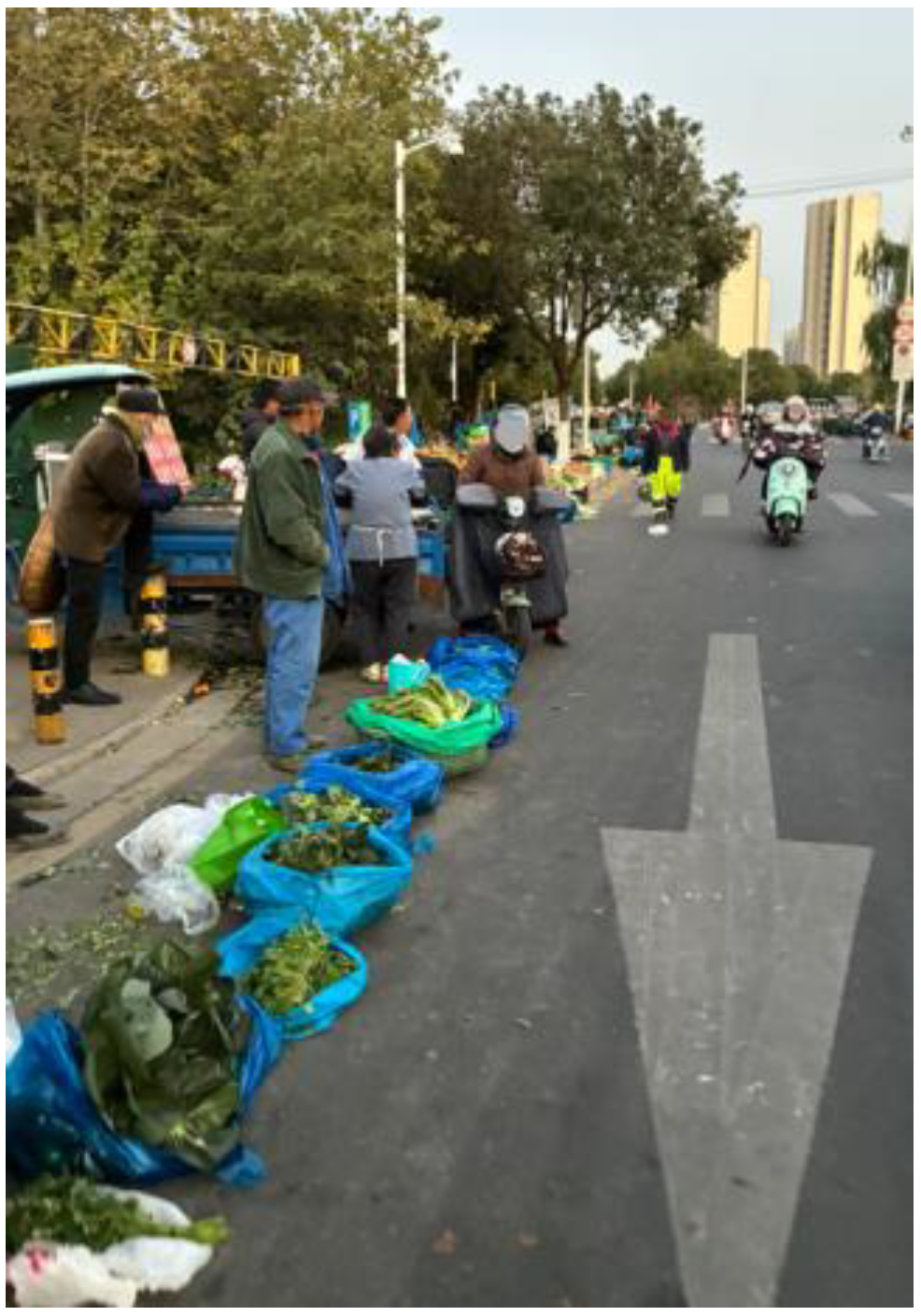
At the heart of this system lies the concept of semi-formalization, which we define operationally as a governance model characterized by three key features: (1) selective enforcement of formal regulations, (2) institutional flexibility in the spatial and temporal organization of economic activity, and (3) hybrid governance structures that combine state planning with grassroots adaptive practices—a core adaptive feature that enables wet markets to balance institutional compliance with the dynamic needs of grassroots vendors and local consumers. In Suzhou, for instance, the government’s 2007 Regulations on the Administration of Wet Markets mandated comprehensive indoor operations [
37]. However, as shown in
Figure 1, a regulatory gray zone has emerged where informal street vendors often cluster around the perimeter of formal wet markets, embodying the informal flexibility embedded in the semi-formal governance framework. This “temporal informality” constitutes a targeted manifestation of such flexibility: municipal authorities selectively enforce rules to accommodate socio-demographic needs, rather than adopting a one-size-fits-all prohibition of informal trading. At a researched wet market in Suzhou Industrial Park, urban management authorities permit mobile vendors to operate until 7:00 AM on weekdays and 9:30 AM on weekends. This temporal zoning strategically balances the livelihood needs of informal vendors, who often lack the resources to rent formal stalls, with the fairness concerns of formal market tenants who pay fixed stall fees. Collectively, these practices demonstrate how semi-formal governance reconciles modernization pressures with livelihood preservation, creating systems that are simultaneously regulated and adaptive. This resonates with the discussions on redundancy and adaptability in the urban resilience theory [
38], reflecting the institutionalized flexibility of semi-formalization in terms of space and time.
Conceptually, our framing of semi-formalization distinguishes itself from two foundational notions in urban governance scholarship: institutional hybridity and negotiated informality. Institutional hybridity captures the combining of core organizational elements that potentially conflict with each other, involving managing inherent tradeoffs between a more economically oriented element of an organization’s identity and one oriented toward social benefit [
39,
40]. Negotiated informality goes beyond ahistorical accounts of informality, the notion sees urban informality as a means of negotiating about legitimacy and resources, exploring emerging urban phenomena and the power dynamics, including state-society relations, behind them [
41,
42]. Semi-formalization, as observed in China’s wet market governance, departs from both as a state-led, institutionalized adaptive model. Informal flexibility is not a spontaneous hybrid outcome or contingent negotiation; instead, it is a deliberately designed component of formal regulatory frameworks, codified into scalable rules (e.g., fixed time windows for informal vending) that reconcile top-down modernization mandates with grassroots livelihood needs.
This institutional flexibility extends to urban planning. The Code of Urban Residential Areas Planning & Design (GB 50180-93, [
43]) considers wet markets by mandating that a wet market with a building area of 500–1000 m
2 should be established for any residential area with a population of 10,000–15,000 residents. For residential areas with a population of 30,000 to 50,000, 1000–2000 m
2 of wet market space is required [
43]. This code was issued in 1993 and amended in 2000, 2002, and 2016. The construction of new wet markets reflects the government’s consideration of urban land use. Nanjing required that for every newly built residential building complex, real estate developers should build a wet market, which is called the “build–transfer–operate” model [
44], suggesting that the number of wet markets would increase with the expansion of urban areas. The land use rights of wet market sites are allocated by the government free of charge through administrative allocation, with real estate developers responsible for constructing those markets. The ownership of the wet market properties belongs to the district or county-level government. The government then authorizes management companies through public bidding to operate the wet markets.
Similarly, Suzhou integrates wet markets into mixed-use developments within residential areas. Such spatial strategies guarantee accessibility, which forms a critical component of their urban resilience. Survey results show that 97.7% of Suzhou residents access markets within 30 min, a timeframe that accommodates diverse transportation needs.
Table 1 demonstrates that wet markets in Suzhou and Nanjing maintain proximal access to public transit, with bus stops located at an average of 0.2 km (Suzhou) and 0.22 km (Nanjing), and subway stations at 1.53 km and 1.12 km, respectively, all within comfortable walking distance. The result is a system where 44.4% of patrons walk to markets, creating “naturally occurring” food access points that require minimal additional infrastructure investment. Accessibility not only represents spatial proximity but also reflects social inclusion, particularly for car-free households, the elderly, and low-income groups [
45].
Transportation patterns reveal fascinating differences between the two cities that reflect their administrative hierarchies. As a provincial capital, Nanjing possesses a more extensive subway system (13 lines totaling 476.4 km) compared to Suzhou’s 7 lines covering 300.5 km. This difference manifests in wet market access patterns, with Nanjing residents enjoying superior transit connectivity. However, Suzhou’s stronger integration with bus networks reflects the city’s distinct planning philosophy, which prioritizes “last-mile” connectivity and pedestrian-friendly neighborhoods to maintain its reputation as a highly livable “garden city”. In contrast, Nanjing’s rapid, large-scale urban expansion has sometimes prioritized high-speed metro connections between distant districts over fine-grained bus network optimization.
The internal environments of these markets have undergone remarkable transformations that challenge traditional stereotypes of wet markets as “dirty, disorderly, and bad”. Evaluation data shows that less than 5% of surveyed wet markets in Suzhou received “poor” ratings for booth uniformity, floor cleanliness, odor, or lighting, with over 65% rated as “good” or “very good” across these categories. These figures slightly exceed Nanjing’s corresponding percentages, as documented in
Table 2. This disparity can be attributed, in part, to Suzhou’s more aggressive implementation of market upgrading policies. Since 2008, Suzhou has invested heavily in upgrading wet markets, which provides substantial subsidies for market renovations and mandates strict esthetic and hygiene standards to align with the city’s tourism and high-end residential branding. Nanjing, while also enforcing national standards, has faced greater challenges in upgrading its older, denser market stock due to fiscal constraints and the sheer scale of its urban core. This reflects China’s evolving regulatory framework for wet markets, including the 2008 “Administrant & Technical practice for markets of agricultural products” (GB/T 21720-2008) [
46] and its 2022 revision (GB/T 21720-2022) [
47], which provide comprehensive guidelines for operational environments and management practices. The result is a new generation of wet markets that maintain their traditional vibrancy while meeting modern standards of hygiene and organization.
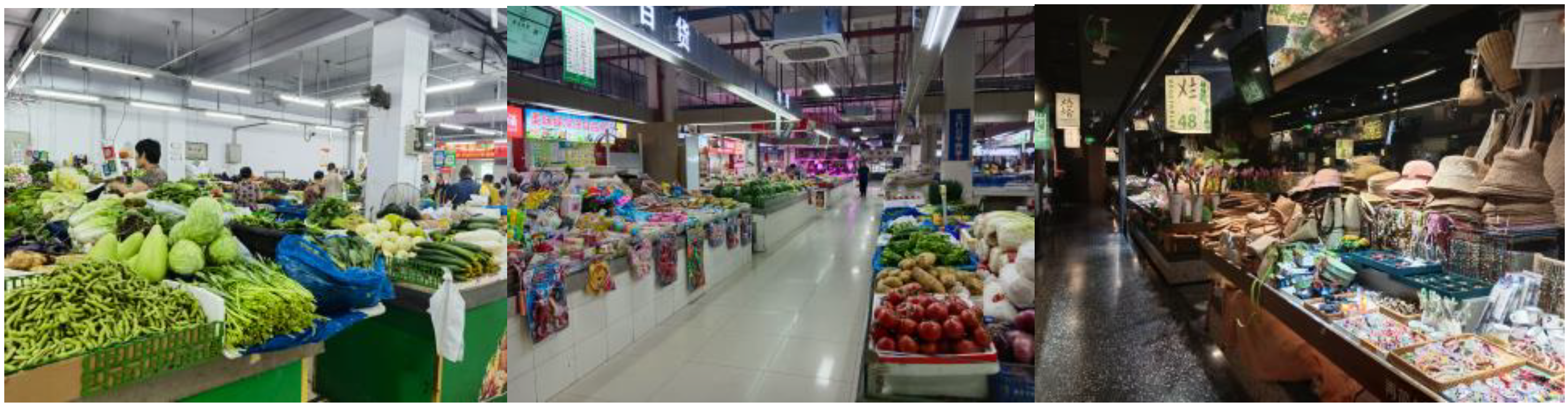
Figure 2 depict the internal scenes of three surveyed wet markets in Suzhou. This reflects the combination of standardization and local adaptation in a semi-formalized system.
5.2. Socioeconomic Embeddedness: Affordability, Trust, and Resilience
Chinese wet markets serve as multidimensional urban institutions that transcend their primary function as fresh food provision hubs. A growing body of evidence underscores their embeddedness in social reproduction and cultural preservation. Wet markets have long been hubs for community interaction, serving as a corrective to excessive urbanization and preserving a sense of “neighborliness” in a society transitioning from a face-to-face to an abstract configuration [
48]. This traditional ambience, characterized by a sense of “human touch”, fosters valuable interpersonal connections and is becoming more appreciated. Wet markets not only provide a place for daily socializing among residents but also offer opportunities for interaction between vendors and consumers, fostering a sense of engagement and camaraderie.
Wet markets maintain their competitive edge through deep socioeconomic integration. Price surveys in Nanjing show that wet markets consistently offer fresh produce at prices approximately 30% lower than supermarkets, a differential particularly pronounced in central urban areas [
2]. This pricing advantage stems from multiple factors: direct sourcing from smallholders, minimal packaging requirements, and the preservation of traditional bargaining practices that allow for price flexibility. Importantly, this cost advantage does not appear to come at the expense of food safety, which is a common assumption in the supermarket transition literature. Our surveys found that 73.33% of Suzhou’s wet markets and 70.70% of Nanjing’s feature on-site mini-labs for qualitative testing with real-time reporting, while 83.33% and 89.33%, respectively, publicly release routine inspection results. This reflects the symbiotic relationship between informal transactions and formal regulation.
Consumer behavior studies reveal the deep cultural embeddedness of wet markets in urban life. In Suzhou, 84% of surveyed consumers express a distinct preference for purchasing fresh produce from wet markets rather than supermarkets, with 70.53% identifying as loyal patrons of specific markets. The reasons for this preference (with multiple responses allowed) form a revealing hierarchy: perceived freshness (47.38%), variety (29.56%), affordable prices (15.09%), superior quality (14.26%), established shopping habits (13.21%), and convenient transportation (7.97%). These patterns persist even in the face of e-grocery expansion: 68.42% of Suzhou respondents maintained stronger preferences for physical wet markets, with only 6.99% of e-grocery users adopting daily online purchasing habits.
The preference for wet markets stems not only from economic rationality but also from long-established interpersonal trust and the sense of ritual embedded in shopping practices. Consumers not only engage in face-to-face social interaction with vendors at wet markets but also maintain contact through social media platforms like WeChat. During this interaction, vendors typically offer additional or non-standardized services to consumers. In a large number of wet markets throughout China, particularly in the southern regions, vendors exemplify an entrepreneurial spirit by providing customers with diverse and personalized services. These services include selling small quantities of bulk products, providing complimentary food preparation services, offering cooking advice, extending credit, facilitating special orders or purchases for regular customers, and even providing free home delivery. These services exceed the scope of what is typically offered by supermarkets.
One vendor’s account—“I know my regulars by name; we talk about their families before we talk about prices”—illustrates the interpersonal dynamics that underpin the trust identified in our quantitative analysis. Interviews with consumers suggested that brand loyalty was often tied to emotional narratives rather than product attributes. This preliminary finding generates a hypothesis that emotional attachment mediates the relationship between satisfaction and repurchase behavior, which could be tested in future quantitative studies.
This kind of inclusive and negotiable neighborhood relationship, which extends beyond mere commercial transactions, is highly valued not only by Chinese but also other Asian communities. Wet markets in Hong Kong and Singapore similarly reflect the interactive dynamic between vendors and residents [
49]. Hence, wet markets serve not only as places of trade but also as spaces for interpersonal connections, highlighting the vendor–resident relationship. In contrast, supermarkets often prioritize a capital–consumer dynamic over personal interaction.
A significant contributing factor to the availability of fresh and diverse products in wet markets is the diligent work of vendors, combined with their varied business strategies and long-term social networks [
18]. Due to the relatively low entry barriers and promising income potential, the occupation of wet market vendors is highly sought after by rural migrants. Consequently, a majority of vendors in large urban wet markets are migrants from surrounding rural regions, seeking to make a livelihood in the city. According to a comprehensive survey conducted by the HCP project in 2017 in Nanjing, 64.90% of wet market vendors were found to be non-local residents, predominantly originating from rural areas. However, this occupation is known for its demanding nature, with many wet market vendors working over twelve hours a day on average. They often begin their day by purchasing goods from wholesale markets during late nights or early mornings, and their commitment to work is such that they have very few days off throughout the year.
The flexibility and diversity of procurement channels among wet market vendors also play a crucial role in ensuring the freshness and variety of products. In China, there are approximately 210 million small-scale farmers whose non-standardized and unstable production volumes often prevent their produce from accessing supermarket distribution channels. Instead, these products are primarily sold through wet markets, especially in peri-urban areas [
27]. Research conducted in Suzhou’s wet markets reveals that many vendors assist in selling locally grown vegetables cultivated by their relatives. Additionally, some wet markets provide dedicated spaces for local small-scale farmers, allowing them to directly sell their seasonal produce [
50].
The institutional flexibility extends beyond physical space and time to encompass technological adaptation, allowing wet markets to coexist and compete with e-commerce platforms. Within this semi-formalized framework, vendors have adopted digital tools in ways that preserve their interpersonal relationships rather than replacing them. For instance, the universal adoption of WeChat Pay has allowed vendors to maintain informal credit systems (e.g., keeping a running tab for regulars) within a formal digital ledger. Furthermore, many vendors have developed hybrid business models, using WeChat groups to take online pre-orders for fresh produce, which customers then pick up during their daily commute. This “click-and-mortar” approach leverages the convenience of e-commerce while retaining the trust and sensory experience of physical market interaction, illustrating how semi-formalization facilitates a dynamic equilibrium between traditional practices and digital disruption.
Wet markets in China serve as integrated food ecosystems that extend far beyond conventional produce retail. In cities like Suzhou, Nanjing, and many others, they also offer retail spaces alongside cooking and dining facilities. Residents can enjoy freshly prepared meals, often featuring local specialties or popular dishes. Many cities in China, including Suzhou, have adopted the model of hawker centers in Singapore (Hawker centers in Singapore serve as hubs for local cuisine, boasting a unique atmosphere across the entire country. Typically located in residential areas or near transportation hubs, they have become an essential part of Singaporean cultural identity), transforming wet markets and their surrounding areas into vibrant neighborhood centers. These areas are complemented by amenities such as express stations, convenience stores, repair shops, and more, catering to the diverse needs of residents. This versatility not only enhances living standards and fosters community bonds but also provides more employment opportunities compared to supermarkets.
Wet markets emanate a vibrant ambiance, bustling with local life and activities. They serve as more than just hubs of culinary activity; they are also public spaces that mirror the daily rhythms of city dwellers. Thus, wet markets can be viewed as microcosms for urban ethnographic studies. In contemporary Chinese cities, where public spaces are often scarce, many young people opt to explore wet markets during weekends or leisure excursions, seeking to immerse themselves in local cuisine and culture. This burgeoning interest has given rise to numerous internet-famous wet markets (e.g., Shuangta Market, Caixiang Market, or Fengmen Hengjie Market), drawing increased attention and contributing significantly to the local economy and consumption.
To sum up, Chinese wet markets possess economic value by fostering connections between small-scale food businesses, social value by providing spaces for community interaction and leisure activities, and cultural value by preserving local culinary traditions. In essence, the unique traits that set wet markets apart from supermarkets are rooted in their inherently public nature.
5.3. Hybrid Governance and Future Challenges
The management and governance of wet markets exemplify innovative public–private synergy. This hybridity is reflected in the collaboration between the public and the private sector in not only the ownership structure of these markets but also their management and operation. Currently, there exist various types of wet market management entities in terms of ownership. Suzhou’s Neighborhood Center is operated by state-owned enterprises (SOEs) on government-leased land, balancing public welfare objectives with commercial viability. These SOEs leverage preferential financing (e.g., lower-interest policy loans) to develop purpose-built market facilities while maintaining standardized management protocols.
The venues for wet markets are often owned by a mix of public and private stakeholders. Wet market management companies may be state-owned, privately owned, or collectively owned. The buildings and infrastructure utilized for wet markets are typically owned by different levels of government, urban residential committees, and village committees, as well as individuals and private enterprises [
51]. The public–private hybrid nature of food outlet operations prioritizes equitable access to food and food affordability. It not only reflects the cooperation between public and private sectors but also incorporates labor from small businesses at both the wholesale and retail level. These systems represent a distinctive form of “state-owned entrepreneurship” that leverages public resources while maintaining market discipline.
Urban administrators increasingly recognize wet markets as assets rather than relics to be replaced. In Suzhou, competitions to select the “most beautiful wet markets” and their integration into urban renewal projects demonstrate how these spaces contribute to city branding and image-making. This represents a significant shift from earlier modernization paradigms that viewed wet markets as embarrassments to be hidden or eliminated. The current approach recognizes these markets as living heritage that contributes to urban identity while performing essential economic and social functions.
The persistence and adaptation of wet markets in Nanjing and Suzhou challenge conventional narratives about retail modernization. Rather than being replaced by supermarkets or e-grocery platforms, these markets have developed symbiotic relationships with newer retail formats while maintaining their distinctive characteristics. They thrive not despite but because of their semi-formal nature, which provides three critical advantages: institutional redundancy through temporal/spatial gray zones that offer crisis buffers absent from fully formalized systems; embedded innovation through hybrid ownership models that allow experimental welfare–commerce integrations; and relational infrastructures that sustain communities beyond transactional economics.
These findings challenge neoliberal urbanization paradigms that equate modernity with total formalization. Instead, they suggest that urban resilience in developing contexts requires cultivating institutional architectures which are able to sustain organized flexibility, accommodating both blockchain traceability and grandmothers haggling over cabbage, both AI monitoring systems and the morning gossip of longtime patrons. As cities face climate crises, aging populations, and technological disruption, wet markets offer a model for infrastructures that are simultaneously high-tech and high-touch, globally connected yet locally rooted. Their continued evolution will provide valuable insights into sustainable urban development pathways that honor tradition while embracing innovation.
6. Conclusions and Discussion
6.1. Conclusions
The evolution of China’s wet markets in Nanjing and Suzhou presents a paradigm of reflexive governance, which is a dynamic process where policy interventions continuously adapt to preserve socio-spatial equity while accommodating modernization. This model, distinct from linear formalization or privatization, emerges through three intertwined dimensions: spatial embeddedness, hybrid institutional arrangements, and socio-technical resilience. By examining wet markets in Nanjing and Suzhou, we discern broader lessons for urban food systems navigating the tensions between globalization and local identity, technological advancement and social cohesion.
At its core, China’s wet market system exemplifies semi-formalization, which is a governance approach that strategically negotiates between state oversight and grassroots adaptability. The deliberate ambiguities create institutional flexibility absent from purely formal systems, allowing markets to function as both economic hubs and social infrastructures. The Vegetable Basket Program (VBP) institutionalizes this balance, with mayoral accountability ensuring policy coherence across urban planning, commerce, and welfare agencies. Crucially, this model resists the neoliberal dichotomy of public versus private. Such hybridity demonstrates how public welfare goals and private efficiency can coexist when governance structures are designed reflexively.
Spatially, wet markets thrive through embedded urbanism, as their strategic proximity to residential areas and functional connectivity with mass transit networks ensure accessibility for non-drivers. This spatial logic fosters affective infrastructures. The markets’ material design further reinforces this resilience. Whereas supermarkets epitomize Harvey’s “spaces of capital accumulation” [
52], wet markets remain “spaces of labor exchange”, where smallholders and vendors maintain economic agency. This distinction underpins their pricing advantage (30% cheaper than supermarkets) and explains their enduring popularity. Studies from Southeast Asia [
53] and Africa [
54] similarly highlight the coexistence of supermarkets and traditional markets, suggesting that the supermarketisation thesis may overstate the displacement of informal vendors. However, unlike in China, where state-led urban planning plays a central role in shaping retail landscape, supermarket expansion in Indonesia and Thailand has been more strongly driven by transnational retail chains and changing consumer aspirations [
55,
56]. By situating our Chinese case within this broader Global South literature, we argue that the supermarketisation thesis requires greater sensitivity to local institutional and cultural contexts.
The future viability of wet markets will depend on leveraging their potential as multifunctional social infrastructure that contributes to urban renewal, climate resilience, and intergenerational care. The soft–hard duality manifest in wet markets, wherein physical infrastructure systematically facilitates social rituals, presents a transferable model with global relevance. For African cities facing similar supermarketisation pressures, China’s experience suggests that hybrid models may better preserve accessibility and vendor livelihoods than wholesale formalization.
Ultimately, wet markets endure not as relics but as living laboratories of urban coexistence. Their resilience stems from embracing contradiction. In an era of climate crises and algorithmic alienation, these spaces remind us that cities thrive not through uniformity but through organized flexibility where policy, technology, and communal praxis continuously adapt to sustain both embodied livelihoods and the body politic. As evidenced by Nanjing and Suzhou, the wet market’s greatest innovation may be its refusal to choose between modernity and tradition, offering instead a third path that neither erases the past nor uncritically preserves it, but rather enables its reflexive reimagination through everyday practice.
6.2. Policy Implications
The transformation of China’s wet markets represents a reflexive governance process that is both revolutionary in outcome and evolutionary in implementation, transcending conventional market–state binaries to create a uniquely resilient urban food ecosystem. As demonstrated in cities like Nanjing and Suzhou, this model neither follows the Western trajectory of supermarket-dominated food systems nor clings to unregulated informality, but rather cultivates a sophisticated middle path where state intervention and market dynamics engage in continuous mutual adaptation.
At the heart of this system lies the principle of institutionalized flexibility, operationalized through specific regulatory and financial mechanisms that can be adapted for replication. The Chinese experience reveals how wet markets have evolved through guided pluralism, where government policies deliberately maintain space for diverse retail formats while ensuring core public goods like food security and affordability. This is not the laissez-faire coexistence sometimes seen in developing economies but a carefully managed ecosystem where supermarkets, e-commerce platforms, and traditional wet markets each play complementary roles. To operationalize this flexibility for other cities, we propose three actionable tools.
First, the implementation of “temporal zoning permits” (as seen in Suzhou) allows for the selective enforcement of regulations, providing informal vendors with legal access to public space during off-peak hours while protecting the livelihoods of formal tenants. Second, the adoption of “sliding-scale fee structures” for market stalls can shield low-income vendors from gentrification pressures, ensuring economic diversity. Third, the establishment of “public–private management contracts” (similar to Nanjing’s “build–transfer–operate” model) combines public ownership of land (ensuring permanent food security infrastructure) with private sector efficiency in daily operations.
The reflexive governance model manifests most powerfully in its spatial and social dimensions. By mandating wet markets within residential areas and integrating them with public transit, Chinese cities have created naturally occurring food security zones, spaces where physical proximity and social practice reinforce each other. This spatial strategy goes beyond simple accessibility metrics; it also fosters the daily rituals and chance encounters that build “ambient community”, the low-stakes but high-frequency interactions that cumulatively create social cohesion.
Financially, the system demonstrates innovative hybridity. While public subsidies have been crucial for infrastructure upgrades, the operational model blends state oversight with private entrepreneurship. Suzhou’s approach of leasing publicly owned market spaces to private management companies through competitive bidding creates a built-in accountability mechanism, while the Vegetable Basket Program’s mayoral responsibility system ensures cross-departmental coordination. This structure has proven adaptable enough to incorporate technological modernization like AI food safety monitoring while maintaining the human-scale interactions.
However, this semi-formalized model is not without its trade-offs, which policymakers must carefully navigate. A key tension exists between food safety enforcement and vendor livelihoods. While strict hygiene standards are necessary to protect public health, over-zealous standardization can impose prohibitive costs on small-scale vendors. To mitigate this, policies should include subsidized access to cleaning services and equipment for low-income operators. Additionally, the fiscal burden of maintaining public wet market infrastructure must be acknowledged. While initial subsidies are essential, cities should explore innovative funding models, such as capturing a portion of the increased property values generated by nearby market amenities, to ensure long-term financial sustainability without over-reliance on direct government grants.
A critical, underemphasized trade-off is the balance between market upgrading and the affordability of both vending livelihoods and consumer access. Upgrading initiatives focused on luxury renovations or uniform, high-cost infrastructure risk displacing low-income vendors and driving up produce prices, eroding the wet market’s core function as an affordable food source for vulnerable households. Local governments can reconcile these goals by prioritizing functional, cost-contained upgrades that target sanitation, ventilation, and food safety infrastructure, with public capital covering the majority of renovation expenses to avoid passing costs to vendors. Complementary safeguards, including reserved stall quotas for incumbent low-income vendors, rent deferral schemes, and targeted price monitoring for staple fresh produce, prevent gentrification and preserve affordability for both vendors and low-income consumers.
China’s wet markets suggest that the future of urban food systems lies not in choosing between tradition and modernity, but in cultivating institutions flexible enough to accommodate both, creating spaces where blockchain traceability coexists with breakfast-time gossip and where public oversight enables rather than stifles community vitality. As cities worldwide grapple with climate change, inequality, and technological disruption, this model of reflexive, place-based governance offers a compelling alternative to both unchecked commercialization and heavy-handed state control.
The resilience of wet markets in the face of modernization pressures suggests that such spaces fulfill deep-seated social needs that cannot be met by purely transactional environments. Their continued evolution will provide valuable insights into the complex relationship between urban form and social experience in the contemporary world.
In this study, we further acknowledge how current policy trajectories may exacerbate vulnerabilities for specific groups or issues. First, as cities grapple with competing fiscal demands, potential reductions in public subsidies for wet markets could undermine their socioeconomic functions. This may disproportionately affect low-income vendors who may face exclusion due to rising operational costs and price-sensitive consumers whose food security may be compromised by market gentrification. This vulnerability is amplified when upgrading projects lack targeted affordability safeguards, underscoring the need for the balanced, vendor- and consumer-centric governance strategies outlined above to mitigate displacement and price hikes. Second, the rapid integration of digital systems risks creating new forms of marginalization. Vulnerable groups include vendors with limited digital literacy, often older or rural-origin traders, who may struggle to adapt to electronic inventory or taxation systems. Third, standardization-driven policies aimed at enhancing efficiency may inadvertently threaten localized foodways, where homogenized hygiene standards could eliminate small-batch, culturally specific products.
6.3. Implications for Further Research
The evolution of China’s wet markets embodies the fundamental tension between modernization and place-making that defines contemporary urbanism. Wet markets represent spaces where traditional foodways negotiate their place within rapidly modernizing cities, not through nostalgic preservation nor wholesale replacement, but through adaptive continuity. At their core, successful wet markets exemplify the spatial alchemy that transforms mere locations into meaningful places. This process offers profound insights into what constitutes a good city in an era of climate uncertainty and technological disruption.
The Chinese experience reveals that effective urban food systems must resolve the progress paradox by balancing quantifiable advancements with irreducible socio-cultural value. Empirical evidence confirms tangible benefits such as a 30% price advantage over supermarkets and upgraded food safety infrastructure, which directly enhance food security and operational efficiency. Concurrently, wet markets sustain essential but unquantifiable place-based attributes, exemplified by personalized vendor–customer relationships and spontaneous social interactions that generate urban sidewalk ballet [
57]. Such qualities, while absent from GDP calculations, produce “thick place”, locations dense with social meaning and mutual recognition.
It is crucial to acknowledge the distinctive nature of China’s food supply chain compared to other nations. China’s decentralized supply chain model, rooted in local wholesale networks, has inadvertently created a robust platform for such place-making. Unlike supermarket chains that homogenize space through standardized formats, wet markets maintain the coexistence of diverse actors and practices. The pivotal role of local governments in localized food supply, alongside the significant contribution of intermediaries, remains underexplored in current research. Future studies could delve into the factors influencing the wet market evolution from both production and distribution standpoints. This aligns with the call for all-encompassing approach to food, where ecological and social sustainability are mutually reinforcing rather than competing priorities [
58]. Within this framework, wet markets’ role can be further analyzed, aiming at tackling the challenges posed by climate change through the planning of food systems.
Looking forward, the social infrastructure framework offers valuable insights for urban planning and policy, particularly in addressing contemporary challenges of social fragmentation and inequality. The case of wet markets demonstrates how thoughtful integration of physical design and social programming can create spaces that serve both practical and communal needs. Current research has yet to fully develop methods for assessing the qualitative social impacts of different infrastructure configurations or for comparing outcomes across cultural contexts. It would be advisable that researchers productively explore how lessons from successful examples like China’s wet markets might inform urban development strategies elsewhere, particularly in rapidly growing cities of the Global South. It is also essential to further investigate how digital platforms might replicate (or undermine) the social infrastructure functions of physical markets, and how policy can nurture retail ecosystems that balance efficiency with equity. The Chinese experience suggests that intentional governance of market transitions, rather than reliance on market forces alone, may best preserve the economic and social benefits that diverse retail formats provide to urban communities.
In conclusion, defining “a good city” in the Chinese context requires embracing the messy vitality of semi-formalized systems. Wet markets exemplify how cities can modernize without succumbing to the placelessness of homogenized urbanism. Their power lies in the co-penetration of space and society, where food practices weave together individual routines, community rhythms, and urban metabolisms. As cities worldwide confront climate change and technological transformation, these markets offer a model for development that embraces progress without erasure, modernization without disembedding. They remind us that the richest urban foodscapes are where efficiency gains need not come at the cost of place-based meaning. In an age of planetary urbanization, hybrid social infrastructure like wet markets may hold the key to cities that are not just smart but wise.
6.4. Limitations
This study, while offering valuable insights into the resilience of wet markets in urban China, is not without limitations. First, regarding generalizability, our case studies are drawn from Nanjing and Suzhou, two large, economically advanced municipalities in the Yangtze River Delta region. These cities possess robust fiscal capacities and well-developed governance infrastructures, which have facilitated the sophisticated semi-formalization observed in their wet markets. Consequently, the specific mechanisms identified (such as substantial public subsidies for infrastructure or high-tech “smart market” upgrades) may not be readily replicable in smaller, inland, or less economically developed cities where resources are scarcer and governance priorities may differ. Future research should explore how wet markets in these diverse contexts adapt to urban pressures with fewer state resources.
Second, our survey data may be subject to self-selection bias. Respondents were primarily recruited at the entrances of selected wet markets, which inherently skews the sample toward individuals who are frequent market patrons. This may have underrepresented the perspectives of consumers who primarily shop at supermarkets or rely on e-commerce platforms for their daily provisions. As a result, our findings regarding consumer preferences and social interaction may overstate the centrality of wet markets in the broader urban foodscape. Additionally, longitudinal data on vendor income trends, for example, were unavailable due to the sensitive nature of financial information, which vendors and market management companies were reluctant to disclose. This limitation affects our ability to draw definitive conclusions about the long-term economic sustainability of semi-formalized governance arrangements, particularly regarding how regulatory flexibility impacts vendor livelihoods over time. These limitations highlight the need for mixed-methods approaches, including longitudinal interviews and collaborative data collection with market management, to better understand the economic and regulatory dynamics of semi-formalization.
Third, this study relies heavily on cross-sectional data, including surveys and site observations conducted at a specific point in time. While this provides a detailed snapshot of the current state of wet markets, it limits our ability to draw definitive conclusions about long-term causal relationships or to trace the dynamic evolution of governance mechanisms (like semi-formalization) over extended periods. A longitudinal approach, tracking both market conditions and consumer behavior over several years, would be necessary to fully understand the trajectory of wet market resilience amid ongoing urbanization and digital disruption.