_Li.png)
Staying Without Sustainability: How Everyday Governance Reshapes Teachers’ Work in Private Higher Education in China


Abstract
1. Introduction
Research Necessity and Purpose
2. Theoretical Background
2.1. Human Sustainability and the Sustainability of Teachers’ Work
2.2. Governance Structures, Power Asymmetry, and Evaluation-Based Control in Educational Organizations
2.3. Silence, Compliance, and Structural Coping
2.4. Research Questions
3. Methodology
3.1. Research Approach
3.2. Fieldwork and Data Collection
3.3. Data Analysis Data Analysis Procedures
3.4. Participants
3.5. Data Analysis
4. Findings
4.1. Evaluation-Based Governance and the Reallocation of Professional Achievements
“At the end of the year, evaluations are basically decided by leaders. No matter how much effort you put in, people who have good relationships with leaders can easily pass the evaluation and even get an ‘excellent’ rating.”
“I trained students and prepared them for competitions, but in the end, the leader insisted that I add the name of a colleague who had a close relationship with him. I felt deeply resentful.”
“I did the training, I handled the competition, and in the end, when we won, they still forced me to add the names of people close to the leadership. I felt wronged, but what could I do? I had no choice but to comply—for the sake of getting an ‘excellent’ evaluation at the end of the year.”
“Our leader also has his own evaluation targets. He asked me to help him write papers. I really didn’t want to do it, but I didn’t want to create conflict with him, so I had no choice.”
“In our place, to be honest, as long as you have a good relationship with the leaders, you can get promoted. Whether it’s fair or not doesn’t really matter. You just learn to let it go.”
“Everything is based on evaluation standards. We just received the list submitted by the secondary colleges.”
“In our university, all the administrators are under forty—ridiculous, isn’t it? If you have good relationships with leaders, you can squeeze into the management team. Compared to teaching, interpersonal relationships seem much more advantageous in private universities.”
4.2. Relational Governance and the Normalization of Alignment Practices
“Our university belongs to an education group, and leadership changes roughly every five years. When new leaders arrive, factions are reorganized. Teaching administrators and student affairs administrators form different camps. If you are close to one side, you cannot be close to the other. One colleague chose the wrong side, and now no one dares to interact with him.”
“When new leaders come in, if you don’t take a side, you’ll be marginalized very quickly.”
“It’s exhausting. You know you came here to teach, but you gradually realize that everything except teaching seems to matter. I really want to leave.”
“If competence is not enough, emotional intelligence has to make up for it. As long as you manage relationships well, you can get a good evaluation.”
4.3. Data-Driven Management and the Gradual Narrowing of Professional Space
“When leaders ask us to inspect classes, we go to the monitoring room and watch the cameras, counting how many students are looking up during class. If more than ten students are not looking at the blackboard and are using their phones, that teacher’s class will be publicly criticized.”
“We also use attendance software. Teachers are required to be on campus during specified hours, and if the location function is not activated, it is counted as absenteeism.”
“I’m exhausted by this surveillance-based class inspection. University students are naturally active and easily distracted. Expecting them to stay focused every minute of a forty-five-minute class—who can actually achieve that? I don’t know. If they want to evaluate us, fine, but the key is to maintain good relationships with the people checking the cameras.”
“We all know that administrators only monitor Teacher X’s classes. It seems like they never check the cameras for other teachers. The adult world is really complicated.”
“The location check-in system is exhausting. The software is on my phone, and during working hours, I have to check in to prove that I’m on campus and at my post. Every month, administrators compile statistics on who wasn’t present.”
4.4. Structural Entrapment and the Erosion of Exit Options
“I’m still single, and in this city, people really care about your occupation when it comes to relationships. Once they hear you’re a university teacher—public or private—parents feel it’s something to be proud of.”
“My parents don’t really care how much I earn. They just want me to have a stable job.”
“It’s not that I don’t want to leave. Other private universities are basically the same. I’ve already moved once—it’s no different.”
“I tried sending out resumes quietly. But other schools called my current workplace to ask about me. My leader didn’t say anything directly, but my annual evaluation score dropped significantly. That’s when I realized—once you’re seen as wanting to leave, your future here is basically over.”
“My family situation isn’t good, and the overall environment is bad. Where else could I go? As long as I get paid, it’s fine. I’m not young anymore—job-hopping isn’t realistic. I’ll just endure it.”
“I don’t expect anything anymore. I just teach my classes properly. I don’t think about innovation or professional value.”
“Teachers change very often here. In some subjects, we get a new teacher every semester. Many of them say the pressure is too much.”
“I used to think being a teacher was prestigious, but they actually seem really exhausted.”
“Most of our teachers are very young—many just graduated from university, not much older than us.”
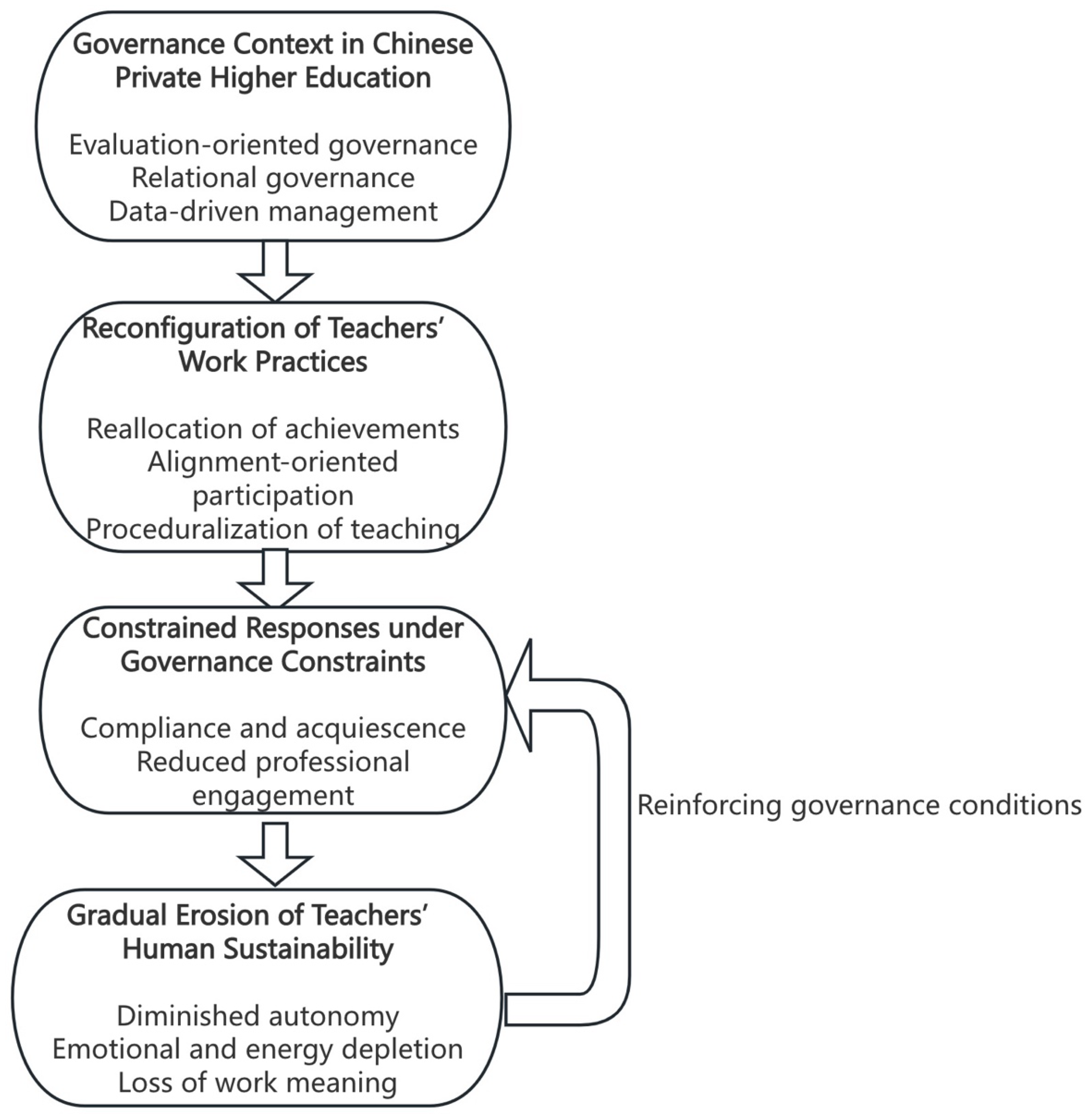
4.5. Core Process: The Gradual Erosion of Teachers’ Human Sustainability
5. Discussion
6. Conclusions
Author Contributions
Funding
Institutional Review Board Statement
Informed Consent Statement
Data Availability Statement
Conflicts of Interest
References
- Levine Brown, E.; Stark, K.; Vesely, C.; Choe, J. “Acting often and everywhere:” Teachers’ emotional labor across professional interactions and responsibilities. Teach. Teach. Educ. 2023, 132, 104227. [Google Scholar] [CrossRef]
- Nath, R.; Pandey, C.P. The Hidden Burden: Emotional Labor and Well-being of School Teachers. Asian J. Educ. Soc. Stud. 2025, 51, 500–510. [Google Scholar] [CrossRef]
- Zhou, S.; Slemp, G.R.; Vella-Brodrick, D.A. Factors Associated with Teacher Wellbeing: A Meta-Analysis. Educ. Psychol. Rev. 2024, 36, 63. [Google Scholar] [CrossRef]
- Demastus, J.; Landrum, N.E. Organizational sustainability schemes align with weak sustainability. Bus. Strategy Environ. 2023, 33, 707–725. [Google Scholar] [CrossRef]
- Gorski, A.-T.; Ranf, E.-D. Sustainability Trends and Dynamics: An Integrative Approach to Economic, Social, and Environmental Perspectives. Sci. Bull. 2024, 29, 46–60. [Google Scholar] [CrossRef]
- Kantabutra, S.; Ketprapakorn, N. Understanding Resilience and Sustainability in Organizations: A Cutting-Edge Framework and the Research Agenda. Sustainability 2024, 16, 8431. [Google Scholar] [CrossRef]
- Pagán-Castaño, E.; Sánchez-García, J.; Garrigos-Simon, F.J.; Guijarro-García, M. The influence of management on teacher well-being and the development of sustainable schools. Sustainability 2021, 13, 2909. [Google Scholar] [CrossRef]
- Wheeler, A.H. From Sacrifice to Shortage: Or How We Can Defend Public Education by Reconceptualizing Teachers’ Labor. Workplace J. Acad. Labor 2025, 36. [Google Scholar]
- Schad, E.; Niklasson, K.; Gronowitz, O. Exploring the sustainability of the teaching profession: A thematic analysis of teachers’ perspectives. Psihol. Obz. 2022, 31, 540–549. [Google Scholar] [CrossRef]
- Kariou, A.; Koutsimani, P.; Montgomery, A.; Lainidi, O. Emotional labor and burnout among teachers: A systematic review. Int. J. Environ. Res. Public Health 2021, 18, 12760. [Google Scholar] [CrossRef]
- Zhang, J.; Li, Y.; Zeng, Y.; Lu, J. Exploring the mediating role of teacher identity between professional learning community and teacher resilience: Evidence from Eastern China. Humanit. Soc. Sci. Commun. 2024, 11, 1290. [Google Scholar] [CrossRef]
- Sanchis-Giménez, L.; Tamarit, A.; Prado-Gascó, V.J.; Sánchez-Pujalte, L.; Díaz-Rodríguez, L. Psychosocial Risks in Non-University Teachers: A Comparative Study between Spain and Mexico on Their Occupational Health. Sustainability 2024, 16, 6814. [Google Scholar] [CrossRef]
- Yao, W.; Wang, Y.; Fu, G. Managerialism, Educational Equity, and Professional Development of Teachers: A Case of Grouplized Schools. In Beyond the Pandemic Pedagogy of Managerialism; Springer Nature: Cham, Switzerland, 2023; pp. 161–188. [Google Scholar] [CrossRef]
- AlAjmi, M.K.F.A.-H.; Alsaleh, A.A. What does teacher agency imply in centralized educational policy systems? Organizational structure and cultural challenges. Int. J. Leadersh. Educ. 2023, 1–24. [Google Scholar] [CrossRef]
- Bicudo de Castro, V. Unpacking the notion of subjectivity: Performance evaluation and supervisor discretion. Br. Account. Rev. 2017, 49, 532–544. [Google Scholar] [CrossRef]
- Hsieh, H.-F.; Shannon, S.E. Three Approaches to Qualitative Content Analysis. Qual. Health Res. 2005, 15, 1277–1288. [Google Scholar] [CrossRef]
- Liu, S.; Huang, Q.; Lv, M. From vocation to profession: Multiple identities of Chinese management academics. Humanit. Soc. Sci. Commun. 2024, 11, 605. [Google Scholar] [CrossRef]
- Strauss, A.; Corbin, J. Basics of Qualitative Research; Sage: Newbury Park, CA, USA, 1990; Volume 15, pp. 61–110. Available online: https://doi-org.libproxy.woosuk.ac.kr/10.1080/0305764X.2 (accessed on 15 November 2024).
- Yu, H. Why are they silent? Unilateralism in the classroom discourse of Chinese higher education. Society 2016, 53, 625–628. [Google Scholar] [CrossRef]
- Zhang, L. Problems and Countermeasures of Faculty Construction in Private Colleges and Universities. Pac. Int. J. 2024, 7, 174–177. [Google Scholar] [CrossRef]
- Jiang, Y. The Professional Development of Primary School Teachers in Rural China. J. Innov. Dev. 2024, 8, 47–51. [Google Scholar] [CrossRef]
- Liu, X.; Zhou, H.; Hunt, S.; Zhang, Y. For-Profit or Not-for-Profit: What Has Affected the Implementation of the Policy for Private Universities in China? High. Educ. Policy 2021, 36, 190–212. [Google Scholar] [CrossRef]
- Nan, B.; Wang, J. On the Path of Carrying out the Precise Employment Guidance Service in Private Colleges and Universities. Curric. Learn. Explor. 2024, 2. [Google Scholar] [CrossRef]
- Deepening the Reform of Employment Systems and Mechanisms and Promoting High-Quality and Full Employment; Chinese Education Administration: Beijing, China, 2024; Available online: https://admin.canedu.org.cn/upload/file/20241125/1732499514334290.pdf (accessed on 15 November 2024).
- Youxiang, K. Research on the Attribute Recognition and Regulation Mechanism in Private Universities. Educ. Res. 2012. Available online: http://en.cnki.com.cn/Article_en/CJFDTOTAL-JYYJ201209021.htm (accessed on 15 November 2024).
- Yue, L.; Alias, B.S.; Hamid, A.H.A. Exploring Teacher Organizational Commitment for Promoting Sustainable Development in Higher Education: A Systematic Literature Review and Analysis of Theories and Methodologies in Chinese Studies. J. Ecohumanism 2025, 4, 544. [Google Scholar] [CrossRef]
- Guo, Y.; Zhang, K.; Dai, X. Study of Creating Incentive Mechanism for Teachers in Private Universities. In Proceedings of the 7th International Conference on Education, Management, Information and Mechanical Engineering (EMIM 2017), Shenyang, China, 28–30 April 2017. [Google Scholar] [CrossRef][Green Version]
- Liu, Y.; Zhang, G.; Yan, X. The Common Governance Mode and Mechanism for Chinese Private Universities. In Proceedings of the Sixth International Symposium on Corporate Governance, Dalian, China, 20 August 2011; Available online: https://d.wanfangdata.com.cn/conference/WFHYXW518649 (accessed on 15 November 2024).
- Wang, Q. Research on the Problems in the Corporate Governance Structure of Private Colleges. J. Jiangxi Sci. Technol. Norm. Univ. 2008. Available online: http://en.cnki.com.cn/Article_en/CJFDTOTAL-NZJS200804014.htm (accessed on 15 November 2024).
- Ahmed, Q.A.; Butt, S.; Abdullah, F. Organizational Sustainability: A Big Data Framework Using Knowledge Sharing and Innovative Work Behavior. Qlantic J. Soc. Sci. 2024, 5, 379–390. [Google Scholar] [CrossRef]
- Stajkovic, A.D.; Stajkovic, K.S. Human Sustainability and Cognitive Overload at Work: The Psychological Cost of Working; Taylor Francis: Abingdon, UK, 2025. [Google Scholar]
- Rean, M.A.; Ibrahim, M.B.H.; Irawan, A.; Akbar, M.A.; Rasyid, A. Nurturing Both Organizational and Human Resource Wellbeing for Sustainable Growth. Adv. J. Ekon. Bisnis 2024, 2, 12–24. [Google Scholar] [CrossRef]
- Lu, Y.; Zhang, M.M.; Yang, M.M.; Li, T. Enhancing Employee Outcomes Through Common Good Human Resource Management: Exploring the Role of Meaningfulness and Thriving. Hum. Resour. Manag. 2024, 64, 485–502. [Google Scholar] [CrossRef]
- Huang, S.; Yin, H. The relationships between paternalistic leadership, teachers’ emotional labor, engagement, and turnover intention: A multilevel SEM analysis. Teach. Teach. Educ. 2024, 143, 104552. [Google Scholar] [CrossRef]
- Zou, X.; Wang, H.; Ma, X.; Pi, Y. The influence of organizational support on emotional labor of Chinese vocational college teachers: The mediating role of professional identity and the moderating role of work-life balance. Acta Psychol. 2025, 261, 105999. [Google Scholar] [CrossRef]
- Jiang, J.; Yip, S.Y.; Gong, C. What Affects Teachers’ Turnover Intention? Examining the Impact of Teacher Professional Status. Asia-Pac. Educ. Res. 2025, 34, 1963–1975. [Google Scholar] [CrossRef]
- Wang, J.-J.; Chang, Y.-C. The Effect of Job Autonomy and Perceived School Organizational Support on Professional Well-being of University Teachers in Hebei, China. J. Curric. Teach. 2025, 14, 247. [Google Scholar] [CrossRef]
- Lee, D.W.C.; Dong, C.; Quah, L.H.T.; Yan, C.C. Navigating burnout and professional identity among allied health educators. Med. Teach. 2025, 1–8. [Google Scholar] [CrossRef]
- Sharipova, A.; Yegenissova, A.H.O. Does Teacher Emotional Burnout Syndrome Affect Teachers’ Development? Yessenov Sci. J. 2024, 48, 32–38. [Google Scholar] [CrossRef]
- Xu, S. A Study on Employee Silence of Teacher Management in Primary and Middle Schools. Chin. J. Spec. Educ. 2009. Available online: http://www.semanticscholar.org/paper/527a0c6a74f92cb8d48e751fcacd2d06dc0d780d (accessed on 15 November 2024).
- Krause-Söhner, E.; Roth, A.; Schaller, C. Multifaceted and even contradictory? Impulses to push efficiency and innovativeness and the dynamic role of ambiguity in context of a German university. J. Bus. Res. 2022, 147, 258–277. [Google Scholar] [CrossRef]
- Nazari, M.; Molana, K. “Predators of Emotions”: The Role of School Assessment Policies in English Language Teachers’ Emotion Labor. TESOL Q. 2022, 57, 1226–1255. [Google Scholar] [CrossRef]
- Hökkä, P.; Vähäsantanen, K. Agency-centred coupling—A better way to manage an educational organization? Int. J. Leadersh. Educ. 2013, 17, 131–153. [Google Scholar] [CrossRef]
- Asante, D.; Tang, C.; Asante, E.A.; Kwamega, M.; Opoku-Danso, A. Leveraging perceived HPWS to improve service encounter quality in high-contact service industries. J. Retail. Consum. Services. 2023, 73, 103344. [Google Scholar] [CrossRef]
- Çolak, İ. The Relationship Between Organizational Trust and Teacher Autonomy: The Mediating Role of Self-Efficacy Beliefs. Psychol. Sch. 2025, 62, 1539–1549. [Google Scholar] [CrossRef]
- Xu, Y.; Yu, H.; Wan, X.; Zhang, L. Strategies for sustainable development in university education: Breaking barriers and cultivating awareness. Educ. Inf. Technol. 2024, 29, 22567–22608. [Google Scholar] [CrossRef]
- Arnold, M.C.; Bauch, K.A. The Effects of Managerial Discretion in Complex Performance Evaluation Settings: Experimental Evidence. SSRN Electron. J. 2020. [Google Scholar] [CrossRef]
- Liu, Y.; Tian, X.; Yang, W. The Research of Teacher Evaluation Mechanism Based on Teachers’ Professional Development. In Proceedings of the Teacher Education Forum, 2016. Available online: http://en.cnki.com.cn/Article_en/CJFDTOTAL-GHXZ201605011.htm (accessed on 15 November 2024).
- Peng, W.; Nair, S.M. Teachers’ Participation in Decision-Making, Professional Growth, Appraisal, and Behavioral Intentions in the Promotion System Reform in Chinese Universities. Front. Psychol. 2022, 13, 932324. [Google Scholar] [CrossRef]
- Huang, Q. The Impact of Organizational Management on Teachers’ Work Motivation in China: A Mediation Analysis of Perceived Fairness. Front. Humanit. Soc. Res. 2025, 2, 181–192. [Google Scholar] [CrossRef]
- You, X. Establishing a Teacher Performance Evaluation System Geared to the Cultivation of Character: With a Reflection on New Public Management Theory. Soc. Sci. China 2021, 42, 135–157. [Google Scholar] [CrossRef]
- Conley, S.; Glasman, N.S. Fear, the School Organization, and Teacher Evaluation. Educ. Policy 2008, 22, 63–85. [Google Scholar] [CrossRef]
- Tornero, B.; Taut, S. A mandatory, high-stakes National Teacher Evaluation System: Perceptions and attributions of teachers who actively refuse to participate. Stud. Educ. Eval. 2010, 36, 132–142. [Google Scholar] [CrossRef]
- Liu, S.; Yin, H. Does school power distance matter for the effectiveness of professional learning communities in China? A multilevel moderated mediation analysis. Teach. Teach. Educ. 2023, 134, 104335. [Google Scholar] [CrossRef]
- Chang, C.L. Confucian ethics perspective. Manag. Decis. 2017, 55, 427–449. [Google Scholar] [CrossRef]
- Pan, P.; Patel, C.D. Internal Auditors Make Consistent Ethical Judgments in English and Chinese in Reporting Wrongdoing? J. Bus. Ethics 2024, 194, 433–453. [Google Scholar] [CrossRef]
- Duarte, M.; Conceição, O.; Pinto, S. What Does Employee Silence Mean? the Role of Organizational Climate and Burnout. Eur. Conf. Manag. Leadersh. Gov. 2024, 20, 486–494. [Google Scholar] [CrossRef]
- Morrison, E.W. Employee Voice and Silence. Annu. Rev. Organ. Psychol. Organ. Behav. 2014, 1, 173–197. [Google Scholar] [CrossRef]
- Ahmad, M.B.; Mehta, A.M.; Shakeel, N.; Naeem, M.; Shahid, R. Unveiling Workplace Dynamics Through Two Wave Study: Examining the Impact of Workplace Bullying, Employee Silence, and Stress on Workplace Deviance. Sage Open 2025, 15, 21582440251368968. [Google Scholar] [CrossRef]
- Liao, C.; Li, Z.; Huang, L. How Does Psychological Contract Breach Affect Employee Silence? A Moderated Mediation Model. Sage Open 2024, 14. [Google Scholar] [CrossRef]
- Rakshani, J.; Hosseini, S.M. Conceptual model of factors affecting organizational silence. J. Innov. Sustain. RISUS 2025, 16, 152–162. [Google Scholar] [CrossRef]
- Xu, J.; Liu, H.; Huang, Y.-T. The wolf is coming: How secondary teachers regulate emotional experiences when facing Chinese education reform. Educ. Stud. 2021, 49, 749–766. [Google Scholar] [CrossRef]
- Akkaya, B. Grounded Theory Approaches: A Comprehensive Examination of Systematic Design Data Coding. Int. J. Contemp. Educ. Res. 2023, 10, 89–103. [Google Scholar] [CrossRef]
- Mills, J.; Bonner, A.; Francis, K. Adopting a constructivist approach to grounded theory: Implications for research design. Int. J. Nurs. Pract. 2006, 12, 8–13. [Google Scholar] [CrossRef]
- Roulston, K.; Shelton, S.A. Reconceptualizing Bias in Teaching Qualitative Research Methods. Qual. Inq. 2015, 21, 332–342. [Google Scholar] [CrossRef]



| Participant Group | Organizational Position | Primary Role in Governance Process | Number of Participants |
|---|---|---|---|
| Teaching staff | Frontline educators | Experiencing performance evaluation, monitoring, and promotion processes | 20 |
| Administrative staff | School-level | Implementing monitoring, evaluation, and data collection practices | 4 |
| Management personnel | Senior management | Designing and overseeing governance and evaluation systems | 2 |
| Students (focus groups) | students | Indirectly involved in classroom monitoring and evaluation environments | 8 |
| Coding Stage | Analytical Focus | Key Outputs |
|---|---|---|
| Open Coding | Interview transcripts, field notes, and observational records were examined line by line to capture teachers’ everyday experiences related to evaluation practices, monitoring, career progression, interpersonal relations, and work pressures within private higher education institutions. | Initial codes reflecting evaluation pressure, attribution of achievements, monitoring practices, relational exclusion, emotional strain, silence, and compliance. |
| Axial Coding | Constant comparison was used to examine how governance practices, power asymmetries, and teachers’ responses were interconnected across organizational situations. | Higher-level categories such as evaluation-based control, relational governance, technological monitoring, gendered expectations, social exclusion, and constrained agency. |
| Selective Coding | Relationships among categories were examined and integrated into an overarching explanatory framework. | Core category describing an unsustainable governance process in which teachers’ professional autonomy and human sustainability are gradually eroded through silence, compliance, and structural entrapment. |
Disclaimer/Publisher’s Note: The statements, opinions and data contained in all publications are solely those of the individual author(s) and contributor(s) and not of MDPI and/or the editor(s). MDPI and/or the editor(s) disclaim responsibility for any injury to people or property resulting from any ideas, methods, instructions or products referred to in the content. |
© 2026 by the authors. Licensee MDPI, Basel, Switzerland. This article is an open access article distributed under the terms and conditions of the Creative Commons Attribution (CC BY) license.
Share and Cite
Wang, F.; Jo, N. Staying Without Sustainability: How Everyday Governance Reshapes Teachers’ Work in Private Higher Education in China. Sustainability 2026, 18, 1587. https://doi.org/10.3390/su18031587
Wang F, Jo N. Staying Without Sustainability: How Everyday Governance Reshapes Teachers’ Work in Private Higher Education in China. Sustainability. 2026; 18(3):1587. https://doi.org/10.3390/su18031587
Chicago/Turabian StyleWang, Fudan, and Namjeong Jo. 2026. "Staying Without Sustainability: How Everyday Governance Reshapes Teachers’ Work in Private Higher Education in China" Sustainability 18, no. 3: 1587. https://doi.org/10.3390/su18031587
APA StyleWang, F., & Jo, N. (2026). Staying Without Sustainability: How Everyday Governance Reshapes Teachers’ Work in Private Higher Education in China. Sustainability, 18(3), 1587. https://doi.org/10.3390/su18031587