


Abstract
Proximity to transportation infrastructure is an amenity that adds market value to residential property. However, not all infrastructure adds market value equally. For example, the empirical evidence suggests proximity to rail infrastructure adds more market value than proximity to pedestrian infrastructure, even though surveys show a willingness on the part of buyers to pay for the latter. Further, proximity to transportation infrastructure such as airports may subtract market value from residential property due to the disamenity of noise. In order to isolate the amenity or disamenity effect of proximity to airports, this study adopts a multilevel approach to residential property transactions, which encompasses the complement of air, bus, pedestrian, and rail infrastructure in an entire region. Analysis of thirteen years of residential property transactions near two international airports advances knowledge on the amenity effect of proximity to airports in light of the amenity effect of pedestrian infrastructure. Unsurprisingly, subregional differences in the amenity effect of proximity are evident due to differences in land use near the respective airports. The latter result suggests airports are not necessarily detrimental to the accrual of value in proximate residential property markets. The latter result also calls into question public policy interventions to mitigate regional disamenity effects of airport proximity evident elsewhere in the empirical literature.
1. Introduction
Demand for air travel in the United States is higher than ever, so flight volumes (departures and arrivals) are also higher than ever [1]. Simultaneously, noise is a negative externality of transportation infrastructure such as airports, which is a popular topic in the empirical literature on residential property valuation [2]. The empirical literature on the effects of airport proximity on residential property values suggests such effects are simultaneously negative environmentally and positive economically [3]. Noise from different mobile sources such as airplanes is a negative externality of proximity, while access to different economic destinations such as jobs is a positive externality of proximity [4]. A review of the empirical literature reveals the majority shift the balance of proximity to the environmental negative [5,6,7]. Interestingly, a review of the empirical literature also reveals buyers use distance-to-airport, not noise-contour-magnitude, to approximate future noise at a property [8].
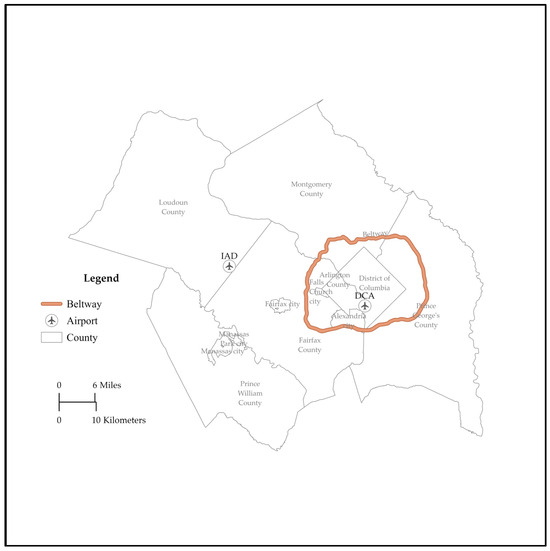
To that end, this study adopts a popular approach in the empirical literature on residential property valuation [9,10,11,12,13,14] known as a multilevel approach. The multilevel approach in this study includes temporal and spatial covariates known to affect residential property valuation in order to isolate the amenity or disamenity effect of airport proximity in the National Capital Region (Figure 1) of the United States. Analysis of more than a decade of residential property transactions near two international airports unmasks differences in the effect of proximity due to differences in land use near the respective airports. Taken together, the questions this study answers are as follows. First, is the airport proximity effect positive or negative near the respective airports? Second, what differences, if any, are evident in the amenity–disamenity balance near the respective airports? Third, what is the empirical evidence for such differences?
Figure 1.
Counties and county equivalents near Ronald Reagan International Airport (DCA) and Washington Dulles International Airport (IAD) in the National Capital Region of the United States.
The background for the above questions derives from regulatory and programmatic mandates from the federal government as well as state and county governments in the United States [15]. For the federal government, the Federal Aviation Administration (FAA) regulates aviation noise and administers noise programs in the United States. The Airport Noise Compatibility Planning (14 Code of Federal Regulations Part 150) of the Aviation Safety and Noise Abatement Act of 1979 [16] is the primary regulation for noise near airports. Part 150 sets the day–night average sound level (DNL) as the measure of local noise, where a DNL of 65 decibels (dB) is the threshold for significant aviation noise incompatible with residential land use. Unfortunately, an FAA survey of 10,000 respondents who reside near twenty representative airports in the United States suggests a DNL from 50 dB to 55 dB is a significant annoyance. Voluntary airport participants in Part 150 are eligible for federal funds for noise abatement and mitigation. The Quieter Home Program (QHP) near San Diego International Airport (SAN) in California is a relevant example of the latter to decrease the interior noise of a property near SAN by 5 dB [17]. For state and county governments, regulatory and programmatic mandates in Virginia are relevant examples. The enactment of the Virginia Residential Property Disclosure Act of 2025 (VRPDA) mandates sellers include language in the Virginia Residential Property Disclosure Statement informing buyers of the need to exercise due diligence to determine if a property is within a public use airport’s noise zone [18]. Loudoun County also regulates land use in an Airport Impact Overlay District (AIOD) near IAD to ensure future development is noise sensitive. Finally, VRPDA mandates the establishment of a website by the Virginia Department of Aviation [19] for buyers to access airport and government noise zone maps.
The outline of this study is as follows. The literature review section lists the empirical literature on how transportation infrastructure in terms of airports affects proximate residential property values. The methodology section specifies the multilevel models. The data section lists the dependent and independent variables. The data section also hypothesizes on the effects of the latter. The results section interprets the model estimates. The discussion section relates the results to the empirical literature on how airport proximity affects regional and subregional residential property values. The conclusions section highlights the implications of the results, the major limitation of this study, and the research the results portend.
2. Literature Review
Table 1 lists the key empirical literature on the proximity effects of airports on residential property values. The list in Table 1 is inexhaustive because the empirical literature on how the environmental and economic externalities of airport proximity interact in time and space to affect residential property values is extensive [2]. To that end, the list represents the key empirical literature from 1990 to the present. Further, the empirical literature on the proximity effects of transportation infrastructure such as roads [20] or railroads [21] is not in Table 1. What follows is a review of the relevant empirical literature representative of the trajectory of data and methodological advancements in residential property valuation [22] to explore how the environmental costs and economic benefits of airport proximity interact to affect residential property values. See Nelson [23,24] for meta-analyses on the interaction.
Table 1.
Key empirical literature on the proximity effects of airports on residential property values.
Pennington et al. [25] found prices are −6.09% lower, on average, in the most noise-affected post codes near Manchester International Airport in the United Kingdom. Interestingly, the inclusion of neighborhood effects decreases the magnitude of the noise coefficient and reverses the significance of the noise coefficient. Overall, the negative effects of airport proximity on residential property values are not robust to differences in neighborhood effects. Collins and Evans [26] found that an Artificial Neural Network (ANN) analysis of prices successfully recognizes noise patterns regardless of property or neighborhood near Manchester International Airport in the United Kingdom. However, the architecture of an ANN analysis of prices is data specific, so generalizability is questionable. To that end, an ANN analysis of prices is a complement to an economic analysis of prices, not a substitute for an economic analysis of prices. Levesque [27] decomposes noise effects on residential property prices near Winnipeg International Airport in Canada into frequency versus loudness effects. The Effective Perceived Noise Level (EPNL) measures loudness in terms of the frequency of noise events versus the duration of noise events. The results suggest frequent and louder noise events decrease prices. The results also suggest that variable noise events increase prices. The latter results suggest constant noise effects are worse than variable noise effects. Tomkins et al. [4] found that prices decrease with distance from Manchester International Airport in the United Kingdom, but the rate of decrease slows with distance. Further, the benefits of proximity with regard to access surpass the costs of proximity with regard to noise. However, Tomkins et al. [4] caution that
“…not all property prices are higher than they would otherwise be in the absence of the airport. Much depends upon the particular configuration of noise and proximity characteristics and thus some households are net gainers whilst others are net losers in terms of property values. Households which benefit the most are those living near to the airport, but whose location in relation to the flight path places them on a relatively low-level noise contour. Households which suffer the most are those at some distance from the airport but which nevertheless are exposed to higher noise levels”.(p. 255)
Espey and Lopez [5] found that prices one mile from Reno-Tahoe International Airport in the United States are −$5500 less than prices two miles from the airport for the same house. Further, house prices are −$2400 less in a noisier zone than in a control zone (60 Ldn). Rahmatian and Cockerill [28] adopt a hedonic price approach to analyze 50,000 residential property transactions near 23 airports in Southern California in the United States. Overall, mean prices increase as distance from an airport increases. However, the rate of increase decreases with distance from an airport. Further, price gradients relative to distance from airports and price gradients relative to distance from (flight) paths reveal buyers distinguish large airports from small airports. For example, the marginal price of one more meter of distance from a large airport ($1.23) is approximately two times the marginal price of one more meter of distance from a small airport (from $0.65 to $0.77). Likewise, the gradient for prices under the path of large airports is greater than the gradient for prices under the path of small airports. Zheng et al. [7] found that the relocation of Hong Kong International in China had a positive effect on prices in a treatment group near to the airport relative to a control group far from the airport. In fact, prices increase by +24.43% in the treatment group relative to the control group after relocation of the airport. Kaur et al. [8] investigate how noise-contour-magnitude versus distance-to-runway affect 1230 residential property prices near Essendon Airport in Australia. The results show Australian Noise Exposure Forecast (ANEF) contours fail to correlate with prices, whereas distance-to-runway correlates with prices. The results also show annual aircraft movements correlate with prices. The distance–price relationship is nonlinear such that the premium is up to +37% approximately 1.64 km from the runway. Further, on the margin, a decrease in annual aircraft movements of 1000 increases prices by +4.5%. Kaur et al. [8] conclude distance-to-runway, rather than noise-contour-magnitude, practically approximates environmental externalities near airports for buyers. Ngo et al. [6] found that mean prices in suburbs near four airports in New Zealand (Auckland, Christchurch, Queenstown, and Wellington) exhibit an inverse, parabolic relationship to distance. Mean prices are lowest in the suburbs approximately 300 m from the airports. Mean prices closer in to the airports are lower, probably due to the environmental costs of proximity such as noise, but mean prices farther out from the airports are higher, probably due to the economic benefits of proximity such as access. The latter results highlight the duality of airport proximity effects as simultaneously negative (environmentally) and positive (economically) [3].
From a data perspective, how the empirical literature in Table 1 operationalizes effects is of importance to the present study. On the one hand, the majority operationalizes effects on the basis of distance. On the other hand, the minority operationalizes effects on the basis of noise. Greater use of the former measure is due to data availability [29]. Barriers to access the data, hardware, and software to map distance are low [30], but barriers to access the data, hardware, and software to map noise are high. Indeed, the release of the first nationwide, multimodal map of transportation noise in the United States, known as the National Transportation Noise Map [31], was only in 2017. Also of note is the international interest from Australia to Canada to China to New Zealand to the United Kingdom to the United States on airport proximity effects.
From a methodological perspective, most of the empirical literature, explicitly or implicitly, adopts a hedonic price approach [32] to model airport proximity effects on residential property valuation. In the hedonic price approach, the implicit (hedonic) price of, in the present case, a property, is a function of the relative utility of a bundle of property characteristics observable to buyers and sellers. Clearly, the list of empirical literature in Table 1 demonstrates airport proximity affects residential property values. However, the magnitude and direction of such effects are dependent on distance, scale, and context [8,28]. Likewise, temporal [33] and spatial covariates [34] are seldom simultaneously evident in such models. With regard to the latter covariates, Rahmatian and Cockerill [28] argue
“Future research could focus on estimating a marginal price that changes with the mean of airport distance. Furthermore, the use of spatial techniques to handle spatial dependence of housing characteristics and sales prices would need to be explored”.(p. 25)
To that end, this study adopts a popular approach in the empirical literature on residential property valuation [9,10,11,12,13,14] known as a multilevel approach. The multilevel approach in this study includes temporal and spatial covariates known to affect residential property valuation in order to isolate the amenity or disamenity effect of airport proximity in the National Capital Region of the United States. Analysis of more than a decade of residential property transactions near two international airports unmasks differences in the amenity effect of proximity due to differences in land use near the respective airports.
3. Methodology
3.1. Multilevel Approach
This study adopts a multilevel approach to explore how proximity to transportation infrastructure (airports) affects residential property values. Precedence for such an approach is evident in the empirical literature [9,10,11,12,13,14]. Justification for such an approach is also evident in the empirical literature [35]. First, airport effects are known to be heterogeneous in residential property markets. Buyers exhibit different thresholds for airport noise from indifference to an unwillingness to pay [36]. Failure to explicitly account for such heterogeneity in statistical models violates homoskedasticity assumptions [37]. To that end, a multilevel approach explicitly nests prices in the residential property market within years within block groups because the dependent variables (Price and lnPrice) consist of property, time, and block group levels. The different levels summarize the mean price–year–block group relationship near airports as well as variation in the mean–price–year–block group relationship near airports [38]. Second, the independence of observations assumption [39] is untenable in the above analysis because the grouping of observations into different classes yields similar error terms that vary systematically by block group [40]. To that end, a multilevel model includes error terms for the respective levels of analysis to account for the fact that outcomes (prices) at the same time (year) and in the same place (block group) tend to correlate [41].
The specification of the multilevel models is as follows [42].
3.2. Multilevel Model
Within each block group, prices are a function of property-level independent variables plus a property-level error term:
where
Yptb = π0tb + π1tbW1ptb + π2tbW2ptb + … + πZtbWZptb + eptb
Yptb is the property p in time t and block group b;
π0tb is the y-intercept term for time t in block group b;
πZtb are z = 1,…, Z property-level coefficients;
WZptb are z = 1,…, Z property-level independent variables; and
eptb is the property-level random effect term.
The model for variation in time within block groups is as follows:
where
π0tb = β00b + β01bX1tb + β02bX2tb + … + β0(B−1)bX(B−1)tb + r0tb
β00b is the y-intercept term for block group b;
β0(B−1)b are b = 1,…, B − 1 time-level coefficients;
X(B−1)tb are b = 1,…, B − 1 dummy variables; and
r0tb is the time-level random effect term.
The model for variation between block groups is as follows. For the block group effect β00b:
where
β00b = γ000 + γ001Z1b + γ002Z2b + … + γ00DZDb + u00b
γ000 is the y-intercept term for block group b;
γ00D are d = 1,…, D block group-level coefficients;
ZDb are d = 1,…, D block group-level independent variables; and
u00b is a block group-level random effect term.
The following section lists the dependent and independent variables. The following section also hypothesizes on the effects of the latter.
4. Data
Table 2 is a data dictionary for the property-, time-, and block group-level variables. Precedence from the empirical literature on how proximity to transportation infrastructure affects residential property values [4,5,6,11,20,26,27] provides guidance on variable selection.
Table 2.
Data dictionary for residential property sales transactions.
Data for residential property sales are from Metropolitan Regional Information Systems, Incorporated (MRIS). MRIS and TREND (Delaware Valley Real Estate Information Network, Incorporated) as well as seven other multiple listing services presently serve the District of Columbia and six states in the Middle Atlantic region (Delaware, Maryland, New Jersey, Pennsylvania, Virginia, and West Virginia) as Bright MLS, Incorporated. The temporal context for the sample of sales from MRIS is from 1 January 2002 to 31 December 2014. This temporal extent reflects the continuous availability of sales data as near to the present as possible, which predates the availability of noise data from the Metropolitan Washington Airports Authority [45] in 2015. This temporal extent also includes an independent variable at the time level (Recession) to capture the effect of the Great Recession on prices in residential property transactions. A sample of sales from 1 January 2015 to as near to the present as possible is available from Bright MLS. However, the origins of the Great Recession in the subprime mortgage sector of the residential mortgage market warrant a retrospective exploration of how proximity and noise interact to affect residential property values in the past residential property market of the National Capital Region to contextualize the present residential property market of the National Capital Region. The spatial context for the sample of sales from MRIS is the counties (Arlington County, Fairfax County, Loudoun County, Montgomery County, Prince George’s County, and Prince William County) and county equivalents (Alexandria city, Fairfax city, Falls Church city, Manassas city, Manassas Park city, and the District of Columbia) near DCA and IAD (Figure 1). The spatial extent reflects the counties and county equivalents as near to DCA and IAD as possible. Exclusion of foreclosure, repeat-sale, short-sale, non-market, and missing-data transactions as well as transactions in the top and bottom 5% of the sales distribution left a subsample of 509,370 sales.
The dependent variable is the inflation-adjusted price or the natural log of the inflation-adjusted price of detached homes and townhomes. The latter property types rank first and second in sales in the residential property subsample. The inflation adjustor is the Home Price Index (HPI) from the Federal Housing Finance Agency [43]. Inflation adjustment is to the fourth quarter of 2014.
The independent variables approximate the bundle of market and non-market characteristics known to affect prices in residential property transactions [46,47,48].
The independent variables at the property level capture the distance, exterior, interior, locational, and quality characteristics of each property. The distance characteristics are Airport (the linear distance in kilometers to the nearest airport), Airport 2 (the nonlinear distance in square kilometers to the nearest airport), Bus Stop (the linear distance in kilometers to the nearest bus stop), Bus Stop 2 (the nonlinear distance in square kilometers to the nearest bus stop), Rail Station (the linear distance in kilometers to the nearest rail station), and Rail Station 2 (the nonlinear distance in square kilometers to the nearest rail station). The nearest airport is DCA or IAD (Figure 1). The nearest bus stop includes bus stops operational before 1 January 2015 so as to overlap with the temporal context of the sample of sales from MRIS from 1 January 2002 to 31 December 2014. The nearest rail station excludes the rail stations in the first phase of the new silver line since the operational overlap of the first five rail stations in the first phase of the new Washington Metropolitan Area Transit Authority (WMATA) silver line (McLean, Tysons Corner, Greensboro, Spring Hill, and Wiehle-Reston East) with the temporal context of the sample of sales from MRIS is only from 26 July 2014 to 31 December 2014. The exterior characteristics are Parking (if the price includes parking) and Type (if the property is a detached home or townhome). The interior characteristics are Basement (if the property includes a basement), Baths–Full (the number of full baths), Baths–Half (the number of half baths), and Bedrooms (the number of bedrooms). The locational characteristics are latitude (decimal degrees from the equator) and longitude (decimal degrees to the Prime Meridian). The quality characteristics are Age (the age in years of the property at closing, contracting, or selling) and New (if the property is less than one year old at closing, contracting, or selling).
The independent variables at the time level capture the temporal context of each property transaction. Quarter is the quarter (first, second, third, or fourth) the property closed, contracted, or sold. The first quarter is from January to March, the second quarter is from April to June, the third quarter is from July to September, and the fourth quarter is from October to December. Recession (if the property closed, contracted, or sold from the fourth quarter of 2007 to the second quarter of 2009) is transactions closed, contracted, or sold in the Great Recession. Year is the calendar year the property closed, contracted, or sold.
The independent variables at the block group level capture the density, surface, and walkability of each block group. Block groups are statistical, geographic subdivisions of census tracts whose population threshold ranges from 600 to 3000 [49]. All of the independent variables at the block group level are added to the full, three-level model specifications grand mean-centered to contextualize the density, surface, and walkability of each block group to all of the block groups in the study area. Jobs–Housing is the number of jobs and housing units per square kilometer of unprotected land for 2010 from the Smart Location Database [50]. Unprotected land has no known development restrictions due to physical or institutional constraints [44]. Federal, state, and local parks; animal parks (zoos); cemeteries; and beaches are examples of protected land. To that end, the denominator square kilometer of unprotected land accurately captures the land area where jobs and housing are evident in block groups. The hypothesis on the effect of the independent variable in the density category is prices are higher in block groups where the number of jobs and housing units per square kilometer are greater. Surface is the mean percentage of land area in the road impervious surface classification from 2002 to 2014 and the mean percentage of land area in the urban impervious surface classification from 2002 to 2014 from the National Land Cover Database (NLCD) Impervious Descriptor [51]. The hypothesis on the effects of the independent variables in the surface category is prices are higher in block groups where the mean percentage of land area in the road impervious surface classification and the mean percentage of land area in the urban impervious surface classification are greater. Walkability is the national walkability score for 2010 for each block group from the National Walkability Index (NWI) [52]. The NWI captures the walkability of each block group in the United States relative to the walkability of all block groups in the United States. The NWI includes four variables from the Smart Location Database [50] known to predict pedestrian trips: employment mix; number of housing units; density of pedestrian-oriented intersections; and commute-mode split. The hypothesis on the effect of the independent variable in the walkability category is prices are higher in block groups where the walkability score is greater [53,54].
The National Capital Region of the United States is the ideal study area to explore the differential effects of airport proximity on residential property valuation for the following reasons. First, DCA (16 June 1941) is older than IAD (17 November 1962). Second, mean annual passenger volumes from 2002 to 2014 are higher at DCA (8,678,310) than at IAD (8,273,624) due to the relative location of DCA in the core of the National Capital Region and the relative location of IAD on the periphery of the National Capital Region. Third, residential property is slightly cheaper near DCA ($494,902.93) than IAD ($497,190.11). Fourth, multimodal accessibility to bus stops and rail stations is greater near DCA (2.41 km and 6.08 km, respectively) than IAD (10.22 km and 18.13 km, respectively). Fifth, walkability is greater near DCA (11.89) than IAD (9.85). Taken together, differences from DCA to IAD are noteworthy, so an exploration of differential effects from airport proximity is defensible.
The following section interprets the model estimates.
5. Results
Descriptive statistics for sales transactions appear in Table 3, Table 4 and Table 5. Table 3 includes sales transactions near DCA and includes sales transactions near IAD. Table 4 includes sales transactions near DCA and excludes sales transactions near IAD. Table 5 excludes sales transactions near DCA and includes sales transactions near IAD. Descriptive statistics for sales transactions were generated using SAS software, Version 9.4. Copyright © [2025] SAS Institute Incorporated.
Table 3.
Descriptive statistics for residential property sales transactions. Includes sales near DCA. Includes sales near IAD.
Table 4.
Descriptive statistics for residential property sales transactions. Includes sales near DCA. Excludes sales near IAD.
Table 5.
Descriptive statistics for residential property sales transactions. Excludes sales near DCA. Includes sales near IAD.
Coefficient estimates for sales transactions appear in Table 6, Table 7 and Table 8. Table 6 includes sales transactions near DCA and includes sales transactions near IAD. Table 7 includes sales transaction near DCA and excludes sales transactions near IAD. Table 8 excludes sales transactions near DCA and includes sales transactions near IAD. The left columns of coefficient estimates in Table 6, Table 7 and Table 8 result from the linear (Price) dependent variable, and the right columns of coefficient estimates in Table 6, Table 7 and Table 8 result from the nonlinear (lnPrice) dependent variable. Coefficient estimates for sales transactions were generated using HLM for Windows, Version 8.2.3.14. Copyright © [1996–2022] SSI, Incorporated.
Table 6.
Coefficient estimates for residential property sales transactions. Includes sales near DCA. Includes sales near IAD.
Table 7.
Coefficient estimates for residential property sales transactions. Includes sales near DCA. Excludes sales near IAD.
Table 8.
Coefficient estimates for residential property sales transactions. Excludes sales near DCA. Includes sales near IAD.
5.1. Intraclass Correlation Coefficient (ICC)
The Intraclass Correlation Coefficient (ICC) measures the proportion of variance in the outcome (property) between groups (time and block group) in random-intercept models [42]. Two methods to calculate the ICC [55] are as follows. First, distribute the variance to the different levels. Second, correlate outcomes from the same group. The former method to calculate the ICC for the DCA + IAD specification distributes 3.40% of the total variance in prices to the time level and 69.97% of the total variance in prices to the block group level. The former method to calculate the ICC for the DCA specification distributes 3.16% of the total variance in prices to the time level and 72.95% of the total variance in prices to the block group level. The former method to calculate the ICC for the IAD specification distributes 4.13% of the total variance to the time level and 63.36% of the total variance to the block group level. The latter method to calculate the ICC for the DCA + IAD, DCA, and IAD specifications estimates the correlation between outcomes at the same time and in the same block group as 73.38%, 76.11%, and 67.49%, respectively [56].
5.2. Proportional Reduction of Error (PRE)
The Proportional Reduction of Error (PRE) for random-effects models [57] is an analog to the coefficient of determination for fixed-effects models. The PRE from the full, three-level model to the null, three-level model in Table 6 is 25.16%. That is, all of the independent variables explain 25.16% of the variation in the linear dependent variable (Price) in Table 6. The PRE from the full, three-level model to the null, three-level model in Table 7 is 41.80%. That is, all of the independent variables explain 41.80% of the variation in the linear dependent variable (Price) in Table 7. Finally, the PRE from the full, three-level model to the null, three-level model in Table 8 is 67.50%. That is, all of the independent variables explain 67.50% of the variation in the linear dependent variable (Price) in Table 8.
5.3. Multilevel Model Results
5.3.1. Property Level
At the property level, the linear Airport category of the Distance variable is statistically significant in Table 7 and Table 8. However, the sign of the former is negative, while the sign of the latter is positive. A one unit (kilometer) increase in the linear Airport category of the Distance variable decreases prices by −$14,733.30 (−2.12%) near DCA in Table 7. A one unit (kilometer) increase in the linear Airport category of the Distance variable decreases prices by +$7831.88 (+1.42%) near IAD in Table 8. Interestingly, the nonlinear Airport category of the Distance variable is statistically significant in Table 8 but not in Table 7. A one unit (square kilometer) increase in the nonlinear Airport category of the Distance variable decreases prices by −$454.64 (−0.08%) near IAD in Table 8. On the one hand, the price–distance relationship near DCA is linear (negative). That is, prices decrease as distance increases and accessibility decreases. On the other hand, the price–distance relationship near IAD is nonlinear (concave). That is, prices increase as distance increases up to a peak point 8.61 km from IAD where prices decrease. The Type category of the Exterior variable is statistically significant in Table 6, Table 7 and Table 8. Moreover, the signs of the statistically significant coefficient estimates for the Type category of the Exterior variable are consistent with expectations. If the property is a detached home, then prices increase by +$158,009.90 (+33.03%) near DCA or IAD in Table 6. If the property is a detached home, then prices increase by +$144,860.30 (+30.84%) near DCA in Table 7. If the property is a detached home, then prices increase by +$167,401.45 (+34.62%) near IAD in Table 8. Each category of the Interior variable (Basement, Baths–Full, Baths–Half, and Bedrooms) is statistically significant at the 99% confidence level in Table 6, Table 7 and Table 8. Moreover, the signs of the statistically significant coefficient estimates for each category of the Interior variable are consistent with expectations. If the property includes a basement, then prices increase by +$13,343.84 (+4.32%) near DCA or IAD in Table 6. If the property includes a basement, then prices increase by +$13,163.53 (+4.09%) near DCA in Table 7. If the property includes a basement, then prices increase by +$12,586.78 (+4.43%) near IAD in Table 8. A one unit increase in the number of full baths, a one unit increase in the number of half baths, and a one unit increase in the number of bedrooms increase prices by +$59,163.36 (+10.63%), +$49,200.62 (+9.54%), and +$21,914.79 (+4.29%), respectively, near DCA or IAD in Table 6. A one unit increase in the number of full baths, a one unit increase in the number of half baths, and a one unit increase in the number of bedrooms increase prices by +$60,423.83 (+11.13%), +$50,508.44 (+9.72%), and +$19,427.83 (+3.72%), respectively, near DCA in Table 7. A one unit increase in the number of full baths, a one unit increase in the number of half baths, and a one unit increase in the number of bedrooms increase prices by +$56,443.89 (+9.83%), +$46,643.76 (+9.19%), and +$25,868.57 (+5.16%), respectively, near IAD in Table 8. The Latitude category of the Locational variable is statistically significant at the 99% confidence level in Table 7. A one unit (decimal degree) increase from the Equator (from south to north) increases prices by +$802,343.60 (+142.16%) near DCA in Table 7. In other words, prices increase by +$802,343.60 (+142.16%) per decimal degree increase (from south to north) near DCA. The Longitude category of the Locational variable is statistically significant at the 99% confidence level in Table 7 and Table 8. A one unit (decimal degree) increase to the Prime Meridian (from west to east) decreases prices by −$473,419.05 (−98.55%) near DCA in Table 7. In other words, prices decrease by −$473,419.05 (−98.55%) per decimal degree increase (from west to east) near DCA. A one unit (decimal degree) increase to the Prime Meridian (from west to east) increases prices by +$1,196,674.67 (+182.12%) near IAD in Table 8. In other words, prices increase by +$1,196,674.67 (+182.12%) per decimal degree increase (from west to east) near IAD. Finally, each category of the Quality variable (Age and New) is statistically significant at the 99% confidence level in Table 6, Table 7 and Table 8. Moreover, the signs of the statistically significant coefficient estimates for each category of the Quality variable are consistent with expectations. A one unit (year) increase in the age of the property at closing, contracting, or selling decreases prices by −$1587.53 (−0.32%) near DCA or IAD in Table 6. A one unit (year) increase in the age of the property at closing, contracting, or selling decreases prices by −$1407.91 (−0.30%) near DCA in Table 7. A one unit increase (year) in the age of the property at closing, contracting, or selling decreases prices by −$1759.78 (−0.34%) near IAD in Table 8. If the property is less than one year old at closing, contracting, or selling, then prices increase by +$54,028.62 (+9.80%) near DCA or IAD in Table 6. If the property is less than one year old at closing, contracting, or selling, then prices increase by +$70,315.95 (+13.45%) near DCA in Table 7. If the property is less than one year old at closing, contracting, or selling, then prices increase by +$43,070.06 (+7.41%) near IAD in Table 8.
5.3.2. Time Level
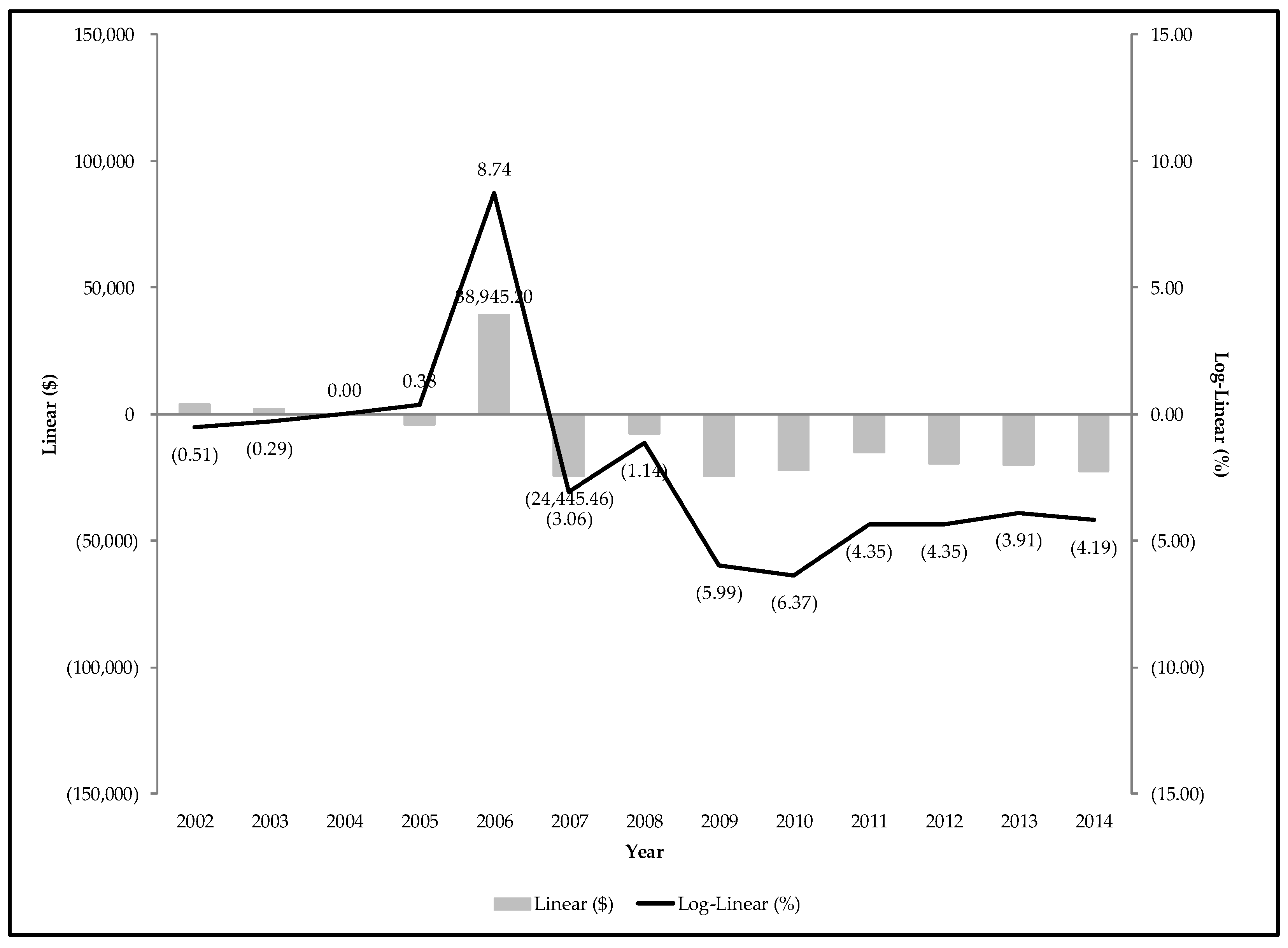
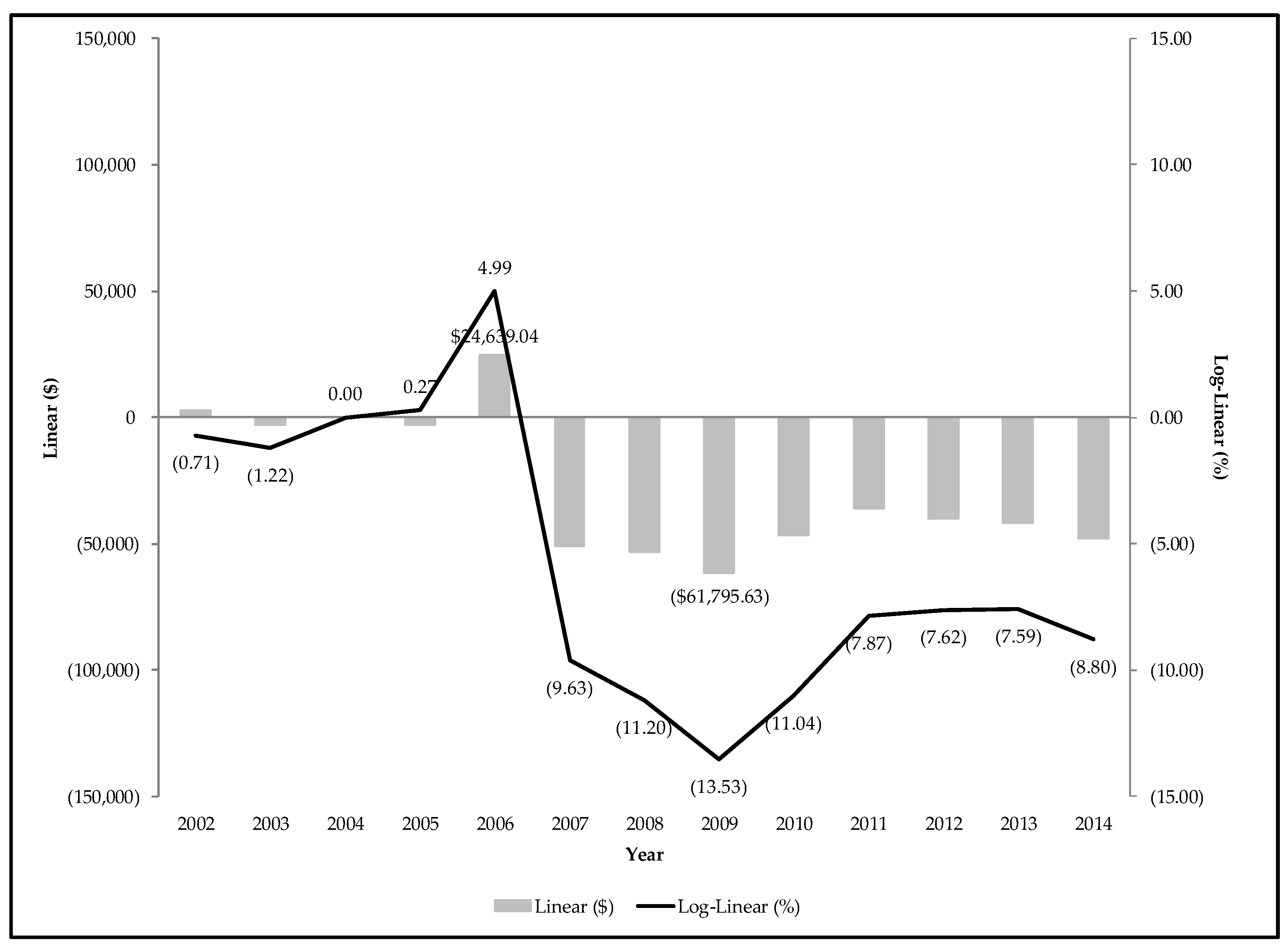
The results for the subsample of sales near DCA in Table 7 and the results for the subsample of sales near IAD in Table 8 unmask differences in the statistically significant independent variables at the time level in the subsample of sales near DCA or IAD in Table 6. The First category of the Quarter variable is statistically significant at the 99% confidence level in the subsample of sales near DCA or IAD. The First category of the Quarter variable is also statistically significant at the 99% confidence level in the subsample of sales near DCA in Table 7 but not in the subsample of sales near IAD in Table 8. If the property closed, contracted, or sold from January to March near DCA or IAD, then prices increase by +3880.12 (+1.11%). If the property closed, contracted, or sold from January to March near DCA, then prices increase by +4850.68 (+1.23%). The Third category of the Quarter variable is statistically significant at the 95% confidence level in the subsample of sales near DCA and the 99% confidence level in the subsample of sales near IAD. However, the sign of the former is negative, but the sign of the latter is positive. If the property closed, contracted, or sold from July to September near DCA, then prices decrease by −$4148.80 (−1.03%) near DCA. If the property closed, contracted, or sold from July to September near IAD, then prices increase by +6437.89 (+1.15%). The Fourth category of the Quarter variable is statistically significant at the 99% confidence level in the subsample of sales near IAD in Table 8 but not in the subsample of sales near DCA in Table 7. If the property closed, contracted, or sold from October to December near IAD, then prices increase by +11,177.85 (+1.71%). Such differences represent differences in the seasonality of the subsample of sales near DCA versus the subsample of sales near IAD. The majority of the year independent variables are statistically significant at the 99% confidence level. Interestingly, 2006 is the peak year for prices in Figure 2 (+$38,945.20 (+8.74%)), Figure 3 (+$45,953.49 (+10.51%)), and Figure 4 (+$24,639.04 (+4.99%)), which is the calendar year before the Great Recession in calendar year 2007. However, the magnitudes of the peak prices are dramatically different. The peak price near DCA in Figure 3 (+$45,953.49 (+10.51%)) relative to the referent year (2004) is approximately twice the magnitude of the peak price near IAD in Figure 4 (+$24,639.04 (+4.99%)) relative to the referent year (2004). Further, the magnitudes of the trough prices are also dramatically different. The trough price near DCA in Figure 3 (−$11,271.77 (+0.04%)) relative to the referent year (2004) is approximately one-sixth the magnitude of the trough price near IAD in Figure 4 (−$61,795.63 (−13.53%)). Such results support the argument that the downward pressure on prices due to the Great Recession was greater on the periphery of the residential property market near IAD versus in the core of the residential property market near DCA (Figure 1). The Recession variable is statistically significant at the 95% confidence level in the subsample of sales near IAD in Table 8 but not in the subsample of sales near DCA in Table 7. If the property closed, contracted, or sold from the fourth quarter of 2007 to the second quarter of 2009, then prices increase by +11,789.09 (+1.20%) near IAD. Such a result follows from the fact that the mean price near IAD ($497,190.11) is slightly greater than the mean price near DCA ($494,902.93). Such a result also isolates local differences in prices from IAD to DCA due to the Great Recession.
Figure 2.
Linear coefficient estimates (left axis) and log-linear coefficient estimates (right axis) for the time-level independent variable year. Includes sales near DCA. Includes sales near IAD. Negative values are in parentheses. Referent is the mode for residential property sales transactions, so 2004 is $0.00 for Dollars (left axis), and 2004 is 0.00% for Percentage (right axis).
Figure 3.
Linear coefficient estimates (left axis) and log-linear coefficient estimates (right axis) for the time-level independent variable year. Includes sales near DCA. Excludes sales near IAD. Negative values are in parentheses. Referent is the mode for residential property transactions, so 2004 is $0.00 for Dollars (left axis), and 2004 is 0.00% for Percentage (right axis).
Figure 4.
Linear coefficient estimates (left axis) and log-linear coefficient estimates (right axis) for the time-level independent variable year. Excludes sales near DCA. Includes sales near IAD. Negative values are in parentheses. Referent is the mode for residential property sales transactions, so 2004 is $0.00 for Dollars (left axis), and 2004 is 0.00% for Percentage (right axis).
5.3.3. Block Group Level
The results for the subsample of sales near DCA in Table 7 and the results for the subsample of sales near IAD in Table 8 unmask differences in the statistically significant independent variables at the block group level in the subsample of sales near DCA or IAD in Table 6. First, the Density variable (Jobs/Housing) is statistically significant at the 99% confidence level in Table 6 and Table 7 but not in Table 8. A one unit increase in Jobs/Housing increases prices by +$432,907.20 (+88.78%) near DCA or IAD, and a one unit increase in Jobs/Housing increases prices by +$300,117.44 (+65.33%) near DCA. The latter result follows from the fact that the mean of the Density variable (Jobs/Housing) near DCA (0.028) is greater than the mean of the Density variable (Jobs/Housing) near IAD (0.020). Second, the Road category of the Surface variable is statistically significant at the 99% confidence level in Table 7 and Table 8. However, the magnitude of the latter is greater than the magnitude of the former. A one unit increase in the Road category of the Surface variable decreases prices by −$969.21 (−0.17%) near DCA, but a one unit increase in the Road category of the Surface variable decreases prices by −$2624.41 (−0.55%) near IAD. Such a result means prices are higher in block groups near IAD than in block groups near DCA where the percentage of land in the road impervious surface classification is lower. Similarly, the Urban category of the Surface variable is statistically significant at the 99% confidence level in Table 7 and Table 8. However, again, the magnitude of the latter is greater than the magnitude of the former. A one unit increase in the Urban category of the Surface variable decreases prices by −$851.46 (−0.22%) near DCA, but a one unit increase in the Urban category of the Surface variable decreases prices by −$968.21 (−0.15%) near IAD. Such a result means prices are higher in block groups near IAD than in block groups near DCA where the percentage of land in the urban impervious surface classification is lower. Third, the Walkability variable (Score) is statistically significant at the 99% confidence level in Table 6 and Table 7 but not in Table 8. A one unit increase in Score increases prices by +$12,603.13 (+2.73%) near DCA or IAD, and a one unit increase in Score increases prices by +$12,716.85 (+2.82%) near DCA. Such a result follows from the fact that the mean of the Walkability variable (Score) near DCA (11.87) is greater than the mean of the Walkability variable (Score) near IAD (9.85).
6. Discussion
The answers to the questions this study asks are as follows. The first question asks if the airport proximity effect is positive or negative near the respective airports. The answer is the proximity effect is positive near DCA, while the proximity effect is negative near IAD. Prices decrease by −$14,733.30 (−2.12%) per kilometer from DCA, while prices increase by +$7831.88 (+1.42%) per kilometer from IAD. The second question asks what differences, if any, are evident in the amenity–disamenity balance near the respective airports. On the one hand, the amenity–disamenity balance favors the economically positive amenity of accessibility near DCA. On the other hand, the amenity–disamenity balance is zero 8.61 km from IAD where the economically positive amenity of accessibility is at a limit. The third question asks what is the empirical evidence for such differences. On the one hand, a one unit (kilometer) increase in the linear Airport category of the Distance variable decreases prices by −$14,733.30 (−2.12%) near DCA in Table 7. On the other hand, a one unit (kilometer) increase in the linear Airport category of the Distance variable decreases prices by +$7831.88 (+1.42%) near IAD in Table 8, while a one unit (square kilometer) increase in the nonlinear Airport category of the Distance variable decreases prices by −$454.64 (−0.08%) near IAD in Table 8.
The simultaneous inclusion of temporal and spatial covariates in multilevel models helps to control for dependence in the outcomes of residential property transactions where prices proximate in time and space correlate. The level of temporal covariates nested within the level of spatial covariates also helps to answer the question as to whether time or space explains more of the variation in residential property transaction outcomes (prices). The decision to nest time within space is a function of the fact that the sample size at the highest level of a multilevel model is the major restriction to accurate estimation [58]. Finally, the subregional specifications near DCA and IAD unmask regional differences in the amenity effect of proximity to airports in the National Capital Region.
Overall, the correlation between outcomes proximate in time and space is strong. The correlation between prices at the same time and in the same block group in the regional (DCA + IAD) specification (73.38%) is strong. Likewise, correlations between prices at the same time and in the same block group in the subregional specifications near DCA (76.11%) and IAD (67.49%) are strong. The above results support the empirical literature on the correlation between outcomes proximate in time [33] and space [28,34]. Primo et al. [41] argue for a clustered standard error approach rather than a multilevel approach to the clustering of outcomes in time and space. However, the advantage of a multilevel approach is that
“These procedures allow the researcher to estimate how much each level of analysis is contributing to explanation in the model, and how much each level is contributing to the error. In other words, the researcher can assess whether the explanation is primarily macro-level or individual-level”.(p. 452)
To that end, regardless of the specification, space explains vastly more of the variation in outcomes (prices) than time. Indeed, the three-level model distributes more of the variation in residential property transaction outcomes to the block group level than the time level in the DCA + IAD (69.97% versus 3.40%), DCA (72.95% versus 3.16%), and IAD (63.36% versus 4.13%) specifications. The above results validate the inclusion time and space at different levels of analysis [56]. The above results also highlight enormous differences in the amenity effect of airport proximity from DCA to IAD in the National Capital Region. Prices decrease by −$14,733.30 (−2.12%) per kilometer near DCA, but prices increase by +$7831.88 (+1.42%) per kilometer to a distance of 8.61 km from IAD where prices decrease. The fact that the block group level explains the vast majority of the variation in outcomes (prices) highlights the relevance of the Road category of the Surface variable and the Urban category of the Surface variable as well as the Walkability variable (Score) at the block group level. The latter result is especially relevant to sustainable land use [22] near airports given the premium walkability conveys to sellers near DCA (−$14,733.30 (−2.12%)).
7. Conclusions
Analysis of thirteen years of residential property transactions near airport infrastructure in the National Capital Region of the United States advances knowledge on the regional amenity effect of proximity to airports in light of the local amenity effect of proximity to pedestrian infrastructure near DCA. The results also advance knowledge on the subregional amenity effect of proximity to airports, which, unsurprisingly, is contradictory due to the differences in land use from DCA to IAD. The major contribution of the results to the sustainable transportation literature is to highlight the value proximity to public infrastructure in the form of an airport conveys to private property.
Research to extend the results of the present study explores how proximity and noise interact to affect residential property values in the National Capital Region. A sample of sales from Bright MLS from 1 January 2015 to the present at the same spatial context as the present study as near to DCA and IAD as possible is available. Monthly noise monitor data near to DCA and IAD is also available from February 2015 to the present from the Metropolitan Washington Airports Authority [44]. The availability of noise data addresses the major limitation of the present study. The noise data overlaps temporally and spatially with the sample of sales from Bright MLS from 1 January 2015 to the present at the same spatial context as the present study, that is, as near to DCA and IAD as possible. After data acquisition is complete, such future research will replicate Collins and Evans [26] to use a neural network to recognize differences in noise patterns near to DCA and IAD, which equalize differences in the amenity effect of airport proximity evident in the present study. Validation of the results of the present study via analysis of noise complaints in zip codes near DCA and IAD is ongoing.
Author Contributions
Conceptualization, E.Z. and R.S.; methodology, E.Z.; software, E.Z.; validation, E.Z.; formal analysis, E.Z.; investigation, E.Z.; resources, E.Z.; data curation, E.Z.; writing—original draft preparation, E.Z. and R.S.; writing—review and editing, E.Z. and R.S.; visualization, E.Z.; supervision, E.Z.; project administration, E.Z. All authors have read and agreed to the published version of the manuscript.
Funding
This research received no external funding.
Institutional Review Board Statement
Not applicable.
Informed Consent Statement
Not applicable.
Data Availability Statement
The raw data supporting the conclusions of this article will be made available by the authors on request.
Conflicts of Interest
The authors declare no conflicts of interest.
References
- TSA Checkpoint Travel Numbers. Available online: https://www.tsa.gov/travel/passenger-volumes (accessed on 27 January 2026).
- Paul, M. Can aircraft noise nuisance be measured in money? Oxford Econ. Pap. 1971, 23, 297–322. [Google Scholar] [CrossRef] [Scilit]
- Li, M.; Brown, H. Micro-neighborhood externalities and hedonic house prices. Land Econ. 1980, 56, 125–140. [Google Scholar] [CrossRef] [Scilit]
- Tomkins, J.; Topham, N.; Twomey, J.; Ward, R. Noise versus access: The impact of an airport in an urban property market. Urban Stud. 1998, 35, 243–258. [Google Scholar] [CrossRef] [Scilit]
- Espey, M.; Lopez, H. The impact of airport noise and proximity on residential property values. Growth Change 2000, 31, 408–419. [Google Scholar] [CrossRef] [Scilit]
- Ngo, T.; Squires, G.; McCord, M.; Lo, D. House prices, airport location proximity, air traffic volume and the COVID-19 effect. Reg. Stud. Reg. Sci. 2023, 10, 418–438. [Google Scholar] [CrossRef] [Scilit]
- Zheng, X.; Peng, W.; Hu, M. Airport noise and house prices: A quasi-experimental design study. Land Use Policy 2020, 90, 104287. [Google Scholar] [CrossRef] [Scilit]
- Kaur, K.; Cardak, B.; McAllister, R. The impact of airport noise on house prices. Q Open 2021, 1, qoab012. [Google Scholar] [CrossRef] [Scilit]
- Gelfand, A.; Banerjee, S.; Sirmans, C.; Tu, Y.; Ong, S. Multilevel modeling using spatial processes: Application to the Singapore housing market. Comput. Stat. Data Anal. 2007, 51, 3567–3579. [Google Scholar] [CrossRef] [Scilit]
- Jones, K.; Bullen, N. Contextual models of urban house prices: A comparison of fixed-and random-coefficient models developed by expansion. Econ. Geogr. 1994, 70, 252–272. [Google Scholar] [CrossRef] [Scilit]
- Habib, M.; Miller, E. Influence of transportation access and market dynamics on property values: Multilevel spatiotemporal models of housing price. Transp. Res. Rec. 2008, 2076, 183–191. [Google Scholar] [CrossRef] [Scilit]
- Hamidi, S.; Bonakdar, A.; Keshavarzi, G.; Ewing, R. Do urban design qualities add to property values? An empirical analysis of the relationship between urban design qualities and property values. Cities 2020, 98, 102564. [Google Scholar] [CrossRef] [Scilit]
- Orford, S. Modelling spatial structures in local housing market dynamics: A multilevel perspective. Urban Stud. 2000, 37, 1643–1671. [Google Scholar] [CrossRef] [Scilit]
- Zolnik, E. A longitudinal analysis of the effect of public rail infrastructure on residential property transactions. Urban Stud. 2020, 57, 1620–1641. [Google Scholar] [CrossRef] [Scilit]
- Tang, R. Federal Airport Noise Regulations and Programs; Congressional Research Service: Washington, DC, USA, 2021; R46920. [Google Scholar]
- Aviation Safety and Noise Abatement Act of 1979. Pub. L. No. 96-193, 94 Stat. 50 (1980). Available online: www.congress.gov (accessed on 27 January 2026).
- Quieter Home Program. Available online: https://www.san.org/aircraft-noise/quieter-home-program/ (accessed on 27 January 2026).
- Aviation Noise. Available online: https://www.loudoun.gov/airportnoise (accessed on 27 January 2026).
- Airport Noise Contours. Available online: https://doav.virginia.gov/noise_contours/ (accessed on 27 January 2026).
- Blanco, J.; Flindell, I. Property prices in urban areas affected by road traffic noise. Appl. Acoust. 2011, 72, 133–141. [Google Scholar] [CrossRef] [Scilit]
- Andersson, H.; Jonsson, L.; Ögren, M. Property prices and exposure to multiple noise sources: Hedonic regression with road and railway noise. Environ. Resour. Econ. 2010, 45, 73–89. [Google Scholar] [CrossRef] [Scilit]
- Krause, A.; Bitter, C. Spatial econometrics, land values and sustainability: Trends in real estate valuation research. Cities 2012, 29, S19–S25. [Google Scholar] [CrossRef] [Scilit]
- Nelson, J. Airports and property values: A survey of recent evidence. J. Transp. Econ. Policy 1980, 14, 37–52. [Google Scholar]
- Nelson, J. Meta-analysis of airport noise and hedonic property values. J. Transp. Econ. Policy 2004, 38, 1–27. [Google Scholar]
- Pennington, G.; Topham, N.; Ward, R. Aircraft noise and residential property values adjacent to Manchester International Airport. J. Transp. Econ. Policy 1990, 24, 49–59. [Google Scholar]
- Collins, A.; Evans, A. Aircraft noise and residential property values: An artificial neural network approach. J. Transp. Econ. Policy 1994, 28, 175–197. [Google Scholar]
- Levesque, T. Modelling the effects of airport noise on residential housing markets: A case study on Winnipeg International Airport. J. Transp. Econ. Policy 1994, 28, 199–210. [Google Scholar]
- Rahmatian, M.; Cockerill, L. Airport noise and residential housing valuation in Southern California: A hedonic pricing approach. Int. J. Environ. Sci. Te. 2004, 1, 17–25. [Google Scholar] [CrossRef] [Scilit]
- Hammer, M.; Swinburn, T.; Neitzel, R. Environmental noise pollution in the United States: Developing an effective public health response. Environ. Health Persp. 2014, 122, 115–119. [Google Scholar] [CrossRef] [Scilit] [PubMed]
- Abraham, I.; Sunday, I.; Saulawa, S.; Eneogwe, C. Evaluation and spatial noise mapping using geographic information system (GIS): A case study in Zaria City, Kaduna State, Nigeria. Environ. Health Eng. Manage. J. 2022, 9, 233–245. [Google Scholar] [CrossRef] [Scilit]
- National Transportation Noise Map. Available online: https://www.bts.gov/newsroom/bts-releases-national-transportation-noise-map (accessed on 27 January 2026).
- Rosen, S. Hedonic prices and implicit markets: Product differentiation in pure competition. J. Polit. Econ. 1974, 82, 34–55. [Google Scholar] [CrossRef] [Scilit]
- Dubé, J.; Legros, D. Spatial econometrics and the hedonic pricing model: What about the temporal dimension? J. Prop. Res. 2014, 31, 333–359. [Google Scholar] [CrossRef] [Scilit]
- Salvi, M. Spatial estimation of the impact of airport noise on residential housing prices. Swiss J. Econ. Stat. 2008, 144, 577–606. [Google Scholar] [CrossRef] [Scilit]
- Khattak, Z.; Khattak, A. Spatial and unobserved heterogeneity in consumer preferences for adoption of electric and hybrid vehicles: A Bayesian hierarchical modeling approach. Int. J. Sustain. Transp. 2023, 17, 1–14. [Google Scholar] [CrossRef] [Scilit]
- Feitelson, E.; Hurd, R.; Mudge, R. The impact of airport noise on willingness to pay for residences. Transport. Res. D-Tr. E. 1996, 1, 1–14. [Google Scholar] [CrossRef] [Scilit]
- White, H. A heteroskedasticity-consistent covariance matrix estimator and a direct test for heteroskedasticity. Econometrica 1980, 48, 817–838. [Google Scholar] [CrossRef] [Scilit]
- Duncan, C.; Jones, K. Using multilevel models to model heterogeneity: Potential and pitfalls. Geogr. Anal. 2000, 32, 279–305. [Google Scholar] [CrossRef] [Scilit]
- Bullen, N.; Jones, K.; Duncan, C. Modelling complexity: Analyzing between-individual and between-place variation—a multilevel tutorial. Environ. Plan. A 1997, 29, 585–609. [Google Scholar] [CrossRef] [Scilit]
- Moulton, B. An illustration of a pitfall in estimating the effects of aggregate variables on micro units. Rev. Econ. Stat. 1990, 72, 334–338. [Google Scholar] [CrossRef] [Scilit]
- Primo, D.; Jacobsmeier, M.; Milyo, J. Estimating the impact of state policies and institutions with mixed-level data. State Polit. Policy Q. 2007, 7, 446–459. [Google Scholar] [CrossRef] [Scilit]
- Raudenbush, S.; Bryk, A. Hierarchical Linear Models: Applications and Data Analysis, 2nd ed.; Sage: Thousand Oaks, CA, USA, 2002; ISBN 978-0-76191-904-9. [Google Scholar]
- Home Price Index. Federal Housing Finance Agency, 2025. Available online: https://www.fhfa.gov/DataTools/Downloads/Pages/House-Price-Index.aspx (accessed on 27 January 2026).
- Ramsey, K.; Bell, A. Smart Location Database: Version 2.0 User Guide; United States Environmental Protection Agency: Washington, DC, USA, 2014. Available online: https://www.epa.gov/sites/default/files/2014-03/documents/sld_userguide.pdf (accessed on 27 January 2026).
- Noise Data Reports. Metropolitan Washington Airports Authority. 2025. Available online: http://public-reports-us-standard.s3-website-us-east-1.amazonaws.com/MWAA/ReportingPortal.html (accessed on 27 January 2026).
- Ball, M. Recent empirical work on the determinants of relative house prices. Urban Stud. 1973, 10, 213–233. [Google Scholar] [CrossRef] [Scilit]
- Brigham, E. The determinants of residential land values. Land Econ. 1965, 41, 325–334. [Google Scholar] [CrossRef] [Scilit]
- Stull, W. Community environment, zoning, and the market value of single-family homes. J. Law Econ. 1975, 18, 535–557. [Google Scholar] [CrossRef] [Scilit]
- United States Bureau of the Census. 2020 Census Participant Statistical Areas Program (PSAP) Quick Reference: Block Groups; Form G-640; United States Department of Commerce: Washington, DC, USA, 2021. Available online: https://www2.census.gov/geo/pdfs/partnerships/psap/G-640.pdf (accessed on 27 January 2026).
- Smart Location Database. Available online: https://www.epa.gov/smartgrowth/smart-location-mapping#SLD (accessed on 27 January 2026).
- Annual NLCD Collection 1 Science Products: U.S. Geological Survey Data Release. Available online: https://www.sciencebase.gov/catalog/item/655ceb8ad34ee4b6e05cc51a (accessed on 27 January 2026).
- National Walkability Index. Available online: https://www.epa.gov/smartgrowth/smart-location-mapping#walkability (accessed on 27 January 2026).
- Zolnik, E. Geographically weighted regression models of residential property transactions: Walkability and value uplift. J. Transp. Geogr. 2021, 92, 103029. [Google Scholar] [CrossRef] [Scilit]
- Zolnik, E. Capturing the value of walkability. Future Transp. 2024, 4, 1334–1349. [Google Scholar] [CrossRef] [Scilit]
- Hox, J.; Moerbeek, M.; van de Schoot, R. Multilevel Analysis: Techniques and Applications, 3rd ed.; Routledge: New York, NY, USA, 2018; ISBN 978-1-138-12140-9. [Google Scholar]
- Tranmer, M.; Steel, D. Ignoring a level in a multilevel analysis: Evidence from UK census data. Environ. Plan. A 2001, 33, 941–948. [Google Scholar] [CrossRef] [Scilit]
- Snijders, T.; Bosker, R. Multilevel Analysis: An Introduction to Basic and Advanced Multilevel Modelling, 2nd ed.; Sage: Los Angeles, CA, USA, 2012; ISBN 978-1-84920-200-8. [Google Scholar]
- Maas, C.; Hox, J. Sufficient sample sizes for multilevel modeling. Methodology-Eur. 2005, 1, 86–92. [Google Scholar] [CrossRef] [Scilit]





Disclaimer/Publisher’s Note: The statements, opinions and data contained in all publications are solely those of the individual author(s) and contributor(s) and not of MDPI and/or the editor(s). MDPI and/or the editor(s) disclaim responsibility for any injury to people or property resulting from any ideas, methods, instructions or products referred to in the content. |
© 2026 by the authors. Licensee MDPI, Basel, Switzerland. This article is an open access article distributed under the terms and conditions of the Creative Commons Attribution (CC BY) license.