Article

How Kindergarten Principals’ Caring Leadership Shapes Teachers’ Work Passion: The Sequential Mediating Roles of Teacher Trust and Teacher Buoyancy


Department of Education, The Catholic University of Korea, Bucheon-si 14662, Republic of Korea
*
Author to whom correspondence should be addressed.
Sustainability 2026, 18(3), 1573; https://doi.org/10.3390/su18031573
Submission received: 28 December 2025 / Revised: 31 January 2026 / Accepted: 2 February 2026 / Published: 4 February 2026

Abstract

Against the backdrop of China’s national initiatives to strengthen the teaching workforce, fostering teachers’ work passion is essential not only for enhancing professional well-being but also for improving educational quality. This study examines how kindergarten principals’ caring leadership influences teachers’ work passion by testing the sequential mediating roles of teacher trust and teacher buoyancy. Using an independent quota sampling strategy, survey data were collected from 395 kindergarten teachers across China. The results indicate that principals’ caring leadership positively influences teachers’ work passion, but this effect is entirely indirect, operating through teacher trust, teacher buoyancy, and their sequential mediation, thereby confirming the “second-order effect” mechanism of leadership. Further mediation analyses reveal that the independent mediating effect of teacher trust (72.47%) is substantially stronger than that of teacher buoyancy (15.15%), while the sequential mediation pathway from teacher trust to teacher buoyancy accounts for 11.73% of the total effect. Overall, this study advances understanding of psychological mechanisms linking caring leadership to teachers’ passion and offers actionable insights for kindergarten principals seeking to refine leadership practices and foster sustained teacher engagement and enthusiasm.

1. Introduction

Teachers are the cornerstone and driving force of education, and developing a high-quality, professionalized teaching workforce is fundamental to building a strong national education system [1]. With the rapid expansion of early childhood education in China, kindergarten teachers are under increasing work-related pressures. Heavy workloads, frequent non-instructional tasks, stringent accountability evaluations, and continually shifting reform demands have eroded teachers’ work passion [2,3]. This decline, in turn, contributes to heightened professional burnout [4,5] and triggers negative work behaviors, including disengagement, procrastination, and even turnover [6,7,8]. A national meta-analysis revealed a significant upward trend in burnout levels among Chinese kindergarten teachers between 2004 and 2022 [9]. In addition, based on a large-scale survey of kindergarten teachers from six representative provinces and municipalities in China (N = 14,392), Hong et al. (2021) reported that more than one-third of teachers expressed an intention to leave the kindergarten teaching profession [10]. Even more concerning, according to the latest statistics released by the Ministry of Education, the number of full-time kindergarten teachers nationwide had fallen to 2.8319 million by the end of 2024, marking a cumulative net decline of 412,300 teachers (12.7%) since 2022 [11]. This persistent downward trend suggests a substantial risk of structural attrition in China’s kindergarten teacher workforce. Even when estimates are based on a conventional teacher–child ratio of 1:9 [5], the current supply of kindergarten teachers still falls short by more than one million teachers. Taken together, persistently elevated levels of burnout and teacher attrition have become critical structural challenges undermining the pursuit of high-quality early childhood education in China. Against this backdrop, identifying effective ways to improve kindergarten teachers’ work experiences and psychological well-being in order to enhance workforce stability and professionalism has emerged as an urgent priority for both research and practice.
Work passion denotes the extent to which individuals identify with their work, maintain motivation over time, and experience enjoyment and satisfaction in their tasks [12]. Teachers who are highly passionate about their work not only experience greater instructional enjoyment and well-being [13,14] but also enhance students’ interest in learning and motivation through the spillover effects of their positive emotions [15]. Thus, fostering teachers’ work passion is not only essential for shifting from “quantity retention” to “quality retention,” but also serves as a critical safeguard for improving educational quality. Notably, while existing research has made substantial progress in examining negative work outcomes such as teacher burnout and turnover intention, investigations into positive work outcomes—such as teachers’ work passion—remain an area that merits further scholarly attention [16,17], particularly among kindergarten teachers. Research focusing on negative work outcomes typically emphasizes remedial interventions, whereas studies on positive work outcomes emphasize proactive motivational strategies, reflecting a preventive rather than corrective logic [18]. This shift—from problem correction to strength enhancement—not only marks a conceptual transition but also underscores the theoretical and practical significance of examining the factors that foster kindergarten teachers’ work passion, particularly within the pressure-laden context of contemporary education.
The experience of work passion is shaped by the dynamic relationship between individuals and their environmental context [19]. Teachers’ work is inherently social, involving frequent communication and collaboration with principals and colleagues, a dynamic that is particularly pronounced in small, densely organized kindergartens [20]. In China, kindergartens generally operate under a principal-responsible system [21], where the principal holds ultimate responsibility for all aspects of the kindergarten. Given China’s culture of high collectivism and power distance, teachers strongly rely on and value principals’ guidance [3,20,22]. Within this cultural and organizational context, principals’ leadership shapes the organizational climate by optimizing working conditions and allocating resources effectively, while also profoundly influencing teachers’ psychological experiences and professional attitudes [23,24]. Consequently, it is widely considered a critical driver of teachers’ work passion [25]. Accordingly, investigating the influence of principals’ leadership on teachers’ work passion holds particular significance in the Chinese educational context.
Within the spectrum of leadership styles, caring leadership has gained attention in leadership research due to its emphasis on supporting and caring for subordinates [26]. Caring leadership is a relational quality aimed at meeting others’ needs, fostering reciprocal relationships, enhancing well-being, and cultivating the capacity to care [27]. Just as students expect care from their teachers, teachers likewise anticipate support and respect from their leaders [28]. Caring for and educating young children is a highly emotional form of labor that not only requires sustained time and effort but also consumes substantial emotional resources. In the absence of adequate external care and support, teachers are particularly vulnerable to emotional exhaustion [29]. Prior research indicates that leaders’ care and support play a crucial role in maintaining teachers’ emotional balance and fostering sustained work passion [30,31]. Consequently, compared with teachers at other educational levels, kindergarten teachers exhibit a particularly urgent need for caring leadership. Although prior studies have demonstrated the positive effects of caring-related factors—such as principals’ caring behaviors or a caring climate in the workplace—on teachers’ work passion [23,32], they have primarily examined caring at either the behavioral level or the level of organizational culture. Specifically, caring behaviors refer to leaders’ concrete and observable actions in day-to-day managerial practices, whereas the caring climate reflects the broader emotional and cultural environment that develops through sustained organizational interactions. In contrast, caring leadership, as a distinct leadership construct, emphasizes leaders’ overall influence and value orientation within organizational contexts. It not only guides caring behaviors through ongoing leadership practice but also shapes and reinforces a caring culture at the organizational level. From this holistic perspective, caring leadership may exert a more systematic, comprehensive, and profound influence on teachers. Nevertheless, there remains a lack of systematic empirical research directly examining the effect of caring leadership as an overarching construct on teachers’ work passion, particularly among kindergarten teachers. By addressing this gap, the present study advances theoretical understanding and practical implications for leadership in early childhood education.
Leadership not only exerts a direct influence on employees’ work passion but can also produce indirect effects by shaping their cognitions and emotions [33]. However, empirical research remains limited regarding the internal mechanisms through which caring leadership affects teachers’ work passion, particularly those operating through individual psychological processes. This gap constrains a deeper understanding of how teachers’ work passion develops and weakens the theoretical foundation for designing targeted leadership-based interventions. Accordingly, greater scholarly attention to the individual-level psychological processes linking caring leadership to teachers’ work passion is warranted. Among the range of relevant psychological factors, teacher trust and teacher buoyancy represent two critical personal resources with strong explanatory potential. Teacher trust captures the extent to which interpersonal relationships shape teachers’ attitudes and behaviors, whereas teacher buoyancy reflects teachers’ capacity to adapt to challenges and recover from everyday work-related setbacks. Together, these complementary processes help illuminate the mechanism through which caring leadership influences teachers’ work passion.
Grounded in these theoretical considerations, the present study focuses on Chinese kindergartens and systematically examines how teacher trust and teacher buoyancy mediate the relationship between principals’ caring leadership and teachers’ work passion. By integrating relationship-oriented and capability-oriented perspectives, this study seeks to deepen understanding of the mechanisms underlying caring leadership and to provide more targeted theoretical contributions and actionable recommendations for enhancing kindergarten teachers’ work passion. Accordingly, this research explores the following questions: (1) Does principals’ caring leadership directly enhance teachers’ work passion? (2) Does teacher trust mediate the effect of principals’ caring leadership on teachers’ work passion? (3) Does teacher buoyancy mediate the effect of principals’ caring leadership on teachers’ work passion? (4) Do teacher trust and teacher buoyancy sequentially mediate the influence of caring leadership on teachers’ work passion?

1.1. Theoretical Framework

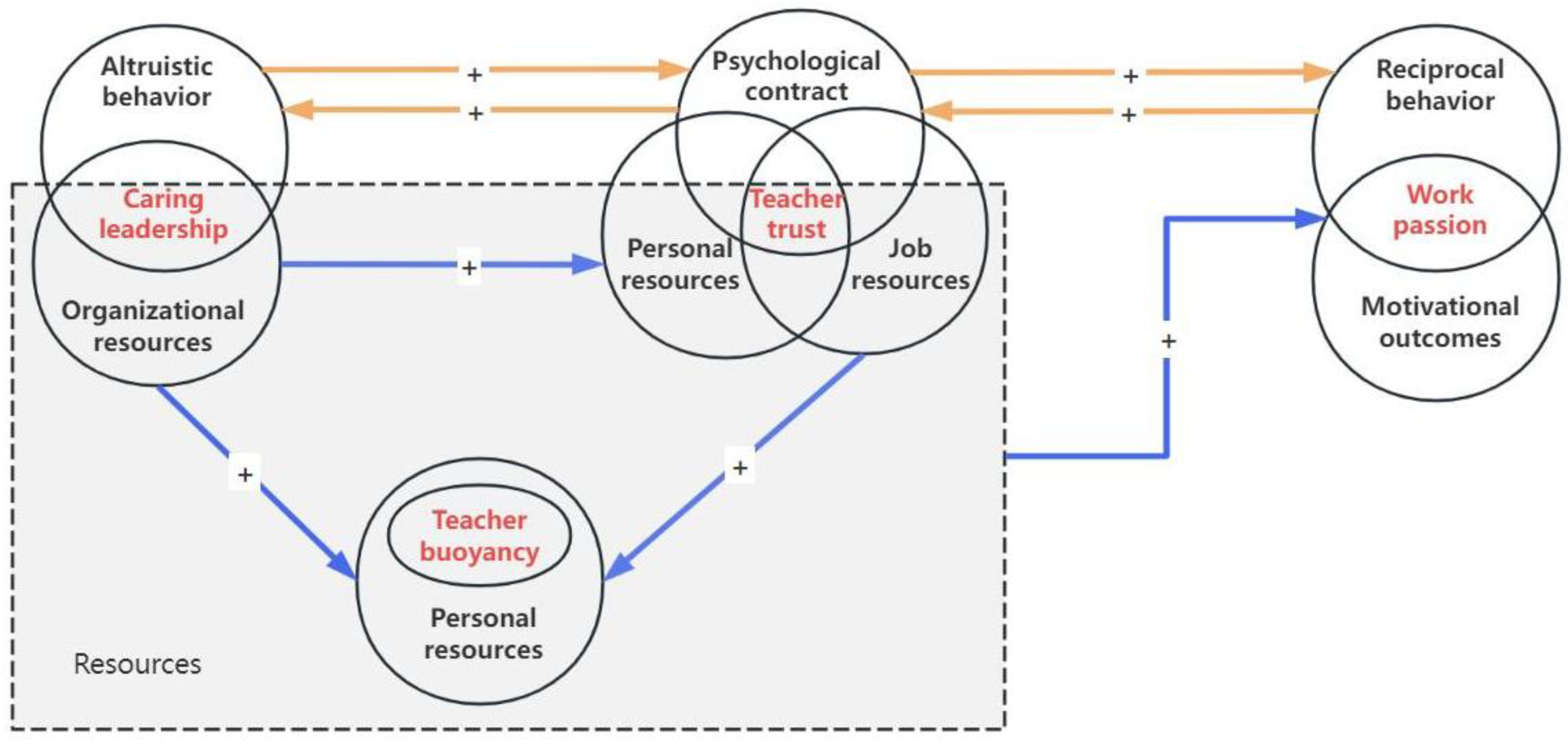
Drawing on Social Exchange Theory (SET) and the Job Demands-Resources (JD-R) theory (see Figure 1), this study develops an integrative theoretical framework to explain the relationships among caring leadership, teacher trust, teacher buoyancy, and teachers’ work passion. SET is a foundational theory in organizational research that explains interpersonal interactions and social relationships in the workplace, highlighting the central role of trust in social exchanges. Trust not only motivates individuals to engage in reciprocal behaviors but is also shaped by others’ attitudes and behaviors [34]. From this perspective, caring leadership, as a form of altruistic behavior, fosters teacher trust, which in turn enhances their work engagement and passion. The JD-R theory emphasizes how job demands and job resources influence employees’ psychological states and work performance, and it is widely applied to explain work-related outcomes and enhance employee functioning [35]. According to this theory, job resources can not only independently trigger motivational processes but also facilitate the accumulation of additional resources, thereby generating positive outcomes through gain spirals [36]. Within this framework, caring leadership, as a core organizational resource, can not only directly enhance teachers’ work passion but also indirectly strengthen it by activating key resources, such as teacher trust and buoyancy. Taken together, this integrative framework provides a relational and resource-based perspective to account for the sequential mediating role of teacher trust and buoyancy in the influence of caring leadership on teachers’ work passion.

1.2. Caring Leadership and Teachers’ Work Passion

In the early 1980s, the concept of “care” was introduced into educational research through Carol Gilligan’s (1982) and Nel Noddings’ (1984) [37,38] discussions on the ethics of care. It gradually emerged as a key topic in the study of school leadership [28,39]. Building on this foundation, Louis et al. (2016) proposed a framework of caring leadership in schools, highlighting five core dimensions: attentiveness and authentic knowledge of others, motivational displacement, situationality, mutuality, and authenticity [27]. Although caring leadership is primarily grounded in Western theoretical frameworks, the care-oriented values it emphasizes are highly compatible with Chinese cultural traditions. Influenced by Confucian philosophy, traditional Chinese culture regards ren (benevolence) as a core ethical principle, emphasizing leaders’ moral responsibility to care for and show concern toward others [40]. Within this cultural tradition, leadership styles widely discussed in the Chinese context—such as paternalistic and benevolent leadership—view care for subordinates as an important characteristic of leaders’ behavior [41,42]. However, by comparison, caring leadership provides a more comprehensive and systematic theoretical articulation of care. Therefore, examining the applicability and explanatory power of caring leadership in the Chinese cultural context not only advances theoretical discussions on its cross-cultural relevance but also provides actionable guidance to enhance leadership practices in Chinese education.
According to the JD-R theory, job resources can activate motivational processes, thereby fostering positive work outcomes [43]. As a pivotal job resource, caring leadership enhances teachers’ positive emotional experiences through concern, understanding, and support, thereby stimulating higher levels of passion and vigor in their work [28,32,44]. Simultaneously, leaders’ care and recognition can strengthen individuals’ perceptions of insider identity and organizational commitment [23,45], motivating them to invest greater passion and effort in achieving organizational goals [44,46]. Moreover, the supportive relational networks fostered by caring leadership encourage teachers to create nurturing and efficient learning environments for students and engage more proactively in collaboration and knowledge sharing with colleagues [27,47]. Amid rapid economic growth and mounting work pressures, relying solely on material incentives is increasingly insufficient to sustain teachers’ ongoing motivation and work passion [48]. In light of the pronounced power-distance tendencies of Chinese culture, leaders’ expressions of care may exert a magnified influence on teachers’ work performance [49]. Within this cultural context, caring leadership is therefore likely to enhance teachers’ work passion through affective pathways, serving as a potentially important alternative mechanism.
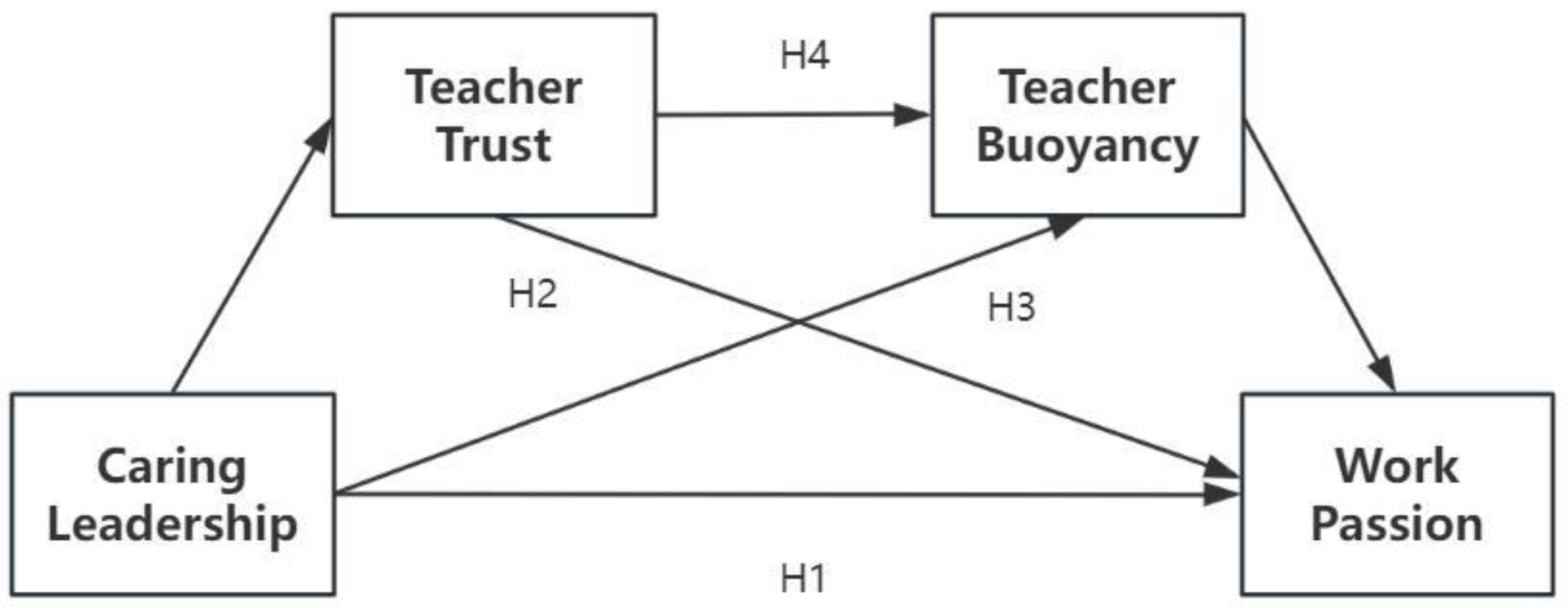
Based on the above, we hypothesize that caring leadership positively influences teachers’ work passion (H1).

1.3. The Mediating Role of Teacher Trust

Teacher trust refers to teachers’ willingness to be vulnerable, grounded in their belief in others’ benevolence, reliability, competence, honesty, and openness [50]. Hoy and Tschannen-Moran (2003) [50] conceptualize teacher trust as encompassing trust in principals, colleagues, and clients (i.e., parents and students), with trust in principals and colleagues constituting the construct’s core dimensions [3,51].
Caring leadership may influence teacher trust. Research has shown that both authentic and transformational leadership significantly enhance teacher trust, and the benevolence, care, and supportive characteristics embodied in these leadership styles closely align with the core principles of caring leadership [52]. Moreover, meta-analytic evidence further indicates that the benevolence component of paternalistic leadership predicts trust more strongly than transformational leadership [41], highlighting the pivotal role of leaders’ caring behaviors as a key mediator in the relationship between leadership and employee work [49,53,54]. According to SET, individuals adjust their attitudes and behaviors based on their perceptions of others’ actions in order to maintain reciprocal social exchange relationships [55]. When individuals experience care and support from their leaders, they not only develop gratitude and trust [47,56] but also feel an implicit sense of obligation, thereby motivating them to engage in their work with heightened passion and dedication [57,58]. Conversely, when leaders exhibit self-serving or exploitative behaviors, individuals’ trust is likely to diminish due to a perceived imbalance between contributions and returns, which, in turn, reduces their passion and discretionary effort at work [54]. Trust is inherently context-dependent. The traditional value that “without trust, nothing can stand” has profoundly shaped Chinese ways of thinking and value orientations, making trust not only a foundation for maintaining stable interpersonal relationships but also a core mechanism through which individuals internalize role obligations as psychological contracts [59,60]. Consequently, in a cultural context that has historically emphasized trust-based relationships, trust plays a particularly important role in fostering employees’ work passion [57].
Based on the above, we hypothesize that teacher trust mediates the relationship between caring leadership and teachers’ work passion (H2).

1.4. The Mediating Role of Teacher Buoyancy

Buoyancy, an emerging construct in positive psychology, was first introduced by Martin and Marsh (2008) [61]. While rooted in resilience research, buoyancy differs in that resilience focuses on rare and significant adversities, such as serious illnesses, whereas buoyancy emphasizes frequent but minor challenges, such as teaching-related pressures [62]. This distinction makes buoyancy particularly relevant to teachers’ everyday work contexts [63]. Wong et al. (2021) explicitly conceptualized teacher buoyancy as the adaptive and proactive ways in which teachers respond to the routine, minor difficulties that commonly arise in their daily professional practice [64].
Evidence from prior research suggests that buoyancy mediates the relationship between leadership and employees’ work performance [65,66]. Drawing on the JD-R theory, job resources can enhance personal resources, thereby facilitating positive work outcomes [67]. In educational contexts, principals’ care, respect, and recognition are considered key job resources that can effectively bolster teacher buoyancy [62,66]. When teachers face work-related challenges, supportive behaviors from principals can meet their emotional needs and encourage proactive adjustment and adaptation, thereby sustaining high levels of buoyancy [68]. As a positive individual psychological resource, teacher buoyancy helps explain why teachers exhibit varying adaptive outcomes under similar stress conditions. Highly buoyant teachers tend to interpret difficulties as opportunities for growth [69] and exhibit greater self-efficacy and achievement [70,71], thereby enhancing their passion and engagement in teaching [72]. Conversely, teachers with lower buoyancy are more likely to be overwhelmed by challenges, experiencing somatic strain, anxiety, and emotional exhaustion [66,70], which impedes sustained motivation and vitality.
Based on the above, we hypothesize that teacher buoyancy mediates the relationship between caring leadership and teachers’ work passion (H3).

1.5. The Sequential Mediating Role of Teacher Trust and Teacher Buoyancy

Evidence indicates that teacher buoyancy develops within strong trust relationships [63,69,73,74]. For example, Li et al. (2019), surveying primary and secondary school teachers in China, demonstrated that school-based trust was a stronger predictor of teacher resilience than working conditions [75]. Trust in both school leaders and colleagues provides teachers with a stable sense of psychological safety, which not only strengthens their confidence and courage in confronting challenges [76] but also fosters a proactive approach to daily work challenges, thereby enhancing their buoyancy [77]. In schools characterized by high-trust climates, teachers tend to share experiences and resources while collaborating on problem-solving, further improving their ability to adapt to and cope with stressful situations [62,75]. In contrast, when trust is undermined, heightened suspicion and defensive behaviors among teachers can elicit anxiety and accelerate psychological fatigue, ultimately diminishing their buoyancy [78,79].
Based on the JD-R theory, interactions between job and personal resources may initiate resource gain spirals that ultimately foster positive work outcomes [67]. As a key job resource, caring leadership facilitates the development of trust networks within schools [56], while trust—an essential interpersonal resource—enhances teachers’ capacity to cope with stress and recover effectively [63,73]. Enhancements in teacher buoyancy further reinforce their sense of efficacy and belonging, enabling them to approach teaching with greater passion and proactivity [80,81]. Based on theoretical and empirical evidence, this study views teacher trust as a predictor of teacher buoyancy, rather than the reverse.
Based on the above, we hypothesize that teacher trust and teacher buoyancy sequentially act as mechanisms through which caring leadership influences teachers’ work passion (H4).
Drawing on previous studies, this research develops a sequential mediation model (Figure 2) to examine how teacher trust and teacher buoyancy serve as mechanisms through which caring leadership affects teachers’ work passion.

2. Materials and Methods

2.1. Participants

Based on an online sample size calculator, a minimum of 385 respondents was required, given the total population of 2,962,905 kindergarten teachers in 2023, a 95% confidence level, and a 5% margin of error. Taking into account the 6% invalid response rate identified during the pilot phase, we set the final sample size to 410. To ensure representativeness, an independently controlled quota sampling strategy was employed. According to the 2023 regional distribution of kindergarten teachers—43.00% in the eastern region, 24.91% in the central region, 27.65% in the western region, and 4.44% in the northeastern region—176, 102, 113, and 19 teachers were recruited from these regions, respectively.
Ethical approval for the present study was granted by the Institutional Review Board of the Catholic University of Korea (IRB No. 1040395-202506-18). Data were collected via an online questionnaire from 10–20 July 2025. Two attention-check items were embedded, and responses were considered valid only if both items were answered correctly. Following the removal of 15 inattentive responses, 395 questionnaires met the validity criteria, resulting in a validity rate of 96.34%. The participant demographics are presented in Table 1.
It should be noted that, compared with the national population of kindergarten teachers, the sample included relatively higher proportions of highly educated teachers and those employed in public kindergartens. This overrepresentation may be related to recent policy orientations in teacher workforce development and talent management practices in public kindergartens. Policies such as the New Era Basic Education Strong Teacher Plan (2022) [82] have consistently encouraged teachers to pursue higher levels of education, while public kindergartens tend to place greater emphasis on educational credentials in recruitment, promotion, and performance evaluation, and provide institutional and resource support for continuing professional development. In this context, the structural characteristics of the sample with respect to educational attainment and kindergarten type are largely consistent with current national upgrading trends. Nevertheless, caution is warranted when generalizing the findings to contexts with substantially different educational resources, policy environments, or teacher workforce structures.

2.2. Measures

Brislin’s (1970) back-translation approach was employed to translate the original English scales into Chinese [83]. First, the first author translated the items into Chinese, after which a bilingual translator, blind to the original items, back-translated them into English. The team then examined the original and back-translated English versions, identified inconsistencies, and refined the Chinese translation through multiple rounds of discussion. Once a preliminary version was developed, six experts—two professors of education, two kindergarten teachers, and two kindergarten principals—reviewed the content and wording of the translated scales, and their feedback was incorporated into further refinements. To ensure cultural appropriateness, translation accuracy, and comprehensibility, a pilot test was conducted with ten kindergarten teachers, during which cognitive interviews were conducted on randomly selected items (e.g., “What do you think this statement means?”) to identify potential ambiguities and guide wording adjustments. To avoid bias, the twelve kindergarten teachers involved in the translation and pilot testing were excluded from the final sample [84]. Additionally, given that all data were self-reported by teachers, procedural remedies were implemented to control for common method bias, including physical and psychological separation of questionnaire sections and the use of different scale anchors for different measures.
Caring Leadership. Kindergarten principals’ caring leadership was assessed using the unidimensional Caring Principal Leadership Scale developed by Louis et al. (2016) [27]. The scale includes eight items, one of which is: “My school administrator develops an atmosphere of caring and trust.” Participants rated items using a 5-point Likert scale, ranging from 1 (strongly disagree) to 5 (strongly agree). Psychometric evaluation demonstrated excellent reliability and validity in this study, with Cronbach’s α = 0.943 and model fit indices of χ2/df = 2.559, RMSEA = 0.063, CFI = 0.988, TLI = 0.983, and SRMR = 0.016.
Teacher Trust. Two subscales from Hoy and Tschannen-Moran’s (2003) [50] Omnibus Trust-Scale—Trust in Principal (8 items) and Trust in Colleagues (8 items)—were employed to assess teacher trust. Illustrative items included: “Teachers in this school trust the principal” (Trust in Principal) and “Teachers in this school trust each other” (Trust in Colleagues). Responses were recorded on a 6-point Likert scale, with 1 indicating strong disagreement and 6 indicating strong agreement. Items 3, 5, and 6 of the Trust in Principal subscale and item 5 of the Trust in Colleagues subscale were reverse-coded. Item 3 of the Trust in Principal subscale was removed during the pretest phase due to a factor loading below 0.70. Psychometric evaluation in this study demonstrated that the two subscales had Cronbach’s α coefficients of 0.939 and 0.941, with model fit indices of χ2/df = 3.289, RMSEA = 0.076, CFI = 0.961, TLI = 0.954, and SRMR = 0.034, demonstrating satisfactory reliability and validity. This study primarily focuses on the mechanism underlying overall teacher trust, with trust in principals and trust in colleagues jointly representing teachers’ overall trust within the work context. Accordingly, teacher trust was modeled as a single construct in the subsequent statistical analyses.
Teacher Buoyancy. Teacher buoyancy was measured with the unidimensional Workplace Buoyancy Scale, developed by Martin and Marsh (2008) [61]. The scale contains four items, with a sample item: “I think I’m good at dealing with work pressures.” Responses were recorded on a 7-point Likert scale, with 1 representing strong disagreement and 7 strong agreement. Psychometric analysis showed a Cronbach’s α of 0.928 for the scale, with model fit indices of χ2/df = 3.305, RMSEA = 0.076, CFI = 0.996, TLI = 0.989, and SRMR = 0.008, demonstrating satisfactory reliability and validity.
Teacher Work Passion. Teachers’ work passion was assessed with the unidimensional Work Passion Scale constructed by Chen et al. (2020) [12]. The scale includes 10 items, with a sample item: “How much would you say you enjoy doing your work?” Responses to each item were captured on a 5-point scale, with ascending scores denoting increased levels of work passion. Psychometric analysis confirmed the scale’s strong internal consistency and construct validity, as evidenced by a Cronbach’s α of 0.940 and excellent model fit (χ2/df = 2.979, RMSEA = 0.071, CFI = 0.975, TLI = 0.968, SRMR = 0.025).
Control Variables. Demographic variables included teacher gender, teaching experience, educational attainment, employment status, kindergarten location, and kindergarten type. ANOVA results indicated that work passion differed significantly only across teaching experience (p = 0.010) and educational attainment (p = 0.015); therefore, we controlled for these two variables in the structural equation modeling. Although other demographic variables did not show significant effects in the present study, they may theoretically influence the outcomes and should be considered in future research.

2.3. Data Processing and Analysis

Because the scales used different scoring anchors, all scale scores were first standardized. Given that both the Caring Principal Leadership Scale and the Work Passion Scale were unidimensional and contained a relatively large number of items, item parceling was conducted using the balanced loadings method. Specifically, the eight items of the Caring Principal Leadership Scale were combined into three parcels: Parcel 1 (items 4, 5, 7), Parcel 2 (items 2, 3, 8) and Parcel 3 (items 1, 6). Similarly, the ten items of the Work Passion Scale were combined into three parcels: Parcel 1 (items 4, 5, 6), Parcel 2 (items 2, 7, 8), and Parcel 3 (items 1, 3, 9, 10). For consistency in the measurement structure, the unidimensional teacher buoyancy scale (four items) was parceled into two item parcels, with Items 2 and 4 constituting Parcel 1 and Items 1 and 3 constituting Parcel 2. We conducted preliminary analyses, descriptive statistics, and correlation analyses using SPSS 26.0, and performed measurement and structural model analyses with Mplus 8.0.

3. Results

3.1. Subsection Preliminary Analyses

To ensure robust model evaluation and reliable results, preliminary analyses were conducted, including normality tests, multicollinearity diagnostics, and assessment of common method bias. Specifically, normality tests were performed to confirm that the data met the assumptions for parametric analyses. Skewness (0.398–1.196) and kurtosis (0.016–1.710) were below 2 and 7, respectively, suggesting that the data met the criteria for approximate normality [85]. Multicollinearity was also assessed to ensure reliable regression estimates. The results revealed that the variance inflation factors (VIFs; 1.407–2.020) were well below the recommended cutoff of 5, and the tolerance indices (TIs; 0.495–0.711) were above 0.1, indicating that multicollinearity was not a concern [86]. Additionally, since all data were collected via teacher self-reports, we applied Harman’s single-factor test to assess how common method bias might influence the relationships among variables. An unrotated exploratory factor analysis revealed five factors with eigenvalues greater than 1, with the largest factor explaining 47.717% of the variance—slightly under the 50% benchmark—suggesting that common method bias was within acceptable bounds [87]. Overall, these preliminary analyses establish a robust statistical foundation for subsequent analyses.

3.2. Descriptive Statistics and Correlation Analysis

Table 2 presents the descriptive statistics and correlation coefficients for all variables. Consistent with expectations, all variables exhibited positive correlations, each significant at the 0.01 level. Specifically, caring leadership was significantly correlated with teacher trust (r = 0.680, p < 0.01) and teachers’ work passion (r = 0.574, p < 0.01), while teacher buoyancy was significantly correlated with teacher trust (r = 0.478, p < 0.01) and teachers’ work passion (r = 0.569, p < 0.01). The observed correlations offer initial evidence supporting the study hypotheses.

3.3. Measurement Model Analysis

The measurement model analysis aimed to evaluate the extent to which observed variables captured their respective latent constructs and their validity. To ensure reliable measurement of latent constructs and provide a sound basis for structural equation modeling, items were loaded onto their respective factors in a measurement model for the four study variables: caring leadership, teacher trust, teacher buoyancy, and teachers’ work passion. To further test the measurement model’s robustness, five alternative models were constructed to compare the fit under different factor structures. Specifically, alternative model 1 combined caring leadership and teacher trust, alternative model 2 combined caring leadership and teacher buoyancy, alternative model 3 combined teacher trust and teacher buoyancy, alternative model 4 combined the three variables except for teachers’ work passion, and alternative model 5 combined all variables into a single factor. Table 3 illustrates that the four-factor measurement model exhibited excellent fit (χ2/df = 1.474, RMSEA = 0.035, CFI = 0.996, TLI = 0.994, SRMR = 0.018) and significantly outperformed all alternative models, indicating that the items were appropriately assigned to their theoretically proposed factors. In addition (see Table 2), all variables demonstrated standardized factor loadings (β) and composite reliability (CR) above 0.70, with average variance extracted (AVE) exceeding 0.50, confirming that the measures achieved satisfactory reliability and convergent validity [88]. The square roots of the AVEs exceeded the inter-variable correlations, demonstrating satisfactory discriminant validity [89]. These results provide a sound basis for the ensuing structural model analysis.

3.4. Structural Equation Modeling

This study utilized structural equation modeling (SEM) to test a sequential mediation model comprising caring leadership, teacher trust, teacher buoyancy, and teachers’ work passion. SEM enables the simultaneous estimation of multiple path coefficients and their significance, allowing for a comprehensive assessment of both model fit and effect sizes [90]. Controlling for teaching experience and educational attainment, a baseline model was specified to examine the effect of caring leadership on teachers’ work passion. Path effects were analyzed via a bias-corrected bootstrap procedure with 5000 resamples and 95% confidence intervals. This method is not only suitable for small samples or complex models, but also provides bias-corrected confidence intervals, thereby enhancing the accuracy of mediation effect estimates. The results showed that the model fit the data well (χ2/df = 2.220, RMSEA = 0.056, CFI = 0.991, TLI = 0.987, SRMR = 0.066), and caring leadership exerted a statistically significant positive effect on teachers’ work passion (β = 0.607, p < 0.001, 95% CI [0.454, 0.768]), confirming Hypothesis 1 in the baseline model.
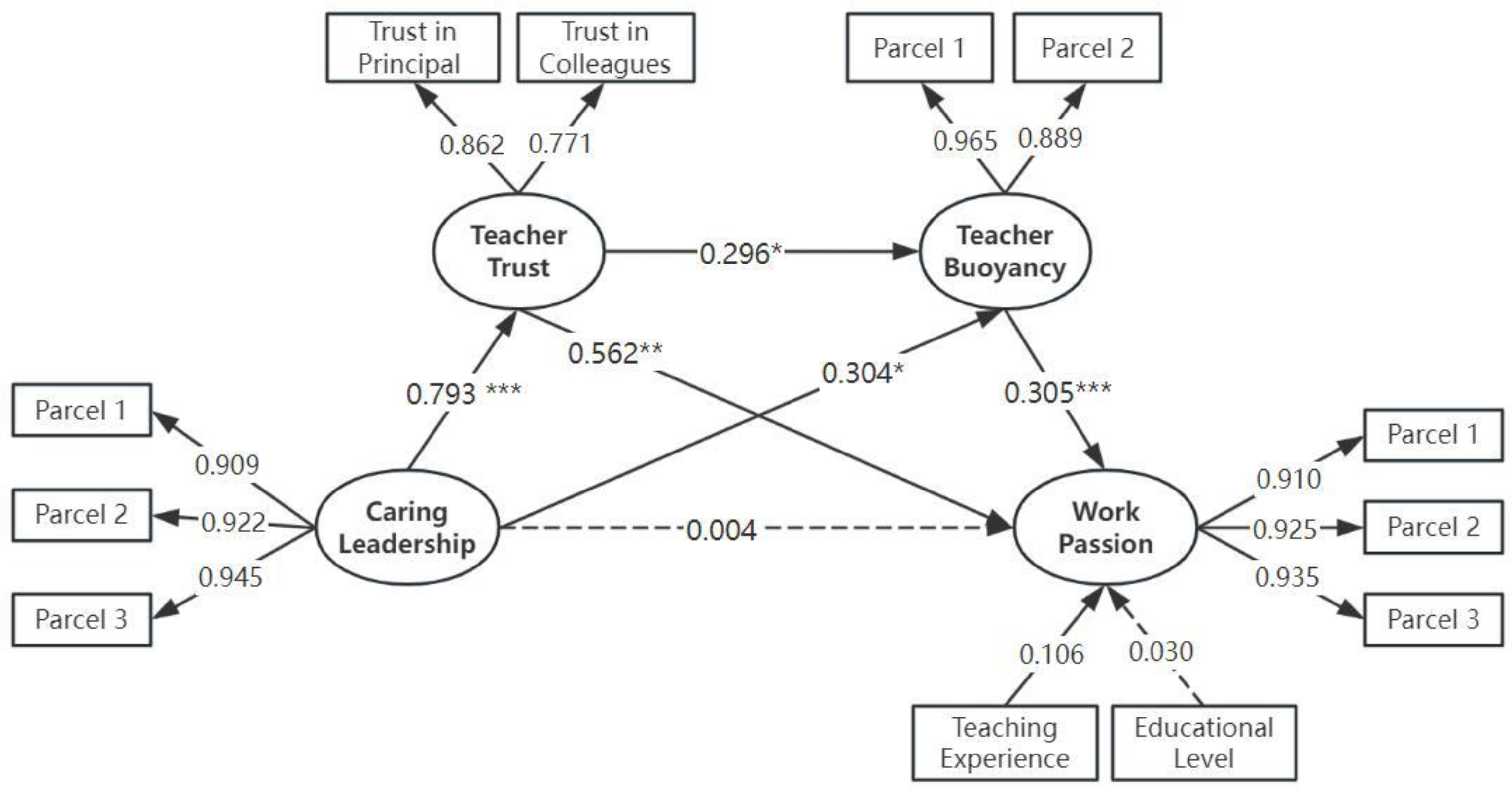
Building on the baseline model, we subsequently estimated a sequential mediation model incorporating teacher trust and teacher buoyancy, which also demonstrated a good fit (χ2/df = 2.133, RMSEA = 0.054, CFI = 0.986, TLI = 0.980, SRMR = 0.065). As shown in Figure 3 and Table 4, the direct effect of caring leadership on teachers’ work passion was nonsignificant (β = 0.004, p = 0.983, 95% CI [−0.353, 0.329]). Consequently, after including the mediators, Hypothesis 1 was no longer supported, suggesting that teacher trust and teacher buoyancy fully convey the effect of caring leadership on teachers’ work passion.
Caring leadership significantly predicted teacher trust (β = 0.793, p < 0.001, 95% CI [0.589, 0.900]), and teacher trust, in turn, significantly predicted teachers’ work passion (β = 0.562, p = 0.001, 95% CI [0.293, 0.997]). Teacher trust significantly mediated the effect of caring leadership on teachers’ work passion (β = 0.445, p = 0.003, 95% CI [0.216, 0.792]), explaining 72.47% of the overall effect, thereby supporting Hypothesis 2.
Caring leadership also significantly predicted teacher buoyancy (β = 0.304, p = 0.009, 95% CI [0.057, 0.604]), and teacher buoyancy, in turn, significantly predicted teachers’ work passion (β = 0.305, p < 0.001, 95% CI [0.160, 0.364]). Teacher buoyancy significantly mediated the effect of caring leadership on teachers’ work passion (β = 0.093, p = 0.038, 95% CI [0.019, 0.197]), explaining 15.15% of the overall effect, thus confirming Hypothesis 3.
In addition, teacher trust significantly predicted teacher buoyancy (β = 0.296, p = 0.020, 95% CI [0.084, 0.705]). The sequential mediation effect of caring leadership on teachers’ work passion through teacher trust followed by teacher buoyancy was also significant (β = 0.072, p = 0.020, 95% CI [0.026, 0.156]), representing 11.73% of the overall effect, thereby supporting Hypothesis 4.

4. Discussion

4.1. The Relationship Between Caring Leadership and Teachers’ Work Passion

The present study revealed that in the baseline model, caring leadership had a significant direct effect on teachers’ work passion, supporting Hypothesis 1. After introducing teacher trust and teacher buoyancy as mediators, the direct effect became nonsignificant, indicating that teacher trust and teacher buoyancy fully convey the impact of caring leadership on teachers’ work passion. Consistent with earlier research, these findings provide additional support for the “second-order effect” mechanism of leadership, whereby positive employee outcomes are not automatically produced by leadership behaviors alone but depend on the activation and functioning of individual psychological processes [49,53]. For instance, Liu, Liu et al. (2024) reported that, within China, distributed leadership had no direct effect on teachers’ well-being; instead, its influence was fully mediated by teachers’ trust in colleagues and principals [84]. In a similar vein, Alazmi and Hammad (2023) demonstrated that teacher trust and agency fully transmitted the effects of learning-centered leadership on teachers’ professional development [91].
Influenced by Confucian culture, Chinese teachers tend to interpret and respond to interpersonal interactions in organizational contexts from a relational perspective. This relationship-oriented cultural orientation closely aligns with the core tenets of social exchange theory. SET posits that individuals’ willingness to invest effort or assume responsibility within organizations hinges on their subjective judgments of the sincerity and trustworthiness of others’ actions [55]. From this perspective, caring leadership, as a critical external contextual input, does not automatically translate into heightened teachers’ work passion; rather, its influence depends on how teachers perceive, interpret, and psychologically construct leaders’ behaviors [92]. Only when principals’ caring behaviors are perceived by teachers as genuinely responsive to their psychological needs and capable of evoking emotional identification and reciprocal motivation can such care be internalized as sustained work passion.

4.2. The Mediating Role of Teacher Trust

Our findings indicate that teacher trust serves as a key mediator linking caring leadership to teachers’ work passion, explaining 72.47% of the overall effect. The results indicate that teacher trust primarily mediates the effect of caring leadership on teachers’ work passion, thereby supporting Hypothesis 2. Consistent with previous research, the findings underscore the crucial function of trust in translating leadership behaviors into positive employee outcomes [49,53].
In high power distance cultures, the institutional and symbolic influence of leaders is magnified, rendering their behaviors more compelling and directive [49]. For teachers, principals’ caring behaviors signify acknowledgment and respect associated with their authoritative role. When teachers perceive such care and recognition, they experience feelings of acceptance and value, which in turn strengthen their trust in the principal [93]. Drawing on SET, teacher trust legitimizes the leader’s authority, motivating teachers to reciprocate by internalizing the principal’s values and vision, consciously aligning their behaviors with organizational goals, and investing greater time, effort, and emotional engagement in their work [94,95]. Moreover, principals’ caring leadership exerts a modeling effect, encouraging teachers to demonstrate similar caring behaviors in their interactions with colleagues [26]. In an organizational climate marked by mutual concern, respect, and support, teachers tend to cultivate deep, trust-based relationships with one another [23]. Such trust alleviates anxiety stemming from performance competition, enhances psychological safety and a sense of belonging, and enables teachers to approach their work with enthusiasm while actively engaging in collaboration, communication, and providing feedback to colleagues [33,74].
Notably, this study challenges the classical view of Tschannen-Moran and Hoy (1998), which asserts that principals’ behaviors influence only teachers’ trust in the principal, without affecting trust among teachers [51]. Importantly, our findings suggest that principals’ caring leadership enhances teachers’ trust in both the principal and among colleagues, thereby promoting teachers’ work passion through this trust-based mechanism.

4.3. The Mediating Role of Teacher Buoyancy

This study found that teacher buoyancy serves as a significant mediator, suggesting that caring leadership can indirectly enhance teachers’ work passion by fostering their buoyancy, lending empirical support to Hypothesis 3. These results align with previous studies, including Yikilmaz et al. (2024), who reported that teacher buoyancy mediates the link between servant leadership and teacher emotional exhaustion [65], and Collie (2021), who showed that autonomy-supportive leadership mitigates teachers’ physical strain and stress by promoting teacher buoyancy [66].
Moreover, these results are consistent with the central principles of the JD-R theory, which posits that the reciprocal interaction of different resources can jointly facilitate positive work outcomes [67]. As a key job resource, caring leadership not only provides instrumental support, enabling teachers to accumulate problem-solving knowledge capital, but also offers emotional support that bolsters their confidence in managing work-related challenges [62,96]. Concurrently, principals’ care, encouragement, and support elicit positive affective experiences among teachers [44], which in turn enhance teachers’ cognitive flexibility under stress and increase their buoyancy [31,97]. Teachers with high buoyancy engage in proactive coping strategies, including cognitive reframing, task optimization, and seeking support, allowing them to rapidly recover psychologically and maintain work passion [69,98]. As buoyancy increases, teachers tend to interpret challenges as occasions for professional development, cultivate positive career expectations, and maintain sustained enthusiasm and energy in their work [99,100].
Taken together, these findings indicate that caring leadership enhances teacher buoyancy by providing both instrumental and emotional resources, and that buoyancy, as a protective psychological resource for managing stress, further strengthens teachers’ work passion. However, the findings indicate that, while teacher buoyancy partially mediates the effect of caring leadership on teachers’ work passion, its contribution is 15.15%, compared with 72.47% accounted for by teacher trust. This substantial difference may be closely related to the collectivist culture and Confucian traditions in Chinese society, which reinforce the central role of trust within organizations, making it not only a strong mediator but also positively influencing teacher buoyancy. Other empirical studies in the Chinese context support this pattern. Yao et al. (2024) showed that teacher trust serves as a more potent mediator than affective commitment in linking teacher empowerment to professionalism [101], while Chang et al. (2025) reported that interpersonal trust plays a stronger mediating role than collaborative learning in linking a caring school climate to organizational commitment [23].

4.4. The Sequential Mediating Role of Teacher Trust and Teacher Buoyancy

Findings show that caring leadership influences teachers’ work passion via a sequential pathway through teacher trust and teacher buoyancy, thereby confirming Hypothesis 4. The results indicate that teacher trust significantly predicts teacher buoyancy, in line with theoretical expectations. Specifically, teachers’ trust in their principals and colleagues enables them to sustain a positive mindset under stress and employ effective strategies to overcome challenges. This suggests that trust, as a psychological relational resource, provides teachers with substantial emotional reserves, thereby supporting the development of their capabilities and the sustained practice of proactive behaviors. A substantial body of empirical evidence supports this perspective. Li and Wu (2014) revealed that interpersonal trust enhances teachers’ psychological resilience [78], and Blair et al. (2024) reported that strong collegial bonds support effective stress management and the maintenance of resilience [74]. Therefore, the present study further corroborates the notion that buoyancy is rooted in positive interpersonal relationships [75].
Drawing on the JD-R theory, teacher trust functions both as a crucial psychological resource—capable of regulating emotional states—and as a vital job resource, facilitating the acquisition and integration of external support. Teachers who trust their principals and colleagues typically recognize that they are not facing challenges alone but can rely on the team’s understanding, assistance, and collaboration [84]. This sense of psychological safety enables teachers to maintain a positive mindset when confronted with difficulties [77]. Moreover, trust fosters team cohesion, encouraging teachers to share experiences, communicate openly, and provide mutual support in the face of setbacks [74,92]. The dual function of teacher trust as both a psychological and job resource further enhances teacher buoyancy, equipping teachers to cope effectively with challenging work environments and ultimately sustaining their work passion [102].
This study highlights and confirms the predictive role of teacher trust on teacher buoyancy, supported by existing theoretical and empirical evidence. However, we do not rule out the possibility that buoyancy may, to some extent, reciprocally influence trust. Future research could further investigate this potential bidirectional relationship to refine theoretical models and broaden the empirical evidence.
Collectively, the results indicate that caring leadership affects teachers’ work passion not through a direct stimulus–response relationship, but via a complex, sequential process involving the activation of teacher trust and buoyancy.

4.5. Limitations and Future Directions

This study provides valuable findings, yet it has some limitations. First, the cross-sectional design restricts causal inference and leaves open the possibility of reverse causation. Subsequent studies might adopt longitudinal approaches to more thoroughly investigate the causal pathways and dynamic processes underlying these associations. Second, to examine the mechanism of overall teacher trust, teacher trust was modeled as a single construct in the statistical analyses, which precluded a more fine-grained examination of the potentially distinct roles of trust in principals and trust in colleagues. Future research could further examine how these two trust dimensions affect the pathway linking caring leadership to teachers’ work passion. Third, given that this study collected data solely at the individual teacher level, future research could integrate individual- and school-level data using multilevel analytical approaches to systematically examine the cross-level effects of caring leadership and the mediating roles of teacher trust and buoyancy. Fourth, the present study collected data solely from teachers, which might have influenced the observed relationships among variables due to individual biases or social desirability effects. Subsequent research could utilize multi-source data, for example, by integrating evaluations from both principals and teachers or including behavioral observations. Finally, the research took place in a relationship-oriented Chinese cultural context, and the sample included an overrepresentation of highly educated and public-sector teachers. These factors might limit the extent to which the results are transferable to countries with distinct cultural, educational, or teacher-related characteristics. Future research could conduct cross-cultural comparisons to examine the stability of the relationships and mechanisms between caring leadership and teachers’ work passion across diverse cultural settings.

5. Conclusions

Based on survey data from 395 Chinese kindergarten teachers, the present study investigated how principals’ caring leadership influences teachers’ work passion and the mechanisms that underlie this relationship. Results from the baseline model indicated that caring leadership exerted a significant positive direct impact on teachers’ work passion, supporting Hypothesis 1. A sequential mediation model incorporating teacher trust and teacher buoyancy was subsequently tested. The results showed that the direct effect of caring leadership on teachers’ work passion became nonsignificant, indicating that its influence is fully transmitted through teacher trust and buoyancy, thereby confirming the “second-order effect” of leadership. Further mediation analyses demonstrated that teacher trust and teacher buoyancy each exerted significant independent mediating effects, supporting Hypotheses 2 and 3. In addition, the sequential mediation pathway through teacher trust and teacher buoyancy was also significant, providing support for Hypothesis 4. Overall, these findings largely supported the proposed hypotheses, providing deeper insight into how caring leadership shapes teachers’ work passion through multiple psychological mechanisms.
From a practical standpoint, the present findings also offer important implications for optimizing leadership practices and fostering kindergarten teachers’ work passion. Specifically, the results show that principals’ caring leadership significantly influences teachers’ trust, teacher buoyancy, and work passion, highlighting the need to reconsider principals’ role as leaders and to systematically strengthen both the conceptual foundations and practical application of caring leadership in kindergarten principal preparation and training programs. Although humanistic care has increasingly been emphasized in Chinese schools, the enduring influence of “officialdom” culture and mounting performance-oriented pressures often leads some principals to adopt authoritative or controlling management styles rather than approaches grounded in understanding and support [30]. In this context, principals should be fully aware of the cascading effects of their leadership behaviors on teachers’ psychological resources and work outcomes, and actively engage in supportive and caring leadership practices in daily kindergarten management. At the institutional level, educational authorities can further facilitate the enactment of caring leadership by intentionally incorporating its core principles and actionable strategies into both pre-service and in-service kindergarten principal training programs.
Second, the findings indicate that kindergarten teacher trust not only serves as a critical bridge between principals’ caring leadership and teachers’ work passion, but also exerts positive spillover effects on teacher buoyancy. This suggests that in the Chinese educational context—characterized by relationship-oriented interactions and high power-distance—cultivating teacher trust is an important pathway for promoting positive work behaviors [49]. Accordingly, principals can systematically enhance teacher trust at multiple levels. On one hand, principals can build and reinforce teachers’ trust in them through proactive communication, attentive listening to teachers’ needs, providing necessary support, leading by example, and fulfilling commitments. On the other hand, principals should foster a supportive and collaborative interpersonal climate by organizing focused workshops, experience-sharing sessions, or professional learning community activities, thereby promoting sustained cooperation among teachers and enhancing their trust in colleagues.
Finally, the results reveal that kindergarten teacher buoyancy plays a significant mediating role in the relationship between principals’ caring leadership and teachers’ work passion, indicating that teachers’ capacity to cope with daily work-related pressures and challenges is a crucial psychological mechanism through which caring leadership promotes sustained work passion. This finding implies that principals should intentionally cultivate kindergarten teachers’ buoyancy in daily practice. They can help teachers manage excessive workload and reduce daily strain through thoughtful task allocation and the provision of necessary institutional resources. Additionally, principals can implement professional development or psychological support programs to equip teachers with effective strategies for coping with stress and regulating emotions, thereby enhancing their adaptability and sustaining their work passion in routine teaching challenges.

Author Contributions

Conceptualization, X.Q. and M.Y.; methodology, X.Q. and M.Y.; software, X.Q.; validation, X.Q. and M.Y.; formal analysis, X.Q.; investigation, X.Q.; resources, X.Q.; data curation, X.Q.; writing—original draft preparation, X.Q.; writing—review and editing, X.Q. and M.Y.; visualization, X.Q.; supervision, M.Y.; project administration, X.Q. All authors have read and agreed to the published version of the manuscript.

Funding

This research received no external funding.

Institutional Review Board Statement

The study was conducted in accordance with the Declaration of Helsinki, and the protocol was approved by the Institutional Review Board of the Catholic University of Korea 1040395-202506-18, 30 June 2025.

Informed Consent Statement

Informed consent for participation was obtained from all subjects involved in the study.

Data Availability Statement

The raw data supporting the conclusions of this article will be made available by the authors on request.

Acknowledgments

The authors sincerely thank the kindergarten teachers for their time and valuable contributions to the research.

Conflicts of Interest

The authors report no commercial or financial interests that could be perceived as a potential conflict of interest in relation to this study.

Abbreviations

The following abbreviations are used in this manuscript:
SETSocial Exchange Theory
JD-RJob Demands-Resources

References

  1. Ministry of Education of the People’s Republic of China. The CPC Central Committee and the State Council issue the Outline of the Plan for Building a Powerful Education System (2024–2035). Available online: http://www.moe.gov.cn/jyb_xxgk/moe_1777/moe_1778/202501/t20250119_1176193.html (accessed on 20 January 2025).
  2. Guo, Y.; Wang, C.; Yang, Y.; Gao, R.; Li, S.; Lu, Y. The relationship between preschool teachers’ sense of teaching efficacy and turnover intention during the COVID-19 pandemic: A mediation model. Early Years 2025, 45, 256–273. [Google Scholar] [CrossRef]
  3. Yin, H.B.; To, K.H.; Keung, C.P.C.; Tam, W.W.Y. Professional learning communities count: Examining the relationship between faculty trust and teacher professional learning in Hong Kong kindergartens. Teach. Teach. Educ. 2019, 82, 153–163. [Google Scholar] [CrossRef]
  4. Bredehorst, J.; Krautter, K.; Meuris, J.; Jachimowicz, J.M. The challenge of maintaining passion for work over time: A daily perspective on passion and emotional exhaustion. Organ. Sci. 2024, 35, 364–386. [Google Scholar] [CrossRef]
  5. Lang, Z.X.; Yu, L. Exploring the Relationship Between Transactional Workload and Turnover Intention of Kindergarten Teachers. J. Chongqing Univ. Educ. 2025, 38, 72–80. [Google Scholar]
  6. Li, G. Involution or Lying Flat: Teachers’ Work Engagement Choice in Incentive Governance in Colleges and Universities. Jiangsu High. Educ. 2022, 107–114. [Google Scholar] [CrossRef]
  7. Zhang, Z.; Shen, Y.; Yang, M.; Zheng, J. Harmonious passion and procrastination: An exploration based on actor–partner interdependence model. Int. J. Contemp. Hosp. Manag. 2023, 35, 4407–4427. [Google Scholar] [CrossRef]
  8. Guo, L.; Yang, E.; Gao, X.; Ma, D. Relationship between the principal’s restrictive behavior and preschool teachers’ turnover intention: A serial mediation model. Psychol. Sch. 2024, 61, 976–999. [Google Scholar] [CrossRef]
  9. Li, N.; Kanji, M. Changes and influencing factors of Chinese preschool teachers’ occupational burnout. J. Environ. Occup. Med. 2025, 42, 75–82. [Google Scholar] [CrossRef]
  10. Hong, X.M.; Zhao, S.J.; Zhang, M.Z. How to Solve the Predicament of the Loss of Kindergarten Teachers. Mod. Educ. Manag. 2021, 69–75. [Google Scholar] [CrossRef]
  11. Ministry of Education of the People’s Republic of China. 2024 National Statistical Bulletin on Educational Development. Available online: http://www.moe.gov.cn/jyb_sjzl/sjzl_fztjgb/202506/t20250611_1193760.html (accessed on 19 January 2026).
  12. Chen, P.; Lee, F.; Lim, S. Loving thy work: Developing a measure of work passion. Eur. J. Work Organ. Psychol. 2020, 29, 140–158. [Google Scholar] [CrossRef]
  13. Yu, X.; Ying, T. Under the surface of teacher occupational wellness and effectiveness in higher education: A look into the mediator roles of work passion and emotion regulation via SEM analysis. BMC Psychol. 2024, 12, 166. [Google Scholar] [CrossRef] [PubMed]
  14. Liu, S.; Yüce, E.; Solhi, M.; Şahin, K.; Azari Noughabi, M. The relationship between language teachers’ enthusiasm and job satisfaction: Investigating the mediating role of foreign language teaching enjoyment. J. Multiling. Multicult. Dev. 2026, 47, 258–273. [Google Scholar] [CrossRef]
  15. König, L. Podcasts in higher education: Teacher enthusiasm increases students’ excitement, interest, enjoyment, and learning motivation. Educ. Stud. 2021, 47, 627–630. [Google Scholar] [CrossRef]
  16. Jang, H.; Cheon, S.H.; Reeve, J.; Song, Y.; Lee, Y. Two ways teachers can develop greater harmonious passion. Phys. Educ. Sport Pedagog. 2025, 30, 184–199. [Google Scholar] [CrossRef]
  17. Kouhsari, M.; Huang, X.; Wang, C. The impact of school climate on teacher enthusiasm: The mediating effect of collective efficacy and teacher self-efficacy. Camb. J. Educ. 2024, 54, 143–163. [Google Scholar] [CrossRef]
  18. Rahaman, H.M.S.; Babalola, M.T.; Khan, A.K.; Hochwarter, W.A. Personal enactment as an antidote to depressed mood’s effect on nurses’ work passion. J. Manag. Psychol. 2025, 40, 97–110. [Google Scholar] [CrossRef]
  19. Jia, Q.; Wang, S.; Wang, G. Charismatic leadership influences employees’ improvisation ability: Harmonious passion as a mediator and job insecurity as a moderator. Soc. Behav. Personal. 2024, 52, 1–10. [Google Scholar] [CrossRef]
  20. To, K.H.; Yin, H.; Tam, W.W.Y.; Keung, C.P.C. Principal leadership practices, professional learning communities, and teacher commitment in Hong Kong kindergartens: A multilevel SEM analysis. Educ. Manag. Adm. Leadersh. 2023, 51, 889–911. [Google Scholar] [CrossRef]
  21. Xia, J.; Wang, M.; Zhang, S. School culture and teacher job satisfaction in early childhood education in China: The mediating role of teaching autonomy. Asia Pac. Educ. Rev. 2023, 24, 101–111. [Google Scholar] [CrossRef]
  22. Cheng, T.; Chen, J.; Bryant, D.A. Teacher Leaders’ Emotions Mirror Teacher Professionalism via Collegial Trust. Asia-Pac. Educ. Res. 2021, 30, 361–373. [Google Scholar] [CrossRef]
  23. Chang, I.H.; Hsu, P.C.; Chen, R.S. Effects of caring climate on career commitment for preschool teachers: The mediating roles of interpersonal trust and cooperative learning. Early Years 2025, 45, 103–118. [Google Scholar] [CrossRef]
  24. Li, M.W.; Mao, Y.Q.; Zhang, S. Research on the Relationship among Teachers’ Emotional Intelligence, Trust Climate and Organizational Commitment. J. Sch. Stud. 2023, 20, 28–36. [Google Scholar] [CrossRef]
  25. Lin, C.; Zhou, X.; Hou, D. Paradoxical leadership and employee creativity: The roles of harmonious work passion and proactive personality. Leadersh. Organ. Dev. J. 2024, 45, 1063–1082. [Google Scholar] [CrossRef]
  26. Smylie, M.A.; Murphy, J.; Louis, K.S. Caring school leadership: A multi-disciplinary, cross-occupational model. Am. J. Educ. 2016, 123, 1–35. [Google Scholar] [CrossRef]
  27. Louis, K.S.; Murphy, J.; Smylie, M. Caring leadership in schools: Findings from exploratory analyses. Educ. Adm. Q. 2016, 52, 310–348. [Google Scholar] [CrossRef]
  28. Edge, K.; Descours, K.; Frayman, K. Generation X school leaders as agents of care: Leader and teacher perspectives from Toronto, New York city and London. Societies 2016, 6, 8. [Google Scholar] [CrossRef]
  29. Zheng, X.; Luo, Y.; Tang, J. Kindergarten teachers’ emotional labor and occupational well-being: How do different interpersonal relationships matter? Early Educ. Dev. 2024, 35, 1862–1876. [Google Scholar] [CrossRef]
  30. Huang, S.; Yin, H. The relationships between paternalistic leadership, teachers’ emotional labor, engagement, and turnover intention: A multilevel SEM analysis. Teach. Teach. Educ. 2024, 143, 104552. [Google Scholar] [CrossRef]
  31. Tuckwiller, E.; Fox, H.; Ball, K.; St Louis, J. More than just a “Nod” to care: Expanding Nel Noddings’ ethics of care framework to sustain educator resilience. Leadersh. Policy Sch. 2025, 24, 366–383. [Google Scholar] [CrossRef]
  32. Li, G.; Zhou, Y.; Zhao, D. Which principal leadership behaviors are more effective?—An analysis based on in-depth thematic interviews with 30 key teachers. Prim. Second. Sch. Adm. 2024, 14–19. [Google Scholar]
  33. Kyambade, M.; Mugambwa, J.; Namuddu, R.; Namatovu, A. Socially responsible leadership and employee’s work passion in public universities in Uganda: The mediating effect of psychological safety. Int. J. Leadersh. Educ. 2024, 1–17. [Google Scholar] [CrossRef]
  34. Tomás, I.; González-Romá, V.; Valls, V.; Hernández, A. Perceived overqualification and work engagement: The moderating role of organizational size. Curr. Psychol. 2023, 42, 23069–23079. [Google Scholar] [CrossRef]
  35. Demerouti, E.; Bakker, A.B. Job demands-resources theory in times of crises: New propositions. Organ. Psychol. Rev. 2023, 13, 209–236. [Google Scholar] [CrossRef]
  36. Bakker, A.B.; Demerouti, E. Job demands-resources theory: Taking stock and looking forward. J. Occup. Health Psychol. 2017, 22, 273–285. [Google Scholar] [CrossRef] [PubMed]
  37. Gilligan, C. In a Different Voice: Psychological Theory and Women’s Development; Harvard University Press: Cambridge, UK, 1982. [Google Scholar]
  38. Noddings, N. Caring: A Feminine Approach to Ethics and Moral Education; University of California Press: Berkeley, CA, USA, 1984. [Google Scholar]
  39. Berkovich, I. Emotional capital in schools: Principals’ caring leadership as a moderator of the mediated association between emotional geographies and school climate. J. Prof. Cap. Community 2023, 8, 125–143. [Google Scholar] [CrossRef]
  40. Qian, H.; Walker, A. Building emotional Principal-Teacher relationships in chinese schools: Reflecting on paternalistic leadership. Asia-Pac. Educ. Res. 2021, 30, 327–338. [Google Scholar] [CrossRef]
  41. Legood, A.; van der Werff, L.; Lee, A.; Den Hartog, D. A meta-analysis of the role of trust in the leadership-performance relationship. Eur. J. Work Organ. Psychol. 2021, 30, 1–22. [Google Scholar] [CrossRef]
  42. Chan, S.C.H.; Mak, W. Benevolent leadership and follower performance: The mediating role of leader–member exchange (LMX). Asia Pac. J. Manag. 2012, 29, 285–301. [Google Scholar] [CrossRef]
  43. Bakker, A.B.; Demerouti, E. The job demands-resources model: State of the art. J. Manag. Psychol. 2007, 22, 309–328. [Google Scholar] [CrossRef]
  44. Eldor, L.; Shoshani, A. Caring relationships in school staff: Exploring the link between compassion and teacher work engagement. Teach. Teach. Educ. 2016, 59, 126–136. [Google Scholar] [CrossRef]
  45. Aldabbas, H.; Bettayeb, A. The influence of psychological climate for caring and perceived insider status on the relationship between managerial caring and positive employee well-being. Int. J. Wellbeing 2024, 14, 1–21. [Google Scholar] [CrossRef]
  46. Wang, Z.; Wang, Q.; Wang, D. Reducing employees’ time theft through leader’s developmental feedback: The serial multiple mediating effects of perceived insider status and work passion. Behav. Sci. 2024, 14, 269. [Google Scholar] [CrossRef] [PubMed]
  47. Ryu, J.; Walls, J.; Seashore Louis, K. Caring leadership: The role of principals in producing caring school cultures. Leadersh. Policy Sch. 2022, 21, 585–602. [Google Scholar] [CrossRef]
  48. Weziak-Bialowolska, D.; Bialowolski, P. Associations of recognition at work with subsequent health and quality of life among older working adults. Int. Arch. Occup. Environ. Health 2022, 95, 835–847. [Google Scholar] [CrossRef]
  49. Cao, J.; Huang, Y.; Shao, X.; Zhong, Y. Driving innovation: Exploring the effect of distributed leadership on collective teacher innovativeness in chinese schools: Driving innovation: Exploring the effect of distributed leadership. Asia-Pac. Educ. Res. 2025, 34, 433–446. [Google Scholar] [CrossRef]
  50. Hoy, W.K.; Tschannen-Moran, M. The conceptualization and measurement of faculty trust in schools: The omnibus T-Scale. In Studies in Leading and Organizing Schools; Hoy, W.K., Miskel, C.G., Eds.; Information Age Publishing: Charlotte, NC, USA, 2003; pp. 181–208. [Google Scholar]
  51. Tschannen-Moran, M.; Hoy, W. Trust in schools: A conceptual and empirical analysis. J. Educ. Adm. 1998, 36, 334–352. [Google Scholar] [CrossRef]
  52. Sun, J.; Zhang, R.; Forsyth, P.B. The Effects of Teacher Trust on Student Learning and the Malleability of Teacher Trust to School Leadership: A 35-Year Meta-Analysis. Educ. Adm. Q. 2023, 59, 744–810. [Google Scholar] [CrossRef]
  53. Podsakoff, P.M.; MacKenzie, S.B.; Moorman, R.H.; Fetter, R. Transformational leader behaviors and their effects on followers’ trust in leader, satisfaction, and organizational citizenship behaviors. Leadersh. Q. 1990, 1, 107–142. [Google Scholar] [CrossRef]
  54. Bajaba, S.; Al-Judibi, Z.; Basahal, A.; Alsabban, A. The broken trust: How exploitative leadership damages employee work passion. J. Soc. Psychol. 2025, 165, 154–169. [Google Scholar] [CrossRef]
  55. Jia, J.; Wu, F.; Liu, M.; Tang, G.; Cai, Y.; Jia, H. How leader-member exchange influences person-organization fit: A social exchange perspective. Asian Bus. Manag. 2023, 22, 792–827. [Google Scholar] [CrossRef]
  56. Louis, K.S.; Murphy, J. Trust, caring and organizational learning: The leader’s role. J. Educ. Adm. 2017, 55, 103–126. [Google Scholar] [CrossRef]
  57. Han, Z.; Ni, M.; Hou, C.; Zhang, Y. Effects of Superior–Subordinate guanxi on employee innovative behavior: The role of follower dependency and work passion. Behav. Sci. 2023, 13, 645. [Google Scholar] [CrossRef]
  58. Zhang, F.; Huang, L.; Fei, Y.; Peng, X.; Liu, Y.; Zhang, N.; Chen, C.; Chen, J. Impact of caring leadership on nurses’ work engagement: Examining the chain mediating effect of calling and affective organization commitment. BMC Nurs. 2024, 23, 716. [Google Scholar] [CrossRef] [PubMed]
  59. Liu, P.; Chen, X.F.; Cheng, Y.X.; Xiao, S.S. Understanding the relationship between teacher leadership and teacher well-being: The mediating roles of trust in leaders and teacher efficacy. J. Educ. Adm. 2023, 61, 646–661. [Google Scholar] [CrossRef]
  60. Pan, H.L.W.; Chen, W.Y. School context matters? Faculty trust and academic emphasis moderating the effects of principals’ distributed leadership on teacher leadership. J. Educ. Adm. 2024, 62, 181–196. [Google Scholar] [CrossRef]
  61. Martin, A.J.; Marsh, H.W. Workplace and academic buoyancy: Psychometric assessment and construct: Validity amongst school personnel and students. J. Psychoeduc. Assess. 2008, 26, 168–184. [Google Scholar] [CrossRef]
  62. Lo, E.S.C.; Wong, A.K.Y.; Tang, S.Y.F.; Li, D.D.Y.; Cheng, M.M.H. Validation of the dual component teacher buoyancy scale: Incorporating contextual resources to understand teacher buoyancy. Teach. Teach. Educ. 2024, 146, 104652. [Google Scholar] [CrossRef]
  63. Tang, S.Y.F.; Wong, A.K.Y.; Li, D.D.Y.; Cheng, M.M.H. Teacher buoyancy: Harnessing personal and contextual resources in the face of everyday challenges in early career teachers’ work. Eur. J. Teach. Educ. 2024, 47, 430–448. [Google Scholar] [CrossRef]
  64. Wong, A.K.Y.; Tang, S.Y.F.; Li, D.D.Y.; Cheng, M.M.H. An exploratory study of teacher buoyancy. J. Prof. Cap. Community 2021, 6, 281–297. [Google Scholar] [CrossRef]
  65. Yikilmaz, I.; Surucu, L.; Maslakci, A.; Dalmis, A.B.; Ergun, M. Workplace buoyancy and servant leadership as catalysts for sustainable disaster management: Mitigating emotional exhaustion in disaster response teams. Sustainability 2024, 16, 2695. [Google Scholar] [CrossRef]
  66. Collie, R.J. COVID-19 and teachers’ somatic burden, stress, and emotional exhaustion: Examining the role of principal leadership and workplace buoyancy. AERA Open 2021, 7, 2332858420986187. [Google Scholar] [CrossRef]
  67. Bakker, A.B.; Demerouti, E.; Sanz-Vergel, A. Job demands-resources theory: Ten years later. Annu. Rev. Organ. Psychol. Organ. Behav. 2023, 10, 25–53. [Google Scholar] [CrossRef]
  68. Collie, R.J.; Perry, N.E. Cultivating teacher thriving through social-emotional competence and its development. Aust. Educ. Res. 2019, 46, 699–714. [Google Scholar] [CrossRef]
  69. Liu, H.; Duan, S.; Chu, W. Unraveling EFL teacher buoyancy in online teaching: An ecological perspective. Int. J. Environ. Res. Public Health 2022, 20, 613. [Google Scholar] [CrossRef]
  70. Ding, J.; He, L. On the association between Chinese EFL teachers’ academic buoyancy, self-efficacy, and burnout. Front. Psychol. 2022, 13, 947434. [Google Scholar] [CrossRef]
  71. Tang, S.Y.F.; Lo, E.S.C.; Yeh, F.; Cheng, M.M.H. Early career teachers thriving in the everyday challenges of teaching: Understanding the relationship between professional competence and teacher buoyancy. J. Prof. Cap. Community 2023, 8, 30–46. [Google Scholar] [CrossRef]
  72. Cheng, M.M.H.; Tang, S.Y.F.; Wong, A.K.Y.; Yeh, F.Y. How early career teachers overcome everyday work-related challenges: An analysis from the perspective of teacher buoyancy. J. Educ. Teach. 2023, 49, 753–767. [Google Scholar] [CrossRef]
  73. Gu, Q.; Li, Q. Sustaining resilience in times of change: Stories from chinese teachers. Asia-Pac. J. Teach. Educ. 2013, 41, 288–303. [Google Scholar] [CrossRef]
  74. Blair, E.E.; Sandilos, L.E.; Ellis, E.; Neugebauer, S.R. Teachers survive together: Teacher collegial relationships and well-being during the COVID-19 pandemic. Sch. Psychol. 2024, 39, 499–509. [Google Scholar] [CrossRef]
  75. Li, Q.; Gu, Q.; He, W. Resilience of Chinese teachers: Why perceived work conditions and relational trust matter. Measurement 2019, 17, 143–159. [Google Scholar] [CrossRef]
  76. Liu, H.; Chen, B.; Li, X.; Zhou, X. Exploring the predictive role of self-efficacy in engagement among EFL teachers in online teaching: The mediation of buoyancy. Asia-Pac. Educ. Res. 2024, 33, 879–888. [Google Scholar] [CrossRef]
  77. Arthur, L.; Bradley, S. Teacher retention in challenging schools: Please don’t say goodbye. Teach. Teach. Theory Pract. 2023, 29, 753–771. [Google Scholar] [CrossRef]
  78. Li, Q.; Wu, D. Sustaining Resilience of Chinese Teachers: The Contribution of Work Conditions and Trust. Teach. Educ. Res. 2014, 26, 62–68. [Google Scholar] [CrossRef]
  79. Gan, L.; Gao, Y.; Wu, J. Toward measuring Chinese EFL teachers’ resilience: The role of teachers’ enjoyment, anger, and anxiety. Front. Psychol. 2022, 13, 853201. [Google Scholar] [CrossRef] [PubMed]
  80. Zhi, R.; Wang, Y.; Derakhshan, A. On the role of academic buoyancy and self-efficacy in predicting teachers’ work engagement: A case of Chinese English as a foreign language teachers. Percept. Mot. Ski. 2024, 131, 612–629. [Google Scholar] [CrossRef] [PubMed]
  81. Yang, Z. The Effect of Job Support on Rural Teachers’ Work Passion: The Multiple Mediating Role of Basic Psychological Needs Satisfaction. Psychol. Dev. Educ. 2023, 39, 850–858. [Google Scholar] [CrossRef]
  82. Ministry of Education and Seven Other Departments of China. Notice on the Issuance of the “New Era Plan for Strengthening the Teaching Workforce in Basic Education”. Available online: http://www.moe.gov.cn/srcsite/A10/s7034/202204/t20220413_616644.html (accessed on 17 January 2026).
  83. Brislin, R.W. Back-translation for cross-cultural research. J. Cross-Cult. Psychol. 1970, 1, 185–216. [Google Scholar] [CrossRef]
  84. Liu, L.; Liu, P.; Yang, H.; Yao, H.; Thien, L.M. The relationship between distributed leadership and teacher well-being: The mediating roles of organisational trust. Educ. Manag. Adm. Leadersh. 2024, 52, 837–853. [Google Scholar] [CrossRef]
  85. Wang, M. Latent Variable Modeling and Mplus Applications: Basic Volume; Chongqing University Press: Chongqing, China, 2014. [Google Scholar]
  86. Polatcan, M.; Özkan, P.; Bellibaş, M.Ş. Cultivating teacher innovativeness through transformational leadership and teacher agency in schools: The moderating role of teacher trust. J. Prof. Cap. Community 2024, 9, 227–242. [Google Scholar] [CrossRef]
  87. Zhang, S.; Long, R.; Bowers, A.J. Supporting teacher knowledge sharing in china: The effect of principal authentic leadership, teacher psychological empowerment and interactional justice. Educ. Manag. Adm. Leadersh. 2024, 52, 1252–1270. [Google Scholar] [CrossRef]
  88. Bagozzi, R.P.; Yi, Y. On the evaluation of structural equation models. J. Acad. Mark. Sci. 1988, 16, 74–94. [Google Scholar] [CrossRef]
  89. Fornell, C.; Larcker, D.F. Evaluating structural equation models with unobservable variables and measurement error. J. Mark. Res. 1981, 18, 39. [Google Scholar] [CrossRef]
  90. Liu, S.; Hallinger, P.; Feng, D. Supporting the professional learning of teachers in china: Does principal leadership make a difference? Teach. Teach. Educ. 2016, 59, 79–91. [Google Scholar] [CrossRef]
  91. Alazmi, A.A.; Hammad, W. Modeling the relationship between principal leadership and teacher professional learning in kuwait: The mediating effects of trust and teacher agency. Educ. Manag. Adm. Leadersh. 2023, 51, 1141–1160. [Google Scholar] [CrossRef]
  92. Decker, C.; Van Quaquebeke, N. Getting respect from a boss you respect: How different types of respect interact to explain subordinates’ job satisfaction as mediated by self-determination. J. Bus. Ethics 2015, 131, 543–556. [Google Scholar] [CrossRef]
  93. Lleo, A.; Ruiz-Palomino, P.; Guillen, M.; Marrades-Pastor, E. The role of ethical trustworthiness in shaping trust and affective commitment in schools. Ethics Behav. 2023, 33, 151–173. [Google Scholar] [CrossRef]
  94. Cao, J.; Zhang, W. Investigating the impact of value congruence on work engagement in EFL teachers: The role of teacher enthusiasm. Front. Psychol. 2023, 14, 1264126. [Google Scholar] [CrossRef]
  95. Peyton, T.; Zigarmi, D. Employee perceptions of their work environment, work passion, and work intentions: A replication study using three samples. Bus. Res. Q. 2024, 27, 121–143. [Google Scholar] [CrossRef]
  96. Granziera, H.; Liem, G.A.D.; Chong, W.H.; Martin, A.J.; Collie, R.J.; Bishop, M.; Tynan, L. The role of teachers’ instrumental and emotional support in students’ academic buoyancy, engagement, and academic skills: A study of high school and elementary school students in different national contexts. Learn. Instr. 2022, 80, 101619. [Google Scholar] [CrossRef]
  97. Dong, H.; Li, W.; Ye, D. The influence of English as a foreign language teachers’ positive mood and hope on their academic buoyancy: A theoretical review. Front. Psychol. 2022, 12, 801435. [Google Scholar] [CrossRef]
  98. Zhang, X.; Yu, K.; Li, W.; Zacher, H. Sustainability of passion for work? change-related reciprocal relationships between passion and job crafting. J. Manag. 2025, 51, 1349–1383. [Google Scholar] [CrossRef]
  99. Xu, Y.; Wang, J. The mediating role of teaching enthusiasm in the relationship between mindfulness, growth mindset, and psychological well-being of Chinese EFL teachers. Humanit. Soc. Sci. Commun. 2024, 11, 1176. [Google Scholar] [CrossRef]
  100. Parker, P.D.; Martin, A.J. Coping and buoyancy in the workplace: Understanding their effects on teachers’ work-related well-being and engagement. Teach. Teach. Educ. 2009, 25, 68–75. [Google Scholar] [CrossRef]
  101. Yao, H.; Ma, L.; Duan, S. Unpacking the effect of teacher empowerment on professionalism: The mediation of trust in colleagues and affective commitment. Teach. Teach. Educ. 2024, 141, 104515. [Google Scholar] [CrossRef]
  102. Sygit-Kowalkowska, E.; Piotrowski, A.; Boe, O.; Rawat, S.; Minic, J.; Predoiu, A.; Predoiu, R.; Vazne, Ž.; Fernate, A.; Malinauskas, R.; et al. Evaluation of work mode and its importance for home-work and work-home relationships: The role of resilience, coping with stress, and passion for work. Int. J. Environ. Res. Public Health 2022, 19, 14491. [Google Scholar] [CrossRef]
Figure 1. The theoretical framework of the present study.
Sustainability 18 01573 g001
Figure 2. Proposed research model of the effects of caring leadership on teachers’ work passion through teacher trust and teacher buoyancy.
Sustainability 18 01573 g002
Figure 3. Sequential Mediation Model. Note. * p < 0.05; ** p < 0.01; *** p < 0.001.
Sustainability 18 01573 g003
Table 1. Demographic Characteristics of the Participants (N = 395).
N%
GenderMale112.78
Female38497.22
Teaching Experience<4 years11128.10
4–15 years22055.70
≥16 years6416.20
Educational AttainmentBelow undergraduate4411.14
Bachelor degree32381.77
Graduate degree287.09
Employment StatusPermanent staff9824.81
Temporary staff29775.19
Kindergarten LocationUrban areas21754.94
Town areas13133.16
Rural areas4711.90
Kindergarten TypePublic kindergartens27168.61
Private kindergartens12431.39
Table 2. Descriptive Statistics, Correlations, and Validity Results.
MSDβCRAVE1234
1.Caring Leadership4.120.850.909–0.9450.9470.8570.926
2.Teacher Trust5.010.860.768–0.8860.8020.6700.680 **0.819
3.Teacher Buoyancy5.361.320.889–0.9650.9250.8610.506 **0.478 **0.928
4.Work Passion3.890.810.911–0.9350.9460.8530.574 **0.640 **0.569 **0.924
Note. Values shown in bold italics along the diagonal correspond to the square roots of the AVE. The lower triangle shows Pearson correlation coefficients. ** p < 0.01.
Table 3. Model Fit Indices.
ModelFactorχ2/dfRMSEACFITLISRMR
Measurement modelCL, TT, TB, WP1.4740.0350.9960.9940.018
Alternative model 1CL + TT, TB, WP5.4100.1060.9620.9460.061
Alternative model 2CL + TB, TT, WP16.0180.1950.8700.8180.097
Alternative model 3TT + TB, CL, WP12.9720.1740.8970.8550.061
Alternative model 4CL + TB + TT, WP18.5570.2110.8390.7870.105
Alternative model 5CL + TT + TB + WP38.4680.3080.6460.5450.107
Note. CL = Caring Leadership; TT = Teacher Trust; TB = Teacher Buoyancy; WP = Work Passion.
Table 4. Results of the Sequential Mediation Model.
Mediating PathβSEp95% CIEffect Size (%)
CL → WP0.0040.1720.983[−0.353, 0.329]0.65
CL → TT → WP0.445 **0.1490.003[0.216, 0.792]72.47
CL → TB → WP0.093 *0.0440.038[0.019, 0.197]15.15
CL → TT → TB → WP0.072 *0.0300.020[0.026, 0.156]11.73
Total Effect0.614 ***0.055<0.001[0.465, 0.774]100
Note. β = standardized path coefficient; SE = standard error; CL = Caring Leadership; WP = Work Passion; TT = Teacher Trust; TB = Teacher Buoyancy. * p < 0.05; ** p < 0.01; *** p < 0.001.
Disclaimer/Publisher’s Note: The statements, opinions and data contained in all publications are solely those of the individual author(s) and contributor(s) and not of MDPI and/or the editor(s). MDPI and/or the editor(s) disclaim responsibility for any injury to people or property resulting from any ideas, methods, instructions or products referred to in the content.