A Framework for Integrating Carbon Accounting Standards into Decision Support Structures in Logistics

 ,
,  and
and
Abstract
1. Introduction
2. Literature Review
3. Materials and Methods
3.1. General Considerations
- Scope 1: Direct emissions generated from sources owned or controlled by the company.
- Scope 2: Indirect emissions generated by the energy purchased and used by the organization.
- Scope 3: Other indirect emissions (not included in Scope 2) generated by activities in the organization’s value chain, both upstream and downstream.
- Direct emissions and absorptions;
- Indirect emissions generated by the consumption of imported energy;
- Other indirect emissions within the value chain (both upstream and downstream);
- Indirect emissions associated with products used by the organization;
- Indirect emissions associated with the use of products belonging to the organization;
- Other indirect emissions generated by supplementary sources.
- Direct emissions;
- Indirect emissions from energy (associated with the purchased electric and thermic energy);
- “Other indirect emissions”.
3.2. Correlation of the GHG Protocol with the Series of ISO 14064 Standards
- Scope: The GHG Protocol focuses on corporate reporting and is accompanied by detailed guidelines and tools, including industry-specific methodologies. Its three scopes cover the whole spectrum of a company’s emissions, both direct and indirect, including the chain. ISO 14064-1, on the other hand, covers both the organization and, indirectly, the projects that the organization is involved in, and it focuses on general requirements that can be applied in many situations. Thus, the Protocol is in-depth (e.g., it offers calculus formulas, conversion factors, and illustrative case studies), while ISO 14064-1 remains at the specification level.
- Voluntary nature vs. external recommendations: Formally, both protocols are voluntary, but the GHG Protocol has earned a higher level of global recognition and is frequently adopted for voluntary public reporting. ISO 14064 is used especially in certification contexts, where independent verification is requested. In many cases, companies use the GHG Protocol for internal use and public communication and ISO 14064 for verification and external audit. The two approaches are not mutually exclusive, so they can be applied complementarily.
- Formality of external verification: A major practical difference is related to data verification. The GHG Protocol does not impose third-party verification, although it recommends transparency and internal controls. ISO 14064-1 was specifically designed for independent verification, offering detailed criteria that allow a certified auditor to assess the accuracy of the emissions inventory.
- Treatment of indirect emissions (value chain): Both documents recognize the importance of indirect emissions associated with the value chain, but the structuring and reporting differ, which justifies the need to map the methodological frameworks.
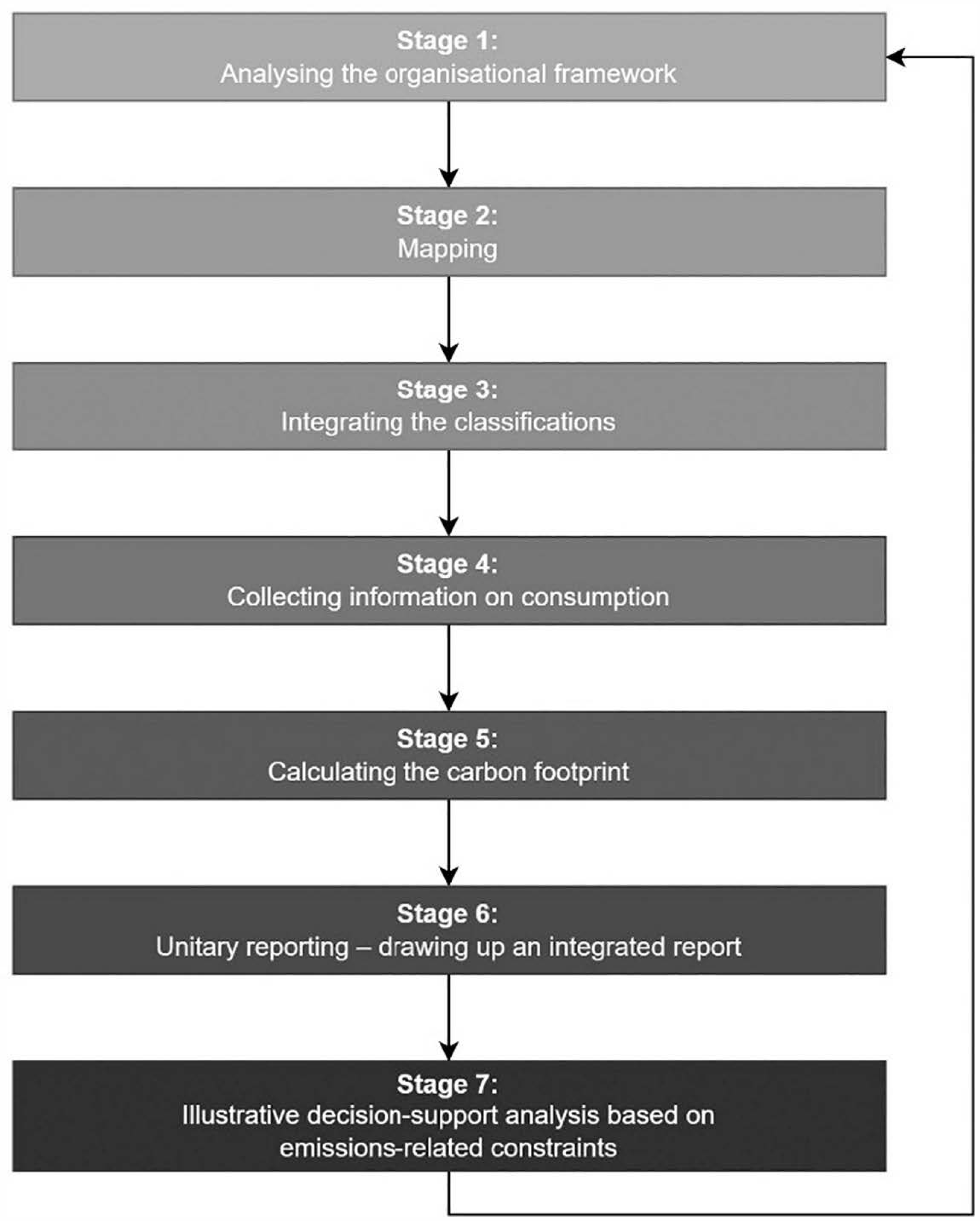
3.3. Developing an Integrated Methodology for Calculating the Carbon Footprint
- Structuring and quantifying energy consumption associated with the activities carried out by a courier logistics hub;
- Enabling the transparent and consistent interpretation of emissions-related data within a structured decision support context.
- The transformation of data resulting from the emissions inventory (according to GHG/ISO) into decision variables (volume of activity, level of equipment usage, structure of fluxes);
- Defining an objective function representing an aggregate energy or emissions-related indicator;
- Simultaneously observing constraints imposed by capacity, demand, environmental standards, and emissions-related limits.
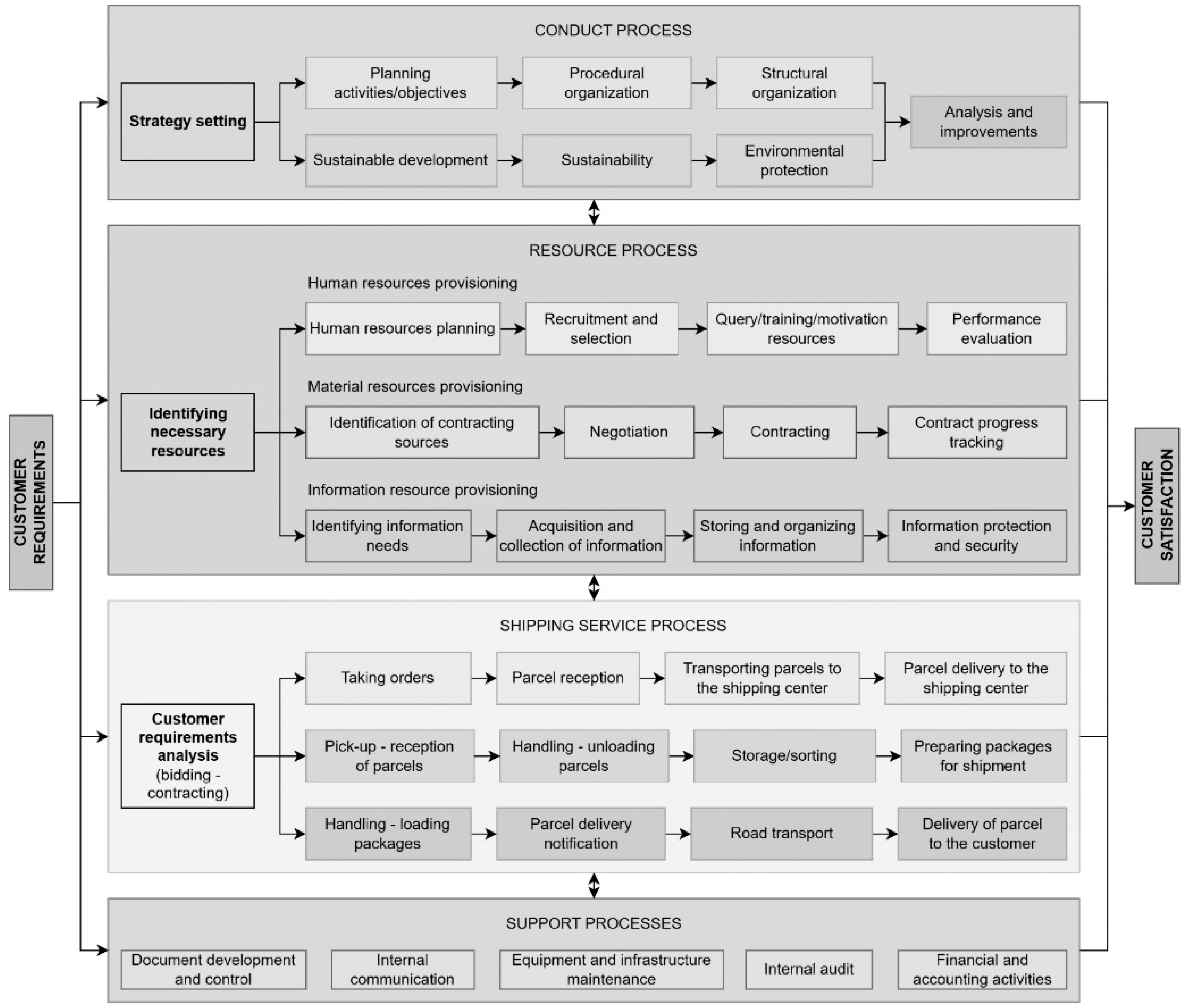
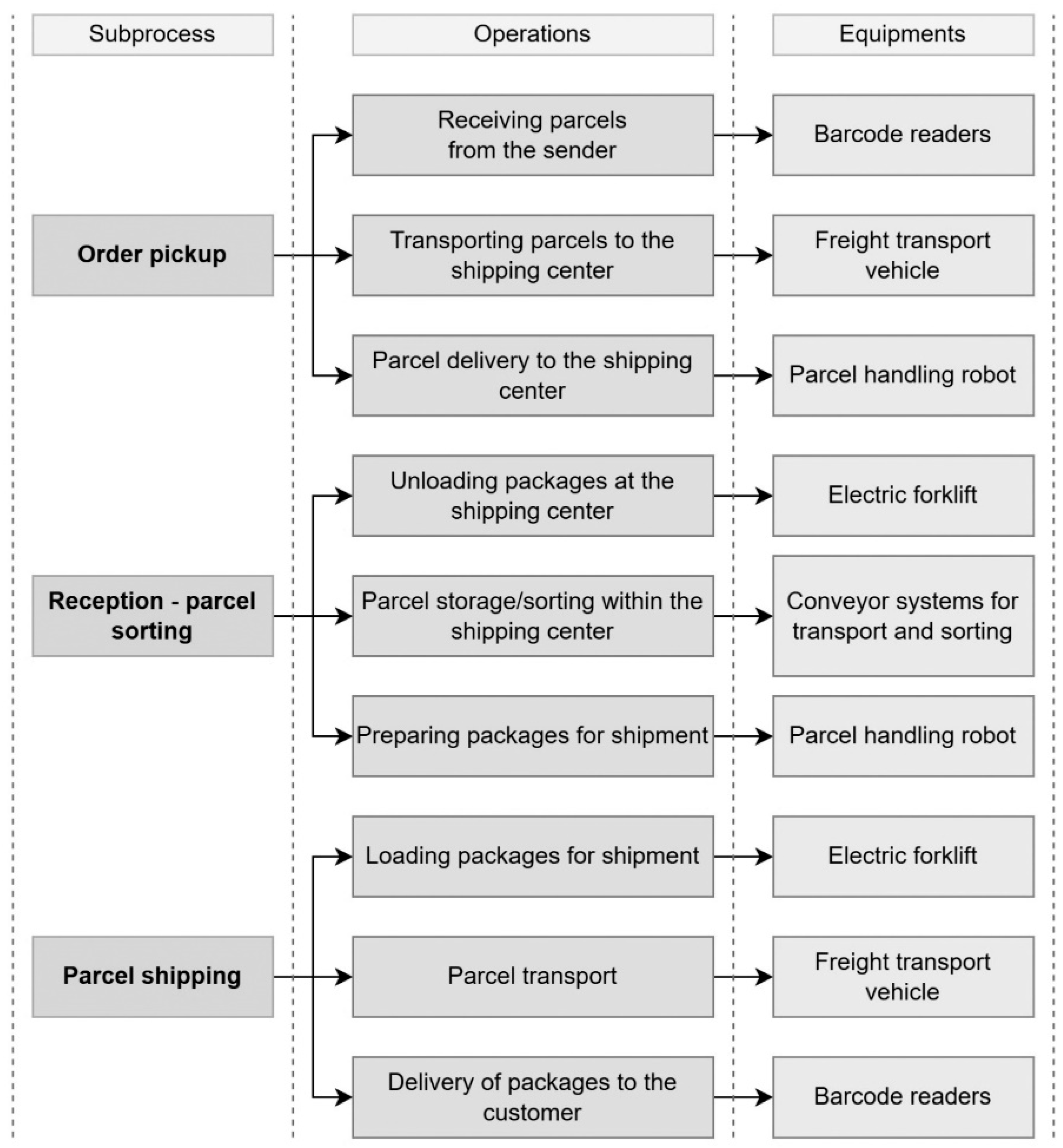
3.4. Applying the Previous Algorithm to a Courier Logistics Hub
- Own diesel lorries fleet (direct emissions—scope 1/ISO 14064-1);
- Warehouse electric energy consumption (indirect emissions—scope 2);
- Subcontractors’ activities (land transport)—other indirect emissions (scope 3).
- The use of standardized emission factors;
- Data uncertainty (±5%);
- Information traceability (fuel invoices, GPS reports, electricity consumption).
- Manages around 250,000 parcels on a daily basis;
- Operates 24 h/day (3 shifts);
- Uses estimates without being influenced by operational peaks.
- Feed conveyors (6 conveyors);
- Accumulation/deceleration conveyors (2 conveyors);
- Conveyors with sorting systems (2 conveyors);
- Outfeed conveyors (12 conveyors).
4. Discussion
- Scenario 1—Variation in energy unit prices
- Scenario 2—Variation in activity volume
- The analytical solution structure remains stable under moderate variations in the objective function coefficients;
- Increases in activity volume lead to proportional increases in the aggregate energy indicator, while preserving the inclusion of all activity flows;
- The integrated analytical framework can be used to explore alternative scenarios by linking emissions inventories with structured representations of operational constraints.
5. Conclusions
Author Contributions
Funding
Institutional Review Board Statement
Informed Consent Statement
Data Availability Statement
Conflicts of Interest
References
- Available online: https://research-and-innovation.ec.europa.eu/research-area/industrial-research-and-innovation/industry-50_en#:~:text=It%20complements%20the%20existing%20,centric%20and%20resilient%20European%20industry (accessed on 4 November 2025).
- The GHG Protocol Establishes Comprehensive Global Standardized Frameworks for Measuring and Managing Greenhouse Gas (GHG) Emissions from Private and Public Sector Operations, Value Chains and Mitigation Actions. The Guidelines in the 2nd Aim Represented a Significant Change in the Corporate Standard. Available online: https://ghgprotocol.org/ (accessed on 4 November 2025).
- ISO14064-1:2018; Greenhouse gases—Part 1: Specification with Organization-Wide guidance for Quantifying and Reporting Greenhouse Gas Emissions and Removals. International Organization for Standardization: Geneva, Switzerland, 2018.
- ISO14064-3:2018; Greenhouse gases—Part 3: Specification with Guidelines for the Verification and Validation of Greenhouse Gas Claims. International Organization for Standardization: Geneva, Switzerland, 2018.
- Marchet, G.; Melacini, M.; Sassi, C.; Tappia, E. Assessing efficiency and innovation in the 3PL industry: An empirical analysis. Int. J. Logist. Res. Appl. 2017, 20, 53–72. [Google Scholar] [CrossRef]
- Govindan, K. Industry 4.0: A review of applications in supply chain management. Comput. Ind. 2018, 101, 159–172. [Google Scholar]
- Fatorachian, H.; Kazemi, H. Impact of Industry 4.0 on Supply Chain Performance. Prod. Plan. Control 2021, 32, 63–81. [Google Scholar] [CrossRef]
- Pereira, N.; Antunes, J.; Barreto, L. Impact of management and reverse logistics on recycling in a war scenario. Sustainability 2023, 15, 3835. [Google Scholar] [CrossRef]
- Rastegardehbidi, P.; Su, Z. Key drivers of green logistics: A systematic literature review and conceptual framework. Sustainability 2025, 17, 9604. [Google Scholar] [CrossRef]
- Wang, K.; Chen, X.; Wang, C. The impact of sustainable development planning in resource-based cities on corporate ESG–Evidence from China. Energy Econ. 2023, 127, 107087. [Google Scholar] [CrossRef]
- Available online: https://www.eea.europa.eu/en/topics/in-depth/transport-and-mobility#:~:text=disturbed%20by%20long,from%20transport%20in%20the%20EU (accessed on 19 August 2025).
- Wan, B.; Wan, W.; Hanif, N.; Ahmed, Z. Logistics performance and environmental sustainability: Do green innovation, renewable energy, and economic globalization matter? Front. Environ. Sci. 2022, 10, 996341. [Google Scholar] [CrossRef]
- Fatorachian, H.; Kazemi, H.; Pawar, K. Digital Transformation for Sustainable Transportation: Leveraging Industry 4.0 Technologies to Optimize Efficiency and Reduce Emissions. Future Transp. 2025, 5, 34. [Google Scholar] [CrossRef]
- Mohan, A.; Krishnan, R.; Arshinder, K.; Vandore, J.; Ramanathan, U. Management of postharvest losses and wastages in the Indian tomato supply chain—A temperature-controlled storage perspective. Sustainability 2023, 15, 1331. [Google Scholar]
- Nicoletti, B.; Appolloni, A. Green Logistics 5.0: A review of sustainability-oriented innovation with foundation models in logistics. Eur. J. Innov. Manag. 2024, 27, 542–561. [Google Scholar] [CrossRef]
- Yontar, E. The role of blockchain technology in the sustainability of supply chain management: Grey based dematel implementation. Clean. Logist. Supply Chain 2023, 8, 100113. [Google Scholar] [CrossRef]
- El Jaouhari, A.; Azari, M.; Arif, J.; El Farouk, I.I.; Jawab, F.; Moufad, I. IoT for the future of sustainable supply chain management in Industry 4.0: A Systematic Literature Review. In Proceedings of the 2022 14th International Colloquium of Logistics and Supply Chain Management (LOGISTIQUA), El Jadida, Morocco, 25–27 May 2022; pp. 1–6. [Google Scholar]
- Gupta, P.; Sharma, Y.; Chauhan, A.; Parewa, B.; Rai, P.; Naik, N. Investigation of green supply chain management practices and sustainability in Indian manufacturing enterprises using a structural equation modelling approach. Sci. Rep. 2025, 15, 14909. [Google Scholar] [CrossRef]
- Xu, Z.; Elomri, A.; Pokharel, S.; Mutlu, F. The design of green supply chains under carbon policies: A literature review of quantitative models. Sustainability 2019, 11, 3094. [Google Scholar] [CrossRef]
- Shamir, R. The efficiency of the simplex method: A survey. Manag. Sci. 1987, 33, 301–334. [Google Scholar] [CrossRef]
- Islam, S.; Biswas, H.R.; Khatun, U.H.; Rani, R.; Nourin, S.I. Optimizing Transportation Logistics for Cost Efficiency in a Garment Factory: A Linear Programming Approach Using LINDO. Sch. J. Phys. Math. Stat. 2024, 11, 146–149. [Google Scholar]
- Available online: https://eur-lex.europa.eu/legal-content/EN/TXT/?uri=CELEX:32022L2464 (accessed on 4 November 2025).
- Gualotuña Parra, J.A.; Valverde-Arias, O.; Tarquis, A.M.; Grau Olivé, J.B.; Speroni, F.C.; Saa-Requejo, A. Combining Markowitz Portfolio Model and Simplex Algorithm to Achieve Sustainable Land Management Objectives: Case Study of Rivadavia Banda Norte, Salta (Argentina). Sustainability 2023, 15, 11050. [Google Scholar] [CrossRef]
- Syifa, E.A.; Istiqomah, T.N.; Puspita, N.P.; Ratnasari, L.; Khabibah, S.; Anggoro, P.W.; Bawono, B. The application of linear programming for the optimal profit of pt. naruna using the Simplex method. Manag. Syst. Prod. Eng. 2023, 31, 138–143. [Google Scholar] [CrossRef]
- Mathavan, N.; Ramesh, G. Reducing non-optimal solution space for interval linear programming problems using interval arithmetic and simplex technique. AIP Conf. Proc. 2023, 2852, 120004. [Google Scholar]
- Zanella, F.; Vaz, C.B. Sustainable short-term production planning optimization. SN Comput. Sci. 2023, 4, 824. [Google Scholar] [CrossRef]
- Fan, J.; Meng, X.; Tian, J.; Xing, C.; Wang, C.; Wood, J. A review of transportation carbon emissions research using bibliometric analyses. J. Traffic Transp. Eng. (Engl. Ed.) 2023, 10, 878–899. [Google Scholar] [CrossRef]
- Cano, N.; Berrio, L.; Carvajal, E.; Arango, S. Assessing the carbon footprint of a Colombian University Campus using the UNE-ISO 14064–1 and WRI/WBCSD GHG Protocol Corporate Standard. Environ. Sci. Pollut. Res. 2023, 30, 3980–3996. [Google Scholar]
- Zhang, N.; Xie, F. A Review of Research on the Transportation Problem. Open J. Appl. Sci. 2025, 15, 1168–1177. [Google Scholar] [CrossRef]
- SR EN ISO 9001:2015; Quality Management Systems—Requirements. International Organization for Standardization: Geneva, Switzerland, 2015.
- SR EN 12464-1:2021; Light and Lighting. Lighting of Work Places. Part 1: Indoor Work Places. Romanian Standardization Association: Bucharest, Romania, 2021.
- Liu, C.; Zhu, Q.; Wei, F.; Rao, W.; Liu, J.; Hu, J.; Cai, W. An integrated optimization control method for remanufacturing assembly system. J. Clean. Prod. 2020, 248, 119261. [Google Scholar] [CrossRef]
- Wang, W.; Saari, R.K.; Bachmann, C.; Mukherjee, U. Estimating transboundary economic damages from climate change and air pollution for subnational incentives for green on-road freight. Transp. Res. Part D Transp. Environ. 2020, 82, 102325. [Google Scholar] [CrossRef]
- Wang, M.; Li, X.; Wang, S. Discovering research trends and opportunities of green finance and energy policy: A data-driven scientometric analysis. Energy Policy 2021, 154, 112295. [Google Scholar] [CrossRef]
- Farahani, R.Z.; Bajgan, H.R.; Fahimnia, B.; Kaviani, M. Location-inventory problem in supply chains: A modelling review. Int. J. Prod. Res. 2015, 53, 3769–3788. [Google Scholar]



| Similarities | Differences |
|---|---|
| Both tools aim at correctly quantifying and reporting emissions. The methodological principles are mostly identical. Both recognize the importance of transparency and accuracy. | Structure: The GHG Protocol analyzes emissions depending on their scope/application domain, while the ISO 14064 standards organize them into 6 categories. Applicability: The GHG Protocol is more often used for voluntary reporting, while the ISO 14064 standards are preferred for certification and verification. Compatibility: The GHG Protocol can be mapped to ISO 14064, but integration entails extra requirements. |
| Type of Facility | Average Consumption Considered/Unit [kWh] | Nominal Area/ Unit [m2] | Warehouse Usable Area [m2] | Number of Units | Consumed Power with Air Conditioning [kWh] |
|---|---|---|---|---|---|
| Air conditioning + ventilation | 2.85 | 70 | 2500 | 36 | 102.6 |
| Warehouse Area | Area (m2) | Light Intensity [lux] | Used Power [KWh] | Power Used with Lighting [KWh] |
|---|---|---|---|---|
| Buffer | 725 | 175 | 1 | 5.3 |
| Pickup/sorting | 875 | 300 | 2.1 | |
| Reception/shipping | 350 | 250 | 0.7 | |
| Offices | 300 | 500 | 1.2 | |
| Complementary | 250 | 150 | 0.3 |
| Equipment Used | Number of Pieces of Equipment | Used/Consumed Power/ Equipment [KWh] | Total Consumed Power [KWh] | Total Consumed Power by Equipment [KWh] |
|---|---|---|---|---|
| Feed conveyor | 6 | 2 | 12 | 39 |
| Accumulation conveyor | 2 | 3 | 6 | |
| Sorting conveyor | 2 | 3.5 | 7 | |
| Outfeed conveyor | 18 | 0.75 | 13.5 |
| Type of Consumption | Used Power/ Equipment [KWh] | Working Time [h] | Total Used Power [KWh] |
|---|---|---|---|
| Facilities | 107.9 | 24 | 2589.6 |
| Transport/sorting technical systems | 39 | 20 | 780 |
| IT equipment | 1 | 24 | 24 |
| Electric forklifts | 7.4 | 6 | 44.4 |
| Type of Vehicle | Number of Vehicles | Consumption [L/100 km] | Working Time [h] | Estimated Consumption [L/h] | Total Consumption per Day [L] |
|---|---|---|---|---|---|
| Lorries 7.5 tonnes | 10 | 20 | 18 | 15 | 3000 |
| Utility vehicles 3.5 tonnes | 250 | 8 | 12 | 5 | 15,000 |
| Activity | Fuel Quantity | Emission Factor | Total Emissions |
|---|---|---|---|
| Fuel used by the vehicle fleet (diesel) | 18,000 L/day | 2.64 kg CO2/L | 47.520 kg CO2/day = 47.52 tonnes CO2 per day |
| Activity | Fuel Quantity | Emission Factor | Total Emissions |
|---|---|---|---|
| Energy consumption for support equipment | 3.438 kWh | 0.265 kg CO2 (emission factor for electricity in Romania) | 0.91 kg CO2 = 0.00091 tonnes CO2 |
| Pickup (h) | Reception- Parcel Sorting (h)BA | Parcel Shipping (h)C | Minimum Value | |
|---|---|---|---|---|
| X1 | 0.5 h | 1.2 h | 1 h | 1.9 |
| X2 | 1.2 h | 0.5 h | 0.3 h | 1.8 |
| X3 | 0.2 h | 0.1 h | 0.3 h | 1.6 |
Disclaimer/Publisher’s Note: The statements, opinions and data contained in all publications are solely those of the individual author(s) and contributor(s) and not of MDPI and/or the editor(s). MDPI and/or the editor(s) disclaim responsibility for any injury to people or property resulting from any ideas, methods, instructions or products referred to in the content. |
© 2026 by the authors. Licensee MDPI, Basel, Switzerland. This article is an open access article distributed under the terms and conditions of the Creative Commons Attribution (CC BY) license.
Share and Cite
Ifrim, A.-M.; Popescu, C.-A.; Silvestru, C.-I.; Oncioiu, I.; Dobrescu, T.-G. A Framework for Integrating Carbon Accounting Standards into Decision Support Structures in Logistics. Sustainability 2026, 18, 1542. https://doi.org/10.3390/su18031542
Ifrim A-M, Popescu C-A, Silvestru C-I, Oncioiu I, Dobrescu T-G. A Framework for Integrating Carbon Accounting Standards into Decision Support Structures in Logistics. Sustainability. 2026; 18(3):1542. https://doi.org/10.3390/su18031542
Chicago/Turabian StyleIfrim, Ana-Maria, Constantin-Adrian Popescu, Catalin-Ionut Silvestru, Ionica Oncioiu, and Tiberiu-Gabriel Dobrescu. 2026. "A Framework for Integrating Carbon Accounting Standards into Decision Support Structures in Logistics" Sustainability 18, no. 3: 1542. https://doi.org/10.3390/su18031542
APA StyleIfrim, A.-M., Popescu, C.-A., Silvestru, C.-I., Oncioiu, I., & Dobrescu, T.-G. (2026). A Framework for Integrating Carbon Accounting Standards into Decision Support Structures in Logistics. Sustainability, 18(3), 1542. https://doi.org/10.3390/su18031542