Article

Multi-Source Joint Water Allocation and Route Interconnection Under Low-Flow Conditions: An IMWA-IRRS Framework for the Yellow River Water Supply Region Within Water Network Layout


1
Hubei Key Laboratory of Water Resources & Eco-Environmental Sciences, Changjiang River Scientific Research Institute, Wuhan 430010, China
2
Research Center on the Yangtze River Economic Belt Protection and Development Strategy, Wuhan 430010, China
3
School of Civil Engineering, Tianjin University, Tianjin 300354, China
4
School of Water Resources and Hydropower Engineering, North China Electric Power University, Beijing 102206, China
5
General Institute of Water Resources and Hydropower Planning and Design, Ministry of Water Resources, Beijing 100120, China
6
College of Water Conservancy and Hydropower Engineering, Hohai University, Nanjing 210098, China
7
College of Hydraulic and Environmental Engineering, China Three Gorges University, Yichang 443002, China
*
Authors to whom correspondence should be addressed.
Sustainability 2026, 18(3), 1541; https://doi.org/10.3390/su18031541
Submission received: 18 December 2025 / Revised: 23 January 2026 / Accepted: 30 January 2026 / Published: 3 February 2026
(This article belongs to the Section Sustainable Water Management)

Abstract

Under intensifying climate change and anthropogenic pressures, extreme low-flow events increasingly jeopardize water security in the Yellow River water supply region. This study develops the Inter-basin Multi-source Water Joint Allocation and Interconnected Routes Regulation System (IMWA-IRRS) to optimize spatiotemporal allocation of multi-source water and simulate topological relationships in complex water networks. The model integrates system dynamics simulation with multi-objective optimization, validated through multi-criteria calibration using three performance indicators: correlation coefficient (R), Nash-Sutcliffe Efficiency (Ens), and percent bias (PBIAS). Application results demonstrated exceptional predictive performance in the study area: Monthly runoff simulations at four hydrological stations yielded R > 0.98 and Ens > 0.98 between simulated and observed data during both calibration and validation periods, with |PBIAS| < 10%; human-impacted runoff simulations at four hydrological stations achieved R > 0.8 between simulated and observed values, accompanied by PBIAS within ±10%; sectoral water consumption across the Yellow River Basin exhibited PBIAS < 5%, while source-specific water supply simulations maintained PBIAS generally within 10%. Comparative analysis revealed the IMWA-IRRS model achieves simulation performance comparable to the WEAP model for natural runoff, human-impacted runoff, water consumption, and water supply dynamics in the Yellow River Basin. The 2035 water allocation scheme for Yellow River water supply region projects total water supply of 59.691 billion m3 with an unmet water demand of 3.462 billion m3 under 75% low-flow conditions and 58.746 billion m3 with 4.407 billion m3 unmet demand under 95% low-flow conditions. Limited coverage of the South-to-North Water Diversion Project’s Middle and Eastern Routes constrains water supply security, necessitating future expansion of their service areas to leverage inter-route complementarity while implementing demand-side management strategies. Collectively, the IMWA-IRRS model provides a robust decision-support tool for refined water resources management in complex inter-basin diversion systems.

1. Introduction

The Yellow River Basin serves as a critical ecological barrier and significant economic zone in China, occupying a pivotal strategic position in the nation’s development landscape [1,2]. However, the basin is inherently endowed with poor water resources. The core challenge lies in the fundamental imbalance between socioeconomic development demands and water resource carrying capacity [3,4]. Per capita water availability within the basin constitutes approximately 25% of the national average in 2021; concurrently, per capita water consumption remains 16% below the national average, reflecting the intense pressure to meet basic needs despite limited resources. Compounding this, surface water exploitation has reached an exceptionally high rate of 80% [5,6], far exceeding sustainable thresholds. This situation fosters intense competition for water allocation between socioeconomic demands and ecological water requirements. Consequently, the basin exhibits markedly reduced drought resilience, exacerbating vulnerability to hydrological extremes [7,8].
Under the dual pressures of climate change and intensive anthropogenic activities, the Yellow River Basin and its associated water supply regions face unprecedented complexity in safeguarding water resource security [9,10,11]. Over the past century, the basin has experienced three distinct prolonged low-flow episodes (1922–1932, 1969–1974, and 1990–2002) [12,13]. During these periods, the natural runoff at the Huayuankou station registered deficits of 21%, 14%, and 20%, respectively, relative to the long-term average of the 1956–2016 hydrological series [14]. Notably, in exceptionally dry years with a flow frequency of 90%, the natural runoff deficit exceeds 27%, reaching a peak deficit of 47% during the driest recorded year (2002). Furthermore, the basin’s mean annual natural runoff volume has undergone a pronounced secular decline, declining from 58 billion m3 in the mid-20th century to 49 billion m3 currently, representing a substantive reduction of approximately 17% [15]. This trajectory signifies a persistent deterioration in the basin’s inherent water resource endowment. Compounding this scarcity, per capita water consumption within the basin remains constrained at merely 84% of the national average, while surface water exploitation rates have exceeded the critical ecological threshold of 80%, well above the internationally recognized sustainable utilization limit of 40% [16,17].
Projections under extreme drought conditions indicate a severe water supply deficit estimated at 9.68 billion m3, equating to a deficit ratio of 23.6%. This shortfall exhibits sectoral disparity, with the agricultural water supply deficit being particularly acute at 29.1%. Crucially, environmental flow allocations suffer severe curtailment, displaced by socioeconomic priorities to levels as low as 21.5% of the multi-year average. Such drastic reductions in ecological water provision pose a significant and escalating threat to the structural integrity and functional resilience of the basin’s ecosystems [18]. Consequently, a critical contradiction has emerged between the accelerating depletion of water resources and the inelastic growth of socioeconomic demands. Water scarcity has thus evolved into the critical bottleneck severely constraining sustainable socioeconomic progress throughout the Yellow River Basin [19,20].
The currently implemented Yellow River water allocation scheme persists in the water resources allocation framework established prior to the operational commencement of the Eastern and Middle Routes of the South-to-North Water Diversion Project [21], which employs a unidirectional scheduling mode lacking an inter-basin and cross-regional surplus-deficit compensation mechanism. Despite the implementation of emergency measures including expanded groundwater extraction and coordinated reservoir group operation, these interventions remain insufficient to fully bridge the water deficit [22]. Although the completed first phase of the Eastern and Middle Routes of the South-to-North Water Diversion Project has cumulatively transferred over 30 billion m3 of water, approximately 80% of this volume has been allocated to replenish downstream sections of the Yellow River Basin, thereby failing to adequately accommodate the substantial water demands of the relatively water-stressed midstream and upstream regions [23]. Compounding this challenge is the pronounced spatiotemporal mismatch between water resource distribution and socioeconomic development patterns within the Yellow River Basin. While Qinghai and Gansu provinces, constituting the Basin’s primary water-producing regions, collectively contribute 60% of its total runoff, they receive only 12% of the allocated water quotas. This stark disparity highlights the urgent need to improve regional equity in water resource allocation [24].
China is currently accelerating the construction of its National Water Network, which now features a prototype national mega water network integrating rivers, lakes, reservoirs, and canals between the Yangtze and Yellow River Basins. Key operational components including the Eastern and Middle Routes of the South-to-North Water Diversion Project and the Hanjiang-to-Weihe River Water Diversion Project have become operational, effectively supplementing water supply across the middle and lower reaches of the Yellow River Basin [25]. The Western Route of the South-to-North Water Diversion Project, currently in advanced planning stages, will substantially augment inter-basin water transfer capacities, with its impact zone extending to primary water supply zones across the upper and middle reaches of the Yellow River Basin. These initiatives create critical water conveyance pathways from the water-abundant Yangtze River Basin to supplement the Yellow River Basin, thereby offering transformative opportunities for enhancing water resources security throughout the Yellow River Basin [26,27]. Against the backdrop of National Water Network development, safeguarding water resources security in the Yellow River Basin during extreme hydrological droughts constitutes a critical unresolved challenge in implementing the major national strategy for ecological conservation and high-quality development in the basin [28,29]. Consequently, advancing research on multi-source water allocation mechanisms through coordinated operation of the Eastern, Middle, and Western Routes of the South-to-North Water Diversion Project is, therefore, imperative [30].
This work focuses on the severe water resource challenges and complex governance dilemmas mentioned above, exploring and addressing the following two issues:
(a)
Building a water resource allocation model that considers multiple routes and multiple water sources
Building a water resource allocation model that can fully consider multiple water diversion routes such as the Eastern, Middle, and Western Routes of the South-to-North Water Diversion Project, as well as various water sources including surface water, groundwater, and unconventional water resources in the Yellow River Basin, to achieve spatially-explicit water resource regulation under the complex water network system of the Yellow River Basin and provide a reliable tool for multi-route regulation in the Yellow River water supply area under extreme low-flow scenarios is critical.
(b)
Conducting water diversion and regulation under different low-flow scenarios of the Yellow River for the mutual support of the Eastern, Middle, and Western Routes of the South-to-North Water Diversion Project.
Establishing a novel water resources allocation framework characterized by “multi-source complementation, multi-route interconnection, and multi-objective coordination” through joint operation and water mutual aid of the Eastern, Middle, and Western Routes of the South-to-North Water Diversion Project, aimed at improving water security reliability and ensuring regional equity in the Yellow River water-supply area, based on the water demand of the Yellow River Basin in 2035, is critical.
This research has important practical significance and strategic value for strengthening water resource security in the Yellow River Basin and supporting the basin’s high-quality development.

2. Description of the Study Area

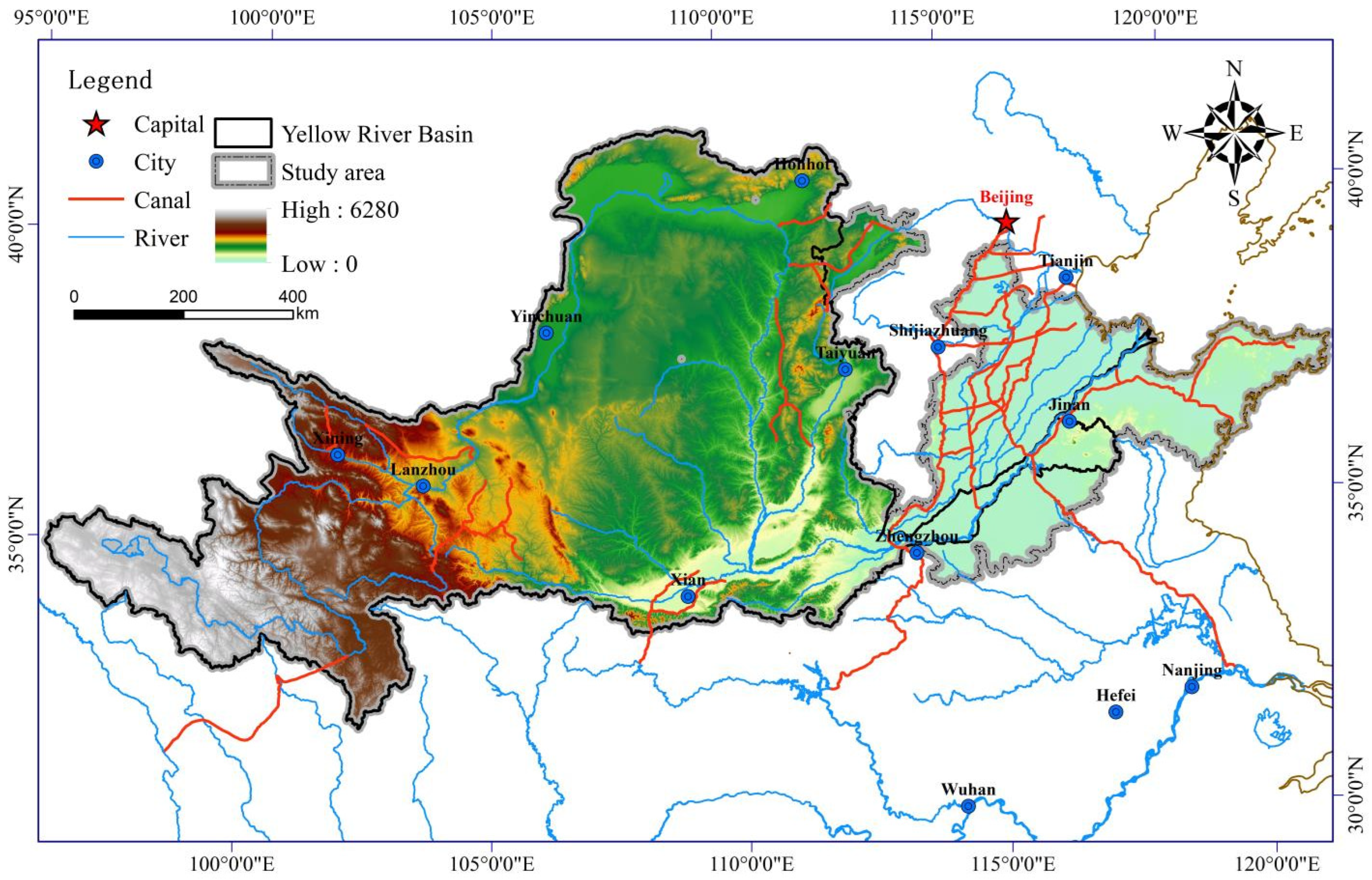
The Yellow River is hailed as the “Mother River” of the Chinese nation, whose basin and external water supply areas collectively form a vital water resource system and socioeconomic development belt in northern China. Stretching 5464 km in length, the river flows through nine provinces—Qinghai, Sichuan, Gansu, Ningxia, Inner Mongolia, Shanxi, Shaanxi, Henan, and Shandong [1]. As a strategic water resource allocation project in northern China, the Yellow River provides water to extra-basin areas through projects such as the “Yellow River to Qingdao Water Diversion” and the “Yellow River to Hebei Water Diversion”. These water supply areas, including parts of the Shandong Peninsula, Shanxi, Hebei, and Henan, cover a total area of 201,000 km2. Together with the Yellow River Basin, the entire Yellow River water supply region spans 997,000 km2, located between 96–123° E and 32–42° N (Figure 1).
Water resources in the Yellow River supply area are limited in total quantity and unevenly distributed spatially [31,32]. The upper reaches serve as the primary water-generating region, with runoff at the Lanzhou section accounting for 62% of the total river runoff of the Yellow River. Gansu, Ningxia, and Inner Mongolia are the primary water-consuming regions within the basin, with their annual water usage comprising 41% of the total water consumption in the Yellow River Basin. In recent years, continuous expansion of the water supply scope and increasing demand have rendered the Yellow River supply area one of the most water-stressed regions in China.
According to the relevant data, the long-term average natural runoff of the Yellow River stands at 43.7 billion m3, while the water supply has increased from 44.6 billion m3 in 1980 to the current 51.2 billion m3 [15]. Surface water consumption has reached 31.8 billion m3, representing 73% of natural runoff—a proportion far exceeding the water resource carrying capacity. With projected further reductions in Yellow River water resources and escalating demand, the Yellow River supply area will face even more severe water scarcity challenges, highlighting the need for a scientific mechanism for multi-route water transfer and multi-source integrated allocation.

3. Materials and Methods

3.1. Description of the IMWA-IRRS Model

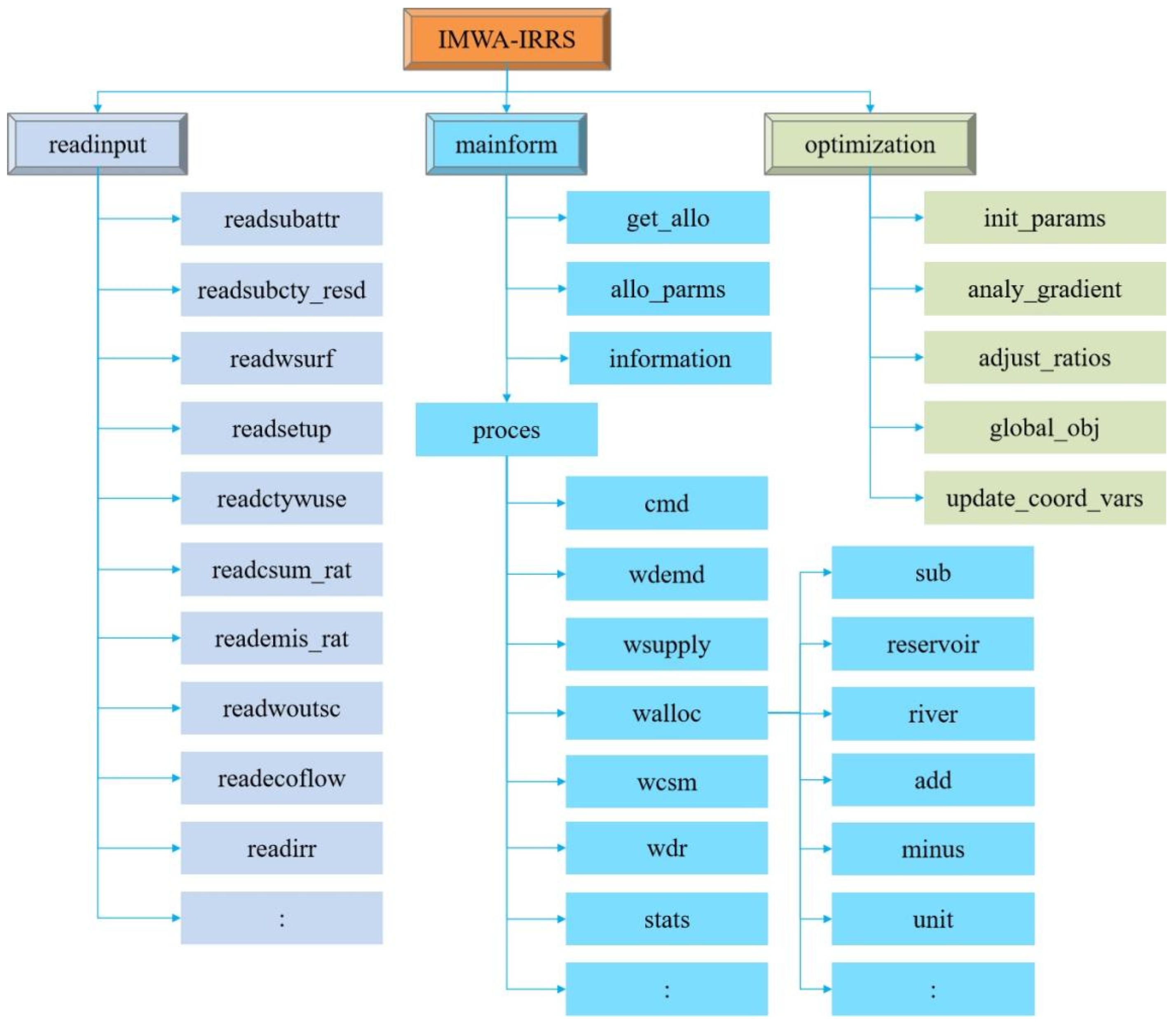
The Inter-basin Multi-source Water Joint Allocation and Interconnected Routes Regulation System (IMWA-IRRS), independently developed in this study, was developed in FORTRAN and compiled using Microsoft Visual Studio 2012, which is developed by Microsoft Corporation, headquartered in Redmond, WA, USA. Centered on the refined allocation of water resources, the model operates through the coordinated functioning of three core modules: data input, main program, and optimization (Table 1). Serving as the model’s data foundation, the Data input module integrates functionalities for basic data loading and management rule parsing. It ingests static foundational data (including watershed topography and hydrometeorological conditions) and deciphers complex dynamic management rules encompassing inflow forecasting, water allocation protocols, ecological constraints, and irrigation schedules. Concurrently, it spatially downscales water demand data to computational units via spatial allocation algorithms. Ultimately, this module generates spatiotemporal statistical metrics at annual and monthly resolutions for watersheds and administrative regions. These outputs are transmitted to the main program module, serving as critical driving parameters and evaluation benchmarks for subsequent computational processes.
The main program module serves as the system’s core component, tasked with simulating real-time dynamic water resource allocation and conducting statistical analysis of simulation outcomes. The module integrates subroutines for water allocation, river, water transfer, reservoir, and groundwater modules. Utilizing real-time hydrological boundary conditions and incorporating source-type specific abstraction rules, the main program module computes monthly water withdrawals for each computational unit. Based on these unit-specific monthly withdrawals, sectoral water demand data, and water use regulations, the allocation component of the module then executes monthly water distribution. Subsequent processing by water consumption and drainage subroutines generates detailed monthly outputs on water withdrawals, consumption, and drainage volumes. This integrated framework establishes a dynamic iterative computation loop at the computational unit scale, simulating the sequential processes of “diversion–conveyance–distribution–consumption–drainage”. Through this sophisticated computational workflow, the main program module achieves spatially refined water resource allocation among diverse user sectors.
The optimization module refines model parameters and water allocation schemes through multiple subroutines, ensuring the effective propagation of optimized results throughout the system. Leveraging simulation outputs from the main program module, the optimization module employs mathematical optimization algorithms, including gradient analysis, parameter adjustment, convergence diagnostics, and coordinated variable analysis to resolve multi-objective trade-offs among water demand satisfaction, equity, and sustainability criteria. These optimized solutions are subsequently fed back to the water allocation module, establishing an iterative feedback mechanism for the dynamic adjustment of allocation strategies.
Collectively, the three modules form a closed-loop coupling framework that enables the IMWA-IRRS model to function as an integrated decision-making tool. The model combines the process simulation of water allocation dynamics with normative optimization of multi-objective water allocation strategies, enabling both scenario analysis and the development of optimal management schemes for complex inter-basin water systems. Through real-time data exchange between input and output interfaces, the IMWA-IRRS model forms a comprehensive water resource allocation mechanism characterized by iterative simulation–feedback–optimization cycles. The architectural structure of the model is visually depicted in Figure 2.

3.2. The Main Principle of the Model

3.2.1. Spatial Allocation of Water Demand Data

The computational units (CUs) for water resource allocation in the IMWA-IRRS model are delineated through the spatial overlay method integrating natural sub-basins and administrative divisions. Given that historical water use data in China are statistically compiled and published at the provincial administrative division level, the model utilizes water demand data at the provincial administrative division level as input and downscales and decomposes the water demand data to CUs through a process based on the area proportions of residential/industrial land and agricultural land within each administrative division. These water demand datasets encompass domestic, ecological, industrial, and agricultural water demands. Specifically, domestic, ecological, and industrial water demands are calculated according to the proportion of construction land area within each CU, while agricultural irrigation water demand is determined based on the proportion of farmland area in each CU [33]. The spatial distribution process of the data is as follows:
(1)
The readsubcty_resd subroutine identifies CUs belonging to the provincial administrative division. Based on the construction land area and farmland area within each CU, it accumulatively calculates the total construction land area and farmland area of the provincial administrative division, computes the area proportions of construction land and farmland for each CU, and transmits the data to the wdemd subroutine for subsequent processing.
(2)
The wdemd subroutine identifies the included CUs in the provincial administrative division. According to the proportions of construction land area and farmland area in each CU, it distributes the water demand data to each CU.

3.2.2. Cyclic Simulation of Managed Water Flow

The process subroutine constructs a cyclic computational framework for multi-process water management, which interconnects the river, reservoir, groundwater, outwp, walloc, and wcsm_dr subroutines through parametric linkages to achieve integrated management of water resources allocation [34].
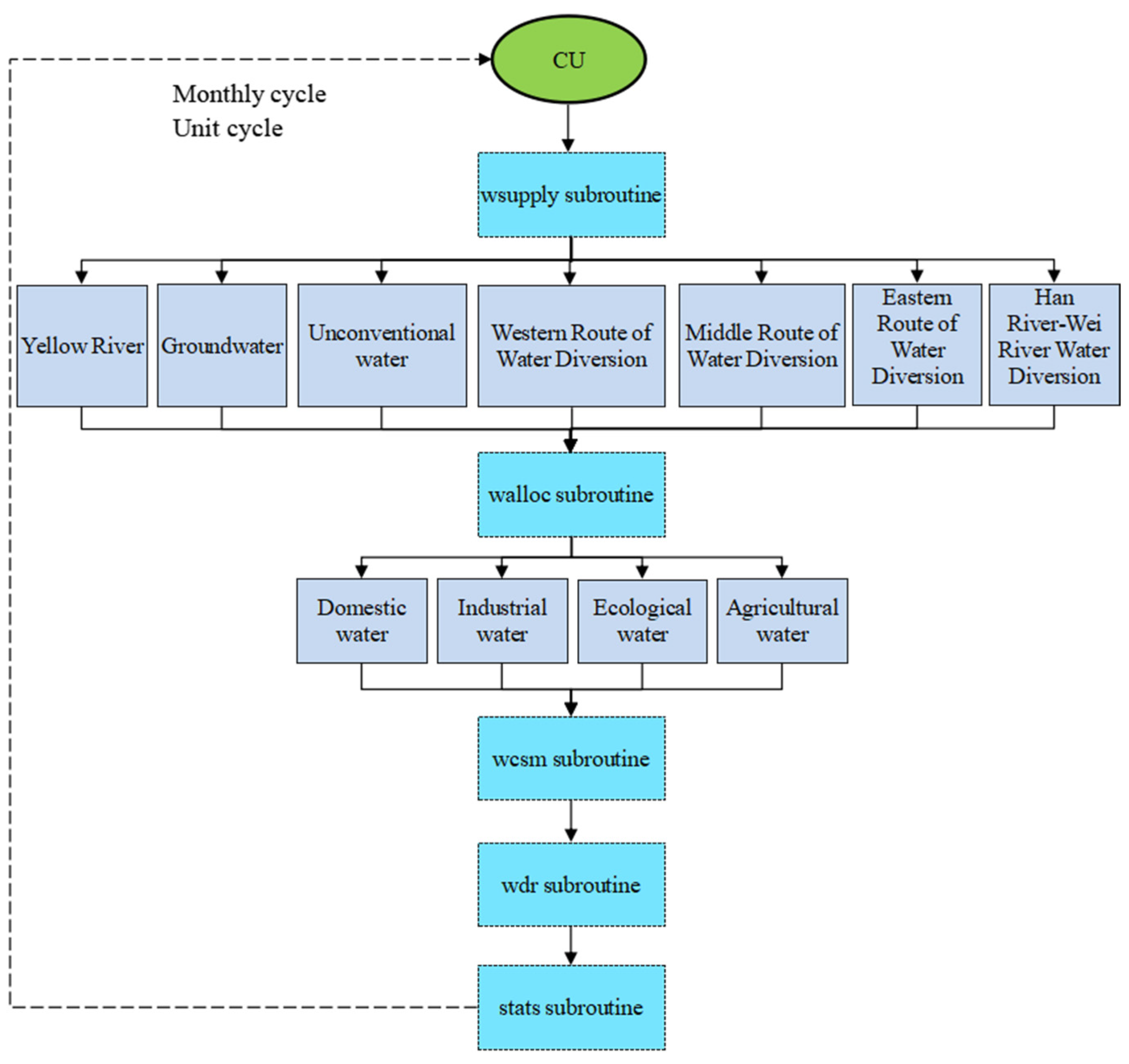
The wsupply subroutine dynamically invokes diverse water source subroutines to quantify available water supply, thereby generating foundational data to support water allocation. The walloc subroutine distributes water volumes following predefined operational rules to satisfy multi-sectoral demands. The wcsm_dr simulation subroutine computes actual water depletion volumes and return flows, respectively. Finally, the stats subroutine performs comprehensive analysis of system-wide data flows, enabling dynamic assessment and operational optimization of the water resource system (Figure 3).

3.2.3. Priority Calculation of Water Use and Water Supply

The walloc subroutine implements a computational framework for multi-source supply allocation and multi-user demand coordination [35].
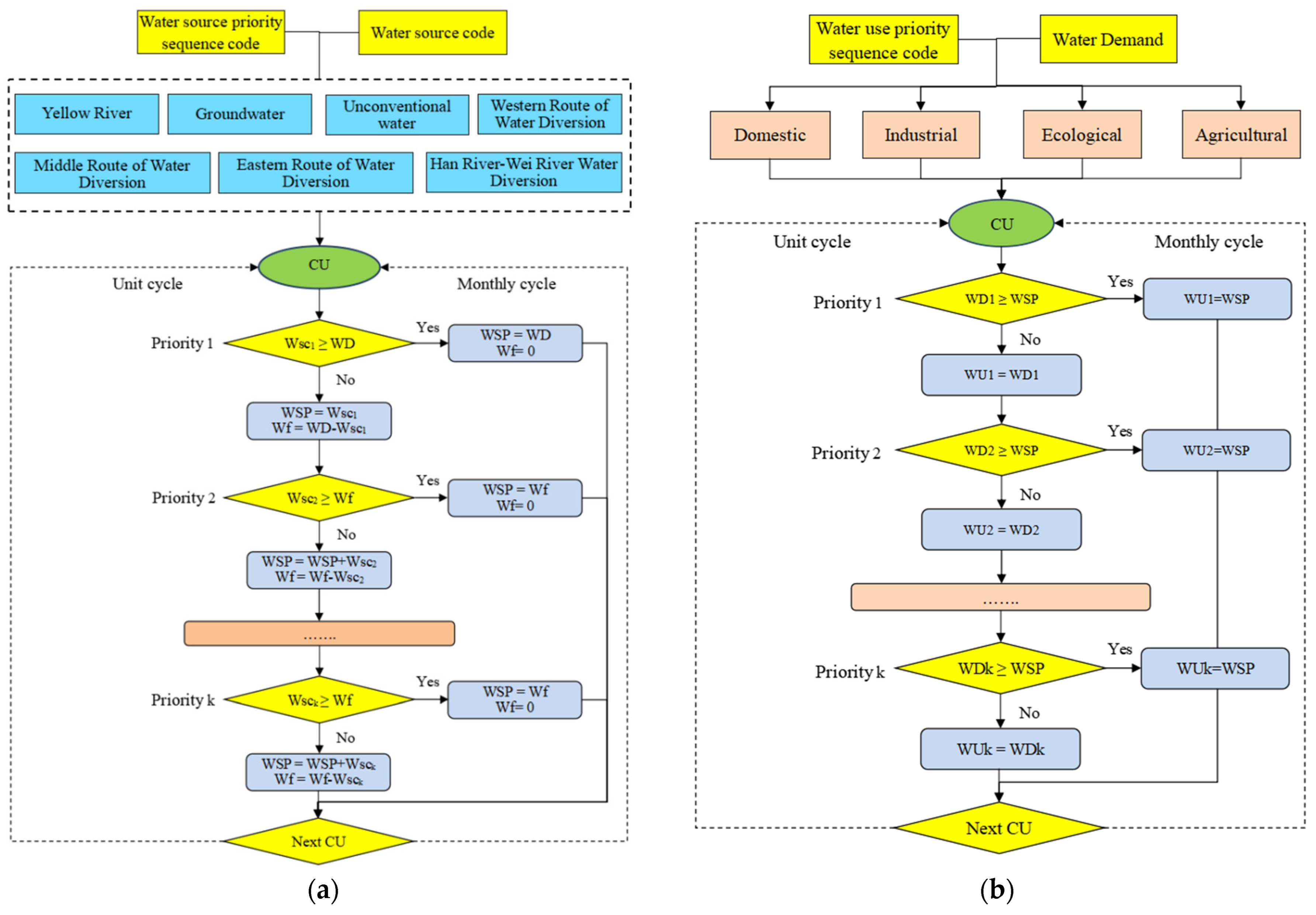
Within the walloc subroutine, the multi-source conjunctive water supply computation integrates diverse water resources including the Yellow River, groundwater, unconventional water, Hanjiang-to-Weihe River water diversion, and the East/Middle/West Routes of the South-to-North Water Diversion Project. Each CU integrates a user-configurable source priority hierarchy, which dynamically adjusts the abstraction sequences based on regional hydrological characteristics. The algorithm performs sequential water allocation starting from the highest-priority source, proceeding iteratively through lower-ranked sources until either (a) the CU’s water demand is fully met, or (b) all designated sources are exhausted. This process is schematically illustrated in Figure 4a, and its mathematical formulation is presented in Equation (1).
W S P i = m i n m a x 0 , W D k = 1 I 1 W S P k , W F , W S C i , W M X
where, WSPi represents the water supply of the water source with a supply priority of i (m3); I is the number of water sources in the CU; WD is the water demand of the CU (m3); WF is the water supply capacity of the source (m3); Wsc is the available water amount of the water source (m3); WMX is the total water use limit (m3).
In water resources allocation, competing water demands from domestic, industrial, ecological, and agricultural irrigation sectors within a CU necessitate the establishment of priority-based allocation sequences. The model permits each CU to customize or adjust its internal water use priority schemes in accordance with specific management objectives. Water allocation proceeds sequentially according to the predefined priority order of water sectors until the total available water withdrawal for the unit is fully allocated. The computational procedure for water use priority is illustrated in Figure 4b. The formula for water use calculation is presented in Equation (2).
W U i = m i n W D i , m a x 0 , W S P · ( 1 p i p ) j = 1 I 1 W U j
where, i represents the number of water consumption departments in the CU; WD represents the water demand of the water sector (m3). WU is the actual amount of water used by the water sector (m3). WSP represents the amount of water supply of the CU (m3); pip represents the loss rate during water supply.

3.2.4. Optimization Method

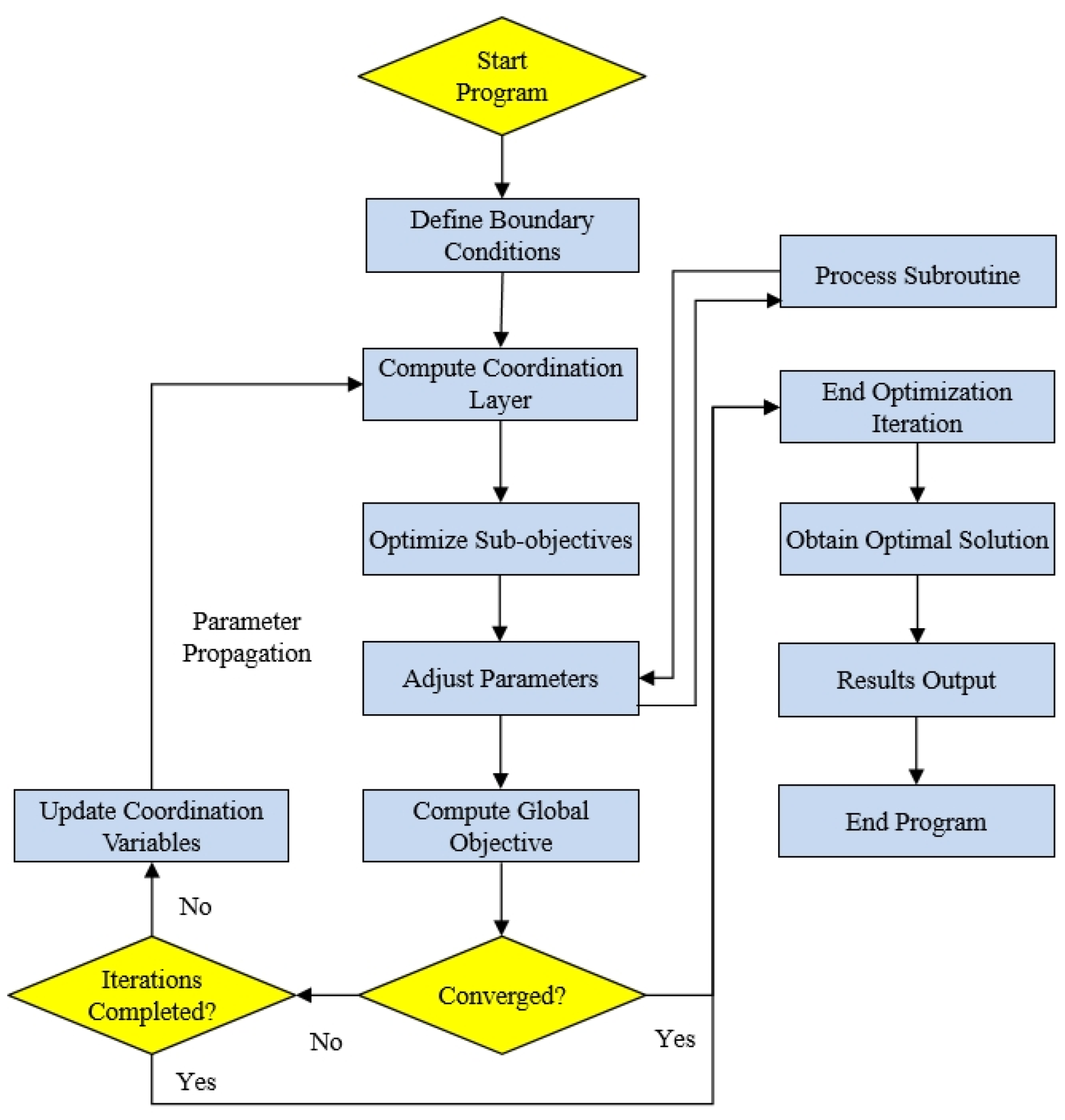
In the IMWA-IRRS model, the optimization module employs a large-scale system decomposition–coordination algorithm [36,37], partitioning the study area into upstream and downstream subsystems using the Huayuankou Hydrological Station as the nodal boundary. Through monthly optimization iterations, a hierarchical control structure is established to facilitate sequential decision-making. Concurrently, the gradient descent method is integrated to accelerate convergence toward the optimal objective, thereby enhancing computational efficiency and reducing optimization time. The specific implementation procedure is as follows:
Define boundary conditions and invoke the process subroutine to construct the optimization framework.
During the coordination layer computation phase, global strategies are formulated according to the correlation among sub-objectives to approximate global optimality; subsequently, each subsystem executes parallel local optimization and feeds back results to the subsequent phase.
In the parameter updating phase, optimization outcomes are integrated to iteratively recalibrate coordination variables and compute the global objective function.
Iteration termination criteria are determined based on predefined optimization iterations and convergence thresholds, ultimately outputting the system’s optimal solution.
The entire process achieves global optimization through bidirectional interactions between the coordination layer and subsystems, featuring modular design while emphasizing interdependencies and synergistic coordination across phases. The operational flowchart of the optimization module is illustrated in Figure 5.
(1)
Objective function
In this study, the model employs a multi-objective framework with two primary objectives: minimizing the water shortage rate and maximizing the equity index. These objectives are mathematically formulated in Equations (3)–(5):
m i n f x = ω 1 · R x + ω 2 · F x
ω 1 = 0.7 + 0.2 · t a n h ( N 2.0 ) 0.6 0.1 · l n ( N )
ω 2 = 1.0 ω 1
where, f(x) represents the overall objective of water resources allocation in the model, which is a coupled composite function integrating the water deficit index R(x) and the equity index F(x). ω 1 and ω 2 denotes the weighting factors for R(x) and F(x), respectively. N denotes the number of model optimizations.
Water deficit index
The water deficit index R(x) is defined as the ratio of water shortage to water demand within the study area, with the primary optimization goal of minimizing the water shortage rate. The formula is presented in Equation (6).
m i n R x = i = 1 N c j = 1 T D i j i = 1 N c j = 1 T W i j
where Dij denotes the water shortage volume for water-use sector j in region i, calculated as the difference between water demand and water supply (m3); Wij represents the water demand for water-use sector j in region i; Nc is the total number of regions, and T stands for the total number of time periods.
Equity index
The equity index F(x) serves as a metric for evaluating the fairness of water resources allocation. In this study, variance is employed to assess the equity level of water resources allocation within the study area, with the optimization goal set to minimize the negative value of equity. This relationship is mathematically expressed in Equations (7) and (8).
m i n F x = T σ D
σ D = 1 T ( D i j μ D ) 2
where μD denotes the averaged water shortage of the study area (m3); Dij denotes the water shortage volume for water-use sector j in region i (m3); T represents the total number of time periods.
(2)
Constraints
In the water resources allocation system, the constraint framework is structured to encompass multiple critical dimensions of hydrological and engineering feasibility, including reservoir storage capacity, ecological flow requirements, water demand satisfaction, water transfer capacity, and hydraulic capacity constraints of water networks.
Reservoir storage capacity
Owing to the dynamic operation of reservoir impoundment and release, the storage capacity of a reservoir exhibits temporal variability, with its fluctuation range constrained between the dead storage capacity (lower bound) and the total storage capacity (upper bound). This relationship is expressed in Equation (9).
Z m i n Z t Z m a x
where Zmin denotes the dead storage capacity of the reservoir (m3); Zn,t represents the reservoir storage volume at time period t (m3); and Zmax signifies the maximum storage capacity of the reservoir (m3).
Ecological flow requirements
A minimum instream flow must be maintained in the river during specific periods, below which irreversible degradation of the ecosystem will occur; thus, water intake from the river should not fall below this threshold. This relationship is given by Equation (10).
Q t Q m i n , t
where Qmin,t denotes the minimum ecological instream flow requirement in the river during time period t (m3/s); Qt represents the actual flow in the river during time period t (m3/s).
Water demand satisfaction
The actual water use of water-use sectors should not exceed their corresponding water demand, which constitutes a fundamental constraint in water resources allocation (Equation (11)).
W u W D
where Wu denotes the water use (m3), and WD represents the water demand (m3). These two variables establish the fundamental balance constraint between water utilization and water demand satisfaction in water resources allocation models.
Water transfer capacity
The actual flow of a water diversion channel shall not exceed its flow capacity. This relationship is expressed as Equation (12).
Q t Q m a x
where Qt represents the actual flow of a water diversion channel during time period t (m3); Qmax denotes the flow capacity of the water diversion channel (m3).
Hydraulic capacity of water networks
The actual water diversion volume is constrained by both the available water volume of water sources and the delivery capacity of channels (Equation (13)).
S t m i n R t ,   Q m a x
where St represents the actual water diversion volume from the water source during time period t (m3); Rt denotes the available water of the water source during time period t (m3); Qmax denotes the flow capacity of the water diversion channel (m3).
Channel water conveyance loss
During water transport in river channels, water losses occur due to natural processes such as reach-scale evaporation and riverbed infiltration. Consequently, runoff in a river reach is not merely the arithmetic sum of upstream inflow and interval confluence; it must also account for the deduction of conveyance losses. The formula is formulated in Equation (14).
L o s s t = m a x 0 ,   i = 1 n Q i , t Q d , t
where Losst represents the water losses volume between the upstream hydrological station and downstream hydrological station during time period t (m3); Qu,i,t denotes the channel inflow at the i-th upstream hydrological station during time period t (m3); Qd,t denotes the channel outflow at the downstream hydrological station during time period t (m3).

3.3. Data and Model Setup

3.3.1. Data

The data required in this work include the following:
  • Water resources data
    (1)
    Runoff data: Long-term monthly natural and measured runoff data from 1978 to 2016 for 15 hydrological stations along the main stem and major tributaries of the Yellow River, including Tangnaihai, Lanzhou, Shizuishan, Huayuankou, Lijin, Minhe, Hengtang, Hongqi, Wenjiachuan, Baijiachuan, Zhangjiashan, Huaxian, Heishiguan, Wushe, and Daicunba, were provided by the Yellow River Conservancy Commission.
    (2)
    Water diversion project data:
    (a)
    Adjustable water volumes for the Eastern, Middle, and Western Routes of the South-to-North Water Diversion Project and the Hanjiang-to-Weihe River Water Diversion Project for 2035.
    (b)
    Key hydraulic parameters of water diversion channels, including flow capacity and length.
    (c)
    Projected 2035 water demand, exploitable groundwater capacity, and unconventional water utilization potential in the Yellow River Basin and its water supply areas.
    (d)
    Ecological guarantee flow rates at key sections of the Yellow River.
These datasets were sourced from the General Institute of Water Conservancy and Hydropower Planning and Design, Ministry of Water Resources.
2.
Water consumption and supply data
(1)
Water supply data: Annual water supply data from 1998 to 2016 for various sources, including surface water, groundwater, unconventional water, and transferred water, in the 85 prefecture-level administrative regions.
Unconventional water refers to water resources that can be utilized after treatment or directly used under certain conditions. In this study area, unconventional water includes reclaimed water, harvested rainwater, brackish water, and mine water.
(2)
Water consumption data:
(a)
Annual water consumption data from 1998 to 2016 for domestic, ecological, industrial, and agricultural sectors across 85 prefecture-level administrative regions within the Yellow River Basin and its water supply areas.
(b)
Water consumption rates for various sectors in the Yellow River Basin and its water supply areas.
These datasets were extracted from the Yellow River Water Resources Bulletin, Henan Water Resources Bulletin, and Shandong Water Resources Bulletin.

3.3.2. Model Setup

The IMWA-IRRS model was set up in the following steps:
(1)
Generalization of water network systems
The IMWA-IRRS model is explicitly designed as a water resource allocation model focused on multi-source and multi-sector coordination at the basin scale. Its core objective is to optimize water allocation strategies under complex management rules rather than simulate detailed hydrological processes. Water system generalization constitutes the foundational step in the model setup. The generalized object refers to a complex natural and artificial water network system framed by rivers and channels. Specifically, the natural water network comprises main streams, tributaries, lakes, and confluence points; while the artificial water network consists of main channels, branch channels, reservoirs, hydrological stations, and water diversion nodes.
In this model, the water resources system is generalized into three core elements: point-type, line-type, and plane-type components. This classification enables a clear characterization of various water users, and water sources relationships throughout the entire water network system. Point elements include reservoirs, sluice gates, river confluences, hydrological stations, and estuaries. Line elements encompass natural river reaches and artificial channels, which form the backbone of the water network. Plane elements refer to the delineated calculation units, each containing four types of water users: domestic, industrial, agricultural, and ecological. These units are divided and formed by the overlay of natural subbasins and administrative boundaries.
Water diversion nodes were identified based on the hydraulic connections between natural river intake points, main channels, and branch channels in the study area. The generalization process resulted in 61 reservoirs, 67 river reaches, 49 channel reaches, 419 confluence points, 28 water diversion nodes, and 16 estuary nodes.
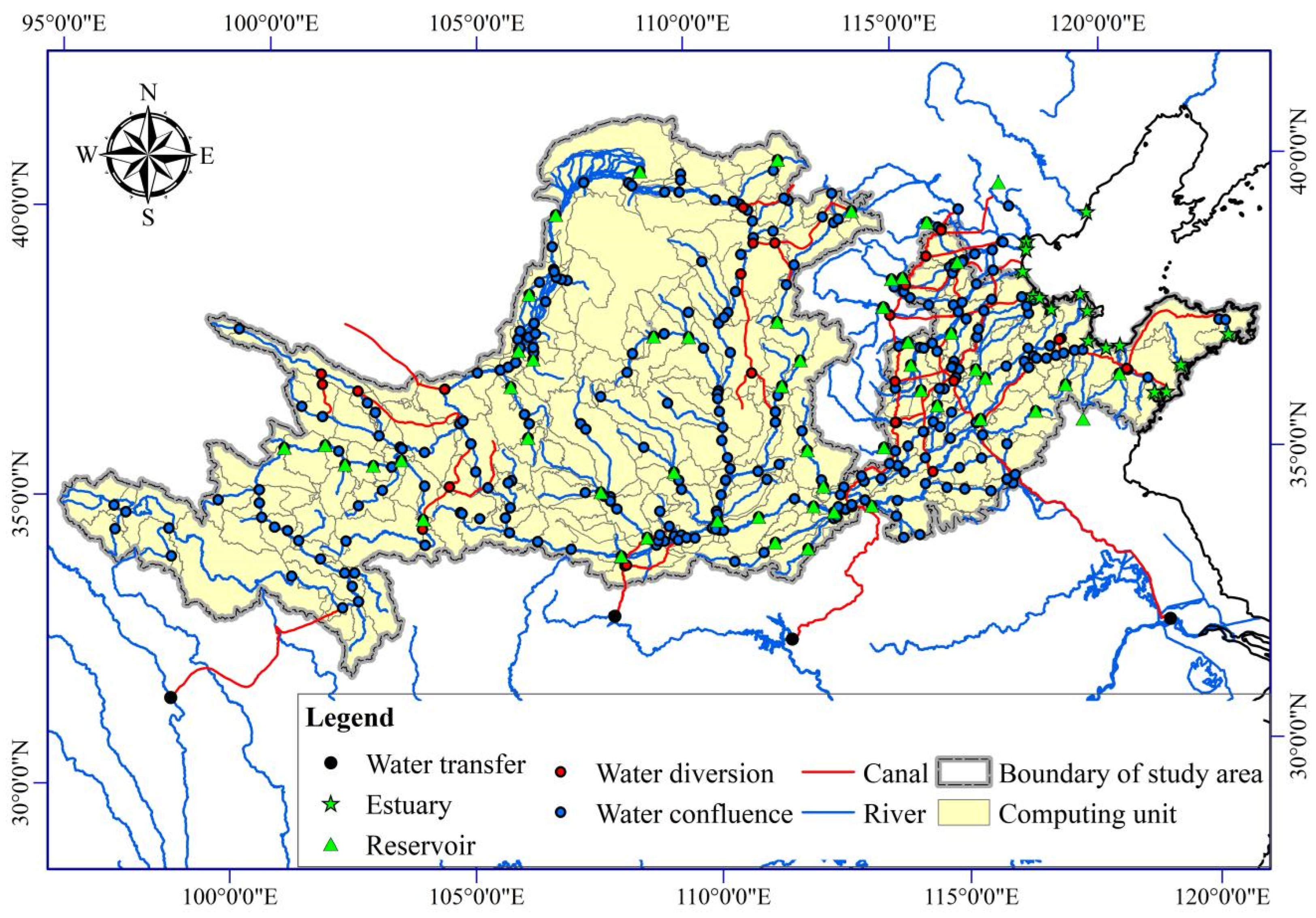
Using ArcGIS 10.2 spatial overlay analysis of natural and artificial water networks, 398 natural river reaches and 63 channel reaches were delineated. Building upon the element generalization, nodes were positioned at key hydraulic connection points along natural rivers and artificial channels according to hydraulic connectivity, establishing a multi-element topological structure integrating natural and artificial water networks. Configuration command identifiers were subsequently developed to enable synergistic operation of functional modules. The generalized hydrological network of the study area is illustrated in Figure 6.
(2)
Computational unit division
Typical methods for computational unit (CU) division in water resources allocation models include administrative division-based methods, water resources zoning-based methods, and their integrated overlay method, each with distinct advantages. Socioeconomic water use data are statistically collected at the administrative unit level, rendering the administrative division-based method conducive to data input. In contrast, the water resources zoning-based method employs natural subbasins as boundaries to delineate CUs, enabling reasonable reflection of the study area’s hydrological zoning characteristics.
In this study, a CU division method was adopted by overlaying Level-II water-resources zoning with municipal administrative divisions [33]. This method not only retains the core characteristic features of CU delineation in traditional water resources allocation models but also fulfills the requirements of water resources management at both basin and administrative levels.
Considering that water consumption and water supply data are statistically aggregated at the administrative unit level, the administrative overlay facilitates the spatial disaggregation of socioeconomic water consumption and water supply information. Furthermore, this approach superimposes administrative boundaries onto natural water resources zoning and assigns corresponding water resources zoning and administrative attributes to the delineated CUs. Through the aforementioned processes, the study area was divided into a total of 439 CUs (Figure 6).

3.3.3. Model Comparison

The Water Evaluation and Planning (WEAP) system, developed by the Stockholm Resilience Centre, is a modeling tool with a visual interface designed to address regional water resource system simulation, optimal allocation, and planning management [38]. WEAP decomposes the entire water resource system into components including rivers, diversions, reservoirs, groundwater, demand sites, transmission links, and return flow links, which are interconnected to enable water network system simulation [39,40]. Over the past decade, WEAP has seen increasingly widespread application, with its efficacy validated across diverse regions globally—in Kenya [41], Tunisia [42], Algeria [43], Greece [44] and China [45,46,47].
WEAP employs linear programming with an objective function maximizing satisfaction rates across all demand sites. Operating on a monthly time step, it calculates water balance for sites and links under two primary constraints: (a) the water balance equation must be satisfied for each site and link; (b) demand sites with identical priority levels must achieve equal satisfaction rates.
In this work, we constructed a WEAP model for the Yellow River water supply regions, with subsequent comparative analysis against results from the IMWA-IRRS model. Based on available data, the Yellow River water supply region was ultimately conceptualized into 192 demand sites, 24 rivers, 6 diversions, 9 groundwater sources, 17 reservoirs, 6 other sources (unconventional water), 434 transmission links, and 184 return flow links.

4. Results

4.1. Model Performance

The proposed model necessitates multi-dimensional validation against diverse datasets, including (i) natural runoff processes and anthropogenically perturbed runoff processes at critical hydrological stations and (ii) water consumption and water supply of the Yellow River Basin. Three performance indexes, the percent bias (PBIAS), the correlation coefficient (R), and the Nash–Sutcliffe efficiency coefficient (Ens), were selected to evaluate the simulation adaptability of the IMWA-IRRS model [48].

4.1.1. Natural Runoff Process

As the Yellow River traverses the arid inland regions of Northwest China, evaporation and infiltration intensities are exceptionally high, resulting in substantial losses. In extreme cases, this phenomenon can lead to downstream natural runoff being lower than upstream values, with the Ningxia–Inner Mongolia reach exhibiting this characteristic most prominently. Therefore, when incorporating long-term monthly natural runoff datasets for each river segment into the IMWA-IRRS and WEAP models, it is imperative to account for input data discrepancies induced by water losses relative to actual values.
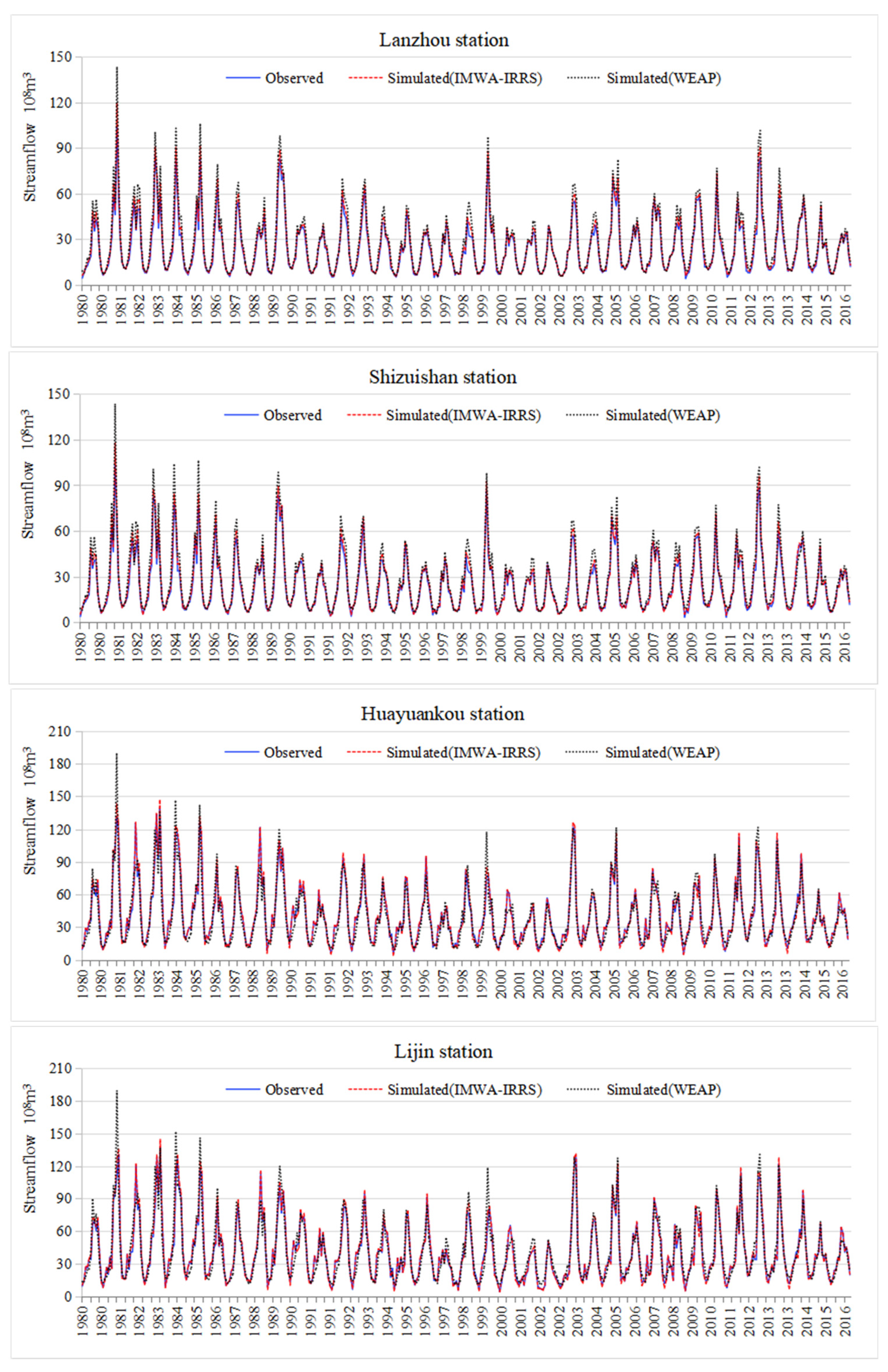
This study focuses on the macro-allocation of total regional water resources, selecting four mainstream hydrological stations (Lanzhou, Shizuishan, Huayuankou, and Lijin) that control the vast majority of the Yellow River’s runoff and cover the basin’s most critical water supply nodes and hydrological processes. These stations’ calibration results fully ensure the model’s accuracy in simulating total basin water volume. Model calibration was performed using natural runoff time-series data from these key hydrological stations: natural runoff data from 1978–1979 were designated as the warm-up period to stabilize initial model conditions; monthly runoff data from 1980–2000 were utilized for parameter calibration; and data from 2001–2016 served for independent validation. The calibration results are presented in Table 2 and Figure 7.
Visual inspection indicates strong agreement between the simulated and observed runoff hydrographs at the four hydrological stations for both models. Quantitative performance metrics further validate their simulation capability. For the IMWA-IRRS model, during both calibration and validation periods, the correlation coefficient (R) and Nash–Sutcliffe efficiency (Ens) between the monthly simulated and observed runoff exceeded 0.98 at all stations (R: 1.00 ± 0.00; Ens: 0.98 ± 0.005), with PBIAS below 10.0% (4.16 ± 2.02%). For the WEAP model, the corresponding R and Ens values generally exceeded 0.85 across stations during both periods (R: 0.96 ± 0.03; Ens: 0.88 ± 0.03), with PBIAS below 15.0% (7.00 ± 7.37%).

4.1.2. Human-Impacted Runoff Process

The Yellow River represents a highly human-impacted fluvial system, where runoff regimes are subject to intensive regulation by cascade reservoir operations on the main stem, compounded by water abstractions for agricultural, industrial, and domestic consumption. Consequently, the actual runoff processes exhibit pronounced complexity and anthropogenic modulation. Accurate simulation of the monthly runoff dynamics under such intense human perturbations would conventionally necessitate integrated consideration of hydrological cycling, reservoir operation rules, and water consumption behaviors–typically the core objective of high-fidelity hydrological models.
The primary objective of this study is to optimize the water resource allocation and supply–demand balance at the macro scale within the Yellow River’s water supply districts, rather than focusing on detailed hydrological process simulation. For validating the efficacy of water resources allocation models, the critical performance metrics lie in their ability to replicate basin-scale water supply–demand matching and the implementation feasibility of proposed allocation schemes. From this perspective, annual runoff, a macro indicator reflecting basin water resource endowment, sufficiently meets the core requirements for model calibration. Therefore, we employed the annual runoff for calibration, using PBIAS and R to evaluate the performance of the two models.
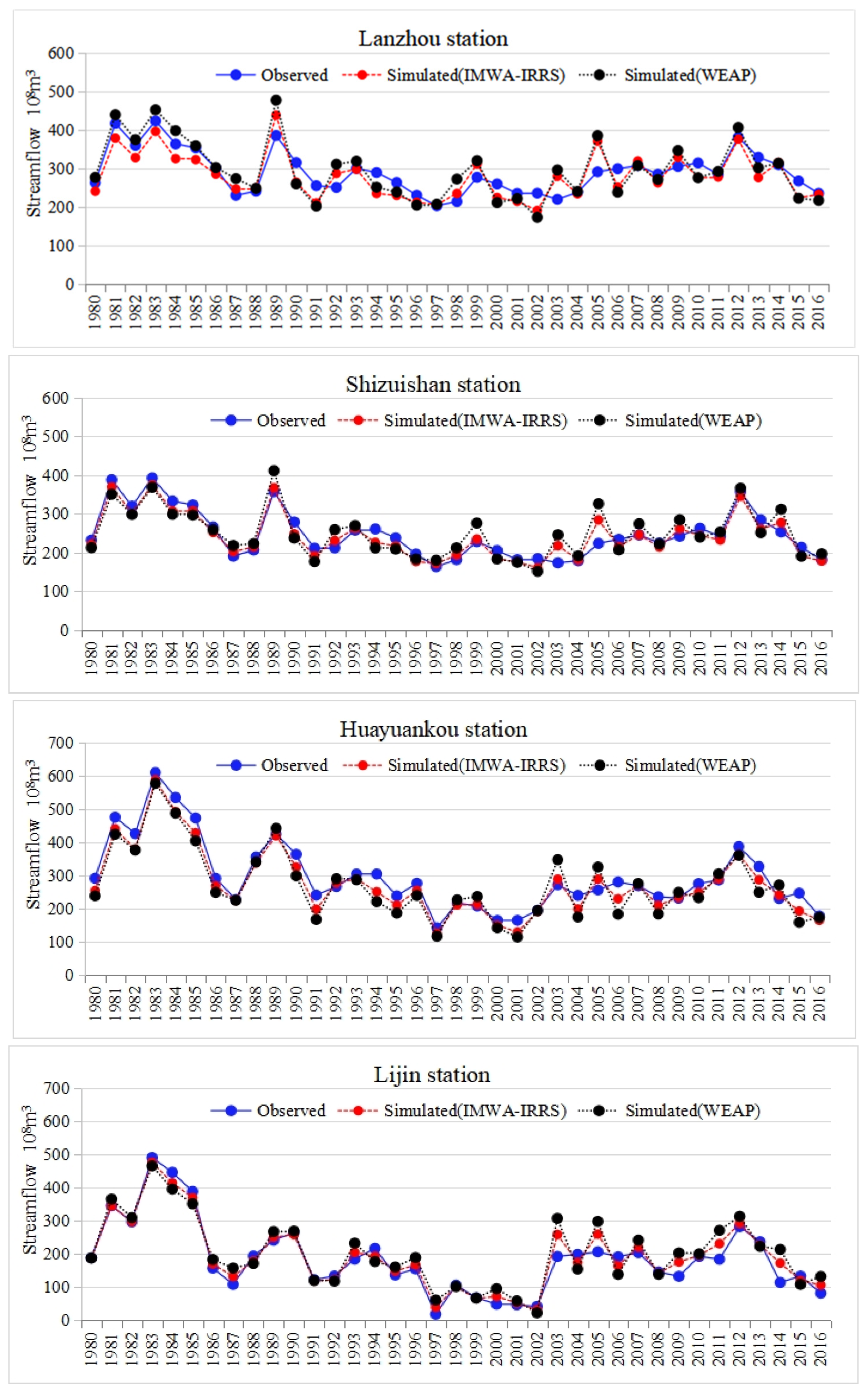
Given the lack of water supply and demand data at the tributary basin scale, only administrative-level data were available, precluding detailed calibration for individual tributary basins. Consequently, four key hydrological stations along the Yellow River (Lanzhou, Shizuishan, Huayuankou, and Lijin) were selected, and their calibration results sufficiently ensure the model’s accuracy in simulating the total basin water volume. A two-year warm-up period (1978–1979) using natural runoff data was implemented to stabilize the initial model conditions. Monthly runoff data from 1980–2000 were then utilized for parameter calibration, followed by validation using total annual runoff data from 2001–2016. The calibration results are presented in Table 3 and Figure 8.
Visual inspection reveals good agreement between the simulated and observed streamflow at four hydrological stations for both models. Quantitative performance metrics further confirm their reliability. For the IMWA-IRRS model, during both calibration and validation periods, the correlation coefficient between the simulated and observed annual runoff generally exceeded 0.8 at four stations (0.91 ± 0.05), with PBIAS within the ±10% range (2.06 ± 3.04%). Both metrics met the required performance thresholds. For the WEAP model, during both periods, the correlation coefficient between simulated and observed annual runoff exceeded 0.7 at four stations (0.83 ± 0.09), with PBIAS within the ±10% range (1.48 ± 6.17%). Both metrics also met the required performance thresholds.
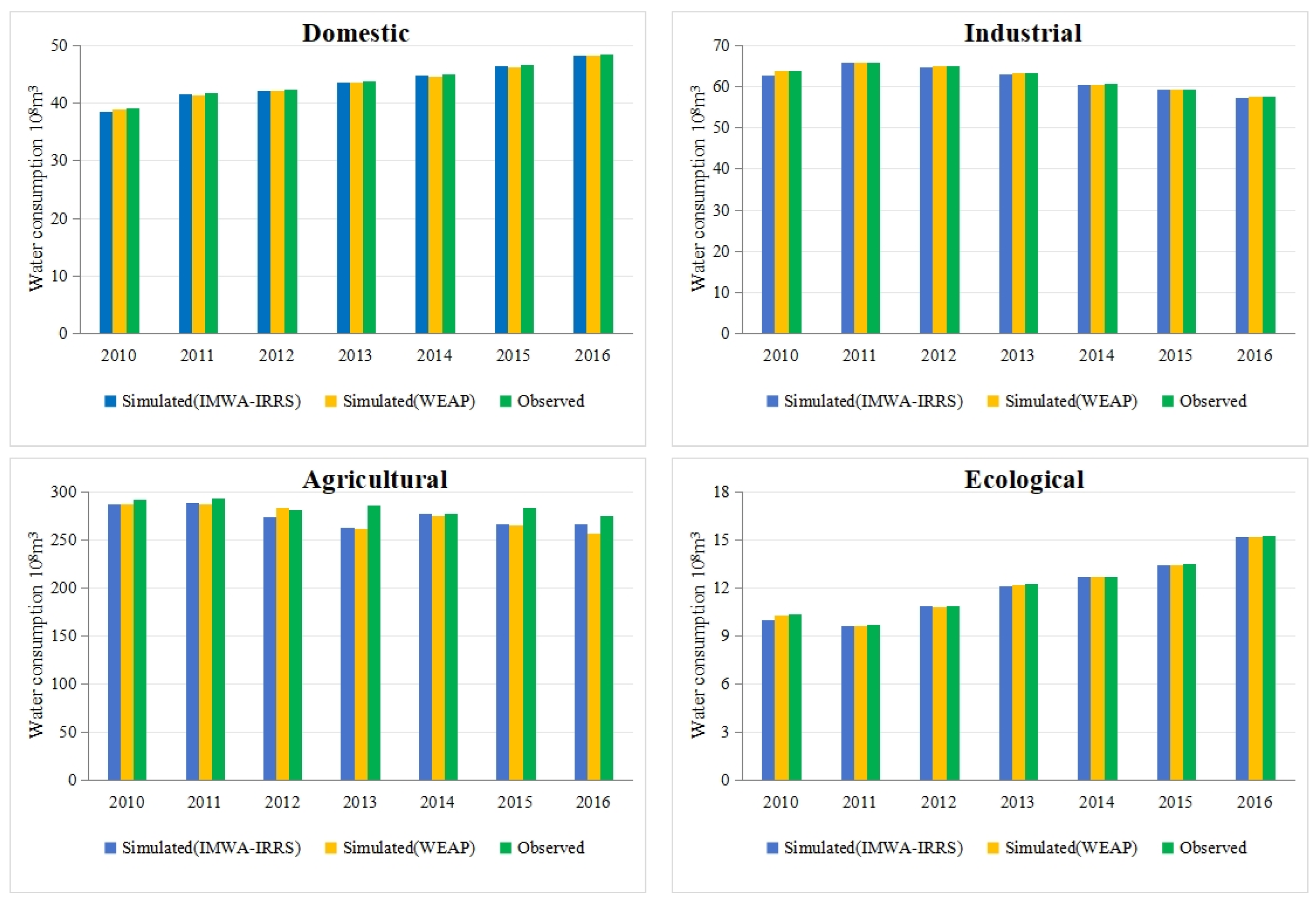
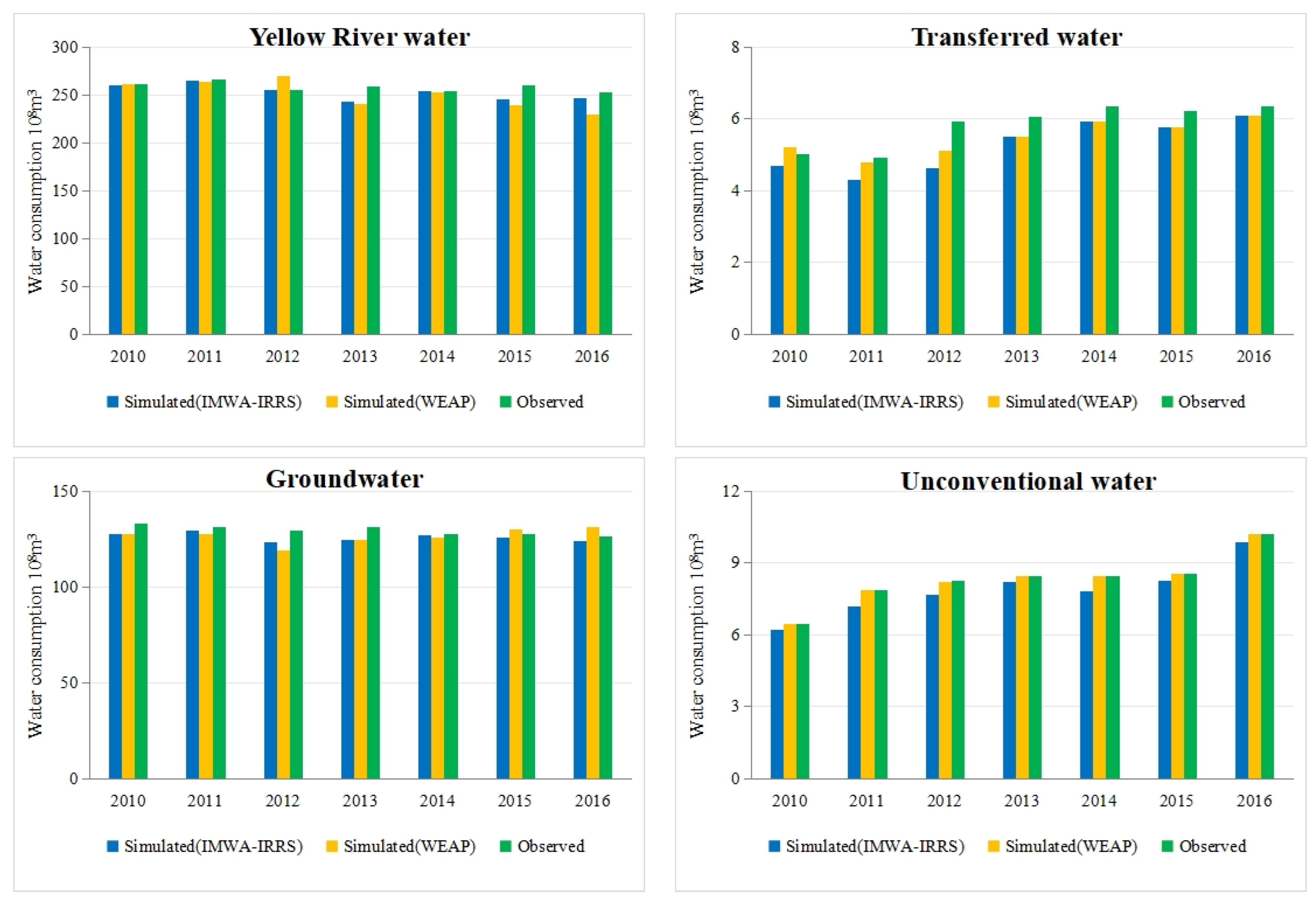
Both the IMWA-IRRS and WEAP models support simulations of water supply and consumption by integrating input datasets, including water demand, water consumption rates, and water use/supply priorities. Validating the water supply and consumption performance of these two models is therefore essential. Using data from the Yellow River Basin Water Resources Bulletins (2010–2016), we validated the sectoral water supply and consumption in the Yellow River Basin. We employed PBIAS to evaluate the performance of the two models (Figure 9 and Figure 10). The results are as follows:

4.1.3. Water Consumption and Water Supply

Both the IMWA-IRRS and WEAP models demonstrated high accuracy in simulating water consumption and supply patterns across the Yellow River Basin, with PBIAS values consistently below the critical threshold of ±25% (Table 4). For the IMWA-IRRS model, the simulated water consumption across all sectors in the Yellow River Basin yields PBIAS values below 5% (1.36 ± 1.31%), with agricultural water consumption showing the highest PBIAS value (3.32%) and the total water consumption yielding a PBIAS value of 2.53%. For water supply simulations, all PBIAS values are less than 10% (4.93 ± 3.40%), where transferred water exhibits the maximum PBIAS value of 9.65%, and Yellow River water supply presents the minimum PBIAS value of 2.16%. Regarding the WEAP model, the sectoral water consumption simulations also demonstrate PBIAS values below 5% (1.24 ± 1.64%), with agricultural water consumption having the highest PBIAS value of 3.67%, and total water consumption achieving a PBIAS value of 2.65%. For the water supply simulations, all PBIAS values are under 10% (2.80 ± 2.44%), with transferred water showing the maximum PBIAS (5.98%), and unconventional water supply displaying the minimum (0.04%).
Overall, the simulation results of both models reasonably reflect the actual water supply and consumption patterns in the Yellow River Basin.

4.2. Multi-Source and Multi-Route Allocation Under Low-Flow Conditions

In this work, we developed water resources allocation schemes for the Yellow River water supply region under 75% and 95% low-flow conditions for the target year 2035, using the IMWA-IRRS model as the analytical tool. The methodology involved dynamically adjusting the water diversion volumes from the Eastern, Central, and Western Routes of the South-to-North Water Diversion Project based on real-time flow conditions in the upper and lower reaches of the Yellow River, combined with multi-source integrated allocation that accounts for local water availability under varying low-flow intensities. Specifically, water diverted via the Western Route is integrated into the Yellow River mainstream and jointly managed as surface water supply for its coverage area, whereas the Eastern and Central Routes operate within their current coverage boundaries for supply simulation. The total water demand in the study area is projected to reach 63.153 billion m3 by 2035, comprising 54.827 billion m3 within the Yellow River Basin and 8.326 billion m3 in external supply districts. Groundwater extraction in the Yellow River Basin is constrained to 12.537 billion m3, with unconventional water resources maintained at 1.073 billion m3.

4.2.1. 75% Low-Flow Condition

In the 75% low-flow condition of the Yellow River, the water supply structure in the study area exhibits a multi-source complementary pattern (Table 5): water from the Yellow River mainstream constitutes the primary source, supplying 35.023 billion m3. This accounts for 58.67% of the total supply and is predominantly allocated within the study area. Groundwater abstraction amounts to 11.553 billion m3, representing 19.35% of total supply, primarily supporting water-stressed provinces such as Shanxi, Shaanxi, and Inner Mongolia. Unconventional water sources supply a limited 0.854 billion m3, representing 1.43% of total supply, concentrated in Gansu, Ningxia, and Inner Mongolia. External water transfers contribute significantly, totaling 12.261 billion m3, representing 20.54% of total supply. These transfers originate from the Western Route (8.00 billion m3), Central Route (1.236 billion m3), Eastern Route (2.025 billion m3), and Hanjiang-to-Weihe River Diversion Project (1.00 billion m3), effectively supporting provinces throughout the basin’s upper, middle, and lower reaches. The total water supply in the study area thus reaches 59.691 billion m3, with an unmet water demand of 3.462 billion m3, resulting in a water shortage rate of 5.48%.
In terms of administrative divisions, Inner Mongolia exhibits the highest water shortage rate at 10.24% (1.223 billion m3 unmet demand), primarily attributed to intensive agricultural water demand coupled with insufficient local water resources. The 2.846 billion m3 diverted via the Western Route failed to fully offset Inner Mongolia’s water deficit. This is followed by Ningxia (8.66% shortage rate, 0.658 billion m3 unmet demand), Gansu (7.44%, 0.399 billion m3), and Qinghai (6.75%, 0.171 billion m3). Due to inherent water resource scarcity, these northwestern provinces continue to face persistent water shortages despite reliance on groundwater and Western Route diversions. In contrast, Shanxi, Shaanxi, and Shandong have met local water needs through efficient utilization of Yellow River water and groundwater, augmented by interconnected cross-basin transfers and multi-source water synergies. Notably, Shaanxi significantly enhanced its water supply capacity by leveraging both Western Route and Hanjiang-to-Weihe River Diversion Project water. In summary, the synergistic operation of interconnected multi-route water transfers under 75% low-flow conditions has markedly alleviated regional water shortages, substantially reducing the overall water shortage rate in the study area. Nevertheless, enhanced protection of groundwater resources and coordination among water transfer projects remain imperative to address challenges posed by extreme low-flow events.

4.2.2. 95% Low-Flow Condition

In the 95% low-flow condition of the Yellow River, water supply pressure intensifies across the study area (Table 6): the total water supply in the study area decreases from 59.691 billion m3 under 75% low-flow condition to 58.746 billion m3, while unmet water demand expands from 3.545 billion m3 to 4.407 billion m3, corresponding to a rise in the water shortage rate from 5.61% to 6.98%. Water scarcity is predominantly concentrated in extra-basin supply areas and upstream high-water-consuming provinces. Owing to the reduced natural runoff of the Yellow River, the water shortage rate in extra-basin areas increases from 13.12% to 20.27% with unmet demand growing by nearly 0.6 billion m3; within the Yellow River Basin, Inner Mongolia exhibits a water shortage rate increase from 10.24% to 11.67%, Ningxia from 8.66% to 9.30%, and Gansu from 7.44% to 8.31%, whereas Qinghai and Sichuan, experience increases in unmet demand despite negligible changes in their water shortage rates.
The water supply from the Yellow River experiences a significant decline under a 95% low-flow condition of the Yellow River, dropping from 35.023 billion m3 under 75% low-flow condition to 33.372 billion m3. Concurrently, the supplementary role of groundwater and unconventional water sources strengthens in the Yellow River Basin: groundwater supply increases from 11.553 billion m3 to 12.089 billion m3, while unconventional water sources rise from 0.771 billion m3 to 1.023 billion m3. Due to the capacity constraints of water transfers, the total water diversion volume remains constant at 12.261 billion m3, failing to fully offset the water shortage caused by reduced Yellow River supply. Although inter-basin water transfer projects have mitigated partial water security risks in the study area, their coverage remains limited, particularly the Middle Route and Eastern Route projects, posing substantial uncertainties for regional water security. To enhance water security, future efforts should focus on expanding the coverage areas of the Middle and Eastern Routes to maximize their inter-project complementarity, while simultaneously reducing water demand within the Yellow River water supply regions.

5. Discussion

5.1. Comparative Advantages of IMWA-IRRS

While both the IMWA-IRRS and WEAP models exhibit comparable simulation accuracy in simulating natural runoff, human-impacted runoff, and water consumption and water supply, the IMWA-IRRS model presents distinct advantages tailored to the specific constraints of the Yellow River water supply region:
First, the IMWA-IRRS model inherently supports the fine-grained partitioning of computational units, enabling direct output of configuration results at the unit scale. In contrast, achieving this level of granularity with WEAP necessitates the manual creation of numerous demand points, each linked to multiple water sources—a process that is not only labor-intensive but also error-prone due to its rigid topological structure.
Second, the IMWA-IRRS model is specifically developed for multi-route interconnected water network systems, a design paradigm that inherently resonates with the complex water allocation mechanisms of the study area. Although the WEAP can be adapted to simulate such connections through workaround methods, the resulting outputs are less intuitive.
However, the IMWA-IRRS model also has certain limitations. WEAP outperforms IMWA-IRRS in processing speed, with its mature codebase and optimized algorithms reducing runtime for large-scale simulations. In terms of functional completeness, WEAP’s decades of development have yielded a more comprehensive feature set, whereas IMWA-IRRS, as a newer model, lacks certain advanced functionalities.
In summary, while WEAP remains a robust and universally applicable tool, the IMWA-IRRS model offers targeted advantages for the Yellow River water supply region by balancing accuracy with practicality in capturing the region-specific complexities of water networks.

5.2. Limitations and Future Improvements

The optimization framework proposed in this study effectively addresses the macro-allocation of water resources in the Yellow River water supply region, providing actionable strategies for policy makers. However, several limitations should be acknowledged:
First, owing to the unavailability of water supply and water demand data at the tributary basin scale, only administrative-level data could be accessed, thereby precluding detailed calibration for each tributary basin. We thus adopted a pragmatic alternative: selecting key hydrological stations along the Yellow River to ensure the model’s accuracy in simulating the total water volume across the study area.
Second, it is worth noting that the convergent solution obtained does not guarantee mathematical uniqueness, as equivalent solutions may exist under different initial conditions or coordination trajectories. This is because our optimization framework prioritizes practical feasibility over exhaustive solution exploration—consistent with the core goal of providing actionable water allocation strategies for basin management. Future research will conduct sensitivity analyses to quantify the impact of initial conditions on solution stability, thereby enhancing the robustness of the model.
Third, the current model does not incorporate dynamic policy factors, which will be addressed in subsequent studies through the integration of institutional change scenarios into the optimization framework.

6. Conclusions

Under climate change and human activities, frequent extreme low flows increasingly threaten Yellow River Basin water security, requiring the development of a multi-source, multi-route, and multi-objective allocation system and coordinated management of the South-to-North Water Diversion Project routes. This study developed the IMWA-IRRS model, detailing its structural framework, water network topology, spatial data distribution, managed flow simulation, allocation rules, and multi-objective optimization. We verified its applicability in the Yellow River water supply region and developed low-flow allocation schemes. The key conclusions are as follows:
(1)
The IMWA-IRRS model characterizes the spatiotemporal dynamics of multi-source water, including local surface water, groundwater, inter-basin transfers, and unconventional water, while explicitly describing water network topology and transmission relationships between sources and users. By integrating simulation and optimal allocation, it realistically reflects network regulation, a strength that is rooted in its macroscopic rule-based framework, simulation accuracy, and applicability to regional water allocation planning, thereby serving as a powerful tool for the refined management of complex water systems.
(2)
Multi-criteria calibration of natural and human-impacted runoff, water consumption, and water supply using R, Ens, and PBIAS demonstrated excellent performance: monthly runoff simulations during both the calibration and validation periods achieved R > 0.98, Ens > 0.98, and PBIAS within ±10%; human-impacted runoff R > 0.8, PBIAS ± 10%; sectoral water consumption PBIAS < 5%; source-specific water supply PBIAS < 10%. These validate IMWA-IRRS’s excellent predictive performance in the Yellow River water supply region.
(3)
The IMWA-IRRS model exhibits comparable simulation performance to the WEAP model in terms of natural runoff, human-impacted runoff, and water consumption and water supply simulations. For natural runoff during validation periods, IMWA-IRRS achieved an Ens of 0.99, an R of 1.0, and a PBIAS of 2.09%, compared with WEAP’s Ens of 0.94, R of 0.98, and PBIAS of 5.68%. In human-impacted flow simulations, IMWA-IRRS produced an R of 0.79 and a PBIAS of 1.03%, compared with WEAP’s 0.73 and −1.38%. For water consumption and water supply, the PBIAS was 2.53% for IMWA-IRRS versus 2.65% for WEAP. These results confirm the comparable performance of the two models, validating the applicability of IMWA-IRRS.
(4)
The proposed 2035 water resource allocation scheme integrates water transfers from the Yangtze to the Yellow River. Under 75% low-flow conditions, total supply reaches 59.691 billion m3 with a shortage of 3.462 billion m3. Under 95% low-flow conditions, supply is 58.746 billion m3 with the shortage increasing to 4.407 billion m3. However, limited coverage of the Middle and Eastern Routes of the South-to-North Water Diversion Project poses uncertainties to regional water security. Therefore, future efforts should prioritize expanding the coverage of these two routes to enhance inter-route complementarity, while simultaneously reducing the local water demand to improve regional water security capacity.
This study provides practical guidance and strategic insights for enhancing water resource security guarantee capacity in the Yellow River Basin and supporting high-quality basin development.

Author Contributions

Conceptualization, M.Y. and X.L.; Methodology, M.Y. and X.L.; Software, M.Y. and L.W.; Validation, L.W.; Formal analysis, K.S., X.Z. and L.W.; Investigation, R.M. and D.W.; Resources, R.M. and J.H.; Data curation, K.S., X.Z. and L.W.; Writing—original draft, R.M., D.W. and H.J.; Writing—review and editing, D.W., J.H. and H.J.; Supervision, H.J. All authors have read and agreed to the published version of the manuscript.

Funding

The study was financially supported by the National Key Research and Development Program of China (2022YFC3202300), the National Natural Science Foundation of China (52509004, 52309077), the National Natural Science Foundation of Hubei Province (2024AFB012, 2022CFD037), and the National Public Research Institutes for Basic R&D Operating Expenses Special Project [CKSF20241018/SZ].

Institutional Review Board Statement

Not applicable.

Informed Consent Statement

Not applicable.

Data Availability Statement

The WEAP model used in this study is commercial software. Its use complies with the official license agreement, and the license details can be accessed via the official website: https://weap21.org/.

Conflicts of Interest

Authors Rui Ma and Jun He were employed by the General Institute of Water Resources and Hydropower Planning and Design, Ministry of Water Resources. The remaining authors declare that the research was conducted in the absence of any commercial or financial relationships that could be construed as a potential conflict of interest.

References

  1. Zheng, X.; Wang, Y.; Zhang, D.; Ma, C.; Wang, H. Driving factors and regulation strategies for resilience of water resources system in the Yellow River Basin. J. Hydraul. Eng. 2025, 56, 1253–1266. (In Chinese) [Google Scholar]
  2. Chen, G.; Zuo, D.; Xu, Z.; Wang, G.; Han, Y.; Peng, D.; Pang, B.; Abbaspour, K.; Yang, H. Changes in water conservation and possible causes in the Yellow River Basin of China during the recent four decades. J. Hydrol. 2024, 637, 131314. [Google Scholar] [CrossRef]
  3. Wang, Y.; Peng, S.; Zheng, X. Key scientific issues of water allocation plan optimization and comprehensive operation for Yellow River basin. Adv. Water Sci. 2018, 29, 614–624. (In Chinese) [Google Scholar]
  4. Zhou, K. Study on the dynamic prediction and optimum regulation scheme of water resource carrying capacity in the yellow river basin. Sci. Rep. 2025, 15, 8188. [Google Scholar] [CrossRef]
  5. Li, C.; Lu, Z.; Yan, D.; Zhang, J.; Dong, Z.; Ma, Q. Assessing spatiotemporal dynamics of water and land resources matching under dynamic environmental conditions in the Yellow River basin, China. J. Clean. Prod. 2025, 525, 146498. [Google Scholar] [CrossRef]
  6. Wan, F.; Zhang, F.; Wang, Y.; Peng, S.; Zheng, X. Study on the propagation law of meteorological drought to hydrological drought under variable time Scale: An example from the Yellow River Water Supply Area in Henan. Ecol. Indic. 2023, 154, 110873. [Google Scholar] [CrossRef]
  7. Peng, S.; Zheng, X.; Yan, D.; Shang, W. New situation and countermeasures of water resources supply and demand in the Yellow River Basin. China Water Resour. 2021, 18–20+26. (In Chinese) [Google Scholar]
  8. Cai, X.; Rosegrant, M.W. Optional water development strategies for the Yellow River Basin: Balancing agricultural and ecological water demands. Water Resour. Res. 2004, 40. [Google Scholar] [CrossRef]
  9. Zhou, Z.H.; Liu, J.J.; Yan, Z.Q.; Wang, H.; Jia, Y. Attribution analysis of the natural runoff evolution in the Yellow River basin. Adv. Water Sci. 2022, 33, 27–37. (In Chinese) [Google Scholar]
  10. Yang, Y.; Son, K.; Hung, F.; Tidwell, V. Impact of climate change on adaptive management decisions in the face of water scarcity. J. Hydrol. 2020, 588, 125015. [Google Scholar] [CrossRef]
  11. Omer, A.; Elagib, N.A.; Zhuguo, M.; Saleem, F.; Mohammed, A. Water scarcity in the Yellow River Basin under future climate change and human activities. Sci. Total Environ. 2020, 749, 141446. [Google Scholar] [CrossRef] [PubMed]
  12. Meng, F.; Su, F.; Yang, D.; Tong, K.; Hao, Z. Impacts of recent climate change on the hydrology in the source region of the Yellow River basin. J. Hydrol. Reg. Stud. 2016, 6, 66–81. [Google Scholar] [CrossRef]
  13. Shang, W.; Wang, Y.; Zheng, X.; Li, X. Identification of Continuous Low Water Period in the Yellow River’s Centennial Runoff Series and Analysis of Water Use Characteristics. Yellow River 2024, 46, 20–25+42. (In Chinese) [Google Scholar]
  14. Wang, H.; Zhao, Y.; Liu, J.; Guo, W. Evolution of Water and Sediment Situation in the Middle and Lower Reaches of Yellow River in Recent 50 Years and Analysis of Its Influencing Factors. Water Power 2020, 46, 48–54. (In Chinese) [Google Scholar]
  15. Wang, Y.; Zheng, X.; Zhang, D.; Shang, W.; Zhou, X.; Lv, H.; Song, Y. Study on water resources security gurantee strategies for the Yellow River Basin during extreme water scarcity year. China Water Resour. 2024, 55–59+77. (In Chinese) [Google Scholar]
  16. Wang, H.; Zhao, Y. Preliminary study on harnessing strategies for Yellow River in the new period. J. Hydraul. Eng. 2019, 50, 1291–1298. (In Chinese) [Google Scholar]
  17. Liu, H.; Qiao, L.; Sun, S. Spatial distribution and dynamic change of water use efficiency in the Yellow River Basin. Resour. Sci. 2020, 42, 57–68. (In Chinese) [Google Scholar] [CrossRef]
  18. Shi, W.; Wang, G. Ecological water demand in the lower Yellow River and its estimation. Acta Geogr. Sin. 2002, 595–602. (In Chinese) [Google Scholar]
  19. Liu, C.; Liu, X.; Tian, W.; Xie, J. Ecological Protection and High-Quality Development of the Yellow River Basin Urgently need to Solve the Water Shortage Problem. Yellow River 2020, 42, 6–9. (In Chinese) [Google Scholar]
  20. Yin, Y.; Tang, Q.; Liu, X.; Zhang, X. Water scarcity under various socio-economic pathways and its potential effects on food production in the Yellow River Basin. Hydrol. Earth Syst. Sci. 2017, 21, 791–804. [Google Scholar] [CrossRef]
  21. Jamshid Mousavi, S.; Anzab, N.R.; Asl-Rousta, B.; Kim, J.H. Multi-objective optimization-simulation for reliability-based inter-basin water allocation. Water Resour. Manag. 2017, 31, 3445–3464. [Google Scholar] [CrossRef]
  22. Zhang, Y.; Li, F.; Peng, S.; Li, K. Study on the Joint Operation of Key Reservoirs to Cope with Drought in the Yellow River Main Stream. Yellow River 2019, 41, 31–35. (In Chinese) [Google Scholar]
  23. Hhua, Y.; Cui, B. Environmental flows and its satisfaction degree forecasting in the Yellow River. Ecol. Indic. 2018, 92, 207–220. [Google Scholar] [CrossRef]
  24. Wang, H.; Liu, J. Collaboration of national water resources with eco-social system in China. China Water Resour. 2016, 7–9. (In Chinese) [Google Scholar]
  25. You, J.; Wang, Z.; Gan, H.; Zang, J. Stepwise compensatory allocation of inter-basin water diversion. J. Hydraul. Eng. 2008, 39, 870–876. [Google Scholar]
  26. Wang, Y.; Peng, S.; Zhou, X.; Wu, J.; Shang, W.; Yan, D. Water allocation scheme optimization in the Yellow River based on incremental dynamic equilibrium configuration. Water Resour. Prot. 2022, 38, 48–55. (In Chinese) [Google Scholar]
  27. Gao, Y.; Xia, M.; Zhang, J.; Tan, X.; Yuan, C. A multi-scale multi-objective optimization model for water resources scheduling in complex inter-basin water transfer systems. J. Hydrol. 2025, 662, 134032. [Google Scholar] [CrossRef]
  28. Li, Y.; Li, Y.; Wang, H.; Ma, R. Thoughts and proactive measures for strengthening water resources regulation in the Yellow River Basin. China Water Resour. 2021, 8–10. (In Chinese) [Google Scholar]
  29. Guo, X. Assessing the impact of the Central Line Project of South-to-North Water Diversion on urban economic resilience: Evidence from prefecture-level cities in Henan and Hebei provinces. Int. Rev. Econ. Financ. 2025, 98, 103904. [Google Scholar] [CrossRef]
  30. Wang, Y.; Zhou, X.; Peng, S.; Wu, J.; Ming, G.; Zheng, X. Water allocation of the first phase of South-to-North Water Diversion Western Route Project based on balanced provisioning of water resources in the Yellow River basin. Adv. Water Sci. 2023, 34, 336–348. (In Chinese) [Google Scholar]
  31. Lu, Y.; Fan, L.; Ding, W. Digital Dynamic Capability Model and Practice of Water Resource Scheduling in Water Transfer Project. Sci. Technol. Manag. Res. 2022, 42, 195–204. (In Chinese) [Google Scholar]
  32. Yang, C.; Wang, H.; Wen, J.; Li, J.; Yang, H.; Cai, C. Optimal allocation and dispatching of water resources in reservoir dam cascade system based on IA-PSO. Water Resour. Hydropower Eng. 2023, 54, 60–68. (In Chinese) [Google Scholar]
  33. Pei, Y.; Xu, J.; Xiao, W.; Yang, M.; Hou, B. Development and application of the water amount, quality and efficiency regulation model based on dualistic water cycle. J. Hydraul. Eng. 2020, 51, 1473–1485. (In Chinese) [Google Scholar]
  34. Yang, M.; Xu, J.; Sang, L.; Liu, Q. Development and application of the distributed water resources allocation and regulation model based on hydrological cycle. J. Hydraul. Eng. 2022, 53, 456–470. (In Chinese) [Google Scholar]
  35. Yang, M.; Xu, J.; Yin, D.; He, S.; Zhu, S.; Li, S. Modified Multi–Source Water Supply Module of the SWAT–WARM Model to Simulate Water Resource Responses under Strong Human Activities in the Tang–Bai River Basin. Sustainability 2022, 14, 15016. [Google Scholar] [CrossRef]
  36. Wu, H.; Ji, C.; Jiang, Z.; Zhang, Y. Large system decomposition-coordination model for optimal power-generation scheduling of cascade reservoirs. J. Hydroelectr. Eng. 2015, 34, 40–50. (In Chinese) [Google Scholar]
  37. Jiang, Y.; Xiong, L.; Yao, F.; Xu, Z. Optimizing regional irrigation water allocation for multi-stage pumping-water irrigation system based on multi-level optimization-coordination model. J. Hydrol. X 2019, 4, 100038. [Google Scholar] [CrossRef]
  38. Zhao, X.; Yang, L.; Zhu, Y.; Hao, M.; Ren, W. Water resources supply and demand balance in Hebei Province based on WEAP model. Water Sci. Eng. Technol. 2023, 4–8. [Google Scholar]
  39. Yates, D.; Sieber, J.; Purkey, D.; Lee, A. WEAP21—A demand-,priority-,and preference-driven water planning model. Water Int. 2005, 30, 487–500. [Google Scholar] [CrossRef]
  40. Zhang, Z.; He, Y.; Chen, X.; Qian, T. Improvement of WEAP model considering regional and industrial water distribution priority and its application. J. Hydrol. Reg. Stud. 2023, 47, 101414. [Google Scholar] [CrossRef]
  41. Mutiga, J.K.; Mavengno, S.T.; Zhongbo, S.; Woldai, T.; Becht, R. Water allocation as a planning tool to minimise water use conflicts in the upper Ewaso Ng′iro North Basin, Kenya. Water Resour. Manag. 2010, 24, 3939–3959. [Google Scholar] [CrossRef]
  42. Hadded, R.; Nouiri, I.; Alshihabi, O.; Maßmann, J.; Huber, M.; Laghouane, A.; Yahiaoui, H.; Tarhouni, J. A decision support system to manage the groundwater of the Zeuss Koutine Aquifer using the WEAP-MODFLOW framework. Water Resour. Manag. 2013, 27, 1981–2000. [Google Scholar] [CrossRef]
  43. Bouklia-Hassane, R.; Yebdri, D.; Tidjani, A.E. Prospects for a larger integration of the water resources system using WEAP model:a case study of Oran Province. Desalination Water Treat. 2016, 57, 5971–5980. [Google Scholar] [CrossRef]
  44. Katirtzidou, M.; Latinopoulos, P. Allocation of surface and subsurface water resources to competing uses under climate changing conditions: A case study in Halkidiki, Greece. Water Sci. Technol.-Water Supply 2018, 18, 1151–1161. [Google Scholar] [CrossRef]
  45. Hong, X.; Guo, S.; Wang, L.; Yang, G.; Liu, D.; Guo, H.; Wang, J. Evaluating water supply risk in the middle and lower reaches of Hanjiang River basin based on an integrated optimal water resources allocation model. Water 2016, 8, 364. [Google Scholar] [CrossRef]
  46. Kou, L.; Li, X.; Lin, J.; Kang, J. Simulation of urban water resources in Xiamen based on a WEAP model. Water 2018, 10, 732. [Google Scholar] [CrossRef]
  47. Yang, L.; Bai, X.; Khanna, N.Z.; Yi, S.; Hu, Y.; Deng, J.; Gao, H.; Tuo, L.; Xiang, S.; Zhou, N. Water Evaluation and Planning (WEAP) model application for exploring the water deficit at catchment level in Beijing. Desalination Water Treat. 2018, 118, 12–25. [Google Scholar] [CrossRef]
  48. Moriasi, D.; Arnold, J.; Van Liew, M.W.; Bingner, R.L.; Harmel, R.D.; Veith, T.L. Model Evaluation Guidelines for Systematic Quantification of Accuracy in Watershed Simulations. Trans. ASABE 2007, 50, 885–900. [Google Scholar] [CrossRef]
Figure 1. The location and topography of the study area.
Sustainability 18 01541 g001
Figure 2. The main modules of the IMWA-IRRS model and their relationships.
Sustainability 18 01541 g002
Figure 3. Operational flowchart of the process subroutine.
Sustainability 18 01541 g003
Figure 4. Flowcharts of priority calculation: (a) water use and (b) water supply.
Sustainability 18 01541 g004
Figure 5. Operational flowchart of the optimization module.
Sustainability 18 01541 g005
Figure 6. Schematic diagram of the water network system in the study area.
Sustainability 18 01541 g006
Figure 7. Comparison of simulated and measured monthly natural runoff processes by IMWA-IRRS and WEAP models at four stations of the Yellow River.
Sustainability 18 01541 g007
Figure 8. Comparison of simulated and measured annual human-impacted runoff by IMWA-IRRS and WEAP models at four stations of the Yellow River.
Sustainability 18 01541 g008
Figure 9. Comparison of simulated and measured water consumption by IMWA-IRRS and WEAP models in the Yellow River Basin.
Sustainability 18 01541 g009
Figure 10. Comparison of simulated and measured water supply by IMWA-IRRS and WEAP models in the Yellow River Basin.
Sustainability 18 01541 g010
Table 1. The main modules of the IMWA-IRRS model and their functions.
Module CategorySubmoduleNumber of SubroutinesMain SubroutinesFunction
Main program moduleMain4mainform, allo_parms, informationInitializing program execution and defining array dimensions for model parameters.
Simulation5process, sim_ini, cmdConducting annual and monthly time-step simulations of hydrological and allocation processes.
Water allocation6readsubcty_resd, wdemd, wsupply, walloc, wcsm, wdrPerforming multi-source water allocation calculations based on supply–demand relationships.
River7river, riverini, rtm, rchwpSimulating channel routing, river network confluence, and in-stream water delivery.
Water transfer3outwp, add, minusManaging cross-basin water diversion and inter-channel flow distribution.
Reservoir3reservoir, resini, resModeling reservoir storage-release dynamics and reservoir-based water supply.
Groundwater3unit, gwsp, virtSimulating groundwater extraction using unit response and virtual aquifer methods.
Statistics4Stats, writem, riverm, output_resultsGenerating statistical summaries of simulation results and outputting monthly hydrological metrics.
Other12rewind_ini, unitalloSupporting auxiliary functions.
Data input module15readinput, readfile, readsubattr, readsetup, readctywuseReading fundamental input data, including runoff, available water transfers, ecological flow requirements, and various allocation and optimization rules, etc.
Optimization module6analy_gradient, adjust_ratiosImplementing multi-objective optimization algorithms for optimal water allocation strategies.
Table 2. Performance of two models in simulating monthly natural runoff at four hydrological stations of the Yellow River.
ModelHydrological StationCalibration (1980–2000)Validation (2001–2016)
PBLASREnsPBLASREns
IMWA-IRRSLanzhou6.27%1.000.984.46%1.000.99
Shizuishan6.09%1.000.983.78%1.000.99
Huayuankou1.72%1.000.99−0.35%1.000.99
Lijin2.58%1.000.990.46%1.001.00
WEAPLanzhou14.50%0.990.9110.58%0.990.94
Shizuishan13.79%0.980.9011.66%0.980.93
Huayuankou−4.54%0.930.87−0.27%0.970.94
Lijin4.22%0.920.850.76%0.970.93
Table 3. Performance of two models in simulating annual human-impacted runoff at four hydrological stations of the Yellow River.
ModelHydrological StationCalibration (1980–2000)Validation (2001–2016)
PBLASRPBLASR
IMWA-IRRSLanzhou−3.18%0.89 1.34%0.71
Shizuishan3.59%0.97 0.51%0.82
Huayuankou7.79%0.99 1.24%0.80
Lijin0.02%0.99 1.04%0.83
WEAPLanzhou4.36%0.89 2.35%0.72
Shizuishan1.95%0.89 −5.60%0.74
Huayuankou9.59%0.97 6.74%0.68
Lijin−3.14%0.98 −9.00%0.79
Table 4. Performance of two models in simulating water consumption and water supply (%).
TermsModelDomesticIndustrialAgriculturalEcologicalTotal Water Consumption
Water consumptionIMWA-IRRS0.63%0.58%3.32%0.92%2.53%
WEAP0.62%0.05%3.67%0.60%2.65%
TermsModelYellow River WaterTransferred WaterGroundwaterUnconventional WaterTotal Water Supply
Water supplyIMWA-IRRS2.16%9.65%2.78%5.12%2.53%
WEAP2.80%5.98%2.37%0.04%2.65%
Table 5. Water allocation of the study area under 75% low-flow condition of the Yellow River.
TermsWater Demand
(108 m3)
Water Supply (108 m3)Water Deficit
(108 m3)
Water Deficit Rate (%)
Yellow RiverGroundwaterUnconventional WaterWater Diversion
South-to-North Water DiversionHan River–Wei River Water DiversionTotal
Western RouteMiddle RouteEastern Route
Shanxi77.6641.9221.060.1714.5100014.5100%
Nei Monggol119.4251.3925.112.2428.4600028.4612.2310.24%
Shandong26.4114.916.17000.185.1505.3300%
Henan75.5147.0220.770.8305.31005.311.582.09%
Sichuan0.430.410.010000000.011.96%
Shaanxi93.8949.8725.7908.240010.0018.2400%
Gansu53.5433.005.683.567.320007.323.997.44%
Qinghai25.3414.993.270.404.970004.971.716.75%
Ningxia76.0745.797.681.3414.6700014.676.588.66%
Yellow River Basin548.27299.30115.538.5478.165.495.1510.0098.8026.104.76%
Outside the basin83.2650.9300 1.846.8715.10023.818.5210.23%
Total631.53350.23115.538.5480.0012.3620.2510.00122.6134.625.48%
Table 6. Water allocation of the study area under 95% low-flow condition of the Yellow River.
TermsWater Demand
(108 m3)
Water Supply (108 m3)Water Deficit
(108 m3)
Water Deficit Rate (%)
Yellow RiverGroundwaterUnconventional WaterWater Diversion
South-to-North Water DiversionHan River–Wei River Water DiversionTotal
Western RouteMiddle RouteEastern Route
Shanxi77.6640.2321.061.8614.5100014.5100%
Nei Monggol119.4249.6825.112.2428.4600028.4613.9411.67%
Shandong26.4111.689.40000.185.1505.3300%
Henan75.5145.4021.560.8305.31005.312.413.19%
Sichuan0.430.390.020000000.025.45%
Shaanxi93.8948.5327.1208.240010.0018.240.000%
Gansu53.5432.545.683.567.320007.324.458.31%
Qinghai25.3414.993.270.404.970004.971.716.75%
Ningxia76.0745.307.681.3414.6700014.677.089.30%
Yellow River Basin548.27288.75120.8910.2378.165.495.1510.0098.8029.605.40%
Outside the basin83.2644.98001.846.8715.10023.8114.4717.38%
Total631.53333.72120.8910.2380.0012.3620.2510.00122.6144.076.98%
Disclaimer/Publisher’s Note: The statements, opinions and data contained in all publications are solely those of the individual author(s) and contributor(s) and not of MDPI and/or the editor(s). MDPI and/or the editor(s) disclaim responsibility for any injury to people or property resulting from any ideas, methods, instructions or products referred to in the content.