Article

Spatiotemporal Evolution and Driving Mechanisms of Production–Living–Ecological Space Coupling Coordination in Foshan’s Traditional Villages: A Perspective of New Quality Productive Forces

1
School of Architecture and Planning, Foshan University, Foshan 528200, China
2
School of Architecture and Urban Planning, Jilin Jianzhu University, Changchun 130119, China
*
Author to whom correspondence should be addressed.
Sustainability 2026, 18(3), 1494; https://doi.org/10.3390/su18031494
Submission received: 19 December 2025 / Revised: 20 January 2026 / Accepted: 27 January 2026 / Published: 2 February 2026

Abstract

Traditional villages, as carriers of agricultural civilization and ecological wisdom, represent important sites for fostering new-quality productive forces. In the context of rapid urbanization, they function as key spaces for rural development while also confronting vulnerabilities such as spatial functional imbalance and ecological degradation. Within the production–living–ecology (PLE) spaces, dependence on labor-intensive and capital-intensive agricultural models often results in resource misallocation and systemic dysfunction. New-quality productive forces, driven by innovation and green transition, provide a fresh perspective for sustainable rural spatial restructuring. However, their micro-scale mechanisms within traditional villages remain underexplored. This study focuses on 22 nationally recognized traditional villages in Foshan, China. Based on land-use and socioeconomic data from 1993, 2003, 2013, and 2023, we applied land-use transition matrices, a coupling coordination degree model, and geographical detector analysis to examine the evolution of PLE spatial patterns and their driving mechanisms. The findings show that (1) spatially, the share of living space increased significantly, while ecological and agricultural production spaces continued to shrink, reflecting heightened competition among the three; (2) the overall coupling coordination degree exhibited a declining trend, indicating weakened synergy among PLE functions; (3) key drivers of system coordination include per capita disposable income of rural residents, agricultural labor productivity, regional technological innovation capacity, and forest coverage, underscoring the synergistic role of socioeconomic and ecological factors in new countryside development. This study elucidates the micro-spatial pathways through which new rural construction and conservation mechanisms operate, providing a reference for context-sensitive conservation and high-quality development of traditional villages in rapidly industrializing regions. The analytical framework can also be extended to other rural areas undergoing transition.

1. Introduction

Traditional villages serve as vital spatial carriers of agricultural civilization and ecological wisdom [1], with their preservation and sustainable development constituting a core issue in comprehensively advancing rural revitalization [2,3]. The PLE spaces—production, living, and ecological—embody the multifunctionality of national territory. These encompass production spaces primarily providing material goods and services, living spaces primarily meeting human habitation and social needs, and ecological spaces primarily maintaining ecological security and delivering environmental services [4]. However, amid rapid urbanization and industrialization, rural spaces commonly face a triple imbalance: inefficient production functions, deteriorating living standards, and eroding ecological foundations [5]. Therefore, coordinating the functional relationships among these three dimensions has become crucial for achieving high-quality rural development [6,7].
Existing research has extensively explored topics including the conceptual definition of PLE spaces [8], classification systems and spatial identification [9,10], coupling and coordination relationships [11,12], spatiotemporal pattern evolution [13,14], driving factors [15], and optimization strategies [16,17]. Regarding the functional essence of PLE spaces, a relatively unified consensus has emerged: they represent the capacity to supply products and services through diverse land use patterns driven by human needs [18]. Regarding classification methods, existing research has progressively refined identification techniques for PLE spaces [9], ranging from constructing multifunctional networks [19] and establishing national frameworks [4] to designing granular hierarchical systems [8]. However, these approaches still commonly face challenges such as insufficient regional adaptability, limited characterization of functional complexity, or excessive system complexity [20]. The core challenge remains balancing classification precision, scale applicability, and dynamic representation capabilities. Regarding identification methods, mature technical frameworks have been established [10], covering multi-level spatial scales from macro [21] to meso [22] and micro [23]. However, research on refined identification remains relatively weak and faces significant challenges when applied to traditional village units with highly mixed functions [24]. Regarding spatio-temporal pattern evolution, research has progressed from early static pattern descriptions to in-depth characterization and analysis of long-term dynamic processes [25]. Driving factors have evolved from single-factor or dominant-factor explorations toward the construction of comprehensive driving frameworks [26]. Current research extensively incorporates multidimensional factors including natural geographic endowments, locational conditions, stages of economic development, urbanization and industrialization processes, demographic shifts, technological progress, and policy frameworks. Quantitative attribution employs statistical methods such as geographic detectors [27], multiple regression, and structural equation modeling [24]. Optimization strategies primarily rely on land use suitability assessments and the integrated spatial planning perspective of “multiple plans in one” [28]. However, existing research on traditional villages—highly mixed-function, culturally sensitive micro-units—still faces two limitations: first, insufficient precision in identification and dynamic characterization; second, a tendency to rely on traditional drivers (such as investment, policy, and urbanization) for analysis, lacking in-depth examination of how emerging drivers—particularly the “new quality productive forces” characterized by innovation—influence micro-spatial coordination [29].
Meanwhile, the theory of “new-quality productive forces” [30], aimed at promoting high-quality development, offers a fresh perspective for understanding rural transformation [31]. This theory represents an advanced state of productive forces driven by innovation and free from traditional extensive factor inputs. Its core lies in high technology, high efficiency, and high quality, emphasizing the use of scientific and technological innovation to drive factor restructuring, industrial upgrading, and the green transformation of development patterns [32]. In the rural context, it differs from traditional productivity reliant on resource- and labor-intensive inputs [33]. Manifested through new factors such as digital technology, intelligent equipment, and green knowledge [34], new-quality productivity is driving the reconstruction of the connotation and functions of the PLE spaces in traditional villages; production spaces are gradually transforming toward intelligence, digitization, and integration [35], living spaces are evolving toward smart, high-quality, and service-oriented environments [36], while ecological spaces are shifting from passive conservation toward value-driven and multifunctional development [37,38]. Existing research has primarily focused on macro-level measurement and economic impacts [39] within the agricultural sector, failing to systematically deconstruct its core elements and embed them within micro-regional spatial analysis frameworks [40]. Furthermore, there remains a lack of in-depth exploration into how it influences the coupling and coordination mechanisms of the PLE spaces [41].
The core theoretical contribution of this paper lies in constructing and testing an analytical framework for “micro-scale spatial coupling and coordination of the ‘PLE’ driven by new-quality productive forces”. Its innovation manifests in creatively applying the concept of “new-quality productive forces”, originating from macroeconomics and the philosophy of technology, to the context of rural human–land relations and micro-spatial governance, achieving cross-disciplinary integration of theoretical perspectives and a shift to the micro-level, and focusing on revealing the complex interaction mechanism between the new-quality productive forces’ triple pathway of “digital penetration-factor allocation-green transition” of new-quality productivity [42] with the coupling coordination degree of the “PLE” spatial system, thereby systematically addressing the question of “how to drive” rather than merely “whether there is a correlation”.
To address this, this study takes national-level traditional villages in Foshan City as a case, focusing on three core questions:
(1)
How do different dimensions of new-quality productive forces differentially drive the spatiotemporal evolution of the coupling coordination degree of traditional villages’ PLE spaces?
(2)
What are the driving mechanisms and pathways? Do interactive effects exist among factors?
(3)
What insights do these findings offer for expanding the spatial governance implications of new-quality productive forces and guiding sustainable rural development at the micro-scale?

2. Materials and Methods

2.1. Research Framework and Methods

2.1.1. Research Framework

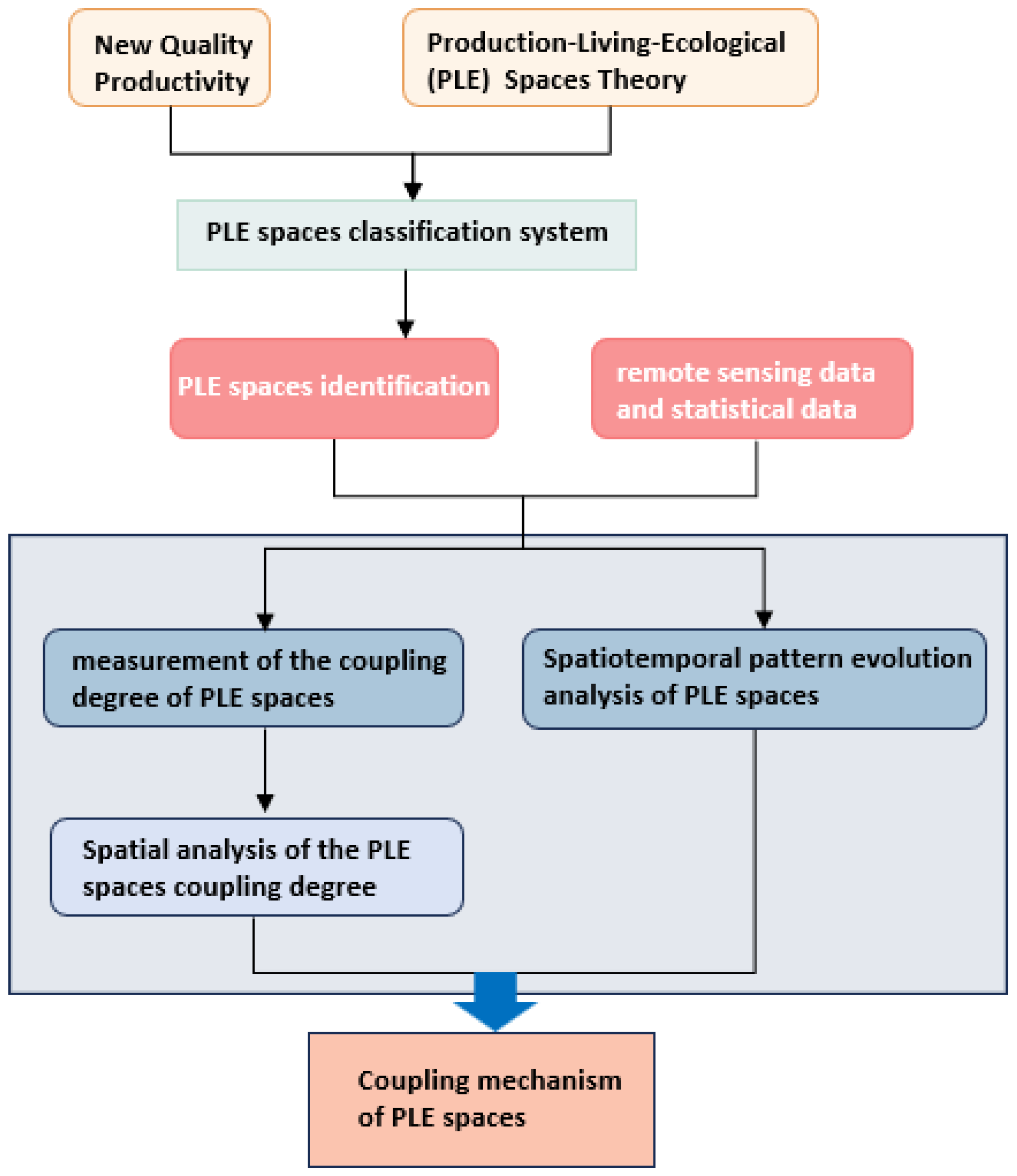
This study adopts new-type productive forces as its core theoretical framework (Figure 1). First, an indicator system for measuring these forces is constructed using the entropy value method, followed by the identification of PLE spaces based on land use types. Building upon this foundation, GIS spatial analysis and land use transition matrices are comprehensively applied to systematically analyze the pattern evolution and transformation characteristics of PLE spaces. Subsequently, kernel density analysis and the coupling coordination degree model are employed to evaluate their spatial agglomeration patterns and systemic coordination levels. The study further utilizes geographic probes to detect factors, identifying core drivers influencing spatial differentiation [43]. Finally, by integrating these multidimensional analysis results, it systematically reveals the spatiotemporal evolution patterns of the PLE spaces in traditional villages of Foshan from the perspective of new-type productive forces, providing empirical evidence and strategic support for their sustainable governance.

2.1.2. Research Methods

(1).
Land Use Transformation
Using ArcGIS 10.8, four land use maps from 1993 to 2023 were spatially overlaid to generate transition matrices for the periods 1993–2003, 2003–2013, and 2013–2023 (Formula (1)). This quantitatively revealed the area conversion pathways and transition rates between different land types [44,45], diagnosing the coordination of spatial functions among the PLE sectors [46].
S = S 11 S 12 S 21 S 22 S 1 j S 1 n S 2 j S 2 n S i 1 S i 2 S n 1 S n 2 S i j S i n S n j S n n
In Equation (1), S denotes area, n represents the total number of land use types, and i, j respectively indicate the selected preceding and subsequent years’ land types. Row vectors characterize outflow areas, column vectors characterize inflow areas, and the diagonal represents unchanged areas.
(2).
Spatial Functional Evaluation Method for the PLE System.
Traditional villages in Foshan exhibit composite functional characteristics, serving as agricultural production bases, high-density residential units, historical and cultural carriers, and water network ecosystems. Functional evaluation, as the foundational step in spatial coordination diagnosis, centers on quantifying the core supply capacities of three spatial categories [47]; production spaces characterize material product supply intensity, living spaces reflect residential and social service levels, and ecological spaces embody environmental safety assurance capabilities. While single-function values (e.g., production function intensity) indicate the supply efficacy of specific spatial units, the overall health status of the spatial system can only be scientifically assessed through multidimensional functional coordination analysis. Accordingly, this study constructs a multi-functional land consolidation system based on the “Classification of Current Land Use” (GB/T 21010-2017) [48], integrated with the regional characteristics outlined in the “Foshan Traditional Village Protection and Development Plan.” Taking production functions as an example: high-production-function land (industrial land, assigned 5 points), medium-production-function land (arable land/rural settlements, assigned 3 points), and low-production-function land (grassland/forest land/lakes, assigned 1 point) [9]; similar logic applies to assigning functional intensity values for living and ecological functions (Table A1). This valuation system converts spatial entities into quantifiable functional indicators, providing foundational variable inputs for subsequent coupling coordination models. For instance, the high production function value (5 points) of industrial land signifies its prominent capacity to supply production factors, while the low production function value (1 point) of water networks reflects their dominant ecological service characteristics. These discrete functional evaluation values inherently reflect only partial attributes. Through coordinated analysis of the coupling of three-dimensional functions, the overall optimization direction of spatial systems can be revealed, providing a basis for precise governance of national territorial space.
(3).
Spatial Coupling Coordination Model for “Three Functions” in Traditional Villages
Calculating the Coupling Coordination Degree of “Three Functions” to Evaluate Spatial Coordination Development Level [49,50].
  • Coupling Degree (Formula (2)):
C = 3 × P i × L i × E i P i + L i + E i 3 1 3
where C is the coupling degree, with values in the range of [0, 1]. A higher C value indicates stronger interactions and mutual influences among the functional spaces of production, living, and ecology, leading the system toward a new ordered structure; conversely, a lower C value suggests the system tends toward disorder. P, L, and E represent the functional indices of production, living, and ecological spaces, respectively. Their values are in the range of [0, 1]. Referencing existing research [51,52], C is categorized into four levels, as shown in Table 1.
Table 1. Classification of “Production-Living-Ecological” space coupling degree.
Coupling DegreeCoupling TypeCharacteristics
[0, 0.3]Low-Level CouplingThe three functions develop independently with weak interconnections and insufficient synergy, potentially leading to dominance by one function
(0.3, 0.5]Antagonistic CouplingThe three functions have minimal connections, with prominent conflicts between them and a lack of coordination.
(0.5, 0.8]Adjustment PhaseThe three functions are relatively well-connected, with interaction between them. They are in an adjustment phase and not very stable.
(0.8, 1]High-level couplingThe three functions work in close coordination, with stable communication and collaborative development.
2.
Coordination Degree (Formula (3)):
T = α P i + β L i + γ E i D = C × T
In the equation, T represents the comprehensive evaluation index for the PLE spatial functions, with values in the range of [0, 1]. A higher T indicates better system integrity. α, β, and λ are undetermined coefficients, with α + β + λ = 1. Based on sustainability theory’s emphasis on the synergistic relationship among production, living, and ecological subsystems, and considering this study’s focus on exploring coupling coordination mechanisms rather than individual functional contributions, this study adopts an approach from related cutting-edge research, assuming equal importance for the three subsystems in overall system coordination. Thus, α = β = λ = 1/3. This equal-weighting assumption ensures methodological robustness and comparability, while also facilitating result interpretation and dialogue with similar studies. D represents the coordinated development level of the PLE spaces’ functions, reflecting the synergy among subsystems. Its value is in the range of [0, 1], with higher D values indicating stronger coupling and coordination. Finally, D values are graded according to the coordination level classification criteria established in [53] (Table 2), revealing the system’s overall optimization direction and coordination status.
Table 2. Classification of coordination levels for “Production-Living-Ecological” functions.
Value RangeClassification TypeCharacteristics
(0, 0.2]On the verge of imbalanceOnly one of the PLE spatial functions dominates, while other functional land spaces are squeezed, leading to dysfunction in the PLE spatial functions
(0.2, 0.4]Mild imbalanceOne PLE spatial function holds a dominant position, with the PLE spatial functions being uncoordinated.
(0.4–0.6]Borderline dysfunctionAddressing issues arising from the imbalance of production, living, and ecological functions through transforming production methods, enhancing living space quality, or improving the ecological environment
0.6–0.8]Moderately coordinatedPredominantly intensive production with significantly enhanced livability and ecological environment, featuring strong coordination and interaction among the PLE spatial functions
(0.9–1.0]Highly CoordinatedThe functions of the PLE spaces mutually reinforce each other, achieving symbiotic integration and orderly development of multifunctional spaces.
(4).
Statistical Analysis Methods
  • Entropy Method
The entropy value method avoids the drawbacks of subjective weighting methods. It objectively reflects the importance of each indicator within the entire evaluation system based on the degree of dispersion of indicator data. The greater the dispersion, the greater the influence of that indicator on the evaluation system, warranting a higher weight. To eliminate the impact of differences in the quantity and units of the original indicator values, the original indicator data must undergo preprocessing before weighting. This paper employs the range standardization method to process the indicator data (Table A2).
For positive indicators:
X i j = X i j m i n   ( x j ) m a x x j m i n ( x j )
For inverse indicators:
X i j = m a x ( x j ) x i j m a x x j m i n ( x j ) w i j = x i j i = 1 m X i j
Calculate the information entropy of the indicator e j , where m represents the number of evaluation years:
e j = 1 1 n m × i = 1 m w i j × l n w i j
Calculate the information entropy redundancy ρ j :
ρ j = 1 e j
And calculate the required indicator weight λ j :
λ j = ρ j j = 1 m ρ j
Calculate the level of new-type productivity based on the indicator weighting ω i j and corresponding weights λ j :
U i = j = 1 m λ j
2.
Geodetector
The geographic detector model serves as an effective tool for studying factors influencing spatial differentiation characteristics, thus finding extensive application in research on the impacts of socioeconomic and natural geographic factors [54]. This paper employs the factor detection analysis of the geographic detector to investigate the causes of spatial differentiation in the PLE functions and their coupling coordination within traditional villages in Foshan. The model formula is:
q = 1 1 M σ 2 a = 1 N M a σ a 2
where q represents the detection value of a factor’s influence on the PLE functions and their coupling coordination, in the range of [0, 1]. A higher q value indicates greater influence of that factor on the PLE functions and their coupling coordination; N denotes the number of classification layers; M a and M represent the sample sizes for layer a (a = 1, 2, 3, ..., N) and the entire area, respectively. σ 2 and σ a 2 denote the discrete variances for the entire area and layer a, respectively. The Geo Detector software (version 1.0-5) was employed to identify dominant factors driving spatiotemporal variation in the spatial coupling coordination of the “three functions” in traditional villages of Foshan. Prior to dominant factor identification, all influence factor data were categorized into three classes (layers) using the natural break method, converting continuous data into categorical data.

2.2. Indicator System Construction

To systematically reveal the mutual feedback mechanism between new-quality productive forces and the PLE space, this study constructs a four-dimensional measurement system (Table 3) based on its core connotations of “innovation-driven, factor upgrading, efficiency optimization, and green sustainability”, adhering to principles of systematicity, operability, and representativeness. Among them, positive (+) or negative (−) mean that the indicators are helpful to improve the performance of subsystem or not [55]. The specific construction process is as follows. First, an initial indicator pool is established. Based on the core theoretical framework of new-quality productive forces—“innovation-driven, factor upgrading, efficiency optimization, and green sustainability”—a systematic review of relevant domestic and international literature, policy documents (e.g., Action Plan for Digital Rural Development, Technical Guidelines for Green Agricultural Development), and authoritative statistical reports led to the preliminary selection of 28 candidate indicators covering the aforementioned four dimensions, forming the initial indicator pool. Second, expert screening was conducted using the Delphi method. Eight experts from fields including rural geography, agricultural economics, territorial spatial planning, and cultural heritage preservation were invited to participate in two rounds of anonymous consultation. Experts scored and evaluated indicators based on their importance, accessibility, and applicability to the Foshan village context. Based on the first-round results (expert coordination coefficient of 0.82), adjustments and clarifications were made to questionable indicators. Following the second round, expert consensus significantly increased (coordination coefficient rose to 0.89), ultimately selecting 18 highly agreed-upon indicators. Finally, statistical tests optimized the indicator set. Using Foshan’s panel data from 1993 to 2023, variance inflation factor (VIF) diagnostics were applied to the 18 indicators to eliminate multicollinearity issues. Setting VIF > 10 as the threshold, five indicators with severe multicollinearity (e.g., “total power of agricultural machinery” highly correlated with “labor productivity”) were excluded. Thirteen highly independent core indicators were retained to form the final measurement system, structured into target, criterion, and indicator layers. The criterion layer established four dimensions to reflect the pathways through which new-quality productive forces influence the PLE spaces:
(1)
Innovation-Driven Development and Digitalization Level: Reflecting technology’s penetration into “production-living” spaces. Computer and mobile phone penetration rates indicate digital infrastructure coverage, while R&D expenditure intensity measures investment in industrial upgrading and spatial intelligent governance through technological advancement.
(2)
Human Capital and Factor Quality Upgrading: Demonstrates how labor force quality enhancement supports the optimization of the “production-living” spatial structure. Comprehensive assessment of indicators such as average years of education and labor productivity evaluates the impact of human capital improvement and income growth on spatial quality.
(3)
Factor Allocation and Output Efficiency: Focuses on the intensive and efficient utilization of “production space”, encompassing indicators such as per capita output value and land productivity to measure how optimized resource allocation enhances spatial economic benefits.
(4)
Green Sustainability and Ecological Support: Represents the degree of “ecological space” protection and green transformation, employing indicators like pesticide use per unit area (negative) and forest coverage to reflect ecological sustainability’s role in safeguarding spatial system coordination.
All indicator data are sourced from the Guangdong Rural Statistical Yearbook, Foshan Statistical Yearbook, and municipal/district-level statistical bulletins, ensuring standardization and continuity. Objective weighting employs the entropy method to eliminate subjective bias, guaranteeing that weights reflect differences in information content across indicators.
Table 3. Development of a measurement system for new-quality productive forces.
Objective LayerCriterion LayerIndicator LayerSymbolCalculation Method or Data SourceAttribute
New Quality ProductivityInnovation-
driven and digitalization level
Average Number of Computers Owned per 100 Rural Households at Year-EndX1Total number of computers owned/Total number of households+
Average number of mobile phones owned per 100 rural households at year-endX2Total mobile phones/total households+
Level of technological innovationX3Internal expenditure on research and experimental development (R&D) × (Total output value of agriculture, forestry, animal husbandry, and fishery/Regional GDP)+
Upgrading Human Capital and Knowledge FactorsAverage Years of Education for Rural PopulationX4(Number of illiterate individuals × 1 + Number of primary school graduates × 6 + Number of junior high school graduates × 9 + Number of senior high school graduates × 12 + Number of college graduates and above × 16)/Total population aged 6 and above+
Labor productivityX5Primary industry value added/Primary industry employment+
Per capita disposable income of rural residentsX6Total Rural Residents’ Disposable Income/Rural Permanent Population+
Factor Allocation and Output EfficiencyAgricultural Output Value per CapitaX7Total Output Value of Agriculture, Forestry, Animal Husbandry, and Fisheries/Rural Population+
Land output efficiencyX8Total agricultural output value/Total crop planted area+
Grain Yield per Unit AreaX9Total Grain Output/Grain Sown Area+
Agricultural electricity efficiencyX10Rural electricity consumption/Total output value of agriculture, forestry, animal husbandry, and fisheries+
Green Sustainability and Policy SupportPesticide Use per Unit AreaX11Total Pesticide Use (Converted to Pure Pesticide Equivalent)/Total Cultivated Land Area
Forest coverage rateX12Forest area/Total land area+
Share of fiscal expenditure on agriculture, forestry, and water affairsX13Local fiscal expenditure on agriculture, forestry, and water affairs/Local fiscal general budget expenditure+

2.3. Research Subjects and Data Sources

2.3.1. Research Subjects

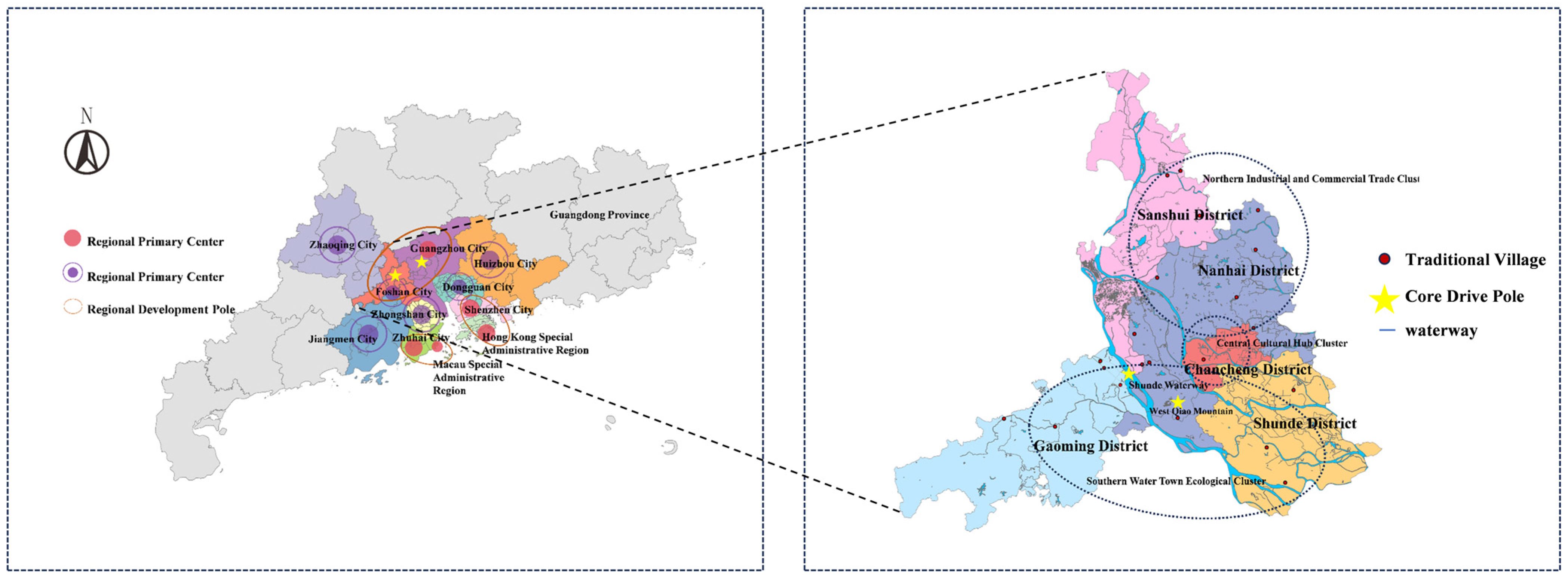
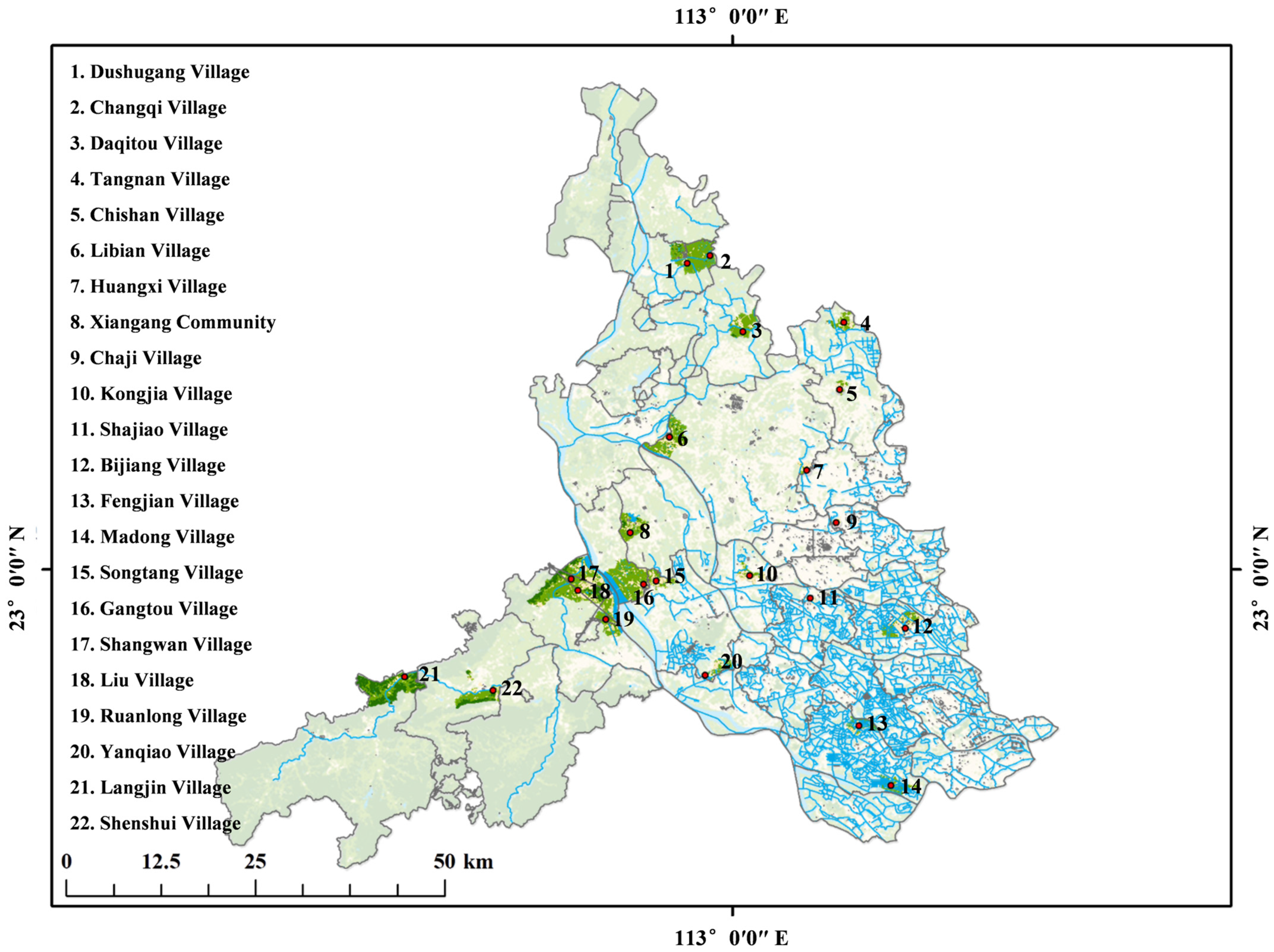
Located at the Guangzhou-Foshan hub within the Guangdong–Hong Kong–Macao Greater Bay Area, Foshan City hosts 22 nationally designated traditional villages embedded within a highly industrialized urban–rural fabric. These villages serve as crucial sites for observing the impact of new-quality productive forces on traditional spatial forms and represent key nodes for cultural heritage preservation and ecological synergy within the Greater Bay Area (Figure 2).
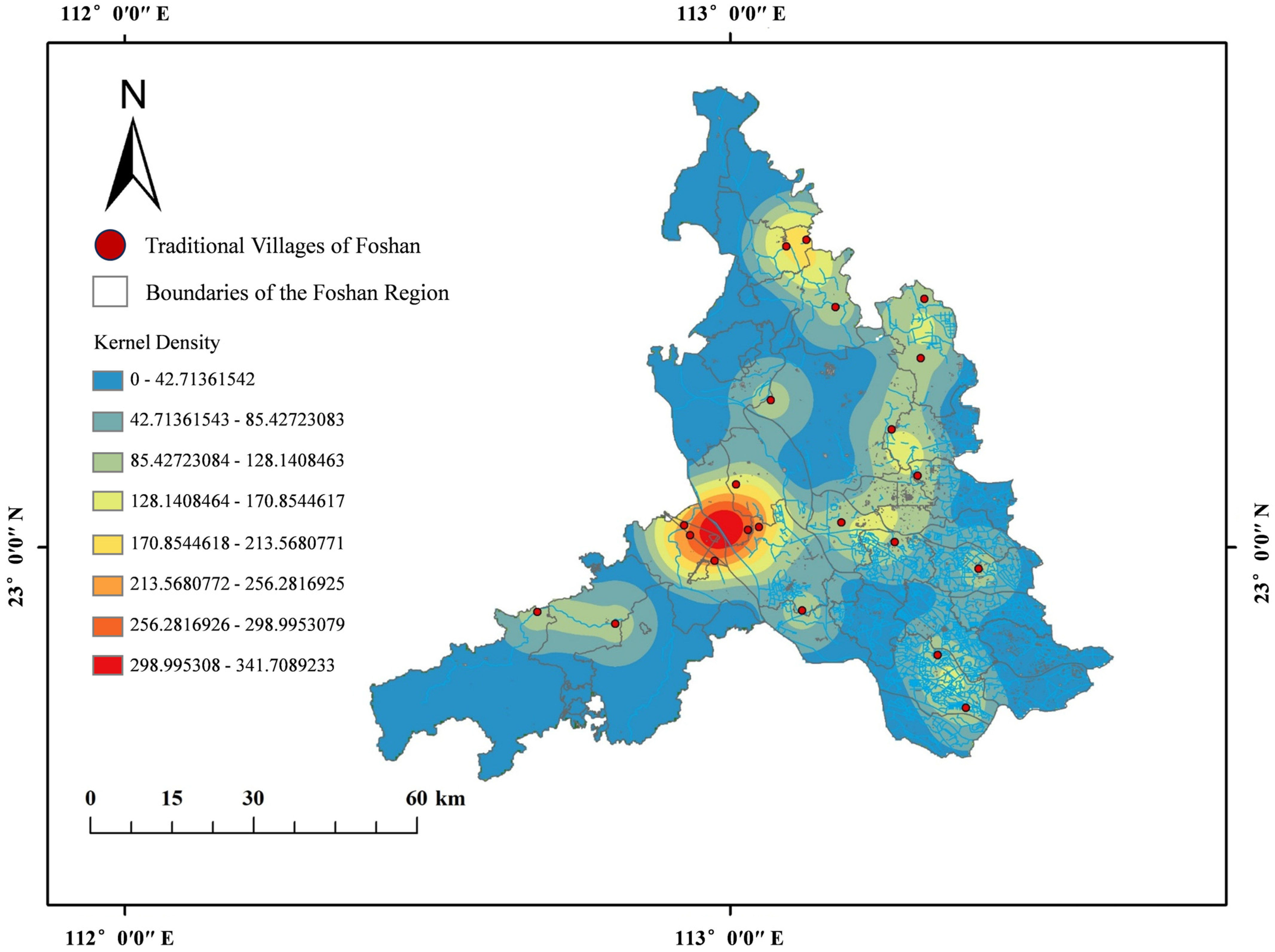
The villages are distributed across the alluvial plains of the Pearl River Delta, with the Xi River and Bei River water systems forming the ecological backbone of the region. Characterized by a subtropical monsoon climate, this area historically fostered a thriving mulberry–fish pond system. The spatial pattern of villages exhibits a “dual-core, three-belt” configuration (Figure 3 and Figure 4), directly reflecting differentiated PLE functions. The northern industrial–commercial–trade cluster (around Xiaoqiao Mountain-Danzao) relies on the Beijiang water system and the ecological barrier of Xiaoqiao Mountain, preserving cultural settlements from the Ming and Qing dynasties’ imperial examination era, demonstrating the synergy between traditional production spaces and ecological barriers; the southern water town ecological cluster (Shunde Waterway) exhibits deep integration between the mulberry–fish pond agroecological system and residential settlements; the central cultural hub cluster (Chancheng), as the core area of the Guangzhou-Foshan metropolitan circle, highlights the dynamic adaptation of living spaces under urban renewal pressures. Foshan’s municipal area spans 3797.79 km2, with traditional villages distributed at a density of 5.79 per 1000 km2. Their spatial distribution exhibits a “dual-core linkage, axial radiation” clustering pattern (Figure 4), with peak densities of 8.42 per 1000 km2 in the Northwest River Corridor Cluster and 6.37 per 1000 km2 in the Shunde Fish-Pond Culture Cluster. This significant density disparity indicates that waterway corridors and pit-pond systems serve as critical spatial carriers for maintaining the efficient coupling of PLE functions. Conversely, density-depleted zones (peripheral areas < 1/1000 km2) represent regions with relatively weaker spatial coordination of these functions. The spatial morphology of villages profoundly reflects the integration of nature and culture: the landscape environment directly shapes the ecological–productive interface [36]; the relationship between dwellings and ancestral halls forms the core structure of living space organization; architectural features and environmental elements embody regionally adaptive technical wisdom.

2.3.2. Data Sources

Traditional village data was sourced from the China Traditional Village Network [56], which provides a list of traditional villages approved by the Ministry of Housing and Urban–Rural Development. To standardize the geographic coordinates of traditional villages in the Foshan region, the MapLocation tool was used to batch-convert latitude and longitude data, ensuring all coordinates adopted the WGS-84 coordinate system. These standardized coordinates were then converted into vector data in shapefile (shp) format using ArcGIS to generate a spatial distribution map of traditional villages in the Foshan region. Geographic Information Systems (GIS) and remote sensing technologies are widely applied in Land Use/Cover Change (LUCC) studies due to their robust spatial observation and analysis capabilities [57]. This study selected land use data from four temporal nodes—1993, 2003, 2013, and 2023—to analyze the spatiotemporal evolution of land use in traditional villages of Foshan. Analysis was based on Landsat satellite imagery (spatial resolution: 30 m; source: Resource and Environmental Science Data Center, Chinese Academy of Sciences). Data underwent preprocessing including image cropping, geometric correction, and atmospheric correction to ensure reliability and comparability. Land use information was extracted through manual visual interpretation. Given the study area’s characteristics—including its Lingnan water village foundation, intertwined high industrialization and ecological conservation, and the composite nature of its mulberry–fish pond heritage—direct application of the national standard “Classification of Current Land Use” (GB/T 21010-2017) proved inadequate for fully characterizing the PLE spatial functions. Therefore, this study adaptively refined the classification system based on the functional orientation of the PLE spaces, integrating it into six major categories: cultivated land, forest land, grassland, water bodies, construction land, and wetlands. This approach more accurately reflects regional realities and supports the exploration of the interaction and evolution patterns of the PLE spatial functions.

2.3.3. Spatial Analysis Units and Data Processing Notes

This study employs 22 nationally designated traditional villages as the fundamental spatial analysis units. To conduct village-scale spatial analysis and geographic detector modeling, all driver data underwent standardized spatialization and matching procedures:
(1)
Vector Boundary Extraction: Precise administrative boundary vector polygon data for each traditional village was digitally acquired based on high-resolution remote sensing imagery and field surveys.
(2)
Data Spatialization and Assignment: For spatially continuous data (e.g., forest coverage, grain yield per unit area), the “Zonal Statistics” tool in ArcGIS was used to calculate average values within each village boundary. For socioeconomic statistics (e.g., per capita disposable income of rural residents, average years of education for rural population), township-level or village-level statistical reports were prioritized for direct matching within data availability constraints. If only county-level data is available, assume relative homogeneity within the area and assign the county average to each village as an approximation, explicitly noting its reliability and limitations for trend analysis in discussions. For point or line feature data (e.g., computers per 100 households, agricultural electricity efficiency), convert to continuous surfaces via kernel density analysis or service radius analysis before extracting village averages.
(3)
Geographic Detector Application: Using the village-indicator panel data processed above as input, the Factor Detector module of the Geographic Detector quantitatively identifies the explanatory power (q-value) of each driving factor in spatial differentiation of the PLE spatial coupling coordination degree.

3. Results and Analysis

3.1. Spatial Distribution and Structural Changes of the PLE Spaces

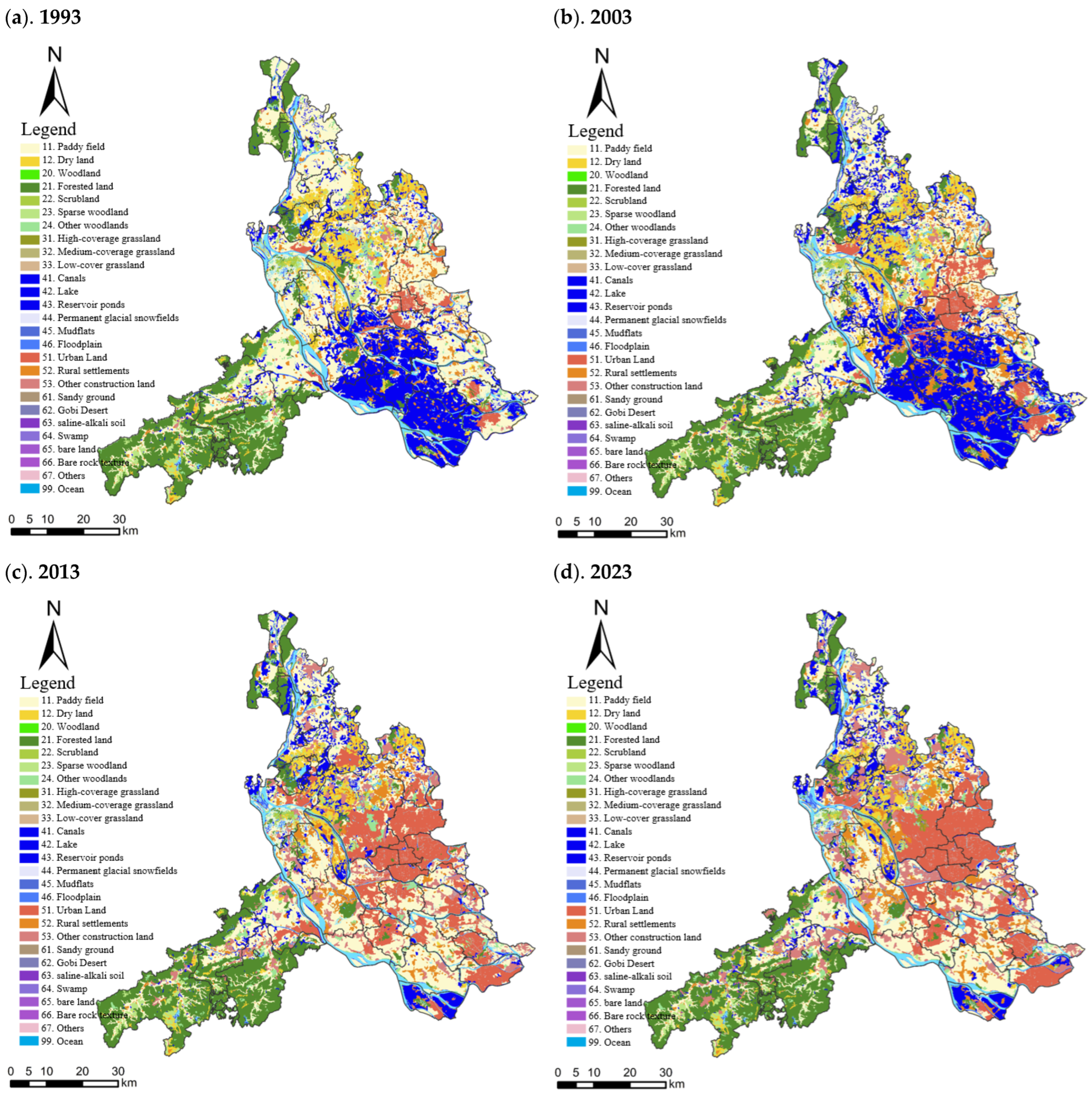
The land use patterns of Foshan City from 1993 to 2023 are shown in Figure 5, Figure 6 and Figure 7.
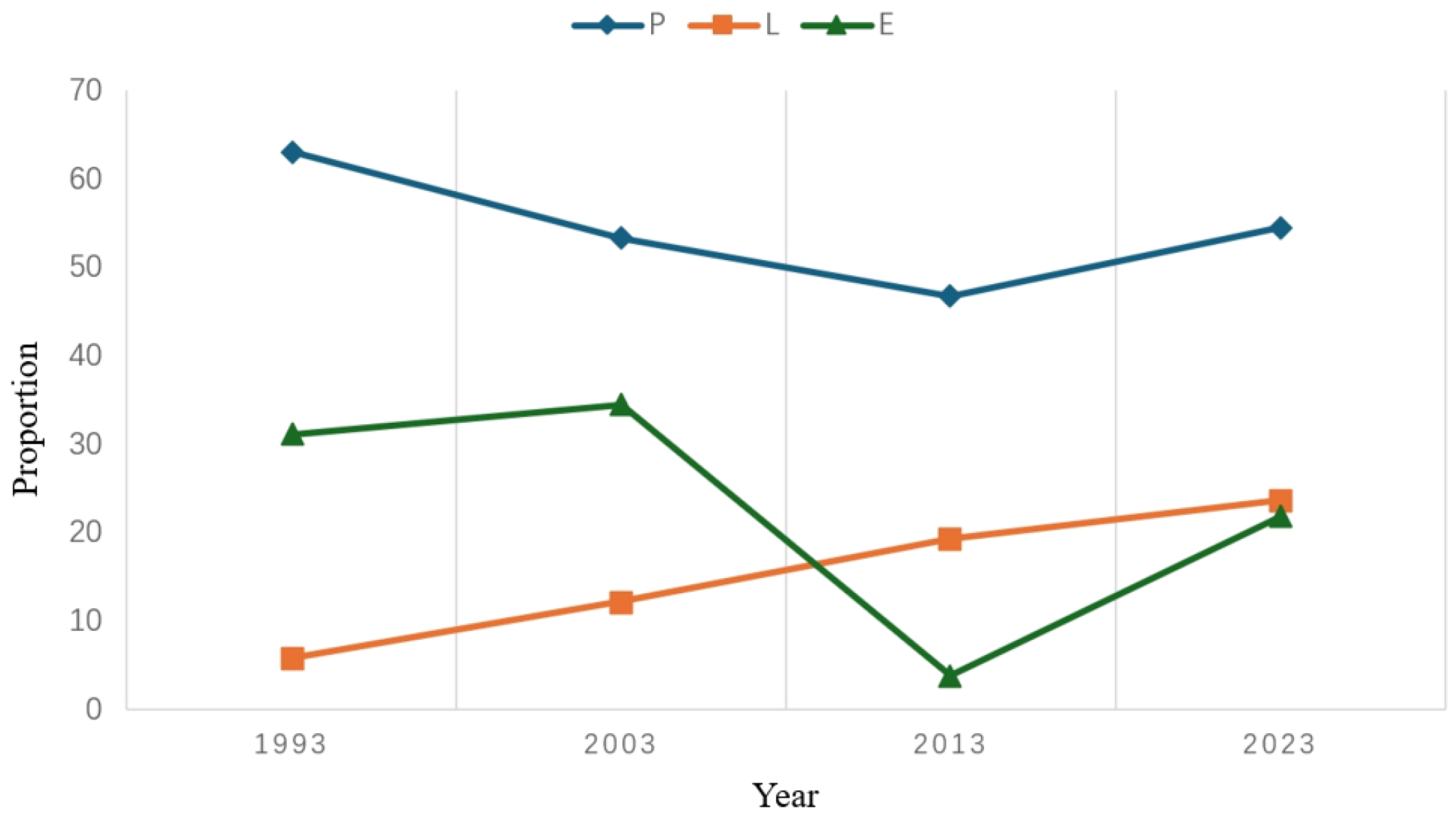
The total area of traditional villages in Foshan spans 195.55 square kilometers. Between 1993 and 2023, the PLE spatial structure underwent significant transformation (Figure 5): (1) Expansion of living space: The proportion of construction land increased from 5.86% (11.46 km2) to 23.62% (46.17 km2), representing a net increase of 17.76 percentage points. (2) Production space contracted: the proportion of farmland decreased from 63.04% (123.25 km2) to 54.57% (106.67 km2), a net reduction of 8.47 percentage points. (3) Ecological space degradation: The proportion of forest land and water bodies decreased from 46.40% (90.73 km2) to 33.48% (65.46 km2), a net reduction of 12.92 percentage points.
In summary, over the past three decades, the PLE spaces in Foshan’s traditional villages have exhibited an evolutionary trend characterized by “expanding living areas, contracting production areas, and deteriorating ecological areas”. The significant fluctuations in the proportions of these three spatial categories may reflect heightened structural tensions within the system, providing a spatial structural foundation for observing the spatiotemporal evolution of their coupling coordination. It should be noted that the aforementioned changes are primarily based on remote sensing interpretation and statistical data analysis. The specific causal relationships between these changes and various driving factors (such as policy, economy, technology, etc.) require further identification through the integration of multi-source data and more detailed mechanism studies.
Changes in primary land use classification further corroborate these trends (Table 4): Construction land experienced sustained rapid growth, while cultivated land fluctuated with an initial decline followed by recovery. The 2023 rebound in cultivated land share was partially attributable to conversions from water bodies. Water bodies initially increased before plummeting sharply. Forest land showed a decreasing trend amid fluctuations, while grassland remains extremely low and shows minimal change.
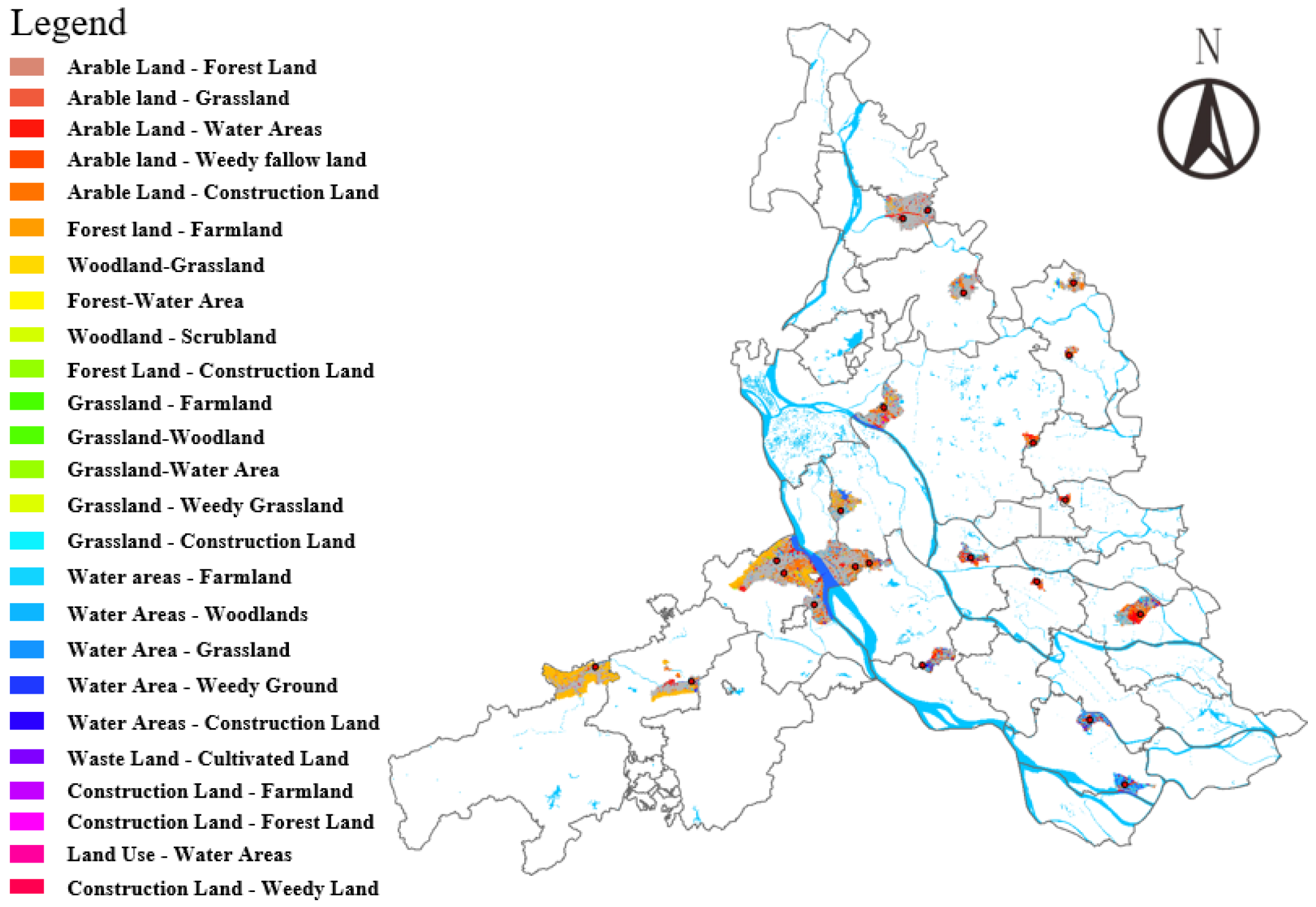
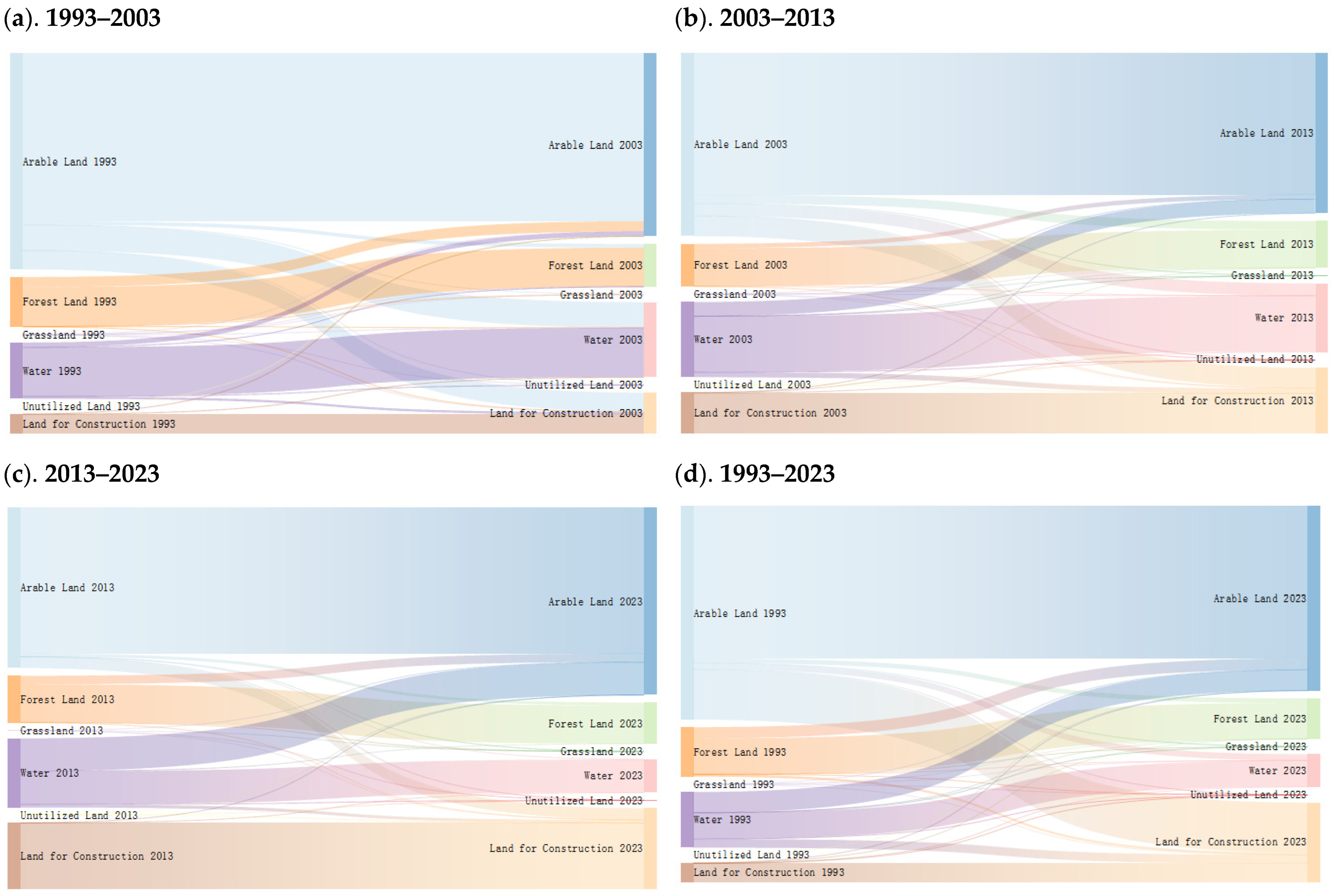
Figure 8 reveals a phased evolution in land conversion within Foshan’s traditional villages: (1) From 1993 to 2003, 18.87 km2 of farmland was converted to construction land (15.3% of the initial total), while water bodies expanded by 10.82 km2 (+33.7%). (2) From 2003 to 2013, 12.98 km2 of farmland was converted to construction land (12.4% of the initial area), while forested land increased by 2.28 km2 (+9.3%). (3) From 2013 to 2023, construction land accelerated its expansion (+8.35 km2, +22.1%), while water bodies drastically decreased by 20.30 km2 (−51.6%).
The aforementioned land conversion process exhibits certain temporal and spatial correlations with the penetration of new productive forces: (1) During the period when digital technologies were progressively applied to agricultural production systems (e.g., precision irrigation, smart agricultural machinery), cultivated land area rebounded between 2013 and 2023 (+15.27 km2, +16.7%), potentially reflecting the positive association between technological penetration and intensive land use. (2) During the phase where innovation factors concentrated notably in the living services sector (e.g., e-commerce logistics, cultural tourism development), construction land expanded continuously (cumulative net increase of 303%), accompanied by corresponding reductions in water bodies and forest land. (3) In regions with relatively lagging green technology systems, net water area decreased by 13.10 km2 (−40.8%) during the same period, with a particularly pronounced decline in later years (−51.6%). Forest land also saw a net reduction of 5.16 km2 (−18.0%), suggesting that insufficient green technology penetration may be linked to weakened ecological space maintenance capacity. (4) In regions with imperfect market-based resource allocation mechanisms, unused land exhibited abnormal growth (a 6.7-fold increase), potentially reflecting tensions between land resource allocation efficiency and the institutional environment [58].
In summary, the overall trend of land conversion exhibits strong spatio-temporal statistical co-occurrence with structural changes in the PLE spaces. Spatial patterns reveal that localized agglomeration of digital and innovative factors often accompanies enhanced production and living functions, while ecological functions fail to improve synchronously. Conversely, regions with insufficient green technology penetration and limited institutional coordination more frequently experience sustained compression of ecological space. These correlations may indicate that the penetration effects across dimensions of new-quality productive forces exhibit unevenness, constituting a key potential mechanism influencing the evolution of PLE space coupling coordination. Concurrently, other plausible explanations must be considered, such as the inertia of traditional urbanization expansion, land use policy orientations, and regional macro-development strategies [59], all of which may jointly shape the aforementioned spatial patterns to varying degrees. It should be further clarified that this study primarily relies on macro-level land use data and statistical models. The revealed “penetration-pattern” relationship primarily reflects a potential spatiotemporal co-occurrence pattern and mechanism, serving as a lead for subsequent mechanism research. However, precise causal pathways and their intensity require further validation through more detailed case studies, process tracking, or quasi-experimental designs.

3.2. Spatiotemporal Evolution of PLE Spatial Coupling

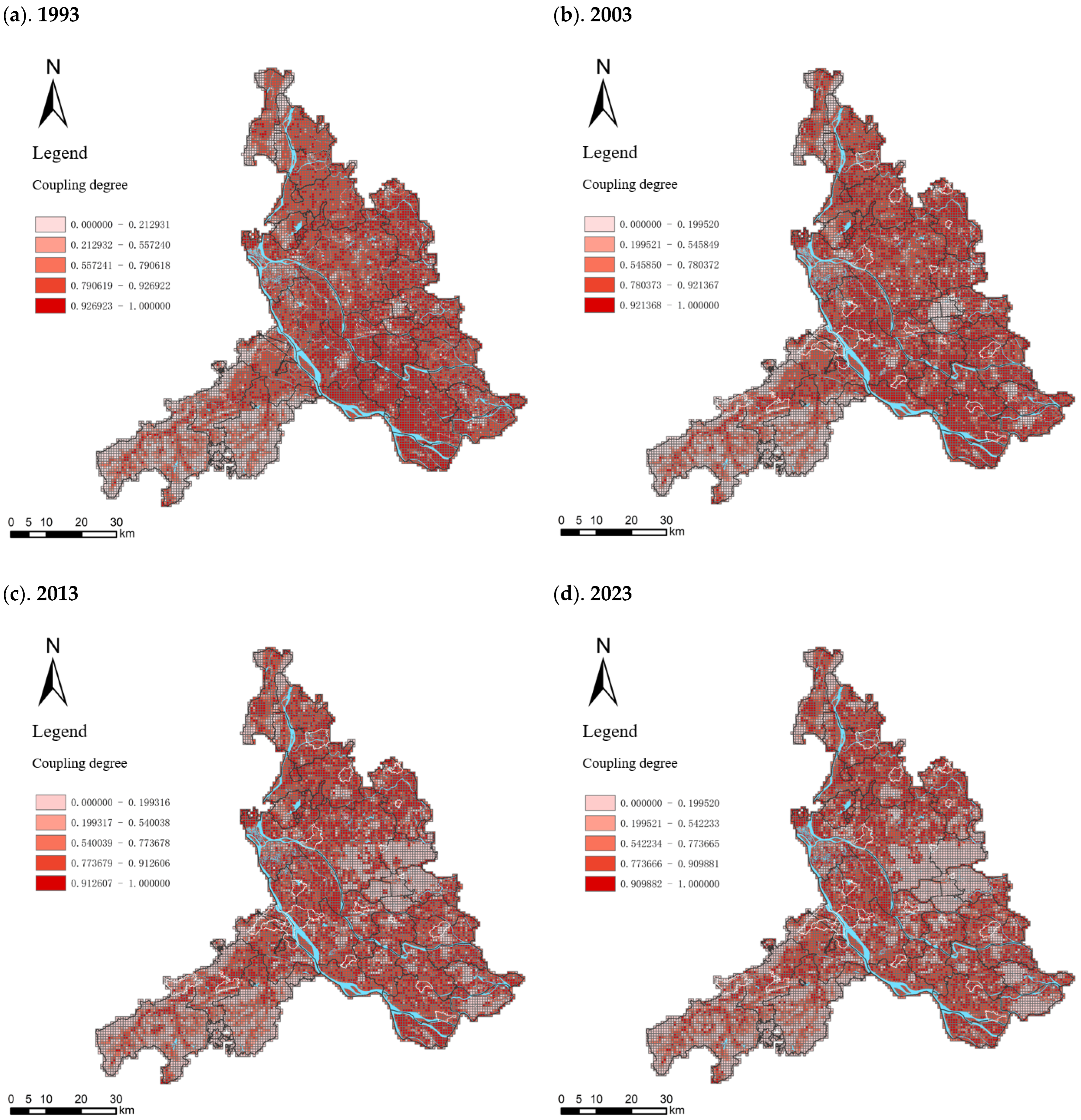
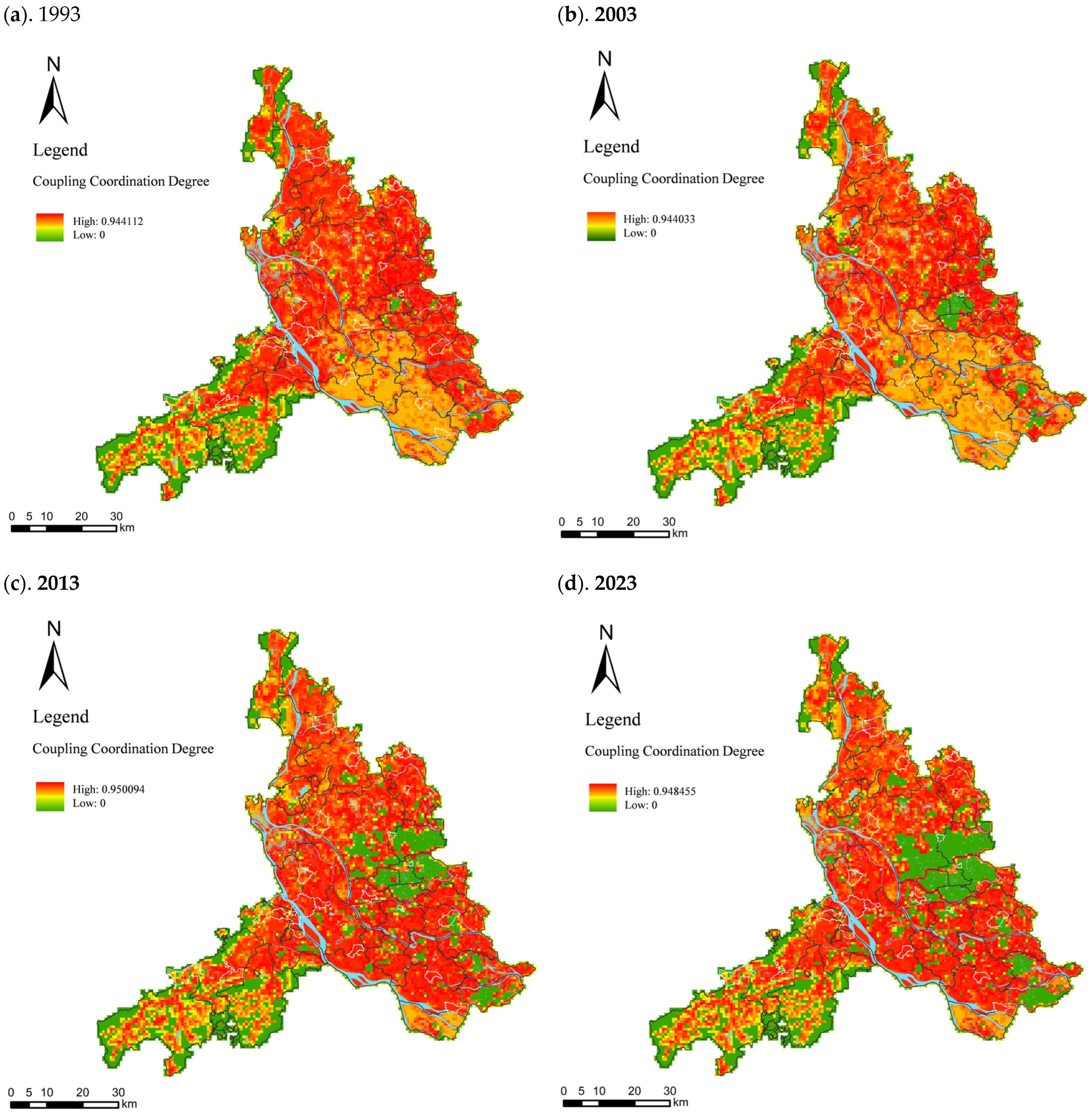
Based on the functional coupling model for the “PLE spaces” in traditional villages established by Formula (2), coupling values for the functional integration of these spaces across four phases were calculated for Foshan’s traditional villages. Using ArcGIS 10.8 software, these calculated values were spatially linked with vector-format spatial analysis units to generate spatial distribution maps of functional coupling for the “PLE spaces” in Foshan’s traditional villages during 1993, 2003, 2013, and 2023 (Figure 9).
Through frequency analysis [55], the coupling coordination level of traditional villages in Foshan shows significant degradation (Figure 9, Table 5): (1) High-level coupling zones continue to shrink: Their proportion decreased from 68.1% (1993) to 53.2% (2023), a net reduction of 14.9%, spatially retreating to the banks of the Xijiang River. (2) Low-level coupling zones show accelerated expansion: Their share increased from 13.5% to 24.2%, forming contiguous clusters in the built-up areas along the Guangzhou–Foshan border (covering 45% of the built-up area in 2023). (3) Medium-value zones fluctuated and diverged: The proportion in the adjustment phase (0.5 < C < 0.8) rose from 14.5% to 17.8%, but spatial continuity weakened.
The statistical analysis reveals a clear correlation between the decline in coordination and spatial imbalances in the penetration of new productive forces: (1) In regions where digital technologies are deeply integrated into production systems, locally high coordination is maintained in river–forest network composite zones (formerly high-value core areas), with their rate of decline relatively slowed. (2) In areas where innovation factors are unipolar concentrated in living spaces, the contiguous expansion of low-value built-up zones (+10.7 percentage points) is accompanied by more pronounced spatial fragmentation of production–ecological functions. (3) In areas with relatively insufficient application of green technology systems, spatial continuity in medium-value zones (adjustment phase) within farmland–water transition belts often breaks down, while antagonistic zones (0.3 < C < 0.5) consistently occupy 4.8%. This process may reveal a critical structural tension; the localized optimization effects of new-quality factors [60] (e.g., digital technologies helping to slow the decline of high-value zones) failed to fully offset the negative spatial impacts of factor-scale erosion under traditional development models (e.g., innovation monopolization accompanied by the doubling of low-value zones) during the observation period. It should be noted that this correlation analysis does not preclude other possible explanations. Factors such as the spatial inertia of traditional urbanization, disparities in regional infrastructure investment, and the enforcement intensity of local land and environmental policies may collectively influence the formation of the observed coordination patterns.
In summary, the spatiotemporal evolution of coupling coordination and the spatial penetration pathways of new-quality productive forces exhibit discernible associative patterns. Analysis reveals that regions with higher digital technology penetration often spatially overlap with locally high-coordination zones; areas characterized by unipolar agglomeration of innovation factors frequently witness the spread of low-coordination zones; and regions lagging in green technology adoption typically exhibit lower overall system coordination levels. These correlations provide empirical evidence for understanding the differentiated impacts of various dimensions of new-quality productive forces on the spatial coordination of the PLE spaces. They also suggest that the unevenness of their interactions is closely related to the overall decline in system coordination, offering crucial empirical clues for addressing research questions (1) and (2). It should be noted that the above correlations represent statistical patterns observed at specific spatial and temporal scales. Their interpretation must account for alternative possibilities (e.g., inertia from traditional urbanization patterns and variations in local policy implementation may simultaneously influence factor allocation and spatial coordination). Furthermore, it must be clarified that this study, based on macro-level statistical data and spatial models at the town and village scales, primarily identifies co-occurrence patterns and statistical correlations among variables. While these findings support mechanistic hypotheses, they cannot definitively establish causal directions or weights. Future research should employ methods such as multi-case comparisons, process tracing, or natural experiments to further identify underlying causal mechanisms and interactive effects.

3.3. Spatial Coupling Coordination Degree and Evolutionary Characteristics of the PLE Spaces in Traditional Villages

Based on the functional evaluation results of the PLE from 1993 to 2023, calculations were performed using the coupling coordination degree model (Formula (3)). The results were then linked to spatial units via ArcGIS 10.8 to generate spatial distribution maps for four representative years (Figure 10). Analysis indicates (Table 6) that the coupling coordination degree in Foshan’s traditional villages exhibits an overall decline with intensified spatial differentiation. The mean value decreased from 0.668 in 1993 to 0.605 in 2023, while the standard deviation continued to increase, reflecting a trend toward greater dispersion in internal coordination levels. This evolutionary process exhibits a consistent phased correspondence with the temporal and spatial penetration of new-quality productive forces.
In 1993, the coordination pattern was predominantly highly coordinated, concentrated in the southern river network ecological complex with strong spatial continuity. Moderately coordinated zones were distributed along the farmland–forest transition belt, while severely imbalanced areas appeared as scattered points. At this stage, new qualitative factors were still in their infancy, and their influence was not yet significantly reflected in the spatial pattern. By 2003, accelerated early industrialization and urbanization (particularly in the east) facilitated the gradual integration of new productive forces characterized by primary technologies (e.g., basic automation equipment) and capital investment. During this phase, the proportion of highly coordinated zones decreased to 39.6%, with weakened spatial continuity (fragmentation of high-value areas, an 18% reduction in regions exceeding 0.92); moderately coordinated zones increased to 35.5%, becoming the dominant type; severely maladjusted zones expanded to 14.2%, spatially overlapping significantly with eastern urban expansion areas.
A fluctuating change emerged in 2013. The proportion of highly coordinated zones rebounded to 48.0%, but their spatial distribution became polycentric and fragmented, moderately coordinated zones sharply declined to 23.2%, while severely unbalanced zones increased to 19.7%, forming contiguous areas along the Guangzhou–Foshan border. During this phase, the introduction of new productive forces (e.g., preliminary IT applications, logistics network expansion) coincided with efficiency gains in some production spaces. However, their uneven diffusion and factor reallocation (e.g., labor and land concentrating in high-return industries) intensified spatial functional conflicts, manifesting as declining coordination stability (with peak zones retreating to the West River shoreline).
By 2023, the further penetration of new-quality productive forces and structural transformation (including smart technology adoption, high-end talent clustering, and green production promotion) exhibited a distinct spatial correspondence with the differentiation of the PLE spatial coordination pattern. On one hand, in ecologically sensitive zones (e.g., the southwestern riverbank belt), mature practices in smart technology and green production correspond to the maintenance of locally high coordination (accounting for 45.5%, remaining the core area but showing a net decrease of 9.3% compared to 1993). Conversely, the clustered development of new-quality factors (e.g., industrial internet, automated production lines) in eastern regions has driven industrial land expansion and enhanced production capabilities. However, this growth has not been accompanied by synchronous improvements in living quality and ecological conservation. Moderately coordinated zones have continuously shrunk to 22.9%, while severely imbalanced zones have significantly expanded to 22.9%, forming large contiguous areas. The overall spatial pattern shows high-coordination zones retreating to a narrow riparian belt in the southwest, while low-coordination zones in the east expand contiguously, closely aligning with the spatial form of industrial agglomeration.
In summary, the spatiotemporal evolution pattern of coupling coordination reveals a strong statistical correlation and phased correspondence between the penetration of new-type productive forces and spatial coordination patterns. This relationship is not singular or linear but manifests through three differentiated pathways: “localized digital technology cultivation, unipolar agglomeration of innovation factors, and relatively lagging green transformation”. Spatially, this forms a divergent pattern characterized by “retreating high-value zones and contiguous low-value zones”. This finding provides evidence for addressing Research Question (1), indicating that the impact of different dimensions of new-quality productive forces on coordination evolution may exhibit significant spatial heterogeneity and uneven effects. It should also be noted that the above correlation analysis, based on macro-spatial–temporal data and model calculations, primarily reflects co-occurrence relationships and mechanism clues. Precise causal mechanisms still require verification through more detailed process studies.

3.4. Spatiotemporal Analysis of Functional Coupling Coordination Among Production–Living, Living–Ecological, and Production–Ecological Spaces

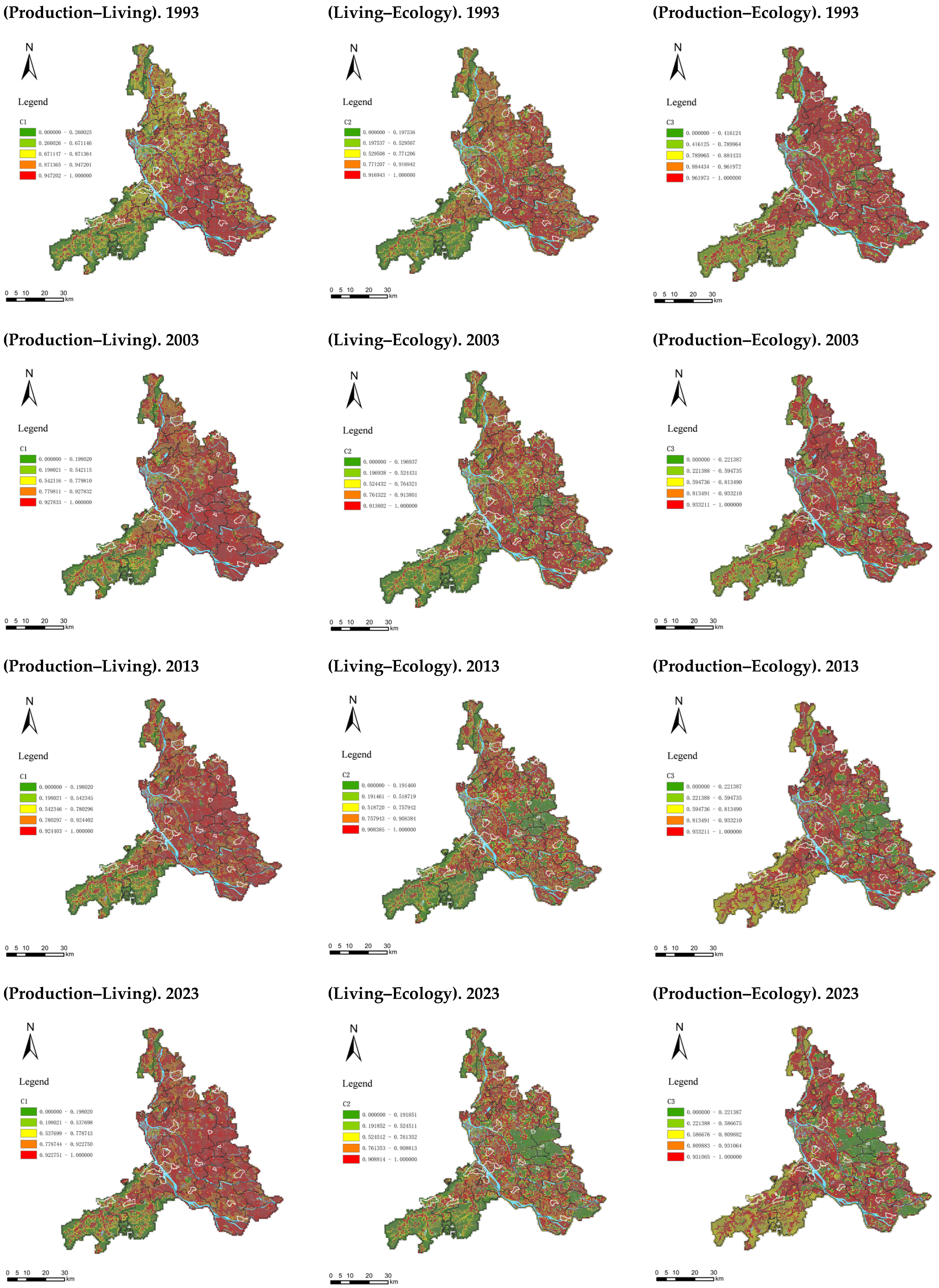
The synergistic coordination of land multifunctionality is a core proposition in modernizing national territorial governance. Based on the coupling coordination degree model, this study conducted a spatiotemporal evolution analysis (Figure 11) of the coordination between pairwise subsystems of the PLE spaces in traditional villages of Foshan from 1993 to 2023—namely production–living (C1), living–ecology (C2), and production–ecology (C3)—from 1993 to 2023. Integrating the theoretical perspective of new-quality productive forces, it explores potential structural bottlenecks in their green and efficient transformation. Results indicate significant spatial differentiation in coordination levels across the three subsystems. Within the C1 system, high-coordination zones predominantly cluster in villages like Bijiang Village and Fengjian Village, which exhibit well-developed cultural–tourism integration, while eastern industrial belt villages such as Changqi Village and Chishan Village persistently maintain low coordination levels. System C2 exhibits relatively high overall coordination, with high-value areas predominantly distributed in Songtang Village and Xiangang Community along the Xijiang River basin, while low-value areas are concentrated in Libian Village near the Guangzhou–Foshan border. High coordination in System C3 is frequently observed in areas like Chaji Village and Kongjia Village, where ecological foundations and productive activities are well-integrated, whereas Huangxi Village and Daqitou Village demonstrate persistently low coordination levels.
From a temporal perspective, overall coordination exhibits a general “U-shaped” fluctuation trend. Following enhanced policy interventions after 2013, coordination levels in some villages like Shajiao Village rebounded, yet the eastern region as a whole continues to lag in development. Collectively, the coordination of “production, living, and ecology” spatial functions in Foshan’s traditional villages reveals a spatial pattern characterized by “decline in the east, resilience in the west, and systemic differentiation”. This pattern can be linked to regional disparities in the penetration of new productive forces and may reflect three structural tensions. First, a degree of disembedding exists between production and living functions, manifested in the spatial co-occurrence of low-end industrial expansion and declining village livability. Second, insufficient coordination exists between production and ecological functions, with limited green technology penetration coexisting with ecological overload pressures in some areas. Third, a mismatch exists between conservation and development objectives, where initiatives like cultural tourism revitalization yield localized successes but fail to achieve universal benefits, resulting in coexisting localized revitalization and overall imbalance. If current development trajectories persist, eastern villages may face the risk of a “coordination trap”, where localized functional improvements struggle to reverse the declining trend in overall systemic coordination.
In summary, this section’s analysis reveals at the subsystem level that the spatial penetration of new-quality productive forces does not uniformly promote synergistic “production-living-ecology” coordination. Instead, it correlates with mismatches in technological pathways, factor allocation, and policy responses, potentially exacerbating the “triple disembedding” between functions. This finding provides further support for understanding Research Question (2), suggesting that spatial coordination mechanisms driven by new-type productive forces may manifest as the coexistence of “differentiated empowerment” and “structural disembedding”. It also resonates with Research Question (3), indicating that without systemic integration, localized technological progress may prove insufficient to reverse the overall decline in coordination, potentially leading to a low-coordination state due to development path dependency.

3.5. Analysis of Driving Factors for Functional Coupling Coordination Degree in PLE

Based on the Geodetector model, this study systematically analyzed the evolutionary mechanism of the coupling coordination degree of the PLE spatial functions in traditional villages of Foshan from 1993 to 2023. It selected 13 core driving factors (Table 7) across four dimensions: innovation-driven development and digitalization level, human capital and knowledge factor upgrading, factor allocation and output efficiency, and green sustainability and policy support. Results indicate a strong statistical correlation between the penetration depth of new-quality factors and the evolution of structural transformation and coordination.
The enhancement of innovation and digital factors (X1: computer ownership, X2: mobile phone ownership, X3: technological innovation level) exhibits a significant positive correlation with improved production space efficiency and optimized living space services. The q-values for all three factors exceed 0.25 and show a sustained upward trend, indicating that the proliferation of digital infrastructure and technological innovation may positively influence the coordination of production, living, and ecological functions by reshaping factor combinations (e.g., smart irrigation, e-commerce logistics). However, their uneven spatial diffusion is also associated with intensified regional divergence—the eastern industrial zones’ spatial coexistence of prioritizing production digitization and neglecting ecological constraints aligns with the decline in coordination observed in this region.
Human capital upgrading (X4: years of education, X5: labor productivity, X6: per capita disposable income) constitutes a core dimension highly correlated with new-quality productive forces, with all three Q-values consistently exceeding 0.50 (X6 reached 0.721 in 2023). The statistically strong correlation between high-quality labor force (X4) and technological innovation (X3) suggests that “knowledge-technology” coupling may bidirectionally promote both the intensification of production spaces and the enhancement of living space quality. However, the unidirectional outflow of human capital to urban areas may simultaneously weaken coordination within rural areas, logically corroborating the previously observed degradation of living space functions.
Analysis of factor allocation transformation reveals dynamic shifts in explanatory power between new-quality productive forces and traditional momentum indicators; the q-value for per capita agricultural output (X7) declined post-2013 (0.487 in 2023), while land output efficiency (X8) rose steadily from 0.532 in 1993 to 0.659 in 2023. Concurrently, the explanatory power of technological innovation (X3) has significantly strengthened (q value rising from 0.423 to 0.603). These changes collectively indicate that development momentum may be shifting from reliance on traditional resource inputs toward a balanced emphasis on innovation and efficiency. However, imbalances persist in this transition. For instance, the explanatory power of agricultural electricity efficiency (X10) remains consistently weak (q values below 0.27) and has failed to pass significance tests in recent years. This suggests lagging technological penetration in certain sectors, potentially constraining overall coordination improvements.
The green sustainability dimension is key to understanding the “ecological optimization” function of new-quality productive forces. The q-value for the core ecological factor—forest coverage (X12)—has risen steadily from 0.385 to 0.523, indicating that the supporting role of ecological baseline quality in system coordination is becoming increasingly prominent. This finding aligns with the theoretical perspective of “ecological assetization”; green technologies (e.g., clean production, resource recycling), when complemented by ecological conservation policies (X13), may enhance ecosystem service functions and convert them into ecological products. This process buffers pressures from production expansion and contributes positive returns to system coordination. However, the rebound in explanatory power of pesticide use per unit area (X11) reflects insufficient adoption of new green agricultural technologies (e.g., biological pesticides, smart application systems), indicating that ecological pressures remain unmitigated. This may be a key factor associated with the retreat of high-coordination zones.
In summary, the driving factor analysis reveals differentiated statistical correlation patterns between the dimensions of new-quality productivity—“digital penetration, innovation clustering, efficiency enhancement, and green transformation”—and the spatial coordination of the PLE functions. Among these, innovation digitization and human capital demonstrate strong explanatory power, yet their spatially uneven diffusion correlates with regional variations in coordination levels, changes in the explanatory power of factor allocation signal shifts in development orientation, while the depth of green transformation is closely tied to the system’s capacity to alleviate ecological constraints. These findings provide quantitative evidence for addressing research questions (1) and (2), revealing the heterogeneity of impacts and complexity of interactions across dimensions of new-quality productivity. They also suggest that insufficient synergy among “technology-institutional-scale” factors may constitute a key bottleneck constraining its enabling effects. Building on this, the exploration of research question (3) gains support, indicating that future policies should focus on establishing a systemic governance framework [32].
It should be further clarified that the above analysis is based on the factor explanatory power (q-value) of the geographic detector, which essentially serves as a statistical measure for attributing spatial differentiation. It reflects the degree of association between variables rather than establishing definitive causal relationships. A high q-value indicates strong statistical covariance between the factor and the spatial distribution of coordination levels. However, the specific causal mechanisms, direction of influence, and potential unobserved confounding variables require deeper process-oriented research for confirmation. For instance, the association between human capital and coordination levels may be partially mediated or moderated by other factors such as regional infrastructure and rural governance capacity. Furthermore, this study faces data-level limitations; some socioeconomic drivers are difficult to obtain directly at the village level. While using district-level proxy data can reflect trends, it may smooth out micro-level differences between villages. The sample size of 22 villages is also limited in ensuring statistical robustness. Future research could expand the sample size, conduct comparative case tracking, or employ mixed-methods approaches to further test and deepen the association pathways and underlying mechanisms revealed in this study.

4. Discussion

4.1. Dialogue and Extension of Existing Research

This study reveals that the expansion of living space and the persistent contraction of production and ecological spaces occur simultaneously in both time and space. This aligns with the pattern of mutual displacement among the three types of space observed in rapidly urbanizing regions in previous research [9,24], collectively reflecting a common spatial compression trend potentially faced by traditional villages. The coupling coordination degree of the PLE spaces in the study area exhibits characteristics of “overall decline and spatial polarization”, manifested as high-value zones retreating to the southwestern riverbank belt while low-value zones significantly expand in the contiguous urban areas of the east. While this differentiation pattern shares morphological similarities with the “core-periphery” structure mentioned in similar studies, this research further identifies its high spatial alignment with the intensive industrialization process in the Guangdong–Hong Kong–Macao Greater Bay Area. This suggests that region-specific development models may profoundly influence the spatial structure of traditional villages.
Theoretically, this study provides micro-level empirical support for the “Human-Land Relationship Regional System Theory” [43] and the “New Quality Productivity Theory” [36]. The evolution of spatial patterns can be interpreted as a manifestation of the “human-land interactive feedback” mechanism. For instance, the formation of low-coordination zones in the eastern urban agglomeration may correspond to persistent tensions between high-intensity socioeconomic activities and the natural carrying capacity. As a core ecological factor, forest coverage (X12) demonstrated a consistently rising explanatory power (q-value), indicating a stable positive correlation between ecological baseline quality and system coordination levels. This supports the “ecology-first” logic of national land governance [28]. However, the coexistence of a “V-shaped rebound” in cultivated land area during the final period and a sharp decline in water area suggests that policy interventions may trigger complex spatial trade-off effects. The specific mechanisms—particularly the collaborative processes among multiple stakeholders in the “policy-market-community” triad—require further analysis in future research.

4.2. Mechanisms and Bottlenecks of New Quality Productivity Factors

The driving effects of various elements of new-quality productive forces on coordinating the PLE spaces show divergent trends. The contribution of technological innovation levels (X3) continues to strengthen, reflecting the deepening role of innovation-driven forces in systemic coordination. In contrast, the contribution of hardware-proliferation indicators such as rural household computer ownership (X1) declined in 2023, indicating that standalone hardware investments yield limited empowerment effects without complementary skills, application scenarios, and institutional coordination. This “technology diffusion bottleneck” phenomenon provides new evidence for verifying the necessity of “technology-institutional” coordination at the village level [42].
Further analysis reveals that the core of green transition pathways lies in advancing “ecological assetization”. This process not only aims to reduce environmental costs but also transforms ecological functions into developmental assets through three mechanisms. First, technology enhances ecological services, such as intelligent monitoring and circular technologies that improve ecosystem regulation and supply capabilities. Second, cultivating tradable ecological products enables market conversion of ecological value through certification and branding. Third, establishing protective feedback loops channels ecological benefits back into sustainable management, mitigating the “production-ecology” decoupling. However, green and digital technologies at the village level still face dual constraints of “diseconomies of scale” and “institutional incompatibility”, fundamentally stemming from insufficient “scale compatibility” between technological pathways and rural baseline conditions. This manifests as:
(1)
Mismatch between technology supply and operational scale: Many green technologies and smart equipment (e.g., large-scale smart irrigation systems, centralized wastewater treatment facilities) are designed for scaled, continuous production scenarios, making them ill-suited for traditional villages characterized by fragmented land, dispersed property rights, and small-scale operators. For instance, promoting precision irrigation technologies in villages with scattered farmland often faces “diseconomies of scale” due to small unit areas and high infrastructure investment costs [61].
(2)
Disconnect between policy standards and local practices: Some top-down ecological conservation or technology promotion policies adopt uniform standards and assessment metrics without adequately considering differences in resource endowments, development stages, and community capacities across villages. This leads to “institutional incompatibility” during local implementation. For instance, while strictly restricting all development activities in ecologically sensitive areas, failing to provide differentiated alternative livelihood or ecological compensation schemes may instead dampen community enthusiasm for conservation, exacerbating the “disembedding” of conservation from development.
(3)
Mismatch between technology application and social organization forms: Digital platforms and networked services typically rely on a certain user density and activity level. However, in villages experiencing population outflow and pronounced aging, it is difficult to achieve the user scale and social interaction foundation required for sustainable operation, leading to difficulties in the “implementation and sustainability” of digital projects.
Therefore, the effective implementation of new productive forces depends not only on technological advancement but critically on compatibility with local resource scales, property rights structures, community organizations, and institutional environments. Promoting sustainable rural development requires particular attention to local adaptability of technologies, flexible policy design, and incremental innovation based on community needs—avoiding efficiency losses and new forms of exclusion caused by one-size-fits-all approaches.

4.3. The Phenomenon of “Idleness” in Spatial Reconfiguration and Systemic Disembedding

Research on identifying the spatial patterns of PLE areas has observed phenomena of idle land coexisting with overall intensification trends. This phenomenon may reflect the complexity inherent in rural spatial transformation driven by new productive forces. Its causes, as observed, primarily involve the combined effects of institutional, economic, and social factors. For instance, approved but unbuilt planning projects may lead to temporary land idleness; imperfect rural land markets and property rights systems may hinder the efficient circulation of factors; population outflow and aging often accompany reduced utilization intensity of farmland and homestead sites; additionally, ecological conservation policies, when lacking alternative livelihood support, may temporarily suppress productive land use.
Thus, idle land can be viewed as a spatial manifestation of insufficient coordination among new capital flows, traditional livelihood patterns, demographic shifts, and evolving governance frameworks. It may not only represent a transitional state but also reflect “friction points” where different systems fail to coordinate effectively. If coordination remains lacking over the long term, such frictions may accumulate locally, exacerbating functional imbalances among production, livelihood, and ecology, and placing some villages at risk of falling into a “coordination trap”. Identifying and paying attention to these spatial signals holds reference value for promoting sustainable and inclusive rural reconstruction.

5. Conclusions

This study systematically analyzes the evolution patterns and driving mechanisms of the PLE spaces in traditional villages of Foshan from the perspective of new-quality productive forces, drawing the following conclusions:
(1)
Significant spatial restructuring has been observed, with the continuous expansion of living space accompanied by the contraction of production and ecological spaces. These changes correlate with a decline in the overall spatial coupling coordination and an intensification of spatial differentiation patterns.
(2)
Spatial evolution appears to be influenced by a combination of internal and external factors. Internal drivers are linked to villagers’ demand for improved living quality, while external drivers include transformative forces such as tourism market development and policy guidance.
(3)
Elements of new-quality productive forces show notable statistical association with spatial coordination. Among these, technological innovation level exhibits a strengthening correlation, whereas the contribution from hardware proliferation has shown fluctuation, suggesting the importance of synergistic “technology-institution-application” support in the diffusion process.
This study offers an integrated perspective for understanding the co-evolution of PLE spaces in traditional villages through the lens of new-quality productive forces, and provides a conceptual basis for reconciling cultural heritage conservation with sustainable development during urbanization. The principles of innovation-driven growth and quality-efficiency emphasis underscored by new-quality productive forces may inform governance approaches in integrated urban–rural regions such as the Guangdong–Hong Kong–Macao Greater Bay Area. The Foshan case reflects both the context-specific dynamics of highly industrialized areas and some common patterns of spatial transformation observed in traditional Chinese villages. It thus holds referential value for spatial optimization, vitality revitalization, and sustainable development pathways in similar regional settings.
Based on the above findings, this study proposes the following policy considerations. First, consider establishing a dynamic coordination mechanism for PLE spaces within territorial spatial planning, aiming to guide the functional balance among living, production, and ecological spaces through measures such as comprehensive land consolidation. Second, develop differentiated and place-sensitive policies that foster new-quality productive forces, with emphasis on coordinated implementation of digital infrastructure, green technology adoption, and human capital enhancement in villages. Third, strengthen integrated governance frameworks for traditional village conservation and development by encouraging community participation and benefit-sharing in initiatives such as cultural tourism revitalization and ecological compensation.
It should be noted that the conclusions above are derived primarily from spatial–statistical analysis and observational data, highlighting associations and co-occurrence patterns rather than definitive causal pathways. The relationships described—such as those between living space expansion and the reduction of other functional spaces—could also be influenced by other factors, including regional policy orientation, land management regimes [62], and historical development pathways. Furthermore, this study has several limitations. The use of 30 m resolution remote sensing data may constrain the detection of micro-spatial features within villages; the measurement of new-quality productive forces does not fully capture intangible elements such as cultural capital and social networks; and the sample of 22 villages, while illustrative of the study area, limits the generalizability of the findings. Future research could integrate higher-resolution imagery, incorporate soft indicators such as intangible heritage transmission and community organization vitality, expand the geographical scope of analysis, and employ mixed methods—including longitudinal case tracking and participatory assessment—to further examine the localized mechanisms and conditional pathways through which new-quality productive forces interact with spatial coordination.

Author Contributions

Conceptualization, W.M., J.B. and Q.L.; Methodology, W.M., J.B. and Q.L.; Software, J.B.; Validation, J.B.; Formal analysis, W.M., J.B. and Q.L.; Investigation, J.B.; Resources, W.M. and J.B.; Data curation, J.B.; Writing—original draft, J.B.; Writing—review & editing, J.B. and Q.L.; Visualization, J.B.; Supervision, W.M. and Q.L.; Project administration, W.M. and Q.L.; Funding acquisition, J.B. All authors have read and agreed to the published version of the manuscript.

Funding

This study received no extra funding.

Institutional Review Board Statement

Not applicable.

Informed Consent Statement

Not applicable.

Data Availability Statement

The original contributions presented in this study are included in the article. Further inquiries can be directed to the corresponding author.

Conflicts of Interest

The authors declare no conflicts of interest.

Appendix A

Table A1. Classification and functional scoring table of production–living–ecological (PLE) spaces in Foshan traditional villages.
Primary CategorySecondary CategoryProduction Function
/Points
Living Function
/Points
Ecological Function
/Points
Category CodeCategory NameCategory CodeCategory Name
1Arable Land11Paddy Fields303
13Dryland303
2Garden Plot21Orchard303
3Woodland31Forested land005
4Grassland43Other Grass005
5Commercial and service land51Wholesale and Retail Land510
52Accommodation and Food Service Land510
54Other Commercial Land510
6Industrial, Mining, and Storage Land61Industrial Land510
63Warehouse Land510
7Residential Land72Rural Homestead Land350
8Public Administration and Public Service Land81Land for Government Agencies and Organizations330
83Educational and Scientific Land330
84Medical and Health Charitable Land330
85Cultural, Sports, and Entertainment Land330
86Public Facility Land330
87Parks and Green Spaces131
88Scenic and Historic Site Facilities330
9Special Land Use94Religious Land330
95Cemetery Land330
10Transportation Land102Highway Land500
103Street and Alley Roads500
104Rural roads500
11Water Areas and Water Conservancy Facilities Land111River Water Surface005
114Pond water surface101
112Lake surface005
117Ditch101
12Other Land121Vacant land005
122Facility Agricultural Land101
123Field Ridges303
Note: The evaluation criteria employ a four-level scoring system of 5, 3, 1, and 0 [9].
Table A2. Quantitative standards and weightings for indicators.
Functions of PLE SpacesIndicator LayerSymbolCalculation Method or Data SourceAttributeWeight
Production Level of technological innovationX3Internal expenditure on research and experimental development (R&D) × (Total output value of agriculture, forestry, animal husbandry, and fishery/Regional GDP)+0.0732
Labor productivityX5Primary industry value added/Primary industry employment+0.0443
Agricultural Output Value per CapitaX7Total Output Value of Agriculture, Forestry, Animal Husbandry, and Fisheries/Rural Population+0.0733
Land output efficiencyX8Total agricultural output value/Total crop planted area+0.0743
Grain Yield per Unit AreaX9Total Grain Output/Grain Sown Area+0.0930
Agricultural electricity efficiencyX10Rural electricity consumption/Total output value of agriculture, forestry, animal husbandry, and fisheries+0.0560
LivingAverage Number of Computers Owned per 100 Rural Households at Year-EndX1Total number of computers owned/Total number of households+0.0572
Average number of mobile phones owned per 100 rural households at year-endX2Total mobile phones/total households+0.1052
Average Years of Education for Rural PopulationX4(Number of illiterate individuals × 1 + Number of primary school graduates × 6 + Number of junior high school graduates × 9 + Number of senior high school graduates × 12 + Number of college graduates and above × 16)/Total population aged 6 and above+0.0956
Per capita disposable income of rural residentsX6Total Rural Residents’ Disposable Income/Rural Permanent Population+0.0474
EcologicalPesticide Use per Unit AreaX11Total Pesticide Use (Converted to Pure Pesticide Equivalent)/Total Cultivated Land Area0.0420
Forest coverage rateX12Forest area/Total land area+0.1722
Share of fiscal expenditure on agriculture, forestry, and water affairsX13Local fiscal expenditure on agriculture, forestry, and water affairs/Local fiscal general budget expenditure+0.0663

References

  1. Propaganda Department of the CPC Guangdong Provincial Committee. Vigorously Inherit and Promote Lingnan Culture. Available online: https://www.qstheory.cn/20250830/06e58e1c15a34ba9a54b2e45db8a9fa8/c.html (accessed on 10 December 2025).
  2. Feng, J. The Dilemma and Path Forward for Traditional Villages—With a Discussion on Traditional Villages as Another Category of Cultural Heritage. Folk Cult. Forum 2013, 1, 7–12. [Google Scholar] [CrossRef]
  3. Mo, W.; Xiao, S.; Li, Q. AHP–Entropy Method for Sustainable Development Potential Evaluation and Rural Revitalization: Evidence from 80 Traditional Villages in Cantonese Cultural Region, China. Sustainability 2025, 17, 9582. [Google Scholar] [CrossRef]
  4. Zhang, H.; Xu, E.; Zhu, H. An ecological-living-industrial land classification system and its spatial distribution in China. Resour. Sci. 2015, 37, 1332–1338. Available online: https://d.wanfangdata.com.cn/periodical/CiBQZXJpb2RpY2FsQ0hJU29scjkyMDI1MTIyNDE1NDU1NRINenlreDIwMTUwNzAwNBoIeWR1eXYzN2w%3D (accessed on 10 December 2025). (In Chinese)
  5. Joint Research Team of the Publicity Department of the CPC Guangdong Provincial Committee and the Comprehensive Editorial Department of Qiushi Journal. “The Hundred-Thousand-Ten-Thousand Project”: Addressing Imbalances in Urban-Rural and Regional Development. Available online: https://www.qstheory.cn/20251129/9e2074be853d49bb8cd6e5ed54670cdc/c.html (accessed on 10 December 2025).
  6. Sun, P.; Zhou, L.; Ge, D.; Lu, X.; Sun, D.; Lu, M.; Qiao, W. How does spatial governance drive rural development in China’s farming areas? Habitat Int. 2021, 109, 102320. [Google Scholar] [CrossRef]
  7. Han, D.; Qiao, J.; Zhu, Q. Rural-spatial restructuring promoted by land-use transitions: A case study of Zhulin Town in central China. Land 2021, 10, 234. [Google Scholar] [CrossRef]
  8. Li, G.; Fang, C. Quantitative function identification and analysis of urban ecological-production-living spaces. Acta Geogr. Sin. 2016, 71, 49–65. (In Chinese) [Google Scholar] [CrossRef]
  9. Liu, J.; Liu, Y.; Li, Y. Classification evaluation and spatial-temporal analysis of “production living-ecological” spaces in China. Acta Geogr. Sin. 2017, 72, 1290–1304. (In Chinese) [Google Scholar] [CrossRef]
  10. Huang, A.; Xu, Y.; Lu, L.; Liu, C.; Zhang, Y.; Hao, J.; Wang, H. Research progress of the identification and optimization of production-living-ecological spaces. Adv. Geogr. Sci. 2020, 39, 503–518. (In Chinese) [Google Scholar] [CrossRef]
  11. Nelson, K.S.; Nguyen, T.D.; Francois, J.R.; Ojha, S. Rural sustainability methods, drivers, and outcomes: A systematic review. Sustain. Dev. 2023, 31, 1226–1249. [Google Scholar] [CrossRef]
  12. Wang, C.; Tang, N. Spatio-temporal characteristics and evolution of rural production-living-ecological space function coupling coordination in Chongqing Municipality. Geogr. Res. 2018, 37, 1100–1114. Available online: https://d.wanfangdata.com.cn/periodical/CiBQZXJpb2RpY2FsQ0hJU29scjkyMDI1MTIyNDE1NDU1NRINZGx5ajIwMTgwNjAwNBoIcHo3YWg4dDI%3D (accessed on 12 December 2025). (In Chinese)
  13. Cui, J.; Gu, J.; Sun, J.; Luo, J. The Spatial Pattern and Evolution Characteristics of the Production, Living and Ecological Space in Hubei Provence. Chin. J. Land Sci. 2018, 32, 67–73. Available online: https://d.wanfangdata.com.cn/periodical/CiBQZXJpb2RpY2FsQ0hJU29scjkyMDI1MTIyNDE1NDU1NRITemhvbmdndGRreDIwMTgwODAxMBoIY21oMzh1YnY%3D (accessed on 12 December 2025). (In Chinese)
  14. Dong, Z.; Zhang, J.; Si, A.; Tong, Z.; Na, L. Multidimensional analysis of the spatiotemporal variations in ecological, production and living spaces of Inner Mongolia and an identification of driving forces. Sustainability 2020, 12, 7964. [Google Scholar] [CrossRef]
  15. Gai, Z.; Chen, X.; Du, G.; Wang, H. Analysis on Eco-environmental Effects and Driving Factors of Ecological-production-living Spatial Evolution in Harbin Section of Songhua River Basin. J. Soil Water Conserv. 2022, 36, 116–123. Available online: https://d.wanfangdata.com.cn/periodical/CiBQZXJpb2RpY2FsQ0hJU29scjkyMDI1MTIyNDE1NDU1NRIUdHJxc3lzdGJjeGIyMDIyMDEwMTcaCGZ3dG90aTVh (accessed on 25 December 2025). (In Chinese)
  16. Zhu, Y.; Yu, B.; Zeng, J.; Han, Y. Spatial Optimization from Three Spaces of Production, Living and Ecologyin National Restricted Zones—A Case Study of Wufeng County in Hubei Province. Econ. Geogr. 2015, 35, 26–32. Available online: https://d.wanfangdata.com.cn/periodical/https://d.wanfangdata.com.cn/periodical/CiBQZXJpb2RpY2FsQ0hJU29scjkyMDI1MTIyNDE1NDU1NRINampkbDIwMTUwNDAwNBoIbXpycDl6dWs%3D (accessed on 15 December 2025). (In Chinese)
  17. Wu, L.; Yu, K.; Yu, X.; Jing, W. Research on the Revitalization Path of Production-Living-Ecologial Space of Typical Villages in Qin-Ba Mountainous Area:A Case Study of Rural Revitalization Planning of Huayuan Village in Shangluo City. Planners 2019, 35, 45–51. Available online: https://d.wanfangdata.com.cn/periodical/CiBQZXJpb2RpY2FsQ0hJU29scjkyMDI1MTIyNDE1NDU1NRIMZ2hzMjAxOTIxMDA3Ggh0N2o2emZwcw%253D%253D (accessed on 15 December 2025). (In Chinese)
  18. Nong, X.; Wu, B.; Chen, T.; Cheng, L. Evaluation of national land use and space for functions of “Production, Life, Ecology”. Planners 2020, 6, 26–32. Available online: https://d.wanfangdata.com.cn/periodical/ghs202006004 (accessed on 15 December 2025). (In Chinese)
  19. Ma, S.; Huang, H.; Cai, Y.; Nian, P. Theoretical Framework with Regard to Comprehensive Sub-Areas of China’s Land Spaces Based on the Functional Optimization of Production, Life and Ecology. China Land Resour. Econ. 2014, 27, 31–34. Available online: https://d.wanfangdata.com.cn/periodical/CiBQZXJpb2RpY2FsQ0hJU29scjkyMDI1MTIyNDE1NDU1NRIRemdkemtjamoyMDE0MTEwMDgaCG5kcWpobHVn (accessed on 15 December 2025). (In Chinese)
  20. Su, X.; Zhou, H.; Guo, Y.; Zhu, Y. Multi-Dimensional Influencing Factors of Spatial Evolution of Traditional Villages in Guizhou Province of China and Their Conservation Significance. Buildings 2024, 14, 3088. [Google Scholar] [CrossRef]
  21. Wei, X.; Zhao, Y.; Li, X.; Wei, Z.; Xia, S. Characteristics and Optimization of Geographical Space in Urban Agglomeration in the Upper Reaches of the Yangtze River Based on the Function of “Production-Living-Ecological”. Resour. Environ. Yangtze River Basin 2019, 28, 1070–1079. Available online: https://d.wanfangdata.com.cn/periodical/CiBQZXJpb2RpY2FsQ0hJU29scjkyMDI1MTIyNDE1NDU1NRISY2pseXp5eWhqMjAxOTA1MDA3GghzcmNqY29zdQ%3D%3D (accessed on 15 December 2025). (In Chinese)
  22. Liu, D.Q.; Ma, X.C.; Gong, J.; Li, H.Y. Functional identification and spatiotemporal pattern analysis of production living ecological space in watershed scale: A case study of Bailongjiang Watershed in Gansu. Chin. J. Ecol. 2018, 37, 1490. Available online: https://d.wanfangdata.com.cn/periodical/CiBQZXJpb2RpY2FsQ0hJU29scjkyMDI1MTIyNDE1NDU1NRIOc3R4enoyMDE4MDUwMjcaCGFmaWtvaXJ1 (accessed on 15 December 2025). (In Chinese)
  23. Zhang, Z.; Hou, Y.; Sun, H.; Guo, S. Study on the evaluation of the spatial function and coordination relationship of the territorial “production-living-ecological” spaces at the township-street scale. Acta Nat.-Resour. Sci. China 2022, 37, 2898–2914. Available online: https://webvpn.neu.edu.cn/https/62304135386136393339346365373340bbefb77189cb4dd4bc166e67/kcms2/article/abstract?v=yqBhao7Q9gw4KtYox427Mu6zEO_fIW54XmtYSjRByYSSZmEP5U8rrGsCz-nHmBiMT5ynh3iQ0ZkHTT31YMp_CQXZWiVdCGRYNxUCJqZk0HWe9StzTK6Ak9R4ZX638QVgw1aA5sr8sNQyV0 (accessed on 1 December 2025). (In Chinese) [CrossRef]
  24. Li, B.; Zeng, C.; Dou, Y.; Liu, P.; Chen, C. Change of human settlement environment and driving mechanism in traditional villages based on living-production-ecological space: A case study of Lanxi Village, Jiangyong County, Hunan Province. Adv. Geogr. Sci. 2018, 37, 677–687. (In Chinese) [Google Scholar] [CrossRef]
  25. Wang, Y.; Yang, Q. Analysis of Temporal and Spatial Evolution Characteristics of Coupling Coordination of Cultivated Land “Production-living-ecological” Space in Upper Reaches of Yellow River—A Case Study of Gansu Province. J. Agric. Sci. Technol. 2025, 27, 205–215. (In Chinese) [Google Scholar] [CrossRef]
  26. Hu, M.; Yigitcanlar, T.; Li, F.; Deng, S.; Yang, Y. Sustainable Development of Production–Living–Ecological Spaces: Insights from a 30-Year Remote Sensing Analysis. Sustainability 2024, 16, 9585. [Google Scholar] [CrossRef]
  27. Wang, J.F.; Xu, C.D. Geodetector: Principle and prospective. Acta Geogr. Sin. 2017, 72, 116–134. Available online: https://kns.cnki.net/kcms2/article/abstract?v=SQKXI91EiTpqAPidv-BJRJ7isdWUFcv47tvmc3rJMTdTqKt5ZXpR1sQSI1c9sFigjclUn7-SG0e_uWD84bO0hE7hbr5xM3Y-8aesgaOU6jWRO2Sgo-bqRCAu0bHHOR2CRmzEpvUcva-7anOO9hhFcCLyvbYoveffFCRdGOMMRtE=&uniplatform=NZKPT (accessed on 10 November 2025). (In Chinese)
  28. Liu, Z. Three Spaces and Three Lines Delimitation in the Context of New Spatial Plan System. Planners 2019, 35, 27–31. Available online: https://d.wanfangdata.com.cn/periodical/CiBQZXJpb2RpY2FsQ0hJU29scjkyMDI1MTIyNDE1NDU1NRIMZ2hzMjAxOTA1MDA0GghzaWpicjIyaw%253D%253D (accessed on 10 November 2025). (In Chinese)
  29. Pathak, V.; Deshkar, S. Transitions towards sustainable and resilient rural areas in revitalising India: A framework for localising SDGs at Gram panchayat level. Sustainability 2023, 15, 7536. [Google Scholar] [CrossRef]
  30. Opinions of the Central Committee of the Communist Party of China and the State Council on Implementing the Rural Revitalization Strategy. People’s Daily, 5 February 2018. Available online: https://kns.cnki.net/kcms2/article/abstract?v=SQKXI91EiTqWEF5ZYI7exY6_TXeYYi0UMO-5oCs-mP3BWRqgggl__Vw5p96Zx3bVyXG2KCp2Zfsqo6rKC71o-0ZyDfr3VwIjyNQZjro68jRBUvJR_oJ3cpvhyB1XQ-ou7P6ojmoVv9KnPP3HBkphpoKI0pnDECBwL33uUTQt1IXIHIzzMkR30A==&uniplatform=NZKPT (accessed on 1 November 2025). (In Chinese)
  31. Slee, B. Collaborative Action, Policy Support and Rural Sustainability Transitions in Advanced Western Economies: The Case of Scotland. Sustainability 2024, 16, 870. [Google Scholar] [CrossRef]
  32. Developing New Quality Productivity Based on Local Conditions. People’s Daily, 6 March 2024; (In Chinese). [CrossRef]
  33. Wang, J.; Wang, H.; Sun, R. Measurement and Spatio-temporal Pattern of the New Quality Productive Forces at the Municipal Level in China. Econ. Geogr. 2025, 45, 67–78. (In Chinese) [Google Scholar] [CrossRef]
  34. Lin, M.; Jian, J.; Yu, H.; Zeng, Y.; Lin, M. Research on the spatial pattern and influence mechanism of industrial transformation and development of traditional villages. Sustainability 2021, 13, 8898. [Google Scholar] [CrossRef]
  35. Lei, J.; Xie, Y.; Chen, Y.; Zhong, T.; Lin, Y.; Wang, M. The Transformation of Peri-Urban Agriculture and Its Implications for Urban–Rural Integration Under the Influence of Digital Technology. Land 2025, 14, 375. [Google Scholar] [CrossRef]
  36. Ren, B. The Logic of Productive Forces Modernization Transforming into New Quality Productive Forces. Econ. Res. J. 2024, 59, 12–19. Available online: https://kns.cnki.net/kcms2/article/abstract?v=SQKXI91EiTqTjHY9lcNBna2DhLXACU-NMGrX7AUMbOvRsPolMk2gMsamPZrzfYfA7L4E4cRKjV5VtBK_Nf2w6jpxMxsvIR2epa--Hk9VQgghr_Khsv-s0t5q6ea_WI4ltwEHPWSRq4X2_11vz99yV0IIw-FXqZxoUU5Q_zItvps=&uniplatform=NZKPT (accessed on 20 November 2025). (In Chinese)
  37. Qi, M.; Yin, J.; Pan, W. New Quality Productive Forces Empowers Rural Revitalization: Value Implication, Coupling Mechanism and Practical Path. Anhui Agric. Sci. 2025, 1–5. Available online: https://kns.cnki.net/kcms2/article/abstract?v=SQKXI91EiTosOD7sigckyBifk2Vq2HNtvOlRrmfnEsn1k0pOjDlB82Td0V8uduny_1WmC10RvcZeUuv4T2ETRWBSqqBBycAgckH9PfnXsLAKYTOvR5lvEDM2tFoSo9smmEBk8LN3BPbzOgN9zPzIE4YzwxPOx0WvEawtGYs1CUY=&uniplatform=NZKPT (accessed on 10 November 2025). (In Chinese)
  38. Zhang, R.; Zhang, X. Empowering the Spatial Construction of Rural Communities through New Quality Productive Forces: Lnternal Mechanisms, Realistic Reflections, and Developmental Pathways. Seek. Truth 2025, 3, 95–108+12. Available online: https://kns.cnki.net/kcms2/article/abstract?v=SQKXI91EiToJxzdQICjx5FLfiPAZOArPPLcm422B-Ei2F2peqp09SAao1dcRof6qaUTCpj01izNm5HqSilEfgVCTsDsizhPUOQXPKpYtR0UfhKPoO_wMso9RhnyRPhgZMOd6ORzc6p1BNvizOkMSUqWiyij0TG5XazCY8lSOtck=&uniplatform=NZKPT (accessed on 10 November 2025). (In Chinese)
  39. Zhang, J.; Wu, Y.; Zhu, Y. Spatial correlation network and its driving mechanism of collaborative agglomeration between manufacturing and producer services in China. Acta Geogr. Sin. 2025, 80, 396–414. Available online: https://kns.cnki.net/kcms2/article/abstract?v=SQKXI91EiTqkWCeU7XZ6TduCoyuht1Jhod0WSB-FRn6fkFfhXAbcaZvOgLDEUe0mODHjs63COdIxiQamgUewlu2Ar0mh-jpcm85ExHues1IihjBiuwHxKYDj07QHWMJRt4U-LvCsXQ7AEFeqkp_rxL3aZW3b7WDtTIZWrq-eVsU=&uniplatform=NZKPT (accessed on 16 November 2025). (In Chinese)
  40. Luo, B. On the New Quality Productivity Forces in Agriculture. Reform 2024, 4, 19–30. Available online: https://kns.cnki.net/kcms2/article/abstract?v=SQKXI91EiTq6bOj6N1GH7UGUAk0gCdlBBh-XQSoPfBPIY7rVnlQdwwJnPwOerrzH0bAMd2vr_qjPhza_rRbt7FgyH0EneuOvbzUFMSJHk5ZI9uYZyyblc8aj6aMh-NzG6kAtppT0LhJWvrR8FXa87QLKlVswf6N_Fb2U357ivnQ=&uniplatform=NZKPT (accessed on 21 November 2025). (In Chinese)
  41. Jiang, Y.; Du, C. New-Quality Agricultural Productive Force Boosts the Realization of the Value of Rural Ecological Products. Rural Econ. 2024, 6, 1–10. (In Chinese) [Google Scholar] [CrossRef]
  42. Hou, G.; Zhang, C. Empowering Comprehensive Rural Revitalization with New Quality Productive Forces. J. Technol. Econ. Manag. 2024, 6, 9–14. Available online: https://kns.cnki.net/kcms2/article/abstract?v=SQKXI91EiTpW68AWdZYk4_-UprhE4Pm6KmYq9hC_YizqbGHIVSCrl88XNSud6Z-kGinj5ApurnxSo5yQUtmq_zo5Jov5lZgb4api-FbwbViZF3DUwstoCv4HaDbLYbaJxOPBxFuERrGe5zrkKtmUz8Kt7K0GCbtQ0Q6-UieYntA=&uniplatform=NZKPT (accessed on 12 November 2025). (In Chinese)
  43. Wu, C. On the Core Research Focus of Geography: Human-Land Relationship Regional Systems. Econ. Geogr. 1991, 3, 1–6. (In Chinese) [Google Scholar] [CrossRef]
  44. Yang, Q.; Duan, X.; Wang, L.; Jin, Z. Land Use Transformation Based on Ecological-production-living Spaces and Associated Eco-environment Effects: A Case Study in the Yangtze River Delta. Sci. Geogr. Sin. 2018, 38, 97–106. (In Chinese) [Google Scholar] [CrossRef]
  45. Li, Y.; Yao, S.; Yan, F.; Chen, L.; Qi, Y. Improved Cellular Automata-Markov model-based simulation and prediction on evolution of land use pattern: A case of Xinyu City. Water Resour. Hydropower Eng. 2022, 53, 71–83. (In Chinese) [Google Scholar] [CrossRef]
  46. Gao, X.; Liu, Z.; Li, C.; Cha, L.; Song, Z.; Zhang, X. Land use function transformation in the Xiong’an New Area based on ecological-production-living spaces and associated eco-environment effects. Acta Ecol. Sin. 2020, 40, 7113–7122. Available online: https://kns.cnki.net/kcms2/article/abstract?v=SQKXI91EiTod_-GN-qMqRELt59yRY8uzYSbnjB7-D-BFov0bozQgBGgFf7sHPWYkewo6Xt1MiviW84ze0e6sWpocl2bgKkDGxiSUVbWfOU46lexMP-MfF4Q1iX50xu4CNQcGuwqpQq51RwFX4k9242rnq-czzDPq6oIWNOyrawc=&uniplatform=NZKPT (accessed on 10 November 2025). (In Chinese)
  47. Zhao, T.; Cheng, Y.; Fan, Y.; Fan, X. Functional Tradeoffs and Feature Recognition of Rural Production–Living–Ecological Spaces. Land 2022, 11, 1103. [Google Scholar] [CrossRef]
  48. GB/T21010-2017; Current land Use Classification. General Administration Of Quality Supervision, Inspection and Quarantine of the People’s Republic of China and National Technical Committee on Standardization of Land and Resources: Beijing, China, 2017.
  49. Lü, D.; Gao, G.; Lü, Y.; Xiao, F.; Fu, B. Detailed land use transition quantification matters for smart land management in drylands: An in-depth analysis in Northwest China. Land Use Policy 2020, 90, 104356. [Google Scholar] [CrossRef]
  50. Wang, H.; Lu, X.; Guo, Q.; Zhang, Y. Spatiotemporal Measurement of Coordinated Resource-Environment-Economy Development Based on Empirical Analysis from China’s 30 Provinces. Sustainability 2023, 15, 6995. [Google Scholar] [CrossRef]
  51. Wang, J.; Wang, S.; Li, S.; Feng, K. Coupling analysis of urbanization and energy-environment efficiency: Evidence from Guangdong province. Applied Energy 2019, 254, 113650. [Google Scholar] [CrossRef]
  52. Li, Y.; Li, Y.; Zhou, Y.; Shi, Y.; Zhu, X. Investigation of a coupling model of coordination between urbanization and the environment. J. Environ. Manag. 2012, 98, 127–133. [Google Scholar] [CrossRef] [PubMed]
  53. Wang, C.-N.; Nguyen, V.T.; Duong, D.H.; Thai, H.T.N. A Hybrid Fuzzy Analysis Network Process (FANP) and the Technique for Order of Preference by Similarity to Ideal Solution (TOPSIS) Approaches for Solid Waste to Energy Plant Location Selection in Vietnam. Applied Sciences 2018, 8, 1100. [Google Scholar] [CrossRef]
  54. Zhang, D.; Zhang, X.; Teng, L.; Ma, W.; Tan, L.; Li, H. Distribution Characteristics and Influencing Factors of Traditional Villages in the Lingnan Region of China. Buildings 2025, 15, 978. [Google Scholar] [CrossRef]
  55. Shen, J.; Wang, Y.; Zhu, M.; Wang, K. Evaluation index system and empirical analysis of rural revitalization level. Trans. Chin. Soc. Agric. Eng. 2020, 36, 236–243. Available online: https://kns.cnki.net/kcms2/article/abstract?v=SQKXI91EiTpFCLipr5CjixuFVHjB4K1clQP3sfd95CW-jb6g61ZVFRkbgfxt1Dr21hfb7Yq4oaN0OWJmZuFwm3ivHDprxUYaWgnpqqeP1zrIZhxDTGlPfyaa6jaXwy16amxtBrP9ouQJSPzrWWOfuXELq_oeJ720Cwbl9yKPyUw=&uniplatform=NZKPT (accessed on 26 November 2025). (In Chinese)
  56. Traditional Village Network. Available online: http://www.chuantongcunluo.com/index.php/Home/Gjml/gjml/id/24.html (accessed on 10 December 2025).
  57. Loc, H.H.; Park, E.; Thu, T.N.; Diep, N.T.H.; Can, N.T. An enhanced analytical framework of participatory GIS for ecosystem services assessment applied to a Ramsar wetland site in the Vietnam Mekong Delta. Ecosyst. Serv. 2021, 48, 101245. [Google Scholar] [CrossRef]
  58. Ma, W.; Jiang, G.; Li, W.; Zhou, T. Multifunctionality assessment of the land use system in rural residential areas: Confronting land use supply with rural sustainability demand. J. Environ. Manag. 2019, 231, 73–85. [Google Scholar] [CrossRef]
  59. Li, Y.; Jia, L.; Wu, W.; Yan, J.; Liu, Y. Urbanization for rural sustainability–Rethinking China’s urbanization strategy. J. Clean. Prod. 2018, 178, 580–586. [Google Scholar] [CrossRef]
  60. Wang, H.; Zhang, L.; An, Z. Digital transformation in agricultural circulation: Enhancing rural modernization and sustainability through technological innovation. Front. Sustain. Food Syst. 2025, 9, 1538024. [Google Scholar] [CrossRef]
  61. Wang, H.; Shan, Y.; Xia, S.; Cao, J. Traditional village morphological characteristics and driving mechanism from a rural sustainability perspective: Evidence from Jiangsu Province. Buildings 2024, 14, 1302. [Google Scholar] [CrossRef]
  62. Sun, P.; Ge, D.; Yuan, Z.; Lu, Y. Rural revitalization mechanism based on spatial governance in China: A perspective on development rights. Habitat Int. 2024, 147, 103068. [Google Scholar] [CrossRef]
Figure 1. A framework of the analysis.
Sustainability 18 01494 g001
Figure 2. Spatial structure of the Guangdong–Hong Kong–Macao Greater Bay Area and location map of traditional villages in Foshan.
Sustainability 18 01494 g002
Figure 3. Distribution map of traditional villages in Foshan.
Sustainability 18 01494 g003
Figure 4. Kernel density of traditional villages in Foshan.
Sustainability 18 01494 g004
Figure 5. Land use classification in Foshan City (author’s own illustration). Note: The map is based on the standard map produced by the National Administration of Surveying, Mapping and Geoinformation. The base map has not been modified.
Sustainability 18 01494 g005
Figure 6. Land use type transfer map of traditional villages in Foshan from 1993 to 2023.
Sustainability 18 01494 g006
Figure 7. Spatial structural changes of PLE spaces in Foshan’s traditional villages.
Sustainability 18 01494 g007
Figure 8. Sankey diagram of land use transitions in Foshan’s traditional villages (1993–2023).
Sustainability 18 01494 g008
Figure 9. Coupling degree of production–living–ecological Spaces in Foshan traditional villages (1993–2023).
Sustainability 18 01494 g009
Figure 10. Coupling coordination degree (CCD) of production–living–ecological spaces (PLES) in Foshan traditional villages (1993–2023).
Sustainability 18 01494 g010
Figure 11. Spatial distribution of coupling coordination degree (CCD) for pairwise functional interactions in Foshan traditional villages (1993–2023): Production–Living|Living–Ecological|Production–Ecological Spaces.
Sustainability 18 01494 g011
Table 4. Functional transfer matrix of P, L, and E in traditional villages of foshan from 1993 to 2023.
Land Type1993200320132023Net Gain/Loss
/%
Area/
(km2)
Percent/%Area/
(km2)
Percent/%Area/
(km2)
Percent/%Area/
(km2)
Percent/%
Arable Land123.247863.04104.380253.391.397746.74106.66854.57−8.47
Forest land28.599314.6424.431412.5026.715613.6623.438712−2.64
Grassland0.11160.020.11160.020.18810.030.07740.020
Water area32.126416.4342.949821.9739.325520.2119.02159.76−6.67
Unutilized land0.00180.010.01350.010.10440.020.17280.03+0.02
Construction Land11.46155.8623.661912.237.817119.3446.1723.62+17.76
Table 5. Proportion of coupling degree (%).
YearLow-Level Coupling
0–0.3
Antagonistic Stage
0.3–0.5
Break-in Stage
0.5–0.8
High-Level Coupling
0.8–1.0
199313.53.914.568.1
200315.34.215.764.8
201321.24.717.256.9
202324.24.817.853.2
Table 6. Proportion of coupling coordination degree.
YearMeanStandard DeviationProportion of Coupling Coordination Degree (%)
Severe ImbalanceModerate ImbalanceBasic CoordinationModerate CoordinationHighly Coordinated
19930.66800.280612.52.011.229.544.8
20030.64130.287914.22.111.635.539.6
20130.63180.335219.72.07.123.248.0
20230.60530.349822.91.96.822.945.5
Table 7. Spatiotemporal single factor detection results of the coupling coordination degree for PLE space functions in Foshan’s traditional villages.
Driving Factor1993200320132023
qpqpqpqp
Computer Ownership Among Rural Residents (X1)0.1980.0620.2870.018 *0.3520.008 *0.3120.016 *
Mobile phone ownership among rural residents (X2)0.2870.025 *0.4120.002 *0.4980.000 *0.3850.007 *
Level of Technological Innovation (X3)0.4230.005 *0.4870.001 *0.5320.000 *0.6030.000 *
Average Years of Education for Rural Population (X4)0.4980.002 *0.5210.000 *0.5030.000 *0.5620.000 *
Labor Productivity (X5)0.5870.000 *0.6480.000 *0.6320.000 *0.7030.000 *
Per capita disposable income of rural residents (X6)0.6230.000 *0.7020.000 *0.6850.000 *0.7210.000 *
Agricultural Output Per Capita (X7)0.5180.001 *0.5630.000 *0.5380.000 *0.4870.002 *
Land Output Efficiency (X8)0.5320.001 *0.6010.000 *0.6230.000 *0.6590.000 *
Grain yield per unit area (X9)0.3520.012 *0.3780.006 *0.4020.003 *0.4320.001 *
Agricultural Electricity Efficiency (X10)0.2650.031 *0.2430.038 *0.2180.0570.2030.072
Pesticide Application Rate per Unit Area (X11)0.1870.0710.2030.0540.2310.041 *0.2650.028 *
Forest Cover Rate (X12)0.3850.008 *0.4120.003 *0.4310.002 *0.5230.000 *
Share of Fiscal Expenditures on Agriculture, Forestry, and Water Affairs (X13)0.3280.017 *0.3520.009 *0.3120.015 *0.2870.021 *
Note: * indicates significance at p < 0.05.
Disclaimer/Publisher’s Note: The statements, opinions and data contained in all publications are solely those of the individual author(s) and contributor(s) and not of MDPI and/or the editor(s). MDPI and/or the editor(s) disclaim responsibility for any injury to people or property resulting from any ideas, methods, instructions or products referred to in the content.