Systematic Review

The Impact of Out-of-School Learning on Academic Achievement in Elementary and Secondary Education: A Meta-Analysis


1
Department of Math and Science Education, Boğaziçi University, İstanbul 34342, Türkiye
2
Department of Educational Sciences, Usak University, Usak 64000, Türkiye
3
Department of Educational Sciences, Harran University, Sanliurfa 63290, Türkiye
4
Department of Philosophy, Sociology, Education and Applied Psychology, University of Padova, 35122 Padova, Italy
*
Author to whom correspondence should be addressed.
Sustainability 2026, 18(3), 1437; https://doi.org/10.3390/su18031437
Submission received: 12 November 2025 / Revised: 17 January 2026 / Accepted: 28 January 2026 / Published: 1 February 2026
(This article belongs to the Section Sustainable Education and Approaches)

Abstract

Students’ learning experiences are typically confined to structured classroom environments, although out-of-school learning offers opportunities to extend and enrich academic development. Despite growing interest in this field, no prior meta-analysis has systematically examined how different out-of-school settings influence student achievement across disciplines and educational levels. This study addresses that gap through a meta-analysis of 42 peer-reviewed studies comprising 54 effect sizes following PRISMA guidelines. Overall, out-of-school learning had a statistically significant, medium-to-large effect ( g ¯ = 0.529). Moderator analyses indicated that the effectiveness of out-of-school learning varied by educational level, disciplinary focus, geographical context, and study design, with stronger effects generally observed in elementary education, and science and social sciences. These findings highlight the context-dependent nature of out-of-school learning and underscore the importance of instructional alignment and implementation quality. The results also confirmed the lack of consistency in planning and assessing the outcomes of out-of-school learning. Investigating variations across disciplines and the decline among school levels would be beneficial for future studies.

1. Introduction

Students’ involvement in the learning environment is an established predictor of student achievement [1]. Inquiry-based learning is one effective way to foster engagement through problem solving, critical thinking, and reflection [2]. It enables students to identify, formulate, and solve problems while deepening conceptual understanding [3]. Several studies have shown positive effects of inquiry- and problem-based learning on student outcomes [2,3]. However, the extent of these effects varies across countries and contexts [1], and inquiry outside the classroom remains comparatively underexplored [2].
Out-of-school learning occurs in structured settings like museums and zoos, providing organized yet interest-driven activities [4,5]. Out-of-school learning typically involves planned and curriculum-linked activities guided by teachers or staff [4]. These environments differ from classrooms by offering hands-on, contextual, and meaningful learning experiences [6].
Despite the potential for out-of-school learning to increase engagement, few studies have thoroughly documented its impact on conceptual understanding or cognitive skills [7]. The uncertainty around activity type, duration, frequency was noted during visits to out of school settings [8], although these settings support cognitive, academic, interpersonal, and psychosocial development by enabling integration and application of knowledge [4,5,9]. While various outcomes are linked to out-of-school learning [9], this study focuses on academic achievement through cognitive and knowledge gains [4,8]. Subject-linked out-of-school learning fosters deeper understanding and practical application through experience-rich environments [10].
In a previous review study, out-of-school learning is depicted to support different outcomes, but these out-of-school studies missed following same procedures when planning these visits and measuring outcomes [11]. To overcome these missing links to coherence, one study suggested using digital scaffolds so that each user can follow a similar pattern [7]. The current study responds to the need underlined by previous studies [7,11] to offer guidelines for coherent out-of-school implementation. Prior meta-analyses have reported achievement related gains in environmental education [12], museum education [13], after-school programs, and summer schools [14,15]. Environmental education contributed to various outcomes such as knowledge, attitude and behavior. Studies from 40 different countries were examined but no country-based comparisons were provided. Finally, environmental education programs did not report differences among design characteristics (e.g., study design), intervention characteristics (e.g., program duration), participant characteristics (e.g., sample size), and outcome characteristics (e.g., operationalization of environmental outcomes) [12]. In another study, the use of AR (Augmented Reality)/VR (Virtual Reality) technologies in museum learning were examined, and authors only reported studies from science, arts, and history museums. This result showed that AR/VR technologies were tested in a limited number of out-of-school settings to support student learning [13]. Out-of-school learning also provided beneficial results for low achieving students. When schools offered these additional activities (summer or after school), they did not create major changes in students’ math and reading achievement [14]. In addition, students’ math achievement in summer school was not directly related to socio-economic status [15].
Our meta-analysis study is derived from the instrumental studies we summarized in this section. Visits to out-of-school environments support achievement [12,13,14,15]. However, previous studies revealed inconsistencies regarding the setting, length, and frequency of activities [11]. Given the variety of out-of-school settings [16], previous review studies were all limited to certain out-of-school settings [12,13,14,15,16]. Previous studies discussed collecting data from different countries but failed to discuss country/continent-based differences [12]. Also, these studies reported achievement from one or two different academic disciplines [12,13,14,15,16]. We aimed to examine the impact of out-of-school learning on students’ academic achievement across disciplines without having any limitations based on out-of-school setting. These gaps created three sections for our analysis: out-of-school characteristics, discipline and sample characteristics, and methodological choices. The literature review, results, and discussion were presented in conjunction with this setup.
While recent research has deepened our understanding of out of school learning, the literature remains fragmented by specific settings. For instance, a recent study examined student achievement in museum visits [17]. Another study focused their review mainly on nature-specific outdoor learning settings [18]. This siloed approach creates a significant blind spot: how academic achievement is driven in different settings. The distinct contribution of the present study is the removal of these setting-based constraints. By synthesizing data across different settings, this study provided a holistic assessment of the field to determine if the out-of-school supported achievement in different settings.
Beyond setting, the generalizability of out-of-school learning differs among disciplines. As noted by Pulido et al., much of the existing synthesis is heavily skewed toward STEM disciplines or specific developmental stages, leaving the efficacy of these interventions in humanities or across broader grade levels underexplored [18]. This inconsistency prevents educators from understanding if out-of-school learning is universally effective to support student achievement or if its benefits are restricted to specific disciplines and sample. Therefore, a critical gap exists in mapping how discipline and sample demographics moderate academic outcomes. This study bridged that gap by explicitly testing these variables as moderators, ensuring that the findings are not artifacts of a specific discipline area or age group.
Finally, the magnitude of the out-of-school effect is often confounded by the heterogeneity of assessment instruments used to measure achievement. Assessment/question type is a critical indicator since there are examples explicitly using different assessment and question types to measure student learning [17]. Furthermore, the validity of these outcomes is heavily dependent on the control of confounding variables, which may vary in different experimental designs. To resolve these disparities, this study isolated methodological choices—specifically question/assessment type, experimental design and random assignment—as a primary distinct section of analysis, ensuring that reported gains are disentangled from the measurement format used to detect them.
In summary, the current literature is centered around various settings and methodological homogeneity. Consequently, a critical gap exists: there is currently no unified consensus on how out-of-school learning supports student achievement in different disciplines. The present study pivots from these isolated analyses to a holistic synthesis, explicitly removing setting-based constraints and comparing disciplines and analyzing assessment type as moderators to determine the robust impact of out-of-school learning on academic achievement.
We investigated the following research questions in our meta-analysis:
  • What effect does out-of-school learning have on students’ academic achievement?
  • How do out-of-school setting characteristics (out-of-school setting, duration/length, country, geographical location, and continent), discipline and sample characteristics (discipline, school level, and grade), and methodological choices (experiment design, random assignment, question type, and assessment item type) influence the effect of out-of-school learning on students’ academic achievement?
In the following section, we will depict the factors affiliated with learning in out-of-school settings.

1.1. Out-of-School Setting Characteristics

Out-of-school learning occurs in venues beyond school—such as museums, science centers, and nature—and varies based on the environment’s structure. Structured settings like museums, aquariums, zoos, after-school programs, and environmental centers are intentionally designed to support educators through exhibitions, demonstrations, or short-term programs [16]. Regardless of the setting, the core goal is to enhance student learning [4].
The discipline studied in out-of-school studies is closely related to the out-of-school setting. Physics and biology were most studied in museum visits [19], while studies conducted in North America emphasized environmental education, especially biodiversity [20]. Out-of-school learning provides a sense of place through direct experience. However, the duration is often limited [21], and the logistics of organizing learning outside may impact the duration [4]. Teachers need both knowledge and confidence to link classroom and out-of-school learning and need to focus on teaching curriculum outdoors, not merely connecting it [22].
The prominence and outcomes of such learning vary by country. Hungarian students’ self-evaluation of out-of-school learning declined from grades 3 to 8 [10]. Nordic studies are underrepresented when compared to other countries despite strong outdoor traditions [23]. United States-based scholars published majority of the articles [9,20]. Overall, national differences exist, and both preparation and post-visit follow-up matter greatly [24]. A global view is essential to understand the field.

1.2. Discipline and Sample Characteristics in Out-of-School Studies

Out-of-school learning often yields positive cognitive outcomes [25]. Various studies confirm these benefits across disciplines. Summer programs positively impacted math achievement in young children from diverse socio-economic backgrounds [15]. Augmented reality aids middle school students’ science learning and including group work and response forms enhance museum-based theorizing [7]. Similarly, another study added that visitors aged 14–79 performed better on questions linked to augmented math exhibits than on non-augmented ones [26].
After-school and summer programs found small but significant gains in reading and math for at-risk students [16]. Regular out-of-school learning (2–7 h/week) was positively related to Danish primary students’ reading achievement [27]. Another study found an animal-based intervention was more effective than classroom instruction in Germany [28]. Despite the prominence of out-of-school activities supporting reading, science, mathematics, the missing emphasis on visual arts should be considered. To accommodate this missing gap, parents in China focus on purchasing these activities for students to support their achievement [29]. In another study, access to books and reading facilities outside the school increased students’ reading achievement in Hong Kong [30]. This creates a new dimension that is rarely discussed in out-of-school studies: the role of socio economic status to offer new out of school experiences [29,30].
Review research consistently demonstrated that out-of-school learning contributes to students’ cognitive and affective development. Participation in such experiences has been associated with gains in knowledge, skills, motivation, and positive learning attitudes [21,31]. Age-related patterns emerge: majority of the studies have examined younger learners aged 10–11, whereas nature-based and environmental research more frequently involves secondary students [9]. This uneven distribution across age groups reveals a gap in the literature, as early and late educational stages remain underrepresented despite the generally positive effects reported across all levels.

1.3. Methodological Choices in Out-of-School Studies

Outdoor education programs mainly use qualitative designs [21], while quasi-experimental designs dominate in environmental education [31]. However, a balance was noted between qualitative and quantitative designs in nature-based studies [9]. Two different studies used checklists to assess methodological quality and found qualitative studies scored higher [9,21]. Despite emphasis on quasi-experimental approaches [20], out-of-school learning studies rarely include control groups [9].
A possible reason for these varied methods could be the lack of a shared definition for nature-based learning [11]. Out-of-school learning lacks consistent learning assessments [5], and outcomes vary widely spanning knowledge, attitudes, behavior, and competencies [20]. As a result, diverse methods are used to measure outcomes. This was described as a “widespread international investigation (p. 1)” [32].
Knowledge is commonly measured alongside awareness, intention, and ability [20]. Environmental knowledge and attitudes were typical outcomes of field trips [9]. This idea aligns with comprehensive evaluation that includes higher-order thinking [5]. A review of 169 studies presented that environmental education improved knowledge, attitudes, and behavior [12]. In a meta-analysis, it was reported that augmented and virtual reality in museums significantly improved perceptions and academic performance [13].
In summary, out-of-school learning research lacks a unified definition or design. Previous studies have not examined how students’ experiences in various out-of-school settings may affect academic achievement in different disciplines. Departing from this need, we conducted the first meta-analysis study investigating the effect of taking students to various out-of-school settings on academic achievement.

2. Methods

The guidelines of PRISMA (Preferred Reported Items for Systematic Review and Meta-analysis) Checklist [33] guided the procedures of the meta-analysis study. PRISMA checklist is provided under Supplementary Materials. We conducted our search in four separate databases in order to gather data from individual articles. We used the APA (American Psychological Association) PsycInfo, Scopus, Education Resources Information Center (ERIC), and Web of Science (WoS) databases. We outlined the search terms together with a group of subject-matter experts. The initial search terms were (“outdoor learning” OR “outdoor education” OR “informal learning” OR “informal learning environments” OR “environmental education” OR “out-of-school learning” OR “education for sustainable development” OR “outreach lab” OR “outreach science lab”). We searched the abstracts and titles of the articles and crossed these keywords with the following keywords based on another meta-analysis study [24]: (“empirical” OR “experimental” OR “control”) and (“content gain” OR “learning gain” OR “achievement”). We searched for peer-reviewed articles published in English.
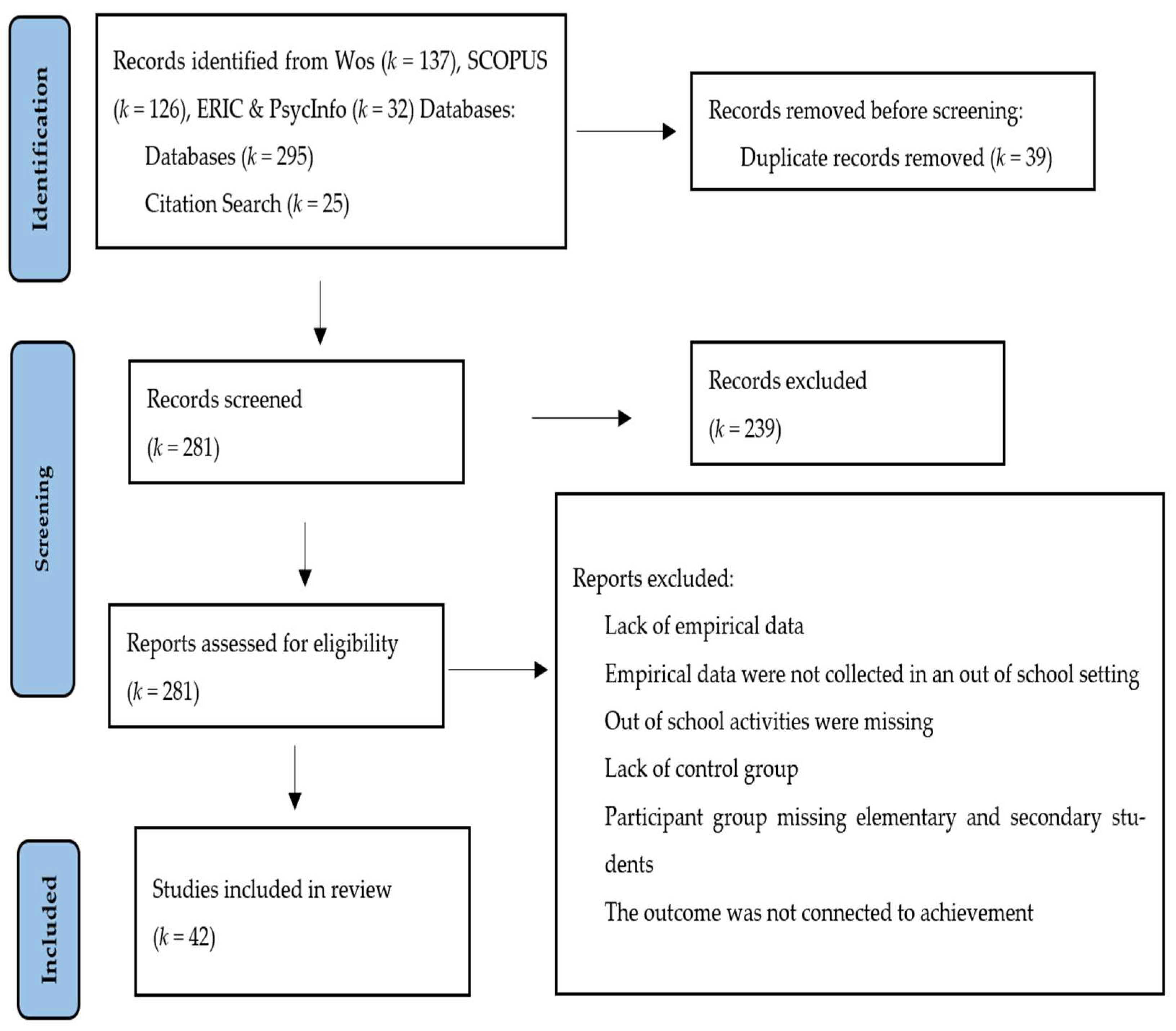
Our search yielded 137 articles in the WoS database, 126 articles in the Scopus database, and 32 articles in the ERIC and APA PsycInfo databases. We also reviewed the citations and reached 25 more articles. The total number of articles was 320. We used EndNote to eliminate duplicate articles, and there were 281 articles when duplicates were removed. Using the Rayyan QCRI software, two authors independently screened and coded each article. Researchers worked blindly and then compared their decisions. There were 25 conflicts (the agreement rate was 90%), and the authors resolved all disagreements. Figure 1 presents the PRISMA flowchart for screening and inclusion. We excluded 239 articles and included 42 individual articles.

2.1. Inclusion Criteria and Coding Process

This section details the inclusion criteria (see Figure 1 for the full list of exclusion criteria). All included articles involved a control group using traditional teaching and an experimental group that visited an out-of-school setting. We followed prior meta-analyses [9,34] in coding procedures. Two authors independently coded all the data (inter-coder agreement = 0.96), and disagreements were resolved through discussion. Data recorded in an Excel file included publication details, sample size, statistics for effect size calculation, and moderator information.
Studies were eliminated for the following reasons: (1) lack of empirical data (e.g., investigation of library programs in K-12 education [35]); (2) the empirical data were not collected in an outdoor setting (e.g., experimental group used the web-based system and did not visit an outdoor setting [36]); (3) out of school activities were missing (e.g., using a virtual environment to study tree frogs [37]); (4) lack of a control group in the study design (e.g., two experimental groups taking part in the lab activity [38]); (5) participant group missing elementary and secondary students (e.g., a study only included college students [39]); and (6) the outcome was not connected to achievement (e.g., examining affective outcomes such as motivation [40]). Moderator variables were selected to reflect key theoretical dimensions emphasized in the literature on inquiry-based and out-of-school learning, including contextual conditions, learner characteristics, and instructional design features. In the following section, we provided a detailed description of moderator coding process.

2.1.1. Out-of-School Setting Characteristics

Out-of-school setting characteristics were coded to capture differences in the degree of structure, duration, and contextual embedding, which have been theorized to influence inquiry processes and knowledge construction in out-of-school learning environments. Unlike earlier studies that focused on specific settings [13], we adopted a broad definition of out-of-school learning, including museums, science centers, outreach labs, zoos, school gardens, and botanical gardens. These were categorized as designed, unstructured, or mixed (e.g., multiple settings [41]). We coded duration [15] into six categories. Since activity types were rarely reported, we were unable to code and categorize activity types.
Next, we coded the country where the study was implemented [1]. Scholars from the United States published most of the articles [9,31], and countries may have different policies regarding out-of-school learning. Under this category, we also added geographical location (North America, Middle East, Central Europe, Asia, Scandinavia, and Africa) and continent (Europe, North America, Asia, and Africa) as other moderators.

2.1.2. Discipline and Sample Characteristics

Discipline and sample characteristics were included as moderators because prior research suggests that the effectiveness of inquiry-based and experiential learning varies by discipline and developmental level. Following procedures presented in a previous study [31], we coded the discipline (science, math, social science, and reading) and school level for participants (elementary, secondary, or mixed). In addition, we added grade as another moderator [34].

2.1.3. Methodological Choices

Methodological variables were coded not only to assess study quality, but also to examine how design features may shape observed effects and contribute to variability across studies. We coded the experimental design (pretest-posttest or posttest only), participant assignment (random or non-random), and question type (multiple choice or mixed) as moderators, as these factors may have confounded the results [9,15].
We also categorized assessment items as reflecting either declarative or conceptual knowledge. Declarative knowledge involves factual content that is not transferable [42], while conceptual knowledge involves transferable understanding of relationships between facts [43]. Articles explicitly measuring or using only declarative items [28] were coded as declarative. Articles including conceptual items were coded as conceptual [44].

2.2. Analysis

To estimate the pooled effect size, Hedges’ g values were calculated from the summary data reported in each study. Hedges’ g rather than Cohen’s d value was selected as the effect size as there are several studies with fewer than 20 participants in our study. In this case, Hedges’ g is known to produce less biased results than Cohen’s d [45] due to smaller sample bias [46]. This choice ensured comparability across studies while minimizing bias in effect size estimation, consistent with best practices in educational meta-analyses. A total of 54 experimental studies conducted in 42 studies were included in this meta-analysis. This meta-analysis included studies that employed pretest/posttest design or at least reported posttest findings. While both pretest and posttest data for the treatment and control groups were reported in 38 studies, only posttest data were reported in the remaining 16 studies. As a result, we calculated effect sizes for both scenarios: only posttest and pretest/posttest. Three requirements must be met before the effect sizes from various designs can be meaningfully pooled [9,15]: (i) every effect size must be in the same metric; (ii) there cannot be mean differences between the effect sizes from different designs; and (iii) all effect sizes from various designs must be standardized by the same standard deviation (standard deviations must be in the same metric). While obtaining the Hedges’ g value from these two data types (i.e., posttest only and pretest/posttest) using Comprehensive Meta-analysis software version 3 (CMA) [47], the standardized mean difference value was calculated by taking the difference between the means of the control group and treatment group. The treatment group represents the out-of-school learning group, and the control group represents the traditional education group that did not receive the treatment (continued regular instruction in the classroom). A positive effect size indicates a result in favor of out-of-school learning. Effect size values calculated from two different designs were combined with “standardization based on post data” using CMA. Moderator analysis examined statistically significant differences between these two design types [48], and there was not a statistically significant difference (p > 0.05, see Section 3).
This meta-analysis included 42 articles and 54 effect sizes, with one outlier excluded. Some studies contributed multiple effect sizes, which were treated as independent when based on different samples (e.g., Author, Publication Year_1 and Author, Publication Year_2; see Table 1). The dependency is seen when the impact of an intervention is studied on several outcome variables for the same group of participants [49]. One of the approaches that can be used in the case of dependent effect sizes is multilevel modeling. However, this meta-analysis calculated multiple effect sizes from the same article across different samples. Effect sizes were treated as independent only when they were derived from different, non-overlapping samples (e.g., distinct grade levels, cohorts, or separately analyzed participant groups within the same article). In such cases, each effect size represented a unique comparison and was included separately in the analysis. Dependency typically arises when multiple outcomes are reported for the same group of participants [49]. In the present meta-analysis, effect sizes were not calculated from multiple outcome measures within the same sample. Therefore, statistical dependence due to shared participants was minimized. Although multilevel meta-analysis or robust variance estimation can be used when effect sizes are statistically dependent, these approaches were not required here because the multiple effect sizes were based on independent samples rather than repeated measures from the same participants. In this study, all analyses related to meta-analysis were carried out using the CMA software version 3. After computing the Hedges’ g value for each study, the mean effect size was estimated using the random effects model [50]. The following criteria for interpreting the mean effect size was suggested: 0.2, 0.4, and 0.6 for small, medium, and large, respectively [51]. In addition, Q-test and I2 values were calculated to investigate the heterogeneity between effect sizes. Statistically significant Q-test and I2 values greater than 75% were used to determine heterogeneity [52]. If there is evidence of heterogeneity between effect sizes, the source of this heterogeneity is investigated by conducting moderator analyses.
In this study, moderator analyses were performed using categorical and continuous variables through the CMA software package. Analog to the ANOVA (i.e., subgroup analysis for categorical moderators) [91] was performed to analyze categorical variables (school level, discipline, country, continent, geographical location, measurement, design, and random assignment types), and metaregression analysis was used for continuous variables (e.g., grade). In moderator analyses, categories represented by very few effect sizes were excluded from subgroup comparisons. Specifically, duration categories with fewer than three effect sizes (e.g., 1 h programs or interventions lasting 2–7 days) were not included in the moderator analysis. This decision follows established meta-analytic conventions, as subgroup estimates based on one or two effect sizes are statistically unstable and may yield unreliable or misleading mean effect size estimates [45,91]. Moreover, Q-between statistics are not interpretable when subgroup sample sizes are extremely small. Therefore, only moderator categories with sufficient representation were retained to ensure meaningful and interpretable comparisons. As stated earlier, only peer-reviewed articles were included in this meta-analysis. Including only published articles in the meta-analysis studies may lead to ignoring findings in unpublished articles and publication bias. Thus, it is necessary to investigate the potential for publication bias in this meta-analysis. In this study, publication bias was examined on CMA software using the following methods: two fail-safe N values [92], trim and fill method [93], and a funnel plot.

3. Results

This section presents descriptive findings, publication bias findings, the effect of out-of-school learning on academic achievement, and moderator analyses.

3.1. Descriptive Findings

In this study, 55 effect sizes were collected from 43 articles (see Table 1). One of the articles [94] was considered an outlier because it had a very large effect size (3.941). Therefore, we conducted the meta-analysis study using 54 effect sizes from 42 articles (see Table 1). The total number of participants in the control group (nc = 6389) was lower than that of the treatment group (nt = 9117). In each study, researchers compared the academic achievements of groups. The control group represents classroom practices using conventional methods. On the other hand, the treatment group includes interventions supporting students’ learning in various out-of-school learning settings. Table 1 summarizes the characteristics of the studies included in the meta-analysis, published between 1970 and 2022.

3.2. Publication Bias Findings

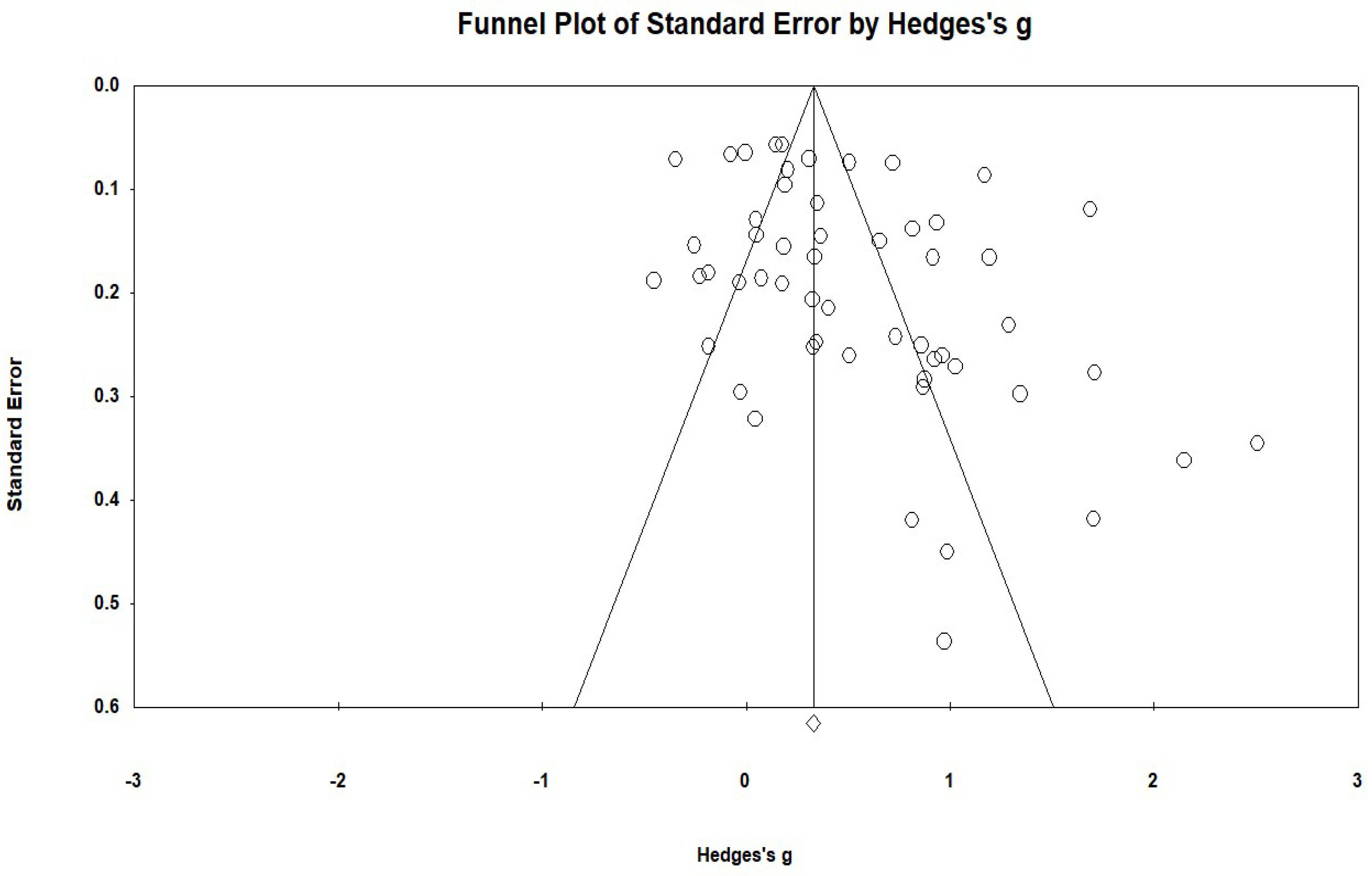
Before presenting the meta-analysis data, the possibility of publication bias was further investigated using a number of different techniques. The estimated value of the classic fail-safe N value was 6389. Based on this calculation, 6389 null studies are required in order to change the statistically significant mean effect size from being significant to non-significant (p > 0.05). Alternatively, about 118 missing studies would be required for each observed study in order to cancel out the effect. There is no publication bias, as indicated by this value, which is more than 5k + 10. Furthermore, it was estimated that Orwin’s fail-safe N was 1725. This indicates that for the effect to be less than the trivial value of 0.01 we need to identify 1725 observed studies. Additionally, Hedges’ g and standard errors were displayed in a funnel plot and examined visually (see Figure 2). The studies seem to be spread symmetrically around the mean effect size. Symmetrical funnel-like form indicates that there was no publishing bias in the funnel plot. The trim-and-fill method recommended that there are zero studies that need to be trimmed and filled under the random effects model. Overall, there is no risk of publication bias in this study based on the trim-and-fill method, the funnel plot, and fail-safe N values.

3.3. The Effect of Out-of-School Learning on Academic Achievement

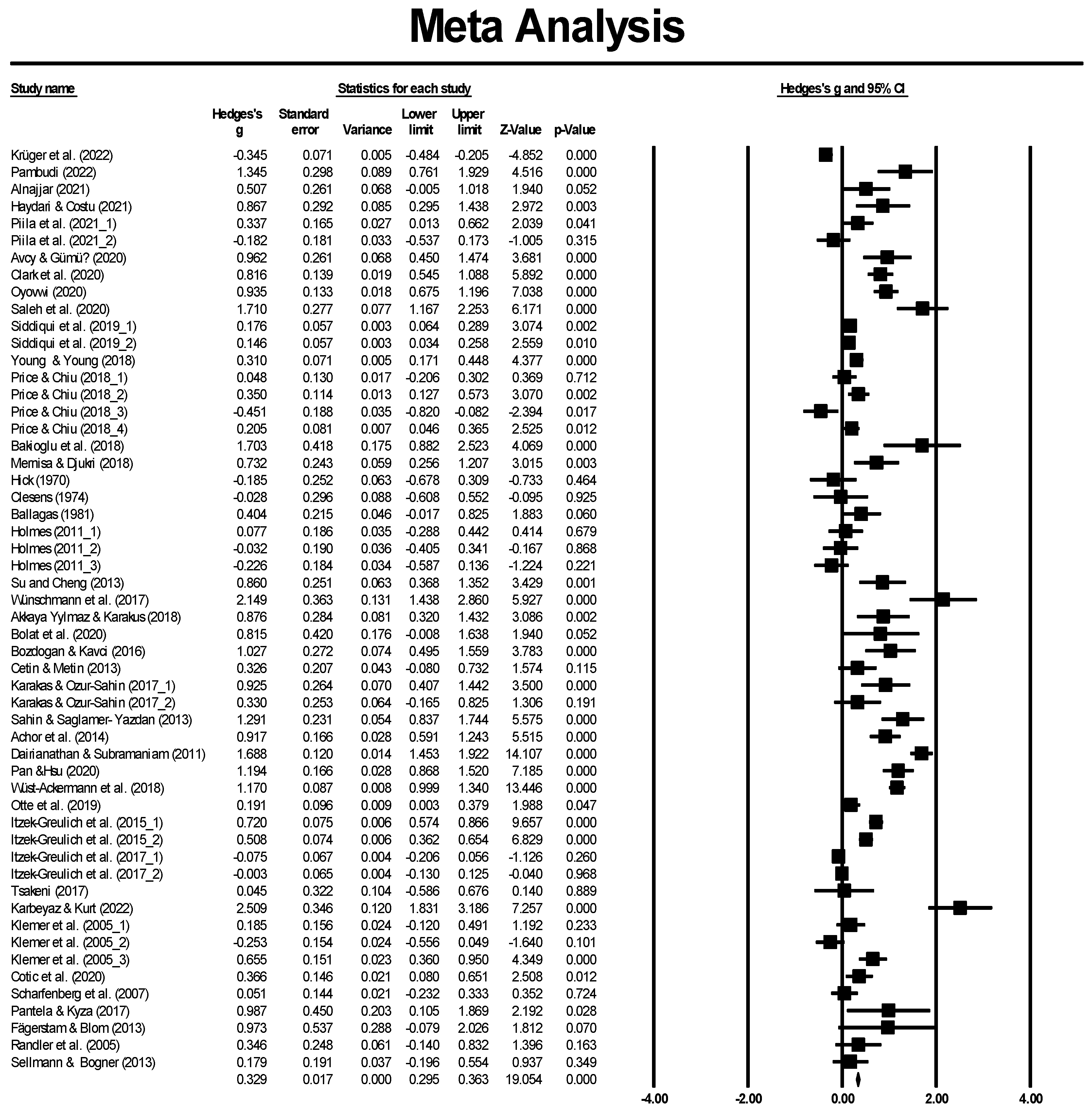
The total effect of out-of-school learning practices on student academic performance was investigated by determining the effect size for each study. According to the random effects model, the overall effect size of out-of-school learning on academic achievement was estimated to be 0.529, 95% CI [0.392, 0.665], as indicated in Table 2. Using Hattie’s widely used guidelines [51], the pooled g value was determined to be medium-to-large in magnitude and statistically significant (z-score = 7.589, p < 0.001). These findings provided evidence for the medium-to-large positive effect of out-of-school learning practices on student academic performance.
As shown in Table 2, I2 value and Q-test statistic indicated that there is a high degree of statistically significant heterogeneity among the studies that the meta-analysis covered. Figure 3 displays the forest plot of the studies that were part of the meta-analysis and suggests heterogeneous distribution. Moderator analyses were completed in order to identify potential sources of heterogeneity.

3.4. Moderator Analyses

In a meta-analysis study, in the presence of statistically significant and high heterogeneity, the sources of heterogeneity are investigated by conducting a moderator analysis. From the included studies, data were gathered regarding the following moderators: the discipline, duration/length, and out-of-school learning setting, as well as the question type, assessment item type, school level, grade, design, random assignment, country, continent, and geographical location. One of these variables (i.e., grade) is a continuous variable, and other variables are coded categorically. The analog to the ANOVA approach was used in this study to investigate whether there are statistically significant differences in mean effect size between the subgroups of categorical variables. By using weighted regression (metaregression) analysis, the relationship between grade and the mean effect size was investigated.

3.4.1. Out-of-School Setting Characteristics

Out-of-school setting [QB = 4.249, df = 2, p = 0.119] did not show a statistically significant difference between their sub-categories in terms of mean effect size value. Duration/length was divided into six different categories, and categories with the lowest frequencies (1 h (k = 2) or 2–7 days (k = 1)) were not involved in the analysis. The analysis reported only four categories: 2–6 h (k = 7), 7–12 h (k = 3), 13–24 h (k = 6), and more than a week (k = 10). The moderator analyses revealed a statistically significant difference in the mean effect size values among these four categories (QB = 19.966, df = 3, p < 0.001). The wide range of effect sizes across duration categories suggests that time alone does not determine effectiveness. Short exposures may be insufficient to support meaningful learning, while extended durations without instructional focus may yield diminishing returns. This pattern highlights the importance of purposeful design and follow-up rather than duration per se.
To investigate the country-of-origin effect, we compared the three countries with the most studies: the U.S. (k = 15), Turkey (k = 11), and Germany (k = 10). Other countries were not included in this comparison as they only included one or two studies. Additionally, the moderator analyses demonstrated a statistically significant difference in the mean effect size values across these three countries (QB = 21.344, df = 2, p < 0.001).
When the studies are classified according to the continents through the countries in which they were published, it is seen that they spread to four different continents: Europe (k = 29), North America (k = 15), Asia (k = 7), and Africa (k = 3). The moderator analyses indicated that there were statistically significant differences in the mean effect size values among these four continents (QB = 32.546, df = 3, p < 0.001).
According to the geographical location variable, the studies are classified as Asia (k = 6), Africa (k = 3), Central Europe (k = 11), Middle East (k = 12), North America (k = 15), and Scandinavia (k = 4) based on the countries in which they are applied. This classification differs from the continent classification, especially due to countries such as Turkey, which appear in Europe in terms of geographical location and are classified as Middle Eastern. The moderator analyses showed that the mean effect size values across six subgroups were statistically significantly different (QB = 52.000, df = 5, p < 0.001).
The substantial variability in effect sizes across countries and regions suggests that out-of-school learning outcomes are strongly shaped by contextual factors rather than reflecting intrinsic superiority of specific settings. Differences in curriculum alignment, baseline achievement levels, teacher preparation, and the novelty of out-of-school experiences may all contribute to this variation. Practically, this indicates that effectiveness estimates should not be generalized across regions without considering local educational conditions.

3.4.2. Discipline and Sample Characteristics

Table 3 presents the results of the subgroup analyses. If the average effect size of the subgroups differs statistically significantly, it is shown by the value in the Q-Between (QB) line (see bold p-values in the table).
Subject/discipline moderator included five categories: science (k = 36), math (k = 5), social science (k = 5), reading (k = 3), and multiple disciplines (k = 2). Studies including multiple disciplines were removed due to low frequency. Analog to the ANOVA results demonstrated that the mean effect sizes between the four disciplines were statistically significantly different (QB = 26.627, df = 3, p < 0.001). Variation in effect sizes across disciplines likely reflects differences in how well out-of-school environments support disciplinary learning goals. Experiential and inquiry-based contexts may more readily translate into achievement gains in science and social sciences, whereas disciplines such as mathematics and reading may require more structured instructional integration to produce comparable effects.
School-level variable was investigated under four categories: elementary school (k = 14), middle school (k = 12), secondary school (k = 27), and mixed (k = 6). The moderator analyses revealed a statistically significant difference in the mean effect size values among the four categories (QB = 9.205, df = 3, p = 0.027). The observed decrease in effect sizes across higher school levels may reflect developmental differences in learning responsiveness as well as increasing curricular specialization. Younger students may benefit more from novelty and experiential learning, whereas older students may require more targeted and discipline-specific out-of-school designs to achieve similar gains.
To investigate the link between the mean effect size and grade variable coded in the data set, a metaregression analysis was carried out (see Table 4). The grade variable is statistically significant (p < 0.01) and a negative (B = −0.136) predictor of the mean effect size.

3.5. Methodological Choices

By splitting the studies into two categories based on how the participants were included in different groups, we were able to examine the effect of the assignment type (random vs. non-random). The mean effect size of 29 studies with random assignment was found to be 0.307, and the average effect size of 16 studies with non-random assignment was found to be 1.020. The results of the moderator analysis showed a statistically significant difference in the mean effect size values between the studies with random and non-random assignments (QB = 17.998, df = 1, p < 0.001). The substantial variability between randomized and non-randomized studies indicates that study design is a key source of heterogeneity, with non-random assignment likely amplifying observed effects through selection mechanisms. As such, variability in effect sizes should be interpreted in conjunction with methodological rigor.
Three categorical variables question type, design, and assessment item type did not show a statistically significant difference between their sub-categories in terms of mean effect size value. That is, out-of-school setting, measurement, design, and assessment item types did not appear to influence the effect of out-of-school learning on academic achievement. The statistically nonsignificant p-values indicated the lack of statistically significant heterogeneity in effect sizes among the subgroups. These results may have been obtained because the distribution of frequency values for the subcategories of these variables (e.g., design variable: 47 vs. 5) is unbalanced. In conclusion, students’ academic achievement did not seem to be impacted by factors such as assessment item type, design, or out-of-school setting. There was no statistically significant heterogeneity in the effect sizes among the subgroups, as shown by the statistically nonsignificant p-values. The distribution of frequency values for the subcategories of these variables (e.g., design variable: 47 vs. 5) was imbalanced, which could have led to these results.

4. Discussion

Inquiry-based learning can occur at all grade levels [2]. Our meta-analysis bridges classroom inquiry with inquiry experiences in diverse out-of-school settings. Based on 42 independent studies and 54 effect sizes, out-of-school learning demonstrated a statistically significant and medium to large effect ( g ¯ = 0.529, p < 0.001) on academic achievement in elementary and secondary education. These results align with other positive outcomes observed in environmental education [12], virtual and augmented reality in museums [13], summer schools [14,15], and after-school programs [14]. Such positive outcomes align with observation that negative findings in out-of-school learning research are rare [25].
The high level of heterogeneity observed in this meta-analysis indicates that the impact of out-of-school learning is not uniform across contexts. Rather than reflecting inconsistency or unreliability, this variability suggests that the effectiveness of out-of-school learning is highly context-dependent, shaped by factors such as educational level, disciplinary focus, duration, and geographical setting. In practical terms, this means that while out-of-school learning is generally beneficial, the magnitude of its impact is likely to vary substantially depending on educational level, and how/where it is implemented.
Despite the large number of subgroup analyses, several consistent and practically meaningful patterns emerge from the findings. First, out-of-school learning shows its strongest effects in elementary education, with effect sizes decreasing across middle and secondary school levels, suggesting greater developmental sensitivity at earlier stages. Second, discipline matters: learning gains are largest in social sciences and science education, where experiential and inquiry-based approaches align closely with out-of-school contexts. Third, contextual factors, including geographical region and country, substantially shape effectiveness, indicating that out-of-school learning is highly sensitive to policy, cultural, and instructional conditions. Finally, study design influences estimated effects, with non-randomized studies reporting larger effect sizes, underscoring the need for cautious interpretation and stronger experimental controls. Together, these patterns indicate that the effectiveness of out-of-school learning depends less on the setting itself and more on how interventions are designed, implemented, and aligned with learners and context.
Careful planning, instruction, and follow-up—especially through assessment—enhance out-of-school learning experience [8]. However, there is still no agreed definition of “properly conceived (p. 107)” out-of-school learning [8]. The next sections unpack disparities related to factors influencing learning in these settings.

4.1. Out-of-School Characteristics

We found no statistically significant differences between types of settings, but unstructured environments yielded higher average effect sizes ( g ¯ = 0.524) compared to designed settings ( g ¯ = 0.252). Mixed settings (combining unstructured and designed experiences) had the highest effect size ( g ¯ = 0.573). This aligns with previous studies. Larger effect sizes were reported from camps and field trips ( g ¯ = 0.953) [12]. On the other hand, smaller effect size was reported from studies utilizing virtual and augmented reality in museums ( g ¯ = 0.45) [13]. While designed settings offer rich real-world content [16], they are often highly structured [4] which may constrain inquiry-based exploration.
Our analysis also confirmed that out-of-school learning is often short-term [13], yet duration significantly moderated effect sizes ( g ¯ = 0.369). The groups that spent 7–12 h outside ( g ¯ = 0.637) and 13–24 h ( g ¯ = 0.552) had the largest mean effect sizes. The groups that spent between two and six hours ( g ¯ = 0.034) and more than a week ( g ¯ = 0.360) in the out-of-school learning environment had smaller mean effect sizes. While invested time for the out of school learning is important, prolonged durations may lead to diminishing returns. In our sample, duration ranged from 180 min to several months. For example, some studies reported one-day programs [59,88], while others spanned several weeks [74] or a full year [27]. These variations underscore the need to define and study the ideal duration for “proper” out-of-school learning. In addition, OECD cautioned that more time in out-of-school settings may not lead to better student performance in science, math, and reading [95].
Inquiry practices and the value of out-of-school learning vary across countries [44]. Due to uneven publication frequency, our review focused on the United States, Germany, and Turkey (see Table 3), with most studies conducted in the United States [9,31]. This is connected with previous studies reporting results from 43 studies in environmental education [12] and using AR/VR in museums mostly in the United States, Taiwan, and Europe [13].
We grouped studies from 16 countries by region and found larger effect sizes in Africa, the Middle East, and Asia—consistent with prior articles reporting higher effect sizes from Turkey and Taiwan [24]. These patterns highlight the influence of geographical context, including policy, training, and culture, underscoring the importance of country and location as key moderators. Geographical differences played an important role when examining achievement. This indicates that universal standards might not be feasible. Variability between nations demonstrates how out-of-school learning is culturally and policy-dependent; methods that work in one educational context need to be modified in another. Although statistically significant differences in effect sizes were observed across countries and regions, these findings should be interpreted as indicators of contextual sensitivity rather than rankings of educational quality. Larger effect sizes in certain regions may reflect differences in achievement, curriculum alignment, novelty of out-of-school learning experiences, or selective implementation in motivated schools. Practically, this suggests that transferring successful out-of-school learning models across countries requires adaptation to local educational structures, teacher preparation, and policy environments, rather than direct replication.
Out-of-school learning promotes deeper cognitive engagement through experiential interaction with real-world circumstances by extending learning outside the classroom. By portraying out-of-school learning as a crucial way for reinforcing inquiry practices through real-world application, out-of-school learning aids supporting students’ learning.

4.2. Discipline and Sample Characteristics

Out-of-school activities support student learning in different content areas. However, the mean effect sizes varied statistically considerably throughout disciplines. In comparison to math education ( g ¯ = 0.295), the mean effect size in science ( g ¯ = 0.632) was higher. The social sciences had the highest mean effect size ( g ¯ = 0.757), whereas reading had the lowest mean effect size ( g ¯ = 0.166). Differences in effect sizes across disciplines also have practical implications. Larger effects in science and social sciences may reflect the experiential and contextual affordances of out-of-school environments, which align well with inquiry, observation, and real-world application. In contrast, smaller effects in mathematics and reading do not imply ineffectiveness, but rather suggest that these disciplines may require more carefully designed activities and follow-up instruction to translate out-of-school experiences into measurable academic gains.
Academic achievement varied significantly among different disciplines, but it is crucial to remember that science education accounted for the vast majority (67%) of the publications in this meta-analysis. It was emphasized that studies with a science education background are common in out-of-school learning literature [25]. It was reported that science museums serve as primary research locations, and biology and physics are the primary subjects of the educational materials [19]. Science is also reported as the primary discipline among Nordic countries [23]. In addition, the number of environmental studies continues to increase [20,31], and they primarily focus on science education.
In our meta-analysis, the effect of out-of-school learning was considerably greater in elementary schools ( g ¯ = 0.805) than in middle schools ( g ¯ = 0.617) and secondary schools ( g ¯ = 0.500). It is important to point out that studies with mixed groups had the lowest mean effect sizes ( g ¯ = 0.209). From a practical standpoint, the stronger effects observed in elementary education suggest that out-of-school learning may be particularly impactful when students are still forming foundational concepts and attitudes toward learning, whereas older students may require more targeted or discipline-specific interventions to achieve comparable gains. Beyond effect size differences, our analysis revealed a limited number of studies at the secondary level. In contrast, another study found that over half of nature-focused out-of-school studies involved secondary students [9]. This suggests a gap in experimental research at this level. Similarly, a study from Hungary reported students’ perceived benefits of out-of-school learning from grades 3 to 8 [10], raising concerns about out-of-school learning in secondary education [8]. Finally, participant grade level appeared to influence outcomes, aligning with previous findings. However, there also studies reporting no significant age-related differences [12].
Large effect sizes in social sciences and elementary education can be very helpful for Education for Sustainable Development. Since attitudes of younger students’ toward the environment are more flexible, they are especially receptive to out-of-school and sustainable learning [17]. Fostering multidisciplinary skills from a younger age would be beneficial.

4.3. Methodological Choices

Studies using conceptual items to measure students’ achievement had a larger effect size ( g ¯ = 0.682) than studies including only declarative assessment items ( g ¯ = 0.336). A review article reported that studies primarily measured declarative knowledge and found a similar effect size ( g ¯ = 0.45) for out-of-school studies [13]. Declarative knowledge was viewed as the primary knowledge required for conceptual understanding [13]. The use of comprehensive assessment tools is recommended for learning outside of school [7]. Our findings support this idea, showing that using conceptual assessments had a bigger impact.
There are no guidelines for preparing the assessment items or what the ideal question would be after an out-of-school learning experience. Studies did not delve into how follow-up assessment items were created. Scholars developing their assessment items did not provide details about assessment type and only discussed tool development procedures [74]. Most of the articles used assessment tools developed by researchers. In contrast, several studies in this analysis looked at student learning in standardized tests [41]. Smaller effect sizes in standardized tests indicated that knowledge acquired may not be applied to other tests. Our findings raise concerns about how students transfer their understanding to other situations.
Our analysis found no statistically significant differences between using different question types. Studies utilizing multiple-choice questions ( g ¯ = 0.559) or mixed questions ( g ¯ = 0.565) had relatively similar effect sizes. Although there was little variation in question types, there were differences in the number of questions asked to students among studies. For example, a questionnaire consisting of four questions [59], a 12-item test [88], and a 30-item exam [74] were used as assessment tools in different articles.
The finding that studies using non-random assignment reported substantially larger effect sizes than those employing random assignment warrants careful interpretation. Non-randomized designs are more vulnerable to selection bias, as participants in out-of-school learning interventions may differ systematically from control groups in prior achievement, motivation, or access to resources. These pre-existing differences can inflate estimated effects and limit causal inference. At the same time, non-randomized studies often reflect authentic educational conditions, where random assignment is impractical or ethically constrained. As such, these studies may demonstrate higher ecological validity but reduced internal validity. In contrast, randomized designs provide more conservative and robust estimates of treatment effects, albeit sometimes at the cost of contextual realism. The observed discrepancy between randomized and non-randomized studies suggests that effect sizes reported in the literature should be interpreted in light of study design. While out-of-school learning appears beneficial across designs, stronger claims regarding effectiveness and generalizability should rely primarily on evidence from randomized or well-controlled quasi-experimental studies.
Finally, compared to studies that only provided posttest results, those that reported pretest and posttest data had a larger effect size ( g ¯ = 0.573). Because the effect on the pretest is much bigger for students who already do well in school [96], future studies may examine how various experimental designs impact learning in out-of-school settings. Not randomly assigning students to the groups made a difference. Considering that the non-randomized approach has drawbacks [97], future studies can also examine how to design an experimental setup for out-of-school learning.
Using declarative evaluation techniques may hinder opportunities provided in out-of-school settings. Fixed, closed-ended questions frequently fail to capture the open inquiry character of out-of-school learning contexts. To better connect with the exploratory characteristics of out-of-school experiences, future research should promote transparency in planning visits and embrace authentic assessment methodologies.

5. Conclusions

Out-of-school environments provide rich opportunities for academic learning and the development of skills such as teamwork, creativity, critical thinking, and problem-solving, while also fostering a connection to nature [9]. These settings promote learning in unpredictable contexts, requiring communication and adaptive thinking [98]. Yet out-of-school learning is often treated as a “black box (p. 1134)” [11]. Our results may offer ideas on how “well taught and effectively followed up (p. 193)” out-of-school experience [8] can be created. Specifically, learning in unstructured settings and using conceptual assessments produced larger effect sizes. The observed heterogeneity suggests that out-of-school learning functions as a flexible, context-dependent educational approach rather than a uniform intervention. Nevertheless, the meta-analysis demonstrates a statistically significant, medium-to-large positive effect on student achievement.

Implications

We have four implications based on the results emerged from different disciplines and countries. Geographic differences must be carefully considered when designing out-of-school learning. Due to cultural and policy variations, universal standards may be impractical. Future studies should explore the role of participant demographics and experimental setup. Greater transparency in how visits are planned forms the first guideline.
Our second suggestion for future studies is related to setting and time. We connected out-of-school learning to inquiry experiences taking place outside the classroom. Our results stated that unstructured settings yielded bigger learning gains, and students spending from 6 to 12 h in out-of-school settings had more conceptual understanding. Making sure that students spend enough time exposing the open nature of out-of-school settings is critical for planning out-of-school settings. To support the nature of open inquiry experiences, assessment practices should be planned accordingly. Given the low number of studies using declarative knowledge may hinder opportunities for open inquiry learning. Differentiating the nature of out-of-school learning and assessment [6] from classroom practices is our third guideline.
Prior knowledge and interest significantly influence student learning in these settings [11]. Designing out-of-school experiences that account for these factors forms our first key guideline. These environments complement formal education by linking school learning to real-world experiences [90,99]. However, disciplines differ in how they conceptualize out-of-school learning. Our conclusions—such as the dominance of science, large effect sizes in social sciences, larger effects in elementary education, and variation based on time spent—can inform future research. Therefore, a fourth guideline is to provide continuous, cross-disciplinary out-of-school opportunities throughout students’ academic careers.
Only two studies reported involving disadvantaged groups (see Table 1). Most participants were from affluent Western contexts [12], raising equity concerns [29,30]. While we discuss out-of-school supporting learning, paying attention to low achievers is also critical [16]. Access to quality out-of-school learning is not guaranteed for all [100], and socio-economic status should be considered as another potential moderator [15]. Ensuring equitable access is our fifth guideline.
Finally, while this meta-analysis covered four international indexes, we did not include local databases—a limitation that may affect generalizability. We focused only on cognitive outcomes. Future research should expand to examine affective dimensions such as attitude [44], and motivation [54].
Future research could explore how students and teachers utilize their time in out-of-school learning setting. Future studies should explore variations across school levels.

Supplementary Materials

The following supporting information can be downloaded at: https://www.mdpi.com/article/10.3390/su18031437/s1. The PRISMA checklist are available online.

Author Contributions

First author, İ.D. and second author, F.Ö. conducted the search and completed the coding process. Third author, S.Ş. conducted the analysis and wrote the Section 3. Remaining sections were prepared by İ.D. and F.Ö.; M.B. worked on the Discussion and editing the manuscript. All authors have read and agreed to the published version of the manuscript.

Funding

This research received no external funding.

Institutional Review Board Statement

Not applicable.

Informed Consent Statement

Not applicable.

Data Availability Statement

The original contributions presented in this study are included in the article/Supplementary Material. Further inquiries can be directed to the corresponding author(s).

Conflicts of Interest

The authors declare no conflicts of interest.

References

  1. Antonio, R.P.; Prudente, M.S. Effects of inquiry-based approaches on students’ higher-order thinking skills in science: A meta-analysis. Int. J. Educ. Math. Sci. Technol. 2024, 12, 251–281. [Google Scholar] [CrossRef]
  2. Furtak, E.M.; Seidel, T.; Iverson, H.; Briggs, D.C. Experimental and quasi-experimental studies of inquiry-based science teaching: A meta-analysis. Rev. Educ. Res. 2012, 82, 300–329. [Google Scholar] [CrossRef]
  3. Hmelo-Silver, C.E. Problem-based learning: What and how do students learn? Educ. Psychol. Rev. 2004, 16, 235–266. [Google Scholar] [CrossRef]
  4. Eshach, H. Bridging in-school and out-of-school learning: Formal, non-formal, and informal education. J. Sci. Educ. Technol. 2007, 16, 171–190. [Google Scholar] [CrossRef]
  5. Tal, T. Out-of-school: Learning experiences, teaching, and students’ learning. In Second International Handbook of Science Education; Fraser, B.J., Tobin, K., McRobbie, C.J., Eds.; Springer Science Business Media: Berlin/Heidelberg, Germany, 2012; pp. 1109–1122. [Google Scholar]
  6. Falk, J.; Storksdieck, M. Using the contextual model of learning to understand visitor learning from a science center exhibition. Sci. Educ. 2005, 89, 744–778. [Google Scholar] [CrossRef]
  7. Yoon, S.A.; Elinich, K.; Wang, J.; Steinmeier, C.; Tucker, S. Using augmented reality and knowledge-building scaffolds to improve learning in a science museum. Int. J. Comput.-Support. Collab. Learn. 2012, 7, 519–541. [Google Scholar] [CrossRef]
  8. Dillon, J.; Rickinson, M.; Teamey, K. The value of outdoor learning: Evidence from research in the UK and elsewhere. In Towards a Convergence Between Science and Environmental Education; Routledge: Oxfordshire, UK, 2006; pp. 193–200. [Google Scholar]
  9. Mann, J.; Gray, T.; Truong, S. Rediscovering the potential of outdoor learning for developing 21st-century competencies. In High-Quality Outdoor Learning: Evidence-Based Education Outside the Classroom for Children, Teachers, and Society; Juker, R., von Au, J., Eds.; Springer International Publishing: Berlin/Heidelberg, Germany, 2022; pp. 211–229. [Google Scholar]
  10. Fűz, N.; Korom, E. The cognitive and non-cognitive effects of out-of-school learning. In Proceedings of the ESERA 2017 Conference, Research, Practice and Collaboration in Science Education, Dublin, Ireland, 21–25 August 2017. [Google Scholar]
  11. Miller, N.C.; Kumar, S.; Pearce, K.L.; Baldock, K.L. The outcomes of nature-based learning for primary school aged children: A systematic review of quantitative research. Environ. Educ. Res. 2021, 27, 1115–1140. [Google Scholar] [CrossRef]
  12. van de Wetering, J.; Leijten, P.; Spitzer, J.; Thomaes, S. Does environmental education benefit environmental outcomes in children and adolescents? A meta-analysis. J. Environ. Psychol. 2022, 81, 101782. [Google Scholar] [CrossRef]
  13. Zhou, Y.; Chen, J.; Wang, M. A meta-analytic review on incorporating virtual and augmented reality in museum learning. Educ. Res. Rev. 2022, 36, 100454. [Google Scholar] [CrossRef]
  14. Lauer, P.A.; Akiba, M.; Wilkerson, S.B.; Apthorp, H.S.; Snow, D.; Martin-Glenn, M.L. Out-of-school-time programs: A meta-analysis of effects for at-risk students. Rev. Educ. Res. 2006, 76, 275–313. [Google Scholar] [CrossRef]
  15. Lynch, K.; An, L.; Mancenido, Z. The impact of summer programs on student mathematics achievement: A meta-analysis. Rev. Educ. Res. 2022, 93, 275–315. [Google Scholar] [CrossRef]
  16. National Research Council [NRC]. Learning Science in Informal Environments: People, Places, and Pursuits; The National Academies Press: Washington, DC, USA, 2009. [Google Scholar]
  17. Lewalter, D.; Neubauer, K.; Moser, S. Self-regulated STEM learning in museums—The role of learner characteristics and visit-related activities in school. Int. J. STEM Educ. 2025, 12, 56. [Google Scholar] [CrossRef]
  18. Pulido, L.; Pépin, A.; Bergeron-Leclerc, C.; Cherblanc, J.; Godue-Couture, C.; Laprise, C.; Paquette, L.; Nadeau-Tremblay, S.; Simard, S. The Effects of Outdoor Teaching on Academic Achievement and Its Associated Factors—A Scoping Review. Educ. Sci. 2025, 15, 1060. [Google Scholar] [CrossRef]
  19. Liu, Q.; Chen, Q.; Luo, H. Using museum to promote learning for K-12 students: A systematic literature review from 2003 to 2023. In 2024 International Symposium on Educational Technology (ISET); IEEE: Piscataway, NJ, USA, 2024; pp. 386–391. [Google Scholar]
  20. Ardoin, N.M.; Bowers, A.W.; Gaillard, E. Environmental education outcomes for conservation: A systematic review. Biol. Conserv. 2020, 241, 108224. [Google Scholar] [CrossRef]
  21. Becker, C.; Lauterbach, G.; Spengler, S.; Dettweiler, U.; Mess, F. Effects of regular classes in outdoor education settings: A systematic review on students’ learning, social and health dimensions. Int. J. Environ. Res. Public Health 2017, 14, 485. [Google Scholar] [CrossRef]
  22. Delen, I.; Krajcik, J. Using mobile devices to connect teachers and museum educators. Res. Sci. Educ. 2017, 47, 473–496. [Google Scholar] [CrossRef]
  23. Remmen, K.B.; Iversen, E. A scoping review of research on school-based outdoor education in the Nordic countries. J. Adventure Educ. Outdoor Learn. 2023, 23, 433–451. [Google Scholar] [CrossRef]
  24. Delen, I.; Sen, S. Effect of design-based learning on achievement in K-12 education: A meta-analysis. J. Res. Sci. Teach. 2023, 60, 330–356. [Google Scholar] [CrossRef]
  25. Jagust, T.; Boticki, I.; So, H.J. A review of research on bridging the gap between formal and informal learning with technology in primary school contexts. J. Comput. Assist. Learn. 2018, 34, 417–428. [Google Scholar] [CrossRef]
  26. Sommerauer, P.; Müller, O. Augmented reality in informal learning environments: A field experiment in a mathematics exhibition. Comput. Educ. 2014, 79, 59–68. [Google Scholar] [CrossRef]
  27. Otte, C.R.; Bølling, M.; Stevenson, M.P.; Ejbye-Ernst, N.; Nielsen, G.; Bentsen, P. Education outside the classroom increases children’s reading performance: Results from a one-year quasi-experimental study. Int. J. Educ. Res. 2019, 94, 42–51. [Google Scholar] [CrossRef]
  28. Wüst-Ackermann, P.; Vollmer, C.; Randler, C.; Itzek-Greulich, H. The vivarium: Maximizing learning with living invertebrates—An out-of-school intervention is more effective than an equivalent lesson at school. Insects 2018, 9, 3. [Google Scholar] [CrossRef]
  29. Huang, H.; Tse, S.K.; Chu, S.K.W.; Xiao, X.Y.; Lam, J.W.I.; Ng, R.H.W.; Hui, S.Y. The correlation between out-of-school and in-school reading resources with primary school students’ reading attainment. Inf. Res. Int. Electron. J. 2019, 24, 3. [Google Scholar]
  30. Tawfik, A.A.; Gatewood, J.; Armstrong, L.; Shepherd, C.E. Informal learning in United States libraries: A systematic review. TechTrends 2022, 67, 550. [Google Scholar] [CrossRef]
  31. Ardoin, N.M.; Bowers, A.W.; Roth, N.W.; Holthuis, N. Environmental education and K-12 student outcomes: A review and analysis of research. J. Environ. Educ. 2018, 49, 1–17. [Google Scholar] [CrossRef]
  32. Mann, J.; Gray, T.; Truong, S.; Sahlberg, P.; Bentsen, P.; Passy, R.; Ho, S.; Ward, K.; Cowper, R. A Systematic Review Protocol to Identify the Key Benefits and Efficacy of Nature-Based Learning in Outdoor Educational Settings. Int. J. Environ. Res. Public Health 2021, 18, 1199. [Google Scholar] [CrossRef]
  33. Page, M.J.; McKenzie, J.E.; Bossuyt, P.M.; Boutron, I.; Hoffmann, T.C.; Mulrow, C.D.; Shamseer, L.; Tetzlaff, J.M.; Aki, E.A.; Brennan, S.E.; et al. The PRISMA 2020 statement: An updated guideline for reporting systematic reviews. BMJ 2021, 372. [Google Scholar] [CrossRef] [PubMed]
  34. Barz, N.; Benick, M.; Dörrenbächer-Ulrich, L.; Perels, F. The effect of digital game-based learning interventions on cognitive, metacognitive, and affective-motivational learning outcomes in school: A meta-analysis. Rev. Educ. Res. 2024, 94, 193–227. [Google Scholar] [CrossRef]
  35. Wang, T.H. Implementation of web-based argumentation in facilitating elementary school students to learn environmental issues. J. Comput. Assist. Learn. 2014, 30, 5. [Google Scholar] [CrossRef]
  36. Ou, K.L.; Liu, Y.H.; Tarng, W. Development of a virtual ecological environment for learning the Taipei tree frog. Sustainability 2021, 13, 11. [Google Scholar] [CrossRef]
  37. Oh, S.; So, H.J.; Gaydos, M. Hybrid augmented reality for participatory learning: The hidden efficacy of multi-user game-based simulation. IEEE Trans. Learn. Technol. 2017, 11, 115–127. [Google Scholar] [CrossRef]
  38. Andergassen, M.; Behringer, R.; Finlay, J.; Gorra, A.; Moore, D. Weblogs in higher education—Why do students (not) blog? Electron. J. E-Learn. 2009, 7, 3. [Google Scholar]
  39. Lawlor, J.; Marshall, K.; Tangney, B. Bridge21–exploring the potential to foster intrinsic student motivation through a team-based, technology-mediated learning model. Technol. Pedagog. Educ. 2016, 25, 187–206. [Google Scholar] [CrossRef]
  40. Chawla, L. Childhood nature connection and constructive hope: A review of research on connecting with nature and coping with environmental loss. People Nat. 2020, 2, 619–642. [Google Scholar] [CrossRef]
  41. Siddiqui, N.; Gorard, S.; See, B.H. Can learning beyond the classroom impact on social responsibility and academic attainment? An evaluation of the children’s university youth social action programme. Stud. Educ. Eval. 2019, 61, 74–82. [Google Scholar] [CrossRef]
  42. Sarwar, G.S.; Trumpower, D.L. Effects of conceptual, procedural, and declarative reflection on students’ structural knowledge in physics. Educ. Technol. Res. Dev. 2015, 63, 185–201. [Google Scholar] [CrossRef]
  43. Kulgemeyer, C. A framework of effective science explanation videos informed by criteria for instructional explanations. Res. Sci. Educ. 2020, 50, 2441–2462. [Google Scholar] [CrossRef]
  44. Fägerstam, E.; Blom, J. Learning biology and mathematics outdoors: Effects and attitudes in a Swedish high school context. J. Adventure Educ. Outdoor Learn. 2013, 13, 56–75. [Google Scholar] [CrossRef]
  45. Borenstein, M.; Hedges, L.V.; Higgins, J.P.T.; Rothstein, H.R. Introduction to Meta-Analysis; Wiley: Hoboken, NJ, USA, 2009. [Google Scholar]
  46. Hedges, L.V.; Olkin, I. Statistical Methods for Meta-Analysis; Academic Press: Cambridge, MA, USA, 1985. [Google Scholar]
  47. Borenstein, M.; Hedges, L.V.; Higgins, J.P.T.; Rothstein, H.R. Comprehensive Meta-Analysis, version 3.3.070; Biostat: Tampa, FL, USA, 2014.
  48. Morris, S.B.; DeShon, R.P. Combining effect size estimates in meta-analysis with repeated measures and independent-group designs. Psychol. Methods 2002, 7, 105–125. [Google Scholar] [CrossRef] [PubMed]
  49. Van den Noortgate, W.; López-López, J.A.; Marín-Martínez, F.; Sánchez-Meca, J. Meta-analysis of multiple outcomes: A multilevel approach. Behav. Res. Methods 2015, 47, 1274–1294. [Google Scholar] [CrossRef]
  50. Field, A.P.; Gillett, R. How to do a meta-analysis. Br. J. Math. Stat. Psychol. 2010, 63, 665–694. [Google Scholar] [CrossRef]
  51. Hattie, J. Visible Learning: A Synthesis of over 800 Meta-Analyses Relating to Achievement; Routledge: Oxfordshire, UK, 2008. [Google Scholar]
  52. Higgins, J.P.; Thompson, S.G.; Deeks, J.J.; Altman, D.G. Measuring inconsistency in meta-analyses. Br. Med. J. 2003, 327, 557–560. [Google Scholar] [CrossRef]
  53. Krüger, J.T.; Höffler, T.N.; Wahl, M.; Knickmeier, K.; Parchmann, I. Two comparative studies of computer simulations and experiments as learning tools in school and out-of-school education. Instr. Sci. 2022, 50, 169–197. [Google Scholar] [CrossRef]
  54. Pambudi, D.S. The effect of outdoor learning method on elementary students motivation and achievement in geometry. Int. J. Instr. 2022, 15, 747–764. [Google Scholar] [CrossRef]
  55. Alnajjar, M. The impact of a proposed science informal curriculum on students’ achievement and attitudes during the COVID-19. Int. J. Early Child. Spec. Educ. 2021, 13, 882–896. [Google Scholar] [CrossRef]
  56. Haydari, V.; Costu, B. The effect of common knowledge construction model-based instruction on 5th grade students’ conceptual understanding of biodiversity. J. Educ. Sci. Environ. Health 2021, 7, 182–199. [Google Scholar] [CrossRef]
  57. Piila, E.; Salmi, H.; Thuneberg, H. Steam-learning to mars: Students’ ideas of space research. Educ. Sci. 2021, 11, 122. [Google Scholar] [CrossRef]
  58. Avci, G.; Gumus, N. The effect of outdoor education on the achievement and recall levels of primary school students in social studies course. Rev. Int. Geogr. Educ. Online 2020, 10, 171–206. [Google Scholar] [CrossRef]
  59. Clark, K.; Pender, D.; Peterson, M.N.; Stevenson, K.; Lawson, D.; Szczytko, R. Reaching underserved populations through a fisheries education program. Fisheries 2020, 45, 131–137. [Google Scholar] [CrossRef]
  60. Oyovwi, E.O. Outdoor school activities strategy for enhancing student’s academic achievement and retention in science in Delta South Senatorial District. J. Educ. Soc. Res. 2020, 10, 98–105. [Google Scholar] [CrossRef][Green Version]
  61. Saleh, S.; Muhammad, A.; Abdullah, S.M.S. STEM project-based approach in enhancing conceptual understanding and inventive thinking skills among secondary school students. J. Nusant. Stud. (JONUS) 2020, 5, 234–254. [Google Scholar] [CrossRef]
  62. Young, J.; Young, J.L. We can achieve if we receive: Examining the effects of out-of-school time activities on black student achievement in mathematics. Equity Excell. Educ. 2018, 51, 182–198. [Google Scholar] [CrossRef]
  63. Price, A.C.; Chiu, A. An experimental study of a museum-based, science PD program’s impact on teachers and their students. Int. J. Sci. Educ. 2018, 40, 941–960. [Google Scholar] [CrossRef]
  64. Bakioglu, B.; Karamustafaoglu, O.; Karamustafaoglu, S.; Yapici, S. The effects of out-of-school learning settings science activities on 5th graders’ academic achievement. Eur. J. Educ. Res. 2018, 7, 451–464. [Google Scholar] [CrossRef]
  65. Mernisa, M.; Djukri, M.S. The influences of outdoor learning process (OLP) on conceptual understanding and environmental concern: Implementations on the ecosystem subject. J. Phys. Conf. Ser. 2018, 1097, 012043. [Google Scholar] [CrossRef]
  66. Hick, T.L. Response of Migrant Children to Outdoor Education; ERIC database: Washington, DC, USA, 1970.
  67. Clesens, M. Discovery Through Outdoor Education. ESEA Title III, Evaluation Report, School Year 1973-74; Office of Education (DHEW): Washington, DC, USA, 1974.
  68. Ballagas, L.D. Special Environmental Education Project for Disadvantaged Gifted Primary Grade Students: 1980-81; ERIC Database: Washington, DC, USA, 1981.
  69. Holmes, J.A. Informal learning: Student achievement and motivation in science through museum-based learning. Learn. Environ. Res. 2011, 14, 263–277. [Google Scholar] [CrossRef]
  70. Su, C.H.; Cheng, C.H. A mobile game-based insect learning system for improving the learning achievements. Procedia-Soc. Behav. Sci. 2013, 103, 42–50. [Google Scholar] [CrossRef]
  71. Wünschmann, S.; Wüst-Ackermann, P.; Randler, C.; Vollmer, C.; Itzek-Greulich, H. Learning achievement and motivation in an out-of-school setting—Visiting amphibians and reptiles in a zoo is more effective than a lesson at school. Res. Sci. Educ. 2017, 47, 497–518. [Google Scholar] [CrossRef]
  72. Akkaya Yilmaz, M.; Karakus, U. The impact of place based education approach on student achievement in social studies. Rev. Int. Geogr. Educ. Online 2018, 8, 500–516. [Google Scholar] [CrossRef]
  73. Bolat, A.; Karamustafaoglu, S.; Karamustafaoglu, O. The effect of outdoor school learning environment on student achievement in 5th grade ‘world of living’ unit: Example of biodiversity museum. Karaelmas J. Educ. Sci. 2020, 8, 42–54. [Google Scholar]
  74. Bozdogan, A.E.; Kavci, A. The effects of out of class teaching activities to secondary school students’ academic achievement in science course. Gazi J. Educ. Sci. 2016, 2, 13–30. [Google Scholar]
  75. Cetin, M.A.; Metin, C. The effects of visiting cemetery and martyrdom and academic success of students in formation of historical knowledge and consciousness. Anatol. J. Educ. Leadersh. Instr. 2013, 1, 44–66. [Google Scholar]
  76. Karakaş Ozur, N.; Sahin, S. The effect of out of classroom activities on student success in the social studies course. Ahi Evran Univ. Kırşehir Fac. Educ. J. 2017, 18, 324–347. [Google Scholar]
  77. Sahin, F.; Saglamer Yazdan, B. The effect of inquiry based outdoor laboratory activities on academic achievements of students. Sak. Univ. J. Educ. 2013, 3, 107–122. [Google Scholar]
  78. Achor, E.E.; Ogbeba, J.; Amadu, S. Effects of school outdoor activities on senior secondary two (SS II) students’ retention in ecology in Jalingo metropolis, Taraba, Nigeria. Niger. Educ. Forum 2014, 22, 83–95. [Google Scholar]
  79. Dairianathan, A.; Subramaniam, R. Learning about inheritance in an out-of-school setting. Int. J. Sci. Educ. 2011, 33, 1079–1108. [Google Scholar] [CrossRef]
  80. Pan, C.T.; Hsu, S.J. Effects of a one-day environmental education program on sixth-graders environmental literacy at a nature center in eastern Taiwan. Sustainability 2020, 12, 5043. [Google Scholar] [CrossRef]
  81. Itzek-Greulich, H.; Flunger, B.; Vollmer, C.; Nagengast, B.; Rehm, M.; Trautwein, U. Effects of a science center outreach lab on school students’ achievement–Are student lab visits needed when they teach what students can learn at school? Learn. Instr. 2015, 38, 43–52. [Google Scholar] [CrossRef]
  82. Itzek-Greulich, H.; Flunger, B.; Vollmer, C.; Nagengast, B.; Rehm, M.; Trautwein, U. Effectiveness of lab-work learning environments in and out of school: A cluster randomized study. Contemp. Educ. Psychol. 2017, 48, 98–115. [Google Scholar] [CrossRef]
  83. Tsakeni, M. The promotion of sustainable environmental education by the Zimbabwe ordinary level science syllabi. Perspect. Educ. 2017, 35, 81–97. [Google Scholar] [CrossRef][Green Version]
  84. Karbeyaz, A.; Kurt, M. The effect of out-of-school learning environments used in life studies lessons on students’ academic achievement and attitudes. Educ. Q. Rev. 2022, 5, 198–217. [Google Scholar] [CrossRef]
  85. Klemmer, C.D.; Waliczek, T.M.; Zajicek, J.M. Growing minds: The effect of a school gardening program on the science achievement of elementary students. HortTechnology 2005, 15, 448–452. [Google Scholar] [CrossRef]
  86. Cotic, N.; Plazar, J.; Istenic Starcic, A.; Zuljan, D. The effect of outdoor lessons in natural sciences on students’ knowledge, through tablets and experiential learning. J. Balt. Sci. Educ. 2020, 19, 747–763. [Google Scholar] [CrossRef]
  87. Scharfenberg, F.J.; Bogner, F.X.; Klautke, S. Learning in a gene technology laboratory with educational focus: Results of a teaching unit with authentic experiments. Biochem. Mol. Biol. Educ. 2007, 35, 28–39. [Google Scholar] [CrossRef] [PubMed]
  88. Pantela, N.; Kyza, E.A. The investigation of concept mapping as a scaffolding tool in a technologically-mediated, mobile learning, augmented reality environment. In Proceedings of the 16th World Conference on Mobile and Contextual Learning, Larnaca, Cyprus, 30 October–1 November 2017; ACM: New York, NY, USA, 2017; pp. 1–7. [Google Scholar]
  89. Randler, C.; Ilg, A.; Kern, J. Cognitive and emotional evaluation of an amphibian conservation program for elementary school students. J. Environ. Educ. 2005, 37, 43–52. [Google Scholar] [CrossRef]
  90. Sellmann, D.; Bogner, F.X. Climate change education: Quantitatively assessing the impact of a botanical garden as an informal learning environment. Environ. Educ. Res. 2013, 19, 415–429. [Google Scholar] [CrossRef]
  91. Lipsey, M.W.; Wilson, D.B. Practical Meta-Analysis; Sage: Newcastle upon Tyne, UK, 2001. [Google Scholar]
  92. Orwin, R.G. A fail-safe N for effect size in meta-analysis. J. Educ. Stat. 1983, 8, 157–159. [Google Scholar] [CrossRef]
  93. Duval, S.; Tweedie, R. Trim and fill: A simple funnel-plot-based method of testing and adjusting for publication bias in meta-analysis. Biometrics 2000, 56, 455–463. [Google Scholar] [CrossRef]
  94. Barker, B.S.; Ansorge, J. Robotics as means to increase achievement scores in an informal learning environment. J. Res. Technol. Educ. 2007, 39, 229–243. [Google Scholar] [CrossRef]
  95. Pyle, K.; Jones, E.; Williams, C.; Morrison, J. Investigation of the factors affecting the pre-test effect in national curriculum science assessment development in England. Educ. Res. 2009, 51, 269–282. [Google Scholar] [CrossRef]
  96. Nidich, S.; Mjasiri, S.; Nidich, R.; Rainforth, M.; Grant, J.; Valosek, L.; Chang, W.; Zigler, R.L. Academic achievement and transcendental meditation: A study with at-risk urban middle school students. Education 2011, 131, 556–565. [Google Scholar]
  97. Berg, T.B.; Achiam, M.; Poulsen, K.M.; Sanderhoff, L.B.; Tøttrup, A.P. The role and value of out-of-school environments in science education for 21st century skills. Front. Educ. 2021, 6, 674541. [Google Scholar] [CrossRef]
  98. Dawson, E. Social justice and out-of-school science learning: Exploring equity in science television, science clubs and maker spaces. Sci. Educ. 2017, 101, 539. [Google Scholar] [CrossRef] [PubMed]
  99. Organisation for Economic Co-operation and Development [OECD]. Quality Time for Students: Learning in and out of School; OECD Publishing: Paris, France, 2011. [Google Scholar]
  100. Deer, G.; Wu, H.; Zhang, L.; Tadesse, E.; Khalid, S.; Duan, C.; Tian, W.; Gao, C. Effect of out-of-school visual art activities on academic performance. The mediating role of socioeconomic status. PLoS ONE 2024, 19, 5. [Google Scholar] [CrossRef]
Figure 1. PRISMA flowchart.
Sustainability 18 01437 g001
Figure 2. Funnel plot of the included studies.
Sustainability 18 01437 g002
Figure 3. Forest plot [27,28,41,44,53,54,55,56,57,58,59,60,61,62,63,64,65,66,67,68,69,70,71,72,73,74,75,76,77,78,79,80,81,82,83,84,85,86,87,88,89,90] of the included studies.
Sustainability 18 01437 g003
Table 1. Summary of the 42 included articles [27,28,41,44,53,54,55,56,57,58,59,60,61,62,63,64,65,66,67,68,69,70,71,72,73,74,75,76,77,78,79,80,81,82,83,84,85,86,87,88,89,90] with 54 effect sizes.
IDAuthorsGradeDisciplineCountryDurationMeasurementSchool Level
1Krüger et al., 2022 [53]10–13ScienceGermany2MC *Secondary
2Pambudi, 2022 [54]4MathIndonesia MC *Elementary
3Alnajjar, 2021 [55]9ScienceSaudi Arabia MC *Secondary
4Haydari & Costu, 2021 [56]5ScienceTürkiye3MixedMiddle
5Piila et al., 2021_1 [57]5–6MathFinland MC *Secondary
6Piila et al., 2021_2 [57]5–6MathFinland MC *Secondary
7Avci & Gümüş, 2020 [58]4Social scienceTürkiye4MC *Elementary
8Clark et al., 2020 [59] Science USA4MC *Elementary + Middle + High
9Oyovwi, 2020 [60] Science Nigeria MC *Secondary
10Saleh et al., 2020 [61]10Science Malaysia MC *Secondary
11Siddiqui et al., 2019_1 [41]5ReadingEngland6 Elementary
12Siddiqui et al., 2019_2 [41]5MathEngland6 Elementary
13Young & Young, 2018 [62] MathUSA High school
14Price & Chiu, 2018_1 [63]4–8ScienceUSA6MC *Elementary + Middle
15Price & Chiu, 2018_2 [63]4–8ScienceUSA6MC *Elementary + Middle
16Price & Chiu, 2018_3 [63]4–8ScienceUSA6MC *Elementary + Middle
17Price & Chiu, 2018_4 [63]4–8ScienceUSA6MC *Elementary + Middle
18Bakioglu et al., 2018 [64]5ScienceTürkiye MC *Middle school
19Mernisa & Djukri, 2018 [65]10ScienceIndonesia MixedHigh school
20Hick, 1970 [66] ReadingUSA Mixed
21Clesens, 1974 [67]SEMultidisciplinary USA6MC *Special education
22Ballagas, 1981 [68]SEScienceUSA6MixedSpecial education
23Holmes, 2011_1 [69]6ScienceUSA1MC *Middle school
24Holmes, 2011_2 [69]6ScienceUSA2MC *Middle school
25Holmes, 2011_3 [69]6ScienceUSA MC *Middle
26Su and Cheng, 2013 [70]4ScienceTaiwan Elementary
27Wünschmann et al., 2017 [71]3ScienceGermany1MixedElementary
28Akkaya Yılmaz & Karakus, 2018 [72]6Social scienceTürkiye MC *Middle
29Bolat et al., 2020 [73]5ScienceTürkiye MC *Middle
30Bozdogan & Kavci, 2016 [74]6ScienceTürkiye5MC *Middle
31Cetin & Metin, 2013 [75]7Social scienceTürkiye2MC *Middle
32Karakas & Ozur-Sahin, 2017_1 [76]6Social scienceTürkiye Middle
33Karakas & Ozur-Sahin, 2017_2 [76]7 Türkiye Middle
34Sahin & Saglamer-Yazdan, 2013 [77]7ScienceTürkiye6MC *Middle
35Achor et al., 2014 [78]11ScienceNigeria MC *Secondary
36Dairianathan & Subramaniam, 2011 [79]5ScienceSingapore MC *Upper elementary
37Pan &Hsu, 2020 [80]6ScienceTaiwan4MC *
38Wüst-Ackermann et al., 2018 [28]5&6ScienceGermany MC *Secondary
39Otte et al., 2019 [27]3–6ReadingDenmark MC *Elementary+ Middle
40Itzek-Greulich et al., 2015_1 [81]9ScienceGermany3MC *Secondary
41Itzek-Greulich et al., 2015_2 [81]9 Germany3
42Itzek-Greulich et al., 2017_1 [82]9ScienceGermany2MC *Secondary
43Itzek-Greulich et al., 2017_2 [82] Germany2
44Tsakeni, 2017 [83]10ScienceZimbabwe4
45Karbeyaz & Kurt, 2022 [84]3ScienceTürkiye6 Elementary
46Klemmer et al., 2005_1 [85]3ScienceUSA Elementary
47Klemmer et al., 2005_2 [85]4ScienceUSA Elementary
48Klemmer et al., 2005_3 [85]5ScienceUSA Elementary
49Cotic et al., 2020 [86]4Science Slovenia2MixedElementary
50Scharfenberg et al., 2007 [87]12 Germany4MixedSecondary
51Pantela & Kyza, 2017 [88]4Social scienceCyprus Elementary
52Fägerstam & Blom, 2013 [44]7&8ScienceSweden2OE **High School
53Randler et al., 2005 [89]3&4ScienceGermany OE **Elementary
54Sellmann & Bogner, 2013 [90]10ScienceGermany4MCHigh
* MC= Multiple Choice, ** OE=Open Ended
Table 2. Overall effect sizes.
kgSEVarianceTest of Null95% CITest of Heterogeneity
ZpLowerUpperQdfp
Random540.5290.0700.0057.589<0.0010.3920.665744.81053<0.001
Table 3. Results of categorical moderators (analog to the ANOVA).
VariableCategorykg95% CIQBdfp
DisciplineScience360.632[0.423, 0.841]26.6273<0.001
Math50.295[0.053, 0.538]
Social science50.757[0.468, 1.045]
Reading30.166[0.069, 0.263]
School LevelElementary school140.805[0.479, 1.131]9.20530.027
Middle school120.617[0.291, 0.943]
Secondary school270.500[0.211, 0.790]
Mixed60.209[−0.035, 0.454]
SettingDesigned210.252[0.073, 0.431]4.24920.119
Unstructured110.524[0.257, 0.791]
Mixed60.573[0.225, 0.920]
Experimental Pretest-posttest470.573[0.419, 0.727]2.08610.149
DesignPosttest only50.248[−0.165, 0.661]
CountryUSA150.149[−0.010, 0.308]21.3442<0.001
Turkey111.023[0.685, 1.361]
Germany100.421[0.082, 0.760]
ContinentEurope290.576[0.396, 0.756]32.5463<0.001
North America150.149[−0.010, 0.308]
Asia71.162[0.802, 1.521]
Africa30.732[0.333, 1.131]
Geographical
Location
North America150.149[−0.010, 0.308]52.0005<0.001
Middle East120.976[0.660, 1.292]
Central Europe 110.414[0.099, 0.730]
Asia61.267[0.926, 1.608]
Scandinavia40.180[−0.093, 0.454]
Africa30.732[0.333, 1.131]
QuestionMultiple choice310.559[0.343, 0.775]0.00110.979
TypeMixed70.565[0.159, 0.972]
Random Yes290.307[0.167, 0.447]17.9981<0.001
AssignmentNo161.020[0.722, 1.318]
Duration/Lenght2–6 h70.034[−0.163, 0.230]19.9663<0.001
7–12 h30.637[0.452, 0.822]
13–24 h60.552[0.134, 0.971]
More than a week100.360[0.137, 0.582]
AssessmentConceptual180.343[0.258, 0.400]3.52410.060
Item TypeDeclarative150.258[0.207, 0.309]
Note. k = number of effect sizes, g = Hedges’ g, CI = confidence interval, df = degrees of freedom, Bolded values significant at α < 0.05.
Table 4. Results of continuous moderators (separate metaregression models).
kVariableBSEpTau-sqR2
54Year0.0700.0270.0090.1710.001
35Grade−0.1360.0440.0020.1810.001
Note. k = number of effect sizes, B = slope, SE = standard error, Tau-sq = Tau-squared, Bolded values significant at α < 0.05.
Disclaimer/Publisher’s Note: The statements, opinions and data contained in all publications are solely those of the individual author(s) and contributor(s) and not of MDPI and/or the editor(s). MDPI and/or the editor(s) disclaim responsibility for any injury to people or property resulting from any ideas, methods, instructions or products referred to in the content.