Review

Trends and Challenges in Environmental Markets for Sustainable Economic Development

by
Joanne C. Burgess
* and
Edward B. Barbier
Department of Economics, Colorado State University, Fort Collins, CO 80523, USA
*
Author to whom correspondence should be addressed.
Sustainability 2026, 18(3), 1424; https://doi.org/10.3390/su18031424
Submission received: 13 November 2025 / Revised: 21 January 2026 / Accepted: 27 January 2026 / Published: 31 January 2026
(This article belongs to the Special Issue Challenges and Sustainable Trends in Development Economics)

Abstract

As ecosystems decline and their valuable goods and services become scarce, there is growing interest in developing and utilizing environmental markets. Such markets have the potential to reduce environmental risks, provide incentives for sustainable management and restoration, and generate revenue for conservation efforts. The expansion in environmental markets and private finance is particularly significant for developing countries, which host a considerable proportion of global environmental benefits but lack sufficient funds to finance nature conservation. This review examines three types of environmental markets that are relevant to developing countries: markets for sustainably produced commodities; trade in natural resource credits, such as carbon, biodiversity, and water; and nature-based finance markets for natural and ecological assets. The challenges and opportunities impacting the creation and operation of these markets in developing countries are explored. If the opportunities are to be realized, there is a need for policies that support the economic viability of environmental markets and private finance in developing countries, protect the environment and maintain vital ecosystems, while promoting sustainable economic development. This paper offers a unique contribution to the existing literature by examining the emerging environmental markets, innovative funding approaches for environmental conservation and sustainable management in developing countries, and the policies needed to support them.

1. Introduction

Because the economic value of the environment continues to rise relative to the goods and services produced in our economies, there is greater interest in developing and utilizing environmental markets. As ecosystems decline, their valuable ecological goods and services become scarcer, whereas as economies continue to grow, the demand for goods and services they produce increases [1]. Although many valuable ecological goods and services currently have no market, there is a growing trend to establish such markets to capture the rising scarcity value of the natural environment. If nature and ecosystems are viewed as a form of capital asset—or natural capital—then environmental markets could provide incentives to invest in, conserve, and restore this increasingly scarce source of economic wealth [2,3,4].
The expansion of environmental markets and private finance is also a response to the increasing risks resulting from the worldwide degradation and loss of natural capital. According to the World Economic Forum (WEF), USD 44 trillion of economic value generation, more than half of the world’s total GDP, is moderately or highly dependent on nature and its services and is at risk of major disruption from nature loss [5]. Businesses and their investors are increasingly concerned about managing three types of nature-based risks: impacts on business operations caused by environmental and climate change, non-compliance with emerging environmental regulations, and liability risks from failing to control the adverse environmental and climate impacts of their businesses [6,7,8].
The World Bank estimates that, while nonrenewable natural capital per person (which accounted for 2% of global wealth in 2020) declined slightly from 1995 to 2020, renewable natural capital per person (6% of global wealth in 2020) declined by at least 20%, reflecting sharp falls in biodiversity and ecosystem services [9]. Over the past two decades, the impacts of environmental scarcity and risks have intensified and become more frequent, making them the greatest source of long-term concern [10]. Among all long-term global risks, the top four are environmental: extreme weather events, biodiversity loss or ecosystem collapse, critical changes to Earth’s systems, and natural resource shortages. Pollution is ranked as the 10th most significant long-term global risk [10].
Johnson et al. (2021) estimate how much decreasing ecosystem services from 2021 to 2030 may impact the global economy [11]. A decline in ecosystem services, caused by the conversion of natural land to cropland, pastureland, and forest plantations, results in an estimated loss of USD 90 billion of global real gross domestic product (GDP) in 2030 compared to a baseline scenario with no change in nature’s services. If the reduction in carbon sequestration is also considered, the projected economic cost increases to USD 225 billion. A collapse in selected ecosystem services (wild pollination, the provision of food from marine fisheries, and timber from native forests) leads to a decline in global GDP of USD 2.7 trillion (2.3% of global GDP) by 2030. These impacts also disproportionately impact poorer economies. Low- and lower-middle-income countries experience the largest declines, with a 10% and 7.3% drop in real GDP, respectively, in 2030. In contrast, upper-middle-income and high-income countries have decreases in real GDP of 3.6% and 0.7%, respectively, in 2030 [11].
Given the evidence of the economic importance of nature, there is growing interest in developing and utilizing environmental markets and private finance to reduce environmental risks, provide incentives for sustainable management and restoration, and generate revenue for conservation efforts [12]. Expansion of environmental markets is especially important for developing countries, which host a large share of global environmental benefits but often lack the funds necessary for adequate conservation efforts [13]. For example, the United Nations Environment Program reports that in 2023, USD 200 billion was invested in nature worldwide. However, this amount represents only a third of the USD 542 billion required annually to achieve climate, biodiversity, and land degradation targets by 2030, leaving a financing gap of USD 330 billion [14]. The Paulson Institute estimates that stopping the global decline in biodiversity by 2030 may be even higher, between USD 722 billion and USD 967 billion per year. After deducting current investments in nature, the funding gap ranges between USD 598 billion and USD 824 billion annually [15].
Governments are the main source of funding for nature conservation worldwide, providing USD 165 billion (82%), while private investment contributes only USD 35 billion (18%) of total global finance flows to nature-based solutions in 2023 [14]. However, private investors are increasingly seeking to reduce and mitigate their exposure to environmental risks and scarcities, while also pursuing opportunities from investments in the sustainable management of valuable natural assets [6,10,15,16,17,18,19]. Therefore, nature finance and private investment could play a much more significant role in closing the global funding gap for nature conservation [14]. Recent trends suggest that such financing is already forthcoming. Private finance for nature has increased from USD 9.4 billion in 2020 to USD 35 billion in 2023 and is projected to exceed USD 102 billion in 2024 [20].
To summarize, the increasing scarcity and value of ecological goods and services, and the economic costs and risks of environmental degradation, have created opportunities for expanding the scale and scope of environmental markets and private finance. Three specific markets appear to be emerging globally [6]. First, there are markets for sustainably produced commodities in agriculture, seafood, timber, and other primary products. Second, markets have also evolved to enable trading in natural resource credits, such as for carbon, biodiversity, and water. Finally, and more recently, there has been the establishment of markets for nature-based finance that directly trade and invest in ecological assets or in the rights to specific natural resources and ecosystems.
In the following sections, we review each of these three environmental markets. We examine evidence on the scale and scope of each market, and we explore the major challenges and opportunities that affect its establishment and operation. We then discuss the implications of these challenges for developing countries and for the design of policies to enable environmental markets to flourish in these countries and promote more sustainable management of nature. The final section draws together the main insights of our review and the key directions for future research on environmental markets in developing countries.

2. Markets for Sustainably Produced Commodities

On average across all developing countries, agricultural, forestry, and fishing value added comprises almost 15% of GDP, and agriculture alone accounts for over a third of employment and merchandise exports [21]. Consequently, the extent and spread of markets for sustainably produced commodities globally are likely to have significant implications for the environment and economic development of these countries.
Global markets for sustainably produced commodities represent a relatively small share of the aggregate commodity markets in sectors such as agricultural products, seafood, timber, and other primary goods. For example, only 1.5% of the world’s farmland is currently certified as organic [22]. This percentage varies across the global agricultural sector, reaching 7% of cocoa production and 22% of tea production certified as sustainable [23]. In the fisheries sector, 14% of the wild marine catch by weight, or 6% of total fisheries and aquaculture production, is certified as sustainable by the Marine Stewardship Council [24]. In the forest sector, 17% of roundwood production is certified as sustainable by the Forest Stewardship Council [25].
However, some major consumer markets for sustainably produced commodities are expanding in size and scope. For example, the New York University Stern Center for Sustainable Business estimates that products marketed as sustainable in the U.S., Germany, and the U.K. increased their market share from 13.7% in 2015 to 18.5% in 2023 for 36 consumer packaged goods categories that make up about 40% of the total market [26].
The growth of global markets for sustainably produced commodities is driven by increasing awareness and understanding of ecological scarcity and associated risks, including extreme weather events, critical changes to Earth’s systems, natural resource shortages, biodiversity loss, and ecosystem collapse, as well as pollution [10]. On the demand side, this is reflected by the growing willingness among consumers to pay a premium for sustainably produced goods [27,28]. Furthermore, as societies grow and become wealthier, preferences for sustainably produced goods and services tend to increase [1]. On the supply side, producers are seeking ways to minimize costly environmental inputs and waste outputs, as well as to reduce their exposure to the risks posed by supply chain shortages.
Several factors are contributing to the growth in the scale, extent, and impact of global markets for sustainably produced commodities. Many of these factors have important implications for the spread and effective use of these markets in developing countries, which will be discussed further in Section 5.
For example, voluntary approaches, such as Voluntary Sustainability Standards (VSS), have been effectively implemented across several natural resource-based sectors to promote sustainable practices within global value chains, including land-use, forest management, seafood, and clothing, enabling the expansion of global markets for sustainably produced commodities. Several important natural resource-based sectors have long-standing sustainability certification programs [29]. For example, the Rainforest Alliance, founded in 1987, launched its certification program in 1989 to identify whether a product is produced and harvested on farms and in forests that adhere to strict environmental, social, and economic sustainability standards.
The Forest Stewardship Council, established in 1993, created a global forest certification system to ensure forests and forest products meet high sustainability standards, prevent deforestation, and protect wildlife and drinking water sources. Similarly, the Marine Stewardship Council, founded in 1996, manages a Fisheries Standard certification program to assess wild-capture fisheries and certify them as sustainable. In 2004, the Roundtable on Sustainable Palm Oil was created as a global certification system for sustainable palm oil. Numerous sustainability certificates in the clothing industry promote environmentally sound practices, such as the Global Organic Textile Standard, Fairtrade Certification, Better Cotton Initiative, and the Bluesign Sustainable Fashion Certificate. Finally, the ISEAL Alliance is a global organization that aims to improve the credibility and impact of sustainability standards by supporting the development and setting of benchmarks for best practices in businesses [22].
Mandatory regulatory mechanisms and requirements have also created incentives for adopting sustainable practices in global commodity markets. For example, several governments and the European Union (EU) have adopted mandatory regulations to address sustainability issues, such as implementing due diligence-based management systems to manage environmental risks related to carbon emissions, deforestation, and hazardous waste within their operations and across global supply chains [30]. The EU Deforestation Regulation, implemented in 2025, requires businesses to demonstrate that the products they sell or export to the EU do not originate from land that was recently deforested or degraded, to reduce the EU’s impact on deforestation, protect biodiversity, combat climate change, and promote sustainable supply chains [31].
In addition, the EU Ecodesign for Sustainable Products Regulation (ESPR) was established in 2024 to increase transparency and inform consumers about sustainable product choices. This involves implementing a Digital Product Passport (DPP), which provides a digital record of a product’s composition, origin, lifecycle, and compliance with safety and sustainability standards. The DPP information is accessed by scanning a data carrier (such as a QR code or barcode) on the product or its packaging, which links to the digital record in the cloud [32,33,34]. The initial sectors that require DPPs include textiles and footwear, furniture, electronics and ICT products, and batteries, iron, steel, and aluminum. Such regulations and standards extend beyond voluntary initiatives, requiring businesses to integrate environmental, social, and governance (ESG) factors into their core operations and reporting.
At USD 8.6 billion, private finance flowing into sustainable supply chains accounts for nearly 25% of the total private finance (USD 35.3 billion) invested in nature-based solutions (NbS) in 2023 [14]. Table 1 shows that of this USD 8.6 billion, USD 3.26 billion (almost 40%) is invested in certified forestry products. The second-largest investment is in the certified organic agricultural goods market, at USD 2.9 billion per year, which accounts for just over 33% of all private finance flowing into sustainable supply chains. Certified seafood, coffee, palm oil, soy, and cocoa also received significant private investment in sustainable supply chains [14]. Although the sustainable and certified commodity markets are highly valued at over USD 444 billion (including USD 220 billion for certified forestry products and USD 40 billion for Rainforest Alliance-certified coffee), and are expanding, they still represent only a small portion—less than 10%, and often less than 5%—of the total value of their respective global commodity markets.

3. Markets for Natural Resource Credits

Environmental markets for trading credits for natural resources, such as carbon, biodiversity, and water, have expanded rapidly in recent years. This environmental market comprises two separate markets: the trade in regulatory compliance credits is based on allowances in the regulated market, whereas voluntary offset credits are traded in the voluntary market. For example, compliance markets involve trading in regulatory credits, such as carbon credits or “carbon allowances,” used to meet legal and regulatory requirements.
In contrast, voluntary markets enable buyers, primarily private entities, to acquire credits voluntarily rather than under legal obligations, thereby supporting their sustainability objectives. In this case, companies and organizations may voluntarily purchase carbon credits to offset their greenhouse gas (GHG) emissions and support their transition to achieving net-zero emissions [36]. Here, we focus on trends and challenges in the trade in credits for carbon, biodiversity, and water in voluntary rather than regulatory compliance markets, as the former is by far the largest and fastest-growing market.

3.1. Trade in Carbon Credits

Since the early 2000s, demand for carbon credits in the voluntary market has increased as businesses seek to offset their emissions and achieve their own net-zero emissions targets. The total volume of carbon credits issued since the start of the voluntary trade through September 2025 is 2346 million tCO2e from the 6101 registered projects [37]. Of this, 1301 million tCO2e (that is, 55% of total issued credits) have been formally retired, meaning they have been officially removed from circulation and permanently marked as used, preventing them from being traded or claimed again. Given that annual global greenhouse gas emissions (excluding Land Use, Land Use Change, and Forestry) reached 53,000 million tCO2e in 2024, the total voluntary credits issued since their establishment represent approximately 4.4% of annual global emissions [38].
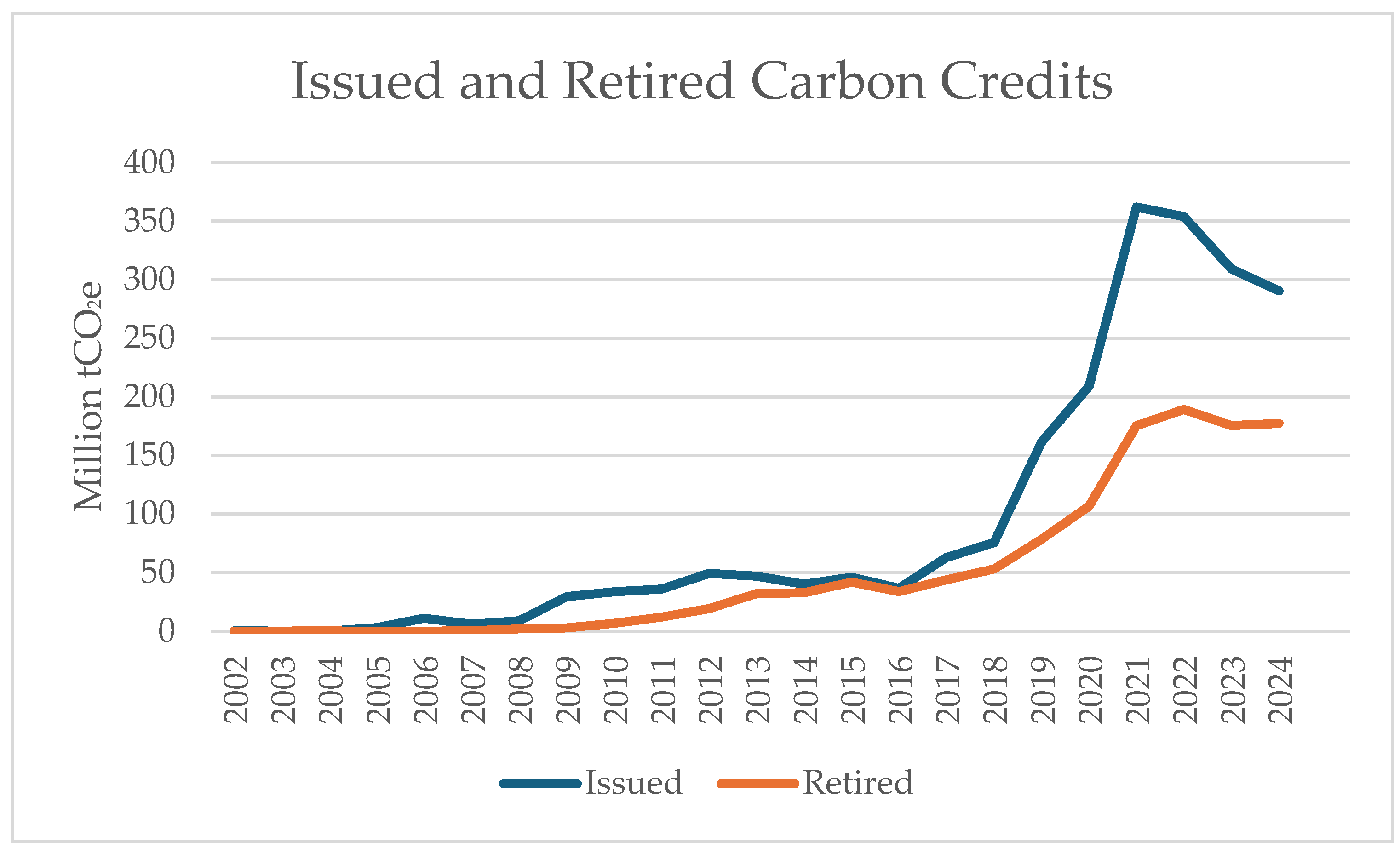
Figure 1 illustrates the issuance and retirement of carbon credits by vintage year from 2002 to 2024. The annual trade in voluntary carbon credits has been growing steadily since the early 2000s, reaching a peak in 2021, with carbon credits representing 362 million tCO2e. Since then, the number has declined to just over 290 million tCO2e in 2024 [37].
A significant and growing component of the voluntary carbon credit market is for nature-based solutions (NbS), which involve actions to conserve, sustainably manage, and restore natural or modified ecosystems, thereby enhancing their ability to reduce or remove carbon emissions [36,39]. Over a third of all voluntary carbon credits issued since the early 2000s (2346 million tCO2e) have been emissions removal or avoidance by NbS, representing 866 million tCO2e from 913 registered projects. In 2024, the total credits issued across all activities (including NbS, renewable energy, household, industry, waste, gas recovery and utilization, non-renewable energy, coal mine methane, and urban activities) amounted to 291 million tCO2e, with NbS accounting for 88 million tCO2e [37]. The leading 10 countries involved in NbS projects accounted for nearly 90% of the total NbS supply in 2024. Among them, Colombia, the United States, Brazil, and Mexico contributed almost two-thirds of all NbS-carbon credits [40].
Table 2 lists the NbS-registered projects and carbon credits issued by activity type, from 2002 to 2025. Although only 23% of all registered NbS projects have been for avoided emissions, particularly afforestation/reforestation and improved forest management, this accounts for 643 million tCO2e. In contrast, 77% of all registered NbS projects have been for emission removal, largely through avoided deforestation and avoided conversion, but this accounts for only 221 million tCO2e.
In the voluntary carbon market, NbS accounted for over two-thirds of total transaction value in 2022 [42]. The value of private finance into NbS for carbon credit transactions rose from USD 67 million in 2016 to USD 1.33 billion in 2021 [42], reaching USD 1.5 billion in 2023 [43]. This amounts to less than 5% of all private finance (USD 35.3 billion in 2023) flowing into NbS [14].
In the early 2020s, it was predicted that voluntary carbon markets would continue to grow significantly, potentially by as much as 15 times their current value by 2030, to meet the rising demand from the private sector for climate solutions, and that NbS would play a significant role in this market expansion [39,44,45,46,47]. Given this, NbS could avoid or remove up to 10 billion tCO2e per year from now until 2050 [47]. However, current market growth has slowed somewhat, and as demand for NbS credits has weakened, prices have also dropped. For the top 500 projects retiring credits in the offset market, the average price of NbS credits was USD 5.6/tCO2e in January 2023, but only USD 3.6/tCO2e in May 2024. Projects with a higher-integrity credit rating tend to display higher prices. For example, REDD+ credits from projects rated BBB or higher have exceeded USD 30/tCO2e, whereas an index of credits for afforestation, reforestation, and revegetation projects rated at BBB has reached USD 25/tCO2e [48,49].
Three important concerns have been raised about the future demand and effectiveness of NbS in mitigating climate change, as well as the credibility of carbon credits generated by such investments [36]. First, additionality refers to the challenge of quantifying the extent to which NbS reduce land-use change or carbon emissions relative to baselines. Second, the problem of leakage identifies the risk that environmentally harmful activities will either move to or expand into other locations. Third, the issue of permanence arises due to the risk and uncertainty surrounding their carbon mitigation potential [46,50,51,52,53,54,55,56]. Recent technological advances in monitoring, AI-driven modeling, and blockchain are enhancing the accuracy and transparency of monitoring, verification, and credit tracking, helping address these three concerns and distinguish between low and high-quality carbon credits. However, this move toward greater transparency has limitations, and the risks and constraints of technological advancements must be considered.
Another issue is that trade-offs among the different benefits of NbS can occur if investments focus primarily on carbon sequestration and climate mitigation, leading to practices such as planting non-native monocultures through afforestation or reforestation, which often result in low biodiversity, water, and other co-environmental benefits [57,58]. Furthermore, due to concerns over the distributional impacts and exclusion from NbS projects, which often focus primarily on carbon sequestration, there has also been resistance to NbS from some Indigenous peoples, local community groups, and grassroots organizations [59,60]. The appropriate establishment of property rights is critical to marketplace design to ensure the efficient, sustainable, and equitable allocation and distribution of environmental goods and services and the successful adoption and implementation of NbS projects [61,62,63,64].
The long-term economic viability of NbS as a global carbon mitigation strategy requires additional assessment compared to traditional energy and technology-based solutions (ETbS), such as clean energy, energy efficiency, carbon capture and storage, and abating industrial and transportation emissions [36]. In the longer term, the cost-effectiveness of carbon credits from NbS relative to those from ETbS for climate change mitigation is expected to decline significantly. One reason is that the mitigation costs of some ETbS are likely to decline due to economies of scale, breakthroughs in research and development, and technological progress [65]. This is especially true for large-scale emission-reduction measures such as electric vehicles, solar photovoltaic panels, and offshore wind turbines, and it is also crucial for carbon-removal technologies like carbon capture and storage and direct air capture [39].
In contrast, NbS do not benefit significantly from economies of scale and learning effects. Instead, they are likely to increase in cost due to higher land opportunity costs from development and population pressures, as well as rising verification, monitoring, and reporting expenses [39,66]. For example, between 2022 and 2050, the per-unit costs across all ETbS are projected to decrease by an average of USD 19 to USD 50/tCO2e mitigated, while costs across all NbS are expected to rise by an average of USD 7 to USD 68/tCO2e [39]. These relative cost trends could substantially impact the market for NbS-carbon credits for climate change mitigation.
Addressing these issues will be crucial for guiding reforms in voluntary carbon markets, strengthening verification protocols for carbon mitigation through NbS, and providing clearer information to help buyers identify high- and low-quality carbon credits. In addition, highlighting the potential for biodiversity and other co-benefits of NbS can enhance opportunities to establish incentives and secure funding for nature conservation and sustainable management.

3.2. Trade in Biodiversity Credits

A review of Fortune Global 500 companies reveals that while most companies have climate-related targets (83%) or acknowledge climate change (an additional 15%), only 51% acknowledge biodiversity loss in some form, and only 5% have set quantified biodiversity targets [67]. Unlike the more established carbon credit market, which uses NbS to reduce or offset CO2 emissions, the market for biodiversity conservation credits from NbS is still in its early stages. However, both markets primarily serve companies focused on sustainability, are closely connected, and often overlap. Some NbS projects now incorporate the value of positive biodiversity outcomes that can result from nature-based carbon projects by “stacking” or “bundling” benefits, thereby creating higher-valued returns on nature conservation efforts.
Biodiversity credits are market-based financial instruments that represent a measurable, evidence-backed unit of positive nature and biodiversity outcomes from conservation and restoration projects. The revenue from the sale of biodiversity credits can generate financial value for new nature conservation efforts, promoting investment in projects that safeguard ecosystems and biodiversity. Biodiversity credits are typically voluntary, enabling companies to meet their internal commitments to protecting and restoring biodiversity through financial activities and investments. In contrast, biodiversity offsets represent compensation for negative impacts on biodiversity caused by a project or activity, and the loss in one location is offset by protecting or restoring a similar habitat in another location. This is usually to fulfill the requirements of regulated compliance schemes. Together, private finance flowing into biodiversity offsets and credits amounts to USD 11.7 billion, representing a third of all private finance (USD 35.3 billion) flowing to NbS [43].
For example, a recently established biodiversity credit project in the U.S. is the Endless Prairie Buffalo Project, a collaborative wildlife restoration and community-benefits initiative between the Assiniboine and Sioux Tribes of Fort Peck, the Environmental Policy Innovation Center (EPIC), Defenders of Wildlife, and the consultancy group Kingfisher Parker. This project aims to raise finance by selling biodiversity credits to support the reestablishment of bison herds and the restoration of grasslands in Montana, benefiting both the environment and the Fort Peck Assiniboine and Sioux Native American tribes [68].
Other examples include the RePlanet wildlife-avoided-loss project in Cusuco National Park (CNP) in northern Honduras, which aims to protect over 1800 hectares of cloud forest, offering significant biodiversity, carbon, and water conservation benefits. The project sells avoided loss biodiversity credits in the voluntary biodiversity credit market, which it combines (i.e., “stacks”) with carbon credits to fund the conservation and management of CNP and local community projects within the park’s buffer zone. Similar biodiversity credit projects offered by RePlanet include the Floreana Island Species reintroduction in the Galapagos Islands, the Taransay Island Rewilding project in Scotland, and the Transylvanian High Nature Value Grasslands in Romania [69].
The voluntary market for biodiversity credits faces the same three fundamental challenges that impact carbon markets: additionality, leakage, and permanence, which can undermine the credibility and effectiveness of establishing and maintaining the market, as well as enabling trade [36]. Furthermore, trade-offs between the various environmental benefits of NbS may arise when projects focus on specific attributes for credit generation, and maintaining support for the project requires engaging with local communities and sharing the benefits [58,59,60]. However, unlike the voluntary market for carbon credits through NbS, there are no viable alternatives or substitutes in the market of traded credits to conserve biodiversity. Therefore, the economic value of biodiversity credits is expected to continue increasing as supply becomes scarcer, alongside rising demand for biodiversity conservation [1]. Biodiversity credits have the potential to play a significant role in raising funds for future biodiversity conservation and sustainable management.
An analysis of five major voluntary biodiversity credit frameworks (Terrasos, Savimbo, Plan Vivo, RePlanet, and ValueNature) revealed that current biodiversity credit prices vary widely. For example, for a 1% biodiversity improvement over 1 hectare, prices range from USD 7 to over USD 41,000 for a 100-year conservation period, using a 2.5% annual discount rate (or USD 0.2 to USD 1100 per year) [70]. The median price was estimated at USD 750 per 100 years (or USD 20 per year), and the mean price at USD 8800 per 100 years (or USD 236 per year) in the existing biodiversity credit market. However, as the authors note, such estimates need to account for the newness of the biodiversity credit market, the limited number of credits, and the lack of transparency [70]. Another comparative analysis of 15 biodiversity credit schemes globally reports that credit prices vary widely, from USD 7 to USD 68,000 per hectare per year, depending on factors such as habitat type, project location, and scheme design [71]. It is anticipated that, given the rising demand for biodiversity credits by companies meeting their biodiversity goals, as well as consumers’ increasing environmental demands, combined with the constrained supply of biodiversity credits and the often high and rising opportunity costs of conservation, the price of biodiversity credits and the volume of trade in biodiversity credits will increase in the future.
A recent market outlook projection for voluntary biodiversity credits estimates three scenarios [72]. Each scenario is influenced by several key assumptions, particularly regarding the enhancement of carbon credits to improve natural outcomes, access to ecosystem services as inputs, contributions to nature’s recovery beyond their own impact, offering products bundled with nature recovery, and taking responsibility for unmitigated biodiversity impacts. The “limited development” scenario assumes that only a small proportion of Fortune 500 companies adopt nature-related targets, and that biodiversity credits play a limited role in achieving them. In this scenario, the market demand is projected to reach USD 760 million annually by 2030 and could increase to USD 6 billion by 2050. The “effective development” scenario assumes that a large share of Fortune 500 companies adopt nature-related targets, and biodiversity credits play a significant role in reaching nature strategies. Under these assumptions, demand could reach USD 2 billion in 2030 and grow to USD 69 billion by 2050. The “transformative development” scenario assumes that all Fortune 500 companies adopt nature-related targets, and biodiversity credits play a significant part in nature strategies. In this case, demand is projected to reach USD 7 billion in 2030, rising to USD 180 billion by 2050. However, the authors note that, since the market for biodiversity credits is relatively new, these estimates are intended to be illustrative of what it would take to reach a market of this magnitude, rather than a projection or forecast [72].
The UN-supported Network Principles for Responsible Investment (IPR) estimates that, if 30% to 100% of existing carbon projects stacked biodiversity and carbon revenues, the projects could support a biodiversity credit market of USD 18 to USD 43 billion per year by 2050 [73]. In this analysis, biodiversity credit prices are assumed to range from basic conservation costs of USD 12/ha/year to the observed willingness to pay for biodiversity co-benefits in the NbS-based carbon credit market, at USD 45/ha/year [73].

3.3. Trade in Water Credits

Trade in rights or entitlements to use water has been established for some time [74,75,76]. However, voluntary markets that trade in credits that support freshwater ecosystems, conserve in-stream flow and their ecological benefits, or support water pollution reduction are a relatively new phenomenon.
An example of a regulatory water quality trading program operates in Oregon, Washington, and Idaho, allowing factories and wastewater facilities to buy pollution reduction credits from landowners who implement verified conservation measures to reduce nutrient runoff, such as streamside buffers and conservation tillage, instead of installing expensive new technology like wastewater treatment plants [77]. Recent efforts have also been made to expand water trading to incorporate water pollution considerations within the regulatory framework. For example, in 2024, the U.S. Environmental Protection Agency (EPA) issued guidance allowing permitted pollution sources to meet regulatory obligations by purchasing pollution-reduction credits from other sources, such as farms and ranches [78].
However, there have been very limited private investments in financial mechanisms and instruments, such as the establishment of voluntary credit markets, which could enable the use of NbS to reduce freshwater scarcity and pollution, for example, through the protection and restoration of forests and peatland ecosystems. Increasing corporate environmental, social, and governance (ESG) commitments, as well as new and impending government regulations targeting water quality and scarcity, have created incentives for the development and adoption of innovative private projects and programs to establish voluntary credit schemes for improved water resource management. Companies are increasingly expanding their nature-related targets and investments beyond carbon to include freshwater. The markets and trade in freshwater credits are growing, enabling new sources of private finance to support investments in water conservation and sustainable management.
Although corporate targets are common for climate change, they are relatively rare for freshwater use and pollution. For example, 83% of Fortune Global 500 companies have climate-related targets, and a further 15% acknowledge the impact of climate change. In contrast, only 25% of Fortune Global 500 companies have acknowledged and set targets for freshwater consumption, 49% have acknowledged but not set targets, and 26% have neither acknowledged nor set targets [67].
New private-sector initiatives and financial tools in the freshwater credit market are also emerging, such as the “Cassowary Credits” project in Australia, which rewards landowners for rainforest restoration that improves freshwater health [79]. In this project, a Cassowary Credit represents a measurable, independently verified improvement in the condition of the rainforest, helping preserve terrestrial biodiversity while enhancing the health of freshwater and marine ecosystems, including the Great Barrier Reef. The Nature Positive Platform (Nat5) Santa Isabel water project in Mexico sells water credits to fund efforts to plant trees and regenerate natural vegetation, thereby reducing water runoff, recharging groundwater, and restoring groundwater storage [80].
Similarly, a public benefits corporation called “WaterCard” has been established in the Colorado River Basin of the United States. The WaterCard program enables individuals and private entities to purchase water conservation credits, which are non-fungible tokens (NFTs) representing verified conservation credits that can be used to offset their water footprint or to invest in conservation efforts. The revenue raised provides financial incentives for voluntary conservation efforts, such as regenerative agriculture, among farmers and ranchers. The WaterCard’s program is designed to operate within the Upper Colorado Commission’s System Conservation Pilot Program and can increase the funding available to farmers and ranchers for conservation efforts [81,82]. An additional potential benefit is to promote initiatives across local water users to fund nature-based interventions at the watershed scale, thereby reducing both local water scarcity and improving water quality.
Another approach is to recognize that nature conservation projects offer the potential to generate and trade in credits for a variety of natural resources, including water. For example, the Nature-Positive Platform (Nat5) identifies NbS projects that affect carbon, biodiversity, soils, and water. For these projects, a range of independently verified and validated credits can be purchased to support conservation, restoration, and ecosystem regeneration [83].
However, there are several major challenges in establishing and enforcing voluntary water markets and trade. Like other natural resource-based credit markets, the issues of additionality, leakage, and permanence remain significant obstacles that can undermine the credibility and effectiveness of creating and maintaining efficient markets and transactions for trading water credits for conservation and pollution control [36]. As these are relatively new markets, they face significant transaction costs in becoming established, such as search costs of identifying and matching willing buyers and sellers, additional infrastructure investments needed for water conservation or pollution abatement, and legal costs associated with creating and enforcing contracts and obtaining regulatory permission to engage in water credit trading [76]. As in the case of the markets for trading water rights, voluntary water credit markets could be significantly impacted by policy distortions and institutional and governance failures, which have frequently exacerbated water scarcity and pollution problems by promoting wasteful water extraction and ecosystem degradation [6,75,76].

4. Nature-Based Finance Markets

Nature-based finance markets are mechanisms that channel private and public investments into activities aimed at protecting, restoring, and sustainably managing natural ecosystems. They generate financial value from the ecosystem services of natural capital. These markets expand on traditional finance models (such as those for food production, timber, and minerals) to include services that were not previously monetized, such as carbon sequestration, biodiversity enhancement, water quality improvement, and natural flood management. Nature-based finance markets provide important sources of funding for environmental conservation and sustainable management, especially in developing countries [84].
There has been a recent, rapid emergence of new nature-based financial instruments with the potential to unlock substantial private and public financial resources for nature conservation and sustainable development (see Table 3). As these instruments involve commercial contracts with monetary value, can generally be traded or held by investors with the expectation of competitive returns, and can be used exclusively to generate returns or additional funding for conserving, restoring, and sustainably managing natural resources and ecosystems, they represent the potential creation of new nature-based finance markets. Some instruments, such as nature-based derivatives, sustainability-linked, thematic, and green bonds, and debt-for-nature swaps, could potentially signal a new financial asset class.
Many of the nature-based financial instruments in Table 3 are already well-established and widely used [86]. In contrast, others are still in early development and may require significant funding to achieve a large-scale impact. For example, as discussed in Section 3, carbon credit market transactions for NbS were USD 67 million in 2016 and reached USD 1.5 billion in 2023 [42,43]. In comparison, the credit market for biodiversity is in its early stages, and the issuance of water credits is limited to select projects. In 2025, the size of the global green bond market was USD 673 billion and is expected to grow to USD 813 billion by 2030 [87].
However, green bonds for projects in developing countries focus mainly on renewable energy, energy efficiency, green transport, and other climate change mitigation investments and are rarely used to finance biodiversity conservation and sustainable management of ecosystems [6]. In recent years, the evolution of nature-based derivative markets has been facilitated by innovations in information technology, environmental monitoring, and artificial intelligence, but the use of such instruments has largely been confined to a few but growing number of biodiversity conservation projects [88].
The potential contribution of nature-based finance markets to environmental sustainability could be significant. A ranking of the top 10 finance solutions for nature by their capacity to unlock large-scale capital and deliver nature-positive impacts included many of the instruments in Table 3: sustainability-linked bonds, thematic bonds for nature, sustainability-linked loans, thematic loans for nature, natural asset companies, natural resource credits, debt for nature swaps, and payments for ecosystem services [85].
Overall, nature-based finance markets and other financial mechanisms that channel investments in nature or reduce environmental risks have an estimated value of USD 4–5 trillion and could grow to USD 30 trillion by 2050 [19,20]. The global transactions market for sustainability-linked bonds (SLBs) is estimated to range from USD 100 million to USD 3 billion, with an expected annual issuance of USD 55 billion in 2024. The market for sustainability-linked loans (SLLs) is estimated at USD 50 million to USD 5 billion, with an expected annual issuance of USD 707 billion in 2024. For payments for ecosystem services, the estimated transaction range is USD 0.1 million to USD 10 million, with an annual transaction volume of USD 36–42 billion in 2018 [85].
There are numerous examples of nature-based financial instruments [85,89]. The “Orsted Blue Bond” is an example of the sustainability-linked bond. This is a tradable fixed-income bond with its coupon rates tied to key environmental or social performance indicators. Poor performance relative to the indicators results in higher coupon rates (“step-ups”), whereas overperformance lowers coupon rates (“step-downs”). In 2023, Orsted issued a 5-year, 100 million Euro blue bond to fund offshore biodiversity protection and marine ecosystem restoration near its wind farms and to support sustainable shipping activities [90].
The Maluku Token Project in Indonesia uses “tokenization” of a nature-based derivative to invest in conservation and local communities. Token holders have the potential to profit from capital gains as tokens are traded on a regulated exchange. In addition to potential price appreciation, token holders will receive an annual yield derived from the revenue generated by green and blue carbon credits. These credits are generated by the 71 million ha of terrestrial and marine ecosystems in the Maluku and Aru Islands, Indonesia. Profits from the Maluku Token Impact Fund, which invests in sustainable projects in the region, will be distributed as dividends, further enhancing the financial benefits of token ownership [91].
Another example is the Boreal Natural Asset Company (NAC), which was established in 2025 in Finnish Lapland by an indigenous-led corporation to maintain and conserve over 1 million acres of native-owned land. The company aims to treat the natural ecosystem as a form of capital to be managed for its range of environmental benefits, including climate regulation, fresh water, food production, and flood mitigation. By combining financial statements and ecological performance reports based on the UN-SEEA (system of economic-environmental accounting) standards, the Boreal NAC intends to assign value to the benefits derived from nature, and, where feasible, estimate the monetary value of ecosystem benefits, including commercial output, non-use and option value, store of value, and risk mitigation [85].
Although the recent emergence and spread of a wide range of nature-based finance markets is promising, to reach their full potential in providing large-scale financial resources while delivering nature-positive impacts will require improved and consistent ecological metrics and monetary values, including environmental risks. Establishing strong demand and supply conditions for nature-based financial instruments also requires a stable, well-supported market as it emerges, along with strong governance and the removal of institutional barriers to new and innovative finance opportunities. These are important challenges that particularly impact developing countries.

5. Discussion: Implications for Developing Countries

As discussed in Section 2, the potential growth in the scale and scope of global markets for sustainably produced commodities presents significant opportunities for producers and consumers, especially in developing countries. However, the increasing costs of establishing and meeting sustainability standards and certification requirements can be prohibitive in low- and middle-income countries [30]. In addition, weak institutional capacity and governance frameworks, especially in developing countries, often play a crucial role in determining how much information on environmental scarcity and risks is considered in production, consumption, and investment decisions. Investments in strengthening institutional capacity and governance frameworks, along with technical assistance and the development of local capacity, can also improve the scale, impact, and maturity of markets for sustainably produced commodities in these regions [36].
In addition, a lack of information or uncertainty in developing countries about the environmental costs, benefits, and risks associated with using scarce natural resources and ecosystems can prevent a full understanding of the true implications of unsustainable natural resource use. For example, inadequate knowledge of the environmental costs and benefits from overuse and degradation of natural resources and ecosystems makes it very difficult for businesses and policymakers to decide on how best to account for these costs and benefits in the pricing of natural resource inputs, such as freshwater, and waste pollution outputs, including greenhouse gases, phosphates, and nitrates. Although methods to assess environmental costs and benefits in developing countries have improved, more guidance and applications are required [92]. Establishing standards and norms, providing technical assistance, and enhancing local capacity can also enhance the scale and impact of markets for sustainably produced commodities [20,36].
As noted in Section 3, the potential for developing countries to benefit from the expansion of markets for natural resource credits will depend greatly on overcoming the challenges posed by additionality, leakage, and permanence. In particular, in carbon offset markets, concerns with these three issues have considerably undermined the credibility of credits issued by NbS projects and investments in many developing countries [33,44,45,46,52,54]. Buyers often view credits from NbS in developing countries as being too risky and have difficulty comparing them with credits issued for other carbon offsets that offer more certain removal or reduction. This may explain why, in offset markets, “NbS credits attract discouragingly low prices” compared with other types of credits, especially if the NbS credits originate from developing countries [52].
Developing countries need assistance in using the most advanced monitoring, assessment, and evaluation methods to address problems of additionality, leakage, and permanence associated with natural resource credits [36]. Ensuring the credibility of natural resource credits issued from developing countries in global markets may require devising methods to adjust the value of their credits for temporary and risky environmental benefits [45,52,54]. Such an approach not only would address concerns about the risk and permanence of natural resource credits issued by developing countries but also could be the basis for securitizing these offsets into bonds, as well as informing potential environmental damages and project risks and facilitating insurance rating and pricing for projects [45].
Nature-based finance faces significant challenges in developing countries, as previously discussed in Section 4. To fully embrace new and emerging nature-based financial instruments to fund environmental conservation and sustainable management, more reliable and consistent data on ecological metrics and monetary valuations, especially regarding environmental risks, is required. Building strong demand and supply for nature-based financial instruments also relies on a stable, well-supported market, effective governance, and the removal of institutional barriers to innovative finance opportunities. However, like other financial markets, speculation and economic uncertainty in nature-based assets can lead to financial instability, significant financial losses, and the misallocation of resources [93]. Therefore, even with appropriate structural safeguards and regulations in place, the market for nature-based financial instruments is likely to remain highly volatile [88].
A further issue is that commercializing nature can be problematic, especially when the conservation value does not align with the extraction value, putting these assets and resources at risk of overuse and misuse. For example, institutions may develop nature-based financial tools to serve their own private needs without fully considering the broader global public benefits of conserving nature or the total impacts on local communities [88]. In such cases, policies that balance conservation benefits with the opportunity costs of commercial use can be highly effective.
To support sustainable investments over alternative conversion and depletion activities in developing countries, there is a need for appropriate policy support and actions, including the provision of information and awareness of sustainable investment opportunities and their positive impact [94,95]. A major obstacle to the spread of environmental markets and private finance for encouraging more sustainable use and conservation of nature in developing countries is the presence of policy distortions that are counterproductive to such an outcome. One concern is the growing proliferation of environmentally harmful agricultural subsidies, especially those that encourage excessive land expansion [96,97,98,99]. For example, market price support and payments based on commodity output produced or variable inputs used, which often encourage farming practices and production to increase land use, have increased from USD 13 billion per year in 2000–02 to over USD 130 billion annually in 2020–22 for 11 major developing countries [98]. The 11 countries are Argentina, Brazil, China, India, Indonesia, Kazakhstan, the Philippines, the Russian Federation, South Africa, Ukraine, and Vietnam. Across all developing countries, agricultural subsidies are responsible for the loss of 2.2 million hectares of forest per year—or 14% of global deforestation [96].
Removal or reduction of such subsidies would improve the efficiency of agricultural production on existing land, boost the competitiveness of smaller producers and poorer economies, reduce land-use expansion, and protect natural habitats and biodiversity [21,96,99,100]. The financial savings from subsidy reduction could also be repurposed to provide greater support for agricultural research and development that focuses on adopting new technologies and climate-smart methods that could boost productivity on existing agricultural land, protect production from climate-related risks, and reduce the overall land intensity of agriculture in developing countries [21,96,99,100,101,102,103]. Repurposing subsidies could also support the additional technical, financial, and institutional investments that are necessary for the expansion of effective environmental markets in developing countries.
For example, across the world, policy distortions and institutional and governance failures have frequently exacerbated water scarcity and pollution problems by promoting wasteful water extraction and ecosystem degradation, creating perverse incentives that fail to balance water use with supply, protect freshwater ecosystems, and support necessary technological innovations for more efficient use of water [104]. The underfunding of water conservation and sustainable management remains a significant constraint [77,105,106,107]. Of the USD 165 billion in public finance flows to NbS in 2022, less than 20% was allocated to address water scarcity and pollution. Specifically, USD 16.2 billion was spent on water resources and wastewater management, and an additional USD 15.4 billion on pollution abatement [14].

6. Conclusions and Future Directions

The trends and challenges in environmental markets and finance solutions for nature have important implications for the efficient, sustainable, and equitable management of natural capital as well as for sustainable development, particularly in developing countries. Although the rise in green markets and finance solutions for nature is highly significant, the constraints are substantial. Strong governance and a supportive policy framework are critical to maintain economic stability and foster investment in environmental markets and finance [108]. Furthermore, even if the various constraints to environmental markets and nature-based finance solutions are addressed, this may still be insufficient to fully address the ongoing conversion and depletion of the world’s natural resources in a timely manner. This could severely hold back progress by developing countries toward sustainable development.
The three main roles for environmental markets are to price the environmental “bads” within existing markets to take account of environmental costs in producer and consumer decision-making, to value and pay for the environmental “goods” produced by natural capital, and to incorporate environmental “risks” into financial and business decisions [6]. The emergence and establishment of green markets and finance solutions for nature focus on addressing the latter two issues. That is, incorporating the environmental benefits of natural assets and their flows of goods and services, as well as environmental risks, into financial and business decisions. However, progress in fully accounting for environmental costs in producer and consumer decisions has been much slower and may undermine the positive gains associated with the rise in green markets and financial solutions for nature.
Policymakers need to support the economic viability of environmental markets and private finance in developing countries through appropriate policies, while also safeguarding, protecting, and conserving critical ecosystems, and promoting sustainable development. Alternative and complementary policy options, such as environmental regulations and standards, removing existing environmentally harmful subsidies, and establishing more effective institutions and governance, are especially important for developing countries to progress toward sustainable development.
However, there are also situations where it may not be feasible to establish efficient, effective, and equitable environmental markets, or to raise adequate financial resources for the required levels of investment in the conservation and sustainable management of natural capital assets. In such cases, alternative and complementary policy options, such as regulations and standards, the removal of existing distortionary policies, and the establishment of more effective institutions and governance, should also be addressed, as they may be crucial in protecting and conserving critical ecosystems in the longer term.
Further research is required to determine how best to establish standards and norms, provide technical assistance, and enhance local capacity, thereby increasing the scale and impact of markets for sustainably produced commodities from developing countries [20,33]. For natural resource credits, progress in research on the additionality, leakage, and permanence of natural resource credits issued by developing countries will be essential as governments and financial markets continue to press for improved verification of such credits and better information to help buyers differentiate between low- and high-quality credits [36]. For new and emerging nature-based financial instruments, more research and technological advances are urgently needed to develop reliable and consistent data to assess natural assets and estimate their monetary value to ensure longer-term confidence in these novel approaches to fund environmental conservation and sustainable management in developing countries.

Author Contributions

Conceptualization, J.C.B. and E.B.B.; writing—original draft preparation, J.C.B. and E.B.B.; writing—review and editing, J.C.B. and E.B.B. All authors have read and agreed to the published version of the manuscript.

Funding

This research received no external funding.

Institutional Review Board Statement

Not applicable.

Informed Consent Statement

Not applicable.

Data Availability Statement

No new data were created or analyzed in this study.

Conflicts of Interest

The authors declare no conflicts of interest.

References

  1. Drupp, M.A.; Hänsel, M.C.; Fenichel, E.P.; Freeman, M.; Gollier, C.; Groom, B.; Heal, G.M.; Howard, P.H.; Millner, A.; Moore, F.C.; et al. Accounting for the increasing benefits from scarce ecosystems. Science 2024, 383, 1062–1064. [Google Scholar] [CrossRef] [PubMed]
  2. Barbier, E.B. Capitalizing on Nature: Ecosystems as Natural Assets; Cambridge University Press: Cambridge, UK, 2011. [Google Scholar]
  3. Barbier, E.B. The concept of natural capital. Oxf. Rev. Econ. Policy 2019, 35, 14–36. [Google Scholar] [CrossRef]
  4. Dasgupta, P. The Economics of Biodiversity: The Dasgupta Review; HM Treasury: London, UK, 2021. Available online: https://assets.publishing.service.gov.uk/media/602e92b2e90e07660f807b47/The_Economics_of_Biodiversity_The_Dasgupta_Review_Full_Report.pdf (accessed on 5 November 2025).
  5. World Economic Forum (WEF). Nature Risk Rising: Why the Crisis Engulfing Nature Matters for Business and the Economy; World Economic Forum: Davos, Switzerland, 2020; Available online: https://www.weforum.org/publications/nature-risk-rising-why-the-crisis-engulfing-nature-matters-for-business-and-the-economy/ (accessed on 5 November 2025).
  6. Barbier, E.B. Economics for a Fragile Planet; Cambridge University Press: Cambridge, UK, 2022. [Google Scholar]
  7. Climate Financial Risk Forum (CFRF). Nature Related Risk: Handbook for Financial Institutions. Climate Financial Risk Forum. 2024. Available online: https://www.fca.org.uk/publication/corporate/cfrf-nature-related-risk-handbook-financial-institutions-2024.pdf (accessed on 5 November 2025).
  8. Evison, W.; Low, L.P.; O’Brien, D. Managing Nature Risks: From Understanding to Action; PwC Publication: London, UK, 2023; Available online: https://www.pwc.com/gx/en/issues/esg/nature-and-biodiversity/managing-nature-risks-from-understanding-to-action.html (accessed on 5 November 2025).
  9. World Bank. The Changing Wealth of Nations: Revisiting the Measurement of Comprehensive Wealth; World Bank: Washington, DC, USA, 2024; Available online: https://documents1.worldbank.org/curated/en/099100824155099751/pdf/P178446-c8271985-738f-49a7-9a96-a3b1d66a002c.pdf (accessed on 5 November 2025).
  10. World Economic Forum (WEF). Global Risks Report; World Economic Forum: Cologny, Switzerland, 2025; Available online: https://www.weforum.org/publications/global-risks-report-2025/ (accessed on 5 November 2025).
  11. Johnson, J.A.; Ruta, G.; Baldos, U.; Cervigni, R.; Chonabayashi, S.; Corong, E.; Gavryliuk, O.; Gerber, J.; Hertel, T.; Nootenboom, C.; et al. The Economic Case for Nature: A Global Earth-Economy Model to Assess Development Policy Pathways; World Bank: Washington, DC, USA, 2021; Available online: https://openknowledge.worldbank.org/server/api/core/bitstreams/9f0d9a3a-83ca-5c96-bd59-9b16f4e936d8/content (accessed on 5 November 2025).
  12. Taskforce on Nature and Nature Finance (TNNF). Global Nature Markets Landscaping Study. Taskforce on Nature and Nature Finance. 2022. Available online: https://www.naturemarkets.net/publications/global-nature-markets-landscaping-study (accessed on 5 November 2025).
  13. Barbier, E.B. The policy implications of the Dasgupta review: Land use change and biodiversity. Environ. Resour. Econ. 2022, 83, 911–935. [Google Scholar] [CrossRef] [PubMed]
  14. United Nations Environment Programme (UNEP). State of Finance for Nature: The Big Nature Turnaround—Repurposing $7 Trillion to Combat Nature Loss; United Nations Environment Programme: Nairobi, Kenya, 2023. [Google Scholar]
  15. Deutz, A.; Heal, G.M.; Niu, R.; Swanson, E.; Townshend, T.; Zhu, L.; Delmar, A.; Meghji, A.; Sethi, S.A.; Tobinde la Puente, J. Financing Nature: Closing the Global Biodiversity Financing Gap. The Paulson Institute, The Nature Conservancy, and the Cornell Atkinson Center for Sustainability. 2020. Available online: https://www.paulsoninstitute.org/conservation/financing-nature-report/ (accessed on 5 November 2025).
  16. Barbier, E.B.; Burgess, J.C. Innovative Corporate Initiatives to Reduce Climate Risk: Lessons from East Asia. Sustainability 2017, 10, 13. [Google Scholar] [CrossRef]
  17. Barbier, E.B.; Burgess, J.C. Policies to support environmental risk management in investment decisions. Int. J. Glob. Environ. Issues. 2018, 17, 117–129. [Google Scholar] [CrossRef]
  18. Flammer, C.; Giroux, T.; Heal, G.M. Biodiversity Finance. J. Financ. Econ. 2025, 164, 103987. [Google Scholar] [CrossRef]
  19. United Nations Environment Programme (UNEP); Finance for Biodiversity Foundation (FBF). Supplementary Information—New Green Shoots: Emerging Trends in Nature and Sustainable Finance; United Nations Environment Programme: Nairobi, Kenya; Finance for Biodiversity Foundation: Amsterdam, The Netherlands, 2024; Available online: https://www.unepfi.org/wordpress/wp-content/uploads/2024/09/New-Green-Shoots-Supplementary-Information.pdf (accessed on 5 November 2025).
  20. Smith, J.; Denke, D.; Alhassan, L.; Tang, V.; Olsen, N.; Wiese, A.; Boric, N.; Goedicke den Hertog, R. Private Finance for Nature in 2024: Scaling, Moving Up the Capital Continuum and Connecting to Impact. Poster AS-WBF-2024-00454 Presented at the 3rd World Biodiversity Forum, Davos, Switzerland. 2024. Available online: https://www.unepfi.org/wordpress/wp-content/uploads/2024/06/Nature-finance-overview.pdf (accessed on 5 November 2025).
  21. Barbier, E.B. Greening Agriculture for Rural Development. World Dev. 2025, 191, 106974. [Google Scholar] [CrossRef]
  22. Taskforce on Nature and Nature Finance (TNNF). Nature in an Era of Crises; Taskforce on Nature and Nature Finance: London, UK, 2022; Available online: https://www.naturemarkets.net/publications/nature-in-an-era-of-crises (accessed on 5 November 2025).
  23. Rainforest Alliance (RA). Tea Certification Data Report 2021; Rainforest Alliance: New York, NY, USA, 2022; Available online: https://www.rainforest-alliance.org/resource-item/tea-certification-data-report-2021 (accessed on 5 November 2025).
  24. Marine Stewardship Council (MSC). The Marine Stewardship Council Annual Report 2020–2021; Marine Stewardship Council: London, UK, 2022; Available online: https://www.msc.org/about-the-msc/reports-and-brochures (accessed on 5 November 2025).
  25. Forest Stewardship Council (FSC). The Share of Sustainable Wood: Data on FSC’s Presence in Global Wood Production. Forest Stewardship Council, 2018. Available online: https://fsc.org/sites/default/files/2019-08/Global%20Volume%20of%20FSC-certified%20Wood%20-July%202018.pdf (accessed on 5 November 2025).
  26. Kronthal-Sacco, R.; Whelan, T. Sustainable Market Share Index; New York University, Stern School of Business, Center for Sustainable Business: New York, NY, USA, 2024; Available online: https://www.stern.nyu.edu/sites/default/files/2024-05/2024%20CSB%20Report%20for%20website.pdf (accessed on 5 November 2025).
  27. World Economic Forum (WEF). New Nature Economy Report II: The Future of Nature and Business; World Economic Forum: Cologny, Switzerland, 2020; Available online: https://www.weforum.org/publications/new-nature-economy-report-ii-the-future-of-nature-and-business/ (accessed on 5 November 2025).
  28. The Economist Intelligence Unit (EIU). An Eco-Wakening: Measuring Global Awareness, Engagement, and Action for Nature; The Economist Intelligence Unit: London, UK, 2021; Available online: https://impact.economist.com/sustainability/ecosystems-resources/an-eco-wakening-measuring-global-awareness-engagement-and-action-for-nature (accessed on 5 November 2025).
  29. Forest Stewardship Council (FSC). 44 Sustainability Certifications for Businesses and Sustainability Professionals; Forest Stewardship Council: Bonn, Germany, 2024; Available online: https://fsc.org/en/blog/sustainability-certifications# (accessed on 5 November 2025).
  30. United Nations (UN). The Future of Sustainable Trade—Due Diligence Initiatives, Voluntary Sustainability Standards and Developing Countries; United Nations: Geneva, Switzerland, 2025. [Google Scholar]
  31. European Union (EU). Commission Notice—Guidance Document for Regulation (EU) 2023/1115 on Deforestation-Free Products. 2025. Available online: https://eur-lex.europa.eu/eli/C/2025/4524/oj (accessed on 5 November 2025).
  32. Fares, N.; Islam, M.S.; Jauhar, S.K.; Kucukaltan, B. Towards an International Digital Product Passport: The New Paradigm of a Worldwide Circular Economy. Circ. Econ. Sustain. 2025, 5, 5475–5495. [Google Scholar] [CrossRef]
  33. Koppelaar, R.H.; Pamidi, S.; Hajósi, E.; Herreras, L.; Leroy, P.; Jung, H.Y.; Concheso, A.; Daniel, R.; Francisco, F.B.; Parrado, C.; et al. A digital product passport for critical raw materials reuse and recycling. Sustainability 2023, 15, 1405. [Google Scholar] [CrossRef]
  34. Adisorn, T.; Tholen, L.; Götz, T. Towards a digital product passport fit for contributing to a circular economy. Energies 2021, 14, 2289. [Google Scholar] [CrossRef]
  35. Willer, H.; Trávníček, J.; Schlatter, B. (Eds.) The World of Organic Agriculture: Statistics and Emerging Trends 2025. Research Institute of Organic Agriculture FiBL and IFOAM—Organics International, Frick and Bonn. 2025. Available online: https://www.organic-world.net/yearbook/yearbook-2025.html (accessed on 9 October 2025).
  36. Barbier, E.B.; Burgess, J.C. Economics of Nature-Based Solutions for Mitigating Climate Change. Rev. Environ. Econ. Policy 2025, 19, 155–174. [Google Scholar] [CrossRef]
  37. Climate Focus. The Voluntary Carbon Market Dashboard; Climate Focus: Amsterdam, The Netherlands, 2025; Available online: https://climatefocus.com/initiatives/voluntary-carbon-market-dashboard/ (accessed on 5 November 2025).
  38. Crippa, M.; Guizzardi, D.; Pagani, F.; Banja, M.; Muntean, M. Greenhouse Gas (GHG) Emissions of All World Countries—2025 Report; Publications Office of the European Union (EU): Luxembourg, 2025; Available online: https://edgar.jrc.ec.europa.eu/report_2025 (accessed on 5 November 2025).
  39. Trove Research. The Role of “Reduction” and “Removal” Projects in the Voluntary Carbon Market—An Economic Analysis; Trove Research: London, UK, 2023; Available online: https://www.msci.com/www/research-report/the-role-of-reduction-and/04832433783 (accessed on 5 November 2025).
  40. Climate Focus. The Voluntary Carbon Market: 2024 Review; Climate Focus: Amsterdam, The Netherlands, 2025; Available online: https://climatefocus.com/wp-content/uploads/2025/01/Voluntary-Carbon-Market-2024-Review.pdf (accessed on 5 November 2025).
  41. EDGAR. Greenhouse Gas (GHG) Emissions of all World Countries; EDGAR Emissions Database for Global Atmospheric Research: Ispra, Italy, 2023; Available online: https://edgar.jrc.ec.europa.eu/report_2024 (accessed on 5 November 2025).
  42. Bhutada, G.; Dander, A. The Rising Demand for Nature-Based Climate Solutions; Visual Capitalist: Vancouver, BC, Canada, 2022; Available online: https://www.visualcapitalist.com/the-rising-demand-for-nature-based-climate-solutions (accessed on 9 October 2025).
  43. United Nations Environment Programme (UNEP). State of Finance for Nature: Restoration Finance Report. Growing the Green: Why and How Restoration Finance Needs to Quadruple by 2030; United Nations Environment Programme: Nairobi, Kenya, 2024. [Google Scholar]
  44. Miltenberger, O.; Jospe, C.; Pittman, J. The good is never perfect: Why the current flaws of voluntary carbon markets are services, not barriers to successful climate change action. Front. Clim. 2021, 3, 130. [Google Scholar] [CrossRef]
  45. Aldy, J.E.; Halem, Z.M. The evolving role of greenhouse gas emission offsets in combating climate change. Rev. Environ. Econ. Policy 2024, 18, 212–233. [Google Scholar] [CrossRef]
  46. Delacote, P.; L’horty, T.; Kontoleon, A.; West, T.A.; Creti, A.; Filewod, B.; LeVelly, G.; Guizar-Coutiño, A.; Groom, B.; Elias, M. Strong transparency required for carbon credit mechanisms. Nat. Sustain. 2024, 7, 706–713. [Google Scholar] [CrossRef]
  47. Girardin, C.A.; Jenkins, S.; Seddon, N.; Allen, M.; Lewis, S.L.; Wheeler, C.E.; Griscom, B.W.; Malhi, Y. Nature-based solutions can help cool the planet—If we act now. Nature 2021, 593, 191–194. [Google Scholar] [CrossRef] [PubMed]
  48. Allied Offsets. Pricing and Activity; Allied Offsets: Washington, DC, USA, 2025; Available online: https://alliedoffsets.com/pricing-activity/ (accessed on 5 November 2025).
  49. Carbon Pulse. Voluntary Carbon Market (VCM) Report: Prices Widening Between High- and Low-Rated Carbon Credits. 2025. Available online: https://carbon-pulse.com/444281/ (accessed on 9 October 2025).
  50. Streck, C. REDD+ and leakage: Debunking myths and promoting integrated solutions. Clim. Policy 2021, 21, 843–852. [Google Scholar] [CrossRef]
  51. Williamson, P.; Gattuso, J.P. Carbon removal using coastal blue carbon ecosystems is uncertain and unreliable, with questionable climatic cost-effectiveness. Front. Clim. 2022, 4, 853666. [Google Scholar] [CrossRef]
  52. Balmford, A.; Keshav, S.; Venmans, F.; Coomes, D.; Groom, B.; Madhavapeddy, A.; Swinfield, T. Realizing the social value of impermanent carbon credits. Nat. Clim. Change 2023, 13, 1172–1178. [Google Scholar] [CrossRef]
  53. Filewod, B.; McCarney, G. Avoiding carbon leakage from nature-based offsets by design. One Earth 2023, 6, 790–802. [Google Scholar] [CrossRef]
  54. Groom, B.; Venmans, F. The social value of offsets. Nature 2023, 619, 768–773. [Google Scholar] [CrossRef]
  55. Haya, B.K.; Evans, S.; Brown, L.; Bukoski, J.; Butsic, V.; Cabiyo, B.; Jacobson, R.; Kerr, A.; Potts, M.; Sanchez, D.L. Comprehensive review of carbon quantification by improved forest management offset protocols. Front. For. Glob. Change 2023, 6, 958879. [Google Scholar] [CrossRef]
  56. West, T.A.; Wunder, S.; Sills, E.O.; Börner, J.; Rifai, S.W.; Neidermeier, A.N.; Frey, G.P.; Kontoleon, A. Action needed to make carbon offsets from forest conservation work for climate change mitigation. Science 2023, 381, 873–877. [Google Scholar] [CrossRef] [PubMed]
  57. Seddon, N.; Chausson, A.; Berry, P.; Girardin, C.A.; Smith, A.; Turner, B. Understanding the value and limits of nature-based solutions to climate change and other global challenges. Phil. Trans. R. Soc. B 2020, 375, 20190120. [Google Scholar] [CrossRef]
  58. Key, I.B.; Smith, A.C.; Turner, B.; Chausson, A.; Girardin, C.A.; Macgillivray, M.; Seddon, N. Biodiversity outcomes of nature-based solutions for climate change adaptation: Characterising the evidence base. Front. Environ. Sci. 2022, 10, 905767. [Google Scholar] [CrossRef]
  59. Seddon, N. Harnessing the potential of nature-based solutions for mitigating and adapting to climate change. Science 2022, 376, 1410–1416. [Google Scholar] [CrossRef] [PubMed]
  60. Chausson, A.; Welden, E.A.; Melanidis, M.S.; Gray, E.; Hirons, M.; Seddon, N. Going beyond market-based mechanisms to finance nature-based solutions and foster sustainable futures. PLoS Clim. 2023, 2, e0000169. [Google Scholar] [CrossRef]
  61. Börner, J.; Baylis, K.; Corbera, E.; Ezzine-de-Blas, D.; Honey-Rosés, J.; Persson, U.M.; Wunder, S. The effectiveness of payments for environmental services. World Dev. 2017, 96, 359–374. [Google Scholar] [CrossRef]
  62. Börner, J.; Wunder, S.; Wertz-Kanounnikoff, S.; Tito, M.R.; Pereira, L.; Nascimento, N. Direct conservation payments in the Brazilian Amazon: Scope and equity implications. Ecol. Econ. 2010, 69, 1272–1282. [Google Scholar] [CrossRef]
  63. Wunder, S.; Börner, J.; Ezzine-de-Blas, D.; Feder, S.; Pagiola, S. Payments for environmental services: Past performance and pending potentials. Annu. Rev. Resour. Econ. 2020, 12, 209–234. [Google Scholar] [CrossRef]
  64. Nyanghura, Q.M.; Biber-Freudenberger, L.; Börner, J. Incentives for biodiversity conservation under asymmetric land ownership. Ecol. Econ. 2024, 219, 108152. [Google Scholar] [CrossRef]
  65. Gillingham, K.; Stock, J.H. The cost of reducing greenhouse gas emissions. J. Econ. Perspect. 2018, 32, 53–72. [Google Scholar] [CrossRef]
  66. Glennerster, R.; Jayachandran, S. Think globally, act globally: Opportunities to mitigate greenhouse gas emissions in low- and middle-income countries. J. Econ. Perspect. 2023, 37, 111–135. [Google Scholar] [CrossRef]
  67. McKinsey & Company. Where the World’s Largest Companies Stand on Nature; McKinsey & Company: New York, NY, USA, 2022; Available online: https://www.mckinsey.com/capabilities/sustainability/our-insights/where-the-worlds-largest-companies-stand-on-nature (accessed on 5 November 2025).
  68. Environmental Policy Innovation Center (EPIC). Endless Prairie Buffalo Project; Environmental Policy Innovation Center: Washington, DC, USA, 2025; Available online: https://www.policyinnovation.org/endless-prairie-buffalo-project (accessed on 9 October 2025).
  69. RePlanet. Wildlife Biodiversity Credit Projects; RePlanet: San Francisco, CA, USA, 2025; Available online: https://www.replanet.org.uk/project/biodiversity-led-projects/ (accessed on 5 November 2025).
  70. Heagney, L.; Nolles, K. The Cost of Biodiversity—What Nascent Biodiversity Markets are Telling Us. Aton Consulting Discussion Paper. 28 March 2024. Available online: https://img1.wsimg.com/blobby/go/cfa07821-39f0-4678-a173-e05e73b884d6/downloads/pricing_of_biodiversity%2020240403.pdf (accessed on 5 November 2025).
  71. Croci, E.; Lucchitta, B.; Cusa, M. Biodiversity credits schemes: A comparative analysis. J. Clean. Prod. 2025, 523, 146382. [Google Scholar] [CrossRef]
  72. World Economic Forum (WEF). Biodiversity Credits: Demand Analysis and Market Outlook; World Economic Forum: Cologny, Switzerland; McKinsey & Company: New York, NY, USA, 2023; Available online: https://www3.weforum.org/docs/WEF_2023_Biodiversity_Credits_Demand_Analysis_and_Market_Outlook.pdf (accessed on 9 October 2025).
  73. Principles for Responsible Investment (IPR). Forecast Policy Scenario + Nature (FPS + Nature): Preparing Financial Markets for Climate- and Nature-Related Policy and regulatory Risks; Principles for Responsible Investment: London, UK, 2023. [Google Scholar]
  74. Chong, H.; Sunding, D. Water markets and trading. Annu. Rev. Environ. Resour. 2006, 31, 239–264. [Google Scholar] [CrossRef]
  75. Grafton, R.Q.; Horne, J.; Wheeler, S.A. Rethinking Water Markets; ORE Environmental Science: Exeter, UK, 2022; Available online: https://oxfordre.com/environmentalscience/view/10.1093/acrefore/9780199389414.001.0001/acrefore-9780199389414-e-800 (accessed on 9 October 2025).
  76. Barbier, E.B. The Water Paradox: Overcoming the Global Crisis in Water Management; Yale University Press: New Haven, CT, USA; London, UK, 2019; Available online: https://yalebooks.yale.edu/book/9780300224436/water-paradox (accessed on 5 November 2025).
  77. Bruno, E.M.; Jessoe, K. Designing water markets for climate change adaptation. Nat. Clim. Change 2024, 14, 331–339. [Google Scholar] [CrossRef]
  78. Environmental Protection Agency (EPA). Water Quality Trading; Environmental Protection Agency: Washington, DC, USA, 2025. Available online: https://www.epa.gov/npdes/water-quality-trading (accessed on 5 November 2025).
  79. Cassowary Credits. Revolutionizing Investment in Rainforest Restoration and Protection: A World-First Biodiversity Credit Scheme—Cassowary Credits. 2025. Available online: https://www.cassowarycredits.com.au/ (accessed on 5 November 2025).
  80. The Nature Positive Platform (Nat5). Nat5 Santa Isabel Water Project; The Nature Positive Platform: London, UK, 2025; Available online: https://www.nat5.bio/collection/santa-isabel-water/ (accessed on 5 November 2025).
  81. Colorado Water Trust. The Price of Conserving Water; Colorado Water Trust: Denver, CO, USA, 2025; Available online: https://coloradowatertrust.org/news/the-price-of-conserving-water/# (accessed on 5 November 2025).
  82. WaterCard. Real Water Conservation Starts Here; Watercard: San Francisco, CA, USA, 2025; Available online: https://www.watercard.org/# (accessed on 5 November 2025).
  83. The Nature Positive Platform (Nat5). Nature Positive Credits; The Nature Positive Platform: London, UK, 2025; Available online: https://www.nat5.bio/ (accessed on 5 November 2025).
  84. Krastev, B.; Krasteva-Hristova, R. Challenges and Trends in Green Finance in the Context of Sustainable Development—A Bibliometric Analysis. J. Risk Financ. Manag. 2024, 17, 301. [Google Scholar] [CrossRef]
  85. World Economic Forum (WEF) and McKinsey & Company. Finance Solutions for Nature: Pathways to Returns and Outcomes; World Economic Forum: Cologny, Switzerland; McKinsey & Company: New York, NY, USA, 2025; Available online: https://www.weforum.org/publications/finance-solutions-for-nature-pathways-to-returns-and-outcomes/ (accessed on 9 October 2025).
  86. Brears, R.C. Green bonds, loans, credit lines, and microfinance financing nature-based solutions. In Financing Nature-Based Solutions: Exploring Public, Private, and Blended Finance Models and Case Studies; Springer International Publishing: Cham, Switzerland, 2022; pp. 105–134. [Google Scholar]
  87. Mordor Intelligence (MI). Global Green Bonds Market Size & Share Analysis—Growth Trends and Forecasts (2025–2030); Mordor Intelligence: Hyderabad, India, 2025; Available online: https://www.mordorintelligence.com/industry-reports/green-bonds-market#: (accessed on 30 October 2025).
  88. Sravan, C.; Mishra, P.P. Bridging the gap between finance and conservation biology: How derivatives can help in conservation. J. Nat. Conserv. 2024, 78, 126550. [Google Scholar] [CrossRef]
  89. Revenues for Nature (N4N). Revenues for Nature Guidebook Series: Nature-Based Models for Unlocking Private Investment into Freshwater (Expanded Edition). 2025. Available online: https://hive.greenfinanceinstitute.com/wp-content/uploads/2025/08/R4N-GUIDEBOOKS-FRESHWATER-EXPANDED.pdf (accessed on 5 November 2025).
  90. Orsted. Summarised Blue Bond Impacts, 2024; Orsted: Fredericia, Denmark, 2024; Available online: https://cdn.orsted.com/-/media/www/docs/corp/com/sustainability/2025/summarised-blue-bond-impacts-2024.pdf (accessed on 30 October 2025).
  91. Maluku Forest. The Maluku Token: Preserving Nature, Empowering Communities, and Innovating for the Future. 2025. Available online: https://malukuforest.com/ (accessed on 5 November 2025).
  92. Barbier, E.B.; Mensah, A.C.E.; Wilson, M. Valuing the Environment as Input, Ecosystem Services and Developing Countries. Environ. Resour. Econ. 2023, 84, 677–694. [Google Scholar] [CrossRef]
  93. Koutmos, D. Twitter Economic Uncertainty and Herding Behavior in ESG Markets. J. Risk Financ. Manag. 2024, 17, 502. [Google Scholar] [CrossRef]
  94. Gurrib, I.; Kamalov, F.; Starkova, O.; Makki, A.; Mirchandani, A.; Gupta, N. Performance of Equity Investments in Sustainable Environmental Markets. Sustainability 2023, 15, 7453. [Google Scholar] [CrossRef]
  95. Yucel, O.; Celik, G.; Yilmaz, Z. Sustainable Investment Attitudes Based on Sustainable Finance Literacy and Perceived Environmental Impact. Sustainability 2023, 15, 16026. [Google Scholar] [CrossRef]
  96. Damania, R.; Balseca, E.; De Fontaubert, C.; Gill, J.; Rentschler, J.; Russ, J.; Zaveri, E. Detox Development: Repurposing Environmentally Harmful Subsidies; World Bank: Washington, DC, USA, 2023. [Google Scholar]
  97. Gallardo, R.K. The environmental impacts of agriculture: A review. Int. Rev. Environ. Resour. Econ. 2024, 18, 165–235. [Google Scholar] [CrossRef]
  98. Organization for Economic Cooperation and Development (OECD). Agricultural Policy Monitoring and Evaluation 2023: Adapting Agriculture to Climate Change Mitigation; OECD: Paris, France, 2023; Available online: https://www.oecd-ilibrary.org/agriculture-and-food/agricultural-policy-monitoring-and-evaluation-2023_b14de474-en (accessed on 5 November 2025).
  99. Food and Agricultural Organization (FAO) of the United Nations. The State of Food and Agriculture 2023—Revealing the True Cost of Food to Transform Agrifood Systems; FAO: Rome, Italy, 2023. [Google Scholar] [CrossRef]
  100. Gautam, M.; Laborde, D.; Mamun, A.; Martin, W.; Piñeiro, V.; Vos, R. Repurposing Agricultural Policies and Support: Options to Transform Agriculture and Food Systems to Better Serve the Health of People, Economies, and the Planet; World Bank: Washington, DC, USA; IFPRI: Washington, DC, USA, 2022. [Google Scholar]
  101. Laborde, D.; Mamun, A.; Martin, W.; Piñeiro, V.; Vos, R. Agricultural subsidies and global greenhouse gas emissions. Nat. Commun. 2021, 12, 2601. [Google Scholar] [CrossRef]
  102. Rosegrant, M.W.; Sulser, T.B.; Wiebe, K. Global investment gap in agricultural research and innovation to meet Sustainable Development Goals for hunger and Paris Agreement climate change mitigation. Front. Sustain. Food Syst. 2022, 6, 965767. [Google Scholar] [CrossRef]
  103. Belton, B.; Baldiga, L.; Justice, S.; Minten, B.; Narayanan, S.; Reardon, T. Can the global drone revolution make agriculture more sustainable? Science 2025, 389, 972–976. [Google Scholar] [CrossRef] [PubMed]
  104. Barbier, E.B.; Burgess, J.C. Economics of Water Scarcity and Efficiency. Sustainability 2024, 16, 8550. [Google Scholar] [CrossRef]
  105. Barbier, E.B. The Economics of Managing Water Crises. Phil. Trans. R. Soc. A 2022, 380, 20210295. [Google Scholar] [CrossRef]
  106. Barbier, E.B. Reform economics of managing global water supplies. Nature 2023, 617, 252. [Google Scholar] [CrossRef]
  107. Barbier, E.B. Water and Economic Growth in Developed and Developing Countries. Water Econ. Policy 2024, 10, 243002. [Google Scholar] [CrossRef]
  108. Oprisan, O.; Pirciog, S.; Ionascu, A.E.; Lincaru, C.; Grigorescu, A. Economic Resilience and Sustainable Finance Path to Development and Convergence in Romanian Counties. Sustainability 2023, 15, 14221. [Google Scholar] [CrossRef]
Figure 1. Issued and retired carbon credits per vintage year (million tCO2e). Source: Figure created by authors based on data from [37].
Sustainability 18 01424 g001
Table 1. Sustainable and certified commodity markets and private finance flows, USD billion (2023).
Product CategorySustainable and
Certified Market
USD Billion
Private
Finance Flow
USD Billion
%
Certified forestry products2203.2638.13
Certified organic agricultural goods 1/1602.9033.92
Certified Seafood51.6018.71
Rainforest Alliance certified coffee400.505.85
Certified palm oil2.20.242.81
RTRS certified soy15.80.030.35
Rainforest Alliance certified cocoa1.50.020.23
Total444.58.55
Source: Table created by authors based on data from [14]. 1/ from [35].
Table 2. Nature-based solutions (NbS) in voluntary carbon markets, 2002–2025.
ActivityRegistered ProjectsTotal (%)Credits
Issued
(Million tCO2e)
Total (%)
Afforestation/reforestation34037.24133.2015.39
Improved forest management30433.3072.538.38
Avoided deforestation14816.21471.0654.42
Avoided conversion404.38168.0619.41
Carbon sequestration in agriculture394.2714.251.65
Reduced emissions in agriculture222.414.710.54
Wetland restoration202.191.850.21
Total913 855.66
Source: Table created by authors based on data from [37]. Note: The total credits issued of 856 million tCO2e is just above Canada’s 2023 annual greenhouse gas emissions (i.e., 748 million tCO2e). This represents approximately 1.4% of the global total greenhouse gas emissions, which reached 53 GtCO2e in 2023 (excluding land use, land use change, and forestry) [41].
Table 3. Select nature-based financial instruments.
Financial InstrumentsDescription
Sustainability-linked bonds (SLBs)Tradable fixed-income instruments that are outcome-based, with coupon rates linked to achieving entity-wide environmental or social key performance indicators (KPIs). Failing to meet KPIs increases coupon rates; exceeding performance can lower coupon rates. SLBs are typically issued by corporations or governments.
Sustainability-linked loans (SLLs)Outcome-based loans with interest rates connected to the borrower’s environmental or social KPIs. Missing targets results in a rate increase, while exceeding them can lower rates. SLLs are typically issued to corporations or governments.
Thematic bonds for natureTradable fixed-income instruments whose “use-of-proceeds” (total amount raised) is designated for specific projects with nature-related themes (e.g., water, pollution control, resource conservation). Thematic bonds for nature are typically issued for public or private projects.
Thematic loans for natureThematic loans for nature are commercial debt instruments with proceeds designated for specific environmental projects. They are usually issued to public or private project developers.
Natural asset companies (NACs)Public or private companies incorporate the total economic value of ecosystem services into financial valuation, offering diversified revenue streams through a single entity. NACs enable assets to be traded and appreciate over time.
Natural resource creditsTrading in credits for specific natural resources (e.g., carbon, biodiversity, and water). See Section 3.
Debt for nature swaps (DNS)Voluntary transactions in which an amount of debt owed by a debtor country is canceled or reduced by a creditor, in exchange for the debtor making financial commitments to nature conservation.
Payments for ecosystem services (PES)Voluntary agreements that provide financial incentives for landowners or stewards to manage land in ways that preserve or improve ecosystem services such as clean water, carbon storage, and biodiversity. Payments are usually conditional on verified results, with tiered rewards for exceeding targets.
Nature-based derivativesForwards, futures, options, swaps, and other contracts that derive most of their value from an underlying ecological or natural resource asset.
Green bondsFixed-income debt instruments used to finance projects with environmental benefits, such as nature conservation, renewable energy, energy efficiency, and pollution control.
Source: Based on Table 1 in [85].
Disclaimer/Publisher’s Note: The statements, opinions and data contained in all publications are solely those of the individual author(s) and contributor(s) and not of MDPI and/or the editor(s). MDPI and/or the editor(s) disclaim responsibility for any injury to people or property resulting from any ideas, methods, instructions or products referred to in the content.