Next Article in Journal
Systematic Risk, Macro Financial Linkages, and Stress Testing: Evidence from the Emerging Economy
Previous Article in Journal
Determinants of the Intention to Adopt Digital Nomadism and Its Implications for Social and Territorial Sustainability
 
 
sustainability-logo
Article Menu

Article Menu

Article

Potential Pathways and Solutions to Acute Food System Crisis in the UK

by
Sarah Bridle
1,*,
Elta Smith
2,
Aled Jones
3,
Pete Falloon
4,5,
Vanessa Pilley
6,
Saher Hasnain
7,
Lucy Stanbrough
8,
Christina Vogel
9,
Caitlin Douglas
10,
Bob Doherty
11,
Philip Tovey
12,13,
Pete Smith
14,
Simon Pearson
15,
S. J. Beard
16,
Neil Ward
17,
Dan Crossley
18,
H. Charles J. Godfray
19,
Monika Zurek
7,20,
Julie Pierce
21,
Dominic Watters
22,23,
Davide Natalini
3,
Tim Benton
24,25,
Riaz Bhunnoo
26,
Ben Dare
27,
Juan Pablo Cordero
1,
Molly Watson
1,
Barnaby Coupe
28,
Judith Batchelar
29,
Ella Taylor
30,
John Ingram
7,
Jude Irons
27,
Tim Lang
9,
Tom Macmillan
31,
Daniel Morton
32,
Sue Pritchard
33,
Angelina Sanderson Bellamy
34,
Eike Sindlinger
35,
Alec Taylor
36 and
Kerry Whiteside
37
add Show full author list remove Hide full author list
1
Department of Environment and Geography, University of York, York YO10 5NG, UK
2
Independent Researcher, Crickhowell NP8 1HF, UK
3
Global Sustainability Institute, Anglia Ruskin University, Cambridge CB1 1PT, UK
4
Met Office Hadley Centre, Met Office, Fitz Roy Road, Exeter EX1 3PB, UK
5
School of Biological Sciences, Faculty of Health and Life Sciences, University of Bristol, Bristol BS8 1QU, UK
6
Department for Environment, Food and Rural Affairs, Nobel House, Smith Square, London SW1P 3JR, UK
7
Department of People and Technology, Roskilde University, Universitetsvej 1, 02, DK-4000 Roskilde, Denmark
8
WTW, 51 Lime Street, London EC3M 7DQ, UK
9
Centre for Food Policy, City St George’s, University of London, London EC1V 0HB, UK
10
Department of Geography, King’s College London, London WC2B 4PA, UK
11
School for Business and Society, University of York, York YO10 5DD, UK
12
Accelerator for Systemic Risk Assessment (ASRA), Washington, DC 20006, USA
13
School of Biological Sciences, University of Reading, Earley, Reading RG6 6AS, UK
14
Institute of Biological and Environmental Sciences, University of Aberdeen, Aberdeen AB24 3UU, UK
15
Lincoln Institute for Agri-Food Technology, University of Lincoln, Lincoln LN6 7TS, UK
16
Centre for the Study of Existential Risk, University of Cambridge, Cambridge CB2 1TN, UK
17
School of Environmental Sciences, University of East Anglia, Norwich NR4 7TJ, UK
18
Food Ethics Council, Impact Hub London Kings Cross, 34b York Way, London N1 9AB, UK
19
Oxford Martin School, Oxford University, South Parks Road, Oxford OX1 3PS, UK
20
Environmental Change Institute, University of Oxford, Oxford OX1 2JD, UK
21
Food Standards Agency, Foss House, Kings Pool, 1-2 Peasholme Green, York Y01 7PR, UK
22
Food is Care CIC, 16 City View, Canterbury CT2 8PT, UK
23
School of Geography and Environmental Sciences, University of Southampton, Southampton SO17 1BJ, UK
24
Chatham House, 10 St James Square, London SW1Y 4LE, UK
25
School of Biology, University of Leeds, Leeds LS2 9AT, UK
26
Global Food Security Programme, Polaris House, Swindon SN2 1UH, UK
27
Independent, c/o Food Climate Society Office Department of Environment and Geography, University of York, York YO10 5NG, UK
28
The Wildlife Trusts, The Kiln, Mather Road, Newark NG24 1WT, UK
29
Food Matters International, Wern Cottage, Mortimer Lane, Mortimer, Reading RG7 3PP, UK
30
School of Geography and the Environment, University of Oxford, South Parks Road, Oxford OX1 3QY, UK
31
Centre for Effective Innovation in Agriculture, Royal Agricultural University, Cirencester, Gloucestershire GL7 6JS, UK
32
Argans Ltd., Plymouth Science Park, 1 Davy Road, Plymouth PL6 8BX, UK
33
The Food, Farming and Countryside Commission, 1-3 Gloucester Road, Bristol BS7 8AA, UK
34
School of Applied Sciences, University of the West of England (UWE), Bristol BS16 1QY, UK
35
Arup, 8 Fitzroy Street, London W1T 4BJ, UK
36
Oceana C/O Bates Wells & Braithwaite, 10 Queen Street Place, London EC4R 1BE, UK
37
Samworth Brothers, 1 Samworth Way, Melton Mowbray LE13 1GA, UK
*
Author to whom correspondence should be addressed.
Sustainability 2026, 18(3), 1342; https://doi.org/10.3390/su18031342
Submission received: 30 October 2025 / Revised: 3 December 2025 / Accepted: 19 January 2026 / Published: 29 January 2026

Abstract

There is increasing concern in many advanced economies about the risks of disruption and crises in agri-food systems. Government departments and non-governmental organisations are working to identify and understand specific risks but struggle to take broad, holistic perspectives and therefore underestimate the potential for civil unrest. In the interests of helping move from understanding to action, we convened a group of experts through a Delphi process to map out potential pathways to acute UK food system crises and identify interventions that would build resilience and sustainability. To this end, we consulted 31 experts, carrying out 15 expert interviews, followed by three surveys and two workshops with a further 16 experts. The experts highlighted the many existing chronic issues creating a tinderbox for an acute risk to lead to a food crisis in the UK. These chronic issues include climate change, poor policy implementation, rising inequality, food supply chain consolidation and the risks from just-in-time supply of food. They voted to include three acute triggers—(a) cyber-attack, (b) a major extreme weather event and (c) a major new international conflict—and described how any combination of these could lead to (d) a UK food availability and/or price shock that could result in widespread fear of unsafe or inadequate food, leading to violence. A total of 7 system-wide interventions were prioritised to help address these pathway elements together and build sustainability, and a further 21 were identified to address elements individually.

1. Introduction

Despite increasing recognition of food system risks across government and research communities [1,2,3], efforts to address systemic vulnerabilities and ensure sustainability remain inadequately coordinated across policy domains [4], leaving critical gaps in our preparedness for acute crises. The potential for events to trigger acute food crises is frequently underestimated. This is often due to outcome and other cognitive biases that fail to recognise probabilistic distributions over longer time horizons and how minor changes in conditions could lead to significantly worse cases than historical precedence (see, for example, [5]). Indeed, food system disruptions have occurred in several countries recently, including climate change risks from drought in Russian wheat harvests [6], solar storms impacting GPS trackers on farms in the US [7], labour strikes at ports disrupting supply chains in the US [8] and conflicts impacting food production and export such as the Russian invasion of Ukraine [9].
The stability of the UK’s food system is a critical aspect of national security, yet it remains vulnerable to threats that could precipitate a crisis. Despite living in a high-income country with sophisticated food supply chains, people in the UK are not immune to disruptions that can lead to severe consequences, such as food insecurity, malnutrition and even civil unrest [10,11,12,13]. Indeed, the UK has seen a tenfold increase in the number of people requiring emergency food parcels over a ten-year period [14], while Brexit had significant impacts on the UK’s food supply chains [15].
Food crises have historically led to severe societal impacts, including economic instability and civil unrest [11], as illustrated by the 2011 food riot in Tunisia that gave life to the commonly known ‘Arab Spring’ and a global food crisis [16]. The interconnectedness of global food systems means that disruptions can have far-reaching consequences beyond food prices and availability [17]. Various factors, independently and in combination—including climate change, growing socio-economic inequalities and geopolitical tensions—create a precarious environment where an acute crisis could unfold [12]. In addition, due to the interconnectedness between systems, food crises, under specific circumstances, can add to and synchronise with crises taking place in other sectors, giving life to multi-system synchronised global crises [18].
A food crisis, in the context of this study, refers to a situation where there is a significant disruption in the availability, affordability, accessibility or quality of food, leading to adverse outcomes such as increased food insecurity, malnutrition and social unrest. Chronic disruptions, such as soil health, are well studied, so in this work we focus on acute crises, as these are often underexplored and their impacts will be unequally distributed. For example, people currently experiencing food insecurity will likely be affected in a more extreme way as a result of a crisis.
Previous studies have examined aspects of food system risks and resilience in the UK context (see, for example, [19,20]). Jones and Bridle et al. [12] assessed potential triggers of civil unrest related to food system disruptions, providing a foundational understanding of how acute shocks could lead to societal crises. However, pathways connecting acute triggers to crisis outcomes, including civil unrest, remain underexplored, and few studies have identified interventions to address them.
This study aims to address these gaps by (1) developing a composite pathway model that captures how acute triggers, such as cyber-attacks, extreme weather and international conflict, could interact to produce a UK food crisis, and (2) using expert elicitation to prioritise interventions and identify principles for their design.
In this paper, we first describe drivers of food system vulnerability before outlining the methodology used to identify potential pathways to acute food system crises in the UK. The Results section highlights chronic issues and acute triggers, as well as interventions (identified by the experts) that could mitigate those drivers. The Discussion section synthesises these findings and proposes a set of principles for how to design food system interventions. We conclude with recommendations for policy and practice to mitigate these risks and enhance the resilience of the UK’s food system.

2. Drivers of Food System Vulnerability

Since 1950, global food production has grown rapidly [21] in absolute terms and due to greater efficiency of land use. This has made it possible, in principle, to feed the over 8 billion people that now live across the planet. However, a number of chronic risks affect the global food system, not least the unequal distribution of food access. Although the growth in food production has helped ameliorate food system risks, it has also helped create new ones [22].
There are physical limitations to food production which, from an environmental perspective, must operate within planetary boundaries [23]. Agriculture requires stable and predictable weather to be productive, and weather variations account for around a third of global crop yield variability [24,25]. However, climate change has already resulted in volatile and extreme weather, creating food production shocks globally [6,26,27,28]. Furthermore, since the Green Revolution, the food system has become heavily mechanised and industrial [29,30], which made it dependent on modern scientific, technological infrastructures to function. In addition, this mechanisation resulted in a heavy dependence on fuel and, in particular, on fossil fuels, which further exposed the global food system to price spikes in the energy sector [18]. In parallel, the loss or degradation of biodiversity, including pollinators and soil health [31], could result in much lower productivity, leading to pressures on the global food system.
Responses to these physical challenges can also be disruptive. For example, while competition can drive improved efficiencies, competition for land from carbon sequestration, conservation, energy infrastructure or general infrastructure [32,33] could result in less land being available for agriculture if policy implementation proves ineffective or leads to unintended consequences. Indeed, a recent survey of farmers [34] highlighted a lack of coherence between government policies in carbon, biodiversity and food production, leading to uncertainty around land use in the future.
Given that global food production is also concentrated in several large breadbaskets (such as the US, Brazil and Russia), there is increased risk of disruption if any of these areas lose the ability to either produce food [28,35] (i.e., as a result of drought or floods) or transport food elsewhere (i.e., as a result of war or infrastructure failure). This disruption was observed recently in Ukraine [36]. With political instability and uncertainty increasing globally [37], it is difficult to predict when and how this chronic risk will impact food systems.
The global nature of food production and supply has made food systems increasingly interconnected. The food supply chain for any country is complex and dynamic [38]. However, there are several places in the world that are critical to global food transportation, such as the Suez Canal, where any disruption can have an outsized impact [39,40]. Coupled with a highly optimised supply chain delivering just-in-time delivery, this centralisation has resulted in a very vulnerable system, as evidenced during the COVID-19 pandemic [41,42,43]. The digitisation of the food system means it is more vulnerable to cybersecurity threats—for example, in smart farming, industrial control systems and infrastructure [44].
However, shocks to food systems do not necessarily lead to significant impacts in society. The impacts on people depend on a number of factors, many of which are linked to wider societal chronic risks. These include the cost-of-living crisis [45], food poverty [46], inequality [47], food consumption patterns which impact physical and mental health [48] and food insecurity, which is linked with anxiety, depression and injury rates. These chronic risks are further coupled with government attempts to tackle endemic issues and/or to manage costs, potentially leading to a lowering of trust in public authorities [49,50,51]. Any acute risks that impact food price inflation or short-term access to and availability of food, which act alongside these chronic societal risks, can therefore have a significant impact.
Given these global and local chronic risks, it is evident that resilience in the food system needs better consideration and preparedness in the face of multiple future challenges. Any acute shocks that occur on top of these chronic issues could have severe and deep influence, leading to economic instability, nutritional impacts and the potential for civil unrest [12,52]. Indeed, in the UK, food conflicts have historically arisen from poor harvests, exacerbated by wars and plagues, though improved by increased production during successive agricultural revolutions [53,54]. In this context, it is important to understand how these chronic risks could lead to pathways of significant impact and what measures may be possible to increase resilience. We focus on potential food crises in the UK as a case study, which aims to address the scant literature on pathways to crisis and interventions in the UK and similar countries.

3. Methodology

Given the complexity inherent in the food system, as well as the uncertainty involved in exploring future pathways, a modified Delphi process [55,56] was adopted for this research. The modified Delphi process involved a literature review and expert interviews which informed two workshops, with pre- and post-surveys sent out to workshop participants. Interviews and workshops were conducted online via Zoom. All interviews and survey responses were anonymised prior to data being shared with experts during the workshops. Workshops were held under the Chatham House rule, meaning the participant input would be non-attributable and, therefore, anonymous.
Experts were selected based on their knowledge of food systems—across policy, business, academia, charities or communities. A long list of individuals and their organisations were mapped against these categories to ensure that a cross-section of knowledge was included. Experts were usually in senior positions of responsibility within their respective organisations and also able to draw on a wider understanding of food systems. They were identified through snowball sampling and the research team’s professional networks. Invitations were sent out to 46 experts from business, policy and charities. Participants were invited to a semi-structured interview (phase 1) or to attend two online workshops in June 2024 for two hours each (phase 2).
A set of 15 semi-structured interviews with experts were conducted. These interviews sought to inform an initial set of candidates for underestimated and overlooked pathways as input to a series of surveys and workshops. Interviewees were asked to consider a definition of food crisis; then, building on the list of risks to food systems (as found in [34]), to prioritise a pathway to civil unrest by developing a systems model. Each interview lasted, on average, one hour and took place in May–June 2024.
Two online workshops were held in June 2024 involving 14 experts. A total of nine experts attended both workshops, with one further expert attending the first and a further four attending the second. After the workshop dates were confirmed, the general election in the UK was announced for July 2024, which resulted in a number of policy experts being unable to attend due to proximity to the pre-election period, when specific restrictions on communications activity were in place. However, four policy experts were still able to contribute to the surveys and the initial semi-structured interviews.
  • Survey 1: Workshop attendees were sent a survey in advance of the first workshop asking them to prioritise a set of initial risks related to UK food systems (completed by 17 participants).
  • Workshop 1: The first workshop was structured to allow participants to agree on a definition of food crisis and a set of priority pathways for subsequent consideration (10 participants).
  • Survey 2: Following Workshop 1, a second survey was sent out to participants to confirm the prioritised list of risks discussed in Workshop 1 and the overall pathways to be developed further in the second workshop (completed by 10 participants).
  • Workshop 2: A set of four pathways were agreed upon based on Survey 2 results and then presented to participants in the second workshop, where they were asked to ensure all key elements of the system were included in each pathway. Following discussion, it was agreed to merge the four pathways as they represented different elements of food systems; therefore, one larger pathway with four different elements was finalised. During the workshop, participants were also asked to consider interventions within food systems that would increase resilience (13 participants).
  • Survey 3: Following Workshop 2, a final survey was sent out to participants asking them for final input on the pathways and mitigation options for interventions within food systems that would build resilience (completed by 18 participants).
Ethical approval was obtained through the Departmental Ethics Committee at Anglia Ruskin University. Individuals participating in the interviews and workshops/surveys were sent a participant information sheet and asked to give informed consent to taking part in the study.
Throughout the process we observed convergence towards more systemic thinking, with the identification of specific and related risks evolving into workshop discussions that emphasised interconnections and cascading effects.

4. Results

The experts converged on a definition of ‘acute food system crisis’ to be used in this study, and identified existing chronic issues which make food systems vulnerable. Pathways were drawn between existing chronic issues and a set of acute triggers that could lead to crisis. Interventions were prioritised across the system, and a set of principles were identified that could be applied when implementing interventions.

4.1. ‘Acute Food System Crisis’ Definition

The definition of ‘acute food system crisis’ for the purpose of this study is as follows:
‘People lack access, availability or cannot afford enough safe, nutritious food, leading to an acute increase in numbers of people anxious about the extreme impact on quality of life (e.g., due to hunger, malnutrition, disease outbreak, civil unrest).’
This definition evolved in several ways—based on comments from Survey 1 and discussion during Workshop 1—from an initial proposition that ‘consumers lack availability and access or cannot afford food, leading to significant impacts on quality of life (including economic livelihoods, morbidity, mortality, migration) through, for example, disease outbreak, extreme hunger or malnutrition or civil unrest’. Specific changes included the following:
  • Referring to citizens as ‘people’ rather than ‘consumers’ to emphasise the humanity of the situation.
  • Introducing the word ‘safe’ to take into account the possibility that food might be available but not suitable for human consumption due to, e.g., spoilage or contamination.
  • Introducing the word ‘nutritious’ to differentiate from provision of empty calories.
  • Using the words ‘acute’ and ‘extreme’ to emphasise that this would be different to the current situation in which many families already face food insecurity and malnutrition due to existing chronic issues.
  • Focusing on levels of anxiety in the population rather than the impact itself, because it was perceived this would be a more likely cause of an acute problem.

4.2. Existing Chronic Issues

Although our questions were about future triggers of a food system crisis, the consulted experts were keen to highlight the many existing issues which have already created a fragile food system serving a vulnerable society.

4.2.1. Existing Chronic Issues: Climate-Related

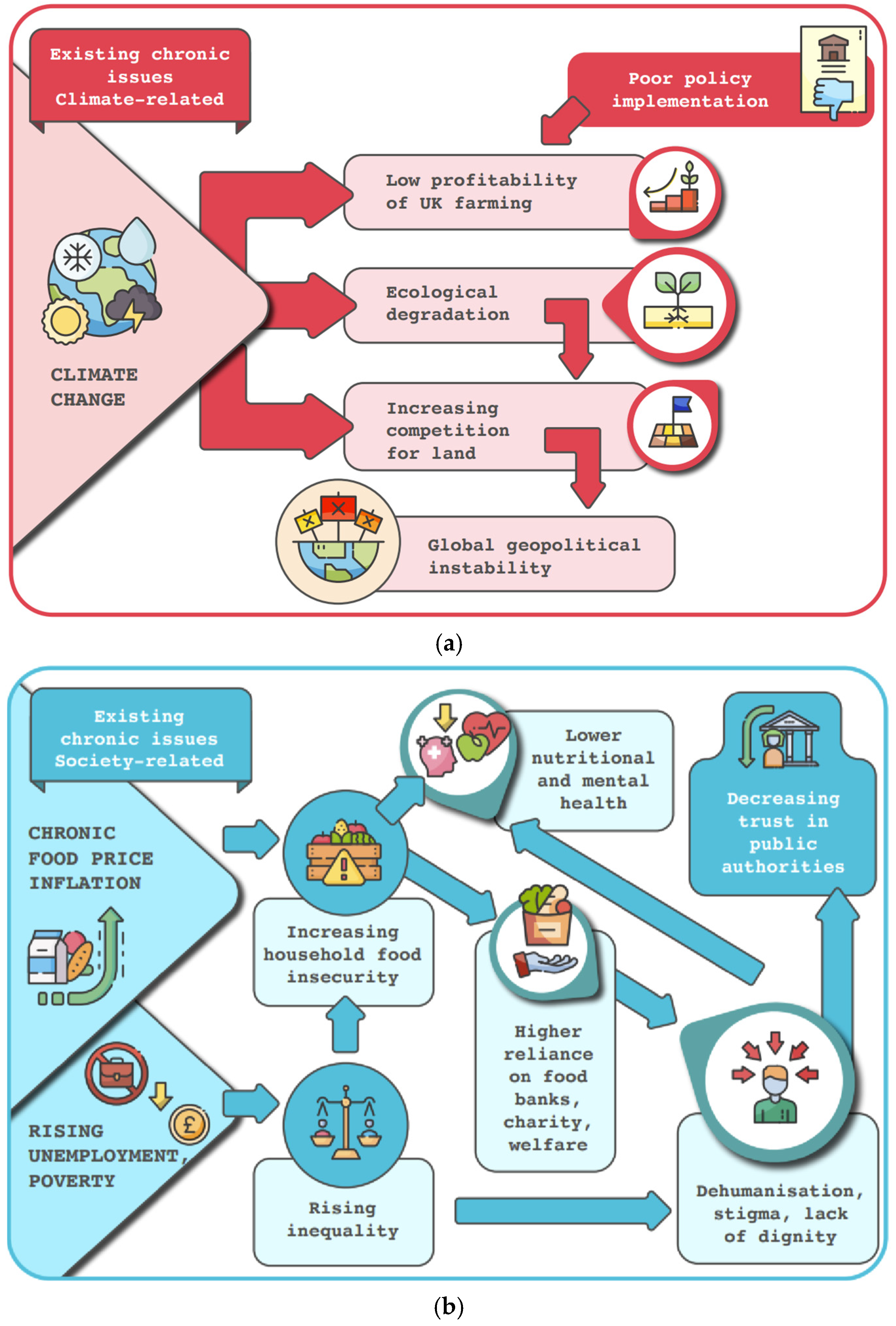
The low profitability of much of UK farming is partially caused by constraints enabled by significant food supply chain consolidation and poor implementation of farming subsidies, and it is being exacerbated by climate change and ecological degradation, including soil run-off into waterways [57]. In addition, policies to tackle climate change and biodiversity loss are contributing to increasing competition for land (Figure 1a).
Increased digitisation along the supply chain makes the food system more vulnerable to cyber breakdowns, including critical infrastructure failures (e.g., CrowdStrike update failure) and malicious activity (e.g., cyber-attacks). The just-in-time supply of food means that any disruption will be felt quickly [19,41], although if implemented well, it could increase both flexibility and resilience.

4.2.2. Existing Chronic Issues: Society-Related

The UK has already been through a period of chronic food price inflation and food price volatility, coinciding with rising poverty and inequality [58] which contributes to a cost-of-living crisis exemplified by increasing household food insecurity. A recent report found that 18% of households with children have experienced food insecurity in the past month, and 9% of households with children reported the children had not had balanced meals due to food insecurity [59]. This situation can result in reduced nutritional wellbeing and greater reliance on food banks, charitable support and social services. This is illustrated in Figure 1b.
More often overlooked, and also emphasised by workshop participants, was the impact of food insecurity on mental health [60]. Food insecurity creates an emotional toll of struggling to provide meals, the challenges associated with financial hardship and the discomfort some may feel when seeking assistance. A critical consideration is how these experiences might influence public trust and community cohesion, which are vital for societal stability. Public distrust in public and private institutions has already been shown to be linked to energy poverty across households in the European Union [61].

4.3. Pathways to Crisis

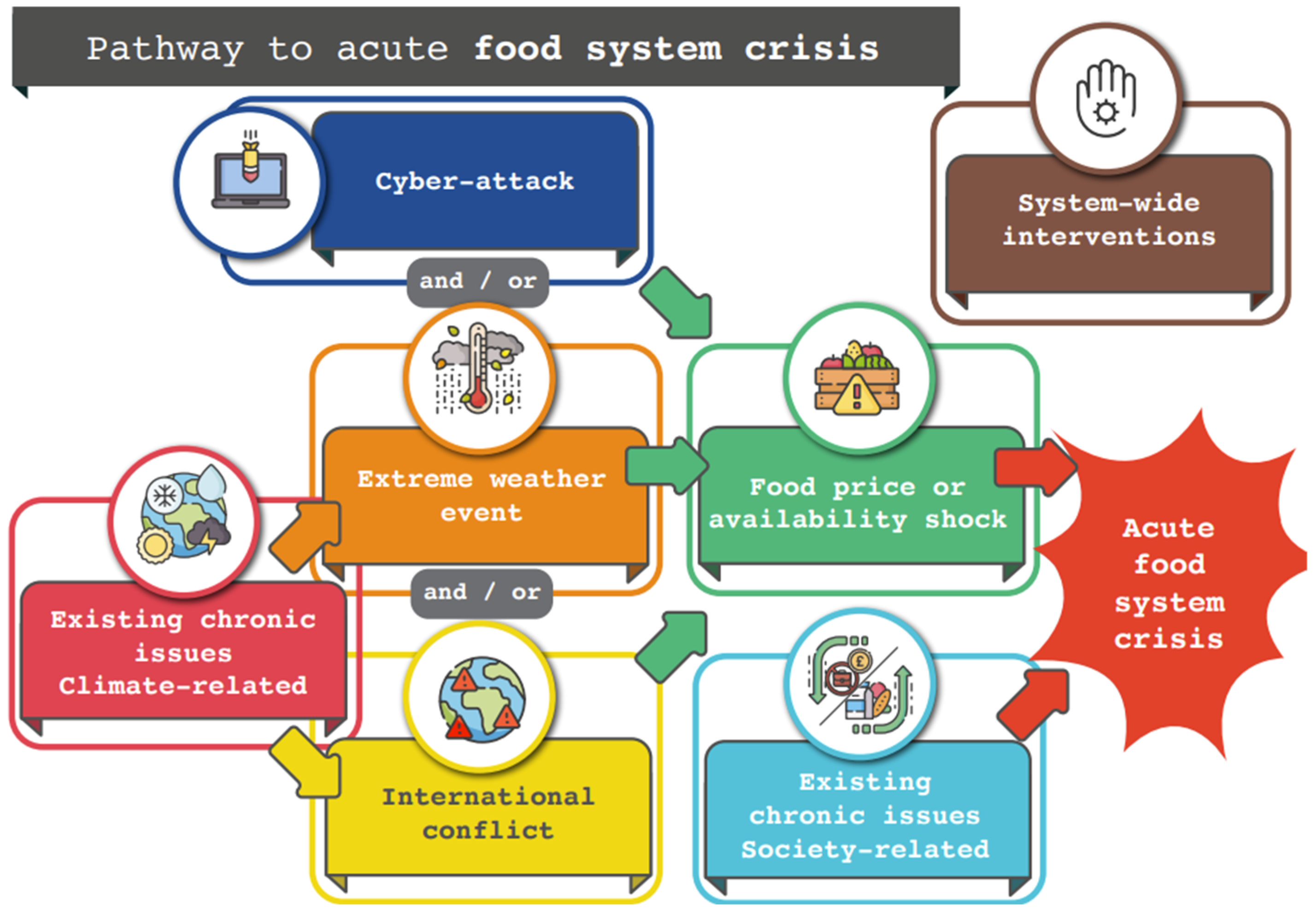
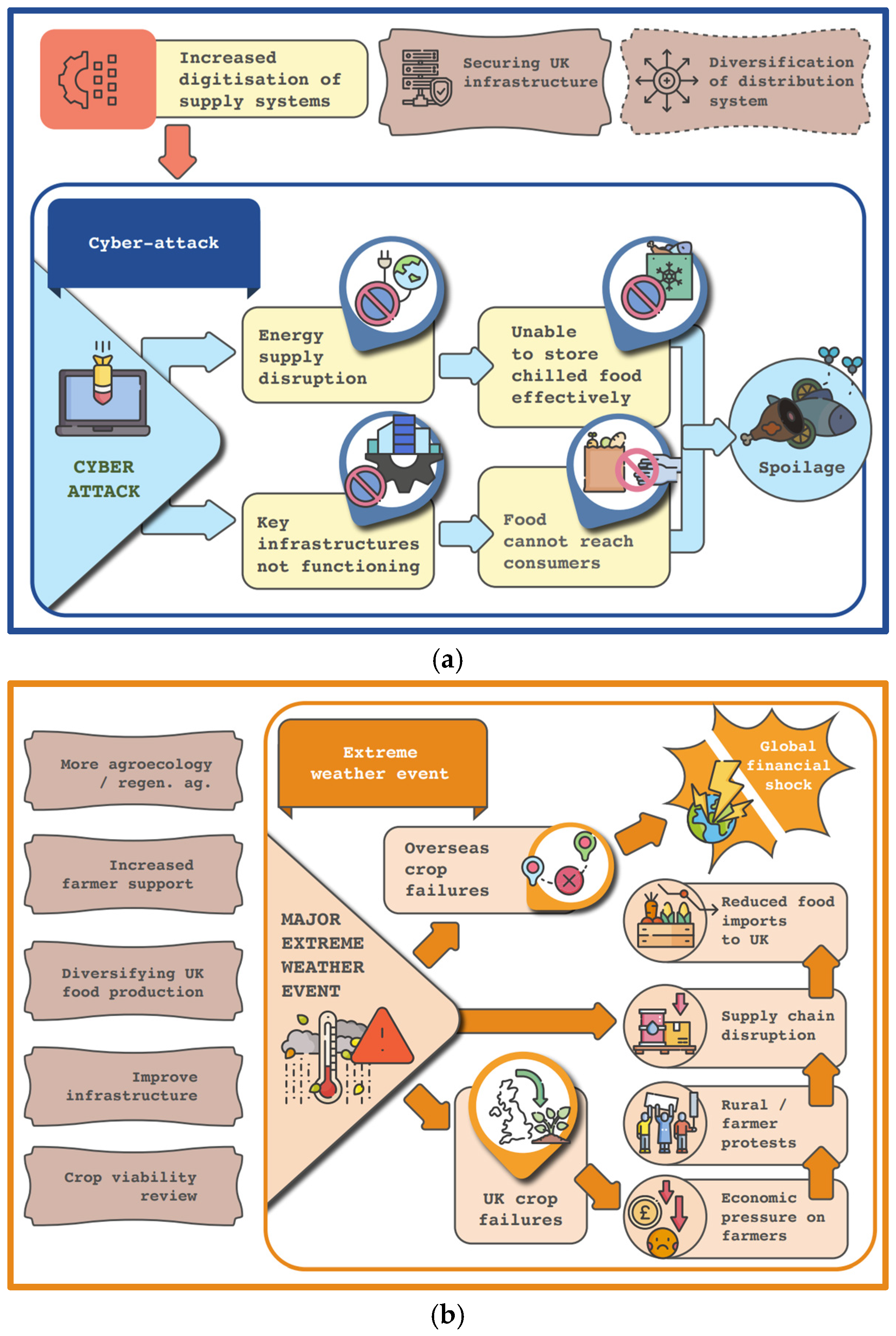
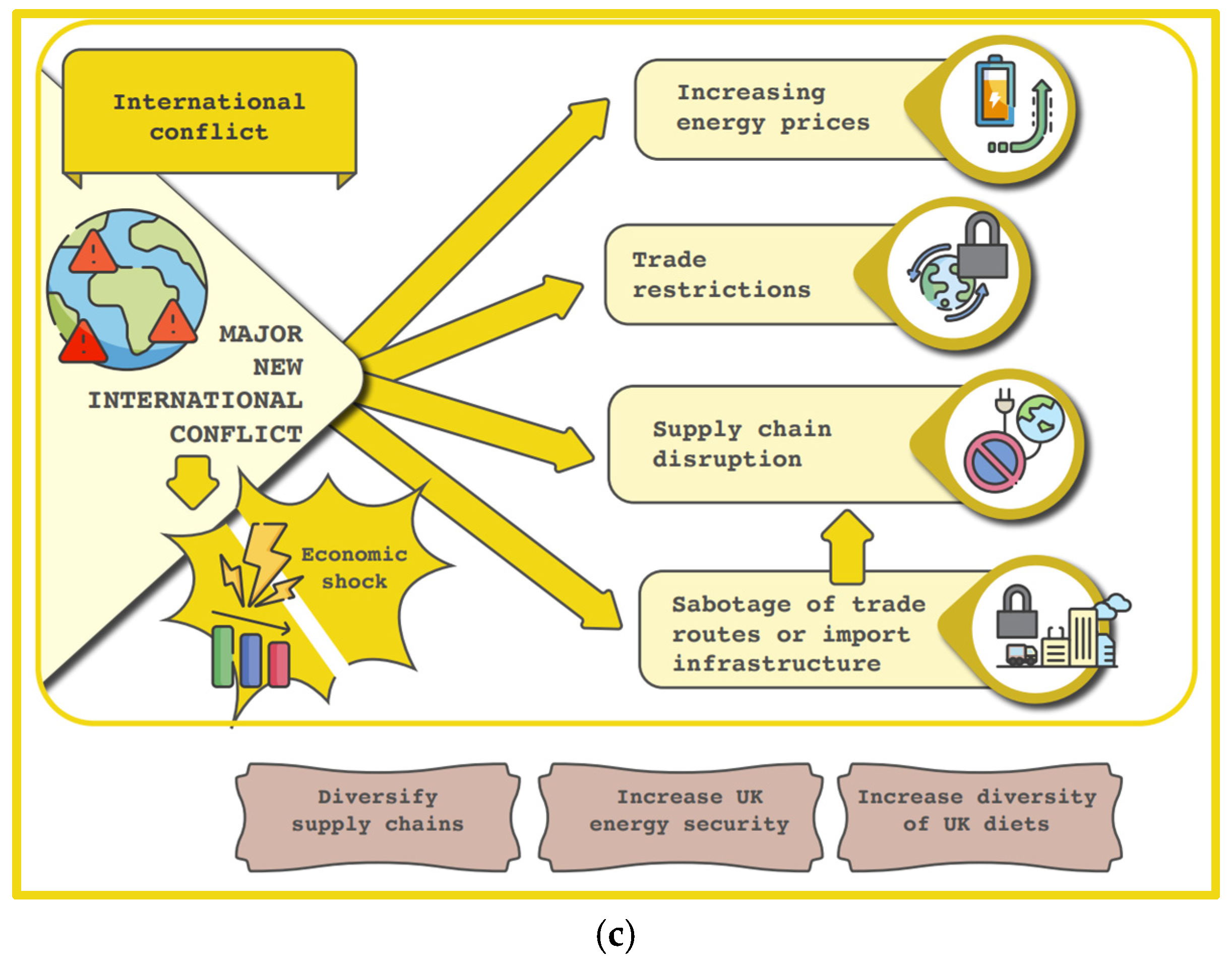
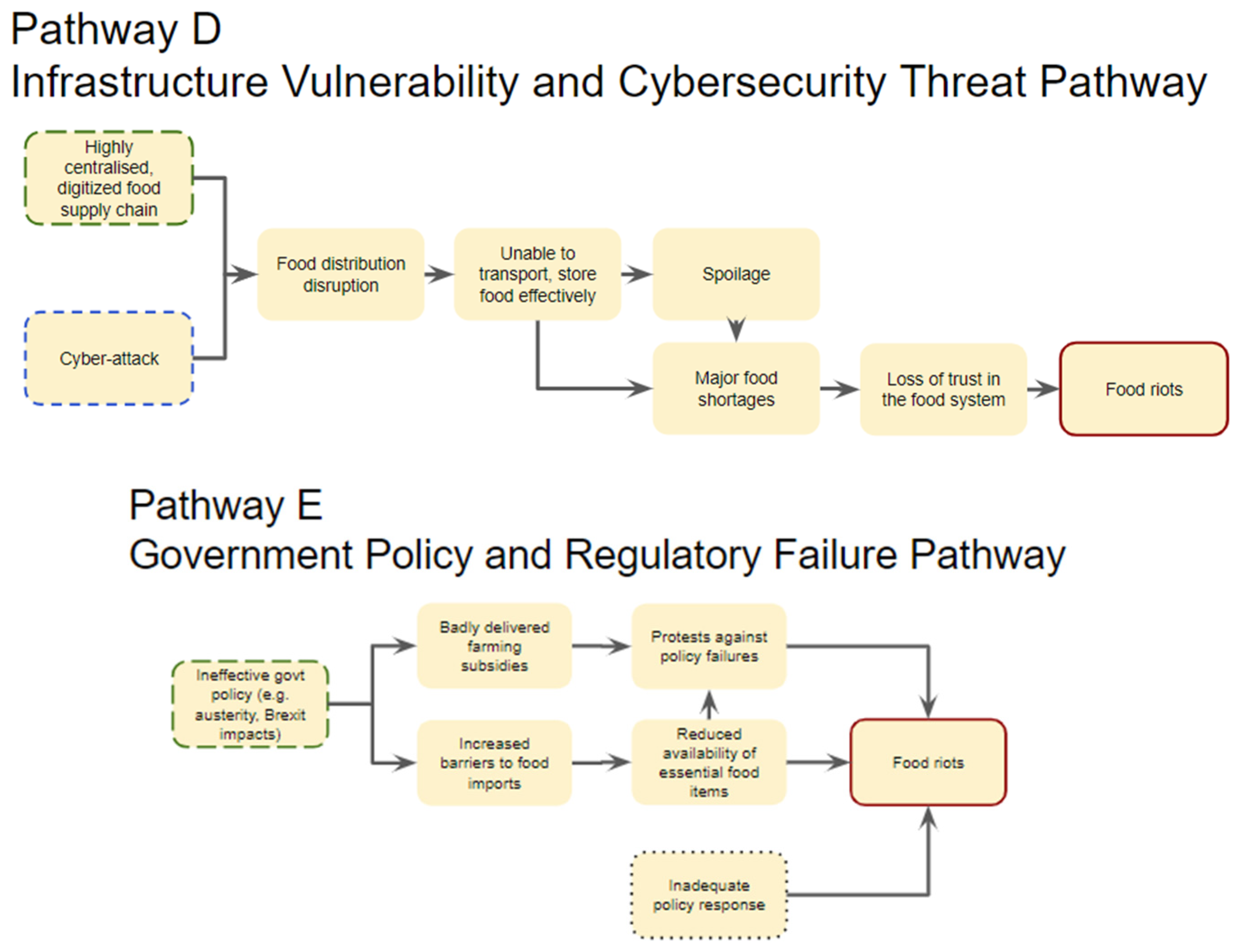
Given the existing chronic issues, a number of possible triggers could start a chain of events leading to an acute food system crisis. The expert interviews and Survey 1 pointed to a set of five possible pathways which were discussed in Workshop 1 (see Appendix A), and further narrowed to three pathways, which were then interconnected, potentially leading to an acute food system crisis. The connections between these three pathways, and the two types of chronic issues shown in Figure 1, are summarised in Figure 2. These three pathways are described in the following three subsections, with more detail given in Figure 3a–c, respectively. We emphasise that this prioritisation of pathways emerged from the expert views, and in particular, they stressed that, while these acute risks are (mostly) uncorrelated, there is a chance that they will occur simultaneously or at least that their impacts will be felt at the same time. Therefore, the availability and affordability price shocks are likely to be underestimated unless a complex systems approach is adopted in assessing a food system crisis.

4.3.1. Cyber-Attack Pathway

An attack on digital information systems could arise from a group of rogue individuals with criminal intent, an organised protest group or state-supported actors. While this study was being carried out, there was a major ransomware attack on the UK National Health Service, with a USD 50 million ransom demanded by hackers [62]. A previous ransomware attack on the food system, in 2023, was directed at Dole Food Company, a major international supplier of fruits and vegetables, causing shortages of its products.
A future cyber-attack could occur within the food system or on a key component of it, such as the retail system (e.g., so food could not be purchased, as occurred during the CrowdStrike update or the attacks on Marks & Spencer and the Cooperative in 2025) or wage systems (e.g., so that workers could not be paid). A cyber-attack on a wider component of critical infrastructure, such as banking systems or deep-sea Internet cables, could also cause disruption to the just-in-time food system, resulting in food not reaching people.
Any buildup of fresh food products in the supply chain is likely to lead to spoilage, but particularly if the cyber-attack leads to disruption of the energy supply, causing outages in cold storage, thus impacting fresh and frozen foods. Either a breakdown in infrastructure (e.g., transport logistics) or spoilage could lead to food shortages and thus an increase in food prices.

4.3.2. Major Extreme Weather Event Pathway

The ongoing effects of climate change include multiple extreme weather events, including those occurring simultaneously in different parts of the world, and these could impact multiple parts of the food supply chain [4]. We consider here a particularly severe extreme weather event or set of events—for example, occurring over one growing season and having a major impact on UK/global food production.
The impact could be on UK crops (e.g., lodging/flattening from winds, floods restricting planting or harvesting or droughts affecting yield) and/or livestock (e.g., extreme heat leading to high mortality rates, as experienced during the record-breaking temperatures in 2022 [63], and difficulty disposing of fallen stock, or freshwater spoilage or shortages impacting animal health). At the time of the expert interviews, several UK flooding events had occurred over the previous 18 months, contributing to a reduction in wheat growing area of 11% in 2024 compared to 2023 [64].
A crop failure could itself lead to food shortages, and thus food price rises, but we also highlight the economic pressures on farmers due to impacts from extreme weather events and the potential for this to lead to civil unrest. Recent protests by farmers [65] and use of farm machinery to blockade significant additional infrastructure (e.g., road barricades) affect the on-farm part of the food supply chain as well as cause wider disruption. But economic pressure on retailers, manufacturers and caterers could also be significant and lead to disruption.
Extreme weather could also impact the workforce itself (e.g., temperatures that are too high for crops to be harvested, which are more likely to occur overseas, affecting imports, than in the UK due to a cooler climate and increased mechanisation). Moreover, supply chain disruption from extreme weather could be caused by transport disruption (e.g., flights, or drought affecting the Panama Canal or rivers in the US used to transport food).
An international extreme weather event could lead to reduced food imports to the UK, leading to food shortages or increased food prices. An overseas crop failure in one or multiple breadbaskets could happen in the same season as a UK crop failure because of the increasingly correlated weather patterns due to climate change [66,67,68,69]. While a global financial shock could emerge following crop failures [26], such a shock could, in turn, lead to acute and significant increases in energy and food prices. Indeed, global financial shocks are anticipated due to a re-evaluation of climate risk within certain sectors (such as energy assets) or countries [70].

4.3.3. International Conflict Pathway

A major new international conflict or significant escalation in an existing conflict could potentially trigger a direct food availability shock or an economic shock resulting in sudden food price increases. Additionally, such conflicts might lead to higher energy costs, as witnessed following Russia’s invasion of Ukraine in 2022 [71]. Trade disruptions could also occur, possibly due to geopolitical realignments or the implementation of economic sanctions against an aggressor nation. At the extreme but realistic end of the spectrum, international conflict could see the use of weapons of mass destruction, including chemical and biological weapons aimed at reducing food production [72] or nuclear weapons with potentially planet-wide climatic impacts [73].
A new conflict in one country could cause protests in another country in an attempt to influence the international response, leading to sabotage of trade routes or import infrastructure—for example, the Houthi attack on shipping in the Red Sea in support of Gaza in 2023.
Disruption might occur for critical food components (e.g., vegetable oils from Ukraine; niacin and thiamine to fortify flour from China; fresh produce imports to the UK that now need to be inspected on arrival post-exit from the European Union), packaging [74] or supply of food production inputs such as fertiliser or machinery. Disruption could be due to labour shortages—for example, if people were called up to fight or migrant workers could not reach their destination for seasonal work.

4.4. Food Price and Availability Shocks

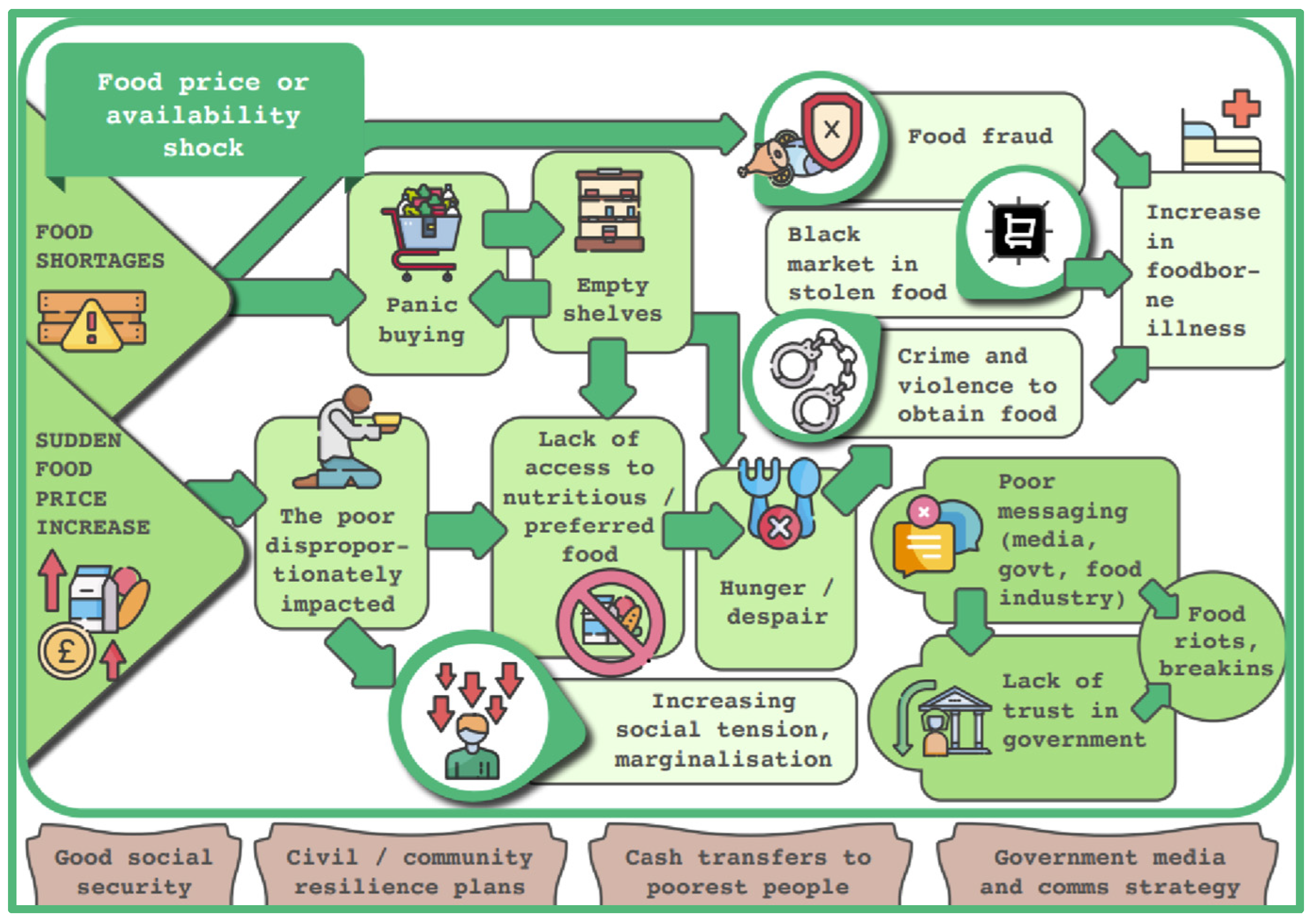
Any combination of the three triggers described above could lead to food shortages and sudden food price increases (Figure 4). Whether these scenarios prompt an acute food system crisis depends on the resilience of society and the reaction of those in authority.
One route to UK food system crisis could arise from hunger and resulting feelings of despair when coupled with a lack of trust in government and exacerbated by ineffective messaging by the media, the food industry and governments, and potentially amplified by social media [75]. Hunger and/or despair could be brought on by a lack of access to nutritious or preferred foods—for example, culturally relevant food. The lack of access to appropriate food could be due to empty shelves or social disparity, resulting in the poorest people being priced out of the market, thus increasing social tension and marginalisation and decreasing trust in government. These responses could also be magnified by the spread of misinformation or manipulation that increases polarisation or despair in a crisis.
The first signals of food shortages can lead to panic buying, creating further food shortages, and increasing panic buying due to visibly empty shelves [76,77]. Food fraud increases at times of food shortage [78], but there may also be an increased black market in stolen food. Desperation to obtain food can also lead to unsafe food practices (e.g., butchering farm animals outside of abattoirs). All of these illegal practices increase the chance of outbreaks of foodborne illness, and thus anxiety related to food.
Crime and violence to obtain food could ensue, giving life to food riots. Food riots could cause widespread fear of being in public places, which would cause further food insecurity if people lacked confidence to purchase food or access to alternative shopping methods (e.g., the elderly and people with disabilities).
Furthermore, such a crisis will likely have strong geographical variation due to regional aspects related to food availability or price changes. Additionally, geographical variations in income disparity and social and cultural differences in reactions to problems regionally could produce pockets of unrest.

4.5. Interventions

While the expert interviews were focused on pathways, a number of interviewees also suggested interventions, and these were captured on the pathway diagrams (see Supplementary Materials S1). In addition, Survey 2 asked the workshop participants to suggest interventions. These two sets of suggestions were combined to pre-populate a diagram for Workshop 2. During Workshop 2, participants added more interventions, and prioritised and discussed the new and old interventions on the diagram. This activity led to a total of 28 high-priority interventions, sent to all 19 people who completed Survey 1 or went to either workshop, to rank and discuss in Survey 3; all but 1 completed Survey 3. The top 20 of these interventions were retained for the final diagrams (Figure 2, Figure 3, Figure 4 and Figure 5). The full list of 28 interventions, anonymised scores and 190 comments from Survey 3 are included in the Supplementary Materials. A short description of each intervention is provided in Appendix B. A detailed analysis of the political or financial challenges associated with implementing these interventions is beyond the scope of this paper. Future research is required into the political and financial trade-offs as well as the practical challenges associated with them.

4.5.1. System-Wide Interventions

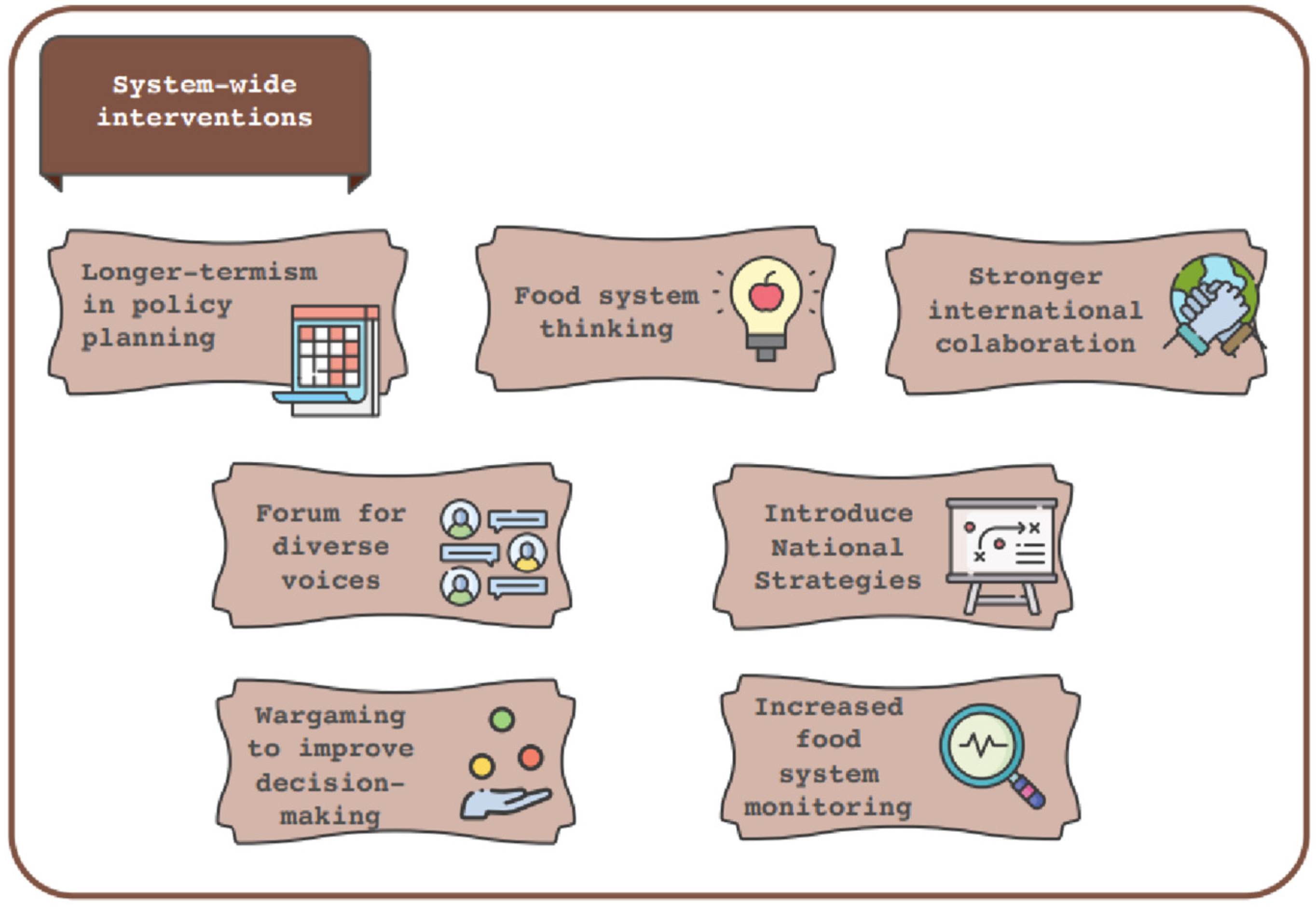
Seven system-wide interventions were put to experts to evaluate in Survey 3 (Figure 5). All seven appeared in the top 20 interventions overall. Participants noted these interventions partly depend on each other for success; they also depend on the need for greater consideration of the national security elements of food security and the relative roles of governments and industry.
The overall highest ranked intervention was a system-wide intervention, namely, ‘Longer-termism in policy planning’ (i.e., beyond a single UK government lifespan of up to 5 years), noting the need to ensure focus on the most critical goals for the food system, including resilience. There is also a need to consider the varying implications for different food system actors to build longer-term considerations into disaster planning.
Food systems thinking was noted as an important change to the status quo—for example, cross-government leadership on food policy, including departments other than the UK’s Department for Environment, Food and Rural Affairs (Defra), such as the Department of Health and Social Care, Department for International Trade, Department for Education and the Department for Levelling Up, Housing and Communities, and statutory agencies including the Food Standards Agency and Competition and Markets Authority. While food systems thinking is desirable, it may be challenging for many food system actors due to narrow remits, hence requiring policymakers to introduce a range of levers and incentives that work together to address environmental, social justice, animal welfare and health and nutrition impacts ‘in the round’. This approach would ideally be not only horizontally integrated across policy areas but also vertically integrated between central government and at other levels such as local authorities.
As well as the increasing collaboration of government with industry, a consensus from Workshop 2 was the need for a forum to contribute to preparedness and planning that consists of diverse voices across food systems, including representation of often unheard voices from the most marginalised communities in our society.
Introduction of new strategies (e.g., National Food Strategies, Land Use Strategies or Horticulture Strategies) was less popular than the previously described interventions largely because a strategy on its own does not have power to enact change. However, they may be an important precursor to more effective action by helping to shift thinking.
Role playing or otherwise simulating a food system scenario (‘wargaming’) was suggested for several potential intervention points, but for this intervention to be useful, it requires skilled work by the organisers to develop the scenarios and execute the game well. It also must be carried out with a diverse range of stakeholders.
Food system monitoring was the least popular of the options put to the participants in Survey 3, possibly because participants were asked to score each intervention alone, whereas the comments pointed out that monitoring can be important in combination with other interventions. A major challenge will be the level of sharing of commercially sensitive data (or at least the use of this as an excuse for not sharing data) along the supply chain, which may require new policy from governments. For example, aligning the Food Data Transparency Partnership recommendations for health and environmental metrics with other reporting metrics, such as greenhouse gas emissions, and making them mandatory, would provide data to inform future food system interventions.

4.5.2. Cyber-Attack Interventions

Two high-level interventions were discussed to prepare for a cyber-attack, only one of which was ranked in the top 20 interventions overall, namely, ‘Securing UK infrastructure (physical and digital)’. A new UK shipping route is an example of how physical infrastructure can be made more secure. Digital infrastructure can be made more secure by simulating attacks—for example, with hindsight, the CrowdStrike incident could have been averted by separating CrowdStrike Falcon from the core of Microsoft Windows [79].
The other intervention, ‘Decentralisation of the food system’, was removed because it was not in the top 20 interventions. Three respondents highlighted the need to diversify, particularly the distribution networks, so this was added to the diagram in a dashed box (to indicate that it was not part of the workshops or put to survey respondents to evaluate).
Any change, whether decentralisation or diversification, will have a cost, and it is not currently clear who would pay that price; however, coordination by national security services is critical. Although cyber-attacks arose as a main theme of food system weakness, none of the workshop participants were experts on cyber-attacks.

4.5.3. Extreme Weather Interventions

Seven extreme weather interventions were tabled in Survey 3, of which five made the top 20 overall:
  • ‘More agroecology/regenerative agriculture’;
  • ‘Increased farmer support’;
  • ‘Diversifying UK food production’;
  • ‘Improve infrastructure e.g., drainage/flood’;
  • ‘Crop viability review’.
  • The following were below the threshold for inclusion:
  • ‘Investment in early-warning systems’;
  • ‘Investment in controlled environment agriculture’.
Two Survey 3 responses highlighted an additional intervention related to the need to monitor trade and related international impacts, considering that 40% of UK food is imported, including a significant proportion of fresh fruit and vegetables, and the increased climate risk overseas.
To reduce the chance of UK crop failure, many people cited the need to transition to more agroecological and regenerative agricultural practices, although more information is needed on which interventions are most effective in different locations. Not only do we need to improve the resilience of the crops already widely grown, we may need to change which crops are grown where, introducing new varieties and more resilient species. For this purpose, research is needed as input to a crop suitability review.

4.5.4. International Conflict Interventions

Five interventions to reduce the impact of international conflict on UK food were put to the workshop participants, of which three were in the top 20:
  • ‘Diversify supply chains’;
  • ‘Increase UK energy security (e.g., renewables)’;
  • ‘Increase diversity of UK diets’.
  • Two were below the threshold for inclusion:
  • ‘Increase UK self-sufficiency in food’;
  • ‘Load shedding (with industry and government working together)’.
The most desirable solution identified was to help engender trust between nations to reduce the risk of international conflict in the first place.

4.5.5. Price/Availability Interventions

Seven interventions to reduce the impact of price/availability on UK food were put to the workshop participants, of which four were in the top 20:
  • ‘Good social security’;
  • ‘Civil/community resilience plans’;
  • ‘Cash transfers to the poorest people in an emergency’;
  • ‘Government media and communications strategy prepared for an emergency’.
The following were below the threshold for inclusion:
  • ‘Rationing by government/retailers in emergency’;
  • ‘Review over-regulation/increase agility of food system’;
  • ‘Blockchain to increase traceability’.

4.5.6. Synthesis of Findings

Several notable patterns emerged from the expert elicitation. The strong preference for system-wide interventions—particularly longer-termism in policy and cross-governmental food systems thinking—over pathway-specific technical measures suggests that experts view fragmentation in governance as a more fundamental vulnerability than any individual trigger. This aligns with a recent analysis arguing that UK food resilience requires a coordinated civil society action across multiple levels of government [80]. The emphasis on social dimensions throughout the process, including trust, dignity, mental health and community resilience, indicates that technical or infrastructural fixes alone are unlikely to prevent food crises from escalating into civil unrest. This echoes principles for fair food policy that foreground equity and participation [81].
The relative deprioritisation of certain interventions also warrants reflection. Increased self-sufficiency ranked below the threshold for inclusion despite the UK’s significant import dependence, suggesting experts may prioritise supply chain diversity over domestic production capacity. Technological solutions such as controlled environment agriculture and blockchain for traceability were deprioritised, which may reflect scepticism about their near-term scalability or cost-effectiveness. While cyber-attacks emerged as a key pathway, no participants had specialist cybersecurity expertise, indicating a gap that future research should address. Systematic evaluation of intervention feasibility and implementation status, using frameworks such as that proposed by Oliver et al. [82], would help translate these strategic priorities into actionable policy.

5. Conclusions and Recommendations

We convened a group of experts to develop pathways from possible events to food system crises. The consulted experts felt it useful to draw a distinction between the many existing chronic issues that make the system vulnerable and potential future acute events that could trigger a crisis.
Initially, we anticipated drawing up a set of separate pathways, but the experts emphasised the interconnectedness of the food system and supported the creation of a composite pathway. The composite pathway focuses on three different potential components as triggers: (a) a cyber-attack, (b) an extreme weather event and (c) an international conflict. Any one of these triggers could lead to a food availability or price shock, which could, in turn, (d) lead to a food system crisis via food riots. Events (a), (b) and (c) could also be connected (therefore potentially correlated)—for example, a malicious cyber-attack could be part of an international conflict.
The experts proposed and prioritised possible interventions to help reduce the chances of a food crisis. These interventions leaned heavily towards system-wide change, of which the most highly ranked were (i) longer-termism in policy planning, (ii) food system thinking, (iii) stronger international collaboration and (iv) a forum for diverse voices to input into food policy decisions.
For interventions to the specific elements of the pathways, it was unsurprising that diversification was highly ranked in all of (i) food production, (ii) supply chains, (iii) food distribution and (iv) dietary choices. Agroecology and regenerative agriculture were considered important to make food production more resilient to extreme weather. Improvements to both physical and digital infrastructure were identified to reduce the impacts of extreme weather and lessen the chances of a cyber-attack being successful, respectively.

5.1. Recommendations

The experts proposed and prioritised interventions that span multiple scales and governance levels. These interventions can be broadly organised into three interconnected categories: community-level interventions that build local resilience and enable inclusive participation; public policy interventions that target specific vulnerabilities through specific government actions; and systemic interventions that address fundamental structures and coordination across government. While distinct in scale, these interventions are mutually reinforcing and must work together to address the interconnected risks within the food system.

5.1.1. Community-Level Interventions

Community-level interventions emphasise local resilience and inclusive participation. The experts identified the importance of increased support, both for farmers and the most marginalised people in society. Civil or community resilience plans should be developed to enable effective responses at the local level [81]. Other interventions, such as a forum for diverse voices, are easier to implement; however, they are only worthwhile if they have real influence over policy decisions, which may be difficult to agree upon within current political decisionmaking processes.

5.1.2. Public Policy Interventions

Public policy interventions address specific vulnerabilities through targeted government actions. It was proposed that improving social security could reduce inequalities and nutritional safety nets could be introduced to address chronic causes of food insecurity—for example, free school meals or a cash transfer to the most vulnerable people. Government communication strategies should be developed well before a crisis occurs, so they can be rolled out effectively if needed. Some interventions, such as a shift to regenerative agriculture, may provide both an increase in resilience and higher returns on investment over time, though short-term losses are politically and financially difficult to manage and overcome. Other policy interventions would also lower risk to other, non-food, shocks and include improvements to cybersecurity or tackling long-term chronic risks, including poverty.

5.1.3. Systemic Interventions

Systemic interventions focus on fundamental reforms to policy development processes and cross-governmental coordination. Several interventions relate to the policy development process, including long-termism in policy and joined-up government. While these are theoretically simple to conceptualise, strong political will is required to enact reform that would go deep across government departments. Preparation for food crises in the UK can occur at multiple levels, from government policies to community initiatives, ideally in a well-coordinated way. However, this preparedness is often hampered by internal conflicts of interest within organisations, conflicting interests between organisations and people, gaps in coordination among organisations and varying time scales and types of events considered. These challenges can lead to inadequate responses to both acute and chronic food system disruptions.

5.1.4. Principles for Designing Interventions

The feasibility of the proposed interventions is governed by their political acceptance, public acceptance and ability to change behaviours (where needed), and availability of any required financial capital. However, the experts involved stressed that the detail of the individual interventions and their specific trade-offs were less important than identifying coherent combinations of interventions that work together to tackle the interconnected risks within the food system.
Therefore, based on our findings, we recommend the following principles are applied when designing interventions. These principles were generally supported by all respondents (in Workshop 2 and Survey 3), so long as they are performed in such a way as to facilitate long-term planning and systems thinking, and to support other recommendations on developing fair policies in food systems. Interventions should
  • Address root causes of both chronic and acute risks as much as possible;
  • Consider how dignity, kindness and fairness can be brought into policymaking;
  • Be co-designed with those disproportionately affected;
  • Take into account power dynamics, conflicts of interest and diversity of different organisations (e.g., not just the big retailers);
  • Take a food systems approach in order to understand indirect effects and unintended consequences.

5.2. Final Thoughts on Consensus

Finally, we comment on the points of convergence and divergence in the Delphi process itself. While individual interviews revealed diverse perspectives on priority risks, the workshop discussions showed notable convergence around three key themes: i) the existence of many chronic risks already present across the system (we had not originally planned to separate out chronic and acute risks, but doing this was the clear conclusion of the group); ii) the need for long-termism in leadership (see other discussion of this point); and iii) the importance of considering the dignity and mental health toll of chronic and acute crises on the poorest people, and thus the need for co-created solutions (see principles). Points of divergence primarily centred on the practicality of how the principles could be applied, which would require more research. The specific issue raised was whether a single decisionmaking body would be in a position to apply all the principles in practice.
Food systems today face an array of chronic issues, many of which are not being addressed. When acute risks manifest in food systems, this can lead to a crisis, including the possibility of civil unrest. Addressing these systemic vulnerabilities is urgent, and while more research is required to fully understand the potential impact of different interventions within food systems, food system transformation cannot wait for definitive answers from these research endeavours. Therefore, we call on policymakers, business, academia and civil society organisations to work together and adopt a systems view of the challenges we face and implement the principles above to design a process for assessing and adopting food system interventions.

Supplementary Materials

The following supporting information (S1. Presentation summarising outputs of expert interviews; S2. Excel spreadsheet of survey responses; S3. Optional Pre-read document for workshop; S4. Results of survey 2; S5. Results of survey 3) can be downloaded at: https://www.mdpi.com/article/10.3390/su18031342/s1.

Author Contributions

Conceptualisation: S.B., E.S. (Elta Smith), A.J., P.F., V.P., L.S., T.B., R.B., B.C. and D.M. conceived the study. Methodology: E.S. (Elta Smith), A.J. and S.B. devised the interviews, surveys and workshops. Investigation: S.B., E.S. (Elta Smith) and A.J. made the figures from the input from the expert interviewees and the workshop/survey participants. Funding acquisition: S.B. and A.J. obtained the main funding for this work. Writing—original draft: S.B., E.S. (Elta Smith) and A.J. drafted the manuscript. Writing—review and editing: P.F., V.P., S.H., L.S., B.D. (Ben Dare), J.P.C., M.W., S.J.B., N.W., D.W., M.Z., D.C., B.D. (Bob Doherty), C.D., H.C.J.G., J.P., S.P. (Simon Pearson), P.S., P.T., C.V., D.N., B.C. and T.L. edited and gave other input to improve the manuscript. Contributors to expert interviews: J.B., S.J.B., B.D. (Bob Doherty), E.T. (Ella Taylor), H.C.J.G., S.H., J.I. (John Ingram), T.L., T.M., V.P., A.S.B., E.S. (Eike Sindlinger), P.S., N.W. and K.W. were the expert interviewees who agreed to be named and included as authors. Contributors to workshops and surveys: T.B., D.C., B.D. (Bob Doherty), C.D., P.F., S.H., J.I. (Jude Irons), S.P. (Simon Pearson), J.P., S.P. (Sue Pritchard), A.S.B., L.S., A.T., P.T., C.V., D.W. and M.Z. were the workshop/survey participants who agreed to be named and included as authors. All authors have read and agreed to the published version of the manuscript.

Funding

S.B., E.S. (Elta Smith) and A.J. were funded by an APEX Award from the British Academy, the Royal Academy of Engineering and the Royal Society AA21\100154 for ‘How to feed the UK amid catastrophic food system disruption’. T.B., S.B., A.S.B., N.W. and P.S. are grateful for funding from the AFN Network+ (UKRI Agri-food for Net Zero Network+) Grant Award EP/X011062/1. S.B. and B.D. (Bob Doherty) acknowledge funding from the Transforming the UK Food System for Healthy People and a Healthy Environment SPF Programme, delivered by UKRI, in partnership with the Global Food Security Programme, BBSRC, ESRC, MRC, NERC, Defra, DHSC, OHID, Innovate UK and FSA. Grant award: FixOurFood programme (BB/V004581/1). P.F. was supported by the Met Office Food, Farming and Natural Environment Climate Service, funded by Defra.

Institutional Review Board Statement

This study was approved by the Departmental Ethics Committee of the Global Sustainability Institute at Anglia Ruskin University (Approval Code: ETH2324-6809; Approval Date: 28 May 2024).

Informed Consent Statement

Informed consent was obtained from all subjects involved in the study.

Data Availability Statement

The original contributions presented in this study are included in the article/supplementary materials. Further inquiries can be directed to the corresponding author.

Acknowledgments

We are grateful to Katherine Denby for input in the early conceptualisation of this work. We are very grateful to the other expert interviewees and workshop/survey participants not included as authors who took part in the surveys/workshops, including Sue Davies and those who did not opt in to being named. The contents of this paper should not be taken to represent the views of the UK government or the organisations to which the authors are affiliated.

Conflicts of Interest

Author Christina Vogel has collaborated with a national UK supermarket chain to independently evaluate a product placement intervention but received no funding or gifts from the supermarket chain. Author Tim Lang led a food shocks report for the National Preparedness Commission 2023-25. Author Barnaby Coupe is the employed by the Wildlife Trusts. The author, Daniel Morton, works for Argans Ltd. The remaining authors declare that the research was conducted in the absence of any commercial or financial relationships that could be construed as a potential conflict of interest. The funders had no role in the design of the study; in the collection, analyses, or interpretation of data; in the writing of the manuscript; or in the decision to publish the results.

Appendix A. Commentary on Expert Interviews and Survey 1

Appendix A.1. Common Triggers Related to Important but Overlooked Risks in the Food System

We used two different approaches to identifying potential overlooked risks that could lead to a UK food system crisis. Firstly, in the expert interviews, we invited suggestions for how a crisis could unfold, capturing how the risks could combine. Secondly, we asked workshop participants to prioritise overlooked risks and potential co-occurring risks. This section summarises the results from these two activities.

Appendix A.1.1. Themes Emerging from the Expert Interviews

  • Extreme weather events: Increasing frequency of extreme weather events, such as heatwaves, droughts and flooding, were frequently mentioned as a primary trigger across multiple pathways, impacting agricultural production and leading to food shortages and price increases.
  • Geopolitical instability/international conflicts (e.g., Russia-Ukraine war): Conflicts leading to disruptions in global food supply chains were frequently mentioned in pathways related to supply chain disruptions. International conflicts and trade restrictions disrupt global food supply chains and increase food prices.
  • Financial pressures/government policy: Insufficient financial returns for agricultural production leading to reduced domestic food production or reduced availability of food through imports was cited in several pathways, particularly those involving government policy failures.
  • Social inequalities: Widening gaps between socio-economic groups exacerbating food insecurity, and increased reliance on food banks and poor nutrition among disadvantaged populations leading to rising food prices reducing food affordability for people, were highlighted in pathways focusing on economic instability.
The top overlooked primary triggers selected in Survey 1 were as follows:
  • Extreme weather (including storm surges, flooding, heat, snow and drought) (17%);
  • Ecological collapse (15%);
  • Breakdown in political cooperation (regional or national) (11%);
  • Endemic poverty (10%);
  • Non-nuclear war (8%);
  • Trade deals that undermine domestic production (8%).
The top co-occurring risks selected in Survey 1 were as follows:
  • Trade restrictions or protectionism (14%);
  • Extreme weather (including storm surges, flooding, heat, snow and drought) (13%);
  • Ecological collapse (11%);
  • Breakdown in political cooperation (regional or national) (9%);
  • Financial crash (9%).

Appendix A.1.2. Risk Combination Matrix from Survey 1

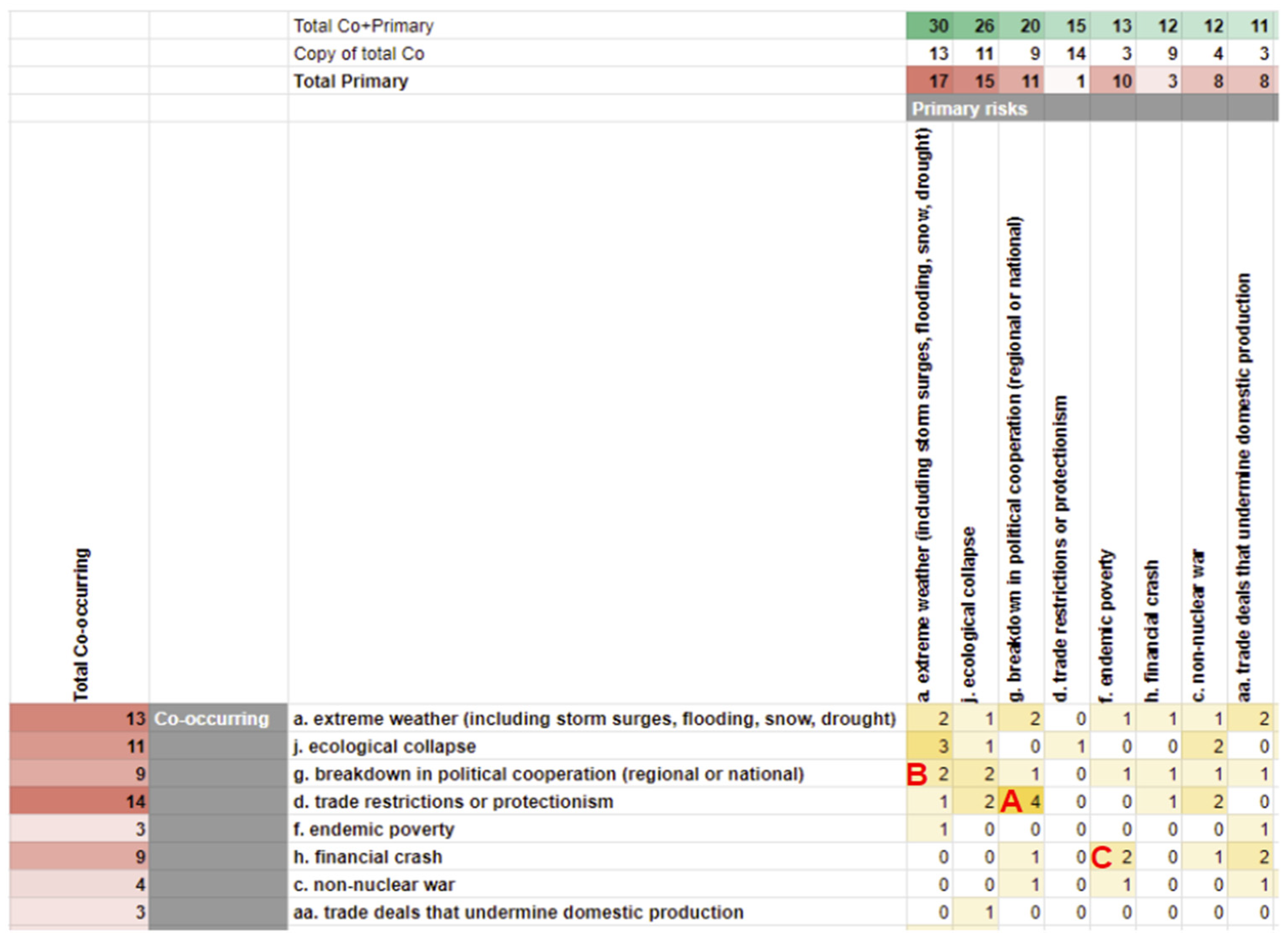
The survey enabled a prioritisation according to risks that might co-occur with primary risks (modulo the small number statistics given 17 participants) (see Figure A1).
Figure A1. Risk combination matrix from Survey 1. The letters A, B and C correspond to the pathways described in the text.
Sustainability 18 01342 g0a1

Appendix A.2. Common Pathways to Food System Crises

Pathways were examined in detail in the 14 interviews. We have analysed the pathways coming from the interviews and distilled them into five relatively distinct pathways. Interviewees frequently combined several elements in the pathways they described, which could plausibly occur in practice. For practical purposes, in this study, we focus on a set of pathways that each contain roughly two triggers, which come from the range of high-priority triggers, reflecting popular combinations. We will then consider mitigation options for each pathway, looking for no-regrets or conflicting measures, on the assumption that this will produce a useful set of mitigation options for a large number of triggers. We defer the study of more than two triggers occurring simultaneously to future work.
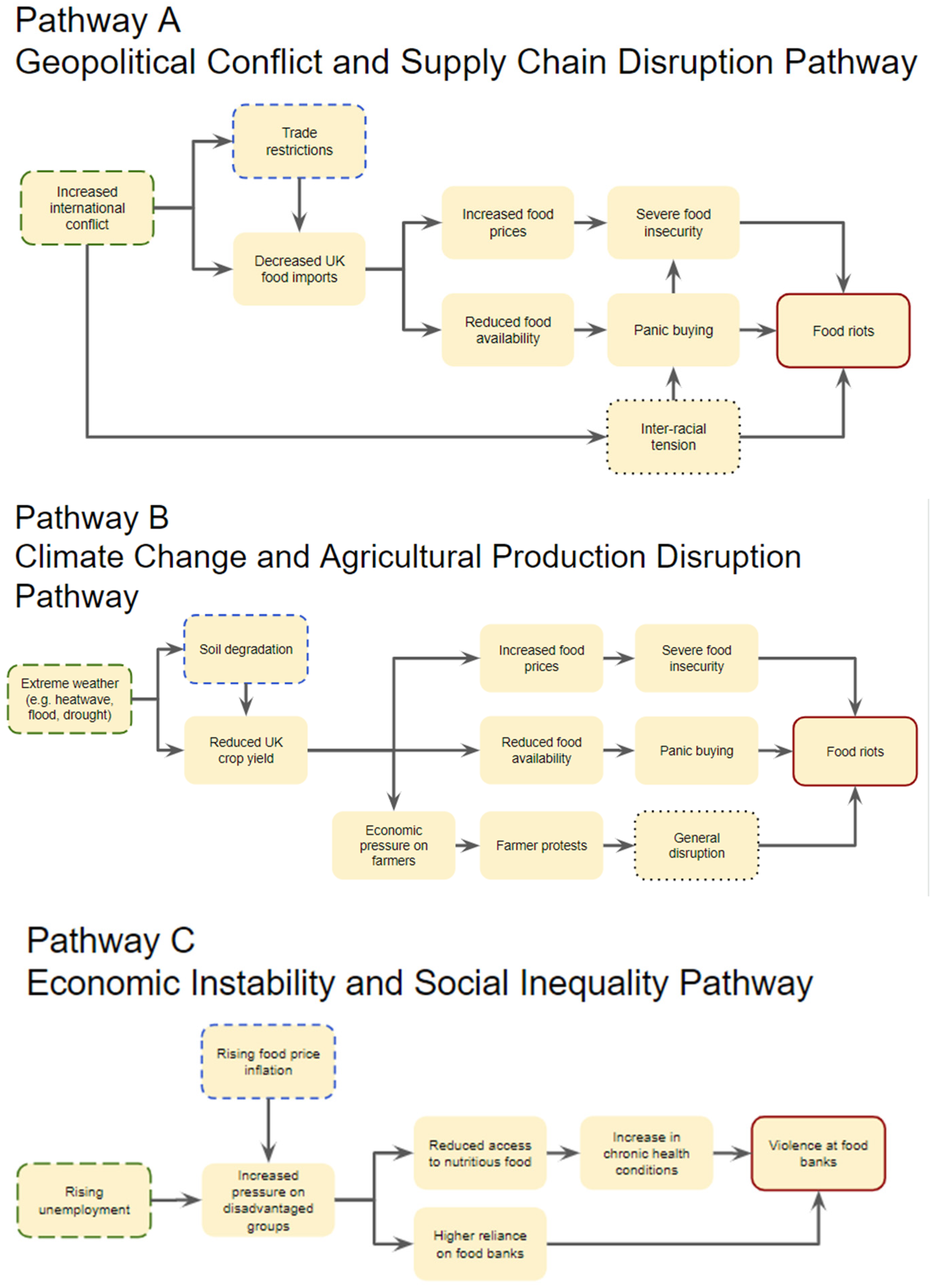
We analysed the expert interviews independently of the results of Survey 1 and identified five pathways (see Figure A2). We found that three of the five pathways corresponded to popular combinations from the survey, and ordered the pathways accordingly (pathways A–C below correspond to the marks ‘A’, ‘B’ and ‘C’ on the risk combination matrix above).
Figure A2. Five common pathways (AE) to food system crises.
Sustainability 18 01342 g0a2aSustainability 18 01342 g0a2b
These pathways were used as input to the discussion in Workshop 1, which led to the detailed diagram in Figure 2.

Appendix B. Details on Interventions

We provide some more detail on the meaning of the interventions for clarity in the tables in this section. The interventions in Table A1 were selected as high priority by the participants, whereas those in Table A2 were not, and are therefore not included in the diagrams, but are included here for completeness. Note that the full survey responses, including additional descriptions as submitted in the survey, are included in Supplementary Data S5.
Table A1. More detail on interventions that were prioritised by the elicitation.
Intervention NameMore Detail
Longer-termism in policy planningAn approach to policy appraisals, policy development and policy implementation that allows benefits (and risks) beyond the term of a parliament to be assessed and policies implemented that span multiple parliaments.
Food system thinking in governments and industriesA joined up, cross-departmental approach to developing policies aimed at the food sector from agriculture through to health and nutrition. This allows the costs and benefits of such policies to be borne by different departments (for example, an investment in agriculture could lead to a health benefit).
Stronger international collaborationA more coordinated multilateral approach to food system planning, including forward planning for cooperation in the eventuality of shocks to the food system. This includes agreements on use of trade restrictions and emergency food aid as appropriate.
Forum for diverse voices to contribute to preparedness and planningA formal process whereby a wider range of stakeholders can regularly feed into policy development in a structured and meaningful way. This could be structured through, for example, expert consultation, citizen assemblies or serious games.
Introduce a National Food Strategy, Land Use Strategy, Horticulture StrategyA coordinated approach to develop long-term strategies for the UK around food, land use and horticulture to provide an overall framework from which policies can be developed.
Wargaming to improve decisionmakingSet up serious gaming processes where policy interventions can be tested against plausible future shocks within the food system. This should lead to actionable outputs.
Increased food system monitoringImproved monitoring through the food system from production through supply chains to retail or catering. This should act as early warning to any shocks that may impact food availability or affordability.
Securing UK infrastructure (physical and digital)Improving cybersecurity and physical security measures around critical infrastructure that may be subject to external attack.
More agroecology/regenerative agricultureRotating crops, reducing tillage (churning up the ground in preparation for crops), choosing locally adapted varieties of crops, applying compost as a fertiliser and using organic alternatives to pesticides are a few examples of regenerative farming practices.
Increased farmer supportGrants, subsidies and technical support for farmers in the transition towards more resilient forms of farming.
Diversifying UK food productionA wider use of alternative crops as well as agriculture production methods. This will lead to crops being more resilient to external shocks, as each source would be differently impacted.
Improve infrastructure, e.g., drainage/floodInvest in landscape management and water infrastructure to reduce the risk of extreme events such as flooding or drought.
Crop viability reviewConduct a large-scale review of crop productivity in the UK, including projections of soil degradation and climate change.
Diversify supply chainsA move to a wider range of supply across the food system, including a larger number of sources of key imports. This would reduce the risk of a single cyber-attack being able to disrupt a significant portion of the UK supply chain.
Increase UK energy security (e.g., renewables)Deployment of local energy generation less reliant on fuel imports and international fossil fuel prices. These could be decentralised and integrated into the food system (e.g., on farm energy generation).
Increase diversity of UK dietsA shift in UK diets to include more plant-based sources, seasonal foods and a wider variety of sources of nutrition.
Good social securityA move to a more holistic living wage which takes into consideration in-work poverty to ensure income matches the changes to the cost of food.
Civil/community resilience plansDevelop a set of civil resilience plans at the local level to outline processes to be used in the eventuality of a food shock.
Cash transfers to poorest people in emergencySet up processes for the release of emergency funds if food price inflation were to increase significantly over a short period of time.
Government media and comms strategy prepared for emergencyDevelop a plan for food shock events which includes public communication around contingencies.
Table A2. More detail on interventions that were deprioritised by the elicitation.
Intervention NameMore Detail
Decentralisation of food distributionCommunity-level distribution hubs that source more local food through shorter supply chains.
Investment in early-warning systemsInvestment in monitoring and prediction systems, including on-farm monitoring, that can forecast floods, droughts and pests or disease.
Investment in controlled environment agricultureIncrease the volume of food produced in controlled environments, such as vertical farms.
Increase UK self-sufficiency in foodGrow more food in the UK and reduce the proportion of imports relative to total consumption.
Load shedding (industry and government working together)In the eventuality of a lower supply of power than demand across the UK electric grid, load shedding allows for a series of rolling blackouts to be coordinated to balance supply and demand.
Rationing by government/retailers in emergencyIntroduction of controlled rationing for particular food products (or all food) in extreme circumstances.
Review over-regulation/increase agility of food systemReview all food policies from agriculture through to food standards to ensure flexibility of supply in times of crises.
Blockchain to increase traceabilityUse of digital technologies to track food products through the supply chain.
The interventions listed here reflect the high-level strategic priorities identified through our expert elicitation process. We did not assess the current level of implementation of these interventions, as this was beyond the scope of the methodology. Future research could benefit from developing more detailed intervention specifications and systematic evaluation of their implementation status using frameworks such as that proposed by Oliver et al. [82].

References

  1. Béné, C.; Oosterveer, P.; Lamotte, L.; Brouwer, I.D.; de Haan, S.; Prager, S.D.; Talsma, E.F.; Khoury, C.K. When food systems meet sustainability–current narratives and implications for actions. World Dev. 2019, 113, 116–130. [Google Scholar] [CrossRef]
  2. Fanzo, J.; Haddad, L.; Schneider, K.R.; Béné, C.; Covic, N.M.; Guarin, A.; Herforth, A.W.; Herrero, M.; Sumaila, U.R.; Aburto, N.J.; et al. Viewpoint: Rigorous monitoring is necessary to guide food system transformation in the countdown to the 2030 global goals. Food Policy 2021, 104, 102163. [Google Scholar] [CrossRef]
  3. Zurek, M.; Ingram, J.; Sanderson Bellamy, A.; Goold, C.; Lyon, C.; Alexander, P.; Barnes, A.; Bebber, D.P.; Breeze, T.D.; Bruce, A.; et al. Food system resilience: Concepts, issues, and challenges. Annu. Rev. Environ. Resour. 2022, 47, 511–534. [Google Scholar] [CrossRef]
  4. Falloon, P.; Bebber, D.P.; Dalin, C.; Ingram, J.; Mitchell, D.; Hartley, T.N.; Johnes, P.J.; Newbold, T.; Challinor, A.J.; Finch, J.; et al. What do changing weather and climate shocks and stresses mean for the UK food system? Environ. Res. Lett. 2022, 17, 051001. [Google Scholar] [CrossRef]
  5. Chan, W.C.H.; Shepherd, T.G.; Facer-Childs, K.; Darch, G.; Arnell, N.W. Storylines of UK drought based on the 2010–2012 event. Hydrol. Earth Syst. Sci. 2022, 26, 1755–1777. [Google Scholar] [CrossRef]
  6. Hunt, E.; Femia, F.; Werrell, C.; Christian, J.I.; Otkin, J.A.; Basara, J.; Anderson, M.; White, T.; Hain, C.; Randall, R.; et al. Agricultural and food security impacts from the 2010 Russia flash drought. Weather Clim. Extrem. 2021, 34, 100383. [Google Scholar] [CrossRef]
  7. Griffin, T.W.; Knipp, D.J.; Shank, J.; Skov, T.M.; McIntosh, S.W.; Leamon, R.J. Impact of the Gannon Storm on corn production across the Midwestern USA. Preprint 2025. [Google Scholar] [CrossRef]
  8. Rose, A.; Miller, N.; Chen, Z.; Roberts, F.; Tucci, A. Economic Impacts of Complex Disasters Affecting the Twin Ports of Los Angeles and Long Beach and their Supply Chains: A Labor Strike, Power Outage, and Terrorist Attack Scenario. 28 September 2024. Available online: https://ssrn.com/abstract=4973669 (accessed on 18 January 2026).
  9. Ben Hassen, T.; El Bilali, H. Impacts of the Russia-Ukraine war on global food security: Towards more sustainable and resilient food systems? Foods 2022, 11, 2301. [Google Scholar] [CrossRef] [PubMed]
  10. Patel, R.; McMichael, P. A political economy of the food riot. In Riot, Unrest and Protest on the Global Stage; Pritchard, D., Pakes, F., Eds.; Palgrave Macmillan: London, UK, 2014; pp. 237–261. [Google Scholar]
  11. Hossain, N.; Hallock, J. Food, Energy & Cost of Living Protests, 2022. Friedrich-Ebert-Stiftung. 2022. Available online: https://ny.fes.de/article/food-energy-cost-of-living-protests-2022 (accessed on 19 September 2024).
  12. Jones, A.; Bridle, S.; Denby, K.; Bhunnoo, R.; Morton, D.; Stanbrough, L.; Coupe, B.; Pilley, V.; Benton, T.; Falloon, P.; et al. Scoping potential routes to UK civil unrest via the food system: Results of a structured expert elicitation. Sustainability 2023, 15, 14783. [Google Scholar] [CrossRef]
  13. Downs, W. Policing Response to the 2024 Summer Riots. UK Parliament. 2024. Available online: https://commonslibrary.parliament.uk/policing-response-to-the-2024-summer-riots/ (accessed on 17 September 2024).
  14. Gorb, A. Food Bank Demand and the Rising Cost of Living. House of Commons Library, UK Parliament. 2022. Available online: https://commonslibrary.parliament.uk/food-bank-demand-and-the-rising-cost-of-living/ (accessed on 19 July 2023).
  15. Benton, T.; Froggatt, A.; King, R.; Wright, G.; Thompson, C. Food Politics and Policies in Post-Brexit Britain. Chatham House. 2019. Available online: https://www.chathamhouse.org/2019/01/food-politics-and-policies-post-brexit-britain (accessed on 19 July 2023).
  16. Lybbert, T.J.; Morgan, H.R. Lessons from the Arab spring: Food security and stability in the Middle East and North Africa. In Food Security and Sociopolitical Stability; Barrett, C.B., Ed.; Oxford University Press: Oxford, UK, 2013; pp. 357–380. [Google Scholar]
  17. Natalini, D.; Jones, A.W.; Bravo, G. Quantitative assessment of political fragility indices and food prices as indicators of food riots in countries. Sustainability 2015, 7, 4360–4385. [Google Scholar] [CrossRef]
  18. Homer-Dixon, T.; Walker, B.; Biggs, R.; Crépin, A.S.; Folke, C.; Lambin, E.F.; Peterson, G.D.; Rockström, J.; Scheffer, M.; Steffen, W.; et al. Synchronous failure: The emerging causal architecture of global crisis. Ecol. Soc. 2015, 20, 6. [Google Scholar] [CrossRef]
  19. Lang, T. Feeding Britain; Penguin: London, UK, 2020. [Google Scholar]
  20. Caves, B.; Lucas, R.; Dewaele, L.; Muravska, J.; Wragg, C.; Spence, T.; Hernandez, Z.; Knack, A.; Black, J. Enhancing Defence’s Contribution to Societal Resilience in the UK: Lessons from International Approaches. RAND Corporation. 2021. Available online: https://www.rand.org/pubs/research_reports/RRA1113-1.html (accessed on 5 August 2024).
  21. Komarnytsky, S.; Retchin, S.; Vong, C.I.; Lila, M.A. Gains and losses of agricultural food production: Implications for the twenty-first century. Annu. Rev. Food Sci. Technol. 2022, 13, 239–261. [Google Scholar] [CrossRef]
  22. Benton, T.; Bieg, C.; Harwatt, H.; Pudasaini, R.; Wellesley, L. Food System Impacts on Biodiversity Loss: Three Levers for Food System Transformation in Support of Nature. Chatham House. 2021. Available online: https://www.chathamhouse.org/sites/default/files/2021-02/2021-02-03-food-system-biodiversity-loss-benton-et-al_0.pdf (accessed on 5 August 2024).
  23. Conijn, J.G.; Bindraban, P.S.; Schröder, J.J.; Jongschaap, R.E.E. Can our global food system meet food demand within planetary boundaries? Agric. Ecosyst. Environ. 2018, 251, 244–256. [Google Scholar] [CrossRef]
  24. Ray, D.; Gerber, J.; MacDonald, G.K.; West, P.C. Climate variation explains a third of global crop yield variability. Nat. Commun. 2015, 6, 5989. [Google Scholar] [CrossRef] [PubMed]
  25. Gowdy, J. Our hunter-gatherer future: Climate change, agriculture and uncivilization. Futures 2020, 115, 102488. [Google Scholar] [CrossRef]
  26. Lunt, T.; Jones, A.W.; Mulhern, W.S.; Lezaks, D.P.M.; Jahn, M.M. Vulnerabilities to agricultural production shocks: An extreme, plausible scenario for assessment of risk for the insurance sector. Clim. Risk Manag. 2016, 13, 1–9. [Google Scholar] [CrossRef]
  27. Kornhuber, K.; Lesk, C.; Schleussner, C.F.; Jägermeyr, J.; Pfleiderer, P.; Horton, R.M. Risks of synchronized low yields are underestimated in climate and crop model projections. Nat. Commun. 2023, 14, 3528. [Google Scholar] [CrossRef]
  28. Chen, J.; Anderson, W.; You, L.; Pope, E. Observed trends in multiple breadbasket yield shocks. Environ. Res. Lett. 2024, 19, 104005. [Google Scholar] [CrossRef]
  29. Timmer, C.P. Chapter 8 the agricultural transformation. In Handbook of Development Economics; North-Holland: Amsterdam, The Netherlands, 1988; Volume 1, pp. 275–331. [Google Scholar] [CrossRef]
  30. Levers, C.; Müller, D.; Erb, K.; Haberl, H.; Jepsen, M.R.; Metzger, M.J.; Meyfroidt, P.; Plieninger, T.; Plutzar, C.; Stürck, J.; et al. Archetypical patterns and trajectories of land systems in Europe. Reg. Environ. Change 2018, 18, 715–732. [Google Scholar] [CrossRef]
  31. Crist, E.; Mora, C.; Engelman, R. The interaction of human population, food production, and biodiversity protection. Science 2017, 356, 260–264. [Google Scholar] [CrossRef] [PubMed]
  32. Smith, P.; Gregory, P.J.; Van Vuuren, D.; Obersteiner, M.; Havlík, P.; Rounsevell, M.; Woods, J.; Stehfest, E.; Bellarby, J. Competition for land. Philos. Trans. R. Soc. B Biol. Sci. 2010, 365, 2941–2957. [Google Scholar] [CrossRef] [PubMed]
  33. The Royal Society. Multifunctional Landscapes: Informing a Long-Term Vision for Managing the UK’s Land. 2023. Available online: https://royalsociety.org/-/media/policy/projects/living-landscapes/DES7483_Multifunctional-landscapes_policy-report-WEB.pdf (accessed on 19 September 2024).
  34. Jones, A.; Bridle, S.; Falloon, P.; Fredenburgh, J.; Reynolds, C. 2024 Results of a survey of UK farmers on food system vulnerability over the short and long term. Sustainability 2024, 16, 6851. [Google Scholar] [CrossRef]
  35. Gaupp, F.; Hall, J.; Mitchell, D.; Dadson, S. Increasing risks of multiple breadbasket failure under 1.5 and 2 °C global warming. Agric. Syst. 2019, 175, 34–45. [Google Scholar] [CrossRef]
  36. Lin, F.; Li, X.; Jia, N.; Feng, F.; Huang, H.; Huang, J.; Fan, S.; Ciais, P.; Song, X.P. The impact of Russia-Ukraine conflict on global food security. Glob. Food Secur. 2023, 36, 100661. [Google Scholar] [CrossRef]
  37. Bowlsby, D.; Chenoweth, E.; Hendrix, C.; Moyer, J.D. The future is a moving target: Predicting political instability. Br. J. Political Sci. 2020, 50, 1405–1417. [Google Scholar] [CrossRef]
  38. Bentham, J.; Singh, G.M.; Danaei, G.; Green, R.; Lin, J.K.; Stevens, G.A.; Farzadfar, F.; Bennett, J.E.; Di Cesare, M.; Dangour, A.D.; et al. Multidimensional characterization of global food supply from 1961 to 2013. Nat. Food 2020, 1, 70–75. [Google Scholar] [CrossRef]
  39. Bailey, R.; Wellesley, L. Chokepoints and Vulnerabilities in Global Food Trade. Chatham House. 2017. Available online: https://www.chathamhouse.org/2017/06/chokepoints-and-vulnerabilities-global-food-trade (accessed on 19 July 2023).
  40. Verschuur, J.; Koks, E.E.; Li, S.H.; Hall, J.W. Multi-hazard risk to global port infrastructure and resulting trade and logistics losses. Commun. Earth Environ. 2023, 4, 5. [Google Scholar] [CrossRef]
  41. Garnett, P.; Doherty, B.; Heron, T. Vulnerability of the United Kingdom’s food supply chains exposed by COVID-19. Nat. Food 2020, 1, 315–318. [Google Scholar] [CrossRef]
  42. Hobbs, J.E. Food supply chains during the COVID-19 pandemic. Can. J. Agric. Econ. 2020, 68, 171–176. [Google Scholar] [CrossRef]
  43. Shittu, E.; Kantamaneni, K.; Campos, L.C. Investigating how COVID-19 has challenged the Eurocentric concept of ‘development’: A case for sustainable food systems in the UK. Food Energy Secur. 2022, 11, e416. [Google Scholar] [CrossRef] [PubMed]
  44. Alatalo, J.; Sipola, T.; Kokkonen, T. Food supply chain cyber threats: A scoping review. In Information Systems and Technologies: WorldCIST 2023; Rocha, A., Adeli, H., Dzemyda, G., Moreira, F., Colla, V., Eds.; Springer: Cham, Switzerland, 2024; pp. 94–104. [Google Scholar] [CrossRef]
  45. Broadbent, P.; Thomson, R.; Kopasker, D.; McCartney, G.; Meier, P.; Richiardi, M.; McKee, M.; Katikireddi, S.V. The public health implications of the cost-of-living crisis: Outlining mechanisms and modelling consequences. Lancet Reg. Health–Eur. 2023, 27, 100585. [Google Scholar] [CrossRef] [PubMed]
  46. Goudie, S. New Data Show 4 Million Children in Households Affected by Food Insecurity. The Food Foundation. 2022. Available online: https://foodfoundation.org.uk/publication/new-data-show-4-million-children-households-affected-food-insecurity (accessed on 14 December 2022).
  47. Hood, A.; Waters, T. Living Standards, Poverty and Inequality in the UK: 2016–2017 to 2021–2022. IFS. 2017. Available online: https://ifs.org.uk/sites/default/files/output_url_files/R127.pdf (accessed on 5 August 2024).
  48. Colombo, P.E.; Milner, J.; Pastorino, S.; Green, R. Population health impacts and associated monetary gains from the taxation of salt and sugar in the United Kingdom. medRxiv 2024. [Google Scholar] [CrossRef]
  49. Taylor-Gooby, P.; Wallace, A. Public values and public trust: Responses to welfare state reform in the UK. J. Soc. Policy 2009, 38, 401–419. [Google Scholar] [CrossRef][Green Version]
  50. Enria, L.; Waterlow, N.; Rogers, N.T.; Brindle, H.; Lal, S.; Eggo, R.M.; Lees, S.; Roberts, C.H. Trust and transparency in times of crisis: Results from an online survey during the first wave (April 2020) of the COVID-19 epidemic in the UK. PLoS ONE 2021, 16, 0239247. [Google Scholar] [CrossRef] [PubMed]
  51. Garritzmann, J.L.; Neimanns, E.; Busemeyer, M.R. Public opinion towards welfare state reform: The role of political trust and government satisfaction. Eur. J. Political Res. 2023, 62, 197–220. [Google Scholar] [CrossRef]
  52. Natalini, D.; Bravo, G.; Jones, A.W. Global food security and food riots–an agent-based modelling approach. Food Secur. 2019, 11, 1153–1173. [Google Scholar] [CrossRef]
  53. Archer, J.E. Food riots. In Social Unrest and Popular Protest in England, 1780–1840 (New Studies in Economic and Social History); Cambridge University Press: Cambridge, UK, 2000; pp. 28–41. [Google Scholar]
  54. Sharp, B. Scarcity and food riots 1377–1439. In Famine and Scarcity in Late Medieval and Early Modern England: The Regulation of Grain Marketing, 1256–1631; Cambridge University Press: Cambridge, UK, 2016; pp. 120–152. [Google Scholar]
  55. Okoli, C.; Pawlowski, S.D. The Delphi method as a research tool: An example, design considerations and applications. Inf. Manag. 2004, 42, 15–29. [Google Scholar] [CrossRef]
  56. Brady, S.R. The Delphi method. In Handbook of Methodological Approaches to Community-Based Research: Qualitative, Quantitative, and Mixed Methods; Jason, L.A., Glenwick, D.S., Eds.; Oxford University Press: New York, NY, USA, 2016; pp. 61–67. [Google Scholar]
  57. UK Parliament. Fairness in the Food Supply Chain: Inquiry. 2024. Available online: https://committees.parliament.uk/work/7682/fairness-in-the-food-supply-chain/publications/ (accessed on 17 September 2024).
  58. Skinner, G.; Bywaters, P.; Kennedy, E. The cost-of-living crisis, poverty, and child maltreatment. Lancet Child Adolesc. Health 2023, 7, 5–6. [Google Scholar] [CrossRef]
  59. The Food Foundation. Food Insecurity Tracking: Round 15. 2024. Available online: https://foodfoundation.org.uk/initiatives/food-insecurity-tracking#tabs/Round-15 (accessed on 17 September 2024).
  60. Gnanapragasam, S.N.; Wright, L.A.; Pemberton, M.; Bhugra, D. Outside/inside: Social determinants of mental health. Ir. J. Psychol. Med. 2023, 40, 63–73. [Google Scholar] [CrossRef]
  61. Grossmann, K.; Jiglau, G.; Dubois, U.; Sinea, A.; Martín-Consuegra, F.; Dereniowska, M.; Franke, R.; Guyet, R.; Horta, A.; Katman, F.; et al. The critical role of trust in experiencing and coping with energy poverty: Evidence from across Europe. Energy Res. Soc. Sci. 2021, 76, 102064. [Google Scholar] [CrossRef]
  62. Lynn, G.; Menon, S. Fix NHS Gaps or Face More Attacks—Ex Cyber Chief. BBC News. 2024. Available online: https://www.bbc.co.uk/news/articles/czd9glyx414o (accessed on 5 August 2024).
  63. Davie, J.C.S.; Falloon, P.D.; Pain, D.L.A.; Sharp, T.J.; Housden, M.; Warne, T.C.; Loosley, T.; Grant, E.; Swan, J.; Spincer, J.D.G.; et al. 2022 UK heatwave impacts on agrifood: Implications for a climate-resilient food system. Front. Environ. Sci. 2023, 11, 1282284. [Google Scholar] [CrossRef]
  64. AHDB (Agriculture and Horticulture Development Board). Arable Market Report—02 September 2024. 2024. Available online: https://ahdb.org.uk/news/arable-market-report-02-september-2024 (accessed on 17 September 2024).
  65. Hancock, A. EU Backs Down on Agricultural Emissions After Farmers’ Protests. Financial Times. 2024. Available online: https://www.ft.com/content/00b344d9-8ff9-4a71-ae31-a76daecb96ab (accessed on 6 August 2024).
  66. Kornhuber, K.; Petoukhov, V.; Karoly, D.; Petri, S.; Rahmstorf, S.; Coumou, D. Summertime planetary wave resonance in the northern and southern hemispheres. J. Clim. 2017, 30, 6133–6150. [Google Scholar] [CrossRef]
  67. Gaupp, F.; Hall, J.; Hochrainer-Stigler, S.; Dadson, S. Changing risks of simultaneous global breadbasket failure. Nat. Clim. Change 2020, 10, 54–57. [Google Scholar] [CrossRef]
  68. Kornhuber, K.; Coumou, D.; Vogel, E.; Lesk, C.; Donges, J.F.; Lehmann, J.; Horton, R.M. Amplified Rossby waves enhance risk of concurrent heatwaves in major breadbasket regions. Nat. Clim. Change 2020, 10, 48–53. [Google Scholar] [CrossRef]
  69. Biess, B.; Gudmundsson, L.; Windisch, M.G.; Seneviratne, S.I. Future changes in spatially compounding hot, wet or dry events and their implications for the world’s breadbasket regions. Environ. Res. Lett. 2024, 19, 064011. [Google Scholar] [CrossRef]
  70. Butler, C. Climate Change Threatens to Cause the Next Economic Mega-Shock. Chatham House. 2023. Available online: https://www.chathamhouse.org/2023/07/climate-change-threatens-cause-next-economic-mega-shock (accessed on 17 September 2024).
  71. Benton, T.; Froggatt, A.; Wellesley, L.; Grafham, O.; King, R.; Morisetti, N.; Nixey, J.; Schröder, P. The Ukraine War and Threats to Food and Energy Security. Chatham House. 2022. Available online: https://www.chathamhouse.org/sites/default/files/2022-04/2022-04-12-ukraine-war-threats-food-energy-security-benton-et-al_0.pdf (accessed on 19 September 2024).
  72. Roberge, L. Agriculture, biological weapons and agrobioterrorism: A review. EC Agric. 2015, 1, 182–200. [Google Scholar]
  73. Jägermeyr, J.; Robock, A.; Elliott, J.; Müller, C.; Xia, L.; Khabarov, N.; Folberth, C.; Schmid, E.; Liu, W.; Zabel, F.; et al. A regional nuclear conflict would compromise global food security. Proc. Natl. Acad. Sci. USA 2020, 117, 7071–7081. [Google Scholar] [CrossRef] [PubMed]
  74. S&P Global. PET Polymer. 2021. Available online: https://www.spglobal.com/commodityinsights/en/ci/products/pet-polymer-chemical-economics-handbook.html (accessed on 18 September 2024).
  75. CPS (The Crown Prosecution Service). Man Jailed for Posting Online During Public Disorder. 2024. Available online: https://www.cps.gov.uk/cps/news/man-jailed-posting-online-during-public-disorder (accessed on 17 September 2024).
  76. Lehberger, M.; Kleih, A.K.; Sparke, K. Panic buying in times of coronavirus (COVID-19): Extending the theory of planned behavior to understand the stockpiling of nonperishable food in Germany. Appetite 2021, 161, 105118. [Google Scholar] [CrossRef]
  77. Lindell, M.K. Where is the panic in ‘panic buying’? consumer purchases at the outset of the COVID pandemic. Int. J. Mass Emerg. Disasters 2024, 42, 3–20. [Google Scholar] [CrossRef]
  78. Costa, M.J.; Sousa, I.; Moura, A.P.; Teixeira, J.A.; Cunha, L.M. Food fraud conceptualization: An exploratory study with Portuguese consumers. J. Food Prot. 2024, 87, 100301. [Google Scholar] [CrossRef] [PubMed]
  79. Murray, T. CrowdStrike Crash Showed Us How Invasive Cyber Security Software Is. Is There a Better Way? The Conversation. 2024. Available online: https://theconversation.com/crowdstrike-crash-showed-us-how-invasive-cyber-security-software-is-is-there-a-better-way-235207 (accessed on 17 September 2024).
  80. Lang, T. Just in Case: 7 Steps to Narrow the UK Civil Food Resilience Gap. 2025. Available online: https://nationalpreparednesscommission.uk/publications/just-in-case-7-steps-to-narrow-the-uk-civil-food-resilience-gap/ (accessed on 17 September 2025).
  81. Food Ethics Council. Back to Basics: Five Principles for Fair Policies. 2023. Available online: https://www.foodethicscouncil.org/opinion/back-to-basics-five-principles-for-fair-policies/ (accessed on 18 September 2024).
  82. Oliver, T.H.; Boazman, K.; Doherty, B.; Dornelles, A.; Gilbert, N.; Greenwell, M.P.; Harrison, L.J.; Jones, I.M.; Lewis, A.C.; Moller, S.J.; et al. Systemic Environmental Risk—Protocols to Appraise Interventions for Complex Risks. SysRisk Project Final Report, December 2021. SysRisk. 2021. Available online: https://www.sysrisk.org.uk/wp-content/uploads/2021/12/SysRisk-Final-Report-December-2021.pdf (accessed on 5 August 2024).
Figure 1. Existing chronic issues connected with climate change (panel (a)) and society (panel (b)), that create a tinderbox for an acute trigger to cause a food system crisis in a country like the UK.
Sustainability 18 01342 g001
Figure 2. An overview of the existing chronic issues and acute triggers and how they are connected, with a note that there are interventions that can affect the whole system. More details on the two types of existing chronic triggers are shown in Figure 1, and more detail on the remaining boxes are shown in subsequent figures.
Sustainability 18 01342 g002
Figure 3. More details on the acute triggers of food system shocks: (a) cyber-attack, (b) extreme weather event and (c) international conflict. The relevant items from the list of top 20 interventions are shown by the brown butterfly labels. Also shown is one extra intervention (brown butterfly label with dashed outline), which is included to ensure at least two interventions are considered for each major acute risk.
Sustainability 18 01342 g003aSustainability 18 01342 g003b
Figure 4. More details on the food price or availability shock part of the pathway. The relevant items from the list of top 20 interventions are shown by the brown butterfly labels.
Sustainability 18 01342 g004
Figure 5. The system-wide interventions identified as part of the top 20 interventions.
Sustainability 18 01342 g005
Disclaimer/Publisher’s Note: The statements, opinions and data contained in all publications are solely those of the individual author(s) and contributor(s) and not of MDPI and/or the editor(s). MDPI and/or the editor(s) disclaim responsibility for any injury to people or property resulting from any ideas, methods, instructions or products referred to in the content.