Review

Thermal Energy Storage for Sustainable Smart Agricultural Facilities: Design, Integration, Control, Environmental Impacts, and Future Perspectives


1
Animal Nutrition and Feed Science Laboratory, Department of Animal Science and Technology, Sunchon National University, Suncheon 57922, Republic of Korea
2
School Education Department, Narowal 51600, Pakistan
3
Department of Multimedia Engineering, Sunchon National University, Suncheon 57922, Republic of Korea
4
Interdisciplinary Program in IT-Bio Convergence System (BK21 Plus), Sunchon National University, Suncheon 57922, Republic of Korea
5
Department of Animal Science and Veterinary Medicine, Gopalganj Science and Technology University, Gopalganj 8100, Bangladesh
6
Department of Poultry Science, Sylhet Agricultural University, Sylhet 3100, Bangladesh
7
Interdisciplinary Program in IT-Bio Convergence System (BK21 Plus), Chonnam National University, Gwangju 61186, Republic of Korea
8
Soo Energy Co., Ltd., 56, Munemi-ro 448beon-gil, Bupyeong-gu, Incheon 21417, Republic of Korea
9
Department of Mechanical Convergence Engineering, Hanyang University, Seoul 04763, Republic of Korea
*
Author to whom correspondence should be addressed.
These authors contributed equally to this work.
Sustainability 2026, 18(3), 1311; https://doi.org/10.3390/su18031311
Submission received: 17 December 2025 / Revised: 12 January 2026 / Accepted: 24 January 2026 / Published: 28 January 2026

Abstract

Smart agricultural systems need stable thermal environments for greenhouses, livestock housing, and on-farm processing. However, renewable heat sources such as solar collectors and heat pumps often cause fluctuations that challenge reliable operation. Thermal energy storage (TES)—particularly water-based sensible tanks, stratified reservoirs, and phase-change material (PCM) systems—provides an effective solution by decoupling heat supply and demand. In this review, tank-based TES technologies for agricultural applications, focusing on design, integration with renewable energy systems, and control strategies, are critically examined. Key performance aspects, including thermal stratification, state-of-charge estimation, and advanced predictive control, are analyzed to identify best practices and limitations. The review finds that sensible TES remains dominant in farm applications due to its low cost and durability, while latent (PCM/ice) and thermochemical storage provide a higher energy density and long-duration potential but are presently limited by material stability, system complexity, and cost. From an environmental perspective, TES contributes to reducing fossil fuel dependence, improving resource efficiency, lowering greenhouse gas emissions, and boosting the resilience of rural farming systems. Overall, TES is recognized as a key enabling technology for climate-smart, energy-efficient, and sustainable agricultural operations. However, remaining research gaps include long-term field validation, standardized performance metrics, and life-cycle environmental assessment.

1. Introduction

Modern indoor and controlled-environment agricultural systems—including greenhouses, livestock housing, and post-harvest handling facilities—are becoming increasingly resource-intensive. Maintaining optimal thermal conditions for plant growth, animal welfare, and processing efficiency requires considerable and often constant heating or cooling. As farming systems move toward higher productivity and automation, their energy demand continues to rise, placing pressure on both operating costs and environmental performance. To address these increasing energy needs while meeting sustainability objectives, energy-efficient system designs that decouple thermal energy supply from demand are essential.
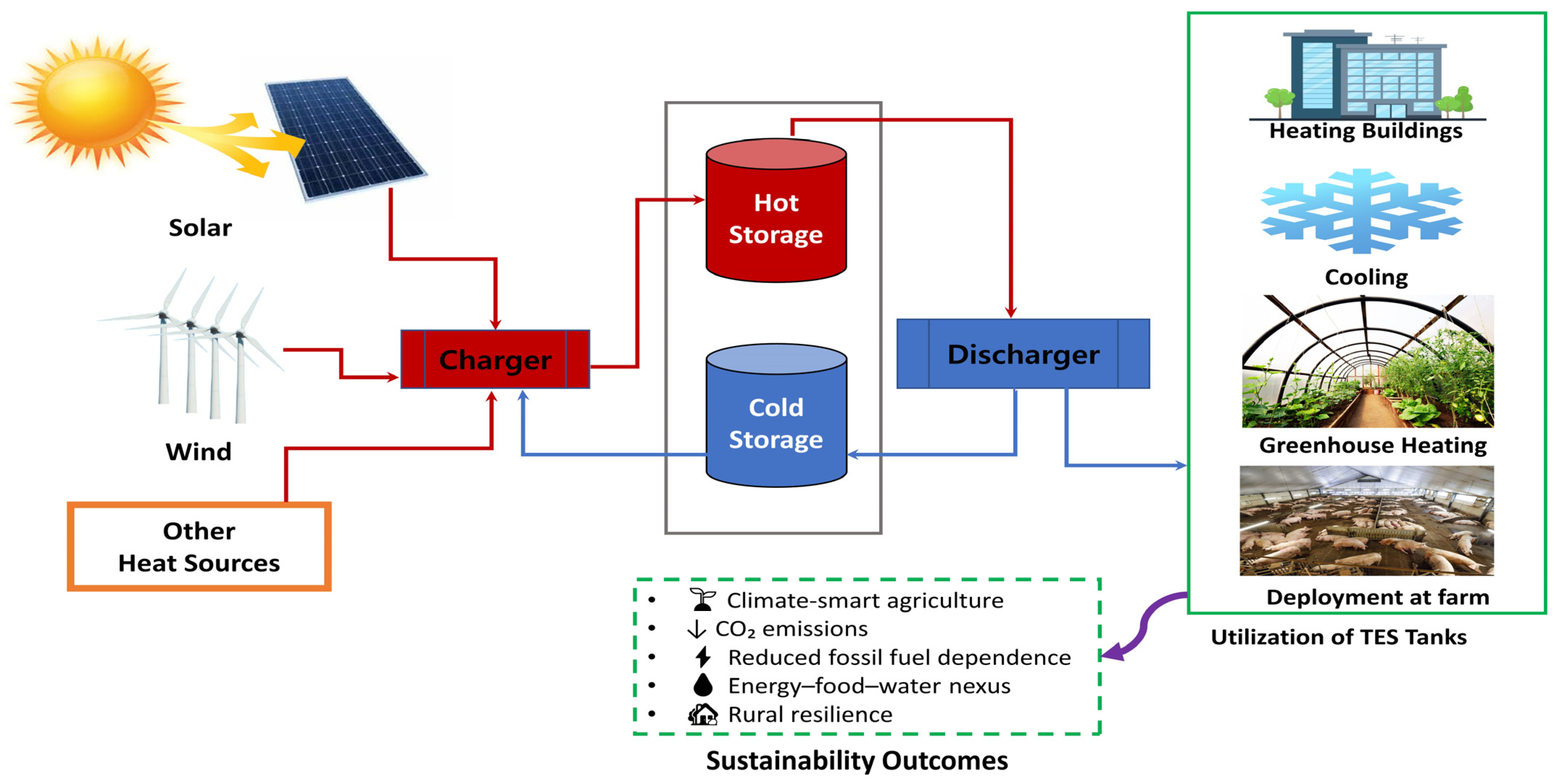
Tank-based thermal energy storage (TES) systems offer a practical and mature solution by enabling the storage of thermal energy during periods of surplus availability or low cost and its subsequent release when demand arises [1,2] (Figure 1). By decoupling energy supply from demand in time, these systems enable peak-load shaving, improved utilization of renewable heat sources, and more stable operation of heating and cooling equipment. TES technologies have been widely implemented in buildings and industrial applications to reduce energy consumption, improve system flexibility, and enhance overall energy efficiency [3,4,5,6]. Their adaptation to agricultural systems has therefore attracted growing attention in recent years.
TES systems can operate via sensible heat storage (by raising or lowering the temperature of a storage medium), latent heat storage (using phase-change materials, PCMs), or thermochemical storage based on reversible reactions. Each technique offers clear advantages and limitations in terms of energy density, operating temperature range, cost, and system complexity [7,8,9]. In agricultural applications, tank-based TES systems are especially attractive because they can buffer shifting thermal loads, integrate renewable or waste heat sources, and stabilize indoor climates under daily or seasonal variability. For instance, recent studies in smart greenhouse applications have shown that properly sized hot- or chilled-water TES tanks can minimize annual energy consumption by approximately 15% while improving temperature stability; however, challenges continue to restrict the widespread deployment of TES in smart farm systems. These include precise sizing of storage tanks under highly variable agricultural loads, maintenance of thermal stratification, lowering of heat losses, integration with farm-scale renewable energy systems, assessment of life-cycle costs under persistent charge–discharge cycling, and practical constraints linked to space availability, insulation quality, and rural infrastructure [10]. Addressing these challenges requires not only better materials and system designs but also advanced control strategies and standardized performance assessment techniques.
Beyond their technical role, TES systems should be evaluated within a broader sustainability context. Climate change is intensifying thermal stress on agricultural systems, increasing the cooling demand in warm regions while raising heating demands in colder climates [11]. Simultaneously, agriculture lies at the heart of the energy–food–water nexus, where energy consumption directly affects the cultivation efficiency, water consumption, and greenhouse gas emissions [12]. By allowing higher shares of renewable energy, reducing fossil fuel dependence, and improving thermal efficiency, TES systems contribute directly to climate-smart agriculture and support multiple United Nations Sustainable Development Goals (SDGs), including SDG 2 (Zero Hunger), SDG 7 (Affordable and Clean Energy), SDG 12 (Responsible Consumption and Production), and SDG 13 (Climate Action) [13,14,15,16]. In this sense, TES is not solely an energy technology but a sustainability enabler for resilient and resource-efficient food systems.
A substantial number of review studies have examined thermal energy storage (TES) technologies mainly in the contexts of buildings, district heating networks, and industrial energy systems, with a strong emphasis on storage materials, numerical modeling, and large-scale renewable energy integration [3,17,18]. In these reviews, agricultural applications are usually mentioned only in passing or treated as extensions of building energy systems, without a detailed analysis of the operating conditions specific to farm environments. In practice, agricultural facilities exhibit strongly variable and season-dependent thermal loads, biological sensitivity of crops and livestock, limited space and infrastructure, and operational priorities that differ fundamentally from those of residential or industrial systems. Consequently, key challenges—such as intermittent occupancy, seasonal shifts between heating- and cooling-dominated operation, animal welfare and crop microclimate requirements, and the integration of on-farm renewable energy sources—are insufficiently addressed in the existing TES review literature [19,20]. This review directly addresses these gaps by providing a focused and systematic analysis of tank-based TES technologies tailored to agricultural contexts, with an emphasis on farm-relevant thermal loads, system integration strategies, control approaches, and sustainability implications that are not comprehensively covered in prior TES reviews.
Against that background, this review focuses on tank-based TES systems for smart agricultural facilities. It comprehensively investigates storage basics, storage media, tank design and sizing methodologies, integration with farm heating and cooling systems, modeling approaches and key performance indicators, as well as economic and environmental considerations. By synthesizing the recent literature and identifying research gaps and future directions, this review aims to support the development and deployment of efficient, durable, and scalable TES solutions that enhance sustainability and resilience in modern agricultural systems.

2. Background/Fundamentals

Tank-based thermal energy storage (TES) systems operate by storing and releasing heat, and their successful application depends on a clear understanding of the fundamental principles behind these processes. This section builds that foundation by outlining three key areas: (i) the basic mechanisms of thermal storage—sensible, latent, and thermochemical; (ii) common tank designs and system configurations; and (iii) the materials and media typically utilized for storage. Although the emphasis is on systems designed for heating, many of the concepts discussed are equally relevant to cold-storage applications such as chilled-water tanks used in smart agricultural facilities.

2.1. Thermal Storage Basics: Sensible vs. Latent vs. Thermochemical

In TES systems, heat can be stored in three main ways: sensible heat, latent heat (via phase-change materials, PCMs), and thermochemical storage (also referred to as adsorption/chemisorption). Sensible-heat storage simply raises (or lowers) the temperature of a storage medium, harnessing its heat capacity. This mechanism is widespread and well-commercialized. For example, ordinary hot-water tanks using water as the medium remain the most common form of sensible heat storage [5,21].
Latent-heat storage exploits the energy absorbed or released during a phase change (solid ⇄ liquid, or other) of a material, providing a higher energy density per unit mass relative to purely sensible storage for the same temperature swing. PCMs therefore enable more compact storage solutions for moderate temperature ranges [22]. Thermochemical storage is less mature but offers very high storage densities by reversible chemical (or adsorption) reactions. Its application in farm-scale tank systems remains more specialized [23]. Another important phenomenon in tank systems is stratification (i.e., the layering of storage fluid by temperature/density gradients) and the thermocline development in charging/discharging cycles. Proper stratification enhances the usable capacity and helps maintain distinct temperature zones, and loss of stratification (through mixing or baffles) reduces performance [24].

2.2. Tank Concepts and Typologies

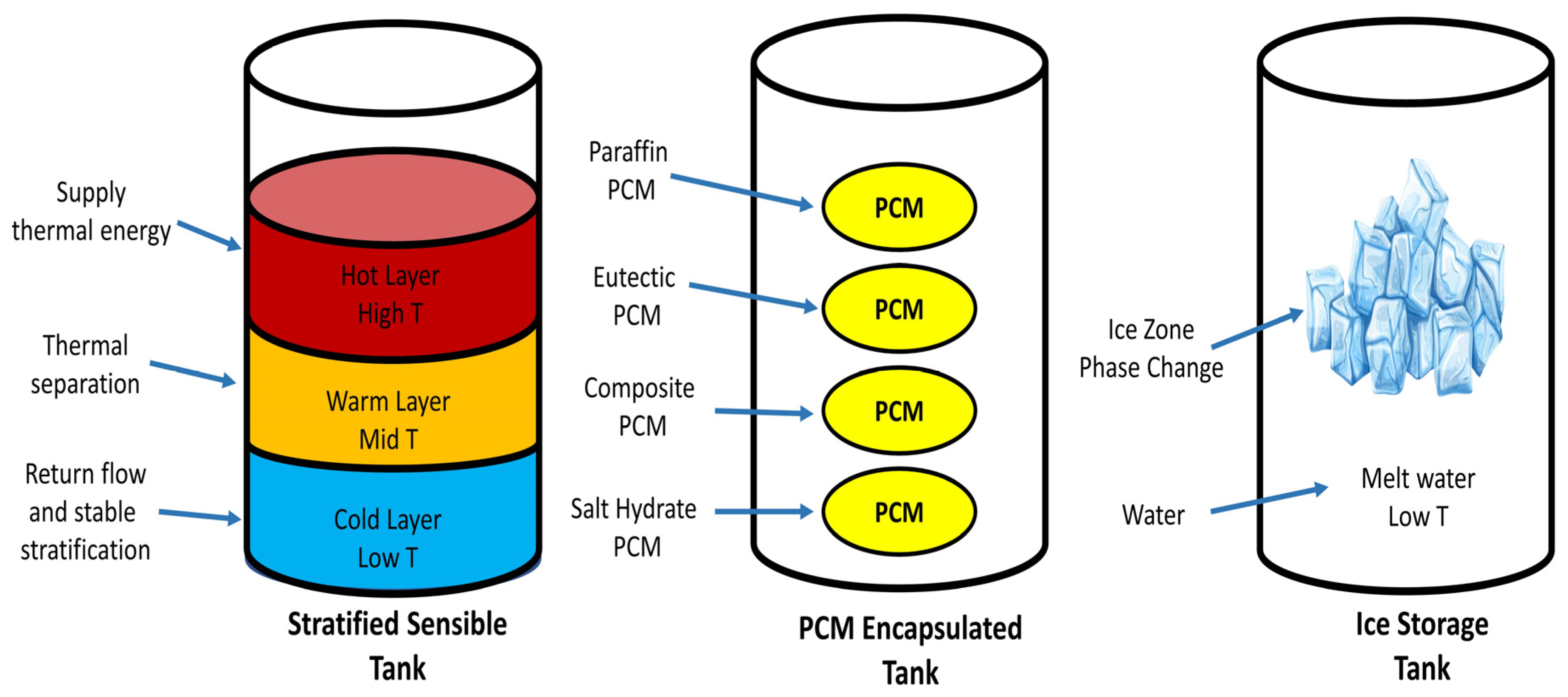
Figure 2 illustrates that several tank configurations are used in TES systems depending on the application, temperature range, and required performance. Some common typologies such as stratified tanks (layer-charge) use vertical tanks wherein the warmer, less dense fluid rests above colder, denser fluid. Charging and discharging ports are located at different heights to maintain the layered temperature profile, thereby improving heat extraction and minimizing mixing [25]. Mixed (or fully mixed) tanks allow fluid mixing and are simpler in construction, but sacrifice stratification benefits. They are easier to design but may yield lower effective temperature separation and storage efficiency [26]. Shell-and-tube or internal heat-exchanger tanks incorporate internal piping or coil arrangements within the tank to charge or extract heat via a secondary fluid loop, enabling decoupling of fluid circuits and ease of integration into HVAC or process systems [27]. In tanks using granular media (rocks, pebbles, ceramic bricks) or encapsulated modules, packed-bed configurations enable a storage medium to be charged by hot fluid or air and then discharged by fluid flow through the media. These are more common in high-temperature or industrial storage but can inform farm-scale designs [28]. Encapsulated PCM module tanks integrate phase-change materials encapsulated in modules (spheres, plates, containers) inside a tank or module arrangement. The PCM modules charge/discharge at near-isothermal conditions during the phase change, enabling compact storage with a smaller ΔT compared to sensible systems [29].
In designing a TES tank, key features include attaining good thermal stratification, minimizing heat losses (via insulation), ensuring compatibility of charge/discharge flow rates, and selecting the proper tank geometry and materials to support agricultural system integration.

2.3. Common Media: Water, Brine, Eutectic Salts, PCMs, Ice Slurry, Refrigerated Water + Antifreeze

Selecting the storage medium is a crucial decision for TES tanks in agricultural applications because the medium impacts the cost, energy density, temperature range, safety, maintenance, and integration. Water remains the most common sensible-heat medium due to its availability, high specific heat capacity (~4.18 kJ/kg·K), low cost, and safe handling. Hot-water tanks are widely used for heating applications including solar thermal, CHP, and building HVAC [5]. Brine/antifreeze solutions for moderate-temperature systems (including low-temperature heat pumps or chilled-water loops), brine (glycol–water mixtures), or antifreeze solutions enable lower-freezing-point operation and safety in colder environments. Eutectic salts/salt hydrates are used in latent storage—they have defined melting/freezing points and relatively high latent enthalpy, and they can be designed for specific temperature ranges. For example, eutectic salt hydrates are increasingly studied for medium-temperature TES [30]. PCMs (organic, inorganic, eutectic), as noted above, store latent heat during a phase change. They are also used in the encapsulated form inside tanks or modules. Key challenges include their low thermal conductivity, supercooling, phase separation, and cost [31]. Although ice slurry/refrigerated water + antifreeze are more commonly associated with cold energy storage (CES) applications, chilled-media tanks are also relevant for agricultural facilities with significant cooling demands, such as post-harvest storage, dairy processing, or animal cooling systems. Storage using chilled water or ice slurry enables temporal shifting of refrigeration compressor loads and exploitation of off-peak electricity. The underlying thermodynamic principles are analogous to those of thermal (heat) storage, but applied in the reverse temperature domain [32]. Thermochemical media or salt sorption beds may be used in niche applications, but their adoption in farm-scale tank systems remains limited [33].
For agricultural smart-farm applications, selecting a medium will depend on the farm’s thermal demand profile (heating vs. cooling), temperature range of the process, space constraints, integration with heat pumps or solar thermal, maintenance capabilities, and cost. Ensuring that the tank medium and typology can deliver the required temperature range with minimal losses and robust cycling is critical.

3. Methodology

This study systematically reviews the peer-reviewed literature related to thermal energy storage (TES) systems, with a particular emphasis on tank-based configurations and their applications in energy-efficient and sustainable agricultural systems. The review process was designed and reported in accordance with the Preferred Reporting Items for Systematic Reviews and Meta-Analyses (PRISMA 2020, Supplementary Materials) guidelines to ensure methodological transparency, reproducibility, and comprehensive coverage of the existing literature [34]. The primary objective was to identify, screen, and synthesize experimental, numerical, analytical, techno-economic, and review studies addressing sensible heat storage, latent heat storage using phase-change materials (PCMs), and ice-based thermal energy storage technologies relevant to livestock housing, greenhouses, food processing, dairy operations, and cold storage facilities.
The published literature was collected primarily from major scientific databases, including Scopus, Web of Science (Core Collection), ScienceDirect, IEEE Xplore, and Google Scholar, as well as publisher platforms such as MDPI and SpringerLink, following established best practices for conducting systematic reviews in energy and sustainability research [34,35,36,37]. The search strategy employed combinations of keywords and Boolean operators applied to titles, abstracts, and author-provided keywords [36,38]. The main search terms included “thermal energy storage”, “TES”, “stratified TES tank”, “sensible heat storage”, “latent heat storage”, “phase change material”, “PCM encapsulated tank”, “ice storage tank”, and “TES control strategies”, combined with application-oriented terms such as “agriculture”, “smart farming”, “livestock”, “greenhouse”, “food processing”, “dairy”, and “cold storage”. Only peer-reviewed journal articles published in English were considered, with no restriction on publication year, allowing both classical and recent studies to be included in order to provide a comprehensive overview of TES technologies, performance characteristics, and applications in agricultural energy systems [34,37].
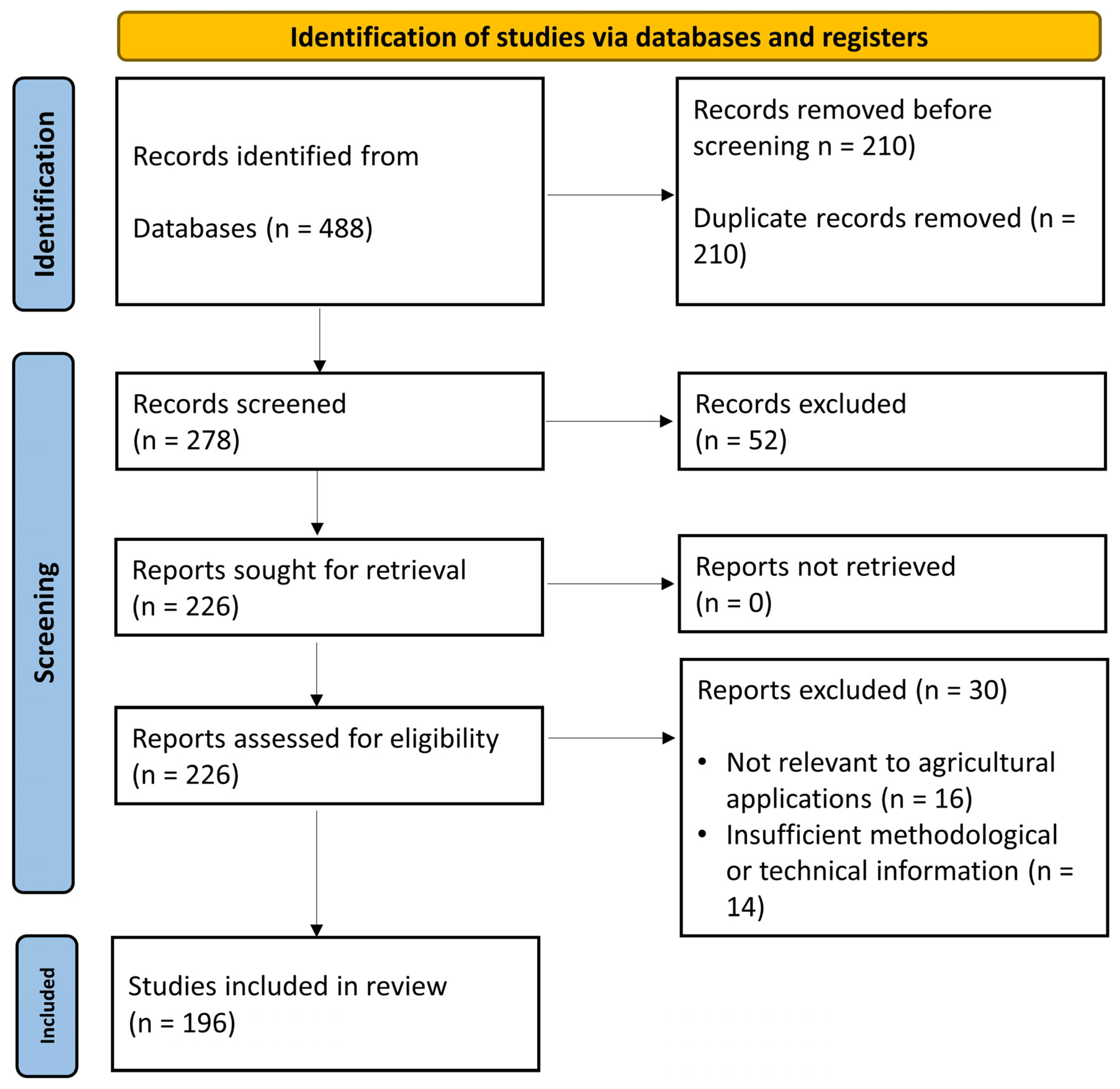
The initial database search resulted in a total of 488 records. All retrieved references were imported into reference management software, where duplicate entries were identified and removed through a combination of automated and manual procedures, as recommended by the PRISMA guidelines [34,36]. The remaining records were subjected to a screening process based on titles and abstracts to evaluate their relevance to the scope of the review. Studies were excluded at this stage if they did not address TES technologies, focused exclusively on non-agricultural or non-agri-food applications, or lacked relevance to tank-based TES systems, in line with standard systematic review screening protocols [36,38].
Full-text versions of the remaining articles were subsequently assessed for eligibility using predefined inclusion and exclusion criteria [34,37]. Studies were included if they investigated sensible heat storage, latent heat storage using PCMs, or ice-based thermal energy storage systems implemented in tank configurations and demonstrated applicability to agricultural or agri-food energy systems. Experimental, numerical, analytical, techno-economic, and review studies were all considered eligible, consistent with previous systematic reviews in the fields of thermal energy storage and sustainable energy systems [37,38]. Exclusion criteria comprised non-tank storage concepts such as geological or borehole storage, conference proceedings, theses, technical reports, patents, non-English publications, and studies with insufficient technical or methodological detail [34,36].
The inclusion and exclusion criteria were defined to ensure that the selected studies were directly relevant to tank-based TES technologies under practical agricultural operating conditions. Non-tank storage concepts (e.g., borehole or geological storage) were excluded because their design, time scales, and spatial requirements differ fundamentally from farm-scale applications. Conference proceedings and non-peer-reviewed sources were excluded to ensure methodological rigor and reproducibility of the synthesized findings.
After full-text eligibility assessment, a total of 196 studies met all inclusion criteria and were selected for final synthesis. These studies formed the basis for qualitative and comparative analysis [34,37]. Most of the data and information included in this review were extracted directly from the selected publications, focusing on the TES technology type, storage medium, system configuration, energy density, operating temperature range, cycle life or thermal stability, cost information where available, and specific agricultural applications [37,38].
The qualitative synthesis was conducted by systematically grouping the selected studies according to the (i) TES storage principle (sensible, latent, ice-based), (ii) tank configuration and storage medium, (iii) agricultural application type (e.g., greenhouse, livestock housing, cold storage), and (iv) system integration and control strategy. Within each group, studies were comparatively analyzed to identify recurring design approaches, performance ranges, technological limitations, and reported sustainability outcomes, rather than merely summarizing individual results.
Potential sources of selection bias should be acknowledged. The review focused on peer-reviewed journal articles published in English and indexed in major scientific databases, which may have excluded relevant studies published in other languages or as technical reports. In addition, database-specific indexing practices and keyword selection may have influenced the visibility of certain publications. Nevertheless, the use of multiple complementary databases and broad search terms was intended to minimize such bias and ensure a comprehensive literature coverage.
The methodological quality of the included studies was assessed qualitatively by examining the clarity of system descriptions, appropriateness of experimental or modeling methodologies, transparency of assumptions and boundary conditions, and relevance to sustainable and smart agricultural energy applications, as commonly adopted in energy-focused systematic reviews [37,38]. This combined systematic and comprehensive approach ensured a thorough and up-to-date synthesis of TES research without restricting the review to a narrowly predefined set of studies. The overall study selection process, including identification, screening, eligibility assessment, and final inclusion, is summarized using a PRISMA flow diagram, which indicates that 488 records were initially identified and 196 studies were ultimately included in the systematic review [34] (Figure 3).

4. Technologies and Materials

Tank-based thermal energy storage (TES) systems can be broadly categorized by the storage mechanism and the materials or structures used. In this section, data reviewed include the major technology classes, like sensible heat, latent heat (PCMs), and thermochemical storage, and also highlight supporting design features such as internal heat-exchangers and thermal insulation, as shown in Table 1. The discussion emphasizes pros and cons for each, with a view to applicability in smart agricultural facilities.
The comparison in Table 1 reveals clear trade-offs among sensible, PCM-based, and ice-based tank thermal energy storage technologies for agricultural applications. Sensible heat storage systems, typically based on hot or chilled water, exhibit lower to moderate energy densities (≈17–81 kWh/m3) but benefit from a simple design, operational robustness, and ease of maintenance, making them well suited to smallholder and resource-constrained farm environments. In contrast, PCM-based systems provide a higher energy density and improved temperature control, supporting applications such as greenhouse climate regulation, food preservation, and milk processing, although higher material costs and system complexity may limit their adoption in rural settings. Ice-based storage technologies offer the highest energy density (≈85 kWh/m3) and are particularly effective for cooling-dominant, industrial-scale operations such as cold storage and dairy chilling, but require sub-zero operation and more advanced control strategies. Overall, the results indicate that no single TES technology is universally optimal; rather, selection should be guided by the farm scale, dominant thermal demand, and trade-offs between energy density, cost, system complexity, durability, and long-term maintainability.

4.1. Sensible Heat Storage

Sensible heat storage (SHS) involves raising (or lowering) the temperature of a storage medium where the phase remains fixed. The stored thermal energy Q may be expressed as
Q = m cp ΔT
where m is mass, cp is the specific heat capacity, and ΔT is the temperature difference. SHS is the most mature and commercially adopted TES method [23].
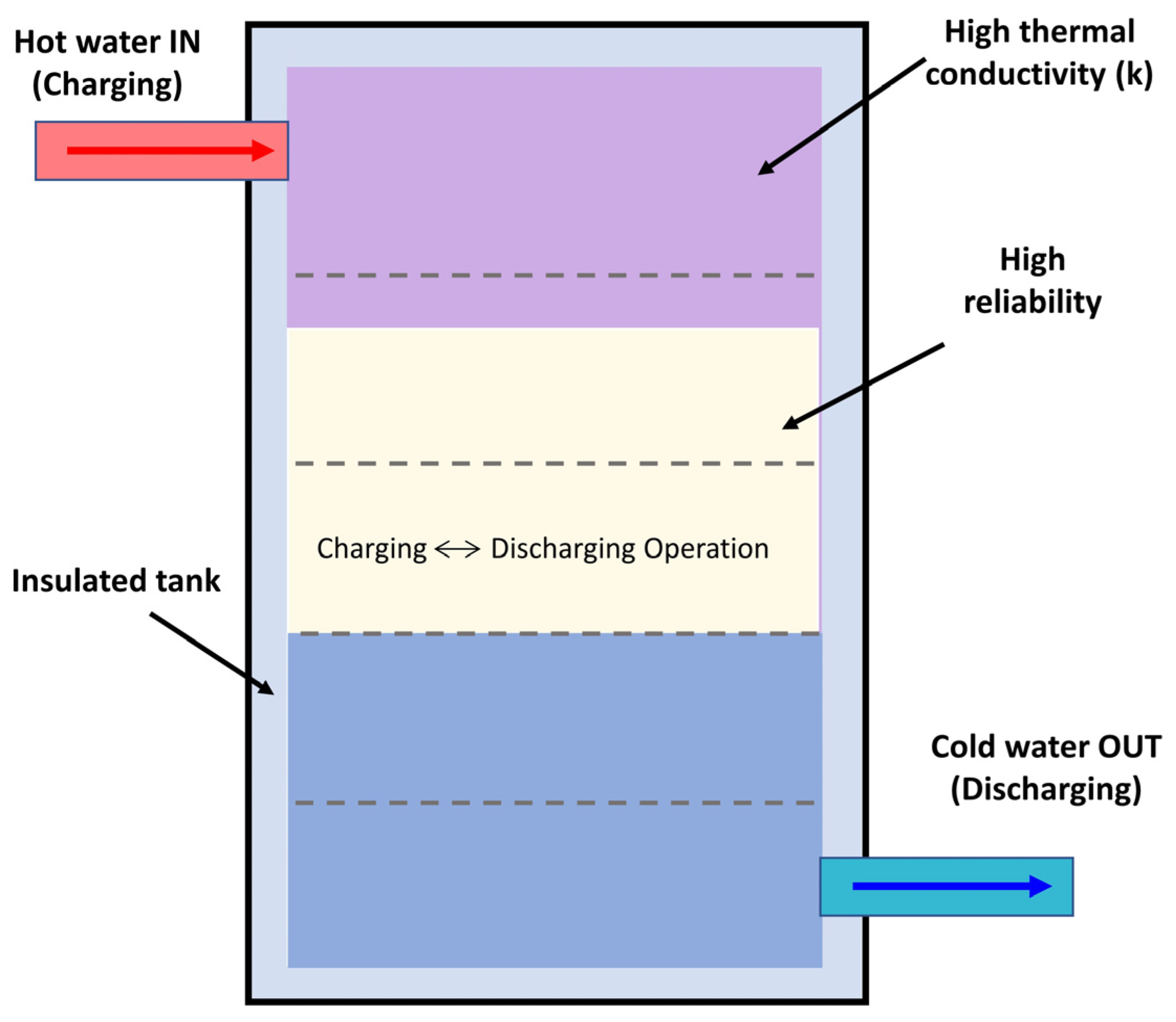
Common media for SHS include water—often used for low-temperature (<100 °C) applications owing to the high cp (~4.18 kJ/kg·K), low cost, and ease of handling [21]. Solids such as concrete, rocks, ceramic bricks are used for moderate to high temperature ranges and often in packed-bed or embedded heat-storage systems [57,58,59]. As shown in Figure 4, sensible heat storage tanks are relatively low-cost (especially water or natural rock/stone media) and have a simple design with well-understood operation, high reliability, good thermal conductivity in many cases (especially solid media), and wide availability of materials [60,61]. Sensible heat storage has a lower energy density per unit volume or mass compared to latent or thermochemical storage for a given temperature span. It requires a large ΔT to store significant energy (which may conflict with agricultural thermal constraints). In this system, stratification/mixing losses may reduce the effective capacity unless properly managed (especially in vertical tanks) [62]. In the case of concrete or rock-based media, construction complexity, weight, space, and structural support become considerations. For example, concrete-based SHS systems are promising but often at temperatures up to 500–600 °C in the framework [63].
For farm applications (e.g., space heating of barns or greenhouses), SHS with water tanks or moderate-temperature rock/brick beds may be quite suitable given the moderate temperature ranges (e.g., 20–60 °C) and lower cost sensitivity. Also, due to its low cost, simple maintenance, and use of non-toxic, food-compatible materials, sensible heat storage is well suited for farms, especially in greenhouses and livestock housing, where it supports renewable heat integration, minimizes fossil fuel dependence, and improves energy efficiency under rural operational constraints.

4.2. Latent Heat Storage (Phase-Change Materials, PCMs)

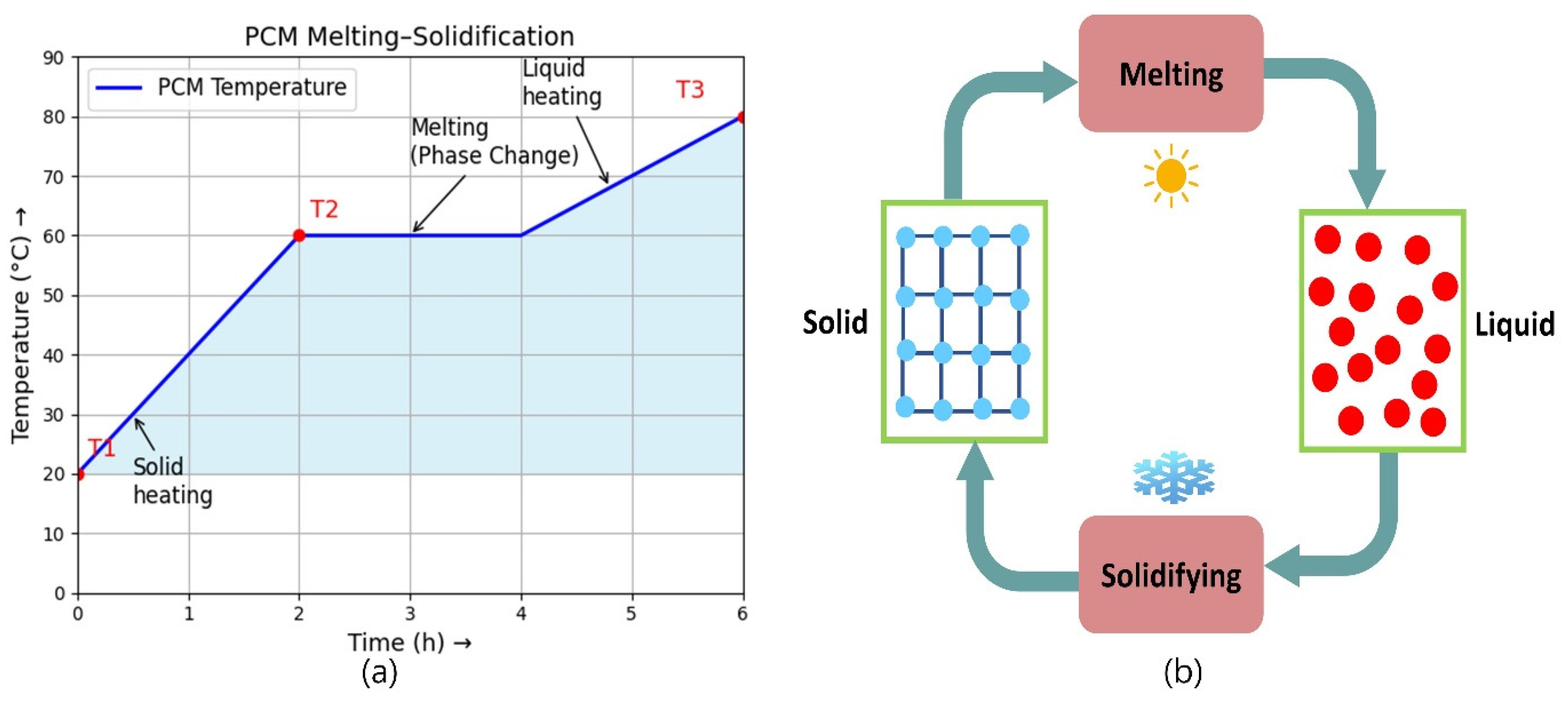
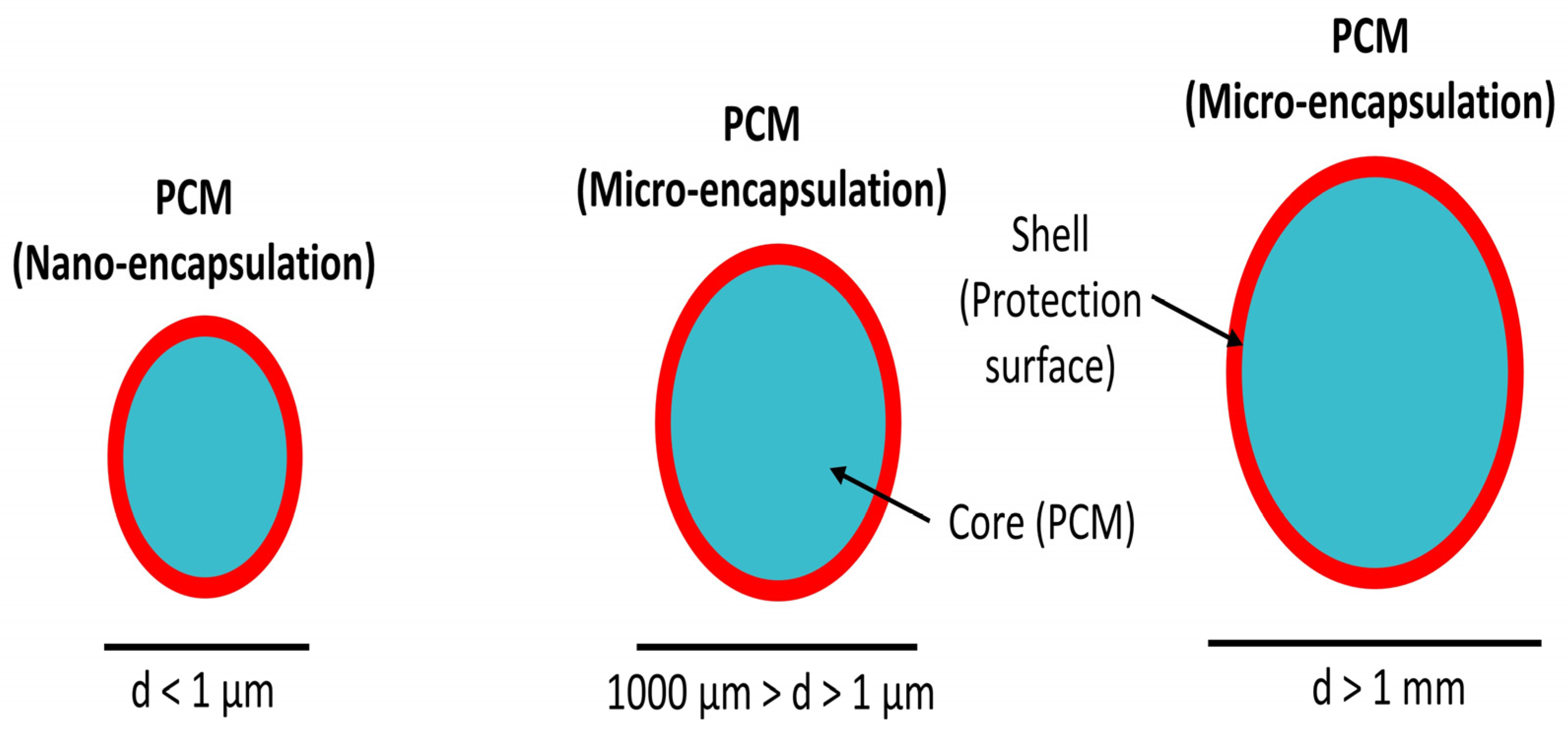
Figure 5 describes how latent heat storage systems store energy via the phase change of a material (typically solid ↔ liquid), while maintaining a near-constant temperature during the phase transition, offering a higher storage density for a given temperature range [5]. PCM types and examples include organic paraffins (e.g., CnH2n+2)—stable, non-corrosive, good cycling behavior, but have lower thermal conductivity and relatively low volumetric heat storage compared to salts [64]. Inorganic salt hydrates (e.g., CaCl2·6H2O, Na2SO4·10H2O) and eutectic mixtures have a higher latent heat per unit volume and wider melting/freezing temperature ranges, but have issues such as phase separation, supercooling, corrosion, and cycle stability [65], as explained in Table 2. PCMs provide significantly higher stored energy per unit mass or volume compared to sensible media for a given ΔT, because of the latent-heat term L. For agricultural heating, the PCM transition temperature also must match the operational range of the heating loop (e.g., 40–60 °C). Mismatch reduces effectiveness. PCMs often need to be encapsulated (micro- or macro-encapsulation) to manage leakage, volume change, and corrosion and to improve thermal conductivity, as shown in Figure 6. For instance, microencapsulated paraffins were subjected to >5000 cycles with minimal degradation [64]. Many PCMs have low conductivity, which can limit charge/discharge rates—in practice, fins, heat pipes, or composite enhancement materials may be used [66,67,68,69].
Figure 5. PCM heating–cooling behavior and phase-change cycle. (a) PCM melting–solidification temperature profile. (b) PCM phase-change cycle (solid ↔ liquid).
Sustainability 18 01311 g005
Figure 6. PCM nano- and micro-encapsulation [70].
Sustainability 18 01311 g006
Table 2. Phase-change material (PCM) classes and key thermophysical properties relevant to energy-efficient and sustainable thermal management in agricultural systems.
Ref.PCM ClassExample MaterialsMelting Temp. (°C)Latent Heat (kJ/kg)Thermal Conductivity
(W·m−1·K−1)
AdvantagesDrawbacks
SolidLiquid
Munir et al. [47]OrganicParaffin wax69–712600.20.2Stable latent heat storage; suitable for agricultural heatingLow thermal conductivity; slow melting/solidification
Moradi et al. [71]OrganicParaffin capsules612130.40.15Enables night-time heating; effective solar energy shiftingOutput temperature fixed to PCM; complex system design
Balachandran et al. [72]OrganicParaffin wax1181950.22NRSupports continuous drying under low solar radiationLow conductivity; requires accurate IoT calibration
Poonia et al. [73]OrganicPolyethylene glycol17–23NRNRNRMaintains temperature up to 7 h after sunset; suitable for remote areasSeasonal PCM switching required; higher system cost
Moon and Kim [74]InorganicSodium sulfate decahydrate32.42540.544NREnables energy shifting and storagePoor charging consistency; phase segregation
Batlles et al. [75]InorganicBischofite58.2116.9NRNRLong-duration cooling; reduced storage volumeLimited discharge heat transfer efficiency
Tafone et al. [76]InorganicKNO3–LiNO3132167.30.50.5High TES density; improved heat-pump performanceHigh-temperature system uncertainty; design sensitivity
Lombardo et al. [77]Inorganic salt hydratesMagnesium sulfate heptahydrate−5.81 to −3.87227.00.620NRHigh latent heat; low supercooling; good cycling stabilityRelatively high cost; low conductivity
Ref. = references; NR = not reported. Conductivity columns denote solid and liquid-phase thermal conductivity, respectively. Advantages and drawbacks are summarized based on performance in agricultural or low-temperature TES applications.
The PCMs summarized in Table 2 demonstrate that latent thermal energy storage can be tailored to diverse agricultural applications through appropriate material selection. Organic PCMs, particularly paraffin-based materials, are generally well suited to smallholder and rural farming systems due to their chemical stability, non-corrosive behavior, and compatibility with food and livestock environments, although their relatively low thermal conductivity can limit charging and discharging rates. In contrast, inorganic and salt-hydrate PCMs offer a higher latent heat and energy density, making them attractive for space-constrained or large-scale applications such as controlled-environment agriculture, cold storage, and process heating. However, these materials often require careful system design to address challenges related to phase segregation, corrosion, and long-term durability, potentially increasing system complexity and maintenance requirements. Overall, the comparison highlights trade-offs between energy performance, cost, and operational robustness, indicating that PCM selection in agricultural systems should be guided by the farm scale, dominant thermal demand, and available technical resources.
Latent heat storage systems have a compact size for a given storage capacity and moderate ΔT, near the isothermal storage during phase change, which simplifies control and improves usable energy. These systems have a higher cost than basic sensible media (depending on material) with challenges of stability over many cycles (especially salt hydrates) and system integration (encapsulation, compatibility with fluids). The temperature range is limited to the melting/freezing point and latent heat, so selection is more constrained. It needs excellent heat transfer management to fully exploit the latent capacity [78].
PCM-based storage offers a higher energy density and better temperature stability, and its application in farm environments is constrained by a higher material cost, encapsulation durability, and maintenance complexity. Vigilant material selection and containment are needed to confirm the safety, leakage prevention, and compatibility with food and livestock operations.

4.3. Thermochemical Storage

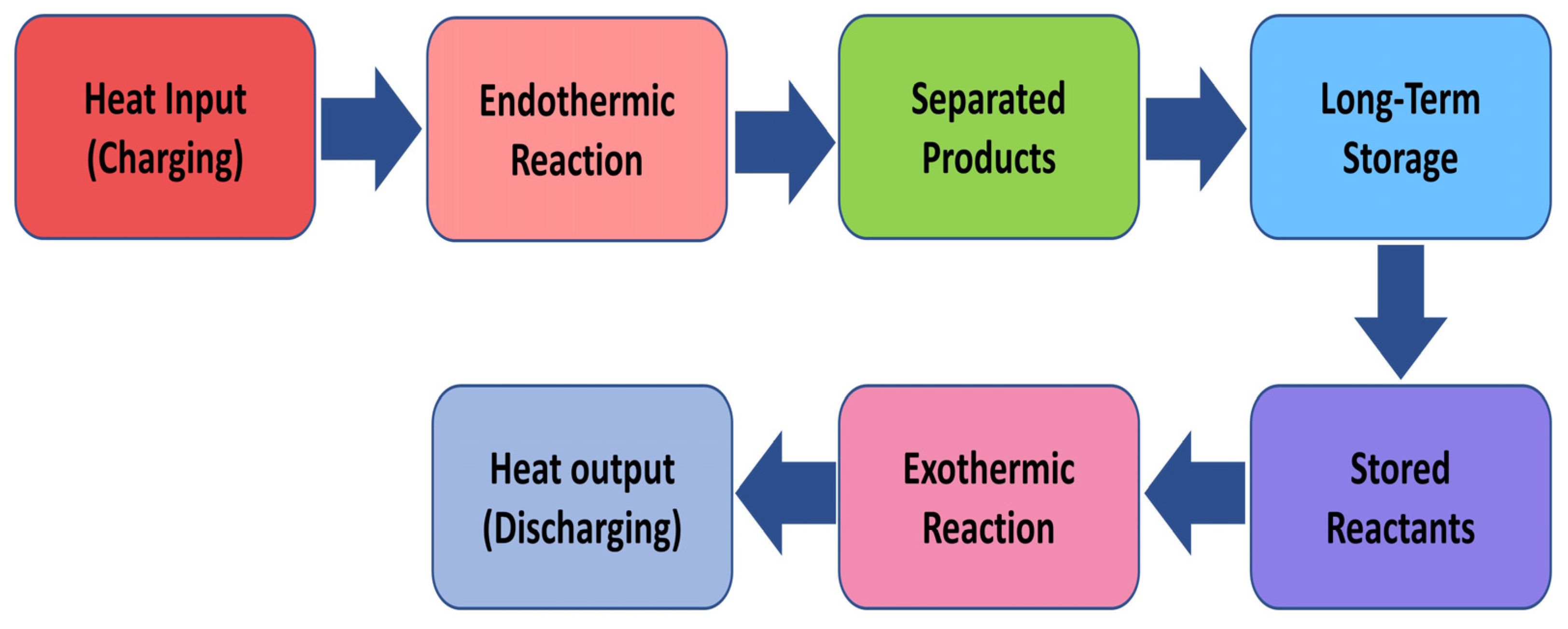
Thermochemical energy storage (TCES) stores thermal energy via reversible chemical or sorption reactions (adsorption/absorption or chemisorption). During charging, heat drives the reaction (e.g., drying of a sorbent, or endothermic reaction), and during discharge, the reaction reverses, releasing heat [79,80] (Figure 7). TCES offers very high theoretical energy densities, lower heat losses (since energy is stored in chemical bonds), and long-term (seasonal) storage potential. However, this system remains at an earlier technology readiness level compared to sensible and latent storage. For farm applications, this storage system may be more suited for seasonal storage of waste heat or solar heat, rather than daily cycling, unless the system is specifically engineered for it [23,81]. In Table 3, some thermochemical storage materials and reaction mechanisms, reaction types, and operating conditions are presented.
TCES offers very high volumetric and gravimetric storage densities—often cited as several times higher than latent or sensible thermal storage systems—and the potential for minimal standby losses when well-insulated, making it suitable for long-term storage (days to weeks or even months) [87,88,89]. Despite these advantages, these systems face significant challenges, including a more complex system design (reactor beds, sorbent handling, fluid/heat exchange), high capital cost and lower commercial maturity compared to sensible/latent options, and unresolved issues such as heat and mass transfer limitations, reaction kinetics, sorbent degradation or attrition, and durability under repeated cycling [87,90]. Although thermochemical storage provides a high energy density and long-term storage potential, its current complexity and lower technology readiness limit near-term adoption in typical farm settings. Such systems may be better suited for centralized or pilot-scale agricultural facilities with technical support rather than small or medium-sized farms. A comparison of storage mechanisms and system parameters of sensible storage, latent (PCM) storage, and thermochemical storage (TCES) is given in Table 4.
Table 4 indicates that sensible and latent TES technologies are presently the most practical options for agricultural applications, as they combine a high technological maturity, relatively low cost, and straightforward operation. However, these systems are mainly suited for short-term thermal buffering rather than long-duration storage. In contrast, thermochemical energy storage provides a substantially higher energy density and the ability to store heat over extended periods with minimal losses, but its technical complexity and lower maturity currently restrict its use in typical farm settings. This comparison reveals an important gap in the existing TES literature: limited application-oriented guidance that connects storage mechanisms with the specific thermal demands, operational constraints, and sustainability goals of agricultural systems—an issue that this review explicitly seeks to address.

4.4. Heat Exchangers, Internal Baffling, and Stratification

Tank performance is strongly influenced by internal design features, particularly heat-exchanger placement, fluid port configurations, baffling to promote or maintain stratification, and minimization of mixing. For example, stratified tanks maintain a temperature gradient (hot at top, cold at bottom), enabling higher exergy extraction by locating the supply/return appropriately, while mixed tanks see full mixing and thus lower effective ΔT [3]. Internal heat-exchanger coils or tubes allow separate circuits (e.g., heat pump loop vs. storage loop) and facilitate decoupled charging/discharging; however, comparative modeling shows that internal exchangers may degrade stratification relative to external ones, reducing charging efficiency [26,96]. Baffles or diffuser plates reduce fluid momentum and mixing, preserving stratification—studies on diffuser design show that an optimized diffuser geometry significantly improves stratification and reduces thermocline thickness [97]. In an agricultural context, where space may be limited and temperature swings moderate, maintaining stratification and efficient charging/discharging is crucial to maximize storage utilization and avoid unnecessary losses [98].

4.5. Thermal Insulation and Losses

Even the best-designed thermal energy storage (TES) tank will suffer heat losses to the ambient unless it is properly insulated. Key factors influencing these losses include
  • Standing losses (or standing loss rate)—that is, the heat lost over time while the tank is idle. This is especially important in agricultural settings, where the tank may stand idle longer (e.g., overnight) and thus lose stored energy [3].
  • Insulation quality, tank orientation, ambient temperature, and heat-exchanger/piping insulation—the insulation’s thickness and thermal conductivity and the tank’s exposure to ambient conditions, which strongly affect overall losses [99].
  • Impact of losses—these losses reduce the usable stored energy, lower the round-trip efficiency of the TES system, and may erode its economic viability. In the context of hot-water storage, standing loss is the amount of energy lost through the tank walls and piping to the ambient [100].
In arrayed farm-scale systems, where the storage tank might be installed in an unconditioned barn or shed, accounting for these insulation and loss effects is particularly important. High-quality insulation, minimizing exposure to large ambient temperature swings, and careful design of the tank’s positioning will reduce heat loss and enhance overall system performance.

5. Tank Design and Sizing for Farm Applications

Designing and sizing tank-based thermal energy storage (TES) for agricultural facilities requires matching the storage capacity and power to highly variable farm loads, balancing cost/footprint constraints, and ensuring reliable integration with HVAC, heat pumps, refrigeration, and renewable sources.

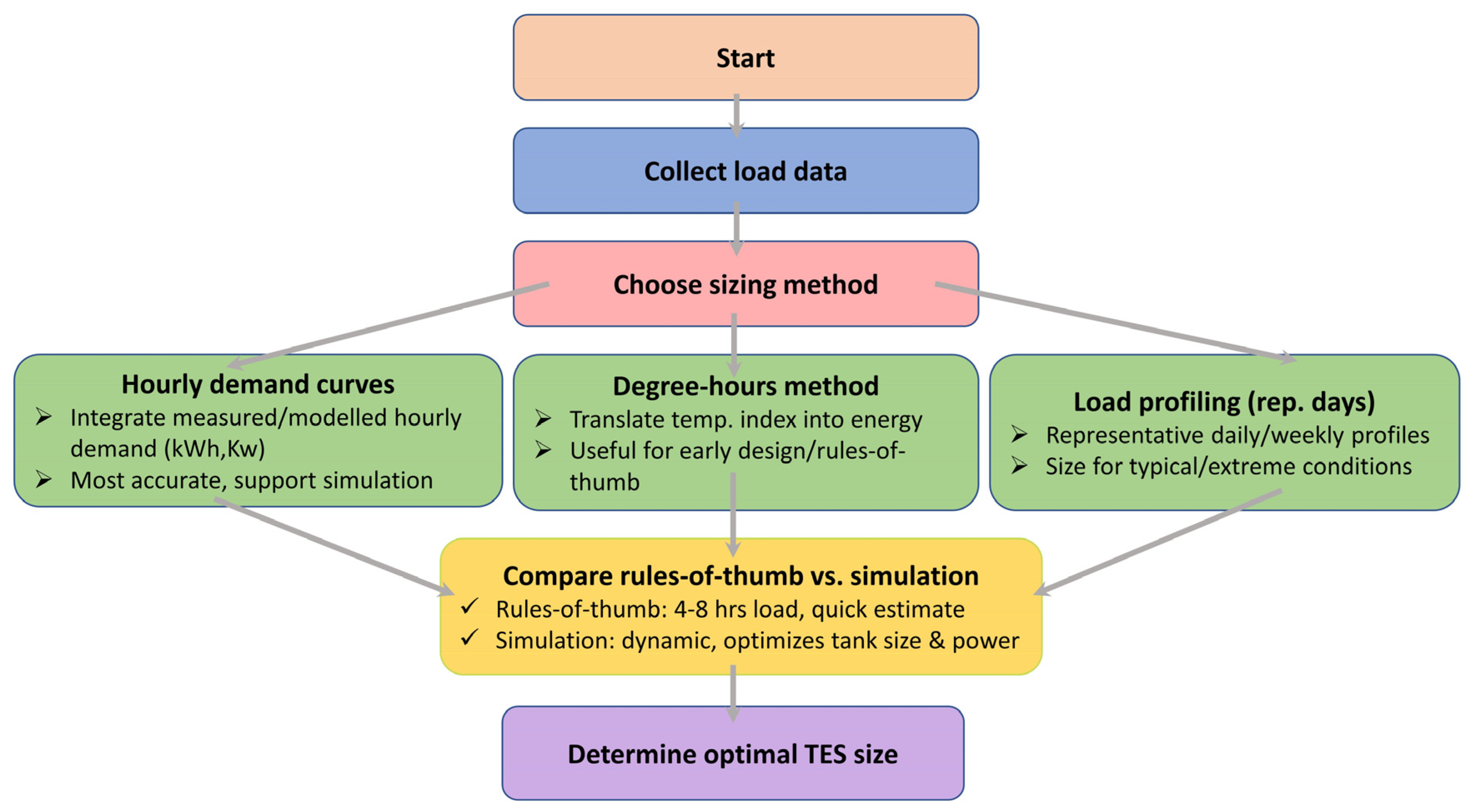
5.1. Sizing Methods: Load Profiling, Degree-Hours, and Hourly Demand Curves

TES sizing typically begins with a load-profiling exercise to quantify the hourly (or sub-hourly) heating demand over representative days or seasons. Common practical approaches include
  • Hourly demand curve integration (most accurate): integrate the farm’s measured or modeled hourly heat demand over the sizing period to produce the required energy (kWh) and peak power (kW). Use of full hourly profiles supports simulation-based sizing and optimization [101].
  • Degree-hours (or degree-days) methods: for simpler estimates, degree-hour approaches translate a temperature-based demand index into energy requirements and are helpful in early design stages or for rule-of-thumb sizing [102].
  • Load profiling with statistical/representative days: for seasonal crops or livestock cycles, choose representative daily/weekly profiles (peak/off-peak) to size for typical and extreme conditions (common in biomass-TES and district heating sizing studies) [41].

5.2. Rules of Thumb vs. Simulation-Based Sizing

Rules of thumb (simple ratios, capacity expressed as 4–8 h of plant load) are useful early in concept development and for quick economic screening, but they risk under/over-sizing when farm loads are highly variable. Industry practice still uses many heuristic rules for preliminary sizing [103]. Simulation-based sizing (dynamic system simulation using TRNSYS v18.00.001 (Thermal Energy System Specialists, USA); Modelica (OpenModelica v1.23.0, Open Source Modelica Consortium); EnergyPlus v9.6.0, or in-house tools) uses the full temporal load profile, equipment COP curves, and control strategies to find the optimal tank volume and power ratings. These methods produce more robust designs and enable techno-economic optimization (CapEx vs. OpEx vs. emissions) [104]. Accurate TES sizing is critical for sustainable farm energy systems, as undersized storage limits renewable energy utilization while oversized tanks increase material use, embodied emissions, and capital cost. Simulation-based sizing supports sustainability goals by minimizing life-cycle environmental impacts, improving resource efficiency, and reducing the reliance on fossil-fuel backup systems, thereby enhancing the long-term resilience of agricultural operations under variable climate and energy conditions. Figure 8 depicts the TES sizing workflow and rules-of-thumb vs. simulation-based sizing.

5.3. Fundamental Sizing Equations and Sample Calculation

For phase-change materials (PCMs), the stored energy includes latent heat:
Q = m L + m cp ΔT
where L is the latent heat of fusion (kJ·kg−1) [105].
Worked example (sensible water tank): Suppose a greenhouse needs 200 kWhth of thermal energy per day to cover night heating (typical example for moderate-size greenhouse systems).
Compute the water mass needed if we design a tank with ΔT = 40 K and use cp = 4.18 kJ·kg−1·K−1.
Step-by-step:
  • Convert energy to kJ: 200 kWh × 3600 kJ/kWh = 720,000 kJ.
  • Rearranged: m = Q/(cp ΔT) = 720,000/(4.18 × 40).
  • Compute denominator: 4.18 × 40 = 167.2.
  • Mass: m = 720,000/167.2 ≈ 4306.22 kg (4.3 tons).
  • Volume (water): V ≈ 4.31 m3 (since 1 kg water ≈ 1 L).
This simple template illustrates how design ΔT has a large effect on the required tank volume; increasing ΔT reduces mass/volume but may be constrained by system temperatures and component limits. Use hourly simulation to refine such estimates and to size associated pumps and heat-exchanger power [106].

5.4. Stratification Management (Diffusers, Baffles, Volume Segmentation)

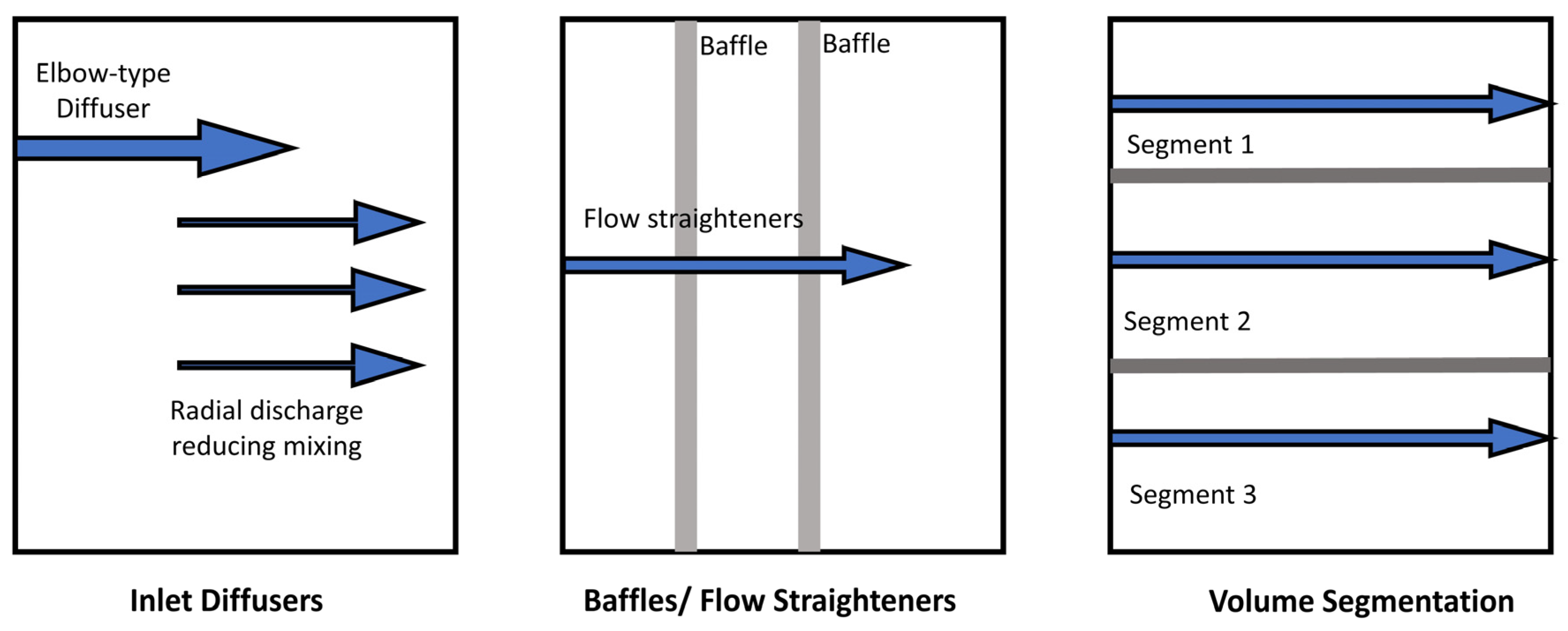
Effective exploitation of the usable capacity relies on preserving thermal stratification (hot top, cold bottom) so that the temperature difference is available at higher exergy. Practical measures include inlet diffusers and ports at different heights to introduce charge/discharge flows gently and reduce momentum-driven mixing; an optimized diffuser geometry (radial, nonequal-diameter, elbow-type) has been shown experimentally and numerically to improve stratification and reduce the thermocline thickness [107,108]. Similarly, baffles and flow straighteners (plates or perforated diffusers) can dissipate inlet kinetic energy and preserve layering; small-scale experiments and CFD studies demonstrate significant stratification gains with appropriately designed baffles [109,110]. In volume segmentation and multi-tank banks, using multiple smaller tanks or internal segmented volumes (e.g., cascade of tanks) can retain stratification more easily than a single large mixed tank and allow staged charging/discharging strategies (Figure 9). This is commonly practiced in district heating and biomass-TES designs [102].
Designers should specify inlet velocities, diffuser discharge patterns, and port heights during early design and validate the stratification with transient simulation (CFD or simplified layered models) since stratification directly affects the retrieved usable energy and system COP [104]. Maintaining stratification improves the storage efficiency, reduces energy losses, and supports low-emission, resource-efficient thermal management in agricultural facilities.

5.5. Integration with Building Envelope, HVAC, Heat Pumps, Refrigeration Systems, and Renewables

Thermal energy storage (TES) must be sized and controlled within a whole-system design framework to maximize the efficiency and economic performance in agricultural applications. When integrated with heat pumps and solar thermal collectors, TES can store surplus heat during high-generation periods and enable time-shifting of heat-pump operation to off-peak hours, improve the overall COP by stabilizing compressor operation and aligning source temperatures with demand profiles. Several integrated design studies and pilot greenhouse systems highlight these benefits [111]. In systems using biomass boilers or combined heat and power (CHP), TES helps the plant operate near its optimal load while the storage tank absorbs short-term fluctuations and supports peak shaving, a trend commonly reported in biomass-TES sizing research [41]. Farms with simultaneous heating and cooling needs can further enhance system-level efficiency by coupling TES with refrigeration processes—for example, using waste heat recovery to charge storage or deploying coordinated hybrid TES–heat pump configurations—though such systems require carefully synchronized control to avoid operational conflicts and maximize economic value [111]. Because control strategies (rule-based, predictive, and model-predictive control) strongly influence both the required storage capacity and dispatch performance, TES sizing and control should be co-optimized using dynamic, system-level simulation approaches [103].

5.6. Physical Constraints: Footprint, Weight, Placement, Insulation, Frost Protection

Farm environments impose several practical constraints that significantly influence the selection, placement, and design of thermal storage tanks. Structural considerations are particularly important, as solid-media or concrete tanks impose substantial loads that require an adequate soil-bearing capacity and strong foundations, whereas water-based tanks occupy a larger volume but involve far fewer structural challenges [112]. The decision to place tanks indoors or outdoors also affects system performance. Outdoor installations demand higher levels of insulation, weather protection, and in some cases, frost mitigation while indoor placement minimizes standing thermal losses but competes with valuable operational space within barns or greenhouses [113]. In systems operating at low temperatures, frost protection becomes compulsory. Chilled loops or cold circuits may require antifreeze brines, glycol solutions, or mechanical freeze-protection measures to prevent damage to pipes and tanks exposed to harsh outdoor conditions [114].

6. Integration of Thermal Energy Storage in Smart Farm Systems

The integration of thermal energy storage (TES) into smart farm infrastructures enables the coordinated control of heating, cooling, and energy use, thereby improving efficiency, stability, and operational flexibility. In smart agricultural settings, TES systems are typically managed through multi-layer control architectures. At the supervisory level, an energy management system (EMS) oversees global optimization—evaluating price signals, weather forecasts, and farm operation schedules—while local controllers regulate pumps, valves, and heat exchangers to maintain desired temperatures in TES units such as hot-water tanks, chilled-water tanks, or phase-change material (PCM) modules [92,115]. IoT-based sensing networks support this hierarchy by continuously monitoring temperature profiles, flow rates, and the state of charge (SOC) of storage tanks, enabling data-driven and adaptive operation [116,117].
TES charging and discharging in smart farms can follow multiple control strategies. Rule-based strategies (e.g., time-of-day charging) store heat during off-peak hours or when renewable energy is in access. More advanced predictive strategies incorporate solar radiation forecasts, ambient temperature predictions, and energy price projections to schedule the optimal charging of thermal tanks [118]. Model predictive control (MPC) has gained particular attention due to its ability to handle system constraints and anticipate future thermal demands, providing an improved performance in dynamic agricultural environments such as greenhouses and dairy farms [119].
In terms of demand response, TES enables smart farms to shift thermal loads away from high-tariff periods by preheating or precooling storage tanks, thereby reducing electricity costs and mitigating peak loads on rural grids. Applications include greenhouse heating, where thermal energy stored during the daytime (via solar collectors or heat pumps) is discharged at night to maintain stable temperatures [120]; produce storage, where chillers operate during low-cost periods to charge cold-storage tanks [121]; and milk cooling, where TES buffers the sharp cooling loads immediately after milking [118]. Additionally, TES facilitates combined heating and cooling arrangements—for example, recovering waste heat from refrigeration systems and storing it for domestic or process heating needs [120].
Successful TES integration requires appropriate interface components, including pumps for circulation, valves for flow control, and heat exchangers for transferring charge between the TES medium and farm equipment. Accurate sensing of thermal parameters ensures reliable SOC estimation, prevents overcharging or thermal losses, and supports automated decision-making [116,117]. Overall, TES serves as a key enabler of flexible, efficient, and renewable-integrated smart farming systems. By decoupling thermal supply from demand, TES improves the part-load efficiency of farm energy systems and reduces the peak electrical demand, which is particularly critical for emission reduction and grid stability in rural agricultural contexts.

7. Performance Modeling and Simulation of Thermal Energy Storage Systems

Performance analysis of thermal energy storage (TES) systems in agricultural and smart-farm environments relies heavily on robust modeling and simulation frameworks. A variety of modeling approaches are used depending on the required level of detail and computational complexity. Simplified 0D and 1D tank models are widely applied to estimate charging–discharging behavior, temperature evolution, and energy balances under varying load conditions [32]. More detailed analyses employ computational fluid dynamics (CFD) to capture stratification, flow mixing, and buoyancy-driven convection inside hot-water or chilled-water tanks, offering higher accuracy for system optimization [122]. Intermediate-complexity methods such as the lumped capacitance approach and resistor–capacitor (RC) thermal network models provide a balance between resolution and computational efficiency, making them suitable for dynamic control studies in smart farms [123]. In more integrated assessments, co-simulation environments that couple buildings, greenhouses, or farm facilities with TES systems allow researchers to evaluate interactions between storage, HVAC operation, and environmental conditions [124].
A wide range of software tools is available for TES modeling. TRNSYS and Modelica are commonly used for detailed dynamic simulations of thermal storage tanks and integrated energy systems, while EnergyPlus is often applied in agricultural building studies that incorporate TES-enhanced HVAC operation [125]. MATLAB (R2023a, MathWorks Inc., Natick, MA, USA)/Simulink remains a standard tool for control-oriented modeling, MPC design, and system-level optimization [126].
To evaluate system performance, researchers rely on several key performance indicators (KPIs). As shown in Table 5, these include the round-trip efficiency, which measures the total recoverable energy; delivered temperature stability, important for maintaining greenhouse or storage-room climates; and the coefficient of performance (COP) impact when TES is coupled with heat pumps or chillers [118]. Additional KPIs such as storage utilization, energy savings, peak load reduction, and economic indicators like the payback time or life-cycle cost help quantify operational and financial benefits in smart-farm settings [95].
Validation of TES models is typically performed using either experimental testbeds or numerical verification. Experimental validation involves controlled laboratory-scale tanks, PCM modules, or pilot-scale farm installations to measure temperature distribution, heat losses, and charging–discharging performance [146]. Numerical validation compares model predictions with high-fidelity CFD simulations or benchmark datasets to ensure stability, accuracy, and reliability across different operating conditions [122].
In terms of sustainability, these approaches enable the design of TES systems that minimize thermal losses, reduce oversizing, and improve overall system efficiency across varying agricultural load conditions. By supporting optimized control strategies and technology selection, these tools contribute to lower energy consumption, reduced operational emissions, and improved resilience of farm energy systems under climate and market variability.

8. Control and Sensing in Smart Thermal Energy Storage Systems

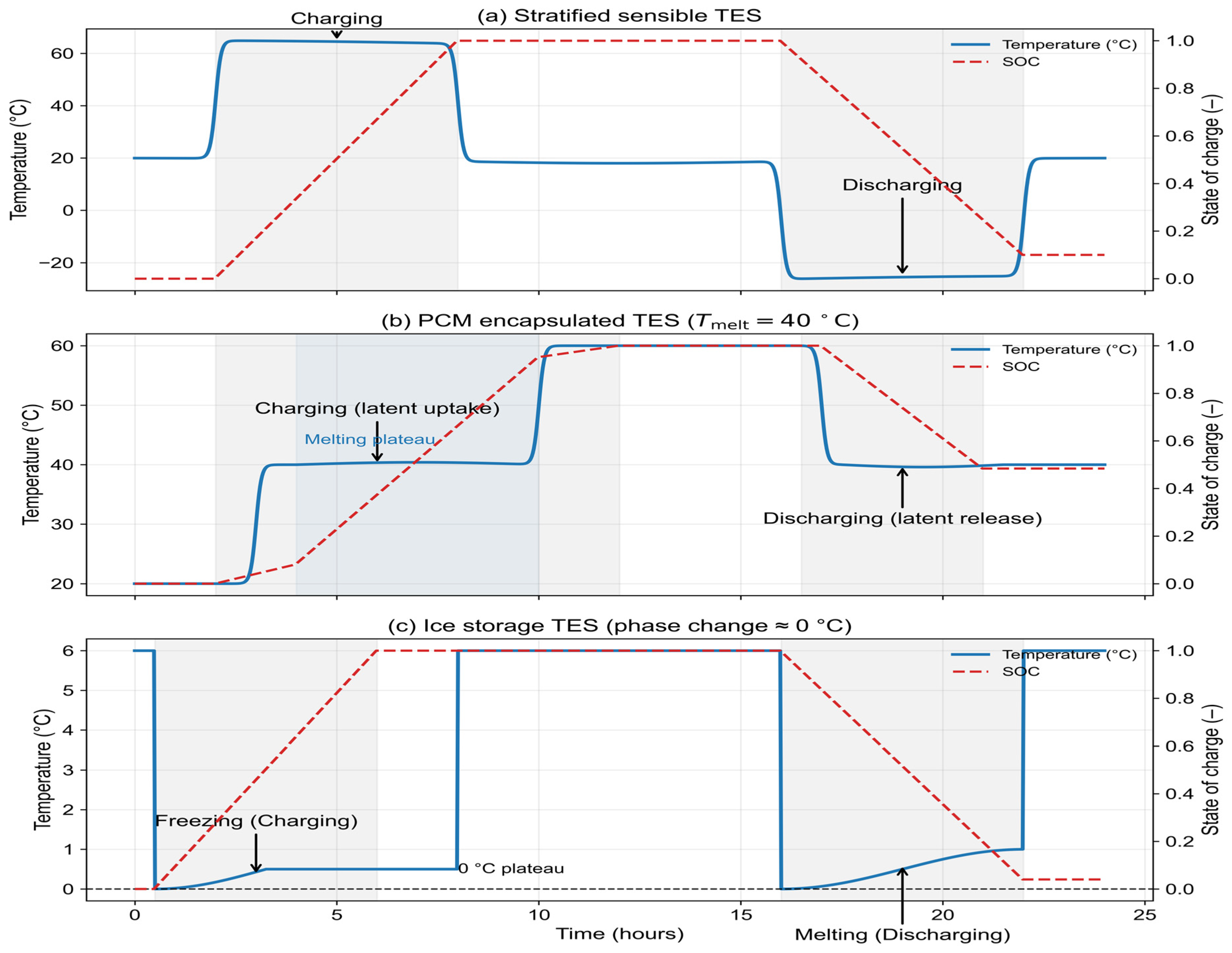
Advanced control and sensing technologies play a critical role in enabling the smart operation of thermal energy storage (TES) systems in agriculture. One of the most important functions is state-of-charge (SOC) estimation, which reflects the amount of usable thermal energy remaining in hot-water or chilled-water tanks. Several SOC estimation approaches have been reported, ranging from temperature-stratification-based methods, which infer available energy by measuring vertical temperature gradients inside the tank [147], to more advanced energy- and entropy-based estimators that model thermodynamic properties to improve accuracy under dynamic charging–discharging conditions [148]. Accurate SOC estimation is essential for predictive control, load shifting, and optimal coordination with heat pumps, chillers, or on-site renewable energy sources. Figure 10 illustrates how sensible, PCM, and ice TES systems respond during charging and discharging in terms of the temperature and state of charge.
Effective SOC monitoring also depends on sensor placement strategies. Proper placement of temperature sensors along the height of a storage tank enables the precise detection of thermocline movement and thermal stratification, which strongly influences the heat recovery efficiency [149]. Inadequate sensor spacing or poor vertical coverage can lead to errors in SOC estimation, particularly when stratification weakens due to mixing or high mass-flow rates. Recent studies have explored optimal sensor configurations using sensitivity analysis and model-based optimization to balance accuracy and cost [147].
Smart TES installations also integrate fault detection and diagnostics (FDD) to ensure a reliable operation. Common faults include tank leakage, loss of stratification due to mixing or sensor degradation, and pump or valve failures that affect charging cycles. Data-driven and model-based FDD methods have been applied to thermal storage systems to identify abnormal temperature patterns, unexpected flow conditions, or deviations from predicted SOC trajectories [150]. Such diagnostic tools are particularly valuable in remote farm settings where continuous human monitoring is difficult.
To support integrated control, TES systems in smart farms rely on communication standards and secure data exchange within the farm’s energy management system (EMS). Protocols such as Modbus, BACnet, and MQTT are commonly used for sensor communication and real-time monitoring [151]. As farms become increasingly digitalized, cybersecurity has become an essential consideration, with risks related to unauthorized data access, manipulation of control signals, and disruption of automation processes. Best practices include encrypted data communication, secure authentication, and regular network auditing to safeguard EMS operations [152].
Overall, the combination of accurate sensing, smart control algorithms, fault diagnostics, and secure communication forms the cornerstone of genuine TES integration in next-generation smart farming systems. From an environmental standpoint, advanced sensing and control of TES systems reduce energy waste by preventing overcharging, unnecessary heat losses, and inefficient cycling. Reliable SOC estimation and fault diagnostics improve the system lifetime and operational stability, lowering material replacement needs and embodied emissions. In digitally managed smart farms, secure and adaptive TES control supports higher renewable energy utilization while enhancing resilience in remote and resource-constrained agricultural settings.

9. Economic and Environmental Analysis

9.1. CapEx and OpEx Drivers

The economic performance of thermal and cold energy storage systems is strongly shaped by both capital expenses (CapEx) and operating expenses (OpEx). CapEx is mainly influenced by tank construction materials, phase-change materials (PCMs) or sensible storage media, insulation quality, and auxiliary components such as pumps, valves, and controls. For example, steel tanks with high-density insulation can significantly increase upfront costs, while PCM-enhanced systems often require additional encapsulation or heat exchangers, further raising the initial investment [95,153].
OpEx is dictated by maintenance needs, thermal losses through the insulation, and electricity costs associated with charging/discharging. Systems integrated with heat pumps or chillers may also experience varying operating costs depending on the efficiency and tariff periods. Thus, both CapEx and OpEx must be evaluated together to understand the total financial burden across the system’s lifetime.

9.2. Life-Cycle Assessment (LCA)

Life-cycle assessment (LCA) provides a structured approach to evaluating the environmental impacts of thermal energy storage (TES) systems across material production, installation, operation, and end-of-life stages. In agricultural applications, direct environmental impacts mainly arise from material-intensive components such as storage tanks, insulation, and phase-change materials. In contrast, indirect benefits are primarily associated with a reduced peak electricity demand and improved integration of renewable energy during operation [145,154].
While several studies suggest that operational benefits can offset initial embodied impacts, agriculture-specific LCA evidence remains limited, and reported outcomes are highly context-dependent. Uncertainties related to material durability, PCM degradation, and end-of-life management persist. Consequently, the sustainability performance of TES in agricultural systems should be evaluated on a case-by-case basis rather than assumed to be universally positive.

9.3. Levelized Cost of Storage (LCOS) for Thermal Energy Storage

The concept of a levelized cost of storage (LCOS), originally developed for electrical energy storage, is now widely applied to assess the economics of thermal energy storage (TES) systems. In the thermal domain, the LCOS typically incorporates several key parameters, including the initial capital investment, annual operation and maintenance expenses, expected system lifetime, round-trip thermal efficiency, and the useful thermal energy delivered each year [155,156].
TES technologies usually benefit from lower capital costs and longer operational lifespans compared to electrochemical batteries, making their LCOSs particularly competitive in applications such as district or building-level heating. Research shows that TES achieves significantly lower LCOS values when integrated with strategies like peak-load reduction or time-of-use shifting, or when operated alongside high-efficiency heat pumps to raise the overall system coefficient of performance (COP) [156]. For example, Ref. [155] demonstrated that these operational strategies can substantially improve the cost-effectiveness of thermal storage in heating networks.

9.4. Incentives and Tariff Structures for Thermal Storage

The economic feasibility of thermal energy storage is highly dependent on the local energy pricing framework, with several tariff and policy mechanisms playing critical roles. These include
  • Time-of-use (TOU) electricity pricing, where charging TES during low-price periods reduces operating cost.
  • Demand charges, which reward shifting heating-related electrical loads away from peak hours.
  • Seasonal tariffs, particularly relevant where winter heating electricity prices are elevated.
  • Incentives for renewable energy utilization, encouraging TES to store surplus solar or other renewable heat.
  • Grid flexibility or demand-response programs, where TES provides thermal load shifting.
  • Energy efficiency rebates, supporting the adoption of high-efficiency heating and storage technologies.
In many areas, thermal storage systems set up for building or agricultural heating can gain shortened payback periods by shifting heat production to off-peak hours and reducing the peak electricity demand. Policy mechanisms that reward load flexibility or renewable integration have been shown to reduce payback durations significantly—for example, from more than a decade to 3–5 years, depending on the TES capacity, insulation quality, and control strategy [118,142,157].
From a life-cycle viewpoint, tank-based TES systems provide environmental benefits that extend beyond direct cost savings. Although initial embodied energy and material impacts contribute to CapEx, these are typically offset over the system lifetime through reduced fossil fuel use, improved renewable energy utilization, and a lower peak electricity demand. When evaluated using the levelized cost of storage (LCOS), TES often demonstrates a favorable long-term sustainability performance due to its long service life, high cycle stability, and low operational emissions compared with electrochemical storage. Additional environmental co-benefits include reduced grid congestion, lower indirect CO2 emissions, and enhanced energy resilience in agricultural systems, supporting climate-smart and resource-efficient farming practices.

10. Case Studies and Applications of Thermal Energy Storage in Agriculture

Thermal energy storage (TES) has been increasingly applied across agricultural systems, particularly in greenhouse heating, dairy processing, and integrated renewable energy farms. These applications demonstrate TES’s ability to improve heating flexibility, reduce fossil-fuel consumption, and support greater utilization of solar thermal and geothermal resources. One representative example is the hybrid renewable energy system installed at the Purme Social Farm in Yeoju, South Korea, where solar thermal collectors, a water-based tank TES (TTES), and a borehole seasonal thermal energy storage (BTES) unit were deployed. Long-term monitoring showed strong thermal stratification, a high renewable heat contribution, and substantial reductions in conventional heating demand [158,159,160]. Similar trends were observed in a citrus greenhouse in South Korea, where a 2905 m3 BTES coupled with solar collectors achieved an estimated solar fraction of approximately 80% and demonstrated long-term thermal stability [161,162]. Economic modeling of BTES for greenhouse heating has also produced favorable results. For example, studies on mid-size (≈1300 m2) greenhouses have shown that optimizing borehole numbers and storage volumes can result in payback periods in the range of 5–7 years [163,164,165,166].
Other regions have implemented TES to support greenhouse climate control and reduce cooling/heating costs. In Malaysia, a TES-integrated cooling system for lowland greenhouses demonstrated substantial savings—up to 60–70% annual electricity reduction—compared with standalone air-conditioning systems [167,168]. Broader reviews confirm that both sensible storage (water tanks, underground reservoirs) and latent storage (PCM-based systems) help buffer temperature fluctuations, improve microclimate stability, and shift thermal loads to off-peak energy periods [92,169,170,171].
TES has also gained traction in agro-industrial processes, particularly in dairy operations where heat is required sporadically for pasteurization, mixing, and cleaning-in-place cycles. Phase-change material (PCM)-enhanced TES systems incorporated into water-jacketed dairy equipment have demonstrated the ability to maintain stable thermal conditions and reduce the peak energy demand, supported by both laboratory experiments and CFD simulations [172]. Large dairy facilities have also examined the integration of TES with heat pumps and CO2-based thermal systems, reporting reduced energy consumption and lower greenhouse gas emissions [142,173].
Pilot and demonstration-scale testbeds further illustrate TES’s potential benefits on farms. For example, the Nexus Farm project implemented a 5680 L above-ground water tank with solar collectors for greenhouse heating, achieving an approximately 30% reduction in heating energy compared to conventional approaches [174,175]. Additional testbeds—including PCM-enhanced greenhouse structures, solar-assisted water tanks, and underground TES systems—have shown improvements in temperature uniformity, renewable energy use, and overall energy efficiency [176]. Table 6 describes several case studies investigated in different regions of the world.
Table 6 shows that latent, sensible, and seasonal TES systems have been successfully applied in building and district energy systems, delivering meaningful reductions in peak demand, improvements in energy efficiency, and lower reliance on fossil fuels. Although most of these examples are drawn from non-agricultural settings, they offer practical and well-tested insights into storage design, system sizing, and control strategies that can be readily adapted to agricultural facilities with comparable thermal behavior, such as greenhouses, livestock buildings, and on-farm processing units. Chilled-water and PCM-based systems, in particular, appear well suited for cooling-dominated agricultural applications, whereas large water tanks and pit TES systems provide useful guidance for meeting seasonal heating demands in energy-intensive farming operations. At the same time, the limited availability of long-term, field-scale TES demonstrations in agricultural contexts points to an important research gap, highlighting the need for targeted validation of these established TES concepts under farm-specific operating conditions and sustainability requirements.
Across these studies, a consistent trend emerges in which TES can enhance energy efficiency, increase renewable heat utilization, and strengthen the resilience of agricultural energy systems. Nonetheless, many implementations remain pilot-scale or limited to simulation studies, indicating the need for broader commercial deployment and long-term field evaluation [118,169].

11. Challenges, Limitations, and Safety Considerations

Despite the clear benefits of thermal energy storage (TES) in agricultural systems, several technical and operational problems still limit extensive adoption. From a technical perspective, thermal losses, particularly in inefficient insulated tanks or underground systems, remain a major obstruction and can significantly reduce the effective storage capacity over time [95]. Systems utilizing phase-change materials (PCMs) raise additional concerns, including material degradation, subcooling, and reduced performance after repeated freeze–thaw cycles [187]. In water-based or brine-based storage units, long-term operation may also lead to corrosion, fouling, and mineral scaling, which increase maintenance requirements and reduce the equipment lifetime [188].
Operationally, TES deployment on farms needs advanced control and forecasting capabilities, as inaccurate scheduling of charging or discharging can decline efficiency or disrupt farm thermal processes. Integrating TES with legacy heating systems, older boilers, or low-efficiency distribution networks can be composite, often requiring retrofits or hybrid operation strategies [189]. Weather and load forecasting errors—common in agricultural settings—may reduce predicted savings or impede temperature control in sensitive applications such as greenhouses or dairy processing.
Safety considerations also impose design and regulatory limitations. Hot-water tanks and pressurized vessels must comply with pressure and temperature safety standards, while some organic PCMs pose fire hazards due to flammability and must be housed in proper containment systems [190,191]. Environmental risks related to PCM leakage and end-of-life disposal must also be considered, as improper handling can lead to soil or water contamination. Although TES itself does not entail hazardous refrigerants, systems that interact with heat pumps or refrigeration units may introduce refrigerant leakage risks, requiring adherence to environmental and safety regulations such as F-gas standards [192].
Finally, the scalability of TES remains a complication. Small farms may face cost and space barriers, whereas large industrial farming operations require high-capacity storage and more advanced control architectures to manage dynamic heating and cooling loads [193,194,195,196]. From a long-term sustainability perspective, improving the material durability, recyclability of PCMs, and modular system design is essential to reduce environmental impacts and ensure economically viable deployment across diverse farm scales.

12. Research Gaps and Future Directions

Regardless of the explained benefits, several gaps still limit the sustainable and widespread adoption of thermal energy storage (TES) in agriculture. From a life-cycle perspective, there is a shortage of long-term studies on the environmental performance of TES materials, particularly the durability, recyclability, and end-of-life management of PCMs, insulation, and tank materials. Eco-friendly, farm-relevant PCMs with high cycling stability remain underdeveloped.
Adoption barriers are largely technical and economic. Reliable state-of-charge estimation under variable agricultural loads remains complicated, particularly in stratified tanks. In addition, high upfront costs, limited space availability, and the absence of low-cost, robust sensors and simplified IoT solutions hinder deployment on small and medium-sized farms.
Policy and standardization gaps further constrain execution. The lack of standardized performance metrics, testing protocols, and sustainability indicators (e.g., life-cycle emissions, energy payback time) complicates a comparison across TES technologies. Clear policy frameworks, incentives, and inclusion of TES within agricultural energy standards are required to speed up market uptake.
Addressing these sustainability, adoption, and policy gaps is vital for positioning TES as a scalable and climate-resilient solution in future smart agricultural systems.

13. Conclusions

Thermal energy storage (TES) provides a clear pathway toward sustainable agriculture by enabling the efficient use of renewable heat, reducing fossil-fuel dependence, and stabilizing thermal conditions in greenhouses, livestock housing, and agro-processing facilities. Among the currently available technologies, tank-based sensible heat storage remains the most practical and widely adopted TES solution due to its low cost, durability, and ease of integration. PCM-based and ice-based latent TES offer higher-energy-density and compact solutions, particularly where space is limited or cooling-intensive applications exist, while thermochemical TES shows long-duration potential but is currently constrained by material stability, system complexity, and economic feasibility.
Proper sizing, thermal stratification, and intelligent control enhance energy efficiency, reduce operating costs, and lower greenhouse gas emissions. Policy support, including targeted incentives, standardized performance metrics, and integration of TES into energy-efficiency and renewable-heat strategies, can further accelerate adoption, particularly in rural and resource-constrained agricultural settings. For practical implementation, simple and robust TES designs integrated with solar thermal systems or heat pumps, alongside basic monitoring and control, are recommended.
Looking forward, the most critical research priorities include
  • Long-term field validation of TES systems across diverse agricultural settings.
  • Development of standardized performance metrics for farm-scale TES applications.
  • Deeper integration with IoT-based monitoring, predictive control, and energy management platforms.
  • Comprehensive cost–benefit and life-cycle assessments across different climates and farm types.
  • Design of scalable, modular TES systems suitable for smallholder farms.
Addressing these priorities will support a wider adoption, maximize the sustainability benefits, and reinforce TES as a cornerstone of resilient, low-carbon agricultural systems, thereby providing actionable guidance for both researchers and practitioners.

Supplementary Materials

The following supporting information can be downloaded at: https://www.mdpi.com/article/10.3390/su18031311/s1, Table S1: PRISMA 2020 Checklist.

Author Contributions

Conceptualization, A.M., H.-S.M., and C.-J.Y.; writing—original draft preparation, A.M. and H.-S.M.; writing—review and editing, A.M., H.-S.M., E.B.L., M.S., M.K.H., J.-G.K., Y.-H.K., H.-R.P., S.-B.R., and C.-J.Y.; supervision and funding acquisition, C.-J.Y. All authors have read and agreed to the published version of the manuscript.

Funding

This research received no external funding.

Institutional Review Board Statement

Not applicable.

Informed Consent Statement

Not applicable.

Data Availability Statement

No new data were created or analyzed in this study.

Acknowledgments

This work was supported by the Korea Institute of Planning and Evaluation for Technology in Food, Agriculture and Forestry (IPET) and Korea Smart Farm R&D Foundation through the Smart Farm Innovation Technology Development Program, funded by the Ministry of Agriculture, Food and Rural Affairs (MAFRA), Ministry of Science and ICT (MSIT), and Rural Development Administration (RDA) (RS-2025-02219443). This work was also supported by the Korea Institute of Energy Technology Evaluation and Planning (KETEP) and the Ministry of Trade, Industry & Energy (MOTIE) of the Republic of Korea (No. RS-2024-00441855).

Conflicts of Interest

Author Sang-Bum Ryu was employed by the company Soo Energy Co., Ltd. The remaining authors declare that the research was conducted in the absence of any commercial or financial relationships that could be construed as a potential conflict of interest.

Nomenclature

Symbols
SDG 2Zero Hunger
SDG 7Affordable and Clean Energy
SDG 12Responsible Consumption and Production
SDG 13Climate Action
QStored thermal energy (kJ)
mMass (kg)
cpSpecific heat capacity (J·kg−1·K−1)
ΔTTemperature difference (K or °C)
LLatent heat of phase change (J·kg−1)
TinInlet temperature (K or °C)
ToutOutlet temperature (K or °C)
Abbreviations
The following abbreviations are used in this manuscript:
TESThermal energy storage
PCMsPhase-change materials
SDGsSustainable Development Goals
KPIsKey performance indicators
HVACHeating, ventilation, and air conditioning
PRISMAPreferred Reporting Items for Systematic Reviews and Meta-Analyses
MDPIMultidisciplinary Digital Publishing Institute
CHPCombined heat and power
CESCold energy storage
SHSSensible heat storage
IoTInternet of Things
TCESThermochemical energy storage
COPCoefficient of performance
CFDComputational fluid dynamics
EMSEnergy management system
SOCState of charge
MPCModel predictive control
RCResistor–capacitor
FDDFault detection and diagnosis
MQTTMessage queuing telemetry transport
CapExCapital expenses
OpExOperating expenses
LCALife-cycle assessment
LCOSLevelized cost of storage
TOUTime of use
TTESTank thermal energy storage
BTESBorehole seasonal thermal energy storage
ANCCAalto New Campus Complex
GSHPGround-source heat pump
CSPConcentrated solar power
TRLTechnology readiness level
HTFHeat transfer fluid
TGAThermogravimetric analysis
DSCDifferential scanning calorimetry
DVSDynamic vapor sorption

References

  1. Miró, L.; Gasia, J.; Cabeza, L.F. Thermal Energy Storage (TES) for Industrial Waste Heat (IWH) Recovery: A Review. Appl. Energy 2016, 179, 284–301. [Google Scholar] [CrossRef]
  2. Parameshwaran, R.; Kalaiselvam, S.; Harikrishnan, S.; Elayaperumal, A. Sustainable Thermal Energy Storage Technologies for Buildings: A Review. Renew. Sustain. Energy Rev. 2012, 16, 2394–2433. [Google Scholar] [CrossRef]
  3. Sarbu, I.; Sebarchievici, C.; Sarbu, I.; Sebarchievici, C. A Comprehensive Review of Thermal Energy Storage. Sustainability 2018, 10, 191. [Google Scholar] [CrossRef]
  4. Meng, F.; Yu, Y.; Wu, Y.; Li, D.; Zhao, X.; Meng, L.; Wang, Z. Study on Energy Flow Characteristics of Solar–Gas Combined Heating System for Settling Tank of Oilfield. Sustainability 2023, 15, 12229. [Google Scholar] [CrossRef]
  5. Abdullah; Koushaeian, M.; Shah, N.A.; Chung, J.D. A Review on Thermochemical Seasonal Solar Energy Storage Materials and Modeling Methods. Int. J. Air-Cond. Ref. 2024, 32, 1. [Google Scholar] [CrossRef]
  6. Carrillo, A.J.; González-Aguilar, J.; Romero, M.; Coronado, J.M. Solar Energy on Demand: A Review on High Temperature Thermochemical Heat Storage Systems and Materials. Chem. Rev. 2019, 119, 4777–4816. [Google Scholar] [CrossRef]
  7. Yang, T.; Liu, W.; Kramer, G.J.; Sun, Q. Seasonal Thermal Energy Storage: A Techno-Economic Literature Review. Renew. Sustain. Energy Rev. 2021, 139, 1–22. [Google Scholar] [CrossRef]
  8. Choi, S.-G.; Park, D.-Y.; Choi, D.-S.; Jung, Y.-H.; Choi, S.-G.; Park, D.-Y.; Choi, D.-S.; Jung, Y.-H. Performance Analysis of Thermal Energy Storage Tanks and Chillers for Optimizing Cooling Efficiency in Smart Greenhouses in Hot and Arid Climates. Sustainability 2024, 16, 11136. [Google Scholar] [CrossRef]
  9. Maraveas, C.; Karavas, C.-S.; Loukatos, D.; Bartzanas, T.; Arvanitis, K.G.; Symeonaki, E. Agricultural Greenhouses: Resource Management Technologies and Perspectives for Zero Greenhouse Gas Emissions. Agriculture 2023, 13, 1464. [Google Scholar] [CrossRef]
  10. Mehraj, N.; Mateu, C.; Zsembinszki, G.; Cabeza, L.F. Optimizing the Design of TES Tanks for Thermal Energy Storage Applications Through an Integrated Biomimetic-Genetic Algorithm Approach. Biomimetics 2025, 10, 197. [Google Scholar] [CrossRef] [PubMed]
  11. Intergovernmental Panel on Climate Change. Climate Change 2007: Impacts, Adaptation and Vulnerability; Cambridge University Press: Geneva, Switzerland, 2001.
  12. Bazilian, M.; Rogner, H.; Howells, M.; Hermann, S.; Arent, D.; Gielen, D.; Steduto, P.; Mueller, A.; Komor, P.; Tol, R.S.J.; et al. Considering the Energy, Water and Food Nexus: Towards an Integrated Modelling Approach. Energy Policy 2011, 39, 7896–7906. [Google Scholar] [CrossRef]
  13. Khan, A.T.; Banik, D. Climate-Smart Agriculture: Pathways to Resilient Farming Systems. Vigyan Varta 2025, 6, 261–267. [Google Scholar]
  14. Naik, B.M.; Singh, A.K.; Venkatesan, P.; Maji, S.; Sunil, J.; Naik, M.R. Assessing the Contribution of Climate Resilient Agricultural Technologies in Advancing Sustainable Development Goals in Telangana, India. Discov. Sustain. 2025, 6, 117. [Google Scholar] [CrossRef]
  15. Ouda, S.; Zohry, A.E.-H. Climate-Smart Agriculture: Reducing Food Insecurity; Springer International Publishing: Cham, Switzerland, 2022; ISBN 978-3-030-93110-0. [Google Scholar]
  16. Sayed, Z. Transforming Our World: The 2030 Agenda for Sustainable Development. Ethics Crit. Think. J. 2015, 2015, 112. [Google Scholar]
  17. Cabeza, L.F.; Martorell, I.; Miró, L.; Fernández, A.I.; Barreneche, C. Introduction to Thermal Energy Storage (TES) Systems. In Advances in Thermal Energy Storage Systems; Elsevier: Amsterdam, The Netherlands, 2015; pp. 1–28. [Google Scholar]
  18. Lund, H.; Werner, S.; Wiltshire, R.; Svendsen, S.; Thorsen, J.E.; Hvelplund, F.; Mathiesen, B.V. 4th Generation District Heating (4GDH): Integrating Smart Thermal Grids into Future Sustainable Energy Systems. Energy 2014, 68, 1–11. [Google Scholar] [CrossRef]
  19. Tassou, S.A.; Lewis, J.S.; Ge, Y.T.; Hadawey, A.; Chaer, I. A Review of Emerging Technologies for Food Refrigeration Applications. Appl. Therm. Eng. 2010, 30, 263–276. [Google Scholar] [CrossRef]
  20. Selvnes, H.; Allouche, Y.; Manescu, R.I.; Hafner, A. Review on Cold Thermal Energy Storage Applied to Refrigeration Systems Using Phase Change Materials. Therm. Sci. Eng. Prog. 2021, 22, 100807. [Google Scholar] [CrossRef]
  21. Bespalko, S. Overview of the Existing Heat Storage Technologies: Sensible Heat. Acta Innov. 2018, 28, 82–113. [Google Scholar] [CrossRef]
  22. Nkwetta, D.N.; Haghighat, F. Thermal Energy Storage with Phase Change Material—A State-of-the Art Review. Sustain. Cities Soc. 2014, 10, 87–100. [Google Scholar] [CrossRef]
  23. Prasad, D.M.R.; Senthilkumar, R.; Lakshmanarao, G.; Krishnan, S.; Prasad, B.S.N.; Prasad, D.M.R.; Senthilkumar, R.; Lakshmanarao, G.; Krishnan, S.; Prasad, B.S.N. A Critical Review on Thermal Energy Storage Materials and Systems for Solar Applications. Aims Energy 2019, 7, 507–526. [Google Scholar] [CrossRef]
  24. Njoku, H.O.; Ekechukwu, O.V.; Onyegegbu, S.O. Analysis of Stratified Thermal Storage Systems: An Overview. Heat Mass Transf. 2014, 50, 1017–1030. [Google Scholar] [CrossRef]
  25. Han, Y.M.; Wang, R.Z.; Dai, Y.J. Thermal Stratification within the Water Tank. Renew. Sustain. Energy Rev. 2009, 13, 1014–1026. [Google Scholar] [CrossRef]
  26. Badescu, V. Optimal Operation of Thermal Energy Storage Units Based on Stratified and Fully Mixed Water Tanks. Appl. Therm. Eng. 2004, 24, 2101–2116. [Google Scholar] [CrossRef]
  27. Chukwudi, B.C.; Ogunedo, M.B. Design and Construction of a Shell and Tube Heat Exchanger. Elixir Mech. Engg. 2018, 118, 50687–50691. [Google Scholar]
  28. Singh, H.; Saini, R.P.; Saini, J.S. A Review on Packed Bed Solar Energy Storage Systems. Renew. Sustain. Energy Rev. 2010, 14, 1059–1069. [Google Scholar] [CrossRef]
  29. Martínez, F.R.; Borri, E.; Mani Kala, S.; Ushak, S.; Cabeza, L.F. Phase Change Materials for Thermal Energy Storage in Industrial Applications. Heliyon 2025, 11, e41025. [Google Scholar] [CrossRef]
  30. Zhang, S.; Li, X.; Sun, Y.; Zeng, J.; Zhu, S.; Song, W.; Zhou, Y.; Ren, X.; Hai, C.; Shen, Y. Low-Cost Magnesium-Based Eutectic Salt Hydrate Phase Change Material with Enhanced Thermal Performance for Energy Storage. Sol. Energy Mater. Sol. Cells 2022, 238, 111620. [Google Scholar] [CrossRef]
  31. Junaid, M.F.; ur Rehman, Z.; Čekon, M.; Čurpek, J.; Farooq, R.; Cui, H.; Khan, I. Inorganic Phase Change Materials in Thermal Energy Storage: A Review on Perspectives and Technological Advances in Building Applications. Energy Build. 2021, 252, 111443. [Google Scholar] [CrossRef]
  32. Dincer, I.; Rosen, M.A. Thermal Energy Storage: Systems and Applications; John Wiley & Sons: Hoboken, NJ, USA, 2011; ISBN 978-1-119-95662-4. [Google Scholar]
  33. Kim, D.H.; Yoon, S.H.; Kim, Y.; Song, C.H.; Lee, K.H.; Choi, J.S. Experimental Studies of the Discharge Performance of Single-Medium TES for CSP Applications. Appl. Therm. Eng. 2017, 127, 499–507. [Google Scholar] [CrossRef]
  34. Page, M.J.; McKenzie, J.E.; Bossuyt, P.M.; Boutron, I.; Hoffmann, T.C.; Mulrow, C.D.; Shamseer, L.; Tetzlaff, J.M.; Akl, E.A.; Brennan, S.E. The PRISMA 2020 Statement: An Updated Guideline for Reporting Systematic Reviews. BMJ 2021, 372, n71. [Google Scholar] [CrossRef]
  35. Moher, D.; Liberati, A.; Tetzlaff, J.; Altman, D.G. Preferred Reporting Items for Systematic Reviews and Meta-Analyses: The PRISMA Statement. Int. J. Surg. 2010, 8, 336–341. [Google Scholar] [CrossRef]
  36. Moher, D.; Liberati, A.; Tetzlaff, J.; Altman, D.G. Preferred Reporting Items for Systematic Reviews and Meta-Analyses: The PRISMA Statement. BMJ 2009, 339, b2535. [Google Scholar] [CrossRef]
  37. Tranfield, D.; Denyer, D.; Smart, P. Towards a Methodology for Developing Evidence-Informed Management Knowledge by Means of Systematic Review. Br. J. Manag. 2003, 14, 207–222. [Google Scholar] [CrossRef]
  38. Siddaway, A.P.; Wood, A.M.; Hedges, L.V. How to Do a Systematic Review: A Best Practice Guide for Conducting and Reporting Narrative Reviews, Meta-Analyses, and Meta-Syntheses. Annu. Rev. Psychol. 2019, 70, 747–770. [Google Scholar] [CrossRef] [PubMed]
  39. Liu, B.; Gao, W.; Li, Q.; Chen, H.; Zhang, Y.; Ding, X. Quantification of Thermal Stratification and Its Impact on Energy Efficiency in Solar Hot Water Storage Tanks. Energy 2025, 326, 136243. [Google Scholar] [CrossRef]
  40. Lugolole, R.; Mawire, A.; Lentswe, K.A.; Okello, D.; Nyeinga, K. Thermal Performance Comparison of Three Sensible Heat Thermal Energy Storage Systems during Charging Cycles. Sustain. Energy Technol. Assess. 2018, 30, 37–51. [Google Scholar] [CrossRef]
  41. Wang, K.; Satyro, M.A.; Taylor, R.; Hopke, P.K. Thermal Energy Storage Tank Sizing for Biomass Boiler Heating Systems Using Process Dynamic Simulation. Energy Build. 2018, 175, 199–207. [Google Scholar] [CrossRef]
  42. Dolgun, G.K.; Keçebaş, A.; Ertürk, M.; Daşdemir, A. Optimal Insulation of Underground Spherical Tanks for Seasonal Thermal Energy Storage Applications. J. Energy Storage 2023, 69, 107865. [Google Scholar] [CrossRef]
  43. Kumar, G.S.; Nagarajan, D.; Chidambaram, L.A.; Kumaresan, V.; Ding, Y.; Velraj, R. Role of PCM Addition on Stratification Behaviour in a Thermal Storage Tank—An Experimental Study. Energy 2016, 115, 1168–1178. [Google Scholar] [CrossRef]
  44. Liang, H.; Liu, L.; Zhong, Z.; Gan, Y.; Wu, J.-Y.; Niu, J. Towards Idealized Thermal Stratification in a Novel Phase Change Emulsion Storage Tank. Appl. Energy 2022, 310, 118526. [Google Scholar] [CrossRef]
  45. Meng, Z.N.; Zhang, P. Experimental and Numerical Investigation of a Tube-in-Tank Latent Thermal Energy Storage Unit Using Composite PCM. Appl. Energy 2017, 190, 524–539. [Google Scholar] [CrossRef]
  46. Castro-Vizcaíno, A.; Romero-Cano, M.S.; Bosch, J.L.; Ariza, M.J.; Alonso-Montesinos, J.; Puertas, A.M.; Gil, B.; Rosiek, S. Performance of a Thermal Energy Storage Tank Based on Latent Heat with Different Capsule Allocations. Experimental Study in a Pilot Facility. J. Energy Storage 2026, 141, 119282. [Google Scholar] [CrossRef]
  47. Munir, Z.; Roman, F.; Niazi, B.M.K.; Mahmood, N.; Munir, A.; Hensel, O. Thermal Analysis of a Solar Latent Heat Storage System Using Scheffler Concentrator for Agricultural Applications. Appl. Therm. Eng. 2023, 218, 119230. [Google Scholar] [CrossRef]
  48. Munir, Z.; Roman, F.; Niazi, B.M.K.; Mahmood, N.; Munir, A.; Hensel, O. Parametric Analysis for Exergetic Optimisation of a Solar Shell-and-Tube Latent Heat Storage Unit for Agricultural Applications. Appl. Therm. Eng. 2023, 233, 121029. [Google Scholar] [CrossRef]
  49. Bianco, N.; Caliano, M.; Fragnito, A.; Iasiello, M.; Mauro, G.M.; Mongibello, L. Thermal Analysis of Micro-Encapsulated Phase Change Material (MEPCM)-Based Units Integrated into a Commercial Water Tank for Cold Thermal Energy Storage. Energy 2023, 266, 126479. [Google Scholar] [CrossRef]
  50. Hunt, J.D.; Issa, R.; Sanjivy, K.; Lucas, F.; Wada, Y. Integrating Seawater Air Conditioning and Mobilized Thermal Energy Storage. J. Energy Storage 2025, 113, 115638. [Google Scholar] [CrossRef]
  51. Oró, E.; Castell, A.; Chiu, J.; Martin, V.; Cabeza, L.F. Stratification Analysis in Packed Bed Thermal Energy Storage Systems. Appl. Energy 2013, 109, 476–487. [Google Scholar] [CrossRef]
  52. Hoseini Rahdar, M.; Emamzadeh, A.; Ataei, A. A Comparative Study on PCM and Ice Thermal Energy Storage Tank for Air-Conditioning Systems in Office Buildings. Appl. Therm. Eng. 2016, 96, 391–399. [Google Scholar] [CrossRef]
  53. Altuntas, M.; Erdemir, D. An Investigation on Potential Use of Ice Thermal Energy Storage System as Energy Source for Heat Pumps. J. Energy Storage 2022, 55, 105588. [Google Scholar] [CrossRef]
  54. Ezan, M.A.; Erek, A.; Dincer, I. Energy and Exergy Analyses of an Ice-on-Coil Thermal Energy Storage System. Energy 2011, 36, 6375–6386. [Google Scholar] [CrossRef]
  55. Dincer, I. On Thermal Energy Storage Systems and Applications in Buildings. Energy Build. 2002, 34, 377–388. [Google Scholar] [CrossRef]
  56. Yan, W.-M.; Huang, C.-Y.; Gao, K.-E.; Amani, M.; Chien, L.-H.; Homayooni, A. Study on the Performance Enhancement of Ice Storage and Melting Processes in an Ice-on-Coil Thermal Energy Storage System. J. Energy Storage 2023, 72, 108410. [Google Scholar] [CrossRef]
  57. Barbhuiya, S.; Das, B.B.; Idrees, M. Thermal Energy Storage in Concrete: A Comprehensive Review on Fundamentals, Technology and Sustainability. J. Build. Eng. 2024, 82, 108302. [Google Scholar] [CrossRef]
  58. Boquera, L.; Castro, J.R.; Pisello, A.L.; Cabeza, L.F. Research Progress and Trends on the Use of Concrete as Thermal Energy Storage Material through Bibliometric Analysis. J. Energy Storage 2021, 38, 102562. [Google Scholar] [CrossRef]
  59. Wang, S.; Abdulridha, A.; Bravo, J.; Naito, C.; Quiel, S.; Suleiman, M.; Romero, C.; Neti, S.; Oztekin, A. Thermal Energy Storage in Concrete: Review, Testing, and Simulation of Thermal Properties at Relevant Ranges of Elevated Temperature. Cem. Concr. Res. 2023, 166, 107096. [Google Scholar] [CrossRef]
  60. Dincer, I.; Dost, S.; Li, X. Performance Analyses of Sensible Heat Storage Systems for Thermal Applications. Int. J. Energy Res. 1997, 21, 1157–1171. [Google Scholar] [CrossRef]
  61. Li, G. Sensible Heat Thermal Storage Energy and Exergy Performance Evaluations. Renew. Sustain. Energy Rev. 2016, 53, 897–923. [Google Scholar] [CrossRef]
  62. Zurigat, Y.H.; Ghajar, A.J. In Sensible Heat Storage Systems. In Thermal Energy Storage: Systems and Applications; John Wiley & Sons: Hoboken, NJ, USA, 2002; p. 259. [Google Scholar]
  63. Rahjoo, M.; Caggiano, A.; Berardi, U.; Prabhu, A.; Dolado, J.S. Reviewing Numerical Studies on Sensible Thermal Energy Storage in Cementitious Composites: Report of the RILEM TC 299-TES. Mater. Struct. 2025, 58, 40. [Google Scholar] [CrossRef]
  64. Khan, Z.; Khan, Z.; Ghafoor, A. A Review of Performance Enhancement of PCM Based Latent Heat Storage System within the Context of Materials, Thermal Stability and Compatibility. Energy Convers. Manag. 2016, 115, 132–158. [Google Scholar] [CrossRef]
  65. Mika, Ł.; Radomska, E.; Sztekler, K.; Gołdasz, A.; Zima, W.; Mika, Ł.; Radomska, E.; Sztekler, K.; Gołdasz, A.; Zima, W. Review of Selected PCMs and Their Applications in the Industry and Energy Sector. Energies 2025, 18, 1233. [Google Scholar] [CrossRef]
  66. Aziz, S.; Amin, N.A.M.; Abdul Majid, M.S.; Belusko, M.; Bruno, F. CFD Simulation of a TES Tank Comprising a PCM Encapsulated in Sphere with Heat Transfer Enhancement. Appl. Therm. Eng. 2018, 143, 1085–1092. [Google Scholar] [CrossRef]
  67. Giménez, P.; Jové, A.; Prieto, C.; Fereres, S. Effect of an Increased Thermal Contact Resistance in a Salt PCM-Graphite Foam Composite TES System. Renew. Energy 2017, 106, 321–334. [Google Scholar] [CrossRef]
  68. Praveen, B.; Suresh, S. Thermal Performance of Micro-Encapsulated PCM with LMA Thermal Percolation in TES Based Heat Sink Application. Energy Convers. Manag. 2019, 185, 75–86. [Google Scholar] [CrossRef]
  69. Singh, R.; Sadeghi, S.; Shabani, B. Thermal Conductivity Enhancement of Phase Change Materials for Low-Temperature Thermal Energy Storage Applications. Energies 2019, 12, 75. [Google Scholar] [CrossRef]
  70. Chekifi, T.; Papurello, D.; Boukraa, M.; Chibani, A.; Khelifi, R.; di Schio, E.R.; Valdiserri, P.; Touafek, K. Advances in Micro- and Nano-Encapsulated Phase Change Materials for Solar Water Applications: A Comprehensive Review of Technological Progress and Future Research Directions. J. Energy Storage 2026, 141, 119166. [Google Scholar] [CrossRef]
  71. Moradi, H.; Mirjalily, S.A.A.; Oloomi, S.A.A.; Karimi, H. Performance Evaluation of a Solar Air Heating System Integrated with a Phase Change Materials Energy Storage Tank for Efficient Thermal Energy Storage and Management. Renew. Energy 2022, 191, 974–986. [Google Scholar] [CrossRef]
  72. Balachandran, S.; Bautista, D.W.R.; Edward, B.; Herald Wilson, V.; Swaminathan, J. Design and Analysis of IOT-Based Solar Dryer for Sustainable Farming. In Proceedings of the 2023 Innovations in Power and Advanced Computing Technologies (i-PACT), Kuala Lumpur, Malaysia, 8–12 December 2023; pp. 1–8. [Google Scholar]
  73. Poonia, S.; Singh, A.K.; Jain, D. Performance Evaluation of Phase Change Material (PCM) Based Hybrid Photovoltaic/Thermal Solar Dryer for Drying Arid Fruits. Mater. Today Proc. 2022, 52, 1302–1308. [Google Scholar] [CrossRef]
  74. Moon, B.E.; Kim, H.T. Evaluation of Thermal Performance through Development of a PCM-Based Thermal Storage Control System Integrated Unglazed Transpired Collector in Experimental Pig Barn. Sol. Energy 2019, 194, 856–870. [Google Scholar] [CrossRef]
  75. Batlles, F.J.; Gil, B.; Ushak, S.; Kasperski, J.; Luján, M.; Maldonado, D.; Nemś, M.; Nemś, A.; Puertas, A.M.; Romero-Cano, M.S.; et al. Development and Results from Application of PCM-Based Storage Tanks in a Solar Thermal Comfort System of an Institutional Building—A Case Study. Energies 2020, 13, 3877. [Google Scholar] [CrossRef]
  76. Tafone, A.; Pili, R.; Pihl Andersen, M.; Romagnoli, A. Dynamic Modelling of a Compressed Heat Energy Storage (CHEST) System Integrated with a Cascaded Phase Change Materials Thermal Energy Storage. Appl. Therm. Eng. 2023, 226, 120256. [Google Scholar] [CrossRef]
  77. Lombardo, G.; Zanetti, G.; Menegazzo, D.; Vallese, L.; Bordignon, S.; Carli, M.D.; Bottarelli, M.; Aydın, A.A.; Agresti, F.; Bobbo, S.; et al. Comparative Performance Analysis of Eutectic Salt-Water Solutions in Latent Thermal Energy Storage for Residential Applications: Insights from the ECHO Project. Appl. Therm. Eng. 2025, 268, 125917. [Google Scholar] [CrossRef]
  78. Thakare, K.A.; Bhave, A.G. Review on Latent Heat Storage and Problems Associated with Phase Change Materials. Int. J. Res. Eng. Technol. 2015, 4, 176–182. [Google Scholar] [CrossRef]
  79. André, L.; Abanades, S. Recent Advances in Thermochemical Energy Storage via Solid–Gas Reversible Reactions at High Temperature. Energies 2020, 13, 5859. [Google Scholar] [CrossRef]
  80. Gbenou, T.R.S.; Fopah-Lele, A.; Wang, K. Recent Status and Prospects on Thermochemical Heat Storage Processes and Applications. Entropy 2021, 23, 953. [Google Scholar] [CrossRef] [PubMed]
  81. Zhang, X.; Ameli, H.; Dong, Z.; Vecchi, A.; Gallego-Schmid, A.; Strbac, G.; Sciacovelli, A. Values of Latent Heat and Thermochemical Energy Storage Technologies in Low-Carbon Energy Systems: Whole System Approach. J. Energy Storage 2022, 50, 104126. [Google Scholar] [CrossRef]
  82. Solé, A.; Martorell, I.; Cabeza, L.F. State of the Art on Gas–Solid Thermochemical Energy Storage Systems and Reactors for Building Applications. Renew. Sustain. Energy Rev. 2015, 47, 386–398. [Google Scholar] [CrossRef]
  83. Wang, C.; Yang, H.; Nie, B.; Zou, B.; Li, Z.; Han, J.; Tong, L.; Wang, L.; Ding, Y. Discharging Behavior of a Shell-and-Tube Based Thermochemical Reactor for Thermal Energy Storage: Modeling and Experimental Validation. Int. J. Heat Mass Transf. 2022, 183, 122160. [Google Scholar] [CrossRef]
  84. Wu, J.; Long, X.F. Research Progress of Solar Thermochemical Energy Storage. Int. J. Energy Res. 2015, 39, 869–888. [Google Scholar] [CrossRef]
  85. Liu, D.; Xin-Feng, L.; Bo, L.; Si-quan, Z.; Yan, X. Progress in Thermochemical Energy Storage for Concentrated Solar Power: A Review. Int. J. Energy Res. 2018, 42, 4546–4561. [Google Scholar] [CrossRef]
  86. Han, X.; Liu, S.; Zeng, C. Innovating Thermochemical Energy Storage: Thermal Performance Enhancement of Cascade Reactor with Rotating Water Spray. Energy 2025, 340, 139315. [Google Scholar] [CrossRef]
  87. Abedin, A.H. A Critical Review of Thermochemical Energy Storage Systems. Open Renew. Energy J. 2011, 4, 42–46. [Google Scholar] [CrossRef]
  88. Farulla, G.A.; Cellura, M.; Guarino, F.; Ferraro, M.; Farulla, G.A.; Cellura, M.; Guarino, F.; Ferraro, M. A Review of Thermochemical Energy Storage Systems for Power Grid Support. Appl. Sci. 2020, 10, 3142. [Google Scholar] [CrossRef]
  89. Xu, H.J.; Han, X.C.; Hua, W.S.; Friedrich, D.; Santori, G.; Bevan, E.; Vafai, K.; Wang, F.Q.; Zhang, X.L.; Yu, G.J.; et al. Progress on Thermal Storage Technologies with High Heat Density in Renewables and Low Carbon Applications: Latent and Thermochemical Energy Storage. Renew. Sustain. Energy Rev. 2025, 215, 115587. [Google Scholar] [CrossRef]
  90. De Rosa, M.; Afanaseva, O.; Fedyukhin, A.V.; Bianco, V. Prospects and Characteristics of Thermal and Electrochemical Energy Storage Systems. J. Energy Storage 2021, 44, 103443. [Google Scholar] [CrossRef]
  91. Farid, M.M.; Khudhair, A.M.; Razack, S.A.K.; Al-Hallaj, S. A Review on Phase Change Energy Storage: Materials and Applications. Energy Convers. Manag. 2004, 45, 1597–1615. [Google Scholar] [CrossRef]
  92. Sharma, A.; Tyagi, V.V.; Chen, C.R.; Buddhi, D. Review on Thermal Energy Storage with Phase Change Materials and Applications. Renew. Sustain. Energy Rev. 2009, 13, 318–345. [Google Scholar] [CrossRef]
  93. Zalba, B.; Marín, J.M.; Cabeza, L.F.; Mehling, H. Review on Thermal Energy Storage with Phase Change: Materials, Heat Transfer Analysis and Applications. Appl. Therm. Eng. 2003, 23, 251–283. [Google Scholar] [CrossRef]
  94. Cabeza, L.F.; Castell, A.; Barreneche, C.; de Gracia, A.; Fernández, A.I. Materials Used as PCM in Thermal Energy Storage in Buildings: A Review. Renew. Sustain. Energy Rev. 2011, 15, 1675–1695. [Google Scholar] [CrossRef]
  95. Cabeza, L.F. Advances in Thermal Energy Storage Systems: Methods and Applications. In Advances in Thermal Energy Storage Systems; Elsevier: Amsterdam, The Netherlands, 2021; pp. 37–54. [Google Scholar]
  96. Karlina, Y.; Yerdesh, Y.; Toleukhanov, A.; Belyayev, Y.; Wang, H.S.; Botella, O. Numerical Simulation Study of Thermal Performance in Hot Water Storage Tanks with External and Internal Heat Exchangers. Energies 2024, 17, 5623. [Google Scholar] [CrossRef]
  97. Chung, J.D.; Cho, S.H.; Tae, C.S.; Yoo, H. The Effect of Diffuser Configuration on Thermal Stratification in a Rectangular Storage Tank. Renew. Energy 2008, 33, 2236–2245. [Google Scholar] [CrossRef]
  98. Martinazzoli, G.; Grassi, B.; Pasinelli, D.; Lezzi, A.M.; Pilotelli, M. Comparative Analysis of Thermal Energy Storage Performance in District Heating Networks: Evaluating the Impact of Different Injection Systems. Int. J. Heat. Technol. 2023, 41, 789–798. [Google Scholar] [CrossRef]
  99. Villasmil, W.; Fischer, L.J.; Worlitschek, J. A Review and Evaluation of Thermal Insulation Materials and Methods for Thermal Energy Storage Systems. Renew. Sustain. Energy Rev. 2019, 103, 71–84. [Google Scholar] [CrossRef]
  100. Emrani, A.; Berrada, A.; Ameur, A.; Bakhouya, M. Assessment of the Round-Trip Efficiency of Gravity Energy Storage System: Analytical and Numerical Analysis of Energy Loss Mechanisms. J. Energy Storage 2022, 55, 105504. [Google Scholar] [CrossRef]
  101. Wang, D.; Carmeliet, J.; Orehounig, K.; Wang, D.; Carmeliet, J.; Orehounig, K. Design and Assessment of District Heating Systems with Solar Thermal Prosumers and Thermal Storage. Energies 2021, 14, 1184. [Google Scholar] [CrossRef]
  102. Mennel, S. How Sizing of Thermal Energy Storage Affects District Heating Networks and the Decarbonisation of Energy Demand Substituting Peak Load with Base Load. Master’s Thesis, University of Strathclyde Engineering, Glasgow, UK, 2022. [Google Scholar]
  103. Hassan, M.A.; Serra, S.; Sochard, S.; Viot, H.; Marias, F.; Reneaume, J.-M. Optimal Scheduling of Energy Storage in District Heating Networks Using Nonlinear Programming. Energy Convers. Manag. 2023, 295, 117652. [Google Scholar] [CrossRef]
  104. Ochs, F.; Dahash, A.; Tosatto, A.; Reisenbichler, M.; O’Donovan, K.; Gauthier, G.; Skov, C.K.; Schmidt, T. Comprehensive Comparison of Different Models for Large-Scale Thermal Energy Storage; Atlantis Press: Dordrecht, The Netherlands, 2022; pp. 36–51. [Google Scholar]
  105. Daniarta, S.; Nemś, M.; Kolasiński, P.; Pomorski, M.; Daniarta, S.; Nemś, M.; Kolasiński, P.; Pomorski, M. Sizing the Thermal Energy Storage Device Utilizing Phase Change Material (PCM) for Low-Temperature Organic Rankine Cycle Systems Employing Selected Hydrocarbons. Energies 2022, 15, 956. [Google Scholar] [CrossRef]
  106. Carroll, W.L.; Birdsall, B.E.; Dumortier, D.; Kammerud, R.; Andersson, B.; Eto, J.; Winkelmann, F. Thermal Energy Storage System Sizing; Lawrence Berkeley National Laboratory: Berkeley, CA, USA, 1989.
  107. Al-Maraffie, A.; Al-Kandari, A.; Ghaddar, N. Diffuser Design Influence on the Performance of Solar Thermal Storage Tanks. Int. J. Energy Res. 1991, 15, 525–534. [Google Scholar] [CrossRef]
  108. Li, S.; Li, Y.; Zhang, X.; Wen, C. Experimental Study on the Discharging Performance of Solar Storage Tanks with Different Inlet Structures. Int. J. Low-Carbon Tech. 2013, 8, 203–209. [Google Scholar] [CrossRef]
  109. Oyewola, O.M.; Idowu, E.T.; Drabo, M.L. Influence of Straight and Inclined Baffles on Enhancement of Battery Thermal Management System Performance. Heliyon 2024, 10, e38585. [Google Scholar] [CrossRef]
  110. Paing, S.T.; Anderson, T.N.; Nates, R.J. Reducing Heat Loss from Solar Hot Water Storage Tanks Using Passive Baffles. J. Energy Storage 2022, 52, 104807. [Google Scholar] [CrossRef]
  111. Vahidhosseini, S.M.; Rashidi, S.; Hsu, S.-H.; Yan, W.-M.; Rashidi, A. Integration of Solar Thermal Collectors and Heat Pumps with Thermal Energy Storage Systems for Building Energy Demand Reduction: A Comprehensive Review. J. Energy Storage 2024, 95, 112568. [Google Scholar] [CrossRef]
  112. Saeed, R.M.R. Advancement in Thermal Energy Storage Using Phase Change Materials; Missouri University of Science and Technology: Rolla, MO, USA, 2018. [Google Scholar]
  113. Okello, D.; Omony, R.; Nyeinga, K.; Chaciga, J.; Okello, D.; Omony, R.; Nyeinga, K.; Chaciga, J. Performance Analysis of Thermal Energy Storage System Integrated with a Cooking Unit. Energies 2022, 15, 9092. [Google Scholar] [CrossRef]
  114. Yang, T.; King, W.P.; Miljkovic, N. Phase Change Material-Based Thermal Energy Storage. Cell Rep. Phys. Sci. 2021, 2, 100540. [Google Scholar] [CrossRef]
  115. Zhou, D.; Zhao, C.Y.; Tian, Y. Review on Thermal Energy Storage with Phase Change Materials (PCMs) in Building Applications. Appl. Energy 2012, 92, 593–605. [Google Scholar] [CrossRef]
  116. Kumar, A.; Roy, A.; Qamar, S. IoT Potential for Green Energy Solutions; CRC Press: Boca Raton, FL, USA, 2025; ISBN 978-1-040-80720-0. [Google Scholar]
  117. Salaria, A.; Rakhra, M. Empowering Agriculture with Smart Energy Management: A Roadmap to Enhanced Productivity. In Proceedings of the 2024 11th International Conference on Reliability, Infocom Technologies and Optimization (Trends and Future Directions) (ICRITO), Uttar Pradeshn, India, 14–15 March 2024; pp. 1–6. [Google Scholar]
  118. Arteconi, A.; Hewitt, N.J.; Polonara, F. State of the Art of Thermal Storage for Demand-Side Management. Appl. Energy 2012, 93, 371–389. [Google Scholar] [CrossRef]
  119. Tang, R.; Wang, S. Model Predictive Control for Thermal Energy Storage and Thermal Comfort Optimization of Building Demand Response in Smart Grids. Appl. Energy 2019, 242, 873–882. [Google Scholar] [CrossRef]
  120. Ozgener, O.; Hepbasli, A. Performance Analysis of a Solar-Assisted Ground-Source Heat Pump System for Greenhouse Heating: An Experimental Study. Build. Environ. 2005, 40, 1040–1050. [Google Scholar] [CrossRef]
  121. Mangold, D.; Schmidt, T.; Müller-Steinhagen, H. Seasonal Thermal Energy Storage in Germany. Struct. Eng. Int. 2004, 14, 230–232. [Google Scholar] [CrossRef]
  122. Abdelhak, O.; Mhiri, H.; Bournot, P. CFD Analysis of Thermal Stratification in Domestic Hot Water Storage Tank during Dynamic Mode. Build. Simul. 2015, 8, 421–429. [Google Scholar] [CrossRef]
  123. Boodi, A.; Beddiar, K.; Amirat, Y.; Benbouzid, M. Building Thermal-Network Models: A Comparative Analysis, Recommendations, and Perspectives. Energies 2022, 15, 1328. [Google Scholar] [CrossRef]
  124. Trčka, M.; Hensen, J.L.M. Overview of HVAC System Simulation. Autom. Constr. 2010, 19, 93–99. [Google Scholar] [CrossRef]
  125. Crawley, D.B.; Lawrie, L.K.; Winkelmann, F.C.; Buhl, W.F.; Huang, Y.J.; Pedersen, C.O.; Strand, R.K.; Liesen, R.J.; Fisher, D.E.; Witte, M.J.; et al. EnergyPlus: Creating a New-Generation Building Energy Simulation Program. Energy Build. 2001, 33, 319–331. [Google Scholar] [CrossRef]
  126. Kwadzogah, R.; Zhou, M.; Li, S. Model Predictive Control for HVAC Systems—A Review. In Proceedings of the 2013 IEEE International Conference on Automation Science and Engineering (CASE), Madison, WI, USA, 17–20 August 2013; pp. 442–447. [Google Scholar]
  127. Cabeza, L.F.; Galindo, E.; Prieto, C.; Barreneche, C.; Inés Fernández, A. Key Performance Indicators in Thermal Energy Storage: Survey and Assessment. Renew. Energy 2015, 83, 820–827. [Google Scholar] [CrossRef]
  128. Palomba, V.; Frazzica, A. Comparative Analysis of Thermal Energy Storage Technologies through the Definition of Suitable Key Performance Indicators. Energy Build. 2019, 185, 88–102. [Google Scholar] [CrossRef]
  129. Palacios, A.; Krabben, Y.; Linder, E.; Thamm, A.-K.; Arpagaus, C.; Paranjape, S.; Bless, F.; Carbonell, D.; Schuetz, P.; Worlitschek, J.; et al. Thermal Energy Storage Technology Roadmap for Decarbonising Medium-Temperature Heat Processes—A Review. Sustainability 2025, 17, 9693. [Google Scholar] [CrossRef]
  130. Bal, L.M.; Satya, S.; Naik, S.N. Solar Dryer with Thermal Energy Storage Systems for Drying Agricultural Food Products: A Review. Renew. Sustain. Energy Rev. 2010, 14, 2298–2314. [Google Scholar] [CrossRef]
  131. Guo, X.; Xu, X.; Wang, Z.; Chang, Z.; Chang, C. Research Progress on the Performance Enhancement Technology of Ice-on-Coil Energy Storage. Energies 2025, 18, 1734. [Google Scholar] [CrossRef]
  132. Teggar, M.; Laouer, A.; Arıcı, M.; Ismail, K.A.R. Heat Transfer Enhancement of Ice Storage Systems: A Systematic Review of the Literature. J. Therm. Anal. Calorim. 2022, 147, 11611–11632. [Google Scholar] [CrossRef]
  133. Cabeza, L.F.; Borri, E.; Gasa, G.; Zsembinszki, G.; Lopez-Roman, A.; Prieto, C. Definition of Key Performance Indicators (KPIs) to Evaluate Innovative Storage Systems in Concentrating Solar Power (CSP) Plants. In Proceedings of the ISES Solar World Congress 2021 (ISES SWC 2021), Online, 25–29 October 2021. [Google Scholar]
  134. Ayuob, S.; Mahmood, M.; Ahmad, N.; Waqas, A.; Saeed, H.; Sajid, M.B. Development and Validation of Nusselt Number Correlations for a Helical Coil Based Energy Storage Integrated with Solar Water Heating System. J. Energy Storage 2022, 55, 105777. [Google Scholar] [CrossRef]
  135. de Gracia, A.; Cabeza, L.F. Numerical Simulation of a PCM Packed Bed System: A Review. Renew. Sustain. Energy Rev. 2017, 69, 1055–1063. [Google Scholar] [CrossRef]
  136. Liu, X.; Zhuang, K.; Lin, S.; Zhang, Z.; Li, X. Determination of Supercooling Degree, Nucleation and Growth Rates, and Particle Size for Ice Slurry Crystallization in Vacuum. Crystals 2017, 7, 128. [Google Scholar] [CrossRef]
  137. Wang, L.; Meng, H.; Wang, F.; Liu, H. Ice Nucleation Mechanisms and the Maintenance of Supercooling in Water under Mechanical Vibration. Results Phys. 2024, 59, 107581. [Google Scholar] [CrossRef]
  138. Zahir, M.H.; Rahman, M.M.; Mohaisen, K.O.; Helal, A.; Shaikh, M.N.; Rahman, M.M. Clarification of the Supercooling and Heat Storage Efficiency Calculation Formula for Shape-Stabilized Phase Change Materials. ACS Omega 2022, 7, 41096–41099. [Google Scholar] [CrossRef] [PubMed]
  139. Jarimi, H.; Aydin, D.; Yanan, Z.; Ozankaya, G.; Chen, X.; Riffat, S. Review on the Recent Progress of Thermochemical Materials and Processes for Solar Thermal Energy Storage and Industrial Waste Heat Recovery. Int. J. Low-Carbon Tech. 2019, 14, 44–69. [Google Scholar] [CrossRef]
  140. Pardo, P.; Deydier, A.; Anxionnaz-Minvielle, Z.; Rougé, S.; Cabassud, M.; Cognet, P. A Review on High Temperature Thermochemical Heat Energy Storage. Renew. Sustain. Energy Rev. 2014, 32, 591–610. [Google Scholar] [CrossRef]
  141. Ding, Y.; Riffat, S.B. Thermochemical Energy Storage Technologies for Building Applications: A State-of-the-Art Review. Int. J. Low-Carbon Tech. 2013, 8, 106–116. [Google Scholar] [CrossRef]
  142. Arteconi, A.; Hewitt, N.J.; Polonara, F. Domestic Demand-Side Management (DSM): Role of Heat Pumps and Thermal Energy Storage (TES) Systems. Appl. Therm. Eng. 2013, 51, 155–165. [Google Scholar] [CrossRef]
  143. Cabeza, L.F.; Miró, L.; Oró, E.; de Gracia, A.; Martin, V.; Krönauer, A.; Rathgeber, C.; Farid, M.M.; Paksoy, H.O.; Martínez, M.; et al. CO2 Mitigation Accounting for Thermal Energy Storage (TES) Case Studies. Appl. Energy 2015, 155, 365–377. [Google Scholar] [CrossRef]
  144. Kalaiselvam, S.; Parameshwaran, R. Thermal Energy Storage Technologies for Sustainability: Systems Design, Assessment and Applications; Elsevier: Amsterdam, The Netherlands, 2014. [Google Scholar]
  145. Nienborg, B.; Gschwander, S.; Munz, G.; Fröhlich, D.; Helling, T.; Horn, R.; Weinläder, H.; Klinker, F.; Schossig, P. Life Cycle Assessment of Thermal Energy Storage Materials and Components. Energy Procedia 2018, 155, 111–120. [Google Scholar] [CrossRef]
  146. Agyenim, F.; Hewitt, N.; Eames, P.; Smyth, M. A Review of Materials, Heat Transfer and Phase Change Problem Formulation for Latent Heat Thermal Energy Storage Systems (LHTESS). Renew. Sustain. Energy Rev. 2010, 14, 615–628. [Google Scholar] [CrossRef]
  147. Morales Sandoval, D.A.; De La Cruz Loredo, I.; Bastida, H.; Badman, J.J.R.; Ugalde-Loo, C.E. Design and Verification of an Effective State-of-Charge Estimator for Thermal Energy Storage. IET Smart Grid 2021, 4, 202–214. [Google Scholar] [CrossRef]
  148. Mendoza Muñoz, D.F.; Rincón, D.; Santoro, B.F. Increasing Energy Efficiency of Hydrogen Refueling Stations via Optimal Thermodynamic Paths. Int. J. Hydrogen Energy 2024, 50, 1138–1151. [Google Scholar] [CrossRef]
  149. Haller, M.Y.; Cruickshank, C.A.; Streicher, W.; Harrison, S.J.; Andersen, E.; Furbo, S. Methods to Determine Stratification Efficiency of Thermal Energy Storage Processes—Review and Theoretical Comparison. Sol. Energy 2009, 83, 1847–1860. [Google Scholar] [CrossRef]
  150. Faure, G.; Vallée, M.; Paulus, C.; Tran, T.Q. Fault Detection and Diagnosis for Large Solar Thermal Systems: A Review of Fault Types and Applicable Methods. Sol. Energy 2020, 197, 472–484. [Google Scholar] [CrossRef]
  151. Mirinejad, H.; Welch, K.C.; Spicer, L. A Review of Intelligent Control Techniques in HVAC Systems. In Proceedings of the 2012 IEEE Energytech, Cleveland, OH, USA, 29–31 May 2012; pp. 1–5. [Google Scholar]
  152. Mohamed, N.; El-Guindy, M.; Oubelaid, A.; Almazrouei, S. khameis Smart Energy Meets Smart Security: A Comprehensive Review of AI Applications in Cybersecurity for Renewable Energy Systems. Int. J. Electr. Electron. Res. 2023, 11, 728–732. [Google Scholar] [CrossRef]
  153. Fleischer, A.S. Thermal Energy Storage Using Phase Change Materials: Fundamentals and Applications; Springer: Berlin/Heidelberg, Germany, 2015. [Google Scholar]
  154. Sternberg, A.; Bardow, A. Power-to-What?—Environmental Assessment of Energy Storage Systems. Energy Environ. Sci. 2015, 8, 389–400. [Google Scholar] [CrossRef]
  155. Jarwar, A.R. Advancing Multi-Energy Systems with Thermal and Electrical Storage: A Literature Review on Levelized Cost Reduction. Int. J. Sustain. Appl. Sci. 2025, 3, 541–552. [Google Scholar] [CrossRef]
  156. Smallbone, A.; Jülch, V.; Wardle, R.; Roskilly, A.P. Levelised Cost of Storage for Pumped Heat Energy Storage in Comparison with Other Energy Storage Technologies. Energy Convers. Manag. 2017, 152, 221–228. [Google Scholar] [CrossRef]
  157. Saffari, M.; de Gracia, A.; Fernández, C.; Belusko, M.; Boer, D.; Cabeza, L.F. Optimized Demand Side Management (DSM) of Peak Electricity Demand by Coupling Low Temperature Thermal Energy Storage (TES) and Solar PV. Appl. Energy 2018, 211, 604–616. [Google Scholar] [CrossRef]
  158. Lanahan, M.; Tabares-Velasco, P.C. Seasonal Thermal-Energy Storage: A Critical Review on BTES Systems, Modeling, and System Design for Higher System Efficiency. Energies 2017, 10, 743. [Google Scholar] [CrossRef]
  159. Monzo, P.; Lazzarotto, A.; Acuna, J. First Measurements of a Monitoring Project on a BTES System. In Proceedings of the IGSHPA Technical/Research Conference and Expo, Denver, CO, USA, 14–16 March 2017. [Google Scholar]
  160. Nordell, B.; Scorpo, A.L.; Andersson, O.; Rydell, L.; Carlsson, B. Long-Term Long Term Evaluation of Operation and Design of the Emmaboda BTES: Operation and Experiences 2010–2015; Luleå University of Technology: Luleå, Sweden, 2016. [Google Scholar]
  161. Buscemi, A.; Beccali, M.; Guarino, S.; Lo Brano, V. Coupling a Road Solar Thermal Collector and Borehole Thermal Energy Storage for Building Heating: First Experimental and Numerical Results. Energy Convers. Manag. 2023, 291, 117279. [Google Scholar] [CrossRef]
  162. Murali, D.; Acosta-Pazmiño, I.P.; Loris, A.; García, A.C.; Benni, S.; Tinti, F.; Gomes, J. Experimental Assessment of a Solar Photovoltaic-Thermal System in a Livestock Farm in Italy. Sol. Energy Adv. 2024, 4, 100051. [Google Scholar] [CrossRef]
  163. Çam, N.Y.; Ezan, M.A.; Ghiat, I.; Biçer, Y. Modeling of a Solar-Aided Heating and Cooling System with Thermal Energy Storage for a Sustainable Agricultural Greenhouse. Appl. Therm. Eng. 2025, 280, 128714. [Google Scholar] [CrossRef]
  164. Durga, S. Techno-Economic Analysis of Seasonal Borehole Thermal Energy Storage for Heating Applications. Master’s Thesis, Cornell University, Ithaca, NY, USA, 2020. [Google Scholar]
  165. Hirvonen, J.; ur Rehman, H.; Sirén, K. Techno-Economic Optimization and Analysis of a High Latitude Solar District Heating System with Seasonal Storage, Considering Different Community Sizes. Sol. Energy 2018, 162, 472–488. [Google Scholar] [CrossRef]
  166. Nordell, B. Borehole Heat Store Design Optimization. Ph.D. Thesis, Luleå University of Technology, Luleå, Sweden, 1994. [Google Scholar]
  167. Banakar, A.; Montazeri, M.; Ghobadian, B.; Pasdarshahri, H.; Kamrani, F. Energy Analysis and Assessing Heating and Cooling Demands of Closed Greenhouse in Iran. Therm. Sci. Eng. Prog. 2021, 25, 101042. [Google Scholar] [CrossRef]
  168. Dincer, I.; Rosen, M.A. Energetic, Environmental and Economic Aspects of Thermal Energy Storage Systems for Cooling Capacity. Appl. Therm. Eng. 2001, 21, 1105–1117. [Google Scholar] [CrossRef]
  169. Kalapala, L.; Devanuri, J.K. Influence of Operational and Design Parameters on the Performance of a PCM Based Heat Exchanger for Thermal Energy Storage—A Review. J. Energy Storage 2018, 20, 497–519. [Google Scholar] [CrossRef]
  170. Öztürk, H.H. Experimental Evaluation of Energy and Exergy Efficiency of a Seasonal Latent Heat Storage System for Greenhouse Heating. Energy Convers. Manag. 2005, 46, 1523–1542. [Google Scholar] [CrossRef]
  171. Sharma, S.D.; Sagara, K. Latent Heat Storage Materials and Systems: A Review. Int. J. Green Energy 2005, 2, 1–56. [Google Scholar] [CrossRef]
  172. Prakash, R.; Ravindra, M.R. Cold Thermal Energy Storage for Milk Chilling: A Numerical and Experimental Study. J. Food Eng. 2023, 337, 111223. [Google Scholar] [CrossRef]
  173. Klasing, F.; Odenthal, C.; Bauer, T. Assessment for the Adaptation of Industrial Combined Heat and Power for Chemical Parks towards Renewable Energy Integration Using High-Temperature TES. Energy Procedia 2018, 155, 492–502. [Google Scholar] [CrossRef]
  174. Adesanya, M.A.; Rabiu, A.; Ogunlowo, Q.O.; Kim, M.-H.; Akpenpuun, T.D.; Na, W.-H.; Grewal, K.S.; Lee, H.-W. Experimental Evaluation of Hybrid Renewable and Thermal Energy Storage Systems for a Net-Zero Energy Greenhouse: A Case Study of Yeoju-Si. Energies 2025, 18, 2635. [Google Scholar] [CrossRef]
  175. Paksoy, H.; Beyhan, B. Thermal Energy Storage (TES) Systems for Greenhouse Technology. In Advances in Thermal Energy Storage Systems; Elsevier: Amsterdam, The Netherlands, 2015; pp. 533–548. [Google Scholar]
  176. Khenfer, R.; Lekbir, A.; Rouabah, Z.; Meddad, M.; Benhadouga, S.; Zaoui, F.; Mekhilef, S. Experimental Investigation of Water-Based Photovoltaic/Thermal-Thermoelectric Hybrid System: Energy, Exergy, Economic and Environmental Assessment. J. Power Sources 2024, 598, 234151. [Google Scholar] [CrossRef]
  177. Henze, G.P.; Felsmann, C.; Knabe, G. Evaluation of Optimal Control for Active and Passive Building Thermal Storage. Int. J. Therm. Sci. 2004, 43, 173–183. [Google Scholar] [CrossRef]
  178. Xu, J.; Wang, R.Z.; Li, Y. A Review of Available Technologies for Seasonal Thermal Energy Storage. Sol. Energy 2014, 103, 610–638. [Google Scholar] [CrossRef]
  179. Todorov, O.; Alanne, K.; Virtanen, M.; Kosonen, R. A Novel Data Management Methodology and Case Study for Monitoring and Performance Analysis of Large-Scale Ground Source Heat Pump (GSHP) and Borehole Thermal Energy Storage (BTES) System. Energies 2021, 14, 1523. [Google Scholar] [CrossRef]
  180. Rismanchi, B.; Saidur, R.; Masjuki, H.H.; Mahlia, T.M.I. Modeling and Simulation to Determine the Potential Energy Savings by Implementing Cold Thermal Energy Storage System in Office Buildings. Energy Convers. Manag. 2013, 75, 152–161. [Google Scholar] [CrossRef]
  181. Zou, W.; Sun, Y.; Gao, D.; Zhang, X. Globally Optimal Control of Hybrid Chilled Water Plants Integrated with Small-Scale Thermal Energy Storage for Energy-Efficient Operation. Energy 2023, 262, 125469. [Google Scholar] [CrossRef]
  182. Schmidt, T.; Mangold, D.; Müller-Steinhagen, H. Central Solar Heating Plants with Seasonal Storage in Germany. Sol. Energy 2004, 76, 165–174. [Google Scholar] [CrossRef]
  183. Miró, L.; Oró, E.; Boer, D.; Cabeza, L.F. Embodied Energy in Thermal Energy Storage (TES) Systems for High Temperature Applications. Appl. Energy 2015, 137, 793–799. [Google Scholar] [CrossRef]
  184. Hajiah, A.; Krarti, M. Optimal Control of Building Storage Systems Using Both Ice Storage and Thermal Mass—Part I: Simulation Environment. Energy Convers. Manag. 2012, 64, 499–508. [Google Scholar] [CrossRef]
  185. Muthaiyan, K.; Lakshmanan, C.; Raj, K.; Sharma, M.R.; Narayanasamy, R.; Vellaichamy, P.; Ramalingam, V. Thermal Performance Study on a Sensible Cool Thermal Energy Storage System for Building Air-Conditioning Applications. Int. J. Photoenergy 2021, 2021, 6690128. [Google Scholar] [CrossRef]
  186. Hoivik, N.; Greiner, C.; Barragan, J.; Iniesta, A.C.; Skeie, G.; Bergan, P.; Blanco-Rodriguez, P.; Calvet, N. Long-Term Performance Results of Concrete-Based Modular Thermal Energy Storage System. J. Energy Storage 2019, 24, 100735. [Google Scholar] [CrossRef]
  187. Mehling, H.; Cabeza, L.F. Heat and Cold Storage with PCM: An Up to Date Introduction into Basics and Applications; Heat and Mass Transfer; Springer: Berlin/Heidelberg, Germany, 2008; ISBN 978-3-540-68556-2. [Google Scholar]
  188. Penot, C.; Martelo, D.; Paul, S. Corrosion and Scaling in Geothermal Heat Exchangers. Appl. Sci. 2023, 13, 11549. [Google Scholar] [CrossRef]
  189. Li, G.; Zheng, X. Thermal Energy Storage System Integration Forms for a Sustainable Future. Renew. Sustain. Energy Rev. 2016, 62, 736–757. [Google Scholar] [CrossRef]
  190. Miró, L.; Barreneche, C.; Ferrer, G.; Solé, A.; Martorell, I.; Cabeza, L.F. Health Hazard, Cycling and Thermal Stability as Key Parameters When Selecting a Suitable Phase Change Material (PCM). Thermochim. Acta 2016, 627–629, 39–47. [Google Scholar] [CrossRef]
  191. Rathod, M.K. Thermal Stability of Phase Change Material; IntechOpen: London, UK, 2018. [Google Scholar]
  192. Sanner, B.; Karytsas, C.; Mendrinos, D.; Rybach, L. Current Status of Ground Source Heat Pumps and Underground Thermal Energy Storage in Europe. Geothermics 2003, 32, 579–588. [Google Scholar] [CrossRef]
  193. Deka, P.; Szlęk, A. Thermal Energy Storage in Buildings: Opportunities and Challenges. Arch. Thermodyn. 2022, 4, 21–61. [Google Scholar] [CrossRef]
  194. Domański, R.; Jaworski, M.; Rebow, M. Thermal Energy Storage Problems. J. Power Technol. 1995, 79. [Google Scholar]
  195. Ge, Z.; Li, Y.; Li, D.; Sun, Z.; Jin, Y.; Liu, C.; Li, C.; Leng, G.; Ding, Y. Thermal Energy Storage: Challenges and the Role of Particle Technology. Particuology 2014, 15, 2–8. [Google Scholar] [CrossRef]
  196. Saha, S.; Ruslan, A.R.M.; Monjur Morshed, A.K.M.; Hasanuzzaman, M. Global Prospects and Challenges of Latent Heat Thermal Energy Storage: A Review. Clean Technol. Environ. Policy 2021, 23, 531–559. [Google Scholar] [CrossRef]
Figure 1. Conceptual framework of a renewable-integrated thermal energy storage (TES) system for sustainable agricultural applications. Solar, wind, and other low-carbon heat sources charge hot and cold storage tanks, which decouple energy supply from demand and enable efficient heating, cooling, and thermal management in farms. By reducing fossil fuel dependence, improving resource efficiency, and supporting climate-smart agriculture, TES acts as a sustainability enabler within the energy–food–water nexus.
Sustainability 18 01311 g001
Figure 2. Conceptual representation of tank-based thermal energy storage technologies used in agricultural systems (stratified sensible tank, PCM encapsulated tank, ice storage tank).
Sustainability 18 01311 g002
Figure 3. PRISMA flow diagram illustrating the study selection process for the systematic review of tank-based thermal energy storage technologies in agricultural applications.
Sustainability 18 01311 g003
Figure 4. Temperature stratification and insulated tank design enable stable SHS charging/discharging operation. The tank is surrounded by low-thermal-conductivity insulation to minimize heat losses, while the water inside provides a high heat capacity for efficient thermal storage.
Sustainability 18 01311 g004
Figure 7. Working principle of thermochemical energy storage (TCES).
Sustainability 18 01311 g007
Figure 8. TES sizing workflow and rules-of-thumb vs. simulation-based sizing.
Sustainability 18 01311 g008
Figure 9. Stratification management techniques in TES tanks. Optimized flow management in TES tanks enhances thermal efficiency, reducing energy use and associated emissions.
Sustainability 18 01311 g009
Figure 10. Sample charging/discharging profiles and SOC illustration for three TES technologies. (a) Stratified sensible, (b) latent PCM, and (c) ice storage. These curves are conceptual and synthetic to highlight typical thermodynamic behavior.
Sustainability 18 01311 g010
Table 1. Comparison of tank-based thermal energy storage technologies relevant to energy-efficient and sustainable agricultural applications.
Ref.TechnologyStorage MediumEnergy Density (kWh/m3)Cost Range
(USD/ton)
Cycle Life/Cycle Stability
(Cycles)
Typical Operating Temp.
(°C)
Suitable Agricultural Applications
Liu et al. [39]Stratified SensibleHot water (solar heated)81.3NRNR20–60Heating, cooling, solar thermal
Lugolole et al. [40]Stratified SensibleSunflower oil + water + small pebbles25–26900–2500100180–200NR
Wang et al. [41]Stratified SensibleHot water17.4NRNR60–75Heating buildings
Dolgun et al. [42]Stratified SensibleWater (hot and cold)46.47 (heating and cooling)NR10,0000–40 (heating);
−40–0 (cooling)
Seasonal heat load management
Kumar et al. [43]PCM-Encapsulated (Latent)Water + polyurethane foam20–25NRNR35–50NR
Liang et al. [44]PCM-Encapsulated (Latent)Phase-change emulsion + water45.5NRNR5–40Heat transfer and energy performance studies
Meng and Zhang [45]PCM-Encapsulated (Latent)Paraffin + water43.6NRNR54–64NR
Castro-Vizcaíno et al. [46]PCM-Encapsulated (Latent)Monoethylene glycol + water +
eutectic (mainly sodium carbonate)
NRNRNR−40–100Food preservation
Munir et al. [47,48]PCM-Encapsulated (Latent)Paraffin wax63.56NRNR69–71Milk pasteurization
Bianco et al. [49]PCM-Encapsulated (Latent)Microencapsulated paraffin wax11.1–14.4NRNR5–40Residential heating
Hunt et al. [50]PCM-Encapsulated (Latent)Paraffins (N-pentadecane, hexadecane, octadecane, N-hexadecane)11.321500–4000500010–18Coastal/island cooling
Oró et al. [51]PCM-Encapsulated (Latent)Spherically encapsulated PCM (PK6) + water23.25NR>2000−2–13NR
Hoseini Rahdar et al. [52]PCM-Encapsulated (Latent)PCM + ice + water–glycol (25% glycol)42.82000–50002000–5000−5–9Exergetic, economic, environmental studies
Altuntas et al. [53]Ice StorageIce + water + 30% ethylene glycolNRNRNR0–5Commercial building cooling
Ezan et al. [54]Ice StorageWater + PCM + ethylene glycol–water (40% glycol)85.2NR5000–20,000−15–25NR
Dincer [55]Ice StorageIce + chilled water + eutectic salts85.0NR~5000–20,0000–5Building heating, cooling, AC
Yan et al. [56]Ice StorageIce + brine (35 wt% ethylene glycol) + water-based alumina nanofluid85.2NR5000–20,000−5–7Cold storage performance evaluation
Ref. = references; NR = not reported. Reported energy densities depend on assumed temperature span and system configuration. Energy density, cost range, cycle life, and temperature range are reported for the primary storage medium in each TES system. When multiple materials are used, supporting materials contribute minimally to thermal storage and are therefore not included in these metrics.
Table 3. Thermochemical energy storage (TCES) materials, reaction mechanisms, and operating conditions relevant to long-duration and sustainable thermal energy storage.
Ref.Material/SystemMechanismReaction TypeOperating Temperature (°C)Notes
Solé et al. [82]MgCl2·6H2O ⇌ MgCl2·H2O + 5H2ODehydration–hydrationReversible solid–gas chemisorption150 (charging)/30–50 (discharging)Promising performance; diffusion limitations and partial irreversibility reported
Wang et al. [83]Shell-and-tube-based TCES reactorGas–solid thermochemical heat releaseExothermic adsorption reaction23–38Heat exchanger-based configuration; performance depends on geometry and material packing
Wu and Long [84]Carbonate system (CaO/CaCO3)Endothermic decomposition and exothermic recombinationReversible solid–gas reaction (calcination ↔ carbonation)700–1000High-temperature storage with high energy density; challenges include low efficiency and poor reversibility
Wu and Long [84]Metal hydridesHydrogen absorption–desorption cycleReversible solid–gas reaction involving H2250–500Promising high-temperature TCES materials with high chemical heat storage density
Liu et al. [85]NH3 ⇌ N2 + H2Ammonia synthesis and decompositionEndothermic (decomposition)/exothermic (synthesis)350–650Excellent reversibility; automatic gas separation; abundant and cost-effective reactants
Han et al. [86]Zeolite 13XDehydration–hydrationPhysical adsorption/desorption180 (charging)/25–30 (discharging)High sorption capacity; fast heat release and good cycling stability
Ref. = references. Operating temperatures correspond to charging (endothermic) and discharging (exothermic) modes, where applicable. “Promising” reflects performance trends reported in the referenced studies, including reversibility, storage density, and material stability.
Table 4. Comparison of thermal energy storage mechanisms and system parameters.
ParameterSensible StorageLatent (PCM) StorageThermochemical Storage (TCES)
1. Storage MechanismTemperature change (ΔT) of material [32,91]Phase change (solid ⇌ liquid) [92,93]Reversible chemical/sorption reaction [79,87]
2. Typical Energy Density (kWh/m3)20–100 [91,94]50–200 (depending on PCM) [92,93]200–1000 [89]
3. Operating Temperature Range0–400 °C [32]−10 to 200 °C [92]40–600 °C [81]
4. Heat Loss During StorageHigh [91]Medium [92]Very low [79]
5. Storage DurationHours–days [90]Hours–days [90]Weeks–months [88,90]
6. Charging/Discharging RateFast (convective limits) [32]Moderate–fast (depends on encapsulation) [93]Limited by reaction kinetics and mass transfer [80]
7. Round-trip Efficiency40–90% [32]70–95% [91]30–90% (depending on reaction) [81]
8. Technology Readiness Level (TRL)High (commercial) [90]Medium–High (commercial PCMs available) [90]Low–Medium (pilot stage) [90]
9. Material/Equipment CostLow [79]Medium [79]High [79]
10. Key ChallengesLarge storage volume [95]Leakage risk, cycling durability, material stability [93]Kinetics, degradation, complex design [87,90]
11. Suitable ApplicationsDomestic heating, hot water [23]HVAC, greenhouses [23]Seasonal storage, solar heat [23]
Table 5. Key performance indicators (KPIs) for thermal energy storage (TES) tanks and corresponding measurement methods.
KPIDefinition/PurposeMeasurement MethodRef.
1. Energy Density (kWh/m3)Amount of energy stored per unit volume of storage medium.Calculate from measured ΔT (sensible) or latent heat and density (latent). Use tank geometry for volume.[127]
2. Charge/Discharge Power (kW)Rate at which TES is charged or discharged; indicates response capability.Real-time measurement of mass flow, inlet/outlet temperatures: Q = m cp (TinTout) or latent heat rate.[128]
3. Round-Trip Efficiency (%)Ratio of delivered (discharged) energy to stored (charged) energy; indicates losses.Monitor total input and output energies across a full cycle; use metering of heat flows and electrical input.[127]
4. Storage Capacity (kWh)Total energy that the storage system can hold.Integrate heat transfer over charging phase; from cumulative heat curves or measurement of mass and ΔT or phase change.[129]
5. State of Charge (SOC)Percentage (%) of energy stored relative to maximum; useful for control and monitoring.Monitor via temperature profiling (multiple thermocouples), interface front sensors (PCM/ice), or stratification measurement cards.[127]
6. Stratification Index/Thermal Stratification DegreeMetric of layering quality in sensible TES tank (hot vs. cold zones); better stratification ⇒ better performance.Place vertical array of thermocouples, calculate temperature variance or stratification index.[130]
7. Heat Loss Rate (W or W/m2K)Rate of thermal energy leakage from the TES system; impacts standby losses.Monitor temperature decay over time with no load; calculate U-value from ambient conditions or use insulated tank test.[129]
8. Phase-Change Completion/Solid Fraction (%)For latent TES (PCM, ice): % of material melted or frozen; indicates usable storage.Use interface sensors, electrical conductivity of material (ice/water), ultrasonic/optical sensors, weight change.[131]
9. Melting/Freezing Time (h)Time required for storage to reach full charge or discharge state; important for sizing and response.Monitor temperature plateau, interface movement, mass or energy change over time.[132]
10. Cycle Life (# cycles)Number of charge/discharge cycles the system can operate before significant degradation; impacts lifetime cost.Long-term cycling tests; track changes in thermal capacity, interface damage, fouling, mechanical wear.[127]
11. Exergy Efficiency (%)Quality of the stored and released energy relative to ambient; important for system integration performance.Calculate using exergy formulas from mass flow, temperature measurements of HTF and ambient.[133]
12. Internal Heat Transfer CoefficientDescribes heat transfer inside tank.Nusselt correlations or curve-fitting helped to measure heat flux data.[134,135]
13. Supercooling Degree (°C)Temperature below freezing before nucleation.Minimum water temperature measured before freezing starts (water/ice systems).[136,137,138]
14. Reaction conversion rateFraction of the thermochemical material that has reacted during charging or discharging.Determined from mass change using TGA/DSC or in situ measurements of reacted mass or released gas.[139,140]
15. Sorption capacityAmount of water (or sorbate) the material can adsorb/desorb per unit mass; determines energy density in sorption TES.Measured from adsorption isotherms using gravimetric vapor sorption or DVS/TGA tests under controlled humidity and temperature.[139,141]
16. CO2 Emissions Avoided (kg CO2/kWhth)Reduction in greenhouse gas emissions due to TES-enabled load shifting or renewable heat utilization.Compare baseline fossil-based heating/cooling emissions with TES-integrated operation using emission factors.[17,142,143]
17. Energy Payback Time (years)Time required for TES system to offset the embodied energy of materials and installation.Ratio of embodied energy to annual energy savings from TES operation.[32,51,144,145]
Ref. = references. All KPIs apply to every TES technology; applicability depends on storage mechanism and system design. Cycle Life (# cycles) = Cycle life measured as the number of charge–discharge cycles (or operation cycles) until failure or degradation.
Table 6. Summary of thermal energy storage (TES) case studies in the literature including transferable building-sector examples.
Location/ProjectTES CapacityApplicationReported Savings/PerformanceRef.
1. IKEA Retail Building, Castellón, Spain15 m3 PCM (RT-31) latent storageHVAC cooling load shiftingReduced on-peak demand by 640 kW with an additional energy use of 20.5%; lower overall power consumption compared to a conventional system[94]
2. Johns Hopkins University, Maryland, USA10,074 m3 chilled-water storage tankCampus coolingPeak electrical demand reduced by 5–7 MW[177]
3. Friedrichshafen, Germany12,000 m3 water storage tankDistrict heatingReduced seasonal heat losses from the thermal storage system[178]
4. Aalto New Campus Complex (ANCC), Otaniemi, FinlandLarge-scale ground thermal storage (equivalent volume ≈ 4 × 10⁶ m3)GSHP-based energy systemImproved long-term energy balance and demand–supply matching under variable climatic conditions[179]
5. Office building, Kuala Lumpur, MalaysiaNRBuilding air-conditioning systemAchieved approximately 4% higher energy efficiency compared to a non-storage system[180]
6. Commercial building, Hong Kong612 m3 chilled-water storage tankBuilding coolingReduced energy consumption of the chilled-water plant[181]
7. Marstal Solar District Heating Plant, Denmark75,000 m3 pit TESSeasonal solar heat storageAchieved 40–50% annual fossil fuel reduction[182]
8. CSP plants, SpainPCM storage (0.97–1.11 m3 per module)Environmental performance assessmentDemonstrated reduced environmental impacts compared to alternative configurations[183]
9. HVAC laboratory, Boulder, CO, USA7.31 m3 ice-on-coil storage tankThermal comfort controlAchieved cost savings under optimal control strategies with ~10% agreement[184]
10. Building sector, India1.51 m3 cool thermal energy storage tankBuilding cooling/heating Enabled chiller operation near +5 °C set-point temperature[185]
11. Masdar Institute Solar Platform, Abu Dhabi, UAE≈5.77 m3 modular concrete TES pilotTES performance testingDemonstrated stable thermophysical properties of storage materials[186]
Ref. = references; NR = not reported. Although many case studies originate from the building and district energy sectors, they demonstrate mature TES designs, control strategies, and performance benchmarks that are directly transferable to agricultural applications such as greenhouses, livestock housing, and on-farm processing facilities.
Disclaimer/Publisher’s Note: The statements, opinions and data contained in all publications are solely those of the individual author(s) and contributor(s) and not of MDPI and/or the editor(s). MDPI and/or the editor(s) disclaim responsibility for any injury to people or property resulting from any ideas, methods, instructions or products referred to in the content.