1. Introduction
Sustainable leadership, grounded in an ethical framework, emphasizes a long-term vision that integrates environmental, social, and economic objectives into organizational practices [
1]. Within the hotel context, such leadership is particularly critical, as frontline employees directly influence sustainability outcomes through service delivery, operational processes, and guest interactions [
2]. By fostering environmentally responsible behaviors and proactive problem-solving, sustainable leaders can empower employees to develop innovative solutions that reduce environmental impact and enhance organizational sustainability performance [
3,
4,
5]. Despite this importance, empirical studies directly linking sustainable leadership to green innovative work behavior (GIWB) in hotels remain limited [
6], highlighting the need for research that examines leadership’s role in driving employee green innovation in service-intensive settings.
Green innovative work behavior refers to employees’ proactive generation, promotion, and implementation of novel ideas aimed at reducing environmental impact [
7]. In hospitality, GIWB is vital for improving energy conservation, waste management, and environmentally friendly service delivery, directly affecting operational efficiency and guest satisfaction [
8]. Employees’ motivation and behavioral characteristics strongly influence their engagement in GIWB, underscoring the need to understand the underlying factors driving green innovation in hotel operations [
9,
10,
11]. Accordingly, this study positions GIWB as a key outcome variable shaped by leadership and psychological mechanisms [
12].
Green psychological empowerment (GPE) reflects employees’ perceived meaning, competence, autonomy, and impact concerning environmental tasks and responsibilities [
13]. Employees who feel empowered are more likely to proactively initiate and implement innovative green solutions [
14]. While general psychological empowerment has been widely studied, its green-specific dimensions within hotel settings remain underexplored [
15]. Thus, GPE is proposed as a mediating mechanism linking sustainable leadership to GIWB, enabling leaders to translate sustainability values into employee-driven innovation [
14,
16].
Green self-efficacy (GSE) represents employees’ beliefs in their ability to effectively perform environmentally responsible tasks [
17]. Employees with high GSE are more confident in generating and implementing green practices, even when operational challenges arise [
18]. Although self-efficacy has been extensively examined in general innovation contexts, its application to green behaviors in hotels remains limited [
19,
20]. Consequently, GSE constitutes a critical psychological pathway through which sustainable leadership can foster GIWB.
This study is grounded in the Ability–Motivation–Opportunity (AMO) theory, which posits that employee performance is influenced by their abilities, motivation, and opportunities to act [
21,
22]. Sustainable leadership is expected to enhance GIWB by: (i) developing employees’ abilities through skill-building and confidence (GSE), (ii) increasing motivation via psychological empowerment (GPE) and recognition of green contributions, and (iii) providing opportunities through supportive leadership practices, autonomy, and access to resources. This theoretical lens informs the selection of constructs, the hypothesized dual mediation model, and the mechanisms through which leadership influences green innovation.
Despite growing scholarly interest, research directly examining sustainable leadership’s influence on GIWB in hotels—particularly in developing countries like Egypt—remains scarce. Prior studies in hospitality have largely focused on transformational, supportive, or green inclusive leadership, often in non-Egyptian contexts such as Saudi Arabia and East Asia [
23], limiting contextual generalizability. Egypt’s high-power-distance, collectivist culture, combined with unique regulatory, resource, and environmental challenges, underscores the importance of examining how sustainable leadership functions in this setting.
Moreover, psychological mechanisms such as GPE and GSE remain insufficiently investigated in hospitality sustainability research. Most studies conceptualize empowerment broadly [
24], neglecting green-specific dimensions, and treat self-efficacy as a moderator or focus on non-innovative outcomes [
25]. Few studies examine these mechanisms simultaneously, leaving a gap in understanding the integrated processes through which leadership influences GIWB [
26]. In addition, the literature relies heavily on cross-sectional, single-source designs, limiting causal inference and increasing susceptibility to common method bias [
27,
28]. Finally, the effects of cultural and sector-specific factors remain underexplored; national culture, power distance, and environmental norms likely shape the effectiveness of sustainable leadership and employees’ green behaviors [
29].
Accordingly, the objectives of this study are threefold: (i) to examine the direct effect of sustainable leadership on employees’ GIWB in Egyptian hotels, (ii) to investigate the mediating role of green psychological empowerment, and (iii) to assess the mediating effect of green self-efficacy. By addressing these objectives within an integrated AMO-theory framework, the study provides empirical evidence on the psychological mechanisms through which sustainable leadership fosters green innovation in Egypt’s hospitality sector.
Importantly, this study positions GIWB not only as environmentally responsible behavior but also as a concrete form of innovation in hotel operations, encompassing the generation, promotion, and implementation of novel solutions to improve energy efficiency, waste management, and sustainable service delivery. By examining the psychological mechanisms through which sustainable leadership fosters GIWB, this research highlights innovative approaches to achieving sustainability objectives in the hospitality sector.
2. Literature Review and Hypotheses Development
2.1. Underpinning Theory: Ability–Motivation–Opportunity (AMO) Theory
Ability–Motivation–Opportunity (AMO) theory posits that employee performance is determined by individuals’ abilities, their motivation to perform, and the opportunities provided to apply their skills [
21,
22]. Optimal performance requires the alignment of all three components, as deficiencies in any dimension may constrain outcomes [
30]. Within sustainability contexts, AMO theory explains how employees’ green abilities, motivation, and opportunities collectively shape their green innovative behaviors. Environmental training, reward systems, and participative green initiatives have been shown to enhance such performance outcomes [
31]. Thus, AMO theory offers a practical and integrative framework linking employee competencies, motivation, and organizational support to environmental action and innovation [
32].
Drawing on Ability–Motivation–Opportunity (AMO) Theory, this study conceptualizes sustainable leadership as a central organizational mechanism that promotes green innovative work behavior by simultaneously strengthening employees’ abilities, motivation, and opportunities to act sustainably. From an ability perspective, sustainable leadership enhances employees’ green self-efficacy by reinforcing their confidence and perceived capability to perform environmentally responsible and innovative tasks. From a motivational perspective, sustainable leadership fosters green psychological empowerment by cultivating a sense of meaning, autonomy, competence, and impact related to environmental initiatives. From an opportunity perspective, sustainable leaders create supportive and participative work environments that enable employees to apply their green capabilities and motivation in daily hotel operations. Through these interrelated pathways, AMO theory provides a coherent theoretical foundation explaining how sustainable leadership translates into employees’ green innovative work behavior via green psychological empowerment and green self-efficacy within the hotel context.
2.2. Sustainable Leadership and Green Innovative Work Behavior
Sustainable Leadership integrates business performance with risk management and responsibility toward external stakeholders, emphasizing environmental stewardship for long-term organizational survival [
6]. It promotes ethical decision-making, transparency, accountability, and balancing stakeholder interests, including employees, communities, and the natural environment [
6]. Sustainable leadership fosters idea generation, organizational learning, flexibility, and long-term thinking over short-term gains [
33], embedding sustainability into organizational culture and strategic direction [
34]. It also encourages employee engagement and commitment, aligns organizational values with employees’ personal sustainability aspirations [
5,
35], and drives responsible resource utilization across operations [
4]. By modeling socially responsible behaviors, sustainable leaders empower employees to engage in sustainability initiatives [
2], ultimately enhancing organizational resilience, reputation, and competitive advantage in a sustainability-focused business environment [
36].
Green Innovative Work Behavior (GIWB) refers to employees generating new ideas, processes, or practices that reduce environmental impact and improve organizational sustainability [
37]. GIWB includes improving energy efficiency, reducing waste, and supporting environmentally responsible products or services [
12], emphasizing creativity and initiative beyond regulatory compliance [
11]. Employees displaying GIWB actively seek novel solutions to environmental problems and promote sustainable practices among colleagues [
38]. Supportive leadership, green HR practices, and a sustainability-focused organizational climate enhance GIWB [
10]. GIWB contributes to organizational performance, strengthens employees’ environmental commitment, and fosters a sense of ownership of sustainability goals [
9,
39], serving as a key driver of long-term competitive advantage [
40].
Sustainable leadership enhances hotel employees’ green innovative work behavior by fostering an organizational environment that integrates environmental values into daily operations and strategic decision-making [
41]. Through ethical role modeling and a strong sustainability-oriented vision, sustainable leaders inspire employees to generate and implement ideas that reduce environmental impact [
42]. Such leaders provide resources, autonomy, and support that motivate employees to pursue eco-innovations beyond their formal job descriptions [
43]. Moreover, sustainable leadership cultivates a work environment that emphasizes long-term environmental commitment, creativity, learning, and continuous improvement in green practices [
44]. This leadership approach also strengthens employees’ environmental awareness and commitment, thereby increasing their willingness to engage in proactive green innovation [
45]. In the hospitality context, sustainable leadership empowers hotel employees to develop innovative solutions related to energy conservation, waste management, and sustainable service delivery [
46]. Employees thus feel encouraged to experiment with and promote environmentally innovative ideas without fear of failure or negative evaluation [
47].
At the micro level, sustainable leadership influences employees’ green innovative work behavior by shaping the cognitive and motivational conditions necessary for idea generation and implementation. Sustainable leaders communicate a clear environmental vision, model pro-environmental behaviors, and create a supportive climate that encourages experimentation with eco-friendly practices. By providing environmental knowledge, recognizing green initiatives, and granting discretion in modifying work processes, leaders enhance employees’ intrinsic motivation and reduce perceived risks associated with green innovation. These leadership behaviors enable employees to perceive green innovation as both valued and feasible, thereby increasing their willingness to propose and implement novel environmentally responsible solutions in their daily work [
23]. Overall, sustainable leadership serves as a key organizational mechanism for translating sustainability values into green innovative work behavior among hotel employees [
48]. Consequently, the following hypothesis is formulated:
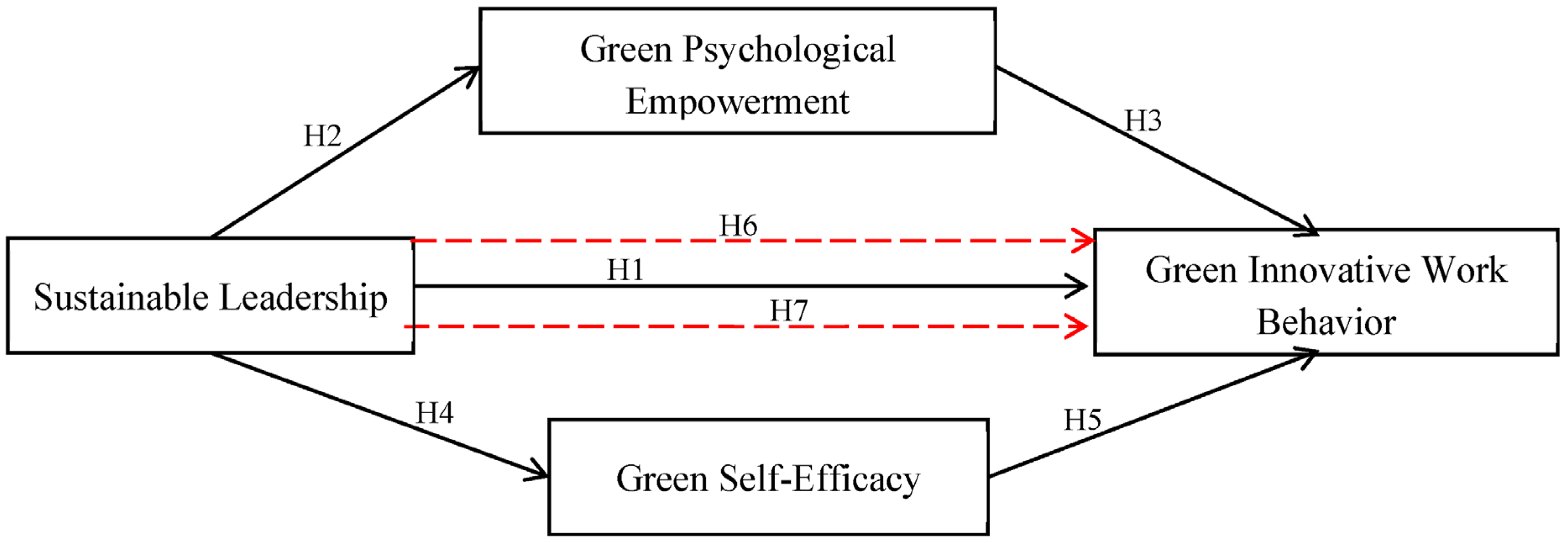
H1: Sustainable leadership positively influences green innovative work behavior.
2.3. Sustainable Leadership and Green Psychological Empowerment
Green Psychological Empowerment (GPE) refers to employees’ intrinsic motivation and sense of meaning, competence, autonomy, and impact in performing environmental tasks and sustainability initiatives [
14]. It reflects employees’ belief that they can effectively contribute to organizational environmental goals through green practices [
49]. GPE emphasizes meaningful participation in sustainability activities, where employees perceive their green actions as valued and aligned with organizational objectives [
50]. Empowered employees demonstrate greater initiative and accountability for environmental outcomes beyond formal job requirements [
15] and engage proactively and innovatively when they believe their efforts can create tangible environmental change [
16]. Key drivers of GPE include leadership support, participative decision-making, and a strong green organizational climate [
51]. GPE enhances environmental commitment, job satisfaction, and ownership of sustainability outcomes, serving as a crucial psychological link between green leadership and improved environmental and organizational performance [
23,
52].
Sustainable leadership creates a work environment that promotes ethical values and environmental responsibility while enabling meaningful employee participation in sustainability initiatives, thereby enhancing green psychological empowerment among hotel employees [
53]. By articulating a clear sustainability vision, sustainable leaders align employees’ perceptions of green tasks with broader organizational goals [
54]. Such leaders also strengthen employees’ sense of competence through training, feedback, and the development of environmental knowledge and skills applicable to their work [
55].
Furthermore, sustainable leadership increases employees’ autonomy by encouraging participation in environmental decision-making processes, which empowers them to propose and implement green ideas [
56]. Through recognition and continuous support, sustainable leaders reinforce employees’ beliefs that their environmental actions can lead to meaningful organizational outcomes [
57]. In hotel settings, empowerment practices encourage employees to assume responsibility for green service delivery and operational activities [
58]. Employees who experience higher levels of green psychological empowerment become more proactive and committed to environmental initiatives.
Sustainable leadership enhances green psychological empowerment by influencing employees’ perceptions of meaning, competence, autonomy, and impact related to environmental initiatives. Through the articulation of a compelling sustainability vision and the recognition of employees’ green contributions, sustainable leaders foster a sense of meaningfulness in environmentally responsible work. At the same time, by providing environmental training and constructive feedback, leaders strengthen employees’ perceived competence in performing green tasks. Furthermore, by encouraging participation in sustainability-related decision-making and granting autonomy in implementing eco-friendly practices, sustainable leaders enhance employees’ feelings of self-determination and impact. Through these mechanisms, leadership behaviors are internalized as psychological empowerment in the green context [
23].
Overall, sustainable leadership acts as a critical antecedent of green psychological empowerment in the hospitality context [
59]. Consequently, the following hypothesis is formulated:
H2: Sustainable leadership positively influences green psychological empowerment.
2.4. Sustainable Leadership and Green Self-Efficacy
Green Self-Efficacy (GSE) refers to an individual’s belief in their ability to successfully perform environmentally friendly tasks and participate effectively in workplace sustainability initiatives [
60]. It reflects employees’ perceived knowledge, skills, and abilities to engage in pro-environmental behaviors and tackle environmental challenges [
61]. High GSE encourages employees to take responsibility for environmental outcomes, persist in green actions under challenging conditions [
62], and proactively engage in practices such as resource conservation, waste reduction, and environmental innovation [
63]. GSE is strengthened by training, experiential learning, and supportive leadership that emphasize environmental competence and continuous learning [
64]. Employees with strong GSE are more willing to adopt and experiment with innovative green practices [
20], which positively influences green innovative work behavior at both individual and organizational levels, enhancing environmental performance [
19]. Overall, green self-efficacy acts as a critical psychological driver that converts environmental awareness into sustained green actions [
17,
18].
Sustainable leadership enhances green self-efficacy among hotel employees by fostering a supportive climate that emphasizes learning, environmental responsibility, and confidence in green competencies [
65]. Through consistent role modeling and demonstrated commitment to sustainability, sustainable leaders strengthen employees’ beliefs in their ability to perform environmentally responsible tasks effectively [
64]. By providing training, guidance, and constructive feedback, sustainable leadership further develops employees’ environmental knowledge and skills, which are essential for building green self-efficacy [
28].
Additionally, empowering leadership practices enable employees to experiment with green ideas and learn from experience without fear of failure [
66]. Sustainable leaders also promote collaboration and knowledge sharing, allowing employees to build confidence through collective green problem-solving [
67]. In hotel operations, such leadership helps employees recognize their capability to contribute to energy conservation, waste reduction, and sustainable service innovation [
68]. As green self-efficacy increases, employees become more proactive and persistent in engaging in environmentally responsible behaviors [
69].
Sustainable leadership contributes to employees’ green self-efficacy by shaping their confidence in successfully performing environmentally responsible behaviors. Leaders enhance green self-efficacy by offering learning opportunities, providing positive feedback, and acting as role models for sustainable practices. Employees gain mastery experiences through guided involvement in environmental initiatives, while observational learning occurs as leaders consistently demonstrate commitment to sustainability. In addition, by allocating resources and reducing structural barriers to green practices, sustainable leaders create conditions that reinforce employees’ beliefs in their own capabilities. These leadership-driven experiences collectively strengthen employees’ green self-efficacy [
70]. Thus, sustainable leadership represents a crucial motivating force in enhancing green self-efficacy among hotel employees [
27]. Consequently, the following hypothesis is formulated:
H3: Sustainable leadership positively influences green self-efficacy.
2.5. Green Psychological Empowerment and Green Innovative Work Behavior
Green psychological empowerment positively influences green innovative work behavior by enhancing employees’ intrinsic motivation, autonomy, and perceived impact regarding environmental initiatives [
71]. When employees perceive their green-related tasks as meaningful, they are more likely to generate and implement environmentally friendly ideas [
15]. A strong sense of competence enables employees to confidently pursue innovative solutions to environmental challenges in the workplace [
72].
Empowered employees also experience greater independence, which encourages experimentation and the reinvention of green practices beyond routine procedures [
73]. Furthermore, employees who believe that their actions can produce meaningful environmental outcomes are more inclined to engage proactively in green innovation [
74]. In organizational environments that support green empowerment, employees are more willing to take risks associated with implementing new eco-friendly ideas [
72]. Overall, green psychological empowerment functions as a key psychological driver of green innovative work behavior [
71]. Consequently, the following hypothesis is formulated:
H4: Green psychological empowerment positively influences green innovative work behavior.
2.6. Green Self-Efficacy and Green Innovative Work Behavior
Green self-efficacy plays a critical role in shaping employees’ engagement in green innovative work behavior by instilling confidence in their ability to generate, promote, and implement environmentally supportive ideas [
75]. When employees perceive themselves as capable and knowledgeable in environmental matters, they are more likely to engage in creative problem-solving and green innovation initiatives [
76]. High levels of green self-efficacy also encourage persistence and experimentation with new green solutions, even under conditions of uncertainty or resource constraints [
77].
Employees with strong green self-efficacy show greater willingness to adopt new green practices and technologies [
78]. This confidence translates into proactive behaviors, such as suggesting methods to reduce energy consumption, minimize waste, or enhance sustainable operational processes. Within supportive organizational environments, green self-efficacy is transformed into tangible innovative environmental actions, enabling employees to continuously generate green innovations that improve overall environmental performance. Consequently, green self-efficacy serves as a fundamental psychological mechanism driving green innovative work behavior [
79]. Consequently, the following hypothesis is formulated:
H5: Green self-efficacy positively influences green innovative work behavior.
2.7. Green Psychological Empowerment as a Mediator
Green psychological empowerment mediates the relationship between sustainable leadership and green innovative work behavior by transforming leaders’ sustainability-oriented practices into employees’ intrinsic motivation and psychological readiness for green innovation [
80]. Sustainable leaders enhance employees’ perceptions of meaning, competence, autonomy, and impact related to environmental initiatives, thereby strengthening their capacity to engage in green actions [
81].
When employees experience high levels of green psychological empowerment, they are more likely to translate sustainability values into innovative environmental behaviors [
82]. This empowerment encourages employees to assume responsibility for developing and implementing eco-friendly ideas in the workplace. Green psychological empowerment thus establishes an indirect pathway through which sustainable leadership influences creativity and experimentation in environmentally innovative practices [
74]. In hotel organizations, empowered employees can successfully introduce novel approaches to sustainable service delivery and operations. The mediating role of green psychological empowerment highlights its importance in explaining how and why sustainable leadership leads to higher levels of green innovative work behavior [
75]. Consequently, the following hypothesis is formulated:
H6: Green psychological empowerment mediates the relationship between sustainable leadership and green innovative work behavior.
2.8. Green Self-Efficacy as a Mediator
Green self-efficacy serves as a mediating mechanism between sustainable leadership and green innovative work behavior by explaining how sustainability-oriented leadership practices enhance employees’ confidence in performing environmentally responsible tasks [
77]. Sustainable leaders support employees through mentorship, resource provision, and guidance, which strengthen their belief in their ability to generate, implement, and manage green initiatives [
83].
Employees with high green self-efficacy are more likely to engage in creative problem-solving and proactively propose innovative solutions to environmental challenges [
84]. This sense of capability encourages employees to experiment with novel eco-friendly practices and persist in implementing green ideas despite obstacles [
78]. In hospitality settings, green self-efficacy enables employees to convert sustainability principles into concrete innovative actions within daily operations and service delivery [
82]. Accordingly, sustainable leadership promotes green innovative work behavior indirectly by strengthening employees’ confidence in their environmental competencies. Overall, green self-efficacy explains how sustainable leadership fosters employees’ engagement in environmentally innovative [
81]. Consequently, the following hypothesis is formulated:
H7: Green self-efficacy mediates the relationship between sustainable leadership and green innovative work behavior.
The theoretical framework of the study is illustrated below in
Figure 1.
3. Research Methodology
3.1. Measurement Instrument
Data for this study were collected using a structured questionnaire divided into two sections. The first section measured the study’s latent constructs through 39 items (see
Appendix A), while the second section gathered demographic information, including gender, age, and educational level. All constructs were operationalized using well-established scales validated in prior research. Respondents rated items on a five-point Likert scale ranging from 1 (“strongly disagree”) to 5 (“strongly agree”).
The constructs and their measurement scales were as follows:
Sustainable leadership (SL) was assessed with a 15-item scale developed by McCann and Holt [
85]. Although this scale was originally introduced over a decade ago, it was deliberately selected for several important reasons. First, the instrument captures the foundational and behavior-oriented dimensions of sustainable leadership, including social, environmental, ethical, and economic responsibility, which align closely with the objectives of the present study. Specifically, the scale focuses on observable leadership behaviors such as ethical decision-making, sustainability-oriented communication, accountability for sustainability-related mistakes, and balancing purpose with profitability—elements that are directly experienced and evaluated by employees. Second, the McCann and Holt scale is particularly suitable for employee-level perceptual research in service-intensive contexts such as the hospitality industry, where sustainability is enacted through daily managerial behaviors rather than solely through formal strategies or policies. In contrast, several more recent sustainable leadership measures emphasize strategic, governance, or macro-level sustainability orientations, which may be less perceptible to frontline employees. Third, despite its age, the scale has demonstrated robust psychometric properties in prior research and showed strong reliability and validity in the current study, supporting its continued applicability. Importantly, the selection of this instrument was theory-driven and purpose-driven, ensuring close alignment with the study’s AMO-based framework and its focus on how leadership behaviors influence employees’ green psychological empowerment, green self-efficacy, and green innovative work behavior.
Green self-efficacy (GSE) was measured using a six-item scale adapted from Chen et al. [
86]. In addition, green psychological empowerment (GPE): Evaluated with a 12-item scale based on Spreitzer [
87].
Moreover, green innovative work behavior (GIWB) was captured through six items adapted from Scott and Bruce [
88] and recent updates by Khan et al. [
12]. Although some GIWB items (e.g., GIWB4: ‘I investigate and secure the funds needed to implement new green ideas’ and GIWB5: ‘I develop adequate plans and schedules for the implementation of new green ideas’) may appear to involve managerial responsibilities, in the context of frontline hotel employees these items reflect initiative-taking, problem-solving, and proactive planning within their operational scope. Employees may contribute by proposing implementation steps, coordinating small-scale green initiatives, or identifying resource needs for environmental improvements, even if final approval rests with management. These items have been validated in hospitality contexts and effectively capture the full spectrum of green innovative work behavior, from idea generation to promotion and implementation [
12].
3.2. Sampling and Data Collection
A judgmental sampling approach was applied to select the five-star hotels under investigation, while convenience sampling was used to recruit employees within these hotels. This approach was deemed suitable given the large population and practical constraints such as time and accessibility. The study focused on full-time employees working in five-star hotels in Greater Cairo, Egypt. The study focused on full-time employees, as green innovative work behavior requires ongoing engagement with organizational processes and sustained interaction with leadership practices. Part-time or temporary staff may have limited exposure to these processes, potentially affecting their ability to engage in meaningful green innovation. Therefore, focusing on full-time employees ensures that participants have adequate opportunity and context to demonstrate GIWB.
Prior to data collection, formal approval was obtained from hotel management and human resources departments. Questionnaires were administered on-site, with participation being voluntary. Respondents were informed about the study’s objectives and assured of confidentiality, with results reported only in aggregated form.
Five-star hotels in Greater Cairo provide an appropriate setting to examine sustainable leadership and its effects on employees’ green psychological empowerment, green self-efficacy, and green innovative work behavior [
89]. These hotels operate at high service and operational standards, which involve significant resource consumption, complex organizational structures, and a diverse workforce. Sustainability is therefore a strategic priority, making leadership practices in this domain particularly visible and influential [
90]. Additionally, these hotels generally have the resources required to implement advanced green initiatives that rely on employees’ motivation, empowerment, and confidence in performing environmentally responsible actions [
91].
The Greater Cairo context further enhances the study’s relevance due to its economic significance, dense concentration of luxury hotels, and active tourism sector, all of which place substantial pressure on environmental resources. Hotels in this region are expected to meet the sustainability standards of international guests, global hotel chains, and regulatory authorities. Within this competitive and resource-intensive environment, sustainable leadership plays a vital role in fostering employees’ psychological empowerment and green self-efficacy, which in turn promote innovative environmentally friendly behaviors [
28].
Out of 500 distributed questionnaires, 396 valid responses were collected, representing a 79.2% response rate. Following Hair et al. [
92], who recommend a minimum of 10 respondents per observed variable, a sample of at least 390 was considered sufficient for the 39 measurement items, confirming the adequacy of the final sample for robust statistical analysis.
3.3. Data Analysis
Data were analyzed using WarpPLS (version 8.0). Partial Least Squares Structural Equation Modeling (PLS-SEM) was employed due to its suitability for testing complex models and its ability to accommodate both exploratory and confirmatory analyses. This approach is particularly appropriate for studies in hospitality and strategic management, as it handles non-normal data distributions effectively and performs well with small to medium sample sizes.
3.4. Common Method Bias
To assess potential common method variance (CMV), several diagnostic tests were conducted. Harman’s single-factor test showed that no single factor accounted for more than 50% of the total variance, indicating that CMV was not a major concern. Additionally, Variance Inflation Factor (VIF) values for all constructs were below the conservative threshold of 3.3. These results collectively suggest that common method bias did not meaningfully affect the study’s findings.
4. Results
4.1. Participants’ Profile
Table 1 summarizes the demographic characteristics of the 396 hotel employees who participated in the study. The sample was predominantly male (60.10%), while females accounted for 39.90% of respondents. Nearly half of the participants were between 30 and 45 years old (47.98%), followed by those above 45 years (26.77%) and those aged 18–29 years (25.25%). In terms of education, most employees held an undergraduate degree (57.58%), whereas 30.81% had a high school education or below, and a smaller proportion possessed a postgraduate qualification or higher (11.62%).
To ensure meaningful workplace insights, only employees with a minimum of one year of professional experience were included, as such experience is generally sufficient for adapting to organizational culture [
93].
4.2. Measurement Model
Table 2 provides a comprehensive evaluation of the measurement model by reporting the psychometric properties of all study constructs. For sustainable leadership, the fifteen indicators exhibit satisfactory factor loadings, indicating that each item meaningfully contributes to the construct (>0.60). The construct demonstrates excellent internal consistency, as reflected by very high composite reliability (CR = 0.951) and Cronbach’s alpha (CA = 0.944). The average variance extracted (AVE = 0.569) exceeds the recommended threshold, confirming adequate convergent validity, while the VIF value (3.114) indicates that multicollinearity is not a concern.
Similarly, green psychological empowerment is measured using twelve indicators, all of which show acceptable loadings. The construct achieves strong reliability, with CR and CA values of 0.930 and 0.917, respectively. Its AVE value of 0.526 suggests that the construct explains more than half of the variance in its indicators, supporting convergent validity. The reported VIF value (3.045) further confirms that collinearity among the indicators remains within acceptable limits.
Green self-efficacy is represented by six indicators, each demonstrating solid factor loadings. The construct shows good internal consistency, with CR of 0.892 and CA of 0.854, and an AVE value of 0.582, indicating satisfactory convergent validity. The relatively low VIF value (1.623) suggests minimal multicollinearity issues.
Finally, green innovative work behavior is assessed through six indicators with strong loadings, reflecting a robust measurement of the construct. The reliability of GIWB is well supported, as evidenced by high CR (0.921) and CA (0.897) values. Its AVE value of 0.662 indicates a high level of shared variance between the construct and its indicators, while the VIF value (1.698) confirms acceptable collinearity levels.
Overall, the results reported in
Table 2 confirm that all constructs meet established criteria for reliability, convergent validity, and multicollinearity, indicating that the measurement model is statistically sound and suitable for subsequent structural model analysis.
Table 3 presents the correlations among the latent variables along with the square roots of the AVE on the diagonal, in accordance with the Fornell–Larcker criterion. These results confirm that the constructs are empirically distinct while remaining theoretically related, supporting the adequacy of the measurement model.
Table 4 reports the results of discriminant validity assessment using the Heterotrait–Monotrait (HTMT) ratio. All HTMT values among the constructs are well below the conservative threshold of 0.85 and the acceptable limit of 0.90, indicating strong discriminant validity. Overall, the findings demonstrate that the measurement model satisfies discriminant validity requirements and that each construct captures a unique aspect of the theoretical framework.
4.3. Model Fit
Appendix B reports the model fit and quality indices used to evaluate the overall adequacy of the structural model following the criteria proposed by Kock [
94]. The results show that the average path coefficient (APC), average R-squared (ARS), and average adjusted R-squared (AARS) are all statistically significant at the 0.001 level, indicating strong explanatory power and meaningful relationships among the constructs. Collinearity diagnostics further support the robustness of the model, as both the average block VIF (AVIF = 2.779) and average full collinearity VIF (AFVIF = 2.370) fall well within acceptable and ideal thresholds.
In terms of overall model fit, the Tenenhaus goodness-of-fit (GoF) value of 0.530 exceeds the criterion for a large effect size, suggesting an excellent overall fit. Additional quality indices, including the Sympson’s paradox ratio (SPR), R-squared contribution ratio (RSCR), statistical suppression ratio (SSR), and nonlinear bivariate causality direction ratio (NLBCDR), all achieve their ideal values of 1.000, indicating the absence of estimation anomalies and supporting the validity of the causal relationships specified in the model. Furthermore, residual-based measures such as SRMR (0.099) and SMAR (0.077) remain below the recommended threshold, confirming a satisfactory level of residuals. Finally, the standardized chi-squared statistic and threshold difference ratios (STDCR and STDSR) meet their respective acceptance criteria, collectively demonstrating that the proposed model exhibits strong fit, high quality, and reliable explanatory capacity.
4.4. Structural Model and Hypotheses Testing
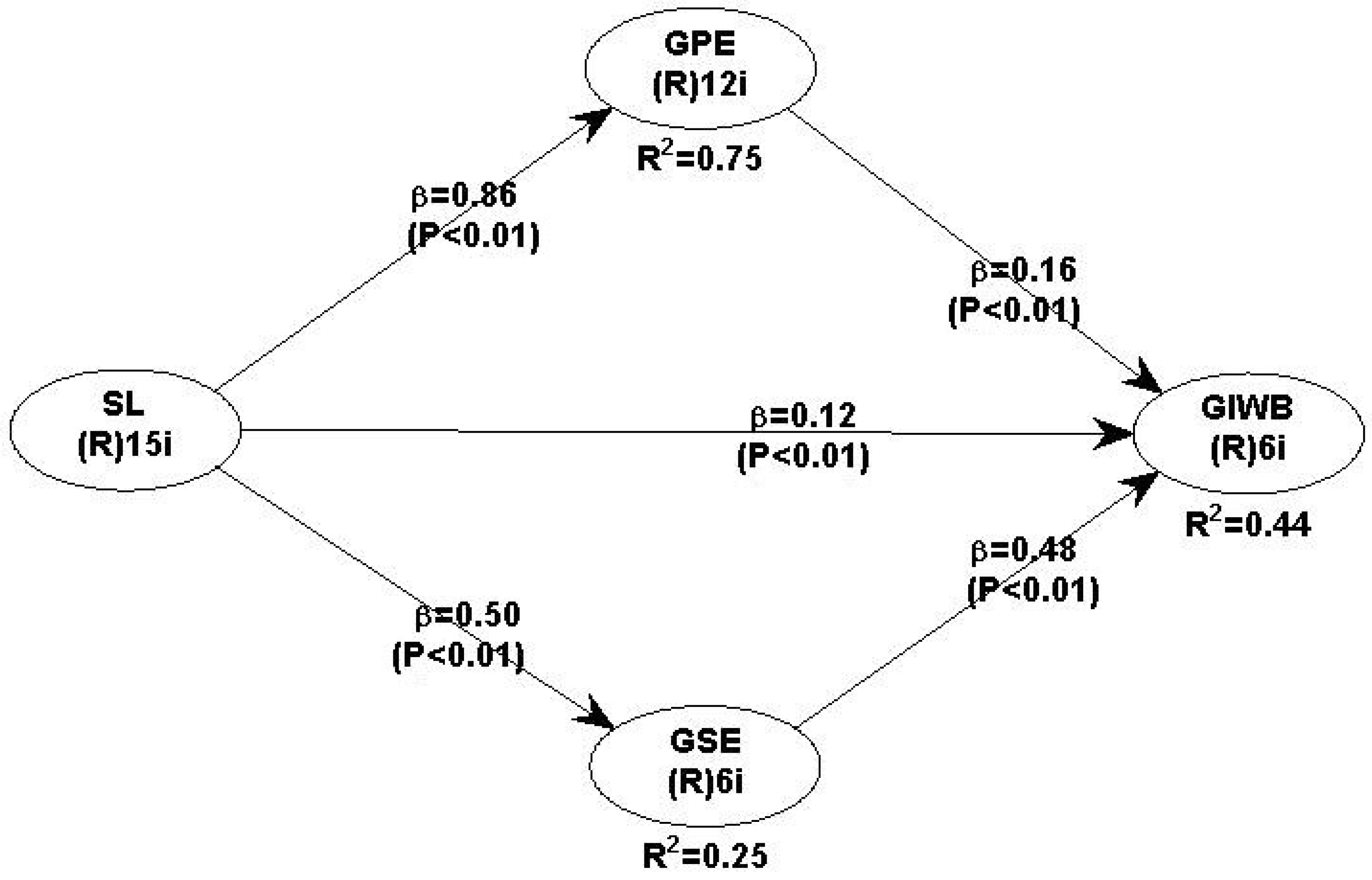
Table 5 and
Figure 2 present the results of the direct effects analysis and hypothesis testing. The findings indicate that all proposed hypotheses are supported, as each structural path is positive and statistically significant at the 0.01 level. Sustainable leadership shows a significant direct effect on green innovative work behavior (β = 0.12), although the effect size is relatively small, suggesting a modest direct influence. In contrast, sustainable leadership has a very strong effect on green psychological empowerment (β = 0.86) with a large effect size, highlighting its critical role in enhancing employees’ psychological empowerment toward environmental initiatives. It also exerts a moderate and significant influence on green self-efficacy (β = 0.50), indicating that sustainable leadership practices substantially strengthen employees’ confidence in performing green-related tasks.
Furthermore, both green psychological empowerment and green self-efficacy have significant positive effects on green innovative work behavior. While the effect of green psychological empowerment on green innovative behavior is modest (β = 0.16), Green self-efficacy demonstrates a stronger influence (β = 0.48), reflecting its important role in driving employees’ environmentally innovative actions. The explained variance values further support the model’s explanatory power, with sustainable leadership accounting for 75% of the variance in green psychological empowerment and 25% in green self-efficacy, while green innovative work behavior is explained by 44% of the variance. Overall, these results confirm the robustness of the proposed direct relationships and the predictive strength of the model.
Table 6 reports the results of the mediation analysis conducted using the bootstrapping approach recommended by Preacher and Hayes [
95]. The findings indicate that both green psychological empowerment and green self-efficacy significantly mediate the relationship between sustainable leadership and green innovative work behavior. Specifically, the indirect effect of SL on GIWB through GPE is positive and statistically significant, as reflected by a substantial indirect effect value and a high t-value. The bootstrapped 95% confidence interval does not include zero, confirming the presence of a significant partial mediation effect.
Similarly, green self-efficacy also serves as a significant mediator in the relationship between SL and GIWB. The indirect effect through GSE is stronger, as indicated by a larger indirect effect size and a higher t-value. The corresponding bootstrapped confidence interval further supports this finding, as both the lower and upper bounds are positive. Overall, the results demonstrate that SL influences GIWB not only directly but also indirectly by enhancing employees’ green psychological empowerment and self-efficacy, thereby providing robust support for the proposed mediation hypotheses.
5. Discussion
The findings of this study provide robust evidence that sustainable leadership plays a critical role in promoting green innovative work behavior among employees in five-star hotels in Egypt. Consistent with the Ability–Motivation–Opportunity (AMO) framework, sustainable leadership positively influenced employees’ green psychological empowerment and green self-efficacy, which in turn enhanced their engagement in environmentally innovative behaviors. This suggests that leaders who prioritize sustainability not only set the strategic direction for green practices but also actively create conditions that enable employees to feel capable, motivated, and empowered to contribute to environmental initiatives. Recent studies in the hospitality industry confirm that leadership styles emphasizing support, autonomy, and environmental concern significantly predict employees’ green innovative behaviors and psychological attachment to sustainability goals. For example, supportive leadership has been shown to foster an innovative climate and psychological empowerment, which jointly enhance green innovative work behavior in hotels [
23].
Specifically, the positive effect of sustainable leadership on green psychological empowerment highlights the importance of leadership in shaping employees’ sense of meaning, competence, self-determination, and impact regarding environmental efforts. Employees under such leadership perceive that their contributions matter and that they have the autonomy and authority to implement green innovations. This aligns with research demonstrating that empowering leadership promotes psychological empowerment, which functions as a key mechanism by which sustainable practices become internalized and enacted by employees [
70,
96]. Similarly, the significant effect on green self-efficacy underscores that sustainable leaders build employees’ confidence in their ability to perform eco-friendly tasks successfully. Other recent work in hospitality contexts shows that leadership approaches such as green transformational or inclusive leadership boost employees’ green self-efficacy, which in turn strengthens their environmental behaviors at work [
50,
60,
97].
The direct influence of both green psychological empowerment and green self-efficacy on green innovative work behavior indicates that employees’ internal capacities and beliefs are central mechanisms for fostering innovation in sustainable practices. Indeed, studies in hotels and service industries have found that when employees feel psychologically empowered and confident about their environmental role, they are significantly more likely to propose and implement creative sustainability initiatives [
29,
50]. Furthermore, the mediation effects of these constructs suggest that the impact of sustainable leadership on green innovation operates, at least in part, through employees’ psychological empowerment and self-efficacy. These findings confirm that sustainable leadership is not merely symbolic; it actively shapes employees’ cognitive and motivational resources, enabling the development of proactive and innovative environmental behaviors.
This pattern mirrors broader evidence in leadership literature showing that empowering leadership styles indirectly influence innovation work behavior via empowerment and engagement processes. For example, studies across sectors report that leadership’s support and autonomy-enhancing behaviors boost employees’ proactive and innovative outcomes through increased psychological empowerment [
98]. Overall, the study reinforces the relevance of the AMO theory by demonstrating that leadership enhances employees’ ability, motivation, and opportunity to engage in green innovation. The alignment with recent empirical research, especially in hospitality and tourism, strengthens confidence in the generalizability of these theoretical mechanisms across diverse cultural and organizational contexts (e.g., Saudi Arabia, China, Indonesia) [
23].
Importantly, while this study examined the dual mediation of green psychological empowerment (GPE) and green self-efficacy (GSE) in the Egyptian hospitality context, it is important to consider how cultural factors may influence these pathways. Egypt is characterized by relatively high power-distance and collectivist cultural values, which may shape employees’ perceptions of leadership and their engagement in green behaviors. In such contexts, employees may rely more heavily on leadership guidance and feedback, potentially amplifying the motivational influence of GSE, whereas the effects of empowerment (GPE) may manifest differently due to limited customary autonomy. These cultural nuances suggest that the mediating mechanisms of GPE and GSE observed in Egypt may differ in strength or emphasis compared to Western, low-power-distance contexts. By situating our findings within this cross-cultural dialogue, the study provides a more nuanced understanding of how sustainable leadership drives green innovative work behavior, highlighting the contingent role of cultural context in shaping the relative impact of psychological and motivational mechanisms.
Overall, the results demonstrate that sustainable leadership enables employees to develop novel and practical solutions for environmental challenges, illustrating a clear pathway through which leadership can drive innovative approaches in hotel sustainability. Through green psychological empowerment and green self-efficacy, employees are not merely complying with eco-guidelines but actively generating and implementing creative solutions, representing an operationalization of innovative management practices in the hospitality context.
6. Theoretical Implications
This study offers several important theoretical contributions. First, it extends the literature on sustainable leadership by empirically demonstrating its effect on green innovative work behavior in the hospitality sector, a context that has received limited attention in sustainability research. Second, by integrating green psychological empowerment and green self-efficacy as mediators, the study deepens our understanding of the mechanisms through which sustainable leadership drives environmentally innovative behaviors. This integration provides a nuanced explanation consistent with AMO theory, highlighting that leadership affects employees’ ability (self-efficacy), motivation (psychological empowerment), and opportunity (supportive organizational practices) to engage in green innovation.
Third, the research contributes to the theoretical discourse on employee-driven sustainability by showing that personal and psychological factors—specifically empowerment and self-efficacy—serve as key conduits for translating leadership influence into behavioral outcomes. By doing so, the study offers empirical support for the argument that leadership effectiveness in sustainability initiatives is contingent on its ability to develop employee capabilities and psychological states conducive to innovation. Finally, the study enriches cross-cultural leadership theory by providing evidence from an emerging economy context, demonstrating that sustainable leadership principles are applicable and effective in a Middle Eastern hospitality setting.
7. Practical Implications
The findings provide actionable insights for hotel managers and practitioners seeking to enhance sustainability performance, particularly in the Egyptian hospitality context.
First, hotel leaders should actively adopt sustainable leadership practices. This includes demonstrating ethical and environmentally responsible behavior, promoting long-term environmental goals, and integrating sustainability into daily operations. Practically, hotels can implement structured workshops and mentoring programs for middle and senior managers, emphasizing eco-conscious decision-making and strategies for empowering frontline employees to contribute to green initiatives. Case studies of successful green practices in local hotels can provide culturally relevant examples and inspire actionable steps.
Second, hotels should foster employees’ green psychological empowerment. Autonomy in decision-making, recognition of eco-friendly contributions, and assignment of meaningful green tasks can enhance employees’ sense of impact. Frontline staff can be encouraged to propose small-scale, feasible green improvements, such as optimizing energy and water use in guest rooms or suggesting innovative waste-reduction measures, even within existing operational constraints. Such practices help employees feel motivated and valued, strengthening their engagement in sustainable innovation.
Third, enhancing green self-efficacy among employees is essential. Targeted training programs, workshops, and peer-learning initiatives can build knowledge, skills, and confidence in performing green tasks. Encouraging employees to share success stories of eco-innovations can reinforce their belief in their capacity to generate sustainable solutions. Leadership can also provide continuous feedback and support, helping employees translate ideas into actionable practices.
Fourth, human resource and operational strategies should be aligned with sustainability objectives. Hotels can integrate green innovation into performance evaluations, reward systems, and promotion pathways, linking employees’ contributions to tangible incentives. For example, recognition awards, team-based challenges, or small financial bonuses for implementing eco-friendly initiatives can motivate proactive behavior. Additionally, cultural resources, such as Islamic environmental principles emphasizing stewardship of natural resources, can be leveraged in internal campaigns or training programs to encourage environmentally responsible practices among staff.
Collectively, these measures create a supportive environment in which sustainable leadership translates into meaningful green innovation outcomes, while addressing operational, cultural, and resource-specific realities of the Egyptian hotel industry. Specifically, hotels can operationalize sustainable leadership to foster innovation by creating structured channels for employees to propose new green initiatives, piloting low-cost eco-projects, and rewarding novel environmentally friendly solutions. By embedding innovation into everyday operational and HR practices, Egyptian hotels can transform sustainability challenges into opportunities for creative problem-solving and continuous improvement, thereby contributing to innovative management approaches in the sector.
8. Limitations and Future Research
While this study provides valuable insights into the relationships among sustainable leadership, employee psychological states, and green innovative behavior, certain limitations should be noted, which also suggest avenues for future research. First, the cross-sectional design limits the ability to draw causal conclusions. Longitudinal or experimental studies could provide stronger evidence of causal mechanisms and help clarify how sustainable leadership drives green innovative work behavior over time. In addition, this study relied on judgmental sampling to select participating five-star hotels and convenience sampling to recruit full-time employees. Although these non-probability sampling approaches were pragmatically justified due to access constraints and operational realities within the hospitality sector, they inherently limit the generalizability of the results. these sampling limitations restrict the external validity of the findings and suggest that the results should be interpreted as context-specific, reflecting the experiences of employees in Egyptian five-star hotels rather than the hospitality industry as a whole. Future research is encouraged to adopt probability-based sampling techniques, include diverse hotel categories and geographic contexts, and utilize multi-source or longitudinal data to reduce bias and enhance the robustness of generalizable conclusions.
Second, the study focused exclusively on employees of five-star hotels in Greater Cairo, Egypt. Although this setting is meaningful for examining sustainability in high-end hospitality, it may restrict the generalizability of the findings to other hotel types, sectors, or cultural contexts. Future research could replicate the study across different regions, hotel categories, or industries to assess the robustness and cross-cultural applicability of the observed relationships. Comparative analyses between high-power-distance, collectivist contexts like Egypt and low-power-distance, Western settings could be particularly insightful in understanding the cultural contingencies of sustainable leadership, green psychological empowerment (GPE), and green self-efficacy (GSE).
Third, the reliance on self-reported data may introduce social desirability bias, particularly in a sustainability-focused context. Incorporating multi-source data, such as supervisor evaluations of employee green innovation or objective performance indicators, could enhance the validity of the findings. Moreover, while this study conceptualizes green self-efficacy as a mediator of sustainable leadership, it does not examine the specific sources of self-efficacy identified by Bandura (1986) [
99]—mastery experiences, vicarious learning, verbal persuasion, and physiological/affective states. Future research adopting a multi-theoretical approach could explore how these mechanisms contribute to the development of green self-efficacy, providing deeper insights into the micro-level psychological processes underlying environmentally responsible behavior.
Fourth, the study did not empirically compare the relative importance of GPE and GSE as mediators, nor did it examine potential interaction effects. Exploring how these mediators operate differently across contexts or interact with other organizational factors, such as culture, environmental knowledge, team dynamics, or perceived organizational support, could shed light on the nuanced pathways through which sustainable leadership promotes green innovative behavior.
Fifth, the study treated hotel employees as a homogeneous group, overlooking potential differences across departments such as front office, housekeeping, kitchen, and marketing. Variations in opportunity, autonomy, and exposure to sustainable leadership may influence the extent and nature of green innovative behavior. Investigating these functional differences could provide more granular insights into the drivers of employee-driven sustainability initiatives.
Finally, sustainable leadership was measured using the McCann and Holt [
85] scale, which, while well-established and behaviorally grounded, represents an earlier conceptualization of sustainable leadership. As the sustainability leadership literature has continued to evolve, newer dimensions—such as digital sustainability leadership, stakeholder co-creation, and ESG-driven governance—may not be fully captured by this instrument. Although the scale demonstrated strong reliability and validity and was well aligned with the study’s objectives and hospitality context, future research is encouraged to employ or compare more contemporary measurement scales or adopt mixed-method approaches to capture the expanding and multidimensional nature of sustainable leadership. Such efforts would help further refine understanding of how evolving leadership practices influence green innovation and sustainability outcomes in hospitality and other service sectors.
Author Contributions
Conceptualization, H.A.K., W.M.E.S., A.B. and M.A.S.; Data curation, H.A.K.; Formal analysis, H.A.K. and A.B.; Funding acquisition, W.M.E.S.; Investigation, H.A.K.; Methodology, H.A.K. and A.B.; Project administration, H.A.K., W.M.E.S. and A.B.; Resources, H.A.K.; Software, H.A.K.; Supervision, H.A.K., W.M.E.S. and A.B.; Validation, H.A.K.; Visualization, H.A.K. and W.M.E.S.; Writing—original draft, H.A.K., W.M.E.S., A.B. and M.A.S.; Writing—review & editing, H.A.K., W.M.E.S., A.B. and M.A.S. All authors have read and agreed to the published version of the manuscript.
Funding
This work was supported by the Deanship of Scientific Research, Vice Presidency for Graduate Studies and Scientific Research, King Faisal University, Saudi Arabia [KFU260146].
Institutional Review Board Statement
The study was conducted in accordance with the guidelines of the Declaration of Helsinki and was approved by the Ethical Committee of the Faculty of Tourism and Hotels, University of Sadat City (date of approval: 1 June 2025; approval code: FTH-USC-144/1/6/2025). This declaration has been clearly stated in the manuscript.
Informed Consent Statement
Informed consent was obtained from all subjects involved in this study.
Data Availability Statement
Data are available upon request from researchers who meet the eligibility criteria. Kindly contact the first author privately through e-mail.
Acknowledgments
This work was supported by the Deanship of Scientific Research, Vice Presidency for Graduate Studies and Scientific Research, King Faisal University, Saudi Arabia [KFU260146].
Conflicts of Interest
The authors declare no conflicts of interest.
Appendix A. Measurement Scales
| Construct | Code | Measurement Items |
| Green Psychological Empowerment | GPE.1 | The environmentally responsible work I do is very important to me. |
| GPE.2 | My job activities related to environmental sustainability are personally meaningful to me. |
| GPE.3 | The environmental aspects of my work are meaningful to me. |
| GPE.4 | I am confident in my ability to carry out environmentally responsible tasks at work. |
| GPE.5 | I am self-assured about my capabilities to perform environmental sustainability-related work activities. |
| GPE.6 | I have mastered the skills necessary to perform my job in an environmentally responsible way. |
| GPE.7 | I have significant autonomy in deciding how to carry out environmentally friendly practices in my job. |
| GPE.8 | I can decide on my own how to implement environmental initiatives in my work. |
| GPE.9 | I have considerable independence and freedom in choosing environmentally responsible ways of doing my job. |
| GPE.10 | My environmentally responsible actions have a strong impact on what happens in my department. |
| GPE.11 | I have a great deal of control over environmental practices and outcomes in my department. |
| GPE.12 | I have significant influence over environmental decisions and initiatives in my department. |
| Sustainable leadership | SL1 | My leader acts in a sustainable socially responsible manner. |
| SL2 | My leader acts in a sustainable environmentally responsible manner. |
| SL3 | My leader acts in a sustainable ethically responsible manner. |
| SL4 | My leader’s decisions are made while considering the entire organisation. |
| SL5 | My leader’s management officially recognises when a mistake is made that affects sustainability. |
| SL6 | My leader is willing to correct mistakes that affect sustainability. |
| SL7 | My leader attempts to use unique innovative methods to resolve sustainability issues. |
| SL8 | My leader attempts to create wealth through sustainable efforts. |
| SL9 | My leader puts purpose before profit. |
| SL10 | My leader balances sustainable social responsibility with profits. |
| SL11 | My leader demonstrates sustainability by persevering through all types of change. |
| SL12 | My leader is concerned how sustainability affects employees. |
| SL13 | My leader communicates sustainability decisions to all involved. |
| SL14 | My leader attempts to build a culture of sustainability through its communication efforts. |
| SL15 | My leader has plan to demonstrate sustainability when hiring, promoting employees and replacing leaders. |
| Green Self-efficacy | GSE1 | I feel I can succeed in accomplishing environmental ideas. |
| GSE2 | I can achieve most of the environmental goals. |
| GSE3 | I feel competent to deal effectively with environmental tasks. |
| GSE4 | I can perform effectively on environmental missions. |
| GSE5 | I can overcome environmental problems. |
| GSE6 | I could find creative solutions to environmental problems. |
| Green innovative work behavior | GIWB1 | Search out new environmentally-related technologies, processes, techniques, and/or product ideas. |
| GIWB2 | I generate green creative ideas. |
| GIWB3 | I promote and champion green ideas with others. |
| GIWB4 | I investigate and secure the funds needed to implement new green ideas. |
| GIWB5 | I develop adequate plans and schedules for the implementation of new green ideas. |
| GIWB6 | I am environmentally innovative. |
Appendix B. Model Fit and Quality Indices (Kock [94])
| | Assessment | Criterion | Mark |
| Average path coefficient (APC) | 0.426, p < 0.001 | p < 0.05 | √ |
| Average R-squared (ARS) | 0.481, p < 0.001 | p < 0.05 | √ |
| Average adjusted R-squared (AARS) | 0.479, p < 0.001 | p < 0.05 | √ |
| Average block VIF (AVIF) | 2.779 | acceptable if ≤ 5, ideally ≤ 3.3 | √ |
| Average full collinearity VIF (AFVIF) | 2.370 | acceptable if ≤ 5, ideally ≤ 3.3 | √ |
| Tenenhaus GoF (GoF) | 0.530 | small ≥ 0.1, medium ≥ 0.25, large ≥ 0.36 | √ |
| Sympson’s paradox ratio (SPR) | 1.000 | acceptable if ≥ 0.7, ideally = 1 | √ |
| R-squared contribution ratio (RSCR) | 1.000 | acceptable if ≥ 0.9, ideally = 1 | √ |
| Statistical suppression ratio (SSR) | 1.000 | acceptable if ≥ 0.7 | √ |
| Nonlinear bivariate causality direction ratio (NLBCDR) | 1.000 | acceptable if ≥ 0.7 | √ |
| Standardized root mean squared residual (SRMR) | 0.099 | acceptable if <= 0.1 | √ |
| Standardized mean absolute residual (SMAR) | 0.077 | acceptable if <= 0.1 | √ |
| Standardized chi-squared with 779 degrees of freedom (SChS) | 18.502, p < 0.001 | p < 0.05 | √ |
| Standardized threshold difference count ratio (STDCR) | 0.947 | acceptable if >= 0.7, ideally = 1 | √ |
| Standardized threshold difference sum ratio (STDSR) | 0.835 | acceptable if >= 0.7, ideally = 1 | √ |
References
- Woo, E.; Wooldridge, M.; LaPorte, E.A. A case study on the effectiveness of cocurricular interdisciplinary sustainability programming for graduate students to create sustainability leaders. Int. J. Sustain. High. Educ. 2025, 26, 1–20. [Google Scholar] [CrossRef] [Scilit]
- Toft, K.H.; Hansen, M.B. Sustainability discourses in the leadership and management literature: A critical review. Bus. Strategy Environ. 2025, 34, 1751–1770. [Google Scholar] [CrossRef] [Scilit]
- Ahmad, S. Entrepreneurship and Sustainable Leadership Practices: Examine how entrepreneurial leaders incorporate sustainability into their business models and the leadership traits facilitating this integration. J. Entrep. Bus. Ventur. 2025, 5, 242–260. [Google Scholar] [CrossRef] [Scilit]
- Ashfaq, F.; Abid, G.; Ilyas, S.; Elahi, A.R. Sustainable leadership and work engagement: Exploring sequential mediation of organizational support and gratitude. Public Organ. Rev. 2025, 25, 231–252. [Google Scholar] [CrossRef] [Scilit]
- Mandal, V.; Pal, D. Sustainable leadership: Empowering green organizational citizenship behaviour through employee green value in the Indian healthcare sector. J. Asia Bus. Stud. 2025, 19, 79–102. [Google Scholar] [CrossRef] [Scilit]
- Liao, Y. Sustainable leadership: A literature review and prospects for future research. Front. Psychol. 2022, 13, 1045570. [Google Scholar] [CrossRef] [Scilit]
- Farrukh, M.; Meng, F.; Raza, A.; Wu, Y. Innovative work behaviour: The what, where, who, how and when. Pers. Rev. 2023, 52, 74–98. [Google Scholar] [CrossRef] [Scilit]
- Arici, H.E.; Uysal, M. Leadership, green innovation, and green creativity: A systematic review. Serv. Ind. J. 2022, 42, 280–320. [Google Scholar] [CrossRef] [Scilit]
- Odugbesan, J.A.; Aghazadeh, S.; Al Qaralleh, R.E.; Sogeke, O.S. Green talent management and employees’ innovative work behavior: The roles of artificial intelligence and transformational leadership. J. Knowl. Manag. 2023, 27, 696–716. [Google Scholar] [CrossRef] [Scilit]
- Huang, Y.C.; Gong, T.J.; Shih, L.T. Examining the impact of green human resource management on green innovative work behavior: A multilevel analysis. Corp. Soc. Responsib. Environ. Manag. 2024, 31, 6401–6418. [Google Scholar] [CrossRef] [Scilit]
- Dahiya, R. Going green at work: A psychometric assessment of the green innovative work behaviour scale. Int. J. Organ. Anal. 2025, 33, 2649–2672. [Google Scholar] [CrossRef] [Scilit]
- Khan, K.; Gogia, E.H.; Shao, Z.; Rehman, M.Z.; Ullah, A. The impact of green HRM practices on green innovative work behaviour: Empirical evidence from the hospitality sector of China and Pakistan. BMC Psychol. 2025, 13, 96. [Google Scholar] [CrossRef] [Scilit] [PubMed]
- Rietze, S.; Schölmerich, F. How Green Transformational Leadership and Psychological Empowerment Impact Green Voice Behavior. Acad. Manag. Proc. 2025, 2025, 14203. [Google Scholar] [CrossRef] [Scilit]
- Zafar, H.; Tian, F.; Ho, J.A.; Roh, T.; Latif, B. Understanding voluntary pro-environmental behavior among colleagues: Roles of green crafting, psychological empowerment, and green organizational climate. Bus. Strategy Environ. 2025, 34, 468–482. [Google Scholar] [CrossRef] [Scilit]
- Ali, M.A.E.; Yahya, B.F. How the psychological empowerment of workers effects the relationship between ethical leadership and green behaviors of workers. In AI and Business, and Innovation Research: Understanding the Potential and Risks of AI for Modern Enterprises; Springer Nature: Cham, Switzerland, 2023; pp. 299–308. [Google Scholar]
- Rashid, S.A.; Al Qaseer, M. Investigating The role of green psychological empowerment of employees in Strengthen organizational sustainability. J. Adm. Econ. Sci. 2022, 24, 2312–9883. [Google Scholar]
- Qin, Z.; Wu, Q.; Bi, C.; Deng, Y.; Hu, Q. The relationship between climate change anxiety and pro-environmental behavior in adolescents: The mediating role of future self-continuity and the moderating role of green self-efficacy. BMC Psychol. 2024, 12, 241. [Google Scholar] [CrossRef] [Scilit]
- Wu, S.W.; Chiang, P.Y. Exploring the mediating effects of the theory of planned behavior on the relationships between environmental awareness, green advocacy, and green self-efficacy on the green word-of-mouth intention. Sustainability 2023, 15, 12127. [Google Scholar] [CrossRef] [Scilit]
- Mughal, M.F.; Cai, S.; Faraz, N.A.; Haiying, C.; Poulova, P. Green servant leadership and employees’ workplace green behavior: Interplay of green self-efficacy, green work engagement, and environmental passion. Curr. Psychol. 2024, 43, 26806–26822. [Google Scholar] [CrossRef] [Scilit]
- Khan, A.N. Elucidating the effects of environmental consciousness and environmental attitude on green travel behavior: Moderating role of green self-efficacy. Sustain. Dev. 2024, 32, 2223–2232. [Google Scholar] [CrossRef] [Scilit]
- Appelbaum, E.; Bailey, T.; Berg, P.; Kalleberg, A.L.; Bailey, T.A. Manufacturing Advantage: Why High-Performance Work Systems Pay Off; Cornell University Press: Ithace, Greek, 2000. [Google Scholar]
- Bos-Nehles, A.; Townsend, K.; Cafferkey, K.; Trullen, J. Examining the Ability, Motivation and Opportunity (AMO) framework in HRM research: Conceptualization, measurement and interactions. Int. J. Manag. Rev. 2023, 25, 725–739. [Google Scholar] [CrossRef] [Scilit]
- Jameel, A.; Sahito, N.; Guo, W.; Hussain, A.; Kanwel, S.; Khan, S. The influence of supportive leadership on hospitality employees’ green innovative work behavior: The mediating role of innovative climate and psychological empowerment. Front. Psychol. 2025, 16, 1565408. [Google Scholar] [CrossRef] [Scilit] [PubMed]
- Alshiha, A.A.; Alkhozaim, S.M.; Alnasser, E.M.; Khairy, H.A.; Al-Romeedy, B.S. Psychological empowerment and employee resilience in travel agencies and hotels. Tour. Rev. 2025, 80, 1394–1412. [Google Scholar] [CrossRef] [Scilit]
- Salama, W.; Khairy, H.; Suliman, M.; Fahmy, N. How organizational politics drives non-green behavior in hotels: A moderated mediation model of psychological withdrawal and green self-efficacy. Environ. Soc. Psychol. 2025, 10, 3921. [Google Scholar] [CrossRef] [Scilit]
- Aboramadan, M.; Crawford, J.; Turkmenoglu, M.A.; Farao, C. Green inclusive leadership and employee green behaviors in the hotel industry: Does perceived green organizational support matter? Int. J. Hosp. Manag. 2022, 107, 103330. [Google Scholar] [CrossRef] [Scilit]
- Rafique, A.; Farhan, H.M.; Tariq, T. Bridging green inclusive leadership and green knowledge sharing: Unveiling the role of employee CSR participation and green self-efficacy. Pak. J. Humanit. Soc. Sci. 2024, 12, 915–934. [Google Scholar] [CrossRef] [Scilit]
- Salama, W.M.; Khairy, H.A.; Othman, I.M.; Ibrahim, T.M.A.G.; Farid, M.B.; Elbanna, S.S.S.A. Paradoxical leadership, green commitment, and green self-efficacy: The mediating and moderating pathways to green innovative work behavior in the tourism and hospitality businesses. Geo J. Tour. Geosites 2025, 62, 2376–2389. [Google Scholar]
- Zhao, H.; Chen, Y.; Zhao, S.; Wang, B. Green inclusive leadership and hospitality employees’ green service innovative behavior in the Chinese hospitality context: The roles of basic psychological needs and employee traditionality. Int. J. Hosp. Manag. 2024, 123, 103922. [Google Scholar] [CrossRef] [Scilit]
- Lin, Y.K.; Lin, C.D.; Lin, B.Y.J. Junior doctors’ workplace well-being and the determinants based on ability–motivation–opportunity (AMO) theory: Educational and managerial implications from a three-year longitudinal observation after graduation. Med. Teach. 2025, 47, 110–125. [Google Scholar] [CrossRef] [Scilit]
- Mbukanma, I.; Strydom, K. Adopting the Ability, Motivation and Opportunity (AMO) Theory to Enhance Employees’ Performance in South African Public Service Organisations Amid the COVID-19 Outbreak. J. Public Adm. 2022, 57, 361–377. [Google Scholar]
- Benítez-Núñez, C.; Díaz-Díaz, N.L.; Ballesteros-Rodríguez, J.L.; de Saá-Pérez, P. Explaining academic researchers’ performance from the Ability–Motivation–Opportunity (AMO) perspective. Stud. High. Educ. 2024, 49, 2423–2440. [Google Scholar] [CrossRef] [Scilit]
- Zada, M.; Erkol Bayram, G.; Contreras-Barraza, N.; Kaptangil, K.; Aylan, S. Integrating social media-driven service innovation and sustainable leadership: Advancing sustainable practices in tourism and hospitality. Sustainability 2025, 17, 399. [Google Scholar] [CrossRef] [Scilit]
- Zhang, G.; Chen, P.; Xu, S. Developing and validating a scale for measuring sustainable leadership development among teachers in Chinese higher education institutions. J. Clean. Prod. 2025, 486, 144403. [Google Scholar] [CrossRef] [Scilit]
- Piwowar-Sulej, K.; Iqbal, Q. Workplace envy as an inhibitor of change-oriented organizational citizenship behavior: The role of sustainable leadership. J. Organ. Change Manag. 2025, 38, 103–122. [Google Scholar] [CrossRef] [Scilit]
- Kareem, M.A.; Kummitha, H.R. Impact of sustainable leadership practices on green innovation: The mediating role of green organisational culture. Discov. Sustain. 2025, 6, 1077. [Google Scholar] [CrossRef] [Scilit]
- Dibattista, I.; Berdicchia, D.; Mazzardo, E.; Masino, G. Green norms in the workplace to promote environmental sustainability: The positive effect on green innovative work behaviors and person-environment relationship. Front. Sustain. 2025, 5, 1506804. [Google Scholar] [CrossRef] [Scilit]
- Al-Ayed, S. Green innovation influenced by employee innovative work behavior via moderating role of innovative leaderships. Cogent Bus. Manag. 2024, 11, 2393741. [Google Scholar] [CrossRef] [Scilit]
- Shahzad, M.A.; Jianguo, D.; Junaid, M. Impact of green HRM practices on sustainable performance: Mediating role of green innovation, green culture, and green employees’ behavior. Environ. Sci. Pollut. Res. 2023, 30, 88524–88547. [Google Scholar] [CrossRef] [Scilit]
- AlEssa, H.S.; Durugbo, C.M. Systematic review of innovative work behavior concepts and contributions. Manag. Rev. Q. 2022, 72, 1171–1208. [Google Scholar] [CrossRef] [Scilit]
- Barkat, W.; Waris, I.; Ahmed, R.; Dad, M. Transformational leadership and frontline managers work engagement, innovative work behavior, organizational citizenship behavior, and employee sustainability in the hotel industry in Pakistan. J. Hum. Resour. Hosp. Tour. 2024, 23, 315–336. [Google Scholar] [CrossRef] [Scilit]
- Asghar, M.; Gull, N.; Xiong, Z.; Shu, A.; Faraz, N.A.; Pervaiz, K. The influence of inclusive leadership on hospitality employees’ green innovative service behavior: A multilevel study. J. Hosp. Tour. Manag. 2023, 56, 347–355. [Google Scholar] [CrossRef] [Scilit]
- Patwary, A.K.; Mohd Yusof, M.F.; Bah Simpong, D.; Ab Ghaffar, S.F.; Rahman, M.K. Examining proactive pro-environmental behaviour through green inclusive leadership and green human resource management: An empirical investigation among Malaysian hotel employees. J. Hosp. Tour. Insights 2023, 6, 2012–2029. [Google Scholar] [CrossRef] [Scilit]
- Sahibzada, Y.A.; Ali, M.; Toru, N.; Farooq Jan, M.; Ellahi, A. Exploitative leadership and green innovative behavior of hospitality employees: Mediation of emotional exhaustion and moderation of perceived organization support. J. Hosp. Tour. Insights 2025, 8, 1847–1866. [Google Scholar] [CrossRef] [Scilit]
- Elshaer, I.A.; Azazz, A.M.; Semlali, Y.; Mansour, M.A.; Elziny, M.N.; Fayyad, S. The nexus between green transformational leadership, employee behavior, and organizational support in the hospitality industry. Adm. Sci. 2024, 14, 107. [Google Scholar] [CrossRef] [Scilit]
- Abdou, A.H.; Al Abdulathim, M.A.; Hussni Hasan, N.R.; Salah, M.H.A.; Ali, H.S.A.M.; Kamel, N.J. From green inclusive leadership to green organizational citizenship: Exploring the mediating role of green work engagement and green organizational identification in the hotel industry context. Sustainability 2023, 15, 14979. [Google Scholar] [CrossRef] [Scilit]
- Soomro, S.A.; Soomro, S.A.; Ibrahim, B.; Aljarah, A. Managerial green leadership behavior and its impact on employee environmental citizenship behavior: The mediating role of green intellectual capital in the hospitality sector. J. Sustain. Tour. 2025, 1–22. [Google Scholar] [CrossRef] [Scilit]
- Öğretmenoğlu, M.; Akova, O.; Göktepe, S. The mediating effects of green organizational citizenship on the relationship between green transformational leadership and green creativity: Evidence from hotels. J. Hosp. Tour. Insights 2022, 5, 734–751. [Google Scholar] [CrossRef] [Scilit]
- Islam, M.A.; Hack-Polay, D.; Haque, A.; Rahman, M.; Hossain, M.S. Moderating role of psychological empowerment on the relationship between green HRM practices and millennial employee retention in the hotel industry of Bangladesh. Bus. Strategy Dev. 2022, 5, 17–29. [Google Scholar] [CrossRef] [Scilit]
- Al-Romeedy, B.S.; Khairy, H.A.; Abdelrahman Farrag, D.; Alhemimah, A.; Salameh, A.A.; Gharib, M.N.; Fathy Agina, M. Green Inclusive Leadership and Employees’ Green Behavior in Tourism and Hospitality Businesses: Do Green Psychological Climate and Green Psychological Empowerment Matter? J. Qual. Assur. Hosp. Tour. 2025, 1–38. [Google Scholar] [CrossRef] [Scilit]
- Zafar, H.; Tian, F.; Ho, J.A.; Zhang, G. Environmentally specific servant leadership and voluntary pro-environmental behavior in the context of green operations: A serial mediation path. Front. Psychol. 2022, 13, 1059523. [Google Scholar] [CrossRef] [Scilit]
- Rietze, S.; Schölmerich, F.; Kühner, C.; Zacher, H. Green transformational leadership and green voice behavior: The motivational role of green psychological empowerment. Corp. Soc. Responsib. Environ. Manag. 2025, 32, 7727–7743. [Google Scholar] [CrossRef] [Scilit]
- Abdou, A.H. Servant leadership for hospitality sustainability: Green psychological capital as a pathway to environmental citizenship behavior. Front. Sustain. 2025, 6, 1535809. [Google Scholar] [CrossRef] [Scilit]
- Chao, H.; Fanbo, M.; Patwary, A.K. Examining organizational commitment to environmental performances among hotel employees: The role of ethical leadership, psychological ownership and psychological empowerment. Sage Open 2024, 14, 21582440241255226. [Google Scholar] [CrossRef] [Scilit]
- Ashraf, S.; Ali, S.Z.; Khan, T.I.; Azam, K.; Afridi, S.A. Fostering sustainable tourism in Pakistan: Exploring the influence of environmental leadership on employees’ green behavior. Bus. Strategy Dev. 2024, 7, e328. [Google Scholar] [CrossRef] [Scilit]
- Gunay, T. Linking Green Transformational Leadership to Employee Green Resilience: A Sequential Mediation Model of Environmental Commitment, Engagement, and Green HR Practices in Green Hotels. Sustainability 2025, 17, 6315. [Google Scholar] [CrossRef] [Scilit]
- Salama, S.; Khairy, H.; Badwy, H.; Almaaitah, R.; Mohammed, S.; Elsokkary, H. Sustainable Leadership and Work Behavior in Hotel Businesses: The Influence of Perceived Environmental Corporate Social Responsibility. Environ. Soc. Psychol. 2024, 9, 3251. [Google Scholar] [CrossRef] [Scilit]
- Khattak, M.A.; Rehman, Z.U.; Hashmi, S.H. Role of empowering leadership in inducing employee green creative behavior in hotel and restaurant industry: A moderated-moderated mediation model: MA Khattak et al. Environ. Dev. Sustain. 2024, 26, 7547–7578. [Google Scholar] [CrossRef] [Scilit]
- Ansong, A.; Andoh, R.P.K.; Ansong, L.O.; Hayford, C.; Owusu, N.K. Toward employee green creativity in the hotel industry: Implications of green knowledge sharing, green employee empowerment and green values. J. Hosp. Tour. Insights 2025, 8, 2482–2498. [Google Scholar] [CrossRef] [Scilit]
- Özgül, B.; Demir, İ. The mediating role of green perceived organizational support in the relationship between green transformational leadership and green self-efficacy. Soc. Responsib. J. 2025, 21, 78–96. [Google Scholar] [CrossRef] [Scilit]
- Lili, Z.; Rafiq, M. The impact of green participative leadership on pro-environmental behavior: Mediating role of green self-efficacy and moderating role of environmental awareness. J. Hosp. Tour. Insights 2025, 8, 1783–1802. [Google Scholar] [CrossRef] [Scilit]
- Senbeto, D.L. Unravelling green innovative behavior in pilgrimage tourism: The role of learning climate and green self-efficacy. J. Sustain. Tour. 2025, 33, 1493–1511. [Google Scholar] [CrossRef] [Scilit]
- Sh Ahmad, F.; Rosli, N.T.; Quoquab, F. Environmental quality awareness, green trust, green self-efficacy and environmental attitude in influencing green purchase behaviour. Int. J. Ethics Syst. 2022, 38, 68–90. [Google Scholar] [CrossRef] [Scilit]
- Nisar, Q.A.; Haider, S.; Ali, F.; Gill, S.S.; Waqas, A. The role of green HRM on environmental performance of hotels: Mediating effect of green self-efficacy & employee green behaviors. J. Qual. Assur. Hosp. Tour. 2024, 25, 85–118. [Google Scholar]
- Nwosu, L. The mediating effect of green self-efficacy in the impact of green inclusive leadership on green organizational citizenship behavior. Future Bus. J. 2025, 11, 186. [Google Scholar] [CrossRef] [Scilit]
- Farooq, R.; Zhang, Z.; Talwar, S.; Dhir, A. Do green human resource management and self-efficacy facilitate green creativity? A study of luxury hotels and resorts. J. Sustain. Tour. 2022, 30, 824–845. [Google Scholar] [CrossRef] [Scilit]
- Nguyen, H.D.; Tho, B.D.; Ho, D.B.; Nguyen, D.D.; Phuong, K.Q.C. Connecting green human resource management practices with employee’s pro-environmental behaviours: The role of self-efficacy and psychological green climate in the emerging hospitality industries. Environ. Res. Commun. 2025, 7, 055002. [Google Scholar] [CrossRef] [Scilit]
- Qasim, A.; Pandi, O.D.; Saleem, F.; Danila, N. Impact of Green Transformation Leadership on Environmental Knowledge Learning and Work Pro-environmental Behaviors: The Mediating Role of Green Self-efficacy and Green Creativity. J. Ecohumanism 2024, 3, 5022–5039. [Google Scholar] [CrossRef] [Scilit]
- Sarifudeen, A.L.; Niyas, A.; Ramalingam, S.K. Eco-Centric Leadership and Green Innovation Behavior in Hospitality Industry: The Mediating Role of Psychological Green Climate and the Moderating Role of Environmental Self-Efficacy. Sustain. Trends Bus. Res. 2025, 3, 1–12. [Google Scholar] [CrossRef] [Scilit]
- Saleem, F.; Mateou, S. Servant Leadership for Sustainability: A Serial Mediation Model of Empowerment, Creativity, and Pro-Environmental Behavior. Adm. Sci. 2025, 15, 380. [Google Scholar] [CrossRef] [Scilit]
- Sun, L. Factors impacting psychological empowerment and innovative work behavior of employees at university in Yunnan, China. AU-GSB E-J. 2023, 16, 182–192. [Google Scholar]
- Ergun, E.; Tunca, S.; Cetinkaya, G.; Balcıoğlu, Y.S. Exploring the Roles of Work Engagement, Psychological Empowerment, and Perceived Organizational Support in Innovative Work Behavior: A Latent Class Analysis for Sustainable Organizational Practices. Sustainability 2025, 17, 1663. [Google Scholar] [CrossRef] [Scilit]
- Mankgele, K.P.; Fatoki, O. Environmentally specific empowering leadership and organisational citizenship behaviour toward the environment: The roles of green work engagement, psychological ownership and environmental concern. Asian Manag. Bus. Rev. 2025, 5, 143–159. [Google Scholar] [CrossRef] [Scilit]
- Salamah, M.J.B.; Alradi, M.N.; Tanni, A.B.A.; Alquran, N.M.; Alqudah, R.A.; Daradkah, A.M.; yousef Alshorman, H. The influence of innovative leadership on teachers? green behavior: The mediating role of psychological capital. Rev. Iberoam. Psicol. Ejerc. Deporte 2024, 19, 364–381. [Google Scholar]
- Butt, R.; Rehmani, M.; Irshad, H.; Anwer, N. The Impact of Green Human Resource Management on Green Creativity: The Mediating Roles of Green Self-Efficacy and Green Work Engagement and the Moderating role of Environmentally SPECIFIC servant Leadership. Environ. Eng. Manag. J. (EEMJ) 2025, 24, 315–334. [Google Scholar]
- Guo, J. The significance of green entrepreneurial self-efficacy: Mediating and moderating role of green innovation and green knowledge sharing culture. Front. Psychol. 2022, 13, 1001867. [Google Scholar] [CrossRef] [Scilit]
- Elrayah, M.; Keong, O.C. Exploring the Association between Green Innovation, Leadership and Environmental Performance: Mediation of Green Self-efficacy. AgBioForum 2023, 25, 107–117. [Google Scholar]
- Gelaidan, H.M.; Al-Swidi, A.K.; Al-Hakimi, M.A. Servant and authentic leadership as drivers of innovative work behaviour: The moderating role of creative self-efficacy. Eur. J. Innov. Manag. 2024, 27, 1938–1966. [Google Scholar] [CrossRef] [Scilit]
- Qadir, F.; Chaudhry, S.A. Green entrepreneurial self-efficacy and its outcomes: The mediating role of the attitude towards entrepreneurship. Asian Bull. Green Manag. Circ. Econ. 2024, 4, 74–98. [Google Scholar] [CrossRef] [Scilit]
- Dong, Y.; Guo, Y. The impact of green transformational leadership on employees’ green innovation behavior: The multilevel chain mediating effect of green empowerment. Chin. Manag. Stud. 2025, 1–22. [Google Scholar] [CrossRef] [Scilit]
- Amrutha, V.N.; Geetha, S.N. Green employee empowerment for environmental organization citizenship behavior: A moderated parallel mediation model. Curr. Psychol. 2024, 43, 5685–5702. [Google Scholar] [CrossRef] [Scilit]
- Anwer, S.; Hyder, M. Navigating sustainable innovation: Exploring the interplay between workplace happiness and the dynamics of leadership, empowerment and organizational culture in the context of green management and circular economy. Asian Bull. Green Manag. Circ. Econ. 2024, 4, 44–61. [Google Scholar] [CrossRef] [Scilit]
- Amjad, F.; Rao, Y.; Rahman, A.U.; Mohsin, M.; Sarfraz, M. Fostering sustainability through the Green HRM and green inclusive leadership: The dual mediating role of creative self-efficacy and green skill competency. Curr. Psychol. 2024, 43, 22181–22199. [Google Scholar] [CrossRef] [Scilit]
- Ahuja, J.; Yadav, M.; Sergio, R.P. Green leadership and pro-environmental behaviour: A moderated mediation model with rewards, self-efficacy and training. Int. J. Ethics Syst. 2023, 39, 481–501. [Google Scholar] [CrossRef] [Scilit]
- McCann, J.T.; Holt, R.A. Servant and sustainable leadership: An analysis in the manufacturing environment. Int. J. Manag. Pract. 2010, 4, 134–148. [Google Scholar] [CrossRef] [Scilit]
- Chen, Y.S.; Chang, C.H.; Yeh, S.L.; Cheng, H.I. Green shared vision and green creativity: The mediation roles of green mindfulness and green self-efficacy. Qual. Quant. 2015, 49, 1169–1184. [Google Scholar] [CrossRef] [Scilit]
- Spreitzer, G.M. Psychological empowerment in the workplace: Dimensions, measurement, and validation. Acad. Manag. J. 1995, 38, 1442–1465. [Google Scholar] [CrossRef] [Scilit]
- Scott, S.G.; Bruce, R.A. Determinants of innovative behavior: A path model of individual innovation in the workplace. Acad. Manag. J. 1994, 37, 580–607. [Google Scholar] [CrossRef] [Scilit]
- Al-Husain, R.A.; Jasim, T.A.; Mathew, V.; Al-Romeedy, B.S.; Khairy, H.A.; Mahmoud, H.A.; Liu, S.; El-Meligy, M.A.; Alsetoohy, O. Optimizing sustainability performance through digital dynamic capabilities, green knowledge management, and green technology innovation. Sci. Rep. 2025, 15, 24217. [Google Scholar] [CrossRef] [Scilit]
- Khairy, H.A.; Badwy, H.E.; Khreis, S.H.A. Perceived Environmental Corporate Social Responsibility and Sustainable Innovation in the Hotel Business: The Mediating Role of Green Intrinsic Motivation. In Navigating Trust in Sustainability Reporting and Assurance; IGI Global Scientific Publishing: New York, NY, USA, 2025; pp. 317–356. [Google Scholar]
- Khairy, H.A.; Badwy, H.E. Adaptive leadership and resilience: The mediating and moderating pathways to green competitiveness in the hospitality sector. J. Hosp. Tour. Insights 2026, 9, 20–42. [Google Scholar] [CrossRef] [Scilit]
- Hair, J.F.; Black, W.C.; Babin, B.J.; Anderson, R.E.; Tatham, R.L. Multivariate Data Analysis, 7th ed.; Pearson: Hoboken, NJ, USA, 2010. [Google Scholar]
- Morrison, E.W. Newcomer information seeking: Exploring types, modes, sources, and outcomes. Acad. Manag. J. 1993, 36, 557–589. [Google Scholar] [CrossRef] [Scilit]
- Kock, N. WarpPLS User Manual: Version 7.0; ScriptWarp Systems: Laredo, TX, USA, 2021. [Google Scholar]
- Preacher, K.J.; Hayes, A.F. Asymptotic and resampling strategies for assessing and comparing indirect effects in multiple mediator models. Behav. Res. Methods 2008, 40, 879–891. [Google Scholar] [CrossRef] [Scilit]
- Iqbal, Q.; Ahmad, N.H.; Nasim, A.; Khan, S.A.R. A moderated-mediation analysis of psychological empowerment: Sustainable leadership and sustainable performance. J. Clean. Prod. 2020, 262, 121429. [Google Scholar] [CrossRef] [Scilit]
- Li, L.; Khan, M.S. How does green transformational leadership influence employee green behavior?-based on the mediating effects of self-efficacy, green positivity and green organizational culture. Rajapark J. 2023, 17, 389–415. [Google Scholar]
- Abuzaid, A.N.; Ghadi, M.Y.; Madadha, S.A.M.; Alateeq, M.M. The effect of ethical leadership on innovative work behaviors: A mediating–moderating model of psychological empowerment, job crafting, proactive personality, and person–organization fit. Adm. Sci. 2024, 14, 191. [Google Scholar] [CrossRef] [Scilit]
- Bandura, A. Social Foundations of Thought and Action: A Social Cognitive Theory; Prentice Hall: Englewood Cliffs, NJ, USA, 1986. [Google Scholar]
| Disclaimer/Publisher’s Note: The statements, opinions and data contained in all publications are solely those of the individual author(s) and contributor(s) and not of MDPI and/or the editor(s). MDPI and/or the editor(s) disclaim responsibility for any injury to people or property resulting from any ideas, methods, instructions or products referred to in the content. |