Article

Tourism as a Catalyst for Reducing Regional Disparities: An Empirical Study of the Economic Convergence Effect of Tourism


1
School of Geography and Ocean Science, Nanjing University, Nanjing 210023, China
2
Huangshan Park Ecosystem Observation and Research Station, Ministry of Education, Huangshan 245800, China
3
Academy of Plateau Science and Sustainability, Xining 810016, China
4
School of Tourism and Exhibition, Hefei University, Hefei 230601, China
5
College of Economics and Management, Nanjing Forestry University, Nanjing 210037, China
*
Author to whom correspondence should be addressed.
Sustainability 2026, 18(3), 1289; https://doi.org/10.3390/su18031289
Submission received: 18 December 2025 / Revised: 22 January 2026 / Accepted: 24 January 2026 / Published: 27 January 2026
(This article belongs to the Section Tourism, Culture, and Heritage)

Abstract

To investigate whether tourism can act as a catalyst for regional economic convergence during the period 2000–2023, this study fills a critical gap in previous research by simultaneously examining the impact of tourism on economic disparities from both static stock and dynamic incremental perspectives, while accounting for spatial dependence. This study analyzes the economic convergence effects of tourism at the Chinese provincial and regional levels using σ convergence and the spatial Durbin model in a conditional β convergence framework. The results confirm the benefits that tourism brings to economic growth and convergence. Spatially, northeastern China exhibits stronger effects, followed by western and eastern China, in contrast to the relatively weaker impacts in central China. Structurally, its direct effect is more pronounced: the convergence effect is stronger for local areas than for neighboring areas. Temporally, the effect is most pronounced in the early (2000–2012) and late (2020–2023) phases, but becomes statistically insignificant in the intermediate period (2013–2019). By moving beyond the question of whether tourism drives growth to reveal for which regions it is most beneficial, this study offers a refined analytical perspective and actionable insights for achieving balanced regional development in China and other countries and regions at a comparable stage of development. The findings also highlight the potential of cultural heritage as a lever for sustainable and equitable regional growth, channeled through tourism.

1. Introduction

Regional disparity has become an increasingly pressing global issue. Although it has made impressive economic achievements in recent years, China also faces serious challenge of prominent regional disparities—evident in the economic gap between its eastern and western provinces and between urban and rural areas. This has become a major barrier to sustainable development; therefore, reducing regional disparities has become a key part of achieving shared wealth.
Tourism, as an integral component of international industries, has been widely recognized for its importance in creating jobs, driving economic development, and facilitating cultural exchange [1]. Several studies have demonstrated the dynamism that tourism brings to economic activity and its beneficial effects on boosting economic growth [2]. Some research has suggested a two-way causal relationship [3]; however, a few studies have also shown a negative or unclear relationship between the two [4]. In contrast, whether tourism contributes to reducing or increasing the imbalances and disparities in regional economic development has received less attention. Tourism is often recognized as having a positive impact on socioeconomic conditions in less-developed areas, and while some scholars argue that it reduces regional disparities [5,6], divergent views also exist [7].
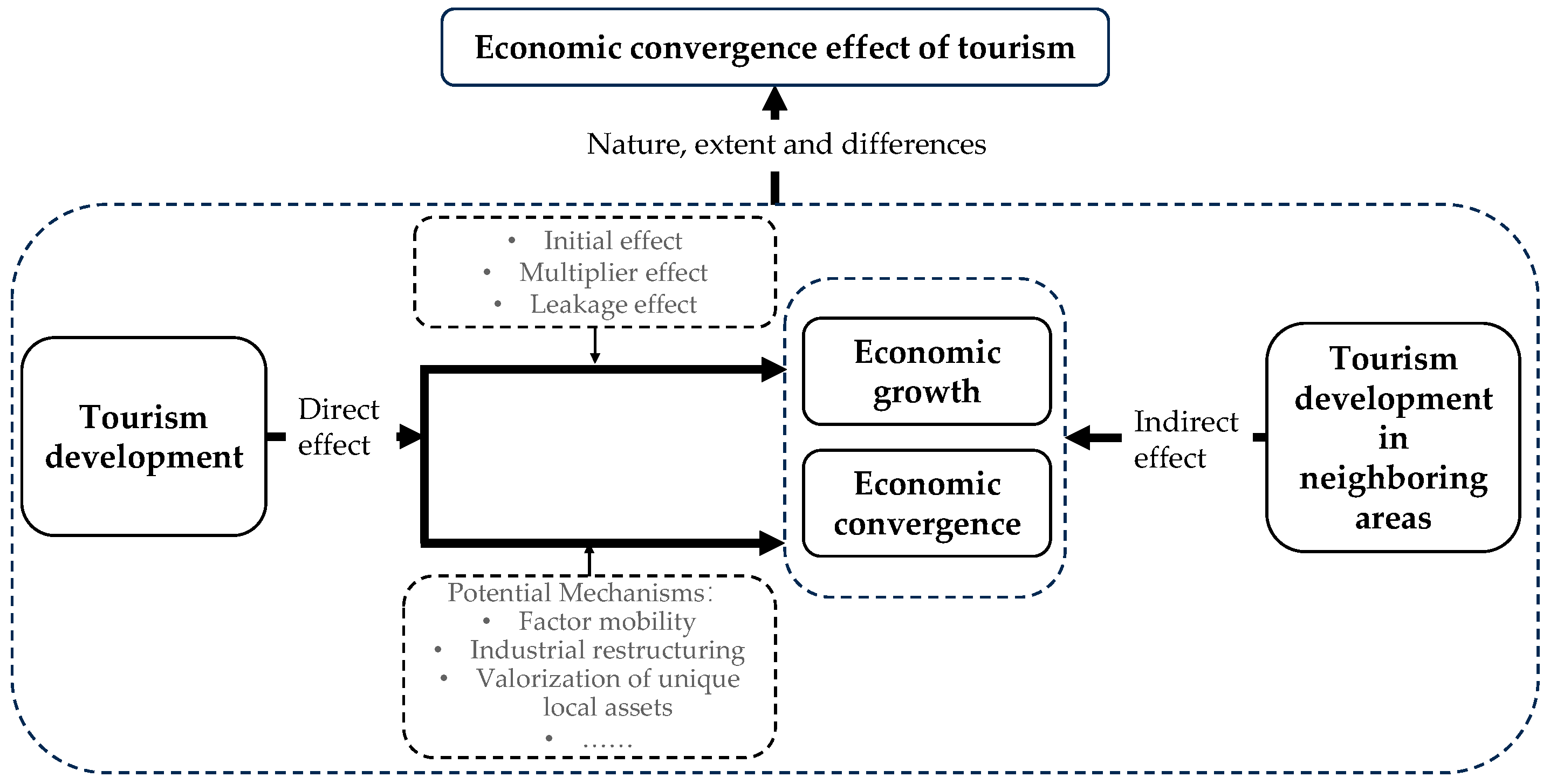
This study aims to examine the role of tourism in narrowing regional economic disparities. The convergence hypothesis, which holds that lagging productivity has the ability to grow faster than the early leader under certain conditions, is among the most historic controversies in economics. Thus, this study introduces the concept of the economic convergence effect of tourism. The concept describes a dynamic process in which regional economies gradually approach the same steady-state level of economic development through tourism-induced mechanisms including factor mobility, industrial restructuring, infrastructure enhancement, and income redistribution. In the context of this study, economic convergence effect of tourism encompasses two dimensions: tourism’s role in promoting regional economic growth and convergence. The concept aims to characterize the nature, extent, and differences of tourism’s impact on economic growth and convergence and conceptually illustrates the proposed effect and its potential mechanisms (Figure 1). Tourism serves as one of the most important channels for monetizing and marketizing cultural and heritage resources. In the Chinese context, its development is deeply dependent on the country’s rich cultural heritage and diverse local cultures. Therefore, investigating the economic convergence effect of tourism also indirectly reveals the potential pathways through which cultural and heritage resources may realize their economic value through the tourism market and influence balanced regional development. The central objective of this research is to characterize the nature, extent, and spatial-structural differences of the economic convergence effect of tourism in the Chinese context. As mentioned above, few recent studies have addressed the relationship between tourism and economic convergence, and no consistent conclusions have been reached on the direction and strength of tourism’s impact on regional economic disparities. In addition, spatial effects are mostly ignored in existing models [8,9,10], which may have led to biased and inconsistent conclusions that do not reveal the true cause, nature, and speed of the convergence process.
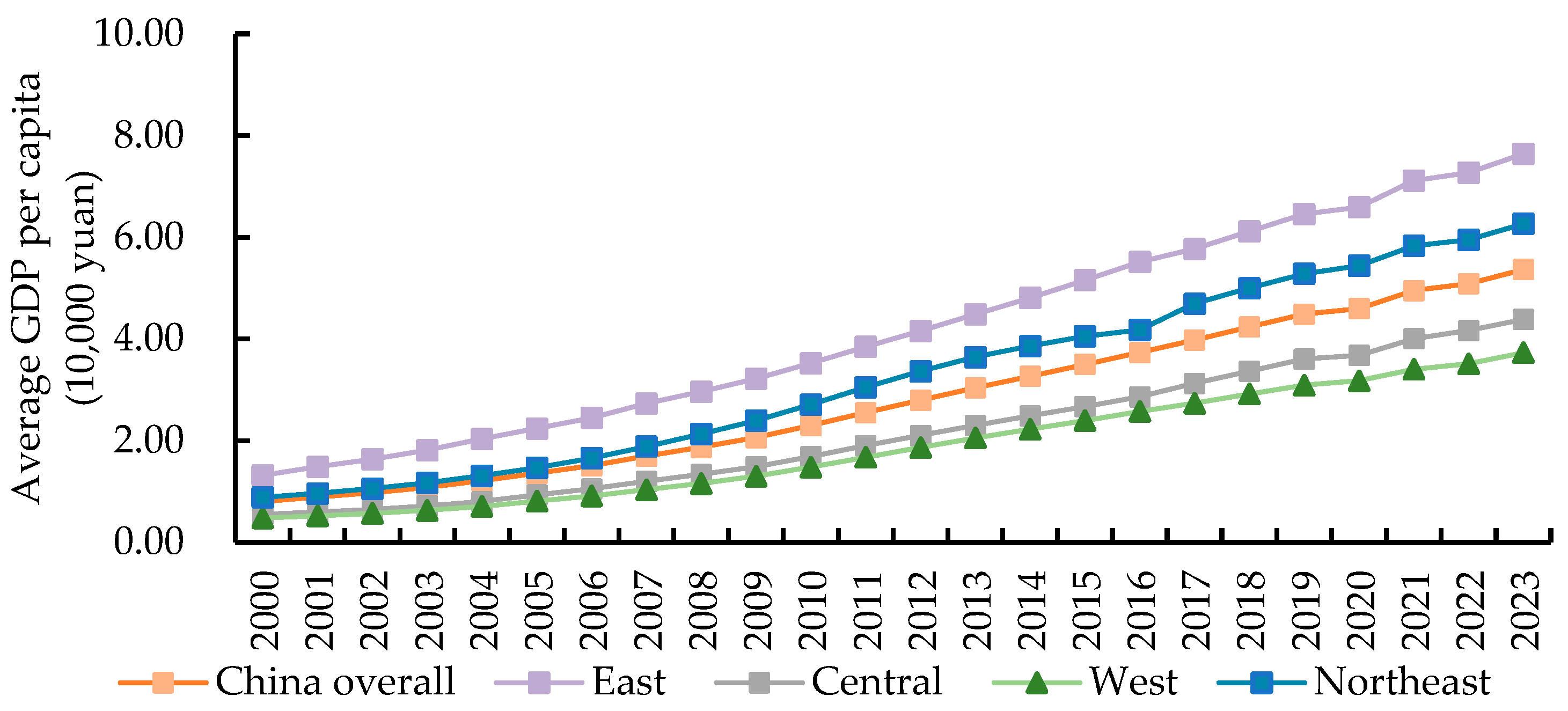
Here, this study presents the economic evolution of China and its four regions during the research period (Figure 2). The study area is divided into four regions: the eastern, northeastern, central, and western regions. It can be observed that economic growth shows a significant upward trend across the nation as a whole as well as in all four regions, with the eastern region standing out in particular. China’s rapid economic growth and tourism development over the past decades provide an excellent laboratory to explore this research theme and deepen the current understanding of the role tourism plays in the evolution of regional economic disparities in the sustainable development context. Therefore, this study analyzes the tourism economic convergence effect using statistical panel data related to regional economic and tourism development in 31 Chinese provinces from 2000 to 2023. This study’s advances are threefold. First, based on the regional socioeconomic system, the significance of tourism to regional economic development is highlighted, and the spatial heterogeneity of this importance is explored, with the western region serving as the benchmark group. Second, combining the σ convergence, the conditional β convergence framework and the spatial Durbin model (SDM) is an appropriate approach to reveal accurately the economic convergence effect of tourism in both stock and incremental terms and its structural differences from a spatial perspective. Third, the study’s findings provide a scientific foundation for governmental decision-making regarding optimizing macro-industrial structures and choosing high-quality development paths.

2. Literature Review

2.1. Tourism and Economic Development

According to tourist economic theory, since tourism is closely linked to many other economic sectors such as transportation, retailing, accommodation, and catering, it may promote development when tourism stimulates the economy through spillover effects and other externalities. Moreover, the structural bonus hypotheses suggests that the cross-sectoral reallocation of factors of production has become an additional source of overall productivity growth [11]. Tourism plays an important role in the structural transformation process by promoting industrial upgrading and development, which has the potential to contribute to productivity and economic growth. Meanwhile, Tourism flows can help regions draw information from exogenous sources, gain access to limited and unevenly distributed resources and outcomes, and further influence economic growth through technological progress.
Regarding the interaction between tourism and economic growth, the current literature has developed four canonical hypotheses: (1) Tourism-Led Growth (TLG): This hypothesis posits that the expansion of the tourism sector is a primary driver of overall economic growth, through channels such as foreign exchange earnings, job creation, and investment stimulation [12]. (2) Economy-Led Tourism Growth (ELTG): Conversely, this view argues that economic growth generates higher incomes and infrastructure, which in turn drive tourism development [13]. (3) Feedback or Bidirectional Relationship: This hypothesis suggests a mutually reinforcing cycle where tourism development and economic growth positively influence each other [14,15]. (4) Neutrality or No Causality: This perspective finds no significant long-run causal relationship between tourism and economic growth [16].
Nevertheless, empirical support for these hypotheses remains context-dependent. The existing literature tends to select specific economies and the inferences made regarding the causality between tourism and economic growth are not universal and cannot be directly applied to other economies [16]. For example, Dogru and Bulut analyzed the relationship between tourism development and economic growth in seven European countries and concluded that economy and tourism are interdependent [3]. However, in China, the nature of this relationship is unclear due to the lack of strong empirical evidence.
Therefore, this study explicitly positions itself within the TLG framework. Our empirical model—which incorporates tourism as a key explanatory variable for regional economic growth and convergence—operates under the TLG assumption. By focusing on the economic convergence effect of tourism rather than merely its growth effect, this research seeks to deepen the TLG discourse, examining its implications for regional equality and long-term spatial economic balance in the Chinese context.

2.2. Tourism and Regional Disparities

Different perspectives, including convergence, divergence, and evolution, have been developed in the discussion of regional economic disparities, as exemplified by Chen and Zhang [17], who found an inverted-N-shaped evolution of regional disparities in ASEAN, driven largely by inter-country disparities. This leaves the question of what role tourism plays in the evolution of development gaps between regions. In the discussion on tourism and poverty alleviation, tourism is often considered a tool that can be effective in improving socioeconomic conditions in low-income and underdeveloped areas [18]. Some scholars argue that tourism can increase resource allocation efficiency, reduce regional disparities, and achieve more balanced regional development [5,6]. As highlighted by neoclassical growth theory [19], the free flow of capital and labor promotes the convergence of marginal outputs across regions, and tourism may accelerate this process by generating employment and attracting investment. Simultaneously, endogenous growth theory emphasizes knowledge spillovers and technological progress as core drivers of economic growth, where tourism fosters economic convergence through knowledge diffusion and industrial structure upgrading [20]. Furthermore, tourism development contributes to economic convergence through other mechanisms, notably infrastructure enhancement and income redistribution. For example, Ribeiro et al. [21] argue that domestic tourism expenditure exerts a significant mitigating effect on regional disparities in Brazil, thereby fostering more balanced inter-regional development. However, new growth theory recognizes that openness does not necessarily guarantee benefits for all economies. Similarly, the technological advances tourism brings are not uniform across sectors. Therefore, theoretically, the benefits of tourism may not be evenly distributed across regions. Meanwhile, as Blake [7] argues, if tourism development excludes local communities, it can widen internal social disparities within a region, potentially offsetting any inter-regional convergence gains. In addition, a Kuznets curve has been suggested to exist between tourism and imbalanced, implying that as tourism develops, its role in reducing disparities begins to emerge [22]. While most existing studies rely on disparities indicators to explore tourism’s effect on the stock of convergence [23], a significant gap remains in understanding its impact on the incremental process of regional economic convergence. This research aims to fill this gap by explicitly investigating whether tourism accelerates regional economic convergence, thereby promoting more balanced regional development from a geographic perspective.

2.3. Convergence Model

The convergence hypothesis, as proposed by Barro and Sala-i-Martin [24], suggests that, compared with developed economies, lagging economies will grow at a faster rate and thus, their level of development can equal that of developed economies after some time, eventually achieving economic steady-state growth. The economic convergence hypothesis includes three types of convergence: σ convergence, β convergence, and club convergence. Among them, σ convergence suggests that the divergence of a sample tends to decrease over time. β convergence assumes that, in the initial stage, lagging regions will grow faster than more developed regions, which can be further subdivided into absolute and conditional β convergence based on the initial conditions and differences in structural characteristics, and the presence of β convergence tends to generate σ convergence. Club convergence further combines absolute and conditional β convergence and refers to economies forming different clubs in their development and converging to the same steady state within those clubs, but without economic growth convergence between them. However, existing studies predominantly examine the relationship between tourism and regional economic disparities from a static perspective, employing either σ convergence analysis or inequality measures such as the Gini coefficient [5,6,25]. Few investigations have adopted a dynamic approach (β convergence) to assess how tourism affects the speed of economic convergence. Meanwhile, theories based on the traditional concept of convergence have been challenged for their ignorance of scale and space [26].
Tobler’s First Law of Geography encapsulates the spatial correlation of geographical phenomena (i.e., spatial autocorrelation) [27]. In the field of tourism efficiency, some scholars have recognized the spatial differences in tourism efficiency [28]. Based on this principle, Liu et al. [29] explicitly incorporated spatial interdependence into their tourism efficiency model. These studies provide a critical background for understanding spatial spillover effects and structural heterogeneity. However, convergence studies based on the analytical framework of neoclassical growth theory tend to ignore the interaction of variables between regions, and their econometric models assume that such spatial effects are nonexistent, which can lead to biased estimates [30,31].
Methods that ignore spatial effects mainly involve ordinary least squares (OLS) regressions and are widely used to assess the convergence of economic growth and investigate the impact of tourism on regional economic disparities [8,9,10]. For example, Haller et al. [32] found through σ and β convergence analyses that tourism revenues are a convergence factor for the EU-28, although the rate of convergence is relatively slow. However, as Islam explained, such methods cannot reveal the causes, nature, or speed of the true convergence process [33].
Some studies on regional economic convergence have attempted to address the limitations of ignoring spatial effects by using spatial econometric models as the main analytical framework. For instance, Tselios found that spatial externalities and interactions are important features of the regional growth process and used spatial econometric techniques to verify the importance of spatial location and proximity in Europe [34]. Rey and Montouri noticed that the convergence model is very sensitive to spatial effects and the rate of convergence is significantly affected [35]. Thus, spatial econometric models consistently outperform OLS models. This approach has been applied to examine convergence in various domains, such as renewable energy consumption. For example, Ren et al. [36] explore the spatial convergence of renewable energy consumption across countries and find that geopolitical risk negatively affects its conditional β convergence. In China, where provinces typically exhibit strong spatial correlations, such models offer more scientific and empirical instruments for a thorough comprehension of the spatial effects of regional economic convergence [37]. Li et al. [38] pioneered the in the use of convergence models incorporating spatial effects to examine tourism’s impact on regional disparities, but their analysis relied solely on comparing point estimates of lagged economic variable coefficients between models with and without tourism variables. Such coefficient changes may reflect corrections for omitted variable bias rather than tourism’s genuine convergence-promoting effects. To address this limitation, the present study introduces an interaction term between tourism and initial economic level, and employs formal statistical tests to directly identify the heterogeneity of tourism’s economic convergence effects, thereby providing more robust causal evidence.
Furthermore, it is essential to distinguish between the convergence of the tourism economy itself and the economic convergence effect of tourism. The former is a descriptive process wherein regional disparities in tourism development diminish over time. This phenomenon provides necessary context, as the mechanism of tourism-driven economic convergence is only valid when tourism resources are not excessively concentrated in developed regions. However, it does not establish causality. The core objective of this study is to examine the latter: whether tourism development serves as a determinant influencing β convergence in the broader regional economy. In other words, we investigate not merely whether tourism becomes more equal across regions, but whether it accelerates the catch-up process of poorer economies toward richer ones.

3. Materials and Methods

3.1. Models

This study mainly utilizes σ convergence and β convergence to verify the convergence effect of tourism on the economy from two aspects: stock and incremental.

3.1.1. σ Convergence

The first type of convergence can be used to quantify the dispersion of tourism revenue per capita or GDP per capita over time in different provinces and was originally proposed by Barro [39]. Measures such as standard deviation and coefficient of variation can be utilized to explore σ convergence. In this study, the standard deviation of the logarithm of each type of data is used as the σ coefficient to eliminate the negative impact of absolute indicators as follows:
σ t 2 = 1 n i = 1 n ( l n y i , t 1 n i = 1 n l n y i , t ) 2 ,
where l n y i , t represents the logarithmic values of tourism or economic data in the i th province at time t , and σ t represents the standard deviation of l n y i , t in the n provinces at time t . There is σ convergence over T years if σ t + T < σ t .

3.1.2. Tourism Augmented Conditional β Convergence Framework

The second type of convergence manifests as lagging regions eventually catching up with more economically developed regions through faster growth rates, and is known as β convergence. Since the economic structure affects the steady-state level, it is subdivided into the absolute β convergence and conditional β convergence hypotheses depending on whether the economic structure is constrained.
Absolute β convergence refers to lagging regions having higher rates of economic growth than developed regions, which refers to the economic convergence in terms of increment. This concept is rooted in Solow’s growth model [19], which assumes that lagging economies are prone to grow more quickly than wealthier economies in the early phases (owing to lower levels of capital accumulation), and that over the long term, both will grow at similar rates. This is based on the neoclassical growth theory of diminishing marginal returns to capital and assumption of exogenous technological progress. For all economies, divergence is a transient occurrence, whereas convergence is the ultimate attainment of a shared steady state.
The test of the absolute convergence hypothesis does not consider the influence of economic structure factors, but rather assesses whether a negative correlation exists between the economic growth rate and initial level during the period under examination. The conditional β convergence hypothesis was developed from new endogenous growth theory [39,40], which considers factors that characterize the economic structure (e.g., human capital and technological progress) [24]. With conditional β convergence, different economies converge to their different steady-state levels regardless of the initial level, considering regional differences. Conditional β convergence holds if convergence still exists after accounting for differences in the economic structural factors. Thus, the β convergence test model is expressed as follows:
ln ( y i , t / y i , t 1 ) = γ i + b l n y i , t 1 + c j l n X i , t j + u i , t ,
where ln ( y i , t / y i , t 1 ) is the economic growth rate, and l n y i , t 1 is the initial economic level. γ i represents the province-specific steady-state levels to which each province converges. b = ( 1 e β T ) is the β convergence coefficient, where β = l n ( 1 + b ) T is the rate of convergence [41]; T is the length of time in which the economic growth rate is measured (in years). X i , t j denotes the economic structural variables across provinces, and u is the stochastic error. Absolute β convergence occurs when γ i =   γ and c j = 0 ; otherwise, conditional β convergence occurs. If coefficient b is negative and significant, then ln ( y i , t / y i , t 1 ) is negatively correlated with l n y i , t 1 , implying that β convergence holds.
Given that absolute β convergence typically occurs in relatively homogeneous samples, and the heterogeneity that exists across Chinese provinces makes it appropriate to consider their different economic structural factors, a conditional β convergence model is adopted.
Tourism flows are an important means for factor mobility, capital accumulation, acquiring knowledge, changing technology, and restructuring. Therefore, we conceptualize it not as a single factor of production, but as a composite factor. Specifically, it influences a region’s steady-state income through the following multiple channels:
  • Facilitation of capital accumulation (both physical and human), acting as a conduit for technology and knowledge diffusion. Tourism investment directly boosts physical infrastructure, while the sector’s demand for skilled labor promotes human capital development.
  • Promotion of structural transformation toward a service-based economy. By stimulating demand for hospitality, retail, transportation, and cultural services, tourism accelerates the shift of resources from primary and secondary sectors to higher-productivity tertiary activities, fostering economic diversification and resilience.
  • Enhancement of economic openness through cross-regional flows of people and services. Tourist movements integrate regions into broader networks, promoting trade in services, and attracting external investment linked to visitor demand.
Consequently, tourism development is included in the conditional β convergence model as a determinant of long-term growth potential and regional convergence.
As noted above, previous studies have rarely considered other important factors of economic growth [31,42], which can lead to bias in the estimated parameters. For an accurate measure of the objective and real impact of tourism on provincial economic convergence, several factors affecting economic growth must be combined. To do so, we draw on the augmented Solow model (MRW) of Mankiw et al. [43], adding control variables such as population, technology, capital, trade, and consumption to the model. We also refer to the framework established by Li et al. [38], ultimately expressing the conditional β convergence model in this study as follows:
ln ( y i , t / y i , t 1 ) = γ i + b ln ( y i , t 1 ) + a 1 l n ( s i , t ) + a 2 l n ( n i , t + g + δ ) + a 3 ln ( R D i , t ) + a 4 ln ( F D I i , t ) + a 5 ln ( E i , t ) + a 6 ln ( C i , t ) + a 7 ln ( T R i , t ) + u i , t ,
where y i , t is GDP per capita; S i , t is the ratio of capital stock to GDP; g is the growth rate of technology progress; δ is the capital depreciation rate; g + δ equals 0.05 according to MRW model [43]. This parameter value is conventional in cross-country and regional growth studies and has been adopted in prior analyses of Chinese provincial economies [23,38]; n i , t is the population growth rate; R D i , t is research and development expenditure per capita; F D I i , t is foreign direct investment; E i , t is Trade-to-GDP ratio; C i , t denotes the retail sales of social consumer goods per capita; and T R i , t is tourism revenue per capita.

3.1.3. Exploratory Spatial Data Analysis

Spatial effects are inherent in geography-related processes [44]. To explore the spatial autocorrelation of provincial tourism and economic development in China, this study also uses exploratory spatial data analysis (ESDA). Accordingly, the global Moran’s I formula is adopted as follows [45]:
I = n i = 1 n j = 1 n w i j ( x i x ¯ ) ( x j x ¯ ) i = 1 n j = 1 n w i j i = 1 n ( x i x ¯ ) 2 ,
where n is the number of provinces; x i and x j are the tourism or economic development data of the i th and jth provinces, respectively; and w i j refers to the elements of the spatial weight matrix. When constructing the spatial weight matrix, the neighboring criterion is chosen, and w i j = 1 when region i is adjacent to region j, otherwise w i j = 0. This choice is consistent with prior research on provincial spatial spillovers in China and captures administrative and geographic proximity [29], which strongly influences interregional tourism flows and factor mobility. Additionally, this study will replace the adjacency matrix with a geographical distance matrix in robustness tests to enhance the robustness of the conclusions. The value of the global Moran’s I is in the range of [−1, 1], and if it is greater than 0 and closer to 1, the spatially positive correlation is stronger between the provinces’ tourism or economic development. If the value is less than 0 and closer to −1, the spatially negative correlation is stronger between provinces’ tourism or economic development. A value of 0 demonstrates no spatial correlation between provinces’ tourism or economic development, but rather a random distribution.
Global spatial autocorrelation analysis can only determine whether there is an aggregation of tourism and economic development as a whole, and cannot determine the degree of correlation between a province and its neighboring provinces. To reflect the types of tourism and economic development agglomeration between provinces, this study uses a Moran scatterplot for local correlation analysis. Moran scatterplot is a visualization of Moran’s I plotted as an intuitive two-dimensional scatterplot with four quadrants representing different types of local spatial autocorrelation. Of these, only quadrants one and three (high–high and low–low clusterings) indicate a positive spatial correlation between the study sample and neighboring sample, whereas quadrants two and four (high–low and low–high clusterings) both indicate a negative spatial correlation between the study sample and neighboring sample.

3.1.4. SDM in the Framework of Conditional β Convergence

Spatial econometrics has advanced rapidly in recent years [46,47], and various spatial econometric models have emerged, such as the spatial lag model (SLM), SDM, and spatial error model (SEM). In this study, the Lagrange multiplier (LM) test was used to select the appropriate spatial econometric model, and the results of which all significantly rejected the original hypothesis. This means that the model should include spatial lagged terms of the dependent variables and spatial error effects, indicating that the SDM should be selected. In addition, the Wald test reveals that the SDM in this study could not be degraded to an SLM or SEM. Meanwhile, the results of the Hausman and Likelihood ratio (LR) tests indicate that a two-way fixed effect should be chosen. Therefore, a two-way fixed-effects SDM is appropriate for this study. SDM has been employed to detect the spatial interdependence of explanatory and dependent variables in regional economic growth [48]. Introducing spatial correlation to the model mitigates the bias caused by omitted variables and effectively improves the explanatory power and validity of the convergence model [49]. The SDM considers both the spatial lag term of the dependent variable and the effect of the error term on the model, and is a conjunction of SLM and SEM. It is not only able to detect the effect of each explanatory variable on the dependent variable in the province and neighboring provinces but also analyzes whether the demonstration effect of the dependent variable is present. In addition, SDM makes it easier to capture and explain the decomposition effects in spillover effects, including direct and indirect effects [50].
Accordingly, the equation for the SDM in the conditional β convergence framework is as follows. The construction of this model draws on the extension of the SDM proposed by Li et al. [38]:
ln ( y i , t / y i , t 1 ) = γ i + b ln ( y i , t 1 ) + λ W ln ( y i , t / y i , t 1 ) + a 1 ln ( s i , t ) + a 2 l n ( n i , t + g + δ ) + a 3 ln ( R D i , t ) + a 4 ln ( F D I i , t ) + a 5 ln ( E i , t ) + a 6 ln ( C i , t ) + a 7 ln ( T R i , t ) + B W ln ( y i , t 1 ) + A 1 W l n ( s i , t ) + A 2 W l n ( n i , t + g + δ ) + A 3 W ln ( R D i , t ) + A 4 W ln ( F D I i , t ) + A 5 W ln ( E i , t ) + A 6 W ln ( C i , t ) + A 7 W ln ( T R i , t ) + λ t + ε i , t ,
In addition to the variables defined in Equation (3), W is the spatial weight matrix. Here, the adjacency matrix is chosen; γ i is the individual fixed effect and represents the province-specific steady-state levels, λ t is the time fixed effect and ε i , t is the error term. In accordance with the objectives of this study, the rate of convergence β 1 for the model with tourism as a conditional convergence factor and the rate of convergence β 2 for the model without tourism included are calculated separately. If β 1   >   β 2 , then tourism reduces regional economic disparities.
Further, we incorporate an interaction term ln ( T R i , t ) ln ( y i , t 1 ) to explicitly examine whether tourism moderates the relationship between initial economic level and growth rate, thereby testing whether tourism facilitates economic convergence. To mitigate the high multicollinearity induced by the interaction term, we mean-centered the variables before constructing their product. Following this transformation, the variance inflation factor (VIF) for the interaction term dropped from 451.6 to 1.42, and the mean VIF across all explanatory variables was 4.96, confirming that multicollinearity no longer poses a threat to the precision of the estimates.
ln ( y i , t / y i , t 1 ) = γ i + b ln ( y i , t 1 ) + λ W ln ( y i , t / y i , t 1 ) + a i ln ( X i , t j ) + α 1 ln ( T R i , t ) + α 2 ln ( T R i , t ) l n ( y i , t 1 ) + B W ln ( y i , t 1 ) + A i W l n ( X i , t j ) + δ 1 W ln ( T R i , t ) + δ 2 W ln ( T R i , t ) l n ( y i , t 1 ) + λ t + ε i , t ,
If α 2 < 0 and significant, it means that less developed regions benefit more from tourism development and tourism accelerates convergence, and vice versa, it means that tourism slows down convergence or has no effect.
Further, we divide the study area into four regions—east, northeast, central, and west—with the western region serving as the benchmark group. To examine regional heterogeneity in tourism’s effects on economic convergence by incorporating regional dummy variables for the eastern, northeastern, and central regions into Equation (6). A significant coefficient for their interaction term indicates that tourism’s promotion of economic convergence exhibits regional heterogeneity.

3.2. Variables and Data

The descriptions of the study variables and data sources and processing are presented in Table 1, in addition to descriptive statistics of all data shown in Table 2. These variables are constructed following the frameworks of Mankiw et al. [43] and their extension by Li et al. [23]. Additionally, the analysis follows the common four-region classification of China: Eastern, Central, Western, and Northeast China (see Supplementary Materials, Table S1 for the complete list of provinces in each region).
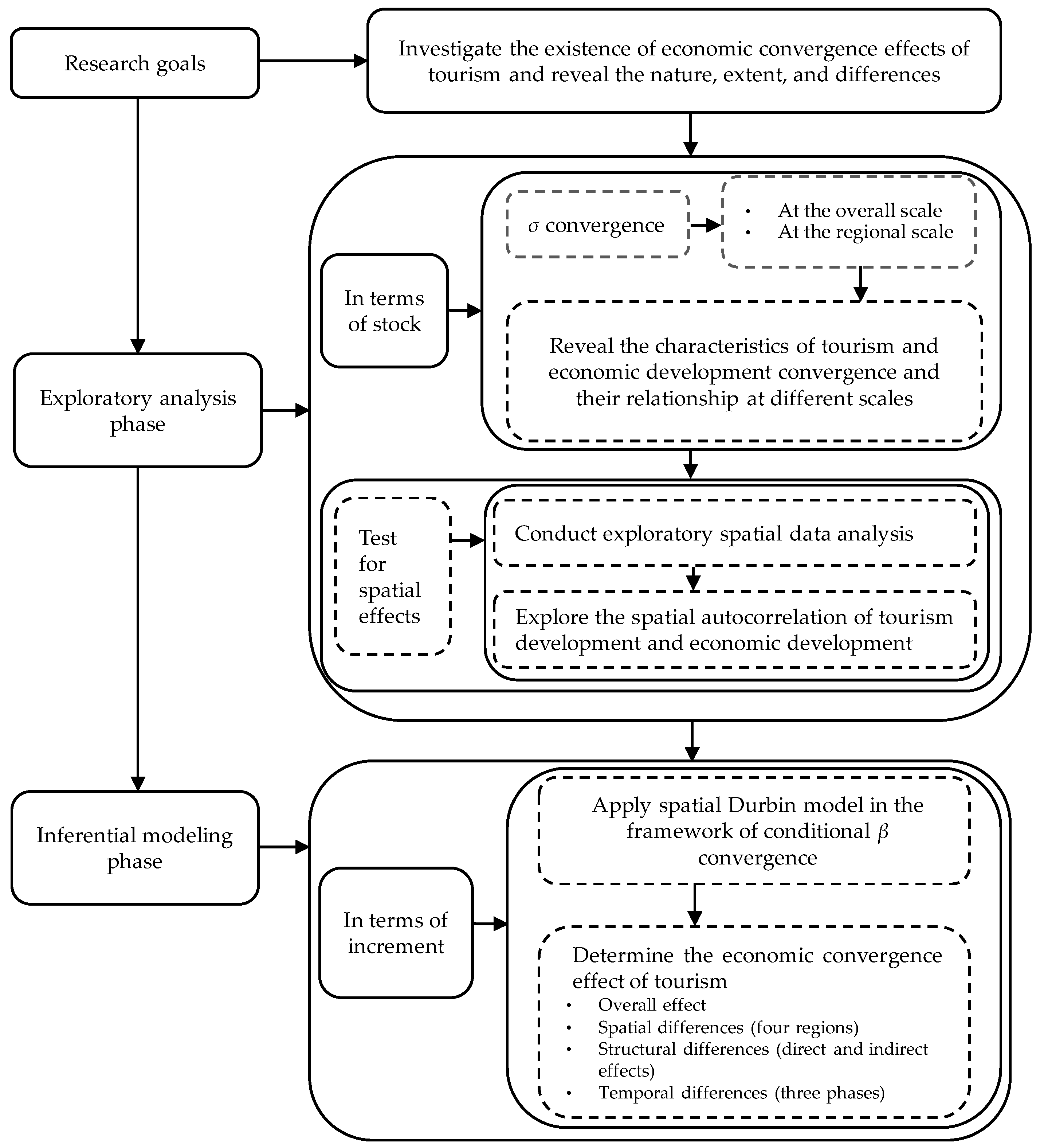
Based on the above sections, we present a diagram of the study framework (Figure 3).

4. Results and Discussion

4.1. σ Convergence of Tourism Development and Economic Development

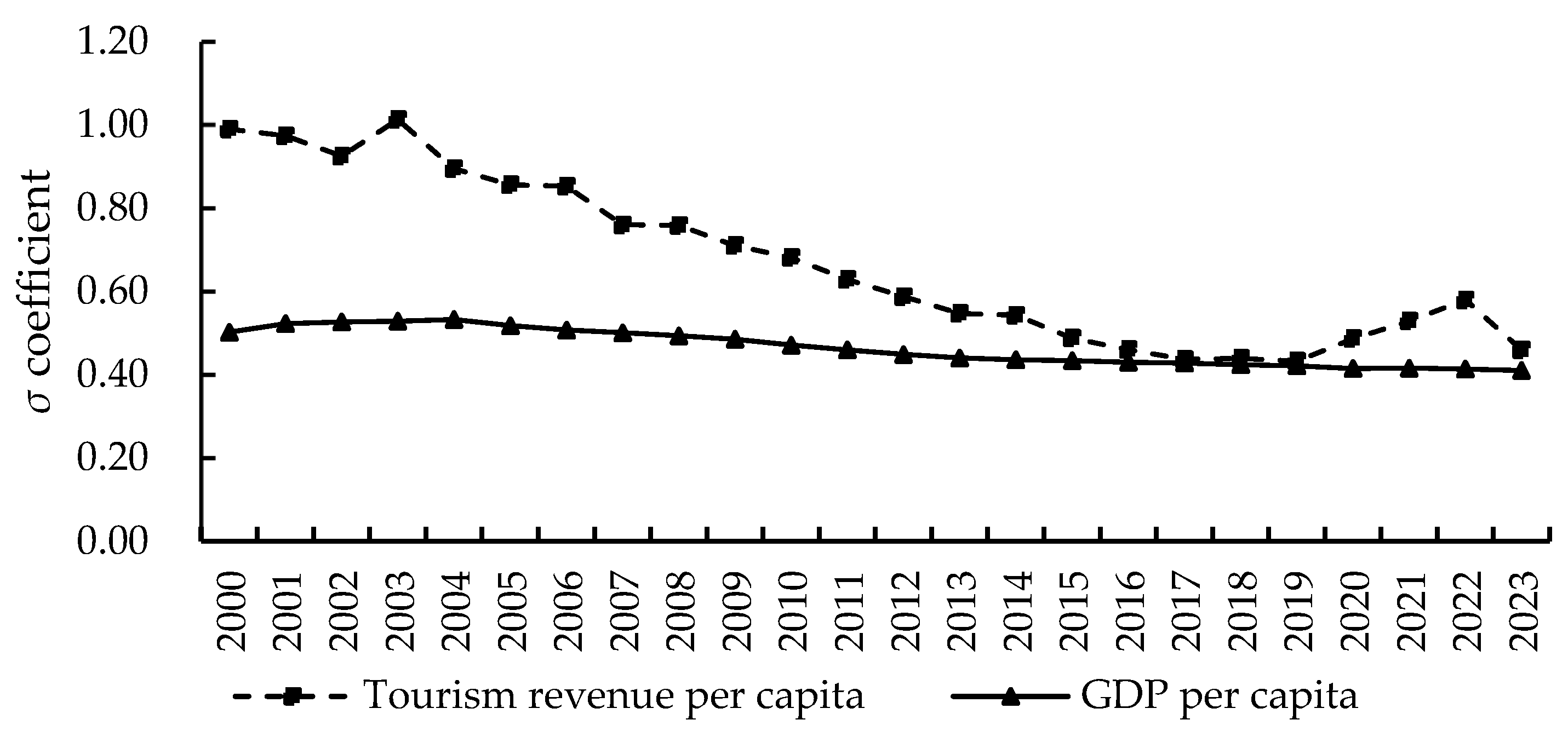
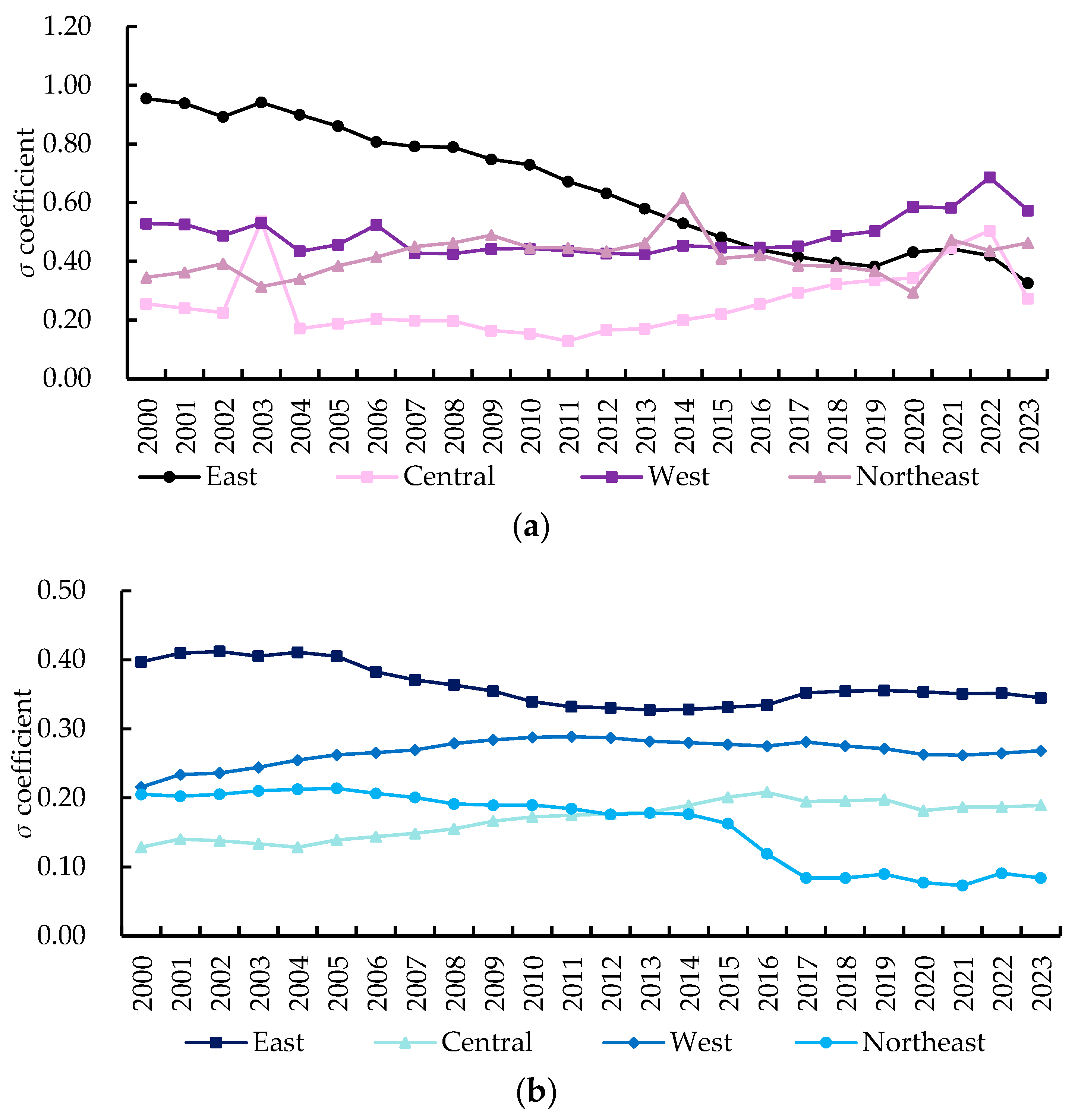
In this study, the standard deviations of the logarithm of the per capita tourism revenue and per capita GDP of Chinese provinces from 2000 to 2023 is calculated quantitatively as the σ coefficient to assess convergence from the stock aspect (Figure 4). The figure shows the following: (1) tourism development shows clear convergence characteristics, and although public health emergencies, such as SARS in 2003 and the COVID-19 pandemic in 2020, led to fluctuations in tourism development, but did not affect the general trend of convergence. The mechanism of tourism-driven economic convergence holds only when tourism resources are not excessively concentrated in developed regions. The demonstrated existence of tourism σ convergence effectively rules out potential confounding effects of the Matthew effect—a phenomenon of cumulative advantage where tourism development disproportionately benefits already developed regions, thereby widening disparities—on our findings [51]; (2) economic development had a slight divergent trend before 2004, and then maintained a flat convergence trend; and (3) the overall convergence trends of tourism development and economic development during the study period are broadly consistent; however, the σ convergence of tourism development is significantly faster than that of economic development, suggesting to a certain extent that tourism may possess the ability and potential to narrow the regional economic gap. Unlike traditional manufacturing or high-tech industries, which rely heavily on industrial agglomeration and advanced production factors, tourism development generally exhibits a lower entry threshold in terms of location and initial development conditions. This characteristic enables less-developed regions to engage earlier and more rapidly in the tourism economy, thereby achieving initial economic catch-up. The steep decline in the tourism convergence curve likely reflects this “low-barrier effect”. This effect aligns with the particular potential of cultural and heritage assets in less-developed regions. Unlike capital-intensive sectors, many cultural heritage resources are inherently place-based and accessible. They typically demand lower upfront investment for tourism activation and, being rooted in local context, face less direct inter-regional competition. Thus, the rapid σ convergence of tourism may partly stem from the capacity of lagging regions to leverage these culturally-rooted resources for earlier market entry and initial catch-up growth.
Consequently, this observation raises a critical question: Does the faster convergence of tourism result from an inclusive growth mechanism that favors less-developed regions, or does it merely reflect a superficial homogenization of tourism economies at a specific stage of development? To distinguish between these possibilities and to investigate the deeper mechanisms through which tourism influences regional disparities, we will employ β convergence in the subsequent section to provide more comprehensive and nuanced assessment of whether tourism promotes economic convergence.
As illustrated in Figure 5, (1) the four regions of East, Northeast, Central and West China have significantly different coefficients of σ convergence in tourism development (Figure 5a). Tourism development in the eastern region shows a clear convergence pattern and remains consistent with the convergence trend of national tourism development, which also reflects from another angle that tourism in the eastern region greatly assists in the convergence of national tourism development. The tourism development gap in the northeastern region is volatile, but began to show a convergence trend after 2014. By contrast, the convergence trends in central and western regions are not obvious, mainly owing to the differences in tourism resources, basic conditions, and industrial policies of the provinces within these regions. (2) The σ convergence coefficients of GDP per capita in the East, Northeast, Central and West China differ significantly (Figure 5b). The economic development of the eastern and northeastern regions has a clear tendency to converge, whereas that of the central and western regions is stable, but the convergence characteristics are not obvious, mainly due to the differences in resource endowment, industrial structure, economic foundation, and development stage of provinces within the central and western regions. With continued national support for economic development factors such as policies, capital, talent, and industry in central and western China, the convergence of economic development in these regions will emerge. Combining the two graphs reveals that the convergence trends of tourism and economic development at the regional scale also echo each other, which further implies the possibility that tourism has economic convergence effects.

4.2. Spatial Relevance of Tourism and Economic Development

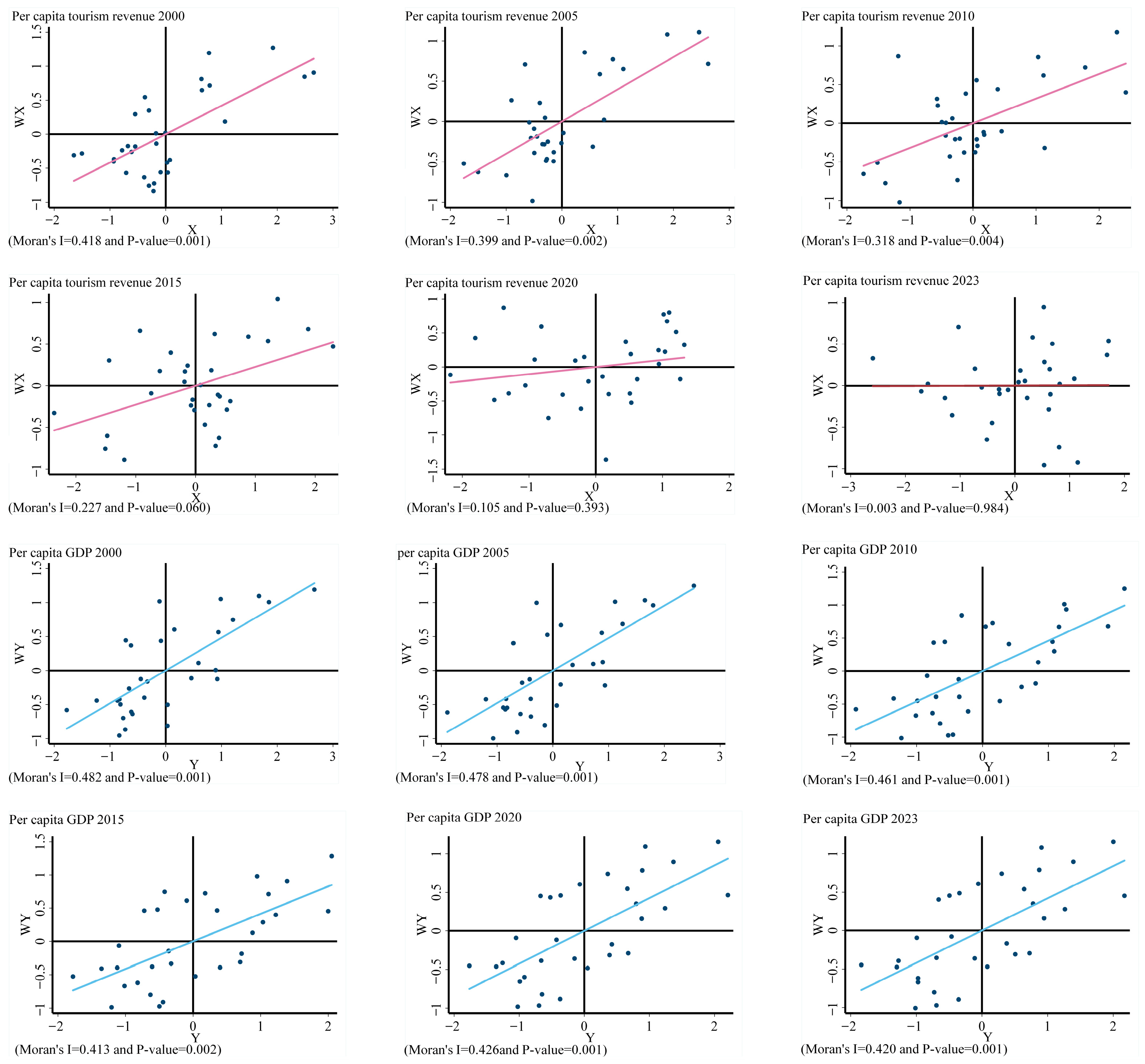
The result of the global spatial correlation analysis (Table 3) shows that tourism and economic development overall had a significant positive spatial correlation during the study period; the positive spatial correlation of tourism development was not significant in later years (2019–2021 and 2023). However, economic data continued to exhibit significant positive spatial correlation, highlighting a divergence between sectoral volatility and regional economic resilience. This is attributable to the fact that tourism constitutes a highly mobile and shock-sensitive service sector. Towards the end of the study period, the impact of the pandemic disrupted tourism development and weakened inter-regional tourism linkages. In contrast, provincial GDP encompasses a broader-based economic structure that includes less mobile and more resilient industries (such as manufacturing and agriculture), which collectively help sustain the relative stability of regional economies. This does not fully indicate the absence of a spatial correlation of tourism development at the end of the study period, given the limitations of the global Moran’s I. Global indicators may obscure local spatial heterogeneity, whereas methods such as Moran scatterplots can decompose global measures like Moran’s I into contributions from individual local.
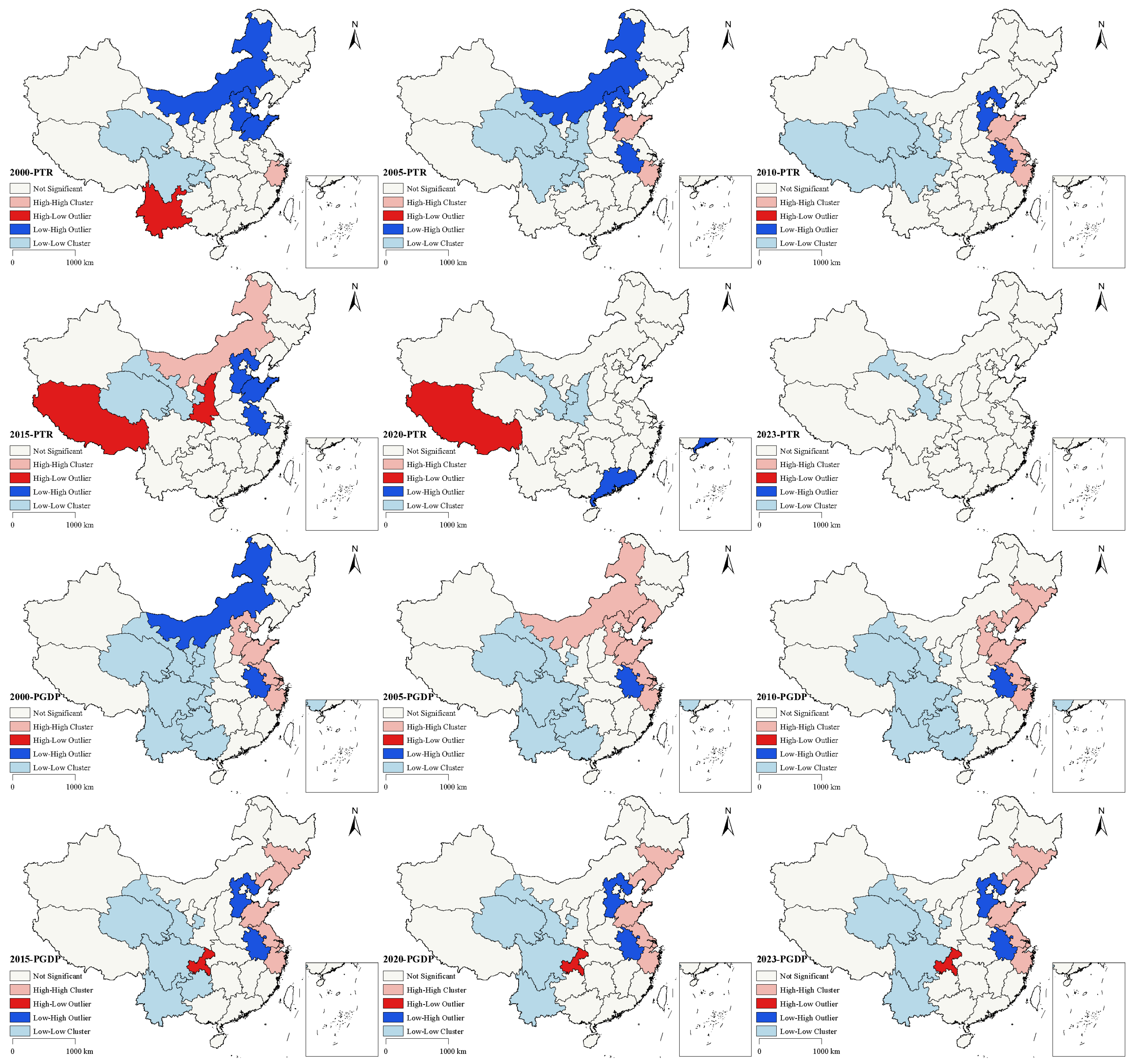
Accordingly, this study further investigates the spatial autocorrelation of local areas. Figure 6 displays the Moran scatterplots of per capita tourism revenue and per capita GDP for Chinese provinces from 2000 to 2023, in which tourism development demonstrates significant positive spatial correlation, and to a greater extent, economic development. Furthermore, since the geographical distance matrix captures more nuanced spatial decay effects, we replaced the adjacency matrix with an inverse-distance, row-standardized geographic distance matrix based on great-circle distances and reconfirmed these local spatial patterns using LISA cluster maps (Figure 7). Additionally, the spatial clustering patterns show a notable correspondence with China’s macro-regional policy divisions. It is observed that high–high clusters are predominantly located in the affluent eastern coastal provinces, whereas low–low clusters are concentrated in the less-developed western and central inland regions. This correlation is particularly pronounced in the spatial clustering patterns of economic data. Even if the global Moran’s I for tourism development is not significant in late-stage, the analysis of local spatial correlations shows spatially positively correlated provinces (low–low clusterings in central and western regions). Crucially, economic development (the dependent variable) exhibits a strong and consistently significant positive spatial autocorrelation throughout the entire study period (Table 3, Figure 6 and Figure 7). This indicates that the core phenomenon to explain in this study is inherently spatial in nature. Additionally, spatial dependence may stem from time-persistent, unobserved factors, such as regional culture or shared infrastructure. This finding fundamentally justifies the adoption of a spatial econometric framework. Such spatial dependence violates the assumption of independently distributed errors in standard regression models, indicating that a province’s development trajectory is influenced not only by its own characteristics but also by those of neighboring regions. This directly motivates the use of spatial econometric models as a theoretically appropriate choice. As established in the methodology section through a series of tests, the Spatial Durbin Model (SDM) was selected for its ability to disentangle direct effects from indirect (spillover) effects. The observed high–high and low–low clusters suggest the presence of strong positive spatial spillovers within groups of provinces sharing similar development levels. The SDM allows explicit estimation of whether tourism growth in a high cluster province stimulates or inhibits growth in neighboring high cluster provinces, with analogous reasoning applying to low clusters.

4.3. Tourism and Economic Conditional β Convergence: An SDM Analysis

Models 1, 2 and 3 are measured in this study by introducing a spatial weight matrix and, after a series of tests, choosing a two-way fixed effects SDM in a conditional β convergence framework (Table 4). Model 1 does not include tourism development variables, only the other key control variables. Model 2 incorporates tourism development variables (using tourism revenue per capita and spatial lags of tourism revenue per capita as proxy variables) as conditional convergence factors. Model 3 includes a tourism-economy interaction term to test the effect of tourism on economic convergence.
The results are summarized below.
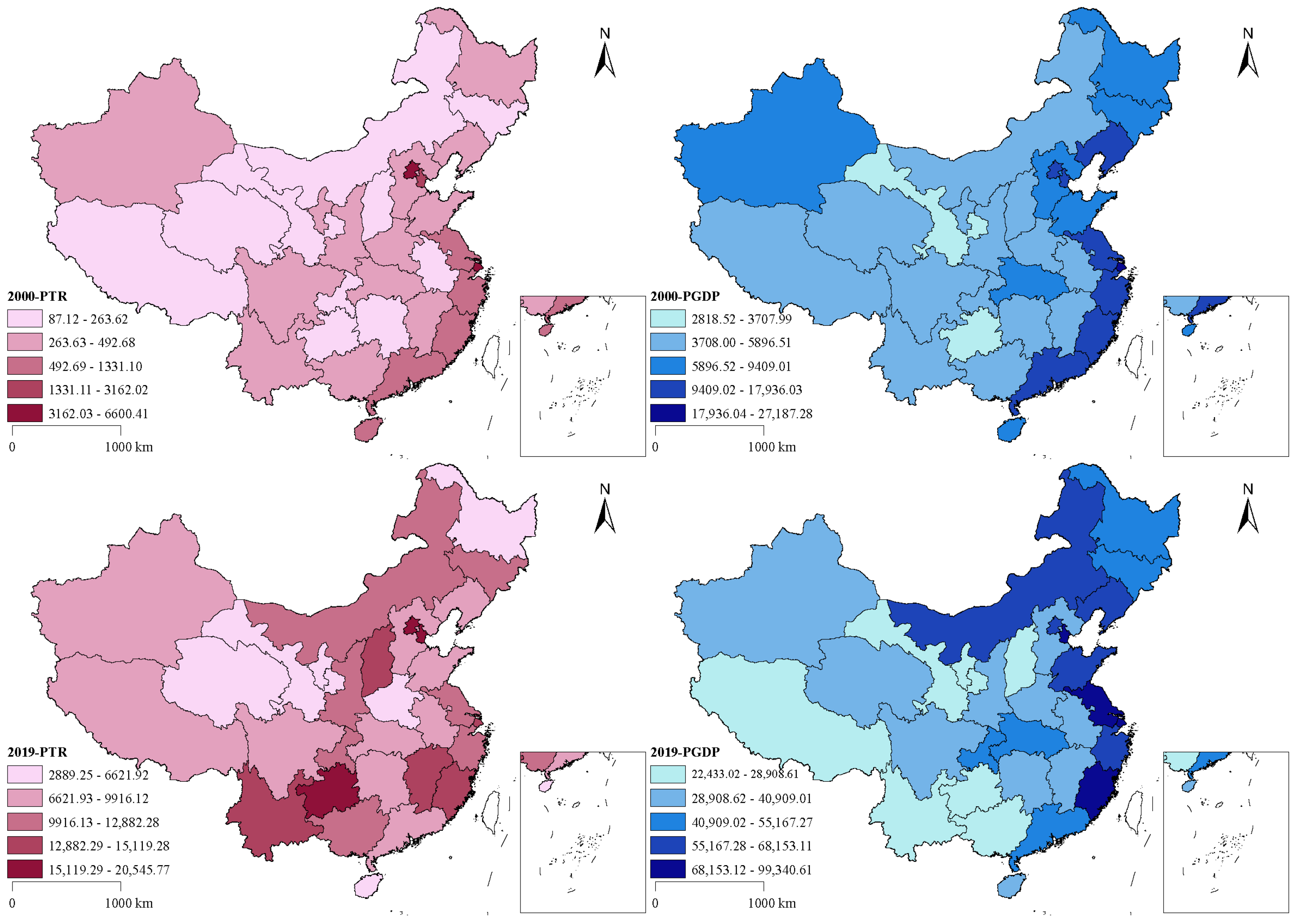
(1) In general, the range of high-level regions for tourism and economic development gradually spreads to the central and western regions, and although the disparity between regions tends to decrease gradually, it still exists. Taking as examples the years 2000 and 2019, which are without a large-scale impact from the COVID-19 pandemic (Figure 8), the high-level regions of tourism and economic development both gradually spread from the initial eastern coastal areas to the central and western regions.
(2) Compared with that of economic development, the spatial spillover effect of tourism is more pronounced, with high-level tourism regions increasing by 166.67% over the 20-year period, while high-level economic regions increased by 28.57% over the same period. Therefore, tourism has the potential to promote economic growth and convergence, thereby driving balanced regional economic development. This study will further validate this inference through SDM in a conditional β convergence framework.
(3) In general, the 31 Chinese provinces show conditional β convergence in economic development. This is evidenced by the significantly negative coefficient of the time-lagged term of GDP per capita in both models (Table 4), implying faster economic growth in the relatively backward provinces. Moreover, its spatial lagged term is significantly positive in both Models 1 and 2, indicating that economic growth in a province in previous years greatly contributes to economic growth in neighboring provinces. In addition, the spatial autoregressive coefficient of the dependent variable (economic development) is significant and positive, indicating that an increase in the per capita GDP growth rate in a province remarkably benefits the economic growth in neighboring regions. Local physical capital accumulation has a positive and significant effect, which is consistent with economic growth theory [42]. The negative coefficient of the spatial lag term of l n ( s i , t ) implies a competitive effect of capital. ln ( n i , t + g + δ ) has a significantly negative coefficient, echoing prior research findings in the field [23,40]. In the economic start-up phase, the growth of human resources is typically a significant driver of economic growth. However, when economic growth is driven by technological innovation and progress in all sectors, if the increase in labor force is not accompanied by an equal or higher proportion of technological progress, the law of diminishing marginal effects makes it difficult for the growth of the labor force to significantly drive economic growth or even have a negative impact. In addition, W × l n ( n i , t + g + δ ) , its spatial lagged term, has a significantly positive coefficient, indicating that population growth in neighboring regions stimulates the local economy and provides more local consumption, which also indicates the complementary effect of labor between regions. The coefficients of ln ( R D i , t ) , ln ( F D I i , t ) , ln ( E i , t ) , and their spatial lagged terms are mostly positive but insignificant; however, when the tourism development variable is included in Model 2, the significance of FDI increases, indicating that tourism further contributes to the role FDI plays in economic development. The coefficients of ln ( C i , t ) and the spatial lag demonstrate that while stimulating local economic growth, consumption simultaneously inhibit neighboring regions’ growth. This divergence stems from factor agglomeration, with consumption growth attracts labor, capital, and technology to concentrate locally at the expense of neighboring regions. Regarding the impact of the core explanatory variable (tourism development) on economic development, the coefficients of both ln ( T R i , t ) and its spatial lagged term are positive, implying that tourism has a beneficial effect on economic growth, which is consistent with previous studies [52].
(4) Tourism development effectively enhances the rate of convergence of regional economic development (Table 4). This conclusion is substantiated through a dual analytical approach: First, adding the tourism development factor (Model 2) increases convergence rate from 7.26% to 7.69%, compared with the baseline model without tourism development factor (Model 1), suggesting a potential positive effect of tourism on economic convergence. This is inconsistent with Oviedo-García et al. [53], likely because of the differences between the economic structure of the case they selected and China, and the fact that the time series data and ARDL they used suffer from small sample sizes and neglect of spatial effects, which may introduce estimation bias. Second, the interaction term analysis provides deeper insight. In Model 3, the inclusion of the interaction term alters the interpretation. In this specification, the interaction term coefficient is the parameter of primary interest, as it directly captures how tourism moderates the relationship between the initial economic level and subsequent growth. The results reveal a significantly negative coefficient for the interaction term, demonstrating that less developed regions derive greater benefits from tourism development, thereby strengthening the conditional convergence mechanism in economic development. These findings provide additional empirical evidence supporting tourism’s function as a catalyst for regional economic convergence.
(5) The economic convergence effect of tourism exhibits spatial heterogeneity (Table 5). In the baseline group of western China, the significantly negative coefficient on the tourism-economy interaction term indicates that tourism growth exerts a stronger positive impact on economic growth in less developed provinces within the region, thereby effectively promoting catch-up and convergence. This can be attributed to the region’s high reliance on tourism as a primary export sector, its rich endowment of unique natural and cultural assets, and supportive national policies that have enhanced accessibility and funneled investment into tourism infrastructure. Simultaneously, the convergence effect of tourism in eastern China is equally strong, which is linked to their mature, diversified tourism economies and advanced market institutions. Here, tourism is deeply integrated into robust regional service ecosystems, fostering stronger productivity spillovers and innovation.
In contrast, however, the convergence effect of tourism in central China is relatively weaker, though still present, likely due to its intermediate level of tourism development and economic structure, which may limit the sector’s relative marginal impact compared to more specialized regional economies.
In northeastern China, the economic convergence effect of tourism is the strongest among all regions. This observation aligns with the rapid σ convergence of the regional economy in the later phase of the study period, as shown in Figure 5b. This may be attributed to the effective role of tourism growth in offsetting the decline of traditional industries. On the one hand, as a core component of the national “Northeast Revitalization” strategy, former industrial heritages have been transformed into cultural tourism attractions, creating new growth pathways that particularly benefit less-developed areas within the region. On the other hand, policy support for ice-and-snow tourism has capitalized on the region’s natural comparative advantage, stimulating service-sector growth and infrastructure investment in previously stagnant local economies. Together with precisely targeted regional revitalization policies, these factors have collectively amplified tourism’s role in stimulating local economic catch-up.
Additionally, the spatial spillover effects of tourism on economic convergence indicate that tourism development in the baseline western and northeastern regions has almost no impact on their surrounding areas. Notably, tourism development within eastern China tends to impede economic convergence in neighboring areas. Specifically, tourism growth in eastern China exerts a negative influence on economic growth in the less developed parts within its surrounding areas. This pattern may be explained by a siphoning effect, whereby resources such as skilled labor, tourism-related investment, and high-spending visitors are diverted from neighboring regions toward the developed core, combined with tourism demand diversion and intensified regional competition. In contrast, tourism development in central China plays a stronger role in promoting economic growth in neighboring less-developed areas, which may be due to its connective geographical and economic position, lower regional disparity, and the diffusion of tourism-related infrastructure and demand into adjacent hinterlands.
(6) Tourism economic convergence effects are structurally different, and the impact can be measured by decomposing the effects and calculating direct and indirect effects (Table 6) [49]. In this case, direct effects measure the influence of changes in the local explanatory variables on the dependent variable, including feedback effects. Indirect effects can be understood as the influence of changes in the local explanatory variables on the dependent variables in neighboring regions, or the influence of the explanatory variables in neighboring regions on the local area. The results reveal that overall, there is an economic convergence effect only in the direct effects, indicating that the factors in each region have a greater convergence effect on the local economy, with no convergence effect on the economy of the surrounding areas Regarding the tourism development variables, the results show that tourism development brings substantial benefits to the economic development of both the local and surrounding areas, although its effect on the economic growth of the surrounding areas is stronger. Meanwhile, tourism significantly contributes to local economic convergence; when accounting for long-term spatial feedback effects, tourism development also demonstrates a significant positive impact on economic convergence in neighboring areas. This pattern has direct implications for China’s regional development strategies. The pronounced indirect effect of tourism aligns with the objectives of policies like the “Western Development Strategy” and the “Rural Revitalization Strategy”. For less-developed western and rural regions, investing in tourism can serve as a strategic lever not only for local growth but also for stimulating neighboring economies through visitor flows and supply chain linkages. Consequently, policymakers should prioritize the development of integrated regional tourism circuits over isolated destination promotion.
Regarding the other regional socioeconomic factors affecting economic growth, physical capital has a significant negative spatial spillover effect of on economic development, which may be due to the large difference in the level of physical capital accumulation between regions. Therefore, as the core region continues to accumulate capital, it will have a greater polarizing effect on the relatively backward surrounding regions. Consumption provides a significant stimulus to local economic growth but has a negative impact on neighboring areas, especially after the inclusion of the tourism variable in the model. This may be attributed to the shift in consumption patterns from local goods and services to tourism-related activities, which could lead to demand diversion and the crowding out of traditional local industries in peripheral regions. Moreover, the population has a positive effect on economic growth in the periphery when the tourism variable is added, which may be due to the synergistic effect of two factors: tourism accelerates population movement and tourism consumption, thus boosting the periphery’s economic development.
(7) The economic convergence effect of tourism exhibits temporal heterogeneity across phases (Table 7). To examine this dynamic, we divided the full sample (2000–2023) into three sub-periods based on distinct stages of China’s macroeconomic shifts: Phase I (2000–2012), Phase II (2013–2019), and Phase III (2020–2023).
Phase I: Tourism demonstrated a significant and positive economic convergence effect, with the tourism-economic interaction term being negative and statistically significant. Both the direct and indirect effects were significant, indicating that during this phase, tourism not only accelerated local economic catch-up in less-developed regions but also generated positive spatial spillovers to neighboring underdeveloped areas. This pattern likely reflects the early-stage advantages of tourism as a low-barrier, labor-intensive sector that rapidly absorbed surplus rural labor and stimulated local consumption and investment, particularly in China’s western and central regions where tourism resources remained underutilized prior to this period.
Phase II: The economic convergence effect of tourism became statistically insignificant. Specifically, tourism no longer exhibited a stronger growth-enhancing effect in initially poorer regions relative to richer ones, and it even showed a dampening effect on economic growth in neighboring less-developed areas. This shift is attributed to the maturing of regional tourism markets and the onset of increasing regional competition. As tourism development became more spatially concentrated and market-oriented, benefits may have accrued disproportionately to already-developed tourism hubs, while less-developed areas faced challenges such as resource diversion, talent outflows, and intensified interregional competition.
Phase III: Tourism again showed a significant economic convergence effect in terms of direct effect, meaning it significantly boosted growth in less-developed provinces. However, the spatial spillover effect turned negative, suggesting that tourism’s convergence benefits did not extend to neighboring underdeveloped regions during this period. This pattern is likely influenced by the COVID-19 pandemic and subsequent travel restrictions, which severely disrupted interprovincial tourism flows and shifted demand toward localized, short-distance tourism. Consequently, tourism’s growth benefits became more locally bound.
These phased results underscore that tourism’s role in regional economic convergence is context-dependent, shaped by evolving regional policies, market structures, and exogenous shocks.

4.4. Robustness Testing

Here, we employ the instrumental variables approach to avoid endogeneity—a situation where an explanatory variable is correlated with the error term, potentially due to reverse causality. Since population dynamics are predominantly determined by long-term factors and remain largely unaffected by short-term economic fluctuations, this study retains the contemporaneous population measures while employing a one-period-lagged tourism variable and control variables (excluding population) as instrumental variables. As Reed [54] noted, using lagged values of endogenous explanatory variables as instruments is a valid estimation method. Additionally, while the adjacency matrix only accounts for whether two provinces are adjacent, the geographical distance matrix captures more nuanced spatial decay effects. Tourist flows and the diffusion of tourism-related investments generally exhibit distance-decay properties [55]. A more affluent or tourism-endowed province may exert economic influence beyond its immediate neighbors, affecting more distant yet accessible regions. We therefore replace the adjacency matrix with an inverse-distance matrix constructed using great-circle distances between provincial capitals, which is subsequently row-standardized. We construct three model specifications: non-tourism (Model 5), tourism scenario (Model 6), and the model incorporating tourism-economy interaction terms (Model 7, Table 8). The regression results indicate that after addressing endogeneity and altering the weight matrix, the estimated coefficients show minor variations while maintaining consistent effect directions. Regarding the core explanatory variable and tourism-economy interaction term, tourism development continues to demonstrate greater benefits for economically underdeveloped regions and effectively enhances regional economic convergence rates. The inclusion of tourism development factors (Model 6) increases the convergence rate from 6.08% to 6.29%.
Comparative analysis of effect decomposition between baseline models (Table 6) and robustness checks (Table 9) reveals that both direct and indirect effects of tourism development remain significantly positive, with particularly pronounced indirect effects. This suggests that tourism exerts stronger spillover effects on neighboring regions’ economic development than on local economic growth. Additionally, the economic convergence effect of tourism on the local economy is still stronger than that of neighboring regions. It is worth noting that when using the inverse-distance matrix, the coefficients for the indirect effects of tourism development on economic convergence remain statistically significant. This result provides econometric confirmation of the reliability of our core conclusion, indicating that the spatial spillover effect of tourism development in promoting economic convergence does not depend on the specific adjacency spatial configuration but remains valid under a more general distance-decay pattern.

5. Conclusions and Implications

5.1. Conclusions

This study innovatively investigates the role that provincial and regional tourism development plays in economic growth and its effect on reducing regional economic disparities in China between 2000 and 2023 from a spatial perspective, to understand more accurately the theoretical and practical implications of the economic convergence effect of tourism.
This study draws several conclusions. Firstly, the contribution of tourism in stimulating economic growth and facilitating economic convergence has been substantiated. Secondly, regarding the spatial heterogeneity of tourism’s economic convergence effects, northeastern China demonstrates stronger effects, followed by the western and eastern regions, in contrast to the relatively weaker impacts observed in central regions. Finally, regarding the structural differences in tourism’s economic convergence effects, while tourism exerts positive influences on both local and neighboring regions’ economic growth and convergence, its convergence effect is marginally more pronounced at the local level than in neighboring areas.
The main contribution of the study is that it not only confirms the positive impact of tourism on economic growth and convergence but also further clarifies the nature, extent, and spatial and structural differences of the economic convergence effect of tourism from a spatial perspective. Additionally, this study is based on the regional socioeconomic system and finds that tourism does not work in isolation. The economic convergence of tourism is attributed to not only the synergy of socioeconomic factors but also the policies of conditioning factors related to the transformation of tourism growth into economic growth and convergence, such as infrastructure and transportation policies. In addition, this study supports the importance of harmonizing and integrating the resources of each region so that the fruits of tourism development can be shared across the regions. The findings show that tourism development is an effective tool that helps to achieve shared wealth. Thus, this study provides a reference for other countries and regions at a comparable stage of development.

5.2. Theoretical Implications

First, this study proposes and defines for the first time the economic convergence effect of tourism and goes a step further by examining the impact of tourism on economic disparities at the provincial and regional levels, thus filling a gap in the existing literature and revealing the contribution of tourism to reducing regional disparities and the new paths it offers for achieving the Common Prosperity. Second, by combining σ convergence and conditional β convergence analyses, the study finds economic convergence in both stock and incremental terms and highlights the contribution of tourism in the process. Third, previous studies mainly examined the role of tourism in reducing regional disparities using non-spatial methods such as OLS and traditional convergence models, which might have led to biased and inconsistent findings [8,9]. By contrast, this study verifies the spatial autocorrelation of tourism and economic development using ESDA. Accordingly, a two-way fixed-effects SDM in a conditional β convergence framework is constructed to analyze the role of tourism development in economic growth and convergence from a spatial perspective. Fourth, the model considers important economic growth factors in the socioeconomic system together with tourism development variables, resulting in a more comprehensive and accurate measurement of the tourism economic convergence effect. In short, this study offers a new research framework for analyzing the relationship between tourism development and economic growth and convergence. This could enable future researchers to accurately measure the impact of tourism on regional economic growth and the reduction in regional disparities and thereby propose strategies that are compatible with the macro socioeconomic system, as well as initiatives that are compatible with the Common Prosperity, while also expanding the exploration to various temporal and spatial scenarios and different statistical perspectives.

5.3. Policy Implications

The findings of this study offer distinct policy pathways: one to harness tourism’s long-term potential as an engine for economic convergence, and another to fortify it against short-term shocks, ensuring this convergence path is resilient and sustainable. Crucially, these pathways must be informed by the significant spatial heterogeneity observed in both the direct (local) effects and indirect (spatial spillover) effects of tourism.
To solidify tourism’s role in reducing regional disparities over the long run, policymakers should move beyond viewing tourism merely as a sector and integrate it into regional planning as a tool for wealth redistribution and spatial rebalancing. This involves directing resources and improving tourism infrastructure in less-developed regions to create lasting economic linkages and facilitate sustained value transfer. Second, policymakers should recognize that, by introducing the tourism variable into the model, the positive impact of some regional socioeconomic factors on economic development becomes significant, such as when tourism is combined with population growth, where strong tourism flows act as carriers of wealth to further drive the flow of capital. Therefore, instead of developing separate policies for tourism and other socioeconomic systems, policymakers should consider them as a coupled system in the policy-making process to reinforce their synergies. Moreover, to maximize tourism’s contribution to coordinated regional development, policies must first consolidate and optimize tourism’s local convergence effects. Regions should continue to enhance the driving role of tourism in fostering economic convergence, particularly in the northeastern, western, and eastern regions, and promote its integration with high-value-added industries. As the region with the weakest economic convergence effect of tourism, central China should focus on improving the economic translation efficiency of tourism in its less-developed areas and strengthening the connection between tourism products and local contexts. Second, it is essential to recognize and manage the regional resource-siphoning effects of tourism growth, particularly in eastern China. The key to policy lies in transforming a zero-sum game into synergistic growth. This requires establishing regional cooperation mechanisms that transcend administrative boundaries. Furthermore, to maximize tourism’s long-term contribution to regional convergence, policymakers should recognize and strategically strengthen its role as a primary channel for realizing the economic value of cultural and heritage resources. By fostering tourism models that actively preserve cultural assets and reinvest revenues into local communities—especially in less-developed regions rich in cultural heritage but limited in other forms of capital—tourism can evolve from a sectoral growth driver into a sustainable mechanism for spatially balanced and culturally-grounded development.
To protect tourism-driven convergence from disruptions and ensure its long-term viability, a parallel focus on building resilience is critical. First, a dual strategy of horizontal industrial diversification and vertical value-chain upgrading is essential. This involves deepening intersectoral linkages between tourism and agriculture, manufacturing, and other service industries, while leveraging technological innovation to provide high-value-added tourism services. Second, clarifying the conditional factors for transforming tourism development into economic growth is crucial to improving the efficiency of that transformation and enhancing the convergence effect. This implies that only focusing on policies that promote the growth of tourism is insufficient; tourism must also be used as an instrument for social development [16]. Policymakers and destination managers should implement policies aimed toward ensuring that the region is prepared for a tourism boom in terms of infrastructure and transportation, at the same time as, or before, developing tourism, thereby creating an enabling environment for sustainable tourism growth and convergence. Furthermore, policymakers should adopt phase-sensitive and spatially differentiated strategies to harness tourism’s convergence potential while mitigating its spatial-temporal disparities.
The promotion of balanced and adequate economic growth is closely linked to the current global challenges facing humanity. Following the practical recommendations of this study would contribute to the achievement of not only the goals of promoting sustainable economic growth and reducing regional disparities but also other goals in the areas of infrastructure, transportation, employment, and poverty.

5.4. Limitations and Future Research

Several limitations of this study warrant attention and point to fruitful directions for future research. First, the aggregate provincial tourism revenue data precludes the disentanglement of potentially distinct effects across tourism subtypes, such as cultural/heritage tourism, business tourism, and leisure tourism. Future studies could extend this line of inquiry to examine whether specific forms of tourism, particularly cultural heritage tourism, uniquely contribute to regional convergence.
Second, the provincial scale of analysis may obscure intra-provincial disparities, as tourism development and economic dynamics likely differ substantially between urban tourism hubs and rural hinterlands within the same province. Research using finer-grained data would help uncover sub-provincial heterogeneities and spatial interaction mechanisms.
Third, while we address potential reverse causality through lagged instrumental variables, other sources of endogeneity may persist. For example, simultaneous regional shocks could jointly influence tourism and growth across neighboring regions, leading to omitted variable bias. Although our two-way fixed effects and spatial controls capture certain unobserved confounders, they may not fully account for all spatio-temporally correlated shocks. Future work could further strengthen causal identification through more refined instrumental strategies.
Fourth, the use of a fixed early-year price basket (2000 base year) to deflate nominal values across the 2000–2023 period may not fully reflect subsequent shifts in relative prices, consumption patterns, and industrial structure. Consequently, the estimated magnitudes of long-term growth and convergence coefficients could be sensitive to base-year choice. Future analyses could test robustness by employing multiple base years to mitigate concerns regarding price structure representativeness.
Beyond these methodological considerations, future research could employ longer-term data tracking and dynamic panel threshold models to further investigate the specific mechanisms and sustainability conditions of tourism-driven convergence. Moreover, the scope of inquiry could be productively expanded beyond economic output to encompass broader well-being indicators, thereby offering a more holistic understanding of tourism’s role in regional development.

Supplementary Materials

The following supporting information can be downloaded at: https://www.mdpi.com/article/10.3390/su18031289/s1, Table S1: The complete list of provinces in each region. Dataset S1: The variable dataset used in the empirical analysis of this study.

Author Contributions

Conceptualization, L.G. and J.Z.; methodology, L.G.; software, L.G.; validation, T.M., L.Y. and P.W.; formal analysis, L.G.; data curation, L.G.; writing—original draft preparation, L.G.; writing—review and editing, T.M., L.Y., P.W., X.M. and J.Z.; visualization, X.M.; supervision, J.Z.; funding acquisition, J.Z. All authors have read and agreed to the published version of the manuscript.

Funding

This research was funded by the National Natural Science Foundation of China, via grant number 42271251.

Institutional Review Board Statement

Not applicable.

Informed Consent Statement

Not applicable.

Data Availability Statement

Data is contained within the article or Supplementary Materials. The datasets generated and/or analyzed during the current study are available from the following public sources: China Statistical Yearbook (2001–2024), provincial statistical yearbooks (2001–2024), and Statistical Bulletin on National Investment in Science and Technology (2000–2023). See Table 1 for full details. The main preprocessing steps included (1) deflation to constant 2000 RMB using CPI and (2) natural logarithm transformation applied to key variables.

Acknowledgments

The authors wish to gratefully acknowledge the editors and reviewers for their valuable comments and suggestions that improved the manuscript.

Conflicts of Interest

The authors declare no conflicts of interest.

References

  1. Incera, A.C.; Fernández, M.F. Tourism and income distribution: Evidence from a developed regional economy. Tour. Manag. 2015, 48, 11–20. [Google Scholar] [CrossRef]
  2. Nunkoo, R.; Seetanah, B.; Jaffur, Z.R.K.; Moraghen, P.G.W.; Sannassee, R.V. Tourism and economic growth: A meta-regression analysis. J. Travel. Res. 2020, 59, 404–423. [Google Scholar] [CrossRef]
  3. Dogru, T.; Bulut, U. Is tourism an engine for economic recovery? Theory and empirical evidence. Tour. Manag. 2018, 67, 425–434. [Google Scholar] [CrossRef]
  4. Zhang, J.K. The effects of tourism on income inequality: A meta-analysis of econometrics studies. J. Hosp. Tour. Manag. 2021, 48, 312–321. [Google Scholar] [CrossRef]
  5. Nugroho, A.; Verikios, G.; Pham, T.; Su, J. The distributional and spillover impacts of tourism across regions: The case of Indonesia. Tour. Econ. 2025, 31, 611–630. [Google Scholar] [CrossRef]
  6. Lv, Z. Deepening or lessening? The effects of tourism on regional inequality. Tour. Manag. 2019, 72, 23–26. [Google Scholar] [CrossRef]
  7. Blake, A. Tourism and income distribution in East Africa. Int. J. Tour. Res. 2008, 10, 511–524. [Google Scholar] [CrossRef]
  8. Chi, J. Revisiting the tourism-inequality nexus: Evidence from a panel of developed and developing economies. Curr. Issues Tour. 2021, 24, 755–767. [Google Scholar] [CrossRef]
  9. Ghosh, S.; Mitra, S.K. Tourism and inequality: A relook on the Kuznets curve. Tour. Manag. 2021, 83, 104255. [Google Scholar] [CrossRef]
  10. Cárdenas-García, P.J.; Brida, J.G.; Alcalá-Ordóñez, A.; Segarra, V. Tourism’s contribution to human development and the reduction of poverty and inequality: Empirical evidence at a regional level in Spain. Int. J. Tour. Res. 2024, 26, e2669. [Google Scholar] [CrossRef]
  11. Zhao, X.; Zhu, J. Industrial restructuring, energy consumption and economic growth: Evidence from China. J. Clean. Prod. 2022, 335, 130242. [Google Scholar] [CrossRef]
  12. Santamaria, D.; Filis, G. Tourism demand and economic growth in Spain: New insights based on the yield curve. Tour. Manag. 2019, 75, 447–459. [Google Scholar] [CrossRef]
  13. Kyophilavong, P.; Gallup, J.L.; Charoenrat, T.; Nozaki, K. Testing tourism-led growth hypothesis in Laos? Tour. Rev. 2018, 73, 242–251. [Google Scholar] [CrossRef]
  14. Perles-Ribes, J.F.; Ramón-Rodríguez, A.B.; Rubia, A.; Moreno-Izquierdo, L. Is the tourism-led growth hypothesis valid after the global economic and financial crisis? The case of Spain 1957–2014. Tour. Manag. 2017, 61, 96–109. [Google Scholar] [CrossRef]
  15. Pulido-Fernández, J.I.; Cárdenas-García, P.J. Analyzing the bidirectional relationship between tourism growth and economic development. J. Travel. Res. 2021, 60, 583–602. [Google Scholar] [CrossRef]
  16. Katircioglu, S.T. Revisiting the tourism-led-growth hypothesis for Turkey using bonds test and Johansen approach for cointegration. Tour. Manag. 2009, 30, 17–20. [Google Scholar] [CrossRef]
  17. Chen, G.; Zhang, J. Regional inequality in ASEAN countries: Evidence from an outer space perspective. Emerg. Mark. Financ. Trade 2023, 59, 722–736. [Google Scholar] [CrossRef]
  18. Qin, D.; Xu, H.; Chung, Y. Perceived impacts of the poverty alleviation tourism policy on the poor in China. J. Hosp. Tour. Manag. 2019, 41, 41–50. [Google Scholar] [CrossRef]
  19. Solow, R.A. Contribution to the theory of economics. Q. J. Econ. 1956, 70, 65–94. [Google Scholar] [CrossRef]
  20. Romer, P.M. Increasing returns and long-run growth. J. Polit. Econ. 1986, 94, 1002–1037. [Google Scholar] [CrossRef]
  21. Ribeiro, L.C.D.S.; Santos, G.F.D.; Takasago, M. Does domestic tourism reduce regional inequalities in Brazil? Curr. Issues Tour. 2023, 26, 3255–3260. [Google Scholar] [CrossRef]
  22. Uzar, U.; Eyuboglu, K. Can tourism be a key sector in reducing income inequality? An empirical investigation for Turkey. Asia Pac. J. Tour. Res. 2019, 24, 822–838. [Google Scholar] [CrossRef]
  23. Li, H.; Goh, C.; Qiu, H.Z.; Meng, F. Effect of tourism on balanced regional development: A dynamic panel data analysis in coastal and inland China. Asia Pac. J. Tour. Res. 2015, 20, 694–713. [Google Scholar] [CrossRef]
  24. Barro, R.; Sala-i-Martin, X. Convergence across states and regions. Brook. Pap. Econ. Act. 1991, 1, 107–182. [Google Scholar] [CrossRef]
  25. Nguyen, C.P.; Schinckus, C.; Su, T.D.; Chong, F.H.L. The influence of tourism on income inequality. J. Travel. Res. 2020, 60, 1426–1444. [Google Scholar] [CrossRef]
  26. Martin, R.; Sunley, P. Slow convergence? The new endogenous growth theory and regional development. Econ. Geogr. 1998, 74, 201–227. [Google Scholar] [CrossRef]
  27. Tobler, W.R. Smooth pycnophylactic interpolation for geographical regions. J. Am. Stat. Assoc. 1979, 74, 519–530. [Google Scholar] [CrossRef]
  28. Song, M.; Li, H. Estimating the efficiency of a sustainable Chinese tourism industry using bootstrap technology rectification. Technol. Forecast. Soc. Chang. 2019, 143, 45–54. [Google Scholar] [CrossRef]
  29. Liu, H.; Gao, C.; Tsai, H. Spatial spillover and determinants of tourism efficiency: A low carbon emission perspective. Tour. Econ. 2023, 30, 543–566. [Google Scholar] [CrossRef]
  30. Anselin, L. Spatial Econometrics: Methods and Models; Springer: Dordrecht, The Netherlands, 1988; pp. 115–168. [Google Scholar] [CrossRef]
  31. Ma, T.; Hong, T.; Zhang, H. Tourism spatial spillover effects and urban economic growth. J. Bus. Res. 2015, 68, 74–80. [Google Scholar] [CrossRef]
  32. Haller, A.P.; Butnaru, G.I.; Hârșan, G.D.T.; Ştefănică, M. The relationship between tourism and economic growth in the EU-28. Is there a tendency towards convergence? Ekon. Istraz. 2021, 34, 1121–1145. [Google Scholar] [CrossRef]
  33. Islam, N. What have we learned from the convergence debate? J. Econ. Surv. 2003, 17, 309–362. [Google Scholar] [CrossRef]
  34. Tselios, V. Growth and convergence in income per capita and income inequality in the regions of the EU. Spat. Econ. Anal. 2009, 4, 343–370. [Google Scholar] [CrossRef]
  35. Rey, S.J.; Montouri, B.D. US regional income convergence: A spatial econometric perspective. Reg. Stud. 1999, 33, 143–156. [Google Scholar] [CrossRef]
  36. Ren, X.; Yang, W.; Jin, Y. Geopolitical risk and renewable energy consumption: Evidence from a spatial convergence perspective. Energy Econ. 2024, 131, 107384. [Google Scholar] [CrossRef]
  37. Qin, X.; Zhang, D.; Du, D. Understanding the Impact of Spatial Externalities on Two-Stage R&D Efficiency: Empirical Evidence from 285 Chinese Prefecture-Level Cities. J. Knowl. Econ. 2024, 16, 8308–8342. [Google Scholar]
  38. Li, H.; Chen, J.L.; Li, G.; Goh, C. Tourism and regional income inequality: Evidence from China. Ann. Tour. Res. 2016, 58, 81–99. [Google Scholar] [CrossRef]
  39. Barro, R. Economic growth in a cross section of countries. Q. J. Econ. 1991, 106, 407–443. [Google Scholar] [CrossRef]
  40. Sala-i-Martin, X. Cross-sectional regressions and the empirics of economic growth. Eur. Econ. Rev. 1994, 38, 739–747. [Google Scholar] [CrossRef]
  41. Islam, N. Growth empirics: A panel data approach. Q. J. Econ. 1995, 110, 1127–1170. [Google Scholar] [CrossRef]
  42. Soukiazis, E.; Proença, S. Tourism as an alternative source of regional growth in Portugal: A panel data analysis at NUTS II and III levels. Port. Econ. J. 2008, 7, 43–61. [Google Scholar] [CrossRef]
  43. Mankiw, N.G.; Romer, D.; Weil, D.N. A contribution to the empirics of economic growth. Q. J. Econ. 1992, 107, 407–437. [Google Scholar] [CrossRef]
  44. Yu, D.; Wei, Y.H.D. Spatial data analysis of regional development in greater Beijing, China, in a GIS environment. Pap. Reg. Sci. 2008, 87, 97–117. [Google Scholar] [CrossRef]
  45. Wang, S.; Fang, C.; Wang, Y. Spatiotemporal variations of energy-related CO2 emissions in China and its influencing factors: An empirical analysis based on provincial panel data. Renew. Sust. Energ. Rev. 2016, 55, 505–515. [Google Scholar] [CrossRef]
  46. Cliff, A.; Ord, K. Testing for spatial autocorrelation among regression residuals. Geogr. Anal. 1972, 4, 267–284. [Google Scholar] [CrossRef]
  47. Elhorst, J.P. Specification and estimation of spatial panel data models. Int. Reg. Sci. Rev. 2003, 26, 244–268. [Google Scholar] [CrossRef]
  48. Pijnenburg, K.; Kholodilin, K.A. Do regions with entrepreneurial neighbours perform better? A spatial econometric approach for German regions. Reg. Stud. 2012, 48, 866–882. [Google Scholar] [CrossRef]
  49. Yang, Y.; Fik, T. Spatial effects in regional tourism growth. Ann. Tour. Res. 2014, 46, 144–162. [Google Scholar] [CrossRef]
  50. LeSage, J.P.; Pace, R.K. Introduction to Spatial Econometrics, 1st ed.; Chapman and Hall/CRC: New York, NY, USA, 2009; p. 340. [Google Scholar] [CrossRef]
  51. Merton, R.K. The Matthew effect in science. Science 1968, 159, 56–63. [Google Scholar] [CrossRef]
  52. Neuts, B. Tourism and urban economic growth: A panel analysis of German cities. Tour. Econ. 2020, 26, 519–527. [Google Scholar] [CrossRef]
  53. Oviedo-García, M.A.; González-Rodríguez, M.R.; Vega-Vázquez, M. Does sun-and-sea all-inclusive tourism contribute to poverty alleviation and/or income inequality reduction? The case of the dominican republic. J. Travel. Res. 2019, 58, 995–1013. [Google Scholar] [CrossRef]
  54. Reed, W.R. On the practice of lagging variables to avoid simultaneity. Oxf. Bull. Econ. Stat. 2015, 77, 897–905. [Google Scholar] [CrossRef]
  55. Ren, X.; Xiao, Y.; Dong, K.; Wang, K. Adding fuel to the flames? Spatial convergence effects of railway development on global tourism industry. Transp. Policy 2025, 162, 545–558. [Google Scholar] [CrossRef]
Figure 1. Conceptual framework of the economic convergence effect of tourism.
Sustainability 18 01289 g001
Figure 2. Economic evolution of China and the four regions.
Sustainability 18 01289 g002
Figure 3. Research framework diagram.
Sustainability 18 01289 g003
Figure 4. Changes in σ convergence coefficients of tourism and economic development in China.
Sustainability 18 01289 g004
Figure 5. Changes in σ coefficients of tourism and economic development in four regions of China. (a) Tourism revenue per capita; (b) GDP per capita.
Sustainability 18 01289 g005
Figure 6. Scatterplots of tourism and economic indicators’ Moran’s I.
Sustainability 18 01289 g006
Figure 7. LISA cluster maps of tourism and economic.
Sustainability 18 01289 g007
Figure 8. Provincial distribution of per capita tourism revenue and per capita GDP (2000, 2019). Note: PTR is per capita tourism revenue, PGDP is per capita GDP.
Sustainability 18 01289 g008
Table 1. Variables’ descriptions and data sources.
VariablesProxy VariablesData Sources
y i , t GDP per capita (RMB)China Statistical Yearbook (2001–2024)
s i , t Ratio of capital stock to GDP (based on the perpetual-inventory method, the real capital stock is calculated; %)China Statistical Yearbook (2001–2024); The statistical yearbook of each province (2001–2024)
n i , t Population growth rate (%)China Statistical Yearbook (2001–2024)
R D i , t Research and development expenditure per capita (RMB)National Bureau of Statistics: Statistical bulletin on national investment in science and technology (2000–2023)
F D I i , t Foreign direct investment (RMB)The statistical yearbook of each province
E i , t Trade-to-GDP ratio (%)China Statistical Yearbook (2001–2024); The statistical yearbook of each province
C i , t Retail sales of social consumer goods per capita (RMB)China Statistical Yearbook (2001–2024)
T R i , t Tourism revenue per capita (constant 2000 RMB), including domestic and inbound tourism revenueThe statistical yearbook of each province (2001–2024)
Note: All the above value indicators are deflated based on the consumer price index (CPI) over the years, taking 2000 as the base period. As the inception of our study period, the year 2000 provides the clearest benchmark for measuring cumulative growth over the entire two-decade span. This approach ensures consistency and interpretability, aligning with the standard practice in long-term panel data analysis.
Table 2. Descriptive statistics of all data.
VariablesObsMeanS.D.MinMax
ln ( y i , t / y i , t 1 ) 7130.0850.035−0.0260.218
ln ( y i , t 1 ) 7139.9290.7677.94411.667
l n ( s i , t ) 7131.3670.4570.3522.379
l n ( n i , t + g + δ )713−2.0910.217−4.726−1.506
ln ( R D i , t ) 7135.5961.3522.0289.096
ln ( F D I i , t ) 71322.9881.91215.98625.851
ln ( E i , t ) 713−1.7591.021−5.1340.706
ln ( C i , t ) 7139.0510.8026.88510.775
ln ( T R i , t ) 7137.8841.1254.4599.930
Table 3. Moran’s I test of tourism and economic development data.
YearTourism Revenue per CapitaGDP per Capita
Moran’s IZ-Valuep-ValueMoran’s IZ-Valuep-Value
20000.4183.9030.000 ***0.4824.3740.000 ***
20010.4063.7970.000 ***0.4704.2720.000 ***
20020.4243.9410.000 ***0.4724.2890.000 ***
20030.3963.6650.000 ***0.4774.3130.000 ***
20040.4023.7640.000 ***0.4794.3340.000 ***
20050.3993.7310.000 ***0.4784.3220.000 ***
20060.3763.5170.000 ***0.4804.3240.000 ***
20070.3403.2120.001 ***0.4804.3090.000 ***
20080.3543.2990.001 ***0.4764.2740.000 ***
20090.3233.0400.002 ***0.4694.2060.000 ***
20100.3183.0000.003 ***0.4614.1320.000 ***
20110.3102.9260.003 ***0.4494.0320.000 ***
20120.2912.7570.006 ***0.4383.9370.000 ***
20130.2662.5400.011 **0.4273.8490.000 ***
20140.2402.3110.021 **0.4183.7670.000 ***
20150.2272.2180.027 **0.4133.7290.000 ***
20160.2212.1570.031 **0.4143.7350.001 ***
20170.2202.1430.032 **0.4143.7460.001 ***
20180.1721.7510.080 *0.4143.7530.001 ***
20190.1371.4550.1460.4153.7600.001 ***
20200.1051.1560.2480.4263.8460.000 ***
20210.0400.6150.5390.4293.8780.000 ***
20220.3052.8220.005 ***0.4223.8140.000 ***
20230.0030.3060.7600.4203.7990.000 ***
Note: ***, **, * denote significance at the 0.01, 0.05, and 0.10 levels, respectively.
Table 4. Estimates of SDM in a conditional β convergence framework.
VariablesModel 1Model 2Model 3
ln ( y i , t 1 ) −0.070 ***−0.074 ***−0.064 ***
l n ( s i , t ) 0.013 **0.0060.001
l n ( n i , t + g + δ ) −0.060 ***−0.060 ***−0.061 ***
ln ( R D i , t ) 0.0040.0040.004
ln ( F D I i , t ) 0.0020.002 **0.002 **
ln ( E i , t ) −0.0010.0010.001
ln ( C i , t ) 0.025 ***0.023 ***0.018 ***
ln ( T R i , t ) 0.005 ***0.001
ln ( T R i , t ) ln ( y i , t 1 ) −0.006 ***
W × ln ( y i , t / y i , t 1 ) 0.286 ***0.252 ***0.177 ***
W × ln ( y i , t 1 ) 0.080 ***0.051 ***0.024
W × l n ( s i , t ) −0.035 ***−0.040 ***−0.030 **
W × l n ( n i , t + g + δ ) 0.016 ***0.016 ***0.011 **
W × ln ( R D i , t ) 0.0010.0070.014 *
W × ln ( F D I i , t ) 0.0010.0010.001
W × ln ( E i , t ) 0.0010.0020.002
W × ln ( C i , t ) −0.021 **−0.027 ***−0.023 ***
W × ln ( T R i , t ) 0.010 **0.002
W × ln ( T R i , t ) ln ( y i , t 1 ) −0.003
Number of observations713713713
log-likelihood2015.5412021.3982041.181
Convergence rate7.26%
(convergence)
7.69%
(convergence)
Note: Convergence rate is not applicable for Model 3 due to the inclusion of the tourism-economic interaction term (this implies the convergence rate is conditional on tourism development); No variables were dropped due to collinearity. ***, **, * denote significance at the 0.01, 0.05, and 0.10 levels, respectively.
Table 5. Economic convergence effects of tourism in four regions of China.
Variables ln ( y i , t / y i , t 1 )
Model 4
ln ( T R i , t ) ln ( y i , t 1 ) −0.006 ***
East i ln ( T R i , t ) ln ( y i , t 1 ) 0.002
Central i ln ( T R i , t ) ln ( y i , t 1 ) 0.005 *
Northeast i ln ( T R i , t ) ln ( y i , t 1 ) −0.010 **
W × ln ( y i , t / y i , t 1 ) 0.096 *
W × ln ( T R i , t ) ln ( y i , t 1 ) −0.001
W × East i ln ( T R i , t ) ln ( y i , t 1 ) 0.022 ***
W × Central i ln ( T R i , t ) ln ( y i , t 1 ) −0.022 ***
W × Northeast i ln ( T R i , t ) ln ( y i , t 1 ) −0.013
Number of observations713
log-likelihood2084.297
Note: ***, **, * denote significance at the 0.01, 0.05, and 0.10 levels, respectively.
Table 6. Estimates of the decomposition effect of various variables on economic development.
VariablesModel 1Model 2Model 3
Direct effect ln ( y i , t 1 ) −0.066 ***−0.072 ***−0.063 ***
l n ( s i , t ) 0.010 **0.003−0.002
l n ( n i , t + g + δ ) −0.060 ***−0.060 ***−0.061 ***
ln ( R D i , t ) 0.0040.0050.005
ln ( F D I i , t ) 0.002 *0.002 *0.002 *
ln ( E i , t ) −0.0010.0010.001
ln ( C i , t ) 0.024 ***0.022 ***0.018 ***
ln ( T R i , t ) 0.006 ***−0.001
ln ( T R i , t ) ln ( y i , t 1 ) −0.006 ***
Indirect effect ln ( y i , t 1 ) 0.077 ***0.041*0.016
l n ( s i , t ) −0.040 ***−0.049 ***−0.034 **
l n ( n i , t + g + δ ) −0.0010.001 **0.001
ln ( R D i , t ) 0.0020.0090.016 **
ln ( F D I i , t ) 0.0010.0010.001
ln ( E i , t ) 0.0010.0030.002
ln ( C i , t ) −0.017−0.026 ***−0.022 **
ln ( T R i , t ) 0.015 ***0.002
ln ( T R i , t ) ln ( y i , t 1 ) −0.005 **
Note: ***, **, * denote significance at the 0.01, 0.05, and 0.10 levels, respectively.
Table 7. Economic convergence effects of tourism across three phases in China.
VariablesPhase IPhase IIPhase III
Direct effect ln ( y i , t 1 ) −0.004−0.138 ***−0.792 ***
ln ( T R i , t ) −0.0050.028 ***−0.006 ***
ln ( T R i , t ) ln ( y i , t 1 ) −0.005 *−0.002−0.014 ***
Indirect effect ln ( y i , t 1 ) 0.0740.192 **0.392
ln ( T R i , t ) −0.012−0.0160.007
ln ( T R i , t ) ln ( y i , t 1 ) −0.015 ***0.018 *0.022 **
Note: ***, **, * denote significance at the 0.01, 0.05, and 0.10 levels, respectively.
Table 8. Estimation results based on the geographical distance matrix with one-period lagged variables.
VariablesModel 5Model 6Model 7
ln ( y i , t 1 ) −0.059 ***−0.061 ***−0.048 ***
l n ( s i , t 1 ) 0.017 ***0.014 **0.006
l n ( n i , t + g + δ ) −0.061 ***−0.061 ***−0.060 ***
ln ( R D i , t 1 ) −0.003−0.003−0.001
ln ( F D I i , t 1 ) 0.001 *0.001 *0.002 **
ln ( E i , t 1 ) 0.0030.003−0.001
ln ( C i , t 1 ) 0.009 *0.008−0.003
ln ( T R i , t 1 ) 0.003 *−0.003
ln ( T R i , t 1 ) ln ( y i , t 1 ) −0.007 ***
W × ln ( y i , t / y i , t 1 ) 0.275 ***0.266 ***0.171 ***
W × ln ( y i , t 1 ) 0.072 ***0.059 ***0.074 ***
W × l n ( s i , t 1 ) −0.030 **−0.031 **−0.034 **
W × l n ( n i , t + g + δ ) 0.017 ***0.017 ***−0.004
W × ln ( R D i , t 1 ) −0.0010.0010.017 **
W × ln ( F D I i , t 1 ) −0.001−0.001−0.001
W × ln ( E i , t 1 ) 0.0050.0060.009 *
W × ln ( C i , t 1 ) −0.0090.011−0.015
W × ln ( T R i , t 1 ) 0.004 *0.005
W × ln ( T R i , t 1 ) ln ( y i , t 1 ) −0.003
Number of observations713713713
log-likelihood2000.9082002.1952047.525
Convergence rate6.08%
(convergence)
6.29%
(convergence)
Note: Convergence rate is not applicable for Model 7 due to the inclusion of the tourism-economic interaction term (this implies the convergence rate is conditional on tourism development). ***, **, * denote significance at the 0.01, 0.05, and 0.10 levels, respectively.
Table 9. Effect decomposition based on the geographical distance matrix with one-period lagged variables.
VariablesModel 5Model 6Model 7
Direct effect ln ( y i , t 1 ) 0.055 ***−0.058 ***−0.046 ***
l n ( s i , t 1 ) 0.015 ***0.012 **0.005
l n ( n i , t + g + δ ) −0.061 ***−0.061 ***−0.060 ***
ln ( R D i , t 1 ) −0.003−0.003−0.001
ln ( F D I i , t 1 ) 0.0010.0010.002 *
ln ( E i , t 1 ) 0.0030.004 *−0.001
ln ( C i , t 1 ) 0.0090.007−0.004
ln ( T R i , t 1 ) 0.003 *−0.004
ln ( T R i , t 1 ) ln ( y i , t 1 ) −0.008 ***
Indirect effect ln ( y i , t 1 ) 0.071 ***0.055 **0.077 ***
l n ( s i , t 1 ) −0.032 **−0.036 **−0.038 **
l n ( n i , t + g + δ ) −0.0010.001−0.016 **
ln ( R D i , t 1 ) −0.003−0.0010.019 **
ln ( F D I i , t 1 ) −0.001−0.001−0.001
ln ( E i , t 1 ) 0.0070.009 *0.010 *
ln ( C i , t 1 ) −0.007−0.012−0.017
ln ( T R i , t 1 ) 0.007 *0.005
ln ( T R i , t 1 ) ln ( y i , t 1 ) −0.004 **
Note: ***, **, * denote significance at the 0.01, 0.05, and 0.10 levels, respectively.
Disclaimer/Publisher’s Note: The statements, opinions and data contained in all publications are solely those of the individual author(s) and contributor(s) and not of MDPI and/or the editor(s). MDPI and/or the editor(s) disclaim responsibility for any injury to people or property resulting from any ideas, methods, instructions or products referred to in the content.