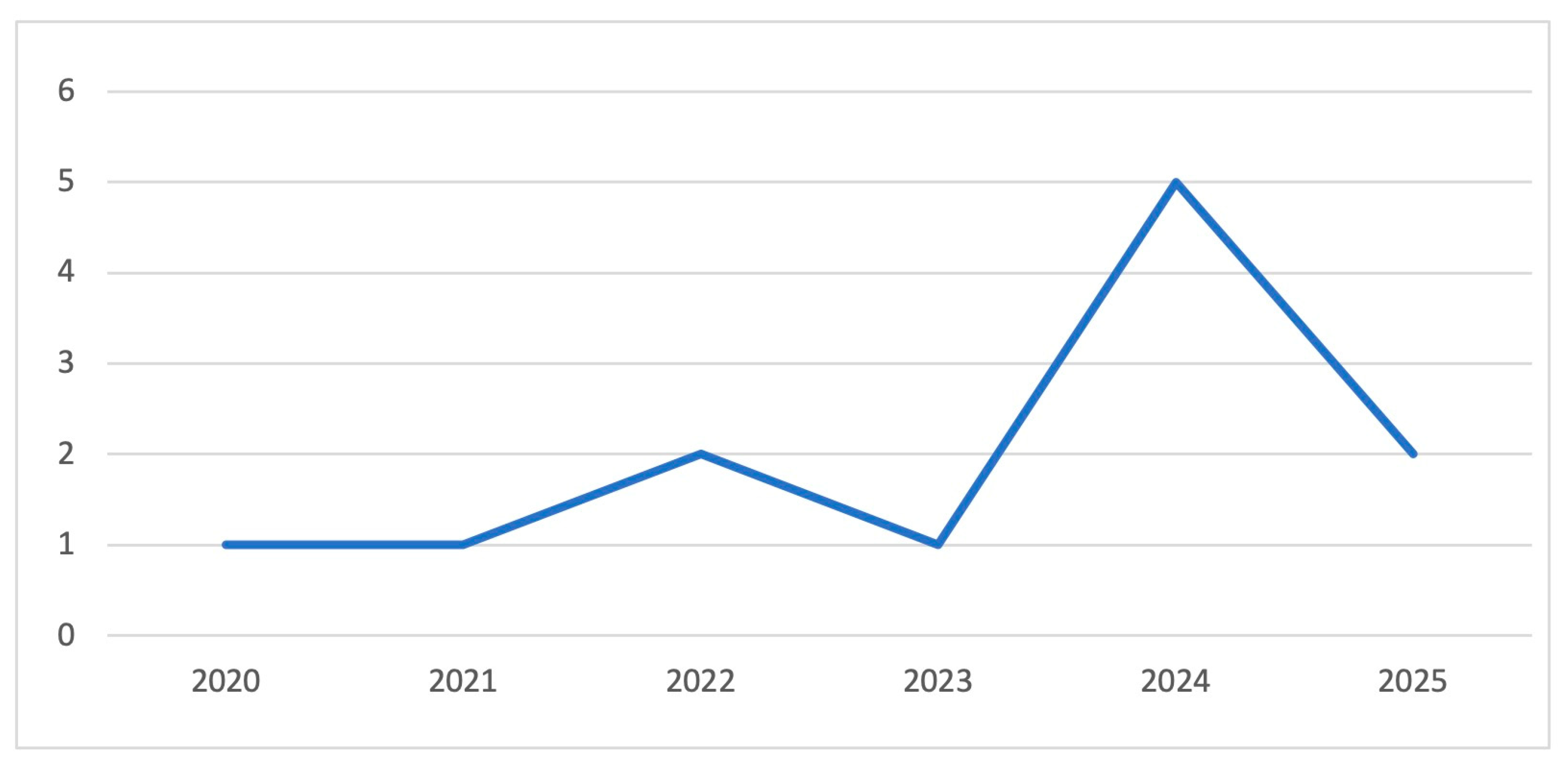
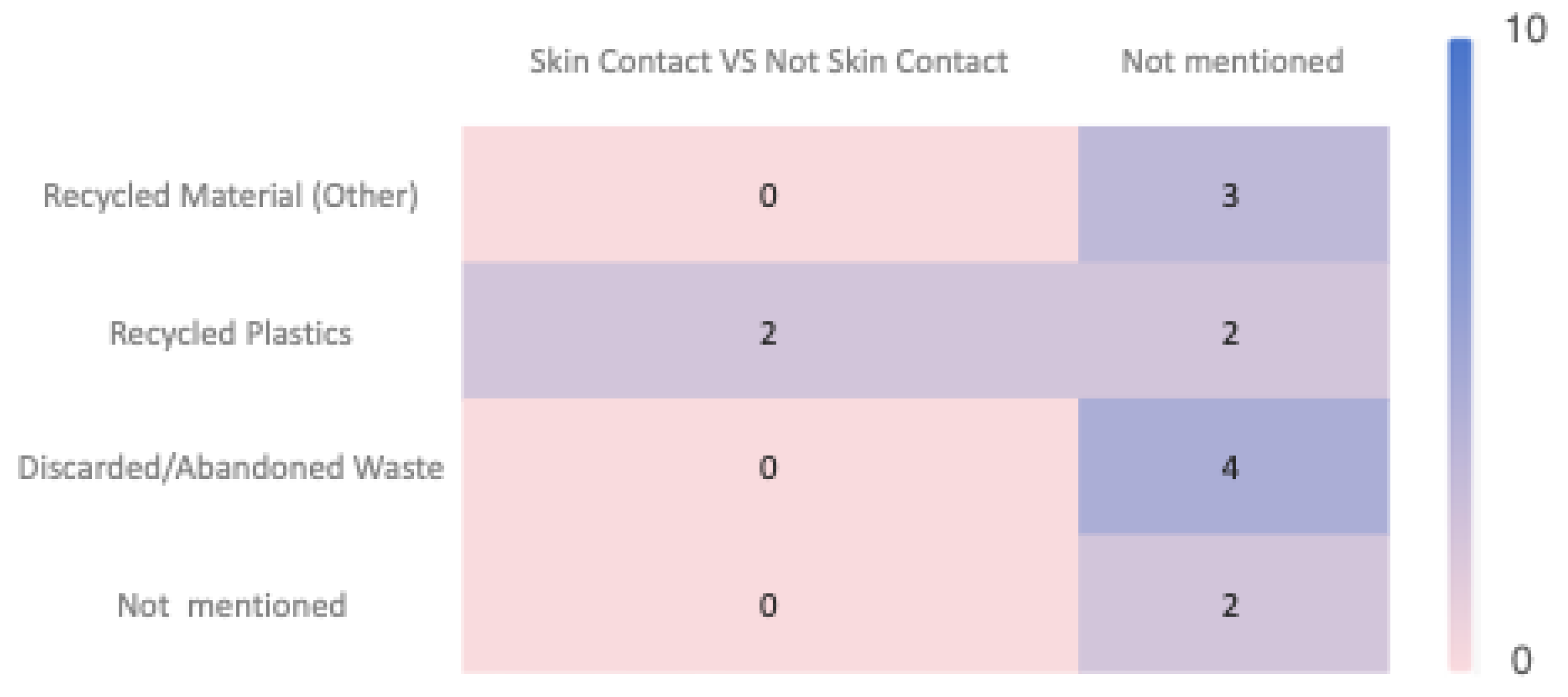
Use Acceptance of Experimental Products Using Recycled Materials at Different Use Distances: A Scoping Review


Abstract
1. Introduction
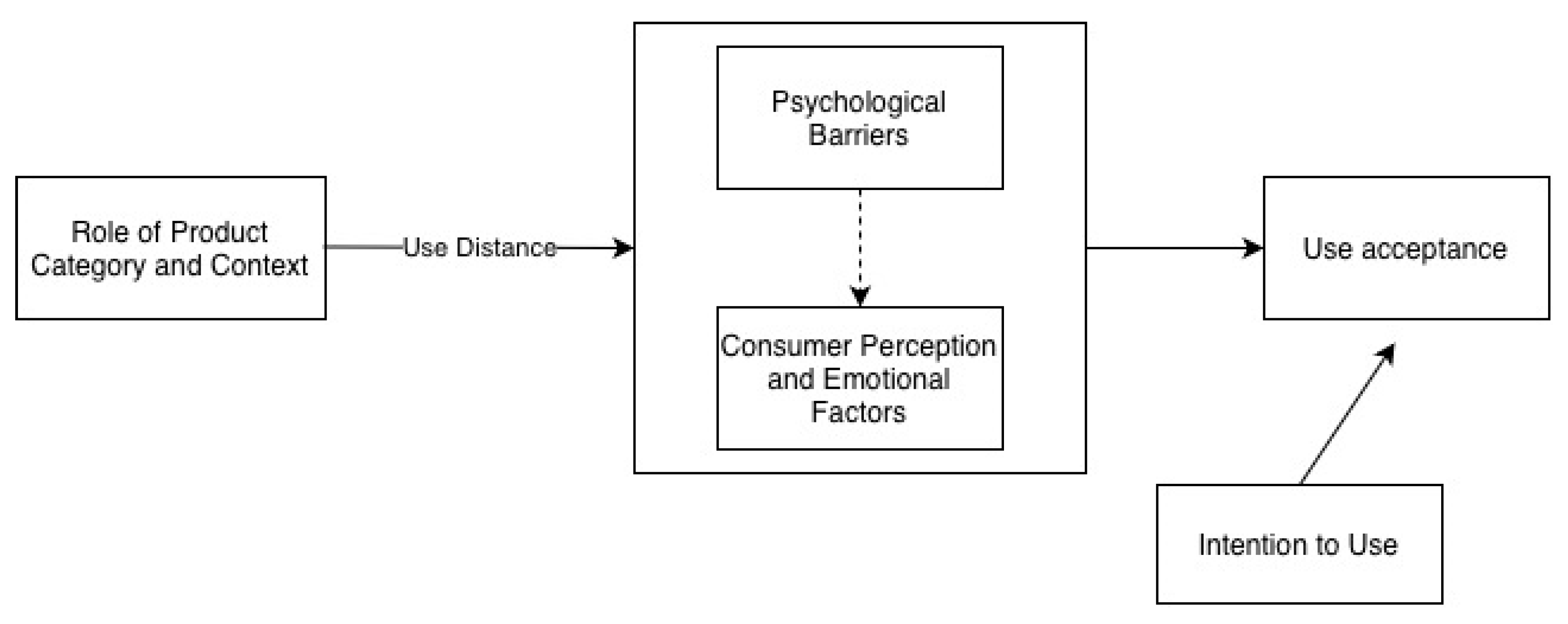
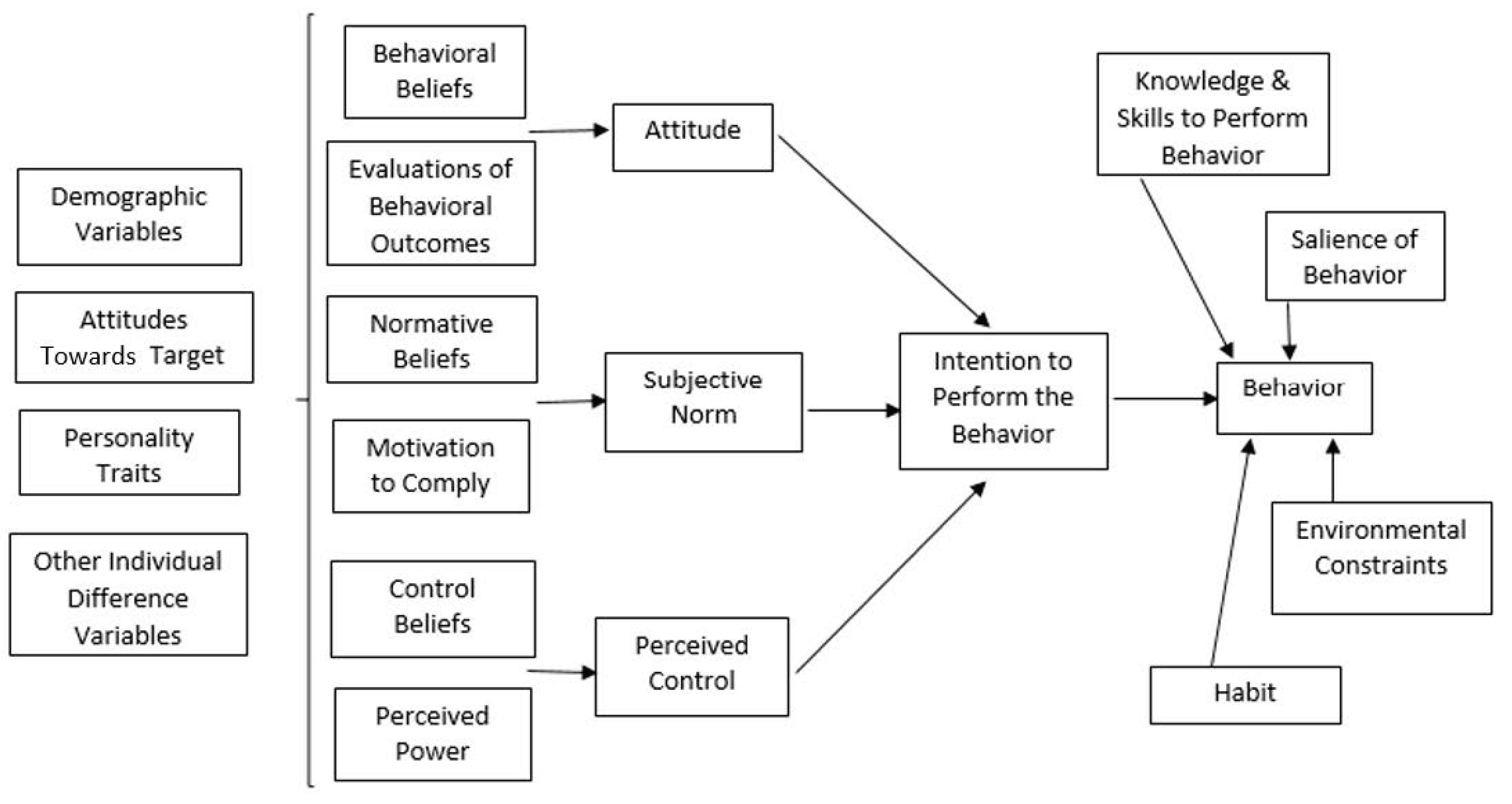
2. Conceptual Framework
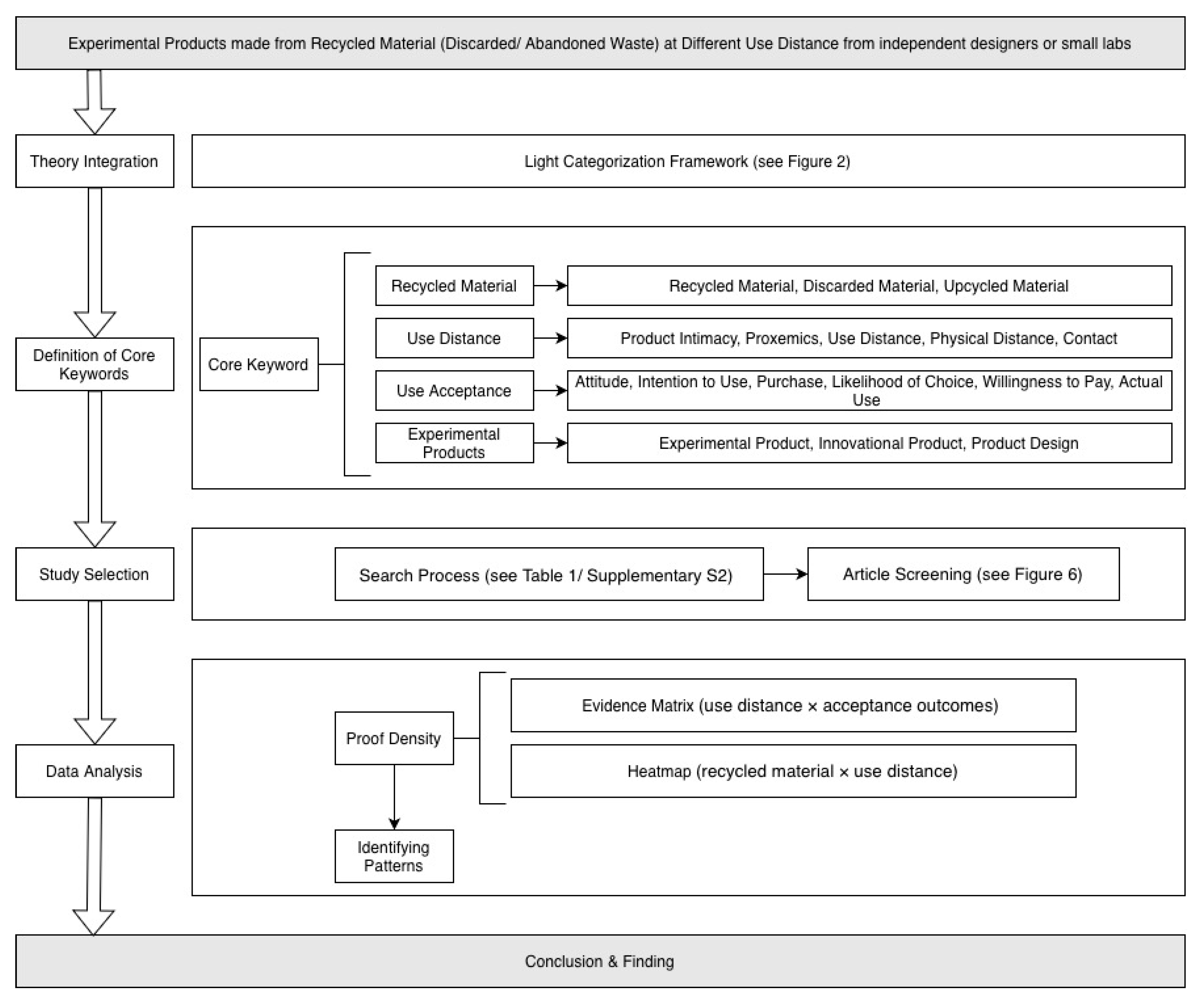
3. Methodology
3.1. A Scoping Review
3.2. Identifying Relevant Studies
3.3. Study Selection
3.4. Charting the Data
4. Evidence Synthesis and Reporting
4.1. Literature Trend
4.2. Identifying Patterns
5. Discussion and Conclusions
Limitations of the Review Methodology
Supplementary Materials
Author Contributions
Funding
Institutional Review Board Statement
Informed Consent Statement
Data Availability Statement
Conflicts of Interest
Abbreviations
| IBM | Integrated Behavior Model |
| TAM | Technology Acceptance Model |
References
- Circle Economy. The Circularity Gap Report 2025; Circle Economy: Amsterdam, The Netherlands, 2025. [Google Scholar]
- Du Bois, E.; Veelaert, L.; Ragaert, K. Design from Recycling: A Material-Driven Design Method. In Springer Handbooks; Springer: Cham, Switzerland, 2025; Volume Part F590, pp. 601–614. [Google Scholar] [CrossRef]
- United Nations. Sustainable Consumption and Production. Available online: https://www.un.org/sustainabledevelopment/sustainable-consumption-production/ (accessed on 9 September 2025).
- Foster, H. Design and Crime: And Other Diatribes; Verso eBooks. 2003. Available online: https://e-artexte.ca/id/eprint/17207/ (accessed on 9 September 2025).
- Sacardi, W. Palavas para Movimentar e Sentar [Exhibition]; Galeria do Palácio Gama Lobo: Loulé, Portugal, 2025. [Google Scholar]
- Walker, S. Design for Meaningful Innovation. In The Routledge Companion to Design Studies; Sparke, P., Fisher, F., Eds.; Routledge: Abingdon, UK, 2016; pp. 395–408. [Google Scholar]
- Yoon, J.; Kim, C.; Kang, R. Positive User Experience over Product Usage Life Cycle and the Influence of Demographic Factors. Int. J. Des. 2020, 14, 85–102. [Google Scholar]
- JooSoap Studio. Eco Soap Made from Frying Oil. Available online: https://www.joosoap.org/ (accessed on 25 September 2025).
- Micklethwaite, P. Design Against Consumerism. In A Companion to Contemporary Design Since 1945; Massey, A., Ed.; Wiley-Blackwell: Chichester, UK, 2019; pp. 436–456. [Google Scholar] [CrossRef]
- Jackson, T. Motivating Sustainable Consumption: A Review of Evidence on Consumer Behaviour and Behavioural Change; Report to the Sustainable Development Research Network; Centre for Environmental Strategy, University of Surrey: Guildford, UK, 2005. [Google Scholar]
- Thorpe, A. Design’s Role in Sustainable Consumption. Des. Issues 2010, 26, 3–16. [Google Scholar] [CrossRef]
- Polyportis, A.; Mugge, R.; Magnier, L. Consumer Acceptance of Products Made from Recycled Materials: A Scoping Review. Resour. Conserv. Recycl. 2022, 186, 106533. [Google Scholar] [CrossRef]
- Meng, M.D.; Leary, R.B. It Might Be Ethical, but I Won’t Buy It: Perceived Contamination of, and Disgust towards, Clothing Made from Recycled Plastic Bottles. Psychol. Mark. 2021, 38, 298–312. [Google Scholar] [CrossRef]
- Correa, C.A.; de Oliveira, M.A.; Jacinto, C.; Mondelli, G. Challenges to Reducing Post-Consumer Plastic Rejects from the MSW Selective Collection at Two MRFs in São Paulo City, Brazil. J. Mater. Cycles Waste Manag. 2022, 24, 1140–1155. [Google Scholar] [CrossRef]
- Zürn, M.K.; Kronmüller, A.; Layrisse Villamizar, F. Branding in the Circular Economy; Nuremberg Institute for Market Decisions (NIM): Nuremberg, Germany, 2023; Available online: https://www.nim.org/en/publications/detail/branding-in-the-circular-economy (accessed on 9 January 2026).
- Futerra. The Greenwash Guide; Futerra Sustainability Communications: London, UK, 2008. [Google Scholar]
- Davis, F.D.; Bagozzi, R.P.; Warshaw, P.R. User Acceptance of Computer Technology: A Comparison of Two Theoretical Models. Manag. Sci. 1989, 35, 982–1003. [Google Scholar] [CrossRef]
- Cao, J.; Qiu, H.; Morrison, A.M. Self-Identity Matters: An Extended Theory of Planned Behavior to Decode Tourists’ Waste Sorting Intentions. Int. J. Environ. Res. Public Health 2023, 20, 5099. [Google Scholar] [CrossRef]
- Davis, K.; Drey, N.; Gould, D. What Are Scoping Studies? A Review of the Nursing Literature. Int. J. Nurs. Stud. 2009, 46, 1386–1400. [Google Scholar] [CrossRef] [PubMed]
- Daudt, H.M.; Van Mossel, C.; Scott, S.J. Enhancing the Scoping Study Methodology: A Large, Inter-Professional Team’s Experience with Arksey and O’Malley’s Framework. BMC Med. Res. Methodol. 2013, 13, 48. [Google Scholar] [CrossRef] [PubMed]
- Pino, G.; Amatulli, C.; Nataraajan, R.; De Angelis, M.; Peluso, A.M.; Guido, G. Product Touch in the Real and Digital World: How Do Consumers React? J. Bus. Res. 2020, 112, 492–501. [Google Scholar] [CrossRef]
- Maguire, H.; Fahy, F. Sew What for Sustainability? Exploring Intergenerational Attitudes and Practices to Clothing Repair in Ireland. IrishGeog 2023, 55. [Google Scholar] [CrossRef]
- Nuojua, S.; Pahl, S.; Thompson, R. Ocean connectedness and consumer responses to single-use packaging. J. Environ. Psychol. 2022, 81, 101814. [Google Scholar] [CrossRef]
- Maione, D. Recrafting Futures: Post-Material Transformations Toward Clothing Longevity; Carnegie Mellon University: Pittsburgh, PA, USA, 2023. [Google Scholar] [CrossRef]
- Ferrero-Regis, T.; Lindquist, M.; Van Lunn, C.; Hopper, C. Mapping Fashion Networks and Pre-Consumer Textile Flows for Circular Communities. Int. J. Sustain. Fash. Text. 2024, 3, 43–66. [Google Scholar] [CrossRef]
- Ghisellini, P.; Passaro, R.; Ulgiati, S. Evaluating Good Practices of Ecological Accounting and Auditing in a Sample of Circular Start-ups. In Place Based Approaches to Sustainability: Volume II; Palgrave Studies in Sustainable Business in Association with Future Earth; Palgrave Macmillan: Cham, Switzerland, 2024; pp. 195–220. [Google Scholar] [CrossRef]
- Polyportis, A.; Mugge, R.; Magnier, L. To See or Not to See: The Effect of Observability of the Recycled Content on Consumer Adoption of Products Made from Recycled Materials. Resour. Conserv. Recycl. 2024, 205, 107610. [Google Scholar] [CrossRef]
- Shi, T. Four Essays on Consumption Behavior in the Circular Economy. Ph.D. Thesis, McGill University, Montréal, QC, Canada, 2024. [Google Scholar]
- Tu, J.-C.; Yang, C.-H.; Lin, S.-H.; Creativani, K. Exploring Consumer Perception and Acceptance of Recycled Merchandise under Five-Sense Design. Environ. Dev. Sustain. 2023, 26, 6393–6417. [Google Scholar] [CrossRef]
- Seo, H. Green or Unique? How Design Typicality and Material Domain Distance Influence Purchase Intentions for Upcycled Clothing. Ph.D. Thesis, North Carolina State University, Raleigh, NC, USA, 2025. [Google Scholar]
- Verma, R.; Dvorsky, J.; Tewari, A.; Shrivastava, A.K.; Kumar, M.; Singh, M.; Sharif, T. Do Gen Y and Gen Z Differ in Their Purchase Intention towards Recycled Products? A Moderation Study. Cogent Bus. Manag. 2025, 12, 2534852. [Google Scholar] [CrossRef]
- Miake-Lye, I.M.; Hempel, S.; Shanman, R.; Shekelle, P.G. What Is an Evidence Map? A Systematic Review of Published Evidence Maps and Their Definitions, Methods, and Products. Syst. Rev. 2016, 5, 28. [Google Scholar] [CrossRef] [PubMed]
- Norman, D.A. The Design of Everyday Things, Revised and Expanded ed.; Basic Books: New York, NY, USA, 2013. [Google Scholar]
- Hall, E.T.; Birdwhistell, R.L.; Bock, B.; Bohannan, P.; Diebold, A.R.; Durbin, M.; Edmonson, M.S.; Fischer, J.L.; Hymes, D.; Kimball, S.T.; et al. Proxemics [and Comments and Replies]. Curr. Anthropol. 1968, 9, 83–108. [Google Scholar] [CrossRef]
- Tricco, A.C.; Lillie, E.; Zarin, W.; O’Brien, K.K.; Colquhoun, H.; Levac, D.; Moher, D.; Peters, M.D.J.; Horsley, T.; Weeks, L.; et al. PRISMA Extension for Scoping Reviews (PRISMAScR): Checklist and Explanation. Ann. Intern. Med. 2018, 169, 467–473. [Google Scholar] [CrossRef] [PubMed]


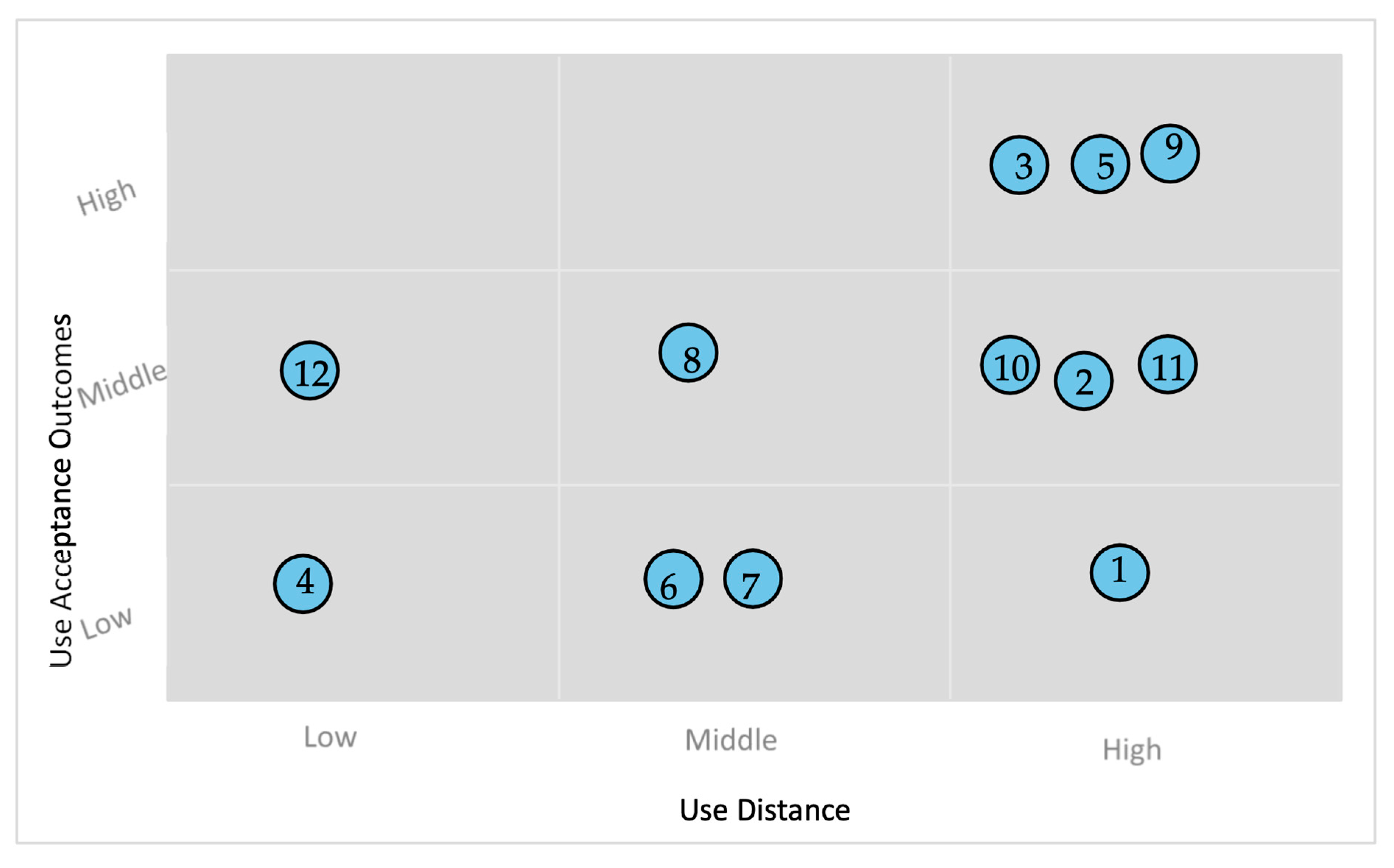


| First Search | Database | Exact Search String | Search Field | Document Type | Research Area | Language | Amount | Date Range | Last Search Date |
| Web of Science | TS=((“recycled material” OR “discarded material” OR “upcycled material”) AND (“experimental product” OR “innovative product” OR “product design”) AND (“product intimacy” OR “proxemics” OR “use distance” OR “physical distance” OR “contact”) AND (“use acceptance” OR “user acceptance” OR “consumer acceptance” OR “adoption” OR “intention”)) | Topic (Searches title, abstract, keyword plus, and author keywords) | All | All | English | 5 | 2020–2025 | 30 December 2025 | |
| Scopus | (TITLE-ABS-KEY (“recycled material” OR “discarded material” OR “upcycled material”) AND (“experimental product” OR “innovative product” OR “product design") AND (“product intimacy” OR “proxemics” OR “use distance” OR "physical distance” OR “contact”) AND (“use acceptance” OR “user acceptance” OR “consumer acceptance” OR “adoption” OR “intention”)) | Title, abstract, keyword | All | All | English | 3 | 2020–2025 | 30 December 2025 | |
| Second Search | Database | Exact Search String | Search Field | Document Type | Research Area | Language | Amount | Date Range | Last Search Date |
| Web of Science | TS = (recycled material OR upcycled material OR discarded material OR waste *) AND TS=(design * OR product * OR sustainable *) AND TS = (acceptance OR adoption OR intention * OR perception * OR attitude * OR preference) AND TS = (proxemic * OR intimacy OR distance OR contact * OR attach *) NOT TS = (concrete OR asphalt OR cement OR aggregate OR construction OR wastewater OR sludge OR “fly ash” OR pavement OR road OR brick OR structural OR civil OR soil) | Topic (Searches title, abstract, keyword plus, and author keywords) | Article, dissertation thesis, and review article | Exclude Engineering, Chemistry, Medical Laboratory Technology | English | 223 (One retracted article has been excluded and one retracted article has been excluded) | 2020–2025 | 30 December 2025 | |
| Scopus | TITLE-ABS-KEY (“recycled material” OR “upcycled material” OR “discarded material” OR waste *) AND TITLE-ABS-KEY (design * OR product * OR sustainable *) AND TITLE-ABS-KEY (acceptance OR adoption OR intention * OR perception * OR attitude * OR preference) AND TITLE-ABS-KEY (proxemic * OR intimacy OR distance OR contact * OR attach *) AND NOT TITLE-ABS-KEY (concrete OR asphalt OR cement OR aggregate OR construction OR wastewater OR sludge OR “fly ash” OR pavement OR road OR brick OR structural OR civil OR soil) | Title, abstract, keyword | Article, conference paper, review, book chapter | Exclude Engineering, Chemistry, Biochemistry, Genetics and Molecular Biology, Medicine, Chemical engineering | English | 134 (One retracted article has been excluded) | 2020–2025 | 30 December 2025 |
| Number | Title | Journal Name | Year of Publication | Perspective |
|---|---|---|---|---|
| 1 | Product touch in the real and digital world: How do consumers react? [21] | Journal of Business Research | 2020 | How touching (versus not touching) tactile-functional products—namely those that provide tactile feedback related to their utilitarian characteristics—affects these products’ expected ease of use, as well as consumers’ attitudes and intentions toward them. |
| 2 | It might be ethical, but I won’t buy it: Perceived contamination of, and disgust towards, clothing made from recycled plastic bottles [13] | Psychology & Marketing | 2021 | This study integrates evolutionary perspectives on contagion, contamination, and the emotion of disgust to explore consumer perception of goods such as clothing made from recycled plastic bottles. |
| 3 | Sew what for sustainability? Exploring intergenerational attitudes and practices to clothing repair in Ireland [22] | Irish Geography | 2022 | While strictly “repair,” it represents a DIY design intervention on potential waste. It provides critical qualitative data on consumer attachment and materiality (psychological barriers to discard), which serves as a foundational comparison for accepting waste-derived products. |
| 4 | Ocean connectedness and consumer responses to single-use packaging [23] | Journal of Environmental Psychology | 2022 | The study provides empirical evidence that psychological distance (operationalized as ocean connectedness) moderates the relationship between material type and consumer acceptance. Specifically, higher connectedness enhances the aesthetic evaluation (attractiveness) of sustainable options while increasing negative perceptions of plastic. |
| 5 | Recrafting Futures: Post-Material Transformations Toward Clothing Longevity [24] | Doctoral dissertation (Carnegie Mellon University) | 2023 | While industry practices often focus on concealing the source of waste to increase acceptance, this study argues that actively engaging in DIY (design) processes can bridge the gap between users and materials, thus altering people’s perceptions of waste. By participating in the restoration process, the “pollution” of waste is neutralized by the “care” of the process, establishing a highly intimate relationship between the product and the consumer, where acceptance evolves into a deep emotional attachment. |
| 6 | Mapping fashion networks and pre-consumer textile flows for circular communities [25] | International Journal of Sustainable Fashion and Textiles | 2024 | Shifts perspective from industrial efficiency to “social circularity.” Uses “contact zones” theory to argue that waste recovery creates spaces for intergenerational connection and community well-being, framing the recycled product as a medium for social intimacy rather than just a commodity. |
| 7 | Evaluating Good Practices of Ecological Accounting and Auditing in a Sample of Circular Start-ups [26] | Palgrave Studies in Sustainable Business in Association with Future Earth (Book) | 2024 | The study examined 20 circular economy startups (SMEs) and clearly identified “waste-based” and “design-based” business models. It proposed “place-based sustainability” and businesses’ “attachment to local communities,” which, from a producer’s perspective, supports the importance of “reducing distance (geographic/social)” for waste products. |
| 8 | To see or not to see: The effect of observability of the recycled content on consumer adoption of products made from recycled materials [27] | Resources, Conservation and Recycling | 2024 | Provides empirical evidence that making waste visible (aesthetic intervention) increases value through social signaling mechanisms. |
| 9 | Four Essays on Consumption Behavior in the Circular Economy [28] | Doctoral dissertation (McGill University) | 2024 | Essays 2 and 3: People who engage in DIY upcycling are more likely to buy commercial upcycled products (bridging the gap between maker culture and consumer market). Essay 4: High visual resemblance to the original waste (“past identity”) negatively affects product evaluation by increasing “perceived intrusiveness” (feeling that the “trash” is invading one’s life). |
| 10 | Exploring consumer perception and acceptance of recycled merchandise under five-sense design [29] | Environment, Development and Sustainability | 2024 | Waste materials are often perceived as “dirty” or “rough.” Improving the tactile experience through design (making it smooth, warm, or textured) is key to overcoming psychological rejection in consumers. The task of independent designers is to transform “vulgar waste” into “refined products” through “sensory transformation.” This is not merely a visual disguise but a tactile elevation. |
| 11 | Green or Unique? How Design Typicality and Material Domain Distance Influence Purchase Intentions for Upcycled Clothing [30] | Doctoral dissertation (North Carolina State University) | 2025 | The core finding of this paper overturns our traditional understanding of green products. It tells us that, in the field of upcycling, the real driving force behind consumer purchases is not “because it’s environmentally friendly,” but “because it’s unique.” Furthermore, the research found that the gap between the source of materials and the final product (e.g., clothes made from old fabric = low gap; clothes made from old tires = high gap) did not significantly enhance purchase intention. This suggests that consumers may care more about the visual design of the final product than the technical complexity of the material source. |
| 12 | Do Gen Y and Gen Z differ in their purchase intention towards recycled products? A moderation study [31] | Cogent Business & Management | 2025 | Although it does not specify a particular “product intimacy distance,” it provides key intergenerational psychological differences (Gen Y vs. Gen Z) for understanding how different groups perceive “recycled products.” Furthermore, while it does not measure a specific “distance,” it measures the underlying psychological mechanisms (moral identification) that influence products across “all distances.” |
Disclaimer/Publisher’s Note: The statements, opinions and data contained in all publications are solely those of the individual author(s) and contributor(s) and not of MDPI and/or the editor(s). MDPI and/or the editor(s) disclaim responsibility for any injury to people or property resulting from any ideas, methods, instructions or products referred to in the content. |
© 2026 by the authors. Licensee MDPI, Basel, Switzerland. This article is an open access article distributed under the terms and conditions of the Creative Commons Attribution (CC BY) license.
Share and Cite
Gou, H.; Bozzi, C.; Dinis, P. Use Acceptance of Experimental Products Using Recycled Materials at Different Use Distances: A Scoping Review. Sustainability 2026, 18, 1288. https://doi.org/10.3390/su18031288
Gou H, Bozzi C, Dinis P. Use Acceptance of Experimental Products Using Recycled Materials at Different Use Distances: A Scoping Review. Sustainability. 2026; 18(3):1288. https://doi.org/10.3390/su18031288
Chicago/Turabian StyleGou, Hualan, Carolina Bozzi, and Paulo Dinis. 2026. "Use Acceptance of Experimental Products Using Recycled Materials at Different Use Distances: A Scoping Review" Sustainability 18, no. 3: 1288. https://doi.org/10.3390/su18031288
APA StyleGou, H., Bozzi, C., & Dinis, P. (2026). Use Acceptance of Experimental Products Using Recycled Materials at Different Use Distances: A Scoping Review. Sustainability, 18(3), 1288. https://doi.org/10.3390/su18031288