Review

Advances in Freshwater Fish Habitat Suitability Determination Methods: A Global Perspective

1
State Key Laboratory of Water Resources Engineering and Management, Wuhan University, Wuhan 430072, China
2
State Key Laboratory of Hydrology-Water Resources and Hydraulic Engineering, Nanjing Hydraulic Research Institute, Nanjing 210029, China
*
Authors to whom correspondence should be addressed.
Sustainability 2026, 18(3), 1272; https://doi.org/10.3390/su18031272
Submission received: 21 December 2025 / Revised: 14 January 2026 / Accepted: 16 January 2026 / Published: 27 January 2026

Abstract

Freshwater fish habitat simulation is a vital technology for assessing the state and dynamics of aquatic ecosystems under changing environments. Based on a comprehensive dataset spanning 1991–2024, this study constructs a domain knowledge map by integrating co-citation analysis, keyword burst detection, and social network metrics. The bibliometric results quantitatively identify leading contributors and trace the field’s exponential growth. Complementing this, a critical technical review reveals a significant paradigm shift in modeling methodologies: moving from traditional univariate suitability curves to advanced multivariate and artificial intelligence (AI)-based frameworks. Despite these advancements, our analysis highlights critical gaps in addressing habitat connectivity and broad environmental stressors. To overcome these limitations, we propose a novel framework that integrates landscape pattern indices with circuit theory to quantify habitat patch arrangement and ecological flows. Furthermore, we advocate for future research to explicitly incorporate climate change scenarios (e.g., thermal regime shifts) and geomorphological processes. This study offers both a macroscopic overview of the discipline’s evolution and a roadmap for developing robust, ecosystem-based management tools.

1. Introduction

The concept of “habitat” was first proposed by Grinnellian scholars in the United States in 1917, defined as the spatial environment inhabited by specific organisms—essentially the ecological milieu in which they reside. Fish habitat, in particular, refers to the aquatic realms occupied by fish, encompassing all essential environmental factors required to sustain vital activities, including hydrology, hydrodynamics, topography, substrate, water quality, and biological components. These elements fluctuate under external pressures and biological feedbacks, thereby directly impacting fish growth, reproduction, fattening, overwintering, and other critical life-history functions [1]. Within aquatic ecosystems such as rivers and lakes, fish species exhibit high diversity and extended lifespans; they typically occupy apex positions in food webs and span diverse trophic levels from primary to higher consumers. Consequently, fish are highly responsive to habitat alterations, serving as pivotal bio-indicators for the health status of river and lake ecosystems [2].
Since the middle of the last century, intensive human activities have severely compromised aquatic ecosystems, leading to a progressive contraction of suitable fish habitats. Consequently, habitat research has gained increased prominence. Since the 1970s and 1980s, comprehensive research and empirical applications regarding river habitat suitability have been conducted in countries including the United States, South Africa, and Australia [3,4]. Specifically, since 1974, the U.S. Fish and Wildlife Service (USFWS) has pioneered several habitat-centric assessment frameworks, such as Habitat-Based Environmental Assessments, Habitat Evaluation Procedures (HEP), and Habitat Suitability Indices (HSI) [5]. Simultaneously, the U.S. Environmental Protection Agency (EPA) developed the Rapid Bioassessment Protocol (RBP) to evaluate stream integrity using indigenous algae, fish, and macroinvertebrates [6]. Similarly, since 1991, Austria’s fisheries policy has consistently emphasized ecological conservation to maintain indigenous fish diversity. Notably, Muhar [7] conducted a habitat quality assessment across 52 major Austrian rivers (excluding the Danube), focusing on river morphology, watershed connectivity, and hydrological conditions. In 1994, South Africa’s Department of Forestry, Fisheries, and the Environment implemented the River Health Program, utilizing fish, invertebrates, riparian vegetation, and habitat conditions as ecological indicators, while employing the Habitat Integrity Index to quantify the impacts of major anthropogenic disturbances [8]. Furthermore, the European Union adopted the Water Framework Directive (WFD) in 2000, establishing a unified management framework and legal basis for water resource protection [9]. Concurrent developments in Australia (2000) introduced the River Condition Index and the River Status Survey Method. In 2003, the UK Environment Agency developed a standardized River Habitat Survey (RHS) to assess habitat conditions through in situ assessments of physical characteristics, including channel morphology, flow regime, vegetation structure, land use, pools, riffles, and artificial structures (Table S1) [10,11].
Research on river habitat conservation and evaluation in China has evolved along two primary trajectories. First, studies have scrutinized the critical environmental elements of habitats for rare and endangered species or individual taxa. For instance, Yi [12,13] developed habitat suitability models for the Chinese Sturgeon to simulate and predict habitat availability under various hydrological scenarios. Second, research on fish habitat suitability and protection has emphasized the harmonization of development and conservation within major river systems and their tributaries. In 1995, the State Council Gorges Project Construction Committee and the Institute of Hydrobiology, Chinese Academy of Sciences, launched a comprehensive survey of the Chishui River Basin. Subsequently, in 1999 and 2000, Academician Cao Wenxuan proposed the establishment of the “Chishui River Upper Yangtze River Endemic Fish Nature Reserve” at the CPPCC National Committee. In April 2005, the State Council approved the incorporation of the Chishui River—a pivotal tributary of the upper Yangtze—into the “National Nature Reserve for Rare and Endemic Fishes in the Upper Yangtze,” effectively prohibiting the construction of cascade hydropower stations along its mainstream. Further efforts include the 2007 establishment of a fish sanctuary in the Luosuo River, a major tributary of the lower Lancang River, and a 2013 study on alternative fish habitats for hydropower development on the lower Jinsha River. Significantly, on 1 July 2021, the “Technical Code for Fluvial Aquatic Habitat Protection” (NB/T 10485-2021) was implemented to standardize the design, construction, and operation of river aquatic habitat mitigation and protection measures [14].
Globally, numerous scholars have extensively investigated fish habitats, focusing primarily on three thematic domains: modeling frameworks [15,16,17,18,19,20], the selection of indicator systems [21,22,23], and management strategies [21,24]. To systematically quantify and summarize research progress, this paper retrieved fish habitat-related literature from the Web of Science Core Collection spanning 1991 to 2024. Using bibliometric tools CiteSpace and VOSviewer, a visualized analysis was conducted to objectively elucidate research methodologies, core research clusters, and emerging trends. The principal contribution of this paper lies in integrating bibliometric mapping with the methodological evolution of habitat suitability modeling. This dual-perspective framework provides a novel lens for understanding the field’s developmental trajectory, specifically aiding in the identification of modeling methods that remain under-explored.

2. Methods

2.1. Data Sources

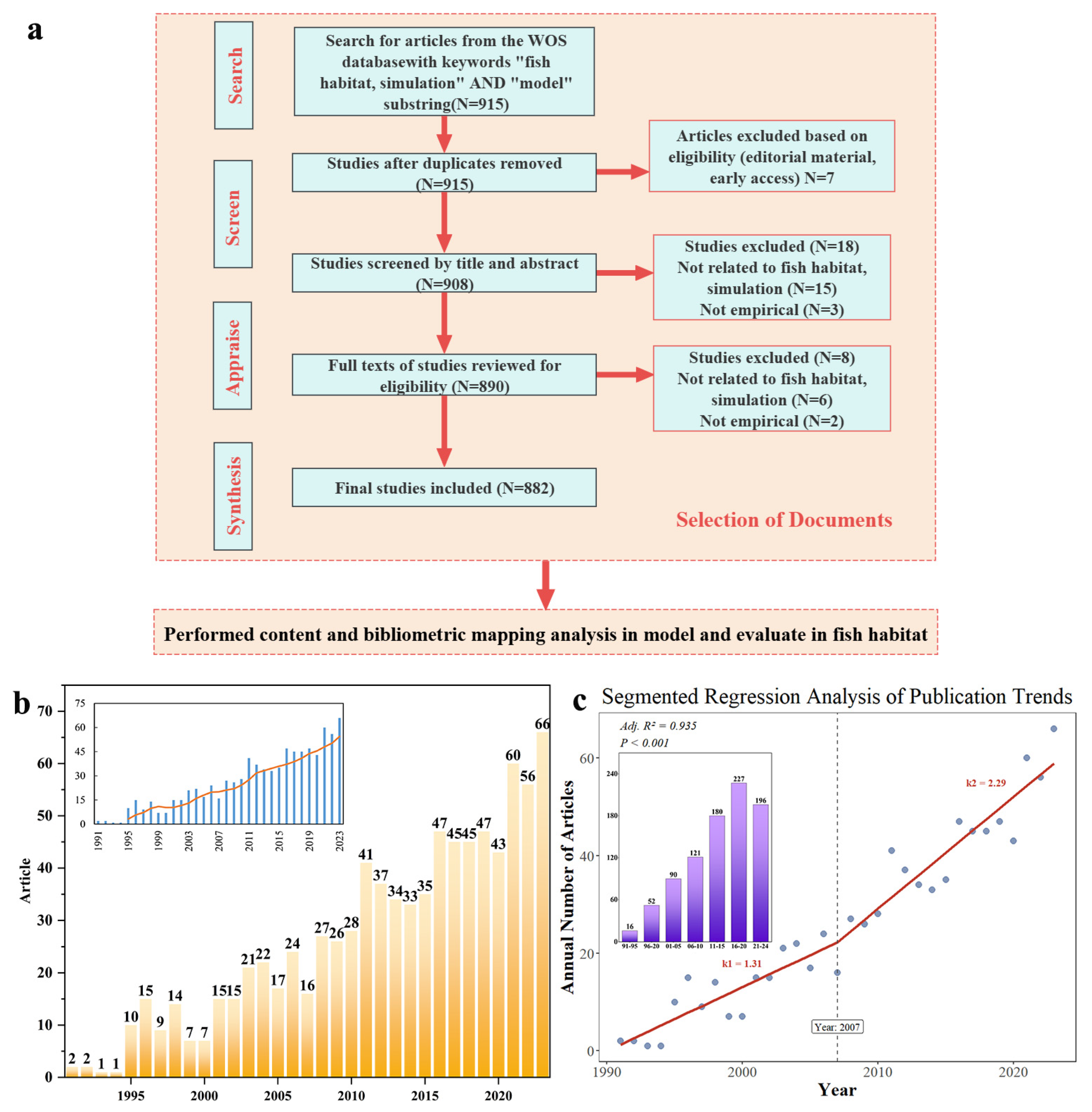
The Web of Science Core Collection was selected as the primary data source, with the search restricted to English-language literature. The applied search string was defined as TS = ((“fish habitat” AND “simulation”) OR (“fish habitat” AND “model”) OR (“fish habitat” AND “evaluate”) OR (“fish suitability”)), spanning the period from 1 January 1991, to 12 May 2024. This query yielded a total of 915 records, comprising original research articles, conference proceedings, conference abstracts, and reviews. To enhance data integrity and minimize systematic errors, the retrieved documents underwent a rigorous screening process (detailed in the “Data Cleaning” section and illustrated in Figure 1a), yielding a final dataset of 882 valid papers.
The chronological publication trend is depicted in Figure 1b,c. To visualize the long-term evolution amidst annual fluctuations, a 5-year moving average (MA) trend line was superimposed. The MA line reveals a sustained upward trajectory, indicating identifying intensifying interest from the scientific community. To quantify this growth objectively and identify its critical evolutionary stages, we performed a segmented regression analysis. The regression model showed a high goodness-of-fit (R2 = 0.935), explaining over 94% of the variability in the dataset and corroborating the trend observed in the MA line.
Specifically, the statistical analysis identified 2007 as a significant breakpoint (p < 0.001), dividing the field into two distinct phases:
  • Incipient Stage (1991–2007): Prior to the breakpoint, the field experienced moderate growth (linear slope, m = 1.31). Annual publication volumes generally fluctuated between 1 and 24, a period of foundational accumulation.
  • Rapid Expansion Stage (2007–2023): Post-2007, the scholarly output witnessed a substantial acceleration. The growth rate shifted upward with a steeper slope (m = 2.29). This accelerated trend culminated in a peak of 66 articles in 2023, reflecting the increasing integration of global eco-hydrology research and habitat suitability modeling.

2.2. Data Cleaning

Raw data retrieved from databases may contain redundant duplicates or thematic inconsistencies if not rigorously screened. Consequently, pre-analytical data cleaning is imperative to preclude quality issues from compromising the results and to ensure the efficacy of the visualized analysis. This study adopts the “DEAN” data cleaning framework, which effectively mitigates the adverse effects of data quality anomalies. The “DEAN” process systematically addresses duplicate entries, erroneous records stemming from retrieval deviations, inconsistent keyword variants (Aliases) characterized by identical semantic meaning but divergent structures, and non-informative low-frequency or confounding keywords (Noise). Following the “DEAN” methodology, the workflow and results of this data cleaning are delineated in Figure 1a and Table S2. Detailed procedural information regarding the research methods is provided in the Supplementary Materials and Table S3, thereby facilitating the reproducibility of this article.

2.3. Data Analysis and Visualization

Data processing and visualization were integrated to systematically examine the research landscape across authorial, geographic, and thematic dimensions. First, to identify core research forces, Price’s Law was applied to determine the distribution of prolific authors, where the minimum publication threshold (m) for “core author” designation was calculated using Equation (1):
m = 0.749 × n max
where nmax represents the number of papers by the most prolific author in the dataset. Authors with a publication count ≥ m are considered core contributors to the research domain. Subsequently, collaboration network for authors with more than four publications was visualized using an overlay view incorporating a temporal dimension, where the color gradient reflects scholarly activity levels over time. In these bibliometric maps, node size corresponds to publication volume, and connecting lines denote collaborative relationships.
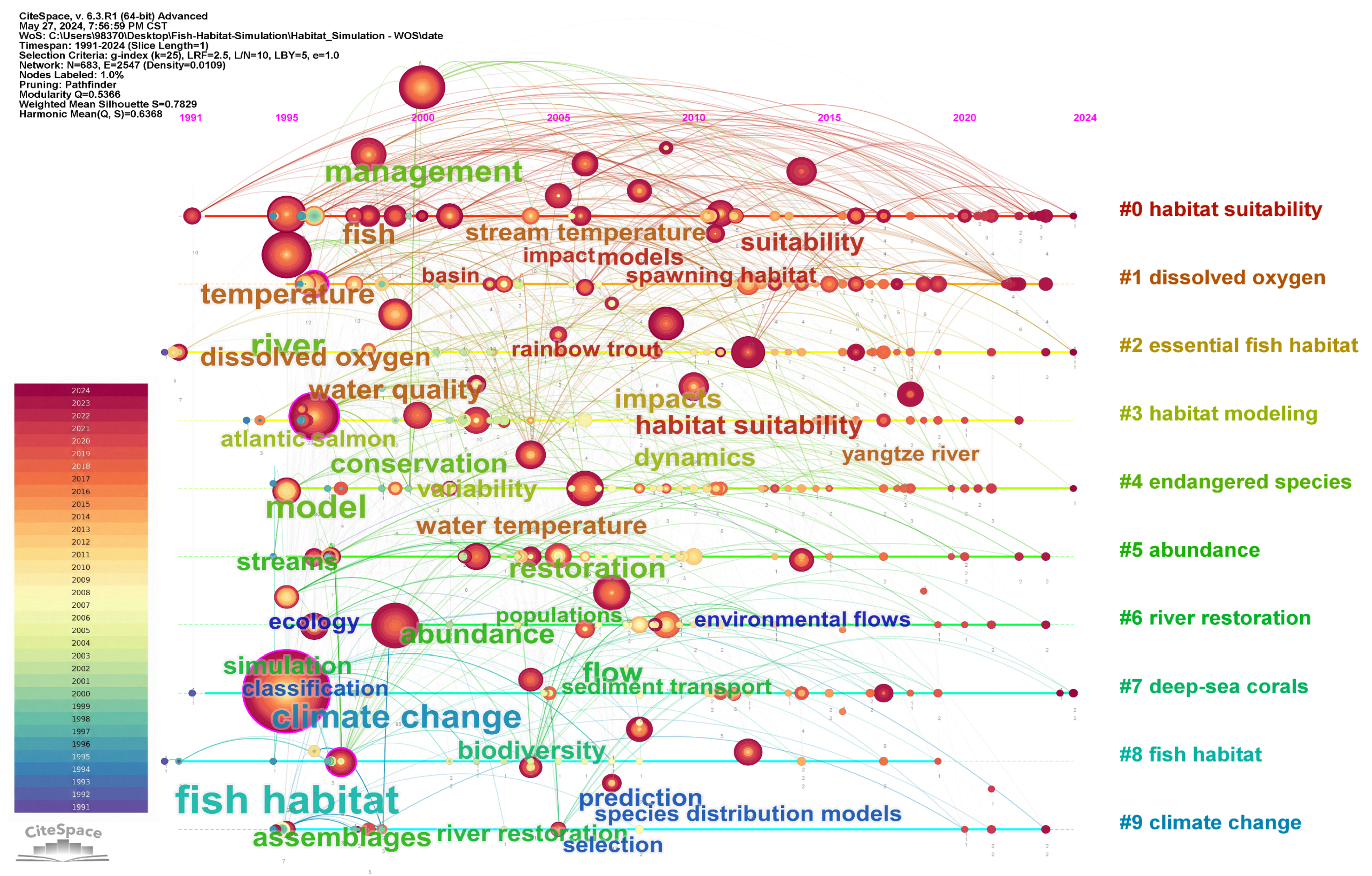
To evaluate global contributions, a spatial analysis of the top 30 countries was performed using VOSviewer 1.6.2 and Scimago Graphica 1.0.53, where node size and edge thickness signify scholarly output and inter-country collaboration strength, respectively. Finally, to identify research hotspots, a keyword co-occurrence network was constructed for 882 documents, filtering 53 keywords with a frequency threshold of ≥20. CiteSpace was further employed to generate keyword clustering timeline views, enabling the characterization of the temporal evolution and structural transitions of the identified research themes.

3. Results and Discussion

3.1. Bibliometric Analysis of the Author

By analyzing the authors of the literature, we can learn about the representative scholars and core research forces in this research field. Goldberg [25] postulated that concerning a specific topic, half of the total publications are contributed by a cohort of highly prolific authors.
Based on the criteria defined in Section 2.3, the threshold for core authors in this study was determined to be m ≈ 3.59 (nmax = 23). Consequently, authors with a minimum of four publications were designated as core authors. A total of 67 core authors collectively contributed 399 papers, accounting for 45.2% of the total corpus. This proportion falls short of the 50% threshold stipulated by Price’s Law, indicating that a highly centralized core author group in freshwater fish habitat research has not yet fully coalesced. This phenomenon is likely attributable to the inherent issues of geographical scale. Research in this field is fundamentally tied to diverse and localized aquatic ecosystems across different regions, which inherently favors a decentralized research structure rather than a globally concentrated core group of scholars.
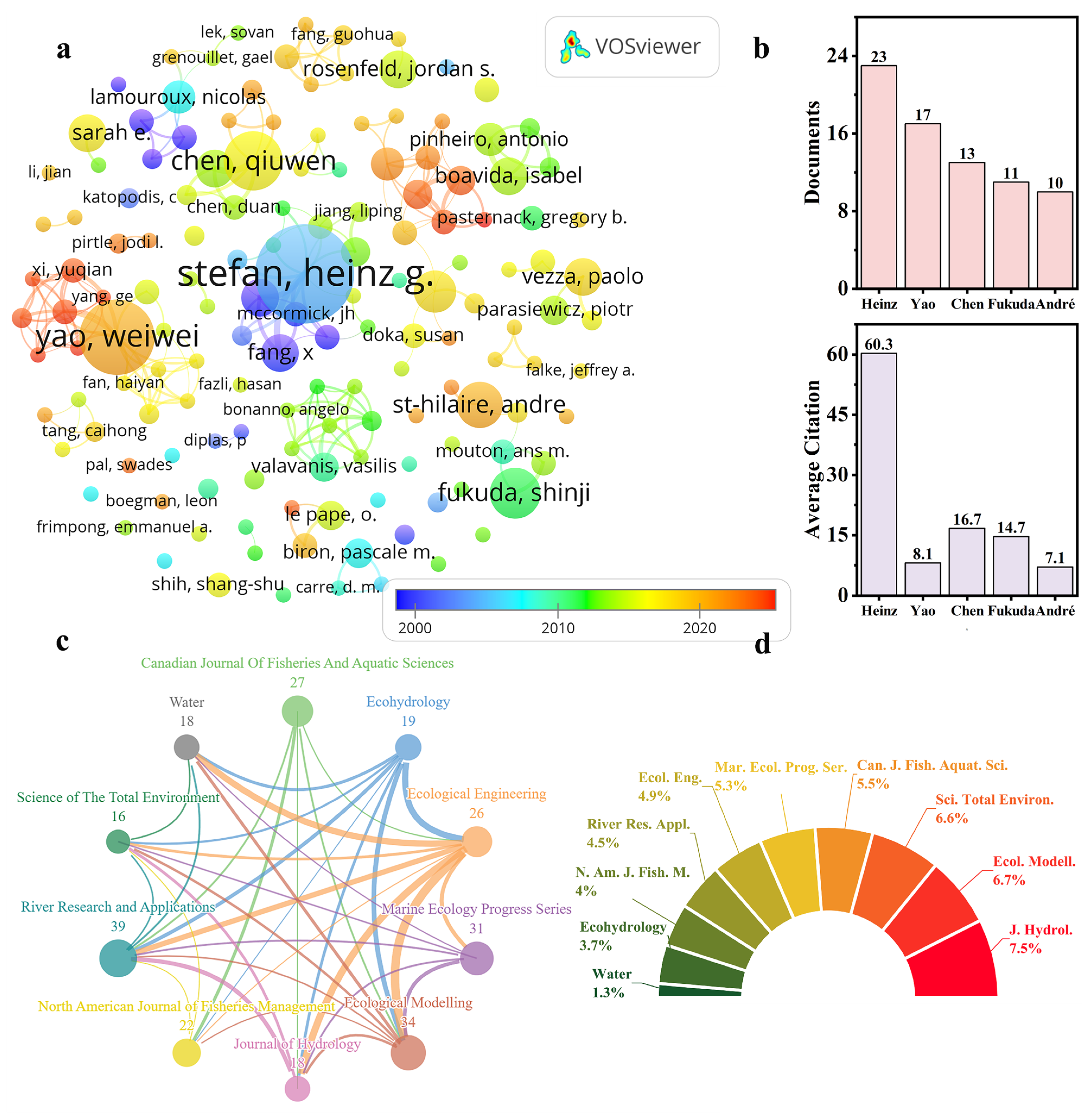
The results of the author collaboration network (Figure 2a) reveal the absence of a cohesive network structure among prolific authors, suggesting that large-scale global research synergies have yet to form—an observation that aligns with the aforementioned Price’s Law analysis. As shown in Figure 2a, the interaction between core scholars remains fragmented, with most collaborations occurring within small, localized research groups rather than integrated global networks. Figure 2b tabulates highly productive authors with at least 10 publications. Among them, Heinz G. Stefan is the most prominent, with 23 publications spanning 1991 to 2024. His research primarily examines the effects of climate change, water quality, and temperature on habitat simulation [26,27,28,29]. Following him are Yao, Weiwei and Chen, Qiuwen, with 17 and 13 publications, respectively. An examination of their scholarly output indicates that these three scholars predominantly focus on environmental hydrodynamics, fish habitat simulation, and ecohydraulics [29,30,31,32,33], reflecting research expertise largely rooted in water resources engineering.

3.2. Bibliometric Analysis of the Journal

Bibliometric analysis of publications spanning the past thirty-five years reveals that research in this field has been predominantly centered on water resources and ecology, with minimal representation in multidisciplinary journals. Figure 2c ranks the top 10 journals by publication volume. Notably, those with a contribution exceeding 30 articles include River Research and Applications (39 articles), Ecological Modelling (34 articles), and Marine Ecology Progress Series (31 articles).
Among these, Water stands out as an open-access journal, underscoring the pivotal role that the expansion of open-access publishing has played in advancing this domain in recent years. Although scholarly debate persists regarding optimal open-access models, the paradigm that research results should be freely accessible is universally acknowledged. Citation metrics indicate that the Journal of Hydrology, a premier publication in hydrological science, commands the highest impact; it accounts for 18 articles with a mean citation rate of 36.28 per article. This suggests that publications in this journal exhibit superior scholarly quality and have garnered substantial recognition within the water conservation community (Figure 2d). The Journal of Hydrology specializes in original research and comprehensive reviews, focusing on critical hydrological issues through robust multi- and interdisciplinary lenses.

3.3. Bibliometric Analysis of the Country

The spatial distribution of global contributions to freshwater fish habitat research (Figure 3) exhibits significant heterogeneity, with research output concentrated in a few leading nations. To move beyond subjective periodization, this study utilized segmented regression analysis (as verified in Section 2.1, R2 = 0.935) to identify 2007 as the objective statistical breakpoint. Consequently, the international research landscape is delineated into three primary phases: the Foundational Stage (1991–2007), the Rapid Expansion Stage (2008–2024) and Entire Study Stage (1991–2024).
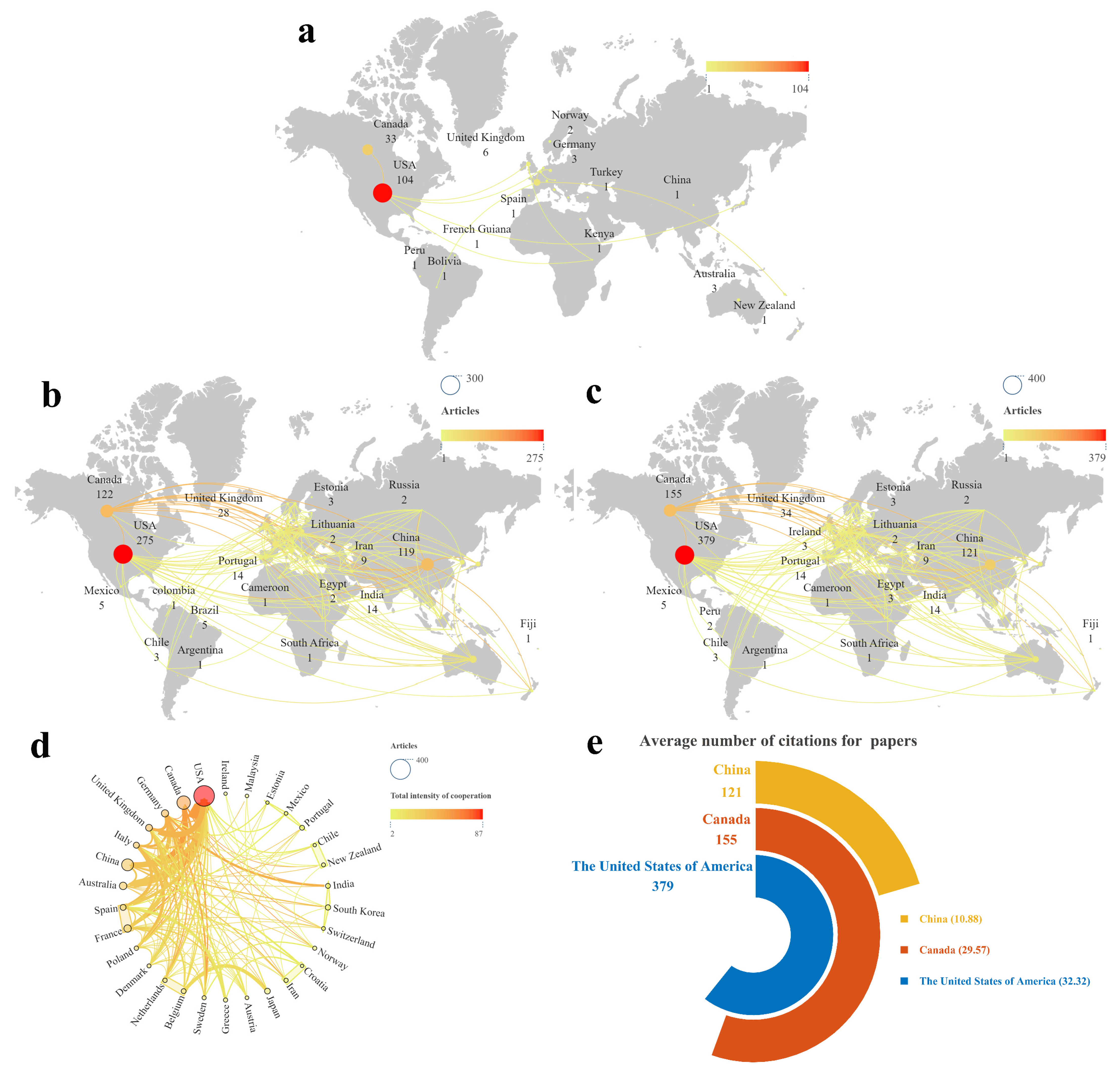
As illustrated in Figure 3a, the Foundational Stage (1991–2007) was characterized by the dominance of North American and European nations. During this interval, the United States (104 papers) and Canada (33 papers) emerged as the primary pioneers, followed by the United Kingdom (6 papers), Germany (3 papers), and Norway (2 papers). This early momentum was significantly bolstered by institutional frameworks such as the EU Water Framework Directive (2000) and the UK’s River Habitat Survey (2003). In contrast, contributions from developing nations remained scarce; for instance, China’s output was limited to a single study focused on the Chishui River—a pivotal tributary of the upper Yangtze that was incorporated into a National Nature Reserve in 2005.
The Rapid Expansion Stage (2008–2024) marks a profound shift toward global diversification (Figure 3b). Following the 2007 breakpoint—which coincides with the establishment of the Luosuo River fish sanctuary in China—publication volumes surged across both developed and developing regions. While the United States and Canada sustained their leadership, increasing their totals to 379 and 155 papers, respectively, the network significantly expanded to include emerging contributors such as India (14 papers), Portugal (14 papers), Iran (9 papers), South Africa (8 papers), and Brazil (5 papers). Notably, China experienced an unprecedented trajectory, with its output soaring from a single paper in the foundational phase to 119 in the second (Figure 3b,c). This quantitative breakthrough was underpinned by proactive government mandates for ecological restoration, most notably the 2021 implementation of the “Technical Code for Fluvial Aquatic Habitat Protection” (NB/T 10485-2021).
To further explore the structural characteristics of these contributions, the co-occurrence network of the top 30 productive countries was analyzed (Figure 3d). The network reveals a highly collaborative global research environment, albeit centered around a few primary hubs. The United States serves as the undisputed central node, exhibiting the highest total intensity of cooperation (reaching 87) and maintaining the strongest bilateral ties with Canada, the United Kingdom, and China. A dense intra-regional collaboration cluster is also evident among European nations, including Germany, France, and Spain. Although China has achieved a quantitative breakthrough and acts as a pivotal bridge in the Asian network, its international cooperative links are still expanding to match the density of its North American and European counterparts. Despite this numerical expansion (the third position globally with 121 total publications), a pronounced disparity exists between publication volume and international impact. While the United States maintains the most substantial influence—accounting for 43% of the total corpus and leading in citation impact (32.32 citations per paper)—the mean citation count for Chinese scholars (10.88) remains modest compared to Canada (29.57) (Figure 3e). This indicates that while China has achieved significant numerical expansion, enhancing the international academic recognition and qualitative impact of its contributions remains a critical objective for future research.

3.4. Keyword Analysis

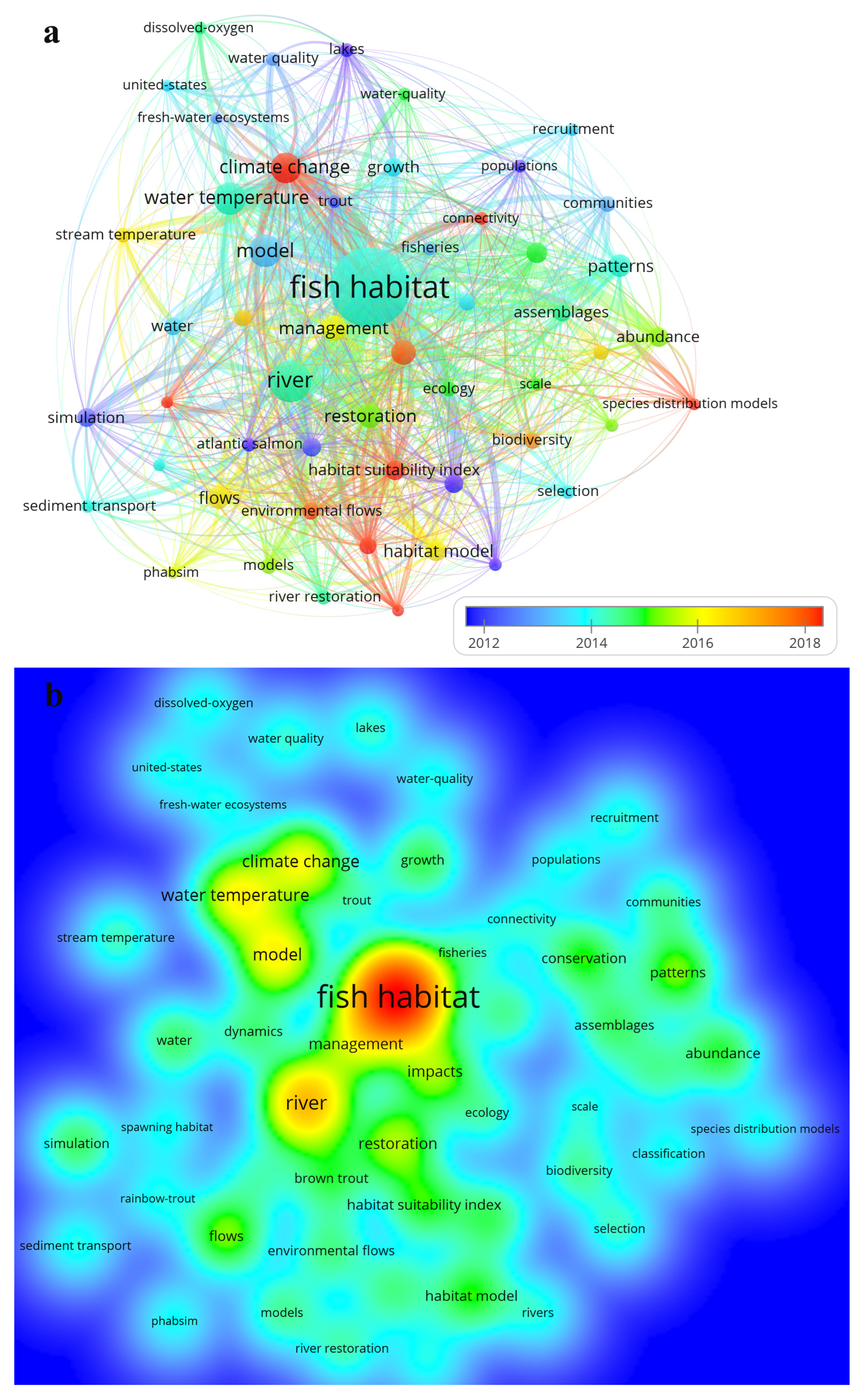
The keyword co-occurrence network (Figure 4a) provides a comprehensive mapping of the thematic essence and research hotspots in freshwater fish habitat science. Based on the established bibliometric criteria, the analysis reveals the core conceptual framework and the primary evolutionary trends of the field. In Figure 4a, the diameter of each node corresponds to the frequency of the keyword, with larger nodes highlighting prominent research hotspots. The edges connecting nodes signify the strength of their thematic association; increased line thickness denotes a higher frequency of co-occurrence within the same literature. Representative terms in the field comprise high-frequency keywords such as “fish habitat,” “habitat model,” “river,” “water temperature,” “climate change,” “suitability index,” “management,” “restoration,” and “impacts.”
Notably, beyond the primary search terms, high-frequency keywords including “management,” “restoration,” and “impact” underscore that a fundamental objective of fish habitat research is the reclamation of natural environments to optimize economic, social, and ecological benefits [13,21,34,35,36]. The prevalence of “water temperature” and “climate change” reflects a burgeoning focus on these drivers [34]. These evolutionary trends are further substantiated by density visualizations and burst keyword analysis (Figure 4b and Table 1).
The keyword clustering timeline view (Figure 5) effectively illustrates the temporal evolution and structural transitions of the research themes. The Modularity Q score (0.5366 > 0.3) and Weighted Mean Silhouette S score (0.7829 > 0.7) validate the significance and high consistency of the cluster network. As illustrated in Figure 5, the research landscape has evolved from early foundational studies on basic physical parameters (e.g., #1 dissolved oxygen and water temperature) toward more integrated and predictive domains, such as #0 habitat suitability and #9 climate change. Notably, the persistent activity in clusters #3 (habitat modeling) and #8 (fish habitat) in recent years aligns with the surging interest in ecological restoration and the Yangtze River basin mentioned in the keyword burst analysis (Table 1).
Climate change exerts profound pressures on aquatic ecosystems, specifically jeopardizing the habitat suitability for stenothermic cold-water species. It can trigger shifts in habitat selection behaviors and phenological changes in breeding seasons. Altered environmental regimes, such as elevated water temperatures, may compel species to modify their habitat preferences and reproductive strategies. Under divergent climate scenarios—ranging from RCP2.6 (low emissions) to RCP8.5 (high emissions)—habitat distributions are projected to undergo significant contractions, with stricter warming trajectories leading to a substantial sequestration of suitable habitats for cold-water taxa. These emerging domains represent current scholarly frontiers. Furthermore, there is a discernible shift toward prioritizing ecological outcomes over purely economic development. Against this backdrop, the Yangtze River basin has emerged as a focal point for fish habitat research [35,37].

3.5. The Impact Mechanism of Habitat on Fish

Fish habitats are governed by multifaceted drivers, necessitating the selection of indicators that exert significant influence on habitat conditions to ensure accurate environmental characterization. A fish habitat encompasses the spatial extent required to support comprehensive life-history processes, including spawning grounds, feeding areas, overwintering zones, and migratory corridors that connect distinct developmental stages. Pivotal habitat constituents include factors that facilitate fish growth and reproduction, such as water temperature, topography, flow regimes, water quality, and prey availability. The identification of key indicators is paramount for the precision of habitat modeling. These factors must represent the full spectrum of ecological conditions while remaining empirically measurable. Established methodologies for factor selection include expert judgment and Principal Component Analysis (PCA) [38]. Simulated habitat variables predominantly feature water depth, flow velocity, substrate composition, sediment content, water temperature, dissolved oxygen (DO), and hydrological connectivity. Despite the absence of standardized selection criteria, a meta-analysis of peer-reviewed literature reveals that water depth (21%), flow velocity (19%), and substrate (16%) constitute the most prevalent descriptors. These are followed by water temperature (5%), habitat coverage (5%), and slope (4%), alongside secondary variables such as salinity, DO, riparian proximity, channel width, water-level fluctuations, and conductivity.
Bathymetry exerts a profound impact on the density, abundance, and taxonomic diversity of fish populations. Vertical gradients in water depth typically correlate with declining water temperature and DO concentrations, which subsequently modulate fish growth and metabolic rates, as well as drive significant ontogenetic shifts in habitat utilization across different life stages [39]. Furthermore, stratified light attenuation at varying depths dictates the photosynthetic productivity of aquatic macrophytes, thereby regulating the availability of autochthonous food resources [40]. Lake depth is intrinsically coupled with surface area and serves as a proxy for hydraulic storage capacity. Consequently, fluctuations in depth induce dynamic shifts in habitat structure and nutrient stoichiometry, ultimately shaping the reproductive success and growth trajectories of fish species.
Within freshwater ecosystems, flow velocity constitutes a pivotal environmental driver that dictates both spatial occupancy and behavioral patterns. Reduced flow regimes may induce more frequent movement and intra-specific competition, potentially reallocating energy from somatic growth to locomotory activity [41]. Conversely, excessively high velocities (>2 m/s) can compel fish into high-intensity exercise, triggering physiological stress and swimming fatigue, which consequently inhibits growth [42]. It is imperative to note that responses to hydraulic conditions are highly species-specific; thus, these effects cannot be generalized across an entire community. The relationship between flow rate and growth remains multifaceted, contingent upon the specific ecological requirements of each species. Beyond physiological and behavioral modulations, variations in flow velocity alter habitat availability. Reduced discharge typically diminishes the wetted area, thereby restricting spatial niches for foraging, refuge, and reproduction—a contraction that disproportionately impacts habitat specialists. Nonetheless, under specific geomorphological contexts, lower velocities may engender novel microhabitats that benefit early life-history stages, such as juvenile fish.
Substrate represents a foundational element of fish habitats, exerting a decisive influence on spawning success and community structure [43]. Organic substrates—comprising detritus such as leaves, wood chips, mosses, and macrophyte roots—function as critical food resources and refugia for benthic animals and aquatic biota [44]. The mineral matrix [45] is characterized by distinct grain size, sorting, and embeddedness, which collectively govern sediment heterogeneity and bed roughness. These physicochemical attributes mediate biological interactions including competition and predation, while facilitating the formation of interstitial spaces. These voids serve as essential microhabitats for spawning, egg incubation, juvenile refuge, and invertebrate colonization [46]. Embeddedness—the degree to which coarse clasts (e.g., cobbles, gravels) are infilled by fine sediments—directly modulates the accessibility of these spaces. Excessive embeddedness induces substrate compaction and impairs oxygen exchange, thereby compromising habitat suitability for early life stages. In contrast, well-sorted substrates with low embeddedness preserve interstitial voids, supporting higher biodiversity and recruitment success. Furthermore, substrate characteristics modulate near-bed hydrodynamics, influencing swimming efficiency [47], while particle size distributions impact reproductive indices, including fecundity, fry size, and survival rates [48].
Water temperature serves as a determinative environmental driver for fish, exerting profound impacts on their physiological, biochemical, and life-history trajectories [49]. Thermal fluctuations modulate critical functions—including feeding, respiration, and reproduction—across ontogenetic stages [50]. Temperature regimes, encompassing climate-driven shifts and coupled water-air temperature variations, directly regulate cellular proliferation rates in fish [51]. Furthermore, thermal shifts can alter the phenology of benthic and planktonic communities, thereby indirectly modulating piscine energy acquisition and somatic growth [52].
Water quality constitutes another fundamental dimension of fish habitats, as piscine vital activities are intrinsically linked to specific physicochemical regimes. Research characterizing habitat water quality primarily scrutinizes dissolved oxygen (DO), nutrients, heavy metals, and anthropogenic pollutants [53]. DO concentrations are paramount for fish survival and metabolic homeostasis [54], governed by a complex interplay of water depth, flow dynamics, irradiance, temperature, and biological demand [55]. Fluctuations in ambient DO directly modulate blood oxygen saturation levels, subsequently impacting growth, fecundity, and other fitness-related traits. Moreover, DO is synergistically coupled with other abiotic and biotic factors, thereby exerting cascading influences on fish health and behavioral ecology.
Hydrological connectivity is a quintessential factor in fish habitat integrity, underpinning essential processes such as migratory movements, ichthyoplankton dispersal, spatial expansion, and foraging [56]. While extensive research has quantified habitat extent, evaluations typically rely on habitat suitability indices (HSI) or qualitative categorization (e.g., unsuitable, suboptimal, and optimal) rather than crude volumetric metrics. However, spatial configuration and inter-patch connectivity remain under-explored. Relying exclusively on habitat area—while ignoring quality or functional connectivity—may precipitate erroneous assessments and misguided management interventions. Notwithstanding the significance of total habitat area, spatially fragmented and isolated patches can obstruct the flux of matter and energy, hindering movement and recruitment, which may ultimately trigger population senescence [57].
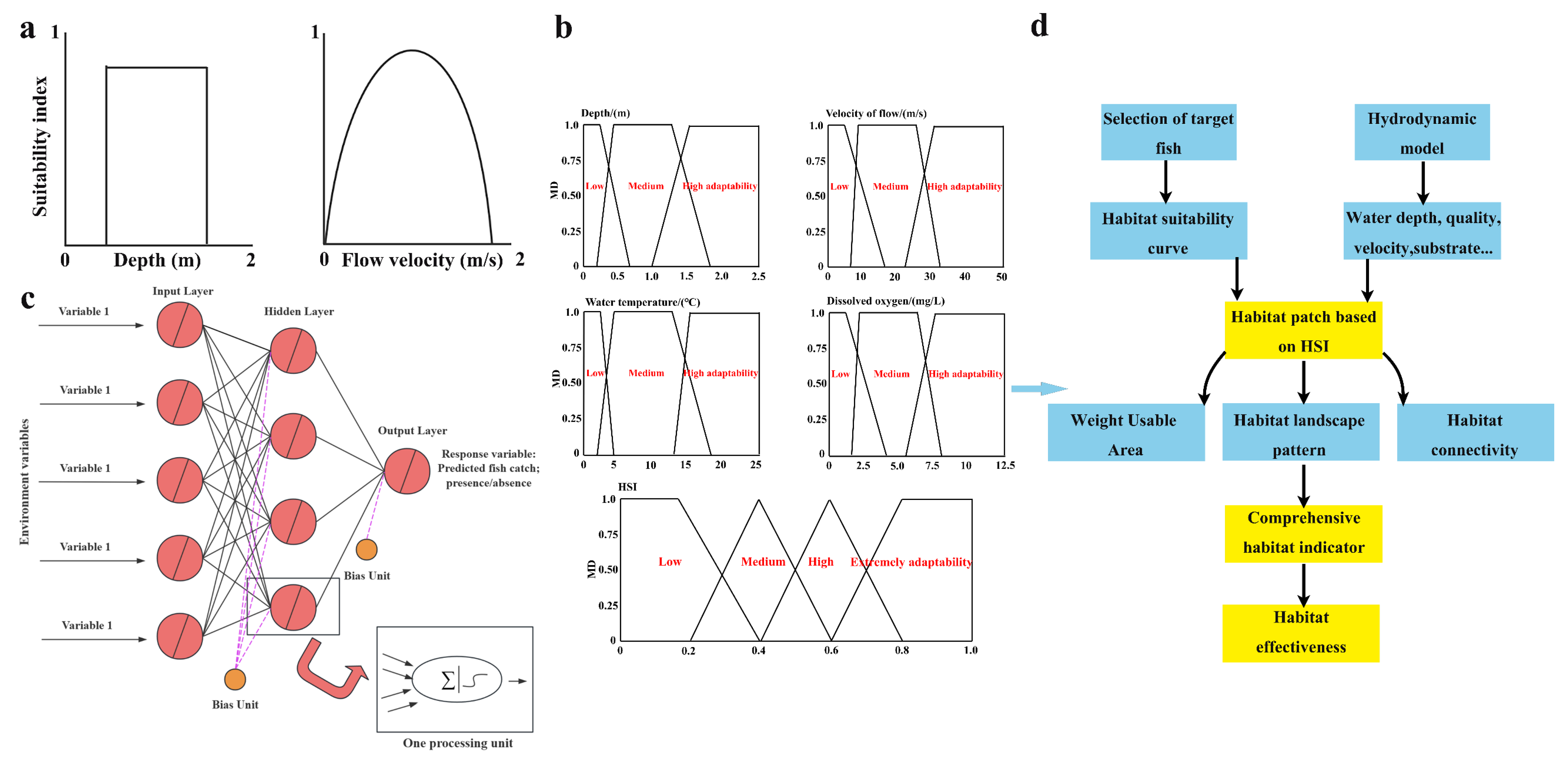
The conceptual framework and the interrelationships between these environmental factors are visually summarized in the accompanying Graphical Abstract (provided as a standalone visual summary). Fish and associated taxa constitute an integrated ecosystem where interspecific competition and mutualism are vital for somatic development. Connectivity across diverse habitat types is essential for the survival and persistence of aquatic biota. While emerging studies have begun to incorporate habitat connectivity, a robust quantitative evaluation framework remains elusive. In landscape ecology, habitat assessment typically synthesizes factors such as patch area, spatial configuration, and fragmentation to evaluate landscape architecture. By leveraging the stochastic properties of electron random walks in circuit theory and accounting for the inherent stochasticity of ecological flows, species can be modeled as electrons and landscape patches as resistive nodes, enabling the quantification of inter-patch connectivity. Lower resistance and higher current density signify enhanced connectivity. We propose an integrated approach using landscape pattern indices to analyze the spatial arrangement of habitat patches, coupled with circuit theory for connectivity assessment. Initially, the aforementioned methods are employed to identify fish habitats and derive both quantity (area) and quality (spatial distribution and connectivity) metrics. Subsequently, the Genetic Algorithm–Analytic Hierarchy Process (GA-AHP) is applied to assign relative weights to these dimensions. Finally, a weighted composite index (ranging from 0 to 1) is calculated, where elevated values denote superior habitat suitability (Figure 6).

4. Methodological Evolution and Synthesis of Fish Habitat Modeling

While the bibliometric analysis in Section 3 provides a macro-scale mapping of the key contributors and general themes in freshwater fish habitat research, it also identifies ‘habitat’ as the foundational concept across all thematic clusters. To complement these quantitative findings, this section provides a qualitative synthesis of the methodological evolution that serves as the technical cornerstone of the field. By transitioning from the ‘who and where’ of the research landscape to the ‘how’ of scientific execution, we evaluate the progression of modeling paradigms—from early univariate approaches to modern AI-driven frameworks—thereby offering a comprehensive discussion on the state of the art in habitat suitability assessment.
The primary objective of fish habitat research is to construct robust modeling frameworks and establish rigorous methodologies for habitat suitability assessment. A comprehensive synthesis of diverse modeling studies reveals that methodological approaches can be systematically categorized into five distinct paradigms: (1) univariate suitability curves; (2) conditional habitat selection criteria (e.g., the MesoHABSIM framework); (3) fuzzy logic-based inference models; (4) multivariate statistical models; and (5) machine learning-driven evaluation approaches. A detailed summary of the advancements in habitat suitability research is tabulated in Table S4.

4.1. Univariate Suitability Curves

The Habitat Suitability Index (HSI), established by the USFWS, remains the primary univariate framework for habitat quantification [58]. HSI models quantify species-specific requirements by mapping environmental variables to normalized indices ranging from 0 (unsuitable) to 1 (optimal). These relationships are typically visualized as curves plotting variable values (abscissa) against suitability indices (ordinate). This architecture underpins over 90% of extant fish habitat models, including the widely adopted PHABSIM [59,60,61]. Figure 6a depicts a representative curve used in these applications.
Functionally, HSI models evaluate individual environmental drivers independently before aggregating results via mathematical functions. While offering high computational efficiency and interpretability, the underlying assumption of variable independence often overlooks synergistic or antagonistic interactions. Consequently, such simplifications can constrain the ecological realism of model outputs.
Despite advanced developments, univariate curves remain predominant in practice. To address their limitations, several alternative paradigms have emerged: (1) fuzzy logic models for stochastic uncertainty; (2) multivariate statistical or probabilistic frameworks for variable interdependencies; and (3) conditional habitat selection paradigms, such as MesoHABSIM. Unlike univariate methods, conditional approaches evaluate variables relative to their environmental context (e.g., depth suitability as a function of specific velocity or substrate), thereby enhancing ecological fidelity within heterogeneous lotic systems.

4.2. Conditional Habitat Selection Criteria

MesoHABSIM, developed by Professor Piotr Parasiewicz, addresses the limitations of micro-scale models like PHABSIM in large-scale river ecosystems. By partitioning fluvial systems into discrete hydromorphological units (HMUs)—such as pools, riffles, and runs—it integrates topography, land cover, and hydrology to evaluate habitat suitability. This meso-scale approach enables management across expansive river systems by navigating complex environments defined by high discharge variability and multi-species requirements. The framework simulates biological responses under divergent flow scenarios, providing rigorous, evidence-based recommendations for flow optimization [62,63].
Renowned for its scalability, MesoHABSIM supports hierarchical, multi-species assessments. While early versions utilized logistic regression for superior accuracy over univariate models, contemporary implementations employ empirically validated conditional habitat selection criteria. Despite its computational complexity, the framework’s methodological versatility makes it a robust instrument for managing intricate hydrological regimes. A synthesis of its technical attributes is tabulated in Table S4 [64].
In practice, MesoHABSIM has seen extensive global deployment, notably in the Quinebaug River basin (USA) to support restoration under fluctuating flows. The systematic workflow involves assimilating multi-source datasets to delineate HMUs, followed by a rigorous quality assessment for each unit. Ultimately, geospatial suitability maps are generated to guide flow optimization, a pipeline successfully replicated across numerous watersheds [63].

4.3. Fuzzy Logic

Fuzzy logic [65] provides a robust mathematical framework for modeling complex systems defined by uncertainty and imprecision. Unlike deterministic models, it allows variables to hold partial membership in multiple categories simultaneously (0 to 1), making it ideal for fragmented or stochastic environmental datasets [66].
In these systems, environmental drivers like flow velocity are represented by linguistic variables (e.g., “low,” “high”). Heuristic “if-then” rules link these to habitat suitability [67]. The workflow involves five steps: (1) defining fuzzy sets and rules; (2) input fuzzification; (3) rule evaluation; (4) output aggregation; and (5) defuzzification via the centroid method to derive a final index (Figure 6b) [68].
By integrating empirical data with expert knowledge, fuzzy logic enhances ecological fidelity, as demonstrated by the CASiMiR model [20,69,70]. However, computational overhead escalates exponentially with input dimensionality. Furthermore, fuzzy logic struggles to represent abrupt ecological thresholds or non-linear state shifts. For instance, it may depict rapid reconfigurations—such as sudden temperature shocks—as gradual transitions, potentially compromising accuracy in dynamic environments. To address this, Niu [71] explored improving model responsiveness to such environmental shocks.

4.4. Multivariate Statistical Frameworks

Traditional HSI and fuzzy logic methodologies often struggle to account for synergistic interactions between habitat drivers, thereby oversimplifying ecosystem complexities. For example, rheophilic fish requiring large substrate as velocity refugia may shift preferences toward lentic environments if such shelters are absent. To address these non-linear dependencies, multivariate frameworks—including Multiple Linear Regression (MLR) [72,73], Principal Component Analysis (PCA) [74,75], Logistic Regression (LR) [76,77], Generalized Linear Models (GLMs) [78,79], Generalized Additive Models (GAMs) [80,81], and Maximum Entropy models (MEMs/MaxEnt) [82,83]—integrate inter-variable dependencies to accurately elucidate the compounded influence on aquatic biota.
While MLR standardly characterizes linear associations, its utility is constrained by multicollinearity [84]. Consequently, PCA is implemented for dimensionality reduction to bolster model stability [85], whereas LR provides superior statistical rigor for presence–absence modeling, as demonstrated in winter flounder distribution studies [86]. Within the MesoHABSIM evolutionary trajectory, coupling LR with the Akaike Information Criterion (AIC) has significantly enhanced ecological inference [87,88]. Furthermore, Random Forest (RF) methods excel in managing high-order interactions and non-linear, high-dimensional spectral data [89,90], marking a shifting preference toward LR and RF for complex classification tasks.
For responses deviating from Gaussian or monotonic patterns, GLMs and GAMs offer flexible architectures and smoothing splines to model intricate ecological nexuses [91]. Similarly, MaxEnt has emerged as an indispensable niche modeling tool [92,93], performing reliably even under data-poor conditions to identify drivers of habitat loss, such as fragmentation and altered hydrological regimes [94].

4.5. Machine Learning-Based Evaluation Methods

Fish–habitat relationships involve multifaceted, non-linear interactions. Within the AI landscape, machine learning (ML) paradigms—particularly Artificial Neural Networks (ANNs)—excel at quantifying suitability by elucidating multiscale dependencies without a priori data assumptions [95]. Various architectures have been implemented, including Fuzzy Neural Networks (FNNs) [96], Fuzzy Habitat Preference Models (FHPMs) [95], Preference Leveling models (PPLs), Multivariate Adaptive Regression Splines (MARS) [97], Discriminant Factor Analysis (DFA) [98], Species Distribution Models (SDMs) [99], and Regression Trees (RTs) [100]. Among these, multilayer perceptrons (MLPs) and feedforward backpropagation networks consistently outperform conventional regression in modeling stochastic ecological processes.
Recently, hierarchical ANN variants (e.g., BPNNs, DNNs) have proliferated. Empirical studies confirm their efficacy: Muñoz [101] implemented an ensemble MLP architecture to assess the ecological niche of Barbus haasi, revealing that integrating biotic interactions significantly augmented model precision. Akkan [102] employed an MLP to predict fish condition factors, achieving remarkable performance across training and validation phases (R2 > 0.99). Li [103] synergized HTI acoustic telemetry with BPNNs to model grass carp migratory trajectories, yielding spatially stable results. Furthermore, Brosse [104] corroborated that ANNs consistently exceed multiple linear regression in predicting ichthyofaunal distribution and abundance. Concurrently, deep learning models—specifically Convolutional Neural Networks (CNNs)—have gained traction for vision-based habitat monitoring, excelling in automated classification, detection, and semantic segmentation [105].
Despite high fidelity, ML models often face limited interpretability (“black-box” issues) and constrained generalizability [106]. To address this, hybrid frameworks integrating ML with fuzzy logic or statistical theory are proposed to enhance transparency. As the field shifts toward Explainable AI (XAI) and high-resolution datasets, AI-driven Habitat Suitability Criteria (HSC) offer more objective, data-driven alternatives to traditional heuristic curves, supporting real-time auditing and improved transferability. Complementing these data-driven paradigms, mechanistic frameworks—such as bioenergetic and agent-based models (ABMs)—explicitly simulate ecological processes [107]. These approaches effectively bridge the gap between empirical and process-based methods, as summarized in Table S4.

4.6. Scale-Consistent Criteria and Model Verification

Habitat modeling frameworks operate across a hierarchical continuum of spatial scales, ranging from microhabitats (e.g., water depth, velocity, and substrate composition) to mesohabitats (e.g., fluvial units such as pools and riffles) and macrohabitats (e.g., watershed-scale fragmentation and river connectivity) [108]. Each tier captures discrete ecological processes; consequently, the applied habitat suitability criteria (HSC) must be meticulously aligned with the corresponding scale to ensure ecological relevance. For instance, expert-elicited flow velocity preference curves are optimal for microhabitat models, whereas macrohabitat assessments necessitate landscape-level metrics such as barrier density or hydrological longitudinal connectivity [109].
Notably, suitability parameters lack universal transferability across scales. Projecting fine-scale preferences onto macro-scale models can precipitate scale mismatches, thereby compromising the integrity of ecological inferences. Recent breakthroughs in artificial intelligence (AI) facilitate the derivation of scale-adjusted suitability functions from empirical datasets, augmenting model adaptability while preserving mechanistic interpretability.
Equally imperative is the rigorous validation of models using robust statistical protocols [110,111]. Model benchmarking typically entails systematic data partitioning—including training/validation splits, k-fold cross-validation, or nested resampling—to mitigate overfitting [112]. Standardized performance metrics, such as the coefficient of determination (R2), root mean square error (RMSE) [113], area under the receiver operating characteristic curve (AUC), and the true skill statistic (TSS), are employed to quantify predictive precision and generalization robustness [114]. For example, Muñoz [101] and Akkan [102] implemented these protocols to validate ANN-driven suitability predictions, underscoring the necessity of objective performance audits in identifying optimal modeling criteria.
At the macrohabitat echelon, Parasiewicz [109] elucidated how machine learning can be synergized with conceptual models to quantify systemic habitat alterations. In a pan-European meta-analysis, the authors scrutinized over 1.2 million anthropogenic barriers, estimating that exceeding 200,000 km of historically free-flowing habitat has been fragmented by impoundments. They correlated structural attributes (e.g., barrier typology and density) with functional impairments, including loss of connectivity and taxonomical community shifts. These results highlight the necessity of embedding macro-scale indicators into habitat suitability frameworks, particularly for regional-scale conservation prioritization.

5. Conclusions

This study provides a systematic synthesis of freshwater fish habitat research (1991–2024), integrating bibliometric mapping with a critical review of methodological evolution. Our analysis identifies a thematic shift from foundational physical parameters toward complex predictive modeling and climate-resilience strategies. The principal contribution of this work lies in elucidating how the field has transitioned through five major paradigms: from univariate suitability curves to advanced AI-driven and hybrid frameworks.
The methodological strengths of current habitat simulations reside in their capacity to integrate multi-domain datasets (hydraulics, water quality, and ecology) to forecast habitat shifts under divergent flow regimes. However, critical limitations remain regarding the explicit integration of fluvial geomorphological processes and the high data intensity required for precise HSI-based architectures. Addressing the scarcity of high-fidelity biological data and the “black-box” nature of machine learning is essential for future model transferability.
Moving forward, habitat modeling must evolve into interdisciplinary, scale-consistent frameworks that incorporate climate stressors and anthropogenic disturbances. The convergence of aquatic and terrestrial modeling paradigms, supported by Explainable AI (XAI) and mechanistic models, will provide a more rigorous scientific foundation for basin-scale conservation governance and informed water resource management.

Supplementary Materials

The following supporting information can be downloaded at: https://www.mdpi.com/article/10.3390/su18031272/s1, Table S1: Research progress on fish habitat; Table S2: Functions and results of the various parts of the “DEAN” process; Table S3: VOSviewer Parameter Settings. Table S4: Habitat suitability research methods. Bibliometric analysis [115,116,117,118,119,120,121].

Author Contributions

Conceptualization, Z.L. and Y.L.; methodology, Z.L. and Y.L.; software, Z.L.; formal analysis, Z.L.; investigation, Z.L.; data curation, Z.L.; writing—original draft preparation, Z.L.; writing—review and editing, Z.L., Y.L. and X.W.; visualization, Z.L.; funding acquisition, Y.L. and X.W. All authors have read and agreed to the published version of the manuscript.

Funding

This work was financially supported by the National Key Research and Development Program of China (2022YFC3204200), Development of an Intelligent Platform for River and Lake Health Identification, Diagnosis, and Early Warning Integrating DeepSeek Large Model (Y125008), Postgraduate Thesis Fund of Nanjing Hydraulic Research Institute (Yy125003).

Institutional Review Board Statement

Not applicable.

Informed Consent Statement

Not applicable.

Data Availability Statement

The raw data supporting the findings of this study are available in Figshare at [122].

Conflicts of Interest

All authors declare that the research was conducted in the absence of any commercial or financial relationships.

References

  1. Grinnell, J. The niche-relationships of the california thrasher. Auk 1917, 34, 427–433. [Google Scholar] [CrossRef]
  2. Li, W.; Chen, D.; Li, R. Determination of an appropriate ecological hydrograph for a rare fish species using an improved fish habitat suitability model introducing landscape ecology index. Ecol. Model. 2015, 311, 31–38. [Google Scholar] [CrossRef]
  3. Wilhelm, J.G.O.; Allan, J.D.; Wessell, K.J.; Merritt, R.W.; Cummins, K.W. Habitat assessment of non-wadeable rivers in michigan. Environ. Manag. 2005, 36, 592–609. [Google Scholar] [CrossRef] [PubMed]
  4. Brierley, G.J.; Cohen, T.; Fryirs, K.; Brooks, A. Post-european changes to the fluvial geomorphology of bega catchment, australia: Implications for river ecology. Freshw. Biol. 1999, 41, 839–848. [Google Scholar] [CrossRef]
  5. Harding, E.K.; Crone, E.E.; Elderd, B.D.; Hoekstra, J.M.; McKerrow, A.J.; Perrine, J.D.; Regetz, J.; Rissler, L.J.; Stanley, A.G.; Walters, E.L.; et al. The scientific foundations of habitat conservation plans: A quantitative assessment. Conserv. Biol. 2001, 15, 488–500. [Google Scholar] [CrossRef]
  6. Spence, R.; Hickley, P. The use of phabsim in the management of water resources and fisheries in england and wales. Ecol. Eng. 2000, 16, 153–158. [Google Scholar] [CrossRef]
  7. Muhar, S.; Schwarz, M.; Schmutz, S.; Jungwirth, M. Identification of rivers with high and good habitat quality: Methodological approach and applications in Austria. Hydrobiologia 2000, 422, 343–358. [Google Scholar] [CrossRef]
  8. Dallas, H. River Health Programme: South African Scoring System (SASS) Data Interpretation Guidelines; Department of Water Affairs and Forestry (Resource Quality Services): Pretoria, South Africa; Institute of Natural Resources: Pietermaritzburg, South Africa, 2007. [Google Scholar]
  9. Kaika, M. The water framework directive: A new directive for a changing social, political and economic european framework. Eur. Plan. Stud. 2003, 11, 299–316. [Google Scholar] [CrossRef]
  10. Parsons, M.; Norris, R. The effect of habitat-specific sampling on biological assessment of water quality using a predictive model. Freshw. Biol. 2010, 36, 419–434. [Google Scholar] [CrossRef]
  11. Milner, N.J.; Wyatt, R.J.; Broad, K. Habscore-applications and future developments of related habitat models. Aquat. Conserv. Mar. Freshw. Ecosyst. 2010, 8, 633–644. [Google Scholar] [CrossRef]
  12. Yi, Y.; Sun, J.; Zhang, S.; Yang, Z. Assessment of chinese sturgeon habitat suitability in the yangtze river (China): Comparison of generalized additive model, data-driven fuzzy logic model, and preference curve model. J. Hydrol. 2016, 536, 447–456. [Google Scholar] [CrossRef]
  13. Yi, Y.; Sun, J.; Zhang, S. A habitat suitability model for chinese sturgeon determined using the generalized additive method. J. Hydrol. 2016, 534, 11–18. [Google Scholar] [CrossRef]
  14. NB/T 10485-2021; Technical Specification for Protection of River Aquatic Habitat. China Renewable Energy Engineering Institute: Beijing, China, 2021.
  15. Wegscheider, B.; Linnansaari, T.; Curry, R.A. Mesohabitat modelling in fish ecology: A global synthesis. Fish Fish. 2020, 21, 927–939. [Google Scholar] [CrossRef]
  16. Naman, S.M.; Rosenfeld, J.S.; Neuswanger, J.R.; Enders, E.C.; Hayes, J.W.; Goodwin, O.E.; Jowett, I.; Eaton, B.C. Bioenergetic habitat suitability curves for instream flow modeling: Introducing user-friendly software and its potential applications. Fisheries 2020, 45, 605–613. [Google Scholar] [CrossRef]
  17. Quan, Q.; Gao, S.; Shang, Y.; Wang, B. Assessment of the sustainability of gymnocypris eckloni habitat under river damming in the source region of the yellow river. Sci. Total Environ. 2021, 778, 146312. [Google Scholar] [CrossRef] [PubMed]
  18. Armstrong, J.B.; Fullerton, A.H.; Jordan, C.E.; Ebersole, J.L.; Bellmore, J.R.; Arismendi, I.; Penaluna, B.E.; Reeves, G.H. The importance of warm habitat to the growth regime of cold-water fishes. Nat. Clim. Change 2021, 11, 354–361. [Google Scholar] [CrossRef] [PubMed]
  19. Knudby, A.; Brenning, A.; LeDrew, E. New approaches to modelling fish–habitat relationships. Ecol. Model. 2010, 221, 503–511. [Google Scholar] [CrossRef]
  20. Noack, M.; Schneider, M.; Wieprecht, S. The habitat modelling system casimir: A multivariate fuzzy approach and its applications. In Ecohydraulics: An Integrated Approach; John Wiley & Sons: Hoboken, NJ, USA, 2013; pp. 75–91. [Google Scholar] [CrossRef]
  21. Yang, S.; Liang, R.; Wang, Y.; Li, K. Fish habitat assessment model considering the spatial pattern and connectivity of habitat patches. Ecol. Indic. 2024, 160, 111840. [Google Scholar] [CrossRef]
  22. Yao, W.; Zhao, T.; Chen, Y.; Yu, G.; Xiao, M. Assessing the river habitat suitability and effects of introduction of exotic fish species based on anecohydraulic model system. Ecol. Inform. 2018, 45, 59–69. [Google Scholar] [CrossRef]
  23. Wang, X.; Deng, Y.; An, R.; Yan, Z.; Yang, Y.; Tuo, Y. Evaluating the impact of power station regulation on the suitability of drifting spawning fish habitat based on the fuzzy evaluation method. Sci. Total Environ. 2023, 866, 161327. [Google Scholar] [CrossRef]
  24. Tamario, C.; Sunde, J.; Petersson, E.; Tibblin, P.; Forsman, A. Ecological and evolutionary consequences of environmental change and management actions for migrating fish. Front. Ecol. Evol. 2019, 7, 271. [Google Scholar] [CrossRef]
  25. Goldberg, S. On Laws That Govern the Growth of Science: Little Science, Big Science; Derek, Price; Columbia University Press: New York, NY, USA, 1963; p. 144. [Google Scholar] [CrossRef]
  26. Herb, W.R.; Johnson, L.B.; Jacobson, P.C.; Stefan, H.G. Projecting cold-water fish habitat in lakes of the glacial lakes region under changing land use and climate regimes. Can. J. Fish. Aquat.Sci. 2014, 71, 1334–1348. [Google Scholar] [CrossRef]
  27. Stefan, H.G.; Hondzo, M.; Eaton, J.G.; McCormick, J. Validation of a fish habitat model for lakes. Ecol. Model. 1995, 82, 211–224. [Google Scholar] [CrossRef]
  28. Hondzo, M.; Stefan, H.G. Dependence of water quality and fish habitat on lake morphometry and meteorology. J. Water Resour. Plan. Manag. 1996, 122, 364–373. [Google Scholar] [CrossRef]
  29. Fang, X.; Stefan, H.G.; Eaton, J.G.; McCormick, J.H.; Alam, S.R. Simulation of thermal/dissolved oxygen habitat for fishes in lakes under different climate scenarios: Part 1. Cool-water fish in the contiguous us. Ecol. Model. 2004, 172, 13–37. [Google Scholar] [CrossRef]
  30. LI, R.; Chen, Q.; Han, R.; Chen, D. Daily eco-hydrograph determination method based on fish spawning habitat simulation. In Proceedings of the 36th IAHR World Congress, Hague, The Netherlands, 28 June–3 July 2015. [Google Scholar]
  31. Li, R.; Chen, Q.; Chen, D. Cumulative effect on fish spawning area influenced by river flow regime change. In Proceedings of the 35th IAHR World Congress, Chengdu, China, 8–13 September 2013. [Google Scholar]
  32. Wang, L.; Chen, Q.; Zhang, J.; Xia, J.; Mo, K.; Wang, J. Incorporating fish habitat requirements of the complete life cycle into ecological flow regime estimation of rivers. Ecohydrology 2020, 13, e2204. [Google Scholar] [CrossRef]
  33. Yao, W. Ecohydraulic tools for aquatic fauna habitat and population status assessment, analysis and monitoring aimed at promoting integrated river management. Ecol. Model. 2021, 456, 109682. [Google Scholar] [CrossRef]
  34. Wen, X.; Liu, Z.; Lei, X.; Lin, R.; Fang, G.; Tan, Q.; Wang, C.; Tian, Y.; Quan, J. Future changes in yuan river ecohydrology: Individual and cumulative impacts of climates change and cascade hydropower development on runoff and aquatic habitat quality. Sci. Total Environ. 2018, 633, 1403–1417. [Google Scholar] [CrossRef] [PubMed]
  35. Wang, P.; Shen, Y.; Wang, C.; Hou, J.; Qian, J.; Yu, Y.; Kong, N. An improved habitat model to evaluate the impact of water conservancy projects on chinese sturgeon (acipenser sinensis) spawning sites in the yangtze river, china. Ecol. Eng. 2017, 104, 165–176. [Google Scholar] [CrossRef]
  36. Kuo, P.-H.; Shih, S.-S.; Otte, M.L. Restoration recommendations for mitigating habitat fragmentation of a river corridor. J. Environ. Manag. 2021, 296, 113197. [Google Scholar] [CrossRef]
  37. Lv, Z.; Wang, G.; Zhang, P.; Ai, X.; Cao, X.; Zheng, W.; Mu, Z.; Yu, B. Optimizing flow regime for the four major chinese carps by integrating habitat suitability within reservoir operation. J. Hydrol. 2023, 626, 130226. [Google Scholar] [CrossRef]
  38. Lever, J.; Krzywinski, M.; Altman, N. Principal component analysis. Nat. Methods 2017, 14, 641–642. [Google Scholar] [CrossRef]
  39. Dejenie, T.; Asmelash, T.; De Meester, L.; Mulugeta, A.; Gebrekidan, A.; Risch, S.; Pals, A.; Van der Gucht, K.; Vyverman, W.; Nyssen, J.; et al. Limnological and ecological characteristics of tropical highland reservoirs in tigray, northern ethiopia. Hydrobiologia 2008, 610, 193–209. [Google Scholar] [CrossRef]
  40. Magbanua, F.S.; Mendoza, N.Y.B.; Uy, C.J.C.; Matthaei, C.D.; Ong, P.S. Water physicochemistry and benthic macroinvertebrate communities in a tropical reservoir: The role of water level fluctuations and water depth. Limnologica 2015, 55, 13–20. [Google Scholar] [CrossRef]
  41. Morro, B.; Davidson, K.; Adams, T.P.; Falconer, L.; Holloway, M.; Dale, A.; Aleynik, D.; Thies, P.R.; Khalid, F.; Hardwick, J.; et al. Offshore aquaculture of finfish: Big expectations at sea. Rev. Aquac. 2022, 14, 791–815. [Google Scholar] [CrossRef]
  42. Nilsen, A.; Nielsen, K.V.; Bergheim, A. A closer look at closed cages: Growth and mortality rates during production of post-smolt atlantic salmon in marine closed confinement systems. Aquac. Eng. 2020, 91, 102124. [Google Scholar] [CrossRef]
  43. Bhat, A. Patterns in the distribution of freshwater fishes in rivers of central western ghats, india and their associations with environmental gradients. Hydrobiologia 2004, 529, 83–97. [Google Scholar] [CrossRef]
  44. Theel, H.J.; Dibble, E.D.; Madsen, J.D. Differential influence of a monotypic and diverse native aquatic plant bed on a macroinvertebrate assemblage; an experimental implication of exotic plant induced habitat. Hydrobiologia 2008, 600, 77–87. [Google Scholar] [CrossRef]
  45. Beauger, A.; Lair, N.; Reyes-Marchant, P.; Peiry, J.-L. The distribution of macroinvertebrate assemblages in a reach of the river allier (france), in relation to riverbed characteristics. Hydrobiologia 2006, 571, 63–76. [Google Scholar] [CrossRef]
  46. Rempel, L.L.; Richardson, J.S.; Healey, M.C. Macroinvertebrate community structure along gradients of hydraulic and sedimentary conditions in a large gravel-bed river. Freshw. Biol. 2000, 45, 57–73. [Google Scholar] [CrossRef]
  47. Johnson, K.; Wait, L.E.; Monk, S.K.; Rader, R.; Hotchkiss, R.H.; Belk, M.C. Effects of substrate on movement patterns and behavior of stream fish through culverts: An experimental approach. Sustainability 2019, 11, 470. [Google Scholar] [CrossRef]
  48. Riebe, C.S.; Sklar, L.S.; Overstreet, B.T.; Wooster, J.K. Optimal reproduction in salmon spawning substrates linked to grain size and fish length. Water Resour. Res. 2014, 50, 898–918. [Google Scholar] [CrossRef]
  49. Beitinger, T.L.; Fitzpatrick, L.C. Physiological and ecological correlates of preferred temperature in fish. Am. Zool. 1979, 19, 319–329. [Google Scholar] [CrossRef]
  50. Heather, F.J.; Childs, D.Z.; Darnaude, A.M.; Blanchard, J.L. Using an integral projection model to assess the effect of temperature on the growth of gilthead seabream sparus aurata. PLoS ONE 2018, 13, e0196092. [Google Scholar] [CrossRef]
  51. Gamperl, A.K.; Ajiboye, O.O.; Zanuzzo, F.S.; Sandrelli, R.M.; Peroni, E.d.F.C.; Beemelmanns, A. The impacts of increasing temperature and moderate hypoxia on the production characteristics, cardiac morphology and haematology of atlantic salmon (Salmo salar). Aquaculture 2020, 519, 734874. [Google Scholar] [CrossRef]
  52. Prokešová, M.; Gebauer, T.; Matoušek, J.; Lundová, K.; Čejka, J.; Zusková, E.; Stejskal, V. Effect of temperature and oxygen regime on growth and physiology of juvenile Salvelinus fontinalis × Salvelinus alpinus hybrids. Aquaculture 2020, 522, 735119. [Google Scholar] [CrossRef]
  53. Li, B.; Yang, G.; Wan, R. Multidecadal water quality deterioration in the largest freshwater lake in china (poyang lake): Implications on eutrophication management. Environ. Pollut. 2020, 260, 114033. [Google Scholar] [CrossRef] [PubMed]
  54. Jin, B.; Winemiller, K.O.; Shao, B.; Si, J.; Jin, J.; Ge, G. Fish assemblage structure in relation to seasonal environmental variation in sub-lakes of the poyang lake floodplain, china. Fish. Manag. Ecol. 2019, 26, 131–140. [Google Scholar] [CrossRef]
  55. Franklin, P. Dissolved oxygen criteria for freshwater fish in new zealand: A revised approach. N. Z. J. Mar. Freshw. Res. 2014, 48, 112–126. [Google Scholar] [CrossRef]
  56. Burgess, O.; Pine, W.E., III. Importance of floodplain connectivity to fish populations in the apalachicola river, florida. River Res. Appl. 2013, 29, 718–733. [Google Scholar] [CrossRef]
  57. Li, R.; Chen, Q.; Tonina, D.; Cai, D. Effects of upstream reservoir regulation on the hydrological regime and fish habitats of the lijiang river, China. Ecol. Eng. 2015, 76, 75–83. [Google Scholar] [CrossRef]
  58. Yi, Y.; Wang, Z.; Yang, Z. Two-dimensional habitat modeling of chinese sturgeon spawning sites. Ecol. Model. 2010, 221, 864–875. [Google Scholar] [CrossRef]
  59. Bovee, K.D. Development and Evaluation of Habitat Suitability Criteria for Use in the Instream Flow Incremental Methodology; Usgs Fort Collins Science Center: Fort Collins, CO, USA, 1986. [Google Scholar]
  60. Bovee, K.D. A guide to stream habitat analysis using the instream flow incremental methodology. Ifip no. 12. Sci. Res. Essays 1982, 6, 6270–6284. [Google Scholar] [CrossRef]
  61. Bockelmann, B.; Fenrich, E.; Lin, B.; Falconer, R. Development of an ecohydraulics model for stream and river restoration. J. Ecol. Eng. 2004, 22, 227–235. [Google Scholar] [CrossRef]
  62. Parasiewicz, P.J.F. Mesohabsim: A concept for application of instream flow models in river restoration planning. Fisheries 2001, 26, 6–13. [Google Scholar] [CrossRef]
  63. Parasiewicz, P.J.R.R. Applications. The mesohabsim model revisited. River Res. Appl. 2007, 23, 893–903. [Google Scholar] [CrossRef]
  64. Maddock, I.; Harby, A.; Kemp, P.; Wood, P.J. Ecohydraulics: An Integrated Approach; John Wiley & Sons: Hoboken, NJ, USA, 2013. [Google Scholar]
  65. Zadeh, L.A. Fuzzy sets. Inf. Control 1965, 8, 338–353. [Google Scholar] [CrossRef]
  66. Chen, Q.; Yang, Q.; Lin, Y. Development and application of a hybrid model to analyze spatial distribution of macroinvertebrates under flow regulation in the lijiang river. Ecol. Inform. 2011, 6, 407–413. [Google Scholar] [CrossRef]
  67. Marchini, A.; Facchinetti, T.; Mistri, M. F-ind: A framework to design fuzzy indices of environmental conditions. Ecol. Indic. 2009, 9, 485–496. [Google Scholar] [CrossRef]
  68. Mouton, A.M.; De Baets, B.; Van Broekhoven, E.; Goethals, P.L. Prevalence-adjusted optimisation of fuzzy models for species distribution. Ecol. Model. 2009, 220, 1776–1786. [Google Scholar] [CrossRef]
  69. Kumar, A.; Singh, A.K.; Garg, A. A novel framework to evaluate software reliability prediction models using multi-criteria decision-making. In Proceedings of the 2024 11th International Conference on Reliability, Infocom Technologies and Optimization (Trends and Future Directions) (ICRITO), Noida, India, 14–15 March 2024; IEEE: Piscataway, NJ, USA, 2024. [Google Scholar] [CrossRef]
  70. Kerle, F.; Zllner, F.; Schneider, M.; Bhmer, J. Modeling of long-term fish habitat changes in restored secondary floodplain channels of the river rhine. In Proceedings of the Fourth International Ecohydraulics Symposium, Cape Town, South Africa, 3–8 March 2002. [Google Scholar]
  71. Niu, Y.; Abdullayev, V.; Alyar, A.V.; Kamran, A.T. Resilience and adaptation to climate change: Community-based strategies in coastal regions. Estidamaa 2023, 2023, 36–43. [Google Scholar] [CrossRef] [PubMed]
  72. Brosse, S.; Lek, S. Relationships between environmental characteristics and the density of age-0 eurasian Perch perca fluviatilis in the littoral zone of a lake: A nonlinear approach. Trans. Am. Fish. Soc. 2002, 131, 1033–1043. [Google Scholar] [CrossRef]
  73. Yi, Y.; Cheng, X.; Yang, Z.; Wieprecht, S.; Zhang, S.; Wu, Y. Evaluating the ecological influence of hydraulic projects: A review of aquatic habitat suitability models. Renew. Sustain. Energy Rev. 2017, 68, 748–762. [Google Scholar] [CrossRef]
  74. Freeman, S.M.; Rogers, S.I. A new analytical approach to the characterisation of macro-epibenthic habitats: Linking species to the environment. Estuar. Coast. Shelf Sci. 2003, 56, 749–764. [Google Scholar] [CrossRef]
  75. YYigezu, G.; Mandefro, B.; Mengesha, Y.; Yewhalaw, D.; Beyene, A.; Ahmednur, M.; Abdie, Y.; Kloos, H.; Mereta, S.T. Habitat suitability modelling for predicting potential habitats of freshwater snail intermediate hosts in omo-gibe river basin, southwest ethiopia. Ecol. Inform. 2018, 45, 70–80. [Google Scholar] [CrossRef]
  76. Fladung, E.; Scholten, M.; Thiel, R. Modelling the habitat preferences of preadult and adult fishes on the shoreline of the large, lowland elbe river. J. Appl. Ichthyol. 2003, 19, 303–314. [Google Scholar] [CrossRef]
  77. de Araújo, R.S.; Aguiar, B.; Dropa, M.; Razzolini, M.T.P.; Sato, M.I.Z.; Lauretto, M.d.S.; Galvani, A.T.; Padula, J.A.; Matté, G.R.; Matté, M.H. Detection and molecular characterization of cryptosporidium species and giardia assemblages in two watersheds in the metropolitan region of so paulo, brazil. Environ. Sci. Pollut. Res. 2018, 25, 15191–15203. [Google Scholar] [CrossRef]
  78. Bolker, B.M.; Brooks, M.E.; Clark, C.J.; Geange, S.W.; Poulsen, J.R.; Stevens, M.H.H.; White, J.-S.S. Generalized linear mixed models: A practical guide for ecology and evolution. Trends Ecol. Evol. 2009, 24, 127–135. [Google Scholar] [CrossRef]
  79. Vasconcelos, R.; Le Pape, O.; Costa, M.; Cabral, H. Predicting estuarine use patterns of juvenile fish with generalized linear models. Estuar. Coast. Shelf Sci. 2013, 120, 64–74. [Google Scholar] [CrossRef]
  80. Ahmadi-Nedushan, B.; St-Hilaire, A.; Bérubé, M.; Robichaud, É.; Thiémonge, N.; Bobée, B. A review of statistical methods for the evaluation of aquatic habitat suitability for instream flow assessment. River Res. Appl. 2006, 22, 503–523. [Google Scholar] [CrossRef]
  81. Yi, Y.; Sun, J.; Yang, Y.; Zhou, Y.; Tang, C.; Wang, X.; Yang, Z. Habitat suitability evaluation of a benthic macroinvertebrate community in a shallow lake. Ecol. Indic. 2018, 90, 451–459. [Google Scholar] [CrossRef]
  82. Gomez, J.J.; Cassini, M.H. Environmental predictors of habitat suitability and biogeographical range of franciscana dolphins (pontoporia blainvillei). Glob. Ecol. Conserv. 2015, 3, 90–99. [Google Scholar] [CrossRef]
  83. Phillips, S.J.; Anderson, R.P.; Schapire, R.E. Maximum entropy modeling of species geographic distributions. Ecol. Model. 2006, 190, 231–259. [Google Scholar] [CrossRef]
  84. Ajemian, M.J.M.; Gregory, W. Moving forward in a reverse estuary: Habitat use and movement patterns of black drum (Pogonias cromis) under distinct hydrological regimes. Estuar. Coast. 2018, 41, 1410–1421. [Google Scholar] [CrossRef]
  85. Vilizzi, L.; Copp, G.H.; Roussel, J. Assessing variation in suitability curves and electivity profiles in temporal studies of fish habitat use. River Res. Appl. 2010, 20, 605–618. [Google Scholar] [CrossRef]
  86. Lazzari, M.A. Habitat variability in young-of-the-year winter flounder, pseudopleuronectes americanus, in maine estuaries. Fish. Res. 2008, 90, 296–304. [Google Scholar] [CrossRef]
  87. Parasiewicz, P.J.R.R. Application of mesohabsim and target fish community approaches to restoration of the quinebaug river, connecticut and massachusetts, USA. River Res. Appl. 2008, 24, 459–471. [Google Scholar] [CrossRef]
  88. Vezza, P.; Martinez, C.F.; Muñoz Mas, R.; Alcaraz, J.; Comoglio, C. Habitat suitability modeling with random forest as a tool for fish conservation in mediterranean rivers. In Proceedings of the 9th International Symposium on Ecohydraulics 2012 Proceedings, Vienna, Austria, 17–21 September 2012. [Google Scholar]
  89. Vezza, P.; Parasiewicz, P.; Calles, O.; Spairani, M.; Comoglio, C. Modelling habitat requirements of bullhead (Cottus gobio) in alpine streams. Aquat. Sci. 2013, 76, 1–15. [Google Scholar] [CrossRef]
  90. Vezza, P.; Parasiewicz, P.; Spairani, M.; Comoglio, C. Habitat modeling in high-gradient streams: The mesoscale approach and application. Ecol. Appl. 2014, 24, 844–861. [Google Scholar] [CrossRef]
  91. Young, M.; Iampietro, P.; Kvitek, R.; Garza, C. Multivariate bathymetry-derived generalized linear model accurately predicts rockfish distribution on cordell bank, california, USA. Mar. Ecol. Prog. Ser. 2010, 415, 247–261. [Google Scholar] [CrossRef]
  92. Pittman, S.J.; Brown, K.A. Multi-scale approach for predicting fish species distributions across coral reef seascapes. PLoS ONE 2011, 6, e20583. [Google Scholar] [CrossRef]
  93. Wines, S.; Young, M.; Zavalas, R.; Logan, J.; Tinkler, P.; Ierodiaconou, D. Accounting for spatial scale and temporal variation in fish-habitat analyses using baited remote underwater video stations (bruvs). Mar. Ecol. Prog. Ser. 2020, 640, 171–187. [Google Scholar] [CrossRef]
  94. Taylor, A.T.; Papeş, M.; Long, J.M. Incorporating fragmentation and non-native species into distribution models to inform fluvial fish conservation. Conserv. Biol. 2018, 32, 171–182. [Google Scholar] [CrossRef]
  95. Fukuda, S.; De Baets, B.; Mouton, A.M.; Waegeman, W.; Nakajima, J.; Mukai, T.; Hiramatsu, K.; Onikura, N. Effect of model formulation on the optimization of a genetic takagi–sugeno fuzzy system for fish habitat suitability evaluation. Ecol. Model. 2011, 222, 1401–1413. [Google Scholar] [CrossRef]
  96. Fukuda, S.; Hiramatsu, K.; Mori, M. Fuzzy neural network model for habitat prediction and hep for habitat quality estimation focusing on japanese medaka (Oryzias latipes) in agricultural canals. Paddy Water Environ. 2006, 4, 119–124. [Google Scholar] [CrossRef]
  97. Leathwick, J.R.; Rowe, D.; Richardson, J.; Elith, J.; Hastie, T. Using multivariate adaptive regression splines to predict the distributions of new zealand’s freshwater diadromous fish. Freshw. Biol. 2005, 50, 2034–2052. [Google Scholar] [CrossRef]
  98. Panfili, J.; Darnaude, A.; Lin, Y.; Chevalley, M.; Iizuka, Y.; Tzeng, W.; Crivelli, A. Habitat residence during continental life of the european eel anguilla anguilla investigated using linear discriminant analysis applied to otolith sr: Ca ratios. Aquat. Biol. 2012, 15, 175–185. [Google Scholar] [CrossRef]
  99. Buisson, L.; Blanc, L.; Grenouillet, G. Modelling stream fish species distribution in a river network: The relative effects of temperature versus physical factors. Ecol. Freshwater Fish. 2008, 17, 244–257. [Google Scholar] [CrossRef]
  100. Rejwan, C.; Collins, N.C.; Brunner, L.J.; Shuter, B.J.; Ridgway, M.S. Tree regression analysis on the nesting habitat of smallmouth bass. Ecology 1999, 80, 341–348. [Google Scholar] [CrossRef]
  101. Muñoz-Mas, R.; Martínez-Capel, F.; Alcaraz-Hernández, J.; Mouton, A. Can multilayer perceptron ensembles model the ecological niche of freshwater fish species? Ecol. Model. 2015, 309, 72–81. [Google Scholar] [CrossRef]
  102. Akkan, T.; Mutlu, C.; Yazicioğlu, O.; Yazici, R.; Yilmaz, M.; Polat, N. Determination of fish condition factor using artificial neural networks and machine learning algorithms. Acta Biol. Turc. 2024, 37, 1–11. [Google Scholar]
  103. Li, R.; Wu, Z.; Li, L.; Cai, D.; Huang, L.; Tao, J.; Luo, F.; Norgbey, E. Simulation of fish migration at different water depths based on backpropagation neural network. Appl. Ecol. Environ. Res. 2019, 17, 437–449. [Google Scholar] [CrossRef]
  104. Brosse, S.; Guegan, J.-F.; Tourenq, J.-N.; Lek, S. The use of artificial neural networks to assess fish abundance and spatial occupancy in the littoral zone of a mesotrophic lake. Ecol. Model. 1999, 120, 299–311. [Google Scholar] [CrossRef]
  105. Saleh, A.; Sheaves, M.; Jerry, D.; Azghadi, M.R. Applications of deep learning in fish habitat monitoring: A tutorial and survey. Expert Syst. Appl. 2024, 238, 121841. [Google Scholar] [CrossRef]
  106. Fukuda, S.; Hiramatsu, K. Prediction ability and sensitivity of artificial intelligence-based habitat preference models for predicting spatial distribution of japanese medaka (Oryzias latipes). Ecol. Model. 2008, 215, 301–313. [Google Scholar] [CrossRef]
  107. Smith, W.E. A bioenergetics-based index of habitat suitability: Spatial dynamics of foraging constraints and food limitation for a rare estuarine fish. Trans. Am. Fish. Soc. 2023, 152, 650–671. [Google Scholar] [CrossRef]
  108. Townsend, C.R.; Riley, R.H. Assessment of river health: Accounting for perturbation pathways in physical and ecological space. Freshw. Biol. 1999, 41, 393–405. [Google Scholar] [CrossRef]
  109. Parasiewicz, P.; Belka, K.; Łapińska, M.; Ławniczak, K.; Prus, P.; Adamczyk, M.; Buras, P.; Szlakowski, J.; Kaczkowski, Z.; Krauze, K.; et al. Over 200,000 kilometers of free-flowing river habitat in europe is altered due to impoundments. Nat. Commun. 2023, 14, 6289. [Google Scholar] [CrossRef]
  110. Bates, S.; Hastie, T.; Tibshirani, R. Cross-validation: What does it estimate and how well does it do it? J. Am. Stat. Assoc. 2024, 119, 1434–1445. [Google Scholar] [CrossRef]
  111. Raschka, S. Model evaluation, model selection, and algorithm selection in machine learning. arXiv 2018, arXiv:1811.12808. [Google Scholar] [CrossRef]
  112. Yates, K.L.; Bouchet, P.J.; Caley, M.J.; Mengersen, K.; Randin, C.F.; Parnell, S.; Fielding, A.H.; Bamford, A.J.; Ban, S.; Barbosa, A.M.; et al. Outstanding challenges in the transferability of ecological models. Trends Ecol. Evol. 2018, 33, 790–802. [Google Scholar] [CrossRef]
  113. Botchkarev, A. Performance metrics (error measures) in machine learning regression, forecasting and prognostics: Properties and typology. arXiv 2018, arXiv:1809.03006. [Google Scholar] [CrossRef]
  114. Hirzel, A.H.; Hausser, J.; Chessel, D.; Perrin, N. Ecological-niche factor analysis: How to compute habitat-suitability maps without absence data? Ecology 2002, 83, 2027–2036. [Google Scholar] [CrossRef]
  115. Pritchard, A. Statistical bibliography or bibliometrics. J. Doc. 1969, 25, 348. [Google Scholar] [CrossRef]
  116. Diem, A.; Wolter, S.C. The use of bibliometrics to measure research performance in education sciences. Res. High. Educ. 2013, 54, 86–114. [Google Scholar] [CrossRef]
  117. Mayr, P.; Scharnhorst, A. Scientometrics and information retrieval: Weak-links revitalized. Scientometrics 2015, 102, 2193–2199. [Google Scholar] [CrossRef]
  118. Abramo, G.; D’Angelo, C.A.; Viel, F. The field-standardized average impact of national research systems compared to world average: The case of italy. Scientometrics 2011, 88, 599–615. [Google Scholar] [CrossRef]
  119. Ma, F.; Xi, M. Status and trends of bibliometric. J. Inf. Sci. 1992, 13, 7–17. [Google Scholar]
  120. Chen, C. Citespace ii: Detecting and visualizing emerging trends and transient patterns in scientific literature. J Am. Soc. Inf. Sci. Tec. 2006, 57, 359–377. [Google Scholar] [CrossRef]
  121. van Eck, N.J.; Waltman, L. Vosviewer: A computer program for bibliometric mapping. ERIM Rep. Ser. Res. Manag. 2009, 84, 523–538. [Google Scholar] [CrossRef]
  122. Liu, Z. Global perspectives on fish habitat research: Advances in habitat suitability determination methods. Figshare 2025. [Google Scholar] [CrossRef]
Figure 1. Methodological workflow for literature selection and chronological evolution of freshwater fish habitat research: (a) document screening flowchart; (b) annual publication distribution with a 5-year moving average (MA) trend line; and (c) segmented regression analysis of research trends.
Sustainability 18 01272 g001
Figure 2. Overlay Visualization of authors (a) with 4 or more publications on fish habitat research, (b) highly productive authors. The publication volume of (c,d) the top ten journals in the field of fish habitat research.
Sustainability 18 01272 g002
Figure 3. Co-occurrence network of countries and the number of national publications on freshwater fish habitats across different periods: (a) 1991–2007; (b) 2008–12 May 2024; (c) the entire study period from 1991 to 12 May 2024; (d) co-occurrence network of the top 30 productive countries; and (e) Average number of citations for papers.
Sustainability 18 01272 g003
Figure 4. Keyword co-occurrence network of freshwater fish habitat research: (a) overlay visualization, where the color gradient represents the average publication year; and (b) density visualization, where the color transition from green to red signifies increasing keyword density based on the frequency and significance of surrounding elements.
Sustainability 18 01272 g004
Figure 5. Timeline visualization of keyword clusters in fish habitat research (1991–2024).
Sustainability 18 01272 g005
Figure 6. Habitat suitability assessment method and comprehensive framework ((a), suitability curve method; (b), fuzzy logic method; (c), evaluation methods for artificial intelligence (such as neural networks): the dashed lines in panel (c) represent the connections originating from the bias units to the neurons in the hidden and output layers; (d), comprehensive framework).
Sustainability 18 01272 g006
Table 1. Analysis of fish habitat keyword emergence intensity from 1991 to 2024.
KeywordsYearStrengthBeginEnd1991–2024
Instream Flow19964.7219962001▂▂▂▂▂▃▃▃▃▃▃▂▂▂▂▂▂▂▂▂▂▂▂▂▂▂▂▂▂▂▂▂▂▂
Simulation19955.2820082014▂▂▂▂▂▂▂▂▂▂▂▂▂▂▂▂▂▃▃▃▃▃▃▃▂▂▂▂▂▂▂▂▂▂
Streams19955.1220112013▂▂▂▂▂▂▂▂▂▂▂▂▂▂▂▂▂▂▂▂▃▃▃▂▂▂▂▂▂▂▂▂▂▂
Optimization20114.3620112013▂▂▂▂▂▂▂▂▂▂▂▂▂▂▂▂▂▂▂▂▃▃▃▂▂▂▂▂▂▂▂▂▂▂
Water Quality19994.7920122016▂▂▂▂▂▂▂▂▂▂▂▂▂▂▂▂▂▂▂▂▂▃▃▃▃▃▂▂▂▂▂▂▂▂
United States20124.1920122017▂▂▂▂▂▂▂▂▂▂▂▂▂▂▂▂▂▂▂▂▂▃▃▃▃▃▃▂▂▂▂▂▂▂
Management20004.4220132018▂▂▂▂▂▂▂▂▂▂▂▂▂▂▂▂▂▂▂▂▂▂▃▃▃▃▃▃▂▂▂▂▂▂
Climate Change19995.9120172024▂▂▂▂▂▂▂▂▂▂▂▂▂▂▂▂▂▂▂▂▂▂▂▂▂▂▃▃▃▃▃▃▃▃
Impact20054.1420192022▂▂▂▂▂▂▂▂▂▂▂▂▂▂▂▂▂▂▂▂▂▂▂▂▂▂▂▂▃▃▃▃▂▂
Suitability20147.0020212024▂▂▂▂▂▂▂▂▂▂▂▂▂▂▂▂▂▂▂▂▂▂▂▂▂▂▂▂▂▂▃▃▃▃
Habitat Suitability20127.1720222024▂▂▂▂▂▂▂▂▂▂▂▂▂▂▂▂▂▂▂▂▂▂▂▂▂▂▂▂▂▂▂▃▃▃
Yangtze River20185.0120222024▂▂▂▂▂▂▂▂▂▂▂▂▂▂▂▂▂▂▂▂▂▂▂▂▂▂▂▂▂▂▂▃▃▃
Note: The red color of the table indicates years with a significant increase in keywords, while the blue color indicates years with no significant change in keywords.
Disclaimer/Publisher’s Note: The statements, opinions and data contained in all publications are solely those of the individual author(s) and contributor(s) and not of MDPI and/or the editor(s). MDPI and/or the editor(s) disclaim responsibility for any injury to people or property resulting from any ideas, methods, instructions or products referred to in the content.