Article

Effects of Returning Mushroom Residues to the Field on Soil Properties and Rice Growth at Different Stages


1
College of Land Resources and Environment, Jiangxi Agricultural University, Nanchang 330045, China
2
Key Innovation Center of Agricultural Waste Resource Utilization and Non-Point Source Pollution Prevention and Control of Jiangxi Province, Nanchang 330045, China
3
Ganzhou Sub-Center of National Vegetable Quality Standards Center, Ganzhou 341600, China
4
College of Bioscience and Bioengineering, Jiangxi Agricultural University, Nanchang 330045, China
*
Author to whom correspondence should be addressed.
These authors contributed equally to this work.
Sustainability 2026, 18(3), 1266; https://doi.org/10.3390/su18031266
Submission received: 23 October 2025 / Revised: 3 December 2025 / Accepted: 23 January 2026 / Published: 27 January 2026

Abstract

Straw returning has been evidenced to be an effective strategy for straw utilization. Nevertheless, numerous adverse effects on straw direct returning have been widely reported. It is safer to fully degrade the straw and then return it to the soil. This strategy has been shown to significantly improve soil nutrients. However, the effect on rice growth is unclear. In this study, a pot experiment was conducted by using different types of mushroom residues with chemical fertilizer for field return, compared to the conventional method of applying chemical fertilizer alone, and straw return with or without fertilizer. It was found that the return of mushroom residues to the field could increases the soil organic matter content by 16.9–23.5%, the alkaline nitrogen by 39.1–47.4%, and the available potassium by 6.8–10.8%. Furthermore, mushroom residues were found to reduce the population of fungi and bacteria in the soil to a certain extent and increase the number of actinomycetes. Moreover, it was determined that mushroom residues elevated the nutrient content in plants, accelerated the tillering rate, and increased the number of tillers. This ultimately led to an increase in rice yield components, such as thousand-grain weight and the effective number of spikes. Mushroom residues can mimic the benefits of straw return while minimizing potential harm to rice yields. This study provides an effective strategy for the resource utilization of straw.

1. Introduction

The total amount of resources of agricultural production waste straw is increasing around the word [1]. The production of crop straw of China ranks first in the world [2,3]. However, most straw was burning, which accounting for about 31.0% of the total resources [3]. Scientific rationalization of straw is an important way of sustainable development of agriculture [4,5,6]. Straw fertilizer is the current comprehensive utilization of the main use of straw [2,7,8]. The use of straw to replace part of the chemical fertilizer to return to the field has been widely proved with economic benefits and ecological value [7,9]. The slow degradation of straw brings a lot of negative effects to farmland, such as the decomposition process producing harmful substances [10,11,12]. Exploring more effective straw utilization measures and soil improvement methods is key to future research [2,13,14].
Through composting, fermentation and other pre-treatment methods, straw can degrade large molecules with complex structures into simple inorganic substances, small organic molecules and humus [15,16]. These substances can be used as effective organic fertilizers, which can be safely and effectively absorbed and utilized by plants [17]. Currently, a large number of farmers have successfully utilized straw for cultivating edible mushrooms, achieving remarkable yields [18]. This strategy not only generates substantial economic returns through mushroom sales, but is also effective in reducing straw degradation [19]. However, the feasibility of returning mushroom residues to fields remains unclear, and the potential impact on plant growth has yet to be investigated [20,21].
Existing studies have shown that mushroom residue can be used as an effective organic amendment to enhance the fertility and productivity of agricultural soils. The application of waste mushroom residue significantly increased crop yield and soil physicochemical properties, compared to no fertilization [22]. Returning mushroom residues to the field has the same ecological benefits of straw returned to the field, including increasing the soil organic matter and nutrient content, increasing the granular structure, and reducing the soil bulk density [19]. It has also been found that mushroom residue improves soil structure and has a substantial impact on increasing soil pH [23]. In addition, Zeng et al. also demonstrated that the return of mushroom residues to the field increased the proportion of bacteria and decreased the proportion of fungi in the soil, and enhanced the ability to suppress soil-borne diseases [24]. Spent mushroom substrate possesses the quality of good organic manure for raising healthy crops of cereals, fruits, vegetables and ornamental plants, in addition to its ability of reclaiming the contaminated soil [25]. Its effectiveness can even rival that of certain chemical fertilizers, while simultaneously reducing the use of chemical fertilizers, aligning with the direction of sustainable agricultural development [26]. However, the current study mainly focuses on the ecological benefits of mushroom residues on soil. The effects of mushroom residues on plant physiology and yield during rice growth are still unclear [27,28]. Meanwhile, the differences between straw and mushroom residues after returning need to be further studied [18].
To address the limitations associated with conventional straw return, this study evaluated multiple rice straw return strategies using untreated rice straw and biologically decomposed mushroom residues derived from in situ cultivation of wine cap mushroom. Five treatments were designed to represent contrasting straw utilization approaches: no fertilization (CK), full chemical fertilization (F), direct straw returning (SF), rice-straw mushroom residue returning (T1), and wheat-residue mushroom residue returning (T2). This study compared the effects of conventional straw return and mushroom-residue return on soil nutrient dynamics, and evaluated how these mushroom residues regulate soil microbial community structure, rice growth, and final yield components.

2. Materials and Methods

2.1. Material Collection

All soil and plant measurements reported in this study were obtained from analyses conducted during the experiment. The experiment soil was neutral loamy paddy soil [29] (pH, 7.18, soil organic matter, (SOM) 13.79 g/kg, alkaline hydrolyzable nitrogen (AN), 90.44 mg/kg, available phosphorus (AP) 23.42 mg/kg, and available potassium (AK), 249.32 mg/kg). The rice straw used in this study contained 8.83 g/kg of total nitrogen (TN), 1.76 g/kg of total phosphorus (TP), and 19.49 g/kg of total potassium (TK). The experiment rice was late-season rice (Wufengyou T025) [30]. The experiment mushroom residue was cultivated using wine cap mushroom. Straw and wheat were used as the cultivation material of mushroom residues. The resulting rice-straw mushroom residue contained 9.64 g/kg TN, 2.11 g/kg TP, and 18.42 g/kg TK. In contrast, the wheat-based mushroom residue exhibited markedly higher nutrient levels, with 32.1 g/kg TN, 16.7 g/kg TP, and 14.62 g/kg TK. Prior to use, the mushroom residues were air-dried, homogenized, and passed through a 2 mm sieve to remove large debris. Urea, calcium–magnesium phosphate and potassium chloride were applied as chemical fertilizers [31].

2.2. Experimental Design

The experiment was set up with an untreated control (CK) and 4 treatments (chemical fertilizer only (F), straw returning with chemical fertilizer (SF), mushroom residues returning by rice straw as the substrate with chemical fertilizer (T1), and mushroom residues returning by wheat as the substrate with chemical fertilizer (T2)). The experiment was conducted in rectangular planting pots (length × width × height: 0.60 m × 0.40 m × 0.24 m), each pot containing 30 kg soil (depth of 20 cm). The incorporation of rice straw and mushroom residues into the soil was carried out 5 days prior to rice transplanting. Rice straw was returned to the field at a rate equivalent to 7500 kg·hm−2 (dry weight). The straw and mushroom residues (Figure 1 depicts the preparation procedure) were applied into the top 0–15 cm soil by mechanical mixing before transplanting. The pot experiment was conducted with nutrient application rates of 0.15 g/kg N, 0.10 g/kg P2O5, and 0.15 g/kg K2O. The nutrient contents of rice straw and mushroom residues were determined, and each treatment was carried out under equal nutrient conditions [32]. Nutrient deficiencies of SF, T1, and T2 were supplemented with chemical fertilizers. Phosphorus and potassium fertilizers were applied as basal fertilizers once. Nitrogen fertilizer was applied 3 times (basal fertilizer, tillering fertilizer and spanicle fertilizer at 4:3:3). The specific fertilization plan is listed in Table 1. Transplant rice seedlings were 30 days old with uniform growth, 6 rootstocks per pot, and 2 plants per rootstock. Each treatment was replicated three times [33]. Pest and weed control were performed manually, and no additional chemical agents were applied to avoid confounding effects.

2.3. Sample Collection and Analysis Methods

Rice samples were collected at the tillering, heading, and maturity stages, respectively, and then dried, crushed, and sieved through 60-mesh sieve for the determination of plant nutrients. The soil samples were dried naturally and sieved through 16- and 100-mesh sieves for the determination nutrients and pH. Subsequently, the rice was tested for seed and yield at maturity stages. The soil pH was measured using a soil-to-water ratio of 1:5 (w/v). SOM was determined by the potassium dichromate oxidation method [34]. AN was analyzed using the alkali diffusion method [35]. AP was determined by the molybdenum blue colorimetric method after extraction with 0.5 mol L−1 NaHCO3 [36], and AK was measured by flame photometry after extraction with 1 mol L−1 NH4OAc [37]. In plant samples, total nitrogen (TN), total phosphorus (TP), and total potassium (TK) were determined after H2SO4–H2O2 digestion, using the semi-micro Kjeldahl distillation, molybdenum blue colorimetry, and flame photometry, respectively. Soil samples collected at each growth stage were used to enumerate the three major microbial groups (bacteria, fungi, and actinomycetes) using the dilution plate counting method [38]. Nutrient agar was used for bacteria, Bengal red agar for fungi, and modified Gauze’s No. 1 medium for actinomycetes cultivation. Plant nutrients used dry ashing followed by ICP-OES [39]. The data refer to the total potassium content (expressed as K2O equivalent) in the mushroom residues and straw, measured via flame photometry after acid digestion.

2.4. Statistical Analysis

All data were subjected to one-way analysis of variance (ANOVA) using SPSS 26.0. Differences among means were evaluated using the least significant difference (Tukey’s HSD) test at p < 0.05. Data normality and homogeneity of variance were verified before performing ANOVA. When necessary, log-transformation was applied to meet statistical assumptions. Graphs were prepared using Origin 2024 (OriginLab Corporation, Northampton, MA, USA). The results are presented as means ± standard deviation (SD), and error bars in all figures indicate SD values. Different lowercase letters indicate statistically significant differences among treatments.

3. Results

3.1. Various in Soil Nutrients

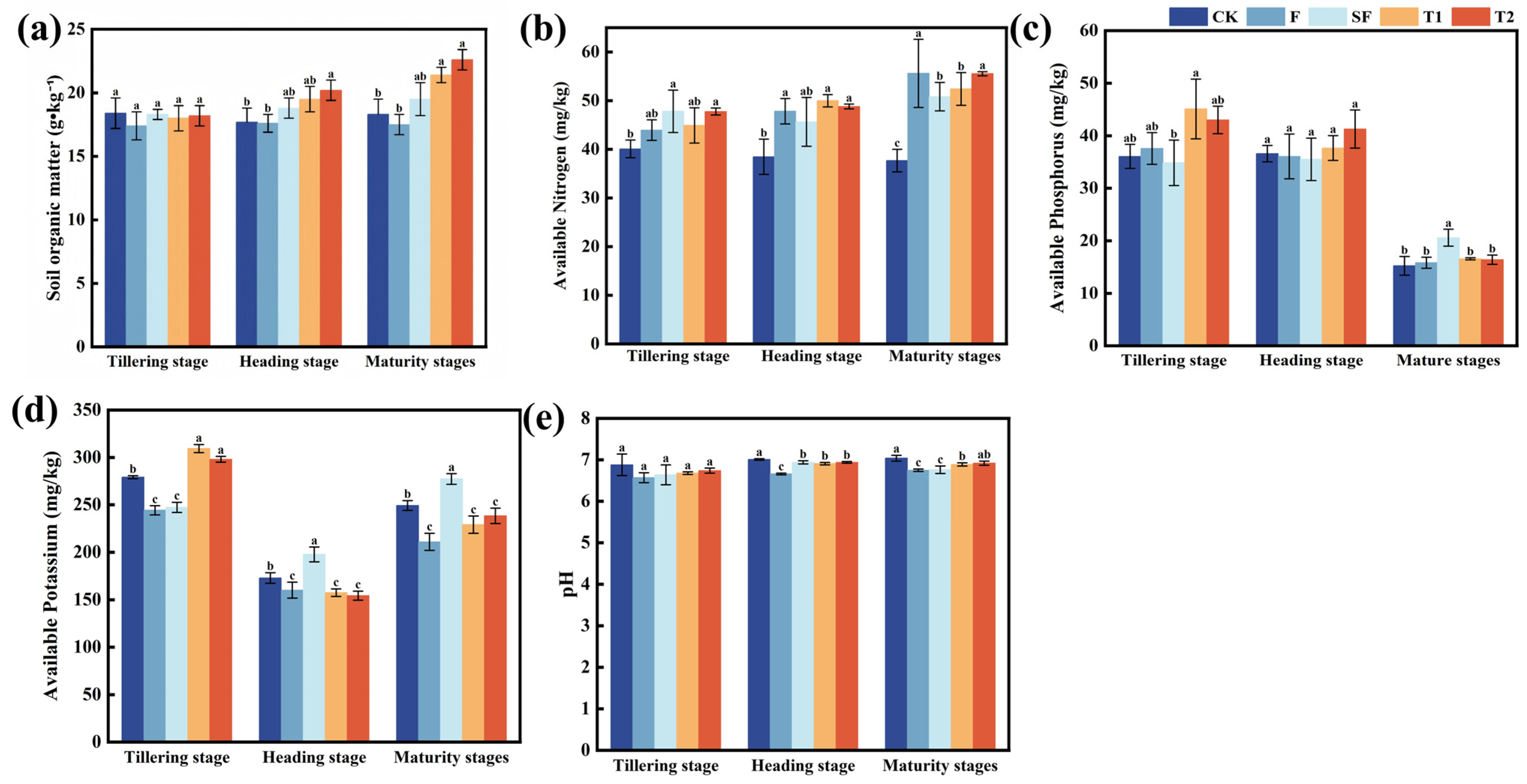
Firstly, the contents of variou soil nutrients were analyzed under different treatments during the growth of rice (Figure 2). At the tillering stage, the differences in SOM content among treatment groups were not significant (17.4–18.4 g/kg) (Figure 2a). However, the SOM contents in SF, T1 and T2 began to gradually, respectively, increase to 18.8, 19.5 and 20.2 g/kg at the heading stage. And SF, T1 and T2 SOM content were further increased to reach 19.5, 21.4, and 22.6 g/kg at maturity stage, while the SOM contents of CK and F did not change. The application of chemical fertilizers significantly increased the AN content of soil compared to the control (37.69 mg/kg) at different stages (Figure 2b). The highest content of AN (55.62 mg/kg) was reached of F at the maturity stage. T1 and T2 also increased the soil A-N content, at 52.42 and 55.55 mg/kg at maturity stage, respectively. These results demonstrate that mushroom residue returning effectively enhanced nitrogen availability comparable to the chemical-fertilizer treatment. The release of organic-N from mushroom residues through mineralization likely contributed to the gradual enrichment of AN, particularly evident after heading, when microbial activity peaked under warm and moist paddy conditions.
In addition, the soil AP content was decreased of all treatments at whole rice cultivation stage (Figure 2c). Under the effect of chemical fertilizers, the soil AP content was 34.85–45.10 mg/kg at tillering stage, and gradually decreased to 15.24–20.59 mg/kg at maturity stage. The AK content of soil showed a rapid increase at tillering stage and was rapidly utilized at heading stage, and then decreased at maturity stage (Figure 2d). The content of AK in T1 and T2 was rapidly released at the tillering stage (reached 309.40, 298.06 mg/kg), which was significantly higher than that of other treatments (244.26–279.15 mg/kg). During the subsequent heading stage and maturity stage, AK in straw was slowly decomposed and released into the soil, reaching maximum values of 197.73 and 277.30 mg/kg, respectively. The others treatments contained 154.31–172.92 mg/kg at heading stage, and 210.97–249.32 mg/kg at maturity stage, which were significantly lower than that of straw returning. Subsequently, the soil pH was analyzed (Figure 2e). All the five treatments were reduced after planting rice and were weakly acidic compared to the alkaline pH of the base soil sample. In contrast, the change in pH was small in the CK treatment, and pH was significantly decreased in F, with a minimum value of 6.57 at the early tillering stage of fertilizer application. The soil pH was reduced much less in SF, T1, and T2 than in F. Although the pH fluctuation occurred in the treatment group, it was still within the normal range of rice growth. Meanwhile, some salt stress phenomena were not observed in the experiment. The organic matter and calcium-rich components of mushroom residues likely contributed to pH stabilization by neutralizing the acidifying effects of nitrogen fertilizers.

3.2. Number of Soil Microbial Species

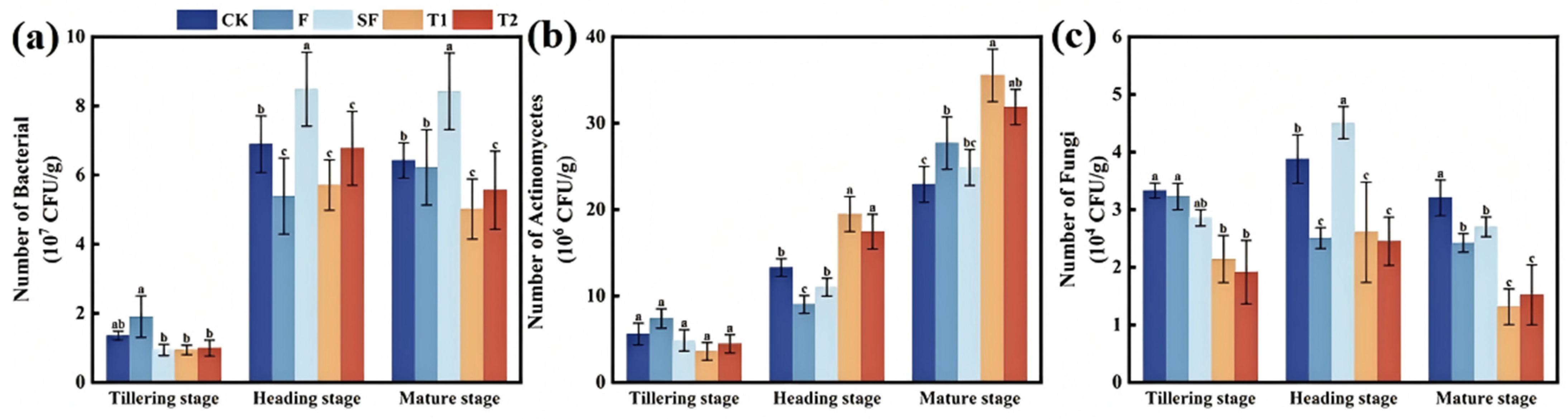
Changes in soil nutrients are seriously linked to changes in soil microorganisms [40]. As shown in Figure 3a, the number of soil bacterial was determined at different stages of rice growth. In all treatments, the number of bacteria increased gradually from tillering to heading stage, where the CK, SF, T1 and T2 reached 6.89 × 10⁷, 8.49 × 10⁷, 5.71 × 10⁷, and 6.77 × 10⁷ CFU/g, respectively. Then, the number of bacteria decreased gradually from heading stage to maturity stage. At the maturity stage, the number of bacteria of CK, SF, T1 and T2 decreased to 6.42 × 10⁷, 8.42 × 10⁷, 5.02 × 10⁷, 5.56 × 10⁷ CFU/g, whereas the number of bacteria in the F (full fertilization) treatment showed a gradual increase and reached a maximum of 6.22 × 10⁷ CFU/g at the maturity stage.
Actinomycetes were effective in increasing the rate of nutrient conversion in the soil. The number of actinomycetes showed an increasing trend (Figure 3b). At the heading stage, the numbers of actinomycetes in CK were 13.28 × 10⁶, F, 9.02 × 10⁶, SF, 11.02 × 10⁶, T1, 19.47 × 10⁶, and T2, 17.45 × 10⁶ CFU/g. At the maturity stage, the numbers of actinomycetes in CK were 22.92 × 10⁶, F, 27.69 × 10⁶, SF, 24.87 × 10⁶, T1, 35.54 × 10⁶, and T2, 31.88 × 10⁶ CFU/g. The T1 treatment was the highest, and the CK treatment was the lowest of all treatments. The higher actinomycete abundance in T1 and T2 suggests that mushroom residues provided a favorable niche rich in cellulose and hemicellulose fragments, promoting the growth of filamentous decomposers responsible for nutrient mineralization.
The number of fungi at different stages of rice in soil was analyzed (Figure 3c). It can be found that the number of soil fungi of all treatments except F gradually increased from tillering to heading stage, the CK, SF, T1 and T2 were 3.88 × 10⁴, 4.51 × 10⁴, 2.61 × 10⁴, and 2.45 × 10⁴ CFU/g at heading stage. And the number of soil fungi gradually decreased to 3.20 × 10⁴, 2.70 × 10⁴, 1.31 × 10⁴, and 1.52 × 10⁴ CFU/g at maturity stage, whereas the number of soil fungi in F was decreased continuously from tillering stage to heading stage and then to maturity stage.
The incorporation of mushroom residues resulted in a noticeable shift in the soil microbial community structure. Compared with SF and CK treatments, mushroom residue amendment markedly increased the abundance of Actinobacteria while reducing bacterial and fungal counts. This shift may be attributed to the biochemical nature of the mushroom residue, which consists of partially decomposed lignocellulosic materials enriched with fungal metabolites. Such substrates tend to selectively stimulate Actinobacteria—microorganisms well known for their strong lignocellulose-degrading capacity and their ability to thrive under conditions of higher recalcitrant carbon inputs [41]. In contrast, the altered microenvironment may temporarily suppress other bacterial and fungal groups during the early decomposition phase. Importantly, this community shift does not necessarily indicate reduced soil microbial functioning. Actinobacteria are key contributors to cellulose degradation, organic matter turnover, and disease suppression. Moreover, despite the observed changes in microbial populations, the mushroom residue treatment did not impair crop performance; instead, it promoted nutrient availability and rice growth. These findings suggest that mushroom residue can modify microbial community composition without negatively affecting the short-term functional outcomes relevant to crop production.

3.3. Nutrient Content of Plants in Rice

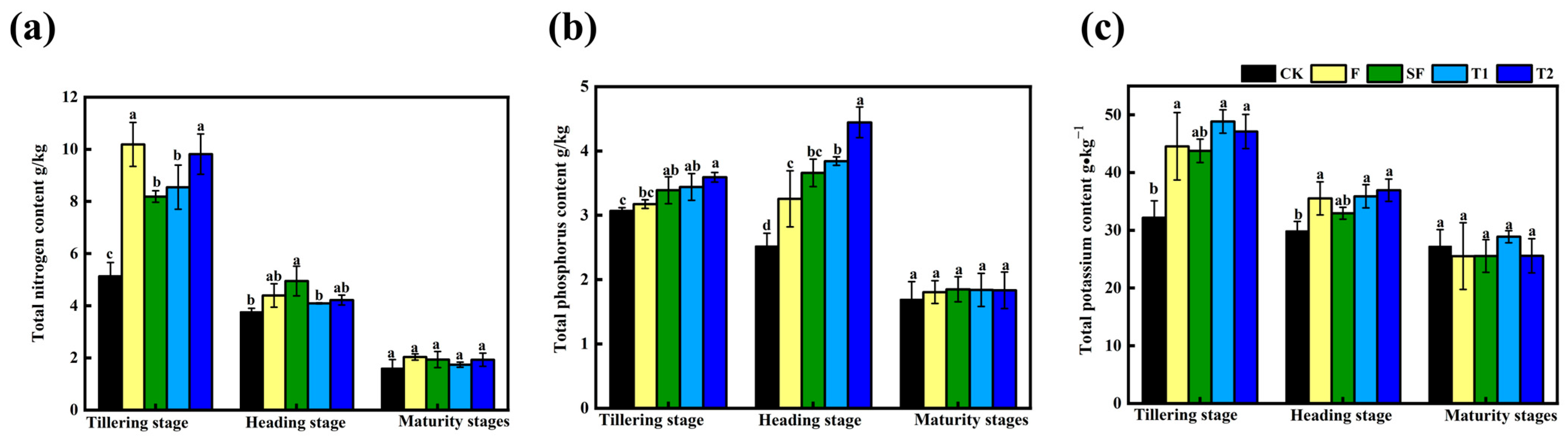
Different soil fertilization measures directly affected the nutrient content of rice, as shown in Figure 3. Firstly, the TN content in the leaves of rice plants gradually decreased (Figure 4a) from 5.13–10.19 g/kg at the tillering stage to 1.62–2.03 g/kg at the maturity stage. The mushroom residue returning T1 and T2 showed a higher TN content at the tillering stage, which reached 8.54–9.82 g/kg. Subsequently, in the heading stage, the TN content in SF was slowly released and reached a maximum value of 4.95 g/kg. At maturity stage, there was no significant difference in the TN content in the treatments, and the content was low. The mushroom residue returning significantly increased TP content in the plant, and the content increased gradually at the tillering and heading stages (T1, 3.84 g/kg and T2, 4.44 g/kg). The TP content in the treatments at the maturity stage was significantly decreased compared with that at the tillering and heading stages, and was roughly in the range of 1.70–1.85 g/kg. The content of TK in the rice showed a gradual decreasing trend (Figure 4c). At the tillering stage, the TK content in T1 and T2 reached a maximum value of 48.85 and 47.10 g/kg, and decreased to 28.88 and 25.58 g/kg at the maturity stage. The observed variations are likely a combination of treatment effects and developmental trends [42].

3.4. Rice Tiller Number

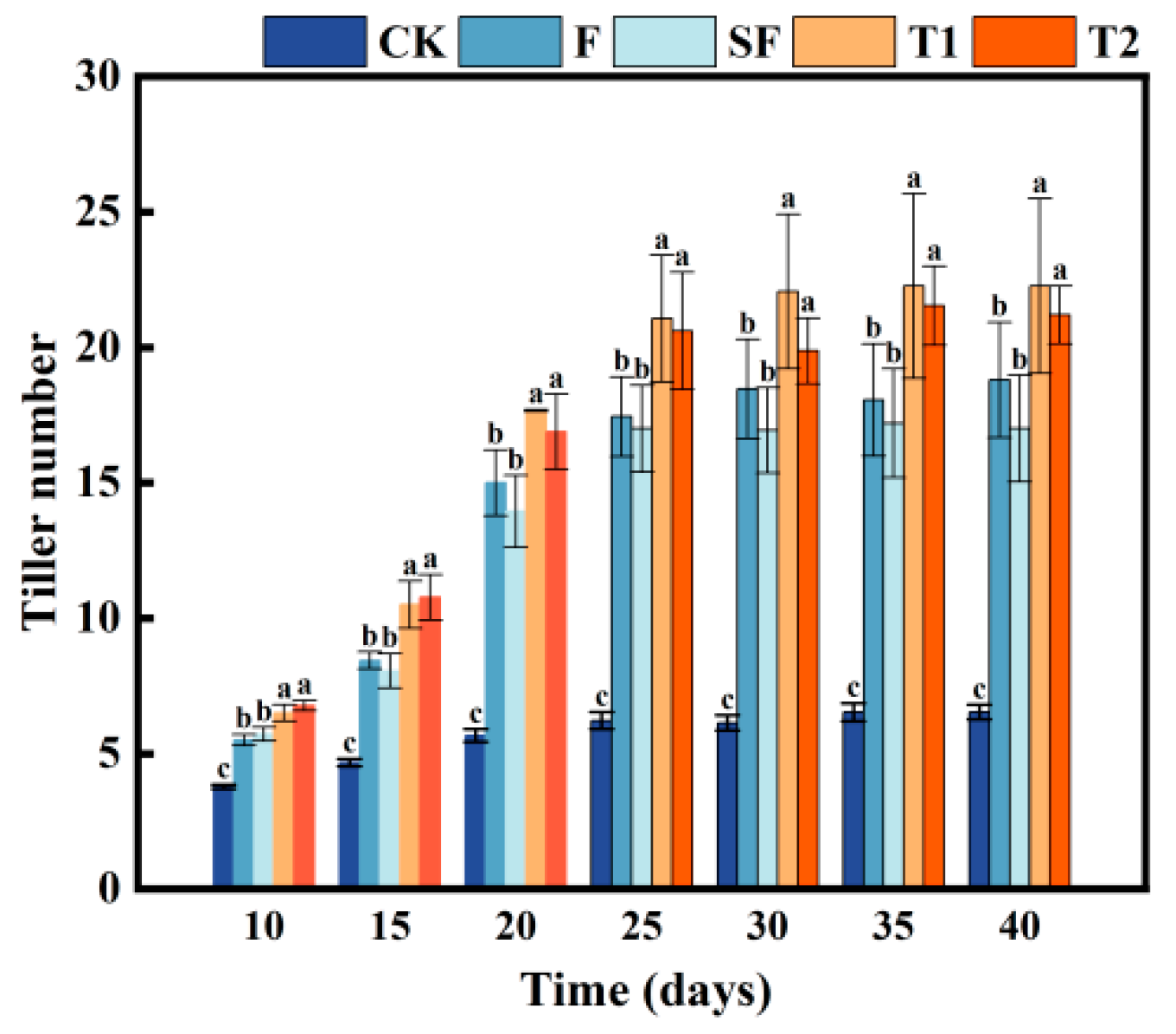
We further analyzed the dynamic effects of all treatments on rice growth, as shown in Figure 5. After rice transplanting, the rice tillering rate gradually increased. After 10 days of transplanting, the difference in tiller number varied significantly (about four to six). On the 20th day, the tiller number was only 6 in CK, but 15 in F, 14 in SF, and up to 17–18 in T1 and T2. Subsequently, the number of tillers stabilized after 30 days. In CK, rice tillering remained poor and slow, with a number of only six. However, in T1 and T2, mushroom residue returning significantly promoted tillering (tiller number of 21–22). The same situation was observed in F and SF, where the tiller number was about 17–18.

3.5. Rice Yield Traits

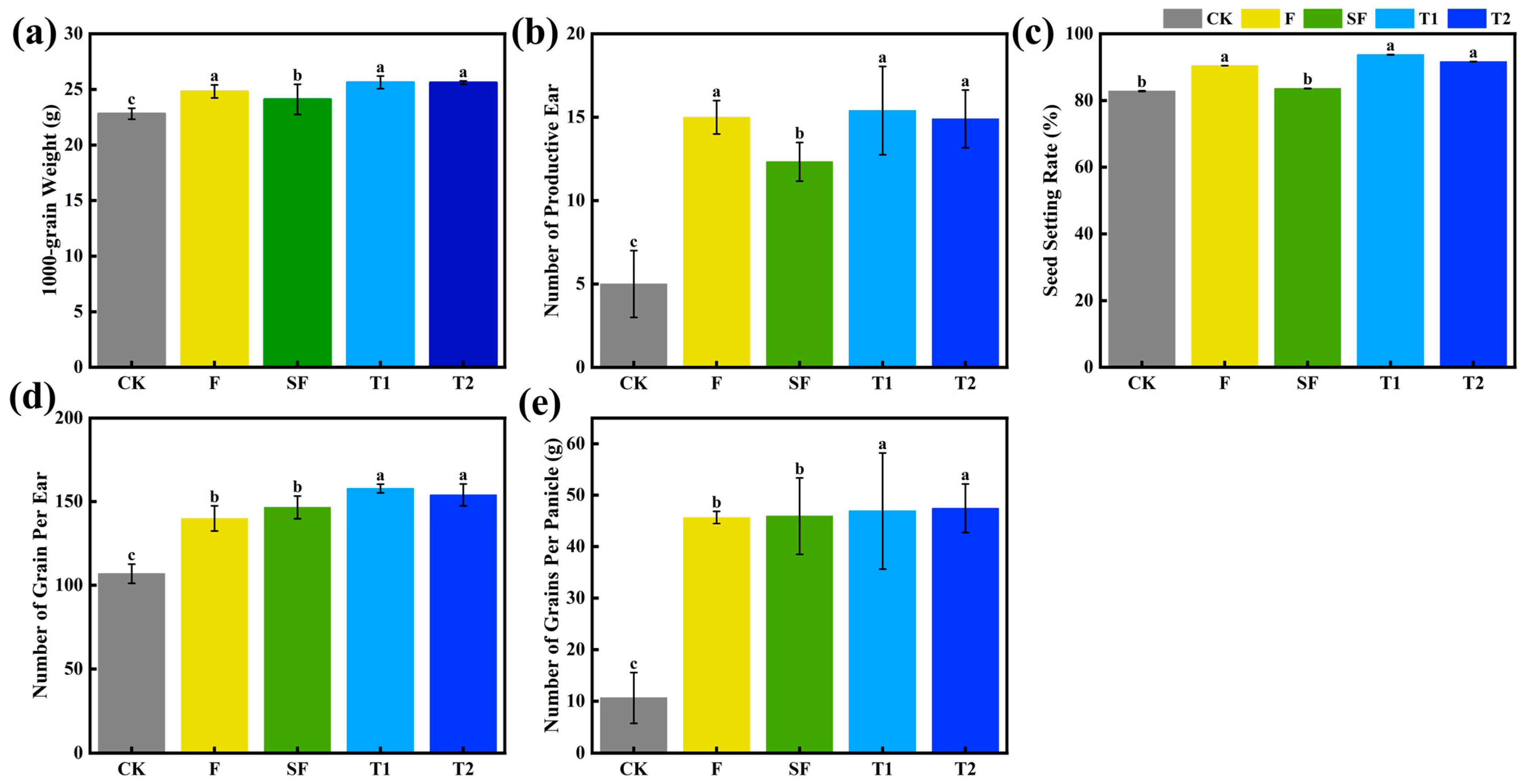
Plant traits related to rice yield were analyzed (Figure 6). Firstly, the yield was significantly decreased in CK with only 22.81 g of 1000-grain weight and 5.00 of productive ear. Moreover, the number of grains per ear was 106.90, while the number of grains per panicle was 10.66 g in CK. Fertilizer application significantly increased the yield of rice. The highest 1000-grain weight was 25.63 g in T1, while SF was relatively low at 24.10. Also, the number of productive ears and the seed setting rate were relatively low in SF, at 12.33 and 83.63%, respectively. The number of productive ears and the seed setting rate were relatively high in F, T1, and T2, while the differences were significant. However, the number of grains per ear in F was relatively low at only 139.88, which was significantly lower than in T1 (157.82) and T2 (153.99).

4. Discussion

4.1. Improvement of Soil Fertility by Mushroom Residues

It has been widely proved that straw returning in combination with chemical fertilizer (SF) can effectively increase the content of SOM [43]. Lignocellulose in straw is degraded and retained in the soil as carbon. Therefore, straw returning could help the carbon in the soil to be better sequestered [44]. Compared to the control, the SOM content was increased by about 6.6% at rice maturity stage. At the same time, mushroom residue returning (T1, T2) showed the same effect. Moreover, due to the simpler form of the mushroom residues, they was more favorable for the rapid transformation of soil microorganisms, which helped the SOM content to increase rapidly [45]. Compared with the CK, it increased by nearly 16.9–23.5%. The stronger SOM accumulation under mushroom residues is attributable to their pre-decomposed state and microbial biomass content, which provide readily metabolizable carbon and promote humification [46,47]. Additionally, these residues may enhance soil aggregation, reducing organic-carbon loss via erosion or mineralization.
Although the application of chemical fertilizer (F) alone significantly increased the soil AN content (47.6%), the mushroom residues returning equally helped to increase the AN (39.1–47.4%) in soil and maintained a more favorable soil C/N. Mushroom residue itself contains relatively high levels of ammonium nitrogen (up to 6.2%), which can be directly and rapidly released into the soil after being returned to the field, significantly increasing its ammonium nitrogen content [48]. The mineralization process of mushroom residue significantly increases soil ammonium nitrogen levels, with the most pronounced effect observed 120 days after application [49]. Obviously, this is more beneficial for soil health and long-term utilization. The content of AP correlated with the plant growth process, being heavily utilized in the early stages and decreasing rapidly [50]. The decomposition process of straw was able to increase the AP in the soil by about 35.1%. Straw is rich in potassium. With the decomposition of straw (as well as mushroom residues), the content of AK in soil was increased [51]. On the one hand, straw itself contains relatively high levels of potassium (K2O content approximately 0.8–2.0%). When directly returned to the field, it decomposes and releases readily available potassium. Long-term straw incorporation significantly increases the soil’s readily available potassium content (with increases ranging from 7.66% to 17.47%) [52]. On the other hand, mushroom residue (mycelium residue) is rich in potassium (with available potassium content reaching up to 690 mg/kg). When returned to the field, it directly supplements the soil with readily available potassium [53]. Straw returning and mushroom residue returning were conducive to an increase in soil AK content, which was significantly increased at tillering stage (6.8–10.8%) by T1 and T2. In addition, SF, T1 and T2 increased soil pH and inhibited soil acidified compared with F, due to reduced application of chemical fertilizers [54].

4.2. Improvement of Soil Microbial Structure by Straw Returning

The number of bacteria in the soil of SF was significantly higher than that in the soil of the other treatments during the heading stage and maturity stage, which was increased by about 23.3–31.4%. This also indicated that the straw degradation process was dominated by more bacteria. In addition, at the maturity stage, the mushroom residue returning soil (T1, T2) showed significantly decreasing bacterial numbers (13.3–21.8%). Thus, straw-degraded residues had less impact on the bacterial community in the soil. The number of soil fungi after fertilization was significantly lower compared to the unfertilized treatment. And the lowest number of fungi was found in T1 and T2, indicating that the return of mushroom residue to the field was not conducive to the direct utilization by fungi, thus effectively reducing the damage of soil-borne diseases [55]. However, T1 and T2 obviously raised the number of actinomycetes at the heading stage and maturity stage. Actinomycetes have been widely demonstrated in recent years to accelerate soil nutrient cycling and promote plant nutrient uptake [56]. Therefore, it also suggests that mushroom residues can be more favorable for soil nutrient transformation and utilization to be utilized by rice. Mushroom residue returning can improve the ecological environment of soil microbial flora, change the proportion of flora in the soil, and improve the soil microbial ecological environment, which is consistent with the results of previous studies.

4.3. Promoting Plant Growth by Mushroom Residue Returning

Compared with the CK, the effect of mushroom residues on the content and uptake of TN, TP and TK in rice plants was obvious. Moreover, compared with the traditional single application of chemical fertilizer (F) and straw (SF), mushroom residue itself is rich in organic matter and nutrients such as nitrogen, phosphorus, and potassium. After being returned to the field, these substances are rapidly decomposed through microbial mineralization and converted into inorganic forms like ammonium nitrogen, nitrate nitrogen, readily available phosphorus, and readily available potassium. These are precisely the nutrient forms that plant roots can directly absorb and utilize [57]. It can release more nutrients that are beneficial to the direct absorption and utilization of plants. The effects of T1 and T2 on plant growth dynamics and nutrients were directly reflected in various indicators of rice growth, compared with SF. The number of productive ears of T1 and T2 was closer to that of F, indicating that the application of mushroom residue returning could replace part of the nutrients [56], and led to an increase in the seed setting rate and a significant increase in the number of grains per ear. Meanwhile, T1 and T2 could effectively increase the 1000-grain weight, number of productive ear and the seed setting rate in rice, which further guaranteed the high yield of rice.

5. Conclusions

The ability to fully utilize straw from agricultural production has now been widely proved [58]. At the same time, mushroom residue returning is currently an effective strategy in efficiently utilizing straw resources [2]. The enhancement of soil nutrients has been further demonstrated, including the increase in SOM by about 16.9–23.5%, AN by 39.1–47.4%, and AK by 6.8–10.8%. Moreover, the return of mushroom residues to the field did not affect the number of fungi and bacteria in the soil, but increased the number of actinomycetes. Actinomycetes guaranteed the uptake of nutrients by the plant and increased the nutrient content in the plant, which led to an increase in the number of productive ears, and ultimately increased the yield constitutive factors of rice. Therefore, making full use of different straw resources for basalization to increase economic benefits, and utilizing mushroom residue for field return to improve ecological benefits is the way forward, with good development.

Author Contributions

C.S.: Conceptualization, Methodology, Validation, Formal analysis, Investigation, Resources, Data curation, Writing—original draft, Writing—reviewing and editing, Visualization. R.H.: Validation, Formal analysis, Investigation. K.S.: Validation, Formal analysis, Investigation. F.W.: Validation, Formal analysis, Investigation. X.Y.: Validation, Formal analysis, Investigation. C.Z.: Validation, Formal analysis, Investigation, Writing—original draft. G.N.: Conceptualization, Methodology, Validation, Formal analysis, Investigation, Resources, Data curation, Writing—reviewing and editing, Visualization. All authors have read and agreed to the published version of the manuscript.

Funding

This work was supported by the Straw Returning Project (07), and the Natural Science Foundation of China (No. 31860595). Jiangxi Provincial Department of Education Scientific Research Project (GJJ210423).

Data Availability Statement

The original contributions presented in this study are included in the article. Further inquiries can be directed to the corresponding author.

Conflicts of Interest

The authors declare that they have no known competing financial interests or personal relationships that could have appeared to influence the work reported in this paper.

References

  1. Sun, M.; Xu, X.; Wang, C.; Bai, Y.; Fu, C.; Zhang, L.; Fu, R.; Wang, Y. Environmental burdens of the comprehensive utilization of straw: Wheat straw utilization from a life-cycle perspective. J. Clean. Prod. 2020, 259, 120702. [Google Scholar] [CrossRef]
  2. Ren, J.; Yu, P.; Xu, X. Straw utilization in china—Status and recommendations. Sustainability 2019, 11, 1762. [Google Scholar] [CrossRef]
  3. Smil, V. Crop Residues: Agriculture’s Largest Harvest: Crop residues incorporate more than half of the world’s agricultural phytomass. Bioscience 1999, 49, 299–308. [Google Scholar] [CrossRef]
  4. Wang, B.; Dong, F.; Chen, M.; Zhu, J.; Tan, J.; Fu, X.; Wang, Y.; Chen, S. Advances in recycling and utilization of agricultural wastes in China: Based on environmental risk, crucial pathways, influencing factors, policy mechanism. Procedia Environ. Sci. 2016, 31, 12–17. [Google Scholar] [CrossRef]
  5. Zeng, X.; Ma, Y.; Ma, L. Utilization of straw in biomass energy in China. Renew. Sustain. Energy Rev. 2007, 11, 976–987. [Google Scholar] [CrossRef]
  6. Mao, J.; Zhao, Z.; Li, X.; Zhao, H.; Lin, C. Comprehensive benefit of crop straw return volume under sustainable development management concept in Heilongjiang, China. Sustainability 2023, 15, 4129. [Google Scholar] [CrossRef]
  7. Yin, H.; Zhao, W.; Li, T.; Cheng, X.; Liu, Q. Balancing straw returning and chemical fertilizers in China: Role of straw nutrient resources. Renew. Sustain. Energy Rev. 2018, 81, 2695–2702. [Google Scholar] [CrossRef]
  8. Zhuang, M.; Zhang, J.; Kong, Z.; Fleming, R.M.; Zhang, C.; Zhang, Z. Potential environmental benefits of substituting nitrogen and phosphorus fertilizer with usable crop straw in China during 2000–2017. J. Clean. Prod. 2020, 267, 122125. [Google Scholar] [CrossRef]
  9. Liu, B.; Wu, Q.; Wang, F.; Zhang, B. Is straw return-to-field always beneficial? Evidence from an integrated cost-benefit analysis. Energy 2019, 171, 393–402. [Google Scholar] [CrossRef]
  10. Guan, X.K.; Wei, L.; Turner, N.C.; Ma, S.C.; Yang, M.D.; Wang, T.C. Improved straw management practices promote in situ straw decomposition and nutrient release, and increase crop production. J. Clean. Prod. 2020, 250, 119514. [Google Scholar] [CrossRef]
  11. Jin, Z.; Shah, T.; Zhang, L.; Liu, H.; Peng, S.; Nie, L. Effect of straw returning on soil organic carbon in rice–wheat rotation system: A review. Food Energy Secur. 2020, 9, e200. [Google Scholar] [CrossRef]
  12. Ma, Y.; Shen, Y.; Liu, Y. State of the art of straw treatment technology: Challenges and solutions forward. Bioresour. Technol. 2020, 313, 123656. [Google Scholar] [CrossRef]
  13. Chen, L.; Sun, S.; Yao, B.; Peng, Y.; Gao, C.; Qin, T.; Zhou, Y.; Sun, C.; Quan, W. Effects of straw return and straw biochar on soil properties and crop growth: A review. Front. Plant Sci. 2022, 13, 986763. [Google Scholar] [CrossRef]
  14. Cheng, J.; Lin, B.-J.; Chen, J.-S.; Duan, H.-X.; Sun, Y.-F.; Zhao, X.; Dang, Y.P.; Xu, Z.-Y.; Zhang, H.-L. Strategies for crop straw management in China’s major grain regions: Yield-driven conditions and factors influencing the effectiveness of straw return. Resour. Conserv. Recycl. 2025, 212, 107941. [Google Scholar] [CrossRef]
  15. Xu, P.; Shu, L.; Li, Y.; Zhou, S.; Zhang, G.; Wu, Y.; Yang, Z. Pretreatment and composting technology of agricultural organic waste for sustainable agricultural development. Heliyon 2023, 9, e16311. [Google Scholar] [CrossRef]
  16. Tian, S.Q.; Zhao, R.Y.; Chen, Z.C. Review of the pretreatment and bioconversion of lignocellulosic biomass from wheat straw materials. Renew. Sustain. Energy Rev. 2018, 91, 483–489. [Google Scholar] [CrossRef]
  17. Wu, Q.; Zhang, Y.; Zhao, L.; Wei, Z.; Song, C.; Pang, C.; Pang, X. Strategies for efficient degradation of lignocellulose from straw: Synergistic effects of acid-base pretreatment and functional microbial agents in composting. Chem. Eng. J. 2025, 508, 161048. [Google Scholar] [CrossRef]
  18. Zhang, R.; Li, X.; Fadel, J.G. Oyster mushroom cultivation with rice and wheat straw. Bioresour. Technol. 2002, 82, 277–284. [Google Scholar] [CrossRef]
  19. Dou, T.; Zhang, K.; Shi, X.; Liu, W.; Yu, F.; Liu, D. Crop–Mushroom Rotation: A Comprehensive Review of Its Multifaceted Impacts on Soil Quality, Agricultural Sustainability, and Ecosystem Health. Agronomy 2025, 15, 563. [Google Scholar] [CrossRef]
  20. Gao, Y.; Wu, Z.; Li, W.; Sun, H.; Chai, Y.; Li, T.; Qin, P. Expanding the valorization of waste mushroom substrates in agricultural production: Progress and challenges. Environ. Sci. Pollut. Res. 2023, 30, 2355–2373. [Google Scholar] [CrossRef] [PubMed]
  21. Pilz, D.; Molina, R. Commercial harvests of edible mushrooms from the forests of the Pacific Northwest United States: Issues, management, and monitoring for sustainability. For. Ecol. Manag. 2002, 155, 3–16. [Google Scholar] [CrossRef]
  22. Tang, Q.; Liu, W.; Huang, H.; Peng, Z.; Deng, L. Responses of crop yield, soil fertility, and heavy metals to spent mushroom residues application. Plants 2024, 13, 663. [Google Scholar] [CrossRef]
  23. Zheng, C. Integrated nutrient management significantly improves pomelo (Citrus grandis) root growth and nutrients uptake under acidic soil of southern China. Agronomy 2021, 11, 1231. [Google Scholar] [CrossRef]
  24. Zeng, G.; Liu, Z.; Guo, Z.; He, J.; Ye, Y.; Xu, H.; Hu, T. Compost with spent mushroom substrate and chicken manure enhances rice seedling quality and reduces soil-borne pathogens. Environ. Sci. Pollut. Res. 2023, 30, 77743–77756. [Google Scholar] [CrossRef] [PubMed]
  25. Anantrao, M.B.P. Influence of Enriched Spent Mushroom Substrate on. Doctoral Dissertation, Mahatma Phule Krishi Vidyapeeth, Ahilyanagar, India, 2020. [Google Scholar]
  26. Castelo-Gutiérrez, A.A.; García-Mendívil, H.A.; Castro-Espinoza, L.; Lares-Villa, F.; Arellano-Gil, M.; Figueroa-López, P.; Gutiérrez-Coronado, M.A. Residual mushroom compost as soil conditioner and bio-fertilizer in tomato production. Rev. Chapingo Ser. Hortic. 2016, 22, 83–94. [Google Scholar] [CrossRef]
  27. He, J.; Zeng, G.; Liu, Z.; Guo, Z.; Zhang, W.; Li, Y.; Zhou, Y.; Xu, H. Replacing traditional nursery soil with spent mushroom substrate improves rice seedling quality and soil substrate properties. Environ. Sci. Pollut. Res. 2024, 31, 39625–39636. [Google Scholar] [CrossRef] [PubMed]
  28. Wang, Q.; Juan, J.; Xiao, T.; Zhang, J.; Chen, H.; Song, X.; Chen, M.; Huang, J. The physical structure of compost and C and N utilization during composting and mushroom growth in Agaricus bisporus cultivation with rice, wheat, and reed straw-based composts. Appl. Microbiol. Biotechnol. 2021, 105, 3811–3823. [Google Scholar] [CrossRef]
  29. Yan, W.; Rao, W.; Zheng, F.; Wang, Y.; Zhang, C.; Li, T. Distribution and Transformation of Soil Phosphorus Forms under Different Land Use Patterns in an Urban Area of the Lower Yangtze River Basin, South China. Sustainability 2024, 16, 2142. [Google Scholar] [CrossRef]
  30. Zeng, Y.H.; Wu, J.F.; Pan, X.H.; Shi, Q.H.; Zhu, D.F. Effects of straw incorporation method on double cropping rice yield and the top-three leaf characteristics. Chin. J. Eco-Agric. 2013, 21, 1459–1466. [Google Scholar] [CrossRef]
  31. Wang, Z.-B.; Chen, J.; Mao, S.-C.; Han, Y.-C.; Chen, F.; Zhang, L.-F.; Li, Y.-B.; Li, C.-D. Comparison of greenhouse gas emissions of chemical fertilizer types in China’s crop production. J. Clean. Prod. 2017, 141, 1267–1274. [Google Scholar] [CrossRef]
  32. Banik, S.; Nandi, R. Effect of supplementation of rice straw with biogas residual slurry manure on the yield, protein and mineral contents of oyster mushroom. Ind. Crops Prod. 2004, 20, 311–319. [Google Scholar] [CrossRef]
  33. Pasuquin, E.; Lafarge, T.; Tubana, B. Transplanting young seedlings in irrigated rice fields: Early and high tiller production enhanced grain yield. Field Crops Res. 2008, 105, 141–155. [Google Scholar] [CrossRef]
  34. Bremner, J.M.; Jenkinson, D.S. Determination of organic carbon in soil: I. Oxidation by dichromate of organic matter in soil and plant materials. J. Soil Sci. 1960, 11, 394–402. [Google Scholar] [CrossRef]
  35. Mulvaney, R.L.; Khan, S.A. Diffusion methods to determine different forms of nitrogen in soil hydrolysates. Soil Sci. Soc. Am. J. 2001, 65, 1284–1292. [Google Scholar] [CrossRef]
  36. Crouch, S.R.; Malmstadt, H.V. Mechanistic investigation of molybdenum blue method for determination of phosphate. Anal. Chem. 1967, 39, 1084–1089. [Google Scholar] [CrossRef]
  37. Stanford, G.; English, L. Use of the flame photometer in rapid soil tests for K and Ca. Agron. J. 1949, 41, 446–447. [Google Scholar] [CrossRef]
  38. Warcup, J.H. Studies on the occurrence and activity of fungi in a wheat-field soil. Trans. Br. Mycol. Soc. 1957, 40, 237-IN3. [Google Scholar] [CrossRef]
  39. Górecka, H.; Chojnacka, K.; Górecki, H. The application of ICP-MS and ICP-OES in determination of micronutrients in wood ashes used as soil conditioners. Talanta 2006, 70, 950–956. [Google Scholar] [CrossRef]
  40. Jansson, J.K.; Hofmockel, K.S. Soil microbiomes and climate change. Nat. Rev. Microbiol. 2020, 18, 35–46. [Google Scholar] [CrossRef]
  41. Tu, D.; Song, R.; Yan, B.; Dai, J.-F.; Fang, H.; Zheng, Q.-Q.; Gu, Y.; Shao, X.-L.; Chen, H.; Li, M.-L.; et al. Reductive soil disinfestation by mixing carbon nanotubes and mushroom residues to mitigate the continuous cropping obstacles for Lilium Brownii. Crop Health 2024, 2, 3. [Google Scholar] [CrossRef]
  42. Ramanathan, K.M.; Krishnamoorthy, K.K. Nutrient uptake by paddy during the main three stages of growth. Plant Soil 1973, 39, 29–33. [Google Scholar] [CrossRef]
  43. Lou, Y.; Xu, M.; Wang, W.; Sun, X.; Zhao, K. Return rate of straw residue affects soil organic C sequestration by chemical fertilization. Soil Tillage Res. 2011, 113, 70–73. [Google Scholar] [CrossRef]
  44. Berhane, M.; Xu, M.; Liang, Z.; Shi, J.; Wei, G.; Tian, X. Effects of long-term straw return on soil organic carbon storage and sequestration rate in North China upland crops: A meta-analysis. Glob. Change Biol. 2020, 26, 2686–2701. [Google Scholar] [CrossRef]
  45. Pintarič, M.; Štuhec, A.; Tratnik, E.; Langerholc, T. Spent mushroom substrate improves microbial quantities and enzymatic activity in soils of different farming systems. Microorganisms 2024, 12, 1521. [Google Scholar] [CrossRef]
  46. Yang, F.; Wang, M.; Zhao, L.; Fan, B.; Sun, N.; Liu, J.; Sun, X.; Dong, Z. The role of cattle manure-driven polysaccharide precursors in humus formation during composting of spent mushroom substrate. Front. Microbiol. 2024, 15, 1375808. [Google Scholar] [CrossRef] [PubMed]
  47. Yang, G.; Ma, Y.; Ma, X.; Wang, X.; Lu, C.; Xu, W.; Luo, J.; Guo, D. Changes in soil organic carbon components and microbial community following spent mushroom substrate application. Front. Microbiol. 2024, 15, 1351921. [Google Scholar] [CrossRef]
  48. Stewart, D.P.C.; Cameron, K.C.; Cornforth, I.S.; Main, B.E. Release of sulphate, potassium, calcium and magnesium from spent mushroom compost under laboratory conditions. Biol. Fertil. Soils 1997, 26, 146–151. [Google Scholar] [CrossRef]
  49. Lou, Y.H.; Zhuge, Y.P.; Wei, M.; Chao, Y.; Liu, A.H. Effect of extraneous organic materials on the mineralization of nitrogen in soil. Chin. J. Soil Sci. 2009, 40, 315–320. [Google Scholar]
  50. Niu, Y.F.; Chai, R.S.; Jin, G.L.; Wang, H.; Tang, C.X.; Zhang, Y.S. Responses of root architecture development to low phosphorus availability: A review. Ann. Bot. 2013, 112, 391–408. [Google Scholar] [CrossRef]
  51. Yuan, G.; Huan, W.; Song, H.; Lu, D.; Chen, X.; Wang, H.; Zhou, J. Effects of straw incorporation and potassium fertilizer on crop yields, soil organic carbon, and active carbon in the rice–wheat system. Soil Tillage Res. 2021, 209, 104958. [Google Scholar] [CrossRef]
  52. Guo, Z.; Wang, D.Z. Long-term effects of returning wheat straw to croplands on soil compaction and nutrient availability under conventional tillage. Plant Soil Environ. 2018, 59, 280–286. [Google Scholar]
  53. Shang, L.; Liqiang, W.; Zhou, X.; Li, S.; Li, X. Effects of organic fertilizer on soil nutrient status, enzyme activity, and bacterial community diversity in leymus chinensis steppe in inner mongolia, China. PLoS ONE 2020, 15, e0240559. [Google Scholar] [CrossRef]
  54. Zhao, S.; Wang, H.; Wang, J. Synthesis and application of a compound microbial inoculant for effective soil remediation. Environ. Sci. Pollut. Res. 2023, 30, 120915–120929. [Google Scholar] [CrossRef]
  55. Chen, S.; Chang, J.; Wu, W.X.; Xu, M.H.; Qiu, L.Y. Effects of returning field of mushroom residue on soil properties and fruit quality in pear orchard. J. Nucl. Agric. Sci. 2012, 26, 821–827. [Google Scholar]
  56. Bhatti, A.A.; Haq, S.; Bhat, R.A. Actinomycetes benefaction role in soil and plant health. Microb. Pathog. 2017, 111, 458–467. [Google Scholar] [CrossRef]
  57. Hanafi, F.H.M.; Rezania, S.; Taib, S.M.; Din, M.F.M.; Yamauchi, M.; Sakamoto, M.; Hara, H.; Park, J.; Ebrahimi, S.S. Envi-ronmentally sustainable applications of agro-based spent mushroom substrate (sms): An overview. J. Mater. Cycles Waste Manag. 2018, 20, 1383–1396. [Google Scholar] [CrossRef]
  58. Matsumura, Y.; Minowa, T.; Yamamoto, H. Amount, availability, and potential use of rice straw (Agricultural residue) biomass as an energy resource in Japan. Biomass Bioenergy 2005, 29, 347–354. [Google Scholar]
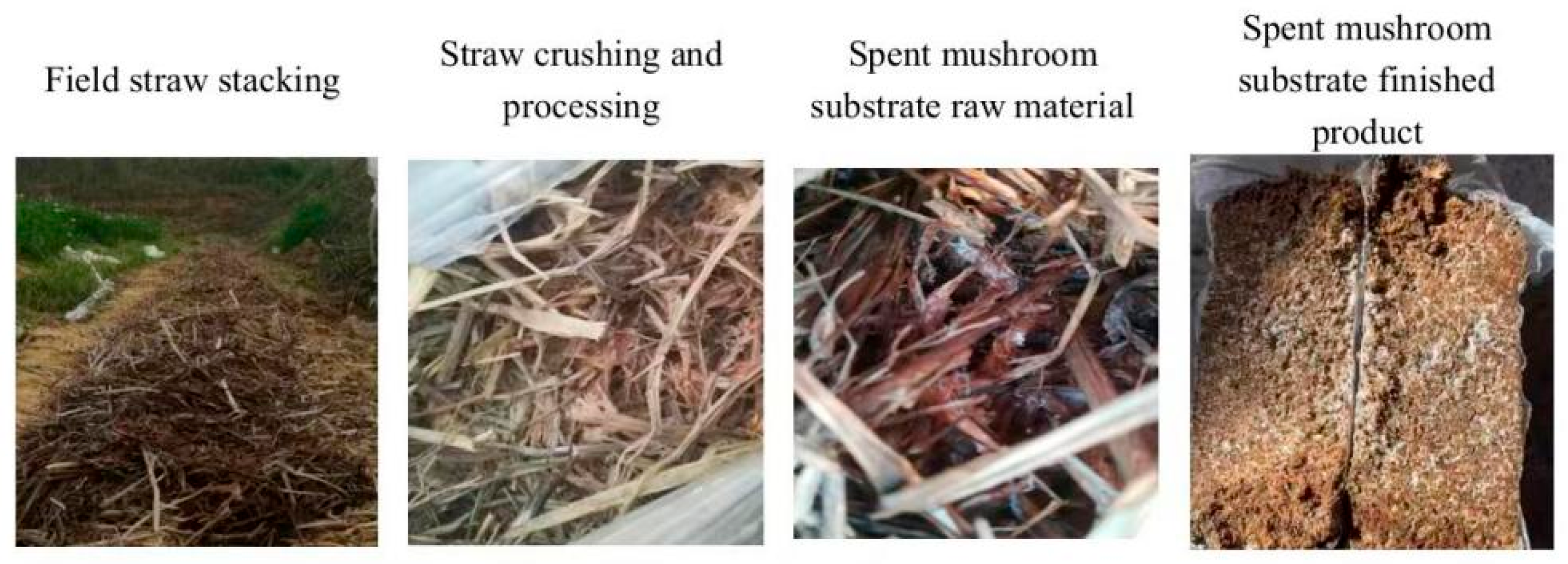
Figure 1. Diagram of material transformation from field straw piles to finished mushroom residue.
Sustainability 18 01266 g001
Figure 2. The nutrients were analyzed under different treatments during the growth of rice, SOM (a), AN (b), AP (c), AK (d), and pH (e). Note: Different lowercase letters in the same column indicate significant differences between treatments (p < 0.05), same below.
Sustainability 18 01266 g002
Figure 3. The number of bacteria (a), actinomycetes (b), and fungi (c) in soil at different stages. Different lowercase letters in the same column indicate significant differences between treatments (p < 0.05).
Sustainability 18 01266 g003
Figure 4. Nutrient content of plants in rice, (a) TN, (b) TP, and (c) TK. Different lowercase letters in the same column indicate significant differences between treatments (p < 0.05).
Sustainability 18 01266 g004
Figure 5. Variation in tiller number in rice in untreated control (CK) and 4 treatments (chemical fertilizer only (F), straw returning with chemical fertilizer (SF), mushroom residues returning by rice straw as the substrate with chemical fertilizer (T1), and mushroom residues returning by wheat as the substrate with chemical fertilizer (T2)). Different lowercase letters in the same column indicate significant differences between treatments (p < 0.05).
Sustainability 18 01266 g005
Figure 6. Variation in rice yield traits: (a) the 1000-grain weight; (b) the number of productive ears; (c) the seed setting rate; (d) the number of grains per ear; and (e) the number of grains per panicle. Different lowercase letters in the same column indicate significant differences between treatments (p < 0.05).
Sustainability 18 01266 g006
Table 1. The quality of organic matter and fertilizer returned to the field.
TreatmentOrganic Material (g/pot)Urea (g/pot)Calcium-Magnesium Phosphate (g/pot)KCl (g/pot)
CK0.000.000.000.00
F0.009.7825.007.50
SF180.006.3318.950.46
T1164.886.3318.361.40
T249.516.339.216.05
Disclaimer/Publisher’s Note: The statements, opinions and data contained in all publications are solely those of the individual author(s) and contributor(s) and not of MDPI and/or the editor(s). MDPI and/or the editor(s) disclaim responsibility for any injury to people or property resulting from any ideas, methods, instructions or products referred to in the content.