Article

Does Digital–Intelligence Policy Synergy Foster Firms’ Key Core Technology Breakthroughs? Evidence from China

1
Business School, Hubei University, Wuhan 430062, China
2
Open Economy Research Centre, Hubei University, Wuhan 430062, China
*
Author to whom correspondence should be addressed.
These authors contributed equally to this work.
Sustainability 2026, 18(3), 1256; https://doi.org/10.3390/su18031256 (registering DOI)
Submission received: 22 December 2025 / Revised: 21 January 2026 / Accepted: 23 January 2026 / Published: 27 January 2026

Abstract

Amid intensifying global competition, key core technology breakthroughs have become central to advancing technological self-reliance and strengthening national productive capacity. Using panel data on Chinese A-share listed firms from 2011 to 2023, we adopt a difference-in-differences framework to identify the effect of digital–intelligence policy synergy on firm-level key core technology breakthroughs. The empirical results show that digital–intelligence policy synergy significantly promotes firms’ key core technology breakthroughs, and this finding remains robust to a battery of robustness checks, including a double machine learning approach. Mechanism analyses indicate that digital–intelligence policy synergy promotes breakthroughs through three channels: deeper technology convergence between the digital economy and the real economy, improved industry–research compatibility, and the accumulation of human capital trained for digital–intelligence. Heterogeneity analyses further suggest that the effect is more pronounced among state-owned enterprises, firms in strategic emerging industries, and firms located in regions with stronger intellectual property protection. Overall, this study offers empirical evidence that orchestrating policy synergies is critical for fostering an innovation ecosystem conducive to technological self-reliance.

1. Introduction

The accelerating wave of scientific and technological innovation has made technological competition the central arena of great-power rivalry. Major economies are rapidly intensifying their science-and-technology strategies to secure first-mover advantages in this new round of global competition. China’s 20th CPC Congress proclaimed that the nation must be “guided by strategic demands, concentrate resources on original and frontier breakthroughs, and resolutely win the battle over critical core technologies.” In this context, mastering critical core technologies has become pivotal to China’s high-quality economic development, the attainment of the strategic high ground in international science-and-technology competition, and the realisation of technological self-reliance. Yet persistent technology sanctions and technology blockades continue to constrain China’s innovation trajectory, creating technological chokepoints. Therefore, faster advances in these areas are crucial for strengthening indigenous innovation and for mitigating exposure to external uncertainty, which in turn supports the country’s long-term strategic interests.
At the same time, a new technological revolution driven by digital technologies is profoundly reshaping global socio-economic development, signalling the advent of a digital–intelligence era. In order to capitalise on the opportunities presented by this transition, the Chinese government has issued a series of policy documents aimed at advancing digital–intelligence development. These include the Special Action Plan for Empowering SMEs through Digitalisation (2025–2027), the 14th Five-Year Plan for Intelligent Manufacturing, and the Guiding Opinions on Deepening Smart-City Development and Advancing City-wide Digital Transformation. The implementation of these initiatives has strengthened technological support and institutional safeguards for corporate innovation, thereby spurring breakthrough innovations. This, in turn, has become an increasingly important driver of socio-economic progress. In this context, it is crucial to explore how digital–intelligence policy can effectively expedite breakthroughs in firms’ key core technologies. Such an inquiry is not only an urgent practical concern for China’s current science and technology agenda but also a strategic imperative in the face of intensifying international competition and the pursuit of high-quality growth.
Digital–intelligence can be broadly defined as the convergence of digital and intelligent technologies. Leveraging advanced tools such as artificial intelligence (AI) and cloud computing, this convergence addresses the economy’s growing needs for effective information processing, analysis, and management [1]. A large body of research has already evaluated the economic impacts of both digitalisation and AI at macroeconomic and firm levels. Digital–intelligence transformation can enhance firm performance [2]. As a core component of digital–intelligence transformation, digital transformation is widely regarded as a key driver of firms’ innovation capability [3]. Digital–intelligence transformation is a complex process [4], and artificial intelligence, as the second pillar of digital intelligence, appears to exert a more nuanced influence on economic development. On one hand, investing capital in AI clearly promotes product innovation and supports firm growth [5]. On the other hand, productivity gains driven by AI often entail substantial lags and may not be fully realised in the short term [6]. Overall, digital–intelligence technologies offer multiple advantages for firms. For example, real-time conversion of digital information can substantially enhance corporate performance [7]. Moreover, policy shocks such as the establishment of AI pilot zones can accelerate R&D investment and information sharing; these changes markedly improve both the quantity and quality of green innovation [1].
Breakthroughs in key core technologies essentially represent radical innovations, which are crucial for sustainable development in both advanced and emerging economies [8,9]. At the technological frontier, such radical innovations are transformative: they can profoundly reshape consumer behaviour [10] and materially strengthen a firm’s position in global competition [11]. The existing literature identifies determinants of radical innovation from two main angles: external environment and internal resources. In terms of external drivers, embeddedness in the innovation ecosystem and technological spillovers are often cited as the most influential factors [12,13]. Government policies likewise provide an important impetus for radical innovation [14]. On the internal side, factors such as financial constraints [15] and absorptive capacity [16] are widely recognised as pivotal firm-level determinants of radical innovation. Meanwhile, greater top-management frame flexibility helps incumbents broaden their cognitive lenses and competitive boundary scanning, facilitating the adoption of nonincremental innovations that extend beyond established technological trajectories [17]. As digital–intelligence initiatives deepen, firms can deploy intelligent technologies more broadly across production domains, thereby expanding the scope of breakthrough innovation [18].
As digital–intelligence technologies increasingly permeate economic and social activities, the transition toward digital–intelligent convergence has become a pivotal engine of corporate innovation and high-quality growth; however, whether this transformation genuinely enables firms to achieve breakthroughs in key core technologies remains an unresolved empirical question. This paper defines digital–intelligent policy synergy as a composite policy effect that arises when digitalisation-oriented policies and intelligence-oriented policies are jointly advanced within the same region, generating complementarities through consistency in policy objectives and the mutual reinforcement of policy instruments and implementation resources. Given the interactive and integrative nature of digital–intelligent technologies, a data-based digital–intelligent transformation can promote the restructuring and coordinated allocation of key production factors—capital, technology, and labour—thereby laying a foundation for policy synergy [19]. Digital–intelligent policy synergy further emphasises that synergistic gains stem from the joint operation of data as a production factor and intelligent technologies, as well as their coupled influence on the behaviour of economic agents. In this study, we focus on two landmark policy initiatives in China: the National Big Data Comprehensive Pilot Zones (NBD) and the Artificial Intelligence Innovation and Application Pilot Zones (AIP). The NBD primarily focus on establishing institutional arrangements and infrastructure that elevate data into a productive asset, thereby transforming information resources into productive inputs; by contrast, the Artificial Intelligence Innovation and the AIP emphasise algorithmic capability by promoting the deployment of AI in real-world settings and its integration with industrial systems. In other words, the NBD initiative lays the groundwork, whereas the AIP initiative strengthens practical application. In this context, this study employs a difference-in-differences (DID) approach to identify the causal effect of digital–intelligent policy synergy on firms’ breakthroughs in key core technologies and to evaluate the effectiveness of these policy initiatives. Our findings provide theoretical insights into how digitalisation-related policies can, from a technology management perspective, alleviate constraints that impede progress in key core technologies.
This study makes three key contributions. First, whereas existing research usually examines digitalisation and intelligentisation in isolation when considering firms’ breakthrough innovation, we consider their combined impact. By focusing on the dual dimensions of digital–intelligence synergy, this paper elucidates how the interplay between these two dimensions acts as a critical driver for breakthroughs in core technologies, thereby enriching the literature on policy complementarity and innovation management. Second, empirical work on digital–intelligence remains limited and often relies on composite indices. Exploiting two large-scale pilot policies in China and implementing a DID design, this study quantitatively identifies the synergistic effects of digital–intelligence policies, thereby extending the empirical evidence base. Third, whereas prior studies have concentrated mainly on mechanisms such as knowledge maturity and venture capital, we investigate three internal pathways—technology convergence between the digital economy and the real economy, industry–research compatibility, and optimised human capital trained for digital–intelligence. By combining firm-level publication data with micro-level recruitment data, we capture—in near real time—the reconfiguration of innovation inputs and human capital, enabling a more precise depiction of the dynamic evolution of firms’ key core technology breakthroughs.
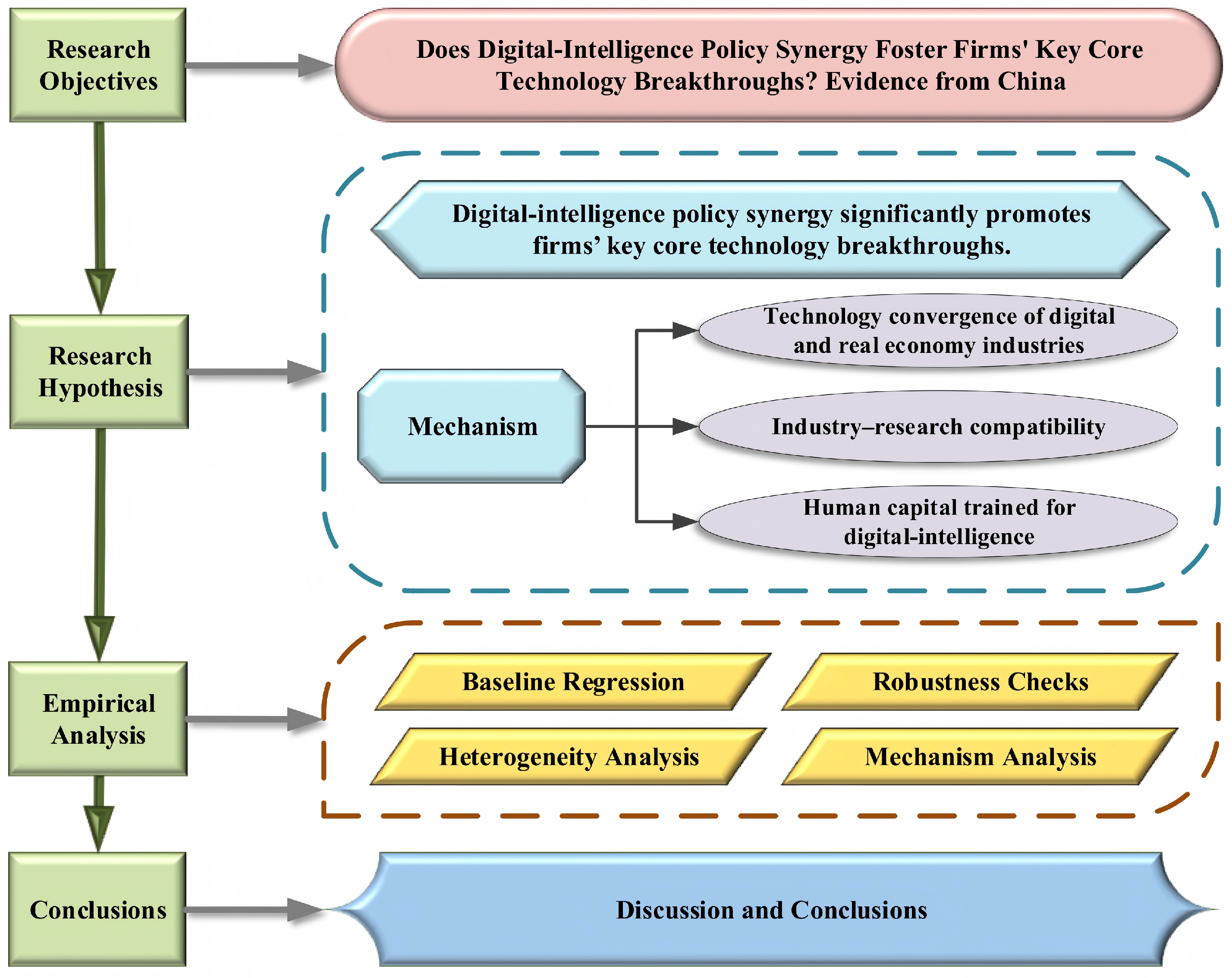
The remainder of the paper is organised as follows. Section 2 reviews the policy background of digital–intelligence and develops the theoretical framework and research hypotheses. Section 3 introduces the empirical specification and describes variable construction. Section 4 reports the main empirical results, including baseline estimates and robustness checks. Section 5 presents the heterogeneity and mechanism analyses. Section 6 concludes by summarising the key findings and discussing policy implications. The overall research framework is illustrated in Figure 1.

2. Theoretical Framework and Research Hypotheses

2.1. Policy Background

Digital–intelligence is not only a defining feature of the new wave of industrialisation but also a key pathway for cultivating new productive forces. National governments play a decisive role in advancing the digital–intelligence agenda. In the United States, the National Strategic Plan for Advanced Manufacturing and the Industrial Internet Consortium provide strong policy support for the research, development, and application of intelligent manufacturing technologies. Germany, centred on its Industry 4.0 initiative, continues to refine its digital-transformation blueprint and has issued the Digital Strategy 2025. Meanwhile, Japan, guided by the Society 5.0 vision, integrates intelligent manufacturing with cutting-edge technologies such as the Internet of Things and artificial intelligence to comprehensively advance manufacturing digitalisation.
With its relatively well-developed digital–intelligence infrastructure, China regards corporate digital–intelligence transformation as an inevitable response to ongoing technological change. As early as 2015, the State Council issued the Action Plan for Promoting Big Data Development, setting out a top-down, national-level blueprint for the production, circulation, and utilisation of data. Data has emerged as the most dynamic factor of production in the third wave of the scientific-and-technological revolution and as the core strategic resource for building a Digital China. To reinforce the integration of regional data infrastructure, enhance the agglomeration and value-creation capacity of data resources, and narrow regional development gaps, the central government has successively approved the establishment of the NBD. Between 2015 and 2016, two batches comprising nine provinces were designated as pilot zones. By developing core big-data technologies, building data-exchange platforms, and institutionalising data openness and sharing, these pilot zones have dismantled long-standing data barriers and injected fresh momentum into the digital-driven and intelligence-driven upgrading of traditional industries.
In 2017, the New Generation Artificial Intelligence Development Plan designated AI as the core driver of a new round of industrial transformation and systematically outlined the corresponding key tasks and strategic objectives. Subsequently, in March 2019, the State Council issued the Guiding Opinions on Promoting the Deep Integration of Artificial Intelligence and the Real Economy, emphasising the imperative to seize AI-related opportunities and to integrate AI deeply with the real economy in order to strengthen China’s scientific and technological capacity and industrial competitiveness, thereby securing the commanding heights of the global industrial revolution. To accelerate AI innovation and its application, the Ministry of Industry and Information Technology approved multiple batches of National AI Innovation and Application Pilot Zones, bringing the total to 11 by the end of 2022. With a focus on industrial planning, infrastructure development, and institutional innovation, these pilot zones have undertaken pioneering initiatives, invigorated corporate innovation, addressed critical core technological chokepoints, and fostered a next-generation AI industrial ecosystem.

2.2. Theoretical Analysis

As global technological competition intensifies, achieving breakthroughs in key core technologies has become a strategic yardstick for a nation’s innovation capacity and industrial security. In response, the Chinese government has introduced two major digital–intelligence industrial policies in succession, the NBD and the AIP, whose policy content is highly complementary. The NBD agenda concentrates on institutional arrangements and infrastructure that transform data into a productive asset, whereas the AIP agenda emphasises algorithmic capability and the deployment of AI in real-world settings and its integration with industrial systems. Together, they form a coherent policy package in which data foundations and application-oriented intelligence mutually reinforce one another. In this context, this paper examines whether such digital–intelligence policy synergy catalyses firms’ breakthroughs in key core technologies and clarifies both the direct effects and the combined mechanisms through which these policies operate.

2.2.1. Direct Effects

A defining feature of the digital–intelligence transformation is the pervasive integration of information and data across economic systems [20]. Data have increasingly been recognised as a core factor of production, alongside capital and labour [21,22]. Building on Schumpeter’s theory of innovation—which emphasises that new combinations of production factors generate creative destruction—the digital–intelligence transformation reframes data as a productive input. This reframing creates external conditions that facilitate firms’ breakthroughs in key core technologies while also improving the efficiency and reliability of their innovation processes [23,24].
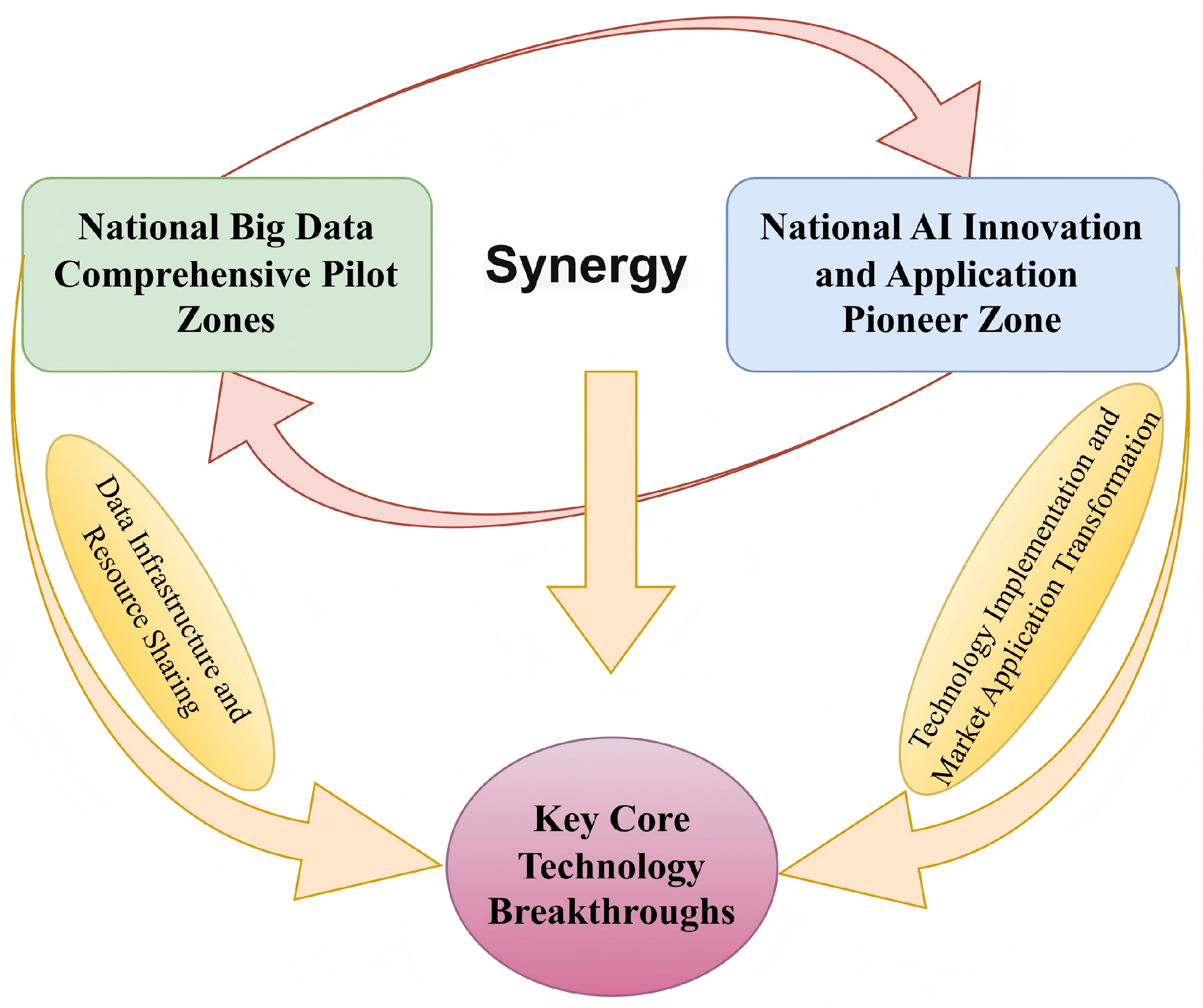
The synergistic effect of digital–intelligence policy on firms’ technological breakthroughs stems from the coordinated efforts of these policies to reduce costs and improve efficiency. These benefits are achieved through both the provision of factor inputs and institutional support. Specifically, the NBD policy prioritises the development of high-performance data centres, cloud-computing platforms, and unified data-governance frameworks. This approach lowers firms’ fixed costs of data acquisition, storage, and processing. Concurrently, the AIP adopts an application-led approach and promotes open scenarios, offering real-world pilot platforms for intelligent algorithms, while combining fiscal subsidies with challenge-based prize incentives to accelerate the translation of R&D into industrial deployment [25]. By harnessing the resource and institutional externalities generated by this policy synergy, firms can overturn entrenched technological and market paradigms, reduce R&D expenditures and market uncertainty, and thereby accelerate key core technology breakthroughs. The direct-impact pathway is illustrated in Figure 2. Accordingly, this study proposes the following Research Hypothesis 1:
H1. 
Digital–intelligence policy synergy significantly promotes firms’ key core technology breakthroughs.
Figure 2. Direct effect diagram.
Sustainability 18 01256 g002

2.2.2. Mechanisms of Impact

In our framework, the proposed mechanisms are conceptualised as parallel channels through which digital–intelligent policy synergy can affect firms’ key core technology breakthroughs.
Within the channel of technology convergence between the digital economy and the real economy, the NBD seeks to unlock the productive potential of data by accelerating the integration of big data with traditional sectors, thereby injecting new momentum into the real economy. In parallel, the AIP strengthens the fusion of AI and the real economy by promoting the application and diffusion of intelligent technologies and products across manufacturing, logistics, and service industries. Taken together, these complementary policies have substantially advanced digital–real-economy convergence, broken down information silos, and enabled firms to use real-time data feedback and seamless information exchange to rapidly identify technical chokepoints and implement targeted solutions. Moreover, technological convergence can create new value [26], while digital convergence increases knowledge diversity [27], thereby releasing resources for a wider set of innovation activities and accelerating firms’ key core technology breakthroughs. Accordingly, we propose the following Research Hypothesis 2:
H2. 
Technology convergence of digital and real economy industries mediates the positive effect of digital–intelligence policy synergy on firms’ key core technology breakthroughs.
Through the channel of industry–research compatibility, the NBD has reduced data fragmentation by advancing big-data integration, data openness, and the development of industrial big-data applications. These efforts help firms overcome data-collection chokepoints and deploy closed-loop applications across the R&D process, thereby cutting data-acquisition costs and bringing technological development into closer alignment with industrial demand. In parallel, the AIP strengthens application orientation by prioritising breakthroughs in foundational core technologies—such as AI chips and intelligent software—to build a secure and reliable industrial ecosystem and encourage firms to intensify R&D investment in AI and related domains [28]. Increased R&D spending enhances firms’ technological capabilities and innovation performance [29], which further reinforces production–research alignment. Stronger alignment reduces trial-and-error costs, mitigates commercialisation risk, shortens R&D cycles, improves coordination between innovation and industrial chains, and raises production efficiency, thereby jointly accelerating key core technology breakthroughs. Accordingly, we posit the following Research Hypothesis 3:
H3. 
Industry–research compatibility mediates the positive effect of digital–intelligence policy synergy on firms’ key core technology breakthroughs.
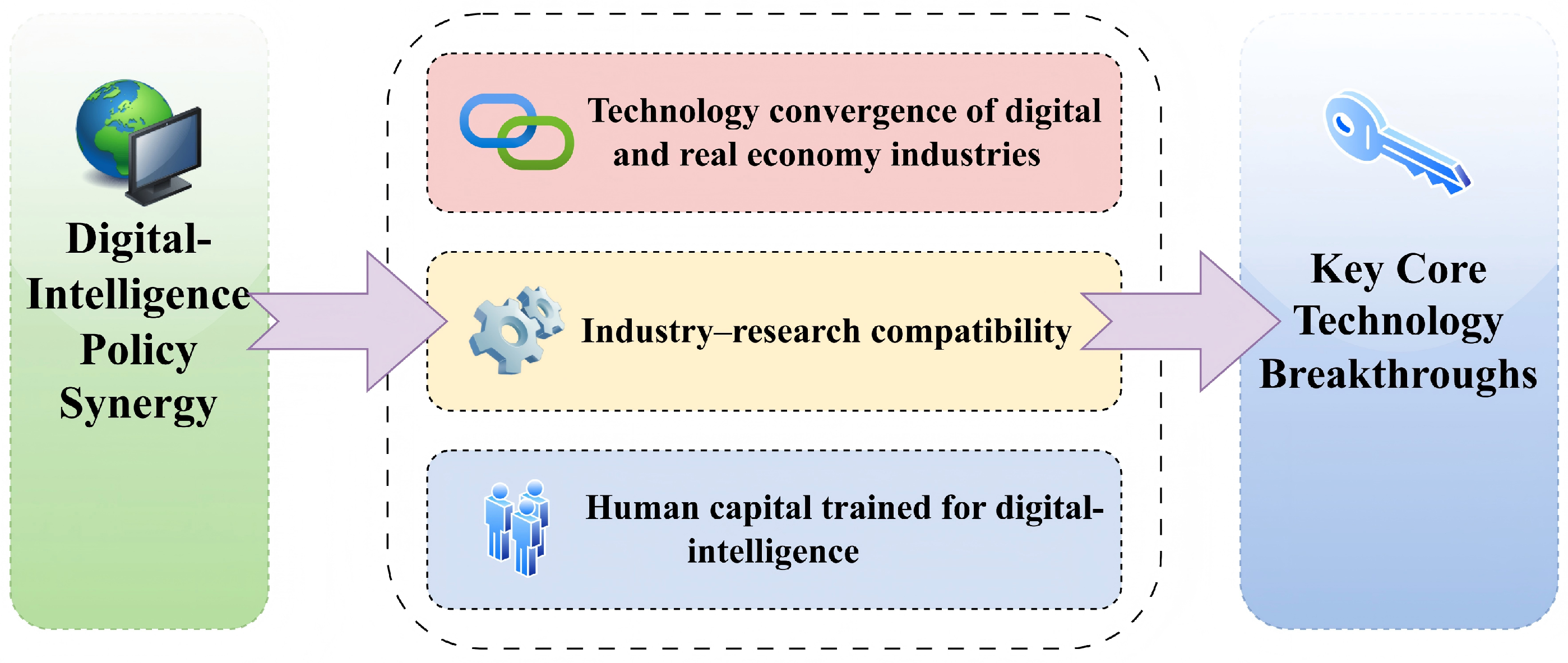
Along the optimised digital–intelligence human-capital channel, the NBD aims to cultivate a new generation of big-data professionals by incentivising firms, universities, and research institutes to jointly establish pilot zones. Big data, in turn, helps reduce information asymmetries, improves the effectiveness of education and training, raises workforce skill levels [30,31], and increases the share of highly skilled labour [32], thereby strengthening the digital–intelligence talent pool. Concurrently, the AIP leverages technological and talent advantages through targeted personnel-support measures: AI has boosted employment rates [33], expanded the pool of digital–intelligence workers, promoted skill upgrading, and accelerated the accumulation of firm-level human capital for digital–intelligence [34,35]. Collectively, these developments improve firms’ internal labour structures. Optimised human capital trained for digital–intelligence therefore facilitates key core technology breakthroughs. First, the agglomeration of talent enhances team quality and collaborative capacity, enabling firms to overcome chokepoints. Second, a higher proportion of digital–intelligence workers often yields flatter organisational hierarchies, thereby boosting the efficiency of R&D in key core technologies. The indirect-impact pathway is illustrated in Figure 3. Accordingly, we propose the following Research Hypothesis 4:
H4. 
Optimised human capital trained for digital–intelligence mediates the positive effect of digital–intelligence policy synergy on firms’ key core technology breakthroughs.
Figure 3. Influence mechanism diagram.
Sustainability 18 01256 g003

3. Research Design

3.1. Data Sources

Given data-availability constraints, this study investigates Chinese A-share firms listed between 2011 and 2023, assembling firm-level data from the China Stock Market & Accounting Research (CSMAR) database and the China National Research Data Services (CNRDS) platform. Following established practice, the raw data are cleaned as follows: (I) firms labelled ST, *ST, PT, or otherwise exhibiting abnormal listing status are removed; (II) firms in the financial industry are excluded; (III) observations lacking core variables are discarded; (IV) firms listed for fewer than twelve months are dropped; and (V) firms reporting negative shareholders’ equity are omitted. To curb the influence of extreme values, all continuous variables are Winsorised at the 1st and 99th percentiles.

3.2. Variable Construction

3.2.1. Dependent Variable

Drawing on the 2023 Key Technology Patent Classification System promulgated by the China National Intellectual Property Administration (CNIPA), this study measures each firm’s capacity to achieve key core technology breakthroughs. This taxonomy encompasses seven major technological domains and 585 tertiary branches and offers an authoritative, government-endorsed delineation of key technologies. First, employing the 2018 Correspondence Table between the International Patent Classification (IPC) and the National Economic Industry Classification, and adopting the four-digit IPC subclass as the most granular matching unit, we extract from each firm’s patent portfolio those patents classified as critical core technologies [36]. The resulting patent counts are subsequently aggregated at the firm–year level, incremented by one, and transformed by the natural logarithm to construct the firm-level indicator of key core technology breakthroughs ( K C T ).

3.2.2. Independent Variable

To measure whether a firm receives support from digital–intelligence policy, this study constructs the dummy variable D I P i t . Specifically, using the two policy platforms NBD and AIP as reference, D I P i t takes the value 1 if the region where firm i is located belongs to both pilot zones and the observation occurs after the policy implementation date; otherwise, it is set to 0.

3.2.3. Control Variables

This study controls for a range of variables related to firms’ financial characteristics, growth characteristics, and governance characteristics that may influence key core technology breakthroughs. The detailed definitions and measurement methods are presented in Table 1.

3.3. Model Specification

Under the policy-evaluation paradigm, the DID framework is routinely employed to identify causal effects by contrasting outcome dynamics for treated and untreated firms around policy implementation. Because the digital–intelligent initiatives in our setting were introduced in a staggered fashion across regions and over time, DID is particularly well suited to capturing the effects of these gradual rollouts under pronounced regional heterogeneity. Building on the extant literature [19,37], we therefore develop an overlapping DID specification. We first estimate the effects of NBD and AIP separately, and then examine whether their joint implementation, which we conceptualise as digital–intelligence policy synergy, promotes Chinese firms’ key core technology breakthroughs. The empirical specification is given by
K C T i t = α 0 + α 1 N B D i t + α 2 C o n t r o l s i t + μ i + λ t + ε i t
K C T i t = α 0 + α 1 A I P i t + α 2 C o n t r o l s i t + μ i + λ t + ε i t
K C T i t = α 0 + α 1 D I P i t + α 2 C o n t r o l s i t + μ i + λ t + ε i t
where i and t denote firms and years, respectively. K C T i t measures firm i’s key core technology breakthroughs in year t. N B D i t is an indicator that equals one if firm i is exposed to the NBD policy in year t, and zero otherwise. A I P i t is an indicator that equals one if firm i is exposed to the AIP policy in year t, and zero otherwise. D I P i t is an indicator that equals one if firm i is jointly exposed to both NBD and AIP in year t and zero otherwise. C o n t r o l s i t is a vector of time-varying firm-level control variables. μ i and λ t denote firm and year fixed effects, respectively, and ε i t is the idiosyncratic error term.

4. Empirical Analysis

4.1. Descriptive Statistics

Table 2 reports the descriptive statistics for the main variables. The mean value of key core technology breakthroughs is 0.744, with a standard deviation of 1.108, indicating substantial cross-firm heterogeneity. The core explanatory variable, D I P , has a mean of 0.097, suggesting that the coverage of digital–intelligence policy synergy is relatively limited. Overall, the variables exhibit reasonable ranges and sufficient variation. In particular, R D displays pronounced dispersion, reflecting sizable differences in firms’ innovation investment, while T o p 1 indicates a moderate degree of ownership concentration, and CEO–chair duality is relatively prevalent in the sample.

4.2. Baseline Regression Results

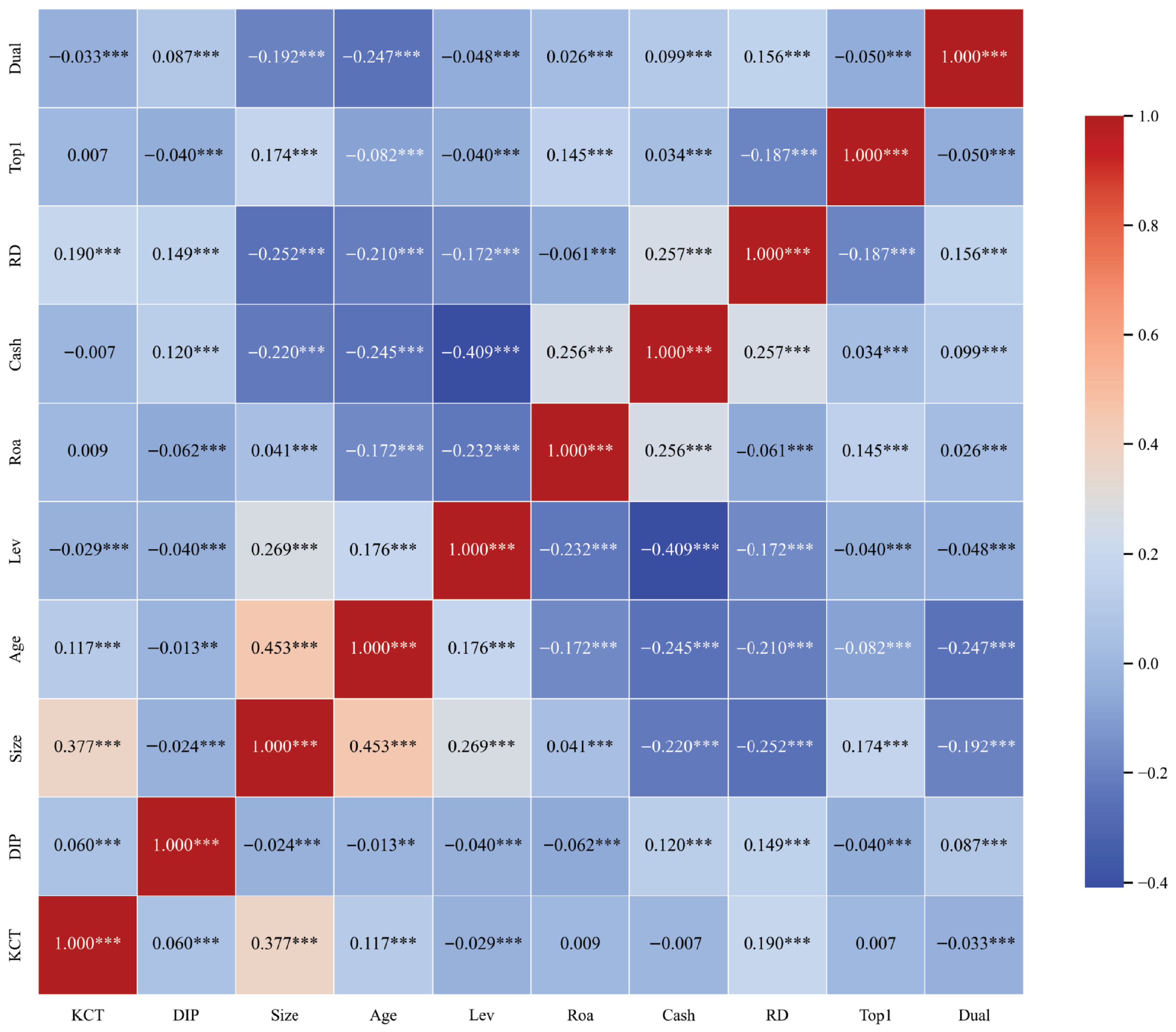
Prior to estimation, we ran three diagnostics on the data and model. VIF scores and Pearson correlations (Figure A1 in Appendix A) showed no multicollinearity. A Hausman test favoured the fixed-effects estimator. Together, these diagnostics confirm that the baseline model satisfies key econometric assumptions and is suitable for causal inference.
Table 3 presents the baseline regression results. Across all specifications, the estimated coefficient on D I P is consistently positive and statistically significant at the 1% level, indicating that digital–intelligence policy synergy significantly promotes firms’ key core technology breakthroughs. Coefficients for the individual-policy indicators—NBD and AIP—are likewise positive and significant at the 10% level. These results suggest that each policy independently stimulates technological breakthroughs, although the magnitude is markedly smaller than under the coordinated policy regime, fully validating Hypothesis 1.
With respect to the control variables, firm size ( S i z e ) displays a significantly positive coefficient, suggesting that larger firms, endowed with more abundant resources, possess stronger technological-innovation capabilities. The coefficients on firm age ( A g e ) and financial leverage ( L e v ) are both significantly negative, suggesting that greater organisational maturity or higher debt burdens may reduce firms’ propensity to undertake innovation risk. Finally, the positive association between research-and-development intensity ( R D ) and K C T is significant at the 1% level, further confirming that policy synergy fosters sustained key core technology breakthroughs by enhancing research investment and optimising resource allocation.

4.3. Robustness Checks

4.3.1. Parallel Trend Test

The DID approach is valid only if treatment and control groups share parallel pre-intervention trends. Here, firms’ key core technology breakthroughs must evolve similarly before the policy. We assess this condition—and the policy’s dynamic effects—via an event study with six leads and four lags. The empirical specification is in Equation (4):
K C T i t = α + n = 6 4 β n D I P i , t + n + γ C o n t r o l s i t + δ i + η t + μ i t
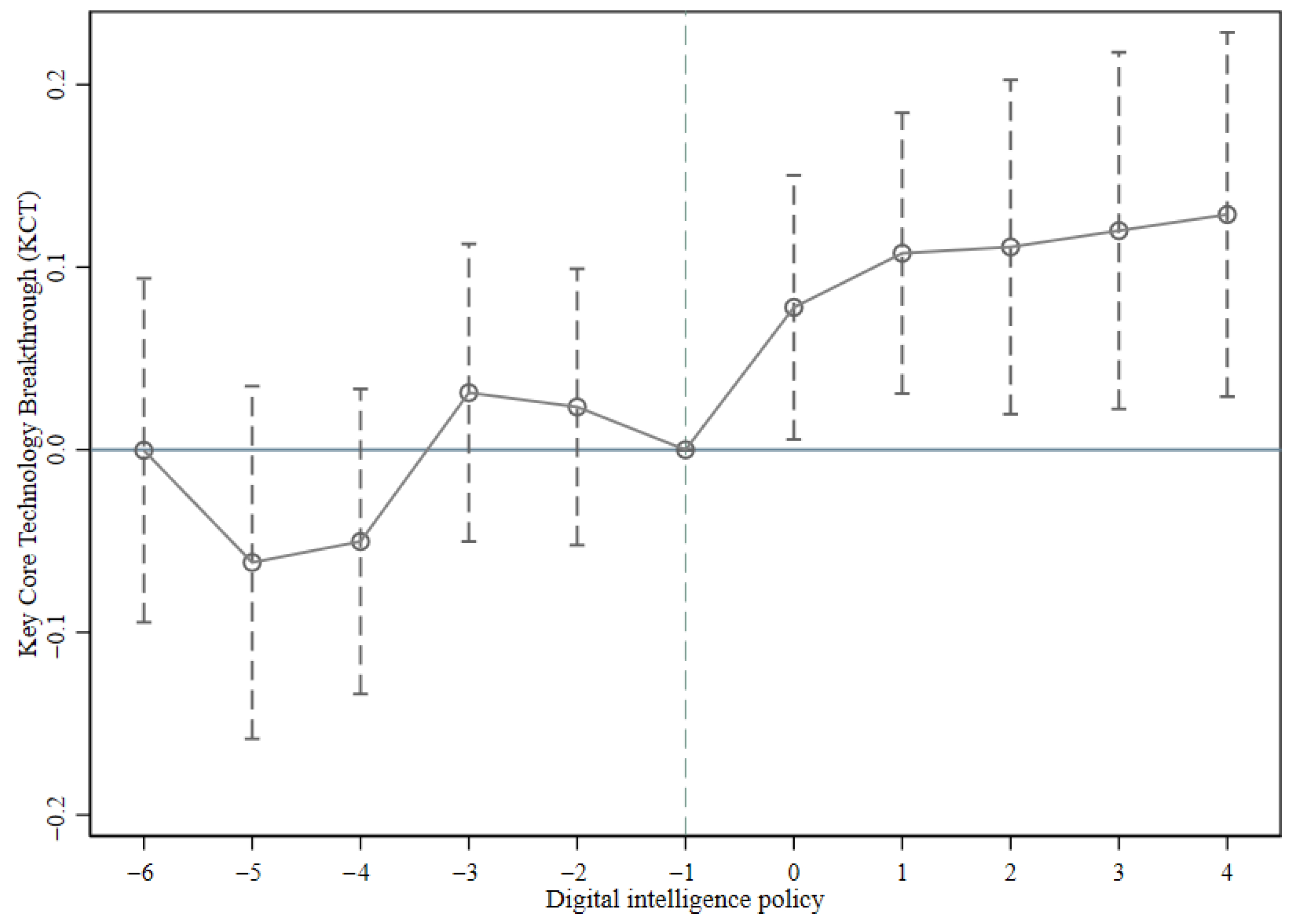
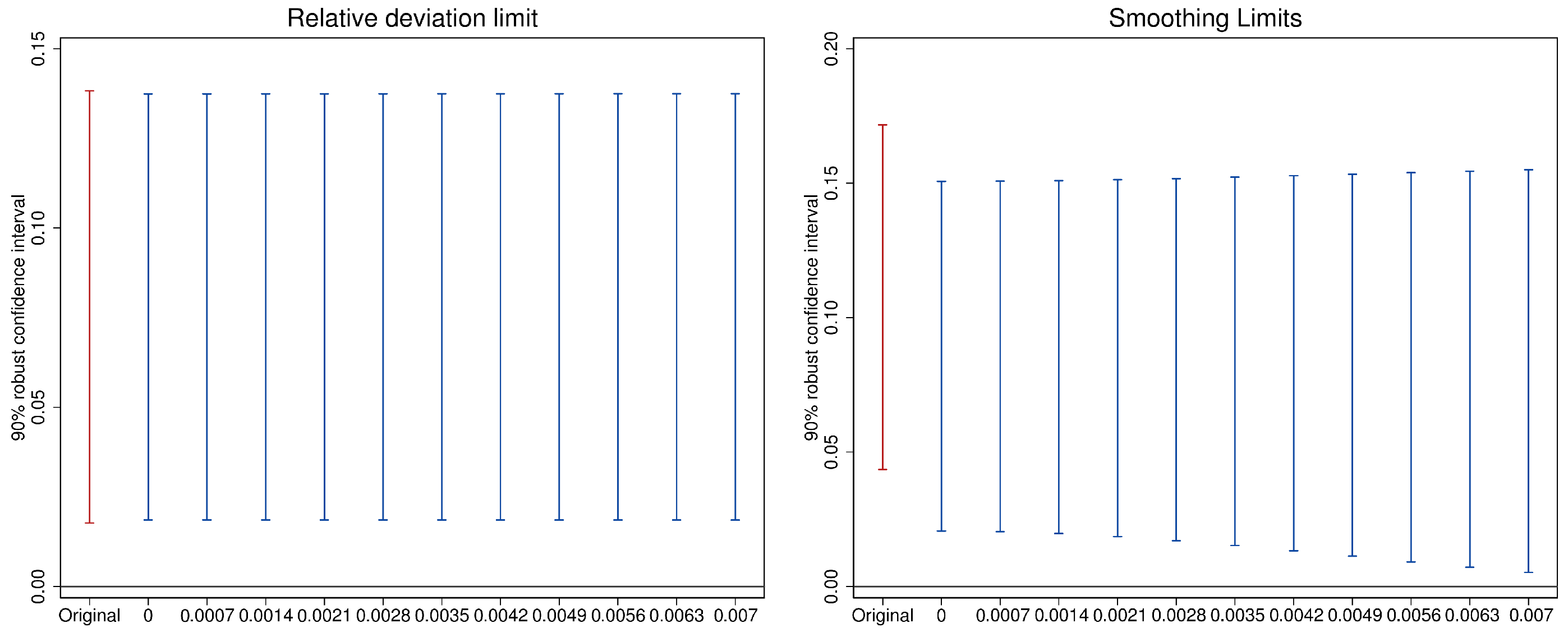
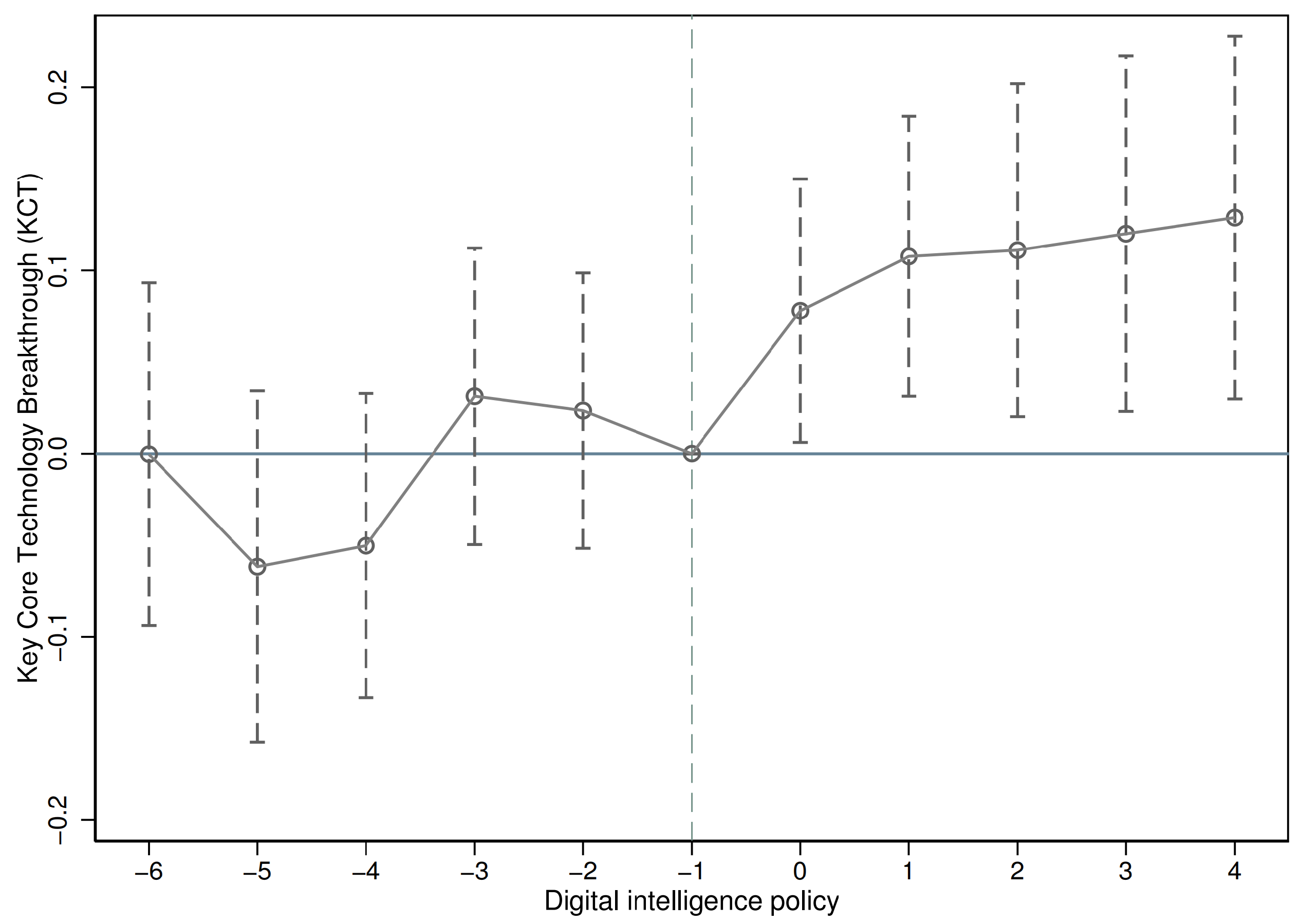
In the event study, the policy dummy D I P equals 1 in the implementation year and 0 otherwise. The year t 1 serves as the baseline, and observations outside the window are folded into end bins. This design traces the dynamic path of K C T around the policy; estimates appear in Figure 4, which confirms parallel pre-trends between treated and control firms and shows a pronounced post-policy gain in technological breakthroughs. To validate the parallel-trend assumption, this study controls for city fixed effects to account for unobserved regional heterogeneity. This approach minimises the confounding effects of pre-existing disparities in innovation capacity, thereby strengthening the causal interpretation of our findings. Given the critical nature of this assumption, we further conduct sensitivity checks; as shown in Figure A2 and Figure A3 in Appendix A, the results remain robust and consistent with the parallel-trend requirement.

4.3.2. Alternative Control Group

In the robustness checks, we retain only firms that are simultaneously subject to both policies and those that are entirely unaffected by either policy, excluding observations exposed to just one policy. This stricter sample allows us to verify whether the main findings hinge on the presence of a single policy. Results reported in columns (1)–(2) of Table 4 show that, even after removing single-policy observations, the overall impact of the policy bundle remains robust. These results confirm that our core conclusion is not driven by any single policy effect but stems from the synergistic influence generated by the joint implementation of both policies.

4.3.3. Alternative Dependent Variable

To test the robustness of our main conclusions, we construct two alternative indicators of key core technology breakthroughs. First, following [23], patents whose annual citation counts fall within the top 10 percent are classified as core patents. Adding one to the number of core patents owned by firm i in year t and taking the natural logarithm yields the indicator C o r e i t . Second, to capture another dimension of technological originality, we use the number of invention patents granted to the firm in the same year as a proxy [38]; after adding one, taking the natural logarithm produces I n v i t . As shown in columns (3)–(6) of Table 4, our findings remain robust under both alternative measures.

4.3.4. PSM-DID and Entropy Balancing

To ensure that the estimated policy effect is not confounded by sample self selection, the study additionally employs propensity score matching (PSM) and entropy balancing to construct a control group that is as comparable as possible to the treatment group in terms of baseline characteristics. The regression results reported in Table 5 show that the D I P continues to exert a significant positive impact on firms’ K C T across various matching algorithms, including nearest-neighbour matching. These findings provide strong evidence for the robustness of the model.

4.3.5. Double Machine Learning

While traditional econometric frameworks may be biased by omitted high-dimensional interactions or nonlinear relationships, machine learning algorithms provide an independent and powerful check on policy effects. Using five distinct machine learning techniques (random forest, Lasso regression, gradient boosting, neural network, and support vector machines), this study tests the robustness of the relationship between the D I P and firms’ K C T as shown in Table 6. Across all models, the D I P coefficient is significantly positive at the 1% level, indicating that the policy’s stimulative effect on K C T is robust to the choice of machine learning algorithm.

4.3.6. Instrumental Variable Approach

To further mitigate potential endogeneity arising from reverse causality, omitted variables, or the selective implementation of the policy, we conduct robustness checks using an instrumental variable (IV) approach. Specifically, we construct the instrument as the interaction between the number of employees in the information transmission, computer services, and software sector of a firm’s prefecture-level city in 2003 and the time variable [39]. This variable was largely predetermined before the policy was introduced and significantly affects the probability that the city is later designated as the N B D or the A I P , thereby satisfying the relevance condition, while it lacks a direct channel through which it could influence firms’ K C T , satisfying the exclusion restriction. Columns (1)–(2) of Table 7 report the IV results. In the first-stage regression, the joint F-statistic for the instrument on the D I P is 2994.310, well above the conventional threshold of 10, indicating a strong correlation between the instrument and the endogenous variable. Moreover, the Cragg–Donald Wald F statistic (22,000) rule out weak-instrument concerns.

4.3.7. Heckman Two-Stage Model

To address potential sample-selection bias stemming from whether a firm is chosen for a digital–intelligence pilot, we conduct an additional robustness test using the Heckman two-step model. The key strategy is to include the firm’s digital–intelligence level ( D I ) [40] as an auxiliary control that appears only in the first-stage equation. The first-stage Probit estimates show that D I has a significantly positive effect on the probability of entering the sample, confirming the relevance of this extra control. In the second-stage regression, we add the inverse Mills ratio ( I M R ) generated in the first stage. Columns (3)–(4) of Table 7 reveal that the I M R coefficient is significant, indicating that uncorrected selection bias would lead to an understatement of the digital–intelligence policy’s effect. After correction, the estimated coefficient on D I P remains positive and significant at the 1 percent level, further confirming that the digital–intelligence policy synergy robustly promotes firms’ key core technology breakthroughs.

4.3.8. High Dimensional Poisson Regression Model

Variables such as a firm’s patent counts are non-negative integers that are typically highly right-skewed and heavily concentrated at zero, causing ordinary least squares and other linear models to suffer from inefficiency and distorted confidence-interval inference. To eliminate the econometric bias introduced by this distributional feature, we follow [41] and re-estimate the baseline specification with a high dimensional Poisson model. As presented in columns (5) and (6) of Table 7, the positive effect of the D I P on firms’ K C T remains significant, further confirming the robustness of the baseline findings.

4.3.9. Placebo Test

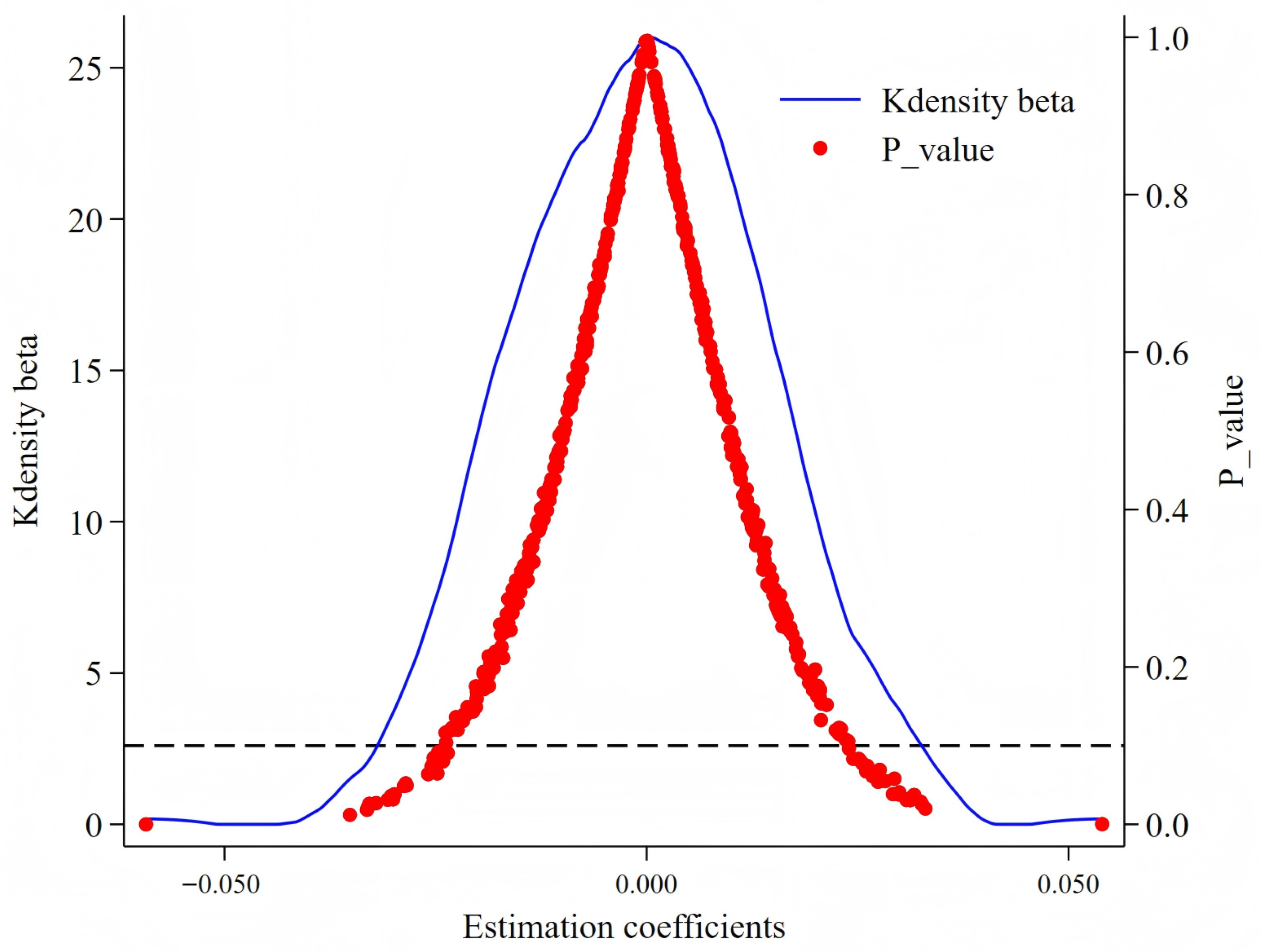
To further examine whether the digital–intelligence policy effectively promotes firms’ key core technology breakthroughs, we conduct a placebo test by randomly generating treatment samples. As shown in Figure 5, most of the placebo estimates lack statistical significance, indicating that the estimated treatment effect of the D I P is unlikely to be driven by chance and thus providing additional support for the robustness of our main conclusion.

4.3.10. Heteroskedasticity Robust Estimation

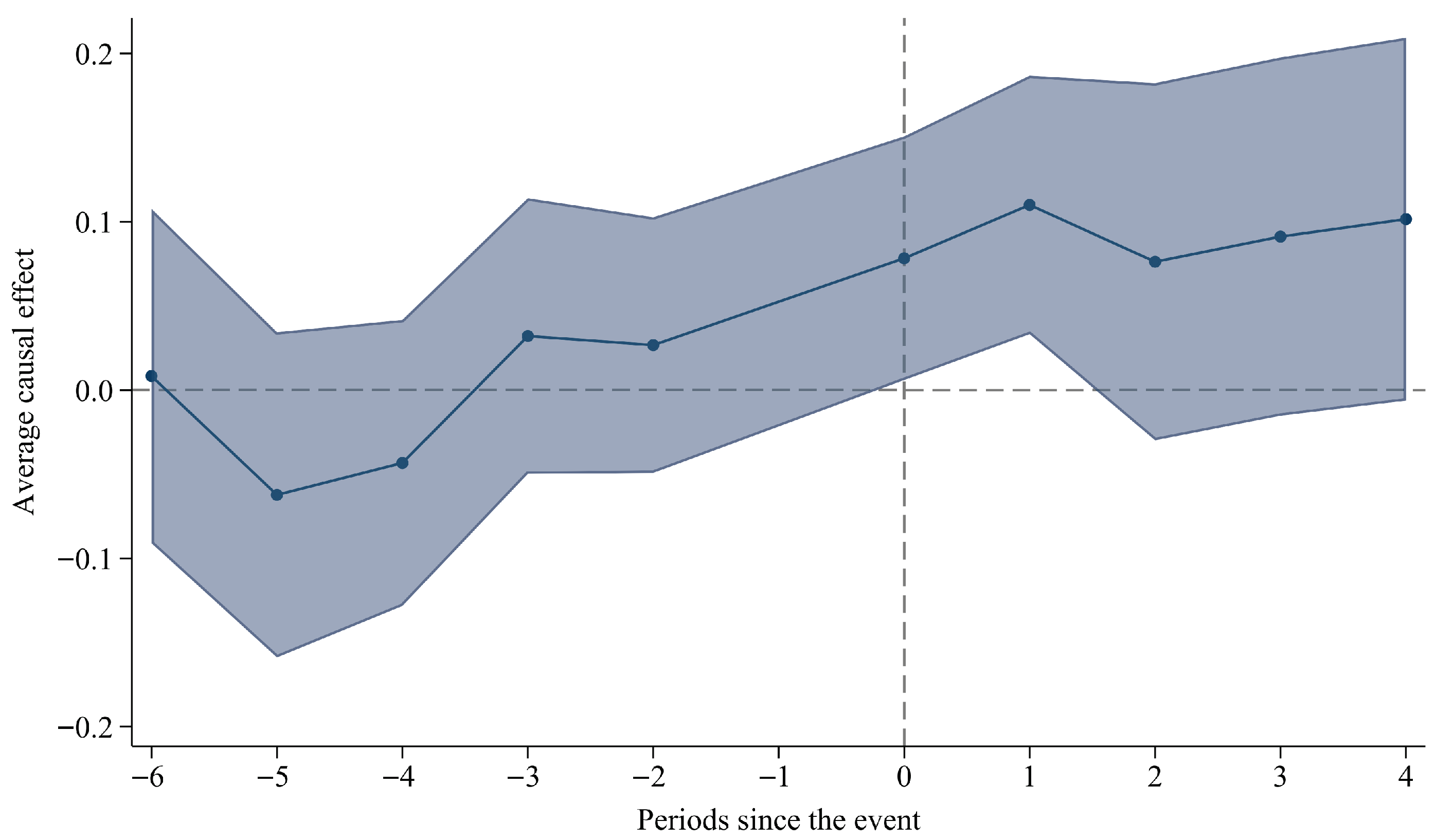
To assess whether the synergy of the digital–intelligence policy operates differently under varying conditions, we perform heterogeneity-robust estimation using the negative-weight diagnostic [42] and the dynamic-effect test [43]. The diagnostic reveals that negative weights constitute only 1.1% of the total, an amount too small to materially influence the baseline results. The dynamic-effect test (see Figure A4 in Appendix A) further shows that, even after accounting for potential heterogeneous treatment effects, the policy’s average dynamic impact remains significant. Overall, the D I P exerts a stable and positive influence on firms’ K C T .

5. Extended Analysis

5.1. Heterogeneity Analysis

When assessing the impact of the digital–intelligence policy on firms’ key core technology breakthroughs, the research focus should extend beyond the overall average effect to probe the heterogeneous responses across firms, industries, and regions, thereby equipping policymakers with more precisely targeted options for policy refinement.

5.1.1. Ownership Type

Ownership structure is an important determinant of firm behaviour and policy responsiveness. Accordingly, we split the sample into state-owned and non-state-owned firms and estimate separate regressions; the results are reported in columns (1) and (2) of Table 8. The evidence indicates that D I P has a statistically and economically significant positive effect on K C T among state-owned firms, whereas the corresponding coefficient is insignificant for non-state-owned firms. This pattern suggests that the policy stimulus is absorbed primarily by state-owned firms.
This divergence can be attributed to differences in resource endowments and institutional environments. State-owned enterprises (SOEs) possess inherent advantages in securing fiscal support, preferential policy financing, and administrative coordination. Their strategic orientation is deeply coupled with governmental objectives, enabling them to rapidly orchestrate resources in response to policy directives. Conversely, non-SOEs rely predominantly on market-based financing, contending with elevated capital costs and investment risks. The absence of effective governmental coordination and robust incentive-compatibility mechanisms further constrains their responsiveness, leading to a diminished marginal impact of policy synergy on their technological upgrades. These findings underscore a persistent ownership bias within current policy instruments and transmission channels, which fail to sufficiently permeate the more market-oriented non-state sector, so the policy’s impact on their K C T is not significant.

5.1.2. Emerging Strategic Industries

Considering the systematic differences in technology dependence, capital constraints, and the strength of policy externalities between strategic emerging industries (SEIs) and other sectors, we partition the sample into SEIs and non-SEIs according to the Strategic Emerging Industries Classification (2023) and re-estimate the baseline regression in each subsample. Columns (3) and (4) of Table 8 reveal that the D I P significantly enhances firms’ K C T within SEIs, whereas the corresponding coefficient is small in non-SEIs. This indicates that the policy’s effectiveness is concentrated in fast-moving fields with strong R&D externalities.
This divergence stems from the fact that firms in SEIs typically operate at the frontiers of technological innovation, where the demand for disruptive breakthroughs is most acute. For these firms, policy synergy provides indispensable technical scaffolds and financial buffers, thereby significantly amplifying its innovation-enhancing effects. Furthermore, the competitiveness of SEIs is intrinsically tied to continuous technological progression, which inherently heightens their responsiveness to external institutional support. In contrast, non-SEIs often possess more mature technological trajectories and established market niches. Their innovation activities are predominantly governed by incremental market demand and competitive pressures rather than external policy stimuli; consequently, the marginal impact of policy interventions on driving their technological breakthroughs is relatively constrained.

5.1.3. Regional Intellectual Property Protection Level

Intellectual property (IP) protection constitutes a critical external condition for corporate technological innovation: its strength directly shapes both the security of R&D investment and the intensity of innovation incentives. Using each city’s number of completed IP-trial cases relative to its GDP, we construct a revealed-comparative-advantage index of IP protection intensity [44]. We then split the sample each year at the median into high- and low-protection groups and re-estimate the baseline model. Columns (5) and (6) of Table 8 show that the D I P markedly enhances firms’ K C T in high-protection areas, whereas the policy’s effect is essentially absent in low-protection areas.
These findings imply that a robust legal and enforcement framework for intellectual property acts as a critical institutional prerequisite. Only within such a protective environment can firms effectively transform policy-induced inflows of capital, data, and R&D support into high-risk, high-reward investments in critical technologies. Conversely, where protection is weak, the threat of infringement and imitation erodes expected returns, curbing firms’ willingness to respond to the policy and leaving the digital–intelligence initiative unable to spark genuine K C T .

5.2. Mechanism Tests

The preceding theoretical analysis posits that the synergy of D I P influences firms’ K C T chiefly through digital–real industrial technology integration, production–research alignment, and optimisation of human capital trained for digital–intelligence. Consistent with this conceptualisation, our mechanism tests treat the channels as independent mediators; examining each pathway separately, we specify the following mechanism-testing model on the basis of Equation (3):
M e d i a t o r i t = α 0 + α 1 D I P i t + α 2 C o n t r o l s i t + μ i + λ t + ε i t

5.2.1. Technology Convergence of Digital and Real Economy Industries

Drawing on the strengths of patent-citation networks in depicting knowledge diffusion and technological synergy, this study constructs a firm-level technology convergence of digital and real economy industries. The procedure is as follows. First, following the Concordance Table between Core Digital-Economy Industries and the International Patent Classification (2023) issued by the China National Intellectual Property Administration, we iteratively map the Statistical Classification of the Digital Economy and Its Core Industries (2021) to the major, minor, and subgroup levels of IPC 2022.01. We then match these IPC codes to each firm’s patent portfolio and identify invention patents that fall within digital-product manufacturing, digital-product services, digital-technology applications, and digital-factor-driven domains, designating them as digital-industry patents. Second, using publication numbers, we compare every patent’s citation list with the above set of digital-industry patents. Any non-digital-industry patent whose reference list contains at least one digital-industry patent is deemed a case of digital knowledge permeating physical technology and is recorded as a single digital real integration event [45,46]. Third, we aggregate these events at the firm–year level, add one to the count, and take the natural logarithm to generate the continuous technology convergence of digital and real economy industries, denoted as T e c h .
The results in column (1) of Table 9 show that T e c h constitutes a key transmission channel through which the digital–intelligence policy affects firms’ key core technology breakthroughs. The regression coefficient of D I P on T e c h is significantly positive, indicating that the policy effectively promotes the penetration and recombination of digital-industry knowledge into real-sector technologies. By strengthening the coupling between firms’ digital and physical technologies, the policy enables firms to absorb and integrate frontier digital elements more rapidly, thereby deepening technological innovation and ultimately translating into substantive K C T . Research Hypothesis 2 is thus confirmed.

5.2.2. Industry-Research Compatibility

Industry–research compatibility is defined as the correspondence between a firm’s R&D activities and its existing core business, capturing the firm’s ability to embed research outputs rapidly into its production system [47]. The measure is constructed as follows. First, we extract the firm’s disclosed core-business keywords from its registration documents. Second, using patent text-mining techniques, we segment the abstracts of patents filed by the firm in the same year and extract the associated technical keywords. Third, we compute the cosine similarity between the core-business keyword vector and the patent-abstract keyword vector; any patent with a similarity score greater than zero is classified as an industry–research compatibility patent. Finally, we count the aligned patents for each firm in a given year, add one to the total, and take the natural logarithm to obtain the continuous indicator of industry–research compatibility ( F i t ).
The regression results in column (2) of Table 9 show that the coefficient of D I P on F i t is significantly positive. This finding indicates that the policy synergy strengthens the knowledge matching between the R&D and production stages, raises firms’ efficiency in transforming digital research outputs into production capabilities, and thereby accelerates K C T , confirming Research Hypothesis 3.

5.2.3. Human Capital Trained for Digital–Intelligence

In this study, optimised human capital trained for digital–intelligence is defined as the number of top-tier digital–intelligence inventors within a firm. Construction proceeds as follows. Using the firm’s patent-application data, we identify patents related to big data or artificial intelligence. Among the inventors who submit such digital–intelligence patents, we rank them by the number of applications and select the top 20% [36]. For each firm, we then count how many of these digital–intelligence inventors are affiliated with it, add one to the count, and take the natural logarithm to obtain the continuous measure of human capital trained for digital–intelligence ( L a b o r ).
The regression results in column (3) of Table 9 indicate that the D I P exerts a significant positive effect on L a b o r . This finding suggests that the policy promotes technological innovation and key core technology breakthroughs by increasing the proportion of top-tier inventors within the firm. The resulting shift in workforce composition reflects firms’ increasing emphasis on digital–intelligence capabilities; as their stock of technical talent expands, firms are better positioned to innovate and to achieve K C T , thereby validating Research Hypothesis 4.

5.2.4. Mechanism Pathway Decomposition

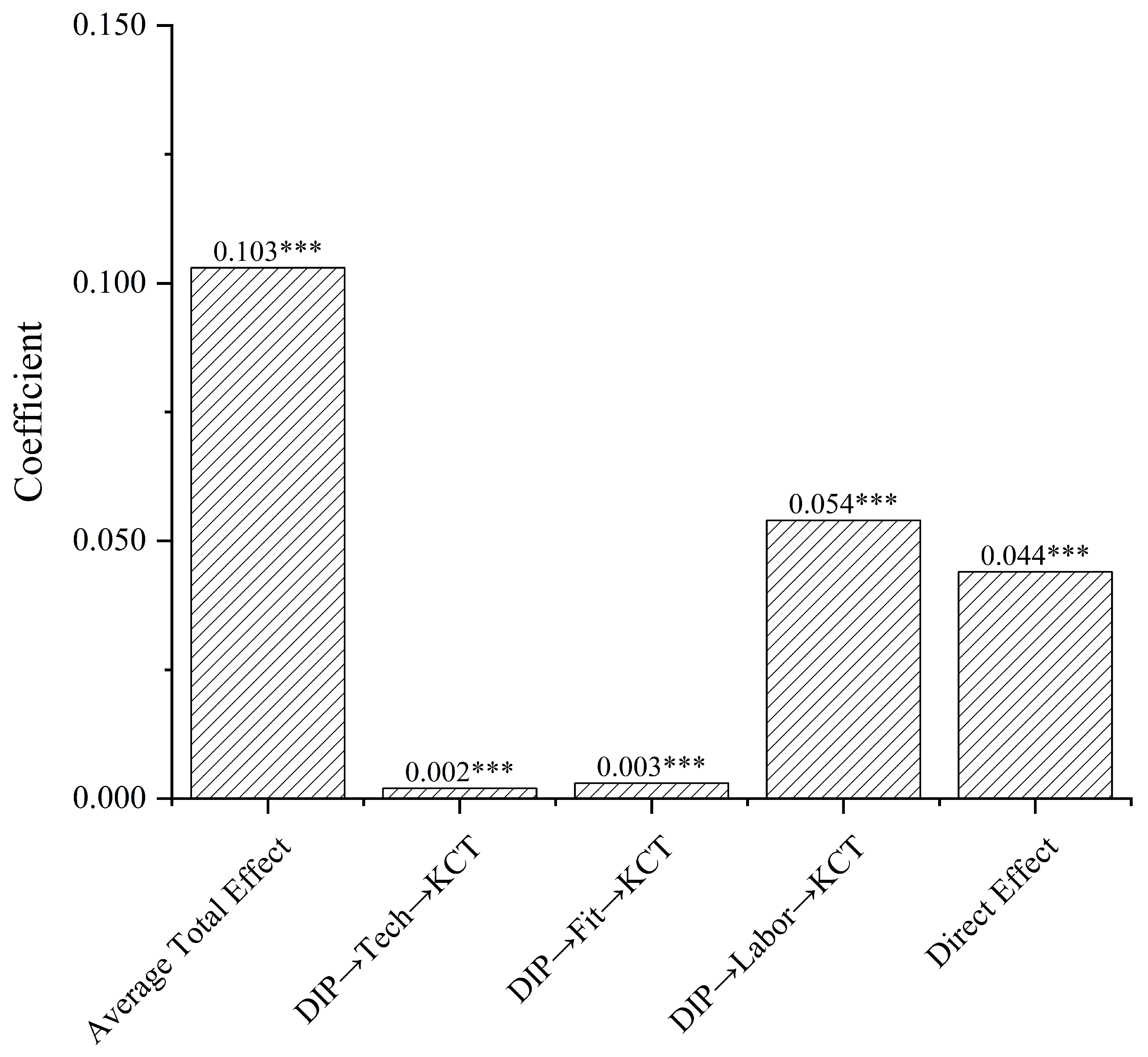
To dissect the operative mechanisms of the digitisation and intelligence policies, this study, grounded in Rabin’s theoretical framework, employs the Gaussian kernel function from the Gradient Boosting Machine (GBM) model to decompose the effect pathways through which D I P fosters firms’ K C T [48]. Table 9 reports the link level estimates that connect D I P to each mediator and each mediator to K C T . Figure 6 complements Table 9 by aggregating these link level results into an additive decomposition of the average total effect so that the contribution of the direct component and the chained composite indirect component can be compared on the same scale. In Figure 6, each bar represents the estimated contribution of one pathway to the average total effect, the sum of the indirect contributions equals the composite indirect effect, and the direct contribution plus the composite indirect effect equals the average total effect. Accordingly, the relative weight of the direct effect and the indirect mechanisms should be interpreted as their respective shares in the total effect. The results in Figure 6 indicate that D I P ’s promotion of K C T relies jointly on its direct effect and a chained, composite indirect mechanism.

6. Conclusions

6.1. Conclusions and Policy Implications

Taking the quasi-natural experiment of NBD and AIP as the setting, this paper employs panel data on A-share listed firms for 2011–2023 to examine how the synergy of digital–intelligence policy affects key core technology breakthroughs. The main findings are as follows. (1) Digital–intelligence policy synergy significantly promotes firms’ key core technology breakthroughs. (2) Mechanism analysis shows that the policies operates chiefly through three channels: technology convergence of digital and real economy industries, industry–research compatibility, and optimised human capital trained for digital–intelligence. (3) Heterogeneity analysis indicates that the policies’ effects are more pronounced for state-owned firms, firms in strategic emerging industries, and firms located in regions with stronger intellectual-property protection.
On this basis, the paper offers the following policy recommendations:
(1)
Strengthen the coordination framework for digital–intelligence policy. Empirical evidence shows that coherently planned digital–intelligence policy facilitates firms’ breakthroughs in key core technologies. Accordingly, policymakers should prioritise cross-instrument consistency and sequencing so that computing infrastructure, data governance, algorithmic innovation, and complementary fiscal measures are mutually reinforcing. More forward-looking countries may emulate China’s pilot-zone model by initially establishing high-performance computing centres, sector-specific data spaces, and open-algorithm platforms in regions endowed with industrial and talent agglomerations, supplemented by fiscal subsidies and ancillary policy instruments. This phased strategy provides economies at varying development stages with a pathway from localised pilots to nationwide implementation, thereby lowering uncertainty and large-scale investment costs.
(2)
Establish integration platforms that fuse digital resources with physical technologies. Our results indicate that diffusing digital-industry knowledge into the real economy is the primary channel through which the policy operates. This implies that the policy’s effectiveness hinges on reducing barriers to cross-organisational knowledge recombination and application in manufacturing and other real-economy settings. Policymakers should encourage platform firms and leading manufacturers to co-develop cross-industry data pools and shared R&D facilities while enabling research institutions and user firms to match needs with outputs on a unified platform. Competitive project grants and ex-post subsidies that reward cross-domain collaboration can substantially improve technology-transfer efficiency. This approach offers a scalable template for industrial digitalisation that can be adapted to local industrial structures to accelerate digital–intelligence upgrading.
(3)
Reinforce production–research coupling and optimise talent composition. The evidence suggests that close alignment between production and research is essential for achieving key core technology breakthroughs. Governments can use R&D super-deductions, joint-laboratory funding, and training subsidies to guide universities, institutes, and firms in co-developing technology roadmaps, thereby embedding research outputs into production more rapidly. In parallel, a training system that integrates vocational education with on-the-job upskilling should be strengthened to support flexible allocation of scientific and digital–intelligence talent. This integrated academia–industry model provides a practical pathway to improve innovation efficiency and alleviate talent-structure mismatches.
(4)
Provide differentiated support to expand policy coverage. Heterogeneity analyses indicate that ownership, strategic orientation, and regional institutional conditions materially shape policy effectiveness. Policymakers could (I) provide interest-subsidised loans, tax relief, and equity injections for privately owned firms facing financing constraints; (II) incentivise digital–intelligence upgrading and cross-industry collaboration in technologically less mature sectors; and (III) expand public technical services and strengthen market-based exit mechanisms in regions with weak intellectual-property protection. Layered support tailored to firm type and regional context can help spread policy benefits more evenly across diverse local economies. From a technology-management perspective, these heterogeneous effects underscore the contingency role of governance structure and strategic orientation in shaping firms’ absorptive capacity and the returns to digital–intelligence investments.
(5)
Promote international co-governance of the digital–intelligence economy. China’s pilot experience underscores that institutional certainty is essential for amplifying digital–intelligence policy effects. Consistent with this, our findings suggest that clearer and more predictable institutional arrangements strengthen firms’ incentives to invest in and coordinate around key core technology innovation. To lower the cost of cross-border R&D and technology exchange, countries should reinforce multilateral or regional governance of data flows, technical standards, investment rules, and intellectual-property rights, promoting mutual recognition of review procedures, interoperability of compliance requirements, and linkage of dispute-settlement mechanisms. A unified and transparent rule set can raise expected returns on cross-border cooperation, thereby spurring global investment in critical core technologies and providing a firmer institutional foundation for high-quality growth of the digital–intelligence economy. From a technology-management perspective, our study links institutional coordination to firms’ alliance governance and knowledge integration, clarifying how external rule environments shape breakthrough-oriented innovation outcomes.

6.2. Limitations and Future Research

Our measure of firms’ key core technology breakthroughs is constructed primarily using information from policy documents and patent classifications. This strategy is motivated by the broad coverage and high availability of patent data, and by the fact that patent classification systems can, to some extent, map inventive outputs into relatively stable technology domains. As a result, they offer a tractable quantitative basis for large-sample, long-horizon evaluations of technological progress. Nevertheless, we explicitly acknowledge that a patent-classification-based indicator is not a perfect representation of key core technology breakthroughs.
Specifically, this proxy may be subject to several limitations. First, patent classifications inevitably involve noise and blurred technological boundaries: a single invention can span multiple technological trajectories, while classification labels may not fully reflect its technological centrality or disruptive potential, thereby introducing measurement error. Second, patents primarily capture codified and publicly disclosed knowledge and therefore may fail to cover pivotal advances embodied in process improvements, engineering integration, iterative software and algorithm development, or trade secrets. This concern is particularly salient in the context of digital–intelligent convergence, where some consequential innovations may not be patented. Third, patenting propensities differ systematically across industries, firm types, and regions, and policy interventions may also alter firms’ filing and disclosure incentives. Consequently, changes in patent counts or classification distributions are not necessarily equivalent to genuine improvements in underlying technological capability. Fourth, non-trivial lags from application to grant, publication, and subsequent citation, together with possible updates to classifications and quality-related information, can create timing misalignment, making short-run measurement more sensitive to reporting windows and administrative procedures.
Future research may improve measurement validity by introducing novelty indicators that more closely align with the conceptual content of key core technology breakthroughs on top of classification-based identification, and by triangulating patent-based measures with other observable signals of technological progress. Such multi-source validation would allow a more comprehensive characterisation of firms’ key core technology breakthroughs.


Author Contributions

Conceptualisation, Y.W. and X.L.; methodology, H.C.; software, X.L.; validation, Y.W. and X.L.; writing—original draft preparation, Y.W. and X.L.; writing—review and editing, Y.W. and H.C.; visualisation, X.L.; funding acquisition, X.L. and H.C. All authors have read and agreed to the published version of the manuscript.

Funding

This research was supported by the Project of Humanities and Social Sciences of the Ministry of Education of China, grant number [22YJA630081].

Institutional Review Board Statement

Not applicable.

Informed Consent Statement

Not applicable.

Data Availability Statement

The original data presented in the study are openly available in the China Stock Market & Accounting Research (CSMAR) Database at https://data.csmar.com (accessed on 17 May 2025) and the Chinese Research Data Services (CNRDS) platform at http://www.cnrds.com (accessed on 17 May 2025).

Acknowledgments

We are very grateful to the editor and anonymous reviewers for their valuable feedback.

Conflicts of Interest

The authors declare no conflicts of interest.

Appendix A

Figure A1. Correlation of main variables plot. ** p < 0.05, *** p < 0.01.
Sustainability 18 01256 g0a1
Figure A2. Parallel trend test with city fixed effects.
Sustainability 18 01256 g0a2
Figure A3. Sensitivity analysis.
Sustainability 18 01256 g0a3
Figure A4. Dynamic effect diagram.
Sustainability 18 01256 g0a4

References

  1. Guo, X.; Xu, J. Can Urban Digital Intelligence Transformation Promote Corporate Green Innovation? Evidence from China. J. Environ. Manag. 2024, 371, 123245. [Google Scholar] [CrossRef]
  2. Zhao, J.; Wang, X.; Yao, X.; Xi, X. Digital-Intelligence Transformation, for Better or Worse? The Roles of Pace, Scope and Rhythm. Internet Res. 2025, 35, 1465–1507. [Google Scholar] [CrossRef]
  3. Cen, T.; Lin, S. Digital Transformation and Corporate Innovation in SMEs. Systems 2025, 13, 551. [Google Scholar] [CrossRef]
  4. Ding, Q.; He, W.; Deng, Y. Can Tax Reduction Incentive Policy Promote Corporate Digital and Intelligent Transformation? Int. Rev. Financ. Anal. 2025, 99, 103932. [Google Scholar] [CrossRef]
  5. Babina, T.; Fedyk, A.; He, A.; Hodson, J. Artificial Intelligence, Firm Growth, and Product Innovation. J. Financ. Econ. 2024, 151, 103745. [Google Scholar] [CrossRef]
  6. Brynjolfsson, E.; Rock, D.; Syverson, C. Artificial Intelligence and the Modern Productivity Paradox: A Clash of Expectations and Statistics; Technical Report w24001; National Bureau of Economic Research: Cambridge, MA, USA, 2017. [Google Scholar] [CrossRef]
  7. Zhang, G.; Wang, X.; Xie, J.; Hu, Q. A Mechanistic Study of Enterprise Digital Intelligence Transformation, Innovation Resilience, and Firm Performance. Systems 2024, 12, 186. [Google Scholar] [CrossRef]
  8. Chen, J. Household Sector Innovation in China: Impacts of Income and Motivation. Res. Policy 2020, 49, 103931. [Google Scholar] [CrossRef]
  9. Miric, M.; Jia, N.; Huang, K.G. Using Supervised Machine Learning for Large-scale Classification in Management Research: The Case for Identifying Artificial Intelligence Patents. Strateg. Manag. J. 2022, 44, 491–519. [Google Scholar] [CrossRef]
  10. Wind, J.; Mahajan, V. Issues and Opportunities in New Product Development: An Introduction to the Special Issue. J. Mark. Res. 1997, 34, 1–12. [Google Scholar] [CrossRef]
  11. Su, Y.S.; Gibson, D. Global Shifts in Technological Power. Technol. Forecast. Soc. Change 2021, 170, 120932. [Google Scholar] [CrossRef]
  12. Shawesh, M.; Iyiola, K.; Alzubi, A. Innovation Eco-Embeddedness, Breakthrough Innovation, and Performance of Non-Core Firms: A Mediation Moderation Study. Sustainability 2024, 16, 8736. [Google Scholar] [CrossRef]
  13. Byun, S.K.; Oh, J.M.; Xia, H. Incremental vs. Breakthrough Innovation: The Role of Technology Spillovers. Manag. Sci. 2021, 67, 1779–1802. [Google Scholar] [CrossRef]
  14. Beck, M.; Lopes-Bento, C.; Schenker-Wicki, A. Radical or Incremental: Where Does R&D Policy Hit? Res. Policy 2016, 45, 869–883. [Google Scholar] [CrossRef]
  15. Keupp, M.M.; Gassmann, O. Resource Constraints as Triggers of Radical Innovation: Longitudinal Evidence from the Manufacturing Sector. Res. Policy 2013, 42, 1457–1468. [Google Scholar] [CrossRef]
  16. Forés, B.; Camisón, C. Does Incremental and Radical Innovation Performance Depend on Different Types of Knowledge Accumulation Capabilities and Organizational Size? J. Bus. Res. 2016, 69, 831–848. [Google Scholar] [CrossRef]
  17. Raffaelli, R.; Glynn, M.A.; Tushman, M. Frame Flexibility: The Role of Cognitive and Emotional Framing in Innovation Adoption by Incumbent Firms. Strateg. Manag. J. 2019, 40, 1013–1039. [Google Scholar] [CrossRef]
  18. Guang, H.; Liu, Y.; Feng, J.; Wang, N. Smart Manufacturing and Enterprise Breakthrough Innovation: Co-existence Test of “U-shaped” and Inverted “U-shaped” Relationships in Chinese Listed Companies. Sustainability 2024, 16, 6181. [Google Scholar] [CrossRef]
  19. Liu, T.; Yao, Z. The Impact of Digital-Intelligent Policy Synergy on Corporate Green Transformation: A Perspective Based on New-Quality Productive Forces. J. Clean. Prod. 2026, 538, 147205. [Google Scholar] [CrossRef]
  20. Hou, J.; Kang, W.; Li, Y.; Liang, S.; Geng, S. Does Digital-Intelligence Contribute to Carbon Emission Reduction? New Insights from China. Sage Open 2024, 14, 21582440241304462. [Google Scholar] [CrossRef]
  21. Xu, Y.; Wei, Y.; Zeng, X.; Yu, H.; Chen, H. Big Data Development and Labor Income Share: Evidence from China’s National Big Data Comprehensive Pilot Zones. Econ. Anal. Policy 2024, 84, 1415–1437. [Google Scholar] [CrossRef]
  22. Li, J.; Wang, Y.; Liang, S.; Zhou, P.; Zhang, A. Does the National Big Data Comprehensive Experimental Zone Pilot Policy Effectively Promote the ESG Performance of Firms? Evidence from Listed Firms in China. Manag. Decis. Econ. 2025, 46, 3106–3122. [Google Scholar] [CrossRef]
  23. Liu, J.; Chen, Y.; Liang, F.H. The Effects of Digital Economy on Breakthrough Innovations: Evidence from Chinese Listed Companies. Technol. Forecast. Soc. Change 2023, 196, 122866. [Google Scholar] [CrossRef]
  24. Sun, Z.; Wu, X.; Dong, Y.; Lou, X. How Does Artificial Intelligence Application Enable Sustainable Breakthrough Innovation? Evidence from Chinese Enterprises. Sustainability 2025, 17, 7787. [Google Scholar] [CrossRef]
  25. Fu, Q.; Lu, J.; Lu, Y. Incentivizing R&D: Prize or Subsidies? International Journal of Industrial Organization 2012, 30, 67–79. [Google Scholar] [CrossRef]
  26. Kim, T.S.; Sohn, S.Y. Machine-Learning-Based Deep Semantic Analysis Approach for Forecasting New Technology Convergence. Technol. Forecast. Soc. Change 2020, 157, 120095. [Google Scholar] [CrossRef]
  27. Lyytinen, K.; Yoo, Y.; Boland, R.J., Jr. Digital Product Innovation within Four Classes of Innovation Networks. Inf. Syst. J. 2015, 26, 47–75. [Google Scholar] [CrossRef]
  28. Huang, Y.; Liu, S.; Gan, J.; Liu, B.; Wu, Y. How Does the Construction of New Generation of National AI Innovative Development Pilot Zones Drive Enterprise ESG Development? Empirical Evidence from China. Energy Econ. 2024, 140, 108011. [Google Scholar] [CrossRef]
  29. Mariani, M.M.; Machado, I.; Magrelli, V.; Dwivedi, Y.K. Artificial Intelligence in Innovation Research: A Systematic Review, Conceptual Framework, and Future Research Directions. Technovation 2023, 122, 102623. [Google Scholar] [CrossRef]
  30. Viollaz, M. Information and Communication Technology Adoption in Micro and Small Firms: Can Internet Access Improve Labour Productivity? Dev. Policy Rev. 2019, 37, 692–715. [Google Scholar] [CrossRef]
  31. Li, X.; Feng, G.F.; Shum, W.Y.; Chui, K.H. The Impacts of Digital Transformation on Labor Income Share: Evidence from China. Emerg. Mark. Financ. Trade 2023, 60, 1265–1280. [Google Scholar] [CrossRef]
  32. Qu, Y.; Fan, S. Is There a “Machine Substitution”? How Does the Digital Economy Reshape the Employment Structure in Emerging Market Countries. Econ. Syst. 2024, 48, 101237. [Google Scholar] [CrossRef]
  33. Wang, Z.; Zhang, T.; Ren, X.; Shi, Y. AI Adoption Rate and Corporate Green Innovation Efficiency: Evidence from Chinese Energy Companies. Energy Econ. 2024, 132, 107499. [Google Scholar] [CrossRef]
  34. Xie, M.; Ding, L.; Xia, Y.; Guo, J.; Pan, J.; Wang, H. Does Artificial Intelligence Affect the Pattern of Skill Demand? Evidence from Chinese Manufacturing Firms. Econ. Model. 2021, 96, 295–309. [Google Scholar] [CrossRef]
  35. Gofman, M.; Jin, Z. Artificial Intelligence, Education, and Entrepreneurship. J. Financ. 2023, 79, 631–667. [Google Scholar] [CrossRef]
  36. Zheng, S.; Han, X.; Guo, X.; Zhang, Z. Construction of national strategic scientific and technological power and Enterprises’ key core technology breakthroughs: Evidence from National and provincial key laboratories. China Ind. Econ. 2024, 9, 62–80. [Google Scholar] [CrossRef]
  37. Zhao, J.; Guo, G. Impact of the Dual Pilot Policy of Smart Cities and Broadband China Strategy on Air Pollution Reduction in China. Discov. Sustain. 2025, 7, 10. [Google Scholar] [CrossRef]
  38. Wang, H.; Zhang, L.; Xu, D. Breakthrough Technological Innovation, Market Competition, and Corporate Competitive Advantage. Financ. Res. Lett. 2025, 76, 107030. [Google Scholar] [CrossRef]
  39. Yang, Y.; Lin, G.T.R. Local Digital Economic Growth, Enterprise Digital Transformation, and Digital Dividends: Evidence from China. Systems 2025, 13, 297. [Google Scholar] [CrossRef]
  40. Bai, J.; Qu, G. How Does Digital Intelligence Drive the SRDI Development of SMEs? Evidence from Chinese-style Niche Enterprises. Technol. Forecast. Soc. Change 2025, 219, 124260. [Google Scholar] [CrossRef]
  41. Cohn, J.B.; Liu, Z.; Wardlaw, M.I. Count (and Count-like) Data in Finance. J. Financ. Econ. 2022, 146, 529–551. [Google Scholar] [CrossRef]
  42. De Chaisemartin, C.; D’Haultfoeuille, X. Two-Way Fixed Effects Estimators with Heterogeneous Treatment Effects. Am. Econ. Rev. 2020, 110, 2964–2996. [Google Scholar] [CrossRef]
  43. Sun, L.; Abraham, S. Estimating Dynamic Treatment Effects in Event Studies with Heterogeneous Treatment Effects. J. Econom. 2021, 225, 175–199. [Google Scholar] [CrossRef]
  44. Hu, J.; Cai, W.; Shen, Y.; Dinis, F. How Does Digital Trade Affect a Firm’s Green Total Factor Productivity? A Life Cycle Perspective. Sustainability 2025, 17, 6435. [Google Scholar] [CrossRef]
  45. Huang, X.; Gao, Y. Technology Convergence of Digital and Real Economy Industries and Enterprise Total Factor Productivity: Research Based on Chinese Enterprise Patent Information. China Ind. Econ. 2023, 11, 118–136. [Google Scholar] [CrossRef]
  46. Xu, Z.; Xu, W.; Xin, D. Digital–Real Economy Integration and Urban Low-Carbon Development in China. Econ. Anal. Policy 2025, 86, 606–621. [Google Scholar] [CrossRef]
  47. Chen, X.; Feng, J.; Gao, C.; Liu, C. Industry-Research Compatibility and Innovation Spillovers from Public Research. J. Quant. Technol. Econ. 2025, 42, 135–156. [Google Scholar] [CrossRef]
  48. Zhou, X.; Yamamoto, T. Tracing Causal Paths from Experimental and Observational Data. J. Politics 2023, 85, 250–265. [Google Scholar] [CrossRef]
Figure 1. Study flowchart.
Sustainability 18 01256 g001
Figure 4. Parallel trends test plot. The vertical dashed line denotes the baseline period, with pre-policy years to the left and post-policy years to the right. Each circle reports the estimated coefficient for the corresponding event time, and the vertical dashed error bars indicate 95% confidence intervals. The horizontal solid line marks the zero-effect benchmark at a coefficient value of 0.
Sustainability 18 01256 g004
Figure 5. Placebo test plot. The blue curve depicts the kernel density of the placebo estimates, while the red dots report the corresponding p-values. The horizontal dashed line marks the conventional significance cutoff at p = 0.10; p-values below this line indicate estimates that are statistically significant at the 10% level.
Sustainability 18 01256 g005
Figure 6. Mechanism pathway decomposition plot. *** p < 0.01.
Sustainability 18 01256 g006
Table 1. Variable definitions.
CategoryVariable NameSymbolDefinition
Dependent VariableKey core technology breakthroughs K C T Drawing on the 2023 CNIPA Key Technology Patent Classification System, we construct the firm-level indicator of key core technology breakthroughs by matching patent IPC subclasses with national industrial standards.
Key Independent VariableDigital–intelligence policy synergy D I P Equals 1 if the firm is simultaneously subject to both digital and intelligence policy and 0 otherwise
Control VariablesFirm sizeSizeNatural logarithm of total assets
Listing ageAgeNatural logarithm of one plus the number of years since the firm’s listing
LeverageLevTotal liabilities divided by total assets
Return on assetsRoaNet profit divided by total assets
Cash flowCashNet cash flow divided by total assets
R&D intensityRDR&D expenditure divided by operating revenue
Ownership concentrationTop1Shareholding ratio of the largest shareholder (%)
CEO-chair dualityDualEquals 1 if the board chair also serves as CEO; otherwise 0
Table 2. Descriptive statistics of the main variables.
VariablesNMeanSDMinMax
K C T 29,4600.7441.1080.0004.511
D I P 29,4600.0970.2960.0001.000
S i z e 29,46022.2121.23220.08126.064
A g e 29,4602.1070.7770.6933.367
L e v 29,4600.3990.2460.0000.879
R o a 29,4600.0360.065−0.2570.199
C a s h 29,4600.2090.1420.0220.678
R D 29,4605.0845.0800.03029.140
T o p 1 29,4600.3320.1440.0830.722
D u a l 29,4600.3110.4630.0001.000
Table 3. Baseline regression results.
Variables(1)(2)(3)(4)(5)(6)
KCT KCT KCT KCT KCT KCT
D I P 0.084 ***0.101 ***
(0.031)(0.029)
N B D 0.055 *0.050 *
(0.033)(0.030)
A I P 0.046 *0.047 *
(0.026)(0.024)
S i z e 0.420 *** 0.421 *** 0.422 ***
(0.022) (0.022) (0.022)
A g e −0.198 *** −0.199 *** −0.201 ***
(0.031) (0.031) (0.031)
L e v −0.077 * −0.079 * −0.080 **
(0.041) (0.041) (0.041)
R o a −0.020 −0.021 −0.012
(0.098) (0.098) (0.098)
C a s h −0.084 −0.088 −0.088
(0.062) (0.062) (0.062)
R D 0.024 *** 0.024 *** 0.024 ***
(0.003) (0.003) (0.003)
T o p 1 0.061 0.059 0.061
(0.130) (0.130) (0.130)
D u a l 0.017 0.017 0.016
(0.016) (0.016) (0.016)
C o n s t a n t 0.728 ***−8.288 ***0.737 ***−8.286 ***0.736 ***−8.311 ***
(0.010)(0.485)(0.004)(0.486)(0.003)(0.485)
Firm FEYESYESYESYESYESYES
Year FEYESYESYESYESYESYES
N29,46029,46029,46029,46029,46029,460
R 2 0.6520.6700.6520.6700.6520.670
Notes: * p < 0.1, ** p < 0.05, *** p < 0.01. Cluster-robust standard errors at the firm level are reported in parentheses.
Table 4. Alternative control group and dependent variable.
VariablesAlternative Control GroupAlternative Dependent Variable
(1)(2)(3)(4)(5)(6)
KCT KCT Core Core Inv Inv
D I P 0.084 ***0.098 ***0.166 ***0.072 ***3.098 ***3.538 ***
(0.031)(0.029)(0.033)(0.027)(1.192)(1.170)
ControlsNOYESNOYESNOYES
Firm FEYESYESYESYESYESYES
Year FEYESYESYESYESYESYES
N26,60126,60123,44723,44729,28729,287
R 2 0.6560.6730.8850.9130.7210.726
Notes: *** p < 0.01. Cluster-robust standard errors at the firm level are reported in parentheses.
Table 5. PSM-DID and entropy balancing.
VariablesNeighbourhoodCaliperRadiusMahalanobisEntropy
(1)(2)(3)(4)(5)
KCT KCT KCT KCT KCT
D I P 0.089 ***0.086 ***0.101 ***0.081 ***0.066 **
(0.029)(0.030)(0.029)(0.030)(0.029)
ControlsYESYESYESYESYES
Firm FEYESYESYESYESYES
Year FEYESYESYESYESYES
N22,55520,36929,41620,52229,460
R 2 0.6900.7000.6700.6810.702
Notes: ** p < 0.05, *** p < 0.01. Cluster-robust standard errors at the firm level are reported in parentheses.
Table 6. Double machine learning.
VariablesRFLassoGradientNNETSVM
(1)(2)(3)(4)(5)
KCT KCT KCT KCT KCT
D I P 0.077 ***0.117 ***0.096 ***0.020 ***0.079 ***
(0.016)(0.020)(0.017)(0.004)(0.017)
ControlsYESYESYESYESYES
Controls squared termYESYESYESYESYES
Firm FEYESYESYESYESYES
Year FEYESYESYESYESYES
N29,46029,46029,46029,46029,460
Notes: *** p < 0.01. Standard errors are reported in parentheses.
Table 7. Endogeneity test and high-dimensional Poisson distribution.
VariablesIVHeckmanPoisson Regression
(1)(2)(3)(4)(5)(6)
DIP KCT Treat KCT KCT KCT
D I P 0.118 *** 0.097 ***0.410 ***0.070 **
(0.044) (0.029)(0.032)(0.033)
I V 0.068 ***
(0.001)
D I 0.145 ***
(0.007)
I M R −0.403 **
(0.094)
F2994.310
C D -F 22,000
ControlsYESYESYESYESYESYES
Firm FEYESYESNOYESYESYES
Year FEYESYESNOYESYESYES
N26,34226,34229,46029,46023,76823,768
R 2 0.7880.053 0.670
P s e u d o   R 2 0.2750.298
Notes: ** p < 0.05, *** p < 0.01. Cluster-robust standard errors at the firm level are reported in parentheses.
Table 8. Heterogeneity test.
VariablesOwnership TypeEmerging Strategic IndustryIP Protection Level
SOENon-SOEYesNoHighLow
(1)(2)(3)(4)(5)(6)
KCT KCT KCT KCT KCT KCT
D I P 0.232 ***0.0390.153 **0.089 ***0.107 ***0.077 *
(0.062)(0.031)(0.074)(0.031)(0.039)(0.042)
p-value0.0010.1870.293
ControlsYESYESYESYESYESYES
Firm FEYESYESYESYESYESYES
Year FEYESYESYESYESYESYES
N892120,539708622,37414,72914,731
R 2 0.7320.6280.6280.6830.6780.717
Notes: * p < 0.1, ** p < 0.05, *** p < 0.01. Cluster-robust standard errors at the firm level are reported in parentheses.
Table 9. Mechanism test.
Variables(1)(2)(3)
Tech Fit Labor
D I P 0.045 ***0.005 ***0.157 ***
(0.017)(0.002)(0.033)
ControlsYESYESYES
Firm FEYESYESYES
Year FEYESYESYES
N29,20021,29129,460
R 2 0.5370.6870.645
Notes: *** p < 0.01. Cluster-robust standard errors at the firm level are reported in parentheses.
Disclaimer/Publisher’s Note: The statements, opinions and data contained in all publications are solely those of the individual author(s) and contributor(s) and not of MDPI and/or the editor(s). MDPI and/or the editor(s) disclaim responsibility for any injury to people or property resulting from any ideas, methods, instructions or products referred to in the content.