Article

Influence of Artificial Oasis on Evolution Trend of Sandstorm in Tarim Basin and Policy Countermeasures from 2000 to 2022


1
College of Civil Engineering and Architecture, Zhejiang University, Hangzhou 310058, China
2
College of Water Resources and Architectural Engineering, Tarim University, Alaer 843300, China
*
Author to whom correspondence should be addressed.
Sustainability 2026, 18(3), 1240; https://doi.org/10.3390/su18031240
Submission received: 21 December 2025 / Revised: 21 January 2026 / Accepted: 23 January 2026 / Published: 26 January 2026
(This article belongs to the Section Air, Climate Change and Sustainability)

Abstract

Sandstorm is the most serious disaster suffered by human settlements in arid areas. From the perspective of human activities, this paper analyzes the influence of artificial oasis change on spatial variation in sandstorm disaster and its driving mechanism, and summarizes the evolution of sand control policy centered on human activities, so as to provide a reference for sandstorm prevention and ecological environment control in arid areas. The results show the following: (1) The spatial distribution of sandstorm disasters in Tarim Basin presents a clear pattern of “two core source areas dominate, spread along mountains and basins, and weaken significantly in oasis”. Artificial oasis scale and green vegetation area showed significant spatial inhibition effects on sandstorm disasters. (2) With the strengthening of human activities and sand control policies and systems, the intensity of sandstorms in Tarim Basin showed a significant trend of westward movement and contraction. (3) Human activities, such as population scale, economic level, artificial green vegetation and grassland area, have significant correlation effects on the intensity of sandstorms.

1. Introduction

Sandstorms are among the major regional disasters affecting human settlements in arid and semi-arid areas [1]. Since 2000, northern China has experienced a relatively active cycle of sandstorms. Xinjiang, as a major sand source region, has suffered frequent sandstorm events during this period. For example, in the spring of 2001, many parts of Xinjiang were struck by severe sandstorms, resulting in traffic disruptions and damage to agricultural facilities. On 9 April 2006, a strong sandstorm originating in Xinjiang swept across 13 provinces, autonomous regions, and municipalities in northern China, affecting an area of approximately 1.8 million square kilometers. Visibility decreased sharply, causing substantial economic and environmental losses. On 23 April 2010, Xinjiang was again hit by a severe sandstorm, particularly in Turpan Prefecture. Instantaneous wind speeds exceeded force 12, and visibility dropped to nearly zero, leading to large-scale crop damage, greenhouse destruction, traffic paralysis, and significant direct economic losses. From the early to mid-2010s, with the continuous implementation of ecological engineering projects in northern China (such as the Three-North Shelterbelt Program) and changes in climate cycles, sandstorm activity in both China as a whole and Xinjiang exhibited a fluctuating but overall declining trend. Nevertheless, strong local sandstorms continued to occur intermittently. In May 2018, severe sandstorms affected many areas in southern Xinjiang, including Hotan, seriously impacting local production, daily life, and air quality. In the spring of 2022, multiple sand and dust weather events were still observed in Xinjiang, although their intensity and spatial extent were reduced. The southern Xinjiang Basin remains a high-incidence area for floating dust and blowing sand.
In 2025, China completed one of the world’s top ten engineering achievements—the Taklimakan Desert Border Lock Project—and achieved full enclosure of the desert through a 3046 km ecological barrier [2,3]. The Taklimakan Desert in southern Xinjiang is the primary source and transport pathway of sandstorms in western China [4,5]. Although sandstorm hazards remain severe in some regions, control efforts have entered a critical stage. On the one hand, continuous efforts have led to a declining trend in sandstorm frequency in certain areas [6]. For example, the number of sandstorm days in Qiemo County decreased from 210 days in 2022 to 180 days in 2024. This improvement is mainly attributed to the establishment of a 3046 km green sand-blocking belt around the desert margin [7,8]. On the other hand, in the remaining 285 km “gap” area along the desert edge, dust hazards remain severe due to extremely harsh natural conditions. The annual average number of dusty days in Minfeng County still exceeds 280, among which nearly 90 days are classified as sandstorm events [9,10]. Overall, the number of dusty days in southern Xinjiang is significantly higher than that in northern Xinjiang, indicating that sandstorm control remains a challenging task [11,12].
The impacts of dust storms in the Taklimakan Desert are mainly manifested as multidimensional and systematic effects. The enormous amount of dust transported by storms causes rapid deterioration of air quality, with PM10 concentrations often exceeding safety thresholds by dozens of times, directly leading to respiratory diseases [13,14]. At the same time, dust deposition seriously pollutes both indoor and outdoor environments, erodes buildings, interferes with transportation and power supply, and may indirectly threaten oasis agriculture and food security by affecting light conditions and soil properties [15,16]. Severe dust storms can instantly reduce visibility to less than 50 m, resulting in the complete paralysis of highways and aviation, as well as repeated disruptions of the transportation network around the Tarim Basin [17,18]. Migrating sand dunes continue to advance and encroach upon farmland and irrigation channels, leading to reduced crop yields and soil fertility degradation. In recent years, studies have shown that dust deposition accelerates glacier melting in the Kunlun and Tianshan Mountains by reducing ice albedo, thereby exacerbating regional water resource crises [19,20]. At present, oases around the Tarim Basin have formed a vicious cycle of “sandstorm invasion–ecological degradation–restricted economic development.” As the frontline of sandstorm defense, oases play a crucial role as ecological barriers in suppressing sandstorm spread [21,22]. Breaking this vicious cycle of “sandstorm invasion–ecological degradation–economic development constraints” has gradually become a research hotspot [23,24].
Research by the international community on oasis sandstorm control has evolved from localized and single engineering measures to a new stage of comprehensive system governance, characterized by global–regional linkage, equal emphasis on technology and management, and coordinated ecological and livelihood development [25,26]. Its core progress is mainly reflected in four major transformations. First, governance concepts have shifted from “confrontational control” to “nature-based adaptive governance.” Early approaches to wind-blown sand disaster management focused on directly “fighting” wind and sand through engineering measures such as artificial shelterbelts and straw checkerboards [27,28]. At present, greater emphasis is placed on understanding and simulating natural ecosystem functions. It is advocated to enhance ecosystem self-repair capacity and stability by restoring natural vegetation in the transition zone between oases and deserts and by implementing ecological water conveyance through natural hydrological processes. Second, the governance strategy has shifted from “hard confrontation” to “smart adaptation.” Technical approaches have also evolved from traditional methods to precise governance empowered by high technologies [29,30]. Satellite remote sensing, unmanned aerial vehicles (UAVs), and Internet of Things (IoT) sensors are widely applied to accurately monitor key indicators such as PM10 concentration and visibility through ground-based stations. In addition, many researchers use lidar to detect the vertical structure of dust, and then simulate the entire dust storm process—from lifting and transportation to deposition—using numerical models. This enables comprehensive and accurate quantification of occurrence, intensity, spatial extent, and impacts [31,32], providing a solid database for precise risk assessment and governance implementation. Third, treatment technologies increasingly incorporate cutting-edge approaches from biology, chemistry, and water-saving irrigation [33,34]. Native plants with drought resistance, salt tolerance, and low water consumption are bred and cultivated through biotechnological methods. Meanwhile, environmentally friendly and biodegradable sand-fixing agents are developed using chemical techniques to rapidly stabilize sand in key areas, buying time for vegetation establishment [35,36]. Finally, intelligent water-saving drip irrigation technologies are adopted to optimize water resource utilization, ensuring that limited water resources are preferentially allocated to maintaining the ecological security pattern of oases [37,38]. The management mode has also changed from government-led to a multi-governance mode of community participation, enterprise settlement and market supervision. The research frontier of international oasis sandstorm control is focusing on the in-depth integration of “natural solutions + high-tech + multi-governance + global vision [39,40].” The challenge in the future lies in how to better quantify the ecological benefits of governance measures from the perspectives of communities, enterprises and markets, establish a more equitable and effective cross-border ecological compensation mechanism, and how to help oasis community human settlements realize sustainable transformation and development in the background of climate change [41,42]. This process marks a smarter and humbler way for mankind to seek harmony with the arid zone environment.
Research on oases and sandstorms has evolved from isolated phenomenon analysis to systematic coupling studies [43,44]. Existing studies have clarified the core role of oases in effectively suppressing sandstorms through their “cold island effect” and vegetation cover. Oases can significantly reduce wind speed and stabilize sand sources, thus acting as natural barriers against sandstorms [45,46]. At the same time, sandstorms also threaten oasis human settlements and exert a dual impact on nutrient redistribution [47,48]. The academic community is increasingly using advanced approaches such as remote sensing and numerical modeling to reveal the interaction mechanisms between oases and sandstorms. The stability of oases is enhanced through systematic measures, including ecological water conveyance and water-saving irrigation, thereby strengthening their ecological function in resisting sandstorms. In addition, urban infrastructure is being improved, and community incident response service systems are being established to enhance the resilience and sustainability of oasis human settlements [49,50]. The ultimate goal is to construct a stable and sustainable oasis human settlement system to fundamentally curb sandstorm hazards. Most existing studies focus on the coupling mechanisms of the entire water–ecology–climate process within the oasis–desert complex system [51,52]. In the remote and economically difficult areas of Xinjiang, desertification control policies and human construction activities play a very important role in the process. However, there are few achievements in the study of sandstorm control from the perspective of sand control policy and the scale change in artificial oasis construction, and there is a lack of systematic analysis of the processes of sand retreat–oasis expansion and sand retreat–human advance. Based on this research gap, this study employs high-resolution, high-quality near-surface PM10 air pollutant datasets from the National Qinghai–Tibet Plateau Scientific Data Center, combined with ArcGIS10.2 spatial analysis and SPSS multiple linear regression methods. We explore the interactive evolution patterns and temporal trends of oases and sandstorms in the Tarim Basin region of southern Xinjiang from 2000 to 2022, and further investigate their spatial evolution patterns, internal relationships, and key driving factors. This paper constructs an interpretative model of the interactions between sandstorms and oasis human settlements and systematically analyzes the driving effects of oasis development on sandstorm disasters. The findings aim to provide a scientific basis for breaking the vicious cycle of “sandstorm invasion–ecological degradation–restricted economic development” in oasis cities.

2. Methods and Materials

2.1. Research Methods

2.1.1. Geographically Weighted Regression Model

The geographically weighted regression (GWR) model is an interpretative approach that incorporates spatial influencing factors into a multiple linear regression framework [53,54]. By introducing spatial non-stationarity and a spatially varying weight matrix, the model is able to explore the relationships between spatial variations and relevant influencing factors across research units within the study area. The mathematical formulation of the model is expressed as follows:
y j = β 0 ( U j , V j ) + n = 1 m β n ( U j , V j ) x j n + ε j
where y j is the explained variable.   β 0 ( U j , V j ) is the intercept constant of sample j. m is the number of grid cells. n is the total number of study cells involved in spatial analysis.   β n ( U j , V j ) is the regression coefficient of sample j in the nth spatial variable. x j n is the standardized influence factor. ε j is the random error.

2.1.2. Standard Deviation Ellipse

Standard deviation ellipses are widely used to analyze the spatial trends of multiple datasets [55,56]. To characterize the movement trajectories of dust storm disasters and predict future trends, the standard deviation elliptical distribution of PM10 emissions from dust storms in southern Xinjiang from 2000 to 2022 was calculated. The evolution trajectory, dispersion pattern, and overall trend of dust storms were summarized using ellipse parameters, including area, axes, and azimuth. Specifically, the azimuth angle of the ellipse represents the directional orientation of dust storm evolution. The ellipse centroid reflects the shift in the center of gravity of dust storm activity. The ellipse area can explain the distribution degree of sandstorm disasters. The major axis and minor axis of the ellipse can explain the intensity of a sandstorm disaster. The equations used to calculate the center of gravity, azimuth, and area of the ellipse are as follows:
X = i = 1 m w i × x i i = 1 m w i , Y = i = 1 m w i × y i i = 1 m y i
where x i and y i are the position coordinates of the ith element, w i is the weight of the ith element, X and Y are barycentric coordinates of the ellipse, and m is the total number of pixels.
S D E x = i = 1 m ( x i x ~ , ) m , S D E y = i = 1 m ( y i y ~ , ) m
S = ( x S D E x ) 2 + ( y S D E y ) 2
where x ~ , and y ~ , are the arithmetic mean centers of x i and y i , respectively; S D E x and S D E y are the x-axis and y-axis, respectively; and S is the area of the ellipse.
tan β = ( i = 1 m x i ~ , 2 i = 1 m y ~ i , 2 ) + ( i = 1 m x i ~ , 2 i = 1 m y i ~ , 2 ) 2 + 4 ( i = 1 m x i ~ , y i ~ , ) 2 2 ( i = 1 m x i ~ , y i ~ , )
σ x = 2 i = 1 m ( x i ~ cos β y i ~ sin β ) 2 m   ,       σ y = 2 i = 1 m ( x i ~ sin β + y i ~ cos β ) 2 m
where β is the azimuth, if the ellipse rotates counterclockwise from true north, the azimuth is negative. The opposite is positive. x i ~ , is the difference between x i and x ~ , . y i ~ , is the difference between y i and y ~ , . σ x is the standard deviation of x-axis. σ y is the standard deviation of y-axis.

2.1.3. Statistical Analysis Methods

The influence of human activities on sandstorm disasters is complex. The purpose of this study is to explore the impacts of different human activities on sandstorm intensity. We select oasis vegetation area, urban population, economic level, industrial structure, and artificial vegetation as indicators of human activities. SPSS 19.0 software is used to systematically construct an interpretative model of sandstorm intensity variations driven by human activities [57,58]. This model explains the correlations between urban population size, economic development level, industrial structure, artificial vegetation, and sandstorm disaster intensity. The core logic of spatial variations in dust storm intensity is interpreted based on significantly correlated human activity variables. Quantitative analysis of the effects of population-related activities on sandstorm intensity provides a scientific basis for formulating sandstorm control strategies in the new era in southern Xinjiang. The mathematical expression of the model is as follows:
Y c = α c + n = 1 m β c k X c k
where Y c represents PM10 emission from sandstorm in city c.   β c k   is the influence coefficient of independent variable.   α c is a constant term.   X c k is the value of independent variable.

2.2. Data Collection

The research data mainly include the vegetation cover index, PM10 data and urban statistical yearbook data. The Normalized Difference Vegetation Index (NDVI) data were obtained from NASA Earth data. Its official website is https://search.earthdata.nasa.gov/, accessed on 1 May 2023. NDVI is widely used for quantitative analysis of vegetation coverage and vitality. The NDVI data used in this study are MOD13A3 products from the MODIS dataset, which were downloaded on 1 May 2023 (https://doi.org/10.5067/MODIS/MOD13A3.006, accessed on 1 May 2023). We normalized NDVI and got the annual average NDVI of counties in South Xinjiang; the resolution of NDVI is 1000 M × 1000 M. The PM10 data were obtained from the China High-Resolution High-Quality Near-Surface Air Pollutants (CHAP) dataset provided by the National Qinghai–Tibet Plateau Scientific Data Center (https://data.tpdc.ac.cn/zh-hans/data/30b46d2f-78ee-4f3e-88ad-690383d47df5, accessed on 1 May 2023) [59,60]. The original data format is NetCDF (.nc). The spatial resolution is 1 km. The unit is µg/m3, and the coordinate system is WGS_1984. For ease of use, we convert the data format to raster format. PM10 is one of the key indicators in this dataset. The dataset provides seamless ground-level PM10 data from 2000 to 2022. These data were generated using artificial intelligence techniques by filling spatial gaps in satellite MODIS MAIAC aerosol optical depth (AOD) products with model data and integrating multiple data sources, including ground observations, atmospheric reanalysis, and emission inventories. In addition, the Southern Xinjiang Urban Construction Statistical Yearbook data were mainly obtained from the Xinjiang Bureau of Statistics. These data include urban development indicators such as urban population size, economic level, rainfall, and land use.

3. Results

3.1. Spatial Relationship Between Sandstorm and Oasis Area Change in Southern Xinjiang

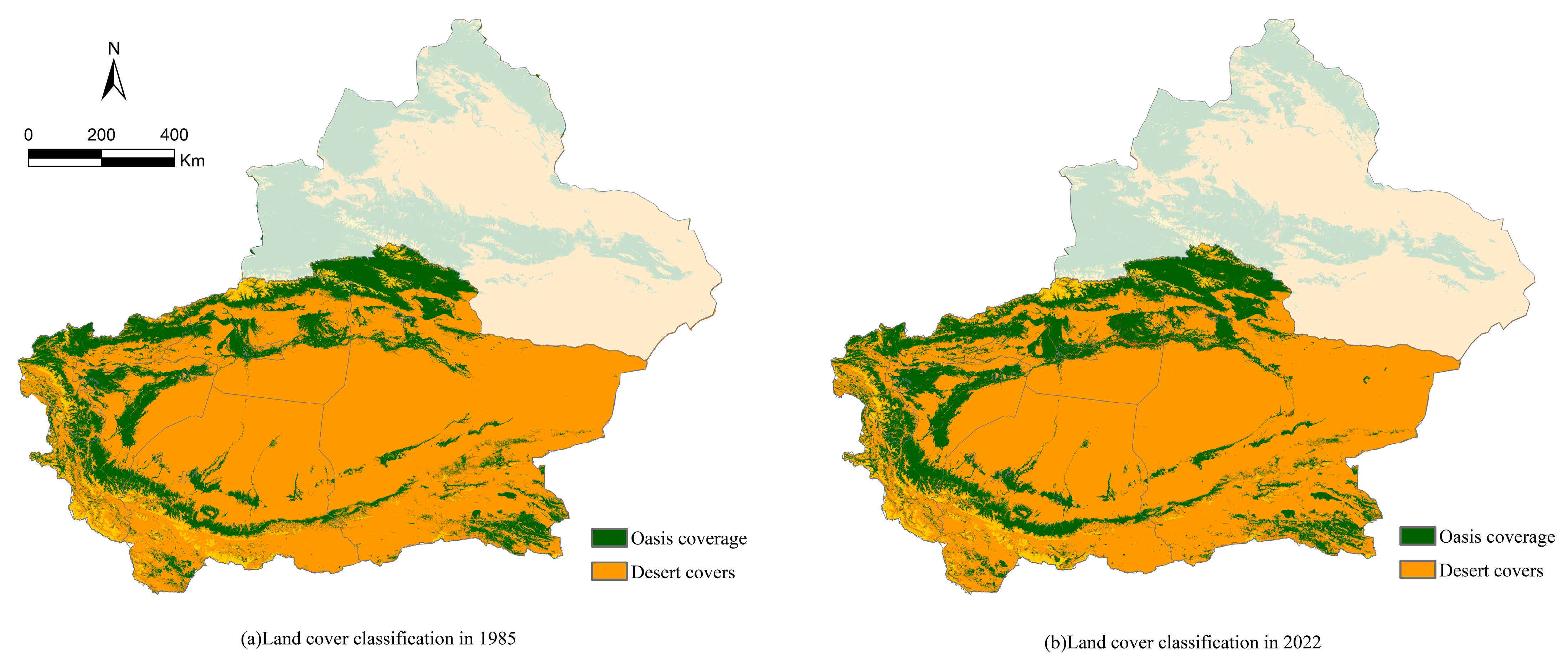
The Tarim Basin in southern Xinjiang is one of the regions with the highest sandstorm occurrence frequency in China and even worldwide. The annual average number of sandstorm days is defined as days with horizontal visibility less than 1 km, and it is commonly used to quantify sandstorm frequency. In recent years, due to a significant expansion of artificial oases on the southern slopes of the Tianshan Mountains, the frequency of sandstorms in the central and northern parts of the basin has relatively decreased. In 1985, the oasis area of the Tarim Basin was approximately 65,000 km2 (Figure 1), and by 2022, it had increased to 106,700 km2, representing a growth of 64.15%. From 1985 to 2022, the Tarim Basin also experienced a reduction of about 1956 km2 in desertified land and 242.82 km2 in desertification-prone areas. During the same period, the number of sandstorm days decreased by approximately 15 days, from 36 days in 1996 to 21 days in 2024. The expansion of oasis areas and the reduction in desert land have significantly decreased the frequency of dust storms. In spring, surface thawing, incomplete vegetation recovery, loose soil, and frequent alternation of cold and warm air masses contribute to high sandstorm activity, accounting for more than half of the annual occurrences. The average annual number of sandstorm days in many areas exceeds 20 days, and in several core regions, it even exceeds 30 days. In contrast, sandstorm frequency decreases significantly during summer and autumn. In winter, the ground is frozen or snow-covered, resulting in the lowest frequency of sandstorms.
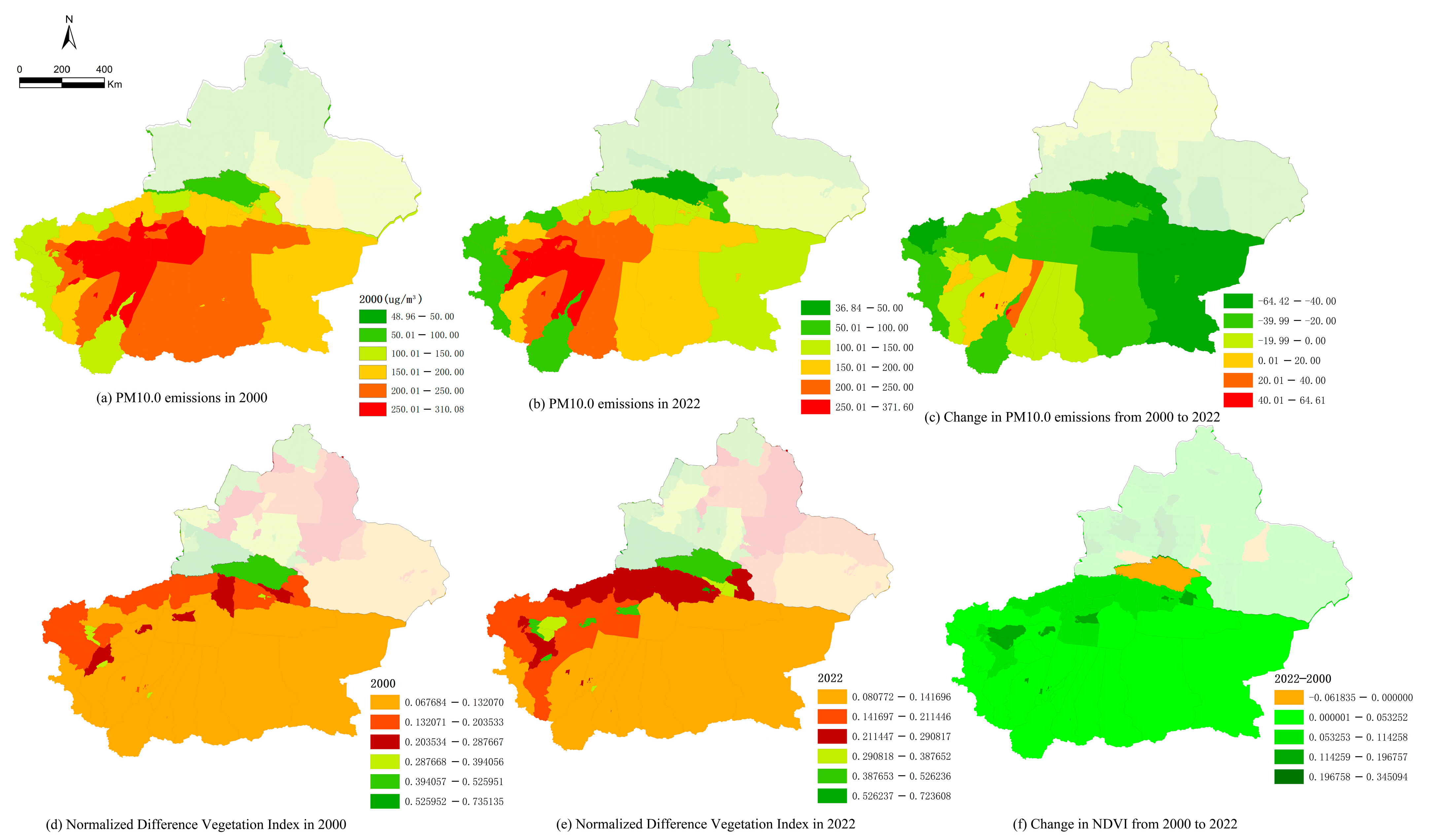
In order to quantitatively analyze the spatial relationship between sandstorms and oasis area changes, PM10 and green vegetation data for southern Xinjiang cities were visually analyzed. The results show that the spatial distribution of sandstorm disasters in southern Xinjiang presents a clear pattern: “two core source areas dominate, spreading along mountains and basins, and weakening significantly in oases.” PM10 emissions from urban sandstorms in southern Xinjiang contracted significantly from 2000 to 2022 (Figure 2), forming two core outbreak areas centered on Moyu County in Hotan and Bachu County in Kashgar. In 2000, the average annual PM10 concentration in cities around the Tarim Basin exceeded 100 μg/m3. By 2022, PM10 emissions increased in only six cities, mainly concentrated in Hotan Prefecture, among which Wada City experienced the most significant increase. The bare sand areas in the hinterland and on the edges of the Taklimakan Desert are permanent strong source areas, exhibiting the highest PM10 emission frequency and intensity. A total of 86.36% of the cities showed a significant downward trend in PM10 emissions, mainly concentrated in the oasis areas on the southern slope of the Tianshan Mountains. The changes in the green vegetation index (Figure 2) indicate that green vegetation in the cities surrounding the Tarim Basin also increased significantly from 2000 to 2022. Vegetation contracted in only one district or county, while all other cities showed an increasing trend. The most significant vegetation growth occurred in desert oasis cities such as Alar, Bachu, Pishan, Bohu, and Moyu. A green vegetation growth zone formed on the southern slope of the Tianshan Mountains, which was significantly correlated with the zonal contraction of PM10 emissions. This further demonstrates that green vegetation expansion in oasis cities can alleviate the intensity of sandstorm outbreaks. Sandstorms mainly propagate along the basin topography in a “northeast-southwest” direction, driven by dominant easterly winds in spring, causing the most direct impact on oases on the western edge of the Tarim Basin. In artificial oasis irrigation areas on the western edge, the frequency and intensity of sandstorms were significantly lower than those in the desert due to wet underlying surfaces and high vegetation coverage. Oasis cities such as Alar, Bachu, and Pishan on the western edge exhibited a significant weakening of sandstorm phenomena. Generally, the risk of sandstorms decreases from the desert center to the oasis edge, but the transition zone between the oasis and the desert remains at high risk of sandstorm invasion.

3.2. Geospatial Interaction Between Sandstorms and Oases in Southern Xinjiang

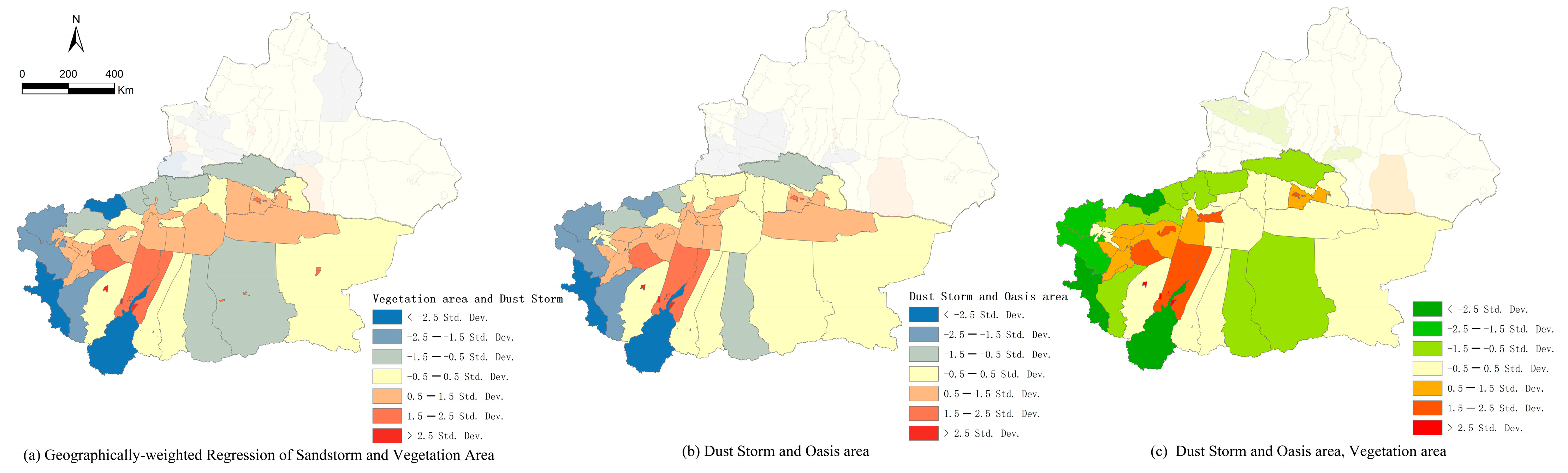
Through the above research, sandstorm disasters and changes in oasis vegetation scale show a significant correlation. To further investigate the spatial relationship among sandstorms, green vegetation, and oasis areas, GIS-based geographically weighted regression (GWR) analysis was conducted to reveal the intensity and direction of the impact of oasis and vegetation on the spatial distribution of sandstorm disasters in different regions (Figure 3). The spatial suppression effect of oases on sandstorms mainly exhibits a gradient pattern: “strong shielding at the core, weak blocking at the edges, and wedge-shaped reduction outside.” The core irrigation areas of oases form obvious “cold and wet islands” through dense vegetation cover and wet underlying surfaces, effectively reducing wind speed, stabilizing local sand sources, and providing strong shielding against sandstorms. The expansion of oasis areas plays a positive role in weakening sandstorm disasters in the Yeerqiang River and Hetian River basins. Oasis vegetation in the Tarim River Basin shows a significant inhibitory effect on sandstorm disasters (Figure 3a). Shelterbelts and transitional vegetation at the oasis edges form weak blocking zones, which can partly intercept and settle transported dust, thereby reducing the intensity of dust disasters. Oasis areas and green vegetation have significant inhibitory effects on sandstorm intensity in the Yeerqiang River and Hetian River basins. Large-scale, continuous oases act like ecological wedges embedded in the desert, significantly altering local airflow and creating areas of reduced wind speed downwind, thus exerting a wedge effect on the diffusion path and intensity of sandstorms. Scientific promotion of oasis construction and vegetation restoration within the carrying capacity of river water resources can effectively achieve the sustainable goal of mitigating sandstorm intensity.

3.3. Analysis on PM10 Emission Trend of Sandstorm in South Xinjiang

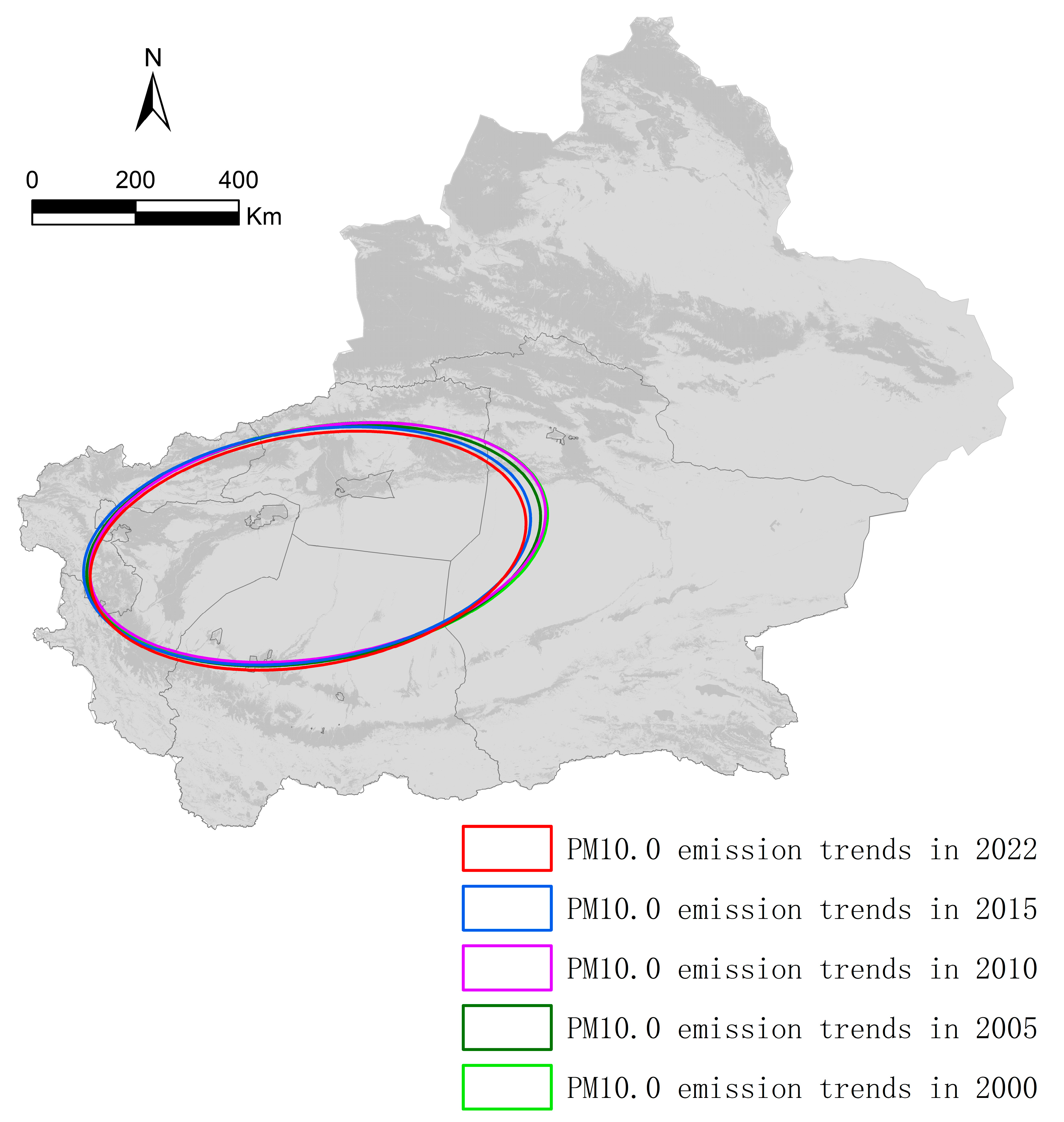
Based on recent observations and data studies of sandstorms, the South Xinjiang Basin, as a core sandstorm source area in China and even Central Asia, exhibits a complex characteristic: “overall frequency fluctuations decrease, but the uncertainty and risk of severe and extremely severe sandstorms remain significant.” To further explore the occurrence trends and pathways of sandstorm disasters in the Tarim Basin, this study uses the standard deviation ellipse tool to simulate and visualize the dynamic process and trends of sandstorms from 2000 to 2022, predict future outbreak paths, and provide references for sandstorm prevention strategies and artificial oasis construction. PM10 emissions from sandstorms in the Tarim Basin show a trend of scale contraction and a westward shift in the gravity center (Figure 4). From 2000 to 2022, the PM10 emission contraction center moved westward from Awati County in Aksu Prefecture to Moyu County in Hotan Prefecture. The overall scale of sandstorm disasters in the basin contracted noticeably, with the X-axis of the ellipse showing clear contraction and a westward shift, gradually approaching Hetian Moyu County and forming a frequent sandstorm center. The intensity of sandstorms decreased significantly, which is related to the construction of artificial oases. The Y-axis of the ellipse shows only slight contraction but a clear southward shift, indicating that the intensity of sandstorm disasters along the southern margin of the basin is increasing and gradually moving southward. This highlights the need to further strengthen artificial oasis construction along the southern margin to mitigate the outbreak frequency of sandstorm disasters in that area.

4. Discussion on Influencing Factors of Sandstorm Evolution in Southern Xinjiang

The variation in sandstorm intensity is a multi-dimensional issue, mainly influenced by meteorological dynamics, sand source materials, surface conditions, and human activities. Most studies have conducted exploratory research from the perspectives of meteorological dynamics and sand source materials, systematically analyzing the disaster logic of sandstorms in terms of wind strength, temperature changes, and geological structure. In contrast, research on the effects of surface conditions and human activities on sandstorm intensity changes remains limited. Based on this, we selected population size, economic level, green vegetation, and construction land area to systematically explore the impact of human activities and land cover on sandstorm intensity changes, using SPSS 19.0 to construct an impact model for sandstorm intensity variation in South Xinjiang. First, correlation analysis was employed to identify explanatory variables significantly associated with sandstorm intensity. Then, a forced-entry linear regression model was used to construct an explanatory model of sandstorm intensity variation, gradually eliminating weakly collinear and non-significant variables such as city size and industrial scale. Finally, core variables with significant influence, high explanatory power, and strong correlation with sandstorm intensity changes were identified (Table 1).
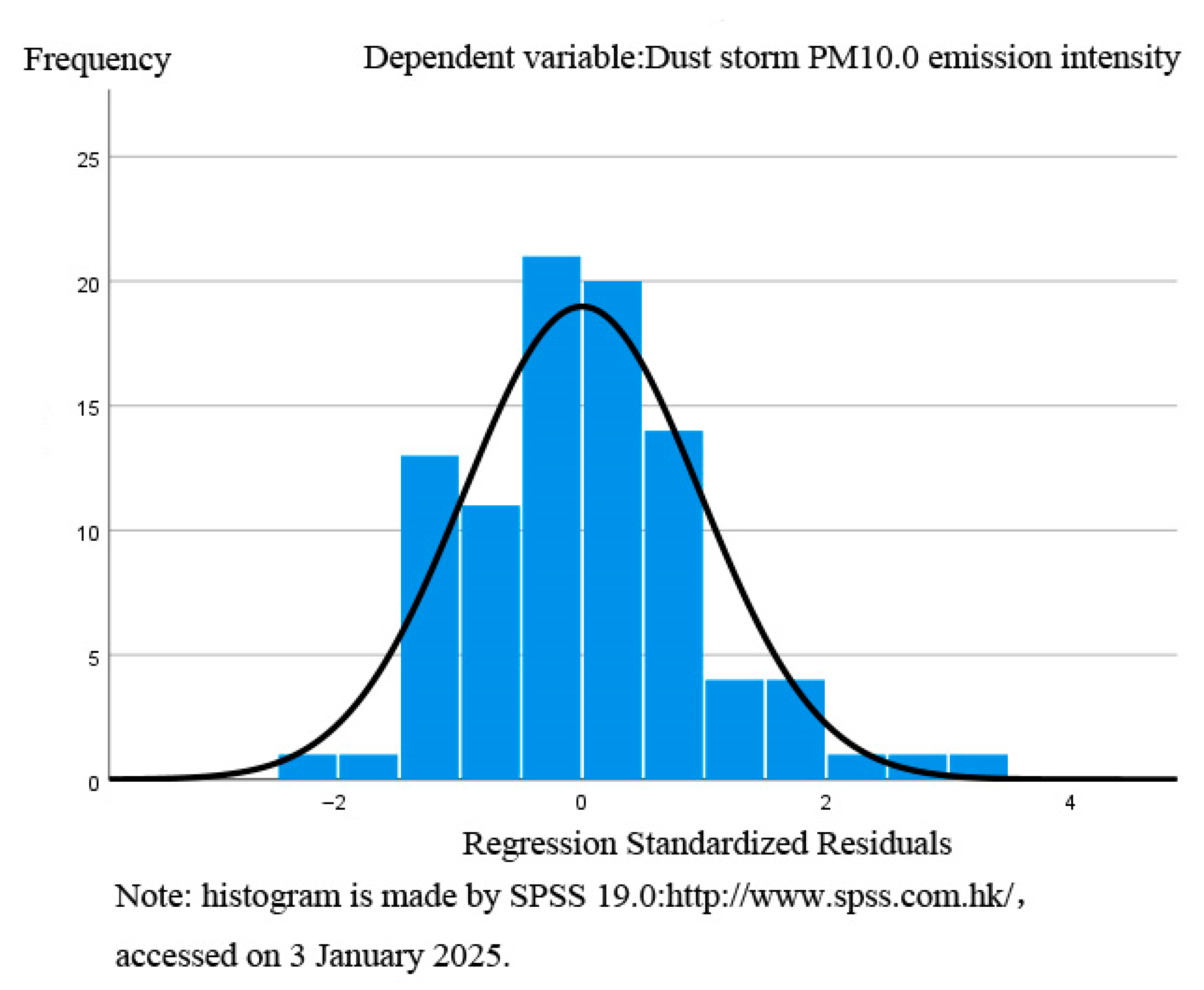
It is not difficult to find from Table 1 that the explanatory variables of sandstorm intensity change have a significant influence on the explanatory model, and the absolute value of T value is greater than 1.96. The VIF values are all less than 7.5, which also indicates that there is no collinearity between all variables. Sig. values are all less than 0.05, which indicates that variables have significant effects on the model. Sig. values are 0.000a. Moreover, the R2 values of the models are all greater than 0.5, and the model histogram is also normally distributed (Figure 5), which further proves that the interpretation model has strong robustness, a high fitting degree and good quality. It also shows that the model has important statistical significance and can be used to explain the disaster mechanism of the dust storm intensity difference distribution. The explanatory model is
Y = 226.330 − 111.79X1 − 0.008X2 + 0.458X3 − 4.1118X4 + 2.007X5 − 0.175X6
From the interpretation model, it can be seen that population size, economic level, green vegetation area, and rainfall in oasis cities significantly affect sandstorm intensity. Both the urban green vegetation cover index and urban grassland area are significantly negatively correlated with sandstorm disaster intensity, exhibiting a strong inhibitory effect. When other variables remain unchanged, a one-unit increase in the green vegetation cover index of an oasis city can reduce PM10 emissions from dust storms by 111.79 μg/m3. Green vegetation plays the most significant role in mitigating dust storm disasters. A similar effect is observed for urban grassland areas, where an increase of 1 km2 reduces PM10 emissions from urban dust storms by 0.008 μg/m3. Clearly, both natural and artificial vegetation can reduce sandstorm intensity, and expanding oasis urban vegetation areas will help mitigate the impacts of sandstorms on the urban human settlement environment. Urban rainfall also significantly suppresses sandstorm intensity. An increase of 1 mm in rainfall in oasis cities reduces PM10 emissions from urban sandstorms by 4.118 μg/m3. Rainfall is particularly important in the arid areas of the Tarim Basin, as it not only replenishes regional water resources but also counteracts large-scale evaporation in desert areas. It ensures the survival of green vegetation, inhibits land desertification, and reduces the intensity of sandstorm outbreaks. In contrast, urban constructed wetlands increase the surface area for evaporation, enhance water evaporation, and thus may increase the risk of sandstorm disasters. For every additional 1 km2 of urban wetland area, PM10 emissions from sandstorms increase by 0.458 μg/m3. Local governments should appropriately control the scale of constructed wetlands to help reduce sandstorm occurrence. Population growth also significantly promotes sandstorm intensity. For every increase of 10,000 in the registered population of oasis cities, PM10 emissions from sandstorms increase by 2.007 μg/m3. Rapid population growth can threaten the ecological carrying capacity of oasis roads, aggravate land degradation and desertification, and increase the frequency of sandstorm disasters. Therefore, local governments need to manage population growth in oasis cities in an orderly manner. Finally, economic growth in oasis cities can help mitigate sandstorm impacts. An increase of 100 million yuan in urban GDP reduces PM10 emissions from dust storms by 0.175 μg/m3. Higher local economic levels support regional governments in implementing desertification control and prevention projects, further reducing sandstorm damage.
In summary, green vegetation, population size, economic level, and precipitation are key driving factors influencing PM10 emissions from dust storms in oasis cities, either inhibiting or promoting sandstorm intensity to varying degrees. Assuming other variables remain constant, local governments can regulate these factors according to the interpretation model and formulate targeted sand control, prevention policies, and sustainable development strategies. By analyzing the spatial distribution factors of sandstorm intensity, a multi-dimensional and systematic strategy should be constructed around the core elements of “sand, people, forest, grass, water, and economy.” This strategy system should focus on stabilizing shifting sand, managing population scale, promoting artificial vegetation, implementing water-saving technologies, and advancing industrial transformation and upgrading.

5. Discussion on Desertification Control Policy

Xinjiang’s sand control policy has evolved from a partial response to systematic management, and ultimately to the pursuit of harmony between humans and sand as well as green and prosperous development. The evolution of desertification control policy in Xinjiang can be summarized into five stages. The 1950s to 1970s represent the infancy of policy. From 1978 to 1999, the policy entered a pilot stage. From 2000 to 2010, policy implementation advanced comprehensively. The period from 2011 to 2023 marks a rapid development stage. After 2023, the policy enters the stage of upgrading and transformation.
In the mid-1950s, Comrade Mao Zedong issued a call to “afforest the motherland,” initiating desertification control work in New China. In 1978, the CPC Central Committee made a strategic decision to build large-scale shelterbelts in key areas affected by windblown sand and soil erosion across northwest, northeast, and northern China. The “Three Norths” project was divided into three phases, and eight phases of shelterbelt projects were initiated. Initially, the main measures for desertification control were engineering defenses combined with mass participation. Xinjiang launched national ecological projects, relying on large-scale afforestation campaigns.
From 1978 to 1999, the policy entered the pilot stage. In the early 1980s, Cele County experienced three forced relocations due to sandstorm invasions, with quicksand advancing to within 1.5 km of the town. In 1983, the Cele Sand Control Research and Experimental Station was established in Xinjiang to explore scientific approaches such as “narrow forest belts” and “small grid” afforestation models. In 1986, the Keke Ya Greening Project, a model national ecological restoration project, was launched, building a “Green Great Wall” integrating windbreak forests, economic forests, and ecological forests. Several provincial-level plans and regulations were promulgated, including the Xinjiang Desertification Prevention Project Plan (1991–2000) and the Xinjiang National Desertification Land Prohibition Reserve Master Plan. With the support of desertification control policies, the overall intensity of sandstorms in Xinjiang has shown a significant declining trend, particularly experiencing a sudden drop in the mid-to-late 1980s (around 1987), resulting in the frequency and impact of sandstorms in the 1990s being noticeably lower than those in the 1970s and 1980s. However, there are substantial regional differences: the area surrounding the Taklamakan Desert in southern Xinjiang has remained the core region with the most frequent and highest-risk sandstorm activity, while sandstorm occurrences in northern Xinjiang and most other areas of the region have continued to decrease.
From 2000 to 2010, policy implementation advanced comprehensively, with the “Three Norths” project continuing to progress. Regulations on the Prevention and Control of Desertification in Xinjiang and other laws were promulgated. Administrative measures such as the Measures for the Implementation of the Forest Law of the People’s Republic of China in Xinjiang and the Regulations on Voluntary Tree Planting in Xinjiang were successively introduced. These laws provided legal guarantees for the protection of forest and grass resources and the prevention and control of desertification, improving local legislation and gradually establishing a comprehensive, law-based, and industrially integrated sand control management system. The combination of governance with characteristic forestry and fruit industries explored ecological and economic benefits, providing new economic impetus for sustainable sand control. Under the support of new policies, sandstorms in Xinjiang have exhibited a pattern of “decreasing frequency but complex intensity indicators.” In southern Xinjiang, the annual mean number of sandstorm days showed a fluctuating downward trend during this period, consistent with the overall decline in dust weather observed in northern China.
From 2011 to 2023, the policy entered a rapid development stage, and desertification control projects were incorporated into the national ecological security strategy. The “Three Norths” project entered an intensive implementation phase. The government formulated the Overall Plan for the Border Prevention War of the Taklimakan Desert in Xinjiang, the Comprehensive Control Plan for the Gurban Tonggute Desert, and the Provincial Ten-Year Plan for Desertification Prevention and Control in Xinjiang (2021–2030). Key documents included the Sixth Phase Plan of Xinjiang’s “Three Norths” Project, the Measures for the Special Administration of Finance of the Taklimakan Desert Border Interdiction Autonomous Region (Trial), and the Technical Rules for the Construction of the Sixth Phase of Xinjiang’s “Three Norths” Project. Landmark campaigns such as “blocking warfare” were launched. These policies promoted the transformation of desertification control from single-department governance to joint efforts across multiple sectors, from isolated management to systematic governance, and from quantity-focused measures to a combination of quantity and quality emphasis. Since 2011, the frequency and extent of sandstorm disasters in the Taklamakan Desert have significantly contracted, with the center of sandstorm activity shifting westward. With strong policy support, sandstorm disasters have been effectively controlled.
After 2023, the policy enters the stage of upgrading and transformation, with measures supporting the “Shajiu” blocking campaigns introduced. In 2024, the 3046 km green sand-blocking protective belt in the Taklimakan Desert will achieve comprehensive “locking edges and closing dragons.” The newly revised Measures for the Implementation of the Law on Desertification Prevention and Control in Xinjiang have come into effect. Desertification control has entered a stage of precise policy and green prosperity, with innovative incentive policies introduced in funding, land, and water management. The government has promoted innovative desertification control models such as “desertification controls + new energy,” “desertification control + ecotourism,” and “desertification controls + agricultural planting.” Efforts focus on developing the sand industry, building green sand control barriers, and promoting the sand mold planting economy. Interest linkage mechanisms have been strengthened to enable local communities to benefit from desertification prevention and control.
Xinjiang’s sand control policy represents a historical evolution from passive resistance to active management, ultimately pursuing “harmony between humans and sand.” In the early stage, national projects (e.g., the “Three Norths” shelterbelt) and mass movements established ecological defense lines. Subsequently, the policy entered a stage of scientific planning and legalization, exploring the “green-rich combination” through local legislation and characteristic forest-fruit industries. In the new era, the policy has been upgraded to a systematic approach under the national ecological civilization strategy. The government adopts top-level planning (e.g., the 2021–2030 plan), innovation incentives (e.g., the “Shajiu” campaign), and technological empowerment (e.g., photovoltaic sand control). Landmark campaigns such as the “Desert Edge Battle” have successfully promoted historical reductions in desertified land. The core of the current policy is “green and prosperous together,” deeply integrating ecological management with the sand industry and achieving a fundamental transformation from simple wind prevention and sand fixation to coordinated ecological, economic, and social development.

6. Conclusions

  • The spatial distribution of sandstorm disasters in South Xinjiang exhibits a clear pattern: “dominated by two core source areas, spreading along mountains and basins, and weakening significantly within oasis interiors.” There is a significant positive correlation between the oasis scale and sandstorm frequency. The spatial suppression effect of oases on sandstorms mainly exhibits a gradient pattern: “strong shielding at the core, weak blocking at the edges, and wedge-shaped reduction at the periphery.”
  • The outbreak frequency of sandstorms exhibits a contracting trend, and the barycenter shifts westward. The outbreak areas show clear clustering characteristics, forming high-incidence sandstorm zones with Alar City, Bachu County, Pishan County, and Moyu County as the cores.
  • Green vegetation cover, population size, economic level, and rainfall are significantly correlated with sandstorm intensity. A one-unit increase in the green vegetation cover index of an oasis city can reduce PM10 emissions from sandstorms by 111.79 μg/m3, and large-scale artificial vegetation planting clearly suppresses the outbreak frequency of sandstorms.
  • The continuous reform of laws, systems, and policies in Xinjiang has also provided a solid foundation for a sustainable desertification control strategy, evolving from passive resistance to active management and utilization of desert areas. This has achieved a fundamental transformation from simple windbreak and sand fixation measures to the coordinated development of ecological, economic, and social benefits.
Finally, PM10 concentration was used to represent the frequency of sandstorms because quantitative data on sandstorm intensity are difficult to obtain. This approach is widely adopted in long-term, large-scale studies in arid regions. However, PM10 levels can also be influenced by anthropogenic emissions and regional transport processes, which introduce certain limitations. Therefore, using PM10 as a sandstorm index is more suitable for industrially underdeveloped or less developed areas, but it may not be appropriate for highly industrialized regions.

Author Contributions

Z.Q. conceptualized the study, interpreted the results and prepared the original draft of the manuscript. X.Z. conceptualized the study and methodology, performed the statistical analysis, interpreted the results and revised the manuscript. All authors have read and agreed to the published version of the manuscript.

Funding

This research is supported by the National Natural Science Foundation of China (Project No: 52278044). This research is supported by Tarim University Urban and Rural Planning Support Professional Construction Project (No: FCZYXJ202503).

Institutional Review Board Statement

Not applicable.

Informed Consent Statement

Not applicable.

Data Availability Statement

All the data included in this study are available upon request from the corresponding author.

Conflicts of Interest

The authors declare no conflicts of interest.

References

  1. Han, J.; Dai, H.; Gu, Z. Sandstorms and desertification in Mongolia, an example of future climate events: A review. Environ. Chem. Lett. 2021, 19, 4063–4073. [Google Scholar] [CrossRef]
  2. Yang, M.; Tian, C.; Guo, B.; Hao, X. The Taklamakan Desert has shrunk over the last two decades. GISci. Remote Sens. 2025, 62, 2574122. [Google Scholar] [CrossRef]
  3. Xi, L.; Qi, Z.; Feng, Y.; Cui, M.; Zou, J. Identification of the Extent of Desertification in the Ring-Tarim Basin Based on the Desertification Composite Index (DCI). Land Degrad. Dev. 2025, 36, 6207–6220. [Google Scholar] [CrossRef]
  4. Jin, L.; He, Q.; Li, Z.; Abbas, A. Variation characteristics of dust in the Taklimakan Desert. Nat. Hazards 2024, 120, 2129–2153. [Google Scholar] [CrossRef]
  5. Yoshino, M. Wind and rain in the desert region of Xinjiang, Northwest China (Wind und Niederschlag im Wüstengebiet von Xinjiang, Nordwest-China). Erdkunde 1992, 46, 203–216. [Google Scholar] [CrossRef]
  6. Li, W.; Zhao, S.; Chen, Y.; Wang, Q.L.; Ai, W.X. State of China’s climate in 2020. Atmos. Ocean. Sci. Lett. 2021, 14, 100048. [Google Scholar] [CrossRef]
  7. Su, Y.; Wang, X.; Luo, X.; Chen, S.; Chen, Y.; Yang, F.; Lei, J.; Chen, F. Warming-Induced Increase in Flooding in the Taklimakan Desert. J. Earth Sci. 2025, 36, 1351–1354. [Google Scholar] [CrossRef]
  8. Tsui, S.; Zhixiong, H.; Heim, S.K.L.; Tiejun, W. Chinese Strategies of Delinking Amid the Implosion of Financial Imperialism. Agrar. South J. Political Econ. 2025, 14, 60–83. [Google Scholar] [CrossRef]
  9. Jiang, Y.; Miao, Y.; Zhao, Y.; Liu, J.; Gao, Y. Extreme-wind events in China in the past 50 years and their impacts on sandstorm variations. Front. Earth Sci. 2023, 10, 1058275. [Google Scholar] [CrossRef]
  10. Xin-Fa, Q.; Yan, Z.; Qi-Long, M. Sand-dust storms in China: Temporal-spatial distribution and tracks of source lands. J. Geogr. Sci. 2001, 11, 253–260. [Google Scholar] [CrossRef]
  11. Zhang, X.X.; Sharratt, B.; Chen, X.; Wang, Z.F.; Liu, L.Y.; Guo, Y.H.; Li, J.; Chen, H.S.; Yang, W.Y. Dust deposition and ambient PM10 concentration in northwest China: Spatial and temporal variability. Atmos. Chem. Phys. 2017, 17, 1699–1711. [Google Scholar] [CrossRef]
  12. Shao, Y.; Wang, J. A climatology of Northeast Asian dust events. Meteorol. Z. 2003, 12, 187–196. [Google Scholar] [CrossRef]
  13. Al-Hemoud, A. Exposure of Dust Storms and Air Pollution (PM10, PM2.5) and Associated Health Risk in the Arid Region. In Dust and Health: Challenges and Solutions; Springer International Publishing: Cham, Switzerland, 2023; pp. 51–78. [Google Scholar] [CrossRef]
  14. Kelly, F.J.; Fussell, J.C. Global nature of airborne particle toxicity and health effects: A focus on megacities, wildfires, dust storms and residential biomass burning. Toxicol. Res. 2020, 9, 331–345. [Google Scholar] [CrossRef]
  15. Tong, D.Q.; Gill, T.E.; Sprigg, W.A.; Van Pelt, R.S.; Baklanov, A.A.; Barker, B.M.; Bell, J.E.; Castillo, J.; Gassó, S.; Gaston, C.J.; et al. Health and safety effects of airborne soil dust in the Americas and beyond. Rev. Geophys. 2023, 61, e2021RG000763. [Google Scholar] [CrossRef]
  16. Aghaei, A.; Eslamian, S.; Dalezios, N.R.; Saeidi-Rizi, A.; Bahredar, S. Drought and Dust Management. In Handbook of Drought and Water Scarcity; CRC Press: Boca Raton, FL, USA, 2017; pp. 699–728. [Google Scholar]
  17. Zhou, Y.; Gao, X.; Lei, J. Characteristics of dust weather in the Tarim Basin from 1989 to 2021 and its impact on the atmospheric environment. Remote Sens. 2023, 15, 1804. [Google Scholar] [CrossRef]
  18. He, Q.; Li, J.; Zhao, T.; Zhang, H.; Meng, L. Observing a dust aerosol layer at a height of 3–4 km above the ground on the southern margin of the Tarim Basin. Atmos. Environ. 2024, 318, 120236. [Google Scholar] [CrossRef]
  19. Dubey, J.; Singh, D.S.; Sati, S.P. Cryosphere Response to Climate Change and Disaster Risk Reduction in the Arid Northwestern Ladakh Himalaya. In Ecosystem-Based Approaches for Resilience Building in Himalayan Landscapes: Insights for Climate Change and Disaster Risk Reduction; Springer Nature: Singapore, 2025; pp. 3–27. [Google Scholar] [CrossRef]
  20. Chen, J.; Xu, J.; Wu, Z.; Meng, X.; Yu, Y.; Ginoux, P.; DeMott, P.J.; Xu, R.; Zhai, L.; Yan, Y.; et al. Decreased dust particles amplify the cloud cooling effect by regulating cloud ice formation over the Tibetan Plateau. Sci. Adv. 2024, 10, eado0885. [Google Scholar] [CrossRef]
  21. Thurston, H. Secrets of the Sands: The Revelations of Egypt’s Everlasting Oasis; Arcade Publishing: Ostfildern, Germany, 2004. [Google Scholar]
  22. Awadh, S.M. Impact of North African sand and dust storms on the Middle East using Iraq as an example: Causes, sources, and mitigation. Atmosphere 2023, 14, 180. [Google Scholar] [CrossRef]
  23. Luo, L.; Zhuang, Y.; Zhao, W.; Duan, Q.; Wang, L. The hidden costs of desert development. Ambio 2020, 49, 1412–1422. [Google Scholar] [CrossRef]
  24. Lovejoy, P.E.; Baier, S. The desert-side economy of the central Sudan. Int. J. Afr. Hist. Stud. 1975, 8, 551–581. [Google Scholar] [CrossRef]
  25. Gao, J.; Chen, D.; Saitiniyazi, M. Vulnerability of oasis agriculture to sandstorm disasters in Xinjiang, China. Bangladesh J. Bot. 2020, 49, 981–988. [Google Scholar] [CrossRef]
  26. Wang, W.; He, S.; Guo, H.; Abuduwaili, J.; Samat, A.; De Maeyer, P.; Van de Voorde, T. Sand and dust storm risk assessment in arid central Asia: Implications for the environment, society, and agriculture. Int. J. Disaster Risk Sci. 2024, 15, 703–718. [Google Scholar] [CrossRef]
  27. Gardner, R.C. Technological Forests: Engineering Nature with Tree Planting on the Great Plains, 1870–1944. Ph.D. Thesis, Montana State University, Bozeman, MT, USA, 2013. Available online: https://www.proquest.com/docview/1357147887?pq-origsite=gscholar&fromopenview=true&sourcetype=Dissertations%20&%20Theses (accessed on 30 May 2025).
  28. Rosenzweig, M.L. Win-Win Ecology: How the Earth’s Species Can Survive in the Midst of Human Enterprise; Oxford University Press: Melbourne, Australia, 2003. [Google Scholar]
  29. Sandu, C.; Brasoveanu, D.; Silivestru, V.; Filipescu, B.; Sandu, R.C. Space Technology for Reduction of Desert Areas on Earth and Weather Control. INCAS Bull. 2018, 10, 39–49. [Google Scholar] [CrossRef]
  30. Li, S.; Li, S.; Jin, L. The Design and Physical Implementation of Seeding Robots in Deserts. In Proceedings of the 2020 39th Chinese Control Conference (CCC), Shenyang, China, 27–29 July 2020; IEEE: Washington, DC, USA, 2020; pp. 3892–3897. [Google Scholar] [CrossRef]
  31. Noreen, S.; Giannetti, F.; Lottici, V. Earth and Martian Sand and Dust Storms: A Comprehensive Review of Attenuation Modelling and Measurements. IEEE Access 2023, 12, 878–922. [Google Scholar] [CrossRef]
  32. Akhlaq, M.; Sheltami, T.R.; Mouftah, H.T. A review of techniques and technologies for sand and dust storm detection. Rev. Environ. Sci. Bio/Technol. 2012, 11, 305–322. [Google Scholar] [CrossRef]
  33. Alharbi, S.; Felemban, A.; Abdelrahim, A.; Al-Dakhil, M. Agricultural and Technology-based strategies to improve water-use efficiency in Arid and Semiarid areas. Water 2024, 16, 1842. [Google Scholar] [CrossRef]
  34. Rastogi, M.; Kolur, S.M.; Burud, A.; Sadineni, T.; Sekhar, M.; Kumar, R.; Rajput, A. Advancing water conservation techniques in agriculture for sustainable resource management: A review. J. Geogr. Environ. Earth Sci. Int. 2024, 28, 41–53. [Google Scholar] [CrossRef]
  35. Li, Y.; Cui, J.; Zhang, T.; Drake, S. Effectiveness of sand-fixing measures on desert land restoration in Kerqin Sandy Land, northern China. Ecol. Eng. 2009, 35, 118–127. [Google Scholar] [CrossRef]
  36. Robbins, W.R. Growing plants in sand cultures for experimental work. Soil Sci. 1946, 62, 3–22. [Google Scholar] [CrossRef]
  37. Xue, X.; Liao, J.; Hsing, Y.; Huang, C.; Liu, F. Policies, land use, and water resource management in an arid oasis ecosystem. Environ. Manag. 2015, 55, 1036–1051. [Google Scholar] [CrossRef]
  38. Huang, J.; Wang, R.; Zhang, H. Analysis of patterns and ecological security trend of modern oasis landscapes in Xinjiang, China. Environ. Monit. Assess. 2007, 134, 411–419. [Google Scholar] [CrossRef]
  39. Middleton, N.; Al-Hemoud, A. Sand and dust storms: Recent developments in impact mitigation. Sustainability 2024, 16, 7121. [Google Scholar] [CrossRef]
  40. Zheng, Z.; Luo, H.; Wang, P.; Chen, Z. Sand and Dust Storms Drivers: A 22 Years Global Bibliometric Evolution. Earth Syst. Environ. 2025, 1–17. [Google Scholar] [CrossRef]
  41. Chen, J.; Yin, S.; Gebhardt, H.; Yang, X. Farmers’ livelihood adaptation to environmental change in an arid region: A case study of the Minqin Oasis, northwestern China. Ecol. Indic. 2018, 93, 411–423. [Google Scholar] [CrossRef]
  42. Bondes, M.; Li, D. Climate Change and Sustainable Development in Western China’s Minqin Oasis. In Climate Change, Sustainable Development, and Human Security: A Comparative Analysis; Lexington: Lanham, MD, USA, 2013; pp. 139–168. [Google Scholar] [CrossRef]
  43. Gu, Z.; He, Y.; Zhang, Y.; Su, J.; Zhang, R.; Yu, C.W.; Zhang, D. An overview of triggering mechanisms and characteristics of local strong sandstorms in China and haboobs. Atmosphere 2021, 12, 752. [Google Scholar] [CrossRef]
  44. Xue, J.; Gui, D.; Lei, J.; Sun, H.; Zeng, F.; Mao, D.; Zhang, Z.; Jin, Q.; Liu, Y. Oasis microclimate effects under different weather events in arid or hyper arid regions: A case analysis in southern Taklimakan desert and implication for maintaining oasis sustainability. Theor. Appl. Climatol. 2019, 137, 89–101. [Google Scholar] [CrossRef]
  45. Zhao, W.; Hu, G.; Zhang, Z.; He, Z. Shielding effect of oasis-protection systems composed of various forms of wind break on sand fixation in an arid region: A case study in the Hexi Corridor, northwest China. Ecol. Eng. 2008, 33, 119–125. [Google Scholar] [CrossRef]
  46. Wan, D.; Mu, G.; Jin, Z.; Lei, J. The effects of oasis on aeolian deposition under different weather conditions: A case study at the southern margin of the Taklimakan desert. Environ. Earth Sci. 2013, 68, 103–114. [Google Scholar] [CrossRef]
  47. Maji, S.; Sonwani, S. Nature of Sand and Dust Storm in South Asian Region: Extremities and Environmental Impacts. In Extremes in Atmospheric Processes and Phenomenon: Assessment, Impacts and Mitigation; Springer Nature: Singapore, 2022; pp. 113–139. [Google Scholar] [CrossRef]
  48. Middleton, N. Impacts of sand and dust storms on food production. Environ. Res. Food Syst. 2024, 1, 022003. [Google Scholar] [CrossRef]
  49. Mahanta1, N.R.; Lele, S. Evolving Trends of Artificial Intelligence and Robotics in Smart City Applications: Crafting Humane Built Environment. In Trust-Based Communication Systems for Internet of Things Applications; Wiley: Hoboken, NJ, USA, 2022; pp. 195–241. [Google Scholar] [CrossRef]
  50. Rędzińska, K.; Dreksler, B. Climate Change and Landscape: Emerging Technologies. In Landscape Architecture in the Arab Middle East; Routledge: London, UK, 2025; pp. 29–54. [Google Scholar]
  51. Scanlon, B.R.; Levitt, D.G.; Reedy, R.C.; Keese, K.E.; Sully, M.J. Ecological controls on water-cycle response to climate variability in deserts. Proc. Natl. Acad. Sci. USA 2005, 102, 6033–6038. [Google Scholar] [CrossRef] [PubMed]
  52. Whitford, W.G.; Duval, B.D. Ecology of Desert Systems; Academic Press: Cambridge, MA, USA, 2019. [Google Scholar]
  53. Du, L.; Wang, H.; Xu, H. Analysis of spatial-temporal association and factors influencing environmental pollution incidents in China. Environ. Impact Assess. Rev. 2020, 82, 106384. [Google Scholar] [CrossRef]
  54. Zhang, J.; Zhu, W.; Zhao, F.; Zhu, L.; Li, M.; Zhu, M.; Zhang, X. Spatial variations of terrain and their impacts on landscape patterns in the transition zone from mountains to plains—A case study of Qihe River Basin in the Taihang Mountains. Sci. China Earth Sci. 2018, 61, 450–461. [Google Scholar] [CrossRef]
  55. Zhang, Y.; Jiang, P.; Cui, L.; Yang, Y.; Ma, Z.; Wang, Y.; Miao, D. Study on the spatial variation of China’s territorial ecological space based on the standard deviation ellipse. Front. Environ. Sci. 2022, 10, 982734. [Google Scholar] [CrossRef]
  56. Yuill, R.S. The standard deviational ellipse; an updated tool for spatial description. Geogr. Ann. Ser. B Hum. Geogr. 1971, 53, 28–39. [Google Scholar] [CrossRef]
  57. Wang, H.; Lv, S.; Diao, Z.; Wang, B.; Zhang, H.; Yu, C. Study on sandstorm PM10 exposure assessment in the large-scale region: A case study in Inner Mongolia. Environ. Sci. Pollut. Res. 2018, 25, 17144–17155. [Google Scholar] [CrossRef]
  58. Yu, L.; Wu, Z.; Du, Z.; Zhang, H.; Liu, Y. Insights on the roles of climate and human activities to vegetation degradation and restoration in Beijing-Tianjin sandstorm source region. Ecol. Eng. 2021, 159, 106105. [Google Scholar] [CrossRef]
  59. Wei, J.; Li, Z.; Xue, W.; Sun, L.; Fan, T.; Liu, L.; Su, T.; Cribb, M. The ChinaHighPM10 dataset: Generation, validation, and spatiotemporal variations from 2015 to 2019 across China. Environ. Int. 2021, 146, 106290. [Google Scholar] [CrossRef] [PubMed]
  60. Fan, H.; Zhao, C.; Yang, Y. A comprehensive analysis of the spatio-temporal variation of urban air pollution in China during 2014–2018. Atmos. Environ. 2020, 220, 117066. [Google Scholar]
Figure 1. Oasis scale change in Tarim Basin from 1985 to 2022.
Sustainability 18 01240 g001
Figure 2. Relationship between PM10 emission from sandstorms and vegetation area change in southern Xinjiang from 2000 to 2022.
Sustainability 18 01240 g002
Figure 3. Geographically weighted Regression relationship between dust storm and oasis, vegetation.
Sustainability 18 01240 g003
Figure 4. Weather Change Trend of Sandstorm PM10 in South Xinjiang from 2000 to 2022.
Sustainability 18 01240 g004
Figure 5. Standardized residual histogram.
Sustainability 18 01240 g005
Table 1. Statistical analysis model of influencing factors of sandstorm disaster.
ModelClassification of IndicatorsVariableBTSig.VIF
Model 1:
(Dependent variable: Urban PM10)
(constant)226.33013.4330.000
Urban landGreen vegetation index/(X1)−111.790−2.5700.0122.226
Grassland area/km2 (X2)−0.008−4.6530.0001.924
Urban constructionWetland area/km2(X3)0.4582.4280.0171.584
Urban rainfallMean annual precipitation/mm (X4)−4.118−4.6740.0002.108
Urban populationPermanent resident population/104 people (X5)2.0075.8770.0001.306
Urban economicGross regional domestic product/108 yuan (X6)−0.175−4.5860.0001.250
Disclaimer/Publisher’s Note: The statements, opinions and data contained in all publications are solely those of the individual author(s) and contributor(s) and not of MDPI and/or the editor(s). MDPI and/or the editor(s) disclaim responsibility for any injury to people or property resulting from any ideas, methods, instructions or products referred to in the content.