Article

ESG Performance and Corporate OFDI: The Moderating Role of the Corporate Life Cycle

1
School of Economics and Management, Xiamen University Malaysia, Sepang 43900, Malaysia
2
Shenzhen Research Institute of Xiamen University, Xiamen University, Shenzhen 518000, China
3
Overseas Education College, Xiamen University, Xiamen 361005, China
*
Author to whom correspondence should be addressed.
Sustainability 2026, 18(3), 1231; https://doi.org/10.3390/su18031231
Submission received: 16 December 2025 / Revised: 8 January 2026 / Accepted: 14 January 2026 / Published: 26 January 2026
(This article belongs to the Section Economic and Business Aspects of Sustainability)

Abstract

As China has increased implementation of its opening-up strategy and the “Belt and Road” initiative, Chinese enterprises have encountered significant historical opportunities to expand their outward foreign direct investment (OFDI). However, international organizations and major nations are increasingly focusing on nonfinancial indicators for multinational corporations; as a result, enterprises frequently encounter social responsibility crises in cross-border investments. Consequently, Chinese firms must enhance their environmental, social, and governance (ESG) practices to bolster their comprehensive competitiveness, which is crucial for promoting successful international engagement and sustainability. This research explores the U-shaped relationship between ESG performance and OFDI, examining how different stages of the corporate lifecycle affect OFDI. The findings indicate that ESG investments compete with OFDI for internal resources during the introduction, growth, and decline phases, thereby inhibiting OFDI activities. In contrast, strong ESG performance in the maturity phase provides a competitive advantage in international markets, facilitating OFDI. The empirical analysis uses a fixed-effects model on a sample of Chinese A-share-listed companies from 2009 to 2022 and employs the PSM, 2SLS, and System GMM methods to test for endogeneity. The results reveal that (1) a positive U-shape relationship between ESG performance and corporate OFDI, and the inflection point occurs when the ESG score equals 69.04. Moreover, (2) the corporate lifecycle intensifies this nonlinear relationship, with growth-phase firms showing a significant inhibitory effect and mature-phase firms showing a pronounced promotional effect. Finally, (3) the U-shaped relationship between ESG performance and corporate OFDI is more pronounced in nonstate-owned enterprises. Based on these findings, this paper provides targeted policy recommendations for enterprises and governments.

1. Introduction

Outward foreign direct investment (OFDI) is a pivotal approach for developing nations to achieve high levels of international openness [1]. Since the 2000s, China has experienced a meteoric rise in OFDI, emerging from a developing-country base to become the world’s second-largest outward investor [2]. The shift from “capital import” to “capital export” is considered a strategic economic transition for China. The trend of Chinese exports and OFDI growth has a reciprocal pattern, reflecting the proactive shift by Chinese enterprises to expand internationally. Undoubtedly, the rapid expansion in scale and regions of OFDI has significantly promoted the high-quality development of China’s economy and ensured that China’s development benefits the world.
Nonetheless, ample room remains for China to improve the quality of its OFDI. The rapid expansion of OFDI in recent years has led to issues such as insufficient environmental awareness, resource waste, deceptive advertising, unfair competition, and substandard product quality. These challenges have escalated overall operational costs for Chinese enterprises, thereby diminishing their international competitiveness and exerting a greater adverse impact on China’s foreign trade [2]. Furthermore, the investment climate for Chinese enterprises continues to deteriorate amidst a global economic recession compounded by uncertainties. Since the 2008 global financial crisis, global economic downturns, the United States–China trade tensions, the Ukraine crisis, and the COVID-19 pandemic have intensified instability, uncertainty, and unpredictability; these issues have led to reduced overseas investment returns and more cautious investment strategies. Additionally, the current global shift marked by unprecedented changes over the past century has accelerated the rise of unilateralism and protectionism. Some countries, seeking to shift domestic conflicts, have advocated “decoupling” from global supply chains [3], imposing barriers such as increased tariffs, technological blockades, and green barriers, thereby raising the threshold and complexity of investment for Chinese enterprises venturing overseas. Moreover, financial constraints persist. Enterprises venturing overseas need enhanced financial services support for financing, investment guarantees, and cross-border currency exchange. Nonfinancial direct investment flows for private enterprises accounted for over 80% in 2023; however, most private enterprises are small-scale and struggle to meet the stringent overseas loan conditions and guarantee requirements of policy banks, limiting their willingness and ability to invest abroad.
Chinese enterprises face complex international environments and internal management challenges, and determining how to effectively enhance and sustain their competitiveness in international markets while mitigating investment risks is a pressing issue. In this context, many scholars advocate that environmental, social, and governance (ESG) disclosure provides a viable pathway to improve enterprises’ OFDI and globalization [2,4,5]. This ESG approach is attributed to the significant societal benefits generated by ESG activities and the reconciliation of interest conflicts [6], thereby enhancing stakeholder relationships and resource availability. When enterprises align profit maximization with economic and societal values under ESG principles, their competitive logic and advantages transform profoundly [2]. Numerous studies have demonstrated that corporate ESG performance can serve as a signal to the external world about an enterprise’s internal characteristics and quality, thereby bolstering investor confidence and reducing financing costs [7]. ESG information also reduces the degree of information asymmetry and the associated risk premium [8,9,10]. Moreover, ESG can help enterprises avoid risks [11], build trust during crises [12], and enhance international competitiveness. Both Cheng and Su (2024) [2] and Wang et al. (2024) [4] posited that ESG could promote OFDI by perfecting reputation mechanisms, alleviating capital constraints, and reducing corporate risks. As an emerging market country, China has a relatively immature domestic market environment, which constitutes a significant institutional incentive for corporate internationalization [13]. However, this type of “institutional escape” international investment also subjects emerging-market enterprises to severe legitimacy challenges in host countries, where they may be doubted for their capacity to fulfill local social responsibilities [14]. Consequently, the societal inclusiveness demonstrated by ESG helps enterprises establish a reputation as responsible investors, thereby overcoming the disadvantages outsiders face.
While continuous improvement in ESG performance is deemed crucial for sustaining corporate OFDI growth, there is a scholarly divide over its actual efficacy. Skeptics such as Shan et al. (2024) [15] argued that the deferred returns on ESG investments may escalate operating costs, thereby diverting resources essential for daily production and impeding corporate growth. Additional studies have posited that managers pursue profit maximization during prosperous times and resort to responsible investments mainly during periods of weak performance to mitigate impacts—the principal-agent dilemma inherent in this scenario may lead to agency problems that diminish commercial creditors’ willingness to extend business credit [16]. Furthermore, the efficient market hypothesis holds that markets do not price social responsibility characteristics; if the expected returns on responsible investments are no greater than those from conventional portfolios, firms will not undertake such investments [17].
These studies reveal substantial academic debate regarding the economic effects of ESG investments. While existing research has explored the facilitative role of ESG performance in corporate OFDI, past studies generally analyze at the aggregate corporate level, overlooking potential heterogeneity across different growth stages. The influence of ESG performance on OFDI may vary significantly across these stages, raising the question of whether the corporate lifecycle moderates this relationship. Exploring this connection is crucial for enterprises at various stages of development as they consider ESG investments and reshape their ESG operational philosophies.
The potential marginal contributions of this paper are as follows. First, this paper analyzes the dynamic relationship between ESG and corporate OFDI. Most scholars have focused on a static relationship between ESG and OFDI, rarely considering the dynamic relationship that may exist across different stages of company growth. OFDI typically evolves over the lifecycle, and the ESG characteristics of firms at different development stages may lead to varying OFDI outcomes; therefore, integrating corporate lifecycle theory into ESG research to examine the impact of ESG at different stages of corporate development provides targeted decision-making insights for businesses. Second, because different industries have varying resource allocations and regulatory requirements, their corporate lifecycles may differ depending on industry characteristics and the nature of the enterprise. This paper further explores the heterogeneity of corporate lifecycles of differing enterprise natures, making the conclusions more universally applicable.
The remainder of the study is organized as follows. The second part analyzes theoretical content related to the topic, including discussions of corporate OFDI, ESG performance, and nonfinancial disclosure, the resource-constraint hypothesis, stakeholder theory, and corporate lifecycle theory. It also summarizes the analysis of the effect of ESG performance on corporate OFDI, laying the theoretical foundation for the subsequent empirical analysis. The third part presents the core focus of this paper, designs and researches the topic content, covering research hypotheses, sample selection, data sources, and variable descriptions. The fourth part contains the empirical analysis, exploring descriptive statistics, variable correlation analysis, baseline regression analysis, endogeneity tests, robustness tests, and heterogeneity analysis. This section examines the relationships among ESG performance, corporate OFDI, and the moderating role of the corporate lifecycle. The fifth part concludes and provides directions for future research.

2. Literature Review

2.1. ESG Performance and Corporate OFDI

The capital constraint hypothesis holds that firms are constrained by their capability to raise both internal and external finance when making investment decisions. Firms with limited available capital require trade-offs when engaging in varying types of investments [18]. The corporate strategy of optimizing ESG performance and OFDI reflects the capital trade-off. Since ESG performance improvement requires a substantial capital injection and is ineffective in the short term, firms are likely to curtail OFDI to ensure adequate resources to meet ESG requirements.
Under the capital constraint assumption, firms are constrained by their internal and external financing capabilities when making investment decisions. The scarcity of available funds necessitates a balancing act among various investment types [18]. Enhancing ESG performance in conjunction with OFDI strategies exemplifies such a capital allocation. Given the substantial financial requirements and the extended time horizon to realize benefits from ESG initiatives, firms might curtail OFDI to ensure they have sufficient resources to meet ESG criteria. Research using US data indicates that bank creditors do not offer preferential interest rates to firms with superior ESG performance; instead, they predominantly assess credit quality [18]. Based on data from China, Chen et al. (2018) [19] found that mandatory nonfinancial disclosure policies, while reducing pollution and enhancing positive externalities, also lead to a short-term decline in profitability and an increase in debt risk. Moreover, managers’ potential to manipulate nonfinancial information might lead to subjective and opaque disclosures, thereby amplifying inherent agency risks [20].
Furthermore, compared to domestic investments, firms undertaking OFDI incur significant fixed and variable production costs when entering new markets [21]; these costs are characterized by substantial capital requirements, prolonged recovery periods, and elevated uncertainties regarding risks and returns. These unfavorable investment characteristics heighten the external financing costs and challenges associated with OFDI. Traditional shareholder expense perspectives contend that achieving commendable ESG performance requires allocating considerable resources that could otherwise be directed to other vital areas, such as outward investment initiatives [4]. The China Council for the Promotion of International Trade found that 70% of Chinese enterprises rely primarily on their own funds for direct investments, with only 16% receiving financial institution support for overseas ventures. Liu et al. (2024) [22] also demonstrated that financing constraints reduce the likelihood of private enterprises engaging in OFDI and the scale of such investments. Enterprises committed to improving ESG performance and disclosing nonfinancial information may further intensify capital constraints, restricting their ability to undertake OFDI. Concurrently, ESG standards require substantial investments in environmental protection, social responsibility, and corporate governance; these obligations typically increase compliance costs, including investments in environmental conservation, ensuring fair treatment and employee rights, and enhancing the transparency and effectiveness of corporate governance structures. These requirements often necessitate prioritization from internal funds, thereby diminishing the capital reserves available for international expansion [23].
Additionally, the factor endowment view holds that firms’ environmental investments are rational choices balancing investment costs with compliance benefits. Firms frequently consider relocating operations to regions with more lenient environmental standards to circumvent domestic restrictions and reduce local environmental investment costs, while also exploiting the resources and markets of host countries, ultimately seeking compensatory benefits. This capital trade-off may be further amplified under the Belt and Road Initiative (BRI) framework. BRI projects often involve large-scale infrastructure development or long-term operations, which entail higher initial investments and greater risks [24]. Concurrently, the increasingly stringent mandatory requirements for ESG information disclosure imposed by Chinese financial regulators, particularly on listed companies, intensify compliance-related capital expenditure pressures during firms’ international expansion phase. To overcome the systemic data, regulatory and infrastructure obstacles, the significant upfront investment required to establish reliable ESG performance may deplete the internal funds that should have been used to fund overseas ventures [14]. Therefore, the relationship between ESG and OFDI in emerging markets is crucially mediated by the severity of a firm’s capital constraints and its stage in the ESG maturity cycle. Without concurrent access to “green” or sustainability-linked financing that is specifically tailored to emerging market contexts, the capital trade-off may result in ESG acting as a temporary brake on OFDI ambitions. Consequently, during a firm’s growth stage or the initial phase of ESG development, limited internal funds may compel management to prioritize between meeting ESG compliance and launching large-scale overseas projects (even in the face of policy opportunities presented by the BRI). This prioritization can result in a short-term inhibitory effect of ESG on OFDI.
In contrast, under stakeholder theory, firms bear responsibilities toward a broad array of stakeholders and society at large. Stellar environmental, social, and corporate governance performance effectively meets the expectations and demands of its diverse stakeholders; thus, it is widely recognized as a critical metric of a corporation’s sustainability [25], promoting reciprocal trust and creating shared value between the enterprise and its beneficiaries. Therefore, active stakeholder connections yield additional resources and backing [26,27], underpinning a firm’s OFDI [4]. Commendable ESG performance also facilitates effective communication and positive interactions between the enterprise and its key stakeholders, helping establish and maintain long-term, stable relationships and thereby reducing the uncertainties of business operations during crises. According to signaling theory, Melo and Galan (2011) [28] argued that firms’ ESG policies play a crucial role in incentivizing them to exploit intangibles and enhance the value of their reputations. Firms that prioritize ESG actively share social responsibility data with the public, thereby establishing a positive public image of their corporate social responsibility practices and ethical business reputation. As consumers and investors increasingly focus on ESG, firms can leverage the asset benefits and reputational value of their ESG practices to gain a significant competitive advantage over other businesses.
Furthermore, environmental protection, stakeholder rights, and social responsibility are perceived as requirements by consumers and investors in host countries and are increasingly becoming regulatory mandates. Campbell et al. (2012) [29] noted that ESG is crucial for multinational corporations to obtain legitimacy in host countries through nonmarket mechanisms. Host nations view foreign investment as a vital driver of economic growth and believe that these enterprises contribute to the overall social welfare by caring for stakeholder interests. Conversely, a firm that contradicts ESG principles may face a swift public relations crisis, substantially diminishing its corporate image and brand reputation, and exacerbating the legitimacy challenges of its transnational operations. The endogenous institutional advantages of a commitment to social responsibility also facilitate firms’ integration into host-country value systems, thereby alleviating the pressures of institutional isomorphism. Moreover, foreign investment activities are often affected by political instability in target countries or regions, such as changes in government policies, political conflicts, and sovereign risks, which can negatively impact investment projects and lead to losses or failures. Additionally, firms must comply with various international and regional legal regulations, including trade, tax, and environmental laws, or they may face legal action, fines, or project termination [2]. These risks can hinder firms’ OFDI; however, ESG can significantly reduce the risks encountered in OFDI, helping firms expand into overseas markets and promote outward investment [2,30].
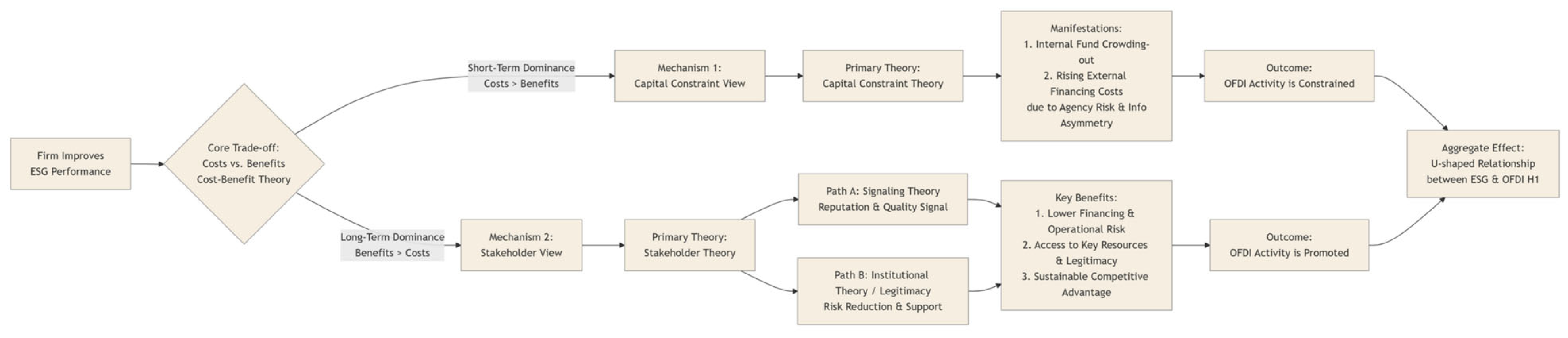
Overall, according to cost-benefit theory, the costs of improving ESG performance may negatively affect financial performance in the short term, as ESG disclosure might increase firms’ debt financing costs by signaling short-term operational pressures. Moreover, enhanced ESG disclosures raise external stakeholders’ and governments’ awareness of a firm’s ESG performance, compelling managers to continuously increase resource allocations to nonfinancial areas (including capital, time, and human resources). This situation could deteriorate financial performance in the short term, intensifying operating cash flow pressures and prompting creditors to demand higher risk premiums. Additionally, OFDI projects incur high supervision costs and severe information asymmetry; the absence of credit guarantees and the presence of operational risks associated with OFDI enterprises prompt fund providers to demand higher risk premiums. These additional costs further increase external financing costs, making it difficult for firms to obtain robust financing support; thus, in the short term, as firms improve their ESG performance, OFDI may be constrained by internal funding shortages and high financing constraints. Conversely, in the long term, corporate goals have shifted from improving financial performance and profitability to promoting sustainable development and market expansion to build brand effects. Good ESG performance can strengthen relationships between firms and their stakeholders, alleviating financial risks posed by external environmental turbulence [31] and downside risks, thereby ensuring firms have sufficient internal funds for OFDI and securing investment returns (Figure 1). Moreover, corporations with a good entrepreneurial identity and excellent ESG performance are likely to be supportive of the host government, mitigating the disadvantages of outsiders [4,32]. Therefore, this paper proposes the following hypothesis:
H1. 
ESG performance and firm OFDI activities exhibit a positive U-shaped relationship which means a standard U-shape with a minimum point. In the short term, as ESG performance improves, OFDI may decrease due to funding constraints. In the long term, as ESG performance improves and the ESG score exceeds a specific point, firms will increase OFDI investments.

2.2. ESG Performance, Corporate OFDI, and Firm Life Cycle

Based on corporate lifecycle theory, firms undergo a series of developmental stages akin to the life cycles of organic species, from inception through growth, maturity, and eventual decline [33]. The phase of a firm’s lifecycle illuminates disparities in its strategic choices, resource allocation, and managerial capacities, as well as the competitive market forces it encounters [34]. The development stage influences a firm’s capacity to allocate resources and prioritize strategies [35,36]. These allocation effects can then affect the firm’s approach to fulfilling ESG responsibilities and directing resources toward OFDI, thereby leading to heterogeneous developmental quality across different lifecycle stages.
In the introductory phase, firms will likely face financial constraints, with management teams seeking to improve capabilities and conserve resources. During this nascent stage, firms may struggle with liquidity, impeding effective competition within their sectors [37,38,39]. The early stages of a firm’s lifecycle are grounded in the dynamic capability framework and often reveal deficiencies in human capital, social capital, cognitive resources, and access to financial, technological, and material resources [40]. In this phase, enterprises could face elevated capital costs due to uncertainties in future cash flows and earnings, which can complicate the acquisition of additional capital [41,42]. Resources are predominantly allocated to foundational activities such as research and development, production, and market entry, making it challenging to sustain the substantial costs associated with OFDI [38,39]. Insufficient international market experience and capital accumulation at this stage preclude substantial overseas expansion. Additionally, prevailing uncertainties, unstable future cash flows, and profitability prompt management to adopt a cautious approach to international markets [41]; thus, risk aversion drives nascent enterprises to consolidate their domestic market foundations rather than dispersing limited resources across risk-laden international markets. The strategic focus during the introduction phase is establishing a domestic market foothold; moderate OFDI is considered only when internationalization becomes a core strategy or when products attain global competitiveness.
Upon entering the growth phase, enterprises gradually achieve profitability and begin capital accumulation, laying a foundation for international expansion. With increased flexibility in resource allocation, firms can meet the financial demands of OFDI and advance managerial competencies. Growth-stage enterprises typically perceive OFDI as an effective avenue for market expansion into emerging markets with high growth potential. At this juncture, the strategic emphasis shifts from market penetration to market share expansion, although understanding of international markets remains limited; hence, the preference for less risky, lower-threshold international markets to mitigate costs and regulatory risks [43]. The OFDI strategy during the growth phase is conservative, focusing on culturally similar or familiar markets to gradually accrue international experience and manage risks, thereby fostering sustained organizational growth.
In the maturity phase, enterprises can secure an even stronger competitive advantage through the utilization of resources, capacity development, and preservation [40,44]. Mature corporations, typically resource-rich and less prone to financial distress, are well-positioned to focus on reputation management and investment [45,46]. The increasing need for brand and reputation management during this period makes OFDI an essential tool for consolidating international market positions. Mature enterprises tend to enter developed markets with stringent ESG standards to augment brand recognition and market reputation [46]. Mature firms can leverage resource and brand advantages to expand market share through OFDI and enhance long-term competitiveness. This approach can be particularly effective in markets with high ESG thresholds, where superior ESG performance further elevates international reputation; thus, the demand for OFDI peaks during maturity, with firms frequently opting to enter high-threshold developed markets to deepen and broaden their internationalization.
As enterprises transition into the decline phase, internal organizational issues such as institutional rigidity, management’s evasion of accountability, and a lack of innovation become prevalent. This situation leads to sharp declines in market share and sales levels, with profitability waning [35,47]. The primary objective becomes self-preservation, shifting the focus back from “seeking development” to “ensuring survival,” thereby directing funds primarily toward conventional production and operational activities [48]. Due to declining sales volumes, market share, and profit margins, and the lack of new profit growth points, the financial condition of firms in the decline phase often deteriorates. This situation makes financing particularly challenging; thus, these enterprises face more severe financing constraints [34], leading to more cautious international market investments. At this stage, OFDI might be regarded as an additional cost burden, prompting firms to curtail international investments to maintain financial robustness. Declining firms typically divest from noncore markets, concentrating resources on more profitable or strategically significant markets, and the OFDI strategy becomes more defensive, aimed at maintaining existing international market shares rather than exploring new markets. Through divestitures or mergers and acquisitions, declining firms optimize resource allocation, minimizing OFDI expenditures to focus on profitable markets, thereby ensuring financial stability and resource efficiency.
Early-stage ESG investments might impede OFDI by straining financial resources when ESG ratings are low, and superior ESG performance in later stages can promote OFDI. Therefore, a combination of ESG performance and lifecycle stages could jointly influence corporate OFDI investment decisions. Additionally, the stage of the corporate lifecycle may amplify the relationship between OFDI and ESG performance. Firms in their maturity phase focus on the reputational ramifications of their actions and interactions with major stakeholders, including regulators; as a result, they are more inclined to adopt positive ESG practices than their younger or declining counterparts [46]. Indeed, during the early and declining phases of a firm’s lifecycle, the indirect costs of ESG activities and disclosures (including both reputational impacts and financial reporting implications) may be less critical than the capital required for survival, growth, innovation, and ongoing financing [49].
In the introduction and growth phases, firms lack a mature customer base, have a limited understanding of potential revenues, costs, and industry dynamics [45] and face resource scarcity and financial instability. These firms are affected by “newcomer liabilities” and face the possibility of an early exit. Their primary focus is on establishing a market foothold and business growth, rather than expanding into international markets or enhancing brand reputation [38,39]. During this period, firms are more concerned with short-term financial stability than with the potential of improved ESG performance to enhance international competitiveness. For these enterprises, ESG investments are often viewed as an additional cost burden rather than a competitive advantage—high-cost inputs do not significantly enhance the firm’s profitability or market share [41]. Corporations with weak ESG practices may struggle to obtain cost-effective financing from banks or investors, potentially negatively affecting their share trading volume. Banks will exercise greater caution in financing companies with inadequate ESG practices, considering not only the related reputational and credit risks but also possible environmental accountability risks. Goss and Roberts (2011) [18] reported that corporations with lower social responsibility ratings paid slightly greater bank interest rates than the most socially conscious corporations; thus, firms in the introduction and growth phases typically exercise caution in ESG performance investments. This approach ensures that limited internal funds are concentrated on domestic operations and core research and development, avoiding additional financial burdens from loan financing.
Additionally, firms in the early stages often face high levels of uncertainty and risk, prompting management to adopt more conservative strategies to avoid the financial burdens of international expansion. OFDI involves complex cross-border operations and high entry costs, leading introduction- and growth-phase firms to focus more on domestic market infrastructure [43]. Even if firms attempt to enhance ESG performance during this stage, resource and management capacity constraints make it difficult for them to achieve a significant competitive advantage in international market; therefore, resource constraints and risk aversion tendencies during the early stages can inhibit the positive impact of ESG performance on OFDI; thus, firms prioritize addressing domestic market competitiveness issues rather than undertaking complex international market operations.
Firms entering the maturity phase have established a stable position in the domestic market, are resource-rich, and enjoy stable financial conditions. The certainty of existing and future cash flows and reduced risks may imply that mature firms face lower financial distress risk and are more inclined to actively advance arrangements, including ESG communications. Managers of mature firms typically have a deeper understanding of the environments in which they operate and possess more resources to identify and undertake proactive ESG activities. Management also pays more attention to long-term brand building and its international market reputation, viewing ESG as a crucial means of enhancing brand image and strengthening market trust [46]. By enhancing ESG performance, firms can build a responsible brand image, gain favor with potential investors, and attract international customers through high social responsibility standards. Thus, the enhancement of ESG performance is no longer viewed merely as a financial cost but as an integral part of brand building. Particularly when entering developed markets with stringent ESG requirements, superior ESG performance reduces market entry barriers and amplifies trust and recognition in international arenas [29]. Enterprises that conform to ESG standards are more readily able to secure regulatory approvals in strictly regulated markets and are perceived as responsible and compliant market participants. This advantage enhances their ability to penetrate international markets [2]. Concurrently, high ESG performance enables firms to differentiate themselves from competitors in international markets, thereby expanding their market share. Enterprises in their maturity phase, endowed with abundant resources, regard ESG performance as a strategic asset for gaining access to international markets and establishing a reputation. Consequently, the dynamic relationship between ESG performance and corporate OFDI becomes increasingly pronounced in the later stages of the lifecycle, given the disparities between young and mature firms in economic foundations [34,40].
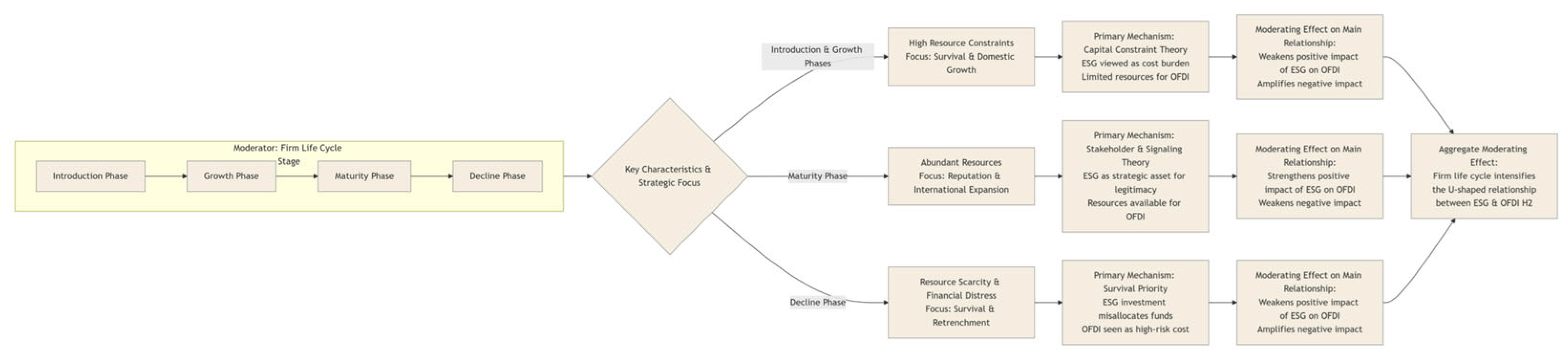
Enterprises’ operational efficiency and financial health deteriorate as they enter the decline phase, making survival in a fiercely competitive market arduous. The capability to attract financing and investment diminishes, leading to instability in capital turnover and potential disruptions in financial chains [50]. Maslow’s hierarchy of needs holds that the paramount task for businesses in this stage is to address existential challenges, sustain capital turnover without sufficient financial resources to fulfill social responsibilities, escalate innovative investments, and maintain internal governance. If declining-phase enterprises augment ESG investments, it could lead to a misallocation of funds, in which the returns on ESG investments fail to compensate for the costs, thereby accelerating their financial distress and increasing the risk of operational crises and debt default [35,47]. Even if efforts are made to improve ESG performance, the scarcity of resources and diminished willingness to expand the market limit the effectiveness of these efforts in driving OFDI. Management in declining firms often adopts defensive strategies, aiming to preserve existing market shares rather than venturing into new international markets. OFDI can be seen as a high-cost, high-risk form of expansion during this phase, compelling firms to focus resources on strategic markets and withdraw from regions with higher risks or lower profitability. ESG investments have little value for declining firms, as they urgently need resources to address pressing financial issues and constraints. Thus, the defensive and resource-conservation strategies of declining firms attenuate the positive impact of ESG performance on OFDI, making it challenging for ESG improvements to significantly drive OFDI expansion in international markets; hence, the relationship between ESG performance and corporate OFDI is likely modulated by the corporate lifecycle (Figure 2). Based on the foregoing discussion, this paper hypothesizes:
H2. 
Controlling for other variables, the corporate lifecycle intensifies the U-shaped relationship between ESG performance and corporate OFDI.


3. Materials and Methods

3.1. Data Source and Sample Determination

This paper selects A-share listed companies on the Shanghai and Shenzhen markets as the research sample, employing a quantitative approach. Owing to the limitations of ESG and OFDI data, and since short-term data might be exposed to temporary shocks (e.g., economic crises, policy adjustments), a wider time horizon is capable of smoothing out these transient fluctuations, so the sample period of this paper is selected as 2009–2022. Chinese accounting standards mandate that listed companies disclose pertinent details about their affiliated companies. This study defines whether a listed enterprise engages in direct foreign investment based on detailed information about these affiliated companies. The data are derived from the CSMAR, which provides essential information about affiliated companies of listed enterprises in China, including the domicile, registered capital (including currency type), affiliation type, and the proportion of equity controlled by the listed company. The exchange rate data utilized are the annual official average rates provided by the World Bank. Moreover, the Huazheng ESG ratings data, sourced from the Wind Information Financial Terminal and widely recognized and applied in both industry and academia [51], serve as the core indicator for measuring corporate ESG advantages. Other financial information and additional corporate characteristics are also retrieved from the CSMAR database. In a bid to assure the accuracy of the data, this paper excludes the relatively special financial industry and other industries with fewer observations, as well as samples with missing key variables or obvious non-compliance with accounting standards. In order to avoid the influence of outliers, the samples with continuous variables above and below 1% are winsorized. After data filtering and processing, a final sample comprising 4698 enterprises with overseas affiliates during the sample period was retained, yielding an unbalanced panel data set with 38,052 effective observations from 2009 to 2022. The analytical tool employed is Stata 17.0.

3.2. Dependent Variable (Corporate OFDI)

OFDI embodies a strategic economic activity wherein corporations exert governance over operations and management of enterprises abroad. Examining Chinese corporate OFDI typically entails aligning firm-level data with the “Directory of Overseas Investment Enterprises (Institutions).” This directory lists only the names, natures, and destinations of OFDI enterprises, lacking crucial investment details such as amounts and modes. Consequently, the dependent variable manifests merely as a binary indicator, signifying the presence or likelihood of a firm’s international activities. This framework limits in-depth exploration into potential U-shaped relationships between ESG performance and corporate OFDI, and identifies at what juncture an inhibitory relationship transforms into a promotive one. Changes in enterprise names or locations also contribute to sample reduction, compromising the precision of parameter estimations.
The CSMAR database unveils critical details on overseas affiliates of listed companies, encompassing the reporting year and the names of these entities. The investment amount of overseas affiliates mirrors the parent company’s OFDI capacity and scale for that year, thereby serving as a robust proxy for corporate OFDI. By utilizing the investment amount of a listed company’s overseas affiliates as the dependent variable, the analysis provides a more nuanced depiction of a firm’s OFDI capabilities and their fluctuations, effectively capturing the impact of ESG performance on corporate OFDI. Per Cheng and Su (2024) [2], this study classifies relationships as “subsidiaries,” “joint ventures,” and “associated companies” of listed companies, where the affiliate is registered outside mainland China and the controlling equity interest is significant, denoting the listed company’s outward direct investment. This research compiles data on outward investments from all listed entities in Shanghai and Shenzhen from 2009 to 2022. The scale of foreign investment for the respective year (measured in RMB) was calculated using the World Bank’s annual official average exchange rates, and the following four adjustments were applied: (1) exclusion of financial enterprises; (2) removal of enterprises with investment scales below 100,000 yuan; (3) focusing on companies registered in tax havens like the Cayman Islands, British Virgin Islands, and Bermuda; and (4) acknowledging that such investments are primarily motivated by tax avoidance. Then add up the registered capital of different overseas affiliates of the enterprise in the same year; The total registered capital of overseas affiliates is finally logarithmically transformed to measure the scale of corporate OFDI.

3.3. Independent Variable (ESG Performance)

Following the approach of Li et al. (2023) [52], this paper employs Huazheng’s ESG scores and ratings as proxy indicators for assessing ESG performance. Weights are assigned, culminating in a comprehensive ESG rating score, graded from lowest to highest as C, CC, CCC, B, BB, BBB, A, AA, AAA, with higher ratings indicating better ESG performance [53]. Besides this rating method, after computing the weighted ESG score from the bottom up according to the index system, Huazheng Indices further adjust the ESG weighted scores by industry, standardizing scores within industries to derive a composite ESG score. While many scholars adopt the Huazheng ESG ratings as the main independent variable in their regressions, the concentration of ratings at medium levels limits the distinction between companies’ ESG levels, thus complicating tests for ESG impacts on corporate OFDI through subgroup analysis (such as industry differences). In contrast, this paper uses comprehensive score data from Huazheng ESG, offering advantages in data reliability and validity, and effectively comparing ESG level differences among companies. Accordingly, the research primarily relies on the comprehensive Huazheng ESG score (ESG_score), with Huazheng ESG ratings (ESG) serving as alternative variables in robustness tests.

3.4. Moderating Variable (Corporate Life Cycle)

Existing literature offers roughly three categorization methods for the corporate life cycle: composite indicators [54], cash flow pattern methods [35], and single-variable methods (company size, age, profitability indicators, retained earnings to total assets ratio). Given the lack of a universally accepted measurement method for corporate life cycles in academia, this paper adopts the widely used retained earnings to total assets ratio method (RE/TA) to categorize life cycles. This ratio serves as a proxy for assessing whether a company finances itself through internal funds or external capital, with higher RE/TA typically indicating a mature or declining phase with reduced investment activities, and lower RE/TA suggesting a younger, rapidly growing company [55].

3.5. Control Variables

Following the methodologies of He et al. (2023) [56], Zheng and Aishan (2023) [57], Luo et al. (2023) [53], Hu et al. (2023) [58], Cheng and Su (2024) [2], Khurram et al. (2024) [59], and Wang et al. (2024) [4], this paper incorporates a series of firm-level control variables to mitigate the impact of omitted variables. These include company size (Size), return on assets (ROA), leverage ratio (Lev), quick ratio (Quick), cash ratio (Cashflow), equity balance (Balance), proportion of independent directors (Indep), dual role of the board chairman (Dual), and company age (FirmAge). Additionally, to control for industry and macroeconomic factors affecting corporate OFDI, the model includes time fixed effects and either individual or industry fixed effects. Definition of terms refers to Table 1.

3.6. Model Settings

3.6.1. Standard Regression Model

In a bid to test the effect of ESG performance on corporate OFDI activities, this paper constructs the following model for verifying Hypothesis 1:
O F D I i , t = β 0 + β 1 E S G _ s c o r e i , t + β 2 E S G _ s c o r e 2 i , t + β 3 S i z e i , t + β 4 L e v i , t       + β 5 R O A i , t + β 6 Q u i c k i , t + β 7 C a s h f l o w i , t + β 8 I n d e p i , t             + β 9 B a l a n c e i , t + β 10 F i r m A g e i , t + β 11 D u a l i , t + λ i + γ t + ε i , t
In Equation (1), O F D I i , t denotes the OFDI size of firm i in year t, E S G _ s c o r e i , t and E S G _ s c o r e 2 i , t represents the ESG composite score of firm i in year t. All the rest of the variables are control variables. λ i and γ t stands for individual fixed effects and time fixed effects, respectively; ε i , t is a randomized disturbance error term.

3.6.2. Moderation Effect Model

In order to test the moderating effect of firms’ life cycle on the nexus between ESG performance and firms’ OFDI activities, Equation (1) is expanded by incorporating the firm’s life cycle (RETA) and its interaction term with the explanatory variables to obtain Equation (2):
O F D I i , t = β 0 + β 1 E S G _ s c o r e i , t + β 2 E S G _ s c o r e 2 i , t + β 3 R E T A i , t + β 4 E S G _ s c o r e i , t × R E T A i , t + β 5 E S G _ s c o r e 2 i , t × R E T A i , t + β 6 S i z e i , t + β 7 L e v i , t + β 8 R O A i , t + β 9 Q u i c k i , t + β 10 C a s h f l o w i , t + β 11 I n d e p i , t + β 12 B a l a n c e i , t + β 13 F i r m A g e i , t + β 14 D u a l i , t + λ i + γ t + ε i , t
In Equation (2), R E T A i , t represents the retained earnings ratio of firm i in year t, which is used to represent the moderating effect of the firm’s life cycle. E S G _ s c o r e i , t × R E T A i , t and E S G _ s c o r e 2 i , t × R E T A i , t denotes the first and second cross-multiplication terms of the firm’s life cycle and ESG composite score. All the rest of the variables are control variables. λ i and γ t stands for individual fixed effects and time fixed effects, respectively; ε i , t is a randomized disturbance error term.

4. Results

4.1. Empirical Results

4.1.1. Descriptive Statistics Results

Table 2 reports the descriptive statistics for principal variables. The mean OFDI stands at 9.190, with a standard deviation of 9.927, a minimum value of zero, and a maximum of 23.38, evidencing substantial variability in OFDI activities among surveyed corporations. The average ESG composite score (ESG_score) registers at 73.25, reaching a peak of 83.80 and a nadir of 58.55, reflecting considerable disparities in ESG performance across firms. The mean proportion of independent directors aligns with China’s regulatory standard of one-third, recording at 0.375. The descriptive statistics for other metrics align well with extant literature. Regarding corporate characteristics, the average firm age (FirmAge) records at 2.885 with a standard deviation of 0.358, denoting that most surveyed companies are within their developmental and maturity phases, albeit with notable age distribution variations. The average balance (Balance) is 0.745 with a standard deviation of 0.615, a minimum of zero, and a maximum of 2.962, denoting that principal shareholders remain the dominant investors, with secondary shareholders holding a minimal share, indicating a concentrated ownership structure. Additionally, approximately 28.9% of the companies observe a dual role where one individual serves as both chairman and CEO (Dual), revealing deficiencies in the governance structures.

4.1.2. Correlation Analysis Results

Table 3 offers a correlation analysis for key variables, revealing a robust positive association between a firm’s OFDI and ESG performance, with a correlation coefficient of 0.108, attaining statistical significance at the 1% level. This association underscores that enterprises with superior ESG performance are predisposed towards heightened outward direct investment. Moreover, the firm’s life cycle (RETA) also exhibits a robust positive association with OFDI at the 1% level, with a correlation coefficient of 0.124, suggesting that OFDI activities amplify as firms advance into their later stages. The firm’s life cycle equally manifests a robust positive association with ESG performance (ESG_score), with a coefficient of 0.280, suggesting that during mature stages, firms typically exhibit superior ESG performance, offering preliminary support for hypothesis 2. ESG performance also correlates positively with firm size (Size) and Return on Assets (ROA), with coefficients of 0.182 and 0.183 respectively, illustrating that larger, more profitable firms are likely to excel in both ESG performance and OFDI activities. These findings underscore the ESG score as an instrumental driver in firms’ internationalization strategies, furnishing a theoretical framework for further exploration. Table 3 confirms that the correlation coefficients among the principal variables predominantly remain below 0.5, with an average Variance Inflation Factor (VIF) without the inclusion of the ESG quadratic term positioned at 1.34, verifying the appropriateness of the chosen variables and confirming that the model is free from multicollinearity concerns.

4.1.3. Baseline Regression Results

Table 4 offers the foundational regression analysis, with columns (1) to (3) deploying OLS regression and columns (4) and (5) applying fixed effects regression. Column (1) explores the linear relationship and quadratic influence of ESG_score on OFDI without incorporating any control variables. The regression results indicate that the quadratic coefficient of ESG_score is 0.2240, significant at the 1% level, tentatively indicating that an enhancement in ESG performance might promote OFDI. To more rigorously confirm the nonlinear nature of this relationship, column (2) incorporates the quadratic term of the core explanatory variable ESG_score. The findings reveal a negative coefficient for the linear term and a positive coefficient for the quadratic term, both significant at the 1% level. This demonstrates a distinct nonlinear characteristic in the impact of ESG performance on OFDI, displaying a “positive U-shaped” relationship where it initially restrains then encourages OFDI.
Recognizing potential disturbances from corporate characteristics on the relationship between ESG performance and OFDI, column (3) integrates control variables. The analysis shows a notable augmentation in the model’s explanatory power, with both the linear and quadratic terms of ESG_score remaining significant at the 5% level, with coefficients of −0.4263 and 0.0037, respectively, consolidating the existence of a positive U-shaped relationship. To enhance model robustness, column (4) examines the data using a dual fixed effects model for individuals and time, illustrating that both the linear and quadratic terms of ESG_score are significant at the 1% level, with coefficients of −0.5938 and 0.0043. To address potential heteroscedasticity, column (5) estimates robust standard errors based on column (4). The findings validate that the significance of core regression coefficients remains unaltered at the 1% level, and the adjusted R-squared value elevates to 0.1027, amplifying the model’s explanatory capacity.
This analysis convincingly validates the existence of a “positive U-shaped” relationship between ESG performance and corporate OFDI. Initially, firms incur substantial expenditures on ESG enhancements, leading to elevated non-operational expenses and diminished cash flow, restricting funds available for outward investment. In subsequent stages, firms with commendable ESG performance are perceived by host countries as capable of fulfilling local social responsibilities, mitigating restrictive barriers and alleviating financial pressures associated with international expansion, aligning with Hypothesis 1.
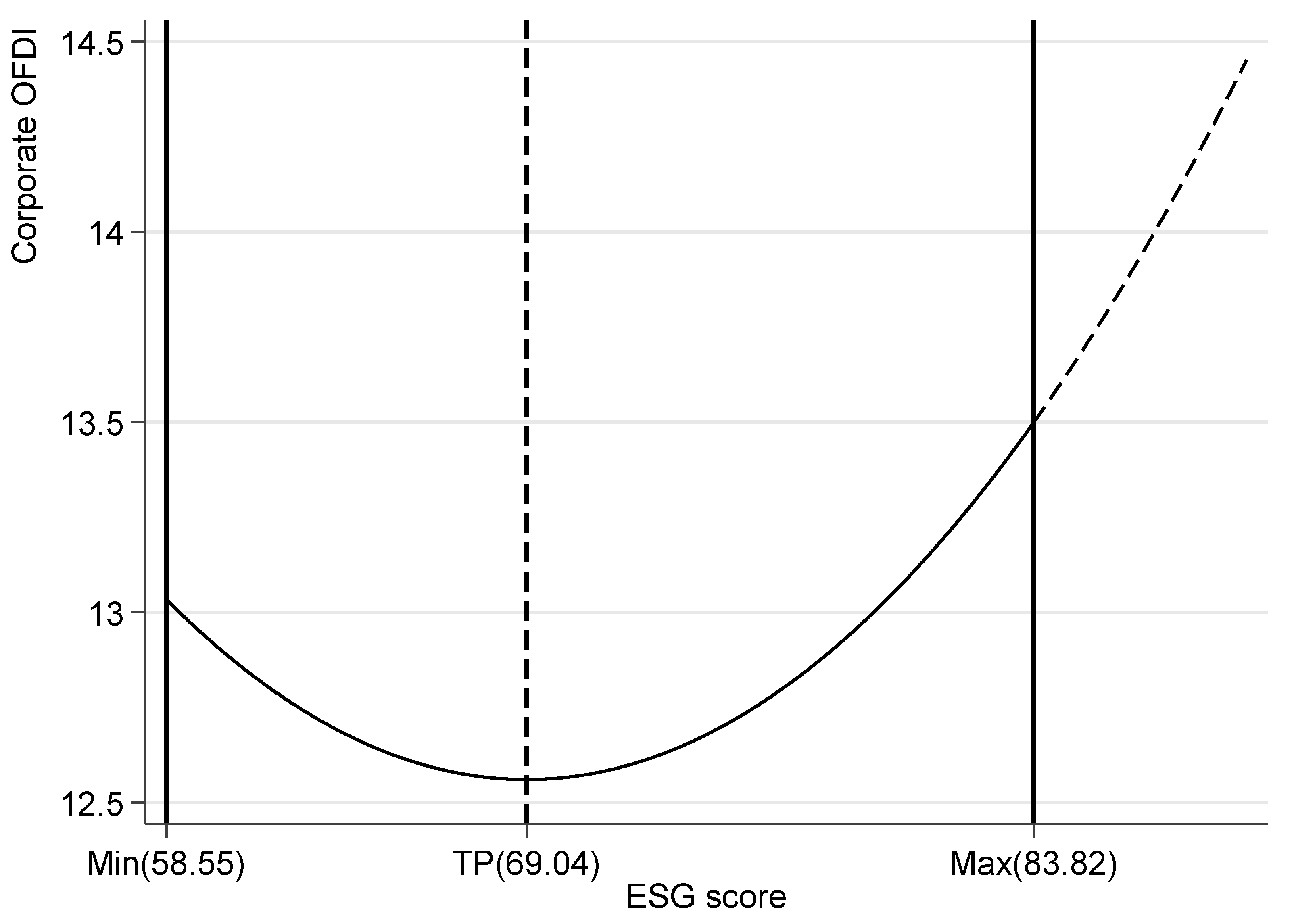
According to extant literature on U-shaped relationships [42,57], substantiating a U-shaped relationship necessitates meeting three criteria: (1) The quadratic term coefficient of the independent variable must be significantly positive; (2) The inflection point of the curve (either maximum or minimum) must reside within the range of the independent variable; (3) The gradient of the curve must be significantly negative at the minimum value of the independent variable and markedly positive at its maximum value. Employing a U-test to probe the positive U-shaped relationship between ESG performance and corporate OFDI, as illustrated in Table 5, the coefficient for ESG_score2 is 0.0043, significant at the 1% level, satisfying criterion 1. The lower and upper bounds of ESG_score are 58.55 and 83.8, respectively, with a turning point at 69.03617, which falls within the range, fulfilling criterion 2. Moreover, at an ESG_score of 58.55, the curve’s gradient is −0.090195, and at 83.8, it is 0.1269885, satisfying criterion 3. The U-test is significant at the 5% level, refuting the null hypothesis that the relationship between the independent and dependent variables is monotonic or an inverted U-shape, thereby substantiating Hypothesis 1. Consequently, as illustrated in Figure 3, a positive U-shaped relationship indeed prevails between ESG performance and corporate OFDI activities.

4.2. Endogeneity Test Results

Exploring the U-shaped relationship between corporate ESG performance (ESG_score) and Outward Foreign Direct Investment (OFDI), overlooking endogeneity issues contravenes the Gauss-Markov theorem, resulting in biased estimations and unreliable policy recommendations [60]. Endogeneity could stem from several sources: first, reverse causality, where ESG performance not only potentially affects a firm’s international investment decisions but also the execution of OFDI might reciprocally impact the firm’s ESG strategy; second, omitted variable biases, such as unobservable elements like corporate governance style and market competition environment, which might concurrently sway ESG performance and OFDI; third, the dynamic attributes, where a firm’s present OFDI actions are significantly shaped by historical decision-making trajectories, creating path dependency. Failing to address these endogeneity concerns could skew model estimates, thus undermining the scientific rigor of theoretical analysis and the credibility of empirical conclusions. Consequently, this study employs Propensity Score Matching (PSM), Two-Stage Least Squares (2SLS), and System Generalized Method of Moments (System GMM) to comprehensively analyze and mitigate potential endogeneity issues, ensuring the robustness and reliability of research findings.

4.2.1. Propensity Score Matching (PSM)

In evaluating the impact of ESG performance on corporate OFDI, entities with superior ESG scores often possess expansive scales, robust financial strength, or a pronounced propensity to engage in OFDI. These attributes themselves could directly affect OFDI. Therefore, to address the bias stemming from non-random sample selection, this paper employs the Propensity Score Matching method (PSM), adhering to methodologies by Atif & Ali (2021) [61], Cheng & Su (2024) [2], and Wang et al. (2024) [4]. Specifically, the study constructs a dichotomous variable by capturing the median annual ESG rating of all sampled firms: if a corporate ESG score in a given year surpasses the median, the binary variable assumes a value of 1; otherwise, it remains 0 [2]. A Probit model assesses the propensity for firms to engage in comprehensive ESG scoring, estimated on the full sample and inclusive of control variables. Thereafter, a propensity score is computed for each annual observation of the firms, and a 1:1 nearest neighbour matching method is applied to pair each treated firm with a control firm based on the closest propensity score, thus minimizing observable characteristic disparities between the groups. The benchmark regression analysis is subsequently re-conducted on the matched sample.
Table 6 presents the results of the balance test post-matching, with all variables displaying standardized deviations below 10%, meeting the covariate balance criterion established by Rosenbaum and Rubin (1985) [62] and demonstrating that PSM effectively mitigates the impact of sample self-selection bias. From Figure 4, we can see that before matching, there is a noticeable difference in the propensity score distributions between the treatment group and the control group. After matching, however, the two groups become more similar in terms of observable characteristics, and their comparability is significantly improved. According to the regression results of the matched samples in Table 7, the facilitative effect of ESG performance on OFDI remains significant and robust, with the direction and significance of the core explanatory variables ESG_score and ESG_score2 remaining unaltered. Specifically, post-PSM matching regression elucidates that the linear coefficient of ESG_score is −0.5522, markedly negative at the 5% level, and the quadratic coefficient is 0.0040, emphatically positive at the same level, reaffirming that the positive U-shaped relationship between ESG performance and OFDI retains its robustness even after accounting for sample selection bias.

4.2.2. Two-Step Least Squares Estimation (2SLS)

Given the potential reciprocal influences between corporate ESG performance (ESG_score) and OFDI, compounded by unidentified factors and reverse causation, this investigation is vulnerable to endogeneity concerns. Consequently, informed by He et al. (2022) [63], Yang et al. (2023) [64], Luo et al. (2023) [53], and Zheng & Aishan (2023) [57], this discourse adopts the lagged first-order of the comprehensive ESG score (L.ESG_score) and the intensity of Confucian ethos at the city level (Confucian) as instrumental variables, employing the Two-Step Least Squares (2SLS) method to reassess the nexus between ESG performance and corporate OFDI. Optimal instrumental variables must satisfy dual criteria: correlation with the endogenous variables without direct impact on the dependent variable [63]. The continuity inherent in ESG performance means that a firm’s performance from a previous period exhibits a substantial positive correlation with its current standing, fulfilling the criterion for relevance. Concurrently, augmentations in ESG performance accrue related dividends, motivating continued advancements and satisfying the correlation principle. Furthermore, due to the ex-post characteristic of a firm’s subsequent ESG performance, it remains uncorrelated with the current perturbations, thereby meeting the exclusion criterion. Although the employment of lagged ESG as an instrument may not be impeccable, the prior period’s ESG performance aligns with the stipulations for exogeneity and relevance, thus it is deemed efficacious.

In addition, this analysis incorporates Confucian ethos as an instrumental variable to enhance the robustness of the test. Specifically, systemic institutional and cultural elements profoundly determine ESG performance. Historical, cultural and ethical values persistently shape ESG dynamics [65]. In China, Confucian ethos, having evolved over millennia, emerges as a dominant societal value, historically revered as a moral benchmark [66]. Entities that elevate their ESG performance, while generating economic benefits, also uphold stakeholder interests and assume societal responsibilities. Such conduct, infused with the philosophy of harmonious development and not solely profit-driven, resonates with Confucian precepts such as “Wealth and high position obtained through unrighteous means are to me as floating clouds” (Confucian Analects—Shu Er). Confucian ethos fosters a heightened awareness of corporate social responsibility, thereby catalyzing proactive improvements in ESG performance [67]. Thus, the prevalence of Confucian ethos in a firm’s locale might exert influence on its ESG performance. Although Confucian ethos could subtly and indirectly influence managerial ethical perspectives through early education, such impacts are typically indirect and delayed [68], presenting challenges in directly translating into specific international investment behaviors. A firm’s OFDI is directly related to its own cash flow, strategic planning, and resource requisites, minimally influenced by the ESG performance of contemporaneous enterprises within the same region and industry, thus satisfying the instrument’s exclusion principle. Therefore, this paper posits the intensity of Confucian ethos in the firm’s province as aligning with the conditions for exogeneity and relevance, rendering it suitable as an instrumental variable. Since the Han dynasty, educational institutions have served as primary conduits for disseminating Confucian thought, with academies acting as pivotal venues for Confucian education. Following the Tang dynasty, national and county-level schools established Confucian temples extensively. Thus, aligning with He et al. (2023) [56], He et al. (2022) [63], and Yang et al. (2023) [64], the number of Confucian temples historically present in a firm’s city is utilized as a proxy variable to gauge the intensity of Confucian ethos.
The analytical outcomes, as delineated in columns (3) to (5) of Table 6, elucidate the following: According to the first-stage regression outcomes in column (3), Confucian and L.ESG_score’s regression coefficients with ESG_score are 0.0033 and 0.6218, respectively, with Confucian attaining significance at the 5% level and L.ESG_score at the 1% level. As elucidated in column (4), the regression coefficients of Confucian and L.ESG_score with ESG_score2 are 0.5312 and 90.1062, respectively, both attaining significance at the 1% level. Moreover, the Kleibergen-Paap rk LM statistic stands at 15.794, with a p-value of 0.0001, indicating no underidentification issues with the instrumental variables. The Cragg-Donald Wald F statistic, measuring at 8.169, surpasses the critical value for a 10% maximum bias (7.03), denoting that the instruments are sufficiently robust and there is no significant presence of a weak instrument issue. Based on the second-stage regression results in column (5), the coefficients for ESG_score and ESG_score2 are −32.2746 and 0.2239, respectively, both achieving significance at the 5% level. Thus, the hypothesis positing a U-shaped relationship between ESG performance and corporate OFDI retains validity under the scrutiny of instrumental variables.

4.2.3. System Generalized Method of Moments Estimation

Corporate decisions regarding OFDI often exhibit path dependence, where current internationalization efforts are significantly influenced by historical investment behaviors. This sticky nature of decision-making processes introduces dynamic endogeneity issues, potentially biasing regression outcomes by omitting dynamic characteristics. To effectively address this concern, this analysis employs the System GMM approach. System GMM mitigates disturbances from dynamic properties by incorporating the lagged values of the dependent variable as explanatory variables and integrating instrumental variables to address reverse causality and omitted variable concerns, thereby ensuring robust estimations of the model. Specifically, this paper processes the dependent variable OFDI at one lag (L.OFDI) and two lags (L2.OFDI) to capture the dynamic influences of historical internationalization behaviors on current decisions. Furthermore, drawing from the studies by Zheng & Aishan (2023) [57] and He et al. (2022) [63] the first-order lag of corporate ESG performance (L.ESG_score) along with the intensity of Confucian ethos (Confucian) serves as an instrumental variable, elucidating the endogeneity issues in current ESG performance (ESG_score) and its quadratic term (ESG_score2). The regression results are presented in column (6) of Table 6.
The regression findings demonstrate that the lagged variables (L.OFDI and L2.OFDI) exert a significant positive effect on current OFDI. In detail, the regression coefficient for one-period lagged OFDI is 0.6856, significantly positive at the 1% level, and the coefficient for two-period lagged OFDI is 0.0343, significant at the 5% level. These results confirm the dynamic nature of OFDI, indicating that current international investment activities are significantly dependent on historical actions. For the primary explanatory variables, ESG_score and ESG_score2, the regression outcomes indicate that the linear term of ESG_score is −10.2682, significant at the 5% level in the negative direction, while its quadratic term is 0.0721, significant at the 5% level in the positive direction. Consistent with prior analyses, this suggests a positive U-shaped relationship between corporate ESG performance and OFDI. Initially, efforts to enhance ESG performance, requiring substantial resource allocation, may suppress OFDI activities; however, as ESG performance improves, recognition and acceptance in international markets increase, policy barriers diminish, and the promotive effect of ESG performance on OFDI gradually becomes evident.
To validate the effectiveness of the instrumental variables, this study conducts serial correlation tests and a Hansen test. The Hansen test result, with a p-value of 0.178, greater than 0.1, affirms that the instrumental variables satisfy the orthogonality assumption, indicating no over-identification issues. The System GMM model’s AR (1) test reveals significant first-order serial correlation (p = 0.000), aligning with System GMM assumptions, as lagged error terms may correlate with current differenced error terms. Conversely, the AR (2) test indicates no significant second-order serial correlation (p = 0.563), suggesting that the instrumental variables are unaffected by second-order serial correlation issues, further affirming their appropriateness and effectiveness. This analysis demonstrates that the coefficients and significance of the lagged OFDI terms and core explanatory variables (ESG_score and ESG_score2) remain largely unchanged after employing the System GMM method, indicating robust model results. By controlling for dynamic endogeneity and addressing reverse causation issues, the System GMM approach provides more reliable empirical support for exploring the positive U-shaped relationship between ESG performance and OFDI.

4.3. Robustness Tests

4.3.1. Alternative Measurements of the Dependent Variable

To further substantiate the robustness of the findings, an initial test involved substituting the dependent variable. According to Caves (1996) [69], Delios & Beamish (1999) [70], and Flores & Aguilera (2007) [71], corporate OFDI refers to enterprises expanding through equity investments beyond their home countries, culminating in establishments within host nations. This study adopts the number of foreign subsidiaries established by Chinese enterprises in a given year (Inter_A) as the flow metric for OFDI rather than a stock measure, thereby offering a nuanced analysis of robustness. This approach not only reflects the annual count of international investment projects beyond China but also captures the influence of home country dependency over time on subsequent foreign investments. This method addresses critiques such as those by Rugman (2005) [72] concerning using foreign sales volumes as a comprehensive indicator of OFDI activities [71]. Regression results presented in Table 8, column (1), show that the coefficient for ESG_score is −0.3697, significantly negative at the 1% level, and the coefficient for the quadratic term of ESG_score is 0.0027, also significant at the 1% level. These results affirm the consistency of the outcomes with the baseline regression, underscoring the robustness of the conclusions.

4.3.2. Alternative Measurements of the Independent Variable

In empirical analysis, ESG performance of enterprises is often quantified using ratings provided by third-party institutions. Major third-party ESG rating agencies include Wind, Huazheng, FTSE Russell, MSCI, and Bloomberg. Given the study period spans from 2009 to 2022, available ESG rating indices include Huazheng ESG and Bloomberg ESG. Despite Bloomberg’s extensive data range, its coverage is limited, prompting reliance on the more comprehensive Huazheng ESG index. Huazheng ESG ratings, which range from AAA (highest) to C (lowest), are converted into scores from 9 to 1 in descending order, as documented in other studies [2,53,73]. Huazheng ESG ratings are updated quarterly, and this study uses the annual average ESG rating as the yearly score for each company. Regression outcomes displayed in Table 8, column (2), reveal an ESG coefficient of −0.6970, significant at the 5% level, and a quadratic term (ESG2) coefficient of 0.1065, significant at the 1% level. These results, derived from alternative measurement methods, align with the core findings.

4.4. Empirical Results: Moderating Role of Corporate Life Cycle

Drawing on regression outcomes delineated in Table 9, this manuscript meticulously examines the pivotal role of corporate life cycle (RETA) in modulating the robust U-shaped relationship between corporate ESG performance (ESG_score) and outward foreign direct investment (OFDI). To mitigate multicollinearity, the analysis, aligned with prior literature [74,75], centralizes RETA. The findings delineate a coefficient for ESG_score at −0.5219, demonstrating a notable negative impact at the 5% significance level, whereas the coefficient for its quadratic term ESG_score2 is 0.0038, substantiating its positive significance at the same level. The coefficient for the moderating variable RETA stands at 76.3950, manifesting a positive effect (p < 0.05), indicating that enterprises in advanced stages of their life cycle (higher RETA values) significantly propel OFDI. This aligns with life cycle theory, positing that mature enterprises, with their accumulated resources, substantial capital, and enhanced managerial capabilities, are better positioned to embark on international investment ventures [35]. Delving deeper into the interaction term ESGRETA (the interaction between ESG_score and RETA) and the quadratic interaction term ESGRETA2, their coefficients are −2.2979 (significantly negative, p < 0.05) and 0.0171 (significantly positive, p < 0.05) respectively. This suggests that the corporate life cycle not only significantly modulates the foundational relationship between ESG performance and OFDI but also intensifies the positive U-shaped dynamic. These results demonstrate that as the corporate life cycle advances, higher RETA values increasingly accentuate the positive impact of ESG performance on OFDI, with the U-shaped curve becoming more pronounced, thereby affirming Hypothesis 2.
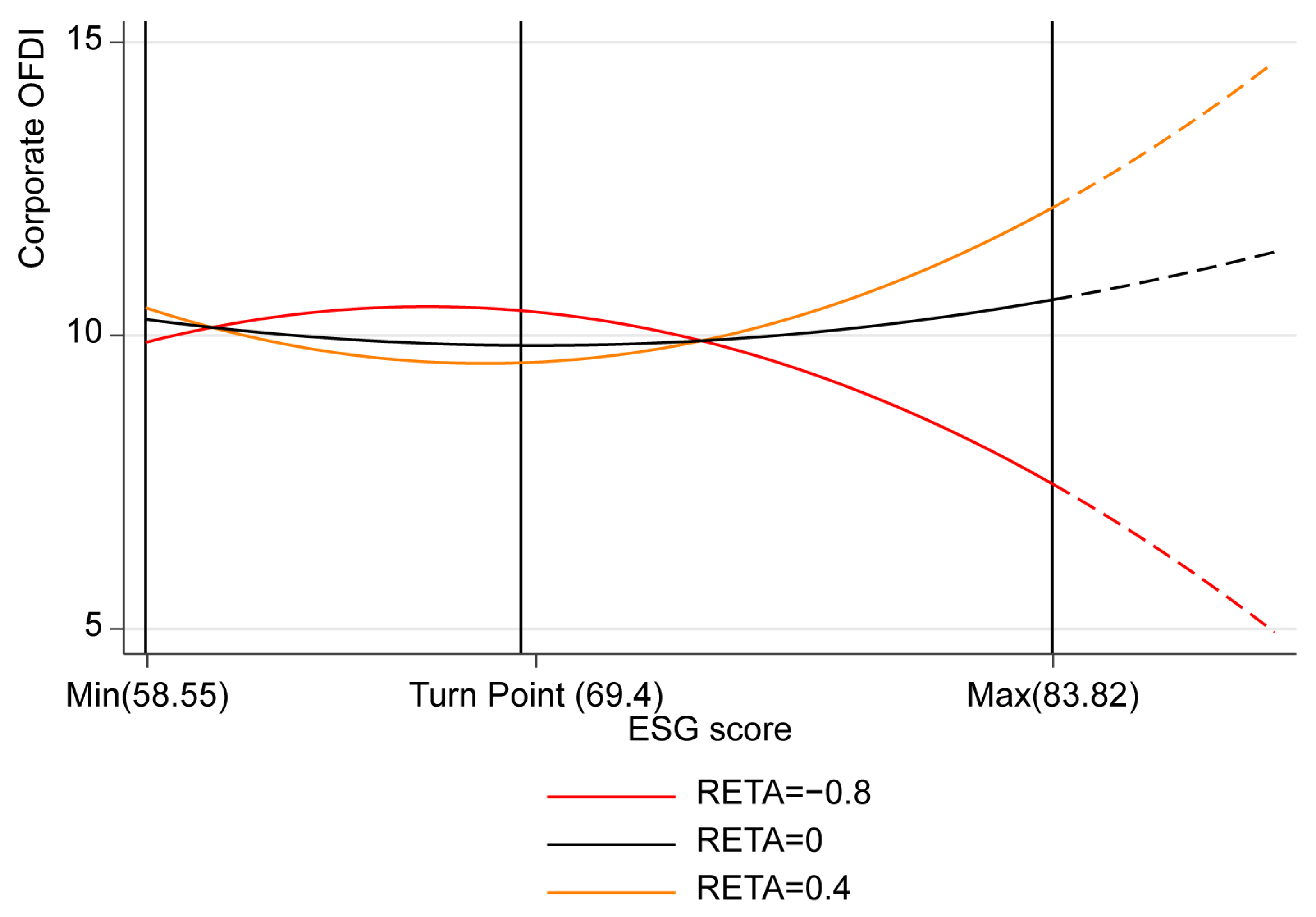
Given that enterprises in their introductory phase typically exhibit characteristics such as unstable financial conditions, reliance on external financing for early development, smaller size, lower market share, weaker profitability, potentially even operating at a loss, and are still exploring their business models and market positioning, these features dictate that introductory phase enterprises are not yet poised for mature capital market participation. However, the sample included in this study comprises enterprises listed on the Shanghai or Shenzhen Stock Exchanges, which must meet stringent listing criteria such as stable profitability, substantial asset size, sustained operational capabilities, and standardized corporate governance structures. Consequently, listed enterprises transcend the characteristics of the introductory phase in terms of financial robustness, operational stability, and market reputation. Additionally, the data processing stage excluded enterprises that had been delisted, subjected to Special Treatment (ST) due to operational issues, or belonged to the financial sector, thereby selecting a cohort of enterprises with stable operations and regulated finances. Under these circumstances, it is likely that the sample does not include enterprises in the decline phase of their life cycle. Thus, as depicted in Figure 5, to further explore the U-shaped dynamic between ESG performance and OFDI across different life cycle stages, this analysis selects RETA values of −0.8 (growth phase) and 0.4 (mature phase) for detailed examination, with RETA = 0 serving as a baseline reference equivalent to the absence of a moderating variable. In the growth phase, a negative RETA value indicates insufficient internal capital accumulation within enterprises, necessitating reliance on external financing to support rapid expansion. During this phase, enterprises prioritize resources for expanding market share, investing in new projects, and enhancing production capacity, with ESG performance relegated to a secondary concern. At RETA = −0.8, an enterprise’s OFDI declines consistently with improvements in ESG performance, transitioning from an initially positive U-shaped curve to an inverted U-shape, thereby accentuating the original U-shaped relationship. Growth phase enterprises, focusing on short-term gains during international expansion, experience the regulatory costs and resource dilution effects of increased ESG investments, thus inhibiting their international ventures. Therefore, growth phase enterprises often lack the impetus for ESG performance and opt for strategies aimed at expanding scale. At RETA = 0.4, an enterprise’s OFDI ascends continuously with enhancements in ESG performance, presenting an overall increasing trend, with the original positive U-shaped relationship becoming steeper. Mature phase enterprises possess the requisite capabilities to translate ESG performance into international advantages: superior ESG performance not only enhances corporate reputation in international markets but also meets investment locations’ demands for sustainable development, thereby fostering growth in overseas investments. Consequently, mature phase enterprises typically represent the stage where ESG investment effects are most affirmative, further substantiating Hypothesis 2.

4.5. Heterogeneity Analysis of the Moderating Effect

The prior discussions on the interplay between ESG performance, corporate OFDI, and the corporate life cycle possess a comprehensive nature. This approach, by neglecting variations in corporate attributes, might lead to biased policy directions. Indeed, firms with different characteristics do not share uniform objective functions and, when subjected to identical ESG performance conditions, may exhibit varying life cycle stages within the same industry. This variance stems from the continuous nature of innovation processes and the dynamic entry and exit of firms throughout the industry life cycle. Additionally, the phase differences in individual corporate life cycles are driven by disparities in knowledge accumulation capabilities, initial capital investments, reinvestment actions, and adaptability to competitive environments [35]. Hence, regression tests in Table 10 and Table 11 take into account the structural characteristics of corporate attributes—whether a firm is state-owned (SOE) or it belongs to a heavily polluted industry to discern the differentiated impact of ESG performance across the life cycles of diverse corporate types.

4.5.1. Heterogeneity Analysis of the Moderating Effect—State-Owned Enterprise

Subsample regression results in Table 10 (Columns 3 and 4), grouped by ownership type, reveal a significant U-shaped relationship between ESG performance and OFDI in non-state-owned enterprises (SOE = 0). Here, the coefficient for ESG_score is −0.4956 (p < 0.05), and for ESG_score2, it is 0.0037 (p < 0.05), both reaching significance. Moreover, the coefficient for ESGRETA is −2.6553 (p < 0.05) and for ESGRETA2, it is 0.0194 (p < 0.01), indicating that the life cycle significantly modulates the relationship between ESG and OFDI in non-state-owned firms, which are typically more responsive to market forces and competitive pressures during growth and maturity phases. When ESG performance reaches a certain threshold, its associated international reputation and competitive advantage notably facilitate OFDI growth.
Conversely, in state-owned enterprises (SOE = 1), though the coefficients for ESG_score and ESG_score2 are −0.6937 (p < 0.1) and 0.0050 (p < 0.1) respectively, suggesting a U-shaped relationship, these exhibit lower significance, and the moderating effect of the life cycle is less pronounced than in non-state enterprises (ESGRETA = −1.0142, ESGRETA2 = 0.0077, both nonsignificant). This might be attributed to the heavier influence of policy directives on state-owned firms, whose resource allocation within the life cycle tends to prioritize long-term goals and social responsibilities, thus exhibiting a muted sensitivity to ESG investment. Additionally, state-owned enterprises typically have robust external resource support capabilities in both early and mature life cycle stages, which mitigate the initial cost impacts of ESG investment on OFDI.
State-owned enterprises, due to their unique ownership structure, are profoundly affected by governmental policies and institutional environments, and their strategic decisions often serve national macroeconomic objectives and policy orientations. Throughout their life cycle, the OFDI behavior of state-owned enterprises might be more influenced by governmental directives and support, with a relatively weaker impact of ESG performance. According to institutional theory [76], corporate behavior is deeply regulated and constrained by the institutional environment, leading state-owned enterprises during internationalization to align more closely with governmental intentions, thereby diminishing the influence of ESG factors. Moreover, agency theory [77] suggests that state-owned enterprises may face more severe agency issues, with management potentially lacking the incentive to enhance ESG performance. In contrast, non-state-owned enterprises, driven more by market mechanisms, directly translate ESG performance into enhancements in corporate reputation, brand value, and international competitiveness. Per stakeholder theory [78], non-state enterprises need to balance the interests of various stakeholders and enhance ESG performance to meet stakeholder expectations, particularly in international markets where robust ESG credentials can enhance corporate legitimacy and recognition. As non-state enterprises progress through their life cycle, by bolstering ESG credentials, they are better positioned to access international market resources and mitigate institutional barriers, thereby facilitating the execution of OFDI. Thus, the moderating effect of the corporate life cycle on the relationship between ESG and OFDI is more pronounced in non-state-owned enterprises.

4.5.2. Heterogeneity Analysis of the Moderating Effect—Heavily Polluting Industry

To thoroughly examine the impact of industry-specific environmental regulatory pressures on corporate strategic decisions, this study conducts subgroup regression analyses based on whether firms belong to heavily polluting industries. The results reveal that a firm’s pollution attribute is a critical boundary condition determining the shape of the relationship between ESG performance and OFDI, as well as the strength of the life cycle moderating effect, with systematic differences observed between the two subsamples.
In the subsample of non-heavily polluting enterprises, we can see in Table 11, a significant inverted U-shaped relationship exists between ESG performance and OFDI. The coefficient for the primary term of ESG_score is negative (−0.542, p < 0.05), while the coefficient for its quadratic term (ESG_score2) is positive (0.0039, p < 0.05). This indicates that initial improvements in ESG performance inhibit OFDI, but once performance surpasses a threshold (approximately 70 points), it transforms into a facilitating factor. More importantly, the moderating effect of the firm life cycle (RETA) is also significant and exhibits a U-shaped pattern (ESGRETA = −2.322, p < 0.05; ESGRETA2 = 0.0172, p < 0.05). This finding confirms that for firms facing relatively lower environmental pressure, ESG investment is more strategically discretionary. During the growth stage, limited internal resources create intense competition between building ESG reputation and undertaking substantial overseas investment, leading to a pronounced “crowding-out effect.” Upon reaching maturity, the superior ESG reputation accumulated earlier becomes a strategically transferable asset across borders. It effectively lowers the legitimacy thresholds and financing costs associated with overseas operations, thereby generating strong synergistic effects with OFDI.
In contrast, the ESG-OFDI pathway for heavily polluting enterprises may exhibit different characteristics. As shown in Table 11, neither the initial inhibitory nor the subsequent promotive effects of ESG_score and ESG_score2 on OFDI are significant, and the moderating role of the firm life cycle is similarly insignificant. Operating in high environmental-risk sectors, ESG (particularly the environmental dimension) is primarily a mandatory compliance task and social responsibility, involving substantial sunk costs. Powerful external regulatory pressures grant ESG investment extremely high priority in resource allocation, which may persistently crowd out capital and managerial attention available for international expansion. However, these firms are often embedded within broader institutional support networks. Their OFDI decisions may be driven not only by economic efficiency considerations but also by multiple objectives such as transferring domestic environmental technologies, securing overseas strategic resources, or aligning with national initiatives like the “Belt and Road” green development agenda. Consequently, the pace and scale of their internationalization are less associated with the life cycle stages depicted by financial indicators like retained earnings and instead reflect more strongly the influence of policy directives and the infusion of external resources.

5. Discussions

5.1. Research Findings

In recent years, the green development concept gained global prominence, and as sustainable development principles become more ingrained, responsible investment has captured broad attention both domestically and internationally. This emergent investment paradigm could reshape corporate competitive advantages and profoundly affect their international expansion. Unlike traditional monopolistic advantages that focus on maximizing private corporate profits, a distinctive ESG-centered advantage that pursues socially inclusive development becomes particularly crucial in multinational corporations’ foreign direct investments; however, this is not applicable universally. Firms at the introductory, growth, and decline phases are constrained by limited financing channels and must balance internal funds between ESG investments and the development of OFDI activities. Conversely, firms in the maturity phase, with substantial internal free cash reserves, can enhance their ESG performance while expanding their international footprint, thereby turning a higher ESG rating into a competitive edge on the global stage. This study focuses on A-share-listed companies in China from 2009 to 2022 and empirically tests the impact of enhanced ESG performance on corporate OFDI. The findings reveal a positive U-shaped nonlinear relationship between ESG performance and corporate internationalization, which remains robust even after various tests for endogeneity and robustness, diverging from the results of Cheng and Su (2024) [2] and Wang et al. (2024) [4]. Both H1 and H2 are supported by the results.
Additionally, this research explores the moderating role of the corporate life cycle on this nonlinear relationship, revealing that the corporate life cycle can accurately identify the causal relationship between improved ESG performance and corporate internationalization, with different corporate life stages amplifying the direct investment effects of ESG enhancements. Due to their limited resources, growth-phase firms exhibit an apparent inhibitory effect of ESG investments on OFDI. In contrast, mature-phase firms rely on market reputation and ample funds, and investing in ESG activities distinctly promotes their internationalization efforts. The nonlinear relationship between ESG performance and OFDI investments is more pronounced for nonstate-owned firms, and the lifecycle reinforcing effect is more substantial. This paper extends the literature on drivers of corporate OFDI, particularly the economic consequences of engaging in active ESG performance.

5.2. Contributions of the Study

This research makes contributions both theoretically and practically. First, by integrating corporate ESG performance with OFDI behavior, it expands the research perspective in the ESG domain, unveiling the mechanisms through which ESG performance influences corporate internationalization strategies. This discovery enriches theories of corporate internationalization by underscoring the role of nonfinancial factors in global corporate expansion. Second, from a dynamic perspective, this paper discusses the moderating role of the corporate life cycle in the relationship between ESG and OFDI, deepening the understanding of corporate strategic decision-making as it evolves across different life stages. This viewpoint helps corporations devise precise ESG investment strategies at different stages of development. Lastly, this paper analyzes the impact of corporate nature on the aforementioned relationships, finding that nonstate-owned enterprises exhibit a more pronounced nonlinear relationship between ESG investment and OFDI and a more significant moderating effect of the life cycle.

5.3. Limitations and Future Directions

Despite its theoretical and practical innovations, this study has its limitations. First, due to data availability constraints, this study uses only Huazhong ESG comprehensive scores and ratings to gauge corporate ESG performance, excluding data from other ESG rating agencies, which may affect the universality of the conclusions. Second, the research sample comprises only China’s A-share-listed companies and excludes non-listed companies. Due to strict listing requirements, listed companies exhibit substantially higher financial robustness, operational stability, and market reputation than non-listed companies, potentially leading to a biased distribution in the life cycle stages of the sample. Additionally, the study excludes delisted companies, companies that have undergone ST treatments, and companies in the financial sector, further limiting the diversity of corporate life cycles in the sample and potentially resulting in findings that do not fully reflect the characteristics of firms in the decline phase of their life cycles. Third, the study uses the ratio of retained earnings to total assets (RE/TA) as a proxy for the corporate life cycle. Although this indicator can reflect lifecycle characteristics to some extent, it also exhibits industry heterogeneity. Moreover, since RE/TA is a proxy, it might not accurately identify a firm’s life cycle stage; for instance, some companies with low RE/TA might already be in the mature phase, while others with high RE/TA might still be in the growth phase. Finally, due to data limitations, the study does not explicitly link ESG activities to OFDI behavior across different stages, thereby failing to explore their interactive mechanisms over time.
Future research could integrate data from multiple ESG rating agencies to enhance the applicability and international comparative value of the results. Studies could also expand the sample range to include non-listed companies and those of different ownership types to more comprehensively reflect the relationship between corporate ESG performance and OFDI behavior. Furthermore, by introducing a more detailed classification of the corporate life cycle and combining industry characteristics with corporate dynamics, future research could analyze the relationship between ESG and OFDI, providing more targeted suggestions for different types of enterprises. Besides, by incorporating firm-level data from multiple countries with diverse institutional environments, economic development stages, and ESG regulatory frameworks, future studies could assess whether the positive U-shaped relationship and the moderating role of corporate life cycle hold across different national settings. Additionally, by tracking the dynamic processes of ESG investment and OFDI behavior, future research could investigate the causal relationships and interactive mechanisms between the two across different time horizons, thereby revealing the long-term impact of ESG activities on corporate internationalization strategies. Finally, future researchers could consider other external factors (such as changes in the international environment and the intensity of policy support) to explore the comprehensive impact of ESG performance on corporate OFDI activities, thereby further refining the theoretical framework and practical implications.

6. Conclusions

This study examines the complex relationship between corporate ESG performance and OFDI, with a particular focus on the contingent role of the corporate life cycle. The empirical results reveal a significant positive U-shaped relationship between ESG performance and OFDI. This relationship is profoundly moderated by the firm’s internal developmental stage and external institutional context.
For corporations, the findings indicate that enhancing ESG performance is not merely a demonstration of fulfilling social responsibilities, but also a crucial factor in gaining international competitive advantage. Therefore, firms should formulate differentiated ESG investment strategies according to their lifecycle stage: growth-phase enterprises might prioritize allocating resources to high-return areas to alleviate financial pressures, while mature-phase firms should intensify their ESG investments, making them a core element of their international competitive strategy. Notably, mature-phase enterprises have ample resources to actively invest in ESG initiatives while expanding internationally, thereby enhancing their market reputation and brand value.
For governments and regulatory bodies, this research underscores the importance of policy support for corporate ESG investments. Given that small and medium-sized enterprises and firms in the growth phase have limited resources, governments should offer diversified financing channels to reduce the costs of ESG investments, thereby enhancing their sustainable development capabilities. Specifically for growth-phase non-SOEs facing dual challenges under resource constraints, a targeted policy framework is essential. This includes: (1) creating dedicated green financing channels, such as through policy banks, green credit interest subsidies, and ESG-performance-linked guarantee funds; (2) promoting the development of technical and managerial support platforms, in collaboration with industry associations or international institutions, to provide ESG standard training, compliance consulting, and technology transfer services; (3) designing market-driven ESG incentives, such as granting priority in selecting outward investment cooperation projects, export credit support, and access to overseas economic and trade cooperation zones to firms with higher ESG ratings; and (4) improving mutual recognition and disclosure frameworks for domestic and international ESG standards to reduce cross-border compliance costs. Through such structural support, growth-phase non-SOEs can more effectively achieve synergistic development between ESG capacity-building and enhanced international competitiveness.
This study’s findings also directly inform the “Green BRI” agenda. Policymakers must recognize that the inverted U-shaped relationship implies that pushing firms—especially resource-constrained private firms—to undertake major ESG upgrades and OFDI simultaneously in the short term may be counterproductive. Therefore, policy should encourage a sequential or integrated capacity-building path. This approach involves: (i) providing technical and financial assistance to help firms, particularly in heavy industries, build domestic ESG capacity as a precursor to major international expansion; (ii) creating “BRI Green Partnership” corridors where firms with proven high ESG performance receive preferential access to financing and project opportunities, thereby creating a market reward for sustainability; and (iii) using diplomatic channels to harmonize ESG standards between China and host countries, reducing compliance uncertainty and allowing firms’ ESG investments to translate more predictably into competitive advantage.

Author Contributions

Conceptualization, Z.W. and J.Y.; methodology, Z.W.; software, Z.W.; validation, Z.W. and J.Y.; formal analysis, Z.W.; investigation, Z.W.; resources, Z.W. and J.Y.; data curation, Z.W.; writing—original draft preparation, Z.W.; writing—review and editing, J.Y.; visualization, Z.W.; supervision, J.Y.; project administration, J.Y.; funding acquisition, J.Y. All authors have read and agreed to the published version of the manuscript.

Funding

This research is supported by research grants from Guangdong Basic and Applied Basic Research Foundation (2021A1515110970), Fujian Social Science Fund (FJ2023B056), as well as Xiamen University Malaysia Research Fund (XMUMRF/2022-C9/ISEM/0035).

Institutional Review Board Statement

Not applicable.

Informed Consent Statement

Not applicable.

Data Availability Statement

Data available on request from the authors.

Conflicts of Interest

The authors declare no conflicts of interest.

Abbreviations

The following abbreviations are used in this manuscript:
OFDIOutward Foreign Direct Investment
ESGEnvironment, Social, Governance
FDIForeign Direct Investment
CSMARChina Stock Market & Accounting Research Database
VIFVariance Inflation Factor
FEFixed Effect
PSMPropensity Score Matching
2SLSTwo-step Least Squares Estimation
GMMGeneralized Method of Moments

References

  1. Zhang, S.; Chen, C. Does outward foreign direct investment facilitate China’s export upgrading? China World Econ. 2020, 28, 64–89. [Google Scholar] [CrossRef]
  2. Cheng, Z.; Su, Y. ESG and Chinese corporate OFDI. Res. Int. Bus. Financ. 2024, 72, 102522. [Google Scholar] [CrossRef]
  3. Witt, M.A.; Lewin, A.Y.; Li, P.P.; Gaur, A. Decoupling in international business: Evidence, drivers, impact, and implications for IB research. J. World Bus. 2023, 58, 101399. [Google Scholar] [CrossRef]
  4. Wang, X.; Ren, K.; Li, L.; Qiao, Y.; Wu, B. How does ESG performance impact corporate outward foreign direct investment? J. Int. Financ. Manag. Account. 2024, 35, 534–583. [Google Scholar] [CrossRef]
  5. Li, Q. The effect of ESG performance on enterprises’ internationalization: From the perspective of cooperative research and development. Appl. Econ. Lett. 2024, 32, 3152–3156. [Google Scholar] [CrossRef]
  6. Velte, P. Does ESG performance have an impact on financial performance? Evidence from Germany. J. Glob. Responsib. 2017, 8, 169–178. [Google Scholar] [CrossRef]
  7. Falck, O.; Heblich, S. Corporate social responsibility: Doing well by doing good. Bus. Horiz. 2007, 50, 247–254. [Google Scholar] [CrossRef]
  8. Wong, W.C.; Batten, J.A.; Mohamed-Arshad, S.B.; Nordin, S.; Adzis, A.A. Does ESG certification add firm value? Financ. Res. Lett. 2021, 39, 101593. [Google Scholar] [CrossRef]
  9. Xie, J.; Nozawa, W.; Yagi, M.; Fujii, H.; Managi, S. Do environmental, social, and governance activities improve corporate financial performance? Bus. Strategy Environ. 2019, 28, 286–300. [Google Scholar] [CrossRef]
  10. Serafeim, G. Public sentiment and the price of corporate sustainability. Financ. Anal. J. 2021, 76, 26–46. [Google Scholar] [CrossRef]
  11. Albuquerque, R.; Koskinen, Y.; Zhang, C. Corporate social responsibility and firm risk: Theory and empirical evidence. Manag. Sci. 2019, 65, 4451–4469. [Google Scholar] [CrossRef]
  12. Lins, K.V.; Servaes, H.; Tamayo, A. Social capital, trust, and firm performance: The value of corporate social responsibility during the financial crisis. J. Financ. 2017, 72, 1785–1824. [Google Scholar] [CrossRef]
  13. Witt, M.A.; Lewin, A.Y. Outward foreign direct investment as escape response to home country institutional constraints. J. Int. Bus. Stud. 2007, 38, 579–594. [Google Scholar] [CrossRef]
  14. Marano, V.; Tashman, P.; Kostova, T. Escaping the iron cage: Liabilities of origin and CSR reporting of emerging market multinational enterprises. J. Int. Bus. Stud. 2017, 48, 386–408. [Google Scholar] [CrossRef]
  15. Shan, X.Y.; Song, Y.; Song, P.L. How ESG performance impacts corporate financial performance: A DuPont analysis approach. Int. J. Clim. Change Strateg. Manag. 2024, 17, 1–24. [Google Scholar] [CrossRef]
  16. Qu, W.; Zhang, J.R. Environmental, Social, and Corporate Governance (ESG), Life Cycle, and Firm Performance: Evidence from China. Sustainability 2023, 15, 14011. [Google Scholar] [CrossRef]
  17. Hamilton, S.; Jo, H.; Statman, M. Doing well while doing good? The investment performance of socially responsible mutual funds. Financ. Anal. J. 1993, 49, 62–66. [Google Scholar] [CrossRef]
  18. Goss, A.; Roberts, G.S. The impact of corporate social responsibility on the cost of bank loans. J. Bank. Financ. 2011, 35, 1794–1810. [Google Scholar] [CrossRef]
  19. Chen, Y.C.; Hung, M.; Wang, Y. The effect of mandatory CSR disclosure on firm profitability and social externalities: Evidence from China. J. Account. Econ. 2018, 65, 169–190. [Google Scholar] [CrossRef]
  20. Quan, X.; Wu, S.; Yin, H. Corporate social responsibility and stock price crash risk: “Value weapon” or “self-serving tool”? Econ. Res. J. 2015, 2015, 49–64. [Google Scholar]
  21. Greenaway, D.; Kneller, R. Firm heterogeneity, exporting and foreign direct investment. Econ. J. 2007, 117, 134–161. [Google Scholar] [CrossRef]
  22. Liu, Y.D.; Tang, T.F.; Li, H.Y.; Luo, L.M. How do government subsidies affect OFDI of private enterprises? Evidence from China. Int. Rev. Econ. Financ. 2024, 90, 241–251. [Google Scholar] [CrossRef]
  23. Xue, Q.; Li, F. Outward foreign direct investment and corporate environmental investment: Competition or cooperation? Sustainability 2024, 16, 6168. [Google Scholar] [CrossRef]
  24. Cheng, L.K.; Zhang, Y. The Belt and Road Initiative and international business policy: A kaleidoscopic perspective. J. Int. Bus. Policy 2022, 5, 135–141. [Google Scholar] [CrossRef]
  25. Pérez, A.; Rodríguez del Bosque, I. The stakeholder management theory of CSR: A multidimensional approach in understanding customer identification and satisfaction. Int. J. Bank Mark. 2016, 34, 731–751. [Google Scholar] [CrossRef]
  26. Freeman, R.E.; Dmytriyev, S. Corporate social responsibility and stakeholder theory: Learning from each other. Symphonya Emerg. Issues Manag. 2017, 1, 7–15. [Google Scholar] [CrossRef]
  27. Laplume, A.O.; Sonpar, K.; Litz, R.A. Stakeholder theory: Reviewing a theory that moves us. J. Manag. 2008, 34, 1152–1189. [Google Scholar] [CrossRef]
  28. Melo, T.; Galan, J.I. Effects of Corporate Social Responsibility on Brand Value. J. Brand Manag. 2011, 18, 423–437. [Google Scholar] [CrossRef]
  29. Campbell, J.T.; Eden, L.; Miller, S.R. Multinationals and corporate social responsibility in host countries: Does distance matter? J. Int. Bus. Stud. 2012, 43, 84–106. [Google Scholar] [CrossRef]
  30. Nofsinger, J.; Varma, A. Socially responsible funds and market crises. J. Bank. Financ. 2014, 48, 180–193. [Google Scholar] [CrossRef]
  31. Shakil, M.H. Environmental, social and governance performance and financial risk: Moderating role of ESG controversies and board gender diversity. Resour. Policy 2021, 72, 102144. [Google Scholar] [CrossRef]
  32. Bell, R.G.; Filatotchev, I.; Rasheed, A.A. The liability of foreignness in capital markets: Sources and remedies. J. Int. Bus. Stud. 2012, 43, 107–122. [Google Scholar] [CrossRef]
  33. Greiner, L.E. Evolution and revolution as organizations grow. Harv. Bus. Rev. 1972, 50, 37–46. [Google Scholar]
  34. Miller, D.; Friesen, P.H. A longitudinal study of the corporate life cycle. Manag. Sci. 1984, 30, 1161–1183. [Google Scholar] [CrossRef]
  35. Dickinson, V. Cash flow patterns as a proxy for firm life cycle. Account. Rev. 2011, 86, 1969–1994. [Google Scholar] [CrossRef]
  36. Xie, Q.; Yin, H. Business environment and the choice of entry mode of OFDI: Evidence from China. J. Asian Econ. 2024, 92, 101717. [Google Scholar] [CrossRef]
  37. Spence, A.M. The learning curve and competition. Bell J. Econ. 1981, 12, 49–70. [Google Scholar] [CrossRef]
  38. Spence, A.M. Entry, capacity, investment, and oligopolistic pricing. Bell J. Econ. 1977, 8, 534–544. [Google Scholar] [CrossRef]
  39. Spence, A.M. Investment strategy and growth in a new market. Bell J. Econ. 1979, 10, 345. [Google Scholar] [CrossRef]
  40. Helfat, C.E.; Peteraf, M.A. The dynamic resource-based view: Capabilities lifecycles. Strateg. Manag. J. 2003, 24, 997–1010. [Google Scholar] [CrossRef]
  41. Jenkins, D.; Kane, G.; Velury, U. The impact of the corporate life-cycle on the value-relevance of disaggregated earnings components. Rev. Account. Financ. 2004, 3, 5–20. [Google Scholar] [CrossRef]
  42. Hasan, M.M.; Hossain, M.; Cheung, A.; Habib, A. Corporate life cycle and cost of equity capital. J. Contemp. Account. Econ. 2015, 11, 46–60. [Google Scholar] [CrossRef]
  43. Gort, M.; Klepper, S. Time paths in the diffusion of product innovations. Econ. J. 1982, 92, 630–653. [Google Scholar] [CrossRef]
  44. Gray, B.; Ariss, S.S. Politics and strategic change across organizational life cycles. Acad. Manag. Rev. 1985, 10, 707–723. [Google Scholar] [CrossRef]
  45. Jovanovic, B. Selection and the evolution of industry. Econometrica 1982, 50, 649–670. [Google Scholar] [CrossRef]
  46. Hasan, M.M.; Habib, A. Corporate life cycle, organizational financial resources and corporate social responsibility. J. Contemp. Account. Econ. 2017, 13, 20–36. [Google Scholar] [CrossRef]
  47. Habib, A.; Hasan, M.M. Firm life cycle, corporate risk-taking and investor sentiment. Account. Financ. 2015, 57, 465–497. [Google Scholar] [CrossRef]
  48. Shi, D.H.; Tan, H.Y.; Ling, Y.X.; Liu, Y.N.; Liu, B.; Tu, Y.Q. Impact of environmental information uncertainty and market competition on corporate ESG performance. Int. Rev. Financ. Anal. 2025, 99, 103935. [Google Scholar] [CrossRef]
  49. Al-Hadi, A.; Chatterjee, B.; Yaftian, A.; Taylor, G.; Hasan, M.M. Corporate social responsibility performance, financial distress and firm life cycle: Evidence from Australia. Account. Financ. 2017, 57, 961–989. [Google Scholar] [CrossRef]
  50. Ang, J.; Smedema, A. Financial flexibility: Do firms prepare for recession? J. Corp. Financ. 2011, 17, 774–787. [Google Scholar] [CrossRef]
  51. Lin, Y.; Fu, X.; Fu, X. Varieties in state capitalism and corporate innovation: Evidence from an emerging economy. J. Corp. Financ. 2021, 67, 101919. [Google Scholar] [CrossRef]
  52. Li, J.; Lian, G.; Xu, A. How do ESG affect the spillover of green innovation among peer firms? Mechanism discussion and performance study. J. Bus. Res. 2023, 158, 113648. [Google Scholar] [CrossRef]
  53. Luo, C.; Wei, D.; He, F. Corporate ESG performance and trade credit financing—Evidence from China. Int. Rev. Econ. Financ. 2023, 85, 337–351. [Google Scholar] [CrossRef]
  54. Anthony, J.H.; Ramesh, K. Association between accounting performance measures and stock prices: A test of the life cycle hypothesis. J. Account. Econ. 1992, 15, 203–227. [Google Scholar] [CrossRef]
  55. DeAngelo, H.; DeAngelo, L.; Stulz, R.M. Dividend policy and the earned/contributed capital mix: A test of the life-cycle theory. J. Financ. Econ. 2006, 81, 227–254. [Google Scholar] [CrossRef]
  56. He, F.; Ding, C.; Yue, W.; Liu, G. ESG performance and corporate risk-taking: Evidence from China. Int. Rev. Financ. Anal. 2023, 87, 102550. [Google Scholar] [CrossRef]
  57. Zheng, H.; Aishan, W. ESG ratings and trade credit: Inverted U-shaped moderating role of information transparency and executives with overseas backgrounds. Environ. Sci. Pollut. Res. 2023, 30, 78554–78568. [Google Scholar] [CrossRef]
  58. Hu, H.; Tu, Z.; Chen, A.; Huang, J. Enterprises’ globalization and ESG performance. Financ. Res. Lett. 2023, 58, 104653. [Google Scholar] [CrossRef]
  59. Khurram, M.U.; Abbassi, W.; Chen, Y.; Chen, L. Outward foreign investment performance, digital transformation, and ESG performance: Evidence from China. Glob. Financ. J. 2024, 60, 100963. [Google Scholar] [CrossRef]
  60. Kmenta, J. Elements of Econometrics, 3rd ed.; Collier Macmillan: New York, NY, USA, 1986. [Google Scholar]
  61. Atif, M.; Ali, S. Environmental, social and governance disclosure and default risk. Bus. Strategy Environ. 2021, 30, 3937–3959. [Google Scholar] [CrossRef]
  62. Rosenbaum, P.R.; Rubin, D.B. Constructing a control group using multivariate matched sampling methods that incorporate the propensity score. Am. Stat. 1985, 39, 33–38. [Google Scholar] [CrossRef]
  63. He, F.; Du, H.; Yu, B. Corporate ESG performance and manager misconduct: Evidence from China. Int. Rev. Financ. Anal. 2022, 82, 102201. [Google Scholar] [CrossRef]
  64. Yang, F.; Chen, T.; Zhang, Z. Can environmental, social, and governance performance drive two-way foreign direct investment behavior? Evidence from Chinese listed companies. J. Clean. Prod. 2023, 430, 139761. [Google Scholar] [CrossRef]
  65. Cai, Y.; Pan, C.H.; Statman, M. Why do countries matter so much in corporate social performance? J. Corp. Financ. 2016, 41, 591–609. [Google Scholar] [CrossRef]
  66. Ip, P.K. Is confucianism good for business ethics in China? J. Bus. Ethics 2009, 88, 463–476. [Google Scholar] [CrossRef]
  67. Fu, P.P.; Narayan, S.W.; Weber, O.; Tian, Y.G.; Ren, Y.S. Does local Confucian culture affect corporate environmental, social, and governance ratings? Evidence from China. Sustainability 2022, 14, 16374. [Google Scholar] [CrossRef]
  68. Flanagan, C.A.; Stout, M. Developmental patterns of social trust between early and late adolescence: Age and school climate effects. J. Res. Adolesc. 2010, 20, 748–773. [Google Scholar] [CrossRef] [PubMed]
  69. Caves, R.E. Multinational Enterprise and Economic Analysis, 2nd ed.; Cambridge University Press: Cambridge, UK, 1996. [Google Scholar]
  70. Delios, A.; Beamish, P.W. Geographic scope, product diversification and the corporate performance of Japanese firms. Strateg. Manag. J. 1999, 20, 711–727. [Google Scholar] [CrossRef]
  71. Flores, R.G.; Aguilera, R.V. Globalization and location choice: An analysis of US multinational firms in 1980 and 2000. J. Int. Bus. Stud. 2007, 38, 1187–1210. [Google Scholar] [CrossRef]
  72. Rugman, A.M. The Regional Multinationals: MNEs and ‘Global’ Strategic Management; Cambridge University Press: Cambridge, UK, 2005. [Google Scholar] [CrossRef]
  73. Lian, Y.; Ye, T.; Zhang, Y.; Zhang, L. How does corporate ESG performance affect bond credit spreads: Empirical evidence from China. Int. Rev. Econ. Financ. 2023, 85, 352–371. [Google Scholar] [CrossRef]
  74. Guo, M.; Shen, S. Managerial shareholding and CSR: Does internal control quality matter? Evidence from China. Sustainability 2019, 11, 4206. [Google Scholar] [CrossRef]
  75. Chen, C.X.; Lu, H.; Sougiannis, T. The agency problem, corporate governance, and the asymmetrical behaviour of selling, general, and administrative costs. Contemp. Account. Res. 2012, 29, 252–282. [Google Scholar] [CrossRef]
  76. Scott, W.R. Institutions and Organizations; Sage Publications: Thousand Oaks, CA, USA, 1995. [Google Scholar]
  77. Jensen, M.C.; Meckling, W.H. Theory of the firm: Managerial behavior, agency costs and ownership structure. J. Financ. Econ. 1976, 3, 305–360. [Google Scholar] [CrossRef]
  78. Freeman, R.E. Strategic Management: A Stakeholder Approach; Pitman Publishing: Lanham, MD, USA, 1984. [Google Scholar]
Figure 1. Theoretical Framework Diagram of H1.
Sustainability 18 01231 g001
Figure 2. Theoretical Framework Diagram of H2.
Sustainability 18 01231 g002
Figure 3. The U relationship between ESG performance and corporate OFDI. The solid line represents the fitted curve within the observed ESG score range (Min = 58.55, Max = 83.82). The dashed line indicates extrapolated predictions beyond this range.
Sustainability 18 01231 g003
Figure 4. PSM propensity score before and after matching.
Sustainability 18 01231 g004
Figure 5. The moderating effect of corporate lifecycle on the relationship between ESG performance and corporate OFDI.
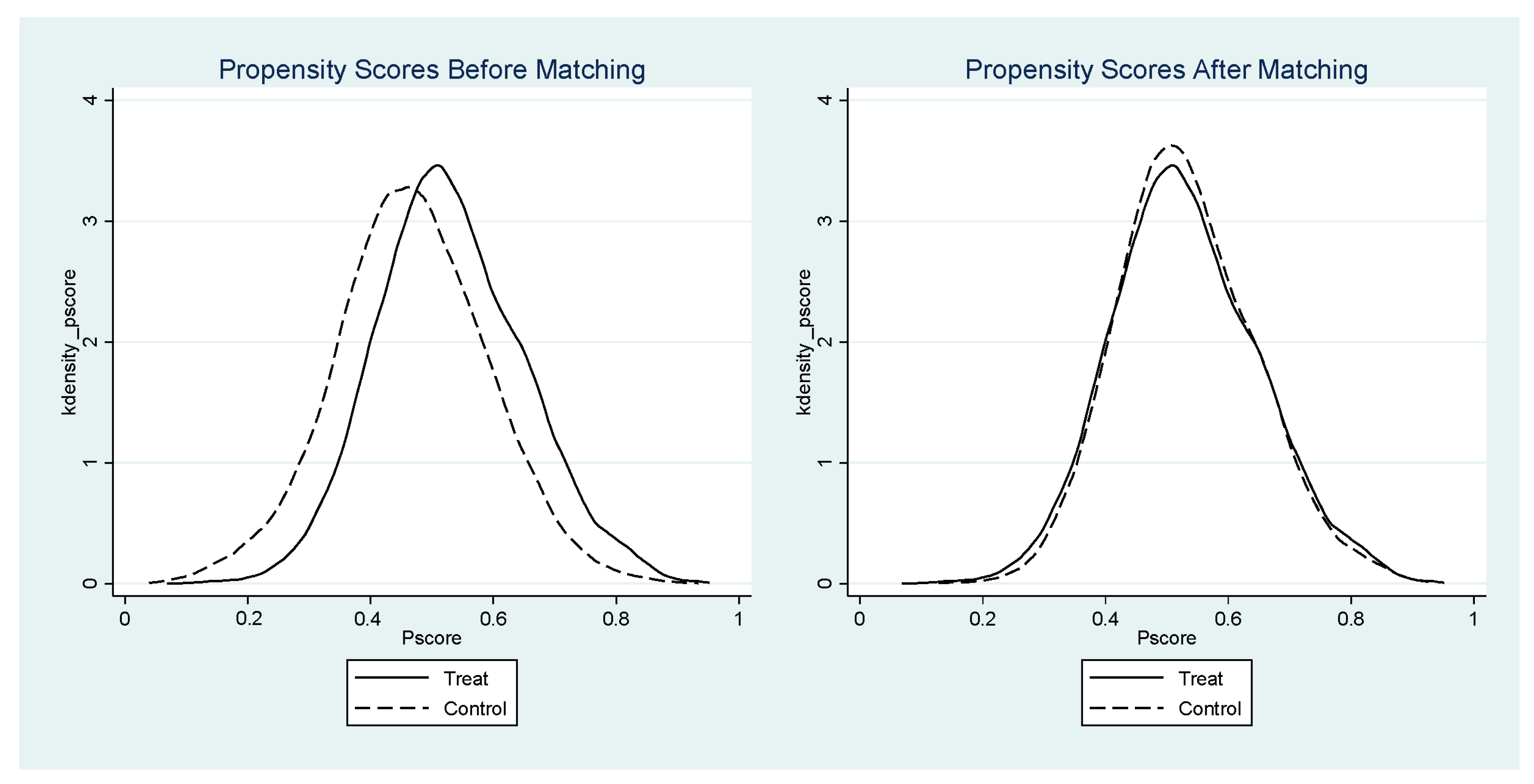
Sustainability 18 01231 g005
Table 1. The variables of this study.
TypeNameSymbolDefinition
Dependent variablesOutward foreign direct investmentOFDIThe logarithm of total registered capital of overseas affiliates with more than 10% controlling equity.
Inter_ANumber of foreign subsidiaries of the enterprise in the year
Independent variablesESG performanceESG_scoreHuazheng ESG Composite Score
ESGHuazheng ESG Rating Index, converting their ratings from highest to lowest to a score of 9 to 1, AAA, AA, A, BBB, BB, B, CCC, CC, C correspond to 9, 8, 7, 6, 5, 4, 3, 2, 1 respectively
Moderating variableCorporate life cycleRETARetained earnings/Total assets
Control variablesCorporate sizeSizeln(Total assets)
Return on assetsROANet profit/total assets
Gearing ratioLevTotal liabilities/total assets
Quick ratioQuickQuick assets/current liabilities
Cash ratioCashflowNet cash flows from operating activities/total assets
Equity balanceBalanceThe shareholding ratios of the second to fifth largest shareholders/the shareholding ratio of the largest shareholder
Corporate ageFirmAgeThe number of corporates’ operating years
Percentage of independent directorsIndepThe number of independent directors/the number of directors represents
Dual role of the board chairmanDualThe value is 1 if the chairman and general manager are the same person; otherwise, the value is 0
Instrument variablesLagged one period ESG_scoreL.ESG_scoreLagged one period ESG_score
Confucian cultural intensityConfucianNumber of historic Confucian temples at the municipal level where the enterprise is located
Table 2. Descriptive statistics.
(1)(2)(3)(4)(5)
VariablesNMeansdMinMax
Number of id46984698469846984698
id38,052308,996273,4922873,527
year38,05220173.90020092022
OFDI38,0529.1909.927023.38
Inter_A38,0521.3913.435022
ESG_score38,05273.254.76658.5583.80
ESG_score238,0525388689.534287022
ESG38,0524.1440.9131.5006
ESG238,05218.017.3842.25036
RETA38,0520.1720.183−0.6980.572
ESGRETA38,0520.24412.97−71.4633.53
ESGRETA238,05234.78932.8−58702810
Size38,05222.171.29619.3226.45
Lev38,0520.4150.2050.02740.908
ROA38,0520.03920.0634−0.3750.247
Quick38,0522.1452.7190.14933.96
Cashflow38,0520.04780.0695−0.2220.283
Indep38,0520.3750.053700.600
FirmAge38,0522.8850.3581.0993.611
Balance38,0520.7450.61502.962
Dual38,0520.2890.45301
Table 3. Correlation Analysis.
OFDIInter AESG ScoreESGRETASizeLev
OFDI1
Inter A0.046 ***1
ESG score0.108 ***0.089 ***1
ESG0.112 ***0.088 ***0.934 ***1
RETA0.124 ***0.013 **0.280 ***0.292 ***1
Size0.170 ***0.328 ***0.182 ***0.185 ***0.017 ***1
Lev−0.031 ***0.124 ***−0.093 ***−0.093 ***−0.450 ***0.506 ***1
ROA0.091 ***0.019 ***0.183 ***0.180 ***0.556 ***0.030 ***−0.298 ***
Quick0.016 ***−0.083 ***0.076 ***0.077 ***0.209 ***−0.330 ***−0.623 ***
Cashflow0.050 ***0.049 ***0.081 ***0.076 ***0.284 ***0.074 ***−0.150 ***
Indep−0.002000.045 ***0.081 ***0.082 ***−0.021 ***0.012 **−0.013 ***
FirmAge0.045 ***0.079 ***−0.046 ***−0.052 ***−0.030 ***0.197 ***0.166 ***
Balance−0.044 ***0.042 ***0.005000.009 *−0.016 ***−0.110 ***−0.140 ***
Dual−0.031 ***0.004000.001000.001000.040 ***−0.187 ***−0.157 ***
ROAQuickCashflowIndepFirmAgeBalanceDual
ROA1
Quick0.138 ***1
Cashflow0.395 ***0.043 ***1
Indep−0.016 ***0.016 ***−0.006001
FirmAge−0.069 ***−0.190 ***0.021 ***0.005001
Balance−0.010 *0.126 ***−0.018 ***−0.027 ***−0.012 **1
Dual0.016 ***0.140 ***−0.017 ***0.104 ***−0.084 ***0.077 ***1
* p < 0.1, ** p < 0.05, *** p < 0.01.
Table 4. Baseline Regression.
(1)(2)(3)(4)(5)
OFDIOFDIOFDIOFDIOFDI
ESG_score0.2240 ***−0.9080 ***−0.4263 **−0.5938 ***−0.5938 ***
(0.0105)(0.2085)(0.2062)(0.1840)(0.2248)
ESG_score2 0.0078 ***0.0037 **0.0043 ***0.0043 ***
(0.0014)(0.0014)(0.0013)(0.0016)
Size 1.6718 ***1.2176 ***1.2176 ***
(0.0481)(0.0980)(0.1887)
Lev −6.4792 ***−5.8004 ***−5.8004 ***
(0.3578)(0.4438)(0.7248)
ROA 6.0869 ***−0.7015−0.7015
(0.8734)(0.7843)(0.9804)
Quick 0.0284−0.1094 ***−0.1094 ***
(0.0237)(0.0239)(0.0319)
Cashflow −1.0893−1.5067 **−1.5067 *
(0.7690)(0.6817)(0.7991)
Indep −2.0927 **−3.2747 ***−3.2747 **
(0.9264)(1.0997)(1.6310)
FirmAge 0.8241 ***7.4410 ***7.4410 ***
(0.1382)(0.5385)(1.0013)
Balance −0.6314 ***−0.2509 *−0.2509
(0.0818)(0.1286)(0.2193)
Dual −0.12640.04630.0463
(0.1124)(0.1301)(0.1921)
_cons−7.2195 ***33.4935 ***−15.1175 **−10.9424−10.9424
(0.7707)(7.5037)(7.5847)(7.0507)(9.2140)
Year FENoNoNoYesYes
Stock FENoNoNoYesYes
N38,05238,05238,05238,05238,052
adj. R20.01150.01230.05340.02370.1027
Standard errors in parentheses. * p < 0.1, ** p < 0.05, *** p < 0.01.
Table 5. U-test.
Table 5. U-test.
Lower BoundUpper Bound
Interval58.5583.8
Slope−0.0901950.1269885
t-value−2.1014223.076471
P > |t|0.01782850.0010534
Table 6. Balance test.
VariableMatched/UnmatchedMean%Bias%Reduct [Bias]
TreatedControl
SizeU22.32822.00225.4
M22.32722.2952.590.1
LevU0.396880.43528−18.8
M0.396920.392192.387.7
ROAU0.047780.030128.1
M0.047740.04923−2.491.6
QuickU2.36891.904917.2
M2.36872.36280.298.7
CashflowU0.052410.0429413.7
M0.052370.05323−1.290.9
IndepU0.379070.3715514
M0.379030.378031.986.8
FirmAgeU2.86892.9026−9.5
M2.8692.86331.683.4
BalanceU0.755840.734363.5
M0.755980.754470.293
DualU0.295560.281333.1
M0.29560.281733.12.5
Table 7. Endogeneity test.
(1)(2)(3)(4)(5)
PSM2SLS
(First Stage)
2SLS
(First Stage)
2SLS
(Second Stage)
System GMM
OFDIESG_ScoreESG_Score2OFDIOFDI
L.OFDI 0.6856 ***
(0.0200)
L2.OFDI 0.0343 **
(0.0158)
Confucian 0.0033 **0.5312 ***
(0.0013)(0.1935)
L.ESG_score 0.6218 ***90.1062 ***
(0.0047)(0.6685)
ESG_score−0.5522 ** −32.2746 **−10.2682 **
(0.2731) (12.8814)(4.7500)
ESG_score20.0040 ** 0.2239 **0.0721 **
(0.0019) (0.0889)(0.0330)
Control VariablesYesYesYesYesYes
_cons−12.772413.4623 ***−3345.753 ***1.1 × 10³ **396.7376 **
(11.3766)(0.5718)(81.9976)(470.8493)(194.7735)
Cragg-Donald Wald F 8.1698.169
Kleibergen-Paap rk LM 15.79415.794
AR (1) p-value 0.000
AR (2) p-value 0.563
Hansen test 0.178
Year FEYesYesYesYesYes
Stock FENoNoNoNoYes
Industry FEYesYesYesYesNo
N29,51932,98532,98532,98528,471
Standard errors in parentheses. ** p < 0.05, *** p < 0.01.
Table 8. Robustness test.
(1)(2)
Inter_AOFDI
ESG_score−0.3697 ***
(0.0873)
ESG_score20.0027 ***
(0.0006)
ESG −0.6970 **
(0.3005)
ESG2 0.1065 ***
(0.0376)
Control VariablesYesYes
_cons−12.3249 ***−30.3738 ***
(3.7689)(2.4451)
Year FEYesYes
Stock FEYesYes
N38,05238,052
adj. R20.17010.1026
Standard errors in parentheses. ** p < 0.05, *** p < 0.01.
Table 9. Moderating effect of corporate life cycle.
(1)
OFDI
ESG_score−0.5219 **
(0.2353)
ESG_score20.0038 **
(0.0016)
RETA76.3950 **
(32.9771)
ESGRETA−2.2979 **
(0.9540)
ESGRETA20.0171 **
(0.0069)
Control VariablesYes
_cons−14.0597
(9.8922)
N38,052
adj. R20.1030
Standard errors in parentheses. ** p < 0.05.
Table 10. Heterogeneity analysis of moderating effects—State-Owned Enterprise.
(1)(2)
SOE = 0SOE = 1
OFDIOFDI
ESG_score−0.4956 **−0.6937 *
(0.2464)(0.4191)
ESG_score20.0037 **0.0050 *
(0.0017)(0.0029)
RETA89.9832 **33.4616
(36.2150)(59.5229)
ESGRETA−2.6553 **−1.0142
(1.0411)(1.7138)
ESGRETA20.0194 ***0.0077
(0.0075)(0.0123)
Control VariablesYesYes
_cons−5.8107−10.1884
(9.4382)(18.2773)
Year FEYesYes
Stock FEYesYes
N24,54813,504
adj. R20.12210.0953
Standard errors in parentheses. * p < 0.1, ** p < 0.05, *** p < 0.01.
Table 11. Heterogeneity Analysis of the Moderating Effect—Heavily Polluting Industry.
(1)(2)
Pollute = 0Pollute = 1
OFDIOFDI
ESG_score−0.5419 **−0.4253
(0.2397)(0.4184)
ESG_score20.0039 **0.0031
(0.0017)(0.0030)
RETA76.8161 **45.7051
(35.0890)(61.1143)
ESGRETA−2.3220 **−1.4826
(1.0043)(1.7734)
ESGRETA20.0172 **0.0120
(0.0072)(0.0129)
Control VariablesYesYes
_cons−24.3567 **−30.0546
(10.1930)(19.8217)
Year FEYesYes
Stock FEYesYes
N27,01411,038
adj. R20.03680.1143
Standard errors in parentheses. ** p < 0.05.
Disclaimer/Publisher’s Note: The statements, opinions and data contained in all publications are solely those of the individual author(s) and contributor(s) and not of MDPI and/or the editor(s). MDPI and/or the editor(s) disclaim responsibility for any injury to people or property resulting from any ideas, methods, instructions or products referred to in the content.